Vue normale

Reçu aujourd’hui — 16 décembre 2025
  • ✇Euromaidan Press
  • ISW: Ukrainian counteroffensive in Kupiansk ongoing, with more settlements liberated (MAP)
    Ukrainian forces continue counterattacking in and around Kupiansk, Kharkiv Oblast, where Russian troops face logistical complications and loss of drone coverage, according to the Institute for the Study of War (ISW). Kyiv’s units have entered northern Kupiansk, blocked Russian infiltration attempts, and liberated nearby settlements, while Russian sources admit growing difficulties. Ukrainian forces have recently managed to encircle Russian troops inside Kupiansk, a city in
     

ISW: Ukrainian counteroffensive in Kupiansk ongoing, with more settlements liberated (MAP)

16 décembre 2025 à 05:58

isw ukrainian counteroffensive kupiansk ongoing settlements liberated · post assessed control terrain direction 15 2025 kupyansk-direction-december-15-2 ukraine news reports

Ukrainian forces continue counterattacking in and around Kupiansk, Kharkiv Oblast, where Russian troops face logistical complications and loss of drone coverage, according to the Institute for the Study of War (ISW). Kyiv’s units have entered northern Kupiansk, blocked Russian infiltration attempts, and liberated nearby settlements, while Russian sources admit growing difficulties.

Ukrainian forces have recently managed to encircle Russian troops inside Kupiansk, a city in Kharkiv Oblast that has remained one of the most active frontline sectors this year. Russian forces advanced toward the city through the summer and autumn, infiltrating parts of Kupiansk by early August, while the Russian military command later portrayed these incursions as significant gains. Kupiansk is a key logistics hub in northeastern Ukraine, and Ukrainian troops launched a coordinated counteroffensive in the area in September 2025 to halt the advance and reclaim lost ground.

Ukrainian troops push forward and cut off Russian movements

ISW says in its 15 December report that Colonel Viktor Trehubov, spokesperson for Ukraine’s Joint Forces Group, noted on 15 December that Ukrainian forces continue clearing operations within Kupiansk and are avoiding urban combat. He reported that Russian forces are using unmanned aerial vehicles to supply a group of around 100 to 200 personnel remaining in the city.

Trehubov implied that UAVs cannot cover all areas and have limited payload capacity, and said drones sometimes drop supplies in ways that expose Russian positions to Ukrainian forces.

A non-commissioned officer of a Ukrainian brigade operating in the Kupiansk direction said Ukrainian troops have liberated several settlements and nearby forest areas, and that elements of his brigade are active in northern Kupiansk. He said Russian forces continue infiltration attempts using a gas pipeline, but Ukrainian forces have blocked the pipeline and now keep all possible exit points under fire control.

isw russia’s army can’t sustain multi-pronged offensives due manpower equipment strain · post assed control terrain russo-ukrainian war 14 2025 russo-ukrainian-war-december-14 russian forces unlikely kremlin’s goal simultaneous offensive operations across
Explore further

ISW: Russia’s army can’t sustain multi-pronged offensives due to manpower and equipment strain

Russian bloggers report worsening conditions

ISW reported that Russian ultranationalist milbloggers continue to acknowledge the deteriorating battlefield situation for Russian forces in Kupiansk. One claimed that Russian troops hold some positions in northern and central parts of the city, while the rest is either a contested “gray zone” or under Ukrainian control.

Another milblogger wrote that conditions in western Kupiansk are “rapidly worsening” and said elements of the 68th Motorized Rifle Division of the 6th Combined Arms Army are “desperately fighting.” He also acknowledged that Ukrainian forces have advanced in Kupiansk and in Myrove, immediately northwest of the city.

According to ISW, the same source admitted that “Russian forces no longer have manpower superiority in the area” and said that Ukrainian interdiction efforts are hindering Russian operations. He added that Ukrainian advances have forced Russian drone operators to retreat across the Oskil River to the east (left) bank.

isw ukrainian troops continue advancing within near kupiansk · post assessed frontline situation 13 2025 institute study war kupyansk-city-december-13-2025 forces while heavy fighting continues city (isw) reports new geolocated footage
Explore further

ISW: Ukrainian troops continue advancing within and near Kupiansk

ISW contradicts Russian claims with geolocated evidence

Geolocated footage published on December 14 and 15 indicates that Russian forces likely do not hold positions within Petropavlivka (east of Kupiansk), contrary to Russian claims of advances in the area,” ISW stated.

ISW also assessed that the Kremlin is continuing to promote a narrative of Russian gains in and near Kupiansk “for a cognitive warfare effort designed to portray the Ukrainian lines as on the verge of collapse.” According to ISW, “the Ukrainian counterattacks in the Kupiansk direction continue to demonstrate that.”

  • ✇Euromaidan Press
  • Zelenskyy confirms Russia still demands all of Donbas in “peace” plan
    After meetings with American and European officials in Berlin on 15 December, Ukrainian President Volodymyr Zelenskyy confirmed that Russia still demands full control of eastern Ukraine's Donbas in its so-called peace plan. He said Ukraine will not surrender any of its internationally recognized territory and rejected any compromise on the Donbas. The Donbas is a historic name for a coal basin and is colloquially used to denote either both Luhansk and Donetsk oblasts, or so
     

Zelenskyy confirms Russia still demands all of Donbas in “peace” plan

16 décembre 2025 à 05:20

zelenskyy confirms russia still demands all donbas peace plan · post ukrainian president volodymyr during evening address 31 2025 ec7492c6 785815c16574a4eb2b7a60c4_1761937691_extra_large ukraine news reports

After meetings with American and European officials in Berlin on 15 December, Ukrainian President Volodymyr Zelenskyy confirmed that Russia still demands full control of eastern Ukraine's Donbas in its so-called peace plan. He said Ukraine will not surrender any of its internationally recognized territory and rejected any compromise on the Donbas.

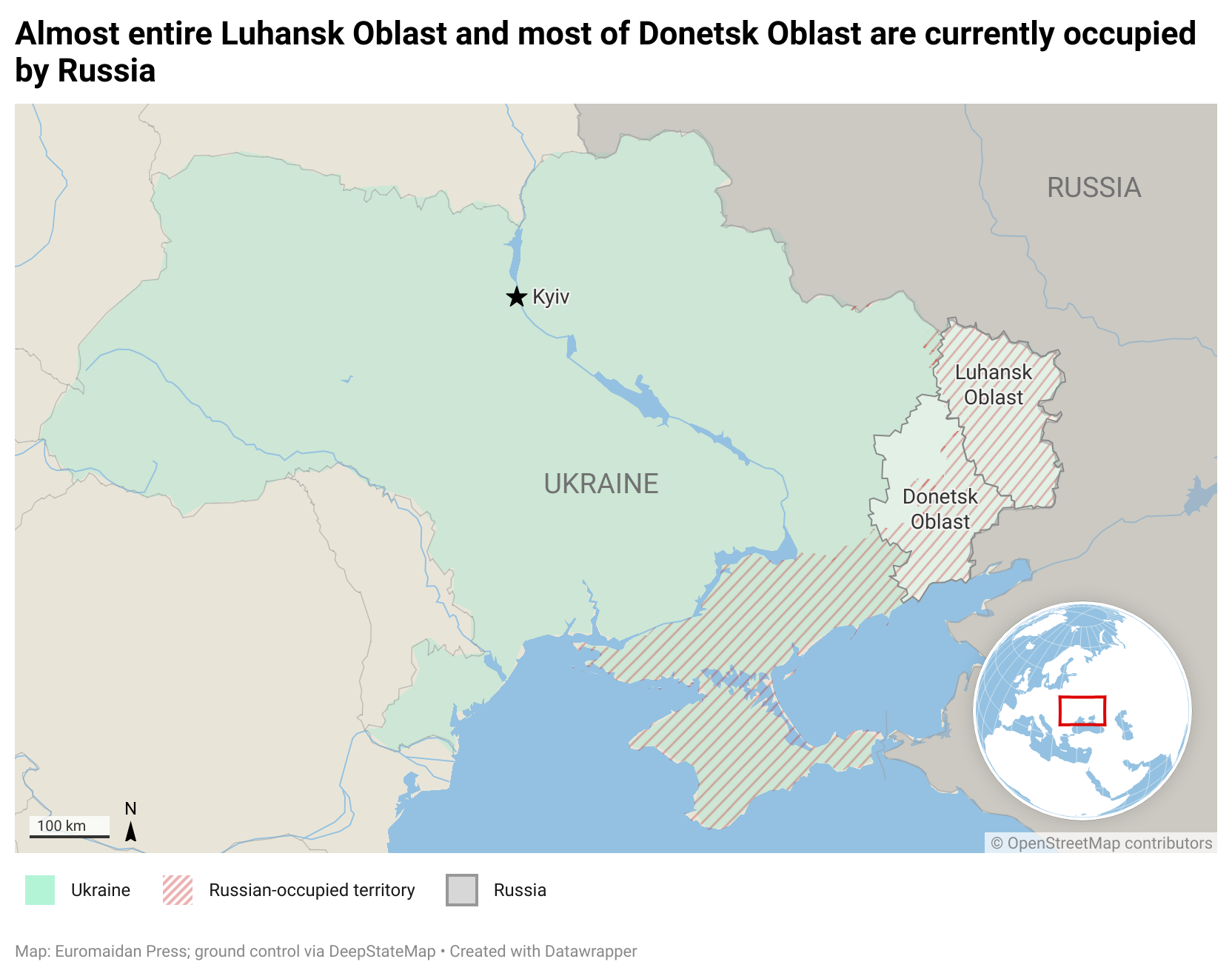
The Donbas is a historic name for a coal basin and is colloquially used to denote either both Luhansk and Donetsk oblasts, or sometimes just Donetsk Oblast. In recent years of the ongoing Russo-Ukrainian war, Moscow has focused on capturing the entire Donbas region, sending its most numerous ground armies into repeated attacks that have brought only incremental gains at the cost of heavy personnel and equipment losses, yet it has still failed to capture the region in its entirety.

Zelenskyy: Russia still wants Donbas — Ukraine won’t give it up

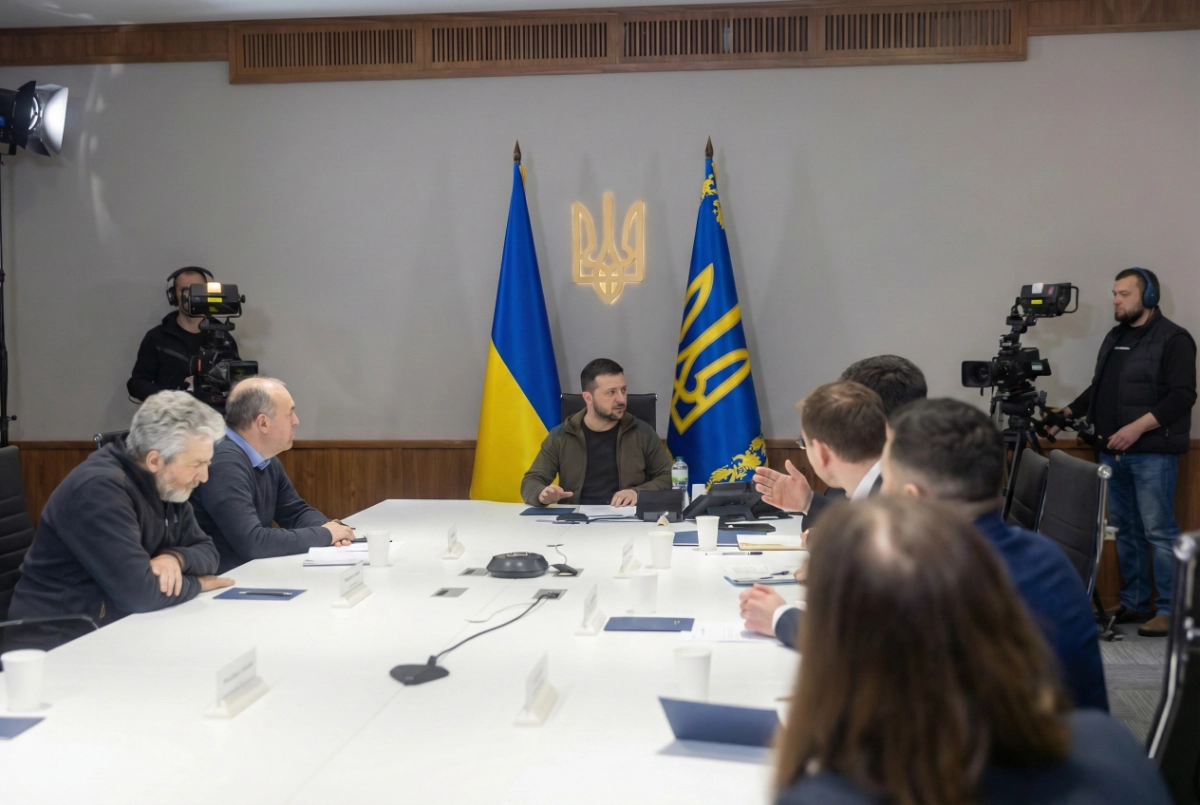
Speaking at a 15 December online press conference attended by Euromaidan Press, Zelenskyy said Moscow still demands the entire Donbas in negotiations.

“Their position has not changed,” he said. “We do not want to give up our Donbas.” 

He made clear that Ukraine will not recognize Russian control over any part of the region, either legally or in practice.

"Neither de jure nor de facto will we recognize Donbas – its temporarily occupied part – as Russian. Absolutely. Nevertheless, we are discussing the territorial issue. You know it is one of the key issues. At this point, there is no consensus on it yet," the President said.

Zelenskyy also addressed American suggestions to create a “free economic zone” in the area, saying that "a “free economic zone” does not mean under the control of the Russian Federation." He stressed that this issue remains one of the most sensitive points in the talks and no consensus has been reached.

Zelenskyy Trump white house peace deal
Explore further

Trump offers Ukraine “security guarantees” that are designed to fail

Zelenskyy previously told Bloomberg that the territorial issue — specifically Russia’s demand for the Donbas — remains the main unresolved point in talks. On 19 November, media reported that US envoy Steve Witkoff had presented a 28-point peace plan to Trump, allegedly developed with Russian representative Kirill Dmitriev. The plan called for Ukraine to withdraw from Donetsk Oblast and drop its NATO ambitions. Some of those provisions have since been removed, shortening the plan to 20 points.

No compromise on territory, but security talks advance

While territorial discussions remain stuck, Zelenskyy said there has been real progress in other areas, especially on security guarantees. He reiterated the US Congress is expected to vote on legally binding commitments that would require a response if Russia violates any future peace deal or ceasefire. The proposed mechanism would mirror NATO’s Article 5, providing a collective response to aggression.

ukrainians
Explore further

75% of Ukrainians oppose “peace plan,” which includes withdrawal of troops from Donbas

The Ukrainian President said detailed talks have also covered Ukraine’s long-term defense needs, including the size of its army, required weapons and training, and sustainable funding. He welcomed growing cooperation between the US and Europe, noting that the broader Coalition of the Willing — now called Europe+ — includes Canada and other non-EU partners.

Russia’s response will shape the next steps

Zelenskyy warned that if Russian President Vladimir Putin rejects the proposals, Ukraine will request more weapons and tougher sanctions from the US. He said this would be a fair reaction to a complete refusal by Moscow to engage in a peaceful resolution.

He added that around 90% of the draft peace documents have been agreed. The next phase includes consultations between the US and Russia, further talks in the United States, and potentially a summit with US President Donald Trump.

Asked about holding a referendum on the final peace agreement, Zelenskyy said no such plans exist for now. He noted that any vote would require a ceasefire and a secure environment, and that Ukraine is focused on easing the burden on civilians already suffering from war.

Reçu hier — 15 décembre 2025
  • ✇Euromaidan Press
  • ISW: Russia’s army can’t sustain multi-pronged offensives due to manpower and equipment strain
    Russian forces are unlikely to sustain the Kremlin’s goal of simultaneous offensive operations across multiple directions due to growing manpower and equipment problems, according to the Institute for the Study of War. Russia’s attempts to escalate fighting along Ukraine’s Fortress Belt — a major fortified defensive line in Donetsk Oblast — are expected to stretch its forces even further. This comes as, during the Russo-Ukrainian war, Russia continues costly ground assaults
     

ISW: Russia’s army can’t sustain multi-pronged offensives due to manpower and equipment strain

15 décembre 2025 à 10:28

isw russia’s army can’t sustain multi-pronged offensives due manpower equipment strain · post assed control terrain russo-ukrainian war 14 2025 russo-ukrainian-war-december-14 russian forces unlikely kremlin’s goal simultaneous offensive operations across

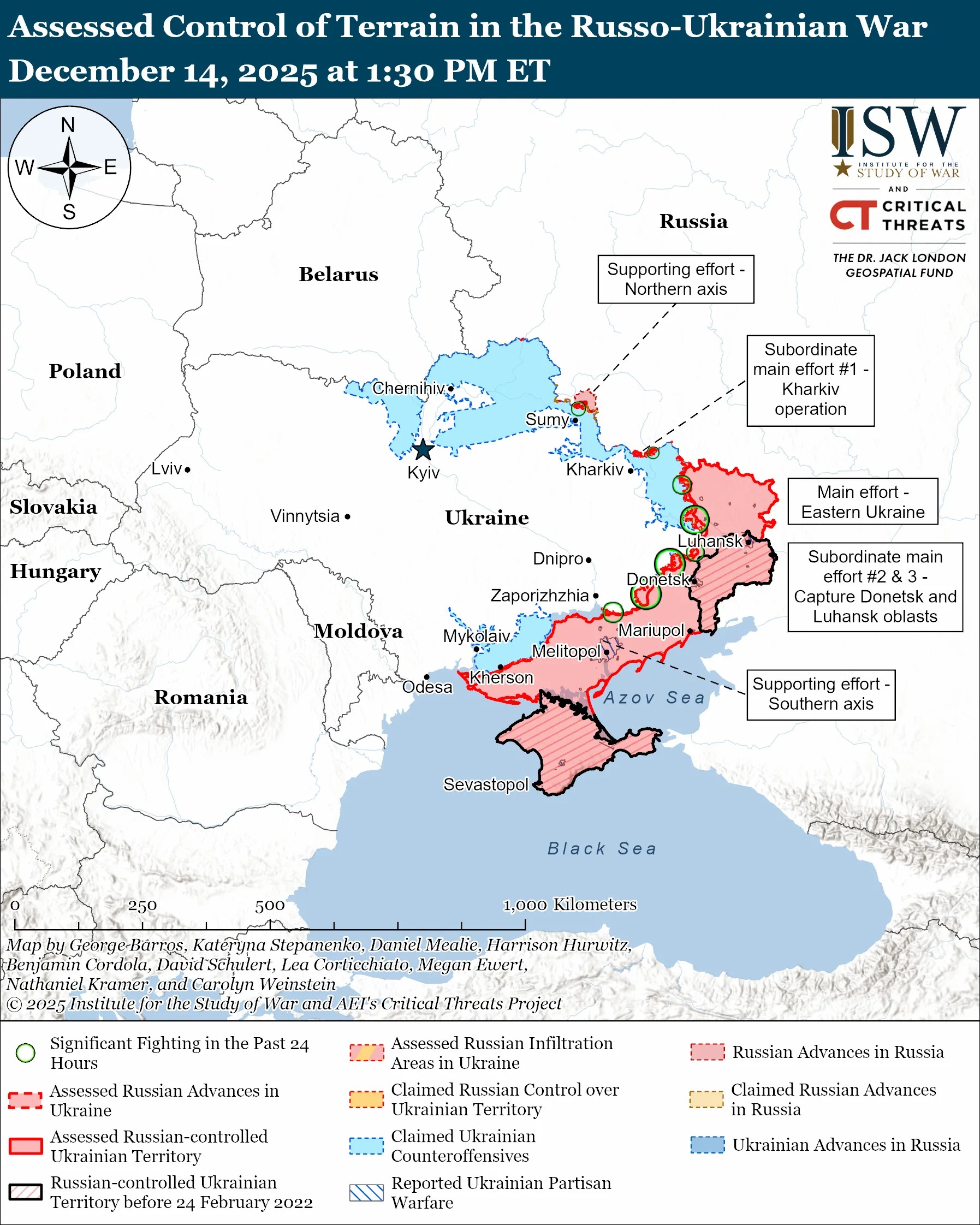
Russian forces are unlikely to sustain the Kremlin’s goal of simultaneous offensive operations across multiple directions due to growing manpower and equipment problems, according to the Institute for the Study of War. Russia’s attempts to escalate fighting along Ukraine’s Fortress Belt — a major fortified defensive line in Donetsk Oblast — are expected to stretch its forces even further.

This comes as, during the Russo-Ukrainian war, Russia continues costly ground assaults across multiple front-line sectors, making only incremental gains while suffering heavy losses in personnel and equipment.

Russian forces face exhaustion across multiple fronts

The Institute for the Study of War (ISW) said in its 14 December report that Russian troops will likely continue to "struggle to maintain the Kremlin’s desired multi-pronged offensive operations in different operational directions." These multi-directional attacks come with high logistical costs, which Russia appears unable to meet in the long term.

ISW noted that Russian President Vladimir Putin and top military officials have recently intensified their battlefield narratives, exaggerating claimed advances on several axes. In particular, they have emphasized operations around Vovchansk, Kupiansk, Siversk, Pokrovsk-Myrnohrad, and Hulyaipole. 

On 27 November, Putin implied that Russian forces near Huliaipole would soon achieve a breakthrough in the Zaporizhzhia direction. However, ISW stated that Russia must either significantly increase the amount of manpower and matériel deployed in each direction to see real results, or pull resources from one sector to bolster another — a tradeoff that would undercut the Kremlin’s messaging of broad success across the entire frontline.

Russian military overstretched near Huliaipole and Oleksandrivka

Ukrainian military observer Kostiantyn Mashovets said on 13 December that the Russian Eastern Grouping of Forces, which operates in the Huliaipole and Oleksandrivka directions, will require regrouping or reinforcements from other parts of the front to maintain their offensive push. He stated that troops under the 5th and 36th Combined Arms Armies are already struggling to carry out operations due to their wide area of responsibility and limited resources.

Mashovets assessed that sustaining pressure near Huliaipole would require either narrowing the frontline or redeploying additional forces, potentially including elements of the 36th and 29th Combined Arms Armies from the Oleksandrivka area to reinforce the 5th Army. He judged that key 5th Army formations, including the 127th Motorized Rifle Division and the 57th Separate Motorized Rifle Brigade, are unlikely to achieve near-term success.

ISW previously assessed that a mid-November breakthrough near Huliaipole was likely enabled in part by a concentrated force grouping comparable in size to that used in the Pokrovsk-Dobropillia direction. Russia has since reinforced the area by reallocating units from other sectors, including VDV, tank, and motorized rifle formations.

Push toward Fortress Belt to drain Russian military further

ISW assessed that Russia’s attempt to begin an assault on the Fortress Belt — Ukraine’s primary fortified line in Donetsk Oblast since 2014 — will likely place even more pressure on its forces. Mashovets warned that launching an attack on key strongholds like Sloviansk and Kramatorsk would require Russia to commit forces and resources from the Western, Southern, and Central Groupings of Forces. In doing so, Russian troops would be unable to maintain activity in other directions, including Velykyi Burlyk and Orikhiv.

He added that structural issues within Russia’s wartime economy and defense industrial base will further complicate efforts to sustain the scale of operations needed for such a push. ISW noted that to follow up on tactical gains around Huliaipole or to capture remaining parts of Donetsk Oblast, Russia would need to weaken its efforts in other frontline sectors.

"The Kremlin is therefore making territorial demands of unoccupied parts of Donetsk, Luhansk, Zaporizhzhia, and Kherson oblasts because it cannot militarily seize these regions at this time," the ISW concluded.

Reçu avant avant-hier
  • ✇Euromaidan Press
  • Ukrainian drones blow up another Russian fuel train in occupied Crimea (VIDEO, MAP)
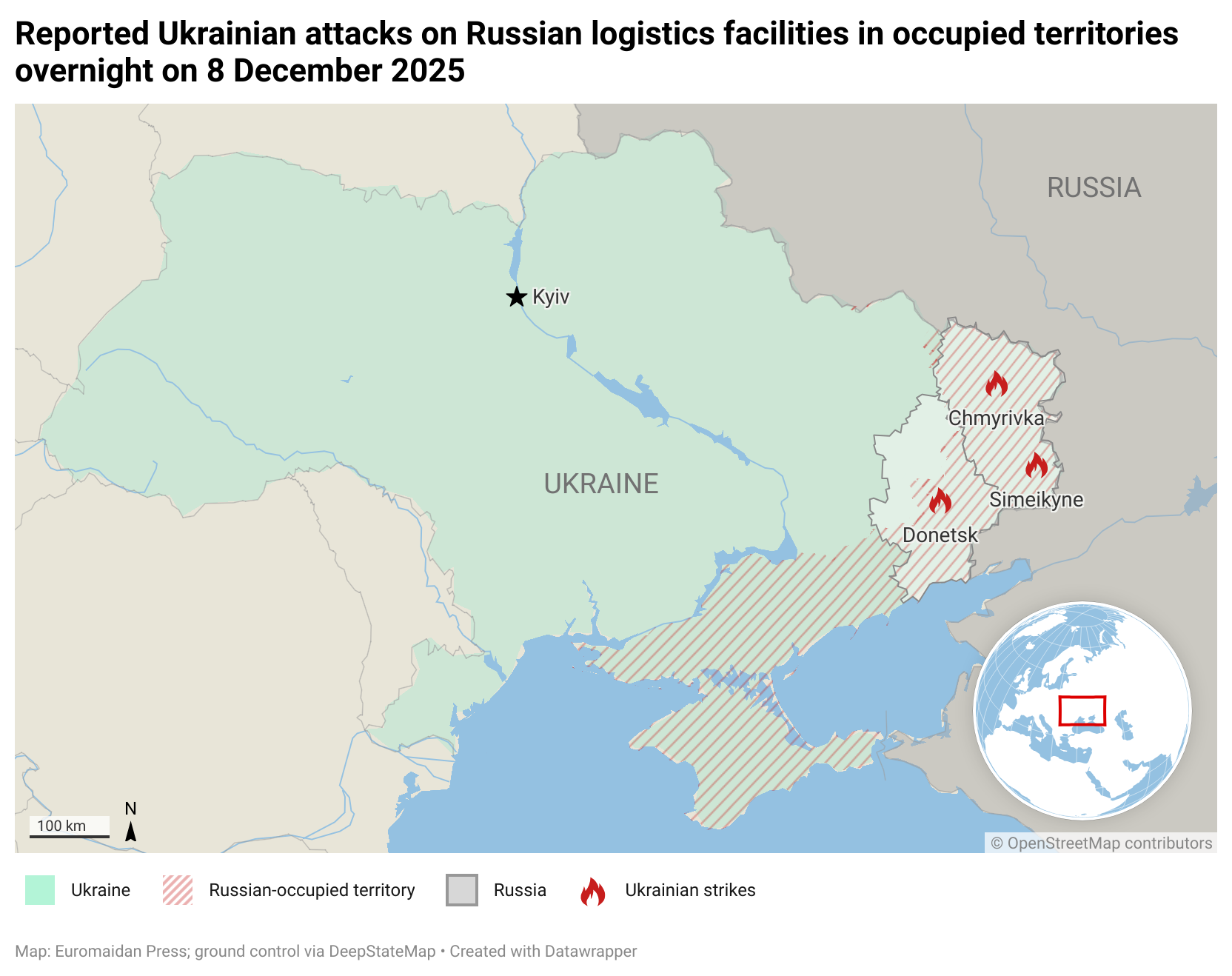
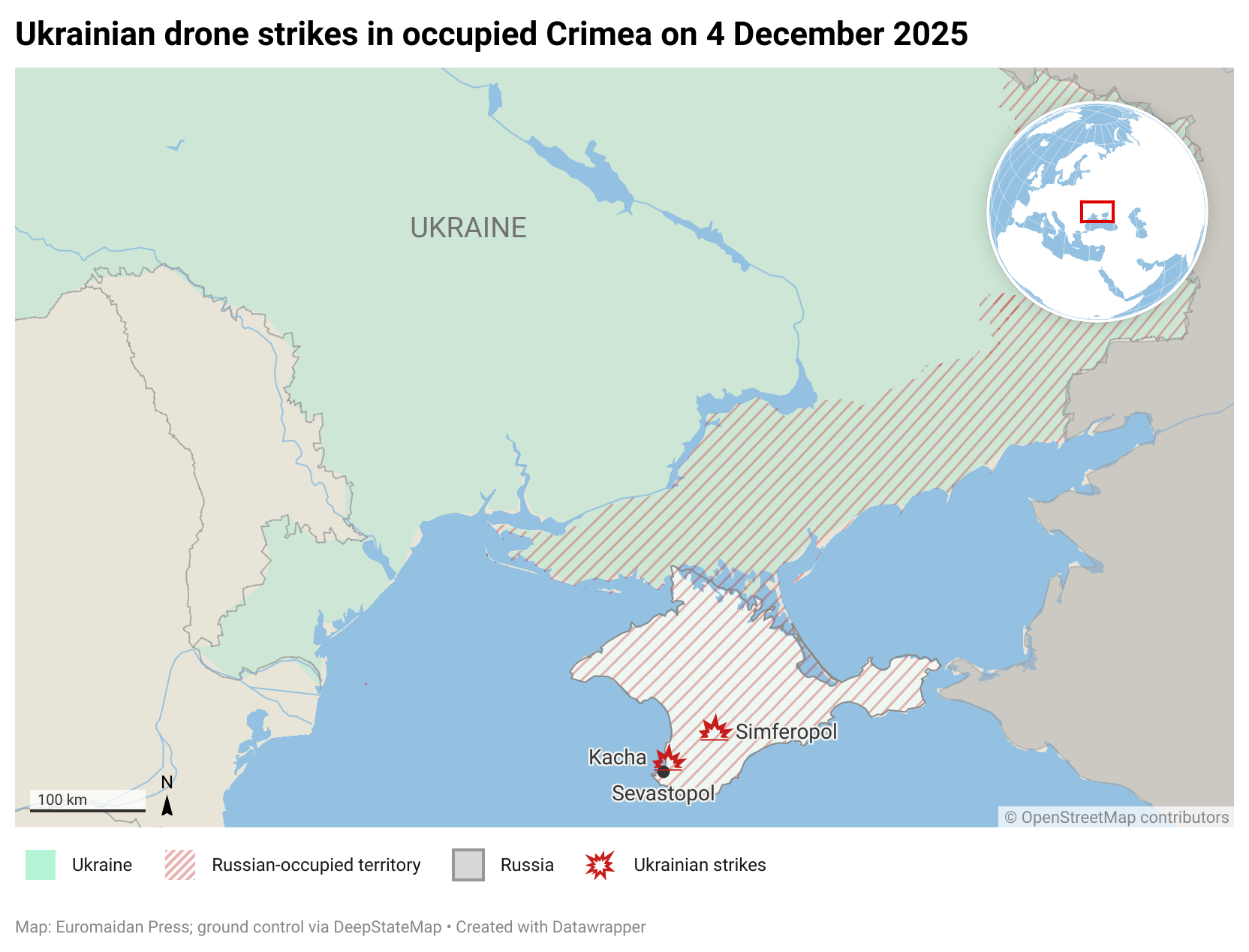
    Ukrainian Army’s Special Operations Forces (SSO) carried out drone strikes against Russian military infrastructure in temporarily occupied Crimea and Donetsk Oblast overnight on 14 December, according to the SSO. The unit said FP-2 strike drones targeted a moving fuel train, an oil depot, and other military objects, and shared video footage of the hits. The Ukrainian Army’s General Staff confirmed additional strikes conducted by other Ukrainian forces in several occupied ob
     

Ukrainian drones blow up another Russian fuel train in occupied Crimea (VIDEO, MAP)

14 décembre 2025 à 12:35

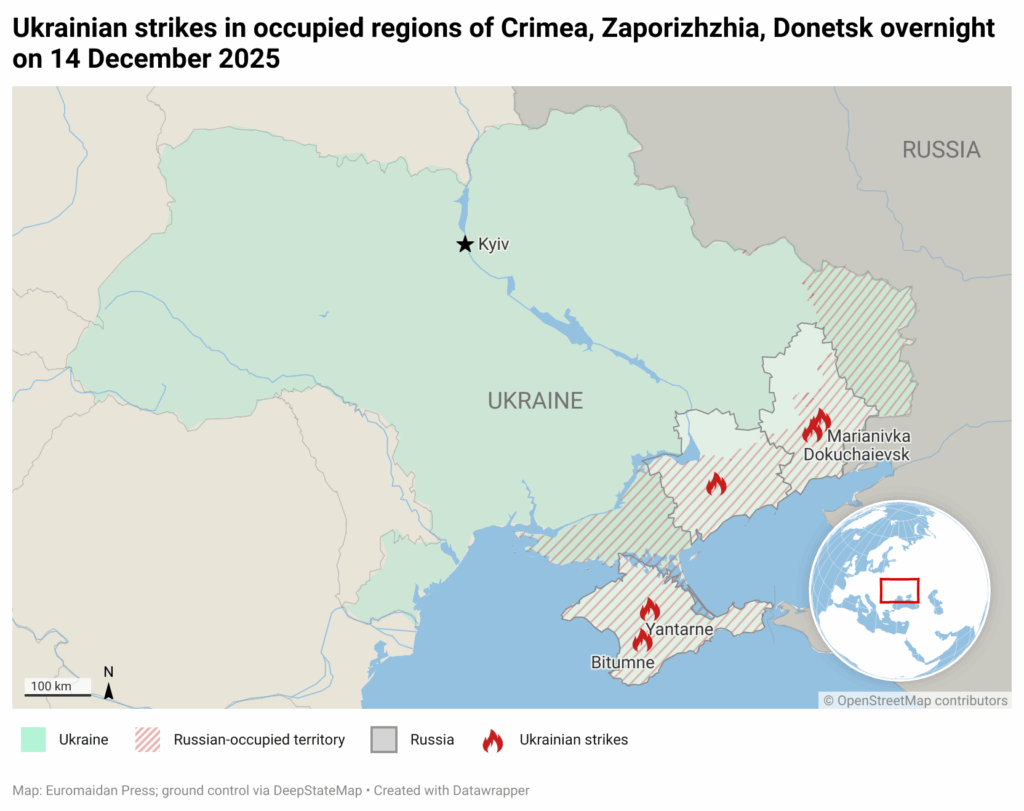
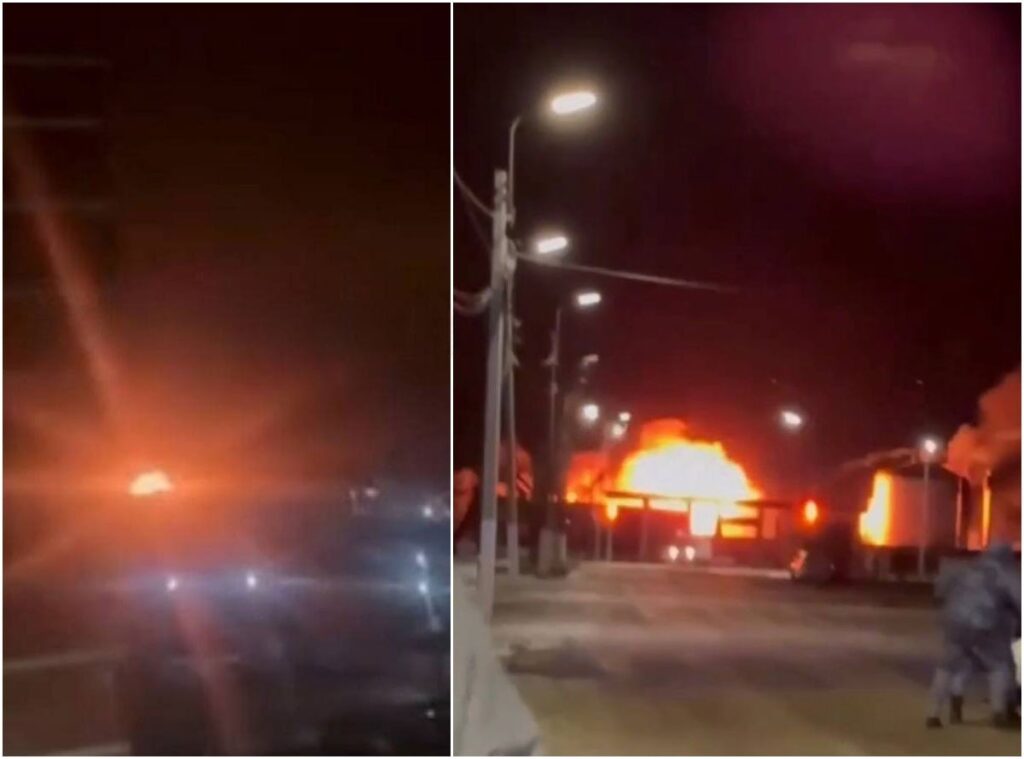
Ukrainian Army’s Special Operations Forces (SSO) carried out drone strikes against Russian military infrastructure in temporarily occupied Crimea and Donetsk Oblast overnight on 14 December, according to the SSO. The unit said FP-2 strike drones targeted a moving fuel train, an oil depot, and other military objects, and shared video footage of the hits. The Ukrainian Army’s General Staff confirmed additional strikes conducted by other Ukrainian forces in several occupied oblasts.

Amid the ongoing Russo-Ukrainian war, Ukrainian forces continue its rear strikes in the occupied territories, and inside Russia, targeting military installations, logistics assets, fuel and defense-industry facilities. 

SSO strikes train and fuel infrastructure in Crimea

According to the SSO, Ukrainian drones hit a moving train transporting fuel and lubricants for Russian troops near the settlement of Yantarne in occupied Crimea. The same drone unit also struck an oil depot in the nearby settlement of Bitumne.

The SSO said its middle-range FP-2 strike UAVs were used to target enemy positions in both Crimea and Donetsk Oblast. The statement emphasized the ongoing use of asymmetric actions to degrade the Russian army’s offensive potential and included video footage showing multiple strikes.

SSO hits Russian electronic warfare and drone training sites in Donetsk Oblast

In Donetsk Oblast, SSO drones struck a Volna-2 electronic warfare station in the settlement of Marianivka. Another strike reportedly hit a training center for FPV drone operators near Dokuchaievsk.

The SSO described the strikes as part of broader efforts to disrupt the enemy’s ability to coordinate and conduct drone warfare.

Other Ukrainian forces hit radar and air defense systems, General Staff says

The Ukrainian Army’s General Staff confirmed SSO's attacks and reported that other Ukrainian military units conducted additional strikes on Russian targets in occupied Donetsk, Zaporizhzhia, and Crimean regions. In Donetsk Oblast, the General Staff reported that two command posts belonging to different units of Russia’s 76th Air Assault Division were struck, as well as another electronic warfare station and a radar station named Imbyr.

In Zaporizhzhia Oblast, Ukrainian forces hit a Tor-M2 air defense system and a laboratory used for Russian UAV systems.

In occupied Crimea, the General Staff confirmed strikes on two fuel bases, the Kasta-2E2 radar station, and a 96L6E radar unit used as part of Russian S-300 and S-400 air defense systems. The damage levels are still being assessed.

  • ✇Euromaidan Press
  • Drones attack two refineries and a oil depot in Russia (MAP, VIDEO)
    Ukrainian drones targeted several Russian energy facilities overnight on 14 December, triggering explosions, fires, evacuations, and power outages, according to local sources. The strikes targeted an oil refinery in Krasnodar Krai, an oil depot in Volgograd Oblast, and likely another refinery in Yaroslavl. Amid the ongoing Russo-Ukrainian war, such Ukrainian attacks are part of a deep-strike campaign, targeting Russian fuel facilities in order to disrupt military supplies a
     

Drones attack two refineries and a oil depot in Russia (MAP, VIDEO)

14 décembre 2025 à 11:51

drones attack two refineries oil depot russia · post fires erupt russian energy facilities during overnight drone attacks 13 2025 left afipsky refinery krasnodar krai right urupinsk volgograd oblast afipsky-left-uryupinsk-right

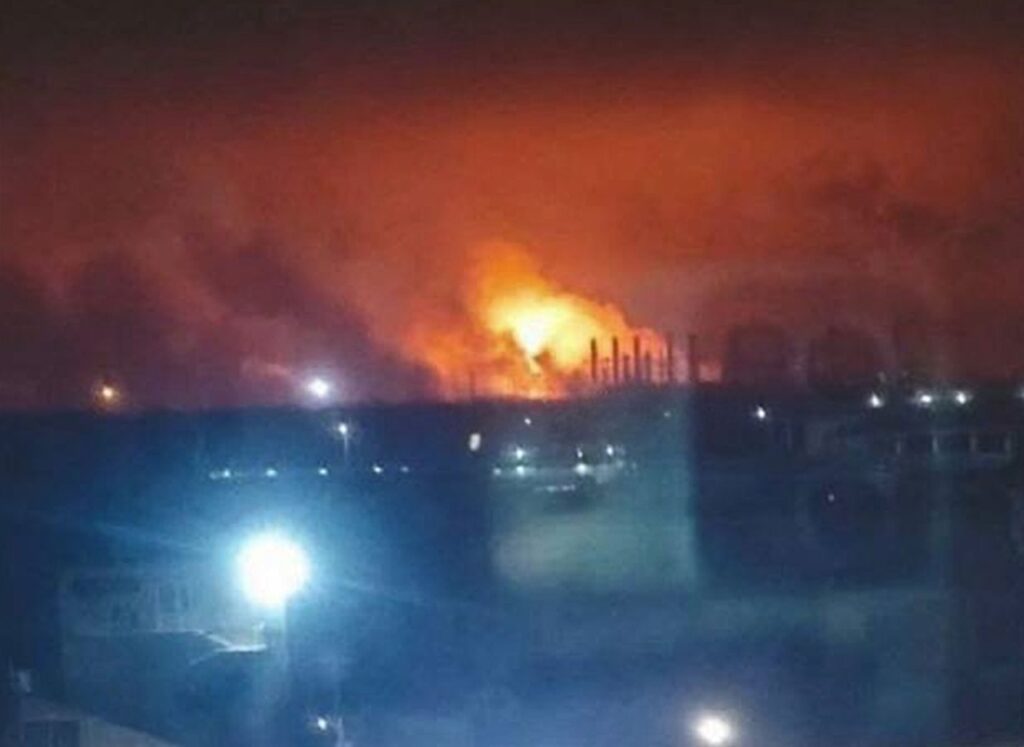
Ukrainian drones targeted several Russian energy facilities overnight on 14 December, triggering explosions, fires, evacuations, and power outages, according to local sources. The strikes targeted an oil refinery in Krasnodar Krai, an oil depot in Volgograd Oblast, and likely another refinery in Yaroslavl.

Amid the ongoing Russo-Ukrainian war, such Ukrainian attacks are part of a deep-strike campaign, targeting Russian fuel facilities in order to disrupt military supplies and oil exports.

Afipsky refinery hit in Krasnodar Krai

Strike drones attacked the Afipsky oil refinery in Krasnodar Krai. Ukrainian Telegram channel Exilenova+, citing local residents, said explosions occurred near the facility during the attack. Russian news Telegram channel Astra also reported blasts in the refinery area during the drone strike on energy infrastructure. Videos, shared by the channels, show explosions at the facility.

After the explosions, power outages hit several city districts. Local explanations linked the blackout to the refinery’s role as a key infrastructure hub that provides electricity transit, water supply, and wastewater treatment for nearby settlements and industrial facilities. 

The Afipsky refinery processes about 6.25 million tons of oil annually and produces gasoline, diesel fuel, gas oil, vacuum gas oil, fuel oil, sulfur, and gas condensate distillates.

The Krasnodar Krai operational headquarters claimed that drone debris fell at two addresses in Afipsky settlement, but no residents were injured. Debris allegedly sparked a fire in the yard of a detached residence. In another case, fragments shattered windows in a private home. Later updates from local authorities stated debris damaged several more homes in the same village.

Due to its strategic importance, Ukrainian drones have targeted the Afipsky refinery repeatedly. On 29 November, a previous strike hit the facility, which satellite imagery later confirmed by showing scorched areas and explosion marks inside the refinery’s production perimeter.

Due to its strategic importance, Ukrainian drones have repeatedly targeted the Afipsky refinery, including a 29 November 2025 strike later confirmed by satellite images showing scorch marks and blast traces inside the facility.

Another drone strike targeted an oil depot in Uryupinsk, Volgograd Oblast, Russia

NASA FIRMS data confirmed fires at the facility.
📹Exilenova+ pic.twitter.com/hhvEgDur71

— Euromaidan Press (@EuromaidanPress) December 14, 2025

Oil depot struck in Volgograd Oblast

Ukrainian drones also attacked an oil depot in Uryupinsk, Volgograd Oblast, Astra reported. Local residents reported explosions and a fire at the site. Volgograd Oblast Governor Andrei Bocharov later confirmed the attack, saying drone "debris" caused a fire at the oil depot.

According to the governor’s statement, no injuries were reported.

The Ukrainian Armed Forces later confirmed strikes on both the Afipsky refinery in Krasnodar Krai and the Uryupinsk oil depot in Volgograd Oblast, reporting explosions and fires at both sites, with damage still being assessed.

Yaroslavl refinery likely hit again

A refinery operated by Slavneft-YANOS in Yaroslavl was likely attacked again, Astra reported, citing readers and local Telegram channels. Air raid alerts sounded in the city before the reported strike. The same refinery previously came under drone attack in the early hours of 12 December.

Russia’s Defense Ministry claimed its air defenses intercepted 141 Ukrainian drones overnight, including over Russian territory and occupied Crimea. The ministry said air defenses shot down 35 drones over Bryansk Oblast, 32 over Crimea, 22 over Krasnodar Krai, 15 over Tula Oblast, and 13 over Kaluga Oblast. The ministry also claimed interceptions over Kursk, Ryazan, Rostov, Belgorod, Leningrad, Smolensk, Pskov, Novgorod oblasts, and the Moscow region. It later claimed a total of 235 Ukrainian fixed-wing drones were intercepted overnight.

The Russian Defense Ministry’s reports did not include Volgograd Oblast, where the Uryupinsk oil depot caught fire.

  • ✇Euromaidan Press
  • ISW: Ukrainian troops continue advancing within and near Kupiansk
    Ukrainian forces continue advancing within and near Kupiansk, Kharkiv Oblast, while heavy fighting continues near the city, the Institute for the Study of War (ISW) reports. New geolocated footage and Ukrainian reporting show gains inside the city and nearby settlements. Russian sources acknowledge some losses but dispute the scope of Ukrainian progress despite available evidence. Kupiansk in Kharkiv Oblast has remained one of the most active frontline sectors this year, wi
     

ISW: Ukrainian troops continue advancing within and near Kupiansk

14 décembre 2025 à 10:05

isw ukrainian troops continue advancing within near kupiansk · post assessed frontline situation 13 2025 institute study war kupyansk-city-december-13-2025 forces while heavy fighting continues city (isw) reports new geolocated footage

Ukrainian forces continue advancing within and near Kupiansk, Kharkiv Oblast, while heavy fighting continues near the city, the Institute for the Study of War (ISW) reports. New geolocated footage and Ukrainian reporting show gains inside the city and nearby settlements. Russian sources acknowledge some losses but dispute the scope of Ukrainian progress despite available evidence.

Kupiansk in Kharkiv Oblast has remained one of the most active frontline sectors this year, with Russian forces advancing toward the city through the autumn and Ukrainian troops launching a coordinated counteroffensive to halt their progress and reclaim lost ground.

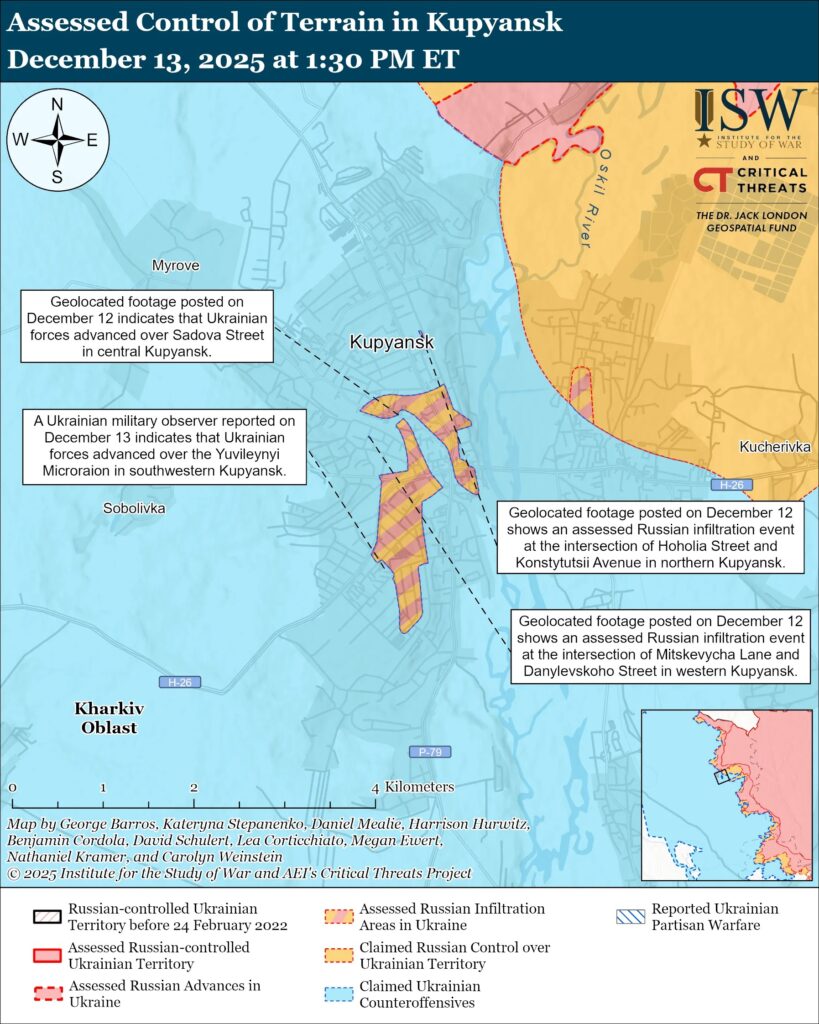
Ukrainian advances confirmed by geolocated footage: Yuvileynyi neighborhood seized, fighting continues

ISW reported on 13 December that Ukrainian forces advanced in central Kupiansk while conducting clearing operations. Footage published on 12 December shows Ukrainian units moving through central districts and pushing southeast of Petropavlivka, east of Kupiansk. Additional footage from 12 and 13 December indicates Russian infiltration groups remain in northern and western Kupiansk.

Ukrainian military observer Yurii Butusov reported that Ukrainian forces fully seized Yuvileynyi Microraion ("micro-district") in southwestern Kupiansk. He assessed that losing this area likely prevents Russian forces from sustaining remaining positions in southern Kupiansk. Butusov also said Ukrainian units continue clearing operations across the city.

Russian infiltration attempts persist

The chief of staff of a Ukrainian drone battalion reported that Russian forces still attempt to penetrate Kupiansk. He said Russian troops primarily move on foot during these efforts. ISW noted that these infiltration attempts continue despite Ukrainian advances and ongoing clearance.

Assessed control of terrain in the Kupiansk direction on 13 December 2025. Map: Institute for the Study of War

Russian milbloggers acknowledge losses

Russian milbloggers acknowledged Ukrainian advances into Yuvileynyi Microraion and northwest of Kupiansk. They reported heavy fighting near Myrove and Radkivka, both northwest to north of the city. One milblogger admitted Russia lost Radkivka and two defensive positions south and east of the settlement. Many Russian milbloggers continued rejecting Ukrainian reports despite evidence supporting Ukrainian claims.

Kupiansk counteroffensive

Ukrainian forces launched their counteroffensive in the Kupiansk area in September 2025 following rapid Russian advances during the summer. By early August, Russian troops had infiltrated Kupiansk, and by late August, the Russian military command began publicly presenting these infiltrations as significant gains. According to Butusov, Russian assault units from the 121st and 122nd motorized rifle regiments, the 27th Motorized Rifle Brigade, and the 1855th Battalion had established entrenched positions in the city and seized a key elevation north of Kupiansk, putting Ukraine in a critical situation by mid-September.

ukraine says its troops encircled remaining russians kupiansk freed nearby villages (video map) · post deepstate situation around kharkiv oblast 12 2025 blue areas mark recent ukrainian gains red show
Explore further

Ukraine says its troops encircled remaining Russians in Kupiansk and freed nearby villages (VIDEO, MAP)

Butusov reported that Ukrainian forces later liberated Tyshchenkivka, Kindrashivka, and Radkivka, enabling a breakthrough in Russian defenses. By 21 October, they reached the west bank of the Oskil River and severed Russian supply lines to Kupiansk from the north. Despite facing a Russian-created drone “kill zone,” Ukrainian units adapted and regained the initiative.

"The Kremlin has been leveraging its claims of advances in and near Kupiansk for a cognitive warfare effort designed to portray the Ukrainian lines as on the verge of collapse," ISW noted, adding that "the Ukrainian counterattacks in the Kupiansk direction continue to demonstrate that this narrative is false."

Zelenskyy outlines Ukraine’s red lines and pushes back on Trump’s claim that everyone but him loves US peace plan

14 décembre 2025 à 08:34

zelenskyy pushes back trump's claim everyone loves peace plan · post president volodymyr addresses nation 27 2025 presidentgovua zelenskyy-no-territorial-concessions-ukraine-defense-diplomacy ukraine news ukrainian reports

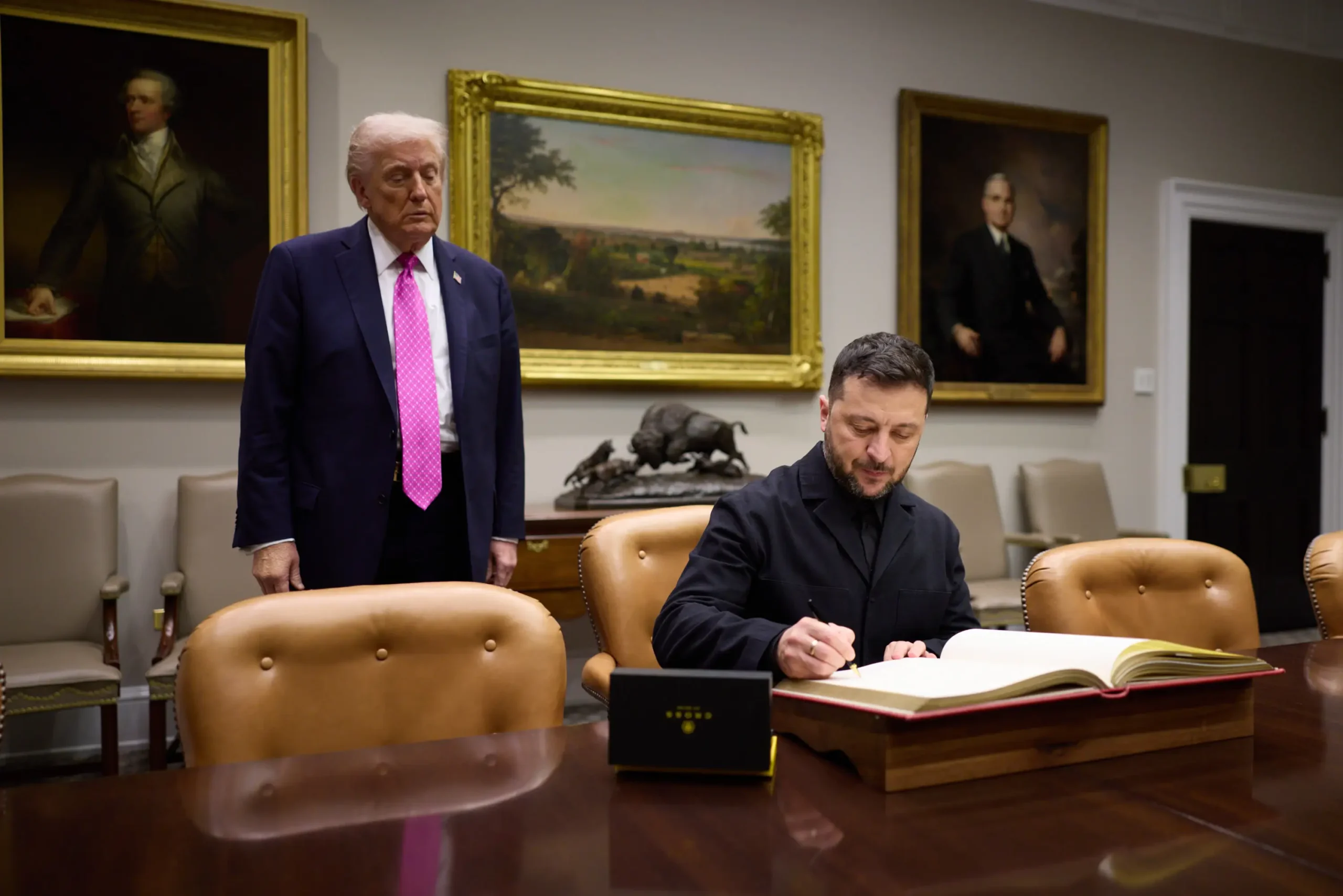
During an online press conference on 14 December, Ukrainian President Volodymyr Zelenskyy addressed questions about ongoing US-led indirect peace negotiations between Kyiv and Moscow. According to Euromaidan Press, he responded to US President Donald Trump's recent claim that Zelenskyy alone dislikes the peace plan, while his team allegedly loves it.

"The plan won't be one that pleases everyone," Zelenskyy said. "There are definitely many compromises in one format of the plan or another."

Berlin summit to discuss 20-point framework with ceasefire provisions

Zelenskyy spoke ahead of meetings with US and European officials in Berlin on 14-15 December. Asked whether the summit could change the situation, he replied:

"Definitely. Because we will be considering the 20-point framework plan, at the end of which there is talk of ceasefire. A ceasefire will definitely change the security situation on the ground."

He planned separate meetings with German Chancellor Friedrich Merz and other European leaders.

Ukraine's red line: no third Russian aggression

Zelenskyy emphasized that any agreement must serve Ukraine's interests and prevent future attacks.

"The most important thing is that the plan be as fair as possible, primarily for Ukraine, because Russia started the war," he said. "And the main thing is that it be effective, that the plan could truly be not just a piece of paper, but an important step toward ending the war."

The Ukrainian President stressed one non-negotiable requirement:

"After signing it, Russia must have no opportunity to start another, third aggression against the Ukrainian people."

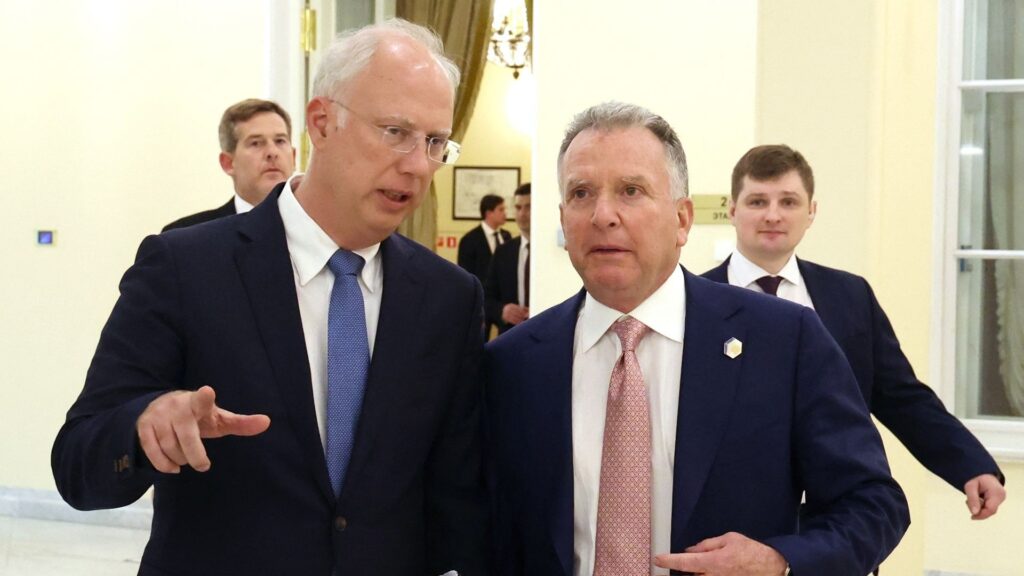
isw kremlin statements again show russia’s unwillingness pursue real peace · post russian fund chief presidential envoy kirill dmitriev (left) special missions steve witkoff (right) saint petersburg 2025 ria novosti
Explore further

ISW: Kremlin statements again show Russia’s unwillingness to pursue real peace

NATO rejection forced Ukraine into bilateral deals

Zelenskyy explained how Ukraine's security strategy evolved after Western partners blocked its preferred path to obtain security guarantees from its allies.

"Ukraine's conditions from the very beginning — or maybe not conditions, correctly said, the desire — was NATO membership. And these were real security guarantees," he said. "Some partners from the United States of America and Europe did not support this direction."

Ukraine now seeks "Article 5-like" bilateral guarantees from the US, mirroring NATO's mutual defense clause.

"And this is already a compromise on our part," Zelenskyy noted, insisting that these arrangements must be "legally binding guarantees, not a Budapest Memorandum," and approved by US Congress.

The Budapest Memorandum was an agreement under which Ukraine gave up the world’s third-largest nuclear arsenal in exchange for security assurances from Russia and the United States. In 2014, Russia invaded Ukraine, escalating its aggression into a full-scale war in 2022. Meanwhile, under Donald Trump, the United States halted military aid to Ukraine, shifted to selling weapons instead, and pushed for a so-called “peace” deal.

Citing an unnamed US official, Axios said that Washington is "willing" to grant Ukraine a legally binding, congressionally approved security guarantee based on NATO’s Article 5.

Russia rejects "stand where we stand" ceasefire

The Ukrainian President says Ukraine's ceasefire position is straightforward:

"I believe that today a fair possible option should be: we stand where we stand," Zelenskyy said. "And this is true, because this is what a ceasefire is — the sides stand, and then diplomatically try to resolve all general issues."

Russia rejected this approach. "Russians respond that we must leave the Donbas or they will occupy it anyway," Zelenskyy said.

According to the President, the US then proposed a "compromise": Russian forces would not enter part of eastern Ukraine if Ukrainian forces withdrew.

"I don't consider this fair," Zelenskyy responded, adding: "If Ukrainian troops withdraw 5-10 kilometers, for example, then why don't Russian troops withdraw the same distance deeper into occupied territories?"

He called this "a question that has no answer yet. But it's very sensitive and very hot."

At the start of the full-scale invasion, Russia exploited previous ceasefires under the so-called Minsk agreements signed in 2014 and 2015. By 2022, Ukrainian troops had been withdrawn from many frontline areas, and the Zelenskyy government had even removed minefields in some locations, including along the administrative border with Crimea. The latter facilitated Russia’s rapid seizure of southern Kherson Oblast and contributed to the encirclement of Mariupol.
Ukrainian President Volodymyr Zelenskyy addresses journalists in Kyiv about Donbas buffer zone proposals in peace talks
Explore further

Ukraine denies agreeing to Donbas buffer zone, calls Le Monde report a misinterpretation

Russia seeks territorial gains without fighting for them

Zelenskyy accused Moscow of pursuing a strategy to avoid military costs.

"Russia wants to not expend forces and occupy our east through political means, diplomatic-political means," he said.

He cited Kupiansk as an example of Russian disinformation supporting this strategy.

"I was recently in Kupiansk and showed who controls this city," Zelenskyy said, adding that "There is a lot of such disinformation from the Russians," and saying to American negotiators: "Don't believe everything Russia says."

Moscow recently claimed to have seized this city in Kharkiv Oblast and to have surrounded Ukrainian forces there. A few days ago, however, Ukraine reported that its troops had instead cut off the Russian units that entered the city.
Ukrainian President Volodymyr Zelenskyy delivering a national address in Kupiansk, Kharkiv Oblast, 12 December 2025. Photo: Ukrainian President's Office
Explore further

“Reality speaks for itself”: Zelenskyy visits Kupiansk as Ukraine traps remaining Russian forces

Ukraine expands negotiating team after Kushner joins US side

The addition of Jared Kushner, Trump's son-in-law and representative, to the US team brought an economic component to the talks. According to Zelenskyy, negotiations now cover three tracks: the 20-point framework, Ukraine's economic reconstruction, and post-war security.

Ukraine responded by expanding its delegation to include the Prime Minister, Economy Minister, Chief of General Staff Andrii Hnatov, and intelligence representatives.

Kyiv awaits US response to latest plan modifications

Zelenskyy confirmed he sent updated comments to Washington but received no formal response yet. Military officials met in Stuttgart, and Hnatov was traveling with the negotiating group.

"I think today or tomorrow I'll receive details. There are no more details for now."

The US speaks for Russia because Ukraine has no direct Kremlin contact

Since Ukraine has no direct dialogue with Moscow, American negotiators "represent the Russian side, if you can say so, because they convey their signals, demands, steps of readiness or unreadiness," Zelenskyy explained. Ukraine discusses both bilateral US-Ukraine matters and reactions to Russian positions with Washington.

Notoriously, since Trump started pushing for Kyiv-Moscow peace agreement, Russia didn't show any readiness to any compromises and continues to insist on Ukraine's de facto capitulation.

Zelenskyy expressed confidence that pressure could work:

"If America pushes, if partners push, and if America wants to end this war the way they're demonstrating today at the highest level, I believe Russia will have to make compromises."

Ukrainian President Volodymyr Zelenskyy shakes hands with Pope Leo XIV at Castel Gandolfo, where the pontiff warned Trump's approach threatens the US-Europe alliance
Explore further

Pope Leo XIV warns Trump approach threatens US-Europe alliance after Zelenskyy meeting

"Current times demand respect only for strength"

Zelenskyy offered a blunt assessment of the current geopolitical reality.

"Today we're talking not about fairness, but about strength," he said. "And unfortunately, this time demands respect only for strength, not for values."

He recalled how international law failed to stop Russia earlier.

"If we were talking about fairness and values, about respect for international law, Russians should have been condemned from the very beginning, more than 10 years ago, for the invasion of sovereign Ukrainian land. This didn't happen. It was only in words."

This reality shapes Ukraine's insistence on enforceable guarantees.

"Today we want non-repetition of war after a ceasefire. And therefore legally binding guarantees are mandatory," Zelenskyy noted.

Throughout 2014-2021, Russia notoriously violated each of multiple previous ceasefires under Minsk accords.

What if peace talks fail?

"We cannot afford to think about this," Zelenskyy said.

He acknowledged the need for realism but refused to dwell on failure scenarios.

"It's like running a long distance, like a marathon. You have to pull yourself together, find another path, and again do everything so that this war ends."

zelenskyy under pressure accept trump peace plan fast axios says · post ukrainian president volodymyr donald united nations headquarters new york city 23 2025 president_donald_trump_participates_in_a_bilateral_meeting_with_ukraine’s_president_volodymyr_zelenskyy_at_the_united_nations_headquarters_(54823591811) ukraine news reports
Explore further

Zelenskyy under US pressure to accept Trump “peace” plan fast, Axios says

  • ✇Euromaidan Press
  • Trump administration considers NATO Article 5-style guarantees for Ukraine, Axios source says
    US President Donald Trump’s advisers have allegedly proposed offering Ukraine Article 5-style security guarantees as part of a broader peace plan, according to Axios. A senior US official told the publication the proposed guarantee would be legally binding and approved by Congress. This comes as Russia's invasion of Ukraine continues, while the US under Trump has been pushing for a peace deal, based on Moscow's demands. According to Axios, the White House is pressuring Ukra
     

Trump administration considers NATO Article 5-style guarantees for Ukraine, Axios source says

14 décembre 2025 à 04:31

trump administration considers nato article 5-style guarantees ukraine axios says · post president donald speaks reporters aboard air force one 2025 trump-speaks -reporters-air-force-one report cites senior united states official describing

US President Donald Trump’s advisers have allegedly proposed offering Ukraine Article 5-style security guarantees as part of a broader peace plan, according to Axios. A senior US official told the publication the proposed guarantee would be legally binding and approved by Congress.

This comes as Russia's invasion of Ukraine continues, while the US under Trump has been pushing for a peace deal, based on Moscow's demands. According to Axios, the White House is pressuring Ukraine to accept the plan. 

Trump advisers push NATO-style guarantee linked to peace terms

Axios reports that Steve Witkoff and Jared Kushner are expected to meet President Volodymyr Zelenskyy on 15 December in Berlin. The meeting will also involve the leaders of Germany, France, and the United Kingdom. Two White House officials told Axios that the meeting aims to reach an agreement on the US plan for peace in Ukraine.

A White House official said the US believes most issues are allegedly close to resolution, but Ukraine's territorial concessions to Russia remain the key sticking point. The official pointed to public remarks made by Zelenskyy on 11 December as a potential signal of progress.

During those remarks, Zelenskyy said that the fairness of the proposed compromises “will be answered by the people of Ukraine” through a referendum or election. The same day, he also stated that he was skeptical of the US proposal for a “free economic zone” in the Donbas and is seeking changes and clarifications. Around 14% of the Donbas remains under Ukrainian control.

A White House official told Axios that the US included Russia’s demand for full control of Donbas in the plan, but proposed making the contested area a demilitarized zone. Holding a vote during wartime would be difficult, but Axios reports that during a 12 December meeting, European officials said they would support Zelenskyy if he proposed a referendum.

US proposal based on three agreements, Axios reports

Axios reports that Witkoff and Kushner discussed the demilitarized zone proposal with the national security advisers of Ukraine, Germany, France, and the United Kingdom. A White House official said those talks, along with recent US-Ukraine discussions on 11 December, led Trump to send his advisers to Europe. Another official told Axios: 

“They believe there could be a chance at peace and the [US] President trusts them.”

Axios states that negotiations on the security guarantees for Ukraine have made significant progress. A senior US official said the Trump administration is willing to give Ukraine a guarantee based on NATO’s Article 5 that would be legally binding and approved by Congress.

We want to give the Ukrainians a security guarantee that will not be a blank check on the one hand but will be strong enough on the other hand. We are willing to send it to Congress to vote on it,” the US official said.

The same official told Axios the current framework includes three separate agreements: one on peace, one on security guarantees, and one on reconstruction. According to the official, the latest talks provided Ukraine with “a full day-after vision” for the first time.

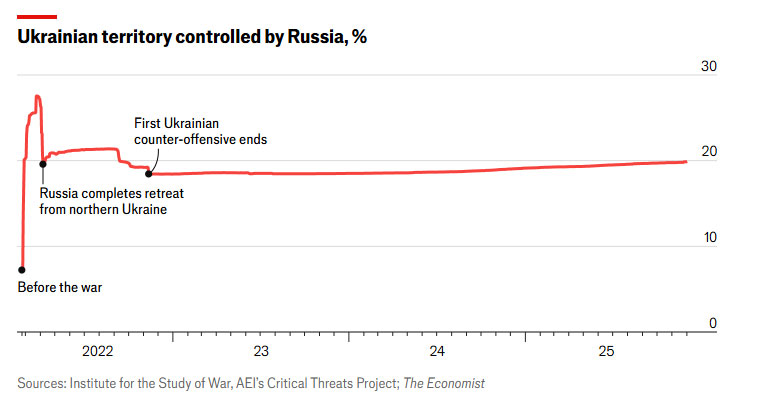
Russia currently controls about 20% of Ukraine. The US official claimed, 

“According to the current proposal the war will end with Ukraine keeping the sovereignty over 80% of its territory, will get the biggest and strongest security guarantee it has ever got and will get a very significant prosperity package.”

  • ✇Euromaidan Press
  • Ukrainian drones blow up Russian An-26 plane and two more radars in occupied Crimea (VIDEO)
    Ukrainian drones struck a Russian An-26 military transport aircraft and two radars in occupied Crimea, according to the Main Directorate of Intelligence of Ukraine. The targeted radars supported Russian S-300 and S-400 systems, and the attack was carried out by HUR’s special unit Prymary ("Ghosts"). Over the past months, Ukrainian strikes targeting Russian air defense assets in occupied territory have become routine. Each destroyed radar or anti-air system makes it easier f
     

Ukrainian drones blow up Russian An-26 plane and two more radars in occupied Crimea (VIDEO)

12 décembre 2025 à 08:40

ukrainian drones blow up russian an-26 plane two more radars occupied crimea (video) · post drone thermal view military transport aircraft moments before strike struck main directorate intelligence ukraine targeted

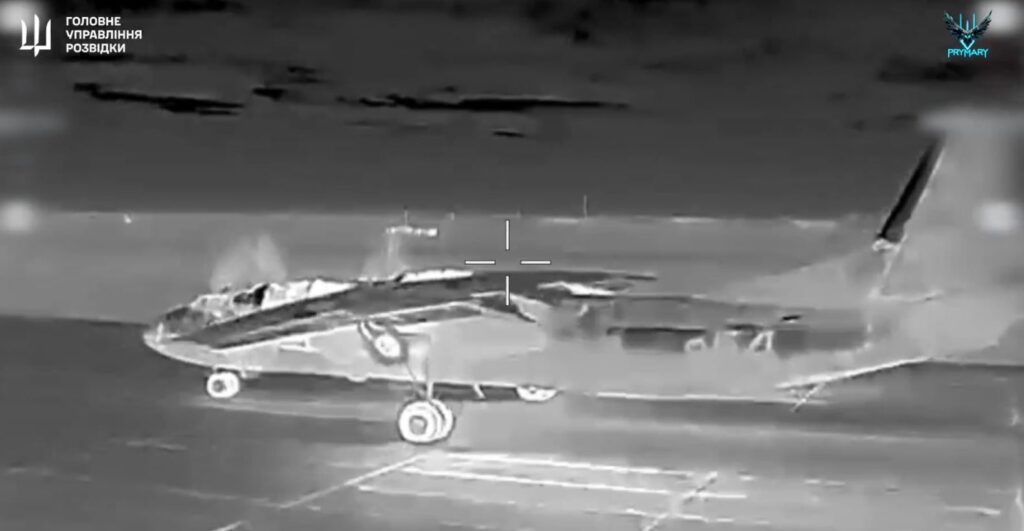
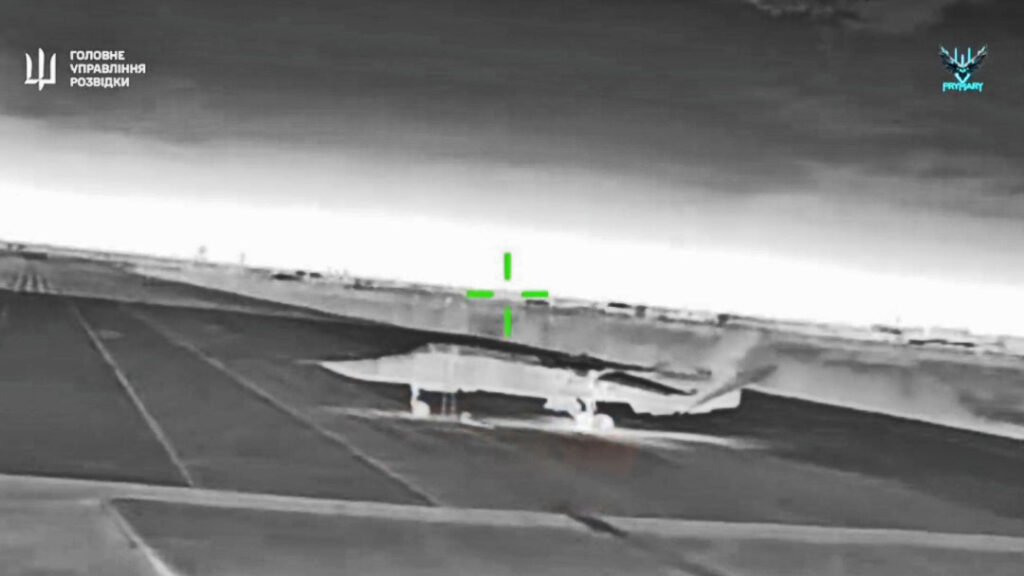
Ukrainian drones struck a Russian An-26 military transport aircraft and two radars in occupied Crimea, according to the Main Directorate of Intelligence of Ukraine. The targeted radars supported Russian S-300 and S-400 systems, and the attack was carried out by HUR’s special unit Prymary ("Ghosts").

Over the past months, Ukrainian strikes targeting Russian air defense assets in occupied territory have become routine. Each destroyed radar or anti-air system makes it easier for Ukrainian drones to carry out future attacks.

Ukrainian military confirms precision strikes in Crimea

On 12 December, the Defense Ministry’s Main Directorate of Intelligence (HUR) shared a video of the strikes and reported that its Prymary unit successfully attacked high-value Russian military targets in the temporarily occupied peninsula over 10–11 December. HUR did not disclose the exact locations of the attacks.

One of the targets was the An-26 aircraft. HUR noted that Russian troops were preparing for takeoff with the multipurpose cargo plane that already was on the runway and had already launched the engines when Ukrainian drones struck its left turboprop engine. 

Drone thermal view of a 64N6E radar inside a radio-transparent dome in occupied Crimea before it was struck. Source: HUR

The same raid also eliminated two expensive Russian radar systems: a 55Zh6M Nebo-M and a 64N6E radar hidden under a radio-transparent cupola. According to HUR, the 64N6E was used as a targeting component for Russian S-300 and S-400 missile systems, making it a critical element of the air defense structure.

Militarnyi reported that on 11 December, Russian occupation-linked Telegram channels acknowledged the loss of the aircraft. They also mentioned reports of killed and injured at the site, possibly among the crew or airfield command staff. These claims have not been independently verified.

  • ✇Euromaidan Press
  • Ukraine says its troops encircled remaining Russians in Kupiansk and freed nearby villages (VIDEO, MAP)
    Ukrainian Defense Forces have surrounded the remaining Russian troops in Kupiansk and liberated surrounding settlements in Kharkiv Oblast, according to the Ukrainian National Guard’s 2nd Corps Khartia. The operation has reportedly cut all ground access for Russian forces, forcing them to rely solely on drones for supplies. Kupiansk, a key logistical hub in northeastern Ukraine's Kharkiv Oblast, was seized by Russian forces early in the full-scale invasion but liberated by U
     

Ukraine says its troops encircled remaining Russians in Kupiansk and freed nearby villages (VIDEO, MAP)

12 décembre 2025 à 08:01

ukraine says its troops encircled remaining russians kupiansk freed nearby villages (video map) · post deepstate situation around kharkiv oblast 12 2025 blue areas mark recent ukrainian gains red show

Ukrainian Defense Forces have surrounded the remaining Russian troops in Kupiansk and liberated surrounding settlements in Kharkiv Oblast, according to the Ukrainian National Guard’s 2nd Corps Khartia. The operation has reportedly cut all ground access for Russian forces, forcing them to rely solely on drones for supplies.

Kupiansk, a key logistical hub in northeastern Ukraine's Kharkiv Oblast, was seized by Russian forces early in the full-scale invasion but liberated by Ukraine in September 2022. Since then, the city has remained on the frontline, with Russian troops attempting new offensives in 2024–2025. A few months ago, the Russians managed to approach the city and enter it.

Ukrainian forces encircle Russian troops and liberate villages around Kupiansk

Khartia reports that the counteroffensive began after the Russian breakthrough into Kupiansk in September. To respond, Commander-in-Chief Oleksandr Syrskyi ordered the creation of a special strike group named Khartia. It included units from the 13th Brigade Khartia, the 475th Assault Regiment Kod 9.2, the 92nd Assault Brigade, the Foreign Legion of the Defense Intelligence, and the 144th Mechanized Brigade. These forces launched a coordinated operation to eliminate the Russian incursion and regain control of the area.

On 20 November, Russian General Staff Chief Valery Gerasimov told Vladimir Putin that Kupiansk had ostensibly been captured. On 2 December, Putin stated that the Kupiansk-Vuzlovyi railway station would fall “in a few days.” 

 Kupiansk on the map.

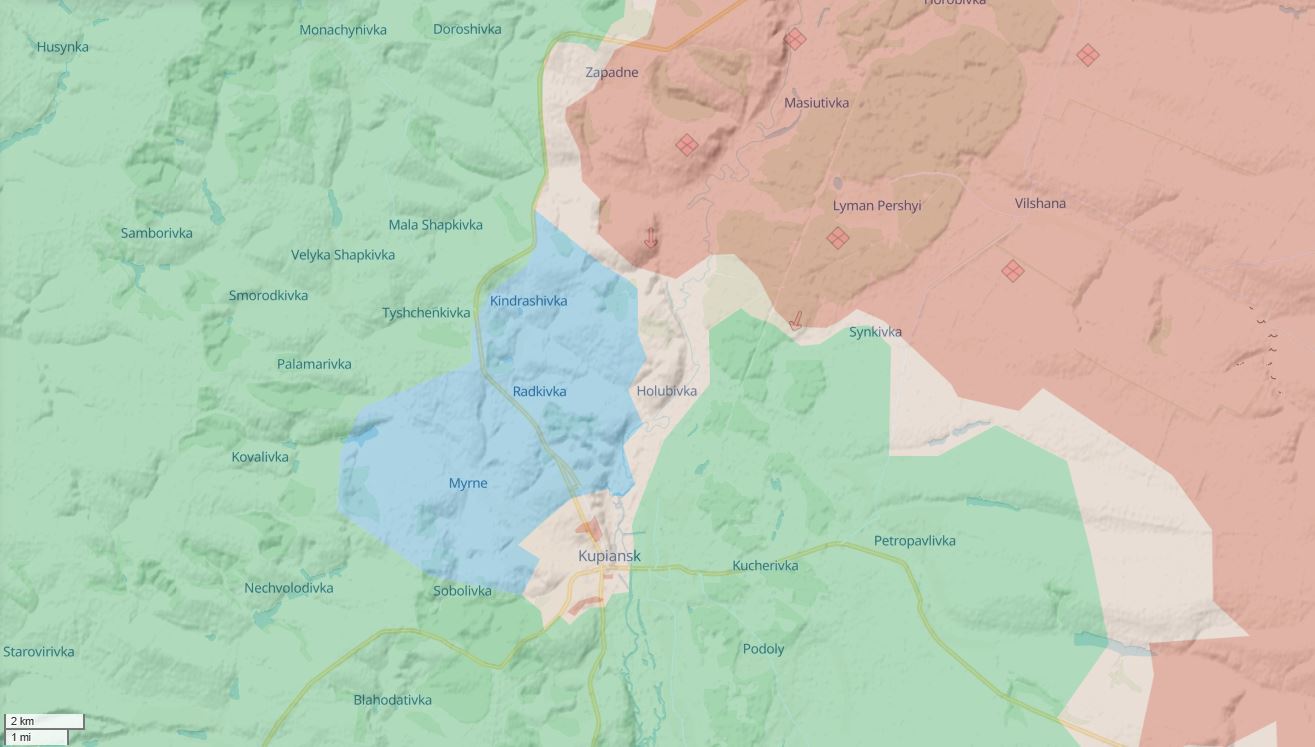
Khartia states that its units advanced to the Oskil River and cut off all land supply routes into Kupiansk. As a result of the operation, Ukrainian forces liberated the villages of Radkivka and Kindrashivka, as well as nearby forests and several districts in northern Kupiansk

From 22 September to 12 December, 1,027 Russian soldiers were reportedly killed, 291 were wounded, and 13 taken prisoner. Over 200 Russian troops remain encircled inside the city, and all their attempts to break through the Ukrainian defenses have been repelled.

According to Khartia, Kupiansk is under full fire control by Ukrainian forces, and the Russian grouping is fully isolated. Militarnyi adds that Ukrainian troops also took control of key infrastructure, including gas pipeline exits previously used by Russian troops to enter the city.

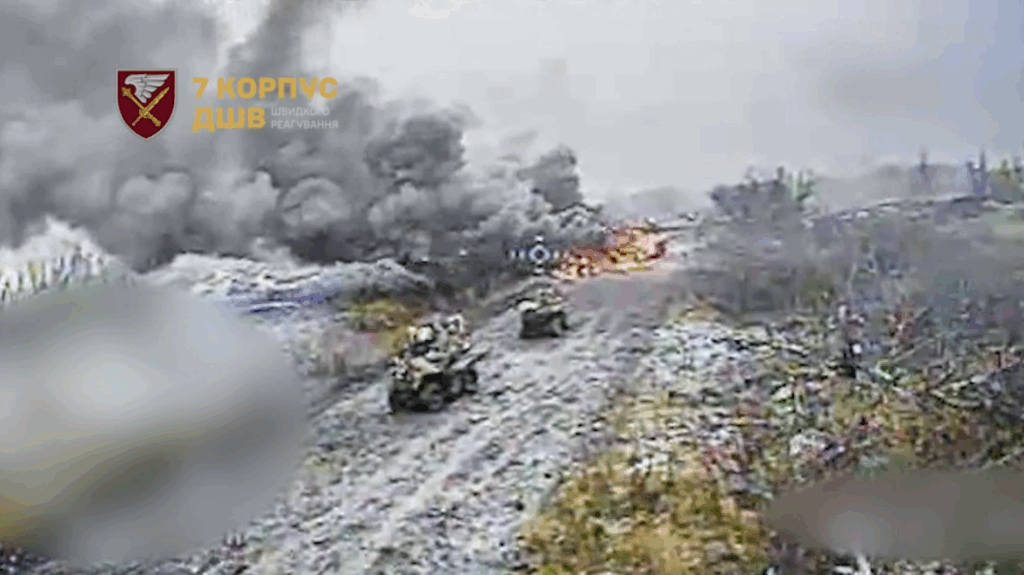
The short video shows movement of Ukrainian tanks during the counteroffensive:

DeepState maps show sharp shift in control

Militarnyi noted that DeepState interactive warzone map, which for months had shown Russian forces pushing up to six kilometers into Kupiansk, now reflects significant Ukrainian gains. The maps updated on 12 December display a sharp change in the city’s status, confirming that Ukrainian forces have reversed the earlier Russian advance. The map now shows three smal isolated Russian-controlled pockets inside the town.

Street fighting continues inside Kupiansk

Although Ukrainian forces have blocked all ground access and hold surrounding territory, fighting continues in central Kupiansk. Khartia reports that several dozen residential buildings in the city’s northern districts have already been cleared of Russian presence. The operation is being conducted with caution, as up to 500 civilians reportedly remain in Kupiansk. Russian troops are attempting to use them as human shields, Khartia adds.

Ukrainian troops destroy Russian battalions, sever supply lines

According to Militarnyi, Ukrainian units crushed several Russian formations during the October–November phase of the operation. These included battalions from the 121st and 122nd Motor Rifle Regiments, the 30th Engineer-Sapper Regiment of the 68th Motor Rifle Division, and the 27th Motor Rifle Brigade. Russian units operated with support from the 7th UAV Regiment and other drone teams, but were ultimately driven back.

Militarnyi confirms that Ukrainian forces blocked all ground routes and forced Russian troops in Kupiansk to rely entirely on aerial drone drops for supplies. The intensity of Russian losses continues to grow as Ukraine holds its positions and repels daily assaults.

Militarnyi also reports that a Recon-Strike Group (RUG), known for its Spanish-speaking fighters, is involved in the battle. The group includes volunteers from Colombia, Peru, Brazil, Zimbabwe, Italy, and Mexico, serving alongside Ukrainians. A recently shared video shows them advancing toward Kupiansk’s center during clearing operations.

This video shows Khartia's RUG fighters, operating in central Kupiansk:

  • ✇Euromaidan Press
  • Ukraine hits two Russian ships linked to Iran arms route in the Caspian Sea, says SOF
    Ukrainian Special Operations Forces says it struck two Russian military-linked ships in the Caspian Sea near Kalmykia, according to Ukraine’s SSO on 12 December 2025. The targeted vessels were reportedly transporting weapons and military equipment and had been previously sanctioned by the US for their role in Russia-Iran arms transfers. Kyiv employs long-range drones and sabotage operations deep inside Russia to disrupt military logistics, transportation networks, fuel infr
     

Ukraine hits two Russian ships linked to Iran arms route in the Caspian Sea, says SOF

12 décembre 2025 à 07:10

ukraine hits two russian ships linked iran arms route caspian sea says sof · post vessels askar sarydzha (top) kompozitor rakhmaninov (bottom) reportedly struck near kalmykia during ukrainian special operation

Ukrainian Special Operations Forces says it struck two Russian military-linked ships in the Caspian Sea near Kalmykia, according to Ukraine’s SSO on 12 December 2025. The targeted vessels were reportedly transporting weapons and military equipment and had been previously sanctioned by the US for their role in Russia-Iran arms transfers.

Kyiv employs long-range drones and sabotage operations deep inside Russia to disrupt military logistics, transportation networks, fuel infrastructure, and strategic assets.

Ukrainian special forces strike two sanctioned Russian ships in Caspian Sea

Ukrainian Special Operations Forces (SSO) said they carried out a joint operation with the insurgent group Chornaya Iskra ("Black Spark”), targeting two Russian vessels close to Russia's Kalmykia coast. The ships were identified as the Kompozitor Rakhmaninov and Askar Sarydzha. Both had been sanctioned by the US for their involvement in transporting military cargo between Iran and Russia. The Caspian Sea is more than 800 km from the frontline in Ukraine.

The military did not specify how the ships were struck, what weapons were used, or the extent of the damage.

According to the SSO, the insurgent group provided precise details about the ships’ routes and their cargo before the operation. SOF says at the unspecified time of the attack, the ships were transporting weapons and military equipment.

The SSO emphasized that it continues to carry out asymmetric actions aimed at disrupting the offensive capacity of the Russian military.

Euromaidan Press was unable to independently verify the strike, the vessels involved, or any resulting damage.

According to tracking data, the Askar Sarydzha was on its way from Iran's Nadar Noshahr to an unknown destination 18 days ago — usually the ship shuttles between Iran and the Astrakhan port in the north of the Caspian Sea. Meanwhile, the Kompozitor Rakhmaninov left Baku, Azerbaijan, days ago.

Iran supplies Russia with long-range drones, which Russia uses in its daily attacks against Ukrainian cities.

Other attacks in the Caspian

A day earlier, Ukrainian media, citing a Security Service source, reported that long-range drones from the SBU's Alpha special operations center struck the Filanovskyi oil production platform, owned by Lukoil-Nizhnevolzhskneft. This marked the first reported Ukrainian strike on a Russian offshore oil field. Previously, Ukrainian attacks on fuel infrastructure had only targeted refineries, pipelines, depots, sea terminals, and, more recently, tankers in the shadow fleet.

Map showing the distance — over 900 kilometers — from Ukraine’s front line to the Filanovsky oil platform in the Caspian Sea. Source: Google Maps

In November 2024, Ukrainian drones struck the Russian Caspian Fleet's base for the first time.

Drones hit deep into Russia again — this time, it’s Yaroslavl’s oil refinery 700 km from Ukraine’s border (VIDEO, MAP)

12 décembre 2025 à 06:26

drones hit deep russia again — time it’s yaroslavl’s oil refinery 700 km ukraine's border · post fire thick smoke rise over slavneft-yanos yaroslavl after drone strike overnight 12 2025

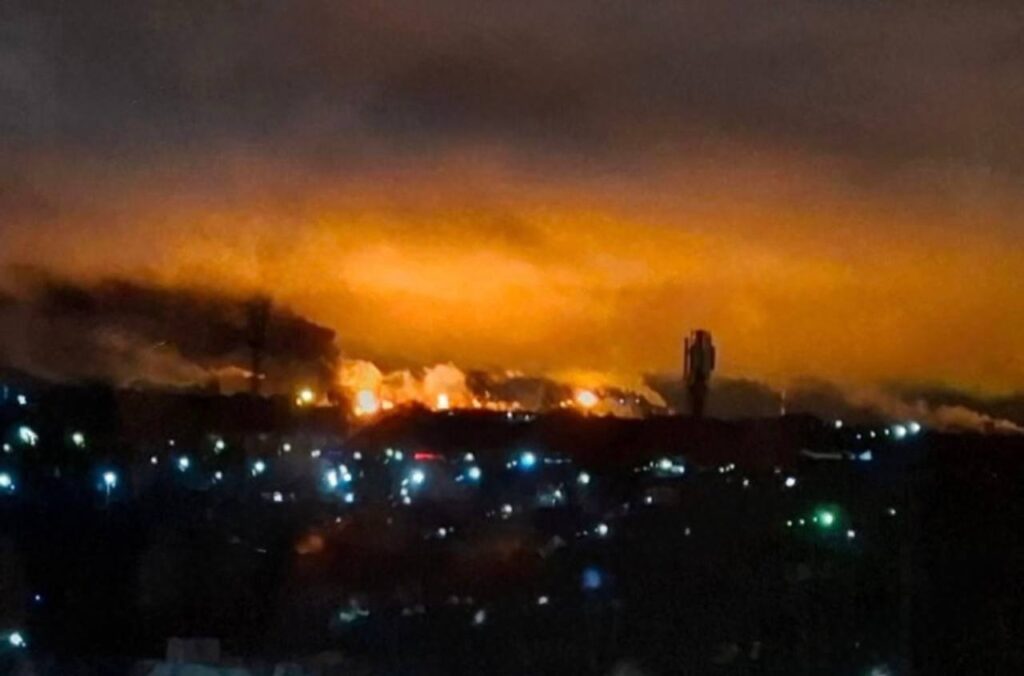
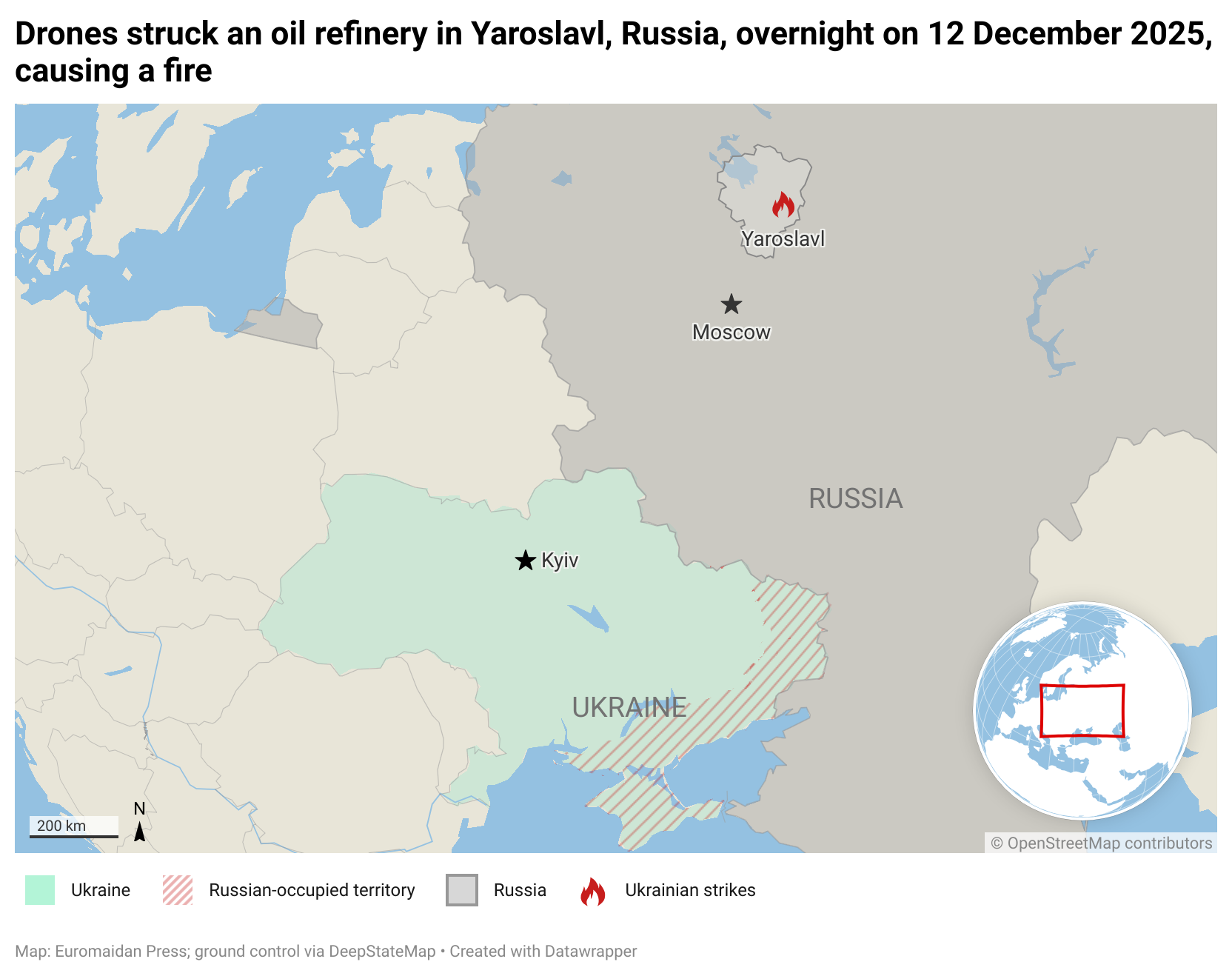
Ukrainian drones struck a major Russian oil refinery in the early hours of 12 December, hitting the Slavneft-YANOS facility in the city of Yaroslavl and igniting a large fire, footage shared by local residents shows. Located more than 700 kilometers from Ukraine’s border, the refinery is one of the largest in Russia by capacity and serves critical industrial and defense sectors.

The strike is part of Ukraine’s long-range campaign aimed at disrupting Russia’s fuel production and export infrastructure to undermine military logistics and reduce revenues used to fund Moscow’s ongoing invasion.

Fire breaks out at one of Russia’s largest oil refineries

The drone attack reportedly targeted the Slavneft-YANOS oil refinery in Yaroslavl, northeast of Moscow, according to Ukrainian Telegram channel Exilenova+. The strike led to a large-scale fire at the site, with local residents reporting a series of explosions just after 3 a.m. According to Russian news Telegram channel Astra, people living near the facility heard five to seven blasts and saw flashes over the city. Many also described hearing an engine noise in the sky shortly before the fire broke out.

Yaroslavl governor Mikhail Yevrayev had declared a drone threat warning in the oblast earlier that night. Social media posts and videos shared shortly after the incident showed a thick column of smoke rising from the refinery grounds.

Last night, drones hit Russia's oil refinery in Yaroslavl, about 250 km northeast from Moscow

The attack caused a large fire at the facility.
📹Exilenova+ pic.twitter.com/0OnnAsRPlT

— Euromaidan Press (@EuromaidanPress) December 12, 2025

This refinery is one of the top five in Russia in terms of primary oil refining capacity and processes up to 15 million tons of crude per year. The Slavneft-YANOS plant produces a broad range of petroleum products, including automobile gasoline, jet fuel, and lubricants.

Later, Exilenova+ reported that the strike likely hit the AVT-4 primary oil distillation unit at the Yaroslavl refinery, noting that a VT-6 vacuum distillation unit at roughly the same location had recently been disabled during a modernization process.

Strategic value of the refinery and its consumers

As noted by Militarnyi, the refinery’s output is critical for Russia’s internal infrastructure. Its products are supplied to major industrial enterprises across the Central and Northwestern oblasts of Russia. Among the known consumers are regional airports, the Northern Railway administration, and defense-related facilities tied to the military-industrial complex.

The Yaroslavl strike marks the second reported attack on this facility in recent months. A similar drone attack reportedly caused a fire at the same refinery on 31 October.

Russia’s Defense Ministry claimed on the morning of 12 December that its air defenses had allegedly shot down 90 drones overnight across Russian regions.

  • ✇Euromaidan Press
  • Ukrainian drones wipe out Russian manpower equivalent to two battalions in 48 hours, commander says
    Ukraine’s Unmanned Systems Forces (SBS) say they destroyed Russian infantry numbers equivalent to two battalions in just two days in Donetsk Oblast The figures were reported by SBS commander Robert “Madyar” Brovdi in public posts on social media. Most of the losses occurred in Donetsk Oblast in eastern Ukraine, where Russian forces have been trying to seize the remaining territory for months. Two days, two battalions’ worth of losses Brovdi reported that SBS drone units str
     

Ukrainian drones wipe out Russian manpower equivalent to two battalions in 48 hours, commander says

12 décembre 2025 à 05:01

ukrainian drones wipe out russian manpower equivalent two battalions 48 hours commander says · post reconnaissance footage shows burning vehicles smoke during failed assault near pokrovsk 10 kolona-mototehniky ukraine’s unmanned

Ukraine’s Unmanned Systems Forces (SBS) say they destroyed Russian infantry numbers equivalent to two battalions in just two days in Donetsk Oblast The figures were reported by SBS commander Robert “Madyar” Brovdi in public posts on social media.

Most of the losses occurred in Donetsk Oblast in eastern Ukraine, where Russian forces have been trying to seize the remaining territory for months.

Two days, two battalions’ worth of losses

Brovdi reported that SBS drone units struck about 505 Russian infantrymen on 11 December alone. Alongside the dedicated drone forces branch, the Ukrainian army and special services have their own drone units. The drone force commander said these losses were inflicted only by external SBS drone pilots and did not include the actions of other Ukrainian Defense Forces units.

He added that the Phoenix unit within the SBS grouping accounted for 109 of those Russian losses during the same day.

A day earlier, on 10 December, Brovdi reported that SBS drones hit another 471 Russian infantrymen. He said this figure also corresponds to the combat strength of a battalion.

Militarnyi notes that combined losses over 10 and 11 December amount to the equivalent of two battalions, based solely on SBS operations.
Map: ISW.

Russian airborne division hit hardest

Russia's 76th Guards Air Assault Division, redeployed in Donetsk Oblast, reportedly suffered the heaviest losses under Ukrainian drone strikes, according to SBS commander Robert “Madyar” Brovdi. Russian forces concentrated in this sector also attempted a mechanized assault near Pokrovsk.

On 10 December, Ukrainian troops repelled a Russian mechanized assault, conducted by the 76th Division. The attack began in the morning, with Russian troops attempting to exploit poor weather conditions to advance toward Pokrovsk. The mechanized columns advanced from the south toward the northern outskirts of the city, where Ukrainian troops were destroyed most of the Russian equipment and troops.

According to Brovdi, SBS data show an average of 282 Russian soldiers hit per day in November, rising to 395 per day during the first 11 days of December. He said the elimination of Russian manpower is now a priority task for Ukraine’s Defense Forces.

  • ✇Euromaidan Press
  • NATO to send Ukraine $5 billion in US weapons by year’s end — focus on air defense
    In the final weeks of 2025, Ukraine is set to receive a large batch of US-supplied weapons worth about $5 billion, according to NATO Deputy Secretary General Radmila Šekerinska in an interview with Ukrainian public broadcaster Suspilne. The shipment, coordinated through NATO’s rapid assistance mechanism known as PURL, will focus heavily on air defense systems, ammunition, and essential spare parts. This comes as Russia continues its ground and air assaults across Ukraine, w
     

NATO to send Ukraine $5 billion in US weapons by year’s end — focus on air defense

12 décembre 2025 à 04:33

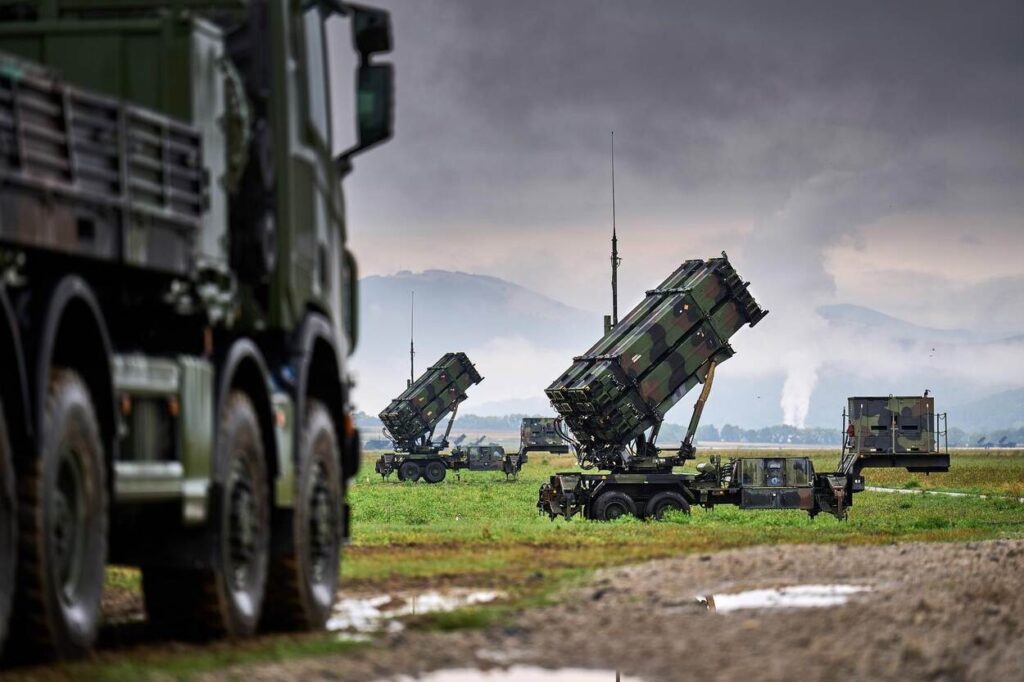
nato send ukraine $5 billion weapons year’s end — focus air defense · post american patriot missile systems patriots final weeks 2025 set receive large batch us-supplied worth about deputy

In the final weeks of 2025, Ukraine is set to receive a large batch of US-supplied weapons worth about $5 billion, according to NATO Deputy Secretary General Radmila Šekerinska in an interview with Ukrainian public broadcaster Suspilne. The shipment, coordinated through NATO’s rapid assistance mechanism known as PURL, will focus heavily on air defense systems, ammunition, and essential spare parts.

This comes as Russia continues its ground and air assaults across Ukraine, while US President Donald Trump pressures Kyiv to accept Russian demands under what he portrays as a peace agreement.

Air defense deliveries to Ukraine seen as ‘difference between life and death’

Suspilne says Šekerinska emphasized that most air defense equipment delivered to Ukraine now comes through the PURL mechanism. She described the deliveries as urgent and life-saving, saying, 

The bulk of air defense equipment arrives in Ukraine via PURL — this is literally the difference between life and death.”

The logistical operations run continuously through hubs in Poland and Romania, enabling round-the-clock movement of military equipment. The funding for the assistance packages comes from NATO’s European allies and Canada. Australia and New Zealand have also joined the initiative.

Ukraine still needs more air defense as NATO ramps up production

Despite the scale of deliveries through PURL, Šekerinska stressed that Ukraine still needs more air defense systems to meet ongoing battlefield demands. She noted that NATO’s defense industry is expanding its production to address the shortfall.

Russia claims it captured Siversk and portrays its victory as inevitable — but ISW says neither is true (MAPS)

12 décembre 2025 à 04:19

russia claims captured siversk portrays its victory inevitable — isw says neither true (maps) · post shows russian advances 41-month campaign seize between 2 2022 11 2025 total assessed advance

Russian forces have not fully seized Siversk in Donetsk Oblast despite Kremlin claims, and the frontlines in Ukraine are not collapsing, according to the Institute for the Study of War (ISW). In reality, Russia is "only making tactical gains across most of the theater," the think tank says.

This comes as Moscow has spent years trying to seize the rest of Donetsk Oblast in eastern Ukraine. While its forces continue to inch forward, they achieve only minor gains at the cost of extremely heavy losses.

Kremlin escalates disinformation over Siversk

In a report dated 11 December, ISW rejected Russia’s announcement that it had taken control of Siversk, calling it part of a wider “cognitive warfare effort” by the Kremlin.

 “The Kremlin claimed that Russian forces seized Siversk [...] and Russian battlefield victory as inevitable. Neither is true,” ISW wrote, adding that the fall of Siversk remained unconfirmed.

The claim came during a virtual meeting on 11 December between Russian President Vladimir Putin and his military commanders. Lieutenant General Sergei Medvedev, commander of the Russian Southern Grouping of Forces, told Putin that elements of the Russian 3rd Combined Arms Army had seized the town. However, ISW noted that only geolocated footage showed that Russian troops likely entered eastern Siversk, while control of western parts remained unverified.

russia claims captured siversk portrays its victory inevitable — isw says neither true (maps) · post shows assessed control terrain direction 11 2025 siversk-direction-december-11-20 russian forces have fully seized donetsk
Map shows assessed control of terrain in the Siversk direction as of 11 December 2025. Map: ISW

Ukrainian 11th Army Corps spokesperson Lieutenant Colonel Dmytro Zaporozhets dismissed the Russian statement outright, saying that “fighting continues throughout Siversk.” He said Russian troops were exploiting poor weather conditions to infiltrate and falsely claim territorial control. A Ukrainian brigade operating in the area said Russian soldiers used small-unit tactics to sneak into parts of the town, raise flags, and promote the illusion of control.

ISW said these actions were part of Russia’s campaign “to portray them as a sweeping, broad-front advance.”

Some Russian milbloggers also contradicted the Kremlin narrative, writing that Ukrainian forces remained in the town and that Russian control was not complete.

Sloviansk not under threat, despite Russia's claims

Russia is using its claimed capture of Siversk to suggest a looming offensive on Sloviansk in Donetsk Oblast. However, ISW said this projection is misleading and premature. According to Medvedev, taking Siversk supposedly opens the way for an attack on Sloviansk, which sits at the northern end of Ukraine’s so-called Fortress Belt. But ISW wrote that “Russian forces are at least several months away from being able to begin an offensive” there.

ISW emphasized that Russia would have to first fully seize Lyman and either cross the Siverskyi Donets River or advance more than 30 kilometers from Siversk. The advance on Siversk itself has taken Russian forces 41 months and stretches back to their gains in Lysychansk in July 2022. Sloviansk, a larger city, would require several more months of fighting, even if Russia reaches its outskirts.

Russian advances limited and slow

ISW noted:

"Russian forces are only making tactical gains across most of the theater."

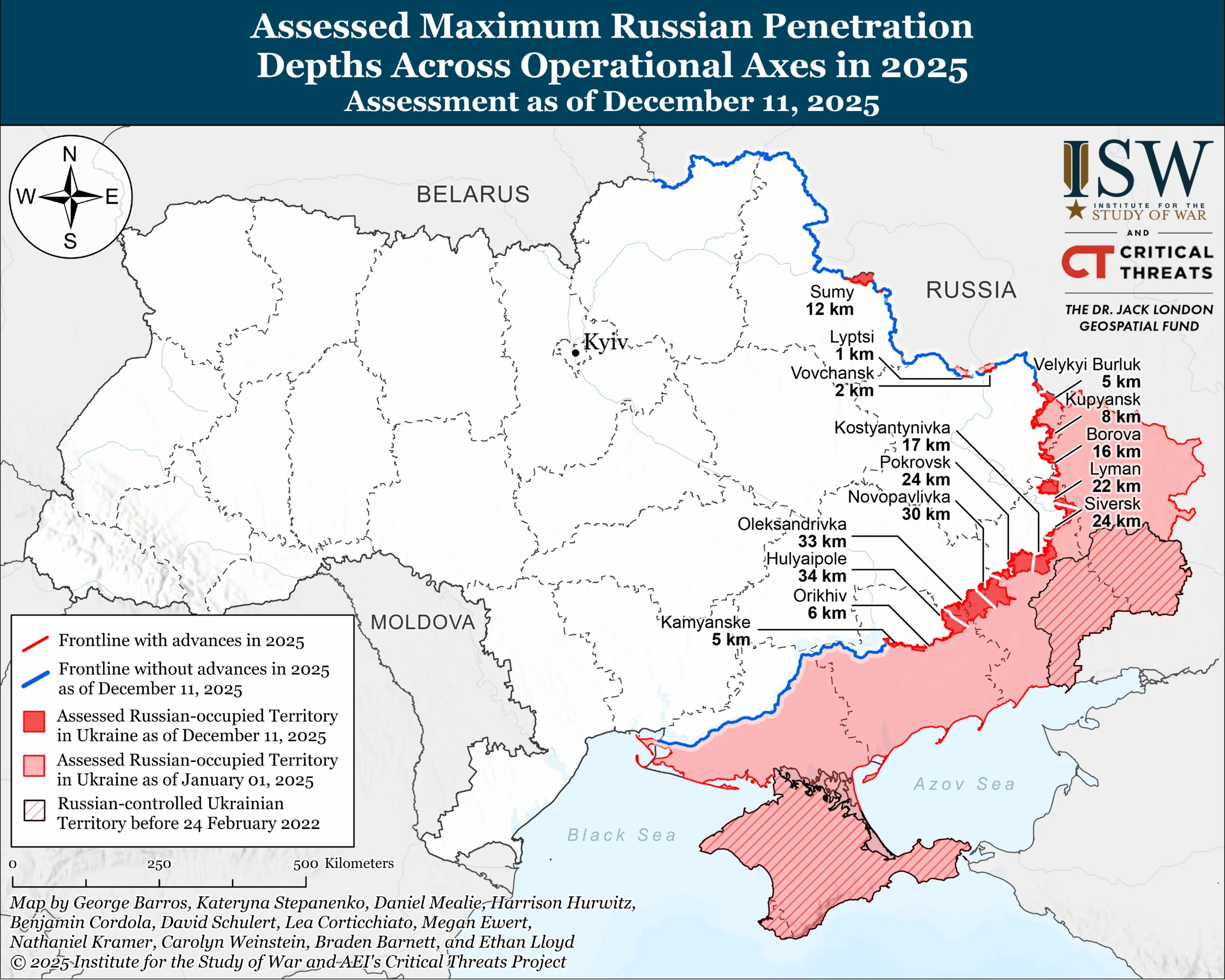
According to the think tank, most Russian advances in 2025 have occurred in just six of the 16 operational directions it tracks. Out of the 4,652.2 square kilometers gained by Russia this year, nearly 80% were in the Lyman, Kostiantynivka, Pokrovsk, Novopavlivka, Oleksandrivka, and Huliaipole directions.

russia claims captured siversk portrays its victory inevitable — isw says neither true (maps) · post shows assessed maximum russian penetration depths across operational axes 2025 11 deepest gains reached
Map shows assessed maximum Russian penetration depths across operational axes in 2025 as of 11 December. The deepest gains reached up to 34 kilometers near Huliaipole. Map: ISW

In contrast, Russian forces made no significant gains in Sumy or northern Kharkiv oblasts, despite repeated claims of progress and a supposed push to create “buffer zones.” Russia’s efforts in Kherson have also stalled since its 2022 withdrawal from the west bank of the Dnipro River.

Russia’s most substantial gains, ISW said, came in areas where it deployed massive force concentrations — sometimes over two combined arms armies. Even there, the pace of advance remained slow. 

“Even the most extensive Russian advances are constrained to foot pace,” ISW wrote.

russia claims captured siversk portrays its victory inevitable — isw says neither true (maps) · post heat shows areas where ukrainian general staff reported russian assaults 4 11 2025 heat-map-of-fighting-cirlces-as
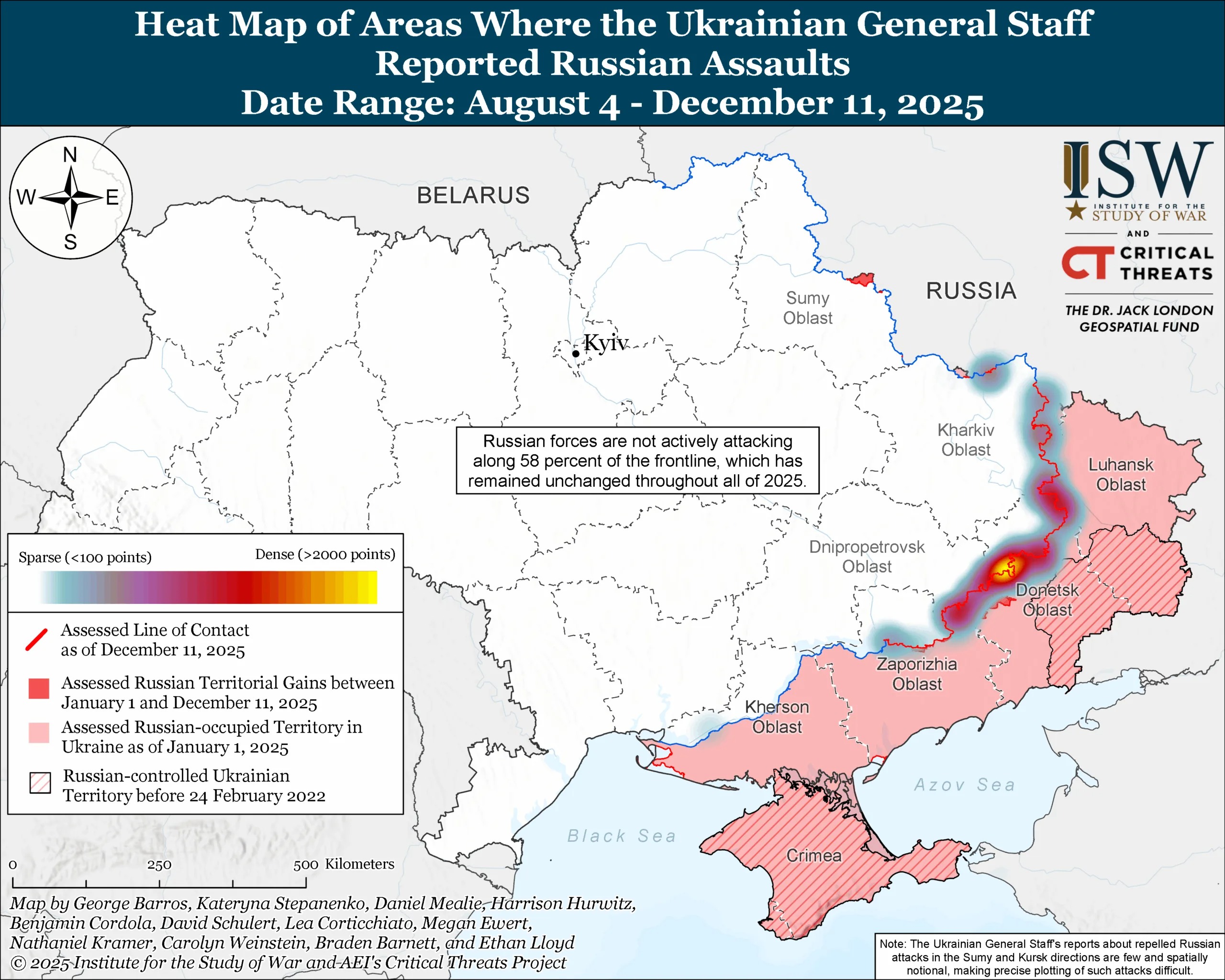
Heat map shows areas where the Ukrainian General Staff reported Russian assaults from 4 August to 11 December 2025. Map: ISW.

Putin’s meetings aim to sell a collapsing frontline

Putin’s latest meeting follows a series of similar sessions in recent weeks where top officials exaggerated military achievements. These include claims of progress near Vovchansk, Kupiansk, Pokrovsk, and Hulyaipole. ISW noted that Russian ultranationalist milbloggers have challenged many of these assertions.

"The Kremlin continues to engage in a systematic cognitive warfare effort to aggrandize Russian advances through exaggerated claims of gains and flag raising infiltration missions in an attempt to portray them as a sweeping, broad-front advance to falsely portray the frontline as collapsing across the theater, contrary to all available evidence," ISW wrote.

  • ✇Euromaidan Press
  • How Norway became a test target for Russia’s Arctic hybrid war
    Russia has stepped up hybrid threat activities in the Norwegian archipelago of Svalbard as part of a long-running campaign to undermine Norway’s sovereignty and test Western unity, according to the European Centre of Excellence for Countering Hybrid Threats (Hybrid CoE). Since 2014—the year when Moscow started its initial invasion of Ukraine—Russia has used a consistent strategy of grey-zone provocations, symbolic gestures, and legal ambiguity in the Arctic region to challe
     

How Norway became a test target for Russia’s Arctic hybrid war

11 décembre 2025 à 15:46

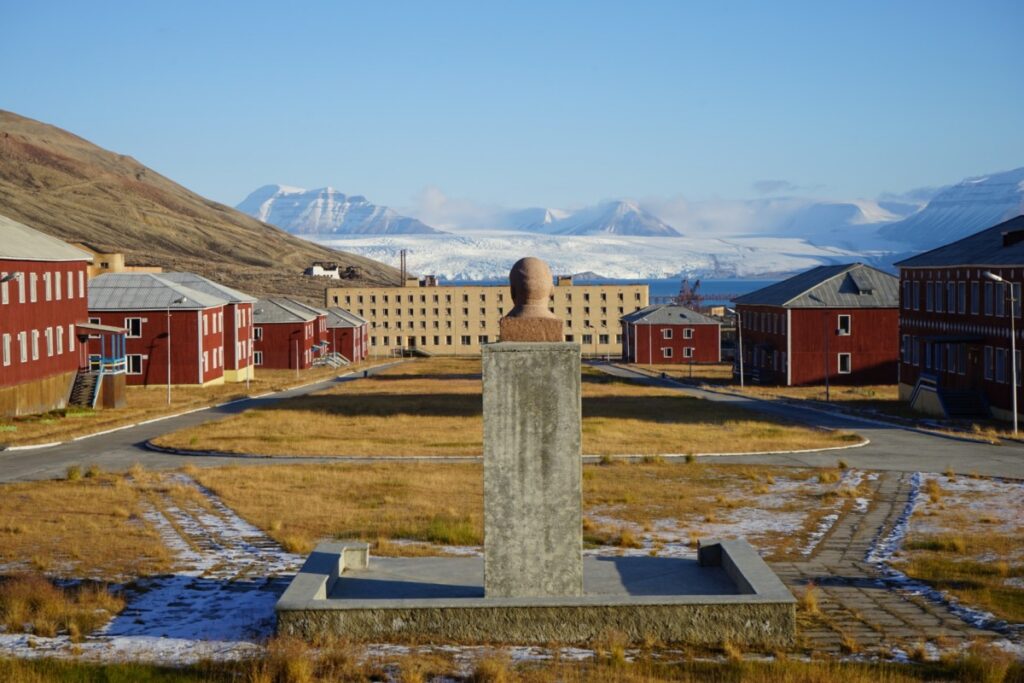
how norway became test target russia’s arctic hybrid war · post pyramiden abandoned soviet coal mining settlement norwegian archipelago svalbard now tourist destination which has become thomas nilsen barents observer

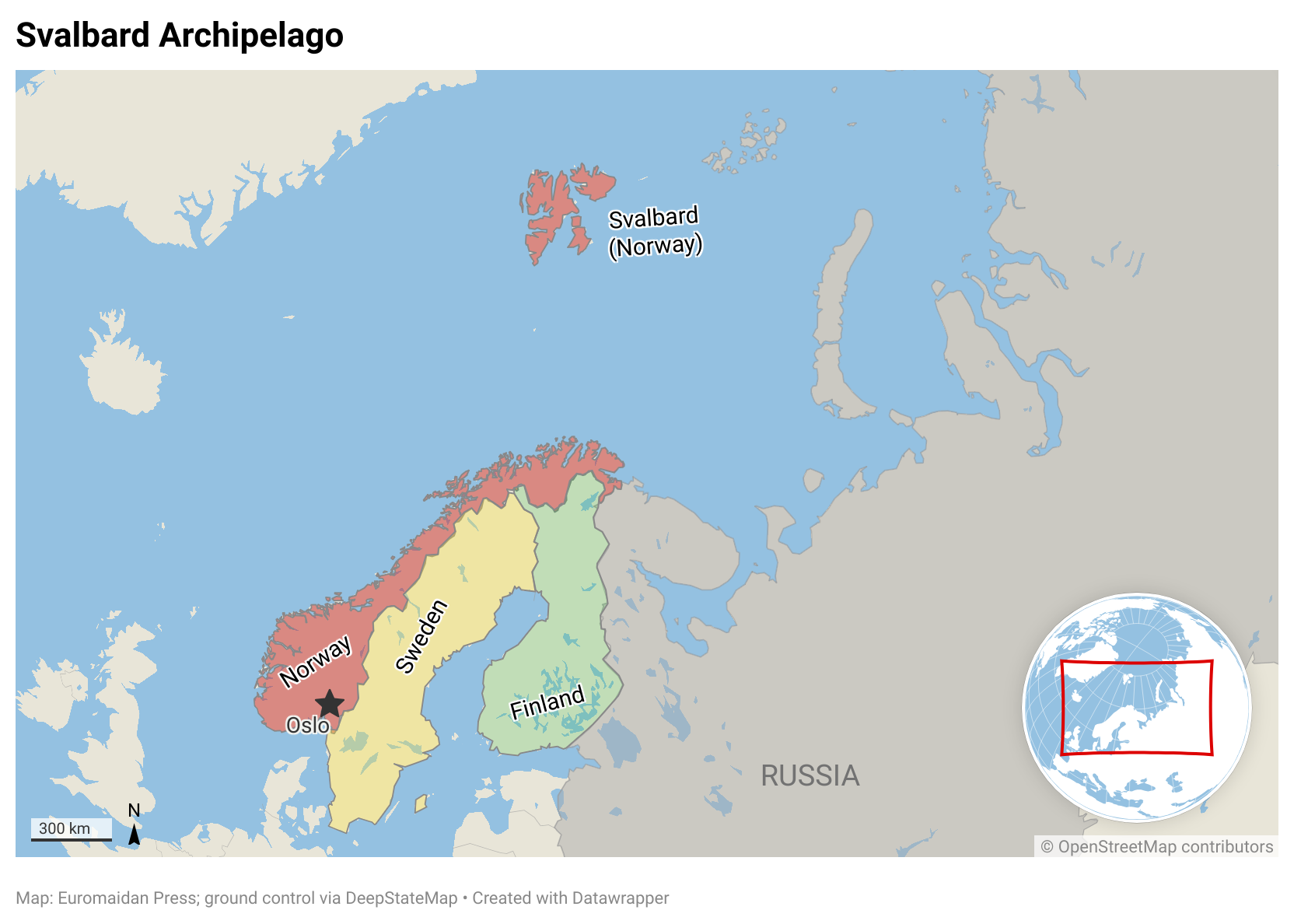
Russia has stepped up hybrid threat activities in the Norwegian archipelago of Svalbard as part of a long-running campaign to undermine Norway’s sovereignty and test Western unity, according to the European Centre of Excellence for Countering Hybrid Threats (Hybrid CoE). Since 2014—the year when Moscow started its initial invasion of Ukraine—Russia has used a consistent strategy of grey-zone provocations, symbolic gestures, and legal ambiguity in the Arctic region to challenge Norway’s authority on Svalbard while avoiding open military conflict, the Hybrid CoE paper states.

Lately, Russia has been escalating hybrid operations—sabotage, espionage, cyberattacks, and agent recruitment—across Europe to weaken support for Ukraine during Moscow’s ongoing invasion of the country. European agencies report arrests of operatives, expanded use of low-level proxies, and increased pressure on military and infrastructure targets.

Moscow’s long game to destabilize Svalbard

The Hybrid CoE paper outlines  how Moscow uses historical narratives, religious symbolism, and surprise visits to build domestic support and provoke responses from Norway. These acts are designed to create "ambiguity and strategic paralysis" and put pressure on Norway to deviate from Western sanctions, which the paper warns could threaten broader European security.

The authors trace this approach back to the Second World War, arguing that Moscow has sought to assert “special rights” on the archipelago by bi-lateralizing issues and exploiting the Svalbard Treaty’s provisions.

Russian actions on Svalbard include information campaigns targeting both Russian and Norwegian audiences, accusations of treaty violations by Oslo, and attempts to portray Norway as hostile to Russian interests. 

Hybrid threats aim to undermine government authority and limit the room for decision making,” the report reads.

Defence ministers of the Nordic-Baltic 8 countries at a meeting in Helsinki, 13 November 2025.
Explore further

“Ukraine’s security is directly connected to ours” – 8 Nordic-Baltic countries pool $500M weapons package

Provocations below the conflict threshold

One high-profile incident was the April 2015 surprise visit of then Deputy Prime Minister Dmitry Rogozin, who was under Schengen sanctions at the time. Russia invoked the Svalbard Treaty to justify his entry, portraying Norway’s protest as a discriminatory treaty violation. Shortly after, Rogozin was filmed at a Russian Arctic camp near the North Pole alongside a polar explorer and a Russian Orthodox bishop. Moscow later used the controversy to retaliate by denying visas to Norwegian lawmakers.

In 2016, Chechen paramilitary forces and FSB personnel unexpectedly landed at Longyearbyen Airport on their way to Barneo Camp. Although the visit followed formal rules, its opaque nature raised alarms in Norway. That same year, Norway tightened regulations for passenger declarations and cargo, prompting Russian criticism and accusations of obstruction.

In 2017, Norway’s invitation to NATO’s Parliamentary Assembly members sparked another Russian backlash. The Kremlin falsely claimed the visit was a military act and used pro-government media to question Norway’s sovereignty, claiming alleged historical Russian rights to the archipelago.

Hybrid threats at sea and on land

Russia’s campaigns intensified in 2020 during the centenary of the Svalbard Treaty. Foreign Minister Sergey Lavrov demanded bilateral consultations and claimed Russian activities were being unfairly restricted. Officials referred to old maps labeling the area as “Holy Russian Islands” and claimed that “Spitsbergen (an obsolete name for Svalbard used in Russian) is also our land.

Russia also escalated legal pressure over the surrounding maritime zones. Moscow repeatedly disputed Norway’s exclusive rights in the Fisheries Protection Zone and continental shelf around Svalbard. When the Norwegian Coast Guard detained a Russian trawler in 2020, Moscow issued a formal note warning it was “ready to use national powers to defend its rights.

phase 0 begins isw says russia laying psychological groundwork future nato war ukrainian navy's chernihiv cherkasy minehunters uk defense journal ukrships russia’s foreign intelligence service (svr) 6 claimed united kingdom
Explore further

Phase 0 begins: ISW says Russia is laying psychological groundwork for a future NATO war

The Hybrid CoE paper details how Russian naval exercises have come closer to Svalbard. In 2021, a Northern Fleet group made an unusual move west of the archipelago during a tactical mission, a maneuver seen as coercive signaling without open conflict.

A suspected sabotage case emerged in 2022 when one of the undersea fiber-optic cables connecting Svalbard to mainland Norway was severed. While Russian fishing vessels were seen in the area, Norwegian police could not conclusively prove responsibility. The incident remains unresolved but fits the pattern of implausible deniability described in the report.

The paper also highlights how Russian fishing and research vessels have been used as tools of influence, exploiting international maritime law to maintain access while potentially conducting intelligence gathering. In response, Norway introduced restrictions and revoked access for certain Russian firms, which was met with further diplomatic threats.

Symbolism and propaganda on the archipelago

Recent years have seen an uptick in public displays of Russian historical and military symbolism in Barentsburg and Pyramiden, the Svalbard towns. Since 2022, Russia has staged events like the so-called Immortal Regiment marches and Victory Day parades in Svalbard, displaying flags from occupied territories in Ukraine and promoting narratives justifying Moscow's all-out war in Ukraine.

Russia's so‑called Immortal Regiment march in Barentsburg on Norway’s Svalbard on 9 May 2022. Photo via mail.polk.press

These events were organized after the appointments of Consul General Andrey Chemerilo, linked to Russian military intelligence, and Ildar Neverov, the CEO of Arktikugol, the state-owned mining company in Barentsburg. The paper notes that Arktikugol, a Russian coal mining unitary enterprise, has been placed under the Ministry for the Development of the Far East and Arctic, increasing its strategic alignment with the Kremlin.

In 2022 and 2023, Russian Navy Day was marked with small flotillas led by the Consul General, reinforcing Russia’s symbolic naval presence in Svalbard. These symbolic acts, the report warns, carry a coercive potential that could be used in future confrontations.

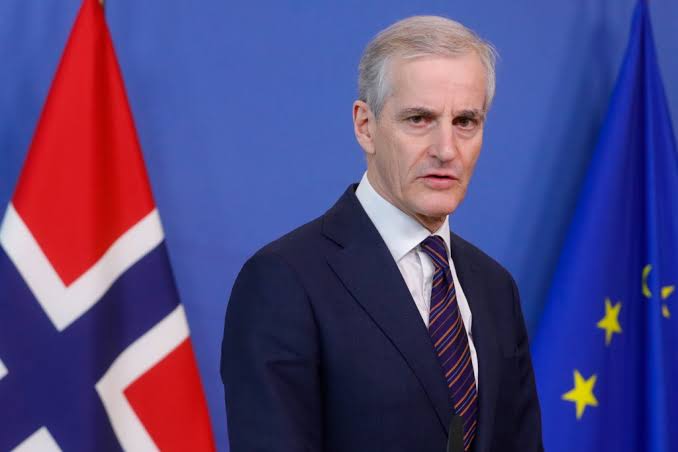
Jonas Gahr Støre.
Explore further

Norway reports first Russian airspace violations in 10 years

Testing limits with "covert lawfare" and cyberattacks

The paper also describes attempts to challenge Norway in court. One case involved a Latvian-registered company with Russian ties seeking to overturn Norway’s refusal to grant snow crab fishing rights off Svalbard. Norway’s Supreme Court ruled in favor of the state in 2023, but the case raised concerns over covert Russian lawfare strategies.

In 2022, an information campaign accused Norway of blockading Russian settlements by enforcing EU transport sanctions. Despite Oslo offering alternative routes, Russian officials ramped up threats to cancel the Barents Sea border agreement. Around the same time, pro-Kremlin hacker group Killnet launched a cyberattack on Norwegian websites.

The Hybrid CoE concludes that Russia’s activities on Svalbard are part of a broader Arctic militarization strategy, aimed at projecting power and controlling key maritime areas. 

What the paper recommends

The Hybrid CoE paper recommends a twofold strategy for Norway: deter Russian hybrid threats while building long‑term resilience. It calls for investment in enhanced institutional defenses, including stronger oversight systems and clearer legal and administrative frameworks. 

It also urges public awareness campaigns to help citizens understand hybrid tactics and resist manipulation. The authors stress the need for strengthened international cooperation, especially with like‑minded states, to ensure consistent support for Norway’s governance of Svalbard. Finally, the paper highlights the importance of independent editorial‑led media to counter information manipulation, reduce the spread of propaganda, and reinforce democratic resilience.

  • ✇Euromaidan Press
  • Lawsuits say Intel and AMD turned blind eye to Russia’s missile use of their chips
    A series of lawsuits filed in Texas accuse major US chipmakers of enabling Russian and Iranian missile and drone strikes that killed Ukrainian civilians between 2023 and 2025, according to Bloomberg. The cases name Intel, AMD, Texas Instruments, and Mouser Electronics, a distributor owned by Warren Buffett’s Berkshire Hathaway, as defendants. As Moscow's invasion of Ukraine continues, Russian forces target Ukrainian cities with drones and missiles every day. The Russian att
     

Lawsuits say Intel and AMD turned blind eye to Russia’s missile use of their chips

11 décembre 2025 à 09:33

lawsuits say intel amd turned blind eye russia’s missile use chips · post transporter-loader vehicle 9t250 russia's iskander system militarnyi combatlaunching2018-10-1024x683 ukraine news ukrainian reports

A series of lawsuits filed in Texas accuse major US chipmakers of enabling Russian and Iranian missile and drone strikes that killed Ukrainian civilians between 2023 and 2025, according to Bloomberg. The cases name Intel, AMD, Texas Instruments, and Mouser Electronics, a distributor owned by Warren Buffett’s Berkshire Hathaway, as defendants.

As Moscow's invasion of Ukraine continues, Russian forces target Ukrainian cities with drones and missiles every day. The Russian attacks against Ukraine referenced in the suits killed dozens of people across five separate incidents. In one case, Iranian-made drones containing components linked to Intel and AMD were used. In others, Russian-made cruise and ballistic missiles were reportedly involved.

US tech firms accused of aiding deadly missile strikes in Ukraine

Bloomberg reports that several lawsuits filed on behalf of Ukrainian civilians allege that semiconductor manufacturers Intel Corp., Advanced Micro Devices Inc. (AMD), and Texas Instruments Inc. failed to prevent their products from being illegally diverted to Russia and Iran. According to the plaintiffs, those components were used in weapons deployed against civilians, including Iskander ballistic missiles, Kh-101 cruise missiles, and Iranian-made drones.

The suits were filed in the Circuit Court for the State of Texas in Dallas, and brought by US mass tort lawyer Mikal Watts and the law firm Baker & Hostetler, which has more than 1,000 lawyers across the US. One suit accuses the companies of “domestic corporate negligence” over their export control and diversion-prevention systems.

These companies know their chip technology is making its way into Russia,” Watts said at a press conference in Washington, calling the US chip makers "merchants of death" and accusing them of making a “farce” of US sanctions law.

lawsuits say intel amd turned blind eye russia’s missile use chips · post transporter-loader vehicle 9t250 russia's iskander system militarnyi combatlaunching2018-10-1024x683 ukraine news ukrainian reports

Lawsuits say Intel and AMD turned blind eye to Russia’s missile use of their chips

The lawsuits also name Mouser Electronics, a Texas-based chip distributor acquired by Berkshire Hathaway in 2007, accusing it of facilitating chip transfers to shell companies controlled by Russian proxies. One suit said Mouser’s logistics operations and decisions were a “substantial domestic component of the misconduct that foreseeably contributed to Plaintiffs’ injuries abroad.”

Companies say they follow sanctions

Intel denied wrongdoing in a statement, saying it “does not conduct business in Russia” and halted shipments to Russia and Belarus after the full-scale war began. The company said it operates “in strict accordance with export laws, sanctions and regulations” and holds suppliers, customers, and distributors to those standards.

Texas Instruments and AMD did not immediately respond to Bloomberg’s requests for comment. Both have previously said they ceased Russian operations and comply with all relevant laws. 

Sanctions under scrutiny as chips keep showing up in Russian weapons

A 2024 Bloomberg investigation found that export controls and sanctions failed to prevent semiconductors from reaching Russian defense contractors. The chips served as the “brains” for drones, glide bombs, communication systems, and Iskander missiles.

  • ✇Euromaidan Press
  • Russia escalates spying on German army over Ukraine support, Berlin’s counterintelligence report finds
    Germany’s military faces mounting pressure from Russian intelligence services, which have intensified their efforts in response to Berlin’s continued support for Ukraine, according to the German Military Counterintelligence Service (Militärischer Abschirmdienst, MAD). This comes as Russia continues its invasion of Ukraine. Beyond its full-scale war, Russia also targets Ukraine’s allies with hybrid operations — including sabotage, espionage, and propaganda — aimed at weakeni
     

Russia escalates spying on German army over Ukraine support, Berlin’s counterintelligence report finds

11 décembre 2025 à 09:07

russia escalates spying german army over ukraine support counterintelligence report finds · post mad people photographing bundeswehr soldiers news ukrainian reports

Germany’s military faces mounting pressure from Russian intelligence services, which have intensified their efforts in response to Berlin’s continued support for Ukraine, according to the German Military Counterintelligence Service (Militärischer Abschirmdienst, MAD).

This comes as Russia continues its invasion of Ukraine. Beyond its full-scale war, Russia also targets Ukraine’s allies with hybrid operations — including sabotage, espionage, and propaganda — aimed at weakening their support for Kyiv. Some of these efforts have paid off: Slovakia elected a pro-Russian prime minister in 2023 who cut aid to Ukraine. In the US, President Donald Trump ended US assistance, switching to selling weapons after assuming office this January. Germany’s pro-Russian AfD party surged to second place, while Poland and Czechia saw electoral outcomes that brought less pro-Ukrainian leadership to power.

Russia escalates covert operations against German army

The MAD’s 2024 annual report, released on 9 December 2025, warns that the Bundeswehr—the German Army—has become a declared reconnaissance target of foreign intelligence services — with Russia identified as a key threat. As Germany continues to arm, train, and support Ukraine, Russian agencies have increasingly focused on obtaining information about the Bundeswehr’s troop strength, weapons systems, command structures, and stationing decisions.

merz says dictated peace—germany stand ukraine german chancellor friedrich addressing bundestag 14 2025 addressed first time euronews reports emphasized need full western unity thanked president donald trump backing 30-day ceasefire
Explore further

With Ukraine’s reserves running low, Merz presses Belgium to unlock €165 billion loan

The report highlights a surge in attempts to obtain classified military information, including direct outreach to Bundeswehr personnel. Russian operatives have used drones to fly over military sites and have allegedly committed acts of sabotage, including multiple incidents involving naval vessels and suspected tampering with drinking water infrastructure.

The report cites the March 2024 leak of a phone call between German Air Force officers by Russian media as a notable case. MAD cites this episode as an example of Moscow’s broader hybrid campaign aimed at undermining Germany’s credibility and exposing sensitive military communications.

Disinformation and sabotage as tools of espionage

The MAD report also details ongoing disinformation efforts and influence operations targeting Germany’s internal and external security policy. These include attempts to erode public trust in German security institutions and to destabilize public perception through coordinated narratives and information warfare.

According to the report, espionage against the Bundeswehr is no longer limited to traditional intelligence collection. It increasingly involves cyber threats, electromagnetic spectrum exploitation, and AI-driven surveillance technologies. Russia’s interest extends beyond battlefield-related intelligence to areas like logistics, operational readiness, and Germany’s evolving NATO posture.

1time-us-army-garrison-hohenfels-bg.jpeg
Explore further

October sees record drone activity over German military sites — Reuters

The deployment of a German brigade to Lithuania, as part of NATO’s eastern defense commitments, has further heightened Russia’s espionage focus. MAD warns that this stationing has made the Bundeswehr a direct surveillance target.

Expanded countermeasures

In response to these threats, MAD conducted over 60,000 personnel security checks in 2024, covering new recruits as well as long-serving military staff. These measures are designed to ensure individual reliability and prevent internal vulnerabilities. Each case, the report emphasizes, represents a decision about whether a person can be trusted with security-sensitive duties.

Despite criticism over the duration of these checks, MAD stresses that thoroughness is critical given the rising level of threat. The agency also notes that ongoing improvements in staffing, legal powers, and funding are essential to maintain effective counterintelligence operations.

German army Leopard 2 main battle tanks at Rose Barracks, Vilseck, Germany, 29 January 2019.
Explore further

Germany has a 1,200-page plan if Russia attacks. Recent drills show it may not work.

MAD President Martina Rosenberg urged vigilance, stating that the best protection against espionage is to take the threat seriously, remain alert to signs of infiltration, and report them promptly to authorities.

Broader context and structural reforms

The report links the current surge in espionage to broader geopolitical changes since Russia’s February 2022 war of aggression against Ukraine. It underscores that hybrid warfare — combining digital manipulation, sabotage, and covert operations — has become a defining threat model.

MAD has launched an internal restructuring process aimed at adapting to this reality. The reforms are intended to enhance strategic flexibility and ensure the agency can fulfill its legal mandate both in peacetime and under crisis conditions, without needing continual structural overhauls.

  • ✇Euromaidan Press
  • Russia eyes Moldova’s Transnistria as new threat axis toward Odesa, says Ukrainian intelligence
    As Moscow's invasion of Ukraine continues, Russia is escalating its covert operations in Moldova’s Russian-backed enclave of Transnistria, raising fresh concerns about a hybrid threat to Ukraine’s southern defenses, according to Suspilne. Ukrainian intelligence believes the Kremlin aims to force Kyiv to divert military resources away from frontline fighting by stirring unrest and opening a potential secondary front near Odesa. Kremlin increases military footprint in Transni
     

Russia eyes Moldova’s Transnistria as new threat axis toward Odesa, says Ukrainian intelligence

11 décembre 2025 à 07:57

russia eyes moldova's transnistria new threat axis toward odesa says ukrainian intelligence · post t8zay-russian-controlled-transnistria-in-moldova-and-the-ukrainian-regions-bordering-it- ukraine news reports

As Moscow's invasion of Ukraine continues, Russia is escalating its covert operations in Moldova’s Russian-backed enclave of Transnistria, raising fresh concerns about a hybrid threat to Ukraine’s southern defenses, according to Suspilne. Ukrainian intelligence believes the Kremlin aims to force Kyiv to divert military resources away from frontline fighting by stirring unrest and opening a potential secondary front near Odesa.

Kremlin increases military footprint in Transnistria

Sources in Ukraine’s Main Intelligence Directorate (HUR) told Suspilne that Moscow has urgently activated military activity in the Russian-controlled Transnistrian region of Moldova, bordering Ukraine's southwest. Reservists are being called up into the unrecognized local armed formations, and weapons are being pulled out of storage. The enclave has also launched drone production and opened centers to train drone operators.

Suspilne’s source said the Kremlin is working to strengthen its presence in Transnistria as part of efforts to destabilize Moldova and create pressure on Ukraine’s southern border. The heightened activity increases the risk of Russian sabotage and reconnaissance groups infiltrating from Transnistria into Ukraine.

The Institute for the Study of War (ISW) noted that Odesa Oblast borders Russian-occupied Transnistria to the west, with Tiraspol—Transnistria’s capital—just about 80 kilometers from Odesa City. Russian mid-range drones stationed in the region would be capable of reaching Odesa and targeting other deep areas inside Ukraine. Russian forces have already demonstrated their ability to conduct operational-depth drone strikes across the theater, ranging from 25 to 100 kilometers.

Russian agents deployed to sow chaos and disruption

According to HUR, Russia is deploying intelligence operatives to Transnistria with instructions to amplify instability. These agents are tasked with spreading disinformation, staging provocations, and conducting sabotage operations. Ukrainian intelligence officials described the moves as part of a wider hybrid operation linked to the upcoming so-called presidential election in Transnistria, set for 2026.

Suspilne’s source emphasized that the Kremlin’s intensified focus on Transnistria signals the launch of a new asymmetric campaign. This operation seeks to generate chaos in Moldova while pressuring Ukraine to reallocate defensive efforts toward its southwestern borders. The same source said the Kremlin wants to quietly expand its military contingent in Transnistria so that, when the moment suits Moscow, the amassed forces and resources will be ready for military escalation.

ISW assessed that the Kremlin is setting conditions for potential future attempts to seize Odesa and Mykolaiv oblasts. While large-scale offensives remain unlikely in the short term, Russia is expected to rely on asymmetric actions, such as limited infiltration and drone strikes, to advance its goals.
  • ✇Euromaidan Press
  • Finland makes drone training compulsory for all new soldiers
    Finland is overhauling its military training programs as drones reshape the nature of warfare, according to YLE. Starting in 2025, every Finnish conscript will be required to undergo drone warfare training — a move driven by lessons drawn from Ukraine’s battlefield experience. This comes as the ongoing Russo-Ukrainian war has redefined ground combat: massive armored and infantry assaults have become nearly impossible due to the widespread use of small drones, which swiftly
     

Finland makes drone training compulsory for all new soldiers

11 décembre 2025 à 07:26

finland makes drone training compulsory all new soldiers · post finnish army staff member trains operate using fpv goggles remote controller niinisalo garrison center pilot esa syväkuru yle ukraine news

Finland is overhauling its military training programs as drones reshape the nature of warfare, according to YLE. Starting in 2025, every Finnish conscript will be required to undergo drone warfare training — a move driven by lessons drawn from Ukraine’s battlefield experience.

This comes as the ongoing Russo-Ukrainian war has redefined ground combat: massive armored and infantry assaults have become nearly impossible due to the widespread use of small drones, which swiftly destroy attacking forces and harass supply lines. As the battlefield becomes increasingly "transparent" under constant aerial surveillance, troops must adapt camouflage and concealment methods accordingly.

Mandatory drone skills for all conscripts

The Finnish Defense Forces have now made drone operations a standard part of conscript preparation, YLE says. The Finnish Army is introducing drone detection and neutralization systems in all units, with training becoming standard for conscripts. A pilot program already took place at the Niinisalo garrison in Satakunta, involving both professional and conscripted personnel. The first group to complete the new drone-focused training is set to end their service on 18 December.

"We understand why we’re doing this and we’re acting in time. Equipment procurement has already begun," said Commander of the Finnish Army Pasi Välimäki.

Troops begin with miniature drones, which require more precision than larger battlefield models. Initial training occurs indoors, gradually progressing to larger UAVs and FPV (first-person view) systems. Soldiers learn piloting, target dropping, enemy drone interception, and technical maintenance. Skill acquisition is tested throughout, adjusted for each recruit’s starting level.

Realistic warzone simulations

To prepare soldiers for the modern battlefield, the army has built three kilometers of trenches and firing positions in Hämeenkangas, also at Niinisalo. More drone warfare training grounds are planned for spring in Huovinrinne near Säkylä. On 9 December, conscripts conducted drills at the Hämeenkangas range, attempting to evade drones using smoke screens before retreating to dugouts.

FPV drone operators also practice deploying munitions and intercepting enemy UAVs. Maintenance and repair of unmanned systems is included in the curriculum, highlighting the multifaceted role drones now play in combat.

Finnish conditions pose unique challenges

While inspired by Ukraine’s drone warfare, Finnish commanders stress the need to adapt techniques and equipment to the local conditions. Systems that perform well in warmer regions are now tested under harsh Finnish weather. Both small and large drones face problems like rotor freezing and reduced visibility due to snow or fog.

Technology is evolving so rapidly that the military avoids locking in specific drone models.

If we had bought Bayraktars, they’d just be lying unused in hangars,” Välimäki noted, referring to the Turkish drones popular early in the Russia-Ukraine war, but later becoming easy targets for Russia's air defenses.

No separate drone corps planned

Rather than establishing standalone drone units, Finland’s military doctrine integrates UAV operations into every branch. Virtual goggles and remote controllers now hold the same status as rifles and tactical gear — signaling a shift in what it means to be combat-ready.

  • ✇Euromaidan Press
  • Ukraine strikes Russian oil platform in Caspian Sea in first-of-its-kind attack 900 km from Ukraine (MAP)
    Ukrainian special forces have struck a major Russian offshore oil platform in the Caspian Sea, halting production at one of the country's largest energy facilities, according to a source in the Security Service of Ukraine (SBU) cited by Ukrinform. The attack in the Caspian is part of Ukraine’s deep-strike campaign targeting Russia’s fuel-industry assets to undermine the export revenues that sustain Moscow’s invasion of Ukraine. A day earlier, the SBU’s Sea Baby drones struc
     

Ukraine strikes Russian oil platform in Caspian Sea in first-of-its-kind attack 900 km from Ukraine (MAP)

11 décembre 2025 à 07:01

title · post offshore lukoil oil extraction platform caspian sea b06d1a93825ec8e3b5d8a3e02017baa3 ukraine news ukrainian reports

Ukrainian special forces have struck a major Russian offshore oil platform in the Caspian Sea, halting production at one of the country's largest energy facilities, according to a source in the Security Service of Ukraine (SBU) cited by Ukrinform.

The attack in the Caspian is part of Ukraine’s deep-strike campaign targeting Russia’s fuel-industry assets to undermine the export revenues that sustain Moscow’s invasion of Ukraine. A day earlier, the SBU’s Sea Baby drones struck the Dashan oil tanker in the Black Sea, a Comoros-flagged vessel belonging to Russia’s “shadow fleet,” which relies on gray schemes to evade EU and G7 sanctions.
Until now, Ukraine had never struck Russian oil fields — only targeting refineries, pipelines, depots, sea terminals, and, more recently, shadow fleet tankers.

Ukrainian drones strike Russian Caspian oil platform for the first time

A source in the SBU told Ukrinform that long-range drones from the SBU’s Alpha special operations center hit the Filanovsky oil extraction platform, which belongs to Lukoil-Nizhnevolzhskneft. The strike marks the first confirmed Ukrainian attack on Russian oil infrastructure in the Caspian Sea.

The Vladimir Filanovsky Field is a Russian oil and gas condensate field in the northern Caspian Sea, about 190 km from Astrakhan, discovered in 1994 and owned and operated by Lukoil. It is about 900 km from the frontline in Ukraine.
Map showing the distance — over 900 kilometers — from Ukraine’s front line to the Filanovsky oil platform in the Caspian Sea. Source: Google Maps

At least four drone hits were reportedly recorded on the offshore platform. As a result of the operation, oil and gas production from more than 20 wells serviced by the site came to a stop.

The Filanovsky field is one of the largest discovered in Russia. According to the source, the site holds reserves of 129 million tons of oil and 30 billion cubic meters of gas. The extracted resources were routed for export through the Caspian Pipeline Consortium.

The source emphasized that the SBU continues to expand the scope of its special operations targeting Russia’s oil and gas sector. 

“The ‘cotton’ in the Caspian Sea is another reminder to Russia that any of its enterprises working for the war are legitimate targets, wherever they are located,” the source said.

The "cotton" is a Ukrainian humorous term based on Russia’s euphemistic хлопо́к ("clap") downplaying explosions in reports about Russia, which machine translation often misrenders as хло́пок “cotton.”

  • ✇Euromaidan Press
  • Ukraine hits Russian chemical giant 700 km from border next to Estonia (VIDEO, MAP)
    A major fire broke out at one of Russia’s largest chemical plants after a Ukrainian drone strike overnight on 11 December, according to Militarnyi. The attack targeted the Akron facility in Veliky Novgorod, a key manufacturer of ammonia and nitrate compounds, located nearly 700 kilometers from Ukraine and only 200 kilometers from the Estonian border. As Russia's invasion continues, Ukraine’s Defense Forces have been regularly carrying out drone and missile strikes on Russia
     

Ukraine hits Russian chemical giant 700 km from border next to Estonia (VIDEO, MAP)

11 décembre 2025 à 06:04

ukraine hits russian chemical giant 700 km border next estonia · post fire rising akron plant area veliky novgorod after drone strike 11 2025 akron-novgorod-nicely-burning major broke out one russia’s

A major fire broke out at one of Russia’s largest chemical plants after a Ukrainian drone strike overnight on 11 December, according to Militarnyi. The attack targeted the Akron facility in Veliky Novgorod, a key manufacturer of ammonia and nitrate compounds, located nearly 700 kilometers from Ukraine and only 200 kilometers from the Estonian border.

As Russia's invasion continues, Ukraine’s Defense Forces have been regularly carrying out drone and missile strikes on Russian military and industrial infrastructure, particularly on facilities involved in supporting the country’s war effort. 

Ukrainian drones hit Akron chemical plant in Veliky Novgorod

The drone strike took place in the early hours of 11 December. The Ukrainian Telegram channel Exilenova+ reported that at least five drones hit the facility, setting off explosions and a fire at the plant. The Akron site is among Russia’s largest chemical enterprises and produces mineral fertilizers, ammonia, nitric acid, and ammonium nitrate. Parts of its production and raw materials are reportedly dual-use, with some components used to manufacture explosives, Militarnyi noted.

Residents of Veliky Novgorod reported hearing the sounds of explosions and drones flying overhead during the night. Eyewitnesses shared video clips on social media showing the aftermath, including flames rising from the area near the plant. Footage from the site appeared on several Telegram channels. Exilenova+ posted several videos from the scene and used geolocation analysis to confirm that the fire broke out in the direction of the Akron plant. 

Akron in Veliky Novgorod is one of Russia’s biggest chemical plants. It produces ammonia, mineral fertilizers, and other nitrogen compounds. Some of its products and raw materials are dual-use, including components used in making explosives.

📹Exilenova+ pic.twitter.com/7RYH5fq2qa

— Euromaidan Press (@EuromaidanPress) December 11, 2025

One of the videos captured a drone rushing toward the facility, resembling the Ukrainian-made Liutyi drone.

Russia confirms drone attack, claims interception

Aleksandr Dronov, the governor of Novgorod Oblast, confirmed the drone attack around 4 a.m. He stated that air defenses and fighter jets were active over the oblast and claimed that 19 drones had been shot down. Dronov added that all emergency services were on high alert and asked residents to remain calm. However, he did not comment on the impact of the attack on the Akron facility itself.

  • ✇Euromaidan Press
  • Another Russian shadow fleet tanker wrecked by Sea Baby drones in the Black Sea (VIDEO, MAP)
    Ukrainian forces disabled a large Russian shadow fleet oil tanker in the Black Sea with naval drones on 10 December, according to Suspilne sources. The vessel, named Dashan and flagged to the Comoro Islands, was en route to the Russian port of Novorossiysk with its transponder off when it was struck by Sea Baby unmanned surface vehicles in a joint operation by Ukraine’s Security Service (SBU) and the Ukrainian Navy, Suspilne reported. As Russia’s full-scale invasion of Ukra
     

Another Russian shadow fleet tanker wrecked by Sea Baby drones in the Black Sea (VIDEO, MAP)

11 décembre 2025 à 05:20

another russian shadow fleet tanker wrecked sea baby drones black · post drone video moment explosion strikes dashan untitlesd-1 ukraine news ukrainian reports

Ukrainian forces disabled a large Russian shadow fleet oil tanker in the Black Sea with naval drones on 10 December, according to Suspilne sources. The vessel, named Dashan and flagged to the Comoro Islands, was en route to the Russian port of Novorossiysk with its transponder off when it was struck by Sea Baby unmanned surface vehicles in a joint operation by Ukraine’s Security Service (SBU) and the Ukrainian Navy, Suspilne reported.

As Russia’s full-scale invasion of Ukraine continues, Kyiv conducts long-range strikes on Russian military and fuel infrastructure using aerial and naval drones, as well as missiles. Many of these attacks focus on oil refineries, fuel depots, and petroleum port terminals to disrupt Russia’s fuel supplies and undermine oil export revenues that help finance its war against Ukraine. Tankers from the Russian "shadow fleet" have recently become part of this expanding list of high-value targets.

Dashan tanker struck while moving at full speed with tracking off

Sources in Ukrainian intelligence told Suspilne that the Dashan tanker suffered critical damage in the attack and can no longer continue its voyage. Militarnyi noted that the Dashan was hit in Ukraine’s exclusive economic zone. The operation was reportedly carried out by the SBU’s 13th Main Directorate of military counterintelligence and the Ukrainian Navy.

The Dashan was traveling at maximum speed with its identification system turned off, making tracking difficult. Russian military blogger Rybar claimed the strike occurred 160 kilometers south of Russian-occupied Feodosia in Crimea.

another russian shadow fleet tanker wrecked sea baby drones black · post reported drone strike dashan near occupied feodosia 10 2025 g700rchwsaanxkv ukraine news ukrainian reports
Map showing the reported Sea Baby drone strike on the Dashan tanker near occupied Feodosia on 10 December 2025. Map: Russian milblogger Rybar

At the time of the hit, the tanker was reportedly transporting petroleum products valued at approximately $60 million.

another russian shadow fleet tanker wrecked sea baby drones black · post oil dashan during previous port call vesselfinder нафтовий танкер джерело ukraine news ukrainian reports
Oil tanker Dashan during a previous port call. Illustrative photo: VesselFinder

Tanker part of Kremlin’s sanctioned shadow fleet

The Dashan is a 275-meter crude oil tanker built in 2005 with a capacity exceeding 164,000 tons. The Dashan has frequently operated in the Mediterranean and Black seas. The ship has been identified as part of Russia’s shadow fleet, which was created to circumvent Western sanctions imposed over its invasion of Ukraine.

Because of its involvement in transporting Russian oil while disabling its tracking systems, the Dashan had already been sanctioned by the EU, UK, Canada, Australia, and Switzerland before the latest incident. According to the Ukrainian Defense Ministry's Main Intelligence Directorate, Russia’s shadow fleet includes over 1,000 tankers, with at least 238 of them actively involved in sanctions evasion.

These tankers often change flags, operate without proper insurance, and deactivate identification systems to avoid detection. Despite repeated sanctions and increased monitoring by Western nations, the Kremlin continues using this fleet to export oil, particularly to buyers in China and India.

Pattern of strikes on Russia’s illicit oil fleet

This is reportedly the third Russian-linked tanker hit by Ukrainian naval drones in the last two weeks in the Black Sea. Ukrainian forces previously struck the Kairo and Virat tankers in late November, both also part of Russia’s shadow fleet and already sanctioned by the EU, US, and UK. Russian milbloggers claim that a total of four such vessels have been hit in the past fortnight, possibly also counting the Mersin tanker struck off the Senegalese coast earlier this month.

In response to Russia’s tactics, the international community has stepped up efforts to clamp down on shadow fleet activity. The EU’s 15th sanctions package added dozens more ships involved in illegal oil transport. Australia recently sanctioned 60 shadow fleet tankers for the first time, and Canada has imposed measures on over 200 such vessels.

Still, these measures have not stopped Russia from using the shadow fleet to fund its war effort.

  • ✇Euromaidan Press
  • Ukrainian forces crush Russian mechanized assault near Pokrovsk under cover of bad weather (VIDEO, MAP)
    Ukrainian troops repelled a Russian mechanized assault near Pokrovsk on 10 December, according to statements published by the 7th Rapid Response Corps and the 68th Separate Jäger Brigade. Russian forces attempted to break through under poor weather conditions but were stopped by coordinated drone and artillery fire. Over recent months, Russia has concentrated its most intense ground assault efforts on Pokrovsk in Donetsk Oblast. While the Pokrovsk battle continues, the Ukra
     

Ukrainian forces crush Russian mechanized assault near Pokrovsk under cover of bad weather (VIDEO, MAP)

11 décembre 2025 à 04:08

ukrainian forces crush russian mechanized assault near pokrovsk under cover bad weather (video) · post reconnaissance footage shows burning vehicles smoke during failed 10 kolona-mototehniky troops repelled statements published 7th

Ukrainian troops repelled a Russian mechanized assault near Pokrovsk on 10 December, according to statements published by the 7th Rapid Response Corps and the 68th Separate Jäger Brigade. Russian forces attempted to break through under poor weather conditions but were stopped by coordinated drone and artillery fire.

Over recent months, Russia has concentrated its most intense ground assault efforts on Pokrovsk in Donetsk Oblast. While the Pokrovsk battle continues, the Ukrainian military acknowledged that logistics remain complicated in the area. To address this, an operation is underway to expand supply corridors to nearby Myrnohrad to support the defense, the military says.

Russian forces attacked Pokrovsk from the south under poor weather cover

The 7th Corps of the Ukrainian Air Assault Forces reported that Russian troops tried to use poor weather conditions to push northward into Pokrovsk on the morning of 10 December. Videos shared by the 7th Corps and the 68th Brigade show foggy, damp weather conditions during the Russian assault. Ukrainian units reported that the attackers deployed armored vehicles, cars, and motorcycles to support the advance. 

The first Russian vehicle was destroyed by an FPV drone operated by the Shershni Dovbusha (Dovbush Hornets), the unmanned systems battalion of the 68th Separate Jäger Brigade named after Oleksa Dovbush. After this strike, other Ukrainian units — including artillery — opened fire on the advancing Russian equipment and personnel.

The 7th Corps said its units were already in position and waiting for the Russian assault. 

“The occupiers began active operations early in the morning, trying to use The occupiers began active operations early in the morning, trying to use the unfavorable weather conditions,” the Corps posted on 10 December. 

Ukrainian troops began repelling the assault in an organized manner. Russian columns reportedly moved from the southern direction toward the northern part of the city, where Ukrainian forces were holding their defensive lines. The 68th Brigade confirmed the strike, noting: 

“The Dovbush Hornets accurately worked on enemy equipment, which will no longer threaten anyone.”

Map: ISW.

Elements of Russia’s elite 76th Division allegedly involved in the assault

According to preliminary information cited by the 7th Corps, units of the 76th Guards Air Assault Division, based in Pskov, Russia, were part of the attack force. Ukrainian forces reported that the destruction of enemy vehicles and personnel was still ongoing as of 16:00 on 10 December.

Ukrainian forces involved in the operation include Air Assault Forces units, assault units, the Unmanned Systems Forces, the Special Operations Forces, the Security Service of Ukraine (SBU), the National Guard, and the National Police.

  • ✇Euromaidan Press
  • US peace proposal down to 20 points, anti-Ukrainian ideas cut, Zelenskyy says
    In a briefing with journalists on 8 December, Ukrainian President Volodymyr Zelenskyy said the current US‑drafted plan to resolve the Russo-Ukrainian war contains 20 points instead of the original 28, according to Liga. He said the earlier version included "openly not pro-Ukrainian" points, which have now been removed.  The US is pushing for a Kyiv–Moscow peace deal to end the war. Meanwhile, the Kremlin, convinced of its advantage, continues dragging out the process — enga
     

US peace proposal down to 20 points, anti-Ukrainian ideas cut, Zelenskyy says

9 décembre 2025 à 09:12

peace proposal down 20 points anti-ukrainian ideas cut zelenskyy says · post president ukraine volodymyr news ukrainian reports

In a briefing with journalists on 8 December, Ukrainian President Volodymyr Zelenskyy said the current US‑drafted plan to resolve the Russo-Ukrainian war contains 20 points instead of the original 28, according to Liga. He said the earlier version included "openly not pro-Ukrainian" points, which have now been removed. 

The US is pushing for a Kyiv–Moscow peace deal to end the war. Meanwhile, the Kremlin, convinced of its advantage, continues dragging out the process — engaging in talks while repeatedly restating demands that amount to Ukraine’s capitulation. One of Russia's demands is that Ukraine surrender the remaining part of Donetsk Oblast it controls — an area that includes the so-called Fortress Belt, which Russian forces have failed to breach despite years of grinding ground assaults.

US adjusts peace proposal after earlier Geneva and Miami discussions

Zelenskyy said the document shown to him by National Security and Defense Council Secretary Rustem Umierov differs from what followed earlier rounds of talks in Geneva and Miami. He explained that the foundation remains the same but emphasized that the plan has been streamlined. 

There were 28 points, now there are 20. They adjusted this direction. And the openly not pro-Ukrainian points have gone,” he said. He noted that the US wants compromise, but Ukraine and Washington still lack an agreed position on territory.

The President said issues tied to Ukraine’s postwar recovery involve financial commitments and must include the European perspective. He noted that he discussed this with European leaders and said Europe must be engaged in the wider conversation.

zelenskyy under pressure accept trump peace plan fast axios says · post ukrainian president volodymyr donald united nations headquarters new york city 23 2025 president_donald_trump_participates_in_a_bilateral_meeting_with_ukraine’s_president_volodymyr_zelenskyy_at_the_united_nations_headquarters_(54823591811) ukraine news reports
Explore further

Zelenskyy under US pressure to accept Trump “peace” plan fast, Axios says

Zelenskyy says US wants war to end, but Ukraine defines fair terms

Speaking to Liga’s correspondent in Brussels, Zelenskyy said he sees a genuine US intention to achieve peace in Ukraine. He stressed that the US is a strong partner and that US President Donald Trump seeks to end the Russian‑Ukrainian war. He added that Ukraine has a deeper understanding of the conflict because “we live inside it.”

Zelenskyy said Trump’s son‑in‑law Jared Kushner, who works with special envoy Steve Witkoff and other members of the negotiation team, “is trying hard.” He said Ukraine sees real effort from the US side. 

“I definitely see that they want the war to end. This is not a game from the United States. It’s important to everyone that the war ends. But for us, it’s also important how and on what terms. So there is no risk of a repeat of the war. Because we don’t trust Russia,” he said.

isw kremlin statements again show russia’s unwillingness pursue real peace · post russian fund chief presidential envoy kirill dmitriev (left) special missions steve witkoff (right) saint petersburg 2025 ria novosti
Explore further

ISW: Kremlin statements again show Russia’s unwillingness to pursue real peace

Ukraine rejects territorial concessions as US seeks compromise

Zelenskyy also reiterated that Ukraine does not consider any transfer of its land. The President stated the topic of trading land for security guarantees is not on the table. Zelenskyy noted that such ideas have surfaced before but said he doubts that the approach is correct. 

We have no legal right under Ukrainian law, our Constitution, international law, to be honest, and we have no moral right. Russia insists we hand over territory. We do not want to give anything away — that’s what we fight for,” he said, adding that the US is now looking for compromise.

He highlighted several sensitive issues in talks: the Donbas (Donetsk and Luhansk oblasts), the occupied Zaporizhzhia Nuclear Power Plant, money for recovery, and long‑term security guarantees for Ukraine. On the Zaporizhzhia NPP, Zelenskyy said: 

“Yes, it is occupied today, but everyone understands… I’m not sure Russia understands this, but we and our partners talk about how it won’t work normally without us. So we still need to talk about it.

The Zaporizhzhia Nuclear Power Station in southeastern Ukraine is the largest nuclear power plant in Europe, currently occupied by Russia.

Zelenskyy warned that the most difficult topic is Russia’s push to seize part of Donetsk Oblast. He said Moscow continues pressure on Ukraine not only with its military but also by using information operations and diplomatic tools. He stressed that Ukraine must protect its land as Russia works to strengthen its position.

  • ✇Euromaidan Press
  • ISW: Kremlin statements again show Russia’s unwillingness to pursue real peace
    Russia continues to reject compromise to end its war in Ukraine, according to the Institute for the Study of War (ISW). Recent statements by senior Kremlin figures again emphasized that Moscow demands only a settlement based entirely on its terms — one that amounts to full Ukrainian capitulation. This comes as US President Donald Trump pushes for Moscow-Kyiv negotiations to end the ongoing Russian invasion of Ukraine. The latest iteration of his proposed peace deal repeated
     

ISW: Kremlin statements again show Russia’s unwillingness to pursue real peace

9 décembre 2025 à 08:16

isw kremlin statements again show russia’s unwillingness pursue real peace · post russian fund chief presidential envoy kirill dmitriev (left) special missions steve witkoff (right) saint petersburg 2025 ria novosti

Russia continues to reject compromise to end its war in Ukraine, according to the Institute for the Study of War (ISW). Recent statements by senior Kremlin figures again emphasized that Moscow demands only a settlement based entirely on its terms — one that amounts to full Ukrainian capitulation.

This comes as US President Donald Trump pushes for Moscow-Kyiv negotiations to end the ongoing Russian invasion of Ukraine. The latest iteration of his proposed peace deal repeated most of Russian demands, unacceptable for Ukraine.

Russian officials demand capitulation, not compromise

ISW reported that Russian State Duma Defense Committee Deputy Chairperson Alexei Zhuravlev said on 8 December that it does not matter who signs what he called the "capitulation" to end the war. He claimed the “main thing” is that the terms “satisfy Russia.” According to ISW, Zhuravlev’s remarks reflected a continued rejection of any negotiated peace deal that falls short of Ukraine surrendering to Russian demands.

Zhuravlev also claimed that Russia’s full-scale invasion of Ukraine was ostensibly caused by worsening US-Russia relations. He said Russia should sign a peace agreement only with the United States, not with Ukraine. 

"Zhuravlev’s statements reiterate how the Kremlin has consistently made demands not only of Ukraine, but of NATO as well, and that the Kremlin continues to refuse a settlement to the war that amounts to anything less than Ukrainian capitulation," ISW wrote.

Kremlin insists negotiations happen “in silence”

Kremlin Spokesperson Dmitry Peskov also spoke on 8 December, stating that any negotiations to end the war must be “done in silence.” ISW assessed this line as part of a wider Kremlin tactic to avoid public discussion of proposed peace plans. According to the think tank, such secrecy likely serves to "obfuscate Russia’s rejection of proposed peace plans."

  • ✇Euromaidan Press
  • Ukraine hits Russian drone base in Donetsk and fuel tanks in Luhansk Oblast (VIDEO, MAP)
    On 9 December, Ukrainian Special Operations Forces (SSO) shared footage of medium-range drone strikes targeting Russian military logistics in occupied Donetsk and Luhansk oblasts overnight on 8 December. The operations aimed to damage Russia’s supply capabilities in the occupied east, according to the SSO. Amid the ongoing Russo-Ukrainian war, Kyiv continues drones strikes in the occupied territories and in Russia, targeting military and logistics facilities.  Both attacks
     

Ukraine hits Russian drone base in Donetsk and fuel tanks in Luhansk Oblast (VIDEO, MAP)

9 décembre 2025 à 07:54

ukraine hits russian drone base donetsk fuel tanks luhansk oblast (video) · post fp-2 strike targeting lubricants warehouse simeikyne russian‑occupied territory 9 2025 earlier news ukrainian reports

On 9 December, Ukrainian Special Operations Forces (SSO) shared footage of medium-range drone strikes targeting Russian military logistics in occupied Donetsk and Luhansk oblasts overnight on 8 December. The operations aimed to damage Russia’s supply capabilities in the occupied east, according to the SSO.

Amid the ongoing Russo-Ukrainian war, Kyiv continues drones strikes in the occupied territories and in Russia, targeting military and logistics facilities. 

Both attacks were carried out using FP-2 drones developed by Ukrainian company Fire Point. The FP-2 is a medium-range strike drone based on the earlier FP-1 model, which was intended for long-range attacks. The FP-2 has a combat radius of 200 kilometers, a wingspan of 2.5 meters, and a payload capacity of 105 kilograms.

Fuel depot destroyed in Luhansk Oblast’s Simeikyne

In Simeikyne, Luhansk Oblast, FP-2 strike drones hit a fuel and lubricants warehouse belonging to the Russian “South” grouping. According to the Ukrainian Special Operations Forces, the strike destroyed tanks containing around 6,000 m³ of fuel. The military said the attack was part of ongoing asymmetric actions to undermine Russia’s offensive potential.

Footage released with the statement shows four FP-2 drones striking the site consecutively. Each subsequent video captures visible fires from earlier impacts.

Drone warehouse hit in occupied Donetsk

A second strike targeted a Russian UAV warehouse in occupied Donetsk. The Ukrainian Special Operations Forces reported that the site belonged to the 9th separate motor rifle brigade of Russia’s 51st army. The warehouse contained tactical-level reconnaissance and strike drones, as well as warheads for them.

The published footage includes consecutive recordings from FP-2 drones showing the hits and resulting fires. Ukrainian forces confirmed the strike was successful and emphasized continued efforts to disrupt Russian logistics on occupied territory.

General Staff reported strikes a day earlier

On 8 December, Ukraine’s General Staff reported the strikes targeting Russian logistics in occupied Donetsk and Luhansk oblasts. In Chmyrivka, Luhansk Oblast, a Russian ammunition depot was hit. Near occupied Donetsk, Ukrainian forces struck a warehouse storing Russian UAVs. According to the General Staff, these actions aimed to disrupt the enemy’s logistics. 

  • ✇Euromaidan Press
  • Ukrainian forces retreat from salient south of Pokrovsk to avoid encirclement (MAP)
    Ukrainian forces withdrew from part of a salient south of Pokrovsk to prevent Russian encirclement, according to the 7th Corps of Ukraine’s Air Assault Forces. Ukrainian Pravda sources added that this withdrawal included positions in the area of Lysiivka and Sukhyi Yar villages, which had become unreachable due to Russian FPV drones and infiltration. Amid the ongoing Russo-Ukrainian war, Moscow has for many months focused on attempts to seize the remaining parts of Donetsk
     

Ukrainian forces retreat from salient south of Pokrovsk to avoid encirclement (MAP)

9 décembre 2025 à 05:43

ukrainian forces retreat salient south pokrovsk avoid encirclement · post changes deepstate following official announcement withdrawal red outline marks area including sukhyi yar lysiivka now occupied russian sukhuy-yar-lysivka-pokrovsk withdrew part

Ukrainian forces withdrew from part of a salient south of Pokrovsk to prevent Russian encirclement, according to the 7th Corps of Ukraine’s Air Assault Forces. Ukrainian Pravda sources added that this withdrawal included positions in the area of Lysiivka and Sukhyi Yar villages, which had become unreachable due to Russian FPV drones and infiltration.

Amid the ongoing Russo-Ukrainian war, Moscow has for many months focused on attempts to seize the remaining parts of Donetsk Oblast in eastern Ukraine. The area around Pokrovsk and Myrnohrad has become the site of the most intense and prolonged ground battles along the entire front, as Russian forces continue their gradual advance at the cost of very heavy casualties.

Most of Pokrovsk is under Russian control as of 8 December. Russian troops have also infiltrated parts of Myrnohrad. The corridor leading to the city remains partially under the surveillance of Russian drones, making access increasingly dangerous.

Ukrainian troops reposition from salient south of Pokrovsk to prevent entrapment

On 8 December, the 7th Corps of Ukraine's Air Assault Forces reported that, by decision of the command, units of the Defense Forces conducted an organized maneuver in the Pokrovsk sector. The personnel were redeployed to more advantageous positions. The corps said the move was intended to preserve the lives of servicemen, improve logistics, and straighten the frontline. It also noted that information about the operation had been withheld for some time for security reasons to avoid jeopardizing the execution.

While the 7th Corps did not specify the exact locations, Ukrainian Pravda reported—citing two sources serving in the Air Assault Forces and in an infantry brigade on the Pokrovsk axis—that troops had withdrawn from positions in the area of Lysiivka and Sukhyi Yar. One of the sources explained the goal was to prevent potential encirclement and to align the frontline more effectively.

A second source told Ukrainian Pravda that reaching those positions had become nearly impossible. According to this soldier, Russian forces controlled the area using both FPV drones and small infantry groups. The road to the positions was 20 kilometers long, and Russians were approaching not only from the flanks but also from the rear.

Ukrainian Pravda added that the 25th Air Assault Brigade and the 68th Jaeger Brigade had been defending that stretch of the front. These were among the strongest brigades deployed to the Pokrovsk area over a year ago. In addition to holding their own lines, they had been covering gaps between other units. A commander told the outlet the retreat was difficult because most of Pokrovsk was already under Russian control at the time, and troops had to pass through the city in some cases under fire.

The decision to pull back was, in part, left to infantry commanders on the ground, Ukrainian Pravda said. They did not want their personnel to end up surrounded by advancing Russian forces.

Russia intensifies assault on Myrnohrad as Ukrainian lines shift

According to the 7th Corps, the situation around Myrnohrad remains difficult. Russian forces are attempting to break through and entrench themselves on the southeastern outskirts of the city. Ukrainian forces continue to destroy Russian assault groups using all available means.

The 7th Corps reported that Russian aircraft dropped 21 glide bombs on Myrnohrad over the past week. On 8 December, Ukrainian troops in the area reportedly eliminated 17 Russian soldiers and captured one more. According to the report, the captive did not resist and was detained while trying to find food.

The Ukrainian General Staff reported that 53 Russian assault attempts were repelled in the Pokrovsk sector on 7 December. That represented roughly one-third of all 164 combat engagements along the frontline that day.

As Germany appeals to China for peace, Zelenskyy says Beijing has no interest in ending Russia’s war against Ukraine

9 décembre 2025 à 04:44

germany appeals china peace zelenskyy says beijing has interest ending russia’s war against ukraine · post presidents xi jinping chine (r) vladimir putin russia (l) moscow 2023 kremlinru ukrainian president

Ukrainian President Volodymyr Zelenskyy said he sees no real desire from China to help end Russia’s war against Ukraine, citing Beijing’s strategic rivalry with Washington as a key reason, according to Liga. His comments came as Germany called on China to use its influence over Moscow to help bring peace.

This comes as US President Donald Trump pushes to force Kyiv and Moscow to end the ongoing Russo-Ukrainian war. Washington’s latest peace proposal was initially based on Russia’s demands, effectively amounting to Ukraine’s de facto capitulation. Although the plan has since been revised, it remains unclear how many of the terms unacceptable to Ukraine are still present in its current iteration.

Zelenskyy: China does not benefit from stopping Russia, so the war continues

Liga says Zelenskyy spoke to Ukrainian media on 8 December and responded to a question from a Liga reporter about China’s role in peace talks and whether it could pressure Russia to end the war. He said China is “a strong country, a strong economy” and clearly holds influence over Russian dictator Vladimir Putin. However, he stated: 

“I don’t see that China benefits from ending this war.”

He linked China’s inaction to the global competition with the United States. Referring to Washington’s updated national security strategy, he noted, 

“These are two poles... two great powers, great economies. And this is a great confrontation.” 

Though this is not a direct military conflict, Zelenskyy said the struggle between the US and China plays out in diplomacy and economics — and in this context, a weak and defeated Russia is not in China’s interest.

“Today, China does not benefit from a weak and defeated Russia in this format,” he said. “And because of that, honestly, the Ukrainian people suffer. Because if China does not benefit from stopping Russia, that means the war continues.”

Zelenskyy emphasized that while China may not be supplying weapons to Russia, it "definitely does not support ending the war." 

He added that Ukrainian intelligence reports suggest Beijing supplies Moscow with machines and “other things,” though no direct arms transfers have been confirmed to him: 

“As for direct weapons deliveries... I have not been informed about that.

Germany calls on China to act for peace in Ukraine

On the same day, German Foreign Minister Johann Wadephul visited Beijing and held talks with Chinese Foreign Minister Wang Yi. According to the Chinese Foreign Ministry, Wadephul urged Beijing to use its leverage to help bring an early end to the Russo-Ukrainian war.

Meanwhile, Wang reiterated China’s standard line that all parties should work toward a peaceful resolution through dialogue and negotiation, aiming for a fair, lasting, and binding peace agreement. He said China allegedly supports “all efforts” that lead to peace and will continue to play a “constructive role.”

  • ✇Euromaidan Press
  • Zelenskyy under US pressure to accept Trump “peace” plan fast, Axios says
    In the wake of a fresh US proposal on ending Russo-Ukrainian war, Ukraine's President Volodymyr Zelenskyy is facing growing pressure from the Trump administration to swiftly accept a peace plan that includes major territorial concessions to Russia, according to Axios. Unnamed Ukrainian officials said the latest American push demands Kyiv agree to terms that heavily favor Moscow, while the US continues to apply less pressure on Russia. Trump team pushes Kyiv for fast approva
     

Zelenskyy under US pressure to accept Trump “peace” plan fast, Axios says

9 décembre 2025 à 03:39

zelenskyy under pressure accept trump peace plan fast axios says · post ukrainian president volodymyr donald united nations headquarters new york city 23 2025 president_donald_trump_participates_in_a_bilateral_meeting_with_ukraine’s_president_volodymyr_zelenskyy_at_the_united_nations_headquarters_(54823591811) ukraine news reports

In the wake of a fresh US proposal on ending Russo-Ukrainian war, Ukraine's President Volodymyr Zelenskyy is facing growing pressure from the Trump administration to swiftly accept a peace plan that includes major territorial concessions to Russia, according to Axios. Unnamed Ukrainian officials said the latest American push demands Kyiv agree to terms that heavily favor Moscow, while the US continues to apply less pressure on Russia.

Trump team pushes Kyiv for fast approval

A Ukrainian official told Axios that after Trump's advisers Jared Kushner and Steve Witkoff met Putin in the Kremlin for five hours last week, the US position worsened. The same official said the American team then held a two-hour phone call with Zelenskyy on 6 December, where they pushed hard for a clear "yes" from him.

"It felt like the US was trying to sell us in different ways the Russian desire to take the whole of Donbas and that the Americans wanted Zelenskyy to accept all of it in the phone call," the official told Axios.

The Donbas is a historic industrial region that includes both Luhansk and Donetsk oblasts. Many Ukrainian and Western media mistakenly use the term as a synonym for Donetsk Oblast, which has been specifically referenced on multiple occasions in Russia’s demands.

Donald Trump in a tuxedo speaks to reporters at the Kennedy Center Honors, expressing his disappointment with Zelenskyy
Explore further

Trump criticizes Zelenskyy for not reading peace proposal as Ukrainian leader pivots to Europe

The phone call followed three days of intensive discussions between Kushner, Witkoff and Zelenskyy’s advisers in Miami. While both US and Ukrainian sources confirmed that some progress had been made, no breakthroughs occurred — particularly on the two most contentious issues: Russia’s demand for full control of Donetsk Oblast, and Ukraine’s request for strong, enforceable US security guarantees.

Kyiv questions proposal timing and terms

Zelenskyy reportedly told Kushner and Witkoff that he hadn’t read the full proposal yet because he received it only an hour before the call. A US official disputed this, telling Axios the documents had been sent the previous day. A Ukrainian official clarified that while some parts came earlier, other key elements were transmitted just before the call.

Ukrainian officials said the new proposal included tougher territorial demands and did not resolve major questions about guarantees. The updated text also raised issues around who would control specific areas, where troops would stay or withdraw, and how to ensure Russia doesn’t resume hostilities if Ukraine pulls back from the contact line.

From left to right: British Prime Minister Keir Starmer, Ukrainian president Zelenskyy, German Chancellor Friedrich Merz, French President Emmanuel Macron, and Polish Prime Minister Donald Tusk in Kyiv, May 2025.
Explore further

US envoys are “playing a game” with Ukraine, Merz and Macron warn – Spiegel

Still, Kyiv claims the US team seemed to expect Zelenskyy to approve the deal by phone. A US official rejected this characterization, saying the draft was shaped by significant Ukrainian input and that Kushner and Witkoff had also pressured Putin to accept some of Ukraine’s positions.

Speaking to reporters on 8 December, Zelenskyy confirmed that Ukraine and its European partners would deliver an updated counterproposal to the US on 9 December. He underlined the key sticking point: 

“Russia insists that we give up territory. We do not want to give anything up. That is exactly what we are fighting for. The Americans are currently looking for a compromise.

Two Ukrainian officials said the latest US offer on guarantees is broader than previous ones, but still does not include a Senate-ratified treaty.

  • ✇Euromaidan Press
  • Ukraine shows what took out Russia’s flying titan: SBU Alpha unit blows up giant Mi-26 chopper (VIDEO)
    Ukraine’s security service released footage showing how an SBU drone destroyed a Russian Mi-26 helicopter. The strike was carried out by the Alpha special forces unit, with the video surfacing months after the reported June attack, according to Militarnyi. The footage also shows an SBU drone hitting an element of the Russian S-400 system. Amid the ongoing Russo-Ukrainian war, Ukraine's SBU security service, HUR intelligence agency, Unmanned Systems Forces, and Navy carry ou
     

Ukraine shows what took out Russia’s flying titan: SBU Alpha unit blows up giant Mi-26 chopper (VIDEO)

8 décembre 2025 à 11:12

ukraine shows what took out russia’s flying titan sbu alpha unit blows up giant mi-26 chopper (video) · post thermal camera footage russian helicopter shortly before being struck ukrainian drone

Ukraine’s security service released footage showing how an SBU drone destroyed a Russian Mi-26 helicopter. The strike was carried out by the Alpha special forces unit, with the video surfacing months after the reported June attack, according to Militarnyi. The footage also shows an SBU drone hitting an element of the Russian S-400 system.

Amid the ongoing Russo-Ukrainian war, Ukraine's SBU security service, HUR intelligence agency, Unmanned Systems Forces, and Navy carry out long-range air attacks against Russian military targets both inside Russia and in the occupied territories.

Strike on the Mi-26 helicopter

The Security Service of Ukraine (SBU) released a video ad to announce its recruitment campaign for civilian specialists to its Alpha unit, writing: 

“You’ve definitely heard of SBU’s Alpha — our daring operations, technological solutions, and results that genuinely change the course of the war.”

The clip includes the never-before-seen footage of a loitering munition strike on a Russian helicopter and the launcher of the S-400 surface-to-air missile system. The agency didn't specify the time and location of the shown attacks.

Militarnyi notes that an SBU attack drone destroyed a Russian Mi-26 helicopter that stood on an airfield in Russian-occupied Crimea. The operation was conducted by the Alpha unit of the SBU. Militarnyi notes that details remain undisclosed and that the helicopter was likely hit in June, though the video appeared only in December. 

In June, Militarnyi reported that SBU forces destroyed Mi-8, Mi-26, and Mi-28 helicopters and a Pantsir-S1 system at the Kirovske airfield. 

Why the Mi-26 loss matters

The Mil Mi-26 is a Soviet-era heavy transport helicopter that still holds the Fédération Aéronautique Internationale world record for the greatest mass lifted by a helicopter to an altitude of 2,000 meters — 56,768.8 kilograms, achieved during a flight in 1982.

Militarnyi explains that the Mi-26 is the most powerful mass-produced transport helicopter, capable of lifting up to 20 tons. It supports strategic transport, evacuations, and military operations in difficult environments. Its destruction weakens Russian logistics in occupied areas.

  • ✇Euromaidan Press
  • Energy outages and 12 civilian deaths reported across Ukraine amid Russia’s strikes (MAP)
    Last night, Russian long-range drones again struck Ukraine’s power grid and residential areas. According to the Ukrainian Air Force, Russian forces launched 149 drones, of which 131 were intercepted. In addition to these attacks, Russian short-range drones, artillery, and other strikes killed at least 12 civilians and injured dozens more across multiple oblasts, local authorities reported. As winter has started, Russia continues its months-long campaign target
     

Energy outages and 12 civilian deaths reported across Ukraine amid Russia’s strikes (MAP)

8 décembre 2025 à 09:03

energy outages 12 civilian deaths reported across ukraine amid russia's strikes · post damage explosion russian drone near residential building chernihiv early hours 8 2025 наслідки вибуху російського бпла біля

Last night, Russian long-range drones again struck Ukraine’s power grid and residential areas. According to the Ukrainian Air Force, Russian forces launched 149 drones, of which 131 were intercepted. In addition to these attacks, Russian short-range drones, artillery, and other strikes killed at least 12 civilians and injured dozens more across multiple oblasts, local authorities reported.

As winter has started, Russia continues its months-long campaign targeting energy sites in order to leave Ukrainians without power and heating in freezing temperatures to break the will to resist. The campaign has been in addition to Russia's drone strikes on residential areas, which have continued every day for several years now.

Sumy Oblast

Russian drones hit a nine-story apartment building in Okhtyrka around 11:30 p.m. on 7 December, causing a fire and injuring seven people. Two were hospitalized and five received outpatient care. Firefighters extinguished the blaze, and emergency crews continued demolition of damaged structures the next day. 

energy outages 12 civilian deaths reported across ukraine amid russia's strikes · post aftermath attack okhtyrka 8 2025 наслідки атаки на охтирку грудня року суспільне суми last night russian long-range
Aftermath of the attack on Okhtyrka on 8 December 2025. Photo: Suspilne Sumy

The oblast authorities reported five more civilians injured in shelling across other communities, including a 12-year-old child. 

Chernihiv

Around 2:40 a.m., a Russian drone exploded near an apartment building in central Chernihiv, injuring three civilians and damaging nearby structures. A gas pipeline caught fire at the site, which was extinguished by morning. The blast also damaged a kindergarten, stores, public buildings, and vehicles. Authorities classified the attack under war crimes investigations.

Dnipropetrovsk Oblast

Local authorities reported that the Russian forces struck Dnipro city and surrounding districts with drones. One person was killed and five injured, including teenagers aged 13 and 14. Residential buildings, one-family homes, an art school, and a farming enterprise were damaged. 

energy outages 12 civilian deaths reported across ukraine amid russia's strikes · post damaged historic building dnipro after shahed drone strike 8 2025 пошкоджена через влучання шахеда історична будівля дніпро
Damaged historic building in Dnipro after a Shahed drone strike on 8 December 2025. Photo: Suspilne Dnipro

In the Hrusivska community, an FPV drone fatally wounded a 51-year-old man. Four people, including a 14-year-old, were injured in Mezhyrichka. Artillery and drones also struck Nikopol, injuring a 13-year-old girl and damaging apartment buildings and other civilian structures, according to the regional administration.

Kherson Oblast

This morning, Russian shelling killed an 87-year-old woman and injured a 78-year-old man and a 45-year-old man in Kherson city. The attacks damaged several multi-story buildings. 

Elsewhere in the oblast, two more people were injured, and damage was reported to a post office, gas station, and eleven homes. 

Air defenses intercepted seven Shahed drones over the oblast overnight, according to the regional authorities.

Donetsk Oblast

The Russian attacks killed four civilians and injured three on 7 December in Druzhkivka, Kostiantynivka, and Lyman, the regional administration reported. The attacks also damaged power infrastructure, leaving large parts of the oblast without electricity, according to the power grid operator Ukrenergo.

Zaporizhzhia Oblast

Russian strikes hit 20 settlements in the oblast over the past day, with officials reporting six people injured

About 13:00 today, the authorities reported a Russian attack on the "industrial infrastructure" in the regional capital and on "one of the oblast's settlements." A later update stated that this attack injured at least six people. 

Kharkiv Oblast

The regional administration said Kharkiv Oblast suffered five civilian deaths and eleven injuries across ten settlements. Victims included elderly civilians and working-age men and women. One of the injured was a 27-year-old who was hurt by an explosion of an unknown device in a forested area.

Energy situation

Ukrenergo reported that Chernihiv and Donetsk oblasts faced the most difficult situation in the power grid following the Russian attacks. According to Ukrenergo CEO Vitalii Zaichenko, Russian forces targeted energy facilities in Poltava, Chernihiv, and Donetsk oblasts last night.

The Energy Ministry confirmed that Dnipropetrovsk, Donetsk, Zaporizhzhia, Sumy, and Chernihiv oblasts experienced outages, and that scheduled power cuts remain in effect nationwide. Businesses and industrial consumers are also under consumption limits.

Ukrainian Air Force report

The Ukrainian Air Force said Russia launched 149 long-range drones, including the Shahed kamikaze drones and Gerbera decoy UAVs, from three directions. About 90 were Shahed-type drones. Ukrainian air defense forces, including aviation and mobile fire groups, downed or suppressed 131 drones. 

16 drones struck targets in 11 locations, with drone debris falling in four others. The attack was ongoing as of 9:00 a.m. with more drones detected in Ukrainian airspace.

  • ✇Euromaidan Press
  • Russia quietly ships gas to China despite international sanctions, Bloomberg says (MAP)
    A Russian liquefied natural gas shipment reached China this week despite US sanctions that targeted both the vessel and the export facility, according to Bloomberg. The delivery marks the latest instance of deepening energy cooperation between Moscow and Beijing, as China continues to ignore Washington’s restrictions. Amid Russia’s full-scale invasion of Ukraine, the G7 and EU imposed wide-ranging sanctions — including restrictions on hydrocarbon exports — aiming to cripple
     

Russia quietly ships gas to China despite international sanctions, Bloomberg says (MAP)

8 décembre 2025 à 07:20

russia quietly ships gas china despite sanctions bloomberg says · post lng tanker valera sailing under flag oman sanctioned banned eu uk (ofsi) (ofac) “valera” diminutive form common russian name

A Russian liquefied natural gas shipment reached China this week despite US sanctions that targeted both the vessel and the export facility, according to Bloomberg. The delivery marks the latest instance of deepening energy cooperation between Moscow and Beijing, as China continues to ignore Washington’s restrictions.

Amid Russia’s full-scale invasion of Ukraine, the G7 and EU imposed wide-ranging sanctions — including restrictions on hydrocarbon exports — aiming to cripple Moscow’s ability to wage war. However, the Kremlin has mostly adapted, often using a shadow fleet of oil and gas tankers to bypass the sanctions and continue receiving export revenues. China claims neutrality, but acts as Russia's ally.

Russia’s sanctioned Portovaya plant quietly delivers gas to China

The Valera LNG carrier loaded fuel at the Portovaya terminal on the Baltic Sea in October, Bloomberg reports. Both the vessel and the terminal were blacklisted by Biden's administration in January as part of a wider push to curb Russian energy exports, before current US President Donald Trump assumed office. According to ship-tracking data compiled by Bloomberg, Valera arrived at the Beihai import terminal in southern China on "Monday" — Bloomberg didn't specify if it is today, 8 November, or a week ago — 1 November.

Shipment from the US‑sanctioned Portovaya LNG plant in Russia reaches China, as shown by vessel‑tracking data. Map: Bloomberg

Despite the US, EU, and UK sanctions, the delivery proceeded without interruption. China does not recognize unilateral US sanctions and has instead increased its imports of blacklisted Russian gas in recent months. Bloomberg reports that Beijing has also ignored Trump’s broader efforts to halt Russian oil sales, a point expected to surface during upcoming trade talks between Washington and New Delhi.

19th sanctioned LNG shipment arrives in China since August

The Valera vessel is not an isolated case. Bloomberg reports that, if its cargo is fully unloaded, this would mark the 19th delivery from a blacklisted Russian LNG plant into China since August. Russia’s Arctic LNG 2 plant in Siberia — also sanctioned by the US — began sending fuel to Beihai in late August. Portovaya is one of two smaller Russian LNG export terminals on the Baltic Sea; the other, Vysotsk, is led by Novatek PJSC and has also been blacklisted.

Between September and November, total Russian LNG shipments to China — including those from unsanctioned facilities — rose by approximately 14% compared to the same period in 2024, according to Bloomberg’s analysis of shipping data.

Satellite imagery revealed ship-to-ship transfers and location spoofing earlier

In mid-October, satellite images showed a tanker loading at Portovaya and later transferring fuel to another ship registered to a Hong Kong-based company near Malaysia. That second vessel, known as CCH Gas, was seen sending out false location signals and was later detected near China. Its current whereabouts remain unknown.

  • ✇Euromaidan Press
  • Italy pledges emergency support to Ukraine after indiscriminate Russian strikes
    On 7 December, Ukrainian President Zelenskyy's Office reported that Italy has pledged emergency energy support to Ukraine after a new wave of indiscriminate Russian strikes on civilian targets. The commitment followed a phone call between Zelenskyy and Italian Prime Minister Giorgia Meloni on 7 December 2025. Reuters also reported on the conversation, citing a statement from Meloni’s office. This comes amid the ongoing Russo-Ukrainian war, as Russia continues to strike civi
     

Italy pledges emergency support to Ukraine after indiscriminate Russian strikes

8 décembre 2025 à 05:33

italy pledges emergency support ukraine after indiscriminate russian strikes · post italian pm giorgia meloni 2023 governoit giorgia_meloni_official_2023 vowed send generators reaffirmed backing peace talks call president zelenskyy news ukrainian

On 7 December, Ukrainian President Zelenskyy's Office reported that Italy has pledged emergency energy support to Ukraine after a new wave of indiscriminate Russian strikes on civilian targets. The commitment followed a phone call between Zelenskyy and Italian Prime Minister Giorgia Meloni on 7 December 2025. Reuters also reported on the conversation, citing a statement from Meloni’s office.

This comes amid the ongoing Russo-Ukrainian war, as Russia continues to strike civilian neighborhoods and Ukraine’s power grid in an effort to leave people without heating and electricity during the winter. At the same time, US President Donald Trump is pressuring Kyiv to accept a peace deal, while Russia keeps repeating its maximalist demands that amount to Ukraine’s capitulation.

Italy to deliver generators after Russian strikes

During the call, Meloni confirmed that generators provided by Italian companies will be sent to Ukraine in the coming days. Zelenskyy’s Office said the two leaders discussed the outcomes of Ukraine’s recent engagement with the American side, as well as prospects for continued cooperation with European partners. Zelenskyy thanked Meloni for her attention to Ukraine’s diplomatic efforts and for what the Office described as a “substantive dialogue.”

The Ukrainian President emphasized that further work is needed to make Russia genuinely commit to ending the war. Both leaders agreed on the importance of real security in Europe and on preventing any renewed outbreaks of war. Preparations for joint diplomatic efforts on the continent are underway.

Meloni also noted that Italy will support Ukraine’s energy infrastructure with the necessary equipment. Zelenskyy expressed gratitude for the assistance and for Italy’s solidarity with the Ukrainian people. According to Meloni’s office, cited by Reuters, the emergency supplies are in response to what she called a fresh wave of “indiscriminate” Russian strikes on civilian targets.
Italy’s foreign minister earlier noted that, with peace talks still underway, it would be “premature” for Italy to take part in a NATO initiative aimed at purchasing US-made weapons for Ukraine.

Broader diplomatic efforts continue

Zelenskyy said the conversation with Meloni was part of a new diplomatic week centered on consultations with European leaders. He is expected to travel to London and Brussels for further talks. Ukraine’s National Security and Defense Council Secretary Rustem Umierov and Chief of the General Staff Andrii Hnatov are already en route to Europe after recent meetings with US envoys.

While Trump’s outgoing envoy stated a peace deal is “really close” and hinges on resolving two remaining issues, Zelenskyy stressed that any peace depends entirely on Russia’s behavior and on sustained collective pressure. According to the President, Moscow must be held accountable for daily strikes and terror against Ukrainian civilians.

  • ✇Euromaidan Press
  • ISW: Ukraine advances near Donetsk’s Kostiantynivka, Russia near Zaporizhzhia’s Huliaipole (MAPS)
    Ukrainian troops made a confirmed advance south of Kostiantynivka in Donetsk Oblast, and Russian forces recently advanced near Dobropillya in Zaporizhzhia Oblast, according to the Institute for the Study of War (ISW). This comes as fighting continues across all sectors of the frontline of the Russo-Ukrainian war, with Russia focusing on efforts to seize the remainder of eastern Ukraine’s Donetsk Oblast. Confirmed Ukrainian advance near Ivanopillia, Kostiantynivka sector ISW
     

ISW: Ukraine advances near Donetsk’s Kostiantynivka, Russia near Zaporizhzhia’s Huliaipole (MAPS)

8 décembre 2025 à 04:58

isw ukraine advances near donetsk's kostiantynivka russia zaporizhzhia's huliaipole · post assessed territorial control claimed druzhkivka donetsk oblast 7 2025 kostyantynivka-druzhkivka-tactical-area-december-7-2025 ukrainian troops made confirmed advance south russian forces recently

Ukrainian troops made a confirmed advance south of Kostiantynivka in Donetsk Oblast, and Russian forces recently advanced near Dobropillya in Zaporizhzhia Oblast, according to the Institute for the Study of War (ISW).

This comes as fighting continues across all sectors of the frontline of the Russo-Ukrainian war, with Russia focusing on efforts to seize the remainder of eastern Ukraine’s Donetsk Oblast.

Confirmed Ukrainian advance near Ivanopillia, Kostiantynivka sector

ISW said in its 7 December daily report that Ukrainian forces recently advanced in the Kostiantynivka–Druzhkivka tactical area of Donetsk Oblast. Geolocated footage published the same day showed Ukrainian troops moving forward in northwestern Ivanopillia, located south of Kostiantynivka.

Russian milbloggers claimed that Russian forces seized Sofiivka, advanced to the outskirts of Pryvillya and Minkivka, and moved near Rusyn Yar. They also reported progress in central Virolyubivka, and claimed that Russian troops entered northern Bezimyane and seized Klynove.

The think tank noted that these claims align with a 5 December statement by Russia’s Ministry of Defense, which said Russian forces seized Bezimyane and Klynove. However, ISW assessed that such statements are likely part of a broader Russian effort to exaggerate advances for political and informational purposes. The think tank observed that Russian forces have used similar tactics, such as raising flags during infiltration missions that do not shift control or the forward edge of battle area (FEBA).

Russian movement near Huliaipole

ISW said geolocated footage showed Russian forces in Zaporizhzhia Oblast advancing on the eastern outskirts of Dobropillia, north of Huliaipole (not to be confused with the Dobropillia located in Donetsk Oblast north of Pokrovsk). Other footage showed Ukrainian forces striking a Russian-occupied building in eastern Huliaipole, which ISW assessed followed an infiltration mission that did not alter control.

isw ukraine advances near donetsk's kostiantynivka russia zaporizhzhia's huliaipole · post russian infiltration efforts zaporizhzhia oblast 7 2025 eastern-zaporizhia-december-7-2025-1 ukrainian troops made confirmed advance south donetsk forces recently advanced dobropillya
Russian advances and infiltration efforts near Huliaipole, Zaporizhzhia Oblast, as of 7 December 2025. Map: ISW

Russian milbloggers claimed further advances near the Haichur River, in southeastern Huliaipole, and in nearby Varvarivka and Zarichne, which ISW did not confirm.

  • ✇Euromaidan Press
  • Russia burns through 1% of its men to grab 1.45% of Ukraine, The Economist reports
    Russia has lost up to 1% of its pre-war male population of fighting age while capturing just 1.45% of Ukrainian territory over nearly three years, according to The Economist. These staggering losses underline the brutal cost of the invasion, as Russian forces continue pushing forward with only limited gains. Amid Moscow's ongoing invasion of Ukraine, Russian President Vladimir Putin reportedly hopes that Ukraine’s defenses will collapse gradually, then all at once.  Russia
     

Russia burns through 1% of its men to grab 1.45% of Ukraine, The Economist reports

8 décembre 2025 à 04:01

russia burns through 1% its men grab 145% ukraine economist reports · post chart shows estimated total russian casualties deaths full-scale russia-ukraine war 24 2022 1 2025 losses has lost

Russia has lost up to 1% of its pre-war male population of fighting age while capturing just 1.45% of Ukrainian territory over nearly three years, according to The Economist. These staggering losses underline the brutal cost of the invasion, as Russian forces continue pushing forward with only limited gains.

Amid Moscow's ongoing invasion of Ukraine, Russian President Vladimir Putin reportedly hopes that Ukraine’s defenses will collapse gradually, then all at once. 

Russia lost 1% of its men to gain 1.45% of Ukraine

Since the start of the full-scale invasion in 2022, Russia has managed to capture only an additional 1.45% of Ukraine’s territory, according to The Economist’s calculations based on data from the Institute for the Study of War (ISW). That marginal territorial gain has come at a catastrophic human cost: between 1 million and 1.35 million Russian soldiers have been killed or wounded. The Economist reports that "perhaps" 1% of Russia’s pre-war male population of fighting age has died in Ukraine.

The pace of Russia’s advances increased slightly in 2025. Russian forces seized 4,562 square kilometers this year, compared with 3,734 square kilometers in 2024. The most intense gains came in November, with troops capturing 690 square kilometers in just 30 days—equivalent to about one and a half Los Angeles International Airports (LAX) each day, The Economist says.

russia burns through 1% its men grab 145% ukraine economist reports · post chart shows share ukrainian territory controlled before full-scale invasion 2025 territory-control has lost up pre-war male population
Chart shows the share of Ukrainian territory controlled by Russia from before the full-scale invasion through 2025. Source: The Economist

Yet despite this acceleration, progress remains slow and geographically limited. Russia's current main target — the city of Pokrovsk, with a pre-war population of 61,000, has been under assault for 14 months — is still not fully under Russian control.

Kremlin needs three more years to finish taking eastern Ukraine

Even if current momentum continues, Russia would need until May 2028 to seize the rest of the four eastern Ukrainian oblasts it partially occupies: Kherson, Zaporizhzhia, Donetsk, and Luhansk. That would require taking an additional 20,345 square kilometers—or 1,453 LAXs.

Russia's casualty count, The Economist notes, likely exceeds the number of American troops killed or wounded in World War II. If oil prices fall in 2026 as expected, funding the war may also become more difficult for the Kremlin.

Ukraine weakened by losses, Europe alone in support

Ukraine has suffered heavy losses too and faces severe manpower shortages, The Economist says. Fighting has increasingly moved to urban areas, where territorial shifts are smaller but often strategically important. In cities like Pokrovsk, even minor gains may open paths to larger breakthroughs. Russia’s growing advantage in drone warfare now allows it to hit Ukrainian positions well beyond the front line.

Meanwhile, Europe struggles to provide enough resources to keep Ukraine’s defense viable. With almost nothing coming directly from the United States, Kyiv is increasingly reliant on European deliveries.


“That’s what we get paid for”: Ukraine’s spy chief confirms ability to eavesdrop on Kremlin’s inner circle

8 décembre 2025 à 03:30

that's what get paid ukraine’s spy chief confirms ability eavesdrop kremlin’s inner circle · post kyrylo budanov head main directorate intelligence ukraine's defense ministry kyiv 23 2024 intel ukraine news

Chief of Ukraine’s Main Intelligence Directorate (HUR) Kyrylo Budanov stated that Ukrainian military intelligence is capable of intercepting conversations of high-ranking Kremlin officials. 

His remark comes after several Western outlets reported that Ukraine may have leaked recordings of conversations between top allies of Russian dictator Vladimir Putin.

Budanov confirms HUR can tap Kremlin elites

During a brief exchange with an RBC-Ukraine correspondent, Budanov gave a short but direct confirmation of the HUR’s capability. 

We can, yes. That's what we get paid for,” he reportedly said.

The comment followed Western media reports claiming Ukraine may have earlier leaked a recording of a conversation between Putin adviser Yuri Ushakov and envoy Kirill Dmitriev. Ukraine didn't confirm that it was behind the leak. 

Previously, Budanov said Russia hopes the threat of destroying Ukraine’s energy system will push Kyiv into peace talks on Russian terms. He added that this is a limited influence factor, which is why Russia is rushing with its “proposals.”

  • ✇Euromaidan Press
  • Lithuania blames Belarus for hybrid attack that paralyzed Vilnius Airport
    A balloon incursion from Belarus forced a temporary shutdown at Vilnius Airport on 6 December. Lithuanian authorities confirmed the disruption was part of what they call a hybrid attack carried out by Belarus. Amid the ongoing Russo-Ukrainian war, Moscow has also been engaged in the increasing number of provocations in the NATO airspace. Belarus under dictator Aliaksandr Lukashenka has been Russia's de facto client state.  Flights grounded for over an hour as balloons enter
     

Lithuania blames Belarus for hybrid attack that paralyzed Vilnius Airport

8 décembre 2025 à 03:09

lithuania blames belarus hybrid attack paralyzed vilnius airport · post shows russian phase zero operations across europe between 9 2025 7 including balloon airspace violation near international russian-phase-zero-operations-in balloons flying

A balloon incursion from Belarus forced a temporary shutdown at Vilnius Airport on 6 December. Lithuanian authorities confirmed the disruption was part of what they call a hybrid attack carried out by Belarus.

Amid the ongoing Russo-Ukrainian war, Moscow has also been engaged in the increasing number of provocations in the NATO airspace. Belarus under dictator Aliaksandr Lukashenka has been Russia's de facto client state. 

Flights grounded for over an hour as balloons enter NATO airspace

Vilnius Airport reported that airspace restrictions were imposed at 6:06 p.m. on 6 December after aerial navigation markings resembling balloons were detected in areas considered dangerous to aviation. The airport lifted the restrictions at 7:32 p.m., but multiple flights were delayed or canceled as a result.

Passengers were advised to contact their airlines for further details and monitor updates on the airport's website. Lithuanian officials said the balloons posed a risk to civil aviation and public safety, calling the event "a hybrid attack carried out by Belarus against Lithuania."

ISW links incident to Russia’s broader strategy

The Institute for the Study of War (ISW) noted it continues to assess that Russia is engaging in both covert and overt hostilities against Europe, and that such aerial violations are likely part of “Phase Zero” — a psychological and informational campaign aimed at preparing conditions for a potential NATO-Russia war.

According to ISW, Belarus functions as Russia’s "de facto cobelligerent" in the war against Ukraine. The group assessed that Belarusian incursions into NATO airspace are likely integrated into Moscow’s broader strategic efforts.

Pattern of balloon incursions, border closures

Suspilne says this was at least the fifth balloon-related airspace disruption since 27 October. 

Overnight on 27 October, Vilnius Airport was temporarily closed after balloons from Belarus were spotted. 

A similar incident occurred on the night of 25–26 October, resulting in delayed and canceled flights.

man caught flying drone near vilnius airport — lithuania says believed allowed · post small quadcopter case shown lithuania’s public security service after 15 2025 detention kit ukraine news ukrainian
Explore further

Man caught flying drone near Vilnius airport — Lithuania says he believed it was allowed

In response to the October incursions, Lithuanian Prime Minister Inga Ruginenė convened a National Security Commission meeting. The commission approved a decision to close the border crossings with Belarus at Šalčininkai and Medininkai. 

Although the crossings were reopened earlier than planned on 20 November, the Prime Minister stressed that if balloon intrusions worsened, the government reserved the right to reinstate the closures.

Ukrainian drones hit Russian Su-24 bomber on tarmac of occupied Crimean airfield. Other strikes targeted radars and a train (VIDEO)

5 décembre 2025 à 23:08

ukrainian drones hit russian su-24 bomber tarmac occupied crimean airfield other strikes targeted radars train (video) · post drone view russia's tactical moments before strike crimea ukraine 5 2025 hur

Ukrainian military intelligence struck a Russian Su-24 bomber in occupied Crimea in a drone operation that also targeted radar systems, a costly drone, and a military train, according to the Main Directorate of Intelligence (HUR). The attacks were carried out by HUR's elite special unit Prymary over the past two weeks.

This comes amid the ongoing Russo-Ukrainian war, as Ukraine continues conducting long-range drone strikes throughout 2025 on Russian military targets in Crimea and other occupied areas, often hitting radars and missile systems to weaken Russian air defenses and support further drone and missile operations.

Ukrainian drone strikes hit Su-24 bomber, radars, and supply train in Crimea

Ukrainian Defense Ministry’s Main Directorate of Intelligence (HUR) confirmed on 5 December that its special forces unit Prymary conducted eight strikes on Russian military infrastructure in occupied Crimea in the past two weeks. The video released by HUR showed the drone attacks on a Su-24 front-line bomber, multiple radar systems, a Russian Orion drone— a reconnaissance UAV with an 8-meter wingspan, a military truck, and a logistics train.

The date and exact locations of the strikes were not disclosed. According to HUR, the strikes were carried out systematically over the last two weeks as part of a continued effort to dismantle Russian military capabilities on the peninsula.

Among the other confirmed targets were a radar antenna in a radiotransparent dome, a 39N6 Kasta-2E2 radar system, two 48Ya6-K1 Podlyot radar stations, and a Russian Ural military truck. The strikes also destroyed a Russian cargo train, further disrupting enemy logistics.

Militarnyi noted that this was not the first time Ukrainian forces destroyed a Su-24 on the occupied peninsula. Footage from 9 August 2022 showed wreckage believed to be a Su-24MR variant following explosions at an airbase near Novofedorivka.

Previous strikes on MiG-29 and Ka-27 helicopter

The HUR report came just a day after the agency released footage of a drone destroying a Russian MiG-29 fighter at the Kacha airfield near Sevastopol in Crimea. Prymary previously destroyed a Russian Ka-27 multipurpose shipborne helicopter and several radar systems in Crimea.

  • ✇Euromaidan Press
  • Ukraine just hit a MiG-29 and radar in Crimea — and filmed the entire strike (VIDEO, MAP)
    A Ukrainian special operations drone unit destroyed a Russian MiG-29 fighter jet at the Kacha airbase and struck the Irtysh radar system near Simferopol in Russian-occupied Crimea overnight on 4 December 2025, according to Ukraine’s Defense Ministry’s Main Directorate of Intelligence (HUR).  This comes amid the ongoing Russo-Ukrainian war. Throughout 2025, Ukraine has been conducting long-range drone strikes against Russian military targets across the Crimean Peninsula and
     

Ukraine just hit a MiG-29 and radar in Crimea — and filmed the entire strike (VIDEO, MAP)

4 décembre 2025 à 11:35

ukraine just hit mig-29 radar crimea — filmed entire strike (video) · post ukrainian drone camera captures moment before striking russian fighter jet parked kacha airbase occupied news reports

A Ukrainian special operations drone unit destroyed a Russian MiG-29 fighter jet at the Kacha airbase and struck the Irtysh radar system near Simferopol in Russian-occupied Crimea overnight on 4 December 2025, according to Ukraine’s Defense Ministry’s Main Directorate of Intelligence (HUR). 

This comes amid the ongoing Russo-Ukrainian war. Throughout 2025, Ukraine has been conducting long-range drone strikes against Russian military targets across the Crimean Peninsula and other occupied areas, often aiming at air-defense infrastructure such as radars and missile launchers. These strikes systematically degrade Russian air defenses, enabling more effective Ukrainian drone and missile operations in occupied regions and across southern Russia.
Video released by HUR includes two separate drone thermal-camera feeds: one showing a drone approaching the aircraft on the tarmac, and another closing in on the radar. As is typical for kamikaze drone footage, both clips cut off at the moment of impact.

MiG-29 hit on the ground at Kacha airbase

The Prymary ("Ghosts") unit of HUR carried out the attack on the MiG-29 fighter jet located on the territory of the Kacha military airfield in southwestern Crimea near Sevastopol. The military intelligence agency reported the strike in an official statement published on 4 December. 

"Special units of the HUR continue systematically weakening the occupiers’ air-defense system over the temporarily occupied peninsula, destroying radars, anti-aircraft systems, and now — even Russian Air Force fighter aircraft," the agency wrote.

This was not the first Ukrainian strike on MiG-29 jets stationed in occupied Crimea. In May 2024, Ukrainian forces used ATACMS missiles to hit the Belbek airfield, where MiG-29, MiG-31, and Su-27 aircraft had been based.

The MiG-29 is a fourth-generation Soviet-designed multirole fighter jet that first flew in 1977. It was created to achieve air superiority and is capable of engaging in close-range air battles at low and medium altitudes. The aircraft has two turbojet engines that provide high speed and maneuverability. The MiG-29 can carry a wide range of weapons, including guided and unguided missiles, as well as aerial bombs. Despite its age, it remains in active service in both Ukraine and Russia.

HUR noted that on 21 September 2025, the Prymary unit destroyed two Russian Be-12 Chaika anti-submarine amphibious aircraft in Crimea — the first recorded strike against that aircraft type.

Radar complex struck near Simferopol

In addition to the MiG-29 strike, Prymary drones destroyed the Irtysh radar system near occupied Simferopol in central Crimea. The radar system was part of the airfield infrastructure and is used for aircraft detection and coordination.

In November alone, Ukrainian forces from several branches carried out multiple strikes against Russia's military, air defense, drone, fuel, and logistics targets across the occupied peninsula:

  • Naval units, together with Special Operations Forces, struck the Saky airfield, destroying a command-and-control center, storage sites for Orion attack drones, Tor-M2 and Pantsir-S1 air defense systems, and a ZU-23-2 anti-aircraft gun mounted on a KamAZ truck.
  • HUR drones destroyed four Russian radar systems and a Ka-27 military helicopter in occupied Crimea.
  • Ukrainian forces struck the Nebo-U radar station, significantly reducing Russia’s ability to monitor and coordinate operations in the southern direction.
  • Special Operations Forces (SSO) struck a facility used for the storage and launch of attack drones in occupied Crimea.
  • Unmanned Systems Forces destroyed a storage and maintenance base for Russian Orion strike-reconnaissance drones near Kirovske.
  • SSO also carried out a drone strike on the Hvardiiskyi oil depot near Karierne in Crimea’s Sakskyi district, damaging its central pumping station.
  • In other strike, the special forces destroyed an S-400 Triumph air defense launcher near Yevpatoria and an ammunition depot used by Russia’s 18th Army near Simferopol.
  • ✇Euromaidan Press
  • Drone raid hits Russian explosives-linked chemical plant in Stavropol Krai overnight. Again (MAP)
    In the early hours of 4 December 2025, Ukrainian drones struck the Nevinnomyssk Azot chemical plant in southern Russia’s Stavropol Krai, according to Ukrainian Telegram channel Exilenova+. A photo published by the channel shows a massive fire blazing on the horizon, later geolocated to the vicinity of the plant. The facility is about 550 km from the frontline in Ukraine. The assault is part of Ukraine's deep-strike campaign, targeting Russian fuel, defense-industrial, and m
     

Drone raid hits Russian explosives-linked chemical plant in Stavropol Krai overnight. Again (MAP)

4 décembre 2025 à 04:35

drone raid hits russian explosives-linked chemical plant stavropol krai overnight · post flames rise direction nevinnomyssk azot russia’s following attack early hours 4 2025 exilenova+ (1) ukraine news ukrainian reports

In the early hours of 4 December 2025, Ukrainian drones struck the Nevinnomyssk Azot chemical plant in southern Russia’s Stavropol Krai, according to Ukrainian Telegram channel Exilenova+. A photo published by the channel shows a massive fire blazing on the horizon, later geolocated to the vicinity of the plant. The facility is about 550 km from the frontline in Ukraine.

The assault is part of Ukraine's deep-strike campaign, targeting Russian fuel, defense-industrial, and military facilities inside Russia and in the occupied areas amid the ongoing Russo-Ukrainian war.

Ukrainian drones hit chemical plant tied to rocket fuel and explosives in southern Russia

At 2:40 a.m., Exilenova+ reported that drones had attacked a site in Nevinnomyssk, allegedly targeting the Nevinnomyssk Azot plant. In a follow-up post, it provided the coordinates of the camera’s point of view, pointing toward the area of the facility, and noted the plant had already been attacked earlier this year.

A drone attack has been reported in southern Russia’s Nevinnomyssk, Stavropol Krai, targeting the Nevinnomysskiy Azot chemical plant. The facility was previously struck in July.

The plant (https://t.co/F4emCMzsQT) produces ammonia, urea, melamine, ammonium nitrate, liquid… pic.twitter.com/idPrXBbfRZ

— Euromaidan Press (@EuromaidanPress) December 4, 2025

In the morning, local Russian news outlet 1777 reported that around 1:30 a.m., at least eight fixed-wing drones had attacked an industrial facility in Nevinnomyssk. The outlet claimed that the assault lasted approximately three hours, during which Russian air defense forces tried to repel it. It stated that no casualties or destruction had been officially confirmed at the time of publication.

Russian Telegram channel Astra said Governor Vladimir Vladimirov acknowledged the strike, claiming there were “no casualties or destruction.” He described the incident as “another attempt by the enemy” to hit Nevinnomyssk. The city’s mayor, Mikhail Minenkov, posted a morning video saying “everything is fine” and thanked Russian air defense crews. 

Russia’s Ministry of Defense stated that it had downed 14 drones over Stavropol Krai that night.

Key link in explosives production chain

Militarnyi noted that the Nevinnomyssk Azot plant plays a key role in Russia’s production of explosives and solid-fuel components. It supplies materials for powerful explosive compounds — including hexogen and octogen — which are transferred to the Sverdlov plant in Dzerzhinsk for use in artillery shells and warheads. The plant also provides chemical components to NPO Iskra, a major Russian manufacturer of solid-fuel rocket engines for missile systems.

Nevinnomyssk Azot is owned by EuroChem and is one of the largest chemical facilities in southern Russia. Its annual output includes over 1 million tons of ammonia and 1.4 million tons of ammonium nitrate. It houses Russia’s only production units for methyl acetate and high-purity acetic acid, as well as the country’s first melamine production line. In 2024, it launched a new potassium nitrate production facility.

This was at least the fourth confirmed drone attack on the plant in 2025. The facility was previously targeted on 14 June, 25 July, and 10 August. Following the June strike, Nevinnomyssk Azot temporarily suspended operations.
  • ✇Euromaidan Press
  • Russia escalates pre-invasion-style messaging against Moldova and Baltic nations, ISW warns
    Russia keeps reviving the same narratives it once used to justify its invasions of Ukraine — now aimed at Moldova and NATO’s Baltic members, according to the Institute for the Study of War (ISW). On 3 December, Russian Foreign Minister Sergei Lavrov claimed that authorities in those countries are “discriminating” against Russians. Lavrov targets Baltics and Moldova with familiar pretext language Russian Foreign Minister Sergei Lavrov on 3 December accused authorities in the
     

Russia escalates pre-invasion-style messaging against Moldova and Baltic nations, ISW warns

4 décembre 2025 à 03:53

russia escalates pre-invasion-style messaging against moldova baltic nations isw warns · post euromaidan press bspe8-the -baltic-states-border-russia-proper-its-exclave-of-kaliningrad-and-belarus-moscow-s-close-ally- keeps reviving same narratives once used justify its invasions ukraine — now aimed nato’s

Russia keeps reviving the same narratives it once used to justify its invasions of Ukraine — now aimed at Moldova and NATO’s Baltic members, according to the Institute for the Study of War (ISW). On 3 December, Russian Foreign Minister Sergei Lavrov claimed that authorities in those countries are “discriminating” against Russians.

Lavrov targets Baltics and Moldova with familiar pretext language

Russian Foreign Minister Sergei Lavrov on 3 December accused authorities in the Baltic States and Moldova of enacting “racist” laws and discriminating against the Russian population. The Institute for the Study of War said Lavrov’s statements closely resemble Kremlin narratives used to justify its invasions of Ukraine.

"The OSCE Office for Democratic Institutions and Human Rights, the infamous ODIHR, overlooks its duties and pays no heed to lawless conduct of the neo-Nazi Kiev regime (Russia's cliché used to refer to the Ukrainian government in Moscow's official messaging, - Ed.) and the ruling circles of the Baltic states and Moldova, which adopt racist laws and subject local Russian population to ruthless discrimination," Lavrov’s article for Rossiyskaya Gazeta reads.

The Russian Foreign Minister further claimed that instead of tackling the above-mentioned Moscow's allegations, the ODIHR is "pumping out" ostensibly "blatantly untruthful reports about Russia’s alleged violations of international humanitarian law during the Ukraine conflict." He wrote it despite the fact that Russia's repeated war crimes in Ukraine have been well-documented. 

ISW warned that high-level Kremlin officials are setting conditions for potential future Russian aggression against both Moldova and NATO members Estonia, Latvia, Lithuania, and Finland. According to ISW, this fits into Russia’s ongoing “Phase Zero” strategy, aimed at establishing informational and psychological groundwork for a possible conflict with NATO.

Last month, Latvian television program De facto reported that Russian intelligence is using messaging apps, border travel, and online creators to spread Moscow-aligned content. Latvian and Estonian officials said Russia is recruiting low-income residents and young people to amplify pro-Kremlin narratives.

Also in November, Lavrov used another interview to level similar accusations at the Baltic States. According to ISW, that move showed Russia is working to revive its pre-invasion rhetoric — now against Estonia, Latvia, and Lithuania.

  • ✇Euromaidan Press
  • Australia’s retiring Tiger helicopters might return to combat—in Ukraine
    A new military support move could be on the way: the Australian government is weighing a Ukrainian request to transfer its fleet of retiring Tiger reconnaissance helicopters, according to ABC. The decision would come alongside an anticipated new aid package for Kyiv. This comes as Ukraine faces daily Russian drone attacks. Ukraine has expanded its use of helicopters in counter‑drone missions. That experience reportedly demonstrated their value in night operations and in
     

Australia’s retiring Tiger helicopters might return to combat—in Ukraine

4 décembre 2025 à 03:23

australia’s retired tiger helicopters return combat—in ukraine · post australian army eurocopter arh performing flight display 2015 international airshow australia australian_army_(a38-017)_eurocopter_tiger_arh_display_at_the_2015_australian_international_airshow news ukrainian reports

A new military support move could be on the way: the Australian government is weighing a Ukrainian request to transfer its fleet of retiring Tiger reconnaissance helicopters, according to ABC. The decision would come alongside an anticipated new aid package for Kyiv.

This comes as Ukraine faces daily Russian drone attacks. Ukraine has expanded its use of helicopters in counter‑drone missions. That experience reportedly demonstrated their value in night operations and in maneuverable interceptions that fixed systems alone could not manage, according to the Ukrainian defense news site Militarnyi.

Australia considering sending its retiring Tiger helicopters to Ukraine

ABC reports that the Albanese government is considering transferring its fleet of retiring Eurocopter Tiger Armed Reconnaissance Helicopters to Ukraine. This move would be separate from the expected new funding package for Kyiv’s war effort. ABC reports that Canberra is weighing a Ukrainian request for military helicopters.

The discussion follows the controversial decision in 2024 to dismantle and bury the fleet of the MRH-90 Taipan helicopters after a fatal crash in July 2023, which killed four Australian soldiers. That decision sparked backlash from Australia’s Ukrainian community, which had criticized the move.

Tigers can be used against Shaheds

Militarnyi noted:

"The Tigers could strengthen Ukraine’s air defense model against drones, complementing both stationary and mobile air defense systems."

It notes that currently, the Ukrainian helicopter “destroy up to 40% of Shahed‑type drones ” in interception zones. Militarnyi underlines the advantages of helicopters in this role — mobility, fast reaction times, and ability to operate at low altitudes where many ground‑based air defense systems struggle.

At the same time, technical concerns remain. The research and security analysis website Global Security highlights years of persistent problems with Tiger ARH helicopters in Australian service.

  • ✇Euromaidan Press
  • Russian drones strike Odesa’s power grid again, injuring seven civilians
    Russian drones hit Odesa’s energy infrastructure last night, injuring seven civilians and setting off a fire at a power facility, according to the State Emergency Service. Local authorities said the attack damaged nearby homes, disrupted trams, and left part of the city without electricity. The strike became the third Russian attack on Odesa’s energy system over the first few days of December. The attack is part of Russia’s daily terror drone and missile campaign, targeting
     

Russian drones strike Odesa’s power grid again, injuring seven civilians

4 décembre 2025 à 02:26

russian drones strike odesa’s power grid again injuring seven civilians · post firefighters extinguish blaze energy infrastructure site odesa after drone 4 2025 652b81c2-112e-4385-8d06-45fa9e0444c1 hit last night setting off fire

Russian drones hit Odesa’s energy infrastructure last night, injuring seven civilians and setting off a fire at a power facility, according to the State Emergency Service. Local authorities said the attack damaged nearby homes, disrupted trams, and left part of the city without electricity. The strike became the third Russian attack on Odesa’s energy system over the first few days of December.

The attack is part of Russia’s daily terror drone and missile campaign, targeting Ukrainian residential areas and power facilities to inflict civilian casualties and leave people without electricity and heating in winter, aiming to break their will to resist.

Russian drone strike sparks fire, injures civilians, causes power outages and transit disruptions in the city

Russian forces attacked Odesa with drones in the early hours of 4 December and hit an energy infrastructure site. The strike caused a fire at the facility and damaged an administrative building, nearby high‑rises, and civilian cars, as reported by Odesa Oblast head Oleh Kiper and the State Emergency Service.

Emergency crews rescued two civilians from blocked apartments and provided psychological support to 33 people, including six children. 

Kiper said the blast damaged doors and windows in seven buildings. Initial reports mentioned six injured civilians, but by 8:51 a.m. authorities said seven people were hurt. Odesa City Military Administration chief Serhii Lysak said three of them were hospitalized in moderate condition.

The Russian strike cut power to part of the Peresypsky district. The outage stopped tram routes No. 1 and No. 20. Tram No. 7 continued running but only on a shortened route between Khersonskyi Square and the 11th station of the Lustdorf Road, according to local authorities.

Pattern of repeated Russian attacks on Odesa’s energy system

The overnight strike became Russia’s third attack on Odesa’s energy infrastructure in recent days. Overnight on 2 December, Russian forces hit an energy facility in Odesa Oblast and caused power interruptions. On the night of 3 December, Russia attacked the region again, injured a power‑sector employee, and triggered another fire.

Russian forces have kept targeting Ukrainian energy infrastructure since October–November, leading to electricity shutoffs across the country. Ukraine's power grid operator Ukrenergo does not rule out blackouts lasting through the entire winter because repairs remain incomplete and the war continues. 

  • ✇Euromaidan Press
  • UN General Assembly votes to demand Russia return deported Ukrainian children without conditions
    A resolution passed by the UN General Assembly (UNGA) is demanding that Russia immediately, safely, and unconditionally return all Ukrainian children it forcibly transferred or deported since the start of its war against Ukraine. The measure condemns not just the physical displacement, but also efforts to indoctrinate, change citizenship, and erase the identities of these children. Since Russia started its ongoing Russian invasion of Ukraine in 2022, it forcibly deported th
     

UN General Assembly votes to demand Russia return deported Ukrainian children without conditions

4 décembre 2025 à 00:56

un general assembly votes demand russia return deported ukrainian children without conditions · post voting screen results 4 2025 vote resolution a/es-11/l16/rev1 “return children” 91 countries voted favor 12 against

A resolution passed by the UN General Assembly (UNGA) is demanding that Russia immediately, safely, and unconditionally return all Ukrainian children it forcibly transferred or deported since the start of its war against Ukraine. The measure condemns not just the physical displacement, but also efforts to indoctrinate, change citizenship, and erase the identities of these children.

Since Russia started its ongoing Russian invasion of Ukraine in 2022, it forcibly deported thousands of Ukrainian children to Russia. In March 2023, the ICC issued arrest warrants for Russian President Vladimir Putin and Children’s Ombudsman Maria Lvova-Belova for the war crime of unlawful deportation. The true total is unknown, as estimates vary and many children remain unaccounted for amid Russia’s lack of verifiable data. Russia continues to deny allegations of forced deportations, claiming its relocations were voluntary efforts to remove children from conflict zones.

The UNGA resolution acknowledges that Russia’s unlawful deportation and transfer of Ukrainian children is the subject of ongoing international legal proceedings. It supports the work of the International Coalition for the Return of Ukrainian Children and emphasizes the importance of rehabilitation and reintegration, including access to healthcare, psychological support, and education.

UN resolution demands Russia return deported Ukrainian children

The resolution, adopted on 3 December 2025 with 91 votes in favor, 12 against, and 57 abstentions, was passed during the 11th Emergency Special Session on Aggression against Ukraine. 

  • Countries voting against were Russia, Belarus, Iran, North Korea, Nicaragua, Cuba, Eritrea, Sudan, Niger, Burkina Faso, Burundi, and Mali. 
  • Abstaining nations included China, India, Brazil, Armenia, Kazakhstan, Kyrgyzstan, Uzbekistan, Egypt, Qatar, and Pakistan. 
  • 30 countries didn't vote, including South Korea, and Russian-leaning Türkiye, Serbia, and Azerbaijan.

The resolution asserts that Russia’s deportations of Ukrainian children violate the Geneva Conventions of 12 August 1949, which prohibit the forced movement of protected persons from occupied territory. It condemns Moscow’s legislative and administrative actions since 2022 that ease the path to Russian citizenship for Ukrainian minors — especially orphans, children without parental care, and unaccompanied children.

Empty playground in Ukraine.
Explore further

Russia sees deported Ukrainian children as bargaining chips with Washington – ISW

The General Assembly also denounced the separation of children from legal guardians and any subsequent "forced change of children’s personal status, their citizenship, adoption or placement in foster families, and efforts to indoctrinate them." The resolution urges Russia to cease such practices immediately and demands access for UN agencies and other international bodies to verify the condition and location of the affected children.

"The General Assembly has sent a strong message: the world will not tolerate the forcible transfer and deportation of Ukrainian children," Ukraine's Foreign Minister Andrii Sybiha believes

just deported ukrainian children turned soldiers workers russians so-called dedication ceremony students milove secondary school become members russia's paramilitary organization yunarmia occupied sorokyne (ex-krasnodon) luhansk oblast 2023 lug-inforu grenade drills
Explore further

Not just deported: Moscow turns Ukrainian children into soldiers, laborers, and Russians, studies show

Kyiv says Russia's tortures and indoctrinates Ukrainian children

Presenting the resolution on behalf of Ukraine, Deputy Foreign Minister Mariana Betsa told the UN General Assembly that the deportation of Ukrainian children is not a political issue but a matter of moral duty and basic human rights. 

“This resolution is about humanity. [...] This resolution is about our moral obligation to bring every Ukrainian child home,” she said.

Betsa accused Russia of turning Ukrainian children into “the most vulnerable targets of aggression.” She cited numerous abuses including killings, injuries, torture, rape, and abductions. According to Betsa, Russia has deported at least 20,000 children since the start of its full-scale invasion in 2022. Ukraine has managed to return just over 1,850 of them.

She warned that Russian authorities are attempting to erase Ukrainian identity by banning Ukrainian language, literature, and history, targeting teachers and parents, and forcing children to repeat propaganda that portrays Ukraine as a "Nazi state." She added that children are being put through military and ideological training, including in so-called “children’s armies.”

Betsa stressed that the resolution reaffirms the UN Charter and international law, condemns the destruction of children’s identities, and demands accountability for those responsible. 

Our children are not subjects of negotiation. Ukraine’s sovereignty and territorial integrity are not subject to compromise. The UN Charter and justice are not subject to compromise,” she said.

  • ✇Euromaidan Press
  • Australia and New Zealand join NATO-US arms initiative for Ukraine with over $71M in aid
    The Two Pacific allies are strengthening Ukraine’s defenses with major new military packages and by formally joining a key NATO–US initiative, according to statements from Ukrainian officials and NATO Secretary-General Mark Rutte. Australia and New Zealand will now contribute to the PURL weapons supply mechanism, adding more than $70 million in combined aid. This comes amid the ongoing Russo-Ukrainian war, after the US under President Donald Trump halted military aid for Uk
     

Australia and New Zealand join NATO-US arms initiative for Ukraine with over $71M in aid

3 décembre 2025 à 23:44

australia new zealand join nato-us arms initiative ukraine over $71m aid · post australian pm anthony albanese meets ukrainian president volodymyr zelenskyy 2022 prime minister two pacific allies strengthening ukraine’s

The Two Pacific allies are strengthening Ukraine’s defenses with major new military packages and by formally joining a key NATO–US initiative, according to statements from Ukrainian officials and NATO Secretary-General Mark Rutte. Australia and New Zealand will now contribute to the PURL weapons supply mechanism, adding more than $70 million in combined aid.

This comes amid the ongoing Russo-Ukrainian war, after the US under President Donald Trump halted military aid for Ukraine and switched to selling weapons. While Ukraine has been boosting its weapons development and production, its allies continue to supply equipment and fund the purchase of US weapons.

Australia and New Zealand join NATO–US PURL weapons supply initiative

NATO Secretary-General Mark Rutte announced on 3 December that Australia and New Zealand would become the first NATO partners to join the PURL initiative — the prioritized Ukraine requirement list used to deliver lethal and non-lethal US capabilities. Speaking after the Ukraine–NATO Council meeting, Rutte said their contributions, alongside new pledges from Canada, Germany, the Netherlands, Norway, and Poland, helped push total commitments to over $4 billion so far.

Our support is making a real difference on the ground,” said Rutte, highlighting the crucial role of air defense deliveries and the need to continue the flow of weapons into 2026. 

He described Australia and New Zealand’s decision to join as “truly great news” and emphasized that burden-sharing for Ukraine aid had improved in recent weeks.

$63 million military package from Australia includes air defense and drone support

Australia’s military support for Ukraine totals AUD 95 million ($63 million), Ambassador Vasyl Myroshnychenko said on Facebook. This includes AUD 50 million for the PURL mechanism, AUD 2 million for the international Drone Coalition, and AUD 43 million in military hardware. The equipment package contains tactical air-defense radar systems, munitions, and combat engineering assets.

Myroshnychenko thanked Australian Prime Minister Anthony Albanese, Deputy Prime Minister Richard Marles, Foreign Minister Penny Wong, and Defense Industry Minister Pat Conroy. 

“This is a true demonstration of Aussie mateship. We will never forget your support,” he wrote.

New Zealand pledges $8.7 million and joins PURL effort

New Zealand’s Foreign Minister Winston Peters and Defense Minister Judith Collins announced a NZD 15 million ($8.7 million) contribution to the PURL initiative. According to Ambassador Myroshnychenko, this marks a major step from a country 17,000 kilometers away from the battlefield.

“New Zealand’s regional security depends on our joint efforts as democratic nations to ensure Russia’s failure in Ukraine,” he wrote. 

The ambassador also expressed gratitude to New Zealand Prime Minister Christopher Luxon and reiterated Ukraine’s appreciation for the solidarity shown from across the Indo-Pacific.

Over $4 billion already pledged to PURL in 2025

According to Rutte, the PURL initiative — funded by NATO allies and now partners — aims to keep a consistent flow of weapons and equipment into Ukraine, especially as the war continues into another winter. With over two-thirds of NATO members already on board, the addition of Australia and New Zealand broadens the geographic scope of the coalition supporting Ukraine’s defense.

  • ✇Euromaidan Press
  • Ukrainian units take out Russian SAM launcher, radars, bridge layer in Donetsk Oblast (VIDEO)
    Ukrainian long-range drones struck Russian-occupied parts of eastern Ukraine, targeting and destroying key components of Russia's air defense infrastructure. The operations eliminated two radar stations and a missile launcher. Meanwhile, frontline units continued targeting Russian logistics vehicles and foot soldiers. Ukraine’s drone warfare campaign has increasingly focused on disabling Russia’s strategic assets. The destruction of radar stations contributes to creating bl
     

Ukrainian units take out Russian SAM launcher, radars, bridge layer in Donetsk Oblast (VIDEO)

3 décembre 2025 à 15:23

ukrainian units take out russian sam launcher radars bridge layer donetsk oblast (video) · post 9a83 vehicle s-300v surface-to-air missile system combat duty moments before its destruction 29 2025 d8f692f46c911d5d

Ukrainian long-range drones struck Russian-occupied parts of eastern Ukraine, targeting and destroying key components of Russia's air defense infrastructure. The operations eliminated two radar stations and a missile launcher. Meanwhile, frontline units continued targeting Russian logistics vehicles and foot soldiers.

Ukraine’s drone warfare campaign has increasingly focused on disabling Russia’s strategic assets. The destruction of radar stations contributes to creating blind spots and tactical errors among Russian front-line units. The ongoing deep-strike campaign is steadily degrading Russian air defenses in the occupied Donbas and southern Ukraine, including Crimea. This erosion is creating better conditions for Ukraine’s combat aviation to operate closer to the frontlines and for Ukrainian drones and missiles to conduct long-range strikes against occupied territories and Russia more effectively.

Ukrainian drones destroy S-300V launcher and Niobiy-SV radars in occupied Donbas

Ukraine’s Defense Intelligence (HUR) has reported that in the early hours of 29 November, it carried out a high-precision drone strike against Russian air defense systems in temporarily occupied Donetsk Oblast. The operation eliminated a 9A83 launcher of the S-300V surface-to-air missile system while it was reportedly on active combat duty. The direct hit on an engaged system underscored the timing and tactical accuracy of the mission.

The strike also destroyed two 1L125 Niobiy-SV radar stations, which play a critical role in Russia’s long-range detection of aircraft, drones, and missiles. These radar systems feed real-time targeting data to missile systems such as the S-300V and Buk-M2. Without them, Russian crews are forced to rely on older, less capable radars, significantly shrinking their detection range and leaving multiple sectors of the front vulnerable.

"Such strikes significantly reduce the Moskovites’ ability to control the airspace over Donbas and create conditions for new air operations by Ukraine’s Defence Forces," HUR wrote.

Defense Express noted that the Defense Intelligence appears to be pursuing a broader strategy of systemic disruption rather than isolated destruction. 

"The removal of both 'eyes' and 'hands' of Russia's air defense network significantly weakens its ability to respond to incoming strikes, clear the sky for Ukrainian aviation, and protect logistics or command hubs deeper in temporarily occupied territory," Defense Express wrote.

Ukrainian commanders have previously noted that disabling Niobiy-SV radars often triggers a cascade of tactical errors among Russian troops, due to the sudden loss of coordination and early warning capability, according to Defense Express. 

Over the past two months, Ukraine’s intelligence and armed forces have destroyed a series of high-value Russian radar and missile systems across occupied regions and inside Russia. The targeted equipment included:

Phoenix drone unit targets logistics and engineering assets in Donetsk

Meanwhile, the Ukrainian Border Guard Service’s Phoenix drone unit shared its recent FPV and bomber drone strikes in the Ocheretyne sector in Donetsk Oblast, delivering damage to Russian logistics and engineering forces. The unit’s latest operations focused on eliminating Russian military transport vehicles, field equipment, and communication antennas.

One of the most significant targets hit was a rare Russian bridge-laying vehicle, used to support offensive maneuvers by enabling armored units to cross natural or artificial barriers. Its destruction undermines Russia’s ability to establish supply corridors and conduct fast-paced assaults. The strike directly impacts Russia’s front-line mobility and complicates its engineering operations.

  • ✇Euromaidan Press
  • Putin claims Russia seized Pokrovsk — ISW finds no sign of that (MAP)
    Russian President Vladimir Putin claimed on 2 December that Ukraine's city of Pokrovsk in Donetsk Oblast had been seized and would serve as a launchpad for further advances, according to the Institute for the Study of War (ISW). However, ISW found no evidence confirming the full Russian capture of the town and assessed that its fall would not enable major breakthroughs for Moscow. This comes as Russia has been focused on capturing the rest of Donetsk Oblast for months, carr
     

Putin claims Russia seized Pokrovsk — ISW finds no sign of that (MAP)

3 décembre 2025 à 03:45

putin claims russia seized pokrovsk — isw finds sign (map) · post area russian president vladimir claimed 2 ukraine's city donetsk oblast had been serve launchpad further advances institute study

Russian President Vladimir Putin claimed on 2 December that Ukraine's city of Pokrovsk in Donetsk Oblast had been seized and would serve as a launchpad for further advances, according to the Institute for the Study of War (ISW). However, ISW found no evidence confirming the full Russian capture of the town and assessed that its fall would not enable major breakthroughs for Moscow.

This comes as Russia has been focused on capturing the rest of Donetsk Oblast for months, carrying out the most intense ground attacks in the area of Pokrovsk. 

The think tank wrote:

"ISW has not observed evidence to confirm the complete Russian seizure of Pokrovsk, but Russia’s seizure of the town in the near future is unlikely to produce rapid Russian advances."

Putin described Pokrovsk as a “good base” for achieving the goals he set at the start of the invasion. He said it offers Russian forces the ability to advance in “any direction” the General Staff considers promising.

Putin "exaggerated Russia’s claimed seizure of Pokrovsk," ISW says

The think tank dismissed Putin's claim as an overstatement, stressing that Russian forces are unlikely to achieve large-scale advances from the area.

ISW noted that Ukrainian troops have established effective field fortifications to the west, north, and northeast of Pokrovsk. These defenses will complicate any Russian movement beyond the town. While Russian forces have recently exploited foggy and rainy conditions that hampered Ukrainian drone use, ISW emphasized that such weather will not last.

Russian units will also face natural obstacles, such as terrain and water features, that limit rapid maneuvering. Past attempts in the nearby Dobropillia direction showed the same challenges, where Russian troops failed to widen a deep but narrow penetration or secure consistent supplies. The operational difficulties encountered then are expected to repeat now.

Map: ISW.

ISW assessed that the Russian units operating around Pokrovsk, including the 51st Combined Arms Army—previously the 1st Donetsk People’s Republic Army Corps—are severely degraded after suffering major losses in recent months. These elements have also failed to close the northern side of a potential encirclement of Ukrainian forces in the Pokrovsk-Myrnohrad pocket and have struggled to repel counterattacks from Dobropillia.

"ISW previously assessed that the Russian seizure of Pokrovsk would achieve an operationally significant effect of depriving Ukraine of its use of Pokrovsk as a logistics hub, but that Russia had already achieved this objective by July 2025," ISW wrote.

The broader strategic impact of controlling Pokrovsk now depends on how Ukraine withdraws, the strength of its follow-on defenses, and whether Russia has enough combat-ready forces to exploit any collapse in the area.


Fortress Belt remains unbroken

Even if Russian forces consolidate gains in Pokrovsk, ISW stated, this will not significantly help Russia achieve its broader objective of quickly seizing the entire Donetsk Oblast. Ukrainian troops still hold the Fortress Belt—an interconnected defensive line made up of major urban centers—which Russia has not captured any part of since 2022.

The Kremlin’s portrayal of Pokrovsk as a major turning point stands in contrast to the facts on the ground. ISW concluded that unless Russian troops overcome several entrenched obstacles, including force readiness, terrain limits, and strong Ukrainian fortifications, their position will remain stalled despite localized gains.


  • ✇Euromaidan Press
  • A first for NATO: Denmark lets Ukraine set up missile fuel factory near Skrydstrup airbase
    Ukraine will build a military-grade missile fuel plant in Denmark — the first such move within NATO territory, according to Bild. The facility by Ukrainian company Fire Point will rise in Vojens near Skrydstrup airbase, aiming to avoid Russian attacks by operating under NATO protection. This comes amid Russia’s ongoing invasion of Ukraine, as Kyiv works to expand its long-range strike capabilities by developing new missiles and attempting to organize their mass pr
     

A first for NATO: Denmark lets Ukraine set up missile fuel factory near Skrydstrup airbase

3 décembre 2025 à 01:34

first nato denmark lets ukraine set up missile fuelfactory near skrydstrup airbase · post danish economy minister morten bødskov (center) haderslev municipality mayor mads skau (left) fire point director viacheslav

Ukraine will build a military-grade missile fuel plant in Denmark — the first such move within NATO territory, according to Bild. The facility by Ukrainian company Fire Point will rise in Vojens near Skrydstrup airbase, aiming to avoid Russian attacks by operating under NATO protection.

This comes amid Russia’s ongoing invasion of Ukraine, as Kyiv works to expand its long-range strike capabilities by developing new missiles and attempting to organize their mass production.

Denmark allows Ukraine to build missile fuel plant near Skrydstrup airbase

Bild reported that Ukraine will build a missile fuel factory in the Danish town of Vojens, breaking new ground within the NATO alliance. The facility, developed by the Ukrainian company Fire Point, will produce solid rocket fuel for military use. It will be located near the Skrydstrup airbase in southern Denmark. Danish Economy Minister Morten Bødskov, Vojens mayor Mads Skau, and Fire Point’s Denmark branch director Viacheslav Bondarchuk took part in the groundbreaking ceremony.

This marks the first time a NATO country has officially permitted Ukrainian military production on its soil. The Danish and Ukrainian governments signed agreements earlier this year to make the project possible. The plant is scheduled to begin operations in 2026.

The choice to build in Denmark aims to eliminate the risk of Russian missile strikes on the facility. Locating the plant within NATO territory is seen as a way to shield Ukraine’s defense industry from wartime threats.

Still, the project has caused concern, Bild says. Danish media report that some Vojens residents are worried about safety and fear possible sabotage by Russia.

  • ✇Euromaidan Press
  • Europe finally cuts the cord: Russian gas to vanish from EU markets by 2027
    The European Union has reached a provisional agreement on a binding regulation to phase out all Russian natural gas imports by 2027, according to the Council of the EU. The deal, reached between the Council and European Parliament, introduces a step-by-step ban on both liquefied natural gas (LNG) and pipeline gas, forming a central part of the EU’s strategy to end reliance on Russian energy after the invasion of Ukraine. After Russia launched its all-out war against Ukraine
     

Europe finally cuts the cord: Russian gas to vanish from EU markets by 2027

3 décembre 2025 à 00:20

europe finally cuts cord russian gas vanish eu markets 2027 · post worker walks near gazprom-operated slavyanskaya compressor station starting point nord stream 2 offshore natural pipeline ust-luga leningrad oblast

The European Union has reached a provisional agreement on a binding regulation to phase out all Russian natural gas imports by 2027, according to the Council of the EU. The deal, reached between the Council and European Parliament, introduces a step-by-step ban on both liquefied natural gas (LNG) and pipeline gas, forming a central part of the EU’s strategy to end reliance on Russian energy after the invasion of Ukraine.

After Russia launched its all-out war against Ukraine in February 2022, EU leaders committed in the Versailles Declaration (March 2022) to end reliance on Russian fossil fuels. Oil and gas imports have declined significantly since then. Oil is now under 3% of EU imports in 2025, but Russian gas still accounts for around 13%, worth over €15 billion annually, posing ongoing trade and energy-security risks.

Council and Parliament reach binding deal to eliminate Russian gas imports by 2027

According to the official press release, the Council of the EU presidency and the European Parliament have reached a provisional agreement that will phase out imports of Russian natural gas across the bloc by the end of 2027. This regulation, announced on 3 December, forms a central element of the EU’s REPowerEU roadmap, which aims to end dependency on Russian fossil fuels after Russia weaponized gas supplies during its war against Ukraine.

The new regulation introduces a legally binding and gradual prohibition on Russian gas imports. The ban applies to both LNG and pipeline gas, with distinct deadlines for each. The full ban on LNG will take effect by the end of 2026, while the pipeline gas prohibition is scheduled for autumn 2027.

Denmark’s Minister for Climate, Energy and Utilities Lars Aagaard called the agreement “a big win for us and for all of Europe,” stressing that the swift consensus with the European Parliament underscores the bloc’s commitment to energy security and independence.

Clear transition deadlines for all contract types

Under the agreement, Russian gas imports will be banned six weeks after the regulation enters into force, with staggered transition deadlines for existing supply contracts:

  • For short-term supply contracts signed before 17 June 2025, Russian LNG will be prohibited from 25 April 2026, and pipeline gas from 17 June 2026.
  • For long-term LNG contracts, the ban will apply from 1 January 2027, aligning with the EU’s 19th sanctions package.

Long-term pipeline gas contracts will be prohibited from 30 September 2027, conditional upon the bloc’s gas storage targets being on track. If those targets are not met, the final cutoff date will be 1 November 2027 at the latest.

Only narrowly defined operational amendments to existing contracts will be allowed, and these may not increase import volumes.

To enforce compliance, the deal mandates a prior authorization process for all relevant gas imports. The European Commission may revise the list of exempted countries if customs monitoring reveals documented circumvention.

Diversification plans, oil phaseout

All EU member states will now be required to submit national diversification plans. These plans must outline how they intend to replace Russian gas and overcome related challenges. Member states must also notify the Commission within one month whether they hold Russian gas supply contracts or enforce national bans.

The same requirement will apply to countries still importing Russian oil. The Commission plans to propose legislation to phase out Russian oil imports by the end of 2027.

The final agreement includes penalties for non-compliance.

❌