Vue normale

Ukraine is saving Donetsk Oblast with world’s first-of-its-kind operation: Vivaldi counteroffensive drops robots directly from heavy bombers 10 kilometers behind Russian lines
21 septembre 2026 à 10:11

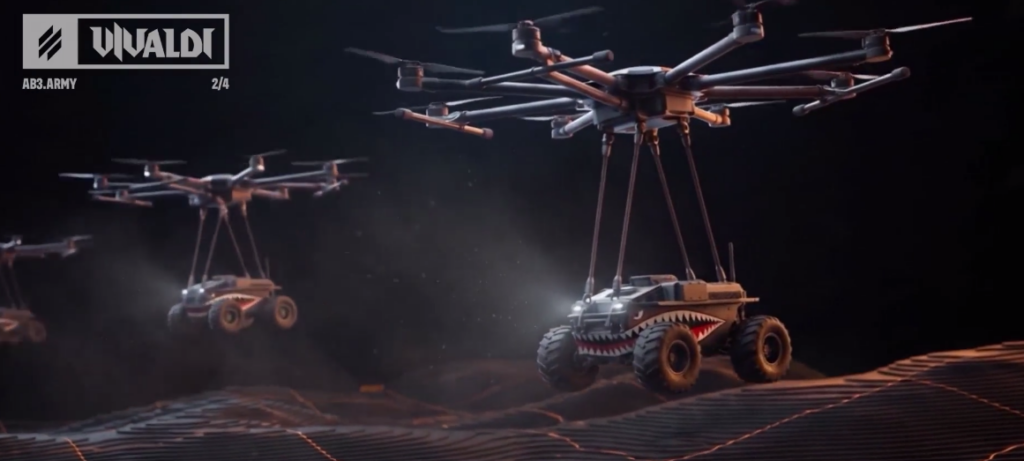
For the first time, Ukraine has dropped ground robots behind Russian lines from the air amid the Operation Vivaldi, protecting Ukraine's fortress cities in Donetsk Oblast. Source: The scheme by the 3rd Army Corps

For the first time, Ukraine has dropped ground robots behind Russian lines from the air. The 3rd Army Corps, behind the mission, says its heavy drones delivered kamikaze unmanned ground vehicles more than 10 kilometers into the Russian rear during the "second season" of Operation Vivaldi, letting Ukrainian troops flank them and clear another 40 square kilometers.

Vivaldi is the counteroffensive the corps is running near Lyman in northern Donetsk. Over its first two "seasons," the 3rd Army Corps and attached units have retaken more than 125 square kilometers, half of it de-occupied outright, and inflicted more than 3,000 casualties on Russian forces.

The operation, run under an information blackout for months, has also disrupted Russia's push and, the Institute for the Study of War found, its plan to encircle the fortified belt of Donetsk cities.

Brigadier General Andrii Biletskyi, corps commander, has said the operation, which he named after Vivaldi's Four Seasons, will run through four phases, and only two have been completed. The air-dropped robot is the newest report on how the corps fights.

Machines go first, infantry follows

The corps casts the tactic as a means of expending robots rather than people.

"In assault operations, drones and ground robots always go ahead of the infantry," Biletskyi says.

The 3rd Army Corps was the first in the world to begin air-dropping ground robotic systems. Our heavy bombers deliver kamikaze robots more than 10 kilometers into the Russian rear.

Wars are won by infantry, one of the corps' soldiers added, "but we protect ours, so the robots go to the enemy first."

A dome hides the assault

As the assault groups advanced amid the operation, Ukrainian air defense and electronic warfare threw a protective dome over the battle area, blinding Russian drones so they could not read the operation's design.

Meanwhile, artillery and strike drones hit command posts, communications nodes, logistics, crossings, and reserves, letting Ukrainian units dig in on the ground they had taken.

On the Lyman axis, the corps says it freed the villages of Shandryholove and Derylove and took control of Drobysheve, and that Vivaldi has kept Russia from shifting significant forces to the Kupiansk front.

Ukraine’s Vivaldi operation cleared 85 square kilometers near Lyman. A soldier who fought it says one thing was hardest of all

19 septembre 2026 à 11:22

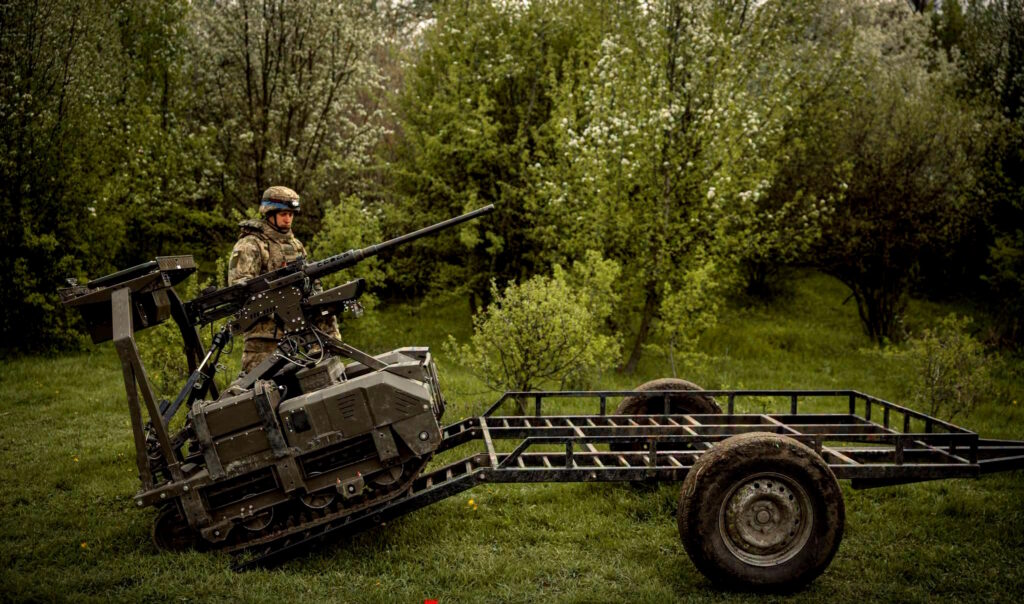
The image shows a Ukrainian soldier standing next to an unmanned ground robotic vehicle. Source: The General Staff

A soldier of Artan, a special unit of Ukraine's Defense Intelligence, known by the callsign Derun, described the fighting during important Ukraine's Operation Vivaldi, according to Novyny.Live. He says the hardest part of Ukraine's counteroffensive in the northern part of Donetsk Oblast is prying Russian troops out of positions they have fortified so well that they see every approach coming.

Vivaldi is bigger than any one assault. It is the counteroffensive that the Third Army Corps is running near Lyman. The Institute for the Study of War says it has disrupted Russia's plan to encircle the fortified "Fortress Belt" of Donetsk cities, as the corps says its first phase cleared 75 square kilometers of Russian infiltrators and de-occupied another 10.

Dug-in Russians see every approach

The problem is Russia's preparation, when "the enemy has made his positions very well fortified," Derun said.

"The hardest is to knock him out of there, because when a position is competently prepared, they see everything," he explained.

A well-sited position lets the defenders watch the open ground an assault group has to cross, spot the attackers early, and fight them at a distance, which is the worst way for the attacker to come.

A lapse opens the way in

When Russian troops stop watching the approaches to their position, the assault group can close the gap unseen, Derun said.

"When Russian troops are distracted, it can play into our hands: we can approach under cover, when he does not see us, and work him from close range," he added.

Once the attackers are in close, he added, the defenders can start to panic and make mistakes.

Vivaldi runs to four seasons

Artan fought as part of a larger force. Alongside the Third Army Corps' own brigades, the operation drew in Ukraine's Special Operations Forces, the border guard, and the military-intelligence unit, all under a single tactical command, and it ran for months under an information blackout before the corps disclosed it.

The corps commander, Andrii Biletskyi, said the phase revealed so far is only the first of four, naming the operation for Vivaldi's Four Seasons.

"This is only the first," he said, promising more.

He had survived Mariupol, Russian captivity and took over Ukraine’s Azov grouping in Donetsk. Now Brigadier General Prokopenko warns Russia may mobilize up to 600,000 for its next offensive

14 septembre 2026 à 11:05

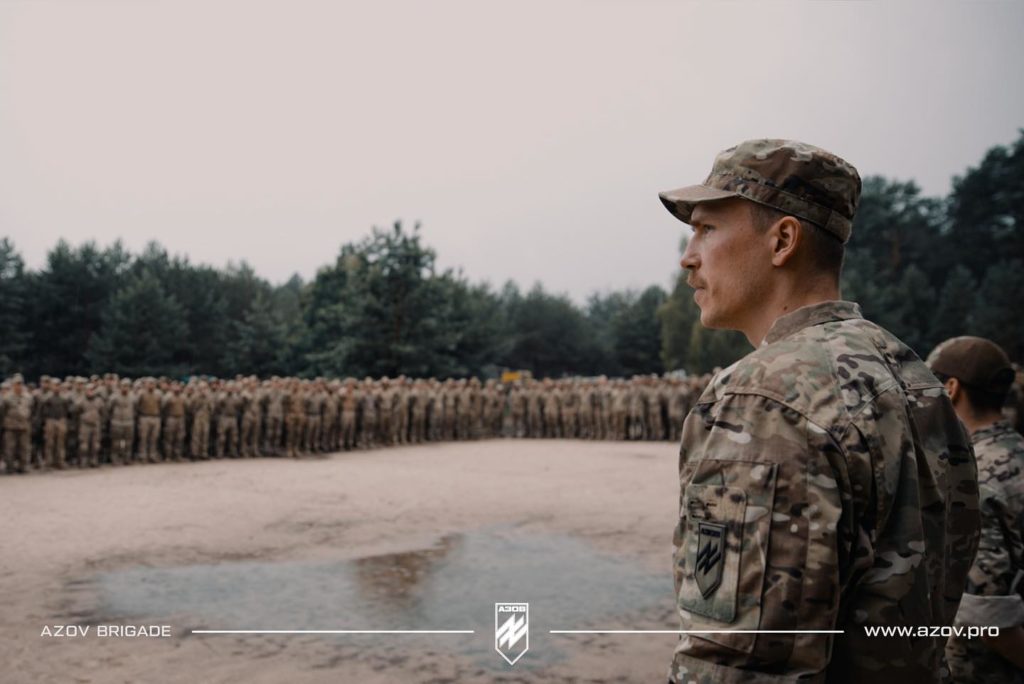
Denys Prokopenko (callsign Redis), commander of the Azov Regiment

Russia may call up as many as 600,000 troops for its next offensive, one of Ukraine's most battle-hardened commanders warns. Brigadier General Denys Prokopenko, who commanded the Mariupol defense, survived Russian captivity, and, on 13 September, took charge of the newly formed Azov grouping fighting in Donetsk Oblast, said covert recruitment is already underway and that open mobilization could begin after Russia's elections, in late September or early winter, Novyny.LIVE reported.

Prokopenko is forecasting the war on the ground he now defends. He commands the Azov grouping, one of two forces Ukraine has assembled to hold the Donetsk front, the sector where Russia is pushing hardest toward the fortress-city belt. That gives his reading the weight of a commander answerable for the line, not a distant analyst.

He expects a Russian mobilization of up to 600,000, double the 300,000 fall call-up reported earlier, all aimed at Russian President Vladimir Putin's declared goal of seizing every inch of Donetsk and Luhansk oblasts.

Russia eyes the fortress cities and the north

By the end of the fall campaign, Prokopenko said, Russia will try to gain a foothold in one of the Donbas strongholds, Dobropillia, Kostiantynivka, Druzhkivka, Kramatorsk, Sloviansk, or Sviatohirsk, to use as a springboard, though he insisted Ukraine will not let it.

He also warned of a second front in the north. Part of the reserve massed by early winter, he said, could be thrown at Sumy and Chernihiv oblasts, according to UA.News.

"The aim is to create a buffer zone in the Sumy and Chernihiv regions and continue the terror against our capital," he told the Yalta European Strategy forum, forcing Ukraine to keep reserves pinned there rather than sending them east.

October forces a tactics shift

September will bring the peak of Russia's summer offensive, Prokopenko said, because the attackers need a result to show for it. October will bring a change, driven by rain, fog, and shorter days.

"Russian forces will be forced to move from small infantry-group tactics to heavy armored vehicles and to attempt mechanized breakthroughs into the depth," he said.

That approach failed before, he argued, and will fail again.

Russia made 500 Ukrainian schoolchildren in occupied Donetsk take part in “anti-terrorism dictation”. It taught them they can be jailed for a repost at 14

5 septembre 2026 à 08:09

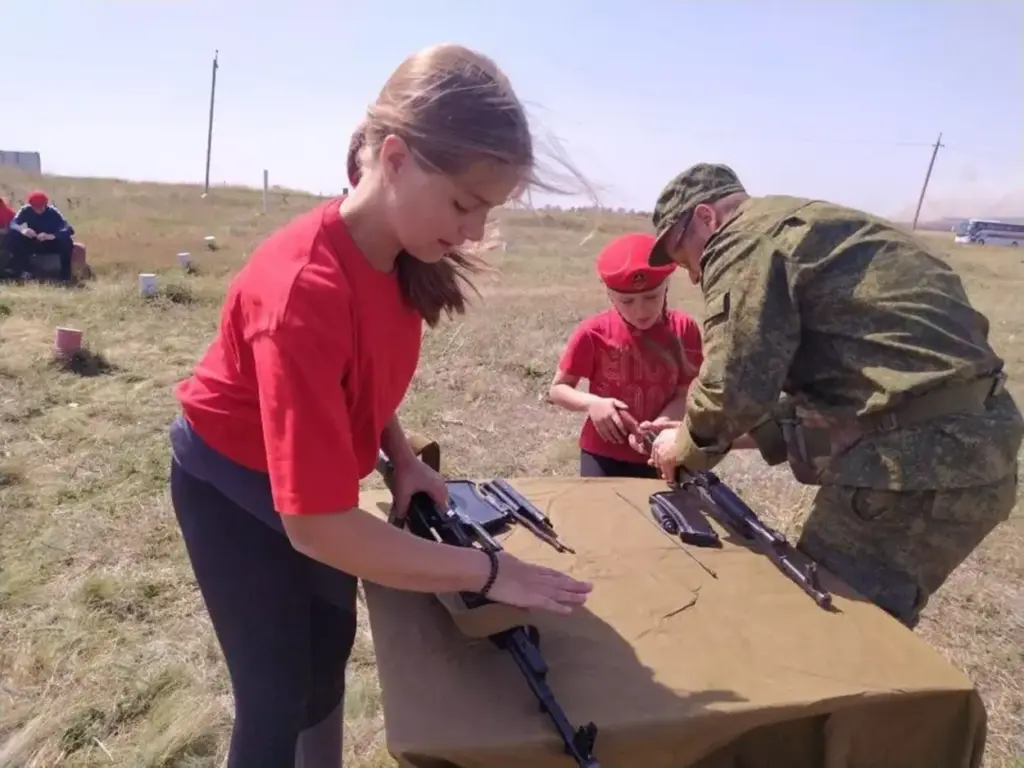
Two children handle rifles as a uniformed man demonstrates a weapon on a table outdoors.

In occupied Donetsk Oblast, the Russian occupation authorities had some 500 schoolchildren take part in an "anti-terrorist dictation." The rights group Zmina says the occupiers and their collaborators stage such events deliberately to intimidate local residents, children, and teenagers among them.

The exercise is one instrument of a documented system. In July 2026, an OSCE expert mission invoked by 41 states found that Russia's use of terrorism and extremism legislation against Ukrainian children may amount to a crime against humanity.

Only in 2025, occupation authorities sent 48 Ukrainian children in Donetsk Oblast to psychiatric hospitals on extremism charges. For example, teenager Maksym Lypkan is being forcibly subjected to psychiatric treatment because he said that the war against Ukraine is an act of villainy.

The test drilled Russian criminal law

The dictation was held in 17 schools across occupied Donetsk, Mariupol, Makiivka, and Volnovakha, with pupils in grades eight through eleven answering questions in writing, according to the occupation's Donetsk News Agency, cited by Zmina.

The three themes were basic definitions, criminal responsibility, and the roles of the state and citizens in combating terrorism, with an emphasis on Russian criminal code provisions on terrorism and extremism.

Some questions were situational. In one, pupils were told that an internet user had shared someone else's post containing banned content, and then asked whether only the original author bore responsibility, or whether the person who reposted it had also broken the law.

Afterward, teachers walked the teenagers through the correct answers. Particular attention was given to the point that criminal liability for terrorism offenses begins at age 14, said Marharyta Kucheriava, who heads a committee on information policy and countering extremism and terrorism within the occupation's "youth parliament" in Donetsk Oblast.

One arm of a wider effort

The dictation sits alongside a broader remaking of occupied schools. From 1 September, the occupation authorities introduced a compulsory Russian-identity subject, a separate military-training track, and behavior grades for children as young as second grade.

❌