Vue lecture

Ukraine takes Zelenskyy’s Russian airspace warning to UN aviation body
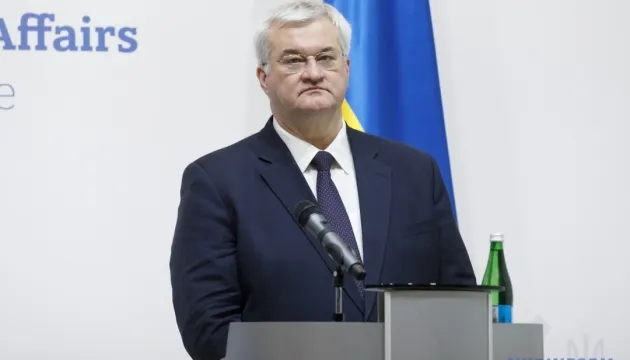
Ukrainian Foreign Minister Andrii Sybiha stands behind a lectern with a microphone and a Ukrainian flag in the background.

Ukraine formally notified the International Civil Aviation Organization (ICAO) on 2 September that Russian airspace is unsafe for civilian flights because of increased military activity, Ukrainian Foreign Minister Andrii Sybiha said. The letter behind the notification asks the organization to urge its member states to stop civil flights over Russia altogether, ZN reported.

ICAO, the UN aviation agency, cannot close Russian airspace or order carriers to reroute. European and US airlines already avoid Russia's airspace, while carriers from China, Türkiye, and the Gulf states have kept flying through it. Those remaining airlines must assess the safety of flying amid drone and air defense operations. Drone alerts during reported Ukrainian attacks have repeatedly shut Russian airports and delayed hundreds of flights.

The notification follows a 1 September warning by Ukrainian President Volodymyr Zelenskyy, who told airlines, insurers, and other aviation stakeholders that Russian skies were becoming unsafe as Ukrainian drones reached deeper into the country.

Zelenskyy said Ukraine's Foreign Ministry would pass information about the risks to international organizations. The letter to ICAO came from another office—Mykola Kalashnyk, Ukraine's minister for recovery, infrastructure, and transport, whose portfolio covers aviation.

Russian President Vladimir Putin said Zelenskyy's statement amounted to "a bid for state terrorism" and that Moscow would find a way to respond if civilian "tragedies" followed.

Sybiha urged airlines to avoid Russian airspace and said the notice was meant to prevent unintended incidents, arguing that Moscow was failing to disclose the dangers its war had created. He invoked Ukraine’s inherent right to self-defense under Article 51 of the UN Charter, the provision that recognizes states’ right to defend themselves against an armed attack. The foreign minister further stated that the war was “returning home to Russia.”

In its separate statement, ICAO warned of rising threats to civil aviation worldwide. It did not mention Russia, endorse Ukraine’s assessment, or say Kyiv’s notification had prompted it.

The UN aviation body identified long-range weapons, drones, navigation-signal interference, and advanced air-defense systems as growing dangers to civilian aircraft. It reiterated that international aviation law prohibits the use of weapons against them.

ICAO urged member states to assess airspace under their control, share threat intelligence quickly, and improve military-civilian coordination.

Russian airports were already facing repeated closures

Russian airspace has not been legally or completely closed. The disruption has instead taken the form of temporary restrictions at individual airports.

From 5–7 May 2026, restrictions during reported Ukrainian attacks delayed more than 450 flights at Moscow airports, while limits at Vnukovo remained in place for nearly 18 hours.

On 6 July 2025, Moscow's Sheremetyevo airport canceled 171 flights, while airports in five other cities suspended operations. During an earlier wave on 22 May 2025, Domodedovo halted flights four times in one day and Sheremetyevo three times, while Vnukovo and Zhukovsky also restricted operations.

Airports in Kaluga, Nizhny Novgorod, Saratov, and Tambov were temporarily closed during a 27 May attack in which Moscow claimed 99 drones were intercepted. Two days later, another alert delayed 20 arrivals and 14 departures at Vnukovo, pro-Kremlin Telegram channels claimed.
  •  

Ukraine says it busted a Kyiv crypto ring that drained EU citizens’ wallets

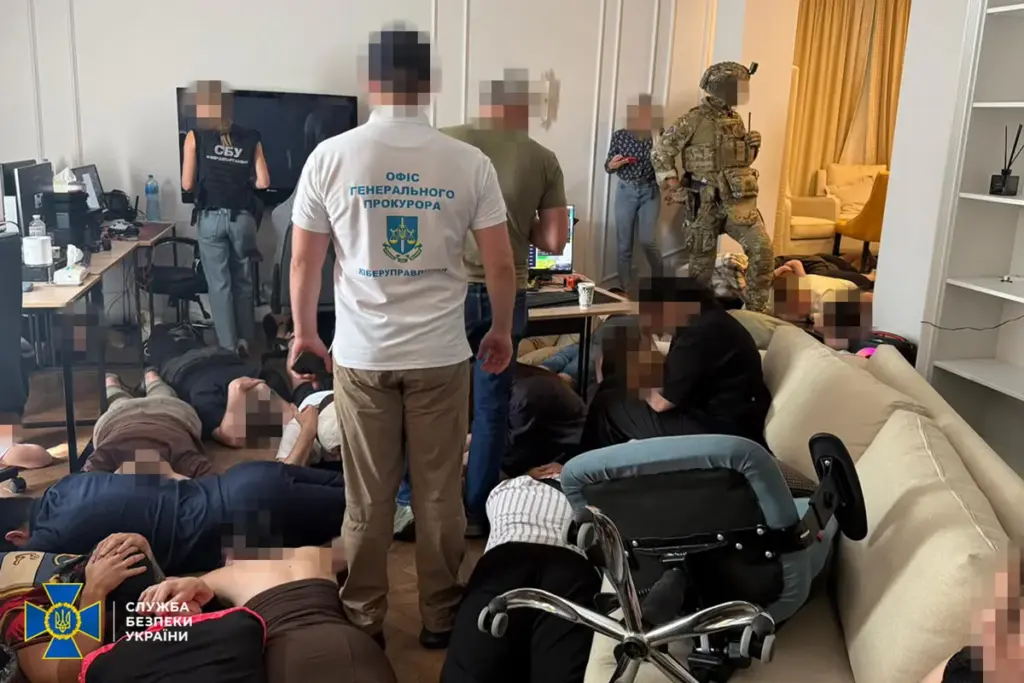
SBU and Prosecutor General’s Office personnel stand inside a crowded room with computers as several people with pixelated faces lie or sit on the floor. An armed tactical officer stands near the back.

Ukraine’s Security Service (SBU) and National Police shut down a Kyiv-based network of several dozen people who allegedly used fake cryptocurrency investment platforms and malicious code to steal digital assets from citizens of EU countries, the SBU said on 1 September.

Investigators identified the alleged organizer as a 25-year-old Kyiv IT specialist, according to the SBU. The case reaches beyond Ukraine because the agency says the alleged victims were EU citizens. The agency said the network’s monthly turnover from funds obtained illegally could reach $1 million during its most lucrative periods.

The SBU said investigators had documented alleged crimes by every member of the group. However, its statement did not specify how long the network had operated, how many EU citizens were affected, which countries they lived in, or the total amount allegedly stolen.

The agency did not name any foreign law enforcement partners involved.

How the crypto ring operated

The alleged organizer of the crypto ring recruited other tech workers in the capital, the SBU said. Posing as cryptocurrency-platform representatives, they offered targets seemingly profitable ways to invest in digital assets.

The network found victims by posting about supposedly lucrative crypto projects in popular Telegram channels, then showed them fabricated trading results and fake profits to make the operation look legitimate, investigators said.

Engaged targets were sent a link to a counterfeit site that mimicked a real crypto service and were persuaded to connect their wallets and approve a transaction, the SBU said. The site carried malicious code called a “drainer” that, the agency said, let the operators withdraw the victims’ assets to addresses they controlled—emptying the wallets.

During 23 searches of the suspects’ offices and homes, officers seized phones, computers, money believed to be criminal proceeds, and 16 high-end cars, including Porsche, BMW, and Mercedes-Benz models, the SBU said.

Authorities were still deciding whether to serve notices of suspicion, while the investigation continued under the Prosecutor General’s Office, the SBU said. Those involved could face up to 12 years in prison with confiscation of property.

Ukraine’s role in combating cross-border cybercrime

Ukraine has previously joined with foreign agencies to pursue cross-border cyber threats. In April, the SBU said it worked with the FBI, EU law enforcement, and Polish counterintelligence to disrupt Russian military-intelligence spying through hacked routers. The operation blocked more than 100 servers and removed hundreds of routers in Ukraine from Russian control.

  •  

Kazakh refinery deal could ease Russia’s front-line fuel pressure—but it covers just 0.3% of demand

Kazakh President Kassym-Jomart Tokayev and Russian President Vladimir Putin walk past an honor guard in Astana, Kazakhstan, on 27 November 2024.

Kazakhstan’s privately owned Kondensat refinery will process Russian crude and return about 70% of the resulting petroleum products to Russia, Kazakh Energy Minister Yerlan Akkenzhenov said on 25 August, Radio Liberty reported.

Based on figures reported by Radio Liberty, the roughly 70% of Kondensat’s maximum gasoline output bound for Russia would amount to about 0.3% of the country’s daily summer gasoline demand. That makes the arrangement a limited stopgap rather than a solution. John Roberts of the Atlantic Council nevertheless told the outlet that even small additional supplies could help during an acute shortage, including at the front: “It helps, but it doesn’t solve the problem.”

Ukrainian drone strikes have knocked dozens of Russian refineries offline in recent months, forcing Moscow to restrict fuel exports and reimpose rationing, Radio Liberty reported. Gasoline caps returned to Moscow and St. Petersburg in August, while Rosneft reportedly limited fills to 30 liters per car at every station nationwide.

Kondensat has processed Russian oil before. The refinery began handling supplies delivered through Tatneft’s TANECO refinery in 2024, when Kazakhstan and Russia agreed to permit exports of fuel produced from Russian feedstock back to Russia. The arrangement was renewed in 2025, according to Radio Liberty.

Central Asia has no spare refining capacity that could materially change Russia’s situation, Ukrainian energy analyst Hennadiy Riabtsev told Radio Liberty’s Schemes project. Possible contributions from Kazakhstan, Kyrgyzstan, India, China, and Belarus would remain a drop in the ocean for the Russian market, he said.

Prospective suppliers also understand that Russian fuel demand supports the war effort and that assisting Moscow could carry sanctions risks, Ukraine’s presidential sanctions commissioner, Vladyslav Vlasiuk, told Schemes. Kyiv therefore does not expect a queue of countries willing to supply Russia with petroleum products, he said.

Russia’s fuel shortage gives Kazakhstan room to bargain

Russia’s shortage has spread from gas station queues to farming and public transport, with fuel-sale restrictions officially covering more than 40 regions by July, Euromaidan Press reported, citing The Moscow Times. Moscow’s export restrictions have also raised prices and tightened supplies across Central Asia.

Yet Russia’s growing dependence gives Kazakhstan additional bargaining room. Ukrainian strikes have previously prompted Russian retailer Wildberries to expand its warehousing operations in Kazakhstan, while Astana has promoted domestic competitors.

  •  

Putin dismisses mobilization reports as Ukraine warns Russia could call up 600,000 to war

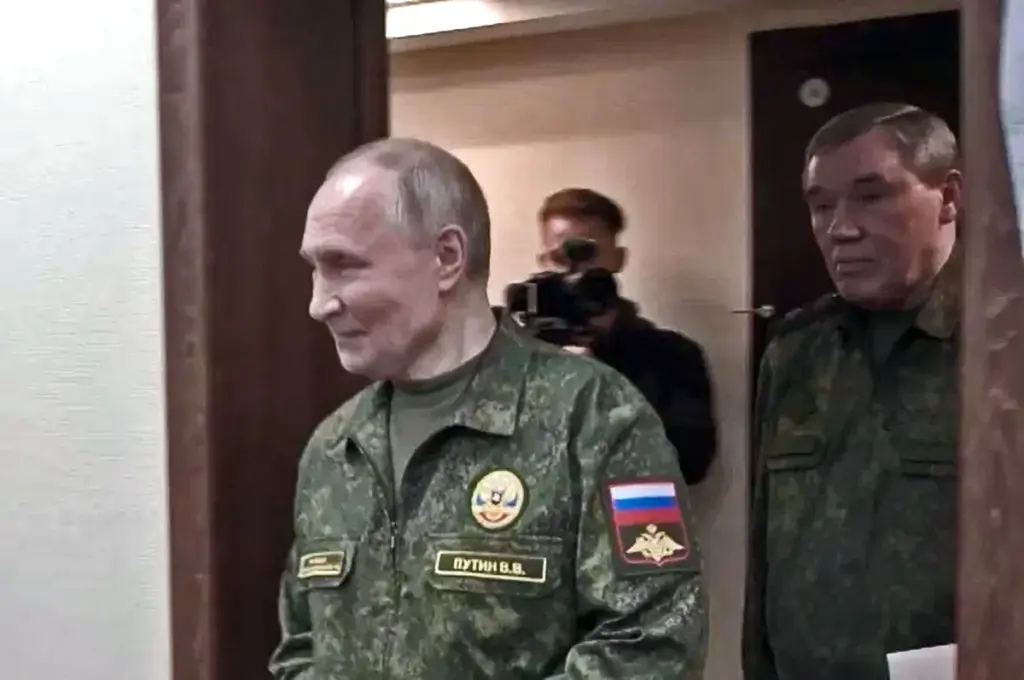
Vladimir Putin walks through a doorway in a military uniform, followed by Russian Chief of the General Staff Valery Gerasimov.

Asked about reports in Ukrainian and Western media that Russia could order a mass mobilization after September’s parliamentary elections, Vladimir Putin replied: “That’s complete nonsense. It’s an information attack on Russia,” RBC reported. He was speaking after the Shanghai Cooperation Organization summit in Bishkek.

Ukraine’s military and foreign intelligence services say Russia’s General Staff has prepared a scenario for mobilizing an additional 600,000 people during 2026 and 2027—300,000 each year. Their briefing described a contingency, not an issued call-up, and did not say mobilization had begun. If activated, the agencies said, the recruits would primarily reinforce units fighting Ukraine and newly formed military units.

Ukraine’s intelligence services linked the scenario to mounting battlefield losses and a slowdown in contract recruitment. They said Russia lost roughly 240,000 personnel from January through July, including at least 140,000 killed or permanently lost, while recruiting about 232,000 contract soldiers. The figures could not be independently verified.

Russia’s military also rehearsed procedures for mobilizing residents of Kaliningrad Oblast in July, Ukrainska Pravda reported, citing The Wall Street Journal.

Reports of a possible draft have generated concern inside Russia. More than 20,000 people crossed into Georgia through the Verkhny Lars checkpoint in a single day amid fears of mobilization, as EP previously reported.

Ukraine’s warnings and Russia’s denials

Ukrainian President Volodymyr Zelenskyy said in August that Moscow planned to mobilize several hundred thousand people after the elections and roughly the same number in 2027, citing military intelligence. HUR deputy chief Vadym Skibitskyi later assessed that a call-up could provide troops for a northern offensive by February 2027, while stressing that the agency saw no preparations underway at the time.

Dmitry Medvedev, Vasily Nebenzya, and the State Duma’s defense committee have all denied plans for another mass draft. Russian officials issued similar denials shortly before Putin announced the 2022 call-up. RBC notes that the decree authorizing that mobilization was never formally revoked. No new call-up has been publicly announced or reported as underway.

  •  

Ukraine confirms strike hit Novatek fuel plant at Russia’s Ust-Luga port

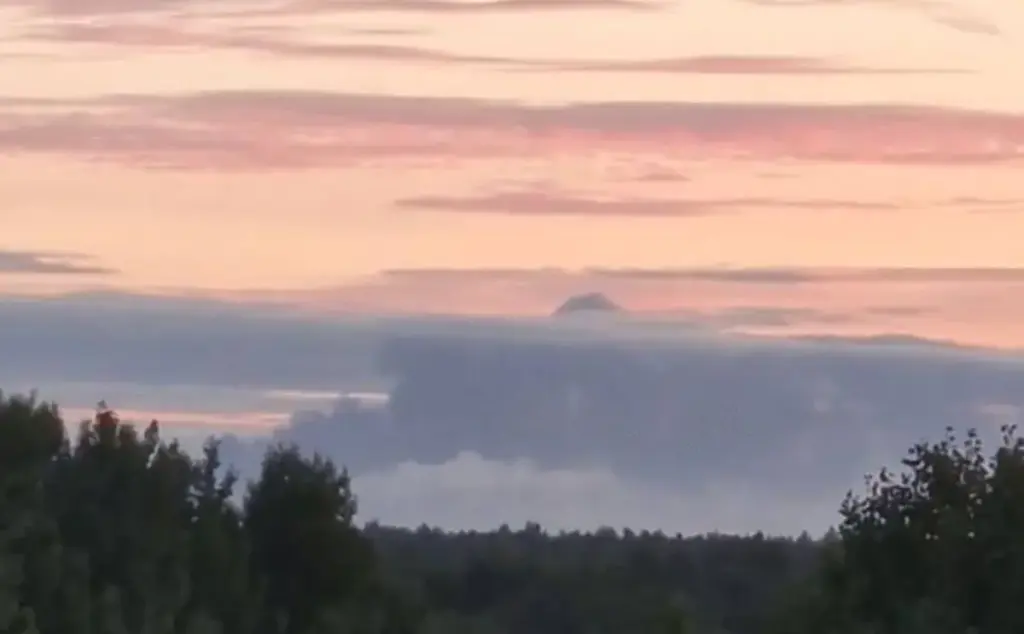
A thick gray plume of smoke rises above a distant tree line beneath a pink early-morning sky.

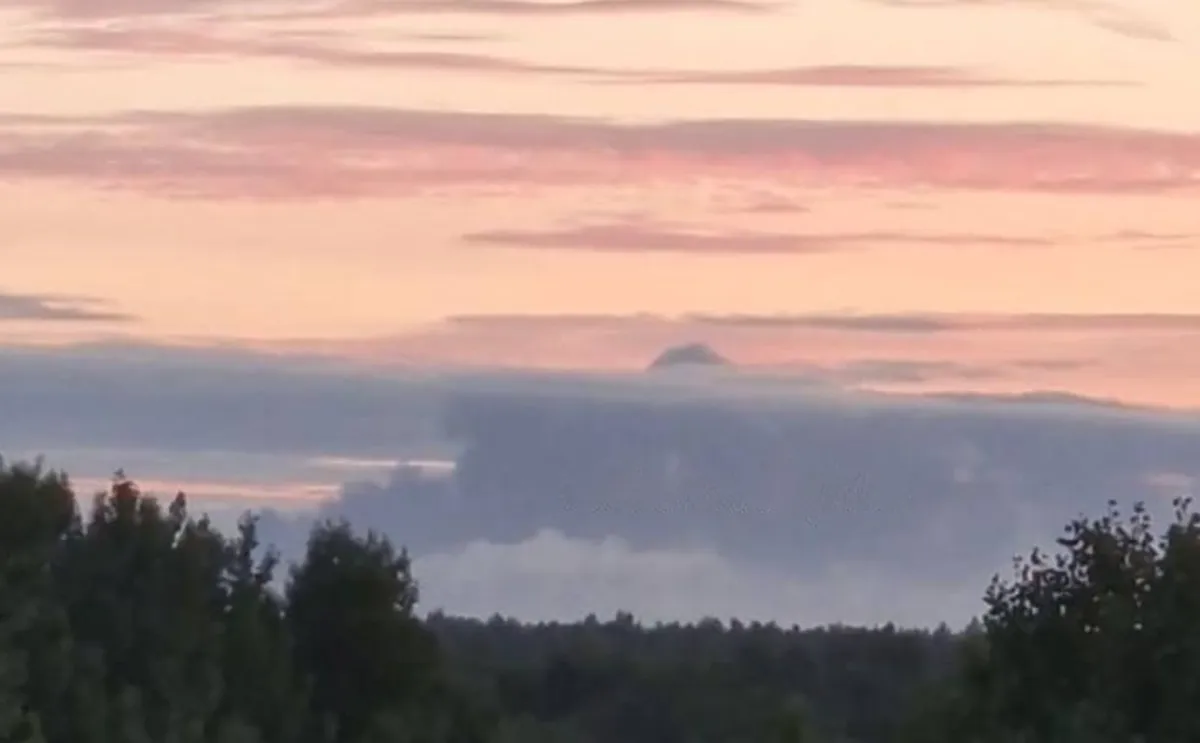
Ukraine’s General Staff confirmed that Ukrainian forces struck the Novatek-Ust-Luga production complex in Russia’s Leningrad Oblast on 1 September, saying the target was hit and a fire followed. The scale of the damage remains under assessment.

Russian authorities initially acknowledged damage and a fire but did not identify the facility. Ukraine’s military intelligence later named the Novatek complex as the target, and the General Staff has now confirmed the strike and said the facility supports Russia’s armed forces. It did not explain how, nor say whether, production was disrupted.

Ukraine’s military intelligence agency, HUR, was first to identify the target, saying on 1 September that its operators had struck the complex alongside Ukraine’s Defense Forces in a joint deep-strike operation. Key elements of the site’s oil-processing installation and other equipment were hit, and a large fire broke out, the agency said. The General Staff confirmed the strike the following day.

Video of the overnight attack on the port of Ust-Luga in Russia’s Leningrad region. pic.twitter.com/dXG5XTkhab

— Exilenova+ (@Exilenova_plus) September 1, 2026

The Novatek complex at Ust-Luga separates stable gas condensate—a liquid produced during natural gas extraction—into fuel and petroleum components and handles their shipment through the Baltic port. Its design capacity exceeds six million tons a year, the General Staff said. The plant produces light and heavy naphtha, kerosene, a diesel fraction, and a marine-fuel component.

A thick gray plume of smoke rises above a distant tree line beneath a pink early-morning sky.
Explore further

Drone attack damages Russia’s Baltic oil port as drone crosses Latvia into Estonia

Ukraine has repeatedly targeted the Ust-Luga port

Before Ukraine named the target, Leningrad Oblast Governor Alexander Drozdenko acknowledged infrastructure damage and a fire at Ust-Luga on 1 September, but did not identify the specific facility. HUR subsequently named the Novatek complex as the target and reported damage to key equipment.

The operation continued Ukraine’s campaign against Ust-Luga’s energy and port infrastructure. Ukrainian agencies confirmed the first strike on Novatek’s complex overnight on 24–25 March. Drones returned on 31 March, setting fuel-storage tanks ablaze, damaging a pier and pumping equipment, and temporarily halting port operations, followed by another reported attack on 7 April. Ukrainian drones last hit the port on 14 August, marking the sixth such attack there in 2026.

  •  

Estonia quarantines emails from Russian domains over cyberattack risk

Abstract illustration of computer code and binary numbers glowing blue and green against a dark background.

Estonia is automatically diverting emails using Russia’s .ru internet domain into quarantine for additional security checks before they reach state institutions connected to the country’s secure government network, Justice and Digital Affairs Minister Liisa Pakosta told Estonia's public broadcaster ERR.

The measure is intended to protect Estonian government computer systems amid a post-2022 surge in cyberattacks that officials link to Russia. It applies only to institutions operating inside the secure state network, leaving local governments and some state bodies outside.

Many Estonian residents, particularly Russian speakers, still use .ru email services, ERR noted. Because the filter is triggered solely by the address ending, legitimate messages will be screened alongside potentially malicious ones and may take longer to arrive.

Pakosta said the safeguard was necessary because cyberattacks against Estonia had increased “exponentially” since 2022 and that many were linked to Russia. She said such attacks had not succeeded against Estonia, while major public-sector cyberattacks had succeeded in both Latvia and Lithuania.

The rerouting is automatic and handled centrally, so agencies do not need to take any action, Pakosta said. A large proportion of state institutions have already moved behind the government’s unified cyber shield, while the transition continues.

Pakosta described the quarantine as one small measure within Estonia’s wider cybersecurity work. Estonia’s courts have gone further, saying they will ask parties in legal proceedings to stop using .ru addresses for official communication, according to ERR.

How the Baltic states are hardening against Russia

Estonia's email quarantine forms part of a broader Baltic effort to limit Russian influence and strengthen defenses against military, cyber, and covert threats.

Estonia, Latvia, and Lithuania are constructing a Baltic Defense Line, a planned network of bunkers, anti-tank ditches, and other barriers, along their borders with Russia and Belarus. Latvia has also banned imports of Russian and Belarusian books, clothing, toys, and other goods.

The threat extends beyond cyberattacks: an Estonian court found that Russia’s military intelligence agency, the GRU, ordered the 2024 firebombing of a Ukrainian restaurant in Tallinn, part of a wider Russian sabotage campaign targeting European supporters of Ukraine.

  •  

Russian propagandists fake Polish newspaper claiming Ukraine faces famine

Side-by-side comparison of a fabricated Polish newspaper front page claiming 63% of Ukrainians face hunger and the genuine front page without the claim.

Russian propagandists used the Matryoshka disinformation network to circulate a digitally altered front page of the Polish regional weekly Przegląd Regionalny warning of a “hungry fall and winter” in Ukraine, the country’s Center for Countering Disinformation reported.

The fake turns genuine anxiety over Russian attacks on warehouses and food logistics into an unsupported prediction of mass starvation. The Center said Matryoshka routinely disguises fabricated material as reporting by established Western outlets, lending Russian narratives borrowed credibility while creating the impression that foreign media consider Ukraine’s situation hopeless.

The fabricated Przegląd Regionalny front page claimed Russian strikes would push 63% of Ukrainians to the brink of famine over a “hungry autumn and winter.” No such article ran—the real front page of that issue looked entirely different, and the circulated image was built using graphics-editing software, the Center said.

The image spread through Matryoshka, a network that dresses invented content in the mastheads of recognized Western outlets. In this case, the campaign was meant to frighten Ukrainians and weaken public confidence, according to the Center.

Although it impersonated a Polish outlet, the Center described Ukrainians—not Polish readers—as the campaign’s target: the Polish masthead supplied an apparently independent foreign voice for a Russian narrative.

The fake works because the disruption it points to is real. Russian attacks on warehouses and food logistics had destroyed up to 90% of Ukraine’s modern food storage capacity, and suppliers were moving stocks and changing delivery routes and storage methods in response, Agriculture Minister Taras Vysotskyi said on 28 August 2026, according to Interfax-Ukraine.

Supermarket chain ATB has temporarily capped purchases of certain essential goods at 6 units of any single product per customer, citing both Russian strikes and resellers buying in bulk.

What the fake predicts, though, is not what officials expect. Presidential defense-technology adviser Serhii “Flash” Beskrestnov urged Ukrainians not to panic and said a systemic food shortage was not expected, ZN.UA reported.

How Russia spreads disinformation in Poland

Russia has repeatedly exploited Poland’s information space to turn political, economic, and security anxieties against Ukraine. Polish Deputy Prime Minister Krzysztof Gawkowski said Russian intelligence had offered Poles €3,000–€4,000 ($3,500–$4,600) to spread disinformation before the 2025 presidential election.

After Russian drones entered Poland that September, Prime Minister Donald Tusk said the Kremlin was using real fears and emotions to fuel anti-Ukrainian sentiment. False claims about Ukrainians living off Polish taxpayers have also fed hostility as bilateral relations frayed.

  •  

Russian Church installs Soviet military veteran to lead occupation-created diocese in Kherson Oblast

Patriarch Kirill sits at a white table in black-and-white Orthodox vestments, looking toward the camera as several people stand around him.

The head of the Moscow-based Russian Orthodox Church, Patriarch Kirill, personally consecrated Igor Pashentsev as bishop of Skadovsk and Oleshky after occupation authorities appointed him to lead the Skadovsk diocese, the Ukrainian outlet IPC-South reported, citing Russian sources.

The appointment advances the Russian church’s incorporation of occupied Ukrainian parishes into a Moscow-controlled structure created after Russia seized the area. Pashentsev will oversee churches across five occupied Kherson districts through a diocese IPC-South describes as operating illegally on Ukrainian territory.

Ukraine banned the Moscow-based Russian Orthodox Church from operating in the country in 2024 and established a court process for suspending Ukrainian religious groups that fail to sever Russian control. The measure targets Russian control, not Orthodox Christianity.

IPC-South says Pashentsev graduated from a Soviet military command school of chemical defense and served in the Soviet Defense Ministry’s 12th Main Directorate from 1981 to 1992. The Federation of American Scientists says the directorate stored, maintained, transported, and secured the Soviet Union's nuclear arsenal, but public records do not identify his duties there.

Ordained in 1993, Pashentsev completed the Moscow Theological Seminary in 1998, later led a Tambov diocesan office for relations with the armed forces and detention facilities, and served in the Barysh diocese. Known in the church as Joseph, he held the rank of archimandrite—a senior Orthodox monk—before his consecration.

During a Dormition liturgy—a major Orthodox feast honoring the Virgin Mary—Kirill gave Pashentsev an episcopal staff symbolizing a bishop’s authority and delivered instructions before his ministry began, Russian church accounts relayed by IPC-South said.

The Russian Orthodox Church created the Skadovsk diocese—a regional church administration—on 27 December 2023 after the occupation made it impossible for the existing Kherson diocese to oversee parishes on the Dnipro’s left bank. The new body incorporated parishes across the occupied Oleshky, Hola Prystan, Kalanchak, Skadovsk, and Chaplynka districts. IPC-South describes it as operating illegally on Ukrainian territory.

Russia weaponizes church control while suppressing other faiths

Pashentsev’s appointment is part of the Moscow Patriarchate’s wider effort to control religious life in occupied Ukraine. Religious communities that reject Kremlin authority face interrogations, threats, closures, and confiscation.

Ukraine’s Security Service has accused church structures of recruiting and training mercenaries for Russia’s military. The Institute for the Study of War, a US-based think tank, says occupation authorities also arbitrarily detain clergy and destroy places of worship while suppressing independent Ukrainian religious identity.

  •  

Putin calls Zelenskyy’s airspace warning “state terrorism” as shares in Russia’s national airline fall 5%

Vladimir Putin stands behind a lectern during a press conference, with the RIA Novosti logo visible above him.

Russian President Vladimir Putin said Moscow would “find a way to respond” if civilian “tragedies” followed President Volodymyr Zelenskyy’s warning that Ukrainian drone operations were making Russian skies unsafe. Zelenskyy told foreign airlines and insurers that the “safe moments” in Russian airspace were over.

Zelenskyy’s warning seeks to extend the cost of Russia’s war beyond damaged military and energy facilities to airlines, insurers, and travelers. It does not mean Russian airspace is legally or completely closed. However, carriers that continue flying over Russia face higher costs from repeated airport shutdowns during drone alerts, as well as the danger that military activity in Russian airspace could endanger civilian aircraft.

Putin spoke after a 1 September Shanghai Cooperation Organization summit in Bishkek, where Russia and China coordinate regional security. Zelenskyy’s warning amounted to “a bid for state terrorism” if he had made it publicly, the Russian president said, adding that Russia does not negotiate with “terrorists.” Putin also said Russian forces were preparing massive strikes on Ukraine’s energy infrastructure.

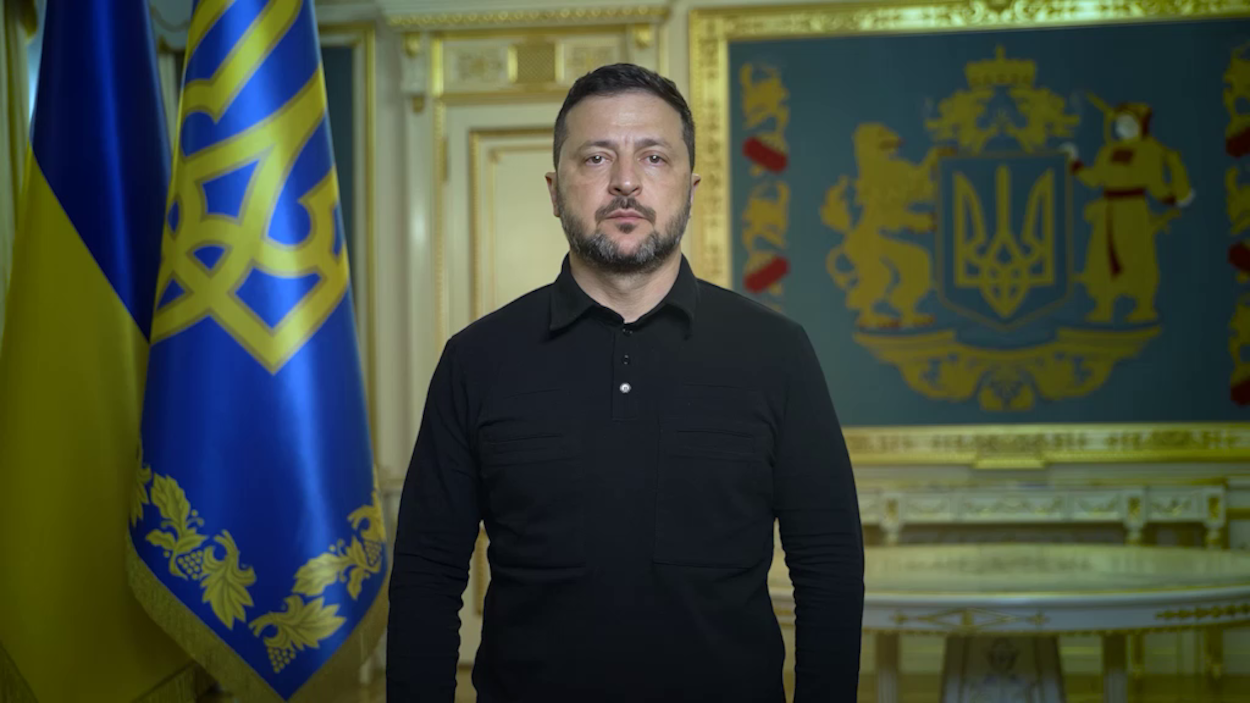
In his evening video address, Zelenskyy said Ukraine did not threaten civilian aircraft but would keep striking Russian military targets and parts of the economy supporting the war. Ukraine’s Presidential Office head Kyrylo Budanov backed the decision, saying long-range weapons would systematically strike military targets in Russia while the invasion continued.

Ukrainian President Volodymyr Zelenskyy during his evening address, 1 September 2026. Screenshot from video: Zelenskyy
Explore further

“Russian airspace will effectively be closing”: Zelenskyy warns airlines Russian skies are no longer safe

Shares in Aeroflot, Russia’s national airline, fell to an intraday low of 30.36 rubles at about 20:40 Moscow time, down 5.11%, Meduza reported, citing Moscow Exchange data. The timing does not establish that Zelenskyy’s speech alone drove the decline.

Wall Street Journal correspondent Yaroslav Trofimov posted a chart of the decline on X, writing, “Aeroflot shares after Zelensky’s warning.”

Aeroflot shares after Zelensky’s warning. https://t.co/L7h2S99jqT pic.twitter.com/Q80gPfYWlo

— Yaroslav Trofimov (@yarotrof) September 1, 2026

European and US carriers already avoid Russian airspace, but airlines from China, Türkiye, the United Arab Emirates, and other Gulf states continue using it, Reuters reported. Aviation-risk firm Osprey Flight Solutions assessed that daily attacks deep inside Russia were nearly certain through 2026 and warned of possible misidentification.

Andrii Kovalenko, head of Ukraine’s Center for Countering Disinformation, said it was “strange” to hear terrorism accusations from “the leader of a terrorist organization masquerading as the Russian state.” Putin’s reaction showed Moscow feared pressure on its airspace, he argued.

Previous closures of Russian airspace due to Ukrainian attacks

Russian airports were repeatedly shut during Ukrainian drone alerts well before Zelenskyy’s warning. On 6 July 2025, Moscow airports canceled 171 flights while airports in five other cities suspended operations.

A 27 May attack closed airports serving Moscow and several other cities after Russia claimed it intercepted 99 drones. Another wave caused flight disruption and mobile internet outages around Moscow, while a 29 May alert again halted flights at Moscow airports.

More recently, Russian authorities restricted operations at Moscow airports during Ukrainian drone attacks, delaying more than 450 flights

  •  

Russia’s Starlink rival falters as latest satellite batch stalls in low orbit, ISW says

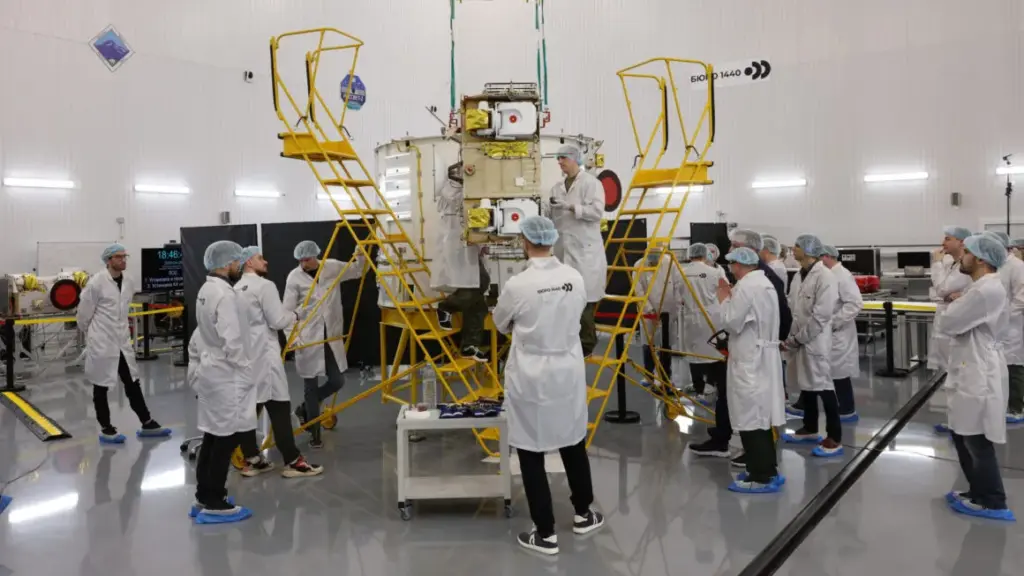
Employees of Russian company Bureau 1440 work on a Rassvet communications satellite.

The Rassvet communications satellites Moscow launched in July are likely to have shorter operational lifespans than planned because atmospheric drag increases at their current altitudes, the Institute for the Study of War (ISW) reported.

Moscow accelerated Rassvet’s deployment after its forces lost unauthorized Starlink access in February. A complete network could support battlefield communications and remotely controlled strikes against Ukraine, but existing satellites provide only brief connectivity windows. The latest setback will likely delay continuous coverage, ISW assessed.

Russian forces had relied heavily on unauthorized Starlink terminals for frontline communications, drone operations, and command-and-control. Ukraine and SpaceX blocked them on 5 February, disrupting Russian communications and assaults across several sectors. A Russian-controlled network could reduce Moscow’s dependence on SpaceX and illicit supply chains for terminals.

None of the 16 satellites launched on 19 July had reached 550 kilometers as of 31 August, according to N2YO tracking data cited by ISW. Many remained between 300 and 400 kilometers, some were gradually losing altitude, and at least two were reportedly heading toward atmospheric reentry.

ISW identified 550 kilometers as the altitude reached by the successful first-batch satellites, while reporting 870 kilometers as Rassvet’s intended operational altitude. At lower altitudes, satellites must use more fuel to counter greater atmospheric drag, shortening their operating lives.

Of the 32 Rassvet satellites launched in 2026, only 12—all from the first batch launched on 24 March—reached sustainable altitudes. They remained at roughly 550 kilometers and provided two daily connectivity windows over Ukraine totaling up to 90 minutes, ISW reported.

Russia needs at least 200–300 working satellites for stable, round-the-clock coverage, presidential defense-technology adviser Serhii “Flash” Beskrestnov assessed. Bureau 1440 plans “dozens” more launches and “hundreds” more satellites, but Russia depends on the scarce, costly Soyuz-2.1b rocket.

Only six to eight Soyuz-2.1b launches of all types have occurred since 2022, limiting Russia to a maximum of 128 Rassvet satellites over four years at that rate, ISW assessed.

Ukraine struck the Progress Space Rocket Center, which builds Soyuz-type vehicles, on 14–15 August and attempted to strike Plesetsk Cosmodrome on 23 August, ISW noted. Both Rassvet batches launched from Plesetsk, showing Ukraine can threaten the rockets and launch infrastructure required to expand the constellation, the institute assessed.

What is Rassvet?

Rassvet, meaning “Dawn,” is a low-Earth-orbit broadband constellation developed by Bureau 1440 as Russia’s domestic alternative to Starlink. Its 5G-based satellites are intended to provide high-speed, low-latency internet independently of SpaceX.

Although initially designed for civilian communications, a mature network could provide Russian forces with battlefield connectivity, command-and-control links, and connections to long-range drones. Moscow aims to place 292 satellites in orbit by the end of 2027 and 924 by 2035.

  •  

Germany blames Moscow for Leipzig drone attack, closes consulate and cultural center among sweeping diplomatic measures

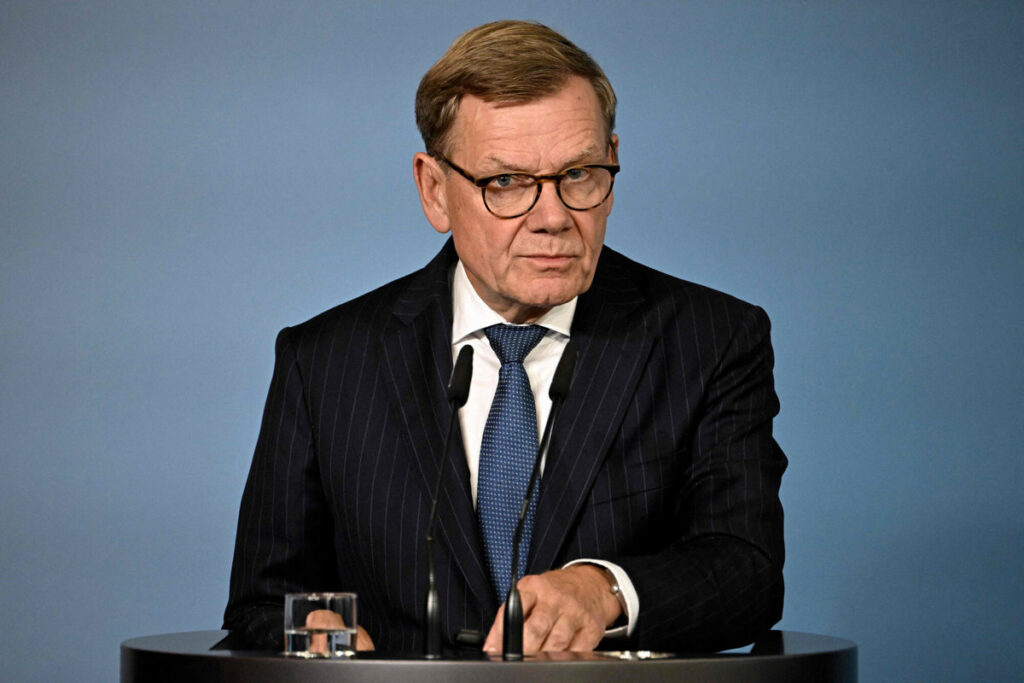
German Foreign Minister Johann Wadephul stands behind a lectern during a press conference.

An explosives-laden drone aimed at a Ukrainian cargo aircraft at Leipzig/Halle Airport was part of a Russian state operation, Interior Minister Alexander Dobrindt said on 1 September.

Germany has moved from suspecting foreign sabotage to formally blaming Russia for the Leipzig attack. The finding has prompted diplomatic and security measures against Moscow while the criminal investigation continues.

Police investigations, the attack pattern, and intelligence findings established Russian responsibility, Dobrindt said. The drones' configuration, components, explosives, and detonation systems resembled those used in other Russian hybrid operations—covert sabotage and disruption below the threshold of open war—and in Russia's war against Ukraine, Foreign Minister Johann Wadephul said.

The first drone, carrying explosives, was found near a Ukrainian cargo aircraft on the evening of 4 August and defused. Investigators believe a DHL freighter may have collided with a second drone while aborting its landing after the airport closed; that drone was never recovered. A third drone was found on 14 August in a field at Kabelsketal, where investigators subsequently discovered roughly 50 grams of suspected military explosive.

Leipzig/Halle is an international freight hub used by Ukrainian Antonov aircraft and NATO's strategic airlift program, through which allies charter heavy transport aircraft to move oversized military cargo.

Berlin will close the Bonn consulate on 18 September, end the operating agreement for the Russian House, a Moscow-backed cultural center, tighten entry controls for Russian nationals, seek to add more targets to EU sanctions lists, and pressure Russia's shadow fleet—opaquely owned tankers used to move Russian oil outside Western restrictions. Wadephul also summoned the Russian ambassador. Russia's Berlin embassy will remain open.

Russian Foreign Ministry spokesperson Maria Zakharova told Interfax that Moscow would respond to Germany's “anti-Russian action,” without specifying how.

NATO Secretary General Mark Rutte said the alliance stood in full solidarity with Germany, and European Commission President Ursula von der Leyen described Berlin's measures as a strong response.

Dobrindt said Germany expects further Russian hybrid attacks. The Leipzig incident follows a widening campaign of suspected Russian sabotage across Europe, including a 2024 incendiary-device attack at the same airport that Western security officials suspected Russian intelligence organized.

How the Leipzig attack unfolded

Euromaidan Press reported on 12 August, citing Die Zeit, that footage showed an explosives-laden quadcopter striking the wing of a parked Ukrainian Antonov An-124 before falling without detonating. The article also noted that a US Defense Department official told CNN that Washington assessed the drone belonged to Russian intelligence.

On 25 August, EP reported, citing Tagesschau’s NDR/WDR/SZ investigation, that investigators had expanded the case to three drones and found the third with suspected military explosive nearby in Kabelsketal, 10 days after the original attempt.

  •  

German politician wants to send Taurus missiles to Ukraine after Russian drone attack in Leipzig airport

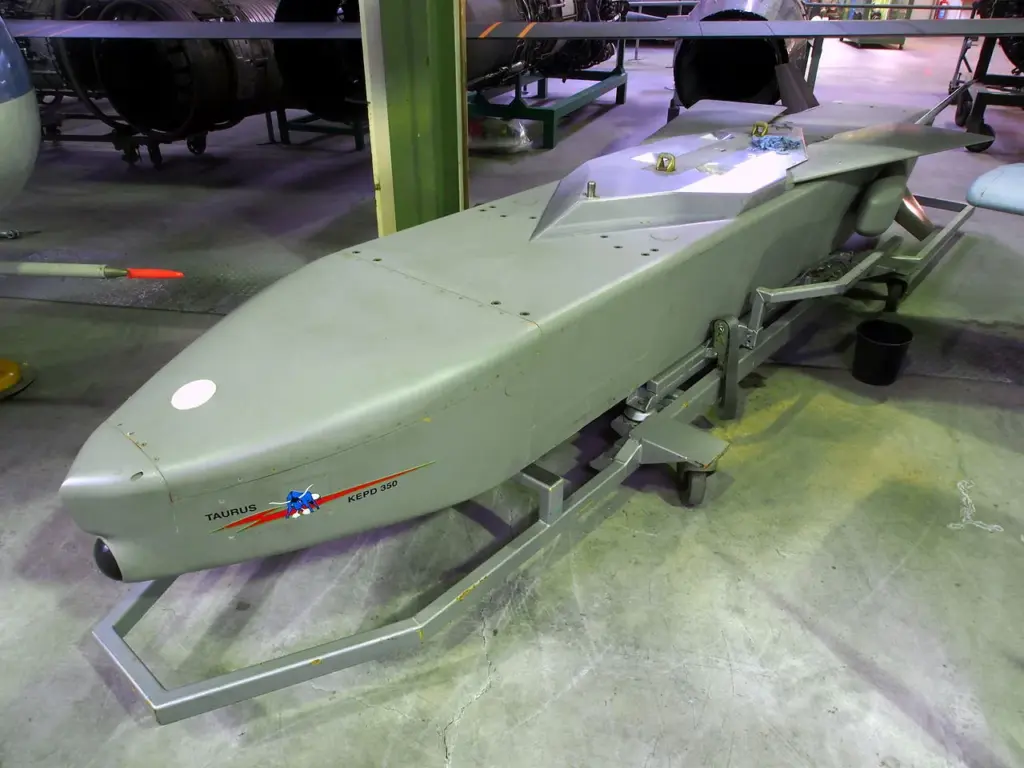
A gray Taurus KEPD 350 cruise missile displayed on a wheeled stand inside an exhibition hall.

Wolfgang Kubicki, chair of Germany’s pro-business liberal Free Democratic Party (FDP), proposed that Berlin summon Russia’s ambassador and use the prospect of Taurus missiles for Ukraine as leverage against further hybrid attacks during an appearance on German broadcaster ntv.

Kubicki’s proposal does not change German policy. The FDP has no seats in the Bundestag, Germany’s federal parliament, while Chancellor Friedrich Merz has ruled out supplying the missiles. However, it recasts military aid to Ukraine as a potential cost Moscow would face for hybrid attacks inside Germany. Berlin has since formally blamed Russia for the Leipzig/Halle operation that prompted his remarks.

Kubicki said “a reasonable person” would tell the ambassador that Germany had so far withheld Taurus missiles. If the hybrid threat continued, Berlin should do everything possible to ensure Ukraine received the weapons it needed to defend itself against Russia, he added.

Taurus, the weapon Kubicki spoke about, is a German-Swedish cruise missile launched from military aircraft, with a range exceeding 500 kilometers. Ukraine has sought it for years to strike military targets far behind Russian lines.

Germany refused to supply Taurus missiles in 2025 while funding hundreds of Ukrainian-made long-range systems. Merz again ruled out a transfer in March, arguing that Ukrainian weapons were more effective.

Leipzig sharpens Germany’s hybrid-war debate

Germany formally blamed Russia on 1 September for the attempted drone attack at Leipzig/Halle Airport and said it would close the Russian consulate in Bonn and terminate the agreement under which the Russian House cultural center operates in Berlin, DW reported. Interior Minister Alexander Dobrindt cited evidence from German and allied intelligence services, as well as investigations across Europe. Russia has denied involvement.

The operation that prompted Kubicki’s warning involved an explosives-laden drone that struck the wing of a Ukrainian Antonov An-124 heavy cargo aircraft on the evening of 4 August but failed to detonate, Die Zeit reported. The airport handles civilian freight and NATO logistics, while Ukraine’s Antonov Airlines uses it as a base.

Investigators later found evidence that three drones were involved and discovered about 50 grams of suspected military explosive near the runways.

  •  

Russian air attack interrupts lessons on first day of school in Ukraine

President Volodymyr Zelenskyy watches as a pupil in an embroidered shirt speaks at a school event decorated with Ukrainian-colored balloons.

Ukrainian president Volodymyr Zelenskyy marked the start of the academic year with children at a Kyiv Oblast school rebuilt after Russian forces destroyed it in 2022, before an air attack forced their first lessons into the shelter on 1 September 2026, the Kyiv Oblast Military Administration said.

Knowledge Day, Ukraine’s traditional start of the academic year, fell during the full-scale invasion for the fifth time. Russia’s war now determines whether children can learn alongside their classmates: local security and shelter access govern classroom returns, while about 200,000 pupils near the front will remain fully remote.

Around three million pupils began the 2026–2027 academic year, including roughly 240,000 first-graders, 10% fewer than a year earlier, Member of Parliament Iryna Borzova of the Verkhovna Rada’s Committee on Youth and Sports told Ukrinform. Most will learn in person or through a blended format, but some 200,000 children near the front will study entirely online, she said.

More than 82% of school pupils and preschoolers can access shelters, Education Minister Andrii Butenko said. The government has allocated UAH 6 billion this year to expand access to shelters and other educational safety infrastructure.

Russian forces destroyed the school Zelenskyy visited in March 2022. It reopened only last autumn with a shelter and backup power, according to the Kyiv Oblast Military Administration.

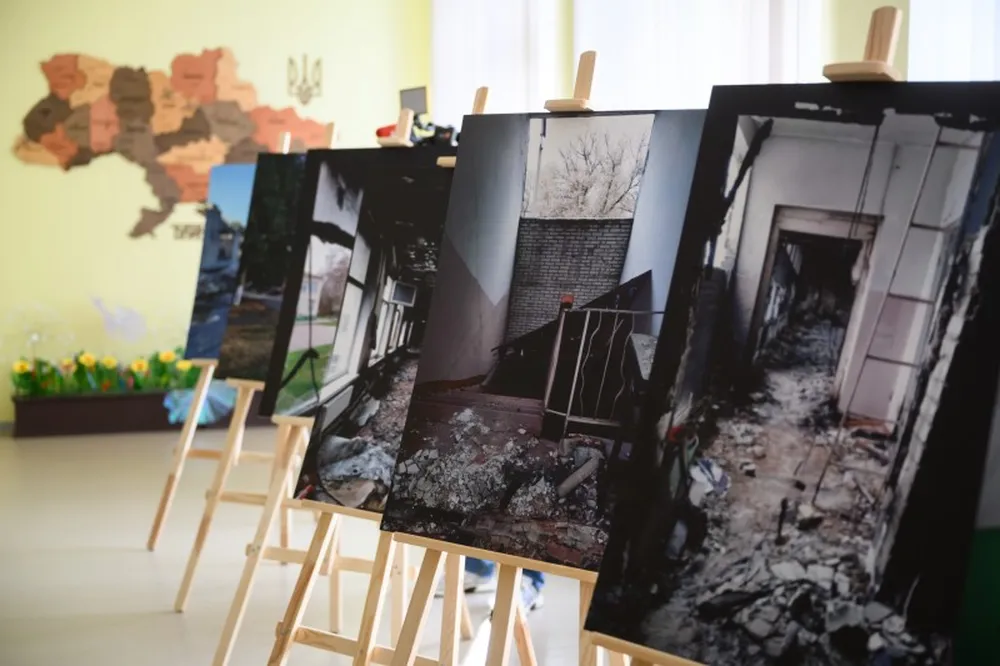
Photographs of burned and rubble-filled school interiors displayed on easels inside the rebuilt school.
An exhibition shows damage inflicted when Russian forces destroyed the Kyiv Oblast school in March 2022. The school reopened in autumn 2025. Photo: Office of the President of Ukraine

Zelenskyy said Russia had spent the preceding two weeks attacking infrastructure partly to disrupt the start of the academic year.

Ahead of Knowledge Day, Kyiv Oblast Military Administration head Tymur Tkachenko advised schools in high-risk communities not to hold mass opening ceremonies. Each school was to decide whether to proceed based on the security situation in its community.

“First and foremost, there must be safety,” Tkachenko said. If a ceremony went ahead, he recommended holding it directly in a shelter where possible. For events outside shelters, attendance was not to exceed the capacity of the nearest protective facility, and schools were told to avoid large gatherings of pupils, parents, and staff.

How Russia’s invasion has devastated Ukrainian education

Ukraine’s 2026 Knowledge Day began after six consecutive days of Russian attacks on Kyiv and its surrounding region, culminating overnight in a massed missile and drone strike. Eight people were killed, and seven were injured, including three children, while civilian infrastructure was damaged across five Kyiv districts.

Russia’s invasion has turned school safety and reconstruction into central parts of Ukraine's education policy. By September 2024, more than 3,500 educational institutions had been damaged and nearly 400 destroyed, with the World Bank estimating that almost $14 billion would be needed to rebuild them.

Attacks on Ukraine’s energy system have also left classrooms without heat or electricity, forcing prolonged holidays and renewed distance learning.

  •  

US welcomes Russia back to G20 but rules out economic relief, source says

US Treasury Secretary Scott Bessent speaks in front of a G20 Asheville 2026 backdrop.

US Treasury Secretary Scott Bessent told Russian Finance Minister Anton Siluanov that “nothing is possible until the war is over” during their 31 August meeting, a source familiar with the exchange told Reuters.

Siluanov’s return marked the first in-person G20 appearance by Russia’s finance minister since 2022, raising European concerns that Moscow was being treated as a normal partner again. Bessent’s response indicated that renewed contact would not bring economic relief while the war continues, although Washington announced no new sanctions or steps to enforce existing ones.

Bessent and Siluanov met on the sidelines of a G20 finance meeting, a forum of major economies, in Asheville, North Carolina. A US official said the talks focused on President Donald Trump’s peace plan for Ukraine. Russia’s Finance Ministry said it discussed Russian-American financial cooperation and work within the G20.

The condition also covered agreements in other areas, Reuters’ source said. Reuters did not specify what form of economic relief Bessent meant. Asked why Washington received Siluanov, White House spokesman Kush Desai said to AFP that the administration was working with Russia to end the bloodshed.

Siluanov last joined a G20 finance meeting virtually in April 2022, prompting Western officials to walk out.

Europe warns against normalization

European officials were preparing further sanctions against Moscow, and German Finance Minister Lars Klingbeil said they wanted Washington’s cooperation. He called Siluanov’s reception a “quite troubling” signal and said relations with Russia could not be normalized while the war continued, Reuters reported.

Klingbeil said European officials agreed that dialogue could help deliver a frank message to Moscow. They nevertheless refused to join the customary group photograph with Siluanov, which organizers ultimately took without him.

US eased Russian oil sanctions during Iran war

Washington sanctioned major Russian oil companies in October 2025. After the US-Israeli war with Iran disrupted supplies through the Strait of Hormuz, however, the Treasury issued temporary licenses allowing Russian oil already at sea to reach buyers.

Bessent defended the relief as a way to prevent a sharper oil price spike, while senators warned that it increased Moscow’s war revenue, Euromaidan Press reported. The waiver briefly lapsed in mid-May before Bessent extended it for another 30 days, despite telling European allies he would not do so, according to Politico.

The licenses were intended to stabilize global supplies but also kept revenue flowing to Moscow. Washington has not announced a new Russia-related enforcement measure or timetable following Bessent’s meeting with Siluanov.

  •  

Latvia blocks Russian and Belarusian books, clothes and toys

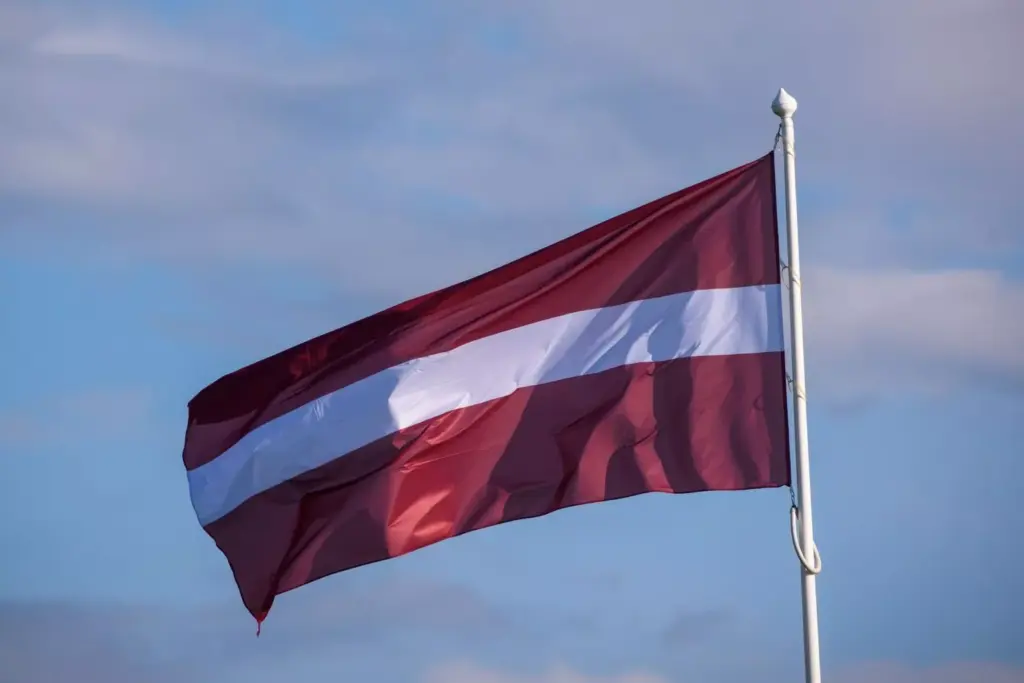
Latvian flag flying from a white flagpole against a blue, lightly clouded sky.

On 1 September 2026, Latvia banned imports of Russian- and Belarusian-made books, clothing, toys, and other consumer goods, including shipments routed through third countries, Latvian Public Media reported.

The restricted goods were worth approximately €12.5 million ($14.5 million) in 2025, or 6.5% of Latvia’s remaining imports from the two countries. Although modest economically, the measure goes beyond EU-wide sanctions and advances Riga’s effort to deny Moscow and Minsk revenue during Russia’s war against Ukraine.

The restrictions cover the following:

  • Books, newspapers, and other printed material
  • Clothing, textiles, footwear, and headwear
  • Toys, games, and sporting equipment.

Latvia’s Cabinet approved the final product list on 25 August following a Foreign Ministry proposal, completing restrictions parliament authorized on 23 July.

The ban applies regardless of whether the products arrive directly or through another country. Russian- and Belarusian-made goods may still transit Latvia on their way to other EU markets, Meduza reported.

Food and beverages are not covered. The restrictions are scheduled to remain in force until 1 July 2027 and will be reviewed annually.

The Foreign Ministry said the measure is also intended to limit the entry of Russian propaganda material. The targeted products accounted for only 0.05% of Latvia’s total imports in 2025, according to Euronews.

How Latvia has been cutting off trade with Russia and Belarus

Latvia’s combined imports from Russia and Belarus have already fallen by 91%, from €2.13 billion ($2.47 billion) in 2022 to €193 million ($224 million) in 2025, according to Latvian Public Media. Much of that decline followed the country’s departure from Russian energy supplies and the Baltic states’ disconnection from the Russian and Belarusian electricity grids.

The latest prohibition blocks consumer goods that Brussels has not collectively banned.

Latvian Prime Minister Andris Kulbergs previously pledged to eliminate the country’s remaining commercial links with Russia and Belarus, although pharmaceutical exporters were expected to remain exempt.

In August, Latvia also resumed publishing a monthly register of businesses trading with either country, naming 171 companies. Inclusion on the list does not itself indicate a sanctions violation.

  •  

Russia promised a scramjet superweapon. Ukraine says Zircon runs on solid fuel

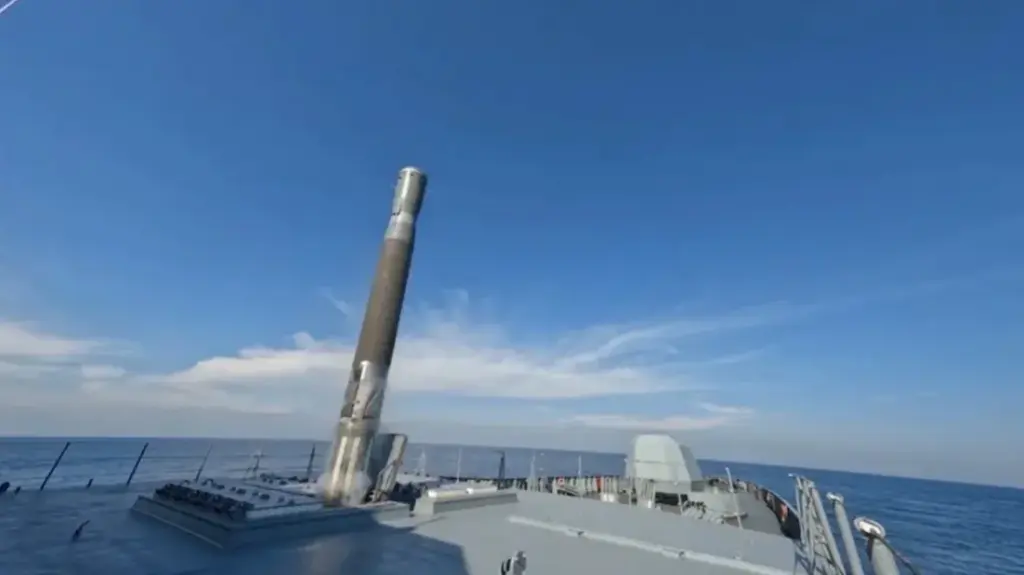
russia touted zircon hypersonic superweapon ukraine says its technology far less exotic · post missile launch warship russian defense ministry militarnyi polish_20260120_110147292jpg news ukrainian reports

Russia's Zircon runs on two solid-propellant motors, a booster and a sustainer, Ukraine's military intelligence (HUR) said in a breakdown of the missile's structure and components. That leaves no room for the scramjet Moscow advertised, Defense Express wrote.

Russia presented Zircon as a hypersonic missile capable of penetrating modern air defenses. HUR says it instead uses solid-propellant motors, which Defense Express reads as demolishing Moscow's claims about a superweapon. The intelligence agency also listed an Altera programmable chip and a TriQuint amplifier among the missile's components, the same finding investigators keep making in Russian weapons.

HUR published an interactive 3D model of Zircon through its War&Sanctions database, the latest in a series on Russian ballistic weapons. The agency said the recorded maximum speed to date does not exceed Mach 6.8—about seven times the speed of sound—and that the missile does not hold it through the whole flight. Russia claims Mach 9 at some stages of flight. Zircon carries a roughly 120-kilogram warhead.

Side-view 3D model of Russia’s 3M22 Zircon missile against a black background.
A 3D render of a 3M22 Zircon. Source: HUR, Ukraine's military intelligence agency

Defense Express reported that a 2010 contract with solid-fuel specialist NPO Iskra indicates that this propulsion system was planned from the earliest stages of Zircon's development.

Built for ships, moved onto a coastal launcher

Zircon is a Russian anti-ship missile developed for surface ships and nuclear-powered submarines. Russia later adapted it for Bastion-M coastal launchers amid difficulties operating its Black Sea Fleet, HUR said.

Ukrainian forensic experts first confirmed Russia had fired a Zircon at Kyiv in February 2024. Defense Express reported that Ukraine intercepted two more over the capital the following month. Russia has continued using Zircon against land targets: in February 2026, it launched four at Ukraine’s power grid, of which Ukrainian air defenses downed two.

What solid-fuel propulsion changes

Solid fuel does not make Zircon slow: Mach 6.8 is still hypersonic. A scramjet draws oxygen from the atmosphere to sustain hypersonic flight; Zircon instead flies on self-contained rocket motors. HUR calls it a ballistic missile rather than the hypersonic cruise missile Russia advertised, and notes its onboard computer is the type fitted to all Russian ballistic missiles. Defense Express says the trajectory may be aeroballistic and the motor possibly dual-pulse, given the range Russia wanted from a missile that had to fit a ship's launch silo.

Russian President Vladimir Putin claimed in 2019 that the missile could reach Mach 9 and travel 1,000 kilometers, up from earlier official figures of Mach 6 to 8 and 400 to 500 kilometers. A year earlier, the former head of its manufacturer said it flew on a jet engine, Defense Express said.

In February 2024, Kyiv's forensic institute concluded from the debris that the engine was air-breathing rather than solid-fuel, and Defense Express went further the following month, reporting from its own sources that Russia had built a working scramjet. The outlet has since appended a correction to that article, noting that HUR found a solid-fuel 3L2211 motor from NPO Iskra where the scramjet was supposed to be.

The US chips inside Zircon

HUR identified two components from US manufacturers inside Zircon: a programmable gate array from Altera, now part of Intel, and a TGA2704 amplifier from TriQuint Semiconductor, now Qorvo. It also mapped 70 companies involved in its production, along with their personnel and foreign manufacturing equipment.

The finding fits a wider pattern. Investigators have found Western electronics in Russia's UMPK glide-bomb kits and traced at least 28 foreign parts from 15 companies in the Kh-101 that struck Kyiv's Okhmatdyt children's hospital.

A 2026 examination found 62 US-made parts in an Iskander missile, while a Russian Geran drone combined a Soviet missile with Western electronics and a Chinese modem.

  •  

Drone attack damages Russia’s Baltic oil port as drone crosses Latvia into Estonia

A thick gray plume of smoke rises above a distant tree line beneath a pink early-morning sky.

Russian authorities reported damage and a fire at Ust-Luga port during an overnight drone attack on 1 September. One drone crossed Latvian and Estonian airspace, prompting NATO to scramble Turkish F-16s.

The attack hit a major outlet for Russian energy exports. Reuters reported that Ust-Luga loads about 700,000 barrels of crude a day and exported 32.9 million metric tons of oil products in 2025. Its terminals also serve shadow-fleet tankers used to bypass sanctions.

Leningrad Oblast Governor Alexander Drozdenko said emergency crews were working in Ust-Luga’s port zone while the damage was being assessed. He later claimed Russian air defenses downed 52 drones over Leningrad Oblast and reported no casualties.

Drozdenko did not identify the damaged facility or specify the scale of the fire.

Militarnyi published an image attributed to the Exilenova+ monitoring channel showing a blaze near the port. The image’s time and precise location have not been independently verified.

🇷🇺 🔥 **𝗗𝗥𝗢𝗡𝗘𝗦 𝗛𝗜𝗧 𝗨𝗦𝗧-𝗟𝗨𝗚𝗔 𝗣𝗢𝗥𝗧 𝗔𝗡𝗗 𝗧𝗢𝗟𝗬𝗔𝗧𝗧𝗜 𝗢𝗩𝗘𝗥𝗡𝗜𝗚𝗛𝗧, 𝗙𝗜𝗥𝗘𝗦 𝗕𝗥𝗘𝗔𝗞 𝗢𝗨𝗧 𝗔𝗧 𝗕𝗢𝗧𝗛

🔥 Drones struck the port zone of Ust-Luga in Leningrad region overnight into September 1, sparking a fire, governor Alexander Drozdenko… pic.twitter.com/lGEesBMOBN

🇺🇦 Vortex Report (@VortexReportX) September 1, 2026
There was no immediate information on whether the attack disrupted port operations. Ukraine had not claimed responsibility at the time of publication.

The regional warnings coincided with a broader drone attack on western Russia that included Ust-Luga, although authorities did not specifically link the drones approaching or entering NATO airspace to the port strike.

Baltic states issue warnings as NATO fighters scramble, while Finland restricts traffic

Estonia warned residents in eight counties and scrambled Turkish fighter jets serving in NATO’s Baltic Air Defense Mission, which protects the skies of Estonia, Latvia, and Lithuania.

Estonian Air Force Commander Brigadier General Riivo Valge said around a dozen drones had moved near the country’s border. One briefly entered southeastern Estonia, while another approached Narva before turning back into Russia. The fighters did not open fire, and the warnings were lifted by about 5:30 a.m.

Latvia issued two warnings overnight, first in the Ludza municipality and then in the Alūksne municipality. Latvia’s Armed Forces said a drone crossed Latvian airspace and continued into Estonia, where NATO fighters searched for it. The Latvian alerts ended at around 4:20 a.m.

Finland’s Armed Forces introduced temporary air and sea restrictions over the eastern Gulf of Finland at 3:37 a.m.

The military lifted both restrictions shortly after 6 a.m., saying no drones had strayed into Finland.

Repeated strikes on Ust-Luga

Ust-Luga lies around 110 kilometers west of St. Petersburg and some 900 kilometers from Ukraine. It is the endpoint of the Baltic Pipeline System-II, which carries Russian crude to the port for export. The area hosts facilities operated by Russian gas producer NOVATEK and fertilizer maker EuroChem.

Ukraine began its series of 2026 attacks on Ust-Luga overnight on 24–25 March. The Security Service of Ukraine, the country’s counterintelligence agency, and the military’s elite Special Operations Forces confirmed that they had struck NOVATEK’s gas-condensate complex, which processes liquid hydrocarbons into fuels.

Further attacks followed in late March. They set fuel-storage tanks ablaze, damaged a pier and pumping equipment, and temporarily halted port operations, according to Russian Telegram channel Astra.

On 7 April, Ukraine’s General Staff, the military’s senior command, confirmed another strike on Ust-Luga’s oil terminal, saying three oil storage tanks were destroyed. Another attack on 14 August again caused damage and a fire, Drozdenko reported at the time.

  •  

From Warsaw to New York, Ukrainians will form human chains on Independence Day

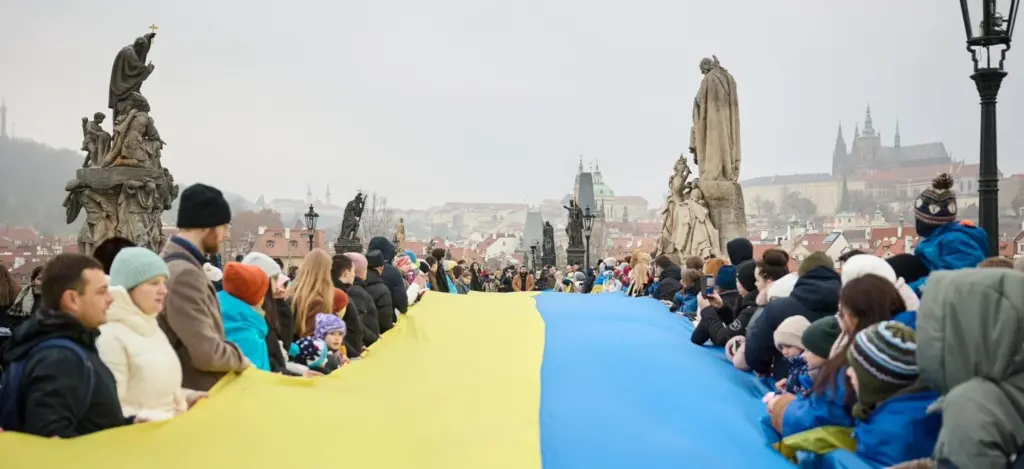
People line Prague’s Charles Bridge holding a long Ukrainian flag, with Prague Castle visible in the background.

Ukrainians and supporters will form human chains in cities abroad at 19:00 (7 p.m.) on 24 August 2026 to mark Independence Day, Ukraine’s Mission to the European Union announced on 20 August.

Russia’s invasion has driven more than 5.6 million Ukrainians to seek refugee or other international protection abroad, according to the UN Refugee Agency. The human chains will help displaced Ukrainians and established diaspora communities show that Ukraine still needs their host countries’ support, the organizers say. Participants follow in the footsteps of Ukrainians in the Soviet era who formed human chains to demonstrate their desire for independence.

The 2026 Chain of Unity campaign website listed 55,600 participants on 22 August. Ukrainians and their supporters will gather on central streets and squares in Warsaw, London, Berlin, Rome, Toronto, New York, and other cities, where they will hold hands in local chains.

An interactive map allows people to find, join, or organize a local chain. Ukraine’s Cultural and Foreign Ministries support the action, which is being held only outside the country.

Ukrainians abroad will use Independence Day in other ways to draw attention to Ukraine’s wartime needs. Ukrainian community groups have organized rallies in 11 cities across 10 countries, calling on European governments to use Russian central bank reserves frozen under sanctions to fund Ukraine.

Why human chains still matter to Ukraine

Human chains became a powerful symbol of Ukrainian unity as Soviet rule weakened and the independence movement moved into the open.

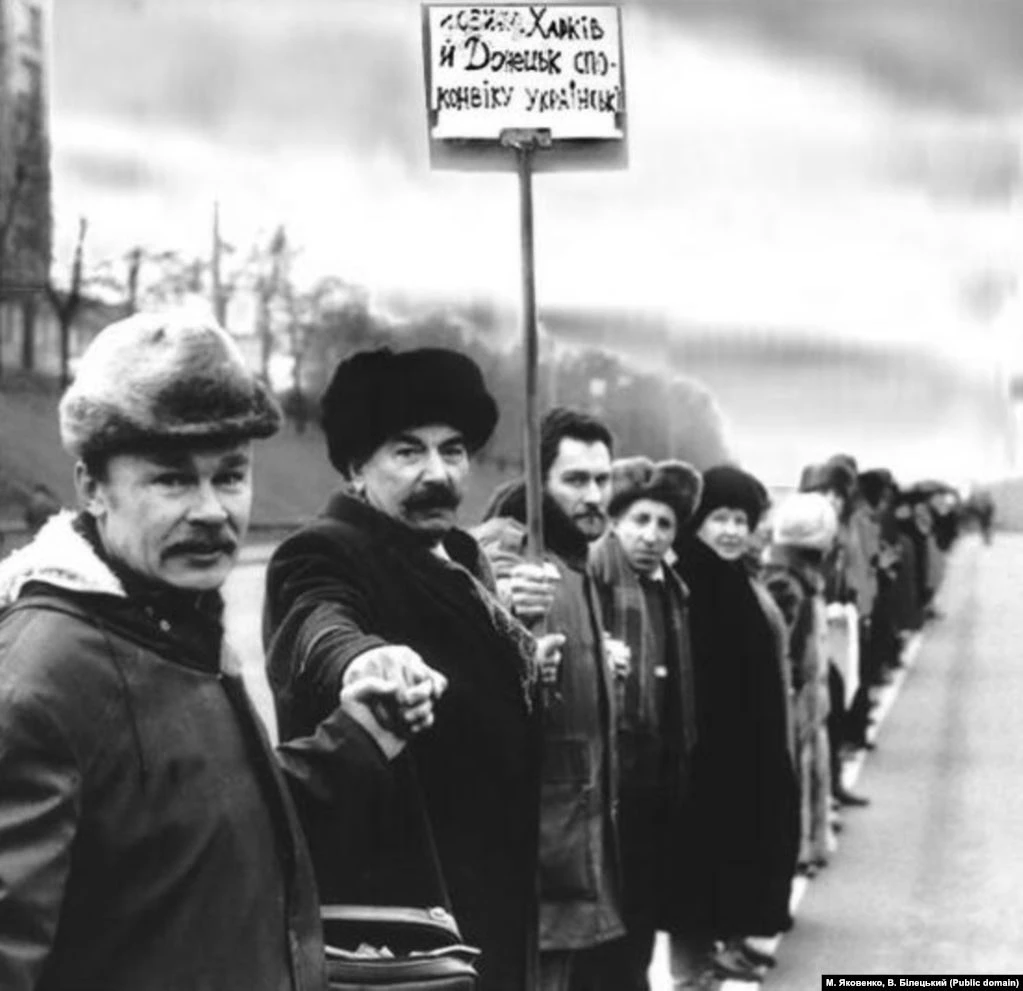
On 21 January 1990, hundreds of thousands of Ukrainians formed the nearly 700-kilometer “Ukrainian Wave” from Ivano-Frankivsk through Lviv to Kyiv. It became late-Soviet Ukraine’s largest public demonstration and helped build momentum for independence the following year.

The pro-independence People’s Movement of Ukraine (Rukh) spent five months organizing the chain. When gaps appeared, organizers bused volunteers from Lviv and Ivano-Frankivsk to fill them, while participants supplied their own fuel.

Human chain formed during the Soviet-era independence movement
Representatives of Donetsk and Kharkiv at the Human Chain in Kyiv. The sign reads, "Kharkiv and Donetsk are Ukrainian from time immemorial." Source: Radio Svoboda

The 1990 chain marked the anniversary of the 1919 union of the Ukrainian People’s Republic and Western Ukrainian People’s Republic, two Ukrainian states that emerged after World War I. By joining hands across regions while their country remained part of the Soviet Union, participants showed broad support for restoring Ukraine's sovereignty and unity.

After 1991, Ukrainians kept the tradition on Unity Day, the 22 January holiday marking that union. They often joined hands across Dnipro bridges to symbolize east-west unity. This year’s action takes the gesture abroad: refugees, established Ukrainian communities, and supporters are using it to show they remain part of one nation.

  •  

Ukrainian drones hit warehouse belonging to Russian online retailer Ozon for the first time

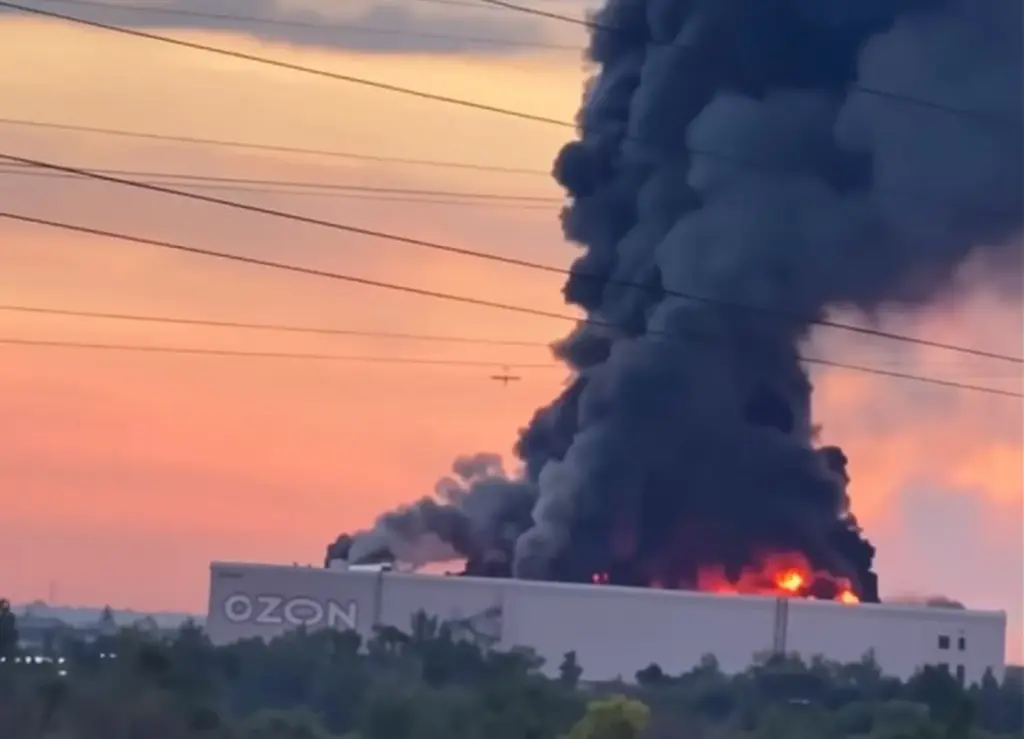
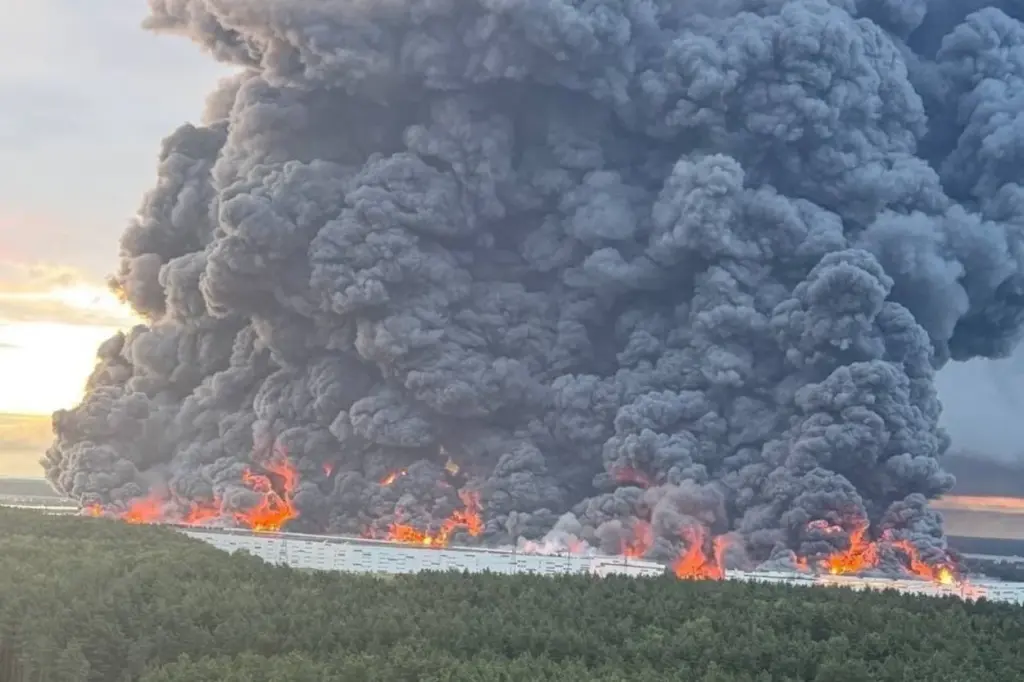
Thick black smoke and flames rise from an Ozon warehouse in Chapayevsk, Russia, at sunset.

Ukrainian FP-1 drones struck an Ozon warehouse in Chapayevsk, Russia’s Samara Oblast, overnight on 22 August 2026, manufacturer Fire Point said.

The attack on the Chapayevsk facility expands Ukraine’s warehouse campaign from Wildberries, Russia’s largest online marketplace, to its second-largest rival, Ozon. Ukraine has repeatedly targeted Russia's major e-commerce distribution hubs to disrupt commercial logistics that Kyiv says help sustain Moscow’s war.

Ozon said the attack injured people and prompted the evacuation of more than 500 employees.

The strike was the first confirmed Ukrainian attack to damage and set fire to an Ozon warehouse, Reuters reported. A drone alert forced Ozon to evacuate a facility in Tatarstan on 31 July, but the building was undamaged and later reopened.

Fire Point said the facility is one of Ozon’s largest warehouses in Volga Oblast, storing goods and processing more than 215,000 orders for delivery each day.

Ozon and Wildberries—Russia’s two largest online marketplaces—and their smaller rivals collectively sell goods and services worth the equivalent of 8.5% of Russia’s GDP and employ 4 million people, Reuters reported in July.

Ozon suspended operations indefinitely and stopped accepting seller deliveries, the company said. As a result, shipments are being redirected to other facilities, while affected orders will either be fulfilled elsewhere or canceled and refunded.

Several people were receiving medical treatment, Samara Oblast Governor Vyacheslav Fedorishchev claimed. Neither he nor Ozon specified how many people were injured, and the extent of the damage remains unclear.

Ukraine’s previous strikes on Russian warehouses

Ukrainian drones had previously concentrated on Wildberries, Russia’s largest online retailer. Since 18 July, Ukraine has struck at least two dozen Wildberries warehouses, Reuters reported.

Ukrainian officials have alleged that Wildberries warehouses move military-linked goods, including drone components. The Kremlin has denied that the company supplies Russian forces. Fire Point made no corresponding claim about the Ozon warehouse.

Fire burning at Wildberries warehouse in Koledino, Russia.
Wildberries warehouse burning in Russia’s Koledino following a Ukrainian drone strike, 16 August 2026. Photo: Exilenova+

Ukraine’s military said the same overnight wave also hit the Novokuibyshevsk refinery in Samara Oblast and caused a fire.

Russian and occupation officials claimed that the broader wave caused civilian deaths and injuries in Yeysk, Belgorod, Bryansk, and Russian-occupied Luhansk.

  •  

Ukraine says its drones hit major Russian refinery amid deepening fuel shortages

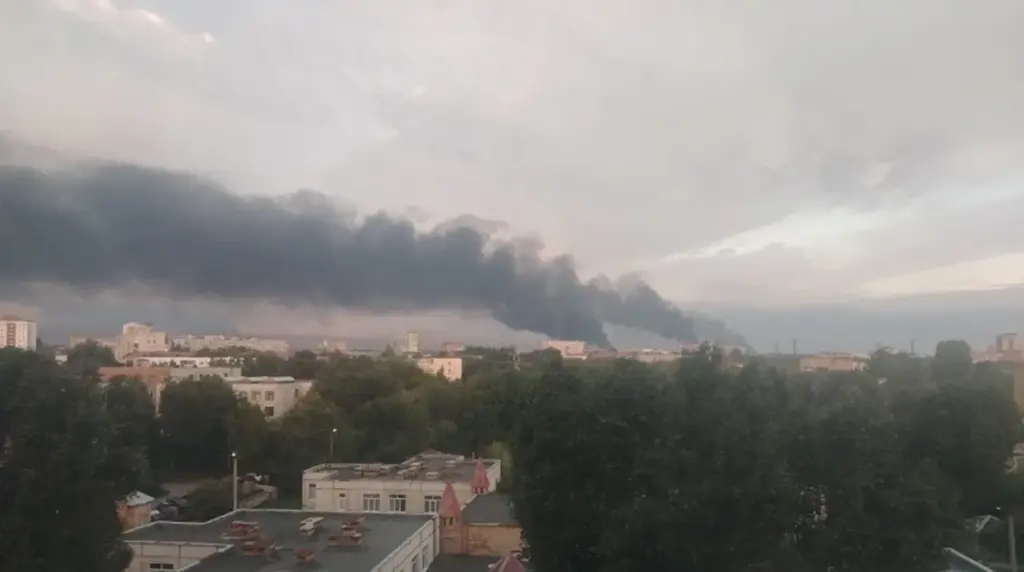
Thick black smoke rises over Novokuybyshevsk following a reported Ukrainian strike on the city’s oil refinery on 22 August 2026.

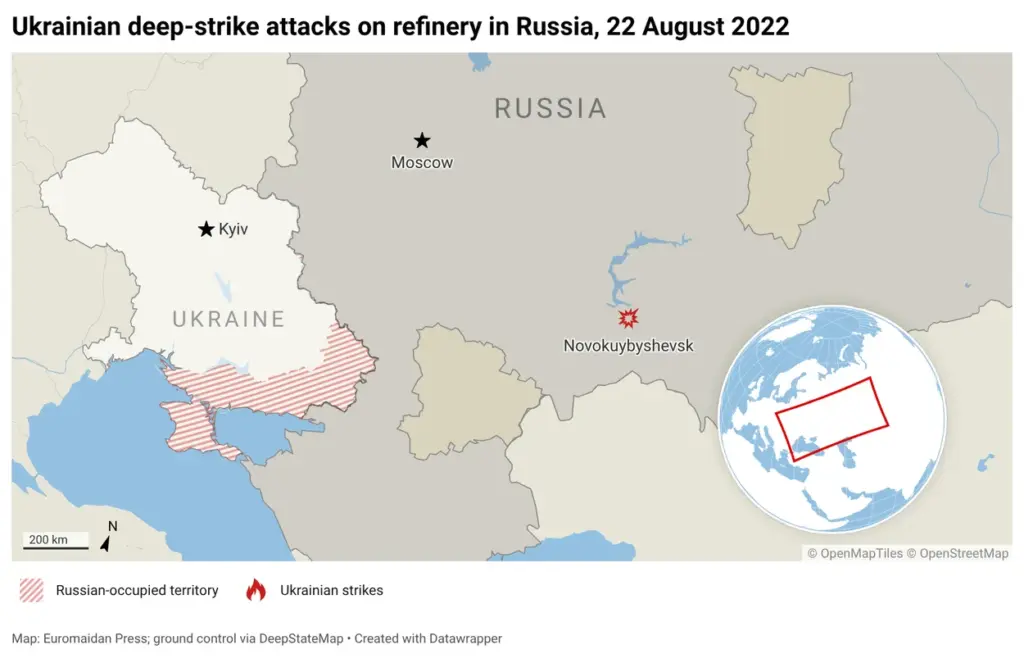
Ukrainian forces struck production facilities at the Novokuybyshevsk oil refinery in Russia’s Samara Oblast overnight on 22 August, sparking a fire at the Rosneft-owned plant, Ukraine’s General Staff said. The extent of the damage remains under assessment.

Ukraine has repeatedly targeted Russia’s oil refineries to restrict military fuel supplies and reduce the energy revenues supporting Moscow’s war. The latest strike came as gasoline rationing returned to Moscow and St. Petersburg, and Rosneft capped nationwide purchases. Militarnyi described the plant as one of Russia’s 10 largest refineries.

The Rosneft-owned refinery can process about 8.8 million metric tons of crude annually and produces more than 20 petroleum products, including aviation fuel and diesel, Ukraine’s General Staff said.

Fire Point said FP-1 long-range drones were used to strike the refinery.

Map of Ukrainian strike on Novokuybyshevsk

The same overnight wave also hit an Ozon logistics center in Chapayevsk, where people were injured, and work was halted, Reuters reported, citing the company.

Novokuybyshevsk Oil Refinery last night and now. pic.twitter.com/aZmL7M8wBe

— Exilenova+ (@Exilenova_plus) August 22, 2026

Neither the damage to the refinery nor any interruption to production has been independently confirmed.

Ukraine keeps pressure on Russian fuel supplies

The strike came one day after Ukraine confirmed hitting Lukoil’s Perm refinery, approximately 1,530 kilometers from Ukraine’s northern border. That attack also caused a fire, according to the General Staff.

At least four Russian refineries went offline during August amid continuing Ukrainian attacks.

By mid-August, filling stations in at least 12 Russian regions were experiencing hours-long lines. Some areas had reintroduced purchase limits or rationing based on license-plate numbers, according to the same report.

Gasoline limits had also been reinstated in Moscow and St. Petersburg, while Rosneft had capped sales at 30 liters per vehicle across its nationwide filling-station network. Diesel purchases remained unrestricted.

  •  

Russia’s North Korean missiles could threaten Kyiv and six other regions, ISW says

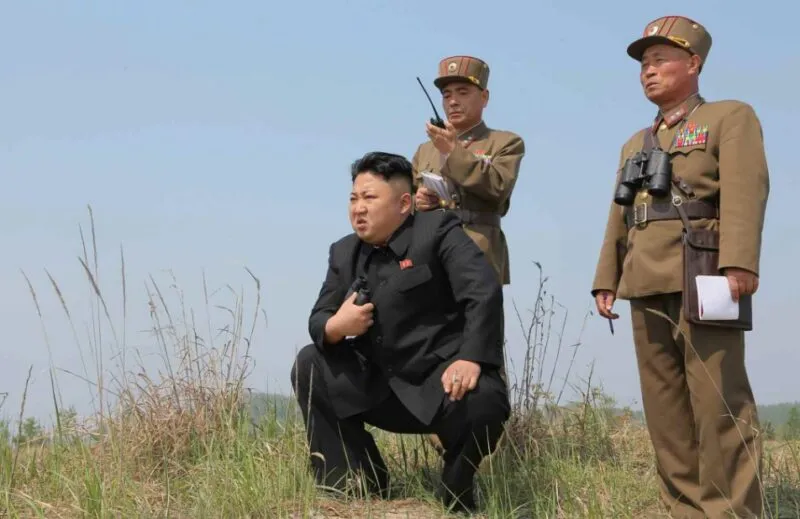
North Korean leader Kim Jong-un crouches in a grassy field while two uniformed military officers stand behind him.

Russia is deploying six launchers for North Korean ballistic missiles in Voronezh Oblast, the Institute for the Study of War (ISW) reported on 20 August. The assessment cited Ukraine’s military intelligence agency (HUR).

Russia has already used North Korean missiles in deadly strikes across Ukraine, and Pyongyang is supplying more of them. From Voronezh Oblast, the weapons could threaten Kyiv and six other regions, adding to the ballistic arsenal Moscow can use in mass attacks intended to overwhelm Ukrainian air defenses.

Six launchers expand Russia’s missile threat

The North Korean missiles could reach Kyiv, Sumy, Kharkiv, Chernihiv, Poltava, Dnipropetrovsk, and Zaporizhzhia oblasts, ISW said.

The unit may eventually field 120 missiles. HUR said North Korea had transferred around 50 KN-23, KN-24, and upgraded KN-30 ballistic missiles to Russia by July.

The KN-30 can carry a 2,500-kilogram warhead, though ISW has seen no evidence of Russia using it against Ukraine. Other North Korean missiles have larger warheads than Russia’s Iskander-M but are less accurate, Ukrainian military expert Anatolii Khrapchynskyi said.

Those missiles could join Russia’s combined attacks. ISW expects Moscow to stockpile ballistic and cruise missiles for several days before launching large barrages intended to overwhelm Ukraine’s air defenses.

ISW pointed to the 19–20 August attack as the latest example of that pattern. The barrage lasted nearly nine hours and killed at least 15 people in Kyiv. Ukraine’s Air Force said it intercepted most drones and cruise missiles, but no longer routinely reports how many ballistic missiles Russia launches or Ukraine intercepts.

North Korean missiles have already killed civilians

Preliminary evidence indicated that Russia used a North Korean ballistic missile in a 30 July strike on Radushne, Dnipropetrovsk Oblast, that killed five members of one family.

On 10 August, a North Korean missile killed seven Zaporizhstal steelworkers and injured 21 others in Zaporizhzhia, Ukrainian officials said. The workers were heading to a shelter when the missile struck.

Ballistic missiles travel at high speed and leave civilians little time to seek cover. They are also harder to intercept than drones or cruise missiles, while Ukraine has limited supplies of the Patriot interceptors used against them.

  •  

Russian groups keep trying—and failing—to reach Lyman, gateway to Donbas’ fortress belt, officer says

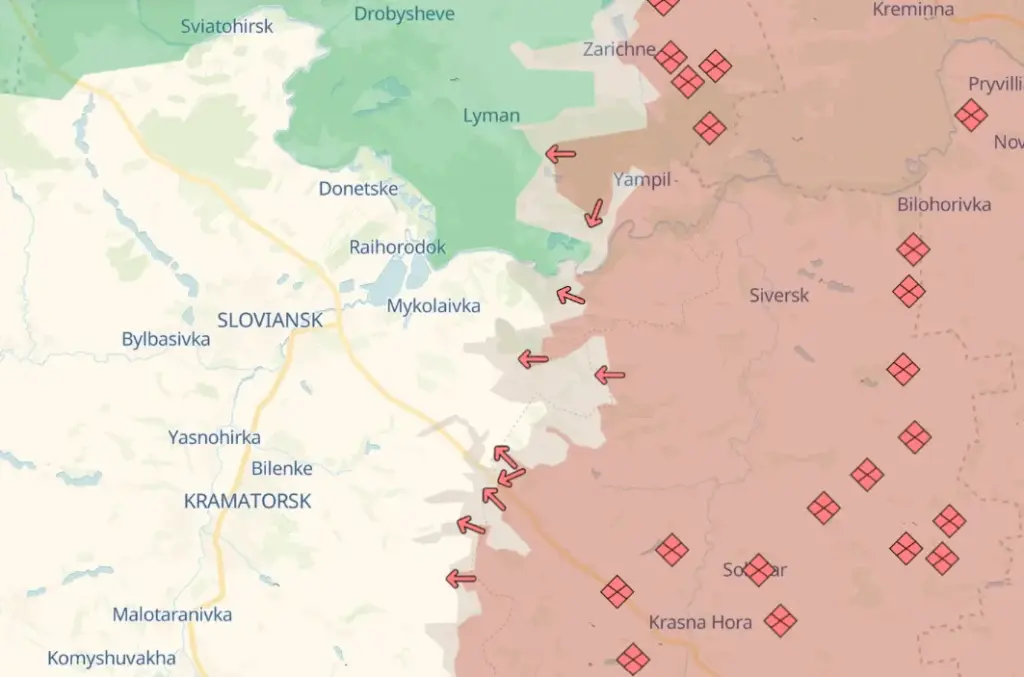
Map of the Lyman front in northern Donetsk Oblast, with arrows showing Russian advances westward toward Lyman, Sloviansk, and Kramatorsk.

Logistical problems are stopping Russian small infantry groups from reaching Lyman, a 53rd Brigade officer told Army TV on 21 August, ArmyInform reported.

Russia is trying to capture Lyman and use it as a launchpad for an advance toward Sloviansk and Kramatorsk. Its forces have repeatedly tried to push into the city. They have reached its eastern edge but have not secured a foothold inside, according to Ukraine’s Joint Forces.

Junior Lieutenant Volodymyr Hirniak, a communications officer with Ukraine’s 53rd Separate Mechanized Brigade, said the situation in the unit’s sector remained tense but had “not changed too radically.”

Russian forces continued to use drones, including fiber-optic models, Hirniak said. On the ground, they were sending small infantry groups to slip through Ukrainian lines and create confusion inside the brigade’s defensive positions.

The tactic was neither new nor confined to the 53rd Brigade’s sector, he added. Russia’s immediate aim was to reach Lyman and “open a gate” for further advances.

However, logistical problems were preventing the groups from achieving that aim, according to Hirniak. Ukrainian troops later detected and neutralized the infiltrating teams, he said.

ArmyInform did not report how many groups had attempted to advance, where within the brigade’s sector the incidents occurred, or over what period. Hirniak’s account could not be independently verified.

Why Russia keeps pushing toward Lyman

Lyman is a frontline city in northern Donetsk Oblast that blocks Russia’s northern route toward Sloviansk and Kramatorsk, part of Ukraine’s fortified Donbas “fortress belt.” Russia occupied the city for about four months in 2022 before Ukrainian forces liberated it on 1 October.

Joint Forces spokesman Viktor Trehubov said on 4 August that Russia needed to capture Lyman and establish a base there before advancing south toward Sloviansk and Kramatorsk.

Russia has pressed towards Lyman for more than a year. In July 2025, another Ukrainian officer said Russian gains near the city remained slow and costly despite repeated attempts to exploit gaps in Ukrainian lines.

  •  

Ukraine’s Flamingo missile maker’s new Danish plant delayed to 2027 as costs could triple

Three workers in blue protective suits inspect a large black Flamingo cruise missile on a factory assembly line.

Ukrainian defense manufacturer Fire Point has delayed its Danish missile-fuel plant until late 2027 after the original building failed to meet safety requirements, pushing the estimated cost above €150 million, Euractiv reported on 19 August.

The plant will produce solid rocket propellant for Fire Point’s Flamingo cruise missiles. Denmark was the first NATO country to permit Ukrainian military production on its territory, the German outlet BILD reported. The site is intended to move some production away from Russian attacks in Ukraine, but the delay postpones that capacity by a year.

Fire Point is building the plant in Vojens, near Skrydstrup Air Base in southern Denmark, Euromaidan Press reported.

Fire Point CEO Iryna Terekh announced the revised plan at DALO Industry Days, a defense-industry conference in Herning. She said Fire Point had originally expected the project to cost €50 million and called the new estimate “very rough.”

Denmark had already removed more than 20 legal barriers to speed up the project, Euractiv reported. Terekh said other European countries also remained interested in hosting Fire Point production.

What is Fire Point

Fire Point currently makes missiles and drones at 90 locations across Ukraine, Terekh told Euractiv in July.

The company supplies more than half of Ukraine’s deep-strike weapons—arms used to hit targets far behind the front line—and says it produces 300 drones daily, in a July 2026 interview with Liga.

In August 2025, Fire Point was producing 100 FP-1 long-range attack drones each day, according to the Associated Press. Its later figure includes FP-1 and FP-2 drones.

Denmark directly funds Ukrainian arms makers

Denmark has created the “Danish model” of aid, which uses allied money to buy weapons directly from Ukrainian manufacturers instead of taking equipment from donor stockpiles.

About $200 million of the €590 million military aid package announced in June was directed through the mechanism, Euromaidan Press reported. Denmark has committed about $11.7 billion in military support to Ukraine from 2022 through 2028, according to its Defense Ministry.

  •  

Captured Russian marine executed Ukrainian commander on superior’s order, prosecutors say

A masked Russian soldier in camouflage and body armor wears a helmet bearing Russian flag and “Z” patches.

Ukrainian prosecutors have formally accused a captured Russian marine of executing a Ukrainian unit commander near Pokrovsk, the Donetsk Oblast Prosecutor’s Office said on 20 August. Investigators allege he took the 34-year-old captive to a forest belt after an interrogation and shot him in the back of the head on his superior’s order.

The case comes as Ukraine steps up efforts to prosecute Russian troops accused of executing or abusing Ukrainian POWs. Ukrainian investigators and UN monitors have documented a growing pattern since 2024 of Russian forces executing Ukrainian troops after capture.

The alleged gunman is now in Ukrainian custody, opening the way for an in-person trial. Russian troops also shot dead a second Ukrainian prisoner, prosecutors said.

Russian assault units had been trying to seize Shakhove on the Pokrovsk front since May 2025, according to the prosecutor’s office. On 10 October 2025, a small Russian infantry group entered the village’s outskirts and captured two Ukrainian service members, including the commander, the office alleges.

After the interrogation, the suspect took the commander to a forest belt and killed him with an automatic rifle, prosecutors said. The other Ukrainian prisoner was also shot dead. The statement names neither victim.

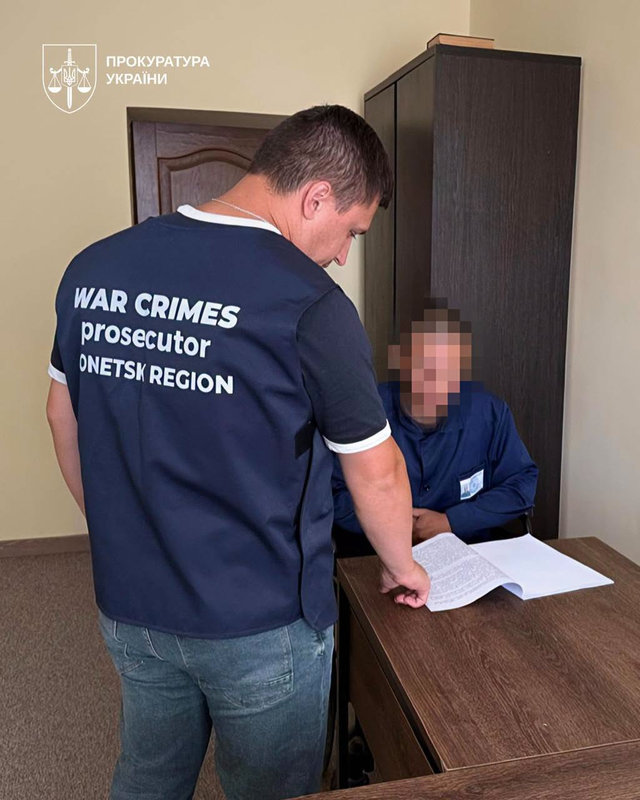
A man wearing a vest marked “War Crimes Prosecutor, Donetsk Region” stands beside a seated man with a pixelated face as they look at documents on a desk.
A Donetsk Oblast prosecutor formally notifies a captured Russian marine that he is suspected of executing a captured Ukrainian unit commander near Pokrovsk. Photo: Donetsk Oblast Prosecutor’s Office / Facebook

Investigators identified the suspect as a 34-year-old native of Russia’s Krasnoyarsk Krai who used the call sign “Tai” and served as a rifleman in the 336th Guards Naval Infantry Brigade.

Ukrainian forces later captured him during fighting in the same sector, according to prosecutors. The office did not say when he was taken prisoner.

Prosecutors formally accused him of cruel treatment of prisoners of war resulting in death, a war crime under Ukrainian law.

Ukraine’s other cases against captured Russian soldiers

Ukraine has previously brought cases against other captured Russian soldiers over POW executions. A Zaporizhzhia court sentenced Dmitry Kurashov to life imprisonment in November 2025—the first time Ukraine convicted a Russian soldier of executing a surrendered Ukrainian POW.

In a separate case, the Security Service of Ukraine charged Sergey Tuzhilov over the execution of one bound Ukrainian POW and his alleged role in killing two others near Vovchansk in June 2024.

  •  

Russia’s UN envoy denies reports of post-election mass mobilization

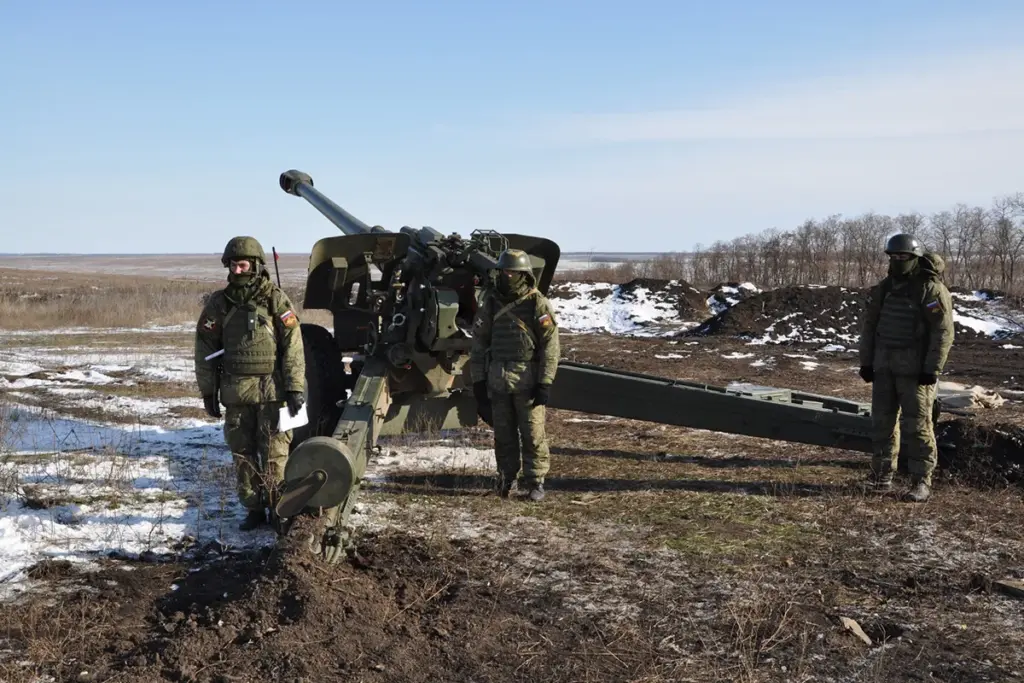
Russian soldiers stand beside a field artillery gun in a snow-covered position.

Russian UN Ambassador Vasily Nebenzya denied reports that Moscow could launch another mass mobilization after September’s parliamentary elections, saying none was planned or expected “as far as I know,” The Moscow Times reported

Russia has avoided another draft since its 2022 mobilization triggered protests and an exodus, relying instead on contract soldiers. Ukraine says those recruits no longer replace battlefield losses, and Moscow may mobilize several hundred thousand people after the elections. That could replenish its forces and support new offensives, although Ukrainian intelligence sees no preparations now.

Nebenzya’s remarks followed a question about more than 20,000 people crossing Russia’s Verkhny Lars border checkpoint into Georgia in one day amid fears of post-election mobilization, Meduza reported.

His comments extend a series of Russian denials. Deputy Security Council Chairman Dmitry Medvedev dismissed reports of another mobilization as “nonsense” in late July. The State Duma’s defense committee said a mass compulsory call-up was not under consideration because the army was recruiting contract soldiers, The Moscow Times reported.

Russia has avoided another mass draft since its September 2022 mobilization triggered protests and an exodus. Officials had also denied that mobilization was planned shortly before President Vladimir Putin announced it, Meduza noted.

Russian government seeks new wartime penalties

Moscow is separately seeking penalties for people and companies that ignore mobilization and military-supply orders issued by regional authorities. The bill would not itself order a new call-up.

The government submitted it to the State Duma, the lower house of Russia’s parliament, on 20 August, The Moscow Times reported. Companies could face fines of up to 1 million rubles or suspension for up to 90 days.

Russian law already punishes such defiance in areas under martial law but imposes no nationwide penalty elsewhere in Russia, according to the bill. Its authors said a “significant number” of violations had been recorded.

Ukraine says a new draft could provide troops for a northern offensive

President Volodymyr Zelenskyy said on 11 August, citing Ukrainian military intelligence, that Russia planned to mobilize several hundred thousand people after the elections and roughly the same number in 2027.

HUR, Ukraine’s military intelligence agency, later assessed that a post-election mobilization could enable Russia to build a strike force for a northern offensive by February 2027. Its deputy chief, Vadym Skibitskyi, stressed, however, that the agency currently sees no evidence that such preparations have begun.

  •  

Latvia resumes naming firms trading with Russia or Belarus after nearly three years

Latvian flag flying from a white flagpole against a blue, lightly clouded sky.

Latvia has resumed publishing monthly lists of locally registered companies trading goods with Russia or Belarus after a nearly three-year pause, public broadcaster LSM reported on 20 August 2026.

Prime Minister Andris Kulbergs has pledged to sever its remaining economic ties with Russia and Belarus, but substantial trade remains legal because EU sanctions are not a full embargo. The monthly register makes that commerce visible by identifying the companies involved.

The Central Statistical Bureau, Latvia's national statistics agency, published the names of 171 companies for July. A subsequent analysis by Latvian news agency LETA found that more than two-thirds operated in logistics, food and agriculture, or medicine.

The disclosure is, in effect, a form of naming and shaming. Yet the statistics bureau stopped publishing a similar list in autumn 2023 because names without transaction details could not support objective conclusions. The register is not a sanctions blacklist, and inclusion does not indicate a sanctions violation.

Under an amendment adopted on 18 June 2026, Latvia’s tax authority must send the data to the statistics bureau each month. The change also lifted tax-confidentiality rules that had kept company names private, LSM reported.

The explanatory note accompanying the law said disclosure was intended to support Ukraine. The amendment's authors argued that Latvian companies should not contribute to Russian and Belarusian state revenues while Russia’s invasion continues, according to LSM.

Latvia seeks to cut its remaining trade

The Prime Minister said in June that Latvia must sever its remaining economic ties with Russia and Belarus. However, he indicated that pharmaceutical exporters would likely be exempted on national-security grounds.

Latvia’s exports to Russia and Belarus each fell only about 7% in 2025, while imports from Russia plunged by more than two-thirds, according to official data cited by Euromaidan Press.

EU sanctions do not prohibit all trade

The EU renewed its economic sanctions on Russia through July 2027, preserving restrictions on trade, finance, and energy, as well as on goods and technology with both civilian and military uses, Euromaidan Press reported in June.

The Council of the EU says its trade restrictions exclude health, pharmaceutical, food, and agricultural products to avoid harming Russian civilians. Those exclusions allow EU companies to continue lawful trade with Russia even while other parts of its economy remain under sanctions over the invasion of Ukraine.

  •  

Ukraine planned 1,000 AI-guided drones a night to shut Moscow airports, Atlantic reports

Smoke rises behind illuminated apartment buildings in Moscow at night following a reported Ukrainian drone attack.

President Volodymyr Zelenskyy allowed preparations for an AI-guided drone campaign against Moscow-area airports, The Atlantic reported on 20 August, citing two anonymous sources with direct knowledge of the proposal.

The reported plan sought to keep civilian flights grounded long enough to pressure Russia’s elite. Had it proceeded, it would have moved Ukraine toward large-scale autonomous strikes, raising questions under the laws of war about attacks without human confirmation. The Atlantic's disclosure follows months of reported Ukrainian attacks that repeatedly forced Moscow-area airport closures and sent increasingly large drone swarms toward the capital.

How the drone operation would have worked

Code-named M&Ms, the operation called for as many as 1,000 drones to fly toward Moscow-area airports each night and overwhelm Russian air defenses, one source said.

Onboard cameras would compare live views with preloaded maps and target images. They would also allow the drones to strike without pilot confirmation and to navigate without a remote-control link that is vulnerable to Russian electronic jamming, the sources said.

One source said prolonged airport closures were intended to pressure Kremlin-linked elites and push Vladimir Putin toward negotiations.

The plan was presented to Zelenskyy during the winter of 2025–26, The Atlantic reported. Preparations stopped after Zelenskyy dismissed Defense Minister Mykhailo Fedorov, whom The Atlantic described as the operation’s mastermind, in July, both sources said. One source said another team could revive the project within about three months.

Both sources said Zelenskyy allowed preparations despite concerns that a drone could hit a civilian airliner. Planners proposed warning airlines, according to one source.

A Zelenskyy spokesperson declined to comment. Another unnamed presidential office official called the report “total nonsense,” saying Ukraine lacked long-range weapons reliable enough to strike the airports without posing undue risks to civilians.

Previous Ukrainian strikes on Moscow

The alleged M&Ms operation never launched, but other reported Ukrainian drone attacks repeatedly disrupted Moscow’s airports.

From 5 to 7 May 2026, restrictions imposed amid reported Ukrainian drone attacks delayed more than 450 flights at Moscow airports. Limits at Vnukovo remained in place for nearly 18 hours, EP reported, citing the independent Russian investigative outlet Agentstvo.

Earlier this week, Russian authorities claimed that 620 drones flew toward Moscow in one night, EP reported. The Atlantic placed Russia’s nationwide interception claim for that night at 791 drones. Ukraine’s military did not claim the attack.

  •  

Russian strikes on Odesa ports push Ukrainian farms toward bankruptcy, Bloomberg reports

A damaged cargo ship burns at sea as thick black smoke rises from its stern and water sprays across the vessel.

Ravil Dzhamally fled when Russian forces occupied his farm in Kherson Oblast, then returned after liberation to clear mines and plant again. Now, tons of his grain lie unsold in plastic sleeves across his fields because Russian attacks have nearly halted exports through Odesa, Bloomberg reported on 20 August.

Odesa’s Black Sea ports handle almost all of Ukraine’s grain exports, Bloomberg reported. Weekly grain and oilseed exports have fallen by more than 90% since early July, data from commodity-data firm Kpler show. That threatens fall planting and the sector that generates more than half of Ukraine’s export revenue. The disruption is also raising food costs in countries that rely on imported grain, Reuters reported.

Farmers must either store harvests they cannot export or sell locally at about one-third of global prices, Bloomberg reported. They say this year’s crisis is worse than the 2022 blockade because the financial reserves that carried them through six months of disruption then have since been depleted.

Russian attacks drive ships from Ukraine’s grain corridor

Ukraine’s Black Sea grain corridor—the wartime shipping route from Odesa—was never formally closed, Euromaidan Press reported. Four or five ships entered Ukraine’s ports on 21 July. Still, none arrived the next day because shipowners had paused calls, not because Ukraine had restricted navigation, Agriculture Minister Taras Vysotskyi told Ukrainian agricultural outlet Latifundist.

Ukraine’s state railway, Ukrzaliznytsia, subsequently restricted selected wheat and barley shipments to Odesa ports. Its register did not state a reason, and the railway did not publicly link the orders to the shipping disruption.

Oleksandr Havryliuk, who farms near the front in Kharkiv Oblast, told Bloomberg that losing his harvest would probably bankrupt him and force him to sell the farm. The National Bank of Ukraine estimates that Ukraine could lose about $2.5 billion in export revenue during the second half of 2026, Reuters reported. Bloomberg said the disruption could trigger widespread farm bankruptcies.

Ukraine seeks EU aid and export routes as losses mount

Financing was already constrained before the port crisis: available financing and insurance were “enough to keep the sector surviving, not enough to keep it growing,” Vysotskyi told Euromaidan Press in May.

Before Russia’s full-scale invasion, agriculture accounted for more than 10% of Ukraine’s economic output, according to World Bank data cited by Bloomberg.

The sector has since grown more important as Russian attacks have destroyed much of the country’s heavy industry, Evghenia Sleptsova, a senior economist at the economic forecasting firm Oxford Economics, told Bloomberg.

Her firm estimates that the disruption could cost the equivalent of 1.8% of GDP this year and 2.1% in 2027. Under a prolonged severe disruption, the 2027 loss could instead reach 5.3%, Oxford Economics said.

Ukraine could exhaust its grain-storage capacity by early November if exports do not recover, the Agriculture Ministry said, according to Bloomberg. Even using every available route, the country may export only about 30 million tons this season, leaving roughly the same volume stored or rotting, Vysotskyi said.

Ukraine’s Agriculture Ministry requested a €220 million EU grant to subsidize interest and unlock up to €4 billion in loans, the ministry said.

Ukraine and Moldova are also discussing a rail route through Moldova to Romania’s port of Constanța, Reuters reported, citing unnamed sources in both countries. Kyiv estimates the route could carry about 10% of its grain exports.

Western rail corridors have limited capacity, while low water levels restrict traffic through Danube ports. Both alternatives cost more than shipping through the Black Sea, Bloomberg reported.

  •  

Ukraine can’t get one permit to find its WWII dead in Poland—yet approves Polish searches, Kyiv’s ambassador says

Ukraine’s Ambassador to Poland Vasyl Bodnar speaks into a microphone during a meeting.

Poland has held up a Ukrainian search at Łasków for months, Ambassador Vasyl Bodnar told Polish broadcaster RMF24, NV reported on 19 August. He says the eastern Polish village may contain the remains of civilians killed there by Polish underground forces in 1944.

The permit dispute is part of a much larger argument over how Ukraine and Poland remember the wartime killings of Poles and Ukrainians. Reciprocal searches resumed only recently after years of deadlock, giving both countries a way to recover and identify victims even as they disagree over historical responsibility. The latest delay tests that fragile progress while Poland remains Ukraine’s main route for Western arms and aid.

Bodnar says Ukrainian civilians were killed at Łasków in 1944 by the Home Army—Poland’s principal underground resistance force during the Nazi occupation—and the Peasant Battalions, an agrarian underground movement.

Bodnar appealed to Poland to issue "at least one permit" for searches on its territory. He said Ukraine systematically approves Polish requests in return. The ambassador blamed the holdup on unspecified “bureaucratic restrictions” and urged Warsaw not to leave the impression that Kyiv was obstructing the work.

In July, Bodnar said Poland’s Institute of National Remembrance had supported the Łasków application procedurally and that only approval from the regional monuments conservator remained. He expected work to start in August.

The institute said it had assisted with Łasków but was awaiting more documents for Ukraine’s separate applications concerning Sahryń and Przemyśl.

Past Polish-Ukrainian exhumations

Reciprocal work between Ukraine and Poland resumed only after Kyiv lifted a moratorium imposed in 2017. Ukraine had halted Polish exhumations in response to the destruction of Ukrainian memorial sites on Polish soil.

The monument to murdered Polish civilians in Huta Peniatska in Ukraine's Lviv Oblast was restored in 2017. Photo: NV
Explore further

Ukraine will keep issuing Polish exhumation permits despite historical tensions. Dispute “causes joy in Moscow,” Kyiv says

A joint team exhumed the remains of 42 Polish victims of massacres by Ukrainian nationalists at Puzhnyky in western Ukraine in May 2025. Ukrainian researchers later searched for a suspected grave of up to 18 Ukrainian Insurgent Army fighters at Jureczkowa, Poland, but found none.

Ukraine granted further permits for Polish searches in 2026. Joint work at Uhly in Rivne Oblast found no mass grave, while exhumations began at Ostrivky and Volia Ostrovetska in July.

Historical grievances strain wartime alliance

The searches are the practical core of a broader dispute over wartime killings of Poles and Ukrainians. Competing interpretations of the Volyn tragedy and battles over Ukrainian Insurgent Army symbols have increasingly spilled into Polish politics and the streets.

Kyiv says it continues approving Polish grave searches while its own researchers wait to begin work in Poland.

  •  

Russia occupied Anton’s home when he was 10. At 18, he volunteered to fight against Ukraine

Two soldiers kneel behind a low brick barrier and fire rifles across an open training field.

Now held in a POW camp in western Ukraine, Anton does not consider himself a traitor. He calls Putin “my President” and said he joined Russia’s army to defend “my land,” the BBC reported.

The BBC interviews show what more than a decade of Russian rule has produced in occupied Donbas. Moscow has replaced Ukrainian schools, media, and public institutions while presenting the occupied regions as permanent parts of Russia. It also recruits residents or forces them to fight against Ukraine.

The BBC said prisoners could refuse and were interviewed without guards or cameras.

Almost all its Ukrainian-born interviewees from territories occupied since 2014 said they had enlisted willingly. Anton said he was not a traitor and called Vladimir Putin “my President.”

His friends also volunteered. Messages announcing their deaths followed: “Dead, dead, dead.”

Forced conscription of Ukrainians in occupied territory

One prisoner from Donetsk Oblast told the BBC he had been forced to fight. He wanted only to return to his wife and children.

The BBC cited an official intelligence-based estimate that Russia forcibly conscripted more than 50,000 Ukrainians in occupied areas. It noted that other estimates were higher.

Ukrainian veteran Pavlo Pshenychnyi told Hromadske that occupation authorities used planted drug evidence to push him into Russia’s army. They threatened him with up to 12 years in prison.

Article 51 of the Fourth Geneva Convention prohibits occupying powers from compelling protected residents to serve in their armed forces.

Anton and the Russification of occupied Ukrainian territory

Russia took control of Anton’s home while he was still in primary school. By adulthood, he called himself Russian and dismissed his Ukrainian surname as irrelevant.

Putin’s 2025 policy decree set a 95% target for “all-Russian civic identity” by 2036 and ordered the integration of occupied Ukrainian regions into Russian education, culture, and media.

Kherson-based outlet MOST reported that Russia will introduce compulsory textbooks on 1 September, presenting four occupied Ukrainian regions as historically Russian.

Ukraine’s Center for Countering Disinformation reported in 2025 that more than 100 teenagers from occupied Luhansk attended a Russian military camp. They received firearms, drill, and guard-duty training.

The center described the camp as part of a wider effort to spread Russian war propaganda and hostility toward Ukraine.

Petro Yatsenko of Ukraine’s POW Coordination Headquarters told the BBC that these prisoners were strongly pro-Russian. He said their national identity was “very blurred.”

Ukraine still considers them Ukrainian and treats Russia’s control of their home regions as temporary, the BBC noted.

  •  

Hungary sent commandos to seize Ukraine’s $82 million bank convoy. Its investigators now say they have found no crime

Stacks of bundled banknotes and nine gold bars arranged on a wooden table.

Hungary has closed the Oschadbank case after finding no crime connected to an $82 million shipment of cash and gold belonging to Ukraine’s state-owned savings bank, The Insider reported on 20 August 2026, citing the bank’s lawyer Lóránt Horváth.

Closing the money-laundering case removes the allegation used to justify seizing Oschadbank’s assets. A separate criminal investigation is examining the couriers’ detention, while Prime Minister Péter Magyar’s government has opened an internal review of the agencies involved. Together with the return of the assets, these steps reverse how this case was handled under former PM Viktor Orbán and may help improve relations with Ukraine.

Hungary’s National Tax and Customs Administration (NAV), the country’s tax and customs authority, traced the assets to a documented deal between Austria’s Raiffeisen Bank International and Oschadbank. Raiffeisen provided records establishing the assets’ origin and Oschadbank’s payment, according to Horváth’s account of NAV’s decision.

Meanwhile, a separate investigation into the couriers’ alleged unlawful detention remains open. János Hajdu, the former head of Hungary’s Counter-Terrorism Center (TEK), is a suspect. TEK is the country’s armed counterterrorism police.

A leaked prosecution document named former Prime Minister Viktor Orbán and three other former officials, including Hajdu, among those involved in deciding on the operation. Orbán has not been named as a suspect, Euronews reported on 30 June.

Orbán denies wrongdoing and says the raid was lawful.

How the Oschadbank case began

TEK stopped two armored cash-in-transit vans near Budapest on 5 March 2026. They carried $40 million, €35 million, and nine kilograms of gold from Vienna to Kyiv under a routine banking contract, Euromaidan Press reported. Officers detained the seven Oschadbank employees as witnesses, kept them handcuffed for 28 hours, and denied them lawyers and Ukrainian consular access, Ukraine’s Foreign Ministry said.

Hungary deported the couriers and imposed three-year Schengen bans, which barred them from most of Europe, although none had been charged with a crime. The orders and bans were later annulled.

Orbán’s government nevertheless portrayed the shipment as possible money laundering. Fidesz politicians also alleged, without evidence, that it was intended to finance Magyar’s then-opposition party, Tisza.

Hungary returned the vans, cash, and gold by 6 May. Ukrainian Foreign Minister Andrii Sybiha called the handover a break with Orbán-era “lawlessness” and a sign that relations could advance through “mutual respect and healthy pragmatism,” Reuters reported.

  •  

He was on the set of a Hollywood thriller about Nord Stream. Then Germany had him arrested over the real attack.

Gas bubbles churn the Baltic Sea above a leak in the Nord Stream 2 pipeline on 27 September 2022.

Croatian police arrested a Ukrainian diver in Pula on 19 August 2026 over his alleged role in the 2022 Nord Stream pipeline explosions, Croatian broadcaster HRT reported. German prosecutors confirmed to AP that the suspect was Volodymyr Zhuravlov (Zhuravliov in Ukrainian official transliteration). Legal Tribune Online reported that he was detained on the set of Zmiinyi (Snake) Island.

The arrest gives German prosecutors a third chance to secure Zhuravliov after two attempts in Poland failed. If Croatia extradites him, he would become the second suspected member of the alleged team to face proceedings in Germany. Berlin has pursued other suspects in the Nord Stream case across Europe, but the identity of the person who ordered the sabotage remains unknown.

Previous arrests and arrest attempts

Germany’s Federal Public Prosecutor’s Office said Zhuravliov was a trained scuba diver who took part in the dives needed to place explosives on Nord Stream 1 and 2 near Denmark’s Bornholm island. Prosecutors say the group sailed from Rostock aboard a yacht that middlemen rented from a German company using forged identity documents.

The 2024 European arrest warrant accuses Zhuravliov of jointly causing an explosion, anti-constitutional sabotage, and destroying structures. He would appear before an investigating judge at Germany’s Federal Court of Justice following extradition, prosecutors said. A Croatian court must first approve his surrender.

LTO reported that investigators first sought Zhuravliov’s arrest in Poland in the summer of 2024, but he crossed into Ukraine before police detained him. Polish police arrested him near Warsaw in autumn 2025. However, a court rejected Germany’s extradition request after finding that the pipelines could be treated as a legitimate military target during an armed conflict. Zhuravliov has denied involvement.

Volodymyr Zhuravliov. Screenshot from NTV video

His lawyer, Tymoteusz Paprocki, told AP that Zhuravliov understood the Polish ruling applied only within Poland.

Another Ukrainian suspect, Serhii K., was arrested near Rimini in August 2025 and extradited to Germany that November after unsuccessful appeals. Prosecutors allege he coordinated the operation rather than joining the dives. They charged him in Hamburg in June 2026.

The route of the Nord Stream pipelines beneath the Baltic Sea. Map: BBC

What was Nord Stream?

Nord Stream 1 and 2 ran beneath the Baltic Sea, carrying—or designed to carry—Russian gas directly to Germany while bypassing Ukraine. Explosions on 26 September 2022 damaged three of their four lines at a depth of about 80 meters.

No court has established who ordered the attack. Ukraine’s Prosecutor General’s Office says no facts demonstrate Ukrainian state involvement and is examining whether Russia staged a false-flag operation using Ukrainians. LTO reported that Germany’s Federal Court of Justice found strong grounds in December 2025 to believe that a state had initiated and directed the sabotage, but did not identify which state.

  •  

Ukraine’s refinery strikes push Russia’s fuel crisis into Central Asia

Aerial view of Kazakhstan’s Kashagan offshore oil field, surrounded by breakwaters in the Caspian Sea.

Gasoline prices have risen roughly 10–13% in Tajikistan, Kyrgyzstan, and Uzbekistan as Russia restricts exports after Ukrainian strikes on its refineries, Kazakh economist Aidar Alibayev estimated in a 20 August interview with Current Time. He did not specify the comparison period.

Earlier Ukrainian attacks disrupted Kazakhstan’s crude exports through Russia’s Black Sea ports. Strikes at refineries are creating a different kind of squeeze: Russia has less gasoline available to dependent neighbors. Tajikistan and Kyrgyzstan are seeking other suppliers, while Kazakhstan could face growing pressure if the shortages persist.

Tajikistan has been hit hardest because it depends heavily on Russian fuel and has the region’s most difficult delivery routes, Alibayev said. He estimated gasoline prices there had risen 12–13%. Current Time reported that Tajikistan is exploring supplies from China; Alibayev said it was also turning to Iran.

Kyrgyzstan, which sources more than 90% of its gasoline from Russia, asked its neighbors, Azerbaijan and Kazakhstan, as well as other countries, for help. Current Time reported that a deputy prime minister said its reserves would last about six weeks. Alibayev estimated prices had climbed around 10%, compared with 11–11.5% in Uzbekistan, which he estimated gets half its fuel from Russia.

In Uzbekistan, Alibayev estimated that fuel prices had risen by about 11% and said the country gets about half of its fuel from Russia.

Russia extended its gasoline and diesel export restrictions through 31 January 2027 as shortages mounted. Intergovernmental and humanitarian shipments remain exempt, while diesel producers regain some export rights from 1 September. Current Time also reported that Russian companies had begun buying gasoline from Belarus.

Kazakhstan is better insulated than its neighbors because its refineries in Atyrau, Shymkent, and Pavlodar produce enough fuel to meet most domestic demand, Alibayev noted. Motorists from Russia and neighboring states are crossing its borders to refuel. He attributed Kazakhstan’s price rises mainly to domestic taxes and the end of an export moratorium—not Russia’s shortage alone.

Central Asia looks for routes beyond Russia as war drags on

Ukraine’s Black Sea campaign has repeatedly struck oil infrastructure around Novorossiysk, where the Caspian Pipeline Consortium terminal handles about 80% of Kazakhstan’s crude exports. Separate tanker attacks cut CPC loadings by a fifth and forced Kazakhstan to reduce production. In contrast, disruptions at the terminal forced Kazakhstan to send Kashagan crude to China for the first time.

Kashagan oil field near Atyrau. CPC disruptions have prompted Kazakhstan to reroute crude to China. Map: Euromaidan Press / Datawrapper

At an informal summit of Central Asian leaders in Cholpon-Ata in early August, Tajik President Emomali Rahmon proposed building a refinery to serve the whole region. For now, Alibayev said, the decisive factor is how long Russia’s troubles last: the longer Ukraine’s strikes continue, the more they will weigh on prices across Central Asia.

  •  

Russian Shaheds hit near Moldova-border crossing, burn food cargo, and black out 13,000 in Odesa Oblast

Firefighters stand beside two burned truck trailers covered in ice as smoke and orange firelight fill the night sky.

Russian strikes in southern Odesa Oblast overnight into 20 August left 13,000 utility customers without power, Odesa Oblast head Oleh Kiper reported. President Volodymyr Zelenskyy also said drones attacked a checkpoint on Ukraine’s border with Moldova.

Russia has intensified attacks on southern Ukraine’s Danube region, where ports and transport routes lie close to Moldova and Romania. The spillover from the attacks has forced these neighboring countries to close airspace, scramble aircraft, and shoot drones down.

The Odesa Oblast Military Administration said Russian strikes disrupted power in several communities, and repair crews began restoration work. It did not identify damaged electrical equipment or say whether the grid had been shut down as a precaution. Two truck trailers carrying food caught fire at another location, but firefighters extinguished both blazes, the State Emergency Service said. No casualties were reported.

Food truck on fire near Reni
One of the food trucks that was struck during Russia's assault. Source: DSNS of Ukraine

Zelenskyy did not identify which crossing was attacked or describe the damage. The Izmail District State Administration later reported that Russia attacked the Reni community with Shahed-136 drones. It recorded a hit on an unspecified site near the Reni–Giurgiulești international checkpoint.

Map of Reni attack
Approximate location of where the strike occurred.

People and freight cross between Ukraine and Moldova through checkpoints such as Reni–Giurgiulești. The district administration did not describe the damage or say whether the checkpoint remained open.

Russian attacks keep reaching Moldova

At 03:16 on 20 August, surveillance systems operated by Moldova’s National Army detected an unauthorized flight, public broadcaster Moldova1 reported.

The object was preliminarily identified as a Shahed-136/Geran-2, a long-range explosive drone used by Russia. It crossed from Ukraine near Kotlovyna in southwestern Odesa Oblast and flew toward Etulia in Moldova’s autonomous Gagauzia region. It returned to Ukrainian airspace at 03:22.

Two investigators examine a blast site with flashlights in a cornfield near Talmaza, Moldova, at night.
Explore further

Blast marks Moldova’s third airspace breach in nine days

Similar incidents occurred earlier in August. An unidentified aerial object exploded in a Moldovan field 12 kilometers from Ukraine on 9 August. On 17 August, Moldova closed part of its airspace for 15 minutes after Ukraine’s Air Force warned that a Russian Banderol, a jet-powered missile-drone, had crossed from Odesa Oblast. The object later exploded near Talmaza.

Romania activates defenses

On 20 August, Romania’s Defense Ministry said its radars detected targets near Ukraine at 02:23 and scrambled two Spanish F-18s and a Romanian helicopter. A drone entered Romanian airspace east of Galați at 03:21 and crashed near Grindu at 03:24. Its impact started a fire that went out on its own. Romania reported no casualties or material damage.

Four days earlier, a Spanish F-18 shot down a drone that entered Romania from Moldova. NATO said it appeared to be Russian.

Russia has recently intensified attacks on Ukraine’s Danube ports and struck the Mayaky bridge connecting southern Ukraine with Moldova and Romania. Such attacks can disrupt Ukraine’s transport links and force neighboring militaries to react within minutes.

  •  

Ukraine hits major Russian refinery and Black Sea oil terminal as drones strike substation powering occupied Crimea

Distant refinery structures silhouetted beneath a cloudy sky, with several gray plumes rising above the industrial complex.

Ukraine’s Defense Forces struck a major oil refinery and a Black Sea oil terminal on 19 August and overnight into 20 August, Ukraine’s General Staff reported. Drones also hit a key mainland electricity hub supplying occupied Crimea, Militarnyi reported after analyzing NASA satellite data.

Together, the reported strikes put three parts of Russia’s war machine under attack within hours: fuel production, Black Sea oil exports, and the mainland electricity bridge to occupied Crimea. They continue a deep-strike campaign intended to disrupt fuel supplies and logistics supporting Russia's invasion

A major refinery deep inside Russia

Ukraine struck the TANECO refinery in Nizhnekamsk, in the Russian republic of Tatarstan, where the General Staff reported a fire at the production site. Militarnyi had earlier identified the same facility from eyewitness footage showing a drone reaching the city’s industrial zone despite Russian air-defense fire.

Ukrainian attack drones swarmed Russia’s Nizhnekamsk Oil Refinery this morning, scoring multiple hits and setting the plant on fire.

Seen here, a Ukrainian Fire Point FP-1 maneuvers and then dives into one of the already-burning Russian refinery’s process units. pic.twitter.com/3v9AjEZFs5

— OSINTtechnical (@Osinttechnical) August 20, 2026

Owned by Tatneft, TANECO is one of Russia’s newest, largest, and most technologically advanced refineries. It can process more than 16 million tons of crude annually and produces gasoline, diesel, aviation fuel, marine fuel, and other petroleum products.

Neither the General Staff nor the available imagery established whether processing equipment was damaged or production stopped.

A Black Sea terminal moving about 20 million tons a year

Ukraine also hit the Tamanneftegaz oil and gas terminal in the village of Volna, Krasnodar Krai, where the General Staff reported another fire. Militarnyi found a corresponding fire in NASA Fire Information for Resource Management System (FIRMS) data and assessed that storage tanks were likely burning.

Taman Peninsula with FIRMS data showing 20 August  Ukrainian strikes
Thermal anomalies on NASA FIRMS from left to right: Tamanneftegaz terminal and Taman 500-kilovolt substation. Source: NASA FIRMS

Militarnyi described Tamanneftegaz as southern Russia’s largest private oil terminal. The complex can handle about 19.9 million tons annually, while its tank farm held more than 1 million cubic meters before Ukrainian attacks began.

The Tamanneftegaz terminal receives, stores, and loads petroleum products onto tankers, making it an important link in Russia’s Black Sea exports. Drones previously hit three tanks and pipelines there on 30 July.

The mainland electricity gateway to occupied Crimea

Drones hit the Taman 500-kilovolt substation in Krasnodar Krai, where NASA satellite data recorded a fire, Militarnyi reported. All four lines of Russia’s power bridge across the Kerch Strait pass through this high-voltage hub, making it the principal mainland gateway for electricity sent to occupied Crimea, Militarnyi reported.

⚠ Confirmed: Metrics show a sudden decline in internet connectivity across Russian-controlled Crimea with high impact to Sevastopol and Simferopol corresponding to a power blackout after overnight Ukrainian drone attacks targeting energy infrastructure 🔌 pic.twitter.com/dqCXzTDcWO

— NetBlocks (@netblocks) August 20, 2026

Power failed in Simferopol, Sevastopol, Kerch, Feodosia, and Yalta around 1:45 a.m., according to Suspilne Crimea. Electric transport stopped in several cities. Sevastopol’s occupation chief said restrictions were lifted after about 90 minutes, although the grid remained unstable and some nearby settlements still lacked electricity. Social facilities in Sevastopol switched to backup power.

Crimean Wind also reported explosions near the Kafa and Malorechenske substations inside Crimea, Suspilne Crimea reported. The available evidence therefore does not establish that the Taman strike alone caused the outages.

Ukraine’s sustained long-range strike campaign

Ukraine's long-range strikes on Russian targets have ramped up in recent months. One day earlier, drones hit a key crude-processing unit at the Bashneft-UNPZ refinery in Ufa, Militarnyi reported. Ukraine had also struck TANECO on 10 August and both Nizhnekamsk refineries on 12 June, Suspilne reported.

Euromaidan Press reported that Ukrainian deep strikes hit 18 Russian oil and gas facilities in May, making it the heaviest month of 2026 at that point. On 6 August, drones attacked a top-five refinery in Yaroslavl for the seventh time this year. Five days later, they reached Orsk, about 1,500 kilometers from Ukraine.

  •  

Arson did not disrupt Ukraine deliveries, Estonian military robot maker says

TheMIS on a dry plain

A deliberately set fire at a Tallinn building used by Milrem Robotics did not disrupt its deliveries of military ground robots to Ukraine, CEO Kuldar Väärsi told Reuters on 19 August 2026. Estonian prosecutors said three suspects had been detained in Latvia.

The Milrem arson case fits in a broader pattern of suspected or confirmed sabotage against Ukraine’s military supply chain. Similar attacks throughout Europe have hit plants making drones, thermal optics, and other equipment for the front. Milrem supplies unmanned ground vehicles (UGVs) that help Ukrainian units move supplies and evacuate wounded without putting drawing upon valuable manpower.

The fire broke out overnight on 15 August in Tallinn’s Lasnamäe district after a resident reported suspicious activity. Nobody was injured, and Milrem has not disclosed what was damaged.

Milrem says it is one of only two foreign suppliers with unmanned ground vehicle (UGV) fleets in active Ukrainian service and expects more than 200 of its systems to be operating there by year-end.

The Netherlands is funding more than 150 additional Milrem vehicles for Ukraine. In June, Milrem and VDL Defentec opened a Dutch production line to support the delivery of more than 100 THeMIS UGVs. Väärsi the fire had not affected production, supply chains, or delivery schedules for this year or next.

THeMIS drone in a forest
A fifth-generation THeMIS unmanned ground vehicle developed by Milrem Robotics. Illustrative image. Photo: Milrem Robotics/Wikimedia Commons, CC BY-SA 4.0.

Unmanned ground vehicles (UGVs) are tracked or wheeled machines with no crew aboard. ArmyInform reported that Ukrainian troops use them to carry ammunition, fuel, and food along exposed routes. A Ukrainian commander identified only as Nazar told ArmyInform that frontline units still rely mainly on UGVs for logistics, although some robots carry explosives.

Three suspects detained as investigators examine possible Russian role

State Prosecutor Gardi Anderson said prosecutors suspect all three detainees of taking part in the arson. Latvian authorities are holding them while the two countries arrange their transfer to Estonia. An Estonian court approved prosecutors’ requests to place two in pretrial detention. A decision on the third remained pending.

Estonian Prime Minister Kristen Michal said investigators were examining whether the fire was the result of sabotage and whether Russia was involved. Authorities have not disclosed the suspects’ alleged motive, whether anyone directed them, or released evidence connecting the attack to Moscow.

Arson has hit other European suppliers to Ukraine

In March, a fire destroyed nearly all of the production capacity at a Czech plant that makes drones and thermal optics for Ukraine. Authorities detained four suspects while investigating possible terrorism and Russian involvement.

Lithuania also charged six people over an attempt to burn a factory supplying radio-wave scanners to Ukraine. Investigators said Russia-based organizers with GRU links coordinated the operation and connected the network to attempted attacks elsewhere in Europe.

Russia has denied Western accusations that it conducts sabotage in Europe.

  •  

Estonia probes Russian link in suspected arson at military robot maker supplying Ukraine

A Milrem THeMIS unmanned ground vehicle crosses sandy terrain in a forest, raising dust behind its tracks.

Estonia is investigating whether Russia was behind a suspected arson attack at a Tallinn building used by Milrem Robotics, Prime Minister Kristen Michal said on 18 August.

Officials have not released evidence yet connecting Moscow to the fire.

The fire hit a site used by a defense contractor that makes unmanned ground vehicles, including THeMIS vehicles used in Ukraine. The Estonian investigation into the Milrem fire comes amid suspected or confirmed arson plots against other European factories supplying Ukraine.

Estonian prosecutors said the fire, which began overnight into 15 August, may have been deliberately set. A resident reported suspicious activity nearby. Investigators identified suspects and asked a court to detain them. No one was injured, and Milrem CEO Kuldar Väärsi told the Estonian outlet Postimees that it was too early to assess the damage.

The company executive said the site was not an office building but declined to identify its contents or what was damaged, including whether unmanned ground vehicles were inside. The company has not said whether production or deliveries were affected.

milrem building in tallinn where the fire on 14-15 august 2026 occured
The building used by Milrem Robotics on Betooni Street in Tallinn, where the fire occurred overnight on 14–15 August 2026. Screenshot: Google Maps Street View

Milrem’s THeMIS vehicles have operated in Ukraine since 2022. By 2023, the company had delivered 15 of the vehicles to Ukrainian forces and border guards. A Dutch-funded order for more than 150 additional vehicles followed in 2025. A new Dutch production line began making them in June 2026 and handed over its first vehicles for Ukraine.

Other factories supplying Ukraine have faced arson

In March, a fire damaged a Czech facility belonging to LPP Holding, which had supplied hundreds of AI-guided drones to Ukraine. Czech authorities investigated possible terrorism and later detained a fourth suspect.

In January, Lithuania charged six people over an attempt to burn a factory supplying radio-wave scanners to Ukraine. Investigators said Russia-based organizers with GRU links coordinated the operation and connected the network to attempted attacks elsewhere in Europe.

Estonia has traced earlier attacks to Russian intelligence

Estonia has also uncovered Russian-directed attacks on its own territory. In 2024, Estonia’s security service detained 10 people over a Russian-coordinated operation that included damaging cars belonging to then-Interior Minister Lauri Läänemets and a journalist and defacing monuments. Officials said the operation sought to spread fear and tension. Journalists from The Insider, Re:Baltica, and Delfi reported how the GRU recruited Baltic residents for vandalism and arson.

In 2025, an Estonian court found that a Moldovan national working for the GRU burned a supermarket as a trial run before firebombing a Ukrainian restaurant in Tallinn. His cousin filmed the second attack.

Those cases explain why investigators are examining a possible Russian role in the Milrem fire, but they do not establish who caused it.

  •  

Polish prosecutors charge a woman over an attack on Ukrainian children. Consulate says the siblings were targeted for speaking Ukrainian

polish prosecutors charge woman over attack ukrainian children consulate says siblings were targeted speaking · post police escort one two women detained connection ukrainians poznań poland 14 2026 marcin kierwiński/x

Polish prosecutors have charged a 46-year-old woman over a nationality-based attack on two Ukrainian siblings in Bydgoszcz, days after police detained her and a 34-year-old man, whom they questioned as a witness, Polish Radio's Ukrainian Service reported the detentions on 18 August 2026, with the charges filed the same evening.

The detentions came four days after the alleged attack in a park near Bydgoszcz’s main railway station. The Bydgoszcz-North district prosecutor charged the woman with insulting the siblings and violating a minor's bodily integrity on nationality grounds. She denied intentionally insulting or assaulting the children and gave police a different account of the encounter.

The case comes amid rising reports of suspected hate crimes against Ukrainians and worsening relations between Warsaw and Kyiv. Police received 180 such reports in the first half of 2026—about one a day. At that pace, 2026 would end more than 30% above 2025 and nearly 35% above 2024.

Prosecutors charged only the woman; the 34-year-old man detained with her was questioned as a witness, even though the mother and the consulate described both adults as aggressors. The prosecutor placed her under police supervision, imposed a no-contact order, and set bail at 5,000 zł ($1,340). The destruction of the boy's toy drone was treated as a misdemeanor because the toy was worth just over 100 zł ($27).

The siblings—a 14-year-old girl and her 12-year-old brother—were playing with a toy drone in the park when the adults confronted them about using it, their mother told police. The Ukrainian consulate said the adults also insulted and threatened the children after hearing them speak Ukrainian.

They twisted a child’s arm, broke a toy drone, and threw fragments at the boy,” Ukraine’s Consulate General in Gdańsk said.

The consulate said the fragments scratched the boy but caused no serious injury.

Other attacks on Ukrainians in Poland

The Bydgoszcz case is one of several recent assaults involving Ukrainian victims.

Police detained two women on 14 August over an attack on Ukrainian men outside a Poznań restaurant the previous day. A video showed one woman insulting, spitting at, and striking the men.

In July, three men allegedly beat a Ukrainian couple in Wrocław after asking whether they were Ukrainian. In Łódź, a man allegedly attacked a passerby he mistook for Ukrainian, breaking his nose and jaw.

The violence has prompted public protests. On 9 August, the Committee for the Defense of Democracy organized “Don’t be indifferent” rallies in 22 cities. Two days earlier, Warsaw organizers delivered a petition with more than 11,000 signatures calling for government action against attacks on Ukrainians.

Deepening Polish-Ukrainian rift and decline in relations

The rise in anti-Ukrainian violence in Poland has unfolded amid worsening political relations between Kyiv and Warsaw. Polish support for accepting Ukrainian refugees fell from 94% in March 2022 to 48% by early 2026, while politicians increasingly use Ukraine as a wedge issue.

Historical disputes over the Volhynia massacres and the Ukrainian Insurgent Army (UPA) have also strained relations. The rift sharpened after Zelenskyy signed a decree granting a Ukrainian special forces unit the honorary title “Heroes of the UPA.” Polish President Karol Nawrocki announced on 19 June that he had decided to revoke Zelenskyy’s Order of the White Eagle, Poland’s highest state honor.

  •  

Russia jails 61-year-old Ukrainian for alleged Azov service, names no specific act

Entrance to the Southern District Military Court building in Rostov-on-Don, Russia.

A Russian court in Rostov-on-Don sentenced 61-year-old Ukrainian Andrii Hulak to five years and four months in a penal colony over alleged service in Ukraine’s Azov brigade, Mediazona reported on 17 August 2026. The court gave no details of when he allegedly served in Azov, what role he supposedly held, or any specific act Hulak was accused of committing.

Russia declared Azov a “terrorist organization” in August 2022 and has since prosecuted Ukrainians it claims served in or were connected to the brigade. Mediazona says Russian courts have treated an alleged connection to units such as Azov as enough to bring charges.

Azov is a Ukrainian National Guard brigade that became a symbol of Ukrainian resistance during the defense of Mariupol. The military unit has since become a primary target of Russian propaganda campaigns aimed at defaming Ukraine.

Hulak’s detention date and location remain unknown

The human rights group Memorial identified the charge as Part 2 of Article 205.4 of Russia’s Criminal Code, which covers participation in a “terrorist group.”

Hulak was born in Prymorske, Donetsk Oblast, and lived in Russian-occupied Urzuf near Mariupol before his detention, Mediazona reported. Memorial says Russia added him to its state register of “extremists and terrorists” on 21 October 2025 and lists him as a political prisoner.

His detention date and current location remain unknown.

Russia prosecutes Ukrainians in occupied territories

Hulak’s case is part of a broader pattern of Russian prosecutions of Ukrainians from occupied territories, including civilians accused of supporting Kyiv and service members prosecuted over their military affiliations.

In occupied Crimea, rights monitors documented 520 Ukrainians facing politically motivated criminal charges by April 2026—more than twice the number recorded when the full-scale invasion began. Of those, 351 were in pre-trial detention or serving sentences.

Outside Crimea, a Russian-installed court in occupied Donetsk sentenced a 17-year-old to six and a half years for allegedly sharing military information with Ukraine’s Security Service. In occupied Zaporizhzhia Oblast, a Russian court gave two women from Enerhodar 14-year sentences over alleged donations of $120 and $57 to Ukrainian forces.

  •  

Russia could open northern front by February if it orders new mobilization, Ukraine intel says

A soldier from Ukraine’s 100th Mechanized Brigade operates an artillery gun firing beneath camouflage netting.

Russia could assemble a strike force for an offensive into northern Ukraine by February 2027 if Moscow launches another mobilization, Ukrainian military intelligence's (HUR) deputy chief Major General Vadym Skibitskyi told RBC-Ukraine on 18 August.

Skibitskyi said another mobilization could follow Russia’s September parliamentary elections. Depending on its scale, that call-up could produce a strike force by February 2027. Skibitskyi based the February estimate on Russia’s 2022 mobilization. He said some personnel reached the front in December 2022, while combat-ready units arrived in January 2023.

Earlier warnings identified a northern route

The February estimate follows Ukrainian warnings about possible attacks across the northern border. In May, Zelenskyy said Ukraine was tracking five scenarios for expanding the war through the north, including an advance through Chernihiv Oblast toward Kyiv.

Syrskyi called an attack from Russia’s Bryansk Oblast into Chernihiv Oblast Moscow’s most realistic northern option, ranking it above an operation through Belarus. Its purpose, he said, would be to draw Ukrainian forces away from the east and south.

Russia has also struggled to prepare other major campaigns as Ukraine targeted the forces and systems needed to carry them out. ISW assessed that Ukrainian drones likely disrupted preparations for a spring–summer offensive in Donetsk Oblast, while a planned Russian naval-drone campaign reportedly stalled after Starlink access was blocked.

Ukrainian intelligence says Russia lacks the manpower

Skibitskyi said Moscow cannot form the units required for a new offensive without mobilization. HUR estimates Russia lost more personnel than it recruited in both June and July. The shortfall reached 3,000 in June and at least 1,000 in July, meaning monthly contracts no longer replaced battlefield losses.

The agency says Russia’s operational reserve is about one-tenth the size of its combat component against Ukraine. Moscow also lacks enough personnel to expand brigades into divisions, while recruitment for its unmanned-systems forces has reached only 30% of its quota.

CSIS estimated in January that Russia had suffered losses unmatched by any major state since World War II while advancing extremely slowly.

  •  

Russia weaponizes Ukrainian children in occupied territories. Ukraine singles out those responsible

Two children handle rifles as a uniformed man demonstrates a weapon on a table outdoors.

Ukraine’s military intelligence (HUR) has named 10 people and two institutions it says are teaching Ukrainian children under occupation to handle weapons—and preparing them to serve Russia.

HUR says those named use youth groups, occupation education authorities, and schools to erase children’s Ukrainian identity and prepare them for Russian military service. Publishing their names supports Ukraine’s efforts to document the system and hold its organizers accountable, but HUR announced no charges or sanctions with the update.

How Russia militarizes Ukrainian youth in occupied territory

At a May 2026 “Zarnitsa 2.0” competition, the Kremlin-backed Movement of the First taught children to handle weapons and explosives and operate drones, HUR said.

At the competition’s stage in occupied Zaporizhzhia Oblast, regional organizer Viktoria Kostromina stated those skills would provide children with a “reliable foundation in life.”

The training sits inside a much larger school system. From 1 September, occupation schools will add a separate basic military-training track alongside a new Russian ideology class and behavior grades. More than 582,000 children across nearly 2,000 schools study under the imposed Russian curriculum, according to the Almenda Center of Civil Education.

Russia is also embedding combat preparation more deeply. “Cossack classes” will make ideological and combat-related drills compulsory for fifth-graders in four occupied Donbas cities. In Crimea, occupation authorities say they have built a pipeline that selects schoolchildren for drone training and ultimately for the Russian military reserve.

The policy has a long horizon. Putin’s 2025 strategy set a 95% “Russian civic identity” target for occupied populations by 2036.

Who HUR says is behind the indoctrination

HUR linked the individuals to the Movement of the First, Yunarmia, occupation education bodies, and a school in Simferopol.

Whom the HUR identified

  • Artur Orlov: chairman of the Kremlin-backed Movement of the First.
  • Oleksii Lavrentiev, Marina Tsvetinskaya, Ruyal Aliyev, Ekaterina Kozyr, Viktoria Kostromina and Kateryna Popova: regional Movement of the First organizers in occupied Ukraine.
  • Svitlana Bespalova: occupation deputy education minister in Crimea.
  • Nikita Polyakov: Yunarmia organizer in occupied Kherson Oblast.
  • Dmytro Pryvidion: director of School No. 5 in occupied Simferopol.

HUR also identified two institutions: Pryvidion’s School No. 5 and the Selet–Ak Bars youth center in Foros. It says the school holds militaristic activities and produces devices for loading rifle magazines, while the center stages pro-war events for children.

All 12 entries now appear in the “Child Kidnappers” section of HUR’s War&Sanctions database.

Ukraine has previously pursued individual organizers through criminal cases. In 2024, the SBU accused a Crimea occupation official of using schools and military camps to indoctrinate pupils and encourage enlistment in Russia’s forces.

Ukraine’s ombudsman later asked the ICC and Ukrainian law enforcement to recognize systematic child militarization as a crime against humanity.

  •  

HUR: Russia seeks rest of Donetsk Oblast, not a peace deal, by year-end

A person walks along a war-damaged street past a burned-out car, rubble, shattered buildings and a collapsed utility pole.

Ukraine's military intelligence (HUR) sees no battlefield signs that Russia is preparing for a ceasefire, deputy chief Major General Vadym Skibitskyi said in an interview with RBC-Ukraine on 18 August 2026. The agency expects no peace agreement before the end of 2026.

Russia’s General Staff plans to capture the remainder of Donetsk Oblast by year-end, Skibitskyi said. Meanwhile, HUR estimates that Russian personnel losses exceeded contract recruitment in June and July, leaving Moscow unable to create new military formations without mobilization.

HUR estimates Russia lost more troops than it recruited in both June and July. Losses exceeded new contract personnel by 3,000 in June and by at least 1,000 in July, leaving recruitment unable to replace battlefield losses. The agency says Russia’s operational reserve is only about one-tenth the size of the part already engaged in combat against Ukraine.

Russia has set a 2026 target of recruiting 409,000 personnel. Without mobilization, however, Moscow cannot create new formations or turn existing brigades into divisions because it lacks personnel, Skibitskyi said. The recruitment plan for Russia’s unmanned-systems forces is only 30% complete, and the command is trying to fill the gap with personnel from other military branches, he added.

If Russia mobilizes after its September parliamentary elections, it could assemble a powerful strike group by around February 2027, according to HUR. Skibitskyi did not rule out its use for a northern offensive. At present, however, HUR sees no conditions, indicators, or troops for such an operation.

Russia previously targeted September for Donbas

In April, Skibitskyi told the Financial Times that Moscow aimed to capture all of Donbas by September, after missing its deadlines to take Kostiantynivka and Druzhkivka. Russia was transferring 20,000 troops from strategic reserves to sustain the offensive, although this amounted to less than one month's worth of its battlefield losses.

By early August, DeepState reported 36 square kilometers of additional Russian-controlled territory across Ukraine in July, a figure that included map corrections for May and June. Without those corrections, Russia gained about 88 square kilometers.

DeepState reported limited progress near Rodynske and Kostiantynivka and toward Sloviansk and Kramatorsk, the heart of Ukraine’s “fortress belt.” At that pace, Russia had “no chance” of capturing all of Donetsk Oblast even by 2027, the group said. It cautioned that another wave of mobilization or a wider deployment of North Korean troops could change the forecast.

  •  

Blast marks Moldova’s third airspace breach in nine days

Two investigators examine a blast site with flashlights in a cornfield near Talmaza, Moldova, at night.

An unidentified aerial object exploded in a cornfield outside Talmaza in southeastern Moldova, tearing a crater about two meters wide and 50 centimeters deep, Moldovan police said on 18 August. The shock wave spread across roughly 45 by 20 meters, but nobody was injured.

Russia has intensified its attacks on Ukraine’s Black Sea and Danube ports, bringing drones and missiles close to Moldova’s border. Moldova has recorded three aerial incidents in nine days, with the latest forcing authorities to close part of the country’s airspace.

Investigators recovered fiberglass body fragments, damaged electronics, and a turbojet engine, which Militarnyi noted is also used by the Banderol. Police said the components resembled those of a jet-powered missile-drone but could not identify the aircraft conclusively.

Ukraine's Air Force reported on 17 August that a Russian Banderol had crossed from Odesa Oblast toward Moldova. Militarnyi identified the weapon as an S8000 and placed the crossing near the Moscow-backed breakaway region of Transnistria.

Moldova’s Defense Ministry separately said it had tracked an unidentified object flying from Kuchurhan toward Tiraspol, the capital of Transnistria.

Map showing Transnistria — the Russian-occupied strip of Moldovan territory on the left bank of the Dniester River, bordering Ukraine to the east and wedged between Chișinău and Odesa. Map: Hudson Institute

Authorities closed central Moldovan airspace for 15 minutes before the object disappeared from radar near Talmaza, Militarnyi said.

Moldova’s Foreign Ministry called the incident a serious violation of its sovereignty and a threat to public safety.

Talmaza blast follows two recent drone incidents in Moldova

The Talmaza explosion followed two similar incidents near Moldova’s border with Ukraine. On 9 August, an unidentified aircraft exploded in a field 12 kilometers from Ukraine and started a fire. Another object entered Moldovan airspace the following evening and was believed to be a jet-powered Shahed.

Metal wreckage from an unidentified aerial object lies beside a forensic measuring scale in a cornfield near Talmaza, Moldova.
Investigators documented wreckage from an unidentified aerial object that exploded in a cornfield near Talmaza, Moldova, on 17 August 2026. Moldovan police said its exact type had not yet been confirmed. Credit: Poliția Republicii Moldova/Facebook.

The recent incidents continue a longer pattern. Six Russian drones entered Moldova during an attack on Ukraine in November 2025, and one landed on a civilian roof.

Drone debris washed ashore in Romania after Russian attacks on Ukraine, 13-14 August 2026. Photos: Radu Miruță
Explore further

More than 100 drones detected near Romania in four days, NATO jets scrambled seven times

President Maia Sandu has called for counter-drone technology capable of intercepting and destroying hostile drones that violate Moldovan airspace, acknowledging that the country currently lacks such capabilities.

Russia’s port campaign reaches Moldova’s border

Across the border, Russian attacks on Ukraine’s Danube ports have reached a recent high, with Romania detecting more than 100 drones during seven recent attacks, interim Defense Minister Radu Miruță said.

Kyiv and Chișinău are also discussing a rail route through Moldova to Romania’s Constanța port as Russian strikes disrupt Ukraine’s maritime exports. Ukraine estimates the route could carry only about 10 percent of its grain exports.

  •  

Greek-run tanker carrying Russian oil hit off Russia’s Black Sea coast, Bloomberg reports

Two oil tankers and several support vessels at the Caspian Pipeline Consortium terminal near Novorossiysk.

The Greek-run oil tanker Skiros was attacked near Novorossiysk on 16 August 2026 after loading Russian crude at the Caspian Pipeline Consortium (CPC) terminal, Bloomberg reported.

The Suezmax-class vessel can carry about 1 million barrels. Bloomberg identified no attacker and provided no information about damage. Skiros’s Athens-based manager told the outlet that no one was injured and no pollution occurred.

CPC primarily exports Kazakh oil and carries more than two-thirds of Kazakhstan’s oil exports. Its shipments recently accounted for almost 2% of the global oil supply. Russian crude typically makes up only 5% to 10% of CPC exports.


Earlier in August, Ukraine agreed not to attack CPC infrastructure or non-Russian ships bound for the terminal if they were not under Ukrainian sanctions and did not carry Russian cargo. Because Skiros carried Russian crude, the protection did not apply to it under the terms Bloomberg described.

Following the July attacks, CPC considered suspending operations due to environmental and safety risks but decided to continue operations, Bloomberg reported.

The Skiros attack ended an almost three-week lull in attacks on ships using the terminal. Bloomberg did not say whether it disrupted oil loading, and CPC declined to comment.

Earlier attacks cut Kazakhstan’s oil production

Earlier attacks suspended loading at the terminal. Kazakhstan’s Energy Ministry confirmed a temporary reduction in oil production to prevent storage facilities from reaching capacity, while Reuters reported CPC loadings fell by a fifth in July.

The disruption also increased shipping and war-risk insurance costs as some operators became reluctant to call at the terminal, The Financial Times reported.

Commander of Ukraine’s Unmanned Systems Forces, Robert “Madyar” Brovdi. Photo: Madyar

Paralysis of the logistics

Ukraine has not claimed responsibility for the Skiros attack, and Bloomberg did not identify an attacker. In a separate operation in July, the SBU and Navy acknowledged striking sanctioned Russian oil tankers Louise 1 and Banda with Mamai sea drones.

Robert “Madyar” Brovdi, commander of Ukraine’s Unmanned Systems Forces, later described the wider objective as the “paralysis of the logistics” of oil, fuel, and cargo that bypasses sanctions.

  •  

Russian drone attacks on Ukraine’s Danube ports hit recent high, Romania says

Four-image collage showing drone wreckage found on Romania’s coast and in nearby waters, including wing fragments, an engine and propeller, and exposed electronics.

Romania detected more than 100 drones involved in seven attacks on Ukraine’s Danube ports in recent days, interim Romanian Defense Minister Radu Miruță told Romanian channel Digi24 on 17 August 2026. He said the attacks were the most intense recorded recently and that Ukrainian forces destroyed most of the drones “a few dozen meters from Romanian airspace.”

Russia’s growing attacks on Ukraine’s Danube ports put a key export route at risk as Kyiv seeks other outlets while its Black Sea ports are under attack. They also put Ukraine's southern border region under pressure as Kyiv develops trade links with Moldova and Romania, and NATO routes more military aid through Romania.

The latest drone swarms remained over Ukraine, and officials found no indication that Romania’s threat level had risen, Miruță stated. The Romanian military nevertheless remained on alert as attacks intensified across the Danube.

Ukraine looks south for trade and military aid

With Russia hitting its ports, Ukraine is turning to Romania and Moldova to keep trade moving. Kyiv and Chișinău are discussing a rail link through Moldova to Romania’s Constanța port, though Ukraine estimates it could carry only about 10% of its grain exports.

The rail proposal comes as Russian port strikes have cut monthly agricultural exports by 20–30% and left up to 10 million tons of grain in storage without buyers, Agriculture Minister Taras Vysotskyi has said.

Drone debris washed ashore in Romania after Russian attacks on Ukraine, 13-14 August 2026. Photos: Radu Miruță
Explore further

More than 100 drones detected near Romania in four days, NATO jets scrambled seven times

NATO said in December that a second aid hub in Romania would begin operating in January. It was designed to supplement the main center in Rzeszów, Poland, and route supplies toward Ukraine’s southern and eastern fronts.

Romania faces repeated drone incursions

Russian drones targeting Ukraine have repeatedly entered Romania as Moscow attacks Ukrainian ports across the Danube. More than 40 such incursions had been recorded by early June, Romanian Foreign Minister Oana Țoiu said.

The most serious occurred on 29 May, when a drone hit an apartment building in Galați. Two people were injured, and about 70 residents fled or were evacuated.

Vladimir Putin suggested that the aircraft might have been Ukrainian, but Romania’s forensic investigation later identified it as a Russian-built Geran-2.

Romanian forces later shot down three drones in 72 hours in July, while Miruță said Spanish pilots and Romanian troops destroyed a fourth on 16 August.

Debris from drones intercepted over Ukraine has also washed onto Romania’s coast, prompting temporary access restrictions while specialists checked for explosives.

Bucharest is buying low-altitude radars and ground interceptors through the EU’s SAFE program. Miruță said drones often fly at 70 to 150 meters, and ground systems would be cheaper to use than fighter-launched missiles.

  •  

He fought for Ukrainian independence until a Soviet chocolate-box bomb killed him. Now Ukraine plans to honor him permanently

A priest conducts a memorial service beside Yevhen Konovalets’ flag-draped coffin, surrounded by flowers and an honor guard in Kyiv.

Ukraine plans to temporarily rebury Yevhen Konovalets, a leading Ukrainian nationalist between World Wars I and II, at its National Military Memorial Cemetery, President’s Office head Kyrylo Budanov wrote in a Telegram post.

His remains will later be transferred to the planned Ukrainian National Pantheon, Budanov said.

The National Pantheon is intended to honor political leaders, soldiers, and cultural figures who built or defended Ukraine. Responding to a citizen's petition, Zelenskyy described the memorial as a way to unite Ukrainians around defending their sovereignty and territorial integrity. Budanov cast Konovalets’ planned reburial as linking the current war against Russia with earlier struggles against foreign rule.

Budanov portrayed Konovalets as a threat to Ukraine’s enemies because he organized military and political resistance to Russian and Soviet rule. He said attempts had been made for decades to erase or distort Konovalets’ name and that returning his remains had long been considered “untimely.”

“The enemies of a free Ukraine feared the colonel during his lifetime—they still do,” Budanov wrote.

Konovalets’ remains were exhumed at Crooswijk Cemetery in Rotterdam, the Netherlands, on 11 August. They returned to Ukraine two days later, deputy head of the President’s Office Iryna Vereshchuk said.

A memorial service was held in Kyiv on 15 August. Officials have not announced when Konovalets will be temporarily reburied or when his remains will be transferred to the Pantheon.

Who was Yevhen Konovalets?

Born near Lviv in 1891, Konovalets commanded the Sich Riflemen, which defended the Ukrainian People’s Republic after the Russian Empire collapsed. The republic was proclaimed in 1917 and declared independence in 1918 before Bolshevik forces defeated it three years later.

Konovalets continued the struggle for independence from exile. He helped establish the Ukrainian Military Organization, an underground group preparing armed resistance to Polish and Soviet rule.

In 1929, Konovalets brought the organization together with other nationalist groups to found the Organization of Ukrainian Nationalists (OUN) in Vienna and became its first leader.

Portrait of Ukrainian military commander and nationalist leader Yevhen Konovalets
Yevhen Konovalets. Source: RFE/RL

He prepared the OUN for armed struggle and sought European support for Ukrainian independence.

On 23 May 1938, Soviet secret police operative Pavel Sudoplatov killed Konovalets in Rotterdam with a bomb concealed in a box of chocolates. Two years after his death, the OUN split into rival factions.

What is the National Pantheon?

Ukraine plans the National Pantheon as a permanent burial and memorial site for major figures in its history, including those buried abroad.

Parliament approved President Volodymyr Zelenskyy’s bill on 1 July. The government selected part of the Kyiv-Pechersk Lavra, a historic Orthodox monastery in the capital, as its site.

The Pantheon plan has raised concern in Poland over whether it could honor members of the Ukrainian Insurgent Army (UPA).

The UPA fought for Ukrainian independence during and after World War II. Poland holds it responsible for killing up to 100,000 ethnic Poles in Volhynia and Eastern Galicia between 1943 and 1945. Poland's parliament has declared the killings a genocide.

Konovalets was assassinated in 1938, before World War II, the OUN’s split, and the UPA’s formation. The Volhynia killings and the OUN factions’ wartime collaboration with Nazi Germany, therefore, postdated his leadership.

Even so, Ukraine’s broader effort to honor nationalist leaders has drawn criticism over the wartime records of Konovalets’ successors. Its May 2026 state reburial of Andrii Melnyk, who succeeded Konovalets as OUN leader, drew objections from Israel’s Foreign Ministry and Yad Vashem over Melnyk’s collaboration with Nazi Germany.

  •  

Russians are buying seaside apartments built on the ruins of the Mariupol homes Russia bombed—DW

War-damaged apartment blocks in Mariupol with burned facades, shattered windows and exposed interiors.

Russians moving into occupied Mariupol are buying apartments built over Ukrainian homes destroyed during Russia’s 2022 siege, German broadcaster Deutsche Welle (DW) reported on 15 August 2026. Ukrainians who lived on the sites received none of the new units, a source told the outlet.

The construction is part of Russia’s wider Russification of occupied Mariupol. Occupation authorities have separately listed nearly 900 apartments for redistribution, including properties belonging to residents forced out by the siege.

Economist Vyacheslav Shiryaev said the new apartments are being bought primarily by newcomers, including Russian security personnel, officials, and military logistics workers. Some simply want to live by the sea but cannot afford property in occupied Crimea or Sochi, a Russian Black Sea resort, he said.

In Russia-occupied regions, borrowers with Russian citizenship are offered mortgages at 2% annual interest, DW reported.

Occupation authorities also ordered some residents out of apartments that had survived the attacks. Some were sent to hostels or accommodation on Mariupol’s outskirts instead of receiving replacement apartments, a source told DW.

Unable to enter occupied Mariupol, DW based its investigation on former residents’ accounts, satellite imagery, and online research.

Homes erased, residents pushed out

For former residents, homes destroyed in the siege are being replaced with apartments for newcomers.

Halyna Artemova, an English teacher, lived in one of the demolished apartment blocks for almost 40 years. A Russian missile struck the building in March 2022. Wounded by shrapnel, she escaped with her mother and son. A new high-rise now stands where her home once did.

Yevhen Sosnovskyi, a photographer, and his wife had lived in a neighboring building for 20 years. It caught fire during the attack, and Russian troops drove residents out without allowing them to take food or clothes.

Sosnovsky photographed his apartment before and after the attack, preserving a record of the home they lost. A parking lot now covers the site.

They’re building on human bones, and fast, to eradicate the traces of their crimes,” Sosnovsky told DW.

Photographer Yevhen Sosnovskyi documented his apartment before and after the Russian attack. Photo: Yevhen Sosnovskyi via DW.

Russia remakes a city it destroyed

The new housing is part of a wider Russian effort to reshape Mariupol after its forces destroyed and occupied the city. The UN assessed that up to 90% of the city’s residential buildings were damaged or destroyed.

On 16 March 2022, Russia bombed the Mariupol Drama Theater, where civilians sheltered beneath a large “CHILDREN” sign. An eyewitness described chaos, blood, and survivors using torn blankets as bandages.

In the wake of its destruction of the city, Moscow plans to move about 114,000 of its citizens into occupied Ukraine, with Mariupol as one of the main destinations.

  •  

Russia builds and expands at least 10 drone bases. Some could put Warsaw in range – Telegraph

Diagram of a black Geran-4 jet-powered UAV with callouts identifying its tracker and Svekla electronic unit.

Russia has built or expanded at least 10 drone bases along its borders with Ukraine and Belarus, creating launch capacity for newer jet-powered attack drones, the most powerful of which could reach Warsaw, The Telegraph reported on 16 August 2026.

The network expands Russia’s capacity for mass drone attacks on Ukraine, while some sites could later threaten NATO. The findings come as Russia is also expanding bases and other military infrastructure along NATO’s northern and Baltic borders. The Telegraph found no evidence that Moscow is planning such an attack.

Seven of the 10 sites were used during recent bombardments of Kyiv, tracking data cited by The Telegraph showed. Using leaked documents, satellite imagery, and DroneSec's analysis, the newspaper identified at least 59 launch rails—tracks that launch fixed-wing drones without runways.

Around 20 appeared long enough for Russia’s latest long-range models, while one base could reportedly store over 1,000 drones.

Leaked Ukrainian documents cited by The Telegraph say the jet-powered Geran-4 and Geran-5 can carry 90-kilogram warheads. However, Ukrainian military intelligence puts the Geran-4’s range at up to 450 kilometers, while the larger Geran-5 has a stated range of up to 1,000 kilometers — enough to reach Warsaw from several of the new sites.

DroneSec founder Mike Monnik said expanded launch capacity and harder-to-intercept technology together increase pressure on Ukrainian air defenses.

Russia builds military infrastructure along NATO’s northern flank

Russia is also expanding military infrastructure elsewhere along NATO’s borders. A Nordic-Baltic investigation identified new or expanded infrastructure from Norway to Kaliningrad, with potential capacity for up to 115,000 personnel.

Satellite imagery showed new barracks, ammunition warehouses, and expanded bases near NATO’s northern and Baltic members.

The Institute for the Study of War, a US-based think tank, assessed that the construction likely supports future Russian operations against NATO rather than an imminent attack. Most Russian combat power remains committed to Ukraine, it said.

Other drone hubs support rapid Russian attacks

Russia has already built comparable hubs for attacks on Ukraine. Satellite imagery analyzed by the open-source intelligence group Strategic Aviation of Russia showed 10 additional launchers under construction at Tsymbulova in Oryol Oblast, following the start of work on 22 April 2026.

At occupied Donetsk Airport, the group identified enlarged launch pads, roads to a Geran and Gerbera drone warehouse, and the apparent construction of another storage building.

Ukraine’s Security Service (SBU) said it struck Shahed storage and launch sites at Primorsko-Akhtarsk on 2 August 2025. Ukraine’s Unmanned Systems Forces commander Robert "Madyar" Brovdi reported hitting drone logistics, warhead-storage, and preparation facilities at Donetsk Airport on 30 December 2025.

  •  

Nearly 500 Africans recruited into Russia’s army have died, Ukraine says

A Kenyan man holds two printed photographs of his son killed fighting for Russia.

486 Africans recruited into Russia’s armed forces are dead, while Ukraine is holding 35 citizens from 17 African countries as prisoners of war, Ukraine’s Ministry of Foreign Affairs (MFA) told Ukrainian public broadcaster Suspilne in findings published on 16 August 2026. Its overall tally rose only slightly from May, climbing from 2,965 recruits from 36 countries to at least 2,982 from 37.

Russia’s recruitment in Africa is part of a broader effort to enlist foreigners for its war. A joint human-rights investigation found that Russia had recruited at least 27,000 people from more than 130 countries since 2022. The system helps Moscow replenish its forces while shifting battlefield risk onto foreigners, many of whom are drawn in by financial pressure, deception, or coercion.

The largest groups of recruits came from Kenya, Egypt, Cameroon, Ghana, Nigeria, Uganda, Algeria, and Mali, the ministry told Suspilne.

Russia’s wider recruitment pipeline in Africa

Russian security services use a “broad arsenal of manipulative methods,” the Ukrainian MFA said. Recruiters promise civilian jobs, education, high salaries, Russian citizenship, or migration benefits. In many cases, foreigners must sign Russian-language military contracts under threat of deportation or imprisonment.

The FIDH–Truth Hounds–KIBHR report found recruiters using social media and intermediaries to advertise civilian jobs. Of 16 foreign POWs interviewed, 13 said they had been promised they would not fight. Most reached combat positions within weeks.

The human toll on African recruits

Kenyan engineer Francis told journalist Dmytro Karpenko, who interviews prisoners captured while fighting for Russia, that he thought he had accepted a security job. In Russia, he received a military uniform instead. After two weeks of training, he reached the front and was captured.

Nigerian recruits Hamzat Kazeen Kolawole and Mbah Stephen Udoka died in an assault after receiving little or no training, Ukrainian military intelligence said. Botswana reported “heartbreaking calls” from its citizens describing “perilous conditions” at the front.

Ukraine’s response to Russia's recruitment campaign

Ukraine’s diplomatic missions regularly inform African officials about the recruitment of their citizens and run awareness campaigns, according to the ministry.

The MFA and Ukraine’s POW Coordination Headquarters also launched Stop Russian Recruiters, a website that explains recruitment methods, shares victims’ accounts, advises people at risk and their families, and accepts reports about recruiters.

  •  

Man and woman attacked two children for speaking Ukrainian, Gdańsk consulate says

Demonstrators carrying Polish flags march behind a banner in Polish and Ukrainian colors reading “UKRO POLIN STOP!!” with a crossed-out Star of David.

Two adults allegedly attacked a 14-year-old Ukrainian girl and her 12-year-old brother after hearing them speak Ukrainian, Ukraine’s Consulate General in Gdańsk said. The attack occurred on 14 August 2026 in a park near a railway station in Bydgoszcz, north-central Poland.

The case comes amid a documented rise in anti-Ukrainian violence in Poland, with recent attacks reported throughout the country. Recent incidents include attacks on Ukrainians in Poznań and Wrocław, as well as on people mistaken for Ukrainians or defending them. Police data obtained by the Polish newspaper Rzeczpospolita showed 180 hate-crime reports involving Ukrainian citizens in the first half of 2026, over 30% more than a year earlier.

The pair, a man and woman with a small dog, shouted obscenities and made nationality-based threats, the consulate said.

They twisted a child’s arm, broke a toy drone, and threw fragments at the boy,” the Ukrainian consulate said, adding that the fragments scratched him.

The consulate said a complaint had been filed, police were searching for the pair, and the children were physically safe but severely stressed. It urged witnesses to contact the police. Polish police had not commented by the time of publication.

Other attacks on Ukrainians in Poland

The attack on the children came amid a string of assaults on Ukrainians across Polish cities.

Shortly after midnight on 13 August 2026, an intoxicated woman insulted two Ukrainian men, spat at one, and struck one of them outside a restaurant in Poznań, according to Polish media. Police detained her and another woman the following day.

In July, three men allegedly beat a young Ukrainian couple in Wrocław after first asking whether they were Ukrainian. Police detained two suspects and continued searching for the third.

That month, a man in Łódź attacked a passerby he supposedly mistook for a Ukrainian, breaking his nose and jaw. Three men also reportedly beat a 60-year-old Pole who intervened when they harassed a Ukrainian teenager on a Poznań tram.

The deepening Polish-Ukrainian rift and decline in relations

The attacks coincide with a broader decline in Polish-Ukrainian relations. Polish support for accepting Ukrainian refugees fell from 94% in March 2022 to 48% by early 2026, while politicians increasingly use Ukraine as a wedge issue.

Much of the fallout stems from disputes over the Volhynia massacres—the 1943–44 mass killings of Polish civilians by the Ukrainian Insurgent Army (UPA) and Polish retaliatory violence against Ukrainian civilians.

The dispute escalated after President Volodymyr Zelenskyy signed a 26 May decree granting a Ukrainian special forces unit the honorary title “Heroes of the UPA.” Polish President Karol Nawrocki responded on 19 June by stripping Zelenskyy of the Order of the White Eagle, Poland's highest state honor.

  •  
❌