❌

Vue normale

  • ✇Euromaidan Press
  • The money starts as bags of cash in a Moscow market and ends up clean in China, leaked files show
    Russia's state-backed payment firm A7 took in at least 283 tons of cash rubles, worth more than $14 billion, between November 2024 and July 2025, and turned much of it into payments to China that hide where the money came from, the International Consortium of Investigative Journalists (ICIJ) and Russian investigative outlet Proekt reported on 21 October, citing leaked internal records. Cut off from Western banks over its war against Ukraine, Russia now moves money the way drug gangs lau
     

The money starts as bags of cash in a Moscow market and ends up clean in China, leaked files show

23 octobre 2026 à 08:19

money starts bags cash moscow market ends up clean china leaked files show · post branch russia’s state defense bank promsvyazbank russian-occupied donetsk ukraine 2023 banko_psb_en_placo_bakuaj_komisaroj_(donecko) news ukrainian reports

Russia's state-backed payment firm A7 took in at least 283 tons of cash rubles, worth more than $14 billion, between November 2024 and July 2025, and turned much of it into payments to China that hide where the money came from, the International Consortium of Investigative Journalists (ICIJ) and Russian investigative outlet Proekt reported on 21 October, citing leaked internal records.

Cut off from Western banks over its war against Ukraine, Russia now moves money the way drug gangs launder theirs: cash goes in, and clean-looking wire transfers come out abroad. The overlap is literal.

Last year, UK investigators found that a network laundering British drug gangs' cash had bought a Kyrgyz bank that was handling payments for Promsvyazbank, Russia's state defense bank. That same bank co-owns A7, which "is also likely to facilitate cash-based money laundering," anti-money-laundering expert George Voloshin told ICIJ. On 1 October, the US Treasury named A7 a "significant transnational criminal organization." Most of the market cash pays Chinese suppliers, and China supplies about 90% of the high-priority Western-restricted items Russia imports for its weapons. Drone makers working for the Russian army are among A7's clients, Proekt found in April.

From market stalls to a defense bank vault

Much of the cash came from Moscow's giant Sadovod market, where broker teams known as "departments" collect bags of rubles from traders, the records show. Vans take the numbered bags to an A7 office, where about 50 cashiers count the money before it is trucked to Promsvyazbank. The bank vaults it and credits A7. At its peak, A7 handled at least 58 tons of cash a month.

Russia's central bank has flagged the problem itself. Money of unknown origin comes "primarily" from Moscow's wholesale and retail markets and from illegal crypto exchanges, a senior Central Bank official said in September, as quoted by ICIJ.
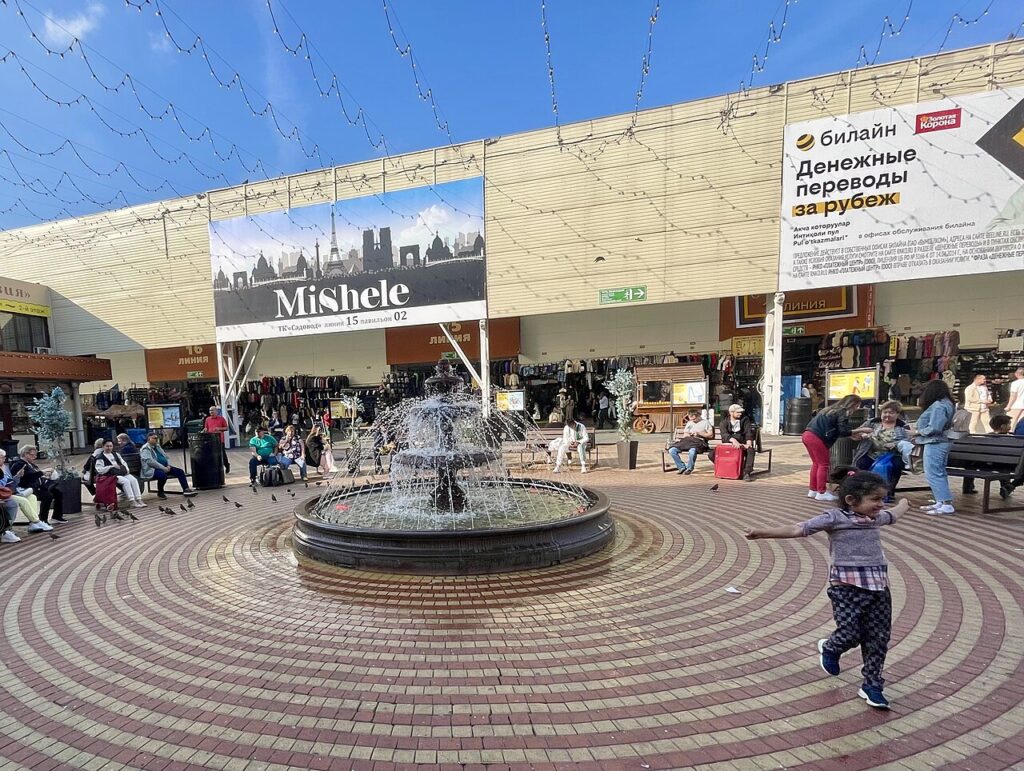
Sadovod market in Moscow, where broker teams later collected cash for the A7 payment firm, Russia, 19 September 2023
Sadovod market in Moscow, where broker teams later collected cash for the A7 payment firm, Russia, 19 September 2023. Photo: Nikita Andreev/Wikimedia Commons

Clean money for Chinese factories

A7 then orders shell companies outside Russia to pay its clients' suppliers, mostly Chinese exporters. The money moves through Kyrgyzstan, largely via the state-owned Trading Company of the Kyrgyz Republic, and the wire transfers carry no trace of cash or of Russia. The records list accounts at ICBC, Bank of China, Agricultural Bank of China, and China Construction Bank. One $287,000 transfer went through Standard Chartered's Hong Kong branch with "Sadovod" recorded as the client.

Chinese banks began refusing Russia-linked payments in December 2023 under the threat of US secondary sanctions. Stripping the funds of their origin makes them easier for Chinese banks to accept, illicit-finance expert Zachary Tvarozna told ICIJ. "The only company that sees everything is A7 itself," Voloshin said.

A7, Promsvyazbank, the Chinese banks, and Kyrgyzstan's economy ministry did not answer ICIJ's questions. A7 has publicly rejected the US accusations, saying it runs "a modern, multi-tiered compliance system."
germany holds up european union's latest russia sanctions package illustrative businesscensornet baltics poland block new
Explore further

US Treasury cracks down on Russia-China-Kyrgyzstan payment network, expands sanctions

Sanctioned, but still moving

A7 launched in late 2024, co-owned by Promsvyazbank and led by Moldovan oligarch Ilan Shor, a "sanctioned and convicted criminal fraudster," according to the US Treasury. Ukraine sanctioned its network in February, and the UK followed in May. A7 claimed to have moved more than 7.5 trillion rubles, about 13% of Russia's 2025 foreign trade transactions, and its network also helped Iran sell oil and buy weapons, the Treasury said.

Sanctions did hit A7's crypto side. Daily volume of its ruble token A7A5 fell 96% from its peak by June 2026, blockchain analytics firm Elliptic found. The cash channel is harder to touch: Western banks can see where A7's money lands, but not where it starts.

Archers Mount Their Steeds in Pursuit of Centuries-Old Warrior Spirit

22 octobre 2026 à 07:04
Horseback archery is making a comeback at a time when modern warfare has become high-tech and impersonal. The sport was featured at the World Nomad Games.

© Nariman El-Mofty for The New York Times

Archers Mount Their Steeds in Pursuit of Centuries-Old Warrior Spirit

22 octobre 2026 à 00:01
Horseback archery is making a comeback at a time when modern warfare has become high-tech and impersonal. The sport was featured at the World Nomad Games.

They Came to Russia for Work. Now They Are Under Fire.

13 octobre 2026 à 05:01
Ukrainian strikes on oil refineries and warehouses have led to casualties among the foreigners easing Russia’s labor shortage.

© Agence France-Presse — Getty Images

Smoke rising from an e-commerce warehouse near St. Petersburg, Russia, after a Ukrainian strike in July.

Peacekeepers, riot police, and drone crews: Russia’s bloc rehearses an operation in a Belarusian oblast bordering two NATO states

12 octobre 2026 à 09:22

peacekeepers riot police drone crews russia’s bloc rehearses operation belarusian oblast bordering two nato states · post bmp-2 infantry fighting vehicles belarus’s 6th separate guards mechanized brigade during combat-readiness check

Russia and four allies began five-day military drills in Belarus on 12 October, the Russia-led Collective Security Treaty Organization (CSTO) said. The troops are rehearsing peacekeeping and a biological-threat response. Minsk insists the drills target no one, while Belarus’s army chief calls them deterrence against hostile states.

Russian troops crossed Belarus to advance on Kyiv in 2022, and it now hosts Russian units with Oreshnik missiles and equipment guiding attack drones into Ukraine. Every foreign deployment there worries Kyiv and neighboring NATO members, which blame Minsk and Moscow for border pressure.

Riot police and drone crews in a “peacekeeping” drill

Belarus, Kazakhstan, Kyrgyzstan, Russia, and Tajikistan brought more than 1,500 troops and over 300 weapons and vehicles, including about 80 drones, The Moscow Times reported, citing the bloc. Armenia, the sixth member, is not among them. The peacekeeping drill runs in Vitsebsk Oblast, bordering Latvia and Lithuania, with Belarusian riot police and internal troops joining, the bloc’s command said.

An illustrative image. Railway tracks
Explore further

Up to 60 railcars: Belarus wires a border base to take in military trains

Russia sent motorized rifle, reconnaissance, electronic warfare, and drone units from its Central Military District, the CSTO said. Russia, this year’s chair, prioritized peacekeeping readiness and the joint biological protection and medical unit, a bloc general said.

Belarus’s military insisted the drills are planned, yet its army chief called them “one of the measures of strategic deterrence against aggressively minded states” and claimed the West is “effectively preparing for a new hot war.”

Pressure on Belarus’s neighbors

In Latvia, armed, masked escorts from Belarus tried to force migrants across this month, the military said, and raiders stole border cameras hours later. Estonia’s police and border guard chief warned migration pressure could jump before winter, as Russia eases entry from countries like Ethiopia and Belarus passes migrants on to the EU. Lithuania posted up to 100 soldiers on its border with Russia’s Kaliningrad, and in September NATO’s Italian jets downed a drone that crossed in from Belarus. On 9 October, Minsk summoned Ukraine’s envoy over an alleged drone strike on a Belarusian truck in Russia, and Kyiv rejected the “absurd accusations” of “an accomplice in the crime of aggression against Ukraine.”

Belarus keeps its army on alert

In September, Belarusian armor drilled near the Suwałki Gap, NATO’s land link to the Baltic states, and Lukashenka said the whole army would be checked, up to mobilization. On 12 October, he ordered a snap check of a 6th Separate Guards Mechanized Brigade battalion, state news agency BelTA reported. European spy agencies also warn of more Russian assassination plots against defense executives.

Ukraine’s intelligence still rates the threat from Belarus as low, but each new contingent, missile unit, and airborne brigade there widens what Kyiv and NATO’s eastern flank must watch.

  • ✇The Kyiv Independent
  • Kyrgyz citizen pleads guilty to illegally exporting US firearms to Russia
    Sergei Zharnovnikov, a 46-year-old citizen of Kyrgyzstan, pleaded guilty in New York federal court on June 25 to a conspiracy to illegally export U.S.-made firearms to Russia and smuggling, the U.S. Department of Justice announced. According to the statement, the defendant exported firearms and ammunition worth more than $1.5 million from the U.S. to Russia, violating U.S. law."The defendant admitted that he purchased American-made, military-grade firearms and re-exported them to Russia," U.S. A
     

Kyrgyz citizen pleads guilty to illegally exporting US firearms to Russia

26 juin 2025 à 12:43
Kyrgyz citizen pleads guilty to illegally exporting US firearms to Russia

Sergei Zharnovnikov, a 46-year-old citizen of Kyrgyzstan, pleaded guilty in New York federal court on June 25 to a conspiracy to illegally export U.S.-made firearms to Russia and smuggling, the U.S. Department of Justice announced.

According to the statement, the defendant exported firearms and ammunition worth more than $1.5 million from the U.S. to Russia, violating U.S. law.

"The defendant admitted that he purchased American-made, military-grade firearms and re-exported them to Russia," U.S. Attorney Joseph Nocella for the Eastern District of New York said.

"Today’s guilty plea is the culmination of extensive investigative work, showing that this office will not allow merchants of lethal weapons and Russia to flout U.S. sanctions."

According to court records, Zharnovnikov, owner of a Bishkek-based arms company, conspired to export U.S. firearms to Russia starting in March 2020. He signed a $900,000 contract with a U.S. company to send weapons to Kyrgyzstan, using a Department of Commerce export license that specifically banned re-export to Russia.

Despite the restriction, Zharnovnikov allegedly sent semi-automatic hybrid rifle-pistols to Russia via Kyrgyzstan without proper permits. Shipping records show the weapons left JFK Airport in July 2022. By November, a Russian client listed those same weapons on a tax form.

Upon sentencing, Zharnovnikov could face up to 20 years in prison.

’50,000 Russian troops pinned down’ — Ukraine halts advance in Sumy Oblast, summer offensive ‘faltering,’ Syrskyi says
“This year’s wave of the enemy’s ‘summer offensive’ from Russian territory is faltering,” Commander-in-Chief Oleksandr Syrskyi said.
Kyrgyz citizen pleads guilty to illegally exporting US firearms to RussiaThe Kyiv IndependentTim Zadorozhnyy
Kyrgyz citizen pleads guilty to illegally exporting US firearms to Russia
❌