❌

Vue normale

  • ✇Euromaidan Press
  • Russia militarizes children from kindergarten to drone training in occupied Ukraine, monitor says
    A Kremlin-backed program aimed at primary-school children claims 10,154 participants in occupied Zaporizhzhia, nearly 30 times Yunarmia's 355 members—Russia's uniformed military youth organization—Petro Andryushchenko, head of the Center for the Study of Occupation, said. Cadet classes in the same region account for another 387, according to Andryushchenko. Yunarmia may represent only a fraction of Moscow’s system for militarizing Ukrainian children under occupation. Movement of the Fir
     

Russia militarizes children from kindergarten to drone training in occupied Ukraine, monitor says

22 septembre 2026 à 06:48

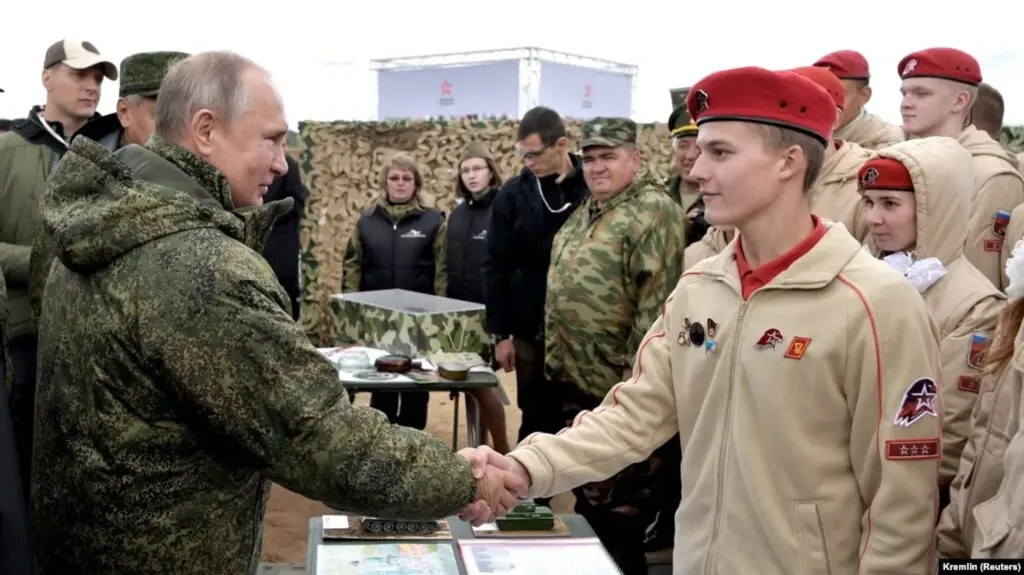
Vladimir Putin shakes hands with a young Yunarmia member wearing a beige uniform and red beret as other members stand behind them.

A Kremlin-backed program aimed at primary-school children claims 10,154 participants in occupied Zaporizhzhia, nearly 30 times Yunarmia's 355 members—Russia's uniformed military youth organization—Petro Andryushchenko, head of the Center for the Study of Occupation, said. Cadet classes in the same region account for another 387, according to Andryushchenko.

Yunarmia may represent only a fraction of Moscow’s system for militarizing Ukrainian children under occupation. Movement of the First, a Kremlin-backed mass youth group covering ages 6 to 18, claims about 65 times Yunarmia's membership in occupied Zaporizhzhia—over 23,000 by the end of 2025, up from about 14,000 a year earlier, according to Andryushchenko's breakdown of the series. A separate infographic in the same series puts the figure at over 19,000. Moscow has sustained the broader campaign throughout the full-scale invasion, combining classroom indoctrination, Kremlin youth movements, military games, and weapons training.

Andryushchenko explains why: Movement of the First is not a military organization, and that is precisely its function—a mass base that enrolls children without their joining any military-patriotic structure, then moves some into specialized programs. Through it, Zarnitsa stopped being a school game and became part of Russia's military-patriotic system. The movement functions as a gateway, not an endpoint.

In Kherson Oblast, the pattern repeated: over 2,700 children and young people passed through Movement of the First events in 2024, and by spring 2025, the registered count had reached 6,200, with primary cells growing from about 70 to 114–115.

From Eaglets to Zarnitsa: programs across occupied Zaporizhzhia

Andryushchenko said Eaglets of Russia, a program aimed at primary-school children aged 6 to 10, claims 10,154 participants across 97 schools and 626 class-teams in occupied Zaporizhzhia, while more than 2,000 children aged 11 to 17 have passed through the Zarnitsa 2.0 military game. In May 2026, children from all four occupied oblasts appeared at a federal Eaglets session alongside children from Russian regions—a sign the occupied territories are already integrated into the system.

He said military-applied instruction now fills about half of the OBZR course, Russia’s “Fundamentals of Security and Defense of the Motherland” subject, in occupation schools. He described a broader system stretching from kindergarten and mass children's organizations through military games and cadet structures to practical training in drones, tactics, weapons, and military medicine.
just deported ukrainian children turned soldiers workers russians so-called dedication ceremony students milove secondary school become members russia's paramilitary organization yunarmia occupied sorokyne (ex-krasnodon) luhansk oblast 2023 lug-inforu grenade drills
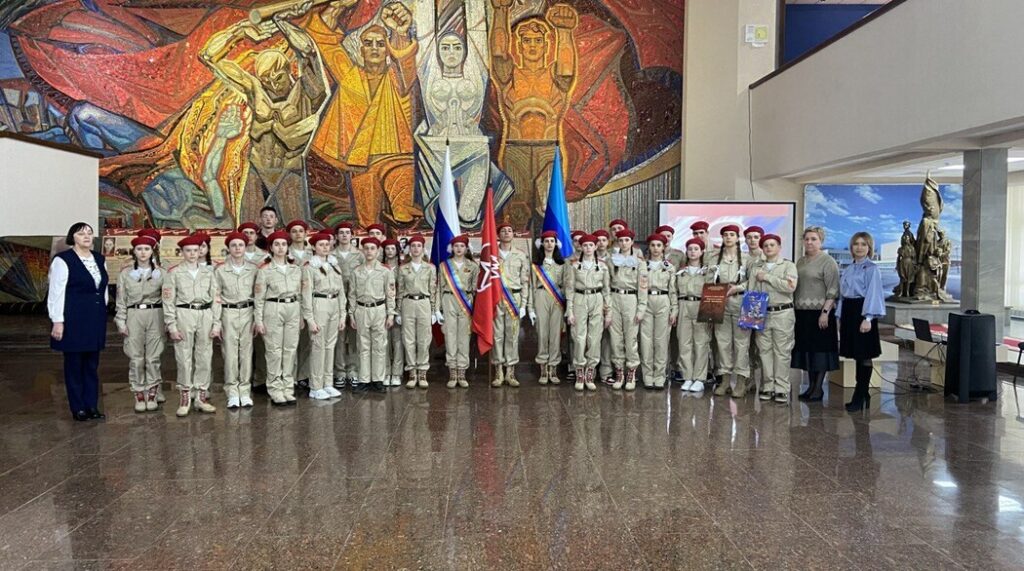
So-called "dedication ceremony for students of Milove secondary school to become members" of Russia's paramilitary organization Yunarmia. Occupied Sorokyne (ex-Krasnodon), Luhansk Oblast, April 2023. Image: lug-info.ru.

Military training center claims thousands across four occupied territories

Beyond Zaporizhzhia, Andryushchenko said the Russian military-sports training center VOIN claims 14,450 trained cadets across four occupied Ukrainian territories in his overview post. A later infographic in the series gives 10,381 for the same four territories, suggesting the figures may count differently.

That cannot be read as a count of children because VOIN programs accept participants aged 14 to 35, according to the Center's own website, and no age breakdown was provided. VOIN says it has trained more than 100,000 cadets across 21 Russian regions overall.

Andryushchenko's post opened a six-part series tracing the system "from first grade to cadet"—though the series itself showed the pipeline actually begins in kindergarten, with "Conversations about Important Things" starting at age 5. Part two, published on 22 September, broke down Movement of the First's role as a gateway, with Zarnitsa 2.0 next. The participation totals cited in his post are claims by Russian-run organizations relayed by the Center. They may overlap, have not been independently verified, and do not show how many individual children participated or whether children move from one program to another.

Luhansk school students wearing the uniform of the so-called Young Army. 2022.
Luhansk school students wearing the uniform of the so-called "Young Army." 2022. Photo: lug-info

Militarization has continued throughout the full-scale invasion

These latest participation claims are the newest snapshot of a campaign that has expanded steadily throughout Russia’s full-scale invasion. In 2023, occupation schools were already teaching children to use assault rifles and provide battlefield first aid.

By late 2024, Putin had ordered the expansion of military-sports camps and youth indoctrination programs.

Reports published in 2025 and 2026 described mandatory “patriotism” lessons from first grade and documented Ukrainian orphans who entered cadet schools and later appeared in Russian military uniforms.

  • ✇Euromaidan Press
  • Russian Church installs Soviet military veteran to lead occupation-created diocese in Kherson Oblast
    The head of the Moscow-based Russian Orthodox Church, Patriarch Kirill, personally consecrated Igor Pashentsev as bishop of Skadovsk and Oleshky after occupation authorities appointed him to lead the Skadovsk diocese, the Ukrainian outlet IPC-South reported, citing Russian sources. The appointment advances the Russian church’s incorporation of occupied Ukrainian parishes into a Moscow-controlled structure created after Russia seized the area. Pashentsev will oversee chu
     

Russian Church installs Soviet military veteran to lead occupation-created diocese in Kherson Oblast

2 septembre 2026 à 08:06

Patriarch Kirill sits at a white table in black-and-white Orthodox vestments, looking toward the camera as several people stand around him.

The head of the Moscow-based Russian Orthodox Church, Patriarch Kirill, personally consecrated Igor Pashentsev as bishop of Skadovsk and Oleshky after occupation authorities appointed him to lead the Skadovsk diocese, the Ukrainian outlet IPC-South reported, citing Russian sources.

The appointment advances the Russian church’s incorporation of occupied Ukrainian parishes into a Moscow-controlled structure created after Russia seized the area. Pashentsev will oversee churches across five occupied Kherson districts through a diocese IPC-South describes as operating illegally on Ukrainian territory.

Ukraine banned the Moscow-based Russian Orthodox Church from operating in the country in 2024 and established a court process for suspending Ukrainian religious groups that fail to sever Russian control. The measure targets Russian control, not Orthodox Christianity.

IPC-South says Pashentsev graduated from a Soviet military command school of chemical defense and served in the Soviet Defense Ministry’s 12th Main Directorate from 1981 to 1992. The Federation of American Scientists says the directorate stored, maintained, transported, and secured the Soviet Union's nuclear arsenal, but public records do not identify his duties there.

Ordained in 1993, Pashentsev completed the Moscow Theological Seminary in 1998, later led a Tambov diocesan office for relations with the armed forces and detention facilities, and served in the Barysh diocese. Known in the church as Joseph, he held the rank of archimandrite—a senior Orthodox monk—before his consecration.

During a Dormition liturgy—a major Orthodox feast honoring the Virgin Mary—Kirill gave Pashentsev an episcopal staff symbolizing a bishop’s authority and delivered instructions before his ministry began, Russian church accounts relayed by IPC-South said.

The Russian Orthodox Church created the Skadovsk diocese—a regional church administration—on 27 December 2023 after the occupation made it impossible for the existing Kherson diocese to oversee parishes on the Dnipro’s left bank. The new body incorporated parishes across the occupied Oleshky, Hola Prystan, Kalanchak, Skadovsk, and Chaplynka districts. IPC-South describes it as operating illegally on Ukrainian territory.

Russia weaponizes church control while suppressing other faiths

Pashentsev’s appointment is part of the Moscow Patriarchate’s wider effort to control religious life in occupied Ukraine. Religious communities that reject Kremlin authority face interrogations, threats, closures, and confiscation.

Ukraine’s Security Service has accused church structures of recruiting and training mercenaries for Russia’s military. The Institute for the Study of War, a US-based think tank, says occupation authorities also arbitrarily detain clergy and destroy places of worship while suppressing independent Ukrainian religious identity.

❌