A Russian strike on southern Odesa Oblast killed one person overnight and set grain trucks on fire. Five trucks loaded with grain were destroyed and three more damaged, with one person killed and three injured, the head of the Odesa Regional Military Administration, Oleh Kiper, said.
The strike hit the Izmail district, home to Ukraine's largest Danube port. The port became a maritime lifeline after Russia's 2022 Black Sea blockade, carrying the overflow whenever the sea
A Russian strike on southern Odesa Oblast killed one person overnight and set grain trucks on fire. Five trucks loaded with grain were destroyed and three more damaged, with one person killed and three injured, the head of the Odesa Regional Military Administration, Oleh Kiper, said.
The strike hit the Izmail district, home to Ukraine's largest Danube port. The port became a maritime lifeline after Russia's 2022 Black Sea blockade, carrying the overflow whenever the sea lanes are constrained, National Security Journal reported. The attack is part of a campaign against the food supply.
Ukraine is one of the world's largest suppliers of wheat, maize, and sunflower, so the strikes register far beyond its borders, in the import-dependent countries that buy its grain.
Fire destroyed eight trucks
The attack set eight cargo trucks and dry grass nearby alight, the press service of the State Emergency Service in Odesa Oblast reported. Rescuers have since put out the fires.
"Unfortunately, a person was killed in the attack, and three more were injured," the service said.
The strike hit transport infrastructure
Russia struck the Izmail district overnight on 29 August, damaging transport infrastructure, the Izmail District State Administration reported. The district sits on the Danube close to the Romanian border.
"There are casualties. Sadly, a person has been killed. The injured have been given the necessary help. Representatives of the security structures and medical workers are working at the scene," the administration said.
The Danube corridor is a standing target
The strike fits a pattern. Russia hit Izmail's port infrastructure on 13 August, cutting power in parts of the city, and struck it again days later, damaging a Togo-flagged civilian vessel. The attacks come during Ukraine's peak wheat harvest, expected at around 60 million metric tons this year, close to the 2025 crop. Farmers need the export revenue now to finance next year's sowing, and storage is filling as grain goes unshipped.
Russia's Defense Ministry has described its Izmail strikes as hitting berthing terminals for military cargo and depots for Western-supplied weapons. The trucks burned in this strike were carrying grain.
In July, most of Ukraine’s grain left through its Black Sea ports. From 1 to 26 August, after Russian attacks sharply reduced ship traffic, Ukraine exported just 1.42 million tons of agricultural products—about a third of its potential volume. Rail and the Danube carried about 600,000 tons each, Agriculture Minister Taras Vysotskyi said.The locomotives carrying that cargo are now among Russia’s main targets.Ukraine now expects to export 38–40 million tons of grain in the 2
In July, most of Ukraine’s grain left through its Black Sea ports. From 1 to 26 August, after Russian attacks sharply reduced ship traffic, Ukraine exported just 1.42 million tons of agricultural products—about a third of its potential volume. Rail and the Danube carried about 600,000 tons each, Agriculture Minister Taras Vysotskyi said.
The locomotives carrying that cargo are now among Russia’s main targets.
Ukraine now expects to export 38–40 million tons of grain in the 2026/27 season, down from 43 million before the attacks intensified, Agriculture Minister Taras Vysotskyi told Reuters. Agricultural products generated more than half of the country’s export revenue last year.
By 24 August, the total number of damaged locomotives had risen to 492.
Russia now sends camera-equipped drones to search for trains and redirects others toward rolling stock that their operators spot in flight. The campaign is no longer confined to fixed targets such as stations, bridges, and substations.
Ukraine’s railways keep running. Damaged lines often reopen within hours, while buses carry passengers around closed sections. With far fewer ships calling at the ports, each damaged locomotive leaves the railway less room to absorb the next disruption.
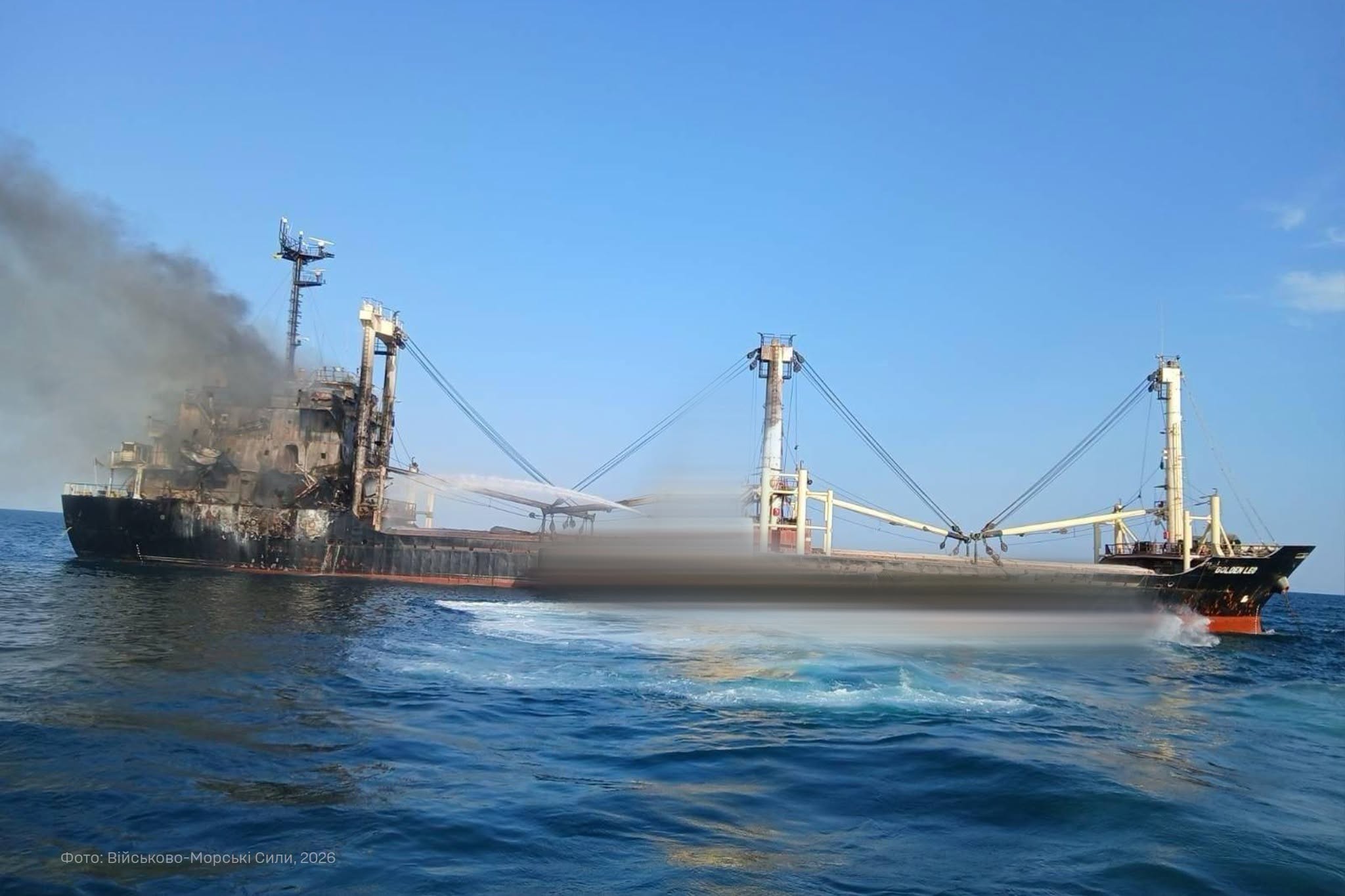
The civilian bulk carrier GOLDEN LEO ablaze after Russian missiles hit it as it left Odesa with a cargo of corn, in the Black Sea, 19 July 2026. Photo: Ukraine’s Navy
Export traffic moves inland
Before the current wave of strikes, the ports of Greater Odesa handled about 80% of Ukraine’s agricultural exports. Rail’s share then rose sharply, but the railway did not carry more grain: Ukrzaliznytsia said 461,000 tons went by rail during the first 25 days of August—67% less than in July and 77% below the corresponding period last year, according to figures reported by Rail.insider. Rail had taken a larger share of a collapsing export flow.
Traffic through the Black Sea corridor collapsed after a series of attacks on civilian vessels in July. One of the deadliest strikes was on the bulk carrier Golden Leo on 19 July, killing 10 people, including a Ukrainian maritime pilot. The ship later sank. On 22 July, for the first time since the sea corridor opened, not a single vessel entered the Odesa ports.
Explore further
Ten dead as Russia strikes a Turkish-owned bulk carrier off Odesa
In July, 169 ships entered, but only 7 did so during the first 11 days of August, the Ukrainian Sea Ports Authority told Kyiv Post. By 24 August, traffic had partly recovered. Three or four ships were entering and leaving the ports of Odesa each day. However, cargo volumes remained three to four times lower than before the intensified attacks, President Volodymyr Zelenskyy pointed out.
Maerskand Hapag-Lloyd suspended feeder services to Greater Odesa in late July and early August, with Maersk rerouting imports to Constanța.
The attacks changed the calculations of shipowners and insurers, even though the ports remained formally open. The late-August recovery shows that Russia did not impose a total blockade, but commercial traffic remained far below its previous capacity.
Ukraine normally moves 4 to 4.5 million tons of farm goods a month; the National Bank of Ukraine estimated in July that alternative routes could initially carry about 2.5 million tons a month. That leaves part of the usual flow with nowhere to go this year—about $2.5 billion in export revenue delayed from the second half of 2026 to the first half of 2027.
The Agriculture Ministry estimates that elevators and grain warehouses with nearly 59 million tons of capacity could be full by early November, leaving an 11-million-ton storage shortfall by the end of autumn.
Russian attacks on Ukraine’s railway infrastructure reached 1,534 by 24 August 2026—already exceeding the 1,200 recorded in all of 2025. Chart: Ukraine’s Ministry of Communities and Territories Development / Interfax-Ukraine / Infrastructure Minister Mykola Kalashnyk / Euromaidan Press. Made with ChatGPT.
Russia turned the drones on the trains
Russia is going after locomotives to cut the export corridors that tie the industrial regions around Kryvyi Rih, Zaporizhzhia, and the east to Odesa’s ports and the western border, Ukrzaliznytsia CEO Oleksandr Pertsovskyi told Reuters in June. He also described the method: Russia is using drones with video cameras and remote control, which allow operators to hit rolling stock in real time.
The climb is in the quarterly data: nine locomotives hit in the first half of 2025, 119 in the second, and 81 in the first quarter of 2026.By 15 August, Pertsovskyi put the figure at more than 250 damaged in the previous six months.
In the first quarter alone, Russia struck the railway 541 times, about half its total for all of 2025, damaging 1,718 objects across the network. By 24 August, the number of attacks on railway infrastructure in 2026 had reached 1,534, Infrastructure Minister Mykola Kalashnyk said.
On 19 July, Russia’s Defense Ministry acknowledged a Geran-4 Seeker drone had struck a locomotive hauling Ukrainian military equipment near Volniansk in Zaporizhzhia Oblast the previous day, and released strike footage.
The Geran-4 Seeker sends video to an operator searching for targets. Once the operator selects one, onboard software guides the final approach. Russia says it has used the system against ships near Chornomorsk, but public evidence does not show how many locomotive strikes involved Seeker; moving trains can also be hit by hand-flown drones redirected in flight.
Explore further
A $50 computer just flew Russia’s newest jet drone into a Ukrainian grain ship—and jamming couldn’t stop it
Russia's new "Geran-4 Siker" Shahed variant uses machine-vision AI for targeting. Source: Warhronika
Jammers cannot protect every train
Ukraine has fitted trains with jammers, which Ukrainian drone and electronic-warfare specialist Serhii “Flash” Beskrestnovsays have protected a significant number of trains. But Russian drones use different frequency bands, so each train needs several systems, and even those cannot provide complete protection.
“Whatever we do, drones will periodically hit trains in the frontline zone,” Beskrestnov wrote in March. “As, unfortunately, they will hit buses and civilian cars.”
Seeker is not the only way to hit a moving train. Russian operators have repeatedly redirected hand-flown drones after spotting trains below, Beskrestnov wrote in April. He said military airspace data allows railway dispatchers to change schedules or evacuate passengers when necessary, and that several hundred trains had been moved out of danger.
The cost is not only rolling stock. On 13 August, a jet-powered Shahed struck the locomotive of the Odesa–Dnipro passenger train at Buialyk station in Odesa Oblast, killing the driver, Ivan Shevchyk, and his assistant, Vasyl Morozov, both of the Znamianka locomotive depot.
The monitoring team had flagged the drone and ordered a stop; the train was entering the station so its 340 passengers, 67 of them children, could get off. All of them were evacuated unhurt. “A sharp maneuver by a jet Shahed is a matter of minutes, and the locomotive crew did not have enough time to come to a full stop and evacuate themselves,” Pertsovskyi wrote.
Prosecutors opened proceedings under Article 438 of the criminal code, violation of the laws and customs of war, causing death.
Two days later, Ukrzaliznytsia changed its rules, increasing the distance at which a train is halted and evacuated when a threat appears—a decision Pertsovskyi tied to the growing number of jet drones. Eight railway workers had been killed in the preceding weeks, at Lozova and Erastivka stations and on the train at Buialyk.
Ukraine is going after the equipment that makes the operator’s link work. On 13 and 14 August, Ukrainian forces struck two ground-based relay stations near Zaliznyi Port in Kherson Oblast that transmit control signals between Russian operators and Geran and Gerbera drones, extending their range and steadying the connection, along with five UAV command posts.
Such relays extend the operator-controlled phase of Geran and Gerbera attacks, including variants that may switch to onboard guidance for the final approach.
Russia's Gerbera drones. Photo: Gastello Design Bureau
Delays reveal resilience—and attrition
Russia has not carved the railway into islands. When seven drone strikes hit a junction between Dnipro and Zaporizhzhia in a single day on 30 January, wrecking locomotives, wagons, and track, trains were rerouted through Dnipro, and evening passengers were put on buses.
Freight was moving again within a day; passenger service stayed cut longer, judged too dangerous for civilians, Le Monde reported. Track and power lines are repaired quickly, and a diesel engine can stand in where electric traction is out of service.
The cost lands on the rolling stock. A locomotive is harder to replace than track, and some of that loss is already permanent. By April, around 50 of more than 300 locomotives hit since the full-scale invasion had been destroyed beyond repair, Deputy Communities Minister Oleksii Balesta said. By 24 August, the total number of damaged locomotives had risen to 492, Infrastructure Minister Mykola Kalashnyk said.
New locomotives will arrive slowly. The first machines from a 55-locomotive order placed with French producer Alstom through a World Bank tender are due in early 2027 for certification, with the full batch expected by May 2029.
Burned grain truck at an open parking lot in Odesa Oblast following a Russian drone strike overnight on 2 November 2025. Photo: Suspilne Odesa
Rail cannot replace the sea
Even undamaged, the railway could not move as much export cargo across the EU border as the ports did by sea. The EU lines are slower, more expensive, and interrupted by a change in track gauge at the border. The Danube is running too low this summer to float full barges, and road haulage was never more than a sliver of Ukraine’s bulk grain.
The strain reaches past agriculture. Ferrexpo stopped seaborne iron ore pellet exports, the Southern Mining and Processing Plant in Kryvyi Rih cut back, and Ukrzaliznytsia throttled some cargo runs to the Odesa port stations, according to Ukrainian industry reports.
The shortfall does not stay inside Ukraine. Egypt, Algeria, and Indonesia together bought about 8.7 million tons of Ukraine’s wheat last season—roughly 62% of the total, with Egypt alone taking more than a quarter.
A long closure of the deep-water ports would send those import-dependent buyers hunting elsewhere: the trade analytics firm ASAP Agri puts Ukraine’s 2026/27 wheat exports at 5 to 10 million tons if the blockade holds, with buyers like Bangladesh turning to Indian wheat instead.
Ukraine is responding with air defenses around key rail nodes, dispersed locomotives, and repair kits pre-positioned for fast fixes, and its transport ministry has taken a railway-resilience plan to NATO, built on early warning and centralized recovery management.
Russia drove most ships from the sea route, leaving Ukraine more dependent on constrained alternatives, and has been hitting the locomotives serving its rail corridors—more than 250 damaged in six months, some beyond repair. But the railway still functions.
Ravil Dzhamally fled when Russian forces occupied his farm in Kherson Oblast, then returned after liberation to clear mines and plant again. Now, tons of his grain lie unsold in plastic sleeves across his fields because Russian attacks have nearly halted exports through Odesa, Bloomberg reported on 20 August.
Odesa’s Black Sea ports handle almost all of Ukraine’s grain exports, Bloomberg reported. Weekly grain and oilseed exports have fallen by more than 90% since early
Ravil Dzhamally fled when Russian forces occupied his farm in Kherson Oblast, then returned after liberation to clear mines and plant again. Now, tons of his grain lie unsold in plastic sleeves across his fields because Russian attacks have nearly halted exports through Odesa, Bloomberg reported on 20 August.
Odesa’s Black Sea ports handle almost all of Ukraine’s grain exports, Bloomberg reported. Weekly grain and oilseed exports have fallen by more than 90% since early July, data from commodity-data firm Kpler show. That threatens fall planting and the sector that generates more than half of Ukraine’s export revenue. The disruption is also raising food costs in countries that rely on imported grain, Reuters reported.
Farmers must either store harvests they cannot export or sell locally at about one-third of global prices, Bloomberg reported. They say this year’s crisis is worse than the 2022 blockade because the financial reserves that carried them through six months of disruption then have since been depleted.
Russian attacks drive ships from Ukraine’s grain corridor
Ukraine’s Black Sea grain corridor—the wartime shipping route from Odesa—was never formally closed, Euromaidan Press reported. Four or five ships entered Ukraine’s ports on 21 July. Still, none arrived the next day because shipowners had paused calls, not because Ukraine had restricted navigation, Agriculture Minister Taras Vysotskyi told Ukrainian agricultural outlet Latifundist.
Ukraine’s state railway, Ukrzaliznytsia, subsequently restricted selected wheat and barley shipments to Odesa ports. Its register did not state a reason, and the railway did not publicly link the orders to the shipping disruption.
Oleksandr Havryliuk, who farms near the front in Kharkiv Oblast, told Bloomberg that losing his harvest would probably bankrupt him and force him to sell the farm. The National Bank of Ukraine estimates that Ukraine could lose about $2.5 billion in export revenue during the second half of 2026, Reuters reported. Bloomberg said the disruption could trigger widespread farm bankruptcies.
Ukraine seeks EU aid and export routes as losses mount
Financing was already constrained before the port crisis: available financing and insurance were “enough to keep the sector surviving, not enough to keep it growing,” Vysotskyi told Euromaidan Press in May.
Before Russia’s full-scale invasion, agriculture accounted for more than 10% of Ukraine’s economic output, according to World Bank data cited by Bloomberg.
The sector has since grown more important as Russian attacks have destroyed much of the country’s heavy industry, Evghenia Sleptsova, a senior economist at the economic forecasting firm Oxford Economics, told Bloomberg.
Her firm estimates that the disruption could cost the equivalent of 1.8% of GDP this year and 2.1% in 2027. Under a prolonged severe disruption, the 2027 loss could instead reach 5.3%, Oxford Economics said.
Ukraine could exhaust its grain-storage capacity by early November if exports do not recover, the Agriculture Ministry said, according to Bloomberg. Even using every available route, the country may export only about 30 million tons this season, leaving roughly the same volume stored or rotting, Vysotskyi said.
Ukraine’s Agriculture Ministry requested a €220 million EU grant to subsidize interest and unlock up to €4 billion in loans, the ministry said.
Ukraine and Moldova are also discussing a rail route through Moldova to Romania’s port of Constanța, Reuters reported, citing unnamed sources in both countries. Kyiv estimates the route could carry about 10% of its grain exports.
Western rail corridors have limited capacity, while low water levels restrict traffic through Danube ports. Both alternatives cost more than shipping through the Black Sea, Bloomberg reported.
Wheat buyers from Egypt to Indonesia are paying more after an unspoken wartime arrangement that kept Black Sea grain ships safe collapsed in July. Jordan canceled two wheat tenders and two for barley this month after attracting few offers.Asian mills face delays on 2 to 2.5 million tons booked for summer delivery—30% to 50% of their import needs—and Indonesia is looking to Australia, Argentina, and Romania to replace about 600,000 tons contracted from the region.Ukraine’s
Wheat buyers from Egypt to Indonesia are paying more after an unspoken wartime arrangement that kept Black Sea grain ships safe collapsed in July. Jordan canceled two wheat tenders and two for barley this month after attracting few offers.
Asian mills face delays on 2 to 2.5 million tons booked for summer delivery—30% to 50% of their import needs—and Indonesia is looking to Australia, Argentina, and Romania to replace about 600,000 tons contracted from the region.
Ukraine’s infrastructure ministry counted 67 attacks on port facilities in July, 35 on civilian vessels in port, and 22 on ships in the maritime corridor. The corresponding figure for all of 2025 was just 14, according to Reuters.
Ukraine’s agriculture ministry has warned that exports may fall nearly by half this season.
Egypt bought 82% from two countries at war
Egypt sourced over four-fifths of its wheat imports from Russia and Ukraine in the first half of 2026. Its private sector, which imports more than half the country’s wheat, has less grain stored than the government, and “the situation is getting worse by the day,” Alexandria-based trader Hesham Soliman told Reuters.
A vessel heading to load grain for Egypt was attacked approaching Novorossiysk last week. Ukrainian President Volodymyr Zelenskyy said he discussed the threat with Egyptian President Abdel Fattah al-Sisi.
Black Sea wheat trades at about $260 to $280 a ton. Australian wheat is quoted at $315 to $320, including cost and freight to Asia, while the cheapest American wheat is at $305, Reuters data showed.
Chicago wheat futures have climbed more than 17% since early July. For now, stronger local harvests in parts of North Africa have cushioned the impact—Egypt procured record volumes of domestic wheat.
Sunflower first, now wheat
India’s refiners shifted to soybean as 150,000 tons of Ukrainian sunflower cargo sat delayed at Black Sea ports. Now the same is happening in wheat.
Explore further
India’s cooking-oil imports jump for festival season—but not war-hit sunflower
Romania detected more than 100 drones involved in seven attacks on Ukraine’s Danube ports in recent days, interim Romanian Defense Minister Radu Miruță told Romanian channel Digi24 on 17 August 2026. He said the attacks were the most intense recorded recently and that Ukrainian forces destroyed most of the drones “a few dozen meters from Romanian airspace.”
Russia’s growing attacks on Ukraine’s Danube ports put a key export route at risk as Kyiv seeks other outlets whil
Romania detected more than 100 drones involved in seven attacks on Ukraine’s Danube ports in recent days, interim Romanian Defense Minister Radu Miruță told Romanian channel Digi24 on 17 August 2026. He said the attacks were the most intense recorded recently and that Ukrainian forces destroyed most of the drones “a few dozen meters from Romanian airspace.”
Russia’s growing attacks on Ukraine’s Danube ports put a key export route at risk as Kyiv seeks other outlets while its Black Sea ports are under attack. They also put Ukraine's southern border region under pressure as Kyiv develops trade links with Moldova and Romania, and NATO routes more military aid through Romania.
The latest drone swarms remained over Ukraine, and officials found no indication that Romania’s threat level had risen, Miruță stated. The Romanian military nevertheless remained on alert as attacks intensified across the Danube.
Ukraine looks south for trade and military aid
With Russia hitting its ports, Ukraine is turning to Romania and Moldova to keep trade moving. Kyiv and Chișinău are discussing a rail link through Moldova to Romania’s Constanța port, though Ukraine estimates it could carry only about 10% of its grain exports.
The rail proposal comes as Russian port strikes have cut monthly agricultural exports by 20–30% and left up to 10 million tons of grain in storage without buyers, Agriculture Minister Taras Vysotskyi has said.
Explore further
More than 100 drones detected near Romania in four days, NATO jets scrambled seven times
NATO said in December that a second aid hub in Romania would begin operating in January. It was designed to supplement the main center in Rzeszów, Poland, and route supplies toward Ukraine’s southern and eastern fronts.
Romania faces repeated drone incursions
Russian drones targeting Ukraine have repeatedly entered Romania as Moscow attacks Ukrainian ports across the Danube. More than 40 such incursions had been recorded by early June, Romanian Foreign Minister Oana Țoiu said.
The most serious occurred on 29 May, when a drone hit an apartment building in Galați. Two people were injured, and about 70 residents fled or were evacuated.
Vladimir Putin suggested that the aircraft might have been Ukrainian, but Romania’s forensic investigation later identified it as a Russian-built Geran-2.
Romanian forces later shot down three drones in 72 hours in July, while Miruță said Spanish pilots and Romanian troops destroyed a fourth on 16 August.
Debris from drones intercepted over Ukraine has also washed onto Romania’s coast, prompting temporary access restrictions while specialists checked for explosives.
Bucharest is buying low-altitude radars and ground interceptors through the EU’s SAFE program. Miruță said drones often fly at 70 to 150 meters, and ground systems would be cheaper to use than fighter-launched missiles.
Moldova will now carry Ukraine’s grain to Romania at half price, and President Maia Sandu is defending that choice against Moldovan farmers who stand to lose from it. What Kyiv was still negotiating a week earlier is now a signed tariff cut, and the growers left to absorb it have threatened mass protests.
Explore further
Ukraine and Moldova d
Moldova will now carry Ukraine’s grain to Romania at half price, and President Maia Sandu is defending that choice against Moldovan farmers who stand to lose from it. What Kyiv was still negotiating a week earlier is now a signed tariff cut, and the growers left to absorb it have threatened mass protests.
Explore further
Ukraine and Moldova discuss rail corridor for grain amid Russian Black Sea attacks
Sandu ties Ukraine’s harvest to Moldova’s security
Speaking on Radio Moldova, Sandu argued that helping a wartime neighbor keep its export income is worth the strain at home, NewsMaker reported.
“If Ukraine cannot sell its products and has no money to defend itself, then we will have bigger problems than we do today,” she said. “We cannot turn our backs on Ukrainians who are bombed every night and every day wake up, grow grain, and resist. Through their resistance, they protect our peace too.”
She set Moldova’s role against that of larger backers: “Other states help them much more—with financial aid, with military aid. Here we can help them, with these transit routes.”
Through their resistance, they protect our peace too.
Maia Sandu
Farmers set a 21 August deadline
Moldova has halved rail transit tariffs on Ukrainian goods from 10 August to 31 December 2026, a move that could earn Moldovan Railways several million euros and route around 10% of Ukraine’s expected six million tons of 2026 cargo through its territory, Curs de Guvernare reported.
The cut has unsettled local growers. The association Forța Fermierilor (Farmers’ Force) says they face real risks and wants a seat in overseeing the transit. After meeting Prime Minister Vasile Tofan on 17 August, it warned of “massive” protests unless the government shows progress by 21 August.
Russian strikes push grain onto the rails
Ukraine wants the overland route because Russia’s strikes have made the sea route unreliable. Odesa’s ports handle about 90% of Ukraine’s grain, and an overnight strike on Odesa on 17 August damaged another foreign civilian ship.
In July alone, Russian attacks damaged 28 vessels at Greater Odesa’s ports and killed 21 sailors, monitor Andrii Klymenko reported. The rail line to Romania’s Constanța port is the safer alternative. Even in 2023, when Moldova moved to shield its market from Ukrainian grain, it kept transit open.
Russia dismissed the idea of a Black Sea ceasefire on 14 August, Reuters reported, a day after the agency disclosed that Ukraine had proposed a mutual halt to attacks on civilian targets there.
Russian Foreign Ministry spokesperson Maria Zakharova said Moscow saw no grounds for measures that would give Kyiv a temporary reprieve.
Russia’s dismissal comes after its strikes drove shipowners from Odesa as Ukraine’s wheat harvest peaked. More than 90% of Ukraine’s farm e
Russia dismissed the idea of a Black Sea ceasefire on 14 August, Reuters reported, a day after the agency disclosed that Ukraine had proposed a mutual halt to attacks on civilian targets there.
Russian Foreign Ministry spokesperson Maria Zakharova said Moscow saw no grounds for measures that would give Kyiv a temporary reprieve.
Russia’s dismissal comes after its strikes drove shipowners from Odesa as Ukraine’s wheat harvest peaked. More than 90% of Ukraine’s farm exports leave through three deepwater Odesa ports. Reuters reported that Ukraine’s 12 August operation at Novorossiysk targeted a naval base and warships, although nearby grain terminals also suspended operations.
Russian forces, by contrast, have repeatedly struck foreign-flagged ships and Ukrainian port infrastructure. The disruption is stranding Ukrainian crops and raising concerns over global food supplies.
Zakharova accused Ukraine of deliberately destabilizing civilian shipping but did not mention Russia’s attacks, Reuters said. She was responding to Turkish Foreign Minister Hakan Fidan, who said Ankara had proposed a Black Sea moratorium to both sides.
Zakharova also said Moscow had received no formal proposal from Türkiye and ruled out reviving the 2022–23 Black Sea grain deal, calling it one-sided.
Ukraine’s harvest has nowhere to go
Reuters said Ukraine’s grain exports had fallen 76% year on year so far in August. Ukraine’s Agriculture Ministry projects agricultural exports could nearly halve, from 64.4 million to 29.6 million tonnes. It expects silos to fill by October as grain backs up.
World Grain, citing the US Department of Agriculture’s Foreign Agricultural Service, reported that corn exports could fall 39% and wheat exports 26%. The US agency expects unsold corn stocks to rise more than tenfold.
The ministry has asked the EU for €220 million to subsidize farm loans and help producers finance autumn sowing. Reuters separatelyreported, citing unnamed sources in both countries, that Kyiv and Chisinau were discussing a rail route to Romania’s Constanța port. Kyiv estimates it could carry only 10% of Ukrainian grain exports.
Explore further
Ukraine and Moldova discuss rail corridor for grain amid Russian Black Sea attacks
Russia turns ports into targets
After Russia refused to extend the UN- and Türkiye-brokered grain deal in 2023, Ukraine opened its own maritime corridor. It remained operational until this summer’s escalation.
Russian forces repeatedly struck foreign-flagged vessels in July. On 19 July, Russian missiles hit the Guinea-Bissau-flagged, Turkish-owned Golden Leo as it left Odesa carrying corn. The attack killed 10 people, Ukraine’s Navy and Sea Ports Authority said. Ag Bull Trading reported that the attacks brought the corridor to its first full stop since it opened in August 2023.
Russia’s dismissal leaves Ukraine’s corridor officially open while Russian attacks continue to drive shipowners away.
Ukraine and international partners agreed to work urgently on a mechanism for up to €4 billion ($4.6 billion) in farm loans, Ukrinform reported on 13 August. The plan would use a proposed €220 million ($253 million) EU grant, the Agriculture Ministry said.
Ukraine rebuilt its maritime trade after pushing Russia’s fleet away from its coast. By 2025, its Black Sea route carried about 92% of the country’s grain and oilseed exports. Russia is now striking the Odesa ports su
Ukraine and international partners agreed to work urgently on a mechanism for up to €4 billion ($4.6 billion) in farm loans, Ukrinform reported on 13 August. The plan would use a proposed €220 million ($253 million) EU grant, the Agriculture Ministry said.
Ukraine rebuilt its maritime trade after pushing Russia’s fleet away from its coast. By 2025, its Black Sea route carried about 92% of the country’s grain and oilseed exports. Russia is now striking the Odesa ports sustaining that recovery. The ministry says the attacks have closed three deep-water ports. Ukraine planned to export 64.4 million tons of agricultural products in 2026/27, but now says shipments may reach only 29.6 million tons. The proposed loan mechanism is meant to cover that cash shortfall before next year’s sowing.
EU and Norwegian diplomats joined the meeting with representatives of the World Bank and the UN Food and Agriculture Organization.
The participants agreed to develop the plan through the Ukraine Facility and EU guarantee institutions. They aim to do so in the coming weeks, before fall storage use peaks. The grant has not yet been approved.
Odesa attacks send Kyiv toward Baltic ports
The loan plan comes as Russia’s attacks force Ukraine to seek new export routes.
Russia initially blockaded Ukraine’s ports after launching its full-scale invasion. Ukraine later restored a sea corridor after forcing much of Russia’s Black Sea Fleet away. Moscow then shifted pressure to missiles and drones, hitting Ukrainian ports 90 times in 2025 and intensifying attacks this summer.
A Russian strike killed 10 people aboard the grain-carrying Golden Leo on 19 July. Three days later, no ship passed through the corridor.
Kyiv is now considering the Polish Baltic ports of Gdańsk, Gdynia, Szczecin, and Świnoujście. Yet the ministry estimates that all alternative routes may eventually carry only 2.9 million tons a month. Ukraine’s monthly target was 5.4 million tons.
Farm loans target next year’s sowing
The €220 million would not go directly to growers. It would subsidize interest and partly cover banks’ lending risks, including by expanding Ukraine’s “5-7-9%” affordable-loan program.
The ministry wants the support to generate €4 billion in farm loans at annual rates no higher than 10%. It calculates that every euro of grant money could mobilize more than €18 in lending.
Ukraine has also temporarily adjusted minimum export price coefficients to offset higher logistics costs, meeting participants noted. Without grain sales, farmers struggle to pay wages and land rents or buy fuel and fertilizer. By November, Ukraine's storage shortfall could reach 11 million tons of crops, with more than €10.8 billion ($12.4 billion) tied up in unsold stocks.
Ukraine’s Agriculture Ministry has cut its forecast for agricultural exports in 2026–2027 by 54% as Russian attacks disrupt shipping through Odesa’s ports, Bloomberg reported.
The ministry now expects 29.6 million tons of agricultural exports, down from 64.4 million. Its wheat export forecast fell by 53%, from 17.6 million tons to 8.3 million tons.
Ukraine grows far more grain than it consumes, exporting 65%–70% of its agricultural output. Bloomberg said the sector
Ukraine’s Agriculture Ministry has cut its forecast for agricultural exports in 2026–2027 by 54% as Russian attacks disrupt shipping through Odesa’s ports, Bloombergreported.
The ministry now expects 29.6 million tons of agricultural exports, down from 64.4 million. Its wheat export forecast fell by 53%, from 17.6 million tons to 8.3 million tons.
Ukraine grows far more grain than it consumes, exporting 65%–70% of its agricultural output. Bloomberg said the sector generated more than half of Ukraine’s export revenue last year. But Russia’s summer attacks have stalled the sea corridor as the harvest arrives, driving some wheat prices below production costs. Land and river routes cannot match the Black Sea shipping capacity, while sales through neighboring EU states remain politically contested. That leaves farmers with less money for the next sowing and further reduces Ukraine’s export income.
Ukraine has about 59 million tons of grain storage. That storage could be full by early November, leaving the country 11 million tons short of space by the end of fall 2026.
Wheat sells below cost as the silos fill up
Ukraine’s export bottleneck is already hitting its farmers. Port prices fell by another 12-15% in one week, while some farmers sold wheat below production cost. When ships stop, traders either stop buying or pass the higher cost of alternative routes on to producers. That leaves farmers with less cash for fall sowing.
To ease the pressure, the government has approved subsidized loans for agricultural producers. President Volodymyr Zelenskyy said Kyiv would expand storage. Ukraine's Agriculture Ministry has also asked the European Commission for €220 million to help cover interest for small and medium-sized farms.
Ukraine and Moldova are discussing a rail route to Romania’s Constanța port. According to the report, grain was already being redirected through Romania, Slovakia, and Hungary, but these routes cannot replace Odesa’s capacity.
Now the ports and the ships are Russia's targets
The export bottleneck is only part of the problem. Russia’s bombardment also threatens the ports, civilian ships, and crews needed to keep the corridor operating.
The port of Odesa normally handles about 90% of Ukraine’s grain shipments. Russia intensified attacks on terminals and civilian ships in July 2026 as the harvest reached the coast.
On 19 July, three Russian missiles struck the foreign-flagged Golden Leo as it left Odesa carrying corn, killing 10 people, including a Ukrainian sea pilot. Three days later, no vessel passed through the corridor.
Alternative routes offer little relief, as record-low Danube levels were restricting river traffic. Poland continues to bar Ukrainian grain from its domestic market. Those constraints leave more of the harvest inside Ukraine and farmers with less money to plant the next crop.