Vue normale

  • ✇Euromaidan Press
  • Russia promised a scramjet superweapon. Ukraine says Zircon runs on solid fuel
    Russia's Zircon runs on two solid-propellant motors, a booster and a sustainer, Ukraine's military intelligence (HUR) said in a breakdown of the missile's structure and components. That leaves no room for the scramjet Moscow advertised, Defense Express wrote. Russia presented Zircon as a hypersonic missile capable of penetrating modern air defenses. HUR says it instead uses solid-propellant motors, which Defense Express reads as demolishing Moscow's claims about a super
     

Russia promised a scramjet superweapon. Ukraine says Zircon runs on solid fuel

1 septembre 2026 à 08:34

russia touted zircon hypersonic superweapon ukraine says its technology far less exotic · post missile launch warship russian defense ministry militarnyi polish_20260120_110147292jpg news ukrainian reports

Russia's Zircon runs on two solid-propellant motors, a booster and a sustainer, Ukraine's military intelligence (HUR) said in a breakdown of the missile's structure and components. That leaves no room for the scramjet Moscow advertised, Defense Express wrote.

Russia presented Zircon as a hypersonic missile capable of penetrating modern air defenses. HUR says it instead uses solid-propellant motors, which Defense Express reads as demolishing Moscow's claims about a superweapon. The intelligence agency also listed an Altera programmable chip and a TriQuint amplifier among the missile's components, the same finding investigators keep making in Russian weapons.

HUR published an interactive 3D model of Zircon through its War&Sanctions database, the latest in a series on Russian ballistic weapons. The agency said the recorded maximum speed to date does not exceed Mach 6.8—about seven times the speed of sound—and that the missile does not hold it through the whole flight. Russia claims Mach 9 at some stages of flight. Zircon carries a roughly 120-kilogram warhead.

Side-view 3D model of Russia’s 3M22 Zircon missile against a black background.
A 3D render of a 3M22 Zircon. Source: HUR, Ukraine's military intelligence agency

Defense Express reported that a 2010 contract with solid-fuel specialist NPO Iskra indicates that this propulsion system was planned from the earliest stages of Zircon's development.

Built for ships, moved onto a coastal launcher

Zircon is a Russian anti-ship missile developed for surface ships and nuclear-powered submarines. Russia later adapted it for Bastion-M coastal launchers amid difficulties operating its Black Sea Fleet, HUR said.

Ukrainian forensic experts first confirmed Russia had fired a Zircon at Kyiv in February 2024. Defense Express reported that Ukraine intercepted two more over the capital the following month. Russia has continued using Zircon against land targets: in February 2026, it launched four at Ukraine’s power grid, of which Ukrainian air defenses downed two.

What solid-fuel propulsion changes

Solid fuel does not make Zircon slow: Mach 6.8 is still hypersonic. A scramjet draws oxygen from the atmosphere to sustain hypersonic flight; Zircon instead flies on self-contained rocket motors. HUR calls it a ballistic missile rather than the hypersonic cruise missile Russia advertised, and notes its onboard computer is the type fitted to all Russian ballistic missiles. Defense Express says the trajectory may be aeroballistic and the motor possibly dual-pulse, given the range Russia wanted from a missile that had to fit a ship's launch silo.

Russian President Vladimir Putin claimed in 2019 that the missile could reach Mach 9 and travel 1,000 kilometers, up from earlier official figures of Mach 6 to 8 and 400 to 500 kilometers. A year earlier, the former head of its manufacturer said it flew on a jet engine, Defense Express said.

In February 2024, Kyiv's forensic institute concluded from the debris that the engine was air-breathing rather than solid-fuel, and Defense Express went further the following month, reporting from its own sources that Russia had built a working scramjet. The outlet has since appended a correction to that article, noting that HUR found a solid-fuel 3L2211 motor from NPO Iskra where the scramjet was supposed to be.

The US chips inside Zircon

HUR identified two components from US manufacturers inside Zircon: a programmable gate array from Altera, now part of Intel, and a TGA2704 amplifier from TriQuint Semiconductor, now Qorvo. It also mapped 70 companies involved in its production, along with their personnel and foreign manufacturing equipment.

The finding fits a wider pattern. Investigators have found Western electronics in Russia's UMPK glide-bomb kits and traced at least 28 foreign parts from 15 companies in the Kh-101 that struck Kyiv's Okhmatdyt children's hospital.

A 2026 examination found 62 US-made parts in an Iskander missile, while a Russian Geran drone combined a Soviet missile with Western electronics and a Chinese modem.

  • ✇Euromaidan Press
  • Kyiv’s largest book market hit by Russian missiles
    Ukrainian emergency services confirmed a large fire at the Pochaina book market in Kyiv’s Obolonskyi district after an overnight Russian ballistic attack on 16 August. Several rows of stalls were burned. The strike comes amid mounting losses across Ukraine’s book industry, as Russian strikes burn printing houses, markets, and the millions of books within them. Pochaina’s latest fire is at least the third to damage the market or adjoining trading rows since mid-June. For
     

Kyiv’s largest book market hit by Russian missiles

16 août 2026 à 08:42

Three firefighters work amid flames and thick smoke at night.

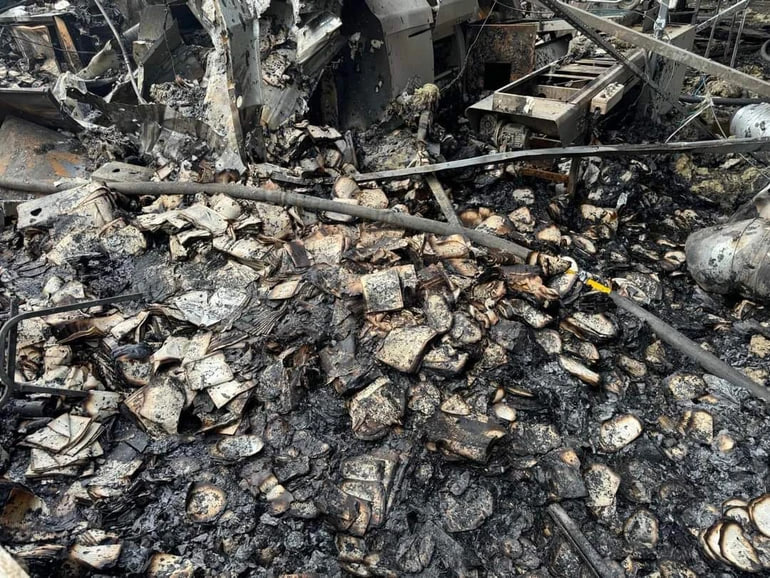
Ukrainian emergency services confirmed a large fire at the Pochaina book market in Kyiv’s Obolonskyi district after an overnight Russian ballistic attack on 16 August. Several rows of stalls were burned. The strike comes amid mounting losses across Ukraine’s book industry, as Russian strikes burn printing houses, markets, and the millions of books within them.

Pochaina’s latest fire is at least the third to damage the market or adjoining trading rows since mid-June. For decades, the sprawling market has served as part bookshop, part flea market, and part archive of Kyiv life — a place to hunt through rare titles, vinyl, and remnants of the 20th century. Officials have not said Russia deliberately targeted it, however, the damage lands amid repeated attacks on Ukraine’s publishing chain and efforts to remove Ukrainian literature under occupation.

By 9:36 a.m., rescuers had extinguished fires at four locations in Kyiv and were dismantling damaged structures. Three people were hospitalized: two in moderate condition and one with light injuries. Pochaina metro station remained open, but damage to its glass entrance temporarily closed one vestibule.

На книжковому ринку у Києві рятувальники долають наслідки атаки.

Кілька рядів торговельного павільйону вигоріли. У багатьох інших — пошкоджені вікна. Книжки продовжують тліти

Відео: Ірина Сітнікова / hromadske pic.twitter.com/Bq3p4x6MT8

— hromadske (@HromadskeUA) August 16, 2026

Founded in 1997, Pochaina grew into Kyiv’s largest book market, offering everything from novels to specialist literature, according to a 2020 preservation petition. Independent vendors organized to defend it after plans emerged to clear the site for another shopping center. The campaign described the market as a cultural institution that supported thousands of jobs.

The adjoining weekend flea market endured the invasion and disappearance of tourists. In 2023, the Associated Press found hundreds browsing stalls stocked with vintage medals, ceramics, VHS tapes, and cracked guitars.

Russia destroys books as part of its war against Ukraine

Russian attacks have damaged publishing houses, printing plants, warehouses, libraries, bookshops, and markets across Ukraine.

The 16 August attack was not the first time Russia had hit Pochaina. A Russian attack damaged book-market pavilions in mid-June. On 30 July, falling missile debris ignited nearby stalls and destroyed collections of antiques, vinyl, and Ukrainian household artifacts, Suspilne reported.

Russia's war against Ukraine has particularly devastated Ukraine's publishing houses and their infrastructure. A 2024 Russian strike on Kharkiv’s Factor Druk printing house killed seven workers and burned 50,000 books. On 1 August 2026, a drone destroyed about eight million books at publisher Ranok’s warehouse.

Reuters reported that Russian strikes destroyed more than 10 million books in recent months.

In occupied areas, Russian forces have also seized Ukrainian history books and burned Ukrainian literature in boiler houses, Ukrainian authorities say.

Yet the Ukrainian book industry continues to thrive, despite Russia's assault. In 2025, Ukraine registered a record 117 new publishing businesses.

❌