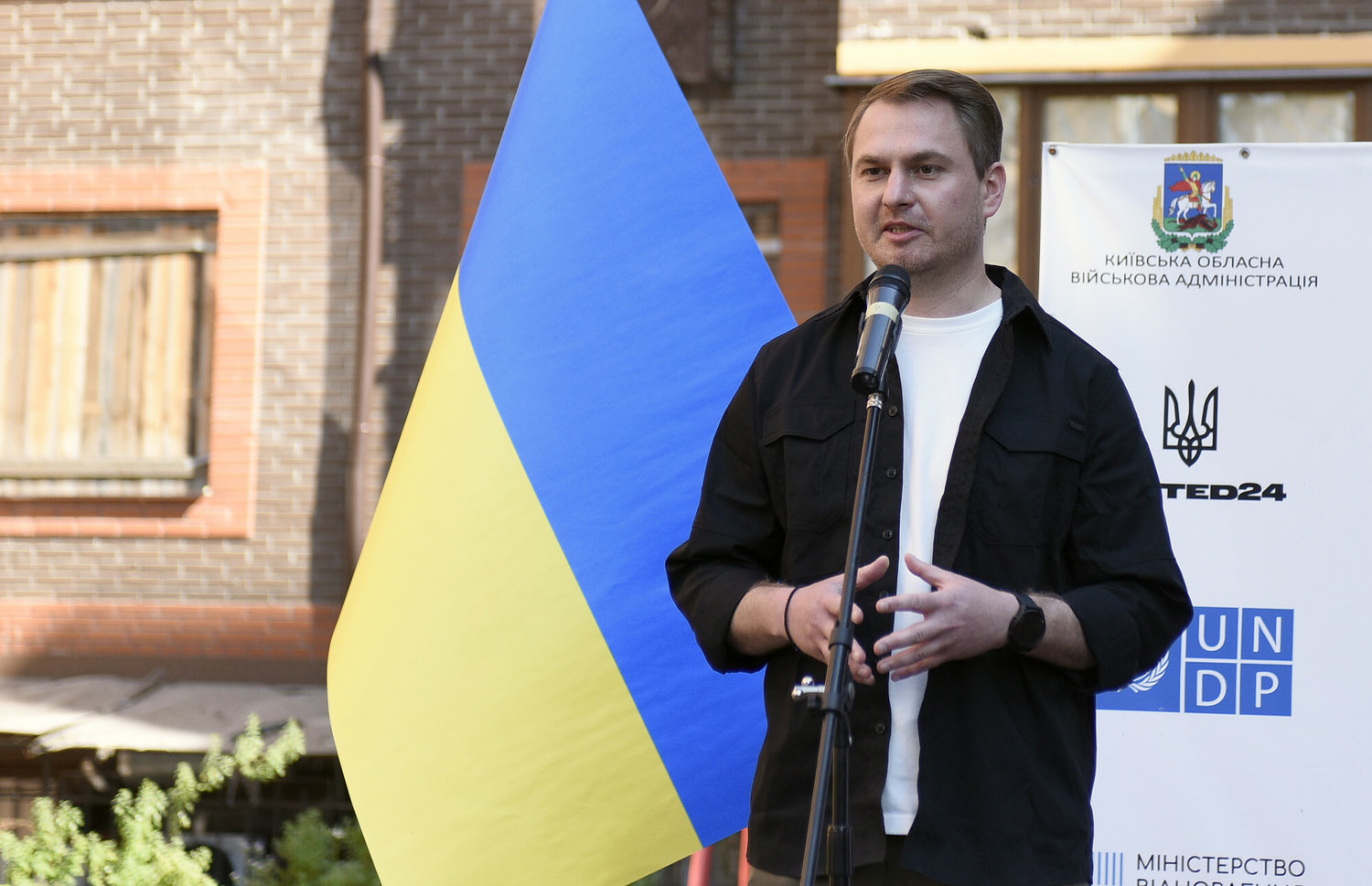
Russia plans to test-fire a new type of ballistic missile before the end of 2026, one built to fly farther than the Iskander missiles it now launches at Ukraine, according to Ukraine's military intelligence. Its deputy chief outlined the plan at a Ukraine-NATO meeting on 8 September, ZN reported.
A longer-range missile would erode the relative safety of western Ukraine, where the routes carrying Western aid run beyond the front, and stretch air defenses already struggli
Russia plans to test-fire a new type of ballistic missile before the end of 2026, one built to fly farther than the Iskander missiles it now launches at Ukraine, according to Ukraine's military intelligence. Its deputy chief outlined the plan at a Ukraine-NATO meeting on 8 September, ZN reported.
A longer-range missile would erode the relative safety of western Ukraine, where the routes carrying Western aid run beyond the front, and stretch air defenses already struggling against ballistic strikes.
A longer reach into western Ukraine
Russia plans final tests of a new ballistic missile with a range of up to 800 kilometers, or about 500 miles, by year's end, Vadym Skibitskyi, deputy head of the Defense Intelligence of Ukraine (HUR), told the Ukraine-NATO Interparliamentary Council, citing the agency's own assessments. Russian forces may try to hit targets in western Ukraine during those tests, he said.
The deputy chief noted that Moscow is raising both the output and the range of its ballistic missiles to intensify strikes and push Ukraine into a social and economic crisis. He urged partners to tighten sanctions until Russia loses access to the foreign components in its long-range weapons.
Russia's modernized 9M723-2, also called the Iskander-1000, reaches up to 550 km, HUR says, and the older 9M723-1 covers 390 km. An 800-km weapon would carry strikes well past the front.
The missile Russia already fields
Russia already fields a longer-range Iskander variant. This summer, its forces first fired the modernized 9M723-2—part of the Bora-M system—in a combined missile strike on Kyiv. A bigger engine and a larger launcher gave that missile its extended reach, HUR said. Ballistic missiles are the hardest of Russia's strikes for Ukraine to stop, and Moscow has poured them out in recent months, running its plants above quota and firing them in larger salvos.
Losing more soldiers than it signs up
Russia is waging a war of attrition despite heavy losses and has not given up on destroying Ukrainian statehood, Skibitskyi said. Skibitskyi put Russia's August losses at 43,000 soldiers against 39,000 recruited. Russia has struggled to fill its ranks for months. Russia's General Staff sees intensified mobilization as the only way to reach its main goals—fully occupying the Ukrainian Donbas and seizing the strategic initiative—he explained.
The Kremlin plans to mobilize about 600,000 people across 2026 and 2027, half of them by the end of this year, he said. Russia will also try to close the Black Sea to Ukraine and to drag Belarus into the war and into hybrid operations against NATO, he added, though HUR sees no signs of Russian strike groupings forming there yet.
Each new kilometer of range puts more of Ukraine within reach from deep inside Russia, without moving a launcher closer to the border.
Ukraine's National Guard now uses fiber-optic control for 70% of its drones, its commander said in an interview reported by Ukrinform on 9 September. Russian jamming cannot touch that link.
On a front where both sides jam radio signals around the clock, cable-guided drones have become some of the most effective weapons in the war—and Russia has turned to them too.
From radio signals to a cable
National Guard Commander Oleksandr Pivnenko gave that share on the YouT
Ukraine's National Guard now uses fiber-optic control for 70% of its drones, its commander said in an interview reported by Ukrinform on 9 September. Russian jamming cannot touch that link.
On a front where both sides jam radio signals around the clock, cable-guided drones have become some of the most effective weapons in the war—and Russia has turned to them too.
From radio signals to a cable
National Guard Commander Oleksandr Pivnenko gave that share on the YouTube channel LB Live. Earlier, the split ran the opposite way—about 20% fiber-optic, 80% radio-controlled.
These drones swap the radio link for a hair-thin cable that unspools as they fly, leaving Russian jammers no signal to block. The change was not smooth. Pivnenko said the National Guard first wrestled with the cable's quality and the way the drones handled. Crews have since learned to fly them for reconnaissance and strikes.
Twice as many drone-hunting crews
The force has also doubled its number of interceptor-drone crews over the past six months, Pivnenko said.
The National Guard plans to keep building those capabilities, Pivnenko added, calling the development of unmanned systems units one of its priorities. Ukraine's Defense Procurement Agency has also opened its first competitive tenders for fiber-optic and deep-strike drones, bought to Defense Ministry specifications rather than by product name. Since the full-scale invasion began, the force's drone crews had struck more than 243,000 enemy targets, Pivnenko said in late July.
A Ukrainian university and the company behind the country's Flamingo cruise missile opened a program to train engineers for the country's weapons industry, and on the first try, not a single applicant passed the entrance exams, the Kyiv Aviation Institute (KAI) told LB.ua. The school runs the course with the drone and missile-maker Fire Point.
More than four years of full-scale war have rebuilt Ukraine into what is now one of the world's busiest makers of drones and mis
A Ukrainian university and the company behind the country's Flamingo cruise missile opened a program to train engineers for the country's weapons industry, and on the first try, not a single applicant passed the entrance exams, the Kyiv Aviation Institute (KAI) told LB.ua. The school runs the course with the drone and missile-maker Fire Point.
More than four years of full-scale war have rebuilt Ukraine into what is now one of the world's busiest makers of drones and missiles. The industry has grown roughly tenfold since 2022 and now aims to build millions of drones a year. Scaling it takes engineers, not only money and factories.
Zero out of 150
The 150 candidates were sorted in two stages. First came the math and physics scores on the Ukrainian university entrance exam (NMT). Then a round of exams designed with Fire Point's engineers. Even applicants who scored well on the NMT couldn't clear that second round.
KAI president Kseniia Semenova said the physics proved too hard. The problems sat at the level of national olympiads, far above a normal entrance test. Anyone can learn them, she said, but only with real preparation. Getting in cold is very hard, she added, and candidates should commit a year ahead. From September, KAI and Fire Point will run preparatory courses.
Weak science in the schools
Semenova traced the failure to the classroom. Teaching of the natural sciences in Ukrainian schools is very weak, she said, and few students will even sit physics on the NMT. Those who do tend to score poorly.
Interest in KAI is climbing anyway. First-year enrollment rose 40% this year, KAI says, led by aviation transport and rocket-and-space technology. But the harder tracks, applied mechanics, composite materials, and engines, aren't growing.
Shipping documents show how a Chinese state company kept supplying Russia's drone factories with the raw material used in its long-range attack drones, Politico reported. Chinese parts have been recovered from downed Russian drones before. These records are the first to show the raw material shipped straight to the factory—a sanctioned arm of Russia's nuclear giant Rosatom.
Russia's mass-produced attack drones run on parts sourced worldwide that keep slipping past Weste
Shipping documents show how a Chinese state company kept supplying Russia's drone factories with the raw material used in its long-range attack drones, Politico reported. Chinese parts have been recovered from downed Russian drones before. These records are the first to show the raw material shipped straight to the factory—a sanctioned arm of Russia's nuclear giant Rosatom.
Russia's mass-produced attack drones run on parts sourced worldwide that keep slipping past Western export controls, and Ukrainian cities take the hits almost nightly. Kyiv has spent the war naming the foreign suppliers behind that hardware, one component at a time.
What the documents show
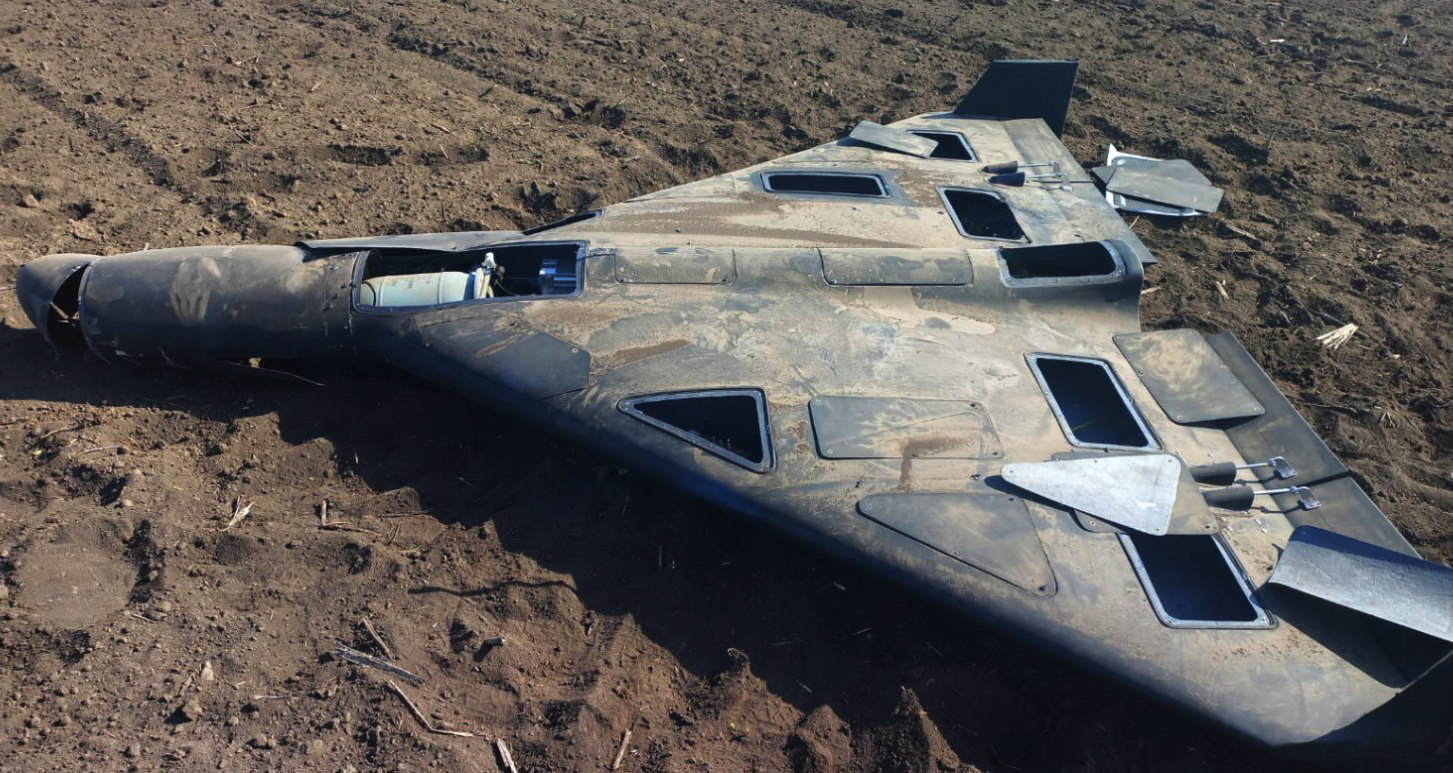
The papers trace 46 metric tons of carbon-fiber chemicals from Jilin Chemical Fiber Group to Alabuga-Volokno, a Rosatom subsidiary in Tatarstan. The exporter disguised the cargo under a customs code meant for civilian fibers like nylon, said weapons expert David Albright, who studies Russia's drone production. That precursor, polyacrylonitrile, is the raw ingredient for the light carbon fiber in Russia's Shahed-type attack drones.
Explore further
Ukraine’s new Tu-95 killer is a $48,000 copy of a drone China refused to sell
Drones of that type killed at least 15 people at a shopping mall in central Ukraine in August. Albright estimated the load could yield enough for as many as 1,300 kamikaze drones. The Kyiv-based Ukrainian Security and Cooperation Center, a think tank close to Ukraine's government, gathered the documents and shared them with Western governments. The US House Select Committee on China judged them legitimate, and Ukraine confirmed their authenticity.
Why Beijing can't plead ignorance
Alabuga-Volokno has faced Western sanctions since 2023 from the US, UK, EU, Ukraine, and others. Jilin faces none. Albright said the documents would let the State Department sanction the Chinese supplier. Serhii Kuzan, who heads the Ukrainian center, called China arguably the main and only source of these composite materials.
Former US officials rejected any idea that Beijing was unaware.
"The idea that Chinese state-owned enterprises can hide things from the Chinese government just doesn't wash," said Dennis Wilder, a former CIA deputy assistant director for East Asia and the Pacific.
Explore further
Russia’s jam-resistant drones run on a Chinese modem no one has sanctioned
Denials and a summit
Rosatom claimed it works in full compliance with the law. China's embassy in Washington called the evidence an attempt to "smear and scapegoat China," saying Beijing has never supplied lethal weapons.
The disclosure lands as US President Donald Trump prepares to meet Xi Jinping in Washington this month. In late August, Xi told Vladimir Putin their ties were set to strengthen.
Russia flew hundreds of warplane sorties against a small group of Ukrainian sea drones, according to the ArmyInform. The drones belong to Group 13, a Ukrainian military-intelligence unit. The unit is running out of Russian warships to sink and now strikes land targets from the sea, its commander, known by his call sign Thirteenth, said.
Years ago, Russia entered its all-out war against Ukraine with a commanding navy and treated the Black Sea as its own. A country left w
Russia flew hundreds of warplane sorties against a small group of Ukrainian sea drones, according to the ArmyInform. The drones belong to Group 13, a Ukrainian military-intelligence unit. The unit is running out of Russian warships to sink and now strikes land targets from the sea, its commander, known by his call sign Thirteenth, said.
Years ago, Russia entered its all-out war against Ukraine with a commanding navy and treated the Black Sea as its own. A country left with almost no warships has since answered with cheap robot boats, turning expendable machines into the tool that now contests that sea.
More than 500 sorties to hunt one small drone group
Group 13 hunts Russian warships with Magura sea drones—uncrewed attack boats. Russia flew more than 500 aircraft sorties against a group of eight to 10 Magura drones at the time, the commander said. Moscow spent more on locating the drones than the unit's entire mission cost, he added. Missions have grown longer, too. What once took a day now takes three, four, or five days.
Explore further
Biggest Magura sea drone doesn’t ram ships. It carries other drones and stays out seven days
The commander split the unit's rise into three stages: victory at sea, an end to Russian air dominance over the water, and now strikes on land from the sea. The bar set in 2023 and 2024 is unrealistic to hold in the Black Sea today, he said, because there are no ship targets left, and what remains is harder to reach. A struck S-400 air-defense system does not pay off like a sunk warship, he added.
The bill for Russia
The damage runs past destroyed hardware. Each Russian sailor killed leaves a family pension to pay and training to write off, the commander said. He pointed to the Syrian Express, Russia's sea supply line to Syria. It once ran a short route and now goes through the Baltic Sea, and the whole bill runs into the millions, he said.
Explore further
Ukraine’s new Magura W6P naval drone won’t kamikaze—but it can patrol 1000 km
The unit's capabilities came together in a strike on the Ivan Khurs, a Russian reconnaissance ship, its first target. The later sinking of the missile boat Ivanovets killed 40 Russian crew in minutes, the commander recalled. He expects the unit to be remembered as revolutionaries, likening its sea drones to the first tanks more than a century ago.
Russia's newest batch of Starlink-style satellites is gaining altitude sooner and sitting higher than the country's already-working first batch did at the same point, an analysis by Ukrainian defense outlet Militarnyi found. That complicates recent reports that the batch will stay far below its working altitude—though a few of the craft clearly have malfunctioned.
Moscow is racing to field its own orbital network to replace the Starlink service its troops used without a
Russia's newest batch of Starlink-style satellites is gaining altitude sooner and sitting higher than the country's already-working first batch did at the same point, an analysis by Ukrainian defense outlet Militarnyi found. That complicates recent reports that the batch will stay far below its working altitude—though a few of the craft clearly have malfunctioned.
Moscow is racing to field its own orbital network to replace the Starlink service its troops used without authorization, a system experts warn could one day relay commands to long-range strike drones.
Where the "failure" verdict came from
Business Insider reported that all 16 satellites in the second Rassvet batch—launched 19 July—had fallen short of their target orbit, citing public US Space Force tracking data. The Institute for the Study of War (ISW) noted that many of the craft sat between 300 and 400 kilometers, well below their intended orbit. Russia looks unprepared to deploy at this pace and will likely face further delays, ISW assessed. At those low heights, thicker air drags on satellites and shortens their lives. Rassvet—Russian for "Dawn"—is built by the Russian firm Bureau 1440. Moscow rushed the network in after SpaceX cut off Russian forces' access to Starlink.
What the altitude data shows
Militarnyi's own reading of the tracking record points the other way. A rocket drops the satellites near 300 kilometers, and they raise themselves over months on their own engines. The July batch fired those engines days earlier than the March group, giving it a head start. By day 46, the new batch's median altitude was 365 kilometers, against 314 for the first. Thirteen of the new craft had passed 320 kilometers and ten cleared 350, against five and one for the first batch. The newer craft climb at a slower daily pace, but the early start left them well ahead on height.
Militarnyi cautions that the batch cannot be judged before roughly 100 to 125 days after launch—around late October—the window in which most of the March craft passed 500 kilometers.
The malfunctions are real
Two satellites show no real climb and are sinking toward the atmosphere, a third rose and slipped back, and a fourth stalled with the cause unclear. The March launch lost one craft outright and left two more stuck below working height. The company had listed a target orbit near 800 kilometers, yet the first batch settled far lower and still works. Militarnyi counts thirteen of its satellites in a stable orbit near 508 kilometers, where Business Insider and ISW put twelve of them at roughly 550. By its count, they now open at least two communication windows over Ukraine each day, each running longer than an hour.
Spain will send Ukraine more Patriot interceptor missiles, Foreign Minister José Manuel Albares confirmed, according to Le Monde.
Patriot interceptors are among the few weapons Ukraine has that can stop Russian ballistic missiles. The specialized rounds are scarce worldwide, and manufacturer Raytheon cannot build them fast enough to meet demand. Each costs $3 million to $4 million.
Spain confirms the flow will grow
Albares spoke at an informal meeting of European
Spain will send Ukraine more Patriot interceptor missiles, Foreign Minister José Manuel Albares confirmed, according to Le Monde.
Patriot interceptors are among the few weapons Ukraine has that can stop Russian ballistic missiles. The specialized rounds are scarce worldwide, and manufacturer Raytheon cannot build them fast enough to meet demand. Each costs $3 million to $4 million.
Spain confirms the flow will grow
Albares spoke at an informal meeting of European Union foreign ministers in Ireland on 2 September. He reaffirmed Madrid's support as Kyiv pressed for more interceptors. "We have been doing this for a long time, and we will continue to do so," he said. He confirmed that Madrid is preparing a new batch. EU foreign policy chief Kaja Kallas said the bloc is also working with non-member states to lift Ukraine's air defenses.
Madrid and Kyiv meet in Wicklow
The confirmation followed talks with Ukrainian Foreign Minister Andrii Sybiha. They met on the sidelines of the same EU gathering, in Wicklow. Sybiha said he pressed Ukraine's urgent need to strengthen its air and ballistic missile defenses. He also thanked Spain for its solidarity. Albares reaffirmed Spain's role as a founding member of the Integrated Anti-Ballistic Missile Coalition, which ten countries launched in Paris on 13 July. The group aims to build a shared anti-ballistic capability, and its declaration calls the coalition purely defensive. Spanish military instructors are training Ukrainian technicians to maintain the systems.
What Spain has promised so far
Spain is not just giving—it is also buying. In December 2025, Madrid signed a $1.7 billion contract with US arms maker Raytheon for four new Patriot systems. It was Spain's largest Patriot order yet. The deal covers radars, launchers, command-and-control stations, and training. Spanish firm Sener builds the control system for the GEM-T interceptor those launchers fire. Spain is one of only a handful of European countries that operate Patriots.
What Spain has already sent
Spain has supplied Ukraine with Patriot missiles before. In March, Madrid pledged five older PAC-2 interceptors from an air-defense artillery regiment at Marines, near Valencia. Madrid has pledged €1 billion ($1.16 billion) in military aid for 2026. Ukraine has spent months urging partners to release interceptors from their stockpiles.
Estonia's defense minister resigned on 2 September over a failed €70 million ammunition deal for Ukraine, ERR reported. The state procurement agency paid EU funds to companies that had never sold artillery shells. Estonian taxpayers may now have to cover the losses.
The Baltic states have poured billions into defense since Russia's full-scale invasion of Ukraine. Estonia alone redirected €500 million toward air defense and drones. It pledged 0.25% of GDP in annual aid f
Estonia's defense minister resigned on 2 September over a failed €70 million ammunition deal for Ukraine, ERR reported. The state procurement agency paid EU funds to companies that had never sold artillery shells. Estonian taxpayers may now have to cover the losses.
The Baltic states have poured billions into defense since Russia's full-scale invasion of Ukraine. Estonia alone redirected €500 million toward air defense and drones. It pledged 0.25% of GDP in annual aid for Kyiv. Defense budgets have grown faster than the procurement systems managing them.
Minister walks over "socks and ammunition"
Hanno Pevkur has held the post since 2022. Amid the scandal, he told Estonian public broadcaster ETV he would step down.
"The minister does not count socks and ammunition," Pevkur said.
RKIK's former chief countered that no major decisions were made without the ministry's approval.
Three opposition parties called for his resignation before he announced it. Prime Minister Kristen Michal said Pevkur was not personally at fault but acknowledged political responsibility applied. The resignation followed a National Audit Office report released on 28 August. Estonia's Prosecutor's Office has also opened a criminal investigation into the procurement.
The deal that fell apart
In 2024, Estonia's Center for Defense Investments (RKIK) signed four contracts with Datasel S.R.L., an Italian-registered firm. Eesti Ekspress reported that the Indian company Neco Defense Munitions owned it. Neither had ever sold a single artillery shell. RKIK paid roughly $81 million in advance using the EU's European Peace Facility. The first delivery was due in November 2024. Ammunition that arrived failed to meet quality standards. Estonia canceled the deals and filed a case at the European Court of Arbitration in Strasbourg.
Pevkur is the second Baltic defense minister to resign in four months. Latvia's Andris Sprūds stepped down in May after drone incursions from Russia's war destabilized the country's government.
Poland will recover hundreds of millions of euros from a shared European Union fund for weapons it handed to Ukraine, the defense outlet Militarnyi reported. The money had been frozen for two years and only started moving after a change of government in Hungary lifted a veto.
Europe's ability to keep weapons moving to Ukraine rests on members trusting they will be paid back for what they give away. When that cost-sharing seizes up, national governments face the full bil
Poland will recover hundreds of millions of euros from a shared European Union fund for weapons it handed to Ukraine, the defense outlet Militarnyi reported. The money had been frozen for two years and only started moving after a change of government in Hungary lifted a veto.
Europe's ability to keep weapons moving to Ukraine rests on members trusting they will be paid back for what they give away. When that cost-sharing seizes up, national governments face the full bill alone, and the case for the next donation gets harder. A single member's veto can jam that machinery for years.
The money starts flowing again
Poland will receive up to $500 million in 2027 from the European Peace Facility (EPF), an EU fund that reimburses member states for military aid to Ukraine. Deputy Defense Minister Paweł Zalewski told the Polish news agency PAP that the ceiling combines the $465 million now secured with a possible $12–35 million more, depending on which of the two payout options the European Commission picks. Warsaw had already collected $960 million earlier, bringing its total EU reimbursement to roughly $1.4 billion.
Explore further
190 or 580 Patriot missiles? What Ukraine’s EU-loan request could buy—and why Washington still decides
The reimbursements had stalled in 2024, when Hungary blocked a $7.7 billion tranche. Budapest dropped the veto in June 2026 after a new government took over, unfreezing the funds. The bloc is now steering part of the money toward joint arms purchases and its training mission for Ukraine, rather than just reimbursement.
Where Poland stands among donors
By Militarnyi's tally of Kiel Institute figures, total Polish aid has reached $6.8 billion, with $5.2 billion of that military. That ranks Poland 11th among donors by raw volume. When weighed against each country's economy, it ranks 9th, equal to 1.021% of Polish GDP, with the military share at 0.775%.
Explore further
A masked figure got into a Polish drone-parts plant—Poland now suspects a foreign spy service set the fire
What Warsaw handed over
Poland has supplied ammunition and other weapons since early 2022, before the full-scale invasion, and has since handed over more than 350 tanks—14 Leopard 2A4, about 60 PT-91 Twardy, and roughly 280 Soviet-era T-72 variants. Warsaw also sent Krab self-propelled howitzers, Piorun shoulder-fired air-defense missiles, and Grad rocket launchers. Alongside Slovakia, it was among the first NATO states to send Ukraine fighter jets, delivering 14 MiG-29 jets and 10 Mi-24 attack helicopters between 2022 and 2024.
Ukraine has asked the EU to spend billions from its support loan on Patriot air-defense missiles, a request European Commission President Ursula von der Leyen confirmed the bloc is weighing. How far the money would stretch depends on a price only Washington controls.
Russia keeps firing more ballistic missiles at Ukrainian cities than the country can shoot down, the warheads hardest for its air defenses to stop. Only a US-made Patriot system can catch them, and their in
Ukraine has asked the EU to spend billions from its support loan on Patriot air-defense missiles, a request European Commission President Ursula von der Leyen confirmed the bloc is weighing. How far the money would stretch depends on a price only Washington controls.
Russia keeps firing more ballistic missiles at Ukrainian cities than the country can shoot down, the warheads hardest for its air defenses to stop. Only a US-made Patriot system can catch them, and their interceptors remain in short supply worldwide, so who pays for them and Washington that agrees or disagrees to sell them now shapes how many cities stay covered.
The exemption Kyiv needs
The European Commission has already received a payment request covering Ukraine's air defenses, including the PAC-3 interceptors that arm Patriot systems. Von der Leyen put it at "several billion euros" and said member states were reviewing it, without naming a figure.
Suspilne, citing its own sources, reported that the request seeks just over $2.3 billion, with another $4.6 billion from the loan's defense tranche going to arms manufactured in Ukraine and the EU, mostly drones.
The money would come from the EU's $104 billion support loan for 2026–27. Because PAC-3 is US technology, spending loan money on it needs an EU exemption. National representatives will take up the decision on 7 September.
What the money actually buys
Defense Express has calculated how many interceptor missiles Ukraine can get with the loan. At the $4–5 million per round the US Army pays, $2.3 billion would fund 460-580 interceptors. At the $6.61 million export price Germany paid in late 2024, about 315. At up to $12.3 million each, the US cleared for Saudi Arabia on 30 January 2026, just 190.
Why money isn't the real problem
For Ukraine, the harder question is not price but whether it can get the missiles at all. Even 315 rounds would equal about half the world's current yearly output, which the sole producer, Lockheed Martin, is straining to lift from around 600 a year to 2,000 by 2030.
Kyiv has been short of interceptors for months. In August, Zelenskyy said Ukraine reached a deal with the US for monthly Patriot deliveries, but that it still needs at least around 5% of American output to get through winter. EU Foreign Policy Chief Kaja Kallas has urged member states to hand over interceptors, especially those with shelf lives nearing their end.
A fire at a Polish plant that makes drone parts for Ukraine's and Poland's militaries is being investigated as possible sabotage by a foreign intelligence service, Militarnyi reported. Poland's National Prosecutor's Office opened the case on two counts: foreign-intelligence activity against the country and a terrorist offense.
Fires and break-ins like this fit a widening pattern — the factories and supply lines that keep Ukraine armed are increasingly targets far from t
A fire at a Polish plant that makes drone parts for Ukraine's and Poland's militaries is being investigated as possible sabotage by a foreign intelligence service, Militarnyi reported. Poland's National Prosecutor's Office opened the case on two counts: foreign-intelligence activity against the country and a terrorist offense.
Fires and break-ins like this fit a widening pattern — the factories and supply lines that keep Ukraine armed are increasingly targets far from the front line. Across the continent, prosecutors keep opening the same kind of arson case against plants tied to Ukraine's defense.
A masked intruder and a two-hour fire
The fire started shortly after midnight on 31 August in the assembly hall of the WB Electronics plant in Skarżysko-Kamienna and spread to the storage rooms. Five crews put it out in under two hours. No one was hurt, but the storage rooms were destroyed, leaving at least 15 million zloty ($4 million) in damage. The plant had no permanent guards on site; a security company monitoring it remotely reported the fire.
Prosecutors say the blaze was set deliberately with a planted charge of flammable material, and no one has been charged. Security cameras recorded a masked person who climbed a fence and got onto the site.
Why Poland is looking at Moscow
Czesław Mroczek, deputy head of Poland's Interior Ministry, told RMF FM radio that many signs point to arson, and that a Russian trail is the obvious inference. An attack on the defense industry can suggest Russian involvement, he said, since European states have faced sabotage for years while backing Ukraine. Mroczek said protection plans for key defense plants must be richer than what this site had. No one has been detained, and investigators are still tracing how the intruder got in and who may have ordered it.
Explore further
After CIA head’s visit to Moscow, Poland’s PM warns Russia is preparing to escalate war. He puts critical window at seven or eight months
What the plant actually makes
WB Electronics is the core of WB Group, Poland's biggest private arms holding, whose firms build reconnaissance and strike drones such as the FlyEye and the Warmate. The Skarżysko-Kamienna site itself makes drone components for unmanned systems, used by both Polish and Ukrainian forces. Ukraine received FlyEye drones back in 2022 under its Army of Drones program, and in 2025 WB Group launched drone production inside Ukraine.
Ukraine's assault regiments, the troops built to storm trenches, have taken on a new role in 2026, reaching far into the Russian rear with their own strike drones, according to a feature by Ukrainska Pravda. Two of them merged their drone teams into a single experimental command and now plan deep strikes and ground assaults together, hitting the roads that feed Russian forces before the infantry moves.
Through 2026, Ukraine has turned drones into a way to choke the logi
Ukraine's assault regiments, the troops built to storm trenches, have taken on a new role in 2026, reaching far into the Russian rear with their own strike drones, according to a feature by Ukrainska Pravda. Two of them merged their drone teams into a single experimental command and now plan deep strikes and ground assaults together, hitting the roads that feed Russian forces before the infantry moves.
Through 2026, Ukraine has turned drones into a way to choke the logistics that keep the invasion moving, backed by dedicated funding aimed squarely at the enemy's rear. The shift now under way puts that reach in the hands of the units doing the ground fighting, so the same troops who storm a position can first starve it from dozens of kilometers away.
Assault troops with a long reach
For most of the war, deep strikes behind the front belonged to specialized drone units. That is changing. The 475th Separate Assault Regiment, known as CODE 9.2, was possibly one of the first non-specialist units to run mid-strikes, flights by medium-range attack drones that hit targets 50 to 150 kilometers past the front.
Explore further
A rare Ukrainian Bulat tank turned up in a brigade that never had them
Then CODE 9.2 and the 1st Separate Assault Regiment named after Dmytro Kotsiubailo built a joint command for multidomain operations, code-named Phalanx (Falanha), so they could plan and strike as one. Before that center existed, each unit fought its own stretch of front at its own pace. In plain terms, ground units now own part of the fight far beyond their own trenches.
Drones go in before the infantry
Reporters watched a soldier follow a live feed from a mid-strike drone called Darts as it flew over occupied Zaporizhzhia Oblast toward the Tokmak–Melitopol road, one of three the report calls key for Russian forces on that stretch. Crews log every flight in Ukraine's Delta battlefield system. When several drones go down in one area, an analyst reroutes the next ones around Russian air defenses. The goal is to wear down the enemy's supply before the infantry ever advances.
Explore further
Ukrainian drone maker is pitching its new five-inch strike FPV as assault squad’s mortar
Where the shift began
CODE 9.2 launched its first mid-strikes at the end of 2025, during the Kupiansk operation, its commander Oleksandr Nastenko, call sign Flint, recalled. In the interview, the two commanders trace the center back to a build-up of heavy bomber drones, then a plan to isolate the enemy's transport and supply. For assault units, that kind of reach is recent. The regiments had already worked together earlier in 2026 to strike Russian routes into occupied Crimea, hitting bridges and trucks that keep the peninsula fed.
Russia is sending jet-powered drones against Ukrainian cities in growing numbers—no longer only the Iranian Shahed-238 it fields as the Geran-3, but the newer, faster Geran-4 and Geran-5. The fear everyone voices is their speed, but speed breaks the cheap layer, not the missiles.
Ukraine's expensive air-defense missiles already routinely shoot down cruise missiles, and to them, a fast drone is just one more target. The strain falls on the cheap layer instead—the interce
Russia is sending jet-powered drones against Ukrainian cities in growing numbers—no longer only the Iranian Shahed-238 it fields as the Geran-3, but the newer, faster Geran-4 and Geran-5. The fear everyone voices is their speed, but speed breaks the cheap layer, not the missiles.
Ukraine's expensive air-defense missiles already routinely shoot down cruise missiles, and to them, a fast drone is just one more target. The strain falls on the cheap layer instead—the interceptor drones Ukraine built to down thousands of Shaheds a month for a few thousand dollars each, a fraction of a missile's price.
Those were designed to catch slow drones, and against jet speed, they struggle. If that layer breaks, the cost of defending Ukraine's skies climbs—and the Defense Ministry has already started paying to keep it from breaking.
The shift is not marginal, and it continues to accelerate. Russia had sent more than 2,500 jet-powered Shaheds against Ukraine by 30 August, against roughly 1,500 in July, informal presidential adviser Serhii "Flash" Beskrestnov wrote—the drones, he noted, were launched practically straight from the factory. Russia fired roughly 1,400 jet-powered drones since the start of 2026 to June, and air defenses recorded about 180 in all of 2025, Colonel Oleksandr Zaruba of Ukraine's State Research Institute said.
Geran-5 (above) and Geran-4 (below). Image: TurDef
A record month, and the weapon built to beat it
Ukrainian interceptor drones destroyed more than 33,000 Russian drones of all types in March 2026—roughly double the February total and a record for the cheapest layer of Ukraine's air defense, then-Defense Minister Mykhailo Fedorov said.
Russia sent Shaheds—cheap, propeller-driven, long-range, lumbering in at about 185 kilometers per hour (115 mph)—in mass raids meant to swamp Ukraine's defenses. Ukraine adapted, with mobile fire teams, electronic warfare, and layered engagement, then added interceptor drones that destroy incoming drones for a fraction of a surface-to-air missile's cost.
As Ukraine got better at catching propeller drones, Russia reached for speed—jet-powered versions that fly more than three times faster than the Shaheds Ukraine spent three years learning to intercept.
Iranian-designed Shahed-136 drone hulls at a Russian drone factory. Photo via TWZ
By August, Ukraine's military intelligence said Russia had stopped building the Geran-3 and shifted to the newer jets, producing roughly 3,000 of them a month.
Conventional air defense already handles this
The worry centers on velocity: a jet drone flies several times faster than a propeller-driven or electric one, reducing the time defenders have to detect, identify, and hit it. But the fear aims at the wrong place, said Oleksii Kolesnyk, director of the Ukrainian firm Reactive Drones.
"A jet-powered UAV is, in many ways, similar to a cruise missile. For conventional air defense, jet-powered drones are simply another aerial target," he told Euromaidan Press.
Ukraine's surface-to-air systems routinely intercept cruise missiles. A fast drone is standard work for them—though Zelenskyy said in late August that the jets are the hardest to intercept, and that combat aircraft now mainly protect against them.
The strain lands on the interceptor drones
An interceptor drone, unlike a ground-launched missile, has to chase its target down and ram it, which worked against slow Shaheds. Against something near cruise-missile speed, the geometry breaks.
The problem exists almost only for interceptor drones, Kolesnyk said—they were never designed for these speeds. At jet velocities, guidance, target tracking, and the final homing onto the target all hit technical ceilings, and faster interceptors alone will not fix it.
"New technical solutions will be needed," he said.
Interceptor drones are why Ukraine can answer mass raids without firing a missile worth hundreds of thousands of dollars at each incoming drone. Break that math, and the affordability of Ukraine's whole air defense shifts.
The Defense Ministry's answer
Through the defense-tech accelerator Brave1, Ukraine backed 12 technologies under the EU4UA Defence Tech grant program, offering up to €150,000 each for high-speed interceptors capable of reaching 450 kilometers per hour (about 280 mph) or more.
Explore further
Ukraine is testing four new drone interceptors as Russia floods its skies with faster Gerans
That push has since produced candidates. By late August, Ukraine had four interceptor systems built to run down the jets, all already in field testing, Defense Minister Yevhenii Khmara said, and the Alexa Spatium had entered service. Ukraine now wants to bring them up to standard and build them in the thousands.
Not a revolution, but an evolution with a long history
Colonel Oleksandr Saienko, a former Ukrainian brigade commander, rejected the idea that any of this is new.
"This is better described as an evolution of unmanned systems rather than a completely new stage of warfare," he said.
Jet drones long predate this war. "The first jet-powered UAVs appeared back in the 1970s," he said, pointing to Soviet reconnaissance drones beginning with the Tu-143 and continuing with the Tu-141 and Tu-243—platforms Ukraine itself later flew in the Donbas war and the full-scale invasion. What has changed is scale, and the problem the drones now solve: arriving before the defender can react.
Explore further
Ukrainian intelligence: Russia’s new jet-powered Geran-4 attack drone runs on Chinese turbojets
Saienko's warning points past the engine.
"The decisive advantage will not belong to whoever simply has a jet engine. It will belong to whoever integrates these platforms into an effective reconnaissance-strike system, protects them against electronic warfare, manufactures them at scale, and keeps costs manageable," he said.
His frame is the kill chain—detect, identify, decide, engage—and every gain in speed compresses that cycle. "If a target is flying at 500 to 700 kilometers per hour, even a delay of several dozen seconds may make interception impossible," he said, adding: "Radars must see sooner, command systems must classify automatically, and operators get less time—until automation becomes a requirement."
Why hasn't every drone gone jet-powered
Speed solves one problem and creates several. "They are simply another category of strike UAV," Kolesnyk said.
"One solution does not replace another."
Oleksii Kolesnyk, Reactive Drones.
Compact turbojets are expensive and hard to source for smaller drones. Bigger airframes have to be reinforced to take the loads and vibration, which adds weight and cost. Fuel burn climbs far above that of the electric or piston drones built for endurance, and higher speed leaves less room for navigation errors.
So, jet drones fill a niche rather than taking over the whole strike fleet. "They are most effective at ranges of roughly 200 to 600 kilometers," Kolesnyk said—fast strikes on high-value or time-sensitive targets, where getting there quickly matters more than flying cheaply or far.
Explore further
Russia unleashes its Geran-5 air defense killer on Ukraine, equipped with British Raspberry Pi microcomputer tracker
Ukraine didn't drop first-person-view (FPV) drones when fiber-optic ones arrived, and jam-resistant drones didn't replace the rest. Each capability added a layer rather than erasing the previous one. Saienko expects the same. "The emergence of jet aviation did not eliminate piston-engine aircraft. The same principle applies," he said. Cheap propeller drones are ideal for mass attacks, while jet platforms handle speed.
The next fight is over reaction time
Jet drones force defenders to decide faster, and that is the harder demand. A slow propeller drone is a wasteful target for an expensive missile. A cruise missile demands an instant answer. A jet drone sits in between—and an operator has to sort which weapon meets which target in seconds, while holding scarce interceptors back for the worst threats. Every misjudgment costs something.
"The challenge is no longer only interception—it is detecting, identifying, and assigning the target quickly enough," Saienko said.
Both experts reach the same conclusion from opposite ends: Kolesnyk through the technical limits of the interceptor drone, Saienko through the entire defensive network. Both land on automation—AI-driven target recognition, distributed sensors, and fast data sharing to shrink the gap between spotting a target and hitting it. The winner won't necessarily fly the fastest aircraft. It will process information faster than its opponent.
Over four days at the end of August, Russia fired about 800 jet drones at Ukraine, Ukraine's president said—a type most of Ukraine's cheap interceptors still cannot catch. And the problem won't stay Ukraine's alone. Drones from the same broad Shahed family have already strayed into NATO airspace and turned up in other wars. The interception race Ukraine is running now is one everyone will eventually run.
Ukraine's former defense minister Mykhailo Fedorov has offered to help the United States build a fleet of attack drones if Washington sends Ukraine the Patriot interceptor missiles it needs to get through winter, he told the Financial Times. The idea is Fedorov's own proposal, not a deal, and he holds no government post that would let him negotiate one for Kyiv. He is in Washington mainly to raise American money for a fund that would both invest in Ukrainian defense-tech c
Ukraine's former defense minister Mykhailo Fedorov has offered to help the United States build a fleet of attack drones if Washington sends Ukraine the Patriot interceptor missiles it needs to get through winter, he told the Financial Times. The idea is Fedorov's own proposal, not a deal, and he holds no government post that would let him negotiate one for Kyiv. He is in Washington mainly to raise American money for a fund that would both invest in Ukrainian defense-tech companies and build new ones of its own.
Over the past year, Ukraine's partners have shifted from handing over weapons off their shelves to funding and co-producing Ukrainian-designed drones and missiles, inside and outside the country.
What the fund would do
Fedorov used his working trip to Washington to line up venture funds, entrepreneurs and tech companies as backers, Suspilne reported. The fund would not simply invest in existing Ukrainian defense-tech firms, he wrote; it would also create new companies around the technologies the front line needs most. He set out three targets: battlefield robots to replace soldiers in the most dangerous positions, jet-powered interceptor drones to bring down Russia's faster new attack drones, and cheap missiles that use artificial intelligence. He did not say what his own role would be, or whether he would profit. He said the next step is to assemble a team and launch the first projects.
Explore further
The Fedorov protesters lost. But they backed a man for what he built, not what he promised—and that may be new in Ukraine.
The interceptors behind the offer
Fedorov framed the drone help as a straight swap.
"I'm ready to make that trade," he told the FT.
Ukraine is running low on interceptor missiles for its Patriot batteries, one of the few air-defense systems able to reliably stop Russia's ballistic missiles. Fedorov declined to say whether he would meet anyone from the Trump administration.
Ukraine's ex-minister turns open critic
President Volodymyr Zelenskyy dismissed Fedorov on 15 July, after six months in the job. Fedorov said a feud with Commander-in-Chief Oleksandr Syrskyi, who he says blocked his reforms, drove the split, Zelenskyy removed Syrskyi on 21 July as protests spread. in an interview with Reuters published on 25 August.
"it looks as though we're gradually, slowly losing," he said in an interview with Reuters.
US Army Green Berets have begun training Poland's special forces to move and strike on the kind of drone-saturated ground Ukraine fights on, the Associated Press reported. No ally besides the US had taken on the drone-heavy drill until now, and US instructors built it only months ago from Ukraine's battlefield lessons.
Ukraine has turned from an aid recipient into a source of tactics, feeding allies the counter-drone methods and strike tactics it forged against Russia's
US Army Green Berets have begun training Poland's special forces to move and strike on the kind of drone-saturated ground Ukraine fights on, the Associated Press reported. No ally besides the US had taken on the drone-heavy drill until now, and US instructors built it only months ago from Ukraine's battlefield lessons.
Ukraine has turned from an aid recipient into a source of tactics, feeding allies the counter-drone methods and strike tactics it forged against Russia's invasion. NATO is still behind: an alliance war game in February exposed how badly its own forces fare against drone warfare of that kind.
Bavaria plays the part of Russia
The drill spans a 1,100-square-mile (3,000 km²) stretch of Bavarian countryside around the US Army's Hohenfels training center, an hour southeast of Nuremberg. Polish commandos must slip past a US airborne unit playing the enemy, then move about 60 miles (100 km) north to Grafenwoehr and blow up a mock target.
In earlier runs, Green Berets removed their uniforms to blend in, a senior enlisted soldier familiar with the scenario said. He and a Green Beret officer at the training complex spoke anonymously, under a US policy against naming special forces personnel.
"This is supposed to be Russia and you're going to stand out in Russia," he said.
Farms, villages, cameras, and a populous city line the route. German civilians, largely unaware of the exercise, become the test: any tip they phone to police can help the military pinpoint the team. Once a team is spotted, "now you have the entire Russian arsenal coming at you," the soldier said. The US side can send military police with dogs or direct more drones to the area, and had more than 100 available in earlier runs.
Explore further
Ukraine’s drones crushed a US armored brigade in a war game in Germany
Allies want Ukraine's lessons—the US Army is stepping back
A Green Beret officer said the drill tries to replicate "all of those effects that we're seeing either Russia or Ukraine having to overcome." Ukraine pioneered this kind of drone warfare across four and a half years of fighting Russia. Its combat experience has been entering NATO training elsewhere in Poland, and its drone crews recently outmatched a US brigade in another German drill. The exercise has run just twice before, both this year with US teams, and the officer said he expects most, if not all, of NATO's 32 members to show interest in trying it.
The wider US message on drones has been mixed, AP said. On 20 August, the Army's acting chief of staff ordered a Europe-based drone unit back to infantry duty. US President Donald Trump has also wavered on cutting troop levels in Europe, and his administration launched a force review.
Ukrainian President Volodymyr Zelenskyy said in March that Ukraine was already helping five Middle East and Gulf states counter Iranian drones fired during the US-Israeli war on Iran, and that US and European governments had asked for help too, AP reported.
NATO said on 30 August 2026 it sees no imminent threat of attack from Russia, Reuters reported. Russia is stepping up covert operations across Europe alongside its war on Ukraine, a NATO official said. The statement followed a week of warnings from Western capitals.
Russia's sabotage campaign in Europe has grown steeply since the full-scale invasion, reaching from Molotov cocktails thrown at a French drone plant to severed undersea cables and attacks on railways. Record
NATO said on 30 August 2026 it sees no imminent threat of attack from Russia, Reuters reported. Russia is stepping up covert operations across Europe alongside its war on Ukraine, a NATO official said. The statement followed a week of warnings from Western capitals.
Russia's sabotage campaign in Europe has grown steeply since the full-scale invasion, reaching from Molotov cocktails thrown at a French drone plant to severed undersea cables and attacks on railways. Recorded attacks in Europe hit 34 in 2024, nearly triple the 12 counted a year earlier by the Center for Strategic and International Studies, which says Western states have yet to build an effective answer to a campaign pitched below the threshold that would trigger a military response.
Attacks on Ukraine and covert acts in Europe are both rising
Russia is attacking Ukraine harder and running more covert operations in Europe at the same time, the official said.
"Even as the Russians are facing very substantial resistance from Ukraine, they are stepping up attacks on Ukraine as well as hybrid acts in Europe," the official said, adding: "As always, NATO remains vigilant and alert to the variety of threats we face. At this time, we see no imminent threat of attack."
Hybrid acts mean covert moves—sabotage, arson, drone flights—that stop short of open war.
A week of alarms
Three developments that week bore on the same question—whether Russia would strike a NATO country, not only Ukraine. Polish Prime Minister Donald Tusk warned on 28 August that Russia is preparing to escalate both in Ukraine and across the region, putting the critical window at seven or eight months.
Days earlier, CIA Director John Ratcliffe flew to Moscow to meet intelligence counterparts. Two people familiar with the meeting told Reuters that Ratcliffe did raise the prospect of Russia acting against a NATO state, though whether the trip had any other aim stayed unclear. One source said several topics came up, including Russia's support for Iran. US President Donald Trump dismissed that reading two days later, saying Russian President Vladimir Putin will not attack NATO territory and that Ratcliffe carried no message.
Explore further
650 participants from 24 countries: Ukraine brings its battle-tested drone-defense experience to NATO’s Baltic Trust 2026 exercise
On 25 August, German Chancellor Friedrich Merz said at a coalition summit that his government will soon name who was behind the 4 August drone attack attempt at Leipzig/Halle airport. Russia denies any role in sabotage on European soil and dismisses such accusations as Western scaremongering.
Sweden will transfer 10 coast guard boats to Ukraine, the Swedish government announced on 27 August 2026. Stockholm will also direct additional funds to multilateral defense programs for Kyiv.
Russia's full-scale invasion added to some 13,500 km² of Ukraine's rivers, lakes, and Black Sea coastline now potentially contaminated with explosive remnants of war, in the world's most mined country, and emergency service divers had cleared 190 km² of it by November 2025. Allied
Sweden will transfer 10 coast guard boats to Ukraine, the Swedish government announced on 27 August 2026. Stockholm will also direct additional funds to multilateral defense programs for Kyiv.
Russia's full-scale invasion added to some 13,500 km² of Ukraine's rivers, lakes, and Black Sea coastline now potentially contaminated with explosive remnants of war, in the world's most mined country, and emergency service divers had cleared 190 km² of it by November 2025. Allied nations have committed billions in military support to Kyiv since 2022, from fighter jets to anti-drone systems.
Rescue boats for Ukraine's mined waterways
Ukraine's State Emergency Service will receive the work and high-speed vessels in their current condition, after the coast guard removes their markings and equipment. The agency will use them for waterborne rescue operations, including clearing mines from river channels.
Explore further
Sweden detains Russians who “camped” near home of CEO of Gripen jets Ukraine is buying
Sweden's Civil Defense Minister Carl-Oskar Bohlin said Sweden is further strengthening Ukraine's maritime capabilities. He described towage, mine clearance, and transport as important capabilities that can now increase further. Sweden's Civil Defense Agency will handle transporting the boats to Ukraine.
The donation follows Sweden's broader naval support for Kyiv. In January 2025, Stockholm doubled its pledge of CB90 assault boats for Ukraine's navy to 32 and added 23 naval combat modules to arm them. The coast guard vessels serve a different purpose—rescue and utility work for a civilian agency, not combat operations.
Another $28 million for defense funds
Sweden will also channel 270 million Swedish kronor (about $28 million) to multilateral defense funds supporting Ukraine, mainly for air defense. Of that sum, $14 million goes to the Prioritized Ukraine Requirements List (PURL), to which Sweden contributed $108 million in June. Allies and partners fund high-priority American materiel through the US-led, NATO-administered program, and this package covers advanced air defense systems and ammunition for Kyiv.
Explore further
Sweden’s first 16 Gripens to reach Ukraine in early 2027. They come with weapons
The government said this marks Sweden's fifth PURL contribution. With the new payment, Stockholm's total PURL funding reaches $552 million.
In July, Sweden's defense minister confirmed Ukraine may use the Meteor missiles promised with its Gripen fighters against Russian aircraft over Russian territory.
A Russian drone company is developing an interceptor drone—the cheap counter-drone weapon Ukraine has fielded at scale against Russian attack drones—internal documents published by the Russian resistance group Black Spark describe, the defense outlet Militarnyi reported. The documents describe two designs under consideration, and Black Spark alleges the company cooperated with Boeing before the full-scale invasion and spied on European companies.
Interceptor drones—unma
A Russian drone company is developing an interceptor drone—the cheap counter-drone weapon Ukraine has fielded at scale against Russian attack drones—internal documents published by the Russian resistance group Black Spark describe, the defense outlet Militarnyi reported. The documents describe two designs under consideration, and Black Spark alleges the company cooperated with Boeing before the full-scale invasion and spied on European companies.
Interceptor drones—unmanned aircraft that hunt other drones—scaled up out of Ukraine's need to shoot down Russia's mass Shahed attacks without spending million-dollar missiles on them. Ukraine now fields them from dozens of licensed makers, and their spread has pushed Russia toward faster jet-powered attack drones. Russia already flies anti-drone interceptors of its own—Ukrainian troops downed one in July—and the leaked designs would fly far faster than that machine.
Mortar-launched drone-killer
NIK is considering two interceptor designs. The first modifies the company's existing UBB-M, a folding-wing loitering munition that launches from a 160 mm container by mortar-style ejection. For the interceptor role, designers changed the wing from straight to swept, shrank the wingspan, installed a larger battery, and fitted a more powerful motor.
Explore further
Russia’s attack drones now jam the cheap interceptors sent to kill them
The modified drone weighs 15-16 kg, carries a 3 kg payload—likely a warhead—and flies at 250-300 km/h with a 20 km operating radius and up to 10 minutes of flight time, operating between 20 meters and 4.5 km altitude. NIK's second design has a cone-shaped fuselage with four electric motors. Its specifications remain unknown.
Espionage claim comes with no documents
Black Spark says the documents came from someone inside the company, not a break-in, and that it holds evidence the firm spied on European companies. It gave no details on the Boeing cooperation beyond dating it before the invasion.
The leak is Black Spark's latest operation against Russia's defense industry. The group, which operates inside Russia, says it infiltrated the Alabuga factory where Russia assembles Shahed-derived Geran drones and copied personnel databases. Ukraine's Special Operations Forces have acknowledged joint missions with Black Spark, including attacks on Russian oil infrastructure.
Belarus is fitting a new base near its border with Ukraine to receive heavy military hardware by rail, according to Radio Svaboda, the Belarus service of Radio Free Europe/Radio Liberty. On paper it is a training ground—but the leaked design documents describe a site built to unload trainloads of vehicles. The work is moving ahead even as Belarusian commanders have begun saying there is no real threat from the West.
Belarus keeps adding permanent military infrastructure
Belarus is fitting a new base near its border with Ukraine to receive heavy military hardware by rail, according to Radio Svaboda, the Belarus service of Radio Free Europe/Radio Liberty. On paper it is a training ground—but the leaked design documents describe a site built to unload trainloads of vehicles. The work is moving ahead even as Belarusian commanders have begun saying there is no real threat from the West.
Belarus keeps adding permanent military infrastructure on its Ukrainian frontier even as its own commanders now drop the Western-threat case behind it.
A rail line sized for military trains
Construction is under way near the village of Yakimaŭka in Homiel Oblast, the part of Belarus that runs along Ukraine's northern edge. Radio Svaboda reported that the new rail infrastructure is designed to receive military trains. The finding rests on project documents obtained by a community of Belarusian railway workers.
The papers describe a separate access track sized for up to 60 railcars and a cargo platform with a ramp for unloading wheeled and tracked vehicles. A state military-design institute, Vaenpraekt, is listed as the client.
A base for a new assault brigade
The papers pin the range only to Homiel Oblast, but Radio Svaboda links it to a wider military complex built near Homiel since late 2023. That complex is the planned home of the 37th separate air-assault brigade of Belarus's Special Operations Forces. Cadastral maps split it into an eastern "military town" and a western "training-tactical field."
Alyaksandr Lukashenka's government created the brigade in 2025 to strengthen the country's southern sector, ostensibly against a threat from Ukraine. Part of the military town was reported finished in June 2026, and crews have since moved to the rail tracks.
Belarus drops its own threat talk
For months, Belarusian officials have claimed the West was preparing to attack. In June 2026, the Minister of Defense of Belarus Viktar Khrenin pressed the line at a meeting of defense ministers from the Russia-led Collective Security Treaty Organization (CSTO) in Moscow, and again at an "anti-fascist congress" in Minsk, where he accused Europeans of a "Nazi mentality."
Khrenin told Lukashenka the situation around Belarus was calm, with no sign that neighbors were preparing to act. On 16 August, the commander of Belarus's air force and air defense, Andrei Lukyanovich, said there was no external threat and that operational contacts with Latvia, Lithuania, and Poland were ongoing.
Ukraine has unveiled the largest robot boat in its Magura sea-drone family, and this one is built to carry and launch other drones instead of ramming enemy ships, the company UFORCE told Militarnyi. UFORCE showed the new V11 during Ukraine's Independence Day drone parade, signaling a move from single-use attack craft toward a floating base at sea.
Ukraine has fought its Black Sea war with throwaway robot boats—cheap, one-way, built to hit a ship and go down with it. Shi
Ukraine has unveiled the largest robot boat in its Magura sea-drone family, and this one is built to carry and launch other drones instead of ramming enemy ships, the company UFORCE told Militarnyi. UFORCE showed the new V11 during Ukraine's Independence Day drone parade, signaling a move from single-use attack craft toward a floating base at sea.
Ukraine has fought its Black Sea war with throwaway robot boats—cheap, one-way, built to hit a ship and go down with it. Shifting toward reusable platforms that keep other machines running far from any coast marks a different bet.
A floating base, not a battering ram
The V11 is the biggest drone in its class. Earlier, Magura boats were made to hit warships. This one is a transport platform that carries other unmanned systems and gear. Its main feature is the ability to launch a larger number of unmanned systems straight from its deck, turning one boat into a mobile base for them. The company refers to the drone as both the V11 and the MV11.
Explore further
American defense company Red Cat announces serial production of copy of Ukraine’s Magura V7 and says it’s their own development
What the V11 can do
UFORCE says the drone carries up to 2,200 kg (about 4,850 pounds) and can stay at sea for up to seven days. The company built it for reconnaissance, surveillance, support of landing operations, and resupplying fuel and equipment to other naval drones.
"It is a platform that provides multi-domain capability: one carrier that carries and launches other unmanned systems far from shore for operations across all domains," said Oleh Rogynskyy, CEO of UFORCE.
He said the investment the company attracts works for Ukraine's Defense Forces.
From strikes to a US production line
UFORCE's design and engineering office in Portugal developed the V11, drawing on international investment and aiming at the needs of Ukraine's Defense Forces. Its work there was first reported in September 2025.
Explore further
Meet the Magura W6: Ukraine’s latest threat to Russian warships
In July, the company and the US firm ReconCraft signed a memorandum for the licensed production of Magura naval drones in the US. Ukraine's Magura boats have forced Russia's Black Sea Fleet back to safer ports, and some versions have even shot down Russian fighter jets.
Ukraine's cheap interceptor drones have been knocking Russia's nightly attackers out of the sky, so Russia has now bolted a jammer onto some of its own drones to blind them, according to Serhii "Flash" Beskrestnov, an adviser to Ukraine's President on defense technology. He examined the system, found in drone wreckage, and mapped how it strikes back at the interceptor sent to hunt it.
Russia batters Ukrainian cities with long-range drones most nights, and Ukraine has le
Ukraine's cheap interceptor drones have been knocking Russia's nightly attackers out of the sky, so Russia has now bolted a jammer onto some of its own drones to blind them, according to Serhii "Flash" Beskrestnov, an adviser to Ukraine's President on defense technology. He examined the system, found in drone wreckage, and mapped how it strikes back at the interceptor sent to hunt it.
Russia batters Ukrainian cities with long-range drones most nights, and Ukraine has leaned on a cheap shield—drones costing a few thousand dollars—instead of burning through far pricier missiles. Anything that dulls that shield pushes the cost of defending the sky back up.
A jammer that waits for the interceptor
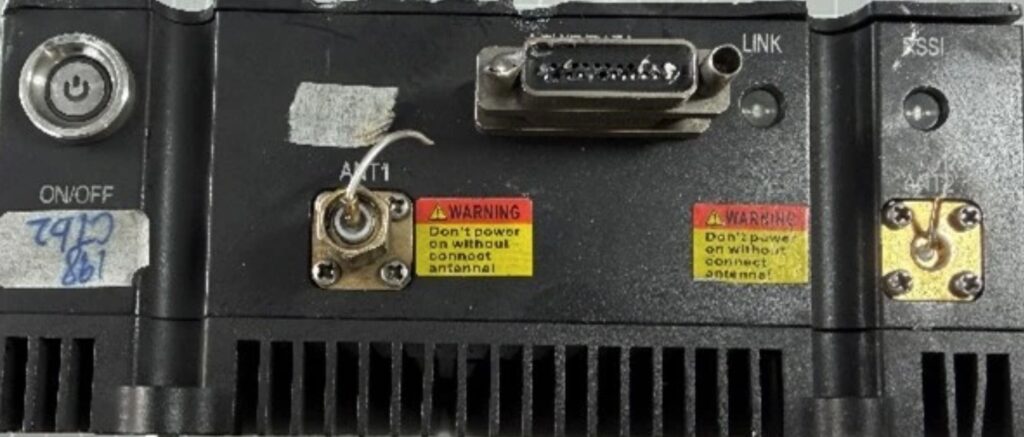
The unit rides on a Geran, Russia's version of the Iranian Shahed one-way drone. It listens for the video signal an approaching Ukrainian interceptor beams back to its pilot. Its receiver reads the interceptor's working frequency, then orders a transmitter to bury that same channel in noise, Beskrestnov found.
Explore further
How Ukraine uses AI to guide long-range drone strikes through electronic warfare and deep into Russian-controlled rear areas
By his first estimate, the jammer's signal runs about five times stronger than the interceptor's video link—enough to wipe the picture and any chance of steering the drone onto its target.
Seconds decide it
In Beskrestnov's account, the system detected a test transmitter and switched on jamming after about three seconds, and the feed cut out. The device stays nearly idle until a hunter comes close, then jumps to full power to smother the signal. It targets the ordinary analog video band around 5.8 gigahertz that many cheap interceptors still use.
Possible answers, include interceptors with terminal-guidance homing for the final stretch of flight, digital communication links, or transmitters set to non-standard frequencies.
Explore further
“Two targets and ammo with one drone”: How a Ukrainian drone crew hunts Russian transport behind the front line
An old problem for Russia's drones
Russia has tried again and again to keep its one-way drones alive against Ukraine's defenses, including wiring jammers into some Shaheds earlier this year. Spending weight and power to protect a drone from a far cheaper interceptor shows how well those cheap drones work.
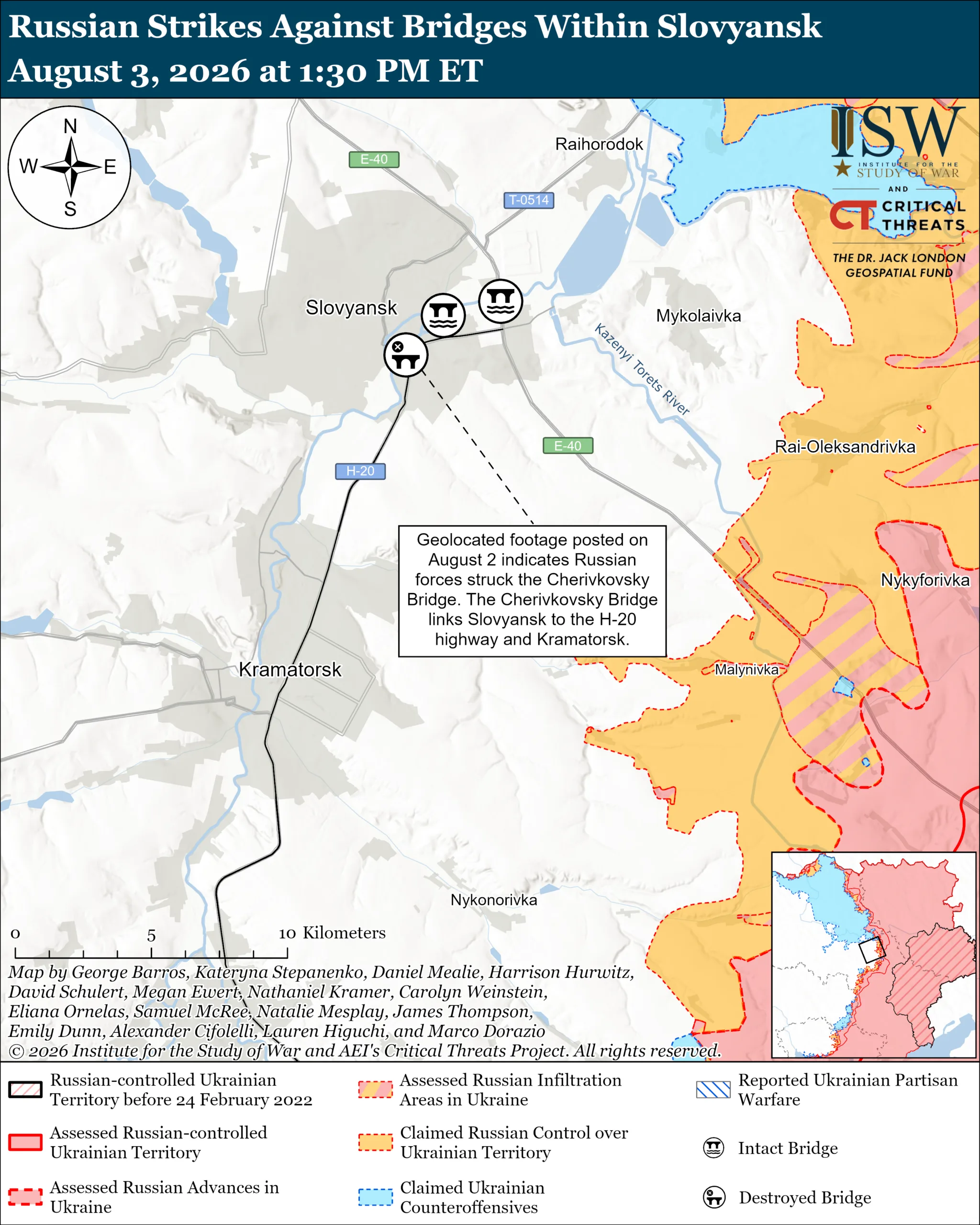
Russian forces have gained ground on the eastern approaches to Sloviansk and continue to prioritize an eastern route toward the city, according to the Institute for the Study of War (ISW). Their earlier push from the northeast had bogged down, and Russia now aims to set up a future assault on one of the last major cities Ukraine still holds in Donetsk Oblast. A quick move on the city itself remains extremely unlikely, ISW said.
Russia's 2026 summer campaign in the east
Russian forces have gained ground on the eastern approaches to Sloviansk and continue to prioritize an eastern route toward the city, according to the Institute for the Study of War (ISW). Their earlier push from the northeast had bogged down, and Russia now aims to set up a future assault on one of the last major cities Ukraine still holds in Donetsk Oblast. A quick move on the city itself remains extremely unlikely, ISW said.
Russia's 2026 summer campaign in the east has advanced through field edges and small villages rather than the breakthroughs the Kremlin keeps promising, the grinding pattern that has defined the fighting across Donetsk Oblast for years.
Explore further
Kostiantynivka: Why one city in Donbas matters so much that Putin lies about having captured it
The eastern approach
Ukrainian military observer Kostiantyn Mashovets reported that Russian forward units are advancing across several tactical areas at once in the Sloviansk direction. He said the command of Russia's 3rd Combined Arms Army rushes assault infantry forward right after each successful infiltration. Russian troops reached the southeastern edge of Pyskunivka, east of Sloviansk, from the east and northeast, moving off positions they had seized on the southern bank of the Siverskyi Donets, Mashovets said. Zakitne lies northeast of Pyskunivka and Kryva Luka southeast of it, and ISW read the advance as evidence Russia has consolidated positions in both.
They also infiltrated the southern and southeastern outskirts of Mykolaivka from western Rai-Oleksandrivka. ISW assessed that Russia is running a dual effort to connect its units near Kryva Luka with those at Rai-Oleksandrivka, so it can assault Mykolaivka from dominant terrain to the east and south at once. Mashovets added that other Russian groups slipped through three settlements along the E-40 Bakhmut-Sloviansk highway, trying to hold the western bank of the Siverskyi Donets-Donbas Canal and reach the river just east of the city.
ISW observed reports on 23 August that Ukrainian forces repelled a Russian infiltration attempt in Mykolaivka.
Oleksandr Borodin, spokesperson for Ukraine's 3rd Army Corps, said the Lyman direction falls in his corps' zone and that Russia's goal there is to half-encircle the Sloviansk-Kramatorsk agglomeration from the flank—first securing bridgeheads across the rivers, then cutting logistics. He called those plans unrealistic:
"We have quite serious defensive positions there and have been preparing for a long time. The capabilities they currently have to try to accomplish this task are insufficient even to come close to achieving such a goal."
Why Moscow switched directions
Russia prioritized attacking Sloviansk from the northeast through Lyman when it opened its spring-summer 2026 offensive, but that effort has largely stalled. The Siverskyi Donets River, which loops north and northeast of the city, together with a web of canals, handed Ukrainian defenders a natural moat. So Russian commanders now treat Mykolaivka as a key prize. Taking it would let them strike west toward Sloviansk from the east, skirting the water obstacles that blocked the northeastern route.
Explore further
Ukrainian intelligence units will not help: Analyst warns that once Russia breaks into Sloviansk and Kramatorsk, reinforcing them only delays inevitable
A slow road into the Fortress Belt
Sloviansk anchors the northern end of Ukraine's Fortress Belt, a chain of fortified cities that has blunted Russian advances in Donetsk Oblast since 2014. ISW cautioned that Russian forces are extremely unlikely to make fast gains west of Mykolaivka, since they still need to seize several more settlements first.
Ukraine's President Volodymyr Zelenskyy said on 23 August that Putin has ordered his army to seize all of Donetsk Oblast by 31 December. By ISW's count, it is the 15th such deadline since 2022, and Russia has missed every one that has come due.
Zelenskyy put Russia's frontline casualties this year at around 267,000, including about 155,000 killed, and said 70% to 80% of them fall in the Kostiantynivka direction. Russia holds about 79.89% of Donetsk Oblast, by ISW's count, and Zelenskyy said the Kremlin is preparing to mobilize around 300,000 men after the 18–20 September State Duma elections, partly to reinforce Donetsk and Luhansk oblasts.
Ukraine is building a sea-facing layer of air defense along its southern coast, Kyrylo Liukov, head of the unmanned technologies department at the Serhii Prytula Foundation, wrote in a column for RBC-Ukraine. Winged interceptors now reach the Russian spy drones that guide strikes in the south.
Russia's nightly drone strikes on Ukrainian cities have turned air defense into a race to close every corridor Russia can fly through, over land first and now over the open sea. K
Ukraine is building a sea-facing layer of air defense along its southern coast, Kyrylo Liukov, head of the unmanned technologies department at the Serhii Prytula Foundation, wrote in a column for RBC-Ukraine. Winged interceptors now reach the Russian spy drones that guide strikes in the south.
Russia's nightly drone strikes on Ukrainian cities have turned air defense into a race to close every corridor Russia can fly through, over land first and now over the open sea. Kyiv does it with cheap interceptors rather than costly missiles, and keeps having to chase Russian workarounds. The sea was the stretch air defense could not reach, and it is where Russia keeps the spotters that make its Shahed swarms steerable.
Land and sea are two different fights
Defending the sky over land and over open water are two different problems, Liukov wrote. Multirotor copters are fast and simple to launch near the coast, but past roughly 25 km offshore, a multirotor is almost useless. Russia builds its mission routes so that drones cross dozens of kilometers over sea before they turn toward Ukrainian targets. Fixed-wing drones close the gap. Built like gliders, they loiter for over an hour and hold a link at 40 km and beyond, helped by an open radio horizon that land's terrain and buildings deny them.
Recon drones are the priority target for a reason. Beyond spotting and confirming hits, they work as relays in a MESH network for a group of strike drones. In that setup, Russian crews can steer Shaheds by hand right up to the moment of impact, Liukov wrote.
Southern units recently set three distance records with foundation-supplied interceptors. The 18th aviation commandant's office of Air Command South downed a Russian Orlan-30 reconnaissance drone 110 km out. It used a Wovkulaka Spitfire interceptor, the longest kill on record for that system.
The 12th Separate Special Purpose Center set the other two, flying a system from the miltech company TechnoTaras: an Orlan downed at 86 km, and a 145 km hunt measured from the takeoff point that held a stable digital link the whole way, Liukov wrote. That leaves Russia's drones exposed much farther from shore than its planners assume, he added—and if such results become routine, Russia has to pull its transit routes farther out still.
The Maiachnia beacon line
A less obvious problem was navigation, not shooting. A drone flying without GPS steers by landmarks, and over open sea, there are none. Late last year, the foundation, the 12th Separate Special Purpose Center, and TechnoTaras launched a project called Maiachnia. It strings radio beacons on the Skyline system along the coast from Ochakiv to Izmail. The beacons work on their own and keep backup power, tied to a central network that operators can adjust remotely. An operator can then track the drone even under GPS jamming, bad weather, or a temporary loss of link, and bring it home. More than five southern units now fly the foundation's winged drones.
The real stakes sit offshore—the southern ports and the Black Sea grain corridor that Russian drones threaten and that land-based copters can barely reach. Keeping Russian drones farther offshore would buy room there. But Russia is scaling up a faster, jet-powered Shahed, and the interceptor answer to it is early—so the offshore edge just won will have to be defended again.
Italian defense giant Leonardo has quietly registered a research subsidiary in Kyiv, planting a direct corporate flag in Ukraine's wartime defense ecosystem, Euractiv reported. The move reverses the company's previous public stance against opening operations in Ukraine.
European defense firms are quickly embedding inside Ukraine's defense industry, as Ukraine's wartime manufacturing base has become a draw rather than a risk for Western capital.
Kyiv-based R&D com
Italian defense giant Leonardo has quietly registered a research subsidiary in Kyiv, planting a direct corporate flag in Ukraine's wartime defense ecosystem, Euractiv reported. The move reverses the company's previous public stance against opening operations in Ukraine.
European defense firms are quickly embedding inside Ukraine's defense industry, as Ukraine's wartime manufacturing base has become a draw rather than a risk for Western capital.
Kyiv-based R&D company
Leonardo Ukraine appeared in Ukraine's business register on 20 May, but the company disclosed the step only in its H1 2026 financial report at the end of July. The subsidiary's share capital stands at about $125,000. Leonardo International wholly owns it.
"We have completed the legal process to begin operations. The new company will be used to work in this region," a Leonardo spokesperson said.
The subsidiary will focus on R&D covering communications and navigation systems, software, IT services, and electronic and optical technologies. The step brings Leonardo closer to Ukraine's drone and missile industry, which has expanded rapidly during the war.
Explore further
Italy wants continental defense alliance, including Ukraine. Kyiv already out-produces all of NATO on drones
From no factory to a Kyiv office
Just over a year ago, then-CEO Roberto Cingolani said that Leonardo had no plans to open a factory in Ukraine, as Reuters reported. At the same time, Cingolani pledged to test Leonardo's Michelangelo Dome air defense system in Ukraine. The Italian government did not reappoint him in April 2026. Lorenzo Mariani took over as CEO in May.
The subsidiary is not a factory. But it gives Mariani a registered legal presence inside Ukraine's defense innovation ecosystem, positioned near the drone and electronic warfare sectors Leonardo wants to tap.
Explore further
Yes, Italy is arming Ukraine — here’s what military aid data shows
Leonardo is not the first major European defense firm to set up inside Ukraine. Germany's Quantum Systems established three joint ventures and made the country its second-largest international base. Rheinmetall is building an ammunition plant there. Ukrainian defense companies, in turn, have opened production facilities across Europe.
The US Army Contracting Command—Detroit Arsenal has published a market survey seeking companies that can supply components for M2A2 ODS-SA Bradley infantry fighting vehicles (IFVs) headed to Ukraine—parts that original manufacturers have stopped making. The posting asks for firms with immediate access to the components or a realistic plan to restart their production, Militarnyi reported.
Maintaining Western armored vehicles in active combat has strained repair chains th
The US Army Contracting Command—Detroit Arsenal has published a market survey seeking companies that can supply components for M2A2 ODS-SA Bradley infantry fighting vehicles (IFVs) headed to Ukraine—parts that original manufacturers have stopped making. The posting asks for firms with immediate access to the components or a realistic plan to restart their production, Militarnyi reported.
Maintaining Western armored vehicles in active combat has strained repair chains throughout the war, with licensing requirements and long lead times slowing restoration of battle-damaged equipment. When components go out of production entirely, the problem shifts from delayed repairs to no repairs at all.
Parts nobody makes
The survey targets components affected by what the command calls an aging manufacturing base. Original suppliers have discontinued production of multiple subsystems, including turret drive control units, transmission control modules, heater mounts, ammunition chutes, specialized Dialight Corp lens assemblies, and other structural, electrical, and mechanical parts unique to the M2A2 ODS-SA.
The Ukrainian Army's Bradley IFV. Photo: Ukraine's General Staff
The posting is not a tender and does not guarantee a contract. Its stated goal is to identify companies that can either deliver the parts now or credibly restart production.
Restoring and sustaining Bradleys for Ukraine
The parts shortage creates a two-stage problem. Before Bradleys can be shipped to Ukraine, the US military refurbishes them at its depots—restoring each vehicle to combat-ready condition under a standard called Fully Mission Capable + Safety. Without the discontinued components, that refurbishment stalls.
Explore further
Ukraine’s M-2 Bradleys engage Russian infantry at point-blank range
The same parts are also needed to keep Bradleys already fighting in Ukraine on the road. The posting specifies that field servicing must proceed without delays caused by parts shortages—meaning the crisis affects both the pipeline into Ukraine and the fleet already there.
Potential contractors must demonstrate repair and technical validation capabilities, supply chain management, and the ability to quickly resume manufacturing of parts that no longer have a producer. The command requires a detailed transition plan with a timeline from contract signing to the delivery of the first restored vehicle.
The US also plans to involve the future contractor in training Ukrainian military mechanics. The contractor would develop courses, manuals, and provide specialized tools and equipment—including instruction on armored recovery vehicles.
Explore further
Chile secretly sells 30 Marder IFVs to Germany in likely Ukraine ring exchange
The 25-mm cannon, stops T-72s, if the turret still turns
The M2 Bradley carries infantry into combat and mounts a 25-mm M242 Bushmaster cannon that fires up to 500 rounds per minute and can defeat Russian light armored vehicles and the side and rear armor of main battle tanks. The US has supplied more than 200 Bradleys to Ukraine under the previous administration, with combat losses mounting across multiple frontline sectors.
Separately, the US Army presented XM30 infantry fighting vehicle candidates at the Michigan Defense Expo 2026—the program is eventually designed to replace the Bradley.
Ukraine and Belgium are drawing up a bilateral agreement to deepen cooperation on drones, President Volodymyr Zelenskyy said after meeting Belgian Foreign Minister Maxime Prévot in Kyiv on 18 August. The two also discussed strengthening Ukraine's air power and shielding it from Russian attacks.
Cheap drones now decide much of the fighting, and Kyiv has turned years of learning to fly and defeat them into leverage—trading that edge for weapons and money with a lengthenin
Ukraine and Belgium are drawing up a bilateral agreement to deepen cooperation on drones, President Volodymyr Zelenskyy said after meeting Belgian Foreign Minister Maxime Prévot in Kyiv on 18 August. The two also discussed strengthening Ukraine's air power and shielding it from Russian attacks.
Cheap drones now decide much of the fighting, and Kyiv has turned years of learning to fly and defeat them into leverage—trading that edge for weapons and money with a lengthening line of Western partners.
A new deal takes shape
Teams on both sides are now writing the text of the Drone Deal and weighing possible dates to sign it, ArmyInform reported. Ukraine is ready to share its own expertise in unmanned systems with partners, Zelenskyy said.
Defense ran through the meeting, with both sides focused on strengthening Ukraine's combat aviation and defending its skies.
"I expect that we will be able to implement what we discussed, and there will be more protection from Russian strikes," Zelenskyy said.
Belgium has promised 30 F-16 fighter jets—the largest F-16 pledge from any single country—though none have reached Ukraine yet, with deliveries tied to Belgium's own switch to newer aircraft.
Explore further
“First time”: Ukrainian troops joined Belgium’s National Day parade in Brussels
Belgium's deeper backing
Zelenskyy thanked Belgium for more than $1.28 billion in support this year, covering defense and civilian needs alike, and for backing Ukraine's move toward the European Union. The military share flows from a standing pledge: since 2025, Belgium has committed to at least $1.16 billion in defense aid a year.
A 2024 security pact locked in that relationship, making a small Western European country one of Ukraine's steadier partners. Belgian firms also service the F-16s Ukraine already flies, the jets delivered by other partners in the coalition.
Ukraine's weapons marketplace DOT-Chain Defense has compressed delivery times from months to weeks after one year of operation, the country's Defense Ministry reported. For the fastest product categories—electronic warfare gear, ground robots, interceptor drones—orders now reach units within 24 hours.
Ukraine's war against Russia's invasion has pushed Kyiv to rebuild military procurement from the ground up, trading slow bureaucratic pipelines for digital platforms where
Ukraine's weapons marketplace DOT-Chain Defense has compressed delivery times from months to weeks after one year of operation, the country's Defense Ministry reported. For the fastest product categories—electronic warfare gear, ground robots, interceptor drones—orders now reach units within 24 hours.
Ukraine's war against Russia's invasion has pushed Kyiv to rebuild military procurement from the ground up, trading slow bureaucratic pipelines for digital platforms where frontline units pick and receive their own weapons faster than Western militaries have managed. Domestic manufacturers now make 90% of newly authorized systems.
Fastest deliveries measured in hours
The Defense Ministry and the Defense Procurement Agency DOT have jointly driven the acceleration, according to the ministry's statement.
"Delivery times for drones and other systems have shrunk from months to a matter of weeks, and often to days," the ministry said.
Beyond that general compression, several categories saw delivery within a single day. Electronic warfare systems, ground robotic platforms, reconnaissance and bomber drones, interceptor drones, and FPV drones on both fiber-optic and radio control all reached units within 24 hours. Ammunition for unmanned systems arrived within six days.
Explore further
Russian drone attacks on Ukraine’s Danube ports hit recent high, Romania says
Over the first year, the platform shipped more than 1.2 million drones and other systems. Units now choose from 1,181 products made by 300 domestic manufacturers.
How the marketplace works
DOT-Chain Defense supplements centralized state supply rather than replacing it, the ministry noted. Combat units use allocated funds to browse and order the equipment they need for their section of the front. The marketplace handles contracts, payments, and delivery.
The platform's drone constructor tool lets units customize drone configurations before ordering. A dedicated training course on using the marketplace recently launched inside the Army+ mobile app.
Explore further
US copies Ukraine: Washington launches Amazon-backed UAVs marketplace, inspired by Kyiv’s Brave1 Market and DOT-Chain Defense
Broader procurement picture
The one-year milestone caps a period of rapid scaling across Ukraine's defense procurement. The country contracted about $8 billion worth of drones in the first half of 2026—double the same period last year, according to the Defense Ministry.
More than 400 combat units now shop for weapons through the marketplace's companion Brave1 Market program using points earned for confirmed battlefield activity. Washington modeled its own Unmanned Aircraft Systems Marketplace on the Ukrainian original earlier this year.
The US plan to sell Türkiye F-35 stealth fighter jets has stalled, blocked by a Russian missile system Ankara bought years ago, Semafor reported. Lawmakers in Washington won't clear the deal while Türkiye keeps the hardware. The lone buyer in talks hasn't budged, and destroying the system is now on the table.
Russia has long used arms exports to pull buyers into its orbit, and the war it started raised the price of those ties—leaving governments that bought Russian air
The US plan to sell Türkiye F-35 stealth fighter jets has stalled, blocked by a Russian missile system Ankara bought years ago, Semafor reported. Lawmakers in Washington won't clear the deal while Türkiye keeps the hardware. The lone buyer in talks hasn't budged, and destroying the system is now on the table.
Russia has long used arms exports to pull buyers into its orbit, and the war it started raised the price of those ties—leaving governments that bought Russian air defense to clash with the supplier that sold it.
The Russian system is in the way
US sanctions law bars Türkiye from the F-35 program while it retains the Russian S-400, Semafor reported. That system is a long-range air defense, built to shoot down planes and missiles. Ankara already paid for six of the jets. They have sat in the United States since Washington expelled Türkiye from the F-35 program in 2019. US President Donald Trump announced plans to sell the jets more than a month ago, and nothing has moved since.
Explore further
Türkiye wants to send Ukraine old US-made cluster munitions—one human rights group is fighting to stop it
No buyer, no easy exit
One way out is to sell the S-400 to another country. Türkiye reportedly opened talks with the United Arab Emirates (UAE) last month, but they don't appear to have progressed. American lawmakers insist Ankara must give up the system entirely first.
Republican Senator Rick Scott told Semafor that Türkiye shouldn't get the jets unless it becomes a true partner—"so if they have the S-400, they cannot have the F-35." Senate Foreign Relations Committee Chairman Jim Risch, a longtime opponent, said the process is "at a standstill."
Explore further
Erdoğan asks Putin to take back Russian S-400 SAM systems in move to win Trump’s favor
Israel and Congress are the live block
The sharper obstacle sits in Washington, Semafor reported. A vote to sell would pit Israel against a NATO ally, and many of Trump's own allies want the S-400 scrapped completely. Israeli Prime Minister Benjamin Netanyahu warned the jets could "destroy the power balance in the Middle East." The outlet said AIPAC, the leading pro-Israel lobby in Washington, is pressing Congress to keep the block.
Selling it still runs through Moscow
Any resale carries its own catch: Russia must approve the transfer of the S-400, giving the Kremlin a reason to block it. The only option that bypasses Moscow is to disable or destroy the system outright. Türkiye earlier tried to return the systems to Moscow, hoping to thaw relations with Washington. It didn't work.
The Trump administration says Ankara hasn't met all the conditions to buy the jets, and the State Department wants the S-400 issue settled with guarantees first.
Latvia's public broadcaster opened a new fundraising drive on 17 August to pay for the rehabilitation of wounded Ukrainian soldiers, LSM reported. The effort is timed to Ukraine's Independence Day on 24 August. Donations run through the charity Ziedot.lv.
Russia's invasion has produced a generation of wounded and traumatized Ukrainians whose recovery will outlast the war. The state already counts more than a million registered veterans, a number that climbs every month.
Latvia's public broadcaster opened a new fundraising drive on 17 August to pay for the rehabilitation of wounded Ukrainian soldiers, LSM reported. The effort is timed to Ukraine's Independence Day on 24 August. Donations run through the charity Ziedot.lv.
Russia's invasion has produced a generation of wounded and traumatized Ukrainians whose recovery will outlast the war. The state already counts more than a million registered veterans, a number that climbs every month.
A new channel for Ukraine's wounded
The drive, called "Together with Ukraine in Thought and Deed!", runs from 17 August to 13 September 2026. Latvian Public Media (LSM) organized it with Ziedot.lv and the Ukrainian Embassy in Latvia. It is dedicated to rehabilitation. Organizers said every euro goes to that goal. Latvians can give online through Ziedot.lv, or by calling a national donation line charged at €5 including VAT.
"Fighting for the security of us all"
The campaign's ambassador is Odita Krenberga, an LSM journalist who has reported from the Ukrainian front line. She said only seconds separated her from death or serious injury, and that many others never got that chance. Russia has taken hundreds of thousands of lives and wounded even more, she said, calling it a painful injustice. Ukrainians, she added, are fighting "for the security of us all, for a safe Europe."
Wounds that take years to heal
Rūta Dimanta, who heads Ziedot.lv, said "the wounds of war take a long time to heal." They are not only physical, she said, but also the pain of loss, helplessness, and injustice. Soldiers must live with the deaths of comrades and the pain in their souls. The money cannot erase that, but it can fund recovery in Ukraine and Latvia, allowing them to carry on with their lives.
Latvia keeps giving
Since the war began, LSM and Ziedot.lv have raised more than €2 million across earlier appeals. The two partners have already sent Ukraine a locally built naval drone, and Latvia has funneled millions to front-line oblasts on the Russian border. Latvia has also pledged 0.25% of its GDP a year to Ukraine's defense—a bigger share than most larger allies give.
Ukraine condemns Russia for jailing people on fabricated terrorism charges. Yet, its own security services keep sending Kremlin opponents back to Moscow, human rights defender Borys Zakharov said in an interview with Ukrainian outlet Texty.org.ua.
The handovers are not a relic of a friendlier past. They slowed after Russia's full-scale invasion in 2022, then resumed; the transfers now run through third countries, Zakharov says, and at least one has ridden the prisoner s
Ukraine condemns Russia for jailing people on fabricated terrorism charges. Yet, its own security services keep sending Kremlin opponents back to Moscow, human rights defender Borys Zakharov said in an interview with Ukrainian outlet Texty.org.ua.
The handovers are not a relic of a friendlier past. They slowed after Russia's full-scale invasion in 2022, then resumed; the transfers now run through third countries, Zakharov says, and at least one has ridden the prisoner swaps that bring Ukraine's captured soldiers home. Ukraine is returning the exact people who bet their lives on it; at the moment, it presents itself to the world as the rule-of-law side of this war.
A double standard, few in Kyiv discuss
Zakharov directs the charitable foundation Human and Law, which defends people fleeing authoritarian states. Russia prosecutes captured Ukrainians on invented terrorism charges, and Kyiv rightly calls it a sham. But when Chechens, Ingush, and other North Caucasians ask Ukraine for protection, officials sometimes brand them criminals and send them back—men who often fled two brutal Chechen wars and the crackdowns after them, and some of whom later fought Russia in volunteer units.
"We say: yes, they are criminals. We hand them over to Russia to die," Zakharov said.
International law forbids this. The principle of non-refoulement bars any state from returning a person to a country where they face death, persecution, or torture. Zakharov says Ukraine's migration authorities often skip that risk assessment entirely.
The cases the West never heard about
Take Timur Tumgoev, an Ingush volunteer fighter whom Ukraine extradited in September 2018. A Russian court sentenced him to 18 years on terrorism charges, his defenders call fabricated. Zakharov says he was tortured so badly that he can barely move.
Timur Tumgoev. Photo: North Caucasus Service
Others escaped by luck. Ukraine nearly removed Zelimkhan Belkharoev, a wrestler, in 2016 despite an emergency order from the European Court of Human Rights, Zakharov says; a deputy justice minister intervened in time. Adam Osmayev, a Chechen battalion commander whose wife Amina Okueva was killed in a 2017 assassination attempt, was saved the same way years earlier.
Why did it not stop after 2022
The war did not end the handovers—it rerouted them. Direct extraditions paused; the transfers now run through Belarus, Moldova, and Turkiye, Zakharov says.
Explore further
Russia hunted civilians by drone in Kherson. Victims are suing the US firm they say helped connect the attackers
Zakharov says Zaur Shogentsukov, a Kabardian who crossed from Belarus to join Ukraine's forces, allegedly failed a polygraph test with the Security Service of Ukraine (SBU) and was pushed back into Belarus under a readmission deal. His tortured body later came back to his family in Nalchik, he says.
Alexey Gerasimov, a student from Russia's Chuvash region who reportedly backed his homeland's independence, slipped into Ukraine in 2024 to join the Sibir Battalion, a unit of Russian volunteers. He ended up in one of the large prisoner exchanges that followed the May 2025 Istanbul talks, and Ukraine delivered him to Russia, where he now faces terrorism charges—the independent Russian outlet Verstka reported in an investigation carried by Novaya Gazeta Europe.
Explore further
Russia stops war only for one reason — and Ukrainians feel betrayed that Europe won’t act on it: Human rights expert names it
The most recent case is still unfolding. Aslan Khakimov, a Russian engineer who fled the Federal Security Service (FSB) in 2015 and spent years building robots for Ukraine's army, has sat in a migration facility since April 2026, accused of financing terrorism and facing deportation.
The most recent case is still unfolding. Aslan Khakimov, a Russian engineer who fled the Federal Security Service (FSB) in 2015 and spent years building ground robotic systems for Ukraine's army, entered on forged documents and lived for a decade under a false identity, Ruslan Puptaiev—the illegal stay Ukraine's migration service cites for the deportation order it issued in April 2026. Russia has separately convicted him in absentia of terrorism, a charge his defenders call fabricated. His supporters argue that returning him would be a death sentence.
Ukraine's services frame these as wartime security decisions, and infiltration is a genuine risk. But non-refoulement admits no wartime exception: even a proven spy is not a country's to send to his death.
The money question
Zakharov offers a blunter explanation for at least some cases: money. In the Tumgoev handover, he says, the man's family was quietly invited to outbid Moscow—to top the sum Russian handlers allegedly pay SBU officers for each person delivered.
"Totalitarian regimes spare no money persecuting their opponents," he said.
Ukraine's security service has not confirmed his account, and the allegation rests solely on his testimony.
Russia, for its part, has already shown its games in these exchanges, at times swapping in people with no link to the war. As Kyiv negotiates ever-larger exchanges to free its own soldiers, the same machinery can carry the Russians and Caucasians who fought for Ukraine the other way — a propaganda gift to Moscow and a warning to the next would-be defector that Ukraine's protection may not hold. For a state that anchors its whole cause in the rule of law, that is a debt that keeps compounding.
Drones have pushed armored vehicles off the roads to Ukraine's front line, a Ukrainian brigade commander told RBC-Ukraine. Denys Perch, who commands the 107th Territorial Defense Brigade, says the drone-saturated belt has grown so deep that pickups no longer reach forward positions. The one enemy weapon his jammers can't touch is the fiber-optic drone.
The war has become a contest over who can pull people off the battlefield fastest, as cheap drones make any human movem
Drones have pushed armored vehicles off the roads to Ukraine's front line, a Ukrainian brigade commander told RBC-Ukraine. Denys Perch, who commands the 107th Territorial Defense Brigade, says the drone-saturated belt has grown so deep that pickups no longer reach forward positions. The one enemy weapon his jammers can't touch is the fiber-optic drone.
The war has become a contest over who can pull people off the battlefield fastest, as cheap drones make any human movement near the front a target. Ukraine keeps out-inventing Russia at the front, but Russia copies each advance and floods the line with it at state scale.
When armor becomes the target
Until recently, armored vehicles still drove supplies to logistics hubs near the front. That is now almost impossible. Perch says that when a large, armored machine appears, Russian forces treat it as a prize target and swarm it with dozens of drones and munitions. Perch would sooner park his armor than seat soldiers inside it.
Explore further
This Ukrainian UGV, beloved by Ukrainian intel, is now winning over NATO countries and global defense giants
A kill zone that keeps widening
On the busiest sectors, Perch says, the kill zone—the drone-ruled strip around the contact line—now runs 15 to 20 kilometers deep. Some positions take three days to reach on foot. Where troops once drove most of the way and walked the last stretch, they now walk it all.
Robots take the drive
Under Perch, the brigade climbed, by his account, from around 22nd to third among Ukraine's Territorial Defense forces on the military's strike-results leaderboard, the home-guard units now fighting on the front. Ground robots—unmanned ground vehicles (UGVs)—do the work that armor cannot. They haul supplies and evacuate the wounded, though the robot often can't be brought back. His brigade runs over 1,500 logistics missions a month by heavy bomber drones alone, and still more by first-person-view (FPV) drones and robots. Russia hunts those bombers, he says, with interceptors that scramble the moment they hear one take off, so his crews mix high and low flight to slip past. Perch expects robots to move from supply runs into combat, hitting Russian troops in their rear.
Explore further
Ukraine wants robots doing 100% of frontline logistics. In June, they ran nearly 17,000 supply and evacuation runs
The drone his jammers can't touch
Both armies now field fiber-optic drones—machines guided by a hair-thin glass thread instead of radio. No signal means nothing to jam. Ukraine learned to block radio and digital drones, cutting their controls and video, Perch said. The glass-fiber ones his electronic warfare cannot reach, because there is no radio link to attack. His brigade still has no counter to them, Perch said, and he wants a technical fix that stops them.
Ukrainian drone operators overwhelmed US Army troops at a training exercise in Germany this year, the Wall Street Journal reported. The drill showed how far American forces still trail on the cheap front-line drones that dominate Russia's war on Ukraine, despite billions in Pentagon spending.
Drones now decide who moves and who dies along Ukraine's front, and Western armies are scrambling to master a way of fighting Kyiv rewrote under fire—some even copying its tool
Ukrainian drone operators overwhelmed US Army troops at a training exercise in Germany this year, the Wall Street Journal reported. The drill showed how far American forces still trail on the cheap front-line drones that dominate Russia's war on Ukraine, despite billions in Pentagon spending.
Drones now decide who moves and who dies along Ukraine's front, and Western armies are scrambling to master a way of fighting Kyiv rewrote under fire—some even copying its tools and procurement wholesale.
The dust gave them away
The exercise, Combined Resolve, ran in April and May. Around 3,500 US personnel, mostly from the 3rd Armored Brigade Combat Team, tried to seize a position defended by an opposing force reinforced with Ukrainian drone troops of the 412th Regiment of Unmanned Systems Forces, or Nemesis. The Ukrainian operators "eliminated" the attacking armored brigade, US officials briefed on the drill told the Journal.
Heavy vehicles kicked up dust that reconnaissance drones caught at once. Explosive-dropping and first-person-view drones, flown straight into their targets, did the rest. Kills came so fast that US vehicles had to be "re-spawned" as fresh units to keep the drill running, a US official told the Journal.
Explore further
For first time, NATO ally built its entire military exercises around Ukrainian Azov Brigade lessons
Years of fighting Russia made the difference
Ukrainian crews have fought Russia for nearly four and a half years, repairing and adapting drones on the move, while US operators have never had to fix and arm them under fire, one person present told the Journal. Midway through, the Ukrainians switched sides and coached the Americans on attacking with drones. Eliot Cohen of the Center for Strategic and International Studies said mastering drones is now vital for the US military, and that so far it has not.
Not everyone agrees on why. Some US officers say drones dominate only because the front barely moves, and that maneuver warfare would revive the tank, the Journal noted. Ukraine's former commander-in-chief, Valerii Zaluzhnyi, argues drones have frozen maneuver for now, the reason the eastern front barely shifts.
Not the first Western army to lose
It keeps happening. Ukrainian drone teams beat British, Estonian, and other NATO troops, including Americans, at a Baltic exercise in May 2025, and outdid Swedish-led NATO forces this spring, the Journal reported. Back in 2023, a US officer training Ukrainians realized the lesson ran the other way.
What Washington is doing about it
The Trump administration, despite friction with Kyiv, has been reaching out to Ukraine, the Journal reported. It is testing Ukrainian drones it may buy, and used counter-drone tools proven in this war to defend its troops against Iran's drones. Defense Secretary Pete Hegseth said in May that he was sending more Americans to study drone warfare in Ukraine. By Washington's own reckoning, no US maker can match Ukraine's combat-forged drones.
Ukraine's first-person-view (FPV) drones are not being displaced by newer unmanned systems, a Ukrainian officer told Ukrinform. They remain a central tool for precision strikes, while Ukrainian forces claim a separate advantage in larger bomber drones.
Unmanned systems have become a defining weapon of Russia's war against Ukraine, and both sides race to out-innovate each other, a contest in which a cheap UAV can down a platform costing dozens of times more.
FPVs re
Ukraine's first-person-view (FPV) drones are not being displaced by newer unmanned systems, a Ukrainian officer told Ukrinform. They remain a central tool for precision strikes, while Ukrainian forces claim a separate advantage in larger bomber drones.
Unmanned systems have become a defining weapon of Russia's war against Ukraine, and both sides race to out-innovate each other, a contest in which a cheap UAV can down a platform costing dozens of times more.
FPVs remain central
"Since FPVs appeared in service, they have become a leading means of precision engagement. This trend will continue," said Captain Anton Bobrovskyi, who commands a company training unmanned-systems specialists at the 199th Training Center of the Air Assault Forces.
Bobrovskyi conceded that Russia also uses drones effectively and that Ukraine learns from it, but said Ukraine keeps a lead in one category: bomber drones.
Explore further
Ukrainian drone that downed Russia’s rarest spy UAV just bagged its anti-drone interceptor too
Ukraine's bomber-drone advantage
Russian forces fear Ukrainian bomber drones, according to Bobrovskyi. He said Ukraine outmatches Russia many times over in such systems, and that Russian troops who encounter one often do not know what to do with it.
The distinction matters because bomber drones work differently from single-use FPVs. Rather than flying into a target and exploding, larger bomber drones carry and release munitions, then fly on. Euromaidan Press has documented the growing role of these systems, including reusable platforms capable of returning to base after dropping their payloads. Developers have also adapted them to fly through Russian electronic warfare, with upgraded Vampire drones built to resist jamming.
Explore further
Sea drones, jet drones, and Neptune missiles hit one Russian port in a single night
Bobrovskyi said Ukraine's advantage does not mean Russia lacks comparable technology. Instead, he argued that Ukrainian forces and society initiated many of the current battlefield drone trends and have kept the initiative in using them.
Each new drone class draws a countermeasure, so the side that keeps iterating fastest holds the battlefield initiative. How long Ukraine's bomber-drone edge lasts will depend on its ability to keep protecting and upgrading those platforms.
The radio that makes Russia's strike drones resistant to Ukrainian jamming is a Chinese-made part sold openly, and the company that makes it has escaped the sanctions hitting the rest of the drone supply chain, the OSINT group Frontelligence Insight found. The part, a mesh radio modem, has been pulled from downed Russian drones even as Western and Ukrainian sanctions expanded to cover the engines, navigation, motors, cameras, and chips around it.
Russia's war on Ukr
The radio that makes Russia's strike drones resistant to Ukrainian jamming is a Chinese-made part sold openly, and the company that makes it has escaped the sanctions hitting the rest of the drone supply chain, the OSINT group Frontelligence Insight found. The part, a mesh radio modem, has been pulled from downed Russian drones even as Western and Ukrainian sanctions expanded to cover the engines, navigation, motors, cameras, and chips around it.
Russia's war on Ukraine now runs on drones built largely from Chinese parts—a flow China keeps open to Moscow while restricting the same goods to Kyiv.
The part that isn't on any list
The modem is the XK-F358 mesh radio made by Shenzhen Xingkai Technology Co., Ltd. of Guangdong. It sells openly online. The company's Made-in-China storefront lists it at $8,100 to $9,000 apiece, and Serhii "Flash" Beskrestnov previously put the price near $7,000.
Ukraine and its partners have sanctioned Chinese suppliers of drone engines, navigation receivers, motors, cameras, and chips—one Ukrainian round aimed explicitly at parts for drones built to bypass electronic warfare—but not the radios.
Explore further
Ukraine finds uranium in six more Russian drones. Their radiation readings ran up to 80 times background
Recovered from downed drones, and hard to jam
Ukraine's Defense Intelligence photographed an XK-F358 recovered from a downed Geran-5, and Beskrestnov photographed another taken from a Gerbera, Militarnyi reported on 19 January 2026.
Russia's response to electronic warfare wasn't a single solution. It evolved along two major paths: fiber-optic drones and mesh networks. This thread summarizes Frontelligence Insight analysis based on OSINT data and a report by the Center for Defense Reforms. Threadpic.twitter.com/k0v0ZeWKYB
The modem uses COFDM modulation and a mesh design in which each unit relays traffic for the rest, so packets reroute automatically when a node drops.
The same modem also turns up under a second name—HX-50, in a more industrial variant—and its use is no experiment: it spread onto Russia's Shahed-136/Geran-2 strike drones from July 2025 and reached serial integration by early September.
Mesh Network XK-F358 modem from the Geran-5 drone. Photo: Defense Intelligence of Ukraine
The network keeps working after losing roughly 80% of its nodes and can link drones across more than 100 kilometers, or up to 600 in relay chains, according to Beskrestnov, a Ukrainian defense adviser who has examined the recovered units. That is why conventional jamming struggles against it: an attacker has to suppress every node at once rather than break a single link.
What sanctions cover, and what they skip
Ukraine's National Security and Defense Council (NSDC) has sanctioned Chinese makers of navigation receivers, motors, cameras, and chips. The US Treasury designated Xiamen Limbach and Redlepus in October 2024, the EU added Shenzhen Minghuaxin in June 2026. No maker of radio or data-link modems appears among them.
None of the four sanctions regimes that have pursued Russia's Chinese drone suppliers—the US, EU, UK, and Ukraine—lists Shenzhen Xingkai, a direct check of each register by Euromaidan Press confirms.
Explore further
US sanctions 13 Iran-Belarus-China entities supplying Iran’s IRGC. That’s three of four “Axis of Upheaval” states
The gap cuts both ways. Ukrainian battalion commanders and industry sources put the share of parts in a standard Ukrainian FPV drone—batteries, motor magnets, fiber-optic cable—at up to 65% Chinese-made, and Ukraine buys from Shenzhen too.
Cutting one supplier, then the next
Tatarigami, who founded Frontelligence Insight, argues the fix is to extend controls beyond individual firms to the entire chain—down to the optical fiber, the reels it ships on, and the machines that make it. Fiber-optic drones already make up about 60% of Russian FPVs in key sectors, Euromaidan Press reports. The record on firm-by-firm designation is discouraging: after Washington hit Xiamen Limbach, Beijing Xichao took over the engine shipments, Reuters found, and Kupol's Garpiya order climbed from 2,000 drones in 2024 to more than 6,000 this year. But among all component categories in a Geran drone, the one that enables jam-resistant control is the only one absent from the registers.
Explore further
“They hit what was in parking lot”: Russian drone operator adapted strike on Ukraine’s largest online retailer’s warehouse in real time
What controls can reach, and what they can't
Xingkai also markets the modem for civilian work—mining, firefighting, maritime. And as the Xichao case shows, cutting off one company rarely halts the flow.
China's foreign ministry claims it knew nothing of the parts exports, says it controls dual-use goods under its own law, and rejects sanctions it calls baseless.
The harder problem is that the same civilian electronics feeding Russia also stock Ukraine's drone lines, so any workable control has to reach named military buyers without severing the dual-use trade Kyiv still needs. And sanctions may not decide this contest at all: Ukraine is already testing electronic-warfare methods built to break the very mesh networks these radios create.
Russia wants its tanks moving again after two years of Ukrainian drones freezing its armored assaults, the Institute for the Study of War (ISW) reported. Its main bet is a tank-mounted system that fires interceptors at incoming drones. The system worked on at least one tank, but Russia lost it anyway.
Since 2022, cheap Ukrainian FPV drones have turned the open approach to any position into ground where armor rarely survives, forcing Russia into slow, infantry-led as
Russia wants its tanks moving again after two years of Ukrainian drones freezing its armored assaults, the Institute for the Study of War (ISW) reported. Its main bet is a tank-mounted system that fires interceptors at incoming drones. The system worked on at least one tank, but Russia lost it anyway.
Since 2022, cheap Ukrainian FPV drones have turned the open approach to any position into ground where armor rarely survives, forcing Russia into slow, infantry-led assaults and years of experiments to armor its tanks against drones.
The shield shot down some drones. Ukraine still killed the tank.
In early August, footage surfaced of Ukrainian drones destroying a Russian tank fitted with the Arena-M active protection system in the Dobropillia sector of Donetsk Oblast. Militarnyi identified the vehicle as a T-72B3A, side number 133, and Militarnyi reported that Ukraine's Security Service (SBU) released the clip. ISW geolocated the footage near occupied Volodymyrivka, east of Dobropillia.
Explore further
Russia took the cages off its newest tanks. The new Arena-M shield bought them a few minutes.
Dmytro Putiata, a Ukrainian combat drone specialist who posts as kriegsforscherD, spoke with the unit involved. On that tank, Arena-M shot down seven drones before its magazine ran dry, he said.
"Unfortunately, it works," Putiata wrote.
It still wasn't enough. Ukrainian crews finished the tank off with more drones. It took 15 to 20 first-person-view (FPV) drones to kill each vehicle, Putiata said. Footage shows the tank moving with its interceptor cells empty. It was the first time the Arena-M was credited with shooting drones down in combat.
Russia keeps sending tanks into that ground for a reason
Russian forces are experimenting with new technology to restore mechanized maneuver and break out of positional warfare—the static, trench-like fighting that has defined the front, ISW reported. They are fitting tanks with active protection systems to help armor survive in the "kill zone," the open ground where drones and other weapons destroy almost anything that moves.
Explore further
Russia’s weirdest armored vehicle was built to fight infantry. The infantry stopped coming
ISW judged that Arena-M alone cannot shield Russian assaults from the drones, let alone the rest of Ukraine's weapons. Russian commanders have largely kept tanks off the roads because drones kill them faster than factories rebuild them. In these assaults, the tank's job is less to fight than to survive long enough to drop infantry closer to Ukrainian lines. Russia will likely keep trying to restore maneuver even after its late-July mechanized assault in the Dobropillia sector failed, ISW added.
Why Russia wants the shield: the cages don't let tanks fight
The bolt-on armor carries a cost. Cope cages and "turtle" shells weigh tanks down and often jam the turret so the main gun can't aim. That trade-off is part of why Russia wants Arena-M: protection without the bulk, so a tank can still move and shoot. Russia recently sent tanks stripped of the welded cages, carrying the shield instead.
Moment of impact of the T-72B3M tank “133,” equipped with the Arena active protection system and empty countermeasure launcher cells. Screenshot from an SBU video.
Arena-M is not new. Active protection systems like it were first built to stop anti-tank missiles, and Russia adapted this one to catch drones. The system's lineage dates back to the late Soviet era, and Russian industry has for years claimed mass deployment that never came. Designers worked on fitting it to T-72B3 and T-90M tanks since at least 2019, yet only single vehicles turned up by 2024—some used to shoot a propaganda film rather than fight.
Ukraine is testing a new electronic-warfare solution to protect heavy bomber drones and unmanned ground vehicles (UGVs) from cheaper FPV drones. The project has reached field testing, with several prototypes sent to military units, RBC-Ukraine reports.
Ukraine's war has become a laboratory for the economics of unmanned combat, where a mass-produced quadcopter can take down platforms that cost dozens of times more, forcing both volunteer foundations and defense firms
Ukraine is testing a new electronic-warfare solution to protect heavy bomber drones and unmanned ground vehicles (UGVs) from cheaper FPV drones. The project has reached field testing, with several prototypes sent to military units, RBC-Ukraine reports.
Ukraine's war has become a laboratory for the economics of unmanned combat, where a mass-produced quadcopter can take down platforms that cost dozens of times more, forcing both volunteer foundations and defense firms to look for asymmetric answers on the electronic side of the front.
$20,000 bomber vs. $300 drone
The gap runs more than 60-to-1. Liuba Shypovych, head of the Dignitas foundation, told RBC-Ukraine that a heavy bomber can cost around $20,000, while an FPV drone capable of damaging or destroying it can cost about $300. Shypovych said the bombers are particularly vulnerable because they are relatively slow and less maneuverable than smaller FPVs, and that shootdowns are becoming increasingly frequent.
Explore further
A $300 FPV downs a $20,000 bomber drone. Ukraine tests an EW shield for it
Yet Ukraine cannot simply stop using the larger drones. According to Shypovych, they are used to deliver water, food, and ammunition to positions that are difficult or impossible to reach by ground. The military therefore approached Dignitas with a request to protect the platforms, and the team is working on the task together with the company Aura.
The jammer has a problem of its own
Equipping a heavy bomber with electronic warfare creates an unusual technical problem. The bomber needs a communications link with its operator, but the same EW system designed to disrupt an incoming enemy FPV could also interfere with that control channel. The problem extends to UGVs, including platforms used to evacuate wounded soldiers. Shypovych said the goal is to develop EW that can counter hostile drones without cutting the Ukrainian platform's own communications.
Explore further
NATO shot down drone over Latvia. Russia’s electronic warfare sent it there
From the test range to the first units
Dignitas and Aura are testing the systems at training grounds and have already sent several samples to military units. Shypovych expects the solution to be ready in roughly two months.
The effort comes as Ukraine rapidly expands its use of unmanned ground systems. Kyiv has set a target to contract at least 50,000 UGVs, with robots already taking on logistics and evacuation tasks in high-risk zones. Ukrainian forces have already received 1,028 UGVs through the DOT-Chain Defense marketplace, with the systems handling logistics, evacuation, mine-laying, and combat. Ukrainian Vampire bombers have also been upgraded to shrug off Russian jamming and even hunt the jammers themselves.