Connexion
Commanders from Azov, Marines, and 93rd tell Ukraine’s defense minister what front needs. He wants their methods scaled to other units

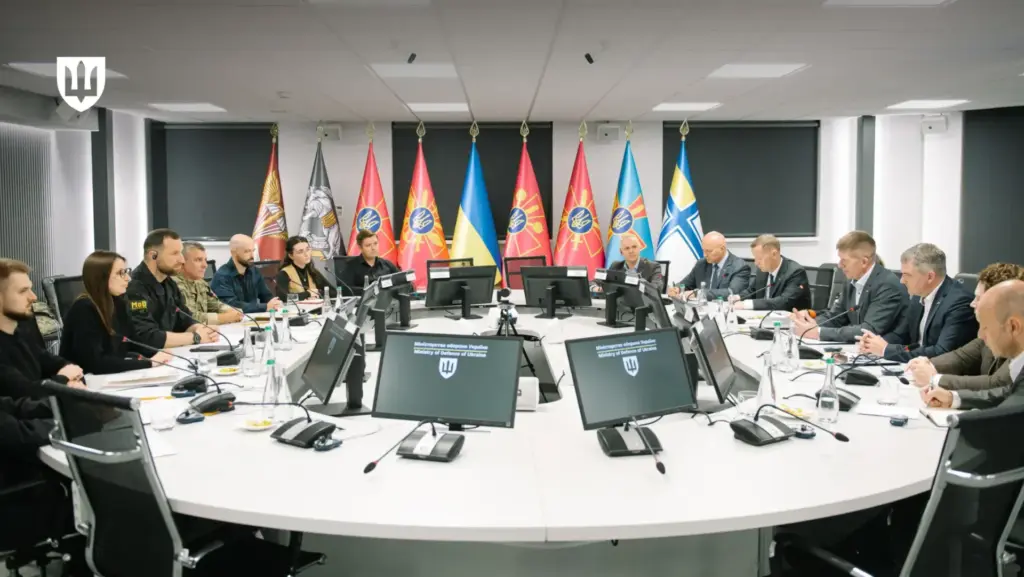
The front changes faster than any headquarters, so Ukraine’s war chief went to the people who fight on it. On 16 October, Ukrainian Defense Minister Yevhenii Khmara met commanders and soldiers from front-line units to discuss the needs of the front, command practices that save lives, and ways to raise combat effectiveness, the Defense Ministry reported.
The front keeps changing, with technology, tactics and weapons shifting constantly, so decisions made far from it risk arriving late and costing lives. Khmara’s answer is to anchor ministry policy in the experience of the soldiers who fight, a continuation of the “machines over men” program.
"The front does not stand still. But the key thing is people. People will always be the foundation and the main value of the Defense Forces,” Khmara said.
He claimed that the decisions of the Ministry of Defense must take into account the experience of warriors, those who directly carry out combat missions at the front.
Ukraine's most battle-hardened brigades say their word
The meeting drew commanders from across the force, including the Airborne Assault Forces, the Marine Corps, the 93rd, 100th, 28th and 155th mechanized brigades, the 1st, 425th and 475th assault regiments, the 3rd and 59th assault brigades, and Azov.
The last one, the 1st Azov Corps of the National Guard of Ukraine, is actively fighting in Donbas Oblast, where units have led counter-operations to disrupt Russian advances toward fortress cities that have been holding Russia's operation since 2014.
Meanwhile, the 93rd "Kholodnyi Yar" Separate Mechanized Brigade took part in fierce battles for Ilovaisk, the Donetsk Airport, Debaltseve, and Bakhmut, as well as in the liberation of the Kharkiv Oblast. Both units are known for their extensive implementation of advanced military technologies, including ground robotic complexes, FPV strike drones, and innovative anti-drone electronic warfare systems.
Command tricks that keep soldiers alive
The talk turned on how good commanders cut their own losses. Participants discussed command approaches that help save soldiers’ lives, use resources efficiently, and achieve combat results.
The ministry wants those methods studied and spread to other units, treating commanders' hard-won judgment as something to scale rather than leave in one brigade.
One goal: fewer Ukrainian losses, more Russian ones
Khmara framed the task in plain terms.
“We must adapt faster and give our warriors modern and effective tools,” he stressed, calling it the shared job of the Defense Ministry, the commander-in-chief and the General Staff.
Read also
-
World’s first aerial evacuation of this kind: Ukraine uses heavy hexacopter to fly wounded soldier off kill zone too mined and too hunted for ground robots
-
Ballistic missile warnings are back, but the Starlink cap stays, Zelenskyy says: Ukraine’s two US lifelines, one restored
-
No crew, a cargo bed, and pontoons: Ukraine’s MAT1LDA robot is built to cross water with 400 kg