Vue lecture

Former Ukrainian president has made offer to Zelenskyy amid Russia’s new type of war on Kyiv

Former Ukrainian President Petro Poroshenko, leader of the opposition European Solidarity party. Source: European Solidarity

Former Ukrainian President Petro Poroshenko, leader of the opposition European Solidarity party, has offered to unite with President Volodymyr Zelenskyy in a new type of government. He has explained his initiative as necessary to save the country and adopt crisis-response measures amid a new phase of the war.

Russia's strike campaign has become a governance problem as much as a military one. Each attack on Kyiv costs the city about $12 million, and they now arrive almost twice a week. Agriculture Minister Taras Vysotskyi said on 28 August that, roughly speaking, 90% of retail chains' food logistics had been destroyed in the latest attacks, which included jet-powered drones that trigger an air alert in Kyiv every hour.

"We are the opposition, but we are ready to cooperate with the authorities in the legislative provision of all necessary decisions, up to the creation of a coalition and a government of national unity," he said.

Speaking in a video address on 31 August, he set out five demands for the parliamentary session.

One: keep the capital running

The current barrage has forced Kyiv to a near-standstill, with alerts sounding through the working day. If they are permanent, Poroshenko argued, the rules for how the city runs must change, and the government, military, transport operators, and business must agree on a single published procedure. When the capital is shut down for hours, much of the economy stops with it, and the lost billions never reach the army, he added.

"Let us say honestly what Putin is doing. He wants to switch Kyiv off. To make people finally say: it is impossible to live here," Poroshenko said.

Two: give parents a school plan

The school year opens on 1 September under a rule allowing in-person classes only where a school has a shelter with room for everyone. Kyiv's administration told UNN that 94% of city schools have basic shelters, but capacity limits set the ceiling, forcing shifts or blended formats when a shelter cannot hold every child at once.

"Tomorrow is 1 September. Thousands of parents still do not understand how their children will study, especially where there are no proper shelters," Poroshenko said.

Three: return Kyiv's money

Kyiv has lost revenue to the central budget even as its defense costs climb, a dispute with the government that predates the barrage. Poroshenko demanded the return of about $180 million to the budget, along with the personal income tax paid by combat brigades.

"This week Kyiv is forced to carry out a budget sequester for the first time," he explained, cutting spending on doctors, teachers, and the socially vulnerable to fund the city's own defense.

Four: scale up war-risk insurance

Russia's strikes have hit businesses faster than any recovery system can answer, with warehouses and logistics hubs among the targets this month. Business needs war-risk insurance, money for rapid recovery after strikes, new logistics, and the ability to invest in its own protection, including private air defense, Poroshenko said.

Five: fund energy resilience now

Putin has named energy as his main target, the former president pointed out, and the coming winter is the pressure point. Kyiv's small, maneuverable generation, cogeneration, and backup power for hospitals, water utilities, and communications must be installed now, he added.

  •  

Russia’s 6-day attack on Kyiv that started two days after CIA head’s visit to Moscow, culminates with massive ballistic missile strike on eve of school year

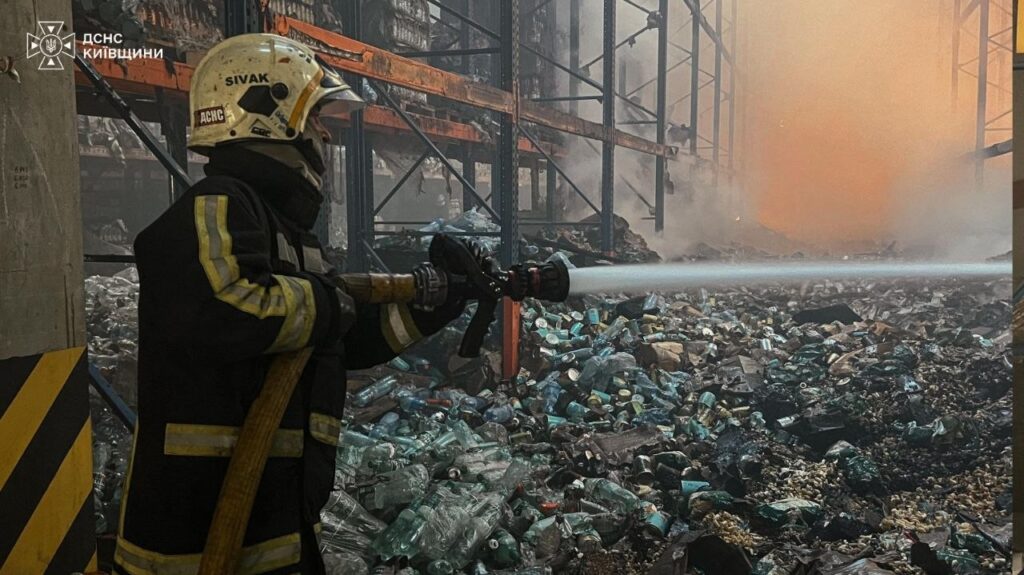
Ukrainian rescuers are helping the victims of a Russian 1 September attack. Source: The State Emergency Service

On 1 September — the day Ukraine marks Knowledge Day, when schoolchildren and students are meant to begin the new academic year — Russia launched a massive attack on Kyiv and its region with ballistic missiles and jet-powered drones. Moscow used different types of its fast, deadly weapons, including ship-launched Kalibr, and hypersonic Zircon missiles, and jet-powered drones to target the Ukrainian capital.

This attack was the culmination of a 6-day assault on the capital and region that began on 27 August. It started two days after CIA Director John Ratcliffe arrived in Moscow on 25 August. US President Donald Trump announced that the visit was linked with US-initiated peace efforts to end the war against Ukraine. Throughout this 5-day period, air raid sirens sounded every hour in the capital and region, paralyzing life in Kyiv, according to Sky News.

As early as the day after the 5-day attack began, Agriculture Minister Taras Vysotsky stated that Russia had destroyed about 90% of the food logistics infrastructure of retail chains, according to UkrInform.

Russia injures three children and continues the attack

As a result of the "ballistic" attack on Kyiv and the region, hits from enemy missiles and strike drones were recorded at 28 locations, and debris from downed targets fell at 10 locations, according to the Air Force of Ukraine.

In addition, some enemy missiles did not reach their targets, and the locations of those missiles are being clarified.

"Unfortunately, as a result of the Russian attack, there are dead and injured. The attack continues, with more than ten Russian drones in the airspace," the military reported.

According to the Kyiv City Military Administration, civilian infrastructure was damaged in 5 of Kyiv's 10 districts — Holosiivskyi, Darnytskyi, Dniprovskyi, Sviatoshynskyi, and Solomianskyi.

"As a result of the attack, unfortunately, 8 people died. Another 7 people were injured, including 3 children," the Kyiv authorities said.

Railway workers are still receiving treatment and remain hospitalized

Russia struck a railway facility, a critical link in the country's logistics chain, as its airways have been closed since 2022.

Oleksandr Pertsovskyi, head of the board of Ukrzaliznytsia (Ukrainian Railways), stated that Russia carried out a targeted ballistic attack on Kyiv's railway infrastructure. Russia killed six railway workers.

According to him, another employee was injured and is in the hospital, where they are receiving the necessary care.

He added that dozens of employees managed to take shelter and survive the attack. They are now being helped to recover from what they experienced.

Pertsovskyi noted that the strike caused "extensive destruction," including the complete destruction of one workshop, and that efforts to extinguish fires at the facility were still ongoing.

He said that, due to the attack's consequences, movement was temporarily restricted on two railway sections, but it was later restored.

Earlier, a source close to the Russian president told The Economist that Vladimir Putin most likely regarded Ratcliffe's visit as a sign of American weakness. He already interpreted former CIA Head Bill Burns' meeting with Russian authorities in 2021 the same way, where he warned about the consequences of Russia's war against Ukraine. Three months after the meeting, Russia launched the full-scale invasion.

  •  

Ukrainian company builds single device that detects FPV drone, reads its video feed, and jams it

The Brama system by Rebel Group. Source: Rebel Group

A Ukrainian defense company has built a single device that finds an FPV drone, reads its video feed, and jams it. Rebel Group has developed Brama, a stationary electronic warfare and reconnaissance system to counter FPV drones, which it plans to codify for use by the Defense Forces, the company's press service told Oboronka.

Brama can both detect a drone's signal and jam it, allowing an operator to move from spotting a drone to suppressing it.

Two jobs from one point

Brama can detect the frequency of an analog video signal, decode it, and then apply directed electronic warfare to suppress both the video channel and the drone's control link, the press service explained. Once an operator receives target data and locates a drone, they can suppress it immediately without additional equipment, Militarnyi reports.

"Both functions are implemented in a single device, so the operator does not need to use additional equipment to move from detection to suppression," a Rebel Group representative says.

Rebel Group is seeking codification

Brama has already passed laboratory testing and trials in combat conditions, according to the company. It is now going through Ukraine's military codification procedure, the required step before defense equipment can be approved for broader use by the armed forces.

Its producer company, Rebel Group, specializes in electronic warfare and reconnaissance systems, and some of its equipment has already been codified and tested at the General Staff's proving grounds, the press service noted.

It joins a widening Ukrainian EW effort

Brama is one of several recent Ukrainian counter-drone systems. In July, Ukraine unveiled Lima Quant, an upgraded electronic warfare system built to defeat the advanced satellite-navigation antennas Russia now fits to Shahed drones, cruise and ballistic missiles, and guided bombs, United24 reported.

Those antennas, newer 12- and 16-element arrays, had proven resistant to earlier jammers, which is why each side keeps building the next countermeasure as the other adapts.

  •  

800 jet drones in four days: Russia is now firing type Ukraine’s interceptors cannot catch

A fire burns at a Nova Poshta fulfillment and sorting center in Sviatopetrivske, Kyiv Oblast, after a Russian drone strike on 28 August 2026. More than 60,000 books were destroyed in the attack. Photo: Readeat

More than half the drones Russia fired at Ukraine over the past four days were jet-powered, and Kyiv was the main target. Of the more than 1,500 drones launched, about 800 were jet-powered, Colonel Yurii Ihnat, head of the communications department of Ukraine's Air Force Command, said, UNIAN reports.

A massive attack on Kyiv and the Kyiv region began on 27 August, two days after US Central Intelligence Agency (CIA) Director John Ratcliffe’s visit to Moscow. According to President Donald Trump, the visit was related to efforts to broker an end to Russia’s war against Ukraine, per Sky News.

Previous interceptors won't work

The attack on Kyiv and the surrounding region, accompanied by repeated air-raid alerts, has continued for all five days since then.

A jet-powered Shahed is a version of the strike drone fitted with a turbojet engine in place of a propeller, which makes it three times faster and far harder to shoot down.

Ukraine intercepts about 88 to 90 percent of all drones, but the rate against jet-powered ones is lower precisely because of their speed, Ihnat noted.

The problem is structural: Ukraine's interceptor drones reach roughly 300 kilometers per hour and physically cannot catch a target moving faster and flying at about five kilometers' altitude, beyond the reach of mobile fire teams and portable SAM systems.

Russia adds jet drones every month

Moscow began using jet-powered UAVs in large numbers in July, launching five times as many as in June, Ihnat noted. Their number may rise further by the end of August, he added.

The jet-drone attacks come from every direction. Ihnat said the debris of recovered Shaheds shows they were manufactured just two weeks earlier, meaning production is running without pause.

Banderols fly like cruise missiles

Russia has also stepped up its use of Banderols, systems that combine features of drones and missiles and fly at up to 600 kilometers per hour, Ihnat said. They are harder to shoot down, so short-range surface-to-air missile systems and aircraft with air-to-air missiles are used against them.

Jet-powered drones are significantly more expensive than conventional ones, Ihnat noted.

The strikes hit specific targets

Russia's attacks are aimed not only at psychological pressure on the capital's residents but at specific targets, Ihnat said. These are logistics and shopping centers, postal terminals, critical infrastructure, and other strategic sites.

Strikes of this kind have destroyed about 90 percent of Ukraine's modern warehouse space in recent weeks and slowed grain exports through the Black Sea corridor.

  •  

“In intercepts, they’re screaming”: Russia occupied this spit to control Ukraine’s ports. Military says it has now isolated 2,500-strong grouping and destroyed all its artillery

Location of Kinburn Spit. Map: Euromaidan Press

Ukrainian troops say they have trapped about 2,500 Russian soldiers on the Kinburn Spit. Systematic drone strikes and remote mining have let them cut the Russian supply lines and destroy almost all of Russia's artillery on the spit, scouts told Radio Free Europe/Radio Liberty's "Crimea.Realities" project.

The Kinburn Spit is a narrow sandy peninsula about 40 kilometers long, between the Dnipro-Buh Estuary and the Black Sea, the last part of Mykolaiv Oblast that Russia has held since 2022. Whoever controls the spit controls the sea exit from the ports, which is why Moscow kept artillery there to shell the southern coast, said former Head of the Mykolaiv Regional State Administration Vitali Kim.

Now, the troops say, Russia can reach the coastal zone of Mykolaiv Oblast only with long-range guns from occupied Kherson Oblast.

Supply runs through a single corridor

The Russian force has one way in — a single land route Ukrainian troops keep under fire, from Zaliznyi Port through Heroiske.

"Our task here is to neutralize everything that drives onto the Kinburn Spit. Since we started destroying Russian troops at a rapid pace, they cannot bring in anything effective," reconnaissance unit commander with the call sign "Yava" explained.

A scout calls the spit a trap

Intercepts show panic among the Russian units, the troops say.

"In the intercepts, they're screaming that they can't do logistics, that they don't want to go in, because it's death. The road is cut, and they have very little ammunition. The spit is a trap for them," the scout said.

Mining the supply routes is the main method

The problem, the troops say, is that the occupiers disguise themselves as civilians, changing into civilian clothes, which places limits on when Ukrainian soldiers can strike. The main method is catching the Russians on logistics by mining their routes.

"A vehicle hit a mine that was dropped maybe a week ago, maybe yesterday. The first thing is cutting Russia's logistics — the vehicles, the resupply by quad bikes and motorcycles," deputy reconnaissance company commander with the call sign "Holova" explained.

  •  

About $150 for airframe, about $875 for finished glider: Ukraine’s BlueBird is selling its drone at every stage of assembly

The Bebradron KIT. Source: BlueBird Tech

A Ukrainian drone maker is selling its unmanned aerial vehicle as a kit that users assemble themselves. BlueBird Tech has unveiled the Bebradrone Kit, a modular drone whose configuration the buying unit sets when it orders, choosing the control system, video transmitter, camera, flight electronics, and navigation gear, Defender Media reports.

The name Bebradron comes from the Ukrainian joke meme “nyukhai bebru” (“sniff the bebra”), a humorous euphemism for the male genitalia.

The airframe comes in three grades

Units choose how much is pre-assembled. The Base version is a bare mechanical airframe for self-installation, at about $150, according to Brave1 Market. The ARF adds pre-installed motors for about $335, and the Pro comes with a configured flight controller for about $130.

A fully built Bebradrone glider without added configuration runs about $875 on the marketplace. BlueBird also offers a custom option, with its own engineers selecting and integrating equipment for a specific mission.

The specifications hold in the base build

In its base configuration, the Bebradrone Kit cruises at 90 kilometers per hour and reaches up to 150. Its tactical radius is up to 45 kilometers, and it carries up to 7.5 kilograms.

Flight time can reach 30 minutes, with a working altitude of 150 to 500 meters. The drone launches from a pneumatic catapult, which needs no runway or prepared strip.

The company grew from a volunteer group

BlueBird describes itself as having started with a small group of enthusiasts testing drone ideas and learning from their own mistakes. That grew into an R&D operation and production workshops, with separate units for development, manufacturing, quality control, service, and military contact.

The company now employs more than 350 specialists across several Ukrainian cities, building electronic warfare, drone detection, strike FPV, and communications systems. Its products are tested under real-world conditions and refined based on feedback from the front lines.

  •  

Ukrainian ground-robot maker has moved into air: Ratel’s first strike drone flies 30 kilometers on Starlink link

A Ratel kamikaze drone. Source: Ratel

A Ukrainian maker known for ground robots has built a flying attack drone. Ratel Robotics has unveiled the Ratel K1, a strike FPV drone for ground targets with a tactical range of up to 30 kilometers, according to Defender Media.

The K1 will likely join the number of weapons that clear out Russian logistics. The campaign scales medium-range drone strikes against Russian supply convoys, depots, command nodes, and air defenses 20 to 200 kilometers behind the front. On 29 May, Ukrainian forces destroyed 483 Russian vehicles in a single day, an all-time record that pushed cumulative Russian motor-transport losses past 100,000.

A 30-kilometer FPV sits at the near edge of that fight, reaching supply routes and second-line positions that shorter drones cannot.

The company came from ground robots

Ratel Robotics is a Ukrainian ground robotics maker whose fielded line includes logistics, casualty evacuation, mining, and demining platforms. The K1 is its move into aerial strike, and the company brings a wartime production record to it rather than starting from scratch.

Ratel's ground systems took part in the military parade in Kyiv on 24 August, marking Ukraine's 35th Independence Day, the company said. The firm has also joined a campaign, with the National WWII Museum and the Tallboy brand, to raise nearly $447,000 for a planned museum of modern military technologies, according to Ratel.

The specifications come from the maker

The K1 is built on a 22-inch frame, reaches a top speed of 75 kilometers per hour, remains airborne for up to 35 minutes, and carries up to 2 kilograms.

The drone uses a digital video system and a daytime camera and is controlled via a satellite link through Starlink. Per Brave1 Market, it has no built-in autonomous navigation, no auto-takeoff, and no automatic return-to-home landing.

The manufacturer is currently working on the next iteration of the Ratel K1, refining the system based on test results and operational experience.

  •  

“We have surprises for our neighbors”: Ukraine’s aviation commander says new aircraft developments are essentially finished and already in testing

A Ukrainian Sukhoi Su-27.

The Ukrainian military is completing work on new aviation developments. They are essentially finished and already in testing, and the aircraft carrying them will enter combat, aviation commander Colonel Oleksandr Diakiv said in an Air Force Command segment.

Ukraine has already done with jets built decades ago. Its crews turned the 1970s-era Su-24 bomber into a launcher for British-French Storm Shadow and SCALP cruise missiles, which carry a 450-kilogram warhead to about 250 kilometers, and used them to strike a Russian command post in occupied Luhansk Oblast on 25 May.

A commander whose air force already remade its Soviet fleet this way is probably not making an empty promise when he says more is coming.

The commander hints at what is coming

Ukraine's aircraft are not done gaining capability, Diakiv said. Standing in front of his own aircraft, he said it would still prove itself.

"We have ideas, we have developments, and we are working on this. We have surprises for our neighbors," Diakiv said.

Part of the work is already in testing, and he tied it directly to combat.

"They are starting to work, they are going through their trials. And it is not for nothing that I say these aircraft will enter combat. Let it be a surprise," he noted.

The old jets already took on new roles

The track record runs across the fleet. The MiG-29 and Su-27 now serve as multirole fighters that strike both air and ground targets, Diakiv said, a shift Ukraine achieved by mastering new weapon types during the full-scale war.

That adaptation is documented. US contractors helped Ukrainian crews modify Su-27s and MiG-29s to fire American AGM-88 HARM anti-radiation missiles at Russian air defenses, and the jets also drop Western precision glide bombs.

The war has no template

Ukrainian aviation adapts constantly to Russian air defenses, fighters, and electronic warfare, Diakiv said. Pilots complete missions and return to base.

This kind of prolonged, high-technology war, fought across many domains, has no precedent, he added, and Ukraine's combat experience is becoming the basis for further developing its aviation.

  •  

Russia launches third attack on Ukraine’s largest Danube port this month, during peak of wheat harvest

ukraine grain

A Russian strike on southern Odesa Oblast killed one person overnight and set grain trucks on fire. Five trucks loaded with grain were destroyed and three more damaged, with one person killed and three injured, the head of the Odesa Regional Military Administration, Oleh Kiper, said.

The strike hit the Izmail district, home to Ukraine's largest Danube port. The port became a maritime lifeline after Russia's 2022 Black Sea blockade, carrying the overflow whenever the sea lanes are constrained, National Security Journal reported. The attack is part of a campaign against the food supply.

Ukraine is one of the world's largest suppliers of wheat, maize, and sunflower, so the strikes register far beyond its borders, in the import-dependent countries that buy its grain.

Fire destroyed eight trucks

The attack set eight cargo trucks and dry grass nearby alight, the press service of the State Emergency Service in Odesa Oblast reported. Rescuers have since put out the fires.

"Unfortunately, a person was killed in the attack, and three more were injured," the service said.

The strike hit transport infrastructure

Russia struck the Izmail district overnight on 29 August, damaging transport infrastructure, the Izmail District State Administration reported. The district sits on the Danube close to the Romanian border.

"There are casualties. Sadly, a person has been killed. The injured have been given the necessary help. Representatives of the security structures and medical workers are working at the scene," the administration said.

The Danube corridor is a standing target

The strike fits a pattern. Russia hit Izmail's port infrastructure on 13 August, cutting power in parts of the city, and struck it again days later, damaging a Togo-flagged civilian vessel. The attacks come during Ukraine's peak wheat harvest, expected at around 60 million metric tons this year, close to the 2025 crop. Farmers need the export revenue now to finance next year's sowing, and storage is filling as grain goes unshipped.

Russia's Defense Ministry has described its Izmail strikes as hitting berthing terminals for military cargo and depots for Western-supplied weapons. The trucks burned in this strike were carrying grain.

  •  

After CIA head’s visit to Moscow, Poland’s PM warns Russia is preparing to escalate war. He puts critical window at seven or eight months

tusk polish prime minister

Poland's prime minister says the next seven or eight months could decide the region's security. Donald Tusk said there are signs of serious Russian preparations to escalate tensions, both in the war against Ukraine and across the region, according to Ukrinform.

Tusk's warning follows weeks of similar alarms from the countries on NATO's eastern edge. Lithuanian President Gitanas Nausėda said on 15 July that intelligence pointed to possible Russian strikes on critical infrastructure in the Baltic states or Poland, according to Defense News.

Poland is the main transit route for Western military aid to Ukraine, which makes its security inseparable from Ukraine's. Tusk himself said in July that Russia could be ready for a confrontation with Europe as early as 2027.

The CIA visit was not the whole of it

At the meeting, reporters asked Tusk about the recent visit of CIA Director John Ratcliffe to Moscow. Poland is in constant contact with the agency's leadership and was not caught off guard by news of Ratcliffe's activity, he said.

Some security information must stay confidential, Tusk added, but that does not mean the public should be deprived of information about the most important threats.

The signals go beyond one trip

The matter is no longer only the CIA director's visit to Moscow, Tusk said. Over recent weeks, numerous public signals have pointed to Russian preparation for escalation.

Russia is very seriously preparing to escalate tensions, both in the war with Ukraine and across the whole region, and that for Russia this fall and winter are meant to be key, he claimed.

Moscow states its aims openly

Some Russian figures have described the war's purpose in plain terms. This week, State Duma vice-speaker Pyotr Tolstoy said Russia views Ukraine as a "territory" that would allow Moscow to export its energy to Europe via a short route, not as a sovereign country.

Tolstoy, whom the EU sanctioned in 2022 as a central figure in Russian state propaganda, also called for massed bombing of Ukrainian cities to break the population into surrender. His remarks are one more public signal of the kind Tusk pointed to.

  •  

What does Ukraine’s new defense minister wear on his wrist? He did not mention it until reporter asked

Zelenskyy Khmara SBU

Ukraine's new defense minister wears his war on his wrist. Yevhenii Khmara's bracelet carries, on each of its chains, the engraved name of a comrade who did not come back from the war, The National Interest reported.

Khmara took over the Defense Ministry on 19 August, replacing Mykhailo Fedorov, whose July dismissal set off nationwide protests. He came to the job from the SBU, Ukraine's Security Service, which he had led for seven months when Ukraine's campaign against Russian oil refining reached its widest scale.

He did not volunteer the story

Khmara did not explain the bracelet until a reporter asked him about it over dinner in Kyiv this month. The names now travel with him into the meetings where decisions about Ukraine's defense are made.

He ran the SBU during the oil campaign

Alpha, the SBU's special operations unit, is a tiny share of Ukraine's armed forces, yet the service's own accounting credits it with an outsized share of the damage inflicted on Russia, up to 20 percent of all enemy infantry losses.

More telling is what happened to Russian oil during his seven months in charge of the service. Ukraine's General Staff now estimates that nearly 43 percent of Russia's refining capacity has been knocked out. To a large extent, this is the result of the campaign Khmara helped oversee.

Khmara also developed a doctrine of ruthless cost asymmetry: strike operations designed to cost roughly 2 percent of the economic damage they inflict, targeting not individual facilities but critical nodes within the system.

Khmara insisted that part of the staff of the previous minister stayed

Earlier, Khmara has proposed that the core of the former Defense Ministry team remain in their positions. In particular, this concerns specialists responsible for procurement reform.

Mstyslav Banik, who served as a deputy to Fedorov, confirmed that he was staying on under the newly appointed defense minister. He led a central part of the ministry's modernization and is responsible for implementing the defense procurement reform.

  •  

Ukraine chooses three Western fighters to build its air force around. One of them can fly again from stretch of road in 15 to 20 minutes

dassault says it’s ready send rafales ukraine — kyiv asks · post rafale fighter jet aviation da00044906_s french aircraft manufacturer has confirmed deliver jets requests le journal du dimanche reports

Ukraine has decided which Western fighters it will build its air force around. The Air Force settled on three platforms, the Swedish JAS 39 Gripen, the French Rafale, and the American F-16, aviation commander Colonel Oleksandr Diakiv said in a segment by the Air Force Command.

Ukraine entered the full-scale war flying Soviet-era jets and has spent three years assembling a Western fleet. F-16s arrived in 2024 and now fly combat missions. France has delivered Mirage 2000s, and Sweden has pledged to deliver Gripen. The choice narrows Ukraine's field to three types it can sustain, arm, and repair at war tempo.

The choice weighed more than performance

Ukraine assessed every platform that might suit it, Diakiv said, and concluded it could operate three with maximum effectiveness. The decision turned on aircraft and operating costs, weapons, logistics, parts availability, what Ukrainian infrastructure can support, and the speed of repairs and battle-damage recovery.

"We went through all the platforms that were possibly acceptable for us. And we came to the conclusion that Ukraine can use three platforms with maximum effectiveness," Diakiv explained.

The F-16 already operates in Ukraine, so the Air Force has both the aircraft and trained pilots, technicians, and specialists who know its quirks. That experience will speed the adoption of the other Western types, according to Diakiv.

The Gripen suits a country under fire

Also, Diakiv singled out the Gripen, a multirole fighter that can strike air and ground targets and carries Swedish and other European weapons. Its main advantage is that it demands little infrastructure.

The jet can operate from unprepared surfaces and stretches of road and requires minimal ground crew to prepare for another flight in 15 to 20 minutes, according to the commander.

The aircraft is only part of the system

Taking on a new platform is not a matter of handing over jets, Diakiv believes. Weapons, ground support, parts, logistics, and trained people all have to arrive together, and Ukrainian pilots, engineers, and logistics specialists are now training abroad.

"You can buy a plane, you can buy a missile, you can buy a bomb, but you cannot buy experience," Diakiv said.

That combat experience, according to the colonel, is increasingly shaping the aviation coalition, with allies helping Ukraine realize ideas drawn from its own fighting rather than only offering finished solutions.

  •  

Ukraine’s intelligence: Russia is running its Nepal, Cuba, Kenya, and India recruitment scheme in Indonesia now

Russian soldiers in camouflage uniforms and helmets stand in formation outdoors.

Russia is looking for its next foreign recruits in Indonesia, Kyiv says. Ukraine's Foreign Intelligence Service reports that it has obtained documents on at least eight Indonesian citizens recruited into the Russian occupation army.

Russia has recruited at least 27,000 foreign nationals from more than 130 countries since February 2022, a joint report by the International Federation for Human Rights and Truth Hounds found in April, separate from roughly 14,000 North Korean troops. Up to 20% of these fighters do not survive the first four months.

The scheme runs on false promises

"The scheme by which Moscow seeks foreign cannon fodder has already been tested on dozens of other countries," the Foreign Intelligence Service said.

Recruiters offer high pay, non-combat work, fast-tracked Russian citizenship, and social guarantees, drawing in people who often have no idea where they are actually being sent, the service said. The same model worked earlier on citizens of Nepal, Cuba, Kenya, and India, and most ended up on the front line without training, with some dying in the first weeks.

Recruitment fills three needs at once

Each foreigner serves several functions for the Kremlin, the service said. A recruit fills a personnel gap at the front and doubles as propaganda about supposed global support for the war.

The third driver is domestic. Discontent over the economy, the war, and plans for a new wave of mobilization has cut the number of Russians willing to sign contracts, bringing dissatisfaction to 69 percent.

The pattern is widening by design

Indonesia is the latest example of Russia's system to fight with its hands of foreign mercenaries.

"Indonesia, the world's largest Muslim country with a population of over 280 million, has joined the list of countries that have become the Kremlin's latest market for cheap human labor for the war," the service said.

  •  

Fix for Ukraine’s interceptors is radar seeker head, and American firm is selling one for $4,000, says president’s tech adviser

russia steers its long-range drones ground towers—kyiv says hit one occupied crimea · post russia’s new “geran-4 seeker” shahed variant uses machine-vision ai targeting geran 4 ukraine news ukrainian reports

Ukraine's drone interceptors work until the weather turns. On 28 July, Presidential advisor Serhii "Flash" Beskrestnov wrote that fog and cloud in fall, winter, and spring can leave an interceptor pilot unable to see more than a dozen meters, and that success rates fall as soon as winter begins, a problem that is especially severe over the sea.

Cheap interceptor drones have become one of Ukraine's main answers to Shahed saturation. But nearly every system shares the flaw Beskrestnov names: it depends on a pilot or camera seeing the target. Ukrainian and foreign teams are all racing toward the same fix, an onboard seeker head.

The method started simple

The earliest approach was primitive but cheap and effective, Beskrestnov said. A pilot flies the interceptor to the right point using the radar network, then finds the target by eye, chases it, and attacks.

Russia answered not only with jet Shaheds but with onboard electronic warfare, evasion systems, in-flight maneuvers, and rear-facing cameras to watch the sky behind, he explained. Ukraine replied with machine-vision target capture and guidance.

Bad weather remains unsolved

None of that fixes visibility, Beskrestnov wrote, and the problem hits both ordinary and jet interceptors. The way out, he argued, is an autonomous seeker head, acoustic, thermal, or radar, mounted on the interceptor itself.

A radar seeker is the ideal, in his view, because it opens the door to a fully autonomous system with no human in the loop: the network sees the target, launches the nearest interceptor, guides it by tactical radar, and the seeker locks on for the kill.

A US firm has put a price on it

Building a radar small enough for an interceptor has proven hard, and teams in Ukraine and abroad are working on it, Beskrestnov said, adding that he would not discuss the Ukrainian efforts because the subject is sensitive.

He pointed to the American company Archimedes, which he said announced a radar days ago, operating at 24 gigahertz with a 25-by-14-degree field of view and a one-kilometer lock-on range, shown in a promotional video mounted on several Ukrainian interceptors, at about $4,000 per unit. Whether it works remains to be seen, he added, given how hard the problem is.

  •  

Ukrainian robot commander calls ground robots “Persian elephants.” What army really needs are “Arabian steeds”, he says

ukraine’s war logistics go robotic battle zones · post ground complex termit cargo board наземний роботизований комплекс «терміт» із вантажем на борту фото тencore several ukrainian combat brigades have shifted

A Ukrainian ground robot used to run 12-15 missions. Near Kupiansk, it now survives three or four. The lifespan is collapsing under the denser Russian FPV drone and mining fire, Andrii Kopach, call sign "Matematyk", who commands a ground-robot unit in the "Lava" unmanned regiment of the "Khartia" corps, told Oboronka.

Ground robots have become a daily part of the front in Ukraine. Ukrainian units ran 16,676 logistics, strike, and evacuation missions with them in June, up 122 percent since January, and the military has contracted more than 22,000 for 2026, nearly double the 2025 total. That scale runs into a wall at the front, where Russia now assigns FPV crews, including fiber-optic drones, specifically to kill the robots.

The lifespan keeps shrinking

The pace of technological change is the core problem, Matematyk said. Ukrainian makers keep improving the platforms, but cannot always keep pace with how quickly the fighting evolves.

A machine may last only three or four missions now, as in Kharkiv Oblast, where it was eight or nine before and 12 to 15 earlier still, he said. Mining, Russian fiber-optic activity, FPV activity, and a targeted focus on countering robots all drive the decline.

Speed is the missing requirement

Most robots at the front are technologically outdated in speed and suspension, Matematyk said. Current figures of 10 to 15 kilometers per hour no longer allow a machine to cross logistics routes safely.

He put the problem in an image. Gun-armed combat robots, he said, are "Persian elephants", fearsome but so slow to reach the objective that "a couple of centuries" pass first. What the army needs are "Arabian steeds" that gallop in, do the job, and gallop back.

AI defense is in development

Ukrainian troops are working with Brave1 and the Digital Transformation Ministry on AI-based active-protection systems that could autonomously detect and neutralize enemy FPVs, Matematyk said. The approaches vary, from a camera to a mini-radar to a camera paired with sound.

The countermeasures could be net launchers, or for fast machines, shotgun blasts and shrapnel, he said. The detection and response are trained on models built from the data his unit has logged over previous years. Ukraine still holds a quality edge over Russian robots through better Starlink-based communications and decentralized robot groups in its units, he added.

  •  

Russia destroyed last of Kherson’s heat and power equipment on 26 August. Ukraine’s new defense minister arrived days later

Ukrainian Defense Minister Yevhenii Khmara during his visit to Kherson on 28 July 2026. Source: Oleksandr Prokudin

Ukraine's new defense minister went to Kherson Oblast days after Russia destroyed the heat of its main city. Yevhenii Khmara visited the region and met the head of the regional military administration, Oleksandr Prokudin, to discuss the region's most urgent needs, the Defense Ministry reported.

Russia hit the Kherson combined heat and power plant with a glide bomb on 26 August, then struck it again overnight with four more, destroying all the heat- and power-generating equipment that remained, Naftogaz said.

Prokudin has urged residents to leave, warning the city may go without heat and power through the winter. He said that Russia has dropped 170 glide bombs on the oblast since 1 July, more than in the entire first half of 2026.

Air defense topped the agenda

Khmara and Prokudin discussed strengthening defenses against various types of drones and protection against aerial bombs, as well as the safety of roads and critical infrastructure, which are being attacked by Russians day and night. They also addressed giving troops in this direction more capacity to strike the Russian targets that threaten civilians and soldiers.

The needs match the threat Prokudin has described. No region of Ukraine currently has the means to shoot down jet-powered Shaheds or glide bombs, he said, and Russia has begun using both more heavily against Kherson's infrastructure.

The minister met marines and the wounded

Khmara spoke with commanders and troops of the 30th Marine Corps operating on the Prydniprovskyi direction, the ministry said. The talks covered financial support for combat units and larger purchases of strike systems.

"We have taken up the soldiers' requests that need Defense Ministry decisions," the ministry said.

Khmara also visited a medical facility treating wounded troops and presented state awards.

The ministry frames it as direct contact

The Defense Ministry said it plans to keep working directly with troops and the leadership of front-line regions to strengthen the Defense Forces and protect Ukrainian lives.

  •  

Partisans say Russian recruiters in occupied Donetsk are taking drunk men from bars straight to enlistment offices

A masked Russian soldier in camouflage and body armor wears a helmet bearing Russian flag and “Z” patches.

Russia is filling its assault units from the bars of occupied Donetsk, partisans say. An agent of the ATESH movement inside the headquarters of Russia's Dnepr group of forces reported that local recruiters in the city are hunting men in bars and on the streets, mainly those drinking, and taking them heavily intoxicated to enlistment offices, the partisans say.

The claim fits a pattern documented three days earlier. On 24 August, three Russian legal-aid groups recorded 47 complaints of forced recruitment across 16 Russian regions and occupied Donetsk Oblast in July and August, targeting men with alcohol, drug, or mental health problems. ATESH now reports the same method inside occupied Donetsk.

There, they are pressured into signing contracts with the Russian army.

The recruits fill named units

The first such "volunteers" have already appeared in two Russian units, according to ATESH. The group named the 328th Guards Air Assault Regiment on the Zaporizhzhia direction and the 77th Separate Motor Rifle Regiment in Donetsk Oblast.

Both units use the men to replace losses in formations that the Russian command keeps throwing into assaults, ATESH said. The claim could not be independently verified.

The method points to a recruitment shortfall

Russian authorities can no longer fill losses with promises of payments and propaganda, so enlistment offices, local administrations, and recruiters have turned to deception, pressure, and what the group called the effective abduction of people.

That reading matches what a Russian rights group said. Volunteers are getting harder to find, which is why the pressure is increasing, said Grigory Sverdlin, director of the anti-mobilization group Idite Lesom.

ATESH works from inside the occupation

ATESH is a Ukrainian and Crimean Tatar partisan movement founded in September 2022. It operates in the occupied territories and inside Russia, and says its network includes Ukrainians, Crimean Tatars, anti-war Russians, and sources within Russia's military and occupation administrations. Its claims are often impossible to verify independently.

  •  

Ukraine dismissed its defense minister in July. He is now advising NATO country on defense innovation

Former Ukrainian Defense Minister Mykhailo Fedorov during a meeting with Italian Defense Minister Guido Crosetto. Source: Fedorov

A NATO country's defense minister wanted Mykhailo Fedorov the day after Ukraine dismissed him. Fedorov, Ukraine's former defense minister, has agreed to advise Italian Defense Minister Guido Crosetto on defense innovation, he wrote on Telegram.

As deputy prime minister and digital transformation minister, Fedorov created the Brave1 defense-tech cluster, then ran the Defense Ministry from 14 January 2026 until his dismissal in July. The removal triggered nationwide protests through July, with demonstrators calling for his reinstatement.

Earlier, Fedorov refused every other post Zelenskyy offered, saying only the defense minister, the president, and the commander-in-chief truly shape the war.

"I thanked Guido for his personal support and for offering me the opportunity to serve as his adviser on defense innovation. In this role, I will help Italy develop modern warfare technologies," he said.

Crozetto moved within a day

The Italian minister said he called Fedorov the day after the dismissal and asked when he would come to Rome to work as an advisor.

Fedorov met Crosetto on the first stop of an international trip focused on digitalization and defense technology.

The focus stays on his own projects

Fedorov said his main focus is unchanged and that he continues working in Ukraine on his own projects to strengthen its defense and attract international resources. In the advisory role, he will help Italy develop technologies of modern war and adapt to new security challenges, he wrote.

The two discussed drones, autonomous systems, air defense, and the development of a defense-tech ecosystem. The future of defense belongs to countries that can quickly test and scale new solutions, Fedorov said, and Ukraine's experience could serve as the basis for a new defense model for Europe.

Earlier, the Ukrainian parliament approved Yevhenii Khmara as the new defense minister. During his first speech, Khmara made it clear that he would continue his predecessor's course — the technologization of the army.

He added that there "would be more Ukrainian weapons, and strikes would be more precise.

  •  

Ukraine has built twin-Kalashnikov turret for cheap ground robots. Security Service has already used one to destroy Russian ambushes

An unmanned ground vehicle with a turret for a Kalashnikov assault rifle. Photo: Brave1

Ukraine is bolting the war's most common rifle onto its robots. A company in the Brave1 cluster has developed a turret built around the Kalashnikov that mounts on low-cost unmanned ground vehicles, the state cluster's press service told Defender Media.

Ground robots have become a daily part of the front in Ukraine. Ukrainian units ran 16,676 logistics, strike, and evacuation missions with them in June, up 122 percent since January, and the military has contracted more than 22,000 for 2026, nearly double the 2025 total.

Arming them cheaply is the next step, and the Kalashnikov is the most cost-effective option because it is already the standard rifle across the force.

The robots are already in combat

Ground drones fitted with the turret are undergoing combat testing in Ukrainian units. Fighters of the Security Service Special Operations Center "A" have used one to destroy Russian ambushes set with concealed waiting-mode drones.

The complex is built on a four-wheel chassis with airless tires and an armored body. At the core of the weapon module is a twin turret mounting two Kalashnikov rifles.

The build took under six months

The developers have received a technical assignment and a grant from the cluster to create the turret. The path from idea to finished prototype took less than six months.

Beyond the base version, the turret can be mounted on other wheeled and tracked ground robots. That flexibility is the point: one weapon module across many platforms.

The rifle choice is about scale

The developers chose the Kalashnikov because it is the most widespread small arm in Ukrainian units, according to Brave1. The cluster considers it a simple, effective solution that lets Ukraine quickly scale up strike robots for assaults and for defense against Russian infantry.

Earlier, the Ukrainian Defense Ministry said it would buy logistics and strike-ground robotic complexes under a new strategy that calls for sticking to the Defense Ministry's specifications rather than approving models one at a time.

  •  

Ukraine struck Tu-95 at base Russia launches its cruise missiles on Ukraine’s civilians. Satellite image shows third of right wing gone

Russian missiles rain down on Ukraine: Kyiv, Dnipro, Lviv, Zaporizhzhia under fire

Russia flies its missile raids on Ukraine from Engels-2. Ukraine keeps reaching the strategic bombers there. Soldiers of the Security Service's Alpha unit have struck a Tu-95MS missile carrier at the Russian airbase, President of Ukraine Volodymyr Zelenskyy wrote.

The Tu-95 is part of Russia's nuclear triad, a Soviet-era strategic bomber Russia has used to launch cruise missiles at Ukraine since 2022. Ukraine has spent the war whittling down the fleet. On 1 June 2025, Operation Spiderweb smuggled explosive drones deep inside Russia on trucks and hit 41 strategic bombers along with other bombers in a single day.

The satellite image shows the damage

The first image of the bomber has appeared on social media. A satellite photo published on Friday, 28 August, by OSINT analysts Exilenova+ shows the aircraft suffered critical damage in the strike.

The bomber lost about a third of its right wing to the drone hit. Other damage is hard to judge in the image due to low resolution.

The Russian Engels-2 air base is home to Tu-95MS and Tu-160 strategic bombers, which regularly launch Kh-101 cruise missiles at Ukraine. The base also houses ammunition and fuel storage facilities, equipment, and aircraft maintenance infrastructure.

A Russian Tu-95 strategic bomber. Source: Exilenova+

Strikes targeting Russian bombers and the airfield’s infrastructure are critically important. They are aimed at degrading the aggressor country’s military capabilities.

A second Engels-2 bomber in weeks

This is not the first Tu-95 Ukraine has reached at the base recently. Ukrainian drones struck Engels-2 in early July, ArmyInform reported, destroying a different Tu-95 whose tail section was torn off and thrown dozens of meters by the blast.

Analyst Oleksandr Kovalenko of Information Resistance said Russia has up to 12 flyable Tu-95MS left after Operation Spiderweb, in varying states of readiness, and that the one hit overnight belonged to the serviceable group.

  •  

“Territory that will allow us to export our energy resources to Europe”: Russia’s deputy Duma chairman calls for massed bombing of Ukrainian cities

state duma building in moscow

A senior Russian official said out loud what Russia's missiles do every night. Pyotr Tolstoy, deputy chairman of the State Duma and great-great-grandson of Russian writer Lev Tolstoy, has called for massed bombing of Ukrainian cities to break the resistance of the people living in them and force a surrender, the news outlet 24 Kanal reported.

Russia denies striking civilians and claims after each attack that it hit military targets, even as its missiles land on homes, hospitals, power plants, and food depots. Ukraine's Foreign Ministry Spokesperson Heorhii Tykhyi said Tolstoy's words should be grounds for an International Criminal Court arrest warrant, calling them a Russian official's demand for war crimes.

What Tolstoy has urged in public, Russian forces have done for more than 12 years while denying it.

The presenter proposed emptying the cities

On the state talk show Vremya Pokazhet, which Tolstoy hosts, he was reminded that more than 20 million people live in Ukraine and asked what would become of them if the country were turned to scorched earth. He proposed warning residents a day before strikes so they could flee their homes.

"You think we are calling for cruelty? We are calling for demoralizing the population so thoroughly that it comes out to meet our troops with its little paws up," Tolstoy said.

Then he named the reason

In the end, Tolstoy described what Ukraine means for Russia's plans.

"[Ukraine] is the kind of territory that will allow us to export our energy resources to Europe by the short route," he said.

He also characterized European leaders in the same speech.

"So gray-haired dwarves from Europe greet them (Ukrainians), and all these notorious Ursulas and Kaja Kallases, do they represent any value to us? No," Tolstoy claimed.

The descendant of a novelist, sanctioned in 2022

Tolstoy trained in France and worked with Le Monde and Agence France-Presse before working with the Russian state television and politics.

The European Union placed him on its sanctions list on 23 February 2022, the day before the full-scale war, naming him a central figure in Russian state propaganda. In 2024, he told the French channel BFMTV that Russian forces would kill French soldiers if they deployed to Ukraine.

  •  

Russians bought $300 million in body armor, thermal sights, and drone parts on Ozon marketplace Ukraine is bombing

one russian warehouse smolders near kazakhstan while bigger fire rages st petersburg · post smoke rising over ozon logistics complex orenburg russia 23 2026 заявлено як задимлення на території складу

Russians are buying their war gear on Ozon. Users of Russia's second-largest online marketplace ordered about $300 million in dual-use and military goods between August 2025 and July 2026, according to internal company data examined by the independent outlet Verstka.

Ukraine is now burning those warehouses down. Its forces struck three Ozon logistics centers covering 314,000 square meters on 24 August, part of a campaign that hit at least four Ozon hubs across southern Russia over several days, Militarnyi reports.

Body armor led the spending

The biggest class by money was tactical gear, six categories covering body armor, helmets, load-bearing vests and belts, armor plates and adapters, and neck and shoulder protection. Users ordered more than 527,000 such items for about $110 million.

Body armor was the single most-ordered product in the class. Almost 157,700 vests were sold for roughly $61 million, at an average of about $388 each.

Optics were the costliest goods

Military optics ranked second by spending and carried the highest prices. Buyers ordered almost 350,000 scopes, night-vision devices, and thermal imagers for about $87 million.

The average thermal sight went for about $1,680, with more than 28,000 ordered. Plain optical scopes were the most common, with over 110,000 orders, followed by almost 99,000 collimator sights.

Drone parts made up the rest

Users also spent about $75 million on drones and drone components. Half of that, roughly $36 million, went to a single category labeled accessories for drones and quadcopters.

That category alone drew 554,000 orders. It consists mostly of the parts to assemble a copter from scratch: frames, propellers, receivers, and cameras.

The first Ukrainian strikes on Ozon started on 22 August. Ozon and Wildberries—Russia’s two largest online marketplaces—and their smaller rivals collectively sell goods and services worth the equivalent of 8.5% of Russia’s GDP and employ 4 million people.

  •  

Russia’s new jet Shaheds run on turbojets from one Chinese company. It deleted them from its English website

Geran-4" is an evolution of the earlier "Geran-3" model

China is helping Russia build a faster Shahed. Russia has begun using upgraded Shahed drones with Chinese-made turbojet engines that fly at speeds close to three times those of earlier versions, the Wall Street Journal reported.

The Shahed jet is designed to beat Ukraine's air defenses. Ukrainian interceptors have downed about 90 percent of the older piston-engine drones, which cruise at roughly 180 kilometers per hour, so Russia switched to the jet-powered Geran-4, which cruises at around 500 kilometers per hour.

The engines come from one Shenzhen firm

The turbojets come from Telefly Telecommunications Equipment, founded in Shenzhen in 2010. The company chiefly makes computer hardware and communications equipment, but also sells its own line of micro-turbojets for drones.

China has long been the main clearinghouse for Shahed parts, including engine components, servomotors, and gyroscopes, the newspaper reported.

The company scrubbed its own website

After Ukraine publicized the discovery of Telefly engines in Russian drones, the turbojet section disappeared from the English-language pages of the company's website. The pages in Chinese and other languages still carry them.

China's foreign ministry, which did not respond either, has previously said it strictly regulates exports of dual-use components and rejects unilateral US sanctions on such trade.

Western parts fade as Chinese parts arrive

Downed Shaheds once carried microcontrollers from Texas Instruments in the US and linear regulators from STMicroelectronics, which the newspaper lists as being based in Switzerland. Over time, the Western components are disappearing even as the drones gain better navigation and attack systems, because US Treasury investigations found nearly all the Western parts were being diverted through Chinese intermediaries, often shell companies in Hong Kong.

Ukrainian government researcher Colonel Oleksandr Zaruba said in June that Shaheds now hold more antennas, modems, and SIM cards to correct their flight paths through local mobile networks, and that the components increasingly come from China.

  •  

Iskander Russia fired at Kyiv Oblast in July held 62 American parts. Ukraine has now named more than 100 Russian ballistics producers and wants its allies to sanction all of them

two children pulled rubble alive three did survive—one village near kryvyi rih after russian missile attack · post residential building burns strike lviv 30 2026 у львові після обстрілу горить

Ukraine has drawn up a list of those who build Russia's ballistic missiles and wants all of them sanctioned by its allies. Kyiv is asking partners to impose sanctions on more than 100 Russian ballistics producers, presidential sanctions commissioner Vladyslav Vlasiuk said at a press conference in Kyiv, according to Ukrinform.

The demand rests on physical evidence. An Iskander that Russia fired at Kyiv Oblast on 10 July held more than 140 foreign components, 62 of them American, alongside parts from Switzerland, Germany, Taiwan, China, and Japan, Vlasiuk reported in July. Most were made recently, which means the parts are still reaching Russia. Naming the factories is Ukraine's attempt to close the gap at the production end rather than chase each shipment.

The plan runs on synchronization

The commissioner laid out several parts of the plan at the press conference. The first is getting the same producers sanctioned everywhere at once, so a firm blocked in one country cannot operate through another. He said the files were handed to partners a few weeks ago, and Ukrainian specialists expect to identify every producer on allied lists by September or October.

The plan also covers what Vlasiuk called kinetic sanctions, meaning strikes on Russian defense-industry sites. He named the Kamensky Combine, which makes components for rocket fuel, as one such target.

The critical parts are still foreign

Ukraine keeps finding Western microelectronics in identified Russian ballistics, including Iskander-M missiles and those used by the S-400 system, with parts traced to the US, Japan, Germany, Taiwan, France, Britain, and Switzerland. The most sensitive elements are the Kometa satellite navigation system and autonomous inertial guidance units, which run on American, Swiss, and French microelectronics.

Ballistics is the most demanding product for quality and precision, Vlasiuk said, which is why those two systems are the chokepoint.

Ukraine wants smaller packages, sooner

The commissioner asked partners to adopt more stringent export controls, up to licensing or banning the export of sensitive components to third countries that help Russia evade sanctions. Ukraine has also compiled a list of more than 10 critical materials, including ammonium perchlorate, aluminum powder, and tungsten, as well as the numerically controlled machine tools Russia needs to build the missiles.

The EU has already begun work on a large 22nd sanctions package. Ukraine is urging it not to wait, asking instead for an interim ballistics package in September and another in October, moving in small steps as Ukraine, Britain, and Canada already do.

  •  

Three Ukrainian units received kit that makes an uncrewed vehicle out of whatever they’re already driving

japan quietly ships military-grade off-roaders ukraine — here’s what can do · post toyota high mobility vehicle transferred loaded transport truck 14 2026 переданий японією позашляховик hmv січня року посольство

Ukraine is turning ordinary cars into robots instead of building them from scratch. Three units of the Armed Forces received the Kaban remote-control system, which converts vehicles into uncrewed ones, developer Drone Fight Group told Defender Media.

Ground robots have become a daily part of Ukraine's front. Ukrainian units ran 16,676 logistics and evacuation missions with them in June, up 122 percent since January, and the military has contracted more than 22,000 ground robots for 2026, nearly double the 2025 total. Most are purpose-built platforms. Kaban takes the opposite route, converting vehicles that a unit already has.

The developers say Kaban was passed to the 3rd Army Corps, the 429th Separate Unmanned Systems Regiment "Akhilles", and the 49th Brigade of the Armed Forces.

The system bolts on without modification

Kaban installs on a vehicle without altering its construction and works with different models, Drone Fight Group said. It lets the operator switch between remote and manual control.

The operator navigates on a digital map, plotting routes and setting markers. Manual correction is built in for GPS spoofing cases. The system predicts its trajectory and can automatically stop the vehicle if the connection is lost.

Starlink carries the control link

The main communication channel is Starlink, and the system also supports analog video transmission and radio control, according to the developers. A vehicle can be fitted with thermal cameras if needed.

Kaban provides two-way audio and remote control of lights, infrared illumination, and searchlights, and it can pull data from the vehicle's onboard computer. Among the optional add-ons, the developers list net launchers and platforms for launching drones.

Combat testing came before the handover

Kaban is developed with support from the Brave1 cluster, and the system has already passed combat trials, according to the developers. Work continues to refine it using feedback from military units.

  •  

Russia’s fleet is set to get 150 uncrewed vessels in 2026, and possibly 230. Sanctions are holding the build back

Ukrainian kamikaze drone Magura V5. Screenshot from CNN video

Russia is trying to build the weapon Ukraine used against it. The Russian fleet is set to receive more than 150 uncrewed surface vessels in 2026, with the state order possibly rising to 230 units, Ukraine's Defense Intelligence told Oboronka.

Ukraine's naval drones drove Russia's Black Sea Fleet out of its main base. Magura strike drones operated by Defense Intelligence sank or damaged more than a dozen Russian vessels and forced the fleet to relocate from Sevastopol to Novorossiysk, roughly 300 kilometers east.

Russia is now ordering the same class of weapon in volume, three years after Ukraine first attacked Sevastopol with drone boats in October 2022.

Intelligence lists Russia's priorities

Ukraine's Defense Intelligence has identified what Russia is prioritizing in its uncrewed surface vessel program. Those are building universal drones from Russian-made components, integrating protected communications and artificial intelligence, and increasing the vessels' operating range.

Sanctions slow the build

Russian production is held back by a shortage of electronic components caused by sanctions, according to the agency. Moscow is finding it harder to import and to develop communications resistant to electronic warfare, Ukraine's Defense Intelligence said.

Limits on Starlink access may also have shaped Russia's naval drone development, the agency added. Russian forces had actively used the terminals to control uncrewed systems.

The imitation runs behind the original

Ukraine unveiled the Magura V11, the largest boat in the family, at its Independence Day drone parade on 24 August.

Rather than ramming ships like the one-way craft that cleared the Black Sea Fleet from Sevastopol, the V11 carries and launches other drones and stays at sea up to seven days.

UFORCE said the drone carries up to 2,200 kg (about 4,850 pounds) and can stay at sea for up to seven days. The company built it for reconnaissance, surveillance, support of landing operations, and resupplying fuel and equipment to other naval drones.

  •  

Zvook covers Ukraine’s skies for under €50 million. Now, it has started testing hydrophones underwater

The Zvook underwater system. Source: The Zvook company

The Ukrainian company that taught Ukraine to hear Russian drones is now learning to listen underwater. Zvook, which develops acoustic systems for detecting drones and missiles, has begun testing hydrophones to detect vessels and other underwater objects by sound, the company said on LinkedIn.

Zvook built its name on land. Its acoustic sensors cover Ukraine at 1,000 meters and below for less than 50 million euros, a system NATO's assistant secretary-general for operations, Tom Goffus, called crazy for its cost-effectiveness. Lithuania chose the same Ukrainian acoustic technology for deployment in 2026 after Russian drones entered its airspace.

The approach stays passive

Zvook says its underwater method emits nothing, unlike traditional sonar. Active sonar sends sound into the water and listens for its return. The company's system only listens to the acoustic environment and uses the information already present in it.

That principle is familiar to the company from the air. Underwater, almost everything else changes: sound propagation, background noise, reflections, environmental conditions, and acoustic signatures create a different detection problem.

Testing comes before any product

The company says its focus now is not a finished product but real-world data. It is working out which objects can be reliably detected and classified, and where a distributed passive underwater acoustic system could have practical value.

Possible applications range from maritime security and vessel awareness to the protection of ports and critical underwater infrastructure, the company explained. Zvook added that it is seeking commercial joint testing with defense organizations, maritime operators, and infrastructure owners.

The company frames it as one method across domains

Zvook cast the shift as continuity rather than a new line of work. From listening to the sky to acoustic tracking, and now beneath the surface, the domain changes, but the principle stays the same: passive, always listening, emitting nothing, the company said.

  •  

“This is smart war”: Ukraine is reinforcing two Donetsk groupings, as Russia pushes at fortress cities. Azov commanders will lead both

Aftermath of a Russian guided bomb attack on Sloviansk, Donetsk Oblast, Ukraine, 24 July 2026. Photo: Ukraine's State Emergency Service

President of Ukraine Volodymyr Zelenskyy has announced a reinforcement of Ukrainian positions in Donetsk Oblast. This comes amid a Russian offensive against the fortress cities that have defended the region since 2014. Zelenskyy announced the decision after a meeting with Commander-in-Chief Mykhailo Drapatyi.

Russian President Vladimir Putin has ordered his army to seize the entire territory of Donetsk and Luhansk oblasts by the end of this year, Zelenskyy said earlier. This comes amid plans in Russia to mobilize 300,000 Russians in the autumn, UNIAN reports.

After speaking with the military and hearing General Staff reports, Zelenskyy said he, Drapatyi, and Defense Minister Yevhenii Khmara determined the next steps to strengthen Ukrainian positions. Two renewed groupings in Donetsk Oblast will be reinforced.

Two Azov commanders take the groupings

The groupings will be led by Hero of Ukraine Denys Prokopenko and Hero of Ukraine Andrii Biletskyi, Zelenskyy said. Prokopenko commands the 1st Azov Corps of the National Guard and led the defense of Mariupol in 2022. Biletskyi founded the Azov movement in 2014 and now commands the 3rd Army Corps.

Prepare for the worst

Robert “Madiar” Brovdi, commander of Ukraine’s Unmanned Systems Forces, has commented on the decision.

“This is Smart War. Total synchronization with the Unmanned Systems Forces grouping, the shortest possible ‘sensor-to-shooter’ chain,” he said, adding that Russian forces should prepare for the worst possible consequences.

Analysts urged the move before it came

Earlier, two experts had also called for such a decision: Oleksandr Kovalenko of Information Resistance and Yurii Butusov, a drone company commander in the National Guard’s Khartia Corps.

"The eastern flank of the Sloviansk-Kramatorsk agglomeration is taking on an increasingly threatening character," said Kovalenko, suggesting Andrii Biletskyi's 3rd Army Corps, often described as one of the most capable formations in Ukraine's forces, can be used to stop the catastrophe.

Yurii Butusov said that if Ukraine's forces retreat from Sloviansk and Kramatorsk, it could ultimately lead to the loss of the Donbas.

  •  

Ukraine’s new commander-in-chief has been picking technical chiefs. Adviser who knows them says he is putting most competent people

Presidential adviser on defense technology development Serhii "Flash" Beskrestnov at the test range of new electronic warfare means against jet-powered Shaheds. Source: Serhii "Flash" Beskrestnov

Serhii "Flash" Beskrestnov, advisor to the president on the development of defense technologies, has highly praised the recent personnel changes in the new Ukrainian commander-in-chief's staff. He says that Mykhailo Drapatyi is appointing the most competent people available to the Armed Forces' technical directions, adding that "after many years of war, he knows most of the army's technical specialists."

The endorsement comes from Beskrestnov, an adviser to former Ukrainian Defense Minister Mykhailo Fedorov, considered the most effective in Ukraine's history. After the dismissal, he became a non-staff adviser to President Volodymyr Zelenskyy.

The technology war moves weekly

Beskrestnov rates the new appointees on temperament as much as expertise.

"The main thing is that these new heads are energetic, modern, and good communicators," he wrote.

In a war of technologies, everything changes literally every week, and "we have to react to all the enemy's challenges just as fast. Analyze, forecast, respond, and act a step ahead of the enemy," he added.

Drapatyi arrived in the same reshuffle

Zelenskyy named Drapatyi commander-in-chief on 21 July, replacing Oleksandr Syrskyi, and said in the same address that he had offered Fedorov a leadership position bringing together Ukraine's technological capabilities.

Fedorov's removal drew street protests across Ukraine. Drapatyi commands the General Staff rather than the ministry, so the appointments Beskrestnov praises sit outside the structure he left behind.

Change will be slow, he expects

"I believe big positive changes are ahead of us, but this will not happen fast, because a great deal has to change," Beskrestnov said.

He did not name any of the new appointees or their posts.

Earlier, Beskrestnov disclosed Russia's new tactics in its drones. According to him, while Ukraine's cheap interceptor drones have been knocking Russia's nightly attackers out of the sky, Russia has now bolted a jammer onto some of its own drones to blind them.

  •  

Belarus built base near Ukraine. Now it’s laying rail that can unload 60 wagons of military equipment

Parliament-building-Minsk-Belarus

Belarus is building railway infrastructure capable of receiving military trains near the village of Yakimauka in Homiel Oblast, according to Radio Free Europe/Radio Liberty. Project documentation obtained by the Belarusian Association of Railway Workers confirms that separate railway infrastructure is being designed for a facility officially called "Construction of a training ground in Homiel Oblast," with the Military Design Institute named as the client.

Minsk backed Russia's aggression against Ukraine and opened its military infrastructure and airspace to the Russian army for the war and for strikes on Ukrainian cities. The first ballistic missiles in 2022 to Kyiv Oblast were launched from the territory of Belarus, killing dozens of civilians.

The site under construction lies about 40 kilometers from the Ukrainian border, and Belarus's three existing air assault brigades sit in Vitsebsk, Brest, and Maryina Horka, none of them on the southern frontier.

The documents specify 60 wagons

The project includes a separate access track designed for up to 60 wagons and a freight platform with a ramp for unloading wheeled and tracked equipment, according to the documentation. The exact location of the new training ground is not yet known.

A new base against "threats from Ukraine"

Large-scale construction of a military base has been underway near Homiel since late 2023, and the 37th Separate Air Assault Brigade of Belarus's Special Operations Forces is likely to be deployed there. Part of the new military town was finished in June 2026, and rail construction continues.

Belarus has formed one battalion of the brigade and plans a second this year, along with combat support, artillery, air defense, and reconnaissance units, Special Operations Forces commander Colonel Aliaksandr Iliukevich said, according to Dzerkalo Tyzhnia.

The government of Alexander Lukashenka established this brigade to “strengthen the southern sector,” ostensibly to counter threats from Ukraine. The eastern part of the new facility is designated on Belarusian state cadastral maps as a “military camp,” while the western section is marked as a “training and tactical field.”

  •  

Retired Valencia official came to Ukraine to repay debt from Franco’s time. Russia has held him since 2022, and now his Kherson apartment has burned

Screenshot from a video provided by Tetiana Marina, his civilian wife. Source: ZMINA

Fire has destroyed the Kherson apartment of Mariano García Calatayud, the Spanish volunteer, who was abducted by Russian forces during the occupation of the city in 2022. His partner, Tetiana Marina, told ZMINA she received two videos from neighbors that morning, the first showing her apartment alight and the second showing the fire spreading through the building.

Calatayud is one case in a system of civilian captivity that Russia does not acknowledge. Ukraine's ombudsman estimates Russia holds up to 20,000 Ukrainian civilians, with confirmed identities for only a fraction. Russia has never charged Calatayud with a crime, never allowed him a lawyer or contact with his family, and for more than three and a half years has declined to confirm it holds him at all.

The building stands at the start of Yevropeiska Street, formerly Suvorova, roughly 500 to 700 meters from the Dnipro, Marina said. Police have recorded the damage. She does not know what caused the fire and suspects a Russian drone.

The videos showed the fire spreading

"In the first, I saw clearly that only my apartment was engulfed. In the second, I saw that all the apartments in the video had burned," Marina said.

She is still trying to reach a neighbor, Iryna, who had been sleeping in a bomb shelter because of the shelling.

  • "I still do not know what happened, but everything burned. It does look like a drone," she said.
A moral debt brought him to Ukraine

Calatayud ran the road construction department at Valencia city hall before retiring. He moved to Ukraine in 2014, collected humanitarian aid from several countries and delivered it to Marinka and Krasnohorivka in Donetsk Oblast, and worked with orphanages.

Marina explained his reason to Radio Free Europe/Radio Liberty. Under Franco, many children of repressed Spaniards were sent to Ukraine, to Odesa. His mother's family was among the repressed.

"That is why he went to Ukraine in 2014, to, as he put it, repay a debt to Ukraine," she said.

When Russian forces took Kherson, he stayed. He could have left for Spain, but did not.

Russia stopped acknowledging him

On 19 March 2022, Calatayud attended a pro-Ukrainian rally. Two men in balaclavas seized him at his own entrance, handcuffed him, put him in a dark blue minibus, and drove him to the occupation administration, Marina said.

He was held in Simferopol pre-trial detention center No. 2. According to other civilian hostages, he was beaten and subjected to electric shocks while in detention. They also described inhumane conditions and a lack of proper medical care. He suffered a heart attack in custody.

In December 2023, Russia reported Calatayud's transfer to Kherson Oblast, the Media Initiative for Human Rights reported. Spain proposed exchanging him for a Russian prisoner of war, and Russia refused. The Red Cross is searching for him in penal colonies, including in Siberia.

Russian military bloggers listed him in a database of foreign fighters, claiming he had joined Kherson's territorial defense. He never carried a weapon in the city, his wife said.

  •  

Ukraine has wrecked more than 100,000 Russian vehicles by hitting the roads, and this new drone is built exactly for that job

The new fixed-wing Baton. Source: The Technological Forces of Ukraine

The Technological Forces of Ukraine have presented a strike drone built to cut Russian logistics. The new fixed-wing Baton is designed to hit firing positions, supply routes, and other targets at tactical depth, out to 90 kilometers, according to the association's announcement.

Everything Russian troops eat, fire, and drive reaches them by road and train. Ukraine has pushed cumulative Russian motor-transport losses past 100,000 vehicles by working that ground, destroying 483 in a single day on 29 May, the highest daily figure since February 2022. Baton is built for that band.

The numbers come from the association

Baton carries three kilograms over a stated range of up to 90 kilometers, stays airborne for 50 minutes, and cruises at 105 kilometers per hour, with a maximum of 140 kilometers per hour, according to the announcement. Its working altitude ranges from 150 to 500 meters, with a ceiling of 1,500 meters.

Eight airframes fit in one pickup, launch comes from a catapult under ground-station control, and preparation takes about 15 minutes, the association said.

Autonomy takes over at two kilometers

The drone locks onto a target and flies to it automatically from up to 2 kilometers away and at altitudes up to 500 meters, the association said. That final stretch is where Russian jamming would otherwise break the link.

Depending on the version, it carries analog or digital video, communicates over LTE or Starlink, and navigates a route autonomously with real-time positioning, according to the announcement.

Two figures do not sit together

Fifty minutes at the stated cruising speed covers roughly 87 kilometers. The 90-kilometer range is therefore a one-way distance at near-full endurance rather than an operating radius.

Earlier, a Ukrainian drone maker pitched a weapon that functions like a mortar, rather than a drone. F-Drones unveiled the F5, a compact five-inch strike FPV built for assault units working treelines, built-up areas, and position support at short range.

  •  

Ukraine starts checks: Five days later, deputy commander was charged for $15,600 in combat pay for combat that never happened

generic DBR SBI officers

Ukraine opened a nationwide investigation into soldiers' payments five days ago. The State Bureau of Investigation has now charged a deputy commander of a separate security and servicing battalion in Odesa Oblast with issuing travel orders that sent his subordinates to fake combat groupings on paper, the bureau reported on 25 August.

Combat pay in Ukraine runs on paperwork. Assault and zonal payments depend on time spent on each mission and require documentary confirmation, with the highest rates going to troops on the line of contact.

The travel orders carried the scheme

The soldiers collected the additional payment known as the Defender's Bonus for combat participation that did not happen, taking about $15,600, without grounds, according to the agency.

"In fact, soldiers remained in Odesa. Despite this, they were paid an additional bonus," officers said.

Part of that money went back to the officer who arranged it. He was detained and charged under Part Five of Article 426-1 of the Criminal Code, which covers a military official exceeding authority and carries a sentence of up to 12 years.

The case sits inside a national sweep

The bureau launched the operation, called Justice for Soldiers, on 20 August together with the General Staff, conducting 72 searches and preparing suspicions against 22 people.

Most of the cases concerned money wrongly paid to soldiers. Twelve proceedings were related to the illegal calculation and receipt of payments by soldiers, with 58 searches conducted and suspicions planned against 20 people.

Twelve of those proceedings deal with the illegal calculation and receipt of payments by soldiers. A separate strand covers commanders using troops for private labor.

A separate strand targeted the misuse of soldiers themselves. Five searches were conducted in a case involving the illegal use of military labor, in which subordinates, instead of performing military duties, were used for construction, household, and other work in the commanders' private interests.

  •  

Ukrainian officers march in Toronto’s 105-year-old Warriors’ Day Parade

Ukrainian officers marched in one of Canada's oldest military parades. Source: Oleh Nikolenko

Ukrainian officers have marched in one of Canada's oldest military parades for three consecutive years, Ukraine's Consul General in Toronto, Oleh Nikolenko, said. They took part in the 105th Warriors' Day Parade in Toronto, an event honoring former and serving military personnel that draws veterans, active-duty soldiers, and their families.

The parade rests on a working military relationship. Canadian forces have trained more than 50,000 Ukrainian security forces personnel since 2015 under Operation UNIFIER, roughly 16,000 of them across Europe since the full-scale invasion, with about 300 Canadian personnel currently deployed on the mission, Canada's Department of National Defense said.

The parade has opened the CNE since 1921

The Warriors' Day Parade has opened the Canadian National Exhibition every year since 1921, marching from the Princes' Gates along Princes' Boulevard to the Stanley Barracks, and organizers call it the longest-running veterans' parade in the free world, according to the CNE.

The consul general framed it as a signal

Nikolenko said Ukrainian soldiers standing among those Toronto honors carried weight beyond the occasion.

"It was very important to see Ukrainian defenders among those to whom Torontonians paid tribute. Their presence is a powerful symbol of the strength of Ukrainian-Canadian friendship, solidarity, and shared support," he stated.

European capitals opened their parades this summer

During the summer of 2026, Ukrainian defenders took part in different parades of their allies. In July, twenty-five Ukrainian soldiers marched down the Champs-Élysées at France's Bastille Day parade on 14 July, behind around 500 troops from 35 Coalition of the Willing countries, while two French Mirage 2000B fighters opened the flypast with a Ukrainian co-pilot in each cockpit.

A week later, the same soldiers led the foreign component of Belgium's National Day parade in Brussels, their first appearance in the city that hosts NATO and EU headquarters.

However, Ukraine was not invited to Poland's Armed Forces Day parade in Warsaw on 15 August, the largest in Polish history, while contingents from the US, Canada, Australia, Lithuania, and other allies did take part, Militarnyi reported.

  •  

Spanish nun’s foundation brings her 45th convoy to Kyiv on Independence Day. It hands ambulance and six vehicles to border brigade fighting for Kharkiv

Sister Lucía Caram from the the Spanish Santa Clara Convent Foundation is receiving an award from the Ukrainian State Border Guard Service. Source: Ukrainian State Border Guard Service

A delegation from the Spanish Santa Clara Convent Foundation, with Sister Lucía Caram, visited Ukraine on its most important day. It handed an ambulance, a pickup, and five cars to the 11th Border Detachment, the "Forpost" brigade holding one of the hardest sectors in Kharkiv Oblast, the State Border Guard Service reported.

The vehicles are the visible part of a medical channel. Sister Lucía Caram, based in Manresa, delivered its 45th convoy to Kyiv this week, according to Atalayar.

The surgery program moves to its next stage

Acting Border Guard Service head Major General Valerii Vavryniuk met the delegation alongside a simultaneous video call with Spanish Defense Minister Margarita Robles.

Two commitments came out of it. The border service is to continue rehabilitating severely wounded border guards in Spanish medical facilities, and to begin advanced training for its own surgeons in reconstructive surgery.

Housing came up as well

Caram raised an initiative by the HANSEN Ukrainian Mission, which offered partnership support in housing families who lost their homes to fighting in the east.

The two sides also discussed rehabilitation more broadly for border guards wounded in combat. Vavryniuk thanked Caram and Spain for the aid programs.

Catalan business pays for the convoys

Before the meeting, Caram and the head of the 10th Mobile Border Detachment laid flowers at the Nebesnyi Dozor monument in Kyiv's Darnytskyi district. She also attended Ukraine's National Prayer Breakfast, the annual interfaith event bringing together political, religious, and civic figures.

Earlier, Robles announced Spain would transfer 100 VAMTAC armored tactical vehicles to Ukraine, along with a batch of 155 mm artillery shells.

In March, Spanish Prime Minister Pedro Sánchez announced a new €1 billion military aid package for Ukraine for 2026. Part of the aid, financed through the EU SAFE instrument, was intended to support the development of joint production within Ukraine’s defense industry. 

  •  

Poland signs $2 billion Piorun order, largest ever for launcher Ukraine has used since 2022

A Polish Piorun shoulder-fired system. Source: Oboronka

Ukrainian troops have been shooting down Russian aircraft with Polish Pioruns since 2022. Poland's Defense Ministry has signed a framework agreement worth more than $2 billion for several thousand shoulder-fired systems in the largest order ever placed for these launchers and missiles.


The money comes from SAFE, the European Union's 150-billion-euro defense loan facility created in response to Russia's war. Poland holds the largest national envelope at 43.7 billion euros, ahead of 18 other participants, TVP World reports.

Four countries split the order

The systems will go to the armed forces of Poland, Latvia, Lithuania, and Norway, the last of which is not an EU member. More than 80% of the missiles and launchers are earmarked for the Polish army, with the implementation agreement for Poland financed from SAFE funds, according to the ministry's release.

The contract also covers simulators, training, and logistics packages. Mesko, part of the state-owned PGZ defense group, manufactures the system.

"Piorun is our export hit," said Magdalena Sobkowiak-Czarnecka, state secretary at Poland's Defense Ministry, adding that other EU countries showed interest in them during talks on the SAFE mechanism.

The seeker head does the work

The Piorun is a modernized Grom that remains in Polish service. The upgrade brought a modified launch mechanism, a new and more sensitive homing head, and an electro-optical sight mounted on a rail.

Those changes improved target acquisition, resistance to countermeasures, and effective range against low-flying aircraft, helicopters, cruise missiles, and drones.

Ukraine's record set the reference

Poland approved its first Piorun transfer to Ukraine on 1 February 2022, three weeks before the full-scale invasion. Ukrainian crews have since used the system against cruise missiles, aircraft, and helicopters, and Western analysts list it among the short-range systems European industry can supply without American approval.

The ministry's announcement names no allocation for Ukraine.

  •  

For first time, Ukraine is tendering ground robots to ministry-set specifications and no maker can take more than half of any class

The MAUL unmanned ground vehicle. Source: AIDronesUA

Ukraine's ground robots ran more than 100,000 missions in the first eight months of 2026. The Defense Procurement Agency will now buy logistics and strike ground robotic complexes according to specifications set by the Defense Ministry, rather than approving models one at a time, the ministry announced.

The mechanism is three days old. The agency applied the same structure to fiber-optic FPV drones on 22 August—classes, multiple lots each, no supplier above half a class. Ukraine is standardizing how it buys entire weapons categories, one category at a time.

The rules sort makers by class

Complexes will be divided into classes by operating range and payload, with four to five lots per class. No single manufacturer may take more than half the order within one class.

Suppliers must meet the technical specifications and hold at least one codified ground robotic complex. The procurement runs in a closed environment under defense security requirements.

"A tender is one of the best instruments for this, because we can buy more equipment for the same money and minimize the risk of supply disruptions by splitting the order among different manufacturers," Deputy Defense Minister Mstyslav Banik said.

Mission volume keeps climbing

Monthly figures of ground robot missions logged in the DELTA combat system rose almost without interruption: 7,511 in January, 11,028 in April, 19,969 in July. Units recorded another 15,729 between 1 and 20 August, about 790 a day compared with roughly 640 a day in July, The Defense Post reported.

Ukraine has contracted more than 22,000 ground robots since January, nearly double the total for all of 2025. The number of units operating them grew from 117 at the end of 2025 to 230 by mid-2026.

A commander disputes the evacuation case

The ministry lists casualty evacuation as one of the tender's purposes. A frontline officer challenged that three days ago.

Tetiana Chornovol, who commands an anti-tank guided missile platoon, said ground robots are too slow for evacuation and often easy targets for Russian drones, arguing brigades need staffed evacuation teams and small light-armored vehicles instead.

  •  

Ukrainian drone maker is pitching its new five-inch strike FPV as assault squad’s mortar

F-Drones has unveiled the F5, a compact five-inch strike FPV built for assault units. Source: F5

A Ukrainian drone maker is pitching a weapon that works like a mortar, not a drone. F-Drones has unveiled the F5, a compact five-inch strike FPV built for assault units working treelines, built-up areas, and position support at short range, according to the company's announcement.

Fiber-optic drones are now a bulk consumable. Ukraine's military received 374,000 under state contracts in 2025 and nearly as many again in the first four months of 2026, the Defense Ministry reported in April.

The F5 arrives three days after Ukraine's Defense Procurement Agency launched its first purchase of fiber-optic FPV drones, in line with ministry-set specifications rather than individual manufacturers.

The specifications come from the manufacturer

F-Drones describes a lightweight five-inch carbon frame that carries up to one kilogram and is supplied in two control configurations.

The fiber-optic version flies about six kilometers. The radio version reaches roughly twice that, up to 13 kilometers. Several drones fit in one backpack, and a ground robot can deliver nine to a position at once, compared with the six FPVs per carrier on the Black Widow ground system.

Fiber optics buys immunity at a cost

F-Drones calls the fiber version fully invulnerable to electronic warfare. Fiber-optic control does defeat jamming because the drone emits no radio signal, but the cable restricts range and maneuverability and can snap or tangle mid-flight, cutting control. Ukrainian crews have also tracked Russian operators by following reflective fibers in sunlight back to the launch point.

The company compares its drone to a mortar

The pitch is about availability, not reach.

"In its role, the F5 is closer to an 82mm mortar than to a classic long-range FPV: always nearby and ready to close out the task here and now," the company said.

The F5 ships with a codified Opera electronic initiation board, and F-Drones says the aircraft has been tested and codified by Ukraine's Defense Ministry.

  •  

Ukraine destroys depot that occupiers filled with generators, after Russian state TV filmed them

An explosion. Credit: UkrInform

Russian propagandists filmed the target for Ukraine themselves. Operators of Ukraine's 422nd Separate Unmanned Systems Regiment "Luftwaffe", part of the 17th Army Corps, have destroyed a Russian logistics hub that occupation forces had set up inside a former Epicentr hardware store in occupied Melitopol, regiment commander Major Mykola Kolesnyk told Army TV.

Melitopol sits on Russia's land corridor to occupied Crimea. The city was occupied on the second day of Russia's full-scale war in 2022.

Russian occupation forces had moved a large consignment of generators and other equipment into the building for military use. Russian state television broadcast footage of the delivery.

Propaganda footage exposed the shipment

The video gave the regiment its confirmation. Russian channels posted footage showing many generators that had not been there before, Kolesnyk said, that had been brought in deliberately.

"The hub was used, above all, to supply the people fighting directly against us, as their forward positions are not far from there. Calling it a civilian facility would be a considerable stretch, because this really was a hub whose services were used directly by Russian troops," Kolesnyk explained.

Operators tracked the target before striking

The regiment watched the site before hitting it, and no civilian was harmed, according to Kolesnyk. He set the operation against the Russian strike on Kryvyi Rih on 21 August, when two waves of drones, half an hour apart, killed 16 people and injured 130, including 23 children.

The UN Human Rights Monitoring Mission in Ukraine visited the site and a hospital and said the shopping center was operational and full of civilians when it was struck, and that the attack appears to breach international humanitarian law.

Generators feed the drone war

The hub's destruction will narrow Russian capacity to equip shelters, Kolesnyk said. The generators mattered for a more specific reason.

"A generator is what makes it possible to charge batteries for the unmanned component that then flies at us. So it is an absolutely legitimate target, and I am sure we will not stop here," the commander added.

A logistics hub in occupied Melitopol just got hit right after Russia stocked it with generators for its army

Anything feeding Russia's war machine is a legitimate target, and this was one
🎥 22nd Unmanned Systems Regiment "Luftwaffe" pic.twitter.com/B9UjZlJJTj

— Euromaidan Press (@EuromaidanPress) August 25, 2026

  •  

Russia set target specific target for military recruits in 2026: in Arkhangelsk Oblast, man was sent to front after being detained for drinking on street

greece blocked gas ban france italy softened entry ban—now brussels tries 1600 companies helping russia's war · post russian soldiers military parade 9 2025 moscow russia kremlinru victory_day_parade_2025_at_red_square ukraine news

Russia is ramping up a campaign of covert mobilization to recruit troops for its war against Ukraine. Over the past month and a half, residents of at least 17 Russian regions have complained of forcible detention, beatings, and coercion into signing contracts with the Russian Defense Ministry, the independent outlet Verstka reported, citing three legal-aid organizations.

Russia recruited 403,000 soldiers in 2025 and set a target of 409,000 for 2026, Ukraine's military intelligence chief Kyrylo Budanov said. Since April, Russian companies have been ordered to nominate two to five employees each for military service.

The School of the Conscript recorded 11 complaints in July and August. Five came from Udmurtia, one each from Primorye, Irkutsk, Ryazan, and Arkhangelsk oblasts, one from Buryatia, and one from the temporarily occupied territories of Donetsk Oblast.

The victims share a profile

The men targeted are not chosen at random. In most appeals, complainants say the victims are men with alcohol, drug, or mental health problems, older or physically disabled men, men living alone, and men with pending legal trouble, said Timofey Vaskin, who heads the legal department at the School of the Conscript.

Four cases show the method

Idite Lesom documented how the coercion works in practice. In Novorossiysk, a man was taken to a police station, beaten, had drugs planted on him, and was made to sign a contract.

In Arkhangelsk Oblast, a man detained for drinking on the street was sent to the front. In Omsk, a man was taken from his workplace, held, and had the contract signed for him. In Udmurtia, a man was removed from a psychiatric register and sent to Donetsk Oblast.

Recruiters work from state records

The targeting runs on official data. Authorities know who carries debts, who is under investigation, and who has recently lost a driver's license, and those are the people they pursue, said Idite Lesom's director, Grigory Sverdlin.

Volunteers are getting harder to find, which is why the pressure is increasing, he added. Call to Conscience advised men in affected regions to grant relatives the power of attorney to represent them at enlistment offices, avoid drinking alone, and refuse to sign a contract under any circumstances.

  •  

582,000 children, 2,000 schools, no Ukrainian language: Russia sent occupied territories its first lesson – on “Unity of the Peoples of Russia”

Two children handle rifles as a uniformed man demonstrates a weapon on a table outdoors.

The school year in the temporarily occupied territories of Ukraine will open with propaganda. On 1 September, pupils in territories outside Ukrainian government control will begin the day with a flag-raising, Russian anthem, and a first lesson drawn from the state "Conversations about Important Things" program, the occupation outlet Donetsk News Agency reported.

Russia's curriculum now governs almost 2,000 schools in the temporarily occupied territories, shaping the education of more than 582,000 children, according to research by the Almenda Center of Civil Education, Ukrainska Pravda reports. Ukrainian was removed as a school subject entirely under federal standards on 15 December 2025.

Russia's education minister Sergey Kravtsov said the relevant recommendations have already been sent to the regions.

The first lesson carries a state theme

The opening session is tied to what Moscow calls the Year of the Unity of Russia's Peoples. The stated content covers cohesion among the country's peoples, "careful treatment of historical memory," and the formation of patriotic views and spiritual-moral guideposts.

"Conversations about Important Things" run every Monday in schools and colleges across Russia and the occupied territories. In practice, the sessions serve as propaganda.

Three other changes land on the same date

The flag ceremony is not the only thing new this September. A compulsory Russian identity subject, a standalone military training course, and behavior grades for children in second grade all take effect on 1 September, the Yellow Ribbon resistance movement reported.

Two new regional history textbooks also became compulsory for grades 5–7 that day. They recast Donetsk, Luhansk, Zaporizhzhia, and Kherson oblasts as historically Russian land.

Earlier, an expert mission under the OSCE's Moscow Mechanism told the OSCE Permanent Council that Russia's remaking of education in the occupied territories breaches Article 43 of the Hague Regulations and Article 50 of the Fourth Geneva Convention.

  •  

Independence Day gift from inside Russian army: Partisans say soldier whose comrades were killed over extortion money destroyed truck resupplying Kostiantynivka front

The destroyed KamAZ truck by a partisan in the Atesh group. Source: Atesh

Ukrainian partisans have dedicated their new “catch” to Ukraine’s Independence Day. According to ATESH, they destroyed a military KamAZ truck that was used in assaults on Donetsk Oblast and was stationed with Russian occupation forces in Rostov Oblast.

ATESH is a Ukrainian-Crimean Tatar partisan movement founded in September 2022 in response to Russia's full-scale invasion. The group operates in occupied Ukrainian territories and in Russia itself, with members including Crimean Tatars, Ukrainians, and Russians who were mobilized into the Russian army but now work for Ukraine.

The operation was carried out without the partisans even having to do it themselves. The vehicle was used in the offensive toward Kostiantynivka, one of the hottest sectors of the current fighting, alongside the Russian advances toward Sloviansk and Kramatorsk.

The sabotage was carried out by a soldier from the Russian Armed Forces’ “Center” Group of Forces, which is assaulting Kostiantynivka. The vehicle was actively used to supply the advancing forces, and its loss disrupts Russian logistics.

Putin has a primary target, Zelenskyy says

Earlier, President Zelenskyy said that the offensive toward Kostiantynivka would remain one of the Russian military’s main priorities through the end of the year, according to Suspilne.

“Putin’s unchanged primary objective on the front is Kostiantynivka–Sloviansk. The latest deadline he has given his generals is to complete the occupation of Donetsk and Luhansk oblasts by the end of the year,” he said.

Since the beginning of 2026, Russia has lost 267,000 personnel along the entire front line, including approximately 155,000 killed, according to the figures cited in the report. Russian forces are suffering their heaviest losses specifically in the sector stretching from Sloviansk to Kostiantynivka.

How was the operation carried out?

The agent joined the movement out of revenge: his commanders killed his fellow soldiers after he refused to pay extortionate demands. The partisans said that such abuses in the Russian army are commonplace, and that the only way to survive and punish those responsible is to resist from within.

Earlier, the partisans reported that Russia’s 64th Motor Rifle Brigade, which has been implicated in crimes in Bucha, was concealing its actual losses. The command allegedly registers many of the dead as “missing in action” in order to reduce the official death toll and avoid payments to their families.

Meanwhile, security and counterintelligence services are reportedly putting pressure on the women, threatening them with criminal charges for “discrediting” the army and the complete loss of any payments if they continue searching for their missing relatives.

  •  

Every Russian attack on Kyiv costs the city about $12 million. They now come almost twice in week

Ukrainian firefighters respond to a blaze at warehouses hit by a Russian drone strike in Kyiv Oblast’s Brovary district, 18 August 2026. Photo: Ukraine's State Emergency Service

Each Russian attack on Kyiv costs the city budget about $12 million. Russian strikes have already damaged more than four thousand buildings in the capital, Mayor Vitali Klitschko said in answer to a Novyny.LIVE journalist.

Russian forces now strike Kyiv with ballistic and cruise missiles or drones on average almost twice a week. The latest massed attack, on the night of 20 August, killed at least 16 people in Kyiv and the region.

The cumulative damage keeps growing

The toll on the city's housing is vast. More than four thousand buildings in Kyiv have been damaged by Russian strikes, Klitschko continued, with each attack adding to a repair bill the city carries alongside the human losses.

New shelters are planned, but old money went unspent

Kyiv plans to expand its shelter network. By the end of 2026, the city intends to install new mobile shelters, placed first in districts and locations that lack other accessible cover, Klitschko stated.

The plan follows a failure that the mayor acknowledged. Last year, Kyiv allocated $12 million for mobile shelters, but the district administrations did not use the money. It was returned to the city budget.

The capital also still lacks enough professional bomb shelters capable of better protecting people during missile strikes, he added. This gap persists as tens of thousands of Kyiv residents shelter in metro stations through the attacks.

The city is building a backup heating system

Meanwhile, Kyiv is preparing for winter under fire. The city has completed more than 50% of planned work to create a backup heating system, with readiness at some sites already reaching 90%, the Kyiv mayor added.

Russia has struck Ukraine's energy and heating infrastructure each winter of the war. A backup system is Kyiv's insurance that a successful strike on one heat source does not leave districts frozen, part of the same preparation for the heating season that Ukraine's government is racing to complete nationally before the cold.

  •  

Russia holds up to 20,000 Ukrainian civilians in captivity. One of newest is teacher who stayed in her occupied village to care for her 83-year-old mother

Hanna Pyrozhenko, a resident of Pershokostiantynivka in Kherson Oblast. Source: The Crimean Tatar Resource Center

On 5 August, Russia detained Hanna Pyrozhenko, a resident of Pershokostiantynivka in Kherson Oblast. The 52-year-old former teacher is currently being unlawfully held in Henichesk. Her husband, who tried to find out where she was being held, was tortured by the Russians and ordered to leave the occupied village, Zarema Bariieva, a manager at the Crimean Tatar Resource Center, says.

Russia is currently holding around 7,000 Ukrainian prisoners of war and up to 20,000 civilian hostages. Some of them are subjected to systematic torture and cruel treatment, including amputations without anesthesia and denial of medical care to wounded detainees, says Deputy Speaker of the Ukrainian Parliament Olena Kondratiuk, according to ZMINA.

Teacher who stayed

Hanna is a former teacher at a local school with more than 20 years of teaching experience. After the full-scale war began, she resigned from her job to care for her 83-year-old mother and her 77-year-old brother.

“She could not and did not want to leave her native village, where she had spent her entire life,” Bariieva said.

Russian security forces first searched the Pyrozhenkos’ home in January 2025. They found nothing at the time and left the couple alone for a while.

Russia troops don't answer questions

On 5 August, FSB officers searched the Pyrozhenkos’ home for a second time. This time, they confiscated Hanna’s phone and laptop and detained her.

“The woman was given just a few minutes to change clothes. Then, without explaining anything, they ordered her to go with them. Her husband’s questions about where he should look for his wife and when she would return home went unanswered,” the human rights activist added.

The Crimean Tatar Resource Center established that Hanna was initially held in Chaplynka and was later transferred to Henichesk. It is currently unknown what exactly she is accused of. A lawyer appointed by the occupation authorities said she would be returned home only to participate in an investigative experiment.

Propaganda teaching instead of truth

At a time when Ukrainian teachers are being detained by Russian security forces, Russia continues to bring its own teachers into the occupied territories.

Russian educators, in turn, are attempting to “re-educate” schoolchildren by eradicating everything Ukrainian from them, according to Ukraine’s Center of National Resistance.

“They tell children about ‘heroes of the SMO’ [the Russian term for its war in Ukraine] and ‘Ukrainian Nazis,’ involve them in activities to support the occupation forces, and organize clubs centered around ‘Victory Day fanaticism’ and the creation of rocket models,” the statement said.

The Kremlin's policy of "re-educating" Ukrainian children and fully colonizing the occupied territories is overseen by Russia's highest leadership. This is evidenced by the visit of Maria Lvova-Belova, Russia's presidential commissioner for children's rights, to the occupied areas of Zaporizhzhia Oblast.

The International Criminal Court has accused her, along with Russian ruler Vladimir Putin, of war crimes over the unlawful deportation and transfer of Ukrainian children from occupied territories.

To ensure that teachers in the occupied territories of the Donetsk and Zaporizhzhia regions teach in accordance with the Kremlin's directives, they are sent to Russia for "professional development" training.

  •  

Ukraine’s ousted defense minister confirms M&M’s operation planning and discloses real story behind its name

Ukrainian Defense Minister Mykhailo Fedorov in Germany, on 15 April 2026. Source: Fedorov

Former Defense Minister Mykhailo Fedorov has confirmed that Kyiv had planned an operation against targets in Moscow. Recently, The Atlantic reported that at the beginning of 2026, Kyiv had planned Operation M&M’s, which involved using AI-powered drones against Moscow's airports to paralyze them.

President Volodymyr Zelenskyy warned at the time that if any of the drones struck a civilian aircraft, Ukraine’s actions could be perceived as an act of piracy. Nevertheless, work on implementing the plan began.

Sources in the Office of the President have declined to confirm the organization of the operation in comments to journalists. However, former Defense Minister Mykhailo Fedorov, who initiated the operation and whose departure from office led to the plan being shelved, did confirm it.

Why M&M’s?

In an interview with 24 Channel, Fedorov declined to explain the idea behind the operation, adding that it could still be implemented in the future.

But he provided details on the operation’s codename, saying journalists had misinterpreted it, as the plan had nothing to do with deploying a large number of cheap drones.

“That is a mistake. At a meeting where we were discussing fully autonomous deep-strike drones, I was handing out M&M’s to everyone. It was my birthday, and someone gave me a box of M&M’s. I shared them with everyone and said that we would call this autonomous-drone project M&M’s," Fedorov said.

What does the former minister plan to do next?

During the interview, Fedorov said he wants to create a venture fund to attract Western capital for investment in Ukrainian startups and developers.

“I have several priorities. One is cheap missiles, because I am convinced that they are the future of warfare involving artificial intelligence. These are inexpensive missiles that could be used to deter strikes and further escalation," he explained.

Another priority for him is the robotization of the front line and the deployment of sensors.

"We need to think about how to remove infantry from the front line. We need to robotize the front line as much as possible so that people do not have to spend months in dugouts under drone attacks," he said.

Opposition to the system

Fedorov also announced that he planned to travel to the US the following week, not to seek President Donald Trump’s support after calls for Ukraine to hold elections.

When asked whether he planned to meet Elon Musk there and continue their cooperation in some form, the former minister replied, “We’ll see.”

He said he did not yet know whether he would run for president or parliament, or, if so, which political team he would join, adding that everything would become clear only after it was possible to prepare for a vote.

The former minister also said that he was currently in opposition—not to any particular politician, but to the system.

“We are not talking about one person, or two people, or just some top officials. We are talking about hundreds of people who have simply become accustomed over the years to making money from the state budget,” he said.

  •  

Reports credit North Korea’s newest missile of terror with 2.5-ton warhead and 900-km range. Expert explains why those numbers can’t both be true

ballistic missiles north korea

Russia may soon get 150 more missiles from North Korea, and their inaccuracy is precisely what makes them dangerous to civilians. This characteristic makes them above all weapons of terror, military expert and Defense Express director Serhii Zghurets said on Espreso.

The particular danger may carry the KN-30, credited with a range of up to 900 kilometers and a 2.5-ton warhead. For comparison, the warhead in Russia's Kalibr cruise missile is 450 kilograms, as in the Iskander ballistic missile, and even those destroy large objects. A missile carrying anything near five times that payload would hit far harder than any weapon already devastating Ukrainian cities.

The claimed specs don't add up

Zghurets urged skepticism toward the most hyped missile. The KN-30's credited figures can hardly be combined in one missile, he said. Physics forces a trade-off.

"If we are talking about a missile that can fly 900 km, then it has a significantly smaller warhead weight. If we are talking about 2.5 tons, then the range will be much shorter," Zghurets explained.

Either version remains dangerous, but the claims as advertised describe a missile that likely does not exist.

A 150-missile delivery is under discussion

North Korea keeps feeding Russia's arsenal. Pyongyang continues to strengthen Russia's military potential with missiles of several types, including the KN-23, KN-24, and KN-30, and a possible supply of about 150 North Korean missiles to Russia is now actively discussed, Zghurets said.

Even if the missiles' real characteristics differ from the claims, such a number would be a substantial addition to the Russian arsenal, he noted, more missiles for the campaign Russia fires at Ukrainian cities regardless of how well each one performs.

Inaccuracy makes them terror weapons

The missiles' precision is their defining flaw. By one estimate, Zghurets cited, missiles flying about 800 kilometers can deviate from their target by 18 kilometers, an error radius wider than most cities.

That rules out military precision but not harm.

"There is definitely no talking about any accuracy with these missiles. But as a weapon of terror that supplements the Russian arsenal, the Russians will of course need it now," Zghurets said.

A missile that can land anywhere within 18 kilometers of its aim point cannot reliably hit a military target, but if fired at a city, it will hit something, which is how Russia has used North Korean missiles against Ukrainian civilians.

Both sides get what they want from the axis

Moscow's interest goes beyond missiles. Russia is also interested in bringing in North Korean troops, which would free part of its own forces for combat against Ukraine, Zghurets said.

Pyongyang is paid in money and technology. North Korea seeks military-technological advantages from the cooperation, including improving its submarine-launched ballistic missile technology, and over the years of the war, may have received about $20 billion from Russia, Zghurets estimated.

The Moscow-Pyongyang military alliance is a serious challenge for the West, he said, though it is hard to predict how actively the US will try to limit the two countries' cooperation.

  •  

Zelenskyy awarded Vikings star, ballistic missile CEO took stage, and strike drone got signed with messages to Russians: Ukraine’s major UNITED24 platform turns four

Ukrainian President Volodymyr Zelenskyy at United24 MODE Summit 2026 on 22 August 2026, in Kyiv. Source: Ukraine's Presidential Office

Kyiv held the UNITED24 MODE Summit 2026, dedicated to the results of four years of work by UNITED24, the president’s fundraising platform. The event came two days before Ukraine's Independence Day.

Since its launch in 2022, the initiative has raised nearly $4 billion to support Ukraine. The platform has become an important fundraising tool, bringing together millions of donors from 145 countries.

The largest contributions through UNITED24 have come from the US, Germany, France, Canada, Australia, Switzerland, Sweden, the Netherlands, Finland, Denmark, Austria, Italy, Norway, Belgium, Ireland, Japan, Poland, Lithuania, Türkiye, Singapore, Paraguay, El Salvador, and Guinea-Bissau.

Zelenskyy awarded Vikings star

During the event, Ukrainian President Volodymyr Zelenskyy awarded several prominent UNITED24 ambassadors, volunteers, and philanthropists for their significant support of Ukraine.

Liev Schreiber, the American actor and director, received the Order of Merit. Katheryn Winnick, the Canadian actress best known for Vikings, received the Order of Princess Olga, 3rd Class. Both of them are UNITED24 ambassadors, according to Ukraine's Presidential Office.

Ballistic missile developer attended event

The main topic of the summit was the further development of Ukrainian defense technologies — from creating new solutions to serial production, scaling, and international cooperation, ArmyInform reports.

The discussion featured Fire Point CEO Iryna Terekh, STARK Ukraine COO Maksym Cherkis, and Brave1 head Andrii Hrytseniuk.

Fire Point is the company that is working on the development of the first Ukrainian ballistic missiles.

Behind buying military equipment, platform helped healing Ukrainians

Overall, donors and philanthropists have also contributed to the purchase of medical equipment.

During this period, more than 117,000 medical devices and pieces of equipment were purchased for a total of more than $51.6 million, according to Ukraine's Health Ministry. These included:

Ambulances: 247 vehicles worth $15.0 million.

Armored evacuation vehicles for military medics: 43 vehicles worth $10.6 million.

Anesthesia machines: 83 units worth $2.6 million.

Neurosurgical microscopes: 10 units worth $2.1 million.

C-arm X-ray systems: 39 units worth $3.1 million.

What are platform's next tasks

The panel was moderated by Hanna Hvozdiar, an adviser to Ukraine’s defense minister, who outlined the state’s key priorities for developing Ukraine’s defense technology sector. She said Ukrainian Defense Tech had already demonstrated its ability to respond extremely quickly to the challenges of war.

Over the past several years, a new industry has effectively emerged in Ukraine, in which a battlefield need can be turned into a technological solution several times faster than in the traditional defense industry.

“The next task is to preserve this speed, scale up the strongest developments, and turn the technological advantage Ukraine is creating today into a long-term strength of the state,” she said.

Particular attention was also paid to Ukraine’s technological independence, including the development of its own critical technologies and component base alongside deeper international partnerships.

“Ukraine continues to develop cooperation with Ukrainian manufacturers, the technology community, and international partners so that promising developments can be scaled up faster,” the Defense Ministry said.

Participants left message to Russians on wings of drone

At the summit, Fire Point presented its FP-1 long-range drone, whose wings were signed with messages to Russians by summit participants, according to UNN.

Foreign Minister Andrii Sybiha also left his message to Russians on the wings of the FP-1.

“The farther our special long-range ‘sanctions’ fly, the closer peace and our victory come,” he wrote.

  •  

One pilot, five bombers: Ukraine’s Lasar’s Group ties whole raid to single operator to save manpower

The Droid TW 12.7. Credti: Devdroid

Ukraine's army doesn't have as extensive human resources as Russia, so it is teaching its machines to do more of the work on their own. Ukrainian developers are building autonomy into aerial and ground drones so the systems take over tasks the operator once did, the defense outlet Oboronka reported.

Across reconnaissance, bombing, interception, and ground robots, Ukrainian firms are automating the steps that once tied up a pilot, allowing a single operator to run multiple drones at once.

Automating reconnaissance and mission planning

The heaviest early demand for autonomy is in reconnaissance. Farsight Vision's FSV Platform builds real-time 3D terrain maps from drone imagery for planning assaults and strikes, and models where enemy electronic warfare and radio dead zones lie, so FPV pilots can avoid losing their link.

Meanwhile, Sine Engineering offers "autonomy modules" that let a drone navigate on its own. A Mavic flies to an observation point, works for 30 to 40 minutes, and returns, with the pilot only turning the camera, so one operator can run several drones.

"70 to 80% of the need for autonomy right now is reconnaissance," Sine Engineering CEO Andrii Chulyk said.

Autonomy for bombers and FPVs

Heavy bomber drones waste most of a pilot's time in transit. A bomber's target can sit 35 to 60 kilometers from launch, over 25 minutes each way, and a mass raid needs a pilot per drone, so Lasar's Group uses route-planning software to tie up to five bombers to one pilot, who connects for a few minutes to line up each strike.

A single pilot can carry out bombing runs one after another with a group of bombers, preserving personnel for other missions.

Autonomous FPVs are pricier but far more capable: Chulyk estimated an AI drone that finds and destroys a target in a swarm would cost $2,000 to $3,000, against about $700 for a pilot-flown night FPV with auto-capture.

Sine Engineering argues one automated FPV can replace up to ten simpler drones in hard missions, while The Fourth Law's Maksym Savanevskyi favors adding auto-capture to cheap existing drones, which he says makes a radio-controlled drone two to four times more effective.

"Fire and forget" for interceptors and robots

The hardest problem for interceptor drones is the "last mile", spotting a small target against open sky. The Fourth Law's TFL Anti-Shahed module scans the sky and detects targets at twice the range of the human eye, marking a Shahed so the pilot knows where to fly.

Savanevskyi predicts Ukrainian makers will field automatic Shahed-killing solutions by year's end. That points toward "fire and forget" interception, said Yevhen Lesin of the 412th Nemesis unmanned-systems brigade, though he warned against autonomy for its own sake, noting automated launch from ground robots creates technical problems and needs more people, not fewer.

Ground-robot autopilots remain among the field's hardest tasks: DevDroid's Oleh Fedoryshyn noted it took Tesla ten years to make the car autopilot work. At the same time, frontline dirt roads, cratered and unmarked, are nothing like marked highways, so DevDroid's robots now cross only short link-dead stretches on their own before the operator resumes control.

  •  

Evacuation is “force majeure that no one is ready for” in most Ukrainian units, and robots are too slow to fix it, commander says

A Ukrainian officer says the army still has no proper system for getting its wounded off the battlefield. Tetiana Chornovov, the commander of a platoon of anti-tank guided missile systems, has called for systemic reform of casualty evacuation in Ukraine's Armed Forces, saying that in the fifth year of the full-scale war, evacuating soldiers from the battlefield remains in most units "a force majeure that no one is ready for."

Most Ukrainian units lack dedicated evacuation groups and specialized armored transport, so evacuations happen in chaos with improvised means, with exceptions only in individual brigades, she says.

Amid public debate over whether ground robots can do the job, Chornovol argues the problem is larger than any single technology, and that the absence of a reliable way out shapes how soldiers fight.

The psychological stakes

Chornovol said the certainty of rescue matters as much as the rescue itself.

"You can't imagine how the existence of professional evac groups would improve the psychological atmosphere at the front. Everyone wants to hope that someone will come for them, will save them," she said.

Her own fear is concrete. Fighting in her fifth year, she said her greatest fear is "that something happens to my people and we'll be helpless, because the evacuation problems will be my problems, and in a small platoon I can't allocate resources to create my own evac group."

One evacuation, seven casualties

Chornovol has backed her argument with a case from a year ago, when her Stuhna anti-tank missile crew was subordinated to a neighboring brigade. At four in the morning, she was told of one killed and one wounded by an enemy chemical-weapons strike, with the evacuation placed entirely on her crew despite weak coordination and unfamiliar terrain.

The rescue attempts compounded the toll.

"My combat vehicle with excellent electronic warfare and an anti-mine grader, which set out for the evacuation, blew up on an anti-tank magnetic mine dropped from a drone," she recalled.

The grader saved lives, but four of her best soldiers were badly concussed. A second vehicle from the brigade, with one of her men as a guide, hit another anti-tank mine, but without a grader: "the mine exploded under the hood, the driver lost his legs, the others were concussed." A third vehicle made it through by luck and took out the wounded and the dead.

"So one evacuation, seven casualties. One severe, without legs," she said, noting the brigade simply had no normal evac group or evac protocol.

She organized the Stuhna evacuation herself, bringing in border guards to control the road, waiting for a window in drone flights, and repairing the electronic-warfare gear stripped from the first knocked-out vehicle.

What Chornovol wants built

Chornovol believes that creating separate staffed evacuation units within brigades is the most necessary reform now, each with an autonomous team and special transport.

"There should be the best drivers, with salaries like assault troops, but also medics, pilots, EW specialists, sappers to defuse mines dropped by drones, and pros: hunters with shotguns to down drones," she said.

On equipment, she argued against relying on ground robots, which she agrees are too slow for evacuation and often easy targets for enemy drones. The main transport, she said, should be a small, fast, lightly-armored vehicle with an anti-mine bottom, light enough to survive the anti-tank mines the enemy drops.

"For a platoon, such equipment is too much, but I don't understand why the whole brigade we were attached to didn't have such an evac vehicle," she said.

She nearly lost five of her men, she added, because of the absence of adequate evacuation approaches and proper light-armored vehicles in the army, asking why the National Guard has them for evacuation while the Armed Forces do not.

  •  

Ukrainian intelligence units will not help: Analyst warns that once Russia breaks into Sloviansk and Kramatorsk, reinforcing them only delays inevitable

Soldiers of the 93rd Separate Mechanized Brigade’s Fox Crew prepare for a logistics run near the Kramatorsk–Kostiantynivka road in Donetsk Oblast. The unit, once focused on anti-tank warfare, now uses strike drones to disrupt Russian supply lines. Credit: 93rd Separate Mechanized Brigade / Fox Crew.

Ukrainian analysts warn that the situation on a key stretch of the Donetsk front is becoming increasingly dangerous for two cities central to Ukraine's defense. The eastern flank of the Sloviansk-Kramatorsk agglomeration is taking on an increasingly threatening character, and earlier stabilization measures are clearly not working, military analyst Oleksandr Kovalenko said.

The two cities anchor the line that has held Russia back for over a decade. Sloviansk and Kramatorsk form part of the so-called fortress belt, the line of Ukrainian fortifications that has restrained the Russian advance since 2014. The agglomeration serves as the most important bastion and logistics hub for Ukrainian forces in the east. A threat to it is a threat to the backbone of Ukraine's defense in Donbas.

Russia is 12 to 13 km away

Kovalenko laid out how close Russian forces have come. Their forward positions are 12-13 kilometers from Sloviansk and Kramatorsk. He warned that if Russia's pace does not slow, the first infiltrations into both cities could come by December 2026.

The advance is measured in ground lost. The problem on the eastern flank runs about 30 kilometers, where Russia's 3rd Combined Arms Army operates.

"Only in the third week of August, Russian forces captured 21 square kilometers of Ukrainian territory in this section of the frontline," the expert said.

Russia uses the terrain of the "Cretaceous Flora" reserve, its hilly micro-relief rather than open steppe, to advance, absorbing not just square kilometers into pockets but villages and settlements.

The flank threatens neighboring sectors

The deterioration is spreading pressure sideways. The advance creates pressure from the southern bank of the Siverskyi Donets on the zone of the 3rd Army Corps, which had stabilized the Lyman direction and pinned Russian forces near Yampil, Kovalenko believes. The former Siverskyi direction saw the fastest rate of territorial loss of any sector in 2025, slowed in April and May 2026, but the 3rd Combined Arms Army's advance has not yet been stopped.

The cumulative loss is large. After losing more than 500 square kilometers over a year, the unstable flank, sagging since June 2025, is becoming a problem for other directions, looming over or pressuring them.

Kovalenko argued the sector has gone months without attention while threatening both the main agglomeration and the successfully held directions around it.

Analysts urge reinforcement before it is too late

Kovalenko proposed a specific fix. The sector must be reinforced as soon as possible, he said, suggesting that the nearest resource, Andrii Biletsky's 3rd Army Corps, often described as one of the most capable formations in Ukraine's forces, be used at least to relieve both banks of the Siverskyi Donets.

"Once infiltrations into Sloviansk and Kramatorsk begin, reinforcing garrisons and landing intelligence-directorate troops will not solve the problem but only delay the inevitable," he warned.

A second analyst gave a similar warning. Yurii Butusov, a drone company commander in the National Guard's "Khartia" corps, said that if Ukraine's forces retreat from there, Russia gains tactical advantages and Sloviansk-Kramatorsk is gradually lost, ultimately leading to the loss of the Donbas.

He also said that only Biletskyi can take responsibility for this battle.

"Only orderly command and organization at the front now will allow us to turn the course of a battle that is so far not going in our favor," Butusov said.

  •  
❌