Vue normale

Russia’s air war has cost the average Ukrainian mall 166.8 working days since 2022, about eight months of closed floors
2 septembre 2026 à 15:37

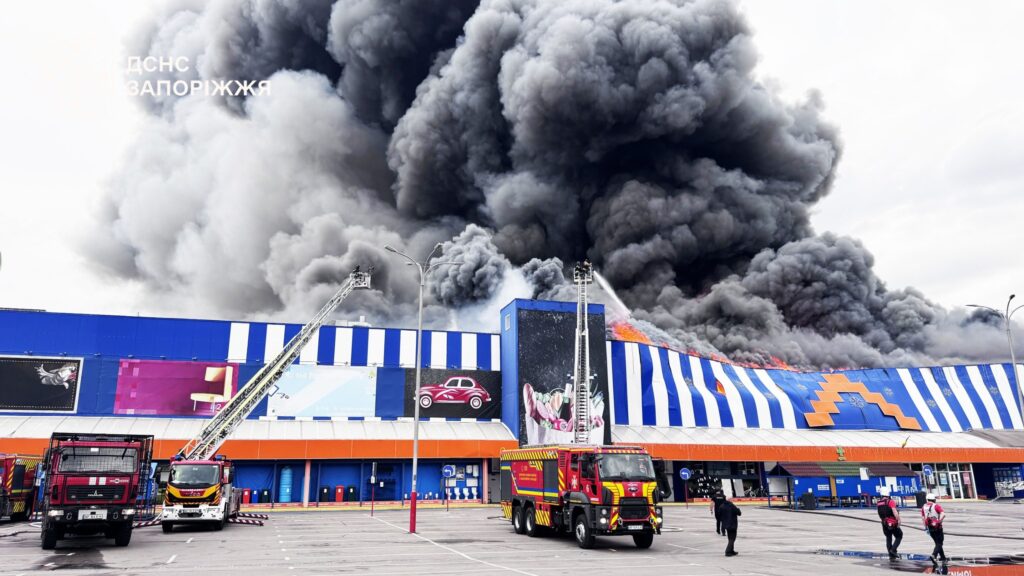
Fire at a shopping center in Zaporizhzhia, Ukraine, following a Russian drone strike on 28 August 2026. Photo: Ukraine’s State Emergency Service

Air-raid alerts covered a record share of working hours at shopping centers across Ukraine in August. Sirens ran for 21.8 percent of the hours malls were open, the Ukrainian Council of Shopping Centers reported.

For more than a fifth of the hours malls were open to serve customers, sirens instead sent staff and shoppers to shelters. The share has more than doubled in a year. The climb is related to Russia's escalating air campaign: Moscow ran a seven-day barrage of ballistic missiles and jet-powered drones against Kyiv into early September, the kind of assault that keeps sirens running through the business day.

Every tracked measure rose

The council considers four figures: the number of alerts, the number during mall working hours, the total alert duration, and the duration during working hours. All four climbed from July to August, it says.

Five regions bear the worst of it

The five regions with the most daytime alert time, between 10 a.m. and 9 p.m., barely changed over the month, the council says. Donetsk Oblast led at 82.0 percent, followed by Sumy at 76.4, Zaporizhzhia at 71.4, Kharkiv at 60.3, and Chernihiv at 40.1.

The sharpest monthly jump fell in Kyiv and Kyiv Oblast.

Faster drones drive the sirens

Russia has switched to jet-powered drones that fly more than three times faster than the propeller Shaheds Ukraine spent three years learning to shoot down. The faster a drone reaches a city, the less time defenders have to catch it.

That is what fills the sirens. Alerts sound earlier and stay on longer, which is the shared council measure.

Ukraine races to answer them

Ukraine has four interceptor systems in field testing, built to take down jet drones, Defense Minister Yevhenii Khmara said on 30 August. The country now wants to bring them to standard and build them in the thousands.

Until that layer works, every jet-drone raid costs Ukraine a long air alert that empties a shopping center.

Downtime piles up over years

Since the full-scale war began, the average Ukrainian mall has lost 166.8 working days to air-raid alerts, according to the report. August 2026 alone accounted for 6.4 of them.

That is more than eight working months of shuttered trading floors, and it is still climbing.

  • ✇Euromaidan Press
  • Russia launches third attack on Ukraine’s largest Danube port this month, during peak of wheat harvest
    A Russian strike on southern Odesa Oblast killed one person overnight and set grain trucks on fire. Five trucks loaded with grain were destroyed and three more damaged, with one person killed and three injured, the head of the Odesa Regional Military Administration, Oleh Kiper, said. The strike hit the Izmail district, home to Ukraine's largest Danube port. The port became a maritime lifeline after Russia's 2022 Black Sea blockade, carrying the overflow whenever the sea
     

Russia launches third attack on Ukraine’s largest Danube port this month, during peak of wheat harvest

29 août 2026 à 15:22

ukraine grain

A Russian strike on southern Odesa Oblast killed one person overnight and set grain trucks on fire. Five trucks loaded with grain were destroyed and three more damaged, with one person killed and three injured, the head of the Odesa Regional Military Administration, Oleh Kiper, said.

The strike hit the Izmail district, home to Ukraine's largest Danube port. The port became a maritime lifeline after Russia's 2022 Black Sea blockade, carrying the overflow whenever the sea lanes are constrained, National Security Journal reported. The attack is part of a campaign against the food supply.

Ukraine is one of the world's largest suppliers of wheat, maize, and sunflower, so the strikes register far beyond its borders, in the import-dependent countries that buy its grain.

Fire destroyed eight trucks

The attack set eight cargo trucks and dry grass nearby alight, the press service of the State Emergency Service in Odesa Oblast reported. Rescuers have since put out the fires.

"Unfortunately, a person was killed in the attack, and three more were injured," the service said.

The strike hit transport infrastructure

Russia struck the Izmail district overnight on 29 August, damaging transport infrastructure, the Izmail District State Administration reported. The district sits on the Danube close to the Romanian border.

"There are casualties. Sadly, a person has been killed. The injured have been given the necessary help. Representatives of the security structures and medical workers are working at the scene," the administration said.

The Danube corridor is a standing target

The strike fits a pattern. Russia hit Izmail's port infrastructure on 13 August, cutting power in parts of the city, and struck it again days later, damaging a Togo-flagged civilian vessel. The attacks come during Ukraine's peak wheat harvest, expected at around 60 million metric tons this year, close to the 2025 crop. Farmers need the export revenue now to finance next year's sowing, and storage is filling as grain goes unshipped.

Russia's Defense Ministry has described its Izmail strikes as hitting berthing terminals for military cargo and depots for Western-supplied weapons. The trucks burned in this strike were carrying grain.

Retired Valencia official came to Ukraine to repay debt from Franco’s time. Russia has held him since 2022, and now his Kherson apartment has burned

26 août 2026 à 02:19

Screenshot from a video provided by Tetiana Marina, his civilian wife. Source: ZMINA

Fire has destroyed the Kherson apartment of Mariano García Calatayud, the Spanish volunteer, who was abducted by Russian forces during the occupation of the city in 2022. His partner, Tetiana Marina, told ZMINA she received two videos from neighbors that morning, the first showing her apartment alight and the second showing the fire spreading through the building.

Calatayud is one case in a system of civilian captivity that Russia does not acknowledge. Ukraine's ombudsman estimates Russia holds up to 20,000 Ukrainian civilians, with confirmed identities for only a fraction. Russia has never charged Calatayud with a crime, never allowed him a lawyer or contact with his family, and for more than three and a half years has declined to confirm it holds him at all.

The building stands at the start of Yevropeiska Street, formerly Suvorova, roughly 500 to 700 meters from the Dnipro, Marina said. Police have recorded the damage. She does not know what caused the fire and suspects a Russian drone.

The videos showed the fire spreading

"In the first, I saw clearly that only my apartment was engulfed. In the second, I saw that all the apartments in the video had burned," Marina said.

She is still trying to reach a neighbor, Iryna, who had been sleeping in a bomb shelter because of the shelling.

  • "I still do not know what happened, but everything burned. It does look like a drone," she said.
A moral debt brought him to Ukraine

Calatayud ran the road construction department at Valencia city hall before retiring. He moved to Ukraine in 2014, collected humanitarian aid from several countries and delivered it to Marinka and Krasnohorivka in Donetsk Oblast, and worked with orphanages.

Marina explained his reason to Radio Free Europe/Radio Liberty. Under Franco, many children of repressed Spaniards were sent to Ukraine, to Odesa. His mother's family was among the repressed.

"That is why he went to Ukraine in 2014, to, as he put it, repay a debt to Ukraine," she said.

When Russian forces took Kherson, he stayed. He could have left for Spain, but did not.

Russia stopped acknowledging him

On 19 March 2022, Calatayud attended a pro-Ukrainian rally. Two men in balaclavas seized him at his own entrance, handcuffed him, put him in a dark blue minibus, and drove him to the occupation administration, Marina said.

He was held in Simferopol pre-trial detention center No. 2. According to other civilian hostages, he was beaten and subjected to electric shocks while in detention. They also described inhumane conditions and a lack of proper medical care. He suffered a heart attack in custody.

In December 2023, Russia reported Calatayud's transfer to Kherson Oblast, the Media Initiative for Human Rights reported. Spain proposed exchanging him for a Russian prisoner of war, and Russia refused. The Red Cross is searching for him in penal colonies, including in Siberia.

Russian military bloggers listed him in a database of foreign fighters, claiming he had joined Kherson's territorial defense. He never carried a weapon in the city, his wife said.

  • ✇Euromaidan Press
  • Russia struck Ukraine’s gas producer 13 times in a single week, forcing some wells offline
    Russia struck facilities of Ukraine's state-owned Naftogaz Group 13 times over the past week, hitting several regions with drones and missiles, the company reported on 17 August. Gas extraction infrastructure was among the targets, and one asset was hit several times. Naftogaz said the strikes seriously damaged equipment and production capacity and cut part of its output. No employees were injured this time. The strikes are part of a systematic Russian drone and missile
     

Russia struck Ukraine’s gas producer 13 times in a single week, forcing some wells offline

17 août 2026 à 06:08

Firefighter attending to a blaze following a Russian attack on Ukraine's energy infrastructure.

Russia struck facilities of Ukraine's state-owned Naftogaz Group 13 times over the past week, hitting several regions with drones and missiles, the company reported on 17 August. Gas extraction infrastructure was among the targets, and one asset was hit several times. Naftogaz said the strikes seriously damaged equipment and production capacity and cut part of its output. No employees were injured this time.

The strikes are part of a systematic Russian drone and missile campaign against Ukraine's oil and gas production, intensifying as winter approaches. Naftogaz has now counted 293 strikes on its facilities since the start of 2026.

Acting Naftogaz CEO Serhii Fedorenko has said the strikes are meant to inflict maximum damage on Ukraine's infrastructure ahead of the heating season. The company said Russian attacks destroyed 37 sites in its network during the first seven months of 2026, 32 Ukrnafta filling stations and five Ukrhazvydobuvannia complexes.

The strikes carry a human cost too: EP has reported 312 workers killed across the group since 2022. In what Naftogaz called its largest strike on gas production infrastructure, Russia fired 35 missiles and 60 drones at facilities in the Kharkiv and Poltava regions in October 2025.

Russia's long war on Ukraine's energy grid

Russia has bombed Ukraine's power and heating systems through every winter of its full-scale invasion. Each year the strikes have grown heavier. Then-Energy Minister Denys Shmyhal said last winter's attacks damaged or destroyed roughly 80% of Ukraine's energy system. Across 2025, Russia hit energy sites more than 600 times, damaging all 15 of the country's thermal plants. The strikes have forced repeated nationwide blackouts and cut heat to homes in sub-zero cold.

That previous campaign failed to collapse the grid, so Moscow now eyes Ukraine's water systems as its next winter target. Heading into the coming winter, Ukraine received about three times fewer air-defense missiles in the first half of 2026 than a year earlier. Kyiv is answering with its own deep strikes on Russian refineries and military plants. For civilians, the pattern means another winter of cold homes, rationed power, and threatened water supplies.

  • ✇Euromaidan Press
  • Russia’s Odesa strikes halve Ukraine’s grain export forecast
    Ukraine’s Agriculture Ministry has cut its forecast for agricultural exports in 2026–2027 by 54% as Russian attacks disrupt shipping through Odesa’s ports, Bloomberg reported. The ministry now expects 29.6 million tons of agricultural exports, down from 64.4 million. Its wheat export forecast fell by 53%, from 17.6 million tons to 8.3 million tons. Ukraine grows far more grain than it consumes, exporting 65%–70% of its agricultural output. Bloomberg said the sector
     

Russia’s Odesa strikes halve Ukraine’s grain export forecast

11 août 2026 à 13:47

Grain pours from a combine harvester into a trailer during harvest in Ukraine.

Ukraine’s Agriculture Ministry has cut its forecast for agricultural exports in 2026–2027 by 54% as Russian attacks disrupt shipping through Odesa’s ports, Bloomberg reported.

The ministry now expects 29.6 million tons of agricultural exports, down from 64.4 million. Its wheat export forecast fell by 53%, from 17.6 million tons to 8.3 million tons.

Ukraine grows far more grain than it consumes, exporting 65%–70% of its agricultural output. Bloomberg said the sector generated more than half of Ukraine’s export revenue last year. But Russia’s summer attacks have stalled the sea corridor as the harvest arrives, driving some wheat prices below production costs. Land and river routes cannot match the Black Sea shipping capacity, while sales through neighboring EU states remain politically contested. That leaves farmers with less money for the next sowing and further reduces Ukraine’s export income.

Ukraine has about 59 million tons of grain storage. That storage could be full by early November, leaving the country 11 million tons short of space by the end of fall 2026. 

Wheat sells below cost as the silos fill up

Ukraine’s export bottleneck is already hitting its farmers. Port prices fell by another 12-15% in one week, while some farmers sold wheat below production cost. When ships stop, traders either stop buying or pass the higher cost of alternative routes on to producers. That leaves farmers with less cash for fall sowing.

To ease the pressure, the government has approved subsidized loans for agricultural producers. President Volodymyr Zelenskyy said Kyiv would expand storage. Ukraine's Agriculture Ministry has also asked the European Commission for €220 million to help cover interest for small and medium-sized farms.

Ukraine and Moldova are discussing a rail route to Romania’s Constanța port. According to the report, grain was already being redirected through Romania, Slovakia, and Hungary, but these routes cannot replace Odesa’s capacity.

Now the ports and the ships are Russia's targets

The export bottleneck is only part of the problem. Russia’s bombardment also threatens the ports, civilian ships, and crews needed to keep the corridor operating. 

The port of Odesa normally handles about 90% of Ukraine’s grain shipments. Russia intensified attacks on terminals and civilian ships in July 2026 as the harvest reached the coast.

On 19 July, three Russian missiles struck the foreign-flagged Golden Leo as it left Odesa carrying corn, killing 10 people, including a Ukrainian sea pilot. Three days later, no vessel passed through the corridor.

Alternative routes offer little relief, as record-low Danube levels were restricting river traffic. Poland continues to bar Ukrainian grain from its domestic market. Those constraints leave more of the harvest inside Ukraine and farmers with less money to plant the next crop.

❌