Vue normale

  • ✇Euromaidan Press
  • More than 100 drones detected near Romania in four days, NATO jets scrambled seven times
    More than 100 drones were detected near Romania over the past 96 hours, with NATO fighter jets scrambled seven times in response to the increased aerial activity, Romanian Defense Minister Radu Miruță said, according to Antena 3 CNN. The figures come as Romania faces a growing number of drone incidents linked to Russia’s war against Ukraine. Romanian forces have recently shifted from monitoring and escorting drones to actively destroying those that enter Romanian airspa
     

More than 100 drones detected near Romania in four days, NATO jets scrambled seven times

14 août 2026 à 16:42

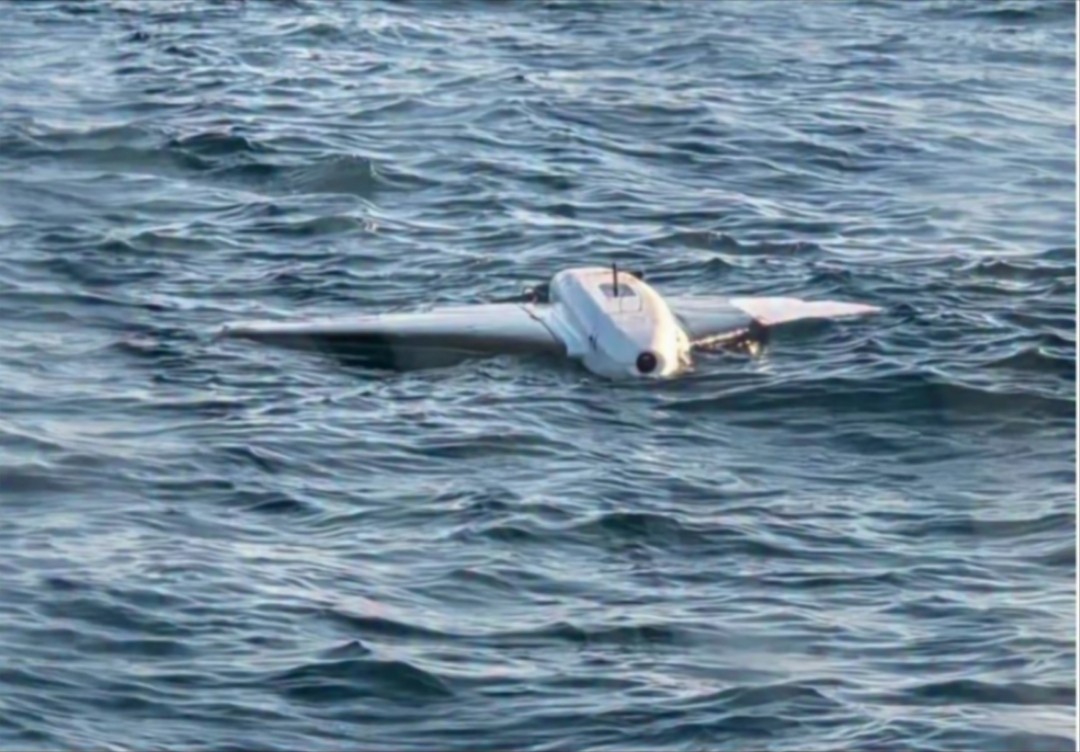
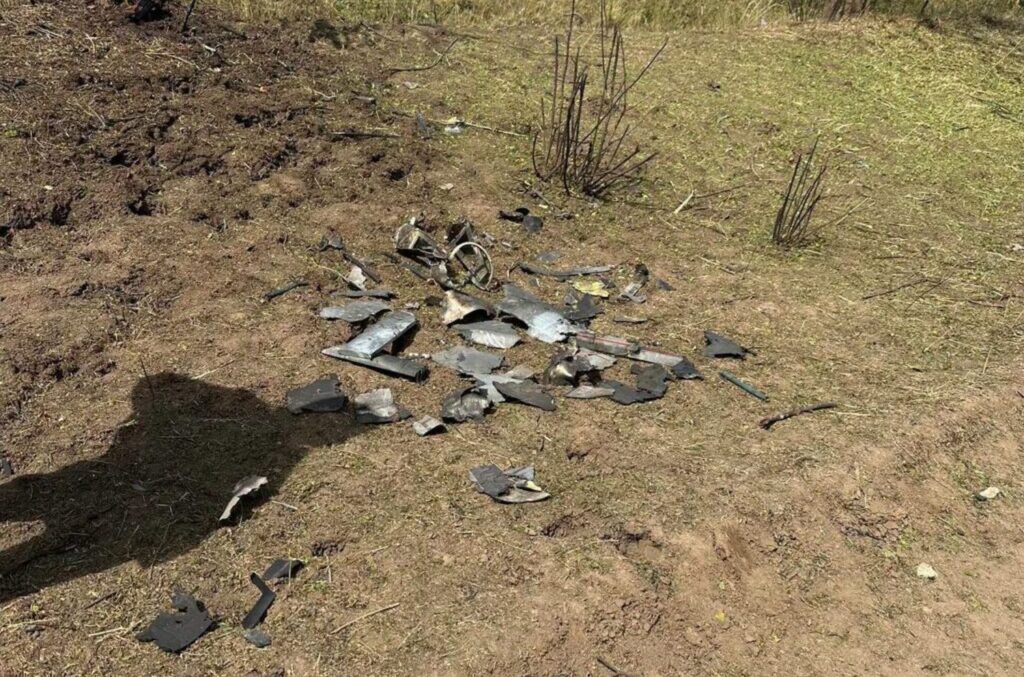
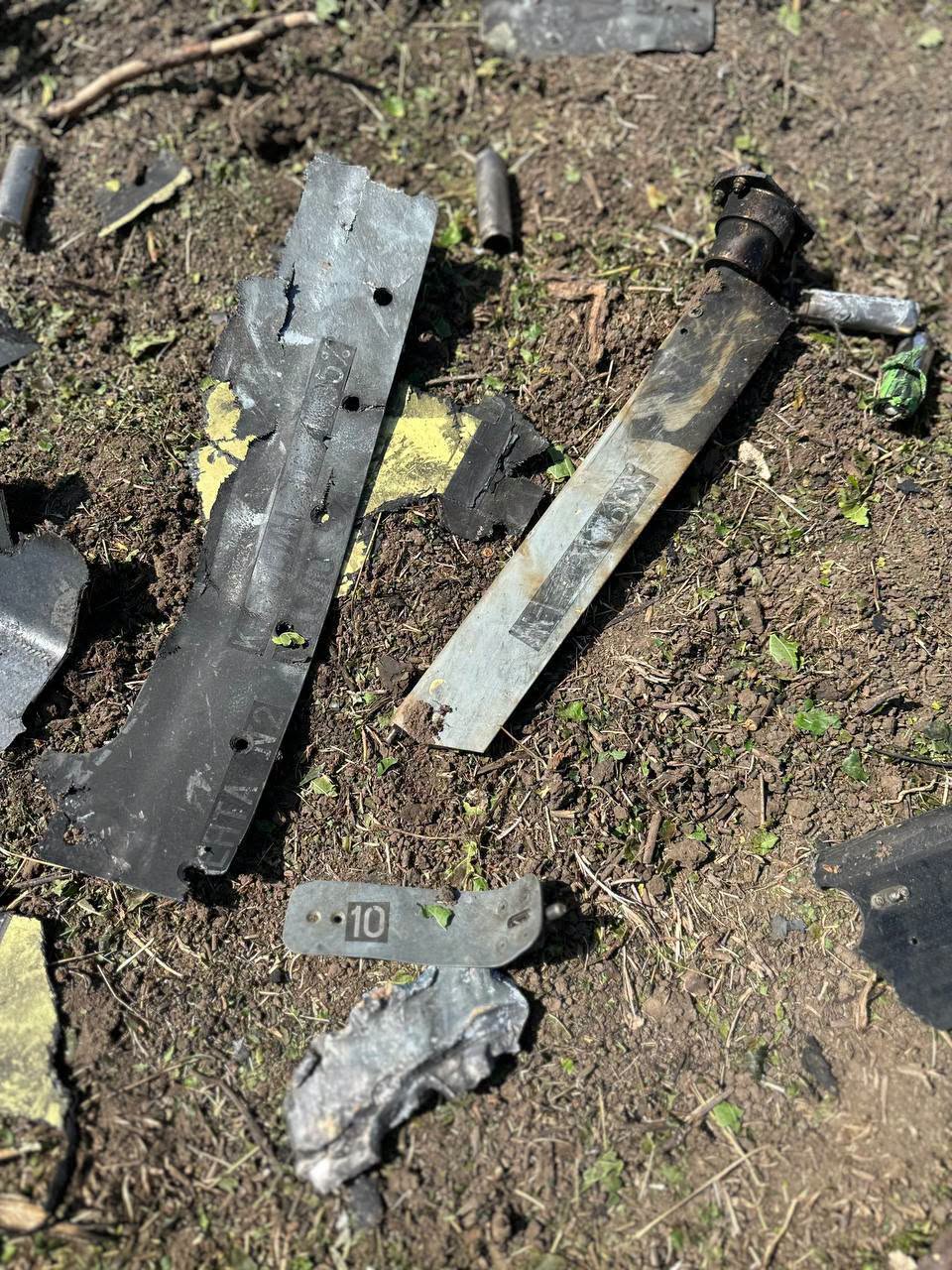
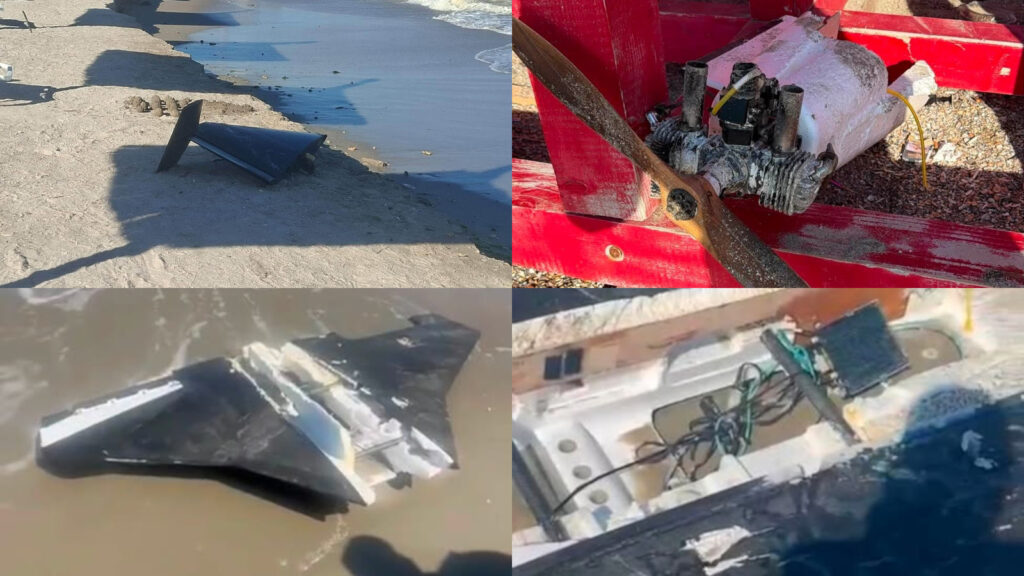
Drone debris washed ashore in Romania after Russian attacks on Ukraine, 13-14 August 2026. Photos: Radu Miruță

More than 100 drones were detected near Romania over the past 96 hours, with NATO fighter jets scrambled seven times in response to the increased aerial activity, Romanian Defense Minister Radu Miruță said, according to Antena 3 CNN.

The figures come as Romania faces a growing number of drone incidents linked to Russia’s war against Ukraine. Romanian forces have recently shifted from monitoring and escorting drones to actively destroying those that enter Romanian airspace, while NATO aircraft are increasingly being called on to respond to aerial threats along the alliance’s eastern flank.

NATO aircraft repeatedly activated

According to Miruță, Romanian authorities detected more than 100 drones in the vicinity of Romanian territory during the four-day period. NATO fighter jets participating in air-policing missions were activated seven times.

Miruță did not report how many of the detected drones entered Romanian airspace, nor how many were identified as Russian or Ukrainian.

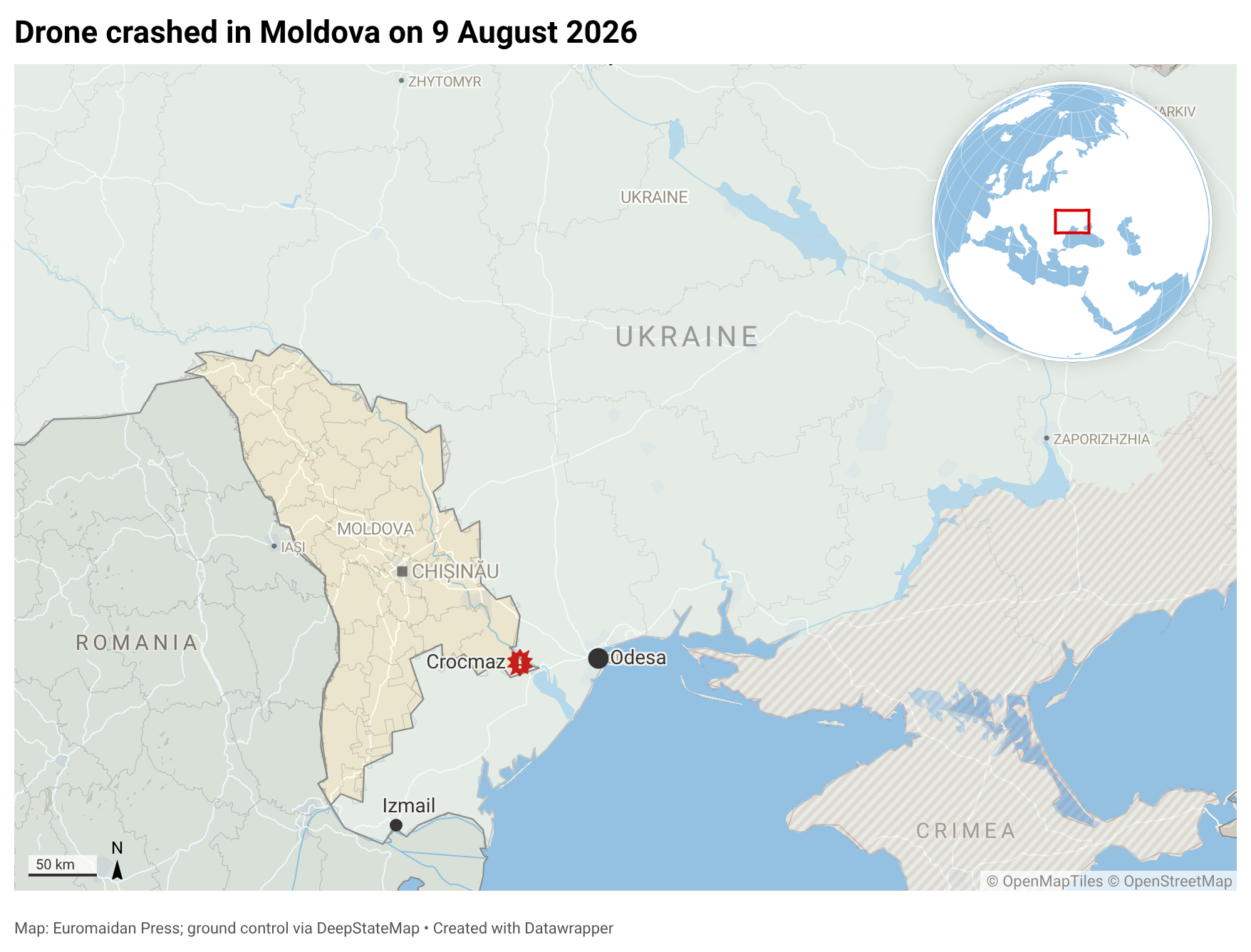
Miruță said most of the drones were destroyed by Ukrainian air defenses outside Romania, but close enough for their debris to reach Romanian shores.

“[Russia’s war in Ukraine] is a real war, with real consequences. That is why we are taking every measure we can to limit the indirect consequences that are also being felt here,” Miruță wrote on Facebook.

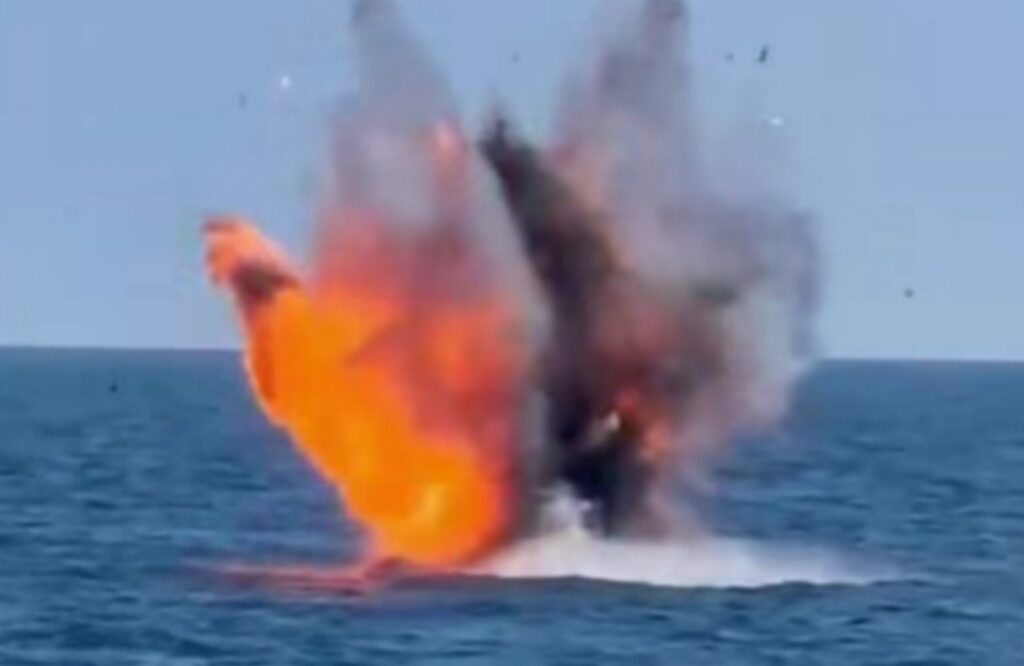
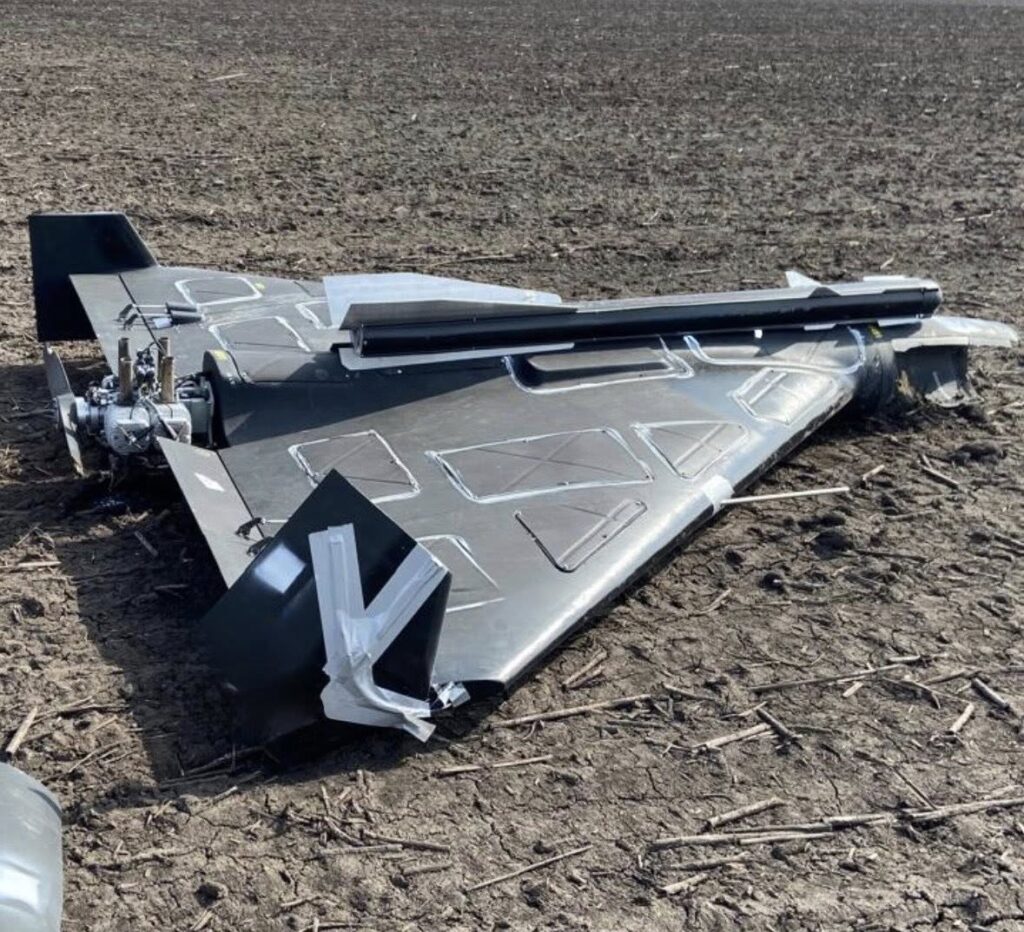
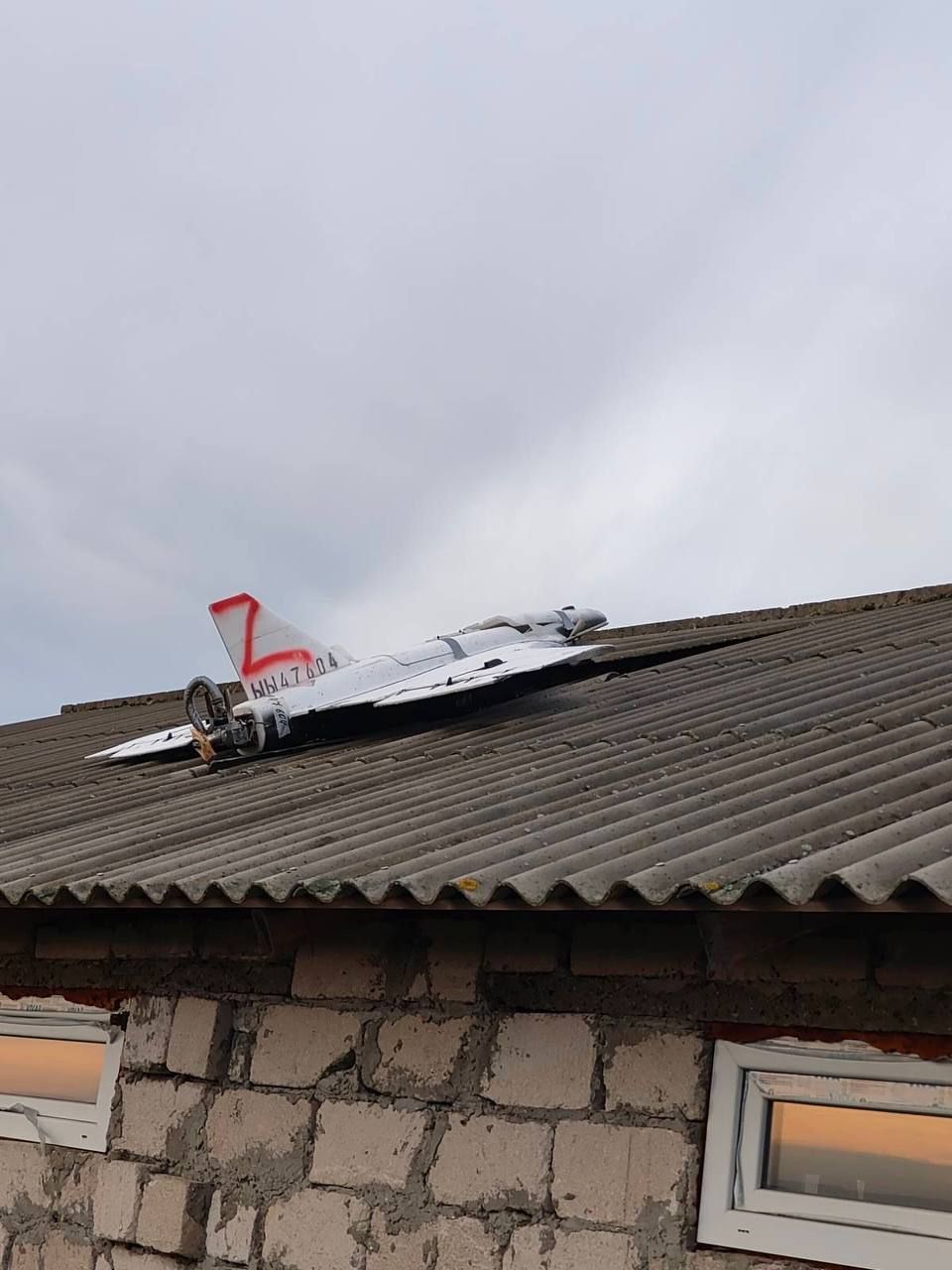
The report comes shortly after Romania destroyed two Russian Gerbera-type drones that were found drifting in the Black Sea near the Neptun Deep offshore gas project on 11 August. Romanian military divers carried out controlled detonations after Ukraine confirmed the drones were not Ukrainian.

Romania has begun shooting down drones

The latest figures follow a significant change in Romania’s response to drone incursions.

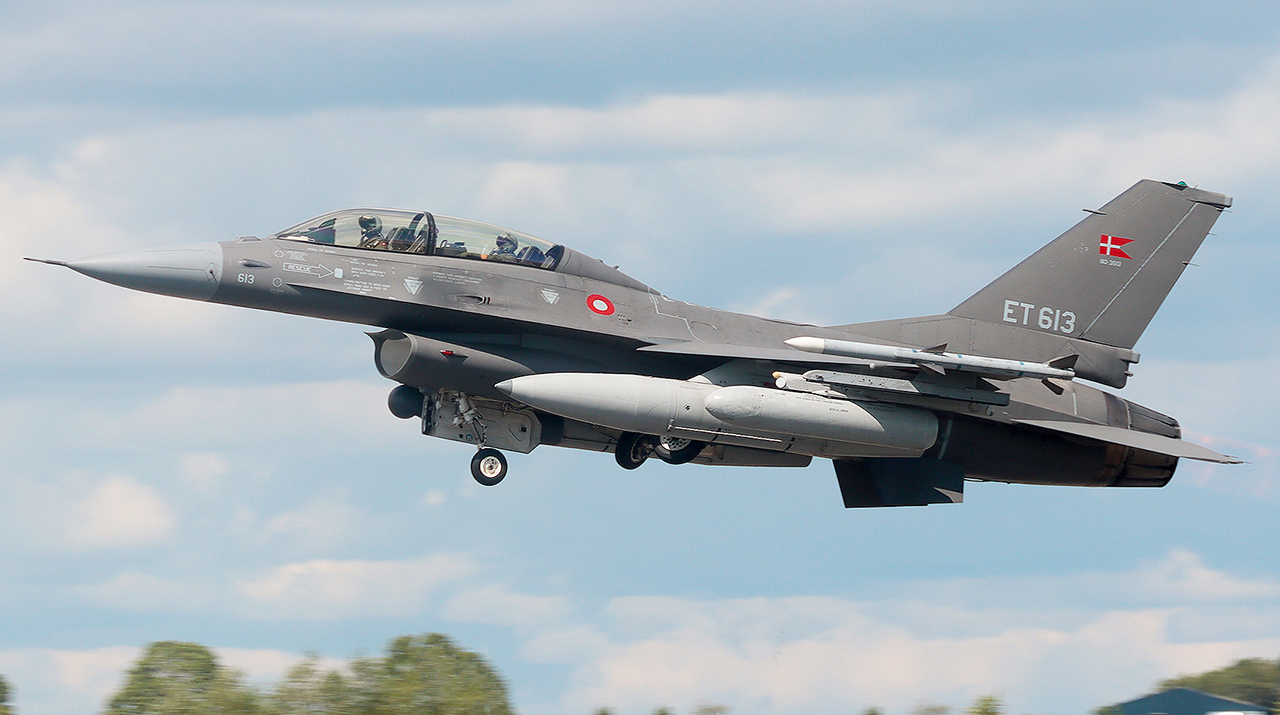
In late July, Romanian F-16s shot down three drones over Romanian territory and territorial waters in three consecutive days. One of the drones was identified as a Russian Shahed-type attack drone, while investigations were conducted into the others.

The July incidents marked a shift from Romania’s previous approach of tracking or escorting drones that crossed into its airspace during Russian attacks on Ukraine. Four of the five drones shot down in EU and NATO countries at that point had been neutralized by Romanian military pilots, according to Miruță.

Romanian President Nicușor Dan called the repeated violations of Romanian airspace “inadmissible and intolerable” and Bucharest prepared a diplomatic protest to Moscow after one of the downed drones was identified as Russian.
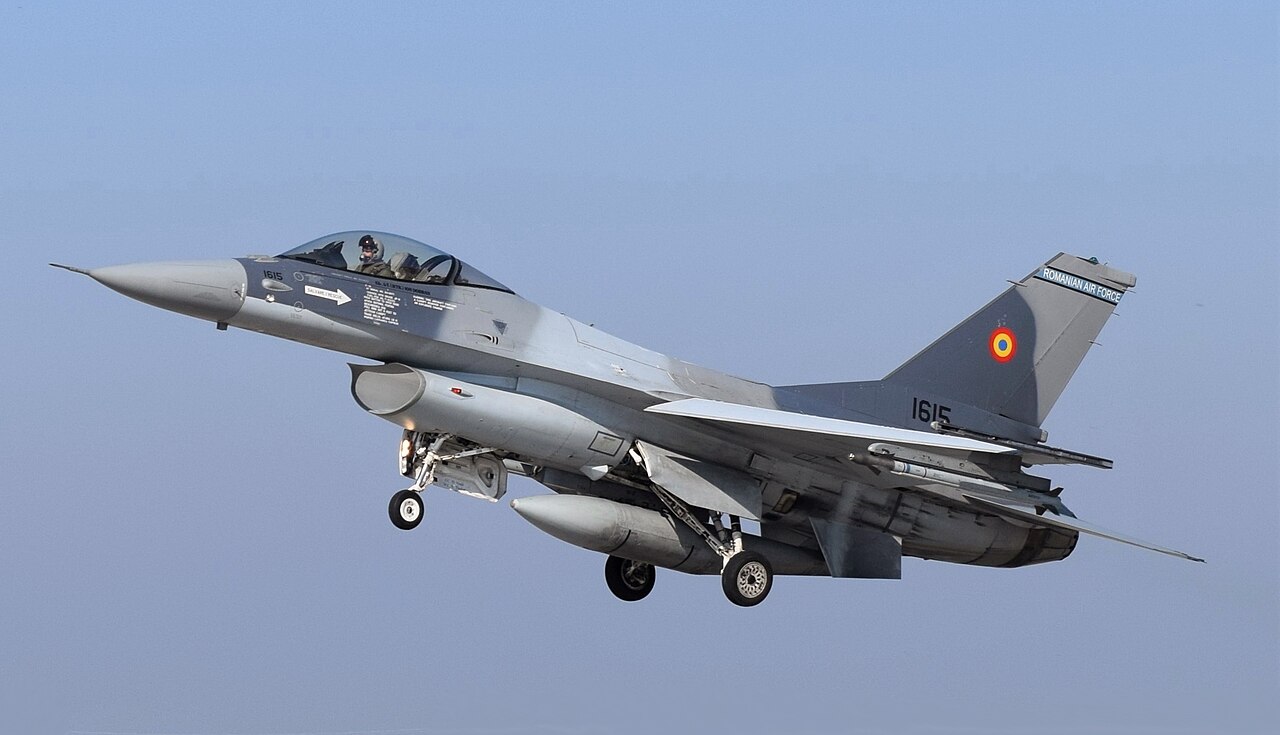
romania knocks third drone its sky 72 hours · post romanian air force f-16 fighting falcon fighter jet lands borcea base 2023 dvidshubnet romanian_f-16_fighting_falcon_lands_at_borcea_air_base_romania ukraine news ukrainian reports
Explore further

Romania knocks a third Russian drone from its sky in 72 hours

Drone war reaches beyond Ukraine

Romania has repeatedly dealt with drones crossing its border during Russian attacks on Ukrainian territory, particularly in the vicinity of Ukrainian ports on the Danube and the Black Sea.

In June, a Ukrainian sea drone that had lost control, which Kyiv attributed to Russian electronic warfare, exploded near an oil terminal in the Romanian port of Constanța. No one was injured, but more than 1,000 people were evacuated from the area as a precaution.

The incidents have also extended beyond Romania. On 14 August, NATO fighter jets shot down a foreign drone after it entered Latvian airspace. Latvia said the drone had entered its airspace as a result of Russian electronic warfare activity.

The repeated incidents have made drone activity around NATO’s eastern border an increasingly regular consequence of Russia’s war against Ukraine.

  • ✇Euromaidan Press
  • Russia plans to remove border zones separating Russia from occupied Ukrainian territories
    Russia’s Federal Security Service (FSB) plans to abolish special border zones along several boundaries with Ukrainian territories occupied by Russia, according to draft orders reviewed by the Russian outlet Agentstvo. The proposed changes would remove restrictions that currently treat movement between Russia and occupied parts of Ukraine much like crossing an international border. The FSB says the move follows Russia’s claimed incorporation of the occupied Ukrainian ter
     

Russia plans to remove border zones separating Russia from occupied Ukrainian territories

14 août 2026 à 15:58

Map of Ukraine, with Russian-occupied territory marked in red, 14 August 2026. Map: DeepState

Russia’s Federal Security Service (FSB) plans to abolish special border zones along several boundaries with Ukrainian territories occupied by Russia, according to draft orders reviewed by the Russian outlet Agentstvo.

The proposed changes would remove restrictions that currently treat movement between Russia and occupied parts of Ukraine much like crossing an international border. The FSB says the move follows Russia’s claimed incorporation of the occupied Ukrainian territories into Russia.

FSB seeks to remove border zones

The draft orders, as reported by Ukrainska Pravda, would invalidate previous FSB orders establishing border zones along the boundaries between Russia’s Rostov and Voronezh oblasts and the occupied territories of Ukraine.

A similar change is planned for occupied Crimea, where the current border zone along the boundary with occupied Kherson Oblast would be abolished.

The existing rules effectively impose additional controls on people entering and leaving the occupied territories, making movement subject to procedures similar to those used at Russia’s state border.

In the draft orders, the FSB justifies the changes by referring to the alleged “admission into the Russian Federation” of the occupied parts of Donetsk, Luhansk, and Kherson oblasts.

Russia illegally claimed to annex those territories, along with Zaporizhzhia Oblast, in September 2022. The move has been rejected by Ukraine and the international community, and Russia does not control all of the territory it claims to have annexed.

Border zone would remain around Crimea's islands

The FSB proposal would not completely eliminate the border zone in occupied Crimea.

A restricted zone would remain “within the boundaries of the Black Sea islands belonging to the Russian Federation,” according to the draft. The FSB’s regional directorate would determine where and when people could enter the zone and would install warning signs.

The proposed changes would remove the existing border zones along Russia’s boundaries with occupied Ukrainian territories, while retaining a border zone around certain Black Sea islands in occupied Crimea.

Russia treats occupied territory as part of its territory

The planned changes reflect Moscow’s effort to incorporate occupied Ukrainian territories into Russia’s administrative and legal system.

In September 2022, Russian President Vladimir Putin signed so-called “accession treaties” claiming to incorporate Donetsk, Luhansk, Kherson, and Zaporizhzhia oblasts into Russia. Russia’s parliament subsequently approved the claims.

The treaties purported to define the boundaries of the annexed territories according to the borders they had on the day Russia claimed to admit them into the Russian Federation, despite Russia not controlling the entirety of those regions.

Russia previously used similar measures to formalize its control over occupied Crimea after illegally annexing the peninsula in 2014.

A Prominent Mexican Politician Says U.S. Revoked His Visa

14 août 2026 à 15:16
Andrés Manuel López Beltrán, a former president’s son, lashed out at the Trump administration after he said it canceled his visa, another flashpoint in the tense U.S.-Mexico relationship.

© Henry Romero/Reuters

Andrés Manuel López Beltrán is the son of Mexico’s former president Andrés Manuel López Obrador, who is still a key leader of Morena, Mexico’s dominant political party.
  • ✇Euromaidan Press
  • Ukraine: 18 of 26 Russian oil and stolen-grain ships face no sanctions
    On 14 August, Ukraine's Military Intelligence (HUR) published data on 26 vessels via its War&Sanctions portal, noting that 18 ships face no sanctions from any of Ukraine's partner countries. The agency said the ships carry Russian oil, liquefied natural gas (LNG), or agricultural products from occupied Ukraine. Euromaidan Press could not independently verify HUR’s vessel records. Russia relies on maritime trade both to fund its war through energy exports and to s
     

Ukraine: 18 of 26 Russian oil and stolen-grain ships face no sanctions

14 août 2026 à 12:40

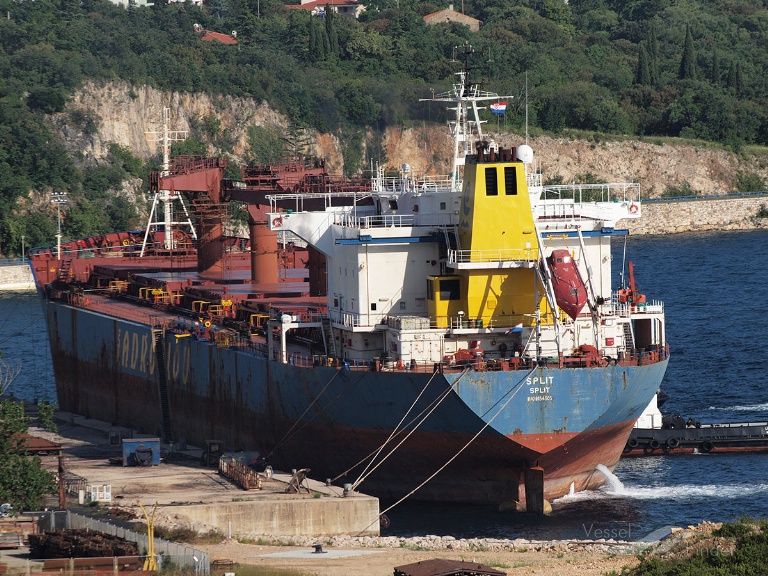
The bulk carrier now named LAMAR S, with SPLIT painted on its stern, moored beside a concrete quay near a wooded coastline.

On 14 August, Ukraine's Military Intelligence (HUR) published data on 26 vessels via its War&Sanctions portal, noting that 18 ships face no sanctions from any of Ukraine's partner countries.

The agency said the ships carry Russian oil, liquefied natural gas (LNG), or agricultural products from occupied Ukraine. Euromaidan Press could not independently verify HUR’s vessel records.

Russia relies on maritime trade both to fund its war through energy exports and to sell crops taken from occupied Ukraine. Kyiv began building a dedicated system against Russia’s shadow grain fleet in April, modeled on its oil-fleet campaign. A US bill introduced this week would also target vessels, owners, insurers, and ports involved in sanctions evasion. HUR’s new list shows how many ships remain outside those restrictions.

Russia’s grain shadow fleet

HUR divided the 26 vessels into three groups:

  • oil tankers serving Lukoil, Rosneft, Surgutneftegas, Novatek, Tatneft, and Gazprom;
  • dry-cargo ships using the occupied ports of Berdiansk, Sevastopol, Kerch, and Feodosia;
  • LNG carriers moving gas from the sanctioned SAAM FSU floating storage unit, which holds LNG from the sanctioned Arctic LNG 2 project.

HUR highlighted three of the 18 vessels that are not facing partner sanctions. The bulk carrier LAMAR S repeatedly loaded wheat at the Avlita terminal in occupied Sevastopol in 2026 for delivery abroad, including to Syria, the agency said.

NAYA FALCON carried baking soda and granulated wheat bran from occupied Sevastopol to Egypt and Cyprus, HUR said. The agency linked the oil tanker GREGAL to UAE-based Cymare Navigation FZC, which it described as affiliated with Sovcomflot, Russia’s state-controlled shipping company.

Russia steals grain while striking Ukraine’s exports

Crops taken from occupied land are sold abroad as Russian produce, while Russia's attacks leave Ukraine’s legitimate harvest with fewer routes to market.

Ukraine’s Foreign Intelligence Service said Russia sold more than 2 million tons of grain from occupied Ukraine as Russian produce in 2025. The agency said ship-to-ship transfers at Kavkaz helped conceal its origin.

Meanwhile, Russian attacks have squeezed Ukraine’s legitimate grain trade. Strikes on civilian ships brought the Black Sea corridor to a near standstill during the July harvest peak. Ten people died when Russian missiles hit the grain-laden Golden Leo on 19 July.

HUR called on Ukraine and its partners to synchronize sanctions and detain vessels that violate restrictions. It said the measures could curb Russia’s maritime logistics and war funding.

France’s Top Court Strikes Down Ban on Social Media for Children

14 août 2026 à 12:00
The move was a setback for President Emmanuel Macron, who championed the ban. He vowed to pass a new version before he leaves office next spring.

© Manuel Ausloos/Reuters

France’s Constitutional Council said that the ban was too wide-ranging, and did not take into account the age, maturity or family situation of children.

Zambia Halts Presidential Election Vote Count Over Violence and Fraud Allegations

14 août 2026 à 14:01
The electoral commission for the southern African nation said poll workers had been attacked and ballots had been stolen.

© Gianluigi Guercia/Agence France-Presse — Getty Images

A voting station’s presiding officer holds a marked ballot during the counting process at Woodlands Primary School in Lusaka, Zambia, on Thursday.
  • ✇Euromaidan Press
  • Russian agent who set fires in Kyiv receives 15-year prison sentence
    A Kyiv court has sentenced an unemployed man to 15 years in prison with confiscation of his property for carrying out arson attacks on behalf of Russian intelligence, Ukraine's Security Service (SBU) said on 13 August. The man was recruited while looking for "easy money" on Telegram channels and carried out two arson attacks in Kyiv before fleeing to Odesa, the SBU reported. Russian intelligence increasingly recruits Ukrainians through Telegram for arson and sabotag
     

Russian agent who set fires in Kyiv receives 15-year prison sentence

14 août 2026 à 09:54

Illustrative photo. Source: Depositphotos

A Kyiv court has sentenced an unemployed man to 15 years in prison with confiscation of his property for carrying out arson attacks on behalf of Russian intelligence, Ukraine's Security Service (SBU) said on 13 August. The man was recruited while looking for "easy money" on Telegram channels and carried out two arson attacks in Kyiv before fleeing to Odesa, the SBU reported.

Russian intelligence increasingly recruits Ukrainians through Telegram for arson and sabotage. It targets people seeking quick money and treats them as disposable operatives, paying small sums for a single task and discarding them once they are caught.

The Russian agent carried out two arson attacks

According to the SBU, the man first set fire to a relay cabinet belonging to a railway signaling system. Russia intended the attack to disrupt freight logistics, including supplies to areas near the front.

The agent later burned a volunteer’s SUV used to deliver humanitarian aid and evacuate civilians from areas affected by Russia’s war. He carried out the attacks at night, using a flammable mixture and filming each incident on his smartphone before sending the footage to his Russian handler.

The SBU arrested him in Odesa in July 2025, where he had attempted to hide after carrying out the attacks. Investigators seized his phone, which contained evidence of his cooperation with Russia.

A court found him guilty on two counts — sabotage committed under martial law, and intentional destruction of property by arson — both carried out as part of a group acting on prior conspiracy. He was sentenced to 15 years in prison with confiscation of his property.

ukraine detains six suspected russian agents including teen arsonist one russian-paid detained sbu fsb saboteur arrested says suspects were recruited telegram ordered target railway military infrastructure 22 security service (sbu)
Explore further

From “easy money” to murder: Russia escalates recruitment of Ukrainians for terrorist attacks inside Ukraine, police warn

Easy money, hard time: other Telegram recruits jailed too

The case follows several similar convictions. In a May case, an agent received 15 years for burning a railway relay cabinet near a Dnipro station in an attempt to disrupt frontline logistics. The SBU said the unemployed local, recruited through Telegram, filmed the arson and reported it to his handler, then was caught before he could carry out a planned series of attacks on the city's critical infrastructure.

In June 2026, another agent was sentenced to 15 years for preparing to burn an electrical substation in Kropyvnytskyi.

In July, SBU investigators reported that a GRU agent in Zaporizhzhia received 15 years for preparing explosives for Russian-organized attacks.

  • ✇Euromaidan Press
  • Reuters: Russia dismisses Black Sea ceasefire idea after Ukraine’s offer
    Russia dismissed the idea of a Black Sea ceasefire on 14 August, Reuters reported, a day after the agency disclosed that Ukraine had proposed a mutual halt to attacks on civilian targets there. Russian Foreign Ministry spokesperson Maria Zakharova said Moscow saw no grounds for measures that would give Kyiv a temporary reprieve. Russia’s dismissal comes after its strikes drove shipowners from Odesa as Ukraine’s wheat harvest peaked. More than 90% of Ukraine’s farm e
     

Reuters: Russia dismisses Black Sea ceasefire idea after Ukraine’s offer

14 août 2026 à 07:35

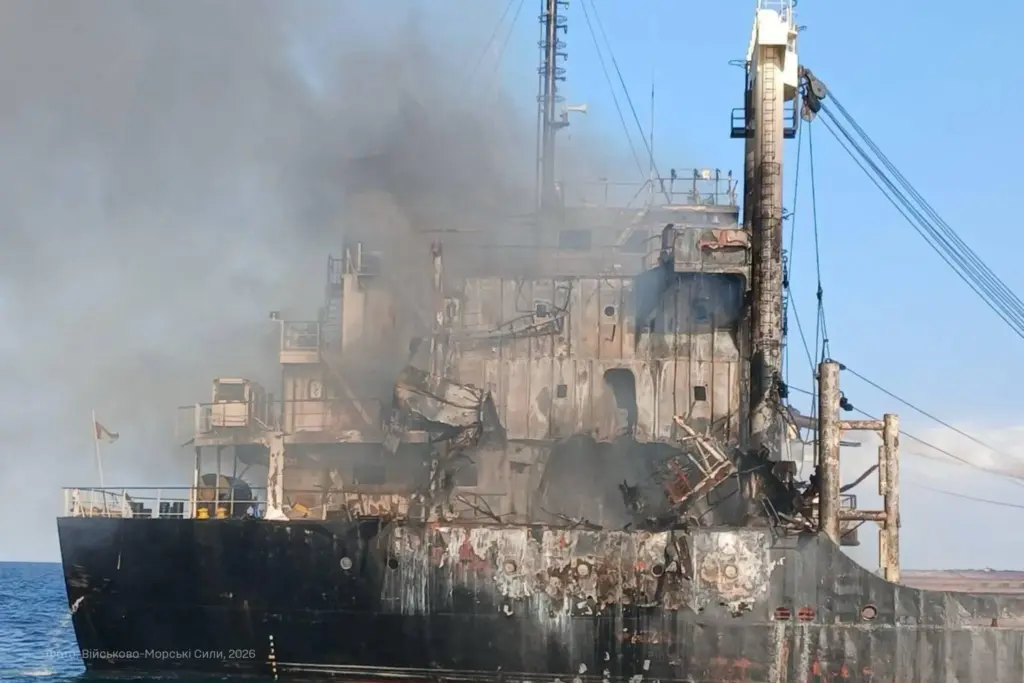
Smoke rises from the burned and heavily damaged superstructure of the Golden Leo cargo ship at sea.

Russia dismissed the idea of a Black Sea ceasefire on 14 August, Reuters reported, a day after the agency disclosed that Ukraine had proposed a mutual halt to attacks on civilian targets there.

Russian Foreign Ministry spokesperson Maria Zakharova said Moscow saw no grounds for measures that would give Kyiv a temporary reprieve.

Russia’s dismissal comes after its strikes drove shipowners from Odesa as Ukraine’s wheat harvest peaked. More than 90% of Ukraine’s farm exports leave through three deepwater Odesa ports. Reuters reported that Ukraine’s 12 August operation at Novorossiysk targeted a naval base and warships, although nearby grain terminals also suspended operations.

Russian forces, by contrast, have repeatedly struck foreign-flagged ships and Ukrainian port infrastructure. The disruption is stranding Ukrainian crops and raising concerns over global food supplies.

Zakharova accused Ukraine of deliberately destabilizing civilian shipping but did not mention Russia’s attacks, Reuters said. She was responding to Turkish Foreign Minister Hakan Fidan, who said Ankara had proposed a Black Sea moratorium to both sides.

Zakharova also said Moscow had received no formal proposal from Türkiye and ruled out reviving the 2022–23 Black Sea grain deal, calling it one-sided.

Ukraine’s harvest has nowhere to go

Reuters said Ukraine’s grain exports had fallen 76% year on year so far in August. Ukraine’s Agriculture Ministry projects agricultural exports could nearly halve, from 64.4 million to 29.6 million tonnes. It expects silos to fill by October as grain backs up.

World Grain, citing the US Department of Agriculture’s Foreign Agricultural Service, reported that corn exports could fall 39% and wheat exports 26%. The US agency expects unsold corn stocks to rise more than tenfold.

The ministry has asked the EU for €220 million to subsidize farm loans and help producers finance autumn sowing. Reuters separately reported, citing unnamed sources in both countries, that Kyiv and Chisinau were discussing a rail route to Romania’s Constanța port. Kyiv estimates it could carry only 10% of Ukrainian grain exports.

Ukrainian grain
Explore further

Ukraine and Moldova discuss rail corridor for grain amid Russian Black Sea attacks

Russia turns ports into targets

After Russia refused to extend the UN- and Türkiye-brokered grain deal in 2023, Ukraine opened its own maritime corridor. It remained operational until this summer’s escalation.

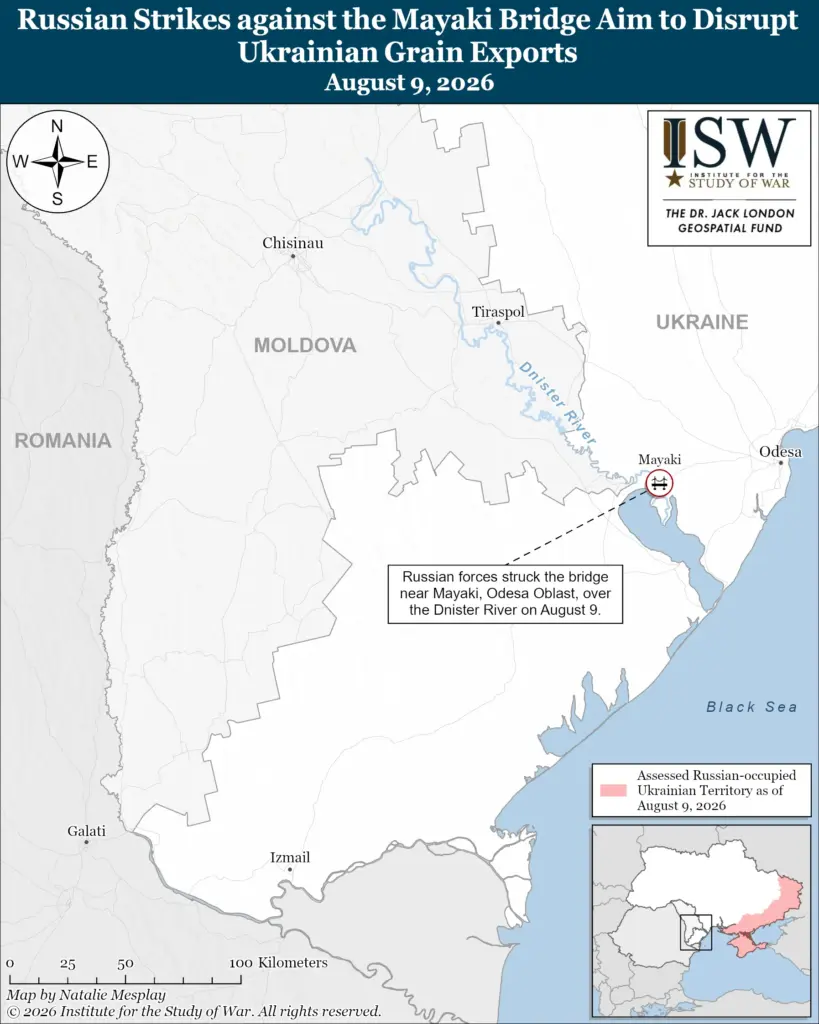
Russian forces repeatedly struck foreign-flagged vessels in July. On 19 July, Russian missiles hit the Guinea-Bissau-flagged, Turkish-owned Golden Leo as it left Odesa carrying corn. The attack killed 10 people, Ukraine’s Navy and Sea Ports Authority said. Ag Bull Trading reported that the attacks brought the corridor to its first full stop since it opened in August 2023.

Russia’s dismissal leaves Ukraine’s corridor officially open while Russian attacks continue to drive shipowners away.

Russia Campaigned to Derail Moldova’s Pro-Western Government

15 août 2026 à 05:03
In Moldova, Moscow paid Orthodox priests, conducted a vote-buying scheme and set up training camps on election interference — all in an effort to derail the Western-leaning government.

© Vadim Ghirda/Associated Press

Police officers in Chisinau, the Moldovan capital, watching protesters gather outside the electoral commission after the polls closed for parliamentary elections in 2025.
  • ✇Euromaidan Press
  • NATO fighter, one drone, one district: a jammed intercept lands over Latvia
    A NATO fighter patrolling Baltic airspace shot down a drone over Latvia early Friday, the Latvian Armed Forces said, in the second Baltic-region drone incursion this week. The interception happened over Balvi Municipality, near Latvia's borders with Belarus and Russia. Latvian officials said the drone entered the country's airspace after being knocked off course by Russian electronic warfare systems — not as a deliberate strike on Latvian territory. Russia has regularly
     

NATO fighter, one drone, one district: a jammed intercept lands over Latvia

14 août 2026 à 04:43

nato jets over baltics get authority shoot down objects pose threat · post russian fighter fly near airspace off latvia's baltic coast seen during interception op 2025 rnqv has upgraded

A NATO fighter patrolling Baltic airspace shot down a drone over Latvia early Friday, the Latvian Armed Forces said, in the second Baltic-region drone incursion this week.

The interception happened over Balvi Municipality, near Latvia's borders with Belarus and Russia. Latvian officials said the drone entered the country's airspace after being knocked off course by Russian electronic warfare systems — not as a deliberate strike on Latvian territory. Russia has regularly bombarded Ukraine's Baltic-facing neighbors with stray drones since intensifying its own long-range strike campaign, and on 12 August, Romania detonated two Russian drones that washed up near its Black Sea gas field.

Latvian forces reported an "airspace threat" in four districts bordering Belarus and Russia shortly after 04:00, and announced the drone's destruction roughly 30 minutes later. Ieva Bērziņa, a representative of Latvia's Joint Armed Forces Staff, said the crash site had been located but its exact position was not being disclosed, and that debris may be scattered over a wide area because the drone was shot down at high altitude.

The incident coincided with a large-scale drone attack on Russian targets in Leningrad Oblast overnight.

This is not the first time drones have crossed into the Baltic states during Russian strikes on its own territory. In May, a drone that entered from Russia damaged fuel tanks at an oil depot in Rēzekne, about 40 kilometers from the border. Ukrainian Foreign Minister Andrii Sybiha said in March that Russia was deliberately steering Ukrainian drones toward Baltic airspace using electronic warfare, adding that Moscow later uses the resulting incidents in information operations targeting the region.

Latvia is weighing the purchase of Brazilian-made A-29 Super Tucano light attack aircraft for counter-drone missions, funded through more than €1 billion the government has earmarked for stronger air defense.

  • ✇Euromaidan Press
  • Ukrainian drones hit Wildberries warehouse in Tver for the third time in two weeks
    Ukrainian drones struck a Wildberries logistics warehouse in Russia's Tver Oblast overnight into 14 August, damaging a wall for the third time in two weeks, regional governor Vitaly Korolev said. No one was hurt, and Wildberries said the goods stored there survived. The Emmaus facility, built on a roughly 77,000-square-meter footprint about 150 km from Moscow, has become a fixture in a Ukrainian long-range drone campaign against Wildberries, Russia's largest online reta
     

Ukrainian drones hit Wildberries warehouse in Tver for the third time in two weeks

14 août 2026 à 04:21

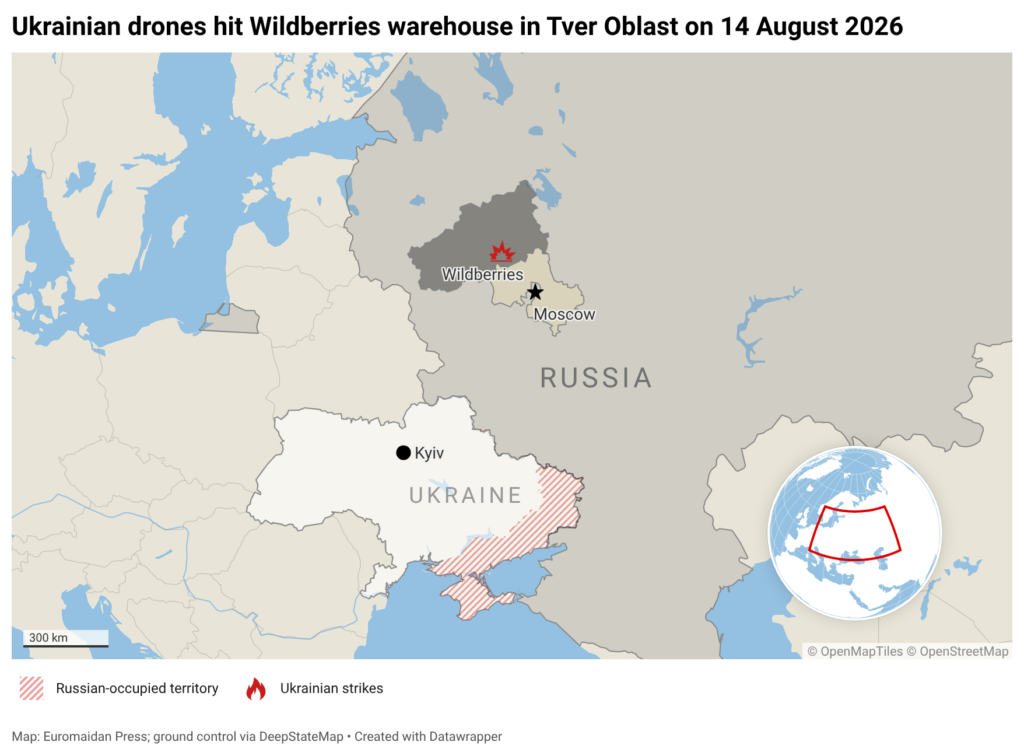
Ukrainian drones struck a Wildberries logistics warehouse in Russia's Tver Oblast overnight into 14 August, damaging a wall for the third time in two weeks, regional governor Vitaly Korolev said. No one was hurt, and Wildberries said the goods stored there survived.

The Emmaus facility, built on a roughly 77,000-square-meter footprint about 150 km from Moscow, has become a fixture in a Ukrainian long-range drone campaign against Wildberries, Russia's largest online retailer, now in its fifth week. Since 18 July, Ukraine has hit more than 20 of the company's logistics sites, according to Russian outlet Agentstvo, part of a declared operation President Volodymyr Zelenskyy announced on 25 June to pressure the Kremlin toward ending the war.

What happened in Tver

Korolev said drone debris damaged the wall of the Wildberries warehouse building in the Kalininsky district overnight, and that the resulting smoke was "promptly extinguished." No warehouse staff were injured, he said. Wildberries confirmed "minor damage" to the logistics complex and said the fire's aftermath was "promptly eliminated," adding that "the goods were not affected."

It is the third reported strike on a Wildberries facility in the Emmaus area in under two weeks. Drones first hit the site on 4 August, damaging a wall, and returned on 6 August, damaging the facade — though Tver governor Korolev did not confirm at the time whether the two strikes hit the same building. Ukrainian monitoring channel Supernova+ has said the repeated, inconclusive strikes mean Ukrainian forces are likely to keep coming back until the hub is disabled.

A campaign built on repetition, not precision

The Tver hub is a minor player in a campaign that has concentrated on Wildberries' largest distribution centers — Koledino outside Moscow, Khryastovo in Vladimir Oblast, Oleksin in Tula Oblast — each spanning well over 100,000 square meters and each hit with enough force to halt operations for days. By contrast, all three Tver strikes have caused only minor structural damage with no confirmed disruption to the warehouse's operations.

That gap matters for how the campaign is read. Euromaidan Press has reported that Ukraine has concentrated its drones on roughly two dozen hubs that move most of Wildberries' goods, while hundreds of smaller depots — Tver likely among them — remain largely untouched or only lightly damaged. Measured against the whole network, the physical loss looks modest; measured against the major hubs Ukraine has targeted, more than half are out of action.

The financial pressure has outpaced the physical damage. Wildberries has been scouting storage space in Kazakhstan beyond the reach of Ukrainian drones, and the Kremlin has been weighing state loans to keep the company solvent, at a point when Russia's federal deficit had already outrun the full-year shortfall the Treasury had budgeted. Ukrainian officials and Estonian military intelligence say Wildberries' warehouses store and move military-linked goods, including body armor and drone parts sold on the platform — a claim Wildberries denies.

  • ✇Euromaidan Press
  • Japan weighs sanctions after Putin’s first visit to disputed Kuril Islands
    Japan is considering new sanctions on Russia after President Vladimir Putin made his first visit to the disputed Kuril Islands on 13 August, a senior Japanese Foreign Ministry official told reporters, according to Kyodo News. Putin traveled to Iturup — Etorofu in Japanese — the largest of the four Russian-held islands Japan claims as its own, days after overseeing Russian Pacific Fleet exercises in the Far East. It is the first time a Russian president or prime minister
     

Japan weighs sanctions after Putin’s first visit to disputed Kuril Islands

14 août 2026 à 03:30

Vladimir Putin visits Etorofu island,

Japan is considering new sanctions on Russia after President Vladimir Putin made his first visit to the disputed Kuril Islands on 13 August, a senior Japanese Foreign Ministry official told reporters, according to Kyodo News.

Putin traveled to Iturup — Etorofu in Japanese — the largest of the four Russian-held islands Japan claims as its own, days after overseeing Russian Pacific Fleet exercises in the Far East. It is the first time a Russian president or prime minister has set foot on the islands. Tokyo summoned Russia's ambassador and lodged a formal protest, calling the visit "totally unacceptable." Prime Minister Sanae Takaichi said the islands are "an inherent part of Japanese territory both historically and under international law."

The Institute for the Study of War assesses that the Kremlin is likely using the visit to deter Japan from adopting a more assertive defense posture, and to discourage EU seizures of Russian shadow-fleet vessels — tying a Pacific island dispute directly to the pressure campaign around Russia's war on Ukraine.

An 80-year-old dispute, reopened on Tokyo's clock

Russia and Japan have never signed a peace treaty ending World War II, entirely because of the Kurils. The Soviet Union seized the four southernmost islands — Iturup, Kunashir, Shikotan, and the Habomai islets — in the war's final weeks, expelling the Japanese residents. Japan calls them the Northern Territories and has never dropped the claim.

Putin's visit lands as Tokyo's posture toward Moscow hardens. Japan's 2026 Defense White Paper, published earlier this month, named Russia as one of the country's principal threats — a paper Putin criticized directly on Wednesday, saying the islands became Russian territory "as a result of World War II" and accusing Japan of imposing "unprovoked sanctions" over what he called the "Ukraine conflict."

The timing cuts against the diplomatic track Tokyo pursued for years. Under former Prime Minister Shinzo Abe, Takaichi's political mentor, Japan met Putin 27 times seeking a peace treaty, and in 2018 the two sides agreed to accelerate talks on a 1956 declaration that would have returned Shikotan and the Habomai islets after a treaty was signed. Russia's full-scale invasion of Ukraine froze those talks in 2022, and Putin's visit closes even the pretense that they might resume soon.

Ukraine has already staked out a position in the dispute: Kyiv's parliament in 2022 recognized the islands as Japanese territory, and President Zelenskyy signed a decree affirming Japan's sovereignty over its "Northern territories" — a reciprocal gesture in the broader alignment between Kyiv and Tokyo against Moscow.

What Japan is weighing

A Foreign Ministry official said only that Tokyo is "considering what step to take going forward," with an additional sanctions package under consideration. No specifics on scope or target have been announced.

The precedent for a symbolic response exists: in 2010, then-President Dmitry Medvedev became the first Russian head of state to visit the islands, traveling to Kunashir — a visit that also drew formal protest without derailing bilateral contact entirely. Putin's visit as president is a harder marker, arriving alongside Russia's sustained war footing rather than a peacetime dispute.

  • ✇Euromaidan Press
  • Ukraine puts controversial Skelia regiment under Azov command as Drapatyi pushes military reforms
    Ukraine’s 425th Separate Assault Regiment Skelia is moving under the operational command of the 1st National Guard Corps Azov, as the Ukrainian military works to consolidate scattered Skelia units under a single command and eventually deploy them on the same section of the front. The move comes amid scrutiny of Skelia following an investigation into dozens of non-combat deaths among its recruits and ongoing criminal proceedings over alleged abuse. It also forms part of
     

Ukraine puts controversial Skelia regiment under Azov command as Drapatyi pushes military reforms

13 août 2026 à 16:10

Soldiers of Ukraine’s 425th Separate Assault Regiment Skelia. Photo: Skelia

Ukraine’s 425th Separate Assault Regiment Skelia is moving under the operational command of the 1st National Guard Corps Azov, as the Ukrainian military works to consolidate scattered Skelia units under a single command and eventually deploy them on the same section of the front.

The move comes amid scrutiny of Skelia following an investigation into dozens of non-combat deaths among its recruits and ongoing criminal proceedings over alleged abuse. It also forms part of broader reforms being carried out by newly appointed Commander-in-Chief Mykhailo Drapatyi, who made the decision to place Skelia under Azov’s operational command, according to the regiment.

Oleksii Bratushchak, head of communications for the Skelia regiment, announced the change on 13 August on the YouTube channel “Butusov Plus”. He stressed that Skelia is not becoming part of Azov’s organizational structure. The arrangement concerns operational command, meaning Azov will direct the regiment’s combat employment.

Skelia’s scattered units are being brought together

Bratushchak said Skelia is currently carrying out combat orders under Azov Corps command, although not all of its units have yet been transferred.

The regiment’s units have been spread across several areas and operating under different higher commands. The plan is to gradually bring them together so they can operate on the same part of the front.

Part of Skelia will move to the Dobropillia direction, where Azov Corps is deployed. Other elements remain on their current assignments for now, including the Pokrovsk, Kharkiv, and Kostiantynivka directions.

Bratushchak said Skelia’s command has already met with Azov and established cooperation. He described the decision as one made by Drapatyi and said the regiment views it positively.

The move follows personnel changes that began earlier in August. On 7 August, Ukrainska Pravda reported that Skelia had begun transferring soldiers to around 10 other units, citing sources in the regiment and Ukraine’s Defense Forces. 
The regiment confirmed that personnel were being reassigned on orders from higher command, while stressing that its units remained at their positions and continued carrying out combat tasks. The number of troops being transferred was not disclosed.

The move is part of Drapatyi’s ongoing reforms of Ukraine’s armed forces following his appointment as commander-in-chief. In July, the General Staff launched an audit of how personnel are distributed among brigades, regiments, and corps, reflecting Drapatyi’s focus on addressing imbalances in how Ukraine’s forces are manned.

A Ukrainian soldier. Source: The 8th Special Purpose Regiment of the Special Operations Forces named after Prince Iziaslav Mstyslavych
Explore further

Ukraine’s army has some brigades starved of soldiers and others overstaffed. New commander is now auditing why
Skelia remains a separate regiment under Azov’s operational command

The change does not dissolve Skelia or turn it into an Azov unit. The regiment remains a separate military formation, while Azov Corps takes operational control over its forces for combat tasks.

Ukraine has been reorganizing its ground forces around corps-level commands, intended to give commanders greater control over multiple brigades and regiments operating in the same area.

Azov itself is now the core of Ukraine’s 1st National Guard Corps, commanded by Brigadier General Denys Prokopenko, known by his call sign “Redis.” The corps has been operating in the Donetsk region as part of Ukraine’s effort to consolidate forces and command structures on the battlefield.

The backdrop: deaths and abuse allegations inside Skelia

The reorganization comes less than two months after a major investigation into conditions inside Skelia’s training system triggered criminal and institutional investigations.

Babel’s investigation published in June documented 25 non-combat deaths among Skelia recruits between late 2025 and spring 2026, including cases where forensic findings raised questions about reported causes of death. Ukraine’s State Bureau of Investigations opened a criminal case, and Skelia’s commander was suspended pending the investigation.

Skelia confirmed that 25 of the 26 deaths cited in the investigation had occurred but disputed some of the reported circumstances. The regiment has denied that abuse was systemic.

Training in the Skelia regiment.
Explore further

Ukraine opened a criminal case over 25 non-combat deaths at its largest assault regiment. Serving soldier’s response was to call reporter “media killer”

The investigation has since produced further legal action. Two Skelia servicemen were placed in pretrial detention in July over allegations of illegally detaining and beating fellow soldiers. 

On 11 August, Ukrainian lawmaker Oleksandr Fediyenko said, citing National Police data, that 103 criminal proceedings had been opened in 2026 over non-combat deaths in the regiment, with three people charged and one case sent to court.

The new operational arrangement does not itself indicate a change in the status of those investigations. Skelia’s communications office has said personnel transfers and organizational decisions are matters for higher military command and part of the management of Ukraine’s armed forces during wartime.

Topos Azteca, a Mexican Volunteer Rescue Group, Helps With Rescue Efforts After Colombia Earthquake

13 août 2026 à 13:16
Topos Azteca, a Mexican volunteer rescue group that works worldwide and helped after the Sept. 11 attacks, arrived in Colombia after searching for survivors in Venezuela.

© Federico Rios for The New York Times

A member of Topos Azteca working among the rubble on Wednesday in Cali, Colombia.

The Man on a Mission to Build India’s Most Livable City

13 août 2026 à 06:17
The chief minister of Andhra Pradesh has 25,000 workers building his dream capital with waterways, bike lanes and a “Quantum Valley” tech hub.

© Priyadarshini Ravichandran for The New York Times

The construction site for a tech hub labeled “Quantum Valley” in Amaravati, Andhra Pradesh, India.

Former Catholic Bishop Is Convicted of Sexual Abuse, Australian News Outlets Say

13 août 2026 à 09:57
A court found Christopher Alan Saunders, the former bishop of Broome, guilty of sexually abusing two men, the Australian Broadcasting Corporation reported.

© Aaron Bunch/Australian Associated Press, via Associated Press

Christopher Alan Saunders, the former bishop of Broome, at the District Court of Western Australia in Perth on Tuesday.
  • ✇Euromaidan Press
  • Poland and the Baltics risk Russian sabotage for backing Ukraine, Bloomberg says
    Russia may expand hybrid attacks against Poland and the Baltic states, including infrastructure sabotage or false-flag attacks, Bloomberg reported on 12 August, citing an unnamed European intelligence official.  The warnings come amid concern that Moscow wants to intimidate Ukraine’s supporters. The CIA warning follows Russian threats, incursions, alleged sabotage plots, and disinformation against Poland and the Baltic states. Most Western military aid reaches Ukraine t
     

Poland and the Baltics risk Russian sabotage for backing Ukraine, Bloomberg says

13 août 2026 à 09:29

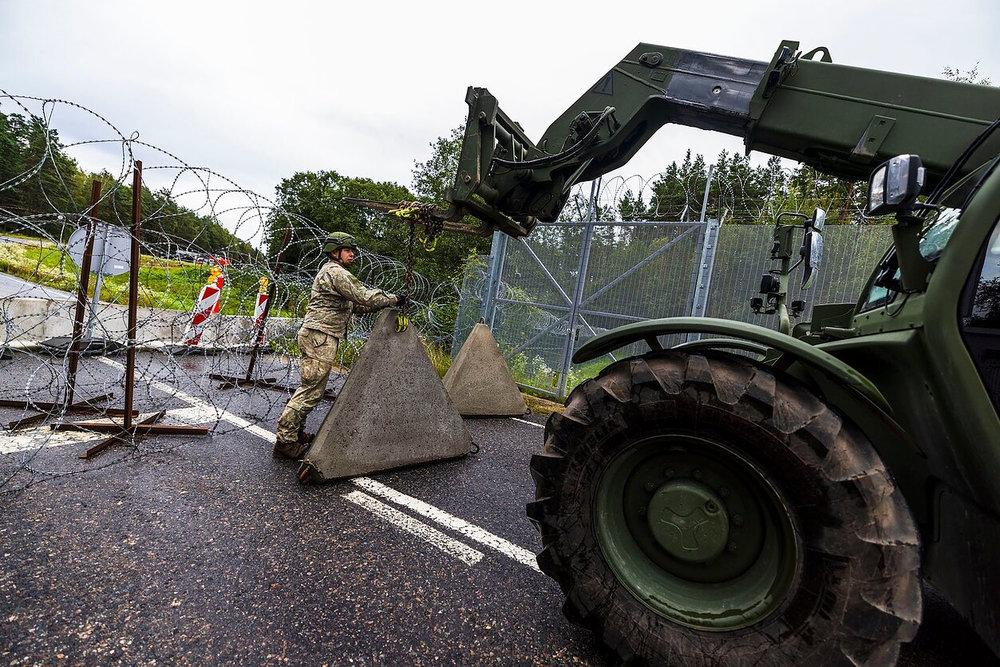
Lithuanian soldier installs concrete barriers and razor wire across a road during a civil defense exercise.

Russia may expand hybrid attacks against Poland and the Baltic states, including infrastructure sabotage or false-flag attacks, Bloomberg reported on 12 August, citing an unnamed European intelligence official. 

The warnings come amid concern that Moscow wants to intimidate Ukraine’s supporters. The CIA warning follows Russian threats, incursions, alleged sabotage plots, and disinformation against Poland and the Baltic states. Most Western military aid reaches Ukraine through Poland, while the Baltic states rank among Kyiv’s strongest supporters. Sabotage of transport, energy, or communications can slow aid delivery and test NATO while hiding Russia’s role.

Separately, a European government official told Bloomberg that the CIA had warned countries in the region of a possible future Russian attack. The CIA declined to comment.

The same official said Russia might instead be creating the impression of an impending attack to sow fear as part of an information operation. The official saw no signs that Moscow was preparing a conventional attack or invasion.

Moscow tests NATO’s eastern flank

Poland and Lithuania had already raised similar concerns. In July, Poland said it had credible intelligence that Russia was planning new provocations. Lithuania later warned that Moscow might rebuild captured Ukrainian drones for false-flag strikes on critical infrastructure.

In September 2025, between 19 and 23 Russian drones entered Polish airspace, shutting down airports and damaging buildings. Poland closed four airports as NATO aircraft responded.

Meanwhile, five people are on trial in Lithuania over attacks allegedly organized for Russian military intelligence in 2024, Bloomberg reported. Lithuania has reinforced infrastructure sites and deployed troops since June.

These warnings and incidents place the CIA alert within a wider pattern of pressure on NATO’s eastern flank and Ukraine’s supporters. 

How Russia strikes without starting a war

Bloomberg cited several recent unexplained drone incidents in Germany alongside the CIA warning. Citing Die Zeit, Euromaidan Press reported that an explosive-laden drone struck the wing of a parked Ukrainian An-124 at Leipzig-Halle airport and failed to detonate. A US Defense Department official in Europe told CNN that Washington assessed the drone belonged to Russian intelligence. 

Bloomberg also reported that a cargo plane hit an unidentified object and that drones appeared over a military base the following day. It did not connect either incident to Russia.

More broadly, Russian hybrid operations have grown sharply since the full-scale invasion. CSIS found that attacks in Europe tripled from 2023 to 2024, after quadrupling the previous year. Separately, the US Helsinki Commission mapped nearly 150 operations in NATO territory attributed to or suspected of Russia between February 2022 and November 2024.

Retired Lt. Gen. Ben Hodges told Euromaidan Press in February that attacks on ports, railways, and cables can probe routes needed for NATO reinforcements. Their deniability raises the political cost of responding.

By hiding its role, Moscow can disrupt support for Ukraine and test NATO without openly starting a war. 

  • ✇Euromaidan Press
  • Tree lines out, swamps in—Lithuania rethinks how to stop Russian armor at the border
    Lithuania's government approved an expanded plan on 12 August to fortify its borders with Russia and Belarus against a possible attack, LRT reports. Lithuania, a Baltic state and NATO member, sits wedged between Russia's Kaliningrad exclave and Belarus. The decision opens a new counter-mobility belt reaching inland from the border, a 20-meter strip that widens to 150 meters where the army marks out areas for operations. The buildout answers a fear that has gripped the B
     

Tree lines out, swamps in—Lithuania rethinks how to stop Russian armor at the border

13 août 2026 à 07:20

745 km² recaptured ukraine's eight-month oleksandrivka counteroffensive kyiv says · post lithuania's border belarus 2016 commons/petr magera lithuania-belarus state 2021 ukraine news ukrainian reports


Lithuania's government approved an expanded plan on 12 August to fortify its borders with Russia and Belarus against a possible attack, LRT reports. Lithuania, a Baltic state and NATO member, sits wedged between Russia's Kaliningrad exclave and Belarus. The decision opens a new counter-mobility belt reaching inland from the border, a 20-meter strip that widens to 150 meters where the army marks out areas for operations.

The buildout answers a fear that has gripped the Baltics since Russia's full-scale invasion of Ukraine in 2022: that a Russia left unchecked in Ukraine could turn on them next. Western intelligence agencies have warned for years that Moscow could eventually threaten NATO itself, and former CIA director David Petraeus has singled out Lithuania as the likeliest first target, pinned between Kaliningrad and Belarus and sitting beside the Suwałki Gap, the thin land corridor that is NATO's only overland route to the Baltic states.

The decision raises the number of engineering parks, storage depots for obstacles like concrete blocks and roadblocks, from 27 to 50, and gives that work until the end of 2028, more than three years past the original April 2025 target. The state rail company LTG Infra is to store the equipment. The changes could cost an extra €50 million ($58 million) from the State Defense Fund between 2026 and 2030.

baltic- states
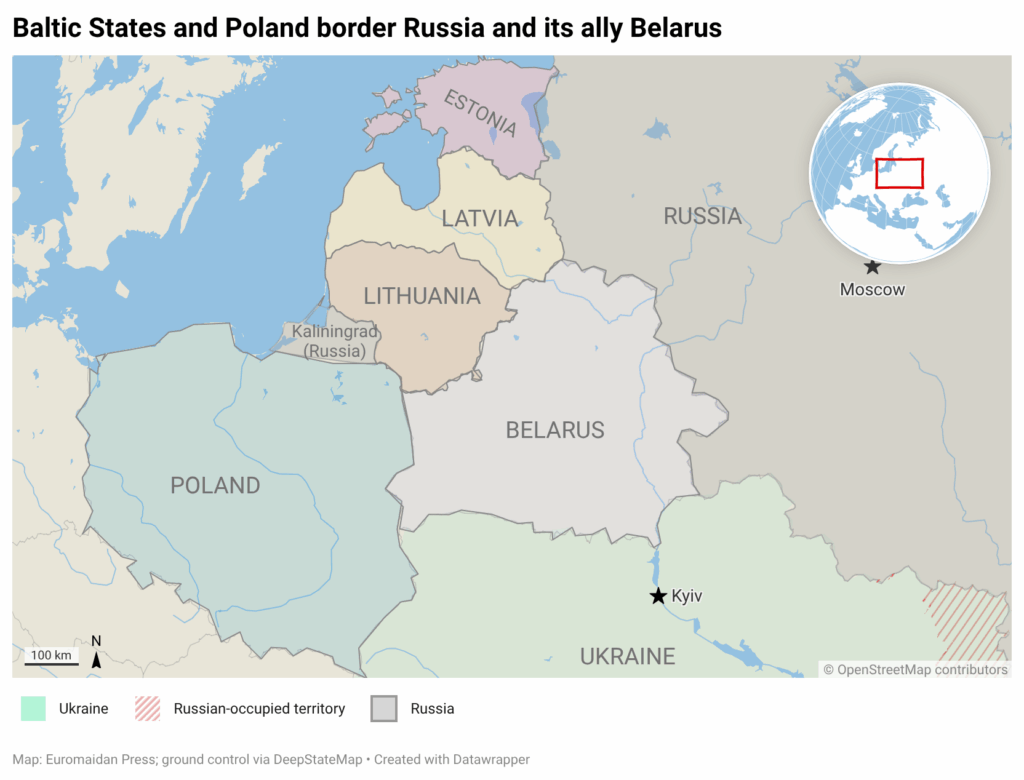
The Baltic region. Map: Euromaidan Press

Of the Baltic states and Poland fortifying their eastern borders, Lithuania is the most at risk yet the least fortified, according to a satellite review by open-source analyst Clément Molin, even as Belarus keeps testing that border with engineered migrant crossings. The plan is Lithuania's share of the Baltic Defense Line, the joint barrier it launched in 2024 with Latvia and Estonia, alongside Poland's parallel East Shield.

The design comes straight from Ukraine. Lithuania began building counter-mobility parks in 2023, drawing on Russia's war against Ukraine, and much of what it is now putting into the ground, the swamps, ditches, and obstacle fields, was tested first on Ukrainian battlefields, where mud, water, and simple barriers have repeatedly stalled armored advances.

The restored swamps should make some ground impassable to heavy military vehicles within a few years, the Defense Ministry says, with that work due by the end of 2030. Plans for defensive ditches and streams in the Marijampolė municipality were dropped, and the ministry found better sites in the Vilkaviškis and Šakiai districts. Deadlines for obstacles on roads and bridge approaches, and for fitting bridges with holders for explosives, were also moved to the end of 2028.

"Military counter-mobility is an important part of Lithuania's defence preparedness," Deputy Defense Minister Tomas Mikelkevičius said. "We seek to make the best possible use of Lithuania's terrain and engineering measures to impede an adversary's movement if necessary and create more favorable conditions for our armed forces to operate."

Lithuania approved its first counter-mobility plan in July 2024. The plan's original 2024 estimate put the full system at around €600 million ($690 million) over the decade.

Russia's pressure on the Baltic borders

The buildout lands amid steady friction along NATO's eastern edge. Latvia has absorbed the bulk of the migrant crossings funneled from Belarus, and this week found its first used smuggling tunnel under the border. Estonia has switched on the first sensors of a planned drone wall along its Russian frontier and is reallocating €500 million ($575 million) toward air defense and long-range strike. Russia, for its part, has shut seven rail crossings with Latvia, Estonia, and Finland without explanation.

The fortification drive is a bet on time. Estonia's military chief has set a two-year clock, warning Russia could be combat-ready again by 2027, and ISW analysts assessed in May that Moscow was manufacturing pretexts for aggression against the Baltics. Poland's parallel East Shield, meanwhile, has gone up far slower than promised, leaving the region's defenses still thin where the threat is judged greatest.

Putin Visits Islands Seized From Japan in World War II, Angering Tokyo

13 août 2026 à 18:38
Prime Minister Sanae Takaichi of Japan has been a public critic of Mr. Putin, who has denounced her country’s sanctions against Russia over the Ukraine war.

© Pool Sputnik Kremlin, via Associated Press

Russia pulled its fleet back to Novorossiysk to keep it safe. Ukraine hit it there with 15 kinds of weapons at once

13 août 2026 à 06:06

sea drones jet neptune missiles hit one russian port single night · post nasa firms shows fires detected around novorossiysk 12 2026 ukraine news ukrainian reports

Ukraine struck the Novorossiysk naval base in Russia's Krasnodar Krai overnight on 12 August, and for the first time coordinated more than 15 different strike systems in a single operation, President Volodymyr Zelenskyy said. The package combined Palianytsia jet drones, Neptune anti-ship missiles and naval drones, hitting warships, air defenses and oil infrastructure at the Black Sea Fleet's main base.

Novorossiysk is the refuge Russia's fleet fled to after Ukrainian drones and missiles pushed it out of occupied Crimea. Reaching its warships there with a mixed salvo — and getting through air defenses that bystander footage showed firing heavily — is the operational read the strike carries, more than any single ship damaged.

The systems and the targets

Zelenskyy named more than a dozen systems that worked together for the first time, from the Palianytsia and Peklo drones to the long-range Neptune and a set of naval drones. He thanked weapons developers for the added reach, framing the coordination itself as the milestone rather than the results.

The Security Service of Ukraine (SBU) confirmed hits on two Kalibr-carrying frigates, the Admiral Essen and Admiral Makarov, and the patrol ship Vasily Bykov. The same strike hit an S-300 radar, a firing position on one of the port's piers, the Sheskharis oil terminal and three of the harbor's berths — a target list wider than the ships alone.

How many ships

The three Ukrainian accounts agree on the two frigates but not on the full tally. The General Staff counted four warships, adding a Buyan-M missile ship to the SBU's three. Zelenskyy separately cited a large landing ship and a corvette among the vessels hit.

Independent analysts who reviewed satellite imagery told The Maritime Executive the damage did not appear catastrophic, with no ships visibly burning or sinking. Ukraine's General Staff said the assessment is still under way.

The fleet's shrinking refuge

The strike extends a campaign that has driven Russia's fleet eastward without Ukraine fielding a navy of its own. Having lost safe basing in Sevastopol, Russia moved its ships more than 300 kilometers from the front — far from Ukraine, but no longer out of reach.

The operation's footprint reached past the base. Russian authorities in Novorossiysk declared a state of emergency and cut water to the port city, and the strike on the Sheskharis oil terminal hit infrastructure that helps fund the war. Zelenskyy said Ukraine would keep striking such targets, and that Russia alone can end the war it started.

  • ✇Euromaidan Press
  • Ukraine strikes Gazprom’s Salavat refinery again as Russia’s fuel shortages return in 16 regions
    Ukrainian drones struck the Gazprom Neftekhim Salavat oil-refining and petrochemical complex in Russia's Bashkortostan on the morning of 13 August, setting off a fire — the second strike on one of Russia's largest refineries in a month. The repeat hit lands as Ukraine's deep-strike campaign forces Russian refining to its lowest level since 2002 and pushes fuel shortages back into at least 16 regions, where drivers again face queues and sales limits at filling stations.
     

Ukraine strikes Gazprom’s Salavat refinery again as Russia’s fuel shortages return in 16 regions

13 août 2026 à 04:15

Gazprom Neftekhim Salavat

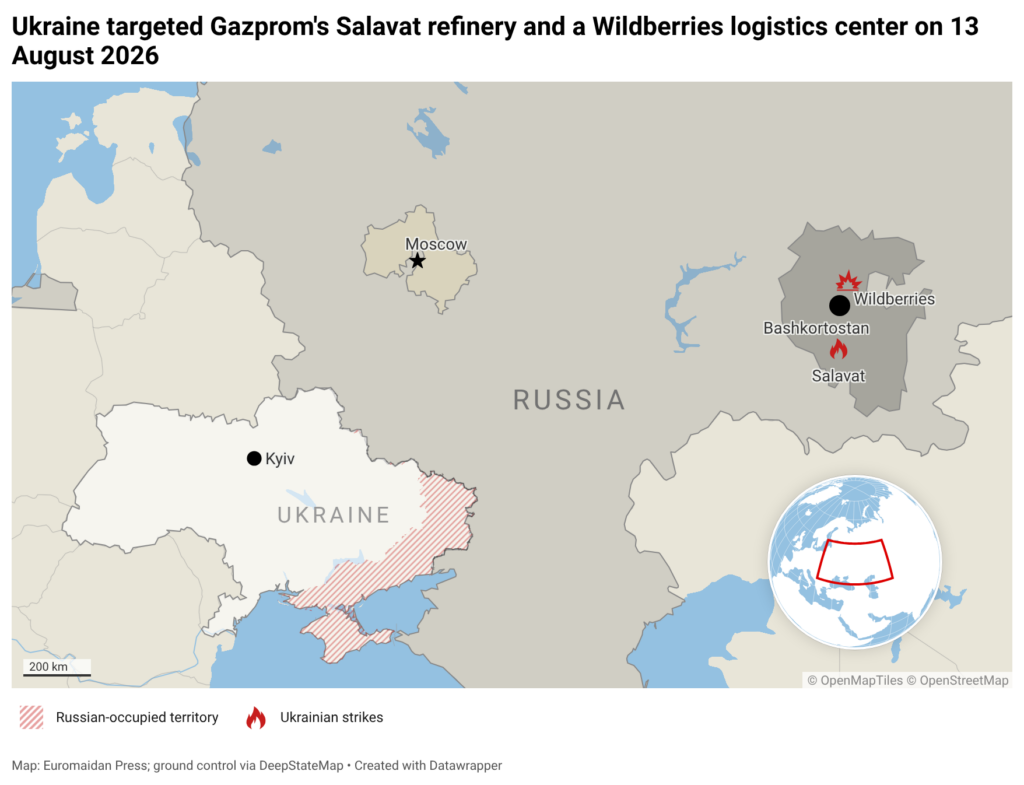
Ukrainian drones struck the Gazprom Neftekhim Salavat oil-refining and petrochemical complex in Russia's Bashkortostan on the morning of 13 August, setting off a fire — the second strike on one of Russia's largest refineries in a month.

The repeat hit lands as Ukraine's deep-strike campaign forces Russian refining to its lowest level since 2002 and pushes fuel shortages back into at least 16 regions, where drivers again face queues and sales limits at filling stations. Striking the same plants faster than Moscow can repair them is the point — each return resets the clock on units that take weeks or months to rebuild.

What happened

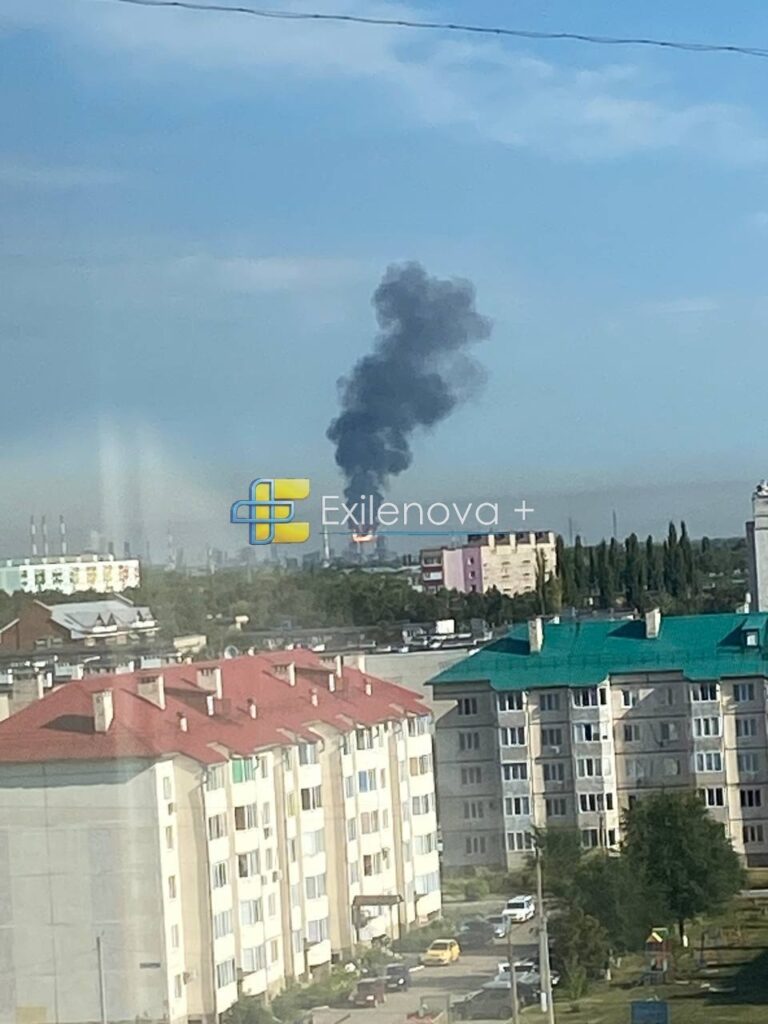
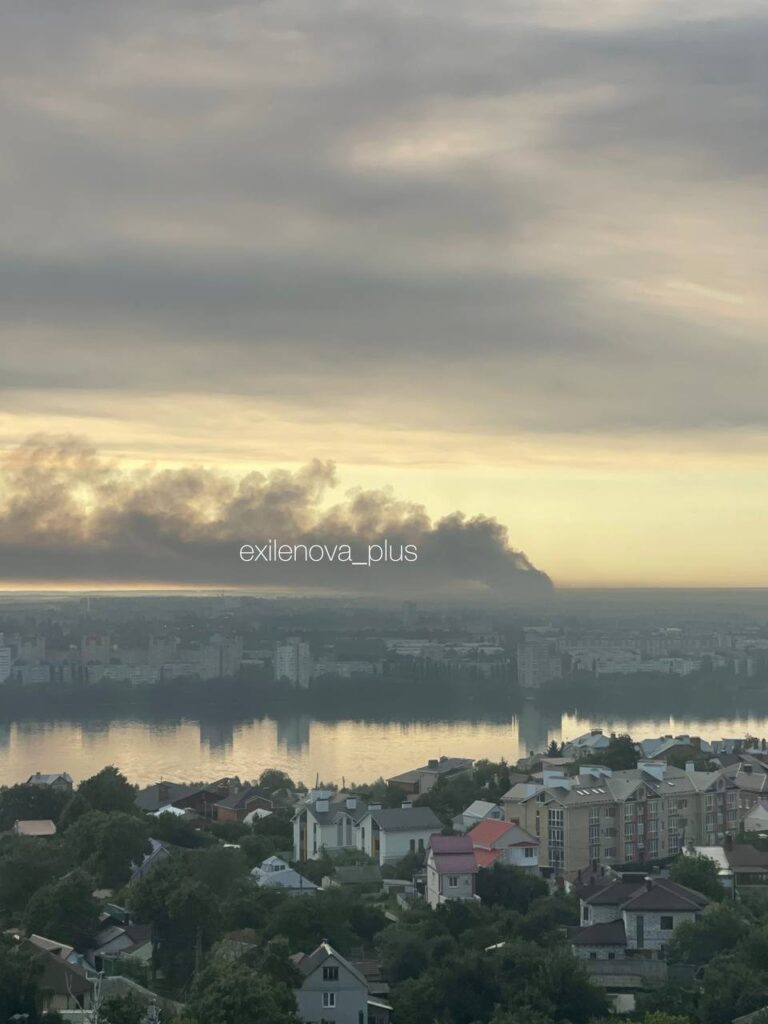
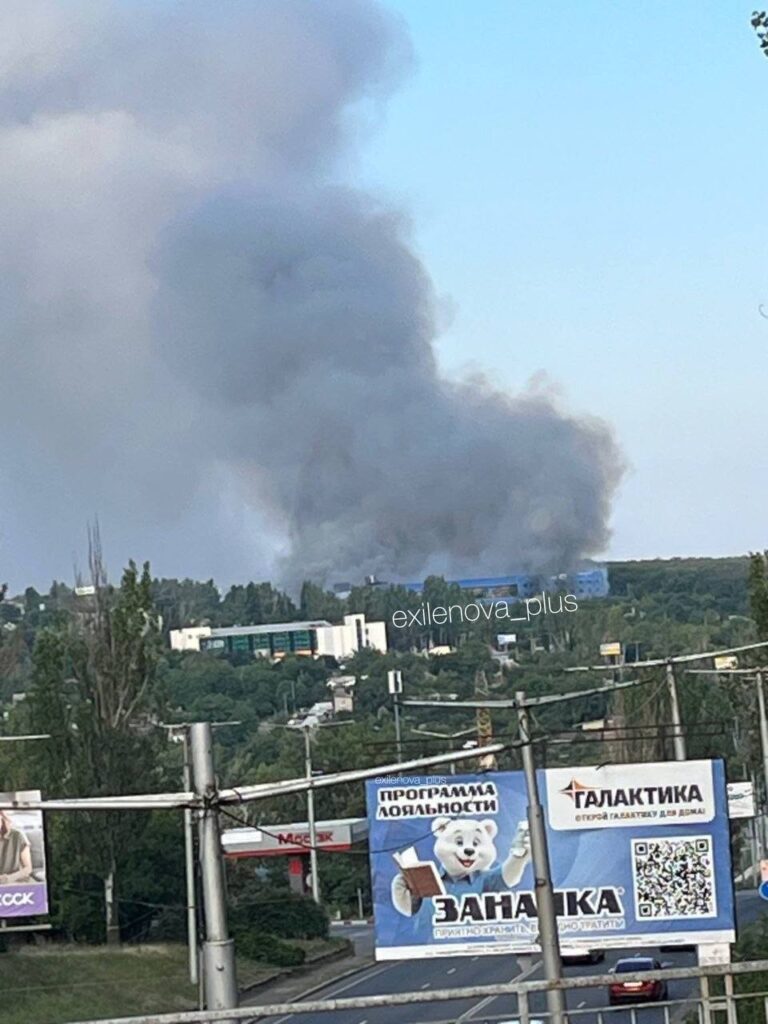
Bashkortostan's head, Radiy Khabirov, confirmed that debris from a downed drone fell in Salavat's industrial zone and sparked a blaze, which he called a "terrorist attack." Ukrainian monitoring channels Exilenova+ and Supernova identified the target as the Gazprom Neftekhim Salavat plant, and residents reported a column of black smoke over the site. Ukraine's military had not commented on the strike.

The complex is one of Russia's largest refining and petrochemical sites. It processed about 7.2 million tons of crude in 2024 — roughly 2.7% of Russia's total refining — and turns out gasoline, diesel, jet fuel, ammonia, and more, according to Reuters, citing industry sources.

Ukrainian drones struck the same plant on 14 July, damaging two primary distillation units and halting operations; industry sources told Reuters the repairs could take weeks to months. Open-source data cited by Radio Svoboda places Russia's only heptyl rocket-fuel producer, the Salavat Chemical Plant, inside the same industrial perimeter, though there is no confirmation it was hit.

A campaign that keeps resetting repairs

Since early August, at least four refineries have stopped processing after Ukrainian strikes, including plants in Orenburg, Tyumen, Saratov, and Volgograd oblasts. Across 2026, attacks have interrupted work at no fewer than 26 refineries, seven of them still offline at the end of July, according to S&P Global.

Russian refining has fallen to about 3.6 million barrels a day, the lowest since 2002, per EA Analytics — the trigger for the fuel crisis now resurfacing. Shortages had eased by late July, but by mid-August residents of at least 16 regions were again reporting queues and sales restrictions, with Ai-92 and Ai-95 grades pulled from some Gazprom and Lukoil stations.

Attack on warehouse Wildberries

Drones also struck a Wildberries logistics center under construction in Bashkortostan's Chishminsky district, according to the monitoring channel Astra.

Wildberries is Russia's largest online retailer. The hub—about 187,000 square meters—has been under construction since 2024 on the grounds of the "Center of Agrotechnologies" agropark.

Coming next summer: the ‘eclipse of the century.’

13 août 2026 à 02:19
The sky will go dark for six minutes or more over landmarks like the Rock of Gibraltar, the casbah of Tangier and the temples of Luxor, Egypt.

© Amir Hamja/The New York Times

Watching the solar eclipse at Washington Square Park in New York in 2024.

Russian Blockade of Major Ukrainian Ports Threatens Global Grain Supplies

13 août 2026 à 06:22
The deadly strikes are part of a long-running maritime battle with Ukraine and echo battles over other key shipping routes around the world.

© Reuters

A vessel struck off the coast of Odesa, Ukraine, last month. The Russian campaign has halted nearly all shipping in and out of the port.

Trump’s Plane Switch Ruse Pales in Comparison With Putin’s Secrecy

12 août 2026 à 17:37
President Trump’s Air Force One subterfuge pales in comparison to the secrecy surrounding Russia’s president, whose fixation on security has reached new heights in recent years.

© Gavriil Grigorov/Sputnik

A Russian state media photo of President Vladimir Putin in his office in the Kremlin last month. The secrecy around Mr. Putin’s movements means journalists have resorted to tracking his activity by assessing the wilting of the plants in his office.
  • ✇Euromaidan Press
  • The Belarus border tunnels reached Latvia—guards turned back the 15 migrants who crawled underground
    Latvia has discovered its first known border tunnel used to enter the country illegally from Belarus, the country’s State Border Guard said on 11 August. Officers intercepted 15 people who had crossed through the underground passage and returned them to Belarus. Latvia, Lithuania, and Poland accuse Belarus and Russia of directing migrants toward their borders to retaliate for EU sanctions and strain countries supporting Ukraine. Minsk and Moscow deny orchestrating the c
     

The Belarus border tunnels reached Latvia—guards turned back the 15 migrants who crawled underground

12 août 2026 à 12:48

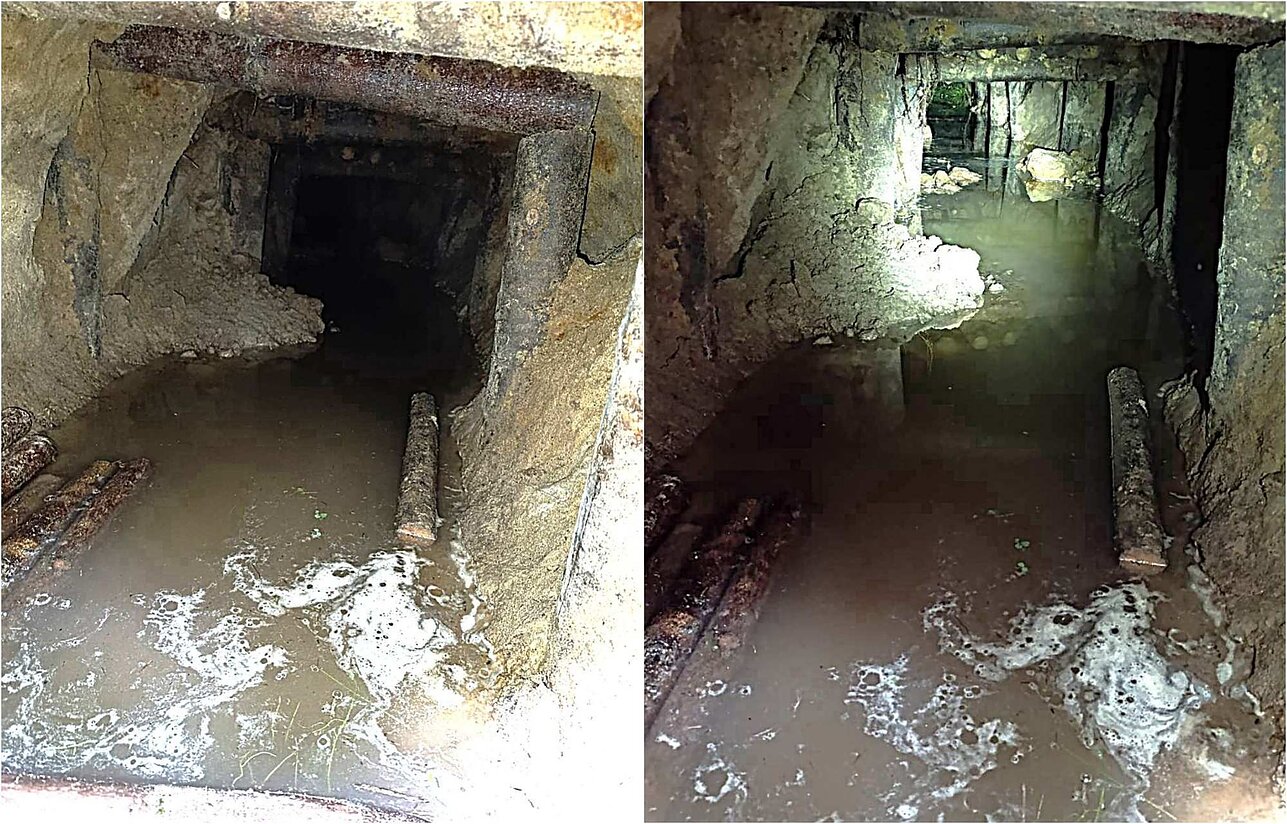
A flashlight illuminates the narrow entrance to a tunnel dug beneath the Latvia–Belarus border.

Latvia has discovered its first known border tunnel used to enter the country illegally from Belarus, the country’s State Border Guard said on 11 August. Officers intercepted 15 people who had crossed through the underground passage and returned them to Belarus.

Latvia, Lithuania, and Poland accuse Belarus and Russia of directing migrants toward their borders to retaliate for EU sanctions and strain countries supporting Ukraine. Minsk and Moscow deny orchestrating the crossings. Tunnels found in Lithuania and Latvia show organizers adapting to fortified borders, requiring Baltic governments to deploy more personnel and surveillance technology.

The tunnel was about 10 meters from Latvia's fence

Border guards found the group on 10 August in Skrudaliena parish, in Latvia’s southeastern Augšdaugava municipality, and briefed the public on the discovery the following day. The operation involved the State Police, a Lithuanian border-service dog handler, and a rapid-response unit, the Latvian Border Guard said.

While reconstructing the group’s route, officers found the passage near the Silene border post, about 10 meters from Latvia’s fence. The agency said it had received intelligence that a tunnel might be under construction, but had previously found no sign of a breach there.

Riga answered on 11 August 2026 by launching Operation Vilkatis, or “Werewolf,” scheduled to run through the end of August. The government says the operation will improve intelligence-sharing among border guards, police, the military, and security services. It will also expand aerial surveillance and target networks that transport and shelter migrants after they cross.

belarusian tunnel eu almost done lithuania drilled hole exactly wrong place—for diggers · post unfinished dug belarus toward lithuanian territory varėna district туннель ведущий из беларуси на территорию литвы vsat
Explore further

The Belarusian tunnel to the EU was almost done. Then Lithuania drilled a hole in exactly the wrong place—for the diggers

Latvia faced 87% of all crossing attempts along the EU-Belarus border by mid-July 2026

Belarus has weaponized migration since 2021, when EU governments accused Alyaksandr Lukashenka’s regime of bringing people from the Middle East and Africa to the bloc’s frontier in retaliation for sanctions. Belarus denied orchestrating the crisis.

Latvia reported more direct evidence in January 2026. Documents and phones taken from detained migrants linked Belarusian military and border personnel to organized crossings, according to Latvia’s armed forces and Border Guard.

By 13 July, Latvia had recorded 7,791 attempts over 111 consecutive days, 87% of all attempts along the EU-Belarus border by then. Lithuania later found an unfinished tunnel dug from Belarus. Latvia’s tunnel, unlike the unfinished Lithuanian passage, had already been used.

  • ✇Euromaidan Press
  • Newer drones haven’t dethroned the FPV, and Russia fears our bomber drones, Ukrainian commander says
    Ukraine's first-person-view (FPV) drones are not being displaced by newer unmanned systems, a Ukrainian officer told Ukrinform. They remain a central tool for precision strikes, while Ukrainian forces claim a separate advantage in larger bomber drones. Unmanned systems have become a defining weapon of Russia's war against Ukraine, and both sides race to out-innovate each other, a contest in which a cheap UAV can down a platform costing dozens of times more. FPVs re
     

Newer drones haven’t dethroned the FPV, and Russia fears our bomber drones, Ukrainian commander says

12 août 2026 à 10:16

A Ukrainian soldier with a drone on the frontline. Photo: General Staff via Facebook

Ukraine's first-person-view (FPV) drones are not being displaced by newer unmanned systems, a Ukrainian officer told Ukrinform. They remain a central tool for precision strikes, while Ukrainian forces claim a separate advantage in larger bomber drones.

Unmanned systems have become a defining weapon of Russia's war against Ukraine, and both sides race to out-innovate each other, a contest in which a cheap UAV can down a platform costing dozens of times more.

FPVs remain central

"Since FPVs appeared in service, they have become a leading means of precision engagement. This trend will continue," said Captain Anton Bobrovskyi, who commands a company training unmanned-systems specialists at the 199th Training Center of the Air Assault Forces.

Bobrovskyi conceded that Russia also uses drones effectively and that Ukraine learns from it, but said Ukraine keeps a lead in one category: bomber drones.

The Russian Sokol-I anti-drone UAV. Source: The 57th Separate Motorized Infantry Brigade
Explore further

Ukrainian drone that downed Russia’s rarest spy UAV just bagged its anti-drone interceptor too

Ukraine's bomber-drone advantage

Russian forces fear Ukrainian bomber drones, according to Bobrovskyi. He said Ukraine outmatches Russia many times over in such systems, and that Russian troops who encounter one often do not know what to do with it.

The distinction matters because bomber drones work differently from single-use FPVs. Rather than flying into a target and exploding, larger bomber drones carry and release munitions, then fly on. Euromaidan Press has documented the growing role of these systems, including reusable platforms capable of returning to base after dropping their payloads. Developers have also adapted them to fly through Russian electronic warfare, with upgraded Vampire drones built to resist jamming.

sea drones jet neptune missiles hit one russian port single night · post fire burns novorossiysk early hours 12 2026 пожежа у новоросійську ніч проти серпня фото exilenova+ ukraine news
Explore further

Sea drones, jet drones, and Neptune missiles hit one Russian port in a single night

Bobrovskyi said Ukraine's advantage does not mean Russia lacks comparable technology. Instead, he argued that Ukrainian forces and society initiated many of the current battlefield drone trends and have kept the initiative in using them.

Each new drone class draws a countermeasure, so the side that keeps iterating fastest holds the battlefield initiative. How long Ukraine's bomber-drone edge lasts will depend on its ability to keep protecting and upgrading those platforms.

  • ✇Euromaidan Press
  • Crude goes south, gasoline north—Ukraine’s strikes split Russia’s oil trade
    Ukraine’s sustained drone strikes on Russian refineries have reversed the country’s position as a net fuel exporter. Moscow now imports gasoline from as far as India and Morocco while rushing crude oil through the Arctic to reach Asian buyers it can no longer supply with finished fuel. The flows are scaling up—and running on the same sanctioned, EU-listed tankers.The reversal is tightening global fuel markets. Russia runs the world’s third-largest refining industry, and th
     

Crude goes south, gasoline north—Ukraine’s strikes split Russia’s oil trade

12 août 2026 à 07:25

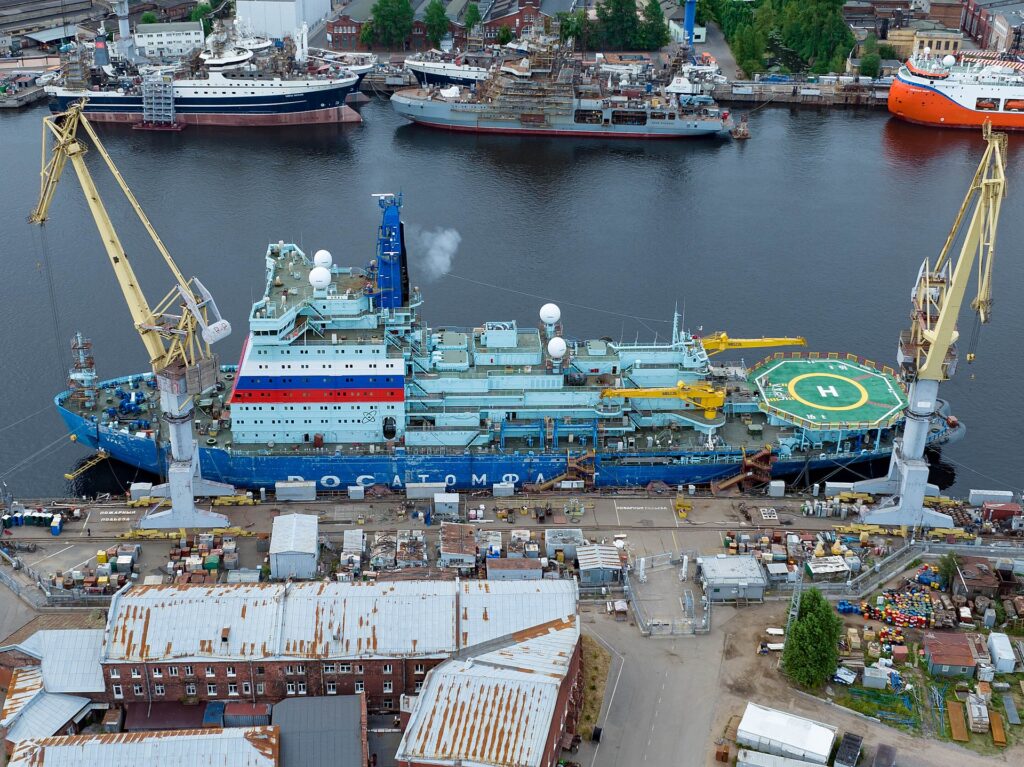
nuclear-powered icebreaker ural at the baltic shipyard in st petersburg

Ukraine’s sustained drone strikes on Russian refineries have reversed the country’s position as a net fuel exporter. Moscow now imports gasoline from as far as India and Morocco while rushing crude oil through the Arctic to reach Asian buyers it can no longer supply with finished fuel. The flows are scaling up—and running on the same sanctioned, EU-listed tankers.

The reversal is tightening global fuel markets. Russia runs the world’s third-largest refining industry, and the combined disruptions have acted to squeeze supply worldwide, with Moscow banning exports of both gasoline and diesel to keep its own pumps supplied.

With refining at a 24-year low, Russia is exporting crude through the Arctic while importing refined fuel from India.

Russian refining falls to its lowest since 2002

Ukrainian drone strikes have driven Russian crude processing to 3.6 million barrels a day in July—its lowest level since 2002 and roughly a third below the seasonal norm, according to EA Analytics data cited by Bloomberg.

tanger med, the cargo port of tangier in morocco
Explore further

Ukraine’s drones force oil-giant Russia to import gasoline—now from Morocco


Ukraine hit at least 24 of Russia’s 34 largest refineries in some 50 strikes, with five more struck last week and at least two this week. With refining at a 24-year low, Russia is exporting crude through the Arctic while importing refined fuel from India.

Fuel shortages and rationing now affect about 50 million people—a third of Russia’s population. Moscow is subsidizing both the damaged refineries and the imported fuel replacing their output.

utrenneye or salmanovskoye port on the northern sea route in the far north of russia
A jetty serving the Utrenneye (Salmanovskoye) field extends into Ob Bay in Russia’s Far North. The port is along the Northern Sea Route, which Russia is increasingly using to ship crude to Asia. Photo: SlavaGol/Wikimedia Commons, CC BY-SA 4.0

Sanctioned tankers take crude toward the North Pole

Seven tankers carrying about six million barrels of crude were heading to Asia through the Northern Sea Route as of 11 August. That volume already amounts to nearly half the approximately 13 million barrels the route carried during the entire 2025 season.

The route cuts two weeks off the voyage to China compared with the Suez Canal, and ice conditions are relatively mild this year, one trader told Reuters.

But speed is only part of the surge. Tankers on the Arctic route bypass European waters, where enforcement has led to inspections and detentions of sanctioned vessels, and Ukraine’s strikes on Black Sea shipping and the Iran–US standoff at Hormuz have narrowed the alternatives.

Vessel-tracking data show the convoy following a route north of the Severnaya Zemlya archipelago rather than through the traditional and more southern Vilkitsky Strait—putting sanctioned oil tankers within 500 nautical miles of the North Pole. Maritime experts said commercial traffic at this scale has never operated that far north.

rosneft controlled nayara energy refinery at vadinar, gujarat, india
The Rosneft-controlled Nayara Energy refinery at Vadinar, Gujarat, India. Photo: AgarwalSimran / Wikimedia Commons, CC BY-SA 4.0

Russian crude returns home as Indian gasoline

In the opposite direction, gasoline refined from Russian crude at Nayara Energy’s Vadinar refinery in western India is flowing back to Russia through a chain of ship-to-ship handoffs at Egypt’s Damietta Port. At least three cargoes have cycled through the hub since June. The first reached Russia on 5 August.

Bloomberg’s tracking data show the tanker Cyclone loaded 42,000 tons of gasoline at Vadinar on 18 June, transferred the cargo to the Oman-flagged Garnet off Damietta on 6 July, and the Garnet reached Russia in early August. Two more tankers, Varg and Photon, followed the same route in July, with Photon’s cargo handed to the Russian-flagged Talisman on 28–29 July.

All these vessels are under EU sanctions. Garnet and Talisman are also under US sanctions.

Nayara’s refinery, which processes 400,000 barrels a day, is 49% owned by Rosneft. EU sanctions in July 2025 drove away its non-Russian crude suppliers, so the plant switched to processing only Russian oil and now buys and sells through traders—which is how its gasoline reaches Russia without a direct India-to-Russia sale, as Euromaidan Press reported.

The expected September launch of Rosneft’s Vostok Oil project could push more crude through the Northern Sea Route, traders told Reuters. NSR crude shipments fell 4% in 2025. This year’s opening weeks have already matched half the full-season total.

  • ✇Euromaidan Press
  • Sea drones, jet drones, and Neptune missiles hit one Russian port in a single night
    On 12 August 2026, Ukraine targeted Russia's main Black Sea naval base and oil terminal at Novorossiysk overnight. Fires broke out at the port's oil and fleet facilities, two of Russia's largest grain terminals stopped work, and debris damaged homes across the city, according to Ukrainian monitoring channels and local Russian authorities. Ukrainian President Volodymyr Zelenskyy confirmed the operation hours later. Russia's southern coast is where much of the war is paid
     

Sea drones, jet drones, and Neptune missiles hit one Russian port in a single night

12 août 2026 à 06:57

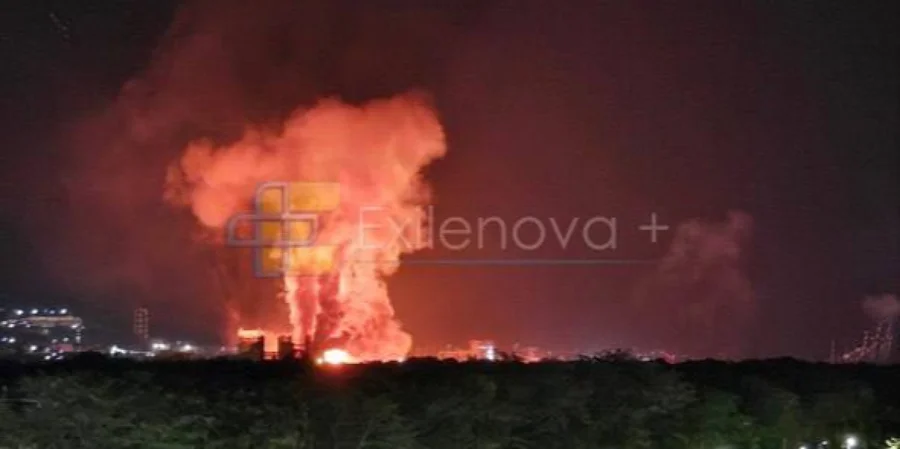
sea drones jet neptune missiles hit one russian port single night · post fire burns novorossiysk early hours 12 2026 пожежа у новоросійську ніч проти серпня фото exilenova+ ukraine news

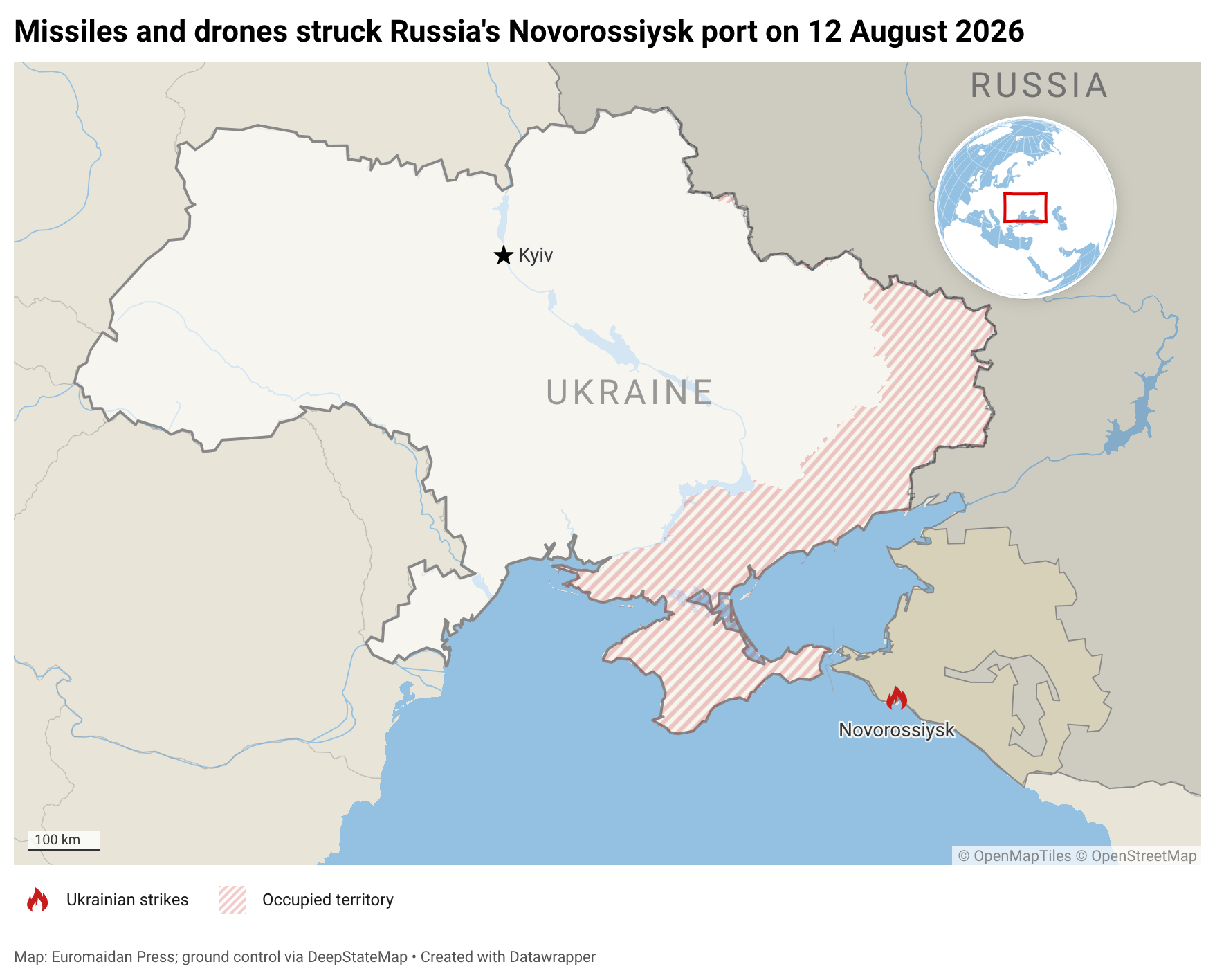
On 12 August 2026, Ukraine targeted Russia's main Black Sea naval base and oil terminal at Novorossiysk overnight. Fires broke out at the port's oil and fleet facilities, two of Russia's largest grain terminals stopped work, and debris damaged homes across the city, according to Ukrainian monitoring channels and local Russian authorities. Ukrainian President Volodymyr Zelenskyy confirmed the operation hours later.

Russia's southern coast is where much of the war is paid for, the loading point for the oil revenue and grain exports that keep the invasion running, and it now sits within reach of Kyiv's long-range weapons.

Kyiv calls it a "unique operation" on the fleet's last big base

Zelenskyy said Ukraine's Defense Forces hit the Novorossiysk naval base overnight on 12 August. The port city is situated more than 350 kilometers from the front line on Russia's eastern Black Sea coast. The Ukrainian president described the assault as a unique operation against the last main outpost of Russia's Black Sea Fleet.

"Our Palianytsia jet drones, Neptune missiles, and naval uncrewed systems precisely struck the designated targets," he said, adding that hits were confirmed on air-defense positions, piers, and seaport infrastructure.

Fires at the Sheskharis oil terminal and the naval harbor

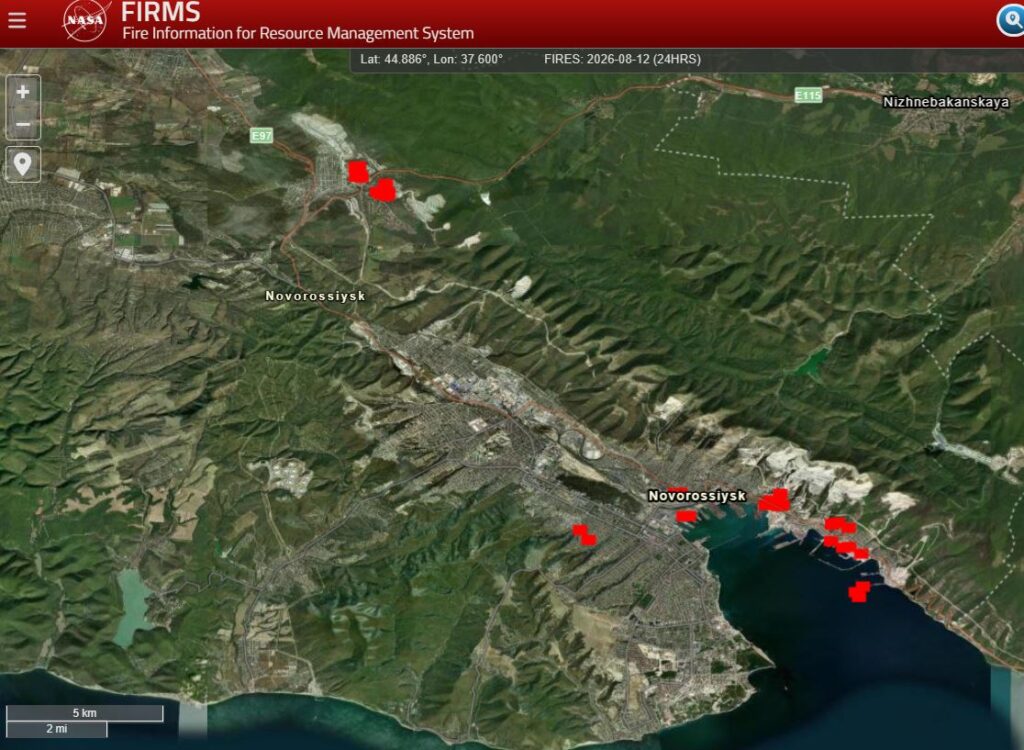
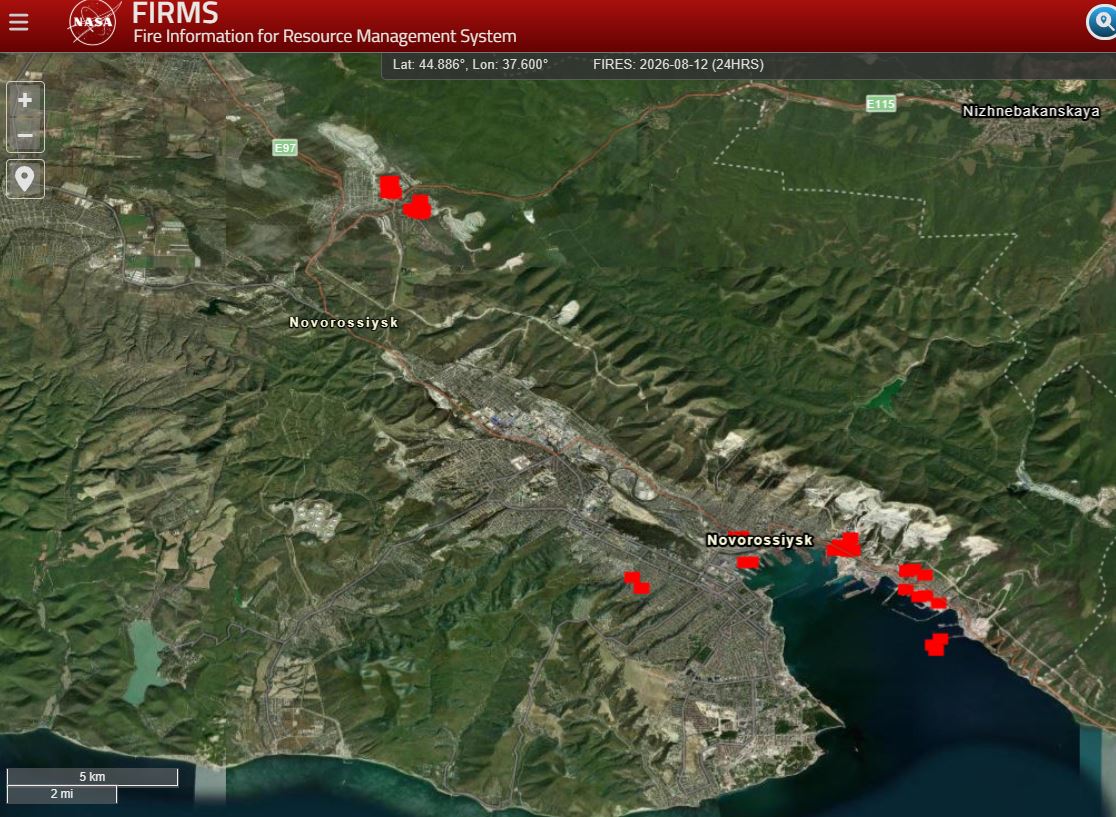
Ukrainian drones hit the oil terminal and the naval base, the Ukrainian defense outlet Militarnyi reported. Its analysis of NASA satellite fire data placed blazes at the Sheskharis complex, where crude loads onto tankers, and near the naval base and fuel-storage tanks.

sea drones jet neptune missiles hit one russian port single night · post nasa firms shows fires detected around novorossiysk 12 2026 ukraine news ukrainian reports
A NASA FIRMS map shows fires detected in and around Novorossiysk on 12 August 2026. Map: NASA FIRMS

Sheskharis is the endpoint of Transneft's main pipelines and a key export point for Russian crude on the Black Sea. Novorossiysk ships 600,000 to 700,000 barrels of oil a day.

The Ukrainian monitoring channel Krymsky Veter said fires broke out near the Sheskharis pier and the military harbor where Black Sea Fleet ships and submarines dock. Russia moved vessels to Novorossiysk after Ukrainian strikes pushed the fleet out of occupied Crimea.

Two grain terminals stop at the world's top wheat exporter

Novorossiysk's two largest grain-handling terminals halted work after the strikes, Reuters reported, citing four industry sources. The world's top wheat seller, Russia sends most of its exports out through Black Sea ports.

The Novorossiysk grain terminal, which can move 8.5 million tons a year, halted work as owner Demetra Holding assessed the damage. NKHP, a terminal handling 7.1 million tons a year, also stopped, its main owner OZK said, adding that no one was hurt. The Ukrainian monitoring Telegram channel Exilenova+ described NKHP, Russia's largest deepwater grain terminal, as one of the sites hit.

novorossiysk

The strikes extend Ukraine's effort to deny Russia the grain and oil revenue that funds the war, a mirror of Russia's own summer campaign against Ukraine's ports: as Moscow strikes Odesa's terminals to choke Ukrainian exports, Kyiv works to shut Russia's own.

A few more videos from Novorossiysk this morning pic.twitter.com/r4zASGtZNc

— Exilenova+ (@Exilenova_plus) August 12, 2026

Russia says its own drone debris damaged homes and killed two

Krasnodar Krai Governor Veniamin Kondratyev claimed several hundred drones attacked the region overnight and that falling debris struck 21 residential buildings and four enterprises in Novorossiysk. He claimed two people were killed, including an eight-year-old child, and 13 wounded across the krai, with about 90 residents moved to temporary shelters.

sea drones jet neptune missiles hit one russian port single night · post smoke rises over novorossiysk after ukrainian strike black 12 2026 video exilenova+ удар по новоросійську серпня року
Smoke rises over Novorossiysk after a Ukrainian strike on the Russian Black Sea port, 12 August 2026. Screenshot from a video: Exilenova+

Novorossiysk Mayor Andrei Kravchenko claimed debris hit six residential buildings, a commercial building, and a construction site, and that there were casualties.

The Russian news Telegram channel Astra reported that a café burned on Sukhumskoye Shosse, across the road from the entrance to the Novorossiysk naval base. Astra also found that a strike damaged School No. 15 near the fleet's ship berths.

Part of a widening summer campaign

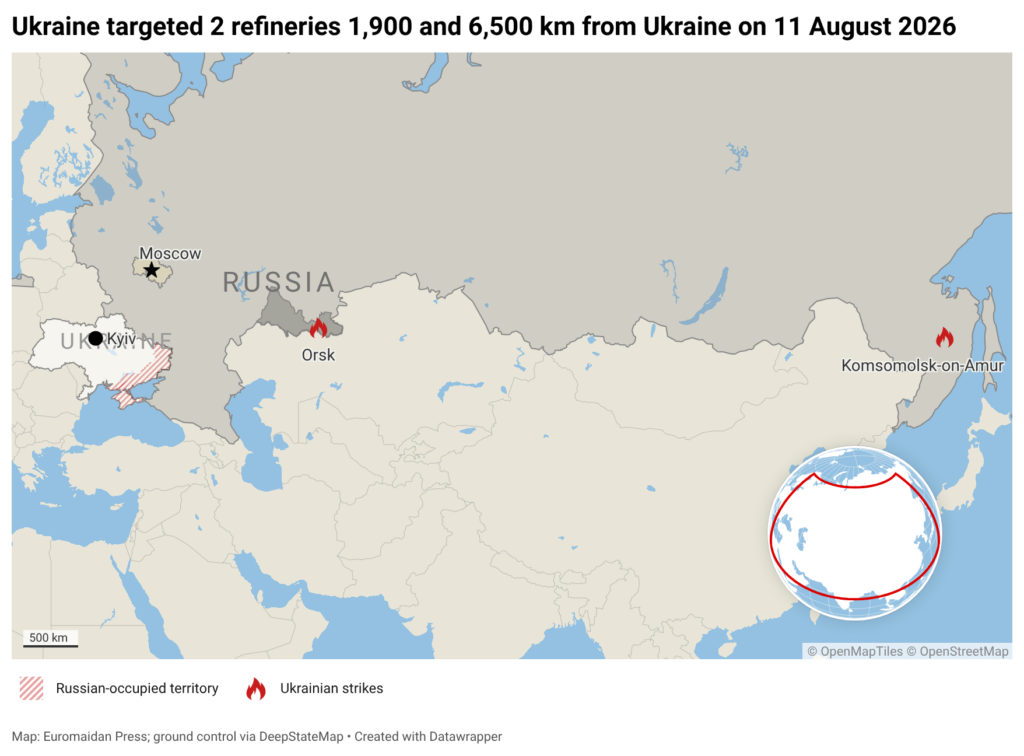
The strike fits a broader Ukrainian effort this summer to carry the war onto Russian soil and drain the Kremlin's ability to fight. A day earlier, Ukrainian drones set a Wildberries logistics complex ablaze near Voronezh and hit an oil refinery in Orsk. Overnight on 10 August, drones struck a petrochemical plant in Tobolsk and a refinery in Tatarstan.

Ukraine’s drone strike shut Russia’s biggest LPG plant as fuel rationing returned in 16 regions

12 août 2026 à 05:12

The ZapSibNeftekhim complex in Tobolsk, Tyumen Oblast, is burning. Source: Supernova

A Ukrainian drone strike shut the plant that produces 40% of Russia’s liquefied petroleum gas on 10 August, and the country’s fuel crisis snapped back across at least 16 regions within days.

The shutdown of the Sibur ZapSibNefteKhim complex in Tobolsk, western Siberia, removes about six million metric tons of annual LPG capacity from a fuel system that was already under strain.

The ZapSibNeftekhim complex in Tobolsk, Tyumen Oblast, is burning. Source: Supernova
Explore further

“This is money of his accomplices burning”: Russian partisans and Ukraine hit Siberian plant tied to Putin’s inner circle


Gasoline restrictions had begun easing across Russia at the end of July, when Ukrainian drones temporarily shifted to other targets. When the strikes resumed in early August, fuel rationing returned immediately, the independent Russian outlet 7×7 reported.

Three industry sources told Reuters on Tuesday that the complex stopped operations indefinitely “while the extent of the damage and its consequences are being assessed.”

No LPG volumes were offered from the Tobolsk delivery point on Russia’s commodity exchange—a point that earlier this year handled about 4,000 metric tons of propane-butane mix per day. Sibur declined to comment.

The shutdown of the Sibur ZapSibNefteKhim complex in western Siberia, removes six million metric tons of annual LPG capacity from a fuel system already under strain.

zapsibneftekhim and tobolsk-polymer in tobolsk
The ZapSibNefteKhim and Tobolsk-Polymer industrial sites in Tobolsk, western Siberia, seen in February 2023. A Ukrainian drone strike shut ZapSibNefteKhim indefinitely on 10 August 2026, taking 40% of Russia’s LPG production offline. Photo: Vyacheslav Bukharov/Wikimedia Commons, CC BY-SA 4.0.

A strike on one unit stopped the entire plant

Tyumen Oblast Governor Aleksandr Moor confirmed a fire at an industrial site following a drone attack but did not identify the facility.

Ukraine’s Special Operations Forces Deep Strike units, working with the Russian insurgent movement Chornaya Iskra (Black Spark), claimed the strike. The plant sits more than 2,200 kilometers from the front line.

Militarnyi’s OSINT analysis identified the specific target as the complex’s central gas fractionation unit—the plant’s entry point, where raw hydrocarbons are separated into usable products before anything else in the production chain can run. About half of ZapSibNefteKhim’s output feeds Sibur’s own petrochemical complex in Tobolsk; the rest goes to market.

Sibur held contracts to supply feedstock to defense-industry enterprises, including the Kamenskiy Kombinat, which produces solid rocket fuel and motors for the Grad, Smerch, and Uragan rocket systems.

Sibur also supplied the Perm Gunpowder Plant, which makes charges for multiple-launch rocket systems, air-defense complexes, and cruise missile boosters, Militarnyi also reported. The Sverdlov Plant and Biysk Oleum Plant, both explosives manufacturers, were also Sibur clients.

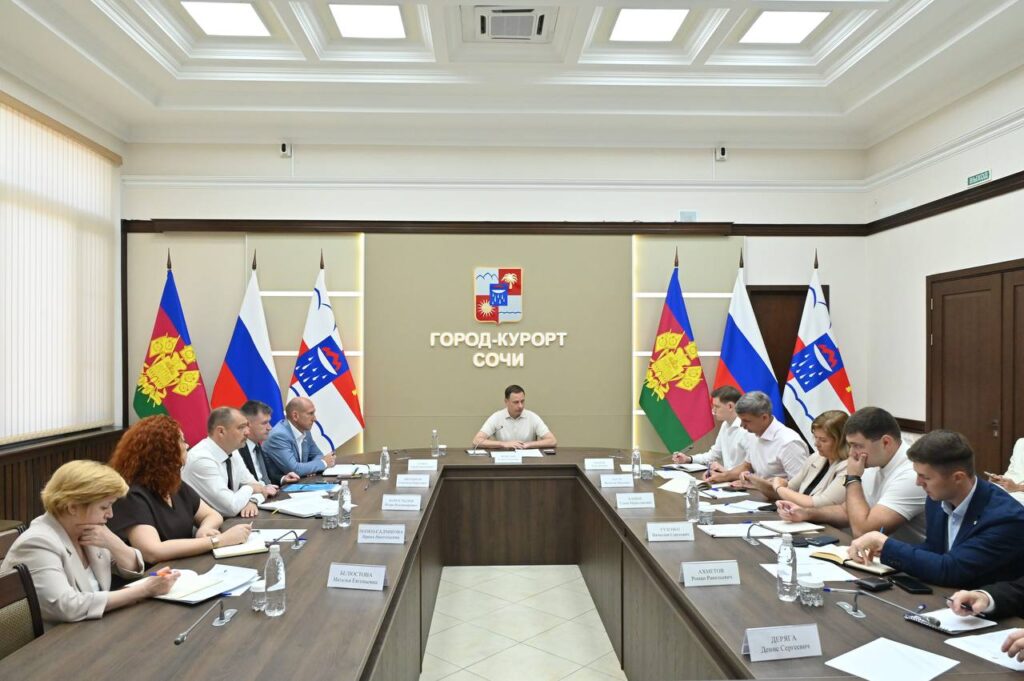
sochi mayor andrei proshuning with city officials
Sochi Mayor Andrei Proshunin meets with city officials as fuel remains available at only 38 of the resort’s 58 gas stations. Photo: Andrei Proshunin/Telegram

Fuel rationing returned within days

Across at least 16 regions, the fuel restrictions that had briefly eased in July are back, 7×7 reported.

In Sochi—Russia’s most famous beach resort—Mayor Andrei Proshunin said on Telegram that fuel was available at only 38 of the city’s 58 gas stations. Deputy Mayor Vyacheslav Bauer told residents and tourists to use public transport or stop driving, the Moscow Times reported.

In Bashkortostan, authorities banned gasoline sales in canisters, leaving at least one resident unable to fuel his lawnmower—as he complained to regional head Radiy Khabirov during a televised address, a Bashkortostan outlet reported. Production at the Ufa petrochemical complex is unaffected by the drone strikes, Khabirov said.

Still, the shortage persists for a different reason: every time a drone-alert protocol is activated, fuel tankers halt en route to gas stations, regional official Elena Prochakovsky explained at a briefing reported by Prufy. Three districts remain in a fuel “red zone,” and 19 of 26 gas stations in Sterlitamak are operating.

Lipetsk Oblast Governor Igor Artamonov told residents not to expect improvement for one to two weeks, Lipetsk outlet Ploshchad reported. “If you can leave 10 liters unfilled, the person arriving on empty will thank you,” he said.

Russia’s fuel system was already breaking

The Tobolsk shutdown lands on an already fractured system. By mid-July, fuel rationing had spread to more than half of Russia’s regions. Ukraine’s drone campaign had struck Russian refineries 194 times in the first half of 2026 alone—eleven times the previous year’s pace—knocking nearly half the country’s refining capacity offline, Ukraine’s General Staff reported on 4 July.

Repair timelines keep slipping because sanctions block the spare parts Russian plants need. To plug the gap, Russia has banned gasoline exports, permitted lower-grade fuel, and begun importing gasoline from India and Morocco, refined from its own crude—shipping it 14,000 kilometers home because its refineries cannot meet domestic demand.

The Tobolsk shutdown removes more LPG output than any single strike of the war. Russia was already rationing fuel in more than half its regions before this strike.

  • ✇Euromaidan Press
  • A bomb-laden drone hit a Ukrainian An-124 in Germany, then lay unnoticed for hours
    Newly analyzed airport camera footage shows a quadcopter drone loaded with Semtex explosive flew straight at a parked Ukrainian An-124 Ruslan cargo aircraft and struck its wing at Leipzig/Halle airport in Germany on the evening of 4 August, the media outlet Die Zeit reported on 10 August. The device bounced off the wing, fell to the ground, and failed to detonate. The drone attacked the aircraft at around 19:30 local time, the media outlet reports. Russia's hybrid a
     

A bomb-laden drone hit a Ukrainian An-124 in Germany, then lay unnoticed for hours

12 août 2026 à 04:29

Ukrainian An-124 at Leipzig Airport in Germany. August 5 August, 2026. Photo: screenshot from Bild video

Newly analyzed airport camera footage shows a quadcopter drone loaded with Semtex explosive flew straight at a parked Ukrainian An-124 Ruslan cargo aircraft and struck its wing at Leipzig/Halle airport in Germany on the evening of 4 August, the media outlet Die Zeit reported on 10 August. The device bounced off the wing, fell to the ground, and failed to detonate. The drone attacked the aircraft at around 19:30 local time, the media outlet reports.

Russia's hybrid attacks are increasingly moving from the information domain into the physical one, including on the territory of other countries. This incident makes sabotage on NATO member states' territory potentially more dangerous if suspicion of Russian involvement is confirmed.

Footage contradicts the warning-shot theory

The drone struck the wing near the fuel tanks, then bounced off the aircraft's surface and fell to the ground. The explosive device also ended up on the ground and did not detonate. The device contained Semtex plastic explosive. Approximately four hours later, a tourist bus driver accidentally noticed it lying on the ground, put his foot on it, and reported the find to airport security.

Video analysis contradicts the earlier theory that the incident may have been intended only as a warning. The nature of the attack indicates an attempt to cause actual damage.

Drone found near a Ukrainian An-124 aircraft in Leipzig, Germany, on 5 August, 2026. Photo: screenshot from Bild video

Investigators examining foreign state involvement

German Interior Minister Alexander Dobrindt suggested that a state actor may have been behind the explosive-laden drone found at the airport. On 7 August, Germany's National Security Council convened under Chancellor Friedrich Merz. Earlier, the United States assessed that the drone discovered at Leipzig/Halle Airport in Germany overnight into 5 August belonged to Russian intelligence, a US Department of Defense official in Europe told CNN.

The cargo aboard the Ukrainian aircraft targeted in the sabotage attempt consisted of military equipment and ammunition that had arrived in Germany from France and was being prepared for further transportation, Süddeutsche Zeitung stated, citing a confidential German police report. However, Germany's Federal Ministry of the Interior denied this claim, according to dpa.

The An-124 Ruslan, struck by the drone, is operated by the Ukrainian company Antonov Airlines. After Russian forces destroyed its main base in Hostomel in 2022, the company has been using Leipzig/Halle airport as a temporary base for its aircraft.

  • ✇Euromaidan Press
  • Romania found two Russian drones bobbing in its sea—and didn’t wait to ask questions
    Russia's war drifted into Romania's Black Sea waters again, and this time the country's military blew the intruders up, acting Defense Minister Radu Miruță said. A vessel near an offshore gas field spotted two floating Russian drones, and army bomb-disposal divers destroyed them. Ukraine confirmed the aircraft were not its own. Wreckage from the air war over Ukraine now keeps turning up on the land and in the waters of nearby NATO states, dragging their forces into a fi
     

Romania found two Russian drones bobbing in its sea—and didn’t wait to ask questions

12 août 2026 à 03:39

romania found two russian drones bobbing its sea—and didn't wait ask questions · post floating aircraft joined run uncrewed systems drifting neighboring countries' land waters знищення дрейфуючого дрона в чорному

Russia's war drifted into Romania's Black Sea waters again, and this time the country's military blew the intruders up, acting Defense Minister Radu Miruță saidA vessel near an offshore gas field spotted two floating Russian drones, and army bomb-disposal divers destroyed them. Ukraine confirmed the aircraft were not its own.

Wreckage from the air war over Ukraine now keeps turning up on the land and in the waters of nearby NATO states, dragging their forces into a fight they never joined.

A ship raised the alarm

Miruță announced the operation on Facebook, sharing a video. Crews working near the gas platform first noticed the drones in the water. Miruță identified both as Gerberas. A coast guard vessel carrying Romanian army sappers then sailed to the scene. The divers found two uncrewed aircraft adrift, along with several other fragments.

The drones lay in Romania's exclusive economic zone, roughly 90 nautical miles (about 167 km) east of Constanța, Militarnyi reported. Miruță said Romania's Defense Ministry then contacted Kyiv: 

"The Ministry of National Defense contacted the Ukrainian partners, who confirmed the systems do not belong to them."

romania found two russian drones bobbing its sea—and didn't wait ask questions · post one drifting spotted black sea before destruction 11 2026 один з виявлених дронів у чорному морі
One of the drifting Russian drones spotted in the Black Sea before its destruction, 11 August 2026. Photo: Romanian Defense Ministry

To protect the shipping route and the work around the platform, the military destroyed the drones in a controlled blast, Suspilne relayed.

Russia designed the Gerbera as a decoy. The cheap foam aircraft forces Ukrainian air defenses to waste time and interceptors, and helps Russian crews locate those defenses. Later, Russia fitted some Gerberas with warheads, turning the decoy into a strike drone. The same model can also carry smaller attack drones or gather intelligence.

Custom Code

The attack on Ukraine

Ukraine's Air Force reported that last night Russia hit Ukraine with an Iskander-M ballistic missile, a Kh-31P anti-radar missile, and Kh-35 guided missiles, plus 138 Shahed-type strike drones — among them jet-powered ones, Gerberas, and Parodiya decoys — fired from several sites inside Russia and from occupied territory. 

The main targets were Sumy Oblast in the northeast and Odesa Oblast, Ukraine's Black Sea coastal region that lies northeast of Romania's shore. By morning, air defenses had downed or suppressed 112 of the drones, though strikes hit 16 locations.

romania knocks third drone its sky 72 hours · post romanian air force f-16 fighting falcon fighter jet lands borcea base 2023 dvidshubnet romanian_f-16_fighting_falcon_lands_at_borcea_air_base_romania ukraine news ukrainian reports
Explore further

Romania knocks a third Russian drone from its sky in 72 hours

Adrift far from any front

The drones surfaced far from any battlefield. Russian uncrewed aircraft have repeatedly drifted into neighboring states during Moscow's attacks on Ukraine. Romania itself has shifted from escorting stray drones to shooting them down.

Neptun Deep is Romania's largest offshore gas project, due to start production in 2027. Bucharest is counting on the field to cut its reliance on outside supply and to feed neighbors that still lean on Russia. The two drones drifted into the waters around it.

  • ✇Euromaidan Press
  • “Faster than originally planned”: Russia wants 292 Starlink-rival satellites by 2027
    Russia is deploying Rassvet satellites, its answer to Starlink, faster than originally planned, Vadym Skibitskyi, Deputy Chief of Ukraine's Defense Intelligence (GUR), told RBC-Ukraine. Moscow aims to expand the network to 292 satellites by the end of 2027 and 924 by 2035, he said. Existing satellites can already provide intermittent connections as they pass over Ukraine. Rassvet could give Moscow an independent alternative to Starlink, which Ukrainian forces rely on
     

“Faster than originally planned”: Russia wants 292 Starlink-rival satellites by 2027

11 août 2026 à 14:04

Employees of Russian company Bureau 1440 work on a Rassvet communications satellite.

Russia is deploying Rassvet satellites, its answer to Starlink, faster than originally planned, Vadym Skibitskyi, Deputy Chief of Ukraine's Defense Intelligence (GUR), told RBC-Ukraine.

Moscow aims to expand the network to 292 satellites by the end of 2027 and 924 by 2035, he said. Existing satellites can already provide intermittent connections as they pass over Ukraine.

Rassvet could give Moscow an independent alternative to Starlink, which Ukrainian forces rely on for battlefield communications and drone operations. Russian forces also used unauthorized Starlink terminals until Ukraine and SpaceX blocked access. Rassvet’s coverage remains intermittent but could eventually support strike drones, prompting Kyiv to consider countermeasures.

Why Russia wants its own Starlink

Ukrainian forces rely heavily on Starlink for frontline communications, drone operations, and command and control. 

Russian forces also relied heavily on unverified terminals until Ukraine and SpaceX blocked them on 5 February. The shutdown disrupted Russian communications and assaults across multiple parts of the front. On 10 August 2026, the SBU said it had dismantled two schemes that registered terminals in Ukraine for transfer to Russian forces.

Rassvet could reduce Russia’s dependence on SpaceX and illicit supply networks. Ukrainian experts have warned that a mature network could also relay data to Russian strike drones.

32 satellites up, 260 to go by 2027

Bureau 1440, the Russian satellite developer behind Rassvet, began testing the network with three satellites in 2023. Three larger prototypes followed in 2024 to test upgraded equipment, including satellite-based 5G technology and laser links between spacecraft. 

Russia launched its first batch of 16 serial Rassvet satellites on 23 March 2026 after manufacturing problems delayed the mission. A second group of 16 followed in July, Militarnyi reported.

In May 2026, Serhii “Flash” Beskrestnov, a defense technology adviser to the President of Ukraine, said each Rassvet satellite then in orbit passed over Ukraine roughly once daily, providing six to 10 minutes of connectivity. He estimated that continuous coverage would require 200–250 satellites. 

  • ✇Euromaidan Press
  • Russia’s tank shield shot down seven drones—Ukraine destroyed the tank anyway
    Russia wants its tanks moving again after two years of Ukrainian drones freezing its armored assaults, the Institute for the Study of War (ISW) reported. Its main bet is a tank-mounted system that fires interceptors at incoming drones. The system worked on at least one tank, but Russia lost it anyway. Since 2022, cheap Ukrainian FPV drones have turned the open approach to any position into ground where armor rarely survives, forcing Russia into slow, infantry-led as
     

Russia’s tank shield shot down seven drones—Ukraine destroyed the tank anyway

11 août 2026 à 12:52

T-72B3A tank equipped with the Arena-M active protection system (APS). Photo: iz.ru/Dmitry Astrakhan

Russia wants its tanks moving again after two years of Ukrainian drones freezing its armored assaults, the Institute for the Study of War (ISW) reported. Its main bet is a tank-mounted system that fires interceptors at incoming drones. The system worked on at least one tank, but Russia lost it anyway.

Since 2022, cheap Ukrainian FPV drones have turned the open approach to any position into ground where armor rarely survives, forcing Russia into slow, infantry-led assaults and years of experiments to armor its tanks against drones.

The shield shot down some drones. Ukraine still killed the tank.

In early August, footage surfaced of Ukrainian drones destroying a Russian tank fitted with the Arena-M active protection system in the Dobropillia sector of Donetsk Oblast. Militarnyi identified the vehicle as a T-72B3A, side number 133, and Militarnyi reported that Ukraine's Security Service (SBU) released the clip. ISW geolocated the footage near occupied Volodymyrivka, east of Dobropillia.

A T-72B3A the moment before a Ukrainian drone strikes.
Explore further

Russia took the cages off its newest tanks. The new Arena-M shield bought them a few minutes.

Dmytro Putiata, a Ukrainian combat drone specialist who posts as kriegsforscherD, spoke with the unit involved. On that tank, Arena-M shot down seven drones before its magazine ran dry, he said.

"Unfortunately, it works," Putiata wrote.

It still wasn't enough. Ukrainian crews finished the tank off with more drones. It took 15 to 20 first-person-view (FPV) drones to kill each vehicle, Putiata said. Footage shows the tank moving with its interceptor cells empty. It was the first time the Arena-M was credited with shooting drones down in combat.

Russia keeps sending tanks into that ground for a reason

Russian forces are experimenting with new technology to restore mechanized maneuver and break out of positional warfare—the static, trench-like fighting that has defined the front, ISW reported. They are fitting tanks with active protection systems to help armor survive in the "kill zone," the open ground where drones and other weapons destroy almost anything that moves.

A BMP-T in 2026.
Explore further

Russia’s weirdest armored vehicle was built to fight infantry. The infantry stopped coming

ISW judged that Arena-M alone cannot shield Russian assaults from the drones, let alone the rest of Ukraine's weapons. Russian commanders have largely kept tanks off the roads because drones kill them faster than factories rebuild them. In these assaults, the tank's job is less to fight than to survive long enough to drop infantry closer to Ukrainian lines. Russia will likely keep trying to restore maneuver even after its late-July mechanized assault in the Dobropillia sector failed, ISW added.

Why Russia wants the shield: the cages don't let tanks fight

The bolt-on armor carries a cost. Cope cages and "turtle" shells weigh tanks down and often jam the turret so the main gun can't aim. That trade-off is part of why Russia wants Arena-M: protection without the bulk, so a tank can still move and shoot. Russia recently sent tanks stripped of the welded cages, carrying the shield instead.

Moment of impact of the T-72B3M tank “133,” equipped with the Arena active protection system and empty countermeasure launcher cells.
Moment of impact of the T-72B3M tank “133,” equipped with the Arena active protection system and empty countermeasure launcher cells. Screenshot from an SBU video.

Arena-M is not new. Active protection systems like it were first built to stop anti-tank missiles, and Russia adapted this one to catch drones. The system's lineage dates back to the late Soviet era, and Russian industry has for years claimed mass deployment that never came. Designers worked on fitting it to T-72B3 and T-90M tanks since at least 2019, yet only single vehicles turned up by 2024—some used to shoot a propaganda film rather than fight.

  • ✇Euromaidan Press
  • North Korean ballistic missile kills 7 steelworkers on their way to shelter, shuts down Zaporizhstal plant
    A Russian ballistic strike on Zaporizhzhia, Ukraine, killed seven employees of the Zaporizhstal steel plant and injured 21 others, Ukrainian steelmaker Metinvest, the plant’s majority owner, said on 11 August. The workers were on their way to a shelter after an air raid alert was announced when the strike hit the industrial site, according to the company.  Metinvest said the attack also damaged energy facilities and infrastructure, as well as the main and auxiliary f
     

North Korean ballistic missile kills 7 steelworkers on their way to shelter, shuts down Zaporizhstal plant

11 août 2026 à 11:44

Inside the Zaporizhstal steel plant. Photo: Zaporizhstal on Facebook

A Russian ballistic strike on Zaporizhzhia, Ukraine, killed seven employees of the Zaporizhstal steel plant and injured 21 others, Ukrainian steelmaker Metinvest, the plant’s majority owner, said on 11 August.

The workers were on their way to a shelter after an air raid alert was announced when the strike hit the industrial site, according to the company. 

Metinvest said the attack also damaged energy facilities and infrastructure, as well as the main and auxiliary facilities of the plant’s coke and blast-furnace operations.

Russia’s ballistic missile strikes leave very little time between threat detection and impact for people to react and reach shelter. Several people have been killed from strikes across the country while on their way to bomb shelters. 

Zaporizhstal shuts down after strike

Metinvest said Zaporizhstal has been completely shut down following the attack, while its other production sites in the city are operating at reduced capacity.

Company specialists are assessing the damage and determining the scope and timeline of repairs. Emergency and restoration work is already underway, according to the statement.

The company said its Zaporizhzhia facilities are civilian industrial sites that employ tens of thousands of people and produce steelmaking and coke-chemical products.

Metinvest said it is providing medical assistance and support to the 21 injured employees and staying in contact with the families of those killed and wounded.

The company's facilities will fly flags at half-mast on 11 and 12 August in mourning for the seven Zaporizhstal workers killed in the attack.

North Korean missiles used against Zaporizhzhia

Ukrainian President Volodymyr Zelenskyy said Zaporizhzhia was targeted overnight with North Korean ballistic missiles, Russian Zircon missiles and guided aerial bombs.

Zelenskyy said the attack was designed to cause maximum damage to civilian infrastructure.

Ukraine's military intelligence said on 5 August that a North Korean missile unit had begun deploying to western Russia, potentially adding up to 120 ballistic missiles and six launchers to Russia's arsenal.

According to Ukrainian intelligence representative Andrii Cherniak, North Korea has supplied Russia with around 150 KN-23 and KN-24 missiles since late 2023, including a recent batch of 40 missiles.

The missiles have been linked to attacks with high civilian casualties, including a July strike on Radushne in Dnipropetrovsk Oblast that killed an entire family.

Ballistic threat is growing

The strike comes as Russia has increasingly relied on ballistic missiles in attacks on Ukrainian cities. Unlike drones and cruise missiles, ballistic missiles travel at very high speeds and are much harder for Ukraine to intercept, particularly because Kyiv has a limited supply of the advanced air defense interceptors needed to counter them, mainly US-made Patriot systems.

Ukraine has reported that most ballistic missiles launched in recent mass attacks have penetrated its air defenses, contributing to severe destruction and civilian casualties.

Russia’s education minister calls it “objective.” A new textbook teaches Ukrainian children that their occupied region is historically Russian

11 août 2026 à 10:00

Covers of Russian “Donbas and Novorossiya” history textbooks for students in grades 5–7.

Russia will introduce two editions of a new regional history textbook series in occupied Ukrainian schools on 1 September 2026. The books present the occupied Ukrainian regions as historically Russian, MOST, a Kherson-based outlet, reported on 10 August.

The new textbooks bring Russia's campaign to erase Ukrainian identity into occupied classrooms, where authorities remove Ukrainian from curricula and replace lessons with Russian ideology, military drills, and firing-range visits. Moscow's Russification campaign extends beyond schools to efforts to change the demographics of occupied Ukrainian territory and re-educate forcibly transferred Ukrainian children.

The new textbook series, entitled "History of Our Region: Donbas and Novorossiya," comprises one edition for grade 5 and another for grades 6–7. The course attached to the books will be compulsory throughout Russia's so-called "new regions," according to the Ukrainian human rights center ZMINA.

"Novorossiya" is an imperial term Moscow uses to claim southern and eastern Ukraine. 

Russia's Education Ministry calls the course "objective" and part of a "unified history of Russia," Meduza reports. Minister Sergei Kravtsov claimed it contains "objective information, rather than the lies that appeared in Ukrainian textbooks."

Replacing the curriculum, then the population

The "Novorossiya" textbook forms part of a broader Kremlin campaign to Russify occupied Ukraine's education, culture, and demographics. 

Since occupying Melitopol, Russian authorities have systematically replaced Ukrainian curricula and textbooks. Older Russian textbooks, issued after Moscow's full-scale war, already depicted occupied Melitopol as part of Russia. 

A 2025 Kremlin strategy requires occupied regions to enter Russia's educational, cultural, and information space. The policy also sets a nationwide target for “All-Russian civic identity” to reach at least 95% by 2036.

35,000 Ukrainian children still missing

Meanwhile, experts estimate that about 35,000 Ukrainian children remain missing and are likely held in Russia or Russian-occupied territory. Yale's Humanitarian Research Lab identified at least 210 facilities used to hold children from Ukraine. The lab found that at least 130 facilities subjected Ukrainian children to pro-Russian cultural, patriotic, or military programs. 

One case shows where such indoctrination can lead. Once listed as missing under occupation, Ukrainian boy Oleksandr Mustiatse later appeared online in a Russian uniform bearing the “Z” invasion symbol, Save Ukraine reported.

  • ✇Euromaidan Press
  • A $300 FPV downs a $20,000 bomber drone. Ukraine tests an EW shield for it
    Ukraine is testing a new electronic-warfare solution to protect heavy bomber drones and unmanned ground vehicles (UGVs) from cheaper FPV drones. The project has reached field testing, with several prototypes sent to military units, RBC-Ukraine reports. Ukraine's war has become a laboratory for the economics of unmanned combat, where a mass-produced quadcopter can take down platforms that cost dozens of times more, forcing both volunteer foundations and defense firms
     

A $300 FPV downs a $20,000 bomber drone. Ukraine tests an EW shield for it

11 août 2026 à 09:27

ukraine tests ew system protect $20000 bomber drones $300 fpvs · post vladyslav “vitamin” electronic warfare specialist serving 141st separate mechanized brigade kirichenko3 news ukrainian reports

Ukraine is testing a new electronic-warfare solution to protect heavy bomber drones and unmanned ground vehicles (UGVs) from cheaper FPV drones. The project has reached field testing, with several prototypes sent to military units, RBC-Ukraine reports.

Ukraine's war has become a laboratory for the economics of unmanned combat, where a mass-produced quadcopter can take down platforms that cost dozens of times more, forcing both volunteer foundations and defense firms to look for asymmetric answers on the electronic side of the front.

$20,000 bomber vs. $300 drone

The gap runs more than 60-to-1. Liuba Shypovych, head of the Dignitas foundation, told RBC-Ukraine that a heavy bomber can cost around $20,000, while an FPV drone capable of damaging or destroying it can cost about $300. Shypovych said the bombers are particularly vulnerable because they are relatively slow and less maneuverable than smaller FPVs, and that shootdowns are becoming increasingly frequent.

ukraine tests ew system protect $20000 bomber drones $300 fpvs · post vladyslav “vitamin” electronic warfare specialist serving 141st separate mechanized brigade kirichenko3 news ukrainian reports
Explore further

A $300 FPV downs a $20,000 bomber drone. Ukraine tests an EW shield for it

Yet Ukraine cannot simply stop using the larger drones. According to Shypovych, they are used to deliver water, food, and ammunition to positions that are difficult or impossible to reach by ground. The military therefore approached Dignitas with a request to protect the platforms, and the team is working on the task together with the company Aura.

The jammer has a problem of its own

Equipping a heavy bomber with electronic warfare creates an unusual technical problem. The bomber needs a communications link with its operator, but the same EW system designed to disrupt an incoming enemy FPV could also interfere with that control channel. The problem extends to UGVs, including platforms used to evacuate wounded soldiers. Shypovych said the goal is to develop EW that can counter hostile drones without cutting the Ukrainian platform's own communications.

A Danish Air Force F-16BM combat trainer aircraft during a training flight. Photo via mil.in.ua
Explore further

NATO shot down drone over Latvia. Russia’s electronic warfare sent it there

From the test range to the first units

Dignitas and Aura are testing the systems at training grounds and have already sent several samples to military units. Shypovych expects the solution to be ready in roughly two months.

The effort comes as Ukraine rapidly expands its use of unmanned ground systems. Kyiv has set a target to contract at least 50,000 UGVs, with robots already taking on logistics and evacuation tasks in high-risk zones. Ukrainian forces have already received 1,028 UGVs through the DOT-Chain Defense marketplace, with the systems handling logistics, evacuation, mine-laying, and combat. Ukrainian Vampire bombers have also been upgraded to shrug off Russian jamming and even hunt the jammers themselves.

  • ✇Euromaidan Press
  • Russia’s Syrian foothold shrinks to a training center as Damascus takes back the airport and a berth
    On 9 August, Russia and Syria signed a memorandum on the reorganization of Moscow’s military presence in the country. For about 18 months, the two countries had been negotiating the status of Russian facilities in Syria. As a result, Damascus will take control of facilities intended for civilian use, including Hmeimim Airport and the fourth commercial berth at the port of Tartus, SANA reported. Russia supported Bashar al-Assad’s regime in Syria. After the dictator’
     

Russia’s Syrian foothold shrinks to a training center as Damascus takes back the airport and a berth

11 août 2026 à 08:52

Illustrative photo. A panorama of Tartus, Syria. Photo: middleeasteye.net

On 9 August, Russia and Syria signed a memorandum on the reorganization of Moscow’s military presence in the country. For about 18 months, the two countries had been negotiating the status of Russian facilities in Syria. As a result, Damascus will take control of facilities intended for civilian use, including Hmeimim Airport and the fourth commercial berth at the port of Tartus, SANA reported.

Russia supported Bashar al-Assad’s regime in Syria. After the dictator’s defeat in 2024, Russian troops began leaving the country en masse, including from military facilities, CNN reports. However, Moscow sought to retain control over two strategic facilities: Hmeimim Air Base near Latakia and the naval base in Tartus. The new memorandum sets out a new format for Russia’s presence in Syria, including at these two facilities.

Russia's bases become training centers within three months

According to the report, Syria will integrate the facilities it receives under the memorandum into the country’s civilian administration. Russian military bases will be converted into joint training centers. The two sides also agreed to review the role of facilities currently used for military purposes.

Also under the memorandum, the countries are to implement these changes within three months. According to the journalists, “the Ministry of Foreign Affairs called the agreement the most important development since talks began about 18 months ago, saying it paves the way for a new stage in Syrian-Russian relations.”

How Russia's influence in Syria grew and then eroded

Since 2015, Russia has engaged in direct military intervention and supplied Bashar al-Assad’s regime with weapons. At the peak of its military activity in Syria, Russia maintained a presence at about 90 military facilities across the country, according to a joint investigation by OSINT groups GeoInsider and SONARROW.

In 2024, Assad lost power and fled to Russia, leaving the status of Russian military bases in Syria uncertain. Although the new government, led by interim President Ahmed al-Sharaa, had been on the opposite side of the Syrian civil war from Russia, it decided not to sever ties with Moscow completely. In 2025, Syria said it wanted Russia “by our side.”

Russian military police in Syria, illustrative image. Photo via Wikimedia

Despite the new government’s “pragmatic” approach to relations with Russia, Moscow’s military presence in Syria gradually began to shrink. Two particularly important strategic facilities for Moscow were the port of Tartus and Hmeimim Air Base. In particular, Tartus is important to Russia because it is Russia’s only naval facility in the Mediterranean. After Assad fled, Moscow began negotiations with Syria over the status of its military facilities.

Oil and sanctions shape the deal

The negotiations over the military bases are not the only contentious issue in Russian-Syrian relations. The issue of Assad’s extradition also featured in talks between Damascus and Moscow after he fled to Russia, per Al Jazeera. On 4 August, Reuters reported that Syria had signaled to Washington that it was prepared to significantly reduce imports of Russian oil amid talks over sanctions relief. Russia has emerged as Syria’s main supplier of oil, with shipments reaching about 60,000 barrels per day this year.

  • ✇Euromaidan Press
  • Seoul says no again to Ukraine’s weapons request as Pyongyang gets ready to send Russia more troops
    South Korea is keeping lethal aid to Ukraine off the table while continuing humanitarian and reconstruction support, Yonhap reported on 10 August. The outlet cited a senior South Korean Foreign Ministry official. South Korea’s response maintains its established policy of providing humanitarian and nonlethal support to Ukraine, but not direct weapons. Seoul previously helped move artillery shells to Ukraine through the United States. While South Korea arms NATO members
     

Seoul says no again to Ukraine’s weapons request as Pyongyang gets ready to send Russia more troops

11 août 2026 à 07:47

Workers unload a South Korean-made K2 Black Panther tank for the Polish army from a trailer at a Polish port at night.

South Korea is keeping lethal aid to Ukraine off the table while continuing humanitarian and reconstruction support, Yonhap reported on 10 August. The outlet cited a senior South Korean Foreign Ministry official.

South Korea’s response maintains its established policy of providing humanitarian and nonlethal support to Ukraine, but not direct weapons. Seoul previously helped move artillery shells to Ukraine through the United States. While South Korea arms NATO members with K2 tanks and K9 howitzers to free up older kit for the Ukrainian front, it still draws the line at any direct transfer to Kyiv. Seoul rejects Ukraine’s purchase requests as North Korea sends Russia ammunition and troops in exchange for money and military technology.

South Korean law bars direct exports of lethal weapons to countries in active conflict, a rule rooted in constitutional principles and Seoul's wariness of antagonizing Moscow and Beijing while managing the threat from the North.

Ukraine is seeking South Korean interceptor missiles for its air defenses. The official neither addressed the request specifically nor formally rejected it:

South Korea’s supply of defense materials to any country has always been carried out in accordance with domestic law,” the official said. Seoul will continue to support Ukraine’s recovery through assistance in energy, infrastructure, healthcare, and education. 

The official also declined to confirm whether Seoul and Kyiv were discussing military support. However, he said Moscow-Pyongyang military cooperation “is directly related to our security and violates the United Nations resolutions” and should stop immediately.

Seoul’s indirect aid stopped short of direct arms transfers

In 2023, Seoul transferred hundreds of thousands of 155 mm shells to the United States under a confidential arrangement. Washington then arranged for them to reach Ukraine, The Wall Street Journal reported.

South Korean exports have also helped NATO members replace weapons sent to Kyiv. Poland bought South Korean K2 tanks and K9 howitzers while transferring older tanks and Polish-built Krab artillery systems to Ukraine.

Yet Seoul rejected Ukraine’s request to buy air-defense systems, radars, and artillery propellant in November 2024. In February 2026, it still limited support to humanitarian and nonlethal aid while considering NATO’s request to help purchase US weapons for Ukraine.

North Korean deployments bring the war closer to Seoul

Ukrainian President Volodymyr Zelenskyy said a decision had been made to deploy 30,000–50,000 more North Koreans to Russia. He warned that they would gain modern combat experience and Russian technology that could later threaten Asian countries. Kyiv wants South Korean air defenses and has offered cooperation on drones.

The South Korean official cited by Yonhap declined to confirm either the reported deployment or Zelenskyy’s statement that Ukrainian and South Korean diplomats were discussing possible cooperation.

North Korea is already believed to have sent approximately 20,000 combat troops and military engineers to Russia’s Kursk region, according to Yonhap. Pyongyang has earned as much as $22 billion from arming Russia, helping it finance conventional and nuclear forces.

The Japanese outlet Kyodo News reported in November 2025 that North Korea had transferred about 6.5 million rocket and artillery munitions in exchange for Russian air-defense, space, and nuclear technologies.  Moscow and Pyongyang’s 2024 mutual defense pact formalized the expanding military relationship.

Workers unload a South Korean-made K2 Black Panther tank for the Polish army from a trailer at a Polish port at night.

Seoul says no again to Ukraine’s weapons request as Pyongyang gets ready to send Russia more troops

  • ✇Euromaidan Press
  • US House takes up Graham sanctions bill targeting Russia’s oil money and shadow fleet
    A bipartisan group of US House members introduced the House version of the Lindsey O. Graham Sanctioning Russia and Iran Act of 2026 on 10 August, advancing the sweeping sanctions package during the chamber's summer recess just days after the Senate passed it. The move puts the bill one chamber from becoming law. If the House passes it, it would hand the president authority to impose tariffs of up to 100% on the biggest buyers of Russian crude and gas—China and India ch
     

US House takes up Graham sanctions bill targeting Russia’s oil money and shadow fleet

11 août 2026 à 06:54

US Senator Lindsey Graham russia sanctions bill senate kyiv 10 2026 presidentgovua

A bipartisan group of US House members introduced the House version of the Lindsey O. Graham Sanctioning Russia and Iran Act of 2026 on 10 August, advancing the sweeping sanctions package during the chamber's summer recess just days after the Senate passed it.

The move puts the bill one chamber from becoming law. If the House passes it, it would hand the president authority to impose tariffs of up to 100% on the biggest buyers of Russian crude and gas—China and India chief among them—and to blacklist the aging tankers of Russia's shadow fleet, the vessels that move sanctioned oil around Western restrictions. The target is the oil revenue that pays for Russia's war on Ukraine, at a moment when Ukrainian deep strikes have already knocked a large share of Russian refining capacity offline.

What the bill would do

The package imposes primary and secondary sanctions on Russian officials, oligarchs, entities propping up Russia's defense-industrial base, and foreign actors that materially aid Moscow's military operations. It targets major Russian banks and the foreign financial institutions that do significant business with them, and it goes after the shadow fleet and sanctions-evasion networks—ships, owners, operators, insurers, and ports that knowingly move Russian oil. The tariff framework, up to 100% on the top five buyers of Russian oil and the top five buyers of its gas, replaces an earlier plan for a blanket 500% tariff, with the US trade representative setting the specific rate for each country. The bill also folds in Iran, extending the Iran Sanctions Act of 1996.

Sanctions could be lifted only if the president certifies to Congress that Russia has signed a peace deal accepted by a free and independent Ukrainian government and has halted hostilities and efforts to subvert Kyiv.

A bill born from a stall—and a death

Graham and Democratic Senator Richard Blumenthal introduced the measure in 2025 with 500% tariffs. It drew more than 80 Senate cosponsors and went nowhere for over a year, as the White House kept it off the floor while betting on negotiations that never delivered. Graham secured President Trump's sign-off, then died on 11 July of an aortic dissection, a day after his last visit to Kyiv. The Senate renamed the bill in his honor and passed it 86-11 on 7 August.

The House is not a rubber stamp

The House text is identical to the Senate-passed version, so the companion functions largely as a whip count—a way for members to signal support before a floor vote expected this fall, once the chamber returns from recess on 31 August. Passage is not guaranteed: some House members have voiced fundamental concerns about handing the president broad tariff powers that could raise costs for US importers and consumers.

  • ✇Euromaidan Press
  • Two Russian refineries burn – Orsk hit by drones 1,500 km out, Komsomolsk ablaze 6,500 km east
    Two Russian oil refineries caught fire on 11 August, but the two incidents tell very different stories. In Orsk, in Orenburg Oblast, drones sparked a blaze that Ukrainian monitoring channels quickly linked to Kyiv's long-range campaign. Meanwhile, thousands of kilometers farther east, a Rosneft plant in Komsomolsk-on-Amur burned for reasons that remain unexplained. A drone strike deep in Orenburg Oblast Early on 11 August, residents of Orsk reported explosion
     

Two Russian refineries burn – Orsk hit by drones 1,500 km out, Komsomolsk ablaze 6,500 km east

11 août 2026 à 05:55

“Orsknefteorgsintez” Orsk Oil Refinery

Two Russian oil refineries caught fire on 11 August, but the two incidents tell very different stories. In Orsk, in Orenburg Oblast, drones sparked a blaze that Ukrainian monitoring channels quickly linked to Kyiv's long-range campaign. Meanwhile, thousands of kilometers farther east, a Rosneft plant in Komsomolsk-on-Amur burned for reasons that remain unexplained.

A drone strike deep in Orenburg Oblast

Early on 11 August, residents of Orsk reported explosions near the Orsknefteorgsintez refinery, and a large fire soon followed. OSINT analysts at the Telegram channel Exilenova+ reported the strike. By their assessment, the drones flew more than 1,500 kilometers from Ukraine's border to reach Orsk. Preliminary findings pointed to damage at the plant's hydrocracking complex. Modernized in recent years, the unit can process 1.6 million tonnes a year.

Russian officials confirmed the attack, though they did not name the target at first. Orsk Mayor Artem Vorobyov urged residents to stay indoors and away from windows. Orenburg Governor Yevgeny Solntsev, meanwhile, activated the "Kovyor" (Carpet) airspace-safety plan across a 100-kilometer radius. Authorities also imposed temporary flight restrictions at the Orsk airport.

"The strike drones covered more than 1,500 kilometers from Ukraine's border to reach Orsk—among the deepest targets yet in the refinery campaign," Exilenova+, via OSINT monitoring

An unexplained blaze in the Far East

Far to the east, the picture is murkier. Around 11:00 local time, residents of Komsomolsk-on-Amur reported a fire near the city's refinery. ASTRA then geolocated the footage to Rosneft's RN-Komsomolsk plant. Notably, Ukrainian analysts cautioned that the fire does not appear to stem from a drone strike. After all, the site sits roughly 6,500 kilometers from Ukraine—far beyond the range of Kyiv's long-range drones. Coverage from the Kyiv Independent, meanwhile, flagged no clear cause.

The plant's press service reported no injuries, as relayed by Russian state agency TASS. Commissioned in 1942, the RN-Komsomolsk refinery has a design capacity of about 8 million tonnes of crude per year. In fact, it supplies more than 60% of the petroleum products across Russia's Far Eastern Federal District. Moreover, it produces gasoline, diesel, marine fuel, and other products for the region.

Ukraine's campaign against Russian oil refineries

The Orsk plant is no stranger to such strikes. Drones previously hit Orsknefteorgsintez on 3 October and 11 November 2025, and again on 29–30 April 2026. Since 2022, Ukraine has widened its deep-strike campaign against Russian oil refineries, fuel depots, and pipelines. Such targets power the Kremlin's army and bankroll the war through oil exports. Increasingly, Russian oil refineries have become the signature target of Ukraine's long-range war. Just the night before, on 10 August, Ukraine's General Staff confirmed a strike on the TANECO refinery in Tatarstan. A fire broke out there, too.

As of publication, Kyiv had not claimed the 11 August Orsk strike. Still, the timing fit a familiar pattern—a long-range campaign aimed at the fuel that keeps Russia's war machine moving.

  • ✇Euromaidan Press
  • Ukrainian drones set a newly opened Wildberries mega-hub ablaze near Voronezh
    Ukrainian drones struck a Wildberries logistics complex in Voronezh Oblast overnight into 11 August, setting off a massive fire at one of the Russian retailer's largest and newest hubs, according to Russian and Ukrainian monitoring channels. Voronezh Oblast Governor Alexander Gusev said one person was killed, a 49-year-old man who was outside during the attack, suffered severe wounds, and died in hospital. Two others were hospitalized, one caught outside and one on the
     

Ukrainian drones set a newly opened Wildberries mega-hub ablaze near Voronezh

11 août 2026 à 04:55

Russia's Voronezh Oblast

Ukrainian drones struck a Wildberries logistics complex in Voronezh Oblast overnight into 11 August, setting off a massive fire at one of the Russian retailer's largest and newest hubs, according to Russian and Ukrainian monitoring channels.

Voronezh Oblast Governor Alexander Gusev said one person was killed, a 49-year-old man who was outside during the attack, suffered severe wounds, and died in hospital. Two others were hospitalized, one caught outside and one on the grounds of the logistics center.

Gusev reported fires at two warehouses in the Novousmansky district, with firefighters containing one blaze across about 16,000 square meters and battling another over roughly 20,000 square meters. Debris also damaged three trucks and a car, he said. Russian outlet Astra and Ukrainian monitoring channels identified the site as a Wildberries complex, which Gusev did not name, placing it at the village of Aleksandrovka.

The struck hub opened fully in late 2025, spans about 152,900 square meters, and can hold more than 90 mn items. Wildberries said it had evacuated staff at its logistics sites across the oblast in line with safety requirements. Gusev claimed Russian air defenses detected and destroyed 15 drones over Voronezh and five districts of the oblast.

The strike is the latest in a widening Ukrainian long-range campaign against Wildberries, described by Ukrainian officials as Russia's answer to Amazon and targeted, President Volodymyr Zelenskyy has said, because the platform helps supply the Russian military with parts for drones and other equipment. Russia rejects the claim.

Ukraine had already hit its 16th Wildberries warehouse in under three weeks by 5 August, when drones set fire to a logistics center in Oleksin, Tula Oblast.

Unmanned Systems Forces commander Robert "Madyar" Brovdi said on 4 August that the campaign had struck 15 sites in 18 days, thirteen of them knocked out of action or seriously damaged. Russian outlet Agentstvo put the count at more than 20 warehouses since mid-July. On 7 August, drones reached a Wildberries hub in Yekaterinburg, more than 1,700 kilometers from Ukraine, and earlier fires hit sites in Moscow Oblast, Tambov Oblast, Krasnodar, Stavropol Krai, Leningrad Oblast, St. Petersburg, and occupied Crimea, as well as Voronezh Oblast itself. Estonian military intelligence has estimated the strikes have caused up to $2 bn in direct damage

Forged end-user certificates through eight countries: how one network kept European tech flowing into Russian missiles

10 août 2026 à 16:38

Vienna, the capital of Austria. Credit: UkrInform

Austria has broken up a smuggling network feeding European technology into Russia's missile production. Austria's DSN counterintelligence service has exposed an international scheme that supplied high-tech industrial equipment to defense-industry enterprises linked to the Russian state corporation Rostec, circumventing EU sanctions, Austria's Interior Ministry reported.

The case is one strand of the vast evasion effort keeping Western parts in Russian weapons. Ukraine has documented that Russian missiles like the Iskander still contain hundreds of foreign components reaching Russia through third countries despite sanctions. The Austrian network is one of the channels that made that possible, routing European machinery to Russian arms makers through a web of front companies.

How the network worked

The smugglers hid the real destination behind a chain of countries. To conceal the supply routes, the suspects used a network of companies in Turkiye, the UAE, Hong Kong, Belarus, Kyrgyzstan, South Korea, Poland, and Lithuania, providing European manufacturers with forged end-user certificates claiming the goods would remain in third countries.

The equipment went to Russian weapons production. According to a preliminary investigation, it was used to make engines for cruise missiles and combat aircraft, among other military hardware, according to the ministry.

"It is unacceptable that high-precision European technologies find their way through roundabout paths into the production of cruise missiles and air-defense systems," Interior Ministry State Secretary Jörg Leichtfried said.

The scale and the arrests

The trade ran for years and moved millions. Purchases of industrial goods for Russian military users date back to 2019, and after sanctions tightened, the routes were redirected through third countries, primarily Hong Kong and Turkiye, with confirmed deliveries to Russian defense firms worth nearly $3.9 million since 2022.

The arrests followed searches. On 20 August 2025, police searched four sites and seized about 40 data carriers. On 13 May 2026, they detained a 28-year-old Belarusian citizen, a company director and co-owner, seizing sanctioned CNC machines and tools worth nearly $164,000. The suspect is in custody.

Part of a wider fight

DSN framed the bust as one battle in a continuous effort. The case shows the lengths to which international networks go to circumvent sanctions, DSN director Sylvia Mayer said.

The bust is a rare visible enforcement action against a problem Ukraine names constantly: that Russia's weapons still run on Western technology, reaching its factories through exactly this kind of third-country laundering. Each dismantled network closes one route, but demand keeps opening others.

A $20,000 “welcome bonus” that was never paid: how a Colombia-registered recruiter sent Peruvians into Russia’s war

10 août 2026 à 14:58

Illustrative photo. The flag of Peru. Photo: Getty Images

On 9 August, Peru's foreign ministry officially reported that 459 Peruvians had been recruited into the Russian army. Of these soldiers, 11 have been killed, 114 are missing, and three have been captured by the Ukrainian army. Another 31 Peruvians were evacuated: three of them chose to stay in Europe, and the rest returned home.

As of 29 April 2026, Russia had drawn in at least 27,000 foreign nationals from more than 130 countries to take part in its war against Ukraine, the International Federation of Human Rights reports. The Peru case is part of Russia's systematic recruitment of foreigners into its military, often through deception. Some men were offered civilian jobs or roles far from the front, only to end up in the thick of the fighting.

Relatives of the recruited men held demonstrations in Peru

On 29 April 2026, relatives of men recruited into the Russian army demonstrated outside Peru's foreign ministry in Lima, urging the authorities to help bring their family members home, according to SwissInfo.

Relatives of Peruvians affected by Russia's war against Ukraine demand urgent repatriation. 2026. Photo: Carlos Félix/LR

On 30 April, the Russian embassy in Peru responded that it agreed some Peruvian men were taking part in the war on Russia's side, but said this was their own voluntary choice. La República, however, reports that before leaving for Russia, the men were made to sign papers in Russian.

On arrival, their documents were taken, after which they underwent brief military training and were ultimately sent to the front. According to media reports, most were former military and police personnel lured by promises of jobs as security guards or civilian specialists, with salaries of $2,600–4,000 a month and bonuses of up to $20,000.

A “rear position” — until it isn’t

First, recruiters promise foreigners high salaries, signing bonuses, and “rear” or civilian positions. Debt traps and threats of deportation are also used. They lure people even through video games and chats. Once in Russia, recruits are forced to sign contracts, after which their documents are confiscated to keep them at the front. The contracts are often written in Russian, a language the foreign recruit does not understand.

Instead of the promised “rear positions,” recruits are thrown into infantry “meat assaults” after just a few days or a week of training. Mercenaries are killed while carrying out missions, while the wounded are often left on the battlefield without evacuation. Some men go missing or flee. Russia treats foreign mercenaries as “expendable labor,” according to leaked recordings cited by Radio Free Europe/Radio Liberty.

This is not an isolated case

Facing losses that now outpace its own mobilization, Russia has turned to citizens of other countries to keep its ranks filled in its war against Ukraine.

Kenya has become one of the largest sources of people recruited through deception. At first, Nairobi believed the number was only a few hundred, but the scale proved much larger. Nairobi thought Russia had recruited around 200 Kenyan citizens, but a new report says the figure is over 1,000. The scheme relied on fake job and education offers, after which recruits had their documents confiscated to keep them on the front line. The European Parliament found that Russia confiscates African recruits' documents and sends them to the front line in Ukraine.

In Cuba, recruiters promised people lucrative jobs, only to lure them into a trap. A Cuban captured near Kupiansk said he joined Russia's war effort under threat of deportation. The scale of the recruitment has been enormous. Ukrainian intelligence estimates that around 20,000 Cuban mercenaries have fought on Russia's side against Ukraine.

ukrainian intel nearly 20000 cuban mercenaries fighting russia’s side against ukraine nationals wearing russian military uniform 2023 video x/pstyle0ne1 florida lawmakers officials highlighted threat regional security news reports
Cuban nationals wearing Russian military uniforms. 2023. Screenshot from a video, via X/PStyle0ne1

The Philippines case shows what awaits the recruited at the end of this pipeline. Ukrainian military intelligence identified a Filipino named John Patrick among Russian soldiers killed in Donetsk Oblast. He was sent into a "meat assault" after just one week of training. He did not speak Russian and carried only a piece of paper with his unit number and his commander's name. After he was wounded, he was left to die in a tree line without evacuation, and Ukrainian intelligence warned that any work in Russia now carries a real risk of forced deployment into an assault unit. The deception relied on promises of high salaries, non-combat positions in the rear, and fast-tracked Russian citizenship, after which recruits were sent into infantry assaults.

“What happens here affects next 50 years”: why American left Pennsylvania to fight in Ukraine’s 47th Brigade

10 août 2026 à 11:32

"Lighthouse", a soldier in the 47th Brigade's reconnaissance company. Source: Magura

An American volunteer who left Pennsylvania to fight for Ukraine believes the outcome here will shape the world for half a century. "Lighthouse", a soldier in the reconnaissance company of the 47th Separate Mechanized Brigade, came to Ukraine from Pennsylvania, the brigade shared.

Lighthouse is one of thousands of foreigners fighting for Ukraine. Since Ukraine created the International Legion in 2022, volunteers from more than 50 countries, including the US, Britain, and Canada, have joined its ranks, and Lighthouse, a scout from Pennsylvania, is one American who traced the war to its roots and decided to come.
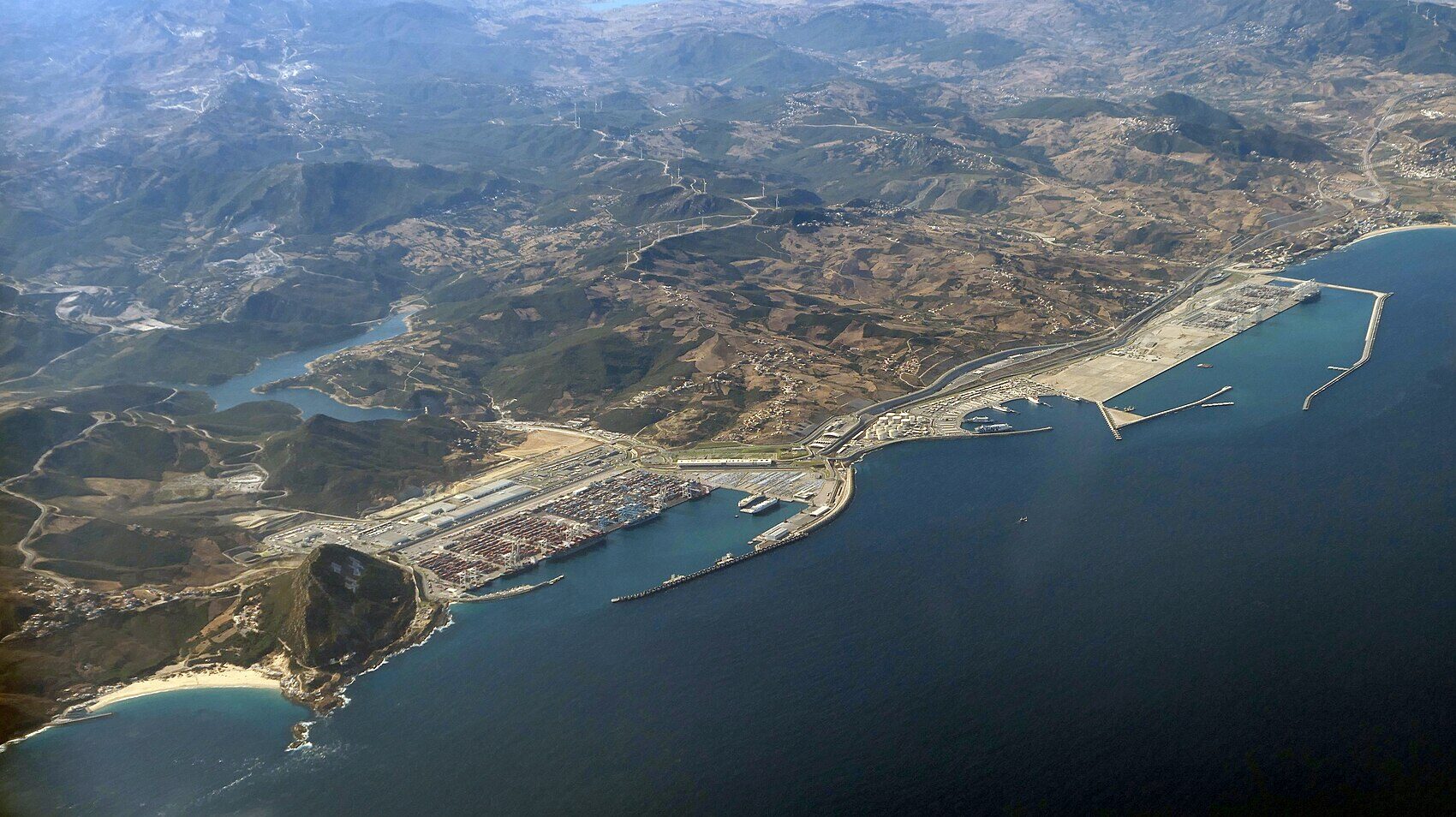
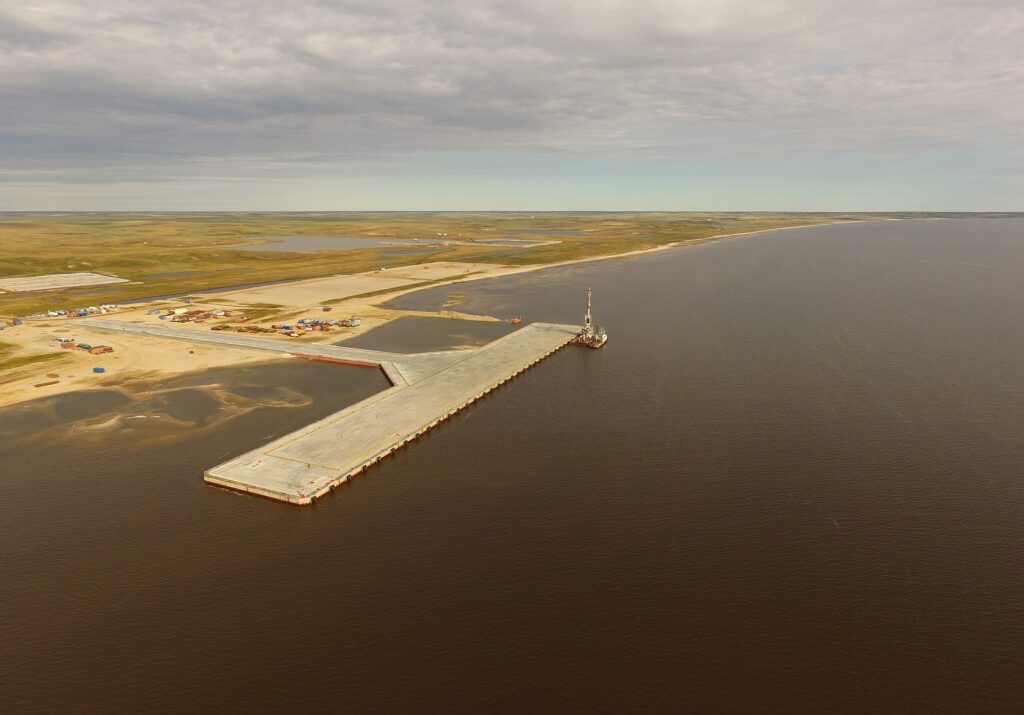

What brought him to Ukraine

The full-scale war in 2022 unsettled him and prompted him to research its causes, which took him back to where the war began. He traced it to the Revolution of Dignity of 2013 and 2014, when Ukrainians drove out a pro-Russian president. Then, Russia responded by seizing Crimea and igniting the war in the east.

"I understood pretty quickly that Ukraine was in a position to be fighting the good fight, and that Russia was being Russia, basically," he said.

He did not leave on impulse. He got in shape, went to the gym, and saved money, but the hardest part was his marriage: putting aside enough that his wife would be secure while he was gone, and making sure she was mentally prepared and would feel supported. She understood his reasoning, he said, and told him, "I support you. I support what you're doing."

Why did Lighthouse choose the 47th?

He chose the brigade carefully. He researched many units and contacted several recruiters before choosing the 47th, which has attracted a substantial foreign contingent, including a mostly Colombian reconnaissance-and-strike group.

What settled his choice was the people. He was able to talk to the men in his squad before he even came, and they would call him every few days.

"Hey, man, how are you doing? Do you need any help figuring out your schedule, or what to bring?" Lighthouse recalled.

They became friends before he got there. Ukraine has felt like home since, he said, a gorgeous place whose people are welcoming and proud of everyone who fights for their country.

He sees the war as the world's fight

For Lighthouse, the stakes reach far beyond Ukraine.

"What happens here now affects the rest of the world and potentially the future for the next 50 years," he said, which is why it matters to him that Ukraine can remain a democracy and stand up to the aggression.

He is not the first American in the 47th to say so. In May, the brigade profiled "Forrest", a 28-year-old North Carolina construction worker who followed the war since 2014 before enlisting and told others, "If you want to fight, go to the 47th."

July was Ukraine’s deadliest month for civilians since 2022 — and Russia is scaling its ballistic missile salvos toward 200 at once

10 août 2026 à 09:05

Shahed R-60 missile decoy Flash

Russia can currently fire a simultaneous salvo of 77 ballistic missiles, and it aims to lift that ceiling to 200. Robert "Magyar" Brovdi, who commands Ukraine's Unmanned Systems Forces, told the Associated Press. He called the plan one of Ukraine's gravest weak points.

Kyiv's only reliable shield against ballistic missiles is the US-made Patriot, and its interceptor stocks are critically low. During mass barrages, dozens of warheads therefore slip through and reach their targets. Only a handful of countries can build such interceptors, and all are short, defense analysts have warned. The AP, for its part, could not independently verify Brovdi's numbers.

Ballistic missiles remain the hardest to stop

That shortfall has already turned lethal. Intensified strikes made July the deadliest month for Ukrainian civilians since April 2022, the UN human-rights office in Ukraine documented. Air defenses downed just 29 of the 195 ballistic missiles Russia fired that month, roughly 15%. Another 40 fell short on their own. Yet the largest single-night launches recorded so far run to only a few dozen. That is well below the salvo of 77 that Brovdi describes, and a fraction of the 200 Moscow is reaching for.

"Even if they only manage half of that, it will all be flying at us."
- Robert "Magyar" Brovdi, commander, Ukraine's Unmanned Systems Forces

Production running ahead of plan

His warning tracks Ukrainian intelligence. Russia's defense industry is overfulfilling its monthly targets, hitting 110% to 120% on the main missile types. So said Deputy Military Intelligence Chief Vadym Skibitskyi in an interview with RBC-Ukraine. He put July output for the Kh-101 cruise missile at 140% of plan, the Kalibr at 111%, and the Kh-35 at 200%. A pause in strikes, he judged, is unlikely.

The pivot to jet-powered drones

Moscow's factories are also retooling around drones. Russia plans to assemble 11,000 strike drones of various types in August 2026, Skibitskyi said. That mix spans the Geran-1 through Geran-5, the Harpia, and several Gerbera variants. Output dipped in July as the industry shifted toward the turbojet Geran-4 and Geran-5.

Those jet models fly faster and demand different interceptors or short-range air defense. They already made up half of one recent attack. The concentration of jet-powered Shaheds, meanwhile, has climbed 2.5 times in recent weeks, Brovdi added. Taken together, the assessments point one way: more missiles and faster drones, launched in larger waves, against defenses Ukraine is scrambling to rebuild.

  • ✇Euromaidan Press
  • ISW: Russia strikes the Mayaki bridge linking southern Ukraine to Romania and Moldova
    Russian forces struck the Mayaki bridge on the M-15 highway on 9 August, the Institute for the Study of War reported. The strike severed a road link that ties southern Ukraine to Moldova and Romania. That Odesa–Reni route crosses the Dniester and feeds the Danube ports. Those ports have become Kyiv's main export outlet since Russian strikes crippled its Black Sea shipping. Conflicting claims over the Mayaki bridge Russian milbloggers reported the attack, though their
     

ISW: Russia strikes the Mayaki bridge linking southern Ukraine to Romania and Moldova

10 août 2026 à 06:51

ISW

Russian forces struck the Mayaki bridge on the M-15 highway on 9 August, the Institute for the Study of War reported. The strike severed a road link that ties southern Ukraine to Moldova and Romania. That Odesa–Reni route crosses the Dniester and feeds the Danube ports. Those ports have become Kyiv's main export outlet since Russian strikes crippled its Black Sea shipping.

Conflicting claims over the Mayaki bridge

Russian milbloggers reported the attack, though their accounts diverged sharply. One claimed that Russian forces had destroyed the span. Others published footage purporting to show that it still stands. A local outlet serving nearby Izmail reported on 9 August that the strike damaged the crossing. Ukraine's State Border Guard Service separately confirmed that authorities briefly restricted traffic on the route. Moscow had already targeted the same structure in December 2025.

Why the land corridor matters

Russia likely hit the Mayaki bridge to choke Ukrainian grain exports, ISW assessed. Those exports now move through a land corridor that Kyiv has leaned on since strikes disrupted its maritime routes. Moscow has steadily intensified this campaign since July 2026. Navy Spokesperson Captain Third Rank Dmytro Pletenchuk offered one measure on 31 July. He said Russian strikes had damaged more than 20 ships near the Black Sea and sharply slowed cargo flows. Meanwhile, the country's main farmers union weighed in on 15 July. The Ukrainian Agri Council estimated that Russian attacks had cut about a third of Ukraine's grain-export capacity.

Minister of Agrarian Policy and Food Taras Vysotskyi has described the fallout. He said the strikes are forcing Kyiv to reroute grain and cargo through the Danube River. Russia used the same playbook in July 2023. Back then, then-Minister Mykola Solskyi reported that strikes destroyed 60,000 tons of grain at Chornomorsk port overnight on 19 July. Therefore, ISW concluded, Russia is likely shifting its strikes from the sea corridor to the land corridor. The aim, analysts wrote, is to block grain exports and weaken Ukraine's wider economy.

Russian forces are likely shifting their strikes from Ukraine's sea corridor to its land corridor to block grain exports and degrade the economy. — Institute for the Study of War

Türkiye floats a Black Sea moratorium

Turkish Foreign Minister Hakan Fidan raised a separate track on 9 August. He said Ankara had proposed a Russian–Ukrainian moratorium on strikes against merchant ships in the Black Sea. Both Moscow and Kyiv have received the offer, Fidan added, and Türkiye now awaits their response.

Drones strike Russian oblasts overnight: thick smoke over a Nizhnekamsk refinery as Crimea’s Krasnoperekopsk industrial zone burns

10 août 2026 à 06:03

makiivka

Drones struck several Russian oblasts overnight into 10 August. A probable strike hit a Nizhnekamsk refinery in the Republic of Tatarstan, while fires spread across occupied Crimea. Local Telegram channels and Ukrainian monitoring groups reported the attacks. Kyiv has not claimed them, and the damage stays unverified.

Thick smoke over the Nizhnekamsk refinery cluster

Residents of Nizhnekamsk reported explosions on the morning of 10 August. Footage online showed drones crossing the city, with dense black smoke above one district, local channels said. Which Nizhnekamsk refinery took the hit stayed unclear. The city hosts two major plants — the TAIF-NK and TANECO complexes.

TAIF-NK processes 7.3 million tons of crude and 1 million tons of gas condensate a year. Its 49 products include AI-92 and AI-95 gasoline, diesel, and jet fuel. TANECO belongs to the Tatneft group. It ranks among Russia's largest and most advanced refineries. Its design capacity exceeds 16 million tons of crude a year.

Ukraine's Defense Forces struck both TANECO and TAIF-NK on 12 June, the General Staff confirmed. Ukrainian units hit the same cluster again in July.

Fires flare in occupied Crimea's Krasnoperekopsk

Explosions rocked Krasnoperekopsk — known in Ukrainian as Yany Kapu — overnight. Numerous fires burned by morning, the monitoring channel Crimean Wind reported. Around 7 blasts sounded between 2 and 3 a.m. Subscribers described a fire behind the railway station in the industrial area.

By the morning of 10 August, NASA's FIRMS satellite system flagged multiple heat signatures there, Crimean Wind said. The hotspots clustered in the town's southern industrial zone. Russian forces store and repair equipment in the area, the channel added.

Drones also crossed Sevastopol. Residents heard aircraft and gunfire near the Balaklava thermal power plant. The Russian-installed governor, Mikhail Razvozhaev, claimed 15 drones fell, mostly over the sea. He admitted, though, that falling debris ignited a forest fire near Inzhir beach and forced a campsite evacuation. A blast in Simferopol briefly cut power around 4 am before supply returned.

Moscow and Rostov cite downed drones

In the capital, Mayor Sergei Sobyanin said air defenses downed 13 drones approaching Moscow overnight. He gave no details on any consequences. Over Rostov Oblast, Governor Yuri Slyusar said more than 70 drones destroyed. Information on casualties and damage was still coming in, he said.

Both counts reflect Russian air-defense claims rather than independently confirmed strikes.

Overnight, Russia's aviation authority Rosaviatsia restricted takeoffs and landings at Begishevo airport in Nizhnekamsk. The curbs also covered 14 other airports, among them Kazan, Ufa, Samara, and Moscow's Domodedovo and Vnukovo.

  • ✇Euromaidan Press
  • Zelenskyy’s Kosovo comments in Belgrade prompt flag removal in Prishtina
    The flag came down from a building in central Prishtina on 9 August, Mayor Përparim Rama said in a Facebook post, after President Volodymyr Zelenskyy remarked on Kosovo during his visit to Serbia. Rama said "the state of Kosovo must be respected." "Our compassion and solidarity will always be on the side of peoples facing war, violence, and persecution," Rama wrote. "Because we, better than many others, know what it means to fight for freedom, dignity, and the right
     

Zelenskyy’s Kosovo comments in Belgrade prompt flag removal in Prishtina

9 août 2026 à 13:19

The flag came down from a building in central Prishtina on 9 August, Mayor Përparim Rama said in a Facebook post, after President Volodymyr Zelenskyy remarked on Kosovo during his visit to Serbia. Rama said "the state of Kosovo must be respected."

    "Our compassion and solidarity will always be on the side of peoples facing war, violence, and persecution," Rama wrote. "Because we, better than many others, know what it means to fight for freedom, dignity, and the right to exist as a state."

    What Zelenskyy said in Belgrade

    The exchange was reciprocal: Zelenskyy reaffirmed Ukraine's refusal to recognize Kosovo's unilateral declaration of independence, while Vučić reiterated Serbia's backing for Ukraine's territorial integrity, including Crimea.

    At the 8 August joint news conference in Belgrade, Zelenskyy said Ukraine's position had not shifted. "Our position on what you said, about the unilateral declaration of Kosovo's independence, remains unchanged," he said. "We have always emphasized this, and Ukraine's policy has not changed. Likewise, we are grateful to our partners for respecting Ukraine's territorial integrity and sovereignty, including, of course, Crimea's belonging to Ukraine. This position of Serbia is also unchanged, including in the UN General Assembly."

    Vučić's position

    Vučić, in turn, tied his support for Ukraine's territorial integrity to Serbia's own stance on Kosovo. "We support the UN Charter, UN resolutions, and that means the territorial integrity of all UN members, which means the territorial integrity of Ukraine as well," he said. "Likewise, we are very grateful to Ukraine for supporting the territorial integrity of the Republic of Serbia. And as far as we are concerned, we will continue this principled policy. There are no 'buts' about this. This is being stated very clearly and firmly now."

    Kosovo's recognition status

    Kosovo is a partially recognized state on the Balkan Peninsula, in the Kosovo and Metohija region, with a population of about 1.7 million, according to Suspilne. Its capital and largest city is Prishtina. Kosovo is recognized by 22 of the European Union's 27 member states. Ukraine does not recognize Kosovo's independence.

    • ✇Euromaidan Press
    • Twelve kilometers from the war, a drone blast set a Moldovan field alight
      A combat drone exploded near a village on Moldova's border with Ukraine on 9 August, sparking a grass fire but hurting no one, Moldovan police said. Investigators recovered fragments and will examine them to establish the drone's type and origin. It was one of two blasts the war pushed across Europe's borders in two days, with Bulgaria fielding a separate drone explosion and summoning Ukraine's ambassador. Russia's mass strikes keep driving drones and missiles across Uk
       

    Twelve kilometers from the war, a drone blast set a Moldovan field alight

    9 août 2026 à 12:27

    twelve kilometers war drone blast set moldovan field alight · post fragments police preliminarily identified parts combat recovered near crocmaz moldova's ștefan vodă district 9 2026 debris same ukraine news

    A combat drone exploded near a village on Moldova's border with Ukraine on 9 August, sparking a grass fire but hurting no one, Moldovan police said. Investigators recovered fragments and will examine them to establish the drone's type and origin. It was one of two blasts the war pushed across Europe's borders in two days, with Bulgaria fielding a separate drone explosion and summoning Ukraine's ambassador.

    Russia's mass strikes keep driving drones and missiles across Ukraine's borders into EU and NATO states, and Russian jamming can knock Ukraine's own drones off course into the same skies—so every crash starts with one question: whose weapon was it.

    A drone down in a Moldovan field

    The blast rang out around 13:20 near Crocmaz, in Moldova's Ștefan Vodă district in the southeast, and set dry grass alight, NewsMaker reported. The village lies on the Dniester, upstream of Ukraine's Dniester estuary.

    twelve kilometers war drone blast set moldovan field alight · post near crocmaz moldova's ștefan vodă district where exploded dry grass 9 2026 crash site same ukraine news ukrainian reports
    The field near Crocmaz, in Moldova's Ștefan Vodă district, where a drone exploded and set dry grass alight, 9 August 2026. Photo: Consiliul Raional Ștefan Vodă/Facebook

    Firefighters and patrols confirmed no civilians were hurt and no homes were damaged. Police found fragments that they preliminarily identified as parts of a combat drone. Those pieces will undergo a ballistic-technical examination to determine the drone's exact type, its affiliation, and how it fell. Crocmaz sits right on the Ukrainian border. The district council posted photos of the object and told residents to avoid the cordoned area and report any fragments to the 112 line.

    twelve kilometers war drone blast set moldovan field alight · post debris exploded near crocmaz moldova's ștefan vodă district close ukraine border 9 2026 moldova fb consiliul raional news ukrainian
    Debris from a drone that exploded near Crocmaz in Moldova's Ștefan Vodă district, close to the Ukraine border, 9 August 2026. Photo: Consiliul Raional Ștefan Vodă/Facebook

    The blast came amid an assault on Odesa

    The drone fell hours after Russia hit Odesa with missiles and drones overnight on 9 August. Much of Moldova's eastern border runs along Odesa Oblast, so wreckage from the war often drifts across. Russian drones have crashed on Moldovan soil during such attacks before. Whether this one was Russian or something else is for the examination to show.

    A parallel case in Bulgaria

    Also today, Bulgaria's Foreign Ministry summoned Ukraine's ambassador, Olesia Ilashchuk, over a drone that exploded on 8 August near the Romanian border, by a Trans-Balkan gas pipeline compressor station, Bulgarian National Television reported. Its defense bloc said the drone was likely a Ukrainian decoy, with no sign it was launched on purpose. 

    russia’s drones violated airspace moldova romania — one fell straight onto civilian roof · post russian drone seen resting building cuhureștii de jos florești district 25 2025 20251125112001-7146 ukraine news
    Explore further

    Russia’s drones violated the airspace of Moldova and Romania — one fell straight onto a civilian roof (MAP)

    ❌