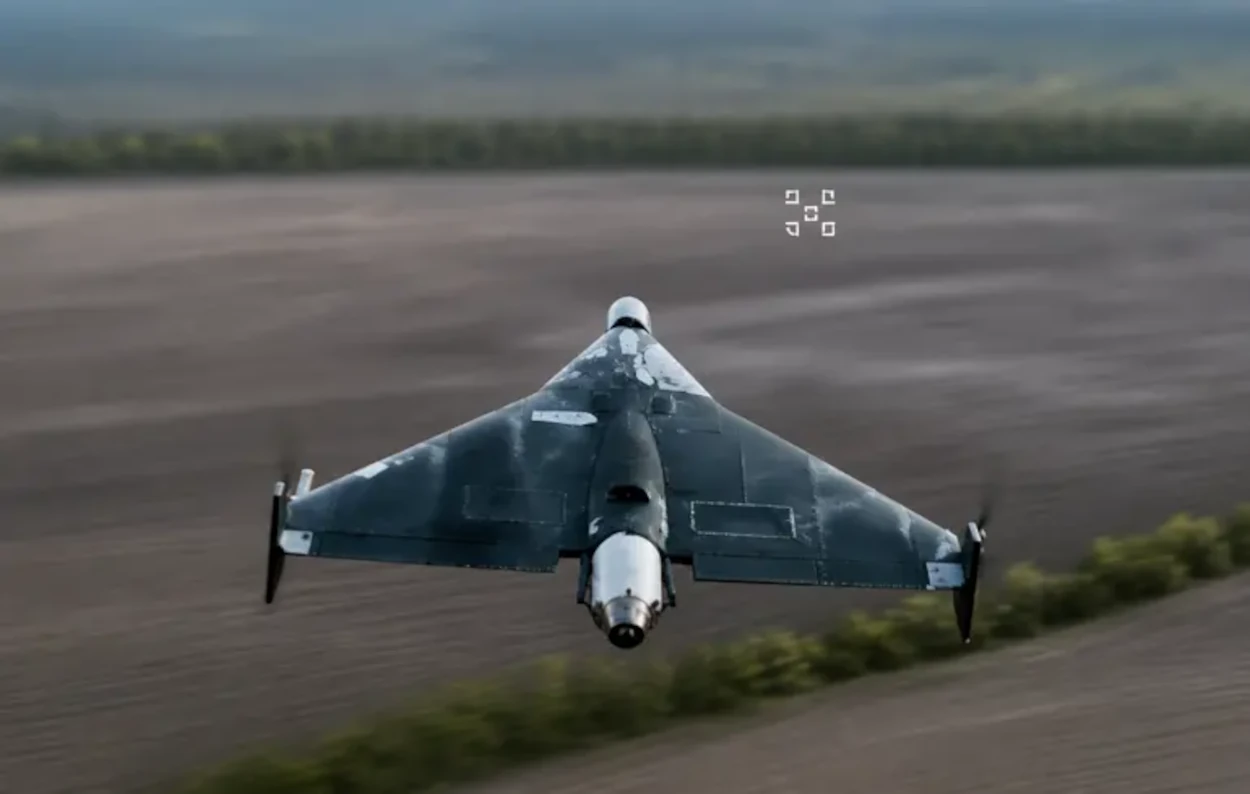
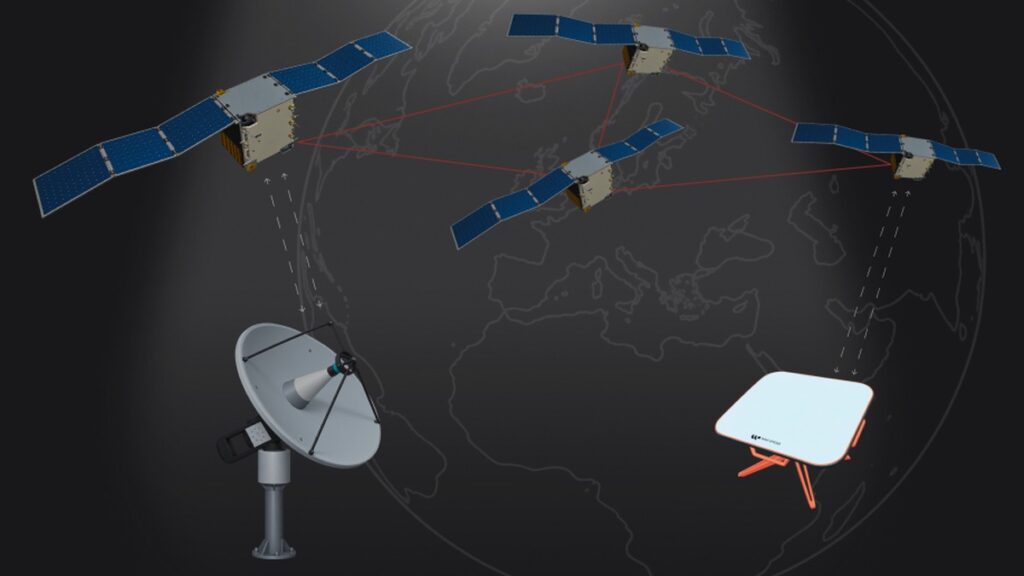
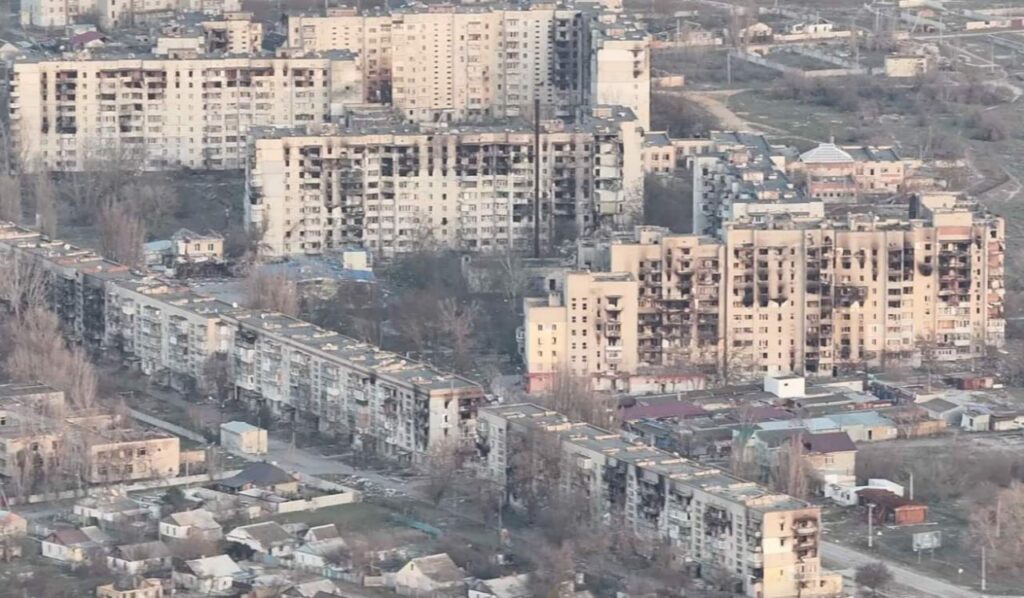
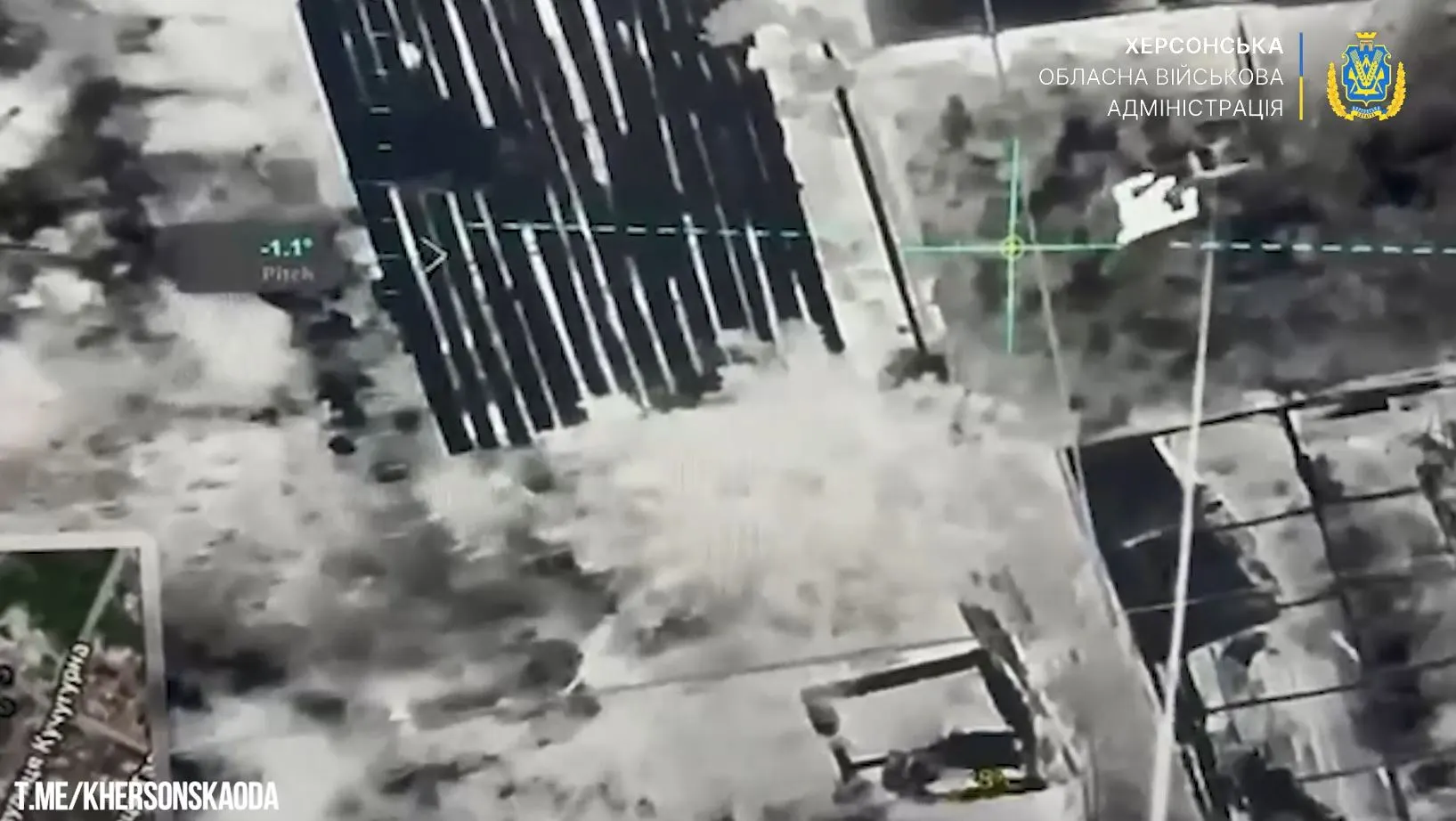
Russian channels claim Ukraine is striking deep with a new kind of satellite terminal. Serhii Beskrestnov, the military communications expert and presidential adviser known as Flash, says he will neither confirm nor deny the report. At the same time, he notes that the technology is far from unique and, unlike Starlink, too slow for real-time work.
Ukraine is scrambling for satellite links beyond Elon Musk’s Starlink, which it does not control and whose slowdown crippled front-line operations last month. Meanwhile, Russia routinely trumpets Ukrainian capabilities as proof it has them figured out. Flash’s point runs counter to the reports: the terminal Russia describes is more limited than the network Ukraine already relies on.
“I neither confirm nor deny”
Beskrestnov, who closely tracks Russia’s electronic warfare and Starlink jamming, notes that every Russian channel has reported the same day that Ukraine was using new satellite terminals for deep strikes.
“I do not confirm or deny this information from Russians. I do not know why this caused such a stir in Russian media, since such technologies have long been nothing unique,” he says.
What the terminal is, and isn’t
Russian reports name the SmartLite Sirius terminals, made by the company HiSky, as the alternative to Starlink in Ukraine.
Per Flash, it can work with both low-orbit and geostationary satellites, and instead of a dish it uses a flat antenna, like Starlink’s, that forms beams to track a satellite as it moves, the same approach taken by the US firm Kymeta.
It is small, about 60 by 30 centimeters and 6 kilograms, and can hold a link on the move. But it is no match for Starlink, Flash underlines.
“Terminals of this type can indeed maintain a connection on the move, but this is not Starlink. The speed can reach a maximum of 2 Mbit/s, and signal latency when working through geostationary satellites will be too great for online operation,” he says.
Tech companies like the idea, as they largely eliminate community opposition, and could cut down on utility costs
While Elon Musk has often touted putting datacenters in space, reports suggest that another geographic area may soon become a widespread target: our lakes and oceans.
Two underwater datacenters are already in operation off the coast of China, and recent reports suggest that the Trump administration is considering plans for four proposed underwater, sealed-pod datacenters to be built off the shores of Maine and Alaska.
At least 44 people were killed in a brutal assault by a group loyal to the Islamic State, officials said. The area is a hot spot of the growing Ebola outbreak.
Congolese civilians checking destroyed buildings after an attack by Islamic State-linked militants in Cantine-Aloya, Democratic Republic of Congo, on Friday.
Tech industry fears delays to its multi-trillion dollar infrastructure buildout meant to power artificial intelligence
Several newly elected Democrats and Senator Bernie Sanders have renewed calls for datacenter moratoriums in the days after the US midterm elections. The sweeping Democratic victory, which was buoyed in part by backlash to the tech industry, has added momentum to efforts to slow down the multi-trillion-dollar buildout of the controversial facilities.
On the social media platform X, Sanders posted a call for an immediate national datacenter moratorium this week. “Americans don’t want Big Tech oligarchs wrecking the environment, gutting jobs and threatening humanity’s future,” Sanders said on Wednesday.
Tech stocks have lost trillions while voters have rejected the industry’s political champions. The billionaire-led boom is facing a democratic reckoning
This week’s midterms showed that the political bill for the AI boom is falling due. The Democratic sweep intensified fears over runaway spending, mounting debt and resistance to datacentres, sending tech shares tumbling. On Thursday Wall Street suffered its worst day since the pandemic as $3.2tn was wiped from markets. Anthropic, developer of the Claude chatbot, is hoping to float within the next fortnight for $1.5tn (£1.1tn), but it may not now get even a trillion dollars. The dominant AI chipmaker Nvidia saw its value crash by more than $400bn. The world’s richest man, Elon Musk, lost $113bn in two days.
While a few very rich people may be a little less wealthy, the sell-off may not be a bad thing. It brings a needed dose of reality to an industry whose spending plans and valuations depend on heroic expectations of future profits. That is a view held by many influential figures – from Goldman Sachs’ research boss to Nobel laureate Daron Acemoğlu. AI may transform the economy. That does not guarantee investors will earn back the sums being poured into it.
Do you have an opinion on the issues raised in this article? If you would like to submit a response of up to 300 words by email to be considered for publication in our letters section, please click here.
The Trump administration has been negotiating agreements with dozens of individual countries. Public health experts say a global agreement would be far more effective.
The Trump administration has been negotiating agreements with dozens of individual countries. Public health experts say a global agreement would be far more effective.
After Thursday’s share price plunge on Wall Street, could the volatility be the start of a huge market meltdown?
Global financial markets have been thrown into a tailspin as investors bet on an AI slowdown after the US midterm elections.
This is not the first time stock markets have wobbled in recent months due to concerns over a tech bubble. But could this volatility be the start of a huge market meltdown?
Excédés par des heures de coupures d’électricité, les habitants de Karachi sont descendus dans la rue et ont bloqué plusieurs axes du poumon économique du Pakistan. Une colère qui illustre les dysfonctionnements quotidiens d’une mégapole de plus de 21 millions d’habitants, une nouvelle fois classée parmi les villes les moins vivables de la planète.
Ukraine’s National Anti-Corruption Bureau (NABU) has charged five people in a new episode of its Carthage case, the bureau said. Investigators say the group ran or shielded scam call centers, drug sales, and a fake-euro workshop. Judges have ruled on two suspects, while the most senior one, a security service general, still waits.
As Ukraine fights off Russia’s full-scale invasion, Brussels has tied its EU membership talks to reforms that include independent anti-corruption agencies, a condition watchdogs flagged as under strain. Carthage is the bureau’s hunt for officials allegedly paid to let scam call centers rob people in Ukraine and abroad, and it now reaches the police and security service meant to stop them.
The general called Akim
On 4 November, NABU detectives detained Serhii Duka, a major general in the Security Service of Ukraine (SBU). A source in the Specialized Anti-Corruption Prosecutor’s Office (SAP) told BBC News Ukrainian that he was held under Article 208 (detention without a prior court order). Investigators say Duka is Akim from their tapes, who helped the group with problems in the SBU, the Prosecutor General’s Office, and the police. When the gang paused its call centers last summer, he allegedly told its leader to change addresses and “go partisan.”
Explore further
“If you’re gonna f*ck, f*ck a queen, if you’re gonna steal, steal a million”: Ukraine’s anti-corruption bureau says senior official ran criminal ring inside Prosecutor General’s Office
Detectives found Duka at a cottage in Roslavychi, Kyiv Oblast, owned by the family of business partners of a relative with ties to Russia, investigative outlet Slidstvo.Info reported.
NABU unit head Oleksandr Abakumov described armed men at the windows and Duka with a pistol, who then smashed his phones with a hammer on a balcony and destroyed a hard drive. Fighters from Alfa, the SBU’s special forces, then arrived in vans. Abakumov called it absurd that the unit came to shield the general from detectives.
The same day, SBU head Oleksandr Poklad said he had fired two senior officials involved in the case, without naming them. The Anti-Corruption Action Center, a Kyiv watchdog, called Duka a key player in the July 2025 attack on NABU, when the SBU searched its detectives. SAP planned to ask a court on 6 November to keep Duka in custody, BBC News Russian reported.
Where the other four suspects stand
Mezha, an anti-corruption center, matched the tapes’ nicknames to the people NABU and SAP charged. The charge list names Andrii Osipov, a repeat convict known as Kryminal (“Criminal”), as the organizer.
On 5 November, the High Anti-Corruption Court ordered Vitalii Rybalka, called Boxer in NABU’s video, held for 60 days without bail, Radio Svoboda reported. The video mentions people being beaten with a hammer. Rybalka denied any part in that and called the suspicion far-fetched, but admitted he knows Osipov. Osipov, jailed in another case, faces the same court next week.
Vitalii Rybalka, called Boxer on NABU’s video, in the High Anti-Corruption Court, Kyiv, 5 November 2026. Photo: Daryna Kolomiiets/RFE/RL
The same court ordered Volodymyr Tsenov, known as Price, held unless he posts bail of UAH 15 million ($330,000). A senior National Police investigator, he is also suspected of taking a bribe.
The fifth suspect, Oleksandr Demianchuk, called Consultant, is a police detective in Kyiv Oblast. No ruling on him was reported by Friday morning.
Detectives also searched Kyiv Oblast police chief Andrii Rubel but did not charge him, Abakumov told Ukrainska Pravda. Rubel ran the National Police’s strategic investigations department from October 2022 to April 2026. NABU suspects he may have acted so as not to notice the crimes, Abakumov said.
Volodymyr Tsenov, known as Price, in the dock of the High Anti-Corruption Court, Kyiv, 5 November 2026. Photo: Anti-Corruption Action Center
What the gang allegedly planned
The tapes show a plot to attack Denys Bihus, an investigative journalist, over his reporting on U420, a shop chain suspected of selling drugs. Participants also discussed how to stop a man who wanted to tell NABU that evidence against one of its detectives might have been faked.
Explore further
Zelenskyy suspends prosecutor general who charged the bureau probing his own office
The leader of the Russian drug cartel Khimprom, called Mexican, offered $2 million on the recordings to remove Dmytro Torhalo, the National Police’s anti-drug chief, Slidstvo.Info reported. Torhalo confirmed Mexican threatened him.
The cartel leader also discussed bribing then-Interior Minister Ihor Klymenko to keep the cartel’s drugs off the banned list, Abakumov said in the same interview. Middlemen suggested offering people close to the minister a share of the business instead.
Dmytro Torhalo, head of the National Police’s anti-drug department, whom the Khimprom cartel leader offered $2 million to remove. Photo: Slidstvo.Info/National Police
Police push back, the Presidential Office responds
Andrii Nebytov, a deputy head of the National Police, wrote that the tapes date from September 2025 to April 2026, when police were already tracking Khimprom with Interpol and the US Drug Enforcement Administration. Deal plans existed, he said, but police dismantled U420.
Presidential Office head Kyrylo Budanov said after the searches that the law is the same for everyone.
NABU and SAP launched Carthage in September against an official in the Prosecutor General’s Office suspected of shielding call centers. Prosecutor General Ruslan Kravchenko then resigned and left Ukraine. His office has since fired eight people.
Nearly $2tn shaved off Nasdaq value as worries of curbs to AI datacenters ripple across bourses
The Nasdaq share index had its worst day in 19 months after slumping 5.5% on Thursday amid growing signs that the artificial intelligence industry will face tougher regulation because of the midterm election results.
As Wall Street sustained widespread losses, the Nasdaq composite tumbled into “correction territory” – more than 10% below its recent record high – with more than $2tn shaved off its value by the end of trading Thursday. The tech-heavy index hadits biggest one-day fall since Donald Trump announced his “liberation day” tariffs on US trading partners in April 2025.
The government said the risk to the British public from the disease was low. The current outbreak in Africa has spread widely across the continent, killing more than 5,000 people.
More threats were reported Friday after dozens of planes were targeted earlier this week. Officials have not reported finding any explosives, but the hoaxes have added to anxiety over hybrid attacks on the continent.
The tech industry spent big on the midterms, but it turned out to be a poor investment. Elon Musk poured a staggering $446m dollars into Republican-aligned political action committees (Pacs) and groups since last year, but his efforts didn’t pay off. Democrats won every one of the five Senate races where Musk’s America Pac spent the most money backing Republican candidates. Carter Sherman and Kai Wright are joined by the Guardian’s US tech editor, Blake Montgomery, to ask what the ‘blue tsunami’ will mean for Musk and the wider tech industry. Will this spell the end of AI datacenters? And if so, what could this mean for the US economy?
The tech industry spent big on the midterms, but it turned out to be a poor investment. Elon Musk poured a staggering $446m dollars into Republican-aligned political action committees (Pacs) and groups since last year, but his efforts didn’t pay off. Democrats won every one of the five Senate races where Musk’s America Pac spent the most money backing Republican candidates. Carter Sherman and Kai Wright are joined by the Guardian’s US tech editor, Blake Montgomery, to ask what the ‘blue tsunami’ will mean for Musk and the wider tech industry. Will this spell the end of AI datacenters? And if so, what could this mean for the US economy?
Depuis son retour au pouvoir, Donald Trump n’a eu de cesse de vouloir remodeler la capitale américaine en y laissant son nom et son empreinte. Après le Kennedy Center, la salle de bal de la Maison Blanche et le Lincoln Memorial reflecting pool, le président américain a à cœur la construction d’une arche de 79 mètres de haut. Pour un projet de cette ampleur, il faut en principe l’aval du Congrès mais Donald Trump semble vouloir s’en affranchir. L’arche verra-t-elle le jour ?
German Chancellor Friedrich Merz conceded on 3 November, after meeting Ukrainian President Volodymyr Zelenskyy, that military deliveries to Ukraine have run into occasional resupply difficulties, according to a transcript the German government published. He will try to resolve them at a Coalition of the Willing summit in Berlin on 19 November, where leaders will agree on the scope of further, mostly military, aid for 2027, he said.
Those snags land on a country already short of air defense. Russia launched another massive cruise and ballistic missile attack that day, Zelenskyy said. In April, Ukraine’s Air Force confirmed that Patriot crews were rationing missiles mid-attack. From late November to mid-December 2025, Ukraine’s F-16 fleet had only a handful of US-made AIM-9 Sidewinder air-to-air missiles, three sources told Reuters.
Merz said Germany wants to provide more winter aid and energy support this year. He said he gathered from his talks with Zelenskyy that many shipments are helping Ukraine’s army a lot right now, despite all the weaknesses in its air defense. He named ammunition for F-16 fighter jets in particular, but also air defense and other munitions.
Germany co-hosts the summit with France and the UK, which lead the coalition of over 30 countries coordinating aid to Ukraine, Radio Svoboda noted. Merz also urged all partners to meet NATO allies’ €70 billion (about $80 billion) military aid commitment for 2026.
Explore further
Europe’s future force for Ukraine from 11 countries will hold its first rehearsal in Poland—for a peace that doesn’t exist yet
Zelenskyy: a big shortage in air defense
Zelenskyy said the leaders discussed Ukraine’s big air-defense shortage and supplies of PAC-2 and PAC-3 interceptors for US-made Patriots and German IRIS-T missiles. They also discussed a new support package for Ukraine’s F-16s, which Ukraine needs, among other things, against Russia’s Shahed attack drones, he said.
The next day, Zelenskyy met German Defense Minister Boris Pistorius. Ukraine has a two-year contract for German-made PAC-2 missiles, and “we are working to accelerate deliveries,” he wrote on X. The two agreed their teams would explore this and other issues, including IRIS-T and F-16 munitions.
None of that closes the Patriot gap quickly. Only a handful of countries can build ballistic-missile interceptors, and all of them are short, defense scholar Marc DeVore told Euromaidan Press in June. Zelenskyy said work is under way on Freya, an anti-ballistic program, but DeVore said he would not bet on it being produced by this winter.
There were three big losers in Tuesday’s midterm elections in the US: Donald Trump, Elon Musk and datacenters.
Datacenters, the facilities full of semiconductor chips that power artificial intelligence and a host of other online products, were on the ballot in elections in at least 40 jurisdictions across 10 states. Voters responded with a strong rebuke of the giant buildings, which have has become a symbol of the tech industry and AI.
As tech bosses get richer and ordinary Americans struggle, Democrats put the case against the US’s grotesque unfairness – and voters responded
Remember the “vibe shift”? Just last year, columnists and corporate boardrooms alike declared that the second coming of Donald Trump meant the old rules of politics and even everyday civility were roadkill.
“I feel liberated,” one top banker told the Financial Times. “We can say ‘retard’ and ‘pussy’ without the fear of getting cancelled … it’s a new dawn.”
En France, la loi sur l’interdiction des réseaux sociaux aux moins de 15 ans vient d’être retoquée par le Conseil constitutionnel, et celle sur l’interdiction du portable au lycée tout juste promulguée. En Corée du Sud, où plus de 40 % des enfants et adolescents sont considérés comme accros aux écrans, selon une enquête annuelle du gouvernement, la société cherche aussi des solutions pour éloigner les plus jeunes des smartphones et applis.
Big tech stocks falter as investors question whether billions being poured into AI can generate returns quickly enough
A sell-off of tech stocks that began earlier this month and gained steam with disappointing earnings from leading tech companies drove US markets down by hundreds of billions of dollars on Friday. In total, the decline has knocked nearly $1tn in value off the tech-heavy Nasdaq exchange in one week and erased about $2tn in a month.
The S&P 500, the index of the 500 most valuable companies in the US, fell by more than 1% Friday, losing hundreds of billions of dollars in market value. It was on track to erase its gain for October, even though it set its all-time high during the same month. The weakness for technology stocks dragged the Nasdaq composite down even further, more than 3%, also erasing hundreds of billions in value. The Dow Jones Industrial Average fell less.
These resource-guzzling centres drive up utility bills and are hated across the political spectrum. Cue a clunky, but potentially influential, new name for them
Jesus may have turned water into wine, but Donald Trump has done one better: he turned Lake Ontario into Lake America and the Gulf of Mexico into the Gulf of America. And then, for his next trick, he insisted we all stop talking about artificial intelligence (AI) and call it superintelligence (SI) instead.
Those, of course, are only a few of the name changes the president has ushered in. When he’s not golfingor commenting on senators’ buttocks, president Trump loves a rebranding project. Which makes sense: coming up with a new name is far easier than making meaningful improvements to people’s lives.
One motion considers reining in political spending while another proposes to municipalize the grid in sign of anger with datacenters and high bills
Two citizen-led ballot initiatives seek to rein in Michigan’s powerful electric utilities as residents say politicians have failed to address pressing issues around controversial datacenters, high energy rates and poor electric reliability.
On Tuesday, voters statewide will consider a nation-leading ban on political donations by the state’s deeply unpopular regulated utilities. At the same time, organizers in Ann Arbor, one the state’s largest cities, are proposing to banish utility giant DTE Energy by municipalizing the grid. It would establish a public power company to deliver energy.
Ukraine will create a Center for the Return of Civilians to bring home Ukrainian civilians held by Russia or living under occupation, Human Rights Commissioner Dmytro Lubinets said on 2 November. On the same day, the Kremlin said it had no plans, for now, for another humanitarian operation like the one in occupied Oleshky.
The Oleshky truce, the longest since 2022, got civilians out because Moscow agreed to it. Within a week, the Kremlin went from calling such a truce a possible precedent to saying it has nothing similar planned, for now. For Ukrainians still in Russian prisons or under occupation, the next negotiated exit has no date.
Oleshky exposed the gaps
In Lubinets’s view, the Oleshky mission showed that Ukraine’s efforts to return civilian hostages from Russian prisons and civilians from occupied territory are not coordinated enough. His office will run the center, modeled on the Child Rights Protection Center, which he called a similar pilot.
Families of people held by Russia or living under occupation will be able to apply to the center, and it will draw attention to Russia’s violations of civilians’ rights. Lubinets said his office is building it on its own, with partners willing to help, and not together with Russia. Still, he said he had agreed with Russia’s Human Rights Commissioner Yana Lantratova to make aid deliveries to Oleshky regular, and the two sides are now discussing how to send them at least once a month.
Kremlin: no similar plans for now
On 26 October, Kremlin spokesman Dmitry Peskov said the Oleshky truce could become a precedent for humanitarian pauses elsewhere. On 2 November, he told a briefing Moscow had no similar plans or initiatives for now, saying each case is unique.
Lantratova claimed Russia had expected more people to leave, but many did not want to leave their homes and relatives. She cited individual cases, including a woman who would not leave her mother after a stroke.
How the mission unfolded
Oleshky lies on the Dnipro’s left bank, across from Ukrainian-held Kherson. In July, international monitors confirmed Russia’s blockade of the town. In September, an Odesa volunteer said residents were foraging for roadside grass. Russian troops also seized food Ukraine dropped by drone, the town’s Ukrainian administration head said.
On 23 October, the White House announced a local ceasefire brokered by US First Lady Melania Trump. It ran from 27 October to 1 November, and its zone expanded beyond the town. Both sides kept their commitments, Lubinets said on 1 November.
Ukrainian troops used the pause to evacuate 167 civilians from Ukrainian-held riverside villages, Ukraine’s General Staff reported. On 31 October, the two ombudsmen agreed to keep working toward regular humanitarian missions.
À l'approche des élections de mi-mandat aux États-Unis, l'Arizona, État clé du scrutin, est en première ligne d'une réforme majeure de l'aide sociale. Depuis l'adoption de la loi budgétaire de Donald Trump en 2025, près de la moitié des bénéficiaires de l'aide alimentaire y ont perdu leurs allocations. Une chute sans équivalent dans le pays. Les autorités reconnaissent aujourd'hui que certains devraient pourtant y avoir toujours droit. Un sujet devenu brûlant dans la campagne électorale.
Young voters have many of the same concerns as the larger voting cohort, even if many are not registered to vote
The 2026 US midterms are approaching against a backdrop of growing political uncertainty, with young voters increasingly mobilizing around concerns about the country’s future.
Although nearly 50 million Americans aged 18 to 29 are eligible to vote in the midterms, almost half remain either unregistered or civically disengaged, according to US Census Bureau data.
Les élections de mi-mandat ont lieu mardi aux États-Unis, où le président Donald Trump n'a jamais été aussi impopulaire. De nombreux États aux sièges autrefois acquis aux républicains sont vacillants. C'est le cas de la Caroline du Nord, un État profondément rural où un emploi sur cinq est lié à l'agriculture.
Trump envoys Jared Kushner and Steve Witkoff floated the idea in Moscow and Kyiv in September, with a US intermediary meant to get around European sanctions, The Wall Street Journal reported on 2 November. European capitals resist it, WSJ said. The Kremlin says the plan cannot work for now, and Kyiv had not commented by Monday afternoon.
The gas is meant to unlock an energy ceasefire between Moscow and Kyiv before winter, US, European, and Ukrainian officials told WSJ. Washington shelved the idea in October, when Ukraine paused strikes on Russian refineries for almost two weeks under US pressure while Russia kept pounding Ukraine’s energy infrastructure. Kyiv’s resumed strikes on 30 October gave the truce push new urgency ahead of US-Russia-Ukraine talks planned for mid-November in Abu Dhabi. Russia has so far rebuffed it.
The pitch
US negotiators see a return to Europe’s gas market as a powerful incentive for Moscow to agree, and argue Kyiv would earn transit fees. People who attended the talks said the deal could be lucrative for American investors. To keep the money from funding the war, White House officials proposed holding the proceeds in a third-country escrow account.
Washington has also cleared Russian diesel sales and is reviewing a request to lift sanctions on the Kremlin’s investment fund.
Europe’s own law
EU rules stand in the way. A Council regulation adopted on 26 January brings a full ban on Russian LNG from the beginning of 2027 and on pipeline gas from autumn 2027. Europe could shift more easily if Kyiv endorsed the gas sales as part of a ceasefire, diplomats told WSJ.
Kremlin spokesman Dmitry Peskov said on 2 November that the situation on the ground showed such plans could not be carried out at the moment. What happens later, he said, depends on buyers and sellers.
Earlier reports from the talks
The New York Times reported on 17 October that the envoys had urged President Volodymyr Zelenskyy to consider restarting the pipelines to help persuade Russia to end the war. Ukraine had let its transit deal expire on 1 January 2025, losing about $1 billion a year in fees, the paper noted. Foreign Minister Andrii Sybiha said then that the move cut off some of Putin’s last leverage over Europe.
Ukraine has cut off more than just Russian gas transit. We have cut off some of Putin’s last remaining leverage over Europe and his use of energy as a weapon. Europe and the world will be safer without Russian gas, oil, and other dependencies, as well as without Russia itself.
Le Monde reported on 27 October, citing a witness close to the Ukrainian delegation, that Witkoff pushed for fully reopening the pipelines carrying Russian gas and oil through Ukraine at talks in Florida on 9 October. Presidential Office head Kyrylo Budanov rejected the plan, the newspaper reported.
Rendre la frontière entre les États-Unis et le Mexique plus hermétique pour en finir avec l'immigration illégale : c'était l'une des principales promesses de campagne du président américain Donald Trump. Une promesse largement tenue : le nombre de personnes entrant illégalement aux États-Unis a atteint un niveau historiquement bas depuis l'investiture de l'actuel locataire de la Maison Blanche en janvier 2025. Les tentatives de traversées illégales ont baissé de 93 % si on les compare aux pics de l'administration Biden.
Ukraine’s and Russia’s human rights commissioners have agreed to keep working on regular humanitarian missions after the evacuation from occupied Oleshky, Ukrainian ombudsman Dmytro Lubinets said on 31 October. A day later, the ceasefire that made the evacuation possible ended.
Without a new truce, the people left behind are back where they were. In July, the Institute for the Study of War concluded that Russia was effectively blockading Oleshky, which lies across the Dnipro from Ukrainian-held Kherson. In May, journalist Zarina Zabrisky said the existing route out, through occupied Crimea, Russia, and Belarus, did not work: only three of 20 people who recently tried it got through.
Oleshky as a first step
Lubinets wrote that he and Russian ombudsman Yana Lantratova had agreed to continue work on regular missions. He said Oleshky should be the first step, since people living near the front line need constant support.
Lantratova claimed the same day that the sides had agreed to hold regular missions.
The truce had been coordinated by US First Lady Melania Trump. On 1 November, Lubinets said both sides had kept their commitments. He added that the two were working through the possibilities of continuing such steps.
Who stayed behind
On 30 October, Lubinets wrote that some buses were heading to Ukraine and others to Russia. About 700 to 1,000 people may remain in Oleshky, The Insider correspondent Tatiana Popova estimated on 31 October. Many feared a provocation or did not want to leave their homes.
Meanwhile, Ukrainian troops used the truce to evacuate 167 civilians, 22 of them children, from Ukrainian-held riverside settlements that came under daily Russian shelling, Ukraine’s General Staff reported on 1 November.
Bodies moved to Henichesk
On 1 November, Ukrainian journalist Oleh Baturin wrote that Henichesk residents had told him dozens of civilians’ bodies were brought there from Oleshky. Volunteer Kseniia Arkhipova confirmed it, he said. By her data, 47 bodies had been kept in the basements of Oleshky’s hospital since May.
How these people died remains unknown. In September, Tetiana Hasanenko, head of Oleshky’s Ukrainian military administration in exile, said more than 100 bodies lay in the basement of the hospital, which had had no electricity for four years.
Residents of Menomonie mounted a successful protest against a huge campus in the city as national resistance to the AI boom grows
In the spring of 2025, Sydney Brennan was riding high. The 22-year-old was finishing college and was a newly elected councilwoman in Menomonie, a city of about 17,000 in the lush plains of north-western Wisconsin.
Weeks into the new job, she was invited to a meeting with consultants pitching a $1.6bn AI hyperscale datacenter campus that an undisclosed big tech company wanted to build just outside of town. The project’s numbers were eye-opening: a 320-acre site that would use an estimated 75,000 gallons of water per day, making it the most significant development in Menomonie’s nearly 150-year history.
La saison régulière du Marché public de Rimouski se termine ce samedi 31 octobre, entre 10 h et 14 h, au parc de la Gare. Plusieurs activités spéciales sont prévues pour les visiteurs afin de souligner l’Halloween.
Russia’s Geran-5 jet drones have sped up to 1,000 km/h while maneuvering, Ukraine’s presidential adviser on defense technology Serhii “Flash” Beskrestnov said in Kyiv on 29 October. He added that Chinese engineers help develop Russia’s Geran drones.
When Russia moved to faster Geran versions, Ukrainian developers had to look for new ways to intercept them, Beskrestnov said, and Ukraine must learn to stay a step ahead. From 1 to 26 September, air defenses downed only 55% of Russia’s jet-powered drones. On 29 October, one such drone hit Dnipro’s railway station, and the death toll has since risen to 15. Over the past three months, air defenses downed nearly 60% of the jet-powered Geran-4, the General Staff said on 27 October, noting a shortage of guided anti-aircraft missiles. That update gave no Geran-5 figure.
A peak well above cruise speed
That peak, about 620 mph, came during maneuvers. Ukraine’s military intelligence (HUR) puts the Geran-5’s cruise speed at 450–600 km/h. By Beskrestnov’s count, the earlier Geran-3 flew at 280–300 km/h.
Explore further
Ukraine intercepts nearly 60% of Russia’s Geran-4 jet drones, General Staff says, as Kyiv races to counter evolving threat
Russia’s best engineers work against Ukraine, and China’s do too, Beskrestnov told journalists. Russia’s Alabuga drone plant sets Chinese engineers tasks such as work on the control module, he said. Key components inside Russia’s Shahed-type drones are Chinese, he said. Meanwhile, China will require licenses for Geran engines from 18 November, Ukraine’s sanctions commissioner Vladyslav Vlasiuk said. Licensing is not a ban, he stressed.
Speed is the easy part
Some interceptors are being designed to match the Geran-5’s cruise speed. US firm CHAOS Industries claims a top speed of 540 km/h for its Vespid Mk 1 interceptor. On 14 October, Ukrainian defense outlet Defense Express judged that may be enough against the Geran-5’s 450–600 km/h cruise speed.
Explore further
Russia equips Geran attack drones with image-based navigation using Google map imagery, reducing reliance on satellite navigation that Ukraine can jam, defense adviser warns
Ukrainian manufacturers have already shown jet-powered interceptor drones, Beskrestnov said. But they have run into problems with control, guidance, automatic target lock, and scaling up production. A model that flies fast is only one part of the job, he said, and an easy-to-use serial product is a different question entirely.
Destinus has completed 1,750 Ruta B1 cruise missiles and reached monthly output of nearly 300, the company said on 29 October, telling Reuters this exceeds Europe’s annual cruise-missile production before Russia’s full-scale invasion.
That gives a date for easing a shortage. A looming shortage of mini jet engines threatened to hold back Ukraine’s deep-strike drones, Reuters reported in April. Czech maker ZofiTech was then producing about 200 a month, nearly all for Ukraine, and expected demand to reach thousands within months. Both Ruta versions use the 1.5-kN engines Destinus is promising. Ukraine plans to build more jet drones and cruise missiles, so engine output next year will have to keep up, Defense Express notes.
Destinus builds its own engines, but hasn’t said how many
Destinus CEO Mikhail Kokorich said the company already produces turbojets in the roughly 1.5-kilonewton class in series, supplying them both for its own missiles and to other manufacturers. The Ruta B1 runs on the company’s own T150 engine. In June, Destinus announced its 1,000th T150 and said the line was designed to sustain production of thousands of missile systems a year. The company has not disclosed its current engine output.
Block 2 enters production, Block 3 is due to fly in 2027
Meanwhile, Destinus said it has begun production of the larger Ruta Block 2, designed to carry a 250-kg payload more than 700 km. Unlike the roughly 300-km Block 1, Block 2 is designed to be stored, transported, and launched from the same container. A third version, Block 3, is planned with a 2,000-km range, with flight tests scheduled for 2027.
Ukrainian President Volodymyr Zelenskyy acknowledged the Ruta’s combat use in October 2025. Days later, he said Ukraine expected mass production of Ruta and Flamingo missiles by the end of that year. In June 2026, then-Defense Minister Mykhailo Fedorov said the Netherlands was ready to finance about 700 Rutas for Ukraine, without specifying the version.
Deterrence takes “tens of thousands of missiles”
At the same time, Kokorich said Europe’s problem is shifting from production to integration.
“To have sufficient deterrence, you need to have tens of thousands of missiles,” he said.
European customers, he added, still need to build the military units and logistics to operate missiles in such numbers. Those arsenals would also need storage, transport, maintenance, and targeting infrastructure, he said, and European militaries would need to rethink how they stockpile and deploy precision-strike weapons.
No Chinese parts, and a bet on cheaper, shorter-range missiles
Kokorich said Destinus uses no Chinese components, unlike wartime production in Ukraine, and said access to Chinese suppliers would make manufacturing cheaper, faster, and easier.
Kokorich also argued that cheaper missiles with ranges under 1,000 km would make up most future demand. Separately, Destinus is working with Rheinmetall on cruise missiles and ammunition for multiple-launch rocket systems, including a planned European equivalent of the GMLRS rockets fired by HIMARS.
Ukraine’s human rights commissioner Dmytro Lubinets and his delegation safely reached Russian-occupied Oleshky in Kherson Oblast on 30 October, with the local truce at 80 hours and holding. He said he was talking with residents to learn what help they need most.
Russia has kept Oleshky, on the left bank of the Dnipro River, cut off for months, leaving residents starving. Now the test is where the buses take people. The White House promised residents who wish to leave transport to their “preferred destination.” Lubinets said on 27 October that everyone who wants to go to Ukraine will be able to. Under agreement pages published by Fox News, his own delegation and the residents who choose Ukraine travel together via Anapa in Russia. From there, a Russian military transport plane to Homiel in Belarus is expected on 31 October.
Explore further
Russia may use the Oleshky truce to rebuild its forces, ISW warns, as evacuees face a route through Russia and Belarus
Buses on standby, aid for those who stay
On the morning of 30 October, before reaching the town, Lubinets wrote from Armiansk in occupied Crimea that he was coordinating the mission with Yana Lantratova, Russia’s human rights commissioner. He said 25 buses with 750 seats had been prepared, plus ambulances for people with limited mobility. Anyone who wants to leave will get a safe way out, and those who stay will receive aid, he added. In delivering that aid, special attention goes to elderly residents and people with disabilities, he said.
We are in Oleshky! The Ukrainian delegation has safely reached the city.
The ceasefire has been in effect for 80 hours and remains in place. I am currently on the ground, speaking with local residents to hear about their needs and understand what kind of assistance they need… pic.twitter.com/AOhKIV0WLO
The evening before, he said people who want to leave could do so until 14:00, with aid distribution after 14:30, without naming a date. Speaking to journalists, he called it the first truce since 2022 to hold this long on such a large stretch of front.
How the truce came about
The White House announced the truce on 23 October, crediting First Lady Melania Trump. It took effect at 03:00 Kyiv time on 27 October. Its zone was later widened. By 29 October, the convoy was ready, Lubinets said. The truce is due to end at 22:59 Kyiv time on 1 November.
Oleshky residents who choose Ukraine are to be taken through Russia and flown to Belarus, and the ceasefire agreement does not say how they will get from there to Ukrainian-held territory, the Institute for the Study of War (ISW) noted on 28 October. ISW also warned that Russia may use the truce to rebuild its forces in Kherson Oblast.
Oleshky, a town across the Dnipro from Kherson, has been occupied by Russia since February 2022, and about 2,000 people remain there, short of food and medicine. A US-brokered truce took hold on 27 October so aid can go in and residents can leave. The mission will show whether Russia lets those who choose Ukraine actually get home.
Anapa, Homiel, and then?
Pages of the agreement, signed on 23 October by Ukraine’s human rights commissioner Dmytro Lubinets and his Russian counterpart Yana Lantratova, were published by Fox News. They send the Ukrainian delegation and residents who want to go to Ukraine from Oleshky to the airport in Russia’s Anapa. From there, a Russian Defense Ministry military transport plane is to fly them to Homiel in Belarus, with the flight expected on 31 October.
Map of the Oleshky evacuees’ planned route set out in the ceasefire agreement, via Anapa in Russia to Homiel in Belarus, and a possible onward route through Poland to Ukraine, October 2026. Map: EP/Datawrapper
The delegation includes Lubinets, two of his staff, and two Ukrainian journalists, accompanied by a representative of the Russian ombudsman’s office and of the group coordinating the mission. Russia’s Dnepr Grouping of Forces, which holds the left bank of the Dnipro, provides the escort. ISW pointed out that the pages do not explain how evacuees travel on from Belarus, and that it remains unclear whether Russia will give residents “a legitimate and duress-free choice” to return to Ukraine.
Explore further
Ceasefire planned for occupied Oleshky as residents face starvation and blocked escape routes, White House announces
A route through Russia may also mean so-called filtration. People leaving occupied Mariupol in 2022 had to pass Russian screening, and many who hoped to reach Ukrainian-controlled territory were taken to Russia instead, Human Rights Watch documented. In Washington, the Congressional Ukraine Caucus welcomed the ceasefire but raised alarm over reports that Russia was keeping Oleshky residents from evacuating to Ukrainian-controlled territory, RFE/RL reported.
Kherson lies just across the Dnipro from Russian-occupied Oleshky, yet residents who choose Ukraine are to be routed through Russia and Belarus. Russia has forcibly deported Ukrainians from occupied areas throughout the war, and it is unclear how many evacuees will eventually reach Ukrainian-controlled territory. Map: EP. Front line: DeepStateMap, 28 October 2026. Imagery: Google
On 29 October, the Ukrainian delegation led by Lubinets arrived in Belarus, and the two delegations held their first in-person meeting at Homiel airport, Belarus’s state agency BelTA reported. Belarus has also joined the operation, BelTA said. Lubinets confirmed the same day that he had set off for Oleshky with the delegation to deliver aid and work on making sure people can leave safely.
A page of the Oleshky ceasefire agreement setting out the evacuees’ route via Anapa and Homiel, signed on 23 October 2026. Photo: provided to Fox News Digital
Aid due on 30 October
The truce has held for 54 hours without violations, Lubinets said on 29 October. Routes are being demined, and an aid cargo is to reach Oleshky on 30 October, he added. The truce is set to last until 22:59 on 1 November. Across the river, the Kherson Oblast administration recorded no shelling and no civilian casualties over the past day.
A municipal worker trims a flowerbed on Kherson’s central square during the ceasefire, 28 October 2026. Behind him is the Kherson Oblast administration building, wrecked by repeated Russian strikes, including guided bombs in June 2025. Photo: Dmytro Lubinets/Telegram
Lantratova wrote that aid had been sent, saying residents need “food, fuel, medicine, hygiene products,” and that they would be able to leave wherever they wanted to go. Kremlin spokesman Dmitry Peskov said Russia expected residents to get aid within a day or two and those who wished to leave to be able to do so, Ukrainska Pravda reported.
US First Lady Melania Trump, who brokered the truce, announced that four Newsmax journalists will work in Oleshky alongside the Russian and Ukrainian humanitarian teams. Her post quoted Putin’s envoy Kirill Dmitriev, who wrote that Russia “welcomes” the Newsmax journalists, rather than any Ukrainian official:
DOCUMENTING OLESHKY Four American journalists from Newsmax will be on the ground in Oleshky, embedded with Russian and Ukrainian humanitarian leaders.
Serving as neutral observers, they will independently record and permanently document this historic humanitarian mission. https://t.co/orfhcC8URs
On the truce’s first day, Russian Defense Minister Andrei Belousov inspected the Dnepr Grouping and met its commander, Colonel General Mikhail Teplinsky. The ministry said they discussed drone units. Ukrainian serviceman and analyst Volodymyr Molchanov told Radio NV that intelligence shows Russia rapidly reinforcing its forces in Oleshky, bringing in what Ukrainian drones had kept out.
Russian forces may use the limited ceasefire to reconstitute in Kherson Oblast, ISW assessed.
A photograph released by the Geneva University Hospitals shows paramedics carrying from a helicopter a woman who had been diagnosed with Ebola following her flight from Nigeria, on Monday.
Ukraine’s Military Intelligence (HUR) has published the names of 49 Russian and Belarusian companies and institutions building Rassvet, Russia’s low-orbit satellite internet system, on its War&Sanctions portal, the agency said on 28 October. It needs it for its military purposes.
Russian troops ran front-line communications and long-range strike drones on smuggled Starlink terminals until SpaceX blocked them on 1 February 2026. Ukraine still flies on Musk’s network, and on 24 October it got back to full speed after a ten-day cap imposed abroad. Rassvet is meant to give Russia’s army satellite links under its own control.
HUR has said Moscow may struggle to obtain components for more satellites, and its list names the suppliers that sanctions would need to target while the network is still being built.
Terminals for Iskander-M command vehicles
Rassvet is first of all a military communications system. Russia plans to use it for command and control, strike platforms, and drones, and to install terminals in the command-and-staff vehicles of Iskander-M missile systems, HUR says.
The Central Research Institute of Automation and Hydraulics is involved in integrating Rassvet into army communications, including fitting command vehicles, Iskander ones among them, with terminals once 292 satellites are in orbit, according to the portal. The same institute produces guidance components for the Iskander-M and Kinzhal missiles.
Planned coverage takes in Ukraine and the EU first, and once it is wide enough, Russia could use the system in hybrid attacks on other countries. That is why partners should block Rassvet’s access to components, equipment, and software now, the agency said.
Roscosmos launches it, a Belarusian missile maker signs on
The lead company is Bureau 1440, part of the IKS Holding tech group. According to the portal, it is linking its flight control center to systems of the Russian Defense Ministry. Roscosmos launches the satellites into orbit, and its head, Dmitry Bakanov, personally oversees Rassvet.
Meanwhile, Belintersat, Belarus’s national satellite operator, signed a partnership with Bureau 1440 in May 2026 to bring Rassvet into Belarus’s telecom network. It is a branch of the Plant of Precision Electromechanics, Belarus’s lead missile developer and maker of the Polonez rocket launcher.
Another Belarusian firm, Aerospace Instruments, prototypes components for the system.
23 of 49 not sanctioned by Kyiv’s allies
Of the 49, 23, Roscosmos among them, are not under sanctions by any country in the sanctions coalition. The companies involved “must be included in all blacklists” of countries, banks, and businesses, the agency wrote.
32 satellites launched, seven launches to go
Russia launched its first 16 Rassvet satellites earlier this year. Stable communications would need 200–250 in orbit, Serhii “Flash” Beskrestnov, then adviser to Ukraine’s defense minister, said in May.
By August, Russia had launched 32 Rassvet satellites and planned seven more launches by the end of 2026, a HUR official told Janes. Only 12 of them, all from the first batch, had reached a sustainable altitude by the end of August, ISW reported.
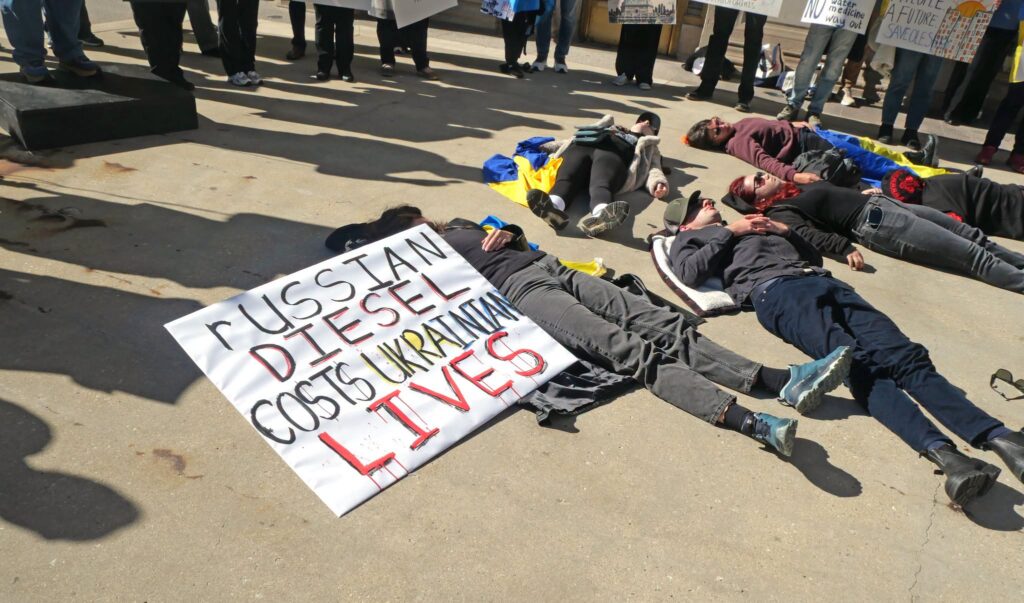
Pro-Ukraine demonstrations took place in more than 10 cities across Europe, North America, and Australia over the past week, with protesters opposing US President Donald Trump’s agreement to resume Russian diesel shipments, the easing of sanctions on Moscow, and restrictions affecting Ukraine’s military support.
The protests were organized by Ukrainian diaspora groups and international supporters of Ukraine, who called on Washington to maintain pressure on the Kremlin, restore Ukraine’s access to Starlink, and stop using military aid and intelligence sharing as leverage against Kyiv.
The International Center for Ukrainian Victory (ICUV) said the actions reflected growing concern over US decisions that could benefit Russia while its war against Ukraine continues.
Pro-Ukraine protesters rally in Chicago, USA, against US policy toward Russia, 13 October 2026. Photo: Radio UA ChicagoPro-Ukraine protesters rally outside the US consulate in Edinburgh, Scotland, against US policy toward Russia, 21 October 2026. Photo: Ukraine Solidarity Campaign
The demonstrations followed Trump’s announcement on 9 October that Russia would supply diesel to US and global markets. The US Treasury’s Office of Foreign Assets Control subsequently issued a temporary license authorizing transactions involving Russian-origin diesel, including imports into the United States, through 7 April 2027.
The decision reversed part of Washington’s restrictions on Russian fuel imposed after Russia’s full-scale invasion of Ukraine in 2022.
“We are witnessing a dangerous situation today: Russia, which attacks Ukrainian cities every day, is being offered economic agreements and sanctions relief, while Ukraine is being asked to make concessions. But Ukrainians cannot simply stop fighting. For us, this is a matter of our state’s existence. Our future cannot be the subject of agreements between Trump and Putin. It belongs to Ukrainians,” said Olena Ivashchenko, founder of Campaign for Ukraine.
Pro-Ukraine protesters rally in Sydney, Australia, against US policy toward Russia, 16 October 2026. Photo: Ukrainians in SydneyPro-Ukraine protesters rally in Rome, Italy, against US policy toward Russia, 21 October 2026. Photo: Ukrainian World Congress
Protests target Russian fuel deal and pressure on Kyiv
In London, hundreds of protesters gathered outside the US Embassy on 16 October, according to organizers from Campaign for Ukraine and partner groups. Participants included Ukrainians, Britons, Americans, and members of other national communities. British lawmakers also raised the issue in Parliament.
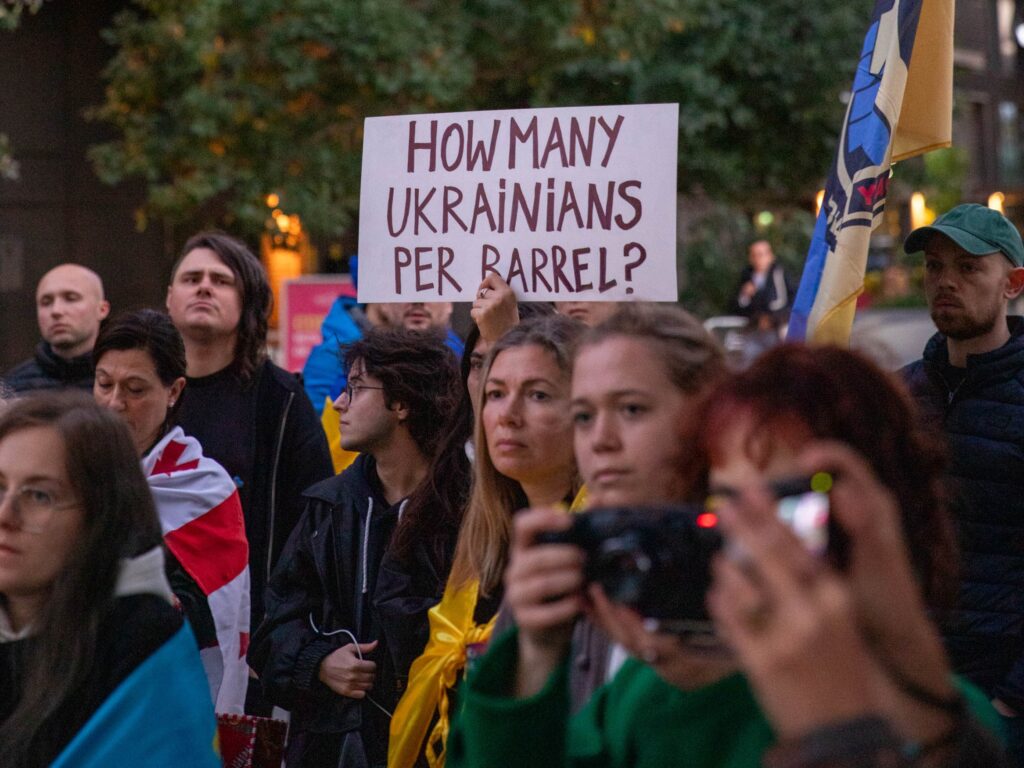
Demonstrators carried signs reading “How Many Ukrainians per Barrel?” and “Occupation Is Not Peace,” calling on Washington to preserve sanctions and reject pressure on Ukraine to make territorial concessions.
Pro-Ukraine protesters rally in London, England, against US policy toward Russia, 16 October 2026. Photo: Khrystyna ShebunchakPro-Ukraine protesters rally in Sydney, Australia, against US policy toward Russia, 16 October 2026. Photo: Ukrainians in SydneyPro-Ukraine protesters rally in Chicago, USA, against US policy toward Russia, 13 October 2026. Photo: Radio UA Chicago
Protests also took place in Edinburgh, Chicago, Houston, Boston, San Diego, Prague, Rome, Stockholm, and Sydney. In Prague, two Ukrainian activists staged a protest outside the US Embassy on 21 October, pouring a red liquid resembling blood onto the road to symbolize the human cost of the policy.
Ukrainian activists stage a protest outside the US Embassy in Prague on 21 October, pouring red liquid onto the road to symbolize the bloodshed caused by Russia’s war against Ukraine and condemn US policies toward Moscow. Photo: Kaputin
The diesel agreement has drawn criticism in Ukraine because Russian fuel exports generate revenue for Moscow while its forces continue attacking Ukrainian cities and infrastructure. A Russian diesel tanker carrying 40,000 metric tons of fuel departed Russia’s Baltic port of Primorsk on 22 October bound for New York, according to shipping data reported by Reuters. It was expected to arrive on 7 November.
Pro-Ukraine protesters rally in Chicago, USA, against US policy toward Russia, 13 October 2026. Photo: Radio UA ChicagoPro-Ukraine protesters rally in Stockholm, Sweden, against US policy toward Russia, October 2026. Photo: Nordic Ukraine
Organizers warn against easing pressure on Moscow
Protest organizers argued that restoring Russian fuel sales and relaxing sanctions risk helping Moscow finance its war. They also opposed any US effort to secure concessions from Kyiv without requiring Russia to end its aggression.
The demonstrations reflect concerns among Ukraine’s international supporters that Washington’s pursuit of economic agreements with Moscow could undermine efforts to isolate Russia and strengthen Kyiv’s position.
Trump has defended the diesel arrangement as a way to increase fuel supplies and lower prices. His administration has also presented engagement with Moscow as part of its broader effort to end the war, while critics question whether easing economic pressure will produce meaningful concessions from the Kremlin.
Pro-Ukraine protesters rally in Boston, USA, against US policy toward Russia, 13 October 2026. Photo: Boston Supports UkrainePro-Ukraine protesters rally in Boston, USA, against US policy toward Russia, 13 October 2026. Photo: Boston Supports Ukraine
A ceasefire around Russian-occupied Oleshky in Kherson Oblast took effect at 03:00 on 27 October Kyiv time, and both sides were complying with the agreements, Ukraine’s human rights ombudsman Dmytro Lubinets said. Russia’s Defense Ministry reported that its forces had stopped firing on the Kherson axis at 04:00 Moscow time, at the same moment.
Russia has kept Oleshky cut off for months. In June, the UN Human Rights Monitoring Mission in Ukraine documented worsening shortages of food, medicine, and medical care there and in neighboring Hola Prystan. As of 8 October, Lubinets’ office still saw no practical breakthrough toward an organized evacuation, with 358 residents verified as needing help to leave. The ceasefire is the first step that has to hold before aid can go in and residents can leave, an operation Marc Beckman, the first lady’s chief adviser, expects to take five to seven days.
By 09:00 on 27 October, Russian forces were still observing the ceasefire, according to Pavlo Drohal, spokesperson for Ukraine’s 30th Marine Corps. Kyrylo Budanov, head of the Presidential Office, announced that the mission had begun and that Lubinets had gone to the site to coordinate it.
The White House announced on 23 October that First Lady Melania Trump had secured a localized ceasefire, set to begin on 29 October. The same evening, Russia’s chief of General Staff Valery Gerasimov announced a ceasefire on the Kherson axis from 27 October, with engineering reconnaissance and a secured route for a humanitarian convoy. Ukraine’s General Staff followed, introducing a ceasefire in a designated area from the same hour.
Beckman told Ukrinform on 26 October that Russia had moved the ceasefire two days earlier and extended it beyond Oleshky into Kherson Oblast. Lubinets said on 23 October that the mission should effectively begin on 29 October, after demining, adding that the date was not a matter of principle for either side.
People in Oleshky wait for food supplies. Photo: BBC
A day after the announcement, Lubinets and his Russian counterpart Yana Lantratova, who lead the two negotiating groups, confirmed the timing in an online meeting, he said. According to Lubinets, the agreement covers demining the road to Oleshky, delivering food, water, medicine, and hospital equipment, and safe movement for civilians.
Newsmax to document the operation
Meanwhile, Melania Trump said she had secured an “impartial American media organization” to accompany the Russian and Ukrainian teams. Beckman named it as Newsmax. He said he had worked directly with the channel’s owner, and that its journalists would record testimony as what he called neutral American observers.
Residents could leave for Ukraine or Russia, or stay, Beckman said. He added that Russia had assured Kyiv and Washington it would respect their choice of destination. Both governments asked him not to disclose what guarantees Russia gave or how violations would be handled, he said. He expects the operation to take five to seven days after 29 October, with an extension possible if both sides agree.
Diplomat doubts the truce will move peace talks
At the same time, Kostiantyn Yelisieiev, Ukraine’s ambassador to the EU in 2010–2015, told Radio NV the truce became possible only through the personal involvement of Donald and Melania Trump. The US president, he said, sees it as a way to show Americans he is bringing peace closer. He said he expects Russia to attempt provocations aimed at pushing residents toward the Russian side.
Yelisieiev said he does not share the optimism of those who think Oleshky could push the wider peace process forward. He compared it to the Black Sea grain corridor, a one-off arrangement that no longer works. He warned of a “diplomatic smokescreen”: Russia imitates negotiations while it keeps fighting, hoping Ukraine and its partners weaken over time.
Ukrainian drone delivering aid to occupied Oleshky on the night of 4 October. Screenshot from video: Ivan Vyhivskyi / Facebook
A town under blockade
Oleshky lies on the left bank of the Dnipro, about 4 km from Kherson, and has been occupied since February 2022, Radio Svoboda reported. The White House says it had about 24,000 residents before the war and estimates 1,700 to 2,000 remain, mostly elderly, including about 50 children. Russian troops have also seized food dropped by Ukrainian drones, a local official said.
French and US maritime patrol planes are watching the western Black Sea, where drones keep hitting merchant ships, Romanian outlet Curs de Guvernare reported on 19 October, citing flight-tracking data. Romania blames Russia for the attacks, while Bulgaria says it cannot prove who launched them.
Ukraine’s three small Danube ports have kept its grain exports from collapsing further, and Russia has pounded those ports since the summer. The ships serving them are now being hit in the economic zones of two NATO members. Many were anchored near or heading to the Sulina Canal, which links the Danube to the sea. That puts the allied patrols over these waters in the middle of the fight over Ukraine’s grain trade.
Map: Euromaidan Press
Two patrol planes over the western Black Sea
A French Navy Atlantique 2 maritime patrol plane arrived in Constanța, Romania’s main Black Sea port, on the evening of 18 October, Curs de Guvernare said. On 24 October, French Foreign Minister Jean-Noël Barrot said in the Bulgarian port of Varna that a French patrol plane had been operating in the area under NATO for two weeks and had contributed to rescue operations.
Explore further
Two tankers burn off Romania’s Sulina as Bulgaria says it lacks proof Russia is behind the Black Sea ship attacks
Meanwhile, a US Navy P-8A Poseidon flew into Varna from Sicily on 18 October, AFP reported, citing flight-tracking data. Two days later, Bulgarian Prime Minister Rumen Radev said it had begun reconnaissance patrols after Sofia asked allies for help, and that some allies had responded quickly. Bulgarian Defense Minister Dimitar Stoyanov called the deployment a joint decision of Bulgaria and NATO. He said the plane cannot strike targets and passes its data to NATO, Anadolu Agency reported.
NATO promises more
On 20 October, NATO’s North Atlantic Council met at Romania’s request. Afterward, the alliance said it would send more maritime patrol aircraft, radar systems, and drones to the Black Sea. NATO military spokesman Col. Martin O’Donnell added that allies have sent or will send intelligence personnel and explosives-forensics teams. NATO itself has not attributed the attacks to any country.
Romania names Russia, Bulgaria hedges
Romania has been blunter. On 15 October, after four merchant ships were hit within a day, acting Foreign Minister Oana Țoiu wrote on X that “Russia bears full responsibility for these developments.” On 17 October, Romanian F-16s shot down two jet-powered Russian Geran drones near Sulina, Romania’s Defense Ministry said.
Unitățile aeriene și navale ale Gărzii de Coastă (GdC/MAI) și ale Inspectoratului General pentru Situații de Urgență (IGSU/MAI) sunt implicate activ în operațiunile de căutare și salvare, în vederea găsirii membrilor dați dispăruți ai echipajului navei care a fost atacată în…
On 23 October, a drone sank the cargo ship Khoryv off Constanța, killing a Ukrainian sailor, and President Nicușor Dan blamed Russia too. “It is part of Russia’s escalation process in its war in Ukraine,” Dan said.
Bulgaria is more cautious. Radev told parliament on 14 October that the attacks worked in Russia’s favor but that Sofia could not prove it. Since taking office in May, he has sought a thaw in ties with Moscow.
Ukraine's military satellite links work at full speed again after a cap that hobbled its drones, Ukraine's Defense Ministry said on 24 October. Hours later, SpaceX owner Elon Musk, who earlier pointed at Washington, said his company had enforced its own rules. A Ukrainian presidential adviser and a drone volunteer replied that civilian Starlink could not fly such missions.
Ukraine holds off Russia with American tools it doesn't control, so any pause decided abroad, like stalled Patriot deliveries or the Starlink cap, opens gaps in its defense. With no stated rule on what Ukraine's forces may do, the next cutoff could again come unannounced and unexplained.
Kyiv records full speed again
The ministry recorded stable connections above 400 km/h (250 mph). Before, Kyiv said, links on Starlink and its military version, Starshield, cut out above 161 km/h (100 mph).
Ukrainian President Volodymyr Zelenskyy said the restoration began overnight. "The speeds are now where they need to be," he said, citing defense against jet-powered Shahed drones. He thanked US lawmakers, the media, the State Department, and the US President, but not Musk or SpaceX.
A Ukrainian soldier installs a Starlink terminal. Illustrative photo: Armed Forces of Ukraine
Musk: "That loophole was closed last week"
Musk replied "Correct" to an X user who called Starlink "not a weapons system." "Ukraine military violated Starlink terms of service and used it for offensive drone strikes to kill people. That loophole was closed last week," he wrote.
Correct.
Using Starlink, a civilian commercial service, for offensive drone strikes to kill people has never been allowed, nor should it be.
Starshield, a different system, is controlled by the US government. What they decide to do is up to them.
He called Starshield "a different system" the US government controls, and warned: "Were Starlink to be turned off, the Ukrainian front line would collapse immediately. This is NOT a threat, it is simply a statement of fact."
Musk named no evidence, cases, or time frames. Overnight, he answered a headline on the US financial blog ZeroHedge saying he "admits" SpaceX throttled Starlink.
"We simply enforced our terms of service when they were bypassed. There has been no change to our terms of service," Musk wrote.
Explore further
Who capped Ukraine’s Starlink? “Ultimately POTUS,” Musk said. Ultimately Musk, reports now say
When the cap hit on 14 October, Musk wrote that the US government owns and controls Starshield and that the US military and "ultimately POTUS" decide any limits. US President Donald Trump, who credited Musk with the fix while Kyiv still saw the cap, said on 24 October he had spoken to Musk about Ukraine but gave no details.
US President Donald Trump and Elon Musk in the Oval Office on 11 February 2025. Photo: White House / Daniel Torok
Ukrainians note contradiction to reality
Ukrainian presidential adviser on defense technology Serhii Beskrestnov, known by the callsign Flash, wrote:
"It is very strange that Elon Musk doesn't know about the restrictions on Starlink operations in Ukraine."
Since winter 2026, every Starlink terminal over Ukraine, occupied areas included, has been limited to 70–90 km/h (43–56 mph), he said, and over Russia, Starlink does not work. "So we PHYSICALLY CANNOT USE COMMERCIAL STARLINK for deep strikes and mid-range strikes," Beskrestnov wrote. Deep strikes hit targets far inside Russia, mid-range ones targets closer to the front.
Ukrainian activist and drone fundraiser Serhii Sternenko called Musk's claim untrue. He said Ukraine introduced whitelists of terminals in February, and any terminal used on the move had to be listed and connected to Starshield.
"So using civilian Starlink for drone missions was technically impossible. All drone missions that needed satellite communication could be carried out only with Starshield," Sternenko added.
European governments help pay for Ukraine's Starlink service. Germany funds it under a contract that runs until April 2027. Polish Foreign Minister Radosław Sikorski, whose country pays around $50 million a year for the service, said on 23 October: "Mixing business with politics usually ends badly, especially when we talk about Elon Musk."
Russia is ready to resume three-way talks with Ukraine and the US, Russian President Vladimir Putin claimed in an interview with Pavel Zarubin of state broadcaster VGTRK, published on 22 October. He said they should settle security for both countries after a final peace deal, not a brief pause.
Putin spoke a day after he hosted US envoy Steve Witkoff in St. Petersburg and Ukrainian President Volodymyr Zelenskyy said he would accept freezing the war along the front line. In May, Kremlin spokesman Dmitry Peskov named Ukraine’s withdrawal from Donbas and Zaporizhzhia and Kherson oblasts as the only condition for peace. Any new round would start from that gap: Kyiv offers to stop where the armies stand, while Moscow’s last stated terms demanded more land.
Talks in November
Putin stated that Moscow and Washington had agreed Russia was ready to resume trilateral contacts. He added that he generally agreed with a US point that European security architecture should also be discussed.
On 21 October, Kremlin aide Yuri Ushakov stated that the sides had settled on mid-November, with Abu Dhabi as the likely venue.
"Historical Russia"
In a 21 October Fox News interview, asked about a freeze leaving Ukraine 75% or more of its land, Zelenskyy answered: “Yes, right now, we have to freeze.”
Explore further
Trump cannot get Putin to halt strikes on Ukraine’s power grid, so he blames Ukraine instead, Zelenskyy says
Asked about the land Ukraine would give up, Putin replied that the occupied regions were not Ukraine’s but "historical Russia." He claimed their residents had voted for independence and then to join Russia, and called any talk of territorial losses inappropriate.
Putin linked Russia’s readiness to negotiate to Ukrainians being a people very close to Russians. He claimed the latest genetic studies show they are one people. Independent outlet Meduza noted it is unclear which studies he meant. Putin’s 12 July 2021 essay on the historical unity of Russians and Ukrainians made the same case, which Ukraine’s national memory institute rebutted.
He closed that answer by asserting Russia would achieve all the goals of what the Kremlin calls its special military operation. He made a similar vow on 17 December 2025.
Undercover reporters ordered 500 drone mesh modems from a Chinese firm, which billed them to Russia’s Alabuga drone plant, investigation by The Insider found. The outlet estimates the firm makes about half the high-power mesh modems that let Russia steer its drones deep into Ukraine. The firm’s director also named US company AMD as the source of a key chip, and AMD says it has not sold to the firm.
Geran drones and Banderol drone-missiles have become Russia’s main weapons against Ukraine’s energy grid. Russia began this winter’s strike campaign against that grid in late September, ISW assessed. Ukrainians’ survival this winter depends largely on how fast the West halts mesh modem sales to Russia, the outlet argued.
What a mesh modem does
A mesh modem links drones into one radio network. Each unit relays data for the others, so if one drone is shot down, traffic reroutes through the rest. Information keeps flowing even if nearly 80% of the drones are downed, Ukrainian defense adviser Serhii “Flash” Beskrestnov said in November 2025.
Range is the other half of the threat. One XK F-359 holds a line-of-sight link over 100–300 km, The Insider says. In theory, a couple of relay drones could keep a whole attack on Kyiv connected. Operators can then send new commands in flight and steer around air defenses. Russia’s Gerbera drones, first built as cheap decoys, increasingly carry these modems.
Explore further
Russia’s jam-resistant drones run on a Chinese modem no one has sanctioned
A modem from an upgraded Gerbera
To trace the part, The Insider’s correspondent in Ukraine examined an unmarked mesh modem from an upgraded Gerbera with a vertical tail fin, a version that appeared this summer. The outlet identified it as Xingkai’s XK F-359, the part Ukrainian intelligence and earlier reporting, Euromaidan Press included, had logged as the XK-F358. The Insider calls that label a misidentification.
Next, The Insider and the Nordsint investigative project contacted Xingkai on WeChat, posing as a Russian military supplier based in Alabuga. A company employee who introduced himself as “Jack Jiang” confirmed the firm is the model’s sole maker. The Insider identified him as Jiang Qin, Xingkai’s director and owner.
500 modems, three banks
The reporters then ordered 500 units for delivery to Alabuga, home to the plant that makes most of Russia’s long-range drones. Jiang invoiced 19.5 million yuan, which The Insider put at about $2.87 million. He offered two ways to pay: dollars to Xingkai’s DBS Bank account in Hong Kong, or yuan to his personal Ping An Bank account.
Explore further
America has sided with Russia against Ukraine. Europe should stop pretending and build a coalition against Russia, China, and even the US
In the chat, the reporters said outright that the end user was a military production facility. Jiang raised no objection, The Insider reported.
Later, after the reporters asked to update the address, Xingkai sent a revised invoice with “Alabuga” spelled in Latin letters. This time, it routed payment to a China Merchants Bank account in the name of a former Xingkai manager. She left a management post at the company in 2025, according to Tesari corporate records cited by The Insider. None of the three banks answered The Insider’s requests for comment.
Jiang also claimed the modem’s programmable chip is made by AMD. Asked for an AMD license, he refused, saying Xingkai buys the chips through a middleman. AMD told The Insider that Xingkai “is not an AMD customer or authorized partner,” and said it had sold the company nothing. AMD added that it bars exports of its products to Russia that violate US export controls and sanctions.
Il reste deux derniers samedis à la saison régulière du Marché public de Rimouski. Les récoltes sont encore en abondance auprès des nombreux exposants qui seront au rendez-vous ce samedi 24 octobre, de 10 h à 14 h, au parce de la Gare.
US First Lady Melania Trump has secured an agreement for a localized ceasefire between Russia and Ukraine in the Russian-occupied city of Oleshky, Kherson Oblast, to allow humanitarian aid deliveries and civilian evacuations to begin on 29 October, the White House announced on 23 October.
The proposed truce comes after months of worsening conditions in Oleshky, where Russian restrictions have left residents without reliable access to food, drinking water, medicine, and medical care. Ukrainian officials and international monitors have called for a humanitarian corridor as civilians face hunger, landmines, and regular attacks, with residents unable to leave safely.
Update: Ukraine launches humanitarian mission to occupied Oleshky after US-mediated agreement
Update 21:31: Ukraine’s Human Rights Ombudsman Dmytro Lubinets announced the launch of a humanitarian mission to Russian-occupied Oleshky in Kherson Oblast, saying an agreement had been signed following negotiations coordinated by the US side, with mediation by US First Lady Melania Trump.
The agreement provides for several stages, including preparations for a ceasefire, clearing routes of mines, delivering humanitarian aid, and unblocking evacuation routes.
Lubinets said his office had been raising the alarm about the looming humanitarian catastrophe in Oleshky since late February 2026 and would report on each stage of the mission.
Ceasefire aims to open evacuation route
According to the White House, Trump and her representative worked directly with Russian and Ukrainian leadership to agree on the ceasefire's terms, timing, and procedures. Civilian representatives from both countries are expected to visit residents to assess their needs, while those wishing to leave will receive transportation to their preferred destination.
The White House said an American media organization would accompany the teams to document the process and help ensure families' wishes are respected.
Trump said she initiated discussions after learning about the crisis during a private conversation at an event in New York during the 81st United Nations General Assembly. She said the agreement also involves technical preparations, including demining.
Explore further
Russian troops seize drone-dropped food in occupied Oleshky, accusing recipients of cooperating with Ukraine. Some people go missing, a local official says
Oleshky residents face hunger and isolation
Oleshky, on the Russian-occupied left bank of the Dnipro River, had around 24,000 residents before Russia's full-scale invasion. Recent estimates put the remaining population at roughly 1,700 to 2,000, including about 50 children.
Residents face severe food and medicine shortages, while Russian forces have restricted movement and attacked vehicles attempting to deliver humanitarian supplies. Ukrainian officials have also said Russian troops have seized food parcels delivered by Ukrainian drones and detained or beaten some residents who received them.
Explore further
Russian troops enter homes and threaten starving Oleshky residents for food and alcohol, officials say
The crisis has drawn growing international attention. Pope Leo XIV appealed to Russian leader Vladimir Putin for a truce to allow aid deliveries and safe civilian evacuations, while Ukraine's human rights ombudsman, Dmytro Lubinets, said on 18 October that negotiations over a ceasefire and evacuation had advanced to the stage of agreeing on final details.
The White House announcement sets 29 October as the start date for the localized ceasefire. Its implementation will determine whether aid can reach residents and civilians can leave safely after months of isolation.
Ukraine's defense minister raised the urgent need for Patriot interceptors with Sweden on 22 October, the Defense Ministry reported. The same day, President Volodymyr Zelenskyy warned of more Russian ballistic strikes and blamed US supply cuts.
Patriots are Ukraine's main defense against Russian ballistic missiles, and their deliveries keep shrinking. Figures Zelenskyy released in August showed Patriot interceptor deliveries falling from 675 in 2023 to 364 in 2025, with 264 projected for 2026. Europe holds enough PAC-2 and PAC-3 interceptors for Ukraine's minimum winter needs, Zelenskyy told journalists on 16 October, but he did not yet know how many Europe would hand over, Ukrainska Pravda reported.
Partners' stocks now, Ukraine's missiles later
Russia fired 21 ballistic missiles at Kyiv overnight on 22 October, Zelenskyy said. Defense Minister Yevhenii Khmara told his Swedish counterpart, Pål Jonson, that Ukraine must counter ballistic threats as fast as possible, in particular with Patriot interceptors.
Explore further
1,000 Patriot missiles arrive too late for this winter, so Ukraine asked the Ramstein arms coalition to open its warehouses
The ministry's readout says Ukraine has Patriot missiles under contract. It also says Kyiv asks partners to transfer interceptors from their stocks in exchange for future deliveries allocated to Ukraine.
Khmara made the same request at the Ukraine Defense Contact Group meeting on 8 September. He said then that Ukraine was contracting about 1,000 Patriot missiles with partners' help and an EU loan, but they would arrive only in the coming years, LB reported. He asked allies for missiles from their stocks now, in exchange for future upgraded missiles under Ukraine's contracts.
"Only when the American side approves it"
Zelenskyy spoke to journalists before meeting Finnish Prime Minister Petteri Orpo, Ukrinform reported. He said the Americans had reduced supplies and Russia would step up ballistic attacks.
"Europeans can provide the missiles only when the American side approves it," Zelenskyy said.
He said the US had sent most of its interceptors to the Middle East.
On 19 October, Zelenskyy told US senators that US Defense Secretary Pete Hegseth was not signing off on Patriot deliveries allies had already paid for. Axios obtained the call transcript from Ukrainian officials. A US government official told the Kyiv Independent that Ukrainian officials' claims that Hegseth was holding up the missiles were "not true."
Washington says nothing has changed. "We have our own needs, too," Secretary of State Marco Rubio said on 20 October, but there is "nothing being deliberately denied to Ukraine." Hegseth told reporters in Eau Claire, Wisconsin, that the US had not changed its posture toward Ukraine, "but certainly with things like interceptors, we want to make sure our guys have the most possible as well."
Nizamiye Hospital in Abuja, Nigeria, where the country’s first Ebola patient was admitted this week. An African health official said that if authorities could not come up with ways to stamp out the outbreak, “the whole continent can be affected.”
Ukraine’s military intelligence (HUR) published a 3D model and parts list of Russia’s new Filin cruise missile on 22 October. The breakdown names the Russian companies behind the missile and the foreign makers of its electronics.
HUR runs its War&Sanctions portal to trace such parts back to their makers. Its stated aim is to “deprive the aggressors of the ability to produce weapons for terror,” the portal says. Meanwhile, Russia is betting on cheap, fast cruise missiles, Serhii Beskrestnov, a freelance adviser to the president on technology, told Radio NV in mid-September. Naming the Banderol, Dan-T, Dan-M, and Gerbera-5, he warned they would soon outrun Ukraine’s jet-powered interceptors, so Ukraine needed its own cheap missiles to shoot them down.
Composite body, ground launch
JSC NPO Molniya, part of Russia’s Tactical Missiles Corporation, builds the Filin, HUR said. The agency called it part of a Russian defense-industry trend toward cheap jet-powered, ground-launched air-attack weapons. Russia began firing it at Ukraine in late summer 2026.
HUR’s data puts the carbon and fiberglass fuselage at 3.5 m, with a 3 m wingspan. Some parts are 3D-printed. Russia claims a top speed of 800 km/h. The range is 600–1,200 km, and the missile flies at ultra-low altitude or up to 6 km. Versions carry 50-kg or 100-kg warheads. A solid-fuel booster fires it from a ground launcher.
A firm tied to a Shahed-type drone
PLAZ LLC makes the onboard equipment, HUR said. The firm also helps produce the Garpiya, a version of Russia’s Shahed-type Geran-2 drone. Filin and Garpiya units share a similar layout and markings. Guidance combines a Chinese-made inertial navigation system with a 16-channel Kometa anti-jamming module from Russia’s VNIIR-Progress.
The electronics resemble those in other Russian missiles and drones but carry a larger share of Chinese parts. Of 81 components, 35 are American and 22 Chinese. The engine, however, is Russian: an R500 turbojet from Reynolds LLC. A similar engine earlier turned up in the S-71K Kover aviation cruise missile and S-71M Monokhrom, HUR said.
For comparison, Ukraine found more than 20 foreign components in a different cheap missile, the Banderol, in May 2025. They included 10 US microchips, and the Banderol flies on a Chinese jet engine.

 Connexion


















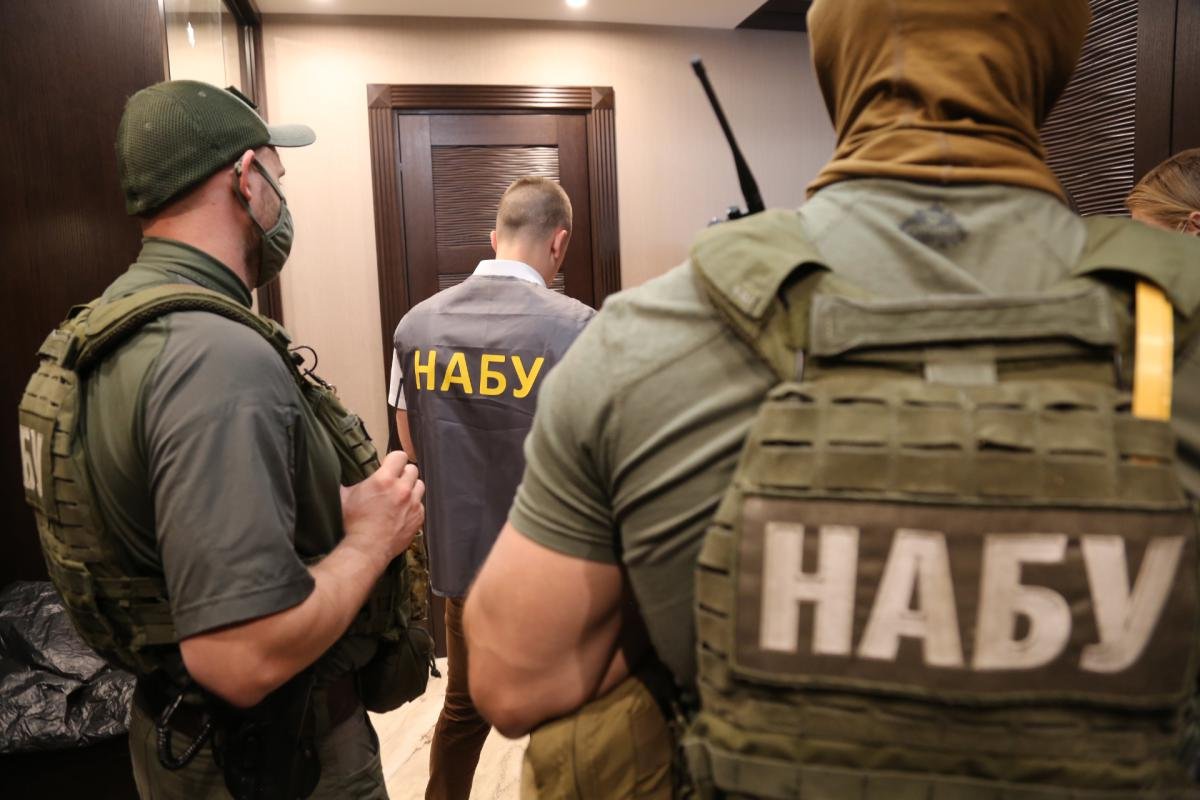


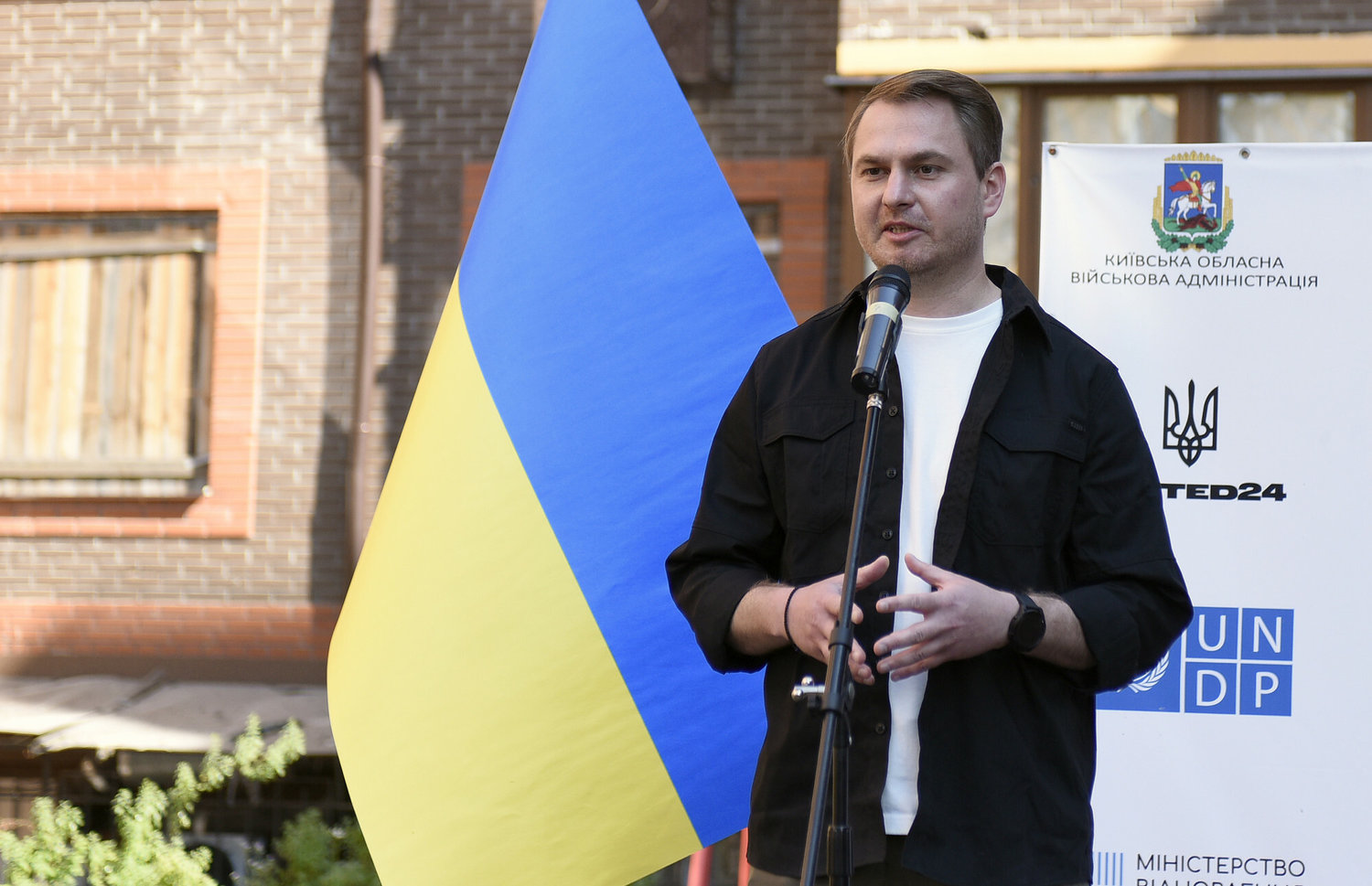
































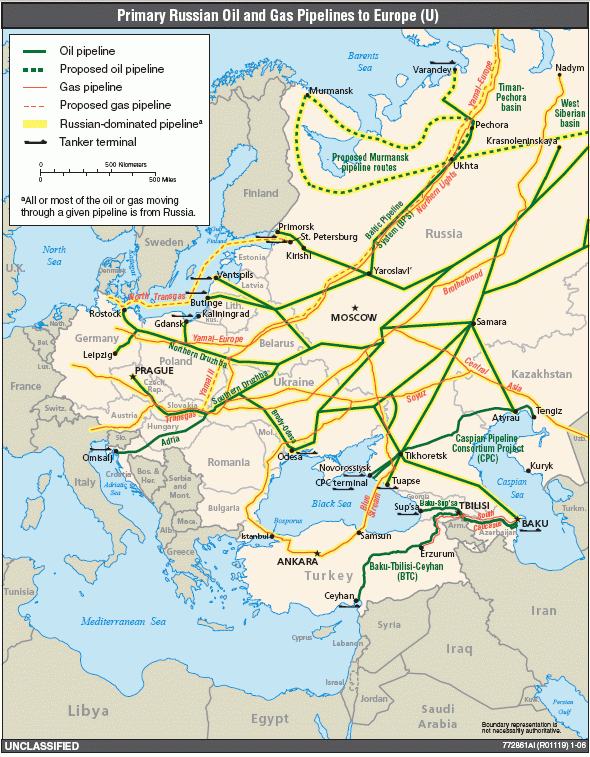
 (@andrii_sybiha)