Vue normale

“There is real hunger there”: Oleshky, occupied town in Ukraine’s Kherson Oblast, turned 942 this week. Behind Russian blockade, its people eat roadside grass

12 septembre 2026 à 14:47

In the occupied town of Oleshky in Kherson Oblast, people are foraging for grass and picking through bombed-out basements for anything to eat, Natalia Soboleva, an Odesa volunteer who tracks the town, says, Espreso reports. The city turned 942 years old this week and marked the day, as it has more than two hundred before it, under a Russian blockade that lets no food in and no one out.

The starvation is engineered. Oleshky, on the Russian-held left bank of the Dnipro, was flooded when Russia blew the Kakhovka dam in 2023 and has been sealed off since late 2025, its roads mined and its aid convoys fired on. In July, OSCE monitors confirmed the blockade, describing a place where the living starve and the dead go unburied.

According to Kherson Regional Administration Head Oleksandr Prokudin, in Oleshky, hundreds of people remain, elderly, children, while food deliveries have all but stopped for months, and Russian forces prohibit the evacuation.

Residents forage through the ruins

Soboleva describes a population reduced to scavenging.

"People walk around gathering grass and cooking whatever they can, going through wrecked basements looking for scraps of food. There is hunger there, real hunger," she said.

Hundreds of abandoned animals are starving, too, and the residents who remain share what little they scavenge with them.

Russia shells the aid convoys

The blockade is enforced with fire. Russian forces attack the humanitarian vehicles that try to bring in food and water, Soboleva said.

The last attempt, on 1 September, ended with Russian troops shelling four volunteer cars. The turn for the worse came around January and February, she said, after a food run from Kopani was hit last summer, killing people and halting deliveries for good.

No corridor lets anyone leave

The one thing that could save the town, its officials and volunteers agree, is a guaranteed humanitarian corridor, and Russia will not grant one.

Volunteers, working with Ukraine's human rights ombudsperson, have twice collected lists of residents who want to leave, and the lists were reportedly cleared with the Russian side, but the occupiers still refused to open a route.

"We have not forgotten Oleshky, or the unspeakable pain the city's residents are living through," Prokudin said, adding that Ukraine keeps pressing to get people out.

Ukraine’s Third Army Corps won’t just hold Donetsk fortress cities. It’s building mission to pull civilians out of them

12 septembre 2026 à 12:13

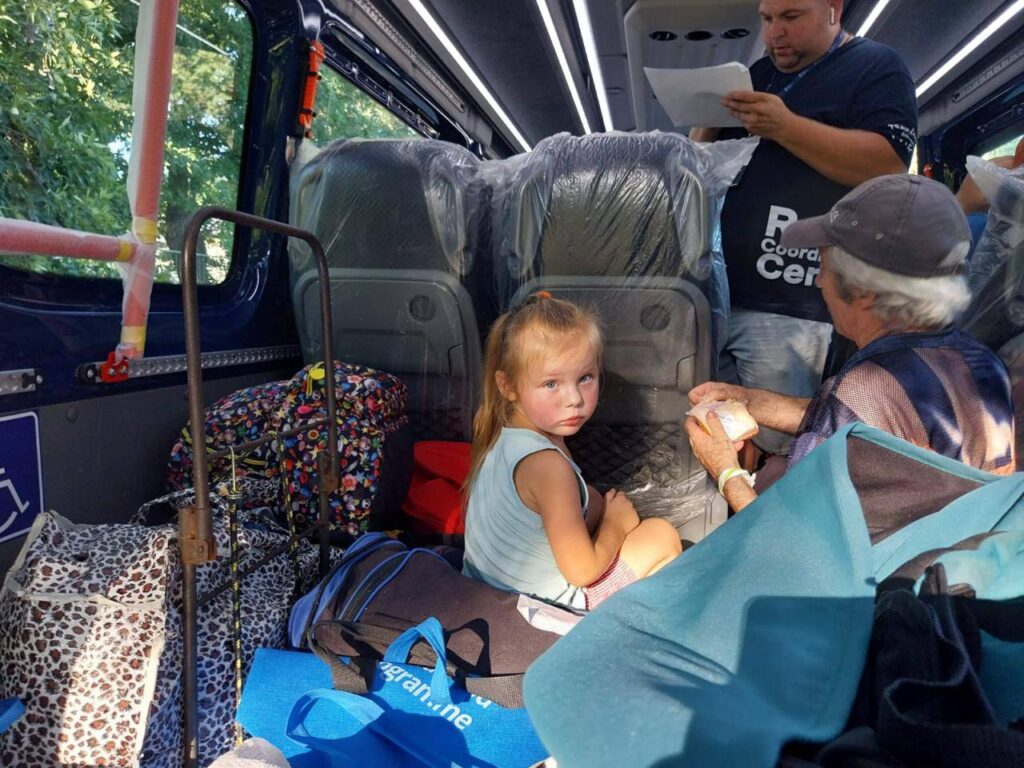
The Ukrainian soldiers simultaneously perform defensive, logistical, and humanitarian functions. Ukraine’s Third Army Corps is launching a separate AB3.HUMANITARIAN initiative to evacuate civilians from frontline settlements. This means saving families, elderly people, children, people with disabilities, from Russian attacks, and those who often have no way to leave on their own.

Recently, the 3rd Army Corps, led by Andrii Biletskyi, the Azov founder, has been tasked with stabilizing the Donetsk front, where Russia is battering the fortress cities that have held since 2014. As that fighting grinds toward towns like Sloviansk and Kramatorsk, the civilians still living in them have to be moved, often under fire.

Robots and boats reach cut-off towns

The corps says its soldiers already regularly pull residents out of settlements near the front. The hard part is the routes: roads watched by Russian drones, approaches too dangerous for a bus or an ambulance. To work them, the evacuation teams use ground robots, armored vehicles, motorboats, and whatever else the terrain demands, reaching places that an ordinary rescue cannot.

Unmanned ground vehicles have become a fixture of Ukrainian evacuations, part of a wider shift in which the military ran more than 100,000 robot logistics and evacuation missions in the first eight months of 2026.

A fund pays for more trips

Making it a formal mission is also about money. The corps' own Staff Fund is opening financing for the vehicles and equipment that the evacuation teams need. The corps expects this dedicated support to enable it to run more trips, into more places, more often, than volunteer improvisation allowed.

The corps urges people to leave early

The appeal underneath the announcement is blunt.

"Take care of yourselves and your loved ones, and leave in good time, because the lives of our people are the most precious thing," the corps wrote.

The plea matters because many who remain on the front line are the least able to move on short notice, and the window to reach them narrows every time the front creeps closer, while roads get more dangerous.

“Its task is not cargo. Its task is people”: After Russian FPV drone hit their house, K-2 brigade sent ground robot to carry casualties out

11 septembre 2026 à 14:47

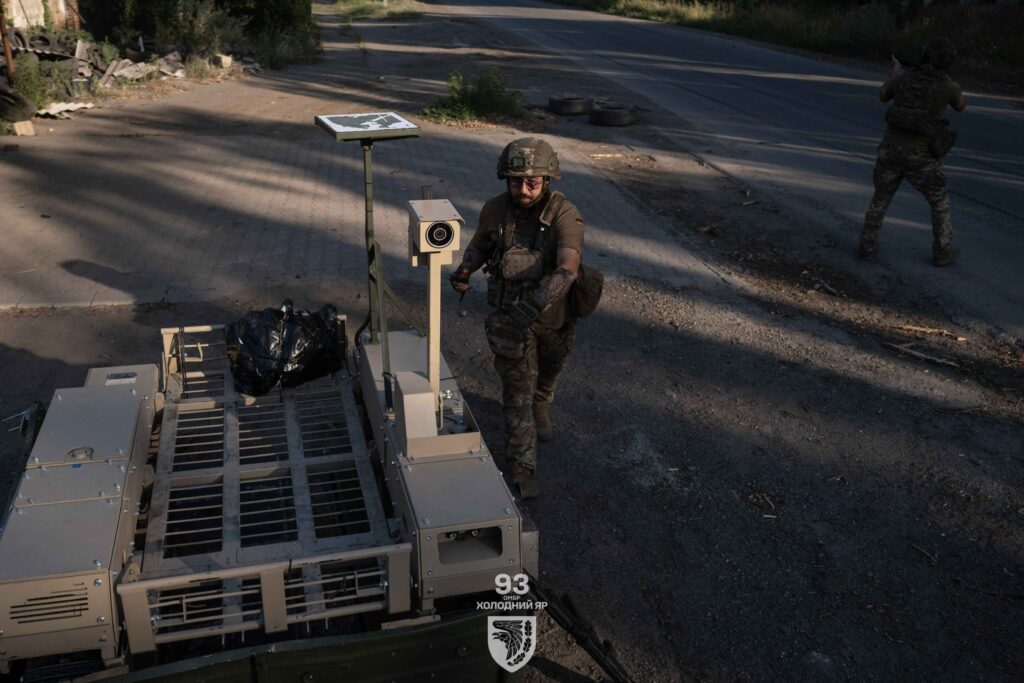
An armed ground robot. Photo: 93rd Brigade

A Ukrainian ground robot that usually hauls ammunition and supplies to the front carried a different load out of it this time: wounded civilians. The 20th "K-2" Unmanned Systems Brigade sent the unmanned vehicle to evacuate people hurt when a Russian FPV drone struck their house, and its soldiers walked the entire route to shield them from more drones.

On a front where Russian FPV drones hunt anything that moves, Ukraine has handed its ground robots the jobs that get soldiers killed: hauling ammunition, clearing mines, and dragging out the wounded. Its units ran more than 100,000 such robot missions in the first eight months of 2026, and Zelenskyy has pushed to contract at least 50,000 more of the machines.

A Ukrainian civilian home took a direct Russia's FPV hit, and the wounded had nowhere safe to run

Ukrainian troops sent in a ground robot to pull them out, with no human driver risking their lives. Usually, such machines haul ammo or supplies
🎥 "K-2" Brigade pic.twitter.com/NTFE93sLFS

— Euromaidan Press (@EuromaidanPress) September 11, 2026

The robot carries people, not cargo

An FPV drone hit the civilian house and left casualties who had to be moved out of the danger zone, K-2 explained, and an ordinary evacuation would have been too risky, so the unit used an unmanned ground vehicle instead.

"Its task is not cargo. Its task is people," the brigade said.

Soldiers guard the whole route

The robot did not go alone. As the footage shows, K-2 soldiers escorted the vehicle along its entire path so they could protect the wounded from Russian drones if the machine came under attack.

That risk is real: Ukraine's evacuation robots have themselves become targets, with Russian forces striking anything that moves on a front where the drone kill zone can stretch a dozen kilometers back from the line.

Near Kupiansk, a robot that once ran a dozen missions now survives three or four before it is destroyed, according to a robot-unit commander.

Earlier, Tetiana Chornovov, the commander of a platoon of anti-tank guided missile systems, said that Ukraine still didn't have a proper system for getting its wounded off the battlefield. Chornovol believes that creating separate staffed evacuation units within brigades is the most necessary reform now, each with an autonomous team and special transport.

  • ✇Euromaidan Press
  • Three Ukrainian units received kit that makes an uncrewed vehicle out of whatever they’re already driving
    Ukraine is turning ordinary cars into robots instead of building them from scratch. Three units of the Armed Forces received the Kaban remote-control system, which converts vehicles into uncrewed ones, developer Drone Fight Group told Defender Media. Ground robots have become a daily part of Ukraine's front. Ukrainian units ran 16,676 logistics and evacuation missions with them in June, up 122 percent since January, and the military has contracted more than 22,000 groun
     

Three Ukrainian units received kit that makes an uncrewed vehicle out of whatever they’re already driving

26 août 2026 à 17:48

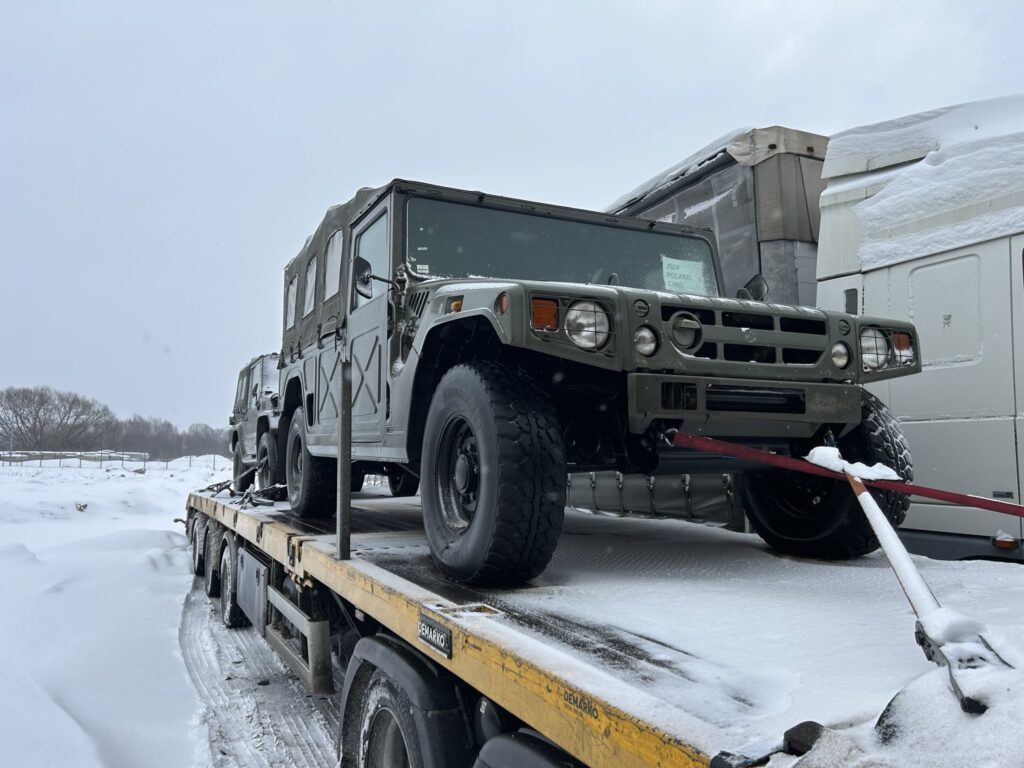
japan quietly ships military-grade off-roaders ukraine — here’s what can do · post toyota high mobility vehicle transferred loaded transport truck 14 2026 переданий японією позашляховик hmv січня року посольство

Ukraine is turning ordinary cars into robots instead of building them from scratch. Three units of the Armed Forces received the Kaban remote-control system, which converts vehicles into uncrewed ones, developer Drone Fight Group told Defender Media.

Ground robots have become a daily part of Ukraine's front. Ukrainian units ran 16,676 logistics and evacuation missions with them in June, up 122 percent since January, and the military has contracted more than 22,000 ground robots for 2026, nearly double the 2025 total. Most are purpose-built platforms. Kaban takes the opposite route, converting vehicles that a unit already has.

The developers say Kaban was passed to the 3rd Army Corps, the 429th Separate Unmanned Systems Regiment "Akhilles", and the 49th Brigade of the Armed Forces.

The system bolts on without modification

Kaban installs on a vehicle without altering its construction and works with different models, Drone Fight Group said. It lets the operator switch between remote and manual control.

The operator navigates on a digital map, plotting routes and setting markers. Manual correction is built in for GPS spoofing cases. The system predicts its trajectory and can automatically stop the vehicle if the connection is lost.

Starlink carries the control link

The main communication channel is Starlink, and the system also supports analog video transmission and radio control, according to the developers. A vehicle can be fitted with thermal cameras if needed.

Kaban provides two-way audio and remote control of lights, infrared illumination, and searchlights, and it can pull data from the vehicle's onboard computer. Among the optional add-ons, the developers list net launchers and platforms for launching drones.

Combat testing came before the handover

Kaban is developed with support from the Brave1 cluster, and the system has already passed combat trials, according to the developers. Work continues to refine it using feedback from military units.

For first time, Ukraine is tendering ground robots to ministry-set specifications and no maker can take more than half of any class

25 août 2026 à 15:41

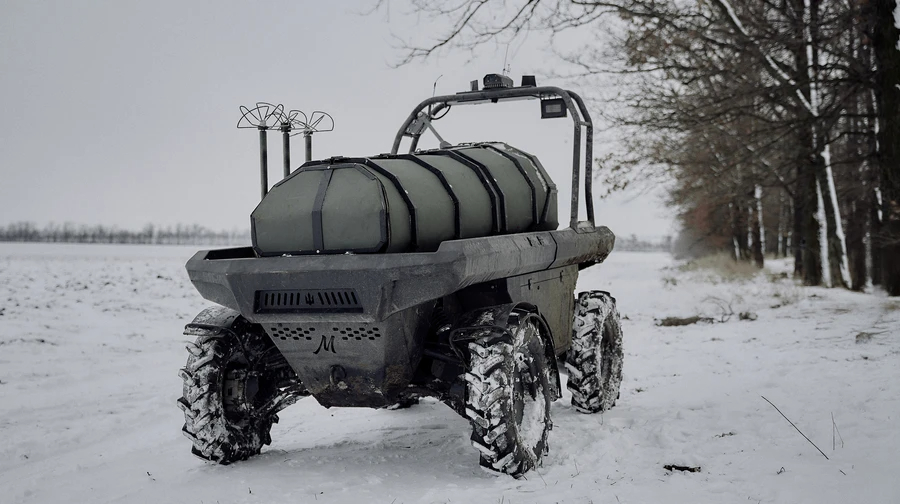
The MAUL unmanned ground vehicle. Source: AIDronesUA

Ukraine's ground robots ran more than 100,000 missions in the first eight months of 2026. The Defense Procurement Agency will now buy logistics and strike ground robotic complexes according to specifications set by the Defense Ministry, rather than approving models one at a time, the ministry announced.

The mechanism is three days old. The agency applied the same structure to fiber-optic FPV drones on 22 August—classes, multiple lots each, no supplier above half a class. Ukraine is standardizing how it buys entire weapons categories, one category at a time.

The rules sort makers by class

Complexes will be divided into classes by operating range and payload, with four to five lots per class. No single manufacturer may take more than half the order within one class.

Suppliers must meet the technical specifications and hold at least one codified ground robotic complex. The procurement runs in a closed environment under defense security requirements.

"A tender is one of the best instruments for this, because we can buy more equipment for the same money and minimize the risk of supply disruptions by splitting the order among different manufacturers," Deputy Defense Minister Mstyslav Banik said.

Mission volume keeps climbing

Monthly figures of ground robot missions logged in the DELTA combat system rose almost without interruption: 7,511 in January, 11,028 in April, 19,969 in July. Units recorded another 15,729 between 1 and 20 August, about 790 a day compared with roughly 640 a day in July, The Defense Post reported.

Ukraine has contracted more than 22,000 ground robots since January, nearly double the total for all of 2025. The number of units operating them grew from 117 at the end of 2025 to 230 by mid-2026.

A commander disputes the evacuation case

The ministry lists casualty evacuation as one of the tender's purposes. A frontline officer challenged that three days ago.

Tetiana Chornovol, who commands an anti-tank guided missile platoon, said ground robots are too slow for evacuation and often easy targets for Russian drones, arguing brigades need staffed evacuation teams and small light-armored vehicles instead.

Evacuation is “force majeure that no one is ready for” in most Ukrainian units, and robots are too slow to fix it, commander says

22 août 2026 à 13:02

A Ukrainian officer says the army still has no proper system for getting its wounded off the battlefield. Tetiana Chornovov, the commander of a platoon of anti-tank guided missile systems, has called for systemic reform of casualty evacuation in Ukraine's Armed Forces, saying that in the fifth year of the full-scale war, evacuating soldiers from the battlefield remains in most units "a force majeure that no one is ready for."

Most Ukrainian units lack dedicated evacuation groups and specialized armored transport, so evacuations happen in chaos with improvised means, with exceptions only in individual brigades, she says.

Amid public debate over whether ground robots can do the job, Chornovol argues the problem is larger than any single technology, and that the absence of a reliable way out shapes how soldiers fight.

The psychological stakes

Chornovol said the certainty of rescue matters as much as the rescue itself.

"You can't imagine how the existence of professional evac groups would improve the psychological atmosphere at the front. Everyone wants to hope that someone will come for them, will save them," she said.

Her own fear is concrete. Fighting in her fifth year, she said her greatest fear is "that something happens to my people and we'll be helpless, because the evacuation problems will be my problems, and in a small platoon I can't allocate resources to create my own evac group."

One evacuation, seven casualties

Chornovol has backed her argument with a case from a year ago, when her Stuhna anti-tank missile crew was subordinated to a neighboring brigade. At four in the morning, she was told of one killed and one wounded by an enemy chemical-weapons strike, with the evacuation placed entirely on her crew despite weak coordination and unfamiliar terrain.

The rescue attempts compounded the toll.

"My combat vehicle with excellent electronic warfare and an anti-mine grader, which set out for the evacuation, blew up on an anti-tank magnetic mine dropped from a drone," she recalled.

The grader saved lives, but four of her best soldiers were badly concussed. A second vehicle from the brigade, with one of her men as a guide, hit another anti-tank mine, but without a grader: "the mine exploded under the hood, the driver lost his legs, the others were concussed." A third vehicle made it through by luck and took out the wounded and the dead.

"So one evacuation, seven casualties. One severe, without legs," she said, noting the brigade simply had no normal evac group or evac protocol.

She organized the Stuhna evacuation herself, bringing in border guards to control the road, waiting for a window in drone flights, and repairing the electronic-warfare gear stripped from the first knocked-out vehicle.

What Chornovol wants built

Chornovol believes that creating separate staffed evacuation units within brigades is the most necessary reform now, each with an autonomous team and special transport.

"There should be the best drivers, with salaries like assault troops, but also medics, pilots, EW specialists, sappers to defuse mines dropped by drones, and pros: hunters with shotguns to down drones," she said.

On equipment, she argued against relying on ground robots, which she agrees are too slow for evacuation and often easy targets for enemy drones. The main transport, she said, should be a small, fast, lightly-armored vehicle with an anti-mine bottom, light enough to survive the anti-tank mines the enemy drops.

"For a platoon, such equipment is too much, but I don't understand why the whole brigade we were attached to didn't have such an evac vehicle," she said.

She nearly lost five of her men, she added, because of the absence of adequate evacuation approaches and proper light-armored vehicles in the army, asking why the National Guard has them for evacuation while the Armed Forces do not.

  • ✇The Kyiv Independent
  • Ukraine preparing to evacuate citizens from Israel, Iran as Middle East conflict escalates
    Ukraine is preparing to evacuate its citizens from Israel and Iran as hostilities between the two countries intensify, the Foreign Ministry told Ukrainian media outlet NV on June 18.The move comes as Israel on June 13 launched widespread air strikes against Iran, targeting nuclear facilities and the country's military leadership. Iran responded with missile strikes on Tel Aviv and other cities, killing multiple civilians, including five Ukrainian citizens on June 14.As of the morning of June 18,
     

Ukraine preparing to evacuate citizens from Israel, Iran as Middle East conflict escalates

18 juin 2025 à 09:58
Ukraine preparing to evacuate citizens from Israel, Iran as Middle East conflict escalates

Ukraine is preparing to evacuate its citizens from Israel and Iran as hostilities between the two countries intensify, the Foreign Ministry told Ukrainian media outlet NV on June 18.

The move comes as Israel on June 13 launched widespread air strikes against Iran, targeting nuclear facilities and the country's military leadership. Iran responded with missile strikes on Tel Aviv and other cities, killing multiple civilians, including five Ukrainian citizens on June 14.

As of the morning of June 18, 293 Ukrainians in Israel and 85 in Iran have requested evacuation, the ministry said. Ten additional foreign nationals with permanent residency in Ukraine have also asked for assistance to evacuate from Iran.

Ukraine's embassy in Israel has received over 400 calls on its hotline as citizens seek updates on possible evacuation routes. The ministry told NV it is developing evacuation plans, including potential flights organized in cooperation with international partners.

On June 13, Kyiv expressed concern over the security situation in the Middle East, describing Tehran as a "source of problems" in the region and beyond.

Iran is a key supplier of weapons to Russia, including Shahed-type drones and ballistic missiles used in attacks on Ukrainian cities. Israel, which hosts a significant Russian-speaking population, has not joined Western sanctions against Moscow.

Tensions in the region grow as U.S. President Donald Trump is also considering launching U.S. strikes on Iranian nuclear targets, Axios reported on June 17.

On Truth Social, Trump demanded Iran's "unconditional surrender" and threatened Supreme Leader Ali Khamenei, while boasting about American control of Iranian airspace.

Trump has also floated Russian President Vladimir Putin as a possible mediator in the conflict.

Putin held separate calls with Iranian President Masoud Pezeshkian and Israeli Prime Minister Benjamin Netanyahu on June 13, condemning Israeli strikes and offering to mediate.

Israel has not publicly responded to Russia's proposal, but Kremlin spokesperson Dmitry Peskov said on June 17 that Tel Aviv appeared unwilling to accept Russian mediation.

Iran's Health Ministry claimed on June 18 that 585 people had been killed by Israeli strikes, with Tehran alleging that 90% of the casualties are civilians.

The figures have not been independently verified.

4 months after striking Chornobyl, Russia warns Israeli attacks on Iran risk nuclear ‘catastrophe’
The warning comes as Moscow accuses Israel of escalating the risk of a nuclear incident in the Middle East, despite Russia’s own record of threatening nuclear facilities during its war in Ukraine, including a February drone strike on the Chornobyl nuclear site that Kyiv and Western experts condemned as nuclear blackmail.
Ukraine preparing to evacuate citizens from Israel, Iran as Middle East conflict escalatesThe Kyiv IndependentAnna Fratsyvir
Ukraine preparing to evacuate citizens from Israel, Iran as Middle East conflict escalates
❌