Retailer removes kid’s clown costume after people said it resembled a racist caricature used in minstrel showsTarget, the US retail corporation, said it pulled a controversial Halloween costume off its shelves after criticism across social media that it resembled a racist caricature.The ad image for the costume, sold as the “Kids’ Glows Under Blacklight Circus Clown Halloween Costume,” depicted a Black child in a bright orange and black top with solid black gloves and a mask with a wide, toothy
Retailer removes kid’s clown costume after people said it resembled a racist caricature used in minstrel shows
Target, the US retail corporation, said it pulled a controversial Halloween costume off its shelves after criticism across social media that it resembled a racist caricature.
The ad image for the costume, sold as the “Kids’ Glows Under Blacklight Circus Clown Halloween Costume,” depicted a Black child in a bright orange and black top with solid black gloves and a mask with a wide, toothy smile. Both the child’s pose and the costume’s gloves and mask were likened to caricatures of Black people used in minstrel shows.
Move is latest deterioration in trade relations between neighbors with historically strong economic tiesDonald Trump announced a new 50% tariff on automobiles and crucial raw materials from Canada, the latest deterioration in trade relations between the two neighbors with historically strong economic ties.The US president said that the increased tariffs would start on 1 January 2027 on all cars, trucks, automobile parts and steel. He also derided the nation’s tariffs on American farmers, writing
Move is latest deterioration in trade relations between neighbors with historically strong economic ties
Donald Trump announced a new 50% tariff on automobiles and crucial raw materials from Canada, the latest deterioration in trade relations between the two neighbors with historically strong economic ties.
The US president said that the increased tariffs would start on 1 January 2027 on all cars, trucks, automobile parts and steel. He also derided the nation’s tariffs on American farmers, writing on social media that Canada has been “ripping off” the US “for years”.
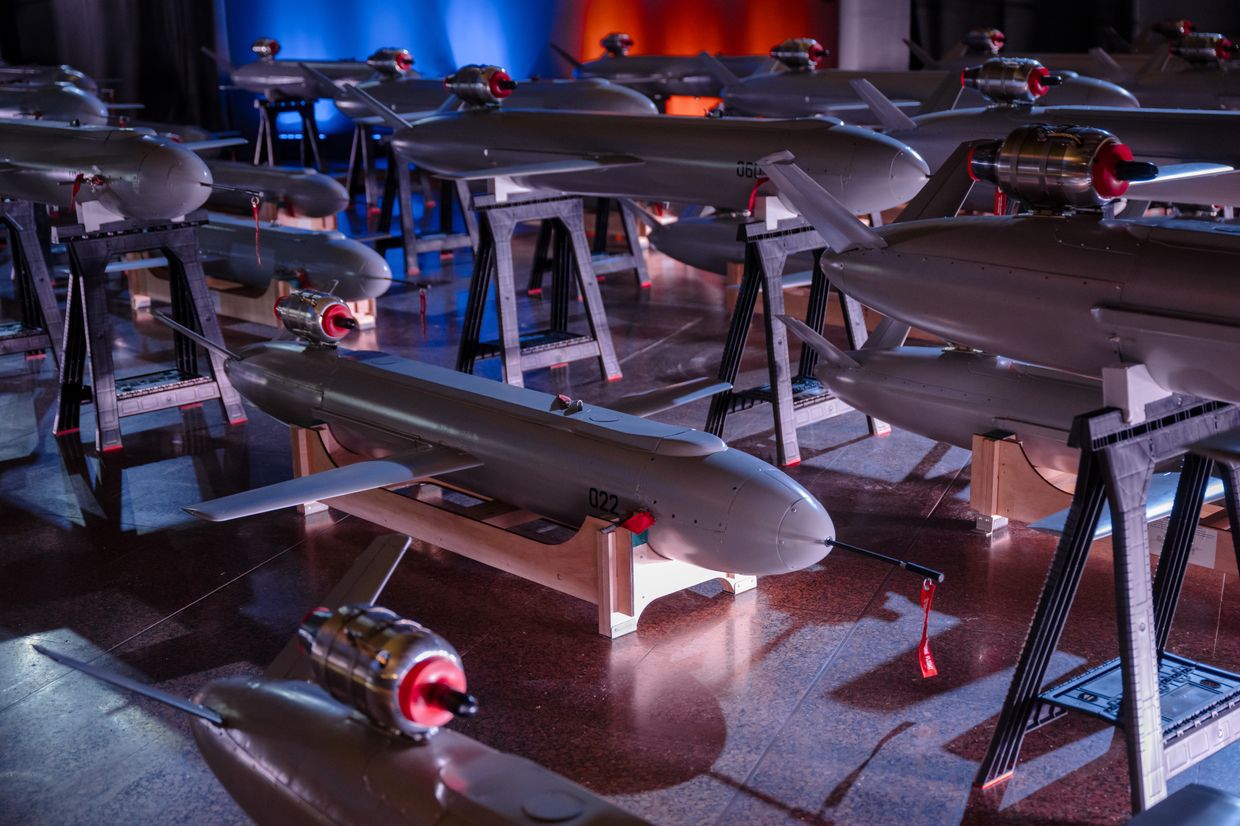
Ukraine is building a sea-facing layer of air defense along its southern coast, Kyrylo Liukov, head of the unmanned technologies department at the Serhii Prytula Foundation, wrote in a column for RBC-Ukraine. Winged interceptors now reach the Russian spy drones that guide strikes in the south.
Russia's nightly drone strikes on Ukrainian cities have turned air defense into a race to close every corridor Russia can fly through, over land first and now over the open sea. K
Ukraine is building a sea-facing layer of air defense along its southern coast, Kyrylo Liukov, head of the unmanned technologies department at the Serhii Prytula Foundation, wrote in a column for RBC-Ukraine. Winged interceptors now reach the Russian spy drones that guide strikes in the south.
Russia's nightly drone strikes on Ukrainian cities have turned air defense into a race to close every corridor Russia can fly through, over land first and now over the open sea. Kyiv does it with cheap interceptors rather than costly missiles, and keeps having to chase Russian workarounds. The sea was the stretch air defense could not reach, and it is where Russia keeps the spotters that make its Shahed swarms steerable.
Land and sea are two different fights
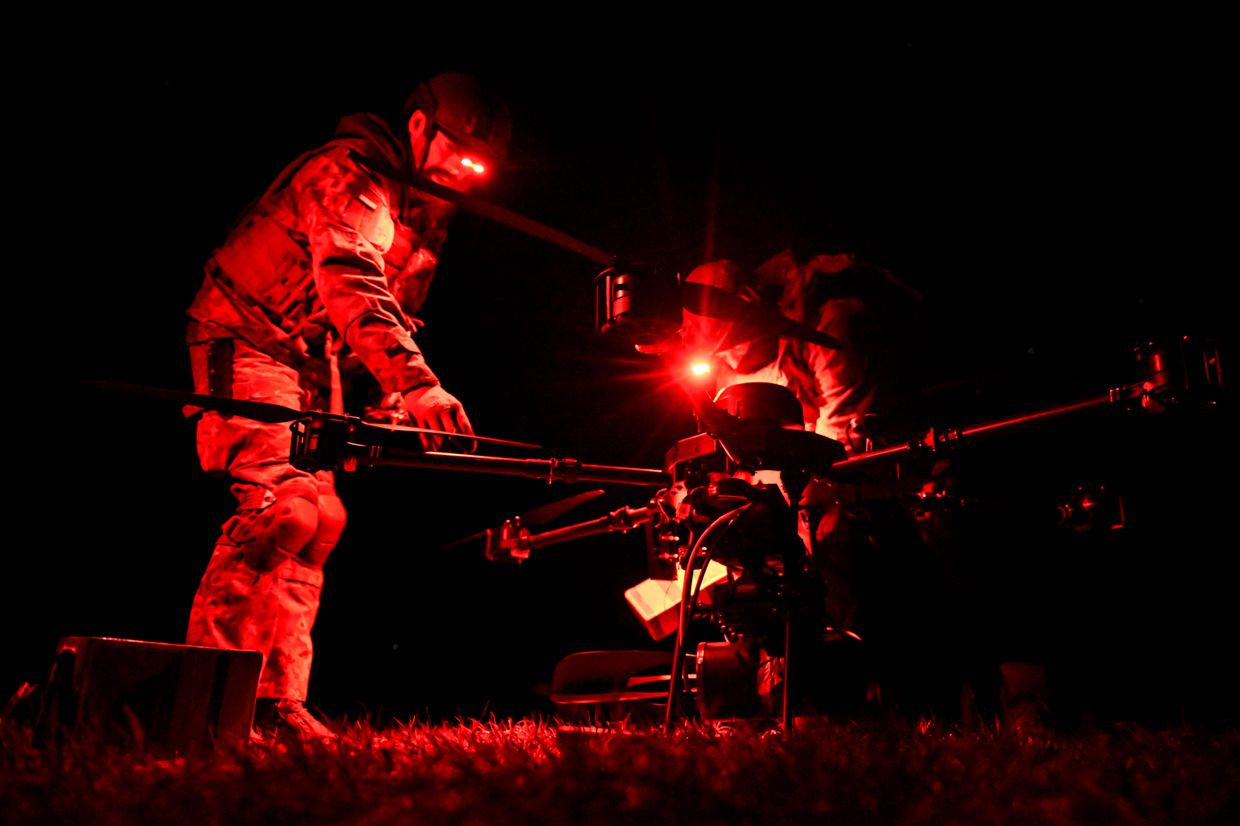
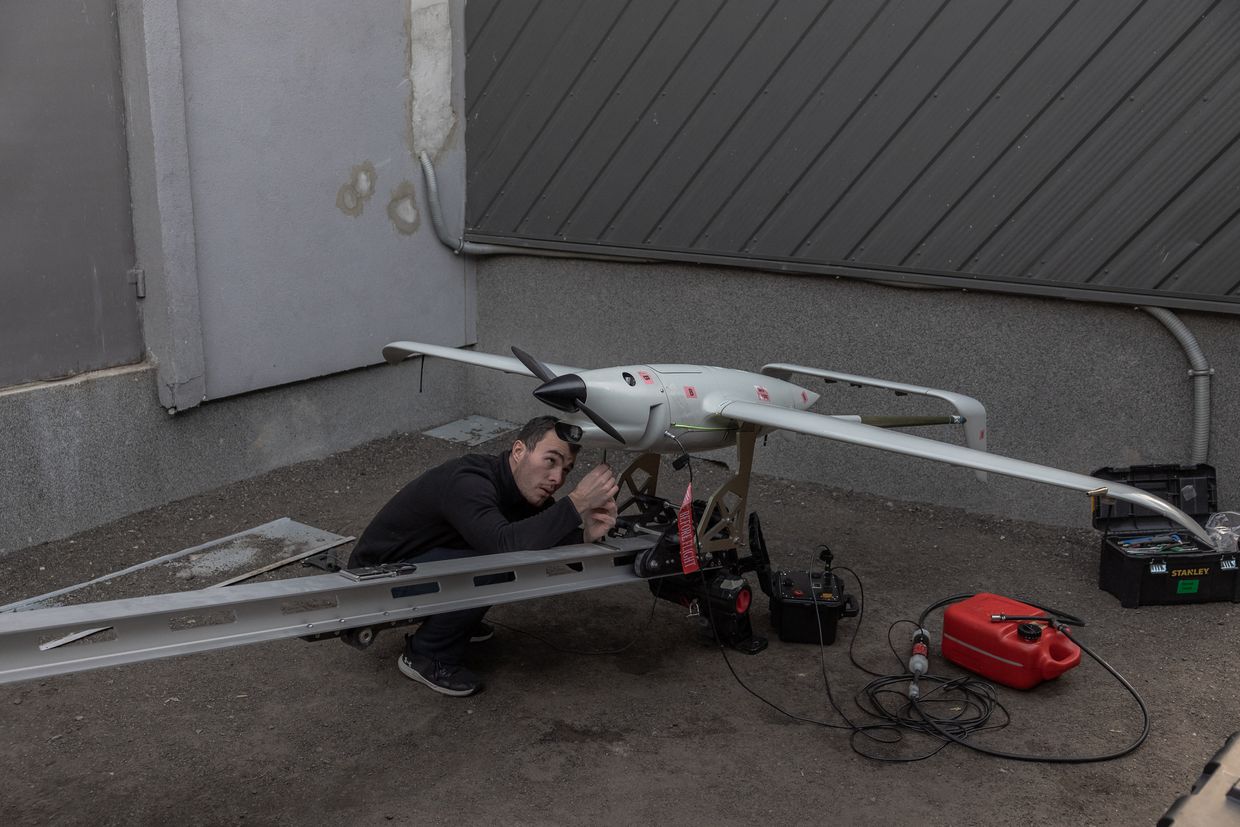
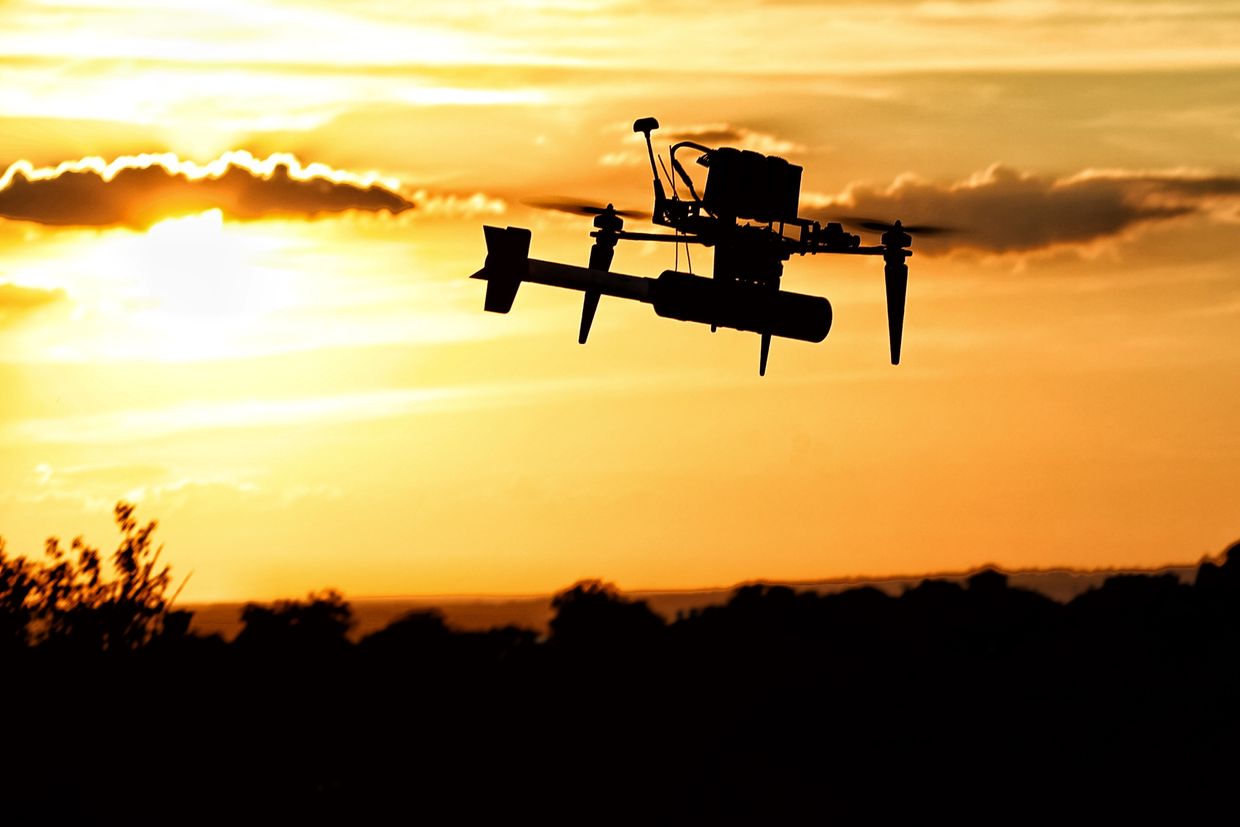
Defending the sky over land and over open water are two different problems, Liukov wrote. Multirotor copters are fast and simple to launch near the coast, but past roughly 25 km offshore, a multirotor is almost useless. Russia builds its mission routes so that drones cross dozens of kilometers over sea before they turn toward Ukrainian targets. Fixed-wing drones close the gap. Built like gliders, they loiter for over an hour and hold a link at 40 km and beyond, helped by an open radio horizon that land's terrain and buildings deny them.
Recon drones are the priority target for a reason. Beyond spotting and confirming hits, they work as relays in a MESH network for a group of strike drones. In that setup, Russian crews can steer Shaheds by hand right up to the moment of impact, Liukov wrote.
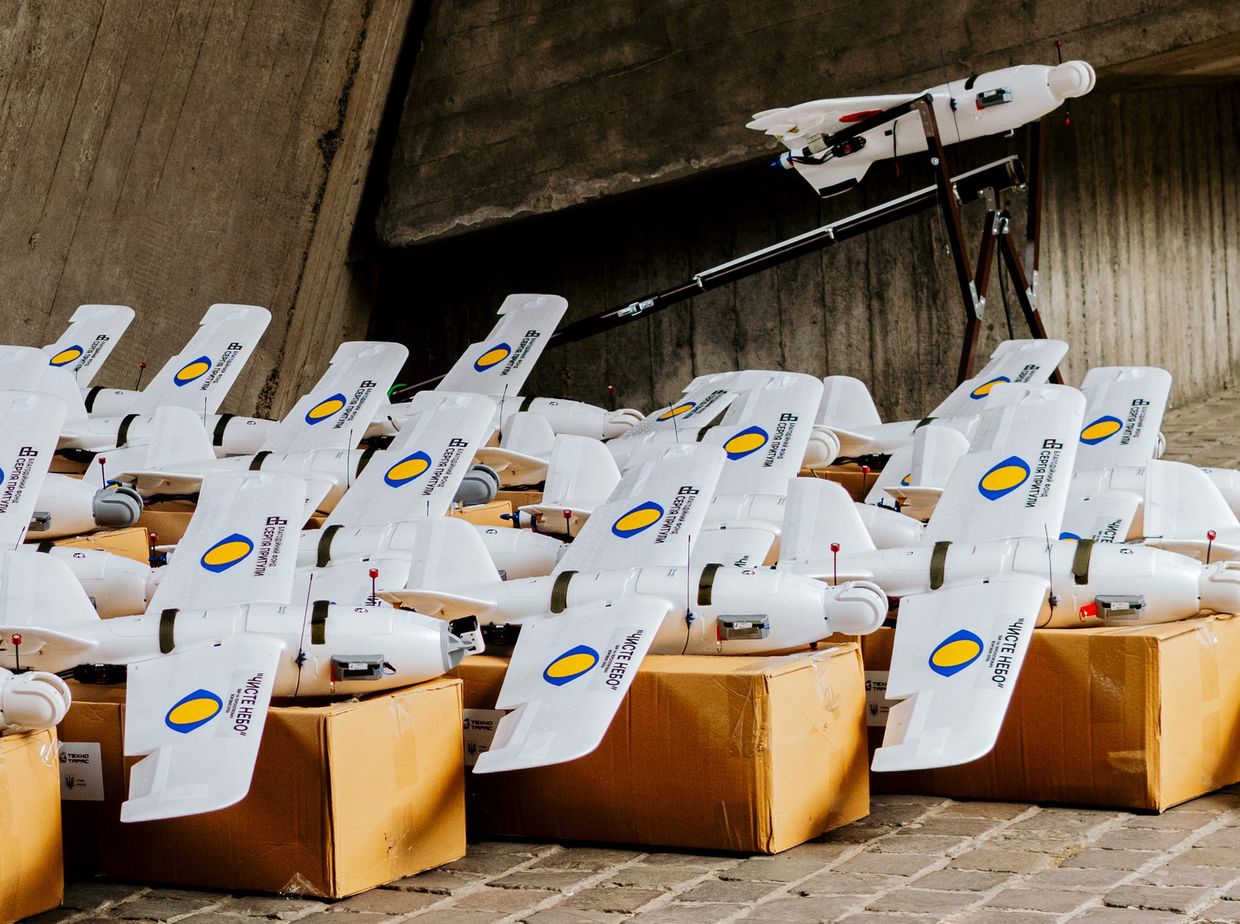
Southern units recently set three distance records with foundation-supplied interceptors. The 18th aviation commandant's office of Air Command South downed a Russian Orlan-30 reconnaissance drone 110 km out. It used a Wovkulaka Spitfire interceptor, the longest kill on record for that system.
The 12th Separate Special Purpose Center set the other two, flying a system from the miltech company TechnoTaras: an Orlan downed at 86 km, and a 145 km hunt measured from the takeoff point that held a stable digital link the whole way, Liukov wrote. That leaves Russia's drones exposed much farther from shore than its planners assume, he added—and if such results become routine, Russia has to pull its transit routes farther out still.
The Maiachnia beacon line
A less obvious problem was navigation, not shooting. A drone flying without GPS steers by landmarks, and over open sea, there are none. Late last year, the foundation, the 12th Separate Special Purpose Center, and TechnoTaras launched a project called Maiachnia. It strings radio beacons on the Skyline system along the coast from Ochakiv to Izmail. The beacons work on their own and keep backup power, tied to a central network that operators can adjust remotely. An operator can then track the drone even under GPS jamming, bad weather, or a temporary loss of link, and bring it home. More than five southern units now fly the foundation's winged drones.
The real stakes sit offshore—the southern ports and the Black Sea grain corridor that Russian drones threaten and that land-based copters can barely reach. Keeping Russian drones farther offshore would buy room there. But Russia is scaling up a faster, jet-powered Shahed, and the interceptor answer to it is early—so the offshore edge just won will have to be defended again.
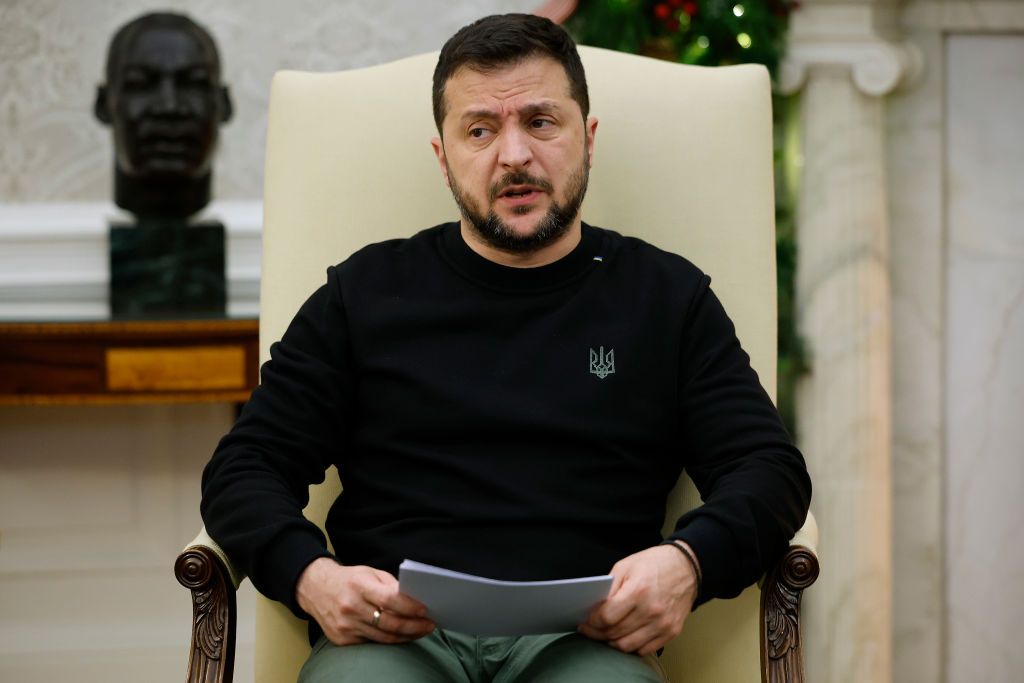
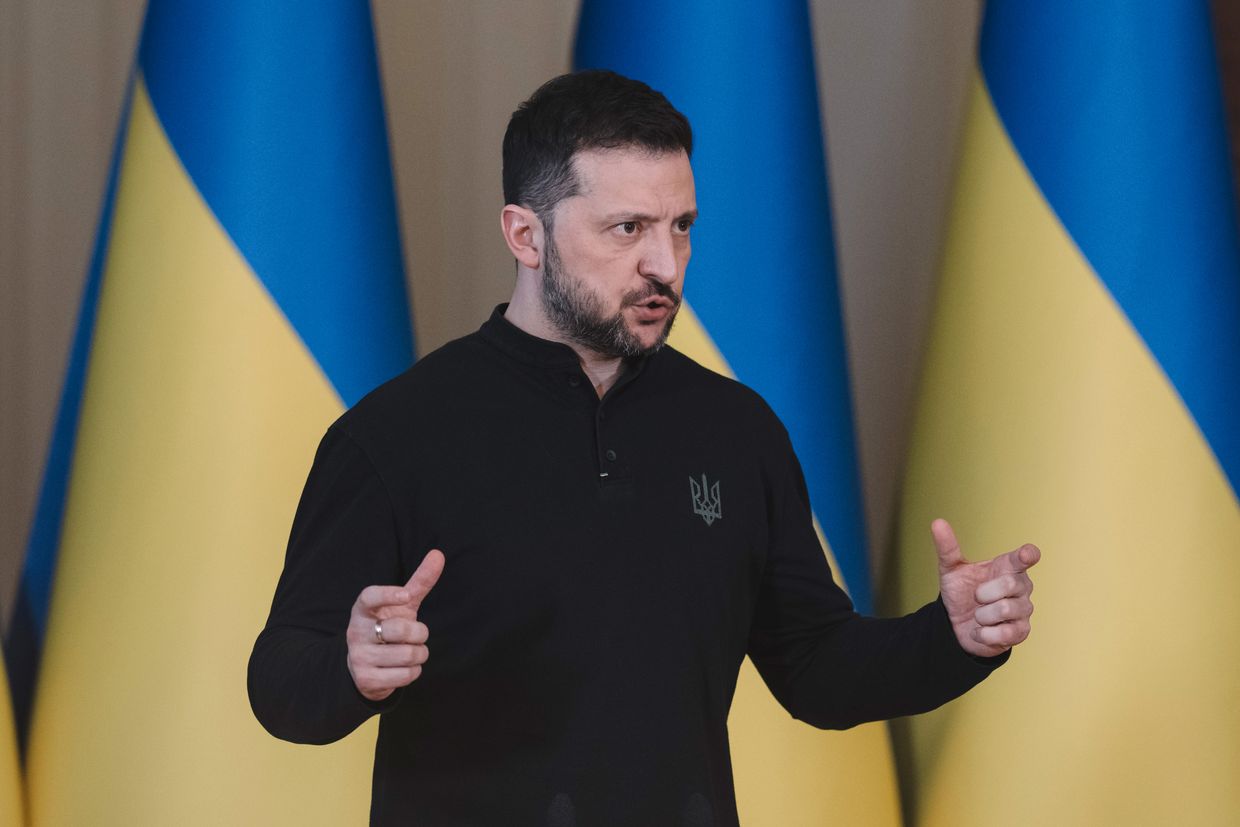
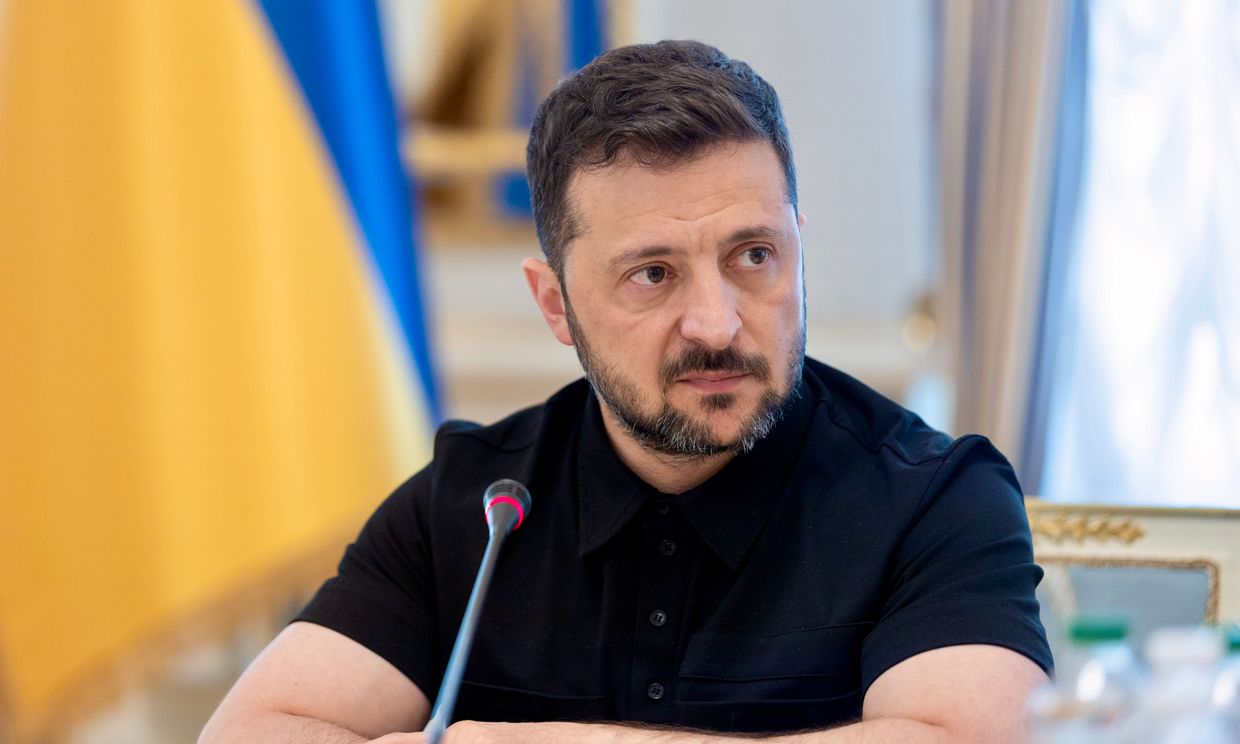
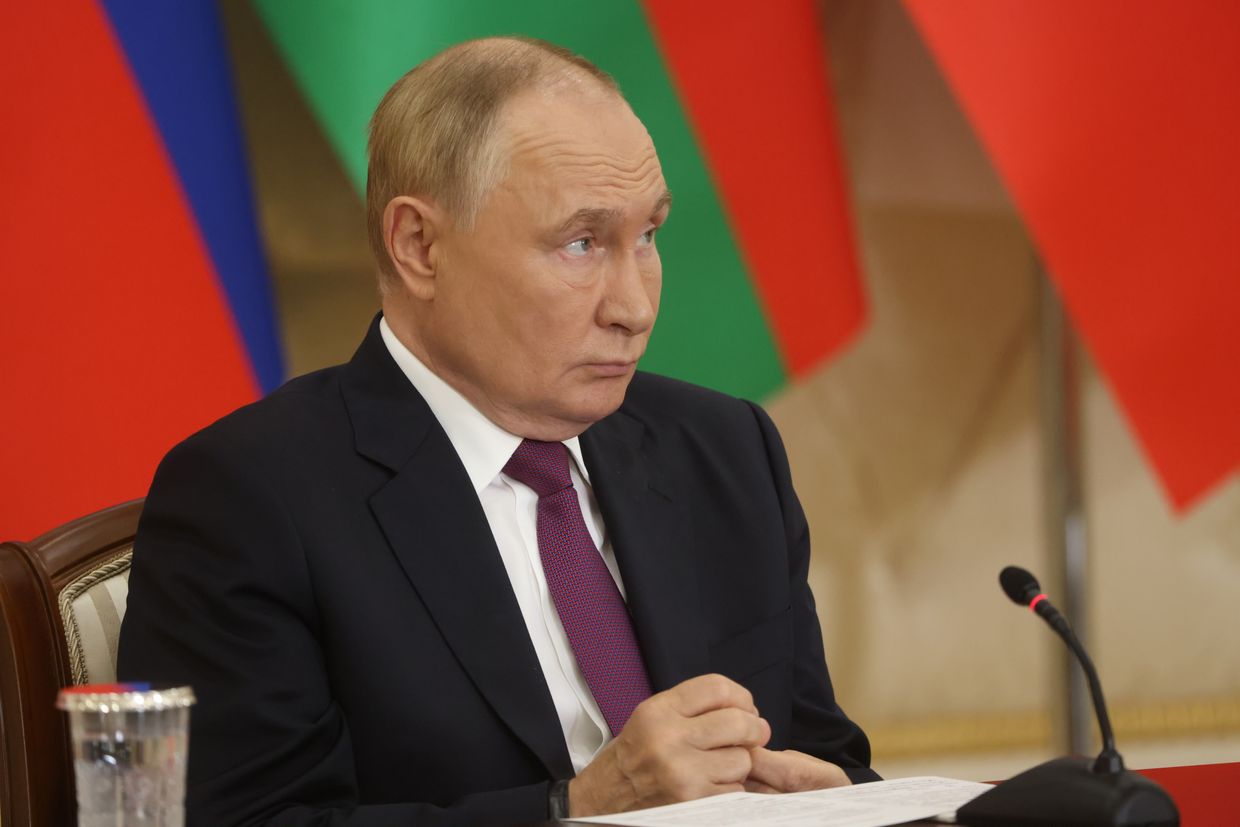
Ukraine celebrated 35 years of independence on 24 August, and Ukrainian President Volodymyr Zelenskyy marked the day with an address listing what the invasion has cost Russia, published by the President's Office. He said Putin is mortal and out of time to understand Ukraine, and said Ukraine will not hand over Donbas or save the Kremlin half a million soldiers. He also asked partners for sanctions and weapons strong enough to force an end to the war.
Russia has been inv
Ukraine celebrated 35 years of independence on 24 August, and Ukrainian President Volodymyr Zelenskyy marked the day with an address listing what the invasion has cost Russia, published by the President's Office. He said Putin is mortal and out of time to understand Ukraine, and said Ukraine will not hand over Donbas or save the Kremlin half a million soldiers. He also asked partners for sanctions and weapons strong enough to force an end to the war.
Russia has been invading Ukraine since 2014 and fighting a full-scale war on it since 2022, and Ukraine now supplies a growing share of the missiles and drones it fights back with, while the air defense shielding its cities still hangs on decisions taken in Washington and European capitals—which is what makes a holiday speech a statement of what Kyiv will not trade and what it needs built or delivered next.
The losses he read back to Moscow
President Zelenskyy turned from his own citizens to Russia partway through the speech.
"You wanted to take all our Ukraine, all our land; instead, you lost your oil refineries, your fleet, your profits, your entire generation that you sent into the meat grinder," he said.
A country that wanted Ukraine erased from the map, he added, is now absent from the international agenda of the future civilization.
For five years now, Russia has tried to exhaust and break Ukrainians — cutting light and heat, destroying homes, Kyiv Mayor Klitschko said on Ukraine's 35th Independence Day
"The aggressor failed to understand one fundamental thing: above all else, Ukrainians love freedom," he… pic.twitter.com/NvVVKSKIK1
He set Moscow's self-image against its filling stations.
"For 27 years, the head of Russia has talked about greatness, while Russia is standing in lines for gasoline," Zelenskyy said.
Moscow and St. Petersburg brought back gasoline rationing this month, and Rosneft capped fills at every station in the country.
On the Russian leader he was blunt.
"Putin hopes that we are tired. But we know that he is mortal," he said, adding that Putin never understood Ukraine and now will not have the time to.
A fifth Independence Day at war
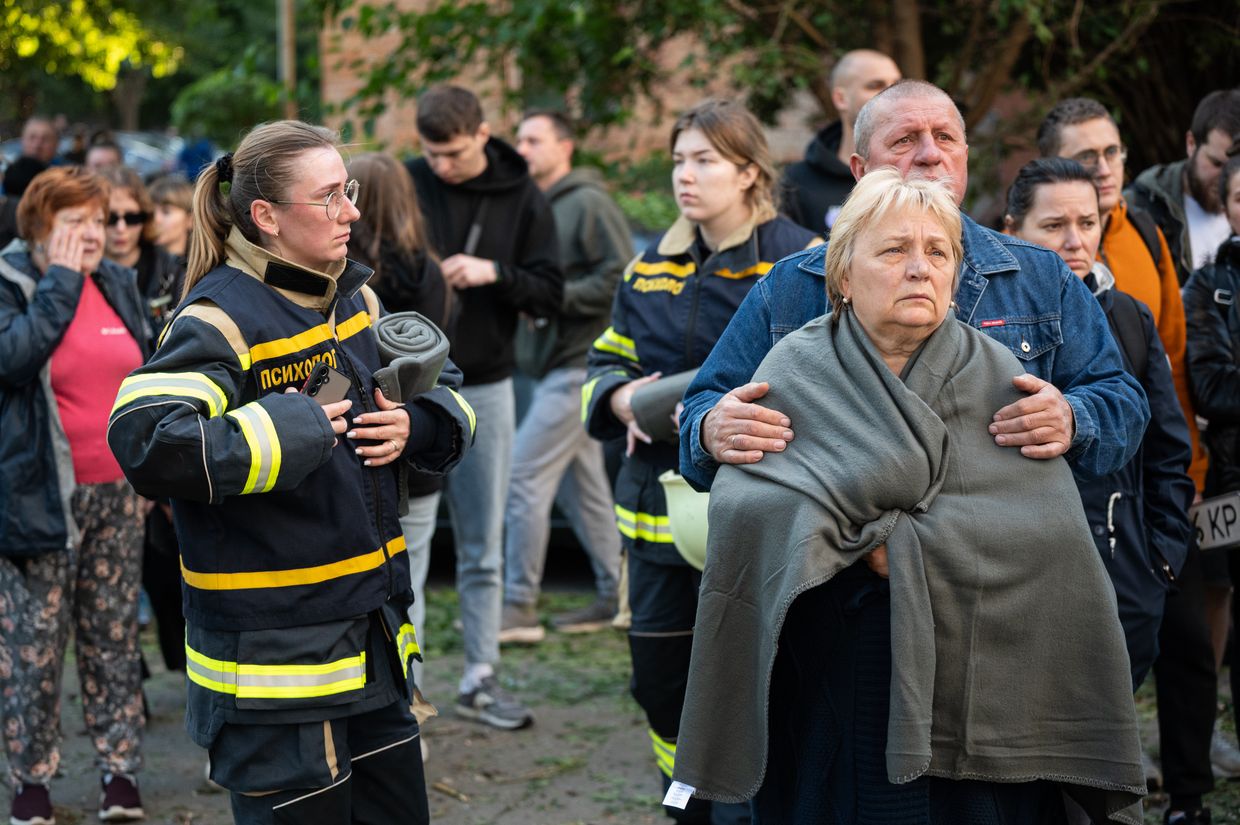
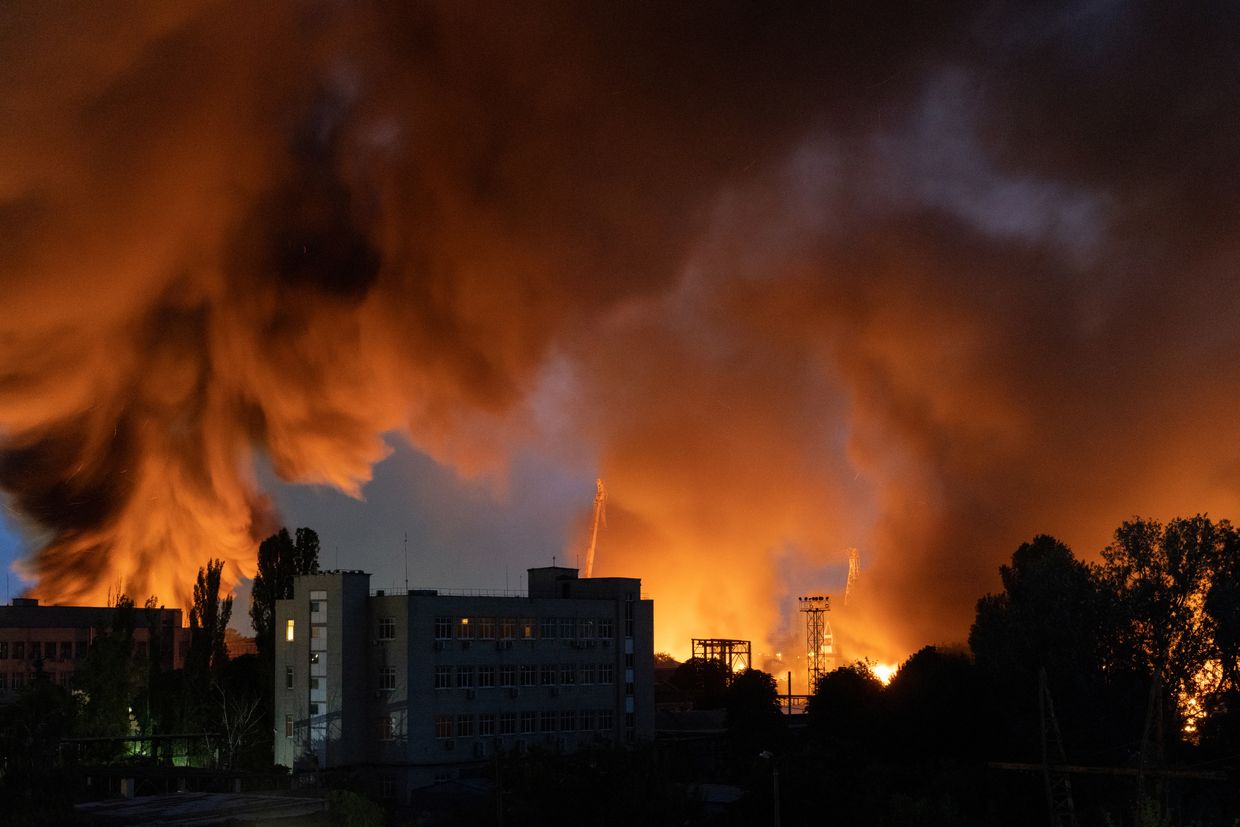
Before the holiday, Russian ballistic missiles hit Kyiv and its main airport hub twice in 24 hours. A solution to Russian ballistic terror must be found, Zelenskyy said, and that gamble must not pay off.
Russia does not want peace, it wants mobilization, the president said. Ukraine will not let Moscow seize the initiative or convince Europe that surrendering Donbas ends the war. Russia keeps pushing back the dates for taking all of Donetsk Oblast and will keep pushing them back, he said.
The president called Ukraine's defense industry a giant that forges independence around the clock, and demanded more from it. Mid-range strikes cut Russian logistics and long-range weapons cut Russian profits, he said, listing Moscow, Tuapse, Tula, Ryazan, Olenya, and Omsk among the places already hit.
Explore further
Ukraine’s drones hit two Russian fighters and a spy drone—and blinded radars from occupied Crimea to Rostov
Ukraine's home-built Flamingo cruise missiles should stop being a rare species and arrive en masse: "They must 'winter' in Russia," Zelenskyy noted.
Previously, Flamingos have hit defense plants more than 1,000 km from the border, though they still appear in strikes in small numbers.
"China should no longer remain silent"
Ukraine is not asking anyone to fight for it, the president said — only for everything needed to stop the war before Putin starts the next one. He wants sanctions that make Russians howl and Moscow at a negotiating table, and said Washington has lost its illusions about Russian intentions. Europe must be Europe, he said: united, ambitious, brave.
"China should no longer remain silent," he added, saying Beijing must cool the ardor of someone who puts on a sailor's uniform and cap and talks about a nuclear strike—a description that fits Putin.
China-based retailer swung to $99m loss in first quarter and faces scrutiny over its environmental footprintBusiness live – latest updatesShein, which built a fast-fashion empire on what seemed like impossibly low prices, has been forced to lower its own valuation in a cut-price stock market float, after falling into the red earlier this year.The online retailer will list on the Hong Kong stock exchange on 1 September at a valuation of close to $27bn (£19.8bn), significantly down from a near-$10
Shein, which built a fast-fashion empire on what seemed like impossibly low prices, has been forced to lower its own valuation in a cut-price stock market float, after falling into the red earlier this year.
The online retailer will list on the Hong Kong stock exchange on 1 September at a valuation of close to $27bn (£19.8bn), significantly down from a near-$100bn private market peak four years ago.
Michael Jeffries is ruled mentally competent to stand trial after being hospitalized for months for dementia symptomsThe former CEO of Abercrombie & Fitch has been ruled mentally competent to stand trial as he faces sex-trafficking charges after being hospitalized for months for dementia and Alzheimer’s symptoms.Michael Jeffries, who is 82 and free on bond for now, is scheduled to be tried in late October, alongside two co-defendants: his partner Matthew Smith and staffer James Jacobson. A p
Michael Jeffries is ruled mentally competent to stand trial after being hospitalized for months for dementia symptoms
The former CEO of Abercrombie & Fitch has been ruled mentally competent to stand trial as he faces sex-trafficking charges after being hospitalized for months for dementia and Alzheimer’s symptoms.
Michael Jeffries, who is 82 and free on bond for now, is scheduled to be tried in late October, alongside two co-defendants: his partner Matthew Smith and staffer James Jacobson. A pretrial hearing was slated for Thursday.
Ukrainian defense manufacturer Fire Point has delayed its Danish missile-fuel plant until late 2027 after the original building failed to meet safety requirements, pushing the estimated cost above €150 million, Euractiv reported on 19 August.
The plant will produce solid rocket propellant for Fire Point’s Flamingo cruise missiles. Denmark was the first NATO country to permit Ukrainian military production on its territory, the German outlet BILD reported. The site is int
Ukrainian defense manufacturer Fire Point has delayed its Danish missile-fuel plant until late 2027 after the original building failed to meet safety requirements, pushing the estimated cost above €150 million, Euractiv reported on 19 August.
The plant will produce solid rocket propellant for Fire Point’s Flamingo cruise missiles. Denmark was the first NATO country to permit Ukrainian military production on its territory, the German outlet BILD reported. The site is intended to move some production away from Russian attacks in Ukraine, but the delay postpones that capacity by a year.
Fire Point is building the plant in Vojens, near Skrydstrup Air Base in southern Denmark, Euromaidan Press reported.
Fire Point CEO Iryna Terekh announced the revised plan at DALO Industry Days, a defense-industry conference in Herning. She said Fire Point had originally expected the project to cost €50 million and called the new estimate “very rough.”
Denmark had already removed more than 20 legal barriers to speed up the project, Euractiv reported. Terekh said other European countries also remained interested in hosting Fire Point production.
What is Fire Point
Fire Point currently makes missiles and drones at 90 locations across Ukraine, Terekh told Euractiv in July.
The company supplies more than half of Ukraine’s deep-strike weapons—arms used to hit targets far behind the front line—and says it produces 300 drones daily, in a July 2026 interview with Liga.
In August 2025, Fire Point was producing 100 FP-1 long-range attack drones each day, according to the Associated Press. Its later figure includes FP-1 and FP-2 drones.
Denmark directly funds Ukrainian arms makers
Denmark has created the “Danish model” of aid, which uses allied money to buy weapons directly from Ukrainian manufacturers instead of taking equipment from donor stockpiles.
About $200 million of the €590 million military aid package announced in June was directed through the mechanism, Euromaidan Press reported. Denmark has committed about $11.7 billion in military support to Ukraine from 2022 through 2028, according to its Defense Ministry.
Italian defense giant Leonardo has quietly registered a research subsidiary in Kyiv, planting a direct corporate flag in Ukraine's wartime defense ecosystem, Euractiv reported. The move reverses the company's previous public stance against opening operations in Ukraine.
European defense firms are quickly embedding inside Ukraine's defense industry, as Ukraine's wartime manufacturing base has become a draw rather than a risk for Western capital.
Kyiv-based R&D com
Italian defense giant Leonardo has quietly registered a research subsidiary in Kyiv, planting a direct corporate flag in Ukraine's wartime defense ecosystem, Euractiv reported. The move reverses the company's previous public stance against opening operations in Ukraine.
European defense firms are quickly embedding inside Ukraine's defense industry, as Ukraine's wartime manufacturing base has become a draw rather than a risk for Western capital.
Kyiv-based R&D company
Leonardo Ukraine appeared in Ukraine's business register on 20 May, but the company disclosed the step only in its H1 2026 financial report at the end of July. The subsidiary's share capital stands at about $125,000. Leonardo International wholly owns it.
"We have completed the legal process to begin operations. The new company will be used to work in this region," a Leonardo spokesperson said.
The subsidiary will focus on R&D covering communications and navigation systems, software, IT services, and electronic and optical technologies. The step brings Leonardo closer to Ukraine's drone and missile industry, which has expanded rapidly during the war.
Explore further
Italy wants continental defense alliance, including Ukraine. Kyiv already out-produces all of NATO on drones
From no factory to a Kyiv office
Just over a year ago, then-CEO Roberto Cingolani said that Leonardo had no plans to open a factory in Ukraine, as Reuters reported. At the same time, Cingolani pledged to test Leonardo's Michelangelo Dome air defense system in Ukraine. The Italian government did not reappoint him in April 2026. Lorenzo Mariani took over as CEO in May.
The subsidiary is not a factory. But it gives Mariani a registered legal presence inside Ukraine's defense innovation ecosystem, positioned near the drone and electronic warfare sectors Leonardo wants to tap.
Explore further
Yes, Italy is arming Ukraine — here’s what military aid data shows
Leonardo is not the first major European defense firm to set up inside Ukraine. Germany's Quantum Systems established three joint ventures and made the country its second-largest international base. Rheinmetall is building an ammunition plant there. Ukrainian defense companies, in turn, have opened production facilities across Europe.
A Ukrainian drone maker is taking its battle-tested technology to a European factory floor. Ukrainian producer Airlogix has agreed with Finnish technology company Innokas to establish a joint venture in Finland, the company reported.
Under the "Build with Ukraine" initiative, the partnership will manufacture uncrewed systems based on Airlogix's Ukrainian technology in Finland, scaling production of Ukrainian drones in Europe and increasing supply to Ukraine's Defense Fo
A Ukrainian drone maker is taking its battle-tested technology to a European factory floor. Ukrainian producer Airlogix has agreed with Finnish technology company Innokas to establish a joint venture in Finland, the company reported.
Under the "Build with Ukraine" initiative, the partnership will manufacture uncrewed systems based on Airlogix's Ukrainian technology in Finland, scaling production of Ukrainian drones in Europe and increasing supply to Ukraine's Defense Forces.
The deal was signed in Denmark
The two companies formalized their intent at a defense event. Airlogix and Innokas signed a Letter of Intent to establish manufacturing in Finland for uncrewed systems based on Airlogix's Ukrainian technology during DALO Industry Days in Denmark.
The next stage will focus on developing the manufacturing model in Finland and establishing the joint venture, according to Airlogix.
Airlogix is a globally ranked drone maker
Airlogix is one of Ukraine's most recognized drone developers. In 2025, it ranked 84th on The Defense Post's list of the world's top 100 unmanned-systems makers, a ranking that weighed revenue, R&D investment, and growth. It was one of three Ukrainian companies on the list, alongside TAF Drones and Ukrspecsystems.
Airlogix makes the GOR unmanned aerial system, designed for reconnaissance and artillery spotting, which flies for two to two-and-a-half hours, has a range of 150 kilometers, and maintains communication at a range of 30 to 40 kilometers.
It is Airlogix's second European production deal
The Finnish venture follows a similar one across the Atlantic. In May 2026, Airlogix formed a 50-50 joint venture, Airlogix-Sentinel, with a Hamilton-based manufacturer to produce Ukrainian reconnaissance drones on Canadian soil for Ukraine's forces, under the same "Build with Ukraine" initiative.
The Trump administration wants average Americans to be able to buy guns online and have them shipped to their doors. Small gun stores warn it could upend the industry and risk public safety.
The Trump administration wants average Americans to be able to buy guns online and have them shipped to their doors. Small gun stores warn it could upend the industry and risk public safety.
Colin Overbey, the manager for Dunn’s Attic in Ormond Beach, Fla., is one of hundreds of people lobbying the A.T.F. to halt proposals that could alter the gun industry.
A retired Russian FSB major-general whose company built secure communications for the Kremlin's security services and military has been found dead in his Moscow apartment, RFE/RL's Current Time reported. Russian outlets, citing their own sources, say the 83-year-old apparently killed himself, though authorities have released nothing. His death adds to a run of senior Russian military and security figures dying in the capital.
Russia's war keeps killing the people who bu
A retired Russian FSB major-general whose company built secure communications for the Kremlin's security services and military has been found dead in his Moscow apartment, RFE/RL's Current Time reported. Russian outlets, citing their own sources, say the 83-year-old apparently killed himself, though authorities have released nothing. His death adds to a run of senior Russian military and security figures dying in the capital.
Russia's war keeps killing the people who build and run it — defense-industry figures and officers assassinated near Moscow, occupation officials blown up in occupied Ukraine — so a reported suicide in a Kremlin insider's apartment rarely settles how he actually died.
An FSB veteran who wired Russia's spies
Igor Laptev, 83, was found dead in an apartment in Moscow. Russian outlet MK and others, citing sources, wrote that he probably took his own life on the afternoon of 20 August. Izvestia claimed he died from a gunshot wound to the head. No suicide note or motive has been reported, and Russian law enforcement has issued no official statement.
Products of Russia's Informtekhnika company on display. Illustrative photo: Minicom.ru via Militarnyi
Laptev was a chemist-technologist by training who served in the Soviet KGB, including combat in Afghanistan, according to Delovoy Peterburg. In the KGB and later the FSB, he worked on information security. In the late 1990s, he was a deputy minister for taxes and duties, and from 1998, he chaired the board of Informtekhnika i Svyaz, now the Informtekhnika group.
Explore further
Leading Russian electronic warfare designer killed in Bryansk car explosion
A supplier to the FSB, the guards, and the army
The company says on its own site that it makes communications systems for federal authorities and security structures, including the FSB, the FSO federal guard service, the Defense Ministry, and the interior ministry. According to OSINT VARTA, it develops and produces specialized telecom equipment and software for secure communications, building switching systems and special-comms platforms for security agencies and state bodies. It also works with Voentelecom, a Russian Defense Ministry structure, to supply troops with digital telecom gear, Militarnyi reported.
A string of deaths among Russia's brass
Laptev's death is not the first in Moscow involving retired Russian generals. On 2 May, retired colonel-general Stanislav Petrov — founder of Russia's radiological, chemical and biological defense troops, who helped create the TOS-1 Buratino heavy flamethrower system — was found dead in a central Moscow apartment. Weeks ago, Moscow buried a general under roadblocks and metal detectors after a bombing that likely killed him at a commander's gathering.
Polish officers have detained a Ukrainian accused of trying to murder a figure from Ukraine's weapons sector on Moscow's orders, Reuters reported. Investigators say his homemade explosive failed to detonate, and he fled to Poland, where officers detained him. The case is the latest in a run of Russian-directed plots targeting people tied to Ukraine across Europe.
Russia increasingly pays ordinary Ukrainians to set fires, plant bombs, and carry out killings inside their
Polish officers have detained a Ukrainian accused of trying to murder a figure from Ukraine's weapons sector on Moscow's orders, Reuters reported. Investigators say his homemade explosive failed to detonate, and he fled to Poland, where officers detained him. The case is the latest in a run of Russian-directed plots targeting people tied to Ukraine across Europe.
Russia increasingly pays ordinary Ukrainians to set fires, plant bombs, and carry out killings inside their own country, recruiting them with offers of "easy money". That recruitment machine now stretches across Europe, where handlers surface on Telegram to enlist spies and saboteurs and mark out targets before the violence lands.
A car bomb that failed
The suspect, named only as Serhii P. under Polish privacy rules, allegedly went after a figure in Ukraine's weapons sector in Irpin, a town in Kyiv Oblast just northwest of the capital. The ABW, Poland's Internal Security Agency, said he planted an improvised explosive device under a car used by the potential victim. The device was meant to be set off remotely with a cellphone, but it "did not detonate due to a malfunction," the agency said.
The suspect, a 63-year-old Ukrainian, fled to Poland after the attempt collapsed and was arrested in Warsaw on 5 August 2026, the Ukrainian outlet NV says. Polish authorities announced the arrest on 20 August and said it kept him from using Poland as a hideout while he dodged investigators. Prosecutors charged him with trying to kill with a bomb and with holding explosives without a permit. The charges carry a floor of 15 years behind bars and a ceiling of life, they said.
Explore further
Ukraine detains organizer of defense industry event struck by Russian missile that killed 10, charged with negligence
The ABW framed the case as proof that Russian intelligence runs operations far beyond its own borders, using people who move between countries to do the work. For years, Kyiv and Western capitals have said Moscow enlists people — Ukrainians among them — to run sabotage and spying missions, a charge Russia keeps rejecting.
A pattern across Europe
The plot fits a wider Russian campaign. Weeks earlier, Warsaw detained a Russian man whom Moscow had allegedly recruited to murder a Ukrainian-American in the same city.
Earlier this year, Ukrainian investigators recently exposed a coordinated scheme to kill a Russian dissident and Ukraine supporter in Lithuania, German prosecutors filed sabotage charges against a Ukrainian and a Latvian, and an earlier plot targeted the chief of German arms-maker Rheinmetall.
Poland and the Baltic States have been named prime targets for Russian sabotage over their backing for Kyiv.
Meat producer closes facilities in Utah and Illinois as beef prices rise for consumers amid historic cattle shortagePeople in the US: how much do you spend on food per month?Tyson Foods, the largest meatpacking company in the US, announced last week that it is closing two of its facilities in Illinois and Utah and selling a beef facility in Washington state, and will lay off hundreds of workers as the supply of cattle hits a 75-year low.The historic cattle shortage has been driven by a multi-yea
Tyson Foods, the largest meatpacking company in the US, announced last week that it is closing two of its facilities in Illinois and Utah and selling a beef facility in Washington state, and will lay off hundreds of workers as the supply of cattle hits a 75-year low.
The historic cattle shortage has been driven by a multi-year drought, rising costs and severe economic pressures, including consolidation among cattle ranchers. Beef prices have soared over the last year due to the shortage, though economists said the Tyson plant closures likely won’t hit consumer prices so hard.
The transportation secretary’s six-part YouTube series is fueling ethical concerns over family adventures funded in large part by corporate sponsors regulated by his department.
The transportation secretary’s six-part YouTube series is fueling ethical concerns over family adventures funded in large part by corporate sponsors regulated by his department.
Christine Hunsicker, former CEO of CaaStle, gave investors falsified documents that overstated profit and cash reservesA fashion tech founder was sentenced to five years in federal prison for her involvement in a $300m “fraud scheme” spanning from 2019 to 2025, the Manhattan US attorney’s office announced on Thursday. Christine Hunsicker, 49, was also sentenced to three years of supervised release.Hunsicker, the founder and ex-CEO of CaaStle Inc, had pleaded guilty this March to one count of sec
Christine Hunsicker, former CEO of CaaStle, gave investors falsified documents that overstated profit and cash reserves
A fashion tech founder was sentenced to five years in federal prison for her involvement in a $300m “fraud scheme” spanning from 2019 to 2025, the Manhattan US attorney’s office announced on Thursday. Christine Hunsicker, 49, was also sentenced to three years of supervised release.
Hunsicker, the founder and ex-CEO of CaaStle Inc, had pleaded guilty this March to one count of securities fraud in relation to a scheme that “defrauded hundreds of investors”, authorities said. Her attorneys did not immediately respond to a request for comment.
The US Army Contracting Command—Detroit Arsenal has published a market survey seeking companies that can supply components for M2A2 ODS-SA Bradley infantry fighting vehicles (IFVs) headed to Ukraine—parts that original manufacturers have stopped making. The posting asks for firms with immediate access to the components or a realistic plan to restart their production, Militarnyi reported.
Maintaining Western armored vehicles in active combat has strained repair chains th
The US Army Contracting Command—Detroit Arsenal has published a market survey seeking companies that can supply components for M2A2 ODS-SA Bradley infantry fighting vehicles (IFVs) headed to Ukraine—parts that original manufacturers have stopped making. The posting asks for firms with immediate access to the components or a realistic plan to restart their production, Militarnyi reported.
Maintaining Western armored vehicles in active combat has strained repair chains throughout the war, with licensing requirements and long lead times slowing restoration of battle-damaged equipment. When components go out of production entirely, the problem shifts from delayed repairs to no repairs at all.
Parts nobody makes
The survey targets components affected by what the command calls an aging manufacturing base. Original suppliers have discontinued production of multiple subsystems, including turret drive control units, transmission control modules, heater mounts, ammunition chutes, specialized Dialight Corp lens assemblies, and other structural, electrical, and mechanical parts unique to the M2A2 ODS-SA.
The Ukrainian Army's Bradley IFV. Photo: Ukraine's General Staff
The posting is not a tender and does not guarantee a contract. Its stated goal is to identify companies that can either deliver the parts now or credibly restart production.
Restoring and sustaining Bradleys for Ukraine
The parts shortage creates a two-stage problem. Before Bradleys can be shipped to Ukraine, the US military refurbishes them at its depots—restoring each vehicle to combat-ready condition under a standard called Fully Mission Capable + Safety. Without the discontinued components, that refurbishment stalls.
Explore further
Ukraine’s M-2 Bradleys engage Russian infantry at point-blank range
The same parts are also needed to keep Bradleys already fighting in Ukraine on the road. The posting specifies that field servicing must proceed without delays caused by parts shortages—meaning the crisis affects both the pipeline into Ukraine and the fleet already there.
Potential contractors must demonstrate repair and technical validation capabilities, supply chain management, and the ability to quickly resume manufacturing of parts that no longer have a producer. The command requires a detailed transition plan with a timeline from contract signing to the delivery of the first restored vehicle.
The US also plans to involve the future contractor in training Ukrainian military mechanics. The contractor would develop courses, manuals, and provide specialized tools and equipment—including instruction on armored recovery vehicles.
Explore further
Chile secretly sells 30 Marder IFVs to Germany in likely Ukraine ring exchange
The 25-mm cannon, stops T-72s, if the turret still turns
The M2 Bradley carries infantry into combat and mounts a 25-mm M242 Bushmaster cannon that fires up to 500 rounds per minute and can defeat Russian light armored vehicles and the side and rear armor of main battle tanks. The US has supplied more than 200 Bradleys to Ukraine under the previous administration, with combat losses mounting across multiple frontline sectors.
Separately, the US Army presented XM30 infantry fighting vehicle candidates at the Michigan Defense Expo 2026—the program is eventually designed to replace the Bradley.
President Trump at the White House with crypto executives on Wednesday. A onetime crypto skeptic, Mr. Trump embraced the technology on the campaign trail in 2024.
The rule to require efficient replacement tires was praised by environmentalists. But manufacturers warned that the change would hurt American companies and increase tire prices.
The rule to require efficient replacement tires was praised by environmentalists. But manufacturers warned that the change would hurt American companies and increase tire prices.
Ukraine's weapons marketplace DOT-Chain Defense has compressed delivery times from months to weeks after one year of operation, the country's Defense Ministry reported. For the fastest product categories—electronic warfare gear, ground robots, interceptor drones—orders now reach units within 24 hours.
Ukraine's war against Russia's invasion has pushed Kyiv to rebuild military procurement from the ground up, trading slow bureaucratic pipelines for digital platforms where
Ukraine's weapons marketplace DOT-Chain Defense has compressed delivery times from months to weeks after one year of operation, the country's Defense Ministry reported. For the fastest product categories—electronic warfare gear, ground robots, interceptor drones—orders now reach units within 24 hours.
Ukraine's war against Russia's invasion has pushed Kyiv to rebuild military procurement from the ground up, trading slow bureaucratic pipelines for digital platforms where frontline units pick and receive their own weapons faster than Western militaries have managed. Domestic manufacturers now make 90% of newly authorized systems.
Fastest deliveries measured in hours
The Defense Ministry and the Defense Procurement Agency DOT have jointly driven the acceleration, according to the ministry's statement.
"Delivery times for drones and other systems have shrunk from months to a matter of weeks, and often to days," the ministry said.
Beyond that general compression, several categories saw delivery within a single day. Electronic warfare systems, ground robotic platforms, reconnaissance and bomber drones, interceptor drones, and FPV drones on both fiber-optic and radio control all reached units within 24 hours. Ammunition for unmanned systems arrived within six days.
Explore further
Russian drone attacks on Ukraine’s Danube ports hit recent high, Romania says
Over the first year, the platform shipped more than 1.2 million drones and other systems. Units now choose from 1,181 products made by 300 domestic manufacturers.
How the marketplace works
DOT-Chain Defense supplements centralized state supply rather than replacing it, the ministry noted. Combat units use allocated funds to browse and order the equipment they need for their section of the front. The marketplace handles contracts, payments, and delivery.
The platform's drone constructor tool lets units customize drone configurations before ordering. A dedicated training course on using the marketplace recently launched inside the Army+ mobile app.
Explore further
US copies Ukraine: Washington launches Amazon-backed UAVs marketplace, inspired by Kyiv’s Brave1 Market and DOT-Chain Defense
Broader procurement picture
The one-year milestone caps a period of rapid scaling across Ukraine's defense procurement. The country contracted about $8 billion worth of drones in the first half of 2026—double the same period last year, according to the Defense Ministry.
More than 400 combat units now shop for weapons through the marketplace's companion Brave1 Market program using points earned for confirmed battlefield activity. Washington modeled its own Unmanned Aircraft Systems Marketplace on the Ukrainian original earlier this year.
Satellite imagery shows the damage Ukraine's Flamingo missiles inflicted on Russia's main rocket-assembly plant, the Ukrainian Telegram channel Exilenova+ reported on 18 August. The overhead photo show a collapsed roof section over a key hall at the Progress Rocket Space Center in Samara, a Russian city about 900 km from the war zone in Ukraine. It puts a measurable figure on damage Kyiv had until now only claimed.
Ukraine has steadily carried its war into Russia's indu
Satellite imagery shows the damage Ukraine's Flamingo missiles inflicted on Russia's main rocket-assembly plant, the Ukrainian Telegram channel Exilenova+ reported on 18 August. The overhead photo show a collapsed roof section over a key hall at the Progress Rocket Space Center in Samara, a Russian city about 900 km from the war zone in Ukraine. It puts a measurable figure on damage Kyiv had until now only claimed.
Ukraine has steadily carried its war into Russia's industrial rear, striking the plants that sustain Moscow's war machine hundreds of kilometers from any front in a sharply growing deep-strike campaign. Every confirmed hit on an irreplaceable Russian factory narrows Moscow's ability to rebuild what it loses, extending a reach Kyiv keeps pushing farther into Russia.
The satellite photo centers the damage on building 106A, Exilenova+ said. Crews there wire the rockets' control systems, cabling and instrument bays. The imagery shows two missile hits on that hall, the channel reported.
The collapsed roof section runs 85 meters long and 35 meters wide. Ukraine struck the plant on 15 August with its home-built Flamingo cruise missiles, which President Volodymyr Zelenskyy confirmed at the time.
Explore further
Reported Flamingo strike hits Samara industrial area housing factory that builds rockets for Russia’s Starlink rival
A rocket hall with no domestic replacement
Progress is the only plant in Russia that serially assembles the Soyuz-2 rocket family, used to launch military reconnaissance and targeting satellites, Exilenova+ noted.
The plant also lofts the Rassvet satellites built by Bureau 1440, Russia's answer to Starlink. The country has no full alternative to the Samara site, they added. Next to building 106A stands 106B, the complex's final-assembly hall.
Ukraine's Fire Point company builds the Flamingo, a long-range cruise missile. Its growing reach lets Kyiv strike defense and space plants far from the front. Overhead imagery has exposed earlier Flamingo damage deep inside Russia.
Slovak company STV Machinery has produced the first two prototype hulls for the BMP-1 infantry fighting vehicle after a 36-year break in production. The plant in Dubnica nad Váhom began developing an updated design in 2024, and a contract with an unnamed foreign customer was signed in late 2025, with serial production scheduled for 2026 to 2027.
The Slovak outlet Future Army reported this on 15 August, citing STV Group's director of special projects, Pavel Be
Slovak company STV Machinery has produced the first two prototype hulls for the BMP-1 infantry fighting vehicle after a 36-year break in production. The plant in Dubnica nad Váhom began developing an updated design in 2024, and a contract with an unnamed foreign customer was signed in late 2025, with serial production scheduled for 2026 to 2027.
The Slovak outlet Future Army reported this on 15 August, citing STV Group's director of special projects, Pavel Beran. He said one prototype is being used to test final assembly and the integration of weapons systems, while the second is undergoing physical and stress testing. The company will not disclose the customer's identity, citing security and business-ethics considerations.
Ukraine has a substantial need for armoured vehicles. Its forces already use and modernise the BMP-1, and cooperation with Western manufacturers could help replenish the fleet faster. In 2024, for example, Ukraine and Germany's Rheinmetall agreed to produce the Lynx IFV and to expand defence cooperation.
Digitised BMP-1 project. Photo: STV Machinery
The Slovak plant has returned to BMP-1 production
According to Militarnyi, the new hulls remain outwardly similar to the Soviet BMP-1 design but have been reworked to more modern requirements. STV Machinery revised the design to meet NATO standards for ergonomics and materials, and strengthened the armour using more modern materials.
Future vehicles will offer a choice of powerplant, with Western-made engines among the options. STV Machinery, the Slovak firm, will produce the hulls and other components, after which its Czech sister company STV Group will carry out full assembly and testing.
The exact size of the order is not yet known, though earlier reports suggested production could eventually reach up to 100 hulls a year.
The company has not named the customer. Defense Express suggested as early as December 2025 that it could be Ukraine. One scenario the outlet floated was the supply of hulls or turretless vehicles, which would allow other combat modules to be fitted.
Production of the BMP-1 hull by the Slovak company STV Machinery. 2025. Photo: STV Machinery
Why Slovakia is building the BMP-1 again
The Dubnica nad Váhom plant previously built licensed versions of the BMP-1, known locally as the BVP-1. Serial production there ran until 1989, after which the plant went more than three decades without making new hulls for the vehicle. The site is the same, but the manufacturer is not: the original vehicles came off the ZŤS Dubnica nad Váhom line in the Czechoslovak era, while today's hulls are made by STV Machinery.
At the same time, the BMP-1 remains a vehicle of the 1960s. Even a modernised hull does not change the platform's fundamental limitations, particularly its level of protection. So if Ukraine really is behind the order, it is likely more a way to rapidly increase the number of armoured vehicles than a long-term replacement for modern Western IFVs, Defense Express noted in 2025.
Also Defense Express stressed that the customer's identity remains only speculation, adding that the buyer could turn out to be another country that operates or once operated the BMP-1, and that firmer detail will have to wait for the company.
Ukraine has knocked out seven of the 10 largest logistics hubs run by Russia's biggest online retailer, the US-based Institute for the Study of War assessed. The strikes are part of a campaign to wear down Russia's defense industry and the dual-use supply lines that feed its war. The newest raids hit two warehouses near Moscow overnight.
Ukraine has pushed its long-range drone war deep into Russia, hunting the oil, freight, and factory sites that keep Moscow's invasion
Ukraine has knocked out seven of the 10 largest logistics hubs run by Russia's biggest online retailer, the US-based Institute for the Study of War assessed. The strikes are part of a campaign to wear down Russia's defense industry and the dual-use supply lines that feed its war. The newest raids hit two warehouses near Moscow overnight.
Ukraine has pushed its long-range drone war deep into Russia, hunting the oil, freight, and factory sites that keep Moscow's invasion supplied. Each strike that lands far from the front tests how much of its own territory Russia can actually defend. ISW assessed that the campaign is squeezing both Russia's economy and its overstretched air defenses, with no sign the retailer's biggest depots are getting any safer.
Two hubs near Moscow burned overnight
On 15-16 August, Ukrainian drones struck Wildberries' single largest hub, a 250,000-square-meter depot in the Koledino Industrial Park in Podolsk, Moscow Oblast. Ukraine's Defense Ministry reported the hit, about 420 kilometers from the border.
Explore further
“One of the most massive” Ukrainian drone attacks hits Moscow Oblast: two major warehouses ablaze
Wildberries confirmed the fire and said it had to reorganize its supply chains. Moscow Oblast Governor Andrei Vorobyov acknowledged the strike, and geolocated footage showed the depot ablaze.
Drones also hit a second warehouse the same night, in Domodedovo, roughly 430 kilometers from the border. Footage showed a fire at the Severnoye Domodedovo complex.
Why the warehouses are targets
Ukrainian officials say Wildberries helps supply the Russian military, moving drone components and navigation gear. Kyiv folded the retailer into a deep-strike campaign that began in mid-July.
The company is Russia's answer to Amazon, its largest online marketplace. Its sprawling depots make broad, hard-to-defend targets.
Wildberries warehouse burning in Russia's Koledino following a Ukrainian drone strike, 16 August 2026. Screenshot from video: bayraktar_1love
The damage keeps growing
By early August, the strikes had destroyed at least 1.18 million square meters of Wildberries storage, about a fifth of its capacity, ISW noted. The toll has climbed since.
The losses ripple outward to independent sellers who rent space in the hubs. Many have watched their stock burn with no compensation.
Samara Oblast Governor Vyacheslav Fedorishchev confirmed that a missile struck an unnamed industrial enterprise overnight on 15 August 2026. Andrii Kovalenko, head of Ukraine’s Center for Countering Disinformation, said the Progress Rocket Space Center was burning. He provided no damage details.
Progress would be a significant target because it builds Soyuz-2 rockets used to launch Rassvet, Russia’s planned alternative to Starlink. Its Soyuz-2.1b rockets carried Russia’
Samara Oblast Governor Vyacheslav Fedorishchev confirmed that a missile struck an unnamed industrial enterprise overnight on 15 August 2026. Andrii Kovalenko, head of Ukraine’s Center for Countering Disinformation, said the Progress Rocket Space Center was burning. He provided no damage details.
Progress would be a significant target because it builds Soyuz-2 rockets used to launch Rassvet, Russia’s planned alternative to Starlink. Its Soyuz-2.1b rockets carried Russia’s first serial-production Rassvet satellites into orbit this year. However, neither the governor’s statement nor available imagery establishes that Progress itself was hit.
Exilenova+ published early footage from Samara and reported that a Flamingo cruise missile had struck the city.
A mature Rassvet network could reduce Russia’s dependence on unauthorized Starlink terminals. For now, neither damage to Progress nor the reported use of a Flamingo missile has been independently confirmed.
Two Ukrainian FP-5 Flamingo cruise missiles reportedly struck Samara. The likely target was TsSKB-Progress. TsSKB-Progress develops, produces and operates medium-class launch vehicles and spacecraft for Earth observation and scientific purposes. The enterprise says more than… pic.twitter.com/VW09MVpRuU
Open-source analysts at Falcon Insight Map geolocated the smoke near Aviakor’s Building No. 106. Militarnyi said Aviakor and Progress sit a few hundred meters apart, and available images could not establish which enterprise was hit. The industrial area lies roughly 900 kilometers from Ukraine.
Kyiv pushes strikes deeper into Russia
Ukraine has increasingly attacked factories far behind the front to disrupt the supply chains sustaining Russian weapons production.
Speaking separately to Euromaidan Press, defense scholar Marc DeVore urged Ukraine to disrupt Russian missile production and launches. Retired US Lieutenant General Ben Hodges noted that Ukraine’s interceptor shortage means it is better to “kill the archer” than try to stop every arrow.
In June 2026, Ukrainian cruise missiles hit a Voronezh semiconductor plant supplying components for the Pantsir-S1, Iskander-K, and Kh-101.
A reported Flamingo strike in July also damaged the Avitek defense plant in Kirov, more than 1,200 kilometers from Ukraine.
The deeper strikes come as Ukraine’s military intelligence (HUR) says Russian factories are producing 110% to 120% of their monthly missile quotas.
How the Samara plant supports Russia’s Starlink alternative
The Progress factory in Samara makes the Soyuz-2.1b rockets used to launch Rassvet satellites developed by Russia’s Bureau 1440. A second batch of 16 entered orbit in July, bringing the serial constellation to 32.
Rassvet’s coverage remains intermittent. However, Moscow plans to deploy 292 satellites by the end of 2027 and 924 by 2035. A Ukrainian defense adviser estimated that continuous service would require 200–250 satellites.
The Trump administration delayed a rule last year that could have sped up the effort to pinpoint the source of the contamination. Critics charge that food safety oversight has eroded overall.
The Trump administration delayed a rule last year that could have sped up the effort to pinpoint the source of the contamination. Critics charge that food safety oversight has eroded overall.
Last year the Food and Drug Administration cut a program that tracked cyclospora outbreaks and delayed a rule that would have required companies to swiftly provide supply chain records in investigations of foodborne disease outbreaks.
France’s Constitutional Council said that the ban was too wide-ranging, and did not take into account the age, maturity or family situation of children.
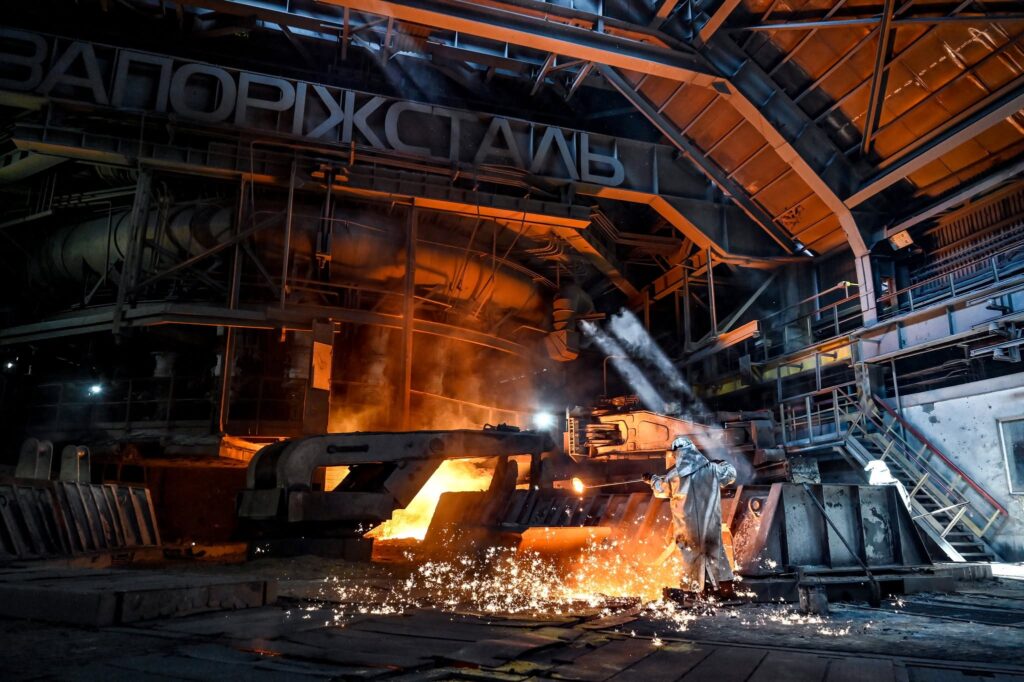
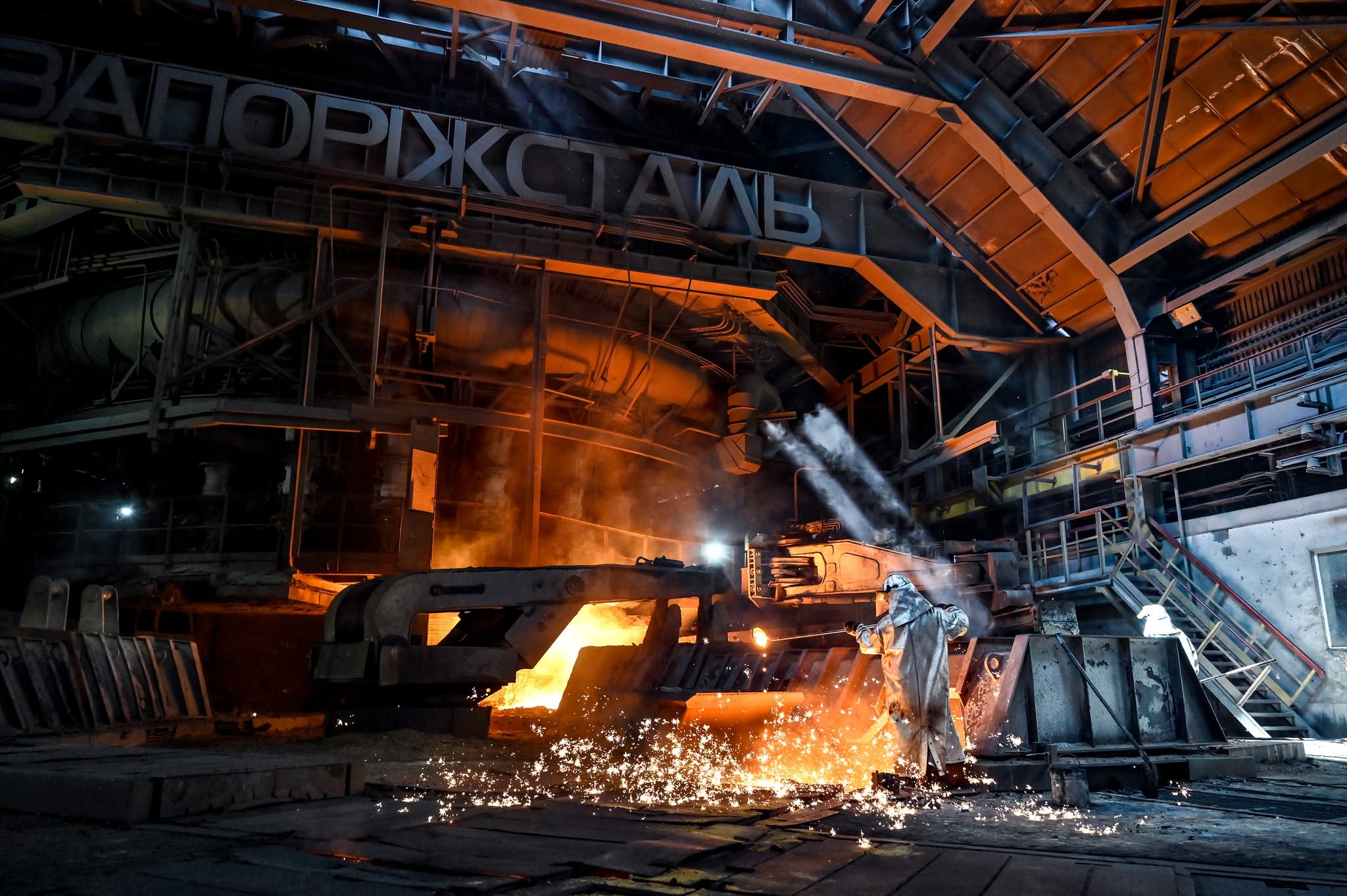
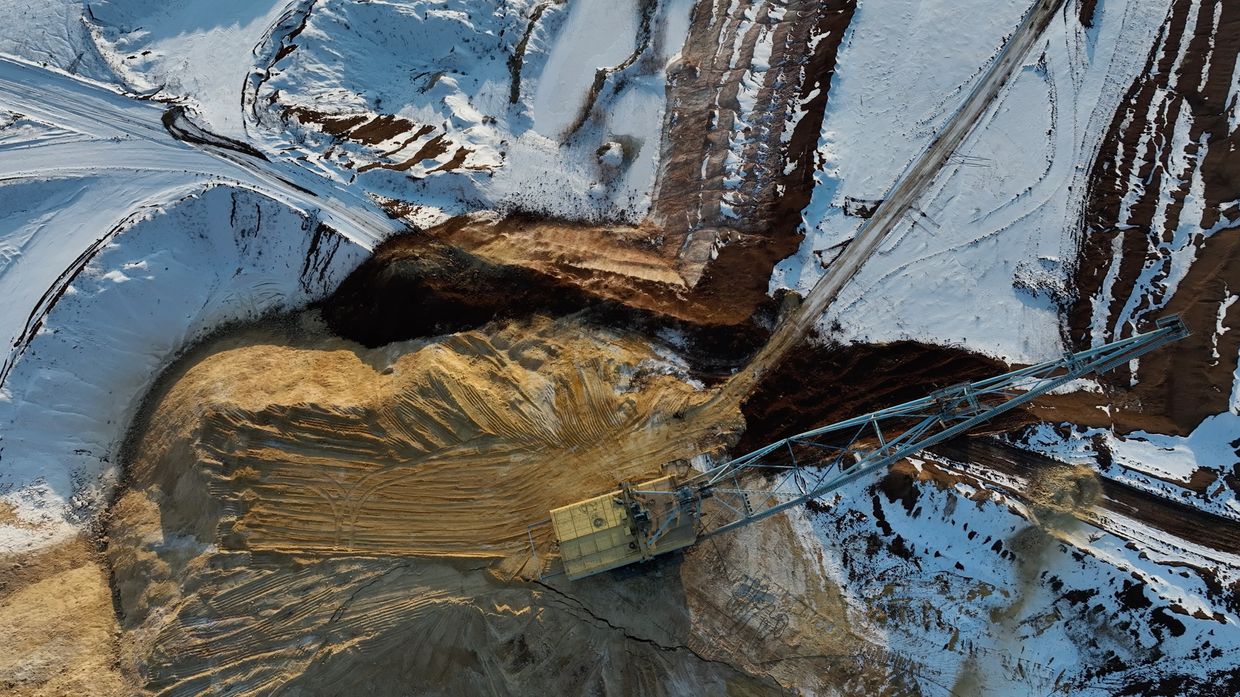
Ukraine’s Zaporizhstal plant plans to shift much of its output to lower-value pig iron to keep exporting under the European Union’s new steel quotas. The move would idle up to half the plant’s capacity, its parent company, Metinvest, says.
Ukraine’s new allowance runs to roughly 1 million metric tons, about 60% below its 2025 shipments to the bloc.
The EU says the quotas shield its own producers from a global steel surplus. For Ukraine, whose steel entered duty-free
Ukraine’s Zaporizhstal plant plans to shift much of its output to lower-value pig iron to keep exporting under the European Union’s new steel quotas. The move would idle up to half the plant’s capacity, its parent company, Metinvest, says.
Ukraine’s new allowance runs to roughly 1 million metric tons, about 60% below its 2025 shipments to the bloc.
The EU says the quotas shield its own producers from a global steel surplus. For Ukraine, whose steel entered duty-free after Brussels lifted tariffs after the 2022 invasion, they land on an industry already hit repeatedly by Russian strikes and cut off from the sea. The tariff-free quota fell by half on 1 July, with a 50% duty on anything above it.
Ukraine’s new allowance runs to roughly 1 million metric tons, about 60% below its 2025 shipments to the bloc, the Kyiv consultancy GMK Center calculates.
Steel makes up about 15% of Ukraine’s exports, and the EU buys close to four-fifths of it. The country’s Federation of Employers estimates the curbs could cost $1.2 billion in foreign earnings and cut GDP by 0.6%.
Falling back on pig iron
Pig iron, a semi-finished product, falls outside the quota, so lifting its share keeps the furnaces earning. But the switch would force the plant to reassign the workers behind those idled lines, Oleksandr Myronenko told Reuters. “Instead of support from the European Union, we face restrictions,” said the Metinvest chief operating officer.
Ukrainian mills cannot easily sell elsewhere: they are less efficient than cheaper Turkish and Chinese suppliers and are undercut in Europe’s own market, Myronenko said.
With the Black Sea route closed, importing coking coal through other European ports now runs $30 to $40 more a metric ton. Rail freight rose 30% this month, and an EU carbon charge has been applied to steel imports since 1 January.
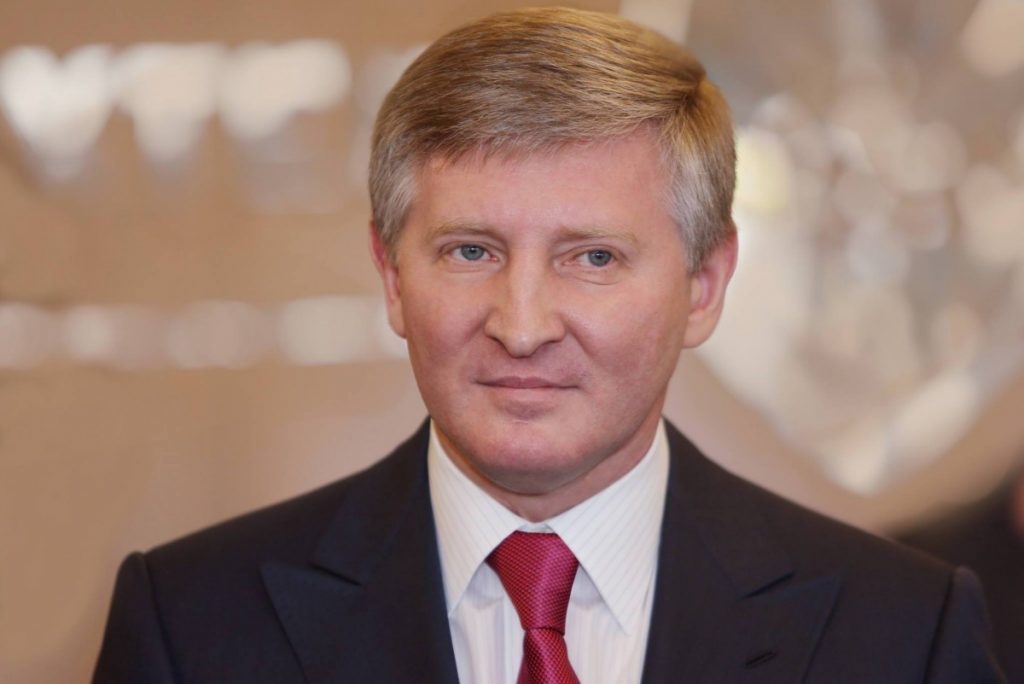
Ukrainian businessman Rinat Akhmetov is the majority owner of Metinvest. Photo: open source
A strike, and a plan in doubt
A Russian ballistic missile killed seven Zaporizhstal workers and shut the plant on 11 August.
Explore further
North Korean ballistic missile kills 7 steelworkers on their way to shelter, shuts down Zaporizhstal plant
The fate of Metinvest’s $8 billion, 15-year plan to convert to cleaner “green steel” is unclear; Myronenko called the modernization unrealistic in wartime. Zaporizhstal is the largest employer in the Zaporizhzhia region and, with the rest of Metinvest, is majority-owned by Rinat Akhmetov, Ukraine’s richest man.
On the plant floor, senior foreman Artem Kalinevych said: “As of today it’s not clear what comes next.”
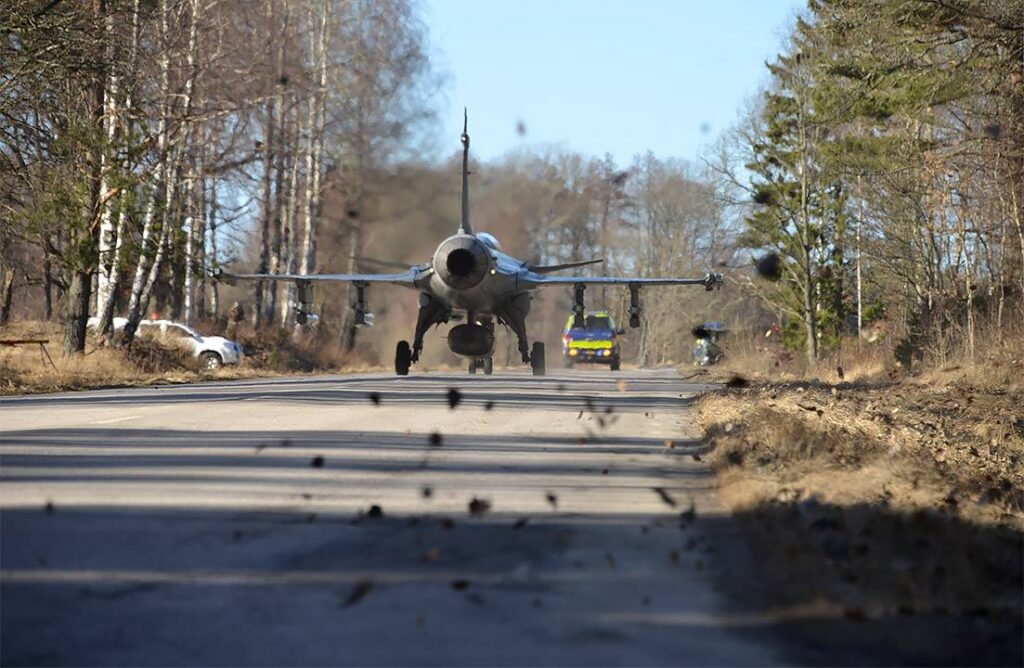
A Russian couple near the home of Sweden's top defense executive drew a security response. The man and the woman were detained after setting up camp near the home of Saab CEO Micael Johansson, SVT Gävleborg reports.
The incident reflects the heightened security around Sweden's defense industry amid its arms supply to Ukraine. Saab makes the JAS 39 Gripen fighter, and in May, Ukraine and Sweden agreed to launch a defense deal that includes the purchase of up to 20 Gripen
A Russian couplenear the home of Sweden's top defense executive drew a security response. The man and the woman were detained after setting up camp near the home of Saab CEO Micael Johansson, SVT Gävleborg reports.
The incident reflects the heightened security around Sweden's defense industry amid its arms supply to Ukraine. Saab makes the JAS 39 Gripen fighter, and in May, Ukraine and Sweden agreed to launch a defense deal that includes the purchase of up to 20 Gripen E/F fighters, according to Ukraine's Office of the President.
The CEO is under personal protection
Johansson lives under guard because of what Saab builds. Because of the company's military production, he is under personal protection, and he framed the security response as a routine precaution.
"My role is quite delicate. That is exactly why the guards checked these people," he said.
The property where the Russians were found does not belong to the Saab CEO himself but to a person close to him, so the couple was near, but not at, Johansson's home.
What happened at the property
The encounter began with a request to fish. A woman who spoke accented English entered the property and asked whether she could fish from the pier belonging to the plot.
She was refused, after which the guards came and took a closer look at the Russian couple.
The facts remain ambiguous
The couple's intentions are being established, and they had earlier told journalists that deportation to Russia would be risky for them because, they said, they had taken part in protests against the war in Ukraine.
That claim, if true, would run counter to a hostile-surveillance reading, though it cannot be verified either way. What the episode does show plainly is the state of alert around Sweden's defense sector amid Russia's threats.
A Russian ballistic strike on Zaporizhzhia, Ukraine, killed seven employees of the Zaporizhstal steel plant and injured 21 others, Ukrainian steelmaker Metinvest, the plant’s majority owner, said on 11 August.
The workers were on their way to a shelter after an air raid alert was announced when the strike hit the industrial site, according to the company.
Metinvest said the attack also damaged energy facilities and infrastructure, as well as the main and auxiliary f
A Russian ballistic strike on Zaporizhzhia, Ukraine, killed seven employees of the Zaporizhstal steel plant and injured 21 others, Ukrainian steelmaker Metinvest, the plant’s majority owner, said on 11 August.
The workers were on their way to a shelter after an air raid alert was announced when the strike hit the industrial site, according to the company.
Metinvest said the attack also damaged energy facilities and infrastructure, as well as the main and auxiliary facilities of the plant’s coke and blast-furnace operations.
Russia’s ballistic missile strikes leave very little time between threat detection and impact for people to react and reach shelter. Several people have been killed from strikes across the country while on their way to bomb shelters.
Zaporizhstal shuts down after strike
Metinvest said Zaporizhstal has been completely shut down following the attack, while its other production sites in the city are operating at reduced capacity.
Company specialists are assessing the damage and determining the scope and timeline of repairs. Emergency and restoration work is already underway, according to the statement.
The company said its Zaporizhzhia facilities are civilian industrial sites that employ tens of thousands of people and produce steelmaking and coke-chemical products.
Metinvest said it is providing medical assistance and support to the 21 injured employees and staying in contact with the families of those killed and wounded.
The company's facilities will fly flags at half-mast on 11 and 12 August in mourning for the seven Zaporizhstal workers killed in the attack.
North Korean missiles used against Zaporizhzhia
Ukrainian President Volodymyr Zelenskyy said Zaporizhzhia was targeted overnight with North Korean ballistic missiles, Russian Zircon missiles and guided aerial bombs.
Zelenskyy said the attack was designed to cause maximum damage to civilian infrastructure.
Ukraine's military intelligence said on 5 August that a North Korean missile unit had begun deploying to western Russia, potentially adding up to 120 ballistic missiles and six launchers to Russia's arsenal.
According to Ukrainian intelligence representative Andrii Cherniak, North Korea has supplied Russia with around 150 KN-23 and KN-24 missiles since late 2023, including a recent batch of 40 missiles.
The missiles have been linked to attacks with high civilian casualties, including a July strike on Radushne in Dnipropetrovsk Oblast that killed an entire family.
Ballistic threat is growing
The strike comes as Russia has increasingly relied on ballistic missiles in attacks on Ukrainian cities. Unlike drones and cruise missiles, ballistic missiles travel at very high speeds and are much harder for Ukraine to intercept, particularly because Kyiv has a limited supply of the advanced air defense interceptors needed to counter them, mainly US-made Patriot systems.
Ukraine has reported that most ballistic missiles launched in recent mass attacks have penetrated its air defenses, contributing to severe destruction and civilian casualties.
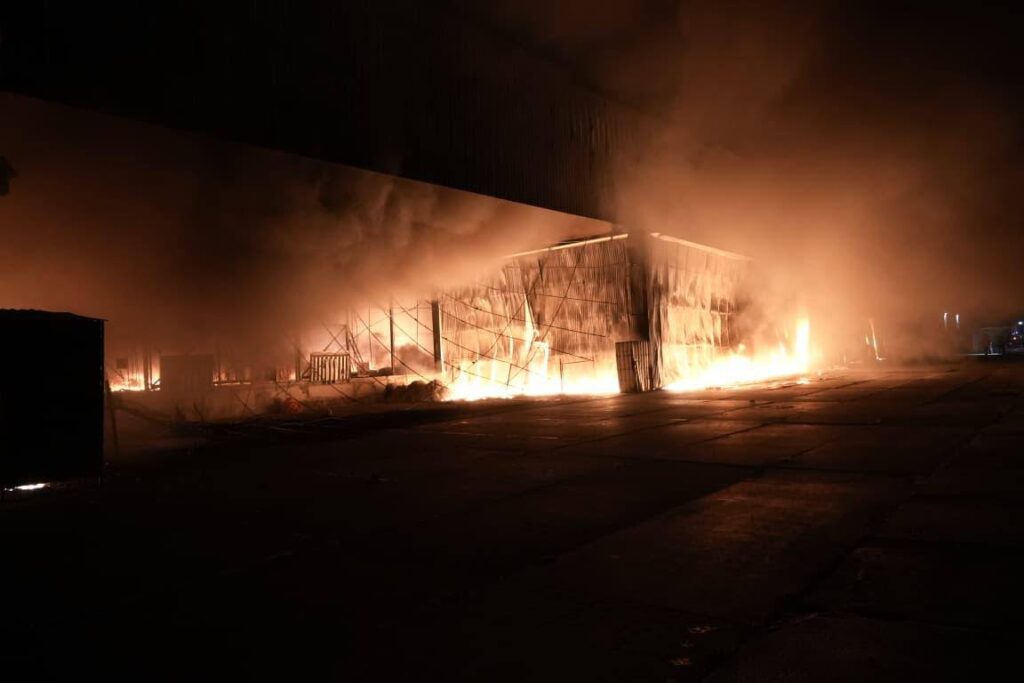
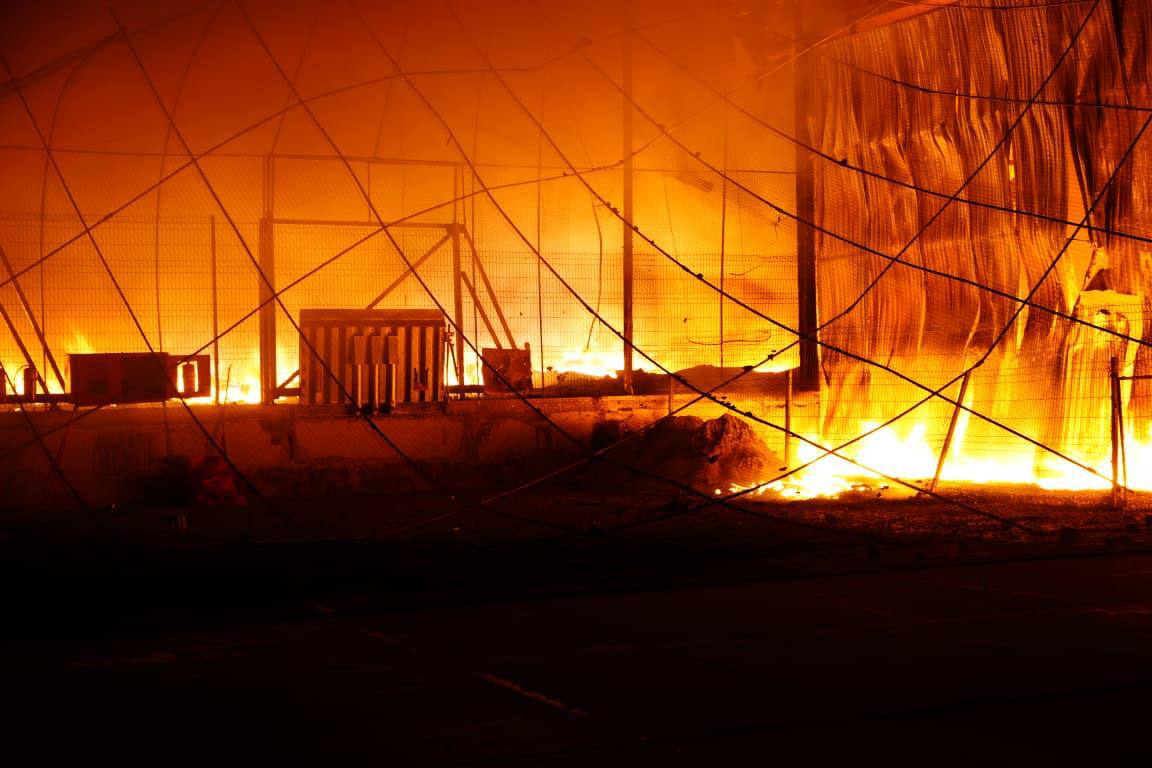
A Russian overnight strike heavily damaged a German-owned car-parts plant in Zhytomyr Oblast, forcing it to halt production, the company said. No workers were hurt, but the destruction was extensive. One of the region's major employers now has no restart date.
Russia increasingly hits the factories and warehouses of foreign companies that kept producing in Ukraine through the war, not only Ukrainian factories, energy facilities, infrastructure, and homes. Each strik
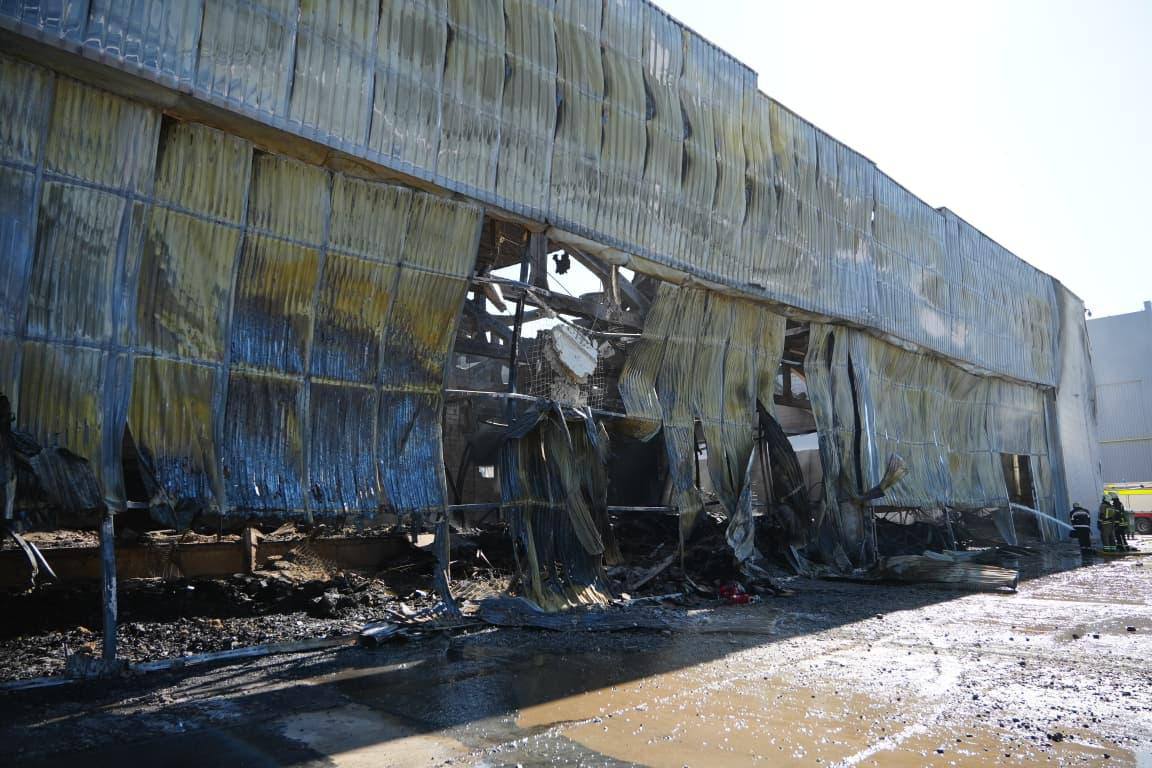
A Russian overnight strike heavily damaged a German-owned car-parts plant in Zhytomyr Oblast, forcing it to halt production, the company said. No workers were hurt, but the destruction was extensive. One of the region's major employers now has no restart date.
Russia increasingly hits the factories and warehouses of foreign companies that kept producing in Ukraine through the war, not only Ukrainian factories, energy facilities, infrastructure, and homes. Each strike on a foreign-owned factory chips away at the jobs and outside investment propping up Ukraine's wartime economy, adding to a burden the country's partners are scrambling to offset.
A German plant knocked offline
Russia struck Zhytomyr Oblast overnight into 9 August and hit the Kromberg & Schubert plant, which reported the attack on Facebook. Its production lines and infrastructure took heavy damage.
"The most important thing for us is that no employees were hurt in the attack," the statement said.
With the damage so severe, the plant suspended operations for an indefinite period. A restart depends on a technical assessment and the full scope of repairs, the company added.
Kromberg & Schubert is a civilian manufacturer with 100% German investment. It has run in the Zhytomyr region for 11 years and employs about 3,500 people. The plant makes the wiring harnesses that thread through cars, supplying European automakers.
The Kromberg & Schubert plant ablaze after the Russian strike in Zhytomyr Oblast, overnight on 9 August 2026. Photo: Vitalii Bunechko
Vitalii Bunechko, head of the Zhytomyr Oblast Military Administration, called it one of the region's budget-forming enterprises. He said the administration and local authorities are working to help the strategic investor and keep the plant running.
The burned-out Kromberg & Schubert plant after the Russian strike in Zhytomyr Oblast, 9 August 2026. Photo: Vitalii Bunechko
Part of a wider overnight assault
Bunechko reported that Russia had launched a massive strike on the oblast overnight. The attack also damaged civilian infrastructure, he said. State Emergency Service crews contained the fires, and investigators began work at the site.
Russia has repeatedly struck Zhytomyr Oblast during the war, stepping up its drone strikes on northwestern Ukraine, often exploiting Belarusian territory.
The United States has only about 25% of the Patriot missile interceptors it needs to meet Pentagon military plans, a shortage that led U.S. President Donald Trump's administration to pause a major transfer of weapons to Ukraine, the Guardian reported on July 8.The decision to halt the delivery, made on July 2, followed an internal review showing low stockpiles of critical air defense systems. The depletion was largely due to recent U.S. operations in the Middle East, including the interception o
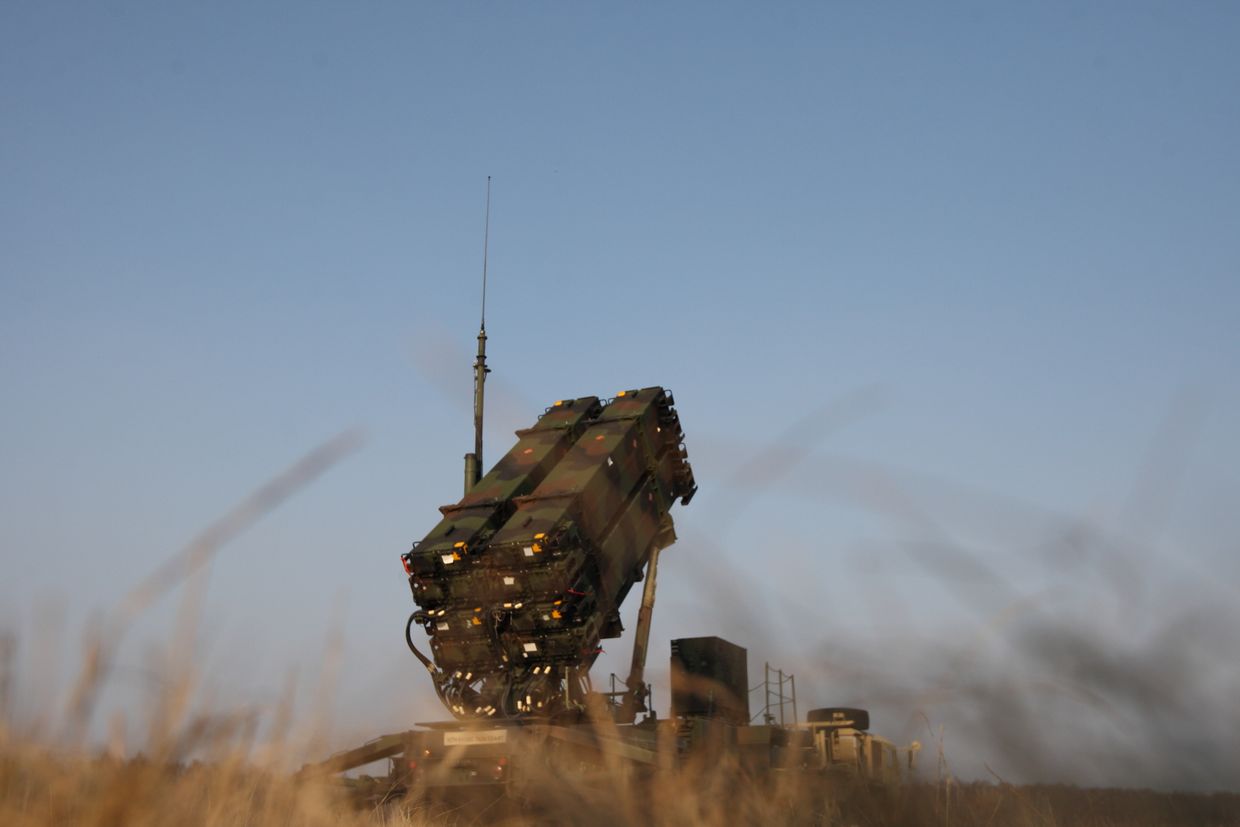
The United States has only about 25% of the Patriot missile interceptors it needs to meet Pentagon military plans, a shortage that led U.S. President Donald Trump's administration to pause a major transfer of weapons to Ukraine, the Guardian reported on July 8.
The decision to halt the delivery, made on July 2, followed an internal review showing low stockpiles of critical air defense systems. The depletion was largely due to recent U.S. operations in the Middle East, including the interception of Iranian missiles after strikes on the American Al Udeid airbase in Qatar, according to the Guardian.
According to officials familiar with the matter, the Pentagon's munitions tracker, used to measure the minimum supplies needed for U.S. war plans, showed Patriot interceptor levels had fallen below acceptable levels. That prompted concerns that sending more to Ukraine could put U.S. defense readiness at risk, the Guardian wrote.
The freeze reportedly affected Ukraine's two key arms transfer methods: drawdowns from Pentagon stockpiles and the Ukraine Security Assistance Initiative (USAI), through which the Defense Department orders new weapons from contractors.
Because U.S. orders take priority, Ukrainian requests for new weapons, including Patriot missiles, face years-long delays.
The pause came at a critical time for Kyiv, as Russia intensifies large-scale aerial attacks on Ukrainian cities. With limited options to acquire precision-guided and other key munitions, Ukrainian forces have increasingly relied on Western-supplied air defenses to counter the growing threat.
For its latest aid package, the U.S. had planned to send dozens of Patriot interceptors, along with Hellfire missiles, air-to-air Sparrows, GMLRS rockets, and anti-tank weapons, according to the Guardian.
NBC News reported on July 4 that U.S. Defense Secretary Pete Hegseth unilaterally halted a weapons shipment to Ukraine despite internal military assessments showing the aid would not compromise American military readiness.
The assessment concluded that while some munitions stockpiles, including precision weapons, were low, they had not fallen below critical thresholds.
Amid the ongoing questions over Washington's weapons pause, Trump has apparently promised to send 10 Patriot interceptors to Ukraine, Axios reported on July 8. Sources also told the Wall Street Journal (WSJ) that Trump claimed he wasn't behind the decision to halt arms to Kyiv in a recent phone call with President Volodymyr Zelensky.
Kyiv and Copenhagen signed a landmark agreement on July 4 that allows Ukrainian defense companies to open production facilities in Denmark, Strategic Industries Minister Herman Smetanin announced. "This is a unique case of international cooperation for the Ukrainian defense industry," Smetanin wrote on Facebook, following the signing ceremony in Copenhagen alongside Danish Industry Minister Morten Bodskov.The deal marks the first time Ukrainian defense technologies will be exported abroad specif
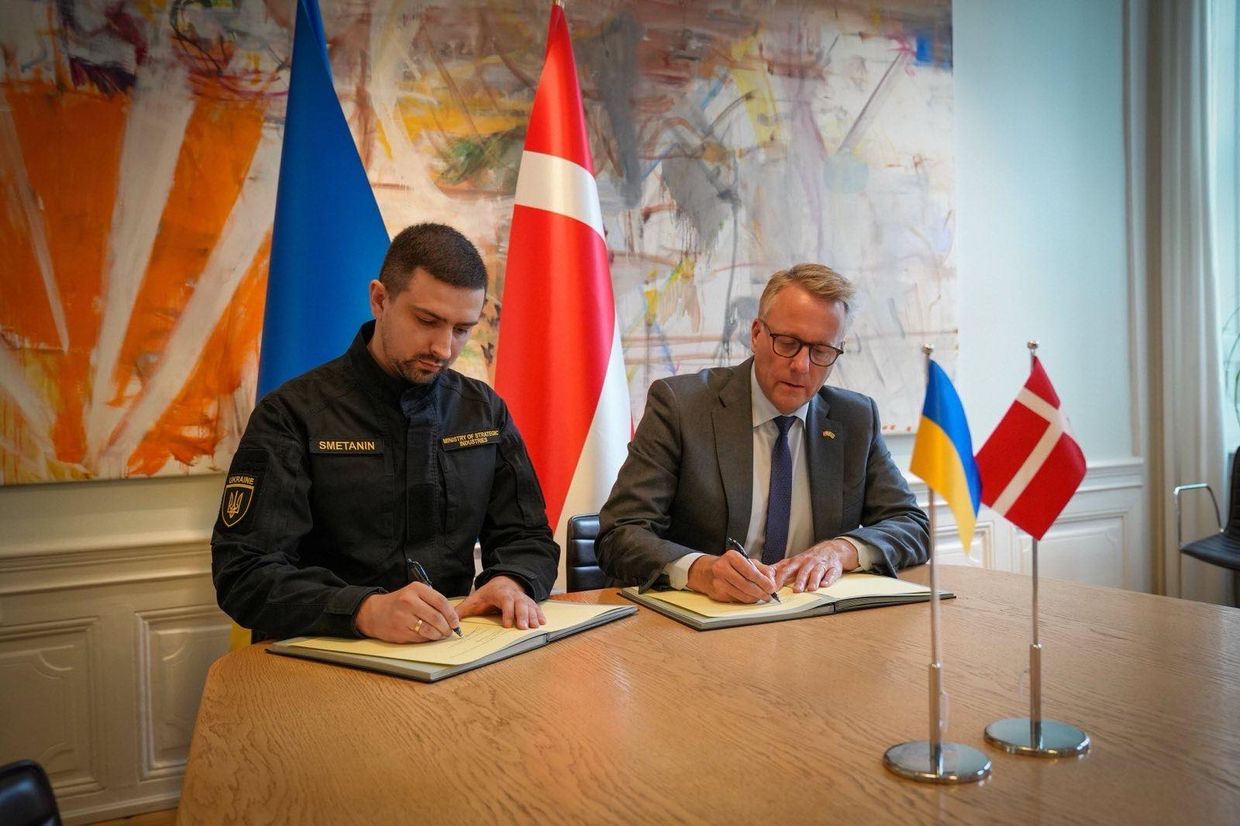
Kyiv and Copenhagen signed a landmark agreement on July 4 that allows Ukrainian defense companies to open production facilities in Denmark, Strategic Industries Minister Herman Smetanin announced.
"This is a unique case of international cooperation for the Ukrainian defense industry," Smetanin wrote on Facebook, following the signing ceremony in Copenhagen alongside Danish Industry Minister Morten Bodskov.
The deal marks the first time Ukrainian defense technologies will be exported abroad specifically for supply to Ukraine's own Armed Forces, he said.
A year ago, Denmark became the first country to fund weapons production by Ukrainian manufacturers. Now, it has become the first to host Ukrainian arms production lines on its territory, Smetanin added.
"Today, it has become the first country to which Ukraine exports its own defense technologies for production, scaling, and supply to the Ukrainian army," he said.
The agreement is part of Ukraine's broader effort to internationalize its defense production. President Volodymyr Zelensky announced on June 21 that Kyiv would soon begin exporting defense technologies and opening weapons production lines in partner countries.
To scale up domestic and international production, Zelensky has called on foreign partners to finance new projects and match Ukraine's rapidly growing manufacturing capacity.
Denmark has been a key backer of Ukraine since the start of Russia's full-scale invasion in 2022. In February 2024, Copenhagen signed a 10-year bilateral security agreement with Kyiv, pledging long-term defense cooperation until Ukraine secures NATO membership.
Skyeton Prevail Solutions, a joint venture between Ukrainian drone manufacturer Skyeton and U.K.-based defense company Prevail Solutions, will manufacture and supply Raybird drones in the U.K., the two companies announced on July 2."Skyeton — a Ukrainian unmanned aircraft systems company with 19 years of engineering pedigree, and Prevail Partners — a leading U.K. defense and security company, announced a joint venture to fast-track the volume manufacture, supply, and support for the integration
Skyeton Prevail Solutions, a joint venture between Ukrainian drone manufacturer Skyeton and U.K.-based defense company Prevail Solutions, will manufacture and supply Raybird drones in the U.K., the two companies announced on July 2.
"Skyeton — a Ukrainian unmanned aircraft systems company with 19 years of engineering pedigree, and Prevail Partners — a leading U.K. defense and security company, announced a joint venture to fast-track the volume manufacture, supply, and support for the integration of its best-in-class drone into U.K. military applications," a statement by the two companies said.
Ukraine has developed drones that have proven to be effective amid the onset of Russia's full-scale war against Ukraine in February 2022 and Russia's initial invasion of Ukraine in 2014.
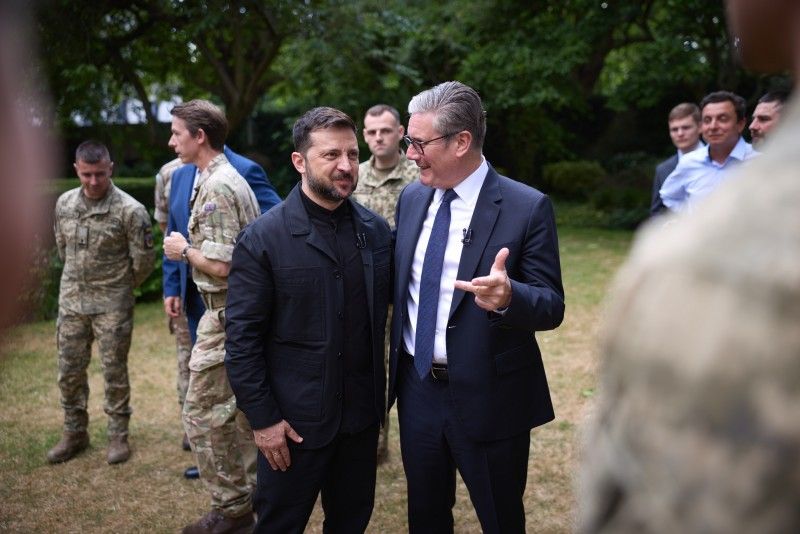
President Volodymyr Zelensky and U.K. Prime Minister Keir Starmer met in London on June 23, where the two leaders agreed to an "industrial military co-production agreement."
"The joint venture will scale the availability of Raybird with new manufacturing in the U.K. for both deployment in Ukraine and provide the necessary integration expertise from Prevail Partners for U.K. and other Western militaries," the statement said.
U.K. lawmaker Iain Duncan Smith described the move as an "important step" for U.K. drone production.
Skyeton says its Raybird drone has over 350,000 flight hours and is responsible for billions of dollars in Russian losses.
Ukraine has relied on drones to meet its own defense needs, as foreign military aid has fallen short in supplying necessary weapons and air defenses.
Grammarly, a company with Ukrainian roots, announced its intent to acquire AI email writing app Superhuman as part of its expansion into an AI productivity platform, the company said in a press release on July 1. Grammarly is the most valuable company with Ukrainian roots, reaching $13 billion valuation as of 2021. Grammarly was founded in 2009 in Kyiv by Oleksii Shevchenko, Maksym Lytvyn, and Dmytro Lider.According to Grammarly's press release, email is Grammarly's top use case, with the platfo
Grammarly, a company with Ukrainian roots, announced its intent to acquire AI email writing app Superhuman as part of its expansion into an AI productivity platform, the company said in a press release on July 1.
Grammarly is the most valuable company with Ukrainian roots, reaching $13 billion valuation as of 2021. Grammarly was founded in 2009 in Kyiv by Oleksii Shevchenko, Maksym Lytvyn, and Dmytro Lider.
According to Grammarly's press release, email is Grammarly's top use case, with the platform editing over 50 million emails weekly.
Superhuman is an AI email application that the company says helps users respond to emails faster and reduces time spent on email communications.
Users are already sending and responding to 72% more emails per hour after using Superhuman compared to the previous period, according to Grammarly.
"This is the future we've been building toward since day one: AI that works where people work, not where companies want them to work," said Shishir Mehrotra, Grammarly's CEO.
The acquisition follows Grammarly's recent purchase of Coda, a productivity tool company. The combined platforms will allow users to work with multiple AI agents for different tasks within email communications.
Grammarly says that its service is used daily by over 40 million users, generating annual revenue of more than $700 million for the company.
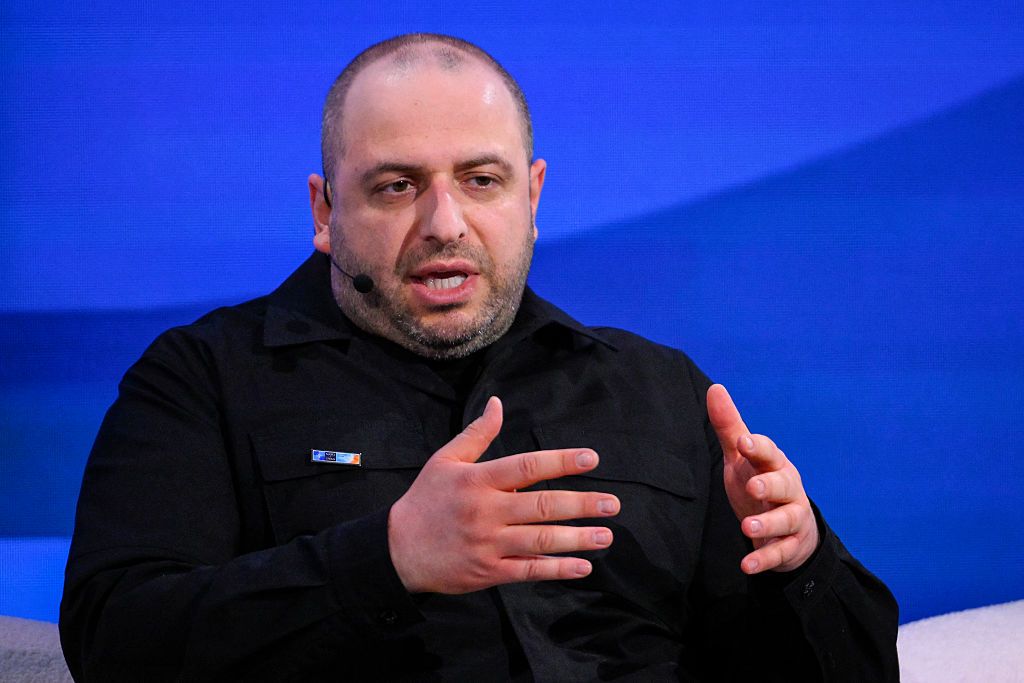
Ukraine is launching a joint weapons production program with members of the Ukraine Defense Contact Group (UDCG), or Ramstein summit participants, Defense Minister Rustem Umerov announced on July 1. The UDCG was formed in 2022 under former U.S. President Joe Biden to coordinate military assistance for Ukraine among about 50 of Kyiv's allies. As part of a new joint production program, new factories and weapons manufacturing facilities will be built in Ukraine and abroad, Umerov said in a social m
Ukraine is launching a joint weapons production program with members of the Ukraine Defense Contact Group (UDCG), or Ramstein summit participants, Defense Minister Rustem Umerov announced on July 1.
The UDCG was formed in 2022 under former U.S. President Joe Biden to coordinate military assistance for Ukraine among about 50 of Kyiv's allies.
As part of a new joint production program, new factories and weapons manufacturing facilities will be built in Ukraine and abroad, Umerov said in a social media post. The international sites will be UDCG member countries participating in the Ramstein-format summit.
New legal and tax regulations will also be put in place for Ukrainian weapons manufacturers, facilitating the construction of new sites and allowing them to rapidly scale up production, Umerov said.
The Defense Ministry on July 1 joined the Verkhovna Rada (Ukraine's parliament) Finance, Tax, and Customs Committee in presenting four draft laws regarding domestic weapons production "aimed at developing the industry." The legislation introduces amendments to tax, customs, and budget regulations, as well as the Criminal Code.
The first vote on the new legislative package is expected to take place in a month, according to Umerov.
"This is a new type of military-industrial cooperation, where Ukraine is an equal partner and player in the global defense market," he said.
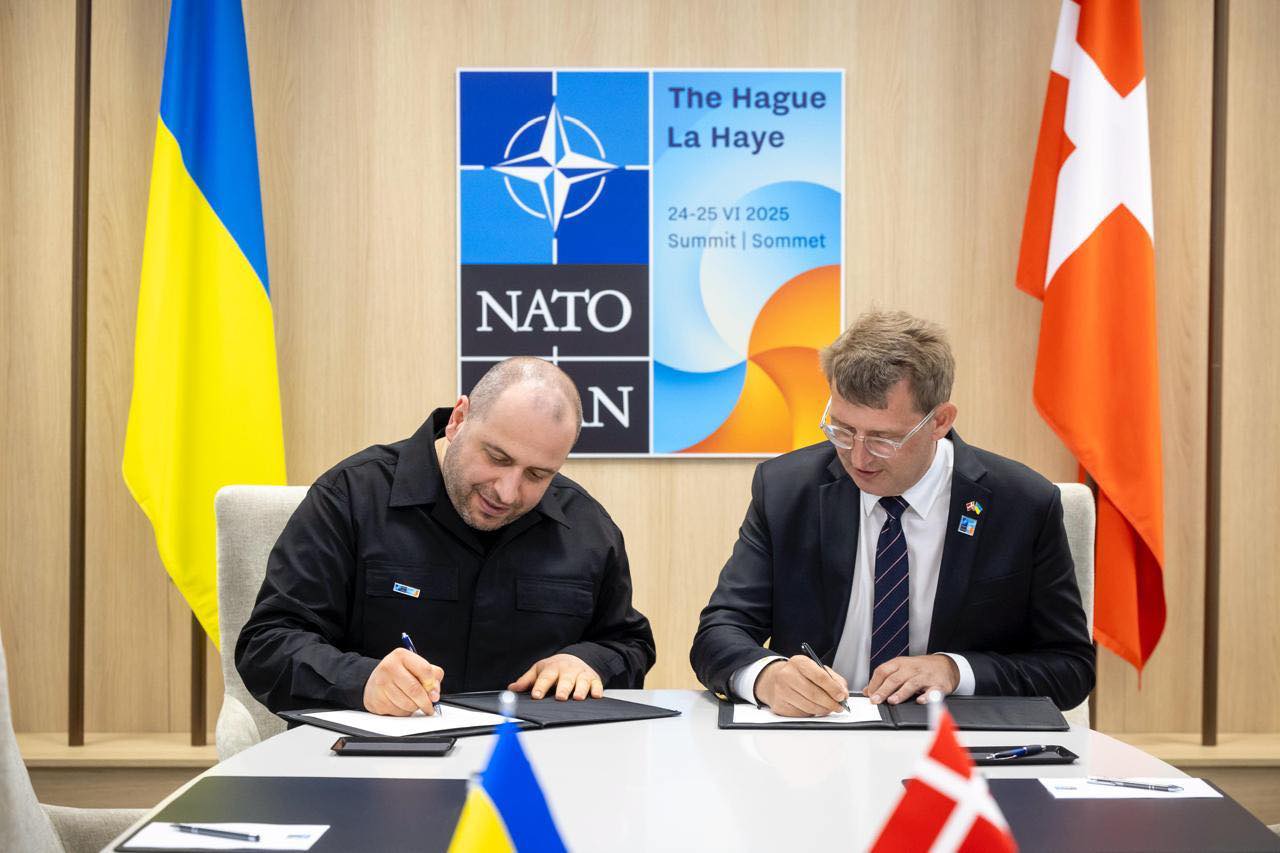
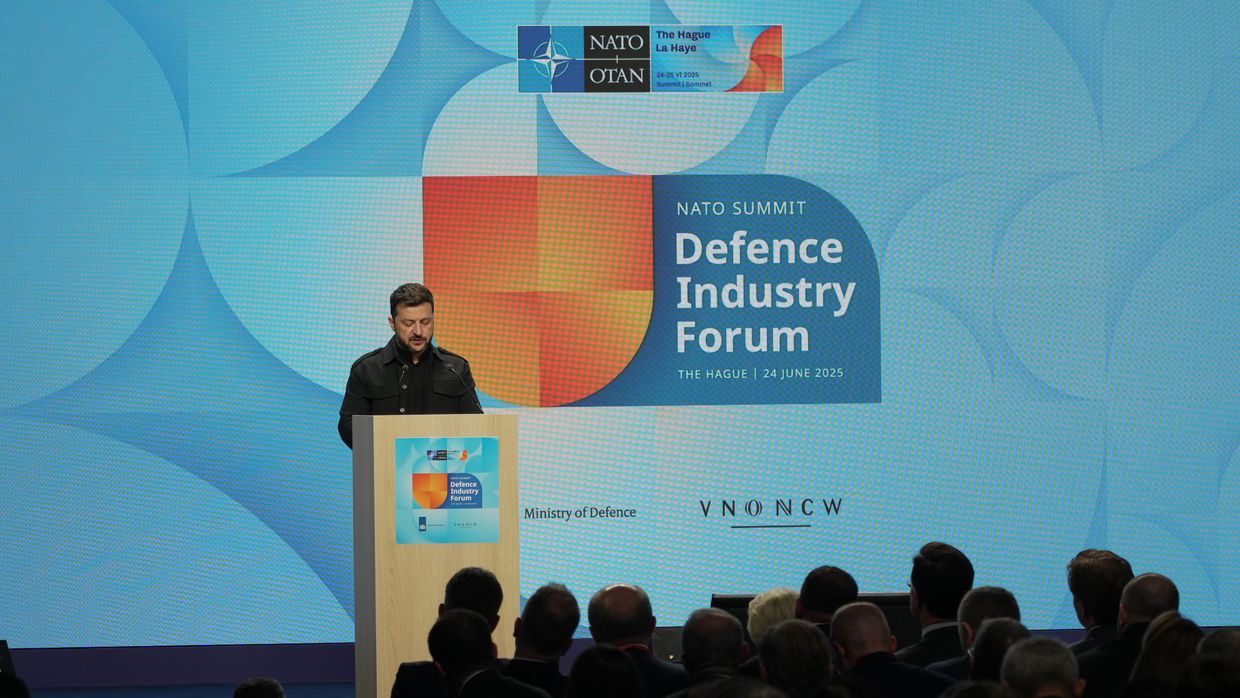
As Ukraine scales up domestic defense production, President Volodymyr Zelensky has been lobbying foreign partners to provide funding to help match its manufacturing capacity. At the NATO summit in The Hague, Ukraine signed agreements on joint weapons production with the U.K. and Denmark. Norway also pledged to jointly develop air defense systems with Kyiv.
Ukraine's defense technology cluster Brave1 has launched the development of anti-drone rifle rounds, significantly increasing the chances of hitting fast-moving aerial targets, the group said in a statement on June 30.According to Brave1, the ammunition appears similar to standard rounds used in automatic rifles but features a specially designed warhead that increases the likelihood of shooting down FPV (first-person-view) drones or commercial quadcopters such as the DJI Mavic before they strike
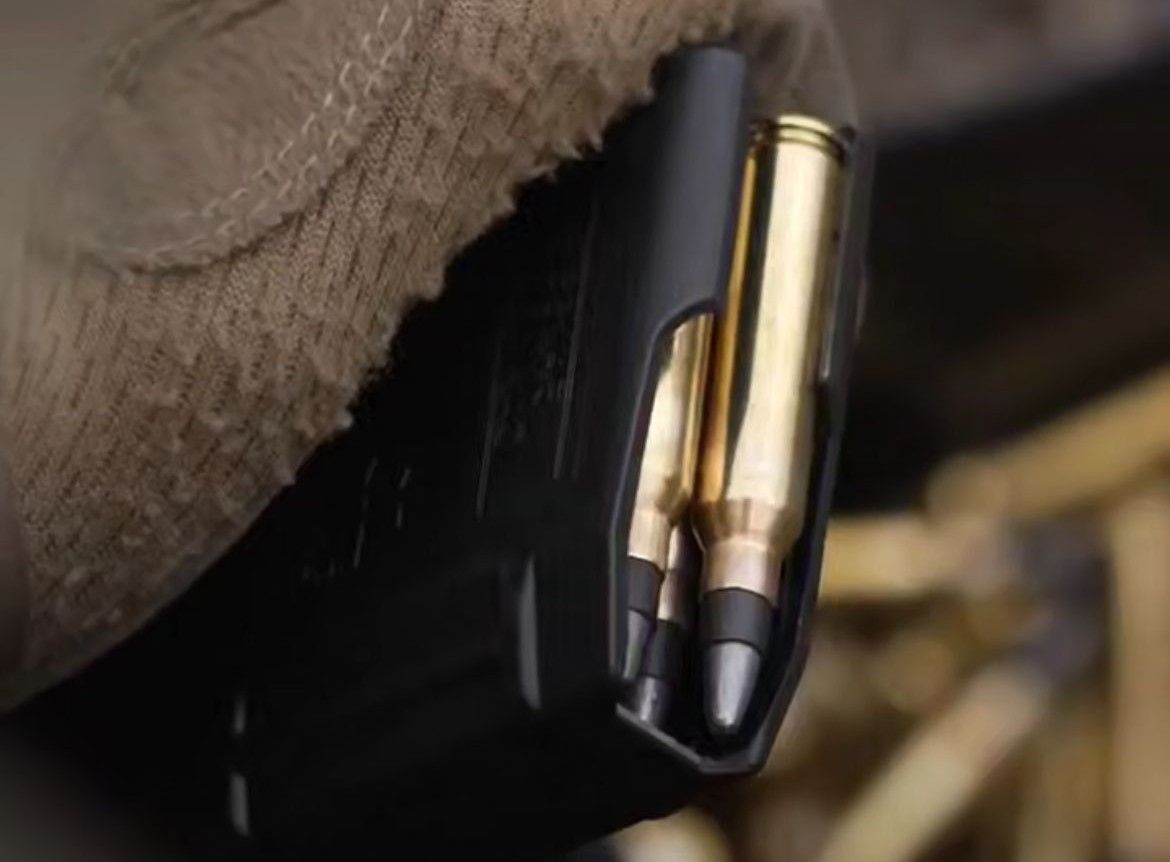
Ukraine's defense technology cluster Brave1 has launched the development of anti-drone rifle rounds, significantly increasing the chances of hitting fast-moving aerial targets, the group said in a statement on June 30.
According to Brave1, the ammunition appears similar to standard rounds used in automatic rifles but features a specially designed warhead that increases the likelihood of shooting down FPV (first-person-view) drones or commercial quadcopters such as the DJI Mavic before they strike.
These types of drones are being used extensively on the battlefield by both Ukrainian and Russian forces. The cost-effective FPV drones have proven highly effective in destroying expensive military equipment.
The manufacturer has already codified the new rounds according to NATO standards, Brave1 said. The goal is to supply every infantry soldier with a magazine of specialized ammunition for use in case of aerial threats.
"These rounds that significantly improve the chances of hitting a moving target are a new development by Brave1," Digital Transformation Minister Mykhailo Fedorov said.
"Our common goal is to ensure that every infantryman has a magazine of such ammunition and can equip his rifle with it in case of an air threat."
Ukraine continues to scale up its drone warfare capabilities. The Defense Ministry said on March 10 that it plans to purchase 4.5 million FPV drones in 2025 at a cost exceeding Hr 110 billion ($2.6 billion), with most of the funds allocated through the Defense Procurement Agency.
President Volodymyr Zelensky has set a goal of producing at least 30,000 long-range drones in 2025.
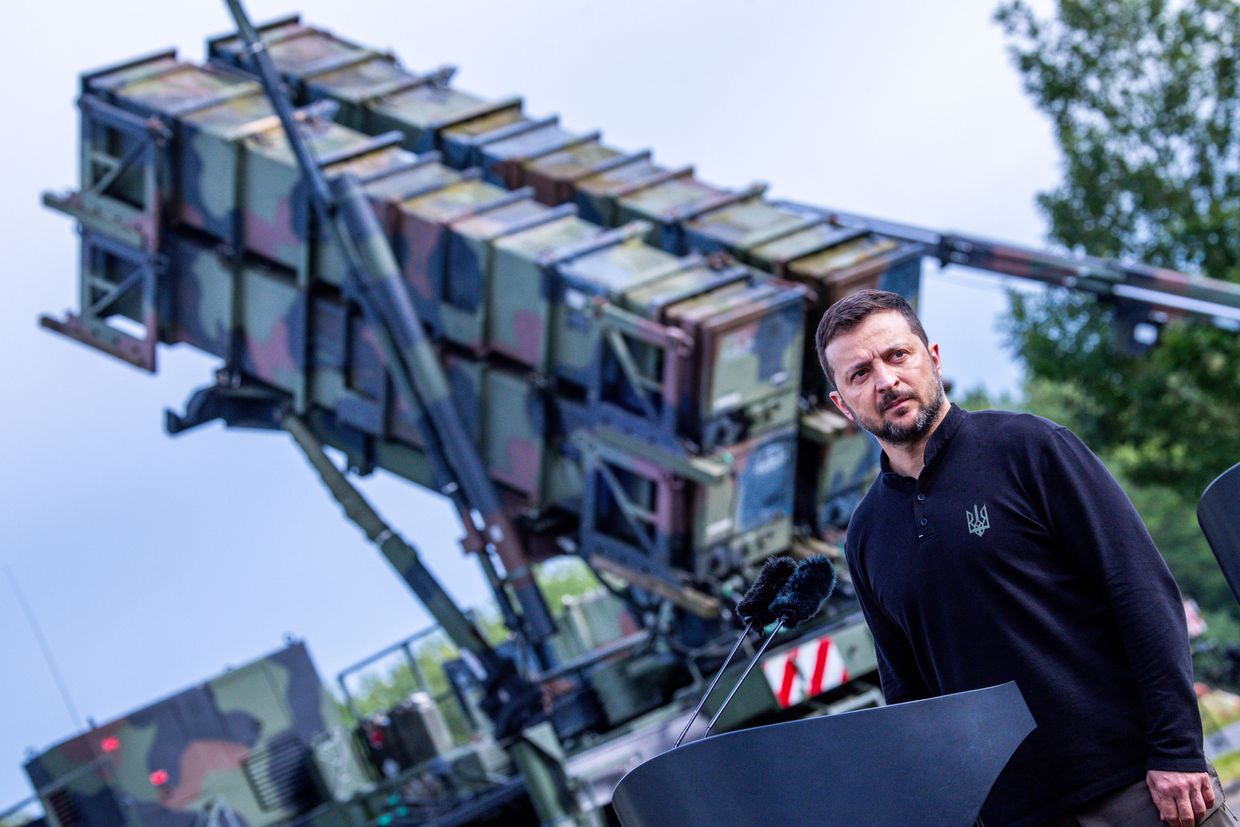
President Volodymyr Zelensky and German Foreign Minister Johann Wadephul met in Kyiv on June 30, where the two leaders discussed Germany supplying additional IRIS-T air defense systems, joint weapons production, and strengthening sanctions against Russia, Zelensky said.Wadephul earlier said Germany is working with its defense industry, European allies, and the U.S. to secure more air defense systems for Ukraine."We are going down every path available... The German defense industry is trying to e
President Volodymyr Zelensky and German Foreign Minister Johann Wadephul met in Kyiv on June 30, where the two leaders discussed Germany supplying additional IRIS-T air defense systems, joint weapons production, and strengthening sanctions against Russia, Zelensky said.
Wadephul earlier said Germany is working with its defense industry, European allies, and the U.S. to secure more air defense systems for Ukraine.
"We are going down every path available... The German defense industry is trying to expand its capacity. We're speaking with our European partners, and I believe we must also move forward with the United States," he said.
Zelensky met with executives of German defense companies alongside Wadephul during the visit to Ukraine's capital.
"We discussed sanctions pressure on Russia, the potential for supplying new IRIS-T systems, and joint weapons production — both in Ukraine and in Germany," Zelensky said in a post to social media.
Zelensky noted Germany signalled it believes that Ukraine's future is in NATO amid Russia's war against Ukraine.
"We will continue to develop relevant military hubs and increase the presence of German companies in Ukraine. We had an in-depth discussion on interceptor drones. I am grateful for the willingness to help," Zelensky said.
Earlier in the visit, Wadephul noted that he remains in close contact with German Defense Minister Boris Pistorius to assess whether existing systems from Germany's own stockpiles can be redirected to Ukraine.
NATO's increased defense spending will lead to the "collapse" of the alliance, Russian Foreign Minister Sergei Lavrov said on June 30, despite Russian officials recently warning that Moscow's own military expenditure is driving the country towards recession.Lavrov's comments come after NATO leaders last week approved a new defense spending benchmark, committing members to spend at least 5% of GDP on defense and security-related expenditures by 2035, a goal long pushed by the U.S. and endorsed by
NATO's increased defense spending will lead to the "collapse" of the alliance, Russian Foreign Minister Sergei Lavrov said on June 30, despite Russian officials recently warning that Moscow's own military expenditure is driving the country towards recession.
Lavrov's comments come after NATO leaders last week approved a new defense spending benchmark, committing members to spend at least 5% of GDP on defense and security-related expenditures by 2035, a goal long pushed by the U.S. and endorsed by NATO Secretary General Mark Rutte.
The week previously, and in a rare public sign that all is not well in Russia, two high-ranking Moscow officials issued separate warnings about the state of the country's economy.
Russian Central Bank Governor Elvira Nabiullina and Economy Minister Maxim Reshetnikov both highlighted that amid the Kremlin's full-scale war against Ukraine, the tools Moscow once relied on to maintain wartime growth are nearly exhausted.
Polish Foreign Minister Radoslaw Sikorski on June 26 said an arms race between Russia and NATO could lead to Russian President Vladimir Putin's downfall.
"Since (Polish Foreign Minister Radoslaw Sikorski) is such a predictor, he probably foresees that a catastrophic increase in the budget of NATO countries, according to my estimates, will also lead to the collapse of this organization," Lavrov reportedly said.
Putin last week announced that Moscow plans to cut its military expenditure beginning next year, in a rebuke of NATO members' plans to increase defense spending to 5% of GDP.
"We are planning to reduce defence spending. For us, next year and the year after, over the next three-year period, we are planning for this," Putin said, though he did not provide concrete details.
"Europe is thinking about how to increase its spending, on the contrary. So, who is preparing for some kind of aggressive actions? Us or them?"
Western officials and analysts point to Russia's surging military expenditures amid its ongoing full-scale invasion of Ukraine. In 2024, Russia's defense budget reportedly rose 42% in real terms, reaching $462 billion, surpassing the combined spending of all European nations, according to the International Institute for Strategic Studies.
NATO allies have cited Russia's military buildup, sabotage campaigns, and continued aggression against Ukraine as reasons to accelerate defense investments. Rutte warned that Russia could rebuild its military capacity to threaten NATO territory within five years, urging members to act with urgency.
Lithuania has signed a memorandum with American defense firm Northrop Grumman and Norwegian Nammo to secure the production of ammunition amid Russia's war against Ukraine, the Lithuanian Defense Ministry announced on June 24."By strengthening our national defense industry, we are investing in both technological capabilities and Lithuania’s resilience to crises. This Memorandum of Understanding will allow us to better equip our armed forces and help Lithuania become an important link in internati
Lithuania has signed a memorandum with American defense firm Northrop Grumman and Norwegian Nammo to secure the production of ammunition amid Russia's war against Ukraine, the Lithuanian Defense Ministry announced on June 24.
"By strengthening our national defense industry, we are investing in both technological capabilities and Lithuania’s resilience to crises. This Memorandum of Understanding will allow us to better equip our armed forces and help Lithuania become an important link in international supply chains," Lithuanian Vice Minister of National Defense Loreta Maskalioviene said.
"The investment and expertise of our allies... will significantly contribute to strengthening of the national defense industry and security not only in Lithuania, but also in the entire region, including Ukraine. The development of the defense industry and investment in production must come without delay," Lithuanian Finance Minister Rimantas Sadzius said.
Russia's full-scale war against Ukraine has sparked concern in Europe that Russia could attack NATO's eastern flank, including Poland, the Baltic countries, and Finland.
Ukrainian intelligence has evidence that Russia is preparing new military operations in Europe, President Volodymyr Zelensky said on June 22.
The partnership will be implemented at the state-owned Giraite Armament Factory, the announcement said, adding that the factory is set to be integrated into Northrop Grumman’s international supply chains.
Northrop Grumman will supply ammunition produced in the Lithuanian defense factory to the international market.
Nammo, as a subcontractor, will provide Northrop Grumman with the 35 mm ammunition production technology.
"It will enhance national strategic autonomy in defense and deepen partnerships with NATO allies, the United States, and Norway. The planned production of ammunition is of critical importance to the Lithuanian Armed Forces, our allies, and Ukraine," Lithuanian Defense Minister Dovile Sakaliene said.
The memorandum will initiate negotiations for the production of medium caliber ammunition, ranging in size from 20-50 mm.
The Giraite Armament Factory will be provided with 35 mm ammunition production technology from the two defense firms, the announcement said.
Sakaliene noted that the new partnership will ensure an uninterrupted supply of ammunition to Lithuania's Armed Forces.
NATO is holding a summit in The Hague from June 24-25 with world leaders, including Zelensky and U.S. President Donald Trump present.
The White House has confirmed that Trump and Zelensky will hold a meeting at the NATO summit.
Defense Minister Rustem Umerov signed a Letter of Intent on June 24 with his Danish counterpart Troels Lund Poulsen to launch Ukrainian defense production in Denmark, Umerov announced on Facebook.The document envisages facilitating the deployment of Ukrainian defense companies in Denmark and integrating of the defense industries of both countries through the "Build with Ukraine" initiative.Denmark has already allocated $47 million for the project, and Ukraine's partners will provide further fund
Defense Minister Rustem Umerov signed a Letter of Intent on June 24 with his Danish counterpart Troels Lund Poulsen to launch Ukrainian defense production in Denmark, Umerov announced on Facebook.
The document envisages facilitating the deployment of Ukrainian defense companies in Denmark and integrating of the defense industries of both countries through the "Build with Ukraine" initiative.
Denmark has already allocated $47 million for the project, and Ukraine's partners will provide further funding for production.
"I thank the Danish government for its trust, steadfast support of Ukraine, and commitment to developing a deep partnership between our countries," Umerov said. "This partnership enhances the security of Ukraine, Denmark, and all of Europe — today and into the future."
The agreement between Ukraine and Denmark also provides coordination between the Danish Defense Ministry, the Business and Industry Ministry, and the Foreign Ministry to integrate Ukrainian enterprises into the European defense system.
"By providing Ukrainian defense companies the opportunity to start production in Denmark, we are creating a basis for close cooperation between defense companies in both countries. This will also provide the Danish Armed Forces with access to the latest technologies and the experience of Ukraine," Poulsen said.
Denmark has pioneered efforts to support Ukraine by investing in its defense industry, creating the so-called "Danish model" of purchasing arms for Kyiv from Ukrainian producers. Copenhagen has provided around $9.8 billion in military aid under its Ukraine Fund for the years 2023-2028.
Ukraine and the United Kingdom have reached an agreement to jointly produce drones, Defense Minister Rustem Umerov announced on June 24.Britain will finance the procurement of Ukrainian-designed drones manufactured in the UK, he added. The deal comes as Ukraine has rapidly developed its drone capabilities since 2022, evolving from modifying commercial aircraft to producing military UAVs, attack drones, and reconnaissance systems at scale.The agreement was reached between President Volodymyr Zele
Ukraine and the United Kingdom have reached an agreement to jointly produce drones, Defense Minister Rustem Umerov announced on June 24.
Britain will finance the procurement of Ukrainian-designed drones manufactured in the UK, he added.
The deal comes as Ukraine has rapidly developed its drone capabilities since 2022, evolving from modifying commercial aircraft to producing military UAVs, attack drones, and reconnaissance systems at scale.
The agreement was reached between President Volodymyr Zelensky and British Prime Minister Keir Starmer, Umerov said.
Under the three-year program, the UK will finance the procurement of a wide range of Ukrainian drones to be produced by British defense companies.
"This will enable British defense companies to rapidly design and produce state-of-the-art drones on a large scale," Umerov wrote on Facebook.
According to Umerov, all production will be directed to meet the needs of Ukraine's Defense Forces. After the war ends, the UK and Ukraine will share the produced drones between themselves.
The initiative will support the scaling of advanced technologies, increased drone production, and the integration of Ukrainian and British defense industries, Ukraine’s defense minister wrote.
Ukraine has ramped up domestic drone production over the recent years of its war with Russia, as well as the development of new missiles.
Various aerial, naval, and ground drones have been developed and often successfully used for reconnaissance, combat, and other tasks throughout the full-scale war with Russia.
In January 2025, Umerov announced that the United Kingdom would finance the production of air defense systems and long-range weapons in Ukraine.
President Volodymyr Zelensky said during NATO summit on June 24 that Ukraine has the capacity to produce over 8 million drones of various types each year, but lacks the financial backing to reach that potential, a shortfall he said must be urgently addressed to defeat Russia's growing military network."Our defense production potential has surpassed $35 billion,” Zelensky said during a speech at the NATO Defense Industry Forum in The Hague. "This includes nearly 1,000 types of products... but aro
President Volodymyr Zelensky said during NATO summit on June 24 that Ukraine has the capacity to produce over 8 million drones of various types each year, but lacks the financial backing to reach that potential, a shortfall he said must be urgently addressed to defeat Russia's growing military network.
"Our defense production potential has surpassed $35 billion,” Zelensky said during a speech at the NATO Defense Industry Forum in The Hague. "This includes nearly 1,000 types of products... but around 40% of this potential lacks proper funding. For example, we can produce over 8 million drones of different types each year, but the financing allows for far fewer."
Zelensky urged allies to scale up investments in joint weapons production, including drone technologies, artillery, and interceptors. He argued that Ukraine's defense capabilities are not only key to defending its own territory, but essential to strengthening NATO's long-term security.
"We must lead in the drone race, both in strike drones and interceptors," he said. "Please increase your investments in Ukraine and joint weapons production. All the weapons we produce become part of a new, stronger European defense and security system."
The Ukrainian president emphasized that Russia is not acting alone, but as part of a broader network of state and non-state actors, including North Korea, Iran, and Chinese companies, which support its war effort against Ukraine and pose a long-term threat to Europe.
"The source of this war and the long-term threat to Europe is Russia," Zelensky said. "But in reality, we are not just facing Russia alone. We are facing a network of state and non-state actors."
Zelensky also called on NATO members to increase defense spending to 5% of GDP and to dedicate at least 0.25% of GDP to support Ukraine's military needs directly. He thanked countries such as Germany, Norway, Sweden, and the Netherlands for their elevated commitments, but urged others to follow suit.
Zelensky warned that Russia is planning "new military operations on NATO territory" and that the war in Ukraine must be stopped now to prevent broader European conflict.
"There are no signs that Putin wants to stop this war," Zelensky said. "So long as he kills, he lives. And our intelligence confirms this."
He also appealed for a crackdown on the supply chains that allow Russia to sustain its weapons manufacturing, referring to Western-origin components found in Russian missiles, drones, and armored vehicles.
"It's not just China, also Taiwan. Some of these parts come from European countries and from the United States," Zelensky said. "Every single tool delivered to Russia's defense sector helps prolong the war and is a crime against peace."
Zelensky's speech comes as NATO leaders gather in The Hague for a high-level summit on June 24-25. NATO leaders are expected to discuss raising the alliance's defensespending target to 5% of the GDP, a proposal the U.S. has championed but from which it considers itself exempt.
Speaking on the sidelines of the NATO summit in The Hague on June 24, NATO Secretary General Mark Rutte called on alliance members to be realistic about the threats posed by Russia and China, and urging them to stay the course in supporting Ukraine."Let's not be naive," Rutte said. "You see what China, North Korea and Iran are doing in supporting the war effort of Russia ... So this is all interconnected."Rutte emphasized that while NATO faces multiple global challenges, from the war in Ukraine
Speaking on the sidelines of the NATO summit in The Hague on June 24, NATO Secretary General Mark Rutte called on alliance members to be realistic about the threats posed by Russia and China, and urging them to stay the course in supporting Ukraine.
"Let's not be naive," Rutte said. "You see what China, North Korea and Iran are doing in supporting the war effort of Russia ... So this is all interconnected."
Rutte emphasized that while NATO faces multiple global challenges, from the war in Ukraine to tensions in the Middle East and Russian influence in Africa, the alliance must be able to focus on more than one crisis at a time.
"If you can only deal with one issue at a time, you should not be in politics or defense," he said.
Rutte said NATO's role is to ensure Ukraine has the military means to stay in the fight until "serious" peace negotiations begin.
"We have to make sure that Ukraine is in the strongest possible position when real talks start," he said. "I'm not talking about these talks led by some Russian historian (Vladimir Medinsky) who wants to go back 1,000 years... That's not serious business.”
The talks he referenced, led by Russian presidential aide Vladimir Medinsky and held in Istanbul in May-June, have yielded prisoner exchange agreements but no progress toward a ceasefire or settlement. Ukraine has offered a comprehensive roadmap, but Rutte said Russia had not come to the table with serious intent.
Instead, Russia continues to reject U.S. proposed comprehensive ceasefire, and insists on its longstanding maximalist demands.
"When the time comes for serious talks, we must ensure any long-term ceasefire or peace deal is durable — so that (Russian President) Vladimir Putin will never again try to seize even one square kilometer of Ukrainian territory," Rutte said.
Rutte also stressed that Ukraine is evolving from a security consumer into a security producer. He noted that the country's "largely untapped" defense industrial base, with a potential value of up to $35 billion, is increasingly attracting European investment.
"Ukraine has one of the largest defense industries in Europe," Rutte said, adding that many countries, including Norway, Denmark, and Lithuania, are now investing in it. "That helps Ukraine, and it helps us.”
Responding to concerns over Europe's reliance on the United States, Rutte said NATO must stop "worrying so much" about U.S. commitment and instead ramp up its own military capabilities.
"There is total commitment by the U.S. President and U.S. senior leadership," Rutte said, dismissing doubts about Washington's future role in NATO. "However, it comes with an expectation that we will finally deal with this huge bubbling issue, which is that we are not spending enough as Europeans and Canadians."
Rutte strongly backed the alliance's new 5% GDP defense investment benchmark, saying increased spending must translate into ammunition stockpiles, troop recruitment, and industrial output. "The Russians are producing in three months what NATO produces in a year," he said.
Earlier, U.S. President Donald Trump accused NATO members of underfunding their militaries, pushing for raising defense spending benchmark to 5% of GDP.
In 2024, only 23 alliance members met the 2% target, according to NATO estimates. Poland was ahead of all members with 4.12% of GDP allocated to defense, followed by Estonia (3.43%) and the U.S. (3.38%).
Ukraine's state defense conglomerate Ukroboronprom and European aerospace giant Airbus have signed a trilateral cooperation memorandum at the Le Bourget International Air Show, the company announced on June 23.The agreement launches initiatives to develop maintenance and repair capabilities for Airbus aircraft operating in Ukraine among specialists at Ukroboronprom's enterprises.As part of the deal, Airbus will send representatives to Ukraine to train local specialists, who will then become cert
Ukraine's state defense conglomerate Ukroboronprom and European aerospace giant Airbus have signed a trilateral cooperation memorandum at the Le Bourget International Air Show, the company announced on June 23.
The agreement launches initiatives to develop maintenance and repair capabilities for Airbus aircraft operating in Ukraine among specialists at Ukroboronprom's enterprises.
As part of the deal, Airbus will send representatives to Ukraine to train local specialists, who will then become certified instructors for aircraft maintenance.
"Trust in our defense industrial complex, particularly Ukroboronprom and its enterprises, is growing among global high-tech companies," said Oleh Hulyak, Ukroboronprom Director General, in a press release. "This proves we have chosen the right path for development and international cooperation."
Hulyak expects new partnerships with foreign partners in aviation and other areas of the company's work.
Ukroboronprom is a leading strategic manufacturer of weapons and military hardware in Ukraine. The association unites about 100 enterprises that develop and manufacture weapons, military equipment and ammunition, including missiles, drones, armored vehicles.
The company reported a consolidated net profit of Hr 1.31 billion ($31.5 million) for the previous year as its enterprises tripled production volumes in 2024 compared to 2023, with a 36% increase in contracts.
In 2024, Ukroboronprom was rankedfor the first time in history among the top 50 global defense companies by Defense News, according to Strategic Industries Minister Alexander Kamyshin.
Norway will invest $400 million in Ukraine's defense industry to support drone and air defense missile production, President Volodymyr Zelensky said in his nightly address on June 22.The announcement followed a visit to Ukraine by Norwegian Defense Minister Tore Onshuus Sandvik."Today, Norway’s Minister of Defense visited Ukraine. A decision has been reached to invest $400 million in our production – new funding, primarily for drones," Zelensky said.Zelensky added that the two countries are also
Norway will invest $400 million in Ukraine's defense industry to support drone and air defense missile production, President Volodymyr Zelensky said in his nightly address on June 22.
The announcement followed a visit to Ukraine by Norwegian Defense Minister Tore Onshuus Sandvik.
"Today, Norway’s Minister of Defense visited Ukraine. A decision has been reached to invest $400 million in our production – new funding, primarily for drones," Zelensky said.
Zelensky added that the two countries are also working together to establish joint air defense production inside Ukraine.
"We are working together to create all the necessary conditions to produce air defense systems in Ukraine — jointly with partners, jointly with Norway," Zelensky said.
He added that Norway's largest defense company – Kongsberg Defence & Aerospace – has already opened an office in Ukraine as part of the cooperation.
"We are expediting all processes to the maximum extent," Zelensky said.
On X, Norway's defense ministry confirmed that Kongsberg has signed agreement with a major Ukrainian company to jointly develop and produce missiles for air defense systems in Ukraine.
The collaboration will focus on producing missiles for the National Advanced Surface-to-Air Missile System, or NASAMS.
"The Norwegian NASAMS system saves lives in Ukraine every day, and is crucial in protecting critical infrastructure. That is why it is important for the Norwegian Government to finance this development of cheaper missiles for the NASAMS system in Ukraine," said Minister Sandvik.
The announcement marks deepening ties between Kyiv and Oslo as Ukraine seeks to expand its domestic defense industry amid Russia’s ongoing full-scale invasion and reduced military aid from the United States.
Ukraine is asking partner countries to allocate 0.25% of their GDP to boosting Kyiv's defense production, President Volodymyr Zelensky said on June 20 at a press briefing attended by the Kyiv Independent. The president's comments come less than a week before the NATO summit in The Hague, where Zelensky will have another opportunity to discuss Ukraine's security needs with world leaders. "Ukraine is part of Europe's security, and we want 0.25% of the GDP of a particular partner country to be allo
Ukraine is asking partner countries to allocate 0.25% of their GDP to boosting Kyiv's defense production, President Volodymyr Zelensky said on June 20 at a press briefing attended by the Kyiv Independent.
The president's comments come less than a week before the NATO summit in The Hague, where Zelensky will have another opportunity to discuss Ukraine's security needs with world leaders.
"Ukraine is part of Europe's security, and we want 0.25% of the GDP of a particular partner country to be allocated to our defense industry and domestic production," Zelensky said at the briefing.
Ukraine is currently in talks with Denmark, Norway, Germany, the United Kingdom, and Lithuania on weapons development partnerships, Zelensky said.
The proposed spending target comes as Ukraine faces intensified aerial bombardments, dwindling U.S. support, and new Russian offensives. Moscow has doubled down on its maximalist ambitions in Ukraine, with Russian President Vladimir Putin insisting "all of Ukraine is ours" in remarks on June 20.
At the same time, Ukraine has demonstrated its ability to strike back at the aggressor state using its own domestically produced weapons. Operation Spiderweb, a mass attack on four key military airfields in Russia, was carried out entirely with Ukrainian drones.
Ukraine has been ramping up its defense production since the full-scale invasion in 2022. Support from Western allies has been critical to that effort, as Kyiv's defense budget does not match the capacities of domestic weapons production.
Denmark pioneered a new model of defense support when it became the first country to offer donate arms to Ukraine via direct purchases from the Ukrainian defense industry. Zelensky has said he wants other NATO members to purchase weapons from Ukraine under the Danish model.
Increased defense spending is the main item on the agenda at the upcoming NATO summit. The United States has backed a proposal to raise the spending target from the current 2% to 5% GDP.
While thus far only Spain has rejected the proposal outright, most NATO members have remained noncommittal. Poland, the Netherlands, and Sweden have expressed willingness to consider the 5% target.
Ukraine's Defense Ministry has officially approved the new domestically produced unmanned ground vehicle, known as the Termit, for front-line use, the ministry announced on June 21.The tracked robot is a next-generation version of Ukraine's existing ground-based unmanned systems already deployed across the front. These systems have supported operations by transporting supplies, conducting reconnaissance, and carrying explosives in contested areas.Termit, the newest model in the series, features
Ukraine's Defense Ministry has officially approved the new domestically produced unmanned ground vehicle, known as the Termit, for front-line use, the ministry announced on June 21.
The tracked robot is a next-generation version of Ukraine's existing ground-based unmanned systems already deployed across the front. These systems have supported operations by transporting supplies, conducting reconnaissance, and carrying explosives in contested areas.
Termit, the newest model in the series, features improved mobility and modularity. The drone can carry up to 300 kilograms and operates on various terrains thanks to its low profile, tracked design, and improved weight distribution.
Its traction battery system allows for several hours of continuous movement over dozens of kilometers. According to the Defense Ministry, Termit drones can be equipped with combat modules, used for medical evacuations, or for transporting specialized equipment as needed.
Ground drones such as Termit are being used more frequently to minimize soldier exposure to front-line risks. Since Russia's full-scale invasion in 2022, Kyiv has prioritized the development of unmanned systems across all domains — air, sea, and land.
President Volodymyr Zelensky has called for the production of at least 30,000 long-range drones in 2025, alongside expanded investment in strike-capable hybrids such as the Palianytsia and Peklo missile-drone platforms.
President Volodymyr Zelensky said on June 20 that Ukraine is rapidly developing interceptor drones to defend against increasingly frequent Russian drone attacks.In his nightly address, Zelensky said the new drones would help strengthen Ukraine's defenses against Iranian-designed Shahed drones, which Russia has been deploying in growing numbers in recent weeks."We are... making separate efforts on interceptor drones, which must strengthen our defense against Shahed attacks," he said, adding that
President Volodymyr Zelensky said on June 20 that Ukraine is rapidly developing interceptor drones to defend against increasingly frequent Russian drone attacks.
In his nightly address, Zelensky said the new drones would help strengthen Ukraine's defenses against Iranian-designed Shahed drones, which Russia has been deploying in growing numbers in recent weeks.
"We are... making separate efforts on interceptor drones, which must strengthen our defense against Shahed attacks," he said, adding that Ukraine's domestic drone production is "already delivering results."
Zelensky also noted that "production volumes of interceptors are already increasing."
Russian drone strikes across Ukraine have been breaking records in recent weeks, with nearly 500 drones and missiles launched overnight on June 9 – highlighting the urgent need for effective countermeasures.
To support Kyiv's defense industry, Zelensky said that Ukraine is working with international partners to secure additional funding and is preparing new agreements ahead of next week’s NATO summit.
Since the start of Russia’s full-scale invasion, Ukraine has focused heavily on developing and deploying advanced unmanned systems. As of April 2025, more than 95% of drones used by Ukrainian forces on the front line are domestically produced.
Both Ukraine and Russia have increasingly relied on drone warfare, employing aerial, naval, and ground-based drones for reconnaissance and combat operations – making technological innovation a critical component of the war.
Failure to provide stronger military and financial support for Ukraine could leave Europe vulnerable to growing Russian influence, meaning Europeans might have to "start learning Russian," the EU's top diplomat, Kaja Kallas, said, the Guardian reported on June 17."We know that Russia responds to strength and nothing else," Kallas said. She called Ukraine "Europe's first line of defense" and emphasized the need for continued sanctions against Russia and more aid to Kyiv.The comments come as Russi
Failure to provide stronger military and financial support for Ukraine could leave Europe vulnerable to growing Russian influence, meaning Europeans might have to "start learning Russian," the EU's top diplomat, Kaja Kallas, said, the Guardian reported on June 17.
"We know that Russia responds to strength and nothing else," Kallassaid. She called Ukraine "Europe's first line of defense" and emphasized the need for continued sanctions against Russia and more aid to Kyiv.
The comments come as Russian forces are intensifying their attacks on Ukrainian cities and the Kremlin continues to reject a push by Kyiv and its Western allies for an unconditional ceasefire.
"To quote my friend, NATO Secretary General Mark Rutte: if we don’t help Ukraine further, we should all start learning Russian," Kallas said.
Kallas cited a sharp increase in Russia's military spending, noting that Moscow is now allocating more money to defense than the EU combined, and more than its own health care, education, and social policies put together.
"This is a long-term plan for a long-term aggression," she said.
In light of this, Kallas urged governments to adopt NATO's new target of spending 5% of GDP on defense, warning of Russia's hybrid warfare tactics, including airspace violations, attacks on critical infrastructure, and covert sabotage operations within EU borders.
The 5% defense spending target is expected to be formally adopted during the upcoming NATO summit, which will take place on June 24 and 25 in The Hague. U.S. President Donald Trump has insisted that the European allies increase their defense budgets.
Earlier, Kallas said Russian President Vladimir Putin "cannot be trusted" to mediate peace while continuing to bomb Ukrainian cities and civilians, as Moscow suggested to mediate negotiations between Israel and Iran amid growing escalation.
"Clearly, President Putin is not somebody who can talk about peace while we see actions like this," she said during a June 17 briefing, after a massive Russian missile and drone strike on Kyiv killed at least 28 people and wounded over 130.
Kallas also reiterated her call for the EU to move forward with tightening the oil price cap on Russian exports, even without U.S. backing. She warned that the ongoing Israel-Iran crisis could cause oil prices to spike, boosting Russia's war revenues.
The EU is currently preparing its 18th sanctions package against Moscow, targeting energy, defense, and banking sectors. The 17th round of sanctions came into effect in May.
Russia deliberately targeted a building used by the U.S. aerospace and defense giant Boeing in a recent attack on Kyiv, the Financial Times reported on June 15. Overnight on June 9-10, Russian forces launched hundreds of drones and seven missiles in one of the biggest attacks on Ukraine, damaging buildings across the capital. One of the targets included Boeing’s office, according to two Boeing employees, three Ukrainian officials, and the head of the American Chamber of Commerce (ACC) in Ukrain
Russia deliberately targeted a building used by the U.S. aerospace and defense giant Boeing in a recent attack on Kyiv, the Financial Times reported on June 15.
Overnight on June 9-10, Russian forces launched hundreds of drones and seven missiles in one of the biggest attacks on Ukraine, damaging buildings across the capital. One of the targets included Boeing’s office, according to two Boeing employees, three Ukrainian officials, and the head of the American Chamber of Commerce (ACC) in Ukraine, whom the FT spoke with.
"This is not just an attack against Ukraine, but also an attack where American business is being hit," Andy Hunder, President of the ACC in Ukraine, which represents nearly 700 U.S. and international investors and corporate members, told the Kyiv Independent.
"This is a war against a world where American businesses are making money and thriving," he added.
The strikes on Kyiv came after Ukraine surprised Russia with Operation Spiderweb that saw hundreds of drones target four airbases in Russia and damage 41 war planes. Moscow promised to retaliate in response.
Boeing, one of the largest American companies operating in Ukraine, cooperates with the Ukrainian aerospace and defense company Antonov, with the two companies exploring several joint ventures and opportunities, including in defense.
Boeing told the FT that none of its employees were injured in the attack and that it continues to operate in Ukraine, where it employs some 1,000 people.
Antonov has also suffered from Russian strikes, as have other defense production sites. As Ukraine pushes for domestic defense production instead of relying on foreign imports, Ukrainian officials say that Moscow is attempting to hinder Ukraine’s efforts to manufacture arms.
German defense company Rheinmetall opened up a factory in Ukraine last October to produce a batch of Lynx infantry fighting vehicles. Moscow threatened the company, saying it was a legitimate target, although Rheinmetall said its facilities are well protected.
Russia has repeatedly targeted other Western businesses. Nearly half of the ACC’s members have had facilities damaged or destroyed, but 90% still continue to operate in Ukraine, Hunder said.
"The American business community is here, it continues to operate, and it's united," he added.
Germany aims to prioritize defense spending in the next EU budget while firmly opposing any increase in national contributions, according to a position paper obtained by the Financial Times (FT). As the bloc’s largest economy and top net contributor, Berlin wants EU funds to support joint arms procurement and help expand production capacity among European weapons manufacturers.The paper reportedly reflects Germany’s broader shift toward higher domestic military spending in response to Russia’s o
Germany aims to prioritize defense spending in the next EU budget while firmly opposing any increase in national contributions, according to a position paper obtained by the Financial Times (FT).
As the bloc’s largest economy and top net contributor, Berlin wants EU funds to support joint arms procurement and help expand production capacity among European weapons manufacturers.
The paper reportedly reflects Germany’s broader shift toward higher domestic military spending in response to Russia’s ongoing threat and amid calls by U.S. President Donald Trump for Europe to shoulder more of its own defense.
Berlin argues the EU budget should also fund dual-use technologies, military transport corridors, and other security-related initiatives despite current treaty restrictions on defence spending from the common budget, according to FT.
To free up funds for these priorities, Germany proposes cutting administrative costs and simplifying the EU budget structure. The government supports reducing the number of programes, granting the European Commission more flexibility to shift funds, and focusing spending on strategic areas such as cross-border infrastructure, energy security, digitalisation, and innovation.
Germany also opposes any extension of the EU’s post-Covid joint borrowing programme, stressing that repayments for the 800 billion euro fund must begin in 2028 as scheduled. While Berlin is open to discussing new EU-level revenue sources such as a carbon border levy or minimum corporate tax, it continues to reject an increase in direct national contributions to the budget, which currently total about 1% of EU GDP.

 Connexion





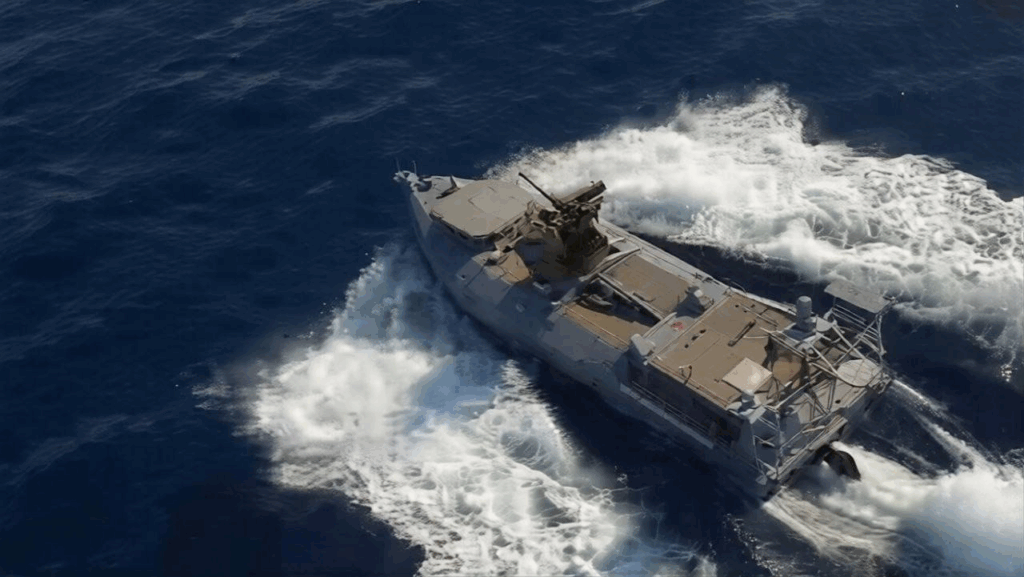

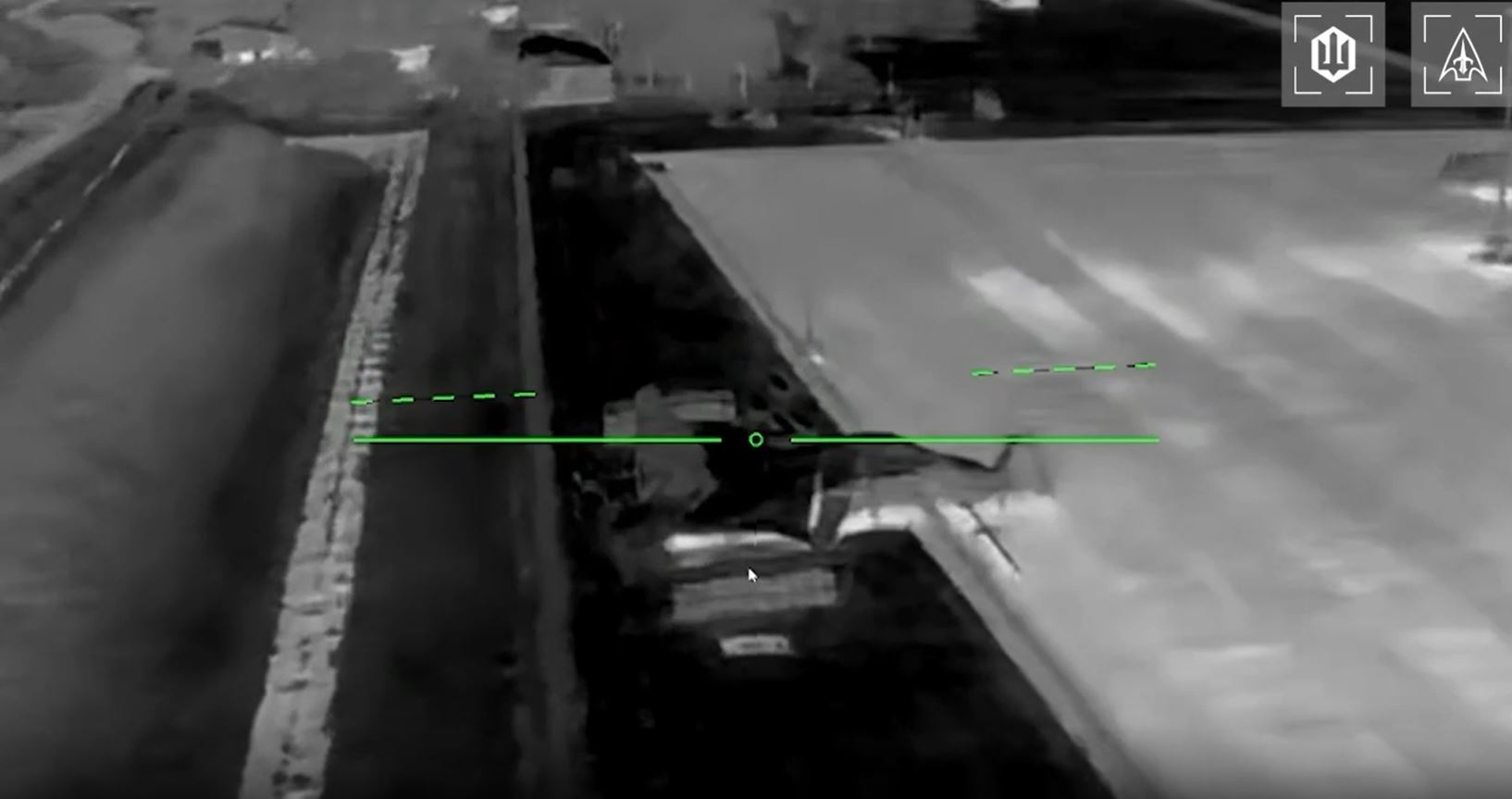




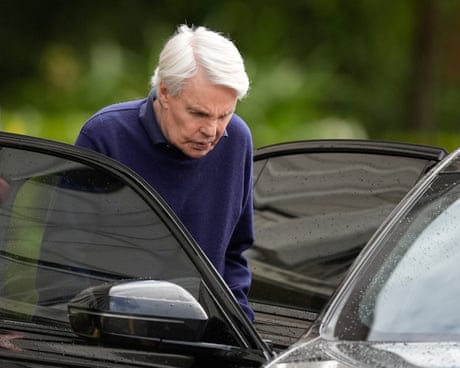
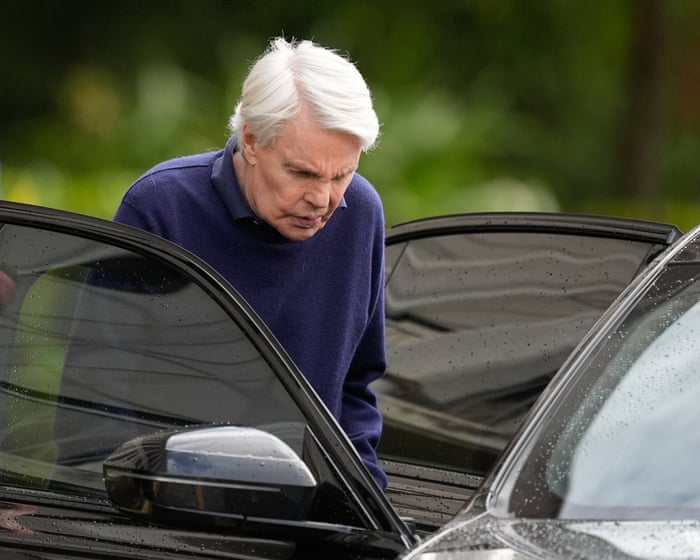
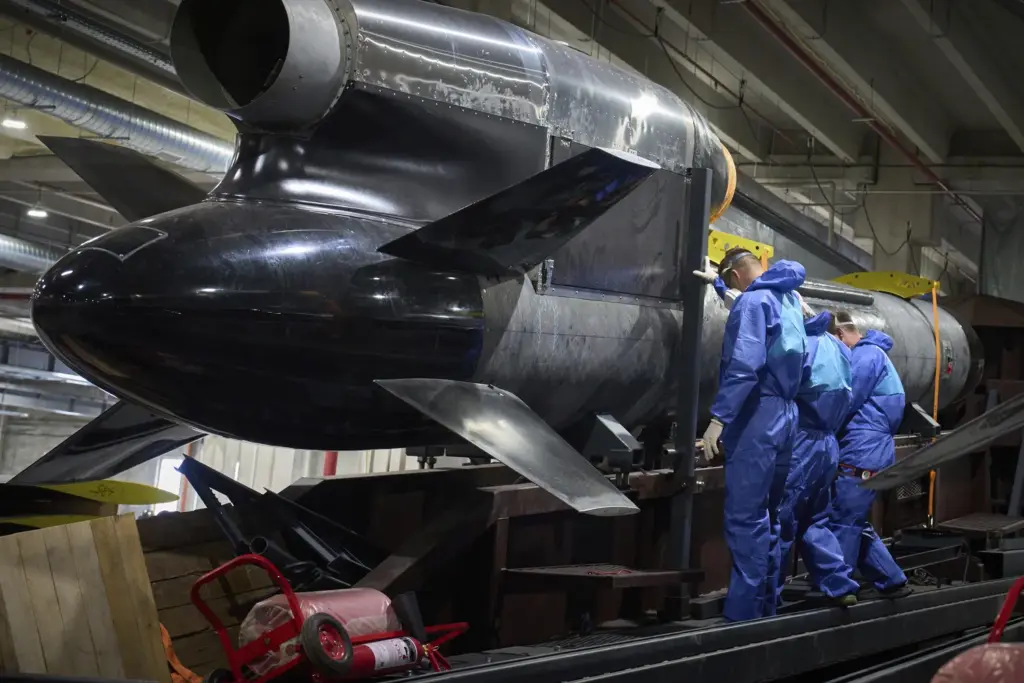
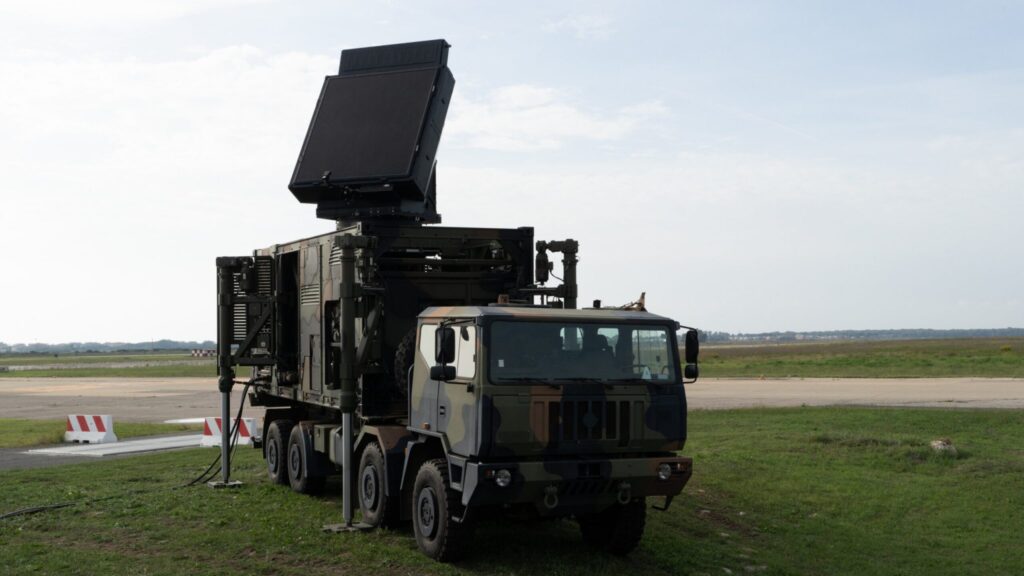


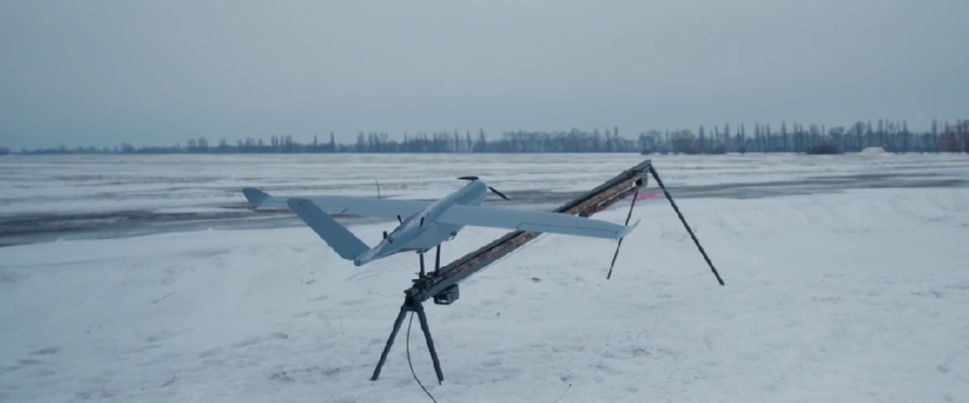





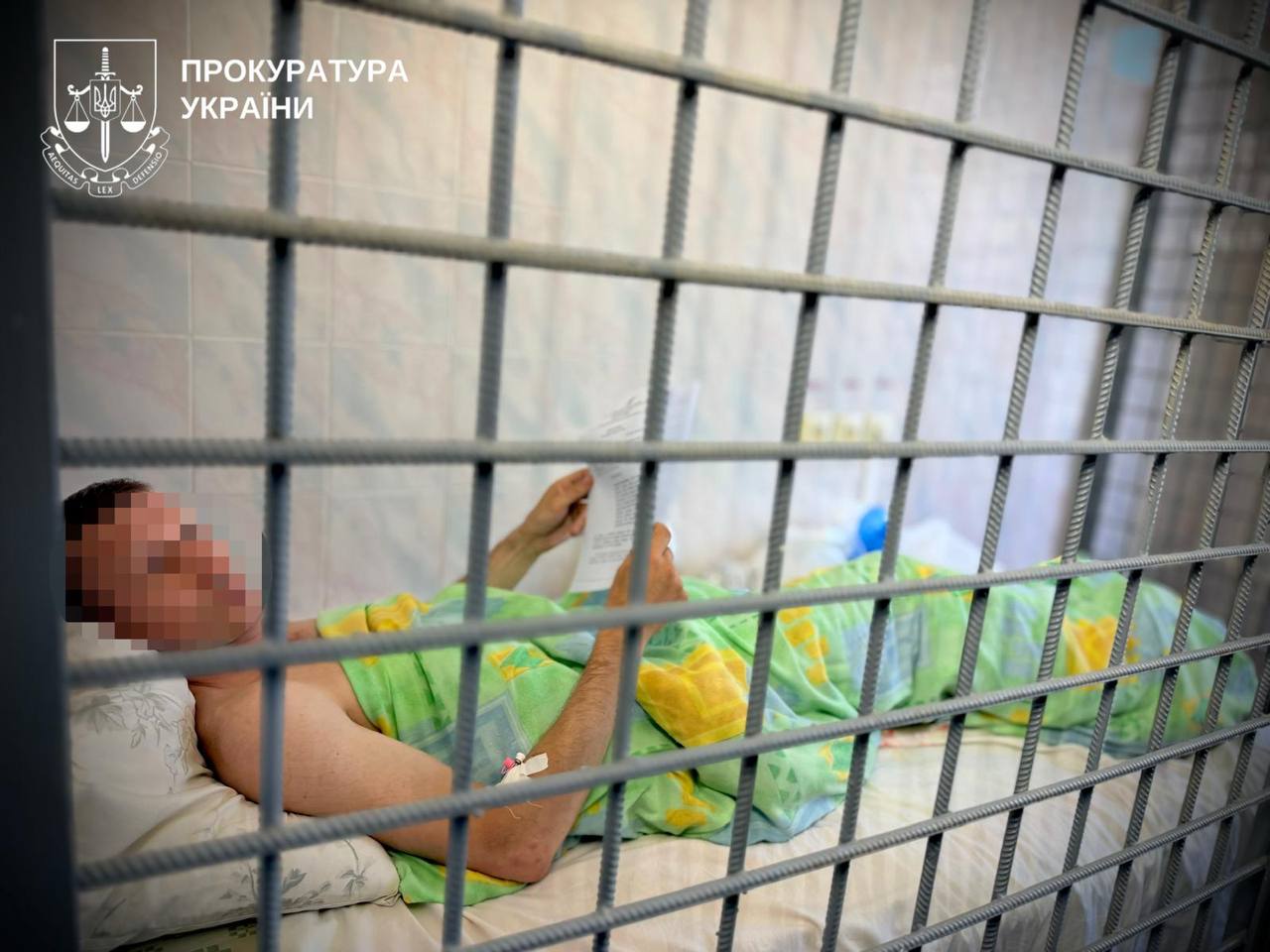


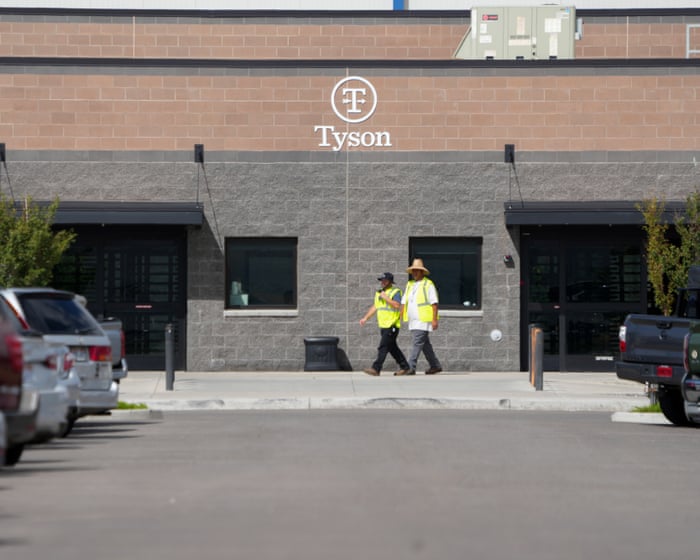




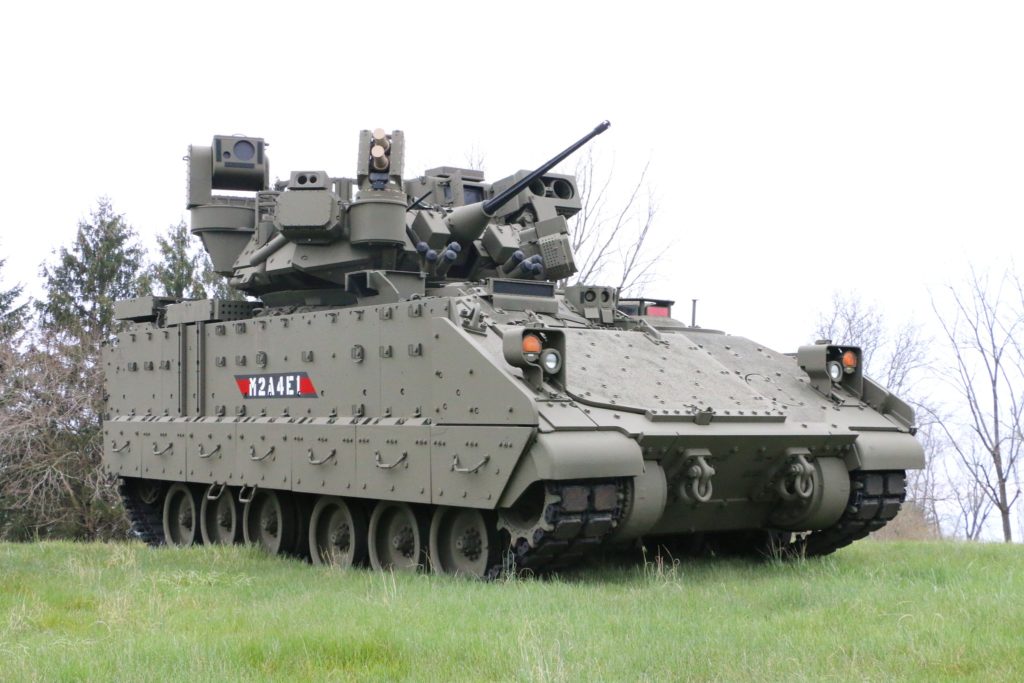
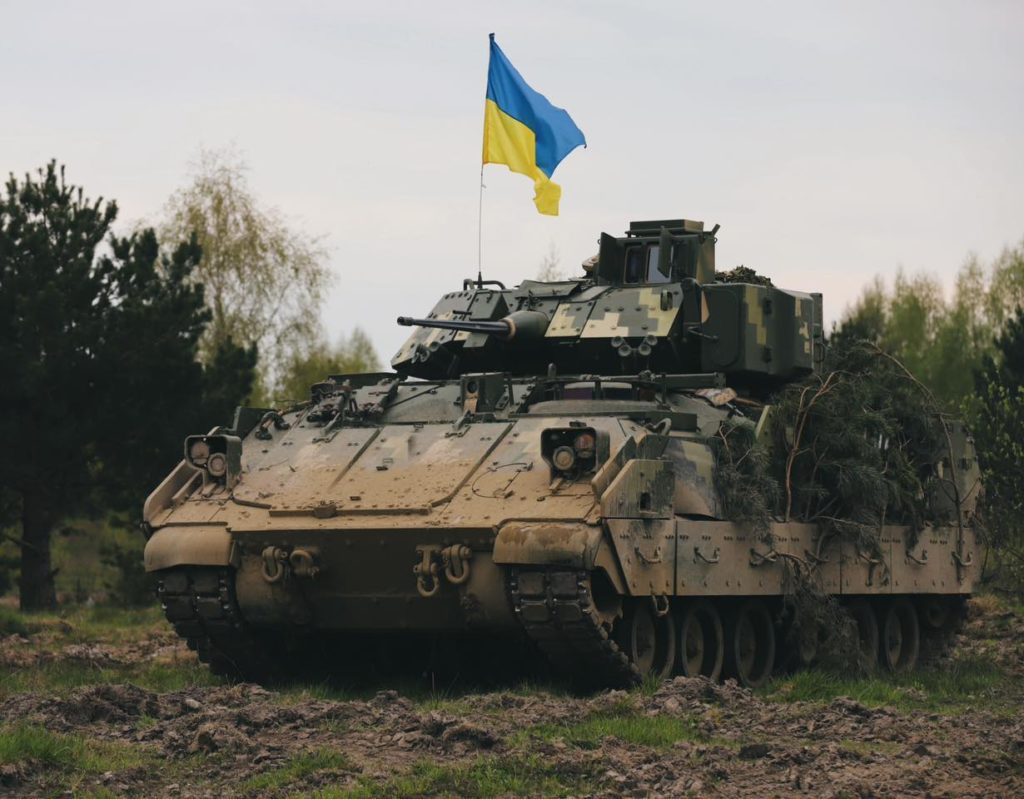
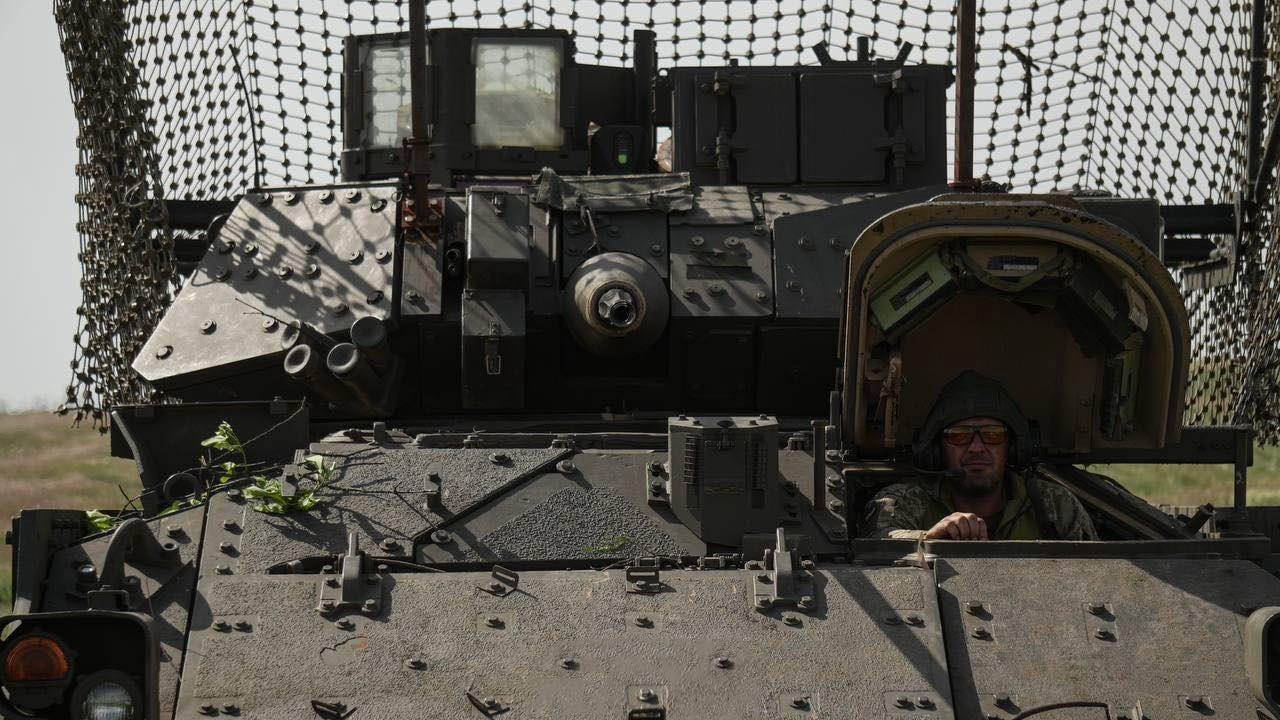
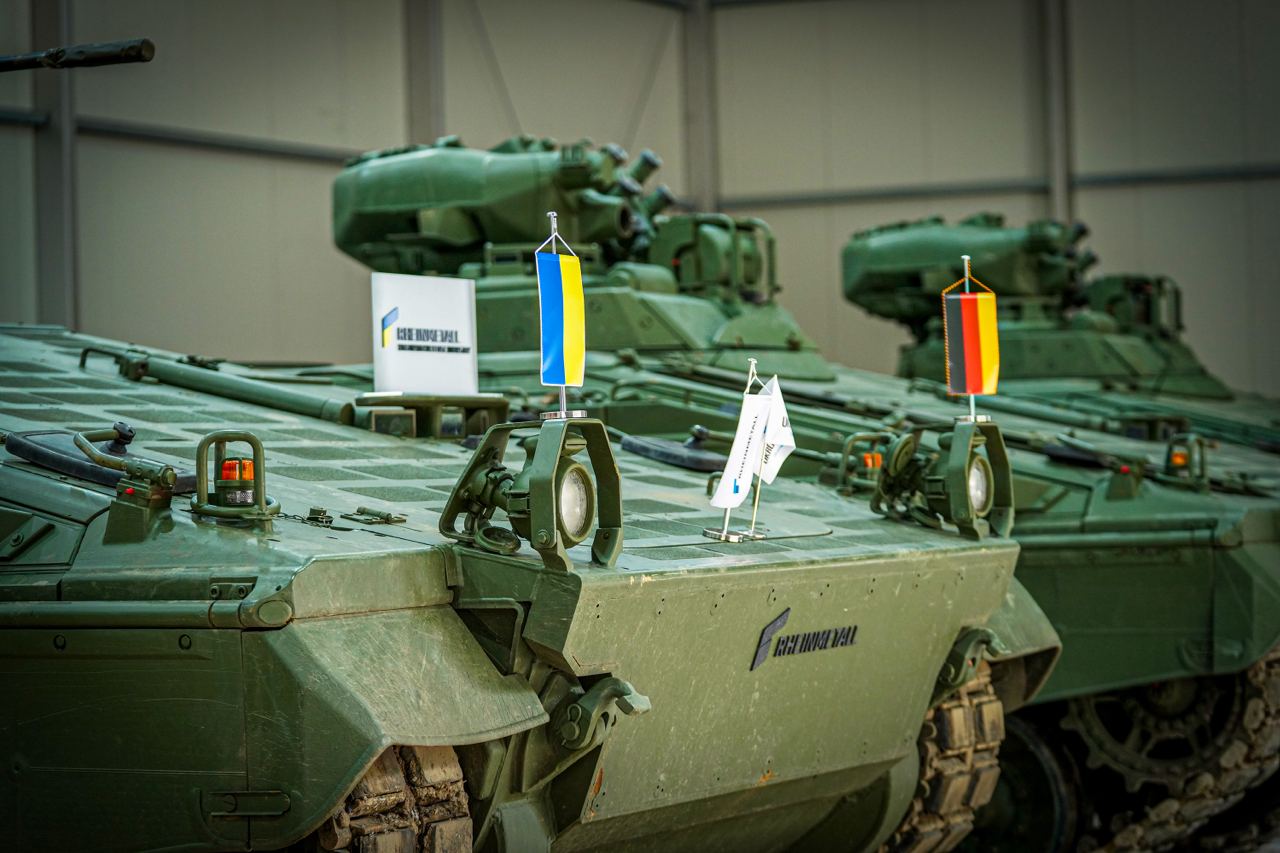


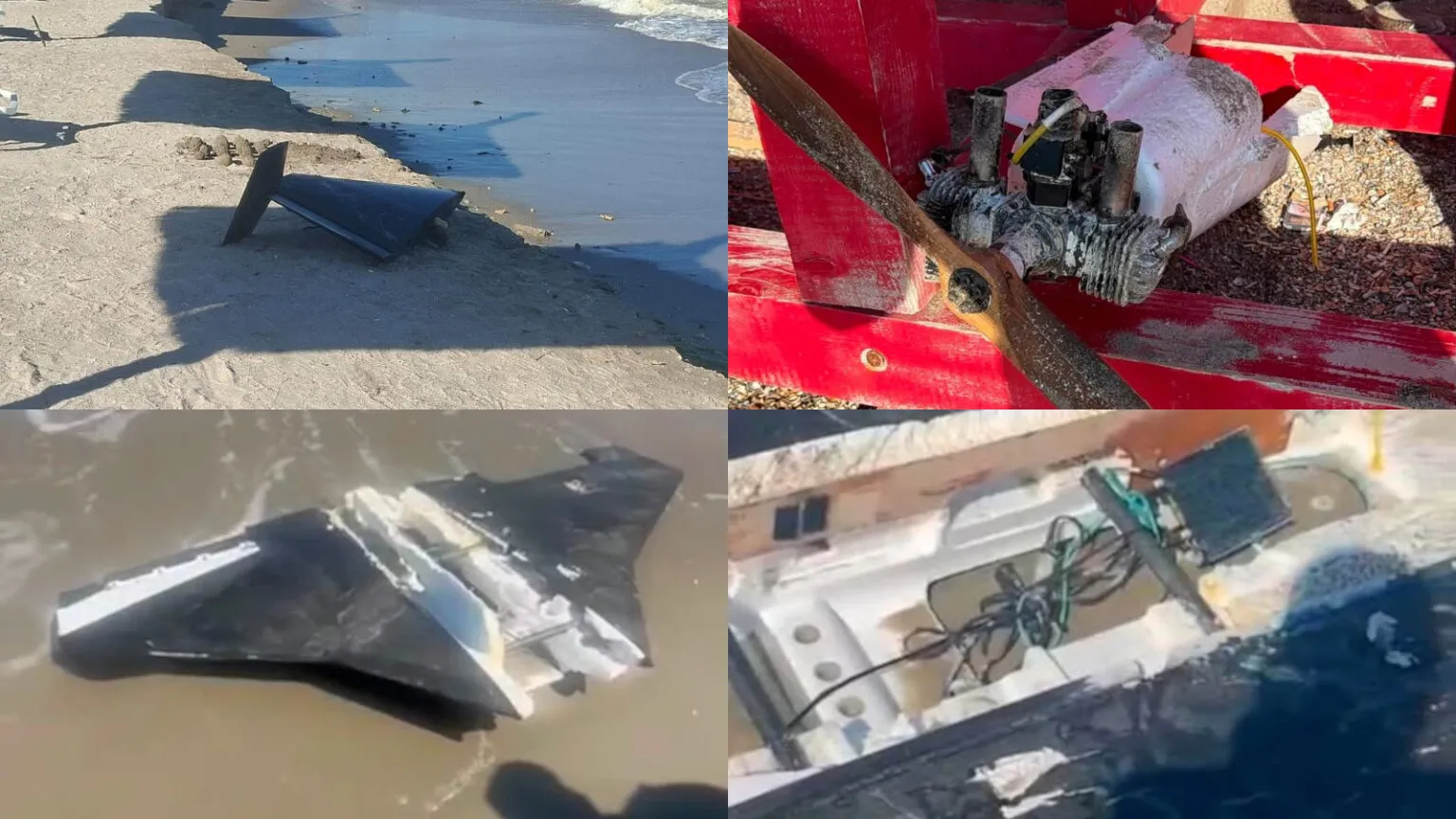

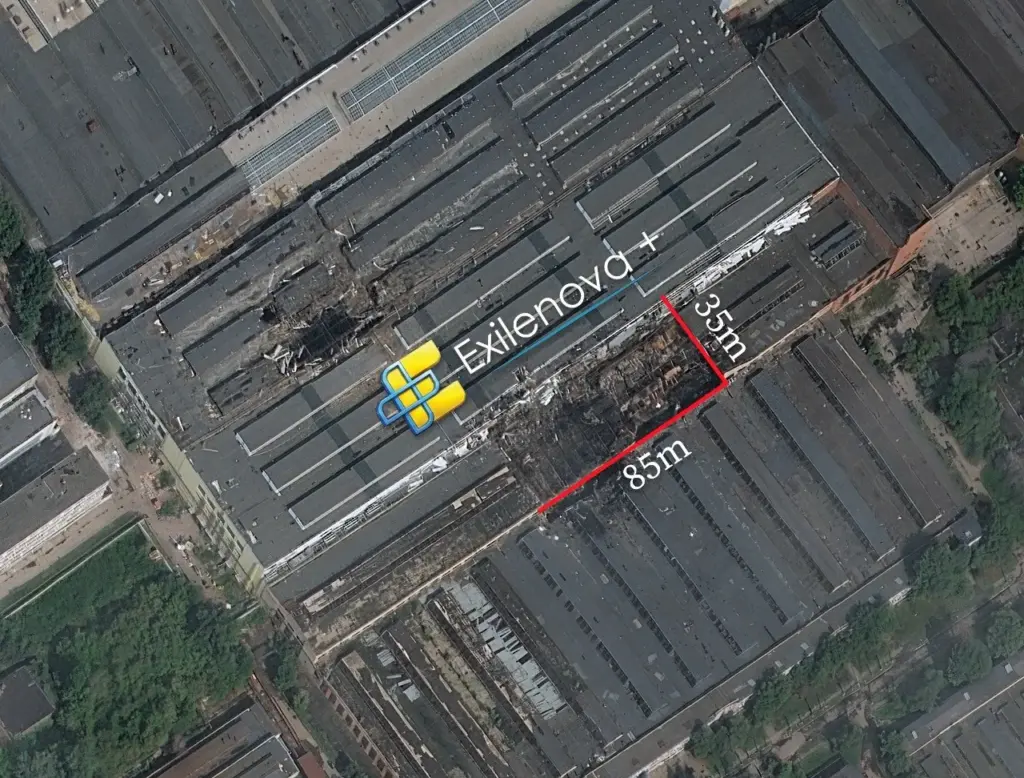
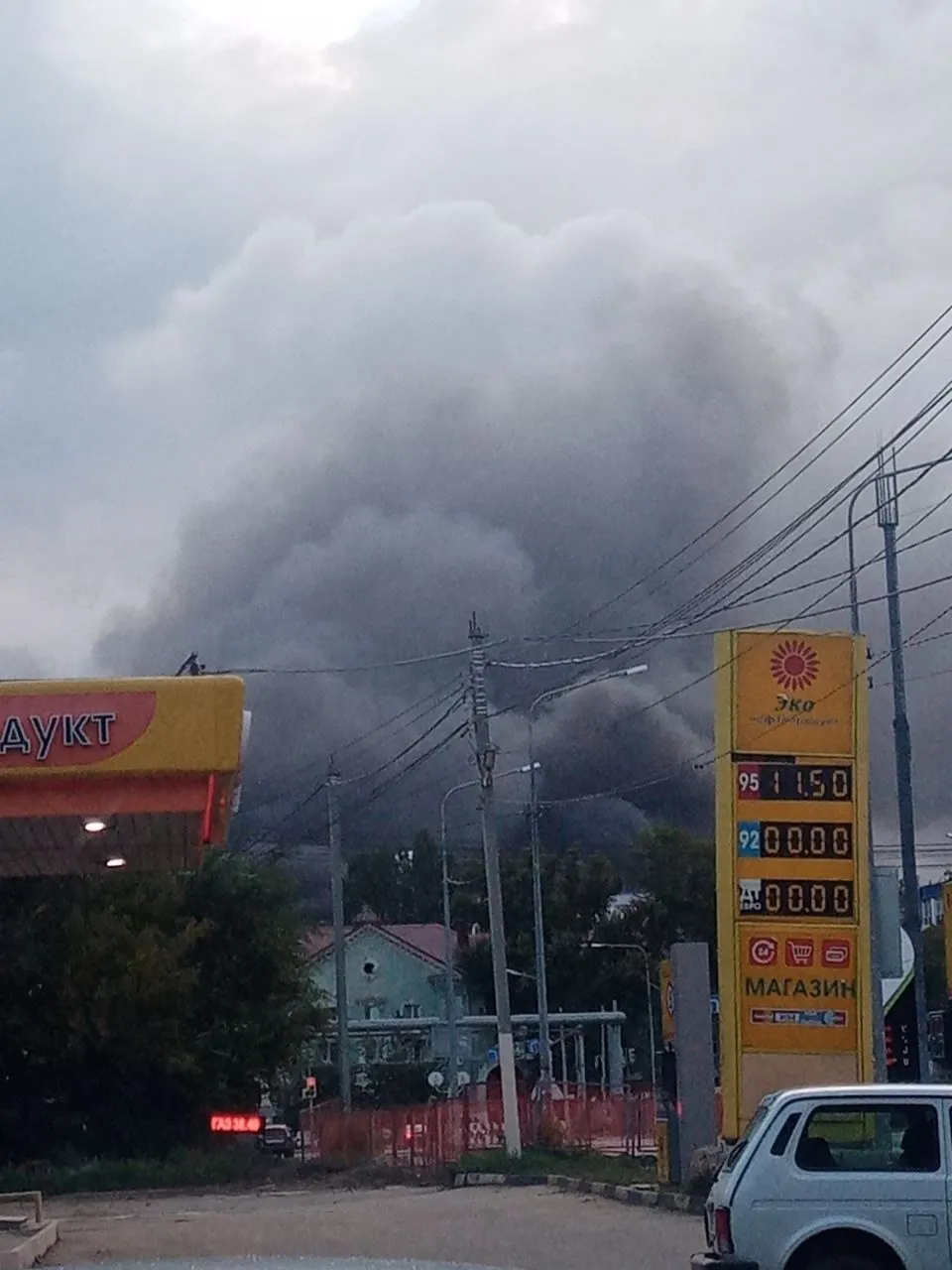
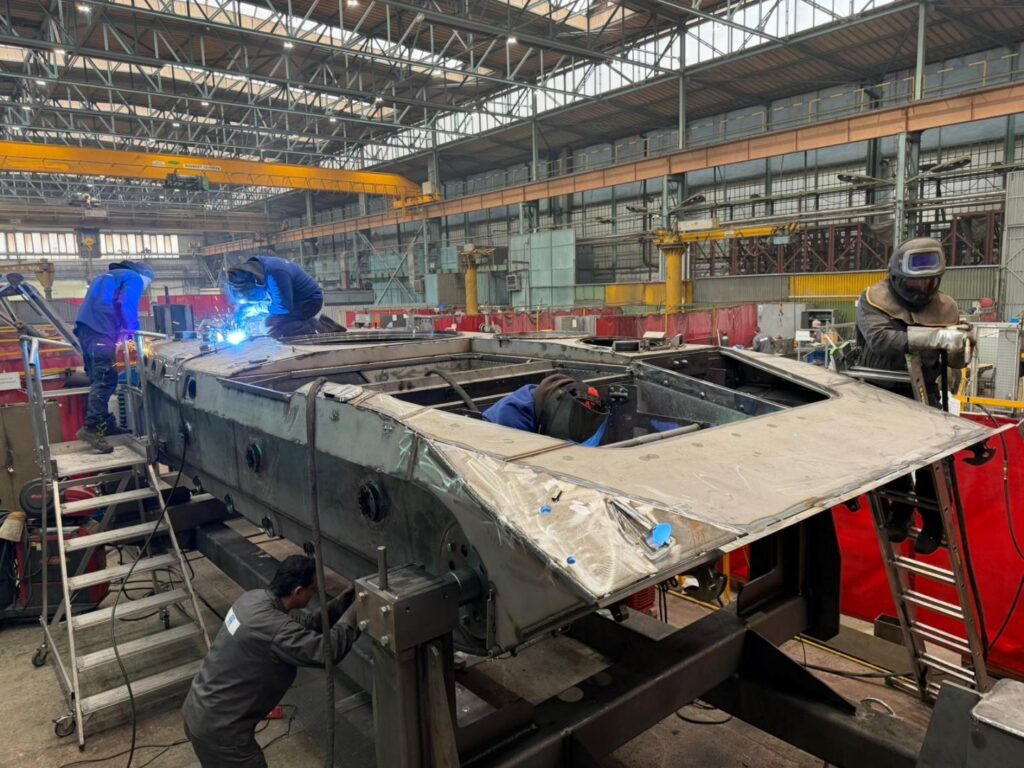
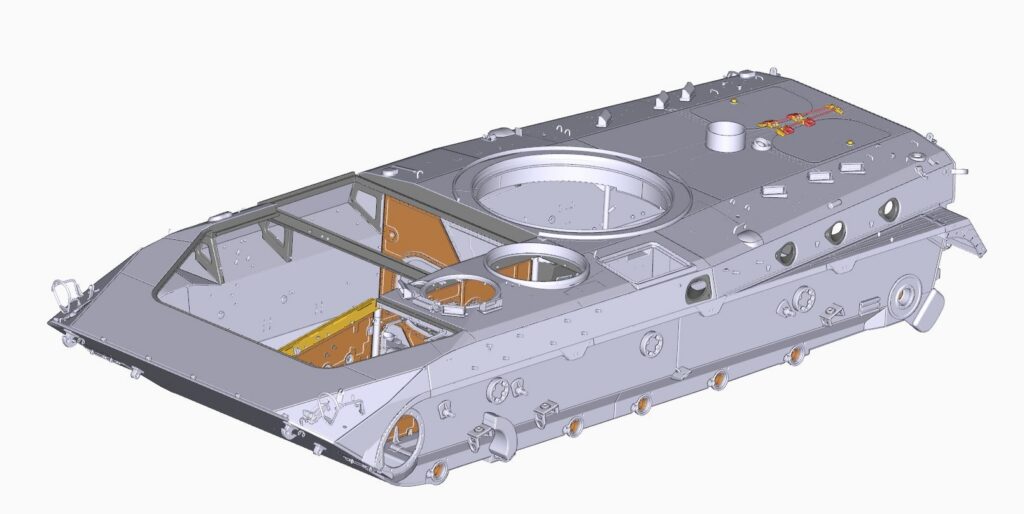

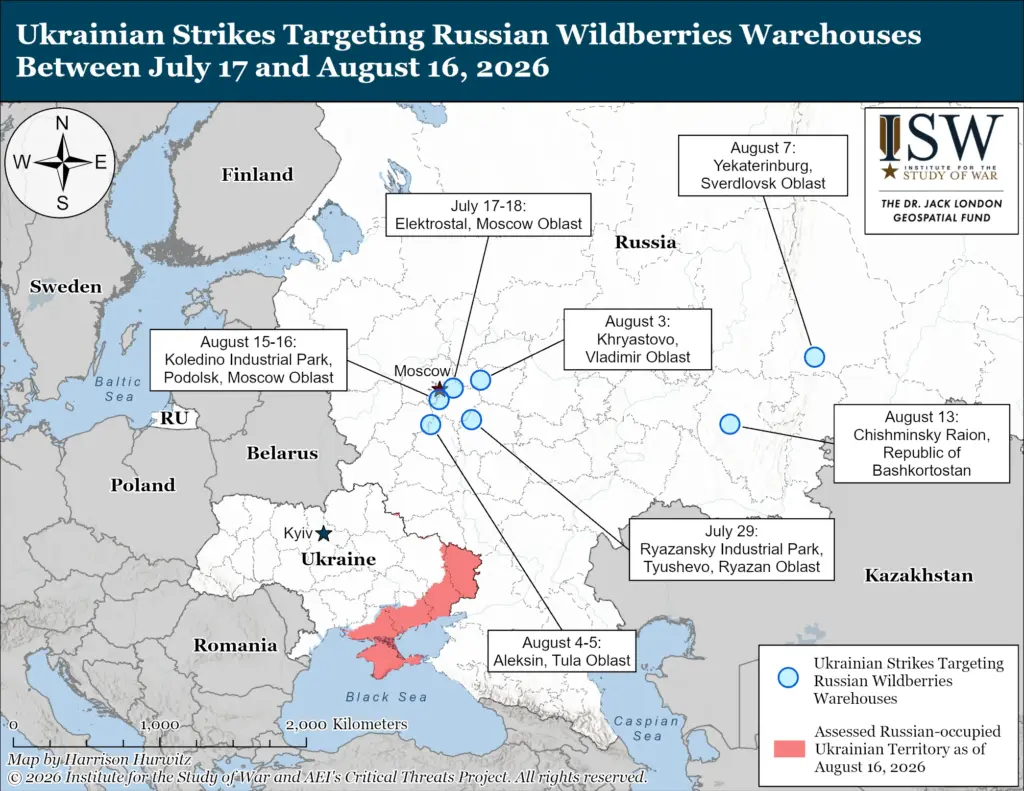
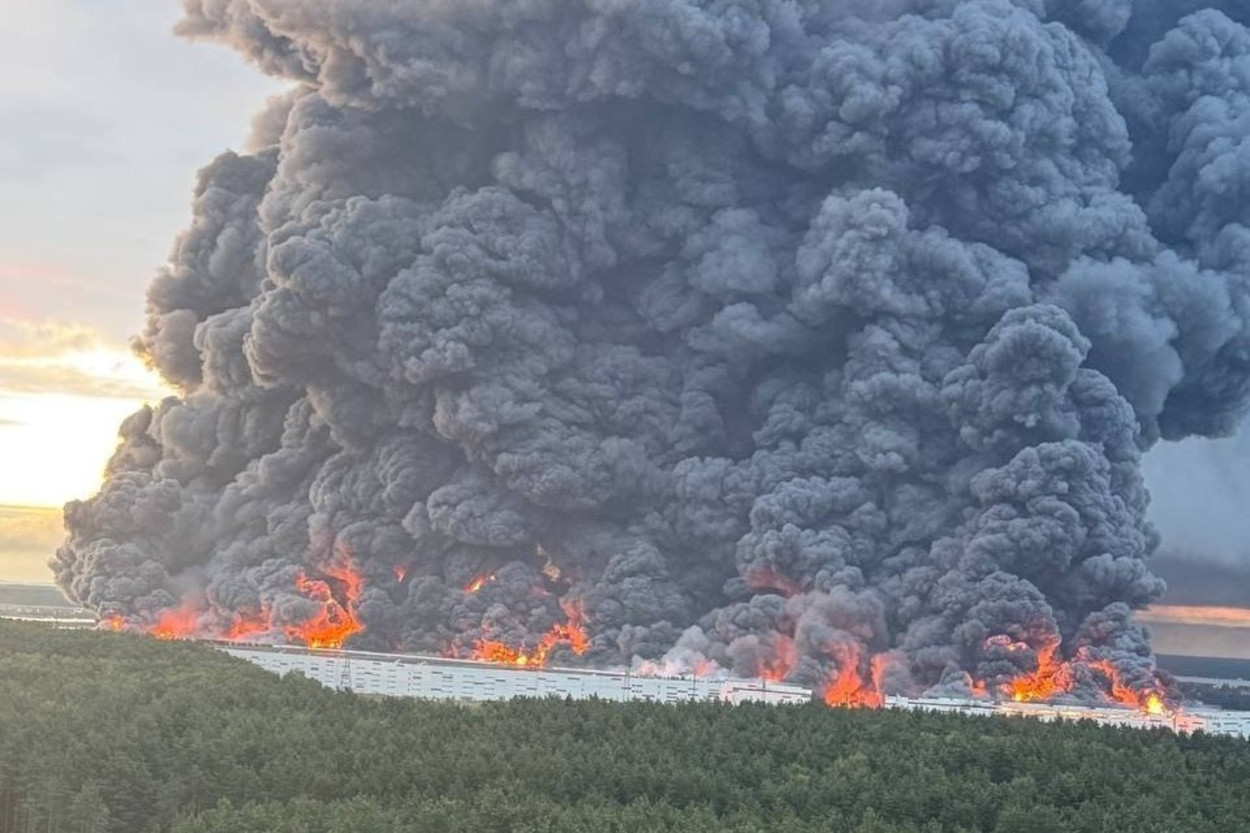
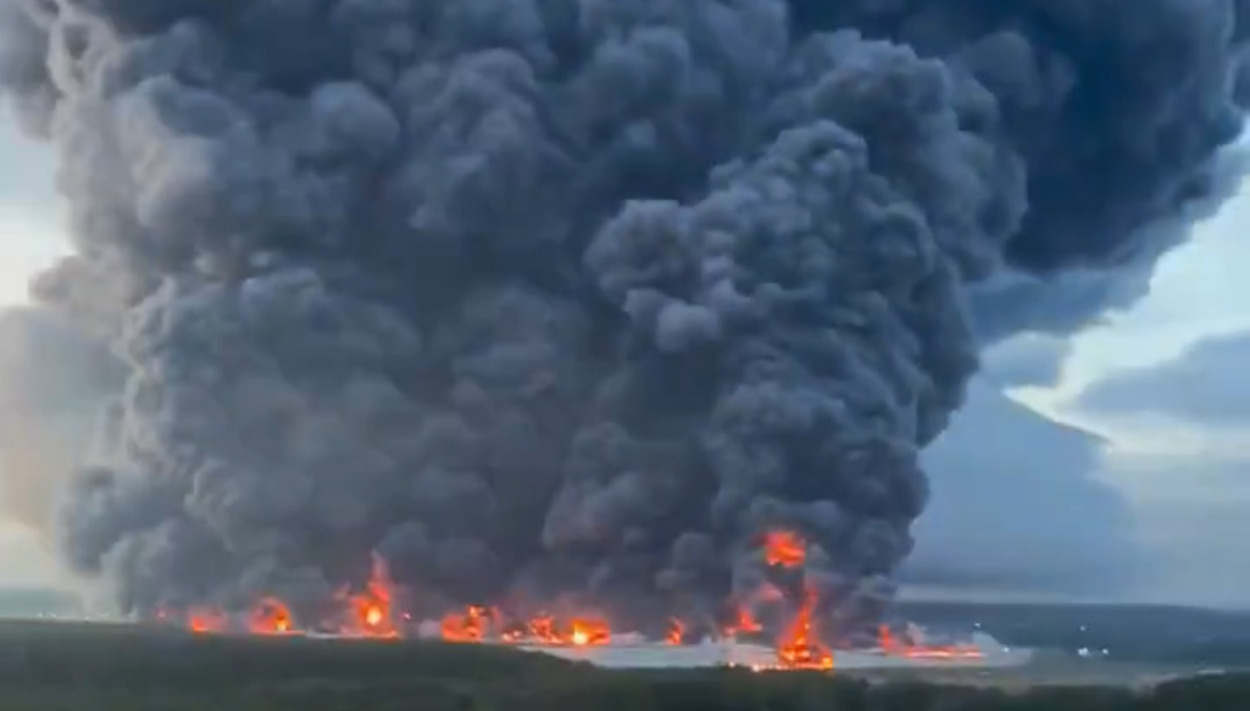
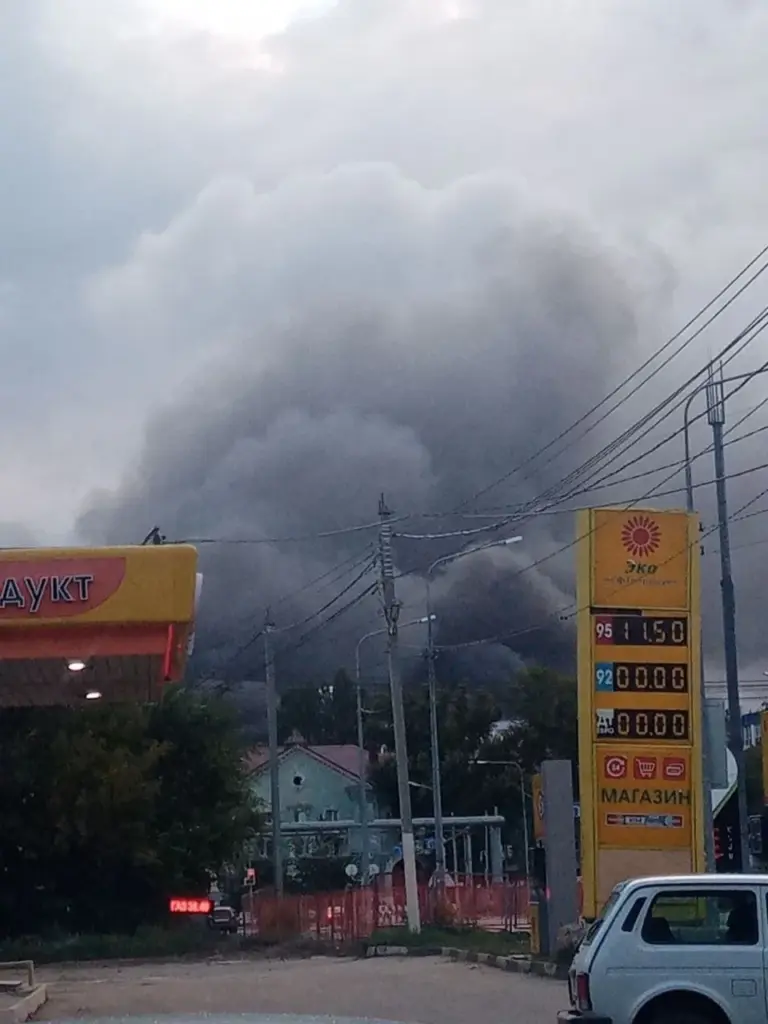
 Two Ukrainian FP-5 Flamingo cruise missiles reportedly struck Samara. The likely target was TsSKB-Progress. TsSKB-Progress develops, produces and operates medium-class launch vehicles and spacecraft for Earth observation and scientific purposes. The enterprise says more than…
 (@NOELreports)