Vue lecture

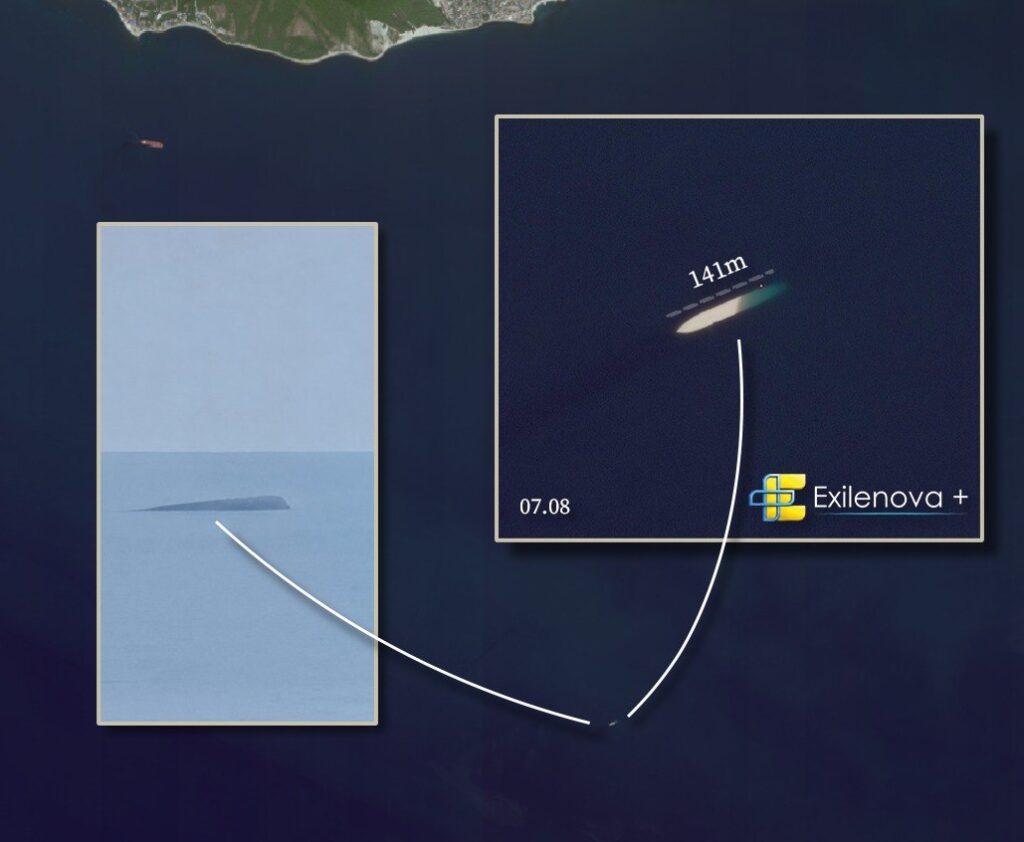
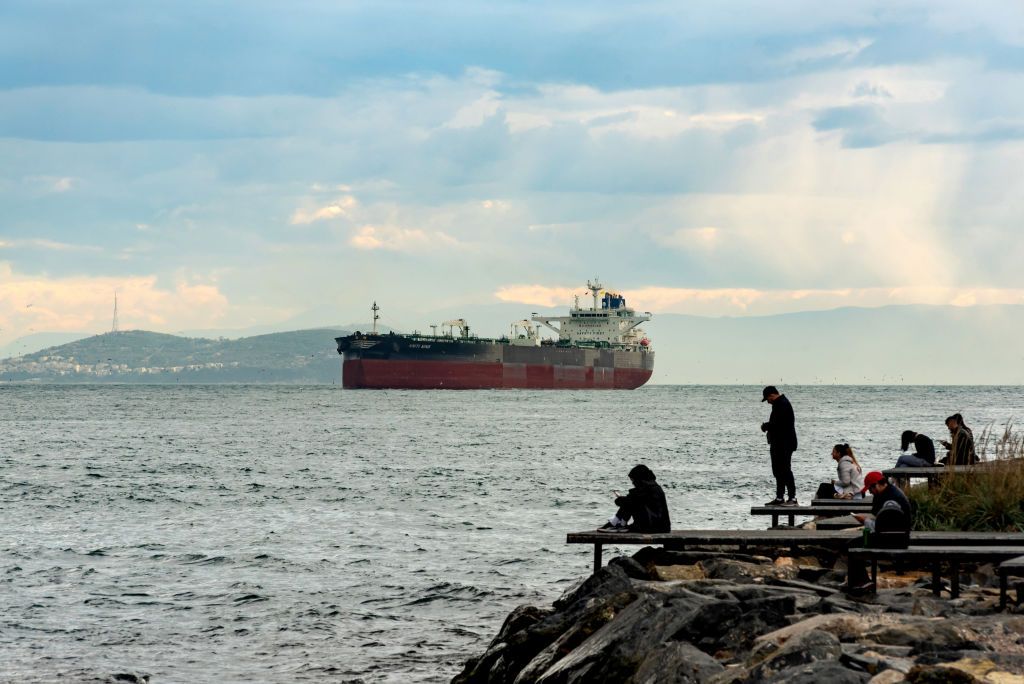
A 141-meter ship mysteriously “disappeared” in the Black Sea near Novorossiysk, while Russian authorities are keeping the incident under wraps

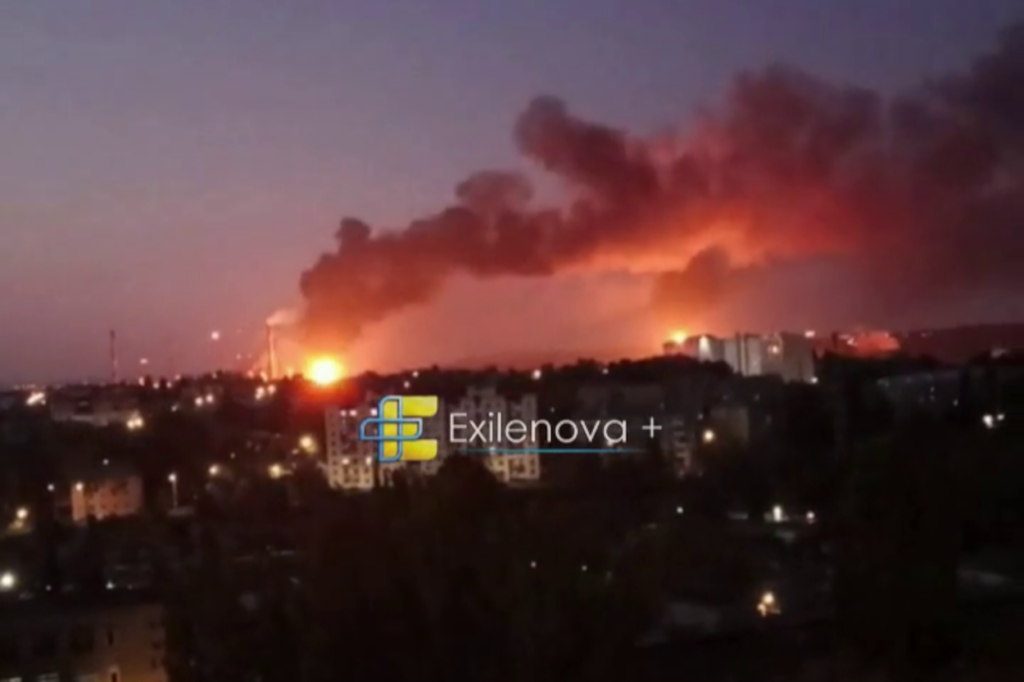
Sunken vessel near Novorossiysk. August 2026. Source: Exilenova+

Overnight on 7 August, a vessel was possibly sunk in the Black Sea near Novorossiysk, the Ukrainian monitoring channel Exilenova+ reports. The project, which spotted the ship in satellite imagery, suggests it may have been carrying military cargo.

Russia has a practice of concealing its fleet losses. Moscow tries to mask the scale of the problem in various ways: it classifies sinkings as accidents, downplays the number of casualties, or stays completely silent about vessel losses. Russia acknowledges fleet losses only when it happens accidentally or when concealing the sinking or damage is no longer possible. The 141-meter vessel, which had no foreign owner to demand explanations, has received none.

Russian officials have not commented on the sinking, Exilenova+ says.

"The news passed quite modestly, but there is a nuance. Russia's 'official' authorities have not reported about any sunken vessel. It just sank. It is not ruled out that the ship was carrying military cargo for Russia's armed forces. Otherwise, why pretend nothing happened?" Exilenova+ wrote.

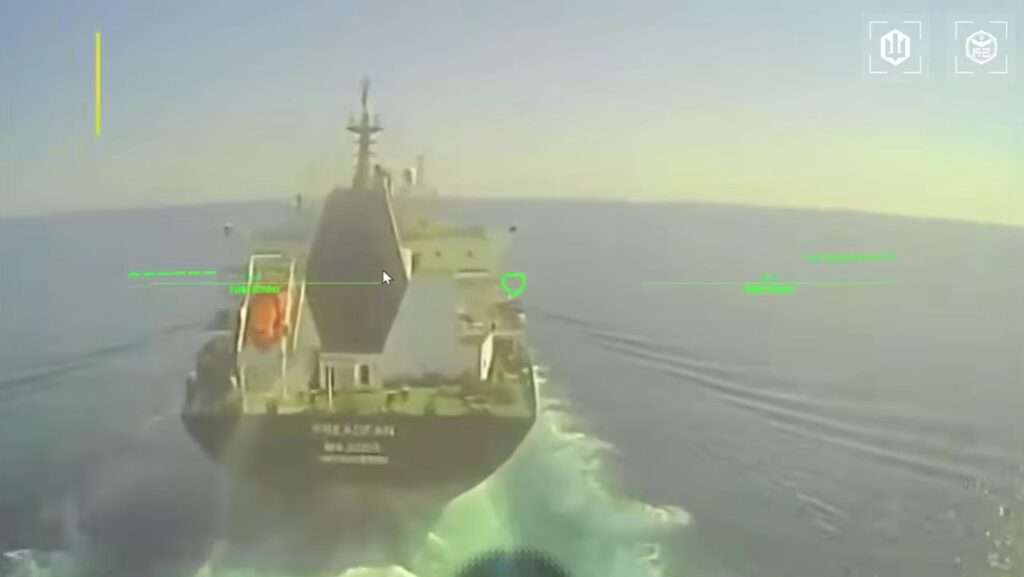
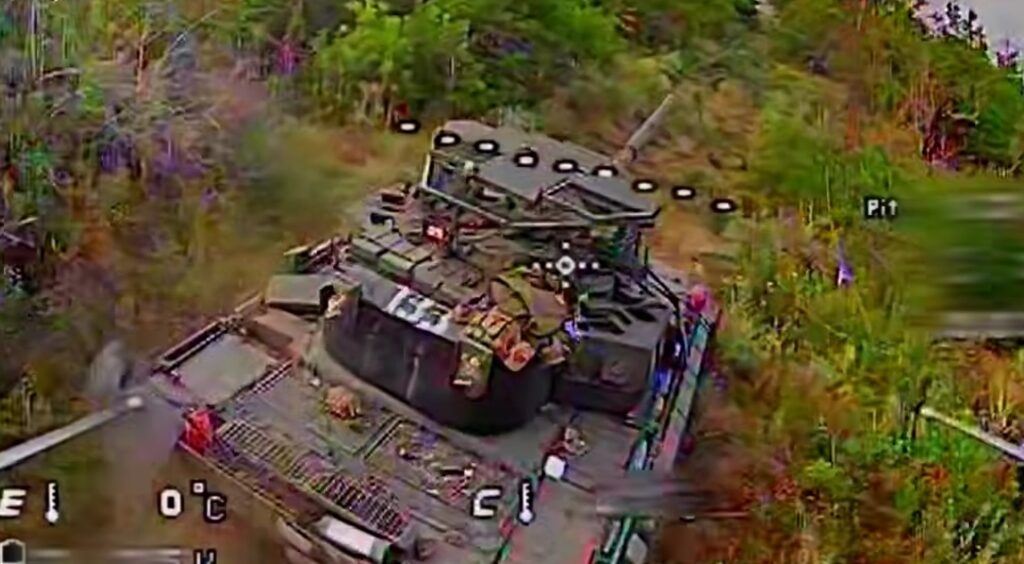
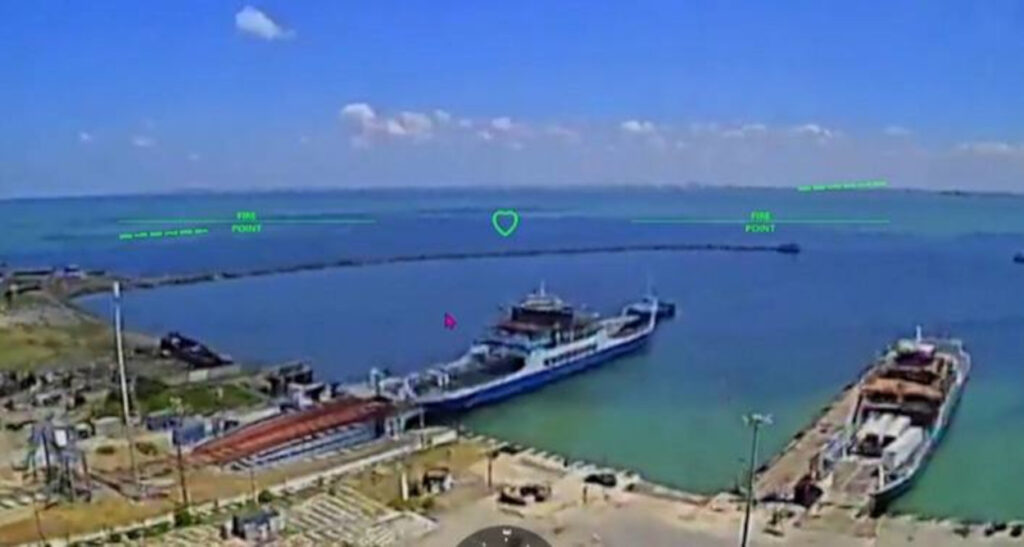
Russian shadow fleet vessel struck by a drone operated by the Unmanned Systems Forces of the Armed Forces of Ukraine. Photo: Screenshot from a video by Robert “Madyar” Brovdi

The vessel was approximately 141 meters long, suggesting a displacement of roughly 10,000 tonnes, according to the Ukrainian outlet Militarnyi.

The strikes that may have caused the sinking

Over 48 hours on 6-7 August, the Unmanned Systems Forces (SBS) struck 102 enemy targets, SBS Commander Robert “Madyar” Brovdi reported. In the same post, he noted that the targets included six shadow fleet vessels in the Black and Azov Seas: two tankers and four dry cargo ships. The SBS also reported striking three units of Russia's fleet on 7 August alone.

"It is entirely possible that the vessel that sank near Novorossiysk is among those struck in those days”, Militarnyi suggests.

Novorossiysk under fire again on 12 August

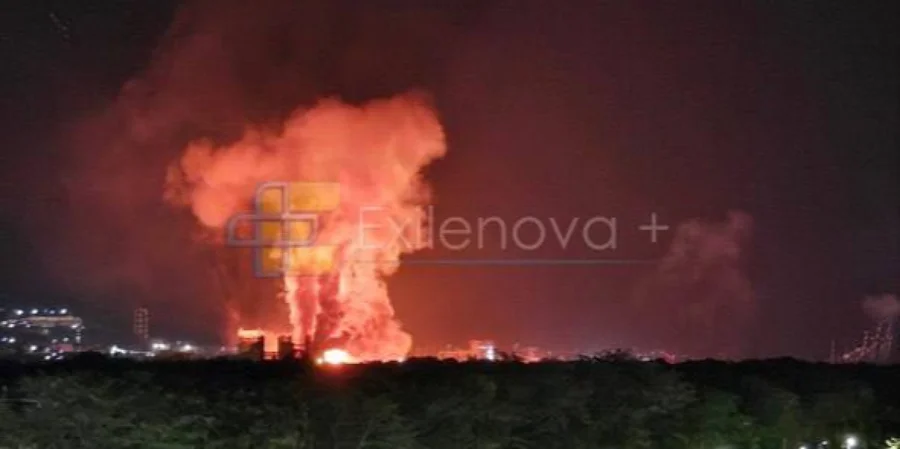
Just hours after the news of the earlier reported sinking surfaced publicly, Novorossiysk came under attack. Overnight on 12 August, Ukraine's defense forces conducted what President Zelenskyy called a "unique operation" against the naval base, using Palianytsia jet drones, Neptune missiles, and unmanned naval systems.

Novorossiysk became Russia's primary Black Sea naval hub after Ukrainian strikes forced the fleet out of Sevastopol.

  •  

Newer drones haven’t dethroned the FPV, and Russia fears our bomber drones, Ukrainian commander says

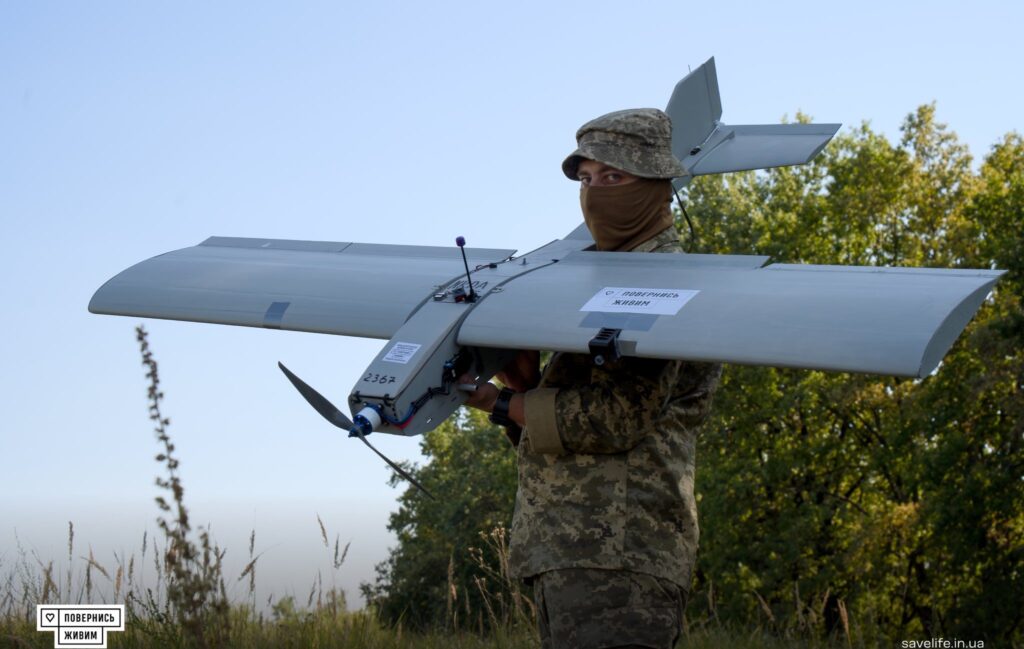
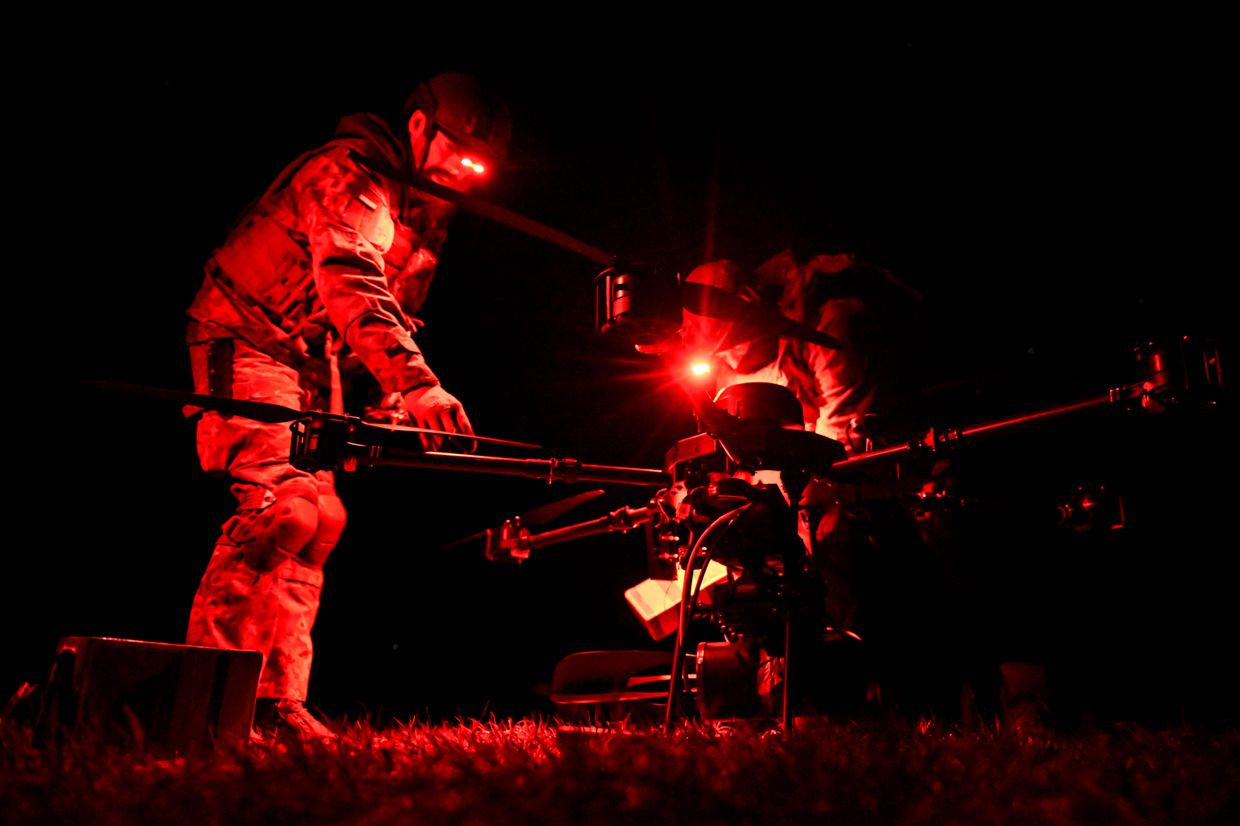
A Ukrainian soldier with a drone on the frontline. Photo: General Staff via Facebook

Ukraine's first-person-view (FPV) drones are not being displaced by newer unmanned systems, a Ukrainian officer told Ukrinform. They remain a central tool for precision strikes, while Ukrainian forces claim a separate advantage in larger bomber drones.

Unmanned systems have become a defining weapon of Russia's war against Ukraine, and both sides race to out-innovate each other, a contest in which a cheap UAV can down a platform costing dozens of times more.

FPVs remain central

"Since FPVs appeared in service, they have become a leading means of precision engagement. This trend will continue," said Captain Anton Bobrovskyi, who commands a company training unmanned-systems specialists at the 199th Training Center of the Air Assault Forces.

Bobrovskyi conceded that Russia also uses drones effectively and that Ukraine learns from it, but said Ukraine keeps a lead in one category: bomber drones.

The Russian Sokol-I anti-drone UAV. Source: The 57th Separate Motorized Infantry Brigade
Explore further

Ukrainian drone that downed Russia’s rarest spy UAV just bagged its anti-drone interceptor too

Ukraine's bomber-drone advantage

Russian forces fear Ukrainian bomber drones, according to Bobrovskyi. He said Ukraine outmatches Russia many times over in such systems, and that Russian troops who encounter one often do not know what to do with it.

The distinction matters because bomber drones work differently from single-use FPVs. Rather than flying into a target and exploding, larger bomber drones carry and release munitions, then fly on. Euromaidan Press has documented the growing role of these systems, including reusable platforms capable of returning to base after dropping their payloads. Developers have also adapted them to fly through Russian electronic warfare, with upgraded Vampire drones built to resist jamming.

sea drones jet neptune missiles hit one russian port single night · post fire burns novorossiysk early hours 12 2026 пожежа у новоросійську ніч проти серпня фото exilenova+ ukraine news
Explore further

Sea drones, jet drones, and Neptune missiles hit one Russian port in a single night

Bobrovskyi said Ukraine's advantage does not mean Russia lacks comparable technology. Instead, he argued that Ukrainian forces and society initiated many of the current battlefield drone trends and have kept the initiative in using them.

Each new drone class draws a countermeasure, so the side that keeps iterating fastest holds the battlefield initiative. How long Ukraine's bomber-drone edge lasts will depend on its ability to keep protecting and upgrading those platforms.

  •  

A bomb-laden drone hit a Ukrainian An-124 in Germany, then lay unnoticed for hours

Ukrainian An-124 at Leipzig Airport in Germany. August 5 August, 2026. Photo: screenshot from Bild video

Newly analyzed airport camera footage shows a quadcopter drone loaded with Semtex explosive flew straight at a parked Ukrainian An-124 Ruslan cargo aircraft and struck its wing at Leipzig/Halle airport in Germany on the evening of 4 August, the media outlet Die Zeit reported on 10 August. The device bounced off the wing, fell to the ground, and failed to detonate. The drone attacked the aircraft at around 19:30 local time, the media outlet reports.

Russia's hybrid attacks are increasingly moving from the information domain into the physical one, including on the territory of other countries. This incident makes sabotage on NATO member states' territory potentially more dangerous if suspicion of Russian involvement is confirmed.

Footage contradicts the warning-shot theory

The drone struck the wing near the fuel tanks, then bounced off the aircraft's surface and fell to the ground. The explosive device also ended up on the ground and did not detonate. The device contained Semtex plastic explosive. Approximately four hours later, a tourist bus driver accidentally noticed it lying on the ground, put his foot on it, and reported the find to airport security.

Video analysis contradicts the earlier theory that the incident may have been intended only as a warning. The nature of the attack indicates an attempt to cause actual damage.

Drone found near a Ukrainian An-124 aircraft in Leipzig, Germany, on 5 August, 2026. Photo: screenshot from Bild video

Investigators examining foreign state involvement

German Interior Minister Alexander Dobrindt suggested that a state actor may have been behind the explosive-laden drone found at the airport. On 7 August, Germany's National Security Council convened under Chancellor Friedrich Merz. Earlier, the United States assessed that the drone discovered at Leipzig/Halle Airport in Germany overnight into 5 August belonged to Russian intelligence, a US Department of Defense official in Europe told CNN.

The cargo aboard the Ukrainian aircraft targeted in the sabotage attempt consisted of military equipment and ammunition that had arrived in Germany from France and was being prepared for further transportation, Süddeutsche Zeitung stated, citing a confidential German police report. However, Germany's Federal Ministry of the Interior denied this claim, according to dpa.

The An-124 Ruslan, struck by the drone, is operated by the Ukrainian company Antonov Airlines. After Russian forces destroyed its main base in Hostomel in 2022, the company has been using Leipzig/Halle airport as a temporary base for its aircraft.

  •  

Russia’s Odesa strikes halve Ukraine’s grain export forecast

Grain pours from a combine harvester into a trailer during harvest in Ukraine.

Ukraine’s Agriculture Ministry has cut its forecast for agricultural exports in 2026–2027 by 54% as Russian attacks disrupt shipping through Odesa’s ports, Bloomberg reported.

The ministry now expects 29.6 million tons of agricultural exports, down from 64.4 million. Its wheat export forecast fell by 53%, from 17.6 million tons to 8.3 million tons.

Ukraine grows far more grain than it consumes, exporting 65%–70% of its agricultural output. Bloomberg said the sector generated more than half of Ukraine’s export revenue last year. But Russia’s summer attacks have stalled the sea corridor as the harvest arrives, driving some wheat prices below production costs. Land and river routes cannot match the Black Sea shipping capacity, while sales through neighboring EU states remain politically contested. That leaves farmers with less money for the next sowing and further reduces Ukraine’s export income.

Ukraine has about 59 million tons of grain storage. That storage could be full by early November, leaving the country 11 million tons short of space by the end of fall 2026. 

Wheat sells below cost as the silos fill up

Ukraine’s export bottleneck is already hitting its farmers. Port prices fell by another 12-15% in one week, while some farmers sold wheat below production cost. When ships stop, traders either stop buying or pass the higher cost of alternative routes on to producers. That leaves farmers with less cash for fall sowing.

To ease the pressure, the government has approved subsidized loans for agricultural producers. President Volodymyr Zelenskyy said Kyiv would expand storage. Ukraine's Agriculture Ministry has also asked the European Commission for €220 million to help cover interest for small and medium-sized farms.

Ukraine and Moldova are discussing a rail route to Romania’s Constanța port. According to the report, grain was already being redirected through Romania, Slovakia, and Hungary, but these routes cannot replace Odesa’s capacity.

Now the ports and the ships are Russia's targets

The export bottleneck is only part of the problem. Russia’s bombardment also threatens the ports, civilian ships, and crews needed to keep the corridor operating. 

The port of Odesa normally handles about 90% of Ukraine’s grain shipments. Russia intensified attacks on terminals and civilian ships in July 2026 as the harvest reached the coast.

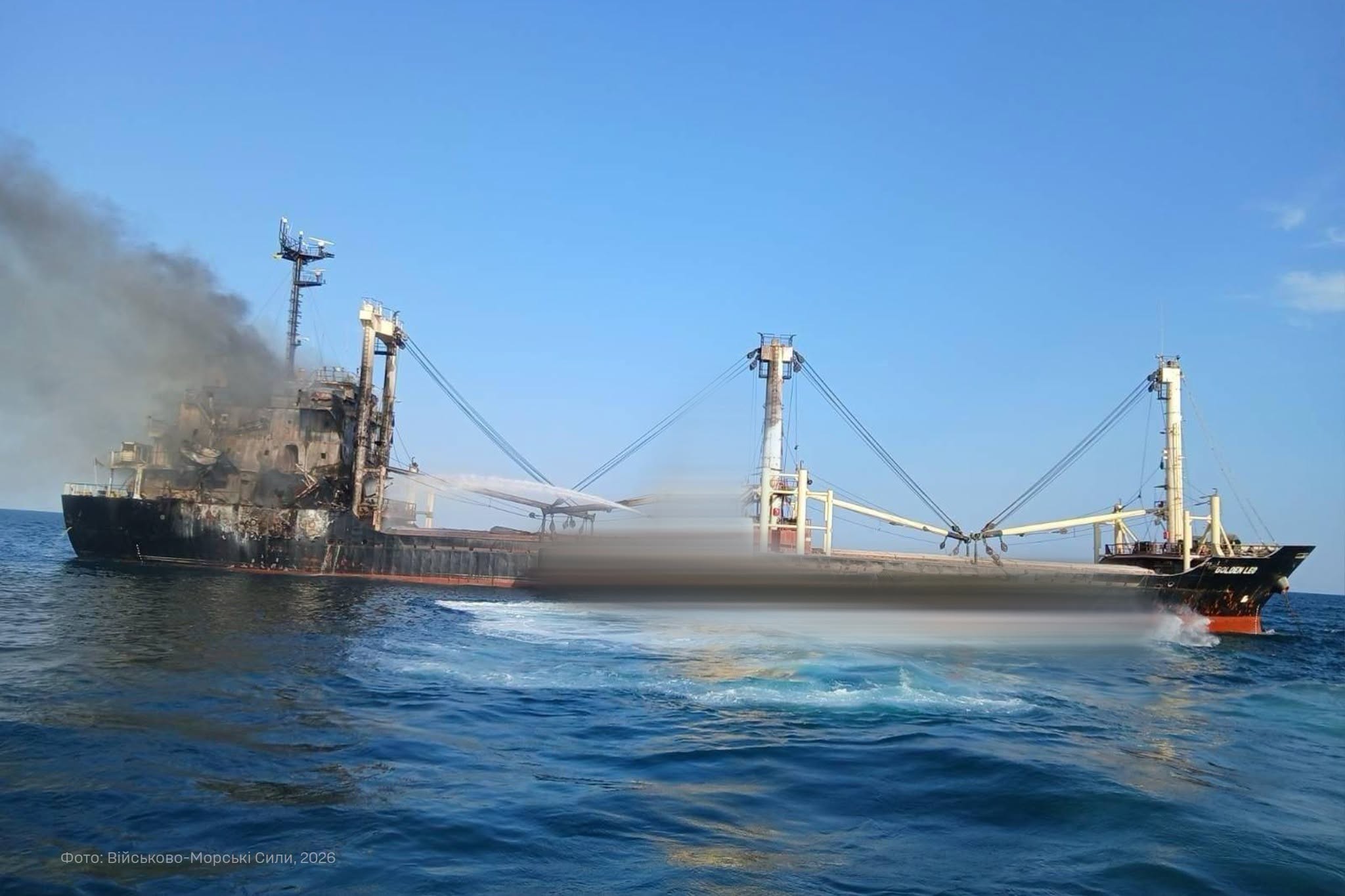
On 19 July, three Russian missiles struck the foreign-flagged Golden Leo as it left Odesa carrying corn, killing 10 people, including a Ukrainian sea pilot. Three days later, no vessel passed through the corridor.

Alternative routes offer little relief, as record-low Danube levels were restricting river traffic. Poland continues to bar Ukrainian grain from its domestic market. Those constraints leave more of the harvest inside Ukraine and farmers with less money to plant the next crop.

  •  

Russia’s tank shield shot down seven drones—Ukraine destroyed the tank anyway

T-72B3A tank equipped with the Arena-M active protection system (APS). Photo: iz.ru/Dmitry Astrakhan

Russia wants its tanks moving again after two years of Ukrainian drones freezing its armored assaults, the Institute for the Study of War (ISW) reported. Its main bet is a tank-mounted system that fires interceptors at incoming drones. The system worked on at least one tank, but Russia lost it anyway.

Since 2022, cheap Ukrainian FPV drones have turned the open approach to any position into ground where armor rarely survives, forcing Russia into slow, infantry-led assaults and years of experiments to armor its tanks against drones.

The shield shot down some drones. Ukraine still killed the tank.

In early August, footage surfaced of Ukrainian drones destroying a Russian tank fitted with the Arena-M active protection system in the Dobropillia sector of Donetsk Oblast. Militarnyi identified the vehicle as a T-72B3A, side number 133, and Militarnyi reported that Ukraine's Security Service (SBU) released the clip. ISW geolocated the footage near occupied Volodymyrivka, east of Dobropillia.

A T-72B3A the moment before a Ukrainian drone strikes.
Explore further

Russia took the cages off its newest tanks. The new Arena-M shield bought them a few minutes.

Dmytro Putiata, a Ukrainian combat drone specialist who posts as kriegsforscherD, spoke with the unit involved. On that tank, Arena-M shot down seven drones before its magazine ran dry, he said.

"Unfortunately, it works," Putiata wrote.

It still wasn't enough. Ukrainian crews finished the tank off with more drones. It took 15 to 20 first-person-view (FPV) drones to kill each vehicle, Putiata said. Footage shows the tank moving with its interceptor cells empty. It was the first time the Arena-M was credited with shooting drones down in combat.

Russia keeps sending tanks into that ground for a reason

Russian forces are experimenting with new technology to restore mechanized maneuver and break out of positional warfare—the static, trench-like fighting that has defined the front, ISW reported. They are fitting tanks with active protection systems to help armor survive in the "kill zone," the open ground where drones and other weapons destroy almost anything that moves.

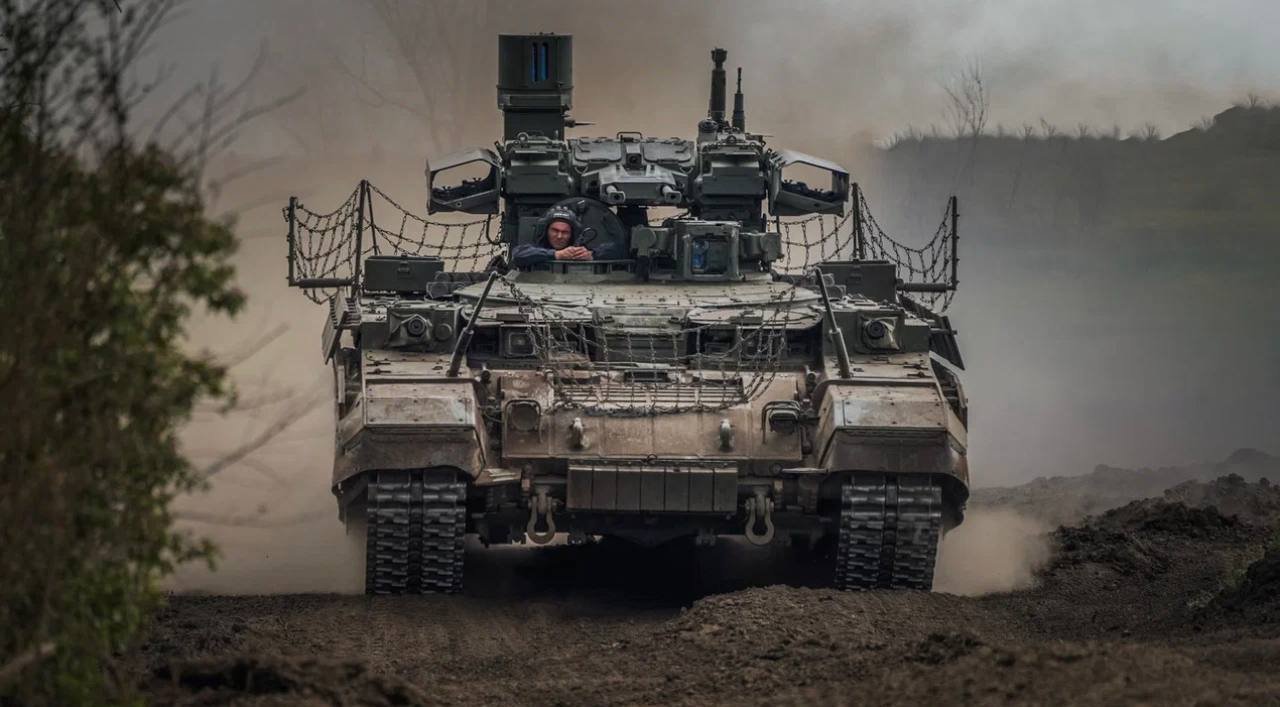
A BMP-T in 2026.
Explore further

Russia’s weirdest armored vehicle was built to fight infantry. The infantry stopped coming

ISW judged that Arena-M alone cannot shield Russian assaults from the drones, let alone the rest of Ukraine's weapons. Russian commanders have largely kept tanks off the roads because drones kill them faster than factories rebuild them. In these assaults, the tank's job is less to fight than to survive long enough to drop infantry closer to Ukrainian lines. Russia will likely keep trying to restore maneuver even after its late-July mechanized assault in the Dobropillia sector failed, ISW added.

Why Russia wants the shield: the cages don't let tanks fight

The bolt-on armor carries a cost. Cope cages and "turtle" shells weigh tanks down and often jam the turret so the main gun can't aim. That trade-off is part of why Russia wants Arena-M: protection without the bulk, so a tank can still move and shoot. Russia recently sent tanks stripped of the welded cages, carrying the shield instead.

Moment of impact of the T-72B3M tank “133,” equipped with the Arena active protection system and empty countermeasure launcher cells.
Moment of impact of the T-72B3M tank “133,” equipped with the Arena active protection system and empty countermeasure launcher cells. Screenshot from an SBU video.

Arena-M is not new. Active protection systems like it were first built to stop anti-tank missiles, and Russia adapted this one to catch drones. The system's lineage dates back to the late Soviet era, and Russian industry has for years claimed mass deployment that never came. Designers worked on fitting it to T-72B3 and T-90M tanks since at least 2019, yet only single vehicles turned up by 2024—some used to shoot a propaganda film rather than fight.

  •  

Russia’s education minister calls it “objective.” A new textbook teaches Ukrainian children that their occupied region is historically Russian

Covers of Russian “Donbas and Novorossiya” history textbooks for students in grades 5–7.

Russia will introduce two editions of a new regional history textbook series in occupied Ukrainian schools on 1 September 2026. The books present the occupied Ukrainian regions as historically Russian, MOST, a Kherson-based outlet, reported on 10 August.

The new textbooks bring Russia's campaign to erase Ukrainian identity into occupied classrooms, where authorities remove Ukrainian from curricula and replace lessons with Russian ideology, military drills, and firing-range visits. Moscow's Russification campaign extends beyond schools to efforts to change the demographics of occupied Ukrainian territory and re-educate forcibly transferred Ukrainian children.

The new textbook series, entitled "History of Our Region: Donbas and Novorossiya," comprises one edition for grade 5 and another for grades 6–7. The course attached to the books will be compulsory throughout Russia's so-called "new regions," according to the Ukrainian human rights center ZMINA.

"Novorossiya" is an imperial term Moscow uses to claim southern and eastern Ukraine. 

Russia's Education Ministry calls the course "objective" and part of a "unified history of Russia," Meduza reports. Minister Sergei Kravtsov claimed it contains "objective information, rather than the lies that appeared in Ukrainian textbooks."

Replacing the curriculum, then the population

The "Novorossiya" textbook forms part of a broader Kremlin campaign to Russify occupied Ukraine's education, culture, and demographics. 

Since occupying Melitopol, Russian authorities have systematically replaced Ukrainian curricula and textbooks. Older Russian textbooks, issued after Moscow's full-scale war, already depicted occupied Melitopol as part of Russia. 

A 2025 Kremlin strategy requires occupied regions to enter Russia's educational, cultural, and information space. The policy also sets a nationwide target for “All-Russian civic identity” to reach at least 95% by 2036.

35,000 Ukrainian children still missing

Meanwhile, experts estimate that about 35,000 Ukrainian children remain missing and are likely held in Russia or Russian-occupied territory. Yale's Humanitarian Research Lab identified at least 210 facilities used to hold children from Ukraine. The lab found that at least 130 facilities subjected Ukrainian children to pro-Russian cultural, patriotic, or military programs. 

One case shows where such indoctrination can lead. Once listed as missing under occupation, Ukrainian boy Oleksandr Mustiatse later appeared online in a Russian uniform bearing the “Z” invasion symbol, Save Ukraine reported.

  •  

A $300 FPV downs a $20,000 bomber drone. Ukraine tests an EW shield for it

ukraine tests ew system protect $20000 bomber drones $300 fpvs · post vladyslav “vitamin” electronic warfare specialist serving 141st separate mechanized brigade kirichenko3 news ukrainian reports

Ukraine is testing a new electronic-warfare solution to protect heavy bomber drones and unmanned ground vehicles (UGVs) from cheaper FPV drones. The project has reached field testing, with several prototypes sent to military units, RBC-Ukraine reports.

Ukraine's war has become a laboratory for the economics of unmanned combat, where a mass-produced quadcopter can take down platforms that cost dozens of times more, forcing both volunteer foundations and defense firms to look for asymmetric answers on the electronic side of the front.

$20,000 bomber vs. $300 drone

The gap runs more than 60-to-1. Liuba Shypovych, head of the Dignitas foundation, told RBC-Ukraine that a heavy bomber can cost around $20,000, while an FPV drone capable of damaging or destroying it can cost about $300. Shypovych said the bombers are particularly vulnerable because they are relatively slow and less maneuverable than smaller FPVs, and that shootdowns are becoming increasingly frequent.

ukraine tests ew system protect $20000 bomber drones $300 fpvs · post vladyslav “vitamin” electronic warfare specialist serving 141st separate mechanized brigade kirichenko3 news ukrainian reports
Explore further

A $300 FPV downs a $20,000 bomber drone. Ukraine tests an EW shield for it

Yet Ukraine cannot simply stop using the larger drones. According to Shypovych, they are used to deliver water, food, and ammunition to positions that are difficult or impossible to reach by ground. The military therefore approached Dignitas with a request to protect the platforms, and the team is working on the task together with the company Aura.

The jammer has a problem of its own

Equipping a heavy bomber with electronic warfare creates an unusual technical problem. The bomber needs a communications link with its operator, but the same EW system designed to disrupt an incoming enemy FPV could also interfere with that control channel. The problem extends to UGVs, including platforms used to evacuate wounded soldiers. Shypovych said the goal is to develop EW that can counter hostile drones without cutting the Ukrainian platform's own communications.

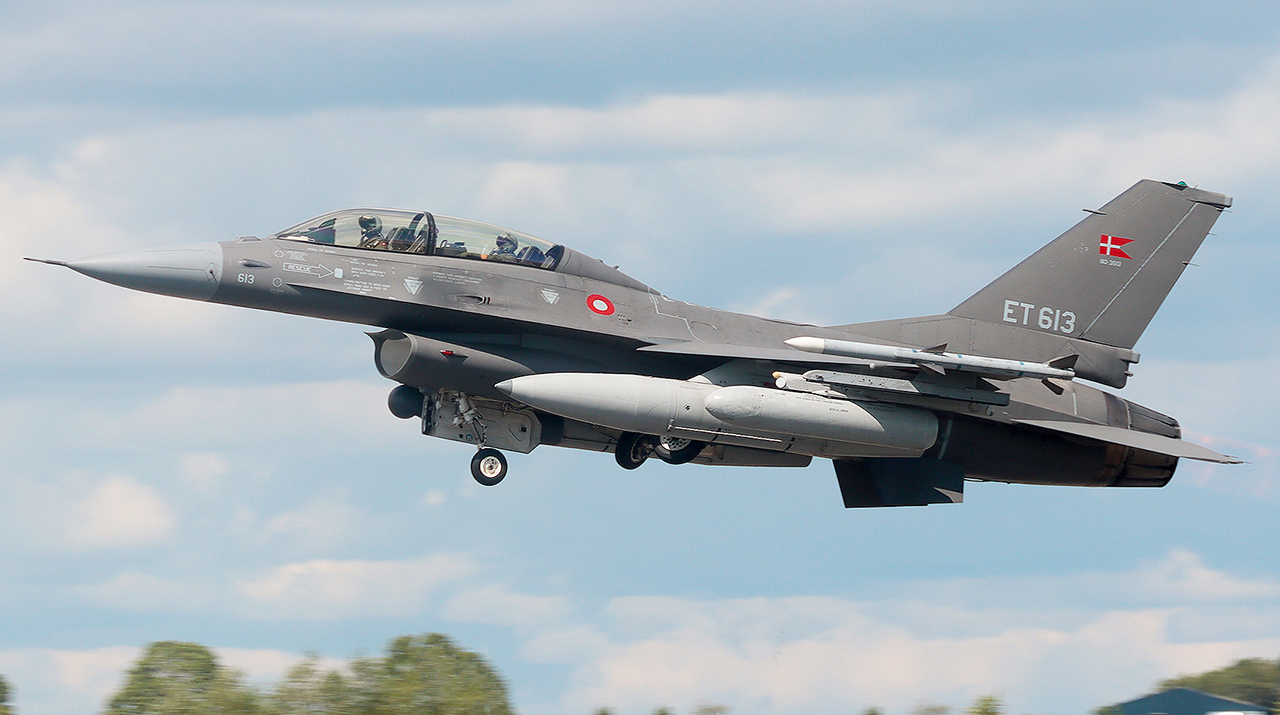
A Danish Air Force F-16BM combat trainer aircraft during a training flight. Photo via mil.in.ua
Explore further

NATO shot down drone over Latvia. Russia’s electronic warfare sent it there

From the test range to the first units

Dignitas and Aura are testing the systems at training grounds and have already sent several samples to military units. Shypovych expects the solution to be ready in roughly two months.

The effort comes as Ukraine rapidly expands its use of unmanned ground systems. Kyiv has set a target to contract at least 50,000 UGVs, with robots already taking on logistics and evacuation tasks in high-risk zones. Ukrainian forces have already received 1,028 UGVs through the DOT-Chain Defense marketplace, with the systems handling logistics, evacuation, mine-laying, and combat. Ukrainian Vampire bombers have also been upgraded to shrug off Russian jamming and even hunt the jammers themselves.

  •  

Seoul says no again to Ukraine’s weapons request as Pyongyang gets ready to send Russia more troops

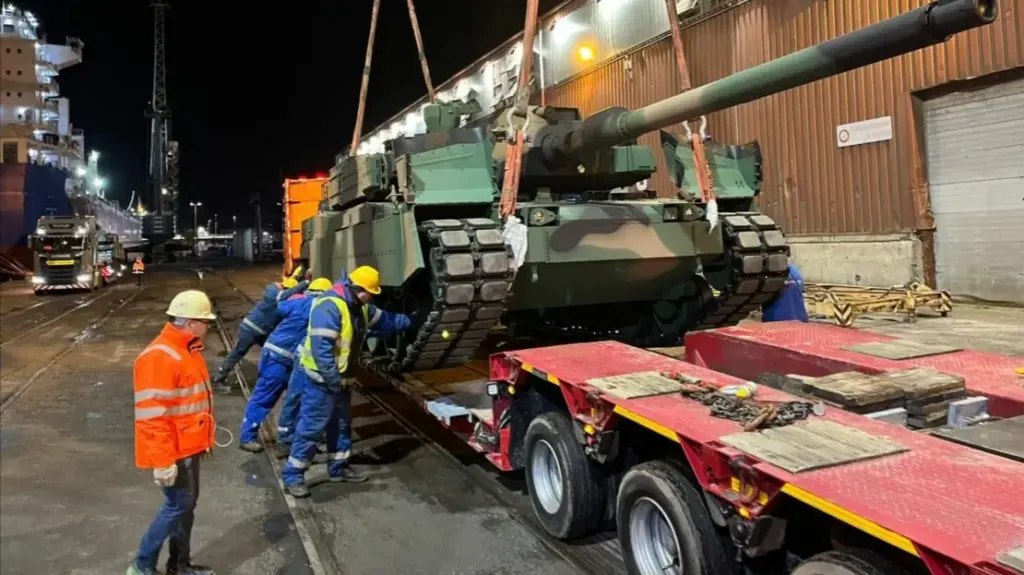
Workers unload a South Korean-made K2 Black Panther tank for the Polish army from a trailer at a Polish port at night.

South Korea is keeping lethal aid to Ukraine off the table while continuing humanitarian and reconstruction support, Yonhap reported on 10 August. The outlet cited a senior South Korean Foreign Ministry official.

South Korea’s response maintains its established policy of providing humanitarian and nonlethal support to Ukraine, but not direct weapons. Seoul previously helped move artillery shells to Ukraine through the United States. While South Korea arms NATO members with K2 tanks and K9 howitzers to free up older kit for the Ukrainian front, it still draws the line at any direct transfer to Kyiv. Seoul rejects Ukraine’s purchase requests as North Korea sends Russia ammunition and troops in exchange for money and military technology.

South Korean law bars direct exports of lethal weapons to countries in active conflict, a rule rooted in constitutional principles and Seoul's wariness of antagonizing Moscow and Beijing while managing the threat from the North.

Ukraine is seeking South Korean interceptor missiles for its air defenses. The official neither addressed the request specifically nor formally rejected it:

South Korea’s supply of defense materials to any country has always been carried out in accordance with domestic law,” the official said. Seoul will continue to support Ukraine’s recovery through assistance in energy, infrastructure, healthcare, and education. 

The official also declined to confirm whether Seoul and Kyiv were discussing military support. However, he said Moscow-Pyongyang military cooperation “is directly related to our security and violates the United Nations resolutions” and should stop immediately.

Seoul’s indirect aid stopped short of direct arms transfers

In 2023, Seoul transferred hundreds of thousands of 155 mm shells to the United States under a confidential arrangement. Washington then arranged for them to reach Ukraine, The Wall Street Journal reported.

South Korean exports have also helped NATO members replace weapons sent to Kyiv. Poland bought South Korean K2 tanks and K9 howitzers while transferring older tanks and Polish-built Krab artillery systems to Ukraine.

Yet Seoul rejected Ukraine’s request to buy air-defense systems, radars, and artillery propellant in November 2024. In February 2026, it still limited support to humanitarian and nonlethal aid while considering NATO’s request to help purchase US weapons for Ukraine.

North Korean deployments bring the war closer to Seoul

Ukrainian President Volodymyr Zelenskyy said a decision had been made to deploy 30,000–50,000 more North Koreans to Russia. He warned that they would gain modern combat experience and Russian technology that could later threaten Asian countries. Kyiv wants South Korean air defenses and has offered cooperation on drones.

The South Korean official cited by Yonhap declined to confirm either the reported deployment or Zelenskyy’s statement that Ukrainian and South Korean diplomats were discussing possible cooperation.

North Korea is already believed to have sent approximately 20,000 combat troops and military engineers to Russia’s Kursk region, according to Yonhap. Pyongyang has earned as much as $22 billion from arming Russia, helping it finance conventional and nuclear forces.

The Japanese outlet Kyodo News reported in November 2025 that North Korea had transferred about 6.5 million rocket and artillery munitions in exchange for Russian air-defense, space, and nuclear technologies.  Moscow and Pyongyang’s 2024 mutual defense pact formalized the expanding military relationship.

Workers unload a South Korean-made K2 Black Panther tank for the Polish army from a trailer at a Polish port at night.

Seoul says no again to Ukraine’s weapons request as Pyongyang gets ready to send Russia more troops

  •  

US forecasters see Ukraine’s corn exports falling 39% as Russia bombs ports

The US Department of Agriculture's Foreign Agricultural Service (FAS) forecasts that Ukraine's grain exports will fall steeply in the 2026-27 season, with corn shipments dropping 39% to 14 million tonnes and wheat 26% to 10.8 million, World Grain reported. The agency tied the decline to Russia's summer campaign against the Odesa ports, which handle roughly 90% of the country's grain.

The forecast puts Washington's own numbers behind what Kyiv has warned for weeks. Ukraine's agriculture ministry projects farm exports could fall by almost half this season, and the FAS estimate — from a body with no stake in Ukraine's budget — points the same way. The difference is where the FAS looks: not at the ships that cannot sail, but at the grain that cannot follow them out.

Grain with nowhere to go

The clearest sign of the blockage is in ending stocks — grain left sitting in the country when the season closes. The FAS expects Ukraine's corn stocks to jump more than tenfold, to 13.5 million tonnes from 1.3 million, and wheat stocks to more than double to 8.2 million. That is grain the harvest produced and the ports could not move.

Ukraine has more than 74 million tonnes of storage for grain and oilseeds, the FAS noted, including about 23 million tonnes of certified warehouse space. Even so, the agriculture ministry has said the country may need another 10 to 12 million tonnes of temporary storage to get through the corn harvest if the Black Sea disruptions continue — most acutely in regions near the front line.

Why Odesa decides the harvest

Almost everything moves through Odesa. Three deepwater ports in Odesa Oblast carry more than 90% of Ukraine's farm exports, and Russia spent the summer hitting them and the ships that call there. Missiles struck the Turkish-owned bulk carrier Golden Leo as it left Odesa loaded with grain on 19 July, killing 10. Days earlier, a Russian drone hit a Palau-flagged corn ship twice as it sailed for Greece.

The land routes that remain — rail, road, and the Danube — cannot take up the slack, and traders have pulled back from buying grain they have no way to ship.

Farming is Ukraine's biggest export earner, bringing in more than half of what the country made selling goods abroad last year. Ukraine is also among the world's largest corn suppliers, which is why a cut of this size registers well beyond its own budget. For the farmers holding this year's crop, the FAS forecast describes a harvest they may not be able to sell.

  •  

Ukraine and Moldova discuss rail corridor for grain amid Russian Black Sea attacks

Ukrainian grain

Ukraine and Moldova are discussing transporting Ukrainian grain by rail through Moldovan territory to the Romanian port of Constanta, an option driven by intensified Russian attacks on shipping in the Black Sea, according to unnamed sources in both countries cited by Reuters.

The talks come as Russian strikes on vessels using the Black Sea corridor have disrupted traffic during the harvest season and forced Ukraine to cut its export forecast. On 22 July, no ship passed through the corridor at all, and the country's agriculture ministry has already lowered its projection for the 2026–2027 season by up to five million tons.

Discount sought, volume guarantees demanded

Kyiv is asking for a discount of 50 percent off the nominal rate to transport its grain, according to the agency's sources. A source at Moldovan Railway said Moldova responded with a counterproposal: guarantees from Ukraine on the volumes of grain it would transport through the route.

"We are currently collecting information on potential volumes from interested shippers. The information-gathering process has not yet been completed," a senior Ukrainian industry official told Reuters.

Ukraine expects corridor to cover 10 percent of exports

Ukraine estimates the Moldovan corridor could handle 10 percent of its grain exports. Agriculture Minister Taras Vysotskyi said earlier that his ministry had lowered its grain export forecast for the 2026–2027 season from 43 million tons to 38–40 million tons because of Russian attacks on ports.

Ministers discuss rail links

A day before the Reuters report, Moldova's Minister of Infrastructure and Regional Development, Vladimir Bolea, visited Ukraine's Odesa region and met with his Ukrainian counterpart, Mykola Kalashnyk, to discuss improving rail connections and expanding the transit network between the two countries.

Moldova's premier defends transit revenue

Moldovan Prime Minister Vasile Tofan said his country should not pass up the opportunity to earn millions of euros from transiting Ukrainian grain cargo. He dismissed suggestions by Moldovan farming groups that Ukrainian grain prices would depress the value of their own produce.

"Let's not look for enemies where there are none," he said on Moldovan television.

Russian attacks on shipping

Russia intensified strikes on vessels using the Ukrainian Black Sea corridor in July. On 13 July, Russian forces struck a civilian ship flying the flag of Togo while it was unloading mineral fertilizer off the coast of Odesa region, killing five crew members and injuring five others.

The following day, 14 July, Russia attacked two civilian vessels in the Black Sea — cargo ships flying the flags of Tanzania and Liberia. The captain of one of the ships was killed. On the evening of 17 July, a vessel flying the flag of the Marshall Islands was struck. Attacks continued afterward.

On 22 July, no vessel passed through the sea corridor. The Ukrainian government called the disruption "deliberate economic and humanitarian terror," coming at the height of the harvest season.

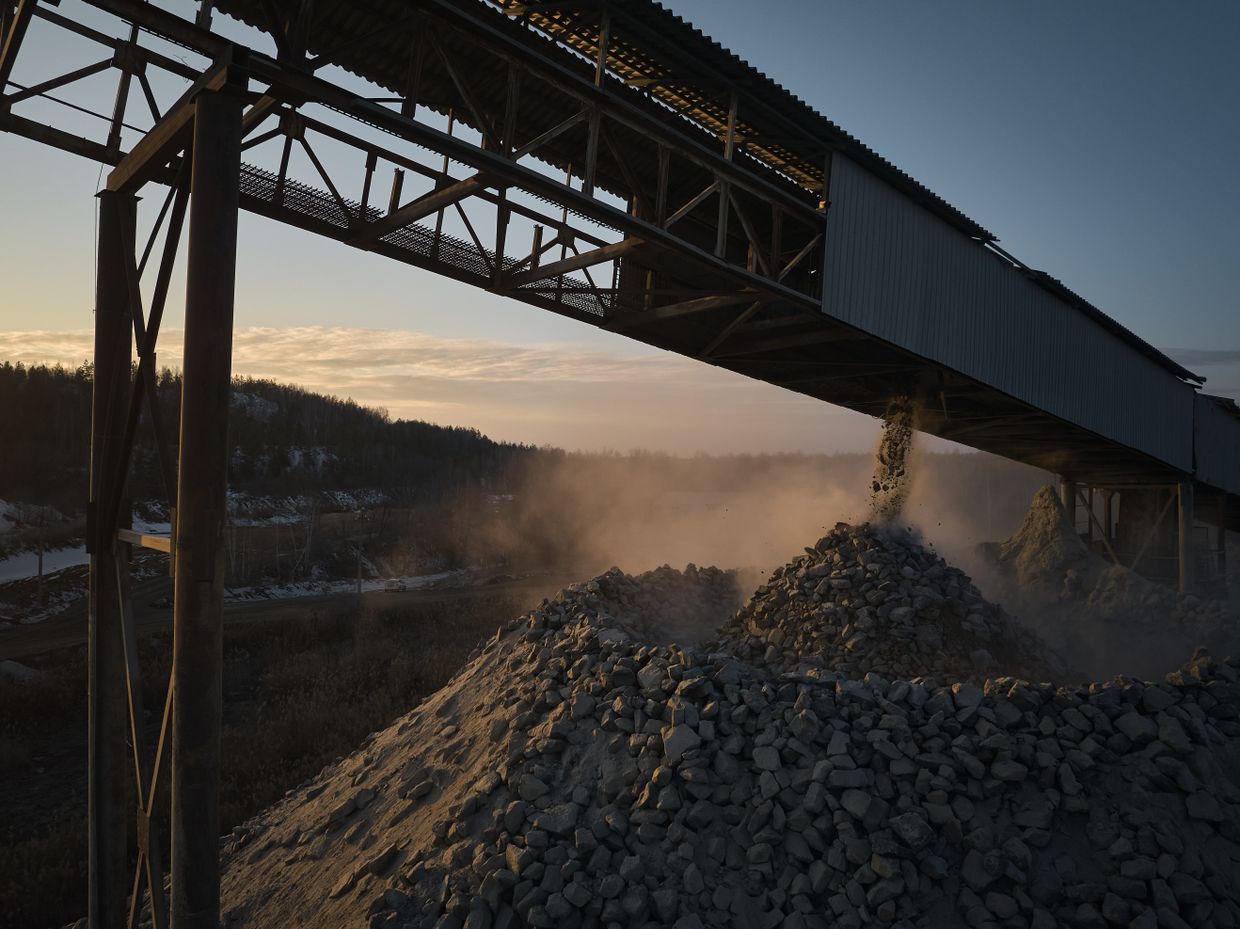
Ukraine convened an urgent session of the UN Security Council over the attacks, calling on all states — particularly those "which this directly concerns" — to demand that Russia stop striking shipping. Separately, the Southern Mining and Processing Plant (Pivdennyi HZK) announced it was suspending extraction and temporarily scaling back operations.

  •  

US House takes up Graham sanctions bill targeting Russia’s oil money and shadow fleet

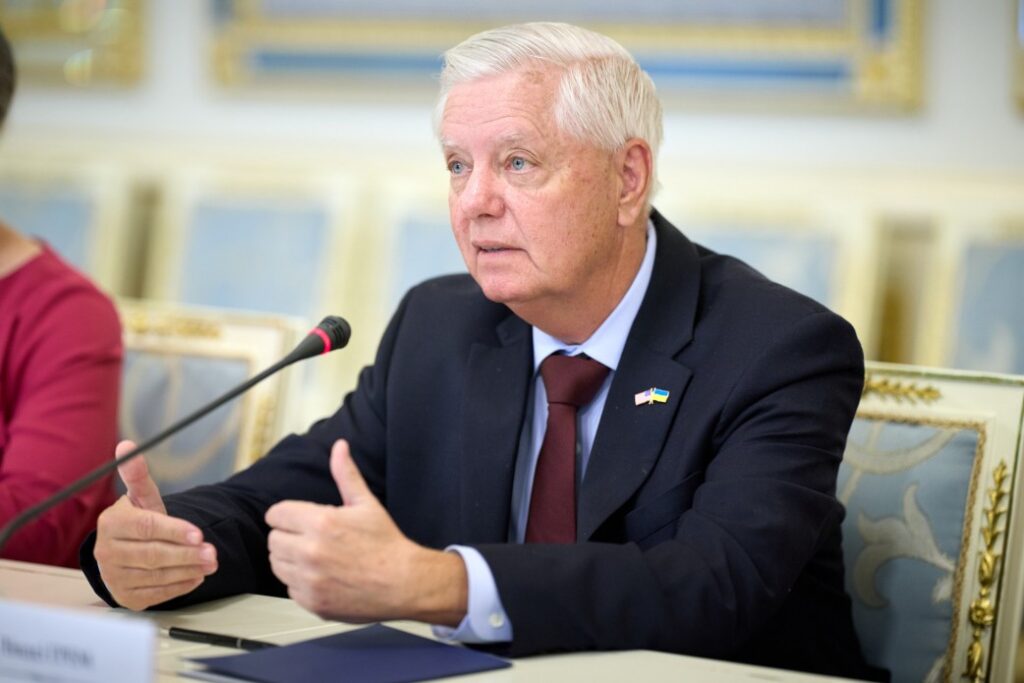
US Senator Lindsey Graham russia sanctions bill senate kyiv 10 2026 presidentgovua

A bipartisan group of US House members introduced the House version of the Lindsey O. Graham Sanctioning Russia and Iran Act of 2026 on 10 August, advancing the sweeping sanctions package during the chamber's summer recess just days after the Senate passed it.

The move puts the bill one chamber from becoming law. If the House passes it, it would hand the president authority to impose tariffs of up to 100% on the biggest buyers of Russian crude and gas—China and India chief among them—and to blacklist the aging tankers of Russia's shadow fleet, the vessels that move sanctioned oil around Western restrictions. The target is the oil revenue that pays for Russia's war on Ukraine, at a moment when Ukrainian deep strikes have already knocked a large share of Russian refining capacity offline.

What the bill would do

The package imposes primary and secondary sanctions on Russian officials, oligarchs, entities propping up Russia's defense-industrial base, and foreign actors that materially aid Moscow's military operations. It targets major Russian banks and the foreign financial institutions that do significant business with them, and it goes after the shadow fleet and sanctions-evasion networks—ships, owners, operators, insurers, and ports that knowingly move Russian oil. The tariff framework, up to 100% on the top five buyers of Russian oil and the top five buyers of its gas, replaces an earlier plan for a blanket 500% tariff, with the US trade representative setting the specific rate for each country. The bill also folds in Iran, extending the Iran Sanctions Act of 1996.

Sanctions could be lifted only if the president certifies to Congress that Russia has signed a peace deal accepted by a free and independent Ukrainian government and has halted hostilities and efforts to subvert Kyiv.

A bill born from a stall—and a death

Graham and Democratic Senator Richard Blumenthal introduced the measure in 2025 with 500% tariffs. It drew more than 80 Senate cosponsors and went nowhere for over a year, as the White House kept it off the floor while betting on negotiations that never delivered. Graham secured President Trump's sign-off, then died on 11 July of an aortic dissection, a day after his last visit to Kyiv. The Senate renamed the bill in his honor and passed it 86-11 on 7 August.

The House is not a rubber stamp

The House text is identical to the Senate-passed version, so the companion functions largely as a whip count—a way for members to signal support before a floor vote expected this fall, once the chamber returns from recess on 31 August. Passage is not guaranteed: some House members have voiced fundamental concerns about handing the president broad tariff powers that could raise costs for US importers and consumers.

  •  

Russian Civilian Deaths Are Growing Rapidly as Ukraine Expands Its Air War

The higher tempo of Ukrainian strikes has fueled discontent among Russians, but it is far from clear that it will change the Kremlin’s calculus about the war.

© Nanna Heitmann for The New York Times

A residential building in Zelenograd, in the Moscow region, was damaged in a Ukrainian drone strike in May. Four people were killed in the attack.
  •  

With Ukraine short of Patriot interceptors, Russia sees no reason to enter real negotiations, ISW says

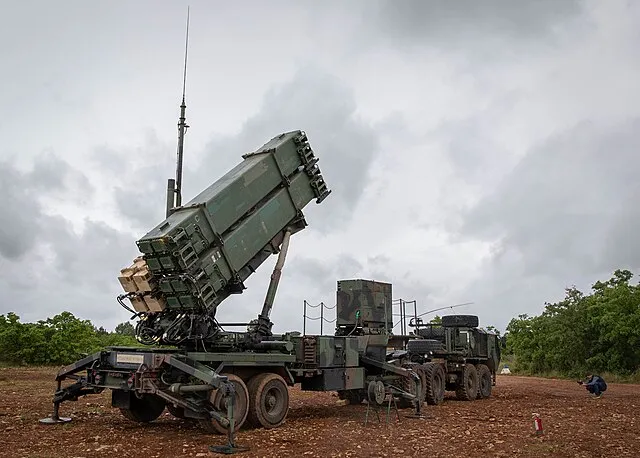
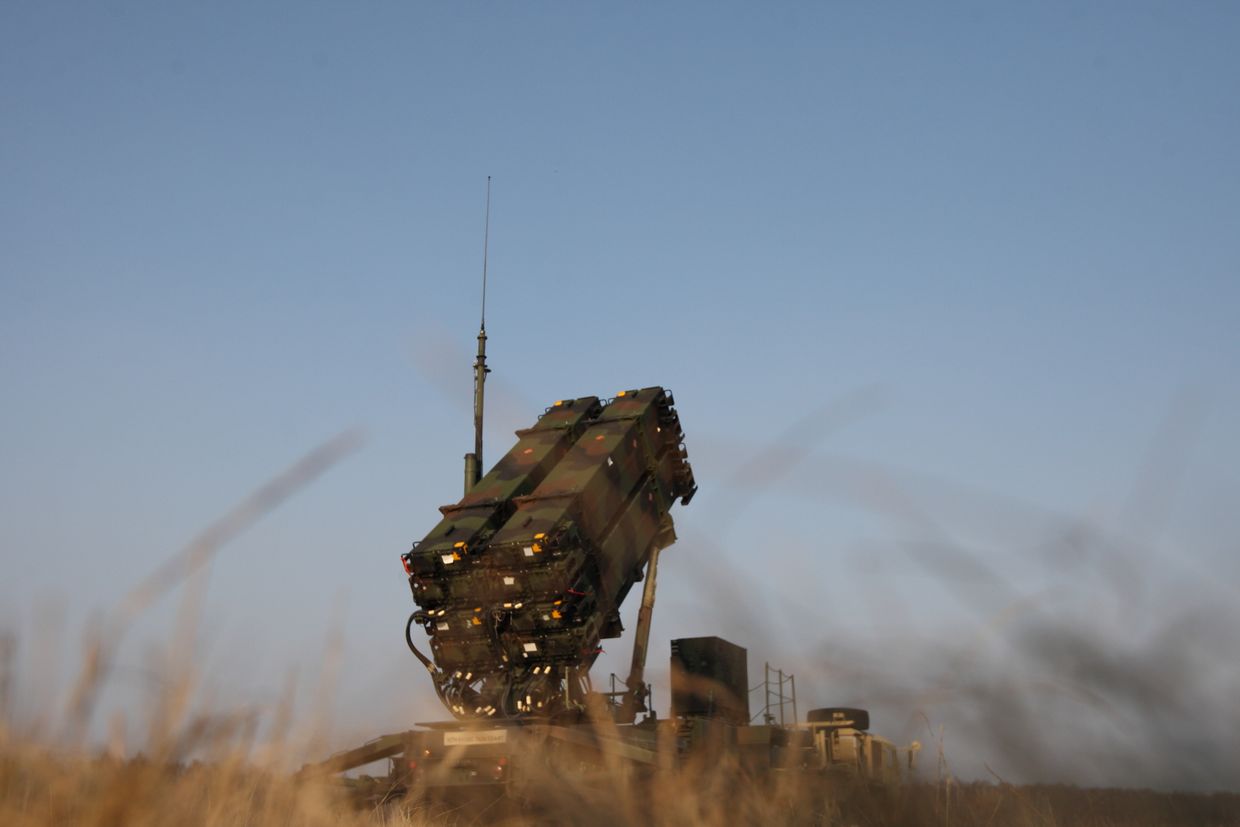
A Patriot air defense launcher raised into firing position on a military trailer.

Russia has rebuilt its missile industry around the weapons most likely to pierce Ukraine's thinning air defenses. The Institute for the Study of War (ISW) made that case on 10 August. Kyiv's Patriot interceptor shortage, it assessed, now hands Moscow no reason to negotiate. Because Kyiv can no longer reliably stop ballistic missiles, the Kremlin sees a clear military path to its maximalist aims.

Factories retooled around the missiles that get through

Since April 2026, Russian plants have prioritized ballistic and cruise missiles built to evade interception. HUR Deputy Head Major General Vadym Skibitskyi reported the shift. Monthly ballistic launches have more than tripled between April and July, he said. Meanwhile, output of key missile types runs 10 to 20% above plan. Moscow also met its full-year Zircon and Onyx targets by 3 August. To free capacity, it suspended the less accurate Kinzhal and Kh-32 lines. Skibitskyi flagged a newer twist, too: S-400 launchers now fire specially developed RM-48U rounds along a ballistic path. Russia is also striking Ukraine's defense plants, he warned, to choke off Kyiv's own ballistic-missile program.

Fired fresh, not from the stockpile

Crucially, these strikes draw on newly built missiles rather than war reserves. That approach lets Moscow sustain larger, more frequent salvos. Its stockpile stays intact for the occasional very large barrage. Unmanned Systems Forces commander Major Robert "Magyar" Brovdi put numbers on the trend. Russia can already loose a simultaneous salvo of 77 missiles, and it is pushing toward 200. He stressed that he meant weapons of all types, not ballistics alone. Kalibr cruise missiles, by contrast, are piling up unused. Moscow is shipping them to fleets beyond the Black Sea as Ukrainian crews down nearly all of them. Repeated strikes have meanwhile driven the Black Sea Fleet back to the port of Novorossiysk.

"The Patriot shortage hands Russia an opening to do serious damage over the winter — and a reason to keep meaningful talks at bay," - Institute for the Study of War assessed

Why the Patriot interceptor shortage stalls negotiations

This reprioritization feeds a winter strategy meant to break Ukraine's will to fight, ISW assessed. The Patriot is still the only system Kyiv fields that can down Russian ballistic missiles. And Kyiv has warned partners it cannot close the interceptor gap before the cold months. As a result, the Kremlin thinks it can hammer cities without paying a battlefield price. That calculation could drag the war into 2027, ISW noted. Putin's theory of victory still rests on outlasting Ukraine's defenses and Western resolve. On 9 August, Deputy Foreign Minister Mikhail Galuzin restated Moscow's line. Any "freeze" that ignores the war's "root causes" is unacceptable, he said — shorthand for the Kremlin's original demands.

  •  

Russian ballistic missiles struck the grounds of a Kyiv children’s hospital and set a warehouse ablaze — overnight strikes across Ukraine killed at least 9

kyiv oblast

Russia struck the capital with ballistic missiles early on 11 August. One of them came down on the grounds of a Kyiv children's hospital in the Shevchenkivskyi district. Rescuers also fought a warehouse fire nearby that left one man injured.

The Kyiv children's hospital strike

Two craters opened on the hospital grounds, while the impact shattered windows and ruptured a gas line, rescuers reported. Utility crews sealed the leak within the hour. Staff at the Kyiv children's hospital had moved patients into the shelter before the strike, so it hurt no one there.

"Luckily, the children and medics were in the shelter — there were no casualties," - State Emergency Service reported

A warehouse ablaze and one man hurt

At a second address in the same district, a strike ignited a fire across 1,200 square meters of warehouse space. Crews first contained the flames, then put them out. Medics soon treated the lone casualty, a 28-year-old man. Earlier, the Air Force had warned of the ballistic threat before the missiles arrived.

Kyiv Oblast also under fire

The wider Kyiv Oblast took damage as well. In the Bucha district, the strike wrecked warehouse buildings and three trucks, although it caused no casualties. Officials said the enemy had again hit the region with ballistic missiles and attack drones.

A far deadlier night beyond Kyiv

Elsewhere, the toll climbed sharply. In Zaporizhzhia, a combined missile and guided-bomb strike killed six people and injured 19, regional authorities reported. Across the oblast, meanwhile, Russian forces launched 938 strikes on 58 settlements in a single day, injuring 52 residents in total. Officials also logged 341 reports of damage to homes, vehicles, and infrastructure.

In central Dnipropetrovsk Oblast, drones and artillery hit five districts more than 20 times. The strikes killed three people, among them a 15-year-old boy, and hurt five others, including a 7-year-old girl. To the northeast, an attack on Zlatopil in Kharkiv Oblast damaged civilian infrastructure and injured a resident.

Meanwhile, in Mykolaiv, drones hurt a 75-year-old woman and damaged homes and an industrial site, and officials described her condition as satisfactory. In nearby Snihurivka, six more drone strikes damaged houses, a shop, and a car, though they caused no injuries.

The strikes add to a wave of Russian attacks on Ukrainian cities this summer. The capital had already endured ballistic missiles days earlier, on the night of 8 August. That evening, explosions also echoed through Kyiv and Dnipro during a mass drone assault.

  •  

Ukraine gave up 1,900 nuclear warheads in 1994 on Western promises that didn’t work. New plan would replace them with Britain’s shield instead

UK Prime Minister Andy Burnham speaks at a lectern before an audience.

A plan presented to the UK's new Prime Minister, Andy Burnham, would extend Britain's nuclear umbrella to Ukraine and other non-NATO European states. In exchange, Britain would regain access to the EU single market for goods, The Telegraph reported on 9 August.

The proposal comes as European governments question whether they can rely on US protection and struggle to turn moral support for Ukraine into troops and weapons. Russia's invasions, despite the assurances Kyiv received from the US and the UK when it surrendered its nuclear arsenal under the Budapest memorandum, have also revived calls for nuclear-backed guarantees.

Former Conservative MP Nick Boles drafted the plan. He proposes a "European Confederation" that combines single-market access with NATO-style mutual defense commitments. 

For Ukraine, it would provide protection modeled on NATO Articles 4 and 5 while Kyiv pursued full EU membership.

Ukraine would maintain a large army as Europe's bulwark against Russia and share defense technology with other members of the Confederation. Britain would raise defense spending to 3.5% of GDP, while both countries would gain full access to the EU's single market for goods.

Boles said Europe needed a new security model because neither US President Donald Trump nor a future US president could be guaranteed to "defend Europe as if it were Kansas." 

Boles's plan is not Burnham government policy. Nevertheless, it has circulated among officials, including National Security Adviser Jonathan Powell, as London considers deeper cooperation with the EU.

Britain's support bumps against Europe's political limits

Prime Minister Burnham entered Downing Street as a firm supporter of Ukraine. He assured Ukrainian President Volodymyr Zelenskyy that British support remained unchanged and pledged to preserve aid levels.

Britain also co-leads with France the Coalition of the Willing, which plans to deploy forces in Ukraine after a ceasefire to deter another Russian attack.

The Coalition has brought together representatives of 40 countries. Still, members remain divided over how far to support Ukraine.

Britain and France have formally declared their intention to deploy forces after a potential ceasefire in Ukraine. Yet Poland offered logistical support but ruled out troop deployment, while Bulgaria has withdrawn from the Coalition. Europe has promised deterrence, but key deep-strike missiles may not arrive until 2029.

Boles's plan would pair Britain's nuclear deterrent with Ukraine's conventional military strength. Unlike the Coalition’s voluntary plans, Boles's proposed European Confederation would place its defense guarantees in a treaty. NATO would initially be responsible for carrying them out.

From surrendered weapons to a nuclear shield

Ukraine inherited the world's third-largest nuclear arsenal after the Soviet collapse, including about 1,900 strategic warheads. 

Kyiv relinquished them under the 1994 Budapest Memorandum after receiving security assurances from Russia, Britain, and the US. Despite these promises, Russia invaded Ukraine in 2014 and launched its full-scale war in 2022.

Russia's invasions have revived calls among Ukrainian lawmakers for nuclear-backed security guarantees. Politician Roman Kostenko has called for guarantees that could include British and French nuclear retaliation in the event of another Russian attack. 

Under Boles's proposal, Ukraine would not regain its own warheads. It would instead come under Britain's nuclear shield.

  •  

A $20,000 “welcome bonus” that was never paid: how a Colombia-registered recruiter sent Peruvians into Russia’s war

Illustrative photo. The flag of Peru. Photo: Getty Images

On 9 August, Peru's foreign ministry officially reported that 459 Peruvians had been recruited into the Russian army. Of these soldiers, 11 have been killed, 114 are missing, and three have been captured by the Ukrainian army. Another 31 Peruvians were evacuated: three of them chose to stay in Europe, and the rest returned home.

As of 29 April 2026, Russia had drawn in at least 27,000 foreign nationals from more than 130 countries to take part in its war against Ukraine, the International Federation of Human Rights reports. The Peru case is part of Russia's systematic recruitment of foreigners into its military, often through deception. Some men were offered civilian jobs or roles far from the front, only to end up in the thick of the fighting.

Relatives of the recruited men held demonstrations in Peru

On 29 April 2026, relatives of men recruited into the Russian army demonstrated outside Peru's foreign ministry in Lima, urging the authorities to help bring their family members home, according to SwissInfo.

Relatives of Peruvians affected by Russia's war against Ukraine demand urgent repatriation. 2026. Photo: Carlos Félix/LR

On 30 April, the Russian embassy in Peru responded that it agreed some Peruvian men were taking part in the war on Russia's side, but said this was their own voluntary choice. La República, however, reports that before leaving for Russia, the men were made to sign papers in Russian.

On arrival, their documents were taken, after which they underwent brief military training and were ultimately sent to the front. According to media reports, most were former military and police personnel lured by promises of jobs as security guards or civilian specialists, with salaries of $2,600–4,000 a month and bonuses of up to $20,000.

A “rear position” — until it isn’t

First, recruiters promise foreigners high salaries, signing bonuses, and “rear” or civilian positions. Debt traps and threats of deportation are also used. They lure people even through video games and chats. Once in Russia, recruits are forced to sign contracts, after which their documents are confiscated to keep them at the front. The contracts are often written in Russian, a language the foreign recruit does not understand.

Instead of the promised “rear positions,” recruits are thrown into infantry “meat assaults” after just a few days or a week of training. Mercenaries are killed while carrying out missions, while the wounded are often left on the battlefield without evacuation. Some men go missing or flee. Russia treats foreign mercenaries as “expendable labor,” according to leaked recordings cited by Radio Free Europe/Radio Liberty.

This is not an isolated case

Facing losses that now outpace its own mobilization, Russia has turned to citizens of other countries to keep its ranks filled in its war against Ukraine.

Kenya has become one of the largest sources of people recruited through deception. At first, Nairobi believed the number was only a few hundred, but the scale proved much larger. Nairobi thought Russia had recruited around 200 Kenyan citizens, but a new report says the figure is over 1,000. The scheme relied on fake job and education offers, after which recruits had their documents confiscated to keep them on the front line. The European Parliament found that Russia confiscates African recruits' documents and sends them to the front line in Ukraine.

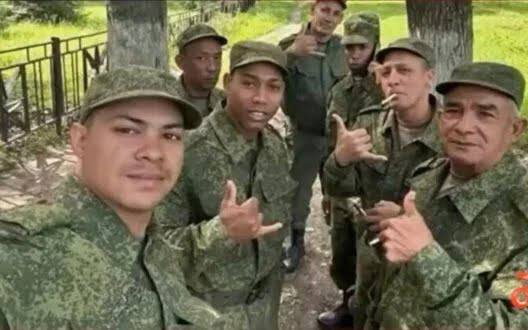
In Cuba, recruiters promised people lucrative jobs, only to lure them into a trap. A Cuban captured near Kupiansk said he joined Russia's war effort under threat of deportation. The scale of the recruitment has been enormous. Ukrainian intelligence estimates that around 20,000 Cuban mercenaries have fought on Russia's side against Ukraine.

ukrainian intel nearly 20000 cuban mercenaries fighting russia’s side against ukraine nationals wearing russian military uniform 2023 video x/pstyle0ne1 florida lawmakers officials highlighted threat regional security news reports
Cuban nationals wearing Russian military uniforms. 2023. Screenshot from a video, via X/PStyle0ne1

The Philippines case shows what awaits the recruited at the end of this pipeline. Ukrainian military intelligence identified a Filipino named John Patrick among Russian soldiers killed in Donetsk Oblast. He was sent into a "meat assault" after just one week of training. He did not speak Russian and carried only a piece of paper with his unit number and his commander's name. After he was wounded, he was left to die in a tree line without evacuation, and Ukrainian intelligence warned that any work in Russia now carries a real risk of forced deployment into an assault unit. The deception relied on promises of high salaries, non-combat positions in the rear, and fast-tracked Russian citizenship, after which recruits were sent into infantry assaults.

  •  

70 ballistic missiles and 12 launchers: Ukraine lines up deep-strike refill from an unlikely supplier

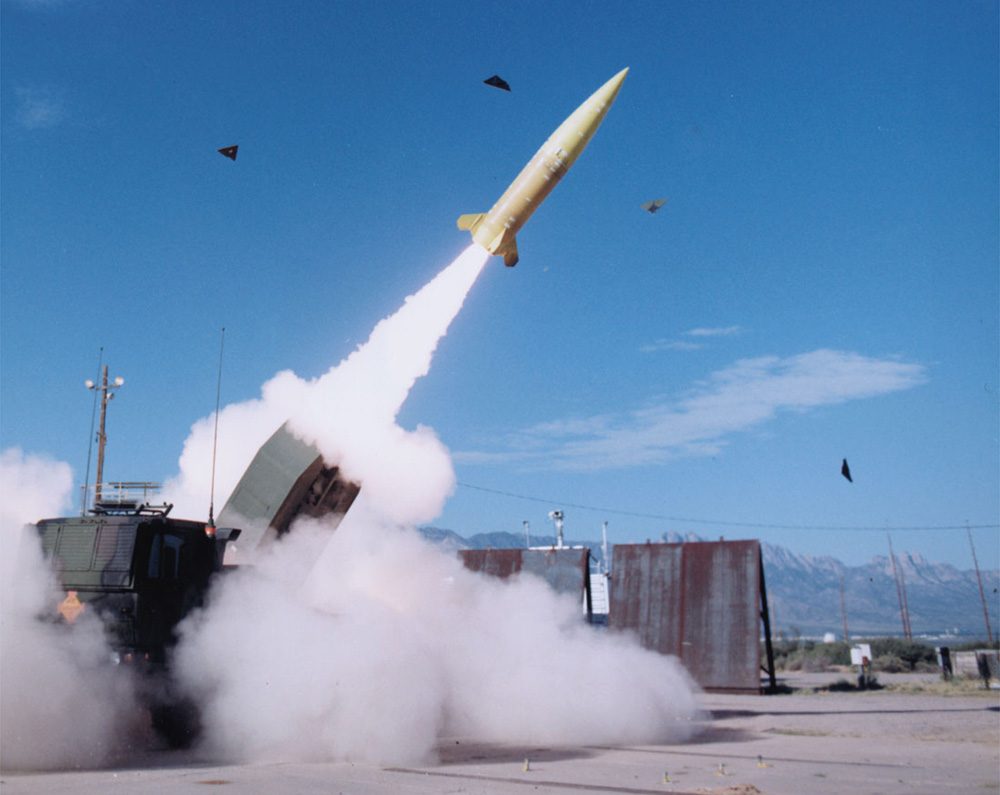
ukraine seeks us approval atacms use kursk offensive missile launch lockheed martin mfc-atacms-block-1a-unitary-02-hjpgpc-adaptive1280medium

Ukraine has agreed to buy a batch of American-made ballistic missiles and rocket launchers from Türkiye, according to Militarnyi. The weapons sit in Turkish stockpiles and still need to clear a routine US review before they ship.

Ukraine's deep strikes run on a scarce, politically gated supply of Western missiles, which it burns through faster than allies' resupply.

What Ukraine is buying

US government paperwork lists 70 M39 ATACMS (Army Tactical Missile System) missiles and 12 M270 rocket launchers, plus tens of thousands of cluster munitions. The M270 is a tracked launcher that fires guided rockets and ATACMS, the heavier sibling of the wheeled HIMARS.

The cluster load adds 2,524 M26 rockets for the M270 launchers and 47,000 M509A1 shells for Ukraine's 2S7 Pion and M110 guns. Both scatter bomblets over a wide area. The deal surfaced in US State Department notifications in the US Congressional Record for 6 August 2026. Türkiye wants to shed older weapons and fund newer systems, the filings say. The shipment moves through Turkish, Bulgarian, and American exporters.

How the sale clears Washington

Explore further

Frontline report: ATACMS returns to battlefield as Ukraine destroys Russian training facility in Voronezh

Because these are US-origin weapons, Washington must sign off first. The filings note that US law forces the State Department to notify Congress once major equipment tops $14 million, or other articles and services top $50 million. There is no approval vote: if neither chamber blocks the sale within 15 days, US consent takes effect automatically. Both chambers sit in recess past that deadline — the House until 31 August 2026, the Senate until 14 September 2026.

What the M39 ATACMS is

The M39 is the original production model of ATACMS, flying about 165 kilometers, or roughly 103 miles—shorter than later versions Ukraine has fired. It steers by laser gyroscopes with no GPS correction, which makes it less precise. Instead, it carries a 560-kilogram cluster warhead of 950 M74 submunitions built to hit troops, unarmored vehicles, and air defenses.

ATACMS, illustrative image. Credit: Wikimedia Commons
Explore further

Ukraine marks invasion anniversary with ATACMS strikes on Russian command and supply lines (MAP)

How Ukraine uses ATACMS

Ukraine has fired ATACMS at Russian command posts, ammunition depots, and air defenses across occupied land and inside Russia. Even occasional launches force Russia to shift air defenses back from the front, easing pressure on Ukrainian troops. That firepower had gone quiet. Ukraine ran through its US-supplied ATACMS months ago, and US approvals came slowly. Buying 70 more through Türkiye lets Ukraine rebuild without waiting on fresh US aid.

  •  

Ukraine’s Crimea campaign could strike seven times more targets with faster funding, Brovdi says

A photo shared by Robert “Madyar” Brovdi shows the Russian ferry “Maria” before it was struck in Ukrainian drone operations, with the damaged “Panagia” ferry visible to the right. Photo: Robert "Madyar" Brovdi

Ukraine's Crimea campaign aims to make the occupied peninsula unusable to Russian forces, its drone-forces commander told The Associated Press. Russia annexed Crimea in 2014. The campaign is only the first phase, said Maj. Robert "Madyar" Brovdi. His units could strike seven times more military targets with faster Western funding, he said.

The constraint is financing, not factory output. Brovdi put his forces at 14 percent of the strength a full-capacity operation would require. He traced the gap to the timing of allied money, not to Ukraine's drone production. "It's not that the production capacity of Ukrainian manufacturers doesn't allow us to make the necessary quantities" of drones, he said. He added: "It's the banal problem of untimely financing, which our partners do allocate, but which moves significantly slower than our plans."

Even so, Brovdi framed the peninsula as decisive. "Crimea falls within the key conceptual pillars on the path to ending the war," he said.

What the Crimea campaign has hit

The summer strikes have hit rail bridges, oil depots, and power infrastructure. These aim to cut supply lines and blind Russian air defenses as drones approach. To pry open a "window" for those drones, the force destroyed more than 300 air defense assets in recent months. Those included surface-to-air systems, radar stations, and electronic-warfare equipment.

Where Starlink connectivity reaches, an average of three drones can now destroy even a heavily defended target, Brovdi said. In turn, his crews match the munitions to each aim. One mix suits a bridge pier; another fits a fuel truck or a moving train. Even so, his forces avoid civilian infrastructure, he added. Still, strikes on the power grid have cut electricity for residents. Brovdi said he has twice publicly apologized to Ukrainians living in Crimea.

He also pointed to one measure of progress. Across four recent large-scale Russian barrages from the peninsula, launch sites fired only five missiles in total. He credited that drop, however, to the destruction of Russian air defenses. The AP could not independently verify the claim.

Forcing Russia off the peninsula

Much of Russia's Soviet-era air defense runs on the power grid. That is one reason Crimea's electricity network keeps drawing fire. As a result, losing power leaves Russian soldiers "blind," Brovdi said, with only machine guns and rifles.

Meanwhile, Ukraine is working to dismantle Crimea's role as a naval base. "Creating conditions that make it impossible for any kind of military capability … to remain there will make Crimea uninteresting … as a military staging ground," he said.

The offensive began in late June. Two weeks in, Ukrainian intelligence indicated Russia had ordered its military commands and security services off the peninsula, Brovdi said. In addition, a covert order called for removing secret archives and artworks. The AP could not independently verify the account.

Russian countermeasures and the missile threat

Russia is pushing back against the Crimea campaign. It is installing jamming systems that will degrade Starlink to some degree, Brovdi said. Russia is also building its own satellite network to rival the service. "This is a risk for the entire planet," he said, "because a dictatorship will gain access to information across the whole globe."

Other threats are mounting as well. Jet-powered Shahed drones are harder for Ukraine to shoot down. Their concentration has risen two and a half times in recent weeks, he said. Moreover, Russia can now fire a simultaneous salvo of 77 ballistic missiles and plans to raise that to 200. As a result, the danger is pressing. Ukraine is short of interceptors for the US-made Patriot, its only defense against ballistic missiles.

"Even if they only manage half of that, it will all be flying at us," Brovdi said. The only way to bring the number down is to hit every facility that builds the missiles, he added. That, he said, is why Ukraine's long-range strikes inside Russia matter.

Wildberries in the crosshairs

One civilian-facing target Brovdi named was Wildberries, Russia's largest online marketplace. Many call it the country's answer to Amazon. "Wildberries is, first of all, a supply platform—it's the war's quartermaster," he said. The company also runs a dedicated section selling goods for Russia's military, he noted.

For now, these strikes aim to make ordinary Russians feel the war directly. He declined to give a timeline. Instead, the strikes will continue "until it becomes impossible for it to recover quickly," he said.

Finally, he cast the retailer as a pressure point on morale. "Ultimately, Wildberries is, forgive the expression, a consumer gambling addiction," he said, comparing lost access to restrictions on social media. "It turned out to be a sensitive sensor of the comfort of Russia's massive population—people who consider themselves completely untouched by the actions of the aggressor country."

  •  

Russia’s advance in Ukraine slows as casualties per square kilometer rise 3.5-fold, Radio Svoboda reports

F-10 strike drone.

The pace at which Russian forces are occupying Ukrainian territory has fallen sharply since the start of 2026, while the scale of Russian losses has not, Radio Svoboda's Russian Service reports, citing data from the Ukrainian project DeepState, which tracks the front line.

DeepState's figures show Russia seized 450 to 550 square kilometers a month at the 2025 peak. The rate then declined steadily from December 2025 through July 2026: 445 square kilometers in December, 160 in April, and 27 in July. A comparable Russian project, Slivochny Kapriz, which by contrast credits the Russian army with any area where its personnel have been spotted—even without confirmed control—recorded a similar slowdown, from 550–600 square kilometers a month last year to 112 in June.

A shrinking prize in northern Donbas

At the end of last year, roughly 5,000 square kilometers remained under Ukrainian control in northern Donbas, including three "fortress" cities larger than Pokrovsk: Kostiantynivka, Kramatorsk, and Sloviansk. Even using Slivochny Kapriz's more generous estimate of the current pace, capturing that territory would take a year and a half.

Losses hold steady as gains shrink

Despite the slowdown, Ukrainian military estimates of Russian losses have not fallen and remain at roughly the level recorded in the second half of 2025. Both Ukraine's General Staff and its Ministry of Defense now publish official loss estimates. According to the General Staff, Russia lost nearly 164,000 people from February through June 2026—five months—an average of 32,800 a month. The Ministry of Defense's verified count for the same period was 157,000 killed and wounded, or 31,500 a month on average. The General Staff puts Russia's total losses since the start of the full-scale invasion at 1.4 million, a figure that includes killed, missing, wounded, and other losses, not only irrecoverable ones.

Western officials have offered comparable figures. UK intelligence chief Anne Keast-Butler said in May 2026 that the Russian army had lost 500,000 servicemen killed alone; at a ratio of two to three wounded per fatality, that implies total Russian losses of 1.5 to 2 million, according to British intelligence. US Secretary of State Marco Rubio estimated Russian losses at 7,000 soldiers a week roughly six months ago, a figure that broadly matches Ukrainian military estimates.

The cost of a square kilometer has tripled

The American Institute for the Study of War calculated in 2024 that Russia lost 125,800 people while capturing 2,356 square kilometers between September and November—53 losses per square kilometer. Radio Svoboda's own calculations, based on General Staff and DeepState data, put the 2025 figure at 85 losses per square kilometer. By the latest 2026 estimates, that figure has risen to 290—3.5 times the 2025 rate.

Drones make breakthroughs impossible, officials say

The slowdown is now widely attributed to Ukraine's growing advantage in drone warfare. CIA Director John Ratcliffe, citing US intelligence, said the average lifespan of a Russian recruit arriving at the front in Ukraine is 20 to 30 minutes. He said the Russian advance has slowed because Ukraine has made major gains in the use of drones and asymmetric warfare methods that are leveling the battlefield: "AI drones have become specialized and inexpensive killing machines."

Current Time, the Russian-language network run by Radio Svoboda, reports that the slow pace of both armies' advances today stems from the specific nature of this war: drones have made rapid breakthroughs impossible.

A Ukrainian drone operator, whose name Radio Svoboda withheld for security reasons, said the decline in the Russian advance stems from a collapse in the training level of Russian troops: "He's worse than he was a year ago. Actually, he's simply not there. They grabbed men from the garage, gave them a rifle, and said: 'Run!'"

The operator said Russian commanders now resort to any means necessary to force some forward movement: "In Kostiantynivka, they now drop supplies for the [infiltrated] soldiers a block away from where they're sitting, just so there's some kind of advance. It's absurd, but unfortunately, that's the reality." That tactic helps Russian forces advance, he said, but at a catastrophic cost: only one soldier in 15 survives.

Russian infiltration groups of two to six fighters cover 15 to 20 kilometers on foot to reach positions, carrying "everything that will help them survive," which makes them, in the operator's words, "the easiest possible target for us." He acknowledged that some Russian soldiers still slip through: "Recently, while we were destroying Russian equipment near one settlement, we missed some motorcyclists who are now hiding somewhere in the tree lines." Stopping the Russian advance entirely, he said, is simply not possible: "We're constantly adjusting our tactics, but so are they—though technology helps us, while for them, as usual, everything is done with an axe."

Kremlin prepares for a new mobilization wave

President Volodymyr Zelenskyy said recently that Russian leader Vladimir Putin is preparing to announce a new mobilization wave after Russia's State Duma elections in September, aiming to recruit 300,000 to 500,000 people. The Kremlin denies planning a mobilization, but the Institute for the Study of War says Russian authorities are taking steps consistent with preparations for a large-scale draft.

Analysts point to a law Putin signed in November 2025 allowing reservists to be sent into combat zones without a formal mobilization declaration. On 22 July, the State Duma passed in three readings a law expanding the pool of people with criminal records or under investigation who may sign military service contracts during mobilization and martial law. The day before, a draft amendment was published under which Russia's National Guard would revise its civil defense rules to explicitly reference mobilization and martial law, requiring advance protective measures for its employees, civilian staff, and their families "from dangers arising during mobilization, during martial law, in wartime," according to Meduza.

The Ukrainian drone operator said mobilization could increase the pace of the Russian advance: "You can't keep track of everyone."

  •  

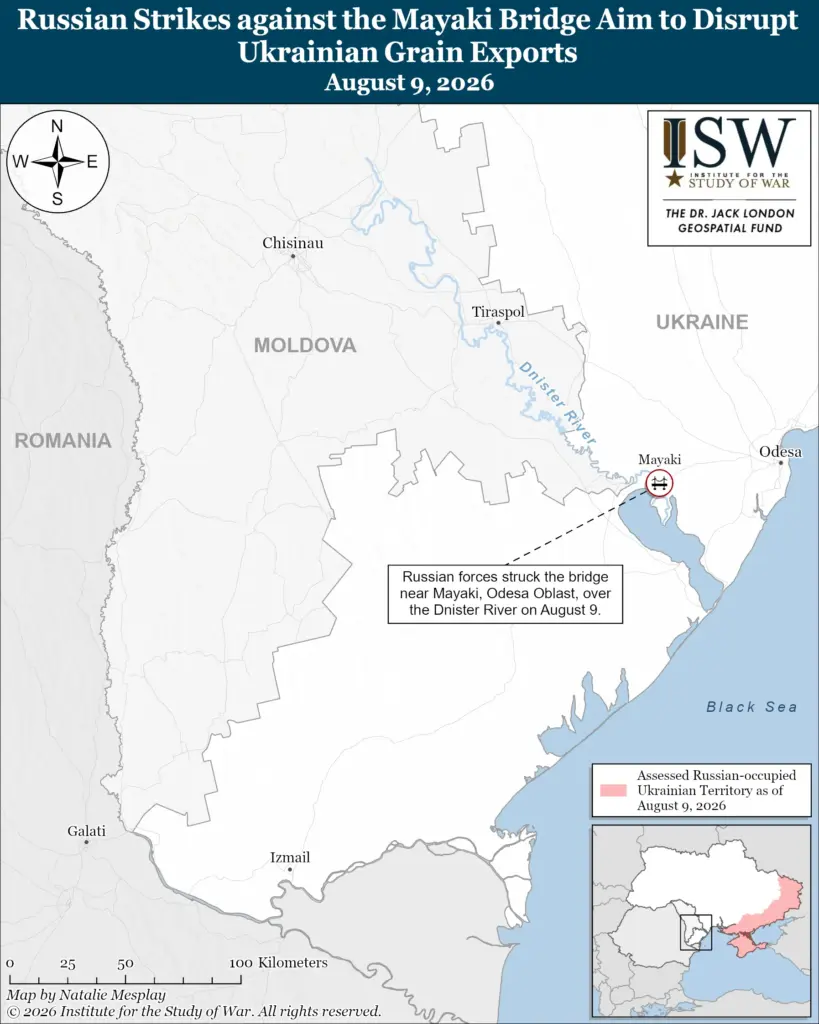
ISW: Russia strikes the Mayaki bridge linking southern Ukraine to Romania and Moldova

ISW

Russian forces struck the Mayaki bridge on the M-15 highway on 9 August, the Institute for the Study of War reported. The strike severed a road link that ties southern Ukraine to Moldova and Romania. That Odesa–Reni route crosses the Dniester and feeds the Danube ports. Those ports have become Kyiv's main export outlet since Russian strikes crippled its Black Sea shipping.

Conflicting claims over the Mayaki bridge

Russian milbloggers reported the attack, though their accounts diverged sharply. One claimed that Russian forces had destroyed the span. Others published footage purporting to show that it still stands. A local outlet serving nearby Izmail reported on 9 August that the strike damaged the crossing. Ukraine's State Border Guard Service separately confirmed that authorities briefly restricted traffic on the route. Moscow had already targeted the same structure in December 2025.

Why the land corridor matters

Russia likely hit the Mayaki bridge to choke Ukrainian grain exports, ISW assessed. Those exports now move through a land corridor that Kyiv has leaned on since strikes disrupted its maritime routes. Moscow has steadily intensified this campaign since July 2026. Navy Spokesperson Captain Third Rank Dmytro Pletenchuk offered one measure on 31 July. He said Russian strikes had damaged more than 20 ships near the Black Sea and sharply slowed cargo flows. Meanwhile, the country's main farmers union weighed in on 15 July. The Ukrainian Agri Council estimated that Russian attacks had cut about a third of Ukraine's grain-export capacity.

Minister of Agrarian Policy and Food Taras Vysotskyi has described the fallout. He said the strikes are forcing Kyiv to reroute grain and cargo through the Danube River. Russia used the same playbook in July 2023. Back then, then-Minister Mykola Solskyi reported that strikes destroyed 60,000 tons of grain at Chornomorsk port overnight on 19 July. Therefore, ISW concluded, Russia is likely shifting its strikes from the sea corridor to the land corridor. The aim, analysts wrote, is to block grain exports and weaken Ukraine's wider economy.

Russian forces are likely shifting their strikes from Ukraine's sea corridor to its land corridor to block grain exports and degrade the economy. — Institute for the Study of War

Türkiye floats a Black Sea moratorium

Turkish Foreign Minister Hakan Fidan raised a separate track on 9 August. He said Ankara had proposed a Russian–Ukrainian moratorium on strikes against merchant ships in the Black Sea. Both Moscow and Kyiv have received the offer, Fidan added, and Türkiye now awaits their response.

  •  

WHO humanitarian warehouse in Dnipro destroyed in strike, Director-General says

Dnipro WHO Humanitarian Warehouse,

A World Health Organization humanitarian warehouse in Dnipro was destroyed in a strike on 7 August, WHO Director-General Tedros Adhanom Ghebreyesus reported on 9 August, without naming those responsible.

Ghebreyesus's account added to a pattern the organization has tracked since the start of Russia's full-scale invasion: 3,148 strikes on Ukrainian healthcare facilities, which have killed 240 people and injured 1,055 more, according to World Health Organization Ukraine data.

The warehouse held humanitarian medical supplies intended for medical facilities at the front line, Ghebreyesus said.

Evacuation before the strike

A WHO staff member and drivers helping evacuate cargo were working at the site before the strike that destroyed it. Before the attack began, they managed to remove 130 of approximately 300 pallets of medical supplies. Preliminarily, no one was injured.

Ghebreyesus withholds blame

Ghebreyesus said he had no data on who struck the warehouse and did not name a culprit. Similar caution from international organizations in describing attacks in Ukraine has occurred before, including after the strike on the Kyiv-Pechersk Lavra.

"Attacks on healthcare facilities MUST STOP. Otherwise people are left without life-saving medical care. Even wars have their rules. One of them—health must be protected!" Ghebreyesus added.

Other recent strikes on healthcare infrastructure

On 6 August, five people were killed in Dnipropetrovsk oblast—three in Kamianske district and two in Pavlohrad, where an Ukrposhta depot was also destroyed. On the night of 1 August, Russia struck the territory of Kyivmedspetstrans twice, burning five ambulances. On 2 June, five medical facilities in the capital were damaged by Russian strikes.

  •  

Poles protest in 22 cities as attacks on Ukrainians escalate

poland

Demonstrators gathered in 22 Polish cities on Sunday, 9 August, to protest a rise in violence against Ukrainians, with most rallies beginning after 17:00, RMF24 reported.

The Sunday rallies followed a demonstration two days earlier, on Friday, 7 August, under the slogan "My Poland doesn't hit, insult, or incite," when organizers submitted a petition signed by more than 11,000 people to the prime minister's office and the Ministry of Interior and Administration, demanding decisive measures against violent attacks on Ukrainian citizens.

Nationwide campaign led by pro-democracy group

The Committee for the Defense of Democracy organized the nationwide campaign. Organizers said the demonstrations respond to increasingly frequent verbal and physical attacks on people targeted because of their origin, language, or appearance. The rallies were also meant to show solidarity with those experiencing violence and discrimination.

A slogan from Auschwitz

The phrase that became the demonstrations' slogan, "Don't be indifferent," was spoken by Marian Turski on 27 January 2020, during commemorations of the 75th anniversary of the liberation of the Auschwitz-Birkenau concentration camp. Turski, a former prisoner of the camp, used the speech to urge people not to accept cruel treatment of minorities, violations of human rights, and historical falsehoods.

Recent incidents

The number of attacks on Ukrainians in Poland has sharply increased in recent weeks. In Kraków, a 39-year-old man who had verbally insulted two people of Ukrainian nationality turned himself in at a police station on 8 August and was detained, according to reporting cited a day before the Sunday protests.

Separately, Tobiasz Bocheński, a member of the European Parliament and former candidate for mayor of Warsaw, said that if the Law and Justice party came to power, it would ensure the deportation of Ukrainian men of conscription age who are not legally employed in Poland. Poland's Ministry of Interior and Administration said such statements amount to populism.

  •  

A wiring maker for Volkswagen and Škoda takes a Russian hit in Zhytomyr Oblast

wiring maker volkswagen škoda takes russian hit zhytomyr oblast · post fire engulfs kromberg & schubert plant after strike overnight 9 2026 bunechko 5458835242480244866 ukraine news ukrainian reports

Russian overnight strike heavily damaged a German-owned car-parts plant in Zhytomyr Oblast, forcing it to halt production, the company said. No workers were hurt, but the destruction was extensive. One of the region's major employers now has no restart date.

Russia increasingly hits the factories and warehouses of foreign companies that kept producing in Ukraine through the war, not only Ukrainian factories, energy facilities, infrastructure, and homes. Each strike on a foreign-owned factory chips away at the jobs and outside investment propping up Ukraine's wartime economy, adding to a burden the country's partners are scrambling to offset.

A German plant knocked offline

Russia struck Zhytomyr Oblast overnight into 9 August and hit the Kromberg & Schubert plant, which reported the attack on Facebook. Its production lines and infrastructure took heavy damage. 

"The most important thing for us is that no employees were hurt in the attack," the statement said. 

With the damage so severe, the plant suspended operations for an indefinite period. A restart depends on a technical assessment and the full scope of repairs, the company added.

Kromberg & Schubert is a civilian manufacturer with 100% German investment. It has run in the Zhytomyr region for 11 years and employs about 3,500 people. The plant makes the wiring harnesses that thread through cars, supplying European automakers.

wiring maker volkswagen škoda takes russian hit zhytomyr oblast · post kromberg & schubert plant ablaze after strike overnight 9 2026 bunechko 5458835242480244867 ukraine news ukrainian reports
The Kromberg & Schubert plant ablaze after the Russian strike in Zhytomyr Oblast, overnight on 9 August 2026. Photo: Vitalii Bunechko

Vitalii Bunechko, head of the Zhytomyr Oblast Military Administration, called it one of the region's budget-forming enterprises. He said the administration and local authorities are working to help the strategic investor and keep the plant running.

wiring maker volkswagen škoda takes russian hit zhytomyr oblast · post burned-out kromberg & schubert plant after strike 9 2026 bunechko 5458835242480244865 ukraine news ukrainian reports
The burned-out Kromberg & Schubert plant after the Russian strike in Zhytomyr Oblast, 9 August 2026. Photo: Vitalii Bunechko

Part of a wider overnight assault

Bunechko reported that Russia had launched a massive strike on the oblast overnight. The attack also damaged civilian infrastructure, he said. State Emergency Service crews contained the fires, and investigators began work at the site. 

Russia has repeatedly struck Zhytomyr Oblast during the war, stepping up its drone strikes on northwestern Ukraine, often exploiting Belarusian territory.

  •  

Russia’s morning strike on a Kharkiv high-rise kills two men and wounds 21

russia's morning strike kharkiv high-rise kills two men wounds 21 · post firefighters work damaged after russian kharkiv's saltivka district 9 2026 2 syniehubov 5458525575338203373 ukraine news ukrainian reports

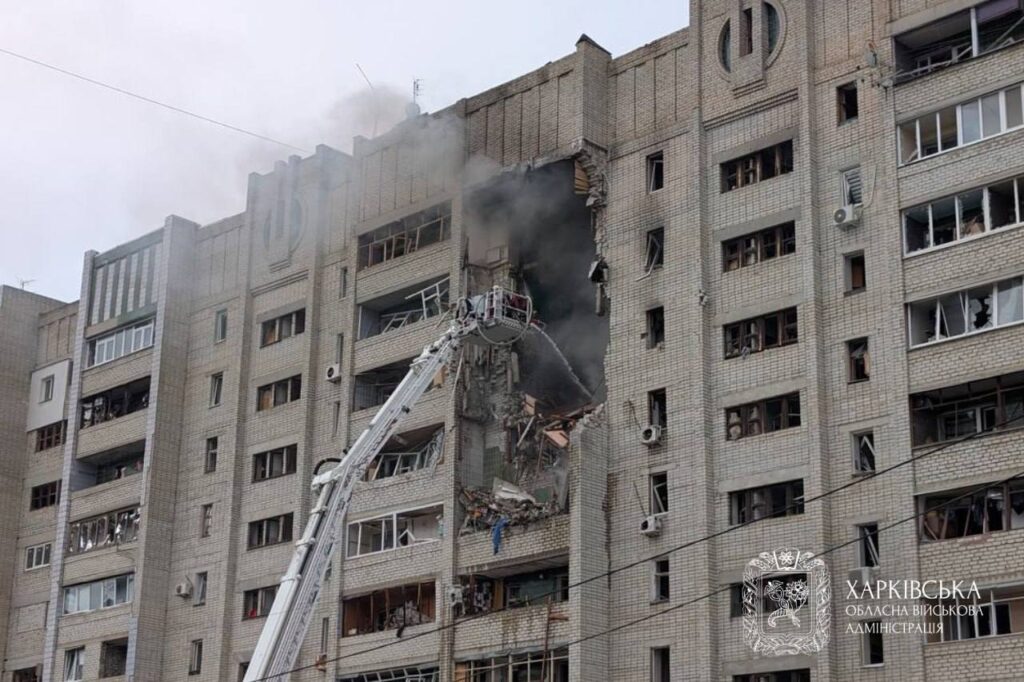
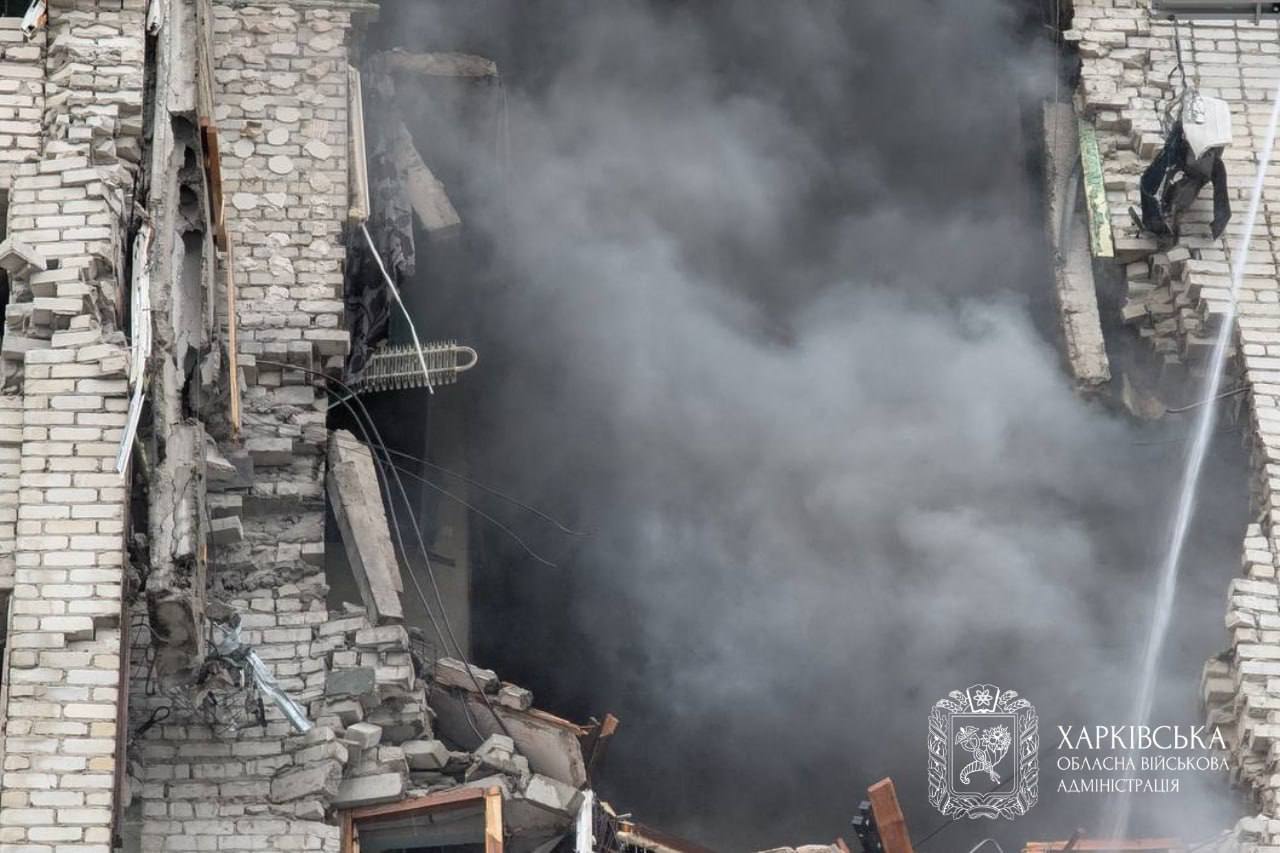
Russian forces struck a residential high-rise in Kharkiv's Saltivka district on the morning of 9 August 2026, killing two people and injuring more than 20 others, according to city and oblast officials. The strike collapsed several upper floors and trapped residents inside. Firefighters carried people down from the top stories while a second strike hit a neighboring building.

Russia hits Ukrainian cities and their apartment blocks night after night, pairing cheap attack drones with a growing volume of cruise missiles that thinning air defenses struggle to stop. Kharkiv, Ukraine's second-largest city, is situated in northeastern Ukraine, with its outskirts roughly 25-30 km from the Russian border, resulting in regular Russian attacks on locals.

A missile through the upper floors

Kharkiv Mayor Ihor Terekhov reported the strike on Saltivka shortly after 07:00. He said Russia had hit a multi-apartment residential building. Minutes later he confirmed the blast destroyed floors 7 through 10, with wounded people inside.

Oleh Syniehubov, head of the Kharkiv Oblast Military Administration, first described a Russian drone strike that killed two. His administration later clarified that a missile hit the high-rise, and that Russia also struck an office building nearby.

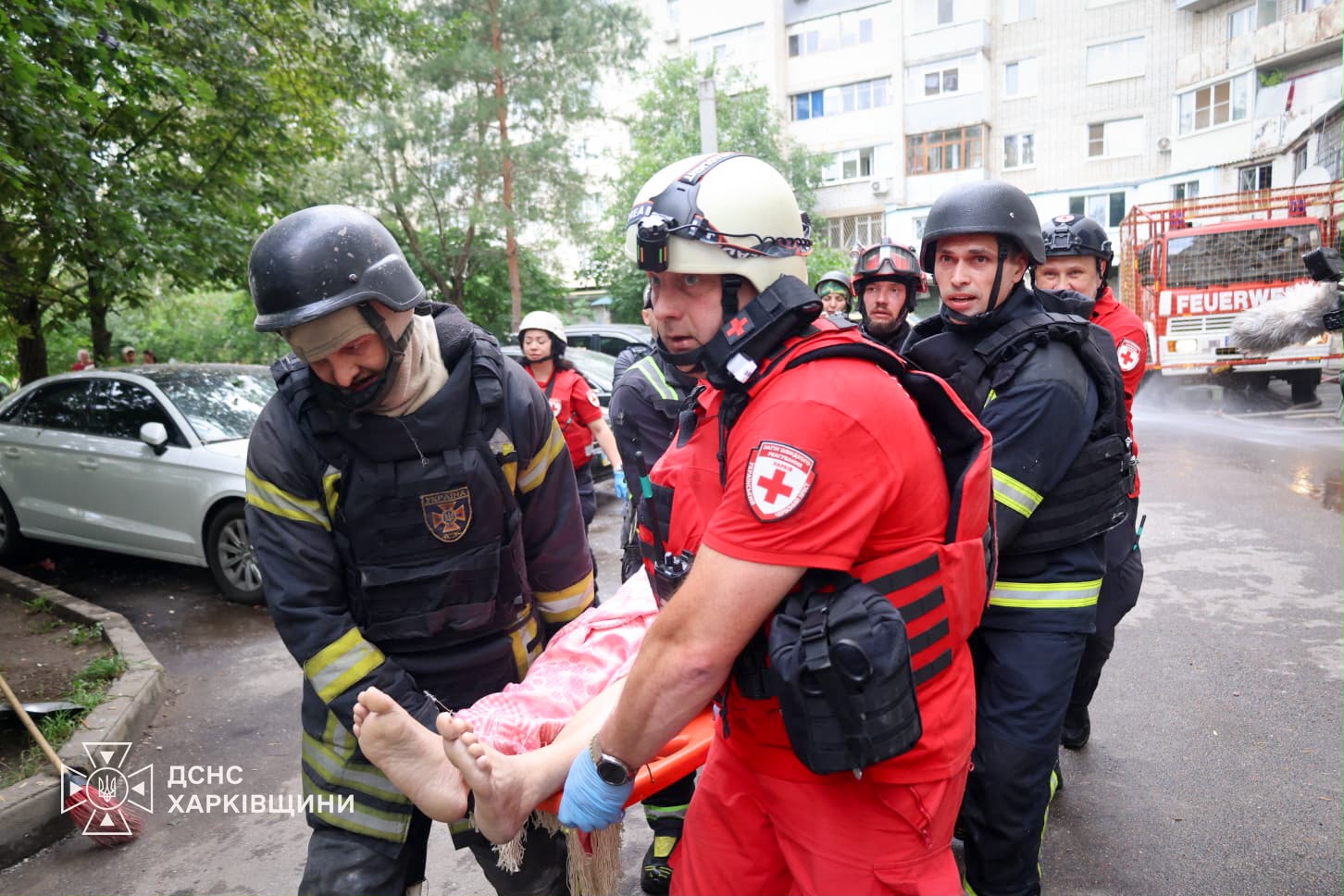
Residents were trapped behind the collapse, and crews began a rescue operation. Firefighters brought seven people down from the upper floors, the State Emergency Service reported. The destroyed ceilings sat between the seventh and tenth floors.

russia's morning strike kharkiv high-rise kills two men wounds 21 · post destroyed upper floors apartment building struck russia kharkiv's saltivka district 9 2026 1 syniehubov 5458525575338203375 ukraine news ukrainian
The destroyed upper floors of the apartment building struck by Russia in Kharkiv's Saltivka district, 9 August 2026. Photo: Kharkiv Oblast Military Administration

As the rescue got underway, Russia struck again. Terekhov said a neighboring high-rise was hit, writing that Russia "is deliberately striking residential buildings" and urging people to shelter. A third impact followed in one of the district's parks.

russia's morning strike kharkiv high-rise kills two men wounds 21 · post rescuers medics carry injured woman site russian kharkiv's saltivka district 9 2026 3 dsns 5458755953088993681 ukraine news ukrainian
Rescuers and medics carry an injured woman from the site of the Russian strike in Kharkiv's Saltivka district, 9 August 2026. Photo: State Emergency Service of Ukraine

Russia regularly employs the double-tap tactic — striking a site, then hitting it again once rescuers arrive — to maximize casualties among first responders.

Two dead, 21 wounded, a boy of five among them

Terekhov counted a dozen wounded at first, then confirmed two people killed at the site. Syniehubov gave the fuller account: two men, aged 50 and 66, killed, and at least 21 people injured.

Among the wounded was a five-year-old boy. 11 people suffered blast injuries and two had carbon monoxide poisoning. Another eight, including a child, had acute stress reactions, and medics hospitalized four.

By late morning, Syniehubov said crews were still clearing the collapsed floors to be sure no one remained underneath. Specialists would then judge whether the building could still be used.

Russians killed two more civilians in Kharkiv this morning

The aerial attack targeted an apartment block, also injuring 21 other people.

📹 TG/DSNS pic.twitter.com/gN9IgRUayP

— Euromaidan Press (@EuromaidanPress) August 9, 2026

A day of strikes across the oblast

Over the past 24 hours, Russia struck Kharkiv and 12 settlements across the oblast, killing three people and wounding or shocking 25, the regional administration said.

In Izium, shelling injured eight people. Russia killed a 68-year-old man in Kivsharivka, near Kupiansk, and wounded a 47-year-old woman in Mykhailivka. In Lozova, a 60-year-old woman was hurt, and a transit evacuation point there took in 227 more people.

  •  

Ukraine’s General Staff confirms strikes on two Russian refineries and Black Sea rig

Flames at Russia's Saratov Oil Refinery after reported Ukrainian drone strike, 2 August 2026. Screenshot from video: Exilenova+

Ukrainian forces struck two Russian oil refineries and a surveillance post mounted on a Black Sea drilling rig on the night of 8 August, Ukraine's General Staff said.

The strikes extend a months-long Ukrainian campaign against Russia's refining sector. Ukrainian forces attacked Russian refineries about 50 times between mid-April and 13 July, hitting at least 24 of the country's 34 large plants and cutting refining volumes to their lowest level in more than two decades, Bloomberg estimated.

A fire at the Ilsky plant

The strike on the Ilsky refinery in Krasnodar Krai touched off a fire on the plant's grounds, the General Staff said. It put the site's capacity at six process units and about 6.6 million tons of oil a year.

The plant "receives, stores and processes hydrocarbon feedstock, produces and ships petroleum products," the General Staff said, adding that its output serves the needs of the Russian armed forces, among other users.

Syzran plant tied to Rosneft

Ukrainian forces also hit the Syzran refinery in Samara oblast, which is part of Rosneft's oil complex, the General Staff said. It described the plant as having a design capacity of about 8.5 million tons of oil a year and producing more than 20 types of petroleum products, including motor fuels and road bitumen, and named it one of the region's key refining facilities supplying fuel to the Russian armed forces.

A surveillance post on the Syvash rig

The third target was a technical observation post on the Syvash jack-up drilling rig in the Black Sea, the General Staff said. Russia uses the rig to house surveillance equipment and keep it operating in those waters, the statement said.

Russian officials confirm the attacks

Overnight, Russian Telegram channels reported drone attacks on Krasnodar Krai and Samara oblast. Samara governor Vyacheslav Fedorishchev confirmed the shelling. Local channels said the Syzran strike landed near an AVT distillation unit and oil storage tanks.

In Krasnodar Krai, the regional operational headquarters confirmed the Ilsky refinery had been damaged and said "debris fell on the plant's territory."

Neither the strikes nor their extent could be verified through independent sources, Radio Svoboda said. The General Staff has said Ukrainian forces "systematically implement measures aimed at reducing the combat potential of the Russian occupation forces" and pressing Russia to end its aggression against Ukraine.

  •  

EU channels a further €30 million into Ukraine’s Energy Support Fund, raising its total contribution to €279 million

EU buildings lit in Ukraine flag colors on fourth anniversary of Russia's full-scale invasion

The European Union has transferred an additional €30 million to the Ukraine Energy Support Fund, raising its total contribution to the mechanism to €279 million, First Deputy Prime Minister and Energy Minister Denys Shmyhal wrote on Telegram.

The transfer is the latest in a series of contributions to the fund from Ukraine's partners. Luxembourg also added funds to the same mechanism recently, and Denmark contributed more than €10 million, European Pravda reported.

What the funding supports

In his Telegram post, Shmyhal described how the fund is used:

"The funds coming in through this financial instrument help us restore the energy infrastructure damaged by Russian attacks, purchase critically needed equipment for our energy companies, and ensure a reliable energy supply, above all for critical infrastructure," Shmyhal wrote.

  •  

Zelenskyy says US will send Patriot interceptors monthly – but not enough to protect from Russian attacks

vucic zelenskyy

Ukraine has reached concrete agreements with the United States for monthly deliveries of interceptor missiles for its Patriot air defense systems, President Volodymyr Zelenskyy said at a joint press conference with Serbian President Aleksandar Vučić in Belgrade on 8 August.

The commitment does not close Ukraine's gap. Zelenskyy said the monthly volume remains insufficient and laid out a parallel effort to secure interceptors from Europe, the Middle East and further afield, as US shipments have thinned this year.

The US as the primary supplier

Repelling ballistic missiles has been a problem since the start of the full-scale war, and the search for a solution begins with the country that builds the systems, Zelenskyy said.

"From the first days of the war in Ukraine there was nothing to repel ballistic missiles. This is very difficult work. In which directions can this problem be solved? Well, first of all, who has anti-ballistic missiles and systems? The manufacturer. That is the United States of America, first of all. Can they help? We are working. Will they allocate us missiles every month? Yes. We have agreements," he said.

Asked whether that supply met Ukraine's needs, he answered: "Are these missiles enough? No." He added that the monthly volumes of American missiles had decreased this year compared with 2025.

Where else Kyiv is looking

Patriot missiles are also held by European countries, Zelenskyy said, naming Germany and Poland as able to substantially strengthen Ukraine's air defense. Kyiv is also in talks with Norway, the Netherlands and Middle Eastern states.

South Korea and Japan could potentially help but do not currently hand over such systems, which Zelenskyy attributed to restrictions in their domestic legislation and constitutions. Ukraine is separately discussing air defense with Israel; the president said Ukraine is ready to buy but that no such option exists at present.

"Every day I speak with one European state or another and with Middle Eastern states so that Ukraine receives additional missiles outside the American package. We are simply at the level where all our institutions must work on this, not only the president. Everyone must work, otherwise there will not be enough missiles," he said.

The Belgrade remarks came a day after Zelenskyy arrived on his first official visit to Serbia.

Zelenskyy had bilateral meeting with Serbian President Aleksandar Vučić. Vucic voiced support for Ukraine's territorial integrity and its path to the European Union.

What esle Zelenskyy and Vučić discussed


The two presidents held talks that ran across the countries' European integration, trade and energy cooperation, a prospective free-trade zone, and diplomatic paths to ending Russia's war on Ukraine. Vučić had said ahead of the meeting that he would discuss both countries' route to EU membership, along with economic and energy cooperation and other opportunities

On the economy, Vučić said the sides had reviewed infrastructure projects and the involvement of Ukrainian companies in Serbia. On peace efforts, Zelenskyy said the leaders had discussed diplomatic instruments capable of bringing the war closer to an end.

Before the press conference, the sides held a ceremony to sign a memorandum on cooperation in animal health and food safety. The document was signed by Serbia's Minister of Agriculture, Forestry and Water Management Dragan Glamočić and Ukraine's ambassador to Serbia Oleksandr Lytvynenko.

Territorial integrity

Vučić framed Serbia's position as a matter of UN principle and tied it to Ukraine's reciprocal stance on Serbia.

"We support the UN Charter, UN resolutions, and this means the territorial integrity of all UN members, which means the territorial integrity of Ukraine as well. Likewise we are very grateful to Ukraine for supporting the territorial integrity of the Republic of Serbia. And as far as we are concerned, we will continue this principled policy. There are no 'buts' on this question. This is being said very clearly and resolutely now," Vučić said.

Support on the road to the EU

Vučić said Ukraine could always count on Belgrade's support in EU accession, and the two discussed both countries' European path during the meeting.

"We wish for Ukraine to open all negotiating clusters as quickly as possible, to close them as quickly as possible, because this is the wish of the Ukrainian people, of the Ukrainian leadership. And speaking of ourselves, we have not had and will not have any problems regarding this in the future. On the contrary, everything we can do to help Ukraine on its European path, we will do," Vučić said.

Trade at $321 million in six months

Vučić said trade between the two countries is growing rapidly: while it stood at $450 million for all of last year, it had already reached $321 million in the first six months of this year.

"The most important import item is iron ore from Ukraine. And I believe that cooperation in the sphere of agriculture, but also in other spheres of energy, everywhere trade turnover can be greater. We discussed projects in the sphere of infrastructure, involving Ukrainian companies on the territory of Serbia. I believe we can have serious and good results in the future," the Serbian president said.

Vučić said he hoped cooperation between the countries would become "significantly stronger and larger-scale" after the war ends. In future, he said, Serbia and Ukraine could jointly export certain goods and enter third-country markets, in particular in Africa and Asia.

"I think we will yet see agreements on such cooperation. Yesterday we had long discussions, today the discussions were really good. I am grateful to President Zelenskyy for the visit to Serbia. I hope we received you properly. And I want to believe that our meetings in the future will be incomparably more frequent than they were before," Vučić added.

A free-trade zone by the end of 2026

Zelenskyy said negotiations on creating a free-trade zone between Ukraine and Serbia are under way, and expressed hope the agreement could be concluded by the end of 2026.

"Our teams must work well to speed up the agreement on a free trade zone between Ukraine and Serbia. These negotiations are progressing, this is positive. And it would be good to prepare everything by the end of this year for concluding the agreement on free trade between Ukraine and Serbia," the Ukrainian president said.

Damaged energy grid and a Serbian humanitarian package

Zelenskyy described the state of Ukraine's infrastructure under Russian strikes.

"For the fifth year now we in Ukraine are forced to go through all these strikes. Russian strikes are aimed mostly at facilities that work precisely for the life of the people. We have virtually no undamaged power plants left. Many railway stations are destroyed, hospitals, universities, ordinary civilian enterprises. In a time of such a war we appreciate and are very grateful for all the support that Ukraine receives from other countries, from other peoples," Zelenskyy said.

He said Ukraine continues to expand all formats of cooperation with partners to give communities and people "more resilience, more capacity to hold out despite all the challenges of the war."

Zelenskyy said Serbia would provide Ukraine with a humanitarian aid package. "We are grateful that there will be a new package of humanitarian support from Serbia for Ukraine, in particular in the sphere of medicine, in the sphere of energy. This is very important for us," he said.

Diplomacy to end the war

Zelenskyy said the leaders had discussed diplomatic instruments that could bring the war closer to an end, and pointed to capitals with influence over the process.

"It is important that everywhere in the world they know what we want, and this is true, and this is a fact, we want a dignified peace, that every opportunity be used for the sake of peace, for the sake of guaranteed security. All available opportunities that exist in Washington, and in Beijing, in the capitals of Europe, our partners in the Middle East, in the Gulf, in all the capitals of the world that have influence over the relevant processes," Zelenskyy said.

  •  

Russian strike kills 3-year-old boy and his grandparents in Kyiv Oblast village

kyiv oblast

A Russian strike on the village of Pukhivka in Kyiv Oblast's Brovary raion overnight into 8 August killed three members of one family: a three-year-old boy, his grandmother, and his grandfather. Four other people were wounded, President Volodymyr Zelenskyy said.
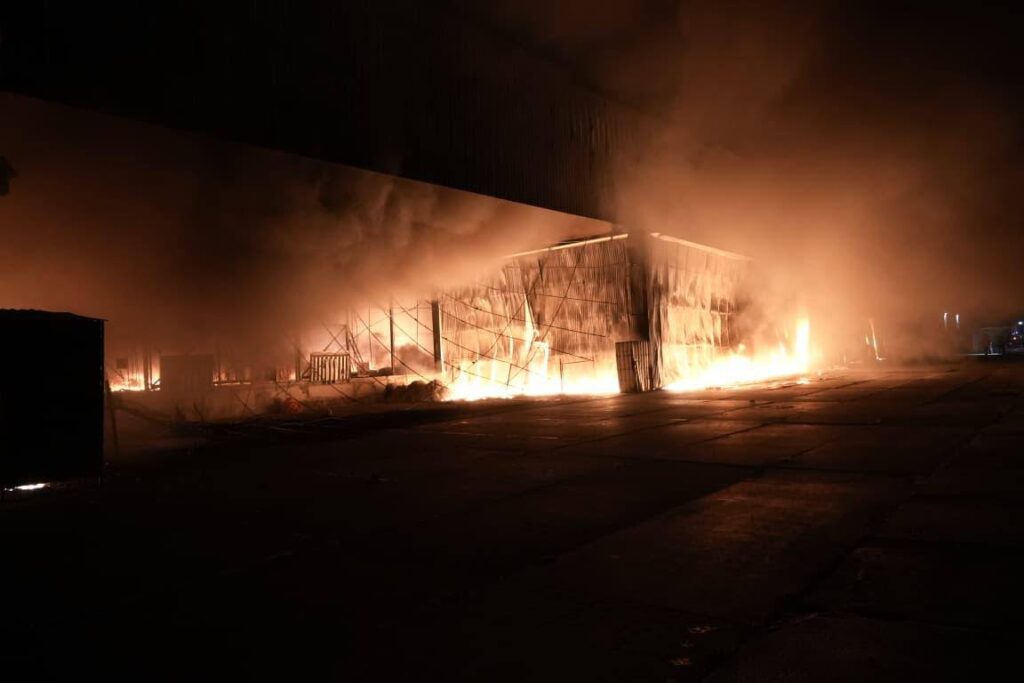
The boy's parents and his 15-year-old brother were among the injured, along with a neighbor who came to help the family and was hit in a second, follow-up strike. The attack came as Russia leans on the ballistic missiles Ukraine can least often intercept, and as Zelenskyy again pressed partners for the interceptors his air defenses are running short of.
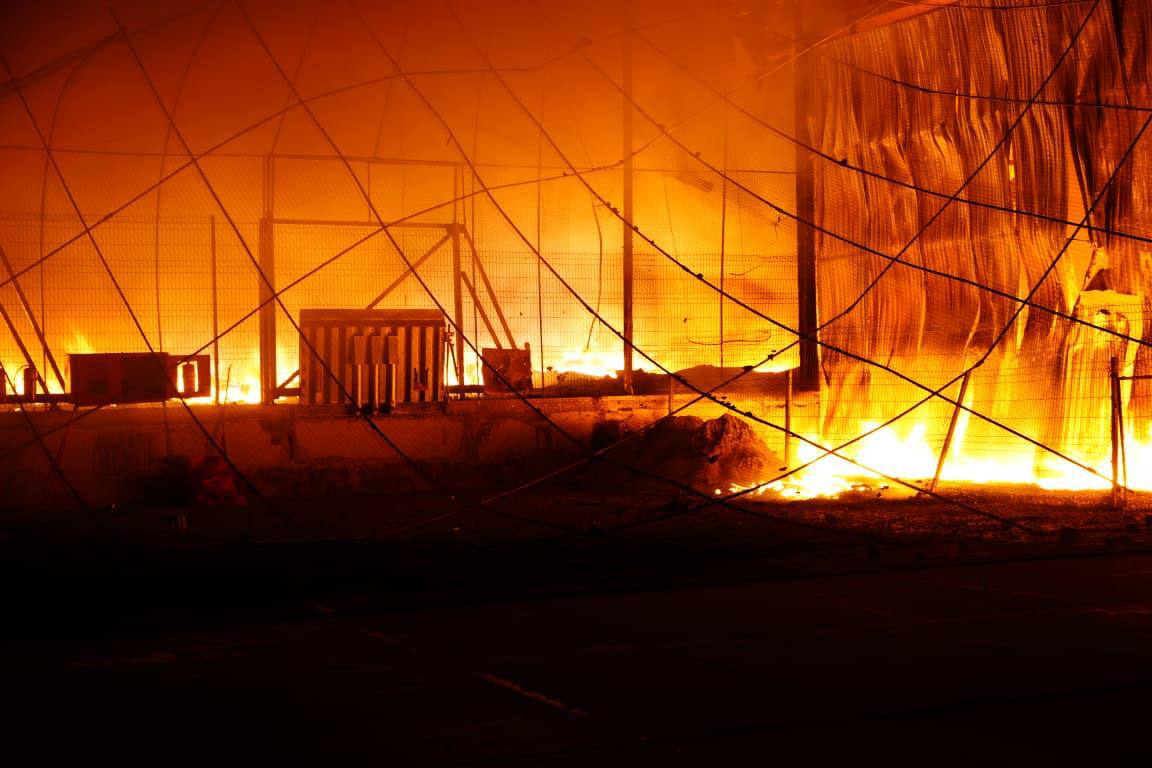
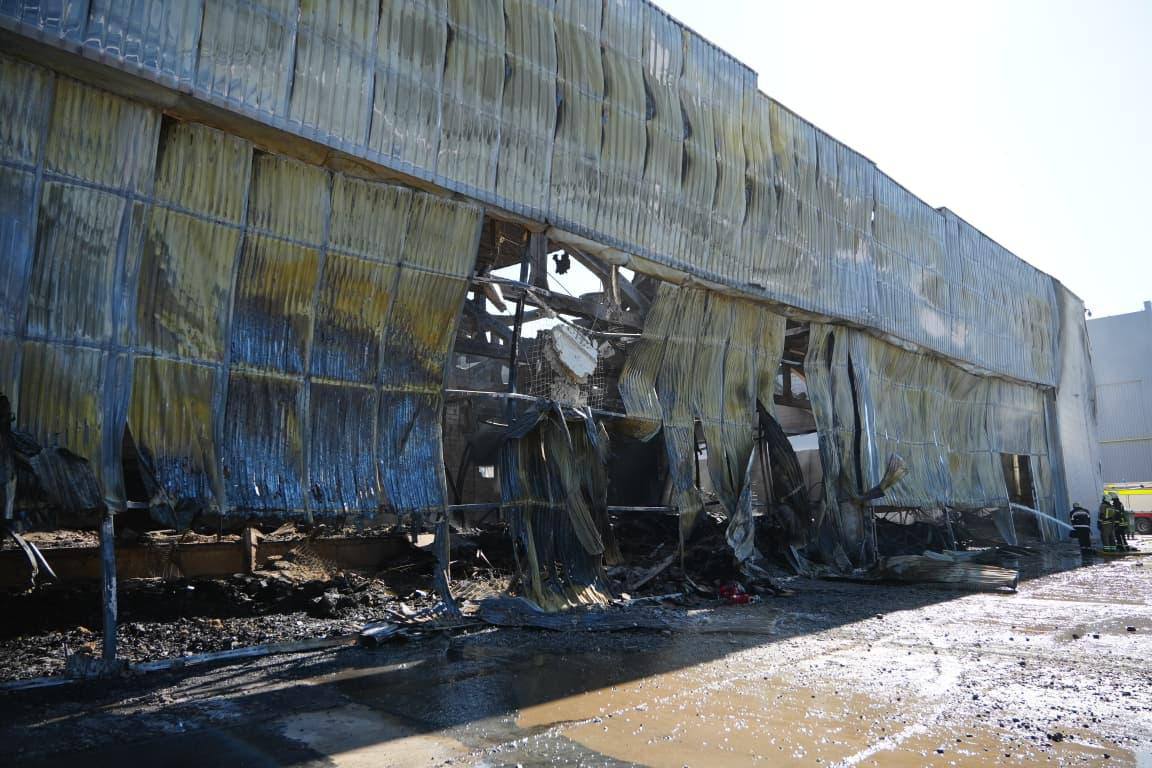
A family killed in their home

Zelenskyy said the strike hit an ordinary residential building. Those wounded, among them the dead child's parents, were treated for thermal burns and shrapnel injuries.

The neighbor was hurt after coming to help the family, when a second Russian strike hit the same place — the double-tap tactic of following an initial strike with another timed to catch rescuers and responders. Russia used it in Kyiv a week earlier, when a follow-up strike killed a 20-year-old volunteer medic.

Six ballistic missiles on Kyiv

Overnight, Russia also struck civilian infrastructure in Kyiv with six ballistic missiles. One person was killed, their body found by rescuers during the cleanup, the Kyiv City Military Administration reported.

A widening gap, and a renewed appeal

Zelenskyy called on Ukraine's partners to tighten sanctions on Russia's ballistic-missile production and to supply more air defense systems and interceptors. The appeal lands against a defense Russia has spent the year outpacing: in July, a third of the missiles it fired — 126 — were ballistic, the type that gives the shortest warning and that Ukraine's systems, save for the Patriot, cannot reliably stop. In the last two large attacks, Ukraine downed two of 36 ballistic missiles, roughly one in twenty, for lack of Patriot interceptors. Russia builds around three ballistic missiles a day, by Ukrainian analysts' estimates, while Ukraine's interceptor stocks stay severely limited.

The same night, Russia also attacked Donetsk, Kharkiv, Sumy, Dnipropetrovsk, Zaporizhzhia, Odesa, Kherson, Mykolaiv, Chernihiv, and Poltava oblasts.

  •  

North Korea made $22 billion arming Russia – nearly four times its haul before the war

Putin North Korea

North Korea has pulled in as much as $22 billion in foreign earnings since Russia's full-scale invasion of Ukraine in 2022—nearly four times what it earned in the previous four years, and the most cash Kim Jong Un has commanded in his 15 years in power, Bloomberg Economics estimates.

That money is the bill for Russia's war, paid to the other side of the world. In exchange for the shells and soldiers keeping Moscow's offensive alive, Pyongyang has been handed the cash, food, and military technology to turn itself from an isolated pariah into a nuclear power that no longer needs to negotiate with anyone. The war draining Russia has quietly built a second, stronger adversary.

Half of Russia's shells, and thousands of soldiers

By the end of 2025, North Korea was covering up to half of Russia's need for 122mm and 152mm artillery ammunition, Ukrainian intelligence estimates—a share Euromaidan Press has tracked since the shipments began in 2023. Pyongyang backed the shells with men: some 16,000 soldiers, for whom Russia paid roughly $2,000 a month each, plus extra for the dead, by Bloomberg's accounting.

The turning point came in 2022. Kim had spent the previous years humiliated—a failed summit with Donald Trump, a harvest failure that triggered hunger, a self-imposed Covid border closure that severed trade with China. In a 2020 national address, he wept while apologizing for the economy. Then Putin's stockpiles ran low, and North Korea's warehouses became a resource Kim could turn into hard currency.

Cash, food, and the technology to build better weapons

The dangerous part is what came back the other way. Russia handed over advanced military technology alongside the payments, and US Forces Korea has said the transfers let Pyongyang compress its weapons-development timelines. Moscow supplied air defenses including at least one Pantsir-class system—a transfer Euromaidan Press reported last year—and a Pantsir-M worth about $20 million now sits on one of North Korea's two new 5,000-tonne destroyers, the largest warships it has ever built. The two countries have also begun jointly producing attack drones.

Kim poured the windfall into a nuclear buildup that, Bloomberg reports, puts North Korea on a path to rival France's arsenal. The country's economy grew 3.5% in 2025, its third straight year of expansion, according to the Bank of Korea.

A windfall that outlasts the war

The boom does not depend on the war continuing. Over the past decade Kim assembled the world's most prolific army of crypto thieves: hacking groups tied to Pyongyang now account for more than 70% of global cryptocurrency thefts, up from about 30% in 2017, according to blockchain intelligence firm TRM Labs. The stolen funds are laundered mostly through Chinese organized-crime networks that take a cut in exchange for clean offshore accounts. "It's absurd to think North Korea now has access to that much money," said Nick Carlsen, a senior TRM investigator.

Kim is spreading his bets diplomatically, too, hosting officials from Singapore, Indonesia, Belarus, and Vietnam over the past year to loosen his reliance on Moscow.

The Kim once written off as an erratic recluse is emerging as the durable leader of a growing nuclear power—one with little reason left to bargain. "Pyongyang has proven its ability to adapt to persistent sanctions," said Jenny Town of the Stimson Center. "And as international law and norms are eroding, it has found camaraderie in its resistance."

  •  

Nawrocki: where “Muscovites are beaten,” Poland helps. Russian Foreign ministry hits back

rzeczpospolita fourth year russia-ukraine war poland’s leader sides aggressor polish president karol nawrocki pap/leszek szymański 1699304a7cc0b825fd6ed95fba7ddad5 (1) editorial published 27 stated russia’s all-out against ukraine has taken position aligns commentary

Polish President Karol Nawrocki used a speech marking his first year in office to restate that Poland will keep backing Ukraine's war against Russia—and to frame that backing as cold strategic interest rather than solidarity, warning in the same speech that continued help does not extend to tolerating Ukrainian nationalist symbols" on Polish soil. He spoke on 6 August at a ceremony in the courtyard of the Presidential Palace in Warsaw, reported by RMF FM.

The remarks land at the hottest point yet in a Polish-Ukrainian memory row that has stripped Kyiv of much goodwill from its most important frontline ally. Poland's interest, Nawrocki said, is that Ukrainians fight "as long as possible and as effectively as possible" against Russia, keeping it far from Poland—help offered not out of shared cause but because a Ukraine that bleeds Russia serves Warsaw. Coming from the country most vital to Ukraine's supply lines, it is a statement of support recast as conditional self-interest.

Support as strategy, not solidarity

"Poland's interest is that Ukraine and Ukrainian soldiers cope as well as possible with the post-Soviet Russian Federation and keep it as far from Poland as possible. That is obvious; that is the Polish state's strategy," Nawrocki said. "Let them kill the Soviets who attacked them—it does not hurt us Poles at all. In this they can always count on our help, because where a Muscovite is beaten, Poland helps, even if it does not take part directly in this war."

The register was deliberate. Nawrocki, a historian who ran the Institute of National Remembrance before winning the presidency, used the pejoratives "Soviets" and "Muscovites" for Russians throughout, casting Polish aid as a matter of keeping the fight on the far side of the border.

The red line: no Bandera flags

The support came fenced. "It is also Poland's strategic interest that Bandera flags do not fly in Warsaw or anywhere in Poland," Nawrocki said, promising to help "but always saying: Poland first, Poles first"—not, he added, "thoughtlessly sending fleet after fleet without analysis, on phone calls and smiles."

The condition points straight at the dispute that has consumed the relationship since May, when Zelenskyy signed a decree granting a special-forces unit the honorary title "Heroes of the UPA," the insurgent army Poland's parliament holds responsible for the Volhynia killings of tens of thousands of Poles and has declared a genocide. Nawrocki stripped Zelenskyy of the Order of the White Eagle in response; in July he pressed parliament to ban the UPA's red-and-black flag by law.

Moscow moves to widen the gap

Russia moved to pry the crack open within hours. Foreign ministry spokeswoman Maria Zakharova derided Nawrocki as a former Gdansk war-museum director whose "clinical Russophobia," she claimed, was affecting his judgment, and reminded him that Russia and Poland share a border "with no Ukraine and no Ukrainians between us"—the erasure of Ukraine stated plainly, from Moscow's own podium.

That is the move Warsaw itself has warned about. Polish officials have cautioned that Russia would seek to exploit the Ukraine tensions, and Polish services recently detained a group accused of recruiting Ukrainians for paid anti-Ukrainian rallies on Russian instructions. The memory feud, as one Polish advocate for Ukraine told Euromaidan Press in June, is theater that serves only one audience—the one in the Kremlin.

  •  

Luxembourg adds €8 million to Ukraine’s energy fund, bringing total to €30 million

Ukrainian energy infrastructure damaged after a Russian attack. Screenshot from video: Ukrainian Ministry of Energy

Luxembourg contributed an additional €8 million ($8.7 million) to the Ukraine Energy Support Fund, raising its total donations to €30 million ($32.7 million), Ukraine's Ministry of Energy reported.

The contribution arrives as the fund—which crossed €2 billion ($2.18 billion) in total lifetime contributions in July—races to close a €650 million ($709 million) gap in unfunded needs ahead of the 2026/2027 winter season. Russia has destroyed more than 9 gigawatts of generation capacity since the start of the most recent heating season alone, and all previously available fund resources have been fully contracted.

Luxembourg's steady commitment

This marks Luxembourg's fourth donation to the fund since 2024. The country initially transferred €2 million in 2024, followed by €10 million in June 2025 and another €10 million in December 2025. The latest €8 million brings the total to €30 million—a notable sum from a country with a population of roughly 660,000.

Energy Minister Denys Shmyhal thanked Luxembourg and its Agency for Development Cooperation for what he called systematic support for Ukrainian energy, adding that the contribution would help provide energy companies with essential equipment and strengthen the resilience of Ukraine's power grid, European Pravda reported.

A fund preparing for its fifth wartime winter

The Energy Support Fund was established in April 2022 and is managed by the Energy Community Secretariat. It has become the primary international mechanism for channeling emergency energy assistance to Ukraine, with contributions from 37 donors across 26 countries and three international organizations.

In a June 2026 joint statement, the G7+ Energy Ramstein Group identified €650 million in priority needs for winter preparation and called for swift mobilization of additional funding.

Luxembourg's contribution is part of a broader wave of European support. Ireland announced €25 million ($29 million) for energy and critical infrastructure protection during its prime minister's visit to Kyiv on 23 July. Sweden's €123 million contribution on 8 July pushed the fund past the €2 billion milestone. Denmark has also recently added over €10 million.

  •  

Ukraine’s Soviet S-300 air defenses ran low—now the US and Ukraine are working to revive their missiles

s-300 missile launch ground battery

The United States and Ukraine are working together to put fresh missiles into Ukraine's aging Soviet-era S-300 air defenses, retired US Army colonel Robert Hamilton told PBS NewsHour. These long-range systems shoot down aircraft, but the missiles that feed them have been depleted. The effort—retrofitting old rounds or building a newer variant—would revive launchers Ukraine already owns.

Ukraine's air defense runs on a shrinking supply of interceptors, with Russian ballistic and drone strikes outpacing what allies can ship. The chokepoint is production capacity, not willingness—and Hamilton frames the S-300 rebuild as one of the slower-burn fixes that ease the strain on scarce Western systems rather than replace them.

A working system near the end of 2026

Hamilton, who heads the Delphi Global Research Center, said the joint effort should come online near the end of 2026 and could turn out "100 or a couple of hundred" anti-aircraft missiles a year. He described the work as an effort to "essentially retrofit or upgrade the old S-300 missiles or a newer variant of the S-300" and give the system better capabilities.

blackouts donetsk
Explore further

Ukraine drones hit Crimea’s S-300/S-400 near Kerch—and knocked out power across four occupied territories overnight

In September 2024, then-US Defense Secretary Lloyd Austin announced at the Ramstein contact group that Washington, in partnership with several European companies, was working with Ukraine to "design and build a substitute" for the Soviet S-300 and the R-27 air-to-air missile used by fighter jets. He never spelled out what that substitute would be.

Why Ukraine's S-300s ran law

When Russia launched its full-scale invasion in 2022, Ukraine held roughly 25-30 S-300PT/PS battalions in varying states of readiness. As the missiles ran out, Kyiv came to lean on Western air defense systems and interceptors while Russia keeps launching mass strikes.

Smoke billows over Kirov, Russia, following a reported Ukrainian strike on the Avitek defense plant, 25 July 2026. Photo: Exilenova+
Explore further

“Very good results” – Wave of Ukrainian strikes across Russia and Caspian Sea overnight target warships, air defenses, logistics

Anything Ukraine can build or rebuild on its own soil is a supply that no foreign stockpile or political fight can cut off.

That same logic is pushing Kyiv toward co-producing Patriots with US firms and fielding its own ballistic interceptor—a race to turn air defense into a domestic industry before the next winter of strikes.

  •  

Russia launches 147 drones overnight, injuring civilians and damaging infrastructure in Sumy, Dnipropetrovsk oblasts

Since the evening of 6 August, Russia has attacked Ukraine with various types of drones, including decoys, the Ukrainian Air Force Command said. Although 114 of those 147 were shot down, some hit their targets, killing at least 2 people and injuring more than 10.

The Russian military has repeatedly used drone decoys to distract Ukrainian air defenses from real targets. By overloading Ukrainian air defenses, more drones reach their targets, which often include Ukrainian civilian infrastructure. In particular, attacks on post offices have become increasingly targeted.

Russian drone attacks overnight on 7 August 2026/Euromaidan Press map

Strike on Sumy Oblast

A Russian drone struck a market in Bilopillia community, Sumy Oblast, on the morning of 7 August, injuring 10 people. Two of them are in serious condition, head of Sumy Oblast Oleh Hryhorov said.

Overnight into 7 August, Russia attacked Sumy Oblast with aerial bombs and various types of drones, Hryhorov said. The attacks damaged infrastructure, non-residential buildings, vehicles, and private homes. Two civilians were injured, but their condition is not serious. One was a 57-year-old man wounded after one of two aerial bombs struck near his home, Sumy City Military Administration Head Serhii Kryvosheienko said. A drone also struck a post office in the Hlukhiv community.

Over the past 24 hours, Russian forces struck 34 settlements across Sumy Oblast in 48 attacks, injuring 13 people, including a child, Sumy Oblast police reported.

Consequences of Russian strikes on Sumy Oblast overnight into 7 August, 2026. Photo: Sumy Oblast Administration

Strike on Dnipropetrovsk Oblast

At the same time, Russia attacked five districts of Dnipropetrovsk Oblast with artillery and various types of drones, with no casualties reported initially, Dnipropetrovsk Oblast Head Oleksandr Hanzha said. He added that the strikes damaged private homes, an administrative building, vehicles, and infrastructure. In Nikopol district, a post office and a gymnasium were damaged in the Russian attack.

A firefighting crew extinguishes a fire following Russian strikes on Dnipropetrovsk Oblast overnight into 7 August, 2026. Photo: Dnipropetrovsk Oblast Administration

Russia continues to strike civilian infrastructure

On the night of 7 August, Russian forces also struck Zaporizhzhia. A drone damaged an office building, causing a fire.

Aftermath of Russia’s attack on a Ukrposhta sorting depot and the base for mobile post offices in Pavlohrad, Dnipropetrovsk Oblast, on 6 August, 2026. Photo: Ihor Smilianskyi

On 6 August, a Russian Banderol cruise missile struck a Ukrposhta sorting depot and a base for mobile post offices. Two Ukrposhta employees were killed, and a mechanic was injured in the strike, Ukrposhta CEO Ihor Smilianskyi said.

“The enemy wanted to stop our movement here, but we will not let them do it. All backup schemes are already working. Pensions, medicines, parcels and letters are being delivered on schedule,” Smilianskyi said.

  •  

US rebuilt full intelligence sharing with Ukraine—and Kyiv strikes deep inside Russia hit harder 

Zelenskyy trump

The United States has rebuilt intelligence sharing with Ukraine—the flow of satellite data, targeting, and attack warnings—to its pre-freeze peak, according to Politico. That restored flow now sharpens Kyiv's long-range strikes inside Russia, and senators from both parties say it has strengthened Ukraine. The White House says President Donald Trump stays focused on ending the war.

Russia funds its invasion largely with oil money, and Ukraine has spent the past year burning that revenue at the source, sending drones against refineries far behind the front. Foreign backing has wavered across the war, and every US pledge now carries the question of whether it will hold.

The freeze that started with a White House blowup

The cutoff came after Trump and Ukrainian President Volodymyr Zelenskyy clashed in the Oval Office on 28 February 2025. Days later, the White House froze weapons and intelligence to push Kyiv toward talks. It did not last. Washington restored the flow within about a week, after US-Ukraine talks in Saudi Arabia.

Russian plane IL-96-300
Explore further

Intelligence: Russia’s civil aviation deteriorates under sanctions, forcing it to dismantle even new aircraft to obtain spare parts

What changed on the battlefield

Senator Mark Warner, the top Democrat on the Senate Intelligence Committee, said the renewed sharing has improved Ukraine's position.

"Everybody loves a winner and looks like Ukraine has turned the tide," said Republican Senator John Cornyn.

Better data, deadlier strikes

"Those strikes were supercharged," and became "significantly more effective when imbued with intelligence from the Americans," said George Barros of the Institute for the Study of War.

He tied the drone strikes on Russian energy sites to a plan to raise the war's cost for Moscow.

Stephen Sestanovich of the Council on Foreign Relations said Ukrainian officials give Washington confident reads on what is happening in Moscow, not just inside the Kremlin. Warner said no one in the US defense establishment, himself included, expected Ukraine to reach this point a year ago.

ten dead russia strikes turkish-owned bulk carrier off odesa · post civilian golden leo ablaze after russian missiles hit left cargo corn black sea 19 2026 ukraine's navy struck foreign-flagged
Explore further

Some Ukrainian farmers sell wheat below cost as Black Sea disruption stops ore operations

What the 2025 blackout cost

Euromaidan Press reported that losing the feed let Russian troops claw back territory in Russia's Kursk Oblast and left thousands of Ukrainians at risk of encirclement.

"As a result of this pause, there are hundreds of dead Ukrainians," one Ukrainian officer told.

Why the renewed backing is hard to unwind

The restored flow binds Washington to Ukraine's deep-strike campaign, making the tie harder for any ceasefire to sever. Agreement across party lines suggests the backing could outlast the next swing in American politics.

  •  

A slice of Estonia’s new EU billions will buy drones—for Ukraine, not itself

A Ukrainian service member holds a Darts attack drone, which has a reported range of 40-60 kilometers. Russian military sources say that these are among the Ukrainian drones that mount a directional antenna that can dynamically maintain connection with a signal repeater. (Photo: Come Back Alive Foundation)

Estonia will use part of a new European Union loan to arm Ukraine with drones, drawing on a loan worth up to €2.34 billionaccording to ERR. The loan will also rebuild its own air defense and ammunition stocks, and all of it must be spent by 2030.

As Moscow continues its all-out war in Ukraine, the EU's northeast is rearming fast, bracing for a Russia that regional military chiefs expect to be combat-ready again within two years.

What the loan buys

Estonia signed the financing deal with the European Commission under SAFE (Security Action for Europe), a €150 billion EU program that raises money jointly on the markets and lends it to member states on cheap terms to fast-track defense spending, its finance ministry said.

A share of Estonia's up-to-€2.34 billion will go to Ukraine as drones. The rest strengthens air defense, buys military vehicles, and refills artillery shells and other ammunition. The credit runs 45 years, and every purchase and delivery must be finished by 2030. Estonia filed its final application in November 2025.

baltic- states
The Baltic region. Map: Euromaidan Press

Why the loan helps

Borrowing through SAFE lets Estonia raise money on better terms than it could alone, because the EU issues debt at lower rates. The bloc raises the money jointly and splits it among members. Estonia will hold defense spending above 5% of GDP, and the loan eases the strain that puts on its budget.

Ukrainian President Volodymyr Zelenskyy and Estonian Prime Minister Kristen Michal on the sidelines of the NATO summit in Ankara, 7 July 2026. Photo: Ukrainian President's Office
Explore further

“Ukraine is becoming a security provider for Europe”: Ukraine signs Drone Deals with Estonia, the Netherlands, and Denmark as Europe taps Kyiv’s battlefield-tested weapons technology

Estonia, a NATO and EU state of about 1.3 million people, shares a 294-kilometer border with Russia and treats Moscow's war on Ukraine as a direct threat to its own security. It has studied that war closely for years and is now racing to rebuild its air defenses and ammunition stocks.

Kadri Peters, a deputy secretary general at Estonia's Defense Ministry, said the fast-changing security situation in Europe demands stronger, quicker defense from the whole alliance. She said large-scale purchases ahead will directly affect Estonia's security and the wider region.

soldiers left summer rotation estonia doesn't know how many coming back—or when · post army task force knighthawk 3rd combat aviation brigade 101st airborne division north medical centre staff during
Explore further

US soldiers left for a “summer rotation.” Estonia doesn’t know how many are coming back—or when

In July, Estonia and the United States agreed to resume weapons deliveries in the coming months, after a pause tied to the war in Iran, with long-range ATACMS ballistic missiles the exception. In May, Washington had warned European allies of long delays as it drained its own stocks, mainly of HIMARS rocket ammunition and NASAMS air-defense missiles. The same shortages hit Ukraine the hardest: it currently struggles to shoot down Russian ballistic missiles for lack of US-made PAC-3 interceptors.

Estonia has been backing Kyiv since the beginning of Russia's full-scale invasion in 2022. It co-leads an IT coalition that has funneled over €1.4 billion into Ukraine's drone programs, and has moved to tap Kyiv's battlefield-tested drone technology for its own forces.

  •  

L’Ukraine, la guerre et la justice : entretien au long cours avec Oleksandra Matviichukhttps://static.wixstatic.com/media/524063_acd6eb87ee1a467d827cd4e1789e10a9~mv2.jpg/v1/fill/w_1000,h_667,al_c,q_85,usm_0.66_1.00_0.01/524063_acd6eb87ee1a467d827cd4e1789e10a9~mv2.jpg

Entretien au long cours avec Oleksandra Matviichuk, avocate ukrainienne et prix Nobel de la paix : crimes de guerre, justice, guerre longue et courage d’une société traumatisée.
Permalien
  •  

The afterlife of empire

On May 3, an unusual procession moved through Washington DC. Several hundred people walked beneath the monuments of the American capital carrying portraits of Red Army soldiers. Children waved Soviet flags. A live orchestra played wartime songs at the World War II memorial. The Russian embassy had filed the permit; the DC Metropolitan Police provided an escort. Russian state media celebrated the event as proof that, with the return of Donald Trump, historical truth too had returned to America.

One organizer told Russian state television: “We love, respect Russia, honor the memory of our heroes.”

Similar marches took place in Paris, Amsterdam and Busan. In Berlin, authorities announced that Soviet flags, Russian symbols and military songs would once again be banned near Soviet war memorials during May 8 and 9 commemorations.

But in Moscow, Victory Day itself appeared haunted by fear.

For decades, May 9 has been Russia’s most sacred annual political ritual, binding victory, patriotism and state power into a single language. But this year, Kremlin spokesman Dmitry Peskov was reduced to announcing that the Immortal Regiment march in Moscow would continue only “in electronic format.”

The run up to this year’s Victory Day became the most anxious Moscow has experienced in recent memory. The Kremlin canceled the traditional procession in the Russian capital, moving it online. Military equipment was removed from the parade. Mobile internet access across Moscow was intermittently shut down in the days leading up to May 9. Spectator numbers in St. Petersburg were reportedly slashed from thousands to just a few hundred. The Victory Parade in Kaliningrad was canceled entirely. Russian media outlets published extraordinary reports about Vladimir Putin retreating deeper into protected bunkers amid fears of Ukrainian drone strikes and assassination attempts.

Russia’s Foreign Ministry even warned foreign governments to evacuate diplomats from Kyiv before May 9, threatening massive retaliation if Ukraine targeted the celebrations with drones.

And then came another extraordinary twist. Volodymyr Zelensky publicly “allowed” the parade to proceed. In a deliberately tongue-in-cheek decree issued after negotiations around a temporary ceasefire, the Ukrainian president formally excluded Red Square from Ukraine’s operational strike plans for the duration of the celebrations, even listing the exact geographic coordinates of the square itself.

Watching it all unfold, I kept wondering whether empires collapse more easily than the systems of feeling they create. The Soviet Union fell apart more than 30 years ago, but the architecture built around victory, sacrifice and historical grievance survived it, stretching across borders, diasporas and rival political projects. What began as Soviet myth-making about liberation has evolved into a transnational political language through which governments, activists, diasporas and rival ideological movements compete over legitimacy, victimhood and belonging.

Over the years, at Coda, in our Rewriting History current, we have tracked how the remembrance of World War II became central to Putin’s machinery of legitimacy and repression. Soon after he came to power, Russian public culture became saturated with stories of the Great Patriotic War. Watching Russian state television often felt as if the war had ended yesterday. New films, schoolbooks, drama series, speeches, parades and television specials turned victory into the emotional foundation of Putin’s Russia. Scholars of Russian memory politics have described how, under Putin, collective memory of the war became a tool for claiming legitimacy, discrediting opposition and presenting the Russian state as the eternal defender against fascism.

 It resonated because it tapped into genuine emotion passed on for generations. It was never just propaganda. It rested on something real: the scale of Soviet loss and the private grief carried by millions of families.

The Immortal Regiment began in 2012 in the Siberian city of Tomsk as a local act of remembrance. Ordinary people walked through the streets carrying photographs of relatives who died in the war. By 2015, Putin was leading the Moscow procession himself, while state-backed organizations coordinated chapters in dozens of countries. But in Putin’s Russia, where victory had already become the central organizing myth of the state, the boundary between private mourning and political mythology dissolved.

The speed of that transformation still feels important to me. It says something about the way modern political systems absorb private emotion and fold it back into the language of the state.

The Kremlin framed these Victory Day rituals as a defense against what it called Western attempts to “rewrite history” by minimizing the Soviet role in defeating fascism or equating Stalinism with Nazism. Ukraine and many Eastern Europeans came to see the marches instead as vehicles for imperial nostalgia and wartime propaganda. 

But the argument, it seems, is no longer only about what happened in the past. It is about who gets to turn memory and grief into political legitimacy in the present.

This year Germany found itself in the extraordinary position of having to ban Soviet flags and military songs near Soviet memorials, effectively regulating the symbolic language of antifascism itself. Historian Timothy Snyder once warned that “if fascists take over the mantle of antifascism, the memory of the Holocaust will itself be altered.” That is precisely the moral and historical dilemma Berlin has now forced into the open. What happens when the symbols of genuine antifascist sacrifice become inseparable from the imagery of an ongoing war? When the flags carried by the soldiers who liberated Auschwitz are also flown at embassy-organized rallies while Russian bombs fall on Kharkiv? 

At Coda, we explored some of these tensions years ago, in our documentary “What To Do With Stalin,” which examined the strange afterlife of Stalin’s image across the former Soviet world. While filming in Georgia, we encountered arguments that now feel strikingly familiar: whether remembering Stalin represented patriotism or denial, historical pride or historical amnesia.

https://www.youtube.com/watch?v=NdfTH6rfe7E

Even then, it was obvious these battles were never really about the past.

Putin himself acknowledged as much during this year’s Victory Day speech, describing the war in Ukraine as a “just” continuation of the struggle against fascism and accusing the West of fueling confrontation with Russia “to this day.” Hours later, he suggested the war might finally be over. “I think that the matter is coming to an end,” he told reporters.

Victory Day 2026 may ultimately be remembered not for the military parade itself, but for revealing how unstable that memory system has become. Moscow performed triumph while fearing attack. Berlin restricted Soviet symbols in the name of democratic security. Washington hosted embassy-linked Soviet commemorations beneath American monuments.

I was ten years old when the Soviet Union collapsed. For those of us who grew up inside it, the end of the empire felt at once chaotic and exhilarating. Borders opened, old certainties disappeared and ideology lost its grip almost overnight. I still feel fortunate that, as a child, I witnessed an empire built on terror and repression collapse into history.

In the decades that followed, we watched Russia slowly turn the symbols and emotional reflexes of the Soviet system into instruments of political power once again. Victory Day became one of the most potent of these instruments: a ritual that fused together grief, patriotism, historical trauma and state legitimacy into a single, powerful sentiment.

Russia’s ambassador to Washington, Alexander Darchiev, praised what he described as the Trump administration’s dramatically changed attitude toward Victory Day commemorations. The holiday, he said, now played “an unequivocally positive role” in Russia-US relations. He pointed specifically to the marches held in the center of Washington, DC.

But the more I think about this year’s Victory Day, the less it feels like a story about Russia alone. When the Soviet Union collapsed, many of us assumed its emotional architecture would disappear with it. Instead, parts of it were patiently cultivated and repurposed for a new era by the men in charge of Putin’s Russia.  

The emotional logic that once underpinned the Soviet system no longer belongs only to Russia and the shattered geography of its former empire. Grievances, historical trauma and rituals of belonging now shape political life all around the world. Digital networks and algorithmic systems did not create these emotional impulses, but they amplified them at a scale the Soviet state could only dream of. Perhaps that is the true afterlife of an empire: not the survival of its borders or ideology, but of the emotional systems it builds to organize fear, belonging and historical destiny.

Additional research by Masho Lomashvili and Irina Matchavariani

The post The afterlife of empire appeared first on Coda Story.

  •  

Trump mulls sending Kyiv another Patriot air defense system, WSJ reports

Trump mulls sending Kyiv another Patriot air defense system, WSJ reports

U.S. President Donald Trump is considering sending Ukraine an additional Patriot air defense system, a move that would mark his administration's first major weapons transfer to Kyiv, the Wall Street Journal (WSJ) reported on July 8, citing two defense officials.

The report is the latest in a series of contradictory messages from the Trump White House in recent days regarding military aid to Ukraine. While the Pentagon on July 2 announced a halt in weapons shipments to Kyiv due to dwindling U.S. stockpiles, Trump later claimed he wasn't responsible for the decision and wanted to send more weapons to Ukraine.

A U.S. defense official told the WSJ that Trump has asked the Pentagon to look into options for supplying Ukraine with more arms, including a Patriot air defense system. Officials are also reportedly exploring whether other nations can send Patriots to Kyiv.

The claim dovetails with recent media reports about the administration's plans to bolster Ukraine's air defenses. Axios reported on July 8 that the White House is pursuing a plan to have Germany sell another Patriot battery to Ukraine, with the U.S. and European allies splitting the cost of the purchase. Sources told the outlet that Trump also pledged to send 10 Patriot interceptor missiles to Kyiv.

If the U.S. provides Ukraine with an additional Patriot system, it would mark the first time Trump has approved a major military aid package to Kyiv that wasn't previously greenlighted by former U.S. President Joe Biden.

Washington has thus far provided Kyiv with three Patriots, a former Pentagon official told the WSJ. Germany has also sent three, while a group of European countries provided one. According to the official, not all systems are in use at the same time due to maintenance issues.

The U.S.-made air defense systems are in high demand around the world. Each system consists of two or three launchers, a radar, a command and control element, and interceptor missiles. Patriot missiles are also in short supply globally: Ukraine faces an urgent need for the munitions amid increased Russian aerial attacks, and the Guardian reported on July 8 that even the U.S. has only 25% of the interceptors required by its defense readiness plans.

According to one of the officials who spoke to the WSJ, the U.S. military would be able to supply an additional Patriot to Ukraine if ordered by the White House.

Putin throws ‘a lot of b*llshit’, Trump says as he ‘looks strongly’ at Russia sanctions bill
Trump also addressed U.S. legislation on sanctions, saying the Senate’s Russia sanctions bill was “totally optional” for him to implement or terminate. “I’m looking at it very strongly,” Trump said.
Trump mulls sending Kyiv another Patriot air defense system, WSJ reportsThe Kyiv IndependentAnna Fratsyvir
Trump mulls sending Kyiv another Patriot air defense system, WSJ reports

  •  

Ukraine synchronizes restrictions on Russia with EU sanctions

Ukraine synchronizes restrictions on Russia with EU sanctions

Ukraine has synchronized its sanctions against Russia with the last three packages of economic penalties imposed by the European Union, President Volodymyr Zelensky announced on July 8.

"Three more packages of EU sanctions are fully effective in Ukraine," Zelensky said in his evening address.

Earlier on July 8, the president announced a new round of sanctions, including restrictions on five Chinese-registered companies accused of supplying components found in Russian Shahed-type drones used to attack Ukraine.

Vladyslav Vlasiuk, Zelensky's sanctions commissioner, told reporters on July 8 that the latest decrees bring Ukrainian penalties in line with the EU's 15th, 16th, and 17th packages of sanctions against Russia.

The 15th package targets individuals from Russia, Belarus, and China, among other countries, according to Vlasiuk. It includes the Russian pilot Alexander Azarenkov, who was involved in the deadly attack on the Okhmatdyt children's hospital in Kyiv. Zelensky signed the sanctions decree on the one-year anniversary of the strike.

The 16th package includes individuals from Russia, China, Turkey, and other nations. It also targets the Voin Center, Russia's military-patriotic education organization operating in occupied Ukrainian territories, and Pivdennyi Flot LLC, which transports Russian oil via its "shadow fleet," Vlasiuk said.

The 17th package designates firms from Russia, China, Turkey, and other countries, including the gold-mining company Petropavlovsk and the Chinese company Skywalker Technology Co. Ltd, produce drone parts for Russia.

The EU is expected to approve its 18th package of sanctions against Russia later this week, after facing opposition from pro-Kremlin bloc members Slovakia and Hungary.

Ukraine has taken measures to coordinate sanctions with international partners in order to amplify pressure on Moscow. Zelensky on June 27 signed a decree to synchronize Ukraine's sanctions against Russia with those imposed by the EU and Group of Seven (G7).

Ukraine war latest: Trump reportedly pledges to send 10 Patriot missiles to Ukraine, asks Germany to send battery
* Trump reportedly pledges to send 10 Patriot missiles to Ukraine, asks Germany to send battery * ‘They have to be able to defend themselves’ — Trump says US will send additional weapons shipments to Ukraine, criticizes Putin * EU to impose ‘toughest’ sanctions on Russia in coordination with US senators, French foreign minister says * Russia’s Black Sea Fleet shrinks presence in key Crimean bay, Ukrainian partisans say * Putin signs decree allowing foreigners to serve in Russian army during
Ukraine synchronizes restrictions on Russia with EU sanctionsThe Kyiv IndependentThe Kyiv Independent news desk
Ukraine synchronizes restrictions on Russia with EU sanctions

  •  

Ukraine's ambassador to US will be replaced, foreign minister confirms

Ukraine's ambassador to US will be replaced, foreign minister confirms

Ukraine's current ambassador to the United States, Oksana Markarova, will be replaced in the near future, Foreign Minister Andrii Sybiha confirmed in an interview with Ukrainian Radio on July 8.

Earlier on July 8, a source in the Presidential Office told the Kyiv Independent that President Volodymyr Zelensky had informed Markarova of her pending dismissal.

"We can expect about 20 decrees dismissing and appointing new heads of foreign institutions," Sybiha said, specifically mentioning the U.S. as one of the planned replacements.

In his comments, Sybiha described Markarova as "one of our most successful ambassadors."

"She is extremely effective and charismatic, but surely every diplomat has a rotation cycle," he said. "I can confirm that the Ukrainian president's vision is to carry out rotations in all countries, both G7 and G20. That is, first and foremost, to strengthen these countries, in particular the U.S. track."

Zelensky and Sybiha on June 21 announced plans to overhaul Ukraine's diplomatic corps, teasing major personnel changes in a bid to secure better military aid packages and other support from international partners.

Zelensky discussed replacing Markarova specifically in a recent phone call with U.S. President Donald Trump, a source in the President's Office told the Kyiv Independent on July 7.

There are multiple "strong candidates" in the running to replace Markarova, the source said. Prime Minister Denys Shmyhal, Deputy Prime Minister Olha Stefanishyna, Defense Minister Rustem Umerov, and Energy Minister Herman Halushchenko are among the candidates, Bloomberg previously reported.

In his evening address, Zelensky said that a meeting with all Ukrainian ambassadors is scheduled for July 21. It was not immediately clear as to when the changes to the posts may take effect.

Markarova has served as Kyiv's ambassador to Washington since April 2021, and played a central role in coordinating U.S. military and financial support during the early phases of Russia's full-scale invasion.

The announcement of her dismissal comes at a high-stakes moment in relations between Kyiv and Washington. The U.S. Defense Department recently paused shipments of critical weapons systems, including Patriot air defense missiles and precision-guided munitions, even as Ukraine faces intensifying Russian attacks.

Trump reportedly pledges to send 10 Patriot missiles to Ukraine, asks Germany to send battery
During the call with German Chancellor Friedrich Merz, U.S. President Donald Trump proposed that Germany sell one of its own Patriot batteries to Ukraine.
Ukraine's ambassador to US will be replaced, foreign minister confirmsThe Kyiv IndependentAnna Fratsyvir
Ukraine's ambassador to US will be replaced, foreign minister confirms
  •  

Ukraine's Naftogaz brings new high-yield gas well online as country reserves run low

Ukraine's Naftogaz brings new high-yield gas well online as country reserves run low

Ukraine's state energy giant Naftogaz has commissioned a new exploration well producing 383,000 cubic meters of natural gas per day through its subsidiary Ukrgazvydobuvannya, CEO Sergii Koretskyi announced on July 8.

The 5.7-kilometer deviated well was drilled and commissioned six weeks ahead of schedule as Ukraine works to boost domestic production amid Russian attacks on its energy infrastructure, including gas storage facilities in western Ukraine.

"This is a significant achievement, given the country's need for gas," Koretskyi said.

Naftogaz produces the lion's share of Ukrainian gas, but its production facilities were severely damaged in a series of Russian missile strikes earlier this year, reducing production by as much as 40%.

According to data from Naftogaz, Ukrgazvydobuvannya lost about 50% of its production due to shelling.

Ukrgazvydobuvannya managed to increase commercial gas production to 13.9 billion cubic meters (bcm) in 2024 compared to 13.2 bcm in 2023, commissioning 83 new wells despite wartime conditions.

Ukraine previously produced 52 million cubic meters daily before Russia's full-scale invasion, but required 110-140 million cubic meters during winter months, covering the shortfall from underground storage.

Russian strikes have repeatedly targeted Ukraine's gas infrastructure, including a February 11 combined missile and drone attack that damaged Naftogaz production facilities in Poltava Oblast.

To secure winter supplies, Naftogaz has signed four contracts with Poland's Orlen for delivery of 440 million cubic meters of U.S. liquefied natural gas. The latest agreement, announced July 2, covers an additional 140 million cubic meters.

According to Bloomberg estimates, in 2025 Ukraine may import a record 5 billion cubic meters of gas from Europe.

Ukraine's gas storage situation has also deteriorated significantly, with underground reserves falling to 6.02 bcm as of May 11 — the lowest level in at least 11 years.

The facilities are operating at just 19.4% capacity, with 2.79 billion cubic meters less gas available than the previous year.

Ukraine’s minerals fund focus of private investment ahead of major recovery conference
This week, thousands of companies, business heads, and global leaders are headed to Rome for the fourth Ukraine Recovery Conference on July 10, with many companies hoping for more clarity around the future of a U.S.-Ukraine minerals deal. It’s been over two months since President Volodymyr Zelensky signed Washington’s so-called “minerals deal” — which, in reality, covers all Ukraine’s natural resources, including oil and gas, related infrastructure, and now, defense projects. While the Economy
Ukraine's Naftogaz brings new high-yield gas well online as country reserves run lowThe Kyiv IndependentDominic Culverwell
Ukraine's Naftogaz brings new high-yield gas well online as country reserves run low
  •  

US only has 25% of Patriot missiles needed for war plans, Guardian reports

US only has 25% of Patriot missiles needed for war plans, Guardian reports

The United States has only about 25% of the Patriot missile interceptors it needs to meet Pentagon military plans, a shortage that led U.S. President Donald Trump's administration to pause a major transfer of weapons to Ukraine, the Guardian reported on July 8.

The decision to halt the delivery, made on July 2, followed an internal review showing low stockpiles of critical air defense systems. The depletion was largely due to recent U.S. operations in the Middle East, including the interception of Iranian missiles after strikes on the American Al Udeid airbase in Qatar, according to the Guardian.

According to officials familiar with the matter, the Pentagon's munitions tracker, used to measure the minimum supplies needed for U.S. war plans, showed Patriot interceptor levels had fallen below acceptable levels. That prompted concerns that sending more to Ukraine could put U.S. defense readiness at risk, the Guardian wrote.

The freeze reportedly affected Ukraine's two key arms transfer methods: drawdowns from Pentagon stockpiles and the Ukraine Security Assistance Initiative (USAI), through which the Defense Department orders new weapons from contractors.

Because U.S. orders take priority, Ukrainian requests for new weapons, including Patriot missiles, face years-long delays.

The pause came at a critical time for Kyiv, as Russia intensifies large-scale aerial attacks on Ukrainian cities. With limited options to acquire precision-guided and other key munitions, Ukrainian forces have increasingly relied on Western-supplied air defenses to counter the growing threat.

For its latest aid package, the U.S. had planned to send dozens of Patriot interceptors, along with Hellfire missiles, air-to-air Sparrows, GMLRS rockets, and anti-tank weapons, according to the Guardian.

NBC News reported on July 4 that U.S. Defense Secretary Pete Hegseth unilaterally halted a weapons shipment to Ukraine despite internal military assessments showing the aid would not compromise American military readiness.

The assessment concluded that while some munitions stockpiles, including precision weapons, were low, they had not fallen below critical thresholds.

Amid the ongoing questions over Washington's weapons pause, Trump has apparently promised to send 10 Patriot interceptors to Ukraine, Axios reported on July 8. Sources also told the Wall Street Journal (WSJ) that Trump claimed he wasn't behind the decision to halt arms to Kyiv in a recent phone call with President Volodymyr Zelensky.

How to enter Ukraine’s defense market: A short guide for foreign companies
Editor’s Note: The opinions expressed in the op-ed section are those of the authors and do not purport to reflect the views of the Kyiv Independent. For editorial coverage of Ukraine’s weapons procurement, the country’s Defense Ministry and the scandal-ridden Defense Procurement Agency click on the links
US only has 25% of Patriot missiles needed for war plans, Guardian reportsThe Kyiv IndependentVladyslav Bandrovsky
US only has 25% of Patriot missiles needed for war plans, Guardian reports
  •  

Putin throws 'a lot of bullsh*t', Trump says as he 'looks strongly' at Russia sanctions bill

Putin throws 'a lot of bullsh*t', Trump says as he 'looks strongly' at Russia sanctions bill

U.S. President Donald Trump said on July 8 he was "not happy" with Russian President Vladimir Putin.

"We get a lot of bullsh*t thrown at us by Putin," he said at a cabinet meeting. "He's very nice all the time, but it turns out to be meaningless."

Trump has vacillated for months between criticizing Putin and praising the Kremlin. So far, he has failed to increase military aid to Ukraine or sanction Russia despite Moscow's refusal to accept a ceasefire.

During his election campaign, Trump repeatedly pledged to end the war in Ukraine within "24 hours." However, his efforts to broker a peace deal between Ukraine and Russia have seen no progress.

Trump also addressed U.S. legislation on sanctions, saying the Senate's Russia sanctions bill was "totally optional" for him to implement or terminate.

"I'm looking at it very strongly," Trump said.

The bill would impose 500% tariffs on imports from countries purchasing Russian oil, gas, uranium, and other products. It was introduced in April but has seen no progress since then.

Earlier, Trump signaled growing openness to tougher measures against Moscow, ABC News reported on June 29.

According to Senator Lindsey Graham, Trump privately told him it was "time to move" the Russia sanctions bill.

"I’m confident the president is ready for us to act," Graham said.

The Senate is expected to vote on the bill after Congress returns from a break in July.

"(Putin is) killing a lot of people — his soldiers and their soldiers mostly. And it's now up to 7,000 a week," Trump said on July 8, referring to Russia's battlefield losses.

In recent weeks, Trump has been critical of the Russian president. Following a phone call with Putin on July 3, Trump said he was "very disappointed," signaling growing frustration with the Kremlin.

When asked by a journalist on July 8 whether he would take action, Trump responded: "Wouldn't be telling you... We want to have a little surprise."

Trump also commented on the the current pause in weapons deliveries to Ukraine. He pointed to the previous transfer of advanced systems, including Javelin anti-tank missiles and Patriot air defense systems, calling them "the best equipment in the world."

His remarks come after the United States halted military aid shipments to Ukraine on July 2 amid an internal Pentagon review of stockpile capacity. The freeze coincided with a surge in Russian aerial attacks, leaving Ukraine increasingly vulnerable amid a shortage of U.S.-supplied air defense systems.

The U.S. halted weapons shipments to Ukraine amid a capability review, the White House and Pentagon previously confirmed, with Trump later denying the pause.

On July 7, the Pentagon said it would renew shipments, saying the additional defensive weapons were intended to help Ukraine protect itself while the U.S. works toward "a lasting peace."

Dnipropetrovsk village likely contested despite Russia’s claim of its capture
The village of Dachne in the southern part of Dnipropetrovsk Oblast appears to be contested, according to the Finnish Black Bird Group open-source intelligence collective. The Russian Defense Ministry on July 7 claimed to have seized Dachne, which would mark the first village to be under Russian control in the industrial Dnipropetrovsk Oblast, located just west of the war-torn Donetsk Oblast. The Ukrainian military denied the claimed capture, calling it “disinformation.” Viktor Tregubov, spok
Putin throws 'a lot of bullsh*t', Trump says as he 'looks strongly' at Russia sanctions billThe Kyiv IndependentAsami Terajima
Putin throws 'a lot of bullsh*t', Trump says as he 'looks strongly' at Russia sanctions bill
  •  

Ukrainian businesses outraged as government blocks economic crimes bureau chief nominee

Ukrainian businesses outraged as government blocks economic crimes bureau chief nominee

Ukraine's Cabinet of Ministers rejected a nominee to lead the economic crimes agency, drawing swift criticism from lawmakers and businesses over alleged interference in the selection process.

The agency, the Bureau of Economic Security, was created in 2021 to investigate economic crimes. It has since faced accusations of being used to pressure — and in some cases extort — businesses, prompting multiple calls and efforts to overhaul it.

Selecting a new director of the agency by the end of July is one of Ukraine's obligations to the EU and International Monetary Fund as part of international financing packages extended to the war-torn country by the institutions.

As part of a recent attempt to relaunch the bureau, Oleksandr Tsyvinsky on June 30 was officially nominated by the bureau's selection commission that consists of six members — three from the government and three international experts. Tsyvinsky is known for exposing schemes involving illegal land seizures in Kyiv..

But Ukraine's government on July 8 said it had rejected Tsyvinsky following alleged concerns raised by the country's intelligence service of potential Russian connections.

The government unanimously decided to ask the commission to submit two new candidates who meet all security requirements, the government press service wrote on its official Telegram channel, a move it claims aligns with the law.

Following Tsyvinsky's nomination, it was revealed that his father holds a Russian passport. He has said he hasn't spoken to his father, who lives in Russia, in years.

Tsyvinsky holds clearance for state secrets and has passed special vetting, backed by over 20 years in law enforcement, including nearly a decade at the National Anti-Corruption Bureau of Ukraine (NABU).

Opposition lawmaker Yaroslav Zhelizniak, said the government had no grounds to reject a properly nominated candidate, claiming President Volodymyr Zelensky's office is behind the blocking of the nomination.

"The (bureau's) legislation provides no legal grounds for the cabinet to demand a new shortlist or impose additional, undefined requirements such as 'security criteria.' The term itself is absent from any statute and therefore has no legal force," Zhelizniak said.

"The SBU letter in this case is nothing more than an indicator of the winner's disloyalty to the President's Office and a desire to block the appointment," said Olena Shcherban, deputy executive director of the AntAC in a statement following the news.

Major business associations have called on Zelensky, Parliament Speaker Ruslan Stefanchuk, and Prime Minister Denys Shmyhal to reverse the government's decision.

The business groups warned that failing to reform the agency will harm investment decisions, particularly as Ukraine's wartime economy needs to attract capital.

"War is a time for radical changes in the rule of law and business climate, otherwise the economy cannot ensure the country's survival," the businesses wrote in an open letter.

‘Neither side wasted time’ — Ukraine’s economy minister on minerals deal negotiations with Trump’s ‘business-oriented’ administration
Ukraine’s Economy Minister Yuliia Svyrydenko says her task is simple — to get the investment fund behind the closely watched minerals deal with the U.S. off the ground, and prove its detractors wrong. “There are so many criticisms from different parties that this fund is just a piece of paper we can put on the shelves — that it won’t be operational,” Svyrydenko, who is also Ukraine’s first deputy prime minister, tells the Kyiv Independent at Ukraine’s Cabinet of Ministers on July 4, the morning
Ukrainian businesses outraged as government blocks economic crimes bureau chief nomineeThe Kyiv IndependentLiliane Bivings
Ukrainian businesses outraged as government blocks economic crimes bureau chief nominee
  •  

Russia's crude exports fall to lowest level since February

Russia's crude exports fall to lowest level since February

Russia's crude oil shipments have dropped to their lowest level since February, as refinery processing outpaces production growth and trims available export volumes, Bloomberg reported on July 8.

Russia has used its revenues from energy exports to finance the war in Ukraine.

Seaborne crude flows averaged 3.12 million barrels a day over the four weeks to July 6, a 3% decline from the previous period ending June 29, according to tanker-tracking data compiled by Bloomberg. That's the lowest level recorded since the four-week period ending Feb. 23.

The gross value of Moscow's oil exports rose by about $100 million, or 8%, to $1.36 billion for the week ending July 6, Bloomberg said. That increase was due to higher volume, although average export prices declined for a second consecutive week.

Most of Russia's oil continues to head to Asia. Shipments to the region averaged 2.73 million barrels per day, slightly lower than the previous month. Flows to Turkey fell to 370,000 barrels a day, and shipments to Syria held steady at 25,000 barrels a day.

The European Union is seeking to tighten sanctions on Russia. Ambassadors have yet to approve the EU's 18th sanctions package due to opposition from Hungary and Slovakia. The bloc failed to adopt the new package on June 27.

The new package includes restrictions targeting Russia's energy and banking sectors, as well as transactions linked to the Nord Stream gas pipeline.

Death of top Russian oil executive fuels fresh scrutiny of elite’s ‘window falls’
The unexplained death of a top Russian oil executive on July 4 is fueling renewed scrutiny over the rising number of high-profile Russian officials and businessmen who have died under mysterious circumstances, specifically, have fallen out of windows. Andrei Badalov, vice president of Transneft, Russia’s largest state-controlled pipeline transport company,
Russia's crude exports fall to lowest level since FebruaryThe Kyiv IndependentTim Zadorozhnyy
Russia's crude exports fall to lowest level since February
  •  

Three men convicted in London arson plot tied to Russia's Wagner Group

Three men convicted in London arson plot tied to Russia's Wagner Group

Three men were found guilty on July 8 in connection with an arson attack on Ukraine-linked businesses in London, which British authorities say was orchestrated by Russia's Wagner mercenary group, Reuters reported.

The alleged ringleader, Dylan Earl, 21, had already pleaded guilty to aggravated arson over the 2024 blaze targeting companies that were supplying Elon Musk's Starlink satellite equipment to Ukraine, according to Reuters.

The systems are considered vital to Ukraine's communications and defense against Russia's ongoing invasion.

Earl also became the first person convicted under the U.K.'s National Security Act after admitting to a separate plot to attack a wine shop and restaurant in London’s upscale Mayfair district and to kidnap its owner, a prominent critic of Russian President Vladimir Putin.

Two others, Jake Reeves, 23, and Earl’s associate, also pleaded guilty to aggravated arson, with Reeves admitting to a charge under the National Security Act for receiving a material benefit from a foreign intelligence agency.

A jury at London's Old Bailey court convicted three additional men, Nii Kojo Mensah, 23, Jakeem Rose, 23, and Ugnius Asmena, 20, of aggravated arson. They had denied the charges. A fourth man, Paul English, 61, was acquitted.

Two other defendants, Ashton Evans, 20, and Dmitrijus Paulauskas, 23, were charged with failing to disclose knowledge of terrorist activity. Evans was convicted on one count and cleared of another. Paulauskas was acquitted of both charges and reportedly broke down in tears as the verdict was read.

Commander Dominic Murphy of the London Metropolitan Police reportedly said he was confident the Wagner Group and the Russian state were behind the attacks.

The U.K. has designated the Wagner Group as a terrorist organization.

Earl had exchanged hundreds of encrypted messages with a supposed Wagner handler using the alias "Privet Bot" on Telegram. According to reporting by the Organized Crime and Corruption Reporting Project (OCCRP), the account was previously advertised by Grey Zone, a Wagner-affiliated channel.

Prosecutors said Earl expressed interest in fighting for Wagner and was encouraged to recruit contacts from British soccer hooligan networks, Irish republican groups, and organized crime circles, Reuters reported. He and Evans also admitted to unrelated charges of dealing cocaine.

The Russian Embassy in London has denied any involvement in the warehouse attack and accused the British government of blaming Russia for domestic issues.

The Kremlin has consistently rejected accusations of sabotage and espionage, despite growing evidence and convictions tied to Russian-linked operations across Europe.

‘Neither side wasted time’ — Ukraine’s economy minister on minerals deal negotiations with Trump’s ‘business-oriented’ administration
Ukraine’s Economy Minister Yuliia Svyrydenko says her task is simple — to get the investment fund behind the closely watched minerals deal with the U.S. off the ground, and prove its detractors wrong. “There are so many criticisms from different parties that this fund is just a piece of paper we can put on the shelves — that it won’t be operational,” Svyrydenko, who is also Ukraine’s first deputy prime minister, tells the Kyiv Independent at Ukraine’s Cabinet of Ministers on July 4, the morning
Three men convicted in London arson plot tied to Russia's Wagner GroupThe Kyiv IndependentLiliane Bivings
Three men convicted in London arson plot tied to Russia's Wagner Group
  •  

Trump reportedly pledges to send 10 Patriot missiles to Ukraine, asks Germany to send battery

Trump reportedly pledges to send 10 Patriot missiles to Ukraine, asks Germany to send battery

U.S. President Donald Trump has promised to send 10 Patriot interceptors to Ukraine - a smaller number than had been paused previously while en route to the country, Axios reported on July 8, citing its sources.

Trump has also suggested that Germany sell one of its Patriot batteries to Ukraine, according to three sources cited by Axios. They said the U.S. and European allies would split the cost of the purchase.

The discussion comes as Ukraine is calling upon its allies, particularly the United States, to support Ukrainian air defense by supplying "life-saving" Patriot systems and relevant missiles.

The Pentagon said on July 2 that some military assistance to Ukraine had been halted as the U.S. Defense Department conducts a review of foreign aid deliveries.

On July 7, the Pentagon said it would renew shipments, saying the additional defensive weapons were intended to help Ukraine protect itself while the U.S. works toward "a lasting peace."

Merz called Trump to request the release of the paused interceptors, according to Axios. During the call, Trump proposed that Germany sell one of its own Patriot batteries to Ukraine.

While no agreement has been reached, officials on both sides say negotiations are ongoing. German officials maintain that Berlin has already sent a higher share of its available Patriot systems to Ukraine than any other NATO country, including the U.S.

Russia has escalated its aerial campaign against Ukraine in recent weeks, launching large-scale missile and drone attacks that have killed and injured hundreds of civilians across multiple cities.

The suspension of U.S. arms deliveries, which include Patriots and precision-guided munitions, drew criticism from Kyiv. During a July 4 phone call with Ukrainian President Volodymyr Zelensky, Trump said he was not responsible for halting the aid, according to the Wall Street Journal.

He reportedly told Zelensky that a review of U.S. munitions stockpiles was initiated after last month's U.S. strikes on Iranian nuclear sites, but denied ordering a full pause in shipments.

NBC News reported that Defense Secretary Pete Hegseth halted the shipments unilaterally on July 2, despite internal Pentagon assessments that the move would not jeopardize U.S. military readiness.

Special Envoy Keith Kellogg and Ukrainian Defense Minister Rustem Umerov are set to meet in Rome later this week to discuss resuming the stalled military aid, Politico reported on July 7.

Seeing war through the lens of narcissism
We usually think of narcissism as a personal flaw — a grandiose ego, a craving for attention, a lack of empathy. But what if narcissism is not just a diagnosis, but a lens? A way of understanding how individuals — and even entire nations — cope with wounds too painful to face directly?
Trump reportedly pledges to send 10 Patriot missiles to Ukraine, asks Germany to send batteryThe Kyiv IndependentDr. Gary E Myers
Trump reportedly pledges to send 10 Patriot missiles to Ukraine, asks Germany to send battery

  •  
❌