A field in Ukraine’s southern region of Mykolvaiv in August. Despite a strong growing season, attacks on Black Sea shipping routes have choked off exports.
In July, most of Ukraine’s grain left through its Black Sea ports. From 1 to 26 August, after Russian attacks sharply reduced ship traffic, Ukraine exported just 1.42 million tons of agricultural products—about a third of its potential volume. Rail and the Danube carried about 600,000 tons each, Agriculture Minister Taras Vysotskyi said.The locomotives carrying that cargo are now among Russia’s main targets.Ukraine now expects to export 38–40 million tons of grain in the 2
In July, most of Ukraine’s grain left through its Black Sea ports. From 1 to 26 August, after Russian attacks sharply reduced ship traffic, Ukraine exported just 1.42 million tons of agricultural products—about a third of its potential volume. Rail and the Danube carried about 600,000 tons each, Agriculture Minister Taras Vysotskyi said.
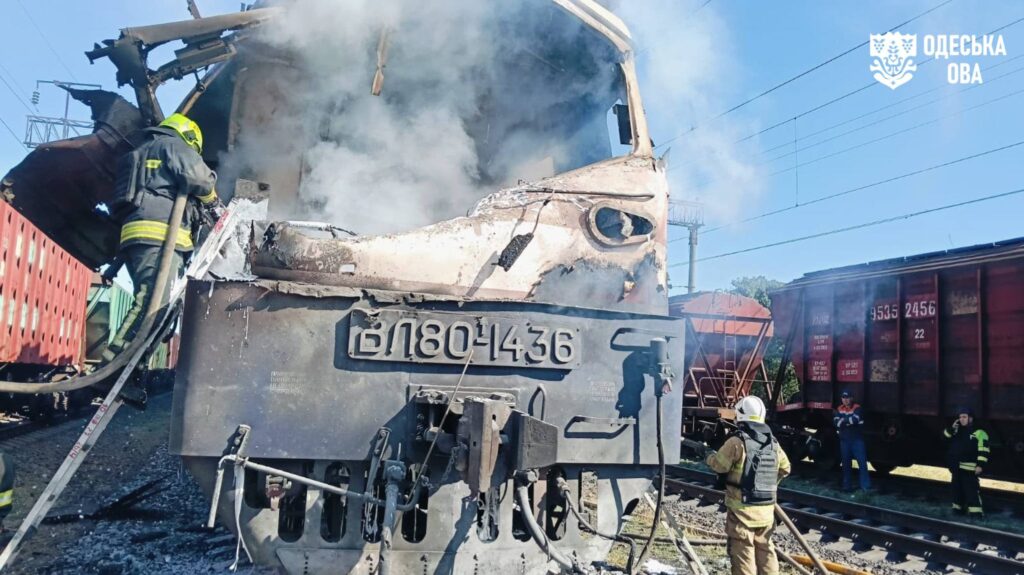
The locomotives carrying that cargo are now among Russia’s main targets.
Ukraine now expects to export 38–40 million tons of grain in the 2026/27 season, down from 43 million before the attacks intensified, Agriculture Minister Taras Vysotskyi told Reuters. Agricultural products generated more than half of the country’s export revenue last year.
By 24 August, the total number of damaged locomotives had risen to 492.
Russia now sends camera-equipped drones to search for trains and redirects others toward rolling stock that their operators spot in flight. The campaign is no longer confined to fixed targets such as stations, bridges, and substations.
Ukraine’s railways keep running. Damaged lines often reopen within hours, while buses carry passengers around closed sections. With far fewer ships calling at the ports, each damaged locomotive leaves the railway less room to absorb the next disruption.
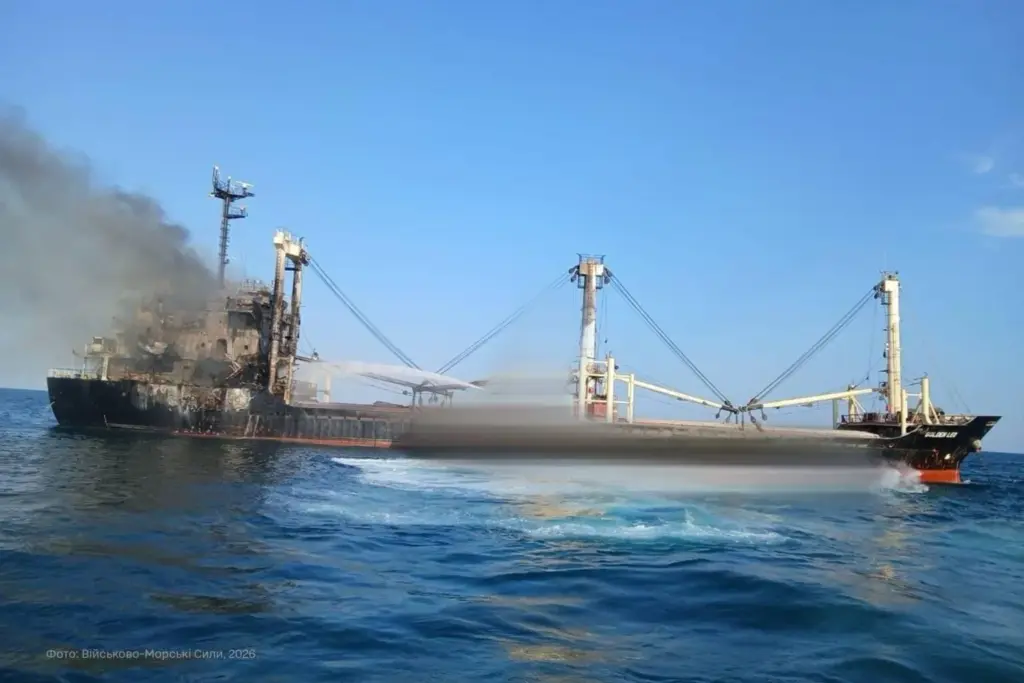
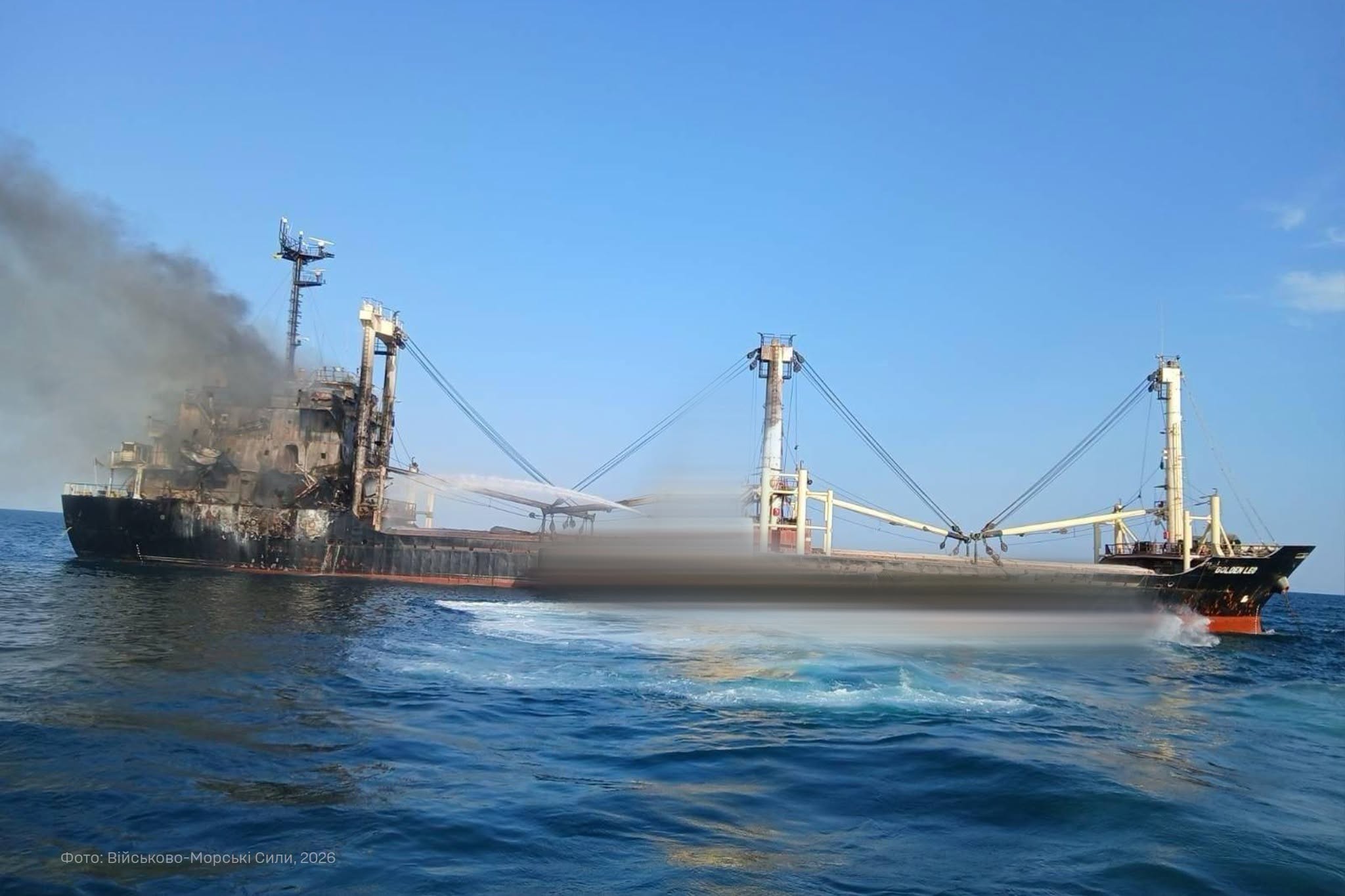
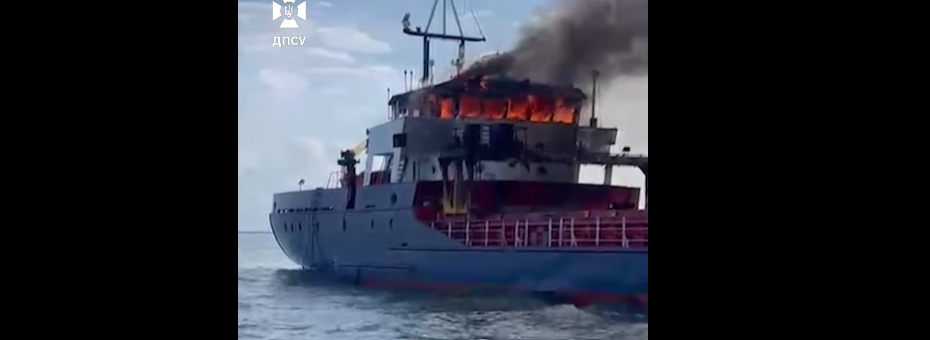
The civilian bulk carrier GOLDEN LEO ablaze after Russian missiles hit it as it left Odesa with a cargo of corn, in the Black Sea, 19 July 2026. Photo: Ukraine’s Navy
Export traffic moves inland
Before the current wave of strikes, the ports of Greater Odesa handled about 80% of Ukraine’s agricultural exports. Rail’s share then rose sharply, but the railway did not carry more grain: Ukrzaliznytsia said 461,000 tons went by rail during the first 25 days of August—67% less than in July and 77% below the corresponding period last year, according to figures reported by Rail.insider. Rail had taken a larger share of a collapsing export flow.
Traffic through the Black Sea corridor collapsed after a series of attacks on civilian vessels in July. One of the deadliest strikes was on the bulk carrier Golden Leo on 19 July, killing 10 people, including a Ukrainian maritime pilot. The ship later sank. On 22 July, for the first time since the sea corridor opened, not a single vessel entered the Odesa ports.
Explore further
Ten dead as Russia strikes a Turkish-owned bulk carrier off Odesa
In July, 169 ships entered, but only 7 did so during the first 11 days of August, the Ukrainian Sea Ports Authority told Kyiv Post. By 24 August, traffic had partly recovered. Three or four ships were entering and leaving the ports of Odesa each day. However, cargo volumes remained three to four times lower than before the intensified attacks, President Volodymyr Zelenskyy pointed out.
Maerskand Hapag-Lloyd suspended feeder services to Greater Odesa in late July and early August, with Maersk rerouting imports to Constanța.
The attacks changed the calculations of shipowners and insurers, even though the ports remained formally open. The late-August recovery shows that Russia did not impose a total blockade, but commercial traffic remained far below its previous capacity.
Ukraine normally moves 4 to 4.5 million tons of farm goods a month; the National Bank of Ukraine estimated in July that alternative routes could initially carry about 2.5 million tons a month. That leaves part of the usual flow with nowhere to go this year—about $2.5 billion in export revenue delayed from the second half of 2026 to the first half of 2027.
The Agriculture Ministry estimates that elevators and grain warehouses with nearly 59 million tons of capacity could be full by early November, leaving an 11-million-ton storage shortfall by the end of autumn.
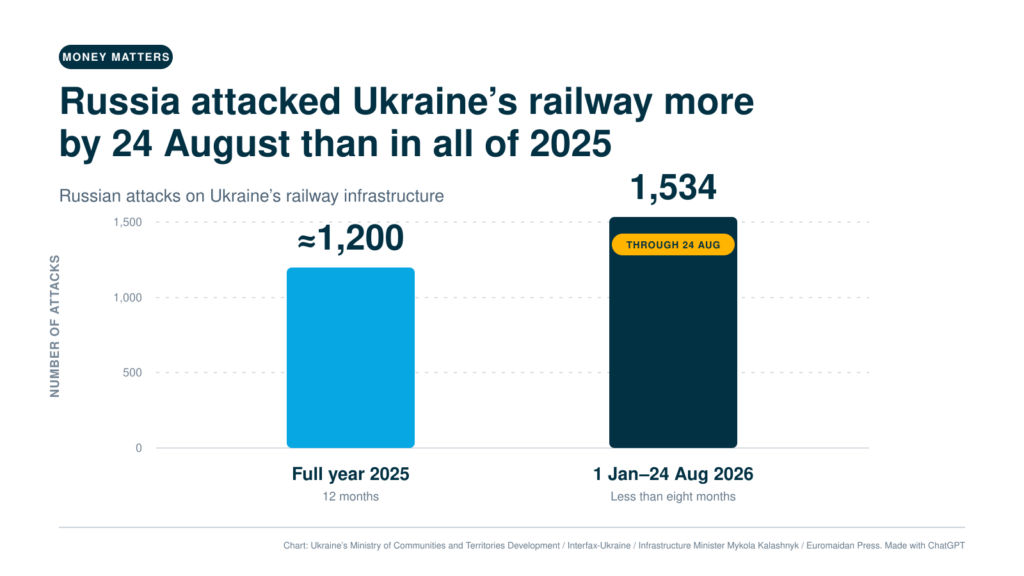
Russian attacks on Ukraine’s railway infrastructure reached 1,534 by 24 August 2026—already exceeding the 1,200 recorded in all of 2025. Chart: Ukraine’s Ministry of Communities and Territories Development / Interfax-Ukraine / Infrastructure Minister Mykola Kalashnyk / Euromaidan Press. Made with ChatGPT.
Russia turned the drones on the trains
Russia is going after locomotives to cut the export corridors that tie the industrial regions around Kryvyi Rih, Zaporizhzhia, and the east to Odesa’s ports and the western border, Ukrzaliznytsia CEO Oleksandr Pertsovskyi told Reuters in June. He also described the method: Russia is using drones with video cameras and remote control, which allow operators to hit rolling stock in real time.
The climb is in the quarterly data: nine locomotives hit in the first half of 2025, 119 in the second, and 81 in the first quarter of 2026.By 15 August, Pertsovskyi put the figure at more than 250 damaged in the previous six months.
In the first quarter alone, Russia struck the railway 541 times, about half its total for all of 2025, damaging 1,718 objects across the network. By 24 August, the number of attacks on railway infrastructure in 2026 had reached 1,534, Infrastructure Minister Mykola Kalashnyk said.
On 19 July, Russia’s Defense Ministry acknowledged a Geran-4 Seeker drone had struck a locomotive hauling Ukrainian military equipment near Volniansk in Zaporizhzhia Oblast the previous day, and released strike footage.
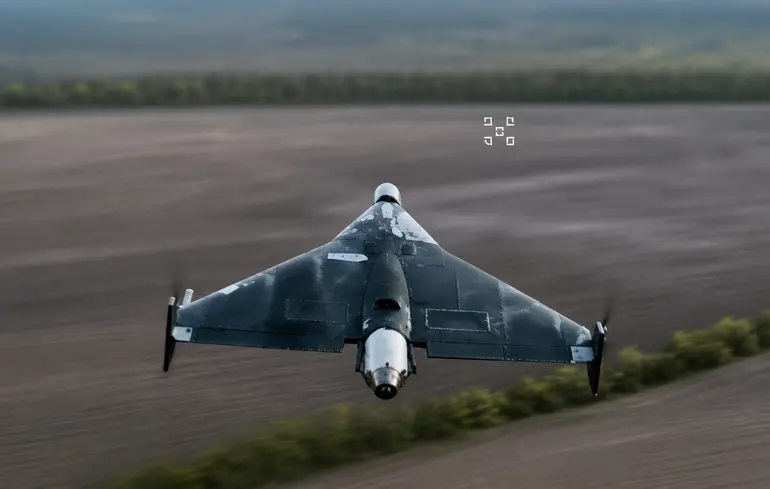
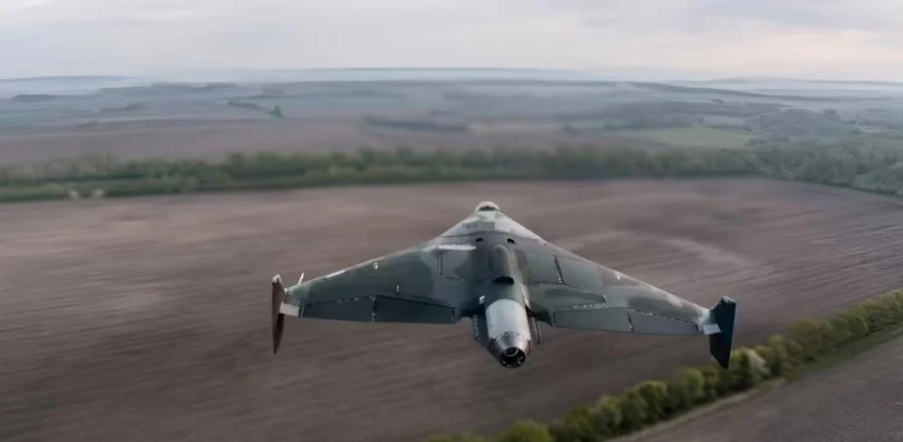
The Geran-4 Seeker sends video to an operator searching for targets. Once the operator selects one, onboard software guides the final approach. Russia says it has used the system against ships near Chornomorsk, but public evidence does not show how many locomotive strikes involved Seeker; moving trains can also be hit by hand-flown drones redirected in flight.
Explore further
A $50 computer just flew Russia’s newest jet drone into a Ukrainian grain ship—and jamming couldn’t stop it
Russia's new "Geran-4 Siker" Shahed variant uses machine-vision AI for targeting. Source: Warhronika
Jammers cannot protect every train
Ukraine has fitted trains with jammers, which Ukrainian drone and electronic-warfare specialist Serhii “Flash” Beskrestnovsays have protected a significant number of trains. But Russian drones use different frequency bands, so each train needs several systems, and even those cannot provide complete protection.
“Whatever we do, drones will periodically hit trains in the frontline zone,” Beskrestnov wrote in March. “As, unfortunately, they will hit buses and civilian cars.”
Seeker is not the only way to hit a moving train. Russian operators have repeatedly redirected hand-flown drones after spotting trains below, Beskrestnov wrote in April. He said military airspace data allows railway dispatchers to change schedules or evacuate passengers when necessary, and that several hundred trains had been moved out of danger.
The cost is not only rolling stock. On 13 August, a jet-powered Shahed struck the locomotive of the Odesa–Dnipro passenger train at Buialyk station in Odesa Oblast, killing the driver, Ivan Shevchyk, and his assistant, Vasyl Morozov, both of the Znamianka locomotive depot.
The monitoring team had flagged the drone and ordered a stop; the train was entering the station so its 340 passengers, 67 of them children, could get off. All of them were evacuated unhurt. “A sharp maneuver by a jet Shahed is a matter of minutes, and the locomotive crew did not have enough time to come to a full stop and evacuate themselves,” Pertsovskyi wrote.
Prosecutors opened proceedings under Article 438 of the criminal code, violation of the laws and customs of war, causing death.
Two days later, Ukrzaliznytsia changed its rules, increasing the distance at which a train is halted and evacuated when a threat appears—a decision Pertsovskyi tied to the growing number of jet drones. Eight railway workers had been killed in the preceding weeks, at Lozova and Erastivka stations and on the train at Buialyk.
Ukraine is going after the equipment that makes the operator’s link work. On 13 and 14 August, Ukrainian forces struck two ground-based relay stations near Zaliznyi Port in Kherson Oblast that transmit control signals between Russian operators and Geran and Gerbera drones, extending their range and steadying the connection, along with five UAV command posts.
Such relays extend the operator-controlled phase of Geran and Gerbera attacks, including variants that may switch to onboard guidance for the final approach.
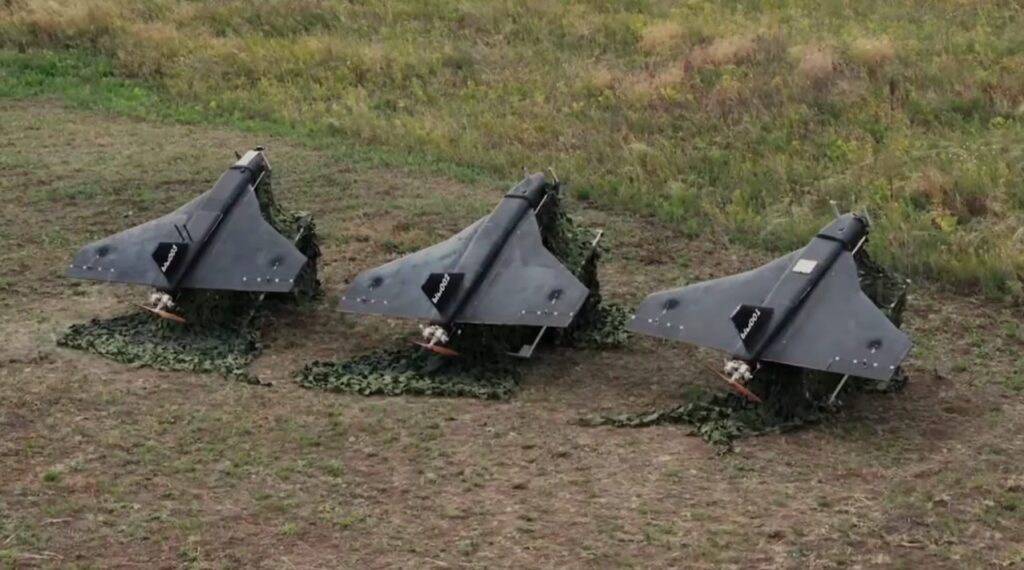
Russia's Gerbera drones. Photo: Gastello Design Bureau
Delays reveal resilience—and attrition
Russia has not carved the railway into islands. When seven drone strikes hit a junction between Dnipro and Zaporizhzhia in a single day on 30 January, wrecking locomotives, wagons, and track, trains were rerouted through Dnipro, and evening passengers were put on buses.
Freight was moving again within a day; passenger service stayed cut longer, judged too dangerous for civilians, Le Monde reported. Track and power lines are repaired quickly, and a diesel engine can stand in where electric traction is out of service.
The cost lands on the rolling stock. A locomotive is harder to replace than track, and some of that loss is already permanent. By April, around 50 of more than 300 locomotives hit since the full-scale invasion had been destroyed beyond repair, Deputy Communities Minister Oleksii Balesta said. By 24 August, the total number of damaged locomotives had risen to 492, Infrastructure Minister Mykola Kalashnyk said.
New locomotives will arrive slowly. The first machines from a 55-locomotive order placed with French producer Alstom through a World Bank tender are due in early 2027 for certification, with the full batch expected by May 2029.
Burned grain truck at an open parking lot in Odesa Oblast following a Russian drone strike overnight on 2 November 2025. Photo: Suspilne Odesa
Rail cannot replace the sea
Even undamaged, the railway could not move as much export cargo across the EU border as the ports did by sea. The EU lines are slower, more expensive, and interrupted by a change in track gauge at the border. The Danube is running too low this summer to float full barges, and road haulage was never more than a sliver of Ukraine’s bulk grain.
The strain reaches past agriculture. Ferrexpo stopped seaborne iron ore pellet exports, the Southern Mining and Processing Plant in Kryvyi Rih cut back, and Ukrzaliznytsia throttled some cargo runs to the Odesa port stations, according to Ukrainian industry reports.
The shortfall does not stay inside Ukraine. Egypt, Algeria, and Indonesia together bought about 8.7 million tons of Ukraine’s wheat last season—roughly 62% of the total, with Egypt alone taking more than a quarter.
A long closure of the deep-water ports would send those import-dependent buyers hunting elsewhere: the trade analytics firm ASAP Agri puts Ukraine’s 2026/27 wheat exports at 5 to 10 million tons if the blockade holds, with buyers like Bangladesh turning to Indian wheat instead.
Ukraine is responding with air defenses around key rail nodes, dispersed locomotives, and repair kits pre-positioned for fast fixes, and its transport ministry has taken a railway-resilience plan to NATO, built on early warning and centralized recovery management.
Russia drove most ships from the sea route, leaving Ukraine more dependent on constrained alternatives, and has been hitting the locomotives serving its rail corridors—more than 250 damaged in six months, some beyond repair. But the railway still functions.
On 14 August, Ukraine's Military Intelligence (HUR) published data on 26 vessels via its War&Sanctions portal, noting that 18 ships face no sanctions from any of Ukraine's partner countries.
The agency said the ships carry Russian oil, liquefied natural gas (LNG), or agricultural products from occupied Ukraine. Euromaidan Press could not independently verify HUR’s vessel records.
Russia relies on maritime trade both to fund its war through energy exports and to s
On 14 August, Ukraine's Military Intelligence (HUR) published data on 26 vessels via its War&Sanctions portal, noting that 18 ships face no sanctions from any of Ukraine's partner countries.
The agency said the ships carry Russian oil, liquefied natural gas (LNG), or agricultural products from occupied Ukraine. Euromaidan Press could not independently verify HUR’s vessel records.
Russia relies on maritime trade both to fund its war through energy exports and to sell crops taken from occupied Ukraine. Kyiv began building a dedicated system against Russia’s shadow grain fleet in April, modeled on its oil-fleet campaign. A US bill introduced this week would also target vessels, owners, insurers, and ports involved in sanctions evasion. HUR’s new list shows how many ships remain outside those restrictions.
Russia’s grain shadow fleet
HUR divided the 26 vessels into three groups:
oil tankers serving Lukoil, Rosneft, Surgutneftegas, Novatek, Tatneft, and Gazprom;
dry-cargo ships using the occupied ports of Berdiansk, Sevastopol, Kerch, and Feodosia;
LNG carriers moving gas from the sanctioned SAAM FSU floating storage unit, which holds LNG from the sanctioned Arctic LNG 2 project.
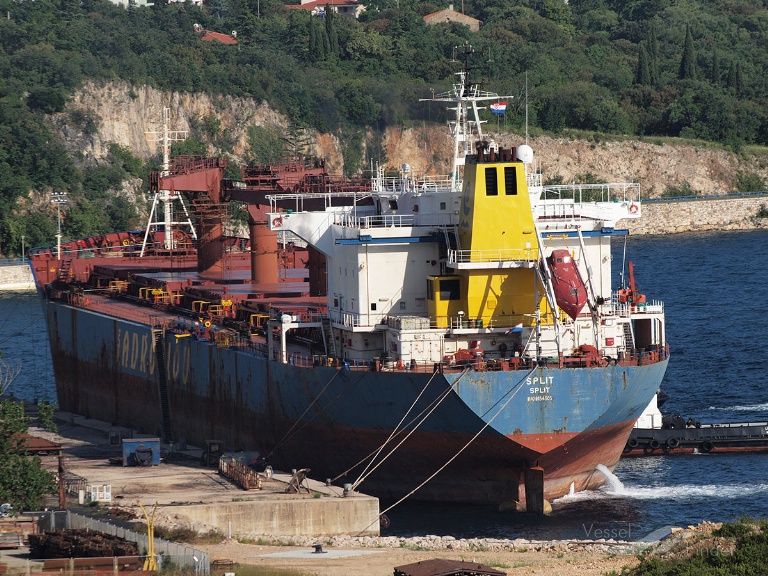
HUR highlighted three of the 18 vessels that are not facing partner sanctions. The bulk carrier LAMAR S repeatedly loaded wheat at the Avlita terminal in occupied Sevastopol in 2026 for delivery abroad, including to Syria, the agency said.
NAYA FALCON carried baking soda and granulated wheat bran from occupied Sevastopol to Egypt and Cyprus, HUR said. The agency linked the oil tanker GREGAL to UAE-based Cymare Navigation FZC, which it described as affiliated with Sovcomflot, Russia’s state-controlled shipping company.
Russia steals grain while striking Ukraine’s exports
Crops taken from occupied land are sold abroad as Russian produce, while Russia's attacks leave Ukraine’s legitimate harvest with fewer routes to market.
Ukraine’s Foreign Intelligence Service said Russia sold more than 2 million tons of grain from occupied Ukraine as Russian produce in 2025. The agency said ship-to-ship transfers at Kavkaz helped conceal its origin.
Meanwhile, Russian attacks have squeezed Ukraine’s legitimate grain trade. Strikes on civilian ships brought the Black Sea corridor to a near standstill during the July harvest peak. Ten people died when Russian missiles hit the grain-laden Golden Leo on 19 July.
HUR called on Ukraine and its partners to synchronize sanctions and detain vessels that violate restrictions. It said the measures could curb Russia’s maritime logistics and war funding.
Ukraine and Moldova are discussing transporting Ukrainian grain by rail through Moldovan territory to the Romanian port of Constanta, an option driven by intensified Russian attacks on shipping in the Black Sea, according to unnamed sources in both countries cited by Reuters.
The talks come as Russian strikes on vessels using the Black Sea corridor have disrupted traffic during the harvest season and forced Ukraine to cut its export forecast. On 22 July, no ship passed
Ukraine and Moldova are discussing transporting Ukrainian grain by rail through Moldovan territory to the Romanian port of Constanta, an option driven by intensified Russian attacks on shipping in the Black Sea, according to unnamed sources in both countries cited by Reuters.
The talks come as Russian strikes on vessels using the Black Sea corridor have disrupted traffic during the harvest season and forced Ukraine to cut its export forecast. On 22 July, no ship passed through the corridor at all, and the country's agriculture ministry has already lowered its projection for the 2026–2027 season by up to five million tons.
Discount sought, volume guarantees demanded
Kyiv is asking for a discount of 50 percent off the nominal rate to transport its grain, according to the agency's sources. A source at Moldovan Railway said Moldova responded with a counterproposal: guarantees from Ukraine on the volumes of grain it would transport through the route.
"We are currently collecting information on potential volumes from interested shippers. The information-gathering process has not yet been completed," a senior Ukrainian industry official told Reuters.
Ukraine expects corridor to cover 10 percent of exports
Ukraine estimates the Moldovan corridor could handle 10 percent of its grain exports. Agriculture Minister Taras Vysotskyi said earlier that his ministry had lowered its grain export forecast for the 2026–2027 season from 43 million tons to 38–40 million tons because of Russian attacks on ports.
Ministers discuss rail links
A day before the Reuters report, Moldova's Minister of Infrastructure and Regional Development, Vladimir Bolea, visited Ukraine's Odesa region and met with his Ukrainian counterpart, Mykola Kalashnyk, to discuss improving rail connections and expanding the transit network between the two countries.
Moldova's premier defends transit revenue
Moldovan Prime Minister Vasile Tofan said his country should not pass up the opportunity to earn millions of euros from transiting Ukrainian grain cargo. He dismissed suggestions by Moldovan farming groups that Ukrainian grain prices would depress the value of their own produce.
"Let's not look for enemies where there are none," he said on Moldovan television.
Russian attacks on shipping
Russia intensified strikes on vessels using the Ukrainian Black Sea corridor in July. On 13 July, Russian forces struck a civilian ship flying the flag of Togo while it was unloading mineral fertilizer off the coast of Odesa region, killing five crew members and injuring five others.
The following day, 14 July, Russia attacked two civilian vessels in the Black Sea — cargo ships flying the flags of Tanzania and Liberia. The captain of one of the ships was killed. On the evening of 17 July, a vessel flying the flag of the Marshall Islands was struck. Attacks continued afterward.
On 22 July, no vessel passed through the sea corridor. The Ukrainian government called the disruption "deliberate economic and humanitarian terror," coming at the height of the harvest season.
Ukraine convened an urgent session of the UN Security Council over the attacks, calling on all states — particularly those "which this directly concerns" — to demand that Russia stop striking shipping. Separately, the Southern Mining and Processing Plant (Pivdennyi HZK) announced it was suspending extraction and temporarily scaling back operations.
Ukraine's Ministry of Agrarian Policy and Food has asked the European Commission for €220 million ($253 million) in grants to keep its small and medium farmers afloat, after Russian strikes on the Greater Odesa ports severed the sea route that carries most of the country's agricultural exports. The money would cover interest on loans issued under the state "Affordable Loans 5-7-9%" program, the ministry's press service said.
The request marks the point where Russia's Bl
Ukraine's Ministry of Agrarian Policy and Food has asked the European Commission for €220 million ($253 million) in grants to keep its small and medium farmers afloat, after Russian strikes on the Greater Odesa ports severed the sea route that carries most of the country's agricultural exports. The money would cover interest on loans issued under the state "Affordable Loans 5-7-9%" program, the ministry's press service said.
The request marks the point where Russia's Black Sea campaign stopped being a shipping story and became a farm-finance one. With the corridor all but stalled, the ministry projects exports for the 2026/2027 season could fall by almost half, from 64.4 million to about 29.6 million tonnes. Grain the farmers have already harvested is piling up in silos the ministry expects to be full by October, and without cash from those sales, producers cannot finance the autumn sowing that plants next year's crop.
How €220 million turns into €4 billion in loans
The grant is small next to the hole it is meant to plug. Ukraine estimates its farm sector will take in roughly €6.4 billion this season against €11.2 billion in operating costs, and will need about €4 billion in working capital just to keep running. The €220 million would not cover that gap directly. Instead, by subsidizing interest, it is designed to unlock a credit portfolio of up to €4 billion ($4.6 billion) at a rate to farmers of no more than 10%, open to small and medium producers that meet the program's environmental and social criteria. Wheat exports alone could otherwise drop from 17.6 million to 8.3 million tonnes.
The blockade behind the request
Through July, Russia intensified strikes on civilian cargo ships in the Black Sea corridor, killing crew members and, on 22 July, halting traffic entirely — not a single vessel passed that day, at the height of the harvest. Ukraine's government called it "deliberate economic and humanitarian terror." Around 90% of Ukraine's farm exports normally move through three Odesa Oblast ports, and Agriculture Minister Taras Vysotskyi has said the rail, road, and Danube routes that remain can carry only about half the lost volume.
The squeeze is already reaching the fields. Oilseed and grain prices have fallen about 30% as unsold stock backs up inside the country, and the ministry puts direct losses to the sector this year at between $1.5 billion and $3 billion. The government has lowered minimum export prices on some products to keep trade moving, and Prime Minister Serhii Koretskyi has said it is expanding a separate program of grain-backed loans so farmers can borrow against stored crops rather than sell them cheap.
Whether Brussels funds the €220 million request, and how fast, will help decide how much of this year's harvest gets planted — and how much stays stranded in silos while the ports stay shut.

 Connexion