Vue normale

Ukraine asks the EU for €220 million to unlock €4 billion in farm loans as Russia’s port strikes choke exports

13 août 2026 à 12:10

A green combine harvester cuts wheat beneath a blue, partly cloudy sky.

Ukraine and international partners agreed to work urgently on a mechanism for up to €4 billion ($4.6 billion) in farm loans, Ukrinform reported on 13 August. The plan would use a proposed €220 million ($253 million) EU grant, the Agriculture Ministry said.

Ukraine rebuilt its maritime trade after pushing Russia’s fleet away from its coast. By 2025, its Black Sea route carried about 92% of the country’s grain and oilseed exports. Russia is now striking the Odesa ports sustaining that recovery. The ministry says the attacks have closed three deep-water ports. Ukraine planned to export 64.4 million tons of agricultural products in 2026/27, but now says shipments may reach only 29.6 million tons. The proposed loan mechanism is meant to cover that cash shortfall before next year’s sowing.

EU and Norwegian diplomats joined the meeting with representatives of the World Bank and the UN Food and Agriculture Organization.

The participants agreed to develop the plan through the Ukraine Facility and EU guarantee institutions. They aim to do so in the coming weeks, before fall storage use peaks. The grant has not yet been approved.

Odesa attacks send Kyiv toward Baltic ports

The loan plan comes as Russia’s attacks force Ukraine to seek new export routes.

Russia initially blockaded Ukraine’s ports after launching its full-scale invasion. Ukraine later restored a sea corridor after forcing much of Russia’s Black Sea Fleet away. Moscow then shifted pressure to missiles and drones, hitting Ukrainian ports 90 times in 2025 and intensifying attacks this summer.

A Russian strike killed 10 people aboard the grain-carrying Golden Leo on 19 July. Three days later, no ship passed through the corridor.

Kyiv is now considering the Polish Baltic ports of Gdańsk, Gdynia, Szczecin, and Świnoujście. Yet the ministry estimates that all alternative routes may eventually carry only 2.9 million tons a month. Ukraine’s monthly target was 5.4 million tons.

Farm loans target next year’s sowing

The €220 million would not go directly to growers. It would subsidize interest and partly cover banks’ lending risks, including by expanding Ukraine’s “5-7-9%” affordable-loan program.

The ministry wants the support to generate €4 billion in farm loans at annual rates no higher than 10%. It calculates that every euro of grant money could mobilize more than €18 in lending.

Ukraine has also temporarily adjusted minimum export price coefficients to offset higher logistics costs, meeting participants noted. Without grain sales, farmers struggle to pay wages and land rents or buy fuel and fertilizer. By November, Ukraine's storage shortfall could reach 11 million tons of crops, with more than €10.8 billion ($12.4 billion) tied up in unsold stocks.
  • ✇Euromaidan Press
  • Russia’s Odesa strikes halve Ukraine’s grain export forecast
    Ukraine’s Agriculture Ministry has cut its forecast for agricultural exports in 2026–2027 by 54% as Russian attacks disrupt shipping through Odesa’s ports, Bloomberg reported. The ministry now expects 29.6 million tons of agricultural exports, down from 64.4 million. Its wheat export forecast fell by 53%, from 17.6 million tons to 8.3 million tons. Ukraine grows far more grain than it consumes, exporting 65%–70% of its agricultural output. Bloomberg said the sector
     

Russia’s Odesa strikes halve Ukraine’s grain export forecast

11 août 2026 à 13:47

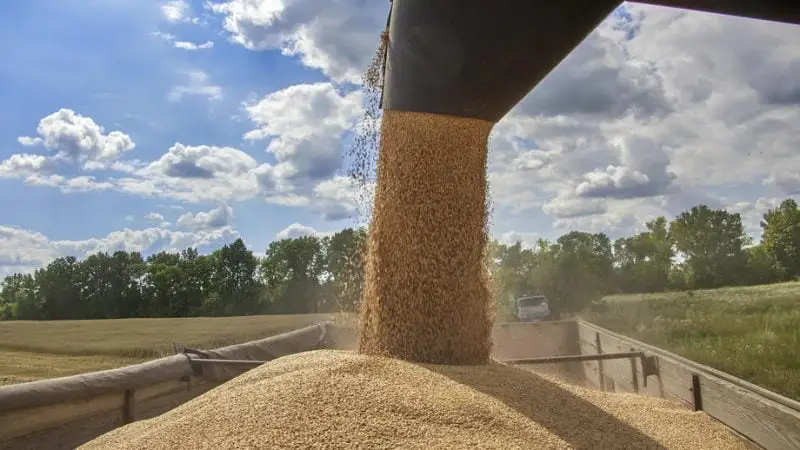
Grain pours from a combine harvester into a trailer during harvest in Ukraine.

Ukraine’s Agriculture Ministry has cut its forecast for agricultural exports in 2026–2027 by 54% as Russian attacks disrupt shipping through Odesa’s ports, Bloomberg reported.

The ministry now expects 29.6 million tons of agricultural exports, down from 64.4 million. Its wheat export forecast fell by 53%, from 17.6 million tons to 8.3 million tons.

Ukraine grows far more grain than it consumes, exporting 65%–70% of its agricultural output. Bloomberg said the sector generated more than half of Ukraine’s export revenue last year. But Russia’s summer attacks have stalled the sea corridor as the harvest arrives, driving some wheat prices below production costs. Land and river routes cannot match the Black Sea shipping capacity, while sales through neighboring EU states remain politically contested. That leaves farmers with less money for the next sowing and further reduces Ukraine’s export income.

Ukraine has about 59 million tons of grain storage. That storage could be full by early November, leaving the country 11 million tons short of space by the end of fall 2026. 

Wheat sells below cost as the silos fill up

Ukraine’s export bottleneck is already hitting its farmers. Port prices fell by another 12-15% in one week, while some farmers sold wheat below production cost. When ships stop, traders either stop buying or pass the higher cost of alternative routes on to producers. That leaves farmers with less cash for fall sowing.

To ease the pressure, the government has approved subsidized loans for agricultural producers. President Volodymyr Zelenskyy said Kyiv would expand storage. Ukraine's Agriculture Ministry has also asked the European Commission for €220 million to help cover interest for small and medium-sized farms.

Ukraine and Moldova are discussing a rail route to Romania’s Constanța port. According to the report, grain was already being redirected through Romania, Slovakia, and Hungary, but these routes cannot replace Odesa’s capacity.

Now the ports and the ships are Russia's targets

The export bottleneck is only part of the problem. Russia’s bombardment also threatens the ports, civilian ships, and crews needed to keep the corridor operating. 

The port of Odesa normally handles about 90% of Ukraine’s grain shipments. Russia intensified attacks on terminals and civilian ships in July 2026 as the harvest reached the coast.

On 19 July, three Russian missiles struck the foreign-flagged Golden Leo as it left Odesa carrying corn, killing 10 people, including a Ukrainian sea pilot. Three days later, no vessel passed through the corridor.

Alternative routes offer little relief, as record-low Danube levels were restricting river traffic. Poland continues to bar Ukrainian grain from its domestic market. Those constraints leave more of the harvest inside Ukraine and farmers with less money to plant the next crop.

❌