Trump’s Summer of Fun Ends With IndyCar Race on Streets of D.C.

© Alex Kent/The New York Times

© Alex Kent/The New York Times

© Alex Kent/The New York Times

© Andrej Isakovic/Agence France-Presse — Getty Images

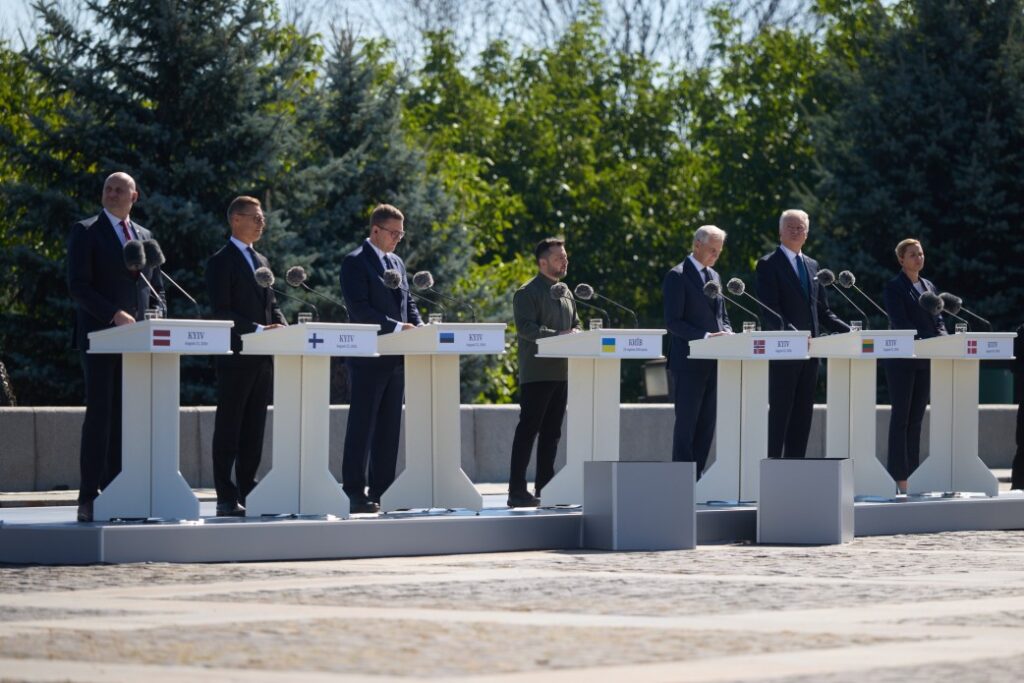
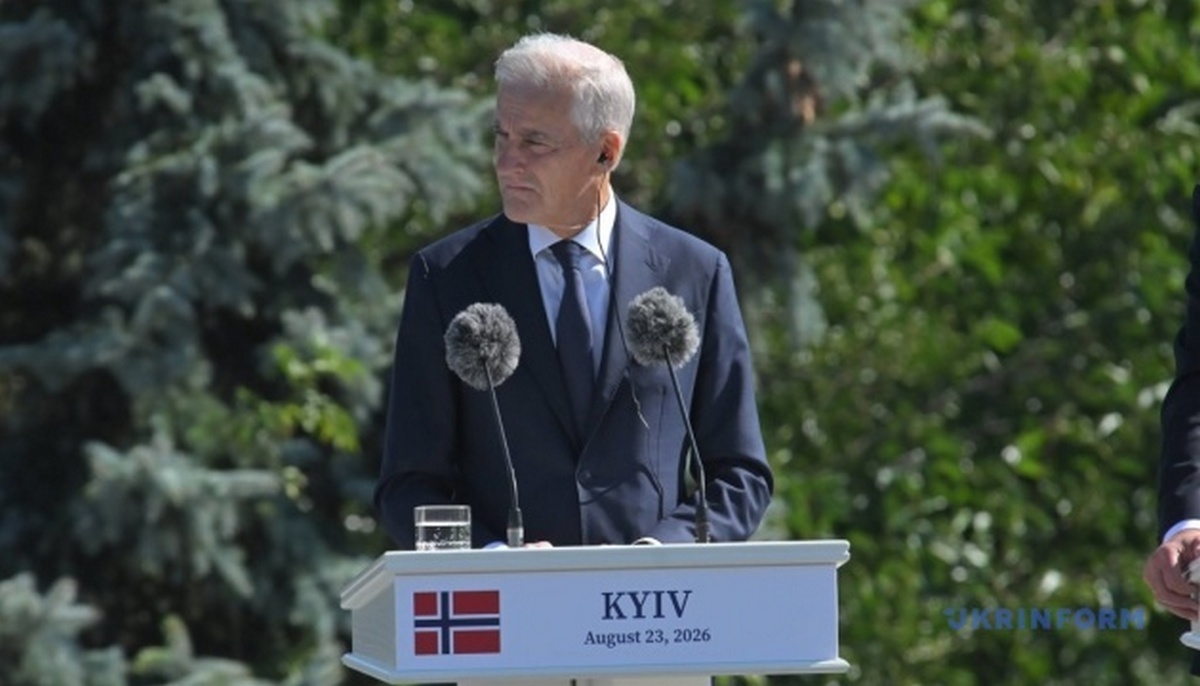
On 23 August, Norwegian Prime Minister Jonas Gahr Støre said Norway will keep Ukraine aid unchanged in 2027, Ukrinform reported. He spoke during Ukraine’s State Flag Day ceremony in Kyiv, attended by six Nordic-Baltic leaders. Ukrainian President Volodymyr Zelenskyy thanked them and tied the flag to Ukraine’s resistance against Russia’s war.
Norway's PM Støre put Norway’s 2027 assistance at about $9 billion, the same level as this year. It will cover military, humanitarian, and financial support.
“In 2027, we will maintain aid at the same level as this year—approximately $9 billion,” Støre said.
He said every party in Norway’s Parliament supports continued aid. Støre also said the package would follow Ukrainian priorities. He noted that supporting and rebuilding Ukraine is not just aid but an investment in Europe's own security.

Støre said Norway and Ukraine were due to sign a strategic partnership declaration later on 23 August. He said it would put cooperation on a long-term footing and benefit both countries.
On Kyiv's Poshtova Square, the little bronze boys who founded the city got dressed up for the holidays.
— Euromaidan Press (@EuromaidanPress) August 23, 2026
For National Flag Day and Independence Day, the sculptures known as "Kids, founders of Kyiv" were given new outfits—embroidered shirts and costumes sewn by the artist's wife,… pic.twitter.com/uy3kL0KUde
Ukraine marked State Flag Day on 23 August, one day before Independence Day. In his address, President Zelenskyy pointed to the historic Independence Flag displayed at the ceremony. Ukrainians carried that flag into Parliament after restoring independence on 24 August 1991.
Zelenskyy said Ukrainians had preserved their blue-and-yellow symbol through 70 years of Soviet rule. He then connected it directly to Russia’s invasions.
“In 2014 and in February 2022, Russia attacked to take away this flag, our symbols, our freedom and independence,” Zelenskyy said.
He also thanked the Nordic-Baltic leaders standing alongside him. The visitors came from Denmark, Estonia, Finland, Latvia, Lithuania, and Norway.
Ukraine marks the 35th anniversary of restoring its independence tomorrow, on 24 August.
Ahead of our Independence Day, we feel we are not alone. Our allies are with us.
— Andrii Sybiha
Today in the morning, I was pleased to welcome leaders of Denmark, Estonia, Finland, Latvia, Lithuania, Norway, alongside other high representatives, at the Kyiv Railway Station.
They will hold… pic.twitter.com/NmPgIVH1g3(@andrii_sybiha) August 23, 2026
The 2026 Nansen Program covers Norwegian support for Ukraine’s military and civilian needs.

© Ettore Chiereguini/Associated Press

© Lisi Niesner/Reuters

© Laura Stevens for The New York Times

© Rashide Frias/Agence France-Presse — Getty Images

© Maciek Nabrdalik for The New York Times

© Wade Payne/Associated Press

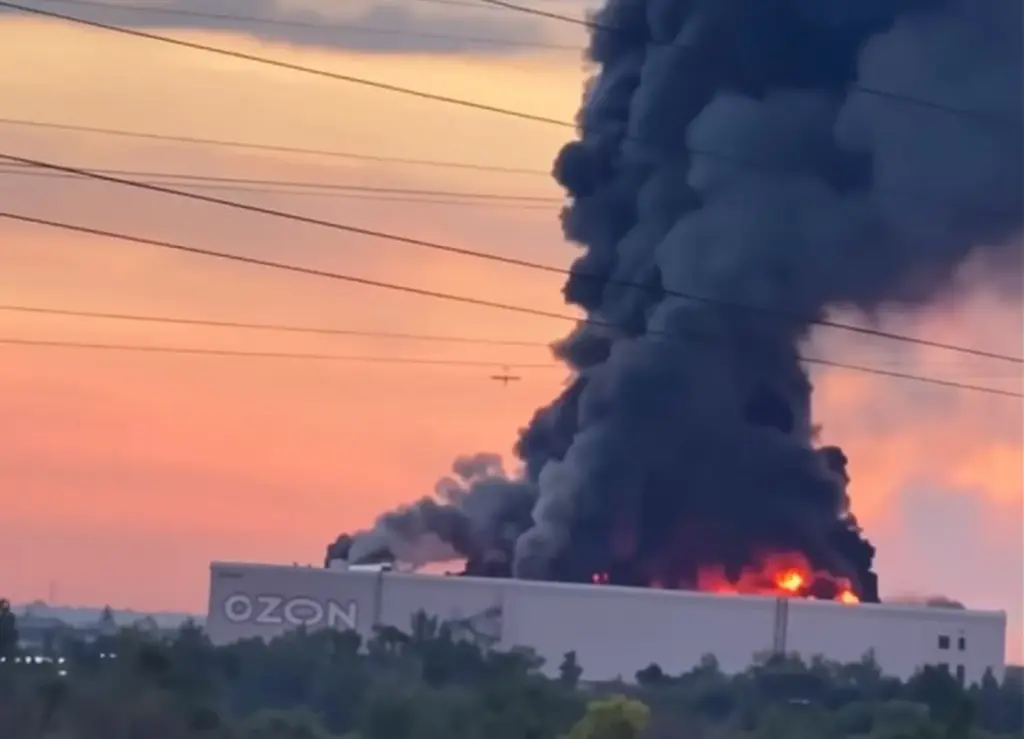
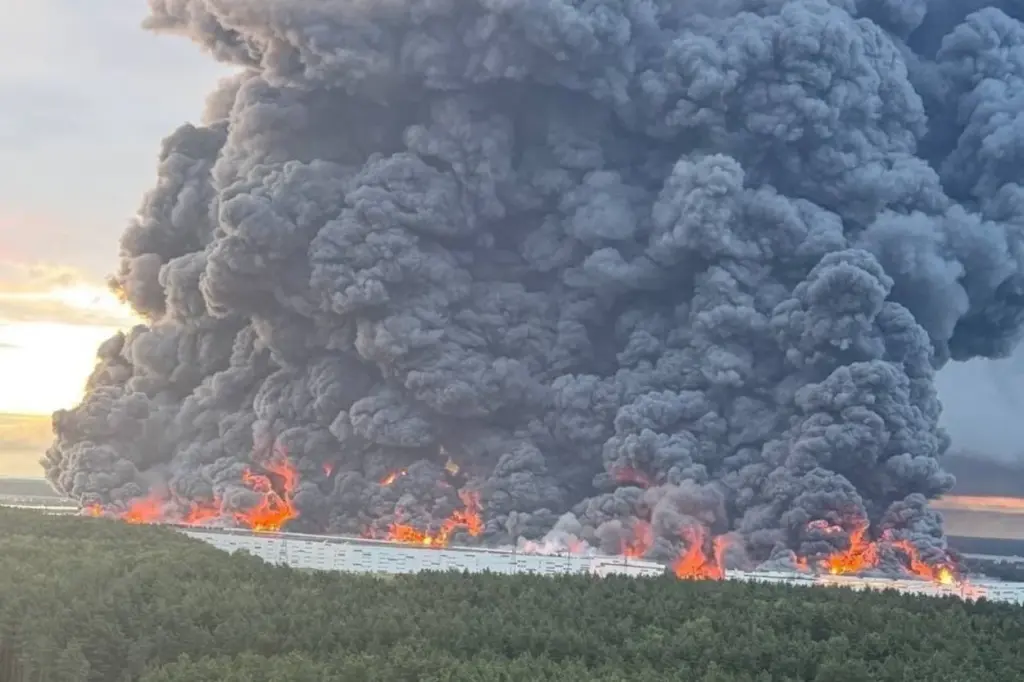
Ukrainian FP-1 drones struck an Ozon warehouse in Chapayevsk, Russia’s Samara Oblast, overnight on 22 August 2026, manufacturer Fire Point said.
The attack on the Chapayevsk facility expands Ukraine’s warehouse campaign from Wildberries, Russia’s largest online marketplace, to its second-largest rival, Ozon. Ukraine has repeatedly targeted Russia's major e-commerce distribution hubs to disrupt commercial logistics that Kyiv says help sustain Moscow’s war.
Ozon said the attack injured people and prompted the evacuation of more than 500 employees.
The strike was the first confirmed Ukrainian attack to damage and set fire to an Ozon warehouse, Reuters reported. A drone alert forced Ozon to evacuate a facility in Tatarstan on 31 July, but the building was undamaged and later reopened.
Fire Point said the facility is one of Ozon’s largest warehouses in Volga Oblast, storing goods and processing more than 215,000 orders for delivery each day.
Ozon and Wildberries—Russia’s two largest online marketplaces—and their smaller rivals collectively sell goods and services worth the equivalent of 8.5% of Russia’s GDP and employ 4 million people, Reuters reported in July.
Ozon suspended operations indefinitely and stopped accepting seller deliveries, the company said. As a result, shipments are being redirected to other facilities, while affected orders will either be fulfilled elsewhere or canceled and refunded.
Several people were receiving medical treatment, Samara Oblast Governor Vyacheslav Fedorishchev claimed. Neither he nor Ozon specified how many people were injured, and the extent of the damage remains unclear.
Ukrainian drones had previously concentrated on Wildberries, Russia’s largest online retailer. Since 18 July, Ukraine has struck at least two dozen Wildberries warehouses, Reuters reported.
Ukrainian officials have alleged that Wildberries warehouses move military-linked goods, including drone components. The Kremlin has denied that the company supplies Russian forces. Fire Point made no corresponding claim about the Ozon warehouse.

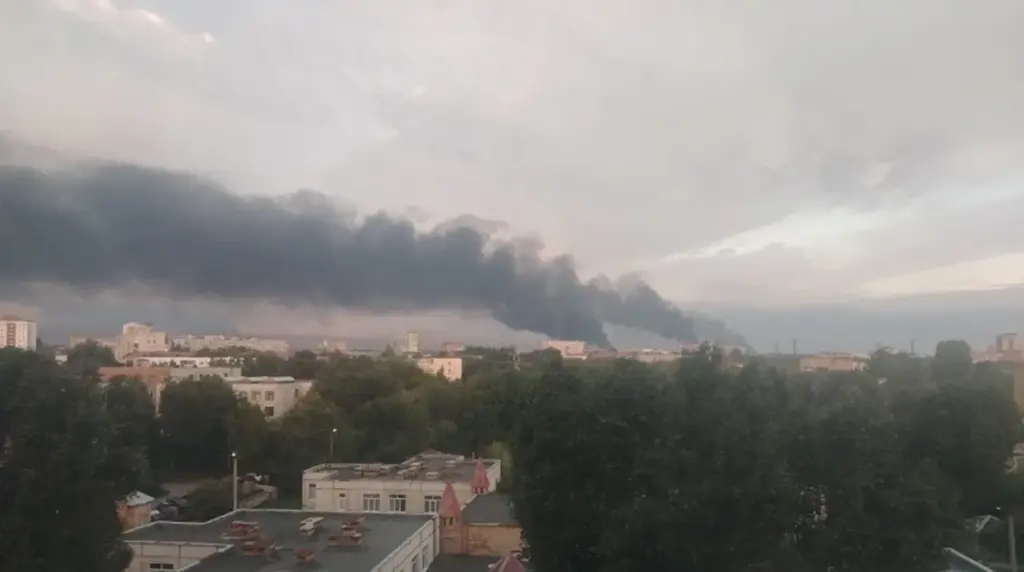
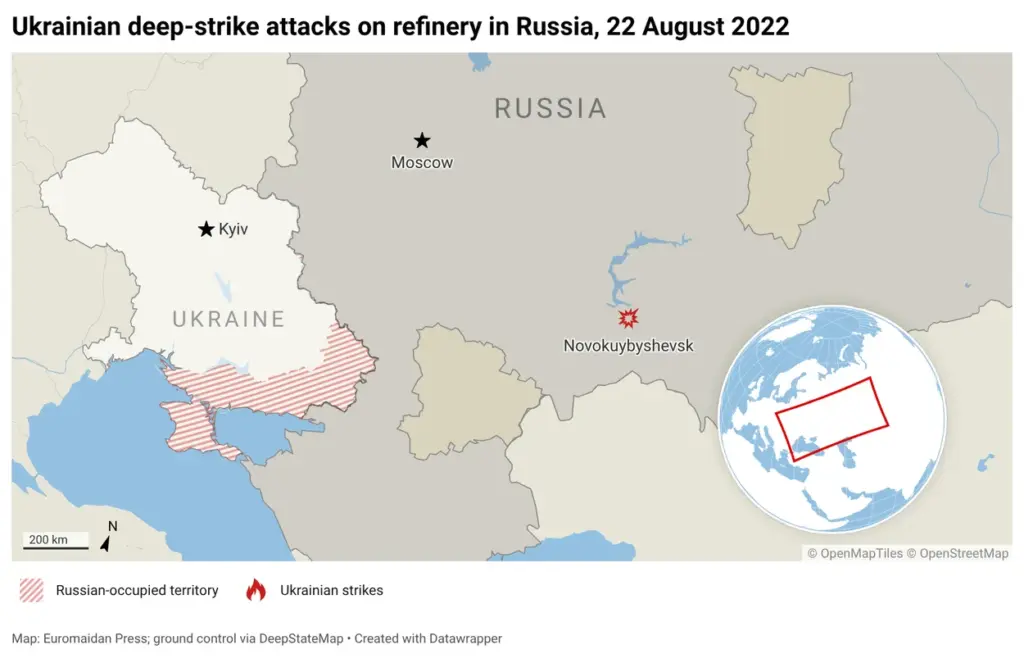
Ukraine’s military said the same overnight wave also hit the Novokuibyshevsk refinery in Samara Oblast and caused a fire.
Russian and occupation officials claimed that the broader wave caused civilian deaths and injuries in Yeysk, Belgorod, Bryansk, and Russian-occupied Luhansk.

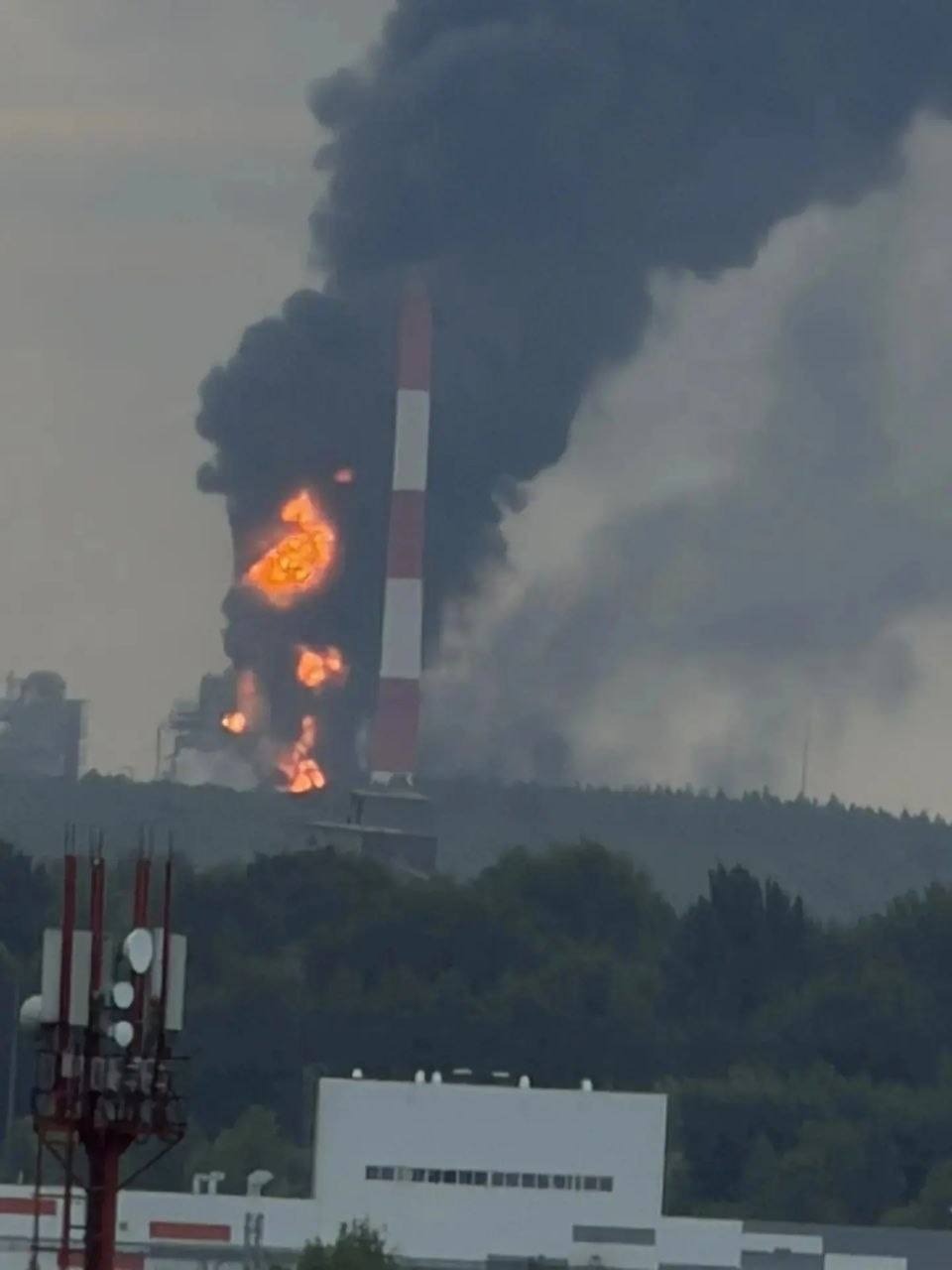
Ukrainian forces struck production facilities at the Novokuybyshevsk oil refinery in Russia’s Samara Oblast overnight on 22 August, sparking a fire at the Rosneft-owned plant, Ukraine’s General Staff said. The extent of the damage remains under assessment.
Ukraine has repeatedly targeted Russia’s oil refineries to restrict military fuel supplies and reduce the energy revenues supporting Moscow’s war. The latest strike came as gasoline rationing returned to Moscow and St. Petersburg, and Rosneft capped nationwide purchases. Militarnyi described the plant as one of Russia’s 10 largest refineries.
The Rosneft-owned refinery can process about 8.8 million metric tons of crude annually and produces more than 20 petroleum products, including aviation fuel and diesel, Ukraine’s General Staff said.
Fire Point said FP-1 long-range drones were used to strike the refinery.

The same overnight wave also hit an Ozon logistics center in Chapayevsk, where people were injured, and work was halted, Reuters reported, citing the company.
Novokuybyshevsk Oil Refinery last night and now. pic.twitter.com/aZmL7M8wBe
— Exilenova+ (@Exilenova_plus) August 22, 2026
Neither the damage to the refinery nor any interruption to production has been independently confirmed.
The strike came one day after Ukraine confirmed hitting Lukoil’s Perm refinery, approximately 1,530 kilometers from Ukraine’s northern border. That attack also caused a fire, according to the General Staff.
At least four Russian refineries went offline during August amid continuing Ukrainian attacks.
By mid-August, filling stations in at least 12 Russian regions were experiencing hours-long lines. Some areas had reintroduced purchase limits or rationing based on license-plate numbers, according to the same report.
Gasoline limits had also been reinstated in Moscow and St. Petersburg, while Rosneft had capped sales at 30 liters per vehicle across its nationwide filling-station network. Diesel purchases remained unrestricted.

Russia has struck Kyiv and its suburbs with ballistic missiles for a second consecutive day, killing civilians. Meanwhile, Ukraine lacks enough interceptors to stop them because deliveries from the US have halted.
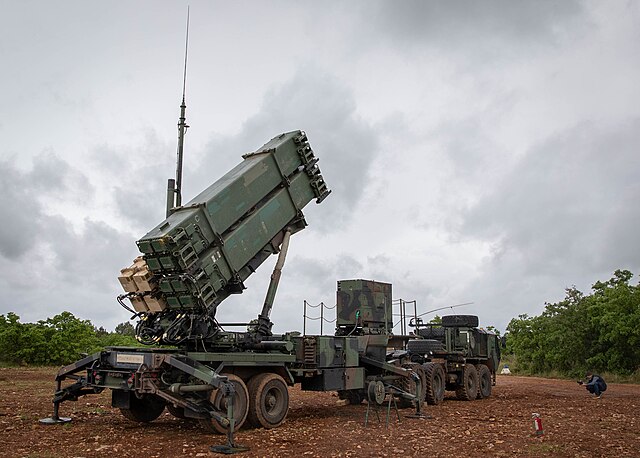
The strikes land at a moment when Ukraine's ability to shoot ballistic missiles down has been cut off at the source. Ukraine intercepts ballistic missiles mainly with US-made Patriot systems. During the recent Oval Office meeting, President Donald Trump declined President Volodymyr Zelenskyy's request for hundreds of additional Patriot interceptors, according to the Financial Times.
At the same time, when Ukraine sought to destroy Russia's ballistic launchers on Russian territory, US billionaire Elon Musk did not allow Ukraine to use Starlink to guide strikes on those launchers, The Atlantic reported. Ukraine can neither shoot the missiles down at the rate it needs nor freely strike the launchers that fire them.
The overnight attack hit Ukraine's railway. On the night of 22 August, a Russian ballistic missile struck a railway enterprise in Kyiv's Darnytsia area, killing a Ukrzaliznytsia worker, the railway's board chairman Oleksandr Pertsovskyi said.
He described a strike timed to the threat.
"In Darnytsia, ballistic strikes hit one of the railway enterprises, at the same moment as, or even a second before, the ballistic threat appeared. One of our workers, a foreman, was killed on the spot. The rest we managed to evacuate quickly after the first strike," Pertsovskyi reported.
Russia launched about six ballistic missiles, with launches recorded from three directions, Kursk, Bryansk, and Millerovo, according to monitoring channels.
Russia struck again in daylight. In the morning, six to eight ballistic missiles attacked the Boryspil area in the Kyiv agglomeration, likely with cluster warheads, according to monitoring channels. Boryspil city is home to the Boryspil International Airport, Ukraine’s main and largest international passenger airport.
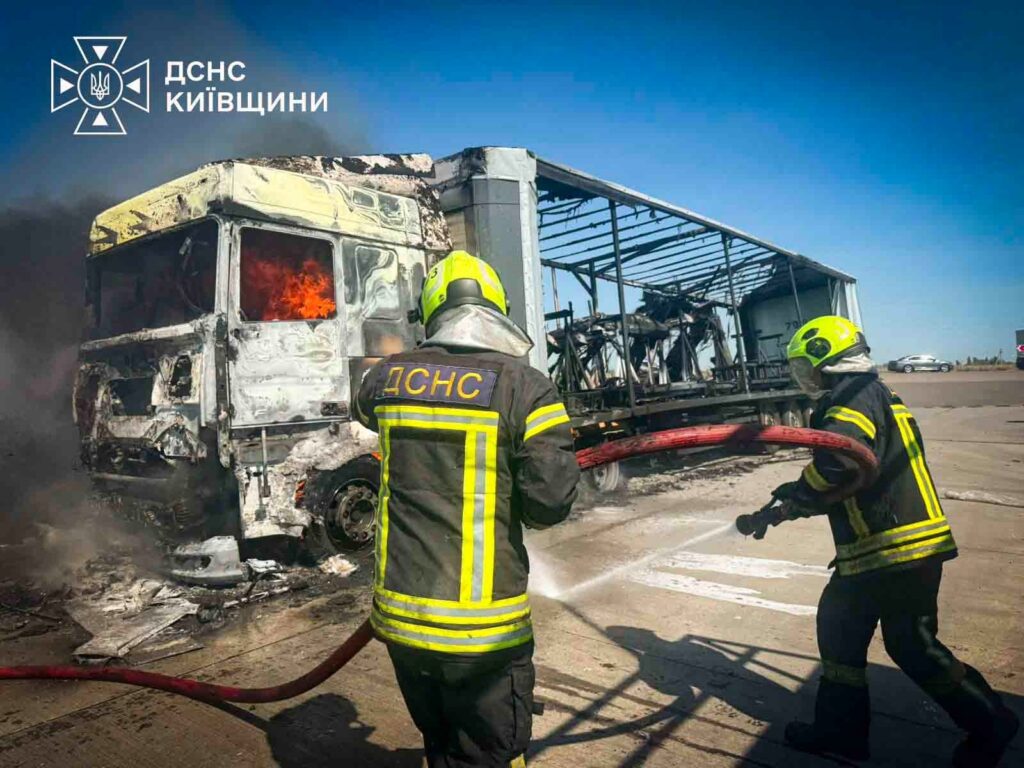
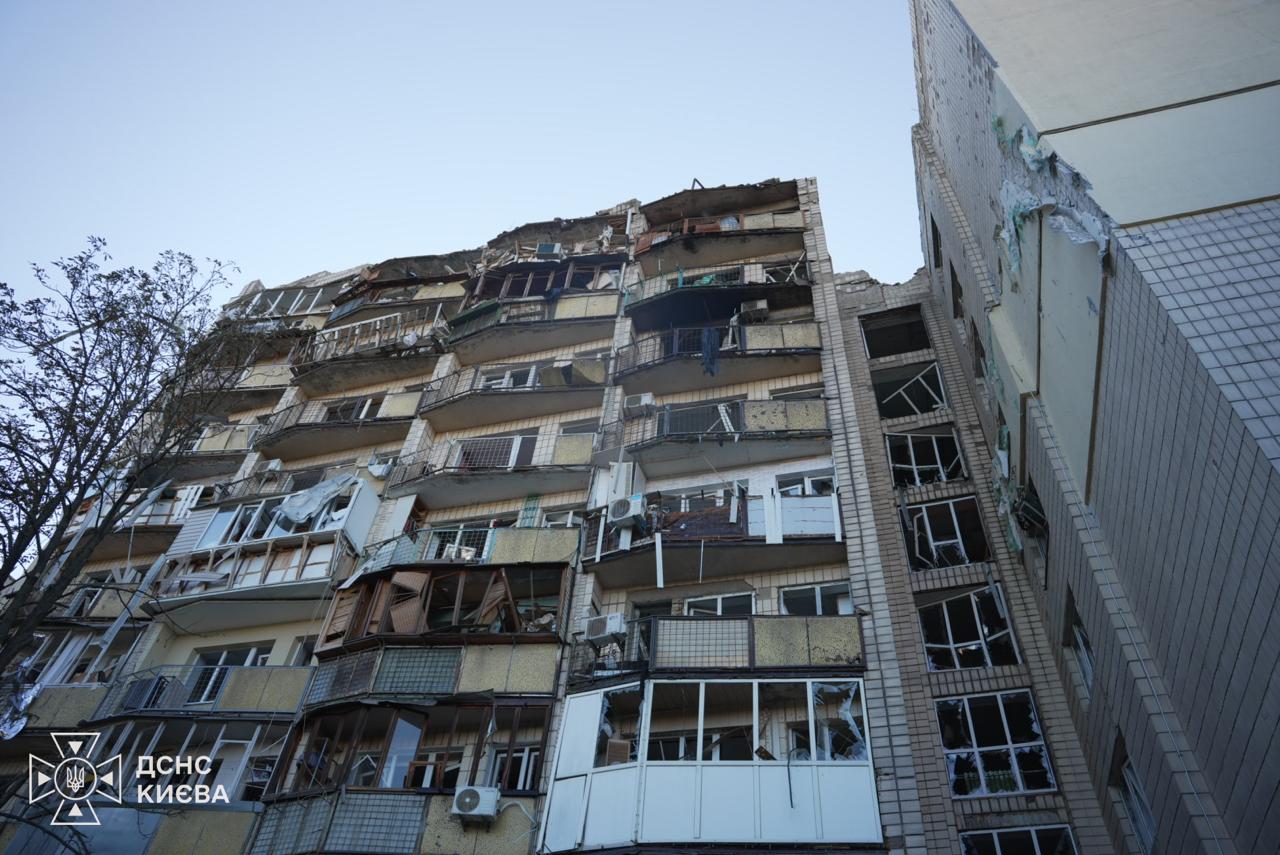
The strike killed civilians and hit infrastructure. Two civilians, a man and a woman, were killed, and the number of wounded rose to eight, including a child, with the daytime strike hitting a truck parking lot along with warehouses, a fuel station, a private household, and vehicles. Two trucks caught fire, and a blaze spread across 700 square meters of open ground, the State Emergency Service (DSNS) said.
The attacks landed two days before Ukraine marks its Independence Day. The Security Service (SBU) has already urged citizens to be especially vigilant before and during the 24 August holiday because of the threat of attacks, warning that in wartime, Russia may use mass events for strikes, provocations, sabotage, cyberattacks, and other crimes.
The service has also warned against recruitment. It reminded Ukrainians not to publish photos or videos of military objects, critical infrastructure, checkpoints, or air-defense systems, nor to share information on the consequences of strikes or the movement of Ukrainian forces.
Russian special services may try to recruit Ukrainians to prepare attacks and sabotage, the SBU said, urging anyone offered money for arson, property damage, planting unknown objects, or collecting information on military sites to report it immediately.

© Dylan Martinez/Reuters

© Mindaugas Kulbis/Associated Press

© Ajit Solanki/Associated Press

© Jeff Chiu/Associated Press

© Mark Godfrey/Associated Press

© Eduardo Verdugo/Associated Press

Russia is deploying six launchers for North Korean ballistic missiles in Voronezh Oblast, the Institute for the Study of War (ISW) reported on 20 August. The assessment cited Ukraine’s military intelligence agency (HUR).
Russia has already used North Korean missiles in deadly strikes across Ukraine, and Pyongyang is supplying more of them. From Voronezh Oblast, the weapons could threaten Kyiv and six other regions, adding to the ballistic arsenal Moscow can use in mass attacks intended to overwhelm Ukrainian air defenses.
The North Korean missiles could reach Kyiv, Sumy, Kharkiv, Chernihiv, Poltava, Dnipropetrovsk, and Zaporizhzhia oblasts, ISW said.
The unit may eventually field 120 missiles. HUR said North Korea had transferred around 50 KN-23, KN-24, and upgraded KN-30 ballistic missiles to Russia by July.
The KN-30 can carry a 2,500-kilogram warhead, though ISW has seen no evidence of Russia using it against Ukraine. Other North Korean missiles have larger warheads than Russia’s Iskander-M but are less accurate, Ukrainian military expert Anatolii Khrapchynskyi said.
Those missiles could join Russia’s combined attacks. ISW expects Moscow to stockpile ballistic and cruise missiles for several days before launching large barrages intended to overwhelm Ukraine’s air defenses.
ISW pointed to the 19–20 August attack as the latest example of that pattern. The barrage lasted nearly nine hours and killed at least 15 people in Kyiv. Ukraine’s Air Force said it intercepted most drones and cruise missiles, but no longer routinely reports how many ballistic missiles Russia launches or Ukraine intercepts.
Preliminary evidence indicated that Russia used a North Korean ballistic missile in a 30 July strike on Radushne, Dnipropetrovsk Oblast, that killed five members of one family.
On 10 August, a North Korean missile killed seven Zaporizhstal steelworkers and injured 21 others in Zaporizhzhia, Ukrainian officials said. The workers were heading to a shelter when the missile struck.
Ballistic missiles travel at high speed and leave civilians little time to seek cover. They are also harder to intercept than drones or cruise missiles, while Ukraine has limited supplies of the Patriot interceptors used against them.

© Matthew Jacobs/Agence France-Presse — Getty Images

© Monika Pronczuk/Associated Press

© Gianluigi Guercia/Agence France-Presse — Getty Images

© Associated Press

Russian UN Ambassador Vasily Nebenzya denied reports that Moscow could launch another mass mobilization after September’s parliamentary elections, saying none was planned or expected “as far as I know,” The Moscow Times reported
Russia has avoided another draft since its 2022 mobilization triggered protests and an exodus, relying instead on contract soldiers. Ukraine says those recruits no longer replace battlefield losses, and Moscow may mobilize several hundred thousand people after the elections. That could replenish its forces and support new offensives, although Ukrainian intelligence sees no preparations now.
Nebenzya’s remarks followed a question about more than 20,000 people crossing Russia’s Verkhny Lars border checkpoint into Georgia in one day amid fears of post-election mobilization, Meduza reported.
His comments extend a series of Russian denials. Deputy Security Council Chairman Dmitry Medvedev dismissed reports of another mobilization as “nonsense” in late July. The State Duma’s defense committee said a mass compulsory call-up was not under consideration because the army was recruiting contract soldiers, The Moscow Times reported.
Russia has avoided another mass draft since its September 2022 mobilization triggered protests and an exodus. Officials had also denied that mobilization was planned shortly before President Vladimir Putin announced it, Meduza noted.
Moscow is separately seeking penalties for people and companies that ignore mobilization and military-supply orders issued by regional authorities. The bill would not itself order a new call-up.
The government submitted it to the State Duma, the lower house of Russia’s parliament, on 20 August, The Moscow Times reported. Companies could face fines of up to 1 million rubles or suspension for up to 90 days.
Russian law already punishes such defiance in areas under martial law but imposes no nationwide penalty elsewhere in Russia, according to the bill. Its authors said a “significant number” of violations had been recorded.
President Volodymyr Zelenskyy said on 11 August, citing Ukrainian military intelligence, that Russia planned to mobilize several hundred thousand people after the elections and roughly the same number in 2027.
HUR, Ukraine’s military intelligence agency, later assessed that a post-election mobilization could enable Russia to build a strike force for a northern offensive by February 2027. Its deputy chief, Vadym Skibitskyi, stressed, however, that the agency currently sees no evidence that such preparations have begun.

© Bernd Von Jutrczenka/DPA, via Associated Press

Latvia has resumed publishing monthly lists of locally registered companies trading goods with Russia or Belarus after a nearly three-year pause, public broadcaster LSM reported on 20 August 2026.
Prime Minister Andris Kulbergs has pledged to sever its remaining economic ties with Russia and Belarus, but substantial trade remains legal because EU sanctions are not a full embargo. The monthly register makes that commerce visible by identifying the companies involved.
The Central Statistical Bureau, Latvia's national statistics agency, published the names of 171 companies for July. A subsequent analysis by Latvian news agency LETA found that more than two-thirds operated in logistics, food and agriculture, or medicine.
The disclosure is, in effect, a form of naming and shaming. Yet the statistics bureau stopped publishing a similar list in autumn 2023 because names without transaction details could not support objective conclusions. The register is not a sanctions blacklist, and inclusion does not indicate a sanctions violation.
Under an amendment adopted on 18 June 2026, Latvia’s tax authority must send the data to the statistics bureau each month. The change also lifted tax-confidentiality rules that had kept company names private, LSM reported.
The explanatory note accompanying the law said disclosure was intended to support Ukraine. The amendment's authors argued that Latvian companies should not contribute to Russian and Belarusian state revenues while Russia’s invasion continues, according to LSM.
The Prime Minister said in June that Latvia must sever its remaining economic ties with Russia and Belarus. However, he indicated that pharmaceutical exporters would likely be exempted on national-security grounds.
Latvia’s exports to Russia and Belarus each fell only about 7% in 2025, while imports from Russia plunged by more than two-thirds, according to official data cited by Euromaidan Press.
The EU renewed its economic sanctions on Russia through July 2027, preserving restrictions on trade, finance, and energy, as well as on goods and technology with both civilian and military uses, Euromaidan Press reported in June.
The Council of the EU says its trade restrictions exclude health, pharmaceutical, food, and agricultural products to avoid harming Russian civilians. Those exclusions allow EU companies to continue lawful trade with Russia even while other parts of its economy remain under sanctions over the invasion of Ukraine.

Australian police have charged a 27-year-old Russian-Australian man with foreign interference after alleging he joined Ukraine's armed forces to obtain military information for Russian intelligence, the ABC reported.
Russia has repeatedly sought to obtain information about Ukraine's military through espionage and intelligence operations as it continues its full-scale invasion. The alleged operation also shows how Moscow can use individuals in third countries to gain access to Ukrainian military information and attempt to pass it to Russian intelligence.
The Australian Federal Police (AFP) arrested Vladimir Teslov on 20 August in Sumner, a suburb of Brisbane. He appeared in Brisbane Magistrates Court on 21 August, where his case was adjourned until 2 October, according to the ABC.
According to the AFP, Teslov traveled to Russia in October 2024 and underwent military-style training before returning to Australia in December.
Teslov allegedly maintained contact after his return with individuals he believed were connected to Russian intelligence services, the AFP said in a press release.
Police allege he traveled to Ukraine in May 2025 and joined the Ukrainian Armed Forces, where he gained access to information about Ukrainian military personnel, units, and locations.
The AFP alleges Teslov subsequently provided, or attempted to provide, information obtained in Ukraine to people he believed were acting on behalf of Russian intelligence.
The agency said he sought to collect and communicate information about Ukrainian military personnel, locations, and operations for the benefit of Russia.
AFP Commissioner Krissy Barrett said the alleged activity could have endangered Ukrainian troops.
“It is alleged that this conduct created a risk to the safety and security of Ukrainian military personnel,” Barrett said, according to ABC.
The allegations have not been tested in court.
Australia has been a major supporter of Ukraine since Russia launched its full-scale invasion in February 2022, providing about A$1.8 billion in military, economic, and humanitarian assistance.
The AFP said its Counter Foreign Interference Task Force began Operation Woodcreeper in June 2026, following an extensive investigation by Australia's domestic intelligence agency, ASIO.
Australian authorities carried out searches at five properties in Queensland on 20 and 21 August, according to the AFP press release. Police seized electronic devices and other items relevant to the investigation, which will undergo forensic examination.
The AFP said further arrests are possible.
Barrett said there was no indication that Teslov posed a threat to Australia itself, although investigators allege parts of the activity took place both in Australia and overseas.
The foreign interference charge carries a maximum penalty of 20 years in prison.
The Russian Embassy in Canberra told ABC it learned of the case through media reports and had not received an official notification from Australian authorities or Teslov. It said it was using available channels to establish the circumstances of the case.
Australian authorities have previously warned of Russian intelligence activity in the country.
ABC noted a separate case involving Russian-born Australian citizens Kira and Igor Korolev, who were arrested in 2024 and accused of attempting to gather and send sensitive information to Russia. Their charges were upgraded to conspiracy to commit espionage in June.
In 2022, Australian Security Intelligence Organisation (ASIO) Director-General Mike Burgess said the agency had disrupted a “hive of spies” from an unnamed country seeking to recruit Australians and obtain sensitive information. Multiple media reports later identified Russia as the country involved, although ASIO has not publicly confirmed this.
Last month, the Australian Signals Directorate and nearly two dozen international partner agencies warned that Russian-linked hackers were targeting Australian defense, communications, energy, and financial sectors.

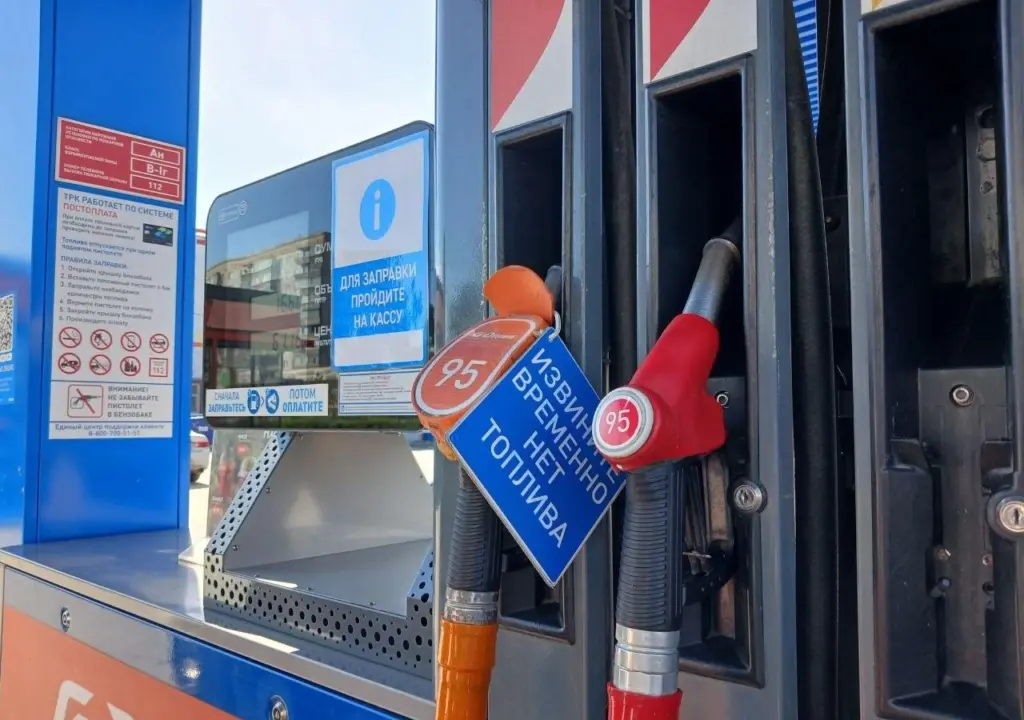
Russia’s summer fuel crisis is back for a second wave, driven by Ukrainian strikes on its oil refineries. This time, it has forced rationing back into both Moscow and St. Petersburg and pushed its largest oil producer to cap gasoline nationwide.
St. Petersburg drivers ran into limits again on 20 August, when several major oil companies restricted sales across the city, Bumaga first reported. Gazprom Neft reinstated a 60-liter-per-receipt cap it had lifted on 4 August and blocked customers from filling more than one canister.
Tatneft capped AI-95 and AI-92 at 50 liters. Many Gazprom Neft stations carried no AI-95 at all, its own station map showed. “Gazprom and Lukoil are dropping dead,” one driver wrote in a local chat.
The limits followed Moscow’s by a day. There, Gazprom Neft cut sales to 40 liters per car, and AI-95 turned up at a single Neftmagistral station, The Moscow Times reported. Rosneft went furthest, capping gasoline at 30 liters per car at every one of its stations across Russia, with no limit on diesel. In June, the same network was still letting drivers take up to 90 liters a fill.
By mid-August, gas stations in at least 12 regions were again seeing hours-long lines, Meduza’s regional roundup found, citing a count by the outlet 7×7. Lipetsk Oblast brought back odd-even rationing by license plate on 13 August and held fills to 30 liters, a step Governor Igor Artamonov announced; Sochi’s authorities asked residents and tourists to leave their cars at home.
Ukraine has spent months hitting the plants to choke off both the fuel Russia’s army runs on and the oil revenue that funds its war. At least four refineries went offline in August alone.
Officials say supply is holding. Energy Minister Sergei Tsivilyov said on 18 August that fuel remains available, even as he acknowledged the lines. Gasoline averaged 76.04 rubles a liter ($0.89) on 10 August, off a July peak that ran nearly 20% above where the year began.
President Volodymyr Zelenskyy allowed preparations for an AI-guided drone campaign against Moscow-area airports, The Atlantic reported on 20 August, citing two anonymous sources with direct knowledge of the proposal.
The reported plan sought to keep civilian flights grounded long enough to pressure Russia’s elite. Had it proceeded, it would have moved Ukraine toward large-scale autonomous strikes, raising questions under the laws of war about attacks without human confirmation. The Atlantic's disclosure follows months of reported Ukrainian attacks that repeatedly forced Moscow-area airport closures and sent increasingly large drone swarms toward the capital.
Code-named M&Ms, the operation called for as many as 1,000 drones to fly toward Moscow-area airports each night and overwhelm Russian air defenses, one source said.
Onboard cameras would compare live views with preloaded maps and target images. They would also allow the drones to strike without pilot confirmation and to navigate without a remote-control link that is vulnerable to Russian electronic jamming, the sources said.
One source said prolonged airport closures were intended to pressure Kremlin-linked elites and push Vladimir Putin toward negotiations.
The plan was presented to Zelenskyy during the winter of 2025–26, The Atlantic reported. Preparations stopped after Zelenskyy dismissed Defense Minister Mykhailo Fedorov, whom The Atlantic described as the operation’s mastermind, in July, both sources said. One source said another team could revive the project within about three months.
Both sources said Zelenskyy allowed preparations despite concerns that a drone could hit a civilian airliner. Planners proposed warning airlines, according to one source.
A Zelenskyy spokesperson declined to comment. Another unnamed presidential office official called the report “total nonsense,” saying Ukraine lacked long-range weapons reliable enough to strike the airports without posing undue risks to civilians.
The alleged M&Ms operation never launched, but other reported Ukrainian drone attacks repeatedly disrupted Moscow’s airports.
From 5 to 7 May 2026, restrictions imposed amid reported Ukrainian drone attacks delayed more than 450 flights at Moscow airports. Limits at Vnukovo remained in place for nearly 18 hours, EP reported, citing the independent Russian investigative outlet Agentstvo.
Earlier this week, Russian authorities claimed that 620 drones flew toward Moscow in one night, EP reported. The Atlantic placed Russia’s nationwide interception claim for that night at 791 drones. Ukraine’s military did not claim the attack.

Finland is investigating a suspected violation of its airspace by a Russian aircraft over the Gulf of Finland, its Defense Ministry said. Authorities have not identified the aircraft or said whether the crossing was deliberate, and the country's border guard has opened an inquiry. The case adds Finland to a growing list of NATO states reporting Russian intrusions along the alliance's frontiers.
A Russian aircraft is suspected of violating Finnish airspace in the western Gulf of Finland on the afternoon of 20 August, Defense Minister Antti Häkkänen said. He said the country treats every such case seriously and that an inquiry is running.
"Every suspected territorial violation is taken seriously. An investigation is underway," Häkkänen said.
The ministry statement did not name the aircraft. The Border Guard later identified it as a Russian Il-20 reconnaissance plane, Finnish broadcaster Yle reported, saying the suspected crossing lasted about three minutes and reached some 4.7 nautical miles into Finnish airspace at its deepest. It said it would release more as the inquiry advances.
The suspected crossing follows two earlier Finnish cases this year. Finland suspected Russian military aircraft of entering its airspace in May, off Porkkala while one avoided a thunderstorm, and again in June, summoning Russia's chargé d'affaires over the two incidents.
Other members of the alliance keep logging similar incidents. Romania has destroyed a sea drone and recovered aerial-drone debris on its soil, and Russian drones have struck near Moldova's border with Ukraine. Kyiv has also accused Russia of steering Ukrainian drones toward Finland and the Baltic States through electronic warfare.
Finland joined NATO in 2023 and has since rearmed sharply, ending a domestic ban on nuclear weapons as part of a wider defense shift. It has stepped up support for Ukraine, most recently backing a power-plant project before Russia's winter energy campaign. Helsinki has also argued it is too early to negotiate with Moscow while the war continues.

© Cassandra Vinograd/The New York Times

© Lynne Sladky/Associated Press

© Kenny Holston/The New York Times

© Heather Diehl/Getty Images

© Roger Kisby for The New York Times

© Thierry Gouegnon/Reuters

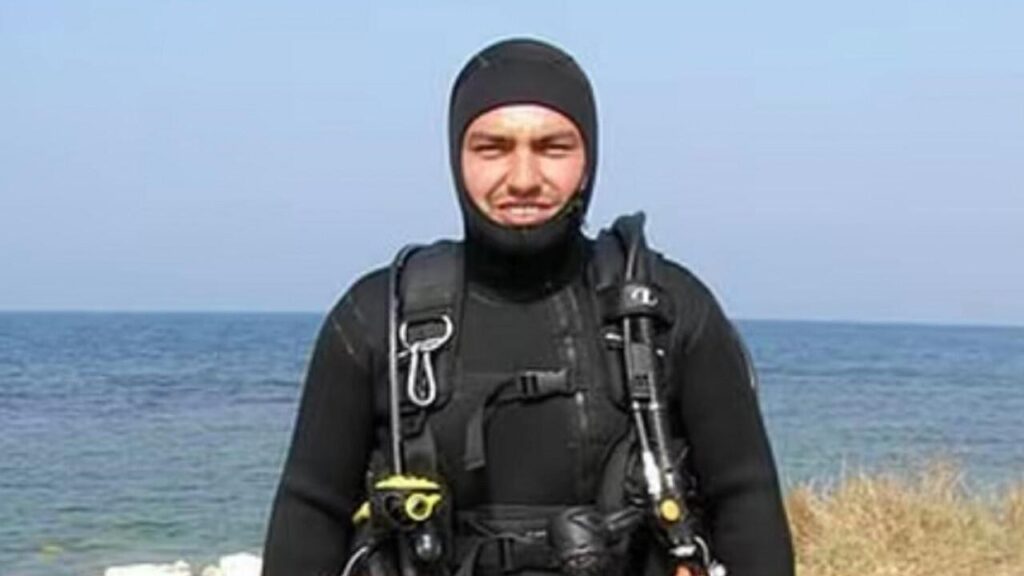
Croatian police arrested a Ukrainian diver in Pula on 19 August 2026 over his alleged role in the 2022 Nord Stream pipeline explosions, Croatian broadcaster HRT reported. German prosecutors confirmed to AP that the suspect was Volodymyr Zhuravlov (Zhuravliov in Ukrainian official transliteration). Legal Tribune Online reported that he was detained on the set of Zmiinyi (Snake) Island.
The arrest gives German prosecutors a third chance to secure Zhuravliov after two attempts in Poland failed. If Croatia extradites him, he would become the second suspected member of the alleged team to face proceedings in Germany. Berlin has pursued other suspects in the Nord Stream case across Europe, but the identity of the person who ordered the sabotage remains unknown.
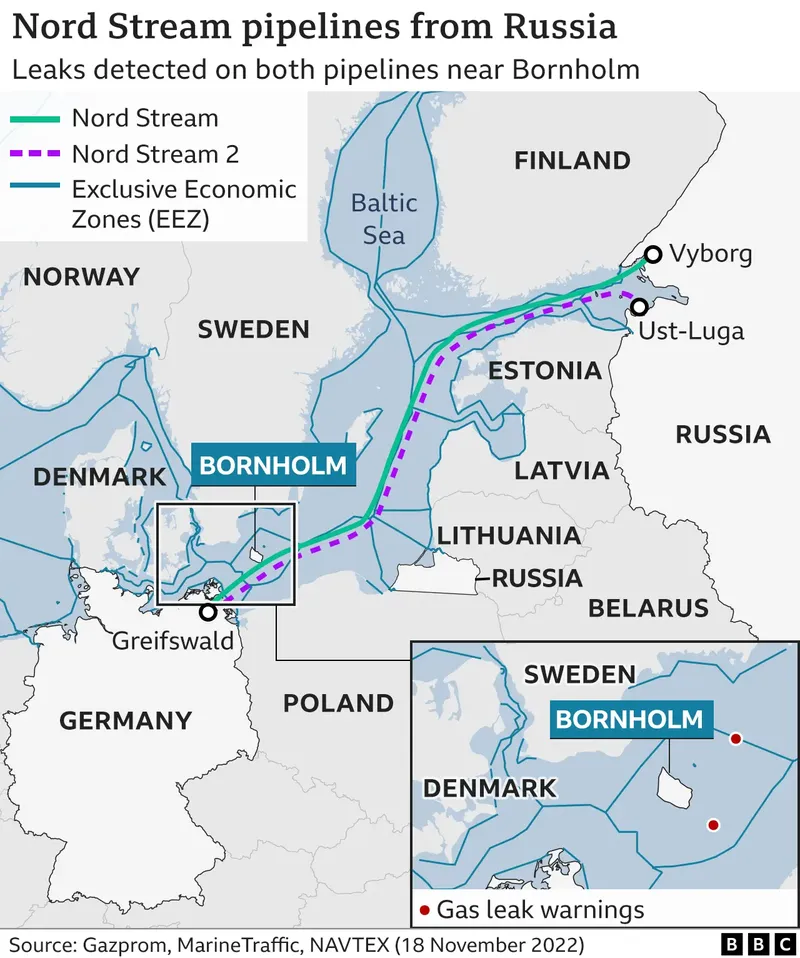
Germany’s Federal Public Prosecutor’s Office said Zhuravliov was a trained scuba diver who took part in the dives needed to place explosives on Nord Stream 1 and 2 near Denmark’s Bornholm island. Prosecutors say the group sailed from Rostock aboard a yacht that middlemen rented from a German company using forged identity documents.
The 2024 European arrest warrant accuses Zhuravliov of jointly causing an explosion, anti-constitutional sabotage, and destroying structures. He would appear before an investigating judge at Germany’s Federal Court of Justice following extradition, prosecutors said. A Croatian court must first approve his surrender.
LTO reported that investigators first sought Zhuravliov’s arrest in Poland in the summer of 2024, but he crossed into Ukraine before police detained him. Polish police arrested him near Warsaw in autumn 2025. However, a court rejected Germany’s extradition request after finding that the pipelines could be treated as a legitimate military target during an armed conflict. Zhuravliov has denied involvement.

His lawyer, Tymoteusz Paprocki, told AP that Zhuravliov understood the Polish ruling applied only within Poland.
Another Ukrainian suspect, Serhii K., was arrested near Rimini in August 2025 and extradited to Germany that November after unsuccessful appeals. Prosecutors allege he coordinated the operation rather than joining the dives. They charged him in Hamburg in June 2026.

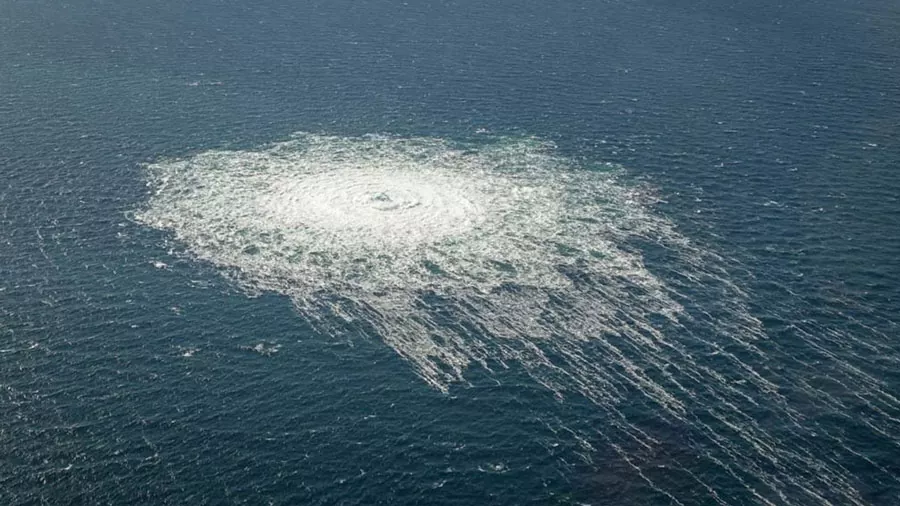
Nord Stream 1 and 2 ran beneath the Baltic Sea, carrying—or designed to carry—Russian gas directly to Germany while bypassing Ukraine. Explosions on 26 September 2022 damaged three of their four lines at a depth of about 80 meters.
No court has established who ordered the attack. Ukraine’s Prosecutor General’s Office says no facts demonstrate Ukrainian state involvement and is examining whether Russia staged a false-flag operation using Ukrainians. LTO reported that Germany’s Federal Court of Justice found strong grounds in December 2025 to believe that a state had initiated and directed the sabotage, but did not identify which state.

Gasoline prices have risen roughly 10–13% in Tajikistan, Kyrgyzstan, and Uzbekistan as Russia restricts exports after Ukrainian strikes on its refineries, Kazakh economist Aidar Alibayev estimated in a 20 August interview with Current Time. He did not specify the comparison period.
Earlier Ukrainian attacks disrupted Kazakhstan’s crude exports through Russia’s Black Sea ports. Strikes at refineries are creating a different kind of squeeze: Russia has less gasoline available to dependent neighbors. Tajikistan and Kyrgyzstan are seeking other suppliers, while Kazakhstan could face growing pressure if the shortages persist.
Tajikistan has been hit hardest because it depends heavily on Russian fuel and has the region’s most difficult delivery routes, Alibayev said. He estimated gasoline prices there had risen 12–13%. Current Time reported that Tajikistan is exploring supplies from China; Alibayev said it was also turning to Iran.
Kyrgyzstan, which sources more than 90% of its gasoline from Russia, asked its neighbors, Azerbaijan and Kazakhstan, as well as other countries, for help. Current Time reported that a deputy prime minister said its reserves would last about six weeks. Alibayev estimated prices had climbed around 10%, compared with 11–11.5% in Uzbekistan, which he estimated gets half its fuel from Russia.
In Uzbekistan, Alibayev estimated that fuel prices had risen by about 11% and said the country gets about half of its fuel from Russia.
Russia extended its gasoline and diesel export restrictions through 31 January 2027 as shortages mounted. Intergovernmental and humanitarian shipments remain exempt, while diesel producers regain some export rights from 1 September. Current Time also reported that Russian companies had begun buying gasoline from Belarus.
Kazakhstan is better insulated than its neighbors because its refineries in Atyrau, Shymkent, and Pavlodar produce enough fuel to meet most domestic demand, Alibayev noted. Motorists from Russia and neighboring states are crossing its borders to refuel. He attributed Kazakhstan’s price rises mainly to domestic taxes and the end of an export moratorium—not Russia’s shortage alone.
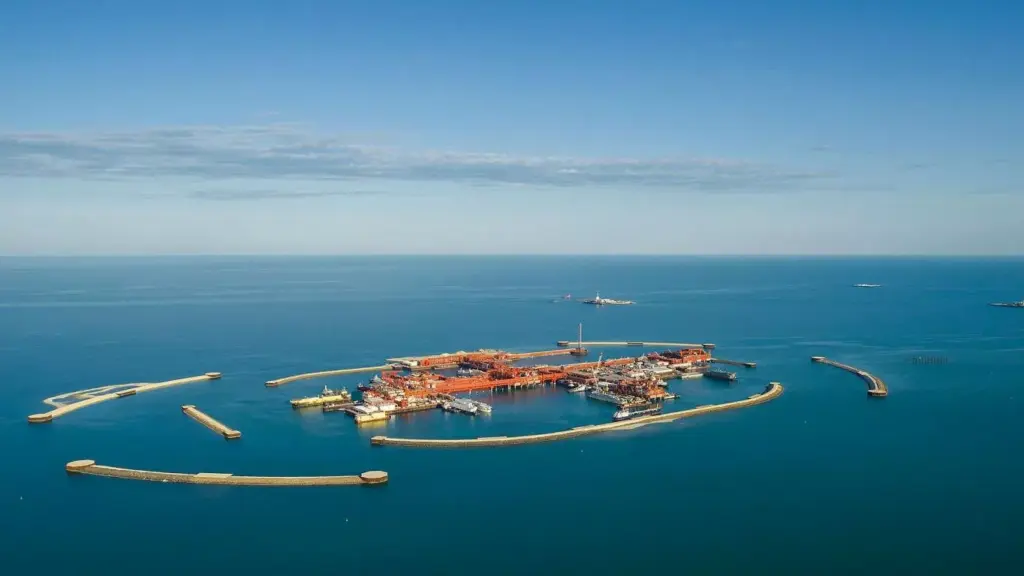
Ukraine’s Black Sea campaign has repeatedly struck oil infrastructure around Novorossiysk, where the Caspian Pipeline Consortium terminal handles about 80% of Kazakhstan’s crude exports. Separate tanker attacks cut CPC loadings by a fifth and forced Kazakhstan to reduce production. In contrast, disruptions at the terminal forced Kazakhstan to send Kashagan crude to China for the first time.

At an informal summit of Central Asian leaders in Cholpon-Ata in early August, Tajik President Emomali Rahmon proposed building a refinery to serve the whole region. For now, Alibayev said, the decisive factor is how long Russia’s troubles last: the longer Ukraine’s strikes continue, the more they will weigh on prices across Central Asia.

© Joyce Zhou/Reuters

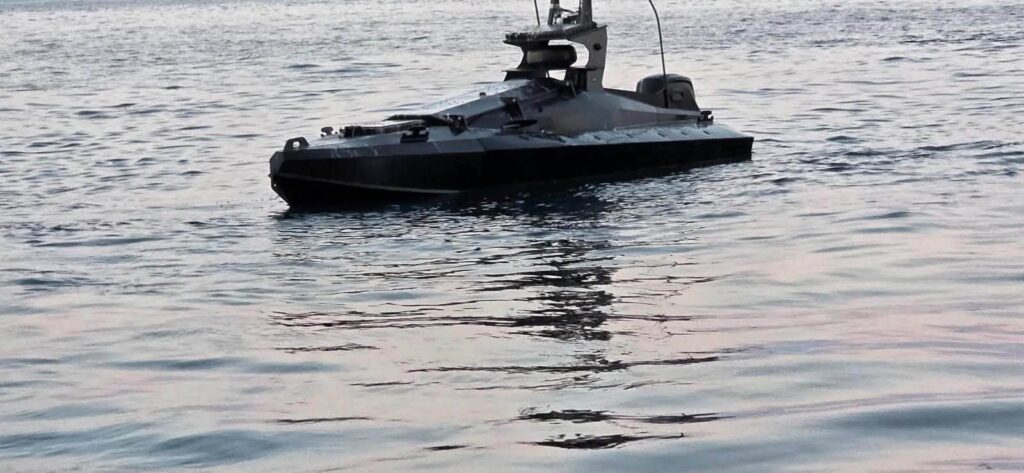
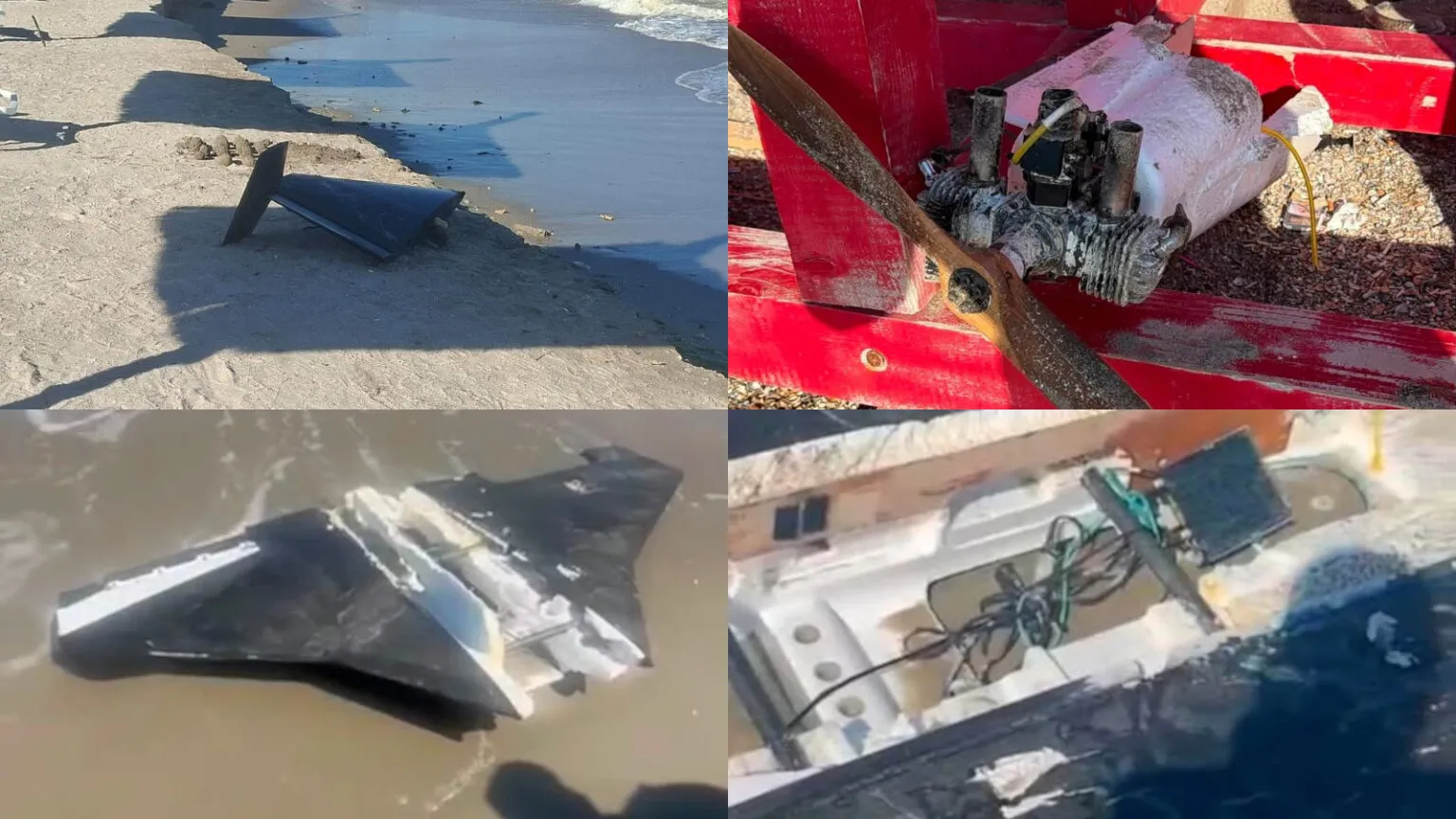
Romania destroyed an explosives-laden maritime drone near its critical Neptun Deep gas platform and recovered debris from a separate aerial drone that crashed on its soil, the Romanian Defense Ministry reported. The incidents came during a major Russian attack on Ukraine on 20 August that killed 14 people in Kyiv city and oblast, caused incidents in Moldova, and triggered air defense activation in Poland.
A commercial vessel spotted a drifting maritime drone near the Neptun Alpha production platform, approximately 80 nautical miles east of Constanța, at around 06:28, the Defense Ministry said. Two Romanian F-16s scrambled with orders to fire. One engaged the target with its onboard cannon—the first time Romania used a cannon against a drone and the first engagement against a maritime drone. All previous shootdowns used air-to-air missiles against aerial drones.
The country's Defense Minister Radu Miruță said the drone was carrying explosives and was spotted just hundreds of meters from the platform where several hundred people work. Through a recently established direct communication channel, Ukraine confirmed the drone was not of Ukrainian origin. President Nicușor Dan directly blamed Russia, condemning "the intensification of these types of irresponsible incidents on the part of the Russian Federation."
The engagement came nine days after Romanian navy divers destroyed two Gerbera-type drones drifting near the same platform by controlled detonation.
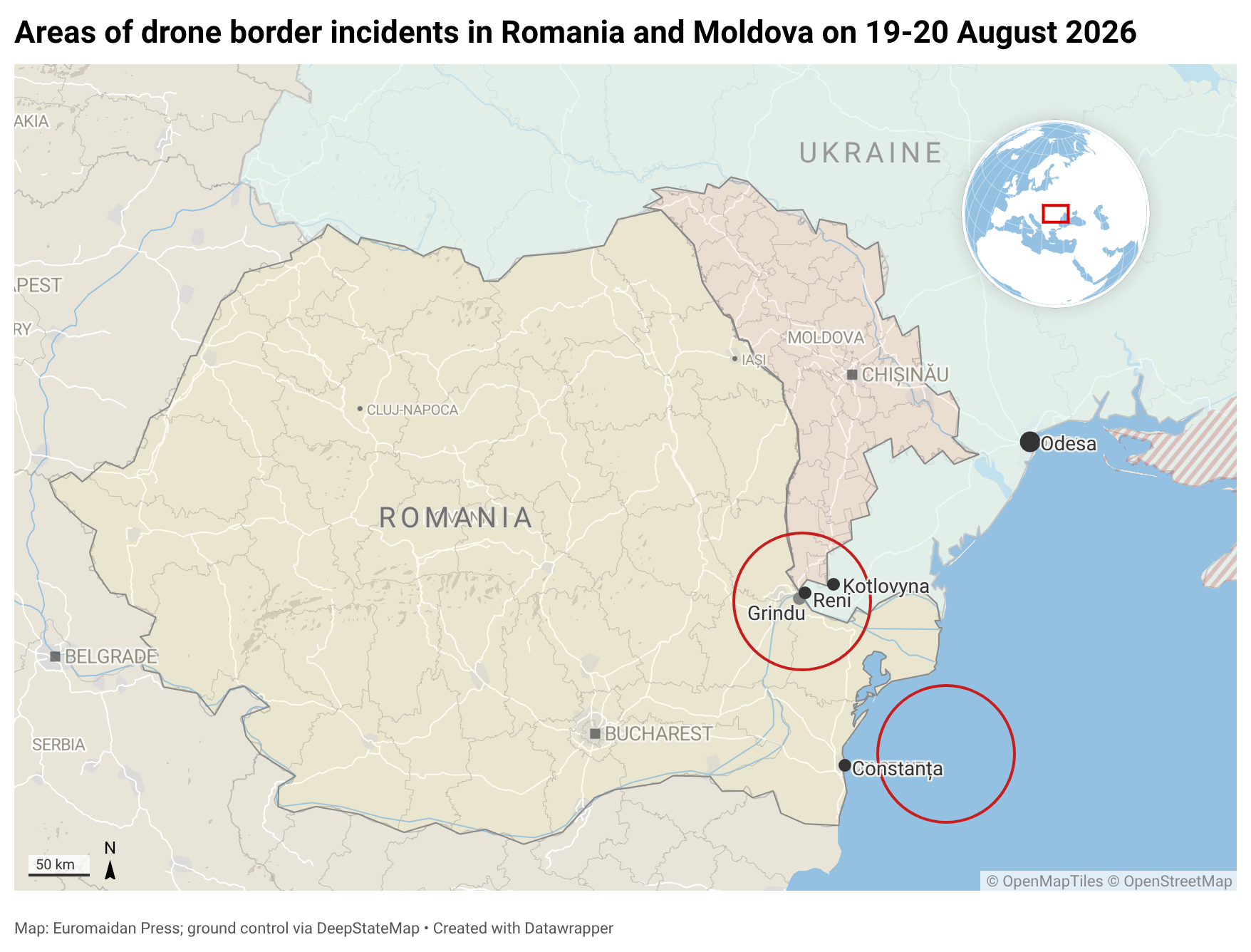
Earlier overnight, Romanian radar detected aerial targets near the Ukrainian border at 02:23, the Defense Ministry said. Two Spanish F-18s from NATO's air policing mission and a Romanian IAR-330 SOCAT helicopter scrambled. At 03:21, a drone crossed into Romanian airspace 13 km east of Galați and crashed three minutes later near the village of Grindu in Tulcea County. No casualties or damage were reported. The fragments posed no explosive hazard.
The crash came four days after a Spanish F-18 shot down another drone over Romanian airspace, Euronews reported. Romanian F-16s intercepted three Russian drones in July.
Poland's Operational Command activated military aircraft and ground-based air defense systems during the Russian attack as a preventive measure. The Netherlands provided air defense support. No breach of Polish airspace was recorded.
Moldova faced multiple incidents. At 03:16, the country's National Army detected what was preliminarily identified as a Shahed-136/Geran-2 drone crossing from Ukraine near Kotlovyna in Odesa Oblast into Moldova's Gagauzia region. It returned to Ukrainian airspace six minutes later, public broadcaster Moldova1 said.
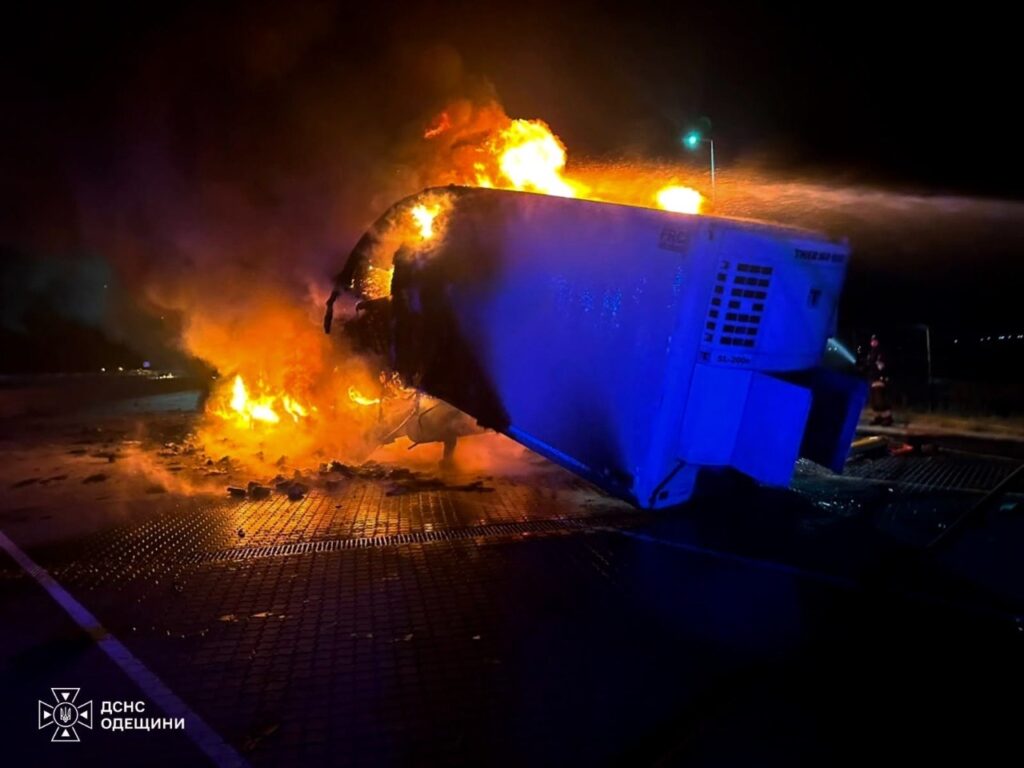
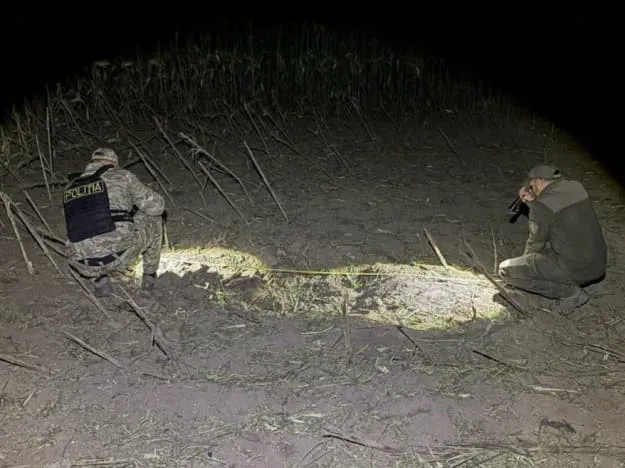
Separately, an explosion at a truck parking lot on Ukrainian territory about 150 meters from the Giurgiulești-Reni border crossing at around 03:45 sparked a fire that spread onto Moldovan soil, Newsmaker reported. Border police found drone fragments in a crater approximately 1 km inside Moldovan territory.

Russian strikes in southern Odesa Oblast overnight into 20 August left 13,000 utility customers without power, Odesa Oblast head Oleh Kiper reported. President Volodymyr Zelenskyy also said drones attacked a checkpoint on Ukraine’s border with Moldova.
Russia has intensified attacks on southern Ukraine’s Danube region, where ports and transport routes lie close to Moldova and Romania. The spillover from the attacks has forced these neighboring countries to close airspace, scramble aircraft, and shoot drones down.
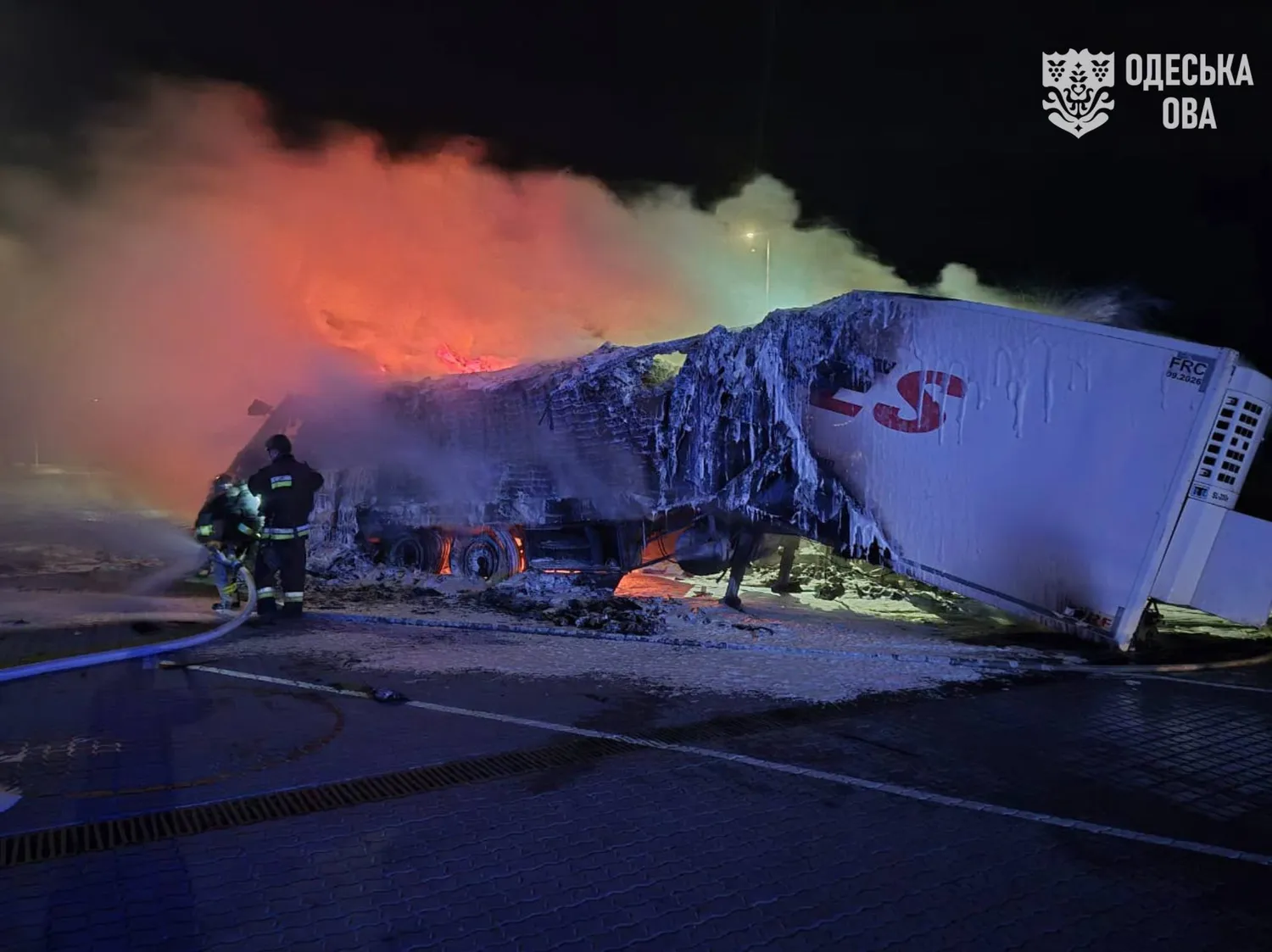
The Odesa Oblast Military Administration said Russian strikes disrupted power in several communities, and repair crews began restoration work. It did not identify damaged electrical equipment or say whether the grid had been shut down as a precaution. Two truck trailers carrying food caught fire at another location, but firefighters extinguished both blazes, the State Emergency Service said. No casualties were reported.

Zelenskyy did not identify which crossing was attacked or describe the damage. The Izmail District State Administration later reported that Russia attacked the Reni community with Shahed-136 drones. It recorded a hit on an unspecified site near the Reni–Giurgiulești international checkpoint.

People and freight cross between Ukraine and Moldova through checkpoints such as Reni–Giurgiulești. The district administration did not describe the damage or say whether the checkpoint remained open.
At 03:16 on 20 August, surveillance systems operated by Moldova’s National Army detected an unauthorized flight, public broadcaster Moldova1 reported.
The object was preliminarily identified as a Shahed-136/Geran-2, a long-range explosive drone used by Russia. It crossed from Ukraine near Kotlovyna in southwestern Odesa Oblast and flew toward Etulia in Moldova’s autonomous Gagauzia region. It returned to Ukrainian airspace at 03:22.
Similar incidents occurred earlier in August. An unidentified aerial object exploded in a Moldovan field 12 kilometers from Ukraine on 9 August. On 17 August, Moldova closed part of its airspace for 15 minutes after Ukraine’s Air Force warned that a Russian Banderol, a jet-powered missile-drone, had crossed from Odesa Oblast. The object later exploded near Talmaza.
On 20 August, Romania’s Defense Ministry said its radars detected targets near Ukraine at 02:23 and scrambled two Spanish F-18s and a Romanian helicopter. A drone entered Romanian airspace east of Galați at 03:21 and crashed near Grindu at 03:24. Its impact started a fire that went out on its own. Romania reported no casualties or material damage.
Four days earlier, a Spanish F-18 shot down a drone that entered Romania from Moldova. NATO said it appeared to be Russian.
Russia has recently intensified attacks on Ukraine’s Danube ports and struck the Mayaky bridge connecting southern Ukraine with Moldova and Romania. Such attacks can disrupt Ukraine’s transport links and force neighboring militaries to react within minutes.

Ukraine’s Defense Forces struck a major oil refinery and a Black Sea oil terminal on 19 August and overnight into 20 August, Ukraine’s General Staff reported. Drones also hit a key mainland electricity hub supplying occupied Crimea, Militarnyi reported after analyzing NASA satellite data.
Together, the reported strikes put three parts of Russia’s war machine under attack within hours: fuel production, Black Sea oil exports, and the mainland electricity bridge to occupied Crimea. They continue a deep-strike campaign intended to disrupt fuel supplies and logistics supporting Russia's invasion
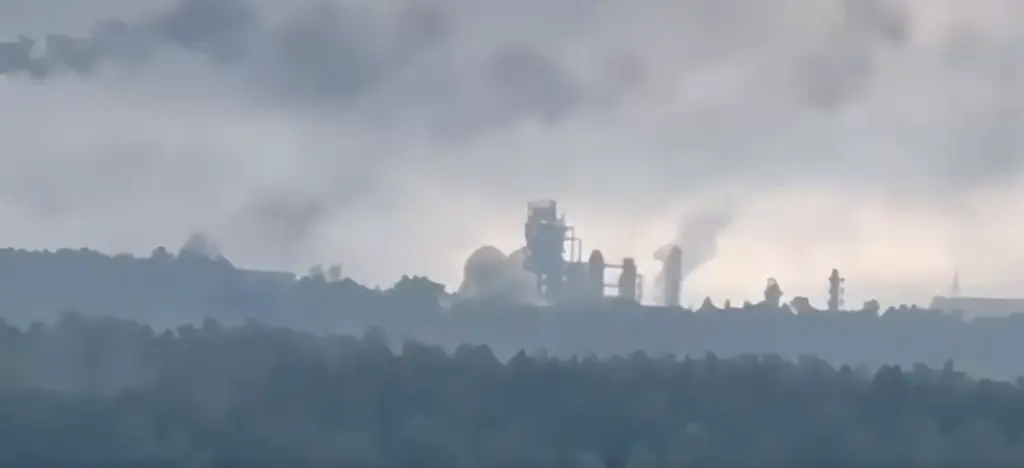
Ukraine struck the TANECO refinery in Nizhnekamsk, in the Russian republic of Tatarstan, where the General Staff reported a fire at the production site. Militarnyi had earlier identified the same facility from eyewitness footage showing a drone reaching the city’s industrial zone despite Russian air-defense fire.
Ukrainian attack drones swarmed Russia’s Nizhnekamsk Oil Refinery this morning, scoring multiple hits and setting the plant on fire.
— OSINTtechnical (@Osinttechnical) August 20, 2026
Seen here, a Ukrainian Fire Point FP-1 maneuvers and then dives into one of the already-burning Russian refinery’s process units. pic.twitter.com/3v9AjEZFs5
Owned by Tatneft, TANECO is one of Russia’s newest, largest, and most technologically advanced refineries. It can process more than 16 million tons of crude annually and produces gasoline, diesel, aviation fuel, marine fuel, and other petroleum products.
Neither the General Staff nor the available imagery established whether processing equipment was damaged or production stopped.
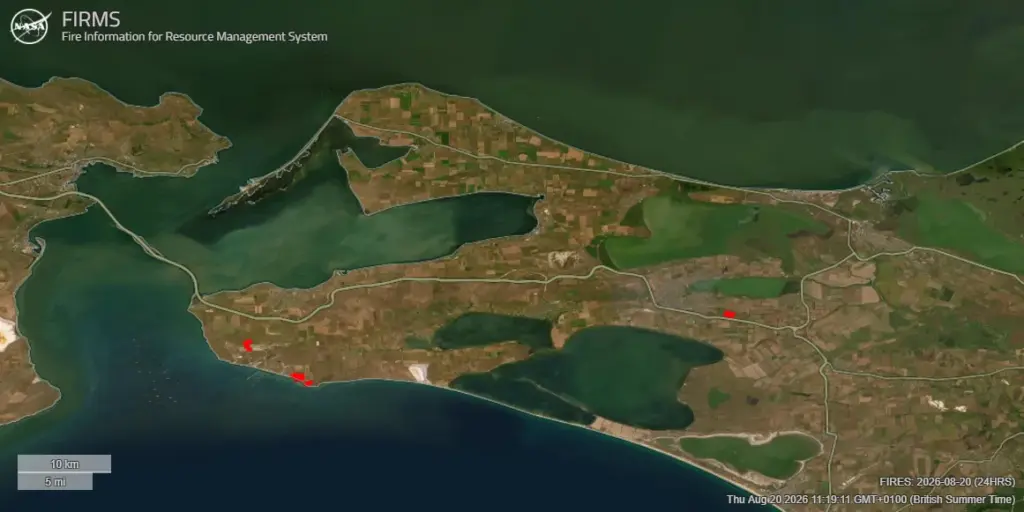
Ukraine also hit the Tamanneftegaz oil and gas terminal in the village of Volna, Krasnodar Krai, where the General Staff reported another fire. Militarnyi found a corresponding fire in NASA Fire Information for Resource Management System (FIRMS) data and assessed that storage tanks were likely burning.

Militarnyi described Tamanneftegaz as southern Russia’s largest private oil terminal. The complex can handle about 19.9 million tons annually, while its tank farm held more than 1 million cubic meters before Ukrainian attacks began.
The Tamanneftegaz terminal receives, stores, and loads petroleum products onto tankers, making it an important link in Russia’s Black Sea exports. Drones previously hit three tanks and pipelines there on 30 July.
Drones hit the Taman 500-kilovolt substation in Krasnodar Krai, where NASA satellite data recorded a fire, Militarnyi reported. All four lines of Russia’s power bridge across the Kerch Strait pass through this high-voltage hub, making it the principal mainland gateway for electricity sent to occupied Crimea, Militarnyi reported.
— NetBlocks (@netblocks) August 20, 2026
Confirmed: Metrics show a sudden decline in internet connectivity across Russian-controlled Crimea with high impact to Sevastopol and Simferopol corresponding to a power blackout after overnight Ukrainian drone attacks targeting energy infrastructure
pic.twitter.com/dqCXzTDcWO
Power failed in Simferopol, Sevastopol, Kerch, Feodosia, and Yalta around 1:45 a.m., according to Suspilne Crimea. Electric transport stopped in several cities. Sevastopol’s occupation chief said restrictions were lifted after about 90 minutes, although the grid remained unstable and some nearby settlements still lacked electricity. Social facilities in Sevastopol switched to backup power.
Crimean Wind also reported explosions near the Kafa and Malorechenske substations inside Crimea, Suspilne Crimea reported. The available evidence therefore does not establish that the Taman strike alone caused the outages.
Ukraine's long-range strikes on Russian targets have ramped up in recent months. One day earlier, drones hit a key crude-processing unit at the Bashneft-UNPZ refinery in Ufa, Militarnyi reported. Ukraine had also struck TANECO on 10 August and both Nizhnekamsk refineries on 12 June, Suspilne reported.
Euromaidan Press reported that Ukrainian deep strikes hit 18 Russian oil and gas facilities in May, making it the heaviest month of 2026 at that point. On 6 August, drones attacked a top-five refinery in Yaroslavl for the seventh time this year. Five days later, they reached Orsk, about 1,500 kilometers from Ukraine.

A deliberately set fire at a Tallinn building used by Milrem Robotics did not disrupt its deliveries of military ground robots to Ukraine, CEO Kuldar Väärsi told Reuters on 19 August 2026. Estonian prosecutors said three suspects had been detained in Latvia.
The Milrem arson case fits in a broader pattern of suspected or confirmed sabotage against Ukraine’s military supply chain. Similar attacks throughout Europe have hit plants making drones, thermal optics, and other equipment for the front. Milrem supplies unmanned ground vehicles (UGVs) that help Ukrainian units move supplies and evacuate wounded without putting drawing upon valuable manpower.
The fire broke out overnight on 15 August in Tallinn’s Lasnamäe district after a resident reported suspicious activity. Nobody was injured, and Milrem has not disclosed what was damaged.
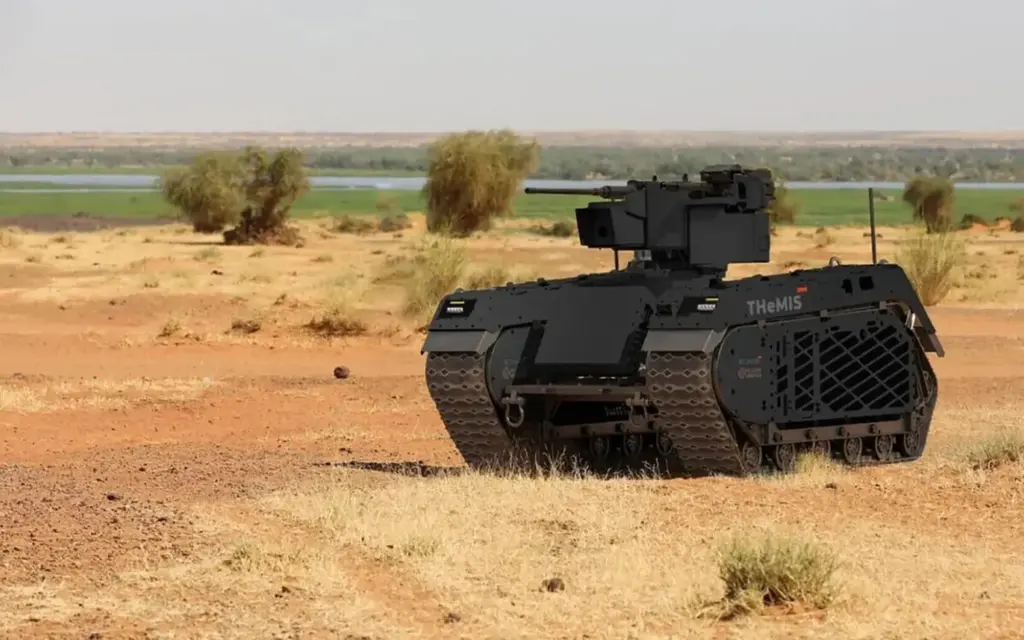
Milrem says it is one of only two foreign suppliers with unmanned ground vehicle (UGV) fleets in active Ukrainian service and expects more than 200 of its systems to be operating there by year-end.
The Netherlands is funding more than 150 additional Milrem vehicles for Ukraine. In June, Milrem and VDL Defentec opened a Dutch production line to support the delivery of more than 100 THeMIS UGVs. Väärsi the fire had not affected production, supply chains, or delivery schedules for this year or next.

Unmanned ground vehicles (UGVs) are tracked or wheeled machines with no crew aboard. ArmyInform reported that Ukrainian troops use them to carry ammunition, fuel, and food along exposed routes. A Ukrainian commander identified only as Nazar told ArmyInform that frontline units still rely mainly on UGVs for logistics, although some robots carry explosives.
State Prosecutor Gardi Anderson said prosecutors suspect all three detainees of taking part in the arson. Latvian authorities are holding them while the two countries arrange their transfer to Estonia. An Estonian court approved prosecutors’ requests to place two in pretrial detention. A decision on the third remained pending.
Estonian Prime Minister Kristen Michal said investigators were examining whether the fire was the result of sabotage and whether Russia was involved. Authorities have not disclosed the suspects’ alleged motive, whether anyone directed them, or released evidence connecting the attack to Moscow.
In March, a fire destroyed nearly all of the production capacity at a Czech plant that makes drones and thermal optics for Ukraine. Authorities detained four suspects while investigating possible terrorism and Russian involvement.
Lithuania also charged six people over an attempt to burn a factory supplying radio-wave scanners to Ukraine. Investigators said Russia-based organizers with GRU links coordinated the operation and connected the network to attempted attacks elsewhere in Europe.
Russia has denied Western accusations that it conducts sabotage in Europe.

© Valentyn Ogirenko/Reuters


© Anindito Mukherjee for The New York Times


© Kim Hong-Ji/Reuters