The seaweed — a stinky, brown algae known as sargassum — has plagued Mexico and the broader region for more than a decade, but this year’s forecast is setting records.
“I am your voice,” said Representative Haley Stevens, a four-term congresswoman who is running for Senate in Michigan, after her accent was mocked online.
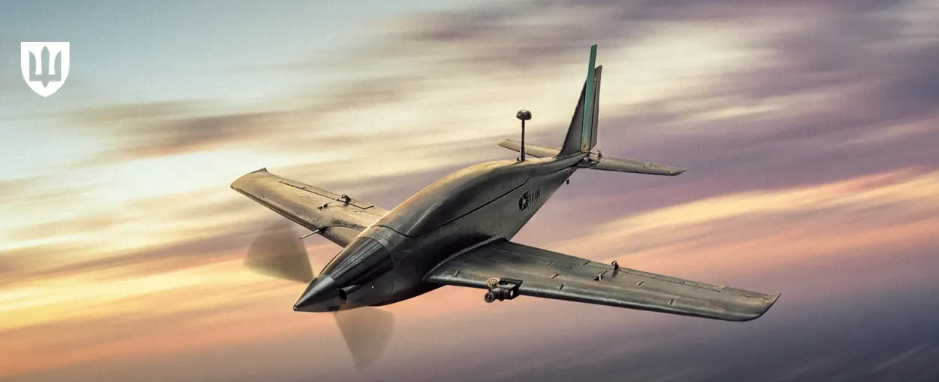
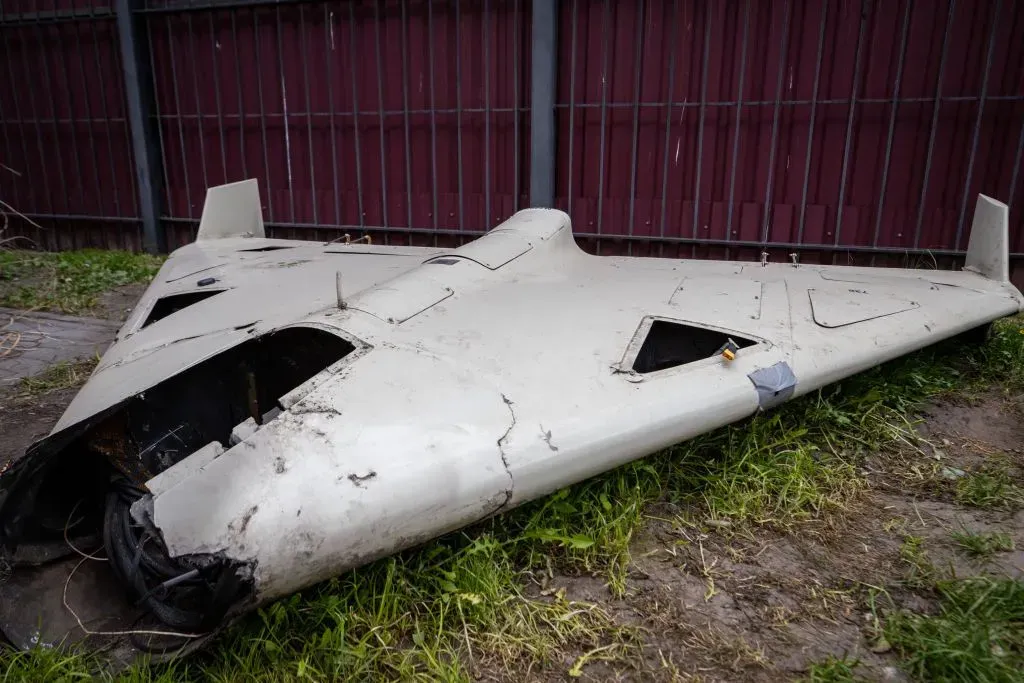
Russia cannot yet use guided kamikaze drones against the regions in the west of Ukraine because of technical limits on its remote-control system. But activating relays in Belarus could change that and put Lviv, Volyn, and other oblasts at risk, presidential adviser Serhii "Flash" Beskrestnov said on the national telethon, Telegraf reports.
Russia's online control system currently works only within a limited range of the border, and the front line, Beskrestnov said, so the "red zone" where drones can be steered in real time does not yet reach the west. If relays in Belarus come online, that zone would expand toward the Belarusian border and cover them.
The warning is concrete because Russia has done exactly this before: it built a network of signal repeaters on Belarusian towers and rooftops that boosted Shahed control signals to reach Kyiv, Rivne, and Volyn oblasts, until Ukraine dismantled it in February 2026.
The Belarus threat is a switch Russia can flip back on
The relay question is not hypothetical. Repeaters in Belarus let Shaheds flying the northern route hit targets across Kyiv, Rivne, and Volyn that Russia struggles to reach from its own soil, and President Volodymyr Zelenskyy has said some strikes on Ukrainian energy and railway sites would not have been possible without that help.
Ukraine has fought to keep it off. After Ukraine tore down the network in February, Kyiv gave Belarusian ruler Alyaksandr Lukashenka a week to pull Russia's drone relays in June, and they went silent in three days. ISW has assessed that operating Shaheds and cheaper Molniyas from Belarusian territory would put the highway and rail line carrying Polish supplies from the border within precision range, and allow Russian operators to hit moving convoys and trains.
The camera-lock tactic is how a guided Shahed hits a moving train
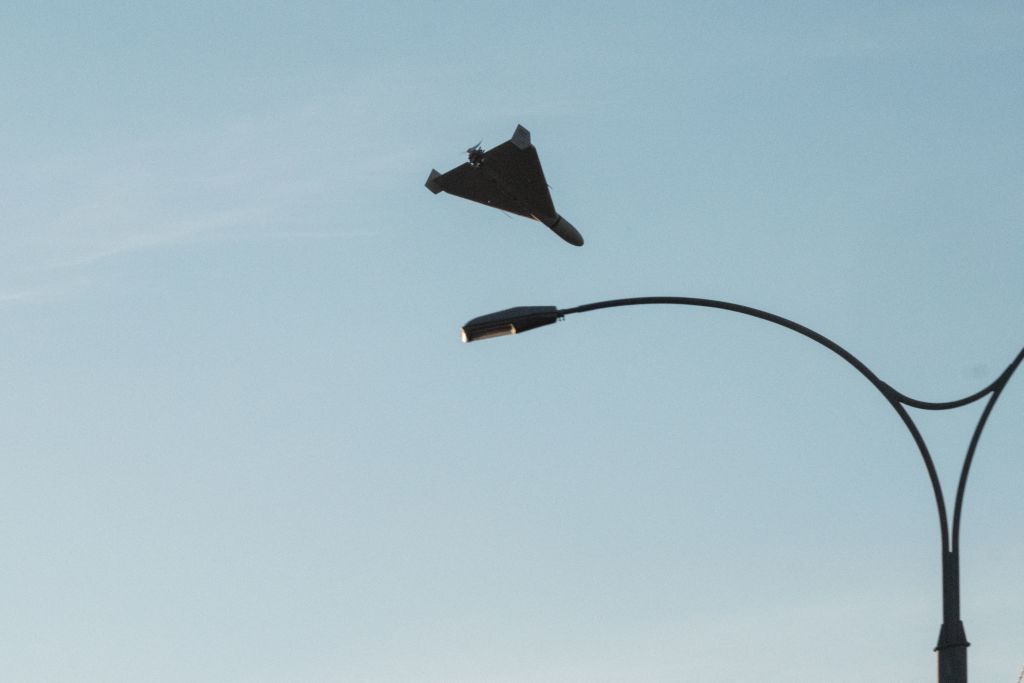
The reason online control matters so much is a new tactic Russia uses to defeat Ukrainian electronic warfare. Russian guided drones now carry powerful cameras with target-capture capability, Beskrestnov said, allowing them to hit specific moving targets rather than fixed coordinates.
He described how it works. From three kilometers out, the pilot sees a locomotive with his own eyes through the drone's camera, switches on a capture box around it, and a Shahed then automatically controls its own flight and attacks the locomotive, Beskrestnov said. Locking onto the target visually and letting the drone fly itself in for the final approach means the operator no longer needs a continuous control link at the moment of impact, which is part of how the drone gets past jamming. Russia understands that mass attacks are ineffective, Beskrestnov said, and is trying to strike important targets with this new tactic.
In some cases, no direct line can be drawn from the president’s domestic nuclear agenda to his family or close allies. But they have overlapping business ties that could position them for gains.
Russia hit a civilian grain ship, waited, and hit it again. A Russian Shahed drone struck a Palau-flagged vessel carrying corn twice as it left a port in Odesa Oblast, setting it on fire, Ukraine's Minister for Restoration, Infrastructure and Transport Mykola Kalashnyk said. Two sailors are missing, and seven crew members and a Ukrainian pilot were rescued.
The double strike on a grain carrier is the maritime edge of Russia's campaign against Ukraine's food exports. The ship was carrying almost 2,800 tons of corn when it was hit as it left the port, and after the strikes, a fire broke out on board.
The State Border Guard Service, which carried out the rescue, reported that the vessel was leaving the mouth of the Danube bound from a Ukrainian port to Greece with nine crew and a pilot aboard when the Shahed hit it, then struck again, the second blast causing a large fire.
This is a deliberate attack on the civilian shipping that carries Ukrainian grain to world markets, and it fits a Russian campaign that has made ports and merchant ships a target through July.
"Russia continues deliberate attacks on civilian shipping and Ukraine's port infrastructure," Kalashnyk said.
The rescue pulled eight from a burning ship
The border guards' maritime security units rescued eight people after the double drone strike, the State Border Guard Service said. The sailors reacted quickly to the distress signal and evacuated eight from the burning vessel, all delivered to safety, with medics monitoring their condition.
The search continues for two crew members who went into the water after the first blast. The two accounts differ slightly on the totals, as they do in the first hours after any strike: Kalashnyk cited seven crew plus a Ukrainian pilot rescued, while the border guards counted eight evacuated. Both agree that two sailors are missing and a search-and-rescue operation is underway. What is confirmed is that a civilian grain ship was struck twice, caught fire, and lost two of its crew to the sea.
The strike is the maritime front of the grain war
The attack extends a campaign that has hammered Ukraine's grain export capacity through July.
From 11 to 15 July, Russian strikes hit three Greater Odesa ports and the merchant ships anchored there, cutting the region's grain-export capacity by roughly a third, according to Reuters. Odesa's ports carry more than 90% of Ukraine's agricultural exports.
A mural commemorating Iran’s former supreme leader, Ayatollah Ali Khamenei, in Tehran. Since a deal between the United States and Iran was signed last month, nearly all of its provisions have been violated.
Ukraine's latest drone hunter is a surplus European naval helicopter
The nine Sea Kings in or bound for Ukraine are stable, capacious and cheap to operate
That makes them good platforms for launching small interceptor drones
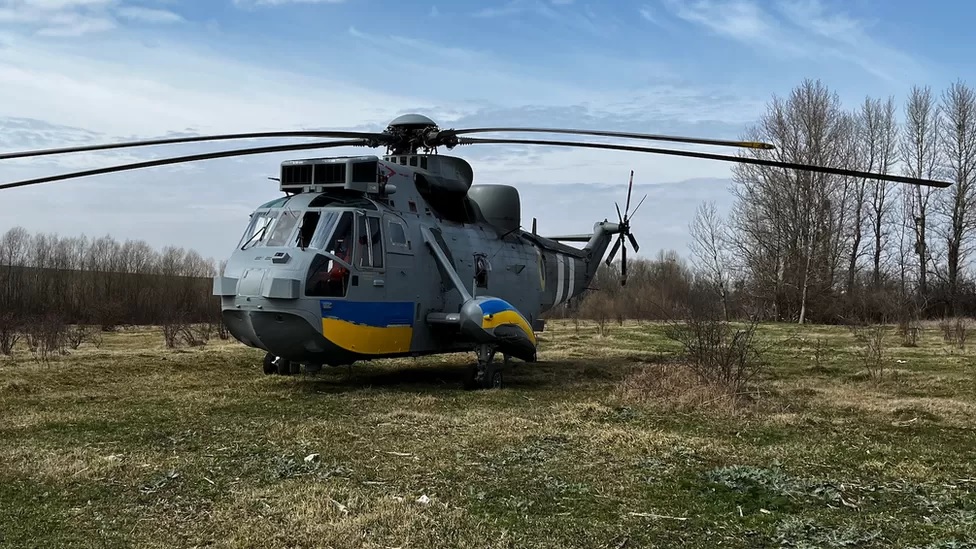
The Ukrainian navy's tiny fleet of donated Westland Sea King helicopters appears to have a new mission: hunting Russian Geran drones.
Aviation reporter H.I. Sutton was the first to note the new mission, when he spotted a specially equipped Sea King on the ground at the Farnborough Air Show in the United Kingdom this week.
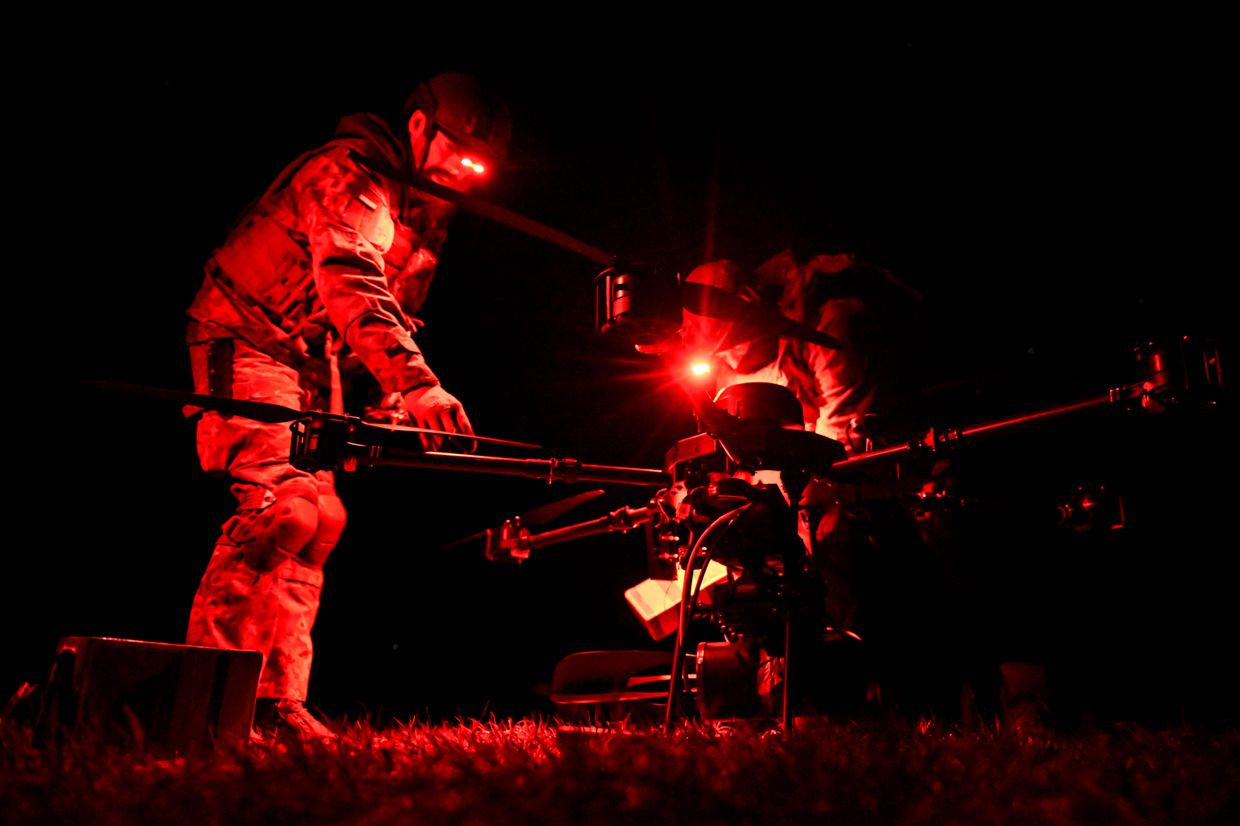
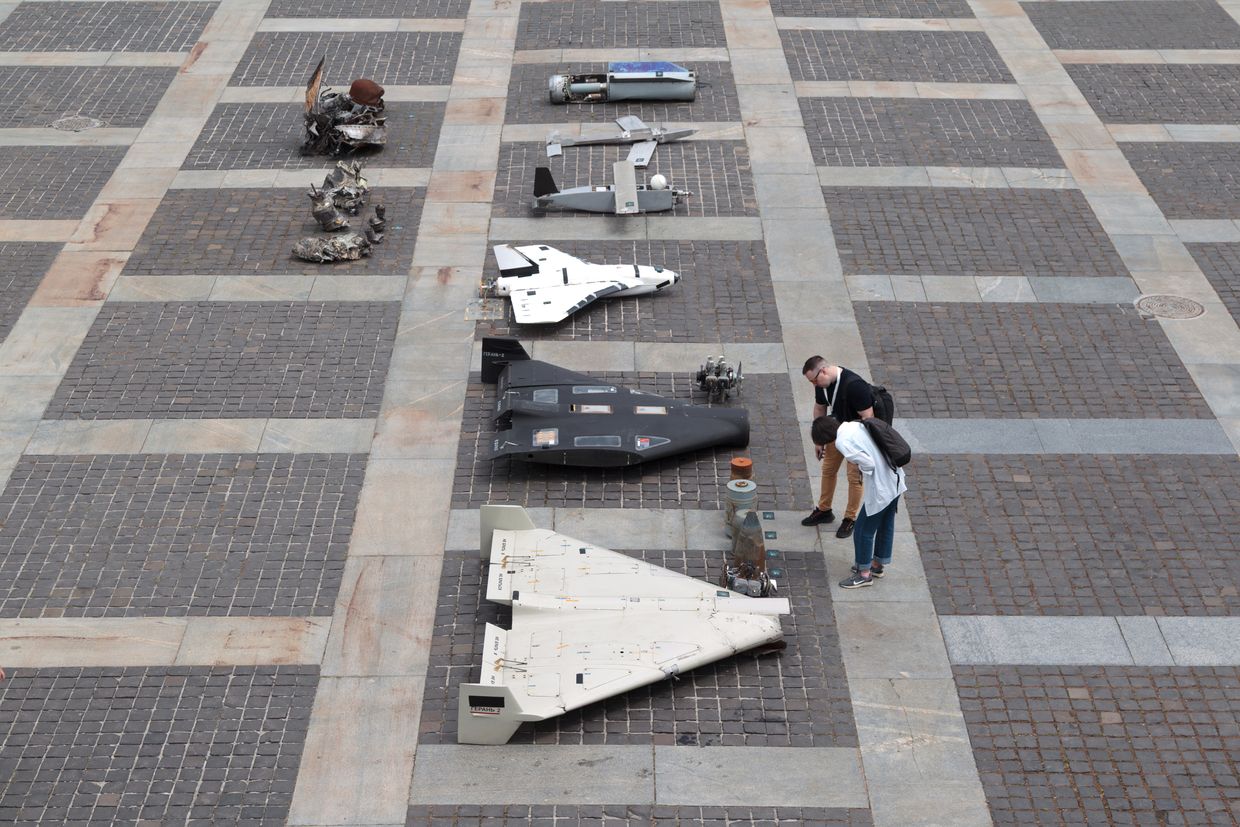
The 1970s-vintage Sea King had new equipment: an under-fuselage railing for small interceptor drones. Ukrainian forces use the inexpensive interceptors to chase down and take down Russia's Geran one-way attack drones. Some of the remote-controlled interceptors feature A.I.-assisted targeting and pack tiny explosive charges. Others are strictly manually controlled and knock down their targets through the sheer force of impact.
Regardless of the details of their designs, interceptors costing just a few thousand dollars apiece have helped Ukrainian air defenders blunt the impact of the thousands of Gerans, drones modeled after Iranian-made Shaheds, that Russia launches at Ukrainian cities every month. Air defenders typically take out around 90% of incoming Gerans.
But interceptor drones come with limitations. They're powered by batteries that exhaust themselves after just a few minutes of flight. And they are prone to being blinded by bad weather and low clouds. To prolong the interceptors' flights and get them above the rain and clouds, Ukrainian forces have begun using manned aircraft to loft the interceptors into the air before launching them.
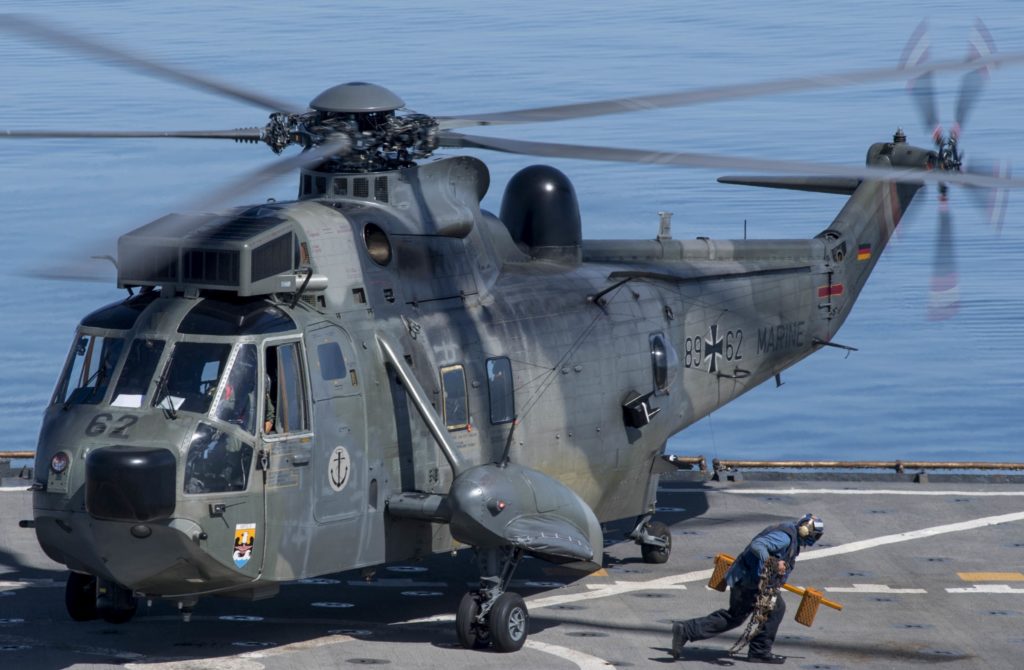
The Sea King, it seems, is Ukraine's latest interceptor drone carrier. While the helicopter Sutton spotted at Farnborough was unmarked, it's likely one of six Sea Kings Germany has donated to the Ukrainian war effort. The United Kingdom previously donated three surplus Sea Kings to Ukraine. The Ukrainian navy's sole helicopter unit, the 10th Naval Aviation Brigade, reportedly operates the Ukrainian Sea Kings.
Before now, it seems the Ukrainian Sea Kings strictly flew coastal search and rescue flights in support of Ukrainian ground and naval forces. But there's an obvious need for more air defenses over the Ukrainian coast. Sea Kings hauling interceptor drones under their bellies, and the drones' operators in their cabins, could be just the thing.
Westland Sea King helicopter of Ukraine's Navy. April 2023. Photo: BBC News
Geran killer
The threat: A.I.-assisted Geran drones. Shortly after Ukrainian drone forces began targeting the tankers, dry cargo ships and auxiliaries belonging to the unregistered "shadow fleet," Russian forces retaliated, launching cruise missiles and Gerans at grain ships and infrastructure in Odesa and other ports in southern Ukraine. Over weeks of near-daily port strikes, Russian missiles and drones have repeatedly hit grain carriers and terminals; the deadliest, a cruise-missile strike on the bulk carrier Golden Leo on 19 July, killed 10 of its crew.
An interceptor drone flying around 350 km/h is too slow to hit a cruise missile flying 900 km/h, but all but the fastest jet-powered Gerans are within the targeting envelope of all but the slowest interceptor drones. The problem, of course, is battery life and weather. To stand the greatest chance of hitting the most Gerans, the interceptors should launch from around a thousand meters in the air.
The Sea King is an old helicopter. But it's also reliable, cheap to operate and capacious. A solid platform for drone launches.
And it's part of a widening trend. This spring, Ukrainian forces armed an Antonov An-28 light turboprop transport with interceptor drones, complementing the An-28's existing side-firing gun and giving the lumbering transport great reach during its drone hunts.
As a drone platform, the An-28 apparently works. Well enough, in fact, that Russian forces have copied the concept. A recent video depicts two old Russian warplanes getting the fittings for aerial interceptor drone launch: a Yakovlev Yak-52 turboprop trainer and an Antonov An-2 piston-powered transport.
Like the Ukrainians do, the Russians hang drones under the planes' wings and seat the drones' operators inside the cabin or cockpit. All aerial drone platforms require add-on radios and antennae to connect the seated operators to their interceptors so that the operators can see what the drones see, and steer them to a hit.
If the Sea Kings also work well as drone platforms (and there's no reason they shouldn't), the Ukrainians may well extend the concept to other airframes. Any helicopter, transport or trainer with a reasonable payload and some space in the cabin or cockpit is eligible.
The Sea King is the latest Ukrainian drone hunter, but it's probably not the last.
President Mohammed Shahabuddin stepped down as speculation swirled over the possible return of his onetime ally Sheikh Hasina, who was ousted as prime minister and fled to India.
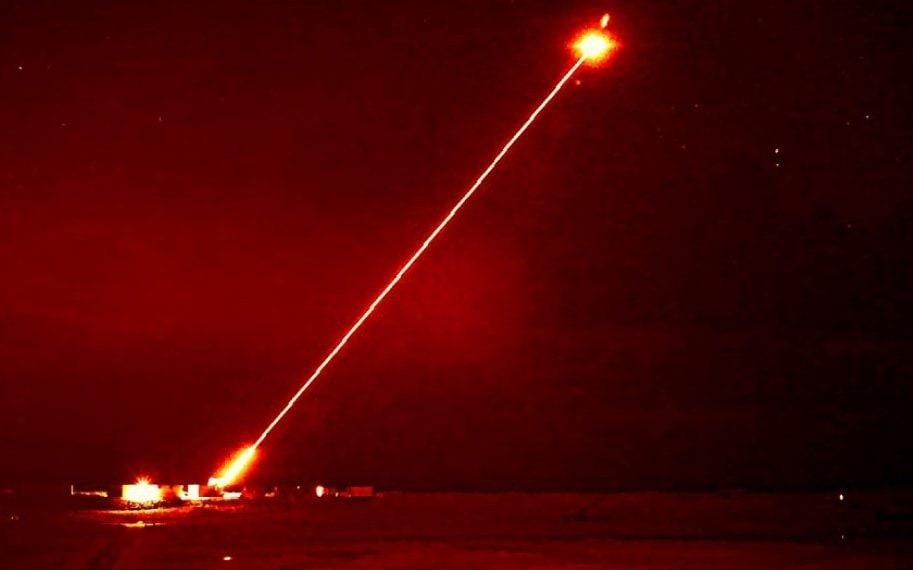
Ukraine could receive laser weapons for countering aerial targets within the next two to three months, Deputy Commander-in-Chief Andrii Lebedenko said at a briefing, according to UNIAN. Teams inside the Armed Forces and private Ukrainian companies are working on the systems.
Ukraine's main laser system is Tryzub, built by the Ukrainian company Celebra Tech, which EP reported in May 2026 was in final testing on a trailer-mounted mobile platform with a stated range of up to 5 km against drones. Ukraine also became the world's fifth country to deploy a combat laser system in December 2024.
"We will have the same kind of means"
"It can already shoot down FPVs today, it is already working today on Shaheds. And this is a story of the next two to three months, when we will have the same kind of means," Lebedenko said.
According to the official, the system will let Ukraine hit aerial attack weapons even better than machine guns.
He called the direction genuinely promising and said that everything is working out today.
Lasers solve cost problem that machine guns only partly solve
The comparison Lebedenko drew to machine guns points to what a laser is for. Ukraine's mobile fire groups shoot down Shaheds with heavy machine guns and cannons because missiles cost more than the drones they kill. A laser takes that logic further, since each shot costs electricity to fire.
The limits are physical rather than financial. Lasers need line of sight, lose power through cloud, rain, smoke, and dust, and must hold a beam on a moving target long enough to burn through it.
Ukraine's laser claims have run ahead of its fielding before
Lebedenko's forecast lands in a program that has been announced repeatedly. Ukraine's Unmanned Systems Forces demonstrated the Tryzub system in April 2025, and Ukraine's drone forces commander at the time said laser technologies were already striking objects at altitude.
In May 2026, the system was still described as undergoing final testing.
None of that makes the current claim wrong. Directed energy weapons are genuinely difficult, and a system that moved from lab demonstration to trailer-mounted final testing to claimed FPV kills has advanced in that period. But the operational date has shifted multiple times. What would make it verifiable is a documented Shahed kill.
Ukraine has a new drone hunter that outclimbs its prey. Ukraine's Defense Ministry codified the Tsyklop interceptor drone, which can rise above the maximum flight altitude of Russian strike and reconnaissance UAVs and destroy them from there.
Ukraine's interceptor lineup has filled fast with systems that compete on speed and cost, and Tsyklop's distinguishing claim is a ceiling higher than what Russia's drones can reach.
It has a wingspan of a little over a meter, stays airborne for nearly 1.5 hours, and comes in two variants: a cheaper, simpler model for slow, low-flying air and ground targets, and a higher-performance version built to catch fast Shaheds at altitude.
The Ministry says the system's range is enough to cover any Ukrainian regional center against drone attacks, and that its V2 variant has already destroyed more than 100 air targets, and was the first to down a Russian Shahed over Kursk Oblast.
The interceptor was developed by a Ukrainian enterprise experienced in building weapons specifically for high-intensity modern warfare, and various Tsyklop modifications have been at the front for several years already, per the Defense Ministry.
Tsyklop already kills full Russian drone catalog
The V2's more than 100 kills span the range of Russian drones Ukraine faces daily: the Gerbera decoy-and-strike drone, the Zala and Supercam and Orlan reconnaissance UAVs, the Lancet loitering munition, and the Molniya. That target list is the point — it means one interceptor is bringing down both the cheap reconnaissance drones that spot for Russian artillery and the Lancets that follow, as well as Shaheds.
Different Tsyklop modifications have been at the front for several years, the Ministry said, so codification formalizes a system already proven in combat rather than introducing an untested one. The cheaper variant handles slow, low targets; the high-performance variant is built for fast Shaheds at altitude.
Tsyklop joins fast-filling interceptor lineup
Tsyklop enters a market that Ukraine has built at speed. The Defense Ministry codified 413 unmanned aerial systems in the first half of 2026, and interceptors are one of the fastest-growing categories.
The competitors each solve the Shahed problem differently. Ukraine's Defense Ministry is procuring 8,000 Octopus interceptors with automatic terminal guidance. Germany funded 15,000 units of the STRILA, which hits 355 km/h and needs no GPS. Wild Hornets' Sting has destroyed more than 600 aerial targets and became the first Ukrainian drone control system approved to NATO standards.
Tsyklop's contribution to that mix is the vertical dimension: a drone that gets above the target rather than chasing it down.
Altitude answers the jet-Shahed problem
The high-flying variant matters because Russia's drones have been getting faster and higher. Russia has fielded jet-powered Geran-4 Shaheds that cruise at 300 to 350 km/h and can burst to 500 to 600, outrunning much of Ukraine's cheaper interceptor fleet.
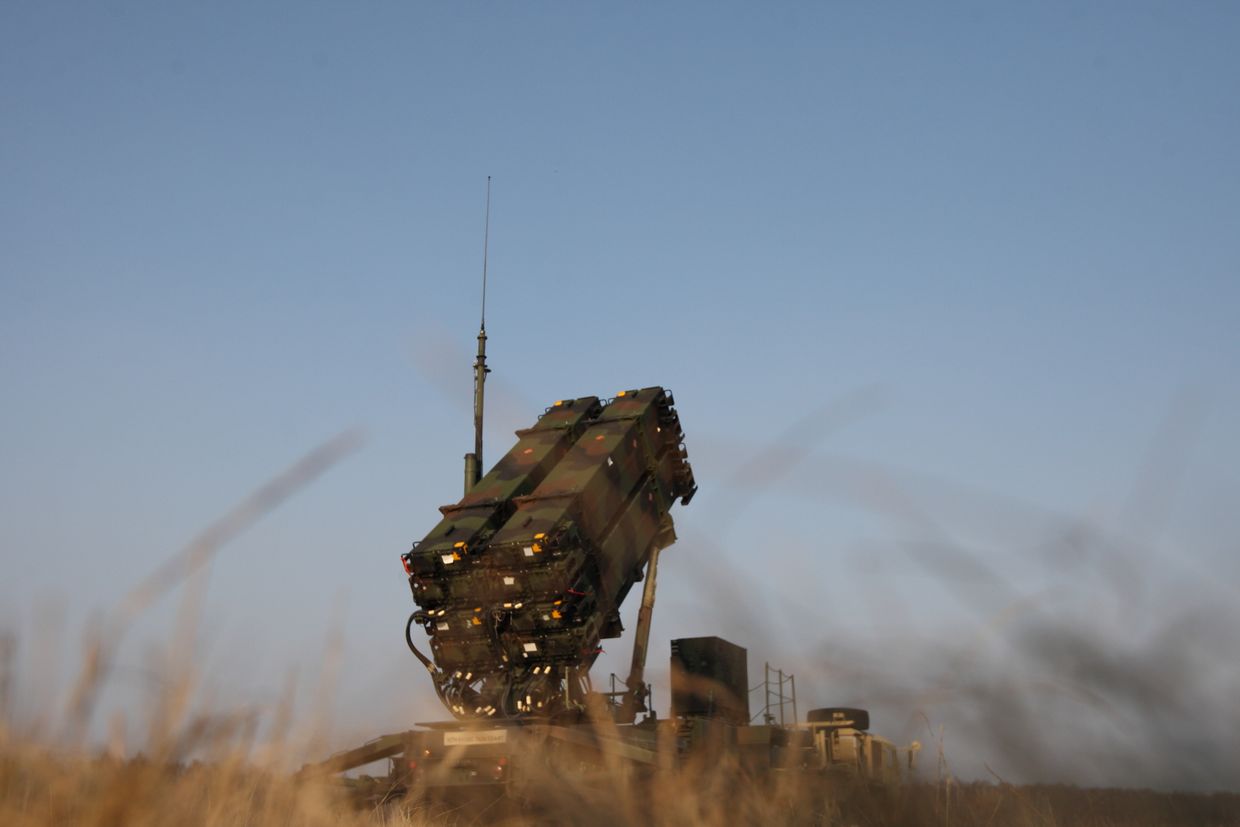
U.S. President Donald Trump is considering sending Ukraine an additional Patriot air defense system, a move that would mark his administration's first major weapons transfer to Kyiv, the Wall Street Journal (WSJ) reported on July 8, citing two defense officials.
The report is the latest in a series of contradictory messages from the Trump White House in recent days regarding military aid to Ukraine. While the Pentagon on July 2 announced a halt in weapons shipments to Kyiv due to dwindling U.S. stockpiles, Trump later claimed he wasn't responsible for the decision and wanted to send more weapons to Ukraine.
A U.S. defense official told the WSJ that Trump has asked the Pentagon to look into options for supplying Ukraine with more arms, including a Patriot air defense system. Officials are also reportedly exploring whether other nations can send Patriots to Kyiv.
The claim dovetails with recent media reports about the administration's plans to bolster Ukraine's air defenses. Axios reported on July 8 that the White House is pursuing a plan to have Germany sell another Patriot battery to Ukraine, with the U.S. and European allies splitting the cost of the purchase. Sources told the outlet that Trump also pledged to send 10 Patriot interceptor missiles to Kyiv.
If the U.S. provides Ukraine with an additional Patriot system, it would mark the first time Trump has approved a major military aid package to Kyiv that wasn't previously greenlighted by former U.S. President Joe Biden.
Washington has thus far provided Kyiv with three Patriots, a former Pentagon official told the WSJ. Germany has also sent three, while a group of European countries provided one. According to the official, not all systems are in use at the same time due to maintenance issues.
The U.S.-made air defense systems are in high demand around the world. Each system consists of two or three launchers, a radar, a command and control element, and interceptor missiles. Patriot missiles are also in short supply globally: Ukraine faces an urgent need for the munitions amid increased Russian aerial attacks, and the Guardian reported on July 8 that even the U.S. has only 25% of the interceptors required by its defense readiness plans.
According to one of the officials who spoke to the WSJ, the U.S. military would be able to supply an additional Patriot to Ukraine if ordered by the White House.
Ukraine has synchronized its sanctions against Russia with the last three packages of economic penalties imposed by the European Union, President Volodymyr Zelensky announced on July 8.
"Three more packages of EU sanctions are fully effective in Ukraine," Zelensky said in his evening address.
Earlier on July 8, the president announced a new round of sanctions, including restrictions on five Chinese-registered companies accused of supplying components found in Russian Shahed-type drones used to attack Ukraine.
Vladyslav Vlasiuk, Zelensky's sanctions commissioner, told reporters on July 8 that the latest decrees bring Ukrainian penalties in line with the EU's 15th, 16th, and 17th packages of sanctions against Russia.
The 15th package targets individuals from Russia, Belarus, and China, among other countries, according to Vlasiuk. It includes the Russian pilot Alexander Azarenkov, who was involved in the deadly attack on the Okhmatdyt children's hospital in Kyiv. Zelensky signed the sanctions decree on the one-year anniversary of the strike.
The 16th package includes individuals from Russia, China, Turkey, and other nations. It also targets the Voin Center, Russia's military-patriotic education organization operating in occupied Ukrainian territories, and Pivdennyi Flot LLC, which transports Russian oil via its "shadow fleet," Vlasiuk said.
The 17th package designates firms from Russia, China, Turkey, and other countries, including the gold-mining company Petropavlovsk and the Chinese company Skywalker Technology Co. Ltd, produce drone parts for Russia.
The EU is expected to approve its 18th package of sanctions against Russia later this week, after facing opposition from pro-Kremlin bloc members Slovakia and Hungary.
Ukraine has taken measures to coordinate sanctions with international partners in order to amplify pressure on Moscow. Zelensky on June 27 signed a decree to synchronize Ukraine's sanctions against Russia with those imposed by the EU and Group of Seven (G7).
The European Commission is discussing with EU member states various options to cover Ukraine's budget deficit for next year, which could range from $8 billion to $19 billion, the Financial Times reported on July 8.
International partners have provided Ukraine with over $39 billion for its wartime economy so far this year, Prime Minister Denys Shmyhal announced.
The financial hole in Ukraine's budget is linked to reduced U.S. support and the lack of prospects for a swift ceasefire with Russia that Europe had hoped for, the Financial Times reported.
A senior EU official told the publication that many of Ukraine's partners had previously counted on a peace deal in 2025, but are now forced to revise their funding plans.
This includes the European Commission, which has already adjusted spending from Ukraine-related funding streams.
Without support from Western partners, Kyiv would face a budget deficit of $19 billion in 2026, according to the Financial Times. However, even if additional international financing for the wartime economy can be secured, a gap of at least $8 billion would remain.
To support Ukraine's budget, Europe is considering providing military aid in the form of off-budget grants that would be recorded separately as external transfers but would count toward NATO member countries' national defense spending targets.
One EU diplomat told the Financial Times that military support for Ukraine is viewed as a contribution to the defense of all of Europe.
In a document for G7 countries reviewed by Financial Times, Kyiv proposed that European allies co-finance Ukrainian forces, framing this as a service to strengthen continental security.
Other support options under discussion include potentially accelerating payments from the existing $50 billion G7 loan program and reinvesting frozen Russian assets in higher-yield financial instruments that the EU allocated to help service the debt.
According to the Financial Times, two sources confirmed that the commission planned to discuss these options with EU finance ministers on July 8.
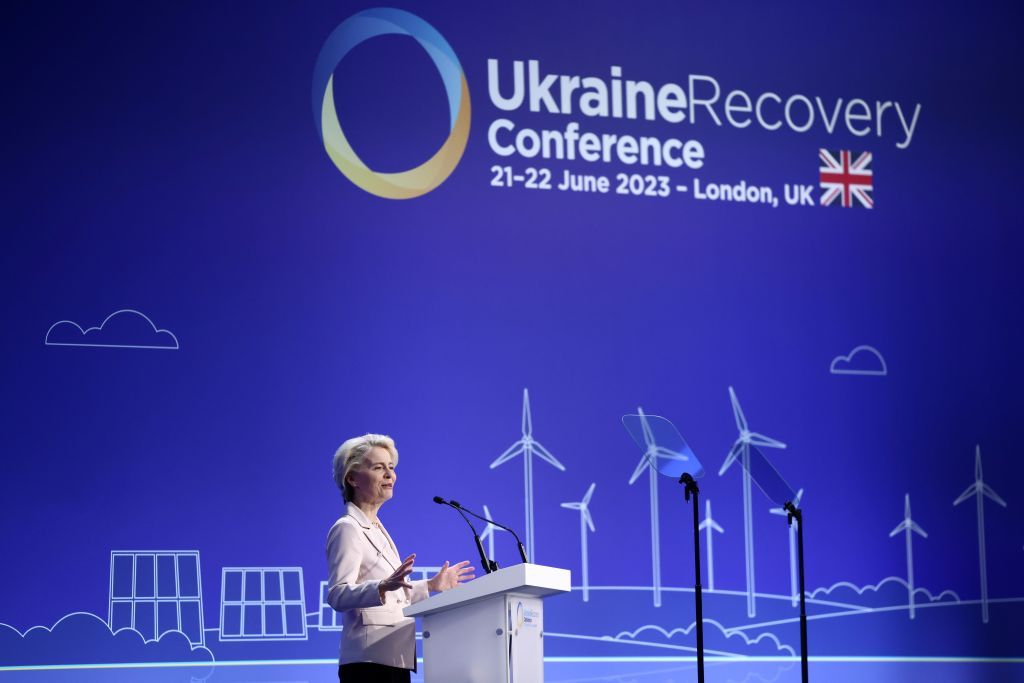
The funding issue will also be raised at the Ukraine Recovery Conference in Rome on July 10-11, dedicated to Ukraine's reconstruction needs. European Commission President Ursula von der Leyen will attend the event.
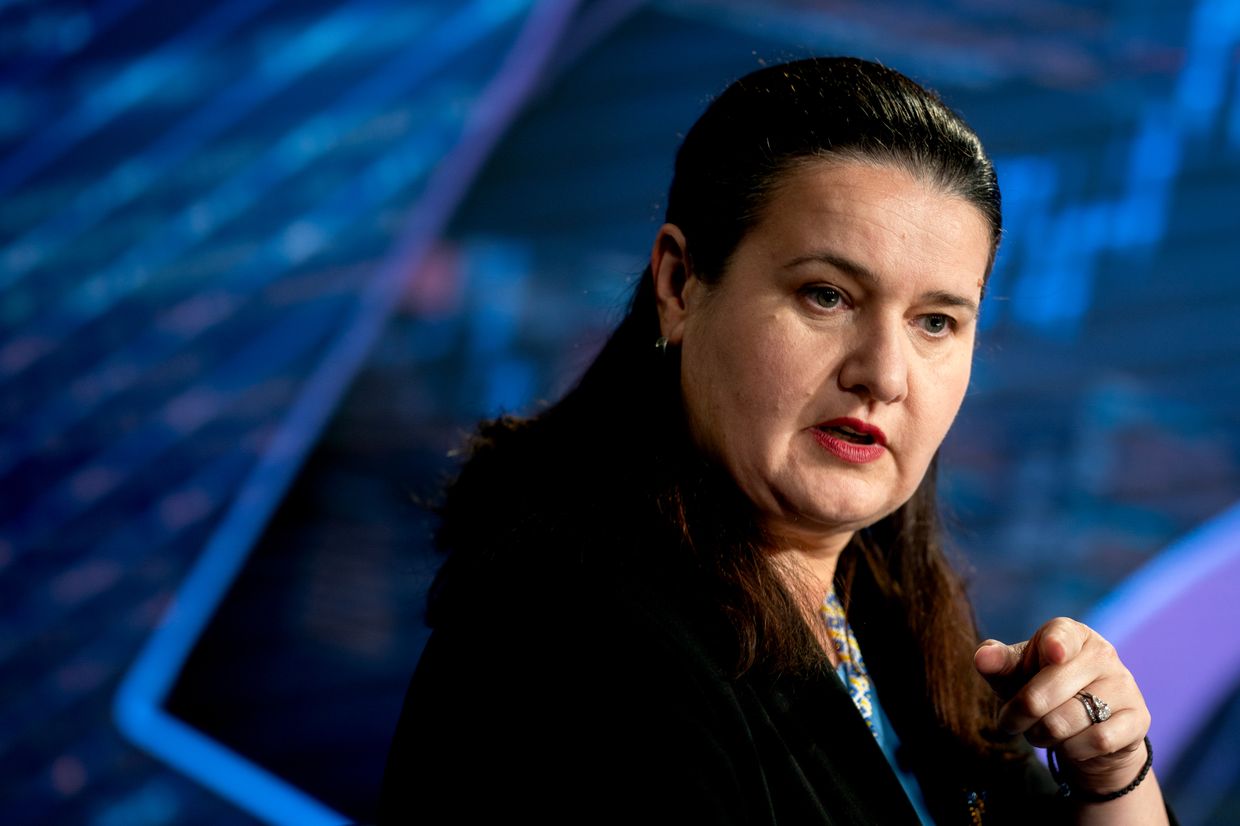
Ukraine's current ambassador to the United States, Oksana Markarova, will be replaced in the near future, Foreign Minister Andrii Sybiha confirmed in an interview with Ukrainian Radio on July 8.
Earlier on July 8, a source in the Presidential Office told the Kyiv Independent that President Volodymyr Zelensky had informed Markarova of her pending dismissal.
"We can expect about 20 decrees dismissing and appointing new heads of foreign institutions," Sybiha said, specifically mentioning the U.S. as one of the planned replacements.
In his comments, Sybiha described Markarova as "one of our most successful ambassadors."
"She is extremely effective and charismatic, but surely every diplomat has a rotation cycle," he said. "I can confirm that the Ukrainian president's vision is to carry out rotations in all countries, both G7 and G20. That is, first and foremost, to strengthen these countries, in particular the U.S. track."
Zelensky and Sybiha on June 21 announced plans to overhaul Ukraine's diplomatic corps, teasing major personnel changes in a bid to secure better military aid packages and other support from international partners.
Zelensky discussed replacing Markarova specifically in a recent phone call with U.S. President Donald Trump, a source in the President's Office told the Kyiv Independent on July 7.
There are multiple "strong candidates" in the running to replace Markarova, the source said. Prime Minister Denys Shmyhal, Deputy Prime Minister Olha Stefanishyna, Defense Minister Rustem Umerov, and Energy Minister Herman Halushchenko are among the candidates, Bloomberg previously reported.
In his evening address, Zelensky said that a meeting with all Ukrainian ambassadors is scheduled for July 21. It was not immediately clear as to when the changes to the posts may take effect.
Markarova has served as Kyiv's ambassador to Washington since April 2021, and played a central role in coordinating U.S. military and financial support during the early phases of Russia's full-scale invasion.
The announcement of her dismissal comes at a high-stakes moment in relations between Kyiv and Washington. The U.S. Defense Department recently paused shipments of critical weapons systems, including Patriot air defense missiles and precision-guided munitions, even as Ukraine faces intensifying Russian attacks.
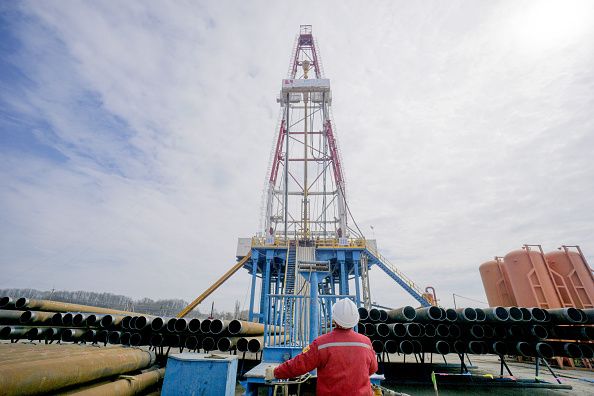
Ukraine's state energy giant Naftogaz has commissioned a new exploration well producing 383,000 cubic meters of natural gas per day through its subsidiary Ukrgazvydobuvannya, CEO Sergii Koretskyi announced on July 8.
The 5.7-kilometer deviated well was drilled and commissioned six weeks ahead of schedule as Ukraine works to boost domestic production amid Russian attacks on its energy infrastructure, including gas storage facilities in western Ukraine.
"This is a significant achievement, given the country's need for gas," Koretskyi said.
Naftogaz produces the lion's share of Ukrainian gas, but its production facilities were severely damaged in a series of Russian missile strikes earlier this year, reducing production by as much as 40%.
According to data from Naftogaz, Ukrgazvydobuvannya lost about 50% of its production due to shelling.
Ukrgazvydobuvannya managed to increase commercial gas production to 13.9 billion cubic meters (bcm) in 2024 compared to 13.2 bcm in 2023, commissioning 83 new wells despite wartime conditions.
Ukraine previously produced 52 million cubic meters daily before Russia's full-scale invasion, but required 110-140 million cubic meters during winter months, covering the shortfall from underground storage.
To secure winter supplies, Naftogaz has signed four contracts with Poland's Orlen for delivery of 440 million cubic meters of U.S. liquefied natural gas. The latest agreement, announced July 2, covers an additional 140 million cubic meters.
According to Bloomberg estimates, in 2025 Ukraine may import a record 5 billion cubic meters of gas from Europe.
Ukraine's gas storage situation has also deteriorated significantly, with underground reserves falling to 6.02 bcm as of May 11 — the lowest level in at least 11 years.
The facilities are operating at just 19.4% capacity, with 2.79 billion cubic meters less gas available than the previous year.
The International Criminal Court (ICC) said on July 8 that it had issued arrest warrants for two senior Taliban leaders, accusing them of crimes against humanity and gender-based persecution following the group's takeover of Afghanistan in 2021.
The move follows Russia's recognition of the Taliban as Afghanistan's legitimate government on July 3. Russia, which had previously designated the Taliban as a banned terrorist group, became the first country in the world to recognize it.
In a statement, the ICC named Taliban supreme leader Haibatullah Akhundzada and Afghanistan's top judge Abdul Hakim Haqqani as suspects in a campaign of systematic oppression targeting women, girls, and others who do not conform to the group's rigid gender ideology.
The court said the alleged crimes took place across Afghanistan from the Taliban's return to power on August 15, 2021, and continued at least until Jan. 20, 2025. The suspects are believed to have played key roles in the enforcement of Taliban policies that led to "murder, imprisonment, torture, rape and enforced disappearance."
The persecution was not limited to women and girls, according to the ICC. The court said that men perceived as allies of women or opponents of Taliban ideology were also targeted.
The ICC emphasized that the Taliban implemented a state-led policy of repression that violated fundamental human rights and freedoms across the country.
Most of the international community has refused to formally recognize the Taliban regime due to its human rights abuses and failure to meet international standards.
Meanwhile, since Moscow's full-scale invasion of Ukraine in 2022 the Kremlin has deepened relationships with authoritarian regimes, including North Korea, Iran, and now the Taliban. Russia has expanded trade with Afghanistan and allowed Taliban officials to participate in Russian forums.
In December 2024, the Russian State Duma passed a law allowing certain groups, including the Taliban, to be removed from the country's list of banned terrorist organizations. The move paved the way for official recognition.
Putin has referred to the Taliban as "allies," and Lavrov has called them "sane people," despite the group's ongoing enforcement of strict Islamic law, including gender apartheid, public executions, and bans on women's education.
The United States has only about 25% of the Patriot missile interceptors it needs to meet Pentagon military plans, a shortage that led U.S. President Donald Trump's administration to pause a major transfer of weapons to Ukraine, the Guardian reported on July 8.
The decision to halt the delivery, made on July 2, followed an internal review showing low stockpiles of critical air defense systems. The depletion was largely due to recent U.S. operations in the Middle East, including the interception of Iranian missiles after strikes on the American Al Udeid airbase in Qatar, according to the Guardian.
According to officials familiar with the matter, the Pentagon's munitions tracker, used to measure the minimum supplies needed for U.S. war plans, showed Patriot interceptor levels had fallen below acceptable levels. That prompted concerns that sending more to Ukraine could put U.S. defense readiness at risk, the Guardian wrote.
The freeze reportedly affected Ukraine's two key arms transfer methods: drawdowns from Pentagon stockpiles and the Ukraine Security Assistance Initiative (USAI), through which the Defense Department orders new weapons from contractors.
Because U.S. orders take priority, Ukrainian requests for new weapons, including Patriot missiles, face years-long delays.
The pause came at a critical time for Kyiv, as Russia intensifies large-scale aerial attacks on Ukrainian cities. With limited options to acquire precision-guided and other key munitions, Ukrainian forces have increasingly relied on Western-supplied air defenses to counter the growing threat.
For its latest aid package, the U.S. had planned to send dozens of Patriot interceptors, along with Hellfire missiles, air-to-air Sparrows, GMLRS rockets, and anti-tank weapons, according to the Guardian.
NBC News reported on July 4 that U.S. Defense Secretary Pete Hegseth unilaterally halted a weapons shipment to Ukraine despite internal military assessments showing the aid would not compromise American military readiness.
The assessment concluded that while some munitions stockpiles, including precision weapons, were low, they had not fallen below critical thresholds.
Amid the ongoing questions over Washington's weapons pause, Trump has apparently promised to send 10 Patriot interceptors to Ukraine, Axios reported on July 8. Sources also told the Wall Street Journal (WSJ) that Trump claimed he wasn't behind the decision to halt arms to Kyiv in a recent phone call with President Volodymyr Zelensky.
U.S. President Donald Trump said on July 8 he was "not happy" with Russian President Vladimir Putin.
"We get a lot of bullsh*t thrown at us by Putin," he said at a cabinet meeting. "He's very nice all the time, but it turns out to be meaningless."
Trump has vacillated for months between criticizing Putin and praising the Kremlin. So far, he has failed to increase military aid to Ukraine or sanction Russia despite Moscow's refusal to accept a ceasefire.
During his election campaign, Trump repeatedly pledged to end the war in Ukraine within "24 hours." However, his efforts to broker a peace deal between Ukraine and Russia have seen no progress.
Trump also addressed U.S. legislation on sanctions, saying the Senate's Russia sanctions bill was "totally optional" for him to implement or terminate.
"I'm looking at it very strongly," Trump said.
The bill would impose 500% tariffs on imports from countries purchasing Russian oil, gas, uranium, and other products. It was introduced in April but has seen no progress since then.
Earlier, Trump signaled growing openness to tougher measures against Moscow, ABC News reported on June 29.
According to Senator Lindsey Graham, Trump privately told him it was "time to move" the Russia sanctions bill.
"I’m confident the president is ready for us to act," Graham said.
The Senate is expected to vote on the bill after Congress returns from a break in July.
"(Putin is) killing a lot of people — his soldiers and their soldiers mostly. And it's now up to 7,000 a week," Trump said on July 8, referring to Russia's battlefield losses.
In recent weeks, Trump has been critical of the Russian president. Following a phone call with Putin on July 3, Trump said he was "very disappointed," signaling growing frustration with the Kremlin.
When asked by a journalist on July 8 whether he would take action, Trump responded: "Wouldn't be telling you... We want to have a little surprise."
Trump also commented on the the current pause in weapons deliveries to Ukraine. He pointed to the previous transfer of advanced systems, including Javelin anti-tank missiles and Patriot air defense systems, calling them "the best equipment in the world."
His remarks come after the United States halted military aid shipments to Ukraine on July 2 amid an internal Pentagon review of stockpile capacity. The freeze coincided with a surge in Russian aerial attacks, leaving Ukraine increasingly vulnerable amid a shortage of U.S.-supplied air defense systems.
The U.S. halted weapons shipments to Ukraine amid a capability review, the White House and Pentagon previously confirmed, with Trump later denying the pause.
On July 7, the Pentagon said it would renew shipments, saying the additional defensive weapons were intended to help Ukraine protect itself while the U.S. works toward "a lasting peace."
Ukraine's Cabinet of Ministers rejected a nominee to lead the economic crimes agency, drawing swift criticism from lawmakers and businesses over alleged interference in the selection process.
The agency, the Bureau of Economic Security, was created in 2021 to investigate economic crimes. It has since faced accusations of being used to pressure — and in some cases extort — businesses, prompting multiple calls and efforts to overhaul it.
Selecting a new director of the agency by the end of July is one of Ukraine's obligations to the EU and International Monetary Fund as part of international financing packages extended to the war-torn country by the institutions.
As part of a recent attempt to relaunch the bureau, Oleksandr Tsyvinsky on June 30 was officially nominated by the bureau's selection commission that consists of six members — three from the government and three international experts. Tsyvinsky is known for exposing schemes involving illegal land seizures in Kyiv..
But Ukraine's government on July 8 said it had rejected Tsyvinsky following alleged concerns raised by the country's intelligence service of potential Russian connections.
The government unanimously decided to ask the commission to submit two new candidates who meet all security requirements, the government press service wrote on its official Telegram channel, a move it claims aligns with the law.
Following Tsyvinsky's nomination, it was revealed that his father holds a Russian passport. He has said he hasn't spoken to his father, who lives in Russia, in years.
Tsyvinsky holds clearance for state secrets and has passed special vetting, backed by over 20 years in law enforcement, including nearly a decade at the National Anti-Corruption Bureau of Ukraine (NABU).
Opposition lawmaker Yaroslav Zhelizniak, said the government had no grounds to reject a properly nominated candidate, claiming President Volodymyr Zelensky's office is behind the blocking of the nomination.
"The (bureau's) legislation provides no legal grounds for the cabinet to demand a new shortlist or impose additional, undefined requirements such as 'security criteria.' The term itself is absent from any statute and therefore has no legal force," Zhelizniak said.
"The SBU letter in this case is nothing more than an indicator of the winner's disloyalty to the President's Office and a desire to block the appointment," said Olena Shcherban, deputy executive director of the AntAC in a statement following the news.
Major business associations have called on Zelensky, Parliament Speaker Ruslan Stefanchuk, and Prime Minister Denys Shmyhal to reverse the government's decision.
The business groups warned that failing to reform the agency will harm investment decisions, particularly as Ukraine's wartime economy needs to attract capital.
"War is a time for radical changes in the rule of law and business climate, otherwise the economy cannot ensure the country's survival," the businesses wrote in an open letter.
Russia's crude oil shipments have dropped to their lowest level since February, as refinery processing outpaces production growth and trims available export volumes, Bloomberg reported on July 8.
Russia has used its revenues from energy exports to finance the war in Ukraine.
Seaborne crude flows averaged 3.12 million barrels a day over the four weeks to July 6, a 3% decline from the previous period ending June 29, according to tanker-tracking data compiled by Bloomberg. That's the lowest level recorded since the four-week period ending Feb. 23.
The gross value of Moscow's oil exports rose by about $100 million, or 8%, to $1.36 billion for the week ending July 6, Bloomberg said. That increase was due to higher volume, although average export prices declined for a second consecutive week.
Most of Russia's oil continues to head to Asia. Shipments to the region averaged 2.73 million barrels per day, slightly lower than the previous month. Flows to Turkey fell to 370,000 barrels a day, and shipments to Syria held steady at 25,000 barrels a day.
The European Union is seeking to tighten sanctions on Russia. Ambassadors have yet to approve the EU's 18th sanctions package due to opposition from Hungary and Slovakia. The bloc failed to adopt the new package on June 27.
The new package includes restrictions targeting Russia's energy and banking sectors, as well as transactions linked to the Nord Stream gas pipeline.
Three men were found guilty on July 8 in connection with an arson attack on Ukraine-linked businesses in London, which British authorities say was orchestrated by Russia's Wagner mercenary group, Reuters reported.
The alleged ringleader, Dylan Earl, 21, had already pleaded guilty to aggravated arson over the 2024 blaze targeting companies that were supplying Elon Musk's Starlink satellite equipment to Ukraine, according to Reuters.
The systems are considered vital to Ukraine's communications and defense against Russia's ongoing invasion.
Earl also became the first person convicted under the U.K.'s National Security Act after admitting to a separate plot to attack a wine shop and restaurant in London’s upscale Mayfair district and to kidnap its owner, a prominent critic of Russian President Vladimir Putin.
Two others, Jake Reeves, 23, and Earl’s associate, also pleaded guilty to aggravated arson, with Reeves admitting to a charge under the National Security Act for receiving a material benefit from a foreign intelligence agency.
A jury at London's Old Bailey court convicted three additional men, Nii Kojo Mensah, 23, Jakeem Rose, 23, and Ugnius Asmena, 20, of aggravated arson. They had denied the charges. A fourth man, Paul English, 61, was acquitted.
Two other defendants, Ashton Evans, 20, and Dmitrijus Paulauskas, 23, were charged with failing to disclose knowledge of terrorist activity. Evans was convicted on one count and cleared of another. Paulauskas was acquitted of both charges and reportedly broke down in tears as the verdict was read.
Commander Dominic Murphy of the London Metropolitan Police reportedly said he was confident the Wagner Group and the Russian state were behind the attacks.
The U.K. has designated the Wagner Group as a terrorist organization.
Earl had exchanged hundreds of encrypted messages with a supposed Wagner handler using the alias "Privet Bot" on Telegram. According to reporting by the Organized Crime and Corruption Reporting Project (OCCRP), the account was previously advertised by Grey Zone, a Wagner-affiliated channel.
Prosecutors said Earl expressed interest in fighting for Wagner and was encouraged to recruit contacts from British soccer hooligan networks, Irish republican groups, and organized crime circles, Reuters reported. He and Evans also admitted to unrelated charges of dealing cocaine.
The Russian Embassy in London has denied any involvement in the warehouse attack and accused the British government of blaming Russia for domestic issues.
The Kremlin has consistently rejected accusations of sabotage and espionage, despite growing evidence and convictions tied to Russian-linked operations across Europe.
U.S. President Donald Trump has promised to send 10 Patriot interceptors to Ukraine - a smaller number than had been paused previously while en route to the country, Axios reported on July 8, citing its sources.
Trump has also suggested that Germany sell one of its Patriot batteries to Ukraine, according to three sources cited by Axios. They said the U.S. and European allies would split the cost of the purchase.
The discussion comes as Ukraine is calling upon its allies, particularly the United States, to support Ukrainian air defense by supplying "life-saving" Patriot systems and relevant missiles.
The Pentagon said on July 2 that some military assistance to Ukraine had been halted as the U.S. Defense Department conducts a review of foreign aid deliveries.
On July 7, the Pentagon said it would renew shipments, saying the additional defensive weapons were intended to help Ukraine protect itself while the U.S. works toward "a lasting peace."
Merz called Trump to request the release of the paused interceptors, according to Axios. During the call, Trump proposed that Germany sell one of its own Patriot batteries to Ukraine.
While no agreement has been reached, officials on both sides say negotiations are ongoing. German officials maintain that Berlin has already sent a higher share of its available Patriot systems to Ukraine than any other NATO country, including the U.S.
Russia has escalated its aerial campaign against Ukraine in recent weeks, launching large-scale missile and drone attacks that have killed and injured hundreds of civilians across multiple cities.
The suspension of U.S. arms deliveries, which include Patriots and precision-guided munitions, drew criticism from Kyiv. During a July 4 phone call with Ukrainian President Volodymyr Zelensky, Trump said he was not responsible for halting the aid, according to the Wall Street Journal.
He reportedly told Zelensky that a review of U.S. munitions stockpiles was initiated after last month's U.S. strikes on Iranian nuclear sites, but denied ordering a full pause in shipments.
NBC News reported that Defense Secretary Pete Hegseth halted the shipments unilaterally on July 2, despite internal Pentagon assessments that the move would not jeopardize U.S. military readiness.
Special Envoy Keith Kellogg and Ukrainian Defense Minister Rustem Umerov are set to meet in Rome later this week to discuss resuming the stalled military aid, Politico reported on July 7.
President Volodymyr Zelensky signed an order on July 8 imposing sanctions on five Chinese-registered companies accused of supplying components found in Russian Shahed-type drones used to attack Ukraine.
The decree follows a statement by Ukraine's Security Service (SBU), which said it recovered Chinese-made parts from downed drones during a July 4 air assault on Kyiv.
Sanctions were imposed on Central Asia Silk Road International Trade, Suzhou Ecod Precision Manufacturing, Shenzhen Royo Technology, Shenzhen Jinduobang Technology, and Ningbo BLIN Machinery.
The list was published on the Presidential Office's website alongside the official decision by Ukraine's National Security and Defense Council.
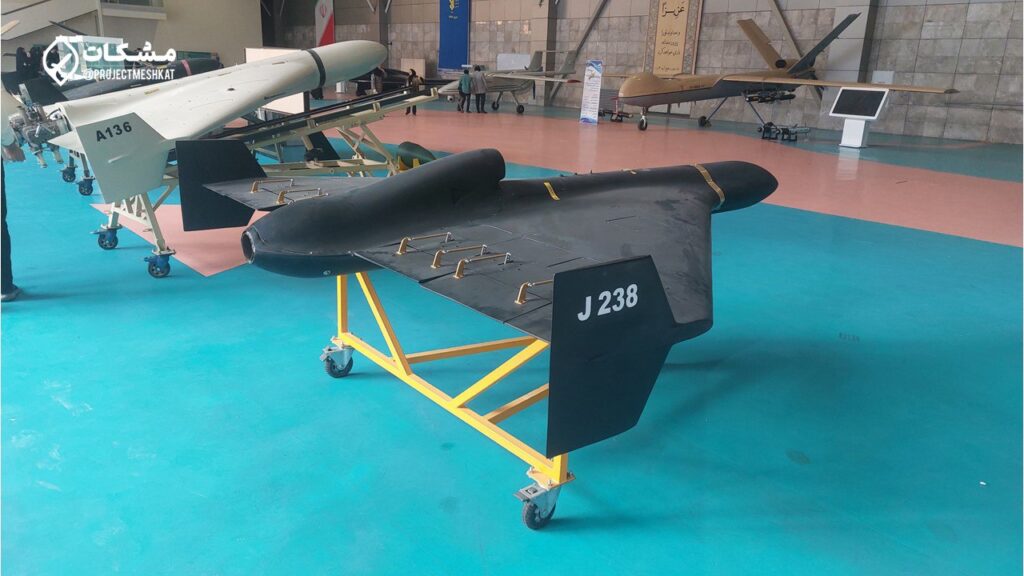
Russia's domestically produced drones based on Iran's Shahed-136 is a loitering munition extensively used by Russia to target Ukrainian cities, and is assembled with components sourced from around the world. Kyiv has warned that some of these parts continue to flow through countries that have not joined Western sanctions.
China has emerged as one of Moscow's key wartime partners, helping Russia circumvent sanctions and becoming the largest supplier of dual-use goods aiding its defense sector.
Vladyslav Vlasiuk, the Ukrainian president's commissioner for sanctions, told journalists on July 7 that Russia's growing ability to sustain weapons production is being driven by a flow of Chinese components and materials.
Zelensky has repeatedly accused China of backing Russia and providing technological and logistical support for its war effort. On May 29, he said Beijing had blocked the sale of drones to Ukraine while continuing to supply them to Russia.
Ukraine has already sanctioned several Chinese companies tied to Russia's war effort.
As Russian-Chinese relations deepen, Russian President Vladimir Putin is expected to visit China in September, where he is scheduled to meet with Chinese leader Xi Jinping.
Russian President Vladimir Putin signed a decree on July 7 permitting foreigners to serve in the Russian army during periods of mobilization, expanding military recruitment efforts.
Putin's partial mobilization decree from Sept. 21, 2022, remains in force and has never been formally rescinded. Ending it would require a separate presidential decree specifying a termination date.
Previously, it was allowed only during states of emergency or under martial law. Despite its full-scale invasion of Ukraine, Russia has avoided formally declaring martial law.
According to the document, the Kremlin is also permitting qualified specialists who have reached the age limit to sign contracts with Russia's Foreign Intelligence Service (SVR), Federal Security Service (FSB), or other state security agencies.
The changes aim to strengthen recruitment as Moscow tries to keep up the pace of troop replenishment without causing another wave of unpopular conscription. The Kremlin has heavily relied on financial incentives and aggressive campaigns to attract new volunteers.
Moscow currently recruits 30,000 to 40,000 individuals into its army each month, sources familiar with U.S. and EU intelligence told the Wall Street Journal.
On March 31, Putin authorized the spring conscription of 160,000 men — the country's largest call-up in 14 years. Though Russian officials claim conscripts are not sent to the front, human rights groups and relatives have reported that many are pressured into signing contracts.
In May, Russia's Investigative Committee Head Alexander Bastrykin said 20,000 naturalized migrants were sent to fight in Ukraine after failing to register for military service.
In the summer of 2024, Russian lawmakers passed a law allowing the revocation of citizenship for naturalized individuals who do not comply with military registration requirements.
Less than a month after his release from Russian captivity, 57-year-old soldier Valery Zelensky died of injuries sustained under torture, Ukrainian media outlet Suspilne reported on July 6.
Zelensky had spent 39 months in Russian captivity. He was released as part of the landmark 1,000-for-1,000 prisoner deal on May 25. Just 22 days later, on June 16, his heart stopped.
At the beginning of the full-scale invasion, his unit delivered weapons to Ukrainian forces in Mariupol, his daughter, Valeria Zelenka, said.
"When the offensive began, they were told that volunteers were needed to go on the assault. Out of 40 (people), eight said, 'We're going.' My father was one of them," she added.
The family did not immediately find out that he had been taken prisoner for some time, and he was considered missing in action. During his years in captivity, Zelensky's family received only one letter. He had long appeared on prisoner exchange lists but did not return until this year.
"The torture was not just cruel, it was inhuman. But he endured it," his daughter told Suspilne.
"He told me, 'Daughter, I endured it because of Kyokushin (a style of karate). I have discipline, I'm tough. My body and muscles protected me.'"
Valeria said her father had been overjoyed to come home and meet his grandson for the first time. He also expressed a desire to learn Ukrainian after years of speaking Russian.
Doctors initially treated him for suspected pancreatic issues, but his condition quickly deteriorated. During surgery, they discovered his organs were severely damaged. He died in intensive care days later.
"My father told me, 'Three people died among us from torture. And when I was in a very bad state, I asked God: Please let me see the eyes of my beloved,'" his daughter said.
A medical report listed extensive injuries. He had a non-functioning shoulder and arm and showed signs of multiple organ failures.
"The first feeling is inexhaustible pain that your loved one is no longer here. He was simply tortured," Valeria said. "And there is relief that he no longer feels that torture."
Zelensky's return was part of a wider prisoner exchange agreed during a first round of direct talks between Ukrainian and Russian delegations in Istanbul.
The case is the latest in a number of Ukrainian soldiers' deaths after their return from Russian captivity, highlighting the effects of "widespread and systematic" torture of prisoners of war (POWs) in Russian prisons, reported by the U.N.
Serhii Dobrovolskyi, a Ukrainian soldier who had been in Russian captivity since 2023, died just a month after his release at the end of May as part of a 1000-for-1000 prisoner swap, an official from the soldier's home region announced on June 21.
In 2023, a high-ranking officer from the "Azov" brigade, Oleh Mudrak, died at 35 years old, months after his release from Russian captivity.
As a POW, he survived the Olenivka camp explosion and endured a dramatic weight loss in just 100 days, as seen in the photos published by Stanislav Aseyev, a Ukrainian writer and activist.
Dmytro Shapovalov, a 32-year-old defender of Ukraine who was exchanged in 2023 after over a year in Russian prisons, died on June 9, according to Suspilne.
Ukrainian prisoners of war (POWs) held in Russian captivity often face torture, abuse, and inhumane treatment, according to Ukrainian officials and human rights groups.
Many former POWs have reported beatings, starvation, and psychological pressure.
The exact number of Ukrainians currently held by Russia remains unknown. Kyiv continues to call for a full all-for-all exchange. Moscow has repeatedly rejected the offer.
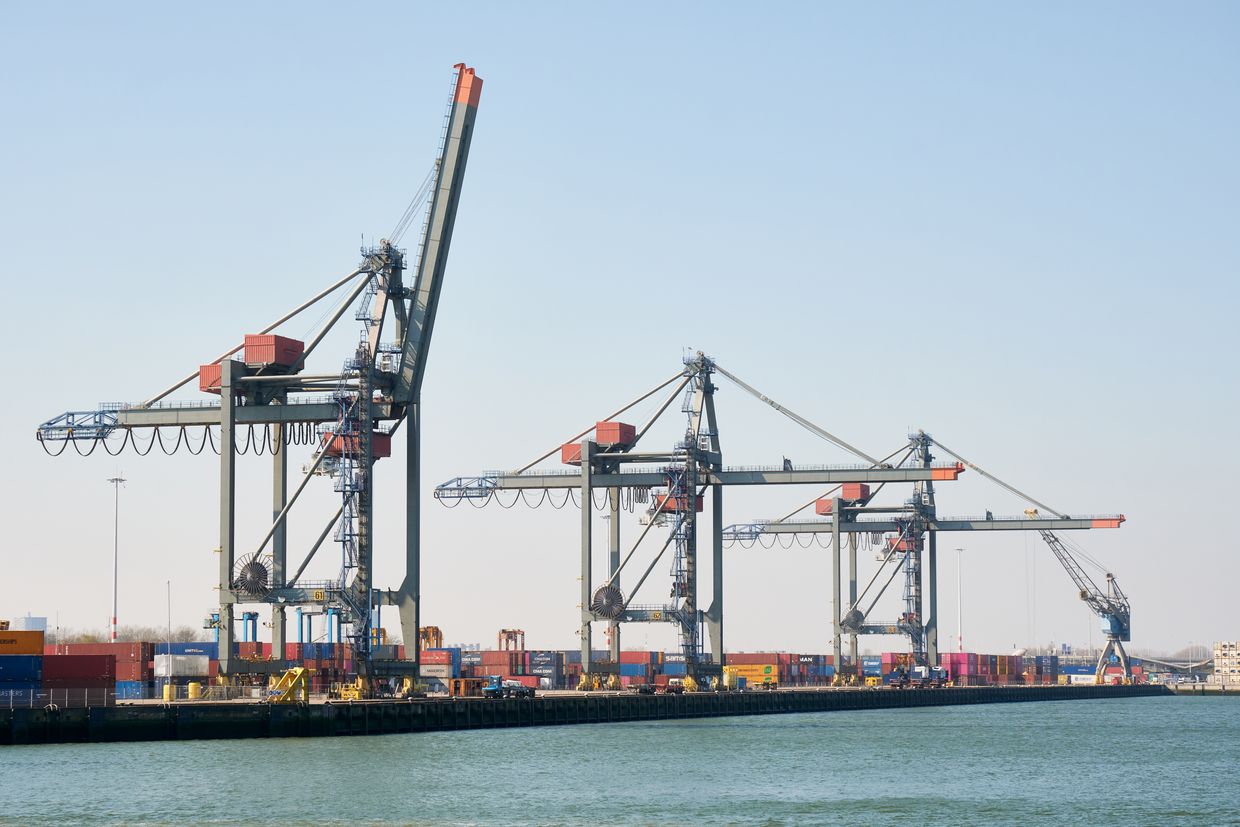
In anticipation of a potential war with Russia, the port of Rotterdam in the Netherlands has begun reserving space for NATO ships carrying military cargo and is mapping out logistics routes for weapons transfers, the Financial Times reported on July 8.
The decision comes as NATO allies increasingly warn of the risk of a large-scale war with Russia within five years. Rotterdam has previously handled weapons shipments, but this marks the first time that it will designate a special berth for military use.
Part of the container terminal will be repurposed to ensure the safe transfer of ammunition and other equipment between vessels. Military supply logistics will be coordinated with the port of Antwerp in neighboring Belgium.
"We see each other less and less as competitors," Boudewijn Siemons, Chief Executive of the Port of Rotterdam Authority, said, referring to the port of Antwerp.
"If large volumes of military goods would have to be shipped, we'd look to Antwerp or other ports to take over some capacity and the other way around."
Siemons added that not all terminals are equipped to handle military-grade cargo, making the logistical coordination crucial, particularly for shipments from the U.S., U.K., and Canada.
In May, the Dutch Defense Ministry confirmed that space would be allocated for military supplies at NATO's request. The move is part of broader efforts by European allies to reduce dependence on the U.S. for defense logistics.
Russia's military spending has surged amid its full-scale invasion of Ukraine. According to the International Institute for Strategic Studies, Moscow's 2024 defense budget rose by 42% in real terms, reaching $462 billion, surpassing the combined total of all European countries.
NATO Secretary General Mark Rutte said on July 5 that a Chinese military move against Taiwan could prompt Beijing to encourage Russia to open a second front against NATO states.
Rutte has repeatedly warned that Russia could rebuild its military capabilities fast enough to pose a direct threat to NATO territory, urging allied governments to act swiftly and decisively.
Ukraine's ambassador to the U.S. has been informed by President Volodymyr Zelensky that she is to be dismissed, a source in the President's Office confirmed to the Kyiv Independent on July 8.
Oksana Markarova has held the post since April 2021, and played a central role in coordinating U.S. military and financial support during the early phases of Russia's full-scale invasion.
But her future in the role was thrown into doubt earlier this week when it was revealed that Zelensky and U.S. President Donald Trump discussed a potential change during a recent phone call, a source in the President's Office told the Kyiv Independent on July 7.
According to the source, the topic of replacing her was raised by Kyiv, suggesting the move could be "useful for both sides." The source added that there are multiple "strong candidates" in the running.
The source added that there are multiple "strong candidates" in the running.Prime Minister Denys Shmyhal, Deputy Prime Minister Olha Stefanishyna, Defense Minister Rustem Umerov, and Energy Minister Herman Halushchenko are among the candidates, Bloomberg previously reported.
The possible reshuffle comes at a moment of renewed tension between Kyiv and Washington. The U.S. Defense Department recently paused shipments of critical weapons systems, including Patriot missiles and precision-guided munitions, sparking concern in Kyiv.
The discussion about Ukraine's representation in Washington also coincides with longstanding speculation about a broader government reshuffle.
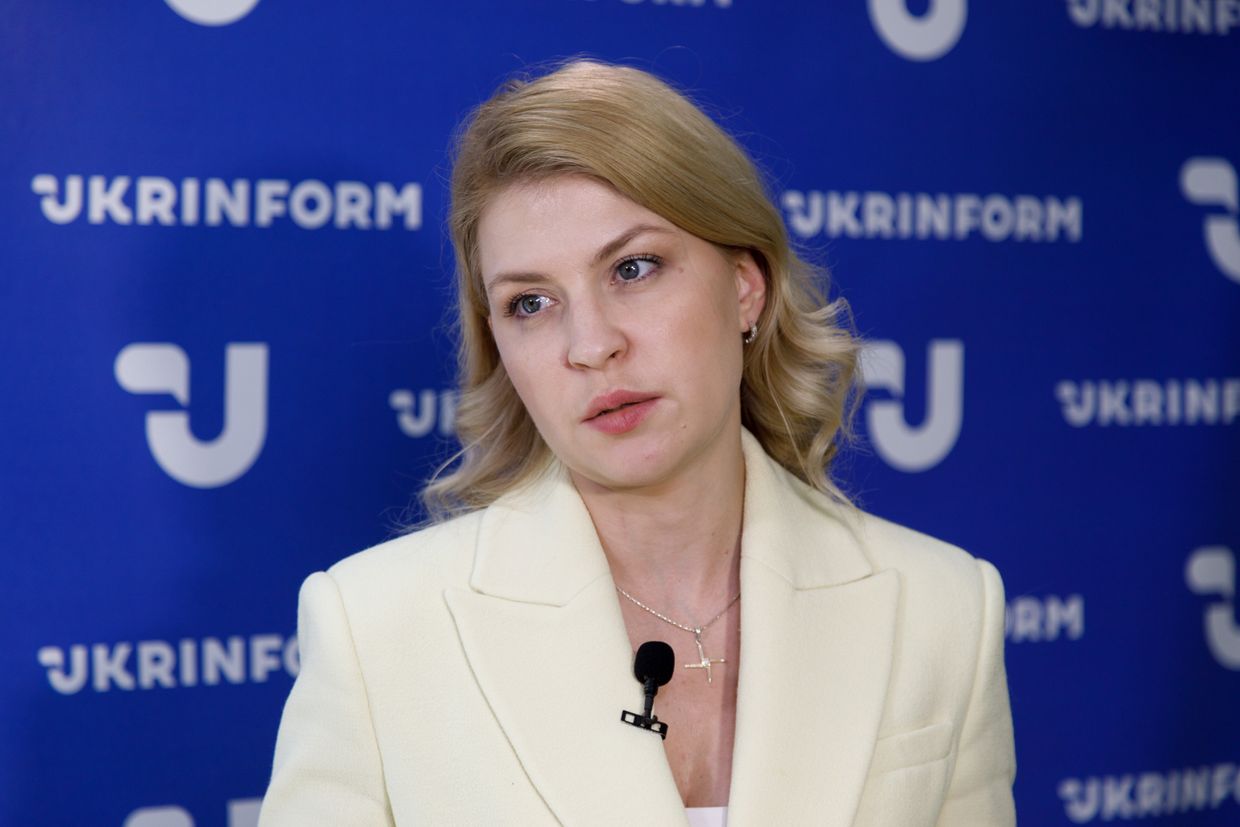
After failing to approve 18th package of sanctions against Russia due to opposition from Hungary and Slovakia, EU countries are expected to finalize an agreement this week, Ukrainian Deputy Prime Minister Olha Stefanishyna said on July 7.
Since EU sanctions require unanimous approval, a single veto could prevent implementation. In late June, EU ambassadors did not approve the sanctions package because of objections from Budapest and Bratislava.
"According to my information, European countries will still reach an agreement this week on the 18th package of sanctions, together with Slovakia and Hungary," she told Ukrainian broadcaster ICTV.
The delay followed earlier signs of resistance from both governments, despite the package being introduced shortly after the previous round of sanctions took effect on May 20.
"It is noteworthy that during the previous period, when the decision on the 17th package was being made, Hungary did not vote for this decision until the last day," Stefanishyna said.
"There was even almost a day when these sanctions were not put into effect."
Unlike Hungarian Prime Minister Viktor Orban, who has consistently opposed sanctions and military aid for Ukraine, Slovakia has not previously attempted to block new EU measures.
Bratislava requested a delay in adopting the latest package until the bloc clarifies the financial implications of RePowerEU — an initiative to end reliance on Russian fossil fuels by 2030.
"Without radical political leadership in the European Union, it will be very difficult," Stefanishyna said, warning of future veto threats by individual member states.
The 18th package includes new restrictions targeting Russia's energy and banking sectors, as well as transactions linked to the Nord Stream pipeline project.
These measures are part of a broader European effort to tighten pressure on Moscow as it continues to reject calls for an unconditional ceasefire in Ukraine.
While the EU pushes forward with additional restrictions, the United States has not imposed new sanctions on Russia since President Donald Trump took office in January.
At least nine civilians were killed and 81 others injured in Russian attacks across Ukraine over the past 24 hours, regional authorities reported on July 8.
Ukraine's Air Force said Russia launched 54 drones overnight, including Iranian-designed Shahed-type attack drones, and fired four S-300/400 guided missiles.
Air defenses intercepted 34 drones, while another eight were likely used as radar-jamming decoys. Drones struck five locations across the country.
The overnight assault was repelled using aircraft, electronic warfare, mobile fire groups, and missile defense systems, the military said.
In Kharkiv Oblast, one person was killed and 40 others were injured, including three children, as the city of Kharkiv and seven other settlements came under attack, Governor Oleh Syniehubov reported.
Russian strikes on Zaporizhzhia Oblast injured 20 people and damaged at least 64 houses and apartment buildings, Governor Ivan Fedorov said.
In Donetsk Oblast, three civilians were killed — two in Oleksiyevo-Druzhkivka and one in Novotroitske — and 10 more were injured, according to Governor Vadym Filashkin.
In Sumy Oblast, four people were killed and four more injured in Russian strikes, the local administration reported.
One person was killed and four others were injured in Kherson Oblast, where Russian forces hit residential areas and public infrastructure, damaging two apartment buildings and 17 houses, according to Governor Oleksandr Prokudin.
Three people were injured in Dnipropetrovsk Oblast, where Russian troops attacked with first-person-view (FPV) drones, Governor Serhii Lysak said.
The wave of attacks follows Russia's ongoing refusal to accept a ceasefire and comes amid rising use of drone and missile strikes against Ukraine's civilian infrastructure.
Ukraine's military intelligence (HUR) identified Russian Armed Forces Major Denis Sheynov as allegedly involved in the July 2024 missile strike on Kyiv's Okhmatdyt children's hospital, HUR reported on July 8.
The strike, which killed two adults and injured at least 34 people, directly hit the country's largest pediatric medical center, where 627 children were receiving treatment at the time.
According to HUR, Sheynov is the head of the special engineering service of the 121st Heavy Bomber Aviation Regiment, part of Russia's 22nd Heavy Bomber Aviation Division, tasked with executing the strike.
Sheynov, born in Saratov on Jan. 30, 1978, was reportedly responsible for the technical preparation of the X-101 air-launched cruise missiles used in the attack.
He graduated from the Saratov Higher Military Command Engineering School Missile Forces, and previously served in Syria in 2018. Sheynov has been awarded several medals by the Russian government, including for participation in the Syrian war.
Ukrainian authorities previously charged Russian Lieutenant General Sergey Kobylash in absentia for ordering the strike, which was widely condemned internationally.
Kobylash gave the order at around 9:15 a.m., while the hospital was struck at 10:45 a.m.
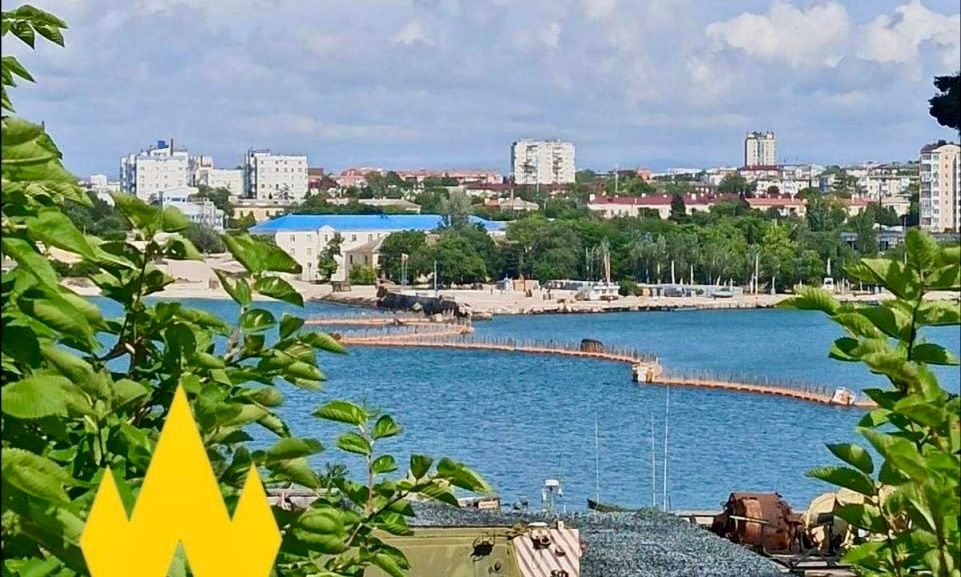
Striletska Bay near Sevastopol, once a key base for Russian warships in occupied Crimea, is now nearly empty and used primarily for mooring tugboats and small patrol craft, the Atesh partisan group reported on July 8.
According to the group, Russia now uses the bay mainly for maintenance work and rare anti-sabotage defense drills, having pulled most major vessels from the area.
"Recently, the bay has been practically empty... The degradation of the occupation fleet in Sevastopol is becoming increasingly obvious. Striletska Bay, which previously housed a large number of combat vessels, is now idle." Atesh said.
The remaining combat units are periodically rotated and redeployed in an apparent effort to avoid detection by Ukrainian reconnaissance.
"Every object is under control — no ship will go unnoticed," Atesh said, adding that all ship movements are being tracked and shared with the Ukrainian Armed Forces.
Sevastopol has served as the base for Russia's Black Sea Fleet since the illegal annexation of Crimea in 2014. Repeated Ukrainian attacks using naval drones, missiles, and long-range drones have forced the Kremlin to reduce its naval presence in occupied Crimea.
Ukraine has destroyed several Russian vessels, including the Caesar Kunikov landing ship, the Sergei Kotov patrol ship, the Ivanovets missile corvette, and multiple high-speed landing crafts.
The shrinking Russian presence in Sevastopol comes as Ukraine steps up drone attacks against other Black Sea Fleet locations. On July 6, drones struck the fleet's facilities in Novorossiysk, Krasnodar Krai, a key port east of Crimea across the Kerch Strait.
U.S. President Donald Trump told President Volodymyr Zelensky during a phone call on July 4 that he was not responsible for the suspension of U.S. arms shipments to Ukraine, The Wall Street Journal (WSJ) reported on July 7, citing unnamed sources familiar with the matter.
The suspension of aid, which includes Patriot air defense missiles and precision-guided munitions, has drawn criticism from Kyiv amid an intensifying Russian aerial campaign that has killed and injured hundreds of civilians in recent weeks.
According to WSJ, Trump told the Ukrainian president that he had ordered a review of Pentagon munitions stockpiles following last month's U.S. strikes on Iran's nuclear sites, but he did not direct the military to halt weapons deliveries.
NBC News reported on July 4 that Defense Secretary Pete Hegseth unilaterally halted the shipment to Ukraine on July 2, despite internal Pentagon assessments showing the aid would not compromise U.S. military readiness.
According to Politico, U.S. Special Envoy Keith Kellogg and Defense Minister Rustem Umerov are scheduled to meet in Rome later this week to discuss restarting U.S. military aid to Ukraine.
Trump did not acknowledge a halt in U.S. weapons shipments to Ukraine. On July 7, he said the U.S. would provide Ukraine with "more weapons," pointing to the scale of Russia's attacks.
"They have to be able to defend themselves, they're getting hit very hard now," Trump told reporters alongside a U.S. and Israeli delegation at the White House.
The comments follow Trump's July 3 call with Russian President Vladimir Putin, after which he said he was "very disappointed" with the Kremlin's continued refusal to end hostilities.
The following day, Trump and Zelensky spoke by phone in what the U.S. president described as a "very strategic" conversation focused on Ukraine's need for air defenses.
Two rounds of direct talks between Russia and Ukraine held in Istanbul in May and June led only to prisoner exchanges, with no breakthrough on ending hostilities. Moscow has maintained maximalist conditions while rejecting calls for an unconditional ceasefire.
Russia has lost 1,028,610 troops in Ukraine since the beginning of its full-scale invasion on Feb. 24, 2022, the General Staff of Ukraine's Armed Forces reported on July 8.
The number includes 1,070 casualties that Russian forces suffered over the past day.
According to the report, Russia has also lost 10,995 tanks, 22,967 armored fighting vehicles, 54,456 vehicles and fuel tanks, 30,034 artillery systems, 1,434 multiple launch rocket systems, 1,192 air defense systems, 421 airplanes, 340 helicopters, 44,230 drones, 28 ships and boats, and one submarine.
The EU will introduce the "toughest sanctions... imposed (on Russia) in the last three years" in coordination with U.S. senators, French Foreign Minister Jean-Noel Barrot said in a television interview on July 7.
"(Russian President Vladimir) Putin is no longer advancing on the front and is now limited to shelling residential areas with drones and missiles. This is leading to numerous casualties among the civilian population. This must stop," Barrot said.
U.S. Senator Lindsey Graham said on June 29 that U.S. President Donald Trump was ready for the Senate to vote on a bill to impose new sanctions on Russia. The Republican senator has repeatedly called for implementing additional sanctions against Moscow.
Barrot noted the EU is planning to impose the strongest sanctions against Russia that the bloc has introduced since 2022.
"This (war) cannot continue; it must stop. To achieve this, in coordination with American senators, Europe is preparing to introduce, based on French proposals, the toughest sanctions we have imposed in the last three years," he said.
"They will directly deplete the resources that allow Vladimir Putin to continue his war," Barrot added.
In the U.S., senators have been working on a sanctions bill, with Graham saying voting on a bill is expected to begin following the end of the July congressional break.
Graham, earlier on July 7, said he expects "the Senate will move the bipartisan Russian sanctions bill that will allow tariffs and sanctions to be placed on countries who prop up Putin’s war machine and do not help Ukraine."
The bill led by Graham has been in the works for several months as the White House has failed attempts to broker a peace deal between Ukraine and Russia.
"Ukraine has said yes to ceasefires and to any and all meeting requests while Putin continues to defy peace efforts. It is now time to put more tools in President Trump’s toolbox in order to end the war," he said.
Russia has relied on its partners, including Belarus, China, and Iran, for trade and to bypass Western sanctions meant to inhibit Moscow's ability to continue its war against Ukraine.
U.S. Special Envoy Keith Kellogg and Defense Minister Rustem Umerov are set to meet at the Ukraine Recovery Conference in Rome later this week to discuss the resumption of U.S. military assistance to Ukraine, Politico reported on July 7.
Following the talks between Kellogg and Umerov in Rome, Politico reported that more meetings are set to take place in Kyiv over the next two weeks.
The United States halted weapons shipments to Ukraine amid a capability review, the White House and Pentagon previously confirmed, with U.S. President Donald Trump on July 3 denying the pause.
Days later, Trump said that the United States would provide Ukraine with additional shipments of weapons amid intensified Russian attacks.
"We're gonna send some more weapons we have to them, they have to be able to defend themselves, they're getting hit very hard now," Trump said on July 7.
The halted U.S. military assistance to Ukraine could be resumed following planned high-level meetings at the conference, two people familiar with the matter told Politico.
A Kyiv meeting between Kellogg and Umerov following the Ukraine Recovery Conference was planned before the U.S. halted military assistance to Ukraine.
Kellogg's spokesperson Morgan Murphy said the meeting was "set up before news of the arms pause came to light last week."
Ukraine would like to promptly resume supplies of air defense and precision munitions, while the U.S. has signalled that the delivery of armored vehicles and engineering equipment may resume soon, the two sources said.
Pentagon spokesperson Sean Parnell confirmed on July 2 that some military assistance to Ukraine has been halted as the U.S. Defense Department conducts a review of foreign aiddeliveries.
"This capability review... is being conducted to ensure U.S. military aid aligns with our defense priorities... We see this as a common-sense, pragmatic step towards having a framework to evaluate what munitions are sent and where," Parnell said.
Despite the Pentagon announcement, Trump did not acknowledge a halt in U.S. weapons shipments to Ukraine.
"Why did you pause weapons shipments to Ukraine?" a reporter asked Trump as the U.S. president prepared to board Air Force One on July 3.
The United States will send "more weapons" to Ukraine amid intensified Russian strikes, U.S. President Donald Trump told reporters on July 7, adding that he is disappointed in Russian President Vladimir Putin.
"We're gonna send some more weapons we have to them, they have to be able to defend themselves, they're getting hit very hard now," Trump said alongside a U.S. and Israeli delegation at the White House.
The U.S. halted weapons shipments to Ukraine amid a capability review, the White House and Pentagon previously confirmed, with Trump later denying the pause.
Trump previously said he was disappointed in Putin for not making progress to end Russia's war against Ukraine, following a phone call between the two leaders on July 3.
On July 7, Trump again said he was unhappy with Putin for failing to cooperate with U.S. efforts to end the war in Ukraine.
"It's a horrible thing, and I'm not happy with President Putin at all," Trump said. "I'm disappointed frankly that President Putin hasn't stopped."
He noted that the additional assistance the U.S. will supply to Ukraine will mainly consist of defense weapons amid increased Russian attacks.
"They're getting hit very hard. We're gonna have to send more weapons, your defensive weapons primarily, but they're getting hit very, very hard. So many people are dying in that mess," Trump said.
Later on July 7 the Pentagon released a statement confirming more weapons would be sent to Ukraine.
"At President Trump's direction, the Department of Defense is sending additional defensive weapons to Ukraine to ensure the Ukrainians can defend themselves while we work to secure a lasting peace and ensure the killing stops," it read.
"Our framework for POTUS to evaluate military shipments across the globe remains in effect and is integral to our America First defense priorities."
President Volodymyr Zelensky has previously said he and Trump discussed supplying Ukraine with additional Patriot missile systems following a phone call between the two on July 4.
Zelensky described his recent phone call with Trump as "the best conversation in all this time" in an evening address on July 5.
"Patriot (missiles) are key to protection from ballistic (missiles). We discussed several other important issues that our teams will work out in detail at meetings in the near future," he said.
Trump described his July 3 conversation with Putin as disappointing, saying that the call "didn't make any progress" in stopping Russia's war against Ukraine.
"I'm very disappointed with the conversation I had today with President Putin," Trump told journalists. "Because I don't think he's there. And I'm very disappointed. I don't think he's looking to stop this fighting."
Pentagon spokesperson Sean Parnell confirmed on July 2 that some military assistance to Ukraine has been halted as the U.S. Defense Department conducts a review of foreign aid deliveries.
"This capability review... is being conducted to ensure U.S. military aid aligns with our defense priorities... We see this as a common-sense, pragmatic step towards having a framework to evaluate what munitions are sent and where," Parnell said.
Despite the Pentagon announcement, Trump did not acknowledge a halt in U.S. weapons shipments to Ukraine.
"Why did you pause weapons shipments to Ukraine?" a reporter asked Trump as the U.S. president prepared to board Air Force One on July 3.
A former deputy chief of the Russian army's General Staff, Colonel General Khalil Arslanov, was sentenced to 17 years in prison on July 7 over a scheme involving the theft of over 1 billion roubles ($12.7 million) from Defense Ministry contracts, Russia's state-owned TASS news agency reported.
A closed-door military court found Arslanov and others guilty of embezzling millions from state contracts with Voentelecom, a company providing telecommunications services to the Russian military.
Arslanov was also convicted of extorting a 12 million rouble ($152,400) bribe from the head of a military communications company. Two co-defendants, Colonel Pavel Kutakhov and military pensioner Igor Yakovlev, received seven and six years in prison, respectively.
Arslanov, a former head of the Russian military's communications unit, served as deputy chief of the army's General Staff from 2013 until his removal in 2020 and was named a colonel general in 2017.
This high-profile conviction is the latest in a series of corruption scandals that have implicated top echelons of the Russian military establishment over the past year. Russia has significantly stepped up prosecutions of senior defense officials.
Just last week, on July 1, former Russian Deputy Defense Minister Timur Ivanov was sentenced to 13 years in a penal colony after being found guilty of corruption. It was the harshest verdict in a series of high-level military corruption cases until Arslanov's sentencing on July 7.
Authorities initially detained Ivanov in April 2024 on bribery allegations, later adding embezzlement charges in October. His trial, like Arslanov's, was held behind closed doors reportedly due to national security concerns.
Ivanov's co-defendant, Anton Filatov, a former logistics company executive, received a 12.5-year sentence.According to state media, the embezzled amount totaled 4.1 billion roubles ($48.8 million), primarily funneled through bank transfers to two foreign accounts. Ivanov pleaded not guilty.
The court stripped him of all state honors and ordered the confiscation of property, vehicles, and cash valued at 2.5 billion roubles, including a luxury apartment in central Moscow, a three-storey English-style mansion, and a high-end car collection featuring brands like Bentley and Aston Martin.
Russia's crude oil production in June fell below its agreed-upon OPEC+ target, according to individuals familiar with the data interviwed by Bloomberg.
Russian producers reportedly pumped 9.022 million barrels per day last month, a figure 28,000 barrels per day below the required level, including compensation cuts. This marks the largest gap between Russia's output and its monthly quota this year, based on Bloomberg's calculations.
Historically, Russia, which co-leads the OPEC+ alliance with Saudi Arabia, has faced criticism for poor compliance with production quotas. However, the nation has shown improved adherence for most of 2025, often pumping below its required levels, according to analysis of Russian data. This increased focus on production discipline follows earlier critiques from Riyadh.
Under the terms of the OPEC+ agreement, Russia's daily production quota for June had increased by 78,000 barrels to 9.161 million barrels. However, Moscow had also committed to a 111,000 barrel-a-day compensation cut for the month, bringing its actual output target to 9.050 million barrels per day.
On July 5, eight OPEC+ nations collectively agreed to raise production by 548,000 barrels per day in August, aiming to capitalize on strong summer consumption. Analysts suggest these additional barrels may be quickly absorbed but could contribute to a crude surplus later in the year.
Independent verification of Russia's oil output data has become challenging since Moscow classified official figures after Western sanctions targeting the nation's energy industry following its full-scale invasion of Ukraine. Consequently, market watchers now largely rely on indicators such as seaborne exports and domestic refinery runs to track trends in Russia's oil production.
The United Kingdom has imposed new sanctions on Russian individuals and an organization involved in the use and transfer of chemical weapons in Ukraine, the British government announced on July 7.
According to the updated sanctions list published on the U.K. government's official website, the new measures target Russia's Scientific Research Institute of Applied Chemistry, as well as Lieutenant General Alexei Rtishchev, head of Russia's Radiological, Chemical and Biological Defense Troops, and his deputy, Andrei Marchenko.
The U.K. government said that both of them "have been responsible for, engaging in, providing support for, or promoting prohibited activity related to chemical weapons."
The Scientific Research Institute of Applied Chemistry was sanctioned for providing Russia's military with handheld chemical grenades, which have been used against Ukrainian Armed Forces.
The new British sanctions come amid growing international concern over Russia's escalating use of banned chemical agents in its war against Ukraine.
On July 4, the Netherlands Military Intelligence and Security Service (MIVD) reported that Russian troops are increasingly deploying chemical weapons— including chloropicrin, a highly toxic World War I-era agent, in the field.
The agents are reportedly dropped by drones to flush Ukrainian soldiers from trenches, leaving them exposed to further drone or artillery strikes. While Russia previously used tear gas, the confirmed use of chloropicrin, a substance banned under international law, is "absolutely unacceptable," Dutch Defense Minister Ruben Brekelmans said.
Ukrainian authorities say Russia has conducted more than 9,000 chemical attacks since the full-scale invasion began in 2022. At least three Ukrainian soldiers have reportedly died from direct exposure.
The European Bank for Reconstruction and Development (EBRD) will enable Ukrainian banks to provide up to 900 million euros ($1.05 billion) in new loans by sharing credit risks, the EBRD announced in a press release on July 7.
The loans will target companies in agribusiness, manufacturing, pharmaceuticals, transport and logistics, as well as energy security projects.
The mechanism will be announced at the Ukraine Recovery Conference (URC) in Rome on July 10-11. This represents the largest risk-sharing facility implemented in Ukraine since the war began, according to the EBRD's press release.
Russian forces have damaged most of Ukraine's thermal power plants and about 30% of power stations, disrupting nearly two-thirds of the country's total electricity generation, the bank says.
The EU, together with other EBRD donors, has developed plans to de-risk renewable energy investments to attract more private capital, which they will announce at the URC.
Nearly one-third of EBRD's wartime financing to Ukraine — 2.4 billion euros ($2.8 billion) — has gone to the energy sector. This includes support for state-owned electricity transmission and gas companies, as well as financing for hydropower and small-scale distributed generation.
In a pre-URC press release, the EBRD also expressed interest in supporting the development of a natural graphite deposit in Ukraine following the U.S.-Ukraine minerals agreement. Graphite is a strategic material used in batteries and defense applications.
The bank will launch the second phase of digitizing Ukraine's paper-based geological data archive to make information about mineral deposits more accessible, the EBRD reports.
Since Russia's full-scale invasion in 2022, the EBRD has invested over 7.2 billion euros ($8.4 billion) in Ukraine's economy.
Russia’s growing ability to sustain weapons production despite Western sanctions is being driven by a flow of Chinese components and materials, Vladyslav Vlasiuk, the Ukrainian president’s commissioner for sanctions, told journalists on July 7.
Vlasiuk’s statement comes as Russia escalates its drone and missile strikes on Ukraine, while the U.S. continues to hold back on imposing tougher sanctions against Moscow and foreign-made components are still being found in Russian weapons used in the attacks.
Ukraine has previously documented that Chinese companies have contributed electronics and materials used in the production of these drones.
Just days earlier, after a large-scale Russian attack on July 4, Foreign Minister Andrii Sybiha shared on social media a photo of a component from a Shahed-136/Geran-2 combat drone discovered in Kyiv. According to Sybiha, the part was manufactured in China and delivered recently.
"The trend of China’s (role) is increasing," Vlasiuk told journalists.
He said that the presence of Chinese-made components and materials in Russian weapons is on the rise, adding that Beijing is expanding its technological capabilities and can now replicate some American technologies.
What an irony. Following tonight's massive Russian air attack on Ukraine, we discovered in Kyiv a component of a Russian-Iranian "Shahed-136"/"Geran-2" combat drone, which was made in China and supplied just recently.
When asked by Kyiv about the Chinese parts found in Russian weapons, Beijing responded by claiming that such support is "non-lethal," the president's commissioner for sanctions said.
Beijing remains one of Russia's key wartime partners, helping Moscow evade Western sanctions and emerging as the leading supplier of dual-use goods used by the Russian defense industry.
In April, President Volodymyr Zelensky said that China, alongside Iran and North Korea, is supplying weapons to Russia.
His remarks followed reports that Ukrainian soldiers had captured Chinese nationals fighting together with Russia's army in Donetsk Oblast. Later, Zelenskyrevealed that at least "several hundred" Chinese nationals are fighting on Russia's side in Ukraine.
Ukraine has already sanctioned several Chinese companies tied to Russia’s war effort.
The South China Morning Post reported that China's Foreign Minister Wang Yi reportedly told the EU's top diplomat Kaja Kallas on July 3 that the country cannot afford for Russia to lose the war in Ukraine amid fears Washington would shift focus towards Beijing.
Editor's note: This story was updated with the latest information from the Kharkiv Oblast Prosecutor's Office.
Russian drones struck Ukrainian conscription offices in the cities of Kharkiv and Zaporizhzhia early on July 7, injuring at least three people in Kharkiv, while also damaging military infrastructure, Ukraine's Ground Forces said. At least one soldier was wounded in Zaporizhzhia.
The attack comes as Russia increases its efforts to disrupt mobilization in Ukraine.
"As a result of the attack, (Russian) drones hit the building of the Kharkiv conscription office and the surrounding area, as well as near the Zaporizhzhia conscription office," the Ground Forces said.
Two other districts of Kharkiv came under attack that same day, in which one woman was killed and over 80 people, including eight children, were reported injured or suffered shock in Kharkiv, according to the local prosecutor's office.
The strikes are the latest in what Ukrainian military officials describe as a deliberate Russian campaign to target enlistment infrastructure and undermine mobilization efforts.
On July 3, a deadly Russian strike on the central city of Poltava killed two people and injured 47 others. The attack caused a fire at the city's military conscription office and heavily damaged nearby civilian buildings, including civilian houses.
Speaking on national television after the Poltava attack, Ukraine's Ground Forces spokesperson Vitalii Sarantsev said Russia was intentionally striking enlistment centers to disrupt Ukraine's ability to replenish its Armed Forces.
"We will continue to strengthen our army, train our troops, and involve more people in defense to deliver a strong response to the enemy," Sarantsev said.
Ukrainian prosecutors have charged five individuals in connection with a massive explosion at an industrial site in the Zhytomyr Oblast that killed two people and injured more than 80, including eight children, the Prosecutor General's Office said on July 7.
The blast occurred on July 2 at a warehouse facility in the village of Berezyna, near the highway outside the city of Zhytomyr. The explosion damaged over 100 homes, three gas stations, and around 20 vehicles, local officials said.
Two company directors and three employees have been formally charged with violating safety rules regarding explosives and other related crimes. The charges include illegal handling of explosives and violations leading to severe consequences under several articles of Ukraine's criminal code.
According to prosecutors, one of the company directors had established illegal production of explosive materials and involved unqualified personnel without the necessary training or certification. The business reportedly operated without permits, licenses, or regulatory oversight, and in close proximity to residential housing.
Investigators said the explosion followed a fire sparked by improper handling and storage of explosives, which led to a series of powerful detonations.
Law enforcement officials are conducting searches at the homes of company executives and founders of the businesses believed to be involved.
The prosecutor's office has filed motions requesting that all five suspects be held in pre-trial detention.
Major shutdowns at Russia's key airports on July 5–6 caused by Ukrainian drone attacks could cost Russian airlines around 20 billion rubles ($254 million), the pro-Kremlin outlet Kommersant reported on July 7, citing airline representatives and industry experts.
Since the start of mass disruptions on July 5, a total of 485 flights were canceled, 88 were diverted to alternate airports, and another 1,900 were delayed across major hubs, according to Russia's aviation agency Rosaviatsiya.
The drone attacks prompted operational shutdowns that triggered widespread logistical and economic consequences. Over 94,000 passengers were housed in hotels, 43,000 refunds were processed, and hundreds of thousands of vouchers for food and drinks were issued.
The estimated financial toll includes direct airline losses from canceled Boeing 737-800 flights, which can run between 15 million and 23 million rubles ($190,000–$292,000) each depending on the route, as well as costs for delays, diversions, and passenger care.
Experts say the true cost could be far higher. Dmitry Datsykov of EXPO.UAV estimated tens of billions of rubles in additional indirect losses, including missed connections, taxi and hotel losses, and supply chain disruptions.
Ukraine has not publicly claimed responsibility for the disruptions but has acknowledged that its drone strategy aims to undermine Russian logistics and force the war's consequences closer to the Russian public.
The economic fallout comes amid growing scrutiny of Russia's transport sector. On July 7, President Vladimir Putin dismissed Transport Minister Roman Starovoit following the aviation chaos and a high-profile ammonia leak at the Ust-Luga port.
The Kremlin has increasingly struggled to protect critical infrastructure from Kyiv's deep-strike drone campaign, which in recent months has expanded to include refineries, radar plants, and now Russia's busiest airports.
Editor's note: This is a developing story and is being updated.
Russia's former Transport Minister Roman Starovoit shot himself dead in Odintsovo following his dismissal by President Vladimir Putin on July 7, the pro-government newspaper Izvestia reported, citing unnamed sources.
Starovoit's ouster came after nearly 500 flights were grounded at major Russian airports on July 5–6 due to security threats from Ukrainian drone attacks.
The following day, an explosion aboard the Eco Wizard tanker at the Ust-Luga port in Leningrad Oblast triggered an ammonia leak, adding to the crisis engulfing Russia's transportation sector.
Starovoit, sanctioned by Ukraine and Western countries for his role in the war against Ukraine, had served as governor of Russia's Kursk Oblast before being appointed transport minister in May 2024.
According to Russian media, Starovoit's body was found near Moscow. Preliminary findings suggest that the suicide may be linked to a possible criminal case.
Media outlets report that the former minister shot himself using an honorary firearm he had received from the Interior Ministry in 2023.
According to media reports, former Kursk Oblast official Aleksei Smirnov, who had previously served as Starovoit's deputy, had provided testimony implicating Starovoit. Smirnov himself was arrested earlier on suspicion of embezzling 1 billion rubles (over $12 million) during the construction of defensive structures in the border region.
An investigation into the large-scale theft of state funds in Kursk Oblast is currently underway, with several of Starovoit's former deputies remaining under suspicion, including Smirnov, who briefly served as acting governor.
State-controlled RIA Novosti, citing Russia's Investigative Committee, reported that Starovoit's body was discovered inside his private vehicle with a gunshot wound. Investigative teams from Russia's Main Investigative Directorate are reportedly working at the scene to determine the exact circumstances. The primary theory under consideration is suicide.
The timing of the death remains unclear. Andrei Kartapolov, head of the State Duma Defense Committee, confirmed the death to RTVI, stating only that it occurred "quite some time ago," without elaborating further.
Long-range Ukrainian drones struck the Ilsky oil refinery in Russia's Krasnodar Krai on July 7, hitting one of the facility's technological workshops, a source in Ukraine's military intelligence (HUR) told the Kyiv Independent.
Located roughly 500 kilometers (311 miles) from Ukrainian-controlled territory, the refinery is among the largest in southern Russia, producing over 6 million tons of fuel annually.
It is involved in the reception, storage, and processing of hydrocarbons and distributes refined products via road and rail. The refinery is part of Russia's military-industrial complex and plays a direct role in supporting Moscow's war effort, the source said.
The Russian regional operational headquarters claimed that "drone debris" fell on the oil refinery.
The strike marks a renewed wave of Ukrainian attacks on Russian oil infrastructure, following a months-long pause since March. On July 1, Ukrainian drones struck the Saratovorgsintez oil refinery in Russia's Saratov Oblast.
Kyiv has targeted dozens of refineries, oil depots, and military-industrial sites since the start of Russia's full-scale invasion in 2022. Winter drone attacks forced at least four Russian refineries to temporarily shut down.
This is the second known strike on the Ilsky refinery. Ukrainian drones, operated by the Security Service (SBU) and Special Operations Forces (SSO), previously targeted the facility on Feb. 17, causing a fire.
Krasnodar Krai, a strategic region along Russia's Black Sea coast, has increasingly come under Ukrainian drone attacks as Kyiv extends the range of its strikes deep into Russian territory.
Ukraine's military intelligence (HUR) on July 7 published what it claimed was a Russian army order to increase its military presence at a base in Armenia, two days after HUR's warning of such a move was denied by Yerevan.
HUR first made the claim on July 5, saying Russia was increasing its forces at the Gyumri base to exert greater influence in the South Caucasus and "destabilize the global security situation."
Armenia's Foreign Ministry denied the claim on the same day.
In a post on social media on July 7, HUR published a document which it said was a "order from the commander of the troops of the Southern Military District of the Russian Armed Forces on the 'replenishment' of the Russian military base in Armenia."
"The telegram lists a list of measures for the urgent “replenishment” of the units of the Russian unit by selecting personnel from among the servicemen of the 8th, 18th, 49th and 58th combined arms armies of the Southern Military District of the Russian Armed Forces," HUR said.
The news comes amid a major deterioration in Russian-Azerbaijani relations after a deadly June 27 operation in Russia's Yekaterinburg, where Russian security forces killed two Azerbaijani nationals and injured several others in a raid linked to a 2001 murder case.
Armenia has had a historically close relationship with Russia but the relations between Yerevan and Moscow have recently deteriorated.
Russia's leverage over both Baku and Yerevan has diminished dramatically since Azerbaijani troops captured Nagorno-Karabakh, an Armenian-controlled region in Azerbaijan, in 2023.
Russian peacekeepers later withdraw from the region, and now Baku and Yerevan are negotiating a permanent peace deal.
Armenia, which has lambasted Moscow for failing to help it during the Nagorno-Karabakh conflict, is drifting closer to the West.
Armenian Prime Minister Nikol Pashinyan has suspended the country's membership in a Russian-led military alliance and announced plans to join the European Union. Recently there has also been a crackdown on the pro-Russian opposition in Armenia.
President Volodymyr Zelensky and U.S. President Donald Trump discussed a potential change in Ukraine's ambassador in Washington during a recent phone call, a source familiar with the conversation told the Kyiv Independent.
Oksana Markarova has held the post since April 2021, and played a central role in coordinating U.S. military and financial support during the early phases of Russia's full-scale invasion.
According to the source, the topic of replacing her was raised by Kyiv, suggesting the move could be "useful for both sides." The source added that there are multiple "strong candidates" in the running.
When contacted by the Kyiv Independent, a spokesperson for Stefanishyna said they "do not comment on rumors."
The possible reshuffle comes at a moment of renewed tension between Kyiv and Washington. The U.S. Defense Department recently paused shipments of critical weapons systems, including Patriot missiles and precision-guided munitions, sparking concern in Kyiv.
The discussion about Ukraine's representation in Washington also coincides with longstanding speculation about a broader government reshuffle.
Rumors about replacing Shmyhal as prime minister have circulated since last summer. Although Zelensky replaced several officials in September 2024, Shmyhal remained in office.
Halushchenko, one of the potential ambassadorial candidates, has faced criticism in parliament. Lawmakers from the Energy Committee, led by lawmaker Inna Sovsun, introduced a motion to dismiss him in January, citing alleged corruption.
Shmyhal has served as Ukraine's Prime Minister since March 2020, overseeing national governance during a period marked by reforms and wartime crises. Before his premiership, he held key roles as Ivano-Frankivsk Oblast Governor and Vice Prime Minister.
Stefanishyna is a seasoned Ukrainian diplomat and expert in European integration who has held high-level government roles since 2020. In September 2024, she was appointed Deputy Prime Minister for European and Euro-Atlantic Integration, and Justice Minister.
Umerov is Ukraine's current Defence Minister, appointed in September 2023. He started his political career as a member of the Parliament for the opposition party Voice (Holos). Umerov played a major role in peace talks with Russia in the early phase of the full-scale war.
The ambassadorial review comes as Kyiv seeks to strengthen its diplomatic ties with Washington.
Zelensky described his July 5 phone call with Trump as "the best conversation in all this time." The U.S. president echoed the sentiment, calling the exchange "very strategic."

 Connexion