Can Ancient Ruins Be Protected From Wildfires? Greece Is Trying.

© Byron Smith for The New York Times


© Byron Smith for The New York Times

The deluge capped a summer of extreme climate events, from deadly heatwaves to wildfires. We must take action now
For millennia, the high peaks of the Himalayas were held together by an invisible, frozen cement – permafrost and glacial ice that bound ancient rock into seemingly unshakable fortresses. But as the planet continues to warm, this alpine glue is liquefying.
The glacial collapse and deluge in Nepal and Tibet was not a freak weather event; it was the structural failure of a mountain itself, nature’s latest commentary on the deadly consequences of human-caused planetary warming. And it was the exclamation point on a summer of extremes, illustrating with a sole unnatural disaster the apocalyptic future that lies in store if we fail to take dramatic climate action.
Continue reading...
© Photograph: Prabin Ranabhat/AFP/Getty Images

© Photograph: Prabin Ranabhat/AFP/Getty Images

© Photograph: Prabin Ranabhat/AFP/Getty Images


© Craig Sanderson, via Associated Press

Plaskett fire has swept through more than 5,900 acres in Monterey county and remains un-contained, says Cal Fire
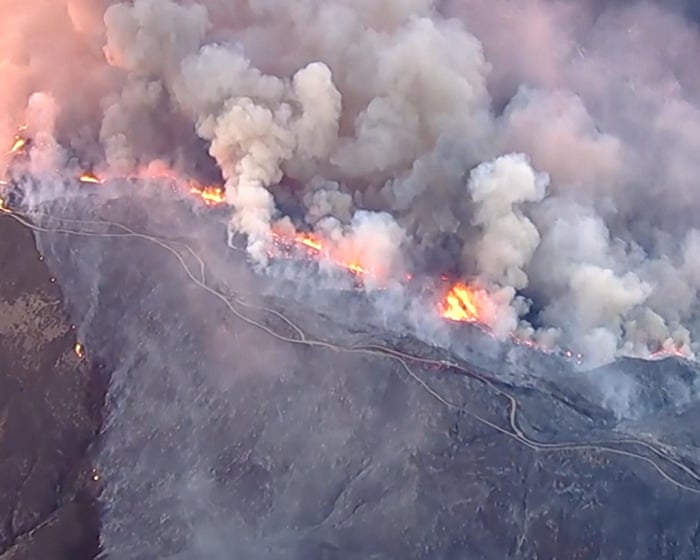
A fire in California’s Big Sur region doubled in size overnight, forcing the evacuation of nearby residents, in a coastal region where firefighters have battled another blaze for weeks.
The Plaskett fire, which sparked on Tuesday, had swept through more than 5,900 acres (2,400 hectares) in Monterey county as of Friday, and remained un-contained, according to Cal Fire. Its cause is under investigation.
Continue reading...
© Photograph: Ethan Swope/AP

© Photograph: Ethan Swope/AP

© Photograph: Ethan Swope/AP


© Fred Greaves/Reuters

Nearly 600 days after the devastating 2025 fires, thousands of Los Angeles residents are still waiting for more than $15bn in federal funds to rebuild their communities
As thousands of residents in Spokane, Washington, begin to grapple with a long recovery after a destructive set of blazes that consumed hundreds of homes in the state’s second most populated city this month, victims of the Los Angeles firestorm broke a grim record – they have faced the longest delay in modern history for federal aid.
Nearly 600 days since a historic firestorm roared into communities across Los Angeles, reducing more than 16,000 structures to ash and toxic debris, the Trump administration has failed to appropriate more than $15bn in long-term recovery funds that are crucial to rebuilding. The delay in supplying the badly needed funds is months longer than the last record set when victims of the Maui fires had to wait 500 days to receive the support, LAist noted this week.
Continue reading...
© Photograph: David Ryder/Reuters

© Photograph: David Ryder/Reuters

© Photograph: David Ryder/Reuters

Exclusive: Michael Boren, a senior official overseeing the US Forest Service, is accused by Democratic senators of ‘inappropriate interference’
Donald Trump’s administration is facing calls to launch an investigation into allegations that Michael Boren, a senior official who oversees the US Forest Service, pressed agency staff to deploy additional resources to fight a fire burning near his Idaho ranch.
Three Democratic senators accused Boren of “inappropriate interference” in a letter seen by the Guardian, demanding answers from Brooke Rollins, the US agriculture secretary. Boren serves as undersecretary of agriculture for natural resources and environment.
Continue reading...
© Photograph: Alex Wong/Getty Images

© Photograph: Alex Wong/Getty Images

© Photograph: Alex Wong/Getty Images


© Ian C. Bates for The New York Times

A magical corner of Oregon has the highest US rate of wildfire smoke deaths. How do residents live with the haze – and grief?
Driving into the county, you can’t miss the sign.
“IT’S THE CLIMATE”.
Continue reading...
© Photograph: Ricardo Nagaoka/The Guardian

© Photograph: Ricardo Nagaoka/The Guardian

© Photograph: Ricardo Nagaoka/The Guardian


© Ian C. Bates for The New York Times

Tens of thousands are still under evacuation orders or warnings amid ‘human-caused’, wind-driven blaze
The Hawk fire is about 27% contained, authorities said on Monday afternoon, two days after the fast-moving, wind-driven wildfire sparked near Reno, Nevada.
Authorities added that 23,000 people are under a “go-now” order and 40,000 people are under a “get-set” warning, an improvement from the 90,000 Nevadans under evacuation orders or warnings on Monday morning.
Continue reading...
© Photograph: Trevor Bexon/Getty Images

© Photograph: Trevor Bexon/Getty Images

© Photograph: Trevor Bexon/Getty Images

A fast-moving Nevada wildfire exploded to more than 15,000 acres (6,000 hectares) on Sunday, pushing from the Sierra foothills toward the centre of Reno and forced nearly 90,000 residents to evacuate as flames threatened neighbourhoods and reached the edge of the University of Nevada campus
Continue reading...
© Photograph: Reuters

© Photograph: Reuters

© Photograph: Reuters


© Abriansyah Liberto/Reuters


© Lisi Niesner/Reuters

Human-caused Hawk fire covers more than 15,000 acres as blaze approaches University of Nevada campus in Reno
A fast-moving Nevada wildfire exploded to more than 15,000 acres (6,000 hectares) on Sunday, pushing from the Sierra foothills toward the center of Reno and urging nearly 90,000 residents to evacuate as flames threatened neighborhoods and reached the edge of the University of Nevada campus.
The Hawk fire’s “GO NOW” evacuation zone had expanded to the edge of the university campus as strong, gusty winds, low humidity and dry vegetation fueled the blaze, according to Truckee Meadows Fire and Rescue in Reno. Of those urged to evacuate, 42,000 were under strict orders. An additional 45,000 people were in the evacuation warning zone, and encouraged to leave now and be prepared to stay away for several days to clear the roads for first-responders.
Continue reading...
© Photograph: Simon Jowitt/Reuters

© Photograph: Simon Jowitt/Reuters

© Photograph: Simon Jowitt/Reuters


© Simon Jowitt/UGC, via Reuters

Firefighters describe being pushed to limit by a brutal wildfire season, with key leadership roles going unfilled
The US has faced a critical shortage of firefighters at the US Forest Service (USFS) this summer as thousands of fires erupted across the country.
Despite officials’ claims that the firefighting workforce was stronger than ever, the agency has failed to keep pace with escalating conditions and the catastrophic fires fueled by them, according to nine firefighters who spoke to the Guardian anonymously, because they are barred from disclosing the information to the public.
Continue reading...
© Photograph: San Francisco Chronicle/Hearst Newspapers/Getty Images

© Photograph: San Francisco Chronicle/Hearst Newspapers/Getty Images

© Photograph: San Francisco Chronicle/Hearst Newspapers/Getty Images


Ukraine sent rescuers to help fight wildfires in France, and they returned from a first-of-its-kind mission. Workers of Ukraine's State Emergency Service (DSNS) have reached Ukraine from France, where they spent nearly two weeks helping to contain large forest fires, Interior Minister Ivan Vyhivskyi announced.
The deployment was Ukraine's first mission to aid an EU member state under the bloc's own civil-protection system, with a combined unit of 70 rescuers and 15 pieces of special equipment, a role reversal for a country that has spent the war receiving European aid rather than sending it.
The Ukrainians worked the fires alongside crews from several countries. Their work involved dozens of call-outs, hundreds of hectares of surveyed territory, and fire pockets that kept smoldering underground, Vyhivskyi says
With them, they took wartime methods to the work. The Ukrainian rescuers patrolled the forests, used drones to spot new ignitions, and contained the fire together with their colleagues. The days became shared work and shared experience, uniting rescuers from Ukraine, France, Slovakia, and other countries, with different languages but with one profession and goal. For the European emergency employees, it was a chance to grasp the unique experience they gained during the full-scale war.
Ukrainian rescuers returned home after nearly two weeks helping fight massive wildfires in France, their first mission under the EU Civil Protection Mechanism
— Euromaidan Press (@EuromaidanPress) August 15, 2026
A joint unit of 70 rescuers and 15 pieces of specialized equipment patrolled forests alongside French, Slovak, and… pic.twitter.com/SXJvqemgQm
Vyhivskyi says that every day, Ukraine's rescuers respond to the aftermath of Russian strikes dozens of times, working in extremely difficult conditions, but despite those challenges, Ukraine is always ready to lend a shoulder to its partners.
When Ukrainian and French forces fought wildfires together, the combined detachment deployed six water tankers on the ground, supported from the air by three French aircraft, two planes, and a helicopter.
During the mission, the Ukrainian rescuers discovered that local residents hang “thousand thanks” banner in recognition of their service.


© Kirsty Wigglesworth/Associated Press


© Miroslav Lelas/Agence France-Presse — Getty Images


© Nic Coury/Associated Press


© U.S. Wildland Fire Service


© Guglielmo Mangiapane/Reuters

© Pablo Blazquez Dominguez/Getty Images


© Darryl Dyck/The Canadian Press, via Associated Press


© BC Wildfire Service, via Reuters