❌

Vue normale

  • ✇Euromaidan Press
  • “We are staying”: EU embassies remain in Kyiv after Russia warns diplomats to leave or risk their lives
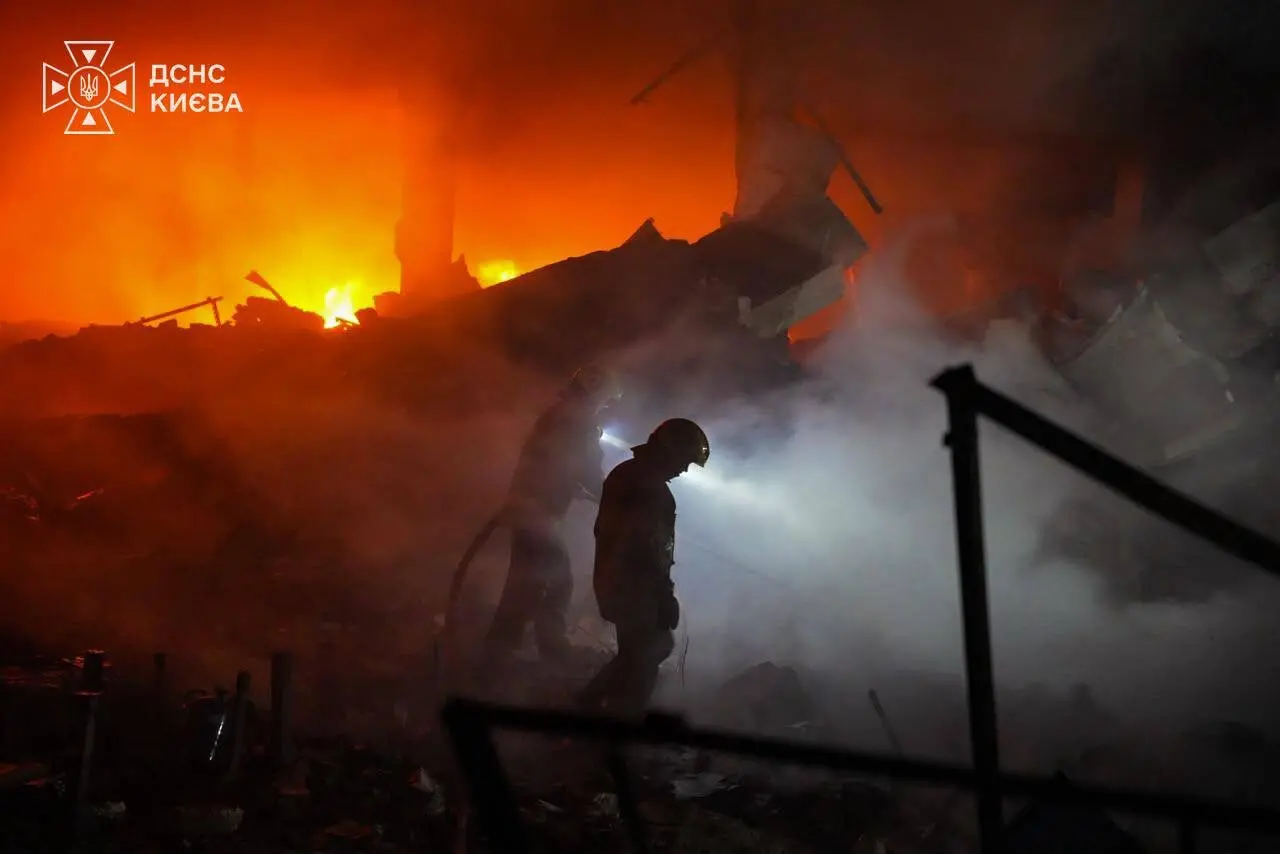
    The EU Delegation and all EU embassies will keep working in Kyiv despite Russia's warning that foreign diplomats should leave or risk their lives, EU Ambassador to Ukraine Katarína Mathernová said on 4 October. Poland and Estonia also said their embassies would stay, calling the threats an attempt to intimidate Europe. Russia attacks Kyiv daily as Moscow tries to make the city unlivable. Alongside the strikes, it now threatens the foreign missions that anchor Ukraine's support in the ca
     

“We are staying”: EU embassies remain in Kyiv after Russia warns diplomats to leave or risk their lives

4 octobre 2026 à 10:46

staying eu embassies remain kyiv after russia warns diplomats leave risk lives · post ambassador ukraine katarina mathernová 796746075_10164532181563363_8495230156254396336_n news ukrainian reports

The EU Delegation and all EU embassies will keep working in Kyiv despite Russia's warning that foreign diplomats should leave or risk their lives, EU Ambassador to Ukraine Katarína Mathernová said on 4 October. Poland and Estonia also said their embassies would stay, calling the threats an attempt to intimidate Europe.

Russia attacks Kyiv daily as Moscow tries to make the city unlivable. Alongside the strikes, it now threatens the foreign missions that anchor Ukraine's support in the capital.

"We are staying"

Russia's Foreign Ministry singled out the embassies still working in Kyiv and the foreign officials who keep visiting Ukraine, Mathernová wrote. Moscow claimed that if something happened to them, the responsibility would be theirs.

"The responsibility for russian attacks belongs to russia! Not to anybody else," Mathernová wrote, adding: "Moscow wants to scare Europe into reducing its support for Ukraine. That will not happen."

The EU Delegation continues its work while taking the security of its team seriously, she added.
russia's drones keep targeting bridges kyiv can't easily replace—now northern crossing cratered · post explosion bridge ukraine 4 2026 20261004111959-2727 (1) news ukrainian reports
Explore further

Russia’s drones keep targeting the bridges Kyiv can’t easily replace—now the Northern crossing is cratered

She pointed to the morning's strike on the Northern Bridge, saying the repeated attacks disrupt the connections between the two banks of the Dnipro. People worry about getting to work, reaching their families, and getting home safely, she wrote.

Poland and Estonia keep their embassies open

Poland's Foreign Ministry said it had no intention of changing how its Kyiv embassy works. The Kremlin's threats and calls for diplomats to leave show it is trying to intimidate Europe and undermine support for Ukraine, the ministry said. Such threats contradict international law and will not work, it added.

Estonia's Foreign Ministry said its embassy stays in Kyiv and its support for Ukraine remains firm. Russia's threats only strengthen Estonia's resolve to stand with Ukraine, the ministry said.

mr putin put end senseless war merz kyiv €1 billion military aid · post ukrainian president volodymyr zelenskyy welcomes german chancellor friedrich 4 2026 video zelenskiy official /telegram володимир зеленський
Explore further

“Mr Putin, put an end to this senseless war”: Merz in Kyiv, with €1 billion in military aid

The European Commission also responded. Russia's threats show the Kremlin is losing the war and losing its self-control, Commission spokesperson Christian Wigand said, Suspilne reported.

More aid, more sanctions

This year alone, the EU has approved €28.3 billion ($32.3 billion) in defense procurement plans for Ukraine and is releasing another €6.6 billion ($7.5 billion) linked to military aid, Mathernová wrote. It is also moving forward with its biggest-ever sanctions listings against Russia, and this week imposed new sanctions over the deportation of Ukrainian children.

German Chancellor Friedrich Merz came to Kyiv on the same day, as Russian attacks on the city continued. He and Zelenskyy visited the National Academy of Sciences building, hit by a Russian drone in September, and Zelenskyy thanked him for coming despite the air raid alert, calling it "a needed and brave signal," in a post on Telegram. Germany remains a reliable partner at Ukraine's side even in difficult times, Merz wrote.

  • ✇Euromaidan Press
  • “Mr Putin, put an end to this senseless war”: Merz in Kyiv, with €1 billion in military aid
    German Chancellor Friedrich Merz arrived in Kyiv on an unannounced visit on 4 October and announced more than €1.3 billion ($1.5 billion) in new German support for Ukraine, Ukrainian President Volodymyr Zelenskyy said at a joint press conference. Part of the money will fund interceptors against Russia's jet-powered drones, as Russian drones struck Kyiv again during Merz's visit. Merz also pledged to speed up Ukraine's EU accession and announced a Coalition of the Willing meeting in Berlin
     

“Mr Putin, put an end to this senseless war”: Merz in Kyiv, with €1 billion in military aid

4 octobre 2026 à 10:38

mr putin put end senseless war merz kyiv €1 billion military aid · post ukrainian president volodymyr zelenskyy welcomes german chancellor friedrich 4 2026 video zelenskiy official /telegram володимир зеленський

German Chancellor Friedrich Merz arrived in Kyiv on an unannounced visit on 4 October and announced more than €1.3 billion ($1.5 billion) in new German support for Ukraine, Ukrainian President Volodymyr Zelenskyy said at a joint press conference. Part of the money will fund interceptors against Russia's jet-powered drones, as Russian drones struck Kyiv again during Merz's visit. Merz also pledged to speed up Ukraine's EU accession and announced a Coalition of the Willing meeting in Berlin this winter.

Russia now attacks Kyiv and other Ukrainian cities daily, increasingly with jet-powered drones that outrun the cheap interceptors built for slower Shaheds. That leaves Ukraine dependent on scarce air defense missiles and on partners willing to pay for new weapons fast.

A package aimed at Russia's jet drones

The €1 billion ($1.13 billion) military part of the package includes funding for joint production of interceptor drones against jet-powered drones, Merz said. Recent technological progress means the new interceptors can quickly enter serial production, he added.

"This will quickly and noticeably strengthen Ukraine's air defense," Merz said.

The package also includes long-range weapons, combat drones, and satellite equipment, which Merz said should help Ukraine destroy Russian launchers more effectively. A separate €350 million ($394 million) will go to Ukraine's energy sector before winter, covering generators, transformer substations, and repair kits, Liga reported.

mr putin put end senseless war merz kyiv €1 billion military aid · post ukrainian president volodymyr zelenskyy german chancellor friedrich building national academy sciences ukraine damaged russian drone strike
Ukrainian President Volodymyr Zelenskyy and German Chancellor Friedrich Merz at the building of the National Academy of Sciences of Ukraine in Kyiv, damaged by a Russian drone strike on 28 September, 4 October 2026. Photo: Office of the President of Ukraine

The two countries also signed an agreement on counter-drone cooperation, Merz said. He stressed that the help runs both ways, with German defense companies learning from Ukraine's war experience. The broader deal also covers joint development of weapons with a range of more than 1,000 km, Reuters reported.

russia's drones keep targeting bridges kyiv can't easily replace—now northern crossing cratered · post explosion bridge ukraine 4 2026 20261004111959-2727 (1) news ukrainian reports
Explore further

Russia’s drones keep targeting the bridges Kyiv can’t easily replace—now the Northern crossing is cratered

Among interceptor drones, the Bars has so far shown the best results, downing up to 30% of its targets, Zelenskyy said. He expects the first results from small missiles designed to counter jet drones in the second half of October.

"We will not be intimidated"

Before the visit, Russia's Foreign Ministry warned foreign nationals and diplomats against staying in Ukraine and threatened new massive strikes on Kyiv. Merz arrived by train with Economy Minister Katherina Reiche and a delegation of German business executives.

"Despite the threats that have reached us from Moscow in recent days, I came today... This shows: we will not let ourselves be intimidated," Merz said.

Merz and Zelenskyy visited the National Academy of Sciences, where a Russian drone killed two people and injured seven on 28 September, the State Emergency Service and the Office of the President said. An air-raid alert sounded while they spoke with rescuers, and emergency service chief Andrii Danyk showed Merz the movement of Russian drones in real time. The same day, a Russian drone hit Kyiv's Northern Bridge again.

"I can only repeat it once again from this point: Mr Putin, put an end to this senseless war," Merz said during the visit. "We are ready for talks, we are ready to discuss bringing this war to an end, but these barbaric attacks on the civilian population of Ukraine must stop," he added, Reuters reported.

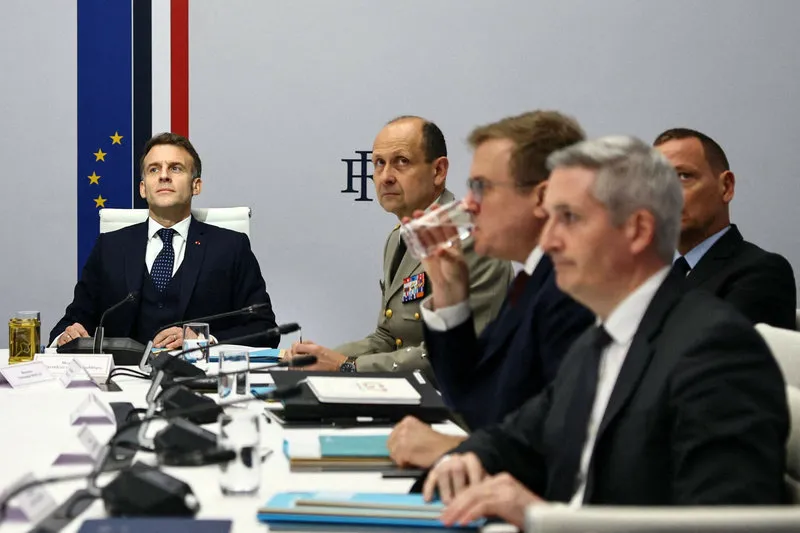
French President Emmanuel Macron sits with military officers and government officials during a Coalition of the Willing meeting in Paris on 24 February 2026.
Explore further

NYT: France, Germany and UK build joint format to secure Europe a place in Ukraine peace talks

Zelenskyy called the chancellor's presence despite the alert "a needed and brave signal" from Merz personally and from all of Germany.

EU path and a Berlin meeting

Germany wants to speed up Ukraine's EU accession and is working toward that in Brussels, Merz said. He welcomed Zelenskyy's assurances on rule-of-law and anti-corruption reforms, which he said matter for further financial aid. Together with France and the UK, Germany plans to host a Coalition of the Willing meeting in Berlin this winter to coordinate further support, he added.

mr putin put end senseless war merz kyiv €1 billion military aid · post ukrainian foreign minister andrii sybiha greets german chancellor friedrich arrival 4 2026 мерц у києві жовтня
Ukrainian Foreign Minister Andrii Sybiha greets German Chancellor Friedrich Merz on his arrival in Kyiv, 4 October 2026. Photo: Andrii Sybiha/X

The trip was Merz's second to Ukraine as chancellor and his fourth since the full-scale invasion. He arrived just as his standing at home is slipping: the far-right AfD reached 30% for the first time in an INSA poll for Bild, while Merz's CDU/CSU fell to a record low of 18%. Days earlier, Merz had directly accused the AfD of having "Russian backers."

Russia’s drones keep targeting the bridges Kyiv can’t easily replace—now the Northern crossing is cratered

4 octobre 2026 à 05:44

russia's drones keep targeting bridges kyiv can't easily replace—now northern crossing cratered · post explosion bridge ukraine 4 2026 20261004111959-2727 (1) news ukrainian reports

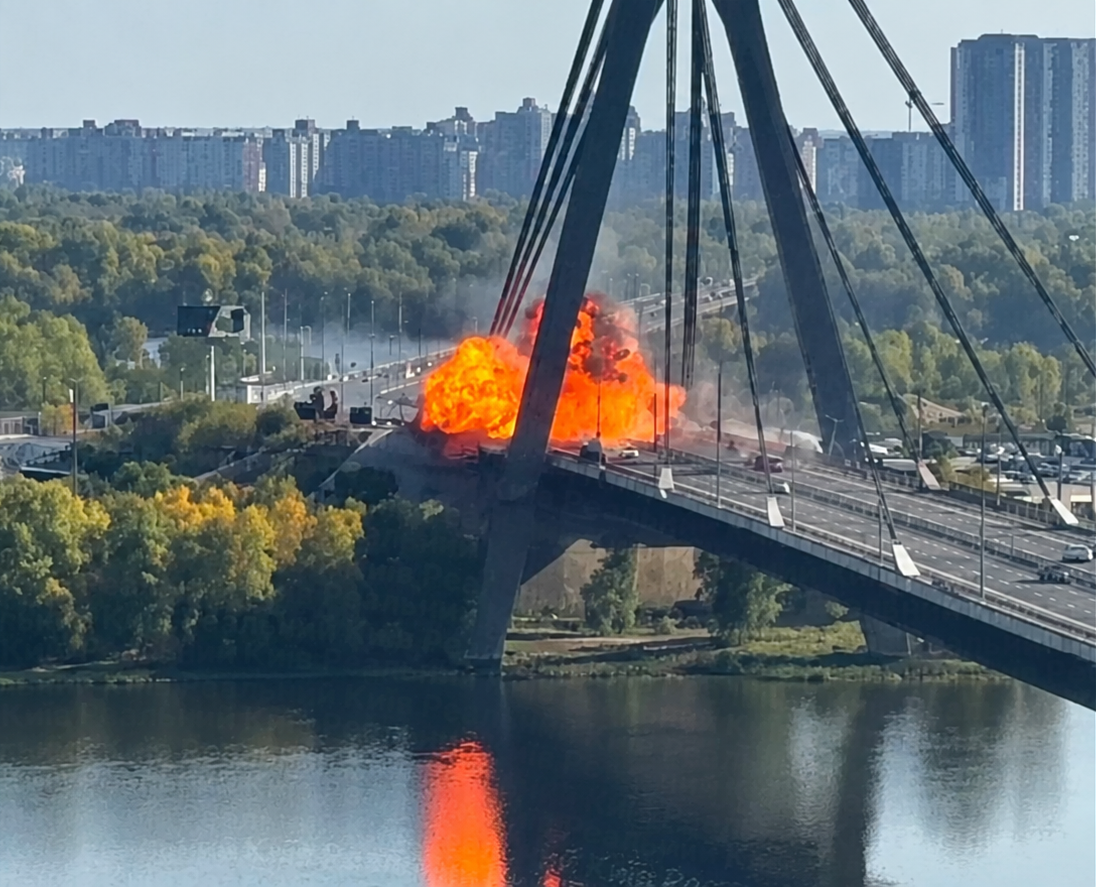
Russia struck Kyiv's Northern Bridge with a drone again on 4 October, the second hit on the crossing in two days, Kyiv Mayor Vitali Klitschko said. The attack damaged a heating main and rerouted public transport, as overnight and morning strikes also hit Kyiv Oblast, Dnipro, and Sumy, where one person was killed.

Russia's air attacks on Ukrainian cities are daily, and in recent days they have hit a Kyiv school sheltering children and turned supermarkets into targets. Strikes on the crossings between the capital's two banks add another layer: they disrupt how millions of people move through the city every day.

A crater on the Northern Bridge, no hot water across the river

The drone hit the bridge's roadway, and videos posted by local channels showed a crater, Liga reported. The strike also damaged a heating main, cutting hot water in Kyiv's Desnianskyi district on the left bank, Klitschko wrote. Repair crews are working to restore it, he added.

Kyiv's transport operator Kyivpastrans cut trolleybus routes short of the river. Routes 29, 30, 31, and 47 now run from the left bank only to Darnytsia Square, and routes 29, 30, and 31 run from the right bank only to Pochaina metro station. Buses 21, 73, 101, and 114 run only to Darnytsia Square because the bridge is closed to traffic.

Russia first hit the Northern Bridge on 3 October, damaging its roadway and trolleybus lines. Two people were injured, and one of them was hospitalized, Klitschko said. A day earlier, repeated drone strikes hit the Southern Bridge and forced its closure. Overnight on 4 October, drone debris also fell on two locations in Kyiv's Dniprovskyi district, Klitschko reported.

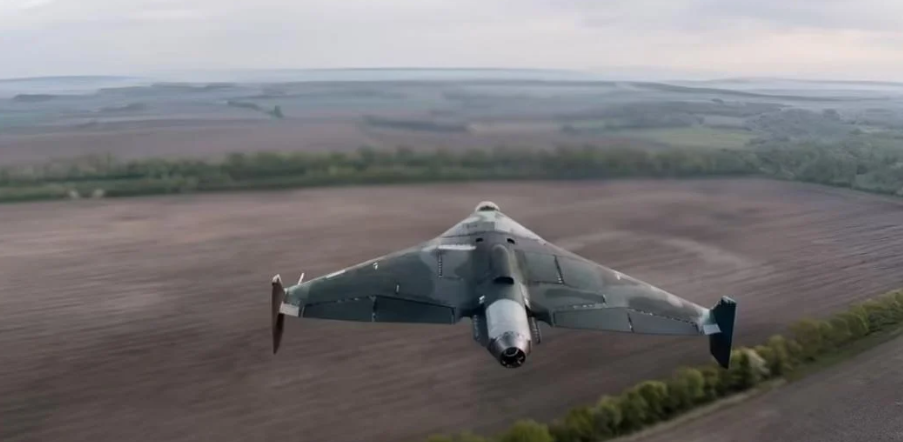
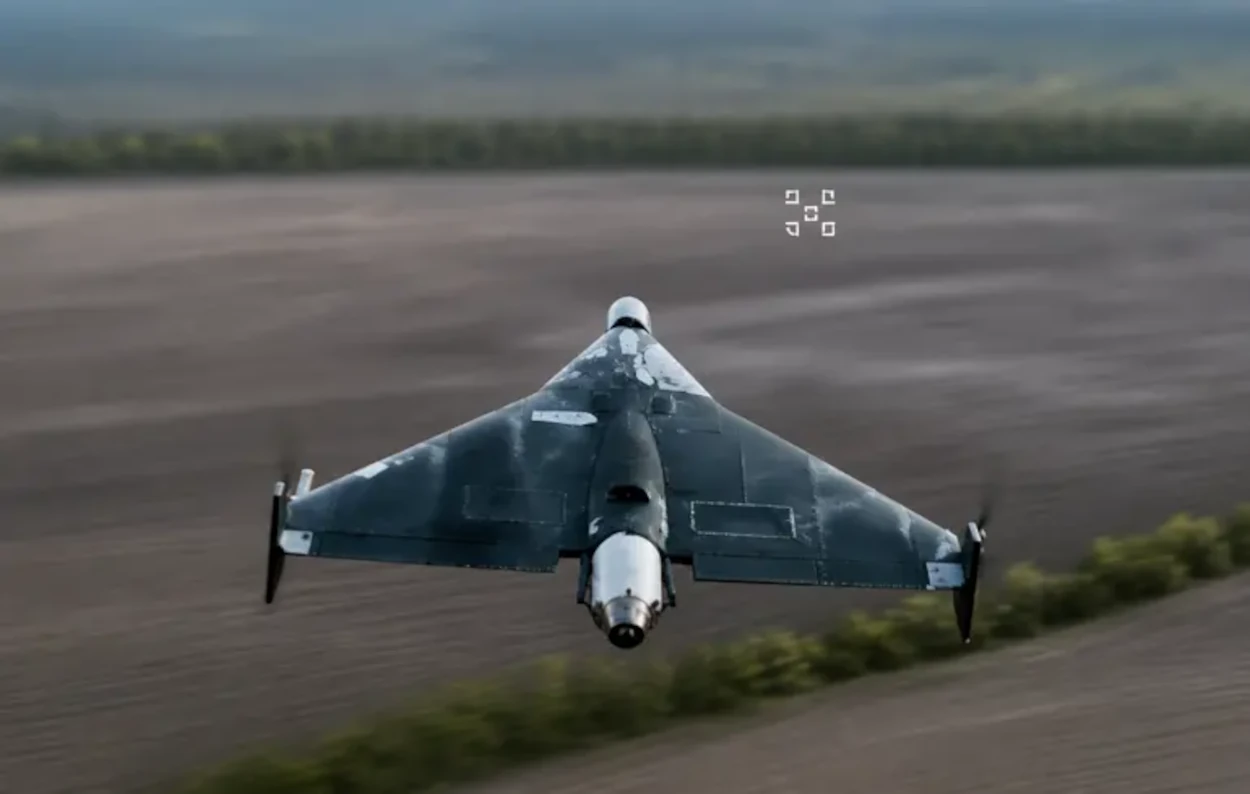
Russia's new "Geran-4 Siker" Shahed variant uses machine-vision AI for targeting. Source: Warhronika
Explore further

Russia adds new weapon to its jet-powered drones, even more dangerous: 40-kilogram charge made to sever high-voltage pylons and iron bridges

Ukraine's government has already begun work on earth dams and pontoon crossings in case the city's Dnipro bridges are knocked out, Restoration Minister Mykola Kalashnyk told Suspilne.

The strike came as German Chancellor Friedrich Merz visited Kyiv. Ukraine and Germany would reach important agreements during the visit, Zelenskyy said. This week alone, Russia launched more than 1,900 attack drones, 1,700 guided bombs, and 25 missiles at Ukraine, more than 800 of the drones jet-powered, he added.

135 drones overnight

Russia launched 135 attack drones at Ukraine overnight, 52 of them jet-powered Shaheds, Ukraine's Air Force reported. By 08:30, air defenses had downed or suppressed 123 drones and two Banderol or Dan-T missiles. Strikes hit five locations, and debris fell on five more.

In Kyiv Oblast, Russian drones damaged six detached houses, a car, a church, a primary school, a café, and a medical facility in Boryspil Raion, the Kyiv Oblast Military Administration said. No one was killed or injured.

Dnipro and Sumy

Russia attacked a communications company's building in central Dnipro, Dnipropetrovsk Oblast head Oleksandr Hanzha reported.

"The whole street there is covered in broken glass, debris, and branches," Dnipro Mayor Borys Filatov wrote, adding that nearby homes and schools escaped damage.

In Sumy, Russian drones struck an ordinary medical supplies warehouse and killed one person, Zelenskyy said. Strikes across the city injured seven people, two of them seriously, the Sumy city council said. The attack also damaged gas networks and left 70 apartments without gas.

  • ✇Euromaidan Press
  • Moscow trains its military pilots at Khanskaya. Locals report a fire there after drones attacked overnight
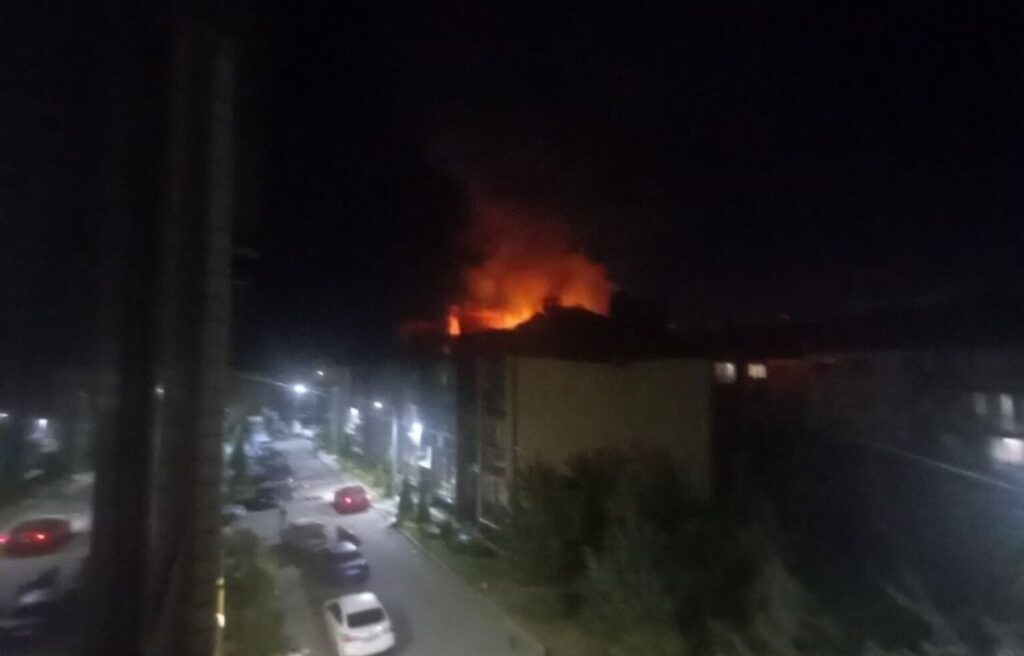
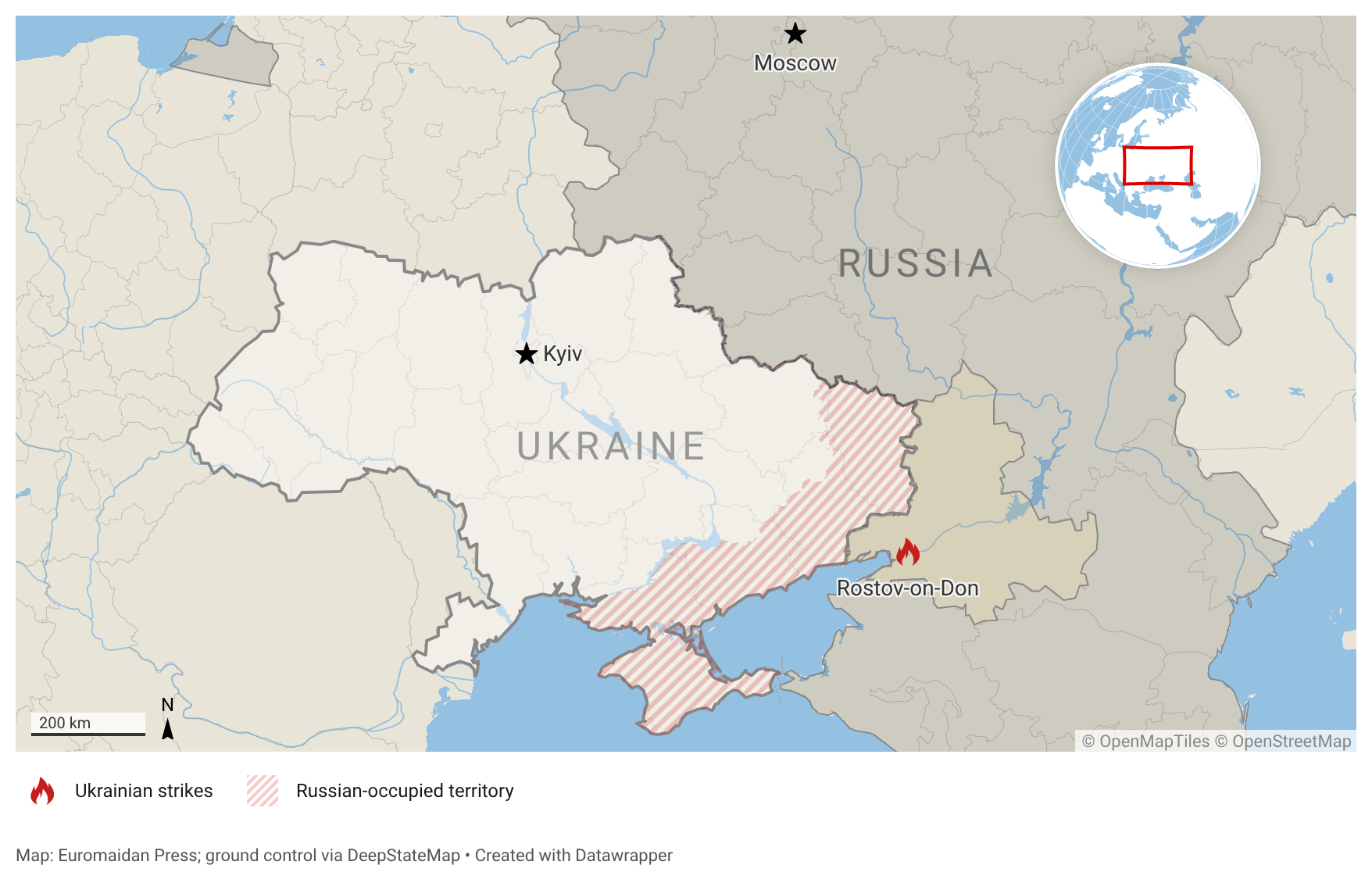
    Drones attacked Russia's Khanskaya military airfield in the Republic of Adygea overnight on 4 October, Ukrainian outlet Militarnyi reported. Local reports, footage, and satellite fire data point to a blaze near the base, which trains Russian military pilots and also serves combat aviation. Neither side has reported the extent of the damage. Ukraine is pressing its long-range campaign against the bases, refineries, and depots that keep Russia's war going, and Kyiv is vowing to hit harder
     

Moscow trains its military pilots at Khanskaya. Locals report a fire there after drones attacked overnight

4 octobre 2026 à 05:42

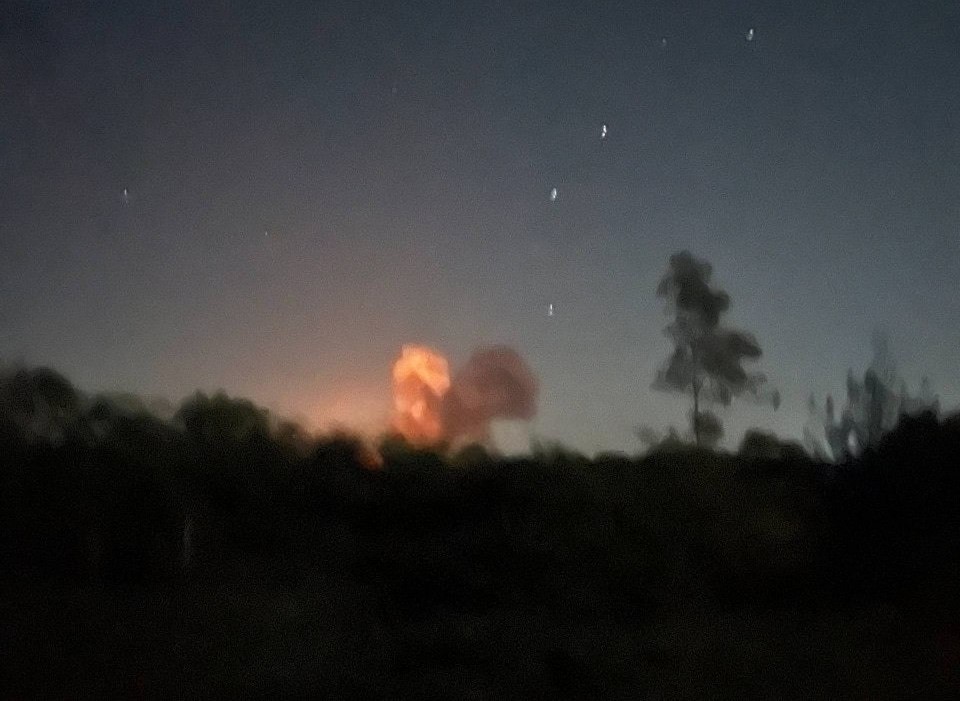
moscow trains its military pilots khanskaya locals report fire after drones struck overnight · post near russia's airfield republic adygea drone attack 4 2026 пожежа в районі аеродрому ханская у

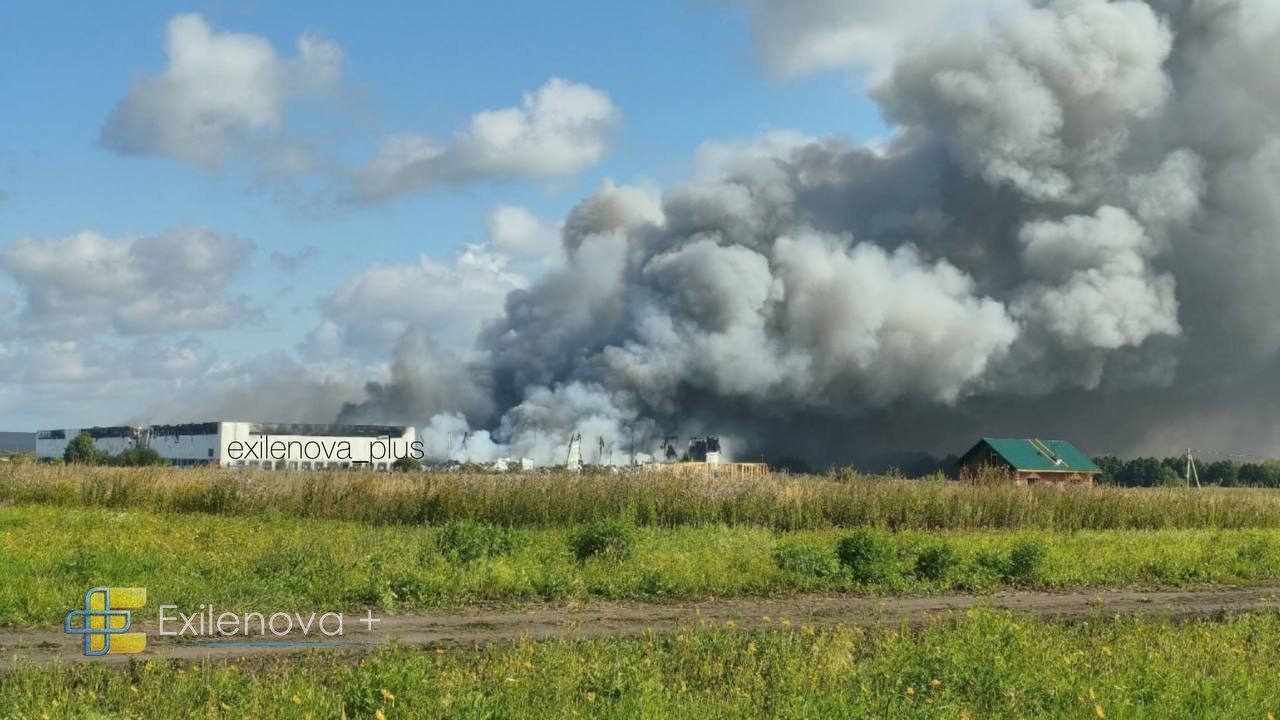
Drones attacked Russia's Khanskaya military airfield in the Republic of Adygea overnight on 4 October, Ukrainian outlet Militarnyi reported. Local reports, footage, and satellite fire data point to a blaze near the base, which trains Russian military pilots and also serves combat aviation. Neither side has reported the extent of the damage.

Ukraine is pressing its long-range campaign against the bases, refineries, and depots that keep Russia's war going, and Kyiv is vowing to hit harder as Russia escalates its strikes on Ukrainian cities. Airfields are part of that target list: in August, Ukraine struck one in Krasnodar Krai in the same overnight wave that hit Russia's second-largest refinery.

Hours of drone alerts, then a fire

Locals reported an attack and a fire at the airfield, Ukrainian monitoring channel Exilenova+ wrote, sharing footage of the blaze. Drone warnings for the area began at 01:42 and lasted until 05:34, Militarnyi said. Over that time, Russian monitoring channels reported drones and active air defenses in the region and around the airfield.

NASA's FIRMS fire-detection data from geostationary orbit also showed a fire in the airfield's area, Militarnyi noted. It also published a video of a Ukrainian drone flying toward the base.

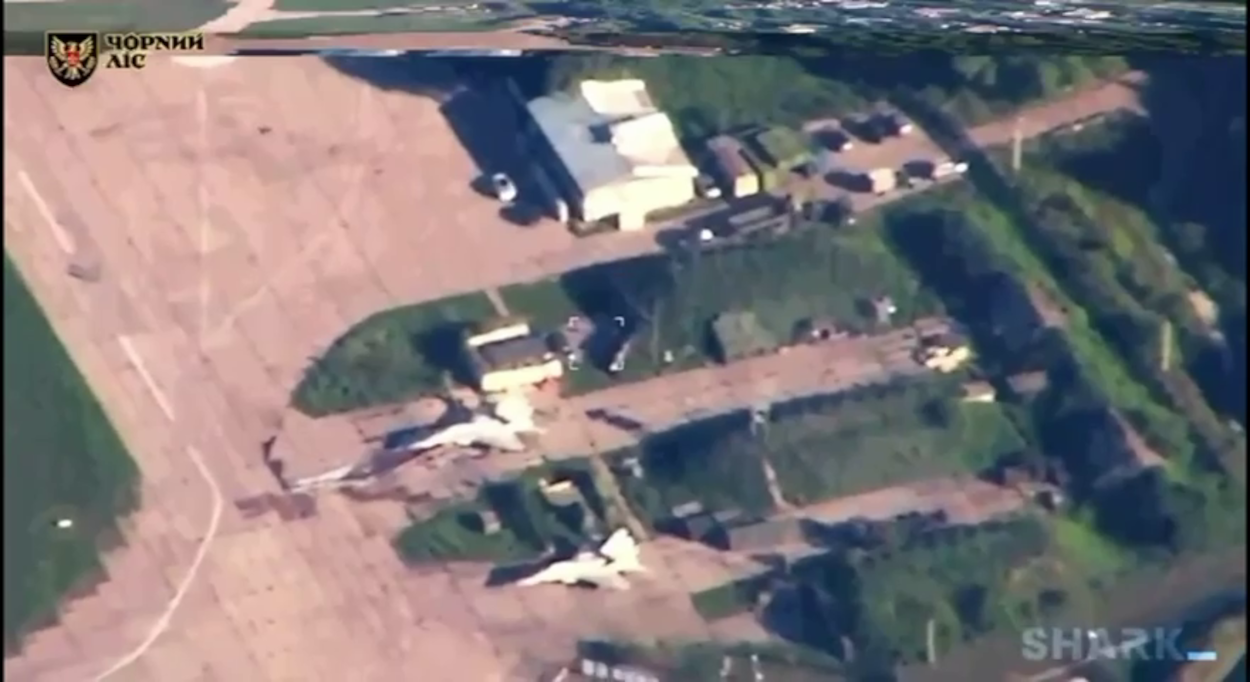
Khalino airfield in Russia's Kursk Oblast is seen from a Ukrainian drone moments before a strike on a MiG-29 fighter jet. Screenshot from video: Ukraine's General Staff
Explore further

Russian MiG-29 jet and the Pantsir air defense meant to protect it both hit in Ukrainian strike on Kursk airfield

A pilot school that also serves combat aviation

The airfield lies 6 km northwest of Maykop and 3 km east of the village of Khanskaya, about 500 km from Ukrainian-controlled territory, according to Militarnyi. Before the war, it was used mainly for training flights and hosted L-39 trainer jets.

moscow trains its military pilots khanskaya locals report fire after drones struck overnight · post near russia's airfield republic adygea nasa firms fire-detection area marked 4 2026 militarnyi 0410hanskaya ukraine
A fire near Russia's Khanskaya military airfield in the Republic of Adygea, with the NASA FIRMS fire-detection area marked, 4 October 2026. Graphic: Militarnyi, photo: Exilenova+

The 761st Training Aviation Regiment was based there until it was disbanded in 2009, when the 272nd Training Aviation Base was formed in its place. The base, military unit 55661, belongs to the Krasnodar Higher Military Aviation School of Pilots. Ukraine's General Staff said in October 2024 that Su-34, Su-27, and Su-35 jets, which Russia uses in its war against Ukraine, were based at the airfield, Militarnyi wrote. In March 2026, the General Staff said Russian forces actively use it for operational-tactical aviation.

Ukraine has struck the base before

Ukrainian drones attacked the airfield as early as October 2024. On 25 December 2025, Ukraine's General Staff said its forces had hit the Maykop airfield and started a fire. That was the same night Ukraine hit the port of Temryuk. Drones attacked the base again on 29 December, when Russian authorities claimed to have repelled the attack. Ukraine struck the airfield once more in March 2026.

  • ✇Euromaidan Press
  • Russia paid with more than 46,000 casualties, and the front moved the other way, ISW finds
    Russia lost almost 300 km² of Ukrainian territory on net between March and September 2026, and it likely gained no ground in September despite its heaviest casualties of the year, the Institute for the Study of War (ISW) assessed. Ukraine's Operation Vivaldi accounts for much of the swing. The think tank notes that Ukraine's secrecy around such counterattacks makes exact monthly tallies hard. Russia has pressed attacks along the entire front through 2026, accepting mass casualties for m
     

Russia paid with more than 46,000 casualties, and the front moved the other way, ISW finds

2 octobre 2026 à 06:09

russia paid more than 46000 casualties front moved other way isw finds · post russian ukrainian territorial gains including infiltrations ukraine between 1 30 2026 russian-territorial-gains-in-ukraine-including-infiltrations-sep-1-to-sep-30-2026 news reports

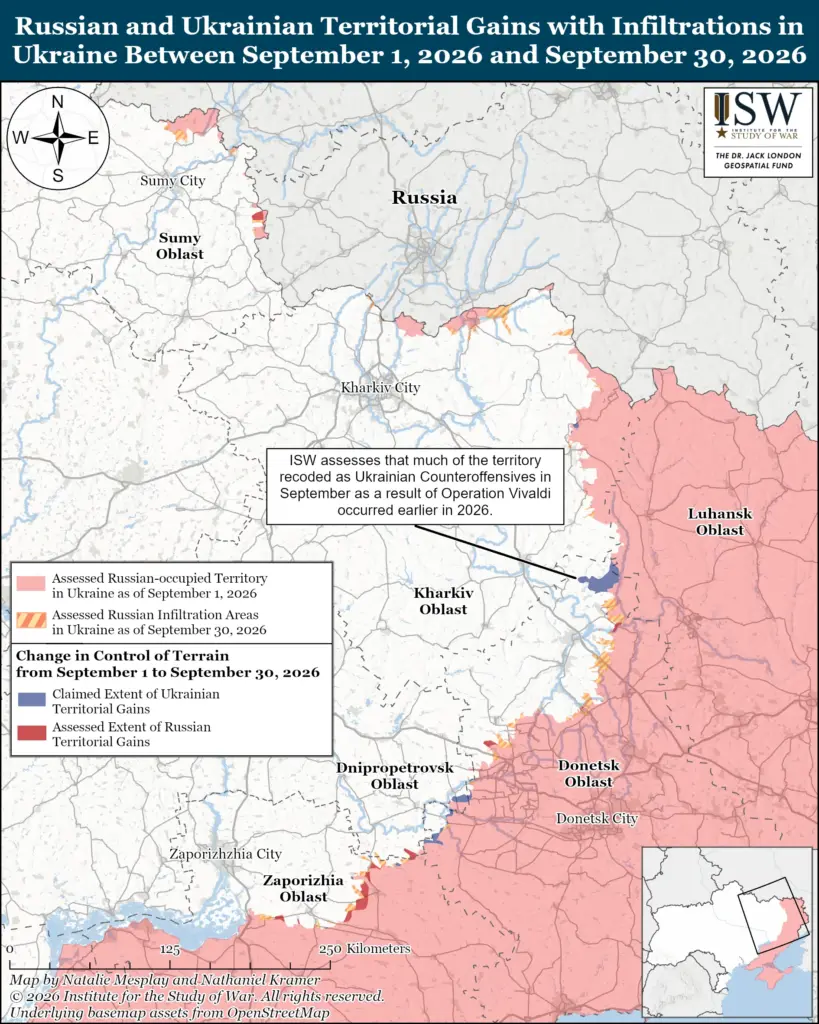
Russia lost almost 300 km² of Ukrainian territory on net between March and September 2026, and it likely gained no ground in September despite its heaviest casualties of the year, the Institute for the Study of War (ISW) assessed. Ukraine's Operation Vivaldi accounts for much of the swing. The think tank notes that Ukraine's secrecy around such counterattacks makes exact monthly tallies hard.

Russia has pressed attacks along the entire front through 2026, accepting mass casualties for marginal ground, and its battlefield year has already been called its worst since 2023. Its losses have been outpacing its recruitment for months.

Russia came out behind in September

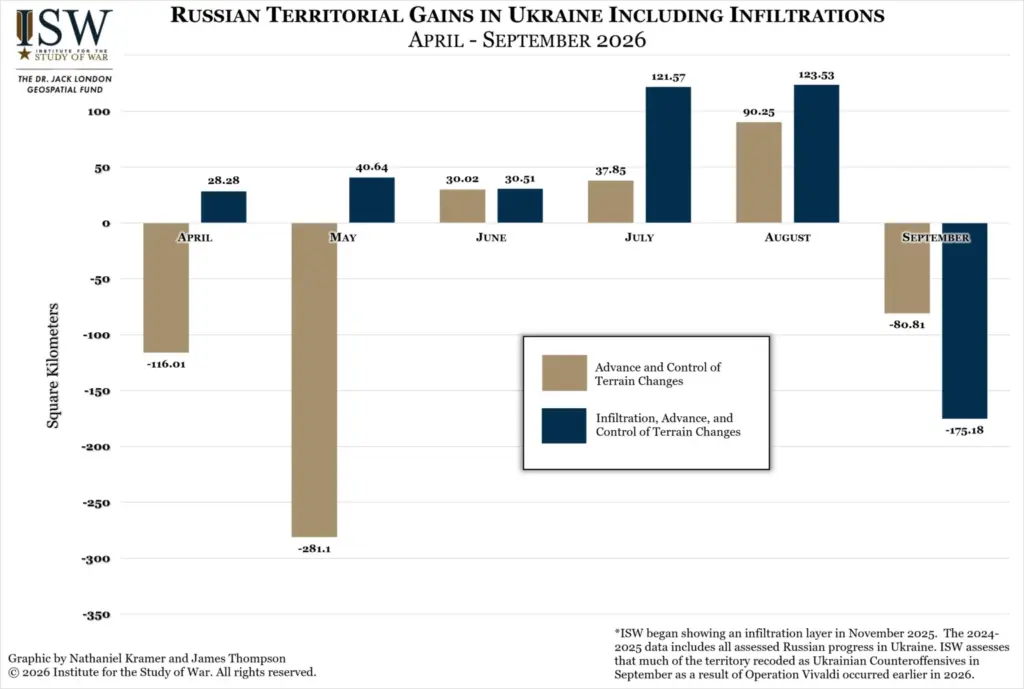
Russian forces seized 175.54 km² in September but lost 256.35 km², a net loss of 80.81 km², or minus 2.69 km² a day, ISW calculated. The balance stayed negative when Russian infiltrations into areas Russia does not control are counted: Russia seized or infiltrated 143.2 km² but lost 318.38 km², a net loss of 175.18 km².

Russian territorial gains in Ukraine with and without infiltrations, April–September 2026.
Russian territorial gains in Ukraine with and without infiltrations, April–September 2026. Graphic: ISW

The September figures include at least 147 km² near Lyman that Ukraine liberated over earlier months, but that ISW recorded only once details of Operation Vivaldi emerged in September. The operation already disrupted Russia's plan to encircle the Fortress Belt cities from the Lyman and Dobropillia directions.

Ukraine's Third Army Corps commander Brigadier General Andrii Biletskyi announcing "Operation Vivaldi," 15 September 2026. Screenshot from video: Ukraine's Third Army Corps
Explore further

Ukraine’s Vivaldi counteroffensive disrupts Russia’s plan to encircle Donetsk Fortress Belt – ISW

Almost 300 km² lost since March

Russia's rate of seizing territory dropped sharply in March 2026 and has stayed low, or even negative, since, ISW found. After controlling for the gains Ukraine made during Vivaldi, Russia lost control of 293.59 km² net across the front since March. Counting infiltrations, it gained a presence in only 174.44 km² over the same period.

ISW's monthly chart shows net Russian losses of 116.01 km² in April and 281.1 km² in May, modest gains in June, July, and August, and a net loss again in September. Oleksandr Syrskyi, then Ukraine's commander-in-chief, reported in June that Ukrainian forces had recaptured 100 km² in May.

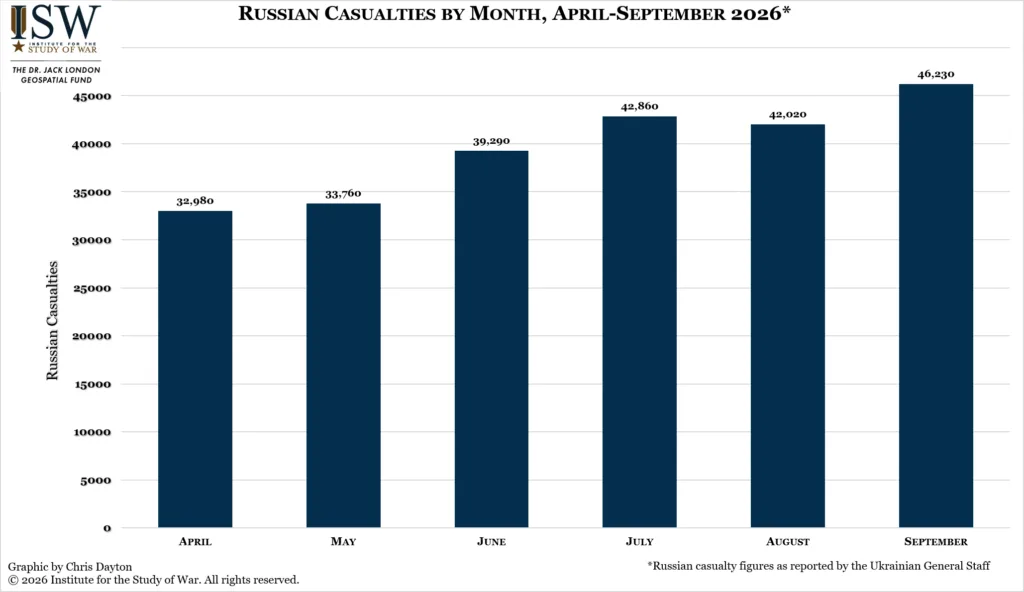
Russian casualties by month as reported by Ukraine's General Staff, April–September 2026.
Russian casualties by month as reported by Ukraine's General Staff, April–September 2026. Graphic: ISW

More than 46,000 casualties for no ground

Russian forces suffered 46,230 casualties in September, Ukraine's General Staff reported. It is the third straight month above 40,000 and the highest monthly toll of 2026, by Kyiv's count. Monthly Russian casualties have climbed from 32,980 in April to 42,860 in July and 42,020 in August, ISW's chart shows.

Russia keeps suffering heavy personnel losses while making extremely limited or even net-negative territorial gains, ISW said, and its current force generation system still recruits fewer soldiers than it needs to replace them.

kyiv strike
Explore further

Russia’s mass drone attacks on Ukraine have a goal—likely Ukraine’s capitulation by spring 2027, ISW says

Ukraine's effective operational security around Vivaldi, likely to continue in future counterattacks, will make meaningful month-to-month assessments of Russian gains and losses hard, the think tank added.

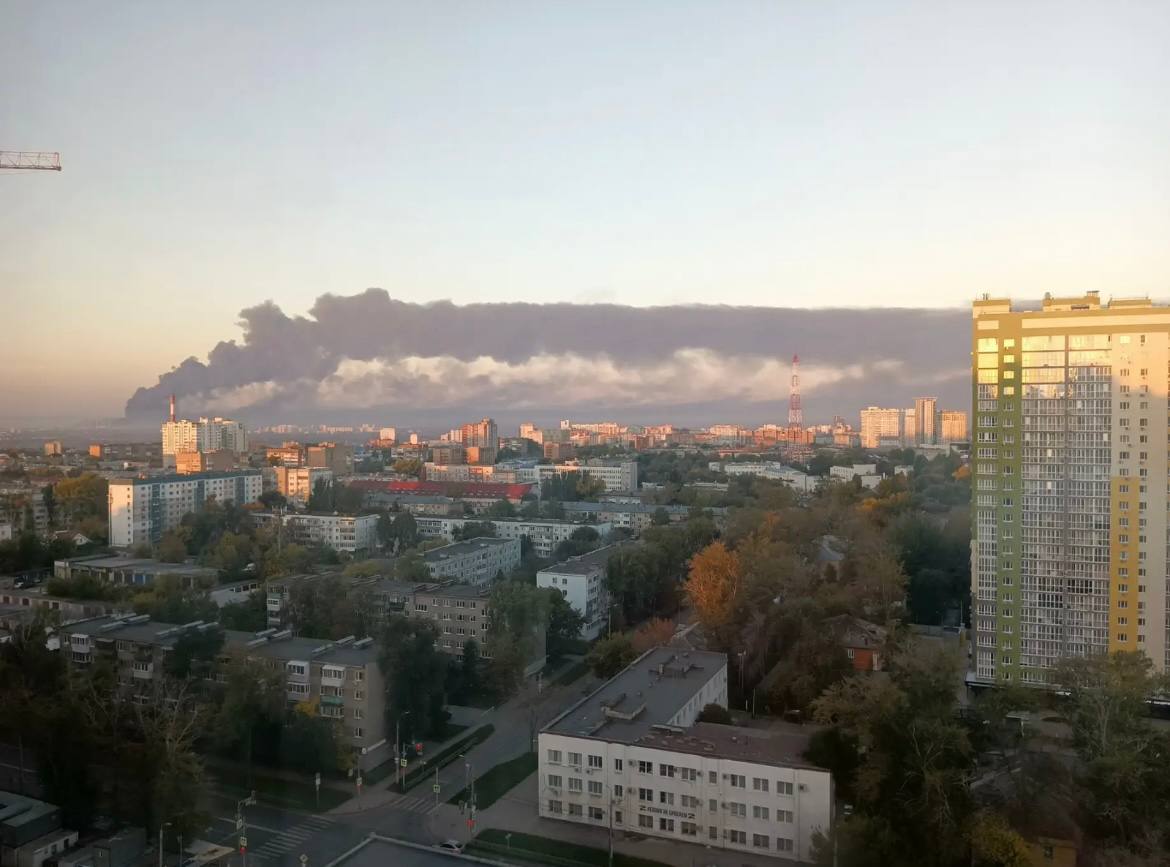
Drones hit Russia’s Volgograd and Samara overnight—fires near a Lukoil refinery, a chemical plant, and likely Europe’s largest oil tank farm in Samara

2 octobre 2026 à 04:47

drones hit russia's volgograd samara overnight—fires near lukoil refinery chemical plant likely europe's largest oil tank farm · post fire area kaustik russia 2 2026 пожежа ймовірно в районі волгоградського

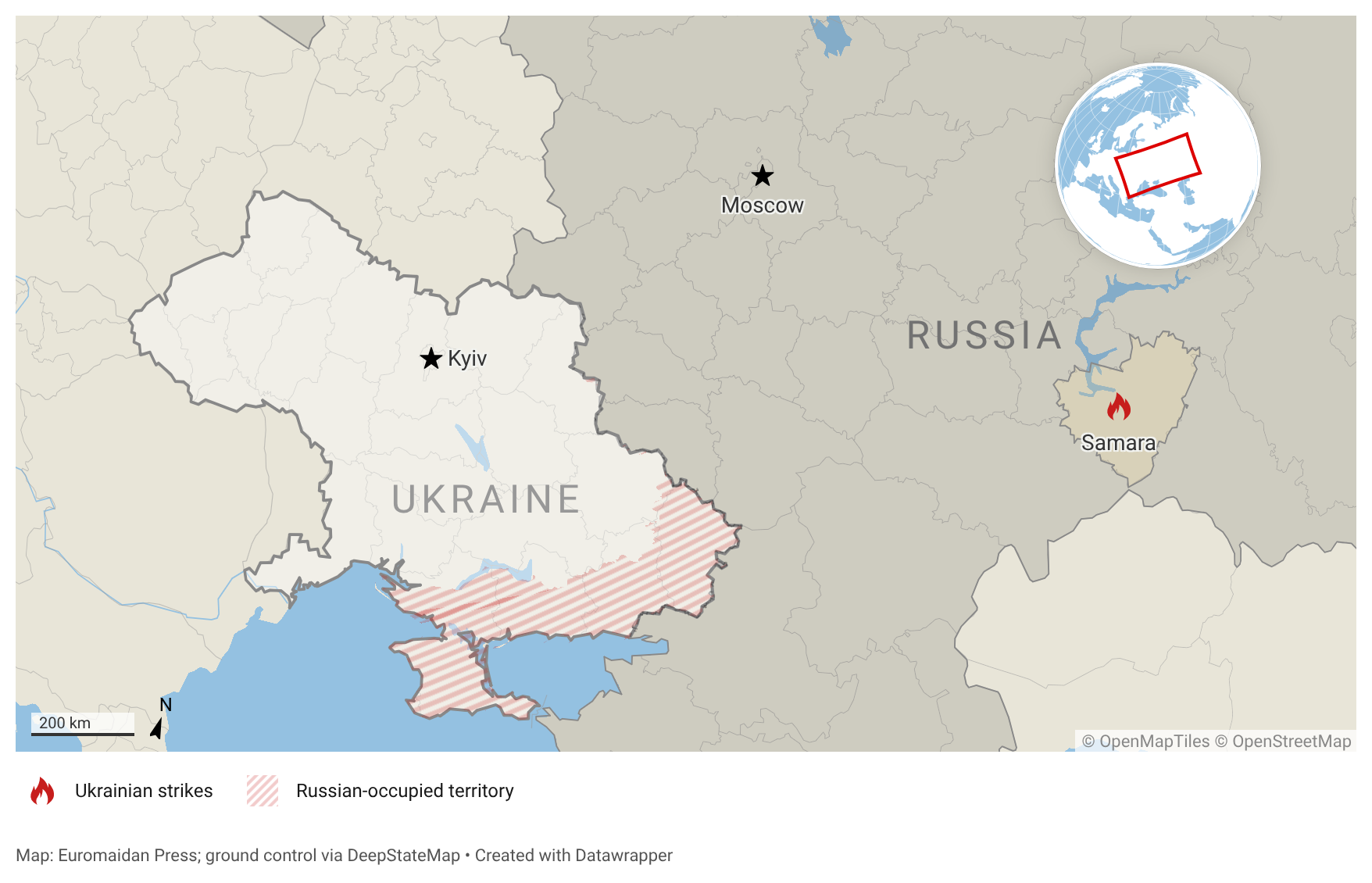
Drones attacked Russia's Volgograd and Samara oblasts overnight on 2 October, sparking fires near an oil refinery, a chemical plant, and likely a major oil-transport hub, Ukrainian and Russian monitoring channels reported. Regional officials acknowledged the attack but not the fires, and the extent of any damage remains unconfirmed.

Explosions and a glow over Volgograd's refinery district

Explosions sounded for a long time in Volgograd itself and around the refinery's industrial zone, Ukrainian Telegram channel Exilenova+ wrote.

Residents reported drones flying over and blasts "in all districts of the city," and complained that no air raid alert sounded, Russian news Telegram channel Astra reported. Its OSINT analysis of eyewitness footage placed the glow near the Lukoil refinery and the neighboring Kaustik chemical plant, though the available videos do not show which facility caught fire.

Volgograd Oblast Governor Andrei Bocharov claimed a "massive drone attack" on the region's industrial infrastructure. He mentioned a fire in an apartment building and one person hospitalized, but no fires at plants.

Lukoil-Volgogradneftepererabotka is one of Russia's largest refineries. It processes 14.8–15.7 million tons of crude a year, about 5% of Russia's refining, and makes gasoline, diesel, jet fuel, fuel oil, and bitumen, according to Astra.

lukoil’s norsi refinery in kstovo, nizhny novgorod oblast
Explore further

Fifth drone-related NORSI shutdown in under five months leaves all major Lukoil refineries offline

Drones have hit the plant repeatedly. In May 2025, strikes damaged its ELOU-AVT-1 and ELOU-AVT-6 primary processing units. A 29 May 2026 strike halted production at the plant, about 500 km east of the war zone, Ukraine's General Staff said. On 31 July, drones set the refinery ablaze again, and Astra reported the AVT-1 and AVT-6 units stopped.

Kaustik sits in Volgograd's southern Krasnoarmeysky district. It is one of the region's leading plants and makes basic chemicals with dual civilian and military use, Astra wrote. The outlet called that output critical to Russia's military industry. The plant runs chlor-alkali production built on salt electrolysis. It makes hydrochloric acid, plastics, synthetic resins, and industrial gases, according to OSINT-Varta. Such products can serve military industry too, including polymer parts and protective coatings for hardware, Militarnyi noted.

Europe's largest tank farm likely on fire near Samara

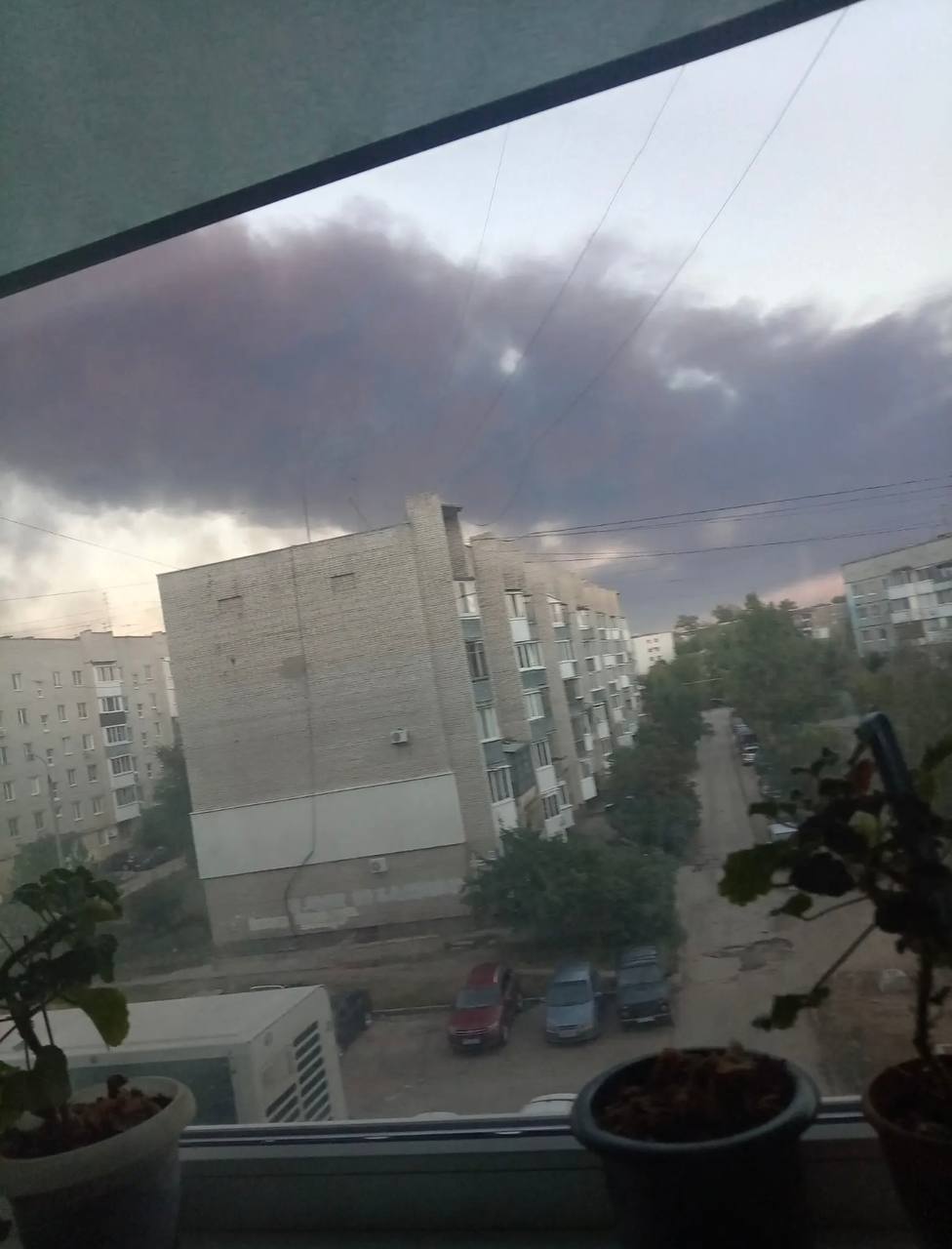
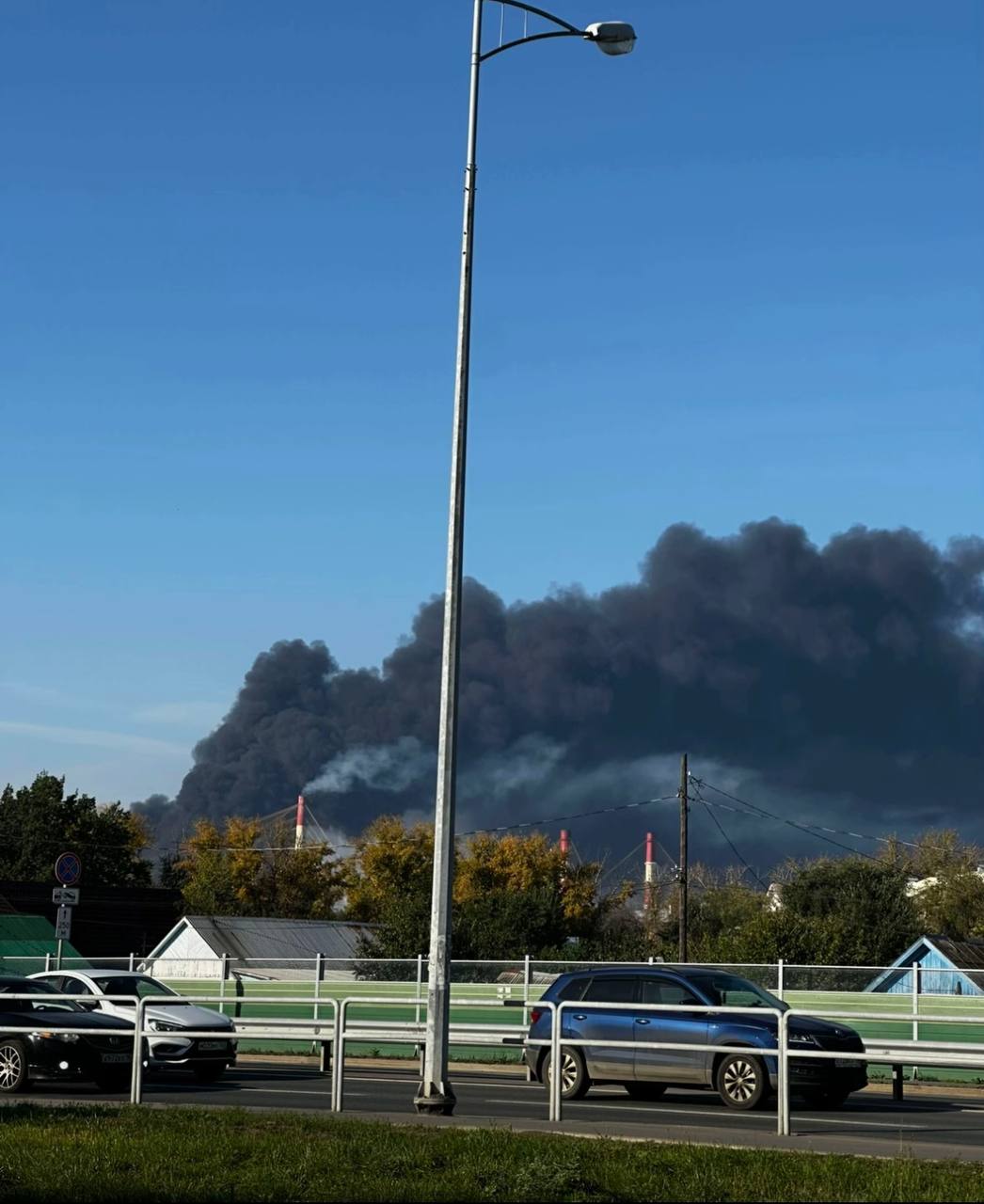
Explosions also rocked Samara, with an especially strong one around 06:30, Astra reported. Its OSINT expert linked reader photos to a fire at the Samara linear production dispatch station in the settlement of Prosvet.

Ukrainian monitoring channel Supernova+ shared video of thick black smoke on the horizon and reported a fire at the station. Exilenova+ reported explosions in Samara followed by a fire.

The station belongs to Transneft, Russia's state pipeline operator. It covers more than 216 hectares and holds 71 tanks with a combined capacity of over 1.6 million m³ of crude. Astra called it Europe's largest tank farm.

Four trunk pipelines converge there, carrying oil from Western Siberia, Tatarstan, Orenburg Oblast, and Kazakhstan. The station blends high- and low-sulfur crude into Urals, Russia's flagship export grade, according to Militarnyi.

Samara authorities did not comment on the fire. Mayor Ivan Noskov stated only that ground public transport was suspended. Samara Oblast Governor Vyacheslav Fedorishchev did not report an attack at all.

The station has been hit before. Operators of the 14th Regiment of Ukraine's Unmanned Systems Forces struck it again overnight on 23 September 2025. On 21 April 2026, drones of the Security Service of Ukraine's Alfa special operations center hit it, reportedly damaging five crude tanks of about 20,000 m³ each.

one refinery night moscow ufa now samara—ukraine working through russia's fuel chain · post smoke plume burning kuibyshev stretching across samara skyline 22 2026 exilenova 5877644049043362820 ukraine news ukrainian reports
Explore further

Ukraine shut down this Samara refinery in June—now its drones are back, and both distillation units are burning again

Ukraine's long-range drones have already pushed Russia's fuel shortages into Central Asia, and Washington has pressed Kyiv to stop, so every hit on processing or export logistics tests how long oil can fund Moscow's war.

  • ✇Euromaidan Press
  • Spain, Belgium, and Poland are sending Ukraine F-16 cannon rounds to fight Russia’s jet drones
    Ukraine may soon receive a multimillion package of 20-mm rounds for its F-16 fighter jets, Foreign Minister Andrii Sybiha told journalists, Hromadske reported. He called the ammunition critical for shooting down Russia's jet-powered drones and said several partners have already begun transferring it. He expects the larger package after an upcoming high-level visit. Russia now strikes Kyiv and other Ukrainian cities daily, increasingly with jet-powered drones that outrun the cheap intercepto
     

Spain, Belgium, and Poland are sending Ukraine F-16 cannon rounds to fight Russia’s jet drones

2 octobre 2026 à 04:38

ukraine's defenses against jet drones aren't built up yet its f-16s getting more rounds meantime · post ukrainian foreign minister andrii sybiha сибіга andrij 7ca21 ukraine news reports

Ukraine may soon receive a multimillion package of 20-mm rounds for its F-16 fighter jets, Foreign Minister Andrii Sybiha told journalists, Hromadske reported. He called the ammunition critical for shooting down Russia's jet-powered drones and said several partners have already begun transferring it. He expects the larger package after an upcoming high-level visit.

Russia now strikes Kyiv and other Ukrainian cities daily, increasingly with jet-powered drones that outrun the cheap interceptors built for slower Shaheds. Fighter jets are among the tools Ukraine uses against them, while its overall interception rate for jet drones still trails its rate against propeller drones.

"Critically important" ammunition

Sybiha said Ukraine has yet to build up its capability to repel jet drones.

"Given that we have not yet built up the capability to repel jet drones, and given the preparations for new strikes, it was critically important to help our military shoot down these drones. Apart from air defense systems, which are too expensive to use constantly against drones, the most effective tools right now are F-16 fighter jets," Sybiha said.

He thanked Spain, Belgium, and Poland, which have begun the process of transferring the ammunition, and said that thanks to them Ukraine will "very soon" have the rounds it needs.

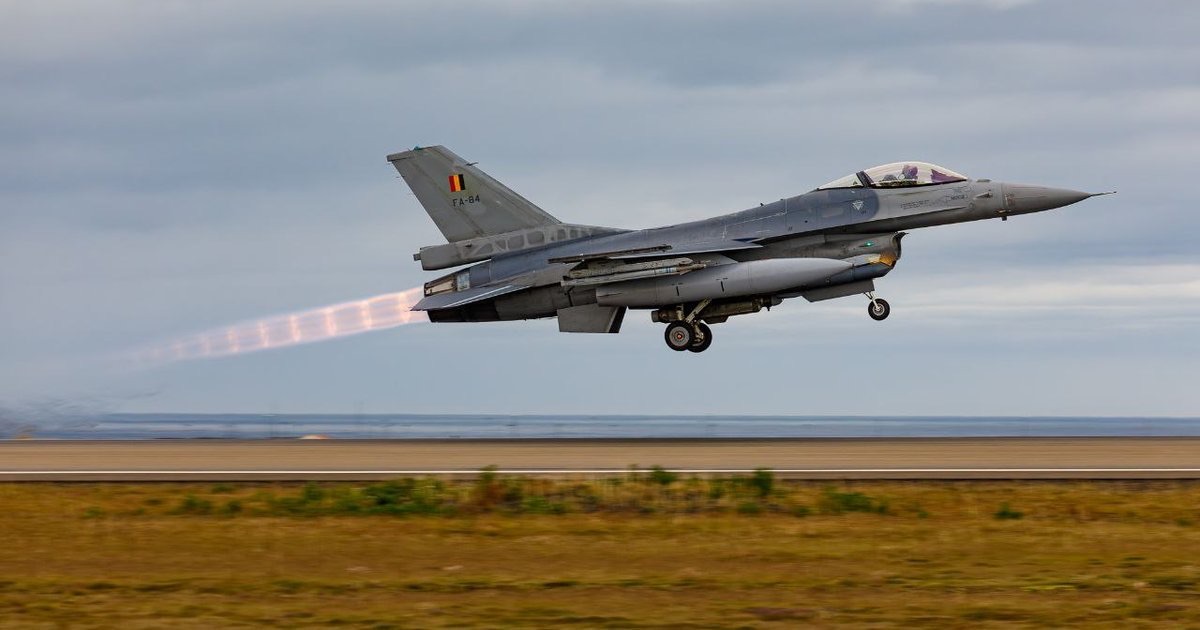
belgium send three f-16 fighter jets maintenance delays keep ukraine using · post belgian jet belgium-f-16-takes-off news ukrainian reports
Explore further

Belgium will send three F-16 fighter jets, but maintenance delays may keep Ukraine from using them

A "very serious visit" ahead

Sybiha linked the larger package to a visit he did not name.

"We will soon have one very serious visit. We think that one of the decisions following this visit will be a multimillion package of this ammunition for Ukraine," he said.

Talks on buying the rounds from private manufacturers are also underway, he added.

Ukraine has already received urgent batches of F-16 ammunition from Belgium, Spain, and other partners, and Belgium plans to send three more F-16s by the end of 2026 under an accelerated procedure. The jets' air-to-air missiles and cannon rounds are imported and not always in stock.

money engineering what stands between ukraine russia's fastest drones zelenskyy says · post russia’s new “geran-4 seeker” shahed variant geran-4 news ukrainian reports
Explore further

Combat shows speed alone can’t catch Russia’s jet-powered drones, despite eight Ukrainian makers’ assurances. So why can’t they stop them?

Another night of Russian strikes

Overnight on 2 October, Russia launched 108 drones at Ukraine, 47 of them jet-powered, and air defenses downed 88 of them. In Kyiv, a Russian strike on a 25-story residential building in the Darnytskyi district killed one person and injured two. Russia also targeted the Southern Bridge again, after striking it three times the previous day, and the city restricted public transport across several bridges.

In Kharkiv Oblast, a Russian FPV drone hit a car in the Solonytsivka hromada on the afternoon of 1 October, injuring a man and a boy. A Russian strike damaged a civilian enterprise in Rivne Oblast and started a fire that forced an evacuation of nearby homes, regional head Oleksandr Koval said, and drones attacked Cherkasy Oblast.

In neighboring Romania, an object believed to be a drone crashed near the village of Plauru in Tulcea County during the attack, starting a fire that caused no casualties, Romania's Defense Ministry said.

  • ✇Euromaidan Press
  • Russian glide bombs scarred a statue of Christ and damaged a 19th-century church in Sumy
    Russian glide bombs that struck central Sumy on 29 September damaged a 19th-century church, the city cemetery around it, and a bronze statue of Christ, NV reported, citing the diocesan outlet Pravoslavna Sumshchyna. The same strike hit a school and nearby homes. Russia kept up its attacks across Ukraine over the following night and day. Russia continues its terror campaign against Ukrainian civilians, and churches are among its routine targets, from a church its incendiary drone burned
     

Russian glide bombs scarred a statue of Christ and damaged a 19th-century church in Sumy

1 octobre 2026 à 06:39

russian glide bombs scarred statue christ damaged 19th-century church sumy · post front saints peter paul ukraine after strike 29 2026 статуя ісуса христа зазнала символічних пошкоджень фото цукр захар

Russian glide bombs that struck central Sumy on 29 September damaged a 19th-century church, the city cemetery around it, and a bronze statue of Christ, NV reported, citing the diocesan outlet Pravoslavna Sumshchyna. The same strike hit a school and nearby homes. Russia kept up its attacks across Ukraine over the following night and day.

Russia continues its terror campaign against Ukrainian civilians, and churches are among its routine targets, from a church its incendiary drone burned to the ground in Donetsk Oblast to one its drone damaged in western Ukraine's Lviv. Its strikes keep landing in city centers where people live, study, and pray, as when a drone hit Kyiv's Academy of Sciences in broad daylight.

The church near the epicenter

Russia struck Sumy with four guided aerial bombs. The blast damaged the Church of Saints Peter and Paul, a national-level architectural monument that stood near the epicenter. The church belongs to the Sumy Diocese of the Ukrainian Orthodox Church (Moscow Patriarchate).

russian glide bombs scarred statue christ damaged 19th-century church sumy · post windows saints peter paul ukraine torn frames blast strike 29 2026 спасо-преображенський кафедральний собор м суми faceboo news
Windows of the Church of Saints Peter and Paul in Sumy, Ukraine, torn from their frames by the blast in the Russian strike on 29 September 2026. Photo: Transfiguration Cathedral of Sumy/Facebook

Almost the entire building was damaged, said the rector, Archpriest Mykola Holyk. The blast wave knocked out windows and broke nearly every pane.

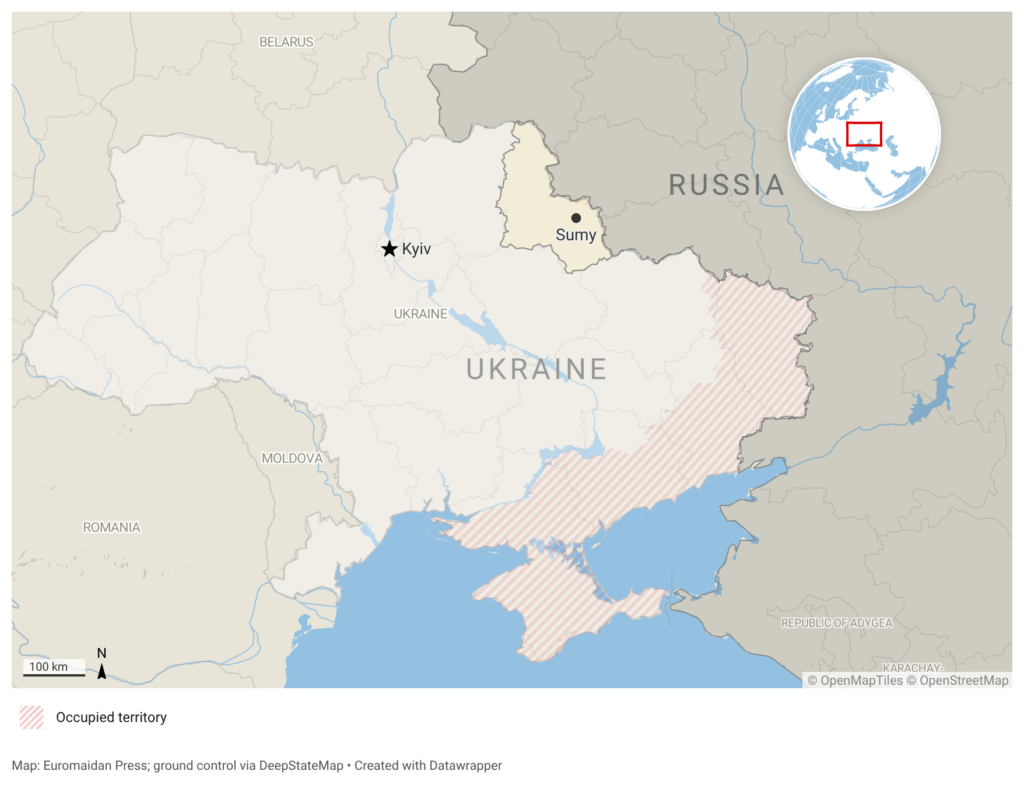
Sumy
Sumy is located only 35-40 km away from Russia's border, placing the city within the range of Russian glide bombs. Map: Euromaidan Press.

Plaster fell and the ceiling collapsed in several places. It tore out doors and wooden fittings, knocked some icons from their places, and holed the roof in many spots. Large and small fragments of the bomb pitted the walls.

russian glide bombs scarred statue christ damaged 19th-century church sumy · post grave dmytro sukhanov front saints peter paul ukraine shrapnel marks wall behind after strike 29 2026 foto спасо-преображенський
The statue of Christ on the grave of Dmytro Sukhanov in front of the Church of Saints Peter and Paul in Sumy, Ukraine, with shrapnel marks on the church wall behind it, after the Russian strike on 29 September 2026. Photo: Transfiguration Cathedral of Sumy/Facebook

Local patrons paid to build the church between 1843 and 1851, in the late classicist style.

A cut across Christ's chest

In front of the church stands a bronze statue of Christ, placed in the late 19th century on the grave of Dmytro Sukhanov, a merchant and former mayor of Sumy. Bomb fragments left a cut across the statue's chest. The statue is a local landmark of monumental art, the outlet Tsukr noted. The strike also damaged about 50 graves in the Central City Cemetery beside the church.

"The godless enemy continues to kill civilians, endanger children, and destroy schools, homes, hospitals, churches, and cemeteries," the diocese said.

russian glide bombs scarred statue christ damaged 19th-century church sumy · post window saints peter paul ukraine strike 29 2026 спасо-преображенський кафедральний собор news ukrainian reports
A window of the Church of Saints Peter and Paul in Sumy, Ukraine, damaged in the Russian strike on 29 September 2026. Photo: Transfiguration Cathedral of Sumy/Facebook

The same attack hit a school where students were sheltering, and a residential area where two people were killed and six injured, three of them children. In September, Russian strikes on Kyiv also damaged two churches belonging to the same Moscow-linked church, the Exaltation of the Cross on Podil and the Pokrova Church on Priorka.

russian glide bombs scarred statue christ damaged 19th-century church sumy · post house destroyed guided aerial bomb kovpakivskyi district ukraine overnight 1 2026 administration 1790832137-625 news ukrainian reports
A house destroyed by a Russian guided aerial bomb in the Kovpakivskyi district of Sumy, Ukraine, overnight on 1 October 2026. Photo: Sumy City Military Administration

Another day of Russian strikes

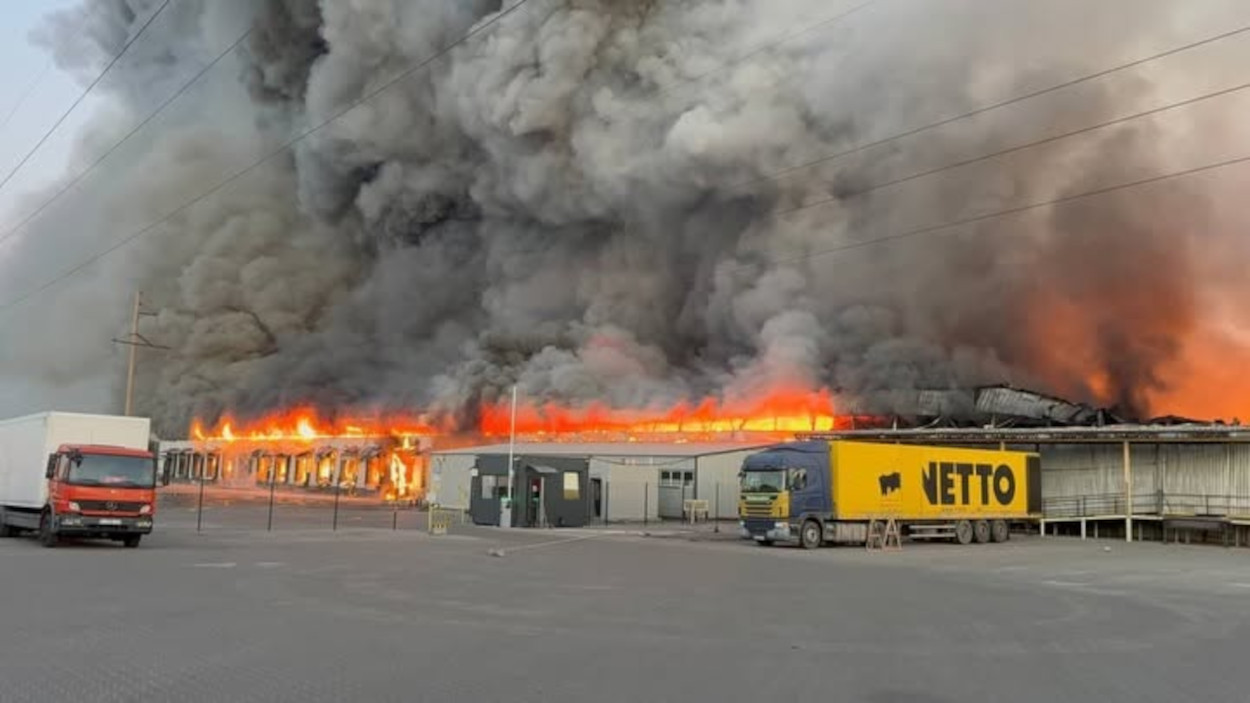
Overnight on 1 October, Russia launched 107 Shahed-type drones at Ukraine, 63 of them jet-powered, the Air Force said. Air defenses downed or suppressed 87, and drones hit 11 locations. In Sumy, a guided bomb hit private homes, injuring two women and damaging about six houses, city military administration head Serhii Kryvosheienko reported. On the morning of 30 September, a Russian strike set a shopping center in Sumy Oblast's Romny district on fire, and crews fought the blaze until late that night, the State Emergency Service said. In Kyiv on the morning of 1 October, a drone hit a school in the Solomianskyi district while children sheltered inside, Mayor Vitali Klitschko said. More than 100 students and about 60 staff were in the shelter, and no one was hurt, police said. A warehouse fire in Kyiv's Obolon district injured one person.

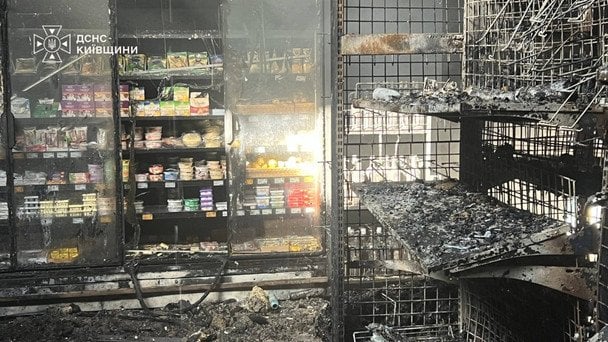
Aftermath of the Russian strike on a store in Kyiv Oblast, September 30, 2026.
Explore further

Kyiv’s supermarkets are the new front line as Russia hunts civilian life before winter

Over the past 24 hours, Russian mortar fire killed two men in Sumy Oblast's Seredyna-Buda hromada, and 15 people were injured across the oblast, the regional administration reported. A morning drone attack killed a 50-year-old man in Mykolaiv Oblast, and drones killed a 44-year-old man in Nikopol district, Dnipropetrovsk Oblast. In Kherson Oblast, Russian attacks killed one person and injured four. Eight people were hurt in Kharkiv Oblast, six in Kyiv Oblast, five in Donetsk Oblast, and three in Zaporizhzhia Oblast, according to regional authorities.

  • ✇Euromaidan Press
  • Moscow’s message to European business: your Russian assets are now leverage against your governments
    The Kremlin is signaling that it will hold the Russian assets of European companies hostage to pressure Europe into rethinking its sanctions, the Institute for the Study of War (ISW) wrote on 30 September. Moscow has already put well-known European retailers and food makers under Russian "temporary management." A senior Russian official has now hinted that European banks could be next. As Russia continues its invasion of Ukraine, it has long turned hostages and threats into weapons. Its
     

Moscow’s message to European business: your Russian assets are now leverage against your governments

1 octobre 2026 à 05:47

moscow's message european business russian assets now leverage against governments · post kamskaya confectionery factory owned nestlé perm russia 18 2010 nestle_in_perm ukraine news ukrainian reports

The Kremlin is signaling that it will hold the Russian assets of European companies hostage to pressure Europe into rethinking its sanctions, the Institute for the Study of War (ISW) wrote on 30 September. Moscow has already put well-known European retailers and food makers under Russian "temporary management." A senior Russian official has now hinted that European banks could be next.

As Russia continues its invasion of Ukraine, it has long turned hostages and threats into weapons. Its record includes nuclear threats against Europe from its Oreshnik missile launch sites and a fresh warning over Kaliningrad. It has played games with Europe's largest nuclear plant that it occupied in 2022, applied gas and water pressure on its neighbors, and Kyiv accuses it of blackmailing the families of Ukrainian prisoners of war. Europe's companies are now one more lever in that kit.

"Let them be scared"

Russia is taking "asymmetric measures" to make Europe rethink its sanctions, a senior Russian government source with direct knowledge of the seizures claimed, Reuters reported. "Let them think about what measures they are taking and what sanctions they are introducing," the source said.

Asked whether the Russian units of Italy's UniCredit and Austria's Raiffeisen could be placed under temporary management, the source answered: "Let them be scared."

Kremlin spokesman Dmitry Peskov claimed the decisions were driven by "the increasing level of involvement of these unfriendly countries in direct battlefield hostilities" against Russia. He suggested the moves were "reversible," but added: "For now, we do not see any grounds for a reversal."

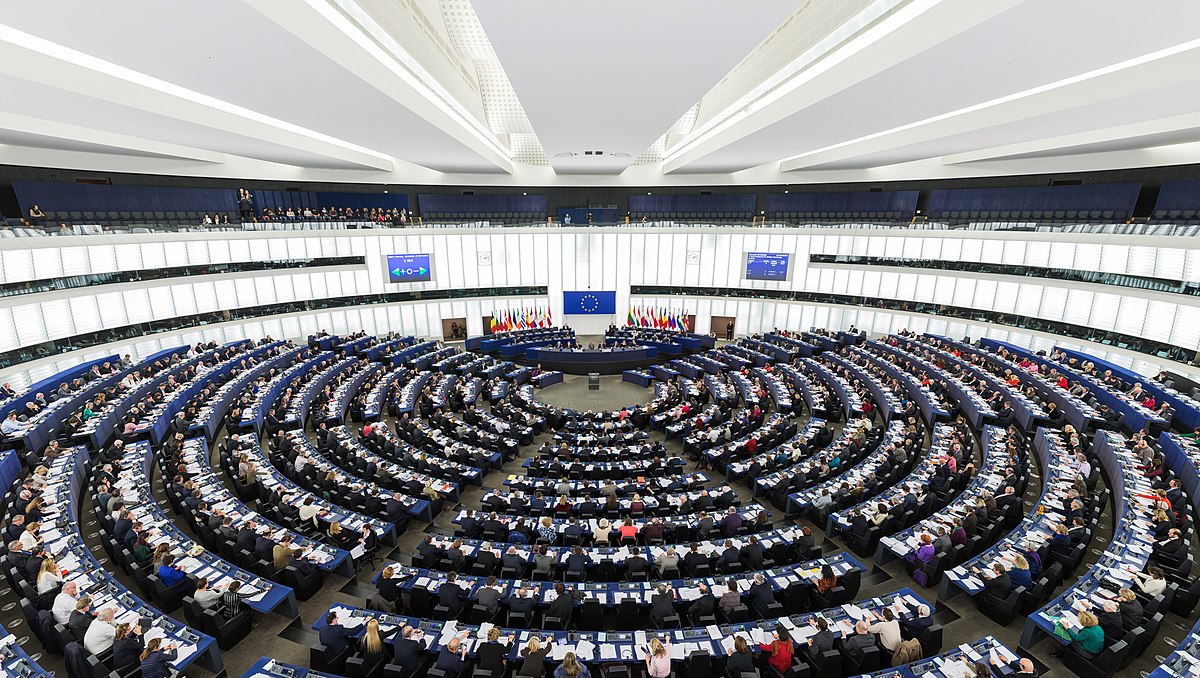
The Hemicycle of the European Parliament in Strasbourg during a plenary session in 2014.
Explore further

EU lawmakers renew push to seize frozen Russian assets as Ukraine faces its toughest winter yet with a €23 billion defense funding gap

Nestlé, Auchan, and Metro under "temporary management"

Putin's decree of 17 September placed 16 companies under the "temporary management" of a firm called L.E.V. Management, with no end date. They include the Russian units of France's Auchan and Lemana PRO, formerly Leroy Merlin, and of Switzerland's Nestlé. A second decree, on 28 September, handed the Russian assets of German wholesaler Metro AG to UK Torg Rus.

Both decrees amend Putin's April 2023 decree No. 302, which lets Moscow take over the property of firms tied to countries it labels "unfriendly." Because the "temporary" management has no expiry date, ISW considers it effectively nationalization. Independent outlet Novaya Gazeta Europe identified L.E.V. Management's director as retired Russian Major General Andrei Krayushkin.

European companies as corporate hostages

The Kremlin likely wants to use the seizures to take European companies as corporate hostages, ISW assessed. It also likely expects a temporary fiscal boost from the revenues of the seized businesses.

The strategy assumes that European firms will judge the benefits of staying in Russia to outweigh the risk of losing their assets, the think tank said. Whether a company is seized depends entirely on Moscow's relations with the country where it is headquartered, ISW added.

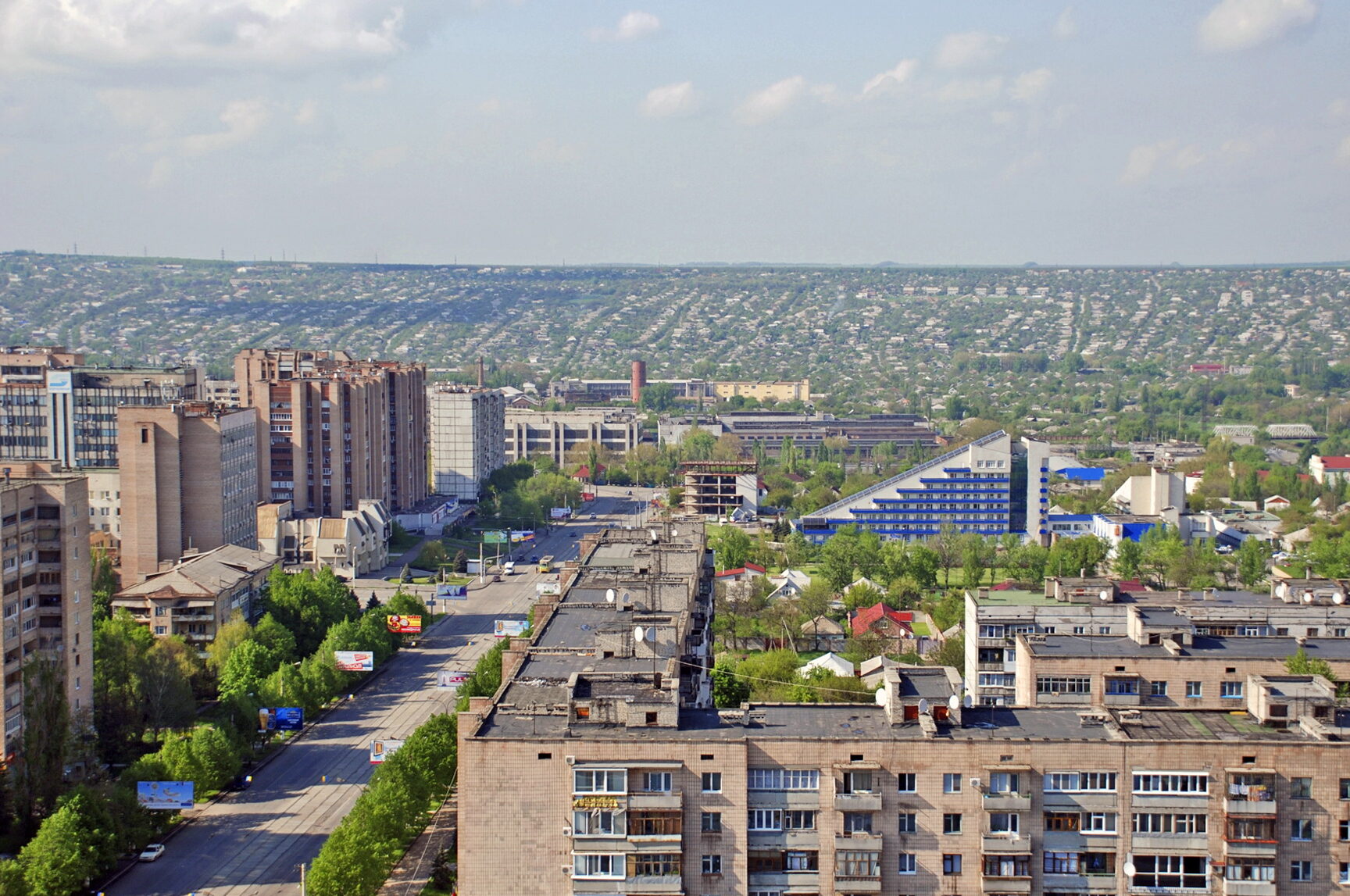
russia declares nearly 8000 luhansk apartments ownerless nationalization · post view 16th line street occupied donbasssosorg 93942 ukraine news ukrainian reports
Explore further

Russia declares nearly 8,000 Luhansk apartments “ownerless” for “nationalization”

Seizing others' property is an old Moscow habit

Since the start of the full-scale war, Russia has introduced temporary administration at 135 foreign-linked firms, mostly from EU countries, according to TASS data cited by Reuters. Earlier targets included French food group Danone and Danish brewer Carlsberg.

The method was tested on Ukraine first. Russia's proxies in occupied Donetsk and Luhansk oblasts stole most Ukrainian assets there in 2014 and 2015. In March 2017, after Ukrainian activists blocked rail trade with the occupied areas, they placed the remaining Ukrainian-registered firms under "temporary administrations," a label close to the one Moscow uses today. The published Donetsk list alone ran to 43 assets, from coal mines and ironworks to the Donbas Arena stadium. Much of the coal and steel business later ended up with firms tied to Serhii Kurchenko, a fugitive oligarch from Yanukovych's era.

  • ✇Euromaidan Press
  • Lithuania gets its US tank battalion back while the Pentagon weighs pulling up to 40,000 troops from Europe
    Lithuania is getting its US troops back although the overall American presence in Europe will shrink, Lithuanian President Gitanas Nausėda said. He tied the wider drawdown to Washington's demand that Europe take more responsibility for its own defense. Lithuania's case, he suggested, is the exception. While waging all-out war on Ukraine, Russia keeps probing Europe with drones and sabotage that stop just short of open attack. Its small Baltic neighbors are already preparing their people
     

Lithuania gets its US tank battalion back while the Pentagon weighs pulling up to 40,000 troops from Europe

29 septembre 2026 à 07:36

lithuania gets its tank battalion back while washington still plans smaller army europe · post lithuanian president gitanas nausėda j stacevičius/lrt nausėda lrt ukraine news ukrainian reports

Lithuania is getting its US troops back although the overall American presence in Europe will shrink, Lithuanian President Gitanas Nausėda said. He tied the wider drawdown to Washington's demand that Europe take more responsibility for its own defense. Lithuania's case, he suggested, is the exception.

While waging all-out war on Ukraine, Russia keeps probing Europe with drones and sabotage that stop just short of open attack. Its small Baltic neighbors are already preparing their people for a possible invasion, and American soldiers on their soil have long been the clearest sign that attacking them means fighting the US. With Washington weighing a pullback and telling Europe to fend for itself, each US unit that stays on Russia's doorstep carries more weight than its size.

"There will be fewer US troops in Europe"

Nausėda spoke in an interview with LNK television on 28 September.

"There will be fewer US troops in Europe. This is partly related to what US President Donald Trump says, to the signals the US administration is sending us that Europe must take on more responsibility itself," he said.

Europe must do more for itself, and it is already doing so, Nausėda added. The US presence in Lithuania matters not only for its military power but also for deterrence, he argued.

"The presence of these troops is precisely what reduces the likelihood of military conflict or military aggression," he told LNK, ELTA reported.

"The heavy battalion will be here"

Nausėda called the decision a kind of encouragement for Lithuania. "As the overall number of US troops in Europe decreases, in Lithuania that number will at least remain, will not decrease, and perhaps will even be slightly larger," he said. "In any case, the heavy battalion will be here."

The battalion will keep its Abrams tanks, but an engineer battalion will replace the artillery battalion, Nausėda said on LRT's Savaitė program. The rotation will again last nine months. The Americans will number roughly as before, over 1,000, Defense Minister Robertas Kaunas said.

Estonia has also secured the return of US troops, at least temporarily, LRT noted.

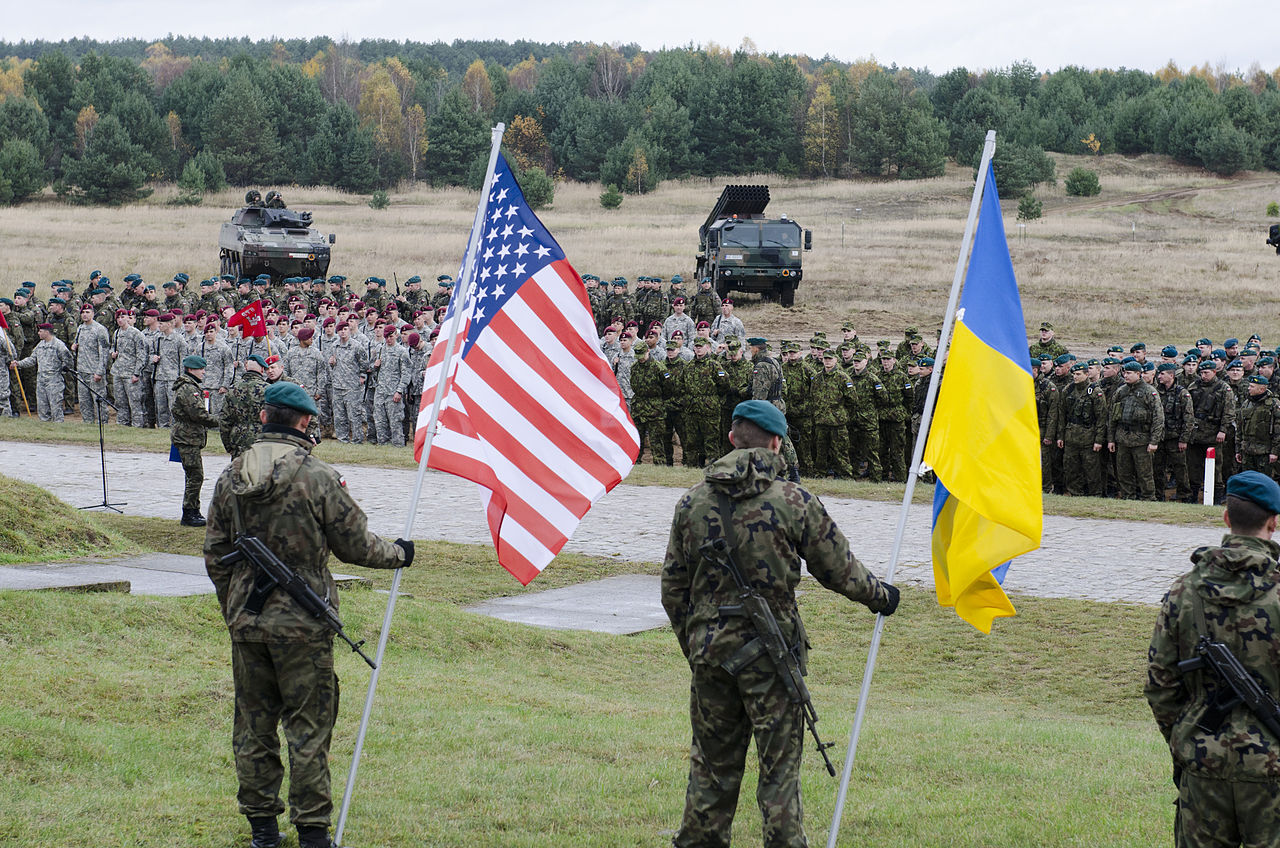
Polish paratroopers holding the United States and Ukrainian state flags during the NATO military exercise Steadfast Jazz 2013 in Poland. (Source: Sgt. A.M. LaVey via Wikimedia)
Explore further

Trump announces 5,000 US troops to Poland — one week after US froze scheduled combat-team rotation and amid Russia’s threat

More than 1,000 US troops began leaving Lithuania when their rotation ended in early June, and no replacement arrived, LRT said. It was the country's first gap in the US presence since 2020. American heavy battalions have rotated through Lithuania since 2019.

The Pentagon is weighing a withdrawal of about 25,000 US troops from Europe, and possibly as many as 40,000, NBC News reported, adding that no final decision had been made. About 80,000 US troops are now stationed on the continent. Germany, Italy, and Spain would likely be among the countries most affected.

  • ✇Euromaidan Press
  • Vivaldi counteroffensive advanced after Ukraine took Russia’s drones out of the fight, ISW assesses
    Ukraine likely neutralized Russia's drone defenses north of Lyman before sending armor into the third phase of its Vivaldi counteroffensive, the Institute for the Study of War (ISW) assessed. An intermediate-range strike campaign against Russian logistics and electronic warfare paved the way, the think tank said. Drones have made this front so deadly that armor now mostly fights from kilometers back. That is what makes Ukraine's armored push onto fortified positions near Lyman stand out
     

Vivaldi counteroffensive advanced after Ukraine took Russia’s drones out of the fight, ISW assesses

29 septembre 2026 à 06:50

vivaldi counteroffensive worked because ukraine took russia's drones out fight isw assesses · post settlements ukraine's 3rd army corps says liberated during operation north lyman donetsk oblast 28 2026 settlements-liberated-during-operation-vivaldi-phase-3-as-of-september-28-2026-scaled

Ukraine likely neutralized Russia's drone defenses north of Lyman before sending armor into the third phase of its Vivaldi counteroffensive, the Institute for the Study of War (ISW) assessed. An intermediate-range strike campaign against Russian logistics and electronic warfare paved the way, the think tank said.

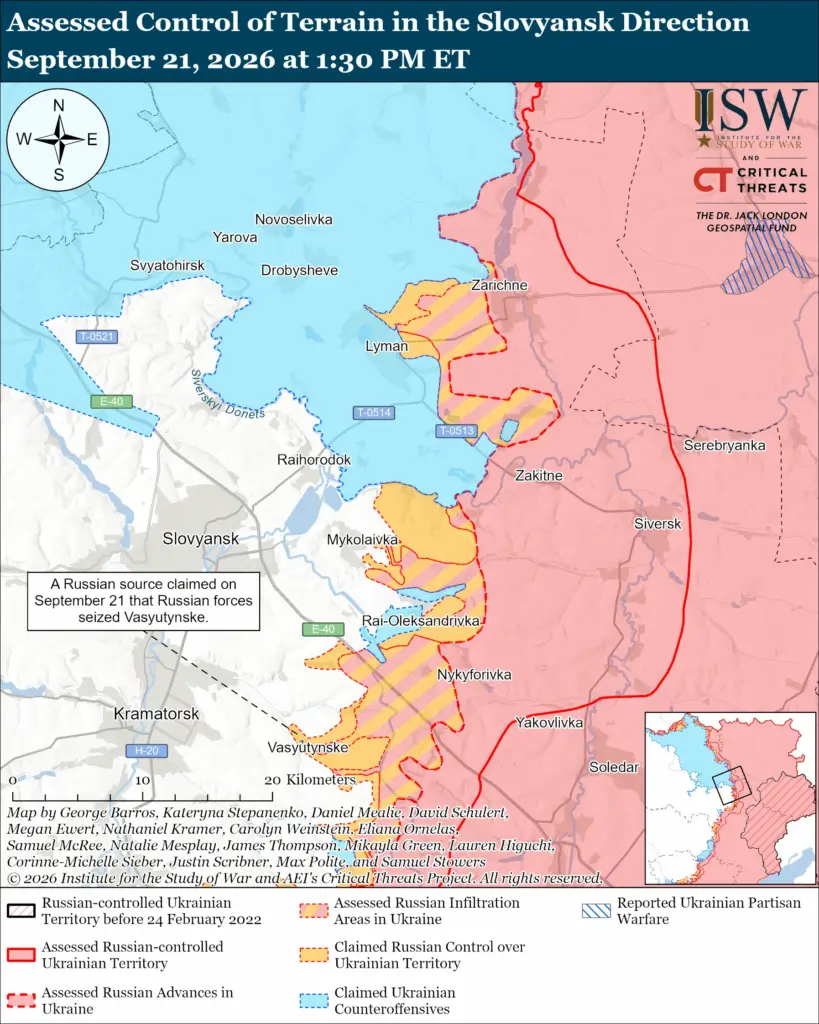
Drones have made this front so deadly that armor now mostly fights from kilometers back. That is what makes Ukraine's armored push onto fortified positions near Lyman stand out. Russia has already shifted its effort south toward Sloviansk after losing the Lyman pincer.

Armor reached Russian bunkers without drawing drone strikes

To break the strongest Russian fortifications, Ukraine used old Soviet BTR-60 armored personnel carriers rebuilt as remote-controlled explosive vehicles, the 3rd Army Corps says.

Ukrainian forces drove them up to heavy Russian fortifications without coming under Russian drone strikes, ISW noted. The think tank said this indicates Ukraine neutralized or otherwise negated Russia's drone defenses in the area.

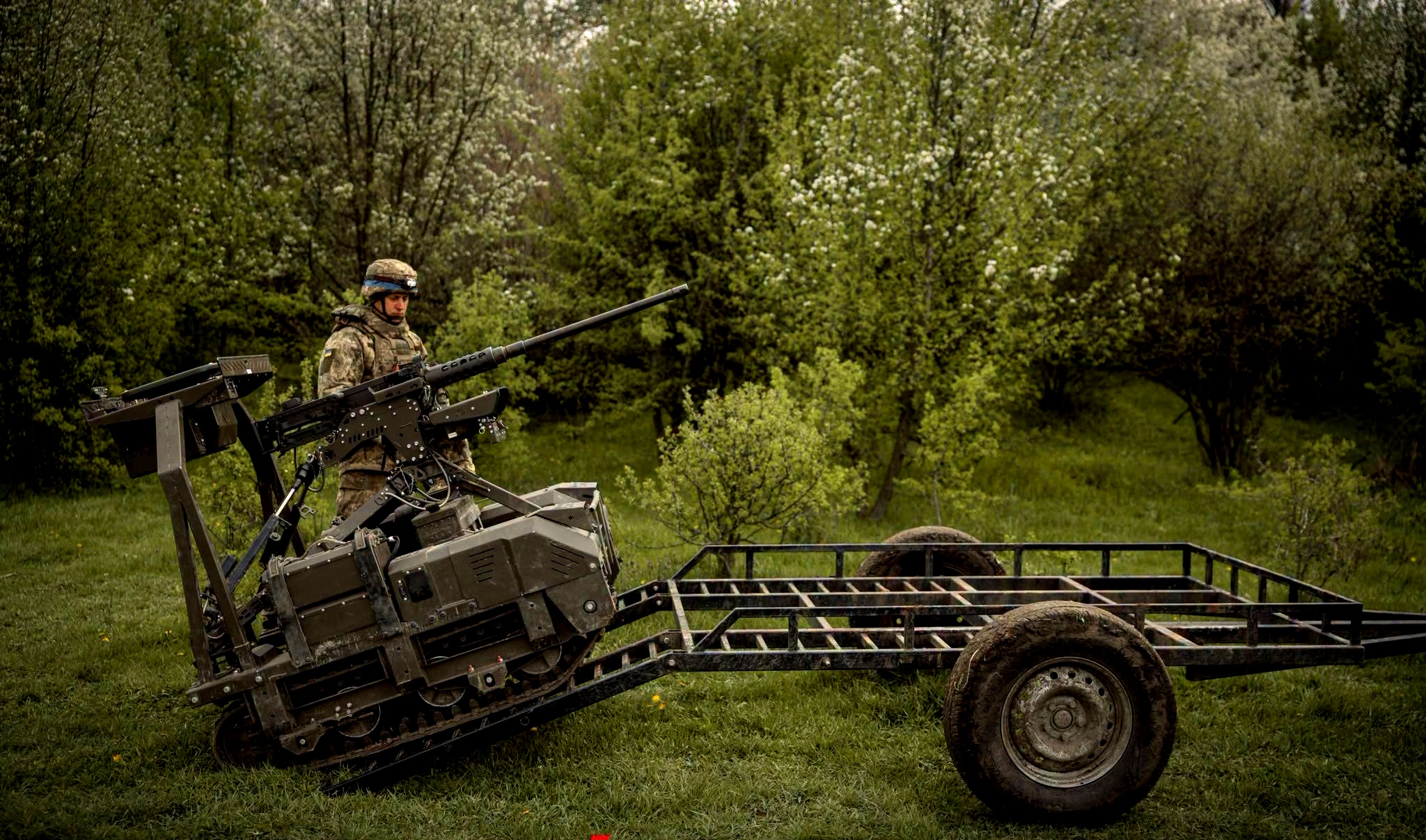
The image shows a Ukrainian soldier standing next to an unmanned ground robotic vehicle. Source: The General Staff
Explore further

New Vivaldi tactic: Ukraine’s ground robots, each carrying two Bullspike grenade launchers, attack Russian positions and then detonate inside their shelters

Strikes on fuel starved Russia's jammers

Ukraine achieved tactical drone overmatch through extensive shaping operations and an intermediate-range strike campaign, ISW said. Those strikes targeted the Russian drones and electronic warfare (EW) systems that would otherwise have hunted the advancing vehicles.

The 3rd Army Corps reported on 17 September that strikes on Russian logistics in occupied Luhansk Oblast had degraded Russian fuel supplies to the front, ISW wrote that day. The corps said that strained Russia's ability to use drones and EW against Ukrainian drones. EW systems consume a lot of power, and Russian troops run them on diesel generators, ISW explained.

Deputy corps commander Maksym Zhorin credited strict information silence and a "Protective Drone" system of EW assets, according to the same assessment. He said it helped neutralize around 20,000 Russian drones. The corps had earlier described mapping Russian command posts and striking them to sow panic.

ATESH partisan Footage of a fire on a relay cabinet at the Bataysk railway junction, near Rostov-On-Don, Russia, 21 December 2025. Screenshot from video: ATESH
Explore further

Ukraine’s Vivaldi counteroffensive near Lyman just got help from behind Russian lines: partisans say they cut rail supply to three Russian regiments, no explosion needed

Five settlements and 2,000 Russian losses

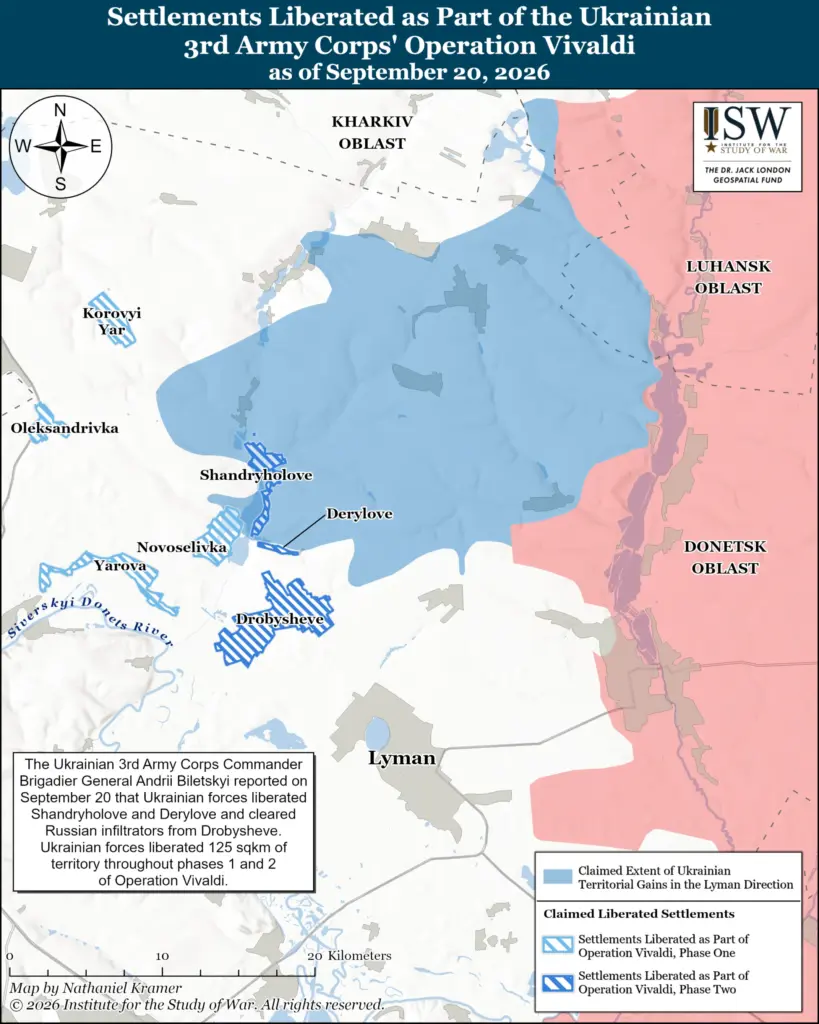
The corps liberated Nove, Ridkodub, and Katerynivka and restored control over Karpivka and Novomykhailivka, it said on 28 September. The phase added 51 km², bringing the total since the offensive began to 176 km².

Russian losses reached 2,000 personnel, and more than 250 Russians were taken prisoner, according to the corps. Corps commander Andrii Biletskyi said a feint from Shandryholove toward Zelena Dolyna drew Russian reserves away from the real target, Nove.

The first two phases had reportedly cleared more than 125 km² north of Lyman.

Russia is stepping up fake Ukrainian government pages as bait for recruiting agents, Ukraine’s security service says

29 septembre 2026 à 04:38

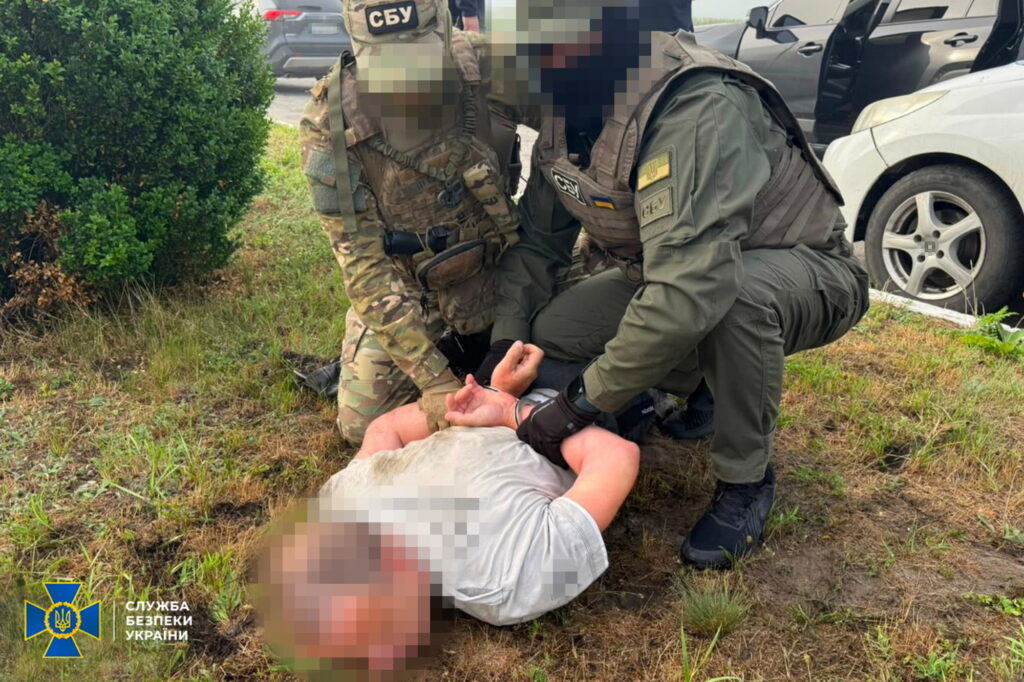
fake ukrainian government pages russia's newest bait recruiting agents ukraine's security service says · post man suspected collaborating fsb detained kharkiv oblast 2026 sbu untitled ukraine news reports

Russian intelligence services have sharply stepped up building websites and social media pages that impersonate Ukrainian state bodies and media, the Security Service of Ukraine (SBU) warned. Moscow uses the fakes to spread disinformation and to steal personal data it can turn into spy recruitment. The SBU says it has already blocked dozens of clones of its own brand.

Counterfeit pages built for propaganda and data theft

The fake sources serve Russian psychological operations and disinformation campaigns, the SBU said on 28 September. Their aim is to destabilize the situation inside Ukraine and damage its position abroad. Russian intelligence also uses them to extract Ukrainians' personal data, the agency said.

Alongside its full-scale invasion, Russia wages war on Ukraine in the cyber domain and through espionage and sabotage. Every agent Russia recruits inside Ukraine can help steer missiles and drones onto targets, and the SBU keeps catching such recruits.

Hacked accounts become recruitment leads

Russians often hack the accounts of users who subscribe to the fake pages and messenger channels, the SBU found. They then use the stolen information for recruitment operations and to collect confidential data.

Moscow is most interested in the combat and operational work of Ukraine's defense and security forces, the agency said. The SBU's cybersecurity department found and blocked more than 50 resources that copied the agency's own branding and positioning.

The fake pages are not Russia's only digital tool. Earlier in September, Anthropic said it had caught Russian spies running a campaign against Kyiv on its Claude AI chatbot.

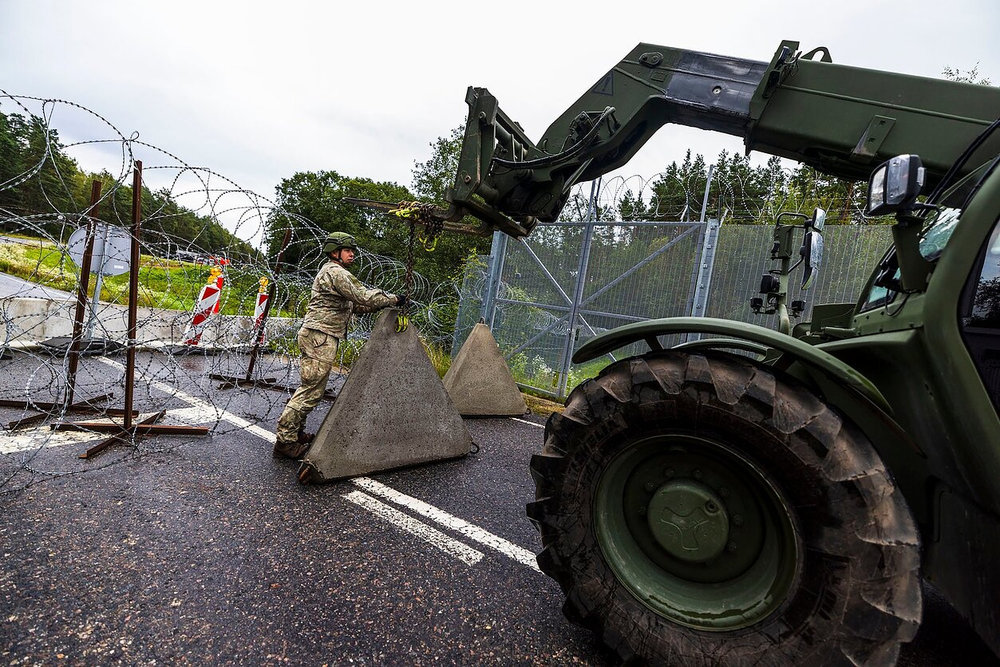
Lithuanian soldier installs concrete barriers and razor wire across a road during a civil defense exercise.
Explore further

Poland and the Baltics risk Russian sabotage for backing Ukraine, Bloomberg says

How Ukrainians can protect themselves

The SBU urged citizens not to follow suspicious links and to rely only on official sources. Anyone who sees a dubious web address, or gets a message from someone posing as an SBU officer, should call the 1516 hotline, the agency said.

What Russia's recruits are sent to do

The SBU's own reports from the past week show what Russia's recruits are tasked with. A mobilized soldier allegedly recruited by the FSB, Russia's Federal Security Service, tried to direct a Russian missile strike on his own unit in Kharkiv Oblast, the SBU said. His repair battalion restores Ukrainian drones.

A Lviv Oblast resident who worked at a drone production site in western Ukraine was allegedly recruited to guide a missile strike on it, the agency reported. The strike was meant to disrupt the steady supply of strike and reconnaissance drones to Ukrainian troops, the SBU said.

A court also sentenced a 17-year-old agent of Russia's military intelligence (GRU), exposed in November 2024, to 10 years in prison, the SBU announced. She tracked Ukrainian air defenses in Chernihiv Oblast under the cover of taxi rides. She talked to her GRU handler through an anonymous messenger chat.

The Kremlin calls mobilization talk “nonsense”—Zelenskyy says it has already begun, with North Korean reinforcements

29 septembre 2026 à 04:23

kremlin calls mobilization talk nonsense—zelenskyy says has already begun north korean reinforcements · post leader kim jong-un speaks opening memorial pyongyang russia's defense minister andrei belousov state duma speaker vyacheslav

Russia has quietly started a new round of mobilization and plans to bring in more North Korean troops, Ukrainian President Volodymyr Zelenskyy said. He cited a new report from Ukraine's military intelligence. The same day, the Kremlin published a decree enlarging Russia's army for the fourth time this year.

Russia widens recruitment at home and abroad

Zelenskyy spoke in his evening address on 28 September, after a briefing from Ukraine's military intelligence (HUR).

"In effect, the Russians have already begun additional mobilization—they are increasing the number of people they recruit through various means," he said.

Moscow also plans to recruit more foreigners, Zelenskyy said. He urged the governments of countries whose citizens Russia recruits to counter it, and said Kyiv would inform each of them.

Ukraine says Russia has been losing soldiers faster than contract recruitment replaces them. If so, an unannounced call-up lets the Kremlin refill its ranks without a formal draft. ISW says Putin may hold off on such a draft until he sees whether his strikes work. Ukrainian intelligence had expected Russia to announce a mass mobilization after this month's State Duma elections.

More than 8,000 North Koreans in Russia, 10,000 more in preparation

More than 8,000 North Korean troops are currently on Russian territory, Zelenskyy said. Pyongyang is selecting another 10,000 for training and deployment to Russia, he added.

Russia is paying, among other things, with technology, according to Zelenskyy. North Korea has launched production of Shahed-type attack drones with Russian technical support, he said.

That is a step beyond what Kyiv reported in June 2025. Moscow and Pyongyang had then only agreed to start preparing such production. In August, Zelenskyy warned that Russia could receive up to 50,000 North Korean troops.

kremlin calls mobilization talk nonsense—zelenskyy says has already begun north korean reinforcements · post leader kim jong-un speaks opening memorial pyongyang russia's defense minister andrei belousov state duma speaker vyacheslav
Explore further

North Korean missile unit deploys to Russia for ballistic strikes on Ukraine, Kyiv says

Kremlin raises the army's size again

Putin's decree sets the authorized strength of Russia's armed forces at 2,441,630, including 1,550,500 military personnel, Vedomosti reported. The decree gives no reason.

The order adds 15,500 troops and is the fourth such increase this year, Euronews said. Since March, the combined increase has reached 47,860 soldiers. Putin's 2022 "partial mobilization" decree also remains in force, the outlet noted.

A soldier from Ukraine’s 100th Mechanized Brigade operates an artillery gun firing beneath camouflage netting.
Explore further

Russia could open northern front by February if it orders new mobilization, Ukraine intel says

Moscow keeps denying a call-up

In early September, Putin claimed that reports of a coming mobilization were "complete nonsense" and "an information attack on Russia." Russian officials gave similar assurances days before the 2022 call-up.

Ukraine's military and foreign intelligence had earlier said that Russia's General Staff prepared a scenario to mobilize 600,000 people over 2026 and 2027, 300,000 each year.

Russia’s pipeline into Kupiansk is now its escape route—with kidnapped civilians as human shields, Ukraine says

28 septembre 2026 à 13:32

russia used gas pipeline sneak soldiers kupiansk now retreating troops marching civilians through other way human shield · post led suspected russian civilian clothes near kharkiv oblast 27 2026 1

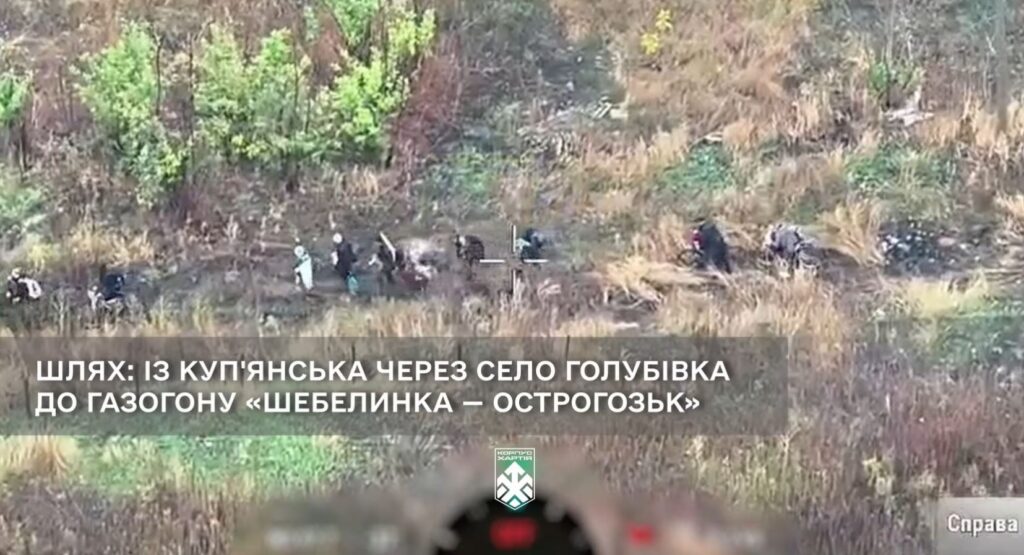
Russian troops retreating near Kupiansk abducted civilians, including children and elderly residents, and drove them into a gas pipeline to cover their withdrawal, the 2nd National Guard Corps Khartia said. The men of military age walking with them in civilian clothes were most likely Russian soldiers who had removed their uniforms, the corps added. Its reconnaissance drones filmed the group on 27 September. Ukrainian forces watched the column but did not open fire because of the civilians, ArmyInform reported.

Ukraine's military has accused Russia of using civilians as human shields in Kupiansk before. During its offensive, Russian troops also tried to enter the city through an inactive gas pipeline. Now, Khartia says, a pipe once used by Russian saboteurs is carrying abducted civilians toward occupied territory.

Nine people forced into the pipeline

Khartia filmed the group as the corps pressed its counteroffensive in the Kupiansk community in Kharkiv Oblast. The footage shows nine people: children, elderly residents, and a person on crutches. Men of military age in civilian clothing walk alongside them.

The group was led from Kupiansk through Holubivka village to the Shebelynka-Ostrohozhsk gas pipeline.

Civilians enter an opening in the ground near the Shebelynka-Ostrohozhsk gas pipeline near Kupiansk, Kharkiv Oblast, 27 September 2026. Screenshot: Khartia Corps

The footage shows them being led into the pipe, where they face a walk of about 10 km in darkness. The pipe exits in a forest, and the civilians will likely be taken to occupied territory.

"We documented this case. The materials will be handed over for a war crimes investigation," the corps said.

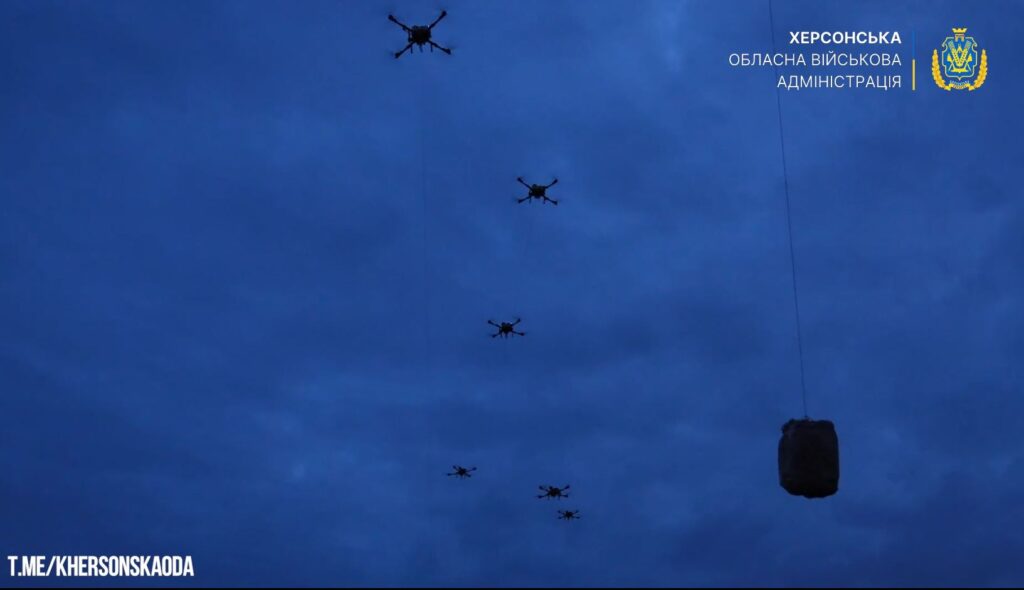
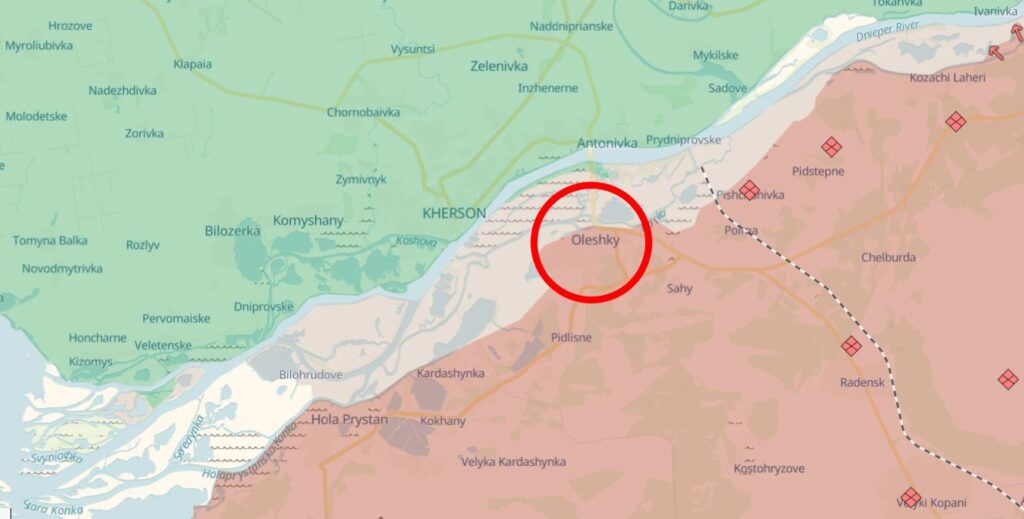
russia holds 2000 people hostage oleshky without food water—ukraine flew 4000 kg locals across dnipro · post drones carry packages starving residents russian-occupied kherson oblast 2026 lifting boxes ukraine news
Explore further

Russia holds 2,000 people hostage in Oleshky without food or water—Ukraine flew 4,000 kg of food to locals across the Dnipro

Ukrainian forces held fire—Russia counted on it

Ukrainian troops saw the group and did not open fire because children and elderly people were among them. Russia counted on exactly that, Khartia said.

The corps warned that Russian propaganda could present the footage as an "evacuation" or "rescue" of civilians, Militarnyi reported. Khartia calls it an abduction.

Khartia's counteroffensive near Kupiansk comes alongside other Ukrainian advances farther south. In northern Donetsk Oblast, the Third Army Corps' Operation Vivaldi has regained control of 125 km², including 50 km² previously under Russian occupation, and inflicted more than 3,000 Russian personnel losses, the corps said. The operation has effectively erased Russia's planned Lyman pincer. Near Kupiansk, Ukraine's defense forces continue pushing Russian forces toward the Oskil River, and the liberation of forests near Dvorichna and Zapadne has reduced the threat to the city.

Russia is launching a faster Geran-5 at Ukraine that satellite jamming may no longer knock off course, a monitoring channel says

28 septembre 2026 à 11:26

russia reportedly adds ground-reading optics its geran-5—one more upgrade ukraine's interceptors have beat · post older geran-5 design left newer one right modified sections outlined collage militarnyi порівняння старої (ліворуч)

Russia has fielded a Geran-5 variant that can steer by images of the ground below without satellite navigation, the Ukrainian monitoring channel Polkovnyk GSh reported. A second Russian jet drone also filmed a strike on Kyiv live and relayed control signals to the drone that hit it, presidential adviser on defense technology Serhii Beskrestnov, known as Flash, said.

Russia's air war on Ukrainian cities has turned into a race of adaptations. As Ukraine got better at catching slow drones, Moscow made them fly faster, and now its jet drones also see for themselves and talk to each other.

A Geran-5 that reads the ground

The channel labels it the Geran-5 K5. Its DSMAC-type module corrects the drone's route by matching images of the ground below against stored references, like the one on Russia's Kh-101 cruise missile. The K5 also has a new fuselage, the channel said.

Because it flies faster than the Geran-4 and the standard Geran-5, it is often mistaken for Dan-T cruise missiles, the channel said. Official Ukrainian sources have not confirmed the K5 designation or the DSMAC-class system, Militarnyi noted.

The base Geran-5 carries a warhead of about 90 kg and cruises at 450–600 km/h, Ukraine's military intelligence (HUR) found in January. It relies on a jam-resistant Kometa-M12 satellite navigation system and a mesh modem. HUR's component list includes no terrain-matching optics.

A fire burns at a Nova Poshta fulfillment and sorting center in Sviatopetrivske, Kyiv Oblast, after a Russian drone strike on 28 August 2026. More than 60,000 books were destroyed in the attack. Photo: Readeat
Explore further

800 jet drones in four days: Russia is now firing type Ukraine’s interceptors cannot catch

One drone struck, another filmed and relayed

Russia published footage of its 25 September strike on the Inkom business center in Kyiv, which killed four people, Kyiv Mayor Vitali Klitschko said. The video was filmed from high above the target and fueled speculation about how it was shot. Beskrestnov dismissed the theories.

"Let me say right away: no secret satellites, no FPV from a Shahed, no Russian agents, no mysterious drones," Beskrestnov wrote.

Russia hit the building with a Geran-5, a jet-powered drone that functions as a small cruise missile. At the same time, a jet Shahed flew into Kyiv and circled the target at almost 3 km altitude, he said. It served as a mesh relay, passing radio signals to the Geran-5. It also filmed the attack and transmitted the video immediately. The Shahed then left Kyiv and destroyed a McDonald's warehouse.

Mesh networking lets Russian drones relay control signals through one another. Russia already flies its jet Shaheds under mesh control.

The Russian military is now capable of acquiring real-time, high-quality BDA of its strikes with Geran-type OWA-UAVs/cruise missiles in downtown Kyiv.

In the footage below, we can see the moment of a Russian strike with Geran-5 cruise missile on the "Inkom" business center… pic.twitter.com/mPx4Kf9tmH

— Status-6 (@Archer83Able) September 27, 2026

Status-6, an X account that monitors the war, reposted the Russian video and suggested a Gerbera-type drone had filmed it. Beskrestnov identifies the camera as the second jet Geran.

"This is certainly a complex Russian drone operation that requires precise calculations and coordination between pilots. I'm even sure they were sitting next to each other," he wrote.

New sensors across the Geran family

Russia's jet Shaheds sometimes switch off their engines before an attack and glide toward the target, Beskrestnov wrote. It is still unclear whether that is a malfunction or a deliberate move to approach slowly and precisely. In the same post, he showed a Geran-4 Seeker, a jet drone that hunts for targets with a front camera. It carries two mesh antennas on its tail, one pointing down and one up.

With colder weather, warm objects will become prey for Geran Seekers equipped with thermal cameras, Beskrestnov warned. He posted a thermal image of a locomotive that a Shahed operator filmed from 5–6 km away.

russia reportedly adds ground-reading optics its geran-5—one more upgrade ukraine's interceptors have beat · post wreckage what monitoring channel polkovnyk gsh identifies new geran-5 k5 russian jet drone functions small
Wreckage of what the monitoring channel Polkovnyk GSh identifies as the new Geran-5 K5, a Russian jet drone that functions as a small cruise missile. Photo: Telegram/Polkovnyk GSh

Ukraine catching up again

Ukraine's interceptors are catching just over half of Russia's jet drones. Beskrestnov confirmed on 19 September that a Ukrainian jet-powered interceptor works and has enough speed margin for different targets, calling it "functional, real, and ready for refinement." Separately, drone maker Wild Hornets says its STING interceptor is heading toward mass production after its first kills against jet Gerans.

Speed alone will not catch them, Beskrestnov argued earlier. Interceptors need machine vision to lock on and guide themselves in.

The threat is in the skies daily. On 28 September, a Russian jet drone hit the National Academy of Sciences in central Kyiv in the middle of the working day, killing a woman.

Russia hits a Kharkiv high-rise overnight, injuring 43 people, then kills four in daylight strikes on central Kyiv and Dnipro

28 septembre 2026 à 08:54

russia hits kharkiv high-rise overnight injuring 43 people strikes central kyiv dnipro broad daylight · post nine-story apartment building damaged russian strike saltivskyi district ukraine 28 2026 synehubov 5319173733626879671 news

A Russian strike on an apartment building in Kharkiv injured dozens of people, many of them children, early on 28 September, regional prosecutors reported. Through the rest of the day, Russian drones hit Kyiv, Dnipro, and other cities, killing civilians in several of them.

Russia has moved much of its aerial campaign to jet-powered drones that fly too fast for the cheap interceptors Ukraine built against older models. Every switch to a faster weapon reopens gaps in city defenses that Ukraine had only just begun to close.

Two floors partly destroyed in a Kharkiv apartment block

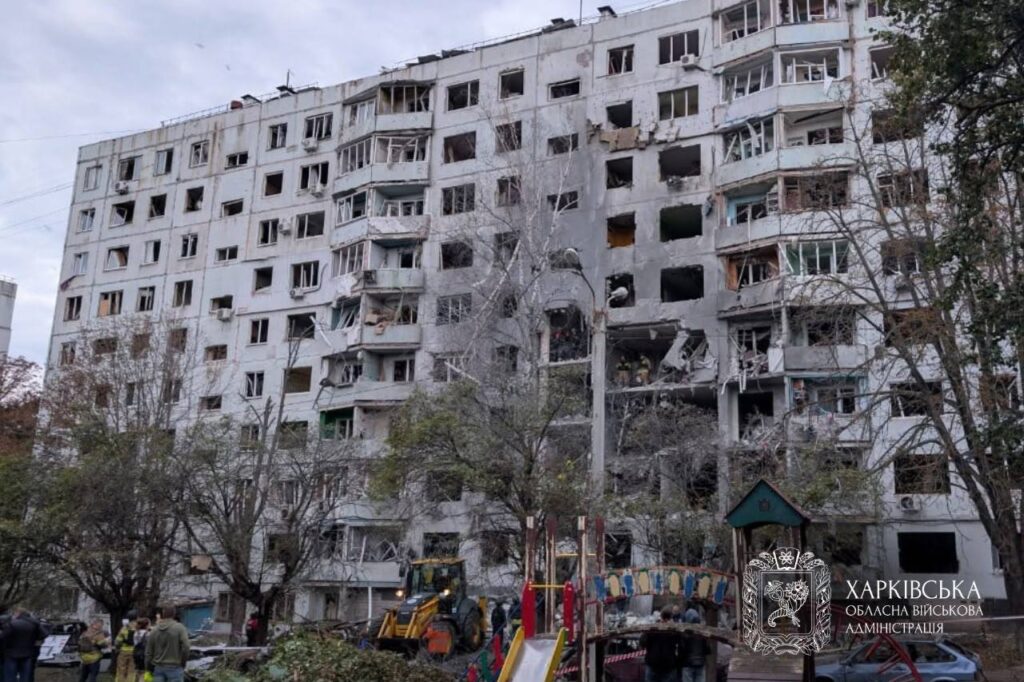
Russia hit a nine-story building in Kharkiv's Saltivskyi district around 04:00. By early afternoon, the count had risen to 43 injured, including 11 children, prosecutors said.

A man of 43 and a girl of 14 remain in hospital with blast wounds, and the others have moderate or light injuries, Kharkiv Oblast head Oleh Syniehubov said. Three children lived in the apartment that took the hit. Their father carried them out himself, and none of them was seriously hurt.

russia hits kharkiv high-rise overnight injuring 43 people strikes central kyiv dnipro broad daylight · post rescuers destroyed floors apartment building hit ukraine 28 2026 synehubov5319173733626879672 news ukrainian reports
Rescuers on the destroyed floors of an apartment building hit by Russia in Kharkiv, Ukraine, 28 September 2026. Photo: Kharkiv Oblast Military Administration

The strike hit the second floor and destroyed the ceiling between the third and fourth floors. Rescuers brought 32 people out of the building. Across the district, the attack damaged 18 apartment buildings and blew out more than 1,500 windows. More than 100 volunteers are helping city services seal them, Syniehubov added.

A resident who fled Kramatorsk a year and a half ago said her family never heard the blast itself.

"We didn't hear any explosion. Glass came pouring down, and a column of smoke stood there," Yuliia Baldzhy told Suspilne Kharkiv. "The children were sleeping in another room, and my husband and I barely squeezed through, grabbed them, and got out."

Yuliia Baldzhy, a resident of the damaged apartment building in the Saltivskyi district of Kharkiv, Ukraine, 28 September 2026. Photo: Suspilne Kharkiv

Kharkiv Mayor Ihor Terekhov said the city had not taken a hit "of this level" in some time. Officials are still establishing the weapon. Syniehubov named guided aerial bombs (KABs) and counted six of them over the oblast in the past day. Prosecutors named a UMPB-5, a Russian munition, as the preliminary version. Terekhov said the city was checking whether it was a KAB or a Banderol, a small cruise missile.

russia hits kharkiv high-rise overnight injuring 43 people strikes central kyiv dnipro broad daylight · post fire among wrecked structures after russian oblast ukraine 28 2026 synehubov 5319173733626879675 news ukrainian
Fire among wrecked structures after overnight Russian strikes in Kharkiv Oblast, Ukraine, 28 September 2026. Photo: Kharkiv Oblast Military Administration

Russia has hit Kharkiv high-rises with guided bombs before. In November 2024, one such strike injured 25 people, including an infant.

money engineering what stands between ukraine russia's fastest drones zelenskyy says · post russia’s new “geran-4 seeker” shahed variant geran-4 news ukrainian reports
Explore further

Combat shows speed alone can’t catch Russia’s jet-powered drones, despite eight Ukrainian makers’ assurances. So why can’t they stop them?

Kyiv hit through the night and into the day

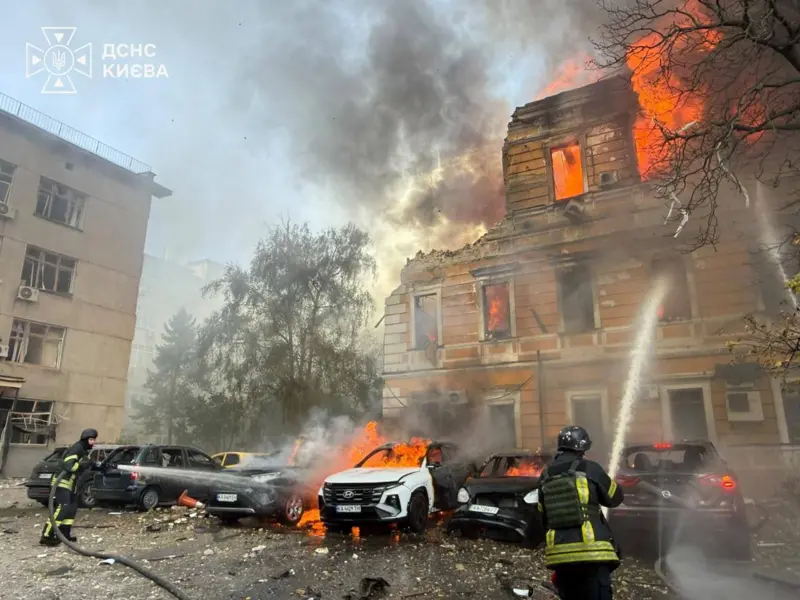
In the middle of the working day, a Russian jet drone struck the main building of the National Academy of Sciences in Kyiv's historic center. The attack killed a woman and injured five people, the Kyiv City Military Administration said. Three of them were hospitalized, Klitschko said. People climbed out of windows to escape the fire.

russia hits kharkiv high-rise overnight injuring 43 people strikes central kyiv dnipro broad daylight · post firefighters put out fires main building national academy sciences ukraine burning cars after russian
Firefighters put out fires at the main building of the National Academy of Sciences of Ukraine and at burning cars after a Russian drone strike in Kyiv, Ukraine, 28 September 2026. Photo: State Emergency Service of Kyiv

"Russia will definitely get a response to this," Ukrainian President Volodymyr Zelenskyy said.

Overnight and into the morning, Russian drones hit a gas station in Obolon, a café by a gas station, office buildings, and a 16-story residential building in Podil. The attacks injured three teenagers in Podil, Kyiv Mayor Vitali Klitschko said. A 17-year-old boy was hospitalized.

russia hits kharkiv high-rise overnight injuring 43 people strikes central kyiv dnipro broad daylight · post firefighter tackles blaze two-story house after russian drone attack ukraine 28 2026 zelenskyy news
A firefighter tackles a blaze in a two-story house after a Russian drone attack in Kyiv, Ukraine, 28 September 2026. Photo: State Emergency Service of Kyiv

Nationwide, Russia launched 165 drones overnight, 79 of them jet-powered, the Air Force reported. Air defenses downed or suppressed 112, and hits were recorded at 14 locations.

The capital is now under attack daily. On 27 September, Russian strikes injured nine people in Kyiv, and Russia hit a Kyiv data center twice. That evening, a Russian drone struck the Stolychnyi market in Sofiivska Borshchahivka, just outside the city, and killed two people. Zelenskyy wrote that one of the two killed in Kyiv Oblast was a citizen of Azerbaijan.

Deaths in Dnipro and Synelnykove

Around 11:15, a Russian drone hit a business center in central Dnipro, killing three people. The number of injured rose to 15, Dnipropetrovsk Oblast head Oleksandr Hanzha said. Rescuers led 47 people out of the burning building, regional council head Mykola Lukashuk said.

"Nearby are residential buildings, a park, a library, offices, shops. The center of Dnipro. In the middle of the working day, hundreds of people are here," Hanzha wrote.

In Synelnykove, a Russian strike on a logistics company's branch killed one person. It injured three others, including a 15-year-old boy now in hospital in serious condition.

Overnight, Russian drones also hit infrastructure in the Vasylkivka community and a market in Nikopol.

Strikes across other regions

In Kharkiv Oblast on 27 September, a Russian FPV drone killed a 67-year-old driver in Shestakove, prosecutors said. A drone on fiber-optic control also killed a 41-year-old woman in a car in Velykyi Burluk and injured a 46-year-old man.

russia hits kharkiv high-rise overnight injuring 43 people strikes central kyiv dnipro broad daylight · post debris warehouse after russian strike odesa oblast ukraine 28 2026 руйнування на одещині після
Debris at a warehouse after an overnight Russian strike in Odesa Oblast, Ukraine, 28 September 2026. Photo: Odesa Oblast Military Administration

Explosions sounded in Poltava overnight. In Rivne Oblast, a Russian attack damaged a detached house without injuring anyone. In Odesa Oblast, Russia struck a warehouse, and an evening attack injured a man of 62 and a woman of 63. Zelenskyy also listed a Palau-flagged ship hit in Odesa Oblast and an ice cream plant damaged in Zhytomyr Oblast, in the same post.

Ukraine hits two fuel depots in Krasnodar Krai, southern Russia, in one night—both wholesale diesel and gasoline

28 septembre 2026 à 04:34

ukraine hits two fuel depots krasnodar krai one night—both wholesale diesel gasoline · post fire rising over depot pavlivska after overnight drone strike 28 2026 download news ukrainian reports

Ukrainian drones struck two fuel depots in Krasnodar Krai overnight on 28 September, setting both on fire, Militarnyi reported. The targets were the NFB-Pavlovskaya depot in Pavlovskaya and the Edelveys-95 depot near Novotitarovskaya, about 25 km from Krasnodar.

Ukraine's deep-strike drone campaign has knocked out a significant share of Russia's refining capacity over the past year, hitting refineries and the fuel depots that store and distribute their output. Washington is pressing Kyiv to ease targeting of Russian refineries while Ukraine pitches a possible energy truce between Ukraine and Russia that Moscow has rejected.

Residents heard six explosions near the railway

A drone alert was declared in the region at 23:43. Residents of Novotitarovskaya then reported drones overhead and at least six explosions near the railway, Russian news Telegram channel Astra reported. Fires broke out at both depots. NASA FIRMS satellite data confirmed both blazes by 04:24, Militarnyi reported, citing imagery published by Ukrainian Telegram channel Exilenova+.

More from Oil Depot in Novotitarovskaya pic.twitter.com/5LigJzW0WL

— Exilenova+ (@Exilenova_plus) September 28, 2026

What the depots store

NFB-Pavlovskaya handles cargo operations with petroleum products, including wholesale trade in motor fuel and petroleum storage, Militarnyi reported.

Edelveys-95 is a similar facility. It specializes in wholesale distribution of diesel fuel (Euro-5 standard) and gasoline (AI-92, AI-95, and AI-100), Astra reported. Its capacity is 4,500 cubic meters, and it has its own rail siding for receiving and shipping fuel. The company has been selling petroleum products for 30 years, buying directly from Russia's largest refineries, according to its website.

Ilsky refinery struck days earlier in the same region

The overnight strikes came two days after SBU drones struck the Ilsky oil refinery in the same region on 26 September, triggering fires near the ELOU-AVT unit and the tank farm. Ilsky is one of the largest refineries in Russia's Southern Federal District, with a design capacity of roughly 6.6 million tonnes of crude per year, and has been struck more than 18 times since the start of Russia's full-scale invasion.

Ukraine's sustained campaign against Russian fuel infrastructure has earlier pushed Russia's fuel shortages into Central Asia and forced Moscow to seek emergency refining deals abroad.

Russia holds 2,000 people hostage in Oleshky without food or water—Ukraine flew 4,000 kg of food to locals across the Dnipro

27 septembre 2026 à 11:46

russia holds 2000 people hostage oleshky without food water—ukraine flew 4000 kg locals across dnipro · post drones carry packages starving residents russian-occupied kherson oblast 2026 lifting boxes ukraine news

Ukrainian forces carried out one of the largest drone food delivery operations across the Dnipro to occupied Oleshky, dropping about 4,000 kg of supplies provided by partners at 100 locations across the city where people are trapped without food, electricity, or water, Kherson Oblast head Oleksandr Prokudin said on 27 September. Russian forces punish residents who receive aid—shooting down supply drones, confiscating packages, and beating people caught accepting food, he noted.

Oleshky—a city across the Dnipro from liberated Kherson—has been occupied since 2022. Russia sealed off the city in late 2025, and conditions worsened sharply in early 2026 as occupation forces cut off food supplies, prevented evacuation, and left the dead unburied. The drone flights are now the only humanitarian operation reaching the trapped population, making each sortie both a lifeline and a target for Russian forces that treat civilian starvation as a tool of control.

Multiple military units flew food across the Dnipro

Since March, Ukrainian forces have been systematically delivering food to Oleshky by drone in coordination with the 11th National Guard Brigade's Bolharychi unit and the 34th Separate Marine Brigade Borysfen, Prokudin said.

russia holds 2000 people hostage oleshky without food water—ukraine flew 4000 kg locals across dnipro · post ukrainian soldiers prepare packages drone delivery occupied 2026 preparing aid boxes ukraine news
Ukrainian soldiers prepare food packages for drone delivery to occupied Oleshky, September 2026. Screenshot: Kherson Oblast Military Administration via Telegram

The latest operation expanded the effort: the 30th Marine Corps, the Hrim tactical group, the 34th National Guard Regiment, and the 79th Border Detachment joined alongside the Borysfen brigade and the Bolharychi unit.

"Instead of loud statements, we chose the path of concrete action," Prokudin wrote.

russia holds 2000 people hostage oleshky without food water—ukraine flew 4000 kg locals across dnipro · post resident approaches package delivered drone russian-occupied kherson oblast 2026 local walks box still
Resident approaches a food package delivered by drone to Russian-occupied Oleshky, Kherson Oblast, September 2026. Screenshot: Kherson Oblast Military Administration via Telegram

The deliveries fly across the Dnipro and drop food packages at pre-selected locations across the occupied city.

Prokudin said about 2,000 people remain trapped in Oleshky, including nearly 50 children. Ukraine's ombudsman and international monitors have put the figure at up to 6,000, with about 200 children.

Explore further

“There is real hunger there”: Oleshky, occupied town in Ukraine’s Kherson Oblast, turned 942 this week. Behind Russian blockade, its people eat roadside grass

Russia shoots down supply drones and beats residents for receiving food

Russian forces try to disrupt the deliveries. Soldiers shoot down drones carrying food, confiscate or resell packages meant for children and elderly residents, and detain people caught receiving humanitarian aid, Prokudin said. Residents are thrown into basements and beaten.

"Deliberate blocking of aid and creation of famine among the civilian population are war crimes with no statute of limitations. Everyone involved in these actions will face inevitable accountability," Prokudin wrote.

Ukraine prepared an evacuation list, secured the ICRC's readiness, and coordinated a ceasefire on its side, but Russia has not confirmed its readiness to open a route, Ukraine's ombudsman said.

Ukraine delivered 4,000 kg of food by drone across the Dnipro to occupied Oleshky

About 2,000 people, including nearly 50 children, are trapped there. Russia shoots down supply drones and beats residents for receiving aid, Kherson Oblast head Prokudin said.

📹TG/Oleksandr… pic.twitter.com/5AsHemMvCV
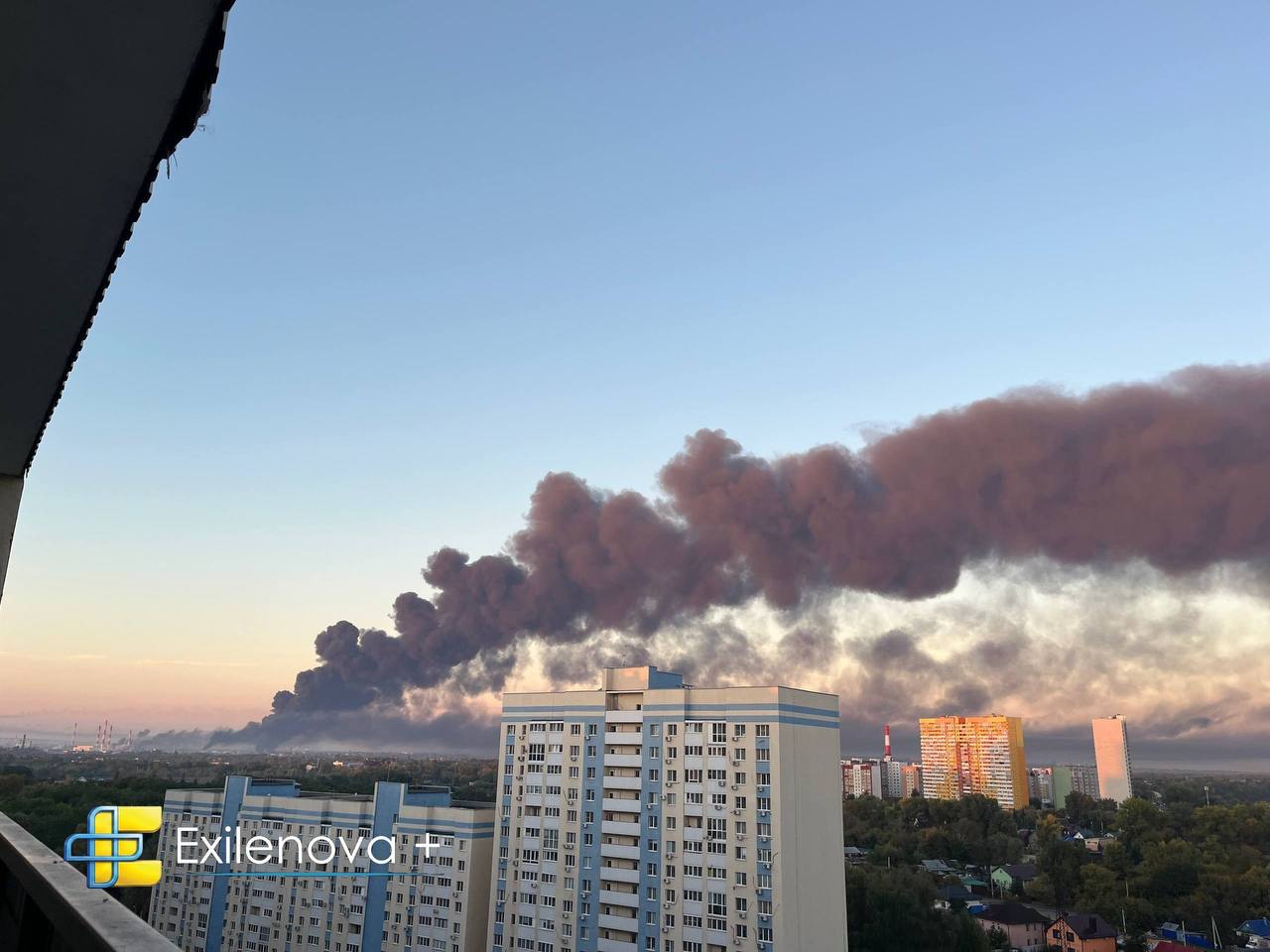
— Euromaidan Press (@EuromaidanPress) September 27, 2026

Council of Europe Commissioner for Human Rights Michael O'Flaherty warned on 25 September that the humanitarian crisis in Oleshky is deteriorating rapidly. Civilians, including children, are trapped without food, medicines, medical care, running water, or electricity, and reports indicate a high risk of death, he said. Under international humanitarian law, Russia as the occupying power is obliged to provide the population with food and medical supplies, O'Flaherty noted, and called for an immediate local ceasefire, unimpeded humanitarian access, and safe evacuation of civilians.

  • ✇Euromaidan Press
  • Swiss voters crush neutrality initiative that would have ended sanctions against Russia—70% say No
    Swiss voters overwhelmingly rejected a neutrality initiative that would have banned Switzerland from adopting sanctions against warring states and blocked cooperation with NATO, Swiss public broadcaster SRF reported. The measure failed by 70.2% to 29.8%, with zero cantons voting in favor. Russia's full-scale war against Ukraine has expanded beyond the battlefield into a campaign of sabotage, political influence, and pressure on European institutions. Every European country that has adop
     

Swiss voters crush neutrality initiative that would have ended sanctions against Russia—70% say No

27 septembre 2026 à 10:27

swiss voters crush neutrality initiative have ended sanctions against russia—69% say · post christoph blocher speaks svp event крістоф блохер фото des kantons zürich fb ukraine news ukrainian reports

Swiss voters overwhelmingly rejected a neutrality initiative that would have banned Switzerland from adopting sanctions against warring states and blocked cooperation with NATO, Swiss public broadcaster SRF reported. The measure failed by 70.2% to 29.8%, with zero cantons voting in favor.

Russia's full-scale war against Ukraine has expanded beyond the battlefield into a campaign of sabotage, political influence, and pressure on European institutions. Every European country that has adopted sanctions or cooperated militarily with Ukraine faces some variant of the same push—to weaken the sanctions regime and fracture the coalition. Russia expressed sympathy for the initiative—which backfired. Opponents warned the measure would benefit Moscow.

What the initiative would have done

The initiative, formally titled "Safeguard Swiss Neutrality," sought to enshrine neutrality as "permanent, armed, and comprehensive," bar cooperation with military alliances unless Switzerland was under direct attack, and ban economic sanctions against warring states—with only UN-mandated measures exempted.

Switzerland currently adopts sanctions autonomously and has largely followed EU sanctions against Russia since the full-scale invasion in 2022. The Swiss government's own explanatory materials stated the initiative would affect sanctions against Russia, SRF reported.

Blocher's Russian connection

Former Federal Council member Christoph Blocher, 85, launched the initiative in autumn 2022—six months into the full-scale war and the same year his daughter Magdalena Martullo-Blocher, who controls Ems-Chemie, decided the two Russian plants would stay. He led the campaign through the organization Pro Schweiz.

Ems-Chemie produces plastics, adhesives, sealants, and technical fibers. Two subsidiaries, operating under the Eftec brand, continued working in Russia after the full-scale invasion, Swiss magazine Republik reported earlier this month. Company and government documents contain strong indications that Eftec products may have been purchased by KamAZ, UAZ, GAZ, and AvtoVAZ—sanctioned companies tied to military vehicle production and financial support for Russian soldiers deploying to Ukraine. Ems-Chemie denies supplying them.

The Federal Council and Parliament both recommended rejection. In the National Council, 124 members voted against and 65 in favor. In the Council of States, the vote was 29 to 10 against.

politico fico first line orbán's disruptor crown — brussels has four more leaders worry about · post left right slovak pm robert czech andrej babiš bulgaria's rumen radev slovenia's former
Explore further

Politico: Fico is first in line for Orbán’s disruptor crown — but Brussels has four more leaders to worry about

Drones over Swiss military bases

Unidentified drones were spotted over Swiss military installations this year. In about 20% of sightings over military sites, authorities cannot identify who is responsible, army chief Benedikt Roos said earlier this month. Asked whether Switzerland is a target for Moscow, he said yes—the country holds critical infrastructure vital to Europe that anyone seeking to destabilize the continent could target.

Across Europe, pro-Russian forces continue to push back against sanctions. Germany's far-right AfD won 43.8% in the Saxony-Anhalt state election on 6 September—its strongest result ever, though every other party refuses coalition. In France, Marine Le Pen leads first-round polling for the 2027 presidential election at 36%. Slovakia's Robert Fico earlier demanded the EU lift Russian energy sanctions.

Russia has combined kinetic and political pressure across Europe—drone incursions into NATO airspace, arson at defense-linked sites, and sabotage of critical infrastructure—alongside support for political forces that oppose sanctions and military cooperation with Ukraine. Switzerland's own intelligence service assessed earlier this year that Russia is waging a long war against the West and escalating it.

  • ✇Euromaidan Press
  • Ukraine’s jet-drone kill rate just hit 55%. Russia’s answer: $12 billion to make more of them
    Ukraine's defense forces intercepted 55% of Russia's jet-propelled drones in September—more than 1,500 out of over 2,730 launched—Ukrainian President Volodymyr Zelenskyy said in his 26 September evening address. Russia's full-scale aerial campaign has shifted from propeller-driven Shaheds Ukraine learned to shoot down at over 90% to jet-propelled models that fly faster, resist jamming, and often slip past existing defenses. 55% and climbing Zelenskyy said military intelligence had
     

Ukraine’s jet-drone kill rate just hit 55%. Russia’s answer: $12 billion to make more of them

27 septembre 2026 à 09:15

ukraine's jet-drone kill rate just hit 55% russia's answer $12 billion make more · post geran-5 small cruise missile sights sting s interceptor drone герань-5 в прицилі дрона-перехоплювача стоп-кадр з

Ukraine's defense forces intercepted 55% of Russia's jet-propelled drones in September—more than 1,500 out of over 2,730 launched—Ukrainian President Volodymyr Zelenskyy said in his 26 September evening address.

Russia's full-scale aerial campaign has shifted from propeller-driven Shaheds Ukraine learned to shoot down at over 90% to jet-propelled models that fly faster, resist jamming, and often slip past existing defenses.

55% and climbing

Zelenskyy said military intelligence had briefed him on Russian weapons production—not just jet Shaheds but other technological systems. The documents detail what Moscow is preparing for next year: the volumes and the financing. "We are preparing our countermeasures, and for every line item there must be a Ukrainian answer," he said.

Several effective interceptor prototypes are already in combat.

"Interceptors have been identified that can become the main tool of our defense. Production, components—all of this we are scaling up. There will be an answer," Zelenskyy said.

The goal is to match the interception rate for regular propeller-driven Shaheds, which exceeds 90%. At 55%, the jet-drone rate is climbing but still leaves nearly half reaching their targets.

$12 billion for one category

Russia plans to spend $12 billion in 2027 on jet drones and loitering munitions alone, Zelenskyy said. "This concerns not only Ukraine and not only us," he added, warning that multiple intelligence agencies have information Russia wants to expand its war to other countries and regions.

He said this is why Ukraine is pushing for stronger sanctions and the Drone Deal format. Ukraine has signed 11 such agreements, the latest with Finland at the UN General Assembly this week, and is preparing a 12th with what Zelenskyy called "a strong country."

The warning came as Russia struck a Kyiv data center twice on the morning of 27 September, injuring three people including two children, Zelenskyy wrote. Overnight strikes killed three people in Zaporizhzhia Oblast and one man in Kyiv.

In total this week, Russia launched more than 2,200 strike drones, roughly 1,650 aerial bombs, and 38 missiles—a significant share of them ballistic—at Ukraine, he said.

russia steers its long-range drones ground towers—kyiv says hit one occupied crimea · post russia’s new “geran-4 seeker” shahed variant uses machine-vision ai targeting geran 4 ukraine news ukrainian reports
Explore further

A $50 computer just flew Russia’s newest jet drone into a Ukrainian grain ship—and jamming couldn’t stop it

Jet drones are now Russia's main aerial weapon

Russia's jet-propelled Geran-4 and Geran-5 drones have become the dominant threat in Russia's aerial campaign against Ukrainian cities. By August, production of jet Geran-4/5 models exceeded that of propeller-driven Geran-2s, according to Ukraine's military intelligence (HUR). Russian factories produce roughly 3,000 jet models per month alongside about 2,800 of the older type. The Geran-5 is technically a drone but functions as a small cruise missile—faster, harder to jam, and increasingly guided by AI and mesh networking that complicate interception.

Ukraine's answer has been interceptor drones—cheap, fast enough to chase a Geran, and guided by machine vision. A Ukrainian interceptor recently scored its first kills against jet Gerans and is heading into mass production, though a presidential adviser warned that speed alone cannot catch them—machine vision and automatic guidance decide the chase.

ISW connects drone crashes in Moldova and Romania, a Starlink fire in Poland, and a Berlin airport shutdown into one Russian pattern

25 septembre 2026 à 09:11

Three gray, triangular-wing drones sit on camouflage netting in a grassy field.

Several recent incidents across Europe were conducted by Russia or are likely attributable to Russia, ISW assessed in its 24 September report, though authorities have not officially linked the Polish and German incidents to Moscow.

Russia's full-scale war against Ukraine has expanded into a parallel campaign of provocations against European defense and logistical infrastructure. The Kremlin is using drones, arson, and undersea cable sabotage to degrade Europe's will and ability to support Ukraine, while deliberately intensifying the frequency of airspace violations to erode the boundary between hybrid and kinetic war.

Drones over Moldova and Romania

Four Russian drones flew over Bukovyna and targeted an energy facility and border crossings with Moldova and Romania, Chernivtsi Oblast Military Administration head Ruslan Osypenko reported. Ukrainian forces shot down three. The fourth flew toward Suceava County in northeastern Romania.

isw drone incursions sabotage intelligence warnings across europe coincidences—they russian operations · post two gerbera crash sites moldova romania 24 2026 two-russian-drones-crashed-in-moldova-and-romania-on-september-24-2026-scaled ukraine news ukrainian reports
ISW map showing two Russian Gerbera drone crash sites in Moldova and Romania on 24 September 2026. Map: ISW

A drone crashed in Cernița, Florești district, Moldova—preliminarily identified as a Russian Gerbera type, the first such device found in the country. It carried an onboard camera, hit a tree, and exploded, Moldovan police said. Romania's Defense Ministry reported a second aerial vehicle entered Romanian airspace for four minutes and crashed near Solca in the same border region; geolocated footage confirmed it was also a Gerbera, ISW noted. Poland evacuated the Hrubieszów and Dorohusk border crossings for 30 minutes, Prime Minister Donald Tusk said. Three countries were put on alert by a single night of Russian strikes.

"Intentional and accidental Russian drone incursions into NATO and Moldovan airspaces are likely part of the Kremlin's efforts to normalize airspace violations by intensifying their frequency," ISW assessed.

Sabotage in Poland and Germany

A fire engulfed the power system and backup generator at a Starlink ground station in Wola Krobowska, central Poland, on the evening of 23 September. Deputy Prime Minister Krzysztof Gawkowski confirmed it was sabotage aimed at cutting internet access, including for Ukraine's military. Authorities have not identified who was responsible, but the act aligns with Russia's "new" doctrine of attacks, Gawkowski said. The station is now operating normally.

German authorities suspended operations at Berlin-Brandenburg airport for 45 minutes the same evening after staff reported a drone sighting, Die Zeit reported. Federal police could not confirm it. ISW assessed both incidents fit Russia's wider pattern of sabotage against European defense assets, though neither has been officially attributed to Russia.

Scattered debris and a scorched patch of ground in a cornfield beneath a cloudy sky.
Explore further

Russian attack puts three countries on alert as drones enter Moldova and Romania

Western intelligence warnings

A Lithuanian Defense Ministry source reported on 23 September that Russia could launch Gerbera drones from a shipping container in the Mediterranean against Spain, France, and Italy. Danish Defense Intelligence assessed on 24 September that Russia will intensify its hybrid war in coming months, including destructive cyber attacks and sabotage carrying a high risk of casualties, and that there is a low but growing risk of a limited Russian military attack on a NATO border state. It sees no indications of an outright invasion. The CIA reportedly warned Poland that Russia may sabotage underwater cables to disrupt its banking system, according to Newsweek Polska journalists.

NATO tracked and confronted Russian submersibles rehearsing deployment of a new cable-disabling weapon near Svalbard in spring 2026—no cables were damaged, but the operation demonstrated Moscow's intent, Reuters reported. Shadow fleet vessels likely served as drone-launch platforms for incursions into NATO airspace, ISW noted.

"The increasing frequency of such warnings suggests that Western intelligence agencies are picking up indicators that the Kremlin is looking to diversify its platforms and means for conducting attacks against NATO and European states and is considering conducting such attacks," ISW assessed.

ISW said it has not yet seen evidence that Russia has conducted the attacks the warnings describe.

Denmark's assessment—that a limited Russian military strike on a NATO border state could come in the coming months—suggests the boundary between hybrid provocations and military action is narrower than European policy has assumed. ISW's synthesis reframes what governments have treated as separate incidents into one campaign.

"Intentional and accidental Russian drone incursions into NATO and Moldovan airspaces are likely part of the Kremlin's efforts to normalize airspace violations by intensifying their frequency," ISW assessed.
"The increasing frequency of such warnings suggests that Western intelligence agencies are picking up indicators that the Kremlin is looking to diversify its platforms and means for conducting attacks against NATO and European states and is considering conducting such attacks," ISW assessed.
  • ✇Euromaidan Press
  • Zelenskyy says Ukraine has agreed on a new Patriot interceptor package—won’t say with whom
    Ukrainian President Volodymyr Zelenskyy announced that Ukraine has agreed on a new package of Patriot interceptor missiles with an unnamed partner, Suspilne reported. He made the announcement on 24 September during a meeting with the Ukrainian community in the United States. Zelenskyy did not reveal the partner's identity, the quantity, or the delivery timeline. Russia's aerial campaign against Ukrainian cities is heading into its most dangerous winter yet, with ballistic strikes on hos
     

Zelenskyy says Ukraine has agreed on a new Patriot interceptor package—won’t say with whom

25 septembre 2026 à 04:45

brussels cleared ukraine spend eu loan money american patriot missiles get through upcoming winter russian attacks · post pac-2 missile launch yonhap пуск ракети illlustrative militarnyi news ukrainian reports

Ukrainian President Volodymyr Zelenskyy announced that Ukraine has agreed on a new package of Patriot interceptor missiles with an unnamed partner, Suspilne reported. He made the announcement on 24 September during a meeting with the Ukrainian community in the United States. Zelenskyy did not reveal the partner's identity, the quantity, or the delivery timeline.

Russia's aerial campaign against Ukrainian cities is heading into its most dangerous winter yet, with ballistic strikes on hospitals, power stations, and residential buildings pushing monthly civilian casualties to their highest level since the war's opening weeks. The gap between the interceptors Ukraine needs and what allies have so far committed has become a central factor in both the defense of Ukrainian cities and the diplomatic standoff.

What Zelenskyy said

Zelenskyy made the announcement during a broader address to the diaspora about diplomacy, the peace effort, and cooperation with US President Donald Trump's team.

"We agreed today—I won't say with whom—on a package of [interceptor] missiles for Patriot systems. This is an important decision," Ukrainian President Volodymyr Zelenskyy told the Ukrainian diaspora in New York.

He gave no further details. Zelenskyy said ending the war was the most important question facing Ukraine and awarded decorations to community members who had contributed to the country's defense.

Before the New York trip, the interceptor question had been raised with several partners. After meeting Trump on 22 September, Zelenskyy said he had asked Washington for a winter package of Patriot interceptors. That same week, he pitched Japan's Prime Minister Sanae Takaichi on air-defense cooperation, noting that Mitsubishi Heavy Industries runs the only plant outside the US licensed to assemble PAC-3 missiles. Suspilne noted the issue had also been discussed with other partners Zelenskyy did not name.

Intercepting more, but not enough

On 24 September, air defenses intercepted 60% of the ballistic missiles Russia fired at Kyiv—a figure the president called significant.

"It was 60%—not 10% and not zero. And this year we had moments when it was zero. Not because someone lacks experience, but because someone lacks missiles," Zelenskyy told journalists in New York.

Since 12 August, Ukraine's Air Force has stopped publishing detailed figures on how many missiles Russia launches, reporting only what it downs—which makes Zelenskyy's percentage a rare public benchmark. By that count, Russia has fired at least 794 ballistic missiles at Ukraine since January, about 43% of all missiles used this year, with July's 174 the monthly high.

The overnight attack

Hours after Zelenskyy spoke in New York, Russia launched 295 drones at Ukraine overnight on 24–25 September. In Odesa, Russian drones killed two people—a 40-year-old woman and a 51-year-old man—and injured two others. In Kyiv, Shaheds struck high-rises in Solomianskyi district, and strikes across the broader region killed a 14-year-old boy.

1000 patriot missiles arrive too late winter so ukraine asked ramstein arms coalition open its warehouses · post ukraine's defense minister yevhenii khmara right commander-in-chief major general mykhailo drapatyi meeting
Explore further

1,000 Patriot missiles arrive too late for this winter, so Ukraine asked the Ramstein arms coalition to open its warehouses

Romania scrambled jets as drones drifted toward its airspace. A woman was injured in Dnipropetrovsk Oblast, and the morning brought further Russian strikes on Zaporizhzhia and Poltava, injuring two more people.

The interceptor crisis

Zelenskyy's announcement lands in the middle of a worsening shortage. In August, he told CNN that Ukraine held roughly 1% of American Patriot stocks and that 5% would get Kyiv through the winter. ISW assessed the same month that the interceptor shortage was one reason Russia saw no incentive to negotiate.

The EU has moved to fill the gap. Brussels cleared Ukraine to spend loan money on Patriot missiles and later released €6.1 billion ($7.1 billion) for interceptors and drones. But Ukraine's air force commander warned that newly ordered missiles would arrive too late for this winter and asked the Ramstein coalition to open existing stockpiles.

At least one partner has now moved from discussion to commitment. The quantity and delivery date remain unknown, and Russia produces ballistic missiles faster than Ukraine's allies have so far been willing to part with the interceptors that stop them.

"We agreed today—I won't say with whom—on a package of [interceptor] missiles for Patriot systems. This is an important decision," Ukrainian President Volodymyr Zelenskyy told the Ukrainian diaspora in New York.
"It was 60%—not 10% and not zero. And this year we had moments when it was zero. Not because someone lacks experience, but because someone lacks missiles," Zelenskyy told journalists in New York.

Two plants make 70% of Ukraine’s steel. Russia hit both. Then ports closed, rail costs rose 30%, and the EU’s carbon tax kicked in

23 septembre 2026 à 09:26

two plants make 70% ukraine's steel russia hit both ports closed rail costs rose 30% eu's carbon tax kicked · post arcelormittal kryvyi rih steelworks прес-центр кривий ріг ukraine news

Russian missile strikes shut down or damaged four of Ukraine's largest steel plants in August and September, halving steel output and prompting the operator of the country's largest plant to call on the government to pass a dedicated rescue plan, RBC-Ukraine reported.

Russia's full-scale war has already cost Ukraine the Azovstal plant in Mariupol, one of its largest steel mills, and more than two years of disrupted production across the sector. The latest strikes hit plants that produce the bulk of remaining capacity, concentrated in a single month, in what the industry describes as a deep crisis for a sector that supplies 6% of the country's GDP.

Steel output halved as missiles hit plants producing 70% of Ukraine's steel

The 11 August strike on Zaporizhstal killed seven workers and injured 21 as they headed for a shelter, Metinvest said; a second ballistic strike on the plant followed on 27 August. Two died and 13 were injured at ArcelorMittal Kryvyi Rih, and five were killed at Kametstal. Russia also hit the Dnipro Metallurgical Plant. On 12 September, Russia struck both Zaporizhstal and ArcelorMittal Kryvyi Rih again with ballistic missiles.

Zaporizhstal and Kametstal, both part of the Metinvest group, stopped entirely. ArcelorMittal Kryvyi Rih—Ukraine's largest steel plant—partially shut down. Zaporizhstal and ArcelorMittal alone produce more than 70% of Ukraine's steel.

August steel production fell to 277,000 tons, down 57.3% year on year and 39.4% from July, according to Ukrmetalurhprom data cited by GMK Center. Rolled-metal output dropped to 270,000 tons.

Strikes, a port blockade, and rising costs hit at once

The strikes came on top of a Black Sea port blockade that has shut down maritime exports of iron ore and steel since late July. A 30% increase in rail tariffs took effect on 1 August. Alternative routes—rail through western border crossings, Danube ports, and roads—can carry at most 50% of what the Black Sea ports handled, GMK Center analyst Andrii Hlushchenko said. Steelmakers also have to compete with farmers for that limited rail capacity.

Rail exports of iron ore and metals dropped 2.5 times in the first 15 days of September compared with the same period last year, Ukrzaliznytsia said. Shipping iron-ore pellets through European ports costs $50–60 per ton, making many deliveries unprofitable.

Ukraine's mining and metallurgical complex exports by destination. Infographic: RBC Ukraine

The steel sector generated 6% of Ukraine's GDP last year, brought in 13% of all foreign-currency earnings, and paid UAH 27 billion (about $606 million) into budgets between January and July. Deputy chair of the parliamentary economic committee Dmytro Kysylevskyi called the situation "a perfect storm."

Meanwhile, Türkiye re-rolls Russian slabs and sells the resulting steel on Ukraine's domestic market. China uses cheap Russian energy to undercut Ukrainian prices.

"We are effectively importing Russian metal in the form of finished products," Ukrmetalurhprom President Oleksandr Kalenkov said.

ArcelorMittal calls for a Cabinet rescue resolution

ArcelorMittal Kryvyi Rih CEO Mauro Longobardo said the government should pass a dedicated Cabinet resolution assigning specific tasks and deadlines to multiple agencies at once.

"No single agency can solve the full set of problems. Without a single document with assigned responsibilities and deadlines, each issue is dealt with in isolation and stalls," ArcelorMittal Kryvyi Rih representatives said.

The resolution should cover EU negotiations on deferring the carbon border tax (CBAM) until at least the end of martial law plus one year, restoring steel quotas to last year's level, stabilizing rail tariffs, securing long-term electricity contracts for industry, and launching anti-dumping investigations against Turkish and Chinese imports, Longobardo said.

Ukraine's Economy and Environment Ministry said it is in talks with the European Commission on easing CBAM and expanding quotas. A Cabinet source told the outlet that Black Sea trade negotiations with Russia are possible in October, after the Duma elections that ended on 20 September.

Explosives found meters from the drone that crashed near a Bundeswehr air base—investigators say it matches the GRU’s Leipzig attack devices

23 septembre 2026 à 07:54

explosives found meters drone crashed near bundeswehr air base—investigators say matches gru's leipzig attack devices · post police officers search debris wunstorf base lower saxony germany 15 2026 german dpa

Investigators found what they believe is explosives meters from a crashed drone near the Bundeswehr's Wunstorf air base in Lower Saxony, Germany, and the device matches the construction of drones used in the GRU-attributed Leipzig airport attack, Süddeutsche Zeitung, NDR, and WDR reported on 22 September. Germany's federal prosecutor and the Federal Criminal Police Office (BKA) have taken over the investigation, and the same reporting traced one of the Leipzig suspects to a sanctioned GRU colonel who directs sabotage against countries arming Ukraine.

Russia's sabotage campaign against countries supporting Ukraine has escalated from arson packages and recruited proxies to explosives-laden drones targeting military infrastructure inside NATO. Germany's military counterintelligence has attributed repeated sabotage on German soil to Russia, while Finnish President Stubb called the broader alarm about Russian threats an "overreaction"—a position the accumulating evidence from Germany and Poland does not support.

Explosives found days after the drone crash

A farmer discovered the drone, broken into several pieces, on the evening of 14 September, about one kilometer from the Wunstorf air base, Militarnyi reported. Days later, police found a suspicious substance just meters from the crash site. Security sources told SZ, NDR, and WDR they believe it is an explosive, though forensic analysis has not yet been completed.

The drone's design is similar to the devices used in the Leipzig airport attack on 4 August, when attackers tried to destroy Ukrainian cargo planes with explosives-laden drones. At least one component was manufactured using a 3D printer, the reporting found. Investigators believe the drone may have been near the military airfield for a long time—possibly up to two years.

Wunstorf air base houses the Bundeswehr's entire A400M transport fleet. The facility is Germany's central hub for moving troops and materiel worldwide. An explosives-laden drone near this base would represent a direct threat to the Bundeswehr's central global logistics hub.

The Wunstorf find was discussed at the weekly intelligence briefing in the Chancellery on 22 September, the outlets reported.

Leipzig suspect linked to sanctioned GRU colonel

The federal prosecutor's investigation connects the Wunstorf case to the Leipzig attack. In that case, Germany's government has officially blamed Russia. Two suspects were identified: Oleg L., a Latvian with a Russian passport, and Andrei K., a dual Belarusian-Russian citizen whose DNA was found at the Leipzig scene.

SZ, NDR, and WDR reported that Oleg L. maintained years-long contacts with GRU Colonel Denis Smolyaninov. The EU sanctioned Smolyaninov for directing sabotage operations against countries supporting Ukraine. Andrei K. had previously been noticed for minor offenses in the Baltic states and Finland and entered Germany on an Italian tourist visa. Moscow denied involvement in the Leipzig attack.

A drone violated the no-fly zone around NATO's missile shield base in Poland

The Wunstorf case came to light in the same week that a drone violated the no-fly zone around the US-operated Aegis Ashore missile defense base in Redzikowo, northern Poland, on 15 September.

Polish troops guarding the facility called civilian emergency services instead of neutralizing the drone, TVP World reported. Poland's defense ministry said the drone was a civilian device that "posed no threat" and remained under military surveillance, but Defense Minister Władysław Kosiniak-Kamysz ordered a full report into the incident.

Vivaldi’s secret weapon was the targeting, not the robots: Third Corps reconnaissance mapped Russian command nodes, then hit them to cause panic

23 septembre 2026 à 05:24

vivaldi's secret weapon targeting robots third corps reconnaissance mapped russian command nodes hit cause panic · post graphic ukraine's army / telegram під час операції вівальді нрк десантували щоб порушити

Ukraine's Third Army Corps dropped kamikaze ground robots on Russian command nodes identified by reconnaissance during Operation Vivaldi, a corps intelligence officer told Radio NV. The strikes aimed to break command coordination and force Russia to divert combat troops to guard its own headquarters, while a parallel campaign destroyed a diesel pipeline that fed about half the daily fuel needs of Russia's entire West grouping.

Russia's full-scale war against Ukraine is now in its fifth year, with Moscow pushing simultaneously along the front and striking cities behind it with drones, cruise and ballistic missiles, and glide bombs. The Vivaldi operation is the first time Ukraine has publicly shown how a reconnaissance-to-robot strike chain works against command nodes without risking infantry, a method that could be replicated across other sectors where Russia's coordination depends on forward headquarters within drone range.

Reconnaissance identified command nodes, robots hit them

One of the tasks set by corps commander Brigadier General Andrii Biletskyi was to disrupt command and communications in the Russian chain of command, the officer said. Brigade and corps reconnaissance identified areas where a strike could break Russian control.

"Reconnaissance of the brigades and the corps identified such areas that could affect the disruption of enemy command. It was into these areas that robots were dropped to create panic, disrupt command, and prevent the enemy from being effective," the officer told Radio NV.

To protect their command posts from the robots, Russian forces had to pull in additional personnel—troops that could not then be used to resist the Third Corps' ground assault.

Map: ISW

The Third Corps announced on 20 September that heavy bomber drones delivered kamikaze ground robots more than 10 km behind Russian lines, calling it a world first.

The same intel operation identified a frontline diesel pipeline

The same intelligence operation uncovered a pipeline running from Voronezh Oblast to temporarily occupied Luhansk Oblast. The pipeline carried finished diesel, not crude oil, and supplied about 50% of the daily fuel needs of Russia's forces on the direction, the officer said.

The corps struck both the intake point where fuel entered the pipeline and the output point where it was loaded onto tankers. The strikes forced Russia to dismantle the pipeline entirely. Russian forces now truck fuel from Voronezh Oblast, a 400 km supply run.

The pipeline's destruction affected not just the Lyman direction but the entire West grouping, including the Kupiansk and Borova directions, the officer said. The logistical disruption left frontline Russian drone units unable to refuel generators to charge batteries, and electronic warfare systems had to operate in a reduced mode.

Repair bases struck, 250 km logistics detour

Third Corps intelligence also located the repair base of Russia's 20th Army and its 144th Division. Ukrainian strikes during the preparatory phase forced Russia to relocate the base to Voronezh Oblast, increasing the repair route to 250 km.

Russia's 20th Army and its 144th Division, reinforced by assault detachments from the First Tank Army, remain the main strike force on the Oskil-Sviatohirsk direction, the officer said. The First Tank Army has been sending additional assault units to stabilize the Russian defensive line after Vivaldi, but these reinforcements are taking critical losses on logistics routes before reaching the combat zone.

vivaldi's secret weapon targeting robots third corps reconnaissance mapped russian command nodes hit cause panic · post isw slovyansk-direction-september-21-2026 ukraine news ukrainian reports

Rubikon pulled out, Russian drone units at 70–90% strength

The officer said the corps headquarters specifically targeted Russia's most effective drone formations. During the preparatory phase, the elite Russian drone unit Rubikon was identified as a critical threat that could isolate the area of operations and obstruct Ukrainian maneuver.

Ukrainian reconnaissance located and passed targeting data to strike assets. Rubikon suffered heavy losses in equipment and personnel, and a senior Russian commander—misjudging the Third Corps' offensive potential—pulled the unit to rear areas for recovery at what turned out to be the worst possible moment, just as Ukraine's assault began.

Russian drone units on the direction are now staffed at 70–90%, the officer said. The corps is working to degrade their capability through targeted strikes on launch sites, pilot positions, and logistics in the second and third echelons.

Four seasons, two public

The officer said Russia's current task is to stabilize its defensive line, restore its observation network, and bring in additional reserves for counterattacks. Russia does not have enough personnel and will have to pull troops from training grounds before they finish their courses, shortening training cycles.

Operation Vivaldi has at least four "seasons," of which only the first two have been made public. The operation's name refers to Italian baroque composer Antonio Vivaldi, and The Four Seasons is his best-known set of four violin concerti.

Biletskyi confirmed the liberation of Shandryholove, Derylove, and full control over Drobysheve on 20 September, bringing the total to 40 km² of freed territory in the second season alone. Russian losses have reached an estimated 3,000 personnel overall, over 12,000 drones in the first season, and hundreds of vehicles, according to the Third Corps. ISW assessed that the operation disrupted Russia's plan to encircle the fortress belt of Donetsk cities—Sloviansk, Kramatorsk, Druzhkivka, and Kostiantynivka.

300 Russian shadow fleet ships disabled in 11 weeks—the Azov Sea is at a standstill, Ukrainian drone force commander says

22 septembre 2026 à 12:26

300 russian shadow fleet ships disabled 11 weeks—the azov sea standstill ukrainian drone force commander says · post seen cameras moments before strikes strike thats about thme telegram madyar ukraine

Operation MoLoChKa has now disabled 300 Russian shadow fleet ships in 11 weeks, SBS commander Robert "Madyar" Brovdi announced. The Unmanned Systems Forces (SBS) campaign has frozen the Azov Sea and the Kerch Strait, Brovdi said.

The Black and Azov seas have turned from Russian supply corridors into contested waters where Russia's shadow fleet—the aging tanker armada it uses to evade oil sanctions—now moves at its own risk, according to the SBS.

134 in the Azov, 166 in the Black Sea

SBS drones struck 134 vessels in the Azov Sea and 166 in the Black Sea since Operation MoLoChKa began on 6 July, the SBS wrote—all, Brovdi specified, stripped of the ability to move under their own power. He called it the "300th fleet," playing on the Ukrainian army's code for a wounded man, and "a suitcase without a handle and a torment for the worm budget."

The Azov Sea "stands and will stand, together with the Kerch Strait," Brovdi said. The northern and northeastern Black Sea operates on what he called a "maybe we'll slip through" gamble.

isw ukraine has opened new phase crimea's isolation hunting seaborne fuel tankers · post russian tanker burns off sea azov coast after ukrainian drone strike ablaze exilenova+ 1 appears have
A Russian tanker burns off the Sea of Azov coast after a Ukrainian drone strike. Photo: Exilenova+/Telegram

The 300-ship count is the latest in a rapid progression. The SBS reported 201 vessels disabled by 29 July—just three weeks into the operation—when Brovdi said Crimea's supply route was "blocked indefinitely." By 11 September, the tally had reached 285, with 215 struck in July, 54 in August, and 16 in the first 11 days of September. The pace slowed as traffic in the strike zone thinned out.

The SBS figures are the unit's own and cannot be independently verified.

ukraine's spy service navy team up strike two russian crude tankers black sea · post shadow-fleet tanker marked 137th vessel struck 6–16 2026 operation sight ukrainian drone sbs video oil
Explore further

Ukraine hits 201 Russian shadow fleet ships in three weeks. Commander says Crimea’s supply route is now blocked indefinitely

Commercial shipping retreating from Russian ports

In late August, MSC Mediterranean Shipping Co., the world's largest container carrier, suspended new bookings for transport through the Russian port of Novorossiysk. Russia itself closed the Don-Azov shipping channel and the Kerch Strait in July after the opening wave of strikes.

By early August, Ukraine had turned Novorossiysk—Russia's main Black Sea export gateway—into a chokepoint, and in mid-August Ukrainian forces struck four Russian warships there in a single night. A 141-meter vessel disappeared near Novorossiysk the same week.

crimea black and azov sea reusable

A parallel campaign against Crimea's power grid

The SBS is running a second operation alongside MoLoChKa. Operation Crimean Switch Off, also launched on 6 July, had struck 374 energy nodes across occupied Crimea and other occupied areas in eastern and southern Ukraine by 10 September. The campaign has blacked out Crimea on multiple nights. Brovdi has said the SBS could strike seven times more targets with faster funding.

Trump announced a “massive” potash deal with Belarus—Lukashenka said the same day there is no spare potash to sell

22 septembre 2026 à 11:04

trump announced massive potash deal belarus—lukashenka said same day spare sell · post alyaksandr lukashenka vladimir putin valaam island russia 1 2025 presidentgovby putin_lukashenko ukraine news ukrainian reports

US President Donald Trump announced a "massive deal" to buy Belarusian potash at prices far below what the US pays Canada, but Belarusian dictator Alyaksandr Lukashenka publicly contradicted him the same day, saying Belarus has no spare volumes to sell.

Washington has spent a year courting Lukashenka with sanctions relief and envoy visits in pursuit of both prisoner releases and trade openings—but the potash episode shows the limits of that courtship when the dictator's own supply chain cannot deliver what the US President has already promised his voters.

Trump promised cheaper potash for American farmers

Trump wrote on Truth Social on 21 September:

"The United States is working on a massive Deal with respect to the purchase of Potash from Belarus. The pricing would be for substantially less than we are currently paying to Canada, very good news for our Farmers and Ranchers."

Potash is a key ingredient in fertilizer. Canada is the world's largest supplier—the US takes 53% of Canadian potash exports, and 80% of the potash American farms use comes from Canada. Canadian potash remains exempt from US tariffs despite the ongoing trade war between the two countries.

The announcement came as Trump's trade dispute with Ottawa deepened—he recently called Canada a "terrible trade partner," and on 16 September European Commission President Ursula von der Leyen offered Canada associate EU membership, which Trump said could be a "hostile act."

Lukashenka said all output is contracted

The same day, Lukashenka told officials Belarus cannot deliver. "Even if we wanted to supply potash to other, Western markets, we simply do not have those volumes—everything is contracted," he said during a meeting with the head of Belarus's State Customs Committee, Uladzimir Arlouski.

Arlouski reported that 85% of all Belarusian exports and imports now move eastward—primarily to China, other Asian countries, and Russia. Budget revenues grew almost 3.5% over eight months, and 5.2% so far this month.

U.S. Special Envoy for Belarus John Coale meets self-proclaimed president Aliaksandr Lukashenka. Photo: BelTA
2026

Trump’s State Department refused to recognize Lukashenka in 2020. Today he’s a “friend.”

A deal built on sanctions relief and prisoner swaps

The potash announcement followed a year-long US effort to engage Lukashenka. Washington lifted sanctions on Belarus's potash industry in exchange for the release of hundreds of political prisoners. US special envoy John Cole has played the central role, meeting Lukashenka last week and securing the release of 25 prisoners—far fewer than the 200 he had previously promised.

Over the course of Cole's effort, at least several hundred people have been freed, among them Nobel Peace Prize laureate Ales Bialiatski and Siarhei Tsikhanouski, husband of the internationally recognized winner of Belarus's 2020 presidential election. But human rights groups and freed prisoners say Lukashenka runs a "carousel"—arresting new political opponents to replace the ones he releases. Lukashenka denied this. "There are no political prisoners in Belarus," he claimed during last week's meeting with Cole.

With US midterms six weeks away on 3 November and the Republican Party struggling in the polls, Trump has been scrambling for wins on fuel and food prices. The same week, he urged Zelenskyy to stop hitting Russian refineries, blaming Ukraine rather than his own war with Iran for record US diesel prices—a move a senior European official told Politico was a search for "scapegoats."

Ukraine shut down this Samara refinery in June—now its drones are back, and both distillation units are burning again

22 septembre 2026 à 08:35

one refinery night moscow ufa now samara—ukraine working through russia's fuel chain · post smoke plume burning kuibyshev stretching across samara skyline 22 2026 exilenova 5877644049043362820 ukraine news ukrainian reports

Ukrainian drones struck Rosneft's Kuibyshev refinery in Samara overnight on 22 September, hitting two primary crude-processing units and triggering a large fire, Ukrainian drone and missile maker Fire Point confirmed. The strike is part of Ukraine's ongoing campaign against the fuel infrastructure that sustains Russia's war—the same plant had to halt crude processing after a drone attack in June. The attack came one day after US President Donald Trump for the second time in a week urged Ukraine's leader, Volodymyr Zelenskyy, to stop the refinery campaign.

Ukraine strikes Russian refineries to degrade the fuel supply that funds and sustains Russia's invasion—every barrel of diesel or aviation fuel that never leaves a wrecked distillation column is a barrel that cannot power Russian tanks, aircraft, or export revenue. With nearly half of Russia's refining capacity now offline, the campaign has become one of Ukraine's most effective tools for raising the economic cost of the war. 

FP-1 drones hit both primary processing units

Fire Point said its FP-1 drones struck the Kuibyshev refinery, hitting the AVT-4 and AVT-5 atmospheric-vacuum distillation units—the plant's primary crude-processing installations. A large fire broke out on the refinery grounds. The Kuibyshev refinery is part of Rosneft and has a designed processing capacity of about 7 million tons of crude oil per year. It is located more than 900 km from the war zone in Ukraine.

one refinery night moscow ufa now samara—ukraine working through russia's fuel chain · post smoke kuibyshev fire seen residential neighborhood samara 22 2026 exilenova 5877644049043362825 ukraine news ukrainian reports
Smoke from the Kuibyshev refinery fire seen from a residential neighborhood in Samara, 22 September 2026. Photo: Exilenova+
In 2024, the plant processed 4.7 million tons of crude and produced about 800,000 tons of gasoline, 1.4 million tons of diesel, and 1.3 million tons of fuel oil.

Samara, moment of attack pic.twitter.com/U47yrene3z

— Exilenova+ (@Exilenova_plus) September 22, 2026

Ukrainian Telegram channel Exilenova+ began reporting explosions and air defense activity in Samara Oblast at 3:50 a.m. By 4:24 a.m., the channel posted videos showing a night fire at the refinery. OSINT channel World Militaries identified the AVT-5 unit as the initial fire site.

one refinery night moscow ufa now samara—ukraine working through russia's fuel chain · post geolocation samara fire worldmilitares / telegram osint tg 5010492582932450907 ukraine news ukrainian reports
Geolocation of the Samara fire. Source: world.militares / Telegram

Russian news Telegram channel Astra separately confirmed the fire at the Kuibyshev refinery.

By morning, the fire was still burning. The smoke plume stretched about 100 km across Samara Oblast, Exilenova+ reported.

Smoke from the Kuibyshev Oil Refinery in Samara has already stretched for 100 km across Russian territory. pic.twitter.com/U5KQ0v1eTW

— Exilenova+ (@Exilenova_plus) September 22, 2026

The Kuibyshev refinery stopped processing crude in June 2026 after Ukrainian drones hit its AVT-4 and AVT-5 units—the same pair now struck again. Each unit processes about 10,000 tons of crude per day, or roughly 73,000 barrels. The refinery had also suspended operations after a drone attack in August 2025.

Samara on the map reusable

Other targets in the overnight wave

Exilenova+ also reported that Ukrainian forces struck a military base in the city of Pochep in Bryansk Oblast overnight, with fire observed at the site. Residents of Tolyatti in Samara Oblast reported explosions, and witnesses suggested the Tolyattikauchuk synthetic rubber plant had been hit, Suspilne reported.

Samara Oblast Governor Vyacheslav Fedorishchev confirmed the attack, claiming Russian air defenses intercepted "dozens of drones." He said drones "targeted industrial enterprises" but did not name which ones. Russia's Defense Ministry claimed 297 Ukrainian drones were intercepted over 14 oblasts and occupied Crimea.

one refinery night moscow ufa now samara—ukraine working through russia's fuel chain · post black smoke kuibyshev fire seen highway near samara 22 2026 exilenova 5877644049043362821 ukraine news ukrainian reports
Black smoke from the Kuibyshev refinery fire seen from a highway near Samara, 22 September 2026. Photo: Exilenova+

Part of an ongoing campaign against Russian fuel infrastructure

Ukraine's General Staff confirmed strikes on both the Bashneft-UNPZ refinery in Ufa and the Kuibyshev refinery in Samara, with fire observed at both sites. Ukraine has been striking Russian refineries continuously for months—hitting targets in Saratov and Volgograd on 11 September, Slavyansk-na-Kubani on 14 September, Syzran on 15 September, Yaroslavl on 17 September, and Ufa on 21 September, the night before the Kuibyshev strike. Earlier, the General Staff said the campaign has disabled 45% of Russia's oil-refining capacity. The strikes have also pushed Russia's fuel crisis into Central Asia, where shortages forced Kazakhstan to seek emergency supplies.

one refinery night moscow ufa now samara—ukraine working through russia's fuel chain · post smoke plume kuibyshev fire seen high-rise samara 22 2026 exilenova 5877644049043362770 ukraine news ukrainian reports
Smoke plume from the Kuibyshev refinery fire seen from a high-rise in Samara, 22 September 2026. Photo: Exilenova+

Trump urged Zelenskyy to stop the campaign for the second time in a week during their 21 September call, telling him "don't hit diesel fuel" and blaming Ukrainian strikes—not the Iran conflict—for rising US diesel prices.

Each plant hit again after a previous shutdown means Russia's repair cycle cannot keep up—the forced downtime compounds, diesel exports are already banned, and gasoline production is falling faster than alternative supply from Kazakhstan or anywhere else can replace it.
  • ✇Euromaidan Press
  • Moldova counted 39 Russian drone incursions in eight months, against 17 in all of 2025
    Russian drones have entered Moldovan airspace 39 times since the start of 2026, against 17 in all of last year, President Maia Sandu said after a meeting of the country's National Security Council, Liga reported. Moldova's military can defend individual sites and little more, and Sandu said the country has to speed up building air defenses it spent three decades without. The council also ordered better protection for the energy facilities the country runs on, drones included. Russia's d
     

Moldova counted 39 Russian drone incursions in eight months, against 17 in all of 2025

22 septembre 2026 à 05:21

moldova counted 39 russian drone incursions eight months against 17 all 2025 · post maia sandu chairs meeting moldova's national security council 21 2026 sandu/facebook ukraine news ukrainian reports

Russian drones have entered Moldovan airspace 39 times since the start of 2026, against 17 in all of last year, President Maia Sandu said after a meeting of the country's National Security Council, Liga reported. Moldova's military can defend individual sites and little more, and Sandu said the country has to speed up building air defenses it spent three decades without. The council also ordered better protection for the energy facilities the country runs on, drones included.

Russia's drone war has outgrown Ukraine's borders, and the countries around it answer with what they have: Poland scrambles jets and extends sirens along its eastern edge, Italian fighters under NATO command downed a Geran over Lithuania, Romanian F-16s shot down three drones over the Danube delta in a single 72 hours. Moldova is the one state in that arc with no alliance behind it and no interceptors of its own, so nothing over its territory stops a drone or costs Russia anything for sending it, which is how a violation hardens into a routine.

What Moldova has to shoot with

Moldovan forces hold portable anti-aircraft missiles, anti-aircraft machine guns, and electronic warfare equipment, Sandu said. Their capabilities are mostly limited to protecting individual pieces of critical infrastructure. Three decades of ignoring air defense will not be paid off in five, she said, and Moldova is working with partners to speed the process up.

The military is now working to extend the range its air defenses cover. Moldova received €120 million from the EU to buy a medium-range system, and it is looking with international partners for more modern and cheaper ways to bring drones down.

Chișinău is also deepening cooperation with countries in the region to receive and pass on threat data faster. Interception is the part Moldova cannot yet do: Romania has shot down drones that reached it after crossing Moldovan territory, while Moldova mostly records them.

romania's jets shoot down bulgaria's navy blows up moldova only now funding air defense russia hits ukraine · post moldovan president maia sandu kyiv anniversary chernobyl nuclear disaster 26 2026
Explore further

Moldova is investing in air defense against the Russian drones crossing from Ukraine—Romania shoots down the ones that reach it

A month of incidents

The pace has picked up this month. A drone tracked over Moldova on 8 September held up seven flights, among them Volodymyr Zelenskyy's plane as it took off for King Harald V's funeral in Norway.

Three days later, Moldova temporarily withdrew its staff from three border crossings on Ukrainian territory because of the threat of Russian strikes, after Russia hit at least five of Ukraine's western crossings since late August.

On the morning of 18 September, a loud explosion went off near Chișinău and police found drone wreckage at the site. In August, a blast near the village of Talmaza marked the country's third airspace breach in nine days.

Warning the public is the other gap

Moldova is still building the system that would tell people a drone is overhead. MD-Alert needs more time to implement and is costed at €5 million, Sandu said, and until it works the government will use whatever notification mechanisms it already has.

The council that produced the drone count was convened on energy, and its decisions ran from gas reserves and fuel stocks to cyber vulnerabilities. Among them, Sandu wrote, were measures to better protect the facilities the country's energy supply depends on from hostile action, including the danger of drones.

Drones hit Rostov-on-Don for the second straight night—OSINT monitors say the military airbase was likely the target again

18 septembre 2026 à 09:57

drones hit rostov-on-don second straight night—osint monitors say military airbase likely target again · post fire over after ukrainian drone attack 18 2026 пожежа у російському ростові унаслідок атаки українських

Ukrainian drones struck Rostov-on-Don for the second consecutive night, with OSINT channels reporting the military airbase was likely targeted again, Militarnyi reported on 18 September. The previous night's strike hit the same installation, and Ukrainian President Volodymyr Zelenskyy reported the destruction of three military aircraft and three helicopters there.

Russia's full-scale war against Ukraine grinds through its fifth year with Russian military airfields serving as launch pads for guided-bomb strikes on Ukrainian cities and front-line positions. Ukraine's drone campaign against these bases and against the defense-industrial plants that supply them aims to destroy the aircraft, radars, and production lines Russia needs to sustain the war.

Second consecutive overnight strike

The attack began around midnight, Russian news Telegram channel Astra reported. Rostov-on-Don city mayor Aleksandr Skryabin stated around 02:00 that air defenses were active and urged people to take cover indoors.

Rostov Oblast governor Yurii Slyusar claimed more than 50 drones were downed overnight over Rostov-on-Don, Taganrog, Bataysk, and five other districts. He listed damage to private houses, apartment buildings, cars, and gas pipes but made no mention of the airbase.

Ukrainian OSINT channel Supernova+ suggested the airbase was the target again. Krymsky Veter reported a fire near the airfield. However, Astra noted the published footage had not been verified by its OSINT expert, and the results of the repeat strike on the base remain unverified.

Residents told Astra they heard no air-raid sirens and did not know where shelters were located. The Moscow Times reported locals described "deafening bangs" from around 00:30.

drones hit rostov-on-don second straight night—osint monitors say military airbase likely target again · post fire over after ukrainian drone attack 18 2026 пожежа у російському ростові унаслідок атаки українських
Explore further

Drones hit Rostov-on-Don for the second straight night—OSINT monitors say the military airbase was likely the target again

Russia's Defense Ministry claimed 629 Ukrainian drones downed overnight across all regions.

Ukraine's General Staff did not mention the airbase

Ukraine's General Staff reported verified results from several earlier strikes, including a hit on Kombinat Kamensky, a solid-rocket-fuel factory in Kamensk-Shakhtinsky, also in Rostov Oblast. The batch did not mention the Rostov-on-Don airbase. That does not necessarily mean the second attack did not take place—the General Staff can report strike results on the same day or days later, once damage is assessed.

Previous night: reported aircraft kills

The previous strike hit the Rostov-on-Don Central military airfield overnight on 17 September. Zelenskyy reported hits on a military transport An-12, two An-26 aircraft, and three helicopters. The SBU said a fire erupted on the aircraft parking area and secondary detonation of ammunition followed, with local residents reporting a large-scale blaze visible across the city. There is no independent verification of these figures.

drones hit rostov-on-don second straight night—osint monitors say military airbase likely target again · post fire over after ukrainian drone attack 18 2026 пожежа у російському ростові унаслідок атаки українських
Explore further

Drones hit Rostov-on-Don for the second straight night—OSINT monitors say the military airbase was likely the target again

Ukraine's General Staff had earlier reported strikes on the same airfield on 6 September. Ukrainian forces also reported destroying a Podlyot radar and two Pantsir-S1 air defense systems at the base, though no imagery was released.

Ukraine has been systematically targeting Russian military airfields and their air defenses with drones across the front, from occupied Crimea to Rostov Oblast. In August, a combined strike also hit a Rostov Oblast airfield alongside a major refinery.

  • ✇Euromaidan Press
  • Russian e-commerce will lose $4.8 billion to the drone campaign against its warehouses, analysts estimate
    Ukrainian drone strikes on the warehouses of Russia's biggest online marketplaces will cost the country's e-commerce 400 million orders and 400 billion rubles ($4.8 billion) in revenue this year, the research firm Data Insight estimates, The Moscow Times reported. It prices what the campaign has done to a whole consumer market, not only to the companies whose warehouses burned. Sellers are cutting back on the platform at the center of it, and Wildberries' payout delays are pushing some
     

Russian e-commerce will lose $4.8 billion to the drone campaign against its warehouses, analysts estimate

18 septembre 2026 à 07:12

warehouse built hold 54 million items fire tambov oblast russia · post helicopter carrying water bucket above burning wildberries logistics center kotovsk 26 2026 exilenova+ ukraine news ukrainian reports

Ukrainian drone strikes on the warehouses of Russia's biggest online marketplaces will cost the country's e-commerce 400 million orders and 400 billion rubles ($4.8 billion) in revenue this year, the research firm Data Insight estimates, The Moscow Times reported. It prices what the campaign has done to a whole consumer market, not only to the companies whose warehouses burned. Sellers are cutting back on the platform at the center of it, and Wildberries' payout delays are pushing some of them out.

Ukraine's long-range drone campaign has widened from military targets to the infrastructure that funds and equips the war, and the country's biggest online marketplaces sit inside that logic: Russians bought $300 million in body armor, thermal sights, and drone components on Ozon in the twelve months to July.

The forecast, cut by a fifth

Data Insight lowered its growth forecast for Russian online retail by 20%, founder Fyodor Virin said. The market will now grow to 9.6 billion orders this year instead of 10 billion, and to 15 trillion rubles ($178 billion) in sales instead of 15.4 trillion.

That is exclusively the effect of the Ukrainian strikes on marketplace warehouses, Virin said, and most of the loss falls on Wildberries. The bombardment of the depots cut sales because goods were unavailable in a given city or entirely, and because delivery times grew as parcels had to travel further.

All of it lands in the second half of the year. Strikes on Wildberries warehouses began on 18 July and on Ozon's on 25 August, according to Virin. Euromaidan Press reported the first strike on an Ozon warehouse on 22 August.

About 30% of the orders that got stuck or disappeared from sale were cancelled outright, Virin estimates. The rest of the unmet demand went mostly to other online platforms and, to a lesser degree, to physical retail. Payout delays that began in mid-August have pushed some sellers to pull their stock, and Wildberries blamed the first missed round on a DDoS attack.

warehouse built hold 54 million items fire tambov oblast russia · post burned-out buildings wildberries logistics center kotovsk 26 2026 exilenova+ ukraine news ukrainian reports
Explore further

A warehouse built to hold up to 54 million items burned down in Tambov Oblast, Russia

What the companies lost

Damage to RWB, the company that runs Wildberries, from the loss of warehouses and infrastructure may reach 147 to 280 billion rubles ($1.7–3.3 billion), while sellers have provisionally lost 445 to 507 billion rubles ($5.3–6 billion), Data Insight's lead analyst Sergei Semko estimated. All of the marketplace's key logistics complexes have been hit, and it could lose a fifth of its network and over half its main hubs at once.

Much of what the sellers lost will not come back. On 22 July, Wildberries' founder said the warehouses were insured but that standard policies do not cover drone-strike risk, and Ozon has told sellers that losses from military action are an entrepreneurial risk neither it nor insurers will compensate.

Total losses for Ozon and its sellers are far lower, at around 100 billion rubles ($1.2 billion). Ozon has a much more branched warehouse network and rents most of its large complexes, Alfa-Bank analysts said. Its shares still fell as much as 29% in a single August session on a day when the Moscow exchange lost 2.9%.

❌