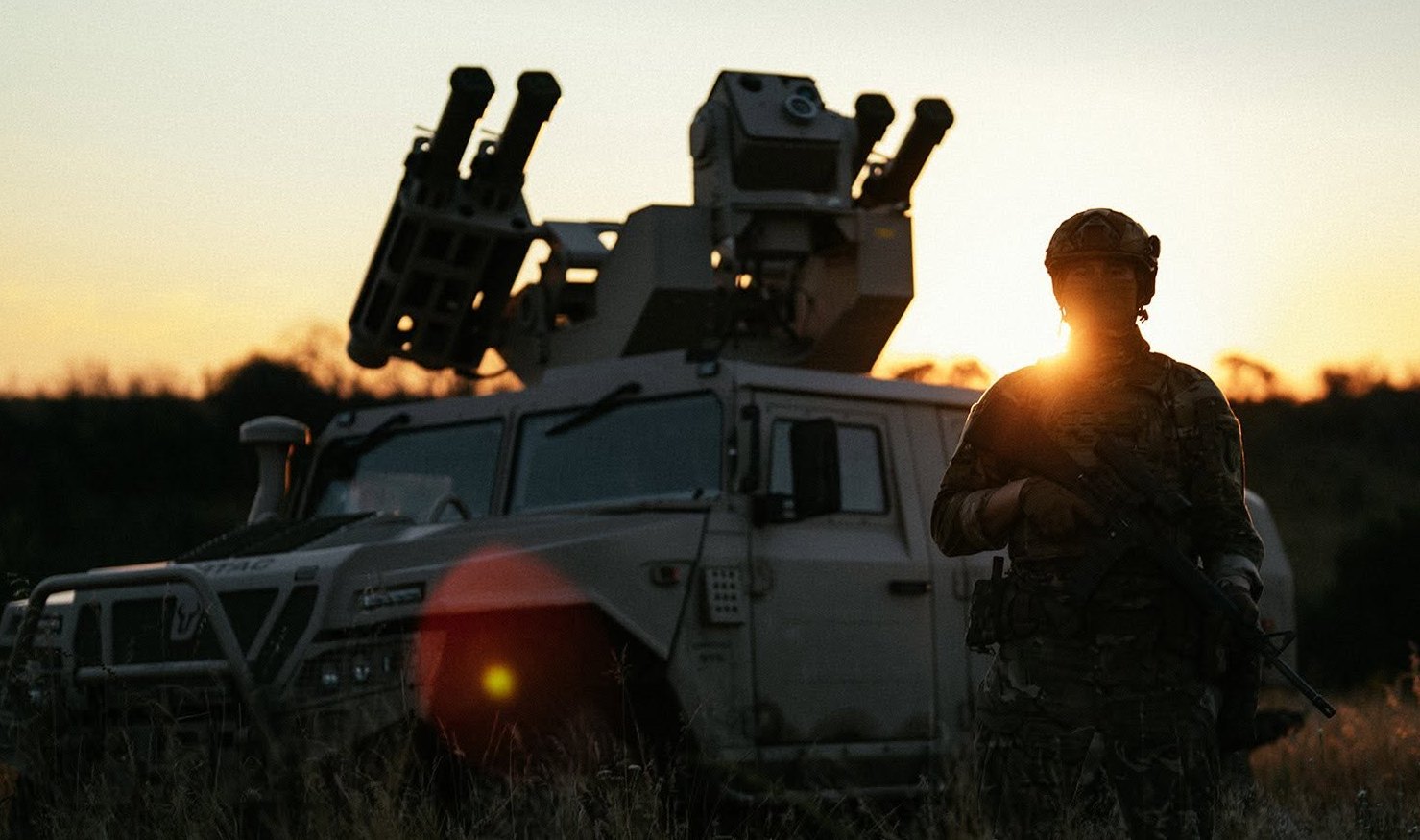
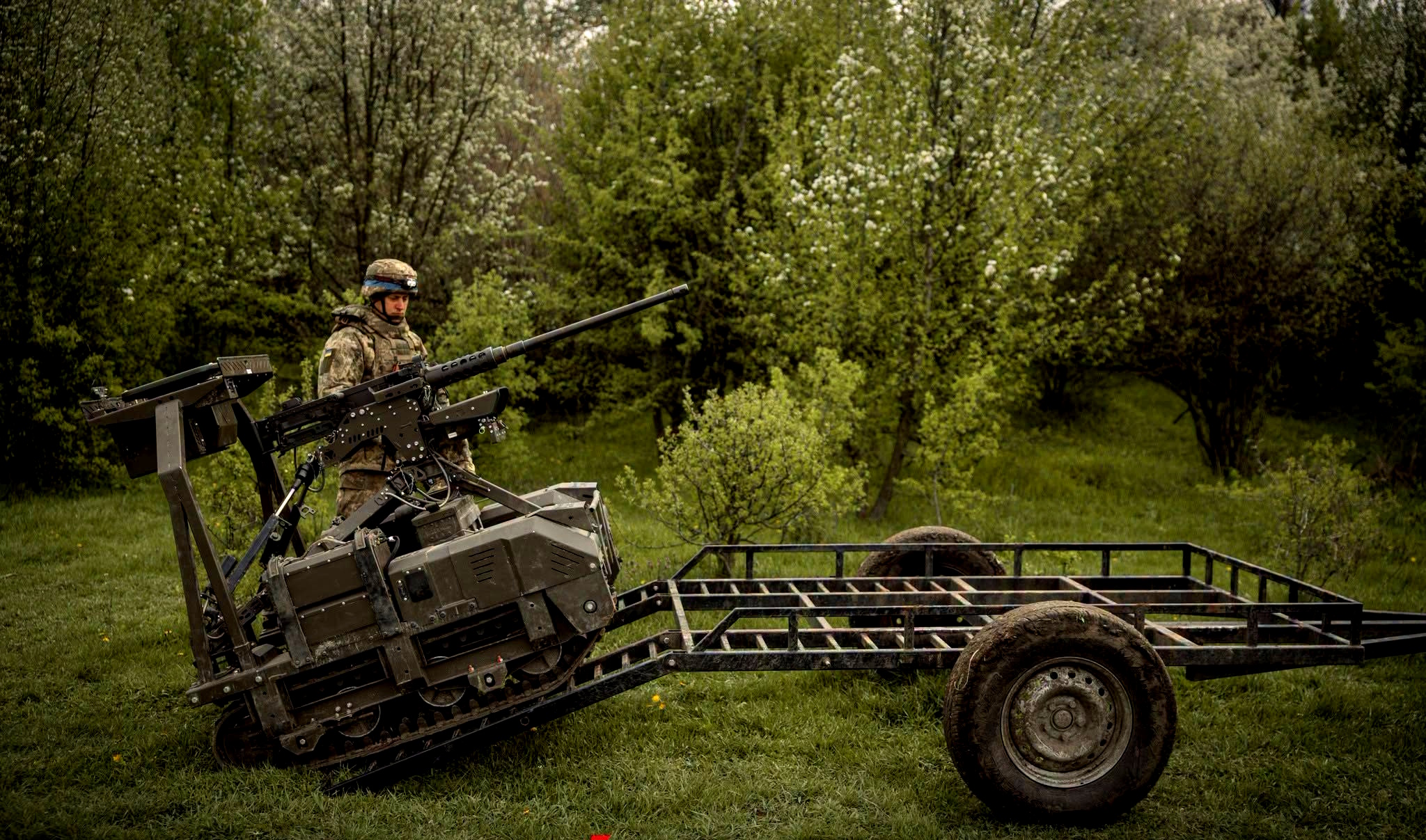
Ukraine’s Third Army Corps has released photos of the RapidRanger air defense system mounted on a URO VAMTAC armored vehicle. The troops themselves described the system as a “short-range storm.”
The system defends the sky in areas where radar cannot spot a target and other weapons cannot reach it, filling the gap between mobile fire groups and heavy, less-mobile air-defense systems. That niche — fast, cheap, and radar-independent — is exactly where Russia's Shaheds and
Ukraine’s Third Army Corps has released photos of the RapidRanger air defense system mounted on a URO VAMTAC armored vehicle. The troops themselves described the system as a “short-range storm.”
The system defends the sky in areas where radar cannot spot a target and other weapons cannot reach it, filling the gap between mobile fire groups and heavy, less-mobile air-defense systems. That niche — fast, cheap, and radar-independent — is exactly where Russia's Shaheds and small reconnaissance drones have been slipping through.
A crew from Ukraine’s 1030th “Aquila” Anti-Aircraft Missile and Artillery Regiment is loading the RapidRanger with anti-aircraft missiles ahead of a combat deployment. Source: Ukraine’s 1030th “Aquila” Anti-Aircraft Missile and Artillery Regiment
The images show a crew of the 1030th "Aquila" Anti-Aircraft Missile-Artillery Regiment arming the launcher with missiles before going on combat duty for the first time, RBC-Ukraine reports.
Light enough to ride a pickup
Rapid Ranger weighs only 500 kilograms and has a modular design that allows it to be mounted on pickups, armored cars, or even tracked platforms.
The systems in Ukrainian service ride Spanish URO VAMTAC tactical off-roaders, which reach 135 km/h, drive on public roads, and can change position quickly or cover long distances.
A crew from Ukraine’s 1030th “Aquila” Anti-Aircraft Missile and Artillery Regiment is loading the RapidRanger with anti-aircraft missiles ahead of a combat deployment. Source: Ukraine’s 1030th “Aquila” Anti-Aircraft Missile and Artillery Regiment
That mobility is the point: a launcher that can shoot and move is far harder for Russian forces to find and destroy than a fixed battery.
Laser guidance beats the decoys
The system's LMM Martlet missiles are 1.3 meters long, weigh 13 kilograms, and reach 1,800 km/h, striking targets up to seven kilometers away. Crucially, the missiles use laser guidance, not only infrared, so Rapid Ranger can hit targets with a low thermal signature or those carrying heat-emitting decoys. That makes it effective against Russian reconnaissance drones like the Orlan-10, whose small heat trail slips past heat-seeking weapons.
A crew from Ukraine’s 1030th “Aquila” Anti-Aircraft Missile and Artillery Regiment is loading the RapidRanger with anti-aircraft missiles ahead of a combat deployment. Source: Ukraine’s 1030th “Aquila” Anti-Aircraft Missile and Artillery Regiment
A 360-degree electro-optical surveillance suite gives the crew all-around coverage, and the system detects targets out to about 15 kilometers, which is more than twice its engagement range, giving the crew time to track a threat before firing.
Rapid Ranger reached Ukrainian units as part of a British military aid package, and Euromaidan Press reported in April that the system was already downing Shaheds from its Spanish mounts. The 3rd Corps' photos are the newest confirmation that Ukraine's newest Western air-defense hardware is now integrated and standing combat duty at the front.
Ukraine's quiet counteroffensive north of Lyman has produced dramatic results since April
Now two Russian regiments are in danger of encirclement
Escape is still likely for the Russians, but their retreat buys time for the Ukrainian defenders of Lyman and nearby Sloviansk
Ukraine secret eastern counteroffensive seems to have been even more successful than some observers reported. It's possible that, in the sector just north of the town of Lyman in eastern Ukra
Ukraine's quiet counteroffensive north of Lyman has produced dramatic results since April
Now two Russian regiments are in danger of encirclement
Escape is still likely for the Russians, but their retreat buys time for the Ukrainian defenders of Lyman and nearby Sloviansk
Ukraine secret eastern counteroffensive seems to have been even more successful than some observers reported. It's possible that, in the sector just north of the town of Lyman in eastern Ukraine's Donetsk Oblast, the Ukrainian 3rd Army Corps is just a few kilometers short of encircling two Russian regiments.
That doesn't mean the Russian units can't escape. After all, there isn't a contiguous line of Ukrainian forces—nor a contiguous line of Russian forces for that matter—anywhere along the 1,200-km disputed gray zone that threads across eastern and southern Ukraine.
Situation near Nove as of 23 August. Map: Euromaidan Press
But the closing pincer around elements of the Russian 2nd and 144th Motor Rifle Divisions could strain the Russians' logistics and compel the Russians to reconsolidate in order to preserve their combat power—by retreating east. That would take a lot of pressure off Lyman and, by extension, also take a lot of pressure off Sloviansk and Kramatorsk, the last two big free cities in Donetsk.
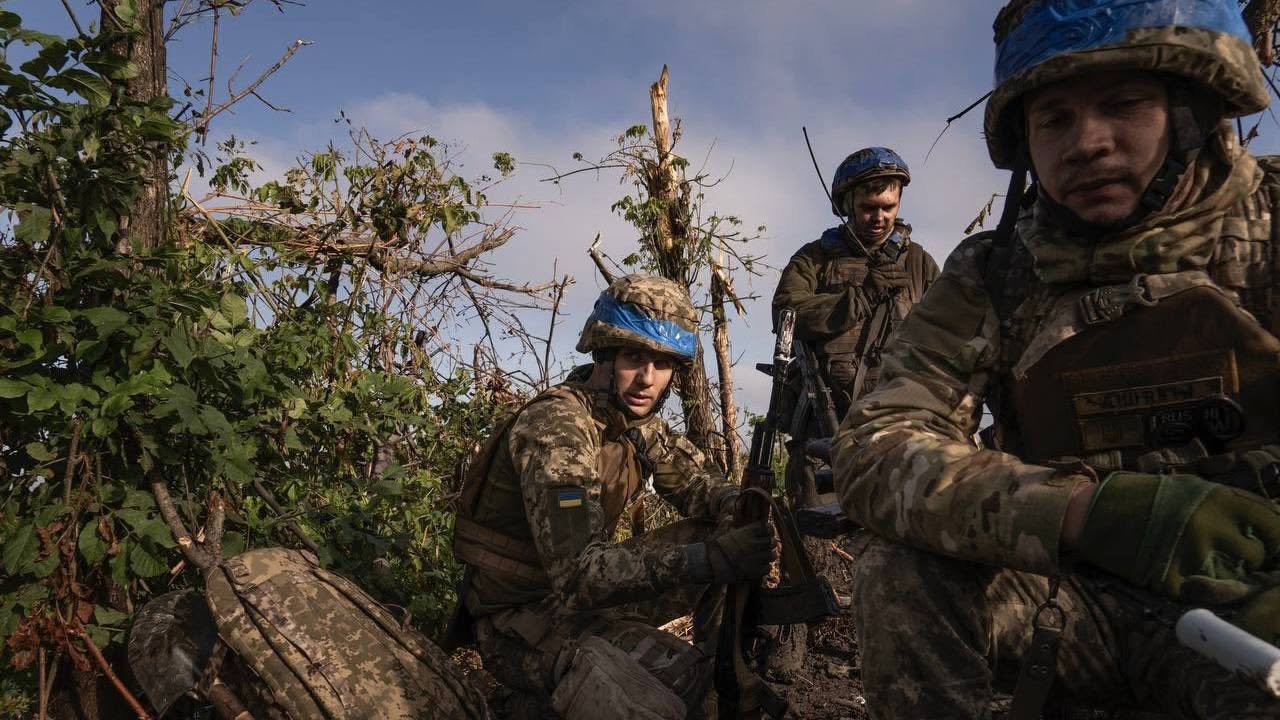
Lyman, which lies 15 km northeast of Sloviansk—the northernmost of the free cities—is the main obstacle between at least six Russian regiments and Sloviansk. The Russians have been inching toward Sloviansk and Kramatorsk from several directions for months now, racing against the coming winter to position forces for a possible siege of the twin cities next year. Winter in Ukraine punishes any attacker by depriving them of the leafy tree canopy that can conceal infiltrating troops during warmer months.
According to the most recent map from analyst and mapper Thorkill, one of the more reliable observers of unit-level action in Ukraine, the Ukrainian 3rd Assault Brigade is just a few kilometers away from linking up with the 60th Mechanized Brigade in or around the village of Kolodyazi.
Sytuacja w rejonie Nowego (Łyman), część II.
Jednym z odcinków frontu w Donbasie, na którym wojska ukraińskie prowadzą obecnie działania zaczepne, jest rejon Kateryniwka - Nowe – Zełena Dolyna, na północ od Łymanu. Od połowy maja 2026 r. pozycje rosyjskiej 144 Dywizji Strzelców… pic.twitter.com/AIvInwHGX3
If true, that means the 3rd Assault Brigade and adjacent units from the 3rd Army Corps have carried out one of the more successful Ukrainian counteroffensives in memory. In April they first exploited gaps in Russian defenses north of the village of Nove. In May and June they advanced toward the village. In July they captured it.
After that, the attacking Ukrainians kept pushing south into the right flank of a 10-km-by-10-km salient that advancing Russian regiments created as they maneuvered around Lyman from the north, aiming to surround the town instead of directly assaulting it on their way toward Sloviansk.
Leaving their flank exposed, the Russians trying to encircle Lyman found themselves at risk of encirclement, instead. If the 3rd Assault Brigade or 60th Mechanized Brigade—together possessing thousands of troops, on paper—can march through Kolodyazi, they will have closed a ring of loose Ukrainian control around at least two Russian regiments, also with potentially thousands of troops.
Emphasis on loose control. Again, there aren't enough Ukrainian forces on the ground north of Lyman to prevent any "encircled" Russians from retreating back to the east. But that retreat would represent a major victory for the Ukrainian defenders north and east of Sloviansk. "The fall of this salient [north of Lyman] would significantly delay the fall of Lyman," analyst and mapper AMK Mapping predicted.
Situational update on the Lyman direction:
The Ukrainian counterattacks north of Lyman are now entering their fourth month, as they come closer and closer to cutting off the Russian salient. Two pincers have been formed, which are both dangerously close to cutting the Russians… pic.twitter.com/mu2kZ4S3Jv
No one expects the Russians to halt their offensive toward Sloviansk and Kramatorsk. But in potentially taking two steps forward and one step back in their northerly march on the free cities, the Russians sacrifice time. Time the Ukrainians can use to stiffen their defenses in Sloviansk and Kramatorsk and evacuate more of the tens of thousands of civilians who remain in the cities despite the constant danger from Russian drones and bombs.
The possible extent of the Ukrainian gains north of Lyman—a 10-km march since April—is impressive given Russia's overall advantage in manpower and firepower in the east. Equally impressive is the operational security, or OPSEC, that cloaked the offensive until now. Sure, there were a few videos of action around Nove that hinted at a major Ukrainian action.
But the units involved exercised surprising discipline, and prevented too much information from leaking. "Someone in the 3rd Corps responsible for [OPSEC] is actually trying to do their job diligently and has quite effectively cut off information," Thorkill noted. The secrecy may have facilitated the Ukrainian advance by delaying any sense of panic among the Russian commanders who are responsible for reinforcing the Lyman salient, but who also tend to ignore bad news as long as possible because they know it could reflect poorly on them.
News of the counteroffensive is now available for all to see, even if official Ukrainian sources have yet to confirm it. That may mean time is running out for the 3rd Army Corps to close its pincer before the Russians retreat or reinforce. AMK Mapping has already seen some evidence of a "partial withdrawal from the most vulnerable positions in the salient.
Explore further
Can Ukrainian forces save Sloviansk and Kramatorsk?
Without much fanfare, Ukrainian forces have been counterattacking north of Lyman in eastern Ukraine's Donetsk Oblast
The Ukrainian advance takes some pressure off the free city of Sloviansk, just 20 km to the southwest
The problem is: the Russians are advancing toward Sloviansk and Kramatorsk from several other directions
Russian forces are fighting against time to close a pincer around the last free cities in eastern Ukraine. The deadline: the coming winter,
Without much fanfare, Ukrainian forces have been counterattacking north of Lyman in eastern Ukraine's Donetsk Oblast
The Ukrainian advance takes some pressure off the free city of Sloviansk, just 20 km to the southwest
The problem is: the Russians are advancing toward Sloviansk and Kramatorsk from several other directions
Russian forces are fighting against time to close a pincer around the last free cities in eastern Ukraine. The deadline: the coming winter, which will strip the leaves from the trees and leave any attacking force exposed to overhead surveillance and attack.
But in one key sector, Ukrainian forces are spoiling the coordinated Russian operation to partially surround Sloviansk and neighboring Kramatorsk. With admirable operational security, or OPSEC, a clutch of Ukrainian brigades under the 3rd Army Corps hasn't just blunted the advance of the Russian Center Group of Forces—it has pushed the Russians back.
This Ukrainian counterattack along the axis through the town of Lyman, ongoing since May, has largely escaped widespread notice. Yes, there is some scant video evidence of Ukrainian attacks. And yes, a few analysts have adjusted their maps to account for apparent Ukrainian advances, especially in the direction of Nove, a Russian-occupied village 15 km north of Lyman, which itself lies 15 km north of Sloviansk.
Ukrainian forces have been conducting for weeks two unnoticed counter-attacks in two directions of the frontline.
With barely any geolocation, the Ukrainians kept a good level of OPSEC and the russians have been reluctant to publish videos from these areas.
But for the most part, Ukrainian and Russian sources have avoided talking about Lyman. "The Ukrainians kept a good level of OPSEC and the Russians have been reluctant to publish videos from these areas" depicting their retreats, analyst and mapper Clément Molinnoted in June, just a few weeks after the Ukrainians attacked toward Nove.
Molin, for one, expects the OPSEC to lift in the coming days. "By the end of the month, we should have an official update on the good results of a Ukrainian offensive that has largely remained secret," he wrote on Monday.
Situation near Nove as of 23 August. Map: Euromaidan Press
April offensive
The Ukrainians' limited counteroffensive around Lyman apparently kicked off on in mid-April. One of the first attacks that left any real evidence occurred on 22 May, when a small Ukrainian mechanized force—perhaps from the 60th or 66th Mechanized Brigade, the 77th Air Assault Brigade, or the Presidential Brigade—attacked in armored trucks and M-113, Stryker, and BTR-4 armored personnel carriers. Heavy bomber drones flew top cover.
The Russian 144th Motor Rifle Division fought back with its own drones. Interceptor drones took aim at the bombers. First-person-view and heavy bomber drones blasted at least one BTR-4, hitting it before and after it dropped off its infantry passengers. Drones struck some of the disembarked Ukrainian infantry.
How many Ukrainian troops survived and entrenched in new positions on 22 May is unclear. Regardless, the Ukrainian 3rd Army Corps wasn't done with Nove. Attacks continued. And sometime after the 22 May assault on Nove, "the Ukrainians managed to consolidate their gains," Molin concluded after scrutinizing a few videos and some satellite imagery.
By early July, Ukrainian forces had succeeded in "operationally encircl[ing] the Russian forces defending the village of Nove," according to analyst and mapper Thorkill. "Fierce fighting is currently underway to expel the Russians from that locality," Thorkill reported at the time.
Sytuacja w rejonie Nowego (Łyman).
Jednym z odcinków frontu w Donbasie, na którym wojska ukraińskie prowadzą obecnie działania zaczepne, jest rejon wsi: Nowe – Zełena Dolyna, na północ od Łymanu. Od połowy maja 2026 r. pozycje rosyjskiej 144 Dywizji Strzelców Zmotoryzowanych… pic.twitter.com/2EJQgz4eps
The aim of the Ukrainian counterattacks is obvious. The 3rd Army Corps intends to put pressure on the northern right flank of 10 km-by-10-km salient jutting into the battleground north of Lyman. The Russian 144th Motor Rifle Division has been pouring troops into the salient, clearly intending to surround and isolate Lyman instead of directly assaulting it—all in order to clear a path toward Sloviansk.
Salients are risky for both sides, however. The farther the Russians extend their Lyman salient, the more exposed they are on their flanks. The Ukrainians know this. And even if the 3rd Army Corps can't fully cut across the salient in order to surround the Russians inside of it, the corps can at least take advantage of the salient's exposed flanks.
Capturing Nove, on the very northern edge of the salient, could allow the Ukrainians to bring to bear more artillery and drones on the Russians south of Nove. The 3rd Army Corps doesn't have to fully encircle the Russian troops closest to Lyman in order to hammer them with withering firepower.
Explore further
Ukraine’s quiet counteroffensive took 745 square km. Russia’s dead Starlink is how
Just how successful the 3rd Army Corps has been in its local counteroffensive could become clearer very soon. That won't spell lasting relief for Sloviansk and Kramatorsk, however. Fighting against the clock as summer begins turning into fall and then winter, the Russians are slowly advancing toward the twin cities from several directions.
The siege of Kramatorsk and Sloviansk is coming. Perhaps not this year, but surely by 2027. To fully safeguard the twin cities, the Ukrainians would need to duplicate their success north of Lyman along several other directions.
That's a big ask of a Ukrainian force that's overall still outnumbered and outgunned.