❌

Vue normale

  • ✇Euromaidan Press
  • Vivaldi counteroffensive advanced after Ukraine took Russia’s drones out of the fight, ISW assesses
    Ukraine likely neutralized Russia's drone defenses north of Lyman before sending armor into the third phase of its Vivaldi counteroffensive, the Institute for the Study of War (ISW) assessed. An intermediate-range strike campaign against Russian logistics and electronic warfare paved the way, the think tank said. Drones have made this front so deadly that armor now mostly fights from kilometers back. That is what makes Ukraine's armored push onto fortified positions near Lyman stand out
     

Vivaldi counteroffensive advanced after Ukraine took Russia’s drones out of the fight, ISW assesses

29 septembre 2026 à 06:50

vivaldi counteroffensive worked because ukraine took russia's drones out fight isw assesses · post settlements ukraine's 3rd army corps says liberated during operation north lyman donetsk oblast 28 2026 settlements-liberated-during-operation-vivaldi-phase-3-as-of-september-28-2026-scaled

Ukraine likely neutralized Russia's drone defenses north of Lyman before sending armor into the third phase of its Vivaldi counteroffensive, the Institute for the Study of War (ISW) assessed. An intermediate-range strike campaign against Russian logistics and electronic warfare paved the way, the think tank said.

Drones have made this front so deadly that armor now mostly fights from kilometers back. That is what makes Ukraine's armored push onto fortified positions near Lyman stand out. Russia has already shifted its effort south toward Sloviansk after losing the Lyman pincer.

Armor reached Russian bunkers without drawing drone strikes

To break the strongest Russian fortifications, Ukraine used old Soviet BTR-60 armored personnel carriers rebuilt as remote-controlled explosive vehicles, the 3rd Army Corps says.

Ukrainian forces drove them up to heavy Russian fortifications without coming under Russian drone strikes, ISW noted. The think tank said this indicates Ukraine neutralized or otherwise negated Russia's drone defenses in the area.
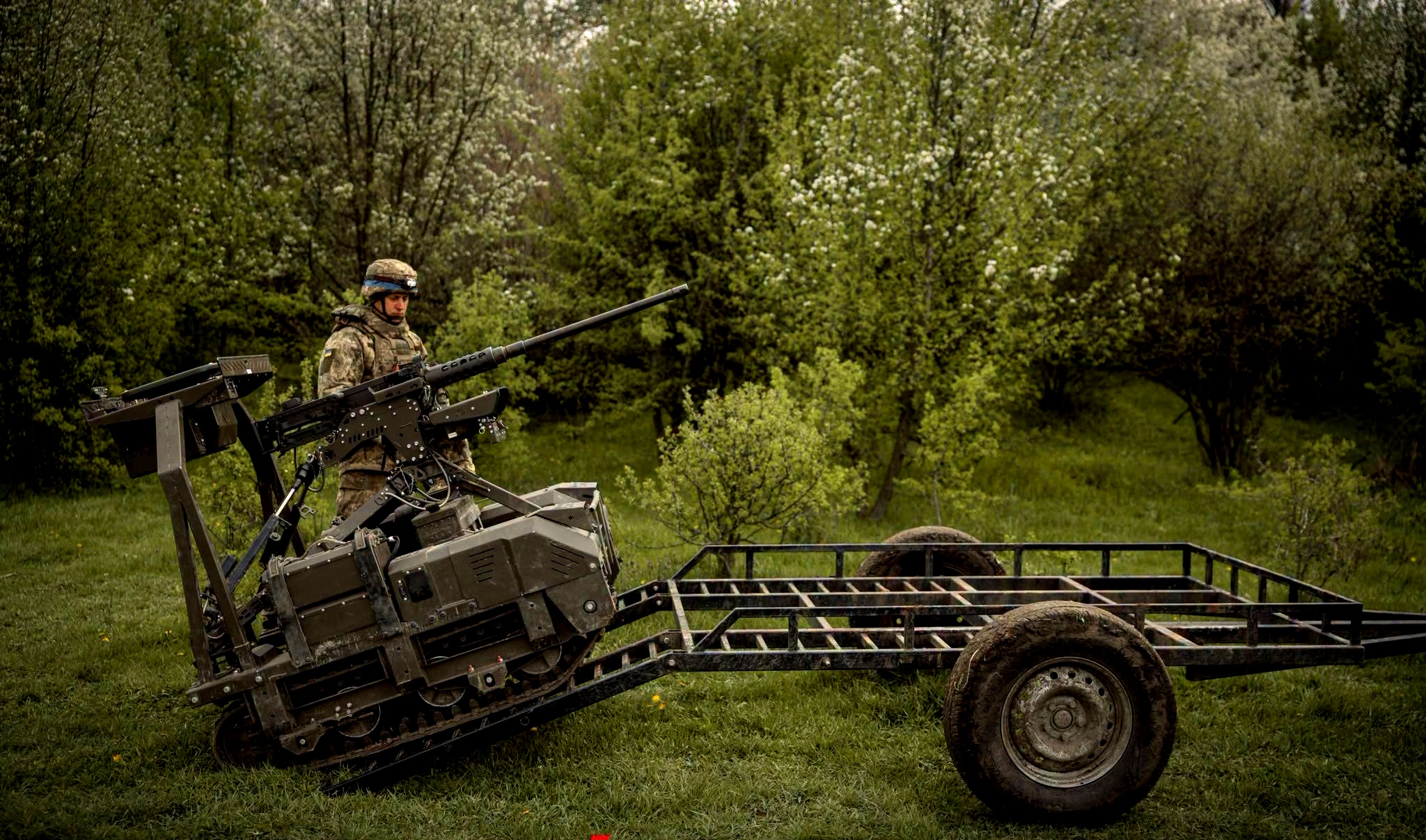
The image shows a Ukrainian soldier standing next to an unmanned ground robotic vehicle. Source: The General Staff
Explore further

New Vivaldi tactic: Ukraine’s ground robots, each carrying two Bullspike grenade launchers, attack Russian positions and then detonate inside their shelters

Strikes on fuel starved Russia's jammers

Ukraine achieved tactical drone overmatch through extensive shaping operations and an intermediate-range strike campaign, ISW said. Those strikes targeted the Russian drones and electronic warfare (EW) systems that would otherwise have hunted the advancing vehicles.

The 3rd Army Corps reported on 17 September that strikes on Russian logistics in occupied Luhansk Oblast had degraded Russian fuel supplies to the front, ISW wrote that day. The corps said that strained Russia's ability to use drones and EW against Ukrainian drones. EW systems consume a lot of power, and Russian troops run them on diesel generators, ISW explained.

Deputy corps commander Maksym Zhorin credited strict information silence and a "Protective Drone" system of EW assets, according to the same assessment. He said it helped neutralize around 20,000 Russian drones. The corps had earlier described mapping Russian command posts and striking them to sow panic.

ATESH partisan Footage of a fire on a relay cabinet at the Bataysk railway junction, near Rostov-On-Don, Russia, 21 December 2025. Screenshot from video: ATESH
Explore further

Ukraine’s Vivaldi counteroffensive near Lyman just got help from behind Russian lines: partisans say they cut rail supply to three Russian regiments, no explosion needed

Five settlements and 2,000 Russian losses

The corps liberated Nove, Ridkodub, and Katerynivka and restored control over Karpivka and Novomykhailivka, it said on 28 September. The phase added 51 km², bringing the total since the offensive began to 176 km².

Russian losses reached 2,000 personnel, and more than 250 Russians were taken prisoner, according to the corps. Corps commander Andrii Biletskyi said a feint from Shandryholove toward Zelena Dolyna drew Russian reserves away from the real target, Nove.

The first two phases had reportedly cleared more than 125 km² north of Lyman.

Ukraine outfoxes Russia near Donetsk’s fortress belt with Soviet BTR-60s rebuilt as kamikaze robots, storms a key hub and takes 250 Russian prisoners

28 septembre 2026 à 06:40

The image shows Russian prisoners of war on the Lyman direction. Source: The 3rd Army Corps

Ukraine's 3rd Army Corps has defeated Russia at the key settlement of Nove in Donetsk Oblast by pointing it the wrong way. Russia has poured its reserves into counterattacks on a feint axis and "slept through" the real strike, which took the important hub in the village and closed the decisive third season of the Vivaldi offensive, commander Andrii Biletskyi said.

Vivaldi is Ukraine's counteroffensive aimed at disrupting Russian forces' plans to encircle the fortress-belt cities in Donetsk Oblast from the north and south. Among them are Sloviansk, Kramatorsk, Druzhkivka, and Kostiantynivka. These cities have helped hold back Russian forces since 2014.

Over its first two "seasons," the 3rd Army Corps and attached units have retaken more than 125 square kilometers, half of it de-occupied outright, and inflicted more than 3,000 casualties on Russian forces.

The operation in Nove was its "third season," Biletskyi said, the turning point of the whole operation. The corps liberated Nove, Ridkodub, and Katerynivka and restored control of Karpivka and Novomykhailivka, adding 51 square kilometers, bringing the total liberated since the offensive began to 176. Ukrainian forces have taken 250 Russians captive.

The feint drew Russia's reserves

The victory, by Biletskyi's account, was won by deception.

"The enemy was convinced the main direction of the strike was Shandryholove–Zelena Dolyna," he revealed, and it burned its reserves counterattacking there.

He added that the Russians slept through the real strike, which was concentrated on taking Nove. The village was the prize, a key Russian hub on the bridgehead, ringed by heights that command the surrounding ground.

"Who controls the heights holds the initiative," Biletskyi said.

By spending its reserves on the wrong axis, he suggested, Russia had little left to hold Nove when the real assault arrived.

Old APCs crack the defense

To break the strongest fortifications, the corps said, it used a homemade weapon: Soviet BTR-60 armored carriers converted into remote-controlled kamikaze robots, driven into Russia's toughest positions and detonated.

In 2024, the Ukrainian forces received another local upgrade of the post-Soviet BTR-60 wheeled armored personnel carrier. This time it was fitted with the BM-7 "Parus" turret, known from the BTR-4 "Bucephalus" The main armament consisted of a 30 mm ZTM-1 automatic cannon paired with a 7.62 mm KT-7.62 universal machine gun.

Additional armament might include a set of four anti-tank guided missile launchers mounted on the sides, or two launchers and a 30 mm KBA-117 automatic grenade launcher. As a result, this upgraded BTR-60 saw a significant improvement in firepower, although the vehicle still has very weak armor and less-than-optimal access to the troop compartment.

It was the latest of the corps' robotic improvisations in Vivaldi, which have included air-dropped ground drones and Bullspike grenade-launcher-armed UGVs. They are Bulgarian hand-held, rocket-propelled anti-tank grenade launchers based on the Soviet RPG-22, which the Bulgarian defense industry previously produced under license.

The corps has leaned on such machines throughout the operation to keep its infantry out of the deadliest fights.

Whole units surrender

As the defense broke down, Russians gave up in groups, including officers, pilots, and artillery soldiers, the corps said. The 3rd Assault Brigade carried much of the fighting, while the 3rd Border Guard Detachment, named for the fallen Colonel Yevhen Pikus, retook Ridkodub and dug in on the new line, with the 10th Mobile Border Guard Detachment "DOZOR" taking an active part in the assault.

❌