Vue normale

Ukraine reportedly strikes Russian airbase used to attack its cities, using a drone similar to the Russian Shahed

16 juillet 2026 à 15:20

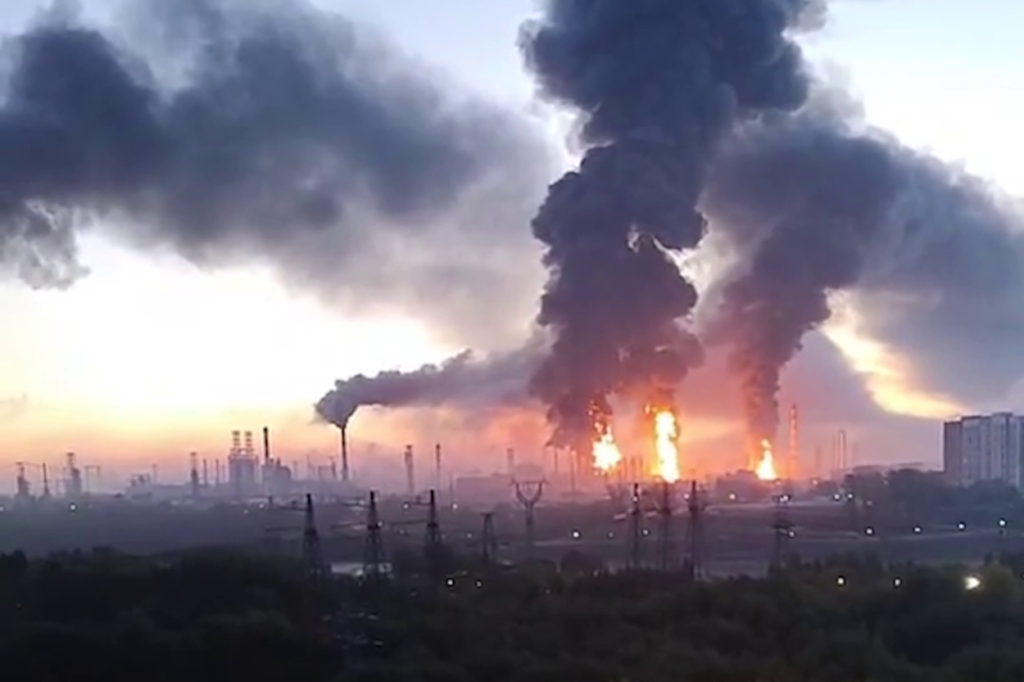
Smoke seen on the horizon reportedly coming from Russia's Engels-2 airbase in Saratov, following a drone strike on 16 July 2026. Photo: Exilenova+

A reported overnight drone attack targeted Russia's Engels-2 strategic airbase in Saratov Oblast on 16 July, with open-source analysts identifying a fire on the installation that hosts bombers used in missile attacks against Ukraine.

The monitoring Telegram channel Exilenova+ reported that multiple drones targeted the airbase overnight. Videos published by the channel appeared to show a fire burning on or near the military installation.

Independent Russian outlet Astra reported, based on open-source analysis, that a fire broke out on the airbase following the strike.

Shahed-like drone design draws attention

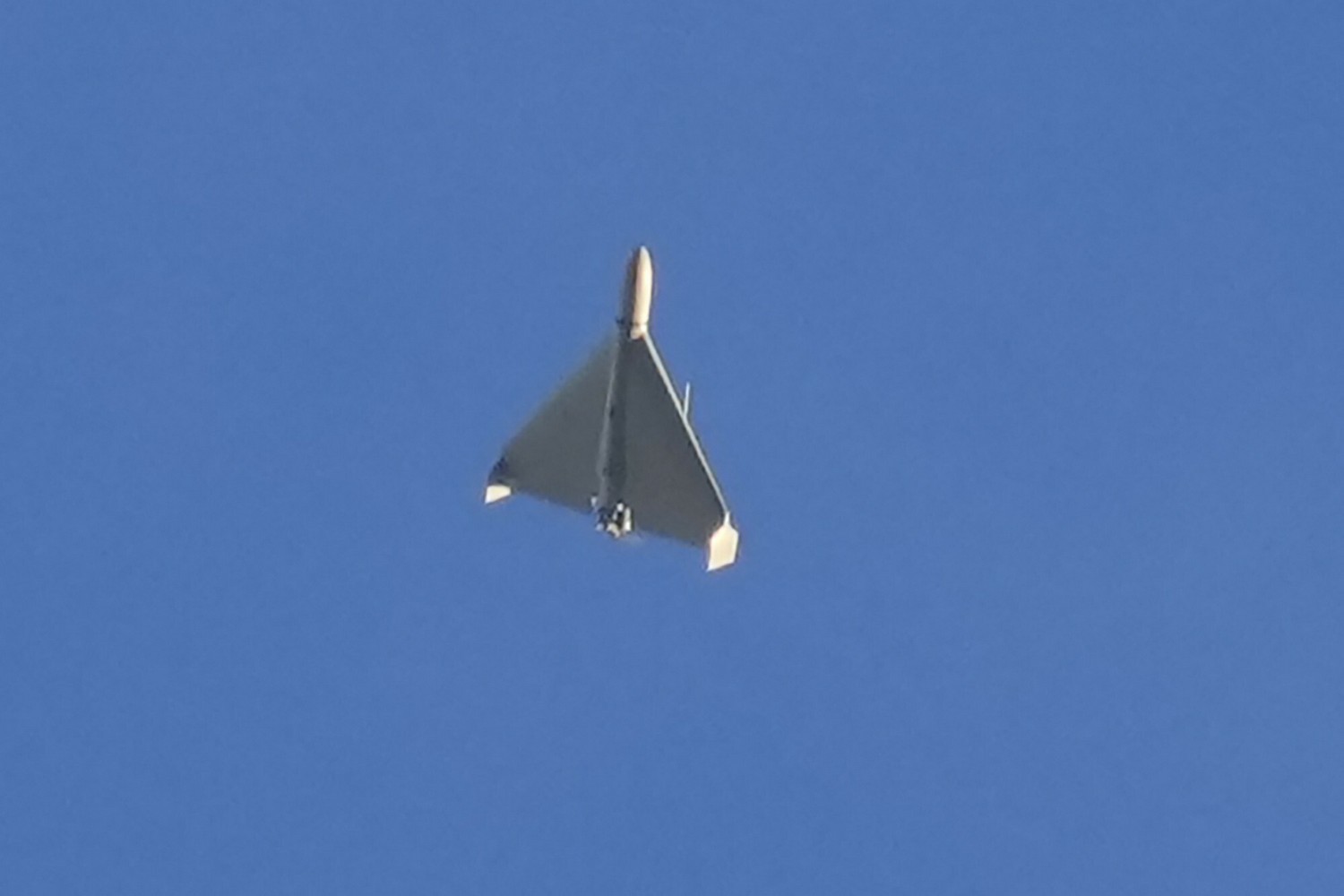
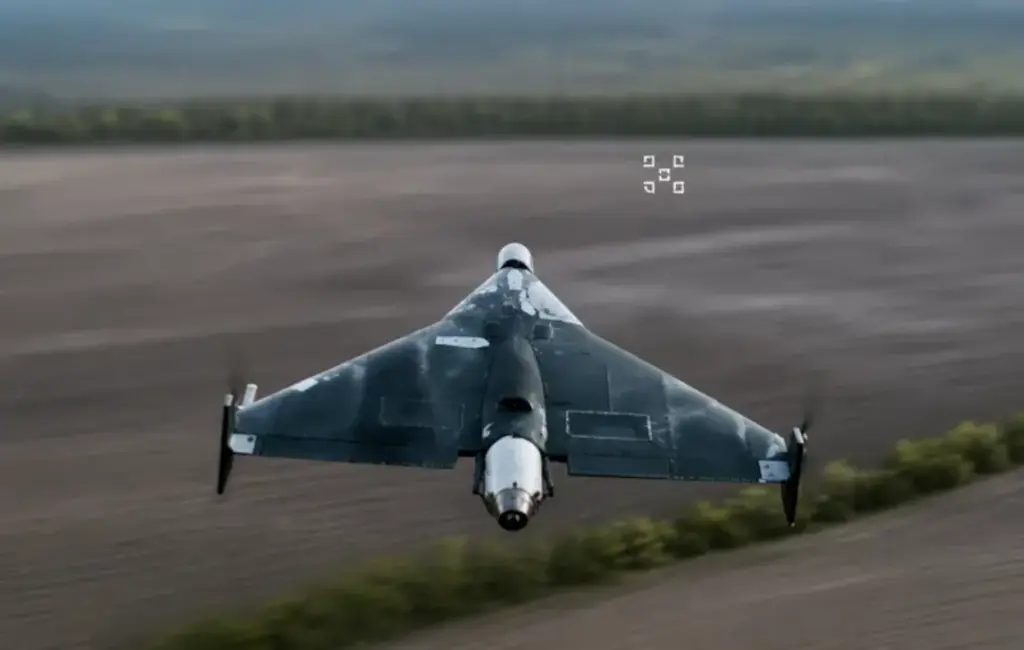
Ukrainian defense outlet Militarnyi noted that footage recorded by local residents appeared to show drones visually resembling Iranian-designed Shahed loitering munitions, which Russia has used extensively to strike Ukrainian cities and infrastructure throughout its full-scale invasion.

The outlet noted that visually similar drones have been observed during previous Ukrainian long-range strikes inside Russia.

An unidentified Ukrainian drone, visually resembling the Iranian-designed Shahed kamikaze drone, used to attack Russia's Engels-2 airbase on 16 July 2026. Photo: Exilenova+

Base used for missile attacks on Ukraine

Engels-2 is one of Russia's principal strategic aviation bases and hosts Tu-95MS and Tu-160 strategic bombers, which Russia regularly uses to launch Kh-101 cruise missiles against Ukrainian cities and infrastructure.

The base also stores munitions, fuel, and maintenance equipment supporting Russia's long-range bomber fleet. Militarnyi noted that Russia expanded the airbase last year by constructing additional aircraft parking areas to accommodate more strategic bombers.

The airbase has been targeted repeatedly since Russia launched its full-scale invasion of Ukraine in 2022, reflecting Ukraine's campaign to degrade Russia's long-range strike capabilities deep behind the front line.

Explosions reported across Engels

Residents of the Russian cities of Saratov and Engels reported hearing multiple explosions beginning around 2:30 a.m. local time, according to monitoring channels.

Saratov Oblast Governor Roman Busargin acknowledged a drone attack on the region, saying civilian infrastructure in Engels had been damaged but reporting no casualties. He did not confirm any strike on the military airfield.

According to Astra, one drone also struck a residential apartment building about two kilometers from the airbase. Militarnyi reported that local residents also described power outages following the explosions, with social media users suggesting a substation may have been hit. 

  • ✇Euromaidan Press
  • UK fast-tracks new ballistic missile for Ukraine with “pared-down” design
    The United Kingdom has signed contracts with several defense companies to develop its first domestically produced ballistic missile in more than 50 years, with a "pared-down" design intended to accelerate deliveries to Ukraine by late 2027, Bloomberg reported on 16 July, citing people familiar with the program. According to Bloomberg, the accelerated effort, known as Project Nightfall, is designed to both bolster Ukraine's long-range strike capabilities and reduce Europ
     

UK fast-tracks new ballistic missile for Ukraine with “pared-down” design

16 juillet 2026 à 12:19

Ukrainian President Volodymyr Zelenskyy, UK Prime Minister Kier Starmer, and NATO Secretary-General Mark Rutte in London at the Coalition of the Willing meeting on 24 October, 2025.

The United Kingdom has signed contracts with several defense companies to develop its first domestically produced ballistic missile in more than 50 years, with a "pared-down" design intended to accelerate deliveries to Ukraine by late 2027, Bloomberg reported on 16 July, citing people familiar with the program.

According to Bloomberg, the accelerated effort, known as Project Nightfall, is designed to both bolster Ukraine's long-range strike capabilities and reduce Europe's dependence on American-made weapons.

Fast-tracked development

Bloomberg reported that the UK Ministry of Defence relaxed some of the missile's original requirements after receiving feedback from industry in an effort to speed up development.

The revised specifications reportedly reduce the missile's range from more than 600 kilometers to 500 kilometers and its warhead from 300 kilograms to 200 kilograms, while raising the target unit cost from under £500,000 to a maximum of £800,000.

According to Bloomberg's sources, test launches are expected to begin within the next 12 months, with the first deliveries planned for late 2027. The publication noted that ballistic missile programs typically take more than a decade to develop and field.

Supporting Ukraine and Europe's rearmament

The project is intended to achieve two strategic goals: supplying Ukraine with long-range strike capabilities and expanding Europe's indigenous defense industrial base as European governments seek to lessen reliance on US military support, Bloomberg reported.

The missile is expected to be capable of launching from multiple vehicle platforms, firing salvos in quick succession, operating in electronically contested environments, and being manufactured at a rate of up to 10 systems per month.

A UK Ministry of Defence spokesperson told Bloomberg that Britain is "applying the lessons of Ukraine to deliver military capability faster, using rapid prototyping, innovation and close collaboration with British industry."

Broader UK weapons effort

Project Nightfall is one of several British initiatives aimed at strengthening Ukraine's long-range strike capabilities.

Britain is also developing a low-cost, long-range cruise missile for Ukraine under Project Brakestop, with testing already underway in the UK, Bloomberg reported.

The report comes as European governments continue expanding joint defense projects and increasing investments in domestic weapons production amid Russia's ongoing full-scale invasion of Ukraine.

  • ✇Euromaidan Press
  • Ukraine repatriates 501 bodies Russia says are Ukrainian service members
    Ukraine has repatriated the bodies of 501 people whom Russia says may be Ukrainian service members, the Coordination Headquarters for the Treatment of Prisoners of War announced on 16 July. The transfer is one of the latest in a series of wartime repatriation operations between Ukraine and Russia, allowing Ukrainian authorities to begin the process of identifying the dead and eventually return them to their families. Identification process begins The Coordination
     

Ukraine repatriates 501 bodies Russia says are Ukrainian service members

16 juillet 2026 à 10:28

Trucks loaded with bodies of Ukrainian soldiers, accompanied by people in protective gear.

Ukraine has repatriated the bodies of 501 people whom Russia says may be Ukrainian service members, the Coordination Headquarters for the Treatment of Prisoners of War announced on 16 July.

The transfer is one of the latest in a series of wartime repatriation operations between Ukraine and Russia, allowing Ukrainian authorities to begin the process of identifying the dead and eventually return them to their families.

Identification process begins

The Coordination Headquarters said the remains will undergo forensic examination by Ukrainian investigators and experts to establish their identities.

The headquarters noted that Russia identified the bodies as potentially belonging to Ukrainian military personnel. 

Ukrainian authorities will independently verify each identity through forensic procedures. The process can take weeks or months, particularly when remains are fragmented or degraded, and often relies on DNA analysis and other forensic methods.

Coordinated repatriation effort

According to the headquarters, the operation involved the Coordination Headquarters for the Treatment of Prisoners of War, the Security Service of Ukraine's Joint Center, the Armed Forces, the Interior Ministry, the Office of the Parliamentary Commissioner for Human Rights, the Commissioner for Persons Missing Under Special Circumstances, the State Emergency Service, and other security agencies.

The headquarters also thanked the International Committee of the Red Cross for assisting with the repatriation.

Part of ongoing humanitarian exchanges

Since the start of Russia's full-scale invasion, Ukraine and Russia have periodically exchanged the bodies of fallen soldiers alongside prisoner-of-war swaps.

Once repatriated, the remains are transferred to specialized state institutions, where forensic experts work to identify the deceased before they can be returned to their families for burial.

100,000 dolphins killed in the Black Sea because of Russia’s war, Ukrainian scientist warns: “We may lose a unique ecosystem”

13 juillet 2026 à 07:55

A dead dolphin on Ukraine’s Odesa coast, where scientists link rising marine deaths to Russia’s war in the Black Sea. Photo: Ivan Rusev on Facebook

Russia's full-scale invasion of Ukraine has killed more than 100,000 dolphins in the Black Sea and could trigger irreversible damage to the sea's ecosystem if the losses continue, according to a leading Ukrainian marine biologist.

The warning comes as scientists continue documenting the environmental impact of the war in the Black Sea, with growing numbers of dead marine mammals forming part of evidence in Ukraine's ecocide investigation against Russia. Underwater explosions, naval activity, pollution, and other military operations have all been linked to the deaths.

In an interview with RBK-Ukraine, Ivan Rusev, head of the research department at Ukraine's Tuzly Lagoons National Nature Park, said researchers estimate that about 20,000 dolphins died in the first half of 2026 alone, bringing the total since Russia launched its full-scale invasion to more than 100,000.

"We may lose a unique ecosystem. Without dolphins, the Black Sea will cease to be 'alive.' It will begin to degrade, and life in it will gradually disappear," Rusev told the outlet.

Scientists say most deaths go undocumented

Rusev said the documented toll represents only a small fraction of the true number of deaths because roughly 95% of dolphin carcasses sink before reaching shore.

Even among the few bodies washed ashore, researchers recover only a small proportion before they decompose or are carried away, making accurate documentation a race against time, he said.

The estimates build on months of monitoring by researchers at Tuzly Lagoons National Nature Park, who earlier this month reported finding 63 dead harbor porpoises along Ukraine's Black Sea coast since late May. They said the strandings likely represent only a small fraction of total deaths and are providing evidence to prosecutors investigating alleged Russian ecocide.

A dead dolphin on Ukraine’s Odesa coast, where scientists link rising marine deaths to Russia’s war in the Black Sea. Photo: Ivan Rusev

War-related threats multiply

According to Rusev, dolphins are being affected by multiple war-related factors.

He said powerful military sonar disrupts their echolocation and navigation, while underwater explosions can cause severe acoustic trauma, decompression sickness, and heart damage. Dolphins are also threatened by sea mines, exploding munitions, naval drones, chemical contamination, and burns caused by phosphorus munitions, he said.

Rusev added that stress and food shortages weaken the animals' immune systems, making them more vulnerable to infections that would normally not be fatal.

The exact causes of individual deaths have not been conclusively established, though scientists have repeatedly linked the rising mortality to the cumulative effects of Russia's war in the Black Sea.

Dolphins flee combat zones

Rusev said researchers in Romania, Bulgaria, and Türkiye have observed unusually large numbers of dolphins after many animals fled areas affected by fighting.

While the migration may improve the chances of survival for some dolphins, he warned that the overall population remains significantly depleted.

He also warned that chemical pollution generated by the war could eventually spread throughout the Black Sea, reaching as far as the Bosporus Strait and threatening the wider marine ecosystem.

Evidence gathered for ecocide investigation

Rusev stressed that documenting the deaths is essential, arguing that without evidence, the environmental consequences of the war could later be disputed.

The deaths of dolphins and other marine mammals are already being examined by Ukrainian authorities as part of an ecocide investigation into Russia's actions, with researchers preserving carcasses and submitting evidence to prosecutors for forensic analysis.

  • ✇Euromaidan Press
  • Russian who helped Ukraine’s military faces deportation after decade under false identity
    A Russian national known in Ukraine as volunteer Aslan Khakimov is in fact Ruslan Puptaiev, a man who entered Ukraine illegally, lived for more than a decade under false documents, and is wanted by Interpol at Russia's request, according to an investigation by Babel. The case has become one of Ukraine's most closely watched deportation disputes, drawing support from soldiers, volunteers, human rights advocates, and lawmakers. Backers argue Puptaiev's contributions to Uk
     

Russian who helped Ukraine’s military faces deportation after decade under false identity

13 juillet 2026 à 07:13

Ruslan Puptaiev, also known as Aslan Khakimov, his wife Oleksandra, and their daughter Amina in 2025. Puptaiev is contesting deportation from Ukraine after authorities discovered he had lived for years under a false identity. Photo from social media, via Babel

A Russian national known in Ukraine as volunteer Aslan Khakimov is in fact Ruslan Puptaiev, a man who entered Ukraine illegally, lived for more than a decade under false documents, and is wanted by Interpol at Russia's request, according to an investigation by Babel.

The case has become one of Ukraine's most closely watched deportation disputes, drawing support from soldiers, volunteers, human rights advocates, and lawmakers. Backers argue Puptaiev's contributions to Ukraine's defense and the risk of torture if returned to Russia should outweigh his immigration violations, while Ukrainian authorities maintain he lived in the country illegally under forged documents.

According to the investigation, Ukraine's State Migration Service cancelled the documents issued under the false identity in October 2025. After Puptaiev failed to regularize his legal status or challenge the decision, the agency ordered his forced deportation in April 2026. He has since been held at a temporary detention facility for foreigners in Lutsk while legal proceedings continue.

Claims of persecution in Russia

Puptaiev told Babel he fled Russia in 2015 after allegedly being detained and tortured by Russia's Federal Security Service (FSB), which he says accused him of Islamist extremism following his conversion to Islam while serving a prison sentence.

He says he entered Ukraine illegally because he feared seeking legal protection would expose him to extradition. Rather than applying for refugee status or other international protection, he instead acquired forged Ukrainian identity documents under the name Aslan Khakimov and later used them to obtain genuine state-issued documents based on the false identity, Babel reports.

Over the following years, he established businesses, married Ukrainian citizens, and registered his children using the fabricated identity.

Volunteer work after Russia's full-scale invasion

Babel reports that Puptaiev became involved in supporting Ukraine's military after Russia launched its full-scale invasion in 2022.

After Russia's full-scale invasion, Puptaiev supported Ukraine's military by donating money, developing equipment including unmanned ground vehicle components and airless evacuation wheels, and training dozens of service members, according to Babel.

Babel reports he has received letters of appreciation from Ukraine's military intelligence agency (HUR), Special Operations Forces, Armed Forces, Ministry of Defense, and individual units recognizing his volunteer work.

His public appeals for support began only after he was detained in April 2026, with supporters portraying the case as an attempt by Ukraine to extradite a volunteer to Russia.

Interpol notice and Russian conviction

According to Babel, Ukraine's National Police confirmed that Puptaiev is the subject of an Interpol notice requested by Russia.

Russian authorities accuse him of financing terrorism and maintaining links to the Islamic State group. Babel notes that Russian media reported he was convicted in absentia by a Russian military court in 2024 and sentenced to 20 years in prison on terrorism-related charges. 

Puptaiev denies Russia's allegations and maintains that he is being politically persecuted.

ECHR blocks deportation to Russia

Puptaiev's lawyers say Ukraine's original deportation order referred only to his "country of origin" – Russia. After his legal team appealed to the European Court of Human Rights (ECHR), the court issued interim measures under Rule 39 on 26 May, temporarily barring Ukraine from returning him to Russia while it considers the case.

Human rights experts told Babel that Rule 39 is reserved for exceptional cases where there is a credible risk of irreparable harm, including torture or threats to life. They said the measure does not determine the outcome of the case but requires Ukraine to avoid returning Puptaiev to Russia while proceedings continue.

Babel reports that Ukrainian authorities are also exploring whether Puptaiev could instead be deported to Kyrgyzstan, where he was born, or Türkiye. His lawyers argue that either country could ultimately extradite him to Russia, exposing him to the same risks the ECHR sought to prevent.

The ECHR case remains pending.

Russo-Ukrainian war, day 1598: Ukraine batters Russia’s Crimea fuel lifeline as drone swarm hits 48 ships in five days

10 juillet 2026 à 17:08

Russo-Ukrainian War 10 July 2026

Exclusives

Ukraine’s Patriot shortage was solved, Washington said. The missile makers hadn’t been told.. Ukraine's NATO ambassador cheered the summit. The analysts watching it didn’t.
Russia risks losing part of its grain harvest as Ukraine’s refinery strikes dry up diesel. Farmers in the country's southern breadbasket face fuel limits, empty pumps, and price spikes at the exact moment combines need to roll, as Moscow continues its costly war against Ukraine.
As Ukraine’s draft crisis erupts in Lviv, its own soldiers keep walking out. Many of the men who went to save the day in 2022 are still at the front; the ones who didn’t are still at home, and the government has wasted four years not saying why that has to change.
Ukraine is advancing in the southeast. It’s still not enough to win the war. The ongoing fight for Komar is a microcosm for the wider war. Ukrainian troops are advancing. But that doesn't mean the war is about to end.
Lviv mobilization riot exposes the draft system Ukraine’s government has refused to fix. Two official watchdogs said the fault lies higher up—with a mobilization overhaul that hasn’t reached the recruiters.
Russia’s war economy is starving its own strategic projects. Russia’s top arms maker can’t afford to build its own garbage incinerators.

Military

48 Russian vessels hit over 5 days as Ukraine turns Crimea's fuel routes into a new battleground Ukraine says drone operators struck 48 Russian vessels over five days, while the General Staff reported additional overnight attacks on logistics ships, oil terminals, and fuel depots supporting Moscow's invasion.

With a 2-to-1 edge, Russia shrank its offensive from 13 fronts to 6, Syrskyi says Russia's offensive campaign has narrowed dramatically despite its numerical advantage, according to Ukraine's commander-in-chief, who says Ukrainian forces are increasingly slowing Russian advances while expanding long-range strikes inside Russia.

Ukraine's deep and mid-range strikes converge on Crimea and Russia's Azov coast Drones hit tankers, both loading ports of the targeted tanker run, five oil depots, and the peninsula's power grid in one night of the isolation campaign.

Anti-drone nets keep failing: Russia's fuel tanks burn from Azov to Moscow Fuel facilities burned from Krasnodar Krai and Rostov Oblast to Moscow and Tatarstan as Russia claimed hundreds of drones downed.

ISW: Ukraine has opened a new phase of Crimea's isolation by hunting seaborne fuel tankers The think tank says strikes on Russian gasoline shipping show Kyiv rapidly adapting after land routes to the peninsula were degraded.

Year ago, Russia fired 28 ballistic missiles in month at Ukraine. Now it's firing three times that Ukraine's Ministry of Defense reports 89% interception of Russian air targets in June, but only 40% on ballistic missiles.

35 ships in four days: Ukraine's campaign against Russia's Azov Sea fuel run keeps widening 12 more shadow fleet riverine tankers, a cargo ship, and a tug among the latest targets.

Intelligence and technology

Ukraine is turning its long-range strike campaign into a permanent military command Ukraine is creating a dedicated command for long-range strikes alongside new Joint Rapid Reaction Forces in a restructuring of the Armed Forces aimed at strengthening deep-strike and frontline capabilities.

Japan builds the missiles Ukraine needs most—its own rules forbid the handoff The day after Trump promised a production license, Zelenskyy named the production partner he wants. The problem: Japan still doesn't sell weapons to countries at war.

Ukraine is building its own ballistic interceptor for $700,000 per shot. Eight countries may join project Ukraine's Freya anti-ballistic project may add up to eight European partners, President Zelenskyy told journalists.

Ukraine rewrote the Patriot playbook—but it's still running out of missiles Single-shot intercepts. $30,000 decoys. Ukrainian crews training Gulf forces. Ukraine has become an air-defense innovator—and it is still losing the race against Russia's missiles.

Ukraine wants to make its own Patriots. Hard part isn't missile — it's Boeing part made in two places on Earth The analysis details the specific technical, supply chain, and security constraints on Ukraine's Patriot production.

Ukraine wants robots doing 100% of frontline logistics. In June, they ran nearly 17,000 supply and evacuation runs Ukraine's ground robots completed 16,676 logistics and evacuation missions in June, up 122% since the start of 2026.

CEO of one of Ukraine's biggest drone makers just got raided. He also owns outlet that exposed 25 non-combat deaths at military unit No court order. Forty locations searched. One in four Ukrainian front-line drones at risk of disruption. And a timeline that Babel's editor says "leads to very bad conclusions."

International

British weapons poised to join Ukraine's €60B EU arms program A new EU-UK agreement would allow Ukraine to spend its €60 billion EU defense loan on British weapons, broadening Kyiv's procurement options, Bloomberg reports.

Britain's incoming leader promises Ukraine aid "will not waver"—but money is the catch Andy Burnham pledges British support "will not waver." The reassurance is real—and it answers a question Kyiv was never really asking.

Poland armed Ukraine with Patriot missiles. Its president's camp called it "treason" Warsaw sent the interceptors at Washington and NATO's request. The opposition-aligned presidency framed it as betrayal — and the defense minister fired back.

Nine jets for drone tech: the Polish-Ukrainian barter that collapsed in June is alive again, Polish minister says Warsaw froze the transfer weeks ago, accusing Kyiv of walking away from the drone-technology side of the deal.

Poland: we have credible information Russia is planning new provocations in Europe FM Sikorski said going public is deliberate — the same tactic that helped derail Moscow's false-flag plans before it invaded Ukraine.

Sports federations are quietly readmitting Russia, which killed 660 Ukrainian athletes. UEFA is about to become holdout UEFA is ready to block Russian teams from returning to international football even after the IOC lifted Russia's disqualification.

Russia laid Nord Stream to bypass Ukraine amid preparations for war. Four years after it exploded, Kyiv says it had nothing to do with blasts Ukraine's Prosecutor General's Office says no facts show state involvement in the September 2022 Nord Stream pipeline sabotage.

Humanitarian and social impact

Russian drone killed last resident of Tokarivka Druha. Now, village has no one left A Russian FPV drone killed a 57-year-old hospital worker.

Read our previous daily review here.

  • ✇Euromaidan Press
  • British weapons poised to join Ukraine’s €60B EU arms program
    Ukraine will soon be able to use the European Union's €60 billion defense loan to purchase weapons from British manufacturers under a new EU-UK agreement expected to be announced next week, according to Bloomberg. The agreement would bridge one of the remaining gaps between the EU's defense financing and one of Ukraine's largest military suppliers, giving Kyiv greater flexibility to source weapons from British manufacturers using EU-backed funding. Citing people fami
     

British weapons poised to join Ukraine’s €60B EU arms program

10 juillet 2026 à 15:10

Ukrainian President Volodymyr Zelenskyy, UK Prime Minister Kier Starmer, and NATO Secretary-General Mark Rutte in London at the Coalition of the Willing meeting on 24 October, 2025.

Ukraine will soon be able to use the European Union's €60 billion defense loan to purchase weapons from British manufacturers under a new EU-UK agreement expected to be announced next week, according to Bloomberg.

The agreement would bridge one of the remaining gaps between the EU's defense financing and one of Ukraine's largest military suppliers, giving Kyiv greater flexibility to source weapons from British manufacturers using EU-backed funding.

Citing people familiar with the negotiations, Bloomberg reported that the agreement is expected to be unveiled at the UK- and France-led "Coalition of the Willing" meeting in Paris on 13 July. The arrangement would allow British defense companies to participate in the EU-backed procurement program after months of negotiations between Brussels and London.

UK firms to gain access to EU-backed procurement

According to Bloomberg, Ukraine will be able to use the €60 billion loan provided by the EU to purchase military equipment from UK defense companies.

Rather than paying a fixed fee for access to the program, the British government would make financial contributions tied to individual contracts whenever Ukraine chooses to spend part of the loan on British-made equipment. 

The contribution would depend on the value of each contract and associated interest costs, Bloomberg reported, citing unnamed sources familiar with the talks.

The arrangement would deepen defense-industrial cooperation between Ukraine and the United Kingdom while giving Kyiv greater flexibility in sourcing weapons from one of its closest military partners.

Separate from broader EU defense fund

The reported agreement follows months of separate negotiations over UK participation in the EU's €150 billion Security Action for Europe (SAFE) defense fund, which have yet to produce a breakthrough.

Bloomberg said talks on the Ukraine loan advanced more smoothly, with several EU member states, including the Netherlands, supporting rapid approval. Officials reportedly viewed the arrangement as beneficial for Ukraine because it would simplify purchases from British defense firms as Ukraine and the UK continue integrating their defense industries.

Support for Ukraine's expanding military needs

The reported agreement comes as Ukraine's European partners seek to strengthen Kyiv's military capabilities ahead of another winter of fighting.

Bloomberg reported that European diplomats believe Ukraine has gained a tactical advantage in recent months through increasingly effective long-range strikes against Russian military and logistics infrastructure. 

At the same time, allies are seeking to expand supplies of air defense systems and deep-strike capabilities as Russia continues large-scale missile and drone attacks on Ukrainian cities.

According to Bloomberg, the agreement was largely finalized on the sidelines of this week's NATO summit in Ankara and could be formally announced during Monday's meeting of the Coalition of the Willing in Paris.

  • ✇Euromaidan Press
  • Ukraine is turning its long-range strike campaign into a permanent military command
    Ukrainian President Volodymyr Zelenskyy has announced the creation of a dedicated long-range strike command and new Joint Rapid Reaction Forces as part of a broader restructuring of Ukraine's Armed Forces aimed at increasing battlefield flexibility and deepening strikes against Russia. In an evening address on 10 July, Zelenskyy said he had signed a decree establishing a new command responsible for coordinating Ukraine's long-range strike capabilities, describing it as
     

Ukraine is turning its long-range strike campaign into a permanent military command

10 juillet 2026 à 14:38

Ukrainian President Volodymyr Zelenskyy, 7 July 2026. Photo: Zelenskyy / Telegram

Ukrainian President Volodymyr Zelenskyy has announced the creation of a dedicated long-range strike command and new Joint Rapid Reaction Forces as part of a broader restructuring of Ukraine's Armed Forces aimed at increasing battlefield flexibility and deepening strikes against Russia.

In an evening address on 10 July, Zelenskyy said he had signed a decree establishing a new command responsible for coordinating Ukraine's long-range strike capabilities, describing it as a command for "global" impact on Russia's war effort. The president said the formation would concentrate all available resources to further reduce Russia's ability to wage war.

"The command must focus 100% of the available resources to further reduce Russia's war potential," Zelenskyy said, adding that it would be led by "a strong and highly experienced commander."

New command formalizes long-range strike campaign

The move comes as Ukraine rapidly expands its deep- and intermediate-range strike campaigns against military, logistics, and energy targets inside Russia and across occupied territories.

Over recent months, Ukrainian forces have intensified attacks on oil refineries, fuel depots, ammunition storage sites, command centers, air defense systems, and transport infrastructure supporting Russia's invasion. 

Ukraine has also stepped up strikes against maritime logistics in the Sea of Azov, targeting vessels transporting fuel and supplies to occupied Crimea.

The campaign aims to degrade Russia's ability to sustain frontline operations by disrupting the fuel, logistics, command, and industrial infrastructure underpinning its war effort, while forcing Moscow to divert resources to defend targets far from the battlefield.

The creation of a dedicated command suggests Kyiv is institutionalizing those capabilities as a distinct operational branch within the Armed Forces, reflecting the growing strategic role of long-range precision strikes in Ukraine's defense.

Rapid reaction forces to combine assault troops and drones

Zelenskyy also announced the formation of Joint Rapid Reaction Forces, describing them as a new component of the Armed Forces designed to respond quickly to changing battlefield conditions.

According to the president, the formation will combine assault troops with drone units, artillery, and other combat capabilities into a single technologically focused force capable of rapid deployment along the front.

The president announced that Brig. Gen. Dmytro Voloshyn, commander of the 8th Air Assault Corps and who has received Ukraine's highest state honor, the Hero of Ukraine award, had been selected to lead the new Joint Rapid Reaction Forces.

Zelenskyy said Voloshyn's combat experience would help develop the new formation and strengthen the Armed Forces' operational capabilities.

The announcement follows a series of military reforms introduced during 2026 as Ukraine adapts its force structure to lessons learned over more than four years of full-scale war, including greater integration of unmanned systems into frontline operations.

Assault forces to undergo reforms

Zelenskyy said Ukraine would also reform its assault forces, acknowledging that "many questions and problems" remain, particularly regarding the treatment of personnel.

He said law enforcement agencies were already taking procedural steps while changes would also be introduced at the command level.

Recent investigations into some assault units have prompted criminal cases, internal military reviews, and wider reforms focused on training conditions, the treatment of recruits, command responsibility, and personnel management.

  • ✇Euromaidan Press
  • 48 Russian vessels hit over 5 days as Ukraine turns Crimea’s fuel routes into a new battleground
    Ukraine's Unmanned Systems Forces say they have struck 48 Russian vessels over the past five days as part of an expanding campaign against the maritime logistics supporting Moscow's invasion and occupation forces in Crimea. The campaign has increasingly targeted tankers, cargo ships, ferries, and other vessels that Ukraine says transport fuel and military supplies sustaining Russian forces after repeated strikes degraded road and rail supply routes to the occupied penin
     

48 Russian vessels hit over 5 days as Ukraine turns Crimea’s fuel routes into a new battleground

10 juillet 2026 à 13:19

A Russian vessel in the Sea of Azov seen before Ukrainian drone strike, 10 July 2026. Screenshot from video: Ukraine's Unmanned Systems Forces

Ukraine's Unmanned Systems Forces say they have struck 48 Russian vessels over the past five days as part of an expanding campaign against the maritime logistics supporting Moscow's invasion and occupation forces in Crimea.

The campaign has increasingly targeted tankers, cargo ships, ferries, and other vessels that Ukraine says transport fuel and military supplies sustaining Russian forces after repeated strikes degraded road and rail supply routes to the occupied peninsula.

Campaign targets Russia's shadow fleet in Azov Sea

According to the Unmanned Systems Forces, Ukrainian drone operators struck 13 vessels in the Sea of Azov on 10 July alone – 10 tankers, one dry cargo ship, one ferry, and one tug. 

The force said the targeted ships belonged to Russia's sanctioned "shadow fleet." The commander of Ukraine's Unmanned Systems Forces, Robert "Madyar" Brovdi, confirmed that the vessels were under international sanctions.

Russia's shadow fleet is a network of vessels used to evade Western sanctions on Russian oil exports. Ukraine says some of the ships are also used to transport fuel and supplies supporting Moscow's military operations.

It also reported striking 41 military targets in occupied Crimea and southern occupied Ukraine overnight, while drone operators hit another 1,660 Russian targets along the front line, including 426 personnel.

Thirteen more Russian logistics vessels were struck in the Sea of Azov on 10 July, including 10 tankers, a cargo ship, a ferry, and a tug, according to Ukraine's Unmanned Systems Forces.

The latest attacks bring Ukraine's reported total to 48 Russian vessels struck over the past… pic.twitter.com/NBMlIHxhuL

— Euromaidan Press (@EuromaidanPress) July 10, 2026

Maritime logistics campaign expands

The reported strikes come as Ukraine intensifies its campaign against Russia's maritime logistics in the Sea of Azov. After months of attacks on the road and rail routes supplying occupied Crimea, Ukrainian forces have increasingly targeted the seaborne fuel network that supports Russian forces on the occupied peninsula.

The announcement updates earlier reports from Ukraine's Unmanned Systems Forces, which had reported striking 15 vessels on 9 July and a further 12 ships by mid-day on 10 July as the campaign unfolded.

The Institute for the Study of War recently assessed that the campaign marks a new phase in Ukraine's effort to isolate occupied Crimea by adapting to Russia's increased reliance on fuel shipments by sea. 

ISW: Ukraine has entered a new phase of its campaign to cut off occupied Crimea — the target list has shifted to the gasoline tankers crossing the Azov Sea.

The think tank says months of strikes degraded the road and rail links feeding the peninsula, forcing Russia to send fuel… pic.twitter.com/HeFRRSUWYc

— Euromaidan Press (@EuromaidanPress) July 10, 2026

Earlier this week, Ukraine's Unmanned Systems Forces reported striking 35 Russian vessels over four days before announcing additional attacks on another dozen ships.

Earlier on 10 July, satellite imagery published by RFE/RL's Skhemy showed a burning tanker and another apparently damaged vessel near the Kerch Strait, while open-source analysts reported that Russian tanker traffic in the Sea of Azov had declined sharply as strikes intensified. 

ukraine's deep mid-range strikes converge crimea russia's azov coast · post one satellite images shared skhemy shows likely damaged vessel sea near kerch strait 9 2026 супутник planet labs липня
One of the satellite images, shared by Skhemy, shows a likely damaged vessel in the Azov Sea near the Kerch Strait, 9 July 2026. Photo: Planet Labs via RFE/RL's Skhemy

Oil infrastructure also targeted

Alongside the reported attacks on Russian vessels, the General Staff of Ukraine’s Armed Forces confirmed that Ukrainian forces again struck the Ilsky oil refinery in Russia's Krasnodar Krai. Explosions followed by a fire were reported at the facility, with the extent of the damage still being assessed.

The Ilsky refinery is one of southern Russia's largest oil processing plants, with an annual capacity of up to 6.6 million tons. It produces gasoline, diesel fuel, and other petroleum products that Ukraine says are used to support Russian military logistics.

Ukraine also reported strikes on the Kurgannefteprodukt oil terminal in Taganrog and the Azovnefteprodukt fuel depot in Azov, both in Rostov Oblast. Fires, explosions, and smoke were reported at the facilities, which the General Staff said are used to receive, store, and distribute fuel for the Russian military.

Long-range strikes continue

The General Staff also reported another strike on NOVATEK's Ust-Luga gas condensate processing complex in Russia's Leningrad Oblast, one of the country's largest facilities for processing gas condensate into petroleum products.

In occupied Zaporizhzhia Oblast, Ukrainian forces also reportedly struck a Russian fuel and lubricants depot near Rozivka.

The General Staff said assessments of the reported strikes are ongoing and that Ukraine will continue targeting infrastructure supporting Russia's military operations.

  • ✇Euromaidan Press
  • With a 2-to-1 edge, Russia shrank its offensive from 13 fronts to 6, Syrskyi says
    Russia's large-scale offensive in the first half of 2026 failed to achieve any of its stated objectives despite holding an almost two-to-one advantage in personnel and equipment, Ukraine's Commander-in-Chief Oleksandr Syrskyi said after reviewing the Armed Forces' performance over the first six months of the year. According to Syrskyi, Russian forces have been unable to sustain the breadth of their offensive operations. While Moscow was previously conducting active assa
     

With a 2-to-1 edge, Russia shrank its offensive from 13 fronts to 6, Syrskyi says

10 juillet 2026 à 11:08

Commander-in-Chief of Ukraine's Armed Forces Oleksandr Syrskyi, 10 July 2026. Photo: Syrskyi

Russia's large-scale offensive in the first half of 2026 failed to achieve any of its stated objectives despite holding an almost two-to-one advantage in personnel and equipment, Ukraine's Commander-in-Chief Oleksandr Syrskyi said after reviewing the Armed Forces' performance over the first six months of the year.

According to Syrskyi, Russian forces have been unable to sustain the breadth of their offensive operations. While Moscow was previously conducting active assaults across 13 operational axes, that number has now fallen to six or seven, reflecting a significant narrowing of its offensive effort.

Russian offensive loses momentum

Ukraine's military continues to conduct defensive operations while carrying out stabilization measures and localized offensive actions that have allowed it to retain the operational initiative in some sectors, Syrskyi said. He added that the ratio of Ukrainian to Russian assault actions now stands at roughly 40 to 60.

Syrskyi attributed the slowdown in Russia's campaign to Ukraine's active defense strategy, saying the pace of Russian territorial advances has more than halved during the first six months of 2026.

He also said Russian forces are suffering average monthly losses of around 32,000 killed and wounded as Ukraine continues its strategy of exhausting the invading army.

According to Syrskyi, the rate of territorial gains by both sides has approached parity, while Ukrainian forces are increasingly liberating territory relative to areas where Russia is still advancing.

Moscow's objectives remain unchanged

Despite the assessment, Syrskyi cautioned that the war remains far from a turning point.

He said Russia has not abandoned its objectives of fully occupying Ukraine's Donetsk and Luhansk oblasts and is seeking to expand offensive operations into Dnipropetrovsk and Zaporizhzhia oblasts while enlarging a buffer zone along Ukraine's northern border. 

His comments came as Russian Foreign Minister Sergei Lavrov reiterated that Moscow will continue the war until it achieves the Kremlin's maximalist objectives outlined by President Vladimir Putin in June 2024. 

Those demands include Ukraine withdrawing from territory it still controls in four partially occupied oblasts, abandoning its NATO ambitions, and accepting conditions widely viewed as amounting to capitulation rather than a negotiated peace.

Syrskyi also warned that Russia continues to intensify missile and drone attacks, increase its use of guided aerial bombs, and commit crimes against civilians.

Ukraine expands long-range strike campaign

Syrskyi highlighted Ukraine's growing long-range strike campaign against Russia.

Ukraine has increasingly used long-range and middle-range strikes to disrupt the infrastructure supporting Moscow's invasion. Recent attacks have targeted logistics routes, rail infrastructure, fuel depots, and energy facilities in occupied Ukraine and Russia's border regions that supply and sustain Russian forces at the front.

He said Ukraine's Deep Strike operations hit 697 targets inside Russia during the first half of 2026, inflicting at least $6.1 billion in direct and indirect economic damage. Ukraine's Middle Strike campaign struck a further 7,028 Russian targets during the same period.

The commander also reported that Ukrainian artillery completed more than 456,000 fire missions, missile forces conducted over 1,140 strikes, the Air Force flew more than 1,100 strike missions, and support units carried out around 1,400 combat tasks.

Ukraine's deep-strike campaign reached a new level in June, with the Defense Ministry reporting more than 200,000 verified strikes on Russian targets and multiple monthly records.

According to Defense Minister Mykhailo Fedorov, Ukraine nearly doubled the number of successful… pic.twitter.com/xekxdtetdf

— Euromaidan Press (@EuromaidanPress) July 5, 2026

Troop rotations and military reforms

Addressing personnel issues, Syrskyi instructed commanders to rotate troops from frontline positions at least once every 60 days whenever operationally possible, calling regular rotations essential for soldiers' health, combat effectiveness, and fair treatment.

He added that criminal offenses within the Armed Forces declined by 12% during the first half of the year following reforms to military discipline and oversight.

Ukraine has pursued broad military reforms in 2026 focused on improving force generation, command efficiency, and the long-term sustainability of its armed forces.

Russo-Ukrainian war, day 1595: Ukraine hits 12 Russian fuel tankers in two days as Belgorod burns under 430-drone barrage

7 juillet 2026 à 16:53

Russo-Ukrainian War 7 July 2026

Exclusives

From Karelia to Kamchatka: Russia rations fuel where drones strike and stockpiles it where they cannot. A drone campaign against refineries has Russians buying gasoline by QR code, license-plate number, and five-hour queue.
Zaporizhzhia, Chornobyl, Kakhovka: a playbook of terror the West still calls deterrence. The West keeps reading the Kremlin’s nuclear threats through a Cold War lens, Svitlana Matviyenko argues. The mistake, she says, is doing Russia’s work for it.
Russia now loses more soldiers than it recruits. But the war won’t end because of that.. For the first time, Russia’s losses outrun its recruits—four years of General Staff data explain why that still won’t end the war.
Russia banned her for studying the famine it denies. She put it online for the whole world anyway. . Millions of Ukrainians died in the Holodomor—Stalin's deliberate starvation of Ukraine in 1932–33. Russia calls it a hoax—all while it replicates its methods in occupied Ukraine. Marta Baziuk, who helped build a course on the Holodomor, explains why the famine matters now—and why the course she helped build could only exist now.
The one sport moving against Russia is run by its ex-deputy PM. Moscow has hijacked the federation, says Malcolm Pein, the English delegate now standing for deputy president on a ticket challenging the Russian incumbent.

Military

Ukraine's drones are sinking Crimea's fuel lifeline, hitting 12 Russian tankers in 2 days
Ukraine says its drone forces struck 12 Russian fuel tankers in two days as part of a campaign to disrupt fuel supplies to occupied Crimea, alongside other military infrastructure.

"Ukraine's urgent needs should be front and centre": Nine EU ministers push Brussels to unlock Patriot air defense missiles as Russia's ballistic attacks intensify
Nine European defense ministers urged the European Commission to speed approval for Ukraine to buy Patriot missiles and other critical weapons from outside the EU under its €90 billion support loan.

Belgorod gas facility burns as Moscow fends off over 430 drones in one night
Fires broke out at Belgorod's gas pipeline dispatch station, airport, and thermal power plant after missiles struck the Russian city on 7 July.

Kyiv death toll rises to 19 after Russia's overnight strike, State Emergency Service says
Rescue crews kept searching rubble in Kyiv's Darnytskyi district on 7 July, more than a day after Russia's missile and drone barrage struck the capital.

Intelligence and technology

Russia tried to secure Japanese jet fuel amid shortages. Tokyo closed the loophole
Japan said its ban on jet fuel exports to Russia covers shipments through third countries and ship-to-ship transfers after Reuters reported Moscow was seeking a cargo via traders.

International

"Ukraine is becoming a security provider for Europe": Ukraine signs Drone Deals with Estonia, the Netherlands, and Denmark as Europe taps Kyiv's battlefield-tested weapons technology
Ukraine is expanding a network of defense partnerships focused on drones, air defense, and military technologies developed during the full-scale war.

As Ukraine urgently seeks more air defense, Canada announces $900 million military aid package
Canada announced nearly $900 million in new military aid for Ukraine, while President Volodymyr Zelenskyy said the package includes support to strengthen the country's air defenses.

Political and legal developments

Zelenskyy arrives in Ankara for NATO summit. Defense minister Fedorov is not in Ukraine's delegation
The Ukrainian president landed in Ankara seeking interceptor missiles and drone agreements.

Budanov: Ukraine won't accept ultimatums from Poland, just as it refused Russia's
The presidential office chief expects the rupture to peak around the 11 July Volyn anniversary.

NATO leaders open Ankara summit as Trump prepares bilateral meeting with Zelenskyy
The Netherlands will unveil over $3 billion in new defense contracts as the alliance seeks to demonstrate compliance with US spending demands.

Read our previous daily review here.

  • ✇Euromaidan Press
  • Russia tried to secure Japanese jet fuel amid shortages. Tokyo closed the loophole
    Japan has said its ban on jet fuel exports to Russia applies not only to direct shipments but also to cargoes routed through third countries or transferred between ships at sea. The statement came after Reuters reported that Russia was preparing to import a jet fuel shipment originating from Japan through a network of traders, as Moscow faces fuel shortages following Ukrainian strikes on Russian energy infrastructure. Tokyo moves to block sanctions evasion Japanes
     

Russia tried to secure Japanese jet fuel amid shortages. Tokyo closed the loophole

7 juillet 2026 à 14:52

Japanese Trade Minister Ryosei Akazawa, 26 May 2026. Photo: Ryosei Akazawa on X

Japan has said its ban on jet fuel exports to Russia applies not only to direct shipments but also to cargoes routed through third countries or transferred between ships at sea.

The statement came after Reuters reported that Russia was preparing to import a jet fuel shipment originating from Japan through a network of traders, as Moscow faces fuel shortages following Ukrainian strikes on Russian energy infrastructure.

Tokyo moves to block sanctions evasion

Japanese Trade Minister Ryosei Akazawa said on 7 July that jet fuel is among the goods covered by Japan’s export restrictions against Russia, Reuters reported.

"Exports to Russia through third countries, including ship-to-ship transfers at sea, are also covered," Akazawa said, while declining to comment on specific cases.

Japan’s Ministry of Economy, Trade and Industry is working to prevent sanctions evasion by raising awareness among companies, issuing warnings, and sharing information with authorities in Japan and abroad, he said.

Russia sought fuel through intermediaries

Reuters reported on 3 July that Russia was expected to receive jet fuel cargo originating from Japan through intermediaries as the country dealt with fuel shortages caused by Ukrainian attacks on oil refineries and fuel depots.

According to sources familiar with the matter cited by Reuters, the shipment involved at least 200,000 barrels of jet fuel expected to load from Chiba, Japan, before being transported to South Korea and potentially transferred to another tanker near Yeosu before continuing toward Russia.

The sources said the cargo’s final destination was unclear, but the arrangement appeared designed to route the fuel through multiple jurisdictions.

Japan’s latest statement indicates that such transfers would still fall under its export restrictions.

Russian fuel crisis deepens

The reported shipment comes as Ukrainian drone strikes have increasingly targeted Russian energy infrastructure, including oil refineries and fuel storage facilities.

The attacks have disrupted fuel supplies across Russia, prompting Moscow to impose restrictions on fuel purchases as shortages affect transportation, industry, and other sectors of the economy.

Russian jet fuel exports have also declined, according to shipping data cited by Reuters. Russia exported around 13,000 barrels per day of jet fuel this year, compared with approximately 30,000 barrels per day last year.

Japan, alongside other G7 partners, has maintained sanctions and export controls aimed at limiting Russia’s ability to sustain its war against Ukraine. Akazawa said Tokyo would continue enforcing strict controls in coordination with international partners.

“Ukraine is becoming a security provider for Europe”: Ukraine signs Drone Deals with Estonia, the Netherlands, and Denmark as Europe taps Kyiv’s battlefield-tested weapons technology

7 juillet 2026 à 14:24

Ukrainian President Volodymyr Zelenskyy and Estonian Prime Minister Kristen Michal on the sidelines of the NATO summit in Ankara, 7 July 2026. Photo: Ukrainian President's Office

Ukraine signed Drone Deal agreements with Estonia, Denmark, and the Netherlands on 7 July, expanding a growing network of European defense partnerships aimed at accelerating joint weapons production, technology sharing, and air defense cooperation.

The agreements were signed on the sidelines of the NATO summit in Ankara by Ukrainian President Volodymyr Zelenskyy and the leaders of the three countries.

Zelenskyy also said Ukraine is preparing additional Drone Deals with Canada and Finland, reflecting growing Western interest in Ukraine's combat-tested defense technologies.

Ukraine’s Drone Deal network expands

Announcing the first of the agreements, with Estonia, Zelenskyy said it was the seventh Drone Deal Ukraine had concluded with international partners.

The Ukrainian President's Office said the agreement provides for joint defense-industrial development, technology cooperation, intelligence and experience sharing, and the establishment of new production facilities in both countries.

The cooperation will cover drones, air defense capabilities, sensor and early warning systems, ammunition, battlefield management systems, and maritime capabilities.

"This agreement is not only a way to accelerate cooperation between our countries. It is also a step forward and a sign of trust," Zelenskyy said.

Estonian Prime Minister Kristen Michal called the agreement "an important document" that strengthens the partnership between the two countries.

Estonia seeks access to Ukrainian drone technology

According to Estonian public broadcaster ERR, the agreement will allow Estonian companies to manufacture drones using Ukrainian technology and expertise, while giving Estonia future access to Ukrainian-made defense products.

Michal told ERR that Ukraine possesses some of the world's most advanced drone knowledge because of the war, and that the agreement would allow Estonian industry to benefit from that expertise.

"Ukraine is no longer only a recipient of security. It is becoming a security provider for Europe," Michal wrote after the signing.

Estonian Defense Minister Hanno Pevkur told ERR the agreement would also give Estonia access to Ukrainian battlefield systems, strengthen its air defenses, and allow Estonian companies to obtain Ukrainian export licenses to manufacture drone technologies domestically.

Denmark and the Netherlands join Ukraine’s Drone Deals

Later on 7 July, Zelenskyy announced that Ukraine had also signed full Drone Deal agreements with Denmark and the Netherlands.

Calling Denmark's agreement Ukraine's ninth Drone Deal, Zelenskyy said it would expand joint defense production, facilitate the exchange of expertise, and establish transparent mechanisms for defense exports.

He said Denmark – already Ukraine's leading partner under the so-called "Danish model" of financing weapons production inside Ukraine – would gain access to Ukrainian weapons exports proven in combat.

During talks with Danish Prime Minister Mette Frederiksen, Zelenskyy said the leaders also discussed strengthening Ukraine's air defenses, accelerating deliveries of Patriot interceptor missiles, and developing future European capabilities against ballistic missile threats.

Following his meeting with Dutch Prime Minister Rob Jetten, Zelenskyy said the Dutch agreement would create additional opportunities for joint production, technology development, and systematic cooperation on expertise and defense exports.

He added that the two leaders also discussed Europe's efforts to develop indigenous anti-ballistic missile capabilities.

More agreements expected with Canada and Finland

Zelenskyy also said Ukraine is preparing a Drone Deal with Canada following talks with Prime Minister Mark Carney earlier in the day.

Following a separate meeting with Finnish President Alexander Stubb, Zelenskyy said preparations are also underway for a Drone Deal with Finland, though no signing date has yet been announced.

Ukraine has increasingly promoted the Drone Deal framework as a way to integrate European defense industries with Ukraine's wartime innovations, allowing partners to jointly manufacture combat-tested systems while strengthening Europe's own defense industrial base.

In recent months, Kyiv has signed similar defense cooperation agreements with several partners, including Middle Eastern countries and NATO members Latvia and Lithuania, as it seeks to build joint production and share battlefield-proven drone expertise.

  • ✇Euromaidan Press
  • As Ukraine urgently seeks more air defense, Canada announces $900 million military aid package
    Editor's note: This article was updated to include official information from the Canadian government. Canada has announced a new military assistance package worth nearly $900 million for Ukraine, including ammunition, armored vehicles, and military equipment, while Ukrainian President Volodymyr Zelenskyy said the package also includes support to strengthen the country's air defenses. The announcement comes as Ukraine continues urging partners to accelerate military s
     

As Ukraine urgently seeks more air defense, Canada announces $900 million military aid package

7 juillet 2026 à 13:11

Canadian Prime Minister Mark Carney and Ukrainian President Volodymyr Zelenskyy on the sidelines of the NATO summit in Ankara, 7 July 2026. Photo: Ukrainian President's Office

Editor's note: This article was updated to include official information from the Canadian government.

Canada has announced a new military assistance package worth nearly $900 million for Ukraine, including ammunition, armored vehicles, and military equipment, while Ukrainian President Volodymyr Zelenskyy said the package also includes support to strengthen the country's air defenses.

The announcement comes as Ukraine continues urging partners to accelerate military support after a series of massive Russian missile and drone attacks that have exposed critical shortages in air defense interceptors.

Strengthening Ukraine’s air defenses remains the priority 

The announcement came during a meeting between Canadian Prime Minister Mark Carney and Zelenskyy on the sidelines of the NATO summit in Ankara.

According to the Canadian government, the assistance includes $475 million for ammunition, nearly $400 million to build 35 Canadian-made armored vehicles, and $50 million for critical technology and engineering equipment as part of Canada's $2.8 billion military support commitment for 2026.

Speaking after the meeting, Zelenskyy said strengthening Ukraine's air defenses remains Kyiv's immediate priority.

"We are primarily focused on ensuring there is more air defense. Protecting lives is the main thing, and Russia's ballistic missiles, other missiles, and drones are terror that must be overcome together with our partners," he said.

Zelenskyy said after the meeting that part of Canada's package intended to strengthen Ukraine's air defenses is already on its way to Ukraine. Canada's official announcement did not specify air defense equipment among the package's announced components.

Air defense remains a priority

The announcement comes as Ukraine urgently seeks additional air defense systems and interceptor missiles following a series of massive Russian aerial attacks involving hundreds of drones and dozens of missiles, including ballistic missiles.

Zelenskyy said part of Canada's assistance intended to strengthen Ukraine's air defenses is already on its way to the country.

"This is medium-term assistance. By medium term, I mean over the next few months. It includes military equipment, ammunition, and other support, in addition to this vital air defense assistance," Carney said, according to a statement from the Ukrainian President’s Office.

Canada backs Ukraine's recovery and energy security

According to Novyny.LIVE, Carney also said Canada will continue supporting Ukraine's energy sector ahead of the coming winter, assist reconstruction efforts, and back Ukraine's integration into the European and global economy.

Zelenskyy added that the two sides also discussed joint energy projects involving Ukraine's state-owned oil and gas company Naftogaz.

Drone agreement under discussion

Zelenskyy said Ukraine and Canada are also preparing a bilateral Drone Deal, describing it as an agreement that goes beyond drone production.

"It is not only about drones, but about a new and effective security system, with capabilities proven in this war. It will certainly be useful," he said.

The Ukrainian president added that he and Carney discussed the current diplomatic situation and exchanged ideas on how to bring peace closer by creating what he described as a "real interest" within Russia in negotiations.

  • ✇Euromaidan Press
  • Ukraine’s drones are sinking Crimea’s fuel lifeline, hitting 12 Russian tankers in 2 days
    Ukraine's Unmanned Systems Forces (SBS) say their drone operators struck 12 Russian fuel tankers carrying gasoline to occupied Crimea over two nights, in what appears to be one of Ukraine's largest claimed attacks on Russian maritime fuel logistics since the start of the full-scale war. Crimea has become a growing focus of Ukraine's long-range drone campaign, which aims to degrade the fuel, air defense, transport, and energy infrastructure Russia relies on to sustain mi
     

Ukraine’s drones are sinking Crimea’s fuel lifeline, hitting 12 Russian tankers in 2 days

7 juillet 2026 à 12:21

Russian tankers in the Azov Sea seen by a Ukrainian drone before a series of strikes on 7 July 2026. Screenshot from video: Robert Brovdi

Ukraine's Unmanned Systems Forces (SBS) say their drone operators struck 12 Russian fuel tankers carrying gasoline to occupied Crimea over two nights, in what appears to be one of Ukraine's largest claimed attacks on Russian maritime fuel logistics since the start of the full-scale war.

Crimea has become a growing focus of Ukraine's long-range drone campaign, which aims to degrade the fuel, air defense, transport, and energy infrastructure Russia relies on to sustain military operations from the occupied peninsula.

In a series of statements on 6-7 July, SBS commander Robert "Madyar" Brovdi said Ukrainian drone units targeted tankers transporting fuel across the Azov Sea from Russia's Taganrog to occupied Crimea.

Twelve fuel tankers targeted

According to Brovdi, Ukrainian forces first struck two “shadow fleet” fuel tankers carrying around 7,000 tonnes of gasoline each on 6 July in a joint operation with the Ukrainian Navy.

A day later, SBS units expanded the operation, damaging eight more sanctioned Russian fuel tankers, along with a cargo ship and a ferry operating in the Azov Sea.

Brovdi described the attacks as part of the "battle for gasoline for Crimea," saying the vessels were supplying fuel to the occupied peninsula.

In a later update, he said Ukrainian drones had struck two additional tankers after the initial report, bringing the total to 10 tankers hit during 7 July and 12 vessels overall.

Campaign aims to isolate occupied Crimea

Ukraine has stepped up long-range strikes on occupied Crimea in recent months, targeting the fuel, transport, air defense, and energy infrastructure that sustains Russian military operations on the peninsula and beyond into southern Ukraine. The campaign has increasingly focused on disrupting logistics rather than destroying frontline positions.

Repeated attacks on oil depots, fuel shipments, electrical substations, and gas infrastructure have contributed to localized fuel shortages and rolling power outages across parts of occupied Crimea. Ukrainian officials say the objective is to complicate Russia's ability to supply troops, operate military facilities, and launch attacks from the peninsula while increasing the cost of maintaining the occupation.

Air defenses and fuel infrastructure also hit

Alongside the maritime attacks, Brovdi said SBS units struck 47 military targets on 6 July and 58 more on 7 July.

He claimed Ukrainian forces destroyed two Russian S-400 Triumf launchers – one in occupied Crimea and another in Russia's Bryansk Oblast – along with a Nebo-U surveillance radar near Kerch and a fuel depot in the city.

Ukraine's military separately confirmed the destruction of the S-400 launcher in Bryansk Oblast, saying it had been used to launch ballistic missiles toward Kyiv.

Ukrainian drone operators destroyed a Russian S-400 launcher in Russia's Bryansk Oblast that had been used to launch ballistic missiles toward Kyiv.

The launcher was detected and destroyed during Russia's overnight mass missile and drone attack on Ukraine on 6 July, according to… pic.twitter.com/tfHemKijpt

— Euromaidan Press (@EuromaidanPress) July 7, 2026

Energy campaign continues

Brovdi also said SBS units struck five electrical substations and a gas compressor station across occupied Crimea on 7 July.

According to the commander, Ukrainian drones have hit 44 energy facilities in occupied Crimea and southern occupied Ukraine since 1 July as part of an ongoing campaign against infrastructure supporting Russian military operations.

Ukraine has increasingly targeted fuel depots, air defense systems, ports, railway infrastructure, and power facilities used by Russian forces behind the front line. The reported strikes on fuel tankers would mark one of the most significant claimed attacks on maritime fuel deliveries supporting Russia's occupation of Crimea.

“Ukraine’s urgent needs should be front and centre”: Nine EU ministers push Brussels to unlock Patriot air defense missiles as Russia’s ballistic attacks intensify

7 juillet 2026 à 11:18

germany urges nato neutralize russian uavs factories patriot air defense system's launchers dutch ministry ukraine news ukrainian reports

Nine European defense ministers have urged the European Commission to rapidly approve Ukraine's requests to purchase Patriot air defense missiles and other critical non-EU weapons under the bloc's €90 billion Ukraine Support Loan (USL).

The request comes as Ukraine faces an acute shortage of Patriot interceptor missiles, the only air defense system currently capable of reliably shooting down Russia's ballistic missiles. Moscow has sharply increased its use of ballistic weapons in recent weeks, repeatedly striking Kyiv with attacks that have killed dozens of civilians and exposed growing gaps in Ukraine's air defenses.

In a joint letter to EU foreign policy chief Kaja Kallas and European Commissioner for Defence and Space Andrius Kubilius, the defense ministers of Sweden, the Netherlands, Germany, Finland, Lithuania, Estonia, Latvia, Denmark, and Poland urged the Commission to swiftly approve Ukraine's procurement plans using provisions that allow purchases from third countries rather than waiting for additional reviews or market studies.

Patriot shortages under growing pressure

The appeal comes a day after Russia launched another massive missile and drone assault on Ukraine, killing at least 19 people in Kyiv alone. The overnight attack involved 68 missiles, including 29 ballistic missiles, and 351 attack drones. 

Ukrainian air defenses intercepted or suppressed most incoming targets, but ballistic missiles again proved the most difficult threat to counter because of ongoing shortages of Patriot interceptors. None of the ballistic or Zircon missiles launched during the attack were intercepted.

Ministers seek non-EU weapons for Ukraine

The ministers said Ukraine urgently needs capabilities that European manufacturers cannot currently supply quickly enough. They specifically identified US-made Patriot PAC-3 interceptors as an urgent requirement, alongside AIM-120 AMRAAM missiles, ATACMS, ADM-160 MALD decoys, and AGM-88 HARM missiles. 

They argued that there are either no EU alternatives for these systems or that European industry cannot deliver them quickly enough to meet Ukraine's operational needs.

"Ukraine's urgent needs should be front and centre," the ministers wrote.

Letter from the Defence Ministers of 🇸🇪 🇳🇱 🇩🇪 🇩🇰 🇪🇪 🇵🇱 🇱🇻 🇫🇮 🇱🇹 to EU Commissioner @KubiliusA and HRVP @kajakallas on the need for Ukraine to have full flexibility in using its €90 billion loan for its urgent military needs. pic.twitter.com/KZUrI7ziCI

— Sweden in EU (@SwedeninEU) July 7, 2026

Ministers warn against procurement delays

They also urged the Commission not to wait for the completion of its mapping of the European Defence Technological and Industrial Base or require Ukraine to conduct additional market studies before approving procurement schedules.

"Making full use of the available instruments will help maintain momentum and enable Ukraine to obtain urgently needed capabilities without unnecessary delay," the letter states. "This will help keep Ukraine in the fight and support it in protecting human lives."

Ukraine has repeatedly appealed for Patriot missiles

The latest strike followed another major Russian aerial assault days earlier, on 2 July, after which Ukrainian President Volodymyr Zelenskyy said delays in delivering previously promised Patriot missiles had prevented Ukraine from intercepting every ballistic missile. 

He said faster deliveries could have saved lives and homes and urged partners to immediately release interceptors from existing stockpiles while awaiting replacement deliveries.

Europe expands Patriot support

Separately, Polish Defense Minister Władysław Kosiniak-Kamysz announced that Poland, the United States, Germany, the Netherlands, and Sweden had signed an agreement to establish a European servicing center for Patriot PAC-3 missiles.

Kosiniak-Kamysz said the facility will significantly expand Europe's capacity to maintain Patriot missiles and accelerate their servicing. The center is intended to strengthen long-term support for Patriot operators, including Ukraine, while expanding defense production and maintenance capabilities in Europe.

Podpisaliśmy porozumienie z USA, Niemcami, Holandią oraz Szwecją w sprawie utworzenia w Europie centrum serwisowania pocisków PAC-3 do systemów Patriot.

To znacznie zwiększy moce oraz przyspieszy produkcję i serwis pocisków.

Tym, którzy od kilku dni straszą, że Polska traci… pic.twitter.com/LSDZhXkO2Z

— Władysław Kosiniak-Kamysz (@KosiniakKamysz) July 7, 2026

Ukraine loan aims to speed military aid

The Ukraine Support Loan, backed by revenues generated from frozen Russian sovereign assets, provides up to €90 billion in funding for Ukraine's budget and defense needs.

The nine ministers argued that allowing Kyiv to procure urgently needed weapons wherever they are available is essential to ensuring the program delivers military support at the pace required by the war, particularly for capabilities such as Patriot interceptors that European industry cannot currently supply in sufficient quantities.

Ukrainian drone operators destroyed a Russian S-400 launcher in Russia's Bryansk Oblast that had been used to launch ballistic missiles toward Kyiv.

The launcher was detected and destroyed during Russia's overnight mass missile and drone attack on Ukraine on 6 July, according to… pic.twitter.com/tfHemKijpt

— Euromaidan Press (@EuromaidanPress) July 7, 2026

Russo-Ukrainian war, day 1593: Ukraine struck over 200,000 Russian targets in June — now Moscow is advertising for people to stop the drones

5 juillet 2026 à 17:06

https://euromaidanpress.com/2026/07/04/russo-ukrainian-war-day-1591-ukraine-carried-out-six-strikes-in-single-day-hitting-helicopter-railway-bridge-and-two-command-posts/

Exclusives

Trump’s spiritual adviser says he never knew about Kherson’s “human safari”. Pastor Mark Burns pledges to raise Kherson's drone siege with Congress and the president after learning of it for the first time.
Russia lost ground for a second straight month in June. CSIS says it has lost the initiative too. The war in Ukraine is grinding into a new frozen state as Russian advances slow or reverse in recent months.

Military

No experience required: Russia advertises for drone operators to defend Moscow from Ukrainian attacks. A job listing on Russia's largest employment platform seeks drone operators to help defend Moscow, reflecting the growing impact of Ukraine's expanding long-range drone campaign.

Ukraine hits Russian airbase in Crimea; major strikes target backbone of Moscow's logistics across occupied Ukraine. Ukraine says overnight strikes targeted key military infrastructure in occupied Crimea and southern Ukraine, aiming to disrupt Russian supply lines, aviation, and rear-area operations.

June set multiple records for Ukraine's deep-strike campaign: over 200,000 Russian targets struck. Ukraine says its forces set new records for artillery destruction, drone interceptions, and attacks on vehicles while increasing long-range strikes against Russian logistics over the last month.

General Staff says Ukraine knocked out 42% of Russia's refining and cost industry $13.5 billion since August 2025. Ukraine's "long-range sanctions" have reached refineries 1,100 km inside Russia and pushed fuel rationing into Moscow.

Helicopter, railway bridge, two command posts: Ukraine lists six strikes in one day.

Russia has hit over 200 Ukrainian locomotives this year. It's targeting logistics that keep country supplied. Russia has destroyed or damaged over 200 Ukrainian locomotives in first-half 2026 alone.

Ukrainian drone reached Russia's MiG-29 at Belbek. HUR says it burned jet and crew servicing it (VIDEO). Ukraine's HUR military intelligence destroyed a Russian MiG-29 fighter at Belbek airfield in occupied Crimea.

Russia's drone barrages slowed in June. Its bombers are worn out — but its factories are retooling for something worse. Analysts warn the compensating pivots are more dangerous.

Ukraine is ten days into campaign to pressure Moscow toward peace: Russia's Baltic oil gateway took hit overnight. Ukrainian overnight strikes reportedly hit a St. Petersburg oil terminal, with Flamingo missiles seen over Chuvashia.

No longer a peaceful rear: Ukraine reports 1,150% increase in deep strikes as drones continue hitting Russia's war machine far from the front lines. Ukraine says its long-range drone campaign reached a new tempo in June, targeting oil refineries, naval facilities, defense plants, and logistics hubs deep inside Russia.

Intelligence and technology

Analysts spotted missile launcher Ukraine had kept classified for three years. Zelenskyy's 4 July Odesa video reveals Ukraine's Harpoon and NSM anti-ship launchers for the first time.

Russia is building fake Ukrainians: One AI video, telling Ukrainians their soldiers are dying so politicians can buy villas, got 900,000 views. Russia has moved to "conveyor production" of fakes.

What makes Russia's new "Banderol" missile so hard to shoot down? Russia's Banderol cruise missile is fast, cheap, and made from foreign components from 30 companies worldwide.

Russia bombs Ukrainian gas stations to get smoke for its TV. Ukraine's military doesn't even refuel there, Mykolaiv's governor says. Russia's strikes on Ukrainian gas stations are for TV footage, not military logistics, Mykolaiv Governor Vitalii Kim stated.

Russia claims city it doesn't hold. ISW says announcement was staged for US's Independence Day. Putin claimed Russia captured Kostiantynivka. ISW and Zelenskyy both say it's cognitive warfare timed for US Independence Day.

Mini air defense against FPVs and the "Peace Duck" AI interceptor: Ukraine unveils 20-system counter-drone arsenal. Ukrainian defense company Contra Drone showcased an integrated architecture combining radar, electronic warfare, autonomous interceptors, and strike drones to counter Russia's expanding UAV threat.

Crimea occupation officials pack up as some reportedly flee to Russia on state fuel as Ukrainian strikes intensify, ATESH claims. ATESH claims Russian-installed authorities in occupied Crimea ordered an urgent evacuation of official records and equipment, while some officials reportedly left for Russia amid escalating Ukrainian deep strikes.

International

Russia's cultural center shuts down in Moldova as Chișinău cuts another Moscow link. The Russian House in Chișinău ceased operations after Moldova ended the bilateral agreement governing the center, the latest step in the country's efforts to reduce Russian influence.

Strength of American spirit: Zelenskyy's US Independence Day message credits Trump's 2018 Javelin decision.

Poland's Tusk expects Ukraine to take first step to ease White Eagle crisis. A former Ukrainian president Viktor Yushchenko has written to Warsaw urging reconciliation.

Poland to scrap the MiG-29 fighter jets it was supposed to hand Ukraine amid growing tensions between the allies. Poland says it will retire its remaining MiG-29 fighters after talks over a proposed transfer to Ukraine broke down amid a worsening political rift between the two countries.

Georgia's only oil refinery to stop processing Russian crude from August, company says. Black Sea Petroleum says its Kulevi refinery will begin processing only non-Russian crude from August–September, ending its reliance on Russian oil as it expands production.

Sweden adopts Ukrainian place names, abandoning Russian-derived spellings: "We counter Russian attempts to erase Ukrainian culture". Kiev, Odesa, Donbas: three place names, three layers of imperial history. Sweden just chose a different set.

Humanitarian and social impact

Ukrainian girl who lost her mother in the Czech Republic returns home to her father. Six months of cross-border negotiation brought her back after her mother's sudden death.

Russia's war keeps killing dolphins: Five more dead dolphins wash up in Odesa Oblast park – 63 since late May. Scientists say the true toll could reach into the thousands after 63 dead harbor porpoises were documented along Ukraine's Black Sea coast since late May.

Read our previous daily review here.

  • ✇Euromaidan Press
  • No experience required: Russia advertises for drone operators to defend Moscow from Ukrainian attacks
    Russia's largest employment platform has posted vacancies for drone operators to help defend Moscow from Ukrainian aerial attacks, Reuters reported on 3 July. The recruitment drive comes as Ukraine has stepped up long-range drone attacks on Moscow in recent months, increasingly targeting military, industrial, and energy facilities as part of a broader campaign to disrupt Russia's ability to sustain its war against Ukraine. According to Reuters, the positions were adv
     

No experience required: Russia advertises for drone operators to defend Moscow from Ukrainian attacks

5 juillet 2026 à 14:28

Aftermath of the attack on Moscow, 18 June 2026. Credit: Exilenova+

Russia's largest employment platform has posted vacancies for drone operators to help defend Moscow from Ukrainian aerial attacks, Reuters reported on 3 July.

The recruitment drive comes as Ukraine has stepped up long-range drone attacks on Moscow in recent months, increasingly targeting military, industrial, and energy facilities as part of a broader campaign to disrupt Russia's ability to sustain its war against Ukraine.

According to Reuters, the positions were advertised on HeadHunter, Russia's largest job recruitment website, on behalf of a volunteer unit known as the Combat Army Reserve Force.

The job advertisement says recruits will help "ensure the capital's security using modern technical solutions and surveillance systems."

Volunteer unit seeks new drone operators

According to the listing, successful applicants would prepare and operate drones, conduct reconnaissance missions, and carry out day and night flights to collect data.

Reuters reported that applicants need only basic technical skills and a willingness to learn, with no previous experience required.

The position offers a starting salary of 150,000 rubles (about $1,950 USD) per month, below Moscow's reported average monthly salary of more than 200,000 rubles.

Reuters said it could not determine when the vacancy was first posted, although it was updated on 1 July.

Ukraine steps up long-range drone campaign

The recruitment comes as Ukraine has significantly expanded its long-range drone campaign against military and industrial targets inside Russia.

In recent months, Ukrainian forces have repeatedly targeted airbases, ammunition depots, fuel storage facilities, military logistics hubs, and defense industry sites, while also increasing attacks on Moscow and the surrounding region.

In June, Ukrainian drones struck Moscow multiple times, including two attacks within three days on a major oil refinery located inside the city's ring road, according to Reuters. Russia has also reported frequent attempts by Ukrainian drones to reach the capital, prompting temporary airport closures and flight disruptions.

Kyiv says its long-range strike campaign is intended to degrade Russia's military logistics, disrupt fuel supplies and industrial production, and complicate the movement of military equipment supporting Moscow's war against Ukraine.

The Kremlin has acknowledged the growing threat, saying it is taking additional measures to strengthen Moscow's air defenses, Reuters reported.

Ukraine hits Russian airbase in Crimea; major strikes target backbone of Moscow’s logistics across occupied Ukraine

5 juillet 2026 à 12:25

Electrical substation on fire following a Ukrainian drone strike in Bakhchisarai, occupied Crimea, Ukraine, on 5 July 2026. Screenshot from video: Robert "Madyar" Brovdi

Ukraine struck a key Russian military airbase in occupied Crimea, three ammunition depots, and two bridges used for military logistics overnight on 5 July, while Ukrainian officials also reported a wave of attacks on energy infrastructure supporting Russian forces on the occupied peninsula.

The strikes are part of Ukraine's expanding long-range campaign against Russian military infrastructure, aimed at disrupting logistics, degrading combat support, and making it harder for Moscow to sustain operations in occupied Ukraine.

Hvardiiske airbase struck

The General Staff of Ukraine’s Armed Forces said strikes targeted Hvardiiske airbase, one of Russia's principal military airfields in occupied Crimea.

According to the military, the airbase is used to base tactical and naval aviation aircraft, support combat sorties, and provide logistics and maintenance for Russian aviation units. The extent of the damage is still being assessed.

Bridges and ammunition depots hit

The General Staff also reported strikes on two road bridges in occupied Donetsk Oblast.

The bridges, spanning the Hruzkyi Yalanchyk River near Huselnykove and the Kalmius River near Staromarivka, were used by Russian forces to transport personnel, weapons, ammunition, and other military supplies, according to the statement.

Ukraine also said it struck three Russian ammunition depots near Makiivka in occupied Donetsk Oblast, Dovzhansk in occupied Luhansk Oblast, and Preobrazhenka in occupied Kherson Oblast.

Ukraine reports expanded campaign against Russian energy infrastructure

Separately, Commander of Ukraine's Unmanned Systems Forces, Robert "Madyar" Brovdi, said Ukrainian drone units had disabled 16 energy facilities in occupied territories over the previous 48 hours, including multiple electrical substations across occupied Crimea.

According to Brovdi, Ukrainian forces struck 37 energy facilities across occupied southern Ukraine between 1 and 5 July, targeting electrical substations and transformers in occupied Crimea and parts of Kherson, Luhansk, and Zaporizhzhia oblasts.

He said the campaign is intended to isolate Russian forces on the occupied peninsula by disrupting electricity, logistics, fuel supplies, and communications supporting Moscow's military presence.

Brovdi also noted widespread power outages across occupied Crimea on 3 July amid Ukraine’s ongoing strikes on energy infrastructure.

Satellite data showing reduced electricity activity across Russian-occupied Crimea on 3 July 2026. Screenshot from video: Robert "Madyar" Brovdi

Ukraine expands campaign against Russian military logistics

Ukraine has significantly expanded its long-range strike campaign in recent months, increasingly targeting Russian military infrastructure deep behind the front line. 

The effort has focused on disrupting logistics, fuel supplies, ammunition storage, transport links, airbases, and energy infrastructure that support Russian military operations in occupied Ukraine and Crimea.

The Ukrainian military has repeatedly said degrading Russia's logistical network is intended to reduce its ability to sustain offensive operations and reinforce frontline units.

  • ✇Euromaidan Press
  • Russia’s cultural center shuts down in Moldova as Chișinău cuts another Moscow link
    Russia's state-run "Russian House" cultural center in Chișinău ceased operations on 4 July after Moldova terminated the bilateral agreement that allowed it to operate, according to statements from the center and the Russian Embassy, Newsmaker reports. The closure is the latest step in Moldova's gradual move away from Russia's political and institutional influence since Russia's full-scale invasion of Ukraine.  The pro-European government has accelerated efforts to st
     

Russia’s cultural center shuts down in Moldova as Chișinău cuts another Moscow link

5 juillet 2026 à 11:17

"Russian House" cultural center in Chișinău, Moldova. Photo via Russian House Chișinău

Russia's state-run "Russian House" cultural center in Chișinău ceased operations on 4 July after Moldova terminated the bilateral agreement that allowed it to operate, according to statements from the center and the Russian Embassy, Newsmaker reports.

The closure is the latest step in Moldova's gradual move away from Russia's political and institutional influence since Russia's full-scale invasion of Ukraine. 

The pro-European government has accelerated efforts to strengthen ties with the European Union, reduce dependence on Moscow, and curb Russian influence operations, citing repeated security threats and interference in the country's internal affairs.

Russian Embassy vows to continue “cultural” outreach

In a statement, the Russian Center for Science and Culture, commonly known as the Russian House, said it was closing "due to the decision of the Moldovan government." The center said some of its functions would be transferred to the Russian Embassy's cultural department, according to Newsmaker.

The Russian Embassy in Moldova confirmed the closure, saying cultural and humanitarian cooperation would continue through the embassy "within the powers of a diplomatic mission" under the 1961 Vienna Convention on Diplomatic Relations.

The embassy also said it would continue to prioritize humanitarian ties between Russia and Moldova, arguing that the center's work reflected public interest in Russian language and culture.

Moldova cites security concerns

The closure follows Moldova's decision to denounce the bilateral agreement governing the center's activities.

According to NewsMaker, Moldovan authorities approved the move in 2025 after repeated violations of the country's airspace by Russian drones. Moldova's Foreign Ministry formally notified Russia in December 2025 that the agreement would be terminated.

The Russian House had operated in Chișinău since 2009 under an agreement signed between the two countries in 1998.

Proposed replacement in Transnistria draws criticism

Separately, the self-proclaimed authorities in the Russian-controlled breakaway Moldovan region of Transnistria have proposed opening a new Russian cultural center following the closure in Chișinău.

According to NewsMaker, Transnistria's de facto foreign minister, Vitaly Ignatyev, said the initiative would help counter what he described as attempts to limit Russia's presence.

Moldova's Bureau for Reintegration told NewsMaker that the separatist authorities have no legal authority to establish such a center. Deputy Prime Minister for Reintegration Valeriu Kiver said opening a Russian cultural center without a bilateral agreement between Moldova and Russia would have no legal basis.

Moldovan Culture Minister Cristian Jardan also criticized the former Russian House's educational activities, warning that young Moldovan citizens traveling to Russia to study could face the risk of military recruitment and deployment to the war in Ukraine.

Parliament Speaker Igor Grosu described the proposed center in Transnistria as another Russian provocation, saying Moscow was seeking to build influence ahead of Russia's parliamentary elections scheduled for September, according to NewsMaker.

Russian troops stationed in Transnistria, Moldova
Russian troops stationed in Transnistria, Moldova. Photo: novostipmr.com
  • ✇Euromaidan Press
  • June set multiple records for Ukraine’s deep-strike campaign: over 200,000 Russian targets struck
    Ukraine's Defense Forces struck more than 200,000 Russian targets in June, while nearly doubling the number of successful strikes more than 50 kilometers behind the front line, according to Defense Minister Mykhailo Fedorov. In a statement on 5 July, Fedorov said the increase reflected a continued focus on disrupting Russian logistics, with attacks targeting supply routes, transport, and ammunition depots. "The number of strikes on logistics continues to grow," Fedor
     

June set multiple records for Ukraine’s deep-strike campaign: over 200,000 Russian targets struck

5 juillet 2026 à 09:01

Russian military helicopter seen by Ukrainian drone before strike. Screenshot from video: Mykhailo Fedorov

Ukraine's Defense Forces struck more than 200,000 Russian targets in June, while nearly doubling the number of successful strikes more than 50 kilometers behind the front line, according to Defense Minister Mykhailo Fedorov.

In a statement on 5 July, Fedorov said the increase reflected a continued focus on disrupting Russian logistics, with attacks targeting supply routes, transport, and ammunition depots.

"The number of strikes on logistics continues to grow," Fedorov said. "The number of targets hit at distances greater than 50 kilometers from the line of combat nearly doubled."

He also said the intensity of Ukrainian strikes against Russian targets in occupied Crimea increased significantly during June.

Ukraine's deep-strike campaign reached a new level in June, with the Defense Ministry reporting more than 200,000 verified strikes on Russian targets and multiple monthly records.

According to Defense Minister Mykhailo Fedorov, Ukraine nearly doubled the number of successful… pic.twitter.com/xekxdtetdf

— Euromaidan Press (@EuromaidanPress) July 5, 2026

Record month for artillery and drone interceptions

According to Fedorov, June set several new records for Ukraine's Defense Forces.

He said Ukrainian forces achieved their highest monthly number of artillery systems destroyed, intercepted a record 49,575 Russian fixed-wing and multirotor drones, and recorded an all-time high in strikes against Russian vehicles and motorcycles.

Fedorov added that Ukrainian forces killed or seriously wounded nearly 28,000 Russian troops during the month.

Verified through eBaly battlefield system

The minister said every reported strike was verified using video evidence through Ukraine's eBaly battlefield analytics system.

The platform provides commanders with near real-time visibility of battlefield results, allowing successful tactics to be identified quickly and expanded across the force.

Ukraine expands long-range campaign against Russian logistics

Ukraine has significantly expanded its campaign of long-range strikes in recent months, increasingly targeting Russian military assets in occupied Ukrainian territory and border regions inside Russia.

The campaign has focused on disrupting the logistics that sustain Russian offensive operations, including ammunition depots, fuel storage sites, transport hubs, rail infrastructure, command posts, and military vehicles. 

Ukrainian officials have repeatedly said degrading Russia's supply network is intended to reduce its ability to reinforce frontline units and sustain offensive operations.

June also saw a continued increase in strikes against occupied Crimea, which serves as a major Russian military and logistics hub supporting operations in southern Ukraine.

Russo-Ukrainian war, day 1591: Russia’s rear is “no longer peaceful” as Ukraine’s drones reach ever deeper into its war machine

3 juillet 2026 à 17:26

Russo-Ukrainian War 3 July 2026

Exclusives

Russia lost ground for a second straight month in June. CSIS says it has lost the initiative too. The war in Ukraine is grinding into a new frozen state as Russian advances slow or reverse in recent months.
The energy superpower now rations fuel by QR code lottery. Governors negotiating jerry-can quotas. The assemblies voting not to convene. What the fuel crisis looks like from Samara, Pskov, Irkutsk, and Sevastopol.
Russia banned the scholars documenting Stalin’s starvation of Ukraine. They put their course out anyway—as Moscow repeats the famine.. As its forces besiege the occupied town of Oleshky, Russia bans Western scholars who are documenting Stalin's famine in Ukraine—the one Moscow continues to deny. The scholars have fired back with a new course.
Ukraine’s ballistic missile may have reached Moscow. The damage wasn’t the point.. Ukrainian developers rush new weapons into combat to gather data, not to inflict damage—the way Fire Point spent a year missing before the Flamingo started landing. The first ballistic shot was doing that job.
Russia’s top bankers break taboo, admit war is hurting the economy. Two of Russia's most influential economic officials have publicly acknowledged the mounting costs of the war in Ukraine, as Kyiv's strikes on oil infrastructure and record military spending expose growing cracks in the Kremlin's wartime economy

Military

Crimea occupation officials pack up as some reportedly flee to Russia on state fuel as Ukrainian strikes intensify, ATESH claims. ATESH claims Russian-installed authorities in occupied Crimea ordered an urgent evacuation of official records and equipment, while some officials reportedly left for Russia amid escalating Ukrainian deep strikes.

"No longer a peaceful rear": Ukraine reports 1,150% increase in deep strikes as drones continue hitting Russia's war machine far from the front lines. Ukraine says its long-range drone campaign reached a new tempo in June, targeting oil refineries, naval facilities, defense plants, and logistics hubs deep inside Russia.

Ukraine hits at least seven Russian warplanes in second strike on Crimea's Saky airbase this week, SBU says. The SBU says its drones struck two key Russian airbases in occupied Crimea, while Ukraine's Unmanned Systems Forces reported dozens of additional strikes on military targets across the peninsula.

Ukraine's eastern kill zone is 25 km deep — corps commander expects 30 by year's end. Drones now do most of the killing, and Russia has abandoned armored assault for two- and three-man infiltration.

Fires hit Crimea power substations again overnight, one for the second time in a week. Blazes at a rebuilt node and a critical hub leave Staryi Krym dark.

Belgorod loses power and water after Ukrainian strike on gas-turbine plant, one killed. The strike came a day after Russia's deadliest assault on Kyiv this year.

Ukrainian drones disabled 13 Russian power stations across occupied territory in 48 hours, commander says. The reported 48-hour operation targeted Russian-controlled energy infrastructure across occupied Crimea, Melitopol, Donetsk, and Luhansk as Ukraine intensifies strikes behind the front line.

Russia says it downed Ukraine's first ballistic missile—a weapon Kyiv has never announced. Kyiv stayed silent. Moscow's ministry did the announcing.

Intelligence and technology

Mini air defense against FPVs and the "Peace Duck" AI interceptor: Ukraine unveils 20-system counter-drone arsenal. Ukrainian defense company Contra Drone showcased an integrated architecture combining radar, electronic warfare, autonomous interceptors, and strike drones to counter Russia's expanding UAV threat.

Ukraine clears its first-ever export of finished combat drones — and they went to the US. For most of the war Kyiv barred drone exports. The first batch out went to the Pentagon.

Ukrainians think their own security service is calling—it's Russia recruiting saboteurs. Russian intelligence services are posing as Ukrainian security agencies in a new recruitment scheme that uses fake criminal investigations and forged SBU documents.

International

Poland to scrap the MiG-29 fighter jets it was supposed to hand Ukraine amid growing tensions between the allies. Poland says it will retire its remaining MiG-29 fighters after talks over a proposed transfer to Ukraine broke down amid a worsening political rift between the two countries.

Georgia's only oil refinery to stop processing Russian crude from August, company says. Black Sea Petroleum says its Kulevi refinery will begin processing only non-Russian crude from August–September, ending its reliance on Russian oil as it expands production.

Italy joins Bulgaria in resisting EU sanctions on Patriarch Kirill. Rome's objection traces back to the Vatican's unease at sanctioning a Christian leader.

Ukraine wants the Ankara summit to name it a NATO security contributor—not just an aid recipient. Kyiv now red-teams the Alliance's war games and runs its only joint center with NATO—and says a record number of members back its membership.

"We do not want materials produced in Ireland to support Russia's war machine" – Ireland nears decision on alumina exports. Irish Prime Minister Micheál Martin says an investigation into alleged alumina supplies to Russia is nearing completion, as President Volodymyr Zelenskyy urges swift action.

Ukraine urges partners to urgently release Patriot missiles after one of war's largest air attacks. President Zelenskyy said delays in delivering promised Patriot missiles prevented Ukraine from intercepting all of Russia's latest attack, adding that faster support could have saved lives and homes.

NATO's former No. 2 says the alliance must rebuild without America. Starting now. He reported to an American commander for years. Now NATO's former deputy chief says Washington is "an inconsistent predator" and Europe must plan to stand without it.

Humanitarian and social impact

Russia's war keeps killing dolphins: Five more dead dolphins wash up in Odesa Oblast park – 63 since late May. Scientists say the true toll could reach into the thousands after 63 dead harbor porpoises were documented along Ukraine's Black Sea coast since late May.

Sweden adopts Ukrainian place names, abandoning Russian-derived spellings: "We counter Russian attempts to erase Ukrainian culture". Kiev, Odesa, Donbas: three place names, three layers of imperial history. Sweden just chose a different set.

Russian strikes kill 19 civilians across Ukraine, including toddler in Sumy Oblast. Russia's latest attacks killed civilians across Ukraine, with deadly strikes in Sumy, Donetsk, and Dnipropetrovsk oblasts and dozens more wounded nationwide.

Kyiv death toll climbs to 30 as rescuers dig for three still buried under a nine-story block. Three residents remain unaccounted for as the search continues, according to Tymur Tkachenko, head of the Kyiv City Military Administration.

Record 52,500 people sheltered in Kyiv metro during Russia's overnight attack — including 4,500 children. Russia's overnight attack on Kyiv was the largest in months — and more people fled underground than any night in recent years.

Read our previous daily review here.

Mini air defense against FPVs and the “Peace Duck” AI interceptor: Ukraine unveils 20-system counter-drone arsenal

3 juillet 2026 à 16:43

Contra-Drone Sense 4 drone video channel detectors on display at the "War'26: People vs Machines" conference, March 2026. Photo: Oboronka

A Ukrainian defense technology company has unveiled an integrated counter-drone architecture featuring an automated "mini air defense" system designed to intercept FPV drones and an AI-enabled interceptor capable of autonomously targeting Russian reconnaissance UAVs, RBK-Ukraine reports.

Ukraine has rapidly expanded development of domestic drone and counter-drone technologies as both sides increasingly rely on unmanned systems across the battlefield, with FPV drones and reconnaissance UAVs becoming central to frontline operations.

The new systems were presented during a closed Demo Day field demonstration organized by Ukrainian company Contra Drone, where the company showcased more than 20 counter-UAV technologies intended to protect troops, vehicles, and critical infrastructure.

Automated "mini air defense" for FPV drones

According to RBK-Ukraine, the centerpiece of the presentation was the Mini Air Defense System (MADS), an automated platform designed to detect, track, and destroy small aerial targets, including FPV drones, quadcopters, and fixed-wing UAVs.

The company said the system can engage targets flying at speeds of up to 300 km/h at ranges and altitudes of up to one kilometer without operator intervention. Interceptor missiles can reportedly be fitted with fragmentation, thermobaric, or net warheads depending on the mission.

Contra Drone also demonstrated several supporting detection systems, including the SPECTRE electronic intelligence complex, SENSE-3 and SENSE-4 FPV drone detectors, and the CD-T15 radar, which the company says can simultaneously track more than 300 aerial objects at distances of up to 22 kilometers.

Electronic warfare for troops and vehicles

The demonstration also featured electronic warfare systems intended to protect soldiers operating near the front line.

Among them was D-JACK, which the company says automatically detects enemy FPV drone controllers using the ELRS communication protocol and applies targeted electronic jamming. Developers also presented the Anti-FPV Backpack 3, a wearable electronic warfare system designed to create a protective electronic "bubble" around moving personnel.

For vehicles and infrastructure, Contra Drone showcased both mobile and fixed electronic warfare systems, including the Contra-drone 8 Ultra, which reportedly suppresses a broad range of digital and analog drone communication channels while on the move.

AI-powered interceptor drone

The company also introduced Peace Duck, a high-speed autonomous interceptor drone equipped with artificial intelligence.

According to Contra Drone, the drone can independently complete the final phase of an interception without operator input, targeting Russian reconnaissance UAVs such as the Orlan and ZALA.

The demonstration also included Yell Duck FPV strike drones, Blackwing and Black Goose fixed-wing UAVs designed to operate in GPS-denied environments, and the Nyvexa unmanned ground platform for logistics and electronic warfare missions.

Poland to scrap the MiG-29 fighter jets it was supposed to hand Ukraine amid growing tensions between the allies

3 juillet 2026 à 16:08

A Polish MiG-29 fighter jet.

Poland will gradually retire its remaining MiG-29 fighter jets after a proposed agreement to transfer some of the aircraft to Ukraine in exchange for drone technology failed to materialize, according to a report by Wirtualna Polska.

The comments come amid tensions between Kyiv and Warsaw following Ukraine's decision to rename a Special Operations Forces unit after the Ukrainian Insurgent Army (UPA). While the UPA is revered in Ukraine for fighting Soviet rule, in Poland it is associated with the Volhynia massacres of Polish civilians during World War II. Polish officials have strongly criticized the move.

Poland's Ministry of National Defence (MON) has reportedly decided the aging Soviet-era fighters will be withdrawn from service as they reach the end of their operational life, rather than transferred to Ukraine.

Proposed transfer to Ukraine falls through

Late last year, Polish officials announced plans to provide Ukraine with part of Poland's remaining MiG-29 fleet as the aircraft were phased out in favor of newer fighters.

According to Wirtualna Polska, the proposed transfer was tied to a broader agreement under which Poland would receive Ukrainian drone technology.

Polish Defense Minister Władysław Kosiniak-Kamysz said Warsaw had presented Kyiv with "a clear offer" on drones and related technology.

"Initially there was agreement in this area. Today Ukraine is not fulfilling this agreement. We remain ready for further talks," he said.

Kosiniak-Kamysz also suggested the stalled negotiations were influenced by broader political tensions between the two countries, including the recent disputes over historical issues.

MiG-29s remain key part of Ukraine's air force

Ukraine still relies on its MiG-29 fleet for air defense and strike missions. Since the start of Russia's full-scale invasion, the Soviet-era fighters have been modified to carry Western-supplied precision weapons, including AGM-88 HARM anti-radiation missiles and AASM Hammer guided bombs. 

Additional aircraft from allies have helped Ukraine replace combat losses and sustain operations.

Poland's MiG-29 fleet to be phased out

According to Poland's defense ministry, the aircraft will be retired as they reach the limits of their certified service life and because there are no plans to modernize the fleet further.

The ministry declined to disclose the timetable for the retirements, saying the schedule will remain classified.

The MiG-29 has served in the Polish Air Force since 1989 and is primarily based at the 22nd Tactical Air Base near Malbork. Although increasingly replaced by modern aircraft, the fighters continue to perform operational duties.

The ministry said the Malbork airbase will remain an important security facility, continuing to host helicopters, fixed-wing aircraft, and allied NATO deployments supporting the Alliance's Air Policing mission on its eastern flank.

Crimea occupation officials pack up as some reportedly flee to Russia on state fuel as Ukrainian strikes intensify, ATESH claims

3 juillet 2026 à 15:29

Smoke rising from the site of a Ukrainian strike somewhere around the Crimean Bridge, 21 June 2026. Screenshot from video: Zelenskyy

Pro-Ukrainian underground resistance movement ATESH claims that Russian occupation administrations in the cities of Kerch and Feodosia in occupied Crimea have been ordered to urgently evacuate official documents and equipment by 3 July.

The reported preparations come as occupied Crimea has become a key focus of Ukraine's deep-strike campaign. In recent weeks, Ukrainian forces have repeatedly targeted Russian airbases, fuel depots, electrical substations, and logistics facilities across the peninsula.

Repeated attacks have disrupted power supplies and contributed to reported fuel shortages across Crimea, where Ukraine has increasingly targeted the infrastructure supporting Russian military operations.

ATESH reports urgent evacuation order

According to ATESH, the directive was issued by the Russian-installed authorities in occupied Crimea and circulated not only to the administrations of Kerch and Feodosia but also to several other occupation bodies across the peninsula.

The movement said officials were instructed to remove sensitive documents and technical equipment, with the order to be completed by the end of 3 July.

The group also claimed that some occupation officials with access to government fuel supplies suddenly took medical leave or requested emergency vacations before departing for Russia's Krasnodar Krai.

The claims could not be independently verified.

ATESH is a pro-Ukrainian and Crimean Tatar partisan movement that says it operates inside Russian-occupied territories and Russia itself. The group claims its network includes members of the Russian military, occupation administrations, and local residents who gather intelligence and conduct acts of sabotage in support of Ukraine's Defense Forces.

Resistance points to previous warnings

ATESH noted that it had previously reported Russian occupation authorities placing operational headquarters on round-the-clock alert in anticipation of potential Ukrainian strikes. The movement said those warnings preceded one of the largest Ukrainian attacks on Russian military facilities in occupied Crimea in recent months.

The resistance group argued that the latest evacuation measures reflect growing concern among occupation officials over Ukraine's expanding ability to strike military and administrative targets across the peninsula.

ATESH said its network continues to monitor Russian military and occupation authorities in Crimea, gathering intelligence that it says is passed to Ukraine's Defense Forces.

Russia’s war keeps killing dolphins: Five more dead dolphins wash up in Odesa Oblast park – 63 since late May

3 juillet 2026 à 14:24

A dead dolphin on Ukraine’s Odesa coast, where scientists link rising marine deaths to Russia’s war in the Black Sea. Photo: Ivan Rusev

Researchers at Ukraine's Tuzly Lagoons National Nature Park have recorded 63 dead harbor porpoises washed ashore since late May, warning that the true death toll in the Black Sea could reach into the thousands.

Russia's full-scale invasion has had a significant environmental impact on the Black Sea, with scientists and conservationists documenting damage from pollution, naval activity, underwater explosions, and attacks on coastal infrastructure.

The latest five dolphin carcasses were discovered along the Odesa Oblast coastline over the past several days, according to Ivan Rusev, head of the park's research department.

A dead dolphin on Ukraine’s Odesa coast, where scientists link rising marine deaths to Russia’s war in the Black Sea. Photo: Ivan Rusev

Scientists warn true toll is far higher

Rusev said the documented cases represent only a fraction of the animals believed to have died. He estimated that thousands of dolphins and porpoises may have perished, with carcasses also washing up on the coasts of Romania and Bulgaria.

He said accurately documenting the deaths is difficult because bodies are often swept back into the sea or carried away by jackals before researchers can record them.

The park has documented the strandings since the first reported case on 18 May. By 30 June, researchers had recorded 58 dead animals, with five more found in recent days.

A dead dolphin on Ukraine’s Odesa coast, where scientists link rising marine deaths to Russia’s war in the Black Sea. Photo: Ivan Rusev

War-related impacts under investigation

Rusev has previously attributed the deaths to a combination of war-related factors, including oil pollution and underwater noise generated by explosions, sonar, and missile strikes, which he says can disorient marine mammals and affect their survival. The precise causes of the deaths have not been conclusively established.

Freshly recovered carcasses are preserved for necropsies and laboratory analysis, while all documented cases are recorded for ongoing research.

Evidence collected for ecocide investigation

Rusev told Suspilne that the national park is working with the Specialized Environmental Prosecutor's Office in Odesa Oblast, which is investigating the deaths as part of a criminal case into alleged ecocide.

He said researchers regularly submit reports on the number of dead dolphins and preserve suitable specimens for forensic examination, adding that the findings are intended to support scientific research and future legal proceedings.

Coast of Tuzlivsky Lymany (Tuzly Lagoons) National Park in Ukraine's Odesa Oblast. Photo via Wikimedia Commons
  • ✇Euromaidan Press
  • Georgia’s only oil refinery to stop processing Russian crude from August, company says
    Georgia's only oil refinery plans to stop processing Russian crude oil from August–September 2026, marking a significant shift away from Russian feedstock, according to an announcement by its owner, Black Sea Petroleum. The decision to phase out Russian crude comes as countries and companies across Europe and the wider region continue to diversify energy supplies following Russia's full-scale invasion of Ukraine, although Georgia has maintained extensive trade ties with
     

Georgia’s only oil refinery to stop processing Russian crude from August, company says

3 juillet 2026 à 14:01

Kulevi Oil Refinery in Georgia. Photo: Black Sea Petroleum

Georgia's only oil refinery plans to stop processing Russian crude oil from August–September 2026, marking a significant shift away from Russian feedstock, according to an announcement by its owner, Black Sea Petroleum.

The decision to phase out Russian crude comes as countries and companies across Europe and the wider region continue to diversify energy supplies following Russia's full-scale invasion of Ukraine, although Georgia has maintained extensive trade ties with Russia throughout the war.

Georgia’s only refinery shifts away from Russian crude

The company said the Kulevi Oil Refinery will begin refining exclusively non-Russian crude oil, a move it says will allow its petroleum products to enter higher-margin export markets.

"Starting from August–September this year, the company will begin refining crude oil of entirely non-Russian origin. This will open doors to high-margin markets for products manufactured by Black Sea Petroleum," the company said in a statement.

The move is expected to broaden the refinery's export opportunities, as products refined from non-Russian crude generally face fewer commercial and regulatory barriers in international markets.

Refinery processed 650,000 tons in first half of 2026

Black Sea Petroleum said the refinery processed more than 650,000 tons of crude during the first half of 2026.

The company also announced an expanded partnership with US industrial technology firm Honeywell, covering the procurement of refinery equipment and automated control systems as part of a broader modernization program.

Aviation fuel production planned

According to the company's roadmap, the refinery plans to begin producing road bitumen in the first quarter of 2027 and aviation fuel in the second quarter of 2027.

Located in the Black Sea port town of Kulevi, the refinery has a nominal processing capacity of 4.5 million tonnes of crude oil per year. The refinery is Georgia's only oil-processing facility.

“No longer a peaceful rear”: Ukraine reports 1,150% increase in deep strikes as drones continue hitting Russia’s war machine far from the front lines

3 juillet 2026 à 13:31

penza institute builds sensors missiles hit ukraine now it's smoking · post smoke rises over russia after ukrainian drone strike 1 2026 news reports

Ukraine's Unmanned Systems Forces (SBS) said they have increased successful strikes deep inside Russian-held territory by 1,150% since the beginning of 2026, as Kyiv continues expanding its long-range drone campaign against Russia's military and industrial infrastructure.

According to the force's June operational summary, Ukrainian drone operators carried out 2,359 deep-strike missions targeting sites 500-2,000 kilometers behind the front line, damaging 172 military-industrial and fuel-energy facilities during the month.

Deep-strike campaign expands

The SBS said its operators also flew 3,406 middle-range strike missions (150-300 km), hitting or destroying 1,682 targets, and 2,747 front-line strike missions (25-150 km), destroying or damaging another 1,265 targets.

Priority targets included Russia's defense industry, fuel and energy infrastructure, logistics hubs, fuel and ammunition depots, command posts, military equipment, and troop concentrations. The force said occupied Crimea remains a separate, sustained focus of the campaign.

Oil refineries, naval bases among targets

The military said Ukrainian forces struck 172 military-industrial and fuel-energy facilities in June alone in coordination with other branches of Ukraine's Defense Forces.

Among the targets listed were the Astrakhan Gas Processing Plant; the Ilsky, Afipsky, Novokuibyshevsk, Moscow, Slavyansk, and Lukoil Nizhegorodnefteorgsintez oil refineries; multiple oil depots and fuel terminals; the Port Kavkaz transport hub; defense industry facilities; naval infrastructure in Kronstadt, including the Russian Navy's 15th Arsenal and the Boikiy corvette; and several Russian space communications centers.

"No safe rear"

"The facts speak for themselves: in 2026, our drones have brought the painful effects of war onto the occupier's territory. There is no longer a peaceful rear across the European part of Russia," Unmanned Systems Forces commander Robert "Madyar" Brovdi said.

The military said sustained attacks on Russia's industrial, logistical, and military infrastructure are intended to reduce Moscow's ability to supply its forces and sustain its war against Ukraine.

Ukraine has steadily expanded its long-range drone campaign over the past year, increasingly striking oil refineries, ammunition depots, airbases, defense factories, and logistics hubs hundreds or even thousands of kilometers from the front line in an effort to erode Russia's military and economic capacity.

Ukraine hits at least seven Russian warplanes in second strike on Crimea’s Saky airbase this week, SBU says

3 juillet 2026 à 12:07

ukrainian manpads takes down russian su-30sm jet over black sea air force's sukhoi sukhoi_su-30sm_in_flight_2014

Ukraine's Security Service (SBU) said it struck two key Russian military airbases in occupied Crimea with drones, damaging or destroying at least seven combat aircraft in its second attack on the Saky airbase this week.

The SBU said the strikes targeted the Saky and Hvardiiske airfields as part of a 40-day campaign ordered by President Volodymyr Zelenskyy to degrade Russia's military capabilities.

Second strike on Saky airbase this week

According to the agency, seven aircraft shelters were hit at Saky airbase, where Russian Su-30SM, Su-30, and Su-24 fighter and bomber aircraft were reportedly stationed. Preliminary assessments indicate that at least seven aircraft were destroyed or damaged.

The SBU described the operation as its second successful strike on the Saky airbase within the past week.

Hvardiiske airbase also targeted

At the nearby Hvardiiske airbase, the agency said drones struck two hangars used to store Shahed attack drones and aviation equipment.

Both airbases are among Russia's main aviation hubs in occupied Crimea. Aircraft operating from the bases regularly launch missile and guided bomb attacks against Ukraine and support Russian military operations on the southern front, the SBU said.

SBU: Operations will continue

"The SBU continues to systematically reduce Russia's military potential," the agency quoted its chief, Yevhenii Khmara, as saying. 

"Every special operation means fewer enemy aircraft, logistics assets, warehouses, equipment, and infrastructure supporting Russia's aggression. We will continue putting maximum pressure on the enemy both on the front line and deep in its rear," he said.

Broader overnight drone campaign across Crimea

The airbase strikes coincided with a broader Ukrainian drone campaign across occupied Crimea. Ukraine's Unmanned Systems Forces said they struck 48 targets overnight, including a Tor-M2 air defense system, multiple electrical substations, and a gas compressor station.

The military said the targets were located across the occupied peninsula and in Russia-controlled parts of Zaporizhzhia Oblast.

Crimea remains central to Ukraine's deep-strike campaign

Ukraine has increasingly targeted Russian airbases, logistics hubs, and military infrastructure deep behind the front lines in an effort to disrupt Moscow's ability to sustain its war against Ukraine.

Occupied Crimea has become a key target of Ukraine's deep-strike campaign in recent months, with repeated attacks on Russian airfields, logistics hubs, and military infrastructure aimed at reducing Moscow's ability to sustain operations and launch attacks against Ukraine.

  • ✇Euromaidan Press
  • Russian strikes kill 19 civilians across Ukraine, including toddler in Sumy Oblast
    Editor's note: this page has been updated throughout the day as more news came in. Russia continued its attacks across Ukraine on 3 July, killing at least 19 civilians and injuring 86 others. The deadliest strikes hit Sumy, Zaporizhzhia, Donetsk, and Dnipropetrovsk oblasts, while drones and shelling also targeted residential areas, farmland, and civilian infrastructure in several other regions. Lozova, Kharkiv Oblast Russia attacked Lozova in Ukraine’s Kharkiv Obl
     

Russian strikes kill 19 civilians across Ukraine, including toddler in Sumy Oblast

3 juillet 2026 à 11:12

Emergency workers responding to a Russian strike on Romny in Ukraine's Sumy Oblast overnight on 3 July 2026. Photo: Ukraine's State Emergency Service

Editor's note: this page has been updated throughout the day as more news came in.

Russia continued its attacks across Ukraine on 3 July, killing at least 19 civilians and injuring 86 others. The deadliest strikes hit Sumy, Zaporizhzhia, Donetsk, and Dnipropetrovsk oblasts, while drones and shelling also targeted residential areas, farmland, and civilian infrastructure in several other regions.

Lozova, Kharkiv Oblast

Russia attacked Lozova in Ukraine’s Kharkiv Oblast, with drones on 3 July, injuring six civilians, including three children.

A strike on a private home sparked a fire and trapped a family inside their cellar when the blast jammed the door. Ukrainian rescuers freed five people, including two children. A 10-year-old girl was hospitalized, while the other victims suffered acute stress reactions.

Russia attacked Lozova in Ukraine’s Kharkiv Oblast, with drones on 3 July, injuring six civilians, including three children.

A strike on a private home sparked a fire and trapped a family inside their cellar when the blast jammed the door. Ukrainian rescuers freed five people,… pic.twitter.com/XORwgFDSRA

— Euromaidan Press (@EuromaidanPress) July 3, 2026

Dnipropetrovsk Oblast

Russian attacks across Dnipropetrovsk Oblast killed three civilians and injured 12 others, including two children, on 3 July.

Russia launched more than 50 attacks across four districts using drones, artillery, guided bombs, and a missile. Two 45-year-old men were killed in Nikopol district, while another civilian was killed in the Sofiivka community of Kryvyi Rih district, where six people were wounded.

The attacks also injured four people, including two children, in Synelnykove district and damaged homes, a supermarket, a college, a gas station, businesses, and other civilian infrastructure across the region.

Russian attacks across Dnipropetrovsk Oblast killed one civilian and injured 13 others on 3 July.

The deadliest strike hit a gas station in the Sofiivka community, where one person was killed and three wounded. Overnight attacks on Kryvyi Rih injured seven more people and… pic.twitter.com/UryMW1kNgf

— Euromaidan Press (@EuromaidanPress) July 3, 2026

Russian attacks across Dnipropetrovsk Oblast killed three civilians and injured 12 others, including two children, on 3 July.

Russia launched more than 50 attacks across four districts using drones, artillery, guided bombs, and a missile. Two 45-year-old men were killed in… pic.twitter.com/W8IRpXdYDV

— Euromaidan Press (@EuromaidanPress) July 3, 2026

Sumy Oblast

Russian attacks across Ukraine’s Sumy Oblast killed five civilians, including a one-year-old girl, and injured at least 22 others on 3 July.

A drone strike on an apartment building in the Romny community killed four people. The victims were two women, an elderly man, and the toddler, who was killed alongside her mother. Three men were also injured and are receiving medical treatment.

Another drone attack in the Richky community killed a 49-year-old woman.

Elsewhere across the oblast, Russian drones and guided bombs wounded civilians in the Sumy, Bilopillia, Vorozhba, and Sad communities, including several children. The attacks continued Russia's sustained campaign against towns and villages near the border.

A Russian drone strike on an apartment building in Romny in Ukraine's Sumy Oblast, killed four civilians, including a girl under two years old, overnight on 3 July.

The attack sparked a major fire that engulfed the building. The victims were two women, an elderly man, and the… pic.twitter.com/51G4l8OEmY

— Euromaidan Press (@EuromaidanPress) July 3, 2026

Russian attacks across Ukraine’s Sumy Oblast killed five civilians, including a one-year-old girl, and injured at least 22 others on 3 July.

A drone strike on an apartment building in the Romny community killed four people – a 76-year-old man, two women, and a girl aged just 1… pic.twitter.com/bIQnQRObPQ

— Euromaidan Press (@EuromaidanPress) July 3, 2026
Fire following a Russian strike on Romny in Ukraine's Sumy Oblast overnight on 3 July 2026. Photo: Oleh Hryhorov
Emergency workers responding to a Russian strike on Romny in Ukraine's Sumy Oblast overnight on 3 July 2026. Photo: Ukraine's State Emergency Service

Donetsk Oblast

Russian attacks across Ukraine’s Donetsk Oblast killed four civilians and injured 13 others over the past day.

In Sloviansk, rescuers recovered the body of a man trapped beneath the rubble after a strike on a residential neighborhood. In Oleksandrivka, seven Russian guided bombs killed one civilian and injured six more.

The attacks also damaged 63 homes, 20 vehicles, schools, and administrative buildings as Russia continued striking towns and villages across the region.

Russian attacks across Ukraine’s Donetsk Oblast killed four civilians and injured 13 others over the past day.

In Sloviansk, rescuers recovered the body of a man trapped beneath the rubble after a strike on a residential neighborhood. In Oleksandrivka, seven Russian guided bombs… pic.twitter.com/l7zJ98MBbN

— Euromaidan Press (@EuromaidanPress) July 3, 2026

Kyiv search-and-rescue efforts concluded

Search operations have ended at the apartment building destroyed in Russia's mass attack on Kyiv, with rescuers recovering 10 bodies from the rubble.

The strike on the nine-story building in Darnytskyi district was part of the overnight assault that killed 30 people across the capital. Recovery and stabilization work is continuing at three other damaged sites in the district.

The attack was one of the largest on Kyiv in months, with Russia launching hundreds of drones and missiles in a coordinated overnight strike that caused widespread destruction across the city.

Search operation ends at collapsed 9-story building in Kyiv's Darnytskyi district — 10 bodies recovered from the rubble, State Emergency Service reports.

Russia's overnight attack on the capital has now killed 30 people. Rescue work continues at three other sites in the… pic.twitter.com/QehffxPANY

— Euromaidan Press (@EuromaidanPress) July 3, 2026
Emergency workers searching for people under rubble at the site of a Russian missile strike in Kyiv's Darnytskyi district on 3 July 2026. Photo: Ukraine's State Emergency Service

Zaporizhzhia Oblast

A Russian drone strike injured two civilians in Zaporizhzhia Oblast, including a farm worker targeted while harvesting crops.

A drone hit a combine harvester during field work in Zaporizhzhia district, injuring a 30-year-old man and setting agricultural machinery and dry vegetation on fire. In another part of the region, a separate strike injured one person and ignited a house and a low-pressure gas pipeline.

A Russian drone strike injured two civilians in Zaporizhzhia Oblast, including a farm worker targeted while harvesting crops.

A drone hit a combine harvester during field work in Zaporizhzhia district, injuring a 30-year-old man and setting agricultural machinery and dry… pic.twitter.com/VuOcjm29Vx

— Euromaidan Press (@EuromaidanPress) July 3, 2026

Wildfires in Kherson and Zaporizhzhia oblasts

Russian attacks sparked at least 23 wildfires across Kherson and Zaporizhzhia oblasts over the past day, burning farmland and natural ecosystems.

In Kherson Oblast, drone debris ignited wheat fields in Beryslav district, destroying crops across several hectares. Emergency services reported 15 ecosystem fires in the region, six caused by Russian attacks. In neighboring Zaporizhzhia Oblast, 17 of 24 recorded wildfires were also linked to Russian shelling.

The fires come as Ukraine enters the peak summer season, when strikes can quickly spread through dry fields and vegetation, putting harvests and nearby communities at greater risk.

Russian attacks sparked at least 23 wildfires across Kherson and Zaporizhzhia oblasts over the past day, burning farmland and natural ecosystems.

In Kherson Oblast, drone debris ignited wheat fields in Beryslav district, destroying crops across several hectares. Emergency… pic.twitter.com/aiq3Pt2fYV

— Euromaidan Press (@EuromaidanPress) July 3, 2026

Sumy

One person was killed and four others injured in Russian guided bomb strikes on Ukraine’s Sumy on 3 July, emergency services said.

The attacks hit residential areas and civilian infrastructure in the city, damaging homes, vehicles, and other buildings.

Rescue teams worked at the strike sites, providing assistance to the wounded and assessing the damage.

One person was killed and four others injured in Russian guided bomb strikes on Ukraine’s Sumy on 3 July, emergency services said.

The attacks hit residential areas and civilian infrastructure in the city, damaging homes, vehicles, and other buildings.

Rescue teams worked at… pic.twitter.com/VZYc96Ugik

— Euromaidan Press (@EuromaidanPress) July 3, 2026

Zaporizhzhia

Two people were killed and at least 20 others injured after Russia launched another combined strike on the Ukrainian city of Zaporizhzhia on 3 July.

The attack hit residential areas and critical infrastructure, setting part of a nine-story apartment building on fire and damaging nearby vehicles. Emergency crews also extinguished fires at two critical infrastructure sites.

Rescuers and psychologists assisted survivors, including four children and a woman with limited mobility, while medical teams continued treating the wounded. Officials said the casualty toll may rise as assessments continue.

Two people were killed and at least 20 others injured after Russia launched another combined strike on the Ukrainian city of Zaporizhzhia on 3 July.

The attack hit residential areas and critical infrastructure, setting part of a nine-story apartment building on fire and damaging… pic.twitter.com/5Uz9ai8aHx

— Euromaidan Press (@EuromaidanPress) July 3, 2026

Donetsk Oblast

A Russian drone strike damaged a fire station in Donetsk Oblast on 3 July, setting part of the building ablaze.

The attack hit a state fire and rescue station in Oleksandrivka, Kramatorsk district, damaging the roof and sparking a fire that rescuers quickly extinguished.

No firefighters were injured.

A Russian drone strike damaged a fire station in Ukraine's Donetsk Oblast on 3 July, setting part of the building ablaze.

The attack hit a state fire and rescue station in Oleksandrivka, Kramatorsk district, damaging the roof and sparking a fire that rescuers quickly… pic.twitter.com/L9nGMfw0gG

— Euromaidan Press (@EuromaidanPress) July 3, 2026

Sumy

A Russian guided bomb strike on central Sumy late on 3 July has killed at least four people, including a child, and left at least 20 others hospitalized as Moscow launched another mass attack on the northern Ukrainian city.

The bomb hit a busy central street, damaging an apartment building, a store, and nearby vehicles. Authorities said at least three children were among the wounded, with a 13-year-old reported in critical condition. Around half of those hospitalized suffered severe injuries.

Rescue operations continue as emergency crews search the scene.

A Russian guided bomb strike on central Sumy late on 3 July has killed at least four people, including a child, and left at least 20 others hospitalized as Moscow launched another mass attack on the northern Ukrainian city.

The bomb hit a busy central street, damaging an… pic.twitter.com/130kzt8uXb

— Euromaidan Press (@EuromaidanPress) July 3, 2026

Russo-Ukrainian war, day 1590: Russia’s largest attack on Kyiv in months kills 25 — a record 52,500 shelter underground

2 juillet 2026 à 16:38

Russo-Ukrainian War 2 July 2026

Exclusives

Ukraine’s ballistic missile may have reached Moscow. The damage wasn’t the point.. Ukrainian developers rush new weapons into combat to gather data, not to inflict damage—the way Fire Point spent a year missing before the Flamingo started landing. The first ballistic shot was doing that job.
Russia’s top bankers break taboo, admit war is hurting the economy. Two of Russia's most influential economic officials have publicly acknowledged the mounting costs of the war in Ukraine, as Kyiv's strikes on oil infrastructure and record military spending expose growing cracks in the Kremlin's wartime economy
Russia annexed Crimea to control it. Now it can’t even control the gas station line. Stations open briefly without warning as pump and resale prices pull apart.
Russia’s oil exports hit a wartime record—its income didn’t. More tankers sail, but their Russian cargoes are worth less.
Ukraine can win the battles. Without the word “victory,” it loses the war.. NATO's former deputy commander says no one but Ukraine names victory as the goal. Ukraine's former defense minister warns that without naming it, even a battlefield win is no victory at all.
Moscow spent centuries explaining Ukraine to the world. A Lviv institute is breaking the monopoly. Sasha Dovzhyk runs INDEX, a Lviv institute that brings foreign scholars to live inside wartime Ukraine long enough to get it right. She spoke with Euromaidan Press about epistemic justice and why she thinks the world still lets Moscow narrate its neighbors.

Military

Ukrainian drones disabled 13 Russian power stations across occupied territory in 48 hours, commander says — The reported 48-hour operation targeted Russian-controlled energy infrastructure across occupied Crimea, Melitopol, Donetsk, and Luhansk as Ukraine intensifies strikes behind the front line.

Russia says it downed Ukraine's first ballistic missile—a weapon Kyiv has never announced — Kyiv stayed silent. Moscow's ministry did the announcing.

Ukraine urges partners to urgently release Patriot missiles after one of war's largest air attacks — President Zelenskyy said delays in delivering promised Patriot missiles prevented Ukraine from intercepting all of Russia's latest attack, adding that faster support could have saved lives and homes.

ISW: Russia's spring offensive is 16 times slower than last year — and costs 19 times more blood per kilometer — Nineteen times more casualties per square kilometer — and sixteen times less ground taken.

NATO's former No. 2 wants Ukraine to fight like it's 1918 — The front is stuck in 1917, Sir Richard Shirreff says—trench attrition neither side can break. The way out was invented a year later.

Two power substations catch fire in western occupied Crimea in probable overnight strike — Fires broke out at the Donuzlav 220 kV and Mityaevo substations in Saky district after a probable strike, Krymsky Veter reported, citing satellite imagery.

Russia's fourth-largest refinery is on fire again. It just came off a shutdown — Drones struck Russia's NORSI oil refinery near Kstovo on 2 July, days after an earlier strike had already knocked out its main crude unit.

Russia strikes Kherson, Zaporizhzhia, Odesa and Kirovohrad oblasts overnight — A Russian drone struck a car in Kherson's Tsentralnyi district on 2 July, injuring a 58-year-old man.

Russian attack on Kyiv kills 20, injures about 100 – UPDATED — Rescuers pulled 17 people from a partially destroyed nine-story building in Kyiv's Darnytskyi district, seven of them from beneath rubble.

Ukraine says it has Donetsk airport under "fire control." Satellite images show Russia building there anyway — Russia is enlarging launch pads at Donetsk Airport for its jet-powered Geran-3 drones, new satellite imagery shows.

Ukraine says it hit Russian hangars in Crimea holding Su-30 jets worth up to $50 million each — Ukraine's SBU claims 5 drone hits on Russian Su-30 fighter hangars at Saky airfield in Crimea.

Intelligence and technology

Airbus joins Ukraine's frontline defence innovation program — Airbus has signed a memorandum with Ukraine's Brave1 defence technology cluster, marking the company's entry into a combat-tested innovation system that feeds frontline data directly into weapons development.

Ukraine deploys its first domestically made guided bombs to battlefield, narrowing Russia's advantages — Ukraine has begun fielding its first domestically produced guided aerial bombs, part of a broader push to reduce dependence on foreign weapons and counter one of Russia's most effective battlefield advantages.

Ukraine's media are top Russian cyber target: Hackers hit Ukrainian TV site with 200,000 requests in minute — The SBU says Ukrainian media are one of Russia's priority cyber targets since the 2022 full-scale war.

Russia's Shaheds cost $10,000 each. Ukraine just unveiled drone that kills them for $2,000 — Ukraine unveiled the ZIRKA drone interceptor at $2,000 per unit with automated targeting.

International

"We do not want materials produced in Ireland to support Russia's war machine" – Ireland nears decision on alumina exports — Irish Prime Minister Micheál Martin says an investigation into alleged alumina supplies to Russia is nearing completion, as President Volodymyr Zelenskyy urges swift action.

NATO's former No. 2 says the alliance must rebuild without America. Starting now. — He reported to an American commander for years. Now NATO's former deputy chief says Washington is "an inconsistent predator" and Europe must plan to stand without it.

Canada launches new measures as Russian hybrid threats deepen — Canada is strengthening its response to Russian hybrid interference with new programs aimed at detecting disinformation, supporting victims of hybrid attacks, and improving international cooperation, as officials warn that Kremlin influence operations are increasingly targeting Canadian society.

Humanitarian and social impact

Record 52,500 people sheltered in Kyiv metro during Russia's overnight attack — including 4,500 children — Russia's overnight attack on Kyiv was the largest in months — and more people fled underground than any night in recent years.

Russia destroyed 49 post offices. Japan rebuilt 20 of them—as modular units near the front line — 20 modular branches now operating in Dnipropetrovsk, Kharkiv, Sumy, Zaporizhzhia, Chernihiv, and Kherson oblasts.

Left-bank Kherson villages have lost gas, lost power — and are burning waste to survive — Residents cook on makeshift stoves using anything that burns as large fires spread through steppe and forests.

Political and legal developments

Ukraine opened a criminal case over 25 non-combat deaths at its largest assault regiment. Serving soldier's response was to call reporter "media killer" — Forensic findings show fractured ribs and blunt chest trauma in multiple cases officially recorded as pneumonia. Ukraine's State Bureau of Investigations is now treating the regiment's commander as a suspect.

Read our previous daily review here.

  • ✇Euromaidan Press
  • Ukrainian drones disabled 13 Russian power stations across occupied territory in 48 hours, commander says
    Ukraine's Unmanned Systems Forces said their units struck 13 Russian-controlled energy and logistics targets across occupied Crimea and southern Ukraine over a 48-hour period, disrupting electrical infrastructure and fuel supplies supporting Russian operations. The operation is the latest in Ukraine's expanding campaign to disrupt Russian military logistics far behind the front line. Rather than focusing solely on ammunition depots and command posts, Ukrainian drone for
     

Ukrainian drones disabled 13 Russian power stations across occupied territory in 48 hours, commander says

2 juillet 2026 à 16:09

Ukraine says its drone forces disabled 13 Russian-controlled energy targets across occupied Crimea and eastern Ukraine on 1-2 July. Screenshot from video: Madyar

Ukraine's Unmanned Systems Forces said their units struck 13 Russian-controlled energy and logistics targets across occupied Crimea and southern Ukraine over a 48-hour period, disrupting electrical infrastructure and fuel supplies supporting Russian operations.

The operation is the latest in Ukraine's expanding campaign to disrupt Russian military logistics far behind the front line. Rather than focusing solely on ammunition depots and command posts, Ukrainian drone forces have increasingly targeted the energy and logistics infrastructure that keeps Russian troops and occupation authorities operating in occupied territories.

In a statement on July 2, Unmanned Systems Forces Commander Robert Brovdi, known by the callsign "Madyar," said Ukrainian drone units disabled 12 electrical substations and one gas distribution station between July 1 and 2.

Strikes targeted occupied Crimea

Most of the reported strikes were carried out in Russian-occupied Crimea, where Ukrainian forces said they hit high-voltage substations near Feodosia, Donuzlav, Rodnykove, Karierne, Mytiaieve, Shyroke, and other locations.

Crimea has faced a wave of Ukrainian long-range drone strikes in recent weeks targeting substations, fuel depots, and other energy infrastructure. The attacks have caused repeated power outages and fuel shortages across the occupied peninsula while increasing pressure on Russian military logistics.

Expanding operation against Russian presence in occupied territories

According to the statement, additional targets included a fuel depot in occupied Melitopol, an electrical substation linked to the Starobesheve Thermal Power Plant in occupied Donetsk Oblast, and energy infrastructure in occupied Luhansk Oblast.

Multiple drone units from Ukraine's Unmanned Systems Forces and the State Border Guard Service of Ukraine reportedly participated in the coordinated operation.

Campaign targets Russia's rear logistics

Ukraine has increasingly used long-range drones to target energy infrastructure, fuel storage facilities, logistics hubs, and military support networks deep behind Russian lines, seeking to complicate Moscow's ability to sustain combat operations in occupied territories.

The military did not specify the extent of the damage at each site.

In a brief message accompanying the list of strikes, Brovdi concluded: "Moscow will fall."

“We do not want materials produced in Ireland to support Russia’s war machine” – Ireland nears decision on alumina exports

2 juillet 2026 à 15:09

Irish Prime Minister Micheál Martin and Ukrainian President Volodymyr Zelenskyy in Dublin, 1 July 2026. Photo: Ukrainian President's Office

Ireland is nearing the end of an investigation into whether alumina produced at one of the country's largest industrial facilities was supplied to Russia for use in its military industry, Irish Prime Minister Micheál Martin said during a joint appearance with Ukrainian President Volodymyr Zelenskyy on 1 July.

Speaking during Zelenskyy's visit to Dublin, Martin said Irish authorities had completed fact-finding and were preparing to submit the case for review, according to ZN.UA.

"I explained to Volodymyr that we are finishing the investigation, and we have obtained all the facts regarding this issue," Martin said.

He added that Ireland "does not want to be in a situation where materials produced in Ireland are sent to support Russia's war machine."

Russian-owned refinery under scrutiny

The investigation concerns Aughinish Alumina, Europe's largest alumina refinery, located in southwest Ireland.

The refinery is not subject to EU sanctions, but it is owned by Rusal, the Russian aluminum producer founded by sanctioned oligarch Oleg Deripaska.

The issue has drawn increased attention as Ireland began its six-month presidency of the Council of the European Union on July 1.

Zelenskyy thanked the Irish government for launching the investigation, saying Russia uses alumina in its defense industry.

"We very much hope for a result that will be positive for us," he said. "And we hope it won't take months."

Keep up with Ukraine?

One clear email each morning — the day's key developments


Zelenskyy urges stronger pressure on Russia

In a separate address marking the start of Ireland's EU Council presidency, Zelenskyy called on European countries to increase pressure on Moscow through tougher sanctions and closer defense cooperation.

He argued that Europe should target companies that continue supporting Russia's war effort and accelerate measures that make it harder for Moscow to sustain its invasion, while also deepening cooperation with Ukraine on security and defense technologies.

  • ✇Euromaidan Press
  • Ukraine urges partners to urgently release Patriot missiles after one of war’s largest air attacks
    Ukraine's Defense Ministry has appealed to nearly 40 partner countries to urgently transfer Patriot interceptor missiles from existing stockpiles, warning that faster decisions are critical after Russia launched one of the largest air attacks of the full-scale war on 2 July. The appeal came after Russia fired nearly 500 attack drones and 77 missiles, including 25 ballistic or hypersonic missiles, during overnight strikes across Ukraine. According to the ministry, Ukr
     

Ukraine urges partners to urgently release Patriot missiles after one of war’s largest air attacks

2 juillet 2026 à 12:38

Aftermath of a Russian mass attack on Kyiv on 2 July, 2026. Photo: Ukraine's Emergency Service

Ukraine's Defense Ministry has appealed to nearly 40 partner countries to urgently transfer Patriot interceptor missiles from existing stockpiles, warning that faster decisions are critical after Russia launched one of the largest air attacks of the full-scale war on 2 July.

The appeal came after Russia fired nearly 500 attack drones and 77 missiles, including 25 ballistic or hypersonic missiles, during overnight strikes across Ukraine.

According to the ministry, Ukrainian air defenses intercepted more than 90% of cruise missiles and 90% of Shahed-type attack drones, but acknowledged that defending against ballistic missiles remains a major challenge due to shortages of Patriot interceptors.

Patriot shortage remains key vulnerability

The ministry said Ukraine has taken several steps to secure additional Patriot ammunition.

It announced that Kyiv signed a record contract in April for hundreds of PAC-2 missiles with German support, though deliveries are expected only over the coming years. Ukraine has also launched its first procurement of around 100 Patriot missiles through a €1 billion EU-backed loan and has begun receiving interceptor missiles from European partners' existing stockpiles.

The ministry also said that adopting NATO's After Action Review process has more than doubled the effectiveness of Patriot systems against maneuvering Russian Iskander ballistic missiles.

Despite those improvements, officials said Ukraine urgently needs additional interceptors now.

Defense Minister Mykhailo Fedorov has written to almost 40 partner countries requesting the immediate transfer of Patriot missiles from existing inventories this month, with replacements to be supplied later under contracts already signed by Ukraine.

The ministry also urged partners to expand the PURL and JUMPSTART procurement mechanisms ahead of the upcoming NATO summit, arguing they are the fastest way to deliver additional missiles.

Zelenskyy criticizes delays in promised aid

Ukrainian President Volodymyr Zelenskyy also criticized delays in delivering previously promised military assistance, saying faster deliveries could have saved lives during Russia's latest strikes.

Speaking at the site of a Russian missile attack in Kyiv's Darnytskyi district, Zelenskyy said Ukraine lacked enough interceptor missiles to counter all 74 missiles launched during the attack.

"We need these missiles," Zelenskyy said, adding that Ukraine had already paid for some deliveries that have yet to arrive.

He cited an agreement with Norway to finance 200 interceptor missiles, saying that "not a single one" has been delivered so far.

"If partners had delivered what was promised on time, we could have saved people and homes," Zelenskyy said.

The latest appeal comes as Ukraine continues to press allies to accelerate air defense support, arguing that existing Patriot stockpiles in partner countries could immediately strengthen protection for civilians and critical infrastructure against Russia's escalating missile campaign.

Russo-Ukrainian war, day 1584: Ukraine sinks two Russian spy ships and an S-400 as 2,760 cars pile up at Kerch

26 juin 2026 à 16:36

Russo-Ukrainian War 26 June 2026

Exclusives

Defense expert: Ukraine’s interceptor shortage has no quick fix. Only a handful of countries can build ballistic-missile interceptors, and all are short. Defense expert Marc DeVore explains why money can't fix Ukraine's interceptor shortage fast — and where the real leverage lies.
I came to be bored, then a Ukrainian poet’s reading hit me like a freight train. Victoria Day in Lviv marks the close of the fellowship named for writer Victoria Amelina. A skeptic’s account of an evening about home.
In the world’s most jammed battlefield, a Kyiv company keeps the signal alive. Light, enduring mesh network enables complex operations in difficult environments
Russia is bolting World War II-style bridges onto armored tractors. They’re slow—and Ukraine’s drones are fast. Every bridge over the Vovcha is gone, so Russian crews drive improvised spans into the river and bail out—leaving the vehicles behind as makeshift bridges. The drones find them anyway.
Recovery conference for Ukraine opens in Poland as Warsaw-Kyiv ties hit bottom. Both presidents stayed away from Gdańsk—and the corridors talked less about rebuilding Ukraine than about whether Kyiv and Warsaw can rebuild their own partnership.
After eight months, Kostiantynivka is falling. Why some Ukrainian commanders would rather fight the open fields behind it. Russia's first strategic win of the year is a ruined city—and Ukraine's drone-centric defense may not miss it the way it once would have.
Ukraine’s banks got too profitable to sell—so the deadline keeps slipping. The central bank sees a “good chance” of two sales by December. The price the market will pay says otherwise.

Military

Crimea isolation: SBU hits two Russian spy ships and an S-400 in occupied Kerch as 2,760 cars piled up trying to get off the peninsula. Russia shut the bridge for six hours during the air alert, and the queue never recovered by midday.

Russia built its air defense in layers. A Ukrainian commander says the drones are peeling them off one by one. The layers were the whole point—each system covering the next. Now the sky over the occupied south opens for Ukrainian jets.

Drones flew 1,300 km to Russia's Ufa—then struck Bashneft refineries. Bashkortostan's head claimed air defenses had shot down the drones and that the damage was caused only by falling debris.

Occupied Crimea's grid takes another night of strikes as Yalta and Sevastopol lose power. Drones came in from every direction while the occupation's air alert lagged hours behind.

A depot supplying two Russian regions with fuel is burning after an overnight drone strike. Russian officials again blamed "falling drone debris," the phrasing Moscow uses to avoid admitting a direct hit.

Ukraine's drones cut Crimea's fuel. Now, Russia can't even move its political prisoners. The week-long paralysis leaves Crimean Tatar and Ukrainian detainees held in Simferopol indefinitely.

Intelligence and technology

Russian MoD claims it shot down nearly 40,000 Ukrainian long-range drones over Russia and Crimea. The figure comes from Defense Ministry tallies compiled by a Russian newspaper.

Ukraine wants an AI-driven army. Its new defense center is already putting AI inside kill chain, steering drones onto target in final seconds. From last-mile targeting that beats jamming to autonomous turrets, the Ukrainian military center wants AI everywhere, but humans still pull the trigger.

International

Russia continues targeting Ukraine's grid. Britain's $381.5 million package bets on nuclear fuel to keep it running. Most of the money, £210 million, is a nuclear-fuel deal first announced this month.

Half of Ukraine's new trainer planes were bought by Czech charity. Fund is called "Gift for Putin". The light planes let Ukraine train future fighter pilots at home and slash the cost of every flight hour.

The UK may turn a captured Russian tanker's cargo into cash for Ukraine's troops. The crude came off a shadow-fleet tanker that Royal Marines boarded in the English Channel.

In Mali, Russians and Malian army killed four civilians, then staged a corpse into a swastika. The victims near Timbuktu were herders with no ties to armed groups, local sources and a rights group told RFI.

Russia has hit Ukraine's energy system 6,000 times. Allies pledge €375 million at Gdansk conference, but fund is still short. The US, Sweden, and Norway led the pledges in Gdańsk, but Ukraine still needs over 3 gigawatts of thermal power repaired before winter.

Humanitarian and social impact

"We remember everyone who is in captivity" – Ukraine brings home 160 defenders held since 2022. This is the 76th exchange since 2022, as part of a coordinated exchange involving international mediation.

Russian strike on a Norwegian charity's demining team kills two, wounds four in Kherson Oblast. The workers were clearing mines to make farmland safe when the strike hit, the group said.

Russian strike killed assistant driver in his train cab in Zaporizhzhia. The driver of the third train in Zaporizhzhia reached safety. His assistant, in the rear cab, could not be saved, the railway chief says.

Political and legal developments

Trade, banks, energy, crypto—the EU keeps its full Russia economic sanctions wall standing to 2027. The Council also held open the door to a 21st package still being negotiated.

Russia's former soldiers may face a locked EU border—if France and Italy stop balking. The two governments worry the measure could open the door to keeping every Russian out, sources told Bloomberg.

Ukraine passes 20 reforms to unlock $3.39 billion from World Bank. The UK and Japan backed the loan, and a $2.35 billion grant fund covered the rest.

Zelenskyy: Ukraine's ongoing Crimea operation is "carefully calculated". The President linked it to a single condition: getting from G7 partners what Kyiv quietly asked for.

Washington just removed seven more Russians, two ships, and two Turkish firms from its sanctions blacklist. The Treasury's sanctions arm gave no reason for the 24 June deletions, which restore asset access and let American companies deal with the named parties again.

Read our previous daily review here.

  • ✇Euromaidan Press
  • “We remember everyone who is in captivity” – Ukraine brings home 160 defenders held since 2022
    Ukraine has brought home 160 military personnel from Russian captivity in a new prisoner exchange coordinated by the Coordination Headquarters for the Treatment of Prisoners of War. The swap, carried out on orders from the President of Ukraine, is the 76th exchange since the start of the full-scale invasion. All those released had been held in Russian captivity since 2022. “We remember everyone who is in captivity. We check every name. We must bring everyone back – b
     

“We remember everyone who is in captivity” – Ukraine brings home 160 defenders held since 2022

26 juin 2026 à 12:22

Ukrainian service members arrive home after release from Russian captivity in the 76th prisoner exchange, 26 June 2026. Photo: Zelenskyy

Ukraine has brought home 160 military personnel from Russian captivity in a new prisoner exchange coordinated by the Coordination Headquarters for the Treatment of Prisoners of War.

The swap, carried out on orders from the President of Ukraine, is the 76th exchange since the start of the full-scale invasion. All those released had been held in Russian captivity since 2022.

“We remember everyone who is in captivity. We check every name. We must bring everyone back – both military and civilians.” Ukrainian President Volodymyr Zelenskyy said, stressing that Ukraine continues systematic efforts to secure the release of all detainees.

Ukrainian service members arrive home after release from Russian captivity in the 76th prisoner exchange, 26 June 2026. Photo: Zelenskyy

Released service members from across Ukraine’s armed formations

Officials said the freed Ukrainians include members of the Armed Forces of Ukraine, the National Guard, the State Border Guard Service, the State Special Transport Service, and other formations. They fought across key frontlines, including Donetsk, Luhansk, Kharkiv, Chernihiv, Zaporizhzhia, Sumy, and Kyiv regions.

Among those released are 115 defenders of Mariupol, including personnel who took part in the defense of the city and Azovstal. The group includes both soldiers and sergeants, as well as 58 officers.

The youngest freed serviceman is 26 years old, while the oldest is 66. All released personnel will undergo medical examinations, receive treatment, financial and documentary support, and rehabilitation after prolonged captivity.

Ukrainian service members arrive home after release from Russian captivity in the 76th prisoner exchange, 26 June 2026. Photo: Zelenskyy

Ongoing exchange efforts with international mediation

Ukrainian officials said a total of 9,606 Ukrainian military personnel and civilians have now been returned through prisoner exchanges since the start of the coordination effort.

The Coordination Headquarters thanked the United States and the United Arab Emirates for their mediation role, as well as all Ukrainian institutions involved in securing the exchange.

Work continues to secure the release of all Ukrainians still held in Russian captivity.

Russo-Ukrainian war, day 1581: Ukraine’s economy just posted its worst contraction of the recovery, and Russian strikes are the reason

23 juin 2026 à 17:25

Russo-Ukrainian War 23 June 2026

Exclusives

Poland and Ukraine’s memory war has spilled into the streets. Its consequences might be disastrous.. A wartime decree, a revoked medal, and a teenager beaten on a Warsaw bridge — why the unsettled past is reopening at the worst possible moment for both nations.
Ukrainian jets now fly in pairs: one lobs cheap glide bombs, the other swats off Russian jets. High-flying escorts are protecting Ukraine's glide bombers from Russian jets. It's a familiar tactic.
Russia’s fuel rationing reaches Siberia as occupied Crimea runs dry. The shortage is spreading region to region, and Russia is importing gasoline by sea.
Ukraine’s economy posted its sharpest contraction since the wartime recovery began. Russian strikes drove Ukraine's sharpest economic contraction since the recovery began, and forecasters have cut the year to near zero.
Belarus’s exiled opposition hands Ukraine a 30-page file on how Minsk is being readied for war. The dossier reached Foreign Minister Andrii Sybiha's desk and lays out eight ways the regime has rebuilt the country into a launch platform for Russia, the report states.
Ukraine has a million wounded veterans—and the funding to train forty as deminers. Maksym Dobrianskyi lost a leg to a Russian mine, then joined a small, donor-funded effort turning Ukraine’s war-wounded into the workforce its recovery needs.

Military

A "fiery" night over occupied Crimea: Ukraine's drone forces logged a 60-target sweep Among other targets, the Unmanned Systems Forces now count 23 Russian air-defense assets destroyed this month, with two launchers, a radar, and an AA-gun added overnight.

Russia sent a repair team to fix a bombed rail bridge in Crimea—Ukraine's drones were waiting After collapsing a span over the North Crimean Canal, special forces struck the arriving machinery and the bridge's remains the following night.

Ukraine's Air Force cripples a bridge feeding Russian troops in occupied part of Zaporizhzhia Oblast Footage shot moments after the hit shows the roadway torn open and the crossing left critically damaged.

The fuel blockade tightens: Kerch struck again, power knocked out across occupied Crimea Trams stopped in Yevpatoria and petrol had already vanished from sale as the strikes piled onto a tightening fuel squeeze.

Russia attacks this one Ukrainian village every single day. It never works, the border service says Each assault toward Vovchanski Khutory ends with Russian troops killed or in Ukrainian hands, per the service's spokesman.

Russia demands Donbas at table. DeepState says taking it would cost two years of fighting and colossal losses Three independent assessments now pointed in the same direction.

Drones hunt anything that moves near front. Ukraine's drone-proof network now grows 9 kilometers daily The service has now installed more than 887 kilometers of anti-drone road protection in front-line oblasts since the start of 2026.

What Ukrainian generals say about Kostiantynivka and what soldiers report are two different things: Russia is already infiltrating city The city is not encircled, the soldiers said, but the situation is significantly more complex than Ukrainian command officially admits.

Intelligence and technology

Russia is manipulating global AI chatbot ecosystems with fabricated websites, leaked documents show Leaked files suggest Russian operatives are attempting to embed manipulated narratives into the infrastructure behind AI systems, including training data and search indexing pipelines, Bloomberg reports.

Ukraine approves first NATO-standard drone control system enabling UAV operation from remote locations – including outside Ukraine The system has already been used in combat conditions, including drone interception and long-distance remote control trials.

Ukraine just cleared new Gyurza-2 for front. It weighs 18 tonnes and survives mine blast Ukraine's Defense Ministry codified the modernized Gyurza-2 armored vehicle with Level 3a/3b mine protection, AI threat detection, and 1,200 km range.

European company says it has built this engine entirely in-house. Now, it can help arm Ukraine at scale The milestone arrives as the Netherlands prepares to fund approximately 700 Ruta missiles for Ukraine.

Ukraine gave its drone-killer system an "app store"—with one rule no add-on can break Engineers can add almost anything, but nothing is allowed to fire a weapon by itself.

International

Hungary again stalls key EU move on Ukraine and Moldova membership negotiations Ukraine and Moldova's EU membership path faces renewed uncertainty after Hungary stalled a key unanimous procedural move required to continue accession negotiations, according to EU diplomats.

Honduras wants to buy Ukrainian war drones – to hunt drug traffickers The deal reflects Ukraine's growing role as a global supplier of battlefield-developed drone systems.

Finland's FM: It's too early to negotiate with Russia—while the EU is already weighing contact Helsinki's top diplomat tied any future talks to one missing condition and pointed to next month's NATO summit as a place to take stock.

Humanitarian and social impact

HUR: Russia dumping anthrax-infected animal carcasses across occupied Kherson, creating long-term environmental contamination risks Ukraine warns that anthrax spores can remain viable in soil for decades, raising concerns about long-term contamination.

Ukrainian veteran lost both hands and eye to Russian drone. So he built rifle he could shoot based on German machine gun He helped design an adaptive rifle.

Russia keeps striking Ukraine's northern border: this week, it killed three generations of one family The boy's 31-year-old mother, his 10-year-old brother, and his 13-year-old sister survived the strike with injuries.

Russian drone kills an Egyptian cook on a civilian cargo ship in the Black Sea The Turkish-owned bulk carrier Victress, bound for a Ukrainian port, caught fire after the overnight strike on 22 June. Another commercial ship sustained minor damage.

Political and legal developments

Ukraine arrests eight people accused of cheering on Russian strikes from inside the country and spying The cases run from Kyiv to Odesa, and one suspect allegedly urged Russia to hit Ukraine with a nuclear missile.

Ukraine registered nearly 69,000 new Russian war crimes over the past year—with only 97 convictions so far The tally comes from the country's chief prosecutor, who marked one year in office by posting the full scorecard and calling his own results "not enough."

Read our previous daily review here.

  • ✇Euromaidan Press
  • Russia is manipulating global AI chatbot ecosystems with fabricated websites, leaked documents show
    Leaked internal documents reviewed by Bloomberg News reveal a large-scale Russian information operation aimed at reshaping online knowledge ecosystems, including search engines and AI chatbots, through networks of fabricated reference sites and coordinated “Wikipedia-style” platforms. A key shift highlighted in the leak is the growing focus on search engines and AI systems as targets of Russian influence operations, raising concerns that large language models and automa
     

Russia is manipulating global AI chatbot ecosystems with fabricated websites, leaked documents show

23 juin 2026 à 15:36

Russian army officer supervising cyber attacks on state networks, spreading misinformation and fake news around Europe during hybrid war. Military personnel works on scams and hacking. Russian disinformation misinformation cyber campaign Russian information warfare

Leaked internal documents reviewed by Bloomberg News reveal a large-scale Russian information operation aimed at reshaping online knowledge ecosystems, including search engines and AI chatbots, through networks of fabricated reference sites and coordinated “Wikipedia-style” platforms.

A key shift highlighted in the leak is the growing focus on search engines and AI systems as targets of Russian influence operations, raising concerns that large language models and automated tools could absorb and reproduce manipulated narratives.

Russia builds Wikipedia-style networks to influence search and AI systems

According to Bloomberg, the files originate from the Social Design Agency (SDA), a Moscow-based entity sanctioned by the US, UK, and EU for involvement in Kremlin-linked disinformation campaigns. 

The documents describe a program dubbed “Project 2026,” which goes beyond traditional social media influence operations and focuses on building an alternative information infrastructure designed to shape how political and current events are represented in digital knowledge systems.

The strategy outlined in the leaked files includes creating cloned encyclopedia-style websites, fake think tanks, and media outlets designed to rank highly in search results and feed manipulated content into systems used by AI models.

Information operations increasingly target AI training and search indexing systems

A key shift highlighted in the leak is the focus on AI systems and search engines as primary targets of influence operations.

Rather than relying solely on viral social media content, the SDA’s approach aims to embed manipulated material into the informational “supply chain” used by search engines and chatbot training systems, increasing the likelihood that false or biased narratives are reproduced by automated tools.

Experts quoted by Bloomberg describe this as an attempt to degrade information reliability at scale by contaminating the underlying datasets that modern AI systems depend on.

Plans include Armenia and Germany-focused information operations

Bloomberg reports that internal planning documents describe a coordinated effort to produce large volumes of web content across multiple languages and countries, with the goal of influencing both search engine rankings and AI training data.

One proposal reportedly outlined the creation of a Wikipedia-style platform for Armenia, designed to insert pro-Kremlin narratives into high-traffic pages. Another document described a separate Germany-focused operation involving hundreds of thousands of web pages, with targets for continuous article editing and content generation designed to influence search visibility and AI outputs.

Researchers cited by Bloomberg said the approach reflects an attempt to “flood the zone” with interconnected content, making it more likely that manipulated narratives are surfaced by automated systems and large language models.

SDA operates as structured cognitive warfare system with performance targets

The files also suggest the SDA operates as part of a broader Kremlin-linked “cognitive warfare” system, combining narrative operations, false flag-style information activity, and long-term content infrastructure building.

Bloomberg reports that some projects were designed to imitate legitimate academic or analytical institutions, publishing articles that reinterpret established research to align with Russian political messaging.

The documents indicate the operation is structured with performance metrics, targeting traffic levels, engagement goals, and systematic tracking of narrative spread across platforms and languages.

Leaked documents show long-term infrastructure-based disinformation strategy

The SDA, led by Ilya Gambashidze and previously linked to Kremlin officials, has been described by US authorities as part of a coordinated foreign influence apparatus supporting Russian state objectives.

Bloomberg notes that earlier disclosures by Western governments had already linked the agency to impersonation campaigns and coordinated online narratives.

The newly leaked documents provide additional detail on the scale and structure of these operations, suggesting an evolution from short-term propaganda efforts toward persistent, infrastructure-based influence systems designed to operate over years.

  • ✇Euromaidan Press
  • Hungary again stalls key EU move on Ukraine and Moldova membership negotiations
    Hungary has delayed a key procedural step needed to advance Ukraine and Moldova’s EU accession talks, Politico reports, putting at risk a timeline for opening all negotiating clusters in the coming weeks. According to two EU diplomats cited by Politico, Budapest blocked the adoption of a formal letter that would have confirmed the bloc’s joint position on progressing accession negotiations.  The move required unanimous approval from all 27 member states, meaning Hung
     

Hungary again stalls key EU move on Ukraine and Moldova membership negotiations

23 juin 2026 à 14:42

Péter Magyar waves the Hungarian flag at Tisza party's supermajority victory rally in Budapest, 12 April 2026

Hungary has delayed a key procedural step needed to advance Ukraine and Moldova’s EU accession talks, Politico reports, putting at risk a timeline for opening all negotiating clusters in the coming weeks.

According to two EU diplomats cited by Politico, Budapest blocked the adoption of a formal letter that would have confirmed the bloc’s joint position on progressing accession negotiations. 

The move required unanimous approval from all 27 member states, meaning Hungary’s objection was enough to stall the process. The issue is expected to return for discussion next week.

First EU accession cluster opened after years of vetoes

The decision follows the European Union’s 15 June agreement to open the first formal negotiation cluster for Ukraine and Moldova, marking the start of structured accession talks after years of delays and vetoes, including earlier resistance from Hungary.

Hungary, under previous Prime Minister Viktor Orbán, had been the main obstacle to opening accession negotiations for Ukraine, repeatedly blocking procedural steps despite Kyiv and Chisinau receiving candidate status in 2022.

New Prime Minister Péter Magyar has allowed some progress, including agreement to open the first negotiation cluster, but has pushed back on accelerating subsequent procedural steps in Ukraine and Moldova’s accession talks.

Cluster talks delayed

The blocked letter was intended to set out a shared EU position on accelerating the accession process and moving toward opening additional negotiating clusters covering core policy areas.

Ukraine and Moldova now face uncertainty over their previously outlined goal of opening all six negotiating clusters by mid-July, a timeline outlined by Ukrainian Deputy Prime Minister Taras Kachka earlier this month.

Hungary signals cautious approach

Politico reports that the move aligns with the stance of Hungarian Prime Minister Péter Magyar, who has taken a more reserved position on Ukraine’s EU membership process.

While Budapest did not oppose opening the first cluster, it has pushed back against accelerated sequencing of negotiations. According to EU diplomats, Hungary also insisted on removing references to opening talks “as soon as possible” from recent EU conclusions.

At a press briefing after last week’s European Council meeting, Magyar said opening all clusters at once would be “not a good idea,” arguing that the process should proceed step by step and also reflect sensitivities around Western Balkan candidates.

Enlargement process remains politically sensitive

Ukraine and Moldova’s accession bids remain politically linked, meaning procedural delays affecting one country impact both simultaneously.

Despite the latest setback, EU member states had previously agreed on June 15 to open the first negotiation cluster, covering fundamental governance and rule-of-law standards – the initial stage of the accession process.

Further progress now depends on unanimous agreement among EU capitals, leaving enlargement talks vulnerable to renewed internal divisions.

  • ✇Euromaidan Press
  • Honduras wants to buy Ukrainian war drones – to hunt drug traffickers
    Honduras is planning to purchase Ukrainian drones to support efforts to combat drug trafficking and strengthen border security, Euronews reports. The discussions reflect growing international demand for Ukrainian unmanned systems, which have been rapidly developed and tested in combat conditions since Russia’s full-scale invasion in 2022. Ukrainian officials have increasingly pointed to the country’s drone sector as a key area of defense industry growth, with expanding
     

Honduras wants to buy Ukrainian war drones – to hunt drug traffickers

23 juin 2026 à 11:26

A Ukrainian soldier with a drone. Source: SBS

Honduras is planning to purchase Ukrainian drones to support efforts to combat drug trafficking and strengthen border security, Euronews reports.

The discussions reflect growing international demand for Ukrainian unmanned systems, which have been rapidly developed and tested in combat conditions since Russia’s full-scale invasion in 2022. Ukrainian officials have increasingly pointed to the country’s drone sector as a key area of defense industry growth, with expanding production capacity and interest from foreign partners.

The discussions come after Honduran President Nasry Asfura visited Kyiv and met Ukrainian President Volodymyr Zelenskyy, where cooperation on defense technologies, including unmanned systems, was discussed. 

Honduras says drones will be used for border monitoring and anti-trafficking operations

According to Euronews, President Asfura said the move is aimed at improving Honduras’ ability to monitor remote areas and respond to organized crime and narcotics trafficking networks operating across the region.

He said Ukrainian technology could strengthen border surveillance in areas that are difficult to secure using conventional policing methods.

Asfura added that Ukrainian drones would be used to support border protection and counter criminal activity, describing the issue as a national security priority.

He also noted that Ukrainian drones could have other civilian uses, including use in agriculture, according to Euronews.

Ukraine expands drone production as battlefield systems attract foreign demand

Ukraine has become one of the leading global producers of military drone systems since 2022, with unmanned platforms now widely used for reconnaissance, targeting, interception, and long-range strike missions. 

The rapid pace of battlefield adaptation has driven fast development across both state and private manufacturers, with systems iterated directly under combat conditions.

Ukrainian officials have also signaled increasing openness to structured international cooperation and controlled exports of selected systems, particularly as production capacity expands beyond immediate battlefield requirements and domestic procurement needs.

Honduras faces sustained violence from drug trafficking networks and gangs

Honduras continues to face high levels of violence linked to drug trafficking routes and criminal organizations, including transnational gangs such as MS-13 and Barrio 18. 

Authorities have increasingly turned to surveillance technologies, including drone-based monitoring, as part of broader efforts to improve oversight of remote and hard-to-reach regions.

HUR: Russia dumping anthrax-infected animal carcasses across occupied Kherson, creating long-term environmental contamination risks

23 juin 2026 à 10:56

Cow skull. Illustrative image, via Wikimedia Commons

Ukraine's military intelligence agency (HUR) has accused Russian occupation authorities in Kherson Oblast of creating conditions that could lead to the spread of anthrax in occupied areas of the region.

HUR described the alleged actions as either deliberate or negligent creation of conditions for a potential anthrax outbreak and said such activity could amount to an act of biological terrorism against civilians living under occupation.

In a statement on 23 June, HUR said Russian authorities are transporting carcasses of livestock infected with anthrax to animal burial sites across occupied Kherson Oblast and disposing of them without observing sanitary requirements.

HUR identifies dozens of livestock burial sites, including several considered high-risk

According to the agency, there are up to 50 livestock burial sites in the occupied region, with around 10 considered particularly dangerous. HUR identified sites near the settlements of Askania-Nova, Skadovsk, and Zaliznyi Port as among the most concerning.

The agency alleges that infected animal carcasses are being buried rather than incinerated and that many burial grounds are located near roads and populated areas. Some sites are reportedly situated less than one kilometer from residential development.

Intelligence warns poor maintenance and groundwater conditions increase contamination risks

HUR also said many of the burial locations lack protective fencing or containment infrastructure and are not being maintained by the Russian-installed occupation administration. Over time, soil above the burial pits can subside, requiring monitoring and maintenance measures that intelligence officials say are not being carried out.

Particular concern surrounds sites located in areas with high groundwater levels. Anthrax spores can remain viable in soil for decades and, in some conditions, for more than a century, increasing the risk of contamination spreading beyond burial zones.

The intelligence agency warned that improper disposal of infected livestock could pose risks to civilians living in occupied territories and to the agricultural sector in Kherson Oblast through possible contamination of soil and healthy animals.

HUR warns Russia could exploit contaminated sites in a future false-flag operation

The agency further claimed that Russia could potentially use livestock burial sites as part of a future false-flag operation, combining a physical incident at contaminated locations with information campaigns accusing Ukraine of developing or using biological weapons.

Ukraine approves first NATO-standard drone control system enabling UAV operation from remote locations – including outside Ukraine

23 juin 2026 à 10:21

Ukrainian interceptor drone hunting a Russian Shahed drone, using Hornet Vision Ctrl remote drone control system. Screenshot from video: Wild Hornets

Ukraine has cleared its first remote drone control system for operational use under NATO-standard codification procedures, Militarnyi reports.

The system allows Ukrainian drone operators to control UAVs from remote locations far from the battlefield, reducing their exposure to artillery, FPV drone strikes, and electronic warfare targeting launch sites near the front line while maintaining continuous drone operations across wider areas of the front.

The system, Hornet Vision Ctrl, was developed by Ukrainian company Wild Hornets and allows operators to control drones remotely from anywhere in the world. It has now been officially approved for use by Ukraine’s Defense Forces following codification under NATO standards, the company told Militarnyi.

The complex includes a ground control station with a digital video system, a 360-degree omnidirectional antenna, and operator workstation equipment designed to enable long-range drone operations with low-latency communication.

Combat testing includes interception of Russian drones during mass attack

Developers say the system is part of a wider Hornet Vision ecosystem focused on improving signal stability, video transmission quality, and operational range across the battlefield.

Militarnyi reports that the system was first introduced in March 2026 and has already been tested in combat conditions, including during a Russian mass drone attack on Ukraine in which a Ukrainian interceptor successfully destroyed an enemy UAV.

Earlier demonstrations showed operators controlling drones from distant locations, including cases of remote operations conducted from outside Ukraine and at ranges of up to roughly 2,000 km in testing scenarios.

A Ukrainian pilot controlled an interceptor drone in northern Ukraine while outside the country, 2,000 kilometers away – a first in the world.

The system is called HORNET VISION Ctrl, developed by Wild Hornets . It previously allowed a pilot from the BULAVA unit to down two… pic.twitter.com/IiCZiZRzcL

— Euromaidan Press (@EuromaidanPress) April 17, 2026

Operational range expanded to up to 100 km for drone crews, developers say

Wild Hornets say the system expands effective control distances for drone crews from around 20 km to up to 100 km, depending on deployment conditions.

The system is compatible with Wild Hornets’ drone platforms, including Sting interceptor drones, and is available both as a standalone product and as part of integrated air defense packages.

According to the company, more than 600 aerial targets have been destroyed using the system, which has rapidly moved from field testing to formal approval under Ukraine’s NATO-aligned procurement framework.

  • ✇Euromaidan Press
  • Russian-occupied Crimea imposes electricity restrictions after grid breakdowns amid Ukrainian strikes
    A Russian-installed energy authority in occupied Crimea said on 21 June that electricity consumption limits are being introduced across the peninsula following what it described as “accidents” on the local power grid. The measures come amid continued Ukrainian strikes on occupied Crimea targeting logistics, transport, and energy infrastructure. In recent days, Ukrainian forces have reported attacks on transport routes, fuel facilities, and infrastructure used to support
     

Russian-occupied Crimea imposes electricity restrictions after grid breakdowns amid Ukrainian strikes

21 juin 2026 à 14:34

Semikolodezyanska oil depot in Yedi-Quyu (Lenine), occupied Crimea, amid a Ukrainian drone attack. Screenshot from video: Ukraine's Special Operations Forces

A Russian-installed energy authority in occupied Crimea said on 21 June that electricity consumption limits are being introduced across the peninsula following what it described as “accidents” on the local power grid.

The measures come amid continued Ukrainian strikes on occupied Crimea targeting logistics, transport, and energy infrastructure. In recent days, Ukrainian forces have reported attacks on transport routes, fuel facilities, and infrastructure used to support Russian military supply chains across the peninsula.

In a statement published by “Krymenergoinform,” residents were told that rolling restrictions on electricity use will be introduced across different regions of Crimea.

The announcement did not provide details on the cause or location of the reported grid disruptions.

Strikes reported near Crimean Bridge supply routes

On the morning of 21 June, strikes were reported on logistics infrastructure linked to the Crimean Bridge crossing between Crimea and Russia, including fuel handling and transport nodes on the Russian side of the Kerch Strait.

The Crimean Bridge remains a key logistics artery connecting occupied Crimea with Russia and a central component of Russian supply routes into the peninsula and onward to occupied territories and frontline positions in southern Ukraine.

Ukrainian drones struck infrastructure linked to the Crimean Bridge overnight, hitting fuel and transport targets on both sides of the crossing in a coordinated operation targeting Russia’s key supply route into occupied Crimea.

According to Ukrainian officials, the strikes hit… pic.twitter.com/kUVZk7LDZb

— Euromaidan Press (@EuromaidanPress) June 21, 2026

Pressure grows on Crimea’s logistics system

Ukrainian officials say the broader campaign aims to weaken Russia’s ability to sustain military operations in southern Ukraine by disrupting Crimea’s role as a logistics hub. Defense Minister Mykhailo Fedorov has said sustained pressure on these supply routes could significantly affect Russia’s operational capacity in the region.

He said Crimea’s transport and supply network plays a key role in supporting Russian forces across occupied southern Ukraine. Ongoing strikes on logistics infrastructure are intended to reduce the flow of fuel, equipment, and military supplies into frontline areas.

Analysts say Ukraine’s expanding strike capability is increasing pressure on Russian rear-area infrastructure, forcing adjustments to logistics networks and creating persistent disruption across occupied southern territories.

  • ✇Euromaidan Press
  • “Our families are part of Ukraine” – KyivPride brings thousands onto Kyiv streets for annual march
    A KyivPride march gathered around 5,000 participants in central Kyiv on Sunday, according to organizers, bringing together LGBTQ+ people, military personnel, veterans, human rights defenders, diplomats, civil society groups, and supporters from across Ukraine. The march carried the slogan “Our families are part of Ukraine.” Organizers described it as both a public demonstration and a statement on legal and social recognition of LGBTQ+ people in Ukrainian society during
     

“Our families are part of Ukraine” – KyivPride brings thousands onto Kyiv streets for annual march

21 juin 2026 à 08:04

Banner reads: “Our families are part of Ukraine.” Participants take part in the KyivPride march in central Kyiv on 21 June, 2026. Photo: KyivPride

A KyivPride march gathered around 5,000 participants in central Kyiv on Sunday, according to organizers, bringing together LGBTQ+ people, military personnel, veterans, human rights defenders, diplomats, civil society groups, and supporters from across Ukraine.

The march carried the slogan “Our families are part of Ukraine.” Organizers described it as both a public demonstration and a statement on legal and social recognition of LGBTQ+ people in Ukrainian society during wartime.

Banner reads: “Our families are part of Ukraine.” Participants take part in the KyivPride march in central Kyiv on 21 June, 2026. Photo: KyivPride

Alongside the march, organizers outlined the following demands to Ukrainian authorities:

  1. Do not adopt the draft of the new Civil Code, as it contains discriminatory provisions and contradicts Ukraine’s obligations under European integration. Instead, ensure implementation of transformation roadmaps with the involvement of LGBTQ+ organizations as full partners in the reform process.
  2. Recognize civil partnerships for military personnel and civilians as an important step toward marriage equality, harmonization of Ukrainian legislation with European equality standards, and fulfillment of Ukraine’s obligations under European Court of Human Rights rulings.
  3. Introduce fair criminal liability for crimes motivated by intolerance, including homophobia and transphobia, by improving the Criminal Code of Ukraine.
  4. Bring Ukraine’s medical legislation on gender transition in line with modern standards and the WHO ICD-11 classification. Simplify the procedure for official document changes for transgender people.
Participants take part in the KyivPride march in central Kyiv on 21 June, 2026. Photo: KyivPride

The event lasted about two hours and covered roughly 1.2 kilometers through the city center. The march started near the Red Building of Taras Shevchenko National University and proceeded along Taras Shevchenko Boulevard and Yevhen Chykalenko Street, ending near the Ploshcha Ukrainskykh Heroiv metro station.

Participants take part in the KyivPride march in central Kyiv on 21 June, 2026. Photo: KyivPride
Placard reads: "Transphobia and homophobia kills." Participants take part in the KyivPride march in central Kyiv on 21 June, 2026. Photo: KyivPride
Participants take part in the KyivPride march in central Kyiv on 21 June, 2026. Photo: KyivPride
Banner reads: "We are their voices / LGBT Military." Participants take part in the KyivPride march in central Kyiv on 21 June, 2026. Photo: KyivPride

Event disrupted by Russian attack on Kyiv

The event reportedly faced disruption after an air raid alert was issued in Kyiv. A rare daytime Russian attack triggered explosions heard across the capital, and Ukrainian air defense systems were activated. Participants dispersed from the area as a precaution while the alert was ongoing.

The gathering took place under wartime security conditions that have repeatedly affected public events in Kyiv, where air raid alerts and drone or missile threats frequently interrupt civic activity.

KyivPride events in Ukraine have continued during the full-scale war, with organizers framing them as part of broader democratic and rights-based expression even under sustained security risks.

Participants take part in the KyivPride march in central Kyiv on 21 June, 2026. Photo: KyivPride
  • ✇Euromaidan Press
  • UK cuts US parts from missile production chain in new systems for Ukraine
    Ukraine is set to receive a new generation of British-developed long-range missiles designed without US components, as London moves to expand its support for Kyiv’s deep-strike capabilities. The UK Ministry of Defense has confirmed the development of three prototype cruise missiles under a program known as Project Brakestop, according to Financial Times reporting on the program. The systems were tested in spring, and at least one design is expected to be delivered to Uk
     

UK cuts US parts from missile production chain in new systems for Ukraine

21 juin 2026 à 07:15

storm-shadow

Ukraine is set to receive a new generation of British-developed long-range missiles designed without US components, as London moves to expand its support for Kyiv’s deep-strike capabilities.

The UK Ministry of Defense has confirmed the development of three prototype cruise missiles under a program known as Project Brakestop, according to Financial Times reporting on the program. The systems were tested in spring, and at least one design is expected to be delivered to Ukraine by the end of 2026.

The move comes as Ukraine seeks to expand and diversify its long-range strike arsenal, amid repeated delays and political constraints linked to US-involved systems. British officials said the new designs remove American components entirely, reducing external restrictions on deployment and export decisions.

New missile designs built for faster, cheaper production

Three companies are involved in the program: MBDA UK, MGI Engineering, and Rotron Aerospace.

MBDA UK developed the Crossbow cruise missile, which uses an independent visual navigation system rather than US-linked guidance inputs. Rotron Aerospace produced a propeller-driven SkyLance variant focused on longer range at lower speed, while MGI Engineering adapted Formula 1-derived technology for its Tiger Shark concept.

UK officials said the aim is to shift toward simpler, lower-cost cruise missiles that can be produced at scale, with a target rate of around 20 units per month. Reported unit costs are significantly lower than existing Western long-range systems.

Broader push to expand strike range

The development comes alongside UK testing of experimental long-range weapons that could reach targets over 300 miles (500 km) away, according to The Telegraph. That range places Moscow within potential strike distance from Ukrainian territory.

Those systems, also part of Project Brakestop trials, are designed to complement existing missiles such as Storm Shadow while increasing range, lowering cost, and speeding up production.

British officials have indicated that follow-on testing is ongoing, with further trials planned in the coming months and initial deliveries to Ukraine possible within a year.

The wider effort reflects a shift in Western procurement toward faster, modular strike systems designed for high-volume production and reduced dependency on sensitive supply chains.

Ukraine hits both ends of the Crimean Bridge corridor, targeting Russia’s logistical grasp on the occupied peninsula

21 juin 2026 à 06:34

Smoke rising from the site of a Ukrainian strike somewhere around the Crimean Bridge, 21 June 2026. Screenshot from video: Zelenskyy

Ukrainian long-range drones struck infrastructure linked to the Crimean Bridge overnight, hitting targets on both sides of the crossing in an operation aimed at disrupting the main logistics corridor connecting occupied Crimea with Russia.

The Crimean Bridge serves as a critical supply artery linking occupied Crimea with Russia’s mainland and remains central to Russian logistics into the peninsula.

In recent weeks, Ukraine’s broader campaign against Crimea has ramped up, targeting the peninsula’s transport and supply network as a whole, including road and rail corridors, fuel depots, ports, and air defense systems supporting Russian operations in southern Ukraine. 

Fuel and port infrastructure targeted on both sides of the bridge

According to Ukrainian officials, the strikes focused on facilities tied to transport and fuel flows around the Crimean Bridge. In occupied Kerch, Ukrainian drones hit the “TES-Terminal-1” fuel storage site, where petroleum products are handled for local and military supply chains.

On the Russian side of the crossing, Ukrainian forces also struck the “Kavkaz” sea port in Krasnodar Krai, a key oil transshipment hub used to move fuel toward Crimea. Fires were reported at storage and handling areas following the attack.

Air defense systems protecting key logistics corridor also hit

The Security Service of Ukraine (SBU) said the operation also targeted air defense assets deployed to protect the Crimean Bridge, including four radar stations associated with S-400 systems and two Pantsir units positioned near the crossing.

Ukrainian President Volodymyr Zelenskyy said the overnight strikes were part of coordinated long-range operations targeting military logistics, oil infrastructure, and air defense systems at a distance of roughly 300 kilometers from the front line. 

He credited units from the Security Service of Ukraine, the Unmanned Systems Forces, military intelligence (HUR), and Special Operations Forces.

Kyiv views Crimean Bridge as part of Russian military logistics system

The Crimean Bridge was built by Russia after its occupation of Crimea in 2014, without Ukraine’s consent. Kyiv considers it an illegal construction on occupied territory and has consistently viewed it as part of Russia’s military logistics system. 

Because the bridge is used to move fuel, equipment, and personnel into occupied Crimea and onward to Russian forces in southern Ukraine, Ukraine treats it as a legitimate military target under international law.

Russo-Ukrainian war, day 1578: Ukraine is turning Crimea into an island — one bridge, one radar, one chip at a time.

20 juin 2026 à 16:43

Russo-Ukrainian War 20 June 2026

Exclusives

Russia sent quad bikes to clear a minefield. Ukraine’s drones did the rest.. Mines blast Russian assault groups from below. To clear a path, one Russian field army modified an all-terrain vehicle.
World draughts readmits Belarus. Its president sees Russia next as soon as the war ends. Half the game’s best players are gone, and the level has collapsed, says Janek Mäggi—and a small federation cannot set its own foreign policy.
Russian forces depend on Crimea. Ukraine is turning it into an island.. “Crimea is the center of gravity of this war for the Russians”
What does Russia do when sanctions strand ten ice-class tankers? It offers to buy them. Novatek’s Singapore arm is negotiating for ten ice-class carriers it has struggled to build at home.

Military

Ukrainian commander: Russia can't buy the air defense to hold Crimea. The microchips don't exist. The bottleneck over Crimea isn't money, a drone-hunting commander says. It's chips.

Azov Corps: Kherson 2.0 is next, then Crimea. Russia has no way to resupply them. Not an analyst or a politician—the corps fighting the campaign said it.

Russia's strike drones now fly with escorts – as Ukraine's interceptors tear through stocks Ukraine's interceptor effectiveness is forcing Russian strike UAVs into escorted formations during missions, while pushing reconnaissance operations toward cheaper, lower-end drone systems.

Ukraine intensifies strikes on Crimea supply routes with renewed hit on Henichesk Strait bridge and rear logistics network Ukraine's military says it struck a key bridge used for Crimea-bound supply routes, alongside air defense systems and UAV command posts in multiple locations.

Watch Ukrainian drones hit gas storage site deep in Crimea. Same operation took out radars, tankers, and Russian command post The Hlibivske facility regulates seasonal and daily gas consumption on the Crimean peninsula and supports pressure in the peninsula's gas transport system.

Safe Moscow is gone: Ukrainian drones hit Russian capital's region for the third time in four days The attack represents the third major Ukrainian drone strike on Moscow within four days, following strikes on 16 and 18 June that damaged the Moscow Oil Refinery in Kapotnya — the capital's largest refinery.

Ukraine's special forces disabled the rail bridge feeding Russian-occupied Crimea The crossing in eastern Crimea carries freight and troops onto the peninsula via the Kerch Bridge.

"Safe Moscow" is no more – drone strikes are eroding the sense of security felt in Russia's capital, SBU unit says A Ukrainian SBU drone unit says repeated strikes on a key Moscow refinery are eroding the idea that Russia's capital remains insulated from the war.

Oil storage site burns in Russia's Rostov Oblast after Ukrainian strike on key fuel logistics hub behind occupied territory Ukraine's Special Operations Forces say they struck an oil depot and fuel storage base in Gukovo, confirming a strike that OSINT analysts linked to a major fire at a fuel facility in Rostov Oblast.

Intelligence and technology

Ukrainian firms court Asian militaries, pitching combat-proven drones as China–Taiwan tensions drive demand – Reuters Ukrainian manufacturers are targeting Japan and Taiwan for partnerships, positioning their war-tested drone systems as demand grows for unmanned capabilities in Asia.

Partisan sabotage forced an emergency shutdown of drone production at Russian defense plant, ATESH claims According to the resistance group, damage to an electrical substation interrupted production and testing lines at a facility manufacturing drone systems for the Russian military.

This Spanish kit turns Ukraine's Soviet 1960s Grad rockets into precision weapons An EW-resistant laser-guided variant developed at Ukraine's specific request achieves accuracy of under 3 meters even under electronic warfare conditions.

From battlefield trophy to allied blueprint: Ukraine opens its Russian arsenal Kyiv says sharing seized equipment and its weak points will cut the time partners need to build countermeasures.

A French factory that makes drones for Ukraine was firebombed with Molotov cocktails French intelligence now treats Russian interference as its leading theory.

Ukraine, Germany to jointly develop anti-ballistic air defense system amid increased attacks Deal expands Ukraine–Germany defense cooperation, opening path for joint air defense development and production of ground-based "TerMIT" robotic systems for Ukraine's forces amid ongoing Russian strikes.

Russian services collecting Moldovans' data for fraud operations, security agency warns SIS says coordinated data harvesting feeds transnational scam networks targeting citizens' banking and personal information.

International

"What happens in Ukraine matters in Indo-Pacific": Australia pledged Ukraine another $70 million The funding will be delivered in two $35 million tranches over the next 12 months through the PURL initiative.

"If he doesn't, Ukraine will": Zelenskyy just gave Lukashenka one week to strip Russian repeaters off Belarus's border towers Zelenskyy made the announcement during a joint press conference with Honduran President Nasry Asfura in Kyiv on 19 June 2026.

EU leaders agree to renew Russia sanctions for a full year for the first time as Bulgaria's pro-Russian leader vows to veto the next batch Rumen Radev wants the Russian oil company that runs his country's only refinery struck from the list, and he objects to sanctions on a Russian Orthodox bishop.

UK to fund 150,000 Ukrainian-made drones and 350 air defense missiles in £752 million package funded by Russian assets London says the aid will strengthen Ukraine's defenses against Russian missile and drone attacks.

Finland ends nuclear weapons ban as parliament approves major NATO-aligned defense shift Decision allows nuclear weapons to be transported or stationed in Finland if required for collective defense.

Humanitarian and social impact

Russian drones kill one sailor and wound five in attack on two civilian ships in the Black Sea The vessels, flying the flags of Panama and Saint Kitts and Nevis, were leaving Ukrainian ports when the drones struck on 19 June.

Political and legal developments

Ukraine rewrites rules for its frontline inventors At least 25% of licensing revenue will now go to the military personnel who created front line technologies.

Read our previous daily review here.

  • ✇Euromaidan Press
  • Russia’s strike drones now fly with escorts – as Ukraine’s interceptors tear through stocks
    Russian forces are increasingly relying on cheaper reconnaissance drones and introducing escort tactics for strike UAVs in response to losses from Ukrainian interceptor systems, according to Militarnyi. Ukraine’s interceptor drone units are becoming more consistent and coordinated in engaging Russian UAVs along the front, increasing interception rates and tightening the conditions under which Russian reconnaissance drones can operate. A Ukrainian anti-aircraft drone
     

Russia’s strike drones now fly with escorts – as Ukraine’s interceptors tear through stocks

20 juin 2026 à 09:43

Russian "Knyaz Veshchiy Oleg" reconnaissance drone as seen from a Ukrainian "General Cherry AIR" interceptor drone, just before strike. Screenshot from video: General Cherry

Russian forces are increasingly relying on cheaper reconnaissance drones and introducing escort tactics for strike UAVs in response to losses from Ukrainian interceptor systems, according to Militarnyi.

Ukraine’s interceptor drone units are becoming more consistent and coordinated in engaging Russian UAVs along the front, increasing interception rates and tightening the conditions under which Russian reconnaissance drones can operate.

A Ukrainian anti-aircraft drone unit commander told Militarnyi that Russian reconnaissance drones now rarely cross the line of contact in the same way as earlier in the war, with activity sharply reduced due to interception losses.

Escorting strike drones with interceptors

The commander describes a new practice of pairing strike drones with additional UAVs designed to engage Ukrainian interceptor drones during attack runs.

These escort drones are intended to disrupt interception attempts and increase the chance that strike UAVs reach their targets. The result is a layered formation combining reconnaissance, strike, and counter-interception roles within a single mission package.

Recon drones forced into high-altitude, short-duration flights

Russian reconnaissance UAVs are now operating at higher altitudes and for shorter periods when crossing into Ukrainian-controlled airspace.

Systems such as the Orlan-10, once widely used for frontline reconnaissance, are now used more cautiously, often limited to brief “in-and-out” missions or high-altitude passes above the effective engagement range of interceptor drones.

According to the report, crews increasingly treat deeper reconnaissance flights as near-expendable, with a high probability of being shot down once they cross deeper into contested airspace.

Shift toward lower-cost UAVs

Militarnyi reports a growing shift toward cheaper reconnaissance platforms, including systems such as “Knyaz Veshchiy Oleg” and reconnaissance versions of the Molniya-2 strike drone.

These systems are being used more widely as Russian forces adapt to sustained losses, prioritizing volume and affordability over survivability and range.

Higher-end drones such as ZALA systems are still in use, but are described as more difficult to intercept due to improved maneuvering and signal-awareness capabilities.

Adaptation under sustained losses

Militarnyi frames these changes as a direct response to increased Russian UAV losses caused by Ukrainian interceptor drones.

Rather than restoring previous reconnaissance reach, Russian forces are adapting through lower-cost platforms, higher drone volumes, and protective escort tactics – maintaining operational output while operating in a more contested and constrained air environment.

Ukraine intensifies strikes on Crimea supply routes with renewed hit on Henichesk Strait bridge and rear logistics network

20 juin 2026 à 08:46

Henichesk Strait bridge struck by Ukrainian drones overnight on 20 June 2026. The bridge connects Russian-occupied Crimea with occupied territory of mainland Ukraine.

Ukraine’s General Staff says Ukrainian forces carried out a coordinated overnight series of strikes targeting Russian logistics infrastructure, air defense assets, UAV command systems, and fuel and energy nodes across occupied territory and inside Russia.

The strikes are part of a widening campaign focused on pressure points linking occupied Crimea with Russian forces operating along the southern axis, with repeated hits on the same transport corridors in recent days

Bridge over Henichesk Strait struck again

According to the General Staff, on the night of 20 June 2026 Ukrainian units struck the road bridge across the Henichesk Strait near Henichesk in Kherson Oblast. The crossing is used as a key supply route between occupied Crimea and Russian forces in southern Ukraine.

The bridge has been repeatedly targeted in recent weeks as part of a broader effort to disrupt the remaining land connections into Crimea. Previous strikes in mid-June damaged multiple crossings in the Henichesk–Arabat Spit area, forcing Russian forces to rely on temporary pontoon solutions and alternative routes.

Open-source reporting and monitoring channels have documented a pattern of repeated attacks on nearby infrastructure, including road bridges and related logistics routes, with fires and damage reported along the corridor over multiple nights. The latest strike continues that sequence, further stressing a route already operating under intermittent disruption.

Ukrainian officials describe the Henichesk crossings as part of one of the remaining practical logistics arteries into occupied Crimea, making them a recurring priority target.

Air defense hit in Zaporizhzhia Oblast

In a separate strike, Ukrainian forces targeted a Russian “Pantsir-S1” short-range air defense system in the Dolynske area of Zaporizhzhia Oblast.

The system forms part of Russia’s layered air defense network protecting troop positions, depots, and transport infrastructure from drone and missile strikes. Ukrainian officials say reducing these systems increases exposure of rear-area logistics and command sites.

A Russian Pantsir surface-to-air system seen by a Ukrainian drone just before strike. Screenshot from video: SBU
A Russian Pantsir surface-to-air system seen by a Ukrainian drone just before strike, 15 February 2026. Screenshot from video: SBU

UAV command posts and rear logistics targets

Additional strikes were reported against Russian UAV command and control points in Soledar in Donetsk Oblast, Hrozove in Zaporizhzhia Oblast, and Terebreno in Belgorod Oblast in Russia.

Ukrainian officials say these facilities were involved in coordinating drone operations against Ukrainian positions and infrastructure.

Commander of Ukraine’s Unmanned Systems Forces Robert “Madyar” Brovdi also said Ukrainian units struck multiple gas compressor stations in occupied Crimea, describing them as part of the fuel and energy backbone supporting Russian military logistics. He said additional strikes also hit transport and logistics assets across occupied territories.

Sustained pressure on Crimea-linked logistics

The General Staff said the overall operation is aimed at degrading Russia’s ability to sustain offensive operations by targeting logistics chains, air defense coverage, and unmanned systems coordination.

The repeated strikes on the Henichesk corridor reflect a broader pattern of sustained pressure on Crimea-linked supply routes, which Ukrainian commanders describe as part of an effort to erode the reliability of Russia’s southern logistics system over time.

Military officials said damage assessments from the latest wave of strikes are still ongoing.

Ukrainian firms court Asian militaries, pitching combat-proven drones as China–Taiwan tensions drive demand – Reuters

20 juin 2026 à 05:48

five russian divers tried lift ukrainian drone novorossiysk bay — never surfaced again ukraine's magura v5 naval militarnyi 02-1 sea detonated during recovery attempt killing russia's elite sabotage group instantly

Ukrainian drone companies are stepping up efforts to enter Asian defence markets, targeting Japan and Taiwan as regional militaries accelerate spending in response to rising tensions with China, according to Reuters reporting on 19 June.

Several firms are seeking production partnerships, supply chains, and export opportunities across East Asia, positioning Ukraine’s battlefield-tested drone sector as a model for “modern warfare” capabilities.

The push comes as US and allied planners increasingly frame drones as central to any potential conflict over Taiwan, including concepts of large-scale autonomous systems designed to overwhelm enemy forces.

Ukraine’s battlefield drone industry seeks Asian foothold

UFORCE, a Ukrainian producer of attack and maritime drones, has been among the most active in outreach efforts. Its CEO, Oleg Rogynskyy, travelled to Tokyo in April to present proposals to Japanese officials and defence contractors on local production partnerships.

The company told Reuters it is seeking to scale up manufacturing cooperation with allies in the region, arguing that lessons from the Black Sea theatre can be applied to East Asia’s maritime environment.

Other Ukrainian firms, including Skyeton and General Cherry, are also exploring partnerships in Japan, which is expanding its domestic drone production capacity and relaxing long-standing restrictions on arms exports.

According to Reuters, Japan’s defence spending on unmanned systems is rising sharply, with plans to scale annual drone output to tens of thousands of units by the end of the decade.

Taiwan interest grows despite political sensitivities

Ukrainian companies are reportedly also exploring contacts in Taiwan, where military planners are accelerating preparations for a possible conflict with China and expanding investment in asymmetric defence systems, including drones.

The engagement remains cautious, reflecting the absence of formal diplomatic relations between Kyiv and Taipei, but Ukrainian firms and industry groups say early-stage discussions are taking place on technology and supply chains.

Some cooperation is focused on industrial inputs, with Taiwan seen as a key source of microelectronics, sensors, and camera systems used in drone manufacturing.

“Unmanned hellscape” doctrine shapes demand

The growing interest in Ukrainian systems comes amid US defence planning that increasingly emphasises mass drone deployments in a potential Taiwan contingency.

Senior US commanders have previously described scenarios involving large-scale autonomous systems designed to create what they call an “unmanned hellscape” to slow or deter an adversary advance.

Military analysts say drones are also expected to play a key role across the island chain stretching from Japan through Taiwan and the Philippines, shaping surveillance, strike, and maritime denial capabilities.

According to Reuters, US troops recently used waterborne UFORCE drones to sink a vessel during a secretive exercise in waters where the South China Sea meets the Pacific, underscoring growing interest in Ukrainian-designed systems. 

Japan seen as regional production hub

Japanese industry is emerging as a key focus for Ukrainian firms due to its advanced manufacturing base and government backing for defence industrial expansion.

Tokyo has increased defence budgets for unmanned systems and is encouraging domestic firms – many of which traditionally focused on civilian electronics – to enter weapons production.

Ukrainian executives say Japan could serve as a gateway to wider Asian markets, including potential indirect exports to countries such as the Philippines, where maritime tensions with China have also intensified.

Ukraine pushes “battlefield proven” pitch

Ukrainian companies argue their advantage lies in rapid iteration and combat experience gained during the war with Russia, where drones have become central to both strike and surveillance operations.

Industry representatives say they are increasingly framing Ukraine’s drone sector as a tested model for modern conflict, offering systems that can be adapted for maritime and island defence environments.

At the same time, Ukrainian firms are also seeking to reduce dependence on Chinese components by building supply chains in Japan and Taiwan, where many key electronic parts are also manufactured.

Wider diplomatic and industrial outreach

Ukraine has expanded defence technology diplomacy since the start of the full-scale war, securing partnerships in Europe and the Middle East while promoting joint production deals for drones and other systems.

Officials in Kyiv have signalled readiness to share technologies such as maritime drones with partners, as part of broader efforts to integrate Ukraine’s defence industry into allied supply networks.

The latest outreach in Asia reflects a broader shift: from wartime production at home to export-oriented industrial cooperation abroad, anchored in rising regional security concerns over China.

❌