Vue normale

  • ✇Euromaidan Press
  • Russians are buying seaside apartments built on the ruins of the Mariupol homes Russia bombed—DW
    Russians moving into occupied Mariupol are buying apartments built over Ukrainian homes destroyed during Russia’s 2022 siege, German broadcaster Deutsche Welle (DW) reported on 15 August 2026. Ukrainians who lived on the sites received none of the new units, a source told the outlet. The construction is part of Russia’s wider Russification of occupied Mariupol. Occupation authorities have separately listed nearly 900 apartments for redistribution, including properties b
     

Russians are buying seaside apartments built on the ruins of the Mariupol homes Russia bombed—DW

17 août 2026 à 11:53

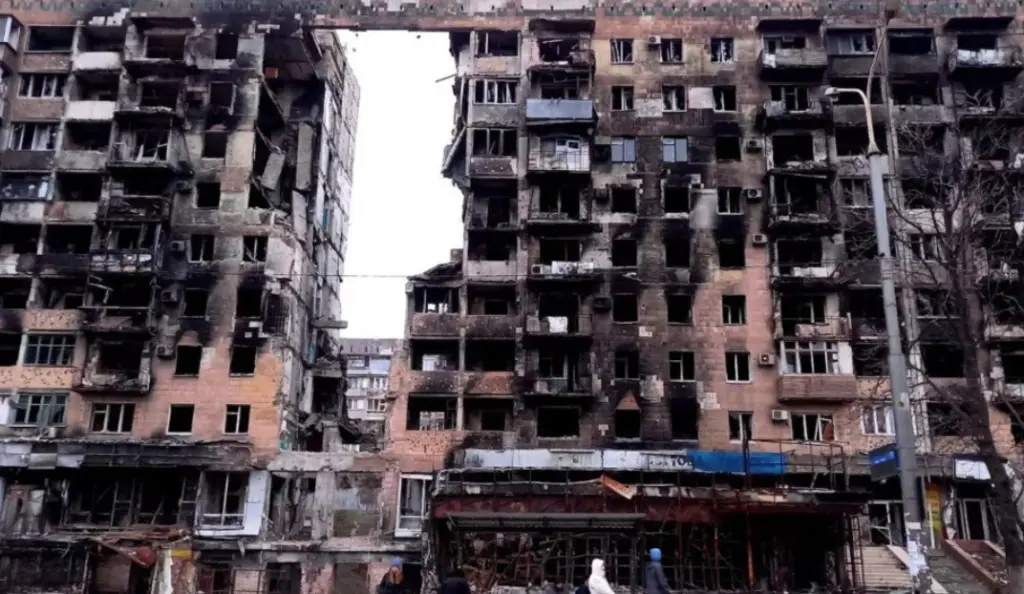
War-damaged apartment blocks in Mariupol with burned facades, shattered windows and exposed interiors.

Russians moving into occupied Mariupol are buying apartments built over Ukrainian homes destroyed during Russia’s 2022 siege, German broadcaster Deutsche Welle (DW) reported on 15 August 2026. Ukrainians who lived on the sites received none of the new units, a source told the outlet.

The construction is part of Russia’s wider Russification of occupied Mariupol. Occupation authorities have separately listed nearly 900 apartments for redistribution, including properties belonging to residents forced out by the siege.

Economist Vyacheslav Shiryaev said the new apartments are being bought primarily by newcomers, including Russian security personnel, officials, and military logistics workers. Some simply want to live by the sea but cannot afford property in occupied Crimea or Sochi, a Russian Black Sea resort, he said.

In Russia-occupied regions, borrowers with Russian citizenship are offered mortgages at 2% annual interest, DW reported.

Occupation authorities also ordered some residents out of apartments that had survived the attacks. Some were sent to hostels or accommodation on Mariupol’s outskirts instead of receiving replacement apartments, a source told DW.

Unable to enter occupied Mariupol, DW based its investigation on former residents’ accounts, satellite imagery, and online research.

Homes erased, residents pushed out

For former residents, homes destroyed in the siege are being replaced with apartments for newcomers.

Halyna Artemova, an English teacher, lived in one of the demolished apartment blocks for almost 40 years. A Russian missile struck the building in March 2022. Wounded by shrapnel, she escaped with her mother and son. A new high-rise now stands where her home once did.

Yevhen Sosnovskyi, a photographer, and his wife had lived in a neighboring building for 20 years. It caught fire during the attack, and Russian troops drove residents out without allowing them to take food or clothes.

Sosnovsky photographed his apartment before and after the attack, preserving a record of the home they lost. A parking lot now covers the site.

They’re building on human bones, and fast, to eradicate the traces of their crimes,” Sosnovsky told DW.
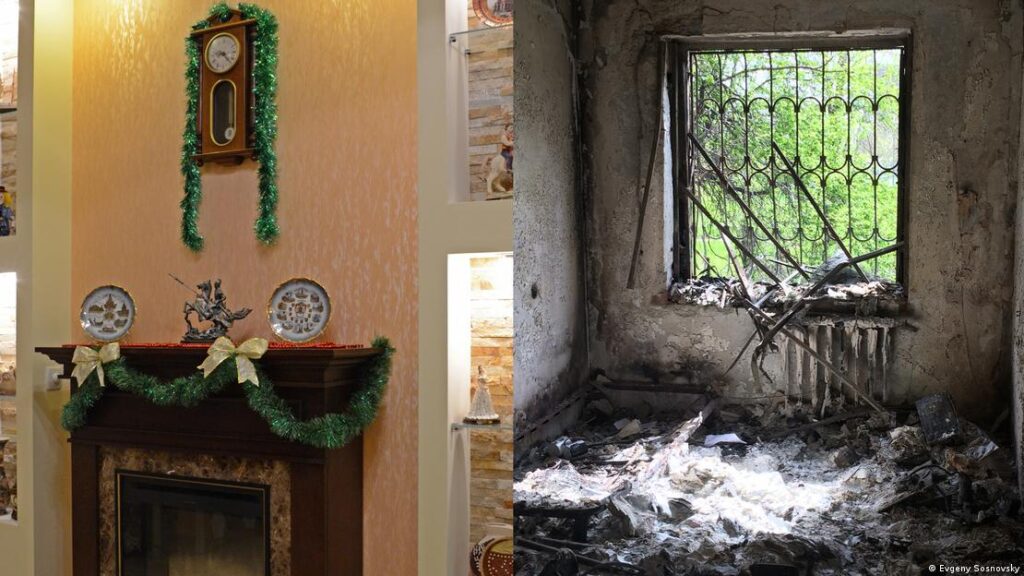
Photographer Yevhen Sosnovskyi documented his apartment before and after the Russian attack. Photo: Yevhen Sosnovskyi via DW.

Russia remakes a city it destroyed

The new housing is part of a wider Russian effort to reshape Mariupol after its forces destroyed and occupied the city. The UN assessed that up to 90% of the city’s residential buildings were damaged or destroyed.

On 16 March 2022, Russia bombed the Mariupol Drama Theater, where civilians sheltered beneath a large “CHILDREN” sign. An eyewitness described chaos, blood, and survivors using torn blankets as bandages.

In the wake of its destruction of the city, Moscow plans to move about 114,000 of its citizens into occupied Ukraine, with Mariupol as one of the main destinations.

  • ✇Euromaidan Press
  • Russia builds and expands at least 10 drone bases. Some could put Warsaw in range – Telegraph
    Russia has built or expanded at least 10 drone bases along its borders with Ukraine and Belarus, creating launch capacity for newer jet-powered attack drones, the most powerful of which could reach Warsaw, The Telegraph reported on 16 August 2026. The network expands Russia’s capacity for mass drone attacks on Ukraine, while some sites could later threaten NATO. The findings come as Russia is also expanding bases and other military infrastructure along NATO’s northern a
     

Russia builds and expands at least 10 drone bases. Some could put Warsaw in range – Telegraph

17 août 2026 à 09:07

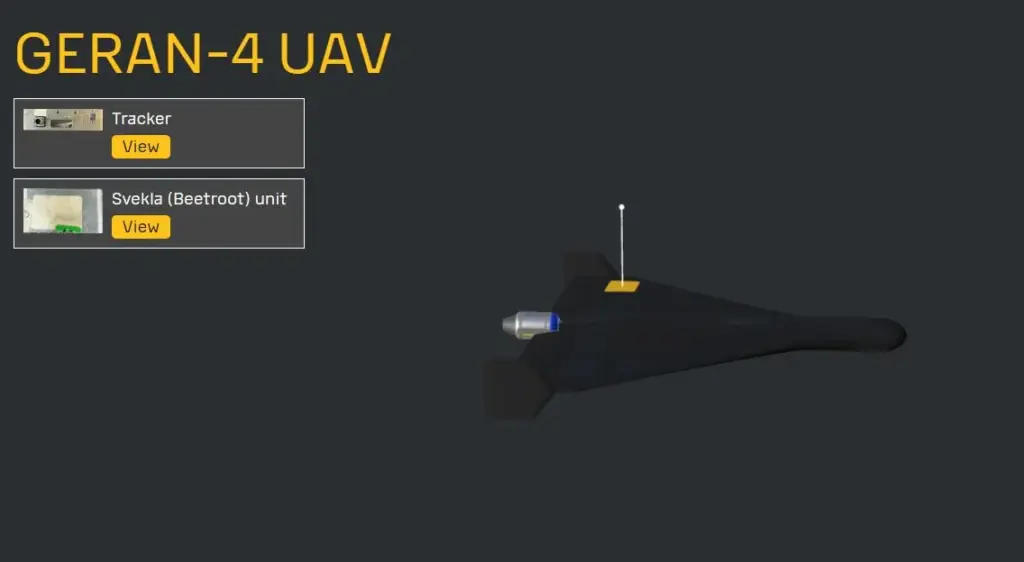
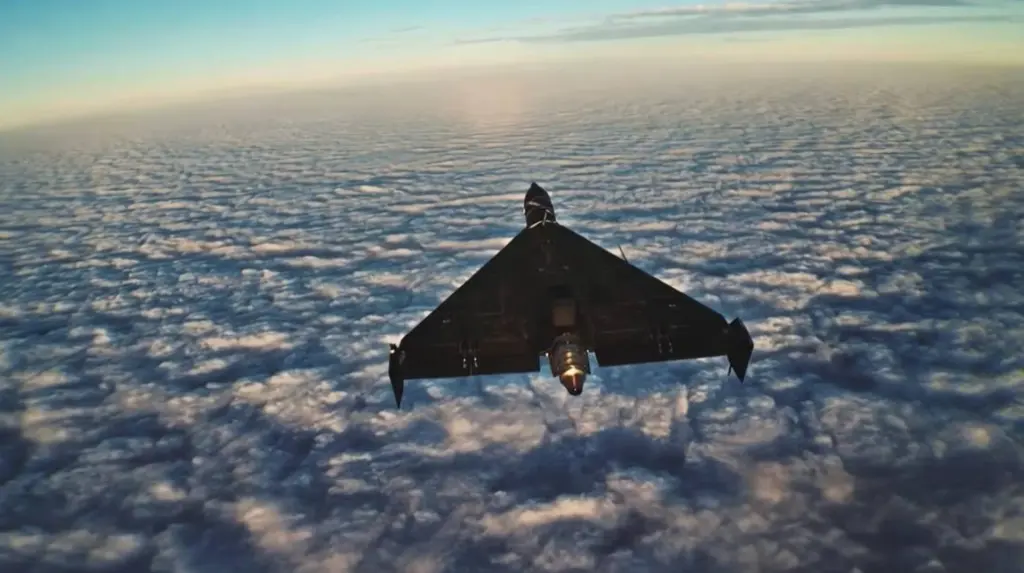
Diagram of a black Geran-4 jet-powered UAV with callouts identifying its tracker and Svekla electronic unit.

Russia has built or expanded at least 10 drone bases along its borders with Ukraine and Belarus, creating launch capacity for newer jet-powered attack drones, the most powerful of which could reach Warsaw, The Telegraph reported on 16 August 2026.

The network expands Russia’s capacity for mass drone attacks on Ukraine, while some sites could later threaten NATO. The findings come as Russia is also expanding bases and other military infrastructure along NATO’s northern and Baltic borders. The Telegraph found no evidence that Moscow is planning such an attack.

Seven of the 10 sites were used during recent bombardments of Kyiv, tracking data cited by The Telegraph showed. Using leaked documents, satellite imagery, and DroneSec's analysis, the newspaper identified at least 59 launch rails—tracks that launch fixed-wing drones without runways.

Around 20 appeared long enough for Russia’s latest long-range models, while one base could reportedly store over 1,000 drones.

Leaked Ukrainian documents cited by The Telegraph say the jet-powered Geran-4 and Geran-5 can carry 90-kilogram warheads. However, Ukrainian military intelligence puts the Geran-4’s range at up to 450 kilometers, while the larger Geran-5 has a stated range of up to 1,000 kilometers — enough to reach Warsaw from several of the new sites.

DroneSec founder Mike Monnik said expanded launch capacity and harder-to-intercept technology together increase pressure on Ukrainian air defenses.

Russia builds military infrastructure along NATO’s northern flank

Russia is also expanding military infrastructure elsewhere along NATO’s borders. A Nordic-Baltic investigation identified new or expanded infrastructure from Norway to Kaliningrad, with potential capacity for up to 115,000 personnel.

Satellite imagery showed new barracks, ammunition warehouses, and expanded bases near NATO’s northern and Baltic members.

The Institute for the Study of War, a US-based think tank, assessed that the construction likely supports future Russian operations against NATO rather than an imminent attack. Most Russian combat power remains committed to Ukraine, it said.

Other drone hubs support rapid Russian attacks

Russia has already built comparable hubs for attacks on Ukraine. Satellite imagery analyzed by the open-source intelligence group Strategic Aviation of Russia showed 10 additional launchers under construction at Tsymbulova in Oryol Oblast, following the start of work on 22 April 2026.

At occupied Donetsk Airport, the group identified enlarged launch pads, roads to a Geran and Gerbera drone warehouse, and the apparent construction of another storage building.

Ukraine’s Security Service (SBU) said it struck Shahed storage and launch sites at Primorsko-Akhtarsk on 2 August 2025. Ukraine’s Unmanned Systems Forces commander Robert "Madyar" Brovdi reported hitting drone logistics, warhead-storage, and preparation facilities at Donetsk Airport on 30 December 2025.

  • ✇Euromaidan Press
  • Nearly 500 Africans recruited into Russia’s army have died, Ukraine says
    486 Africans recruited into Russia’s armed forces are dead, while Ukraine is holding 35 citizens from 17 African countries as prisoners of war, Ukraine’s Ministry of Foreign Affairs (MFA) told Ukrainian public broadcaster Suspilne in findings published on 16 August 2026. Its overall tally rose only slightly from May, climbing from 2,965 recruits from 36 countries to at least 2,982 from 37. Russia’s recruitment in Africa is part of a broader effort to enlist foreigners f
     

Nearly 500 Africans recruited into Russia’s army have died, Ukraine says

17 août 2026 à 08:16

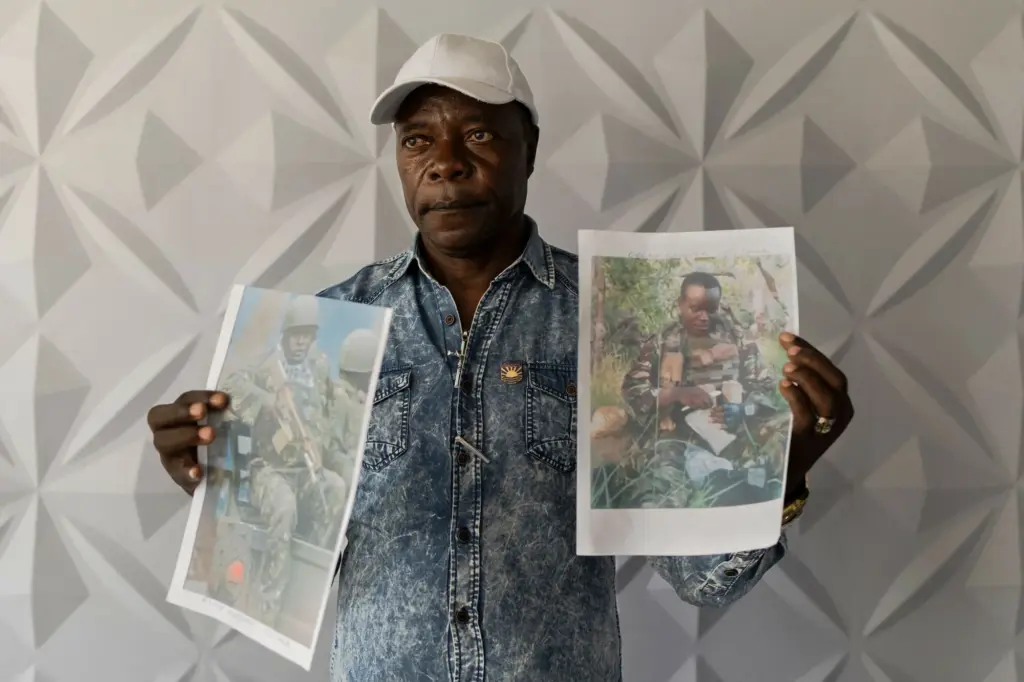
A Kenyan man holds two printed photographs of his son killed fighting for Russia.

486 Africans recruited into Russia’s armed forces are dead, while Ukraine is holding 35 citizens from 17 African countries as prisoners of war, Ukraine’s Ministry of Foreign Affairs (MFA) told Ukrainian public broadcaster Suspilne in findings published on 16 August 2026. Its overall tally rose only slightly from May, climbing from 2,965 recruits from 36 countries to at least 2,982 from 37.

Russia’s recruitment in Africa is part of a broader effort to enlist foreigners for its war. A joint human-rights investigation found that Russia had recruited at least 27,000 people from more than 130 countries since 2022. The system helps Moscow replenish its forces while shifting battlefield risk onto foreigners, many of whom are drawn in by financial pressure, deception, or coercion.

The largest groups of recruits came from Kenya, Egypt, Cameroon, Ghana, Nigeria, Uganda, Algeria, and Mali, the ministry told Suspilne.

Russia’s wider recruitment pipeline in Africa

Russian security services use a “broad arsenal of manipulative methods,” the Ukrainian MFA said. Recruiters promise civilian jobs, education, high salaries, Russian citizenship, or migration benefits. In many cases, foreigners must sign Russian-language military contracts under threat of deportation or imprisonment.

The FIDH–Truth Hounds–KIBHR report found recruiters using social media and intermediaries to advertise civilian jobs. Of 16 foreign POWs interviewed, 13 said they had been promised they would not fight. Most reached combat positions within weeks.

The human toll on African recruits

Kenyan engineer Francis told journalist Dmytro Karpenko, who interviews prisoners captured while fighting for Russia, that he thought he had accepted a security job. In Russia, he received a military uniform instead. After two weeks of training, he reached the front and was captured.

Nigerian recruits Hamzat Kazeen Kolawole and Mbah Stephen Udoka died in an assault after receiving little or no training, Ukrainian military intelligence said. Botswana reported “heartbreaking calls” from its citizens describing “perilous conditions” at the front.

Ukraine’s response to Russia's recruitment campaign

Ukraine’s diplomatic missions regularly inform African officials about the recruitment of their citizens and run awareness campaigns, according to the ministry.

The MFA and Ukraine’s POW Coordination Headquarters also launched Stop Russian Recruiters, a website that explains recruitment methods, shares victims’ accounts, advises people at risk and their families, and accepts reports about recruiters.

  • ✇Euromaidan Press
  • Man and woman attacked two children for speaking Ukrainian, Gdańsk consulate says
    Two adults allegedly attacked a 14-year-old Ukrainian girl and her 12-year-old brother after hearing them speak Ukrainian, Ukraine’s Consulate General in Gdańsk said. The attack occurred on 14 August 2026 in a park near a railway station in Bydgoszcz, north-central Poland. The case comes amid a documented rise in anti-Ukrainian violence in Poland, with recent attacks reported throughout the country. Recent incidents include attacks on Ukrainians in Poznań and Wrocław, a
     

Man and woman attacked two children for speaking Ukrainian, Gdańsk consulate says

17 août 2026 à 05:24

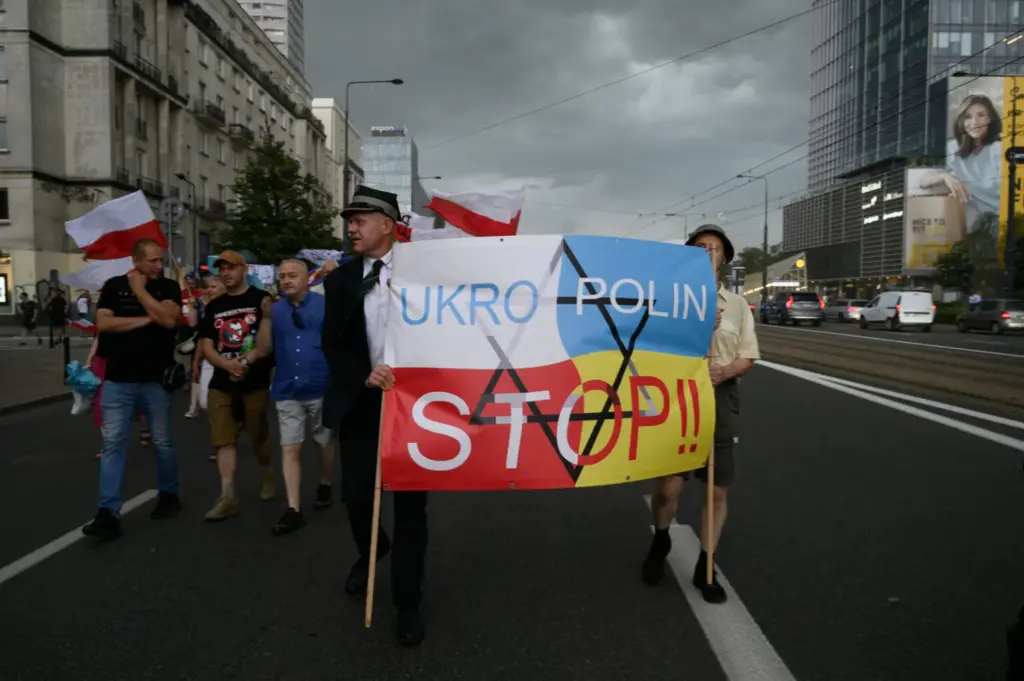
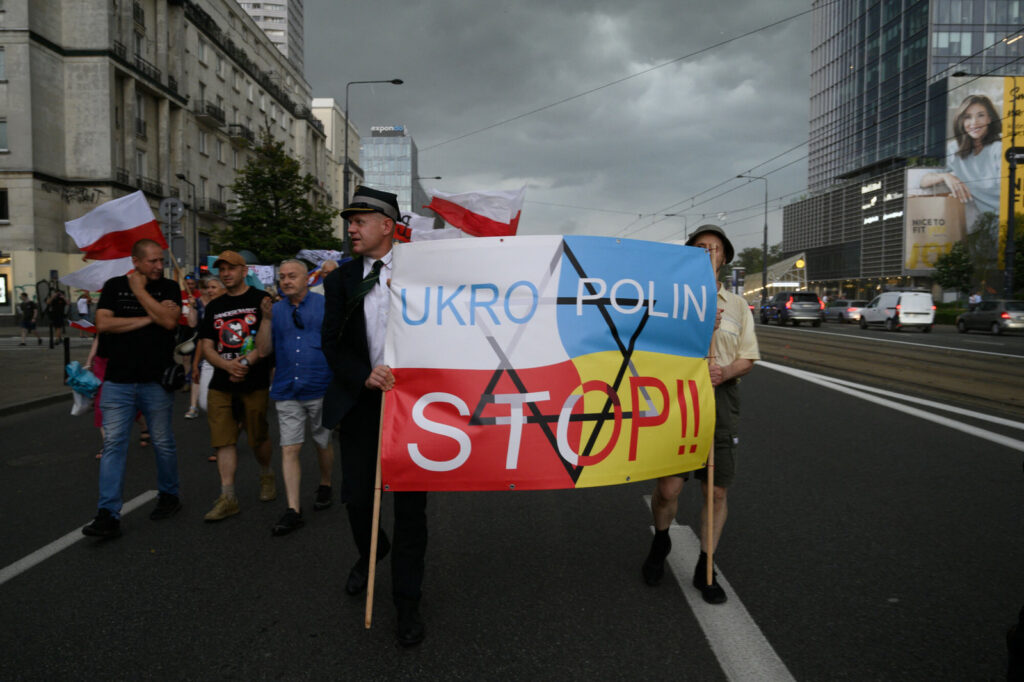
Demonstrators carrying Polish flags march behind a banner in Polish and Ukrainian colors reading “UKRO POLIN STOP!!” with a crossed-out Star of David.

Two adults allegedly attacked a 14-year-old Ukrainian girl and her 12-year-old brother after hearing them speak Ukrainian, Ukraine’s Consulate General in Gdańsk said. The attack occurred on 14 August 2026 in a park near a railway station in Bydgoszcz, north-central Poland.

The case comes amid a documented rise in anti-Ukrainian violence in Poland, with recent attacks reported throughout the country. Recent incidents include attacks on Ukrainians in Poznań and Wrocław, as well as on people mistaken for Ukrainians or defending them. Police data obtained by the Polish newspaper Rzeczpospolita showed 180 hate-crime reports involving Ukrainian citizens in the first half of 2026, over 30% more than a year earlier.

The pair, a man and woman with a small dog, shouted obscenities and made nationality-based threats, the consulate said.

They twisted a child’s arm, broke a toy drone, and threw fragments at the boy,” the Ukrainian consulate said, adding that the fragments scratched him.

The consulate said a complaint had been filed, police were searching for the pair, and the children were physically safe but severely stressed. It urged witnesses to contact the police. Polish police had not commented by the time of publication.

Other attacks on Ukrainians in Poland

The attack on the children came amid a string of assaults on Ukrainians across Polish cities.

Shortly after midnight on 13 August 2026, an intoxicated woman insulted two Ukrainian men, spat at one, and struck one of them outside a restaurant in Poznań, according to Polish media. Police detained her and another woman the following day.

In July, three men allegedly beat a young Ukrainian couple in Wrocław after first asking whether they were Ukrainian. Police detained two suspects and continued searching for the third.

That month, a man in Łódź attacked a passerby he supposedly mistook for a Ukrainian, breaking his nose and jaw. Three men also reportedly beat a 60-year-old Pole who intervened when they harassed a Ukrainian teenager on a Poznań tram.

The deepening Polish-Ukrainian rift and decline in relations

The attacks coincide with a broader decline in Polish-Ukrainian relations. Polish support for accepting Ukrainian refugees fell from 94% in March 2022 to 48% by early 2026, while politicians increasingly use Ukraine as a wedge issue.

Much of the fallout stems from disputes over the Volhynia massacres—the 1943–44 mass killings of Polish civilians by the Ukrainian Insurgent Army (UPA) and Polish retaliatory violence against Ukrainian civilians.

The dispute escalated after President Volodymyr Zelenskyy signed a 26 May decree granting a Ukrainian special forces unit the honorary title “Heroes of the UPA.” Polish President Karol Nawrocki responded on 19 June by stripping Zelenskyy of the Order of the White Eagle, Poland's highest state honor.

  • ✇Euromaidan Press
  • Former Polish PM accuses Ukrainian officials of letting robbers plunder massacre victims’ graves
    Former Polish prime minister Jarosław Kaczyński accused groups in western Ukraine of desecrating remains and stealing WWII-era victims’ jewelry. The leader of the national-conservative Law and Justice (PiS) wrote on X on 14 August 2026 that his party would demand Polish government intervention. Kaczyński’s claim comes amid growing anti-Ukrainian sentiment in Poland and a dispute with Kyiv over how Polish wartime victims are remembered. However, Kaczyński’s X post named
     

Former Polish PM accuses Ukrainian officials of letting robbers plunder massacre victims’ graves

16 août 2026 à 14:46

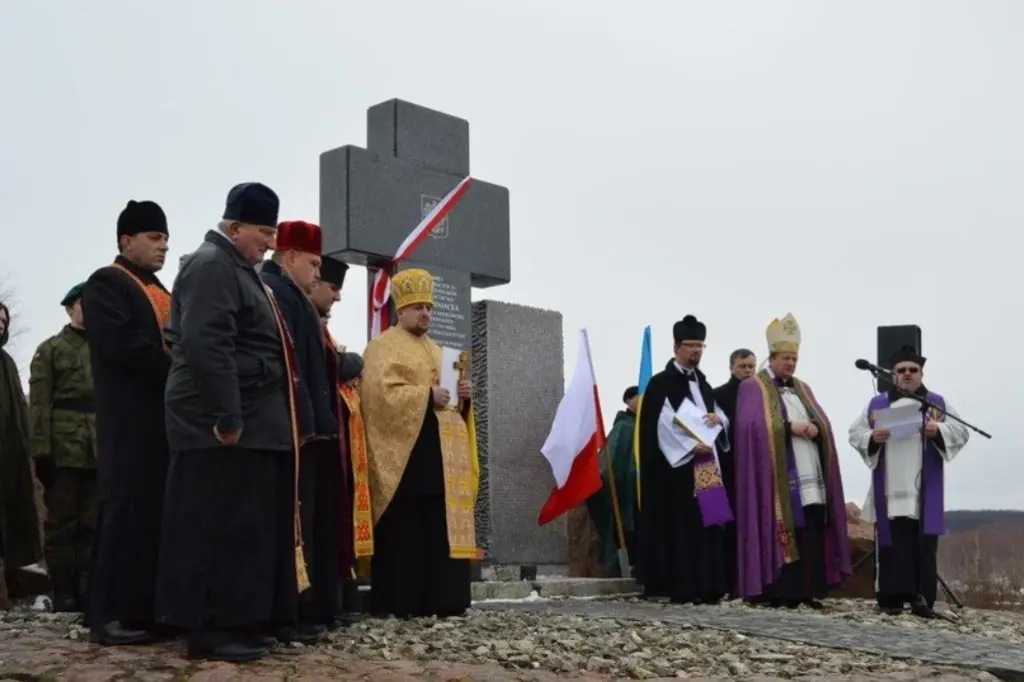
Polish and Ukrainian clergy stand beside a memorial cross during a ceremony, with both countries’ flags behind them.

Former Polish prime minister Jarosław Kaczyński accused groups in western Ukraine of desecrating remains and stealing WWII-era victims’ jewelry. The leader of the national-conservative Law and Justice (PiS) wrote on X on 14 August 2026 that his party would demand Polish government intervention.

Kaczyński’s claim comes amid growing anti-Ukrainian sentiment in Poland and a dispute with Kyiv over how Polish wartime victims are remembered. However, Kaczyński’s X post named no location and provided no public evidence, while authorized Polish-Ukrainian teams continue exhuming and reburying Polish victims.

“Illegal excavations at the sites of former Polish villages in Eastern Galicia are turning out to be real,” Kaczyński wrote, referring to a historical region now largely in western Ukraine.

He called the alleged looters “black diggers,” a term for people who dig through burials or archaeological sites for valuables. He said they were pilfering the graves of Poles killed in the World War II-era Volhynia massacres and alleged that local Ukrainian officials were allowing it.

Kaczyński said PiS would appeal to Poland’s state authorities, including the Foreign Ministry, and demand “explanations and a response.”

The evidence described by PiS has not been made public. Onet reported that it was unclear which incidents he meant and that neither government had responded at the time. PiS spokesperson Rafał Bochenek later told the publication Interia that citizens had sent photographs allegedly showing damaged graves and listings for excavated objects. Interia published neither.

Polish-Ukrainian teams continue authorized exhumations

Meanwhile, Poland’s Institute of National Remembrance (IPN), the country's state historical institute, said Ukraine authorized its latest excavations at Ostrówki and Wola Ostrowiecka in Volyn.

From 13 July to 7 August, Polish and Ukrainian specialists recovered 55 victims, including 26 children. They also secured more than 300 personal items and pieces of clothing. The remains are due to be buried at Ostrówki cemetery on 30 August.

The excavation followed a wider thaw. Ukraine lifted its moratorium on Polish searches, while joint teams exhumed and reburied 42 people at Puźniki in 2025. Both countries have exchanged lists of sites for further searches.

Historical disputes deepen the Polish-Ukrainian rift

Relations between Kyiv and Warsaw worsened after Ukraine gave a military unit the honorary title “Heroes of the Ukrainian Insurgent Army (UPA)."

The UPA fought for Ukrainian independence but is held responsible in Poland for the World War II-era massacres of Polish civilians. Polish President Karol Nawrocki later stripped President Volodymyr Zelenskyy of the Order of the White Eagle, Poland’s highest state honor.

Violence is also rising on the Polish streets. Reports of suspected hate crimes against Ukrainians in Poland rose by more than 30% in the first half of 2026, even as anti-xenophobic voices became more visible online. Kaczyński’s claim adds an unverified criminal allegation to the dispute.

  • ✇Euromaidan Press
  • British drones hit Russia for first time in Ukraine’s deep-strike campaign – The Sunday Times
    Ukrainian forces have used British drones to attack targets inside Russia for the first time, adding two UK-built systems to Kyiv’s arsenal, The Sunday Times reported on 15 August, citing Ukrainian military sources. The newspaper explicitly identified oil refineries in Volgograd and Yaroslavl among the targets struck during the previous six months. Ukraine still relies mainly on domestically produced drones. But the British systems give Kyiv cheaper weapons that can be
     

British drones hit Russia for first time in Ukraine’s deep-strike campaign – The Sunday Times

16 août 2026 à 14:29

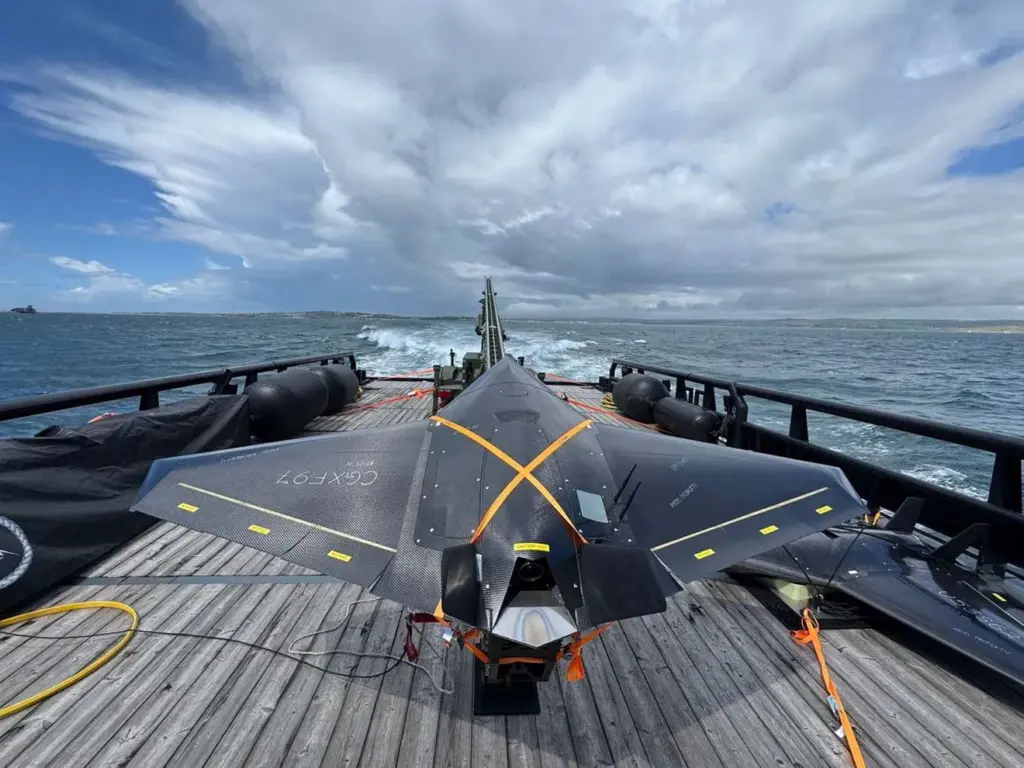
Black Nyan one-way attack drone secured to a launcher on the deck of a Royal Navy vessel at sea.

Ukrainian forces have used British drones to attack targets inside Russia for the first time, adding two UK-built systems to Kyiv’s arsenal, The Sunday Times reported on 15 August, citing Ukrainian military sources. The newspaper explicitly identified oil refineries in Volgograd and Yaroslavl among the targets struck during the previous six months.

Ukraine still relies mainly on domestically produced drones. But the British systems give Kyiv cheaper weapons that can be replenished and launched in volume. They help sustain Kyiv's attacks on Russian oil, logistics, and military targets without running down limited stocks of Western long-range missiles.

The Sunday Times called this a new phase in UK–Ukraine military cooperation. A senior British defense source said the deployments showed London was “not nervous anymore” about Russian pressure.

What British support adds to Ukraine’s homegrown drone force

Britain has supplied Ukraine with two systems with very different ranges. The Nyan, a jet-powered one-way attack drone made by BAE Systems subsidiary Callen-Lenz, can travel more than 150 miles. The second is catapult-launched and has a range above 600 miles; The Sunday Times withheld its manufacturer’s name on security grounds.

Long-range drones typically cost £50,000 to £100,000, compared with more than £750,000 to replace a Storm Shadow missile, the newspaper said. They can also be stockpiled and launched in swarms, helping Ukraine strain Russian air defenses without exhausting finite missile stocks.

The drones extend wider British support. In June, the UK announced funding for 150,000 Ukrainian-produced drones by the end of 2026. Ukrainian forces have also deployed British Rapid Ranger systems against Russian Shaheds and used UK-supplied Storm Shadows inside Russia, protecting Ukraine at home while widening its options across the border.

Ukraine’s deep-strike campaign reaches 52 Russian regions

Across Ukraine’s overall campaign, The Sunday Times reported almost 700 successful deep strikes between January and June. They reached 52 Russian regions and caused more than £35 billion (about $47.3 billion) in economic damage.

A senior Ukrainian military source said the British systems were proving successful. “When we launch them, we always say Slava Ukraini and God save the King,” the source told The Sunday Times.

Former UK Air Marshal Greg Bagwell predicted Moscow would “sabre rattle” and potentially declare British factories legitimate targets. Other defense sources warned of intensified cyberattacks or espionage against the UK.

  • ✇Euromaidan Press
  • NYT: France, Germany and UK build joint format to secure Europe a place in Ukraine peace talks
    France, Germany, and the UK are working to create a format representing Europe in talks over Russia’s war against Ukraine, The New York Times reported on 15 August, citing five European officials. Known collectively as the E3, the three countries would support Ukraine’s position and protect European interests in any settlement. The initiative is Europe’s attempt to secure a place in talks the US is expected to lead. The three governments fear that Washington and Moscow
     

NYT: France, Germany and UK build joint format to secure Europe a place in Ukraine peace talks

16 août 2026 à 12:38

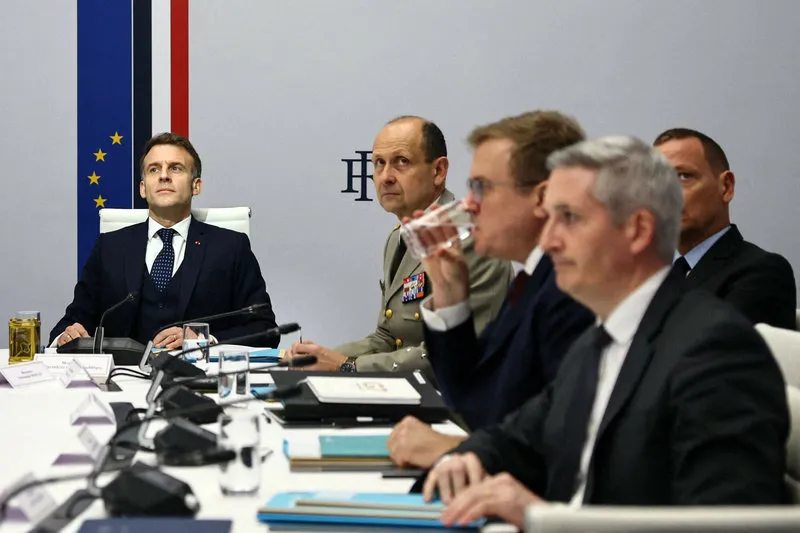
French President Emmanuel Macron sits with military officers and government officials during a Coalition of the Willing meeting in Paris on 24 February 2026.

France, Germany, and the UK are working to create a format representing Europe in talks over Russia’s war against Ukraine, The New York Times reported on 15 August, citing five European officials. Known collectively as the E3, the three countries would support Ukraine’s position and protect European interests in any settlement.

The initiative is Europe’s attempt to secure a place in talks the US is expected to lead. The three governments fear that Washington and Moscow could reach a deal without them, although Europe would have to enforce sanctions, decide how to use frozen Russian assets, and help protect Ukraine afterward. European officials also doubt Washington will stay committed to serious negotiations.

The officials expect Washington to lead negotiations with Moscow. The E3 wants to become the core group supporting Ukraine, following Kyiv’s request that it prepare for talks. France and Germany are shaping the position, while Britain fears damaging relations with Trump.

Poland, Italy, and the Nordic countries would be consulted, with the EU later involved. Some Baltic states and Hungary do not trust France and Germany to represent them. London called the discussion speculative.

The Coalition has rehearsed a force but not agreed to deploy it

The E3 forms the core of the Coalition of the Willing. At a 7 June meeting with President Volodymyr Zelenskyy, its leaders backed an immediate ceasefire and legally binding guarantees, including the deployment of a multinational force.

More than 600 British troops rehearsed with French paratroopers and an Italian platoon in February for a possible deployment. They could form the core of a 10,000-strong force pledged by London and Paris after a ceasefire.

Yet some members reportedly made Russia’s consent a condition for deploying troops, effectively giving Moscow a veto. Bulgaria has left, and Germany has not committed troops. The Coalition’s leadership is also shifting after Keir Starmer’s resignation and ahead of Emmanuel Macron’s departure in 2027.

Ukraine talks still misunderstand Russia's intentions

European officials see few signs that Vladimir Putin is ready for serious negotiations, the NYT reported. A separate EU attempt to open direct contact with Moscow divided member states.

Experts told Euromaidan Press that Russia uses peace processes to stall, press maximalist demands, and improve its battlefield position. Moscow also dismissed a Black Sea ceasefire proposal after Kyiv offered a mutual halt to attacks on civilian targets.

Ukraine’s partners risk mistaking Russia’s presence at talks for a willingness to compromise. Former Ukrainian diplomat Iuliia Osmolovska warned that Moscow also benefits from failed negotiations by exhausting Western governments until they pressure Kyiv to concede.

Before 2022, Russia signed 26 ceasefires in eastern Ukraine; none lasted more than two weeks. A pause can bank concessions, rotate troops, and let Moscow resume fighting from a stronger position.

  • ✇Euromaidan Press
  • Stranded beside a frontline road, a dog found rescuers in Ukrainian soldiers
    A dog was caught in mesh beside a frontline road and could not free itself. Ukrainian soldiers stopped their vehicle, cut away the netting, and released it, as footage Ukrainian serviceman Denys Lysak posted on 10 August 2026 shows. The netting is meant to shield traffic from Russian FPV drones, but it can also trap animals left in the combat zone. The roadside rescue reflects how Russia's war against Ukraine has adversely impacted animals throughout Ukraine, while also
     

Stranded beside a frontline road, a dog found rescuers in Ukrainian soldiers

16 août 2026 à 09:44

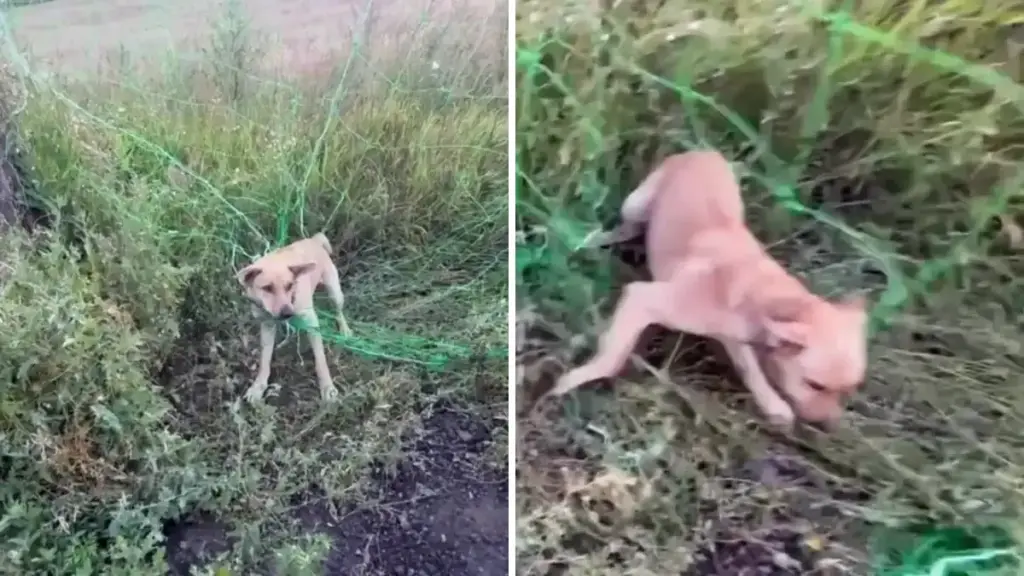
Side-by-side screenshots show a tan dog trapped in green anti-drone netting and moving free after Ukrainian soldiers cut it loose.

A dog was caught in mesh beside a frontline road and could not free itself. Ukrainian soldiers stopped their vehicle, cut away the netting, and released it, as footage Ukrainian serviceman Denys Lysak posted on 10 August 2026 shows.

The netting is meant to shield traffic from Russian FPV drones, but it can also trap animals left in the combat zone. The roadside rescue reflects how Russia's war against Ukraine has adversely impacted animals throughout Ukraine, while also highlighting a familiar relationship along Ukraine’s front, where soldiers feed, shelter, and sometimes take in the animals they encounter.

Lysak wrote that animals left without owners suffer greatly in areas affected by fighting. Ukrainian troops try to feed, evacuate, or shelter them, he said. Many units have taken in several rescued cats and dogs.

“Unfortunately, you can’t help all of them, but we try,” Lysak said.

The animals Ukrainian troops find at the front

Across Ukraine, animals are caught in the crossfire—injured, stranded, or driven from their habitats. Sometimes Ukrainian troops reach them in time, as they did during the Special Operations Forces' (SSO) “Operation Bambi.”

Rangers from the 6th Separate Special Operations Regiment found a frightened fawn while clearing a Russian position, according to footage the SSO released on 15 August. The video shows the animal nestled against one soldier as the unit moved out.

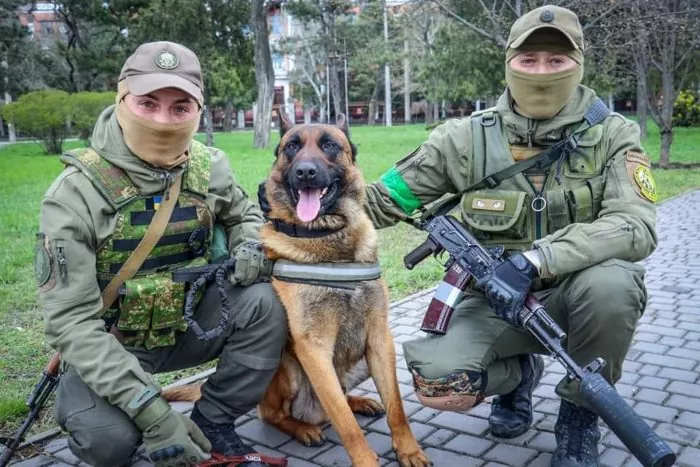
Some animals remain with the units that find them. Euromaidan Press reported in 2022 on Max, a Belgian shepherd abandoned by a Russian National Guard unit in Mykolaiv Oblast. A villager sheltered him before handing him to Ukraine’s National Guard, where handlers began teaching the former Russian service dog to follow commands in Ukrainian.

Photo of Max. Source: 19th Regiment of the National Guard of Ukraine

The fawn’s destination remains unknown. The SSO said only that it had been evacuated from the danger zone. Kharkiv volunteers had evacuated 18,800 animals by October 2024, but only around one-fifth had been reunited with their owners.

Russia's assault on Ukraine's ecosystem

Russia’s war has also affected wildlife beyond the trenches. Marine biologist Ivan Rusev estimated that more than 100,000 Black Sea dolphins have died since 2022, with sonar, underwater blasts, mines, and pollution among the suspected causes.

Russia’s destruction of the Kakhovka Dam dealt another blow. The floodwaters swept through areas holding 70% of the world’s Nordmann’s birch mice and half its sandy blind mole-rats, while killing tens of thousands of nesting birds.

  • ✇Euromaidan Press
  • Kyiv’s largest book market hit by Russian missiles
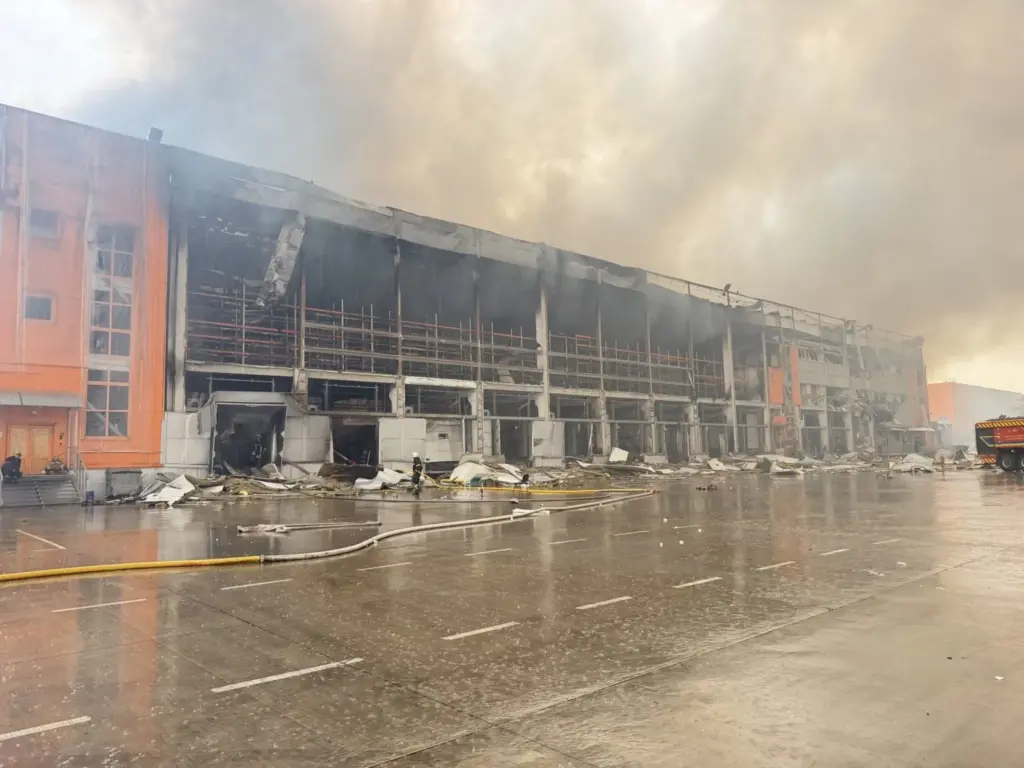
    Ukrainian emergency services confirmed a large fire at the Pochaina book market in Kyiv’s Obolonskyi district after an overnight Russian ballistic attack on 16 August. Several rows of stalls were burned. The strike comes amid mounting losses across Ukraine’s book industry, as Russian strikes burn printing houses, markets, and the millions of books within them. Pochaina’s latest fire is at least the third to damage the market or adjoining trading rows since mid-June. For
     

Kyiv’s largest book market hit by Russian missiles

16 août 2026 à 08:42

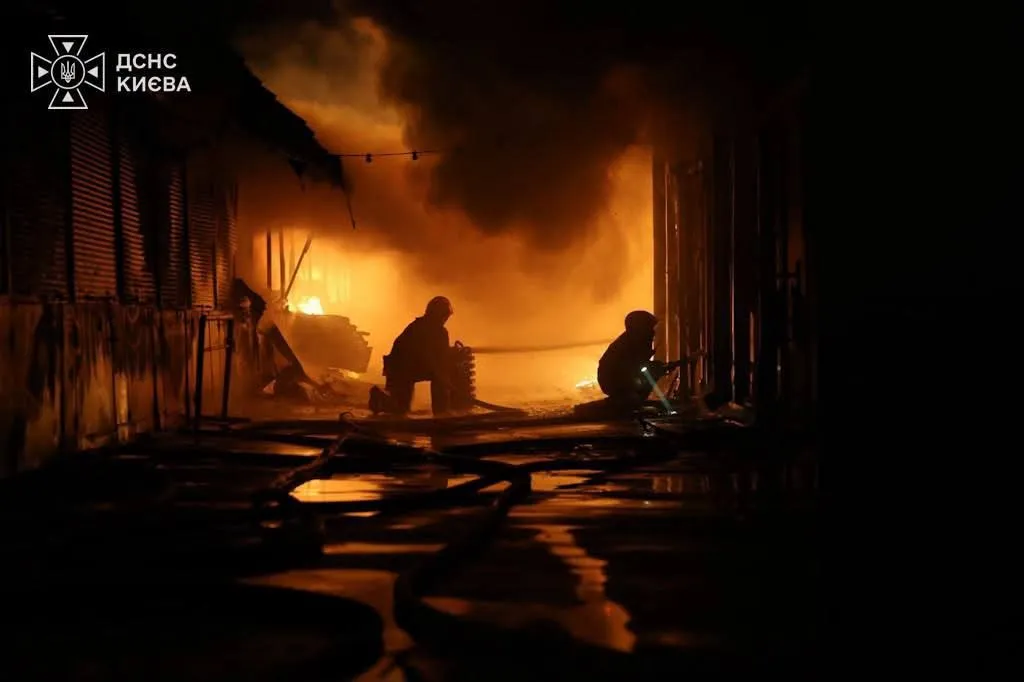
Three firefighters work amid flames and thick smoke at night.

Ukrainian emergency services confirmed a large fire at the Pochaina book market in Kyiv’s Obolonskyi district after an overnight Russian ballistic attack on 16 August. Several rows of stalls were burned. The strike comes amid mounting losses across Ukraine’s book industry, as Russian strikes burn printing houses, markets, and the millions of books within them.

Pochaina’s latest fire is at least the third to damage the market or adjoining trading rows since mid-June. For decades, the sprawling market has served as part bookshop, part flea market, and part archive of Kyiv life — a place to hunt through rare titles, vinyl, and remnants of the 20th century. Officials have not said Russia deliberately targeted it, however, the damage lands amid repeated attacks on Ukraine’s publishing chain and efforts to remove Ukrainian literature under occupation.

By 9:36 a.m., rescuers had extinguished fires at four locations in Kyiv and were dismantling damaged structures. Three people were hospitalized: two in moderate condition and one with light injuries. Pochaina metro station remained open, but damage to its glass entrance temporarily closed one vestibule.

На книжковому ринку у Києві рятувальники долають наслідки атаки.

Кілька рядів торговельного павільйону вигоріли. У багатьох інших — пошкоджені вікна. Книжки продовжують тліти

Відео: Ірина Сітнікова / hromadske pic.twitter.com/Bq3p4x6MT8

— hromadske (@HromadskeUA) August 16, 2026

Founded in 1997, Pochaina grew into Kyiv’s largest book market, offering everything from novels to specialist literature, according to a 2020 preservation petition. Independent vendors organized to defend it after plans emerged to clear the site for another shopping center. The campaign described the market as a cultural institution that supported thousands of jobs.

The adjoining weekend flea market endured the invasion and disappearance of tourists. In 2023, the Associated Press found hundreds browsing stalls stocked with vintage medals, ceramics, VHS tapes, and cracked guitars.

Russia destroys books as part of its war against Ukraine

Russian attacks have damaged publishing houses, printing plants, warehouses, libraries, bookshops, and markets across Ukraine.

The 16 August attack was not the first time Russia had hit Pochaina. A Russian attack damaged book-market pavilions in mid-June. On 30 July, falling missile debris ignited nearby stalls and destroyed collections of antiques, vinyl, and Ukrainian household artifacts, Suspilne reported.

Russia's war against Ukraine has particularly devastated Ukraine's publishing houses and their infrastructure. A 2024 Russian strike on Kharkiv’s Factor Druk printing house killed seven workers and burned 50,000 books. On 1 August 2026, a drone destroyed about eight million books at publisher Ranok’s warehouse.

Reuters reported that Russian strikes destroyed more than 10 million books in recent months.

In occupied areas, Russian forces have also seized Ukrainian history books and burned Ukrainian literature in boiler houses, Ukrainian authorities say.

Yet the Ukrainian book industry continues to thrive, despite Russia's assault. In 2025, Ukraine registered a record 117 new publishing businesses.

Ukrainian rapper mocked Russia’s claim he helped deliver drones for attacks near Moscow. A month later, Russia allegedly tried to kill him in Poland

16 août 2026 à 05:28

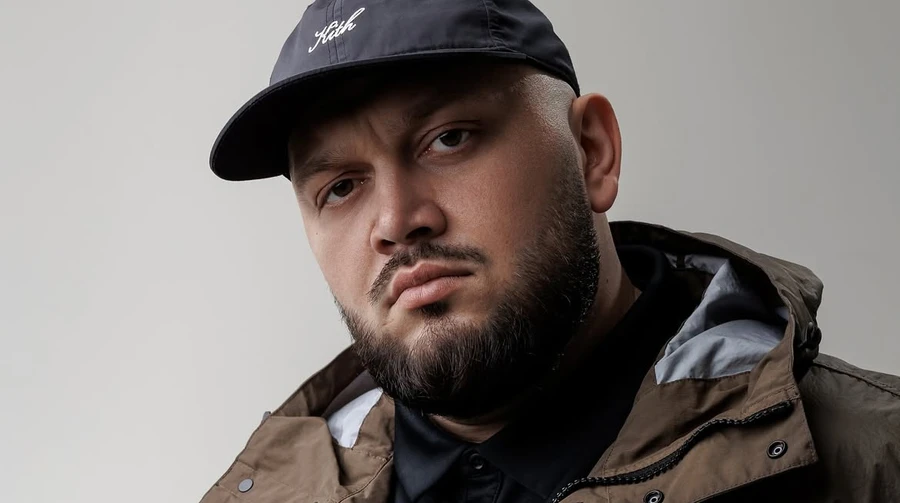
Ukrainian-American rapper Kyivstoner wearing a black cap and dark jacket.

On 14 August 2026, Polish broadcaster RMF FM identified American-Ukrainian rapper and video blogger Kyivstoner as the previously unnamed target of an alleged Russian-directed assassination plot in Warsaw. The case comes as European authorities investigate suspected Russian attacks and sabotage across the continent.

The alleged plot against Kyivstoner comes amid attacks on Kremlin critics abroad, including the fatal shooting of a Russian opposition artist in Poland in June.

Polish authorities disclosed the Kyivstoner's case on 13 August but withheld the target’s identity. RMF’s identification points to a possible motive, though it relies on unverified allegations from the FSB, Russia's domestic security agency that Kyivstoner of managed drone deliveries intended for attacks near Moscow.

Who is Kyivstoner?

Kyivstoner was born Albert Vasiliev and uses the name Slevin Dadyan on his US passport. He gained attention through humorous videos and the Ukrainian group Hryby before releasing solo tracks, including “Leto” (Summer) and “Zvuk” (Sound).

In a 2025 interview, Vasiliev voiced support for Ukrainians and opposition to Russian occupation, saying Russian ruler Vladimir Putin made him angry and that he wanted civilians and soldiers to stop dying.

In July 2026, Russia’s FSB accused Kyivstoner of overseeing logistics for a foiled drone attack on a defense enterprise near Moscow.

The agency alleged that 35 drones assembled in Kyiv were concealed in a shipment of ceramic tiles and smuggled into Russia through Slovakia, Poland, and Belarus. Russian authorities also added Vasiliev to a register of people they label as involved in extremist or terrorist activity.

Vasiliev responded on Instagram by mocking Russia's allegation, saying he had been relaxing and playing video games rather than organizing an attack.

Russian authorities also accuse him of cooperating with Ukrainian intelligence. He denies the accusations, and RMF offered no independent evidence to substantiate them.

Suspect detained before alleged attack

Prime Minister Donald Tusk said Polish services detained the Russian suspect on 7 August, stopping the alleged attack “at the last minute.” US services assisted the operation. A Polish court remanded the man in custody for three months.

The journalists described the Russian citizen as a native of Donbas in eastern Ukraine. Tusk said the target, who holds Ukrainian and US passports, was “inconvenient to the Putin regime.”

The prime minister called it the first Russian-ordered attempt of its kind against a US citizen in another NATO country.

Killings and disrupted plots across Europe

Throughout Europe, Russia has tried to hunt down and kill anti-Kremlin critics and supporters of Ukraine. In June, Russian opposition artist Robert Kuzovkov, known as Semyon Skrepetsky, was shot dead in eastern Poland. Hours earlier, he had reported threats from “Russian patriots.” Polish authorities detained two Belarusian nationals, but have not attributed the killing to Moscow.

US and German services also reportedly foiled a Russian plot against Rheinmetall CEO Armin Papperger in 2024. German intelligence later treated the surveillance of Bavarian drone manufacturer Donaustahl’s CEO as a suspected planned assassination.

“Get the f*ck back to Ukraine”: Two intoxicated Polish women attack Ukrainian men amid rise in anti-Ukrainian violence in Poland

16 août 2026 à 04:07

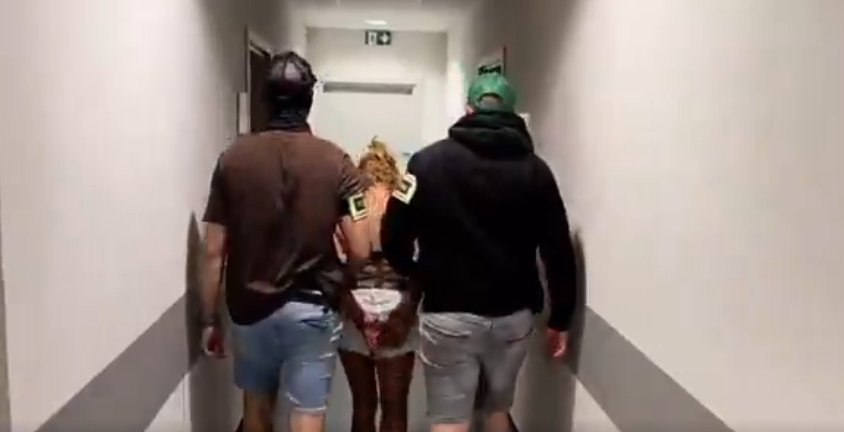
A woman with her hands behind her back walks between two masked police officers down a white corridor.

Polish police detained two women in connection with an attack on Ukrainian men outside a Poznań restaurant, Interior Minister Marcin Kierwiński announced. The incident comes as Polish-Ukrainian relations grow more strained and public attitudes toward Ukrainians worsen. The incident occurred shortly after midnight on 13 August on Półwiejska Street.

Police data obtained by Rzeczpospolita show 180 hate-crime reports involving Ukrainian citizens in the first half of 2026, over 30% more than a year earlier. Police have not said whether they are treating the Poznań case as a hate crime, although the recording includes nationality-based abuse.

One woman insulted two Ukrainian men, spat at one, knocked over a restaurant parasol, and struck one of the men, the Polish radio station RMF FM reported.

Półwiejska core pic.twitter.com/n2KGfyDRA7

— poznan_moment (@poznan_moment) August 13, 2026

Regional police spokesperson Iwona Liszczyńska said officers responded to reports of two apparently intoxicated women. However, the women had left before officers arrived. Police contacted the restaurant manager, who filed a formal complaint on the morning of 14 August. Officers had already begun identifying the women before the complaint was filed.

Kierwiński first reported that police had detained one woman and identified the other. He later announced the second woman’s detention and declared “zero tolerance for aggression and hatred.”

Previous attacks on Ukrainians in Poland

Kierwiński’s warning followed a series of attacks against Ukrainians in Poland this year. In July, three men allegedly beat a Ukrainian couple in Wrocław after asking whether the woman was Ukrainian. Police detained two suspects and treated the assault as a nationality-motivated hate crime.

In May, police detained five suspects aged 15 to 18 after an attack on three Ukrainian teenagers in Warsaw. One of them, 16-year-old Artem, suffered a fractured skull. 

Earlier in July, two men linked to Poland’s far right confronted a Ukrainian woman at her legal-aid office in Poznań. They demanded entry and asked whether she supported Stepan Bandera, a WWII-era Ukrainian nationalist disliked by many Poles.

Historical dispute deepens political rift

The Poznań incident comes as anti-Ukrainian themes have gained ground in Polish far-right politics, while Warsaw and Kyiv remain divided over the WWII-era Ukrainian Insurgent Army. Many Ukrainians honor the UPA for resisting Soviet rule. Poland holds it responsible for massacring Polish civilians. 

Poland and Ukraine’s dispute over the Volhynia massacres, exhumations, and UPA symbols has prompted protests and a diplomatic clash over state honors. Police have not linked the Poznań attack to that dispute. 

Reported Flamingo strike hits Samara industrial area housing factory that builds rockets for Russia’s Starlink rival

15 août 2026 à 06:01

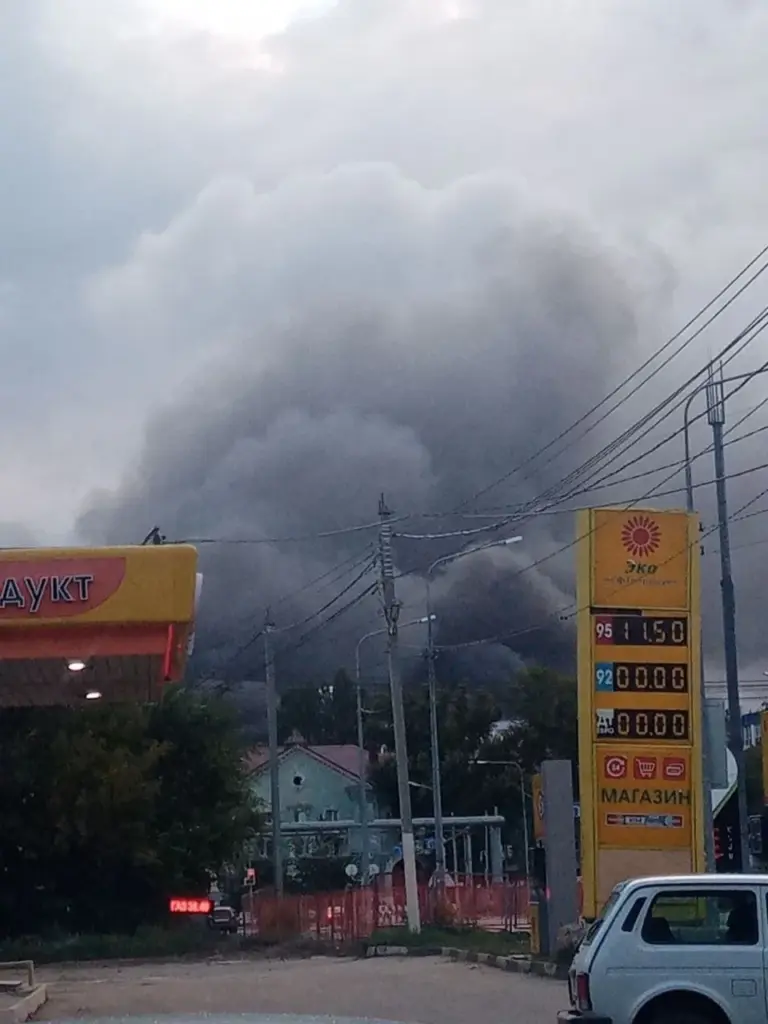
Thick gray smoke rises behind buildings, power lines, and a fuel station in Samara after a reported missile strike.

Samara Oblast Governor Vyacheslav Fedorishchev confirmed that a missile struck an unnamed industrial enterprise overnight on 15 August 2026. Andrii Kovalenko, head of Ukraine’s Center for Countering Disinformation, said the Progress Rocket Space Center was burning. He provided no damage details.

Progress would be a significant target because it builds Soyuz-2 rockets used to launch Rassvet, Russia’s planned alternative to Starlink. Its Soyuz-2.1b rockets carried Russia’s first serial-production Rassvet satellites into orbit this year. However, neither the governor’s statement nor available imagery establishes that Progress itself was hit.

Exilenova+ published early footage from Samara and reported that a Flamingo cruise missile had struck the city.

A mature Rassvet network could reduce Russia’s dependence on unauthorized Starlink terminals. For now, neither damage to Progress nor the reported use of a Flamingo missile has been independently confirmed.

❗Two Ukrainian FP-5 Flamingo cruise missiles reportedly struck Samara. The likely target was TsSKB-Progress. TsSKB-Progress develops, produces and operates medium-class launch vehicles and spacecraft for Earth observation and scientific purposes. The enterprise says more than… pic.twitter.com/VW09MVpRuU

— NOELREPORTS 🇪🇺 🇺🇦 (@NOELreports) August 15, 2026
Open-source analysts at Falcon Insight Map geolocated the smoke near Aviakor’s Building No. 106. Militarnyi said Aviakor and Progress sit a few hundred meters apart, and available images could not establish which enterprise was hit. The industrial area lies roughly 900 kilometers from Ukraine.

Kyiv pushes strikes deeper into Russia

Ukraine has increasingly attacked factories far behind the front to disrupt the supply chains sustaining Russian weapons production.

Speaking separately to Euromaidan Press, defense scholar Marc DeVore urged Ukraine to disrupt Russian missile production and launches. Retired US Lieutenant General Ben Hodges noted that Ukraine’s interceptor shortage means it is better to “kill the archer” than try to stop every arrow. 

In June 2026, Ukrainian cruise missiles hit a Voronezh semiconductor plant supplying components for the Pantsir-S1, Iskander-K, and Kh-101.

MISSILE ATTACK IN SAMARA, RUSSIA

INSANE FOOTAGE OF THE DIRECT HIT

🇺🇦🇷🇺‼‼‼‼‼‼‼‼‼‼‼‼‼ pic.twitter.com/8UVHSL5hid

— WW3 Monitor (@WW3_Monitor) August 15, 2026

A reported Flamingo strike in July also damaged the Avitek defense plant in Kirov, more than 1,200 kilometers from Ukraine.

The deeper strikes come as Ukraine’s military intelligence (HUR) says Russian factories are producing 110% to 120% of their monthly missile quotas. 

How the Samara plant supports Russia’s Starlink alternative

The Progress factory in Samara makes the Soyuz-2.1b rockets used to launch Rassvet satellites developed by Russia’s Bureau 1440. A second batch of 16 entered orbit in July, bringing the serial constellation to 32.

Rassvet’s coverage remains intermittent. However, Moscow plans to deploy 292 satellites by the end of 2027 and 924 by 2035. A Ukrainian defense adviser estimated that continuous service would require 200–250 satellites.

  • ✇Euromaidan Press
  • Ukraine: 18 of 26 Russian oil and stolen-grain ships face no sanctions
    On 14 August, Ukraine's Military Intelligence (HUR) published data on 26 vessels via its War&Sanctions portal, noting that 18 ships face no sanctions from any of Ukraine's partner countries. The agency said the ships carry Russian oil, liquefied natural gas (LNG), or agricultural products from occupied Ukraine. Euromaidan Press could not independently verify HUR’s vessel records. Russia relies on maritime trade both to fund its war through energy exports and to s
     

Ukraine: 18 of 26 Russian oil and stolen-grain ships face no sanctions

14 août 2026 à 12:40

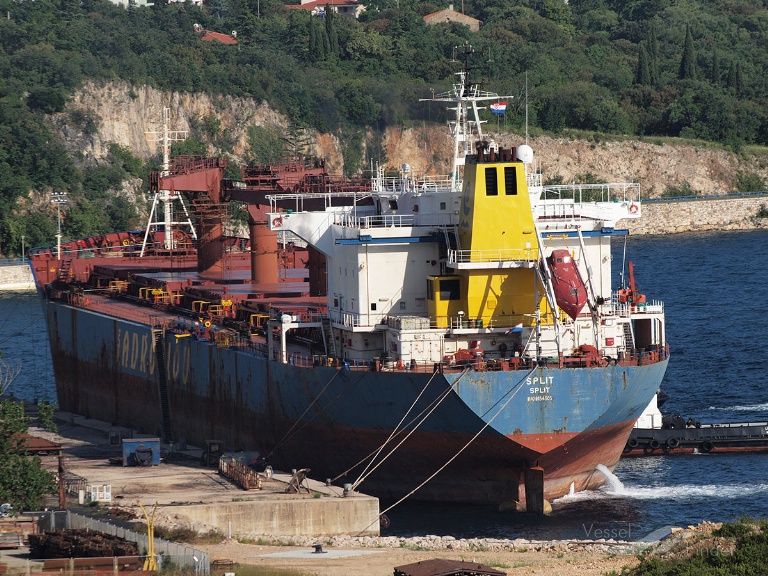
The bulk carrier now named LAMAR S, with SPLIT painted on its stern, moored beside a concrete quay near a wooded coastline.

On 14 August, Ukraine's Military Intelligence (HUR) published data on 26 vessels via its War&Sanctions portal, noting that 18 ships face no sanctions from any of Ukraine's partner countries.

The agency said the ships carry Russian oil, liquefied natural gas (LNG), or agricultural products from occupied Ukraine. Euromaidan Press could not independently verify HUR’s vessel records.

Russia relies on maritime trade both to fund its war through energy exports and to sell crops taken from occupied Ukraine. Kyiv began building a dedicated system against Russia’s shadow grain fleet in April, modeled on its oil-fleet campaign. A US bill introduced this week would also target vessels, owners, insurers, and ports involved in sanctions evasion. HUR’s new list shows how many ships remain outside those restrictions.

Russia’s grain shadow fleet

HUR divided the 26 vessels into three groups:

  • oil tankers serving Lukoil, Rosneft, Surgutneftegas, Novatek, Tatneft, and Gazprom;
  • dry-cargo ships using the occupied ports of Berdiansk, Sevastopol, Kerch, and Feodosia;
  • LNG carriers moving gas from the sanctioned SAAM FSU floating storage unit, which holds LNG from the sanctioned Arctic LNG 2 project.

HUR highlighted three of the 18 vessels that are not facing partner sanctions. The bulk carrier LAMAR S repeatedly loaded wheat at the Avlita terminal in occupied Sevastopol in 2026 for delivery abroad, including to Syria, the agency said.

NAYA FALCON carried baking soda and granulated wheat bran from occupied Sevastopol to Egypt and Cyprus, HUR said. The agency linked the oil tanker GREGAL to UAE-based Cymare Navigation FZC, which it described as affiliated with Sovcomflot, Russia’s state-controlled shipping company.

Russia steals grain while striking Ukraine’s exports

Crops taken from occupied land are sold abroad as Russian produce, while Russia's attacks leave Ukraine’s legitimate harvest with fewer routes to market.

Ukraine’s Foreign Intelligence Service said Russia sold more than 2 million tons of grain from occupied Ukraine as Russian produce in 2025. The agency said ship-to-ship transfers at Kavkaz helped conceal its origin.

Meanwhile, Russian attacks have squeezed Ukraine’s legitimate grain trade. Strikes on civilian ships brought the Black Sea corridor to a near standstill during the July harvest peak. Ten people died when Russian missiles hit the grain-laden Golden Leo on 19 July.

HUR called on Ukraine and its partners to synchronize sanctions and detain vessels that violate restrictions. It said the measures could curb Russia’s maritime logistics and war funding.

  • ✇Euromaidan Press
  • Captured Akhmat fighter says he chose Ukraine and a drone guided him away from Russia’s ranks
    A former fighter from the Akhmat forces, armed formations loyal to Chechnya’s Kremlin-backed ruler Ramzan Kadyrov, said he wants to fight for Ukraine after nearly a year in captivity. Identified only as Magomed, he gave his account to Dmytro Karpenko, a Ukrainian journalist and blogger known for interviewing Russian prisoners of war, in a video published on 9 August 2026. Militarnyi, a Ukrainian military news outlet, reported on the interview on 13 August. Magomed’s
     

Captured Akhmat fighter says he chose Ukraine and a drone guided him away from Russia’s ranks

14 août 2026 à 10:55

Former Akhmat fighter Magomed, center, speaks with journalist Dmytro Karpenko, left, and another man during a video interview.

A former fighter from the Akhmat forces, armed formations loyal to Chechnya’s Kremlin-backed ruler Ramzan Kadyrov, said he wants to fight for Ukraine after nearly a year in captivity.

Identified only as Magomed, he gave his account to Dmytro Karpenko, a Ukrainian journalist and blogger known for interviewing Russian prisoners of war, in a video published on 9 August 2026. Militarnyi, a Ukrainian military news outlet, reported on the interview on 13 August.

Magomed’s reported crossing reflects a divide that has placed Chechen fighters on both sides of Russia’s war. Since 2014, Kadyrov-loyal formations have fought for Moscow, while anti-Kremlin Chechens seeking independence from Russia have supported Kyiv.

Magomed’s account traces one fighter’s claimed passage from the first camp toward the second after Russians allegedly killed his brother. His account has not been independently verified.

The Chechen fighter said he had served near Svitlodarsk, Bakhmut, and Horlivka, including evacuating soldiers’ bodies.

Magomed also claimed two Chechens had crossed before him, prompting Russian commanders to check fighters’ phones and tighten surveillance.

According to Magomed, he later followed a Ukrainian drone toward Ukrainian positions with other Chechens. Ukrainian troops dropped medicine, water, and a radio to guide them. A Russian FPV drone attacked during the crossing and killed one Chechen, he alleged.

Ukrainian forces received the survivors and handed Magomed to the police brigade "Liut". His captivity began on 29 August 2025. Magomed also alleged that Russians killed his brother and called the death an epileptic seizure. Magomed said that drove him to fight Russia.

Militarnyi reported that Magomed had joined the International Legion, which is run by Ukraine's military intelligence. However, Karpenko’s video description says he wants to join the legion. Neither source explained the discrepancy.

What is Akhmat?

Akhmat, the unit Magomed belonged to, provides Russia with frontline troops and rear-area security. UK intelligence estimated in 2024 that around 9,000 personnel served in pro-Russian Chechen units in Ukraine.

Kadyrov’s reach has also expanded during the war. A later investigation found that his armed network had grown to 20 units across Russia’s military and security structures.

The Akhmat group's influence may extend beyond military operations. In January 2026, ATESH, a Ukrainian-Crimean Tatar partisan group, said Moscow planned to hand occupied Mariupol to Akhmat as a reward for Chechen leaders’ loyalty. The resistance organization claimed that arriving Chechen forces sought control of the city’s resources and industry.

Chechens also fight for Ukraine

On the other side, Chechens seeking an independent Ichkeria (the indigenous Chechen name for Chechnya) have fought for Ukraine since 2014.

In April 2026, Ukrainian intelligence said Shamanbat, a Ukrainian special unit that includes Free Ichkeria fighters, helped conduct drone and artillery strikes on Akhmat positions. The agency claimed the operation killed dozens of Akhmat personnel and wounded about 80.

  • ✇Euromaidan Press
  • Reuters: Russia dismisses Black Sea ceasefire idea after Ukraine’s offer
    Russia dismissed the idea of a Black Sea ceasefire on 14 August, Reuters reported, a day after the agency disclosed that Ukraine had proposed a mutual halt to attacks on civilian targets there. Russian Foreign Ministry spokesperson Maria Zakharova said Moscow saw no grounds for measures that would give Kyiv a temporary reprieve. Russia’s dismissal comes after its strikes drove shipowners from Odesa as Ukraine’s wheat harvest peaked. More than 90% of Ukraine’s farm e
     

Reuters: Russia dismisses Black Sea ceasefire idea after Ukraine’s offer

14 août 2026 à 07:35

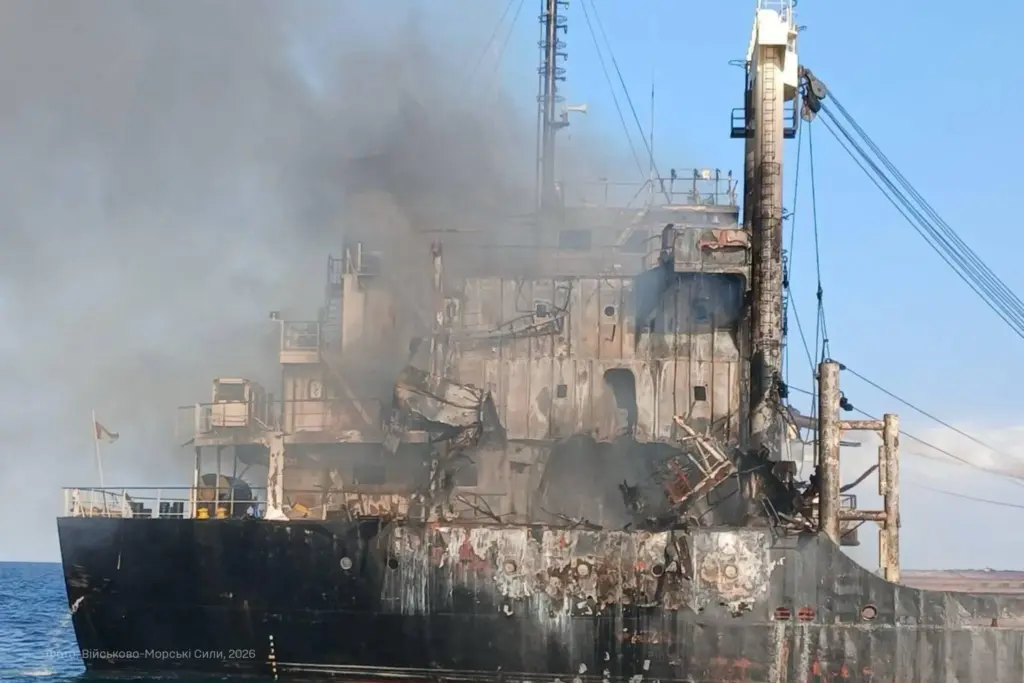
Smoke rises from the burned and heavily damaged superstructure of the Golden Leo cargo ship at sea.

Russia dismissed the idea of a Black Sea ceasefire on 14 August, Reuters reported, a day after the agency disclosed that Ukraine had proposed a mutual halt to attacks on civilian targets there.

Russian Foreign Ministry spokesperson Maria Zakharova said Moscow saw no grounds for measures that would give Kyiv a temporary reprieve.

Russia’s dismissal comes after its strikes drove shipowners from Odesa as Ukraine’s wheat harvest peaked. More than 90% of Ukraine’s farm exports leave through three deepwater Odesa ports. Reuters reported that Ukraine’s 12 August operation at Novorossiysk targeted a naval base and warships, although nearby grain terminals also suspended operations.

Russian forces, by contrast, have repeatedly struck foreign-flagged ships and Ukrainian port infrastructure. The disruption is stranding Ukrainian crops and raising concerns over global food supplies.

Zakharova accused Ukraine of deliberately destabilizing civilian shipping but did not mention Russia’s attacks, Reuters said. She was responding to Turkish Foreign Minister Hakan Fidan, who said Ankara had proposed a Black Sea moratorium to both sides.

Zakharova also said Moscow had received no formal proposal from Türkiye and ruled out reviving the 2022–23 Black Sea grain deal, calling it one-sided.

Ukraine’s harvest has nowhere to go

Reuters said Ukraine’s grain exports had fallen 76% year on year so far in August. Ukraine’s Agriculture Ministry projects agricultural exports could nearly halve, from 64.4 million to 29.6 million tonnes. It expects silos to fill by October as grain backs up.

World Grain, citing the US Department of Agriculture’s Foreign Agricultural Service, reported that corn exports could fall 39% and wheat exports 26%. The US agency expects unsold corn stocks to rise more than tenfold.

The ministry has asked the EU for €220 million to subsidize farm loans and help producers finance autumn sowing. Reuters separately reported, citing unnamed sources in both countries, that Kyiv and Chisinau were discussing a rail route to Romania’s Constanța port. Kyiv estimates it could carry only 10% of Ukrainian grain exports.

Ukrainian grain
Explore further

Ukraine and Moldova discuss rail corridor for grain amid Russian Black Sea attacks

Russia turns ports into targets

After Russia refused to extend the UN- and Türkiye-brokered grain deal in 2023, Ukraine opened its own maritime corridor. It remained operational until this summer’s escalation.

Russian forces repeatedly struck foreign-flagged vessels in July. On 19 July, Russian missiles hit the Guinea-Bissau-flagged, Turkish-owned Golden Leo as it left Odesa carrying corn. The attack killed 10 people, Ukraine’s Navy and Sea Ports Authority said. Ag Bull Trading reported that the attacks brought the corridor to its first full stop since it opened in August 2023.

Russia’s dismissal leaves Ukraine’s corridor officially open while Russian attacks continue to drive shipowners away.

  • ✇Euromaidan Press
  • Russia allegedly sent a hitman after a US-Ukrainian citizen in Warsaw. Poland caught the suspect
    Polish Prime Minister Donald Tusk said authorities had detained a Russian citizen recruited by Moscow to kill a man in Warsaw. The target holds US and Ukrainian passports, the Associated Press (AP) reported on 13 August. Tusk said Polish security services stopped the alleged attack “at the last minute.”  Since 2022, AP has mapped about 200 acts of sabotage, arson, and disruption across Europe that officials have linked to Russia. European governments say the campaign ai
     

Russia allegedly sent a hitman after a US-Ukrainian citizen in Warsaw. Poland caught the suspect

14 août 2026 à 06:40

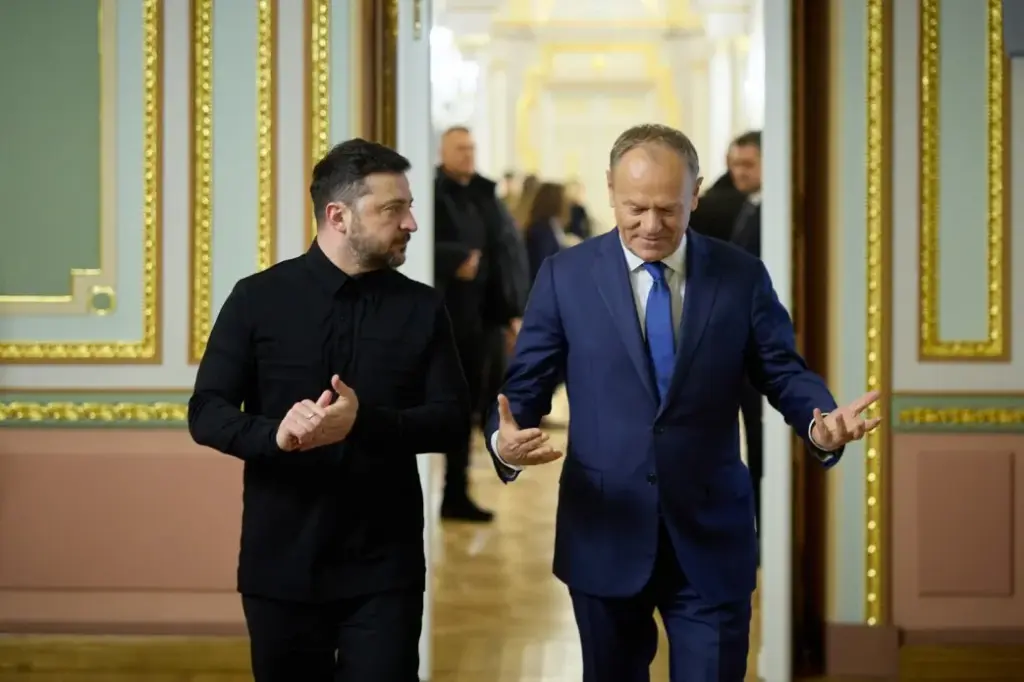
Ukrainian President Volodymyr Zelenskyy walks beside Polish Prime Minister Donald Tusk in an ornate government building.

Polish Prime Minister Donald Tusk said authorities had detained a Russian citizen recruited by Moscow to kill a man in Warsaw. The target holds US and Ukrainian passports, the Associated Press (AP) reported on 13 August. Tusk said Polish security services stopped the alleged attack “at the last minute.” 

Since 2022, AP has mapped about 200 acts of sabotage, arson, and disruption across Europe that officials have linked to Russia. European governments say the campaign aims to intimidate Ukraine’s supporters and disrupt military aid, while Ukrainian authorities report similar recruitment tactics inside Ukraine.

The suspect was detained on 7 August and remanded for three months, Warsaw police said. Tomasz Siemoniak, the minister overseeing Poland’s intelligence services, said the operation involved US services.

PM Tusk called it the first Russian-ordered attempt of its kind against a US citizen in another NATO country. He said the target was “inconvenient to the Putin regime,” without explaining why.

In their bulletin, Reuters reported that Russia’s Warsaw embassy did not immediately respond to a request for comment. Moscow denies conducting a sabotage campaign in Europe.

Russia has already gone after a German arms CEO and critics of the Kremlin

European authorities had already reported plots against arms-industry figures supplying Ukraine. CNN reported in 2024 that US and German services foiled a plot against Rheinmetall chief Armin Papperger. 

Former Bellingcat investigator Christo Grozev said an intelligence insider told him he was on Russia’s kill list. He also warned Putin critic Garry Kasparov that a Russian agent trained in assassination had infiltrated exile groups to approach him.

Russia has also been accused of targeting Kremlin opponents abroad. In June, Kremlin critic Robert Kuzovkov was shot dead in Poland. Tusk said the killing resembled a political assassination, but Warsaw has not attributed it to Russia.

Russia uses disposable agents, not career spies

The alleged recruitment in Warsaw resembles tactics reported elsewhere in Europe. German investigators identified a former Ukrainian bricklayer and an untrained Romanian woman as the suspected operatives surveilling Stefan Thumann, head of Bavarian drone maker Donaustahl. German intelligence later classified the case as a suspected planned assassination.

Ukrainian authorities have reported similar recruitment at home. The SBU said an FSB-directed foreign pair killed Colonel Ivan Voronych in Kyiv in July 2025. Both suspects later died in a shootout with law enforcement.

Ukrainian police say Russian recruitment can escalate from surveillance and simple deliveries to arson, terrorism, and murder. Since the start of 2026, police and the SBU have registered 31 terrorist attacks and prevented another 14.

Ukraine asks the EU for €220 million to unlock €4 billion in farm loans as Russia’s port strikes choke exports

13 août 2026 à 12:10

A green combine harvester cuts wheat beneath a blue, partly cloudy sky.

Ukraine and international partners agreed to work urgently on a mechanism for up to €4 billion ($4.6 billion) in farm loans, Ukrinform reported on 13 August. The plan would use a proposed €220 million ($253 million) EU grant, the Agriculture Ministry said.

Ukraine rebuilt its maritime trade after pushing Russia’s fleet away from its coast. By 2025, its Black Sea route carried about 92% of the country’s grain and oilseed exports. Russia is now striking the Odesa ports sustaining that recovery. The ministry says the attacks have closed three deep-water ports. Ukraine planned to export 64.4 million tons of agricultural products in 2026/27, but now says shipments may reach only 29.6 million tons. The proposed loan mechanism is meant to cover that cash shortfall before next year’s sowing.

EU and Norwegian diplomats joined the meeting with representatives of the World Bank and the UN Food and Agriculture Organization.

The participants agreed to develop the plan through the Ukraine Facility and EU guarantee institutions. They aim to do so in the coming weeks, before fall storage use peaks. The grant has not yet been approved.

Odesa attacks send Kyiv toward Baltic ports

The loan plan comes as Russia’s attacks force Ukraine to seek new export routes.

Russia initially blockaded Ukraine’s ports after launching its full-scale invasion. Ukraine later restored a sea corridor after forcing much of Russia’s Black Sea Fleet away. Moscow then shifted pressure to missiles and drones, hitting Ukrainian ports 90 times in 2025 and intensifying attacks this summer.

A Russian strike killed 10 people aboard the grain-carrying Golden Leo on 19 July. Three days later, no ship passed through the corridor.

Kyiv is now considering the Polish Baltic ports of Gdańsk, Gdynia, Szczecin, and Świnoujście. Yet the ministry estimates that all alternative routes may eventually carry only 2.9 million tons a month. Ukraine’s monthly target was 5.4 million tons.

Farm loans target next year’s sowing

The €220 million would not go directly to growers. It would subsidize interest and partly cover banks’ lending risks, including by expanding Ukraine’s “5-7-9%” affordable-loan program.

The ministry wants the support to generate €4 billion in farm loans at annual rates no higher than 10%. It calculates that every euro of grant money could mobilize more than €18 in lending.

Ukraine has also temporarily adjusted minimum export price coefficients to offset higher logistics costs, meeting participants noted. Without grain sales, farmers struggle to pay wages and land rents or buy fuel and fertilizer. By November, Ukraine's storage shortfall could reach 11 million tons of crops, with more than €10.8 billion ($12.4 billion) tied up in unsold stocks.

  • ✇Euromaidan Press
  • One tower linked two Russian regiments near Kharkiv border. Ukrainian partisans say they disabled it 
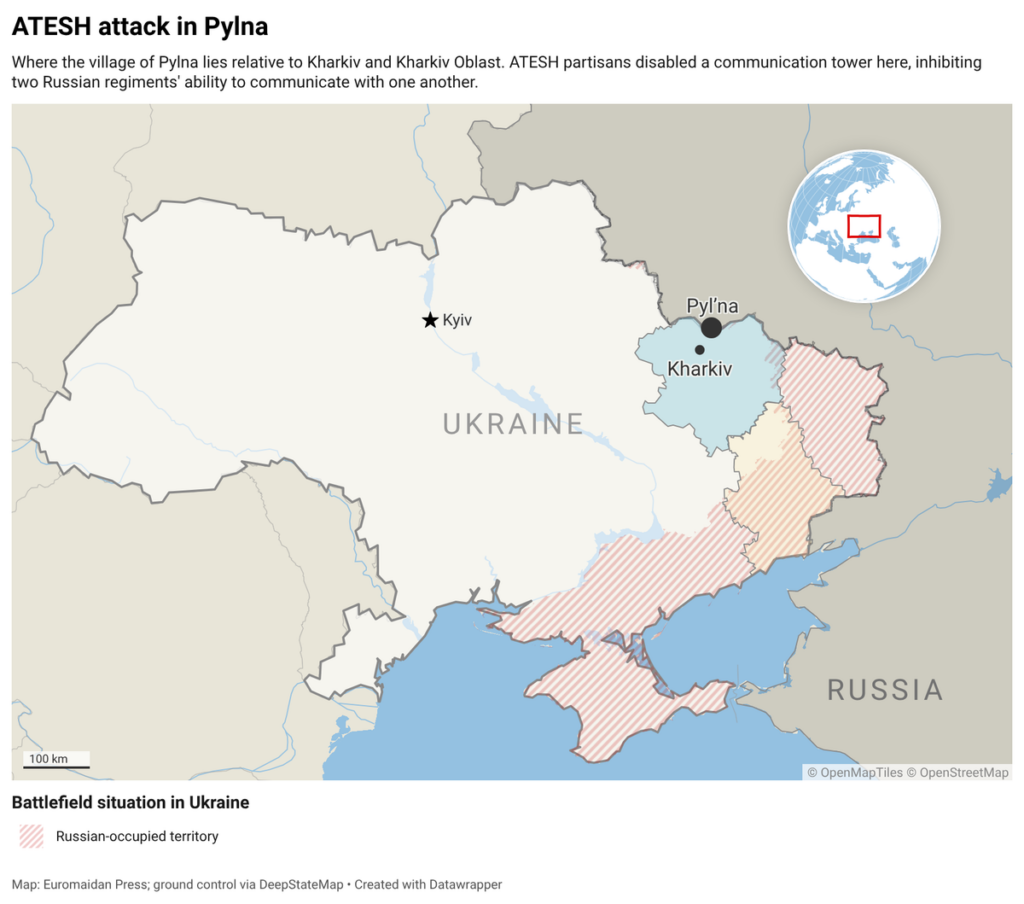
    On 13 August, the Ukrainian-Crimean Tatar partisan movement ATESH said its agents had disabled a communications tower near Pylna in northern Kharkiv Oblast. The group said the damage disrupted links between two Russian motor rifle regiments near the border. Pylna lies on the Russian border and was among the villages seized when Moscow opened the northern Kharkiv front in May 2024. The claimed tower attack is part of a wider Ukrainian resistance effort behind Russian li
     

One tower linked two Russian regiments near Kharkiv border. Ukrainian partisans say they disabled it 

13 août 2026 à 12:00

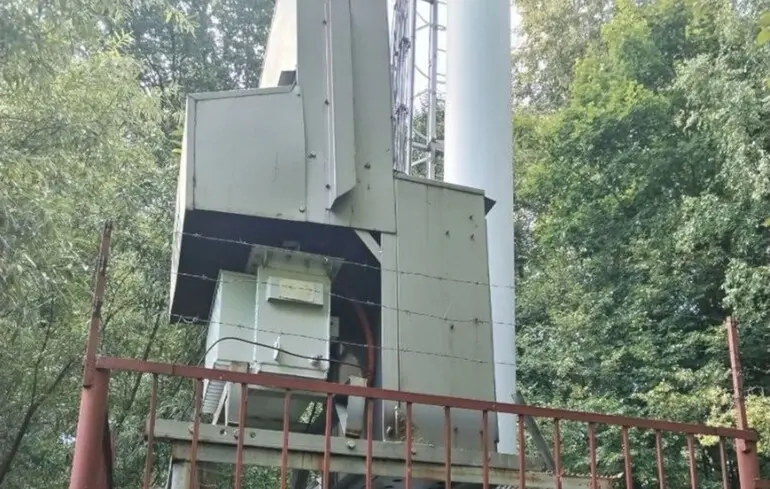
Close-up of equipment at the base of a communications tower behind a metal fence in a wooded area.

On 13 August, the Ukrainian-Crimean Tatar partisan movement ATESH said its agents had disabled a communications tower near Pylna in northern Kharkiv Oblast. The group said the damage disrupted links between two Russian motor rifle regiments near the border.

Pylna lies on the Russian border and was among the villages seized when Moscow opened the northern Kharkiv front in May 2024. The claimed tower attack is part of a wider Ukrainian resistance effort behind Russian lines. Moscow's forces still depend on infrastructure in occupied territory to communicate, move supplies, and hold the line. Ukraine’s underground fighters exploit that dependence from within, targeting communications, transport, and fuel supplies to create problems for Russian units at the front.

ATESH said the tower carried data between Russian command posts and coordinated units in the area. The movement said its loss disrupted command channels and delayed border-zone mobile groups. It did not say how agents disabled the tower or how long the interruption would last.

The partisans stated that the communications between Russia’s 345th and 380th motor rifle regiments were hit hardest. The regiments operate in neighboring sectors and rely on stable links for joint action and rapid responses, according to the group. ATESH claimed their offensive tempo and ability to support each other had fallen.

Neither the claimed ATESH sabotage nor its reported effects have been independently verified.

ATESH attacks on Russian supply lines

The tower claim follows ATESH’s 10 August account of sabotaging an electric locomotive near Voronezh. The group said it carried military supplies toward the Kupiansk front in Kharkiv Oblast. In June, ATESH also said agents damaged power and rail equipment near Russia’s Novomoskovsk Azot plant, whose output feeds explosives production.

ATESH has also reported intelligence work inside Russian forces. In July, the group said an agent reported a Ukrainian strike on five military fuel trucks in occupied Luhansk. Together, the claims describe a campaign against transport, fuel, and communications behind the front.

Ukrainian resistance works behind the front

The claimed tower operation is one part of the Ukrainian resistance behind Russian lines. Underground networks also gather intelligence and sustain civil defiance. 

A Euromaidan Press investigation documented groups planting explosives, tracking Russian positions, distributing leaflets, and painting Ukrainian symbols despite the threat of imprisonment and torture.

ATESH says its network includes Ukrainians, Crimean Tatars, anti-war Russians, and sources inside Russia’s military and occupation administrations. Its claims are often impossible to verify independently. Taken together, they portray a campaign to make Russia’s rear less secure while other groups preserve Ukrainian identity under occupation.

  • ✇Euromaidan Press
  • Poland and the Baltics risk Russian sabotage for backing Ukraine, Bloomberg says
    Russia may expand hybrid attacks against Poland and the Baltic states, including infrastructure sabotage or false-flag attacks, Bloomberg reported on 12 August, citing an unnamed European intelligence official.  The warnings come amid concern that Moscow wants to intimidate Ukraine’s supporters. The CIA warning follows Russian threats, incursions, alleged sabotage plots, and disinformation against Poland and the Baltic states. Most Western military aid reaches Ukraine t
     

Poland and the Baltics risk Russian sabotage for backing Ukraine, Bloomberg says

13 août 2026 à 09:29

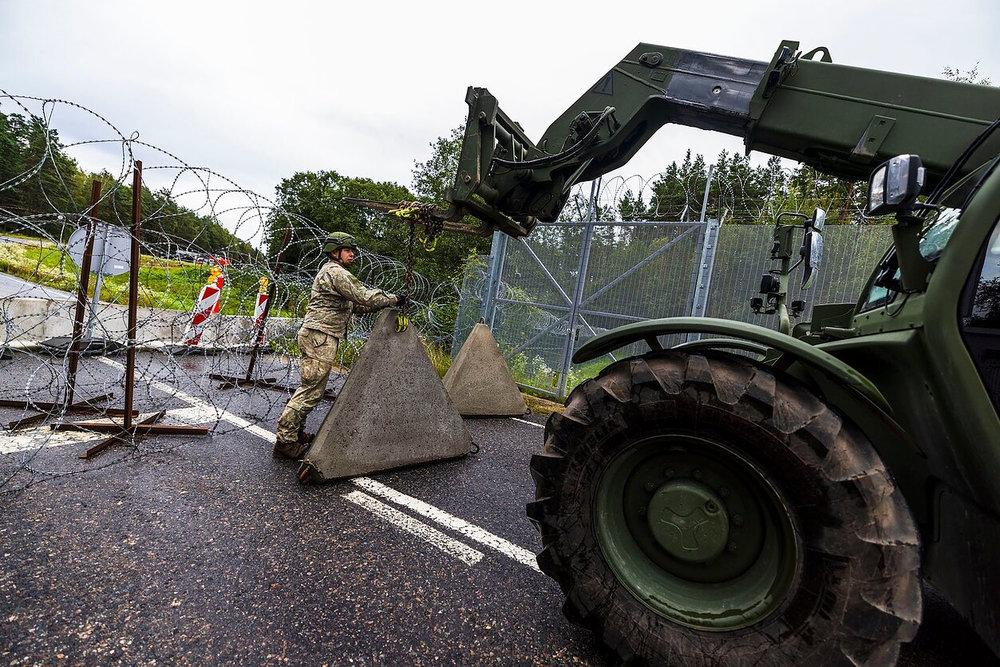
Lithuanian soldier installs concrete barriers and razor wire across a road during a civil defense exercise.

Russia may expand hybrid attacks against Poland and the Baltic states, including infrastructure sabotage or false-flag attacks, Bloomberg reported on 12 August, citing an unnamed European intelligence official. 

The warnings come amid concern that Moscow wants to intimidate Ukraine’s supporters. The CIA warning follows Russian threats, incursions, alleged sabotage plots, and disinformation against Poland and the Baltic states. Most Western military aid reaches Ukraine through Poland, while the Baltic states rank among Kyiv’s strongest supporters. Sabotage of transport, energy, or communications can slow aid delivery and test NATO while hiding Russia’s role.

Separately, a European government official told Bloomberg that the CIA had warned countries in the region of a possible future Russian attack. The CIA declined to comment.

The same official said Russia might instead be creating the impression of an impending attack to sow fear as part of an information operation. The official saw no signs that Moscow was preparing a conventional attack or invasion.

Moscow tests NATO’s eastern flank

Poland and Lithuania had already raised similar concerns. In July, Poland said it had credible intelligence that Russia was planning new provocations. Lithuania later warned that Moscow might rebuild captured Ukrainian drones for false-flag strikes on critical infrastructure.

In September 2025, between 19 and 23 Russian drones entered Polish airspace, shutting down airports and damaging buildings. Poland closed four airports as NATO aircraft responded.

Meanwhile, five people are on trial in Lithuania over attacks allegedly organized for Russian military intelligence in 2024, Bloomberg reported. Lithuania has reinforced infrastructure sites and deployed troops since June.

These warnings and incidents place the CIA alert within a wider pattern of pressure on NATO’s eastern flank and Ukraine’s supporters. 

How Russia strikes without starting a war

Bloomberg cited several recent unexplained drone incidents in Germany alongside the CIA warning. Citing Die Zeit, Euromaidan Press reported that an explosive-laden drone struck the wing of a parked Ukrainian An-124 at Leipzig-Halle airport and failed to detonate. A US Defense Department official in Europe told CNN that Washington assessed the drone belonged to Russian intelligence. 

Bloomberg also reported that a cargo plane hit an unidentified object and that drones appeared over a military base the following day. It did not connect either incident to Russia.

More broadly, Russian hybrid operations have grown sharply since the full-scale invasion. CSIS found that attacks in Europe tripled from 2023 to 2024, after quadrupling the previous year. Separately, the US Helsinki Commission mapped nearly 150 operations in NATO territory attributed to or suspected of Russia between February 2022 and November 2024.

Retired Lt. Gen. Ben Hodges told Euromaidan Press in February that attacks on ports, railways, and cables can probe routes needed for NATO reinforcements. Their deniability raises the political cost of responding.

By hiding its role, Moscow can disrupt support for Ukraine and test NATO without openly starting a war. 

A 12-year-old dies in occupied Kherson Oblast where no hospital or ambulance is left, Ukrainian official says

13 août 2026 à 07:34

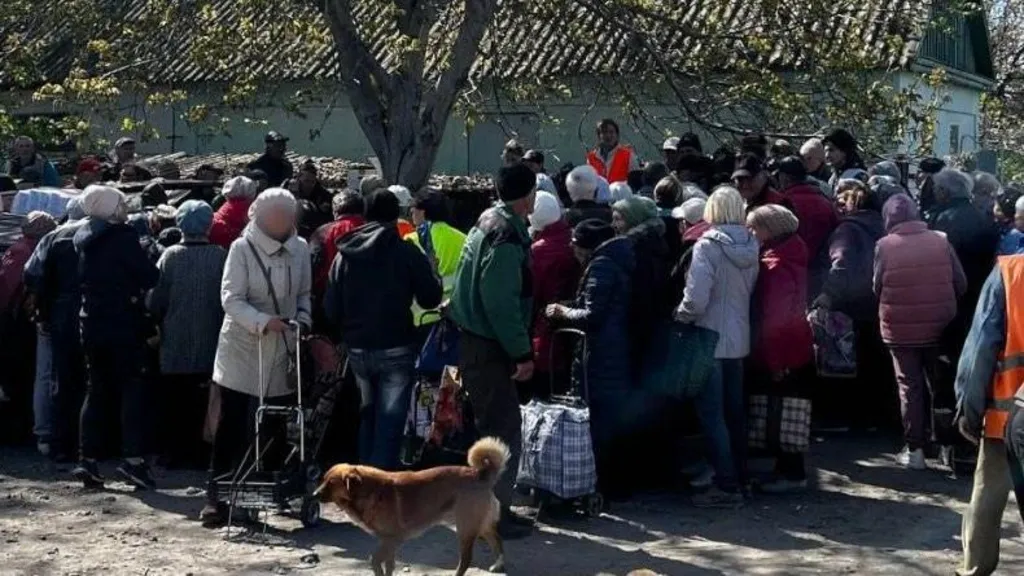
Residents, many elderly and carrying shopping trolleys, gather outdoors in occupied Oleshky, Kherson Oblast.

A 12-year-old with a high fever died without medical care in Russian-occupied Kherson Oblast, Hola Prystan official in exile Svitlana Linnyk told Ukrinform on 13 August 2026.

No medicine or medical worker was available locally, and the child’s mother could not reach an ambulance pickup point, she said.

The child's reported death comes amid a wider humanitarian crisis in Russian-occupied Kherson Oblast. UN and OSCE monitors found drone attacks, mines, and movement restrictions obstructing medical aid and evacuations around Oleshky and Hola Prystan, two occupied communities across the Dnipro from Kherson city. About 6,000 civilians, including 200 children, remained in and around the two communities as of May. Similar medical shortages span occupied Ukraine, while access to free medicines has been tied to having a Russian passport.

The Hola Prystan community where the child died has no operating hospital or rural medical post, Linnyk said. Only two pharmacies remain: one in the city of Hola Prystan and another in the nearby village of Nova Zburivka. Both are selling their remaining supplies.

The nearest hospital is in Skadovsk, an occupied Black Sea port about 60 kilometers by road from Hola Prystan. Nova Zburivka’s ambulance has not operated since 2025. 

Russian occupation authorities have distributed no humanitarian aid for at least eight months to villages surrounding Hola Prystan, or for over a year in the city itself, Linnyk said. 

Linnyk said a Moscow Patriarchate priest occasionally brought supplies but gave them only to Russian passport holders. This reflects a broader pattern of tying basic services in occupied Ukraine to accepting Russian citizenship.

Ukrainian children face a medical system stripped bare 

The medical dangers surrounding the 12-year-old’s death are not confined to Hola Prystan.

In April 2025, Ukraine’s National Resistance Center reported that occupation officials were administering vaccines to children under six in Luhansk Oblast. It described the vaccines as uncertified and of unknown origin.

That November, the Center said a Russian inspection found Crimea’s main children’s hospital lacked breathing bags and cardiac monitors. It said infant mortality on the occupied peninsula had risen 9% over the previous year.

Aid comes with a Russian passport

Hola Prystan is not the only occupied community where access to care has depended on Russian citizenship.

In 2023, Russian-installed officials in occupied Zaporizhzhia Oblast threatened to deny medical care to residents without Russian passports. A 2025 Kremlin policy later tied free medicines for chronic illnesses to Russian citizenship.

Ukraine’s Health Ministry reported in July 2024 that Russian forces had destroyed 214 medical facilities. It said the full toll remained unknown because authorities had limited access to occupied territories. 

  • ✇Euromaidan Press
  • Russia builds 3,000 jet drones monthly to counter Ukrainian interceptors, HUR says
    Russia has ceased producing its Geran-3 jet-powered attack drone, Ukraine’s Military Intelligence (HUR) told the Ukrainian defense outlet Militarnyi. The agency estimates Russian industry now makes about 3,000 newer Geran-4 and Geran-5 drones per month. Russia is shifting toward faster jet drones as Ukraine’s low-cost interceptors have become more effective against slower Shaheds. The Geran-4 and Geran-5 leave defenders less time to react, requiring faster interceptors
     

Russia builds 3,000 jet drones monthly to counter Ukrainian interceptors, HUR says

12 août 2026 à 14:02

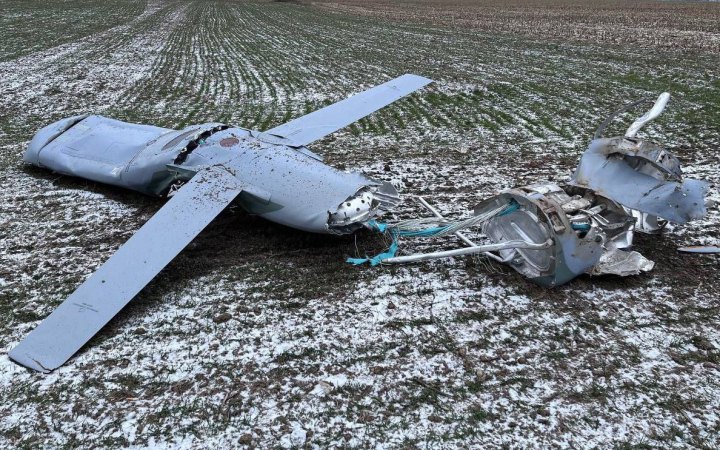
3D model of a Russian Geran-4 jet-powered attack drone, shown from above with its tracker and navigation unit listed beside it.

Russia has ceased producing its Geran-3 jet-powered attack drone, Ukraine’s Military Intelligence (HUR) told the Ukrainian defense outlet Militarnyi. The agency estimates Russian industry now makes about 3,000 newer Geran-4 and Geran-5 drones per month.

Russia is shifting toward faster jet drones as Ukraine’s low-cost interceptors have become more effective against slower Shaheds. The Geran-4 and Geran-5 leave defenders less time to react, requiring faster interceptors or short-range air defenses. At the reported production rate, these newer Geran models, previously used in limited numbers, could become a regular feature of Russian attacks.

HUR said Russia has established serial assembly of the two newer models at the Alabuga complex in Tatarstan, with other Russian companies supplying components. The agency also said Russia’s Defense Ministry wants to expand Alabuga’s capacity. Construction began in May. Satellite imagery showed large-scale work by early July 2026, although the purpose of the new buildings remains unknown.

From Geran-3 to newer jet drones

Russia first used Geran-3 drones in large numbers during a combined nighttime attack on Ukraine on 30 July 2025. At least eight flew alongside propeller-driven Shaheds and decoys. The model retained the Geran-2 airframe but replaced its piston engine with a Chinese Telefly JT80 turbojet. HUR gave it a speed of 300–370 kilometers per hour and a range of up to 1,000 kilometers.

In May, then-Defense Ministry adviser Serhii “Flash” Beskrestnov said Ukrainian defenses stopped 95% of incoming Shaheds during the most recent documented strike and predicted Moscow would produce more jet-powered Geran variants.

The newer Geran-4 has a more robust airframe than the Geran-3 and is designed for high-speed flight and maneuvers. It can reach 500 kilometers per hour.

The larger Geran-5 carries a roughly 90-kilogram warhead and has a stated range of up to 1,000 kilometers. HUR has said Russia may equip it with R-73 air-to-air missiles, potentially threatening aircraft sent to intercept it.

The Chinese engines that Russia itself can't build

The Geran line combines Iranian designs, Russian assembly, and imported technology. HUR described the Geran-3 as a localized version of Iran’s Shahed-238. It found 45 foreign components inside, including parts from the United States, China, Switzerland, Germany, Britain, and Japan.

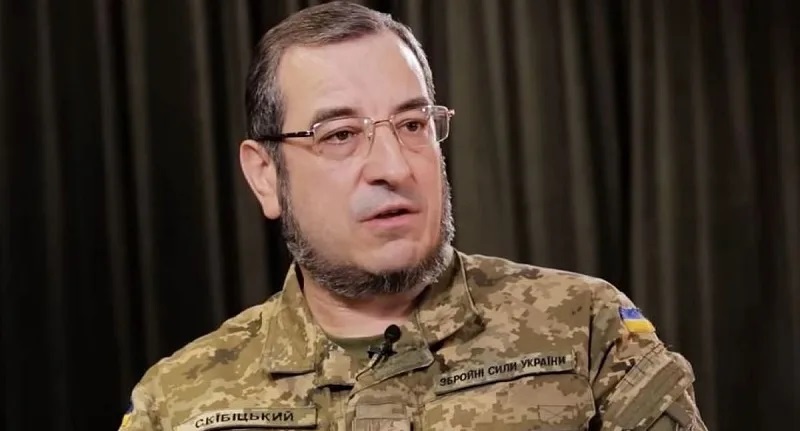
Russia depends on China for the turbojet engines in newer Geran models. HUR deputy chief Vadym Skibitskyi told RBC-Ukraine that Russia remains fully dependent on Chinese turbojet engines for the Geran-4 and Geran-5. Each costs about $35,000–$40,000, he said.

A Chinese XK-F358 mesh radio recovered from a Geran-5 also helps Russian drones resist jamming. Its manufacturer remains outside the US, EU, UK, and Ukrainian sanctions, according to a review by Euromaidan Press.

  • ✇Euromaidan Press
  • A Ukrainian railway engineer spied on Lyman’s defenses for Russia using Google Maps
    A Ukrainian court sentenced the former chief engineer of Lyman’s locomotive depot to 15 years in prison with property confiscation for helping Russia target the frontline city, Ukraine’s Security Service (SBU) said on 11 August. Investigators report he sent a Russian handler the locations of Ukrainian positions intended for guided-bomb and artillery strikes. Lyman blocks Russia’s northern route toward Sloviansk and Kramatorsk, which are part of Ukraine's fortress belt i
     

A Ukrainian railway engineer spied on Lyman’s defenses for Russia using Google Maps

12 août 2026 à 14:01

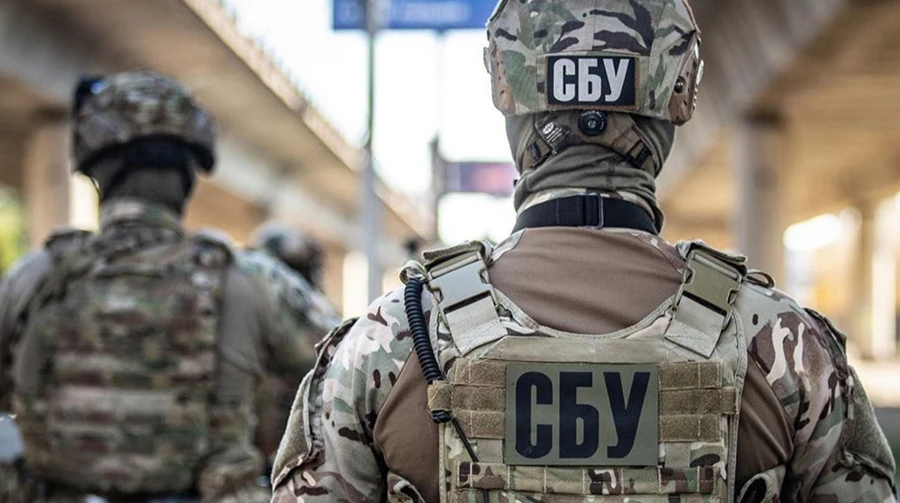
SBU officers in camouflage and tactical gear, seen from behind during an operation.

A Ukrainian court sentenced the former chief engineer of Lyman’s locomotive depot to 15 years in prison with property confiscation for helping Russia target the frontline city, Ukraine’s Security Service (SBU) said on 11 August. Investigators report he sent a Russian handler the locations of Ukrainian positions intended for guided-bomb and artillery strikes.

Lyman blocks Russia’s northern route toward Sloviansk and Kramatorsk, which are part of Ukraine's fortress belt in the Donbas. As attacks on supply lines intensify, information about Ukrainian positions can help Russia direct bombs and artillery. The case fits a broader pattern of Russian intelligence recruiting people inside Ukraine to locate targets. Russian services have used money and blackmail, including threats against recruits’ families, to secure their cooperation.

According to the SBU, the former engineer traveled around Lyman and its outskirts to record Ukrainian military bases. He marked possible targets on Google Maps, then sent screenshots to a handler in Russia through a messaging app.

The collaborator operated from basement

The agency said an acquaintance whom it described as a “DNR deputy” in occupied Donetsk Oblast connected him with Russian intelligence. The SBU said the man moved into an apartment building’s basement to shelter himself while directing Russian strikes on the community.

SBU officers detained him in Sloviansk in May 2026. The agency said a seized smartphone contained evidence of his reconnaissance and contacts with the Russian side.

The SBU did not identify the man, the court, or any specific strike enabled by his information.

How Russia turns locals into spotters 

The Lyman case involved an acquaintance of the former engineer, but Russian services also use money, blackmail, and online platforms to find recruits. The SBU says minors may initially receive simple assignments, such as taking photographs or painting graffiti, before being directed toward more serious sabotage.

Other recruits have allegedly answered Telegram offers of “easy money.” These include a Zaporizhzhia man later convicted of building bombs and a Dnipro suspect accused of activating more than 1,000 Starlink terminals for Russian forces.

Ukraine has prosecuted similar cases before. In November 2024, a court sentenced another Russian agent to 15 years for guiding missile and drone strikes in Zhytomyr Oblast.

More recent cases remain at the allegation stage. The SBU has accused a Kharkiv Oblast man of installing hidden cameras near military sites and a Poltava student of mapping energy facilities while filming air-defense units.

  • ✇Euromaidan Press
  • The Belarus border tunnels reached Latvia—guards turned back the 15 migrants who crawled underground
    Latvia has discovered its first known border tunnel used to enter the country illegally from Belarus, the country’s State Border Guard said on 11 August. Officers intercepted 15 people who had crossed through the underground passage and returned them to Belarus. Latvia, Lithuania, and Poland accuse Belarus and Russia of directing migrants toward their borders to retaliate for EU sanctions and strain countries supporting Ukraine. Minsk and Moscow deny orchestrating the c
     

The Belarus border tunnels reached Latvia—guards turned back the 15 migrants who crawled underground

12 août 2026 à 12:48

A flashlight illuminates the narrow entrance to a tunnel dug beneath the Latvia–Belarus border.

Latvia has discovered its first known border tunnel used to enter the country illegally from Belarus, the country’s State Border Guard said on 11 August. Officers intercepted 15 people who had crossed through the underground passage and returned them to Belarus.

Latvia, Lithuania, and Poland accuse Belarus and Russia of directing migrants toward their borders to retaliate for EU sanctions and strain countries supporting Ukraine. Minsk and Moscow deny orchestrating the crossings. Tunnels found in Lithuania and Latvia show organizers adapting to fortified borders, requiring Baltic governments to deploy more personnel and surveillance technology.

The tunnel was about 10 meters from Latvia's fence

Border guards found the group on 10 August in Skrudaliena parish, in Latvia’s southeastern Augšdaugava municipality, and briefed the public on the discovery the following day. The operation involved the State Police, a Lithuanian border-service dog handler, and a rapid-response unit, the Latvian Border Guard said.

While reconstructing the group’s route, officers found the passage near the Silene border post, about 10 meters from Latvia’s fence. The agency said it had received intelligence that a tunnel might be under construction, but had previously found no sign of a breach there.

Riga answered on 11 August 2026 by launching Operation Vilkatis, or “Werewolf,” scheduled to run through the end of August. The government says the operation will improve intelligence-sharing among border guards, police, the military, and security services. It will also expand aerial surveillance and target networks that transport and shelter migrants after they cross.

belarusian tunnel eu almost done lithuania drilled hole exactly wrong place—for diggers · post unfinished dug belarus toward lithuanian territory varėna district туннель ведущий из беларуси на территорию литвы vsat
Explore further

The Belarusian tunnel to the EU was almost done. Then Lithuania drilled a hole in exactly the wrong place—for the diggers

Latvia faced 87% of all crossing attempts along the EU-Belarus border by mid-July 2026

Belarus has weaponized migration since 2021, when EU governments accused Alyaksandr Lukashenka’s regime of bringing people from the Middle East and Africa to the bloc’s frontier in retaliation for sanctions. Belarus denied orchestrating the crisis.

Latvia reported more direct evidence in January 2026. Documents and phones taken from detained migrants linked Belarusian military and border personnel to organized crossings, according to Latvia’s armed forces and Border Guard.

By 13 July, Latvia had recorded 7,791 attempts over 111 consecutive days, 87% of all attempts along the EU-Belarus border by then. Lithuania later found an unfinished tunnel dug from Belarus. Latvia’s tunnel, unlike the unfinished Lithuanian passage, had already been used.

  • ✇Euromaidan Press
  • Ukraine says Russia can’t replace its losses, plans mass draft after elections—and again in 2027
    In an 11 August 2026 address, Ukrainian President Volodymyr Zelenskyy stated Russia is preparing a new mass mobilization drive after its parliamentary elections this fall, citing an assessment by Ukrainian military intelligence. Moscow plans to mobilize several hundred thousand people by the end of 2026 and roughly the same number by the end of 2027, he said. The mobilization would come on top of continuing contract recruitment.  Moscow has relied on contract soldier
     

Ukraine says Russia can’t replace its losses, plans mass draft after elections—and again in 2027

12 août 2026 à 11:54

Russian soldiers in camouflage uniforms and helmets stand in formation outdoors.

In an 11 August 2026 address, Ukrainian President Volodymyr Zelenskyy stated Russia is preparing a new mass mobilization drive after its parliamentary elections this fall, citing an assessment by Ukrainian military intelligence.

Moscow plans to mobilize several hundred thousand people by the end of 2026 and roughly the same number by the end of 2027, he said. The mobilization would come on top of continuing contract recruitment. 

Moscow has relied on contract soldiers and foreign troops to avoid the political cost of another compulsory draft. But Russia has struggled to recruit soldiers as quickly as it loses them. A mass call-up could replace losses and maintain offensive operations, although Ukrainian officials say it may initially do little more than offset battlefield losses.

Zelenskyy said internal Russian documents support the intelligence assessment. The documents have not been published. 

According to Zelenskyy, Putin plans to wait until after Russia’s parliamentary elections, then use the result to claim the Russians support continuing the war. He described the vote as an “imitation,” claiming every party allowed to compete opposes peace. Russia’s Supreme Court barred Yabloko, the country’s only officially registered party opposing the war, from contesting the election, Reuters reported.

Russia avoided a second draft since 2022. Now recruitment can't keep up

The Kremlin has largely avoided another compulsory call-up since its September 2022 mobilization triggered mass protests and an exodus of Russians. Instead, Moscow has used financial incentives and recruited prisoners and foreigners to replenish its forces in Ukraine.

In March 2026, then-Commander-in-Chief Oleksandr Syrskyi said Russia aimed to recruit 409,000 troops during 2026 and form at least 11 divisions. Ukrainian intelligence then warned in July that Moscow could mobilize 500,000 people that fall. 

195,000 new contracts signed—but losses keep outpacing recruitment

Russia has struggled to meet those targets while covering battlefield losses. Ukraine said Moscow had failed to replace its losses for five consecutive months by April. By mid-July, Russia had signed 195,000 military contracts against a target of 204,500, while Ukraine’s Foreign Intelligence Service estimated its 2026 personnel losses at 196,700.

In his 11 August 2026 address, Zelenskyy claimed Russia is losing at least 30,000 personnel monthly, 60% of them killed, and that its force in Ukraine is gradually shrinking. The figures could not be independently verified.

Zelenskyy also said Putin expects the recruits and North Korean troops to prolong the war and expand Russian offensive capacity. The president stated that he had ordered Ukraine’s intelligence agencies and special services to make Moscow’s plans harder to carry out, but gave no details.

  • ✇Euromaidan Press
  • “Faster than originally planned”: Russia wants 292 Starlink-rival satellites by 2027
    Russia is deploying Rassvet satellites, its answer to Starlink, faster than originally planned, Vadym Skibitskyi, Deputy Chief of Ukraine's Defense Intelligence (GUR), told RBC-Ukraine. Moscow aims to expand the network to 292 satellites by the end of 2027 and 924 by 2035, he said. Existing satellites can already provide intermittent connections as they pass over Ukraine. Rassvet could give Moscow an independent alternative to Starlink, which Ukrainian forces rely on
     

“Faster than originally planned”: Russia wants 292 Starlink-rival satellites by 2027

11 août 2026 à 14:04

Employees of Russian company Bureau 1440 work on a Rassvet communications satellite.

Russia is deploying Rassvet satellites, its answer to Starlink, faster than originally planned, Vadym Skibitskyi, Deputy Chief of Ukraine's Defense Intelligence (GUR), told RBC-Ukraine.

Moscow aims to expand the network to 292 satellites by the end of 2027 and 924 by 2035, he said. Existing satellites can already provide intermittent connections as they pass over Ukraine.

Rassvet could give Moscow an independent alternative to Starlink, which Ukrainian forces rely on for battlefield communications and drone operations. Russian forces also used unauthorized Starlink terminals until Ukraine and SpaceX blocked access. Rassvet’s coverage remains intermittent but could eventually support strike drones, prompting Kyiv to consider countermeasures.

Why Russia wants its own Starlink

Ukrainian forces rely heavily on Starlink for frontline communications, drone operations, and command and control. 

Russian forces also relied heavily on unverified terminals until Ukraine and SpaceX blocked them on 5 February. The shutdown disrupted Russian communications and assaults across multiple parts of the front. On 10 August 2026, the SBU said it had dismantled two schemes that registered terminals in Ukraine for transfer to Russian forces.

Rassvet could reduce Russia’s dependence on SpaceX and illicit supply networks. Ukrainian experts have warned that a mature network could also relay data to Russian strike drones.

32 satellites up, 260 to go by 2027

Bureau 1440, the Russian satellite developer behind Rassvet, began testing the network with three satellites in 2023. Three larger prototypes followed in 2024 to test upgraded equipment, including satellite-based 5G technology and laser links between spacecraft. 

Russia launched its first batch of 16 serial Rassvet satellites on 23 March 2026 after manufacturing problems delayed the mission. A second group of 16 followed in July, Militarnyi reported.

In May 2026, Serhii “Flash” Beskrestnov, a defense technology adviser to the President of Ukraine, said each Rassvet satellite then in orbit passed over Ukraine roughly once daily, providing six to 10 minutes of connectivity. He estimated that continuous coverage would require 200–250 satellites. 

  • ✇Euromaidan Press
  • Russia’s Odesa strikes halve Ukraine’s grain export forecast
    Ukraine’s Agriculture Ministry has cut its forecast for agricultural exports in 2026–2027 by 54% as Russian attacks disrupt shipping through Odesa’s ports, Bloomberg reported. The ministry now expects 29.6 million tons of agricultural exports, down from 64.4 million. Its wheat export forecast fell by 53%, from 17.6 million tons to 8.3 million tons. Ukraine grows far more grain than it consumes, exporting 65%–70% of its agricultural output. Bloomberg said the sector
     

Russia’s Odesa strikes halve Ukraine’s grain export forecast

11 août 2026 à 13:47

Grain pours from a combine harvester into a trailer during harvest in Ukraine.

Ukraine’s Agriculture Ministry has cut its forecast for agricultural exports in 2026–2027 by 54% as Russian attacks disrupt shipping through Odesa’s ports, Bloomberg reported.

The ministry now expects 29.6 million tons of agricultural exports, down from 64.4 million. Its wheat export forecast fell by 53%, from 17.6 million tons to 8.3 million tons.

Ukraine grows far more grain than it consumes, exporting 65%–70% of its agricultural output. Bloomberg said the sector generated more than half of Ukraine’s export revenue last year. But Russia’s summer attacks have stalled the sea corridor as the harvest arrives, driving some wheat prices below production costs. Land and river routes cannot match the Black Sea shipping capacity, while sales through neighboring EU states remain politically contested. That leaves farmers with less money for the next sowing and further reduces Ukraine’s export income.

Ukraine has about 59 million tons of grain storage. That storage could be full by early November, leaving the country 11 million tons short of space by the end of fall 2026. 

Wheat sells below cost as the silos fill up

Ukraine’s export bottleneck is already hitting its farmers. Port prices fell by another 12-15% in one week, while some farmers sold wheat below production cost. When ships stop, traders either stop buying or pass the higher cost of alternative routes on to producers. That leaves farmers with less cash for fall sowing.

To ease the pressure, the government has approved subsidized loans for agricultural producers. President Volodymyr Zelenskyy said Kyiv would expand storage. Ukraine's Agriculture Ministry has also asked the European Commission for €220 million to help cover interest for small and medium-sized farms.

Ukraine and Moldova are discussing a rail route to Romania’s Constanța port. According to the report, grain was already being redirected through Romania, Slovakia, and Hungary, but these routes cannot replace Odesa’s capacity.

Now the ports and the ships are Russia's targets

The export bottleneck is only part of the problem. Russia’s bombardment also threatens the ports, civilian ships, and crews needed to keep the corridor operating. 

The port of Odesa normally handles about 90% of Ukraine’s grain shipments. Russia intensified attacks on terminals and civilian ships in July 2026 as the harvest reached the coast.

On 19 July, three Russian missiles struck the foreign-flagged Golden Leo as it left Odesa carrying corn, killing 10 people, including a Ukrainian sea pilot. Three days later, no vessel passed through the corridor.

Alternative routes offer little relief, as record-low Danube levels were restricting river traffic. Poland continues to bar Ukrainian grain from its domestic market. Those constraints leave more of the harvest inside Ukraine and farmers with less money to plant the next crop.

Russia’s education minister calls it “objective.” A new textbook teaches Ukrainian children that their occupied region is historically Russian

11 août 2026 à 10:00

Covers of Russian “Donbas and Novorossiya” history textbooks for students in grades 5–7.

Russia will introduce two editions of a new regional history textbook series in occupied Ukrainian schools on 1 September 2026. The books present the occupied Ukrainian regions as historically Russian, MOST, a Kherson-based outlet, reported on 10 August.

The new textbooks bring Russia's campaign to erase Ukrainian identity into occupied classrooms, where authorities remove Ukrainian from curricula and replace lessons with Russian ideology, military drills, and firing-range visits. Moscow's Russification campaign extends beyond schools to efforts to change the demographics of occupied Ukrainian territory and re-educate forcibly transferred Ukrainian children.

The new textbook series, entitled "History of Our Region: Donbas and Novorossiya," comprises one edition for grade 5 and another for grades 6–7. The course attached to the books will be compulsory throughout Russia's so-called "new regions," according to the Ukrainian human rights center ZMINA.

"Novorossiya" is an imperial term Moscow uses to claim southern and eastern Ukraine. 

Russia's Education Ministry calls the course "objective" and part of a "unified history of Russia," Meduza reports. Minister Sergei Kravtsov claimed it contains "objective information, rather than the lies that appeared in Ukrainian textbooks."

Replacing the curriculum, then the population

The "Novorossiya" textbook forms part of a broader Kremlin campaign to Russify occupied Ukraine's education, culture, and demographics. 

Since occupying Melitopol, Russian authorities have systematically replaced Ukrainian curricula and textbooks. Older Russian textbooks, issued after Moscow's full-scale war, already depicted occupied Melitopol as part of Russia. 

A 2025 Kremlin strategy requires occupied regions to enter Russia's educational, cultural, and information space. The policy also sets a nationwide target for “All-Russian civic identity” to reach at least 95% by 2036.

35,000 Ukrainian children still missing

Meanwhile, experts estimate that about 35,000 Ukrainian children remain missing and are likely held in Russia or Russian-occupied territory. Yale's Humanitarian Research Lab identified at least 210 facilities used to hold children from Ukraine. The lab found that at least 130 facilities subjected Ukrainian children to pro-Russian cultural, patriotic, or military programs. 

One case shows where such indoctrination can lead. Once listed as missing under occupation, Ukrainian boy Oleksandr Mustiatse later appeared online in a Russian uniform bearing the “Z” invasion symbol, Save Ukraine reported.

  • ✇Euromaidan Press
  • Seoul says no again to Ukraine’s weapons request as Pyongyang gets ready to send Russia more troops
    South Korea is keeping lethal aid to Ukraine off the table while continuing humanitarian and reconstruction support, Yonhap reported on 10 August. The outlet cited a senior South Korean Foreign Ministry official. South Korea’s response maintains its established policy of providing humanitarian and nonlethal support to Ukraine, but not direct weapons. Seoul previously helped move artillery shells to Ukraine through the United States. While South Korea arms NATO members
     

Seoul says no again to Ukraine’s weapons request as Pyongyang gets ready to send Russia more troops

11 août 2026 à 07:47

Workers unload a South Korean-made K2 Black Panther tank for the Polish army from a trailer at a Polish port at night.

South Korea is keeping lethal aid to Ukraine off the table while continuing humanitarian and reconstruction support, Yonhap reported on 10 August. The outlet cited a senior South Korean Foreign Ministry official.

South Korea’s response maintains its established policy of providing humanitarian and nonlethal support to Ukraine, but not direct weapons. Seoul previously helped move artillery shells to Ukraine through the United States. While South Korea arms NATO members with K2 tanks and K9 howitzers to free up older kit for the Ukrainian front, it still draws the line at any direct transfer to Kyiv. Seoul rejects Ukraine’s purchase requests as North Korea sends Russia ammunition and troops in exchange for money and military technology.

South Korean law bars direct exports of lethal weapons to countries in active conflict, a rule rooted in constitutional principles and Seoul's wariness of antagonizing Moscow and Beijing while managing the threat from the North.

Ukraine is seeking South Korean interceptor missiles for its air defenses. The official neither addressed the request specifically nor formally rejected it:

South Korea’s supply of defense materials to any country has always been carried out in accordance with domestic law,” the official said. Seoul will continue to support Ukraine’s recovery through assistance in energy, infrastructure, healthcare, and education. 

The official also declined to confirm whether Seoul and Kyiv were discussing military support. However, he said Moscow-Pyongyang military cooperation “is directly related to our security and violates the United Nations resolutions” and should stop immediately.

Seoul’s indirect aid stopped short of direct arms transfers

In 2023, Seoul transferred hundreds of thousands of 155 mm shells to the United States under a confidential arrangement. Washington then arranged for them to reach Ukraine, The Wall Street Journal reported.

South Korean exports have also helped NATO members replace weapons sent to Kyiv. Poland bought South Korean K2 tanks and K9 howitzers while transferring older tanks and Polish-built Krab artillery systems to Ukraine.

Yet Seoul rejected Ukraine’s request to buy air-defense systems, radars, and artillery propellant in November 2024. In February 2026, it still limited support to humanitarian and nonlethal aid while considering NATO’s request to help purchase US weapons for Ukraine.

North Korean deployments bring the war closer to Seoul

Ukrainian President Volodymyr Zelenskyy said a decision had been made to deploy 30,000–50,000 more North Koreans to Russia. He warned that they would gain modern combat experience and Russian technology that could later threaten Asian countries. Kyiv wants South Korean air defenses and has offered cooperation on drones.

The South Korean official cited by Yonhap declined to confirm either the reported deployment or Zelenskyy’s statement that Ukrainian and South Korean diplomats were discussing possible cooperation.

North Korea is already believed to have sent approximately 20,000 combat troops and military engineers to Russia’s Kursk region, according to Yonhap. Pyongyang has earned as much as $22 billion from arming Russia, helping it finance conventional and nuclear forces.

The Japanese outlet Kyodo News reported in November 2025 that North Korea had transferred about 6.5 million rocket and artillery munitions in exchange for Russian air-defense, space, and nuclear technologies.  Moscow and Pyongyang’s 2024 mutual defense pact formalized the expanding military relationship.

Workers unload a South Korean-made K2 Black Panther tank for the Polish army from a trailer at a Polish port at night.

Seoul says no again to Ukraine’s weapons request as Pyongyang gets ready to send Russia more troops

  • ✇Euromaidan Press
  • A Russian who moved to Ukraine got 13 years the moment he visited relatives back home
    The Sverdlovsk Regional Court sentenced Ivan Stolbov, a 34-year-old Russian citizen who lived in Ivano-Frankivsk, Ukraine, to 13 years in a high-security penal colony. The court sentenced Stolbov over 11 alleged donations of about 100 hryvnias (about $2.23) each to an unidentified Ukrainian organization, Mediazona reported on 10 August 2026. Born in Sarapul, Russia, Stolbov worked as a procurement manager before his arrest. Since 2022, Russian courts have imprisoned
     

A Russian who moved to Ukraine got 13 years the moment he visited relatives back home

10 août 2026 à 15:56

Ivan Stolbov stands behind glass in a Russian courtroom beside a man and a uniformed guard.

The Sverdlovsk Regional Court sentenced Ivan Stolbov, a 34-year-old Russian citizen who lived in Ivano-Frankivsk, Ukraine, to 13 years in a high-security penal colony.

The court sentenced Stolbov over 11 alleged donations of about 100 hryvnias (about $2.23) each to an unidentified Ukrainian organization, Mediazona reported on 10 August 2026. Born in Sarapul, Russia, Stolbov worked as a procurement manager before his arrest.

Since 2022, Russian courts have imprisoned Russians and Ukrainians under treason, terrorism, and other national-security laws over donations to Ukrainian causes. Penalties depend on the charge: high treason, used against Stolbov, has a 12-year minimum. The Kharkiv Human Rights Protection Group (KHPG) reports that Russian officials threaten up to eight years in prison for donations to organizations Moscow labels extremist, regardless of the amount (this includes Ukrainian organizations).

Authorities detained him at Yekaterinburg's Koltsovo International Airport in July 2025. Stolbov had traveled to Yekaterinburg to visit relatives.

The verdict said he was not registered in Russia. Court records reviewed by Mediazona showed that Stolbov then received three consecutive administrative arrests, two imposed as he left the detention center, before prosecutors filed the treason charge. 

KHPG has reported cases in which Russian authorities used surveillance to detect such transfers.

KHPG has documented defendants ranging from teenagers and pensioners to travelers and residents of occupied Ukraine.

Small transfers, decade-long sentences 

Stolbov’s case is one of several in which Russian courts have imposed decade-long terms over alleged donations to Ukraine.

Two women from Russian-occupied Enerhodar received 14 years each after allegedly transferring $120 and $57 to Ukrainian forces.

In May, a Russian court sentenced Ukrainian citizen Polina Kuzmina to 12 years and Russian citizen Vladimir Grabovetsky to 14 years. Prosecutors accused them of making 78 transfers to fund Ukraine’s Armed Forces.

KHPG documented a 14-year sentence for a Melitopol mother of two over alleged donations to Ukraine’s military and the Freedom of Russia Legion. KHPG also reported that Viktor Nikitenko, 58, received 12 years for alleged transfers and Ukrainian war bonds.

Stolbov’s 13-year term sits just above the minimum for high treason under Russian law. Article 275 provides for 12 to 20 years or life imprisonment.

Ukraine gave up 1,900 nuclear warheads in 1994 on Western promises that didn’t work. New plan would replace them with Britain’s shield instead

10 août 2026 à 15:14

UK Prime Minister Andy Burnham speaks at a lectern before an audience.

A plan presented to the UK's new Prime Minister, Andy Burnham, would extend Britain's nuclear umbrella to Ukraine and other non-NATO European states. In exchange, Britain would regain access to the EU single market for goods, The Telegraph reported on 9 August.

The proposal comes as European governments question whether they can rely on US protection and struggle to turn moral support for Ukraine into troops and weapons. Russia's invasions, despite the assurances Kyiv received from the US and the UK when it surrendered its nuclear arsenal under the Budapest memorandum, have also revived calls for nuclear-backed guarantees.

Former Conservative MP Nick Boles drafted the plan. He proposes a "European Confederation" that combines single-market access with NATO-style mutual defense commitments. 

For Ukraine, it would provide protection modeled on NATO Articles 4 and 5 while Kyiv pursued full EU membership.

Ukraine would maintain a large army as Europe's bulwark against Russia and share defense technology with other members of the Confederation. Britain would raise defense spending to 3.5% of GDP, while both countries would gain full access to the EU's single market for goods.

Boles said Europe needed a new security model because neither US President Donald Trump nor a future US president could be guaranteed to "defend Europe as if it were Kansas." 

Boles's plan is not Burnham government policy. Nevertheless, it has circulated among officials, including National Security Adviser Jonathan Powell, as London considers deeper cooperation with the EU.

Britain's support bumps against Europe's political limits

Prime Minister Burnham entered Downing Street as a firm supporter of Ukraine. He assured Ukrainian President Volodymyr Zelenskyy that British support remained unchanged and pledged to preserve aid levels.

Britain also co-leads with France the Coalition of the Willing, which plans to deploy forces in Ukraine after a ceasefire to deter another Russian attack.

The Coalition has brought together representatives of 40 countries. Still, members remain divided over how far to support Ukraine.

Britain and France have formally declared their intention to deploy forces after a potential ceasefire in Ukraine. Yet Poland offered logistical support but ruled out troop deployment, while Bulgaria has withdrawn from the Coalition. Europe has promised deterrence, but key deep-strike missiles may not arrive until 2029.

Boles's plan would pair Britain's nuclear deterrent with Ukraine's conventional military strength. Unlike the Coalition’s voluntary plans, Boles's proposed European Confederation would place its defense guarantees in a treaty. NATO would initially be responsible for carrying them out.

From surrendered weapons to a nuclear shield

Ukraine inherited the world's third-largest nuclear arsenal after the Soviet collapse, including about 1,900 strategic warheads. 

Kyiv relinquished them under the 1994 Budapest Memorandum after receiving security assurances from Russia, Britain, and the US. Despite these promises, Russia invaded Ukraine in 2014 and launched its full-scale war in 2022.

Russia's invasions have revived calls among Ukrainian lawmakers for nuclear-backed security guarantees. Politician Roman Kostenko has called for guarantees that could include British and French nuclear retaliation in the event of another Russian attack. 

Under Boles's proposal, Ukraine would not regain its own warheads. It would instead come under Britain's nuclear shield.

  • ✇Euromaidan Press
  • The Atlantic: US firms may fear cheaper Ukrainian Patriots, Republican official says
    An unnamed Republican official in Washington said fears of Ukrainian competition may be obstructing a Patriot license, The Atlantic reported on 9 August. RTX’s Raytheon and Lockheed Martin may worry Ukraine would improve Patriot interceptors and make them faster and cheaper than US production lines, he said. The official said the manufacturers would frame their concerns around intellectual-property theft and technology transfer. Their deeper concern, he claimed, is that
     

The Atlantic: US firms may fear cheaper Ukrainian Patriots, Republican official says

10 août 2026 à 12:41

A Patriot air defense launcher raised into firing position on a military trailer.

An unnamed Republican official in Washington said fears of Ukrainian competition may be obstructing a Patriot license, The Atlantic reported on 9 August. RTX’s Raytheon and Lockheed Martin may worry Ukraine would improve Patriot interceptors and make them faster and cheaper than US production lines, he said.

The official said the manufacturers would frame their concerns around intellectual-property theft and technology transfer. Their deeper concern, he claimed, is that Ukraine could eventually outcompete them. Neither company has publicly confirmed that motive.

Meanwhile, Russia’s missile threat is growing. July was Ukraine’s deadliest month for civilians since 2022, while Moscow can reportedly launch 77 ballistic and cruise missiles at once and aims to raise that capacity to 200. Ukrainian intelligence separately said Russian plants reached 110–120% of their July missile-production targets and are unlikely to pause their attacks.

Why the Patriot license remains unfinished

US President Donald Trump promised the license at NATO’s 8 July summit. Yet Lockheed Martin and RTX had not been informed, and by 23 July, both described the process as only beginning.

On 8 August, Ukrainian President Volodymyr Zelenskyy said Trump had agreed to grant Ukraine Patriot production licenses, but paperwork was delaying their issuance.

Current interceptor supplies are also failing to keep pace with Russian attacks. After a 5 August strike killed 17 people, Zelenskyy said Ukraine had received three times fewer anti-ballistic missiles since the beginning of 2026. He suggested the reduction might partly be intended to make Kyiv more compliant.

At their 28 July White House meeting, Zelenskyy asked Trump for 300 Patriot interceptors before winter, Axios reported. Trump declined, citing depleted US stocks and demand for interceptors in the Middle East.

Why Ukraine might look like a competitor—and why it is also part of the solution

Ukraine’s expanding defense industry is testing Western allies’ willingness to strengthen a potential competitor.

 In January, French President Emmanuel Macron warned that French arms manufacturers faced “fierce competition” from Ukrainian and other European rivals. By July, Le Monde reported that many European allies remained torn between helping Ukraine and creating a new continental competitor.

Yet Kyiv has also proven willing to cooperate with its partners on mutual defense. Ukrainian military specialists have already helped the US counter Iranian-designed Shahed drones and protect American bases in the Middle East. After Washington requested assistance in March, Kyiv sent interceptor drones and military specialists to Jordan the following day.

Kyiv has also spearheaded the ten-country FREYJA initiative, combining Ukrainian launchers and interceptors with European radars and sensors to counter Russian ballistic missiles. Zelenskyy said the system could eventually protect countries across Europe.

Industrial cooperation extends to the Pentagon’s Drone Dominance Program. Kyiv approved its first export of finished combat drones after F-Drones’ F10 placed sixth among 25 competitors. The company won a prototype order for 2,000 drones and plans to open a factory in Ohio.

Russian plants are overfulfilling monthly missile production quotas by 110-120% and unlikely to pause strikes, Ukraine’s intelligence says

10 août 2026 à 08:41

Vadym Skibitskyi, deputy head of Ukraine’s military intelligence.

Russia fired 198 ballistic and hypersonic missiles at Ukraine in July, its highest monthly total of 2026, alongside 153 cruise missiles, as its factories ran their main missile lines at 110 to 120% of plan, the deputy head of Ukraine's Defense Ministry intelligence directorate (HUR), Major General Vadym Skibitskyi, told RBC-Ukraine in an interview published on 10 August.

The volume reflects a production run, not a drawdown of reserves. Moscow has spent recent months building and firing more of exactly the weapons most likely to penetrate Ukrainian defenses, as Kyiv runs short of the Patriot interceptors that are its only reliable counter to ballistic missiles. On 5 August, Ukraine failed to intercept any of 28 Russian missiles, including 24 ballistic ones.

Launches climbed through the summer

Ballistic launches rose steadily before July's peak: 61 in April, 107 in May, and 134 in June, Skibitskyi said. Attack intervals shortened from roughly one strike every 10 days to weekly, then tighter. "Everything depends on the quantity of weapons produced," he said.

Russia is meeting its monthly plans for the main missile types at 110 to 120% and, by 3 August, had already fulfilled its full-year plan for the Zircon hypersonic and modernized Onyx missiles, building 33 Zircons and 60 Onyx in seven months. That output, Skibitskyi said, makes a lasting pause in strikes unlikely.

Cruise missiles Russian Ukraine
A downed Russian Kh-101 missile. Illustrative photo by Ukraine's Air Force

Plans overfulfilled, reserves untouched

Output for individual systems ran well above target. The July plan for the Kh-101 cruise missile was met at 140%, the Kalibr at 111%, and the Kh-35 at 200%, according to HUR figures. In absolute terms, Russia planned 72 Kh-101s and built 87. It planned 26 Kalibrs and built 29.

Its stockpile of 9M723 ballistic missiles for the Iskander-M stood at about 130 as of 5 August, against a monthly plan of 60, though July output reached 65, Skibitskyi said. For the RM-48U, a Mach 6 surface-to-surface missile launched from the S-400, the August plan is about 40 units on estimated reserves of 400.

"They are not really going into reserves. Right now almost everything for use comes off the assembly line," Skibitskyi said.

ukrainian intelligence russia’s advanced missile arsenal shrinks nearly 50% since russia's iskander-m its mobile launcher iskander domestic pyongyang-supplied kn-23 ballistic stockpile has dropped 580 300 told liga report does mention
An Iskander-M short-range ballistic missile launcher with its missile raised, at the Army-2016 military expo near Moscow, Russia, 8 September 2016. Photo: Vitaly V. Kuzmin

Newly built Kalibrs now largely go to equip Russia's new warships and submarines, he added, and Ukraine intercepts nearly all the Kalibrs fired when it has the surface-to-air missiles to do so.

Kinzhal and Kh-32 output halted since April

Part of the ballistic surge came from stopping other programs. Russia suspended production of the hypersonic Kinzhal and the Kh-32 cruise missile in April, redirecting their propellant and components to missiles it considers more effective, Skibitskyi said. The Kh-32, a modernized Kh-22, had failed repeated attempts to improve its accuracy and was returned to development.

The Kinzhal has a similar problem.

"We can hardly recall a case when this missile hit the target precisely," Skibitskyi said. "For an effective missile the deviation from the target should not exceed 5 to 7 meters, and theirs is 30 meters and more."

Geran-3 jet-powered Russian attack drone.
The Geran-3 jet-powered Russian attack drone. (Photo: Wild Hornets)

A shift to jet-powered drones

Russia's August plan for strike drones, across the Geran, Gerbera, and Harpia families, is 11,000 units, Skibitskyi said. Production dipped in July as plants retooled toward the turbojet Geran-4 and Geran-5, which already made up half of one recent attack and require faster interceptors to stop.

The engines remain a bottleneck. Russia depends on China for the turbojets, pays about $35,000 to $40,000 apiece, and is trying to build its own, Skibitskyi said.

Targets: defense plants, logistics, and Black Sea shipping

Russia concentrates its strikes on Ukraine's defense-industrial complex, centered on Kyiv, Zaporizhzhia, Dnipro, and Kharkiv, and on logistics, including railways, ports, and shipping, Skibitskyi said. He described a methodical campaign against civilian vessels in the Black Sea: "This is an unprecedented situation, when civilian vessels are not simply struck but methodically finished off and destroyed, to deny us the ability to conduct trade."

Energy sites tied to ports and logistics are also targeted, he said, along with other infrastructure meant to sow panic and destabilize the country.

North Korea, Iran, and a Starlink analog

North Korea has transferred 40 more KN-23 and KN-24 missiles after an initial batch of about 100, Skibitskyi said. One recent North Korean missile strayed roughly 15 kilometers from its target and killed a family. Iranian cooperation has narrowed since 2022 and 2023, as Russia now builds its own strike and FPV drones.

Moscow is also fielding Rassvet, a Russian analog of Starlink, faster than planned. Sixteen satellites reached orbit in March 2026, with a planned constellation of 292 by 2027 and 924 by 2035. For now, it works only in fragments, as each satellite passes over Ukrainian territory.

A pause looks unlikely

Russia may cut the number of missiles sent at a single target but is unlikely to stop, Skibitskyi said. The tempo will depend above all on how much it can produce. "They will be able to reduce the number of missiles flying at one target, but they are unlikely to make a pause," he said.

Under roadblocks and metal detectors, Moscow buries a general likely killed in the Bucha commander’s party bombing

7 août 2026 à 11:30

Portrait of Major General Valery Plokhotnyuk surrounded by red flowers and funeral wreaths at his burial site.

Major General Valery Plokhotnyuk was buried in Moscow on 5 August 2026, four days after he reportedly died in a bombing at an Italian restaurant. Security was heavy at the funeral. The ceremony at Troyekurovskoye Cemetery reportedly took place behind roadblocks, metal detectors, and buses carrying Russian National Guard troops.

If he died in the blast, Plokhotnyuk would be at least the fourth senior Russian general killed near Moscow since December 2024. The earlier targets held senior roles in Russia’s war against Ukraine. Moscow has blamed Kyiv for others without presenting public proof. Unlike the three earlier generals, however, independent reporting has not established that Plokhotnyuk himself was the intended target. Responsibility for several of the killings remains disputed or unconfirmed.

The Russian news site Mediazona verified through state registries that Plokhotnyuk died on 1 August 2026, the day of the Moscow bombing. His business partner later confirmed the death after speaking with the general’s father.

Russian officials have not confirmed that Plokhotnyuk died in the blast.

Plokhotnyuk previously commanded Russian troops in Transnistria, a Russian-backed breakaway strip of Moldova. In 2022, he was serving as chief of staff of Russia's 49th Combined Arms Army. Its units attacked southern Ukraine through Kherson and Zaporizhzhia oblasts.

A bomb was brought to the restaurant disguised as a gift

The device that killed Plokhotnyuk exploded at the entrance to Moscow’s Balzi Rossi restaurant on the evening of 1 August. Five people died, and at least 19 suffered injuries.

A woman tried to carry the device inside as a gift but was stopped by a security guard, according to accounts compiled by Sistema, RFE/RL’s Russian investigative unit. The bomb then reportedly detonated remotely.

The woman and the guard both died. Investigators have not said whether she knew that the package contained explosives.

The scene outside Balzi Rossi after the explosion. Source: Baza

Sistema found several signs that the closed restaurant was hosting a belated 55th-birthday celebration for Colonel General Aleksandr Chaiko, appointed head of Russia’s Aerospace Forces in May 2026.

Footage taken before the blast reportedly showed a backdrop reading “Alexander 55.” State registries confirmed that Chaiko’s son-in-law, Daniil Peredriy, died that day. Chaiko’s daughter, Maria, and another relative reportedly suffered injuries.

The presence of several Chaiko relatives indicates that the event was held for him. However, independent reporting has not established whether he was inside when the bomb exploded. Ukraine has not claimed responsibility.

The EU sanctioned Chaiko in March 2026. It identified him as the senior Russian commander on the ground when Russian forces entered Bucha in February 2022. Hundreds of civilians were killed during Russia’s occupation of the Kyiv suburb.

Far from the front, Russia’s generals keep coming under attack

Before Plokhotnyuk’s reported death, bombings had killed at least three senior Russian generals in Moscow and its surrounding region since December 2024.

A bomb hidden in an electric scooter killed chemical warfare commander Igor Kirillov outside his apartment. An SBU source told Reuters that Ukraine organized the operation.

A car bomb later killed General Staff officer Yaroslav Moskalyk near Moscow. Zelenskyy subsequently mentioned an intelligence briefing on the “elimination” of Russian commanders without naming Moskalyk. Kyiv never formally claimed the bombing.

Another vehicle blast killed military planner Fanil Sarvarov in December 2025. Russian investigators considered possible Ukrainian involvement, while Kyiv remained silent.

No public evidence has established who organized the Balzi Rossi bombing.

  • ✇Euromaidan Press
  • Ukraine’s missile, Europe’s sensors—FREYJA enters active development on an early-2027 clock
    Ukraine expects the joint European FREYJA interceptor program to deliver "concrete results" by the turn of 2026–2027, President Volodymyr Zelenskyy said on 6 August. The program "is already actively underway," he added.  Under the program, Ukraine would manufacture the interceptor and launcher, while European partners would provide radars, sensors, and other critical components. Zelenskyy said FREYJA is intended to intercept ballistic missiles and would benefit coun
     

Ukraine’s missile, Europe’s sensors—FREYJA enters active development on an early-2027 clock

7 août 2026 à 10:55

Fire Point concept graphic showing the FP-7.x interceptor missile beside a table of proposed specifications.

Ukraine expects the joint European FREYJA interceptor program to deliver "concrete results" by the turn of 2026–2027, President Volodymyr Zelenskyy said on 6 August. The program "is already actively underway," he added. 

Under the program, Ukraine would manufacture the interceptor and launcher, while European partners would provide radars, sensors, and other critical components.

Zelenskyy said FREYJA is intended to intercept ballistic missiles and would benefit countries across Europe. He said its successful development would place Ukraine among the few countries with an anti-ballistic system of their own.

The FREYJA project seeks to address Ukraine's growing shortage of interceptors capable of stopping Russian ballistic missiles. FREYJA will not solve the immediate shortage, but it could reduce Europe's long-term reliance on scarce US-made Patriot interceptors. Recent Russian attacks have shown the consequences of that shortage.

How the FREYJA interceptor would help Ukraine

Ten countries are involved in FREYJA, and Zelenskyy said more partners had agreed to join the effort. Leading European defense companies will contribute the radars, sensors, and other technology the system requires, he said.

This joint venture connects Ukraine's wartime missile production with technologies held by established European manufacturers. Earlier Euromaidan Press reporting described the project as pairing a Ukrainian Fire Point interceptor with European radar, guidance, and sensor technology.

Image: Euromaidan Press

Euromaidan Press noted that each FREYJA round cost about $700,000, compared with roughly $4 million for a PAC-3 interceptor. However, FREYJA is not a one-for-one Patriot equivalent and has not yet demonstrated a ballistic-missile interception. The lower price could matter if Ukraine can manufacture it at scale.

Zelenskyy's timetable concerns "concrete results," not a fully operational or mass-produced system.

Ukraine needs FREYJA amid growing interceptor shortage

The need for FREYJA was on display during Russia's overnight attack on 5 August. Moscow launched 24 ballistic and four anti-ship missiles, and Ukraine reported intercepting none of them. Air defenders neutralized 98 of 115 drones, but missiles and drones still struck 26 locations. 17 people were killed.

July 2026 had already shown the same deterioration. Ukraine only downed two of 36 ballistic missiles in two major attacks, roughly one in eighteen, as Patriot stocks ran low.

Washington offers no quick relief. Trump's July promise of a Patriot production license remains in its early stages, according to the system's manufacturers. Asked about more Patriot interceptors on 6 August, Trump replied that the United States also needed missiles.

The mismatch leaves Ukraine pursuing two tracks: pressing partners for scarce Patriots now while building FREYJA for a less dependent European defense later.

  • ✇Euromaidan Press
  • Bosch is second German brand in one night to lose its Ukraine warehouse to Russian strike
    Russia destroyed a Bosch warehouse in Ukraine overnight into 5 August, the German manufacturer said. The strike wiped out its stock of household goods and industrial technology. No Bosch employee or worker for its logistics partner was injured. The strike was part of Russia's intensified attacks on the warehouses and distribution centers that supply Ukraine. Destroying these facilities eliminates stored goods and disrupts the delivery of food, parcels, equipment, and ot
     

Bosch is second German brand in one night to lose its Ukraine warehouse to Russian strike

7 août 2026 à 07:22

Russia destroyed a Bosch warehouse in Ukraine overnight into 5 August, the German manufacturer said. The strike wiped out its stock of household goods and industrial technology. No Bosch employee or worker for its logistics partner was injured.

The strike was part of Russia's intensified attacks on the warehouses and distribution centers that supply Ukraine. Destroying these facilities eliminates stored goods and disrupts the delivery of food, parcels, equipment, and other essential products. Recent attacks have hit both Ukrainian companies and international brands operating in the country.

Bosch said the warehouse premises belonged to its logistics partner. The company's preliminary assessment found that all Bosch products stored there had been destroyed. It did not disclose the location.

Bosch and its logistics partner are now assessing the damage. They are also seeking ways to maintain operations and meet commitments to customers and business partners.

Russia launches anti-ship missiles on stocks

The Bosch loss came during the same overnight barrage that devastated warehouses and production sites across Kyiv and the surrounding region. Russian strikes destroyed facilities used by Rozetka, Nova Poshta, and Epicentr. The three companies distribute parcels, household goods, and construction supplies across Ukraine.

That attack killed 17 people and wounded 44. Ukraine intercepted none of the 24 ballistic missiles or four anti-ship missiles Russia launched, according to Ukrainian officials.

Ukraine is looking for ways to protect its businesses

The same night, a strike burned down the central Ukraine warehouse of German automotive-products maker Liqui Moly. All employees escaped injury, and the company said it would continue operating.

Russia's overnight barrage burned down the Ukrainian warehouse of a German household brand, Liqui Moly. Source: Liqui Moly

Two nights earlier, a Russian drone attack outside Dnipro set food warehouses ablaze. On 1 August, another Russian drone hit a Rozetka warehouse where 270 people were working, killing one employee.

The campaign comes as Russia launches more missiles than Ukraine can reliably stop. Moscow fired 376 missiles in July, including 126 ballistic weapons, Euromaidan Press previously reported.

Ukrainian presidential adviser Serhii Beskrestnov said Russia had intensified attacks on warehouses and production sites. He warned businesses to disperse their stocks. Russia can sustain about 100 ballistic-missile launches a month and locate commercial targets using cheap local informants, he said.

  • ✇Euromaidan Press
  • Poland’s anti-Ukrainian rhetoric eases online—but hate crime reports climb 
    Radical anti-Ukrainian rhetoric became less prominent across Polish social media in July, according to an analysis published on 3 August by Gremi Personal, a recruitment firm for Ukrainian workers. Gremi Personal researchers monitored public Polish-language posts and comments across Facebook, X, TikTok, YouTube, Instagram, and Wykop, a Polish social news and discussion platform. They recorded less direct ethnic abuse, collective blame, calls to restrict Ukrainians' righ
     

Poland’s anti-Ukrainian rhetoric eases online—but hate crime reports climb 

7 août 2026 à 07:13

Protesters carrying Polish flags march with an anti-Ukrainian banner reading “UKRO-POLIN STOP!!” in Warsaw.

Radical anti-Ukrainian rhetoric became less prominent across Polish social media in July, according to an analysis published on 3 August by Gremi Personal, a recruitment firm for Ukrainian workers.

Gremi Personal researchers monitored public Polish-language posts and comments across Facebook, X, TikTok, YouTube, Instagram, and Wykop, a Polish social news and discussion platform. They recorded less direct ethnic abuse, collective blame, calls to restrict Ukrainians' rights, and justification of violence than in the previous period.

Polish social media posts condemning xenophobia and attacks on Ukrainians also became more visible.

Still, the result marks a shift in online discourse, not proof that attitudes across Polish society have improved. Gremi said its monitoring was not a representative opinion poll. Negative discussion around Ukrainian migration, welfare, and Polish-Ukrainian historical memory also remained widespread.

Poland's social media may be cooling faster than its streets, but nearly a million Ukrainians still held temporary protection there as of mid-April 2026 amid rising hate crimes and renewed disputes over Ukraine's honoring of the Ukrainian Insurgent Army, blamed by Poland for wartime massacres. Russia exploits the rift with disinformation.

How Polish-Ukrainian relations have worsened

Historical memory has become a sharper political fault line in Polish-Ukrainian relations since President Volodymyr Zelenskyy issued Decree 440/2026 on 26 May. The order gave a Ukrainian special forces unit the honorary title "Heroes of the UPA."

The Ukrainian Insurgent Army is remembered in Ukraine for fighting Soviet rule. Poland holds it responsible for the massacres of Polish civilians during World War II.

Polish President Karol Nawrocki stripped Zelenskyy of Poland's highest honor in June in response to the "Heroes of the UPA" decree. In July, he also sought a legal ban on the UPA's red-and-black flag.

The row followed years of Poland's far right turning Ukrainian refugees and historical grievances into wedge issues, rallying voters against Polish aid to Ukraine.

Hate-crime reports keep climbing

Reports of suspected hate crimes against Ukrainians in Poland have risen since the beginning of 2026. Ukrainians filed 180 reports of suspected hate crimes with Polish police in the first half of 2026, Rzeczpospolita reported. The newspaper cited national police data. The total was more than 30% above the same period in 2025.

These were allegations, not crimes confirmed by investigators or courts. Yet recent attacks show the danger behind the numbers.

In May, 16-year-old Ukrainian refugee Artem suffered a fractured skull in an attack on a Warsaw bridge. Police detained five teenage suspects, while Warsaw's mayor blamed increasingly hostile right-wing rhetoric.

Screenshot from a video of the attack on the Ukrainian couple, Wrocław, 26 July 2026.

On 26 July, three men allegedly beat a young Ukrainian couple in Wrocław after asking whether the woman was Ukrainian. Investigators are treating the assault as a hate crime driven by the victims' nationality.

Days earlier in Poznań, three men beat a 60-year-old Pole after he defended a Ukrainian teenager from abuse on a tram.

Colombian veterans, a British bomb-disposal expert, a Finnish teenager: who are the 16,000 foreigners fighting for Ukraine?

6 août 2026 à 15:21

Ukrainian service members and Colombian volunteer fighters in camouflage and tactical gear gather beneath trees near the front line.

About 16,000 foreign volunteers from at least 72 countries serve in Ukraine's Defense Forces, Military Ombudsman Olha Reshetylova said. Reshetylova said nearly 40% are citizens of Latin American countries.

The figures show the scale of foreign volunteers' participation in Ukraine's military as Russia's invasion strains Ukraine's manpower. Reshetylova's office monitors their rights and uses complaints to identify recurring problems.

Reshetylova announced the figures during a 4 August meeting of the heads of Ukraine's foreign diplomatic missions.

"Ukraine values [foreign service members'] contribution and understands their responsibility to uphold their rights," she said.

Since 27 January 2026, her office has received more than 300 requests from foreign service members, their relatives, and authorized representatives—requests concerning pay, benefits, supplies, combatant status, medical care, and early contract termination. The office has proposed legal changes in response.

Reshetylova did not explain how the figure of 16,000 was calculated. In February 2026, a Ukrainian Ground Forces official said that more than 10,000 foreigners had served or were serving in Ground Forces units.

That cumulative figure covered a narrower part of Ukraine's Defense Forces and is not directly comparable with Reshetylova's estimate.

Foreign recruits bring combat experience and specialist skills

The International Legion, the main destination of most foreign volunteers, draws members from more than 50 countries. Its members include veterans of the war against ISIS, career soldiers, medics, and newcomers motivated by duty, adventure, experience, or personal loss. 

On the front line, Colombian veterans have played a significant role in aiding Ukrainian forces in Zaporizhzhia Oblast, bringing military and police experience gained fighting drug cartels and rebels in Colombia.

Some foreign service members also contribute specialist skills beyond infantry combat. British bomb-disposal expert Christopher "Swampy" Garrett cleared mines and trained more than 2,000 Ukrainian troops, police officers, and international volunteers.

Garrett was killed on 6 May 2025 while dismantling a Russian explosive device in Izium. 

Contracts, captivity, and the human cost

Beyond the battlefield, foreign service members can face contract disputes in Ukraine, prosecution at home, or imprisonment by Russia.

Finnish volunteer Leo Åland struggled to end his six-month contract. He was killed in combat after serving in Ukraine's military for just over four months.

British ex-soldier gets 19-year sentence in Russia on “terrorism” charges while he was fighting for Ukraine in Russia’s Kursk Oblast. Source: RBC-Russia

In December 2025, a Swiss court convicted Avi M. of serving in Ukraine's military. Swiss law prohibits citizens from joining foreign armed forces.

Russia has prosecuted captured foreign members of Ukraine's military as mercenaries rather than treating them as prisoners of war. A Russian court sentenced British fighter James Scott Rees Anderson to 19 years following his capture in Kursk Oblast.

❌