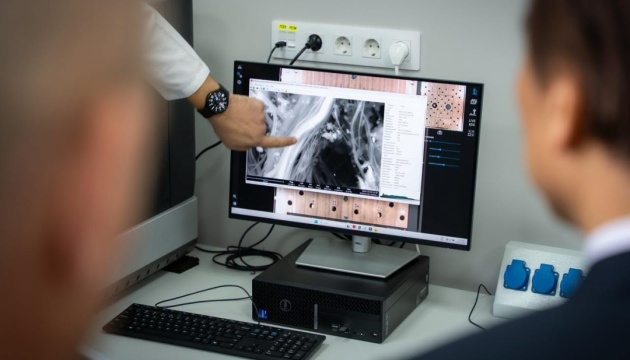
A national laboratory equipped for transmission electron microscopy has opened in Kyiv, enabling the highly accurate detection of asbestos in materials and debris from demolition sites.
Ukraine is awaiting an official response from the Pentagon and SpaceX confirming that the Starshield satellite system has been fully restored, while its connection speed remains unstable.
Ukrainian air defenses neutralized 253 drones and nine S-8000 Banderol/Dan-T missiles used by Russian forces to attack Ukraine during the day on October 16.
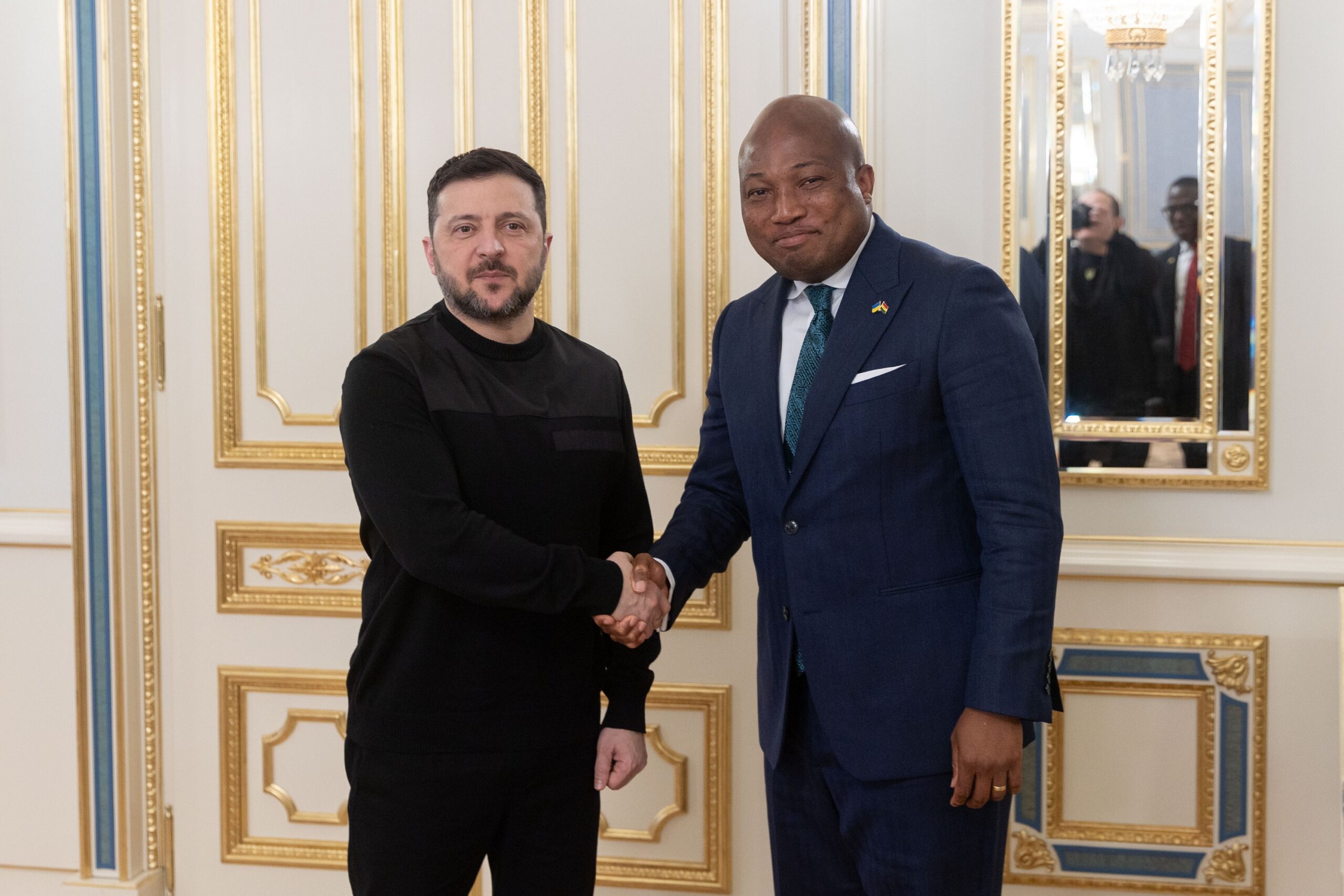
President Volodymyr Zelensky stated that Ukraine is using Starlink to operate interceptor drones that shoot down “Shahed” rockets attacking the civilian population.
President Volodymyr Zelensky stated that European countries have a sufficient number of PAC-2 and PAC-3 anti-ballistic missiles to meet Ukraine’s minimum needs this winter.
Ukrainian air defenses neutralized 114 drones used by Russian forces to attack Ukraine overnight on October 16. Enemy strikes were recorded at 24 locations.
Over the past 24 hours, there were 304 combat engagements between the Ukrainian Armed Forces and Russian troops. The enemy exerted the most pressure in the Pokrovsk direction.
Total combat losses among Russian military personnel from February 24, 2022, through October 16, 2026, reached approximately 1,561,020, with 1,790 of them killed in the last 24 hours.
Ukraine expects to finalize an agreement with Poland by the end of the year on a €125 million loan for the purchase of Polish weapons. Ukraine is also ready to conclude a “Drone Deal” with Poland and cooperate on the joint production of weapons under the SAFE program.
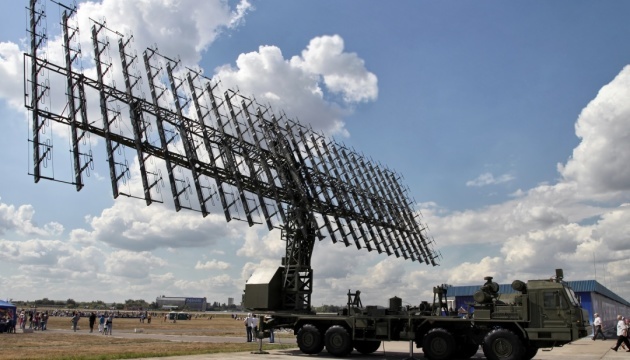
Fighters from the “Predator” Brigade of the Patrol Police Department struck a Russian invaders’ “Irbis” mobile radar station—worth millions of dollars—with attack drones.
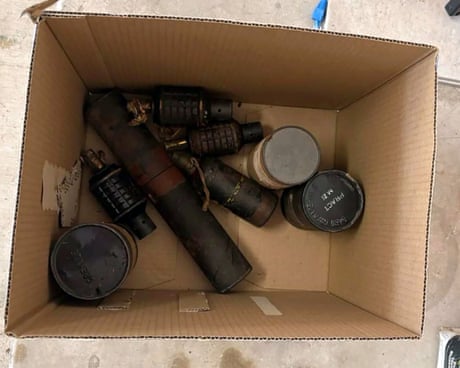
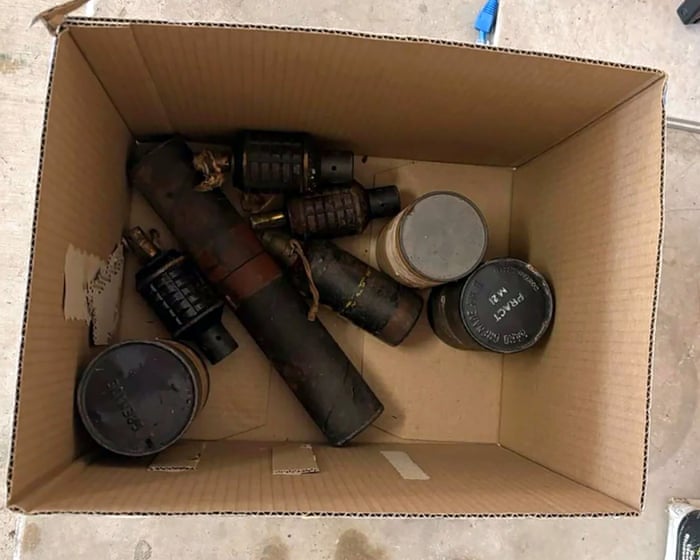
Discovery of grenades prompted a neighborhood lockdown and a visit from the Austin police department’s bomb squad
A buyer at a Texas estate sale discovered several second world war-era grenades in a box of newly bought items, prompting a neighbourhood lockdown and a visit from the Austin police department’s bomb squad.
The grenades, which were described as “live and active” in a social media post by the Austin police association, were removed and disarmed.
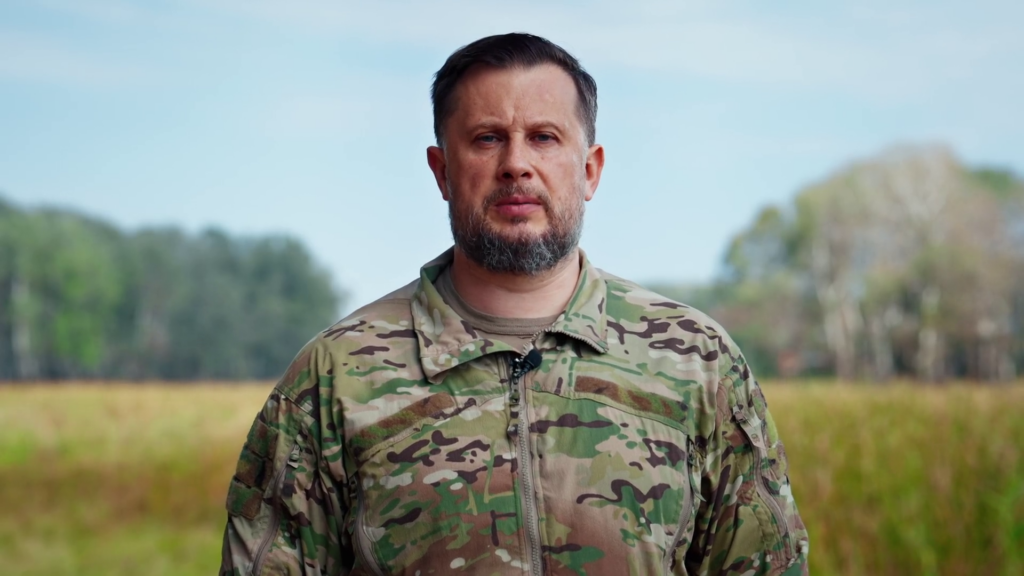
Ukraine has completed its Operation Vivaldi, aimed at protecting its fortress belt cities of Donetsk Oblast, which helped Kyiv preserve the region from Russian occupation for 12 years. Brigadier General Andrii Biletskyi, the commander of the Third Army Corps behind the operation, has reported that the fourth phase secured 101 km² of territory. Among the latest achievements is the liberation of three settlements—Zelena Dolyna, Lypove, and Kolodiazi.
The operation's main objective was to move Ukrainian troops into more advantageous defensive positions, Biletskyi said in the first days after the operation was made public. Vivaldi has now summed up the results of all four phases: Ukraine has established full control over 16 settlements, liberated 277 km² of territory, and inflicted 8,000 casualties on Russian forces.
Ukraine worked against Russia's deadline
During Operation Vivaldi, Ukrainian forces have prevented Russian troops from outflanking the Sloviansk-Kramatorsk agglomeration and cutting the Kharkiv–Sloviansk highway, a key supply route for Ukraine’s forces in Donbas, Biletskyi says.
“We thwarted the offensive of the Zapad grouping and forced it to redeploy some units of the 1st Tank Army, which eased pressure on Kupiansk-Vuzlovyi,” Biletskyi announces.
Previously, the Institute for the Study of War noted that Russian President Vladimir Putin was confident that Russian forces would be able to seize the entire Donetsk Oblast by the end of 2026 — the Kremlin’s latest deadline for achieving this goal.
Ukraine’s military was on a mission to prevent this.
Season one: clearing russian infiltration groups
On 15 September 2026, Ukraine’s Third Army Corps announced Operation Vivaldi in northern Donetsk Oblast. During the first phase, Ukrainian troops cleared Russian groups from 75 km² of territory and liberated another 10 km².
The Third Army Corps said it had struck Russian supply routes and fuel infrastructure, prompting Russia to relocate its fuel and lubricant reserves to Voronezh Oblast. According to the corps, Russian forces lost around 1,500 troops, more than 12,000 drones, and hundreds of pieces of equipment.
Season two: liberation of Shandryholove and Derylove
On 20 September, the Third Army Corps reported the liberation of Shandryholove and Derylove and the establishment of full control over Drobysheve.
During the second season, Russian forces lost another 800 troops, bringing their total losses across the first two seasons to more than 3,000, according to the corps.
During the first two seasons of the operation, Ukrainian troops and attached units regained control of 125 km² of territory, including 50 km² that had been fully liberated.
Soldiers of Ukraine’s Third Army Corps. Source: Ukraine’s Third Army Corps
The first phase of Vivaldi involved eliminating Russian groups that had infiltrated Ukrainian positions, explained the commander of a battalion in the 125th Brigade, callsign Darwin, per ArmyInform. After clearing those groups, the Defense Forces moved on to the operation’s second phase, using reconnaissance drones to detect Russian forces, he added.
For this, Ukraine used UAVs and ground robotic systems.
“The Third Army Corps was the first in the world to begin deploying ground robotic systems by air. Our heavy bombers deliver kamikaze ground robotic systems more than 10 kilometers behind enemy lines,” Biletskyi noted.
Season three: advances near Novе and Ridkodub
On 28 September, the Third Army Corps reported the liberation of Nove, Ridkodub, and Katerynivka and the restoration of control over Karpivka and Novomykhailivka. Ukrainian forces regained another 51 km² of territory, bringing the total area liberated since the start of the offensive to 176 km². Russian forces lost around 2,000 troops, and more than 250 were taken prisoner, the corps said in its summary of the operation’s third phase.
Settlements Ukraine's 3rd Army Corps says it liberated during Operation Vivaldi north of Lyman, Donetsk Oblast, Ukraine, as of 28 September 2026. Map: ISW
“The Russians were convinced that the main axis of attack was Shandryholove–Zelena Dolyna. This led it to squander its reserves in counterattacks along that very axis. The Russians slept through the actual strike, which was focused on capturing Nove,” Biletskyi said.
Operation Vivaldi aimed to disrupt Russia’s plans in Donetsk Oblast
The need for Operation Vivaldi arose amid Russian attempts to encircle Ukraine’s fortified belt in Donetsk Oblast. Ukrainian forces conducted preparatory efforts aimed at degrading Russia’s offensive capabilities, including strikes on Russian drone operators, the Institute for the Study of War reported on 9 October.
Ukrainian counterattacks in the Lyman direction and east of Sloviansk and Kramatorsk were intended to complicate Russian efforts to seize the fortified belt in Donetsk Oblast, the report noted.
The corps advanced gradually, reclaiming small areas instead of attempting a large-scale breakthrough.
German services detained two Turkish citizens on 12 October over the 23 September arson attack on a Starlink ground station in Wola Krobowska, near Warsaw, Poland’s Internal Security Agency (ABW) said. Both are suspected of arson, and Polish officials blame Russian intelligence. RMF24 later reported that German police also detained two more people who may be connected to the attack.
Poland is one of the main corridors for Western aid to Ukraine, and Polish Foreign Minister Radosław Sikorski has said Poland spends about $50 million a year on Ukraine's Starlink service. That puts Polish infrastructure in the path of a Russian campaign that already hacks cameras to track arms heading east.
Fingerprints, DNA, and a route out
The men were held under European arrest warrants and now await transfer to Poland. Interior Minister Marcin Kierwiński wrote that the suspects would face charges of “subversion, sabotage on behalf of a foreign intelligence service” after their transfer to Poland. Polish authorities issued European arrest warrants for the suspects, who were subsequently detained in Germany.
Działania @PolskaPolicja i @ABW_GOV_PL we współpracy ze służbami niemieckimi (BKA) doprowadziły do zatrzymania na terenie Niemiec 2 obywateli Turcji odpowiedzialnych za podpalenie stacji Starlink w Woli Krobowskiej. Zarzut-dywersja, sabotaż na rzecz obcego wywiadu. @CBSPolicji
Police chief Marek Boroń said investigators reconstructed how the suspects prepared the attack and fled. “We have secured recordings pointing to this specific action. We have fingerprints, the perpetrators’ DNA, how they moved, when they came to Poland, and when they were evacuated from our country,” he said. One suspect lives in Germany, and the other had been ordered to leave the country, he added.
Warsaw points at Moscow
Prime Minister Donald Tusk called the fire another act of Russia's hybrid war and promised the saboteurs will answer to Polish justice.
Na zlecenie polskich służb niemiecka policja zatrzymała dwóch obywateli tureckich podejrzanych o podpalenie stacji Starlink na Mazowszu. To kolejny akt wojny hybrydowej. Sprawcy sabotażu odpowiedzą przed polskim wymiarem sprawiedliwości.
“We have no doubt that Russian intelligence services are behind this act of sabotage,” said Tomasz Siemoniak, the minister coordinating Poland’s special services.
Those services increasingly turn to people tied to the criminal world, he added.
Two more possible links
German counterterrorism officers detained a woman in Berlin, and a man is also in German custody, Polish radio RMF FM reported, citing its reporter. Both may be linked to the arson. The woman allegedly picked up the Turkish men near Łódź after they entered Poland from Germany, then drove them to Wola Krobowska. The man’s role is still being examined.
Ukrainian marines planned a clearing operation near Pokrovsk for about a month, their deputy commander said in remarks relayed by Army Inform. The Defense Ministry’s news agency published them on 12 October. He also described the Russian infantry the marines captured as barely trained, hungry, and unwilling to fight.
Russia seized Pokrovsk by seeping small infantry groups into the city a few at a time. Beyond the city, Russian advances stayed limited. ISW assessed on 25 February that the capture brought no further operationally significant gains. Small advances continued, and DeepState mapped one near Bilytske in Donetsk Oblast on 7 October. Every stretch where Ukrainian units stop that infiltration closes the route Russia used to take the city.
What the operation produced
Karyi, the 40th Separate Marine Brigade’s deputy commander, said that Operation Audit cleared about 6 km². The marines suffered no losses while inflicting them on the Russians, he said, and gathered a lot of intelligence. He promised the enemy many more surprises.
Explore further
Ukraine makes local gains on Pokrovsk front despite sustained Russian attacks
The brigade had announced an operation by the same name on 26 September. It said then that the marines had cleared 5 km² and captured two Russian soldiers. The brigade also said they had stopped the flow of Russian infiltration on that stretch of the Pokrovsk direction.
Two weeks of training, then the front
Karyi called the two prisoners typical of the Russian infantry now sent against the marines, with all of two weeks’ training behind them. He said Russian recruits spend a month on transfers and paperwork before going into battle. They then walk to their positions for one or two weeks.
Explore further
ISW: First Pokrovsk, then Huliaipole—now Russia points its logistics-killing air campaign at the Fortress Belt
If drones or Ukrainian ground groups don’t kill them first, he said, they surrender because they no longer want to fight. They are not fed or given water. He described one parcel a week with a can of stewed meat, and water drunk from the ground underfoot. That, Karyi said, is why the Russian troops facing the marines are demoralized and untrained.
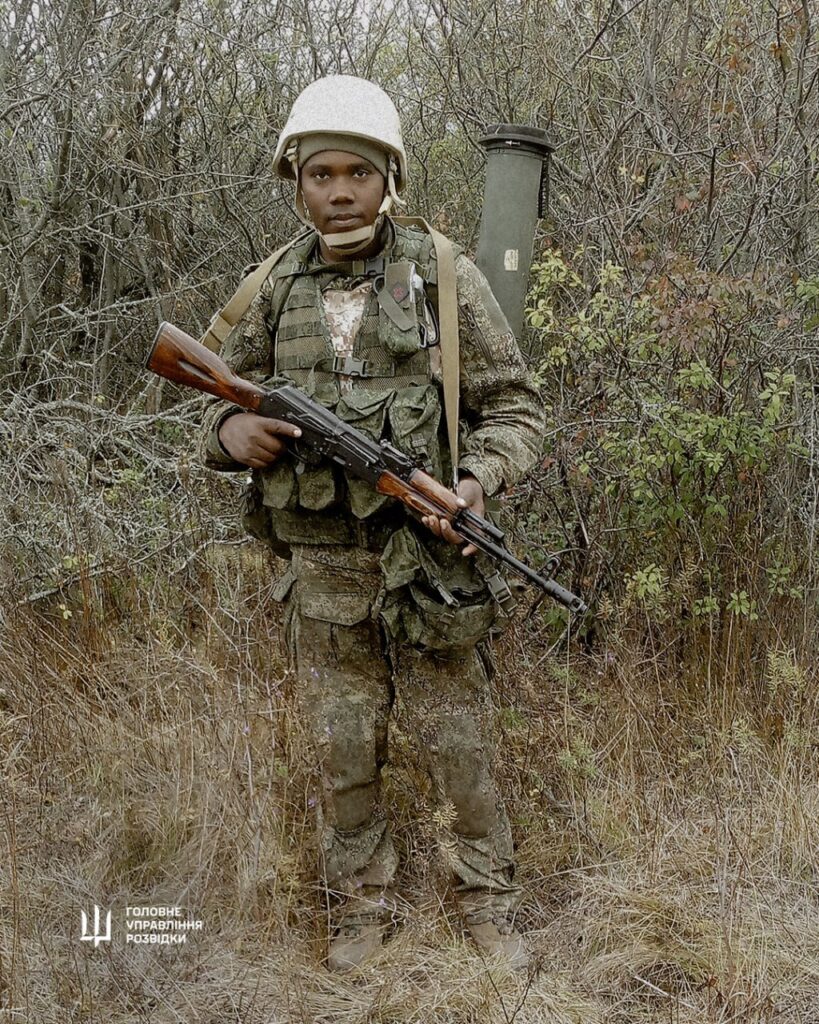
Kenya wants five of its citizens captured fighting for Russia in Ukraine to be treated as victims of human trafficking rather than prisoners of war, Foreign Affairs Cabinet Secretary Musalia Mudavadi told Kenyan lawmakers on 8 October, Bloomberg reported. Botswana is also seeking a citizen's return.
In 2025, Ukrainian ambassador Ivan Kholostenko called Russia's role in Africa neocolonialism. As Africa Corps troops prop up friendly regimes, the Kremlin is carrying out "a typical colonial practice of resource extraction," taking gold, diamonds, bauxite, and uranium, according to Ukraine's Foreign Intelligence. Russia also uses the continent as a recruiting ground for its war: nearly 500 Africans have died fighting for Russia, Ukraine says.
Five Kenyans in a Ukrainian camp
Kenya is negotiating to bring the five men home, and President William Ruto has raised the matter with Ukrainian President Volodymyr Zelenskyy, Mudavadi told the Senate. One has been held since November 2025, the others since March and April. The youngest is 23, Bloomberg reported. Kenya's honorary consul found them held in humane conditions at the Zakhid-1 camp, with access to medical care, the government said. Ukraine also holds the remains of four Kenyans.
Victims or fighters for hire
African governments say some of their citizens went to Russia for promised work as drivers, security guards, or cooks and were then forced into military service. The Kenyans "report having been recruited under false promises of employment," Mudavadi said.
"The circumstances of their recruitment and conscription are consistent with trafficking in persons," he said.
Ukraine's POW authority sees most foreign recruits differently. "The main motive for most of these mercenaries is financial gain," Dmytro Usov, secretary of Ukraine's Coordination Headquarters for the Treatment of Prisoners of War, said in November 2025, while stressing that many had ended up in Russia's army through fraud or coercion.
Ukraine holds that prisoners of war go home through exchanges, but Russia has never asked to trade for any foreign fighter except North Koreans, the headquarters said in May, adding it may consider other solutions if diplomats and lawyers find one.
Thousands of foreigners in Russia's ranks
Russia has recruited more than 28,000 foreigners from 135 countries, and more than 5,000 have been killed, a Ukrainian government website cited by Bloomberg says. Ukraine holds at least 213 foreign prisoners of war, not counting Russians and North Koreans, 37 of them African, according to documents Bloomberg saw. Russian dictator Vladimir Putin claimed on 3 September that people are "coming forward voluntarily and signing contracts."
Kenya's government counts 354 citizens linked to the war: 84 killed or missing, 34 hospitalized in Russia, and 62 repatriated. Petitioners told senators that 841 Kenyans remain unaccounted for. Mudavadi said his March visit to Moscow put Kenya on a Russian recruitment "stop list," with no new Kenyans enlisted since.
Some African governments take steps
In August, Botswana stopped eight citizens from joining the Russian military at airports in Botswana, South Africa, and Ethiopia, Bloomberg reported.
Captured Russian soldiers and an African mercenary. Illustrative photo: ArmyTV
Ghana accused Russia of luring its citizens into the war the same month, after Kenya and South Africa. The European Parliament said in March that Russia strips African recruits of their documents. Ukraine, meanwhile, is drafting its first Africa strategy.
President Volodymyr Zelensky of Ukraine revealed last month that two POWs defected to South Korea. South Korea accused him of breaking a confidentiality agreement.
Russia is concentrating missiles on a smaller, more specific set of targets, and its jet-powered attack drones are part of the reason, the Institute for the Study of War (ISW) assessed. Its combined attack overnight on 7 October killed 22 people in Pryluky, the State Emergency Service (SES) said as of the morning of 8 October. Russian milbloggers noted the shift the same day.
Russia often uses concentrated drone and missile strikes to overwhelm localized Ukrainian air defenses and destroy urban centers, ISW noted. Pryluky, where the strike killed children, was one of the areas a Russian channel says drew a significant share of the Kh-101s that night. With winter close, ISW expects the same pattern against Ukraine's energy grid, with jet drones partly letting Russia keep its missiles for priority targets without firing many more.
Missile waves on a few areas, Russian channels claim
Russia launched 48 Kh-101, Iskander-K, and Kalibr cruise missiles overnight on 7 October, Ukraine's Air Force reported. It also fired ballistic missiles, Zircon and Oniks anti-ship missiles, and 130 strike and decoy drones, 46 of them jet-powered Shahed-type models.
Explore further
22 killed in Russian missile strike on Pryluky, including five children
Russian milbloggers claimed the same day that Moscow had grouped a large part of its missile salvo into repeated waves on a few areas, while other weapons kept stretching Ukraine's air defenses elsewhere. The pro-war Russian Telegram channel Dva Mayora described the change as a switch from striking with splayed fingers to a series of hits with missile "fists." Defenders must then absorb a sharply rising load around one chosen site as one wave follows another, the channel claimed.
Citing Ukrainian monitoring channels, it claimed that roughly 30 or more Kh-101 cruise missiles flew toward Pryluky, Kremenchuk, Svitlovodsk, and Oleksandriia in Chernihiv, Poltava, and Kirovohrad oblasts. It put the Kremenchuk group at up to 15 missiles, Kh-101s and Kalibrs among them, aimed at the area of Kremenchuk and its hydroelectric plant.
Jet drones take some of the load off Russia's missiles
ISW said the jet-powered versions penetrate Ukrainian air defenses deeper and more reliably than propeller models. In ISW's assessment, that partly lets Russia concentrate cruise and ballistic missiles on priority targets without significantly raising missile use. Russia builds about 3,000 Geran-4 and Geran-5 jet drones a month, Ukraine's military intelligence agency (HUR) told Militarnyi in August.
Explore further
Ukraine spent three years learning to catch Russian drones—so Russia made them fly faster
ISW expects Russia to apply the pattern in a likely brutal winter campaign against energy infrastructure. Russia likely intends to make city life untenable and force Ukraine to capitulate to its demands, ISW assessed. Such tactics have not worked before and are unlikely to work now, analysts added.
They called cheap countermeasures to jet drones and small cruise missiles vital, alongside Western air defense aid such as US-made Patriots, which can stop ballistic missiles. Ukraine has already paired a Soviet-era Kub launcher with American RIM-7 interceptors to catch jet drones.
After trading his military uniform for civilian clothes, Myanmar’s strongman president, U Min Aung Hlaing, is in Malaysia, his ninth stop on a search for international legitimacy.
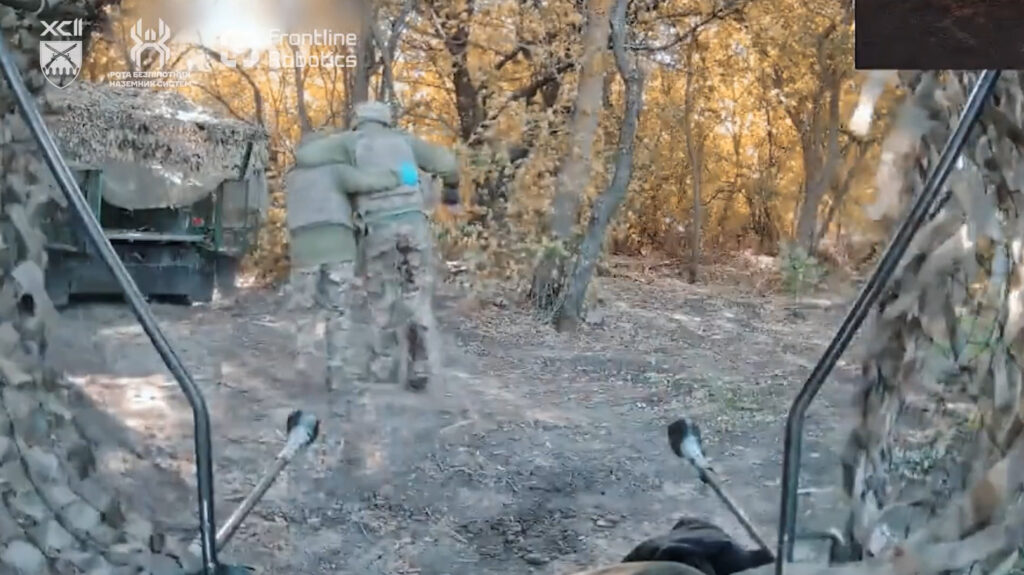
A company of unmanned ground systems from Ukraine's 92nd Assault Brigade used the robotic system Frodo to evacuate a wounded soldier, Frontline Robotics told Militarnyi on 7 October.
Ground robots are being used to evacuate wounded soldiers from the drone-dominated "kill zone," a band tens of kilometers deep on both sides of the front line. About 112,000 logistics and evacuation missions by ground robotic systems were recorded from January through August 2026, according to Ukraine's Defense Ministry.
Operator credits speed and suspension
The operator, callsign Tango, named speed and the ability to perform complex maneuvers as the robot's main advantages, according to Militarnyi. The unit also praised Frodo's adaptive suspension, which it said smoothed out rough terrain and kept the wounded soldier's transport relatively comfortable.
The Frodo ground robot's evacuation mission with Ukraine's 92nd Assault Brigade, autumn 2026. Screenshot from video: Frontline Robotics
What Frodo can carry, and how far
The robot has a 6×6 wheel layout with independent suspension, adjustable ground clearance of 170–330 mm, and a top speed of 40 km/h. Its recommended payload is 200 kg, and its maximum is 400 kg, according to Frontline Robotics. The company lists its range as 150 km on asphalt and up to 90 km over rough terrain with the recommended load. Frodo supports several communication channels, and one person can swap its batteries in about two minutes.
Frodo had passed the Defense Ministry's codification and could carry remote-controlled modules such as the Burya turret, Militarnyi reported on 30 September.
The 92nd Brigade had used ground robots to evacuate wounded soldiers before. In September 2025, the brigade evacuated three wounded soldiers using a ground robot, according to Militarnyi.
More than 50 Russian companies could default on their bonds this year, the most since 2009, a rating-agency analyst told Russian newspaper Izvestia, which reported it on 6 October.
Russia's wartime economy is straining under high interest rates, and the budget is too: the 2026 deficit has nearly doubled from the earlier forecast to a record $88 billion, with more deficits planned for the next three years as Moscow raises taxes to fund the war and plans its biggest defense budget since the full-scale invasion began.
A default is a situation in which a company cannot make promised interest payments to investors on time or repay borrowed money. If a payment is not made by the agreed deadline, the company becomes delinquent, which under certain conditions is recognized as a default.
So far this year, 20 companies have defaulted for the first time, compared with 24 in all of 2025, said Mikhail Nikonov of the Expert RA rating agency. Most of the companies that missed payments are small issuers of high-yield bonds, Izvestia reported.
In 2026, Russian companies have missed payments totaling 41 billion rubles (about $490 million), compared with 34 billion rubles (about $410 million) the previous year, according to investment bank Sinara.
Russia faces a new wave of corporate defaults
By the end of 2026, the number of Russian companies unable to service their ruble-denominated debt on time could reach 40–50, the highest level since 2010, said Pavel Zholobov, junior managing director at the NRA rating agency.
The number of bond defaults in 2026 has already reached its highest level in a decade, Zholobov said. Similar figures were recorded in the mid-2010s: in 2014, 35 companies missed payments; in 2015, 52 did so; and in 2016, there were 44 issuers. This occurred in part after Western sanctions were imposed on Russia over its annexation of Crimea and its war in Donbas, as well as amid a halving of oil prices and a sharp weakening of the ruble.
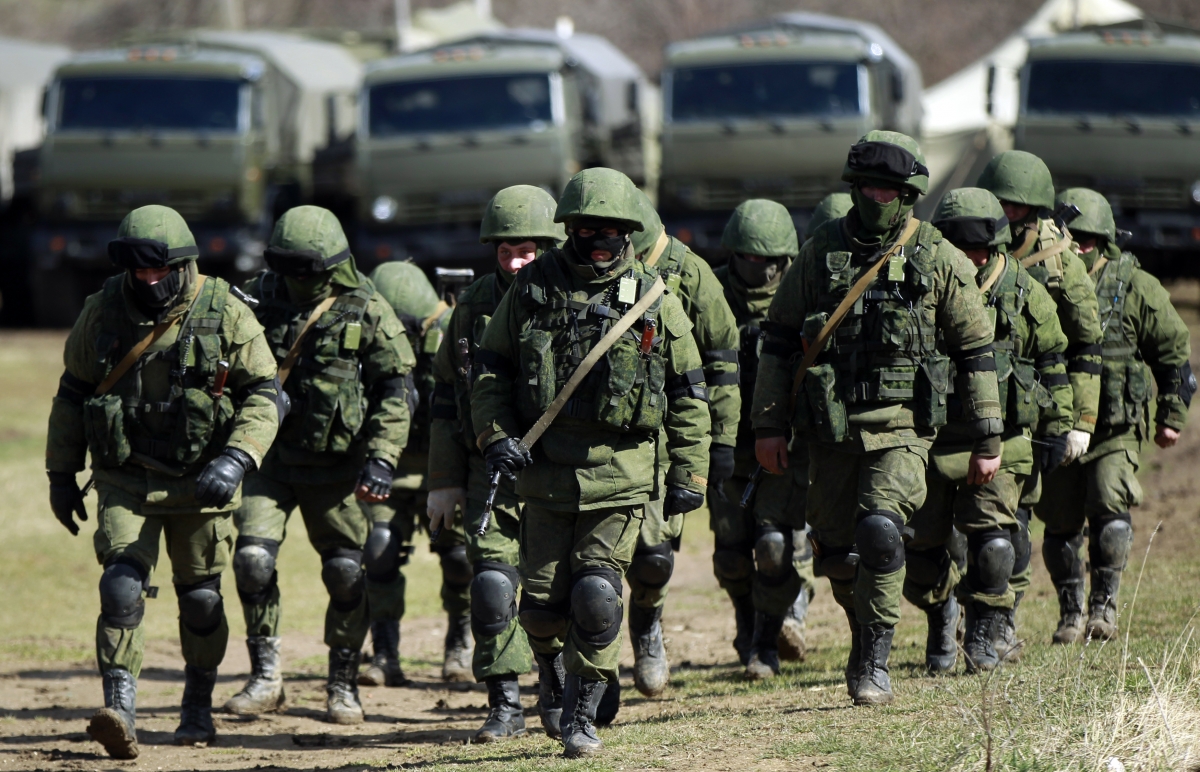
So-called "little green men" (the Russian occupation troops comprised special forces who removed insignia, wear face masks to prevent identification and call themselves a "Crimean self-defense force") surround a Ukrainian military base in Perevalne, Crimea, during the Russian annexation of the peninsula in February-March 2014.
There were more defaults only in 2009. At the time, amid the fallout from the global financial crisis, more than 100 issuers faced payment problems, while the volume of distressed debt reached nearly 200 billion rubles, Zholobov noted.
High interest rates put pressure on companies
This time, the main reason for companies' difficulties in making bond payments has been the prolonged period of high interest rates, which has continued since 2023. Companies are raising financing at high interest rates but are unable to refinance their debt on more favorable terms, explained Ekaterina Sidorova, head of the Foreign Exchange, Commodities and Debt Markets Department at SberCIB Investment Research.
At the same time, the situation does not yet resemble a systemic debt crisis: defaults are primarily being recorded among companies with low credit ratings and high debt burdens, Sidorova said.
If a company fails to repay bond debt, it is given 10 business days to meet its obligations. If it fails to do so, the company may offer investors a restructuring—for example, by postponing payments in exchange for a higher interest rate.
The number of defaults will remain high in 2027, Sidorova believes.
High interest rates were a response to accelerating inflation in Russia. Domestic demand was outpacing production, Russia's Central Bank said in October 2023. Sanctions over the war and rising defense spending had also hit the economy and the ruble, which had lost about 25% against the dollar that year. The bank raised its key rate from 7.5% in the first half of 2023 to 15% by the fall.
Ukraine targets Russia's oil industry to weaken its war economy
Ukraine is also seeking to weaken Russia's economy as part of efforts to reduce its ability to finance the war. In particular, Defense Minister Yevhenii Khmara said strikes on oil refineries are aimed at "bleeding the Russian war machine" and destroying its military and economic potential. According to the ministry, the attacks have knocked out more than 51% of Russia's oil refining capacity.
In the first half of July, Russian oil refineries processed about 3.9 million barrels of oil per day—the lowest level since March 2005. Due to the production cuts, Moscow was also forced to restrict fuel exports.
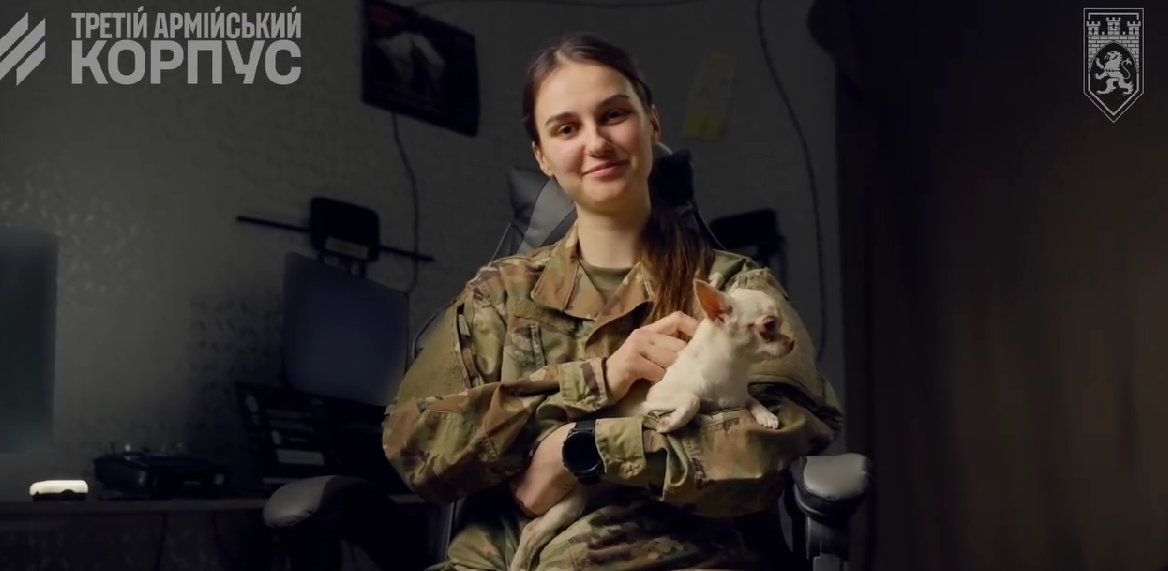
Natalia is 25 years old and from Odesa. She has served in two armies—the Israeli and Ukrainian militaries. In the Armed Forces of Ukraine, she has, among other things, carried out missions as part of a UAV, FPV drone, and strike-wing crew on the Zaporizhzhia and Kupiansk fronts, NV reported on 5 October.
During the Russo-Ukrainian war, women in Ukraine have the right to voluntarily enlist in the military. As of March, more than 75,000 women were serving in the armed forces, more than 55,000 of them as service members, the commander-in-chief said, and their number has been growing every year. Recently, discussion around the mandatory mobilization of women has intensified. Keith Kellogg, former US Special Presidential Envoy for Ukraine under President Donald Trump, said that he considered mobilizing women in Ukraine appropriate. In response, Iryna Vereshchuk, Deputy Head of the Office of the President of Ukraine, said she would rather see more missiles and more will from the United States than advice to mobilize women.
In Israel, Natalia served in a search-and-rescue brigade as a rescue soldier and in the engineering corps during a deployment along the northern border.
Natalia was born in Russia’s Saint Petersburg but does not remember her life there
The young woman was born in St. Petersburg, where her family lived at the time. When she was a year and a half old, her mother returned to Odesa with her and her older son. Natalia says she remembers her life exclusively in Ukraine.
She spent the first nearly two years studying at Lviv University, but later decided to leave the university and look for other educational opportunities. Natalia studied, among other places, in Denmark through a scholarship program. After completing it, she planned to enroll at a European university to study sound engineering, but the coronavirus pandemic began at that time.
She moved to Israel under a program for Jewish youth at the end of 2020. After the program ended, due to quarantine restrictions and closed airports, Natalia faced a choice: obtain a work visa or acquire citizenship under the Law of Return. She chose the latter—and with it, she also became obligated to perform military service.
In May 2022, Natalia joined the Israeli military and chose a combat unit.
“When the war started in Israel itself, I still had six months of mandatory service left. I was discharged and immediately transferred to reserve service. Once I managed to resolve all the bureaucratic issues so that this would not be considered desertion, I returned to Ukraine,” the young woman says.
Natalia returned to Ukraine in March 2025, and in August signed a contract with the Armed Forces of Ukraine.
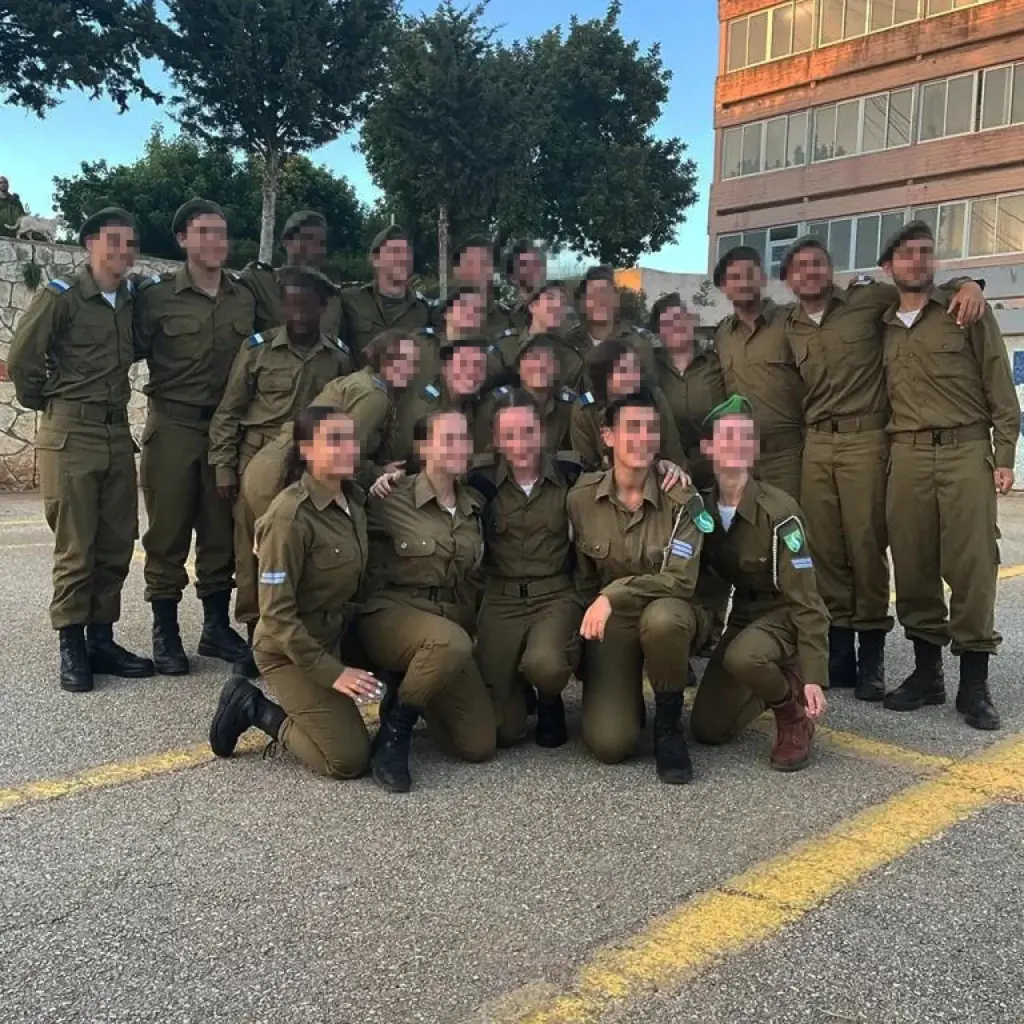
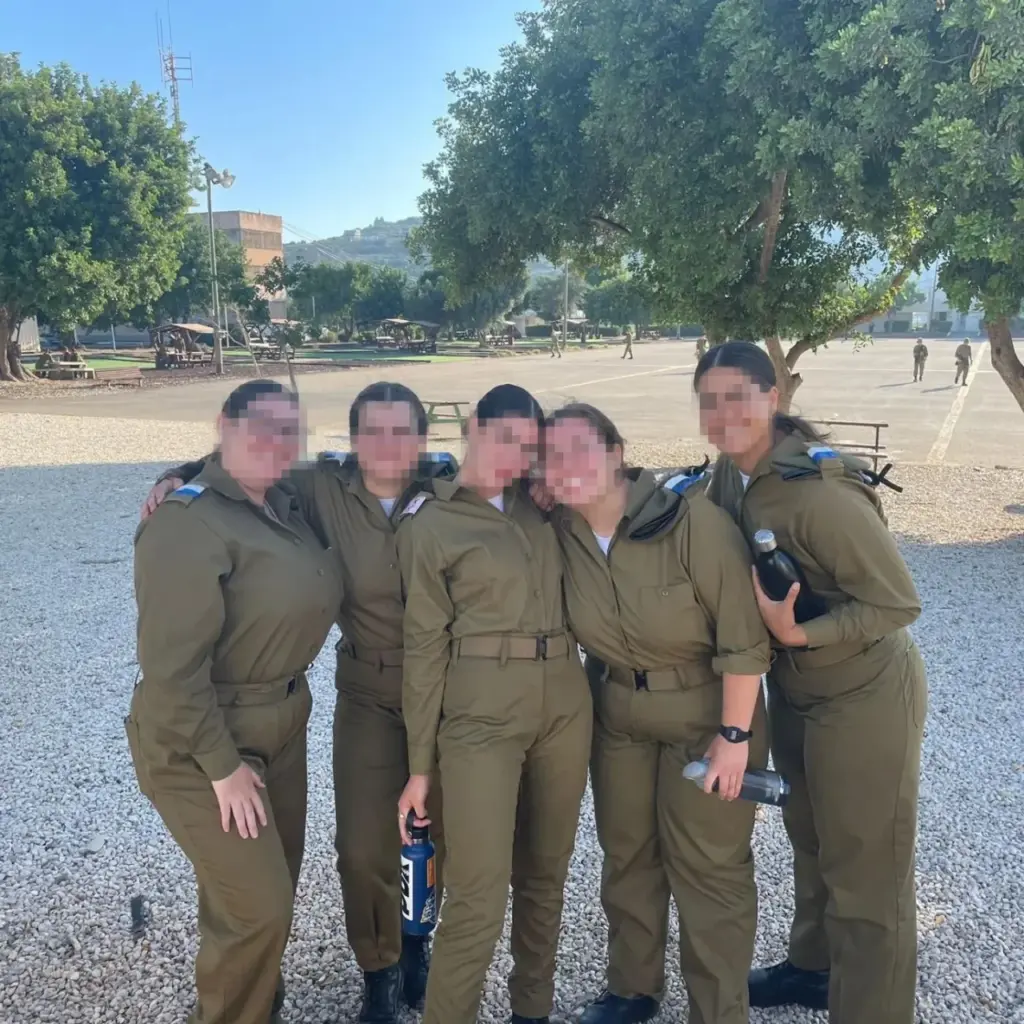
Natalia (right) and her fellow servicewoman. Photo courtesy of Natalia/NV
“The army—both Israeli and Ukrainian—gives you a deeper understanding of what society is made of”
Among the advantages of the Ukrainian army, she highlights its ability to quickly adapt to circumstances. In particular, she mentions the use of drones, OSINT, and solving complex technological tasks with minimal resources.
“The West could learn from this situational agility. They often spend huge budgets on developments that should be cheap and mass-produced,” the veteran says.
However, such Ukrainian ingenuity is largely a consequence of a lack of funding, Natalia notes.
In the Israeli military, Natalia highlights society’s readiness for the constant threat of war and more systematic planning of military service.
“There, preparation for and perception of the army begin at school: by the age of 14–15, teenagers already understand where they want to go, what skills they need, and undergo selection for special or intelligence units,” the young woman says.
She then gives the opposite example of the situation in Ukraine.
Explore further
This Ukrainian female soldier flies one of war’s heaviest drones. She turns down promotion twice to keep doing it
“In Ukraine, with very rare exceptions, people hide until they are mobilized, and suddenly face the reality of conscription without having any understanding of the system,” the veteran says.
Asked how adapted the Ukrainian army is to women, she answered: “In no way,” adding that the Israeli army is “also largely not fully adapted.”
In Ukraine, this is reflected, in particular, in the provision of clothing and equipment that often does not correspond to women’s sizes and physiology. She says she had to purchase her own anatomically fitted body armor. She cited the example of veteran Natalia Lishchyshyna, who had her breasts amputated due to prolonged wearing of body armor that was not adapted to the female anatomy.
In Israel, by contrast, there is a practice of reimbursing expenses for equipment that service members purchase at their own expense.
Serving in the military in both countries provides an opportunity to better understand what society is actually made of, the young woman says.
“The army—both Israeli and Ukrainian—gives you a deeper understanding of what society is made of. You encounter people you would never have crossed paths with in your civilian bubble because of differences in views or socioeconomic circumstances,” Natalia says.
She believes this makes it easier to accept mistakes, difficulties, and new challenges.
The Ukrainian army is not adapted to women in any way, Natalia says
In Natalia’s view, the problem is not only the living and working conditions but, above all, the lack of mechanisms necessary for the systematic mandatory mobilization of women. At the same time, she believes voluntary recruitment should be encouraged and expanded.
One of the problems is the lack of a legal procedure for temporary childcare in cases when both parents are simultaneously carrying out combat missions, Natalia says, stressing that she means the period of their service, rather than situations involving the death of one of the parents.
Another shortcoming is insufficient protection against sexual violence and harassment in the Ukrainian military.
“Here, any complaint goes through the direct chain of command. If the commander is not interested in resolving the problem or is involved in it themselves, the woman is left defenseless,” the veteran says.
In Israel, by contrast, there is a separate hotline and mechanisms for documenting such cases without directly approaching a commander.
Natalia (second from left) during her service in the Israeli army. Photo courtesy of Natalia/NV
Women in combat positions can also still be taken insufficiently seriously, denied participation in combat missions, or transferred to staff positions without their consent.
Natalia also emphasizes the lack of systematic military training for civilian women “at any level” and gives school education as an example.
“Even with the weak level of the school curriculum for the subject ‘Defense of Ukraine,’ boys had at least some basic knowledge. Girls were not involved in it at all,” the veteran says.
For now, Natalia believes that women’s military service should remain voluntary, as society as a whole is still not ready to fully accept women in the military.
Russia lost more troops in September than in any other month this year, hitting the record, by Ukraine's count. The General Staff put last month's Russian casualties at 46,230, a 2026 record and 45.8% above January's.
At the same time, Russia's strikes on Ukraine's rear escalated in September and are climbing again in October. The result is a grind that bleeds Russia on the ground while Ukrainian cities absorb the blows from above.
Losses span the whole front
"Ukraine's Defense Forces continue to inflict systemic and tangible losses on the Russian occupation forces in personnel and equipment along the entire line of contact," the General Staff says.
The toll climbs all year
The monthly figures have risen almost without pause. After a dip to 26,090 in February, Russian losses climbed through the spring and summer, 39,290 in June, 42,860 in July, 42,020 in August, before last month's high.
The record reaches down to a single day: the General Staff counted 2,090 Russian casualties in the 24 hours to 28 September, which British Defense Intelligence assessed as the highest daily toll since the full-scale invasion, one of only four days to top 2,000, the other three in 2024.
British intelligence tied the high rate to intense fighting around the fortified belt of Donetsk cities, especially near Dobropillia.
Meanwhile, Kyiv is also continuing its Vivaldi Operation near Lyman, and its latest mission used ground robots, each carrying two Bullspike grenade launchers to launch an attack on Russian positions and then detonate inside their shelters.
Kyiv reads the climb
Across the war, Ukraine says it has put roughly 1.5 million Russian troops out of action, a toll that has bought little ground as the months-long summer offensive stalled short of its goals.
"Every attempt to pressure our positions ends for the enemy in disproportionate losses of wounded and killed," the General Staff says.
The figures are Kyiv's own and cannot be independently checked: they count the Russians' wounded and killed but never their own.
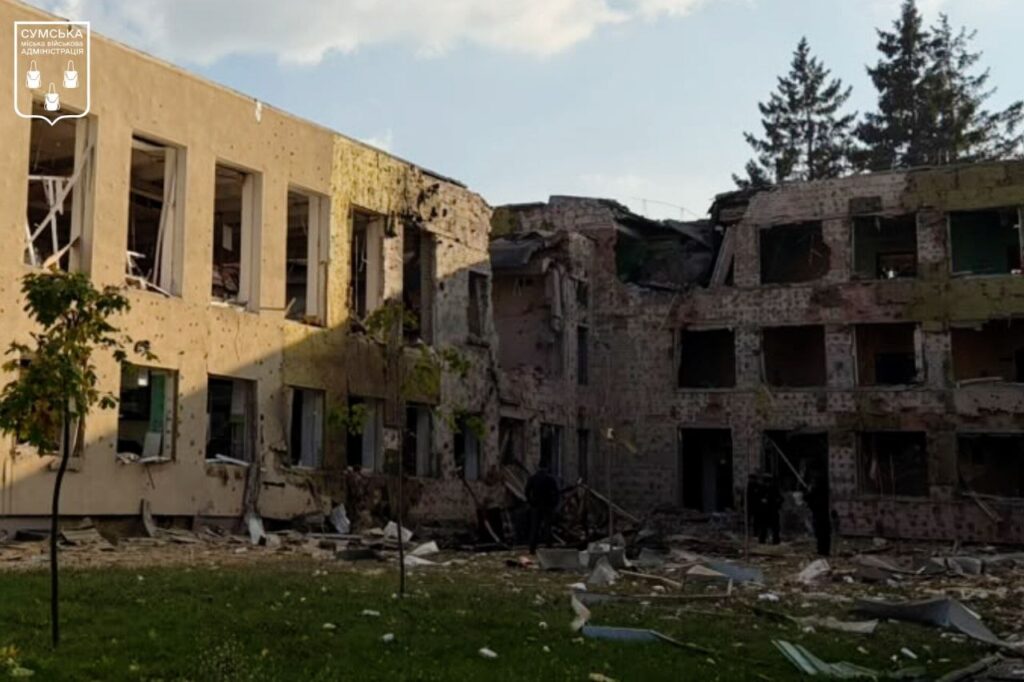
The Russian army deliberately struck a school in Sumy with a 250-kilogram aerial bomb while students—children in grades 1–4—were there, Serhii Kryvosheienko, head of the Sumy City Military Administration, reported on 29 September. The strike was one of a series of mass attacks on Ukrainian territory over the past 24 hours.
Across Ukraine, children now begin the school year in bomb shelters, because Russian missiles, drones, and glide bombs keep hitting schools, hospitals, and homes far from the front. The first eight months of 2026 brought more civilian casualties than all of last year, the UN says, and places where children gather are part of that toll.
Kryvosheienko said the Russians aimed the bomb at the school on purpose.
"With no pity or compassion whatsoever, they strike at children? There is nothing human in the enemy! He is not fighting on the battlefield—he is destroying a nation," Kryvosheienko said.
About 40 students were in the school's shelter at the time, a school employee told Suspilne correspondents. Preliminary reports indicate the children were not injured, Suspilne said.
Ukrainian President Volodymyr Zelenskyy confirmed the strike on the school.
"Four KABs struck the city center, right at the school building, where classes were underway. Thank you to the teachers and the school administration: the children and teachers were in the shelter, a total of 100 people were evacuated in time," he wrote.
Two people were killed in Sumy, and children are among those injured
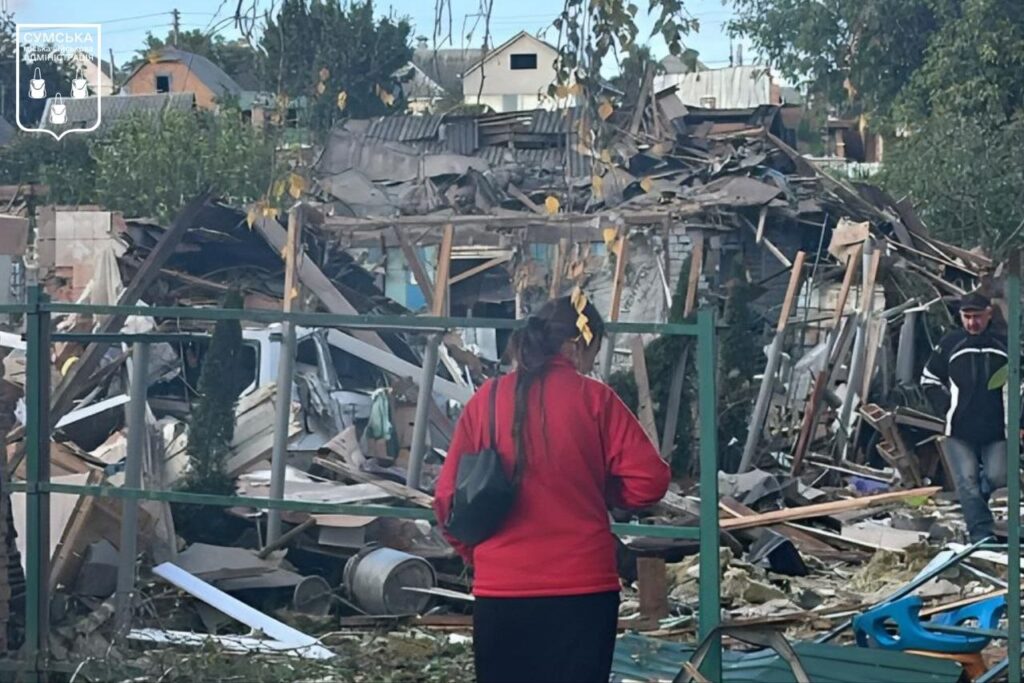
Over the past 24 hours, Russian forces carried out more than 60 strikes on 25 population centers in 13 territorial communities of Sumy Oblast, the Sumy Regional Military Administration reported. Two people were killed and 15 others were injured, including two children, according to the administration's figures for each community. Over the course of the day, the oblast was under an air-raid alert for 22 hours and two minutes.
In particular, a 74-year-old man and a 70-year-old woman were killed in the Sumy community as a result of strikes by guided aerial bombs (KABs), the report said. Four people were injured and three people sustained trauma as a result of the Russian attack, including a one-year-old girl. A six-year-old girl was also injured, while a 49-year-old man sustained injuries in a UAV attack.
Aftermath of the Russian attack on Sumy Oblast, Ukraine, 29 September 2026. Photo: Sumy City Military Administration
Over the past 24 hours, the Russians attacked Mykolaiv Oblast with Shahed/Gerbera-type attack UAVs, killing a 56-year-old man, the Mykolaiv Regional State Administration reported. The attack destroyed one detached house, damaged two others and four outbuildings, and caused fires, according to the report.
An 8-year-old girl and an 85-year-old woman suffered acute stress reactions as a result of Russian shelling
Russian forces attacked Kharkiv and 10 population centers in Kharkiv Oblast, according to Oleh Syniehubov, head of the Kharkiv Regional Military Administration. Two people were hurt, both with acute stress reactions.
In Kharkiv, an 8-year-old girl suffered an acute stress reaction, as did an 85-year-old woman in the village of Ohurtsivka, Syniehubov reported.
The Russians used various types of weapons against Kharkiv Oblast: one guided aerial bomb (KAB), one multiple rocket launcher system (MLRS), five Molniya-type UAVs, seven FPV drones, and eight UAVs whose type is still being determined, according to the report.
In Kharkiv, Russian shelling damaged the windows of an apartment building, two cars, a private house, and the roof of a shopping center. A car was also damaged in the village of Myronivka, and three cars in the village of Mali Fesky.
A car damaged in the Russian attack on Kharkiv Oblast, Ukraine, 29 September 2026. Photo: Kharkiv Regional Military Administration
The Russians also injured six residents of Donetsk Oblast: three people in Bilbasivka, one person in Sloviansk, one person in Shabelkivka, and one person in Druzhkivka, Donetsk Regional State Administration head Vadym Filashkin reported on his social media.
Over the past day, 18 population centers in Kherson Oblast came under Russian airstrikes, drone attacks, and artillery shelling, leaving five people injured, says Oleksandr Prokudin, head of the Kherson Regional Military Administration. He adds that Russian forces targeted critical and social infrastructure as well as residential areas, damaging two detached houses in particular.
Russian forces carried out 686 strikes on Zaporizhzhia Oblast
Over the past 24 hours, the Russians carried out 686 strikes on 51 population centers in Zaporizhzhia Oblast, but no civilians were injured, co-chair of the Zaporizhzhia Regional Defense Council Ivan Fedorov reported, adding that:
Russian forces carried out 22 airstrikes on 18 population centers.
530 UAVs of various modifications, predominantly FPV drones, attacked 37 population centers.
Five MLRS strikes were recorded against Orikhiv, Novoandriivka, and Kosivtseve.
129 artillery strikes hit 19 population centers.
44 reports were received concerning damage to infrastructure, homes, and vehicles.
A house damaged in the Russian attack on Zaporizhzhia, Ukraine, 29 September 2026. Photo: Zaporizhzhia Regional Defense Council
Seven facilities in Zhytomyr Oblast were damaged during the evening and overnight hours leading into 30 September, says Vitalii Bunechko, head of the Zhytomyr Regional Military Administration. Food and processing industry enterprises as well as energy facilities came under Russian attack. Four cars also burned as a result of the attack, Bunechko added.
The Russian army attacked three districts of Dnipropetrovsk Oblast with UAVs, Dnipropetrovsk Regional Military Administration head Oleksandr Hanzha wrote on social media. The attacks damaged infrastructure, and a fire broke out in one of the communities, he said, adding that there were no casualties.
Air defense forces neutralized three Russian UAVs over Cherkasy Oblast, with no casualties, Ihor Taburets, head of the Cherkasy Regional Military Administration, reported. However, the fall of an enemy target caused a fire at an infrastructure facility, which was quickly extinguished, he added.
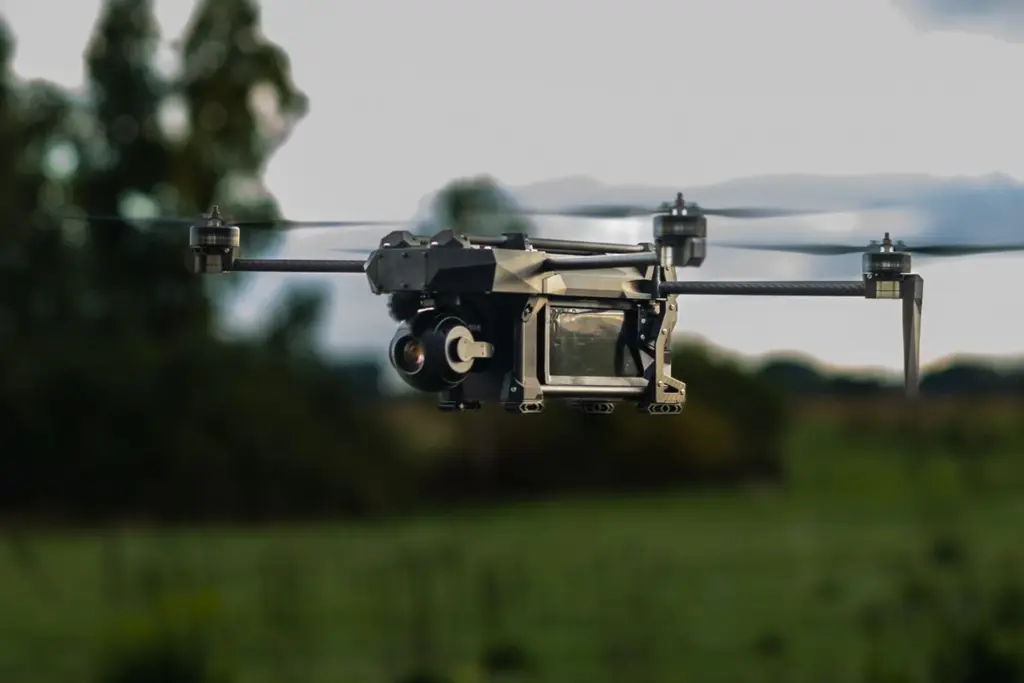
Ukrainian company Vyriy Industries is bringing a new tactical reconnaissance drone, Slavic, to the market, Oboronka reports, citing information from the manufacturer. The control system of the new drone will be familiar to DJI Mavic operators, the company also said.
Mavic has long been one of the main reconnaissance tools used by Ukrainian forces, with Ukraine relying heavily on supplies of these drones from abroad. After Ukrainian President Volodymyr Zelenskyy said China had stopped selling drones to Ukraine, the country began seeking alternatives. Slavic is one of these domestic alternatives, designed not only to replace Mavic but also to adapt its capabilities to current battlefield conditions, allowing reconnaissance crews to operate farther from the line of contact and reducing risks to personnel.
Slavic has a tactical range of up to 30 kilometers without GPS
Slavic can remain airborne for up to 1.5 hours because it is equipped with a 40,000 mAh solid-state battery, the media outlet notes. The drone has a tactical range of up to 30 kilometers, the report says.
Illustration showing the positions of the Slavic pilot (left) and Mavic pilot (farther to the right), as well as the drones’ flight ranges relative to enemy positions (shown in red). Illustration: Vyriy Industries
The aircraft can operate without GPS, as Slavic uses optical positioning for navigation. The pilot can also select a less congested channel and operate more effectively in difficult terrain because the communications system operates across a wide range of channels.
The manufacturer notes that for surveillance, Slavic is equipped with a daytime 2K digital camera mounted on a three-axis stabilized gimbal, with 10x optical and 30x hybrid zoom.
Part of the drone with the camera. Photo: Vyriy Industries
The system is supplied as a ready-to-use package “out of the box,” with all the equipment needed for operation without additional field modifications.
The drone is designed to keep crews farther from the front line
The company said its new drone has successfully completed initial combat trials with seven units of the Ukrainian Defense Forces and is preparing for scale-up, the media outlet notes.
“The war has changed, and so have the working conditions for crews. The kill zone has expanded, while available commercial drones have a limited tactical range. The main task now is to provide the military with a specialized platform that can fly longer and farther, so crews can operate farther from the line of contact. This is exactly why we began developing Slavic,” said Oleksii Babenko, founder and CEO of Vyriy Industries.
At the same time, the team is working on new Slavic configurations, including testing thermal imaging modules for nighttime reconnaissance. The manufacturer is also preparing the platform for scaled-up production and deliveries to the Ukrainian Defense Forces, the company told the media.
“Frankensteins” and Ukrainian-made drones are among the options for replacing scarce Mavics
The Ukrainian military had widely used Chinese DJI Mavic 3 drones, including to adjust artillery fire, monitor infantry positions and conduct surveillance, prompting Ukraine to seek ways to replace the shortage. More than five alternatives to the Chinese drone had already been developed in Ukraine, the Ministry of Strategic Industries of Ukraine confirmed to RBC-Ukraine in July 2025.
DJI Mavic 3 in use by a Ukrainian servicemember. Photo: Ministry of Defense of Ukraine
There are also other options for replacing them. The main work in military units is being done with “Frankensteins,” drones assembled from two or three damaged aircraft, Mavic UAV pilot instructor “Dobryi” said in an interview with Militarnyi in July this year. At the same time, such drones are less reliable than new ones, he added.
Small groups of Russian infantry could slip into regional capital Zaporizhzhia this winter, a frontline commander warned in a mid-September interview with Dnipro TV, in a debate later compiled by Radio Svoboda. His forecast drew quick pushback from a military analyst, who called it far more categorical than the situation warrants. At the center of the dispute lies the drained Kakhovka Reservoir, whose dry bed Russia now uses for cover.
Dense drone surveillance has made large mechanized assaults costly, pushing Russian commanders toward small groups that probe for gaps. That shift turns unwatched terrain — here, the drained reservoir bed—into the seams they test.
Solitary groups, not massed forces
Dmytro Filatov, callsign Perun, commands the 1st Separate Assault Regiment named after Dmytro Kotsiubailo. The danger will come not as a massed assault but as infiltration, he said. He expects solitary infantry groups to reach and enter Zaporizhzhia over the winter. He pointed to the Stepnohirsk axis and the dense buildings along the Dnipro shore. Fog and rain raise pressure across the whole front, and Russian troops have long fought well in winter, he said.
A city on the front's edge
Zaporizhzhia is a regional capital and industrial center in southeastern Ukraine, with more than 700,000 residents before the full-scale invasion. The city sits about 25 km from the nearest active front, around Stepnohirsk to the south—unusually close for a regional capital of its size. Russian missiles, drones, and glide bombs hit the city daily. It has held since 2022, and Russia has not taken a Ukrainian regional capital since the war's first months.
The aftermath of the Russian attack on Zaporizhzhia on 30 May 2026. Credit: Local Governor Ivan Fedorov
The dead reservoir as cover
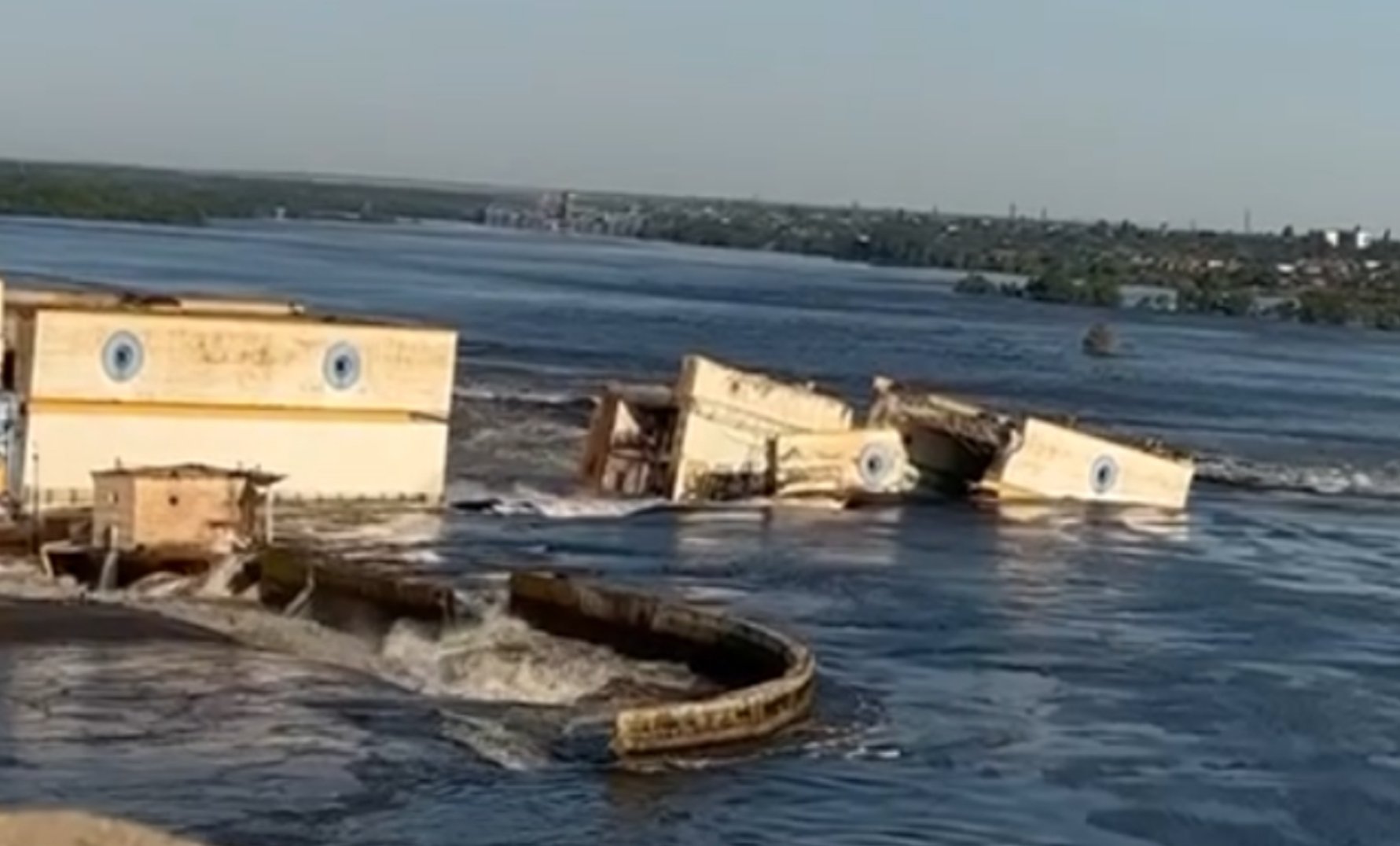
Russia blew up the Kakhovka dam in June 2023 and drained the reservoir behind it. Reeds now stand several meters high across the dry basin, giving foot soldiers cover to move unseen. Ukraine's Southern Defense Forces reported in November 2025 that Russian groups use it to press into the Ukrainian flank.
Russian troops increasingly use the bed to infiltrate and haul supplies, said Kostiantyn Mashovets of the Information Resistance group. One of their assault groups pushed as far as Malokaterynivka before Ukrainian forces blocked it, he wrote. Ukrainian troops hold northern Plavni, including the railway station and part of the E-105 highway, Mashovets added. The Institute for the Study of War pointed to the same route in its 26 September assessment, citing Ukrainian military observers.
Explore further
“The worst environmental catastrophe since Chornobyl disaster”: Three years after Russia destroyed Kakhovka Dam, real death toll is still unknown
An analyst is not convinced
Oleksandr Kovalenko, a military-political expert and Information Resistance coordinator, rates the threat far lower. He wrote that the warning "sounded far more categorical than it should have." Stepnohirsk, about 25 km south of Zaporizhzhia, is the closest active fighting to the city. Russia has tried for years to take the town but now controls only its 3rd microdistrict and southern Plavni.
Infiltration becomes possible only if Russia takes the whole foothold and reaches the north bank of the Konka river. That will not happen by the end of 2026, and no ground push on the city looks possible, he said. The main danger stays daily Russian strikes on the city, not a ground advance, he added.
Russia is likely attempting to force Ukraine to capitulate by spring 2027 through a large-scale campaign of long-range strikes, the Institute for the Study of War (ISW) said in its 27 September report. Russian President Vladimir Putin's new theory of victory relies heavily on the mass use of jet-powered drones and ballistic missiles against Ukraine, the institute assesses.
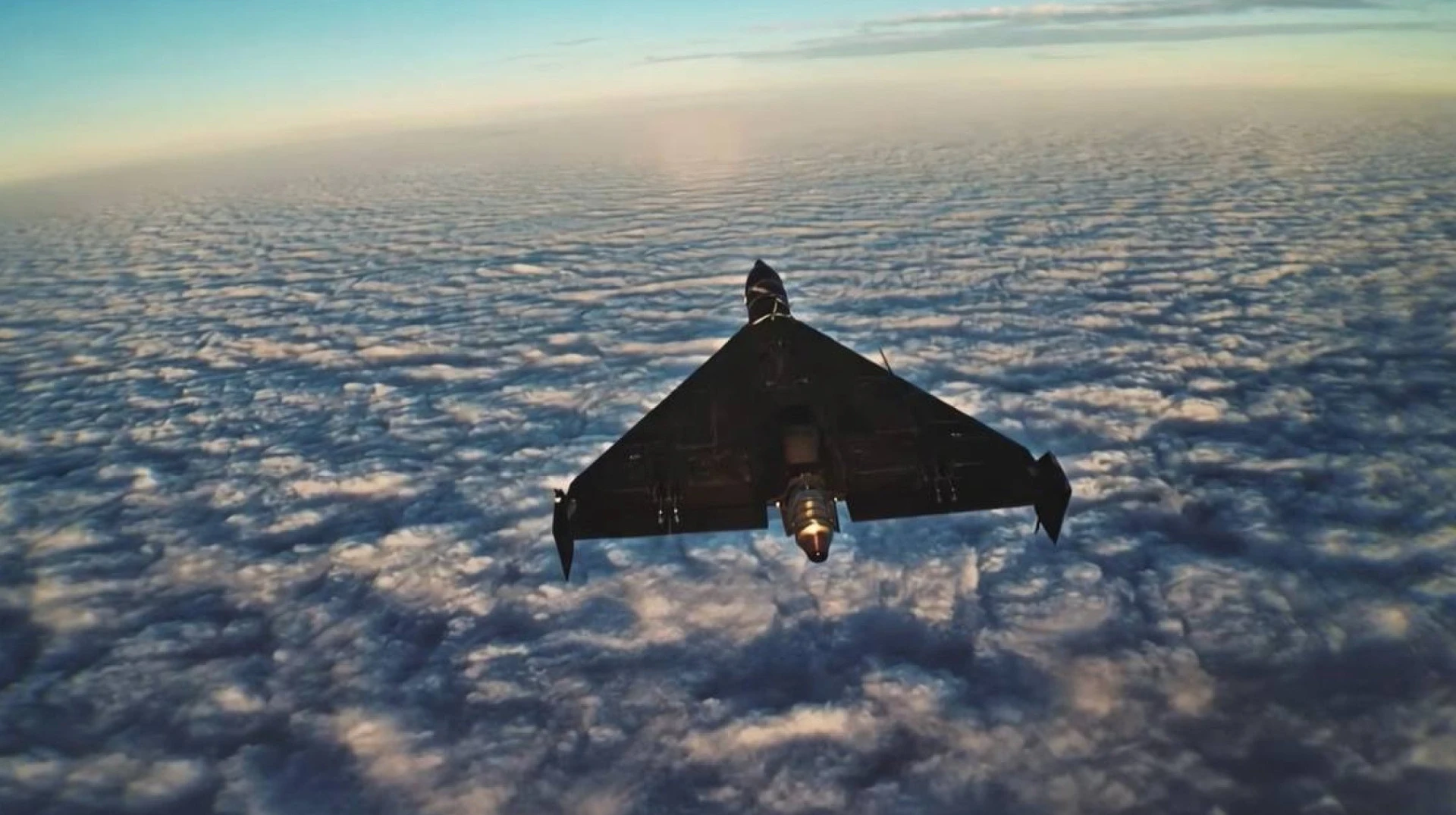
Russia keeps shifting to faster jet-powered drones that Ukraine's defenses struggle to stop, forcing it to spend scarce missiles on them. Russia's use of jet-powered drones rose eightfold from June to August, with Moscow launching around 7,700 such drones since their initial deployment, Ukrainian Air Force spokesperson Yurii Ihnat said on 23 September. But Putin likely does not expect the campaign to last indefinitely, and he may hold off on a new mobilization until he sees whether the strikes work, ISW assesses.
Putin's modified theory of victory
Putin's modified theory of victory largely depends on Russia's ability to mass-launch cheap jet-powered Gerans that get through Ukrainian defenses often enough, the institute notes.
Even a Kremlin-linked Russian milblogger claimed on 27 September that the Russian strategy, which relies heavily on long-range strikes, is costly and cannot continue indefinitely, not least because Ukraine is hitting Russia harder too, according to the analysis.
At the same time, Putin stated on 25 September that Ukraine "must feel" Russia's "retaliatory" strikes. ISW assesses that this suggests he intends to intensify Russia's strike campaign in winter, as he has in previous winters.
The aftermath of the Russian attack on Kyiv, Ukraine, 27 December 2025. Photo: National Police
If Putin is counting on Ukraine to break and capitulate this winter, he may be ignoring what the campaign will cost Russia over time, the institute notes. This strategy also counts on Ukraine's shortage of Patriot interceptors against ballistic missiles, and on the country's power grid and other vital systems giving way under months of strikes.
Until that approach runs out, Putin is unlikely to back down on his demands or agree to real ceasefire talks, ISW assesses.
Ukrainian interceptors could disrupt Russia's plan
A Kremlin-linked Russian milblogger claimed on 27 September that Russian forces launched predominantly jet-powered Geran-5 drones at Odesa, Mykolaiv, and Kyiv during the night of 26–27 September. According to the blogger, Russia's diverse arsenal of strike weapons and Ukraine's shortage of air defense assets allow Russian forces to maintain the current pace of strikes and expand the range of targets, ISW writes in its analysis.
At the same time, Ukrainian President Volodymyr Zelenskyy said on 26 September that Ukraine's interception rate for jet-powered Shahed drones currently stands at 55%. Of more than 2,730 such drones Russia had launched in September by then, Ukrainian forces had downed or suppressed more than 1,500, he added.
Jet-powered drones Geran-5 (above) and Geran-4 (below). Image: TurDef
Ukraine is testing interceptor drone prototypes in combat conditions, Ukrainian Presidential Office head Kyrylo Budanov told Novyny.LIVE on 27 September. The mass deployment of interceptors capable of shooting down jet-powered Gerans could begin within several months, he added. Ukrainian companies have already successfully tested several interceptor drones capable of intercepting Russian jet-powered drones in field conditions, the institute notes.
At the same time, it remains unclear whether Ukraine will be able to scale up its interceptor program quickly enough and achieve sufficient success to disrupt the intensification of Russia's campaign during the winter, ISW notes.
Why Putin may hold off on a new mobilization
Expanding Russia's arsenal of strike weapons is cheaper than carrying out a second mobilization economically, militarily, and socially, a Kremlin-linked Russian milblogger cited by the institute claimed.
Putin may put off large-scale forced mobilization until he sees whether the strikes deliver, ISW assesses, though his officials have been laying the groundwork for it despite Kremlin denials. Still, the need to replace Russia's enormous battlefield losses could push him to order such a mobilization as early as this fall, ISW notes, as Ukrainian and other sources have repeatedly reported he is preparing to do.
Russia's low-Earth-orbit satellite constellation Rassvet went from a few minutes of connectivity over Ukraine to two stable windows lasting more than an hour each in just five months. The system was built by the Russian private company Bureau 1440 as Moscow's answer to Starlink.
As of now, it is nowhere near matching SpaceX's 10,000-satellite network—but the gap between what Russia has now and what it needs is closing, and the tools that could slow it down mostly sit unused. When Ukraine and SpaceX bricked Russian-obtained Starlink terminals earlier this year, Russian assaults froze across the front—proof that cutting satellite command-and-control links matters more than disrupting guidance. Russia is now building its own links. The most consequential tool that could slow that down is Western sanctions against Bureau 1440 itself.
Four years of Western sanctions have failed to cut Russia off from the foreign components its missile and drone factories rely on: parts manufactured after sanctions were imposed still reach Russian assembly lines within months. Rassvet is a new version of the same problem. The system is still being built and relies on imported components whose exact origin is disputed—some experts point to American and European parts reaching Russia through sanctions-evasion networks, others say the core hardware is built from off-the-shelf Chinese components. Its manufacturer remains unsanctioned by any Western government, while some of the infrastructure needed to expand production has already been struck by Ukraine.
Six minutes in March, two hours by August
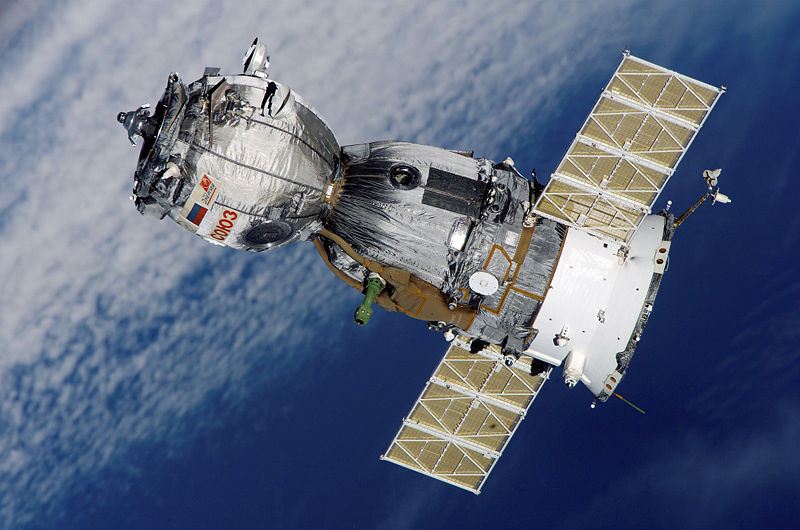
In March 2026, Bureau 1440 launched its first operational batch of 16 Rassvet satellites from Plesetsk Cosmodrome. Each pass over Ukraine created a window of six to 10 minutes, Serhii Beskrestnov, callsign Flash, a Ukrainian presidential adviser on defense technology, estimated at the time.
By late August, the picture had changed. Tracking data from N2YO showed four passes a day and two stable communication windows lasting more than an hour each. Satellite communications expert Volodymyr Stepanets said that 12 of the 16 satellites from the first batch had reached their operational altitude of 550 km, three were still ascending, and one had burned up—likely due to a manufacturing defect. A second batch of 16 went into orbit in July, though those satellites struggled to reach their target altitude and some may reenter the atmosphere.
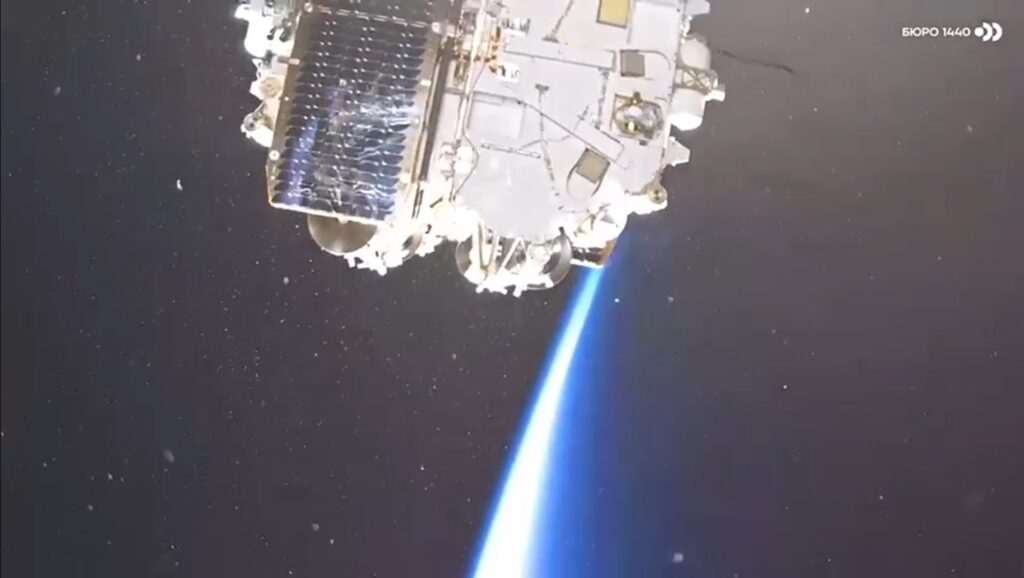
Bureau 1440 shows footage of separation of 16 Rassvet satellites from Soyuz's third stage pic.twitter.com/jhe2krZ1kA
The second batch may be climbing faster than the first did at the same stage. Still, Russia is far from the 200–250 satellites Beskrestnov considers necessary for stable, round-the-clock coverage, and the altitude of roughly 550 km is still short of the roughly 800 km the constellation is designed to reach.
What Rassvet would change on the battlefield
Russia is unlikely to have any civilian use in mind for these communication windows. The satellites transmit in the Ka and Ku bands—high-frequency signals that are difficult to jam and difficult to detect.
Radio frequency spectrum and satellite frequency bands, including Ka and Ku bands used by Russia's Rassvet constellation. Source: Bliley Technologies
Right now, Ukraine's electronic warfare can push Russian drones offline: a Shahed flying low through a jammed zone loses its link and drifts off course. A satellite relay overhead would change that. The drone holds its course, receives updated coordinates mid-flight, stays below radar, and strikes. The constellation could do this for long-range strike and naval drones alike—letting them operate through electronic warfare at very low altitudes, where Ukraine's air defenses struggle to see them.
Bureau 1440 has also developed user terminals small enough to fit on Geran-type attack drones and cruise missiles. Gerans have struck Ukrainian territory, including Kyiv and Kyiv Oblast, almost continuously over the past month. A terminal on a Geran would turn a one-way munition into a weapon that can be redirected after launch. Unlike the Starlink terminals Ukraine relies on, which are geographically restricted, Russian terminals are expected to face no such limits—the same terminal that connects a Geran over Kyiv Oblast would work over Berlin or Paris.
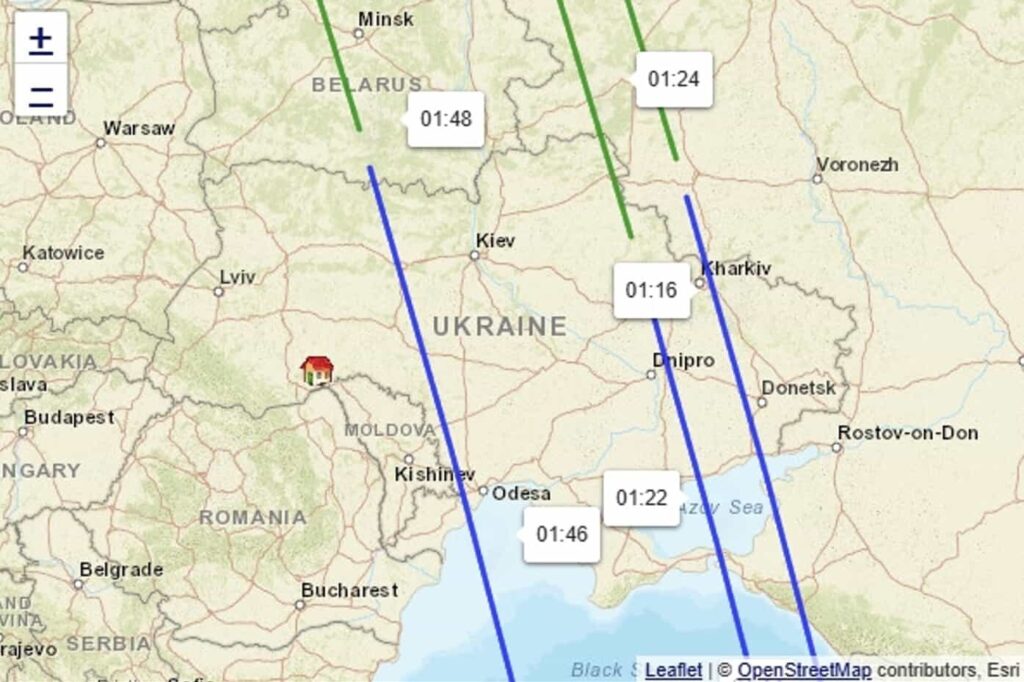
A pass of the Russian Rassvet satellites over Ukraine scheduled for 21 April 2026. Source: www.n2yo.com
The sanctions lever—and the gap in it
Rassvet's parent company, IKS Holding, is one of Russia's largest hardware and software developers. The US sanctioned the holding, its then-owner Anton Cherepennikov, and the subsidiaries Kryptonit and KNS Group on 24 February 2023. Cherepennikov died under unexplained circumstances, but the company keeps operating.
Ukraine's Foreign Intelligence Service (SZRU) says the holding serves as a personnel reserve for the Federal Security Service (FSB). The first deputy CEO of IKS Holding is Boris Korolyov, son of FSB First Deputy Director Sergei Korolyov, according to the SZRU. He took the post at 27 in 2023, after Cherepennikov's death.
More importantly, though, is the company that actually builds the satellites—Bureau 1440—and its leadership. Ukraine has placed the company on its own sanctions list, but Kyiv's unilateral designations carry limited trade enforcement power, because these people and this company are absent from Western lists. At Euromaidan Press's request, the US-based research organization C4ADS confirmed that Bureau 1440 and its leadership sit outside every Western sanctions regime, and called designating the manufacturer the single most visible and effective step available.
From the Ukrainian side, Viktoriia Vyshnivska, a senior analyst at the Independent Anti-Corruption Commission (NAKO), told Euromaidan Press that sanctions on Bureau 1440 are not a magic button—but they are not pointless, either. Because Bureau 1440 uses Western equipment, designating the company would directly affect trade in those boards and components, she said. Any Western manufacturer that kept doing business with the company would also risk investigation and legal consequences.
Given the reach of Russia's sanctions-evasion networks and its close ties with China in joint production and technology sharing.
"We shouldn't expect a magical effect," Vyshnivska said.
But sanctions would make direct trade impossible and raise the cost and difficulty of sourcing Western components.
Even if the useful window is short, making supplies more expensive and harder to find is the point.
Many of the goods Bureau 1440 uses are already banned from sale to Russia under EU export controls, Vyshnivska noted. Yet Bureau 1440 itself is still absent from the sanctions lists. Her recommendation: Bureau 1440, its current owners, its parent company, the key related entities and individuals, and its main suppliers should all be designated.
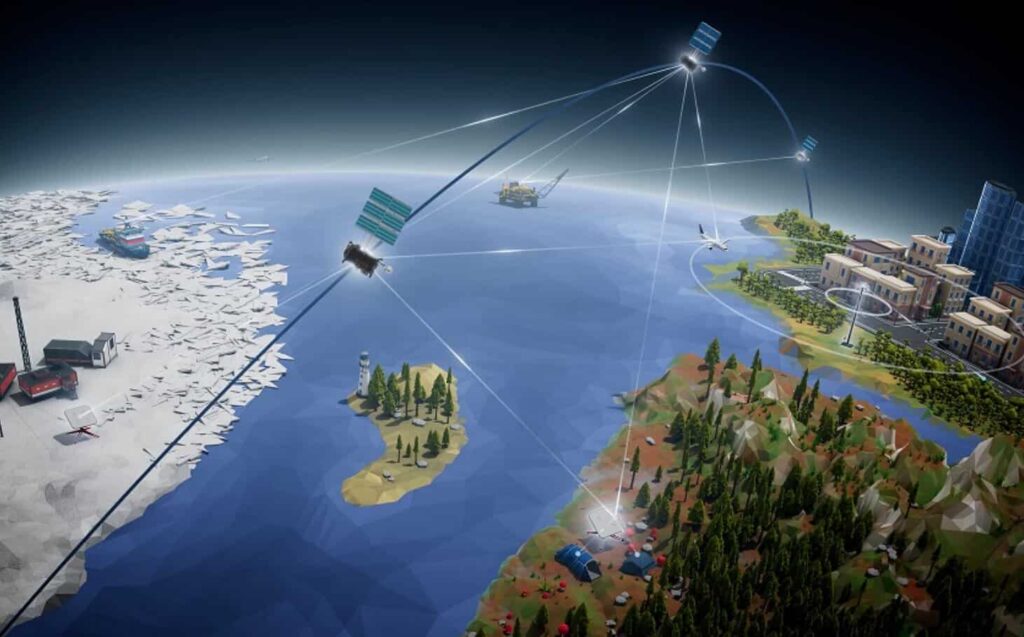
Illustration of the Russian Rassvet satellites by Bureau 1440
Diplomacy: Ukraine goes to the ITU
Beyond that, Ukraine is trying to act on its own on several fronts.
The first is diplomacy. On 28 August, Ukrainian Foreign Minister Andrii Sybiha said Ukraine had sent a formal note to the International Telecommunication Union (ITU), the UN agency that coordinates radio frequencies, demanding that Ukrainian territory be excluded from Rassvet's service areas across all frequency bands. The system's use over Ukraine "has nothing to do with civilian purposes," he wrote on X.
Today, we officially addressed the International Telecommunications Union @ITU requesting an exclusion of Ukraine’s national territory from the declared service areas of all beams of the Russian military satellite system 'Rassvet' satellite networks in all frequency bands.
Days later, at a meeting of EU foreign ministers in Ireland, Sybiha handed partners a list of nine legal entities linked to the project and urged them to impose sanctions.
The EU had already moved once: its 21st sanctions package, adopted on 23 July, targeted the Rassvet network. But the main gap is not closed, and that round stopped short of the manufacturer, leaving Bureau 1440 and its chief executive off the lists.
Hitting the supply chain with weapons
Another lever is direct strikes. In mid-August, Ukrainian-made Flamingo cruise missiles struck an industrial zone in Samara that houses the Progress Rocket Space Center—the only plant in Russia that serially assembles the Soyuz-2.1b rockets used to launch Rassvet into orbit. Satellite imagery published by the Ukrainian Telegram channel Exilenova+ showed a collapsed roof section 85 meters long and 35 meters wide over Building 106A, the hall where crews wire the rockets' control systems and cabling. The channel reported two missile hits on that hall.
The aftermath of a strike by two FP-5 Flamingo cruise missiles on the Progress Rocket and Space Center. Photo: t.me/exilenova_plus
If the hall was destroyed, production could stop entirely, and switching to other Russian launch vehicles would take significantly longer and add complexity. Drones also attempted to strike Plesetsk Cosmodrome, from which both 2026 batches were launched.
Both targets—the factory that builds the rockets and the site that launches them—are needed if Russia is to expand Rassvet production.
The timeline: 5.5 to eight years, if nothing changes
Russia plans to expand the constellation to 292 satellites by the end of 2027, Deputy Chief of Ukraine's Defense Intelligence (HUR) Vadym Skibitskyi said. Moscow's longer-term goal is 924 satellites by 2035.
Explore further
After SpaceX cuts off Starlink access, Russia launches first 16 satellites of its own “Rassvet” alternative
With 32 satellites already launched in two batches, 260 more are needed. At 16 satellites per launch, that requires roughly 17 launches. At a four-month interval between launches, deploying them would take roughly 5.5 years even if every launch succeeded and every satellite reached its target orbit. That most likely won't fully work out: one satellite from the first batch is already lost, two from the second batch may be lost as well, and none of them has yet reached the required altitude.
Russia also depends on the scarce Soyuz-2.1b rocket. The rocket has averaged only six to eight launches per year since 2022—most committed to GLONASS navigation satellites, ISS resupply, and military payloads—limiting Russia to a theoretical maximum of roughly two Rassvet-dedicated launches per year, or 128 Rassvet satellites over four years at that rate.
There is still time to shut this project down or slow it. Vyshnivska put the useful window to slow Rassvet at about a year. Russia, by Ukrainian calculations, needs five to eight years to see it through.
Après avoir nié, l’essayiste et chroniqueur au Figaro de 29 ans a reconnu être derrière le compte qui accuse l’écrivain d’avoir rédigé son best-seller avec une intelligence artificielle Nouvelle
— Permalien
Within 24 hours of claiming Ukrainian troops were surrounded near Dobropillia, Russia’s Defense Ministry and pro-war channels expanded the narrative to several supposed encirclements in northern Kharkiv Oblast. Evidence supports none of that, the Institute for the Study of War (ISW) has said.
The claims come as Ukrainian forces make gains in several frontline sectors, according to ISW. Near Dobropillia, Russian bloggers described the ability to fire on supply roads rather than troops surrounding the town. At the same time, Ukrainian forces said they had prevented Russia from physically cutting the routes.
Russia’s Defense Ministry claimed its forces had captured Krasnyi Yar and Potykhonove northeast of Kharkiv. Pro-war bloggers then claimed Russian troops threatened to trap Ukrainian units near Riznykove and had already surrounded others near Rublene. One asserted that roughly 1,500 Ukrainian soldiers were encircled across 460 square kilometers.
ISW found no evidence for those claims. A Ukrainian brigade spokesperson said Russian forces were still shelling settlements they claimed to hold and described positions in the area as heavily intermingled, with no clear front line.
Around Dobropillia, the Kremlin-linked Rybar channel claimed Russian troops were infiltrating toward nearby settlements and making tactical gains south of the town. It did not claim Russian forces had secured those settlements or show an encirclement on its map, ISW noted.
Another Russian blogger said neither side currently had the forces needed to establish and sustain a genuine encirclement.
Russia’s push toward Dobropillia continues
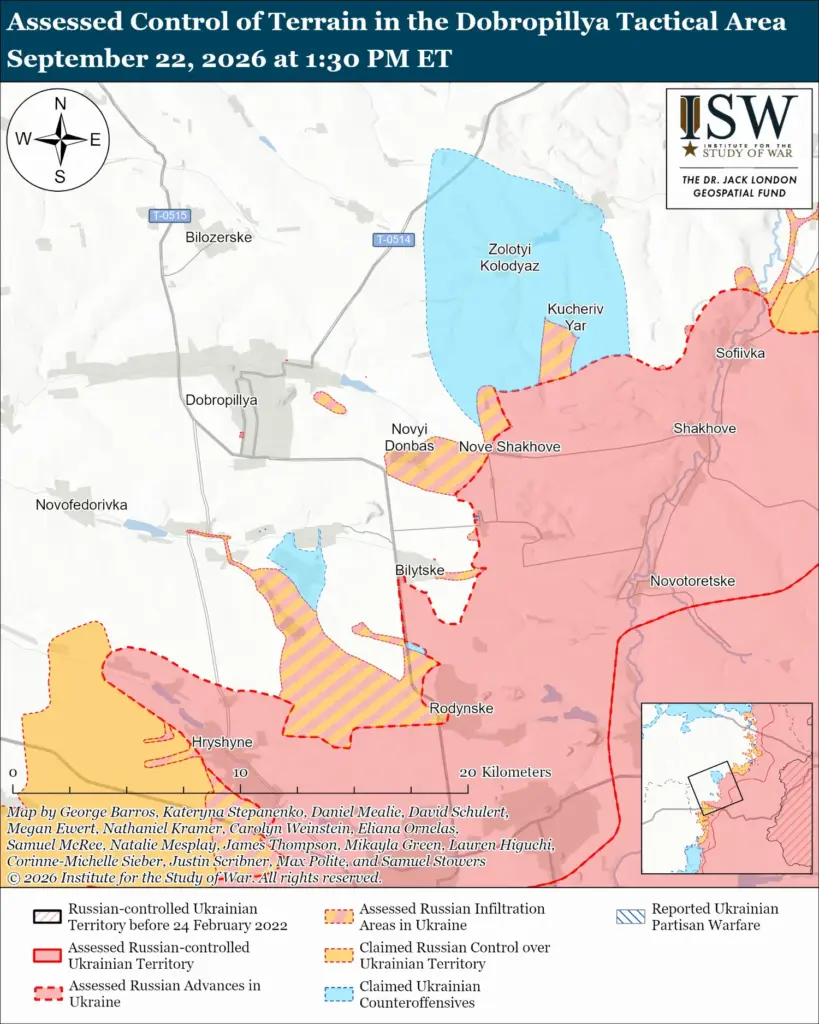
Russia’s Defense Ministry had claimed on 22 September that its troops surrounded Dobropillia, a transport hub on the approach to Ukraine’s fortified cities in Donetsk Oblast.
ISW found no evidence for that claim and linked its timing to the UN General Assembly and Ukraine’s recent battlefield gains. A Ukrainian officer said Russian troops had made no major advances near the town.
Russian assaults continue despite that setback. A Ukrainian staff sergeant reported a sharp increase in the number of small groups trying to reach Dobropillia. On 23 September, Ukraine’s 1st Azov Corps said its forces had prevented Russian troops from physically cutting supply routes toward Dobropillia and Druzhkivka.
Moldova’s Defense Ministry reported four drone incursions, Romania’s Defense Ministry confirmed a drone crash, and Poland’s Operational Command scrambled fighters twice during Russia’s 24 September attack on Ukraine.
The strike wave forced Moldova to close part of its airspace, Romania to warn residents and launch F-16 fighter jets, and Poland to activate aircraft, air defenses, and radar. No casualties were reported in the two confirmed crashes, and Poland detected no incursion during its first deployment. Moldova has recorded dozens of Russian drone incursions this year.
The drones approached from Ukraine’s Vinnytsia, Odesa, and Chernivtsi oblasts, according to Moldova’s Defense Ministry. Authorities temporarily closed part of the country’s northern airspace.
Near Cernița in northern Moldova, one drone struck a tree, fell into a field beside a farm, and exploded, police said. No casualties were reported.
Investigators preliminarily identified the camera-equipped wreckage as a Gerbera, a low-cost Russian drone often used during attacks on Ukraine. Police said it was the first device of that type found in Moldova.
Police also reported a resident’s account of another explosion near Vadul Rașcov, but said they were still investigating the location.
Romanian radar first tracked an aerial target over Ukraine near the border before it entered northern Romania, the Defense Ministry said. Romania launched two F-16s and sent emergency alerts to residents’ phones in the area. The drone remained in Romanian airspace for about four minutes before crashing near Solca, the ministry said. Officials reported no casualties or damage and had not identified the drone’s origin.
Poland’s Operational Command launched fighters twice in response to Russian strikes on western Ukraine. The first Polish deployment ended around 08:00 with no airspace violation detected; the command announced a second at 09:07. It also activated ground-based air defenses and radar.
The incursions came amid a wider assault. Ukraine’s Air Force said Russia launched 282 drones of various types, along with ballistic and other missiles, overnight into 24 September. Ukrainian officials reported detecting four drones over Chernivtsi Oblast, the Ukrainian region bordering Moldova and Romania, and shooting down three.
Moldova’s repeated airspace breaches
The latest incident followed several breaches in August. An unidentified drone exploded near Crocmaz on 9 August. Another object exploded near Talmaza on 17 August after Moldova briefly closed part of its airspace.
President Maia Sandu said Russian drones had entered Moldovan airspace 39 times in 2026, compared with 17 times throughout 2025. Moldova has portable air-defense weapons and electronic warfare equipment, but Sandu said these chiefly protect individual sites. Her government is working with partners to expand air-defense coverage and speed up threat warnings.
Russia’s Defense Ministry claimed on 22 September 2026 that it had surrounded Dobropillia, but the Institute for the Study of War (ISW) found no evidence to support the announcement. Dobropillia is a small town in Donetsk Oblast, known as the "pearl of the Donbas" for its coal industry, which has helped make Ukraine's Fortress Belt cities, holding the region from Russians since 2014, per RBC Ukraine.
Ukraine’s Vivaldi counteroffensive in Donetsk Oblast broke the northern arm of Russia’s plan to surround the fortified cities. ISW says Moscow’s Dobropillia claim diverts attention from that setback and portrays Ukrainian defenses as collapsing during the 81st session of the UN General Assembly, held on 21-28 September. The institute says Russia is likely spreading such claims to support its push for Ukraine’s capitulation.
Meanwhile, Ukrainian officers say Russian assault groups are still trying to break through toward Dobropillia, but have made no major gains.
Russia’s encirclement claim clashes with Ukrainian battlefield reports
Russia’s Ministry of Defense has claimed its troops were advancing toward Oleksandrivka, a village northwest of Dobropillia, but published no map to support its account.
At the same time, Ukrainian military observer Kostyantyn Mashovets said Ukrainian troops still held positions south and northeast of the city, which the experts said was inconsistent with the claimed encirclement.
ISW reported that a Ukrainian artillery reconnaissance battalion chief of staff said on 22 September that Russia had made no major advances near Dobropillia. He said Russian commanders kept postponing deadlines because of heavy losses and a gap between their plans and battlefield conditions.
A Ukrainian battalion officer said Russian troops were still trying to slip through Ukrainian lines in small groups.
How Dobropillia fits Russia’s plan to surround the fortress belt
Dobropillia is a transport hub on the southwestern approach to Ukraine’s “fortress belt,” which includes Kostiantynivka, Druzhkivka, Kramatorsk, and Sloviansk. These cities have anchored Ukraine’s defense in Donetsk Oblast since 2022.
Ukraine’s Third Army Corps commander, Andrii Biletskyi, whose corps is conducting the Vivaldi counteroffensive north of Lyman, explained that Russian forces advancing through Dobropillia were meant to join another force coming from north of Lyman, behind the fortified cities, encircling them rather than attacking them head-on.
Ukraine’s Third Army Corps commander, Brigadier General Andrii Biletskyi, announced “Operation Vivaldi” on 15 September 2026. Source: screenshot from Ukraine’s Third Army Corps announcement of Vivaldi
ISW had already assessed on 16 September that Vivaldi had made the two-sided plan infeasible. In its 22 September report, ISW said Russia’s false claim about Dobropillia partly aims to divert attention from those Ukrainian gains.
Russian assaults toward Dobropillia continue
The setback north of Lyman has not stopped Russia’s push toward Dobropillia. Ukrainian staff sergeant Dmytro Davydenko reported on 14 September a sharp increase in assault groups moving toward the city, sometimes more than his unit could engage. He said Ukrainian troops had mined, blocked, or destroyed the main approaches.
ISW reported that Russia was preparing armor and drone support for possible assaults using armored vehicles this fall. A Ukrainian battalion officer said fog might help Russia move that equipment, although Ukrainian reconnaissance and drones would make it difficult. He said Russian glide bombs continued to strike infrastructure in the area.
Ingérence russe en France : deepfakes, réseau Pravda, formation SputnikPro et 8 000 €/mois proposés à un journaliste. Enquête exclusive sur la stratégie du Kremlin avant 2027.
— Permalien
 Connexion

























(@afec7032) March 24, 2026

(@andrii_sybiha) August 28, 2026