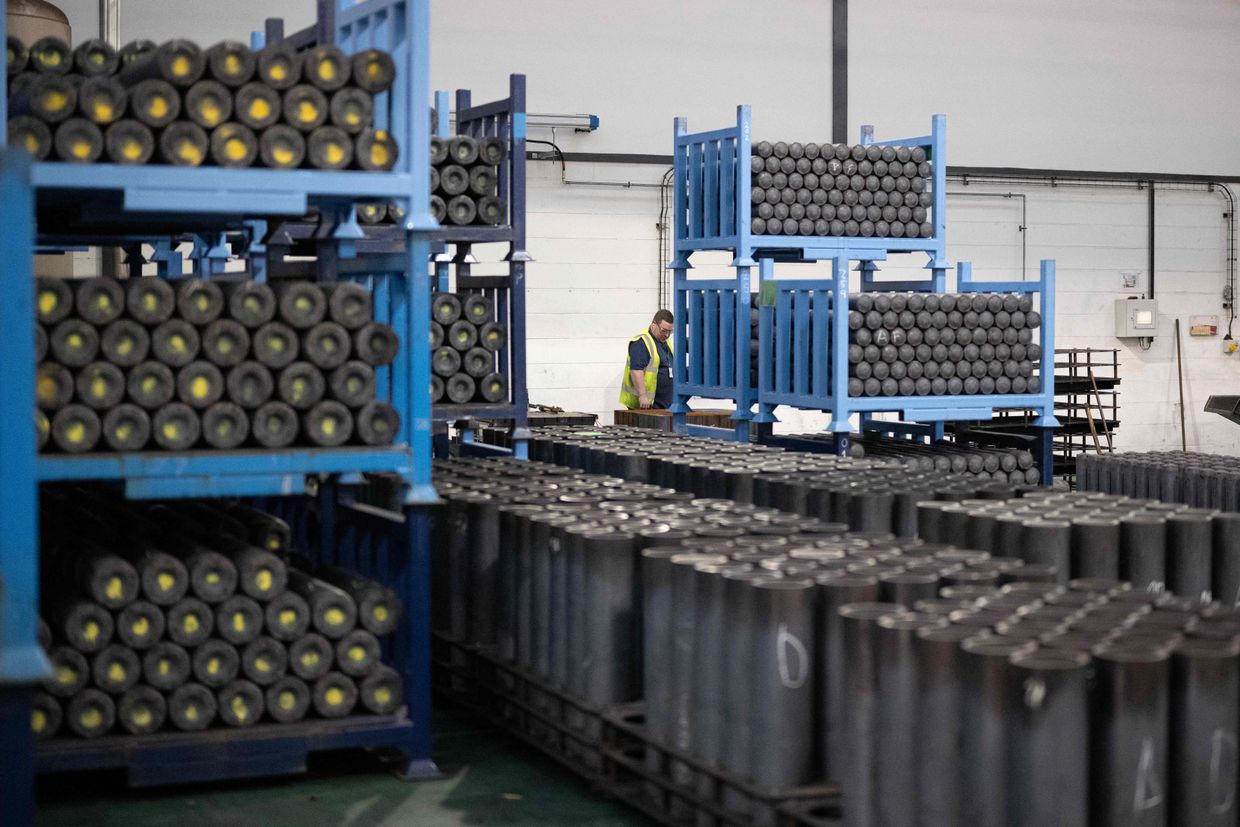
Lithuania has signed a memorandum with American defense firm Northrop Grumman and Norwegian Nammo to secure the production of ammunition amid Russia's war against Ukraine, the Lithuanian Defense Ministry announced on June 24."By strengthening our national defense industry, we are investing in both technological capabilities and Lithuania’s resilience to crises. This Memorandum of Understanding will allow us to better equip our armed forces and help Lithuania become an important link in internati
Lithuania has signed a memorandum with American defense firm Northrop Grumman and Norwegian Nammo to secure the production of ammunition amid Russia's war against Ukraine, the Lithuanian Defense Ministry announced on June 24.
"By strengthening our national defense industry, we are investing in both technological capabilities and Lithuania’s resilience to crises. This Memorandum of Understanding will allow us to better equip our armed forces and help Lithuania become an important link in international supply chains," Lithuanian Vice Minister of National Defense Loreta Maskalioviene said.
"The investment and expertise of our allies... will significantly contribute to strengthening of the national defense industry and security not only in Lithuania, but also in the entire region, including Ukraine. The development of the defense industry and investment in production must come without delay," Lithuanian Finance Minister Rimantas Sadzius said.
Russia's full-scale war against Ukraine has sparked concern in Europe that Russia could attack NATO's eastern flank, including Poland, the Baltic countries, and Finland.
Ukrainian intelligence has evidence that Russia is preparing new military operations in Europe, President Volodymyr Zelensky said on June 22.
The partnership will be implemented at the state-owned Giraite Armament Factory, the announcement said, adding that the factory is set to be integrated into Northrop Grumman’s international supply chains.
Northrop Grumman will supply ammunition produced in the Lithuanian defense factory to the international market.
Nammo, as a subcontractor, will provide Northrop Grumman with the 35 mm ammunition production technology.
"It will enhance national strategic autonomy in defense and deepen partnerships with NATO allies, the United States, and Norway. The planned production of ammunition is of critical importance to the Lithuanian Armed Forces, our allies, and Ukraine," Lithuanian Defense Minister Dovile Sakaliene said.
The memorandum will initiate negotiations for the production of medium caliber ammunition, ranging in size from 20-50 mm.
The Giraite Armament Factory will be provided with 35 mm ammunition production technology from the two defense firms, the announcement said.
Sakaliene noted that the new partnership will ensure an uninterrupted supply of ammunition to Lithuania's Armed Forces.
NATO is holding a summit in The Hague from June 24-25 with world leaders, including Zelensky and U.S. President Donald Trump present.
The White House has confirmed that Trump and Zelensky will hold a meeting at the NATO summit.
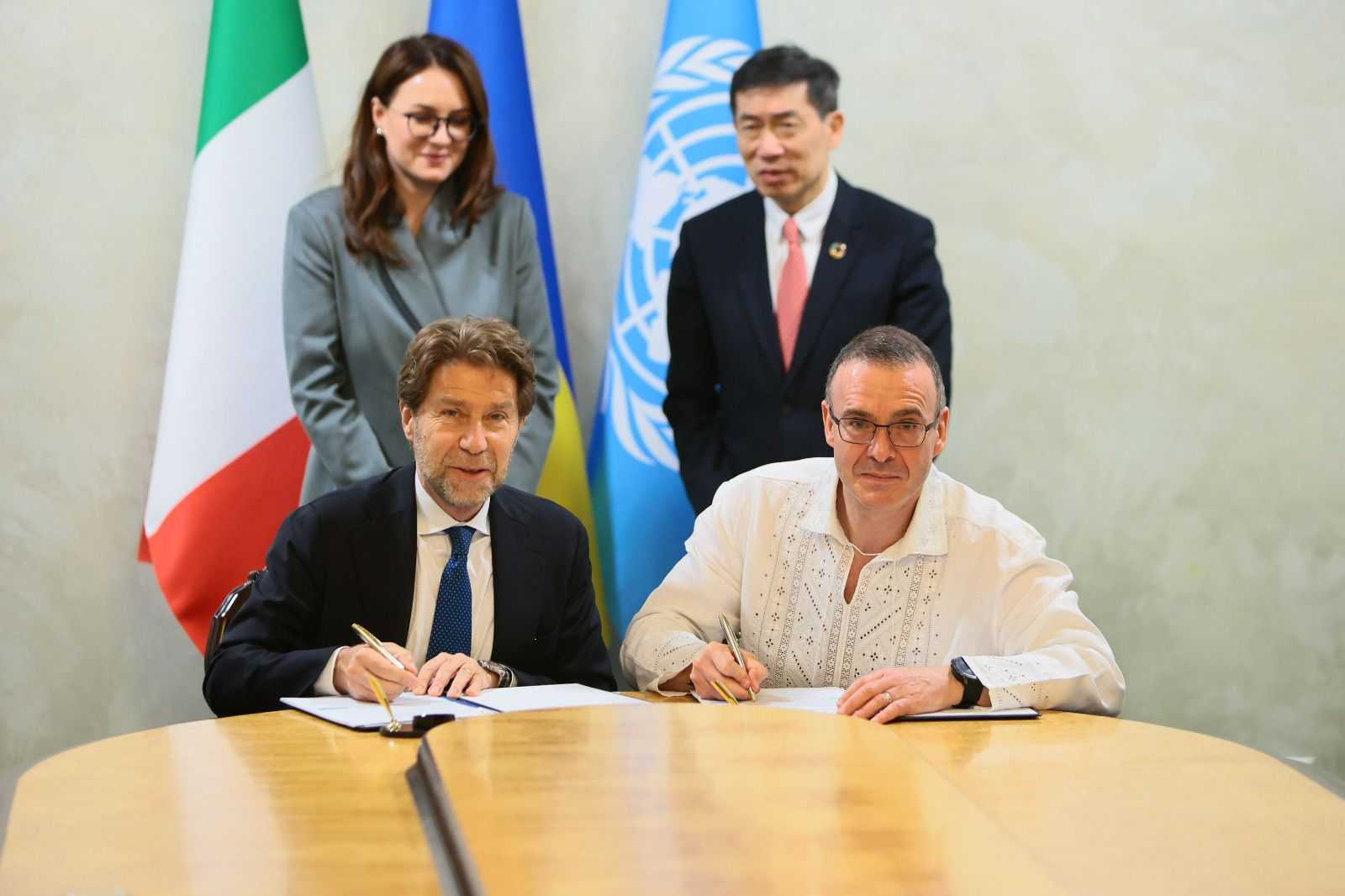
Italy has pledged 1.5 million euros (approximately $1.6 million) to support humanitarian demining efforts in Ukraine, deepening its partnership with the United Nations Development Programme (UNDP) and the Ukrainian government. The agreement was formalized during a high-level ceremony in Kyiv on June 23 attended by Italian Ambassador Carlo Formosa, UN Assistant Secretary-General and new UNDP Administrator Haoliang Xu, Jaco Cilliers, Resident Representative of the UNDP in Ukraine, and Ukraine’s Fi
Italy has pledged 1.5 million euros (approximately $1.6 million) to support humanitarian demining efforts in Ukraine, deepening its partnership with the United Nations Development Programme (UNDP) and the Ukrainian government.
The agreement was formalized during a high-level ceremony in Kyiv on June 23 attended by Italian Ambassador Carlo Formosa, UN Assistant Secretary-General and new UNDP Administrator Haoliang Xu, Jaco Cilliers, Resident Representative of the UNDP in Ukraine, and Ukraine’s First Deputy Prime Minister and Economy Minister Yuliia Svyrydenko.
"Demining is not just a technical operation; it is a deeply humanitarian act that combines cooperation and innovation to restore hope in Ukraine," Ambassador Formosa said. "This project is not only a response to the emergency — it’s a step toward recovery. It’s about returning land to farmers, playgrounds to children, and safe roads to families."
The funding will support UNDP’s mine action program, which focuses on clearing land contaminated by mines and explosive remnants of war, ensuring the safe return of land to Ukrainian communities.
The initiative comes as Ukraine continues to grapple with one of the world’s largest demining challenges. According to the State Emergency Service, the total area of potentially mined land has been reduced by over 20% since late 2022. However, approximately 137,000 square kilometers (52,900 square miles) — much of it farmland — remain contaminated. Demining operations are carried out by the emergency service personnel, National Police, Ministry of Defense, and non-governmental organizations.
Currently, 112 certified demining operators, including eight international groups, are active in Ukraine, the State Emergency Service reported on June 24. Their combined capacity includes more than 9,000 personnel, 278 specialized vehicles, and over 13,000 metal detectors.
While significant progress has been made, Ukrainian officials stress that continued international support and funding are critical to accelerating clearance efforts.
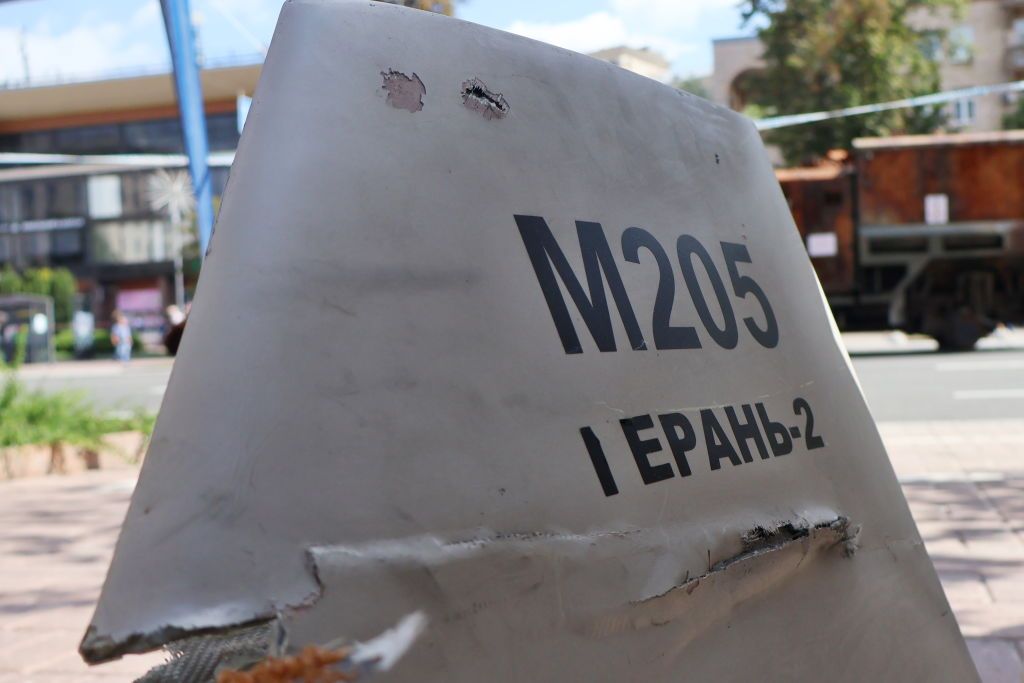
Since the start of Russia’s full-scale invasion, Moscow has launched 28,743 Shahed-type drones at Ukraine — with 2,736, or roughly 9.5%, fired in June 2025 alone, President Volodymyr Zelensky said during a speech to the Dutch Parliament in The Hague.Speaking on June 24, he stressed that Russia would never have been able to carry out such drone attacks without support from Iran, and Ukraine, in turn, could not have intercepted most of the drones without the help of its international partners.Zel
Since the start of Russia’s full-scale invasion, Moscow has launched 28,743 Shahed-type drones at Ukraine — with 2,736, or roughly 9.5%, fired in June 2025 alone, President Volodymyr Zelensky said during a speech to the Dutch Parliament in The Hague.
Speaking on June 24, he stressed that Russia would never have been able to carry out such drone attacks without support from Iran, and Ukraine, in turn, could not have intercepted most of the drones without the help of its international partners.
Zelensky called for accountability and emphasized that rules must apply to all — including the Kremlin: "Putin pretends not to understand the rules that shape the modern world. And here, in The Hague, I want to say this very clearly to him: There is a rule — do not kill. There is a rule — do not treat people like beasts. There is a rule — do not destroy cities and villages. There is a rule — do not sponsor terror. There is a rule — do not steal children. And if you break these rules, you will be held accountable."
According to Zelensky, these principles — though difficult for Russia to grasp — form the foundation of international norms, from the UN Charter to Europe’s shared vision of life.
To achieve lasting peace, Zelensky outlined two key strategic priorities. First, he called for maximum isolation of Russia which includes full political isolation, comprehensive sanctions, and the termination of any cooperation that allows Russia to survive and continue waging war.
"Every loophole that allows them to keep going must be closed. We need a strong 18th EU sanctions package. We need tough, painful sanctions on Russian oil. Every reduction in Russia’s oil revenue helps bring peace closer," he said.
Zelensky argued that the most effective step would be imposing a $30-per-barrel price cap on Russian oil exports.
“The world must reach this threshold — not just to help stop Russia’s war against us, but to prevent any future military operations that Russia might launch against Europe and the Alliance,” he said. “Military plans must become prohibitively expensive for Russia. We must fully block their tanker fleet and cut them off from international banking. That’s what works.”
Second priority, according to Zelensky, is the need for stability in defense support. "Russia must see that Ukraine will not be left alone, and that Europe will not back down."
Recent U.S. strikes on three Iranian nuclear facilities did not eliminate the core components of Tehran’s nuclear program and likely delayed it by only a few months, according to an early assessment by the U.S. Defense Intelligence Agency (DIA), CNN reported on June 24, citing four sources familiar with the findings.The analysis, based on a battle damage report from U.S. Central Command, contradicts public statements by President Donald Trump and Defense Secretary Pete Hegseth, who claimed the o
Recent U.S. strikes on three Iranian nuclear facilities did not eliminate the core components of Tehran’s nuclear program and likely delayed it by only a few months, according to an early assessment by the U.S. Defense Intelligence Agency (DIA), CNN reported on June 24, citing four sources familiar with the findings.
The analysis, based on a battle damage report from U.S. Central Command, contradicts public statements by President Donald Trump and Defense Secretary Pete Hegseth, who claimed the operation had "obliterated" Iran’s nuclear capabilities.
"So the (DIA) assessment is that the U.S. set them back maybe a few months, tops," one source told CNN, adding that Iran’s stockpile of enriched uranium was not destroyed and that most centrifuges remain “intact.”
The White House acknowledged the assessment’s existence but strongly dismissed it. "This alleged assessment is flat-out wrong and was classified as ‘top secret’ but was still leaked to CNN by an anonymous, low-level loser in the intelligence community," press secretary Karoline Leavitt said. “The leaking of this alleged assessment is a clear attempt to demean President Trump, and discredit the brave fighter pilots who conducted a perfectly executed mission to obliterate Iran’s nuclear program. Everyone knows what happens when you drop fourteen 30,000 pound bombs perfectly on their targets: total obliteration.”
Trump, for his part, stood by his assessment of the mission's success. “I think it’s been completely demolished,” he said on Tuesday. “Those pilots hit their targets. Those targets were obliterated, and the pilots should be given credit.” Asked if Iran could rebuild, Trump responded: “That place is under rock. That place is demolished.”
While both Trump and Hegseth praised the strikes as decisive, others expressed caution. Chairman of the Joint Chiefs of Staff Dan Caine said it was “way too early” to determine whether Iran retained nuclear capabilities.
Republican Rep. Michael McCaul, former chair of the House Foreign Affairs Committee, also avoided endorsing the president’s characterization. “I’ve been briefed on this plan in the past, and it was never meant to completely destroy the nuclear facilities, but rather cause significant damage,” McCaul told CNN. “But it was always known to be a temporary setback.”
The DIA’s assessment reportedly found that damage at the Fordow, Natanz, and Isfahan sites was mostly limited to aboveground infrastructure, such as power systems and uranium metal processing buildings. The underground facilities—where Iran's most sensitive nuclear work takes place—were largely unaffected, the sources said.
According to CNN, Israel had been carrying out its own strikes on Iranian nuclear facilities prior to the U.S. operation, but relied on U.S. B-2 bombers equipped with 30,000-pound “bunker buster” bombs to finish the job. Despite over a dozen bombs being dropped on Fordow and Natanz, the sites’ key components remain intact, the sources said.
The U.S. also reportedly used Tomahawk missiles launched from a submarine to target Isfahan, rather than deploying bunker busters. A source said this was due to doubts over whether the bombs could penetrate Isfahan’s deep underground levels, which are believed to be even more fortified than Fordow.
Two sources also told CNN that Iran likely retains undisclosed nuclear facilities that were not targeted and remain operational.
Meanwhile, classified briefings for lawmakers on the strikes were postponed. The all-Senate briefing was rescheduled for Thursday, and the House briefing’s new date remains unclear.
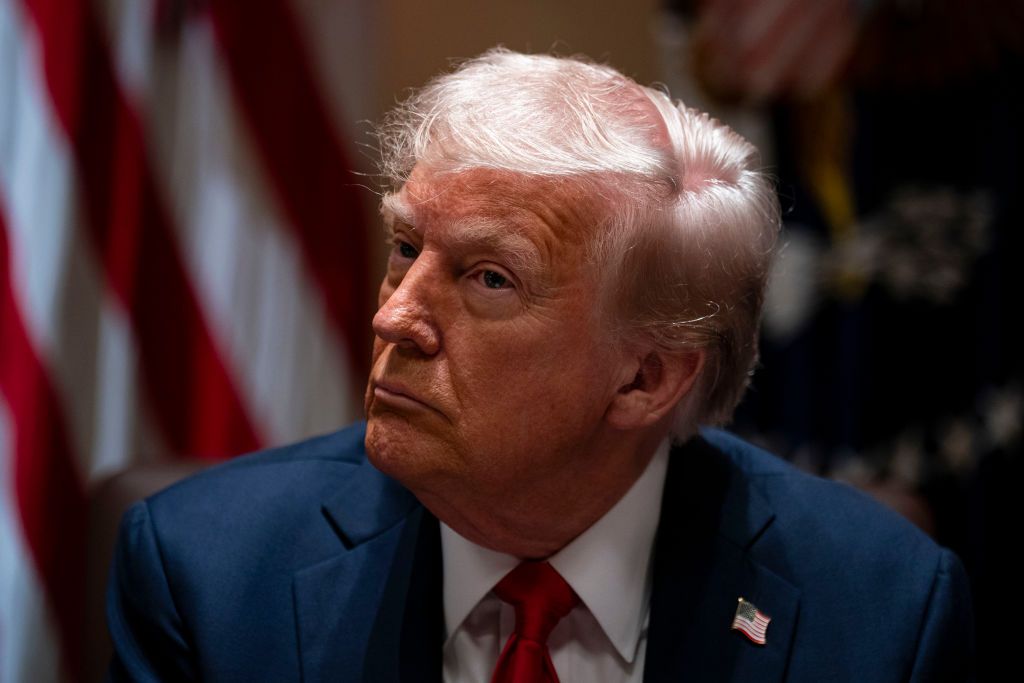
President Donald Trump refused to give a clear commitment to NATO’s Article 5 — the alliance’s collective defense clause — as he departed for a pivotal summit in The Hague, raising fresh concerns about his stance on one of NATO’s core principles.When pressed by reporters aboard Air Force One on whether he would uphold the mutual defense obligation, Trump replied, “It depends on your definition of Article 5,” adding, "There’s numerous definitions of Article 5. You know that, right? But I’m commit
President Donald Trump refused to give a clear commitment to NATO’s Article 5 — the alliance’s collective defense clause — as he departed for a pivotal summit in The Hague, raising fresh concerns about his stance on one of NATO’s core principles.
When pressed by reporters aboard Air Force One on whether he would uphold the mutual defense obligation, Trump replied, “It depends on your definition of Article 5,” adding, "There’s numerous definitions of Article 5. You know that, right? But I’m committed to being their friends, you know, I’ve become friends with many of those leaders, and I’m committed to helping them."
Although Article 5 is central to NATO’s security framework, Trump has previously expressed skepticism about honoring it, often criticizing member states for not contributing enough to shared defense efforts.
Asked to elaborate, he said, "I’m committed to saving lives. I care about life and safety." He added that he would explain his position in full once at the summit: "I’ll give you an exact definition when I get there — I just don’t want to do it from the back of a plane."
Trump’s remarks come as NATO faces what its leadership describes as its most significant threat in decades.
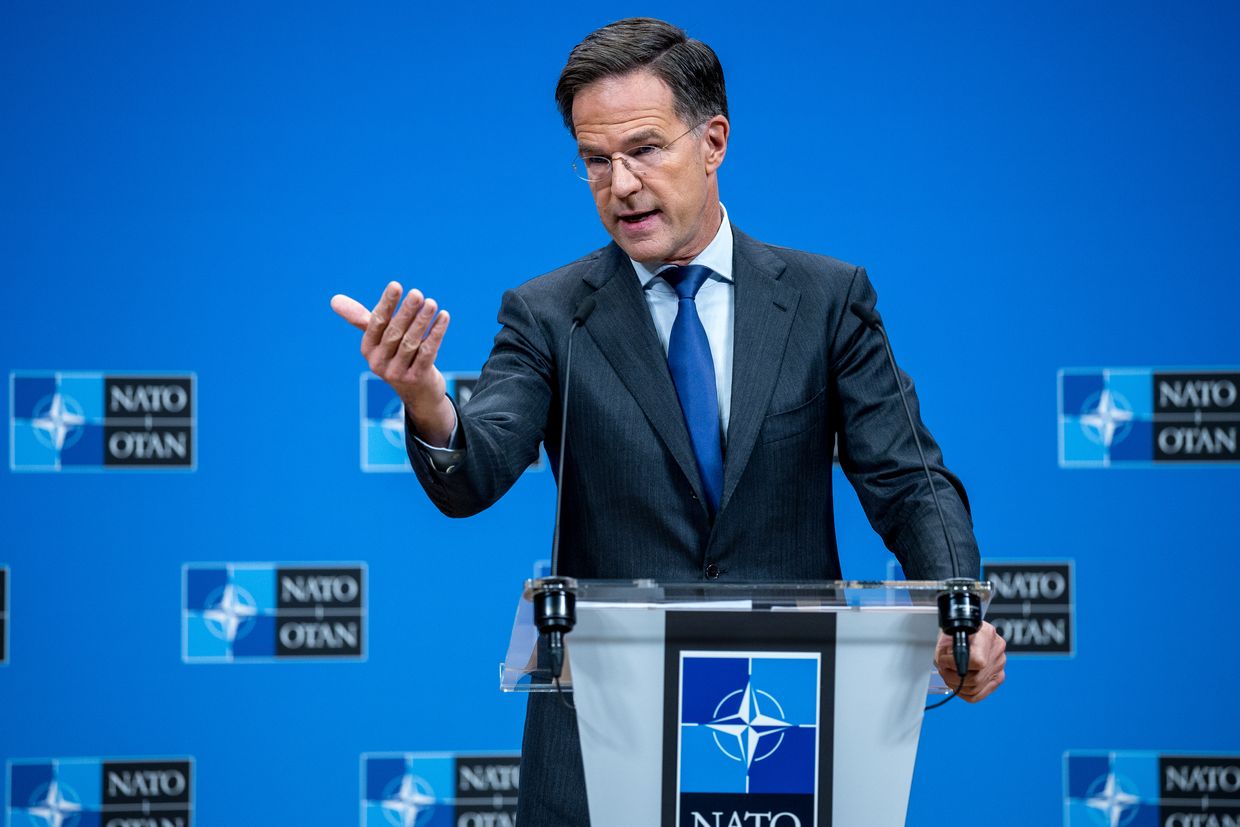
At a press briefing on June 23, NATO Secretary General Mark Rutte said Russia remains the primary danger to the alliance, citing its growing alignment with China, North Korea, Iran, and Belarus.
"Moscow continues to wage war against Ukraine, with support of North Korea, Iran, and China, as well as Belarus," Rutte said.
He added that NATO leaders plan to adopt a "historic" defense investment plan at the June 24–25 summit in The Hague, including a new 5% of GDP benchmark for defense spending and stronger backing for Ukraine.
"All leaders will take bold decisions to strengthen our collective defense, making NATO a stronger, fairer, and more lethal alliance," Rutte said. “This is a leap that is ambitious, historic, and fundamental to securing our future.”
Their last meeting was in April at Pope Francis' funeral, amid concerns over the U.S. role in peace talks between Kyiv and Moscow. Details of the June 25 meeting are still being finalized, but the talks are expected in the "early afternoon," a source told AFP.
Defense Minister Rustem Umerov signed a Letter of Intent on June 24 with his Danish counterpart Troels Lund Poulsen to launch Ukrainian defense production in Denmark, Umerov announced on Facebook.The document envisages facilitating the deployment of Ukrainian defense companies in Denmark and integrating of the defense industries of both countries through the "Build with Ukraine" initiative.Denmark has already allocated $47 million for the project, and Ukraine's partners will provide further fund
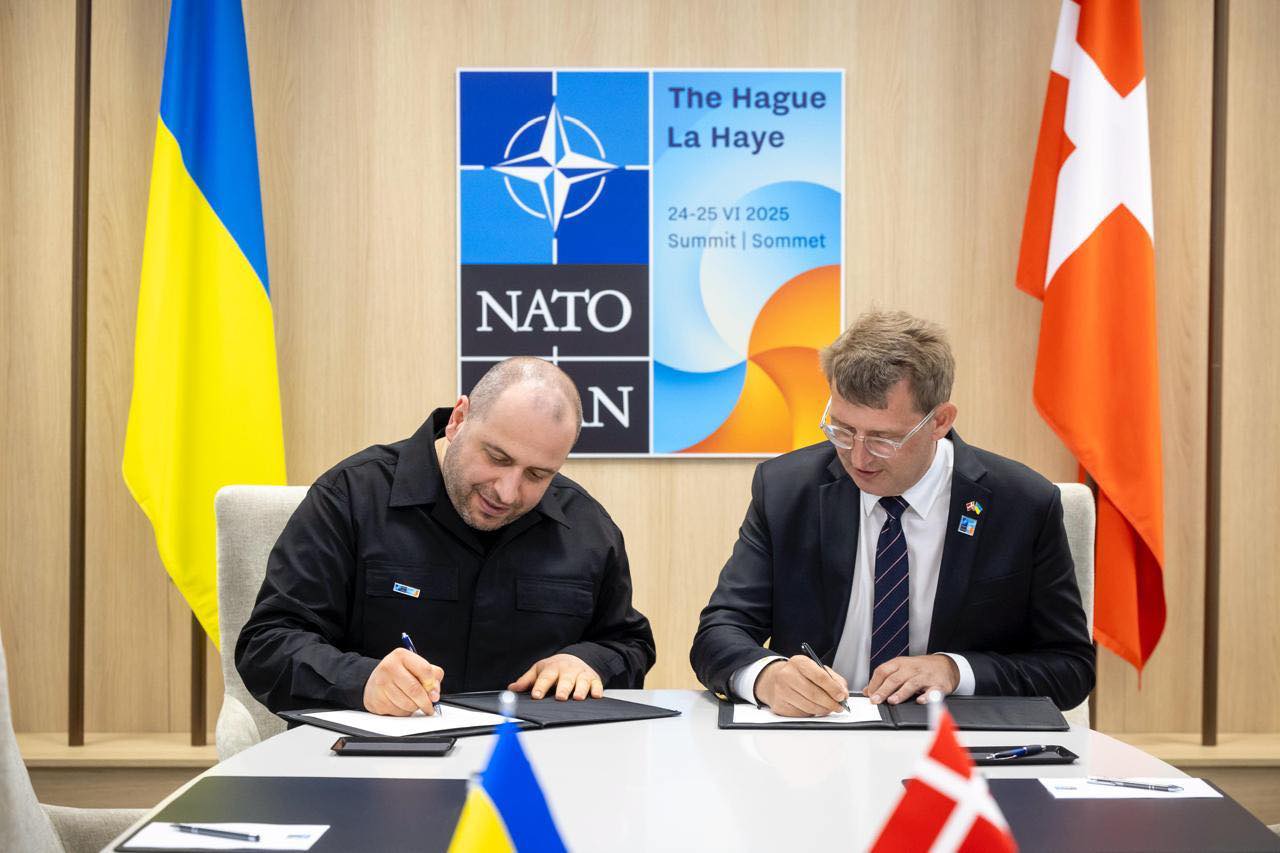
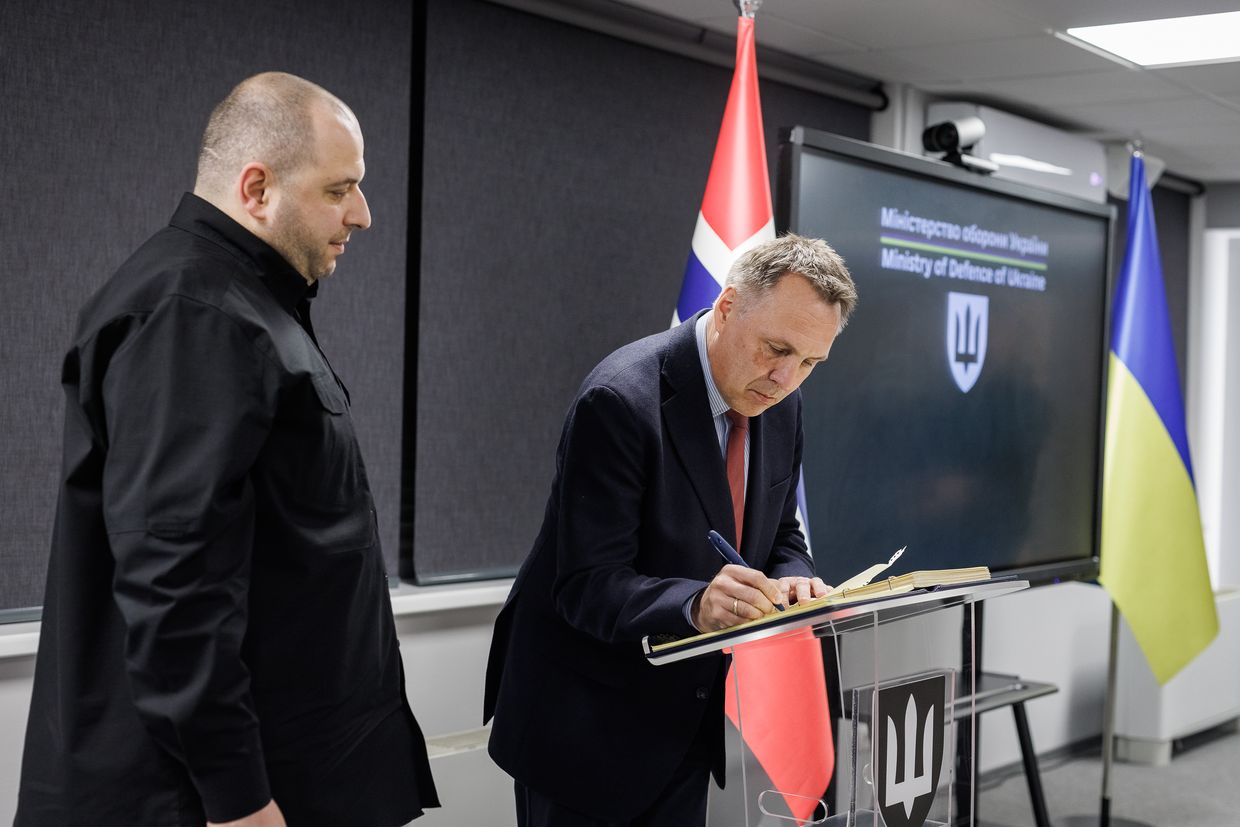
Defense Minister Rustem Umerov signed a Letter of Intent on June 24 with his Danish counterpart Troels Lund Poulsen to launch Ukrainian defense production in Denmark, Umerov announced on Facebook.
The document envisages facilitating the deployment of Ukrainian defense companies in Denmark and integrating of the defense industries of both countries through the "Build with Ukraine" initiative.
Denmark has already allocated $47 million for the project, and Ukraine's partners will provide further funding for production.
"I thank the Danish government for its trust, steadfast support of Ukraine, and commitment to developing a deep partnership between our countries," Umerov said. "This partnership enhances the security of Ukraine, Denmark, and all of Europe — today and into the future."
The agreement between Ukraine and Denmark also provides coordination between the Danish Defense Ministry, the Business and Industry Ministry, and the Foreign Ministry to integrate Ukrainian enterprises into the European defense system.
"By providing Ukrainian defense companies the opportunity to start production in Denmark, we are creating a basis for close cooperation between defense companies in both countries. This will also provide the Danish Armed Forces with access to the latest technologies and the experience of Ukraine," Poulsen said.
Denmark has pioneered efforts to support Ukraine by investing in its defense industry, creating the so-called "Danish model" of purchasing arms for Kyiv from Ukrainian producers. Copenhagen has provided around $9.8 billion in military aid under its Ukraine Fund for the years 2023-2028.
Ukraine's military intelligence agency (HUR) and the Foreign Ministry have evacuated 31 Ukrainian citizens from Iran on the instructions of President Volodymyr Zelensky, the agency said on June 24.The news follows a war between Iran and Israel that began on June 13. The countries reached a ceasefire deal on June 24. Israel and Iran attacked each other hours after the ceasefire was announced. Despite the initial violations, the agreement appears to be holding now. Ukraine evacuated 14 children, 1
Ukraine's military intelligence agency (HUR) and the Foreign Ministry have evacuated 31 Ukrainian citizens from Iran on the instructions of President Volodymyr Zelensky, the agency said on June 24.
The news follows a war between Iran and Israel that began on June 13. The countries reached a ceasefire deal on June 24.
Israel and Iran attacked each other hours after the ceasefire was announced. Despite the initial violations, the agreement appears to be holding now.
Ukraine evacuated 14 children, 12 women, and five men, according to HUR.
The evacuation was carried out through Azerbaijan and Moldova to Kyiv, the statement read.
"We felt completely unprotected all the time in Tehran because there were no air raid alerts. In addition, the Internet was down, and we had no idea what was happening," Varvara from Kyiv Oblast, who was evacuated from Iran, told HUR's press service.
Earlier, Ukraine evacuated 176 people from Israel, including 133 Ukrainian citizens. The evacuation from Iran is the final stage of a joint operation by HUR and the Foreign Ministry to rescue Ukrainian citizens from high-risk areas, according to the agency's statement.
Tensions between Iran and Israel had already been rising after Iran launched missile strikes on Tel Aviv and other Israeli cities on June 13, killing multiple civilians, including five Ukrainian nationals. The attack came in retaliation for Israeli military action.
On June 24, Trump announced that a ceasefire between Iran and Israel had come into effect, following the U.S. strikes on Iranian nuclear facilities and a retaliatory Iranian attack on a U.S. military base in Qatar.
The Council of Europe and Ukraine will sign an agreement on June 25 to set up a special tribunal for the crime of Russian aggression, Yevheniya Kravchuk, a member of Ukraine's delegation to the Parliamentary Assembly of the Council of Europe (PACE), said on June 24.The move marks a milestone in international efforts to hold President Vladimir Putin and other top Russian officials accountable for launching the full-scale war against Ukraine."What seemed like a dream of justice will soon become a
The Council of Europe and Ukraine will sign an agreement on June 25 to set up a special tribunal for the crime of Russian aggression, Yevheniya Kravchuk, a member of Ukraine's delegation to the Parliamentary Assembly of the Council of Europe (PACE), said on June 24.
The move marks a milestone in international efforts to hold President Vladimir Putin and other top Russian officials accountable for launching the full-scale war against Ukraine.
"What seemed like a dream of justice will soon become a reality. Ukraine, together with the Council of Europe, will sign an agreement that will bring Russia to justice," Kravchuk wrote on Facebook.
Ukrainian Deputy Prime Minister Olha Stefanishyna stressed that the special tribunal will have jurisdiction over the Russian president, prime minister, foreign minister, and other top officials.
"It is not a matter of debate anymore, only a matter of time. Some will get into the hands of justice sooner, some later, but they will all be held accountable. There are no exceptions," Stefanishyna told the Kyiv Independent. "It's critical to restore the international rule of law and prevent future acts of aggression."
The tribunal's jurisdiction covers all aspects of the crime of aggression, including the planning, preparation, initiation, or execution of acts of aggression, according to Stefanishyna.
"The tribunal's design makes it clear that the official status of the accused at the time of the crime does not exempt them from responsibility," she said. "Functional immunity does not apply here; high-ranking officials can be prosecuted even while holding office. The statute provides rules for conducting proceedings if the accused is absent."
The tribunal will be authorized to cooperate with the International Criminal Court (ICC) to ensure jurisdictional effectiveness and share information, Stefanishyna added.
President Volodymyr Zelensky has long advocated for the tribunal to ensure that Putin and other senior Russian officials face justice for launching the invasion three years ago.
Ukrainian prosecutors have documented thousands of war crimes committed by Russian forces, including attacks on civilians, cultural and medical sites, and acts of torture and deportation.
While war crimes, crimes against humanity, and genocide can be prosecuted against individuals at any level, the crime of aggression applies exclusively to state leaders responsible for planning and waging a war.
The ICC has already issued arrest warrants for Putin and Maria Lvova-Belova, the Russian official overseeing the forced deportation of Ukrainian children to Russia.
Ukraine and the United Kingdom have reached an agreement to jointly produce drones, Defense Minister Rustem Umerov announced on June 24.Britain will finance the procurement of Ukrainian-designed drones manufactured in the UK, he added. The deal comes as Ukraine has rapidly developed its drone capabilities since 2022, evolving from modifying commercial aircraft to producing military UAVs, attack drones, and reconnaissance systems at scale.The agreement was reached between President Volodymyr Zele
Ukraine and the United Kingdom have reached an agreement to jointly produce drones, Defense Minister Rustem Umerov announced on June 24.
Britain will finance the procurement of Ukrainian-designed drones manufactured in the UK, he added.
The deal comes as Ukraine has rapidly developed its drone capabilities since 2022, evolving from modifying commercial aircraft to producing military UAVs, attack drones, and reconnaissance systems at scale.
The agreement was reached between President Volodymyr Zelensky and British Prime Minister Keir Starmer, Umerov said.
Under the three-year program, the UK will finance the procurement of a wide range of Ukrainian drones to be produced by British defense companies.
"This will enable British defense companies to rapidly design and produce state-of-the-art drones on a large scale," Umerov wrote on Facebook.
According to Umerov, all production will be directed to meet the needs of Ukraine's Defense Forces. After the war ends, the UK and Ukraine will share the produced drones between themselves.
The initiative will support the scaling of advanced technologies, increased drone production, and the integration of Ukrainian and British defense industries, Ukraine’s defense minister wrote.
Ukraine has ramped up domestic drone production over the recent years of its war with Russia, as well as the development of new missiles.
Various aerial, naval, and ground drones have been developed and often successfully used for reconnaissance, combat, and other tasks throughout the full-scale war with Russia.
In January 2025, Umerov announced that the United Kingdom would finance the production of air defense systems and long-range weapons in Ukraine.
U.S. President Donald Trump said on June 24 that his Russian counterpart Vladimir Putin had called him and offered to help resolve the conflict between Iran and Israel, Fox News reported."As you know, Vladimir called me up. He said, can I help you with Iran? I said, 'no, I don't need help with Iran. I need help with you.' And I hope we're going to be getting a deal done with Russia, which is a shame. Six thousand soldiers died last week," Trump told journalists while heading to a NATO summit.Tru
U.S. President Donald Trump said on June 24 that his Russian counterpart Vladimir Putin had called him and offered to help resolve the conflict between Iran and Israel, Fox News reported.
"As you know, Vladimir called me up. He said, can I help you with Iran? I said, 'no, I don't need help with Iran. I need help with you.' And I hope we're going to be getting a deal done with Russia, which is a shame. Six thousand soldiers died last week," Trump told journalists while heading to a NATO summit.
Trump's remarks come as The Hague hosts the NATO summit on June 24-25, at which the American leader is expected to meet Ukraine's President Volodymyr Zelensky.
Trump added he would like "to see a deal with Russia," which recently launched a new summer offensive against Ukraine, disregarding calls by Kyiv and its Western partners for an unconditional ceasefire.
The U.S. president did not provide further details on a potential deal with Russia.
Russia has deepened military and political ties with Tehran during the full-scale invasion of Ukraine.
Iran has supplied Moscow with thousands of Shahed attack drones used in routine strikes on Ukrainian cities.
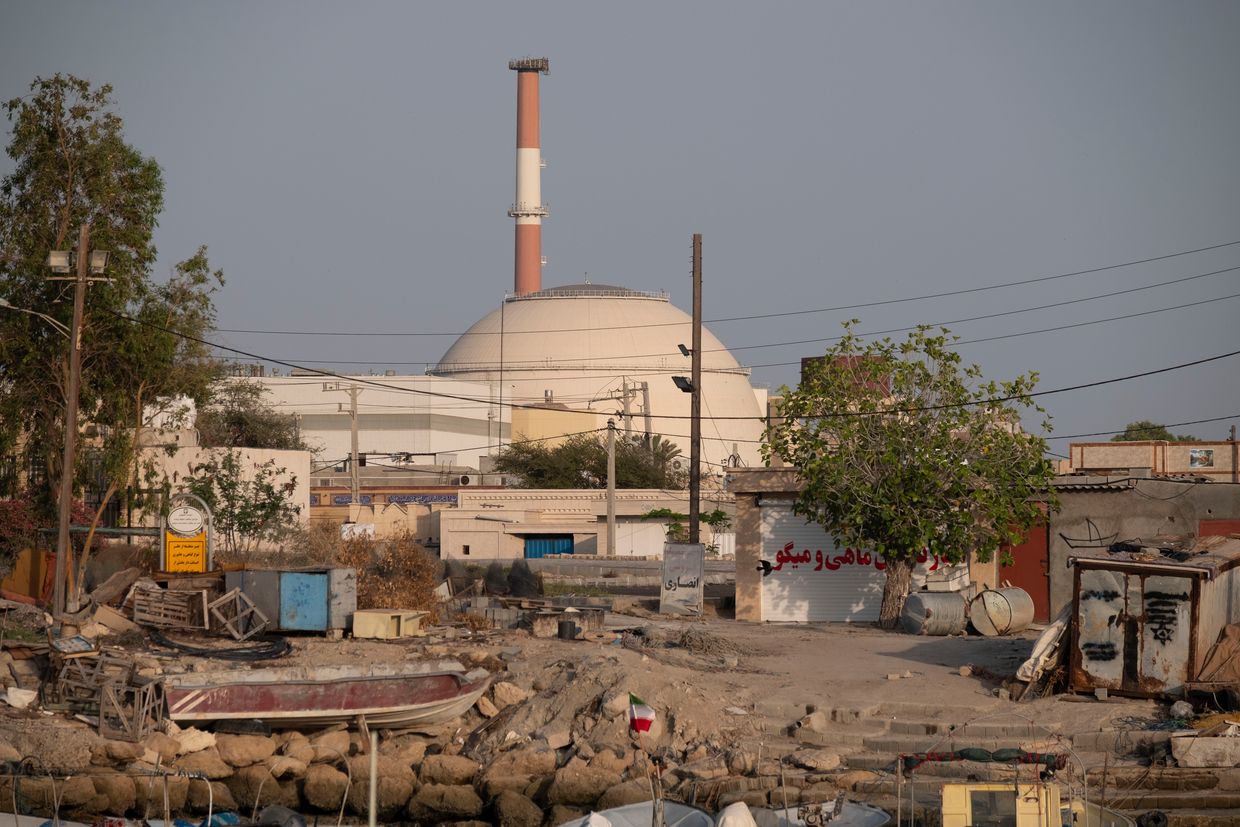
Russia and Iran have cooperated to develop their own nuclear programs as both countries face Western sanctions. Russia supplied Iran with the Middle East's first nuclear power plant despite objections from the West.
Tensions between Iran and Israel had already been rising after Iran launched missile strikes on Tel Aviv and other Israeli cities on June 13, killing multiple civilians, including five Ukrainian nationals. The attack came in retaliation for Israeli military action.
Following several days of escalating conflict, Trump announced a ceasefire between Israel and Iran, but it was violated within hours of the American president's statement.
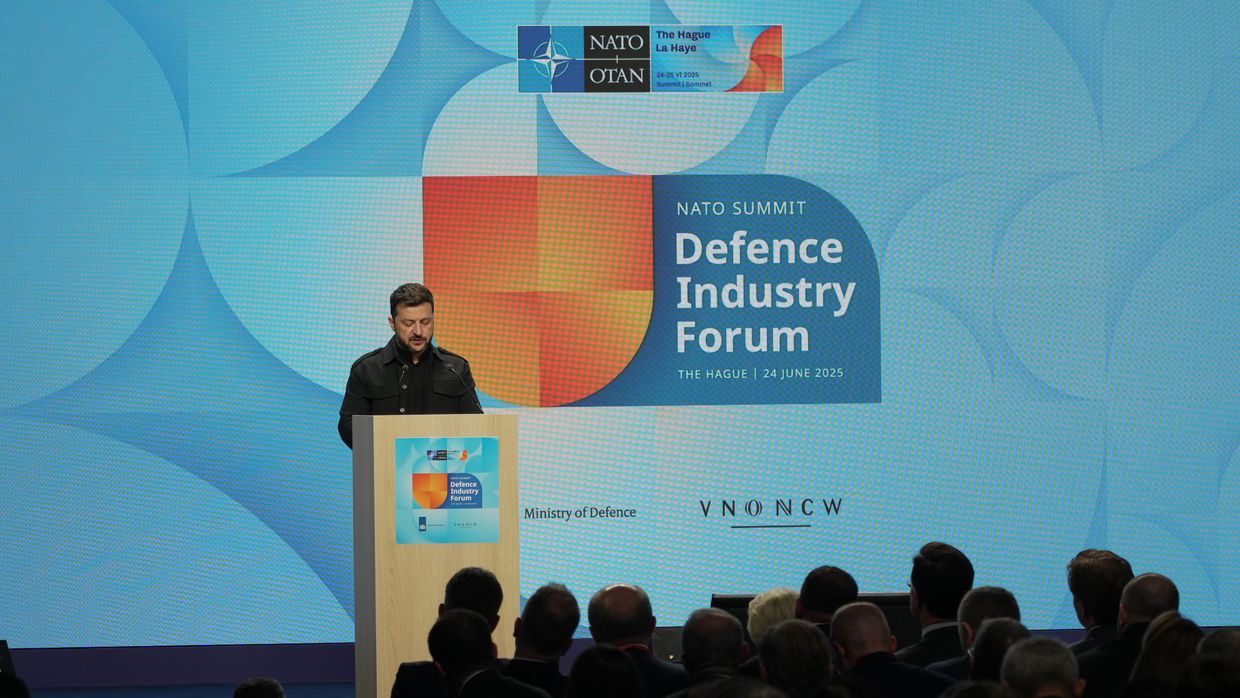
President Volodymyr Zelensky said during NATO summit on June 24 that Ukraine has the capacity to produce over 8 million drones of various types each year, but lacks the financial backing to reach that potential, a shortfall he said must be urgently addressed to defeat Russia's growing military network."Our defense production potential has surpassed $35 billion,” Zelensky said during a speech at the NATO Defense Industry Forum in The Hague. "This includes nearly 1,000 types of products... but aro
President Volodymyr Zelensky said during NATO summit on June 24 that Ukraine has the capacity to produce over 8 million drones of various types each year, but lacks the financial backing to reach that potential, a shortfall he said must be urgently addressed to defeat Russia's growing military network.
"Our defense production potential has surpassed $35 billion,” Zelensky said during a speech at the NATO Defense Industry Forum in The Hague. "This includes nearly 1,000 types of products... but around 40% of this potential lacks proper funding. For example, we can produce over 8 million drones of different types each year, but the financing allows for far fewer."
Zelensky urged allies to scale up investments in joint weapons production, including drone technologies, artillery, and interceptors. He argued that Ukraine's defense capabilities are not only key to defending its own territory, but essential to strengthening NATO's long-term security.
"We must lead in the drone race, both in strike drones and interceptors," he said. "Please increase your investments in Ukraine and joint weapons production. All the weapons we produce become part of a new, stronger European defense and security system."
The Ukrainian president emphasized that Russia is not acting alone, but as part of a broader network of state and non-state actors, including North Korea, Iran, and Chinese companies, which support its war effort against Ukraine and pose a long-term threat to Europe.
"The source of this war and the long-term threat to Europe is Russia," Zelensky said. "But in reality, we are not just facing Russia alone. We are facing a network of state and non-state actors."
Zelensky also called on NATO members to increase defense spending to 5% of GDP and to dedicate at least 0.25% of GDP to support Ukraine's military needs directly. He thanked countries such as Germany, Norway, Sweden, and the Netherlands for their elevated commitments, but urged others to follow suit.
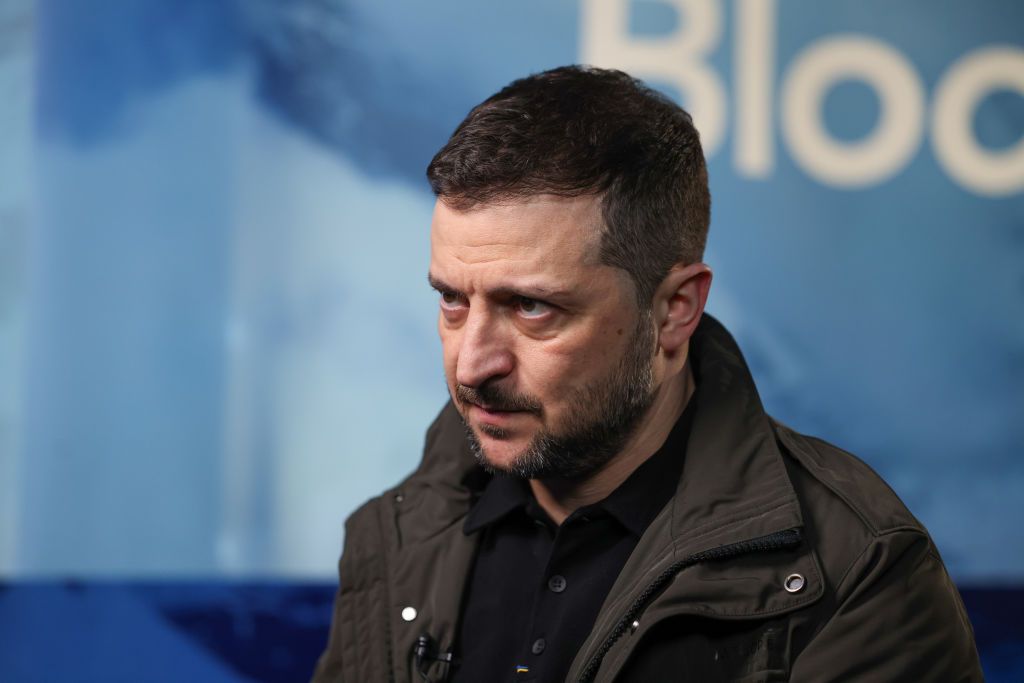
Zelensky warned that Russia is planning "new military operations on NATO territory" and that the war in Ukraine must be stopped now to prevent broader European conflict.
"There are no signs that Putin wants to stop this war," Zelensky said. "So long as he kills, he lives. And our intelligence confirms this."
He also appealed for a crackdown on the supply chains that allow Russia to sustain its weapons manufacturing, referring to Western-origin components found in Russian missiles, drones, and armored vehicles.
"It's not just China, also Taiwan. Some of these parts come from European countries and from the United States," Zelensky said. "Every single tool delivered to Russia's defense sector helps prolong the war and is a crime against peace."
Zelensky's speech comes as NATO leaders gather in The Hague for a high-level summit on June 24-25. NATO leaders are expected to discuss raising the alliance's defensespending target to 5% of the GDP, a proposal the U.S. has championed but from which it considers itself exempt.
Editor's note: This is a developing story and is being updated.Israel launched airstrikes on Iranian territory on June 24, defying U.S. President Donald Trump's call for calm just few hours after he announced a ceasefire between the two countries, according to the Times of Israel.The attack comes less than an hour after Trump told reporters that "Israel needs to calm down" as he criticized both countries for undermining the ceasefire he says he brokered. "We basically have two countries that hav
Editor's note: This is a developing story and is being updated.
Israel launched airstrikes on Iranian territory on June 24, defying U.S. President Donald Trump's call for calm just few hours after he announced a ceasefire between the two countries, according to the Times of Israel.
The attack comes less than an hour after Trump told reporters that "Israel needs to calm down" as he criticized both countries for undermining the ceasefire he says he brokered.
"We basically have two countries that have been fighting so long and so hard that they don't know what the f*ck they're doing," Trump said on June 24.
Hours after Trump said the ceasefire came into effect, Israel accused Tehran of launching missiles toward its territory — an allegation Iran denied.
Following Iran's alleged missile strike, Trump and Israeli Prime Minister Benjamin Netanyahu reportedly spoke on the phone and agreed that Israel would carry out a limited response. The air force strike targeted a single "symbolic" radar installation.
Ahead of Israel's strike, Trump wrote on Truth Social that all of the Israeli planes "turn around and head home, while doing a friendly 'Plane Wave" to Iran."
According to the Times of Israel, Israeli officials said Trump was still sending messages promising that Israel would not attack Iran "after he knew we would attack," a senior official told the Kan public broadcaster.
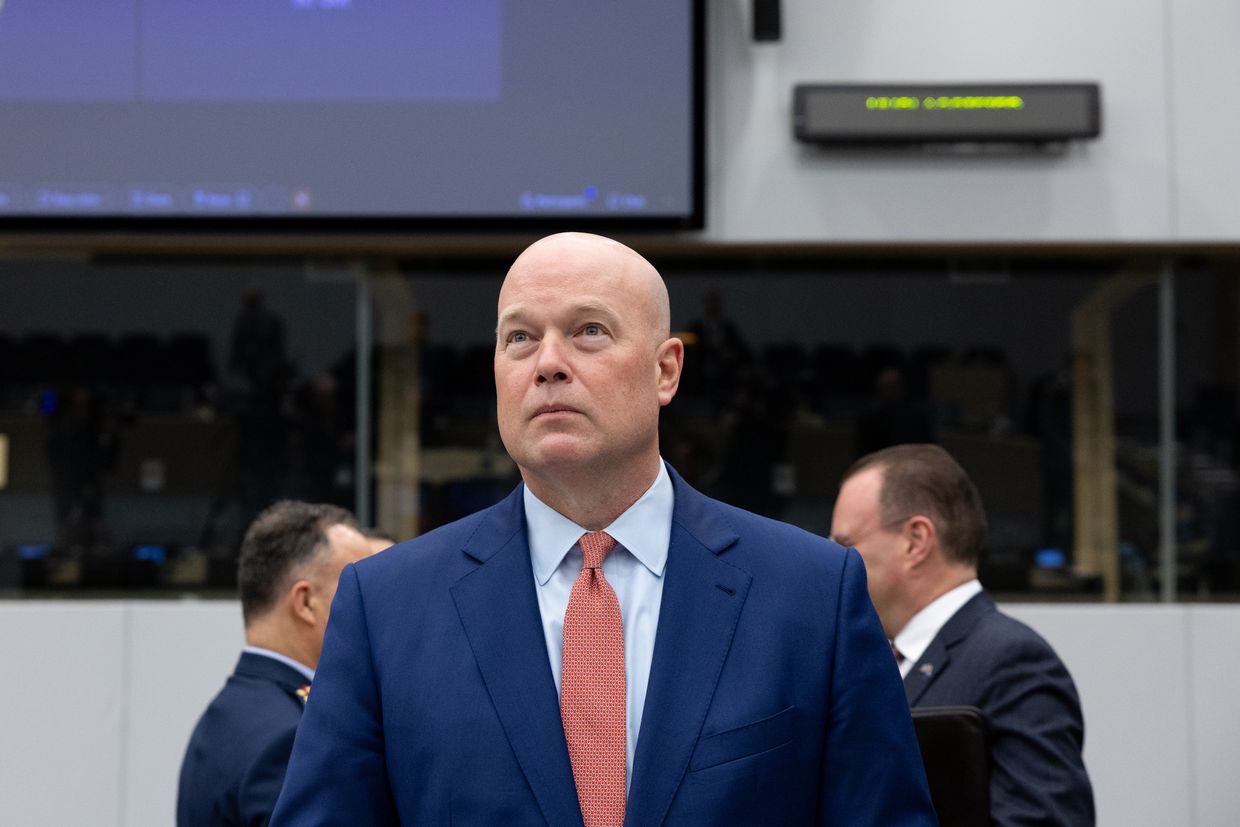
U.S. airstrikes on Iranian nuclear facilities demonstrated how precision military action can achieve rapid peace, U.S. Ambassador to NATO Matthew Whitaker said on June 24, speaking at the NATO Public Forum held alongside the alliance summit in The Hague."(The U.S. attack on Iran's nuclear facilities) shows how you get that peace through that strength, and that strength is amplified and enhanced by this alliance (NATO)," Whitaker said, referring to the June 21 American strikes on Iran's Fordow, N
U.S. airstrikes on Iranian nuclear facilities demonstrated how precision military action can achieve rapid peace, U.S. Ambassador to NATO Matthew Whitaker said on June 24, speaking at the NATO Public Forum held alongside the alliance summit in The Hague.
"(The U.S. attack on Iran's nuclear facilities) shows how you get that peace through that strength, and that strength is amplified and enhanced by this alliance (NATO)," Whitaker said, referring to the June 21 American strikes on Iran's Fordow, Natanz and Esfahan nuclear sites, which U.S. President Donald Trump called a "spectacular success."
Whitaker emphasized that the U.S. remains a reliable ally and a cornerstone of NATO's deterrence. "The U.S. isn't going anywhere," he said. "The U.S. has certain capabilities that you want an alliance to have."
He added that recent U.S. military operations underscore the importance of defense investments by all member states. "If all of (NATO) countries elevate investments in their defense, I think we will have peace for generations,” Whitaker said.
The U.S. strikes on Iran came amid escalating tensions between Israel and Tehran. Trump said the strikes were intended to push Iran toward negotiations, warning that the alternative would be "tragedy for Iran far greater than we have witnessed."
Trump claimed that a ceasefire between Iran and Israel was achieved on June 24. Just hours later, Israel accused Tehran of launching missiles toward its territory — an allegation Iran denied.
Whitaker said the White House hopes the U.S. will also bring to an end Russia's war in Ukraine. He added that there is "no purely military solution" to the war in Ukraine.
Unlike past U.S. administrations, Trump has not introduced new sanctions against Russia despite increasing Russian missile and drone attacks on civilians.
On June 24, the first day of the NATO summit, Russia launched a ballistic missile strike on the Ukrainian city of Dnipro, killing at least three people and injuring more than 20, including two children, according to regional officials.
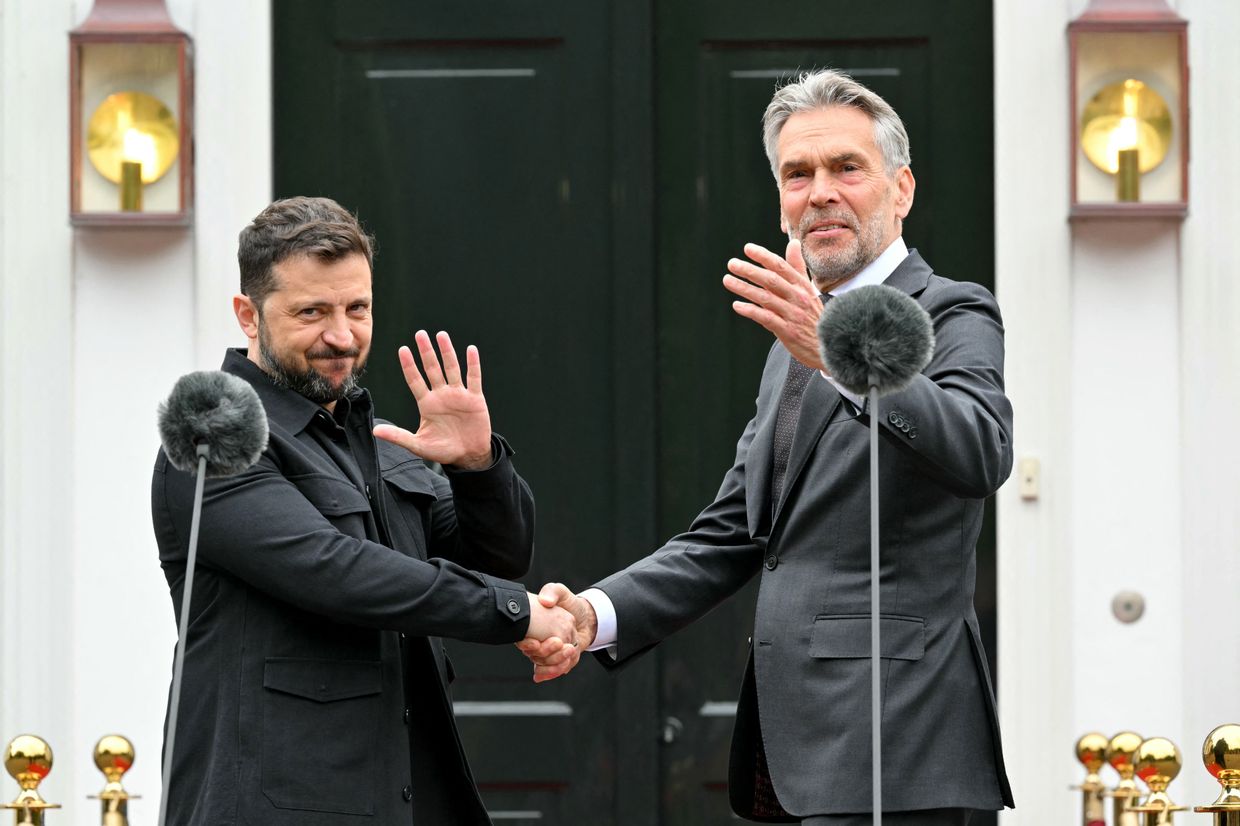
President Volodymyr Zelensky met outgoing Dutch Prime Minister Dick Schoof on June 24 in The Hagueon the first day of the NATO summit.Welcoming Zelensky at the Catshuis official residence, Schoof presented a new military aid package for Ukraine, including 100 drone radar systems, front-line vehicles for evacuating the wounded, and 80 million euros (over $90 million) for the drone initiative. The Netherlands will also start producing drones for Ukraine, according to Ukrainian specifications.Zelen
President Volodymyr Zelensky met outgoing Dutch Prime Minister Dick Schoof on June 24 in The Hagueon the first day of the NATO summit.
Welcoming Zelensky at the Catshuis official residence, Schoof presented a new military aid package for Ukraine, including 100 drone radar systems, front-line vehicles for evacuating the wounded, and 80 million euros (over $90 million) for the drone initiative. The Netherlands will also start producing drones for Ukraine, according to Ukrainian specifications.
Zelensky arrived in the Netherlands on the evening of June 23, planning to meet allied leaders – including U.S. President Donald Trump – to discuss NATO's response to Russia's war against Ukraine during the annual summit.
"Let me be clear: Ukraine is part of the family that we call the Euro-Atlantic family," Schoof told Zelensky in front of reporters.
The new aid package is valued at 175 million euros ($200 million) and comes after a 500 million euros ($580 million) agreement to produce 600,000 drones with the Ukrainian defense industry, Dutch Defense Minister Ruben Brekelmans said separately at the summit.
"We have these technologies, we want to share them with our partners. In The Hague, we begin to work with some countries on co-production," Zelensky said when talking about Ukraine's drone manufacturing capabilities.
Calling The Hague the "city of justice," Zelensky also said he counts on allied support in "holding Russia accountable for its crimes" and named the Netherlands among Ukraine's leading European supporters.
Zelensky's arrival was preceded by rumors that he might skip the event if Trump does not attend either. Nevertheless, the Ukrainian president later confirmed he plans to meet the U.S. leader on June 25, potentially marking their third meeting since Trump took office after the expected talks at the G7 summit in Canada fell through.
This year's NATO summit is taking place as Russia continues to launch large-scale deadly attacks on Ukrainian cities, disregarding calls by Kyiv and its Western partners for a ceasefire.
Allied leaders also face growing uncertainty about the Trump administration's commitment to both Ukraine and NATO's collective security as new conflicts emerge in the Middle East.
Editor's note: The story was updated after the White House confirmed the meeting between Ukraine's President Volodymyr Zelensky and his American counterpart Donald Trump.U.S. President Donald Trump will meet his Ukrainian counterpart Volodymyr Zelensky during a NATO summit in The Hague, the White House confirmed on June 24.The last time Zelensky and Trump met was in April on the sidelines of Pope Francis' funeral amid concerns that Washington would withdraw from mediating peace talks between Kyi
Editor's note: The story was updated after the White House confirmed the meeting between Ukraine's President Volodymyr Zelensky and his American counterpart Donald Trump.
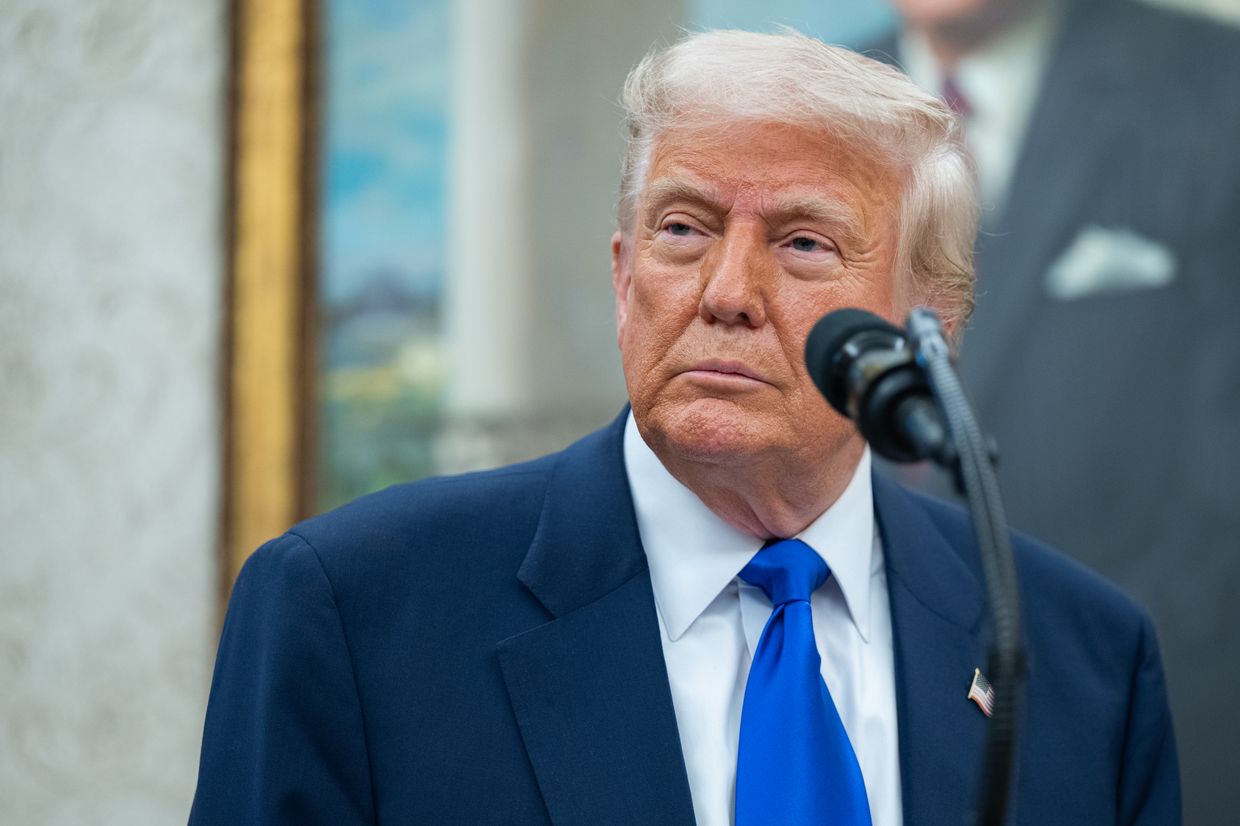
U.S. President Donald Trump will meet his Ukrainian counterpart Volodymyr Zelensky during a NATO summit in The Hague, the White House confirmed on June 24.
The last time Zelensky and Trump met was in April on the sidelines of Pope Francis' funeral amid concerns that Washington would withdraw from mediating peace talks between Kyiv and Moscow.
The White House did not provide any further details about the meeting between the two leaders.
The talks between Zelensky and Trump were scheduled for the "early afternoon" on June 25, the source told AFP, adding that "the teams are finalizing the details" of the meeting.
Trump and Zelensky are expected to discuss Ukraine's "purchase of a defense package, a large part of which consists of air defense systems," according to the source.
The discussion will also focus on "sanctions against Russia, and a price cap on oil," the source added.
Earlier, Trump said that he "would probably meet" Zelensky in The Hague after the two presidents did not manage to talk during the G7 summit in Canada earlier in June, AFP reported on June 24.
When asked what he would say to Zelensky, Trump replied: "I'll say: 'How are you?' He's (Zelensky) in a tough spot, he shouldn't have been there at all".
Zelensky also said in an interview with Sky News that he planned to meet Trump in The Hague. Asked whether the meeting would be a formal discussion or an informal encounter, Zelensky said it was a matter of scheduling: "They are talking about timing. It's timing."
Zelensky's participation in the summit was confirmed by the European Council on June 20, following reports that he was reconsidering the visit due to uncertainties surrounding Trump's participation.
Upon arrival in The Hague on June 24, Andriy Yermak, head of Ukraine's presidential office, said he held a "substantive" discussion with U.S. Secretary of State Marco Rubio about the upcoming Zelensky-Trump meeting. Yermak said the two discussed the structure, agenda, and key topics for the meeting.
Zelensky is also scheduled to meet European Commission President Ursula von der Leyen and NATO Secretary-General Mark Rutte during the summit.
In the interview, Zelensky also addressed concerns about Trump's perceived closeness to Russian President Vladimir Putin.
"It is a complicated question because I truly do not know what relationship Trump has with Putin," Zelensky said. "I think what I know, you know, and the media knows. There are various signals about that."
He added that he believes Trump understands Ukraine is a U.S. ally and that "the real existential enemy of America is Russia."
"They will never be friends. They may be short-term partners, but they will never be friends," Zelensky said.
Zelensky expressed hope that Trump's approach to Russia is tactical, intended to pressure Putin into peace negotiations. "I would like this approach to be only a way to force Putin to the negotiating table and to end the war. And let us hope so," he said.
Zelensky was scheduled to meet Trump at the Group of Seven (G7) summit, held June 15-17. However, the U.S. president left the multilateral event early due to the renewed conflict between Israel and Iran.
A majority of Europeans would oppose following the U.S.' lead if President Donald Trump pushed Ukraine to cede territories or lifted sanctions on Russia as part of a peace agreement, a new poll published on June 23 has found.Despite the self-imposed deadline of 100 days to end the war in Ukraine, Trump is now 155 days into his presidency and Russian attacks have only escalated.Trump has still yet to take any concrete steps to pressure Moscow into ending its war but has floated several concession
A majority of Europeans would oppose following the U.S.' lead if President Donald Trump pushed Ukraine to cede territories or lifted sanctions on Russia as part of a peace agreement, a new poll published on June 23 has found.
Despite the self-imposed deadline of 100 days to end the war in Ukraine, Trump is now 155 days into his presidency and Russian attacks have only escalated.
Trump has still yet to take any concrete steps to pressure Moscow into ending its war but has floated several concessions that Ukraine could be forced to make including ceding territory, while at the same time announcing no new military aid packages for Kyiv.
The survey, conducted by the European Council on Foreign Relations, found that even in countries with pro-Russian governments like Hungary, more people opposed the idea than supported it.
Respondents in 12 countries (Denmark, Estonia, France, Germany, Hungary, Italy, Poland, Portugal, Romania, Spain, Switzerland and the U.K.) were asked about three scenarios — the U.S. pushing Ukraine to cede territory, lifting sanctions on Russia, and withdrawing all military support.
Majorities in all countries opposed their own governments following the U.S. lead except for Hungary in the case of withdrawing all military support.
Opposition was highest in Denmark, the U.K., Poland, Spain and Portugal, and lowest in Hungary, Romania and Italy.
"A benevolent interpretation is that Europeans support an autonomous European policy to support Ukraine and they don’t want to blindly follow Trump’s lead," the report's authors said.
"But another reading of that data is that Europeans want Ukrainians to continue fighting on their behalf."
The wide-ranging survey also asked about attitudes to increasing defense spending and compulsory military service.
Majorities supported increased defense spending in Poland (70%), Denmark (70%), and the U.K. (57%), with large minorities in Germany (47%), Spain (46%), and France (45%).
When asked about compulsory military service, France (62%), Germany (53%), and Poland (51%) were the strongest supporters but crucially, not in the age bracket most likely to be called up — 18 to 29-year-olds.
Europeans are also becoming increasingly despondent about the U.S. under the leadership of Trump, with large majorities in the U.K. (74%) and Germany (67%) believing the U.S. political system is "broken."
Editor's note: This is a developing story and is being updated. Russia launched a deadly missile attack on the Ukrainian city of Dnipro on June 24, striking civilian infrastructure and a passenger train, killing at least 17 people and injuring scores of others, local officials reported.Dnipropetrovsk Oblast Governor Serhii Lysak said the morning strike ignited a large fire and also damaged a dormitory, a gymnasium, and an administrative building in the city.The Russian military also struck the n
Editor's note: This is a developing story and is being updated.
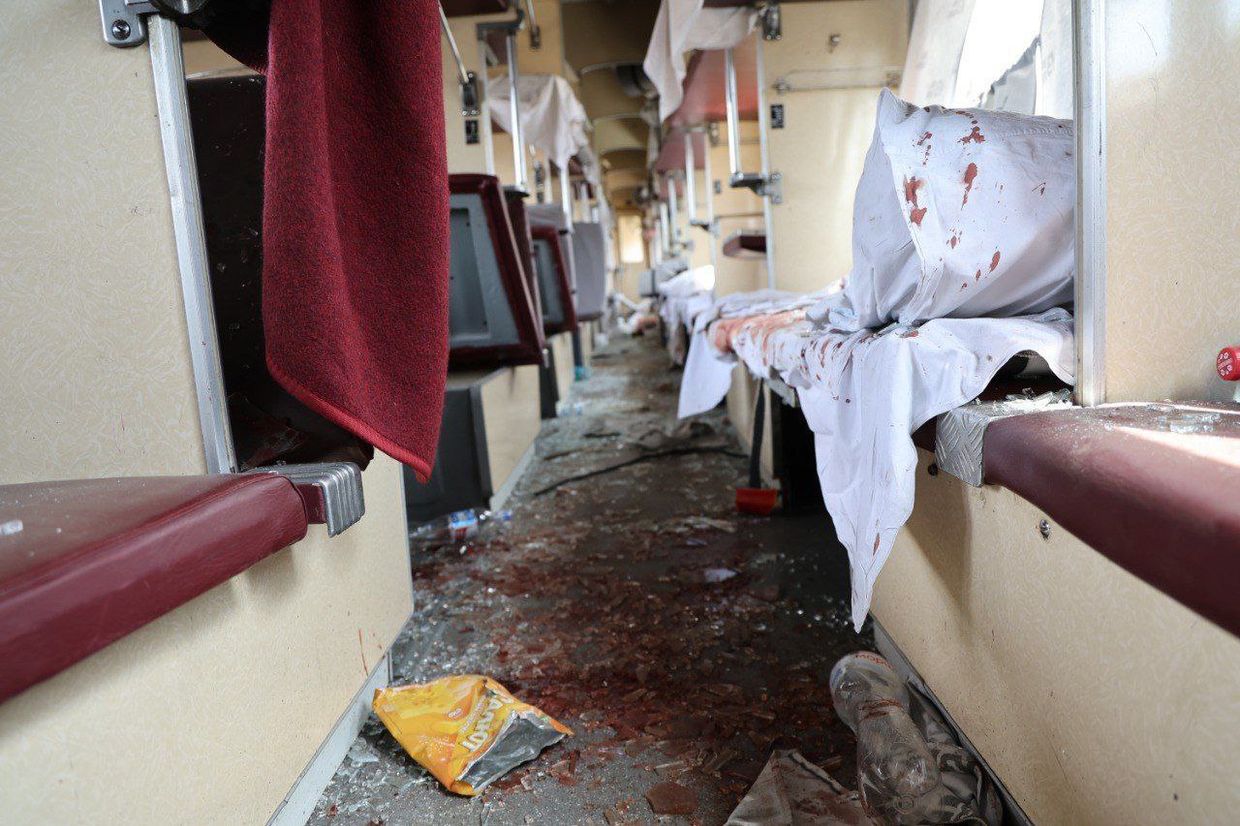
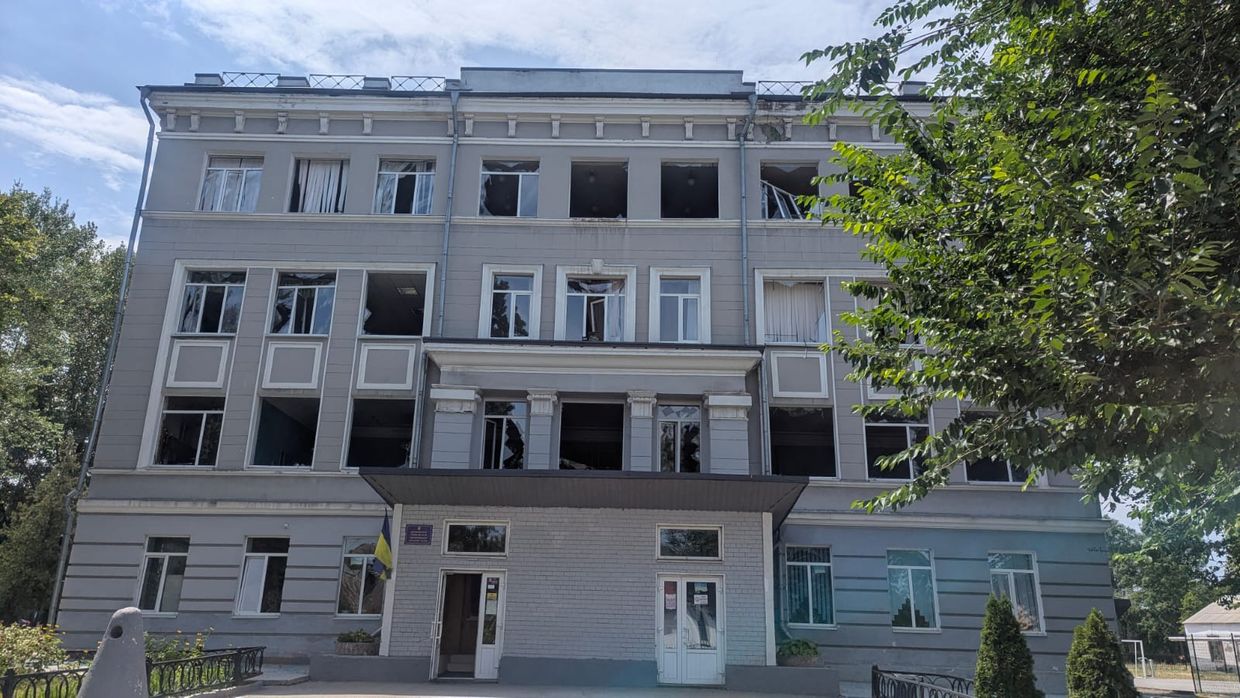
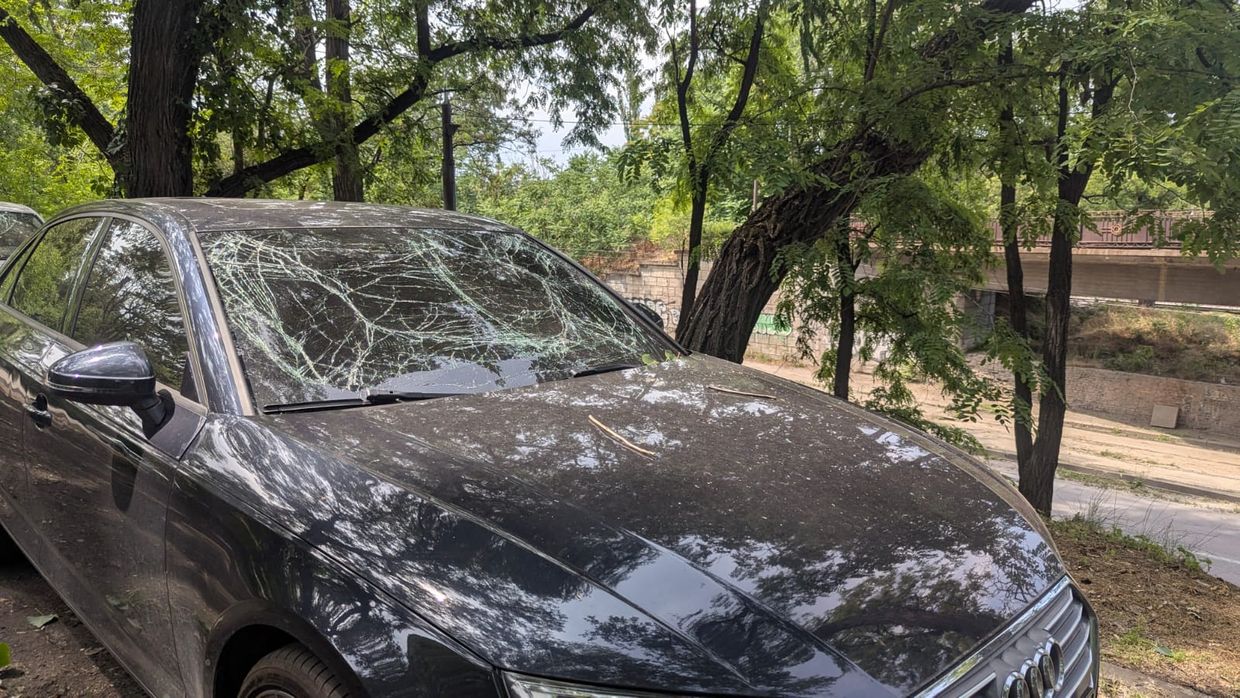
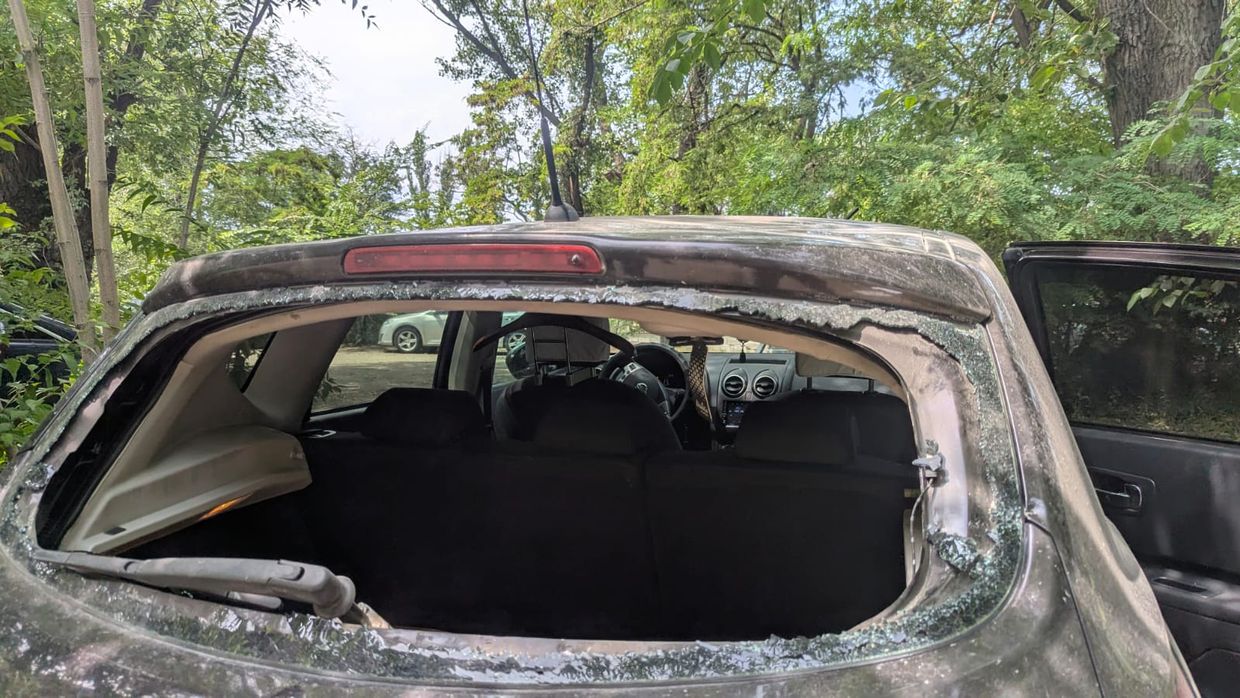
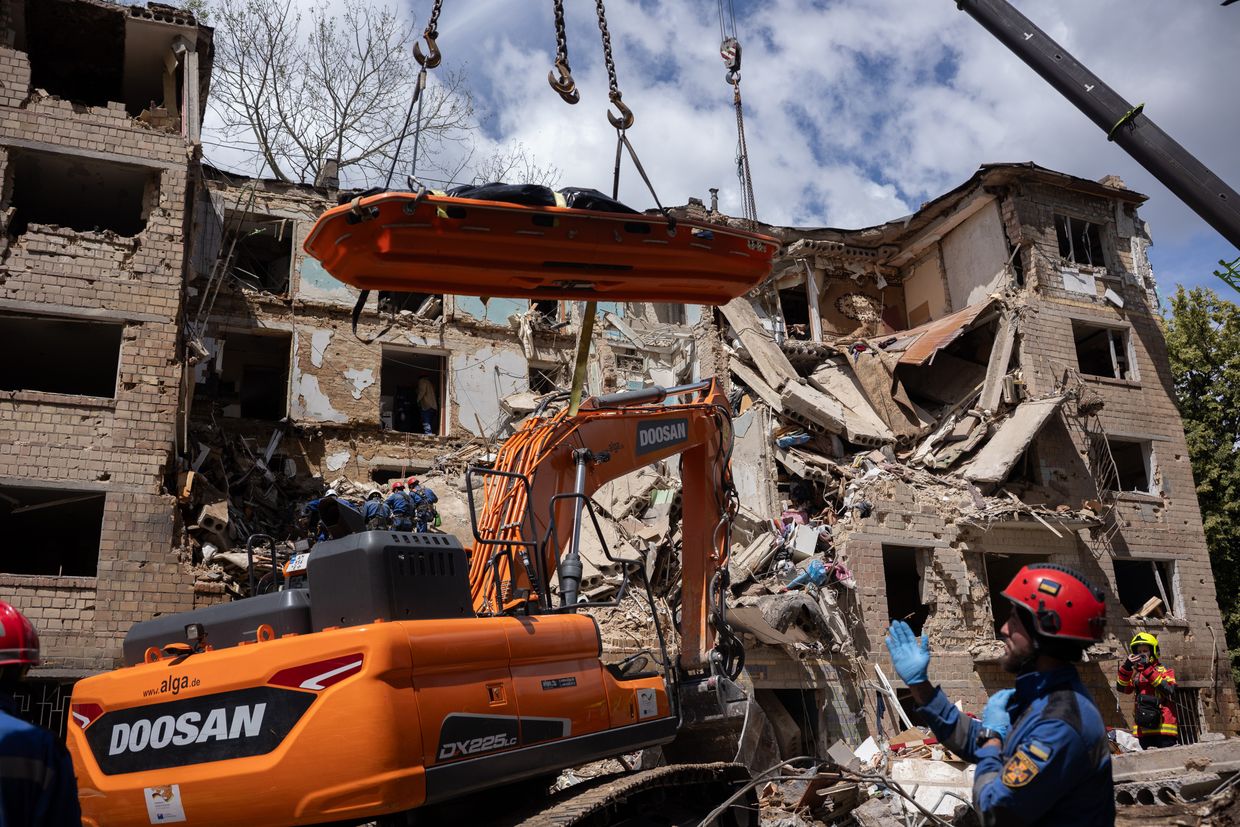
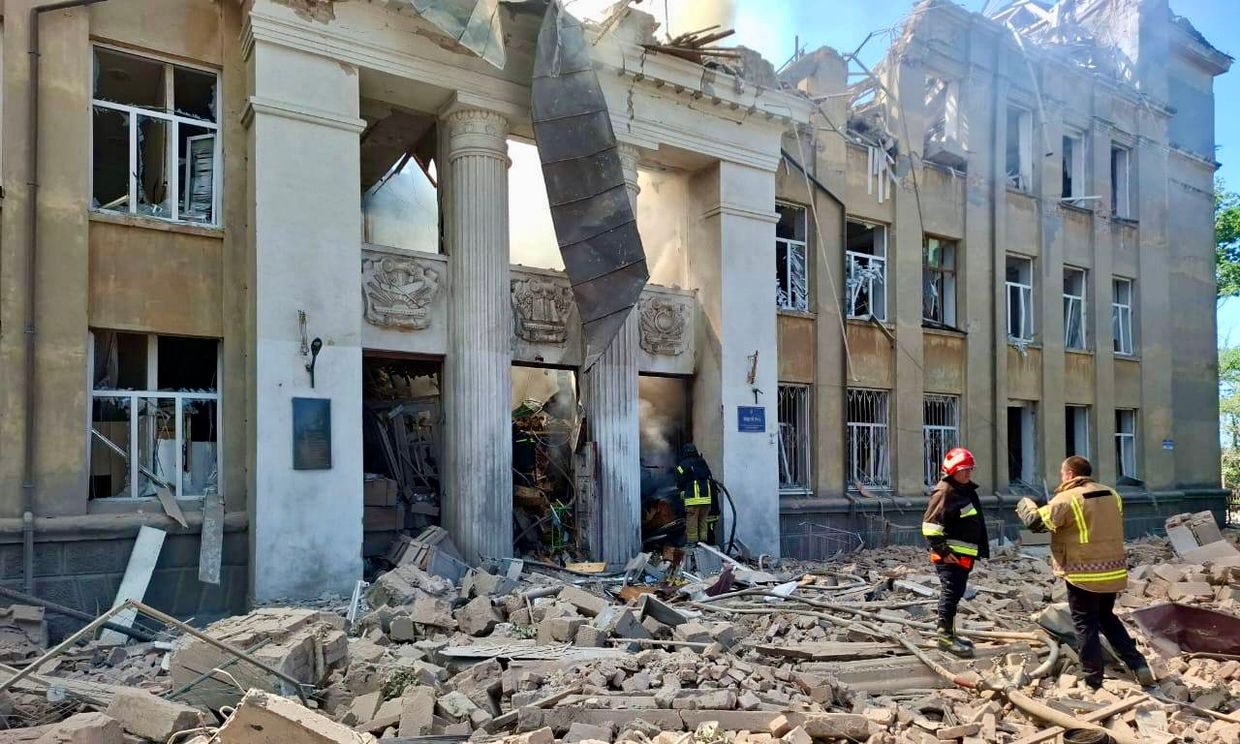
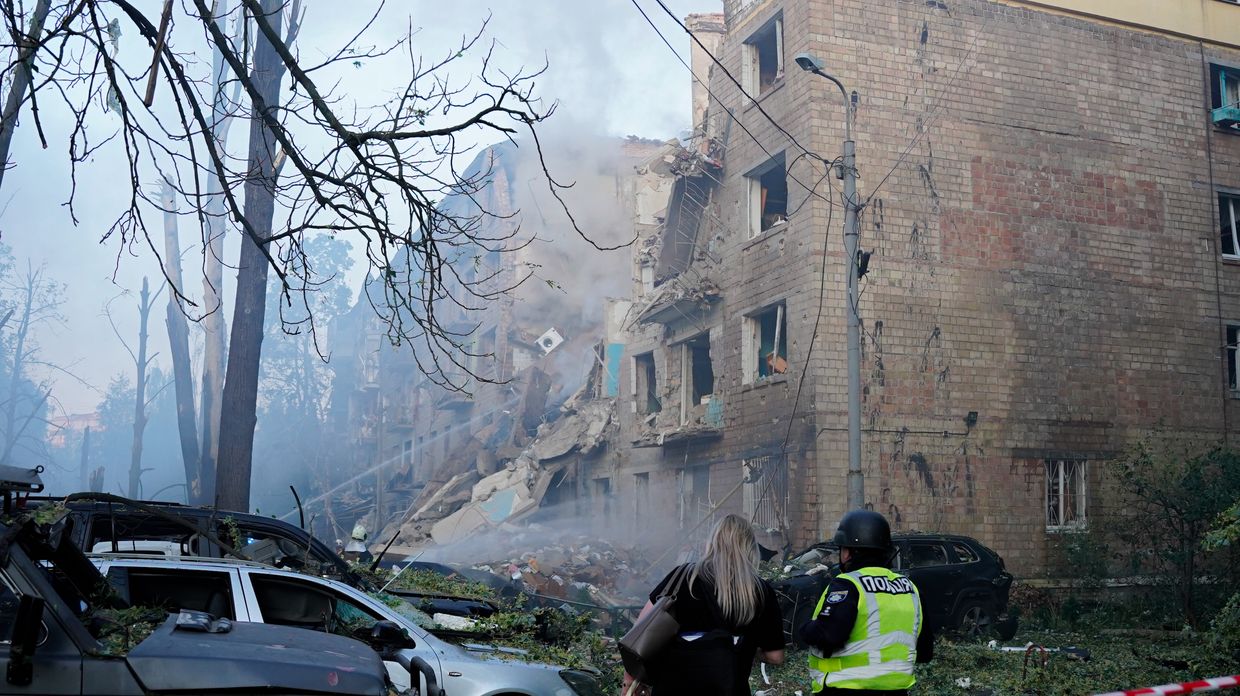
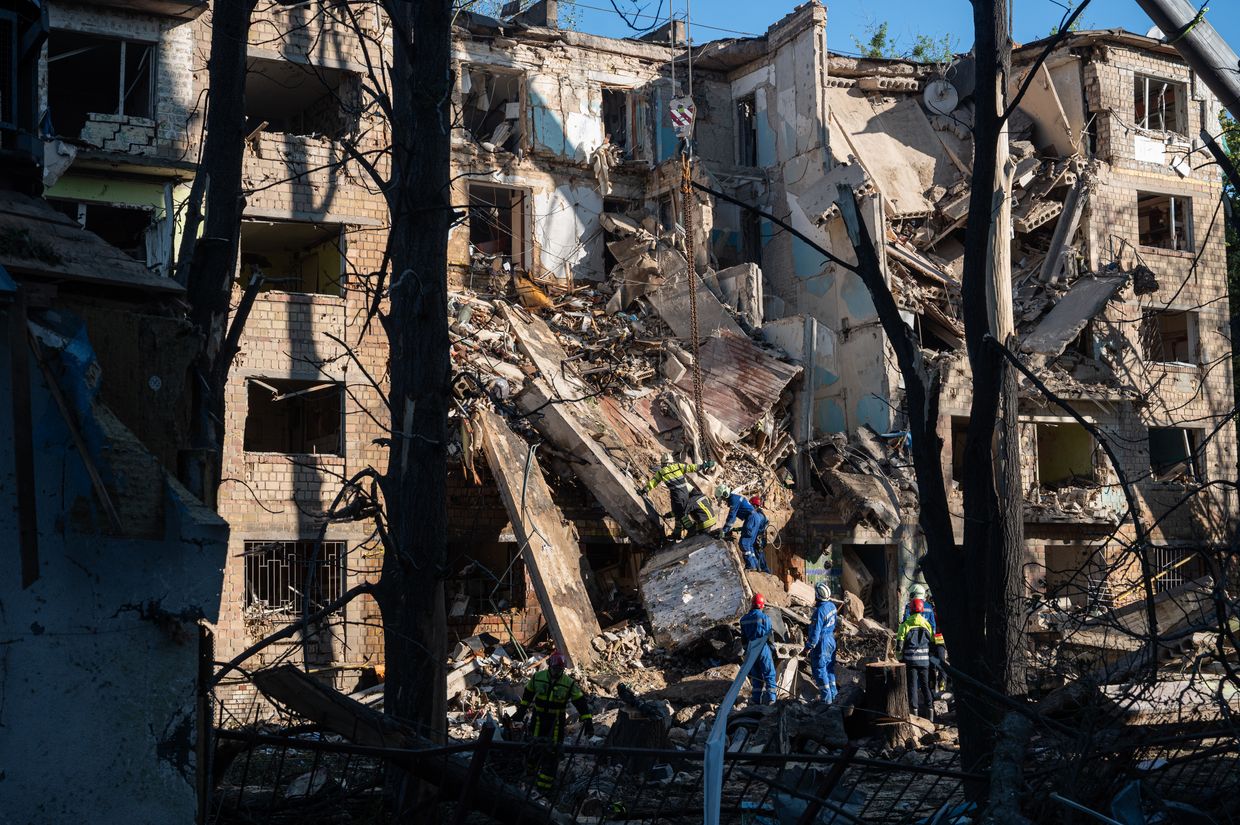
Russia launched a deadly missile attack on the Ukrainian city of Dnipro on June 24, striking civilian infrastructure and a passenger train, killing at least 17 people and injuring scores of others, local officials reported.
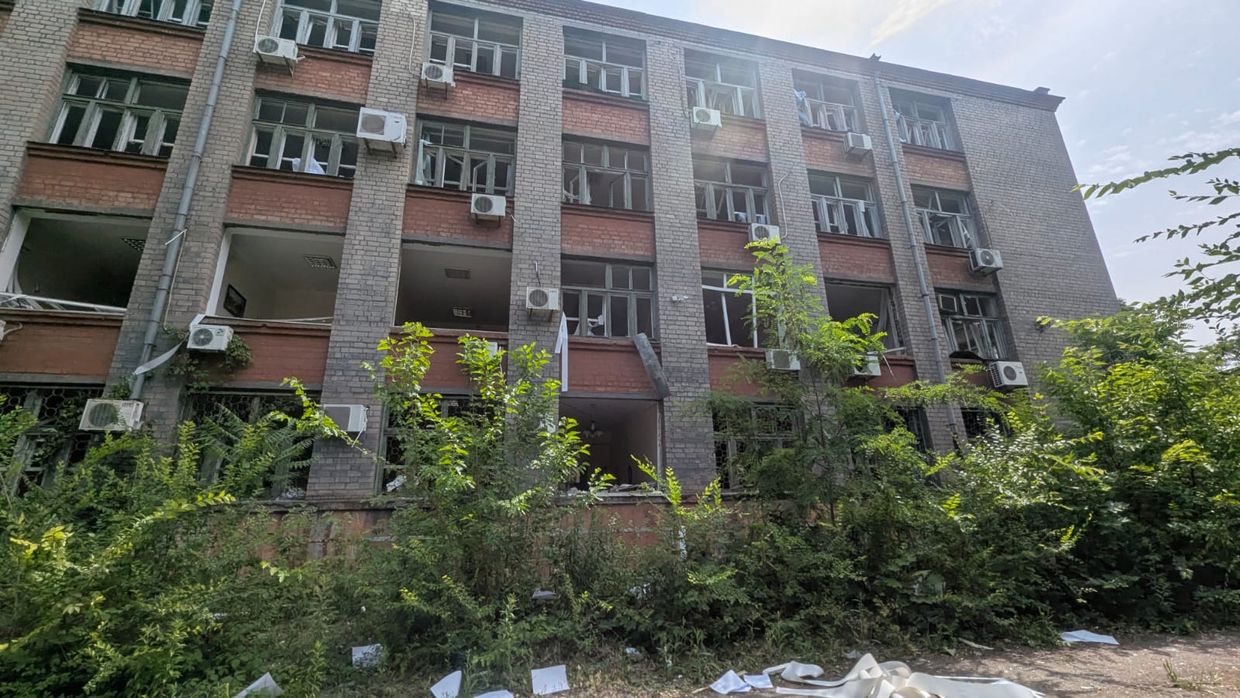
Dnipropetrovsk Oblast Governor Serhii Lysak said the morning strike ignited a large fire and also damaged a dormitory, a gymnasium, and an administrative building in the city.
The Russian military also struck the nearby town of Samarske, Lysak said. Casualties were reported in both locations.
"Unfortunately, there are dead and wounded everywhere," he said.
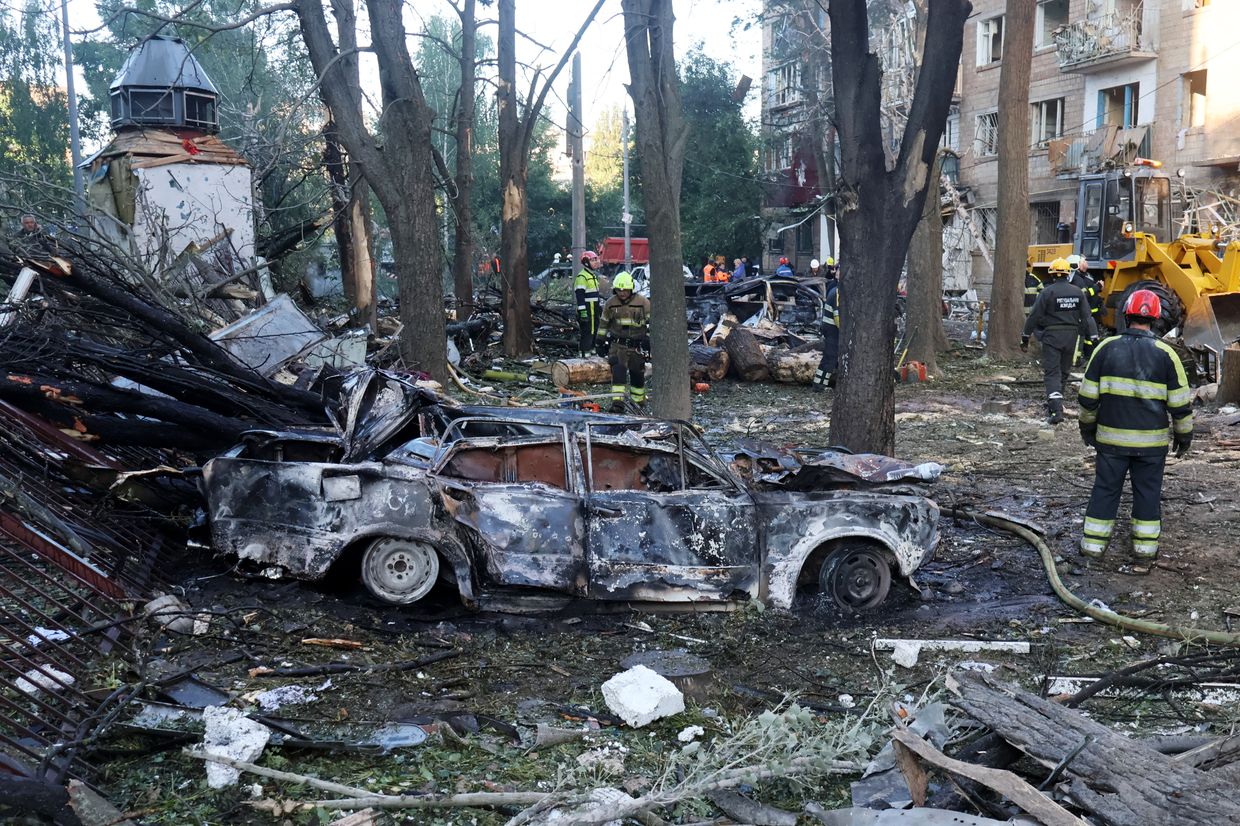
An school in Dnipro that was damaged in Russia's ballistic missile attack on June 24, 2025. (Dnipro.media)
Multiple cars got damaged in Dnipro during Russia's ballistic missile attack on June 24, 2025. (Dnipro.media)
Multiple cars got damaged in Dnipro during Russia's ballistic missile attack on June 24, 2025. (Dnipro.media)
In Samarske, two people were killed, and 14 injured. Eight were hospitalized, with half of them in critical condition.
"As of now, more than 160 people are known to have been injured. Unfortunately, 11 people have died," President Volodymyr Zelensky said in a post on social media, adding: "The rubble is still being cleared, so the death toll may, unfortunately, increase."
Around 8:30 p.m. local time, the death toll rose to 17, while the number of wounded increased to 279, including 27 children, Lysak reported.
Almost a hundred of the victims remain in hospital, according to Lysak.
Ukraine's national railway company, Ukrzaliznytsia, said that a train traveling from Odesa to Zaporizhzhia was damaged in the attack.
"Ukrzaliznytsia is preparing a replacement train in Dnipro to evacuate passengers to Zaporizhzhia," the company said in a statement.
A damaged passenger train at a station in Dnipro Oblast, Ukraine after a Russian missile strike on June 25, 2025. (Ukrzaliznytsia / Telegram)
In an update, Ukrzaliznytsia said no passengers or railway workers were killed in the attack, though several people sustained injuries and are receiving medical care.
The attack came as NATO leaders convened for a high-level summit in The Hague. NATO Secretary General Mark Rutte warned on June 23 that Russia remains the alliance's most immediate and long-term threat.
Speaking on the sidelines of the NATO summit in The Hague on June 24, NATO Secretary General Mark Rutte called on alliance members to be realistic about the threats posed by Russia and China, and urging them to stay the course in supporting Ukraine."Let's not be naive," Rutte said. "You see what China, North Korea and Iran are doing in supporting the war effort of Russia ... So this is all interconnected."Rutte emphasized that while NATO faces multiple global challenges, from the war in Ukraine
Speaking on the sidelines of the NATO summit in The Hague on June 24, NATO Secretary General Mark Rutte called on alliance members to be realistic about the threats posed by Russia and China, and urging them to stay the course in supporting Ukraine.
"Let's not be naive," Rutte said. "You see what China, North Korea and Iran are doing in supporting the war effort of Russia ... So this is all interconnected."
Rutte emphasized that while NATO faces multiple global challenges, from the war in Ukraine to tensions in the Middle East and Russian influence in Africa, the alliance must be able to focus on more than one crisis at a time.
"If you can only deal with one issue at a time, you should not be in politics or defense," he said.
Rutte said NATO's role is to ensure Ukraine has the military means to stay in the fight until "serious" peace negotiations begin.
"We have to make sure that Ukraine is in the strongest possible position when real talks start," he said. "I'm not talking about these talks led by some Russian historian (Vladimir Medinsky) who wants to go back 1,000 years... That's not serious business.”
The talks he referenced, led by Russian presidential aide Vladimir Medinsky and held in Istanbul in May-June, have yielded prisoner exchange agreements but no progress toward a ceasefire or settlement. Ukraine has offered a comprehensive roadmap, but Rutte said Russia had not come to the table with serious intent.
Instead, Russia continues to reject U.S. proposed comprehensive ceasefire, and insists on its longstanding maximalist demands.
"When the time comes for serious talks, we must ensure any long-term ceasefire or peace deal is durable — so that (Russian President) Vladimir Putin will never again try to seize even one square kilometer of Ukrainian territory," Rutte said.
Rutte also stressed that Ukraine is evolving from a security consumer into a security producer. He noted that the country's "largely untapped" defense industrial base, with a potential value of up to $35 billion, is increasingly attracting European investment.
"Ukraine has one of the largest defense industries in Europe," Rutte said, adding that many countries, including Norway, Denmark, and Lithuania, are now investing in it. "That helps Ukraine, and it helps us.”
Responding to concerns over Europe's reliance on the United States, Rutte said NATO must stop "worrying so much" about U.S. commitment and instead ramp up its own military capabilities.
"There is total commitment by the U.S. President and U.S. senior leadership," Rutte said, dismissing doubts about Washington's future role in NATO. "However, it comes with an expectation that we will finally deal with this huge bubbling issue, which is that we are not spending enough as Europeans and Canadians."
Rutte strongly backed the alliance's new 5% GDP defense investment benchmark, saying increased spending must translate into ammunition stockpiles, troop recruitment, and industrial output. "The Russians are producing in three months what NATO produces in a year," he said.
Earlier, U.S. President Donald Trump accused NATO members of underfunding their militaries, pushing for raising defense spending benchmark to 5% of GDP.
In 2024, only 23 alliance members met the 2% target, according to NATO estimates. Poland was ahead of all members with 4.12% of GDP allocated to defense, followed by Estonia (3.43%) and the U.S. (3.38%).
Editor's note: This story was updated to include comments made by U.S. President Donald Trump.Iran launched missiles toward Israel on June 24, just hours after U.S. President Donald Trump announced a ceasefire between the two countries had come into effect, the Israeli military said. Iran denied the accusation."A short while ago, sirens sounded in northern Israel following the identification of missiles launched from Iran toward the State of Israel," the Israel Defense Forces (IDF) said in a sta
Editor's note: This story was updated to include comments made by U.S. President Donald Trump.
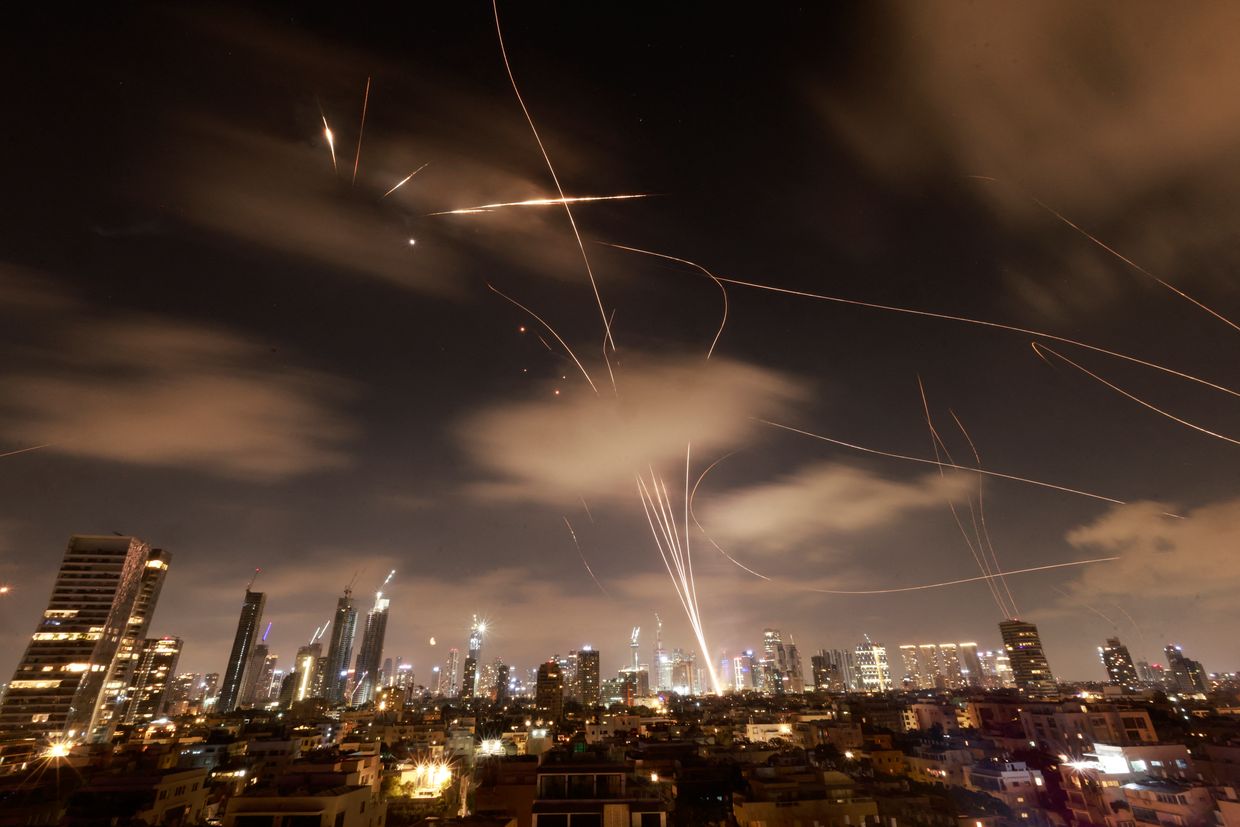
Iran launched missiles toward Israel on June 24, just hours after U.S. President Donald Trump announced a ceasefire between the two countries had come into effect, the Israeli military said. Iran denied the accusation.
"A short while ago, sirens sounded in northern Israel following the identification of missiles launched from Iran toward the State of Israel," the Israel Defense Forces (IDF) said in a statement.
"At this time, the IAF (Israeli Air Force) is operating to intercept and strike where necessary to eliminate the threat," the statement read.
Israeli Defense Minister Israel Katz instructed the army to respond forcefully to Iran's ceasefire violation, Reuters reported. Katz said that Israel will continue to strike Iran after the "utter violation" of the ceasefire.
Shortly after Israel's statement, Iranian state media reported that Tehran denied firing missiles at Israel after the ceasefire began.
A senior security official in Iran told CNN that “no missiles have been fired at the enemy" after the ceasefire.
The reports come after days of escalating hostilities in the Middle East. Early on June 24, Trump declared in a Truth Social post that a ceasefire had begun, writing, "The ceasefire is now in effect. Please do not violate it!"
Israeli Prime Minister Benjamin Netanyahu said on June 24 Israel had agreed to Trump's ceasefire proposal, claiming that Israel had "achieved its goal of removing the Iranian nuclear and ballistic missile threat," according to Reuters.
Trump said later on June 24 that Israel needs to "calm down" after what he described as violations of the ceasefire by both sides.
"I gotta get Israel to calm down now," Trump said as he left the White House. "Israel, as soon as we made the deal, they came out and they dropped a load of bombs, the likes of which I've never seen before, the biggest load that we've seen."
He added: "We basically have two countries that have been fighting so long and so hard that they don't know what the f*ck they're doing."
Trump also wrote on Truth Social that "Israel is not going to attack Iran."
"Nobody is going to be hurt. The Ceasefire in in the effect," U.S. president wrote,
Previously, the U.S. launched airstrikes on Iran's nuclear facilities in Fordow, Natanz, and Esfahan on June 21. In response, Iran fired missiles at U.S. military bases in the region, including at least 10 targeting Al Udeid Air Base in Qatar and one aimed at a base in Iraq.
The Pentagon confirmed that Iran launched several short- and medium-range missiles at Al Udeid but reported no U.S. casualties. Trump dismissed the attacks as "limited and largely ineffective."
Iran is a key arms supplier to Russia, providing Shahed drones used in attacks on Ukrainian cities and pledging to send ballistic missiles. Israel, while home to a significant Russian-speaking population, has not joined Western sanctions against Moscow.
NATO Secretary General Mark Rutte said during a press briefing on June 23 that Russia remains the main threat to the alliance, citing Moscow's cooperation with China, North Korea, Iran, and Belarus. "Moscow continues to wage war against Ukraine, with support of North Korea, Iran, and China, as well as Belarus," Rutte said.The Secretary General told reporters that the alliance leaders are set to adopt a historic defense investment plan at the summit in The Hague on June 24-25, including a new ben
NATO Secretary General Mark Rutte said during a press briefing on June 23 that Russia remains the main threat to the alliance, citing Moscow's cooperation with China, North Korea, Iran, and Belarus.
"Moscow continues to wage war against Ukraine, with support of North Korea, Iran, and China, as well as Belarus," Rutte said.
The Secretary General told reporters that the alliance leaders are set to adopt a historic defense investment plan at the summit in The Hague on June 24-25, including a new benchmark of 5% of GDP for defense spending and a strengthened commitment to Ukraine.
"All leaders will take bold decisions to strengthen our collective defense, making NATO a stronger, fairer, and more lethal alliance," Rutte said at a press conference before the summit. “This is a leap that is ambitious, historic, and fundamental to securing our future.”
Rutte said the plan includes major increases in air defense systems, tanks, armored vehicles, and artillery, a response to the evolving threat landscape, particularly Russia's war against Ukraine.
"We see Russia's deadly terror from the skies over Ukraine every day. We must be able to defend ourselves from such attacks," Rutte added.
The Secretary General warned that NATO must act urgently to prepare for future threats, citing assessments that Russia could rebuild sufficient military capacity to challenge NATO within five years. "Our security environment has changed, and not for the better. The threats we face today demand that we do far more," he said.
Rutte emphasized that the new defense investment plan will be reviewed in 2029, with annual reporting to ensure credibility.
He stressed that NATO remains committed to supporting Kyiv and reaffirmed the alliance's long-standing position that "Ukraine's path to NATO membership is irreversible." According to Rutte, the allies have pledged over 35 billion euros ($40,6 billions) in military aid to Ukraine for the first half of 2025, up from 20 billion announced earlier this year.
President Volodymyr Zelensky is attending the summit and will hold multiple meetings with NATO leaders. However, NATO's Ukraine Council will not convene, a decision seen as part of efforts to keep the summit's focus narrow, a move aimed at appeasing U.S. President Donald Trump, according to Politico.
The summit, shortened to 24 hours, has only one major session on defense spending. European officials cited by Politicosaid the format was designed to deliver a clear win to Trump, who is expected to tout the 5% spending pledge as a personal success. The U.S. is reportedly exempting itself from the new benchmark.
While recent summits have centered on Russia's invasion of Ukraine, this year's joint communique may omit references to the war.
During the briefing, Rutte said that the final communique, agreed by NATO ambassadors, has "important language" about Ukraine, including defense spending up until 2035.
"This is a clear commitment by allies," Rutte said.
U.S. President Donald Trump announced on June 24 that a ceasefire between Iran and Israel had come into effect, following the U.S. strikes on Iranian nuclear facilities and retaliatory attack on U.S. military base in Qatar."The ceasefire is now in effect. Please do not violate it!" Trump said in a post on Truth Social on June 24.The announcement follows days of intensifying conflict after the U.S. conducted airstrikes on Iranian nuclear facilities on June 21, targeting sites in Fordow, Natanz, a
U.S. President Donald Trump announced on June 24 that a ceasefire between Iran and Israel had come into effect, following the U.S. strikes on Iranian nuclear facilities and retaliatory attack on U.S. military base in Qatar.
"The ceasefire is now in effect. Please do not violate it!" Trump said in a post on Truth Social on June 24.
The announcement follows days of intensifying conflict after the U.S. conducted airstrikes on Iranian nuclear facilities on June 21, targeting sites in Fordow, Natanz, and Esfahan.
In response, Iran launched multiple missiles at U.S. military bases in the region, including at least 10 toward the Al Udeid Air Base in Qatar and at least one toward a base in Iraq, Axios reported, citing an Israeli source.
The Pentagon confirmed that Iran fired several short- and medium-range missiles at Al Udeid, but said no American personnel were harmed. Trump downplayed the attack, calling it "limited and largely ineffective."
Israeli Prime Minister Benjamin Netanyahu said on June 24 that Israel has agreed to a U.S.-brokered ceasefire with Iran, thanking Trump for his support in defending Israel and "removing the Iranian nuclear threat," according to Reuters.
"Israel has achieved its goal of removing the Iranian nuclear and ballistic missile threat," Netanyahu said in a statement. "Israel thanks President Trump for his support and participation in removing the Iranian nuclear threat."
Iran is a key arms supplier to Russia, providing Shahed drones used in attacks on Ukrainian cities and pledging to send ballistic missiles. Israel, while home to a significant Russian-speaking population, has not joined Western sanctions against Moscow.
Tensions between Iran and Israel had already been rising after Iran launched missile strikes on Tel Aviv and other Israeli cities on June 13, killing multiple civilians, including five Ukrainian nationals. The attack came in retaliation for Israeli military action.
Trump, who has long styled himself as a dealmaker and peacemaker, has come under criticism for his failure to deliver on promises to reach a ceasefire between Russia and Ukraine. During his electoral campaign, he pledged to end the war between Russia and Ukraine within 24 hours of taking office. More than 100 days after Ukraine accepted a U.S.-backed proposal for a ceasefire, no progress has been made.
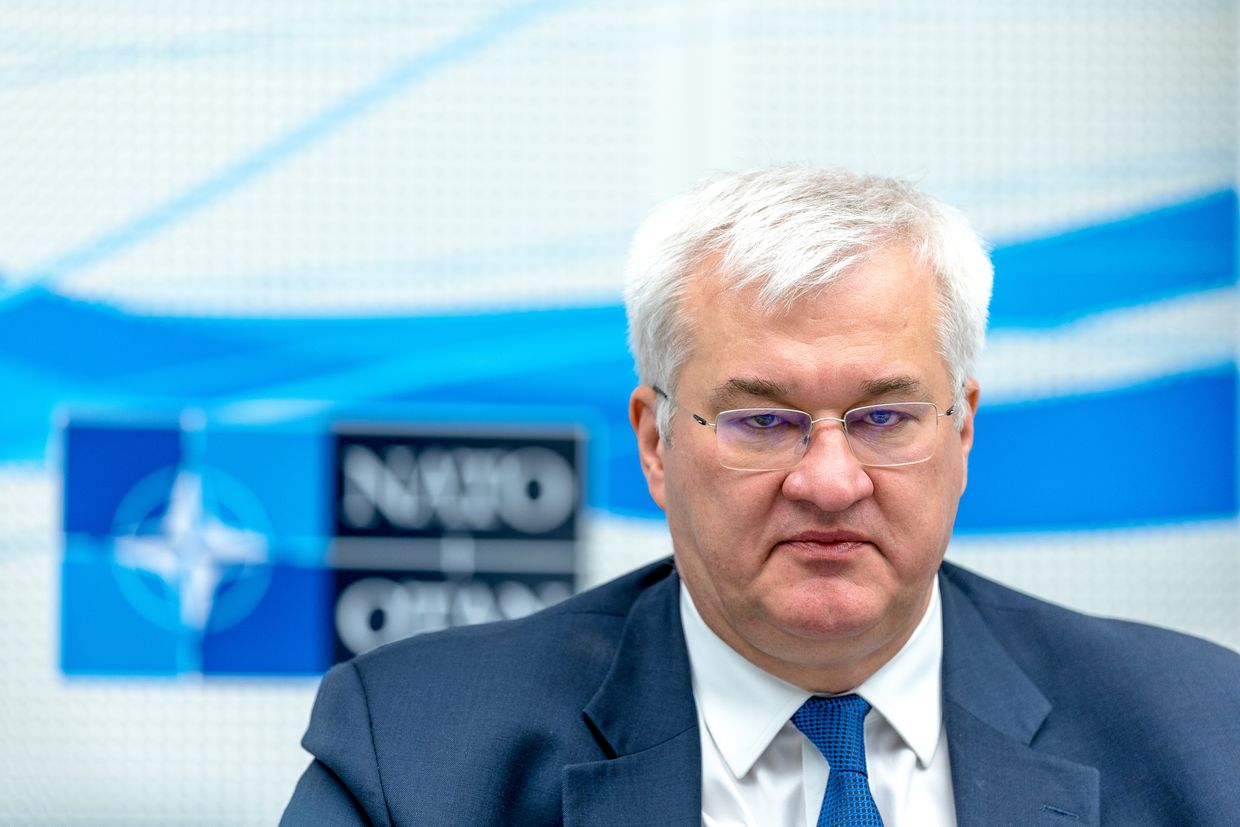
"It has been exactly 100 days since Ukraine unconditionally accepted the U.S. peace proposal to completely cease fire, put an end to the killing, and move forward with a genuine peace process," Ukrainian Foreign Minister Andrii Sybiha said on June 19. "Russia continues to choose war."
Ukraine backed the proposal during talks in Jeddah on March 11, agreeing to a 30-day unconditional ceasefire. Russia has rejected the offer, continuing its assault on Ukrainian cities and pushing for maximalist demands.
"It is time to act now and force Russia to peace," Sybiha said. "Peace through strength, increased sanctions, and enhanced capabilities for Ukraine."
Russia has lost 1,013,700 troops in Ukraine since the beginning of its full-scale invasion on Feb. 24, 2022, the General Staff of Ukraine's Armed Forces reported on June 24.The number includes 1,200 casualties that Russian forces suffered just over the past day.According to the report, Russia has also lost 10,966 tanks, 22,879 armored fighting vehicles, 52,961 vehicles and fuel tanks, 29,511 artillery systems, 1,424 multiple launch rocket systems, 1,188 air defense systems, 416 airplanes, 337 he
Russia has lost 1,013,700 troops in Ukraine since the beginning of its full-scale invasion on Feb. 24, 2022, the General Staff of Ukraine's Armed Forces reported on June 24.
The number includes 1,200 casualties that Russian forces suffered just over the past day.
According to the report, Russia has also lost 10,966 tanks, 22,879 armored fighting vehicles, 52,961 vehicles and fuel tanks, 29,511 artillery systems, 1,424 multiple launch rocket systems, 1,188 air defense systems, 416 airplanes, 337 helicopters, 41,915 drones, 3,388 cruise missiles, 28 ships and boats, and one submarine.
Russian attacks on Kherson Oblast killed four people and injured five others between June 23 and 24, local officials reported.Russian forces launched drone and artillery strikes on dozens of settlements across the region, Governor Oleksandr Prokudin said on Telegram.Twenty-nine settlements were affected, including the regional capital, Kherson, which shares the same name as the oblast.The strikes damaged critical infrastructure and residential areas, including four private houses. A shop and sev
Russian attacks on Kherson Oblast killed four people and injured five others between June 23 and 24, local officials reported.
Russian forces launched drone and artillery strikes on dozens of settlements across the region, Governor Oleksandr Prokudin said on Telegram.
Twenty-nine settlements were affected, including the regional capital, Kherson, which shares the same name as the oblast.
The strikes damaged critical infrastructure and residential areas, including four private houses. A shop and several private vehicles were also reportedly damaged.
Kherson Oblast, located in southern Ukraine just north of Russian-occupied Crimea, has been repeatedly targeted by Russian forces since the start of the full-scale invasion.
Russian forces launched a drone attack on Kharkiv overnight on June 24, injuring three people and damaging civilian infrastructure, Mayor Ihor Terekhov said.The first explosions were reported around 2:00 a.m. local time, with three civilian injuries confirmed by 4:00 a.m., according to local officials.Seven Iranian-made Shahed drones were launched at the city, three of which struck their targets, Terekhov said.The strikes damaged a civilian enterprise in the Saltivka district and residential bui
Russian forces launched a drone attack on Kharkiv overnight on June 24, injuring three people and damaging civilian infrastructure, Mayor Ihor Terekhov said.
The first explosions were reported around 2:00 a.m. local time, with three civilian injuries confirmed by 4:00 a.m., according to local officials.
Seven Iranian-made Shahed drones were launched at the city, three of which struck their targets, Terekhov said.
The strikes damaged a civilian enterprise in the Saltivka district and residential buildings in Nemyshlianskyi.
Emergency services responded to the affected sites.
In recent weeks, Moscow has been intensifying attacks against Kharkiv – Ukraine's second-largest city – which sits just over 20 kilometers (15 miles) from the Russian border.
A Russian drone attack against the city overnight on June 12 injured at least 15 people, including children.
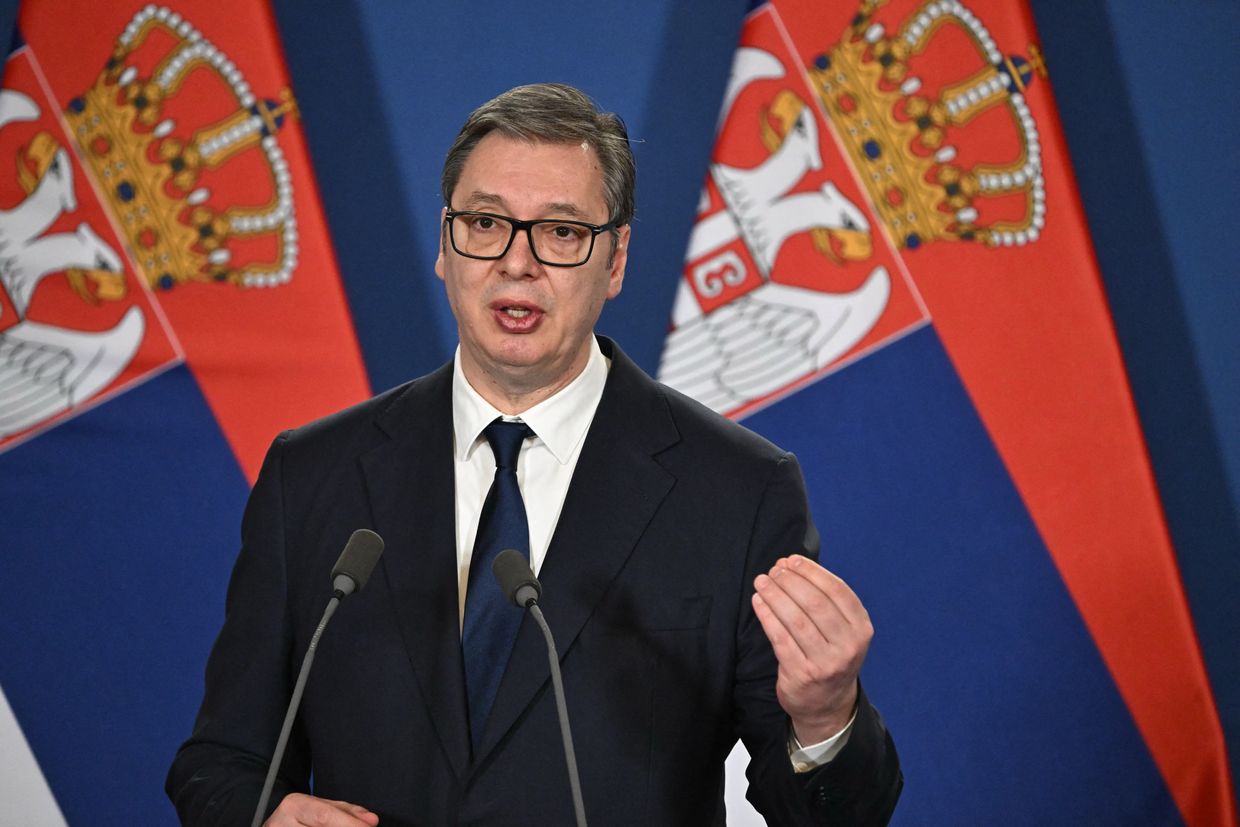
Serbian President Aleksandar Vucic announced on June 23 that Serbia has halted all arms exports, citing national security and economic interests. He denied that the move was a response to mounting criticism over allegations that Serbian munitions have ended up in Ukraine.Speaking after a meeting with senior military officials, Vucic said that Serbia is only sending ammunition to its own barracks and all exports are suspended, in line with Serbia's best interests.Shortly after the announcement, S
Serbian President Aleksandar Vucic announced on June 23 that Serbia has halted all arms exports, citing national security and economic interests. He denied that the move was a response to mounting criticism over allegations that Serbian munitions have ended up in Ukraine.
Speaking after a meeting with senior military officials, Vucic said that Serbia is only sending ammunition to its own barracks and all exports are suspended, in line with Serbia's best interests.
Shortly after the announcement, Serbia's Defense Ministry issued a statement confirming the suspension of all arms and military equipment exports.
Vucic's decisions comes amid increasing criticism – particularly following claims that Serbian ammunition has been supplied to Ukraine.
In May 2025, Russia’s Foreign Intelligence Service (SVR) accused Belgrade of supplying weapons to Kyiv, despite Serbia's friendly ties with Moscow and declared neutrality in Russia's invasion.
According to a 2024 investigation by the Financial Times, Serbian ammunition has made its way to Ukraine through intermediaries, although Belgrade maintains it does not directly arm either side.
Since Russia’s full-scale invasion of Ukraine in 2022, Serbia has attempted to navigate a delicate diplomatic path between Moscow and the West.
In his most recent balancing act, Vucic refused to sign a declaration condemning the invasion – so as not to "betray Russia" – while simultaneously pledging to support Ukraine's reconstruction.
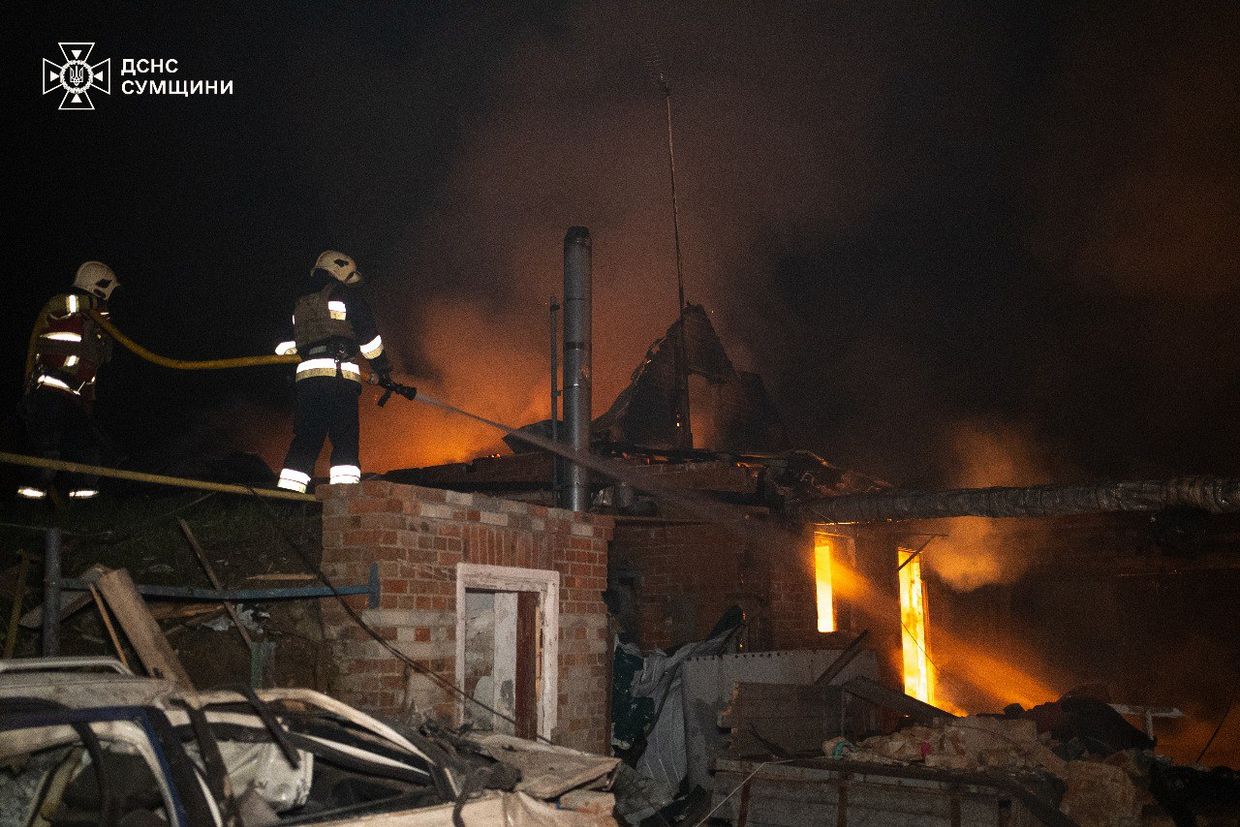
Russian forces launched a drone attack on Sumy Oblast overnight on June 24, killing three people, including an 8-year-old boy, and injuring six others, local officials reported.The strike targeted a settlement near Verkhnia Syrovatka around midnight local time, Governor Oleh Hryhorov said on Telegram. The victims included an adult man and woman, and the child.As of 7:00 a.m. local time, six people – including three children – have been reported injured. All have been hospitalized and are receivi
Russian forces launched a drone attack on Sumy Oblast overnight on June 24, killing three people, including an 8-year-old boy, and injuring six others, local officials reported.
The strike targeted a settlement near Verkhnia Syrovatka around midnight local time, Governor Oleh Hryhorov said on Telegram. The victims included an adult man and woman, and the child.
As of 7:00 a.m. local time, six people – including three children – have been reported injured. All have been hospitalized and are receiving medical care.
The attack damaged about 30 residential buildings and four cars, and sparked a large-scale fire. Police investigators, rescue workers, and medics are responding at the scene.
Sumy Oblast, which borders Russia, has faced intensified assaults in recent weeks amid a broader Russian offensive along Ukraine's northeastern border.
Since March, Russian forces have reportedly captured around 200 square kilometers in the region, prompting evacuations from over 200 settlements.
Ukrainian forces, however, have been reportedly driving Russian troops back amid the continued cross-border attacks.
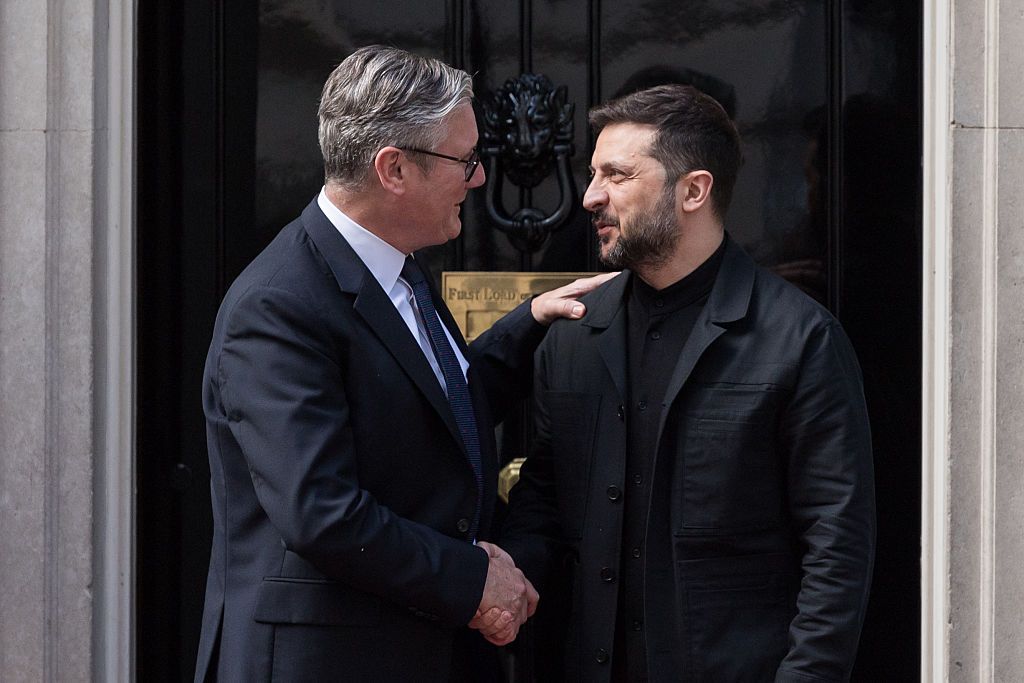
Ukrainian President Volodymyr Zelensky met with U.K. Prime Minister Keir Starmer at Downing Street on June 23, ahead of the NATO summit in The Hague.Zelensky had earlier paid a visit to King Charles III at Windsor Castle before joining Starmer to discuss continued British support for Ukraine’s defense.During a joint visit to a U.K. military training site for Ukrainian personnel, Starmer said he and Zelensky held "an excellent bilateral meeting" and had agreed to an "industrial military co-produc
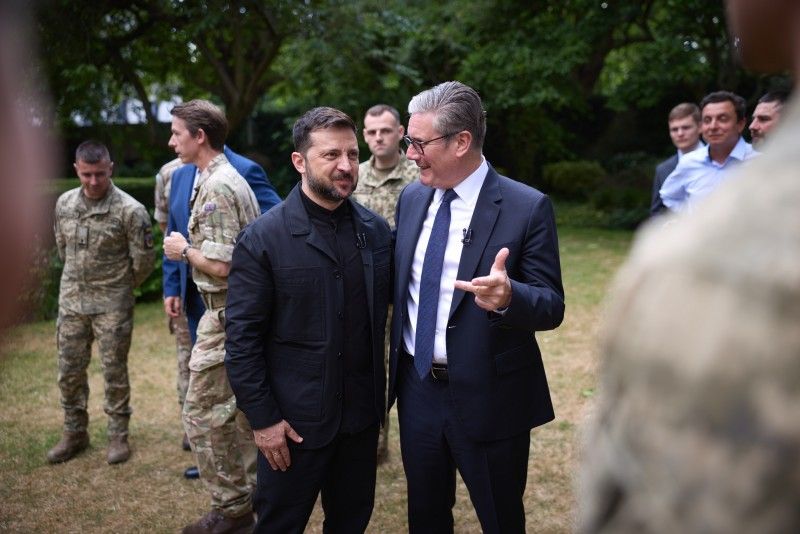
Ukrainian President Volodymyr Zelensky met with U.K. Prime Minister Keir Starmer at Downing Street on June 23, ahead of the NATO summit in The Hague.
Zelensky had earlier paid a visit to King Charles III at Windsor Castle before joining Starmer to discuss continued British support for Ukraine’s defense.
During a joint visit to a U.K. military training site for Ukrainian personnel, Starmer said he and Zelensky held "an excellent bilateral meeting" and had agreed to an "industrial military co-production agreement." He described the deal as "a massive step forward in the contribution that we can continue to make." Zelensky added the agreement "will be very strong and will transform both nations," though specific details were not disclosed.
Addressing Ukrainian troops, Starmer said it was "really humbling" to witness their "level of professionalism, commitment and bravery." Around 58,000 Ukrainian service members have been trained under the international program based in the U.K.
Zelensky thanked the U.K for its consistent backing since the start of Russia’s full-scale invasion in 2022. “We are very thankful to the UK... for such big support of Ukraine from the very beginning of this war,” he said. He noted that the UK-based training initiative has “strengthened our army” and enabled Ukraine to “survive and fight.”
The visit precedes the NATO summit in The Hague, where allies are set to unveil new defense spending targets. NATO Secretary General Mark Rutte said member states will aim to spend five percent of GDP on defense — a move he called “a quantum leap that is ambitious, historic and fundamental to securing our future.”
Under a compromise deal, members will commit to allocating at least 3.5 percent of GDP to core military expenditures and 1.5 percent to broader security areas such as cybersecurity and infrastructure.
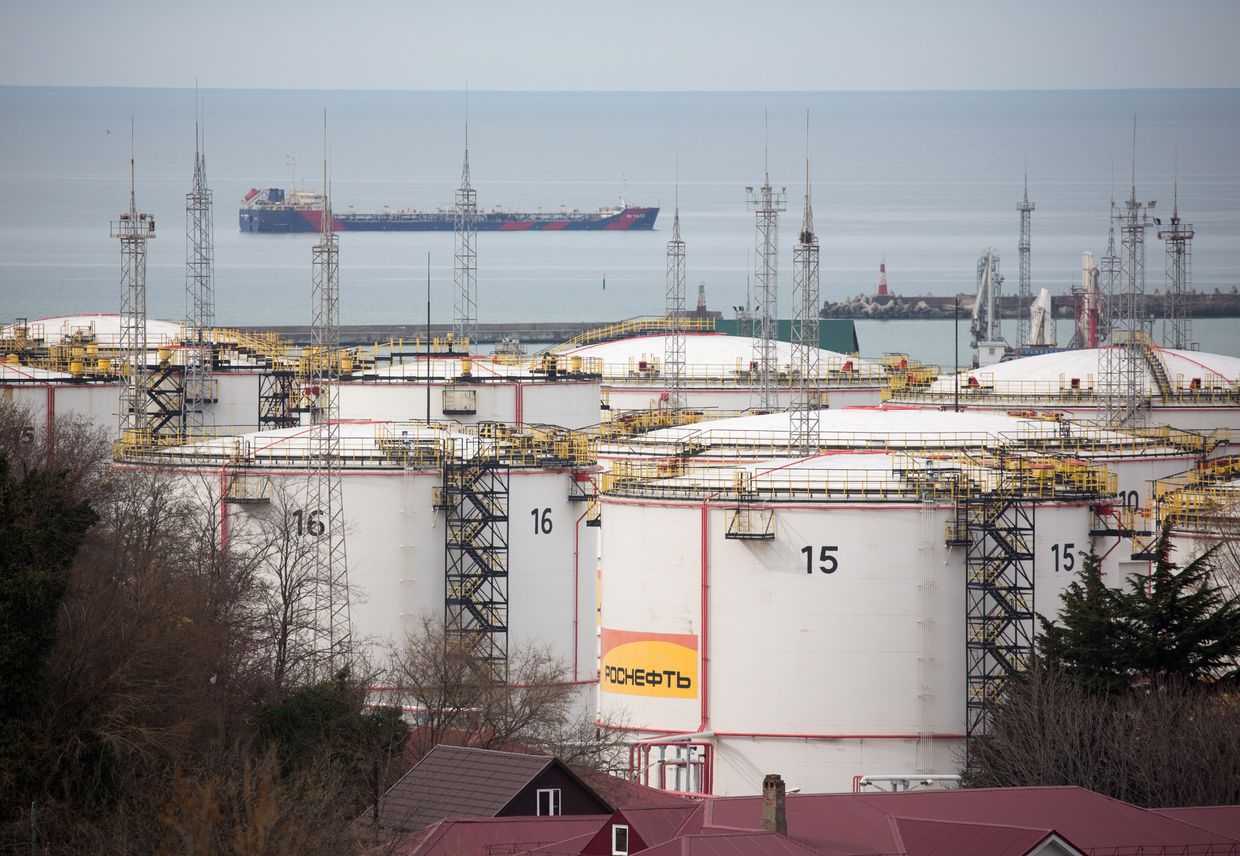
Ukraine's Armed Forces struck the Atlas oil depot in Russia's Rostov Oblast overnight on June 23, the General Staff reported. The attack ignited a fire at the site, with Ukrainian forces saying the strike had reached its intended target. The facility supplies fuel and lubricants to Russian military units.Yuri Slyusar, the acting governor of Rostov Oblast, confirmed that a fire occurred at an industrial facility after the attack. He added that no one was injured.The full extent of the damage is s
Ukraine's Armed Forces struck the Atlas oil depot in Russia's Rostov Oblast overnight on June 23, the General Staff reported.
The attack ignited a fire at the site, with Ukrainian forces saying the strike had reached its intended target. The facility supplies fuel and lubricants to Russian military units.
Yuri Slyusar, the acting governor of Rostov Oblast, confirmed that a fire occurred at an industrial facility after the attack. He added that no one was injured.
The full extent of the damage is still being assessed, according to the military.
Located near the Azov Sea and bordering Ukraine, Rostov Oblast plays a crucial logistical role for Russia's war effort due to its proximity to front-line operations. The same depot was previously targeted in November 2024.
"The defense forces continue to take all measures to undermine the military and economic potential of the Russian occupiers and force the Russian Federation to stop its armed aggression against Ukraine," the General Staff said.
The strike is part of Ukraine's broader campaign aimed at disrupting Russian supply chains and degrading its capacity to sustain the full-scale invasion.
Fuel depots, rail infrastructure, and ammunition stockpiles inside Russia and occupied territories have increasingly become targets for long-range drone and missile strikes.
Editor's note: This story is being updated. Iran launched multiple missiles at U.S. military bases in the Middle East, targeting sites in Qatar and Iraq, a day after the U.S. conducted air strikes on nuclear sites in Iran. At least 10 missiles were reportedly fired at the Al Udeid Air Base in Qatar and at least one toward a base in Iraq, Axios reported, citing an Israeli source. The U.S. Defense Department confirmed that Iran launched several short- and medium-range missiles at Al Udeid Air Base
Iran launched multiple missiles at U.S. military bases in the Middle East, targeting sites in Qatar and Iraq, a day after the U.S. conducted air strikes on nuclear sites in Iran.
At least 10 missiles were reportedly fired at the Al Udeid Air Base in Qatar and at least one toward a base in Iraq, Axios reported, citing an Israeli source.
The U.S. Defense Department confirmed that Iran launched several short- and medium-range missiles at Al Udeid Air Base, the New York Times reported. According to the Pentagon, there have been no reports of American casualties.
President Donald Trump downplayed Iran's response to the recent U.S. strike on its nuclear facilities, describing Tehran’s retaliation as limited and largely ineffective. "There have been 14 missiles fired — 13 were knocked down, and 1 was 'set free,' because it was headed in a nonthreatening direction," Trump said in a statement on Truth Social. He emphasized that no Americans were harmed and that the damage was minimal.
Trump went on to say, "Most importantly, they’ve gotten it all out of their ‘system,’ and there will, hopefully, be no further HATE." Ending on a conciliatory note, Trump added that he would "enthusiastically encourage Israel" to pursue peace in the region.
Iranian President Masoud Pezeshkian wrote on X that his country "neither initiated the war nor wanted it, but we will not leave the aggression against the great Iran unanswered."
Iran's targeting of U.S. assets marks a dangerous widening of the conflict, raising fears of further destabilization in the region.
The missile strikes come in response to the June 21 U.S. air campaign that targeted three nuclear facilities in Iran — Fordow, Natanz, and Esfahan — as Washington joined Israel's military operation against Tehran's nuclear program.
The escalation follows Israel's June 13 attack that prompted Iran to retaliate with missile attacks on Tel Aviv and other cities, killing multiple civilians, including five Ukrainian citizens.
Iran is a key supplier of weapons to Russia, including Shahed-type drones and ballistic missiles used in attacks on Ukrainian cities. Israel, which hosts a significant Russian-speaking population, has not joined Western sanctions against Moscow.
On June 13, Kyiv expressed concern over the security situation in the Middle East, describing Tehran as a "source of problems" in the region and beyond.
Ukraine's state defense conglomerate Ukroboronprom and European aerospace giant Airbus have signed a trilateral cooperation memorandum at the Le Bourget International Air Show, the company announced on June 23.The agreement launches initiatives to develop maintenance and repair capabilities for Airbus aircraft operating in Ukraine among specialists at Ukroboronprom's enterprises.As part of the deal, Airbus will send representatives to Ukraine to train local specialists, who will then become cert
Ukraine's state defense conglomerate Ukroboronprom and European aerospace giant Airbus have signed a trilateral cooperation memorandum at the Le Bourget International Air Show, the company announced on June 23.
The agreement launches initiatives to develop maintenance and repair capabilities for Airbus aircraft operating in Ukraine among specialists at Ukroboronprom's enterprises.
As part of the deal, Airbus will send representatives to Ukraine to train local specialists, who will then become certified instructors for aircraft maintenance.
"Trust in our defense industrial complex, particularly Ukroboronprom and its enterprises, is growing among global high-tech companies," said Oleh Hulyak, Ukroboronprom Director General, in a press release. "This proves we have chosen the right path for development and international cooperation."
Hulyak expects new partnerships with foreign partners in aviation and other areas of the company's work.
Ukroboronprom is a leading strategic manufacturer of weapons and military hardware in Ukraine. The association unites about 100 enterprises that develop and manufacture weapons, military equipment and ammunition, including missiles, drones, armored vehicles.
The company reported a consolidated net profit of Hr 1.31 billion ($31.5 million) for the previous year as its enterprises tripled production volumes in 2024 compared to 2023, with a 36% increase in contracts.
In 2024, Ukroboronprom was rankedfor the first time in history among the top 50 global defense companies by Defense News, according to Strategic Industries Minister Alexander Kamyshin.
Ukrainian Deputy Prime Minister Oleksii Chernyshov on June 23 was formally named a suspect in a high-profile illegal land grab case, becoming the highest-ranking official in Ukrainian history to face such charges while in office.After reports and public speculation around Chernyshov's potential involvement, the National Anti-Corruption Bureau (NABU) released a statement announcing that he was the sixth suspect in a “large-scale” corruption scheme led by a property developer from Kyiv who illegal
Ukrainian Deputy Prime Minister Oleksii Chernyshov on June 23 was formally named a suspect in a high-profile illegal land grab case, becoming the highest-ranking official in Ukrainian history to face such charges while in office.
After reports and public speculation around Chernyshov's potential involvement, the National Anti-Corruption Bureau (NABU) released a statement announcing that he was the sixth suspect in a “large-scale” corruption scheme led by a property developer from Kyiv who illegally claimed a land plot to build a residential complex.
In a comment to the Kyiv Independent, Chernyshov denied the accusations against him. "I'm absolutely not involved in that (scheme) — that's clear," he said.
He also said he won't step down from his post. "I will stay in this position," Chernyshov told the Kyiv Independent.
Chernyshov, who heads the new National Unity Ministry in charge of returning refugees, is a close ally of President Volodymyr Zelensky. He raised eyebrows in Ukraine after leaving the country days before law enforcement revealed a massive corruption scheme and detained two of his former close associates — Maksym Horbatiuk and Vasyl Volodin.
According to the anti-corruption agency, during his time as communities and territories minister in 2020-2022, Chernyshov and his associates undervalued land plots by five times to benefit the developer, which Ukrainian media identified as Serhii Kopystyra, allegedly costing the state Hr 1 billion ($24 million).
In exchange, NABU says the developer gave kickbacks to Chernyshov and his accomplices with "significant" discounts on apartments in his existing buildings, totaling over Hr 14.5 million ($346,000). Ukrainian news site Ukrainska Pravda reports this took place between 2021-2022.
NABU and Ukraine's Specialized Anti-Corruption Prosecutor's Office (SAPO) seized the plot to prevent the scheme. Most of the illegally obtained apartments have been seized.
Chernyshov arrived back in the country on June 22 after suspicions mounted in Ukraine that he was on the run and avoiding detention.
"I was definitely on a business trip and I was not escaping out of Ukraine," Chernyshov told the Kyiv Independent. "The rumors of me not returning are nothing but manipulation. I came exactly once my trip was over. I had a very intensive trip in Europe."
Chernyshov claims he was targeted by a "smear campaign" but said he didn't know who could be behind it.
He also said that he came back on his own accord and denied that anyone had asked him to return.
The minister arrived at the NABU offices on June 23, after the agency summoned him to be charged. Upon leaving the bureau, Chernyshov wrote on Facebook that he had a “constructive chat” with detectives and will cooperate with the organization.
An investigation into Chernyshov and two of his associates took place last year after suspicions arose, according to Ukrainska Pravda, with the agency obtaining a warrant to search Chernyshov's home.
But sources in anti-corruption agencies told Ukrainska Pravda that the head of NABU, Semen Kryvonos, blocked police searches due to his close relationship with Chernyshov, who was his boss when Kryvonos headed the State Architecture Inspection, an agency that was subordinated to Chernyshov's former ministry.
Searches allegedly took place a few weeks ago, after a one-year delay, according to Ukrainska Pravda.
Chernyshov said that while he knows Kryvonos in a professional manner, the two are not in contact. He added that the allegations against Horbatiuk and Volodin look "quite serious" but that it was for law enforcement to decide if their detention is justified.
He was appointed head of state-owned energy giant Naftogaz in 2022 after the dissolution of the Communities and Territories Development Ministry. He became the national unity minister in December 2024, a ministry created from scratch.
Chernyshov is widely believed to have a personal friendship with Zelensky. According to a report by Ukrainska Pravda, he was among only a handful of guests invited to celebrate Zelensky's birthday during the Covid-19 pandemic in 2021 — and the only member of the Cabinet of Ministers in attendance.
"The key thing is that today NABU and SAPO have actually reached the immediate circle of the president's 'family,'" Olena Shcherban, deputy executive director at the Anti-Corruption Action Center (ANTAC), a Kyiv-based watchdog, told the Kyiv Independent.
The President's Office feels the threat from NABU and SAPO and will likely attack the two institutions in response to Chernyshov's notice of suspicion, rather than "saving" the minister, Shcherban added.
"I am sure we will see both attempts to make harmful changes to the law and personal attacks on the SAPO head (Oleksandr Klymenko)," she said.
U.S. President Donald Trump on June 23 called for urgent measures to prevent rising oil prices amid escalating tensions with Iran."Everyone, keep oil prices down. I'm watching," Trump wrote on Truth Social. "To the Department of Energy: Drill, baby, drill! And I mean now."The post comes after global oil prices surged on June 13 following a series of Israeli air strikes on Iranian nuclear facilities. The escalation sparked fears of broader conflict in the energy-rich Middle East, home to critical
U.S. President Donald Trump on June 23 called for urgent measures to prevent rising oil prices amid escalating tensions with Iran.
"Everyone, keep oil prices down. I'm watching," Trump wrote on Truth Social. "To the Department of Energy: Drill, baby, drill! And I mean now."
The post comes after global oil prices surged on June 13 following a series of Israeli air strikes on Iranian nuclear facilities. The escalation sparked fears of broader conflict in the energy-rich Middle East, home to critical oil shipping routes.
The surge in oil prices risks undermining Western attempts to curb Russia's war funding, as the Kremlin relies heavily on oil revenues to sustain its invasion of Ukraine. President Volodymyr Zelensky has warned that a price surge could further embolden the Kremlin.
On June 21, the U.S. joined Israel in conducting airstrikes that targeted three nuclear facilities in Iran — Fordow, Natanz, and Esfahan. The operation triggered a strong response from Tehran, which threatened to block the Strait of Hormuz, a key global oil transit route.
U.S. Vice President JD Vance responded on June 22 that any Iranian attempt to shut the strategic waterway would "destroy their own economy." The strait is a vital chokepoint for global energy supplies, with nearly a fifth of the world's oil passing through it daily.
Amid the turmoil, the EU has reportedly postponed plans to tighten the $60-per-barrel price cap on Russian crude, originally imposed in December 2022. The mechanism restricts Western firms from shipping or insuring Russian oil sold above that threshold.
The Russian Finance Ministry has relied heavily on energy revenues to sustain defense spending, which hit record highs this year.
Ukrainian state grid operator Ukrenergo's supervisory board has appointed Vitaliy Zaichenko, the company's current chief dispatcher, as its new head, Ukrainian media reported on June 23. The appointment comes after ten months of interim leadership following the controversial dismissal of former CEO Volodymyr Kudrytskyi in September 2024.The company has been under temporary management of Oleksiy Brekht while the supervisory board struggled with prolonged disputes over the selection process.Ukrene
Ukrainian state grid operator Ukrenergo's supervisory board has appointed Vitaliy Zaichenko, the company's current chief dispatcher, as its new head, Ukrainian media reported on June 23.
The company has been under temporary management of Oleksiy Brekht while the supervisory board struggled with prolonged disputes over the selection process.
Ukrenergo, which operates Ukraine's electricity transmission system and is a member of the European electricity grid network (ENTSO-E), plays a critical role in the country's energy security, especially during wartime when Russian attacks have repeatedly targeted energy infrastructure.
Zaichenko beat out two other finalists: Oleksiy Brekht, the interim head of Ukrenergo, and Ivan Yuryk, former acting head of Ukrainian Railways.
The supervisory board's June 4 attempt to elect a new CEO failed amid conflict with the Energy Ministry, which changed appointment rules without consulting the Energy Community Secretariat, drawing criticism from European partners.
The new rules complicated the selection process by requiring five out of seven supervisory board votes instead of the previous four needed to elect a chairman.
According to Ukrainian MP Max Khlapuk, the European Bank for Reconstruction and Development (EBRD) threatened to block 141 million euros ($152 million) in funding and demand early repayment of 533 million euros ($574 million) already received over the rule changes.
Former Ukrenergo CEO Volodymyr Kudrytskyi was dismissed on Sept.2, 2024, after President Volodymyr Zelensky called for his resignation over alleged failures to protect substations from Russian missiles and drones.
Kudrytskyi disputed this account, saying he initiated the supervisory board meeting himself, though he did not reveal the reasons for his dismissal.
Following Kudrytskyi's dismissal, supervisory board chairman Daniel Dobbeni and member Peder Andersen resigned early, citing political pressure in personnel decisions.
Ukraine's largest private energy company DTEK and British clean energy group Octopus Energy have launched a program to install rooftop solar panels and battery storage systems at Ukrainian businesses and public institutions, DTEK said in a press release on June 23.The program, called RISE (Resilient Independent Solar Energy), was announced at Octopus Energy's Tech Summit in London and aims to raise 100 million euros ($115 million) to finance 100 energy projects over three years, helping stabiliz
Ukraine's largest private energy company DTEK and British clean energy group Octopus Energy have launched a program to install rooftop solar panels and battery storage systems at Ukrainian businesses and public institutions, DTEK said in a press release on June 23.
The program, called RISE (Resilient Independent Solar Energy), was announced at Octopus Energy's Tech Summit in London and aims to raise 100 million euros ($115 million) to finance 100 energy projects over three years, helping stabilize the grid, lower electricity costs and protect customers from outages, the company said.
DTEK’s facilities have been repeatedly targeted since the start of Russia’s full-scale invasion as Moscow sought to cripple Ukraine's energy infrastructure. The company was forced to shut down its gas production facilities in Poltava Oblast in March.
"About 70% of Ukraine's thermal generation capacity has been damaged, destroyed or seized since the full-scale invasion," said DTEK CEO Maksym Timchenko in the press release.
“This has created not only an urgent need to rebuild but also an opportunity to accelerate the shift to a decentralized, renewable energy system,” he added.
The alternative energy systems will be installed by D.Solutions, DTEK's business unit operating under the Yasno retail brand.
Installed equipment will run on Octopus Energy's AI-powered Kraken operating system, enabling businesses to optimize energy use in real time, reduce consumption during peak hours and sell surplus electricity back to the grid.
"They (DTEK) are rebuilding at pace and pioneering a decentralized, smart energy system powered by homegrown renewables," said Greg Jackson, Octopus Energy Group founder and CEO.
According to DTEK, Ukraine's commercial and industrial energy market has an untapped potential of 300 megawatts annually, valued at 200 million euros ($229 million). DTEK's Yasno brand serves over 60,000 business customers and can generate projects worth 30 million euros per year.
DTEK previously announced plans to build one of Europe's largest energy storage facilities with six installations across the country, totaling 200 megawatts to power 600,000 households. The company secured a $72 million loan from three Ukrainian banks.
Russian President Vladimir Putin in 2023 authorized the ordering of at least two attempts to assassinate Ukrainian journalist Dmytro Gordon, Security Service of Ukraine (SBU) head Vasyl Maliuk told media on June 23, RBC-Ukraine reports.Gordon is a prominent journalist and media personality popular in both Ukraine and other post-Soviet countries, known for his sharp criticism of Russian aggression. His YouTube channel has 4.5 million subscribers. "Gordon triggers Russians. He has a large audienc
Russian President Vladimir Putin in 2023 authorized the ordering of at least two attempts to assassinate Ukrainian journalist Dmytro Gordon, Security Service of Ukraine (SBU) head Vasyl Maliuk told media on June 23, RBC-Ukraine reports.
Gordon is a prominent journalist and media personality popular in both Ukraine and other post-Soviet countries, known for his sharp criticism of Russian aggression. His YouTube channel has 4.5 million subscribers.
"Gordon triggers Russians. He has a large audience in Russia and in the (Russian) occupied territories (of Ukraine)," Maliuk said. "There are two networks that worked on Gordon that we can speak (publicly) about."
According to the SBU, the first network was led by a former lawmaker from the now-banned pro-Russian Party of Regions, originally from Poltava Oblast. The agency did not name the lawmaker.
The former MP was allegedly tasked by Russia's Federal Security Service (FSB) with coordinating surveillance and preparations for a strike that would kill Gordon.
"The plan was to use a homemade explosive device or coordinate a missile or a drone strike — but only if Gordon's presence in the targeted house was confirmed," Maliuk said.
The SBU had already been investigating the ex-lawmaker for involvement in a separate railway bombing case in Poltava Oblast when the assassination plot was uncovered. The group was arrested before executing the plan.
The second assassination team, Maliuk said, was a criminal group from Dagestan working secretly for the FSB under the cover of being fugitives from Russian law enforcement.
"They sent this individual here long before the full-scale war. He carried out FSB tasks all the time — very professionally, very covertly," Maliuk said.
The group monitored Gordon's movements and residence, planning to assassinate him either with a short-barreled weapon if he was alone, or with a rifle and follow-up pistol shot if accompanied by a bodyguard.
The SBU detained the group, and its leader confessed to preparing the hit on Moscow's orders. He said he had been promised $400,000 for the killing.
Gordon, who has become a high-profile figure on Ukraine's information front, regularly uses his platform to expose Russian disinformation and advocate for Ukrainian sovereignty.
A lion has attacked collaborator Oleg Zubkov at the Taigan Safari Park he founded in Russian-occupied Crimea, the Crimean Wind Telegram channel reported on June 22.Zubkov is a businessman who renounced his Ukrainian citizenship and began cooperating with the Russian authorities following Moscow's illegal annexation of Crimea in 2014He also smuggled animals from zoos in the partially occupied Zaporizhzhia and Kherson oblasts after the full-scale invasion of Ukraine in 2022.During an evening feedi
A lion has attacked collaborator Oleg Zubkov at the Taigan Safari Park he founded in Russian-occupied Crimea, the Crimean Wind Telegram channel reported on June 22.
Zubkov is a businessman who renounced his Ukrainian citizenship and began cooperating with the Russian authorities following Moscow's illegal annexation of Crimea in 2014
He also smuggled animals from zoos in the partially occupied Zaporizhzhia and Kherson oblasts after the full-scale invasion of Ukraine in 2022.
During an evening feeding, Zubkov was attacked by a lion which tore his trachea, neck, and chest muscles with its claws. He managed to leave the lion's enclosure but then lost consciousness.
As a result of the attack, Zubkov lost a significant amount of blood and was transported by helicopter to a hospital in Simferopol, Crimea.
Zubkov regained consciousness on June 23 after surgery, and his condition is described as stable.
This is not the first time lions at the Taigan Safari Park have attacked its staff. In 2024, three lions killed Leokadia Perevalova while she was cleaning an enclosure. Perevalova had worked at the park for 17 years.
Three people were killed and at least 12 others injured after a Russian ballistic missile strike hit the city of Bilhorod-Dnistrovskyi in Odesa Oblast on June 23, Governor Oleh Kiper reported. The attack targeted a local educational institution, destroying the building and leaving several people, including members of the teaching staff, possibly trapped under the rubble. No children were present at the time due to summer holidays, Kiper said.As of 4:00 p.m. local time, three of the wounded were
Three people were killed and at least 12 others injured after a Russian ballistic missile strike hit the city of Bilhorod-Dnistrovskyi in Odesa Oblast on June 23, Governor Oleh Kiper reported.
The attack targeted a local educational institution, destroying the building and leaving several people, including members of the teaching staff, possibly trapped under the rubble. No children were present at the time due to summer holidays, Kiper said.
As of 4:00 p.m. local time, three of the wounded were reported in serious condition, while the others — including two teenagers — were being treated for moderate injuries. The Air Force reported tracking two high-speed ballistic targets heading toward the city shortly before the strike.
Later in the day, Kiper reported that a 60-year-old woman died of her wounds at the hospital. Eight victims remained hospitalized as of 9:00 p.m. local time, while the rest were receiving outpatient care.
Bilhorod-Dnistrovskyi, a historic Black Sea city known for its Akkerman Fortress, lies near the mouth of the Dniester River.
Under international humanitarian law, the deliberate targeting of civilian infrastructure such as schools is forbidden and may constitute a war crime. Russia has repeatedly struck non-military sites throughout its full-scale invasion.
Earlier the same day, Russia launched another mass missile and drone attack on Kyiv, killing at least eight people and injuring 33 others, including four children, according to city officials.
Ukraine has returned the remains of three Russians who were handed over to Kyiv as part of an exchange of fallen soldiers' bodies, Interior Minister Ihor Klymenko told Interfax Ukraine on June 23.Ukraine has said the practice of passing off the bodies of Russian soldiers as Ukrainian is part of an attempt to obscure the scale of its military losses from the Russian public, and at least 20 such incidents have been recorded during recent repatriations conducted under the Istanbul agreements.Russi
Ukraine has returned the remains of three Russians who were handed over to Kyiv as part of an exchange of fallen soldiers' bodies, Interior Minister Ihor Klymenko told Interfax Ukraine on June 23.
Ukraine has said the practice of passing off the bodies of Russian soldiers as Ukrainian is part of an attempt to obscure the scale of its military losses from the Russian public, and at least 20 such incidents have been recorded during recent repatriations conducted under the Istanbul agreements.
Russia did not comment on the discovery made by the Ukrainian side, while Klymenko said during a press conference on June 23 that it could be done to "sow chaos" during the identification of the soldiers' bodies.
Personal badges, chevrons, documents, military uniforms elements, and footwear typical of the Russian Armed Forces were found during the bodies examination transferred by Russia to Ukraine, Ukraine's Interior Ministry said.
According to Klymenko, the bodies were transferred to Russia after confirmation that they belong to Russians. The other 17 bodies have not yet been handed over to Moscow, as examinations continues.
"We are waiting for the DNA of relatives. Therefore, we want the relatives (of Russians) to submit their DNA so that we can confirm," Klymenko told Interfax Ukraine. "I gave an order to prohibit the release of these bodies to the Russians until there is a 100% confirmation."
The Interior Ministry's experts conduct up to 10,000 examinations per month to identify individuals, and one fragment of remains can be examined up to five times, Klymenko said.
"The bodies of our heroes come back extremely mutilated. There are objective reasons for this, such as an ongoing war and widespread use of weapons. At the same time, we have recorded cases when the remains of one person were returned during different stages of repatriation, which complicates our work," Klymenko said.
The June 2 negotiations in Istanbul resulted in the most expansive prisoner and body exchange agreement of the full-scale war, although no ceasefire was reached.
Ukraine received a total of 6,057 bodies of its fallen soldiers as part of the phased exchange. Russia, according to Kremlin aide and negotiator Vladimir Medinsky, took back 78.
Explaining the difference between the two numbers, President Volodymyr Zelensky on June 20 said that the bodies of the vast majority of Russian soldiers currently killed on the battlefield remain in Russian hands.
"They were advancing, and their dead remained in the territory where they were," he said.
Russia accused Kyiv on June 7 of rejecting a proposed body return, publishing footage allegedly showing Ukrainian corpses stored in refrigeration units. Ukraine dismissed the claims, saying the footage was filmed on Russian territory, not at a designated handover site.
Kyiv has consistently called for an "all-for-all" exchange of prisoners of war, but Moscow has so far refused to agree to a comprehensive swap.
President Volodymyr Zelensky arrived in the U.K. on June 23 to conduct several meetings with "a primary goal" of deepening defense cooperation, presidential spokesperson Serhii Nykyforov said in comments reported by Ukrinform.Zelensky's visit comes just a few hours after yet another Russian attack on Kyiv, which killed at least seven and injured almost 30 people. A residential buliding was partially destroyed in a direct ballistic missile hit.In the U.K., Zelensky is to meet with King Charles II
President Volodymyr Zelensky arrived in the U.K. on June 23 to conduct several meetings with "a primary goal" of deepening defense cooperation, presidential spokesperson Serhii Nykyforov said in comments reported by Ukrinform.
Zelensky's visit comes just a few hours after yet another Russian attack on Kyiv, which killed at least seven and injured almost 30 people. A residential buliding was partially destroyed in a direct ballistic missile hit.
In the U.K., Zelensky is to meet with King Charles III, British Prime Minister Keir Starmer, as well as with the speakers of both houses of parliament, Lindsay Hoyle and John McFall, according to Nykyforov.
Zelensky is also scheduled to meet with Ukrainian military personnel undergoing training in the U.K. and representatives of think tanks.
This year, the U.K. has allocated 4.5 billion pounds ($5.8 billion) for military assistance to Ukraine, marking its largest annual commitment so far.
London remains one of Kyiv's most steadfast military partners, providing long-range missiles, armored vehicles, training, and political support against Russian aggression.
Russian President Vladimir Putin has condemned U.S. strikes on Iran as "completely unprovoked aggression," more than three years into his completely unprovoked full-scale invasion of Ukraine.Putin made the comments at the Kremlin during a meeting with Iran's Foreign Minister Abbas Araghchi on June 23, after U.S. President Donald Trump's announcement of successful air strikes on three nuclear facilities in Iran, Fordow, Natanz, and Esfahan, conducted in coordination with Israel over the weekend."
Russian President Vladimir Putin has condemned U.S. strikes on Iran as "completely unprovoked aggression," more than three years into his completely unprovoked full-scale invasion of Ukraine.
Putin made the comments at the Kremlin during a meeting with Iran's Foreign Minister Abbas Araghchi on June 23, after U.S. President Donald Trump's announcement of successful air strikes on three nuclear facilities in Iran, Fordow, Natanz, and Esfahan, conducted in coordination with Israel over the weekend.
"The completely unprovoked aggression against Iran has no basis and no justification," Putin said, adding that Russia "is making efforts to provide assistance to the Iranian people."
Since Russia launched its full-scale invasion of Ukraine, Moscow has killed tens of thousands of Ukrainian civilians, and the true extent of the death toll is simply not known.
Russia's full-scale invasion of Ukraine was a clear and direct violation of both international law and the UN Charter.
Earlier on June 23, President Volodymyr Zelensky on highlighted Russia's hypocrisy for describing U.S. strikes on Iran as "grossly violating international law" just hours before launching yet another deadly mass missile and drone strike on Ukraine.
"After the strikes on Iran's nuclear facilities, there was an uproar from Moscow," Zelensky said.
"The Russian leadership demonstratively condemned the 'missile and bomb' actions. Today, Moscow is silent — after its own army launched a cynical attack using Russian-Iranian 'Shaheds' and missiles on civilian infrastructure in Kyiv and other cities."
Moscow on June 22 condemned the recent U.S. strikes against Iranian nuclear facilities.
"The irresponsible decision to subject the territory of a sovereign state to missile and bomb strikes, no matter what arguments are used, is grossly violating international law, the U.N. Charter, and the resolutions of the U.N. Security Council," the Russian Foreign Ministry said in a statement.
Overnight on June 23 a devastating Russian missile and drone strike on Kyiv killed at least 7 people and injured dozens more, including children.
The attack was one of the largest air assaults on the capital this year, with 368 aerial weapons launched, including 159 Iranian-made Shahed drones and 16 missiles, according to Ukraine's Air Force.
Russia has deepened military and political ties with Tehran since and Iran has supplied Moscow with thousands of Shahed-type attack drones used in routine strikes on Ukrainian cities, as well as short-range ballistic missiles.
Russia and Iran have cooperated to develop their own nuclear programs as both countries face Western sanctions. Russia supplied Iran with the Middle East's first nuclear power plant despite objections from the West.
Russia has lost around 1,012,500 troops in Ukraine since the beginning of its full-scale invasion on Feb. 24, 2022, the General Staff of Ukraine's Armed Forces reported on June 23.The number includes 1,010 casualties Russian forces suffered just over the past day.According to the report, Russia has also lost 10,965 tanks, 22,872 armored fighting vehicles, 52,861 vehicles and fuel tanks, 29,490 artillery systems, 1,423 multiple launch rocket systems, 1,188 air defense systems, 416 airplanes, 337
Russia has lost around 1,012,500 troops in Ukraine since the beginning of its full-scale invasion on Feb. 24, 2022, the General Staff of Ukraine's Armed Forces reported on June 23.
The number includes 1,010 casualties Russian forces suffered just over the past day.
According to the report, Russia has also lost 10,965 tanks, 22,872 armored fighting vehicles, 52,861 vehicles and fuel tanks, 29,490 artillery systems, 1,423 multiple launch rocket systems, 1,188 air defense systems, 416 airplanes, 337 helicopters, 41,717 drones, 28 ships and boats, and one submarine.
President Volodymyr Zelensky on June 23 highlighted Russia's hypocrisy for describing U.S. strikes on Iran as "grossly violating international law" just hours before launching yet another deadly mass missile and drone strike on Ukraine."After the strikes on Iran's nuclear facilities, there was an uproar from Moscow," Zelensky said. "The Russian leadership demonstratively condemned the 'missile and bomb' actions. Today, Moscow is silent — after its own army launched a cynical attack using Russian
President Volodymyr Zelensky on June 23 highlighted Russia's hypocrisy for describing U.S. strikes on Iran as "grossly violating international law" just hours before launching yet another deadly mass missile and drone strike on Ukraine.
"After the strikes on Iran's nuclear facilities, there was an uproar from Moscow," Zelensky said.
"The Russian leadership demonstratively condemned the 'missile and bomb' actions. Today, Moscow is silent — after its own army launched a cynical attack using Russian-Iranian 'Shaheds' and missiles on civilian infrastructure in Kyiv and other cities."
Moscow on June 22 condemned the recent U.S. strikes against Iranian nuclear facilities.
"The irresponsible decision to subject the territory of a sovereign state to missile and bomb strikes, no matter what arguments are used, is grossly violating international law, the U.N. Charter, and the resolutions of the U.N. Security Council," the Russian Foreign Ministry said in a statement.
Overnight on June 23 a devastating Russian missile and drone strike on Kyiv killed at least 7 people and injured dozens more, including children.
The attack was one of the largest air assaults on the capital this year, with 368 aerial weapons launched, including 159 Iranian-made Shahed drones and 16 missiles, according to Ukraine's Air Force.
After the strikes on Iran's nuclear program facilities, there was a lot of uproar from Moscow — the Russian leadership performatively condemned the “missile-and-bomb” actions. Today, Moscow is silent after the Russian army carried out a completely cynical strike using… pic.twitter.com/xq6TUsfWM2
— Volodymyr Zelenskyy / Володимир Зеленський (@ZelenskyyUa) June 23, 2025
Air defenses intercepted most, but not all. The attack hit six locations directly, causing destruction in 25 separate sites across Kyiv and the wider region.
Governor of Kyiv Oblast Tymur Tkachenko reported 6 people were killed, with 25 other injured in Kyiv alone, including four children.
In his remarks, Zelensky also warned of a growing alliance between Russia, Iran, and North Korea — a "coalition of killers," he said, and urged countries near these regimes to consider whether they can defend themselves if such a bloc continues to spread terror.
"Each country neighboring Russia, Iran, and North Korea should ask whether their own defenses are enough if this axis of evil preserves and remains unchecked," he said.
Zelensky, speaking ahead of meetings with British officials during his visit to the U.K., said he would push for stronger collective air defense and tougher sanctions on Russia.
Zelensky's comments came just a day after Ukraine's Foreign Ministry called for the dismantling of Iran's nuclear program following U.S. air strikes on Iranian nuclear sites.
"Iran is complicit in the crime of aggression against Ukraine," the ministry said in a June 22 statement. "The Iranian regime is providing military assistance to Russia, including the supply of UAVs and technologies that Russia consistently uses to kill people and destroy critical infrastructure."
The statement followed U.S. President Donald Trump's announcement of successful air strikes on three nuclear facilities in Iran, Fordow, Natanz, and Esfahan, conducted in coordination with Israel.
Moscow, which condemned the U.S. and Israeli strikes on Iran, has long cooperated with Tehran on nuclear and military matters. Russia supplied Iran with its first nuclear power plant and has relied on Iranian drones throughout its invasion of Ukraine.
Russian attacks have killed at least 13 civilians and injured 57 across multiple oblasts over the past day, Ukrainian officials reported on June 23.According to the Ukrainian Air Force, Russia deployed 368 aerial weapons, including 352 attack drones, 11 Iskander-M/KN-23 ballistic missiles, and 5 Iskander-K cruise missiles, striking primarily Kyiv. Ukraine's air defenses destroyed 354 of them.In Kyiv Oblast, Governor Mykola Kalashnyk said a person was killed in Bilotserkivka district, two were ho
Russian attacks have killed at least 13 civilians and injured 57 across multiple oblasts over the past day, Ukrainian officials reported on June 23.
According to the Ukrainian Air Force, Russia deployed 368 aerial weapons, including 352 attack drones, 11 Iskander-M/KN-23 ballistic missiles, and 5 Iskander-K cruise missiles, striking primarily Kyiv. Ukraine's air defenses destroyed 354 of them.
In Kyiv Oblast, Governor Mykola Kalashnyk said a person was killed in Bilotserkivka district, two were hospitalized, and two others received on-site medical aid. Attacks damaged houses in three districts: Boryspil, Bila Tserkva, where a medical facility in a hotel was destroyed, and Bucha, damaging several houses and vehicles.
In Kyiv city, Mayor Vitali Klitschko and Kalashnyk reported 6 killed and 25 injured, including a pregnant woman and a child rescued from a damaged 25-story building in the Shevchenkivskyi district.
In Kherson Oblast, Governor Oleksandr Prokudin said Russian drone, artillery, and air attacks hit numerous settlements, including Kherson city. Infrastructure damage included seven apartment buildings, 14 houses, a gas pipeline, a garage, and vehicles. One person was killed, and six were wounded. Early June 22, three more people were injured across the oblast.
In Donetsk Oblast, Governor Vadym Filashkin reported that a Russian attack killed two residents in Siversk and Myrne, with five more wounded. The numbers exclude casualties in occupied Mariupol and Volnovakha.
In Chernihiv Oblast, Russian missile and drone strikes killed at least three people and injured 11 others, including four teenagers, Governor Viacheslav Chaus said. The attacks damaged houses, businesses, and infrastructure across multiple districts, including Chernihiv, Nizhyn, Pryluky, Korukivka, and Novhorod-Siverskyi.
Deputy Prime Minister Oleksii Chernyshov returned to Ukraine on June 22 following his official trip abroad amid media speculations connecting Chernyshov's absence to an ongoing corruption investigation.Chernyshov, who announced his return in a Facebook post, has been the subject of controversy in recent days after law enforcement agencies unveiled a corruption scheme involving two officials from the now-dissolved Communities and Territories Development Ministry, which was headed by Chernyshov.Su
Deputy Prime Minister Oleksii Chernyshov returned to Ukraine on June 22 following his official trip abroad amid media speculations connecting Chernyshov's absence to an ongoing corruption investigation.
Chernyshov, who announced his return in a Facebook post, has been the subject of controversy in recent days after law enforcement agencies unveiled a corruption scheme involving two officials from the now-dissolved Communities and Territories Development Ministry, which was headed by Chernyshov.
Suspicions about Chernyshov, who heads the new National Unity Ministry focused on relations with refugees and the Ukrainian diaspora, arose when the deputy prime minister did not attend a Kyiv forum he himself organized in person but joined online from abroad.
Chernyshov unexpected work trip to Vienna, announced on June 16, came just three days after law enforcement officials revealed the scheme, leaving Prime Minister Denys Shmyhal to answer questions in parliament about Chernyshov's trip. The National Unity Ministry said that foreign trips are a regular part of Chernyshov's work.
Ukrainska Pravda reported, citing its sources, that Chernyshov's son and wife had also Ukraine following Chernyshov's most recent trip. It was not immediately clear whether they had returned to the country.
"Finally home. A difficult but very important business trip (which, thanks to some media outlets, became unexpectedly popular) is now over," Chernyshov said in a Facebook post.
Chernyshov added that he will be returning to work within the Cabinet of Ministers starting on June 23.
"We’ll also break down the smear campaign fact by fact. The truth always prevails," he added, referring to the ongoing police matter.
According to Ukrainska Pravda, Chernyshov and two of his associates came under investigation last year over suspicions that they received kickbacks from Serhii Kopystira, the head of the KSM Group, for illicitly transferring a plot of land for real estate development between 2021 and 2022.
Four sources in anti-corruption agencies told Ukrainska Pravda that despite the investigation, no police searches were conducted at the time, as they were blocked by the head of the National Anti-Corruption Bureau, Semen Kryvonos, who has a long-standing relationship with Chernyshov.
After the dissolution of the Communities and Territories Development Ministry at the end of 2022, Chernyshov was appointed the head of the state-owned energy company Naftogaz. In 2024, the official was tasked with leading the new National Unity Ministry — a position that often involved travel abroad — while also being named deputy prime minister.
The other two people connected to the case — Maksym Horbatiuk and Vasyl Volodin — were reportedly detained last week as the investigation began moving forward.
President Volodymyr Zelensky previously commented on Chernyshov's presence abroad amid questions from media.
"What Shmyhal told me is that he’s on a business trip. He had two tasks from me, from the government, from all of us: the first — to open hubs in different countries, and the second — multiple citizenship. As far as I understand, he is working on both of these," Zelensky was quoted as saying.
The Kyiv Independent could not verify all the claims presented through the media investigation.
President Volodymyr Zelensky is expected to attend the summer plenary session of the Parliamentary Assembly of the Council of Europe (PACE), scheduled for June 23-27 in Strasbourg, France.According to the draft agenda, Zelensky is slated to address the assembly on June 26, though his attendance has not yet been confirmed.While the content of Zelenky's speech has not been disclosed, the PACE summer session is expected to focus on women's rights in Europe as well as the war in Gaza.Legal and human
President Volodymyr Zelensky is expected to attend the summer plenary session of the Parliamentary Assembly of the Council of Europe (PACE), scheduled for June 23-27 in Strasbourg, France.
According to the draft agenda, Zelensky is slated to address the assembly on June 26, though his attendance has not yet been confirmed.
While the content of Zelenky's speech has not been disclosed, the PACE summer session is expected to focus on women's rights in Europe as well as the war in Gaza.
Legal and human rights issues related to Russia’s ongoing war against Ukraine, and a corresponding resolution, are also listed on the agenda.
The spring session, which took place in April 2025, focused predominantly on Georgia, Turkey, and Ukraine.
Ahead of the PACE session, Zelensky is also set to attend next week's NATO summit in The Hague on June 24. He is expected to meet with European Commission President Ursula von der Leyen and NATO Secretary-General Mark Rutte.
PACE is the parliamentary arm of the Council of Europe, an international organization of 46 countries, including Ukraine, that promotes democratic values and human rights. Russia was expelled from the body in early 2022 in response to its invasion of Ukraine.
Since the start of the full-scale invasion in 2022, the assembly has issued a number of resolutions regarding Russia, calling for the establishment of an international special tribunal to hold Russia accountable for war crimes and recognizing Putin as an illegitimate dictator.
Most recently, PACE adopted a resolution addressing the ongoing Russian war of aggression against Ukraine, stressing the urgent need to ensure accountability and avoid impunity for the serious breaches of international law committed.
Editor's note: This is a developing story and is being updated as new details emerge.Russia launched a mass missile and drone attack on Kyiv overnight on June 23, killing at least nine people and injuring 33 others, including four children, local officials reported.Kyiv Independent journalists heard explosions and kamikaze drones flying overhead from around 1 a.m. Louder explosions from ballistic missiles were heard an hour later, with the attack lasting around 3.5 hours in total.The heaviest da
Editor's note: This is a developing story and is being updated as new details emerge.
Russia launched a mass missile and drone attack on Kyiv overnight on June 23, killing at least nine people and injuring 33 others, including four children, local officials reported.
Kyiv Independent journalists heard explosions and kamikaze drones flying overhead from around 1 a.m. Louder explosions from ballistic missiles were heard an hour later, with the attack lasting around 3.5 hours in total.
The heaviest damage occurred in the Shevchenkivskyi district of the city, when a five-story building partially collapsed after being hit by a ballistic missile, Ukraine's military reported. At least nine people died as a result, and more may be trapped under the rubble.
An 11-year-old girl was confirmed as the ninth victim of the strike, Tymur Tkachenko, head of the Kyiv City Military Administration, said. Her mother's body was recovered earlier from the rubble.
0:00
/
The scene of the damaged building in Shevchenkivskyi district (Vitalii Klitschko/Telegram)
Student Veronika Sherinova, who lives in a nearby building, said she didn't sleep all night — first because she was hiding from the attack, then because the missile strike shattered the windows in her home and neighboring apartments.
"Most of my former classmates lived in this building (that was hit), most of my friends and acquaintances, too," she told the Kyiv Independent at the site of the strike. "We got dressed right away and went over."
"When my mom and I arrived, I saw them coming out in just their underwear, covered in blood, wounded. It was impossible to look at. It was pure shock. We were all in a state of shock."
At first, she just wanted to help clear the shattered glass and debris. But after seeing the extent of the destruction, Sherinova realized that some of the people she knew might not have survived the attack.
"The strike hit exactly the floors where our friends lived," she said. "Unfortunately, they didn’t survive. My other friends did — they were on the first floor," she added, her eyes filling with tears.
"It was a miracle they came out without a single scratch. But the upper floors were just blown away, there wasn’t even a chance for anyone up there to survive."
A woman and policeman stand in front of the partially collapsed residential building after a Russian attack on June 23, 2025 in Kyiv, Ukraine (Ihor Kuznietsov/Novyny LIVE/Global Images Ukraine via Getty Images)
According to Sherinova, the Russian strike killed a family living on the upper floor — a father, mother, and grandfather — but their teenage son survived.
"We suspected it right away, but we didn’t want to believe it until the very end. But then we found out that they were the first ones they carried out," she said. "The boy is in shock right now; he doesn’t realize what’s happened. He’s just not reacting at all."
She said her two other friends who lived in the building left for abroad immediately after the strike.
"They went abroad — they took a bus and left right away."
State Emergency Service spokesperson Svitlana Vodolaha told journalists at the site that when rescuers arrived, they had been told only a few people would be affected there.
"As it turned out, the information we had was not reliable — there were more people here than we had been told. At this moment, we still don’t have complete information on how many people might be trapped under the rubble," Vodolaha said.
"That’s why we’ll keep working until the very end, until we’re completely sure no one is left under the debris."
Shortly after their arrival, rescuers pulled 10 people from under the rubble, including two children and a pregnant woman, Vodolaha said.
A wounded woman with smartphone stands near the partially destroyed building on June 23, 2025 in Kyiv, Ukraine (Ihor Kuznietsov/Novyny LIVE/Global Images Ukraine via Getty Images)
Vodolaha did not rule out the use of cluster munitions in this attack. After arriving at the site, Kyiv Independent journalists observed holes in the building across from the one that was hit, resembling those from the previous strike on the capital on June 17.
Cluster munitions are banned under international law by more than 100 countries due to their indiscriminate nature and the long-term threat they pose to civilians, especially when unexploded submunitions remain hidden in residential areas.
"It’s possible as such incidents have happened not only during today’s attack but at other times as well," Vodolaha said.
"I think everyone has noticed how our attacks have become longer and more intense, even across the capital," she added. "That’s why this morning we were working simultaneously at 15 locations."
Fifteen-year-old Roman Turko arrived at the site in the morning after the attack with his friend. His uncle lived in the destroyed building but, luckily, wasn’t home when the strike happened.
"He’s currently serving (in the military), he’s a border guard. He was on duty, so luckily he wasn’t home," Turko told the Kyiv Independent. "His apartment doesn’t really exist anymore: The balcony is gone, the walls are gone."
"If he had been there, it probably would have been the end for him."
After surviving such a heavy attack, Sherinova is now considering leaving Kyiv, at least for a while. But she says it feels like there’s nowhere left to hide from the Russian war.
"There’s a kindergarten nearby where my mom works. It has a shelter, and that’s where we usually go when we see reports of (Russian) jets taking off or a possible strike."
"But today it happened so suddenly, we wouldn’t have had time to run anywhere. We just stepped into the hallway, crouched down, and covered our eyes and ears," she said.
"It’s hitting everywhere, strikes are happening everywhere. I still can’t believe it happened to me, to my neighborhood, where I was born and have lived my whole life."
"I just can’t believe it. I’m still in such a state of shock, looking at all of this and not believing it really happened."
In the wider Kyiv Oblast, a woman was killed and eight others injured in Bila Tserkva, the Kyiv Oblast Military Administration reported.
Casualties were also reported in other areas around the capital in Kyiv Oblast, including Bucha, a town just northwest of Kyiv.
According to the Ukrainian Air Force, Russia deployed 368 aerial weapons, including 352 attack drones, 11 Iskander-M/KN-23 ballistic missiles, and 5 Iskander-K cruise missiles, striking primarily Kyiv. Ukraine's air defenses destroyed 354 of them.
The residential building damaged by a Russian attack as teams continue search and rescue effort in Kyiv, Ukraine on June 23, 2025 (Danylo Antoniuk/Anadolu via Getty Images)
Russian forces reportedly struck six locations directly, with debris falling in 25 sites across Kyiv and its surrounding region.
Earlier, it was reported that a high-rise apartment building was damaged as a result of the attack in the area, as well as an exit at the Sviatoshyn metro station and a nearby bus shelter.
Reports indicate that the Darnytskyi, Podilskyi, Solomianskyi, Shevchenkivskyi, and Sviatoshynskyi districts had been affected by the attack.
Fires also broke out in the Podilskyi district, where debris struck a residential building and a vehicle.
A large fire was also reported at a four-story office building in the Solomianskyi district. The fire reportedly covered an area of 800 square meters, the State Emergency Service said, with firefighting efforts ongoing.
Drone strike debris also landed in an open area of a stadium in Sviatoshynskyi without causing injuries or fire.
President Volodymyr Zelensky condemned the attack, noting that while Moscow had previously criticized strikes on Iran's nuclear program, it remained silent following its own "cynical" bombardment of Kyiv with Shahed drones and missiles.
"Only in Kyiv, five apartment buildings were damaged. These are ordinary residential buildings," he said, adding that one person was also killed in Bila Tserkva after a Shahed drone hit a hospital.
Zelensky said the attack damaged sites in four Ukrainian regions and involved 352 drones—including 159 Shaheds—and 16 missiles, possibly including North Korean ballistic missiles.
"Every country near Russia, Iran, and North Korea should be thinking about whether they can protect life if this coalition of killers continues spreading terror," Zelensky said.
The view in Kyiv seen outside of a window as Russia launches another large-scale attack on Kyiv on June 23, 2025. At least five people have been injured in the attack, local officials reported. (Olena Zashko/The Kyiv Independent)
A fire burns in the aftermath of a Russian attack on Kyiv on June 23, 2025. (Ukraine's State Emergency Service/Telegram)
A firefighter extinguishes burning debris in the aftermath of a Russian attack on Kyiv on June 23, 2025. (Ukraine's State Emergency Service/Telegram)
The attack on the capital comes just days after Russia launched one of its largest attacks on Kyiv, killing 28 people and injuring 134 others.
Russia's latest round of large-scale attacks comes as Commander-in-Chief Oleksandr Syrskyi warned on June 21 that Russian forces are attempting to advance along almost the entire front in eastern Ukraine while trying to establish a buffer zone in northeastern Sumy Oblast.
Norway will invest $400 million in Ukraine's defense industry to support drone and air defense missile production, President Volodymyr Zelensky said in his nightly address on June 22.The announcement followed a visit to Ukraine by Norwegian Defense Minister Tore Onshuus Sandvik."Today, Norway’s Minister of Defense visited Ukraine. A decision has been reached to invest $400 million in our production – new funding, primarily for drones," Zelensky said.Zelensky added that the two countries are also
Norway will invest $400 million in Ukraine's defense industry to support drone and air defense missile production, President Volodymyr Zelensky said in his nightly address on June 22.
The announcement followed a visit to Ukraine by Norwegian Defense Minister Tore Onshuus Sandvik.
"Today, Norway’s Minister of Defense visited Ukraine. A decision has been reached to invest $400 million in our production – new funding, primarily for drones," Zelensky said.
Zelensky added that the two countries are also working together to establish joint air defense production inside Ukraine.
"We are working together to create all the necessary conditions to produce air defense systems in Ukraine — jointly with partners, jointly with Norway," Zelensky said.
He added that Norway's largest defense company – Kongsberg Defence & Aerospace – has already opened an office in Ukraine as part of the cooperation.
"We are expediting all processes to the maximum extent," Zelensky said.
On X, Norway's defense ministry confirmed that Kongsberg has signed agreement with a major Ukrainian company to jointly develop and produce missiles for air defense systems in Ukraine.
The collaboration will focus on producing missiles for the National Advanced Surface-to-Air Missile System, or NASAMS.
"The Norwegian NASAMS system saves lives in Ukraine every day, and is crucial in protecting critical infrastructure. That is why it is important for the Norwegian Government to finance this development of cheaper missiles for the NASAMS system in Ukraine," said Minister Sandvik.
The announcement marks deepening ties between Kyiv and Oslo as Ukraine seeks to expand its domestic defense industry amid Russia’s ongoing full-scale invasion and reduced military aid from the United States.
Ukrainian journalist Vladyslav Yesypenko was released on June 20 after more than four years of detention in Russian-occupied Crimea, Radio Free Europe/Radio Liberty reported.Yesypenko, a freelance contributor to Crimea.Realities, a regional project of RFE/RL's Ukrainian Service, reported on various issues in Crimea before being detained by Russia’s FSB in March 2021.He was accused of espionage and possession of explosives, charges he denied, and later sentenced to five years in prison by a Russi
Ukrainian journalist Vladyslav Yesypenko was released on June 20 after more than four years of detention in Russian-occupied Crimea, Radio Free Europe/Radio Liberty reported.
Yesypenko, a freelance contributor to Crimea.Realities, a regional project of RFE/RL's Ukrainian Service, reported on various issues in Crimea before being detained by Russia’s FSB in March 2021.
He was accused of espionage and possession of explosives, charges he denied, and later sentenced to five years in prison by a Russian-controlled court.
Yesypenko said he was tortured, including with electric shocks, to force a confession, and was denied access to independent lawyers for nearly a month after his arrest.
RFE/RL welcomed his release, thanking the U.S. and Ukrainian governments for their efforts. Yesypenko has since left Russian-occupied Crimea.
“Vlad was arbitrarily punished for a crime he didn’t commit… he paid too high a price for telling the truth about occupied Crimea,” said RFE/RL President Steven Kapus.
During his imprisonment, Yesypenko became a symbol of press freedom, receiving several prestigious awards, including the Free Media Award and PEN America’s Freedom to Write Award.
His case drew support from human rights groups, the National Union of Journalists of Ukraine, and international advocates for media freedom.
Russia invaded and unlawfully annexed Crimea in 2014, cracking down violently on any opposition to its regime.
Following Russia's full-scale invasion of Ukraine in February 2022, the Kremlin toughened its grip on dissent, passing laws in March 2022 that prohibit what authorities label as "false" criticism of Russia's war.
Ukraine’s Foreign Ministry said on June 22 that Iran’s nuclear program must be dismantled to prevent it from threatening the Middle East or the wider world, following U.S. air strikes on Iranian nuclear facilities.“The Iranian regime’s aggressive actions and long-standing destructive policy aimed at undermining global peace and security – particularly its hostility toward Israel and others – have led to the current situation,” the ministry said in an official statement.These comments come after
Ukraine’s Foreign Ministry said on June 22 that Iran’s nuclear program must be dismantled to prevent it from threatening the Middle East or the wider world, following U.S. air strikes on Iranian nuclear facilities.
“The Iranian regime’s aggressive actions and long-standing destructive policy aimed at undermining global peace and security – particularly its hostility toward Israel and others – have led to the current situation,” the ministry said in an official statement.
These comments come after U.S. President Donald Trump announced on June 21 that the U.S. air strikes targeted three nuclear sites in Iran, Fordow, Natanz, and Esfahan, joining Israel's campaign against Iran's nuclear program amid the escalating conflict in the Middle East.
The ministry added that Iran continues to destabilize the region through its support of proxy groups and is complicit in Russia’s war against Ukraine.
“Iran is complicit in the crime of aggression against Ukraine. The Iranian regime is providing military assistance to Russia, including the supply of UAVs and technologies that Russia consistently uses to kill people and destroy critical infrastructure,” the statement read.
The ministry noted that although the U.S. and other nations have made peaceful diplomatic efforts to curb Iran’s nuclear ambitions, these efforts have ultimately failed to produce meaningful results.
“As early as this spring, the United States warned Iran of the consequences in the absence of constructive steps.”
Ukraine also asserted its unique moral position on nuclear issues, having given up the world’s third-largest nuclear arsenal in the 1990s, and argued that the elimination of Iran’s nuclear ambitions would enhance global safety.
Meanwhile, Moscow has diplomatically backed Iran after Israel launched the initial air strikes against Iranian military and nuclear targets on June 13, an operation that sparked further waves of aerial attacks from both sides.
In its statement, the Russian Foreign Ministry urged a response from the U.N. Security Council, saying that "the confrontational actions of the U.S. and Israel must be collectively rejected."
Editor's note: This is a developing story.Russia launched a missile attack on June 22 on the training ground of a Ukrainian mechanized brigade, where military personnel were being trained, the Ground Forces reported."Unfortunately, there are dead and wounded," the statement read. The Ground Forces said that greater personnel losses were avoided thanks to the timely security measures taken when the air raid alert was issued.Around 5:30 p.m., the Ground Forces initially said that three people were
Russia launched a missile attack on June 22 on the training ground of a Ukrainian mechanized brigade, where military personnel were being trained, the Ground Forces reported.
"Unfortunately, there are dead and wounded," the statement read. The Ground Forces said that greater personnel losses were avoided thanks to the timely security measures taken when the air raid alert was issued.
Around 5:30 p.m., the Ground Forces initially said that three people were killed in the attack and 11 were wounded.
The number of injured was later updated, at around 7:30 p.m., to 14 people.
A special commission has been set up at the Ground Forces Command to investigate the incident, according to the statement. Law enforcement agencies are also working at the scene.
It is the second officially confirmed Russian attack in June that led to military casualties in the training facilities, adding to a chain of such attacks in the past few months.
Former Ground Forces Commander Mykhailo Drapatyi had promised to ensure new safety standards on the training grounds and hold accountable those responsible for the deaths after a Russian strike on March 1 on the training ground in Dnipropetrovsk during exercises.
Yet on May 20, another Russian missile strike against a shooting range in Sumy Oblast killed six service members and injured over 10, according to Ukraine's National Guard.
After another Russian attack on June 1 on a Ukrainian military training ground killed 12 and injured 60, Drapatyi submitted his resignation as the Ground Forces Commander. He was appointed Commander of the Joint Forces on June 3.
Ukraine's swift release of the statement and casualty number in the latest Russian attack stands out, as both Ukraine and Russia rarely acknowledge successful enemy attacks against their military facilities.

 Connexion
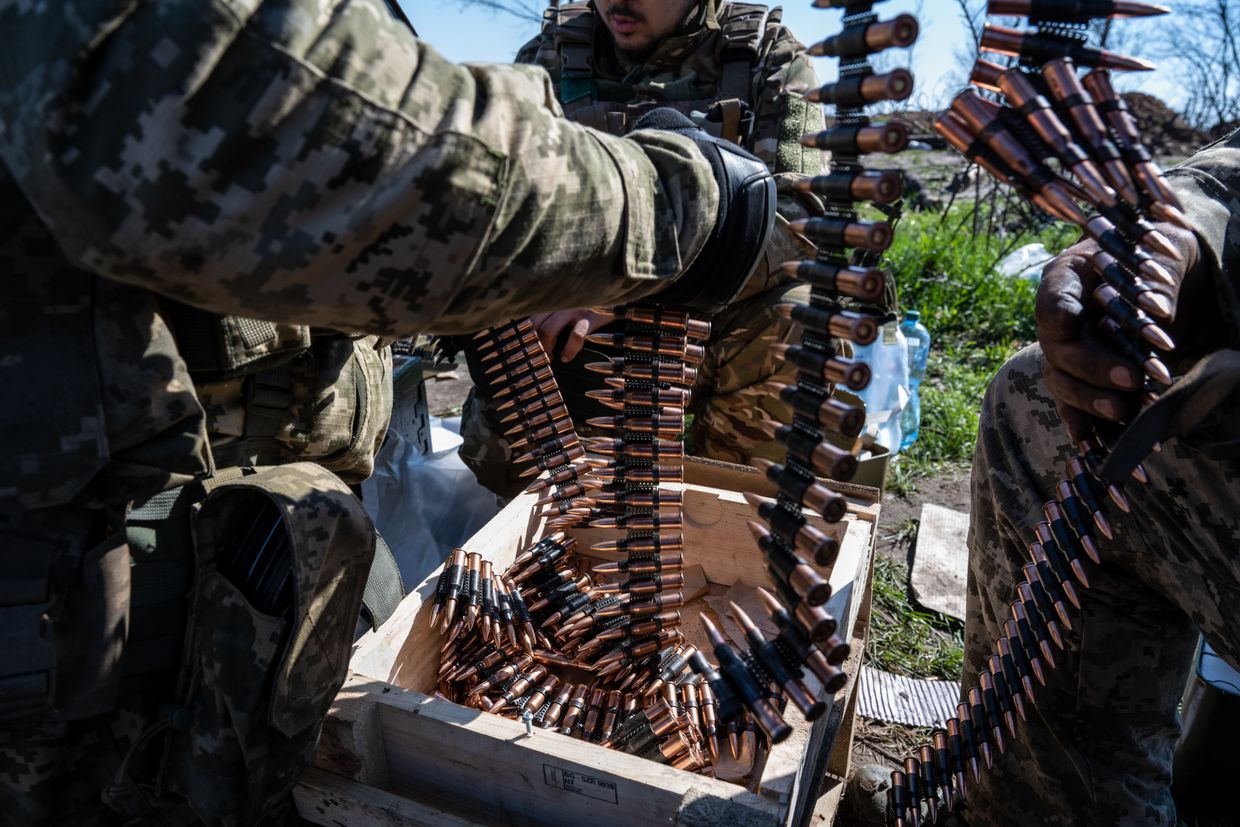
 The Kyiv IndependentKollen Post