Connexion
How Schools and Universities Try to Censor Student Journalists
Student journalists, their advisors, and legal advocates say colleagues and administrators are attempting to undermine student reporting on Jeffrey Epstein, Gaza, and other issues that public institutions would rather not have their reputations connected to.
Public records obtained by 404 Media show administrators taking meetings with parents and alumni when they take issue with student reporting and asking advisors to compromise their professional ethics. They also show escalating tensions between student newsroom staff and administrators, prompting more legal aid requests to advocacy groups.
This comes as student journalists at The Cornell Daily Sun earned recognition for breaking the “Cornell Seven” story regarding the lawsuit filed in New York’s trial court last month by a Jane Doe accusing current and former Cornell University students of drugging and sexual abuse. The student journalists told The Cut this week that a vague university and campus police statement from nearly two years ago prompted more questions than answers. Such is the basis for most accountability journalism on college campuses.
The cases we reviewed involved the phase of the reporting process that comes later, where a factual dispute the newsroom has defended or a complaint where the person doesn’t bother to explain what is allegedly wrong with the students’ reporting.
In Colorado, a high school social studies teacher emailed the student publication’s advisor at the time, accusing a student’s opinion piece called “Why is Gaza Important?”of being “published with factually inaccurate and racist information,” but then said in the same email, “I’m not going to start listing the inaccuracies along with the omissions.”
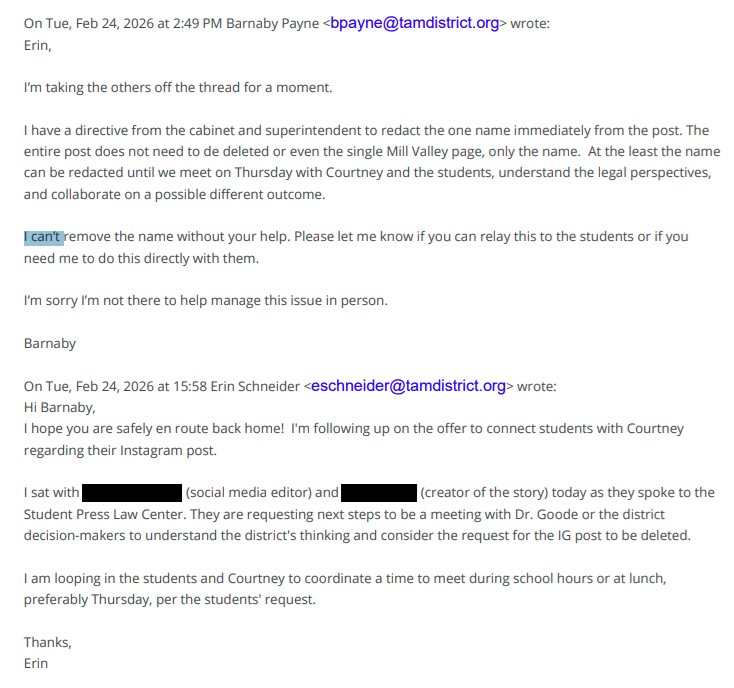
In California, a high school principal told a student journalism advisor to redact the name of an individual threatening to sue the district for defamation after student journalists published an Instagram carousel to their school’s newspaper account about the number of times their county turned up in the Epstein files. In this case, which has already been widely reported on, the administrator told the journalism advisor to redact the name of the woman who was threatening suit without determining whether the reporter made a factual mistake (the students did not).
“I can’t remove the name without your help,” the principal told the advisor via email, after the advisor said the students would first seek legal guidance from the Student Press Law Center before taking any actions.
Soon after the op-ed was published, the student newspaper’s advisor was reassigned to another role within the district. The advisor from the California school district stepped down from her role during the last school year; she now consults schools and nonprofits on best practices for their student media programs. Mike Hiestand, who is a lawyer with the Student Press Law Center, has spent decades advising student newsrooms. He says it’s common for administrators to target advisors, adding that it’s one of the more effective censorship methods available to them.
“School officials, they see employees as kind of an easy target over whom they have some authority, and they know that in many places, that relationship between the students and their advisor is a tight one,” Hiestand told 404 Media. “Unfortunately, some school officials take advantage of that bond and definitely go after advisors.”
In 2025, the Student Press Law Center (SPLC) claimed that the nonprofit had responded to nearly 1,000 hotline inquiries from student newsrooms in 46 states and Washington D.C. The most common inquiries involved censorship, libel and copyright. Overall, SPLC says calls are down, but hotline inquiries about censorship specifically are up 17 percent from the year prior.
“One of the biggest things we’ve certainly found with censors over the years is they want to be called everything but a censor,” he added. “What they’re doing is everything but censorship.”
This tracks with what 404 Media is observing through public records requests into school, library and university censorship. The same state laws that have been used to restrict how topics like race, gender, and systemic inequality can be accessed and taught have also put student journalists covering those beats in a bind.
Records from Pensacola State College obtained by 404 Media show that last spring, an administrator tried to block funding for a journalism professor to print students’ class assignments for their portfolios because at least one of the stories involved reporting on the LGBTQ+ community. The campus later relented and agreed to release funding for students’ portfolios. In an email to the advisor, an administrator involved in the situation wrote that “the proper role of administration is to facilitate rather than impede the completion of legitimate classroom projects.”
“When you have a principal coming in who doesn’t have a lick of journalism experience claiming that they’re there to guide young journalists, that’s where I have problems,” Hiestand said. “Every principal and every superintendent in the country seems to think that they are qualified editors.”
Similar verbiage has appeared in other public records requests involving student journalists, like in the case of a Maryland school district memo about principals reading and approving every story before publication. In the memo, the chief of schools wrote that “[a]s responsible adults and educational leaders, we have the duty to guide the work of our students as they are developing their skills in a school setting during a school-directed activity.” But internal correspondence obtained by 404 Media suggests that the memo was “really to be sure an administrator could initial any printed posters, review school apparel, and scan over the yearbook to be sure that there is no violation” of the student handbook.
Marie McMullan, program manager and counsel for the Student Press Legal Hotline with the Foundation for Individual Rights and Expression, says so far, 2026 has been a very consequential year for students leading their school publications.
“Student journalists are a very bright group,” McMullan told 404 Media. “They are great at sounding the alarm and bringing advocates out of the really blatant examples. But I always just worry about making sure that student journalists know their rights so that they can assert them in cases where there are subtler forms of censorship.”
At Southern Illinois University Edwardsville (SIUE), student reporters with The Alestle, the university’s student newspaper, claim that the institution’s marketing and communications department had become more insistent on attending interviews conducted by student reporters in recent months. The department took issue with editor-in-chief Dylan Hembrough’s framing of the dispute, calling several of the claims “inaccurate.” In an interview with 404 Media, Hembrough said the paper investigated and determined there was nothing inaccurate about the story. When Hembrough did not retract the story, the executive director of marketing and communications at SIUE sent an open letter to the entire campus—a mailing list of more than 14,000 people, including faculty and staff—taking issue with that story, along with other stories throughout the years as well.
“The Alestle appears willing to substitute alarming headlines for verified facts, to rely on posturing rather than careful reporting and to treat corrections as an inconvenience rather than a professional obligation,” the open letter reads. With the letter was a link to a 27-page document of corrections the department expected student leadership to act on.
“I have been on the other side of panicking over things like this,” Hembrough told 404 Media. “Something that has helped me get through that, or at least stave it off, is the idea that the truth is more important than whatever I feel about it. Embarrassment or humiliation should have no bearing on how or even whether a publication makes a correction.”
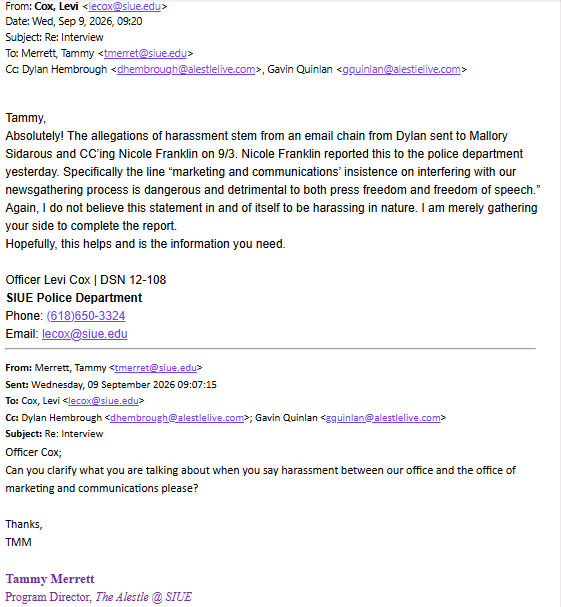
Then in September, Hembrough learned via email that he was being investigated by the campus police for harassment against the department. When Hembrough’s journalism advisor asked the officer to clarify on what grounds, the officer said the report was based on a line in an email, which read: “Marketing and communications’ insistence on interfering with our newsgathering process is dangerous and detrimental to both press freedom and freedom of speech.” Hembrough shared his email with 404 Media, which reads as an editor defending another student reporter’s right to conduct an interview without the department exercising prior restraint over the publication. In her statement to campus police, she reportedly told the officer that “other members of my office have approached me stating Alestle reporters have been by my office uninvited,” and that she didn’t have a lock on her door.
“Due to the media between Marketing and Communications and the Alestle I am worried a ‘January 6th’ type of crowd may be outside my office,” the complainant told the officer, according to the campus police report. The officer advised her to contact facilities management about getting a lock for her office door and concluded that the facts of the case don’t “meet the statutory threshold for Harassment by Electronic Communications.”
The public records reviewed by 404 Media from SIUE support the claims The Alestle’s journalists make throughout their reporting on the department. SIUE did not respond to 404 Media’s request for comment.
The situation at SIUE serves as an example of a dispute about institutional reputation that’s escalated to involve campus law enforcement, but law enforcement nonetheless. McMullan says this escalation has an undeniable chilling effect on free speech, noting that policies and laws that public institutions use to silence young reporters still need to abide by the First Amendment. But overall, she’s impressed with how students at SIUE and other campuses are meeting the moment, even when the adults in the room aren’t.
“Whether it’s in a court of public opinion or a court of law, students are not accepting censorship,” she said. “They’re pushing back against it.”