The president, who has been dogged by the war in Iran and eroding alliances, is also expected to sign a security deal on Greenland and meet with world leaders.
The president, who has been dogged by the war in Iran and eroding alliances, is also expected to sign a security deal on Greenland and meet with world leaders.
Montréal n’autorisera pas de nouvel empiétement sur le territoire du parc Jarry, a affirmé lundi la mairesse de Montréal, questionnée sur le projet d’agrandissement des installations de Tennis Canada qui s’y trouvent déjà.
La Ville de Montréal perd patience face à la paralysie du dossier Sanimax, cette entreprise qui opère une usine d’équarrissage qui cause des nuisances majeures dans l’est de Montréal.
Environmental groups vow to continue opposition to deal that would expand site for Elon Musk rocket company
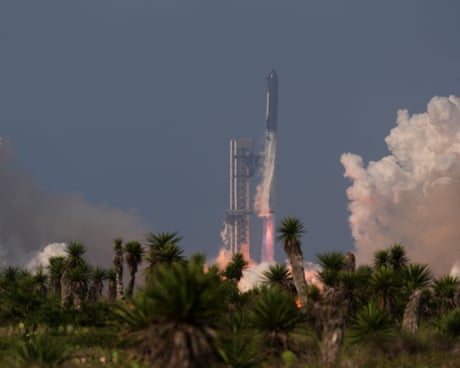
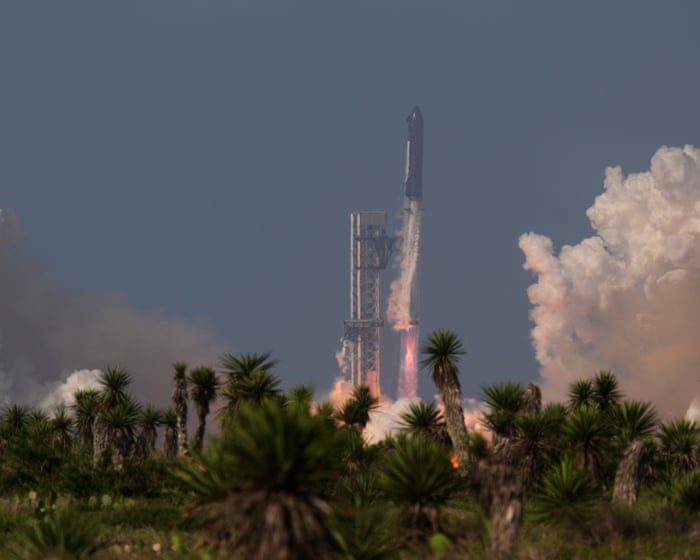
A federal judge on Monday refused to block the Trump administration from giving SpaceX more than 700 acres of wildlife refuge as part of a land swap in Texas, while environmental groups vowed to continue their legal challenge.
US district judge Fernando Rodriguez Jr declined the plaintiffs’ request for a preliminary injunction to prevent the parcel exchange, saying they failed to prove it would worsen ecological risks to a Gulf coast region already transformed by billionaire Elon Musk’s rocket operations.
Supreme court, which has twice blocked maps from being used in November, likely to have final say in legal fight
A long-running legal fight over Missouri’s congressional map took another turn Monday when a federal appeals panel ruled in favor of new districts backed by Donald Trump, even though the US supreme court has blocked those districts from being used in the November election.
A three-judge panel of the 8th US circuit court of appeals said Missouri should use the new Republican-drawn US House districts in the November election, just as the state did in its August primary. To revert to its prior districts for the general election would violate the US constitution, the appeals judges said.
Accra Reset’s report states countries in the region and global south should take greater control of their health development after USAID debacle
The United States’ withdrawal from key aid programs has put has put healthcare in Africa and the Global South “under growing strain” a new report warns.
The report says the Trump administration’s cuts to programs such as US Agency for International Development (USAID), as well as the Covid-19 pandemic and rising costs of living globally have brought “new urgency” for the need to reform healthcare in the region.
Le nouveau règlement interdisant d’insulter ou d’offenser un représentant de la Ville de Montréal (dont les policiers) a été adopté lundi au conseil municipal. Il sera appliqué de façon judicieuse, a assuré la mairesse de Montréal, et réservé aux cas les plus sérieux.
Le Bureau de l’inspecteur général de Montréal (BIG) donne un solide coup de balai dans le secteur de la collecte des matières résiduelles, au terme d’une enquête qui a révélé l’embauche massive de sous-traitants non autorisés, connus pour leur recours à des travailleurs au noir et à des prête-noms. Malgré les risques élevés de blessures, de nombreux éboueurs sillonnaient les rues sans les protections légales auxquelles ils devraient avoir droit.
Immigration agency’s move makes it harder for lawyers and family to find detainees, in line with stringent Trump policy
US Immigration and Customs Enforcement (ICE) has stopped publicly revealing where it is holding thousands of detainees who are subject to final deportation orders, an unannounced move that has made it far more difficult for lawyers and relatives to find them, according to current and former officials familiar with the practice.
ICE removed those detainees from its online detainee locator system on 15 September, according to three current and former ICE officials who spoke to the Associated Press on condition of anonymity because they were not authorized to discuss the change. Several lawyers contacted by the AP confirmed their clients vanished from the system this week, and the American Immigration Lawyers Association warned its members about the situation on Friday.
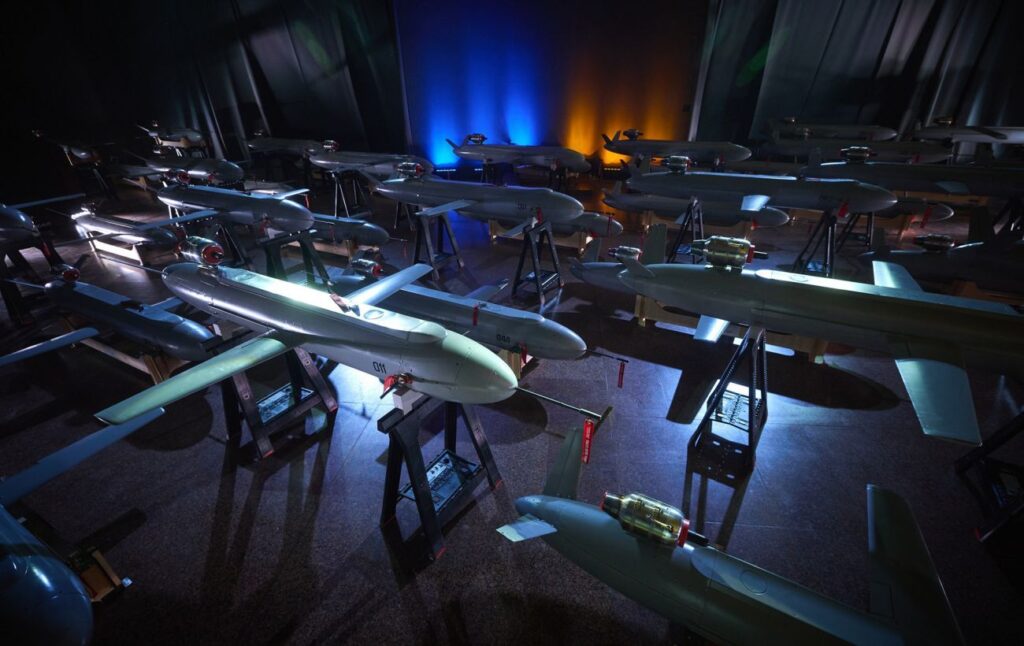
Russia wants to build 14,000 of a new cruise missile next year, enough to fire them at Ukrainian cities by the thousand. The weapon, the Dan-T, is a cheap air-launched jet missile that flies hundreds of kilometers on its own, RBC-Ukraine reported.
The danger is volume, not finesse. Russia aims to produce up to 2,000 Dan-T missiles by the end of this year and scale it drastically, RBC-Ukraine's sources say. Fired in large numbers, it would add a fresh layer to the Gerans and the cruise and ballistic missiles that already saturate Ukraine's skies on the worst nights.
Numbers make the threat
The experts are less worried about any single Dan-T than about the swarm. High speed, long range, and the ability to launch the missiles by the thousand would stretch Ukraine's air defense further with every strike, forcing crews to spend scarce interceptors on yet another cheap target.
The missile flies to its objective autonomously, and Russia claims a special flight profile designed to make it harder for air defense to spot and shoot down.
A target drone becomes a weapon
The Dan-T has an unusual pedigree. It began as the Dan-M, a jet-powered target drone Russia's Sokol bureau built in the early 1990s and imitated US Tomahawk cruise missiles for air-defense practice, now planned to be stripped of its recovery parachute, fitted with a warhead, and fired at Ukrainian cities. Like Russia's other new cruise weapons, it carries no operator link, steering itself by satellite and inertial navigation.
The Banderol joins the list
The Dan-T is not the only new weapon unsettling Ukraine's military. The experts named it alongside the S8000 Banderol, a separate cheap cruise missile that Russia already builds at up to 80 a month and has used in some of its heaviest strikes on Kyiv. The Dan-T closely resembles the Banderol and, being cheaper, may end up replacing it.
When I first started writing about online cultures and subcultures almost 10 years ago, one of the first scholars I read on the subject of internet anthropology was Professor Sherry Turkle. Her earlier books, including The Second Self (published in 1984) and Life on the Screen (1995) became something like a model for my own writing and this kind of reporting— approaching the internet with an ethnographer's mindset and taking nonjudgemental documentation of how people are behaving and feeling in a given space, even if that space is digital.
Through talking directly to people in their own environments, whether they were in MUDs and early virtual chat spaces or Second Life and massive role-playing games, her work revealed endlessly interesting firsthand perspectives on lifestyles that people still found subversive, marginal, and at times perverse. The people she interviewed often said that digital worlds offered support, companionship, sexual satisfaction, gender play and freedom that the quote-unquote "real" world did not. These were topics traditional academia wasn't yet touching: cyber-sex, intimate relationships unfolding in chatrooms, embodiment in online worlds that felt as real to their inhabitants as the world their physical selves sat in behind a keyboard.
What struck me about those books — and later, in Alone Together, Reclaiming Conversation, and The Empathy Diaries — was often how fundamental the human needs for connection and vulnerability are, despite the technology being used to fulfill those needs.
Fast forward to today. Something has shifted. “In 1984, I called the computer a second self,” Turkle writes in her latest book, Artificial Intimacy: Who We Become When We Talk to Machines. “Computers provoked an explosion of talk about what was essential about being a person and about how new computational ideas might illuminate our thinking about the mind. With the digital twin, the metaphor is turned on its head. It’s the agent who is in charge and imagines a version of you. Now you’re the second self. So when you are given time to get ‘back to your life,’ it’s been diminished.”
Professor Turkle is a licensed clinical psychologist, the founding director of MIT's Initiative on Technology and Self, and the Abby Rockefeller Mauzé Professor of the Social Studies of Science and Technology at MIT. Artificial Intimacy: Who We Become When We Talk to Machines comes out on September 29.
The technology today is wildly different than it was in the 80s, but as Professor Turkle explores in our conversation for the 404 Media podcast, the need for empathy, vulnerability, and to feel understood remains central to the human experience. With increasing reliance on conversational “companion” chatbots like ChatGPT and Replika, we risk misinterpreting machine programming as care, and risk misattributing human qualities like empathy and emotional intelligence onto unfeeling, incapable robots. The result, she argues, is a population forfeiting its empathy skills at an alarming rate, trading difficult feelings and conversations with humans for convenience and instantaneous feedback.
“When people turn to a chatbot, they don’t have to dread the fatigue of genuine give-and-take. And they don’t fear judgment or abandonment. But when we talk to chatbots, we lose the skills required to interact with humans, so chatbots start to feel like a better option. With an alternative, disappointment with people feels unnecessary,” Turkle writes.
What happens when people stop caring that there’s not a human on the other line? We got into that on the podcast.
“It's a product whose fundamental directive is to keep your attention. And so it matters very much that we sort of become glommed onto it as though it were a person when it isn't,” Professor Turkle said in our conversation. “But more than that, I think that it's very important to ask, what is the end game of this?” She referred to the interview Mark Zuckerberg gave last year when he said Americans can only have three real friends, and intended to let AI fill in the demand for more.
“Now that to me is a very dark endgame,” she said. “And so people who say, ‘What the hell? I kind of like it.’ Well, let's just think about where we're moving towards. Because it's not just a little entertainment. It's a corporate project to get us involved in certain kinds of relationships that are going to make tons of money and to keep us at our screens all day talking to sycophantic, seemingly loving entities that don't know who we are and don’t care about us.”
In our wide-ranging conversation, we talk about how we got here, the concept of “deskilling” one’s own capacity for human connection and vulnerability, whether there’s a way back out of this mess for us, and what happened when she asked a chatbot to roleplay her own legacy (spoiler alert: nothing good).
Foreign defense suppliers owe Ukraine approximately $10.58 billion, according to Ukraine’s Ministry of Finance. Of this amount, approximately $1.70 billion represents overdue receivables or funds that the Ministry of Defense has already paid to suppliers but for which the corresponding goods or services were either delivered late or not delivered at all.
Ukraine is seeking to recover these funds through the courts. However, in several cases, the statute of limitations is approaching or has already expired, potentially preventing the state from recovering the money.
A $22,400 legal bill could put $403 million in recoverable funds at risk
The government needs approximately $22,400 in legal fees to continue these proceedings. Without this funding, Ukraine could lose more than $403 million, roughly 18,000 times the amount required for legal services.
“The lack of funding for international disputes deprives Ukraine of the ability to forcibly recover these assets,” the Ministry of Finance said.
Funding shortfall could jeopardize legal cases and future financing
The ministry warned that a lack of funding could deprive the state budget of significant revenues, potentially force Ukraine to terminate contracts with foreign legal advisers already representing it, and delay the appointment of new advisers. It could also negatively affect Ukraine’s standing and make it more difficult to secure financing in the future, Ekonomichna Pravda reports.
The Ministry of Defense’s overdue receivables have been growing year after year. As of 1 January 2024, they amounted to approximately $886 million, rising to approximately $1.01 billion as of 1 January 2025.
In this context, receivables are amounts owed to the Ministry of Defense by suppliers for goods not delivered or services not provided on time, even though the ministry has already paid for them.
The Ministry of Finance raised these issues amid a funding shortfall for Ukraine’s Defense Forces in 2026, which the president has put at approximately $27 billion.
Russia's newest military satellites keep stalling short of orbit, and Ukraine's top technology adviser says that is exactly why no one should relax. Serhii Beskrestnov, the presidential adviser on defense technology known as Flash, warns that once Russia completes its "Rassvet" satellite network, Moscow could steer its Gerans and missiles from space, and that Ukraine has to build the jamming to stop it before that day comes.
A working Rassvet would hand Russia a permanent link to its long-range weapons, letting it control drones and missiles online through satellites, what Flash calls "a small catastrophe."
Russia is nowhere near that yet: it has launched around 32 satellites but needs 200 to 250 for stable, round-the-clock coverage, and its most recent batch stalled in low orbit. Flash's point is that the reprieve is temporary.
"Russia is a space power," he wrote, and one heavy Angara rocket could loft much of the constellation in a single launch once its engines are fixed.
Ukraine has tried to choke the program at its source, striking a Russian space-rocket plant in mid-August and reaching for the Plesetsk cosmodrome days later, though the effort has only slowed it.
The MESH failure sets the warning
His alarm rests on a mistake, he says, Ukraine already made. For a year, he wrote, no one in the armed forces systematically worked on countering the MESH radio networks Russia uses to fly its jet Gerans, and no one shielded the capital with electronic warfare, even as the enemy openly built out the technology.
Breaking what he called a lifelong rule against criticizing colleagues, he "thanked" the former commander-in-chief and his electronic-warfare chief for the lapse, he wrote a bit earlier.
The result, he said, is that Russian Geran-5 are now striking under MESH control while Ukrainian specialists scramble to catch up.
The jamming must come first
With Rassvet, Flash argues, Ukraine cannot afford the same delay. The counter-system must not only be designed but actually fielded before the constellation is up, with the country's key infrastructure shielded by the time Russia's satellites reach orbit.
"This electronic warfare must ALREADY have closed all key infrastructure sites," he wrote.
Building it, he cautioned, will be neither fast nor cheap.
La mairesse de Montréal a dénoncé le manque d’action de sa prédécesseure contre l’itinérance, lundi, rejetant les critiques de Projet Montréal quant à la dégradation de la situation sociale dans la métropole.
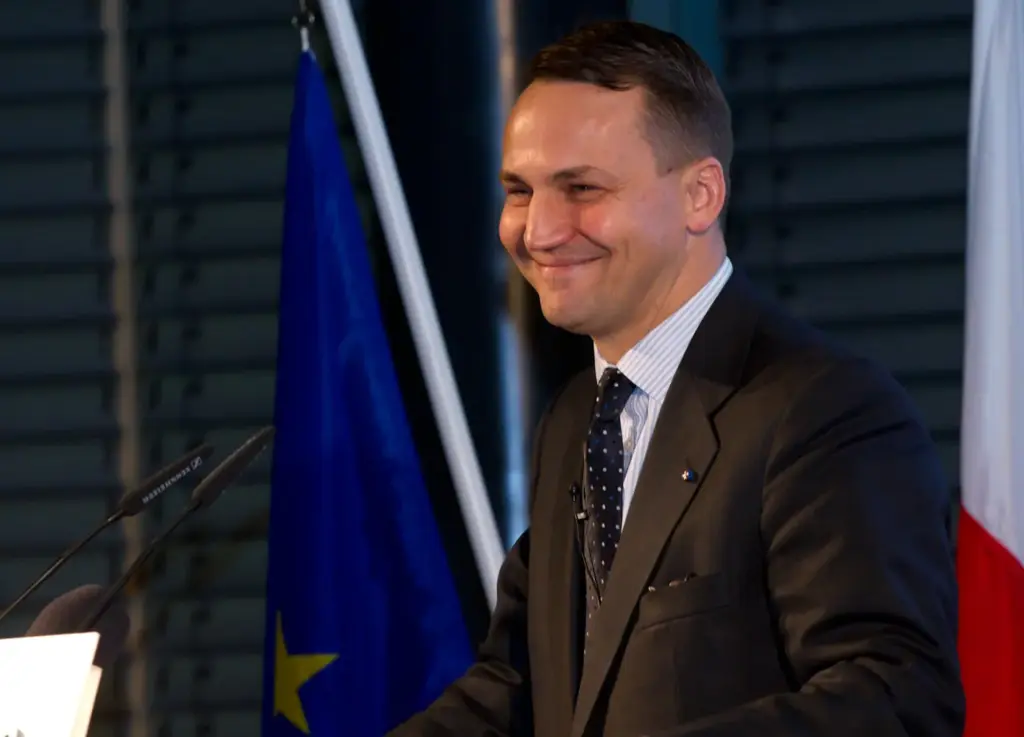
Polish Foreign Minister Radoslaw Sikorski says he has personally warned Russian officials that Polish response to a possible attack from Moscow would include both offensive and defensive actions, according to an episode of the program Front Sikorskiego.
Sikorski's disclosure comes as European governments step up preparations for possible Russian attacks and provocations. Polish Prime Minister Donald Tusk said on 17 September that intelligence assessments indicated Russia could stage drone or missile attacks against countries supporting Ukraine in the coming months, while Lithuania said it had access to the same intelligence.
Sikorski says he has told Russian officials to "be careful, because we have more combat aircraft than you do."
"So if you do something that no one wants, we won't just sit back and do nothing. We will respond both defensively and offensively," Sikorski stresses.
He frames the warning as deterrence and points to Ukraine's strikes on Russian oil refining infrastructure as an example of what air power can achieve. Ukraine has destroyed what Sikorski described as 30–40% of Russia's oil refining capacity, he says, arguing that European air forces could accomplish far more.
European governments prepare for Russian provocations
Tusk said Russia could try to present such attacks as accidents in an effort to weaken NATO's willingness to respond. Lithuanian Foreign Minister Kęstutis Budrys confirmed the following day that his country had the same intelligence and said officials had discussed the possibility of a Russian false-flag operation, according to Delfi.
France has also moved to prepare for possible Russian hybrid attacks. President Emmanuel Macron ordered a plan to protect critical infrastructure and sensitive defense-industry sites from drone and cyberattacks, the Kyiv Independent reported, after saying the Russian hybrid threat had intensified. "The day we are attacked physically, we will not be warned," Macron said.
Sikorski did not say when he delivered the warning or which Russian officials received it.
La 3e édition du Festi-Bob de Rimouski, présenté le 5 septembre dernier au Centre communautaire Saint-Pie-X, a permis de recueillir une somme record de 21 000 $.
En tout, le comité organisateur versera 18 900 $ à la Fondation Bob Bissonnette, tandis qu’il remettra 2 100 $ à la Fondation Jennely-Germain, qui combat la malnutrition infantile dans la Vallée de La Matapédia, à Rimouski et à Baie-Comeau.
De nouveau cette année, le Festi-Bob proposait des tournois amicaux de dekhockey et de soccer destinés aux jeunes et aux adultes, sans volet éliminatoire, avec maquilleuse et DJ sur place. Un match réunissant différentes personnalités sportives de la région a également eu lieu au cours de la journée.
La programmation musicale en soirée, animée par l’humoriste rimouskois Sébastien Haché, mettait en vedette Yoann Guay et Olivier Bergeron, deux anciens participants de Star Académie.
L’humoriste rimouskois Sébastien Haché assurera l’animation du spectacle, ponctué de capsules vidéo inédites mettant en vedette Patrice Lemieux, personnage créé et interprété par Daniel Savoie.
Un encan virtuel a aussi permis à plusieurs acheteurs de mettre la main sur des chandails autographiés de Charle-Édouard D’Astous du Lightning de Tampa Bay, de Philippe Danault et Zachary Bolduc du Canadien de Montréal, d’Alex Belzile du Rocket de Laval, de Kristopher Letang des Penguins de Pittsburgh, de Jonathan Marchessault des Predators de Nashville, de Jeffrey Viel des Ducks d’Anahein, de Marc-Antoine Pouliot, des Oilers d’Edmonton et de tous les joueurs des Capitals de Washington font aussi partie de l’encan.
Le Festi-Bob de Rimouski a vu le jour en 2024 à l’initiative de Serge Dionne, un ami d’enfance du regretté Bob Bissonnette, pour soutenir la pratique du sport et des arts chez les jeunes qui composent avec certaines difficultés financières ou personnelles. Il a permis d’amasser 36 000 $.
Un conducteur de 26 ans a été arrêté récemment filant à plus de 185 km/h, dans une zone de 70 km/h, sur l’autoroute 20 à la hauteur de la rue Pullman, dans l’arrondissement du Sud-Ouest à Montréal.
L’intelligence artificielle ne se contente plus de chercher un produit ou de comparer les prix. Elle commence à pouvoir sortir la carte de crédit, au sens figuré, et terminer elle-même l’achat. Mastercard, Flybits et la Banque Rogers annoncent avoir réalisé ce qu’elles présentent comme la première transaction de commerce agentique au Canada réunissant un assistant […]
Quatre mairesses d’arrondissement ont demandé lundi au gouvernement du Québec de remettre sur les rails le projet de nouvelle ligne de transport en commun dans le grand sud-ouest de Montréal.
Ukrainian soldiers have saved about $40 million through discounts built into their army app. The "Pluses" program in Army+ just signed its 40th partner, Ukraine's tactical-gear maker M-Tac, and it lets soldiers claim the deals without showing a military ID, Mstyslav Banik, a deputy defense minister, says.
Banik is the man who helps Ukraine's digital transformation. He was a part of Army+ and its companion Reserve+ development team, ran former Defense Minister Mykhailo Fedorov's procurement reform, and kept his post after Fedorov was pushed out this summer. The new defense minister, Yevhenii Khmara, kept Banik and his team to preserve the reform's momentum.
Fuel leads the discounts
The discounts soldiers most often use, Banik says, are on fuel, pharmacy purchases, and postal services. The newest partner, M-Tac, a Ukrainian maker of military and tactical clothing and gear, becomes the ninth company in the program's "equipment" category, alongside Ukrarmor, UTactic, and Balistika.
To claim its discount, a soldier generates a code in the app and shows it at the Militarist store or enters it on M-Tac's website.
Soldiers skip the ID check
The design spares soldiers the need to prove their identity. Because only service members can access Army+ to begin with, the discounts require no military documents or status checks and therefore do not require handing over personal data, the Defense Ministry said. The ministry has also allowed soldiers to pass along offers to their families, a feature they have used more than 110,000 times.
The app started as a paperwork fix
Army+ is more than a coupon book. It was launched in 2024 to strip bureaucracy out of soldiers' lives, letting them file reports in a few clicks instead of days. Within a day of its launch, 20,000 soldiers had signed in. It has since grown to handle transfers, mobilization, the return of soldiers who were on AWOL, and services from training courses to secure chat.
Russian authorities left residents in and around Moscow without air raid sirens or phone alerts during Ukraine's largest combined strike on Moscow Oblast, apparently to guard turnout at Russia's parliamentary elections, the Institute for the Study of War (ISW) said. The silence angered residents and even pro-war commentators as a major oil refinery burned.
For most of this war, Russia has handled strikes on its cities as a routine to be announced, warned about, and waited out. Withholding warnings during the heaviest raid yet, in the middle of a national vote, suggests authorities will trade residents' safety for the look of a calm election when a political milestone is on the line.
Sirens stayed off during the biggest raid
Ukraine hit strategic sites across the Moscow area overnight on 19-20 September, the last day of Russia's State Duma vote. Moscow Oblast officials did not switch on air alert sirens or send the SMS warnings they had used during far smaller attacks. They quietly restricted mobile service without major public notice. Ukraine struck oil and logistics targets, not polling stations, according to the experts, and authorities appeared to place high turnout above protecting civilians.
Moscow Oblast residents complained that no alert reached them, some posting on the Telegram channel of regional Governor Andrei Vorobyov before it closed comments. A prominent Kremlin-linked military blogger attacked the official response, saying it erodes public trust and that cutting mobile service does "not really help."
What the drones hit
Ukraine's General Staff reported striking the Gazpromneft-Moscow Oil Refinery in the city's Kapotnya district, one of Russia's largest plants, causing a large fire. Ukrainian manufacturer Fire Point said its FP-1 drones completely shut down the refinery, with all primary processing units damaged.
Governor Andrei Vorobyov claimed air defenses countered 249 drones across 17 municipal districts. The strike was part of Ukraine's widening campaign against the fuel sector funding Russia's war, with about a fifth of Russian refining capacity offline.
Poland will have more than 1,000 automated warning sirens in Lublin Voivodeship by the end of 2026, Interior Minister Marcin Kierwiński said on 19 September, up from nearly 350 now. The region had about 30 remotely activated sirens at the beginning of 2024.
The expansion comes as Russian attacks on the west of Ukraine are reaching closer to Poland. Prime Minister Donald Tusk said Russia is expected to intensify attacks on Ukraine's critical infrastructure and warned of possible "accidental" drone or missile strikes on NATO countries, including Poland. He also said Russia is introducing jet-powered drones that move much faster and at higher altitudes.
Sirens sound as drones approach the border
A Russian air attack on western Ukraine triggered air-raid warnings in Poland's Lublin and Podkarpackie regions on 17 September. Sirens sounded in Lublin and Rzeszów, while residents received an SMS warning: "ATTENTION! ATTENTION! ATTENTION! Threat of an air attack. Find a safe place. Follow the instructions of the emergency services. Await further announcements."
The Polish military said its aircraft were activated in response to Russian strikes involving jet-powered drones against western Ukraine. A Russian drone flying toward Poland fell on Ukrainian territory about four kilometers from the Polish border, according to Polish authorities. Polish airspace was not violated.
Airports in Lublin and Rzeszów temporarily suspended operations to give military aircraft freedom of movement. Polish authorities said the measures were preventive and intended to protect Polish airspace.
More strikes on the border zone
On 13 September, Russian strikes near the Yahodyn-Dorohusk border crossing damaged a gas station and hit the locomotive of a Kyiv-Warsaw passenger train about two kilometers from the Polish border. No deaths were reported, and the border crossing temporarily halted operations.
On 19 September, Poland again activated ground-based air-defense systems and increased radar reconnaissance in response to another wave of Russian strikes on Ukraine. The operation ended the same day with no violation of Polish airspace recorded.
Shelters, sirens, and a 1939 echo
Beyond sirens, authorities have marked nearly 3,500 official shelter locations in Lublin Voivodeship. More than 500 State Fire Service stations and volunteer fire units took part in special exercises on 19 September to practice responses to warning signals and emergency alerts.
"We are building a civil-protection system virtually from scratch," Kierwiński said at a briefing in Lublin. "We have very, very little time."
The 17 September strikes fell on the anniversary of the Soviet Union's 1939 invasion of Poland. Prime Minister Donald Tusk described the Russian attack as "massive, extremely brutal."
The 13 September strikes near the border also drew a response from Kyiv. Foreign Minister Andrii Sybiha described them as Putin's terror "knocking" directly on the doors of the EU and NATO and called for a "full trade embargo, a total entry ban, and complete sanctions against Russia's military-industrial complex."
Avec une vingtaine de segments de rue fermés pour les mondiaux de cyclisme au sud de l’avenue du Mont-Royal et des entraves se comptant par dizaines, le centre-ville de Montréal avait toutes les allures d’un labyrinthe lundi matin. Heureusement, de nombreux automobilistes avaient décidé d’éviter le secteur, où la circulation était somme toute fluide.
La reconstruction de la chaussée du carrefour giratoire à Mont-Joli se poursuit jusqu’à ce vendredi 25 septembre. Mandatée par le ministère des Transports et de la Mobilité durable, l’entreprise Colas s’occupe d’asphalter la portion menant vers l’autoroute 20 et la route 132.
Plusieurs fermetures avaient été mis en place pour permettre la tenue des travaux, dont la portion de la 20 entre la sortie 629 et le carrefour giratoire et celle de la 132 entre la route de l’Aéroport et l’axe de l’avenue Levasseur.
Des entraves touchent aussi l’avenue Perreault Ouest, à la hauteur de la rue Industrielle, ainsi que l’avenue Levasseur à partir de la rue Poirier. L’accès aux commerces demeure dans ces secteurs durant les travaux.
Avec les milliers de véhicules qui empruntent le carrefour giratoire de Mont-Joli quotidiennement, le ministère a ordonné le remplacement complet de la chaussée, ce qui comprend l’augmentation de l’épaisseur de l’enrobé bitumineux.
Sa durée de vie projetée pourrait atteindre 30 ans, mais des interventions d’asphaltage en surface pourraient toutefois être nécessaires d’ici là. Le contrat pour la réalisation des travaux atteint 649 000 $.
Le 13e Challenge Vélo Plein Air, présenté le 19 septembre, a permis à la Fondation Maison Marie-Élisabeth de recueillir le montant record de 64 649 $, dépassant largement l’objectif fixé à 50 000 $.
Même si le nombre de cyclistes était moindre cette année, les 80 généreux participants (90 en 2025) étaient répartis en 2 groupes égaux, soit à vélo de montagne ou sur route.
Ils ont réalisé une levée de fonds d’un dynamisme exceptionnel qui a permis de tout de même dépasser de 11 000$ celle de l’an dernier.
« La météo était parfaite et les participants enthousiastes. Je tiens à remercier personnellement tous les partenaires et les cyclistes, qui, en plus de leur défi, ont réalisé une collecte de fonds au-delà de nos attentes. Nous avons eu aussi une participation exceptionnelle d’équipes qui se sont qui se sont données à fond pour leur levée de fonds », a d’ailleurs indiqué la présidence d’honneur d’Annie Théberge.
Fidèles au rendez-vous
Toujours fidèles au rendez-vous, Carl Bérubé et son équipe de Vélo Plein Air soutiennent la Maison Marie-Élisabeth depuis 2014.
« Carl est l’initiateur du défi. Nous le remercions chaleureusement d’avoir choisi notre cause au départ et d’y être fidèle depuis toutes ces années. C’est grâce à de belles collaborations comme celle-ci que notre Maison peut aller chercher plus d’un million de dollars dont elle a besoin chaque année pour poursuivre sa mission! », lance Steeve Lemieux, président du conseil d’administration de la Maison Marie-Élisabeth (MMÉ) et fier participant pour la 11e année au défi.
Cette année, en plus de Carl, René Bérubé, Catherine Lord, Geoffrey Deschesnes, Pierre Côté et Yves Landry composaient le comité organisateur.
Les participants du Challenge de montagne Vélo Plein Air 2026 (P
Grâce à ce beau partenariat, le Challenge Vélo Plein Air a permis à la Maison Marie-Élisabeth de recueillir plus de 402 600 $ en 13 ans.
Tous ces dons vont directement aux soins et services offerts gratuitement par la maison de soins palliatifs aux patients et à leurs proches. Paule Côté, directrice de la Maison Marie-Élisabeth, a enfilé le maillot du Challenge pour une sixième année à vélo de montagne.
Prix Endurance pour Marie-Noëlle Laurin
Le prix « Endurance », donné pour la cinquième fois dans l’histoire du Challenge, a été remis par Alexander Reford, représentant la Fondation Jack Herbert, à Marie-Noëlle Laurin de l’équipe « Les Gagnon pour Mamie » qui adhère bien à notre cause, qui se démarque par sa fidélité et qui fait preuve de persévérance.
Plusieurs commanditaires appuient la cause, année après année, et contribuent grandement au succès connu par l’activité depuis ces dernières années.
Depuis plus de 16 ans, la Maison Marie-Élisabeth accueille et offre gratuitement des soins palliatifs aux personnes en phase terminale. Sa direction doit recueillir plus de 1,5 M $ annuellement afin de perpétuer sa mission.
Montréal et le Syndicat des cols bleus regroupés de Montréal ont conclu une entente de principe pour le renouvellement de leur convention collective, a annoncé la Ville. La grève qui devait commencer ce mardi est donc suspendue.
Doula stopped to assist couple with birth while first responders were also stuck in traffic and arrived on foot
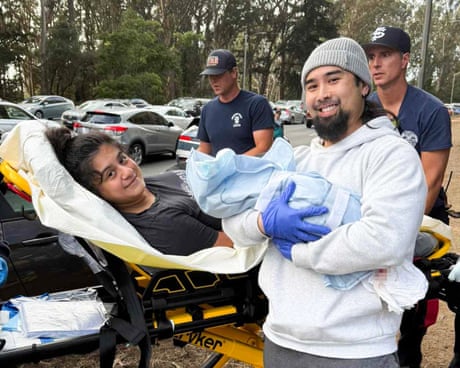
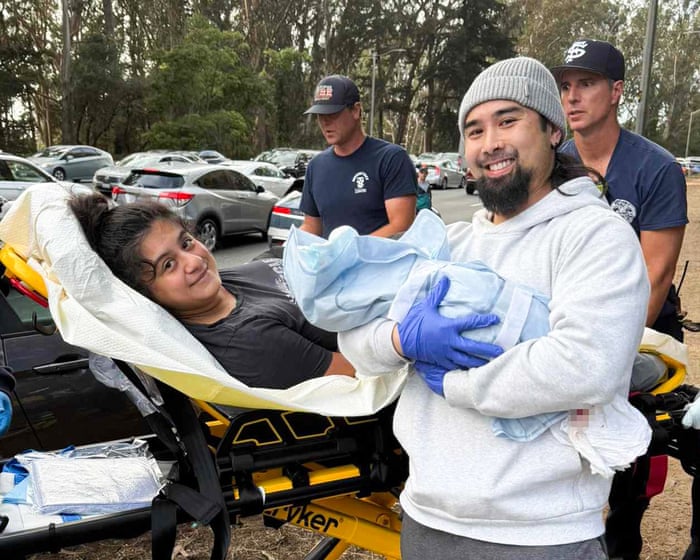
A woman stuck in heavy traffic in San Francisco went into labor and gave birth to a healthy baby girl, local authorities have said.
The San Francisco fire department said in a statement that a couple had been snarled in heavy congestion near the city’s Golden Gate Park when they were forced to pull over due to the imminent birth.
For the first time, Ukraine has dropped ground robots behind Russian lines from the air. The 3rd Army Corps, behind the mission, says its heavy drones delivered kamikaze unmanned ground vehicles more than 10 kilometers into the Russian rear during the "second season" of Operation Vivaldi, letting Ukrainian troops flank them and clear another 40 square kilometers.
Vivaldi is the counteroffensive the corps is running near Lyman in northern Donetsk. Over its first two "seasons," the 3rd Army Corps and attached units have retaken more than 125 square kilometers, half of it de-occupied outright, and inflicted more than 3,000 casualties on Russian forces.
The operation, run under an information blackout for months, has also disrupted Russia's push and, the Institute for the Study of War found, its plan to encircle the fortified belt of Donetsk cities.
Brigadier General Andrii Biletskyi, corps commander, has said the operation, which he named after Vivaldi's Four Seasons, will run through four phases, and only two have been completed. The air-dropped robot is the newest report on how the corps fights.
Machines go first, infantry follows
The corps casts the tactic as a means of expending robots rather than people.
"In assault operations, drones and ground robots always go ahead of the infantry," Biletskyi says.
The 3rd Army Corps was the first in the world to begin air-dropping ground robotic systems. Our heavy bombers deliver kamikaze robots more than 10 kilometers into the Russian rear.
Wars are won by infantry, one of the corps' soldiers added, "but we protect ours, so the robots go to the enemy first."
A dome hides the assault
As the assault groups advanced amid the operation, Ukrainian air defense and electronic warfare threw a protective dome over the battle area, blinding Russian drones so they could not read the operation's design.
Meanwhile, artillery and strike drones hit command posts, communications nodes, logistics, crossings, and reserves, letting Ukrainian units dig in on the ground they had taken.
On the Lyman axis, the corps says it freed the villages of Shandryholove and Derylove and took control of Drobysheve, and that Vivaldi has kept Russia from shifting significant forces to the Kupiansk front.
Gov. JB Pritzker of Illinois, widely seen as a potential presidential candidate, revealed in an interview on “CBS Mornings” that he had been on a GLP-1 regimen since 2024.
Russia is quietly moving to expand the capacity of the plant behind its long-range attack drones, a step that could sharply raise how many it launches at Ukraine, according to Politico. The plan turns on a single carbon fiber factory in Russia's Tatarstan region and runs to the end of the decade.
These files add something narrower than Russia's known intent to fight on: they identify carbon fiber as a critical material capping how many drones it can build. To break that cap, the Kremlin is funding production lines that will not run until the decade's end—a bet on winning by out-building Ukraine, even as the strikes grind on.
The bottleneck Russia wants to break
Politico obtained internal documents from Russian state nuclear corporation Rosatom showing its Alabuga-Volokno plant would add 500 tons of military-grade aerospace carbon fiber a year by 2029. Rosatom declined to comment. Weapons expert David Albright, who heads the Institute for Science and International Security, estimated that volume could yield airframes for about 28,000 more attack drones a year—a 78% jump.
Ukraine already estimates Russia can build more than 36,000 Shahed/Geran kamikaze drones a year. Carbon fiber is the choke point: it keeps the airframes light and strong, and Russia has no cheap substitute.
"Without the carbon fiber, they can't make the drone. Can't substitute for the carbon fiber in the drone and keep its weight down," Albright said.
Moscow is investing in the raw material, not just more assembly halls—the fiber, not floor space, is what caps output.
Ground already cleared in Tatarstan
Documents gathered by the Ukrainian Security and Cooperation Center describe a new factory on the site designed to produce UMT42S-3K aerospace-grade fiber. Satellite images from May to July show land cleared for construction. Albright's own August imagery shows foundations going in. He said the stated 2027 completion date "requires rapid construction." Russia has spent the past year adding new assembly halls at the same site.
The plant and its parent, Rosatom's Umatex Group, already sit under US, UK, and other Western sanctions. The US House Select Committee on China and the Ukrainian government both verified the documents, officials told Politico.
The push comes as Russia leans harder on jet-powered Shaheds, which Ukraine's Air Force says are hard to down with conventional defenses. Kyiv has fielded its first jet interceptor and tested a new one in September—but the plant is a bid to out-build those defenses faster than Ukraine can scale them.
That brings up questions: what are cities and law enforcement agencies using Axon ALPRs for? And who are they in turn sharing that data with? 404 Media has started to find out, but needs the help of local residents and community members to figure out what is happening across the country.
👮
Have you obtained Axon ALPR activity logs? We think this information is important so we can learn how police are using Axon's surveillance cameras. Please feel free to send the files to us! You can email joseph@404media.co.
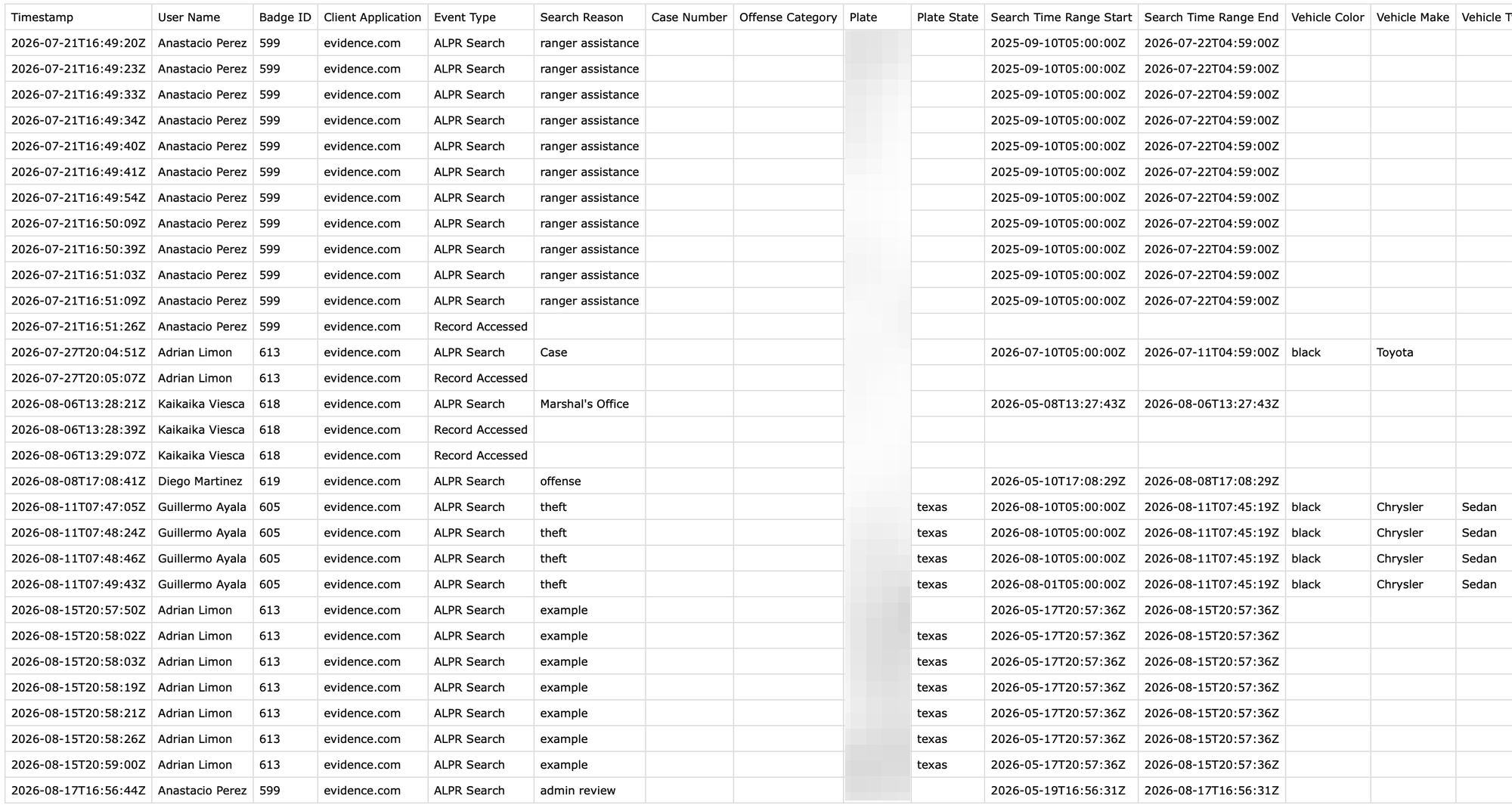
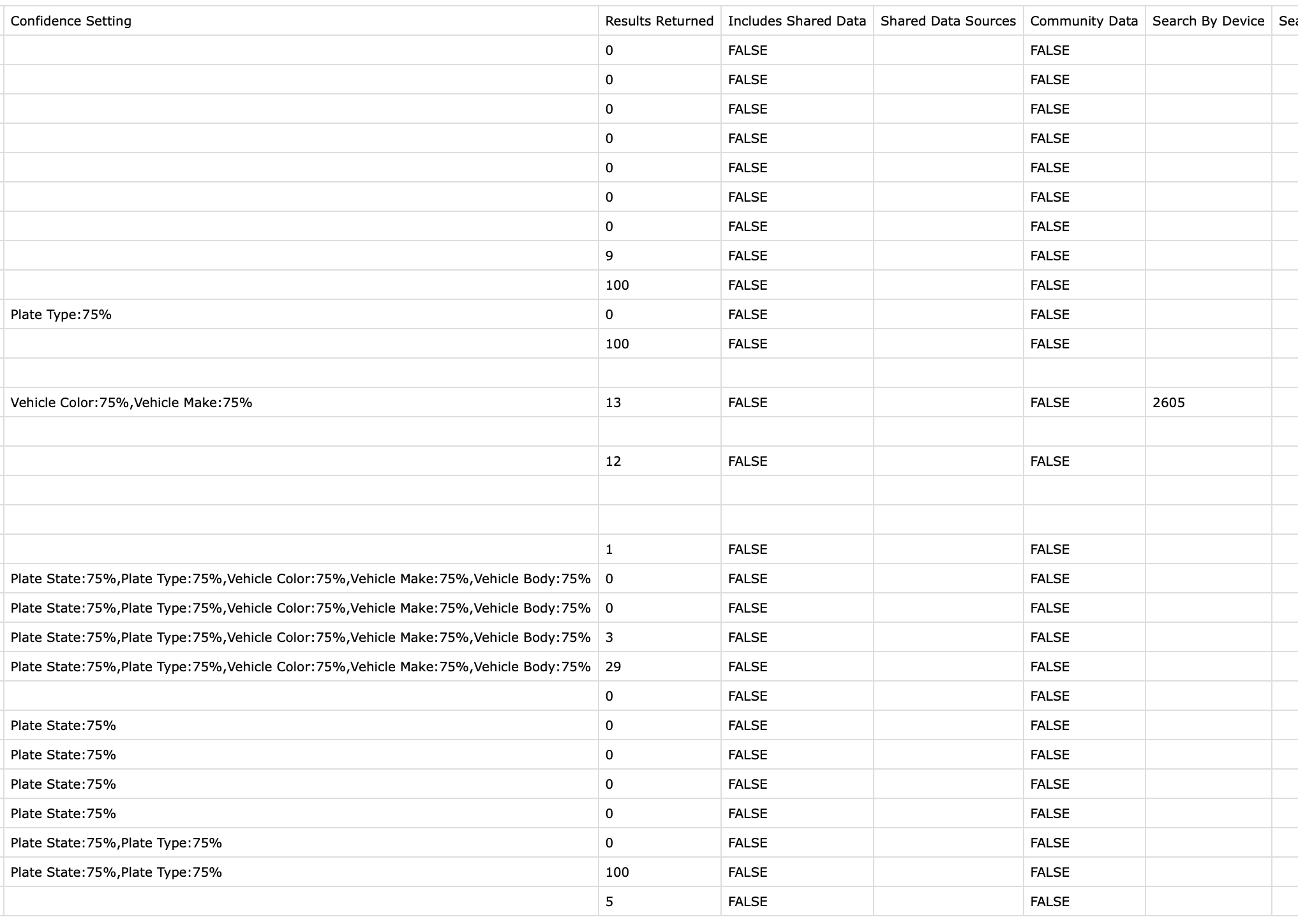
Over the last few weeks, 404 Media has filed requests with various cities and police departments for Axon “activity reports” and “sharing reports.” These show in granular detail when a police officer searched Axon’s ALPRs, the name of the officer, their badge number, the license plate they reached, and, most importantly, the stated reason why. These activity reports are essentially Axon’s version of Flock’s “network audits,” which has been the basis of much of 404 Media’s Flock reporting, and local and national media outlets’ around the country. You can see an example of one here:
404 Media redacted the plates in this screenshot.Another screenshot from an Axon activity report.
So far, 404 Media has obtained activity reports from the Benton County Sheriff's Office, WA; Falmouth Police Department, ME; Johns Creek Police Department, GA; Ocean Shores Police Department, WA; Pleasanton Police Department, TX; and Red Wing Police Department, MN.
But we need your help. Has your local police department or city switched to Axon ALPR cameras? Were they already using Axon? And do you want to know what they’re using those cameras for?
We’re asking interested readers to file the below public records request. You can simply copy this language, tweak it a little if necessary to apply to your state, then file the request with the relevant agency. You can do this by finding their relevant public records request email address, or by filing it through Muckrock. This is the platform we use for sending and organizing our records requests.
The Internal ALPR Activity report is the one shown above. The Network ALPR Activity report shows what other agencies the police department or city shares their data with. The ALPR Data Sharing report provides a history of when other agencies were invited, or removed, to receive the data. And the ALPR Hostlist Management Audit report details changes made to alerts the agency may receive.
If you file a request and get data back, please feel free to email it to us at joseph@404media.co. We’ve seen with the nationwide conversation about Flock that local residents can do a lot to reveal how surveillance technology is being used in their own communities. We hope we can find out a bit more about how agencies are using Axon’s cameras too.
To Whom It May Concern:
Pursuant to the [YOUR STATE’S PUBLIC RECORDS LAW], I hereby request the following records:
1. Internal ALPR Activity report in Axon.
The report should include data logged from the period of January 1, 2025, to the date this request is processed. Per Axon's documentation, the Internal ALPR Activity report is available within the LPR > ALPR Search > LPR Audit menu. You can find instructions to locate this here: https://www.axon.com/help/fusus/software/fusus/alpr/alpr-audit.htm
2. Network ALPR Activity report in Axon.
The report should include data logged from the period of January 1, 2025, to the date this request is processed. Per Axon's documentation, the Network ALPR Activity report is available within the LPR > ALPR Search > LPR Audit menu. You can find instructions to locate this here: https://www.axon.com/help/fusus/software/fusus/alpr/alpr-audit.htm
3. ALPR Data Sharing report in Axon.
The report should include data logged from the period of January 1, 2025, to the date this request is processed. Per Axon's documentation, the ALPR Data Sharing report is available within the LPR > ALPR Search > LPR Audit menu. You can find instructions to locate this here: https://www.axon.com/help/fusus/software/fusus/alpr/alpr-audit.htm
4. ALPR Hotlist Management Audit report in Axon.
The report should include data logged from the period of January 1, 2025, to the date this request is processed. Per Axon's documentation, the ALPR Hotlist Management Audit report is available within the LPR > ALPR Search > LPR Audit menu. You can find instructions to locate this here: https://www.axon.com/help/fusus/software/fusus/alpr/alpr-audit.htm
The requested documents will be made available to the general public, and this request is not being made for commercial purposes.
In the event that there are fees, I would be grateful if you would inform me of the total charges in advance of fulfilling my request. I would prefer the request filled electronically, by e-mail attachment if available or CD-ROM if not.
Thank you in advance for your anticipated cooperation in this matter. I look forward to receiving your response within the time period that the statute requires.
The court’s decision was based entirely on the timing of proposed new mail-in ballot rules. The larger question could re-emerge
Last week’s supreme court decision upholding the district court’s restraining order on USPS’s mail-in ballot restrictions is being hailed as a victory for electoral integrity by politicians, political commentators and voting rights advocates alike. The senator Chuck Schumer, for example, called the decision “one of the most important cases to protect voting rights before the supreme court”. But the unsigned, three-sentence opinion, with only a brief concurrence and a lengthy dissent, is no such thing.
The court based its brief opinion entirely on the timing of the roll-out of the new rules, which became effective on 21 August, just weeks away from the midterm elections and only days before several states were scheduled to begin mailing out their ballots. California’s submission to the court, joined by twenty-two states and the district of Columbia, asking the court to leave the injunction against the rule change in place, made clear that compliance with the rules in advance of the midterms would not only be difficult; it would be impossible without disenfranchising thousands of voters. And that, of course, is the point.
On 19 November 2025, Indian police raided the ‘Kashmir Times’ in Jammu. They said they were on an “anti-terror” operation. The offices had been shut since 2022 and were in dilapidated condition, the equipment largely defunct. Yet, the police claimed to have recovered a “pistol and live AK-47 cartridges.”
Since 2018, only five journalists have faced cases under India’s draconian anti-terror Unlawful Activities (Prevention) Act. Trials rarely start, leaving journalists in a state of perpetual purgatory, even if they are out on bail under onerous conditions.
Before the police came charging into these unused offices last year, the ‘Kashmir Times’, founded by my father in 1954, had long suffered sustained persecution – the seizure of records, of equipment, the harassment of staffers, the use of social media to spread slurs, trumped up charges of tax evasion and the embedding of spies.
The first ever copies of Kashmir Times, initially a weekly, were seized by the government. In 1983, my father survived a murderous assault with serious injuries inflicted by a Hindu nationalist mob. I joined the newspaper in 1989, as the armed militancy, the ‘insurgency’ against the Indian state, became widespread, and experienced firsthand the struggle to report the news accurately and truthfully. The government would frequently withdraw its advertising, which was the main source of funding for most news outlets. We were besieged on several fronts, facing down the state, militants and aggressive Hindu nationalists.
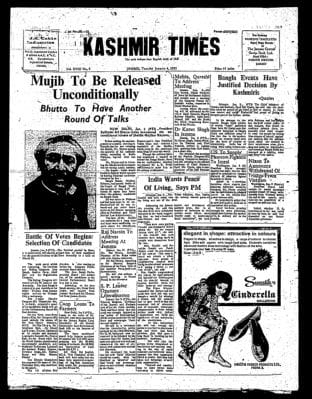
Kashmir Times front page, January 1972. Image courtesy of Kashmir Times / Anuradha Bhasin digitized by Stanford Libraries.
In 2019, as Indian prime minister Narendra Modi began his second term in office, his government removed the special autonomous status granted to Jammu and Kashmir and protections that had existed for nearly 70 years. Once a state, Jammu and Kashmir was split into two federally governed territories. The Indian-administered part of Kashmir – the subject of several military conflicts between India and Pakistan, with both countries claiming the entire disputed territory while controlling a portion of it – had effectively become a police state and control of the media was a critical component of this transformation.
As Executive Editor of the ‘Kashmir Times’, one of the oldest newspapers in the region and the largest, with four editions, I petitioned India’s Supreme Court against the six-month-long internet shutdown that the Modi government imposed in 2019. But by 2020, three editions of the ‘Kashmir Times’ had shut down and the fourth only limped along, a once daily newspaper that was now only occasionally published. By February 2022, even this edition was shut down. I left India with my husband Prabodh Jamwal, the editor of the ‘Kashmir Times’, and revived it as a digital newsroom in exile in the United States in November 2023.
Prabodh Jamwal, Executive Editor of The Kashmir Times, at his office in Jammu City in January 2022. Nasir Kachroo/NurPhoto via Getty Images.
But, as the so-called terror investigation and the mysterious discovery of weapons in our long disused office in 2025 showed, the ‘Kashmir Times’ remained a thorn in the side of the Modi government. The Indian prime minister has frequently presented India on the international stage as the “mother of democracy” and the “Vishwaguru”, a moral exemplar and teacher to the world. Just last week, between September 12 and 13, Delhi hosted Vladimir Putin, Xi Jinping and Iranian president Masoud Pezeshkian as part of the annual BRICS meeting, the global group founded initially by Brazil, Russia, India, China and South Africa (hence the acronym) that is increasingly being presented as an alternative power centre to the American-led Western alliance. For an India seeking to portray itself as not just an emerging superpower but as a democratic force, it is vital that Kashmir remain repressed, hidden away from global scrutiny.
It’s why, even as a newsroom in exile, we continue to be pursued by an Indian government seeking to tarnish our credibility, to deny us the right to report on Kashmir. We are being subject to a vendetta and it represents what has happened to journalism in Kashmir. Journalists have been silenced by the Modi government, Kashmiri voices strangled, and the local media industry deliberately destroyed.
What is happening to journalism in Kashmir is a harbinger of what lies ahead for the rest of India.
A model of suppression
Geeta Seshu of Free Speech Collective, which monitors press freedoms in India, argues that Kashmir is a laboratory where every strategy of media suppression is tested and perfected for use elsewhere. India, which once had a noisy, argumentative press, now ranks at a lowly 157 out of 180 countries in the World Press Freedom Index. Reporters Without Borders, which compiles the ranking, says “press freedom is in crisis” in Modi’s India.
The 2023 Digital Personal Data Protection Act provided a “dangerous framework for expansion of surveillance and censorship” across the country. It empowered the government to demand data from any entity, including journalists, effectively requiring them to reveal their sources. The amendments to the 2020 Information Technology Rules already burden intermediaries with harsh obligations and have been used to arrest journalists, block websites and compel social media platforms to restrict content. Recently, Instagram restricted posts about reports of Kashmiris shot by Indian security forces using pellet guns on unarmed protestors.
Seshu’s fear that what happens in Kashmir will be replicated in the Indian mainland has largely been borne out. For example, in 2023, nearly 50 journalists associated with the portal ‘NewsClick’ – some only vaguely – were subject to arrests and interrogations. Many had their devices seized without due process. Their alleged crimes were essentially guilt by association, charges manufactured not from evidence but from a, frankly, lazy piece of journalism published in the ‘New York Times’ about NewsClick’s funding. The charges were eventually quashed by an Indian court.
The "To Defend Journalism" protest at New Delhi's Press Club of India, October 2023. Vipin Kumar/Hindustan Times via Getty Images.
Such court rulings are less likely in Kashmir. As a Kashmiri journalist based in Delhi says, “unlike the rest of India, Kashmir is a police state, and state control requires any independent journalism to be shut down.”
In Kashmir, the Indian state has engineered a sophisticated edifice of control through securitization, surveillance and interrogation. It is invisible, intangible, and all-pervasive, a model that extracts quiet surrender and obedience. Unlike the targeted killings of journalists in Gaza, in Kashmir the control of information is seamlessly embedded in everyday life, requiring no enforcement, no traces of brutality. The journalists are essentially cowed into submission.
It began with the world’s longest internet shutdown – a complete lockdown for six months and a partial one for another year. What the shutdown created, despite a court verdict restoring communications, was fear among journalists compelled to work out of a government-surveilled computer facility, and then a perpetuation of that fear through consistent localized and temporary digital shutdowns. So commonplace are these shutdowns that they no longer warrant reporting or commentary.
In June 2020, the Modi government introduced a 53-page document called ‘J&K's Media Policy’ which gave the authorities sweeping powers to monitor, judge, and punish journalists, branding critical reporting as “fake news”, “unethical”, or “anti-national”. The authorities would also routinely remove government advertising from cash-strapped outlets and provide accreditation only to journalists deemed loyal, thus turning bureaucrats into arbiters of what constitutes news and who gets to report it. The effect is chilling.
And then there’s the monitoring of communications.
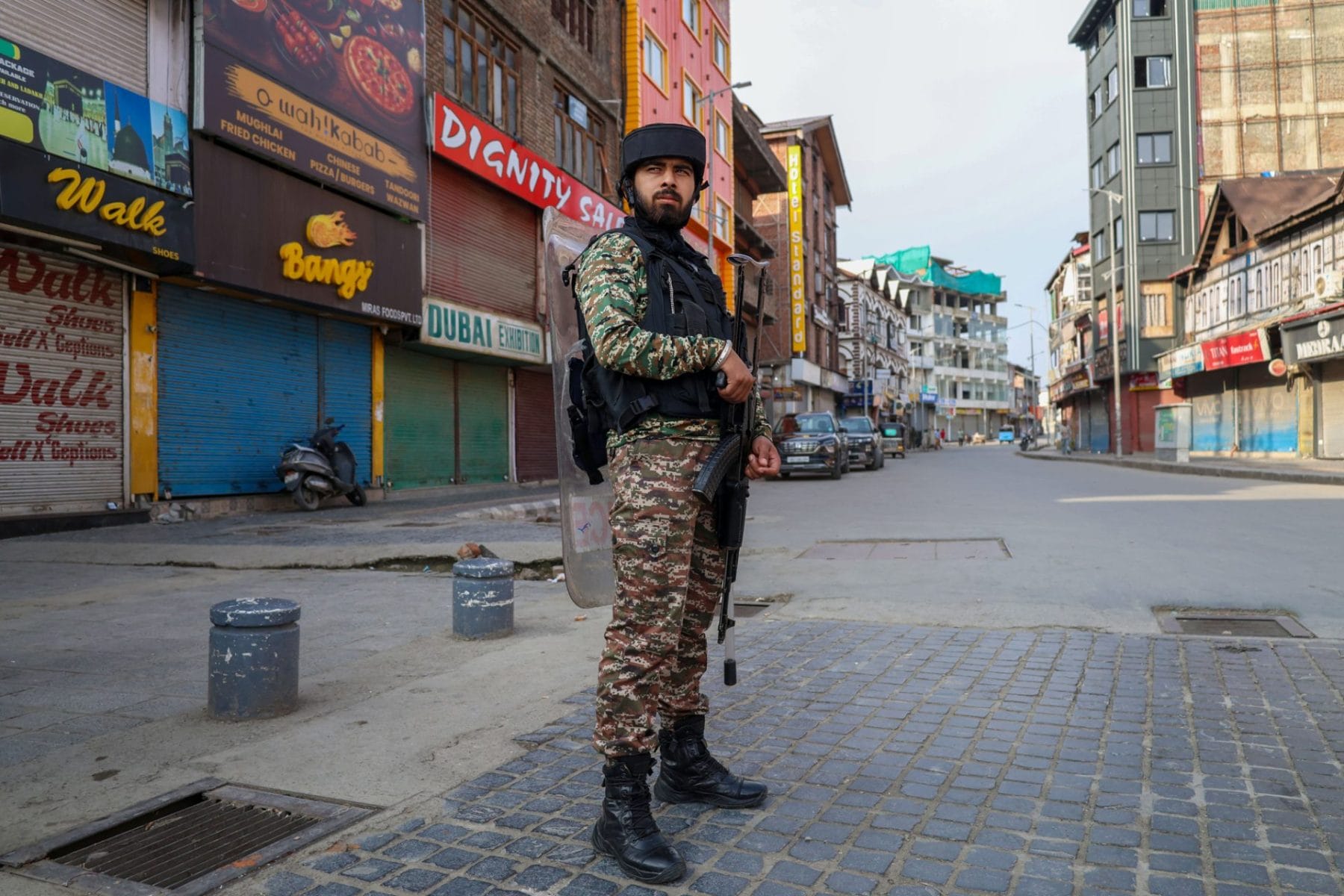
An Indian security personnel in Srinagar, Jammu and Kashmir, August 2026. Firdous Nazir/NurPhoto via Getty Images.
“I can’t say if they’re using Pegasus or some other spyware or technology,” a journalist told me about being interrogated over emails sent to an editor, “but they knew everything about our conversations.” In a 2021 leak, it turned out the Indian government was using Pegasus to spy on at least 40 Indian journalists, only one of who was Kashmiri.
But, a Kashmiri journalist says, “officials have told us ‘nothing in Kashmir is end-to-end encrypted’ and digital activity is clearly being constantly monitored.” No Kashmiri journalist I spoke to for this story, including those who contribute to the ‘Kashmir Times’, have the encrypted messaging Signal app, used worldwide by journalists, on their phones. Devices are routinely checked when journalists are summoned to police stations in Kashmir for questioning. Some said their devices were returned after being tampered with. “You face humiliation and beatings for using Signal and VPNs,” many journalists said. “You can only get away with it if you’re not on their radar,” said one.
In November 2025, the Indian government issued a directive insisting on verifying the “bona fides” of journalists working in Jammu and Kashmir, and the police followed up by requiring journalists to part with personal information including biometrics and bank statements. In January this year, senior journalist Basharat Masood of The Indian Express spent seven hours at a Srinagar police station, then was summoned for three more days and told to sign a bond promising not to “repeat his mistake” – for reporting on the surveillance of mosquea surveillance, even as officials had already admitted to large-scale data collection and verification.
Surveillance normalized
Police also surveil Kashmiris through the use of drone cameras, a network of 1,000 electronic cameras installed at major traffic junctions, and through unrestricted access to people’s social media activity across platforms ostensibly to track anti-India activity. During an illegal “Census 2024” drive, the police collected residents' personal data and GPS-tagged coordinates of homes. And the soon-to-be-rolled-out Jammu and Kashmir-specific digital identity cards that collects the data of entire households, purportedly to ensure the smooth rollout of welfare schemes, has also sparked local anxieties.
Still, as pervasive as the surveillance is, it is journalists that find themselves in the firing line. Any critical word warrants a summons to a police station, interrogation, intimidation and even detention. This happens repeatedly, with journalists never aware of what specific “offence” might trigger a police summons. The reflex, after several such visits to police stations, is self-protection and self-censorship.
A Kashmiri journalist told me that the language the police use to summon journalists for questioning is particularly sinister. It is almost as if the police are enjoying instilling fear. “Aaj dastarkhan par aapki dawat hai”, for instance, is a typical summons. You are invited to a feast, the police say cynically, knowing a journalist is likely to be harshly questioned, even beaten.
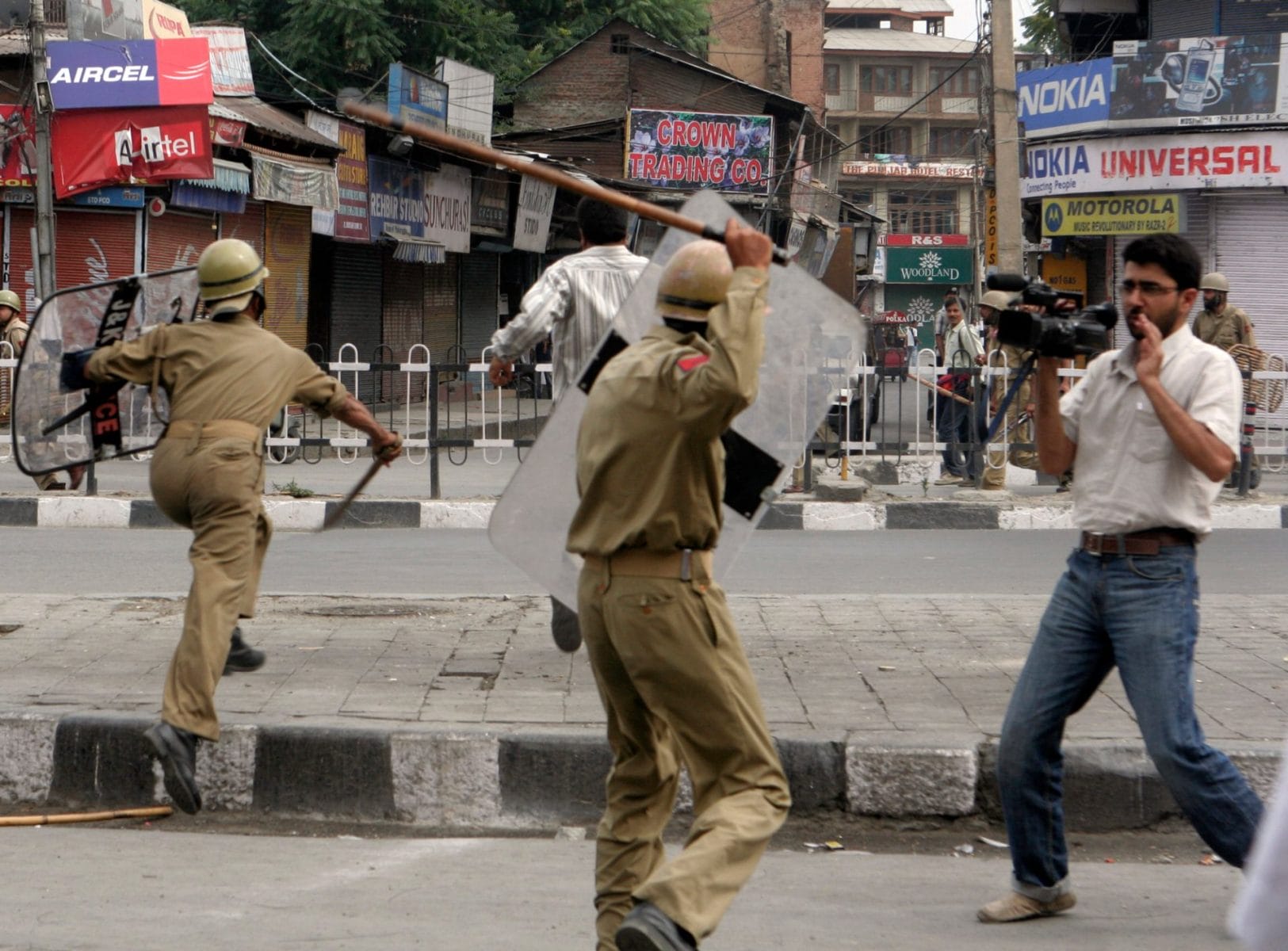
Indian police confront journalists and civilians during a protest on July 10, 2009 in Srinagar in the Indian Administered Kashmir. Yawar Nazir/Getty Images.
Often, Kashmiri journalists, without notice, are placed on no-fly lists. Sanna Irshad Mattoo, a Pulitzer Prize-winning photojournalist, was twice prevented from travelling abroad for exhibitions and award ceremonies, a pointed message that even international recognition offers no protection. At least twelve journalists have had their passports revoked; two of them were already abroad at the time, rendering them stateless.
The Free Speech Collective filed a Right to Information (RTI) query in March 2024 to ascertain exactly how many Kashmiris had had their passports revoked or cancelled. The plea was rejected by the government on grounds of “national security”.
As India continues to press its case as a formidable, if still rising power, citing its 7.8% growth rate over the past quarter, it continues to be defensive and secretive about Kashmir. Foreign journalists are largely barred, or at least heavily restricted, from reporting from both Indian and Pakistani-administered Kashmir. In May, last year, India and Pakistan exchanged air strikes after a terrorist attack in Indian-administered Kashmir and Modi fell out with Donald Trump over the latter’s claim to have stopped both nuclear powers from accelerating towards a disastrous war.
Despite Kashmir being a long-standing issue that merits global attention, reporting from the region has reduced to a trickle.
Mohammad Amin Lara outside his shop in Sopore, Jammu and Kashmir. The shop, once a fully occupied newspaper store, is now a grocery store due to the decline in newspaper sales. Nasir Kachroo/NurPhoto via Getty Images.
A Google search of Kashmir-related news floods your screen with links, but it is bulk without substance. Articles read like a log of official announcements and statements, punctuated by the occasional piece on a shrinking water body, a development project, a political tussle over a non-issue, or unemployment figures. Each report floats like a loose, individual particle suspended in air, packaged and presented as definitive. No investigation into context. No excavation of the past. No interrogation of contributing factors. A story about an alleged terrorist’s hair transplant and cosmetic dentistry, based entirely on police sources, is passed off as an investigation into Kashmiri insurgency. A superficially detailed piece on anti-encroachment drives or home demolitions will carry little beyond the grief of the displaced, or the remarks of a politician whose interest in the community begins and ends with votes. A terrorist’s hair transplant story, based on the police version, passes off as an investigation into Kashmir’s complex insurgency dynamic.
Kashmir fell off the radar a long time ago, says Free Speech Collective’s Geeta Seshu.
Even mundane stories are difficult to report. No one wants to be quoted. A university professor said he could once “talk to journalists and trust they understood the context. Now, a single sentence can be pulled out, circulated on WhatsApp, and suddenly I’m either an anti-national or a government stooge. Both sides will use the same quote to attack you differently. Why would I take that risk?”
Tarushi Aswani, an Indian journalist, told me that “a curtain has been pulled over Kashmir by silencing journalists who ask questions.” Instead, she added, “press release journalism fills the vacuum, erasing the truth about Kashmir, its history, its politics, its development, environment and aspirations.” Kashmir is no longer looking at a mirror. The lack of truthful reporting means nothing is reflected back. Instead, Kashmiris are looking into the lens of a surveillance camera.
*The eight Kashmiri journalists interviewed for this story spoke on condition of anonymity.
Le 9 novembre 1965, New York est frappé par une panne électrique de 12 heures. Et… neuf mois plus tard, tadam, un baby-boom.
Le 15 octobre 1976, Sainte-Luce-sur-Mer est frappé par une panne électrique de 12 heures. Et… tadam, le premier Conseil de la Culture du Québec vient au monde.
Ce soir-là, arrivé tôt à la grande Maison des Clercs de Saint-Viateur, on m’avise de la panne de secteur. Me faut prévenir mes camarades qu’un act of God a balayé les activités de la soirée. Le frère portier me donne accès à son téléphone.
Pendant l’appel, j’observe le frère qui écrit méticuleusement, entouré d’une volumineuse pile de documents, d’une montagne de papiers, éclairé par deux bougies. La scène ressemble à un tableau de Vermeer avec ses ombres qui figent le temps.
L’appel conclu, intrigué, je lui demande quel travail urgent l’oblige à écrire de force pendant cette grande noirceur. « Oh, j’écris un dictionnaire. »« Pardon? » « Un dictionnaire chinois qui permettra aux correspondants épistolaires de relier les 190 langues chinoises et leurs dialectes à la langue standard, le mandarin. »
Vingt-cinq ans missionnaire en Chine, et de retour, il se dévouait beau temps, mauvais temps à cette singulière mission.
Ce même 15 octobre 1976, sous le signe astrologique du Dragon de feu, mourut Chou En-Lai, grand mandarin et premier ministre chinois.
Samedi le 16 octobre 1976, un petit mandarin, sous-ministre aux Affaires culturelles, entame sa conférence devant notre Conseil tout neuf, en citant un proverbe chinois[1] : « Si ce que tu as à dire n’est pas plus beau que le silence, tais-toi. » Puis il jette une douche d’eau froide sur l’assemblée des 250 personnes, venues qui de L’Étang-du-Nord, de Saint-Denis-De la Bouteillerie, qui de Manche-d’Épée, ou de Saint-Fabien.
Il nous dit, sans rire, que notre premier CA, tout juste élu, n’est pas valide, l’État se réservant le droit de nommer les administrateurs. On était jeunes, baveux, et plutôt déterminés. Denis LeBlond, mon équipier du Théâtre les gens d’en bas, dégaine le premier au micro des échanges : « J’aimerais commencer par un proverbe chinois : À beau mentir qui vient de loin! »
Je soumets à votre imagination quatre personnages de BD : Le vilain Mandarin, représentant de Montréal/Babylone et de Québec/Stadaconé, face à Périphérie, du Bas-du-Fleuve, Excentrique de la Gaspésie et Décentrée des Îles-de-la Madeleine. Comment relier les exotiques accents et dialectes des teigneux éloignés, à la langue du Mandarin aux dix anneaux de puissance?
Même singulière mission, beau temps, mauvais temps, que mon frère portier et parfois, même fabrication de miracles, que ce portier de légende, le frère André.
Bien des choses ont été gagnées depuis ce 15 octobre, et tant d’autres restent à l’être. Le jeune homme que j’étais n’aurait pas prévu un développement aussi spectaculaire sur deux générations. Ni le dur désir de durer qui habite les talentueux artistes d’ici et maintenant.
Une part du mérite revient à ces valeureuses équipes qui se sont succédé au Conseil puis à Culture Bas-Saint-Laurent, avec des directions remarquablement stables qui ont revendiqué haut et fort et accompagné nos diamants bruts. Équipes de feu, menées par les Bernard Boucher, Rita Giguère, Ginette Lepage, Julie Gauthier et Dominique Lapointe.
Le jubilaire Conseil est né d’un act of God, en synchronicité avec le signe astrologique chinois du Dragon de feu, symbole de créativité et d’innovation dans les arts. Depuis 50 ans, nous avançons sous le patronage du fantôme de l’électricité. Les enfants de la panne sont partis pour rester!
Texte lu par Eudore Belzile au Vieux-Théâtre de Saint-Fabien le 11 juin 2026 pendant le Party de cuisine de Culture Bas-Saint-Laurent qui célébrait ses 50 ans d’art et de rencontres.
[1] Certains sites web parlent plutôt d’un proverbe arabe
Les résultats d’un sondage réalisé par la firme Segma Recherche pour le compte de Radio-Canada et Le Soleil dévoilent que le Parti québécois aurait la faveur de près de la moitié des électeurs du Bas-Saint-Laurent, soit 46 %, en excluant les indécis.
Legislation proposed by House Democrats aims to address survivors’ financial and medical burdens
Danielle Bensky wants a typical life.
“I would just love to own a house one day and have a dog,” said Bensky, who is among the Jeffrey Epstein survivors advocating for accountability. “I think that’s the dream – literally just to have a normal existence where we’re not trying to fight the government and constantly be facing our own abuse.”
Today’s wealth gap is much bigger, and the country’s richest have much more power than they once did. It’s an Age of Oligarchy
For many, the era of US history that most resembles contemporary America is easy to identify: the Gilded Age.
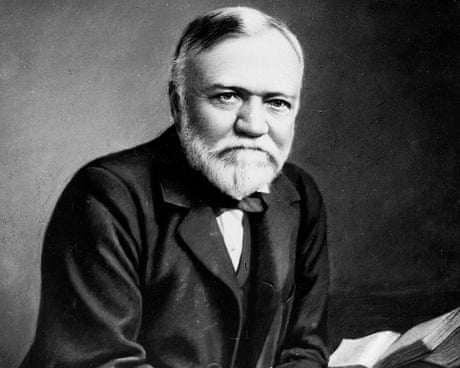
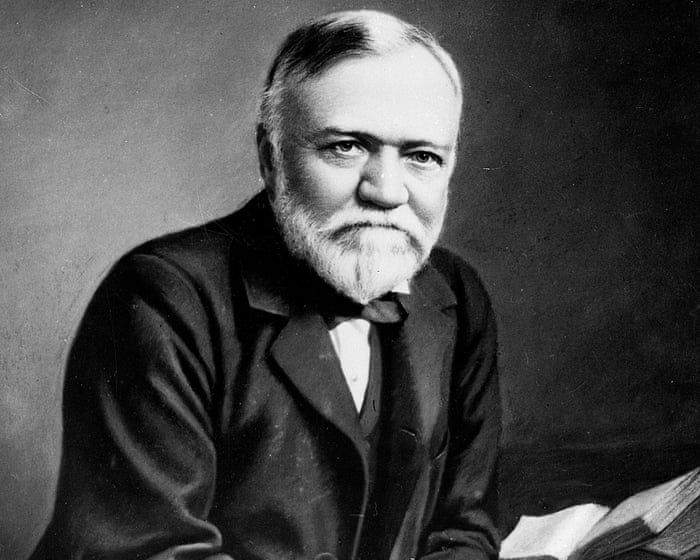
It is, in certain ways, an apt comparison. Like modern America, the Gilded Age saw a small number of men tower over US politics and industry alike. Rising atop a swell of wealth inequality, figures like Cornelius Vanderbilt, Andrew Carnegie and John D Rockefeller mixed private interests with public policy, opening doors in Washington and beyond with ease. Their model is a clear precedent for figures such as Elon Musk, Mark Zuckerberg, Larry Ellison and more.

 Connexion