❌

Vue normale

White House ordered limits on Ukraine’s military satellite service — Reuters. Who made the decision remains unclear

16 octobre 2026 à 07:44

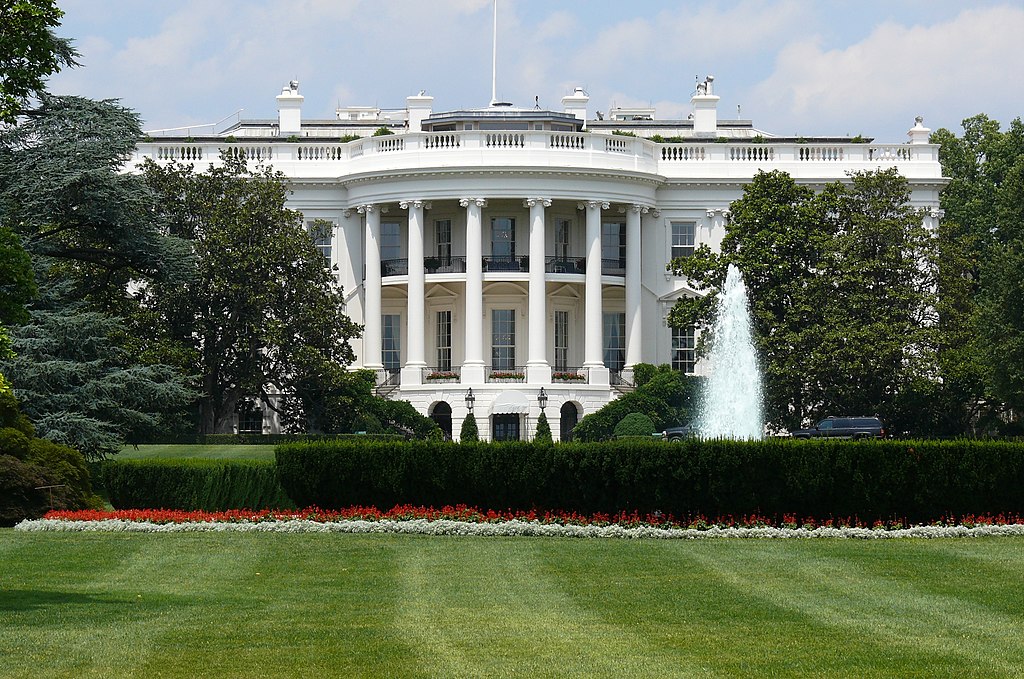
The White House, seen from Lafayette Square. File photo, June 2024.

White House officials instructed Pentagon leaders to limit Starshield, SpaceX’s military-grade satellite service used by Ukrainian forces, Reuters reported on 15 October, citing three officials. The report came a day after a senior US official told Axios the Trump administration had nothing to do with the alleged Starlink restrictions.

Ukrainian forces rely on US-controlled satellite technology for battlefield operations and for intercepting Russian drones aimed at Ukrainian cities, so the latest restrictions have raised questions about how reliably they can depend on it.

    Senior US official denies president requested restrictions

    Asked about the order, a senior US official replied, “No such request was ever made by the president.” The White House did not respond to questions about whether other administration officials might have made the request.

    Ukrainian officials contacted the White House, State Department and Pentagon on 13 and 14 October and were told it was a White House decision

    European allies question Starlink restrictions

    European officials raised concerns about the restrictions. German Foreign Minister Johann Wadephul criticized the throttling and said Ukraine must continue to receive full support, Spiegel reported on 15 October. Wadephul said Germany had questions for the US, noting that Germany finances part of the Starlink technology used in Ukraine.

    On 16 October, UK Defense Secretary Wes Streeting said US Defense Secretary Pete Hegseth had assured him in a face-to-face meeting that Starlink was back up and running, the Guardian reported. However, a Ukrainian Defense Ministry source said that military-grade terminals were working in motion again, but only at speeds of up to 160 km/h.

    New data-speed restrictions disrupted drone missions

    The military Starshield package previously had no data-speed restrictions, Ukraine’s 7th Rapid Response Corps told Novynarnia. Ukrainian officials said that after the restrictions were imposed, terminals disconnected when drones exceeded 160 km/h and sometimes at 80 km/h.

    The Corps also reported 10–20-second connection drops at 110–120 km/h on the Huliaipole front, which made drones harder to control. One unit had to cancel some missions.

    The restrictions came as US President Donald Trump pressed Kyiv to stop striking Russian oil refineries, blaming them for soaring energy prices ahead of November’s midterm elections. Ukraine suspects SpaceX imposed the restrictions to pressure Kyiv over the refinery strikes, but that motive has not been confirmed.

    Trump calls Ukraine’s renewed refinery strikes “a disgrace” after Russia’s 39-missile strike on its energy sites

    16 octobre 2026 à 07:09

    again trump presses zelenskyy stop russian refinery strikes · post ukrainian president volodymyr meets donald ankara türkiye 8 2026 presidentgovua ukraine news reports

    US President Donald Trump called Ukraine’s renewed strikes on Russian oil refineries a disgrace in an interview with Newsmax and questioned President Volodymyr Zelenskyy’s will to settle the war on 15 October. His statements came after he made a deal with Russian President Vladimir Putin to allow Russian diesel back into the US ahead of the mid-term elections in the US.

    Kyiv says its long-range strikes have knocked out more than half of Russia's refining capacity, one of the few levers it controls on Moscow's war income, according to Ukraine's Defense Ministry. This is part of efforts to reduce the aggressor's capabilities to launch assaults, including the latest, during which four Russian regions fired 39 Iskander-M, North Korean KN-23, hypersonic Zircon, and supersonic anti-ship cruise Oniks missiles, Zelenskyy said.

    Trump criticizes Zelenskyy over oil prices while remaining silent on Russian strikes

    Earlier, Zelenskyy said that Ukraine stopped refinery strikes for three days to meet US wishes after Trump announced an “energy ceasefire” on 11 October. At the same time, Russia struck a Kharkiv heat-and-power plant within hours of the announcement, he emphasized.

    Meanwhile, in the interview with Newsmax, Trump said Zelenskyy is only pushing world oil prices higher.

    “Well, I think that’s a disgrace,” he said.

    He added that Ukraine has other options: “There are a lot of targets that you can hit.”

    At the same time, Trump didn't say a word about Russian strikes on Ukraine's civilian buildings and power infrastructure ahead of the winter.

    Trump compares Zelenskyy to a circus showman

    The US leader said he is “not a big fan” of Zelenskyy. He claimed both sides “would like to see it end,” but that he finds Zelenskyy “more difficult to deal with than Putin.”

    Kremlin welcomes Trump National Security Strategy as aligned with Russian vision on Ukraine
    Explore further

    US weighs relief for sanctioned shadow fleet tankers, days after freeing Russian diesel

    He also said that he believes the depletion of US ammunition stockpiles is linked to the aid provided to Ukraine under the Biden administration, rather than the war with Iran.

    Ukraine has repeatedly offered to help the US counter Iranian drones during the operation. The New York Times reported that a Ukrainian team departed the day after the US made such a request.

    Nevertheless, despite Kyiv’s offers and actions, Trump once again compared Zelenskyy to P. T. Barnum, the 19th-century American circus showman, saying that he received a tremendous number of Patriots and Tomahawks.

    However, there is no public confirmation that Tomahawk missiles were transferred to Ukraine during the Biden administration.

    Trump’s Deal With Russia Inflames Ukraine War He Vowed to End

    15 octobre 2026 à 21:02
    The Ukrainian president’s defiant decision to continue attacking Russian refineries underscores President Trump’s inability to end a war he had promised to resolve.

    © Doug Mills/The New York Times

    President Trump during a campaign stop in Alaska on Tuesday. He has not delivered on his promises to end the war in Ukraine, or to lower prices, and recent deals with Russia could complicate both issues.

    Trump’s Deal With Russia Inflames Ukraine War He Vowed to End

    15 octobre 2026 à 21:02
    The Ukrainian president’s defiant decision to continue attacking Russian refineries underscores President Trump’s inability to end a war he had promised to resolve.

    © Doug Mills/The New York Times

    President Trump during a campaign stop in Alaska on Tuesday. He has not delivered on his promises to end the war in Ukraine, or to lower prices, and recent deals with Russia could complicate both issues.

    After Trump, Musk tells Ukraine’s president to go. Zelenskyy says he won’t resign and will never accept Ukrainian land as Russian

    15 octobre 2026 à 08:49

    musk tells ukraine’s president go zelenskyy says won’t resign never accept ukrainian land russian · post volodymyr during interview piers morgan recorded visit britain 14 2026 video uncensored / ukraine

    Tech billionaire Elon Musk wrote on X on 15 October: “And so the slaughter continues … Time for Zelensky to go.” Four days earlier, he had posted that Zelenskyy had gone too far, after US President Donald Trump said it was time for Ukraine to get a new president. Asked by Morgan on 14 October whether he would resign, Zelenskyy said he would not: “It’s my responsibility.”

    Musk’s post comes as Washington squeezes Kyiv instead of Moscow: Ukraine’s military satellite links slowed, US missile warnings went missing, and the US threatened to cut intelligence unless Kyiv stops hitting Russian refineries.

    Land and elections

    Zelenskyy said elections could not be held under constant Russian attack: “From the point of security, you can’t do elections.”

    Of any future president, he said: “I’m sure the new man or woman will defend our country.” He also reminded Trump that Crimea and parts of Donbas were already occupied when he took office, under another president, long before the full-scale invasion.

    “I’m a realist, and I understand that people are more important than one kilometer or two kilometers. It’s not about kilometers. It’s about land and homes,” he told Morgan.

    Zelenskyy has said Ukraine is ready for elections if a full 60-day ceasefire is in place. Numerous sources told The Atlantic that Trump sees Zelenskyy as the main obstacle to a peace deal and related business deals with Russia. One Trump adviser said he is also an obstacle to Trump’s hopes for the Nobel Peace Prize.

    Starlink

    Ukrainian forces reported restrictions on Starshield, the SpaceX satellite system they use for battlefield communications and drone operations, and Zelenskyy warned the decision would cost lives. On 14 October, Musk said Starshield is owned and controlled by the US government, which sets its limits, and that commercial Starlink cannot be used for offensive military action. Zelenskyy told the FT he did not know whether the decision was SpaceX’s or the US government’s, adding: “I think it’s about SpaceX.” A senior US official told Axios the Trump administration had nothing to do with the restrictions.

    Intelligence and refineries

    On two consecutive nights, air raid alerts in Kyiv sounded only after Russian ballistic missiles were already approaching or striking the capital. Zelenskyy said Ukraine received no warning from partners of the launches on 12 and 13 October, which hit civilian infrastructure and a major power plant. A Ukrainian official told CNN the loss of intelligence “will give Russians a real leverage on a frontline.” A European official questioned Washington’s explanation that weather caused the gaps in missile warnings. Trump denied halting intelligence sharing.

    Washington had warned it could suspend intelligence sharing if Ukraine kept striking Russian refineries, Axios reported. A US official disputed that any explicit threat was made. Sources told CNN the US had also threatened to halt European purchases of US weapons for Ukraine. Zelenskyy told the FT the warning came through military channels.

    To lower energy costs before next month’s midterm elections, Trump has pressed Kyiv to stop refinery strikes, CNN reported. Zelenskyy said he felt betrayed after Trump announced a diesel supply deal with Russia. On 14 October in London, he told the FT that Ukraine would resume strikes on Russian oil refineries.

    Musk pointed at the US military over Ukraine’s satellite limits. Now a US official says the administration had nothing to do with them

    15 octobre 2026 à 06:43

    The Starlink logo on a smartphone screen.

    Ukrainian officials contacted the White House, CIA, and Pentagon after the restrictions, which Ukraine says affected both Starlink and Starshield, Axios reported on 14 October. A senior US official told Axios the Trump administration had nothing to do with the restrictions. On the same day, Elon Musk said on X that Starshield systems are owned and controlled by the US government, and that any speed or usage limits are decided by the US military and ultimately the president.

    The restrictions could affect Ukraine’s ability to intercept Russian attack drones and carry out mid-range strikes against Russian forces and military targets in occupied Ukrainian territories. A speed cap of 160 km/h was insufficient to intercept some jet-powered drones, an unnamed Ukrainian official told Axios. Ukrainian officials told Axios they suspect SpaceX imposed the restrictions to pressure Kyiv to accept US President Donald Trump’s demand to stop striking Russian oil refineries, though the motive remains unconfirmed. But Starlink does not work inside Russia, and the drones attacking Russian oil facilities use other communications systems, according to Reuters.

    What Musk and the White House said

    Musk did not directly address the throttling, Axios noted. Starlink, he wrote, “is a commercial service owned and controlled by SpaceX,” limited to civilian or defensive use.

    White House officials told the Ukrainians they don’t have control over SpaceX, two sources told Axios. One said the administration would reach out to SpaceX to figure out what happened. The White House did not immediately respond to Axios’s request for comment.

    How the cap disrupted drone missions

    Presidential adviser Serhii Beskrestnov said on 14 October that SpaceX had imposed a 160 km/h limit on Starshield’s “military package” overnight without warning. Ukraine’s 7th Rapid Reaction Corps said mid-range strike drones must reach high speed quickly and that an unstable connection “will make it impossible to launch such aircraft or use them as intended.” One unit on the Huliaipole front had to cancel some missions, the corps told Novynarnia.

    ukraine goes back hitting russian oil after its trump-forced pause left kyiv without warnings incoming ballistic missiles · post ukrainian president volodymyr zelenskyy during interview piers morgan london 14 2026
    Explore further

    Ukraine is going back to hitting Russian oil after its Trump-pressured pause, during which Kyiv got no US warnings of incoming ballistic missiles

    Ukrainian officials told Axios the system turned off when drones exceeded 160 km/h, and sometimes 80 km/h, before service was partially restored on 14 October. The Defense Ministry said SpaceX continues to restrict Starlink to 160 km/h and that it remains in communication “with partners and SpaceX regarding stable service conditions and the prevention of sudden restrictions,” Axios reported.

    A diesel deal

    The restrictions followed Trump’s 9 October deal with Russian President Vladimir Putin easing sanctions on Russian diesel. A day later, Trump told reporters: “We said you could do whatever you want to Russia, don’t hit the refineries,” the Kyiv Independent reported.

    Zelensky Says Ukraine Will Resume Russian Refinery Strikes, Defying Trump

    16 octobre 2026 à 12:07
    President Volodymyr Zelensky expressed overt frustration with the United States in an interview with The Financial Times. He had paused the strikes to comply with a demand from the United States.

    © Pool photo by Henry Nicholls

    President Volodymyr Zelensky of Ukraine in London on Wednesday.

    Ukraine is going back to hitting Russian oil after its Trump-pressured pause, during which Kyiv got no US warnings of incoming ballistic missiles

    15 octobre 2026 à 03:25

    ukraine goes back hitting russian oil after its trump-forced pause left kyiv without warnings incoming ballistic missiles · post ukrainian president volodymyr zelenskyy during interview piers morgan london 14 2026

    Ukraine will resume strikes on Russian oil refineries, ending a three-day pause it held at Washington’s request, Ukrainian President Volodymyr Zelenskyy told the Financial Times in an interview published on 15 October. Russia kept bombing Ukraine’s energy system throughout the pause, while Kyiv lost US missile warnings and its Starlink service slowed. Zelenskyy said Ukraine would halt energy strikes again only in exchange for more US air defense.

    Ukraine's deep-strike campaign targets the Russian oil industry, which fuels Russia's army in Ukraine and earns the export revenue funding the war. Striking the plants that turn Russian crude into fuel, 12 of them hit in September alone, is one of the few levers Kyiv controls on Moscow’s war income. US President Donald Trump has blamed those strikes for higher US fuel prices, which most analysts attribute to the Iran war, and Washington has threatened to withhold intelligence, and reportedly weapons, unless Kyiv gives it up. Each step Washington takes toward Moscow, from fuel waivers to talk of frozen assets, widens the gap Europe and Ukraine must fill, while Russia gains revenue and time to keep striking.

    A pause that bought nothing

    Zelenskyy said he stopped the refinery strikes for three days to meet US wishes, but Russia kept hitting Ukraine’s energy infrastructure and killing civilians. During the pause, Ukraine received no US warnings of ballistic missile launches, he said. Starlink also slowed across the country, hampering front-line operations and mid-range strikes on Russian military targets, he added.

    Russia used those days to fire 39 ballistic missiles and more than 120 drones at Ukraine’s grid overnight into 14 October, leaving at least 600,000 people without power. “We hold energy ceasefire from our side,” Zelenskyy told Piers Morgan on 14 October. Of the Starlink slowdown, he added: “I’m sure that they knew what they did.”

    The price of another pause

    Ukraine could again stop hitting Russian energy only if it receives more US interceptors for its Patriot systems, Zelenskyy told the FT. He warned that a halt could simply invite more US-Russia deals that feed Russia’s war machine, and predicted the next one would involve gas.

    kyiv asking musk let strike inside russia its best line gone · post elon 2026 world economic forum / ciaran mccrickard wef ukraine news ukrainian reports
    Explore further

    “Starshield systems are owned and controlled by the US government”: Musk says Trump, not SpaceX, is behind cut hitting Ukraine

    US intelligence officials had warned Ukraine’s embassy in Washington that a new strike on Russia’s energy facilities would end all intelligence sharing at once, The Washington Post reported, citing a person familiar with the matter. Washington has not fully cut it off, but the threat stands, the person said. Trump said on 13 October that the US was still sharing intelligence.

    Washington’s other moves toward Moscow

    A senior US official told Axios the administration had nothing to do with the Starlink limits, which Elon Musk had blamed on the US military. The administration is also considering easing sanctions on shadow fleet tankers, which have carried oil from Russia, Iran, and Venezuela, so the blacklisted vessels could haul non-sanctioned cargo, a US official told Reuters. The US Energy Department said the move would not help Russia ship its oil or fuel.

    Washington eased sanctions on Russian oil this spring, after which Russia’s oil income jumped $890 million in a week, and it extended that waiver despite telling allies it would not. US envoys also proposed unfreezing part of Russia’s frozen assets to lure Moscow back to talks, an idea European officials rejected, the Financial Times reported.

    Ukraine says it hit 12 Russian refineries in September. No refinery strikes reported since Trump’s “energy ceasefire”

    13 octobre 2026 à 09:45

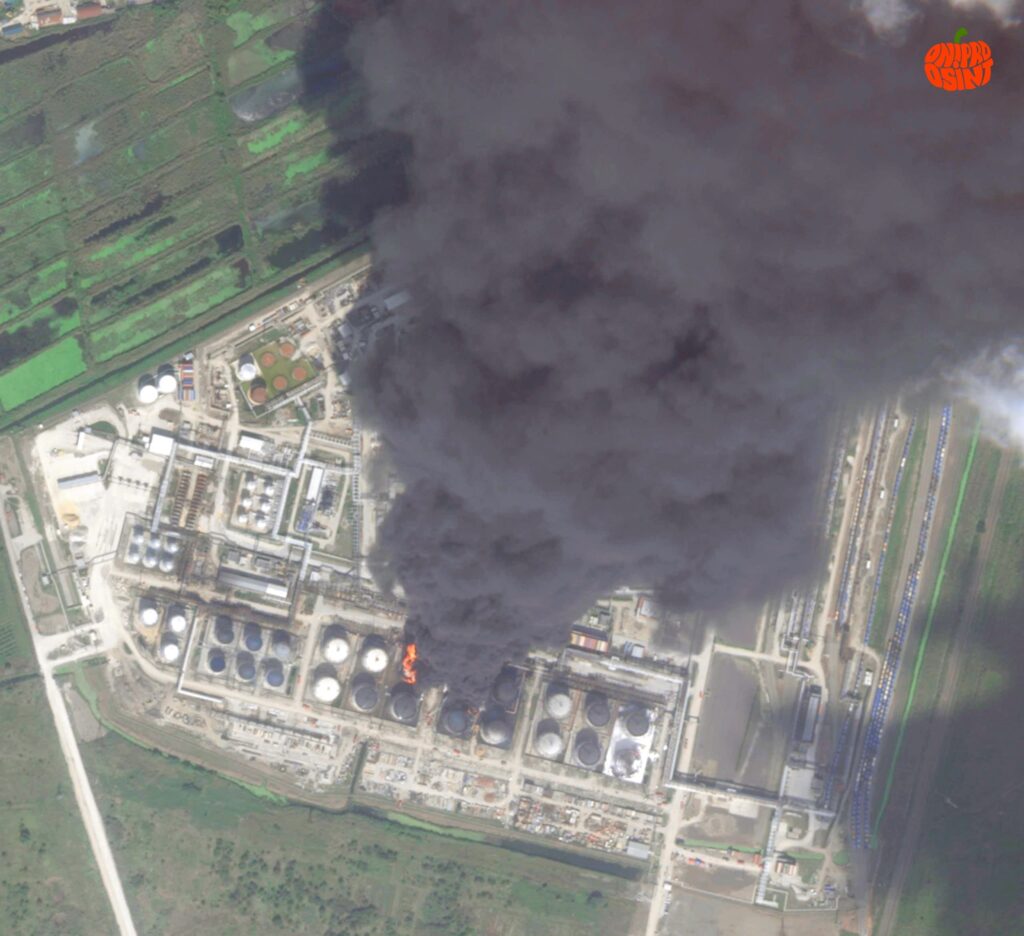
    Satellite imagery of the Slavyansk oil refinery after a nighttime UAV attack on 13 September. Part of the refinery is obscured by thick smoke from a fire in the tank farm, Krasnodar Krai, Russia. Photo: Dnipro Osint

    Ukrainian forces hit 12 large Russian refineries in September, Ukraine’s Ministry of Defense said, according to ArmyInform on 12 October. The farthest on the ministry’s list, Lukoil’s refinery in Perm, lies about 1,500 kilometers from Ukraine’s border. Since Trump's 11 October announcement, Euromaidan Press has found no reports of new Ukrainian refinery strikes in the official and unofficial Ukrainian and Russian sources it monitors.

    A refinery-for-refinery pause would limit Ukraine’s ability to disrupt Russia’s oil industry while leaving Moscow free to keep attacking Ukraine’s energy system, giving Russia an advantage in a war where both sides use energy infrastructure as a target. The issue has become urgent since Trump announced an “energy ceasefire” on 11 October, after which Ukraine reported holding off strikes on Russian energy facilities while Zelenskyy said Russia attacked several Ukrainian energy sites.

    The campaign continued into October. Ukraine’s General Staff said Ukrainian forces struck the Samara oil pumping station overnight into 10 October, the third attack on the station that month, according to Radio Svoboda.

    Ukraine held off, Russia hit six energy sites

    Zelenskyy said Ukraine had refrained from striking Russian energy facilities overnight on 11–12 October following Trump's announcement. Monitoring channels and official Russian sources did not report any new refinery strikes on 13 October.

    “Last night, we did not attack any energy facilities on the territory of Russia because President Trump said that there would be an energy ceasefire,” Ukrainian President Volodymyr Zelenskyy said.

    He added that Ukraine does not announce its next operational steps. Zelenskyy said Russia attacked six Ukrainian energy facilities on 12 October alone, according to Radio Svoboda.

    Refineries first, power plants possibly later

    A White House official told Axios that the proposal would begin with both sides halting attacks on oil refineries, with a possible agreement covering power plants to follow. Axios reported that Russia had not accepted a ceasefire.

    The Institute for the Study of War (ISW) said the proposal, as described, would give Russia a major concession without offering Ukraine anything in return: Russia has scores of operating refineries, while Ukraine has one. ISW also said the proposal would allow Russia to continue its winter strikes on Ukrainian power stations.

    “Now it’s your turn”: US envoys planned to show Moscow a refinery pause and a diesel deal, then ask for something back, a source tells Reuters

    13 octobre 2026 à 07:54

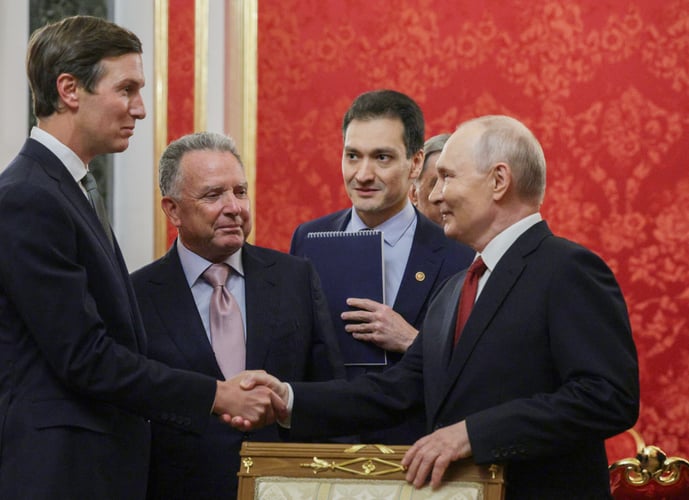
    “now it’s turn” envoys planned show moscow refinery pause diesel deal ask something back tells · post jared kushner shakes hands russian president vladimir putin special envoy steve witkoff beside

    US President Donald Trump’s envoys told Kyiv that letting Russia sell diesel could draw Moscow back to peace talks, Reuters reported. In the same meeting, they said Russia’s leader was not ready to negotiate. Since then, Moscow has offered nothing in return, and Trump has brushed off claims that Russia helps Iran.

    Washington is pressing Ukraine to stop striking Russian refineries and offering Moscow economic incentives to return to peace talks, even though Russia has made no commitment in return. Yesterday, Russian ballistic missiles hit Kyiv before air raid sirens sounded, amid disputed warnings that the US could cut intelligence support. Meanwhile, Ukraine is being asked to halt its long-range campaign against the oil infrastructure that fuels and finances Russia's war.

    The pitch: a diesel deal as a signal to Moscow

    Trump’s Middle East envoy Steve Witkoff and Trump’s son-in-law Jared Kushner met the Ukrainian delegation in Miami on 9 October. They described Russian President Vladimir Putin as unprepared to negotiate but said the diesel deal could help restart three-way talks, two of the sources said.

    The third source said the deal could “soften” Moscow because it “sends a signal that Trump is open to do things” with Russia. One of the sources described the plan:

    “The idea was that the US could go back to Russia and say ‘See, the Ukrainians stopped striking and we gave you this deal. Now it’s your turn to do something.’”

    Ukraine’s part was to stop hitting Russian refineries. Kushner repeated Trump’s request at the meeting, noting the administration had made it several times, two sources said.

    trade banks energy crypto—the eu keeps its full russia economic sanctions wall standing 2027 · post flags member states headquarters council european union brussels belgium 17 2025 getty images/thierry monasse
    Explore further

    EU blacklists 1,569 Russian arms suppliers and their bosses in its biggest sanctions round ever, as Trump eases up on Moscow

    Kyiv was asked to hold its fire on Russian oil

    The Ukrainians agreed to nothing formally, Reuters’ sources said. They signaled they would accept an energy ceasefire if Russia did the same, but saw the US approach as an attempt to appease Russia with business deals.

    Two days later, Trump declared an energy ceasefire, and Ukrainian President Volodymyr Zelenskyy said Ukraine was ready if Russia reciprocated. Euromaidan Press has monitored official and unofficial Ukrainian and Russian sources and found no reports of new Ukrainian strikes on Russian refineries after Trump’s announcement. One of the last, on the night of the diesel announcement, knocked out more than half the tanks at a fuel-export terminal in Rostov-on-Don.

    Three sources told Reuters the envoys did not threaten to cut US support over the refinery strikes. A Ukrainian official told Axios, however, that the envoys warned Trump could cut Ukraine off from US intelligence, which a US official denied. US officials are also believed to have told European allies that Trump would halt PURL, the NATO scheme for Europe-funded US weapons for Ukraine, unless the strikes stopped, according to FT.

    U.S. President’s envoys, Steven Witkoff and Jared Kushner on 6 September in Kyiv. Source: President's Office of Ukraine
    Explore further

    Ukrainian journalist asks Trump’s envoy to his face whether he was disgusted to sit across from “international criminal” Putin. Witkoff wouldn’t answer directly

    What Moscow has offered in return

    A person close to the Kremlin told Reuters that Putin would return to the table only when he gets “the remaining 11% of Donbas.” Ukraine refuses to cede more land. During the 9 October call that produced the deal, Putin declined to commit to resuming talks, his aide Yuri Ushakov told reporters, Axios reported.

    Moscow has not confirmed the energy ceasefire either. Trump insisted on 12 October that the sides had agreed “because I said they agreed,” RFE/RL reported. On the evening of 12 October, Russian munitions collapsed an apartment stairwell in Kharkiv, killing four people. Russian Deputy Prime Minister Aleksandr Novak, meanwhile, claimed diesel exports could reach 3.0–3.5 million tons a month by year-end, above the volumes Trump announced.

    “Too much to lose”: Trump on Russia and Iran

    Late on 12 October, Trump wrote on Truth Social that he did not believe Russia and China were helping Iran, since they have “too much to lose.” In March, he told Fox News that Putin “might be helping them a little bit.” Asked about Russia’s possible support for Iran, Treasury Secretary Scott Bessent told Fox News on 2 September that his message to everyone was to “stay away.” That month, a Financial Times investigation found Russia secretly helping Iran develop supersonic cruise missiles that could threaten US warships.

    “We don’t need to hit the entire plant”—Ukraine’s drones go for refinery parts sanctions make hard to repair

    13 octobre 2026 à 05:06

    Satellite imagery of the Slavyansk oil refinery after a nighttime UAV attack on 13 September. Part of the refinery is obscured by thick smoke from a fire in the tank farm, Krasnodar Krai, Russia. Photo: Dnipro Osint

    Ukrainian drones have helped push Russia into its worst fuel crisis since the Soviet Union fell, The Washington Post (WaPo) reported on 11 October.

    Diesel is where this war reaches American drivers. US President Donald Trump blames rising diesel prices mostly on Russia’s war in Ukraine, while experts blame mainly the US war with Iran. Some of his allies now accuse Kyiv of trying to sway the US midterms.

    Drones go for the first stage of refining

    The Washington Post looked at dozens of strikes between 1 April and 31 August. Three refinery experts then examined satellite images of 54 strikes with visible damage. In over half, the damage seems to be to the desalting and distillation units, known by the Russian acronym ELOU-AVT. These units clean the crude of water and salt, then split it into separate compounds, the first steps toward gasoline and diesel. More than a third appear to have hit secondary units, which turn those compounds into jet fuel, gasoline, and liquefied petroleum gas.

    From April through August, drones struck two-thirds or more of the 36 big Russian refineries that S&P Global Energy tracks, a strike every third day. Some took as many as five hits. On 16 June, drones set the Moscow refinery’s distillation towers on fire. That strike and a second one days later kept the plant offline into September, WaPo reported, citing data firm Kpler. Ukraine targeted the refinery again on 20 September.

    The White House in Washington DC, USA. Illustrative image: Wikimedia Commons.
    Explore further

    Trump’s Russian diesel deal, which drew fury in Ukraine, is unlikely to lower prices, experts say

    “We don’t need to hit the entire plant,” a Ukrainian drone battalion commander with the call sign Tango told The Washington Post. Ukraine knows where to strike so that a refinery stops and stays down, he said. His unit, Ukraine’s 1st Separate Center of Unmanned Systems, runs long-range strikes deep inside Russia.

    Sanctions slow the repairs

    The EU banned exports of oil-refining equipment to Russia the day after the 2022 invasion, and the US followed days later. WaPo reported that the bans cover the distillation and secondary processing units Ukraine keeps hitting. The bans make spare parts hard to get, Alexander Kolyandr of Eurasia Group told the paper, and the strikes come faster than repairs.

    Since last year, Ukraine has doubled the size of each wave, decoys included, a person involved in the strike campaign told WaPo. The decoys are unarmed and draw Russian fire, wasting air-defense ammunition, WaPo explained. Without them, the person said, Ukraine would simply lose expensive systems. András Rácz of the German Council on Foreign Relations told WaPo that even if only 2–3% of drones get through, the damage is significant.

    Trump Gives Putin a Hand in Russia’s Economic War With Ukraine

    12 octobre 2026 à 12:20
    President Trump is moving to buy Russian diesel while also pressuring Ukraine to halt attacks on refineries, a lifeblood of Moscow’s war machine.

    © Reuters

    Smoke rising from fires at an oil refinery after what the authorities said was a Ukrainian drone strike in Moscow last month.

    Deals with dictators lead to hell: Estonia’s PM urges Europe to help Ukraine destroy Russia’s refineries after Washington eased sanctions on diesel

    10 octobre 2026 à 18:06

    estonian capital allocates € 200000 ukrainian cities development view tallinn estonia tallinnee city introduces program supporting municipalities aid expertise sharing eu integration initiatives estonia's launched new cooperation support 2025 city's

    Estonia’s answer to the US-Russia diesel agreement: deals with dictators lead to hell. Prime Minister Kristen Michal wants the European Council to discuss giving Ukraine more aid so it can destroy Russia’s oil refineries, after sharply criticizing the US decision to strike a diesel deal with Russia, ERR reports.

    Washington has eased sanctions on Russian diesel, a move Ukraine says funds a war that has killed more than 80 Ukrainian civilians in two days. Estonia’s answer is to go the opposite way and help Ukraine hit the source of that fuel, the refineries, harder.

    "It is worth discussing in Estonia and at the European Council next week whether we can quickly contribute more to Ukraine so they can blast Russia's oil refineries to smithereens," Michal says.

    He casts the US deal as a historic error. Innocent people are being killed for gas and fuel money, Michal warns, saying that the promised fuel may never arrive. For years, the US urged allies to drop Russian fuel, and Estonia did, so cutting Moscow’s revenue must continue, not reverse, he adds.

    Mihkelson: Russia's strategic goals remain unchanged

    Meanwhile, Marko Mihkelson, chair of the Riigikogu Foreign Affairs Committee, says that Russia's strategic objectives remain the same as they were before: to rebuild its empire, beginning with the subjugation of Ukraine, and to dismantle the Euro-Atlantic system of collective defense.

    "That is why European allies still have only one way to prevent this war of aggression from spreading: to do everything possible to ensure that Russia’s strategic objectives fail and that the imperial wars launched by the Kremlin end in defeat," he says.

    This clear strategic objective should also serve US interests, he continues, adding that "Russia’s long-standing ambition, pursued in concert with China and Iran, to undermine America’s global leadership is entering a decisive phase."

    Rebuking Ukraine Over Oil Strikes, Trump Says It Should ‘Get a New President’

    10 octobre 2026 à 15:28
    Hours after President Trump said the United States would buy Russian diesel, the Kremlin said there would be no immediate resumption of discussions to end the war.

    © Haiyun Jiang/The New York Times

    President Trump at a campaign rally in Syracuse, N.Y., on Friday. His announcement that the United States would buy Russian diesel was followed by the lifting of U.S. sanctions on Russian diesel exports.

    Russia sells cheaper fuel abroad and pays to keep its own pumps running amid Ukraine’s refinery strikes, but crude money still flows

    9 octobre 2026 à 08:33

    ukraine says its strikes have knocked out 51% russia's oil refining capacity · post flames saratov refinery after reported ukrainian drone strike 2 2026 image_2026-08-02_14-32-39 news reports

    Russia's seaborne exports of refined oil products rose to a three-month high in September, but the growth came from cheaper fuel oil and naphtha as diesel shipments fell to their lowest in more than a decade, Bloomberg reported, citing Vortexa data. Russia kept diesel at home after Ukrainian refinery strikes and paid oil companies to supply its pumps, while high crude prices lifted its crude export earnings.

    During the ongoing deep-strike campaign, Ukraine's long-range drones have knocked out more than half of Russia's oil refining capacity, Kyiv says, and Russia's budget oil revenues are falling even as it raises war spending. High global crude prices are softening that blow.

    Cheaper fuel out

    Total seaborne product exports reached about 1.17 million barrels a day in September. Fuel oil shipments rose 6% to about 613,000 barrels a day, the highest since April. Naphtha, a feedstock for petrochemicals, jumped 35% to 363,000 barrels a day. Exports of refinery feedstocks, including vacuum gasoil, rose to about 32,000 barrels a day, according to Bloomberg.

    The trade has moved north. Almost 80% of fuel oil cargoes left from Baltic ports, and naphtha loadings there rose almost 50% as Ukrainian attacks disrupted Black Sea infrastructure. In September, Ukraine reported hitting an oil terminal in Novorossiysk, Russia's main Black Sea oil port—one in a string of attacks on Russia's Black Sea ports and oil sites.

    more than 500 drones moscow’s count kh-101 fuel plant second yandex data center far-north refinery hit · post smoke over ukhta komi republic after reported drone attack lukoil 9 2026
    Explore further

    More than 500 drones by Moscow’s count: Kh-101 fuel plant, second Yandex data center, and a far-north refinery hit

    Diesel kept at home

    Diesel and gasoil exports fell 28% to 144,000 barrels a day, the lowest monthly volume in Vortexa data going back more than a decade. Russia has restricted diesel exports to protect domestic supply after Ukrainian attacks on its refineries. Drones kept hitting them into October, from a Lukoil refinery in Volgograd to Gazprom's Salavat complex in Bashkortostan.

    In September, Russia paid oil companies the biggest subsidy in more than four years to keep road fuel on the domestic market. It also imported about 350,000 tonnes of motor fuel by sea, mostly gasoline from India, Morocco, and Türkiye, Reuters calculations showed. Officials are considering letting some producers resume diesel exports in October to avoid overstocking, according to Interfax.

    The diesel squeeze has reached the White House. US President Donald Trump stated on 30 September that diesel was hurt "not by the Middle East, but by what's going on in Russia, because those diesel refineries are being knocked out at a pretty alarming rate."

    Crude carries the revenue

    Russia's crude exports reached about 3.99 million barrels a day in the week to 27 September, and the estimated value of its seaborne crude shipments neared its highest since the full-scale invasion began, Bloomberg reported. Brent crude traded at about $102.60 a barrel on 9 October, according to Trading Economics data.

    Drone attack forces Yandex to shut down its data center on the grounds of a sanctioned Russian machine-tool plant

    8 octobre 2026 à 08:28

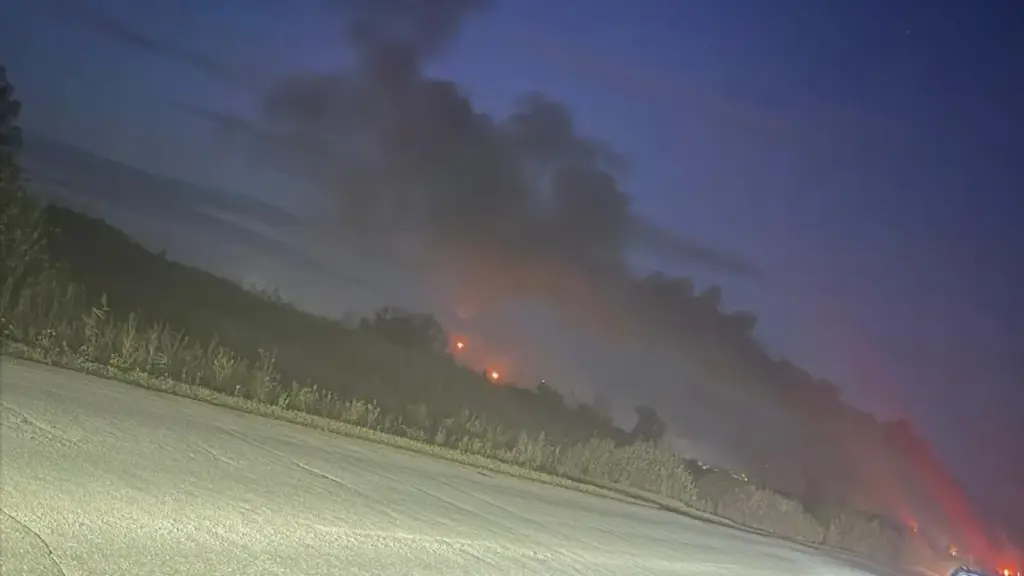
    Smoke over Salavat following an attack on the night of October 8.

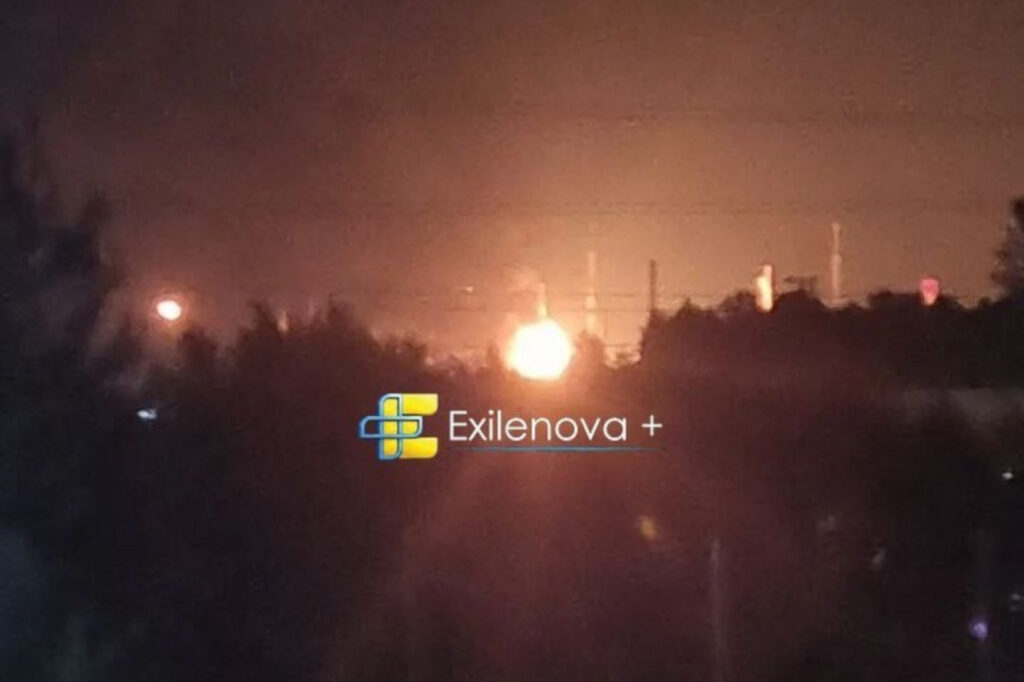
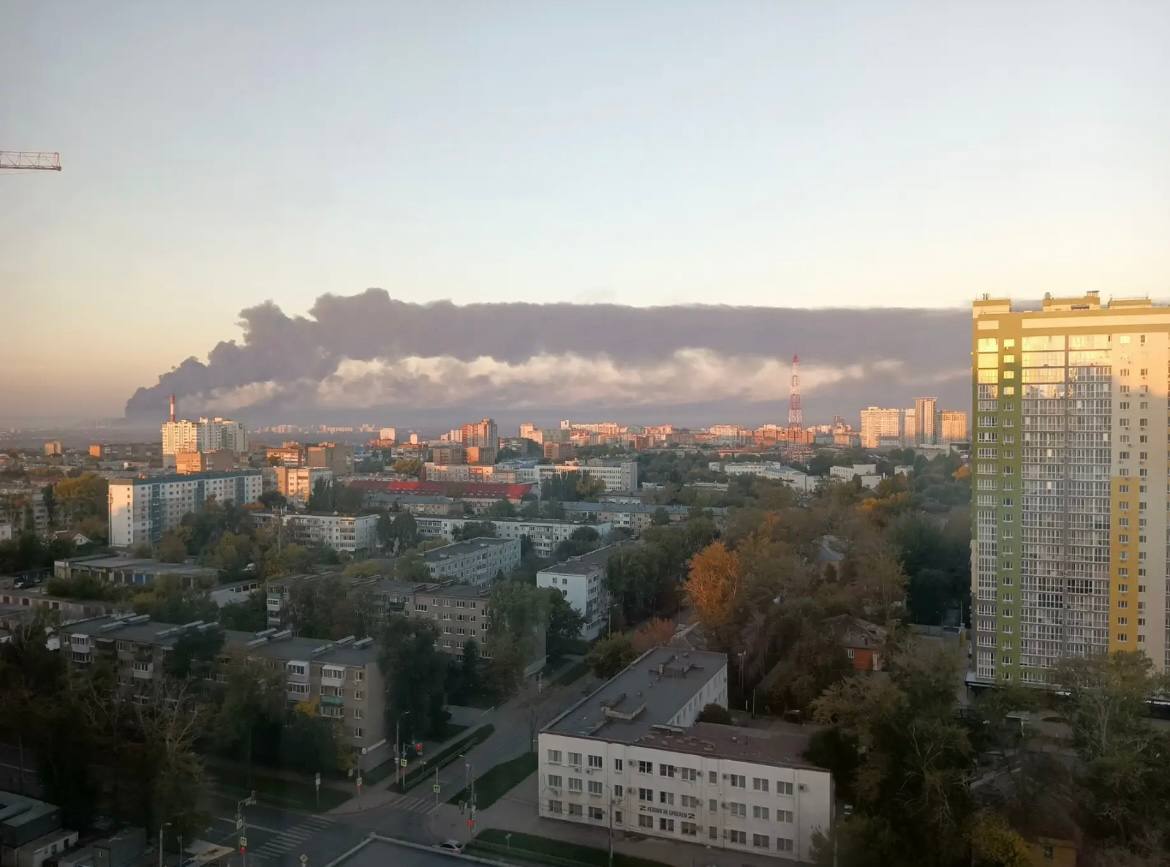
    A drone attack overnight on 8 October caused a fire that hit part of Yandex's data center in Sasovo, Ryazan Oblast, about 580 km from Ukraine, and the site is fully stopped, the Russian tech company told Russian media. The data center sits on the grounds of Sasta, a sanctioned machine-tool plant, Russian outlet Astra said, citing Wikimapia data. Astra's OSINT analyst found from eyewitness footage that the fire hit the plant.

    Since late September, Russia has been striking data centers in Kyiv that keep Ukraine's internet and online services running. Now a drone attack has stopped one of the data centers that Russia's largest tech company relies on.

    Fires reported at a refinery in Salavat and a machine-tool plant in Sasovo after overnight attacks on 8 October 2026.
    Fires reported at a refinery in Salavat and a machine-tool plant in Sasovo after overnight attacks on 8 October 2026. Map: Euromaidan Press

    Yandex counts the damage

    Yandex warned that some services may be unavailable, while its core services kept running and no one was hurt. Ryazan Oblast Governor Pavel Malkov claimed two drones were downed, a roof caught fire at an enterprise in the Sasovo district, and windows were blown out in several homes.

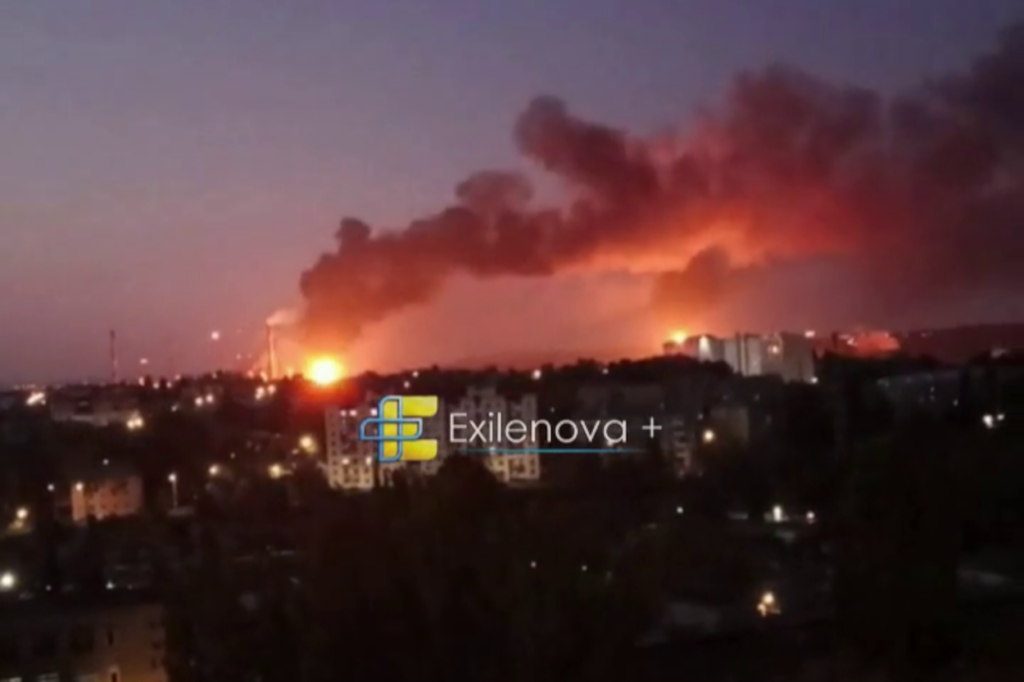
    The power failure took down a wide range of Yandex Cloud infrastructure, including computing capacity, networks, data storage, databases, Kubernetes, cloud services, AI, and security and monitoring systems, Ukrainian outlet ZN.ua reported, citing Exilenova+.

    Ukrainian monitoring channel Exilenova+ reported that the plant was hit, without naming an attacker. The channel said Sasta, which claims a place on Russia's register of defense-industry companies, makes computer-controlled machine tools, including five-axis machining centers, and previously supplied the Tactical Missiles Corporation (KTRV) and Roscosmos. The plant's value to the arms industry lies in machines that cut precision parts, not in finished weapons, the channel said.

    Citing Exilenova+, Militarnyi reported that Ukraine's Defense Forces hit the plant. It also linked Sasta to Iskander missile supply chains. No source has said whether the plant or the data center was the target, and no Ukrainian official has claimed the Sasovo strike. Sasta has been under US sanctions since November 2023, UK sanctions since February 2024, and Ukrainian sanctions since April 2025, a sanctions database shows.

    Salavat: Kyiv reports a hit

    Ukrainian forces hit the Gazprom Neftekhim Salavat complex in Bashkortostan, about 1,380 km from the front line, causing a fire, Ukraine's General Staff said. It said the complex processes up to 10 million metric tons of hydrocarbons a year and serves Russia's armed forces. Its key unit, the ELOU-AVT-6 primary oil refining unit launched in 2012, can process 6 million metric tons a year, Militarnyi reported. Astra's analyst placed the fire a few kilometers outside Salavat, possibly near the refinery.

    Salavat oil refinery moment of attack pic.twitter.com/bUxuRshSK1

    — Exilenova+ (@Exilenova_plus) October 8, 2026

    Salavat Mayor Marat Zagidullin claimed that debris from several drones fell in the industrial zone that morning and started a fire.

    "The enterprise continues to work," he said.

    Astra noted earlier hits on the complex on 24 September 2025, on 14 July 2026, when refining fully stopped, and on 13 August 2026.

    Russia's strikes on Ukraine's data centers

    Russia has repeatedly hit data centers in Kyiv since 23 September. Strikes hit the COSMONOVA data center twice, the second time knocking it out, and the Parkovyi data center stopped working completely on 1 October after a series of strikes. In early October, Russia destroyed the dline.ua data center in Kyiv.

    • ✇Euromaidan Press
    • Russia’s war against Ukraine sends the bill to its own companies: bond defaults head for a 17-year high
      More than 50 Russian companies could default on their bonds this year, the most since 2009, a rating-agency analyst told Russian newspaper Izvestia, which reported it on 6 October. Russia's wartime economy is straining under high interest rates, and the budget is too: the 2026 deficit has nearly doubled from the earlier forecast to a record $88 billion, with more deficits planned for the next three years as Moscow raises taxes to fund the war and plans its biggest defense budget since t
       

    Russia’s war against Ukraine sends the bill to its own companies: bond defaults head for a 17-year high

    7 octobre 2026 à 11:31

    russia facing record number corporate defaults second time decade one main causes being same—waging war against ukraine · post russian rubles tsn money news ukrainian reports

    More than 50 Russian companies could default on their bonds this year, the most since 2009, a rating-agency analyst told Russian newspaper Izvestia, which reported it on 6 October.

    Russia's wartime economy is straining under high interest rates, and the budget is too: the 2026 deficit has nearly doubled from the earlier forecast to a record $88 billion, with more deficits planned for the next three years as Moscow raises taxes to fund the war and plans its biggest defense budget since the full-scale invasion began.

    A default is a situation in which a company cannot make promised interest payments to investors on time or repay borrowed money. If a payment is not made by the agreed deadline, the company becomes delinquent, which under certain conditions is recognized as a default.

    So far this year, 20 companies have defaulted for the first time, compared with 24 in all of 2025, said Mikhail Nikonov of the Expert RA rating agency. Most of the companies that missed payments are small issuers of high-yield bonds, Izvestia reported.

    In 2026, Russian companies have missed payments totaling 41 billion rubles (about $490 million), compared with 34 billion rubles (about $410 million) the previous year, according to investment bank Sinara.

    Russia faces a new wave of corporate defaults

    By the end of 2026, the number of Russian companies unable to service their ruble-denominated debt on time could reach 40–50, the highest level since 2010, said Pavel Zholobov, junior managing director at the NRA rating agency.

    The number of bond defaults in 2026 has already reached its highest level in a decade, Zholobov said. Similar figures were recorded in the mid-2010s: in 2014, 35 companies missed payments; in 2015, 52 did so; and in 2016, there were 44 issuers. This occurred in part after Western sanctions were imposed on Russia over its annexation of Crimea and its war in Donbas, as well as amid a halving of oil prices and a sharp weakening of the ruble.

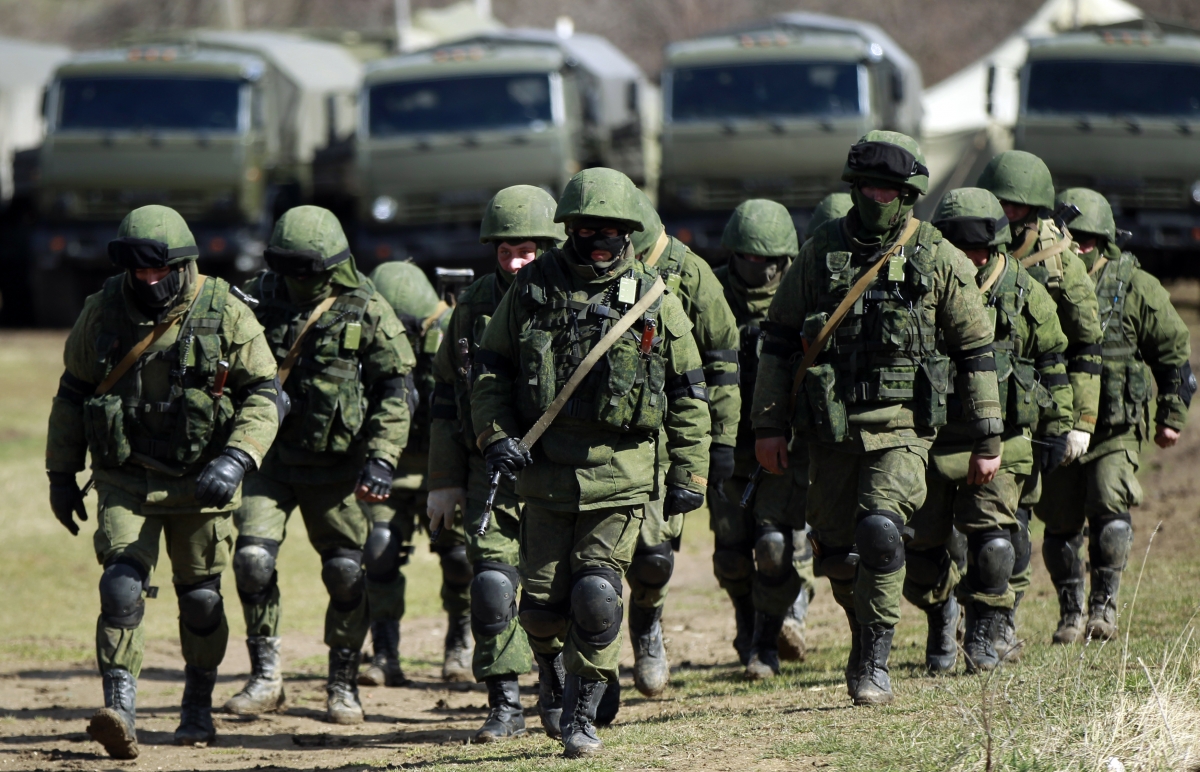
    So-called "little green men" (the Russian occupation troops comprised special forces who removed insignia, wear face masks to prevent identification and call themselves a "Crimean self-defense force") surround a Ukrainian military base in Perevalne, Crimea, during the Russian annexation of the peninsula in February-March 2014.
    So-called "little green men" (the Russian occupation troops comprised special forces who removed insignia, wear face masks to prevent identification and call themselves a "Crimean self-defense force") surround a Ukrainian military base in Perevalne, Crimea, during the Russian annexation of the peninsula in February-March 2014.

    There were more defaults only in 2009. At the time, amid the fallout from the global financial crisis, more than 100 issuers faced payment problems, while the volume of distressed debt reached nearly 200 billion rubles, Zholobov noted.

    High interest rates put pressure on companies

    This time, the main reason for companies' difficulties in making bond payments has been the prolonged period of high interest rates, which has continued since 2023. Companies are raising financing at high interest rates but are unable to refinance their debt on more favorable terms, explained Ekaterina Sidorova, head of the Foreign Exchange, Commodities and Debt Markets Department at SberCIB Investment Research.

    At the same time, the situation does not yet resemble a systemic debt crisis: defaults are primarily being recorded among companies with low credit ratings and high debt burdens, Sidorova said.

    If a company fails to repay bond debt, it is given 10 business days to meet its obligations. If it fails to do so, the company may offer investors a restructuring—for example, by postponing payments in exchange for a higher interest rate.

    The number of defaults will remain high in 2027, Sidorova believes.

    High interest rates were a response to accelerating inflation in Russia. Domestic demand was outpacing production, Russia's Central Bank said in October 2023. Sanctions over the war and rising defense spending had also hit the economy and the ruble, which had lost about 25% against the dollar that year. The bank raised its key rate from 7.5% in the first half of 2023 to 15% by the fall.

    Ukraine targets Russia's oil industry to weaken its war economy

    Ukraine is also seeking to weaken Russia's economy as part of efforts to reduce its ability to finance the war. In particular, Defense Minister Yevhenii Khmara said strikes on oil refineries are aimed at "bleeding the Russian war machine" and destroying its military and economic potential. According to the ministry, the attacks have knocked out more than 51% of Russia's oil refining capacity.

    In the first half of July, Russian oil refineries processed about 3.9 million barrels of oil per day—the lowest level since March 2005. Due to the production cuts, Moscow was also forced to restrict fuel exports.

    • ✇Euromaidan Press
    • Ukraine says its strikes have knocked out more than 51% of Russia’s oil refining capacity
      Ukraine's Security and Defense Forces have "put out of action" more than 51% of Russia's oil refining capacity through recent long-range strikes, Defense Minister Yevhenii Khmara said in a statement published by the Defense Ministry on 4 October. These "carefully thought-out" actions were aimed at "bleeding the Russian war machine" and "destroying its military-economic potential," Khmara said. Ukraine treats Russia's refineries as a priority target because their revenue helps fund the w
       

    Ukraine says its strikes have knocked out more than 51% of Russia’s oil refining capacity

    5 octobre 2026 à 11:08

    ukraine says its strikes have knocked out 51% russia's oil refining capacity · post flames saratov refinery after reported ukrainian drone strike 2 2026 image_2026-08-02_14-32-39 news reports

    Ukraine's Security and Defense Forces have "put out of action" more than 51% of Russia's oil refining capacity through recent long-range strikes, Defense Minister Yevhenii Khmara said in a statement published by the Defense Ministry on 4 October. These "carefully thought-out" actions were aimed at "bleeding the Russian war machine" and "destroying its military-economic potential," Khmara said.

    Ukraine treats Russia's refineries as a priority target because their revenue helps fund the war. Even Russian President Vladimir Putin claimed on 1 October that the strikes had cost Russia 1% of its GDP and had "partially" achieved their goal, Interfax reported.

    The ministry did not publish how it calculated the figure.

    "The consequences of Ukrainian operations are not always visible immediately. But the effect accumulates and produces a tangible result," the ministry said.

    Ukrainian deep strikes continue to bring the war to Russian territory

    The ministry named eight recently struck facilities, among others. One of them is the Moscow Oil Refinery, which Ukraine targeted in a massive drone attack on the night of 20 September, Ukrainian President Volodymyr Zelenskyy said. The refinery, operated by Gazprom Neft in Moscow's Kapotnya district, supplies about 40% of Moscow's fuel market and 70% of the Moscow region's demand for gasoline and aviation fuel, according to Russian news Telegram channel Astra.

    Another was KINEF, which Ukraine has attacked repeatedly. It is Russia's second-largest oil refinery by capacity, and the Ukrainian military struck it on the night of 30 August, setting off a fire at the facility.

    Fire reported at Russia's Kirishi/KINEF oil refinery following an overnight Ukrainian drone attack, 29–30 August 2026. Photo: Exilenova+
    Fire reported at Russia's Kirishi/KINEF oil refinery following an overnight Ukrainian drone attack, 29–30 August 2026. Photo: Exilenova+

    The ministry also named the Yaroslavl, Perm, Ilsky, Saratov, and Syzran refineries and the Ust-Luga port complex.

    Ukraine triples production and procurement of long-range drones—and this is not the end

    This year, Ukraine has tripled the production and procurement of long-range attack drones, the ministry said.

    "This is not the limit. We will continue to scale up deep-strike capabilities," the statement said.

    International cooperation is part of that push. Berlin will fund the production of additional DeepStrike-class long-range drones in Ukraine, German Defense Minister Boris Pistorius said after a meeting of the Ukraine Defense Contact Group on 15 April. The sides also agreed to jointly develop and produce a medium- and long-range drone system.

    Ukraine and Germany also signed an agreement on the joint production of Bars drones, Ukrainian Foreign Minister Andrii Sybiha said on 8 July. The Bars' modular design allows it to be used for deep strikes, among other missions.

    Bars jet-powered drone. Photo: Museum of the Russian-Ukrainian War
    Bars jet-powered drone. Photo: Museum of the Russian-Ukrainian War

    Oil refinery output has fallen

    Russian refineries cut crude oil processing by 14% in the first nine months of the year compared with the same period last year amid Ukrainian drone attacks, according to calculations by two industry sources.

    Experts' estimates of the decline differ widely. In August, Serhii Vakulenko of the Carnegie Russia Eurasia Center put it at 25–28%, while Russian economic commentator Vyacheslav Shiryaev put it at 65–70%, according to Defense-Aerospace.

    Fuel production data give a more concrete picture: in July, Russia's gasoline and diesel output was about a quarter to a third lower than in March 2026, the outlet reported.

    Drones hit Russia’s Volgograd and Samara overnight—fires near a Lukoil refinery, a chemical plant, and likely Europe’s largest oil tank farm in Samara

    2 octobre 2026 à 04:47

    drones hit russia's volgograd samara overnight—fires near lukoil refinery chemical plant likely europe's largest oil tank farm · post fire area kaustik russia 2 2026 пожежа ймовірно в районі волгоградського

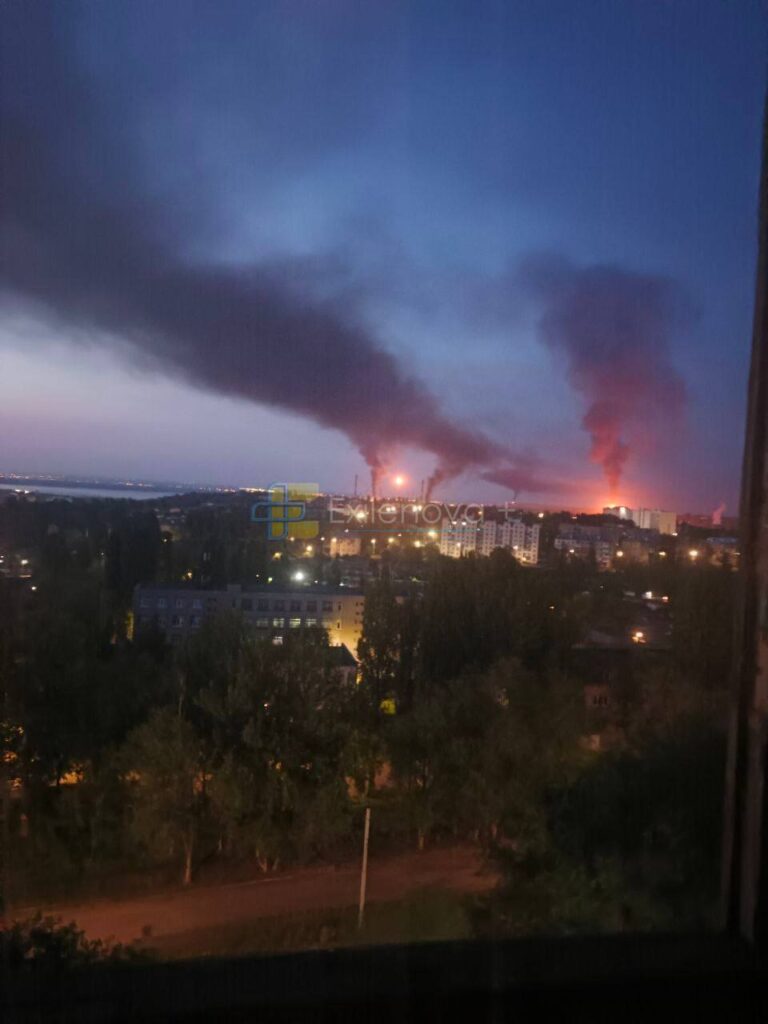
    Drones attacked Russia's Volgograd and Samara oblasts overnight on 2 October, sparking fires near an oil refinery, a chemical plant, and likely a major oil-transport hub, Ukrainian and Russian monitoring channels reported. Regional officials acknowledged the attack but not the fires, and the extent of any damage remains unconfirmed.

    Explosions and a glow over Volgograd's refinery district

    Explosions sounded for a long time in Volgograd itself and around the refinery's industrial zone, Ukrainian Telegram channel Exilenova+ wrote.

    Residents reported drones flying over and blasts "in all districts of the city," and complained that no air raid alert sounded, Russian news Telegram channel Astra reported. Its OSINT analysis of eyewitness footage placed the glow near the Lukoil refinery and the neighboring Kaustik chemical plant, though the available videos do not show which facility caught fire.

    Volgograd Oblast Governor Andrei Bocharov claimed a "massive drone attack" on the region's industrial infrastructure. He mentioned a fire in an apartment building and one person hospitalized, but no fires at plants.

    Lukoil-Volgogradneftepererabotka is one of Russia's largest refineries. It processes 14.8–15.7 million tons of crude a year, about 5% of Russia's refining, and makes gasoline, diesel, jet fuel, fuel oil, and bitumen, according to Astra.

    lukoil’s norsi refinery in kstovo, nizhny novgorod oblast
    Explore further

    Fifth drone-related NORSI shutdown in under five months leaves all major Lukoil refineries offline

    Drones have hit the plant repeatedly. In May 2025, strikes damaged its ELOU-AVT-1 and ELOU-AVT-6 primary processing units. A 29 May 2026 strike halted production at the plant, about 500 km east of the war zone, Ukraine's General Staff said. On 31 July, drones set the refinery ablaze again, and Astra reported the AVT-1 and AVT-6 units stopped.

    Kaustik sits in Volgograd's southern Krasnoarmeysky district. It is one of the region's leading plants and makes basic chemicals with dual civilian and military use, Astra wrote. The outlet called that output critical to Russia's military industry. The plant runs chlor-alkali production built on salt electrolysis. It makes hydrochloric acid, plastics, synthetic resins, and industrial gases, according to OSINT-Varta. Such products can serve military industry too, including polymer parts and protective coatings for hardware, Militarnyi noted.

    Europe's largest tank farm likely on fire near Samara

    Explosions also rocked Samara, with an especially strong one around 06:30, Astra reported. Its OSINT expert linked reader photos to a fire at the Samara linear production dispatch station in the settlement of Prosvet.

    Ukrainian monitoring channel Supernova+ shared video of thick black smoke on the horizon and reported a fire at the station. Exilenova+ reported explosions in Samara followed by a fire.

    The station belongs to Transneft, Russia's state pipeline operator. It covers more than 216 hectares and holds 71 tanks with a combined capacity of over 1.6 million m³ of crude. Astra called it Europe's largest tank farm.

    Four trunk pipelines converge there, carrying oil from Western Siberia, Tatarstan, Orenburg Oblast, and Kazakhstan. The station blends high- and low-sulfur crude into Urals, Russia's flagship export grade, according to Militarnyi.

    Samara authorities did not comment on the fire. Mayor Ivan Noskov stated only that ground public transport was suspended. Samara Oblast Governor Vyacheslav Fedorishchev did not report an attack at all.

    The station has been hit before. Operators of the 14th Regiment of Ukraine's Unmanned Systems Forces struck it again overnight on 23 September 2025. On 21 April 2026, drones of the Security Service of Ukraine's Alfa special operations center hit it, reportedly damaging five crude tanks of about 20,000 m³ each.

    one refinery night moscow ufa now samara—ukraine working through russia's fuel chain · post smoke plume burning kuibyshev stretching across samara skyline 22 2026 exilenova 5877644049043362820 ukraine news ukrainian reports
    Explore further

    Ukraine shut down this Samara refinery in June—now its drones are back, and both distillation units are burning again

    Ukraine's long-range drones have already pushed Russia's fuel shortages into Central Asia, and Washington has pressed Kyiv to stop, so every hit on processing or export logistics tests how long oil can fund Moscow's war.

    • ✇Euromaidan Press
    • Trump demanded Zelenskyy stop hitting Russian refineries—for the second time in a week
      US President Donald Trump repeatedly asked Ukrainian President Volodymyr Zelenskyy to stop attacks on Russian oil refineries during a phone call on 20 September, Axios reported, citing a person familiar with the conversation. The two leaders are due to meet in New York today, 22 September, during the UN General Assembly. For Ukraine, the strikes are a way to disrupt the fuel supply supporting Russia's military. Trump is now linking the attacks to global diesel prices. The International
       

    Trump demanded Zelenskyy stop hitting Russian refineries—for the second time in a week

    22 septembre 2026 à 05:16

    again trump presses zelenskyy stop russian refinery strikes · post ukrainian president volodymyr meets donald ankara türkiye 8 2026 presidentgovua ukraine news reports

    US President Donald Trump repeatedly asked Ukrainian President Volodymyr Zelenskyy to stop attacks on Russian oil refineries during a phone call on 20 September, Axios reported, citing a person familiar with the conversation. The two leaders are due to meet in New York today, 22 September, during the UN General Assembly.

    For Ukraine, the strikes are a way to disrupt the fuel supply supporting Russia's military. Trump is now linking the attacks to global diesel prices. The International Energy Agency (IEA) said disruptions to Russia's refining system following intensified Ukrainian attacks have compounded diesel supply losses.

    Trump backed the strikes two months ago

    At a NATO summit on 8 July, speaking alongside Zelenskyy, Trump said Ukrainian strikes on Russian oil refineries could help end the war. "It's an escalation, but it's also an escalation that can help lead to an end," he said. Secretary of State Marco Rubio said Ukraine's ability to strike deep into Russian territory was one of the changes in the war in recent months and said the escalation could create space for negotiations.

    On 13 September, Trump called on Zelenskyy to stop the attacks.

    "Mr. Zelenskyy has to do one thing: he has to stop knocking out diesel fuel in Russia," Trump said. "There are plenty of other targets. Don't hit diesel fuel. That's hurting the world."

    Trump added that the rise in prices was not caused by the Iran conflict. "This isn't done by the Middle East, this is done by what's happening with Russia and Ukraine," he said.

    On 20 September, Trump raised the demand again in his call with Zelenskyy. "The word diesel came up many times" during the conversation, a person familiar with the call told Axios.

    What is driving diesel prices

    US diesel prices had reached $6.06 per gallon by 13 September, up from $3.71 a year earlier. The IEA said in June that global energy markets were contending with their largest supply disruption in history because of the near-closure of the Strait of Hormuz, though it also noted that a US-Iran agreement to reopen the strait had begun easing prices from their April peak. A Bipartisan Policy Center analysis attributed the diesel surge to the Iran conflict and did not address Ukrainian strikes.

    Ukraine's refinery campaign has also disrupted Russian fuel production. The General Staff of the Armed Forces of Ukraine said on 4 July that attacks had disabled 42.7% of Russia's oil-refining capacity. Russia's gasoline production fell an estimated 25% year-on-year in the week of 15–21 June, while Moscow has extended its ban on diesel exports through at least September.

    Zelenskyy confirms Tuesday meeting

    After the call, Zelenskyy said it had been "an important conversation" and that today's meeting "could change a lot." He said there was "diplomatic momentum" and that Ukraine was ready "to take really serious steps." He also said the call covered ideas for de-escalation and fundamental security issues including energy and food security.

    Rustem Umerov, head of Ukraine's Foreign Intelligence Service and Kyiv's chief negotiator, told Axios that US envoys Steve Witkoff and Jared Kushner had helped with the peace talks, where the number of stumbling blocks had fallen from "dozens to essentially one or two key issues." Umerov was rebutting a Kyiv Independent report that Kyiv was frustrated with Witkoff, which he called false.

    Russia has warned its cities about every strike for years. During the heaviest raid yet, on election day, it left the sirens silent

    21 septembre 2026 à 12:35

    Vladimir Putin voted in the presidential election in Russia

    Russian authorities left residents in and around Moscow without air raid sirens or phone alerts during Ukraine's largest combined strike on Moscow Oblast, apparently to guard turnout at Russia's parliamentary elections, the Institute for the Study of War (ISW) said. The silence angered residents and even pro-war commentators as a major oil refinery burned.

    For most of this war, Russia has handled strikes on its cities as a routine to be announced, warned about, and waited out. Withholding warnings during the heaviest raid yet, in the middle of a national vote, suggests authorities will trade residents' safety for the look of a calm election when a political milestone is on the line.

    Sirens stayed off during the biggest raid

    Ukraine hit strategic sites across the Moscow area overnight on 19-20 September, the last day of Russia's State Duma vote. Moscow Oblast officials did not switch on air alert sirens or send the SMS warnings they had used during far smaller attacks. They quietly restricted mobile service without major public notice. Ukraine struck oil and logistics targets, not polling stations, according to the experts, and authorities appeared to place high turnout above protecting civilians.

    Moscow Oblast residents complained that no alert reached them, some posting on the Telegram channel of regional Governor Andrei Vorobyov before it closed comments. A prominent Kremlin-linked military blogger attacked the official response, saying it erodes public trust and that cutting mobile service does "not really help."

    What the drones hit

    Ukraine's General Staff reported striking the Gazpromneft-Moscow Oil Refinery in the city's Kapotnya district, one of Russia's largest plants, causing a large fire. Ukrainian manufacturer Fire Point said its FP-1 drones completely shut down the refinery, with all primary processing units damaged.

    Governor Andrei Vorobyov claimed air defenses countered 249 drones across 17 municipal districts. The strike was part of Ukraine's widening campaign against the fuel sector funding Russia's war, with about a fifth of Russian refining capacity offline.

    • ✇Euromaidan Press
    • A fifth of Russian refining sits idle, and the sector’s earnings still grew
      Russian oil refineries earned more in the first half of this year than in the same period a year earlier, even as Ukrainian drone strikes kept a fifth of the country's refining capacity out of action, The Moscow Times reported. Record wholesale prices and fast-growing payments from the federal budget have more than covered what the attacks and the repairs cost. Russian consumers are covering the rest at the pump. Refineries turn Russian crude into the two things the war needs: fuel for
       

    A fifth of Russian refining sits idle, and the sector’s earnings still grew

    17 septembre 2026 à 07:46

    refinery saratov two tatarstan pumping station bashkortostan — one night's russian oil target list · post smoke fire rise over russia after ukrainian drone strike 8 2026 saratov5075776523918314508 ukraine news

    Russian oil refineries earned more in the first half of this year than in the same period a year earlier, even as Ukrainian drone strikes kept a fifth of the country's refining capacity out of action, The Moscow Times reported. Record wholesale prices and fast-growing payments from the federal budget have more than covered what the attacks and the repairs cost. Russian consumers are covering the rest at the pump.

    Refineries turn Russian crude into the two things the war needs: fuel for the army, and billions in export earnings and taxes that help pay for it. That is why That is why Ukraine keeps hitting them with long-range drones, and why what those strikes do to Russian oil earnings matters more than how many plants are burning.

    Where the profits come from

    Russian refineries earned 938 billion rubles ($11.1 billion) in the first half of 2026, 16.2% more than a year earlier, according to the state statistics service Rosstat. Ukrainian drone strikes have put a fifth of the country's refining capacity out of action.

    Two things produced that result, according to Promsvyazbank analyst Yekaterina Krylova: high wholesale prices on the SPIMEX commodity exchange, and a sharp increase in state fuel subsidies.

    Wholesale prices took off in March, after the war in the Middle East began: light petroleum products have risen 37% since late February and diesel by a third, with July bringing record exchange prices of 82,600 rubles ($982) per tonne of AI-95 gasoline. Crude got cheaper for the refiners over the same stretch, as the ruble price of Urals oil peaked in spring and fell through the summer while the products made from it kept getting dearer.

    A tall flame rises above an industrial facility in Novy Urengoy at night.
    Explore further

    Ukraine says drones hit Russia’s gas heartland over 3,000 km from its border—a wartime record

    The budget pays the difference, the country pays the bill

    Russia's damper mechanism compensates oil companies for selling fuel cheaply at home rather than exporting it, and the payments grow as the gap between domestic and world prices widens.

    The Finance Ministry paid out close to 350 billion rubles ($4.2 billion) a month in the second quarter, and 500 billion rubles ($5.9 billion) for July and August together. Krylova expects the subsidies and the prices together to widen net margins by 45% in the third quarter, to 35,000 rubles ($416) per tonne of gasoline.

    Russia's retail prices tell the other half of the story. Gasoline has risen 21.2% since January and diesel 18.4%, well above Russian inflation. Budget money lets the majors, which own both the refineries and the filling-station chains, hold their own forecourt prices near inflation. Independent chains have no such cushion: they buy at the higher wholesale prices and sell dearer, which is how Russia has been squeezing them out of the market. For drivers, the crisis has been physical as well as financial, with rationing and dry pumps spreading across dozens of regions.

    Kazakh President Kassym-Jomart Tokayev and Russian President Vladimir Putin walk past an honor guard in Astana, Kazakhstan, on 27 November 2024.
    Explore further

    Kazakh refinery deal could ease Russia’s front-line fuel pressure—but it covers just 0.3% of demand

    What the strikes have cost

    Ukrainian drones have been hitting Russian refineries since 2024, and the campaign escalated sharply from August 2025, when strikes deep inside Russia became systematic. Russian refineries disclose none of their losses from it.

    Ukraine's General Staff estimated the total damage to the Russian oil industry since August 2025 at $13.5 billion, in a count published in early July. The insurance broker Mains put direct losses to the oil and gas sector from drone strikes last year at more than 100 billion rubles ($1.2 billion), and above a trillion rubles once lost profit and indirect damage are counted.

    • ✇The Kyiv Independent
    • Ukrainian drone strike hits major oil refinery in Russia's Krasnodar Krai, HUR source claims
      Long-range Ukrainian drones struck the Ilsky oil refinery in Russia's Krasnodar Krai on July 7, hitting one of the facility's technological workshops, a source in Ukraine's military intelligence (HUR) told the Kyiv Independent. Located roughly 500 kilometers (311 miles) from Ukrainian-controlled territory, the refinery is among the largest in southern Russia, producing over 6 million tons of fuel annually. It is involved in the reception, storage, and processing of hydrocarbons and distributes r
       

    Ukrainian drone strike hits major oil refinery in Russia's Krasnodar Krai, HUR source claims

    7 juillet 2025 à 08:01
    Ukrainian drone strike hits major oil refinery in Russia's Krasnodar Krai, HUR source claims

    Long-range Ukrainian drones struck the Ilsky oil refinery in Russia's Krasnodar Krai on July 7, hitting one of the facility's technological workshops, a source in Ukraine's military intelligence (HUR) told the Kyiv Independent.

    Located roughly 500 kilometers (311 miles) from Ukrainian-controlled territory, the refinery is among the largest in southern Russia, producing over 6 million tons of fuel annually.

    It is involved in the reception, storage, and processing of hydrocarbons and distributes refined products via road and rail. The refinery is part of Russia's military-industrial complex and plays a direct role in supporting Moscow's war effort, the source said.

    The Russian regional operational headquarters claimed that "drone debris" fell on the oil refinery.

    The strike marks a renewed wave of Ukrainian attacks on Russian oil infrastructure, following a months-long pause since March. On July 1, Ukrainian drones struck the Saratovorgsintez oil refinery in Russia's Saratov Oblast.

    Kyiv has targeted dozens of refineries, oil depots, and military-industrial sites since the start of Russia's full-scale invasion in 2022. Winter drone attacks forced at least four Russian refineries to temporarily shut down.

    This is the second known strike on the Ilsky refinery. Ukrainian drones, operated by the Security Service (SBU) and Special Operations Forces (SSO), previously targeted the facility on Feb. 17, causing a fire.

    Krasnodar Krai, a strategic region along Russia's Black Sea coast, has increasingly come under Ukrainian drone attacks as Kyiv extends the range of its strikes deep into Russian territory.

    HUR publishes Russian military order, claims proof of Moscow increasing military footprint in Armenia
    HUR first made the claim on July 5, saying Russia was increasing its forces at the Gyumri base to exert greater influence in the South Caucasus and “destabilize the global security situation.”
    Ukrainian drone strike hits major oil refinery in Russia's Krasnodar Krai, HUR source claimsThe Kyiv IndependentChris York
    Ukrainian drone strike hits major oil refinery in Russia's Krasnodar Krai, HUR source claims
    • ✇The Kyiv Independent
    • 'Important facility hit' — Ukraine attacks Russian oil refinery in Saratov Oblast, military says
      Ukrainian drones struck the Saratovorgsintez oil refinery in Russia's Saratov Oblast, causing damage to the facility, Ukraine's General Staff reported on July 1. "An important facility has been hit," the General Staff said via its official Telegram channel. The Saratovorgsintez refinery and chemical plant, owned by Russian energy giant Lukoil, is located nearly 1,500 kilometers (930 miles) from Ukraine's border in the city of Saratov. The city hosts multiple strategic military and industrial sit
       

    'Important facility hit' — Ukraine attacks Russian oil refinery in Saratov Oblast, military says

    1 juillet 2025 à 18:15
    'Important facility hit' — Ukraine attacks Russian oil refinery in Saratov Oblast, military says

    Ukrainian drones struck the Saratovorgsintez oil refinery in Russia's Saratov Oblast, causing damage to the facility, Ukraine's General Staff reported on July 1.

    "An important facility has been hit," the General Staff said via its official Telegram channel.

    The Saratovorgsintez refinery and chemical plant, owned by Russian energy giant Lukoil, is located nearly 1,500 kilometers (930 miles) from Ukraine's border in the city of Saratov. The city hosts multiple strategic military and industrial sites.

    The refinery was targeted to "reduce the enemy's offensive capabilities," the General Staff wrote.

    "The occupiers use the capacity of this refinery to supply fuel and lubricants to Russian military units involved in the armed aggression against Ukraine."

    The attack was a joint operation carried out by Ukraine's military intelligence agency (HUR) and other military units, the General Staff said. A fire broke out at the site of the attack and damage to the refinery's technological installations has been confirmed. The full consequences of the strike are still being investigated.

    The Kyiv Independent could not verify these claims.
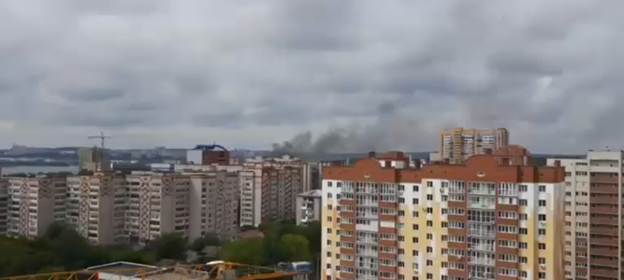
    The report is the latest in a series of announcements on July 1 about successful Ukrainian strikes on Russian targets. Earlier in the day, HUR released footage of Ukraine's UJ-26 drones, commonly known as Bober (Beavers), targeting high-value Russian air defenses and a fighter jet in occupied Crimea.

    A source in the Security Service of Ukraine (SBU) told the Kyiv Independent that Ukrainian drones struck a major Russian military plant in the city of Izhevsk, over 1,300 kilometers (800 miles) from the front lines.

    Ukraine also hit a Russian command post in occupied Donetsk Oblast, according to the General Staff.

    Ukraine war latest: Ukrainian drones strike Russian plant 1,300km from border, SBU source says
    Key developments on July 1: * ‘With surgical precision’ — Ukrainian drones strike Russian plant 1,300km away, SBU source says * Russian missile strike on Dnipropetrovsk Oblast kills brigade commander, injures 30 people, Zelensky says * Ukrainian forces hit Russian command post in occupied Donetsk Oblast, General Staff says * Zelensky signs ratification of
    'Important facility hit' — Ukraine attacks Russian oil refinery in Saratov Oblast, military saysThe Kyiv IndependentThe Kyiv Independent news desk
    'Important facility hit' — Ukraine attacks Russian oil refinery in Saratov Oblast, military says

    ❌