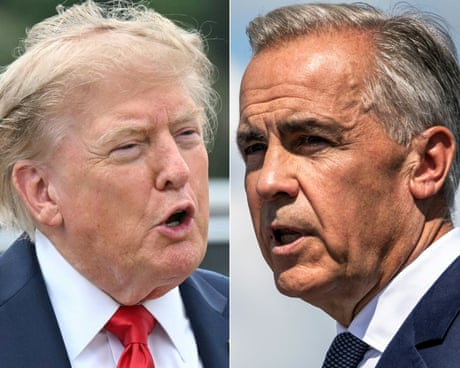
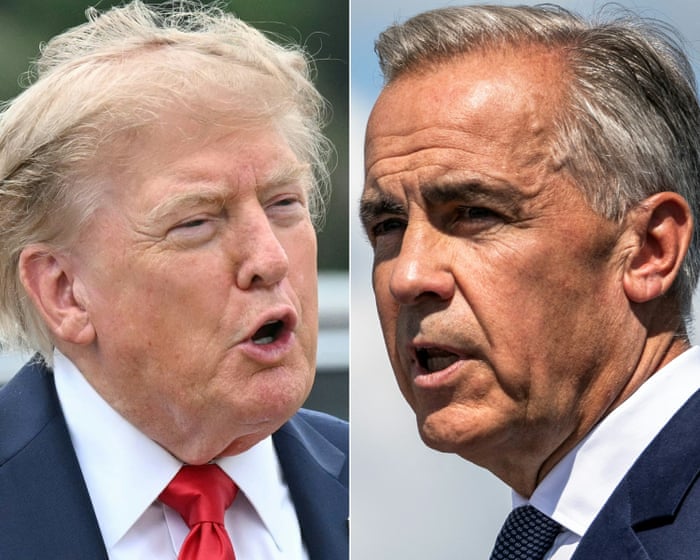
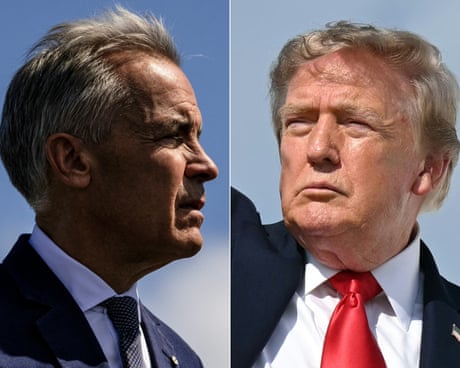
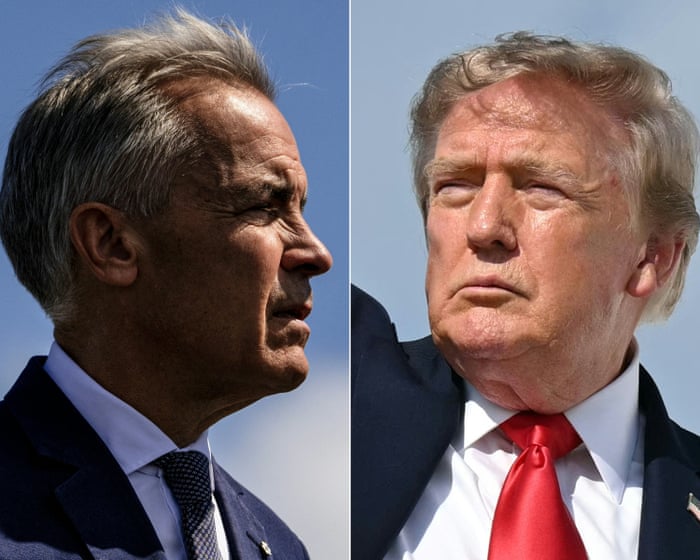
Mark Carney avait expliqué la semaine dernière que plusieurs raisons l’avaient poussé à suspendre les négociations commerciales avec les États-Unis.
Parmi ces raisons, Carney a cité la volonté de Washington d’exempter les entreprises américaines des règles sur l’étiquetage bilingue et l’affichage en français.
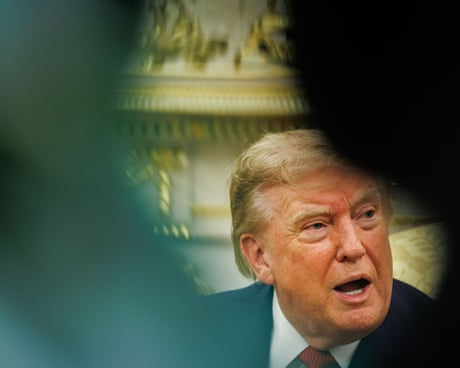
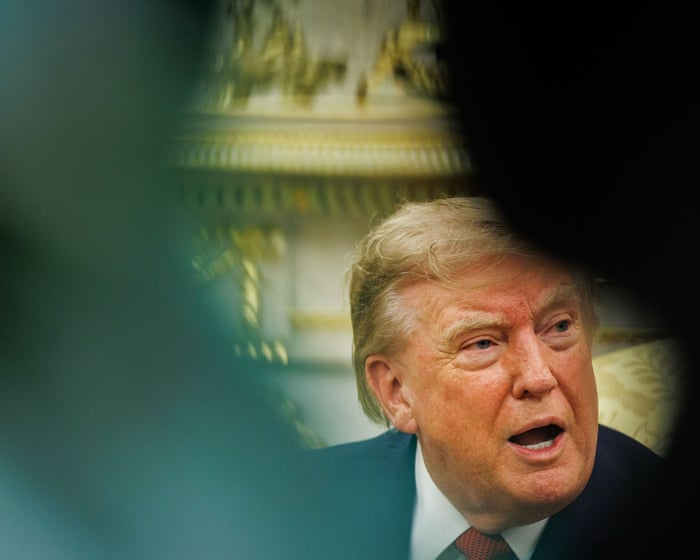
Donald Trump et plusieurs membres de son gouvernement ont soutenu depuis qu’ils n’avaient jamais fait une telle demande.
Howard Lutnick, ministre américain du commerce, a même laissé entendre hier que le gouvernement canadien aurait suspendu les négociations pour nuire au Parti québécois et à son projet d’indépendance, à l’approche des élections québécoises.
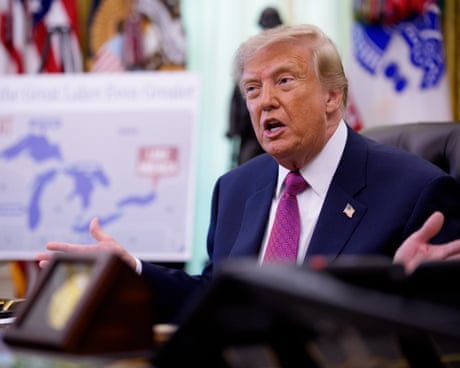
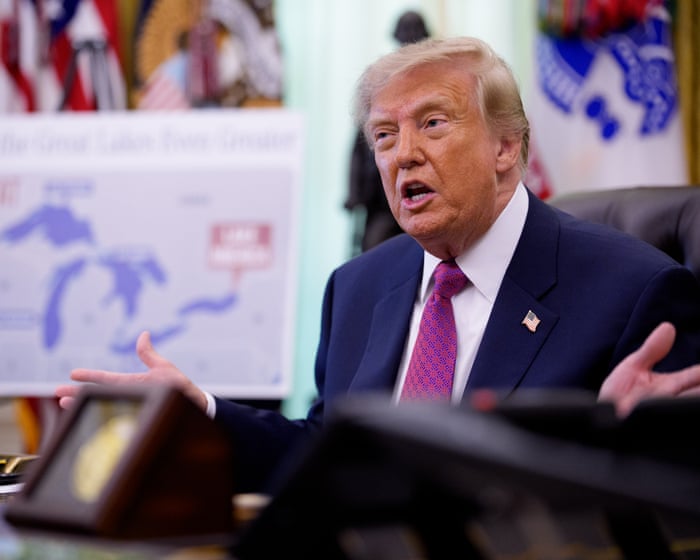
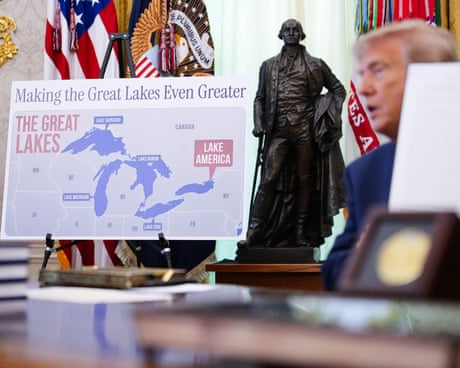
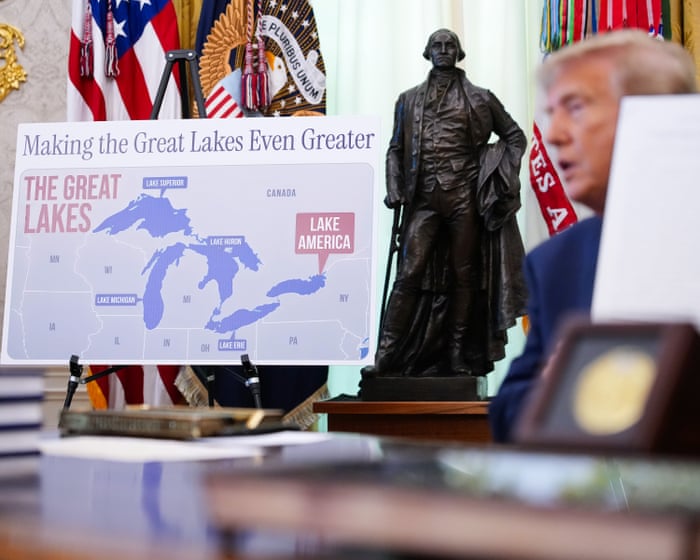
Le président américain a signé hier un décret pour le renommer «lac d’Amérique», en représailles à l’annonce récente de contre-tarifs douaniers par le Canada.
Mais ce changement ne s’appliquerait qu’aux documents et aux services fédéraux américains.
Lorsque Trump avait renommé l’an dernier le golfe du Mexique en «golfe de l’Amérique», certains services de cartographie avaient adopté ce changement.
Le lac Ontario est l’un des cinq Grands Lacs situés entre le Canada et les États-Unis.
Ses rives bordent l’Ontario et l’État de New York.
Congressman Jamie Raskin asks president’s son to detail firm’s recent success after he joined 1789 Capital as partner
Democrats on a powerful US congressional committee have launched an investigation into a venture capital firm which has thrived since recruiting Donald Trump’s son.
Donald Trump Jr joined 1789 Capital as a partner just days after his father won a second term in office in November 2024. Congressman Jamie Raskin, ranking member of the US House of Representatives judiciary committee, has asked the president’s son to detail the firm’s recent success.
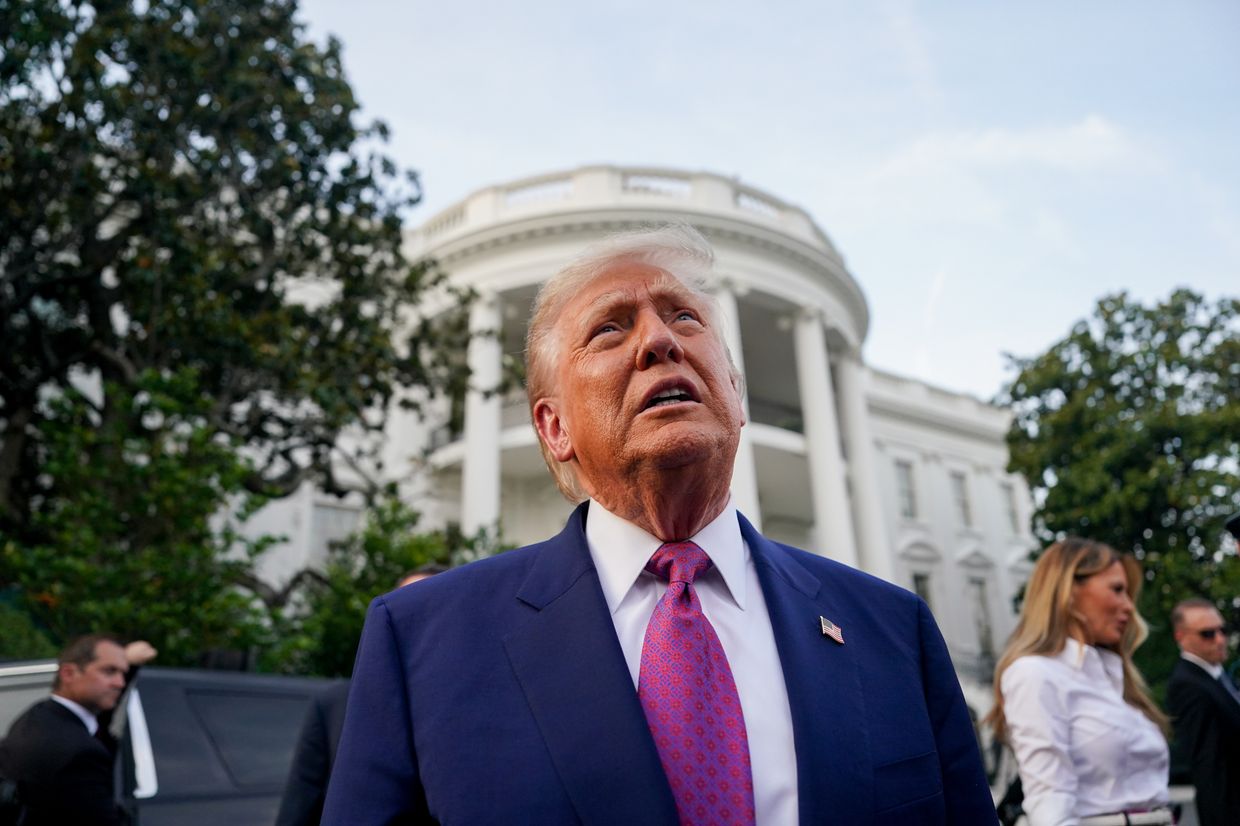
Donald Trump signed an executive order on Thursday directing the federal government to rename Lake Ontario, making it Lake America, amid his escalating trade war with Canada.
The order directs federal agencies to adopt the name-change on US maps, documents and databases. But Trump has no authority to rename Canada’s portion of the lake, nor to compel Canada, international legal bodies, international mapmakers, or the rest of the world to adopt a new name.
Exclusive: Experts and former officials say accounts are running dry, and funding a war with no clear endgame is the main challenge
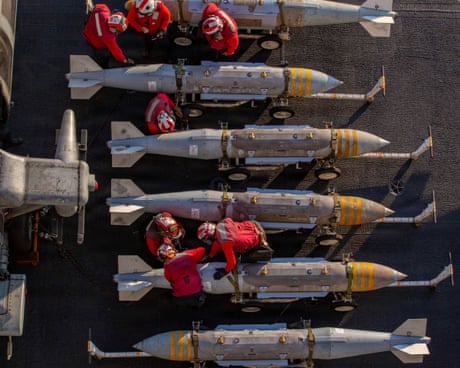
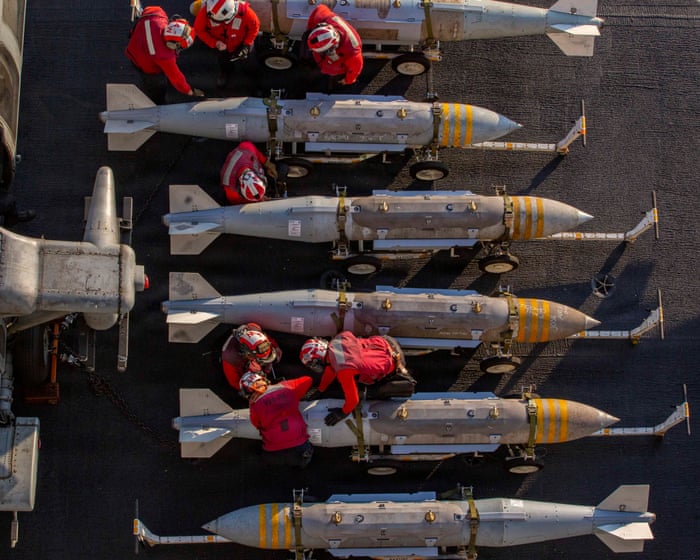
Donald Trump’s war on Iran has driven the US military into a severe financial crisis, with the US navy forced to transfer money from its payroll and other sources to cover the costs of combat, according to documents seen by the Guardian, and interviews with navy officials, contractors and defense analysts.
The US-Israeli operation, which has depleted US munitions stockpiles and prompted retaliatory Iranian strikes that have wrecked strategic bases across the Middle East, is piling pressure on budgets across the military.
Judge ruled Jeanine John Taele, discovered with firearm days before Trump visit, was unfit to face felony charge
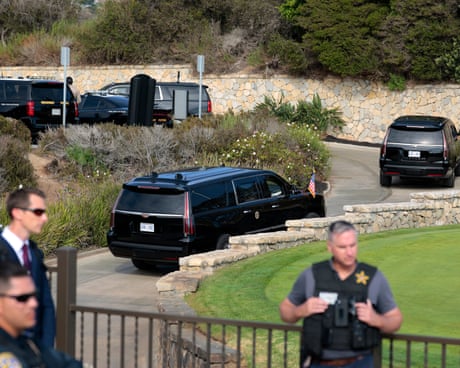
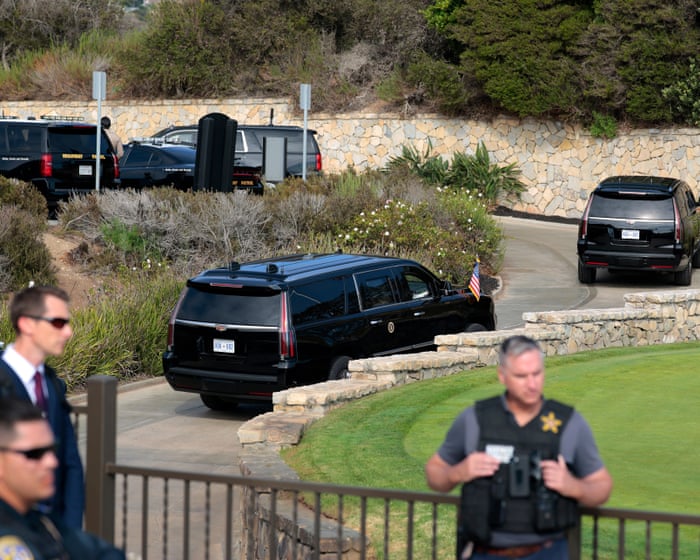
A judge in California has suspended criminal proceedings against a man found with a loaded gun near Donald Trump’s golf course in Los Angeles, and instead ordered him to undergo a mental health evaluation.
Jeanine John Taele, 38, of Downey, California, was arrested for weapons violations days before the president spoke at a 5 August Republican fundraiser at the Trump National Golf Club in Rancho Palos Verdes.
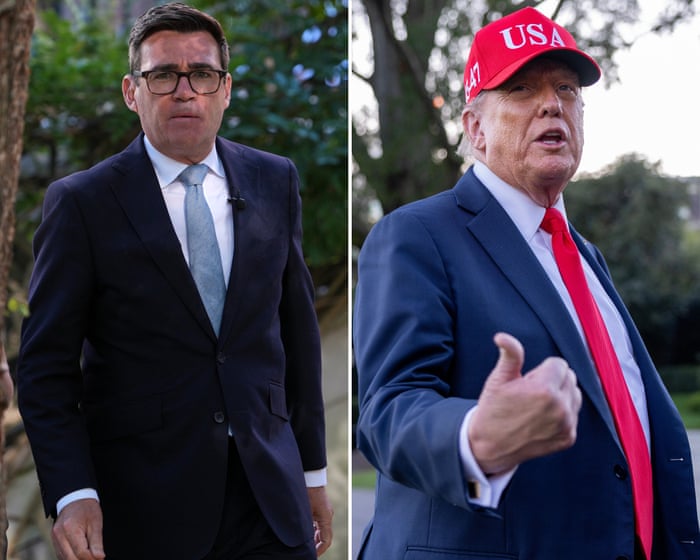
Burnham has nothing to hide as he prepares to meet president he once called poisonous. It may actually win him more respect
It makes a pleasant change. Not so long ago, Keir Starmer was falling over himself in his efforts to keep things sweet with Donald Trump. Offering the US president a second state visit within minutes of meeting him. Everyone knows you should never put out on the first date: it only makes the other person think you’re a pushover. Sure enough, The Donald banked the marching bands and the Windsor silver service, made polite conversation for three days and then went back to trash-talking him.
Yet still, Starmer just sat there and took it. As if one word of criticism would be too much. Wittering on about the “special relationship” as if Trump gave a moment’s thought to the UK before he did anything. The rest of us wouldn’t have put money on the US president even being able to locate Britain on a map. It was only latterly, when The Donald chose to bomb Iran, that the penny finally dropped for Keir. And even then he looked pained by the apparent betrayal, as he resisted the calls of Kemi Badenoch and Nigel Farage to join in the war.
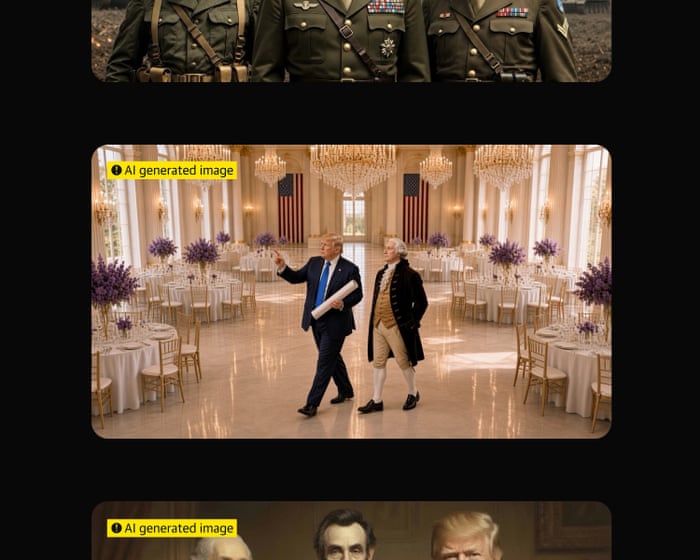
As the US president struggles to end his war with Iran, and with his approval ratings hitting the lowest levels of his second term, he has in recent weeks posted a series of AI-generated images of himself alongside key historical American figures.
The senator’s remarks reflect a turning point in Democrats’ attacks on the president. What should we make of them?
Apparently, he likes to say her name with a French accent. “Na-tah-lee!” the president cries out, in that affected tone of faux-formality that one might use with a person they love but do not quite respect, and she comes running, her thin legs teetering on her heels.
Natalie Harp, Trump’s 35-year-old “executive assistant”, was an odd recurring character in the latest blockbuster Trump administration book, Regime Change, by the New York Times’ Maggie Haberman and Jonathan Swan. In the book, Harp features like a silent sentinel, ever present but eerily quiet as Trump rants and raves. It’s not exactly clear what the scope of her responsibilities is; though, as Jamelle Bouie points out, the fact that she evidently helps run the president’s social media accounts, which can sway markets and influence his foreign counterparts, makes her one of the most powerful people in the federal government.
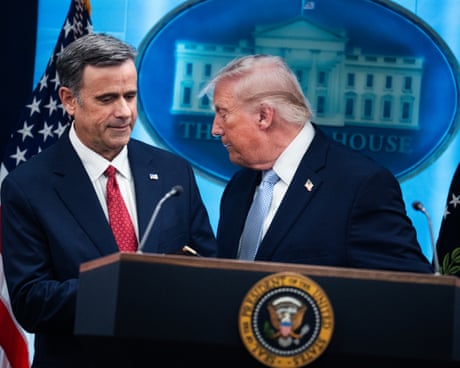
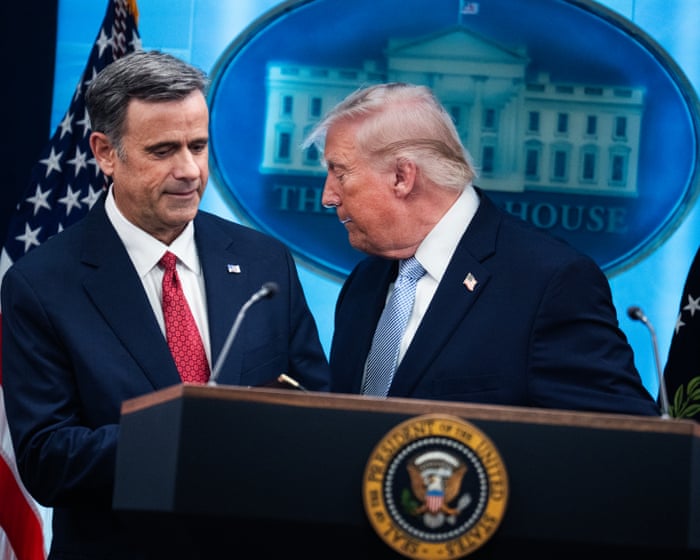
Donald Trump has downplayed a visit to Moscow by the CIA director, John Ratcliffe, as “semi-routine” after he turned up in the Russian capital unannounced, triggering a wave of speculation about the reasons for his trip.
Ratcliffe was reported to have flown to Moscow on a government transport plane on Tuesday in a rare visit after taking off from the Andrews air force base in Maryland.
Earlier this year, a survey found that Canada, along with Switzerland, was the best-liked country in the world. We all know this kind of polling is about as scientific as a high school popularity contest, but at least anecdotally, Canadians have a reputation for being friendly and welcoming, respectful and polite. Many people would find it difficult to dislike Canadians.
But not Donald Trump, who in a “hold my beer” moment this week demonstrated that he, at least, finds it easy to resent Canadians. The US president called the country “difficult and unreasonable”, and in a particularly hysterical moment, threatened to rename a lake, after trade talks collapsed.
In this episode of Guardian Australia’s US politics podcast Decoding America, co-hosts Jonathan Yerushalmy and Reged Ahmad explore why datacentres in the US have provoked such anger – and whether that could harm Republicans in the midterms given Donald Trump is such a supporter of the growing industry.
They also look at why the US and Canada are fighting over tariffs. The Canadian prime minister, Mark Carney, is pushing back and both countries could be on the cusp of a full-blown trade war.
Finally: why does the Trump administration’s secretary of transportation, Sean Duffy, have his very own YouTube show – and is he the only one?
They should ask the question Reagan asked at the end of his debate against Jimmy Carter: ‘Are you better off now than you were before this presidency?’
The midterm elections are already upon us, and every Democrat and independent running against a Republican should ask voters the question Ronald Reagan asked on 28 October 1980, at the end of his televised debate against Jimmy Carter: “Are you better off now than you were before this presidency?”
Unless you’re very, very rich, the answer is obviously: “No, I’m worse off.”
Energy bills have increased three times faster than the rate of inflation while Trump has been president. The national average monthly utility bill reached $280 in early 2026, a 12% increase since the end of 2024, just before the second Trump administration took office.
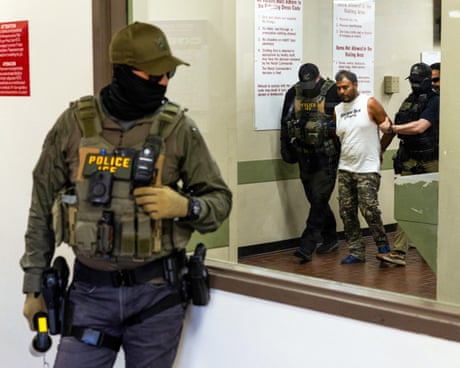
Administration moved away from high-profile raids that defined immigration enforcement approach last year but still deported record number of people
The Trump administration arrested and deported a record number of immigrants in July, according to newly released government data – apprehending an average of 1,500 people and removing 1,100 people daily.
This latest data confirms what attorneys and immigrant advocates have been seeing across the US – although the administration has moved away from the high-profile, militarized raids that came to define its immigration enforcement approach last year, it is quietly ramping up its operations.
The quiet-spoken Canadian prime minister has spoken unutterable truths
Is it perhaps a sign of the times that Mark Carney, the prime minister of Canada, has become a thrilling orator? A sober banker, he speaks calmly, without many vocal inflections. We expect Canadians to be somewhat flat; even a little boring, and yet Carney has already delivered two remarkable speeches in 2026, and the year is far from over.
The first, at Davos, described a “rupture in the world order”, and “the end of a pleasant fiction”. By that, he meant that the world could no longer depend on the United States to lead the Pax Americana that has largely kept the peace since the end of the second world war.
Using the bathroom or having a cry is about to become more expensive for North Americans as the US and Canada enter a full-fledged trade war that threatens to flush away decades of peaceful trading between the two nations.
After trade negotiations broke down between the two countries last weekend, Mark Carney, the Canadian prime minister, vowed to match US tariffs “dollar for dollar” and unveiled a list of nearly 900 American goods that will face 25% to 50% tariffs starting on 8 September.
Everyone can see that the Iran war has been a strategic disaster for the US, while a failing president pretends he is winning
Now is the twilight of Donald Trump’s supremacy. The US is still the richest and most heavily armed nation on Earth. That status is secure. The current president, contemptuous of law and indulged in lawlessness by a supine Congress, enjoys even greater power than the constitution allows.
With those advantages it takes a special talent for incompetence to look as thwarted and impotent as Trump does with more than two years of his second term still to run.
Le gouvernement fédéral a présenté des mesures en représailles aux droits de douane américains entrés en vigueur samedi dernier.
À compter du 8 septembre, le Canada imposera des taxes à l’importation de 15%, 25% ou 50% sur environ 700 produits américains.
Secteurs les plus touchés
acier
produits laitiers
électroménagers
matériel agricole
pâtes et papiers
électronique
Ces contres-tarifs ne visent que des produits frappés par des tarifs américains.
Ils s’appliqueront à presque 28 milliards $ d’exportations annuelles des États-Unis vers le Canada.
C’est un montant équivalent à celui des exportations canadiennes vers les États-Unis visées par les nouveaux tarifs américains.
Réponse américaine à la riposte canadienne
Donald Trump avait dès lundi, avant qu’on connaisse le détail des contre-tarifs, menacé de porter à 50% en janvier prochain les tarifs américains sur les voitures, les camions, les pièces automobiles et l’acier canadiens.
Tariffs on Canada, threats against Iran’s partners and bond market intervention show a president weaponising US power while making Americans poorer at home
Three moves in the last week have exposed the limits of Donald Trump’s economic bullying. The US slapped 50% tariffs on another $20bn of Canadian goods – then threatened the same rate on the cars, trucks, parts and steel that America Inc depends on. On Monday, the Treasury secretary, Scott Bessent, menaced Iran’s trading partners with exclusion from the US financial network, hoping that coercion can deliver what months of war have not. And as the costs of war, tariffs and pro-billionaire tax cuts helped send US bond yields higher, the Treasury stepped in to tame long-term rates. These are not contradictory policies but a gamble: that US economic power can be repeatedly weaponised without reducing others’ willingness to depend on it.
The Trump administration’s “D-day” sanctions are potentially the most consequential because they expose the scaffolding of American financial power. While markets shrugged off the immediate threat, that calculation might change were the US to target a major Chinese refinery or bank. Such an escalation could spark a trade war with Beijing. The US has leverage. But China has pressure points – especially farmers in Republican states – that make using it costly. In the long run, there is a price to pay. Nations hold one another’s currencies partly because they trust the political relationship. Mr Trump is testing what happens when they don’t.
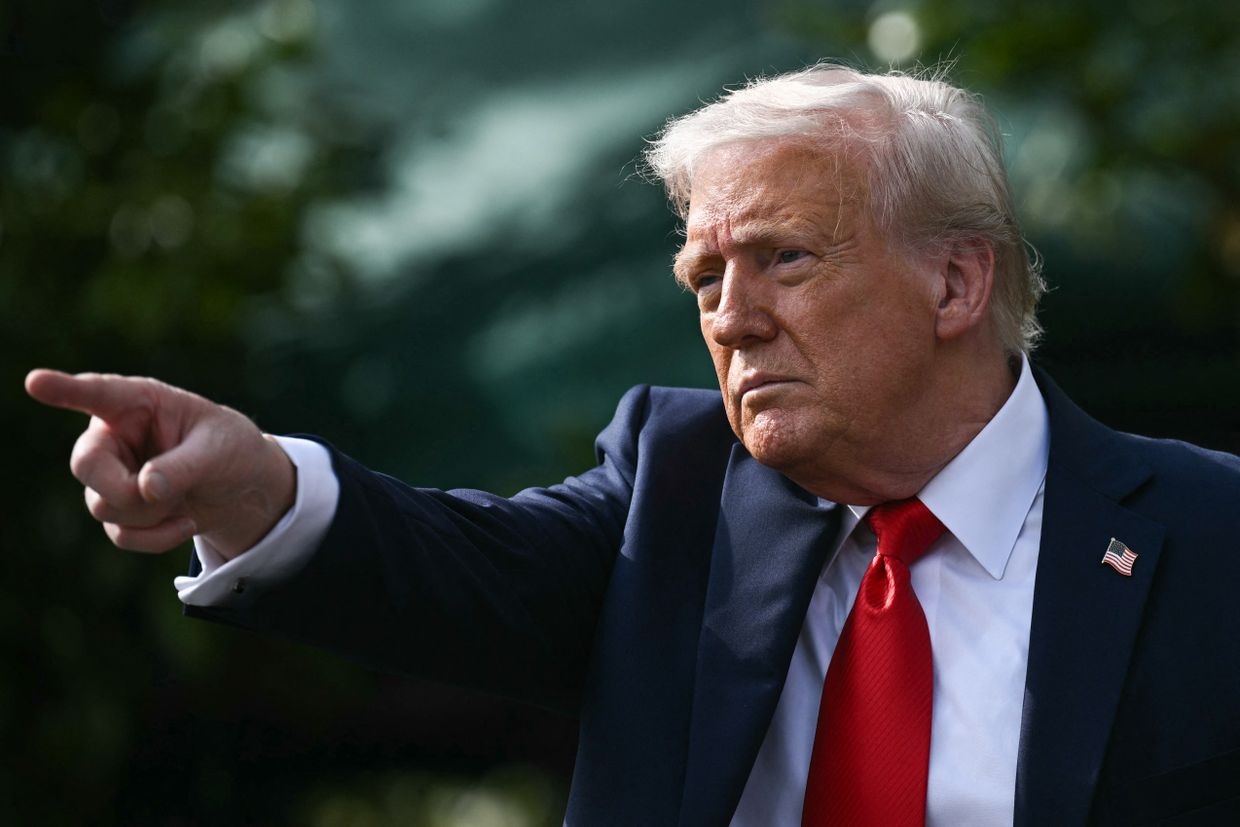
On Truth Social, however, the president shot down assertions that the US talks with Canada collapsed in part due a proposed trade deal that would have weakened French language protections.
“I would never interfere with Canadians speaking French!” he wrote. “In fact, I have never even thought of doing such a stupid thing. This lie was made up by a weak and ineffective Prime Minister in an attempt to gain political support, which he has totally lost, from the people of Quebec.”
A recent memo claiming executive privilege over communications with private advisers invites corruption
A recent office of legal counsel memo on executive privilege maintains that private advisers to a president can avoid responding to a subpoena by asserting the president’s executive privilege. The ability of presidents to shield communications from public view through claims of executive privilege, whether their own or those of a senior adviser, was already a powerful tool for presidents to avoid accountability. But if courts accept the OLC’s new interpretation of presidential privilege, it will be substantially harder to call witnesses to testify before Congress or in court proceedings regarding possible wrongdoing by the presidents.
Equipping presidents with extensive power to block witnesses in legal proceedings is a dangerous practice that invites corruption by presidents and their advisers. Consider the former White House counsel Don McGahn’s 2019 refusal to testify in response to a subpoena by the House judiciary committee in connection with the special counsel Robert Mueller’s investigation into Donald Trump. McGahn didn’t come up with that idea on his own. It was the Trump White House that sought to bar McGahn from testifying through an assertion of a type of executive privilege known as “testimonial immunity.” Ironically, Mueller was investigating whether Trump obstructed justice, among other things, by demanding that McGahn fire Mueller himself. Trump’s insistence that McGahn not testify, backed up by a 2019 OLC opinion, effectively made the first Trump administration complicit in the very obstruction under investigation.
Mark Carney a suspendu vendredi soir les négociations commerciales avec les États-Unis.
Il a expliqué que des modifications demandées par Washington étaient «inéquitables, non rentables et remettaient en cause la fiabilité de tout accord».
Selon Carney, les négociateurs américains voulaient:
restreindre les ententes commerciales que le Canada pourrait conclure avec d’autres pays;
maintenir des droits de douane trop élevés sur le secteur automobile;
exempter les entreprises américaines de l’obligation d’afficher et d’étiqueter leurs produits en français.
Le premier ministre fédéral a résumé samedi: «quand vous êtes attaqués, c’est que vous êtes en guerre», avant d’affirmer: «nous avons été attaqués».
Le gouvernement américain applique depuis samedi des tarifs douaniers de 50% sur de nombreux produits canadiens:
les produits laitiers
les alcools
des matériaux de construction
d’autres produits très variés, dont des appareils électroniques, des meubles et des bâtons de hockey
Ces tarifs affecteraient 5% des exportations canadiennes aux États-Unis.
La proportion est de 9% pour les exportations venant du Québec.
Le gouvernement canadien a l’intention d’imposer le 8 septembre des droits de douane d’un montant total équivalent, «au dollar près», sur les exportations américaines vers le Canada.
Ces contre-tarifs viseraient notamment les produits laitiers, l’acier et les appareils électroniques.
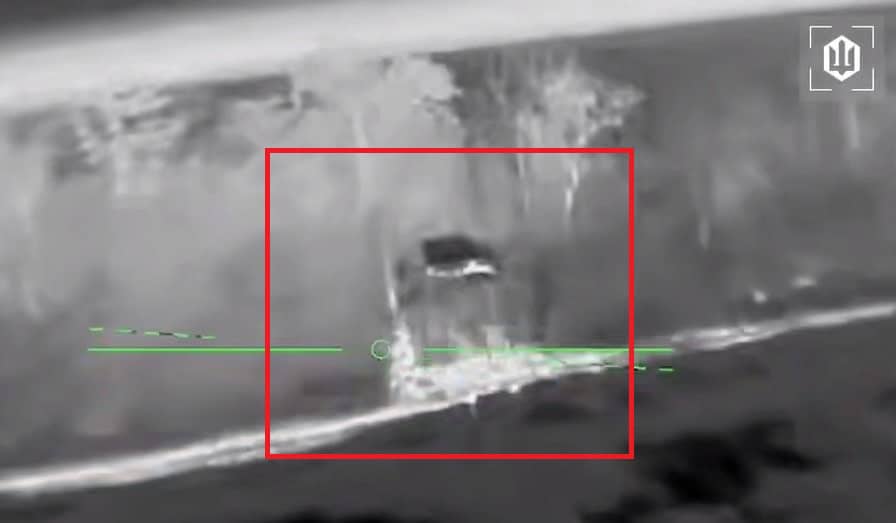
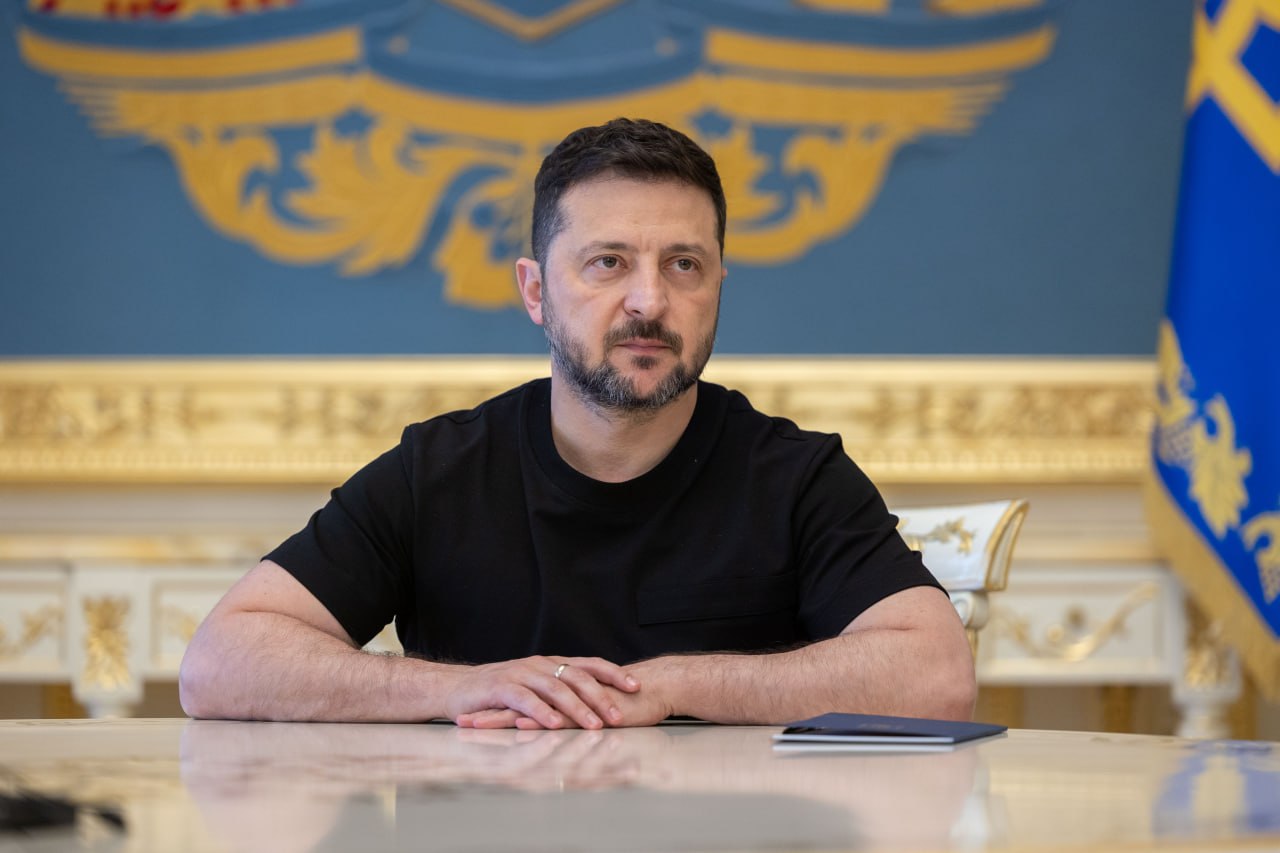
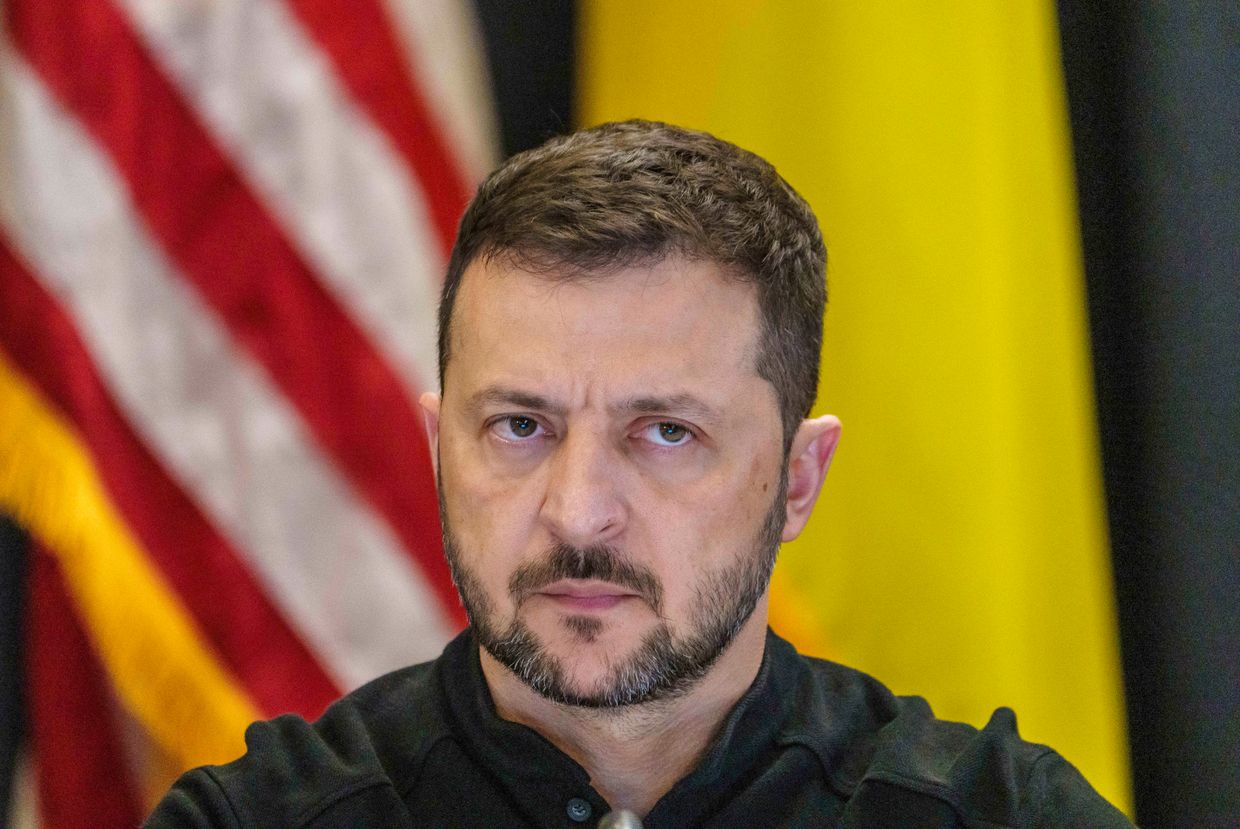
Ukraine has struck a Russian Iskander launcher near its border as part of a dedicated operation against nearby ballistic-missile launch positions, Ukrainian President Volodymyr Zelenskyy told journalists, according to Ukrinform.
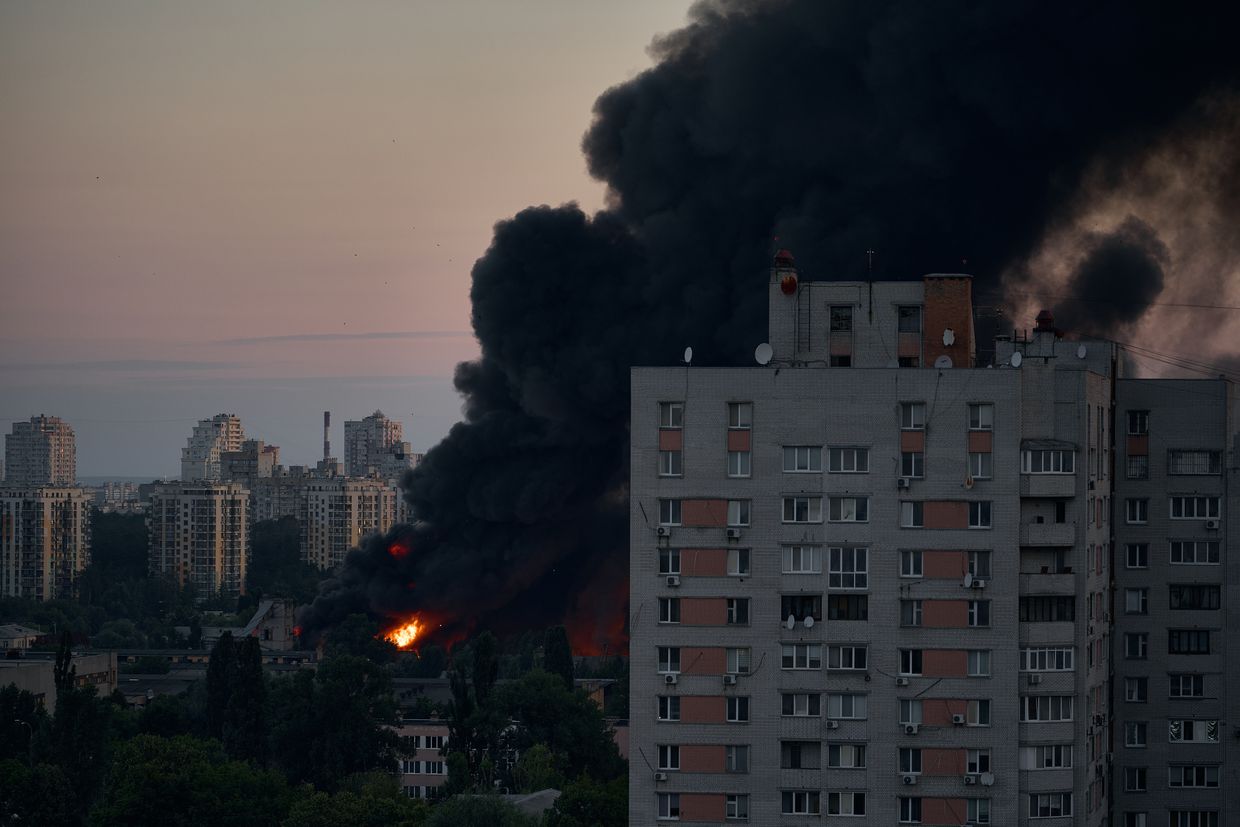
Russia continues using ballistic missiles against Ukrainian cities while Ukraine has rationed Patriot interceptors and warned of acute shortages, pushing Kyiv to combine interception with strikes on the systems and positions used to launch those missiles.
President says Ukraine hit an Iskander launcher
President Zelenskyy described the strike as a success but said the sensitivity of the operation prevented him from providing many details.
“We struck an Iskander launcher near our borders,” he said. “I am grateful to our warriors who are carrying this out. This is our operation to hunt their systems positioned nearby.”
The president, however, didn't disclose where the launcher was located or what weapon Ukrainian forces used to hit it.
Zelenskyy said strikes on launchers are one way Ukraine is trying to counter Russian ballistic attacks when anti-ballistic interceptor stocks are limited.
“When our anti-ballistic missile stocks are at a minimum, there is another tactic. It is more difficult, and we developed it,” he said. “It is hunting their nearby positions from which ballistic missiles are launched.”
He described the effort as a separate program and operation. Euromaidan Press could not independently verify the reported strike.
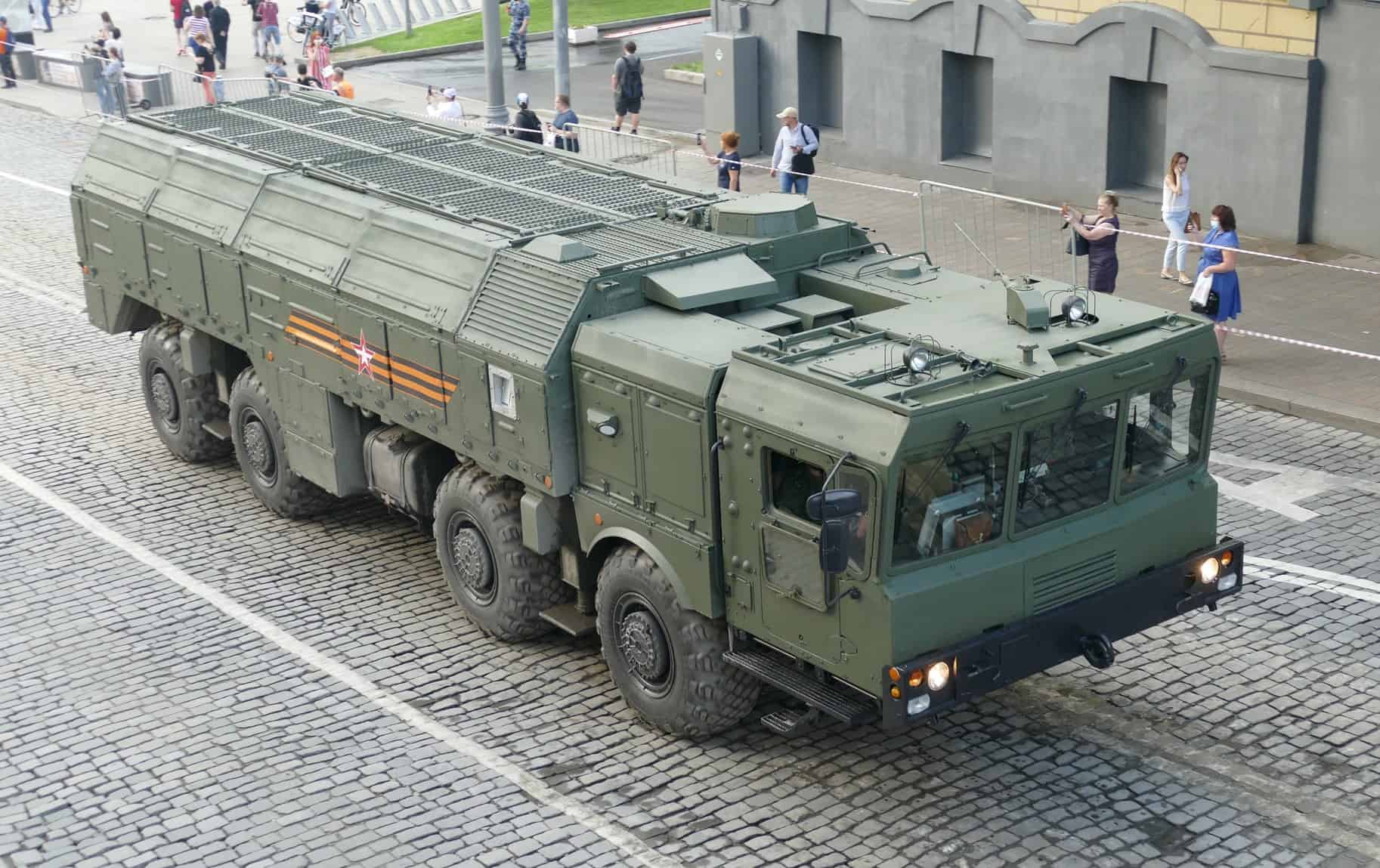
Russian Iskander-M missile system, 2020. Illustrative photo. Photo from Russian government sources via Militarnyi
Ukraine has already targeted Russian ballistic missile infrastructure in several operations this year. In April, Ukrainian drone forces reported strikes on two bases linked to Iskander systems in occupied Crimea.
On 30 May, Ukraine’s Unmanned Systems Forces said they destroyed an Iskander system at a launch position near Taganrog in Russia’s Rostov Oblast.
Explore further
5% of US Patriot stocks gets Ukraine through winter, 10% ends the ballistic threat — and Zelenskyy has just 1%, he tells CNN
SpaceX rejected Ukraine’s request to use Starlink inside Russia
The launcher strike comes as Ukraine is also looking for better ways to operate long-range drones against military targets in Russia. Zelenskyy said SpaceX ultimately refused to let Ukraine use Starlink inside Russia because of escalation concerns.
Kyiv had wanted Starlink to work over Russian territory for defense operations, including drone strikes on Russian ballistic-missile launchers near the border. The Defense Ministry asked him in the first half of 2026 to raise the issue with US President Donald Trump, Zelenskyy said. Zelenskyy said Trump relayed that decision to him at a later meeting. Ukraine continues discussing the issue with the US side.
Ukraine and European partners are separately developing the FREYJA anti-ballistic system, with Kyiv seeking a prototype capable of demonstrating practical results by mid-2027. The project is intended to combine Ukrainian missile technology with European radars, sensors, and command systems.
Ukraine is asking Elon Musk to let it arm deep-strike drones with his Starlink network and turn them on Russian ballistic-missile launchers far inside Russia, the Financial Times reported. The plan needs Musk's approval — and US President Donald Trump was cool to the idea when Ukrainian President Volodymyr Zelenskyy raised it at the White House on 28 July, with people present expecting Musk to refuse.
Kyiv is chasing the workaround because its air defenses are stretched: Russia keeps escalating its missile and drone strikes, and Ukraine is running low on the Patriot interceptors that are its only dependable answer to Russian ballistic missiles. As Russia builds more missiles and drones, Ukraine's interceptor needs run into the hundreds before the year is out.
At the meeting, FT reported, Zelenskyy pressed Trump to lobby Musk for permission to fly Starlink-linked drones across the Russian border. He capped the pitch at 200 km into Russia — far enough to reach launch sites, command posts, and other targets — on the calculation that a shallower limit might make Musk likelier to agree.
Starlink could extend Ukrainian drone strikes
Riding SpaceX's satellites, Starlink drones hold a steadier link to their pilots at long range than ordinary radio allows, and they shrug off the jamming that grounds other drones. The drones have already shown their worth in the fighting at home, and Vienna-based military analyst Franz-Stefan Gady said that across the border they "could be very useful in hunting" Russian launchers, FT wrote.
Kyiv's best channel to Musk has also just closed: Zelenskyy recently fired his defense minister, Mykhailo Fedorov, who had a direct line to the billionaire.
Mykhailo Fedorov during a June interview, a month before his dismissal, in which he described leaks and private-company influence inside the defense ministry. Photo: screenshot from PRESSING / Army-Media of Ukraine's Defense Forces
Speaking to a Ukrainian podcast on 6 August, Fedorov said that even with a channel to Musk still open after his firing, he had made no progress on cross-border Starlink use—"a difficult task right now."
Explore further
The Fedorov protesters lost. But they backed a man for what he built, not what he promised—and that may be new in Ukraine.
Musk’s Starlink decisions have affected both sides in the Russo-Ukrainian war
Musk has backed Ukraine's heavy dependence on Starlink for military command and comms. In 2022, Musk declined to extend Starlink coverage for Ukrainian troops mid-operation near occupied Crimea, citing his fear of triggering a nuclear escalation.
He has also acted against Moscow: in February, at Fedorov's direct request, Musk shut down the Starlink terminals that Russian forces had been operating illicitly against Ukraine.
Now, Musk answered Fedorov's Monday post with a line about "trying to do the right thing" and wanting peace — and said nothing about the Starlink ask.
À la suite du report de l’instauration de nouveaux droits de douane américains, le gouvernement fédéral a confirmé hier qu’il finalisait un accord avec Washington.
Mark Carney s’est toutefois contenté d’évoquer des «progrès substantiels», en soulignant qu’«il reste encore du travail important à accomplir».
Aucun des deux gouvernements n’a dévoilé le contenu de l’accord qui serait en cours de finalisation. Seules indications:
Dominic LeBlanc, ministre responsable du commerce Canada–États-Unis, a indiqué que le système de gestion de l’offre resterait intact.
Tim Houston, premier ministre de la Nouvelle-Écosse, a dit que Carney avait demandé aux provinces de remettre en vente l’alcool américain.
Dans une publication sociale en fin de soirée mardi, le président américain a indiqué qu’il reportait de trois jours l’instauration de nouveaux droits de douane américains sur de nombreux produits canadiens.
Ces tarifs douaniers, de 50%, avaient été annoncés le mois dernier et devaient entrer en vigueur aujourd’hui.
D’intenses négociations commerciales entre le Canada et les États-Unis ont eu lieu ces derniers jours.
Trump a justifié le report de l’entrée en vigueur par le fait que les deux pays seraient parvenus à une entente, qui resterait cependant à finaliser par écrit.
Paul St-Pierre Plamondon a annoncé hier que si le Parti québécois remporte les élections en octobre:
il consultera les Québécois sur l’indépendance du Québec;
mais il n’organisera pas de référendum sur la question tant que Donald Trump sera président des États-Unis.
Le second mandat de Trump doit se terminer en janvier 2029.
Le mandat du prochain gouvernement québécois doit, lui, se terminer en octobre 2030.
Le chef péquiste soutient que l’avenir politique du Québec exige «un débat éclairé et serein», et que ce débat ne doit pas «être confisqué par les coups d’éclat d’un président imprévisible».
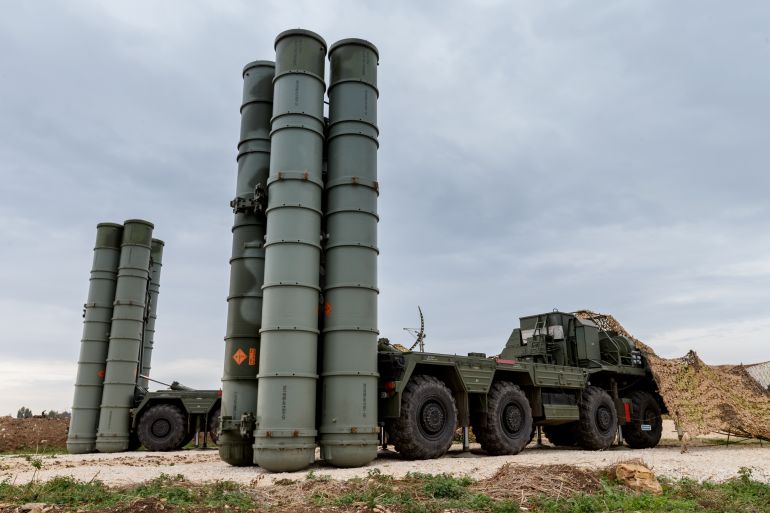
The US plan to sell Türkiye F-35 stealth fighter jets has stalled, blocked by a Russian missile system Ankara bought years ago, Semafor reported. Lawmakers in Washington won't clear the deal while Türkiye keeps the hardware. The lone buyer in talks hasn't budged, and destroying the system is now on the table.
Russia has long used arms exports to pull buyers into its orbit, and the war it started raised the price of those ties—leaving governments that bought Russian air defense to clash with the supplier that sold it.
The Russian system is in the way
US sanctions law bars Türkiye from the F-35 program while it retains the Russian S-400, Semafor reported. That system is a long-range air defense, built to shoot down planes and missiles. Ankara already paid for six of the jets. They have sat in the United States since Washington expelled Türkiye from the F-35 program in 2019. US President Donald Trump announced plans to sell the jets more than a month ago, and nothing has moved since.
Explore further
Türkiye wants to send Ukraine old US-made cluster munitions—one human rights group is fighting to stop it
No buyer, no easy exit
One way out is to sell the S-400 to another country. Türkiye reportedly opened talks with the United Arab Emirates (UAE) last month, but they don't appear to have progressed. American lawmakers insist Ankara must give up the system entirely first.
Republican Senator Rick Scott told Semafor that Türkiye shouldn't get the jets unless it becomes a true partner—"so if they have the S-400, they cannot have the F-35." Senate Foreign Relations Committee Chairman Jim Risch, a longtime opponent, said the process is "at a standstill."
Explore further
Erdoğan asks Putin to take back Russian S-400 SAM systems in move to win Trump’s favor
Israel and Congress are the live block
The sharper obstacle sits in Washington, Semafor reported. A vote to sell would pit Israel against a NATO ally, and many of Trump's own allies want the S-400 scrapped completely. Israeli Prime Minister Benjamin Netanyahu warned the jets could "destroy the power balance in the Middle East." The outlet said AIPAC, the leading pro-Israel lobby in Washington, is pressing Congress to keep the block.
Selling it still runs through Moscow
Any resale carries its own catch: Russia must approve the transfer of the S-400, giving the Kremlin a reason to block it. The only option that bypasses Moscow is to disable or destroy the system outright. Türkiye earlier tried to return the systems to Moscow, hoping to thaw relations with Washington. It didn't work.
The Trump administration says Ankara hasn't met all the conditions to buy the jets, and the State Department wants the S-400 issue settled with guarantees first.
France, Germany, and the UK are working to create a format representing Europe in talks over Russia’s war against Ukraine, The New York Times reported on 15 August, citing five European officials. Known collectively as the E3, the three countries would support Ukraine’s position and protect European interests in any settlement.
The initiative is Europe’s attempt to secure a place in talks the US is expected to lead. The three governments fear that Washington and Moscow could reach a deal without them, although Europe would have to enforce sanctions, decide how to use frozen Russian assets, and help protect Ukraine afterward. European officials also doubt Washington will stay committed to serious negotiations.
The officials expect Washington to lead negotiations with Moscow. The E3 wants to become the core group supporting Ukraine, following Kyiv’s request that it prepare for talks. France and Germany are shaping the position, while Britain fears damaging relations with Trump.
Poland, Italy, and the Nordic countries would be consulted, with the EU later involved. Some Baltic states and Hungary do not trust France and Germany to represent them. London called the discussion speculative.
The Coalition has rehearsed a force but not agreed to deploy it
The E3 forms the core of the Coalition of the Willing. At a 7 June meeting with President Volodymyr Zelenskyy, its leaders backed an immediate ceasefire and legally binding guarantees, including the deployment of a multinational force.
More than 600 British troops rehearsed with French paratroopers and an Italian platoon in February for a possible deployment. They could form the core of a 10,000-strong force pledged by London and Paris after a ceasefire.
Yet some members reportedly made Russia’s consent a condition for deploying troops, effectively giving Moscow a veto. Bulgaria has left, and Germany has not committed troops. The Coalition’s leadership is also shifting after Keir Starmer’s resignation and ahead of Emmanuel Macron’s departure in 2027.
Ukraine talks still misunderstand Russia's intentions
European officials see few signs that Vladimir Putin is ready for serious negotiations, the NYT reported. A separate EU attempt to open direct contact with Moscow divided member states.
Experts told Euromaidan Press that Russia uses peace processes to stall, press maximalist demands, and improve its battlefield position. Moscow also dismissed a Black Sea ceasefire proposal after Kyiv offered a mutual halt to attacks on civilian targets.
Ukraine’s partners risk mistaking Russia’s presence at talks for a willingness to compromise. Former Ukrainian diplomat Iuliia Osmolovska warned that Moscow also benefits from failed negotiations by exhausting Western governments until they pressure Kyiv to concede.
Before 2022, Russia signed 26 ceasefires in eastern Ukraine; none lasted more than two weeks. A pause can bank concessions, rotate troops, and let Moscow resume fighting from a stronger position.
Le gouvernement américain avait imposé le mois dernier de nouveaux droits de douane de 50% sur de nombreux produits canadiens.
Il est prévu qu’ils entrent en vigueur mercredi prochain.
Dominic LeBlanc, ministre fédéral responsable du commerce Canada–États-Unis, et Jamieson Greer, ministre américain du commerce international, se sont rencontrés hier pour la troisième fois en trois semaines.
Selon plusieurs médias, LeBlanc et Greer pourraient conclure une entente au cours des prochains jours.
Une telle entente pourrait être soumise lundi à Donald Trump, deux jours avant l’entrée en vigueur des nouveaux tarifs douaniers.
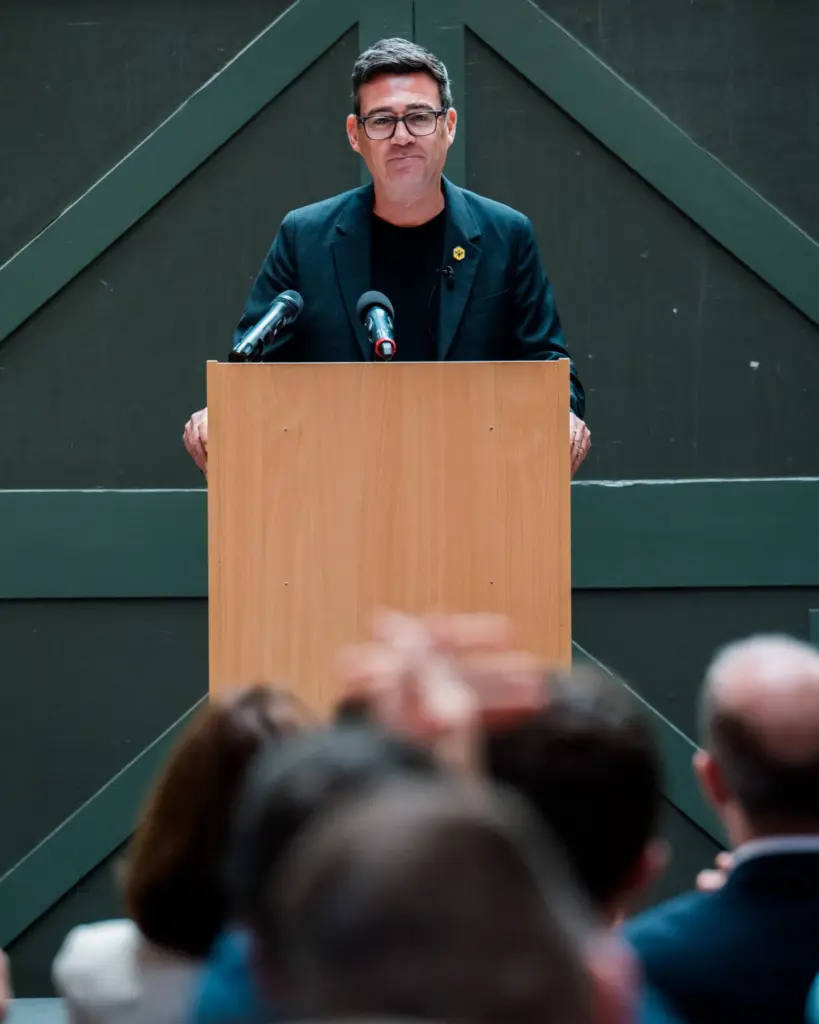
A plan presented to the UK's new Prime Minister, Andy Burnham, would extend Britain's nuclear umbrella to Ukraine and other non-NATO European states. In exchange, Britain would regain access to the EU single market for goods, The Telegraph reported on 9 August.
The proposal comes as European governments question whether they can rely on US protection and struggle to turn moral support for Ukraine into troops and weapons. Russia's invasions, despite the assurances Kyiv received from the US and the UK when it surrendered its nuclear arsenal under the Budapest memorandum, have also revived calls for nuclear-backed guarantees.
Former Conservative MP Nick Boles drafted the plan. He proposes a "European Confederation" that combines single-market access with NATO-style mutual defense commitments.
For Ukraine, it would provide protection modeled on NATO Articles 4 and 5 while Kyiv pursued full EU membership.
Ukraine would maintain a large army as Europe's bulwark against Russia and share defense technology with other members of the Confederation. Britain would raise defense spending to 3.5% of GDP, while both countries would gain full access to the EU's single market for goods.
Boles said Europe needed a new security model because neither US President Donald Trump nor a future US president could be guaranteed to "defend Europe as if it were Kansas."
Boles's plan is not Burnham government policy. Nevertheless, it has circulated among officials, including National Security Adviser Jonathan Powell, as London considers deeper cooperation with the EU.
Britain's support bumps against Europe's political limits
Prime Minister Burnham entered Downing Street as a firm supporter of Ukraine. He assured Ukrainian President Volodymyr Zelenskyy that British support remained unchanged and pledged to preserve aid levels.
Britain also co-leads with France the Coalition of the Willing, which plans to deploy forces in Ukraine after a ceasefire to deter another Russian attack.
The Coalition has brought together representatives of 40 countries. Still, members remain divided over how far to support Ukraine.
Britain and France have formally declared their intention to deploy forces after a potential ceasefire in Ukraine. Yet Poland offered logistical support but ruled out troop deployment, while Bulgaria has withdrawn from the Coalition. Europe has promised deterrence, but key deep-strike missiles may not arrive until 2029.
Boles's plan would pair Britain's nuclear deterrent with Ukraine's conventional military strength. Unlike the Coalition’s voluntary plans, Boles's proposed European Confederation would place its defense guarantees in a treaty. NATO would initially be responsible for carrying them out.
From surrendered weapons to a nuclear shield
Ukraine inherited the world's third-largest nuclear arsenal after the Soviet collapse, including about 1,900 strategic warheads.
Kyiv relinquished them under the 1994 Budapest Memorandum after receiving security assurances from Russia, Britain, and the US. Despite these promises, Russia invaded Ukraine in 2014 and launched its full-scale war in 2022.
Russia's invasions have revived calls among Ukrainian lawmakers for nuclear-backed security guarantees. Politician Roman Kostenko has called for guarantees that could include British and French nuclear retaliation in the event of another Russian attack.
Under Boles's proposal, Ukraine would not regain its own warheads. It would instead come under Britain's nuclear shield.
Donald Trump a annoncé le mois dernier de nouveaux droits de douane, de 10% ou de 12,5%, pour remplacer la surtaxe mondiale de 10% imposée l’an dernier et qui arrivait à échéance.
25 États américains ont déposé hier une plainte auprès du Tribunal de commerce international des États-Unis pour contester ces tarifs imposés par Washington.
Ils soutiennent que le gouvernement Trump n’a pas, comme il le prétend, décrété ces tarifs pour combattre le travail forcé, mais plutôt pour rétablir des droits de douane proches de ceux que les tribunaux avaient déjà annulés par deux fois.
Donald Trump a annoncé hier qu’un accord avait été conclu sur le désarmement complet du mouvement palestinien Hamas et de tous les autres groupes armés dans la bande de Gaza.
C’était l’un des points qui bloquaient la mise en œuvre de la deuxième phase du plan de paix américain pour Gaza.
Le président américain a précisé que l’armée israélienne quittera le territoire palestinien lorsque le Hamas sera désarmé.
Le Hamas n’avait pas encore confirmé publiquement l’accord hier soir.
U.S. President Donald Trump is considering sending Ukraine an additional Patriot air defense system, a move that would mark his administration's first major weapons transfer to Kyiv, the Wall Street Journal (WSJ) reported on July 8, citing two defense officials.
The report is the latest in a series of contradictory messages from the Trump White House in recent days regarding military aid to Ukraine. While the Pentagon on July 2 announced a halt in weapons shipments to Kyiv due to dwindling U.S. stockpiles, Trump later claimed he wasn't responsible for the decision and wanted to send more weapons to Ukraine.
A U.S. defense official told the WSJ that Trump has asked the Pentagon to look into options for supplying Ukraine with more arms, including a Patriot air defense system. Officials are also reportedly exploring whether other nations can send Patriots to Kyiv.
The claim dovetails with recent media reports about the administration's plans to bolster Ukraine's air defenses. Axios reported on July 8 that the White House is pursuing a plan to have Germany sell another Patriot battery to Ukraine, with the U.S. and European allies splitting the cost of the purchase. Sources told the outlet that Trump also pledged to send 10 Patriot interceptor missiles to Kyiv.
If the U.S. provides Ukraine with an additional Patriot system, it would mark the first time Trump has approved a major military aid package to Kyiv that wasn't previously greenlighted by former U.S. President Joe Biden.
Washington has thus far provided Kyiv with three Patriots, a former Pentagon official told the WSJ. Germany has also sent three, while a group of European countries provided one. According to the official, not all systems are in use at the same time due to maintenance issues.
The U.S.-made air defense systems are in high demand around the world. Each system consists of two or three launchers, a radar, a command and control element, and interceptor missiles. Patriot missiles are also in short supply globally: Ukraine faces an urgent need for the munitions amid increased Russian aerial attacks, and the Guardian reported on July 8 that even the U.S. has only 25% of the interceptors required by its defense readiness plans.
According to one of the officials who spoke to the WSJ, the U.S. military would be able to supply an additional Patriot to Ukraine if ordered by the White House.
U.S. President Donald Trump said on July 8 he was "not happy" with Russian President Vladimir Putin.
"We get a lot of bullsh*t thrown at us by Putin," he said at a cabinet meeting. "He's very nice all the time, but it turns out to be meaningless."
Trump has vacillated for months between criticizing Putin and praising the Kremlin. So far, he has failed to increase military aid to Ukraine or sanction Russia despite Moscow's refusal to accept a ceasefire.
During his election campaign, Trump repeatedly pledged to end the war in Ukraine within "24 hours." However, his efforts to broker a peace deal between Ukraine and Russia have seen no progress.
Trump also addressed U.S. legislation on sanctions, saying the Senate's Russia sanctions bill was "totally optional" for him to implement or terminate.
"I'm looking at it very strongly," Trump said.
The bill would impose 500% tariffs on imports from countries purchasing Russian oil, gas, uranium, and other products. It was introduced in April but has seen no progress since then.
Earlier, Trump signaled growing openness to tougher measures against Moscow, ABC News reported on June 29.
According to Senator Lindsey Graham, Trump privately told him it was "time to move" the Russia sanctions bill.
"I’m confident the president is ready for us to act," Graham said.
The Senate is expected to vote on the bill after Congress returns from a break in July.
"(Putin is) killing a lot of people — his soldiers and their soldiers mostly. And it's now up to 7,000 a week," Trump said on July 8, referring to Russia's battlefield losses.
In recent weeks, Trump has been critical of the Russian president. Following a phone call with Putin on July 3, Trump said he was "very disappointed," signaling growing frustration with the Kremlin.
When asked by a journalist on July 8 whether he would take action, Trump responded: "Wouldn't be telling you... We want to have a little surprise."
Trump also commented on the the current pause in weapons deliveries to Ukraine. He pointed to the previous transfer of advanced systems, including Javelin anti-tank missiles and Patriot air defense systems, calling them "the best equipment in the world."
His remarks come after the United States halted military aid shipments to Ukraine on July 2 amid an internal Pentagon review of stockpile capacity. The freeze coincided with a surge in Russian aerial attacks, leaving Ukraine increasingly vulnerable amid a shortage of U.S.-supplied air defense systems.
The U.S. halted weapons shipments to Ukraine amid a capability review, the White House and Pentagon previously confirmed, with Trump later denying the pause.
On July 7, the Pentagon said it would renew shipments, saying the additional defensive weapons were intended to help Ukraine protect itself while the U.S. works toward "a lasting peace."
U.S. President Donald Trump has promised to send 10 Patriot interceptors to Ukraine - a smaller number than had been paused previously while en route to the country, Axios reported on July 8, citing its sources.
Trump has also suggested that Germany sell one of its Patriot batteries to Ukraine, according to three sources cited by Axios. They said the U.S. and European allies would split the cost of the purchase.
The discussion comes as Ukraine is calling upon its allies, particularly the United States, to support Ukrainian air defense by supplying "life-saving" Patriot systems and relevant missiles.
The Pentagon said on July 2 that some military assistance to Ukraine had been halted as the U.S. Defense Department conducts a review of foreign aid deliveries.
On July 7, the Pentagon said it would renew shipments, saying the additional defensive weapons were intended to help Ukraine protect itself while the U.S. works toward "a lasting peace."
Merz called Trump to request the release of the paused interceptors, according to Axios. During the call, Trump proposed that Germany sell one of its own Patriot batteries to Ukraine.
While no agreement has been reached, officials on both sides say negotiations are ongoing. German officials maintain that Berlin has already sent a higher share of its available Patriot systems to Ukraine than any other NATO country, including the U.S.
Russia has escalated its aerial campaign against Ukraine in recent weeks, launching large-scale missile and drone attacks that have killed and injured hundreds of civilians across multiple cities.
The suspension of U.S. arms deliveries, which include Patriots and precision-guided munitions, drew criticism from Kyiv. During a July 4 phone call with Ukrainian President Volodymyr Zelensky, Trump said he was not responsible for halting the aid, according to the Wall Street Journal.
He reportedly told Zelensky that a review of U.S. munitions stockpiles was initiated after last month's U.S. strikes on Iranian nuclear sites, but denied ordering a full pause in shipments.
NBC News reported that Defense Secretary Pete Hegseth halted the shipments unilaterally on July 2, despite internal Pentagon assessments that the move would not jeopardize U.S. military readiness.
Special Envoy Keith Kellogg and Ukrainian Defense Minister Rustem Umerov are set to meet in Rome later this week to discuss resuming the stalled military aid, Politico reported on July 7.
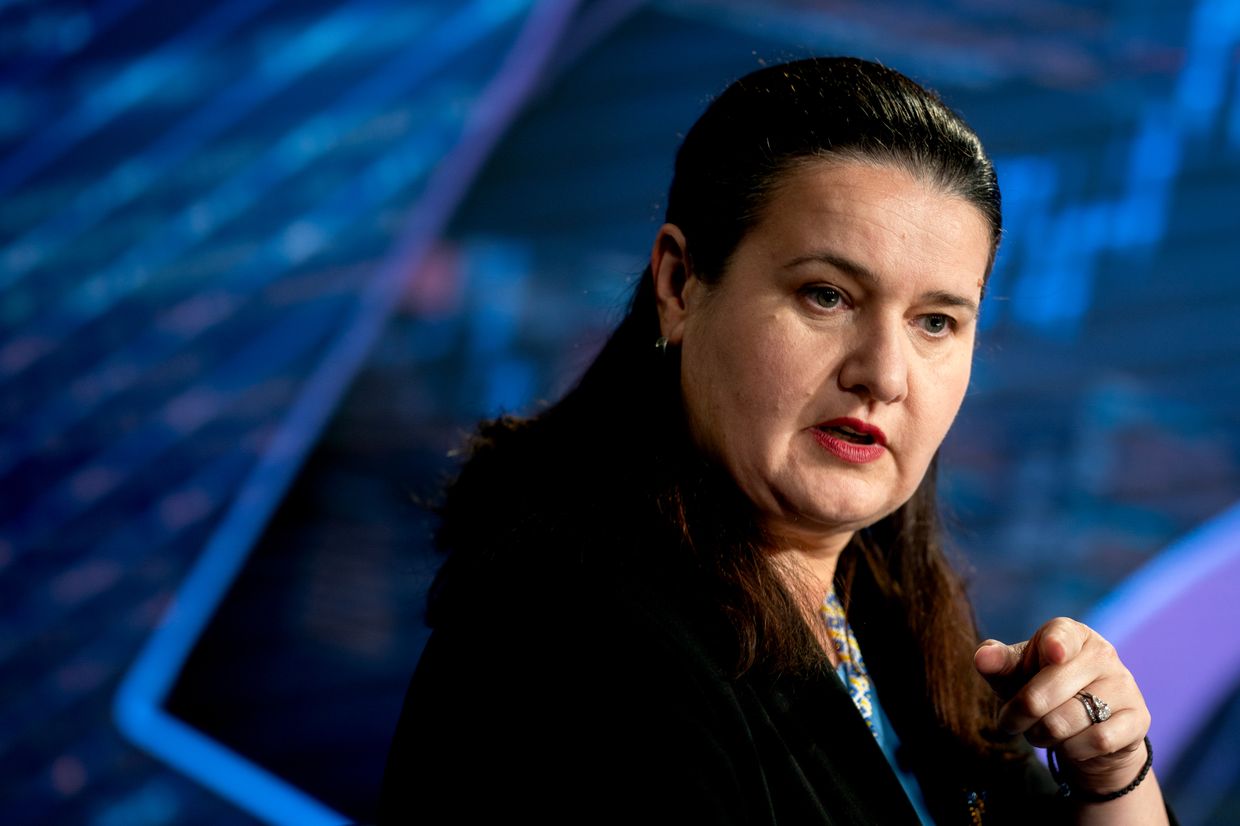
Ukraine's ambassador to the U.S. has been informed by President Volodymyr Zelensky that she is to be dismissed, a source in the President's Office confirmed to the Kyiv Independent on July 8.
Oksana Markarova has held the post since April 2021, and played a central role in coordinating U.S. military and financial support during the early phases of Russia's full-scale invasion.
But her future in the role was thrown into doubt earlier this week when it was revealed that Zelensky and U.S. President Donald Trump discussed a potential change during a recent phone call, a source in the President's Office told the Kyiv Independent on July 7.
According to the source, the topic of replacing her was raised by Kyiv, suggesting the move could be "useful for both sides." The source added that there are multiple "strong candidates" in the running.
The source added that there are multiple "strong candidates" in the running.Prime Minister Denys Shmyhal, Deputy Prime Minister Olha Stefanishyna, Defense Minister Rustem Umerov, and Energy Minister Herman Halushchenko are among the candidates, Bloomberg previously reported.
The possible reshuffle comes at a moment of renewed tension between Kyiv and Washington. The U.S. Defense Department recently paused shipments of critical weapons systems, including Patriot missiles and precision-guided munitions, sparking concern in Kyiv.
The discussion about Ukraine's representation in Washington also coincides with longstanding speculation about a broader government reshuffle.
U.S. President Donald Trump told President Volodymyr Zelensky during a phone call on July 4 that he was not responsible for the suspension of U.S. arms shipments to Ukraine, The Wall Street Journal (WSJ) reported on July 7, citing unnamed sources familiar with the matter.
The suspension of aid, which includes Patriot air defense missiles and precision-guided munitions, has drawn criticism from Kyiv amid an intensifying Russian aerial campaign that has killed and injured hundreds of civilians in recent weeks.
According to WSJ, Trump told the Ukrainian president that he had ordered a review of Pentagon munitions stockpiles following last month's U.S. strikes on Iran's nuclear sites, but he did not direct the military to halt weapons deliveries.
NBC News reported on July 4 that Defense Secretary Pete Hegseth unilaterally halted the shipment to Ukraine on July 2, despite internal Pentagon assessments showing the aid would not compromise U.S. military readiness.
According to Politico, U.S. Special Envoy Keith Kellogg and Defense Minister Rustem Umerov are scheduled to meet in Rome later this week to discuss restarting U.S. military aid to Ukraine.
Trump did not acknowledge a halt in U.S. weapons shipments to Ukraine. On July 7, he said the U.S. would provide Ukraine with "more weapons," pointing to the scale of Russia's attacks.
"They have to be able to defend themselves, they're getting hit very hard now," Trump told reporters alongside a U.S. and Israeli delegation at the White House.
The comments follow Trump's July 3 call with Russian President Vladimir Putin, after which he said he was "very disappointed" with the Kremlin's continued refusal to end hostilities.
The following day, Trump and Zelensky spoke by phone in what the U.S. president described as a "very strategic" conversation focused on Ukraine's need for air defenses.
Two rounds of direct talks between Russia and Ukraine held in Istanbul in May and June led only to prisoner exchanges, with no breakthrough on ending hostilities. Moscow has maintained maximalist conditions while rejecting calls for an unconditional ceasefire.
The United States will send "more weapons" to Ukraine amid intensified Russian strikes, U.S. President Donald Trump told reporters on July 7, adding that he is disappointed in Russian President Vladimir Putin.
"We're gonna send some more weapons we have to them, they have to be able to defend themselves, they're getting hit very hard now," Trump said alongside a U.S. and Israeli delegation at the White House.
The U.S. halted weapons shipments to Ukraine amid a capability review, the White House and Pentagon previously confirmed, with Trump later denying the pause.
Trump previously said he was disappointed in Putin for not making progress to end Russia's war against Ukraine, following a phone call between the two leaders on July 3.
On July 7, Trump again said he was unhappy with Putin for failing to cooperate with U.S. efforts to end the war in Ukraine.
"It's a horrible thing, and I'm not happy with President Putin at all," Trump said. "I'm disappointed frankly that President Putin hasn't stopped."
He noted that the additional assistance the U.S. will supply to Ukraine will mainly consist of defense weapons amid increased Russian attacks.
"They're getting hit very hard. We're gonna have to send more weapons, your defensive weapons primarily, but they're getting hit very, very hard. So many people are dying in that mess," Trump said.
Later on July 7 the Pentagon released a statement confirming more weapons would be sent to Ukraine.
"At President Trump's direction, the Department of Defense is sending additional defensive weapons to Ukraine to ensure the Ukrainians can defend themselves while we work to secure a lasting peace and ensure the killing stops," it read.
"Our framework for POTUS to evaluate military shipments across the globe remains in effect and is integral to our America First defense priorities."
President Volodymyr Zelensky has previously said he and Trump discussed supplying Ukraine with additional Patriot missile systems following a phone call between the two on July 4.
Zelensky described his recent phone call with Trump as "the best conversation in all this time" in an evening address on July 5.
"Patriot (missiles) are key to protection from ballistic (missiles). We discussed several other important issues that our teams will work out in detail at meetings in the near future," he said.
Trump described his July 3 conversation with Putin as disappointing, saying that the call "didn't make any progress" in stopping Russia's war against Ukraine.
"I'm very disappointed with the conversation I had today with President Putin," Trump told journalists. "Because I don't think he's there. And I'm very disappointed. I don't think he's looking to stop this fighting."
Pentagon spokesperson Sean Parnell confirmed on July 2 that some military assistance to Ukraine has been halted as the U.S. Defense Department conducts a review of foreign aid deliveries.
"This capability review... is being conducted to ensure U.S. military aid aligns with our defense priorities... We see this as a common-sense, pragmatic step towards having a framework to evaluate what munitions are sent and where," Parnell said.
Despite the Pentagon announcement, Trump did not acknowledge a halt in U.S. weapons shipments to Ukraine.
"Why did you pause weapons shipments to Ukraine?" a reporter asked Trump as the U.S. president prepared to board Air Force One on July 3.
President Volodymyr Zelensky and U.S. President Donald Trump discussed a potential change in Ukraine's ambassador in Washington during a recent phone call, a source familiar with the conversation told the Kyiv Independent.
Oksana Markarova has held the post since April 2021, and played a central role in coordinating U.S. military and financial support during the early phases of Russia's full-scale invasion.
According to the source, the topic of replacing her was raised by Kyiv, suggesting the move could be "useful for both sides." The source added that there are multiple "strong candidates" in the running.
When contacted by the Kyiv Independent, a spokesperson for Stefanishyna said they "do not comment on rumors."
The possible reshuffle comes at a moment of renewed tension between Kyiv and Washington. The U.S. Defense Department recently paused shipments of critical weapons systems, including Patriot missiles and precision-guided munitions, sparking concern in Kyiv.
The discussion about Ukraine's representation in Washington also coincides with longstanding speculation about a broader government reshuffle.
Rumors about replacing Shmyhal as prime minister have circulated since last summer. Although Zelensky replaced several officials in September 2024, Shmyhal remained in office.
Halushchenko, one of the potential ambassadorial candidates, has faced criticism in parliament. Lawmakers from the Energy Committee, led by lawmaker Inna Sovsun, introduced a motion to dismiss him in January, citing alleged corruption.
Shmyhal has served as Ukraine's Prime Minister since March 2020, overseeing national governance during a period marked by reforms and wartime crises. Before his premiership, he held key roles as Ivano-Frankivsk Oblast Governor and Vice Prime Minister.
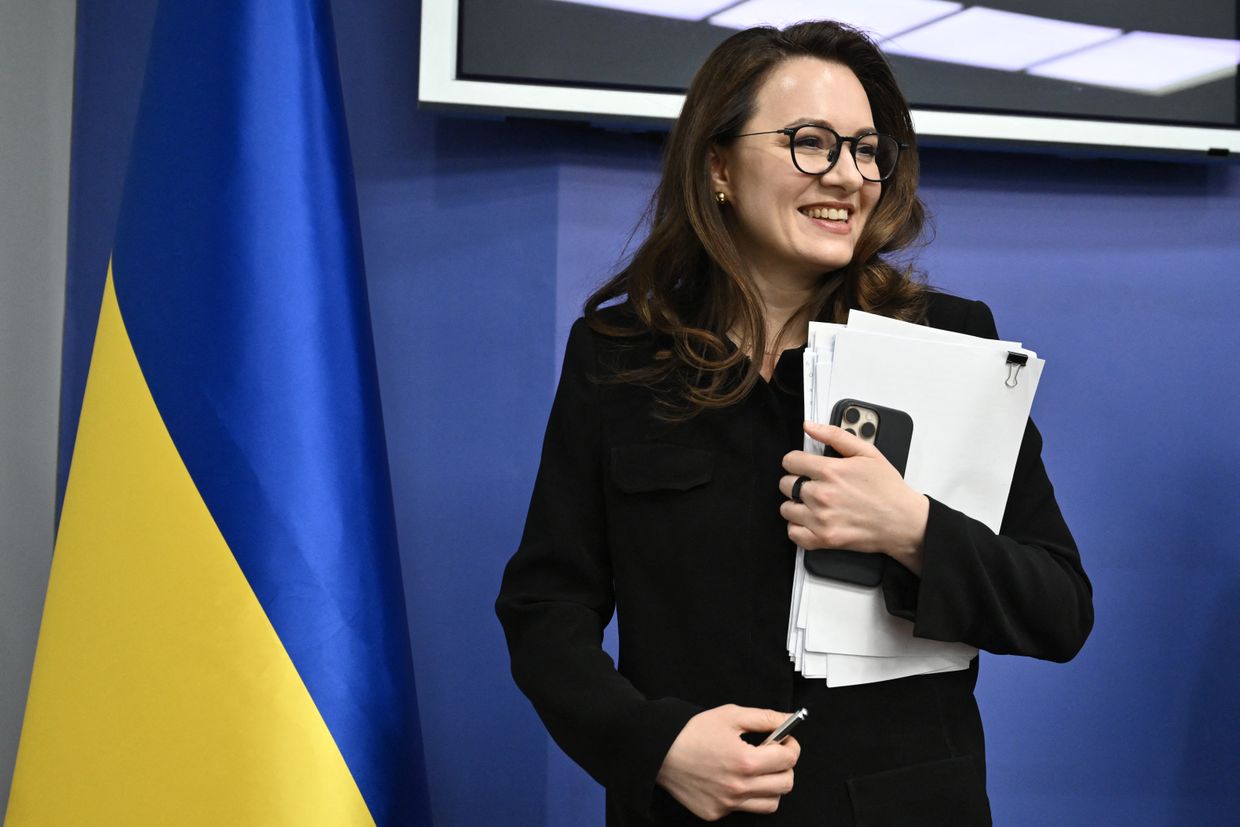
Stefanishyna is a seasoned Ukrainian diplomat and expert in European integration who has held high-level government roles since 2020. In September 2024, she was appointed Deputy Prime Minister for European and Euro-Atlantic Integration, and Justice Minister.
Umerov is Ukraine's current Defence Minister, appointed in September 2023. He started his political career as a member of the Parliament for the opposition party Voice (Holos). Umerov played a major role in peace talks with Russia in the early phase of the full-scale war.
The ambassadorial review comes as Kyiv seeks to strengthen its diplomatic ties with Washington.
Zelensky described his July 5 phone call with Trump as "the best conversation in all this time." The U.S. president echoed the sentiment, calling the exchange "very strategic."
U.S. President Donald Trump said on July 6 that his administration is "helping a lot" when it comes to Ukraine, defending his approach to the ongoing war.
"I am helping Ukraine. I'm helping it a lot," Trump told reporters when asked in Washington why the U.S. does not support Ukraine as strongly as it supports Israel.
The comment follows a growing outcry in Kyiv over the U.S. Defense Department's decision to pause deliveries of key weapons, including Patriot air defense missiles and precision-guided munitions.
Ukrainian officials have warned that the delay leaves the country more vulnerable to intensified Russian missile and drone attacks, which have killed and injured hundreds of civilians in recent weeks.
While Trump has repeatedly said he wants to end the war and support Ukraine, his administration has not imposed new sanctions on Russia since he took office in January and has yet to approve additional military assistance packages.
Instead, the Trump administration has prioritized military action in the Middle East. The U.S. launched air strikes on three nuclear sites in Iran on June 21, a move critics say stands in contrast to Washington's cautious posture toward Moscow.
Speaking on Air Force One on July 5, Trump expressed frustration over his July 3 phone call with Russian President Vladimir Putin.
"It just seems like he wants to go all the way and just keep killing people," Trump said.
Trump also spoke with President Volodymyr Zelensky on July 4 in what the U.S. president later described as a "very strategic" call. Trump said the two discussed Ukraine's urgent need for air defenses.
"They're going to need something because they're being hit pretty hard," Trump said, adding that supplying Patriot systems was a possibility.
Despite those comments, there have been no new authorizations for weapons deliveries, and Trump's administration has continued to avoid direct economic pressure on Moscow.
Two rounds of direct talks between Russia and Ukraine held in Istanbul in May and June led only to prisoner exchanges, with no breakthrough on ending hostilities. Moscow has maintained maximalist conditions while rejecting calls for an unconditional ceasefire.
U.S. President Donald Trump said on July 6 that his administration will impose an additional 10% tariff on countries aligning themselves with what he described as the BRICS group's "anti-American policy."
"There will be no exceptions to this policy," Trump wrote on the social network Truth Social.
The announcement coincided with the BRICS summit in Brazil, where member states, including Russia, China, and India, adopted a declaration condemning strikes on Iran and Israel's operations in Gaza.
The document did not explicitly name the U.S. but criticized actions perceived as destabilizing. On June 21, the country carried out strikes on three major Iranian nuclear sites: Fordow, Natanz, and Isfahan.
Trump's latest trade threat escalates tensions with the BRICS group, which has increasingly sought to reduce dependence on the U.S. dollar and shift toward a multipolar world order.
Kirill Dmitriev, head of Russia's sovereign wealth fund, described the summit as the start of a new "Global South" era, highlighting the group's aim to reshape the global order.
Though Russian President Vladimir Putin said in October 2024 that there are no immediate plans to create a BRICS currency, he highlighted the group's goal of financial sovereignty.
In January, Trump warned of 100% tariffs on BRICS members if they attempt to adopt a new or existing currency to replace the U.S. dollar in international trade.
Russian Foreign Minister Sergey Lavrov attended the BRICS summit in person, while Putin participated via video due to an outstanding International Criminal Court (ICC) warrant. Brazil, the summit's host, is an ICC member and obligated to arrest Putin if he enters the country.
The declaration also condemned incidents on Russian railway infrastructure and called for a negotiated settlement in the war against Ukraine. However, it avoided urging Russia to halt its full-scale invasion.
BRICS expanded in 2024, admitting Egypt, Ethiopia, Iran, and the United Arab Emirates as new members. In October 2024, Putin hosted a BRICS forum in Kazan, attended by 36 world leaders.
U.S. President Donald Trump on July 6 commented on tech billionaire Elon Musk's plan to create a new political party, calling it "ridiculous" and warning that third-party movements have historically failed in the United States.
"I think creating a third party is ridiculous... we've had tremendous success with the Republican Party," Trump told reporters on July 6 before boarding Air Force One in Morristown. "The Democrats have lost their way, but it's always been a two-party system, and I think creating a third party just adds to the confusion."
These comments came after Musk unveiled plans on July 5 to launch a new political force in the U.S. called the "America Party."
Musk said the party's goal is to "give you back your freedom" and offer an alternative to the entrenched Republican and Democratic systems, a few weeks after a public split with Trump.
The strained relationship between Musk and Trump began to deteriorate significantly after a period when Musk publicly supported Trump's re-election bid and held a high-profile role in the U.S. government's Department of Government Efficiency (DOGE).
Musk's new party announcement followed Trump signing a major tax and spending bill into law, the One Big Beautiful Bill Act, legislation that Musk had strongly criticized.
Trump later commented further in a Truth Social post, saying that third parties bring "complete and total disruption and chaos" and criticizing Musk.
"I am saddened to watch Elon Musk go completely 'off the rails,' essentially becoming a TRAIN WRECK over the past five weeks," Trump wrote.
Trump also linked Musk's political shift to his frustration over the recently passed Republican bill eliminating the federal electric vehicle mandate.
"It is a Great Bill but, unfortunately for Elon, it eliminates the ridiculous Electric Vehicle (EV) Mandate, which would have forced everyone to buy an Electric Car in a short period of time. I have been strongly opposed to that from the very beginning," Trump added.
Musk led DOGE until May 30 and had been a key figure in dismantling U.S. foreign aid institutions, including USAID, which delivered billions in aid to Ukraine.
Weeks after a high-profile public falling out with U.S. President Donald Trump, tech mogul Elon Musk announced the creation of a new political party in the United States, dubbed the "America Party."
Musk said on July 5 that the party's aim is to "give you back your freedom" and challenge the traditional two-party Republican and Democratic system.
The announcement came a day after Trump signed his sweeping tax cut and spending bill into law, a legislative act that Musk has fiercely opposed. It remains unclear if the America Party has been formally registered with election authorities, but Musk indicated it would launch "next year."
Musk's decision follows a poll he conducted on X on July 4, asking his followers if he should create a new political party.He cited the overwhelming support, writing: "By a factor of 2 to 1, you want a new political party and you shall have it! When it comes to bankrupting our country with waste & graft, we live in a one-party system, not a democracy."
The strained relationship between Musk and Trump began to deteriorate significantly after a period where Musk publicly supported Trump's re-election bid and held a high-profile role in the U.S. government's Department of Government Efficiency (DOGE).
In May, Musk announced his departure from DOGE, citing the end of his "scheduled time." Initially, Trump praised him as "one of the greatest business leaders and innovators the world has ever produced."
However, tensions escalated sharply on May 22 after the U.S. House of Representatives passed the "One Big Beautiful Bill Act," a significant tax-cut and spending bill that Trump signed into law on Friday.
Musk vehemently condemned the legislation, calling it a "massive, outrageous, pork-filled Congressional spending bill is a disgusting abomination." He argued that the bill's spending would exacerbate the "already gigantic budget deficit" and "burden American citizens with crushingly unsustainable debt."
Adding to the friction earlier this week, Trump threatened to cut off billions of dollars in federal subsidies to Musk's companies and even hinted at the possibility of deporting the South Africa-born entrepreneur.
Europe must dramatically ramp up its defenses against a resurgent Russia, NATO Secretary General Mark Rutte said in an interview with the New York Times published on July 5, crediting U.S. President Donald Trump for driving the alliance to unprecedented levels of commitment.
Rutte, who assumed his role late last year after 14 years as Prime Minister of the Netherlands, has been navigating NATO through a period marked by Russia's expansionist ambitions and questions about the reliability of the United States as an ally.
"Russia is reconstituting itself at a pace and a speed which is unparalleled in recent history," he told the outlet, adding that "...they are now producing three times as much ammunition in three months as the whole of NATO is doing in a year. This is unsustainable, but the Russians are working together with the North Koreans, with the Chinese and Iranians, the mullahs, in fighting this unprovoked war of aggression against Ukraine."
He emphasized the interconnectedness of security across different regions, noting that a secure Arctic is vital due to increased Chinese and Russian activity, and a secure Atlantic is "crucial" for the U.S. "If the Arctic, if the Atlantic Ocean, if Europe is not secure, the U.S. has a big problem," Rutte said, arguing that Russia is ultimately aiming to attack the U.S.
The Secretary General strongly dismissed Russian Foreign Minister Sergey Lavrov's comments that NATO's new defense spending targets would "bankrupt" members.
"I know Sergey Lavrov very well. He has been foreign minister of Russia since the birth of Jesus Christ, and I’ve never taken him seriously. When you talk about fake news, listen to Sergey Lavrov," Rutte told the NYT. He believes Lavrov's comments are "clearly evidence that the deterrence is working."
Rutte acknowledged concerns about the defense industrial output across the alliance, adding that, "we simply lack the defense industrial base to produce the weapons we need to make sure that we can deter the Russians or the North Koreans or whoever to attack us." He underscored the importance of not just financial investment, but also having sufficient personnel and industrial capacity to effectively utilize weaponry.
On the subject of Ukraine, Rutte confirmed that European allies have significantly increased their financial commitment. "The Europeans have now cobbled together $35 billion in military aid this year to deliver to Ukraine, which is more than last year," he said. He viewed this as a logical and fair shift, with the U.S. expecting Europeans to "take more of the burden when it comes to the concrete support to Ukraine."
While acknowledging the complex discussions surrounding peace talks, Rutte recognized President Donald Trump's role in initiating dialogue with Russian President Vladimir Putin.
"He is the one who broke the deadlock with Putin. When he became president in January, he started these discussions with Putin, and he was the only one who was able to do this. This had to happen. A direct dialogue between the American president and the president of the Russian Federation."
However, Rutte admitted that subsequent peace talks in Istanbul involved Russia sending a less serious delegation, leading to the conclusion that "we are not there yet, and that means that in the meantime you have to make sure that Ukraine has what it needs to stay in the fight."
Despite some perceived divergences in approach between NATO and the U.S. regarding peace talks, Rutte insisted on the American administration's commitment to the conflict's importance.
"The American administration completely takes the view and shares it with the Europeans that this war in Ukraine is crucial for the defense of NATO territory going forward and that we have to make sure that Ukraine is in the strongest possible position to stop the Russians from taking more territory, and that when it comes to a cease-fire or, even better, a peace deal, that Ukraine with some help will be able to prevent Putin from ever attacking Ukraine again in the future."
President Volodymyr Zelensky described his recent phone call with U.S. President Donald Trump as "the best conversation in all this time" in an evening address on July 5.
"Patriot (missiles) are key to protection from ballistic (missiles). We discussed several other important issues that our teams will work out in detail at meetings in the near future," Zelensky said.
The two leaders spoke on July 4, agreeing to strengthen Ukraine's air defenses amid intensified Russian strikes, Zelensky said earlier.
A day prior to speaking with Zelensky, Trump held a phone call with Russian President Vladimir Putin in an effort to discuss ending Russia's war against Ukraine.
"This was probably the best conversation in all this time, it was maximally productive. We discussed the topic of air defenses. I am grateful for the readiness to help," Zelensky said, describing his phone call with Trump.
Relations between Ukraine and the U.S. have previously been strained as the White House pushed Kyiv to sign a lucrative bilateral minerals deal and tried to broker a peace deal with Moscow that did not rule out major concessions for Ukraine.
Zelensky's phone call with the U.S. leader followed media reports and announcements from Washington of a pause in military assistance to Ukraine. Trump, on July 3, denied that Washington has stopped supplying weapons to Kyiv.
Trump described his July 3 conversation with Putin as disappointing, saying that the call "didn't make any progress" in stopping Russia's war against Ukraine.
"I'm very disappointed with the conversation I had today with President Putin," Trump told journalists. "Because I don't think he's there. And I'm very disappointed. I don't think he's looking to stop this fighting."
Editor's note: This story has been updated with additional comments by U.S. President Donald Trump.
U.S. President Donald Trump said on July 5 that Russian President Vladimir Putin does not appear interested in ending the war in Ukraine, according to a comment made onboard Air Force One.
Trump reiterated that he was "very unhappy" with the July 3 phone call between the two leaders.
"It just seems like he wants to go all the way and just keep killing people. It's not good. I wasn't happy with it," Trump told reporters.
The call, which lasted about an hour, was confirmed by the Kremlin to have focused on Ukraine. Putin reportedly told Trump that Russia would continue pursuing its "goals" in the war.
Trump's remarks follow a sharp escalation in Russian missile and drone attacks across Ukraine that have killed and injured hundreds of civilians in recent weeks.
The strikes have hit multiple regions, destroying civilian infrastructure amid persistent calls from Ukraine, the U.S., and Europe for an unconditional ceasefire.
When asked if he can end Russia's war against Ukraine, Trump said, "I don’t know. I can’t tell you whether or not that’s going to happen."
Trump agreed when asked if ending the war is a priority, saying, "Yes. I’d like to see it happen."
The day after his call with Putin, the U.S. president spoke by phone with President Volodymyr Zelensky and said the two had a "very strategic" conversation.
"We talked about different things... I think it was a very, very strategic call," Trump said. When asked about supplying Patriot air defense systems to Ukraine, he replied, "Yeah, we might."
"They're going to need something because they're being hit pretty hard," Trump added.
The statement comes as the U.S. Defense Department has paused deliveries of several key weapons systems, including Patriot missiles and precision-guided munitions, prompting concern in Kyiv.
While Trump has said he wants to help Ukraine, his administration has not imposed new sanctions on Russia since taking office and has not approved additional aid packages.
The U.S. president has instead directed strikes against Iran, targeting three nuclear facilities in June in response to regional escalations, a move critics say contrasts with his cautious approach toward Moscow.
When asked why he appears tougher on Tehran than Moscow, Trump told reporters, "No, I think I'm tougher on Russia than I am on Iran."
Despite two rounds of face-to-face talks between Moscow and Kyiv in May and June in Istanbul, no agreement on a ceasefire has been reached. The negotiations have only resulted in prisoner exchanges, as Moscow continues to push for maximalist demands in peace talks.

 Connexion