Foreign ministers for Austria and the Netherlands said no one was harmed at their embassy compounds, and the European Union’s ambassador said a drone “exploded right above my head" by her hotel.
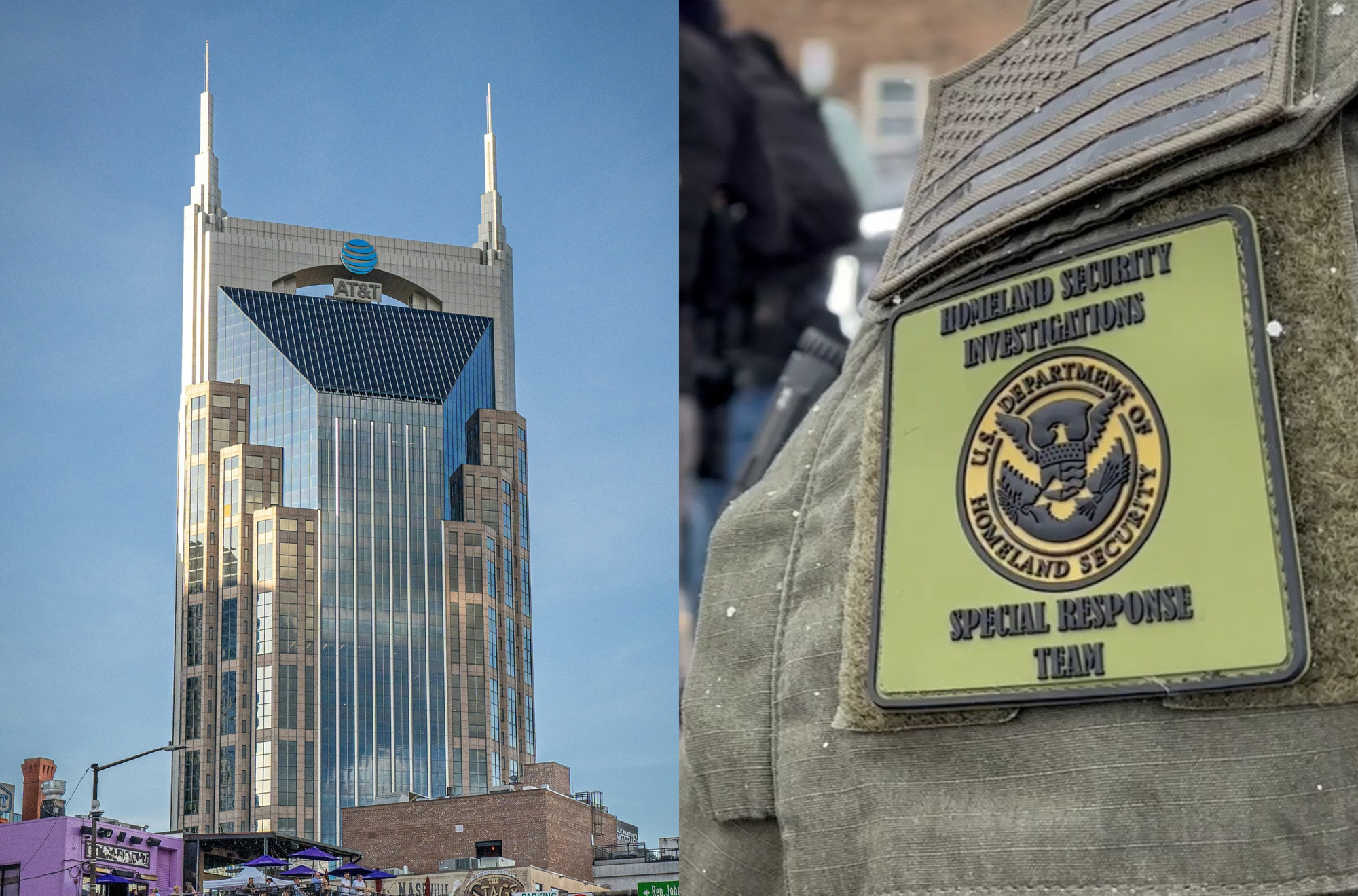
Immigration and Customs Enforcement is paying telecommunications giant AT&T millions of dollars to have AT&T’s analysts sift through mountains of raw AT&T data for a wide variety of investigations, according to an internal ICE document obtained by 404 Media, other procurement records, and experts who reviewed those records. Civil liberty experts have called it a mass surveillance program, and they say the data can include trillions of phone records and location data.
The AT&T product, interchangeably called Data Analytics and Support Services or Data Analytical Services, appears to be related to an earlier surveillance program called Hemisphere, in which AT&T provided U.S. authorities at state, local, and federal levels access to AT&T user data. Though that program shut down, ICE is still paying for access to raw data under this new arrangement with AT&T, according to the restricted ICE procurement document obtained by 404 Media. The program likely affects more than just AT&T customers because the company connects phone calls for other phone companies, meaning non-customers are likely swept up too, according to a surveillance expert.
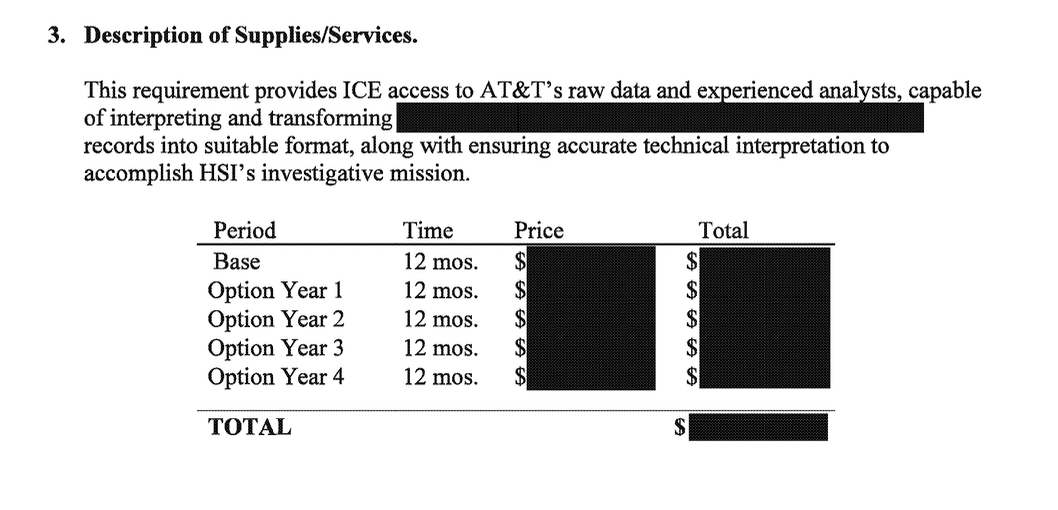
“This requirement provides ICE access to AT&T’s raw data and experienced analysts,” the document obtained by 404 Media reads.
💡
Do you know anything else about this data? Do you work at ICE or another federal agency using it? I would love to hear from you. Using a non-work device, you can message me securely on Signal at joseph.404 or send me an email at joseph@404media.co.
AT&T told 404 Media the data is made available under a valid legal order, but experts point out it requires an administrative subpoena, which agencies can issue themselves and don’t require a judge’s approval, raising concerns that ICE can use the data for essentially whatever it wants. The document also shows how financial incentives play a part in providing data to ICE.
“The Biden administration shut down Hemisphere after I and Rep. Biggs repeatedly questioned this warrantless mass phone surveillance program. 404 Media’s reporting shows that the Trump-Vance administration has created a zombie version of Hemisphere surveillance, and given it to their chosen enforcers at ICE,” Senator Ron Wyden told 404 Media in a statement.
Christopher Soghoian, a surveillance expert who worked for Senator Wyden for a decade until September, told 404 Media, “It’s bad enough that AT&T is mining its customers’ private phone records as a paid service for ICE, but because AT&T is also mining the records of other wholesale telecom companies, consumers can’t vote with their wallets and switch carriers to protect their privacy.”
Last September, ICE posted a procurement record saying it awarded a contract to AT&T for access to its Data Analytics and Support Services. When ICE announced the purchase, an attached document to the listing was marked as “controlled” and not available to the public. 404 Media subsequently obtained the document through a Freedom of Information Act (FOIA) request with ICE. The Financial Times previously reported on the public procurement records but did not report on the restricted document at the time.
“OAQ [the Office of Acquisition Management] intends to procure, on a sole source basis, access to raw data and analytical services from a telecommunications company,” the restricted document reads. It says AT&T analysts will transform the AT&T data “into a suitable format” while “ensuring accurate technical interpretation to accomplish HSI’s investigative mission.” HSI is Homeland Security Investigations, the criminal investigative arm of ICE, which has traditionally focused on things like cybercrime and child abuse cases, but under the Trump administration has dramatically refocused on immigration violations and investigating voter fraud.
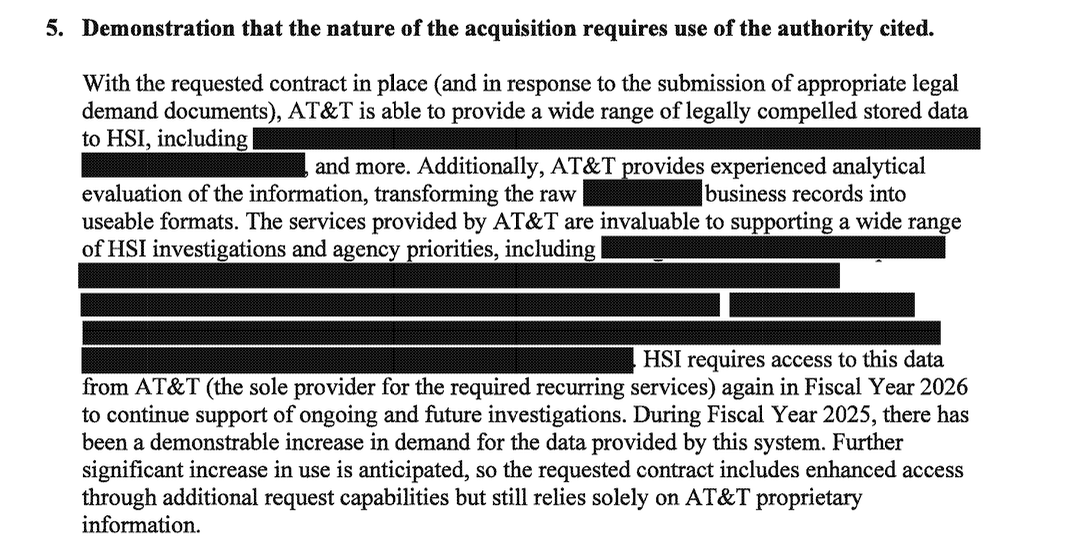
The document says the AT&T data will be used to support “a wide range of HSI investigations and agency priorities,” but the specific sorts of investigations, taking up several lines of the document, are redacted.
A screenshot of the document obtained by 404 Media.
Another document previously obtained by Senator Wyden’s office lays out the sort of data collected by AT&T and the capabilities available under the Data Analytical Services program. Those services include linking multiple devices or phone numbers to an identified target; identifying devices that have had their SIM cards replaced; determining whether phones associated with an international investigation target have entered the U.S.; and deconflicting international phone numbers associated with targets. That document was provided by the Office of National Drug Control Policy (ONDCP), an obscure White House-affiliated entity that previously funded the Hemisphere program, and which 404 Media reported is behind a growing nationwide network of automatic license plate readers (ALPRs). According to documents previously obtained by the EFF and EPIC, the AT&T program contains more than a trillion phone records.
Soghoian added AT&T also provides “wholesale service to other phone companies, helping them to deliver calls.” Through that, “AT&T is able to collect, save, and mine records of calls by customers of other companies, even conversations in which both callers use non-AT&T phone companies.”
The restricted document 404 Media obtained says that during Fiscal Year 2025, there was a higher demand for data provided by this AT&T system, and “further significant increase in use is anticipated.”
A screenshot of the document obtained by 404 Media.
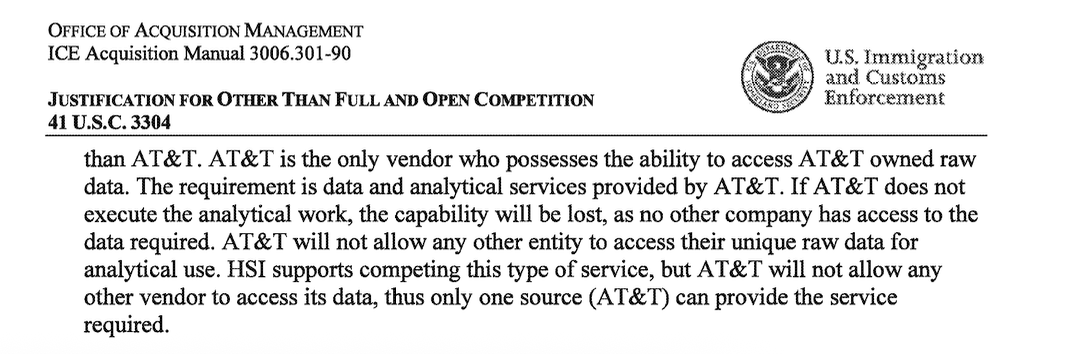
“AT&T is the only vendor who possesses the ability to access AT&T owned raw data,” the document continues. “The requirement is data and analytical services provided by AT&T. If AT&T does not execute the analytical work, the capability will be lost, as no other company has access to the data required.”
Public procurement records show ICE paid AT&T more than $2.1 million in 2025 for access to the service, and more than $2.2 million this August, with the possibility to pay up to more than ten million dollars over the coming years.
“ICE appears to have contracted for access to the same data and service AT&T provided for the Data Analytical Services (DAS) Program, formerly known as the Hemisphere Project, which is the largest telephone record collection program reported to date. ICE using DAS or something akin to it would potentially come with access to trillions of phone records and location data,” Jeramie Scott, senior counsel at EPIC and director of EPIC's Surveillance Oversight Program, told 404 Media. “This program is ripe for abuse and is being used by an agency known for the abuse of its authority.”
“This is AT&T continuing to leverage its phone service to conduct mass, indiscriminate surveillance to sell to law enforcement,” Scott added. “ICE is now taking advantage of AT&T’s surveillance as a service model while likely evading any judicial oversight and conducting no privacy impact assessment prior to using the service to determine whether it should be used in the first place. Spoiler alert: It shouldn’t!”
A screenshot of the document obtained by 404 Media.
Scott pointed out the data likely includes location information too, and this raises the question whether the program violates the law given Supreme Court rulings Carpenter and Chatrie. The former ruled that law enforcement needed a warrant to obtain phone location data. The latter made a similar judgment around location data and geofence warrants.
“Americans are pushing back on government surveillance, from Flock cameras to FISA, all across the country and will be rightfully outraged that AT&T is allowing ICE to search through its customers' phone records without a warrant or court oversight,” Senator Wyden added.
An AT&T spokesperson told 404 Media in an email, “For decades, we have been a trusted partner to provide reliable connectivity to federal agencies as well as state and local governments. We are required by law to provide information to government and law enforcement agencies when it is demanded under lawful order. We ensure that these requests are valid, and that our responses comply with the law.”
ICE did not respond to multiple requests for comment, but previously told the Financial Times, “Nothing new here. For years law enforcement across the nation has leveraged technological innovation to fight crime. ICE is no different.”
The precursor to Data Analytical Services was a program called Hemisphere. The New York Times first revealed Hemisphere in 2013, in which AT&T employees sat alongside Drug Enforcement Administration agents and supplied them with phone data going as far back as 1987. Authorities said they stopped federal funding for Hemisphere in September 2024 and shut the program down. But Data Analytical Services is essentially a continuation of that program. The document Senator Wyden’s office previously obtained says that Data Analytical Services was previously called Hemisphere.
“Hemisphere is a surveillance program that refuses to die and keeps coming back with different names and different forms,” Soghoian added. “It is now clear that the Biden White House misled Congress when it said that Hemisphere had been shut down. The White House drug office funded program used by state and local law enforcement may be gone, but federal agencies are continuing to pay AT&T for the same services.”
Rodney Mims Cook Jr., chairman of the U.S. Commission of Fine Arts, sought to pay tribute to Russia’s ambassador to United States, whose death was announced on Nov. 11.
Rodney Mims Cook Jr., whom President Trump appointed to the U.S. Commission of Fine Arts, orchestrated the display of a Russian flag at Millennium Gate Museum in downtown Atlanta this week.
Current and former officials say that Transportation Secretary Sean Duffy’s push to quickly finish modernization during President Trump’s second term could continue to disrupt air travel.
Ukraine must put a "just and tough" end to Khimprom, a drug cartel led by a Russian citizen, President Volodymyr Zelenskyy wrote on 17 November. He discussed the cartel investigations with Ukraine's acting top prosecutor, after an anti-corruption case that caught the cartel's leader on tape reached the security service and police.
Russia keeps fighting Ukraine along the front line and hitting Ukrainian cities with drones and missiles, while Kyiv negotiates to join the European Union. Brussels ties those talks to the rule of law, and Kyiv can't close any negotiating chapter until it meets interim targets on courts, corruption, policing, and democratic institutions. In October, Kyiv and Brussels agreed to set up a joint task force to speed up the rule-of-law and anti-corruption reforms that gate membership. A cartel accused of trying to buy people in the very agencies meant to stop it shows what those reforms are up against.
The president wants punishment nobody can dodge
Zelenskyy and acting Prosecutor General Anton Kovalskyi went over the work of the Prosecutor General's Office in the two months since Kovalskyi took charge, and the investigations into what the president called the Khimprom gang.
"The inevitability of punishment is the principle that must become the best answer to the criminal activity of Khimprom and the people linked to this structure," Zelenskyy wrote.
Acting Security Service of Ukraine (SBU) head Oleksandr Poklad proposed internal steps to strengthen the service, Zelenskyy wrote in a separate post on 17 November. The president ordered a plan for them and said there were also answers to "weighty personnel questions."
A Russian-built drug network inside Ukraine
In April, Ukraine's National Police tied Khimprom to U420, a chain of shops it says sold drugs, and said the cartel's network had grown to 105 distribution points across the country. Khimprom's leader is a Russian citizen known as "Mexican," and police counted more than 30 violent crimes the gang committed or ordered.
Why now: the trail reached the security service
On 4 November, detectives from the National Anti-Corruption Bureau (NABU) detained SBU Major General Serhii Duka, suspected of shielding a group that investigators say ran or protected scam call centers, drug sales, and a fake-euro workshop. Two police officers are also among the five people NABU charged. On the investigators' recordings in the same case, Khimprom's leader offered $2 million to remove Dmytro Torhalo, the police's anti-drug chief, investigative outlet Slidstvo.Info reported. Torhalo confirmed the cartel leader had threatened him. The leader also discussed bribing then-Interior Minister Ihor Klymenko, a NABU unit head said.
Serhii Duka (center), a general in the Security Service of Ukraine (SBU), being detained by anti-corruption detectives at a cottage in Roslavychi, Kyiv Oblast, Ukraine, 4 November 2026. Photo: DR, via NV
Duka left custody on 13 November after 1,612 payments covered the bail the court had set, Ukrainska Pravda reported, citing its sources. The outlet's sources had said SBU officers in the regions were pressed to pay. Duka told a parliamentary inquiry on 18 November that nobody had forced anyone to collect the money.
On 7 November, Zelenskyy called that week's news about the SBU "frankly shameful" and asked lawmakers to make security officers declare their wealth again. He also said Kyiv had raised Khimprom with the United States. On 10 November, Kovalskyi ordered an internal check on whether prosecutors helped return property seized from scam call centers and U420, his office said.
Explore further
Investigators say prosecutors shielded scam call centers. Their office has now fired eight people and is checking how its ex-chief left Ukraine
On Friday, Zelenskyy told reporters the cartel had already entered Poland and was trying to enter Germany, and that Ukraine needed foreign law enforcement, primarily the US, to stop it, Interfax-Ukraine reported. Anti-corruption officials told him they had nothing linking Klymenko, now secretary of Ukraine's National Security and Defense Council, to Khimprom, he said.
Police officers at a U420 shop, part of the chain linked to the Khimprom drug cartel. Photo: National Police of Ukraine
A prosecutor's office with a record of its own
Kovalskyi, previously Khmelnytskyi Oblast's chief prosecutor, became acting prosecutor general by decree on 17 September. His predecessor, Ruslan Kravchenko, left Ukraine while anti-corruption agencies investigated alleged protection of scam call centers.
An investigation by the Government Accountability Office found that researchers were able to prod chatbots into generating data that could be used in planning or conducting mass-casualty attacks.
The study, conducted in the spring at the request of Senator Maggie Hassan, Democrat of New Hampshire, involved chatbots from OpenAI, Anthropic, Google and SpaceXAI.
The ICJ has never found a state responsible for committing genocide, and a significant factor in previous cases has been how to prove “intent” in a crime defined as acts committed with the “intent to destroy, in whole or in part” a national, ethnical, racial or religious group.
Four students of a high school in Baltimore are suing after the police handcuffed and searched them because an artificial intelligence gun-detection system wrongly alerted a bag of Doritos.
Kenwood High School in Baltimore. Last year, four students there were waiting for a ride home after football practice when the police arrived with guns drawn.
An internal I.R.S. memo viewed by The New York Times reveals how the agency is carrying out President Trump’s orders to investigate “domestic terrorism.”
Under an order by President Trump after the killing of Charlie Kirk, the I.R.S. was told to investigate whether nonprofits were “directly or indirectly financing political violence or domestic terrorism.”
Germany's largest bank kept Kremlin-linked oligarchs as clients over its risk managers' warnings, The New York Times and partners reported on 17 November. Leaked internal records show Deutsche Bank, which denies helping clients dodge sanctions, held on to some firms linked to sanctioned oligarchs after the 2022 sanctions.
Besides weapons, sanctions are the West's main instrument against the money behind Russia's war on Ukraine. In September, the EU extended its freeze on about 2,600 Russians and companies until 2029, and banks enforce it.
The leak holds more than 15 million files covering the bank's work since the early 2010s, Le Monde said. More than 230 journalists from over 50 outlets received it, in an investigation coordinated by South African nonprofit Barracuda Media.
Clients on a US Treasury list brought in nearly half of the bank's Russian revenue in international private banking by 2020
In November 2020, an internal Russia review counted 160 Russian clients in the bank's international private banking arm. Seventeen sat on a 2018 US Treasury list of oligarchs and Kremlin insiders, which was not in itself a sanctions designation, the bank told reporters. Those 17 clients produced 47% of that unit's Russian client revenue, South Africa's Financial Mail reported. The review called a sanction on the whole list an "extremely unlikely scenario."
Warnings had come earlier, the files show. In May 2019, an adviser told a board risk committee that one bad client would cost a multiple of what it earned. In mid-2020, the bank cleared a €1.1 billion transfer that it later suspected was for Russian politician Suleiman Kerimov, Le Monde found. By 2021, the bank still listed billionaire Oleg Deripaska, oligarch Gennady Timchenko, and Kerimov, or entities tied to them, among its most sensitive clients, Financial Mail reported. The US had already sanctioned all three. Risk managers had warned for years about clients like Deripaska and fellow billionaire Viktor Vekselberg, The New York Times reported. Profit kept winning, the investigation found.
After Russia's full-scale invasion, the bank used a 50% rule
"As you know we have a large Russian Oligarchs client population," an anti-financial crime specialist at the bank had written by 25 February 2022, a day after the invasion began.
She added that other clients held Russian securities, including those of entities the US had sanctioned the night before, and asked which clients the bank could unwind and whether to advise them "to unwind while they still can."
In early 2022, the bank's clients included Sibur, gold miner Polyus, and other Russian firms partly owned, or suspected to be controlled, by sanctioned Russians, Le Monde found. Timchenko held 14.5% of Sibur, Russia's leading petrochemical company. The bank's own notes said dealing with a firm was not barred as long as its sanctioned shareholders held no more than 50%.
Days after the invasion, the US Justice Department asked for a list of the bank's sanctioned Russian clients, knowing the first answer would not be complete. The bank generally left out firms that were not sanctioned themselves where sanctioned owners held under 50%, the files show. A US Treasury rule broadly allows that, the Times noted. A lawyer at the bank's law firm, Gibson Dunn, wrote that it had been decided not to mention the bank's "several thousand relationships" with sanctions-hit Russian clients in the cover letter to the department, because this was "information which has not been asked for," Financial Mail reported. The bank also cited banking secrecy in Switzerland and Luxembourg, where most of its key Russian clients sat, to withhold some client data. A few days after the bank sent its partial client lists to the department, one employee wrote that an unnamed Russian embassy was a client. Neither it nor at least 10 Russian diplomats who reportedly had accounts at the bank had appeared on the lists sent to that point, Financial Mail found. Prosecutors apparently accepted the bank's answers, the Times reported.
Explore further
The money starts as bags of cash in a Moscow market and ends up clean in China, leaked files show
Responding to the investigation, Deutsche Bank strongly rejected "any suggestion that Deutsche Bank sought to help clients evade sanctions." It said it acted promptly to implement sanctions after the invasion and met its obligations under its 2021 agreement with the Justice Department over earlier bribery allegations. In March 2022, it announced it was winding down what remained of its Russian business. Its credit exposure to Russia had fallen to €13 million by the end of 2025, the bank said. Its 2025 annual report still showed the equivalent of 162 full-time staff and a €61 million pre-tax profit in Russia.
When Russia launched its full-scale invasion, the bank's clients also included metals and telecoms magnate Alisher Usmanov, according to Financial Mail. The EU dropped him from its sanctions list in September, but the US still sanctions him. Moscow, meanwhile, has signaled it will hold European companies' Russian assets to push Europe into reconsidering its sanctions, according to a September assessment by the Institute for the Study of War. European banks could be next, a senior Russian government source hinted to Reuters at the time.
Shares fall as Berlin asks for answers
Deutsche Bank shares dropped more than 6% in Frankfurt trading on 17 November, then pared the loss to 3.8% in the early afternoon, Euronews reported. The leak also covers the bank's dealings with US President Donald Trump and Jeffrey Epstein, the late convicted sex offender. The bank must give "full transparency" on how it has fixed past failures and control gaps and how it will prevent them, German Finance Minister Lars Klingbeil told public broadcaster ZDF.
Paul Madonna, known for his drawings of San Francisco landmarks, has recovered enough to have his own art exhibition four years after nearly dying in a head-on collision.
Marc Arthur Kelian Bineli Mvogo,18 ans, de Drummondville, un des cinq individus arrêtés dans la nuit du 4 au 5 octobre à la suite d’une introduction par effraction survenue dans une résidence de la rue Principale à Saint-Gabriel-de-Rimouski, a vu son orientation et déclaration. prévue ce lundi au palais de justice de Rimouski, être reportée au 25 janvier.
« Je suis en attente du mandat de l’aide juridique. Je dois demander un report », a mentionné l’avocate de l’accusé, Me Maude Barrière, qui a comparu par vidéoconférence, tout comme son client.
Au terme d’une enquête sur remise en liberté d’un peu plus d’une heure où trois personnes ont témoigné, la juge de la Cour du Québec, Jannick Poirier, a statué pour la libération sous conditions de l’accusé, le 16 octobre dernier.
Elle a rappelé que la norme est la remise en liberté et que bien que Bineli Mvogo fasse face à l’une des accusations les plus grave du code criminel passible de l’emprisonnement à perpétuité, elle estime que la remise en liberté de l’accusé représente un danger pour la société.
Il est accusé d’introduction par effraction dans une maison d’habitation et d’y avoir commis un acte criminel, soit des voies de fait armées.
Sans antécédent judiciaire
« C’est un jeune de 18 ans qui est sans antécédent judiciaire, mais qui a de mauvaises fréquentations. Il fréquente l’école des adultes à temps plein pour finir son secondaire 5 et il a un emploi en entretien ménager », a mentionné la juge.
Sa mère verse une caution de 1 000$ et elle s’engage à s’assurer que son fils respecte ses conditions.
Il devra notamment demeurer chez sa mère à Drummondville et être à la maison entre 20 h et 7 h, sauf pour un emploi légitime et rémunéré. Il lui est interdit de se trouver dans les bars et de consommer de l’alcool et des drogues, incluant le cannabis.
Marc Arthur Kelian Bineli Mvogo ne peut pas non plus avoir d’armes et il doit verser une caution de 1 500$ sans dépôt, qu’il devra payer s’il brise une condition. Il lui est aussi interdit de se trouver dans le district judiciaire de Rimouski, sauf pour se présenter à la Cour.
Selon les premiers éléments de l’enquête, des suspects se seraient introduits dans l’habitation avant d’agresser les deux occupants. Les victimes, un homme et une femme dans la quarantaine, ont subi des blessures importantes et ont été transportés à l’Hôpital régional de Rimouski.
L’enquête policière a permis d’établir que cet événement ne serait pas attribuable au hasard. « Les informations recueillies jusqu’à maintenant indiquent plutôt que les victimes auraient été visées de façon spécifique », mentionne le corps policier.
Les quatre hommes ont comparu une première fois le 5 octobre en fin de journée sous un chef d’accusation d’introduction par effraction dans une maison d’habitation et d’y avoir commis un acte criminel, soit des voies de fait armées.
Un 5e accusé est d’âge mineur (16 ans). Il a comparu devant le tribunal de la jeunesse. Son statut de mineur protège son identité.
Les cinq accusés ne proviennent pas du Bas-Saint-Laurent.
Gov. Gavin Newsom is trying to spare the lives of 548 prisoners on California’s death row. Prosecutors and victims’ families say that it amounts to an abuse of power.
After a nationwide ground stop, flight schedules are returning to normal after tens of thousands of travelers encountered delays and cancellations over the weekend.
Games behind paywalls and exorbitant costs forcing a drop in attendance — even to watch Connor McDavid in Edmonton — have only compounded the loss of a Saturday night ritual.
A bomb went off under a car in southern Moscow on 13 November, seriously wounding Serhii Zavorotnyi, a former adviser to Mykola Azarov, Ukraine's prime minister under Viktor Yanukovych, Russian Telegram channel Mash reported. Russia's Investigative Committee opened a criminal case.
Since late 2024, bombings and shootings far from the front have killed Russian generals, officers, and collaborators in a shadow war that Kyiv sometimes claims and sometimes leaves unexplained. The Moscow blast came a day after a remote-detonated car bomb killed a Russian colonel near St. Petersburg. This time the target was not an officer but a former Ukrainian official who went over to Moscow. In 2020, a US Senate committee named him an officer of Russia's foreign intelligence service, the SVR, "involved in influence operations." No one has claimed the blast, and Kyiv has not commented.
A bomb under the driver's side
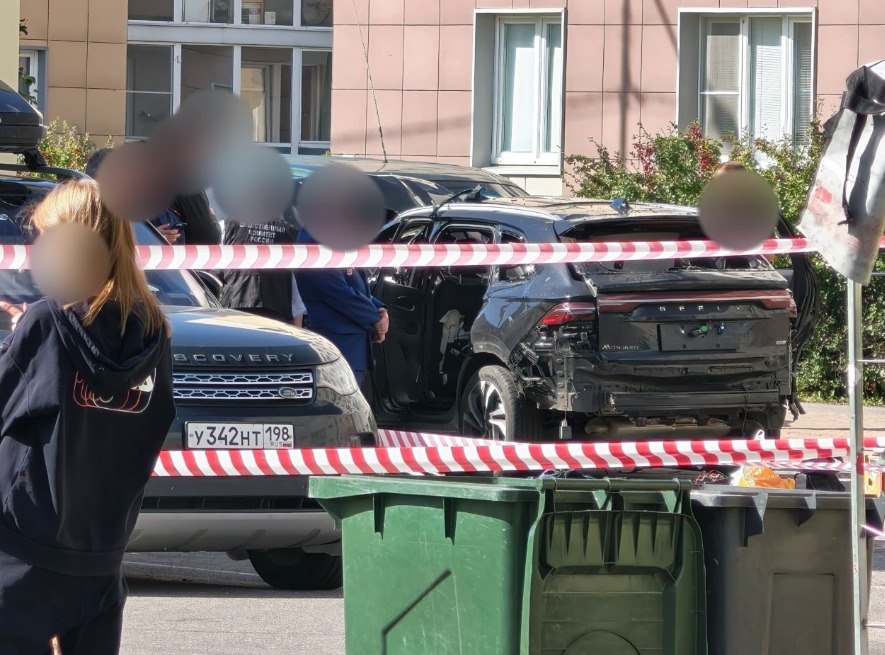
The car, a Toyota, exploded on Kirovogradskaya Street in Moscow's Chertanovo district, Russian Telegram channel Baza reported. The device was fixed to the car's underside on the driver's side and went off as Zavorotnyi drove along the street, Mash wrote. The main version is that the car had been mined and that the device went off about 500 meters from his home, Baza added.
The 72-year-old climbed out of the car himself before he was taken to hospital, Mash reported. He was later in intensive care in critical condition, the channel added.
The damaged SUV on a residential street in Moscow's Chertanovo district, Russia, after the 13 November 2026 blast. Photo: Exilenova+
Moscow investigators are treating the blast as attempted murder by a dangerous method, Russian state news agency RIA Novosti reported, citing the Investigative Committee.
From Kyiv's cabinet to Moscow's talk shows
Zavorotnyi was Azarov's press secretary while Azarov was Ukraine's prime minister. He stayed in that role after Azarov fled to Russia following the 2014 Euromaidan revolution and announced a "government in exile" from Moscow, the Senate report says.
Passers-by gather around the damaged SUV on Kirovogradskaya Street in Moscow, Russia, 13 November 2026. Photo: Exilenova+
In Russia, he ran the pro-Russian site "Antifascist" and accused Ukraine's Security Service of terror, Mash wrote. He also co-wrote a book titled "Yanukovych gave up. The State Department accepted. How Russia lost Ukraine" and heads the IT center of a state agricultural university in Russia's Primorsky Krai, the channel said earlier.
Explore further
Russian Aerospace Forces officer killed by a bomb in his own car in St. Petersburg
Ukrainian Telegram channel Exilenova+, which posted the Senate report excerpt, called him a frequent guest of pro-Kremlin media who systematically pushed narratives that suited Moscow.
Au terme d’une enquête préliminaire de trois jours et demi qui a pris fin ce jeudi matin, le juge James Rondeau a cité Doxanne-Maherline Racine, 28 ans, de Terrebonne, à son procès sur les accusations telles que portées, c’est-à-dire tentative de meurtre et voies de fait graves.
Le magistrat estime qu’il y a plus qu’un scintillement de preuve de l’implication de l’accusée dans un événement survenu en avril 2024 à Sainte-Angèle-de-Mérici.
« Mon rôle, à ce stade, n’est pas de déterminer si l’accusée est coupable ou non, mais bien de statuer si le ministère public a présenté un scintillement de preuve en rapport avec les accusations portées », a-t-il expliqué.
Les motifs de la décision, tout comme le contenu des témoignages et des plaidoiries des deux parties, sont touchés par une ordonnance de non-publication afin de ne pas contaminer le procès à venir.
La procureure de la Couronne, Me Marie-Pierre Chicoine-Côté, estime que la preuve démontre que l’accusée a participé à l’infraction et qu’elle devait être citée à son procès sur les chefs de tentative de meurtre et de voies de fait graves.
L’avocat de l’accusée, Me Diba Ntumba Muntu, a plaidé à l’effet que sa cliente n’était pas au courant de ce qui allait se passer lors des événements.
Procès devant un jury
Le 18 juillet 2025, Doxanne-Maherline Racine avait opté pour un procès devant un jury précédé d’une enquête préliminaire.
Son dossier est donc transféré à l’ouverture du terme des assises criminelles de la Cour supérieure, le 8 décembre à Rimouski, pour les procès qui se dirigent vers un jury.
L’accusation de possession d’une arme prohibée n’était pas admissible à un procès devant jury. Ce dossier est reporté au terme régulier de la Cour du Québec, le 14 décembre, toujours à Rimouski, pour fixer une date de procès.
Likenson Grégoire coupable
Rappelons que Likenson Grégoire a plaidé coupable, lundi matin, à une accusation de tentative de meurtre au moment où son enquête préliminaire prévue pour toute la semaine devait débuter. Il a été condamné à 15 ans de pénitencier.
Le récit des faits présentés au tribunal est frappé d’une ordonnance de non-publication afin de ne pas nuire au procès de Doxanne-Maherline Racine.
After years in elite police units, he drew scrutiny from human rights groups for selling arms and providing other services to unsavory governments. He was 80.
Éric Roussel, de Mont-Joli, a plaidé coupable à des accusations de voies de fait simples, étranglement en contexte de violence conjugale, harcèlement et bris de condition, le 6 novembre dernier, au palais de justice de Rivière-du-Loup.
L’enseignant en arts martiaux, qui a notamment dirigé l’équipe de kickboxing Team Shark à Rimouski, a admis s’être livré à des voies de fait contre une femme entre le 1er avril 2023 et le 29 février 2024 à Rivière-du-Loup et s’être porté à des voies de fait contre la même plaignante en l’étranglant, le 21 novembre 2023.
Des enquêteurs de la Sûreté du Québec (SQ) ont procédé tôt, mercredi matin, à une perquisition dans une résidence située sur le 4e Rang à Sainte-Rita, dans Les Basques, en lien avec les événements de violence armée survenus au cours des dernières semaines dans le secteur de Rivière-du-Loup, dont les meurtres de deux jeunes femmesoriginaire de Saint-Pascal.
« Des démarches d’enquête se poursuivent actuellement afin de faire la lumière sur ces événements et d’identifier les personnes qui pourraient y être impliquées. Puisque plusieurs enquêtes sont toujours en cours, aucun autre détail ne peut être communiqué pour le moment », mentionne le corps policier par voie de communiqué.
Depuis ce temps, des policiers ont mené une série de perquisitions en lien avec le trafic de stupéfiants.
Toute information sur des actes criminels ou des événements suspects peut être communiquée à la Centrale de l’information criminelle de la Sûreté du Québec au 1 800 659-4264.
Russia struck a fire in Yahotyn, Kyiv Oblast, a second time while firefighters were putting it out, killing two of them on 11 November, State Emergency Service head Andrii Danyk said. Two more rescuers were wounded. Overnight, Russia also attacked Ukraine with ballistic missiles, Zircon missiles, and 123 attack drones, killing women in Kyiv, Kherson, and Zaporizhzhia Oblast.
Russia keeps up mass strikes on Ukraine's cities and power grid as winter sets in, and returning to a site once rescuers arrive has become part of them. On 8 November, Russian drones struck rescuers three times at a bombed school in Komyshuvakha, Zaporizhzhia Oblast. Repeat strikes make every call-out more dangerous for the crews whose speed decides whether fires spread and whether people trapped under rubble survive. This time the attack also reached western regions far from the front, hitting energy facilities in Rivne, Khmelnytskyi, and Cherkasy oblasts and a customs terminal near the Polish border.
Two firefighters killed at the same fire
Russian drones attacked Yahotyn through the day on 11 November. Around noon, one hit the grounds of a lyceum while 171 children, their teachers, and staff sheltered inside, and no one was hurt, the Kyiv Oblast Military Administration said. Later strikes damaged two kindergartens, two houses, and a large non-residential building and started a fire.
Major Oleksandr Bondarenko, who headed a fire and rescue unit in Kyiv Oblast, had served for 25 years and leaves a wife, a daughter, and a son. Yurii Lytovchenko, a driver with another unit, had served for more than 30 years and leaves a wife and a son. The wounded rescuers, Serhii Musiiaka and Valentyn Mykhno, are in hospital.
"There are no words to convey the pain of such news," Danyk wrote.
Across Kyiv Oblast, the attacks killed two people and injured three, the National Police reported: the two firefighters killed, two rescuers wounded, and a truck driver in Brovary whose vehicle caught fire from falling debris. Strikes damaged 19 houses in Bucha district, 16 in Fastiv district, and 17 in Boryspil district, along with an enterprise in Obukhiv district.
A drone hit a Kyiv apartment block at rush hour
At about 8 a.m. on 12 November, a Russian drone hit a nine-story apartment block in Kyiv's Solomianskyi district, setting apartments on the third to sixth floors on fire, the Kyiv City Prosecutor's Office said. A 44-year-old resident was killed. Seven people were hurt, most of them treated for acute stress.
A nine-story apartment block in Kyiv's Solomianskyi district after a Russian drone hit it, 12 November 2026. Photo: State Emergency Service of Ukraine
Rescuers pulled three people out of the building, which lost part of an outer wall.
Missiles and jet drones
Russia launched Iskander-M and KN-23 ballistic missiles, S-400 missiles, Zircon anti-ship missiles, and 123 Shahed-type drones, 73 of them jet-powered, Ukraine's Air Force said. It did not say how many missiles were fired or intercepted. Air defenses downed or jammed 89 drones and five Banderol and Dan-T jet weapons. Hits were recorded at 17 locations, and debris fell at 18 more.
Later that morning, President Volodymyr Zelenskyy said that US-made Starshield satellite terminals face systematic speed limits of 161 km/h along the front, which makes it harder for Ukrainian interceptor drones to catch Russia's jet drones. "There have already been hits," he said, adding that "this helps the Russians kill more Ukrainians." Kyiv is clarifying the matter with Washington. In October, a ten-day cap cut the link to Ukrainian drones moving faster than about 160 km/h.
A resident holds her dog outside the apartment block hit by a Russian drone in Kyiv, 12 November 2026. Photo: State Emergency Service of Ukraine
Power cuts reach the west
Grid operator Ukrenergo reported partial outages in nine oblasts. In Rivne Oblast, more than 160 settlements were left without power, among them the town of Kostopil, the regional administration said. In Kovel, Volyn Oblast, a drone fell on a customs terminal, setting trucks and a fuel tanker on fire and injuring one person, the regional administration said.
Explore further
Only one-third of Ukraine’s key transformers are protected from Russian strikes — but biggest threat may be inside system, lawmaker says
In Vinnytsia Oblast, the attack hit energy facilities and injured a woman. Energy facilities were also hit in Khmelnytskyi Oblast's Shepetivka district and in Cherkasy Oblast's Uman and Zvenyhorodka districts, officials said. In Odesa, drones hit an apartment block on the morning of 12 November. Russia attacked the city again around noon, setting a car on fire, and no casualties had been reported by then.
A 99-year-old killed near the front
A Russian guided bomb killed a 99-year-old woman in Balabyne, Zaporizhzhia Oblast, on the morning of 12 November and wounded a 12-year-old girl. Over the previous day, Russia struck the oblast 797 times, wounding 15 people, including a child, in Zaporizhzhia and the surrounding district, regional head Ivan Fedorov said.
In Kherson, a drone strike at about 4:40 a.m. fatally wounded a woman. Separately, a drone wounded a 32-year-old man in Novovorontsovka, Kherson Oblast, and a 70-year-old man sought hospital care after a Russian mine went off near him in Kherson the day before.
A car burning in Kharkiv after a Russian attack on 11 November 2026. Photo: Oleh Syniehubov/Telegram
The day before, on 11 November, a Russian strike hit a market in central Chornomorsk, Odesa Oblast, around midday. Eleven people were hurt, and the death toll later rose to four. In Kharkiv, a drone set a car on fire, killing its driver and passenger. Two more people were wounded in Kharkiv Oblast and five were treated for acute stress, among them two girls, Kharkiv Oblast Military Administration head Oleh Syniehubov said.
Strikes wounded six people in Pavlohrad, Nikopol district, and Mezhova in Dnipropetrovsk Oblast. In Poltava Oblast, five people were injured when a drone hit Kremenchuk district, where the State Emergency Service said a production building at a private company caught fire. One person was wounded in Donetsk Oblast and one injured in Zhytomyr Oblast.
The ruling, which could affect similar laws in other British Commonwealth countries, has spotlighted a legal system still intertwined with a former colonial power.
The death of Alexander Darchiev was announced by Russia’s foreign ministry. He was appointed to his post in Washington in 2025, as relations between the Kremlin and the White House warmed.
Democratic socialists had another success with Ms. Raman’s ascent to the Los Angeles mayoralty. But she is no sure bet to align with all of the group’s priorities.
Jean Jr. Larèche Baptiste, 37 ans, de Rivière-du-Loup, l’une des nombreuses personnes arrêtées lors de plusieurs opérations policières visent à maintenir une pression constante sur les acteurs du crime organisé dans le KRTB, a renoncé lundi (9 novembre) à la tenue de son enquête sur remise en liberté.
Il demeurera donc détenu pour la suite du processus judiciaire.
Baptiste a plaidé non coupable et opté pour un procès devant un jury. Il a mentionné à plusieurs reprises ne pas vouloir d’avocat. Son dossier a été transféré à l’ouverture du terme des assises criminelles de la Cour supérieure, le 7 décembre, à Rivière-du-Loup.
Jean Jr. Larèche Baptiste a été arrêté le 4 novembre lors de perquisitions effectuées dans le secteur de la rue Témiscouata à Rivière-du-Loup. Les policiers ont notamment saisi une arme prohibée.
Double meurtre
À la suite du double meurtre survenu le 22 octobre dans le stationnement du restaurant Normandin de Rivière-du-Loup, pour lequel aucune arrestation n’a encore été effectuée, la Sûreté du Québec a multiplié les interventions ciblées sur le territoire en procédant à de nombreuses arrestations en matière de lutte contre le trafic de stupéfiants et du crime organisé.
Outre Baptiste, deux autres personnes arrêtées ont comparu au palais de justice de Rivière-du-Loup et elles sont demeurées détenues en attendant leur retour devant le tribunal.
Le palais de justice de Rivière-du-Loup (Photo Le Soir.ca- Olivier Therriault)
Arrêté le 4 novembre, Daniel Poirier, 46 ans, de Rivière-du-Loup, a comparu et demeure détenu en lien avec des activités de trafic de stupéfiants. Il reviendra à la cour le 16 novembre pour son enquête sur remise en liberté.
Pour sa part, Yanny Tremblay, 45 ans de Rivière-du-Loup, a été intercepté le 5 novembre. L’individu a comparu en lien avec du trafic de stupéfiants et demeure emprisonné. Il reviendra en cour le 16 novembre pour son enquête caution.
Les actions se poursuivront sur le terrain
La Sûreté du Québec promet de poursuivre ses actions au cours des prochaines semaines afin de maintenir une pression constante sur les acteurs du crime organisé, de perturber leurs activités et de contribuer à la sécurité de la population.
Les citoyens qui détiennent de l’information concernant des activités criminelles peuvent communiquer de façon confidentielle avec la Centrale de l’information criminelle de la Sûreté du Québec au 1 800 659-4264.
An expanding legal fight over the proposed site of President Trump’s 250-foot triumphal arch looms over his visit to Arlington National Cemetery on Veterans Day.
Alex Bradette, de Fermont, arrêté le 9 juin à Saint-Joseph-de-Lepage après avoir notamment traversé la rivière Mitis et quitté les lieux d’une sortie de route survenue à Saint-Octave-de-Métis, tentera de convaincre le tribunal de le remettre en liberté pour la suite du processus judiciaire, le 17 novembre, lors de son enquête sur remise en liberté qui se tiendra devant un juge de garde.
La date de l’enquête caution a été fixée ce vendredi matin au palais de justice de Rimouski.
Lors d’une précédente comparution, l’avocate de l’accusée, Me Juliette Levasseur, avait mentionné être à la recherche d’une maison de thérapie qui pourrait être présenté comme un plan de sortie lors de son enquête sur remise en liberté.
Une durée d’une heure et demie est prévue pour l’enquête sur remise en liberté.
Bradette a déjà renoncé à la tenue de son enquête sur remise en liberté dans le délais prescrit de trois jours ouvrables. Il est détenu depuis son arrestation le 9 juin. Rappelons que la détention préventive purgée avant l’imposition d’une peine compte à 1,5 jour par jour purgé.
L’homme de 29 ans a comparu une première fois le 9 juin, au palais de justice de Rimouski, pour répondre à de nombreuses accusations. Le ministère public s’est alors objecté à sa remise en liberté.
De nombreuses accusations
Bradette a comparu une première fois le jour de son arrestation, au palais de justice de Rimouski, pour répondre à de nombreuses accusations. Le ministère public s’est alors objecté à sa remise en liberté.
Selon la dénonciation obtenue par Le Soir.ca, l’homme est accusé d’avoir conduit un véhicule avec les capacités affaiblies, d’avoir refusé d’obtempérer à un ordre de se soumettre à l’éthylomètre, sans excuse raisonnable et de conduite dangereuse.
Alex Bradette doit aussi répondre d’avoir agi de manière et avec l’intention de provoquer la peur chez une personne associée au système judiciaire, de harcèlement envers la même personne, d’avoir volontairement entravé les agents de la paix dans leurs fonctions et de méfaits sur une autopatrouille.
Il fait aussi face à deux chefs d’accusation de bris de probation.
Embardée et délit de fuite
Les policiers de la Sûreté du Québec sont intervenus à la suite d’une embardée impliquant un véhicule survenue sur la route du Grand-Remous, à Sainte-Octave-de-Métis.
À leur arrivée sur les lieux, les policiers ont constaté qu’aucun occupant ne se trouvait à bord du véhicule. Des démarches ont rapidement été entreprises afin de localiser la ou les les personnes impliquées.
Dans le cadre de l’intervention, Bradette a été localisé dans le secteur du 4e Rang, à Saint-Joseph-de-Lepage, après avoir notamment traversé la rivière Métis.
The kingdom’s promised reforms don’t always match the realities of its justice system. Unmarried women, particularly foreign workers, face unique perils.
In the past two weeks, prosecutors in the capital have failed to secure indictments in at least three cases, an acceleration of the problems the Justice Department has had with grand juries.
There has been a deluge of grand jury failures in Federal District Court in Washington, where prosecutors have been tasked with carrying out many of President Trump’s revenge prosecutions.
Une enquête préliminaire sera finalement nécessaire dans le dossier de Philippe Dorais, 26 ans, de Rimouski, accusé de conduite dangereuse ayant causé la mort de Steve Collin, le 14 mai 2025 à Saint-Anaclet-de-Lessard.
C’est ce qu’a indiqué l’avocate de l’accusé, Me Caroline Bérubé, vendredi dernier au palais de justice de Rimouski, après avoir discuté avec le procureur de la Couronne, Me Alex Turcotte, qui devait communiquer avec la famille de la victime.
La date de l’enquête préliminaire sera fixée le 14 décembre.
L’enquête préliminaire a deux fonctions, déterminer si l’accusé sera cité à son procès sur l’accusation telle que portée et permettre à la défense de pouvoir interroger certains témoins avant le procès afin de se préparer à cette étape.
Dorais a opté pour un procès devant un juge seul (sans jury).
Il a été libéré à la suite de sa première comparution, le 11 février 2026, date à laquelle les enquêteurs du poste de la MRC Rimouski-Neigette, en collaboration avec la division des crimes majeurs de Rimouski, ont procédé à son arrestation en lien avec la collision mortelle survenue le 14 mai 2025 à Saint-Anaclet-de-Lessard.
Collision avec une motocyclette
Rappelons que vers 22 h 15, les policiers du poste de la MRC Rimouski-Neigette avaient été appelés sur l’autoroute 20, près du km 616, pour une collision impliquant une motocyclette et un véhicule circulant en direction ouest.
Le décès du conducteur de la motocyclette avait été constaté sur les lieux. Le conducteur du véhicule avait été transporté au centre hospitalier pour soigner des blessures mineures.
Un enquêteur et un reconstitutionniste s’étaient rendus sur place afin d’éclaircir les circonstances de l’événement.
Despite its win, the administration signaled it had adjusted construction plans in the national park with an aim to “preserving the unique landscape and public access.”
The driver of a silver sedan was arrested after crashing his car into a placard just north of the White House. The authorities also arrested a second man who jumped a barricade at a nearby park.
Coup de théâtre ce lundi matin au palais de justice de Rimouski alors que Likenson Grégoire a plaidé coupable à une accusation de tentative de meurtre, au moment où son enquête préliminaire prévue pour toute la semaine devait débuter. Il a été condamné à 15 ans de pénitencier.
Présent dans le box des accusés, Grégoire a renoncé à son enquête préliminaire et il a enregistré un plaidoyer de culpabilité.
La procureure de la Couronne, Me Marie-Pierre Chicoine-Côté, a relaté les événements survenus le 25 avril 2024 à Saint-Angèle-de-Mérici pour lesquels l’accusé a plaidé coupable.
Une ordonnance de non-publication a été ordonnée par le juge de la Cour du Québec, James Rondeau, afin de préserver les droits de la présumée complice, Doxanne Meherline Racine, dont l’enquête préliminaire va se tenir cette semaine.
Suggestion commune
La peine imposée à Likenson Grégoire découle d’une suggestion commune intervenue en fin de semaine entre Me Chicoine-Côté et l’avocat de l’accusé, Me Stéphane Pouyes.
« Il s’agit de l’un des crimes les plus graves au code criminel qui est passible de l’emprisonnement à perpétuité et dont la peine minimale, dans le cas de l’utilisation d’une arme à feu, est de quatre ans. Nous avons tenu compte des antécédents judiciaires de l’accusé, de la gravité des gestes, de son appartenance à un gang de rue et du fait qu’il a plaidé coupable pour arriver à une peine qui nous semble raisonnable, soit 15 ans de détention », a expliqué Me Chicoine-Côté.
Le juge a donné suite à la suggestion, estimant que la peine se trouve dans la fourchette des sentences pour un crime semblable. La détention équivalente à 1 392 jours est déduite de la peine.
La sentence comprend également des peines concurrentes de cinq ans de prison pour la possession d’une arme à feu prohibée et de sept ans pour la possession d’une arme à feu pendant que cela lui était interdit par le tribunal lors d’une sentence précédente.
Le juge impose également une interdiction de posséder des armes à perpétuité à l’accusé et il lui ordonne de se soumettre à un prélèvement d’ADN pour analyse génétique dans les 120 jours.
Enquête pour la présumée complice
L’enquête préliminaire de la présumée complice, Doxanne Méherline Racine, devait débuter ce lundi matin au palais de justice de Rimouski. « Nous avons besoin de temps pour réorganiser le déroulement de l’enquête. Certains témoins pourront être libérés puisqu’ils ne touchaient que Likenson Grégoire », a mentionné Me Chicoine-Côté.
Doxanne-Maherline Racine (Photo courtoisie SQ)
L’accusée et son avocat, Me Diba Ntumba Muntu, sont présents physiquement au palais de justice pour la tenue de l’enquête préliminaire. L’accusée conteste sa citation à procès sur le chef de tentative de meurtre. Le juge Rondeau aura donc ultimement à trancher la question.
Russian drones struck Ukrainian rescuers three times as they worked the site of a school bombing that killed 55 people. The attacks on 8 November, at the site of the 2 November airstrike on a school in Komyshuvakha, Zaporizhzhia Oblast, wounded two emergency workers and damaged fire-rescue vehicles, Ukraine’s State Emergency Service said.
Striking a site a second time once rescuers arrive has become a hallmark of Russia’s war on Ukraine, turning first responders into targets. At Komyshuvakha, the crews were recovering the dead from a strike that buried civilians sheltering in an underground school.
Three strikes on the rescuers
During the second attack, a Russian drone hit a fire-rescue vehicle and wounded its driver. About an hour later, as rescuers towed the damaged vehicle away, a third strike wounded a second driver and damaged more equipment. Both were given medical care. The crews are working under constant fire, the service said, and repeated drone attacks have damaged several vehicles.
Two of its dogs were injured as well: a Belgian shepherd, Mria, suffered a leg injury, and another, Targan, suffered an acute stress reaction that may end its search work.
“Russia continues to cynically destroy Ukrainian emergency workers as they carry out their duty,” the service said.
The strike that killed 55
On the morning of 2 November, Russia dropped multiple aerial bombs on Komyshuvakha, among them the three-ton FAB-3000, hitting a canteen and the underground school that served as a humanitarian hub and heated “Point of Invincibility” shelter, said Ivan Fedorov, co-head of the Zaporizhzhia Oblast Defense Council.
The Ukrainians go to such points to charge their devices, have a hot meal, and warm up. People were inside when the bombs fell, and dozens were killed.
The only survivor of her brigade
Earlier, Raisa, a 68-year-old cook at the canteen, spent nearly two hours under a concrete slab before rescuers freed her, she told the BBC.
She had stepped out to take the trash and could not reach the shelter when the bomb struck. The slab pinned her right arm and injured her head.
“Carried out the trash, came in, and then nothing. Slabs fell on us. We were on top at the time,” she said.
Her partner, Iryna Fokina, was killed beside her, and Raisa said every one of the eight women on her brigade died.
“The girls from our brigade, eight people, and they all died,” she added.
Amorcé mercredi et jeudi (11 et 12 novembre) au palais de justice de Rimouski, le procès de Jimmy Lévesque, 36 ans de Rimouski, accusé de proxénétisme, se poursuivra le 19 novembre.
Le procès a débuté avec le témoignage de la plaignante qui se fait à huis clos.
Une avocate commise d’office a été désignée par le tribunal pour mener le contre-interrogatoire de la plaignante, puisque l’accusé se représente seul et qu’il ne peut pas contre-interroger lui-même la victime présumée.
Un paravent a d’ailleurs été installé pour permettre à cette dernière de témoigner à l’abri des regards de l’accusé.
Le procès, qui se tient presque trois ans après l’arrestation de l’accusé, le 7 février 2024 à Rivière-du-Loup, durera une journée et demie.
Une ordonnance de non-publication a été prononcée par le tribunal concernant toutes informations permettant d’identifier la ou les victimes présumées.
Trois avocats ont cessé d’occuper
Rappelons que Me Yan Primeau a obtenu la permission de la juge Annie Landreville de cesser d’occuper, au début de mai.
Me Primeau était le 3e procureur à représenter l’accusé dans cette affaire après Me Caroline Bérubé et Me Élodie Perron.
Les policiers de la Division des enquêtes sur les crimes majeurs de Rimouski, en collaboration avec les patrouilleurs de Rivière-du-Loup, ont arrêté Jimmy Lévesque dans le secteur de la rue Lafontaine. Il est détenu depuis ce moment.
Il faisait l’objet d’un mandat d’arrestation à la suite d’une enquête en matière de proxénétisme.
La défense a renoncé à la tenue de l’enquête sur remise en liberté de son client mentionnant qu’elle admettait ne pas être en mesure de se décharger de son fardeau de preuve afin de convaincre un juge de le remettre en liberté pendant la suite du processus judiciaire.
Lévesque restera donc derrière les barreaux pendant toute la durée des procédures. Rappelons que la détention préventive, c’est-à-dire celle qui est faite avant l’imposition d’une sentence, compte à 1,5 jour par jour purgé.
A new examination of video footage shows that the officer who shot at a fleeing car in a Walmart parking lot, killing a boy, had previously ramped up encounters by punching, cursing and drawing his weapon.
Death row inmates used to be held together at the San Quentin state prison, but they have since been transferred to other state facilities and moved into the general population.
Three handwritten, signed reports attributed to a young Viktor Orbán described fellow conscripts’ conduct and their political, sexual, and religious orientation during his military service in Zalaegerszeg, according to former Prime Minister Miklós Németh. He made the claim in a statement that investigative journalist Szabolcs Panyi first described in a podcast and published on 5 November.
For 16 years, until May, Orbán ran Hungary as Russian President Vladimir Putin’s most reliable ally in the EU, and US President Donald Trump publicly endorsed him. As Russia waged its war on Ukraine, his government vetoed EU sanctions on Russia and blocked a €90 billion EU loan to Kyiv.
The account surfaced as Hungary opened its communist-era secret police files to the public. It also comes as the Trump administration is backing Orbán for UN secretary-general, according to the Wall Street Journal’s editorial board. Németh’s statement now sits in the state security archive, but it is testimony, not the reports themselves.
Németh says he could not verify the papers
Németh wrote that Defense Minister Ferenc Kárpáti showed him the reports in March 1990, shortly before Hungary’s first free election. He could not check who wrote them, or whether the handwriting and signature were genuine, though he believed he recognized them. He returned the papers to Kárpáti and kept no copies.
Miklós Németh’s statement of 30 March 2026 in English translation. The original is held by Hungary’s State Security Archive. Source: Szabolcs Panyi/VSquare
Years later, a few months before Kárpáti died in 2013, Németh asked him what had become of the documents. Kárpáti said they were with Géza Stefán, the longtime head of the Military Security Office, which succeeded communist military counterintelligence. According to Panyi, Stefán had been trained by the KGB in Moscow and hoarded compromising files on Hungary’s elite. Those files vanished from his safe the day after he died in 2009, and Panyi wrote that the alleged Orbán reports could have been among them.
Orbán says he was the target, not the informer
A day after the podcast, on 3 November, Orbán posted more than 20 pages of state security files on Facebook. He said authorities had tried to recruit him during his military service, that he refused, and that he and his wife were later wiretapped. Hungarian weekly hvg noted that he had published the same files in 2005 and 2012. Earlier, when Panyi asked for comment, Orbán’s spokesman Bertalan Havasi called the claims “FAKE NEWS.”
Meanwhile, Hungarian outlet Contextus cited an archive card that lists Orbán from October 1981 as a “social contact” of military counterintelligence in Zalaegerszeg. Under military counterintelligence rules, Contextus noted, such contacts signed no recruitment pledge and filed no written reports, which does not fit handwritten, signed reports.
Explore further
Ukraine’s last two EU negotiation blocks stay shut as Hungary’s new government keeps Orbán’s veto
Németh waited for a new disclosure law
Németh was vice president of the London-based European Bank for Reconstruction and Development in 1991–2000. In a 2020 interview, he said he had signed a declaration not to comment on Hungarian politics while he worked at the bank. Panyi says this explains Németh’s silence in the 1990s. In March this year, Németh deposited his statement with a lawyer. Then, in September, he handed it to the State Security Archive, after parliament widened access to the files under the new government that took office in May. Historian János M. Rainer, who heads the new review committee, attended the handover, according to Hungarian outlet Telex.
Hungary’s online database of communist-era secret police files opened on 4 November, as Reuters reported it would. Panyi wrote that it names roughly 50,000–60,000 people, with more recruitment files due by 25 February 2027.
L’enquête préliminaire de Likenson Grégoire, accusé de tentative de meurtre relativement à une agression armée survenue le 25 avril 2024 à Sainte-Angèle de Mérici, débutera lundi prochain (9 novembre) avec 23 témoins qui devraient se faire entendre au cours de la semaine.
Le juge de la Cour du Québec, James Rondeau, a présidé une séance de gestion, mercredi matin, au palais de justice de Rimouski.
L’individu de 23 ans s’est trouvé un avocat, Me Stéphane Pouyes, mais ce dernier n’est pas en mesure d’œuvrer à l’enquête préliminaire puisqu’il vient tout juste de recevoir la preuve de son client.
« Je vous comprends, mais j’avais prévenu monsieur Grégoire que l’enquête ne serait pas reportée s’il arrivait avec un avocat à la dernière minute. Il y a eu plusieurs reports et changements d’avocats. C’est un dossier qui date de 2024. Il faut procéder. Je refuse le report, mais je vous permets d’assister à l’enquête si vous souhaitez vous préparer pour un éventuel procès à venir », a mentionné le juge.
Me Pouyes sera le 4e avocat de Likenson Grégoire après Frédérik Couturier, Kristina Markovich et à Gleb Shalabanov. L’enquête préliminaire devait initialement se tenir du 23 au 27 mars.
« Monsieur Grégoire pensait régler ces dossiers selon une entente qu’il croyait intervenue entre les parties, ce qui n’est pas le cas », a précisé Me Pouyes.
Procès devant jury
Likenson Grégoire conteste sa citation à procès. Son enquête préliminaire prévue pour cinq jours se tiendra de manière commune avec la coaccusée Doxanne Maherline Racine.
L’accusé a opté pour un procès devant un jury à la suite de l’enquête préliminaire.
Grégoire a renoncé à la tenue de son enquête sur remise en liberté. Il est détenu depuis son arrestation le 25 avril 2024. Rappelons que la détention préventive purgée avant l’imposition d’une peine compte à 1,5 jour par jour purgé.
La procureure de la Couronne, Me Marie-Pier Chicoine-Côté, a déposé une nouvelle accusation de voies de faits graves en août 2024.
Grégoire faisait déjà face à une accusation de tentative de meurtre et à une autre de possession d’une arme prohibée.
Les policiers sont intervenus le 25 avril 2024 vers 9 h 30 concernant un homme de 31 ans ayant été blessé par arme à feu à Sainte-Angèle-de-Mérici. Une heure plus tard, le suspect a été interpellé à Notre-Dame-des-Neiges.
Un pistolet de calibre 9 mm a été saisi par les policiers. Le suspect et la victime sont connus des milieux policiers.

 Connexion