Vue normale

  • ✇Euromaidan Press
  • Russia’s North Korean missiles could threaten Kyiv and six other regions, ISW says
    Russia is deploying six launchers for North Korean ballistic missiles in Voronezh Oblast, the Institute for the Study of War (ISW) reported on 20 August. The assessment cited Ukraine’s military intelligence agency (HUR). Russia has already used North Korean missiles in deadly strikes across Ukraine, and Pyongyang is supplying more of them. From Voronezh Oblast, the weapons could threaten Kyiv and six other regions, adding to the ballistic arsenal Moscow can use in mass
     

Russia’s North Korean missiles could threaten Kyiv and six other regions, ISW says

21 août 2026 à 17:13

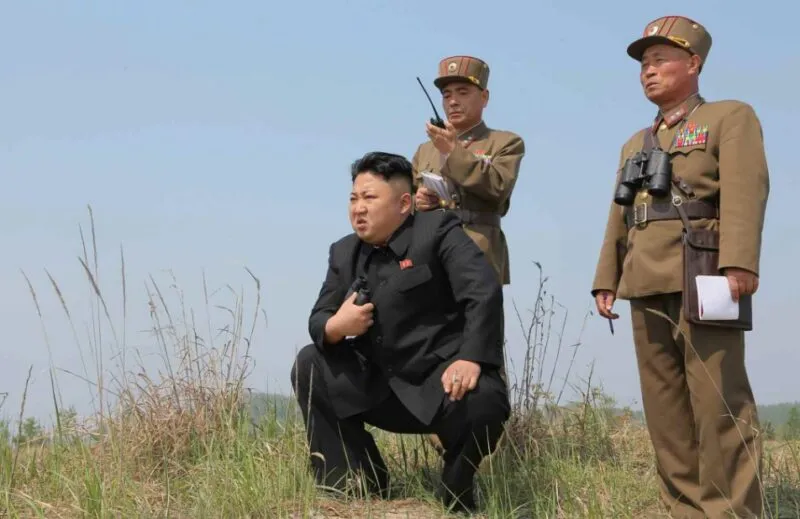
North Korean leader Kim Jong-un crouches in a grassy field while two uniformed military officers stand behind him.

Russia is deploying six launchers for North Korean ballistic missiles in Voronezh Oblast, the Institute for the Study of War (ISW) reported on 20 August. The assessment cited Ukraine’s military intelligence agency (HUR).

Russia has already used North Korean missiles in deadly strikes across Ukraine, and Pyongyang is supplying more of them. From Voronezh Oblast, the weapons could threaten Kyiv and six other regions, adding to the ballistic arsenal Moscow can use in mass attacks intended to overwhelm Ukrainian air defenses.

Six launchers expand Russia’s missile threat

The North Korean missiles could reach Kyiv, Sumy, Kharkiv, Chernihiv, Poltava, Dnipropetrovsk, and Zaporizhzhia oblasts, ISW said.

The unit may eventually field 120 missiles. HUR said North Korea had transferred around 50 KN-23, KN-24, and upgraded KN-30 ballistic missiles to Russia by July.

The KN-30 can carry a 2,500-kilogram warhead, though ISW has seen no evidence of Russia using it against Ukraine. Other North Korean missiles have larger warheads than Russia’s Iskander-M but are less accurate, Ukrainian military expert Anatolii Khrapchynskyi said.

Those missiles could join Russia’s combined attacks. ISW expects Moscow to stockpile ballistic and cruise missiles for several days before launching large barrages intended to overwhelm Ukraine’s air defenses.

ISW pointed to the 19–20 August attack as the latest example of that pattern. The barrage lasted nearly nine hours and killed at least 15 people in Kyiv. Ukraine’s Air Force said it intercepted most drones and cruise missiles, but no longer routinely reports how many ballistic missiles Russia launches or Ukraine intercepts.

North Korean missiles have already killed civilians

Preliminary evidence indicated that Russia used a North Korean ballistic missile in a 30 July strike on Radushne, Dnipropetrovsk Oblast, that killed five members of one family.

On 10 August, a North Korean missile killed seven Zaporizhstal steelworkers and injured 21 others in Zaporizhzhia, Ukrainian officials said. The workers were heading to a shelter when the missile struck.

Ballistic missiles travel at high speed and leave civilians little time to seek cover. They are also harder to intercept than drones or cruise missiles, while Ukraine has limited supplies of the Patriot interceptors used against them.

  • ✇Euromaidan Press
  • Russian groups keep trying—and failing—to reach Lyman, gateway to Donbas’ fortress belt, officer says
    Logistical problems are stopping Russian small infantry groups from reaching Lyman, a 53rd Brigade officer told Army TV on 21 August, ArmyInform reported. Russia is trying to capture Lyman and use it as a launchpad for an advance toward Sloviansk and Kramatorsk. Its forces have repeatedly tried to push into the city. They have reached its eastern edge but have not secured a foothold inside, according to Ukraine’s Joint Forces. Junior Lieutenant Volodymyr Hirniak, a c
     

Russian groups keep trying—and failing—to reach Lyman, gateway to Donbas’ fortress belt, officer says

21 août 2026 à 16:54

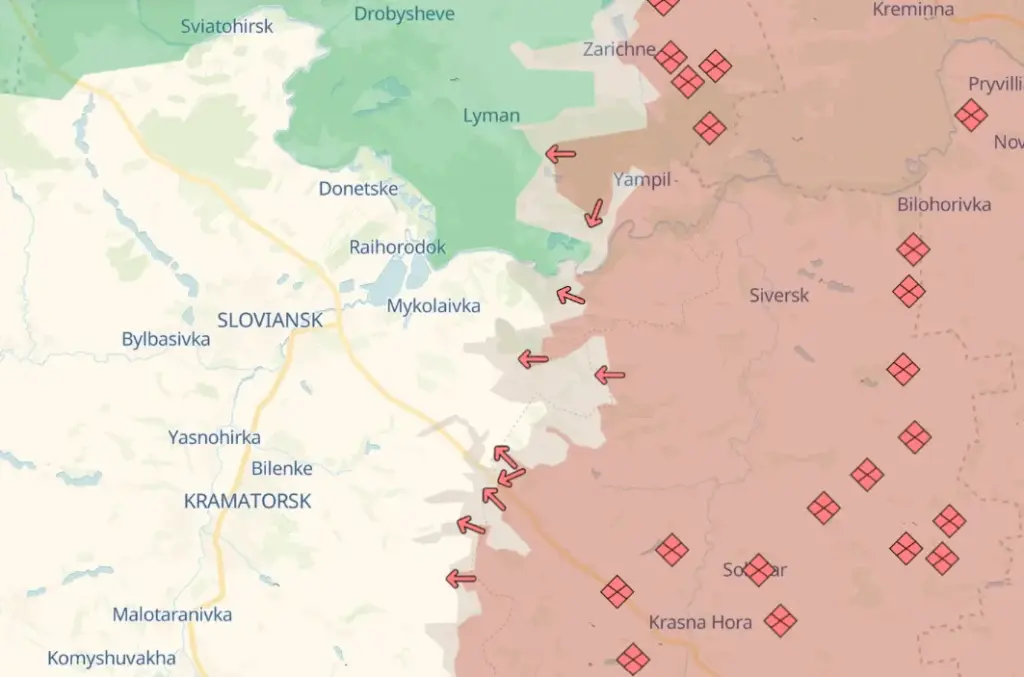
Map of the Lyman front in northern Donetsk Oblast, with arrows showing Russian advances westward toward Lyman, Sloviansk, and Kramatorsk.

Logistical problems are stopping Russian small infantry groups from reaching Lyman, a 53rd Brigade officer told Army TV on 21 August, ArmyInform reported.

Russia is trying to capture Lyman and use it as a launchpad for an advance toward Sloviansk and Kramatorsk. Its forces have repeatedly tried to push into the city. They have reached its eastern edge but have not secured a foothold inside, according to Ukraine’s Joint Forces.

Junior Lieutenant Volodymyr Hirniak, a communications officer with Ukraine’s 53rd Separate Mechanized Brigade, said the situation in the unit’s sector remained tense but had “not changed too radically.”

Russian forces continued to use drones, including fiber-optic models, Hirniak said. On the ground, they were sending small infantry groups to slip through Ukrainian lines and create confusion inside the brigade’s defensive positions.

The tactic was neither new nor confined to the 53rd Brigade’s sector, he added. Russia’s immediate aim was to reach Lyman and “open a gate” for further advances.

However, logistical problems were preventing the groups from achieving that aim, according to Hirniak. Ukrainian troops later detected and neutralized the infiltrating teams, he said.

ArmyInform did not report how many groups had attempted to advance, where within the brigade’s sector the incidents occurred, or over what period. Hirniak’s account could not be independently verified.

Why Russia keeps pushing toward Lyman

Lyman is a frontline city in northern Donetsk Oblast that blocks Russia’s northern route toward Sloviansk and Kramatorsk, part of Ukraine’s fortified Donbas “fortress belt.” Russia occupied the city for about four months in 2022 before Ukrainian forces liberated it on 1 October.

Joint Forces spokesman Viktor Trehubov said on 4 August that Russia needed to capture Lyman and establish a base there before advancing south toward Sloviansk and Kramatorsk.

Russia has pressed towards Lyman for more than a year. In July 2025, another Ukrainian officer said Russian gains near the city remained slow and costly despite repeated attempts to exploit gaps in Ukrainian lines.

  • ✇Euromaidan Press
  • Ukraine’s Flamingo missile maker’s new Danish plant delayed to 2027 as costs could triple
    Ukrainian defense manufacturer Fire Point has delayed its Danish missile-fuel plant until late 2027 after the original building failed to meet safety requirements, pushing the estimated cost above €150 million, Euractiv reported on 19 August. The plant will produce solid rocket propellant for Fire Point’s Flamingo cruise missiles. Denmark was the first NATO country to permit Ukrainian military production on its territory, the German outlet BILD reported. The site is int
     

Ukraine’s Flamingo missile maker’s new Danish plant delayed to 2027 as costs could triple

21 août 2026 à 15:18

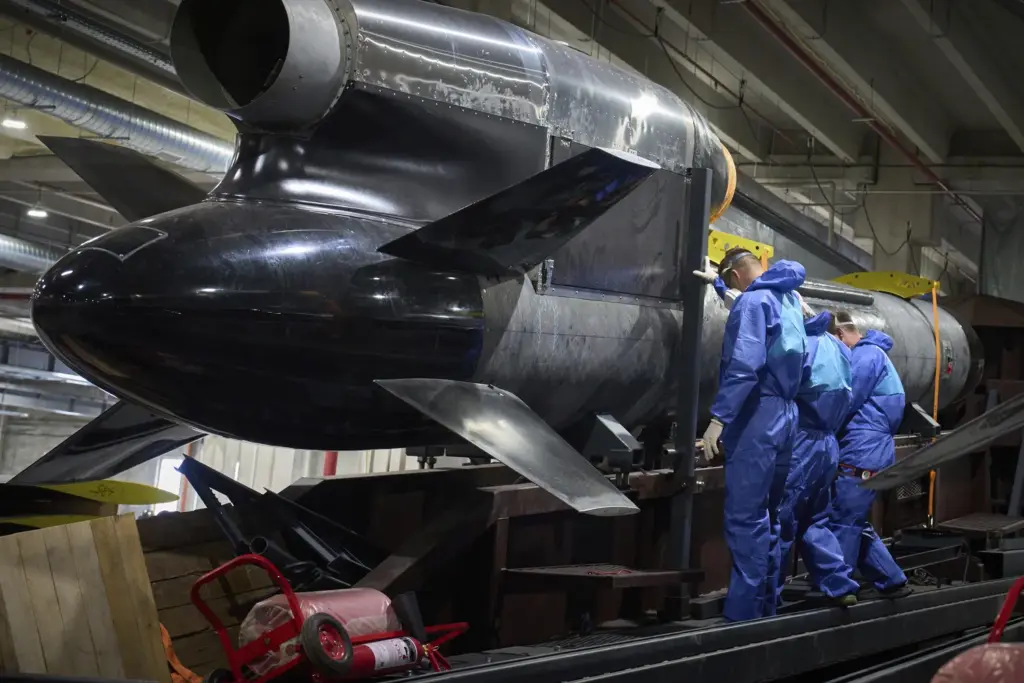
Three workers in blue protective suits inspect a large black Flamingo cruise missile on a factory assembly line.

Ukrainian defense manufacturer Fire Point has delayed its Danish missile-fuel plant until late 2027 after the original building failed to meet safety requirements, pushing the estimated cost above €150 million, Euractiv reported on 19 August.

The plant will produce solid rocket propellant for Fire Point’s Flamingo cruise missiles. Denmark was the first NATO country to permit Ukrainian military production on its territory, the German outlet BILD reported. The site is intended to move some production away from Russian attacks in Ukraine, but the delay postpones that capacity by a year.

Fire Point is building the plant in Vojens, near Skrydstrup Air Base in southern Denmark, Euromaidan Press reported.

Fire Point CEO Iryna Terekh announced the revised plan at DALO Industry Days, a defense-industry conference in Herning. She said Fire Point had originally expected the project to cost €50 million and called the new estimate “very rough.”

Denmark had already removed more than 20 legal barriers to speed up the project, Euractiv reported. Terekh said other European countries also remained interested in hosting Fire Point production.

What is Fire Point

Fire Point currently makes missiles and drones at 90 locations across Ukraine, Terekh told Euractiv in July.

The company supplies more than half of Ukraine’s deep-strike weapons—arms used to hit targets far behind the front line—and says it produces 300 drones daily, in a July 2026 interview with Liga.

In August 2025, Fire Point was producing 100 FP-1 long-range attack drones each day, according to the Associated Press. Its later figure includes FP-1 and FP-2 drones.

Denmark directly funds Ukrainian arms makers

Denmark has created the “Danish model” of aid, which uses allied money to buy weapons directly from Ukrainian manufacturers instead of taking equipment from donor stockpiles.

About $200 million of the €590 million military aid package announced in June was directed through the mechanism, Euromaidan Press reported. Denmark has committed about $11.7 billion in military support to Ukraine from 2022 through 2028, according to its Defense Ministry.

  • ✇Euromaidan Press
  • Captured Russian marine executed Ukrainian commander on superior’s order, prosecutors say
    Ukrainian prosecutors have formally accused a captured Russian marine of executing a Ukrainian unit commander near Pokrovsk, the Donetsk Oblast Prosecutor’s Office said on 20 August. Investigators allege he took the 34-year-old captive to a forest belt after an interrogation and shot him in the back of the head on his superior’s order. The case comes as Ukraine steps up efforts to prosecute Russian troops accused of executing or abusing Ukrainian POWs. Ukrainian investi
     

Captured Russian marine executed Ukrainian commander on superior’s order, prosecutors say

21 août 2026 à 14:00

A masked Russian soldier in camouflage and body armor wears a helmet bearing Russian flag and “Z” patches.

Ukrainian prosecutors have formally accused a captured Russian marine of executing a Ukrainian unit commander near Pokrovsk, the Donetsk Oblast Prosecutor’s Office said on 20 August. Investigators allege he took the 34-year-old captive to a forest belt after an interrogation and shot him in the back of the head on his superior’s order.

The case comes as Ukraine steps up efforts to prosecute Russian troops accused of executing or abusing Ukrainian POWs. Ukrainian investigators and UN monitors have documented a growing pattern since 2024 of Russian forces executing Ukrainian troops after capture.

The alleged gunman is now in Ukrainian custody, opening the way for an in-person trial. Russian troops also shot dead a second Ukrainian prisoner, prosecutors said.

Russian assault units had been trying to seize Shakhove on the Pokrovsk front since May 2025, according to the prosecutor’s office. On 10 October 2025, a small Russian infantry group entered the village’s outskirts and captured two Ukrainian service members, including the commander, the office alleges.

After the interrogation, the suspect took the commander to a forest belt and killed him with an automatic rifle, prosecutors said. The other Ukrainian prisoner was also shot dead. The statement names neither victim.

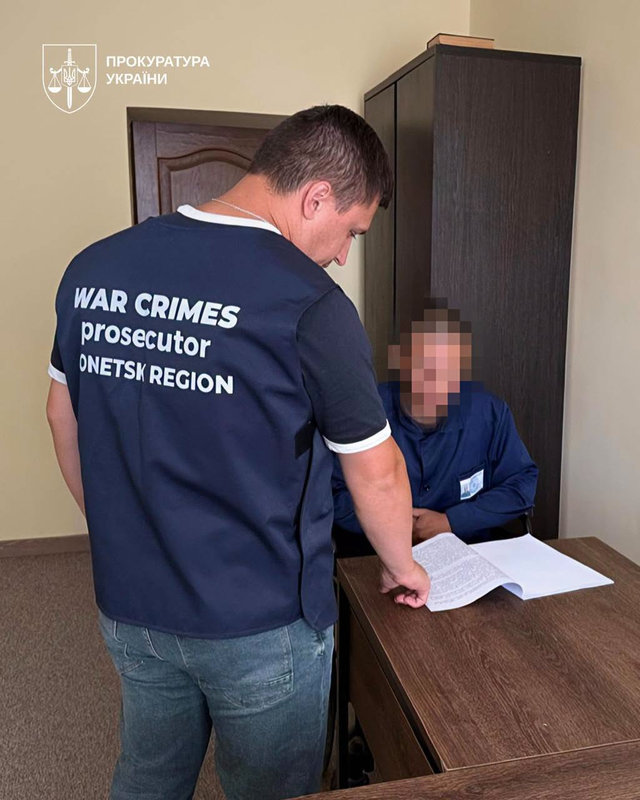
A man wearing a vest marked “War Crimes Prosecutor, Donetsk Region” stands beside a seated man with a pixelated face as they look at documents on a desk.
A Donetsk Oblast prosecutor formally notifies a captured Russian marine that he is suspected of executing a captured Ukrainian unit commander near Pokrovsk. Photo: Donetsk Oblast Prosecutor’s Office / Facebook

Investigators identified the suspect as a 34-year-old native of Russia’s Krasnoyarsk Krai who used the call sign “Tai” and served as a rifleman in the 336th Guards Naval Infantry Brigade.

Ukrainian forces later captured him during fighting in the same sector, according to prosecutors. The office did not say when he was taken prisoner.

Prosecutors formally accused him of cruel treatment of prisoners of war resulting in death, a war crime under Ukrainian law.

Ukraine’s other cases against captured Russian soldiers

Ukraine has previously brought cases against other captured Russian soldiers over POW executions. A Zaporizhzhia court sentenced Dmitry Kurashov to life imprisonment in November 2025—the first time Ukraine convicted a Russian soldier of executing a surrendered Ukrainian POW.

In a separate case, the Security Service of Ukraine charged Sergey Tuzhilov over the execution of one bound Ukrainian POW and his alleged role in killing two others near Vovchansk in June 2024.

  • ✇Euromaidan Press
  • Russia’s UN envoy denies reports of post-election mass mobilization
    Russian UN Ambassador Vasily Nebenzya denied reports that Moscow could launch another mass mobilization after September’s parliamentary elections, saying none was planned or expected “as far as I know,” The Moscow Times reported Russia has avoided another draft since its 2022 mobilization triggered protests and an exodus, relying instead on contract soldiers. Ukraine says those recruits no longer replace battlefield losses, and Moscow may mobilize several hundred thousa
     

Russia’s UN envoy denies reports of post-election mass mobilization

21 août 2026 à 13:57

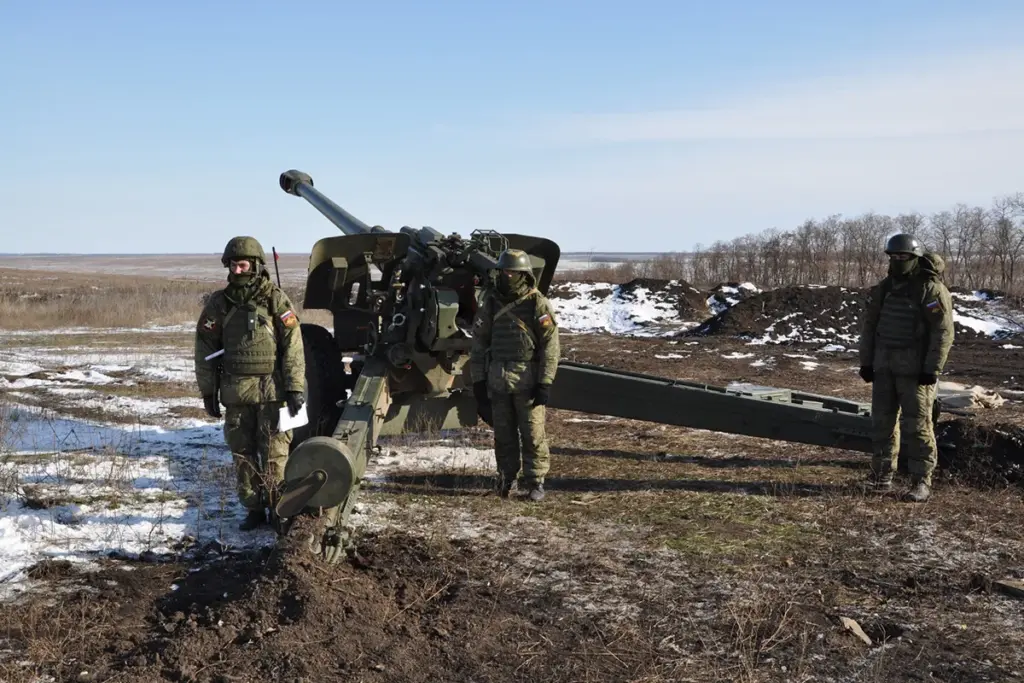
Russian soldiers stand beside a field artillery gun in a snow-covered position.

Russian UN Ambassador Vasily Nebenzya denied reports that Moscow could launch another mass mobilization after September’s parliamentary elections, saying none was planned or expected “as far as I know,” The Moscow Times reported

Russia has avoided another draft since its 2022 mobilization triggered protests and an exodus, relying instead on contract soldiers. Ukraine says those recruits no longer replace battlefield losses, and Moscow may mobilize several hundred thousand people after the elections. That could replenish its forces and support new offensives, although Ukrainian intelligence sees no preparations now.

Nebenzya’s remarks followed a question about more than 20,000 people crossing Russia’s Verkhny Lars border checkpoint into Georgia in one day amid fears of post-election mobilization, Meduza reported.

His comments extend a series of Russian denials. Deputy Security Council Chairman Dmitry Medvedev dismissed reports of another mobilization as “nonsense” in late July. The State Duma’s defense committee said a mass compulsory call-up was not under consideration because the army was recruiting contract soldiers, The Moscow Times reported.

Russia has avoided another mass draft since its September 2022 mobilization triggered protests and an exodus. Officials had also denied that mobilization was planned shortly before President Vladimir Putin announced it, Meduza noted.

Russian government seeks new wartime penalties

Moscow is separately seeking penalties for people and companies that ignore mobilization and military-supply orders issued by regional authorities. The bill would not itself order a new call-up.

The government submitted it to the State Duma, the lower house of Russia’s parliament, on 20 August, The Moscow Times reported. Companies could face fines of up to 1 million rubles or suspension for up to 90 days.

Russian law already punishes such defiance in areas under martial law but imposes no nationwide penalty elsewhere in Russia, according to the bill. Its authors said a “significant number” of violations had been recorded.

Ukraine says a new draft could provide troops for a northern offensive

President Volodymyr Zelenskyy said on 11 August, citing Ukrainian military intelligence, that Russia planned to mobilize several hundred thousand people after the elections and roughly the same number in 2027.

HUR, Ukraine’s military intelligence agency, later assessed that a post-election mobilization could enable Russia to build a strike force for a northern offensive by February 2027. Its deputy chief, Vadym Skibitskyi, stressed, however, that the agency currently sees no evidence that such preparations have begun.

Russian drone strike on Kryvyi Rih shopping center kills 15, injures 130. Second attack targeted rescue workers 30 minutes later

21 août 2026 à 12:48

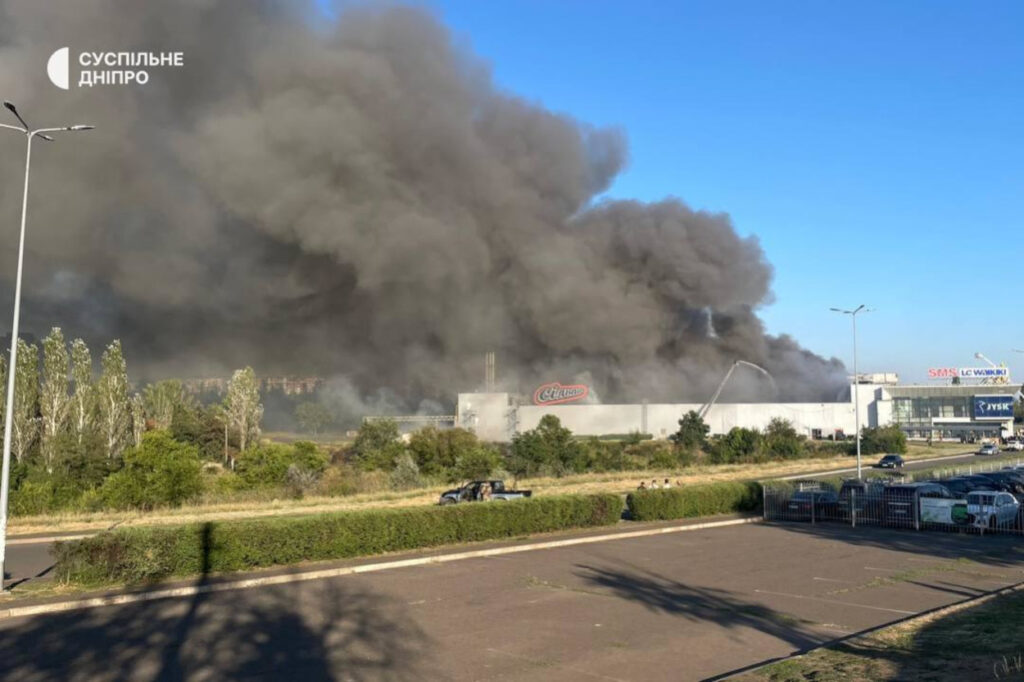
A shopping center burns after a Russian drone attack in Kryvyi Rih, Dnipropetrovsk Oblast, Ukraine, on 21 August 2026. Photo: Suspilne Dnipropetrovsk

Editor's note: This is a developing story.

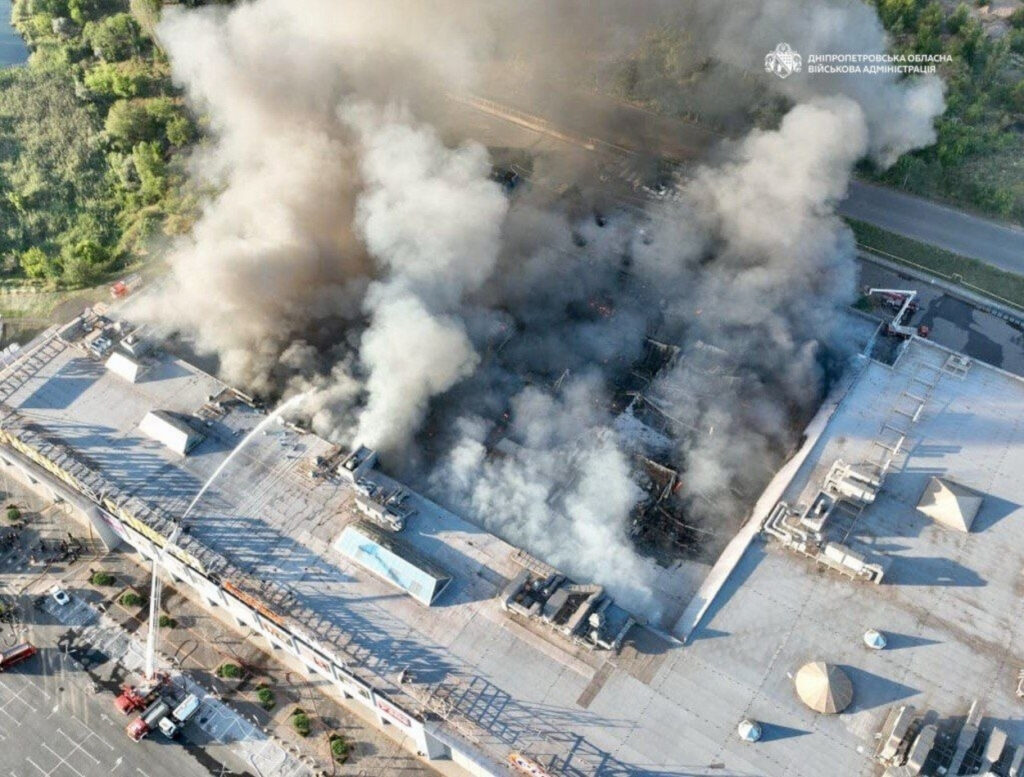
A Russian drone attack on a shopping center in Kryvyi Rih on 21 August killed at least 15 people and injured 130, including 23 children, local authorities said.

The attack struck the shopping mall during the day, setting shops inside the building on fire, regional military administration head Oleksandr Hanzha said.

The attack came in two waves, with the second strike hitting emergency responders about 30 minutes after the first strike caused the fire, Ukrainian President Volodymyr Zelenskyy said.

Twenty-nine people remain in serious condition, including five children, according to Head of the Kryvyi Rih Defense Council Oleksandr Vilkul.

One of the victims died in hospital from severe injuries sustained in the attack, bringing the death toll to six, according to Hanzha.

A shopping center burns after a Russian drone attack in Kryvyi Rih, Dnipropetrovsk Oblast, Ukraine, on 21 August 2026. Photo: Oleksandr Hanzha

Second strike hit emergency responders

The second wave came as emergency crews were responding to the fire caused by the first strike.

Zelenskyy called the attack “simply an act of terrorism” and said the international community should respond with real pressure on Russia.

“For peace to be possible, Russia needs to face real accountability,” Zelenskyy said.

Kryvyi Rih, in central-southern Ukraine, has faced frequent Russian missile and drone attacks throughout the full-scale war, with repeated strikes causing heavy civilian casualties.

“Such strikes are simply an act of terrorism,” Ukrainian President Volodymyr Zelenskyy said after a Russian drone attack on a shopping center in Kryvyi Rih killed five people and injured at least 52, including six children.

The attack came in two waves, with a second strike… pic.twitter.com/pCGwCqtiXv

— Euromaidan Press (@EuromaidanPress) August 21, 2026

Russian channels acknowledge strike on civilian target

Russian military Telegram channels described the shopping center as a target shortly after the attack, according to Kryvyi Rih Times.

One Russian channel claimed that a “Geran-4” jet-powered drone had been used to strike the shopping and entertainment complex and said the “target was hit” before noting that a fire had broken out inside the building.

The channel also published the precise coordinates of the shopping center.

The posts did not provide evidence that the shopping center was a legitimate military target.

Russian forces have repeatedly used drones and missiles to strike Ukrainian cities and civilian infrastructure throughout the full-scale invasion.

Russian attacks across Dnipropetrovsk Oblast

Russian forces attacked four districts of Dnipropetrovsk Oblast nearly 60 times on 21 August using drones, artillery, and an aerial bomb, Hanzha said.

In addition to the attack on Kryvyi Rih, Russian strikes hit communities in Nikopol, Synelnykove, and Kamianske districts, damaging apartment buildings, private homes, and cars.

Three people were injured in Nikopol district, while two others were injured in Synelnykove district. Several of the injured were hospitalized, Hanzha said.

The attacks also damaged private homes in Synelnykove district and caused a fire in the Krynychanska community of Kamianske district.

  • ✇Euromaidan Press
  • Ukraine warns Russia could exploit upcoming Independence Day for attacks and sabotage
    Ukraine's Security Service (SBU) urged Ukrainians to remain particularly vigilant ahead of Independence Day on 24 August, warning of potential Russian attacks and other security threats around the holiday. Security threats are often heightened around major national holidays in Ukraine during the full-scale war with Russia, when large public gatherings can create opportunities for attacks and Russia has an added incentive to use symbolic dates to spread fear and disrupti
     

Ukraine warns Russia could exploit upcoming Independence Day for attacks and sabotage

21 août 2026 à 11:47

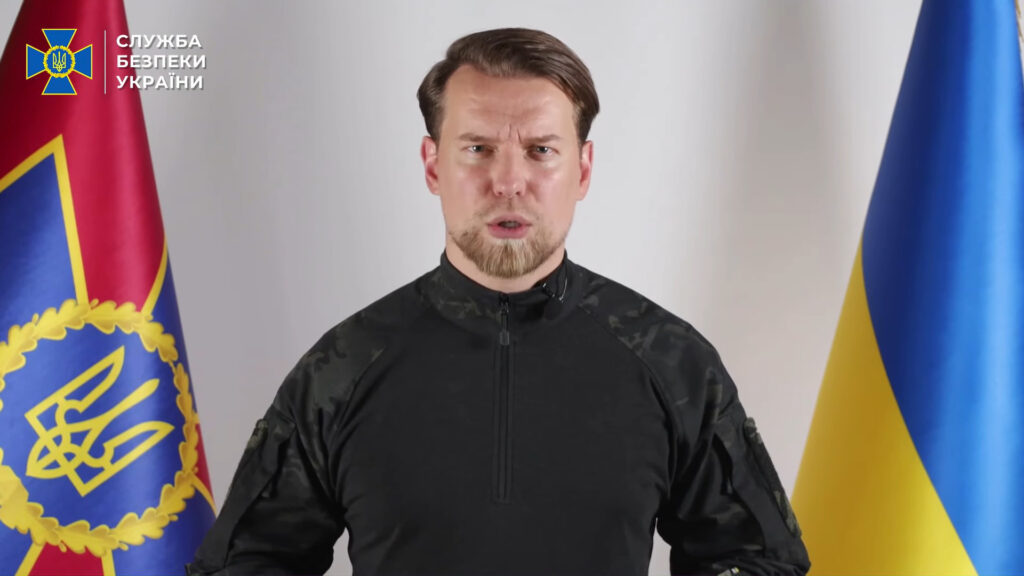
SBU spokesperson Artem Dekhtiarenko warned of potential Russian attacks and sabotage ahead of Ukraine’s Independence Day on 24 August. 21 August 2026. Screenshot from video: SBU

Ukraine's Security Service (SBU) urged Ukrainians to remain particularly vigilant ahead of Independence Day on 24 August, warning of potential Russian attacks and other security threats around the holiday.

Security threats are often heightened around major national holidays in Ukraine during the full-scale war with Russia, when large public gatherings can create opportunities for attacks and Russia has an added incentive to use symbolic dates to spread fear and disruption.

The SBU said Russia could exploit Independence Day gatherings for attacks, provocations, sabotage, cyberattacks, or other crimes.

Russia may recruit Ukrainians for sabotage

The SBU specifically warned about attempts by Russian intelligence services to recruit Ukrainians to carry out attacks inside the country.

According to the agency, Ukrainians could be offered money to set fires, damage property, plant suspicious objects, collect information about military facilities, or carry out other illegal activities.

The SBU urged people not to accept such offers and to immediately report attempts at recruitment.

It also warned that recruiters may disguise requests as ordinary tasks. People could be asked to photograph a particular location, deliver a package, or leave an object somewhere without being told the real purpose of the task.

The SBU said people should be especially cautious about requests from unknown individuals, including those claiming to represent law enforcement.

Russia has repeatedly sought to recruit Ukrainians for sabotage and other activities inside Ukraine during the full-scale war. Ukrainian authorities have previously reported cases in which people were offered money to carry out arson attacks, damage infrastructure, gather intelligence, or perform other tasks on behalf of Russian handlers.

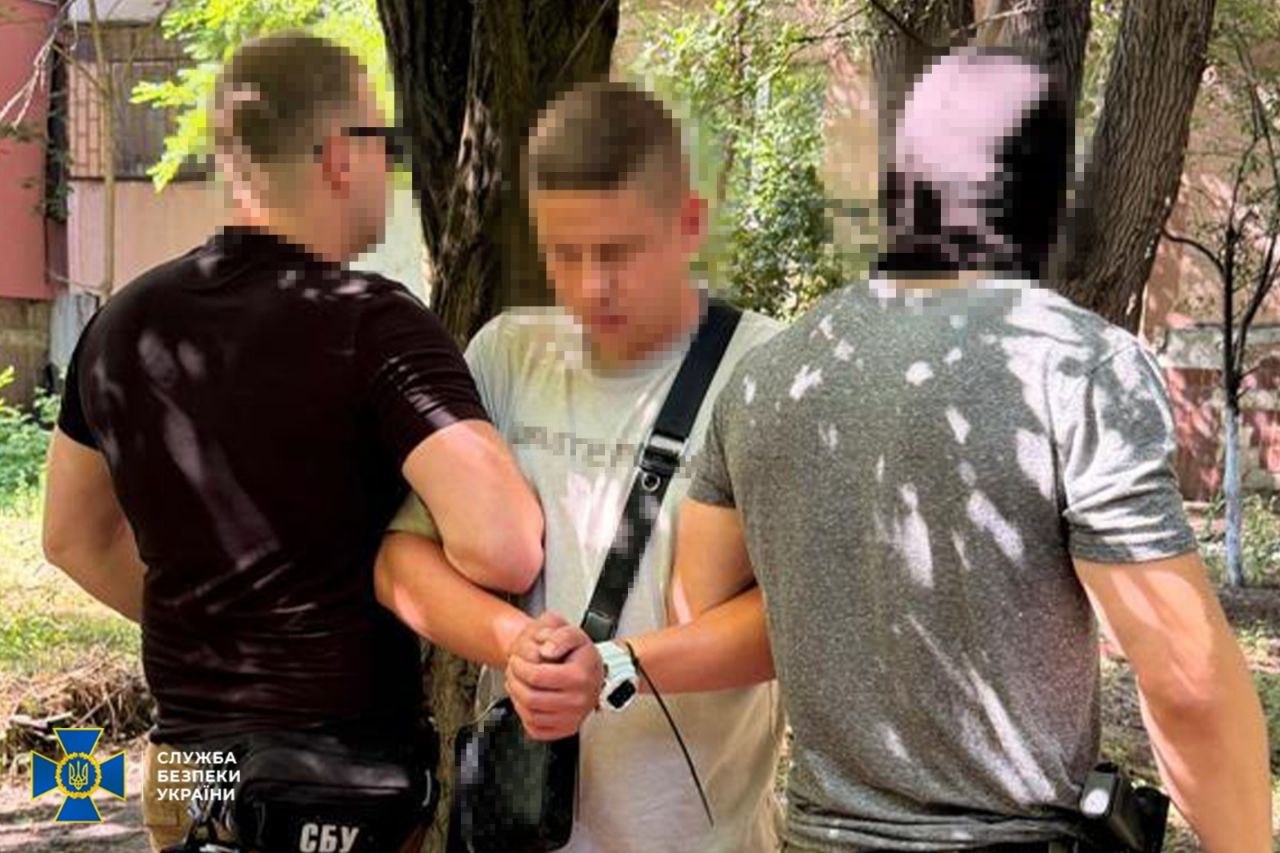
Ukraine's Security Service says it detained a suspected Russian agent accused of activating more than 1,000 Starlink terminals for Russian forces. Photo: SBU
Explore further

Alleged Russian agent arrested in Dnipro, accused of activating 1,000+ Starlink communications terminals to support Russian forces

Warning over information that could help Russia

The agency also urged Ukrainians to avoid sharing information that could help Russia identify military targets or assess the results of its attacks.

That includes photos and videos showing the locations of Ukrainian troops, critical infrastructure, checkpoints, and air defense systems.

The SBU also told people not to publish information about the consequences of Russian strikes, Ukrainian air defense operations, or the movement of Ukrainian military personnel.

Such information can reveal the location and activity of Ukrainian forces or help Russia assess the effectiveness of its strikes.

Independence Day under wartime threats

Ukraine will mark its 35th Independence Day on 24 August, more than four years after Russia launched its full-scale invasion.

The holiday comes as Russia continues to use missiles and drones to attack Ukrainian cities and infrastructure, while Ukrainian authorities remain concerned about Russian intelligence activity and sabotage inside the country.

The SBU urged Ukrainians to remain particularly vigilant before and during Independence Day and to report suspected recruitment, preparations for sabotage or terrorism, and other activity that could threaten national security.

  • ✇Euromaidan Press
  • Latvia resumes naming firms trading with Russia or Belarus after nearly three years
    Latvia has resumed publishing monthly lists of locally registered companies trading goods with Russia or Belarus after a nearly three-year pause, public broadcaster LSM reported on 20 August 2026. Prime Minister Andris Kulbergs has pledged to sever its remaining economic ties with Russia and Belarus, but substantial trade remains legal because EU sanctions are not a full embargo. The monthly register makes that commerce visible by identifying the companies involved.
     

Latvia resumes naming firms trading with Russia or Belarus after nearly three years

21 août 2026 à 11:28

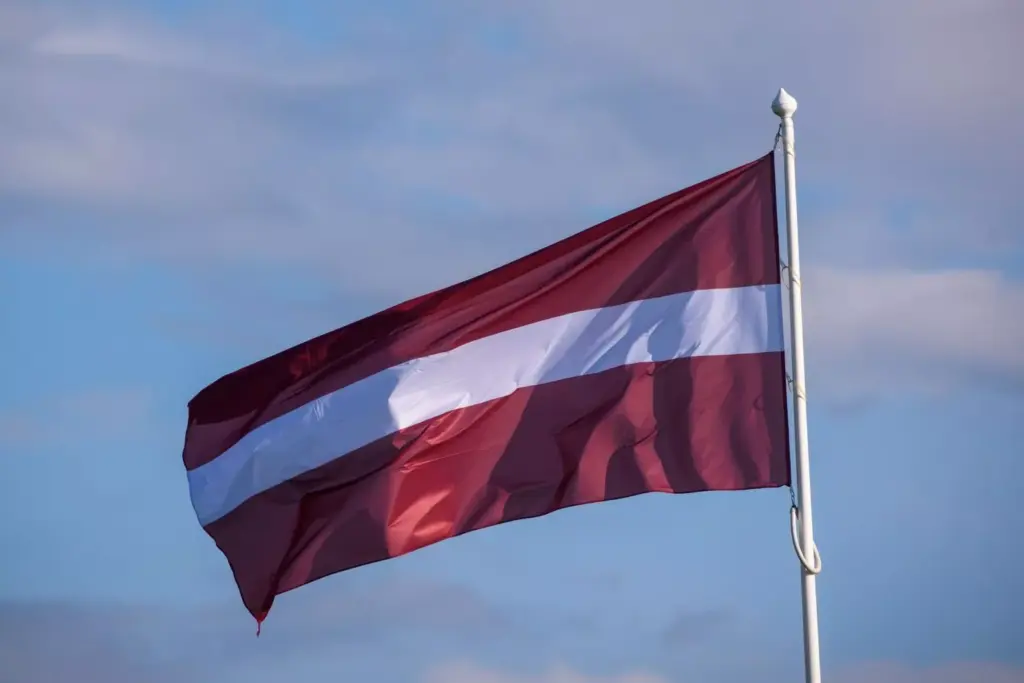
Latvian flag flying from a white flagpole against a blue, lightly clouded sky.

Latvia has resumed publishing monthly lists of locally registered companies trading goods with Russia or Belarus after a nearly three-year pause, public broadcaster LSM reported on 20 August 2026.

Prime Minister Andris Kulbergs has pledged to sever its remaining economic ties with Russia and Belarus, but substantial trade remains legal because EU sanctions are not a full embargo. The monthly register makes that commerce visible by identifying the companies involved.

The Central Statistical Bureau, Latvia's national statistics agency, published the names of 171 companies for July. A subsequent analysis by Latvian news agency LETA found that more than two-thirds operated in logistics, food and agriculture, or medicine.

The disclosure is, in effect, a form of naming and shaming. Yet the statistics bureau stopped publishing a similar list in autumn 2023 because names without transaction details could not support objective conclusions. The register is not a sanctions blacklist, and inclusion does not indicate a sanctions violation.

Under an amendment adopted on 18 June 2026, Latvia’s tax authority must send the data to the statistics bureau each month. The change also lifted tax-confidentiality rules that had kept company names private, LSM reported.

The explanatory note accompanying the law said disclosure was intended to support Ukraine. The amendment's authors argued that Latvian companies should not contribute to Russian and Belarusian state revenues while Russia’s invasion continues, according to LSM.

Latvia seeks to cut its remaining trade

The Prime Minister said in June that Latvia must sever its remaining economic ties with Russia and Belarus. However, he indicated that pharmaceutical exporters would likely be exempted on national-security grounds.

Latvia’s exports to Russia and Belarus each fell only about 7% in 2025, while imports from Russia plunged by more than two-thirds, according to official data cited by Euromaidan Press.

EU sanctions do not prohibit all trade

The EU renewed its economic sanctions on Russia through July 2027, preserving restrictions on trade, finance, and energy, as well as on goods and technology with both civilian and military uses, Euromaidan Press reported in June.

The Council of the EU says its trade restrictions exclude health, pharmaceutical, food, and agricultural products to avoid harming Russian civilians. Those exclusions allow EU companies to continue lawful trade with Russia even while other parts of its economy remain under sanctions over the invasion of Ukraine.

  • ✇Euromaidan Press
  • Lukoil’s Perm refinery struck 1,530 km from Ukraine’s northern border, Kyiv confirms
    Ukraine struck one of Russia's largest oil refineries deep in the Urals and a military airfield overnight in a long-range attack, Ukrainian President Volodymyr Zelenskyy announced on 21 August. The Ukrainian Army's General Staff confirmed the refinery and airfield hits, while Zelenskyy said the same night also reached the Black Sea and brought fresh damage from earlier strikes on a Russian warplane and a drone-launch site. Ukraine's long-range drone campaign has spent t
     

Lukoil’s Perm refinery struck 1,530 km from Ukraine’s northern border, Kyiv confirms

21 août 2026 à 11:14

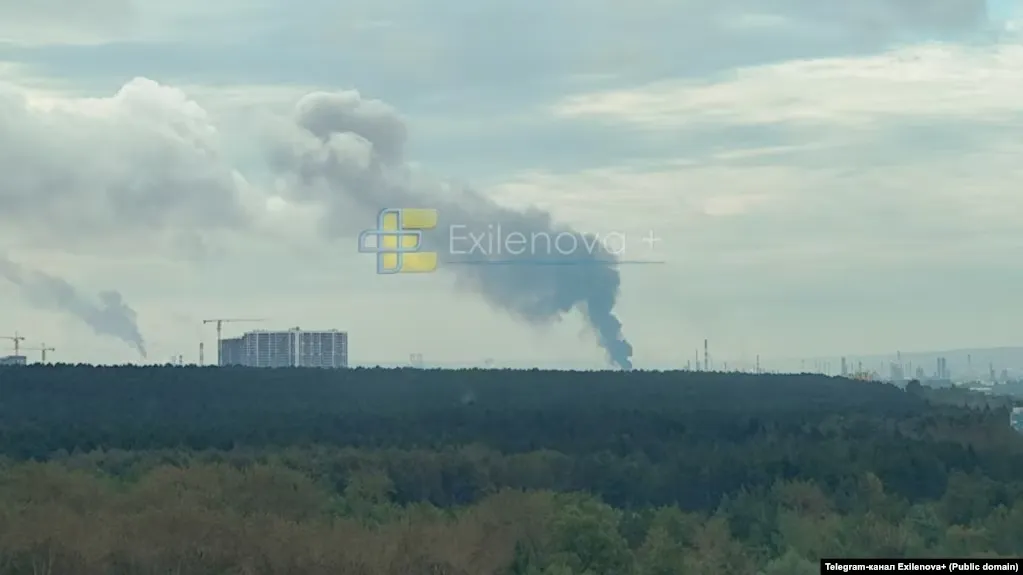
lukoil's perm refinery struck 1530 km ukraine's northern border kyiv confirms · post smoke rises over russia after ukrainian drone strike lukoil-permnefteorgsintez oil 21 2026 morning 08 exilenova ukraine news

Ukraine struck one of Russia's largest oil refineries deep in the Urals and a military airfield overnight in a long-range attack, Ukrainian President Volodymyr Zelenskyy announced on 21 August. The Ukrainian Army's General Staff confirmed the refinery and airfield hits, while Zelenskyy said the same night also reached the Black Sea and brought fresh damage from earlier strikes on a Russian warplane and a drone-launch site.

Ukraine's long-range drone campaign has spent the year reaching ever deeper into Russian territory, forcing Moscow to spread its air defenses across thousands of kilometers and driving fuel shortages that now reach beyond its borders. Each strike on Russia's oil backbone compounds the strain on its refining and export earnings, even as the Kremlin diverts chemicals meant for weapons into keeping filling stations supplied.

Fire at a major Lukoil refinery in Perm

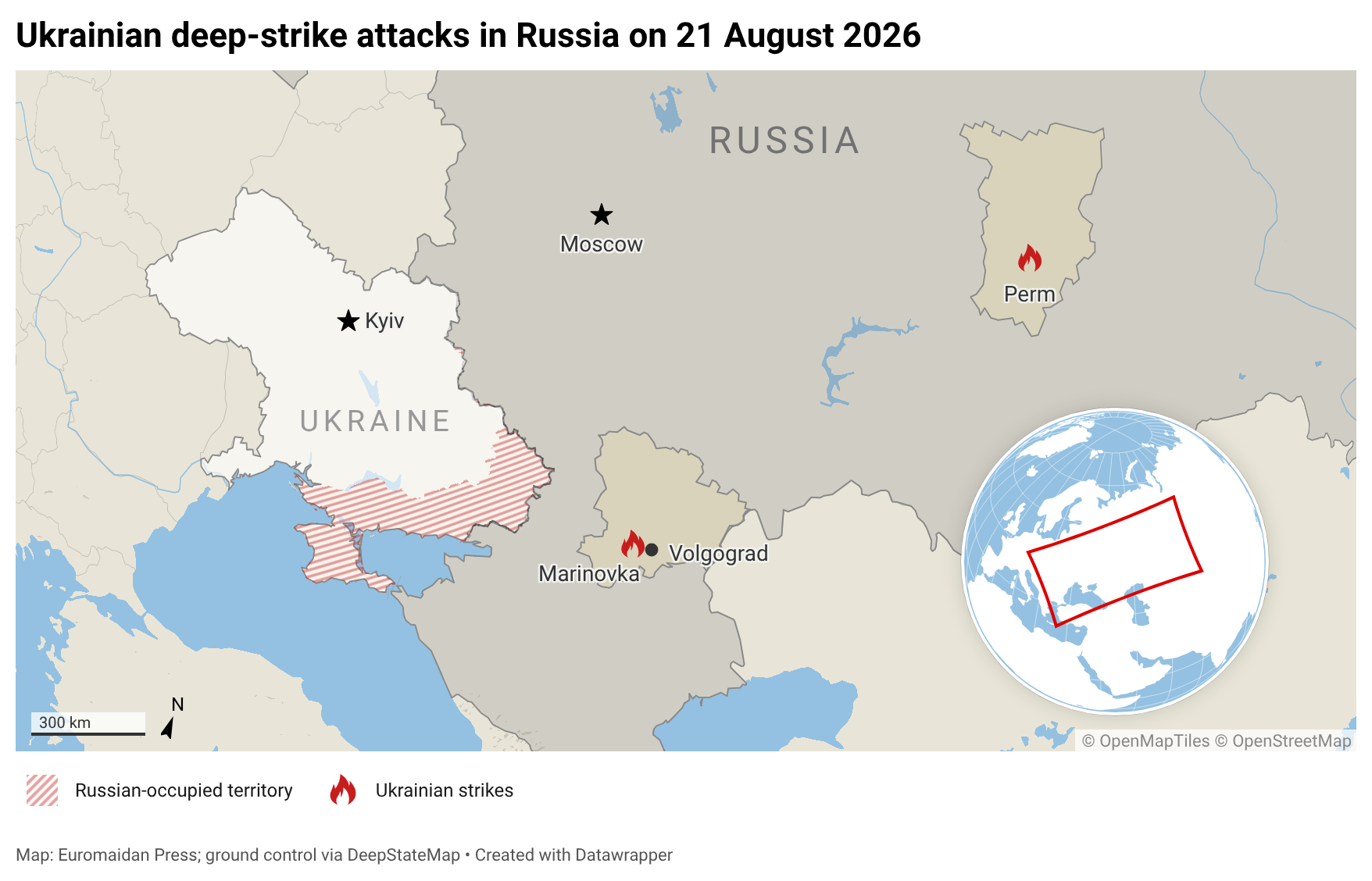
Zelenskyy said the overnight drones hit the Lukoil-Permnefteorgsintez refinery — known as PNOS — in Perm, where the General Staff recorded a fire on the plant's grounds. The target sits more than 1,500 km from Ukraine's northern border, in a region near the Ural Mountains.

The refinery is one of Russia's largest, able to process more than 13 million tons of crude a year, with more than half its output sold abroad until recently. It supplies fuel to both Russia's economy and its army.

lukoil's perm refinery struck 1530 km ukraine's northern border kyiv confirms · post w6umk-ukrainian-deep-strike-attacks-in-russia-on-21-august-2026- ukraine news ukrainian reports

Ukrainian Telegram channels Supernova+ and Exilenova+ shared footage of explosions and a rising plume, with locals reporting a series of blasts at the site. Russia's Perm Krai authorities claimed they repelled the attack and downed 16 drones.

Oil refinery in Perm continues to burn pic.twitter.com/pKeCNbycMQ

— Exilenova+ (@Exilenova_plus) August 21, 2026

Kyiv has repeatedly hit the plant through the year. After a strike at the end of July, it had been running well below capacity.

Airfield, Black Sea, and other targets the same night

The General Staff said the same night's drones also struck the Marinovka military airfield in Volgograd Oblast, located in Russia's Volga region, with the damage still being assessed, while Zelenskyy added that Ukraine achieved unspecified results in the Black Sea. The military also reported hitting a drone storage and launch site near Donetsk, a materiel warehouse in occupied Crimea, two command posts in Donetsk and Zaporizhzhia oblasts, and six relay stations in Crimea used to steer Russia's Geran and Gerbera attack drones.

Zelenskyy also confirmed damage from earlier strikes: a Russian Su-34 fighter-bomber hit at the Akhtubinsk airfield, about 600 km from the front line, and a drone store and launch site struck at Primorsko-Akhtarsk, roughly 180 km away. The strike extends a run of deep hits this month, from the TANECO refinery in Tatarstan and a Black Sea oil terminal to three refineries hit in one night and an Omsk refinery struck 2,500 km away in Siberia.

  • ✇Euromaidan Press
  • Ukraine planned 1,000 AI-guided drones a night to shut Moscow airports, Atlantic reports
    President Volodymyr Zelenskyy allowed preparations for an AI-guided drone campaign against Moscow-area airports, The Atlantic reported on 20 August, citing two anonymous sources with direct knowledge of the proposal. The reported plan sought to keep civilian flights grounded long enough to pressure Russia’s elite. Had it proceeded, it would have moved Ukraine toward large-scale autonomous strikes, raising questions under the laws of war about attacks without human confi
     

Ukraine planned 1,000 AI-guided drones a night to shut Moscow airports, Atlantic reports

21 août 2026 à 09:11

Smoke rises behind illuminated apartment buildings in Moscow at night following a reported Ukrainian drone attack.

President Volodymyr Zelenskyy allowed preparations for an AI-guided drone campaign against Moscow-area airports, The Atlantic reported on 20 August, citing two anonymous sources with direct knowledge of the proposal.

The reported plan sought to keep civilian flights grounded long enough to pressure Russia’s elite. Had it proceeded, it would have moved Ukraine toward large-scale autonomous strikes, raising questions under the laws of war about attacks without human confirmation. The Atlantic's disclosure follows months of reported Ukrainian attacks that repeatedly forced Moscow-area airport closures and sent increasingly large drone swarms toward the capital.

How the drone operation would have worked

Code-named M&Ms, the operation called for as many as 1,000 drones to fly toward Moscow-area airports each night and overwhelm Russian air defenses, one source said.

Onboard cameras would compare live views with preloaded maps and target images. They would also allow the drones to strike without pilot confirmation and to navigate without a remote-control link that is vulnerable to Russian electronic jamming, the sources said.

One source said prolonged airport closures were intended to pressure Kremlin-linked elites and push Vladimir Putin toward negotiations.

The plan was presented to Zelenskyy during the winter of 2025–26, The Atlantic reported. Preparations stopped after Zelenskyy dismissed Defense Minister Mykhailo Fedorov, whom The Atlantic described as the operation’s mastermind, in July, both sources said. One source said another team could revive the project within about three months.

Both sources said Zelenskyy allowed preparations despite concerns that a drone could hit a civilian airliner. Planners proposed warning airlines, according to one source.

A Zelenskyy spokesperson declined to comment. Another unnamed presidential office official called the report “total nonsense,” saying Ukraine lacked long-range weapons reliable enough to strike the airports without posing undue risks to civilians.

Previous Ukrainian strikes on Moscow

The alleged M&Ms operation never launched, but other reported Ukrainian drone attacks repeatedly disrupted Moscow’s airports.

From 5 to 7 May 2026, restrictions imposed amid reported Ukrainian drone attacks delayed more than 450 flights at Moscow airports. Limits at Vnukovo remained in place for nearly 18 hours, EP reported, citing the independent Russian investigative outlet Agentstvo.

Earlier this week, Russian authorities claimed that 620 drones flew toward Moscow in one night, EP reported. The Atlantic placed Russia’s nationwide interception claim for that night at 791 drones. Ukraine’s military did not claim the attack.

  • ✇Euromaidan Press
  • Russian strikes on Odesa ports push Ukrainian farms toward bankruptcy, Bloomberg reports
    Ravil Dzhamally fled when Russian forces occupied his farm in Kherson Oblast, then returned after liberation to clear mines and plant again. Now, tons of his grain lie unsold in plastic sleeves across his fields because Russian attacks have nearly halted exports through Odesa, Bloomberg reported on 20 August. Odesa’s Black Sea ports handle almost all of Ukraine’s grain exports, Bloomberg reported. Weekly grain and oilseed exports have fallen by more than 90% since early
     

Russian strikes on Odesa ports push Ukrainian farms toward bankruptcy, Bloomberg reports

21 août 2026 à 07:47

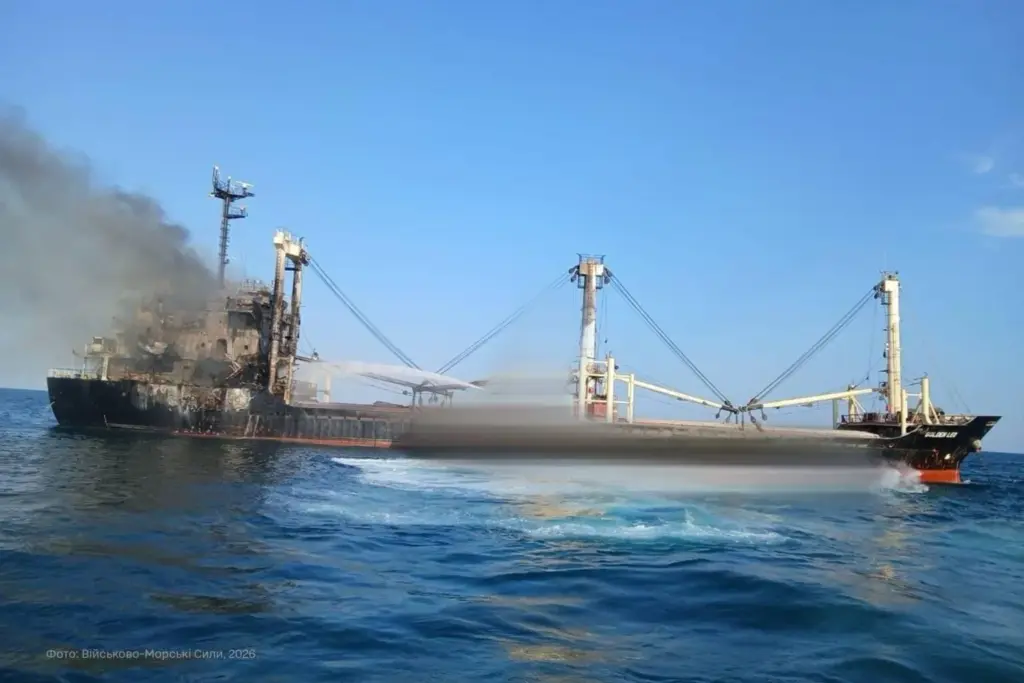
A damaged cargo ship burns at sea as thick black smoke rises from its stern and water sprays across the vessel.

Ravil Dzhamally fled when Russian forces occupied his farm in Kherson Oblast, then returned after liberation to clear mines and plant again. Now, tons of his grain lie unsold in plastic sleeves across his fields because Russian attacks have nearly halted exports through Odesa, Bloomberg reported on 20 August.

Odesa’s Black Sea ports handle almost all of Ukraine’s grain exports, Bloomberg reported. Weekly grain and oilseed exports have fallen by more than 90% since early July, data from commodity-data firm Kpler show. That threatens fall planting and the sector that generates more than half of Ukraine’s export revenue. The disruption is also raising food costs in countries that rely on imported grain, Reuters reported.

Farmers must either store harvests they cannot export or sell locally at about one-third of global prices, Bloomberg reported. They say this year’s crisis is worse than the 2022 blockade because the financial reserves that carried them through six months of disruption then have since been depleted.

Russian attacks drive ships from Ukraine’s grain corridor

Ukraine’s Black Sea grain corridor—the wartime shipping route from Odesa—was never formally closed, Euromaidan Press reported. Four or five ships entered Ukraine’s ports on 21 July. Still, none arrived the next day because shipowners had paused calls, not because Ukraine had restricted navigation, Agriculture Minister Taras Vysotskyi told Ukrainian agricultural outlet Latifundist.

Ukraine’s state railway, Ukrzaliznytsia, subsequently restricted selected wheat and barley shipments to Odesa ports. Its register did not state a reason, and the railway did not publicly link the orders to the shipping disruption.

Oleksandr Havryliuk, who farms near the front in Kharkiv Oblast, told Bloomberg that losing his harvest would probably bankrupt him and force him to sell the farm. The National Bank of Ukraine estimates that Ukraine could lose about $2.5 billion in export revenue during the second half of 2026, Reuters reported. Bloomberg said the disruption could trigger widespread farm bankruptcies.

Ukraine seeks EU aid and export routes as losses mount

Financing was already constrained before the port crisis: available financing and insurance were “enough to keep the sector surviving, not enough to keep it growing,” Vysotskyi told Euromaidan Press in May.

Before Russia’s full-scale invasion, agriculture accounted for more than 10% of Ukraine’s economic output, according to World Bank data cited by Bloomberg.

The sector has since grown more important as Russian attacks have destroyed much of the country’s heavy industry, Evghenia Sleptsova, a senior economist at the economic forecasting firm Oxford Economics, told Bloomberg.

Her firm estimates that the disruption could cost the equivalent of 1.8% of GDP this year and 2.1% in 2027. Under a prolonged severe disruption, the 2027 loss could instead reach 5.3%, Oxford Economics said.

Ukraine could exhaust its grain-storage capacity by early November if exports do not recover, the Agriculture Ministry said, according to Bloomberg. Even using every available route, the country may export only about 30 million tons this season, leaving roughly the same volume stored or rotting, Vysotskyi said.

Ukraine’s Agriculture Ministry requested a €220 million EU grant to subsidize interest and unlock up to €4 billion in loans, the ministry said.

Ukraine and Moldova are also discussing a rail route through Moldova to Romania’s port of Constanța, Reuters reported, citing unnamed sources in both countries. Kyiv estimates the route could carry about 10% of its grain exports.

Western rail corridors have limited capacity, while low water levels restrict traffic through Danube ports. Both alternatives cost more than shipping through the Black Sea, Bloomberg reported.

Ukraine can’t get one permit to find its WWII dead in Poland—yet approves Polish searches, Kyiv’s ambassador says

21 août 2026 à 06:38

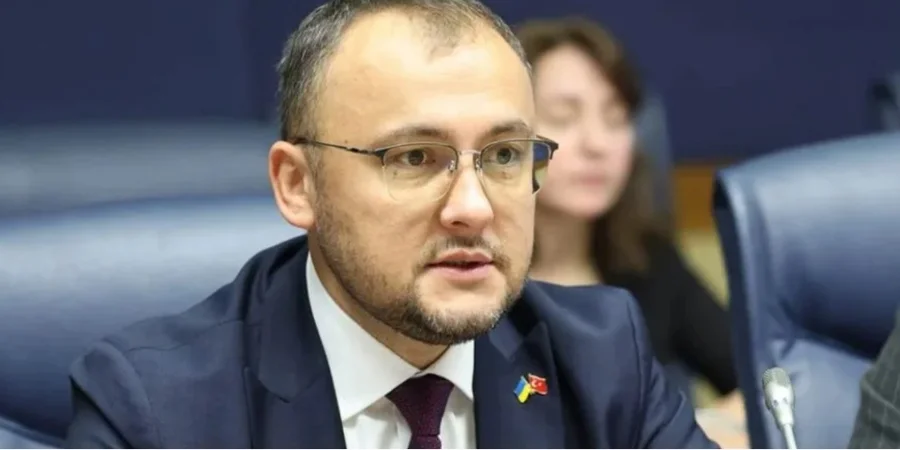
Ukraine’s Ambassador to Poland Vasyl Bodnar speaks into a microphone during a meeting.

Poland has held up a Ukrainian search at Łasków for months, Ambassador Vasyl Bodnar told Polish broadcaster RMF24, NV reported on 19 August. He says the eastern Polish village may contain the remains of civilians killed there by Polish underground forces in 1944.

The permit dispute is part of a much larger argument over how Ukraine and Poland remember the wartime killings of Poles and Ukrainians. Reciprocal searches resumed only recently after years of deadlock, giving both countries a way to recover and identify victims even as they disagree over historical responsibility. The latest delay tests that fragile progress while Poland remains Ukraine’s main route for Western arms and aid.

Bodnar says Ukrainian civilians were killed at Łasków in 1944 by the Home Army—Poland’s principal underground resistance force during the Nazi occupation—and the Peasant Battalions, an agrarian underground movement.

Bodnar appealed to Poland to issue "at least one permit" for searches on its territory. He said Ukraine systematically approves Polish requests in return. The ambassador blamed the holdup on unspecified “bureaucratic restrictions” and urged Warsaw not to leave the impression that Kyiv was obstructing the work.

In July, Bodnar said Poland’s Institute of National Remembrance had supported the Łasków application procedurally and that only approval from the regional monuments conservator remained. He expected work to start in August.

The institute said it had assisted with Łasków but was awaiting more documents for Ukraine’s separate applications concerning Sahryń and Przemyśl.

Past Polish-Ukrainian exhumations

Reciprocal work between Ukraine and Poland resumed only after Kyiv lifted a moratorium imposed in 2017. Ukraine had halted Polish exhumations in response to the destruction of Ukrainian memorial sites on Polish soil.

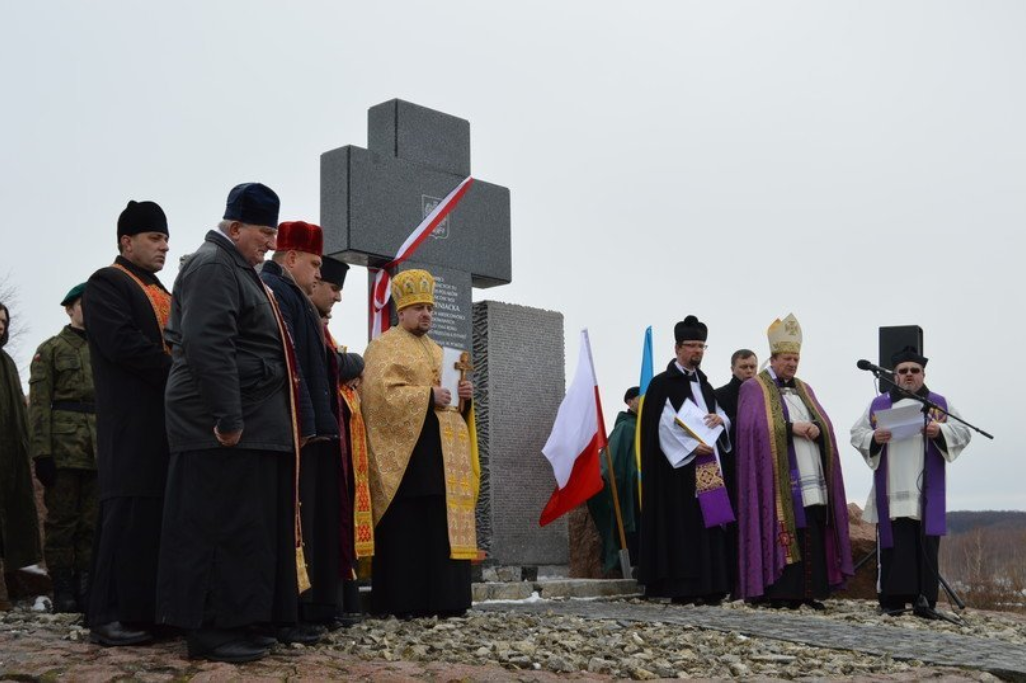
The monument to murdered Polish civilians in Huta Peniatska in Ukraine's Lviv Oblast was restored in 2017. Photo: NV
Explore further

Ukraine will keep issuing Polish exhumation permits despite historical tensions. Dispute “causes joy in Moscow,” Kyiv says

A joint team exhumed the remains of 42 Polish victims of massacres by Ukrainian nationalists at Puzhnyky in western Ukraine in May 2025. Ukrainian researchers later searched for a suspected grave of up to 18 Ukrainian Insurgent Army fighters at Jureczkowa, Poland, but found none.

Ukraine granted further permits for Polish searches in 2026. Joint work at Uhly in Rivne Oblast found no mass grave, while exhumations began at Ostrivky and Volia Ostrovetska in July.

Historical grievances strain wartime alliance

The searches are the practical core of a broader dispute over wartime killings of Poles and Ukrainians. Competing interpretations of the Volyn tragedy and battles over Ukrainian Insurgent Army symbols have increasingly spilled into Polish politics and the streets.

Kyiv says it continues approving Polish grave searches while its own researchers wait to begin work in Poland.

  • ✇Euromaidan Press
  • Russia occupied Anton’s home when he was 10. At 18, he volunteered to fight against Ukraine
    Now held in a POW camp in western Ukraine, Anton does not consider himself a traitor. He calls Putin “my President” and said he joined Russia’s army to defend “my land,” the BBC reported. The BBC interviews show what more than a decade of Russian rule has produced in occupied Donbas. Moscow has replaced Ukrainian schools, media, and public institutions while presenting the occupied regions as permanent parts of Russia. It also recruits residents or forces them to fight
     

Russia occupied Anton’s home when he was 10. At 18, he volunteered to fight against Ukraine

21 août 2026 à 06:32

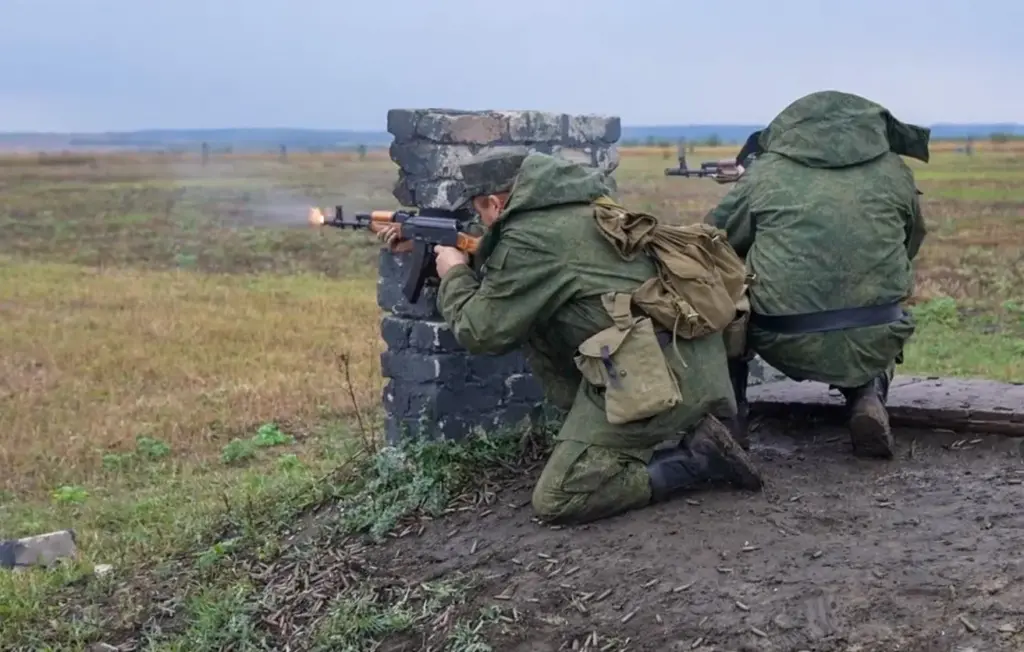
Two soldiers kneel behind a low brick barrier and fire rifles across an open training field.

Now held in a POW camp in western Ukraine, Anton does not consider himself a traitor. He calls Putin “my President” and said he joined Russia’s army to defend “my land,” the BBC reported.

The BBC interviews show what more than a decade of Russian rule has produced in occupied Donbas. Moscow has replaced Ukrainian schools, media, and public institutions while presenting the occupied regions as permanent parts of Russia. It also recruits residents or forces them to fight against Ukraine.

The BBC said prisoners could refuse and were interviewed without guards or cameras.

Almost all its Ukrainian-born interviewees from territories occupied since 2014 said they had enlisted willingly. Anton said he was not a traitor and called Vladimir Putin “my President.”

His friends also volunteered. Messages announcing their deaths followed: “Dead, dead, dead.”

Forced conscription of Ukrainians in occupied territory

One prisoner from Donetsk Oblast told the BBC he had been forced to fight. He wanted only to return to his wife and children.

The BBC cited an official intelligence-based estimate that Russia forcibly conscripted more than 50,000 Ukrainians in occupied areas. It noted that other estimates were higher.

Ukrainian veteran Pavlo Pshenychnyi told Hromadske that occupation authorities used planted drug evidence to push him into Russia’s army. They threatened him with up to 12 years in prison.

Article 51 of the Fourth Geneva Convention prohibits occupying powers from compelling protected residents to serve in their armed forces.

Anton and the Russification of occupied Ukrainian territory

Russia took control of Anton’s home while he was still in primary school. By adulthood, he called himself Russian and dismissed his Ukrainian surname as irrelevant.

Putin’s 2025 policy decree set a 95% target for “all-Russian civic identity” by 2036 and ordered the integration of occupied Ukrainian regions into Russian education, culture, and media.

Kherson-based outlet MOST reported that Russia will introduce compulsory textbooks on 1 September, presenting four occupied Ukrainian regions as historically Russian.

Ukraine’s Center for Countering Disinformation reported in 2025 that more than 100 teenagers from occupied Luhansk attended a Russian military camp. They received firearms, drill, and guard-duty training.

The center described the camp as part of a wider effort to spread Russian war propaganda and hostility toward Ukraine.

Petro Yatsenko of Ukraine’s POW Coordination Headquarters told the BBC that these prisoners were strongly pro-Russian. He said their national identity was “very blurred.”

Ukraine still considers them Ukrainian and treats Russia’s control of their home regions as temporary, the BBC noted.

Hungary sent commandos to seize Ukraine’s $82 million bank convoy. Its investigators now say they have found no crime

21 août 2026 à 06:22

Stacks of bundled banknotes and nine gold bars arranged on a wooden table.

Hungary has closed the Oschadbank case after finding no crime connected to an $82 million shipment of cash and gold belonging to Ukraine’s state-owned savings bank, The Insider reported on 20 August 2026, citing the bank’s lawyer Lóránt Horváth.

Closing the money-laundering case removes the allegation used to justify seizing Oschadbank’s assets. A separate criminal investigation is examining the couriers’ detention, while Prime Minister Péter Magyar’s government has opened an internal review of the agencies involved. Together with the return of the assets, these steps reverse how this case was handled under former PM Viktor Orbán and may help improve relations with Ukraine.

Hungary’s National Tax and Customs Administration (NAV), the country’s tax and customs authority, traced the assets to a documented deal between Austria’s Raiffeisen Bank International and Oschadbank. Raiffeisen provided records establishing the assets’ origin and Oschadbank’s payment, according to Horváth’s account of NAV’s decision.

Meanwhile, a separate investigation into the couriers’ alleged unlawful detention remains open. János Hajdu, the former head of Hungary’s Counter-Terrorism Center (TEK), is a suspect. TEK is the country’s armed counterterrorism police.

A leaked prosecution document named former Prime Minister Viktor Orbán and three other former officials, including Hajdu, among those involved in deciding on the operation. Orbán has not been named as a suspect, Euronews reported on 30 June.

Orbán denies wrongdoing and says the raid was lawful.

How the Oschadbank case began

TEK stopped two armored cash-in-transit vans near Budapest on 5 March 2026. They carried $40 million, €35 million, and nine kilograms of gold from Vienna to Kyiv under a routine banking contract, Euromaidan Press reported. Officers detained the seven Oschadbank employees as witnesses, kept them handcuffed for 28 hours, and denied them lawyers and Ukrainian consular access, Ukraine’s Foreign Ministry said.

Hungary deported the couriers and imposed three-year Schengen bans, which barred them from most of Europe, although none had been charged with a crime. The orders and bans were later annulled.

Orbán’s government nevertheless portrayed the shipment as possible money laundering. Fidesz politicians also alleged, without evidence, that it was intended to finance Magyar’s then-opposition party, Tisza.

Hungary returned the vans, cash, and gold by 6 May. Ukrainian Foreign Minister Andrii Sybiha called the handover a break with Orbán-era “lawlessness” and a sign that relations could advance through “mutual respect and healthy pragmatism,” Reuters reported.

❌