Talarico casts himself as a moderate who would put Texans’ needs over party allegiances amid close contest against Republican Ken PaxtonJames Talarico, the Texas Democratic nominee for Senate, sat face to face with skeptical Republicans and independents voters who grilled him on a slew of contentious issues including Israel’s military campaign in Gaza, abortion and foreign aid, during a CNN town hall co-hosted by the Jubilee Media digital platform on Wednesday.One voter, a young Republican activ
Talarico casts himself as a moderate who would put Texans’ needs over party allegiances amid close contest against Republican Ken Paxton
James Talarico, the Texas Democratic nominee for Senate, sat face to face with skeptical Republicans and independents voters who grilled him on a slew of contentious issues including Israel’s military campaign in Gaza, abortion and foreign aid, during a CNN town hall co-hosted by the Jubilee Media digital platform on Wednesday.
One voter, a young Republican activist who volunteered at the party’s midterm convention in Dallas last month and recently appeared on Fox News as a supporter of Talarico’s opponent, questioned the authenticity of Talarico’s faith, referencing a past remark where he described God as nonbinary.
Aimée Lévesque (Arts littéraires et livre), Joan Sullivan (Arts visuels et métiers d’art) et Ito Laïla (Arts visuels et métiers d’art), toutes trois de la MRC de Rimousk-Neigette, sont finalistes au prestigieux Prix du CALQ – Artiste de l’année au Bas-Saint-Laurent 2026.
Le Conseil des arts et des lettres du Québec (CALQ), en collaboration avec Culture Bas-Saint-Laurent et Le Devoir, dévoilera la personne lauréate le 29 octobre prochain au Centre culturel Berger de Rivière-du-Loup lors du 50e
Aimée Lévesque (Arts littéraires et livre), Joan Sullivan (Arts visuels et métiers d’art) et Ito Laïla (Arts visuels et métiers d’art), toutes trois de la MRC de Rimousk-Neigette, sont finalistes au prestigieux Prix du CALQ – Artiste de l’année au Bas-Saint-Laurent 2026.
Le Conseil des arts et des lettres du Québec (CALQ), en collaboration avec Culture Bas-Saint-Laurent et Le Devoir, dévoilera la personne lauréate le 29 octobre prochain au Centre culturel Berger de Rivière-du-Loup lors du 50e anniversaire de la création des Conseils régionaux de la culture.
Le choix des finalistes et du lauréat ou de la lauréate est déterminé́par un jury composé de pairs et coordonné par le CALQ.
Aimée Lévesque vit à Rimouski, où elle enseigne l’anglais et la linguistique au collégial. Ses poèmes abordent le dialogue entre l’étranger et le familier, incluant le monde vivant non humain.
Elle a publié deux livres de poésie aux Éditions La Peuplade, soit Tu me places les yeux en 2017 et Parmi les femmes : de Prague à Sarajevo, en 2024.
Elle écrit actuellement un essai poétique sur notre rapport au vivant en observant le lien qui nous unit à cet oiseau mal aimé qu’est le goéland.
La voix aux non-humains
Artiste interdisciplinaire, écrivaine et agricultrice, Joan Sullivan collabore avec des musiciens, des poètes et des scientifiques pour offrir la voix aux non-humains comme le fleuve Saint-Laurent, la forêt boréale ou le phytoplancton.
Ses textes et récits visuels ont été publiés dans les revues Vie des arts et Le crachoir de Flaubert au Québec ainsi que dans le réseau international en ligne ClimateCultures, en Angleterre.
Ito Laïla a établi son atelier de verre et sculpture en 2015 au Bas-Saint-Laurent. Sa pratique artistique passe par l’exploration des territoires sauvages et de leurs ressources matérielles et immatérielles.
À ce jour, elle a réalisé une vingtaine d’expositions individuelles entre les murs de musées, galeries et centres d’artistes en art actuel au Québec, ailleurs au Canada en France et en Norvège, en plus d’avoir remporté de nombreux prix et bourses.
Parcours dynamique et excellence
Depuis 2002, Culture Bas-Saint-Laurent organise la cérémonie de remise du Prix du CALQ – Artiste de l’année dans la région.
Ce prix vise à̀ reconnaître un artiste ou un écrivain qui se démarque par le dynamisme de son parcours et l’excellence de ses réalisations récentes.
Assorti d’un montant de 15 000 $, il reflète la volonté du CALQ d’offrir un soutien à la carrière de ceux qui contribuent de manière exceptionnelle à la vitalité́ culturelle de leur région, par leur travail et leur talent.
Cette distinction s’accompagne également d’une campagne publicitaire déployée par le CALQ dans les éditions papier et numérique du Devoir au lendemain de la remise du prix.
De plus, Culture Bas-Saint-Laurent offrira à la personne lauréate une œuvre originale de l’artiste visuelle Fernande Forest.
The first France–Ukraine Municipal Innovation Forum is underway in Nice, focusing on community resilience, the modernization of urban infrastructure and the development of partnerships between the two countries.
The first France–Ukraine Municipal Innovation Forum is underway in Nice, focusing on community resilience, the modernization of urban infrastructure and the development of partnerships between the two countries.
Des milliers de personnes ont manifesté mercredi à Bogota contre les politiques du président Abelardo de la Espriella. Le président, au pouvoir depuis août, s'est aligné sur Washington et veut démanteler les reformes de son prédécesseur, rappelle Pascale Mariani, correspondante de France 24 à Bogota. L'ambiance est tendue, le président a notamment signé un décret visant à modifier le protocole d'intervention des forces de l'ordre lors des manifestations.
Des milliers de personnes ont manifesté mercredi à Bogota contre les politiques du président Abelardo de la Espriella. Le président, au pouvoir depuis août, s'est aligné sur Washington et veut démanteler les reformes de son prédécesseur, rappelle Pascale Mariani, correspondante de France 24 à Bogota. L'ambiance est tendue, le président a notamment signé un décret visant à modifier le protocole d'intervention des forces de l'ordre lors des manifestations.
Pour l'Ukraine, "il est compliqué de faire sans Starlink, il n'existe aucune constellation équivalente. Même chose pour le renseignement américain", estime Ulrich Bounat, analyste géopolitique, sur le plateau de France 24. "Volodymyr Zelensky ne peut pas se permettre de couper le cordon avec les États-Unis, mais il y a une réalité : les Américains ne sont plus un allié". Reste à savoir si les Européens vont compenser encore le départ des Américains.
Pour l'Ukraine, "il est compliqué de faire sans Starlink, il n'existe aucune constellation équivalente. Même chose pour le renseignement américain", estime Ulrich Bounat, analyste géopolitique, sur le plateau de France 24. "Volodymyr Zelensky ne peut pas se permettre de couper le cordon avec les États-Unis, mais il y a une réalité : les Américains ne sont plus un allié". Reste à savoir si les Européens vont compenser encore le départ des Américains.
Luiz Inácio Lula da Silva, le président sortant et candidat du Parti des travailleurs (PT), affirme que le groupe américain Meta limite la diffusion de ses contenus. Il appelle son parti à saisir l’Organisation des États américains, qui observe le bon déroulement des élections au Brésil.
Luiz Inácio Lula da Silva, le président sortant et candidat du Parti des travailleurs (PT), affirme que le groupe américain Meta limite la diffusion de ses contenus. Il appelle son parti à saisir l’Organisation des États américains, qui observe le bon déroulement des élections au Brésil.
Syndicats, communautés indigènes, étudiants et organisations féministes ont défilé, mercredi, dans plusieurs villes de Colombie pour rejeter la politique du gouvernement d'Abelardo de la Espriella. L'opposition craint que le président de droite dure n'abolisse les réformes sociales obtenues par Gustavo Petro.
Syndicats, communautés indigènes, étudiants et organisations féministes ont défilé, mercredi, dans plusieurs villes de Colombie pour rejeter la politique du gouvernement d'Abelardo de la Espriella. L'opposition craint que le président de droite dure n'abolisse les réformes sociales obtenues par Gustavo Petro.
The employee, now fired, had said he advised government agencies in Saudi Arabia. He was also listed as a partner at a venture firm with a Saudi prince.
The employee, now fired, had said he advised government agencies in Saudi Arabia. He was also listed as a partner at a venture firm with a Saudi prince.
The San Francisco offices of OpenAI. According to a court filing, a thumb-size recording device wrapped in toilet paper was found plugged into the back of a television in an executive conference room.
Un grand jury de l’État de Washington a mis en accusation une personne présumée de complicité dans la tuerie de masse survenue à Tumbler Ridge, en Colombie-Britannique.
Un grand jury de l’État de Washington a mis en accusation une personne présumée de complicité dans la tuerie de masse survenue à Tumbler Ridge, en Colombie-Britannique.
The former fiancé of the South Carolina representative and two of his business associates were charged on Wednesday with sex crimes and voyeurism in connection with a 2018 incident.
The former fiancé of the South Carolina representative and two of his business associates were charged on Wednesday with sex crimes and voyeurism in connection with a 2018 incident.
La première ministre de l’Alberta, Danielle Smith, a déclaré avoir officiellement voté lors du référendum sur l’indépendance de la province – et son vote va en faveur d’un Canada uni.
La première ministre de l’Alberta, Danielle Smith, a déclaré avoir officiellement voté lors du référendum sur l’indépendance de la province – et son vote va en faveur d’un Canada uni.
Ukraine is seeking fresh funding for 2027 and says it is ready to deliver the reforms. Prime Minister Serhii Koretskyi says Ukraine’s external budget financing need for 2027 exceeds $52 billion, with more than $32.6 billion still to be raised.
That money underwrites the basics of a country at war: the army, pensions, hospitals, and support for business, he notes. Defense and security alone will take almost 44 percent of GDP in the 2027 budget, and the gap comes as Russia keeps hammerin
Ukraine is seeking fresh funding for 2027 and says it is ready to deliver the reforms. Prime Minister Serhii Koretskyi says Ukraine’s external budget financing need for 2027 exceeds $52 billion, with more than $32.6 billion still to be raised.
That money underwrites the basics of a country at war: the army, pensions, hospitals, and support for business, he notes. Defense and security alone will take almost 44 percent of GDP in the 2027 budget, and the gap comes as Russia keeps hammering the infrastructure that generates Ukraine’s own revenue.
“The defense capability of the country, the payment of pensions, the support of hospitals and business depend on these funds,” Koretskyi says.
The hole Russia keeps digging faster than Kyiv can fill it
Russia’s strikes widen the gap even as Kyiv tries to close it. Russia systematically attacks critical infrastructure, business, production and civilian sites, and the destruction and halted enterprises will leave tax revenues about $1.5 billion below forecast by the end of the year, he warns.
For instance, output of Ukraine's steel industry, one of the pillars of its wartime economy, fell 57.3% in August due to Russian strikes. This sector is Ukraine's second-largest foreign-currency earner, employing more than 70,000 people directly and another 250,000 in related industries, and paying close to $1 billion a year in taxes.
Beyond the budget itself, the off-budget needs of Ukraine’s Defense Forces for 2027 are estimated at $45 billion, or about 40 billion euros, a figure that sits on top of the $52 billion budget requirement, he says.
The reforms Kyiv must deliver to unlock the money
The money hinges on reforms Ukraine still has to deliver. In the next few days, the government is to approve all the decisions needed to continue financing.
“Ukraine continues to work on fulfilling its part of the commitments. This week, the government is expected to approve all the necessary decisions to ensure continued funding,” the Ukrainian prime minister says.
Meanwhile, the Parliament plans to consider the bills required under the support programs of the IMF, the World Bank and the EU.
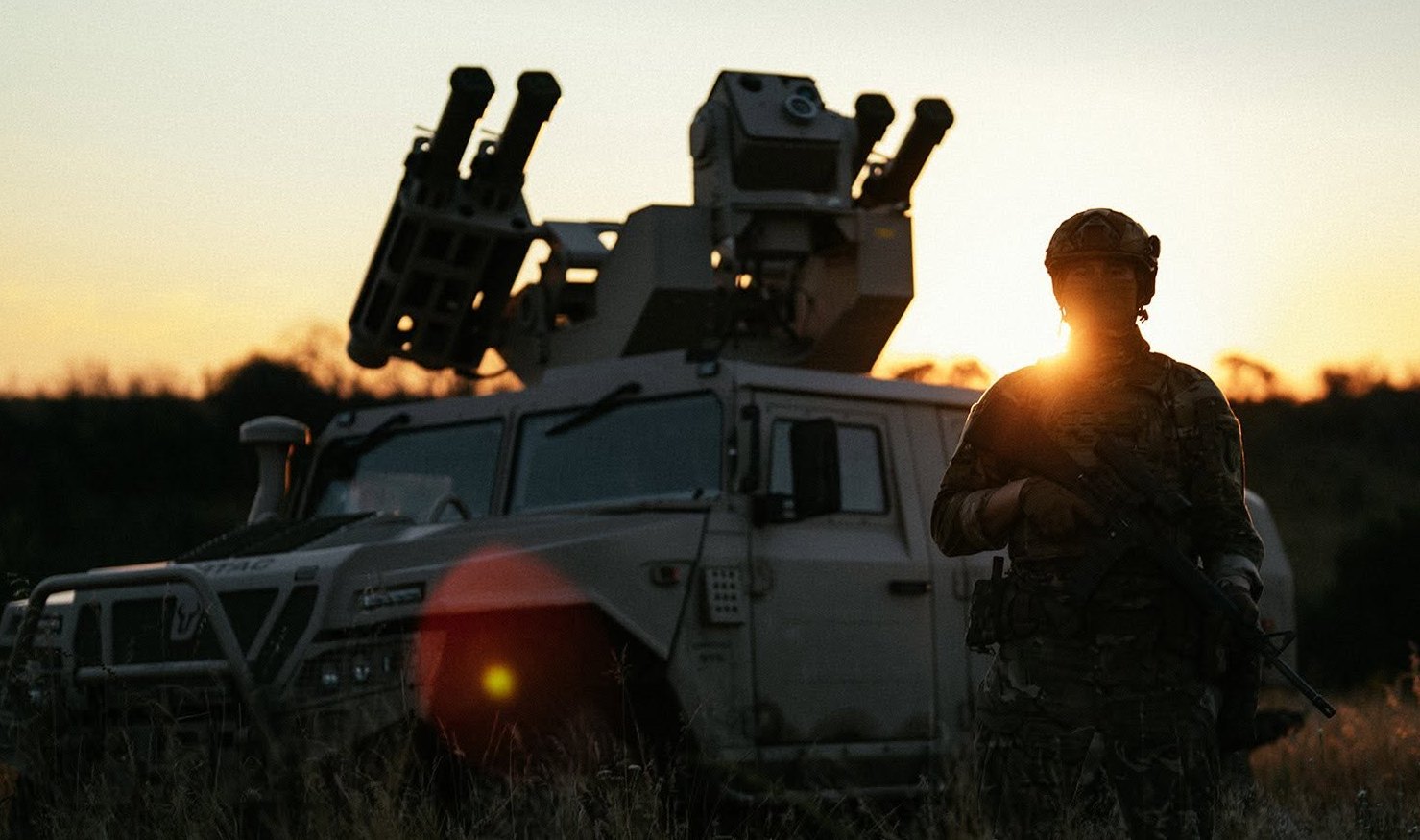
Ukraine is handing its factories the right to shoot back at the Russian drones hunting them. Nearly 100 companies have joined Ukraine’s experimental program that allows private enterprises to operate their own air defenses, granting them authority to conduct air defense operations and form their own crews, the Defense Ministry says.
Russian drones strike Ukrainian factories, warehouses and power sites so relentlessly that the state cannot shield every one, so the Defense Ministry is enl
Ukraine is handing its factories the right to shoot back at the Russian drones hunting them. Nearly 100 companies have joined Ukraine’s experimental program that allows private enterprises to operate their own air defenses, granting them authority to conduct air defense operations and form their own crews, the Defense Ministry says.
Russian drones strike Ukrainian factories, warehouses and power sites so relentlessly that the state cannot shield every one, so the Defense Ministry is enlisting the businesses being hit to defend themselves.
The program has grown quickly, from 24 companies in April to 81 by mid-September and nearly 100 now, and its crews have already destroyed a substantial number of Russian aerial targets.
The companies range from operators of critical infrastructure to state and private firms across the economy. The project is carried out under a Cabinet resolution dated 19 November 2025, which mobilizes enterprise resources to support Ukraine’s defense against air threats.
Civilian crews that answer to the Air Force, not themselves
These teams do not fire into a shared sky on their own. About 50 air-defense groups have been formed and are operating under the relevant Air Force commands, and crews from six enterprises are already carrying out combat missions, the ministry says. The rest are training or finishing preparation before they join.
As of 14 October, the groups have downed more than 60 aerial targets, mostly Russian drones, using interceptor drones and automated turrets with heavy machine guns, according to the ministry. The Air Force command sets each group’s targets based on its weapons and tasks, and, jointly with the company, defines its sector, personnel, and equipment.
Who pays, and who pulls the trigger
The arrangement splits cost and control. Some weapons the enterprises buy with their own money, holding end-user status, while a company can also ask the Air Force to lend arms and ammunition from military stocks.
Private air defense is one layer of a multi-tiered shield, meant to protect industrial capacity, critical infrastructure and civilian staff from systematic drone attacks. The crews began combat work in 2026.
Schools under scrutiny as Cornell is often follow a sort of public relations playbook, adding rules, hiring outside investigators and sometimes making leadership changes.
Schools under scrutiny as Cornell is often follow a sort of public relations playbook, adding rules, hiring outside investigators and sometimes making leadership changes.
Ukraine’s anti-corruption agencies just clawed back millions for the state budget. The National Anti-Corruption Bureau (NABU), the Specialized Anti-Corruption Prosecutor’s Office (SAPO) and the State Property Fund have returned about $5.1 million to the state budget, the bureau says.
NABU and SAPO were created in 2015 after the Euromaidan revolution as independent bodies to fight high-level corruption, and their independence is a core condition for Ukraine's path to the EU. This recover
Ukraine’s anti-corruption agencies just clawed back millions for the state budget. The National Anti-Corruption Bureau (NABU), the Specialized Anti-Corruption Prosecutor’s Office (SAPO) and the State Property Fund have returned about $5.1 million to the state budget, the bureau says.
NABU and SAPO were created in 2015 after the Euromaidan revolution as independent bodies to fight high-level corruption, and their independence is a core condition for Ukraine's path to the EU. This recovery is the kind of concrete payoff that EU-backed reform was meant to produce.
Investigating one case, detectives and prosecutors found that the leadership of a regional branch of the State Property Fund had failed to act. Because of that inaction, the state risked losing millions of dollars.
To head off the loss, NABU and SAPO alerted the fund’s central leadership and gave it access to part of the investigation materials.
How the agencies turned a case into cash
The fix came from sharing what the investigation had uncovered. After working through the data, the State Property Fund took the necessary steps and secured the full budget amount, the bureau says.
NABU and SAPO continue to cooperate with other state bodies to protect the country’s economic interests and prevent corruption crimes, the bureau adds. The agencies framed the case as proof that enforcement, beyond investigation alone, can return money the state would otherwise lose.
Why these agencies matter beyond one case
The recovery lands at a fraught moment for the two institutions. Their independence has been under sustained pressure, and in July 2026 parliament briefly stripped it before mass protests and EU warnings forced a reversal.
In 2025, Brussels tied as much as 50 billion euros in aid and the pace of accession talks to the agencies’ autonomy, treating NABU and SAPO as pillars of the rule-of-law reforms Ukraine promised on its way into the bloc.
The former Foreign Minister and current Industry Minister Mélanie Joly, speaking with Ottawa bureau chief Mercedes Stephenson at The Globe's defence summit, said the geopolitical instability the United States has created isn't going away any time soon, and both Democrats and Republicans agree on many of the current administration's isolationist policies.
The former Foreign Minister and current Industry Minister Mélanie Joly, speaking with Ottawa bureau chief Mercedes Stephenson at The Globe's defence summit, said the geopolitical instability the United States has created isn't going away any time soon, and both Democrats and Republicans agree on many of the current administration's isolationist policies.
Russian reinforcements are surging toward Dobropillia in eastern Ukraine's Donetsk Oblast
The Russians have a plan: take Dobropillia and close the southern jaw of a pincer around Kramatorsk and Sloviansk
Ukrainian forces aren't powerless to resist, but many of their own best troops are busy attacking elsewhere
The Russians are pouring troops into a key sector just southeast of the town of Dobropillia in eastern Ukraine's Donetsk Oblast, threatening to overwhelm Ukrainian defen
Russian reinforcements are surging toward Dobropillia in eastern Ukraine's Donetsk Oblast
The Russians have a plan: take Dobropillia and close the southern jaw of a pincer around Kramatorsk and Sloviansk
Ukrainian forces aren't powerless to resist, but many of their own best troops are busy attacking elsewhere
The Russians are pouring troops into a key sector just southeast of the town of Dobropillia in eastern Ukraine's Donetsk Oblast, threatening to overwhelm Ukrainian defenses and march one settlement closer to Kramatorsk and Sloviansk, the last two big free cities in Donetsk.
But the Russians' push toward Dobropillia isn't without cost. Russian losses in this sector are "colossal," according to the mapper Playfra. And every soldier the Kremlin deploys along the Dobropillia axis is a soldier it can't deploy elsewhere.
And that may help explain why the Russians are falling back in two other key sectors, in northern Donetsk Oblast and in neighboring Dnipropetrovsk Oblast. The Dobropillia axis is the Russians' clear priority. For the Ukrainians, that's an opportunity to attack elsewhere.
Dobropillia ORBAT - Summer 2026
Similar to last year, Russia has significantly reinforced the Dobropillia direction, seeking to capture the town itself while simultaneously developing the southeastern approach toward Druzhkivka and Kramatorsk.
Dobropillia, a former mining town with a pre-war population of around 28,000, is now a fortress. It anchors Ukrainian positions along the highway that threads northeast to Kramatorsk.
Russia has attacked here before. In August 2025, Russian troops pushed a salient toward the Dobropillia–Kramatorsk highway, and Ukrainian counterattacks cut it apart. By October that year, President Volodymyr Zelensky put Russian losses on the Dobropillia front at about 13,000.
Ukrainian military analyst Kostiantyn Mashovets describes the push on Dobropillia as the southern flank of a Russian operation to envelop the whole Sloviansk–Kramatorsk urban area. The other approaches are harder going. From the southeast, the Russians are blocked by stubborn Ukrainian forces still clinging to positions in the ruins of Kostiantynivka. From the north, starting this spring, the Ukrainian 3rd Army Corps rolled back 18 months of Russian gains.
For an army that's been struggling to complete its conquest of Donetsk, to say nothing of breaking through in other front-line oblasts, Dobropillia has become the priority.
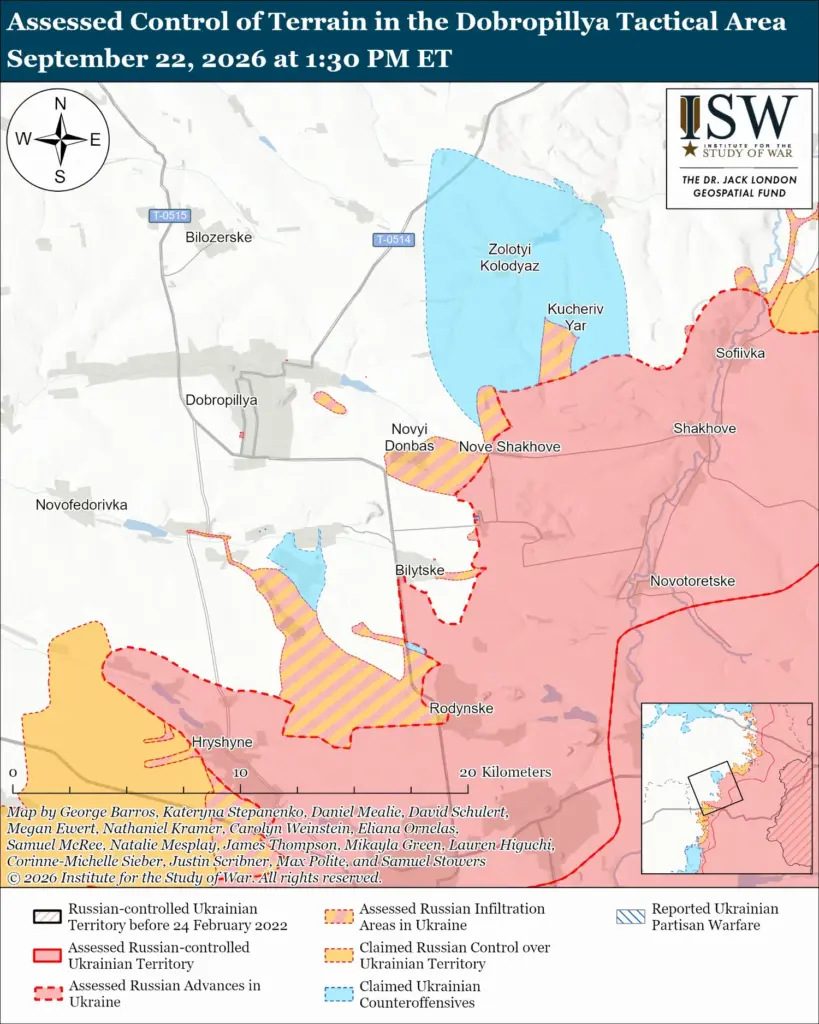
And that's why the Russians are channeling fresh forces into the Dobropillia sector. Part of the 41st Combined Arms Army and units of its 90th Guards Tank Division are now fighting there, Mashovets wrote on 9 October, and the Russian command keeps feeding fresh assault infantry into the sector through the village of Nove Shakhove despite heavy losses. The open-source account Unit Observer tracked the buildup as early as September.
Potentially tens of thousands of troops from those formations join the main forces of the 2nd and 51st Combined Arms Armies, according to Mashovets, as well as elements of the Russian naval infantry, facing the Ukrainian 1st Azov Corps and 19th Army Corps around Dobropillia.
The reinforcements give Russian commanders more options. Mashovets expects the 51st CAA to push south and southwest of Dobropillia and the 2nd CAA toward Raksha and Sviatohorivka, enveloping the town and cutting its supply routes from Bilozerske before any direct assault. The neighboring 8th CAA is fighting around Kostiantynivka. The Russians' immediate goal is "to maintain this offensive pressure from summer into the fall," Unit Observer wrote, setting conditions for a possible siege of Kramatorsk next year.
The outlook for the Ukrainian defenders of Dobropillia is "worsening," Playfra warned on 13 October:
The Russians have a seemingly infinite manpower pool here and a clear numerical advantage, which allows them to significantly increase the flow of infiltrators and, as such, the chance of some passing through Ukrainian defenses.
This leads to especially deep Russian infiltrations, which in turn slowly but surely destabilize the situation for the Ukrainians, which are progressively forced to abandon their most advanced positions.
The Ukrainians aren't without options, Playfra explained. They should double down on their current strategy of saturating the fields around Dobropillia with drones in a ring at least 2 to 3 km deep, forestalling large-scale Russian movements until the winter strips the leaves off the trees, depriving the Russians of their best cover from overhead surveillance. This could buy Dobropillia "much more time," Playfra predicted.
Mashovets puts a date on how long Dobropillia has to hold. If it and Druzhkivka, the town just south of Kramatorsk, hold until mid-to-late December, he wrote, the whole Russian plan for Sloviansk and Kramatorsk would collapse and have to be rewritten almost from scratch.
ISW’s map of the Dobropillia area on 22 September 2026 shows Russian-controlled and infiltration areas near the city. Source: Institute for the Study of War.
Help isn't coming
Just don't expect a lot of Ukrainian reinforcements along the Dobropillia axis. Many of Ukraine's best troops are busy attacking.
Taking advantage of the surge of Russian manpower in the direction of Dobropillia, Ukrainian forces have counterattacked where the Russians are weakest: in northern Donetsk Oblast and also in Dnipropetrovsk Oblast, just south of Donetsk.
Map: Euromaidan Press
In months of carefully planned assaults supported by ground robots and intensive drone strikes, Ukrainian forces have liberated hundreds of square kilometers in northern Donetsk and Dnipropetrovsk. The Ukrainian 3rd Army Corps' Operation Vivaldi in northern Donetsk largely removed the immediate northern threat to Sloviansk and neighboring Kramatorsk.
But it didn't do anything to help in the direction of Dobropillia, where the Russians have many more troops, much more firepower, and—equally importantly—a singular focus: closing the southern jaw around the last big free cities in Donetsk.
Explore further
Ukraine’s 3rd Army Corps took the lessons of the failed 2023 counteroffensive into Operation Vivaldi. It fought small, and won.
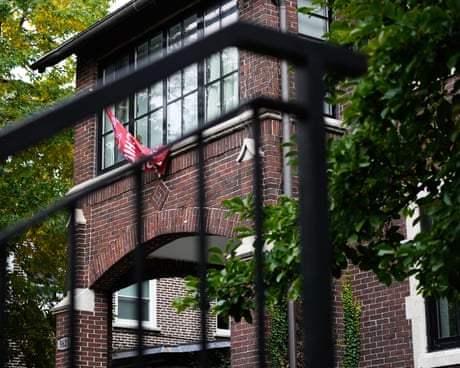
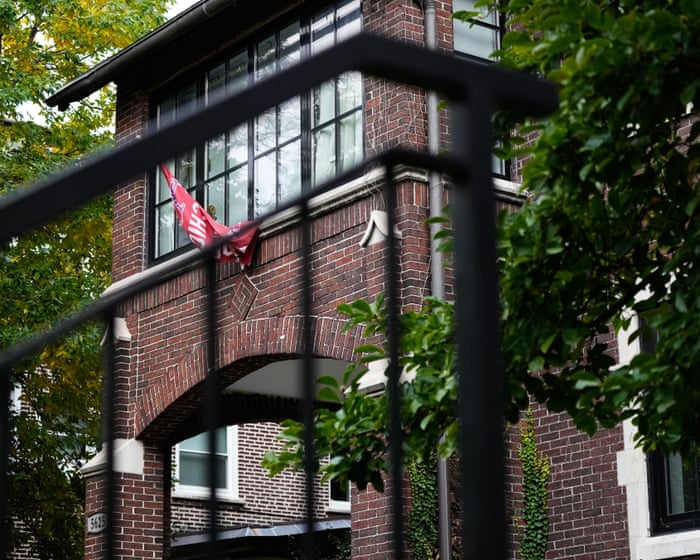
Alleged assault follows report of gang-rape at frat house at Cornell, which ignited national uproar and criticism onlineA 21-year-old woman reported being sexually assaulted last weekend at a fraternity house near the University of Chicago, as Greek life nationwide faces renewed scrutiny for recurrent misconduct.The incident allegedly took place on Sunday at about 1.50am at the off-campus Alpha Epsilon Pi residence, according to a university daily crime log. Continue reading...
Alleged assault follows report of gang-rape at frat house at Cornell, which ignited national uproar and criticism online
A 21-year-old woman reported being sexually assaulted last weekend at a fraternity house near the University of Chicago, as Greek life nationwide faces renewed scrutiny for recurrent misconduct.
The incident allegedly took place on Sunday at about 1.50am at the off-campus Alpha Epsilon Pi residence, according to a university daily crime log.
Industry Minister Mélanie Joly is rejecting an accusation by U.S. Ambassador Pete Hoekstra that Canada might be interfering in the upcoming U.S. midterm elections.
Industry Minister Mélanie Joly is rejecting an accusation by U.S. Ambassador Pete Hoekstra that Canada might be interfering in the upcoming U.S. midterm elections.
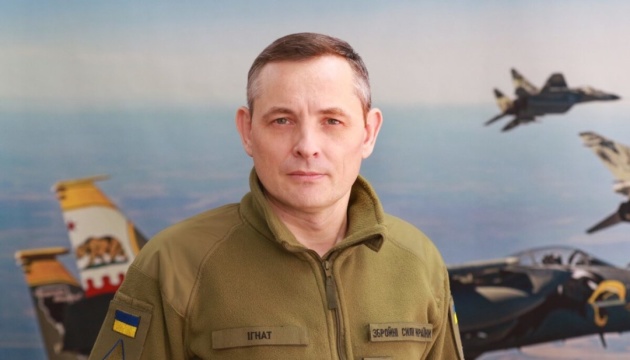
Ukrainian Air Force spokesperson Yurii Ihnat said that debris from Russian missiles indicates that some components were manufactured in Europe and the United States just two to three weeks before the strikes.
Ukrainian Air Force spokesperson Yurii Ihnat said that debris from Russian missiles indicates that some components were manufactured in Europe and the United States just two to three weeks before the strikes.
Exclusives
America has sided with Russia against Ukraine. Europe should stop pretending and build a coalition against Russia, China, and even the US. In three days, Washington sanctioned the court that issued Putin’s arrest warrant, lifted its own sanctions on Russian diesel, called for Zelenskyy to step down, and declared an “energy ceasefire” that asks only Ukraine to stop firing. These are not the acts of an ally.
Ukraine’s 3rd Army Corps took the lessons of the failed 2023
Joining a global movement, President Claudia Sheinbaum signed a decree requiring the removal of a range of material for people under 18 and held out the prospect of tougher measures.
Joining a global movement, President Claudia Sheinbaum signed a decree requiring the removal of a range of material for people under 18 and held out the prospect of tougher measures.
Les unités antiémeute albanaises ont fait usage de canons à eau et de gaz lacrymogène, mercredi à Tirana, contre les manifestants rassemblés pour réclamer la démission d'Edi Rama et une aide plus importante pour les étudiants. Plusieurs incendies ont été déclenchés, des protestataires ont pris pour cible les bureaux du chef du gouvernement et deux ministères.
Les unités antiémeute albanaises ont fait usage de canons à eau et de gaz lacrymogène, mercredi à Tirana, contre les manifestants rassemblés pour réclamer la démission d'Edi Rama et une aide plus importante pour les étudiants. Plusieurs incendies ont été déclenchés, des protestataires ont pris pour cible les bureaux du chef du gouvernement et deux ministères.
 Connexion

























ORBAT - Summer 2026