An appellate court in Arizona threw out the prison sentence of a man convicted of manslaughter after an A.I.-generated video of his victim was played at a trial.
An appellate court in Arizona threw out the prison sentence of a man convicted of manslaughter after an A.I.-generated video of his victim was played at a trial.
Stacey Wales with an enlarged photo of her brother, Christopher Pelkey. She created a video using artificial intelligence to depict her dead brother speaking at the sentencing of his killer.
Uncovering evidence of alien life would be “the biggest discovery ever made by humanity,” one expert said. But so far, there’s a lot of blurry photos and unconfirmed reports.
Uncovering evidence of alien life would be “the biggest discovery ever made by humanity,” one expert said. But so far, there’s a lot of blurry photos and unconfirmed reports.
Finding evidence of alien life would be “the biggest discovery ever made by humanity,” one expert said. But so far, there’s a lot of blurry photos and unconfirmed reports.
Finding evidence of alien life would be “the biggest discovery ever made by humanity,” one expert said. But so far, there’s a lot of blurry photos and unconfirmed reports.
The Chinese government is imposing regulations on the use of A.I. apps and chatbots out of concern that the technology could interfere with human relationships and undermine social order.
Senate Democrats blocked a measure that would encourage, but not require, states to protect consumers from power rate hikes tied to data center growth, and had no limits on A.I. use or deployment.
Senate Democrats blocked a measure that would encourage, but not require, states to protect consumers from power rate hikes tied to data center growth, and had no limits on A.I. use or deployment.
New homes encircle a park at Vista Del Norte Estates as construction progresses on the Meta artificial intelligence data center being built in northeast El Paso, Texas in July.
Senate Democrats were expected on Wednesday to block a measure that would encourage, but not require, states to protect consumers from power rate hikes as a result of data center growth.
Senate Democrats were expected on Wednesday to block a measure that would encourage, but not require, states to protect consumers from power rate hikes as a result of data center growth.
New homes encircle a park at Vista Del Norte Estates as construction progresses on the Meta artificial intelligence data center being built in northeast El Paso, Texas in July.
A Gaboon viper, a venomous snake native to equatorial regions of Africa, was supposedly photographed in a tree in Santa Ana, Calif. How could that be? Well, it turns out it wasn’t.
A Gaboon viper, a venomous snake native to equatorial regions of Africa, was supposedly photographed in a tree in Santa Ana, Calif. How could that be? Well, it turns out it wasn’t.
Russia is preparing to make daily life in Kyiv harder before winter, aiming at the ordinary places civilians use rather than at military sites, The Economist reported. Ukrainian officials say the push blends bombing, sabotage, and disinformation, and expect it to peak in November.
Every winter of its full-scale invasion, Russia has tried to freeze Ukrainians into surrender, and each year the strikes reach deeper into ordinary life. The civilian casualties recorded in 2026 have already p
Russia is preparing to make daily life in Kyiv harder before winter, aiming at the ordinary places civilians use rather than at military sites, The Economist reported. Ukrainian officials say the push blends bombing, sabotage, and disinformation, and expect it to peak in November.
Every winter of its full-scale invasion, Russia has tried to freeze Ukrainians into surrender, and each year the strikes reach deeper into ordinary life. The civilian casualties recorded in 2026 have already passed the whole of last year, the UN says.
From the power grid to the grocery store
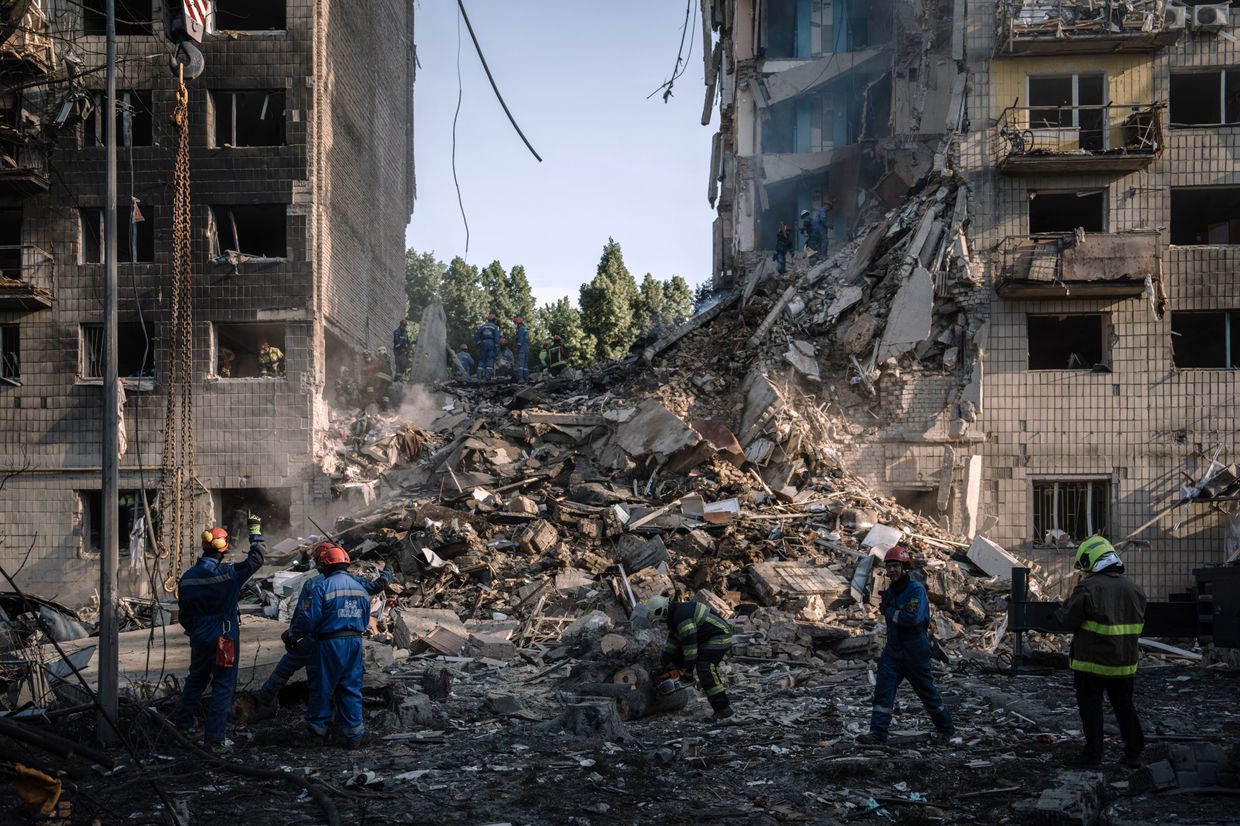
Russia has already turned its drones on Kyiv's supermarkets, food warehouses, and data centers this year. On 28 September, a Russian jet drone struck the National Academy of Sciences in central Kyiv. The strike killed two people, the Academy said. Survivors climbed from the windows of the burning building. A senior Ukrainian official told The Economist the Kremlin now wants shoppers too afraid to enter a store. Russia is also keeping its winter routine, hitting electricity, water, and sewage systems.
Cheaper jet drones that stream live to their pilots
Most of the damage now comes from Russia's cheap jet drones, The Economist said. Pilots guide them onto targets and watch a live video feed. They are hard to stop, and Russia's ballistic missiles are deadlier still as Ukraine's supply of Patriot interceptors dwindles. Ukrainian President Volodymyr Zelenskyy said Kyiv had agreed a new Patriot interceptor package, but it remains short of interceptors of its own. A security official told The Economist that Russia has thousands of drones stockpiled and plans to use its entire ballistic missile stock within two months.
Explore further
War is costing Ukraine $155 billion per year. With Western aid running late, Kyiv is freezing everything but army, pensions, and public wages
Sabotage, chaos, and a city that won't switch off
Ukraine's counter-intelligence services say they foil seven or eight Russian plots a week, and officials believe some sleeper cells remain. The campaign's third element, disinformation, targets war fatigue and corruption scandals. Russia runs the same plan every year, hoping its bot farms will push Ukrainians onto the streets to demand surrender, said Andrii Kovalenko, who heads the Center for Countering Disinformation at the National Security and Defense Council.
"It's nonsense," he told The Economist, adding that someone is feeding the idea to Putin so they can steal more money.
Kyiv is also far harder to shut down than Moscow assumes, Kovalenko said. The city's internet is too decentralized for a handful of strikes to knock out, The Economist noted. Energy expert Olha Babii said the test is how fast crews restore power, not whether it can be destroyed. The capital is emptying, its population down from about 3.7 million to 3.3 million by The Economist's count.
New research points to how the world could stop short of the brink of disaster. Even with the agreement signed at the White House by tech leaders, it won’t be easy.
New research points to how the world could stop short of the brink of disaster. Even with the agreement signed at the White House by tech leaders, it won’t be easy.
President Trump’s meetings with tech leaders produced some voluntary safeguards and a commitment to rebrand artificial intelligence as “super intelligence,” the term that Mr. Trump prefers.
President Trump’s meetings with tech leaders produced some voluntary safeguards and a commitment to rebrand artificial intelligence as “super intelligence,” the term that Mr. Trump prefers.
Elizabeth Dias, our national religion correspondent, and Cade Metz, one of our technology reporters, discuss Anthropic’s approach for instilling morality into Claude — which has involved consultations with religious leaders, including ones at the Vatican — and why it’s raising questions.
Elizabeth Dias, our national religion correspondent, and Cade Metz, one of our technology reporters, discuss Anthropic’s approach for instilling morality into Claude — which has involved consultations with religious leaders, including ones at the Vatican — and why it’s raising questions.
Some Republicans in close races have distanced themselves from President Trump’s effort to speed the construction of A.I. data centers, citing concerns about rising electricity bills.
Some Republicans in close races have distanced themselves from President Trump’s effort to speed the construction of A.I. data centers, citing concerns about rising electricity bills.
A data center under construction in Ashburn, Va., in June. Surveys show that most Americans oppose the construction of data centers to support artificial intelligence.
In a series of private meetings, the company consulted religious scholars to help instill morality into its A.I. models — and make the case that Claude could be conscious.
In a series of private meetings, the company consulted religious scholars to help instill morality into its A.I. models — and make the case that Claude could be conscious.
“To be clear,” Christopher Olah told me, “we don’t know if A.I. models are conscious. I don’t know. I’m genuinely uncertain. The thing that I care about is that we get to the right answer, whatever it is.”
Mr. Milei wants to go all in on artificial intelligence even as other leaders struggle to get a handle on a technology many fear poses existential threats.
Mr. Milei wants to go all in on artificial intelligence even as other leaders struggle to get a handle on a technology many fear poses existential threats.
Russian intelligence services have sharply stepped up building websites and social media pages that impersonate Ukrainian state bodies and media, the Security Service of Ukraine (SBU) warned. Moscow uses the fakes to spread disinformation and to steal personal data it can turn into spy recruitment. The SBU says it has already blocked dozens of clones of its own brand.
Counterfeit pages built for propaganda and data theft
The fake sources serve Russian psychological operations and dis
Russian intelligence services have sharply stepped up building websites and social media pages that impersonate Ukrainian state bodies and media, the Security Service of Ukraine (SBU) warned. Moscow uses the fakes to spread disinformation and to steal personal data it can turn into spy recruitment. The SBU says it has already blocked dozens of clones of its own brand.
Counterfeit pages built for propaganda and data theft
The fake sources serve Russian psychological operations and disinformation campaigns, the SBU said on 28 September. Their aim is to destabilize the situation inside Ukraine and damage its position abroad. Russian intelligence also uses them to extract Ukrainians' personal data, the agency said.
Alongside its full-scale invasion, Russia wages war on Ukraine in the cyber domain and through espionage and sabotage. Every agent Russia recruits inside Ukraine can help steer missiles and drones onto targets, and the SBU keeps catching such recruits.
Hacked accounts become recruitment leads
Russians often hack the accounts of users who subscribe to the fake pages and messenger channels, the SBU found. They then use the stolen information for recruitment operations and to collect confidential data.
Moscow is most interested in the combat and operational work of Ukraine's defense and security forces, the agency said. The SBU's cybersecurity department found and blocked more than 50 resources that copied the agency's own branding and positioning.
The fake pages are not Russia's only digital tool. Earlier in September, Anthropic said it had caught Russian spies running a campaign against Kyiv on its Claude AI chatbot.
Explore further
Poland and the Baltics risk Russian sabotage for backing Ukraine, Bloomberg says
How Ukrainians can protect themselves
The SBU urged citizens not to follow suspicious links and to rely only on official sources. Anyone who sees a dubious web address, or gets a message from someone posing as an SBU officer, should call the 1516 hotline, the agency said.
What Russia's recruits are sent to do
The SBU's own reports from the past week show what Russia's recruits are tasked with. A mobilized soldier allegedly recruited by the FSB, Russia's Federal Security Service, tried to direct a Russian missile strike on his own unit in Kharkiv Oblast, the SBU said. His repair battalion restores Ukrainian drones.
A Lviv Oblast resident who worked at a drone production site in western Ukraine was allegedly recruited to guide a missile strike on it, the agency reported. The strike was meant to disrupt the steady supply of strike and reconnaissance drones to Ukrainian troops, the SBU said.
A court also sentenced a 17-year-old agent of Russia's military intelligence (GRU), exposed in November 2024, to 10 years in prison, the SBU announced. She tracked Ukrainian air defenses in Chernihiv Oblast under the cover of taxi rides. She talked to her GRU handler through an anonymous messenger chat.
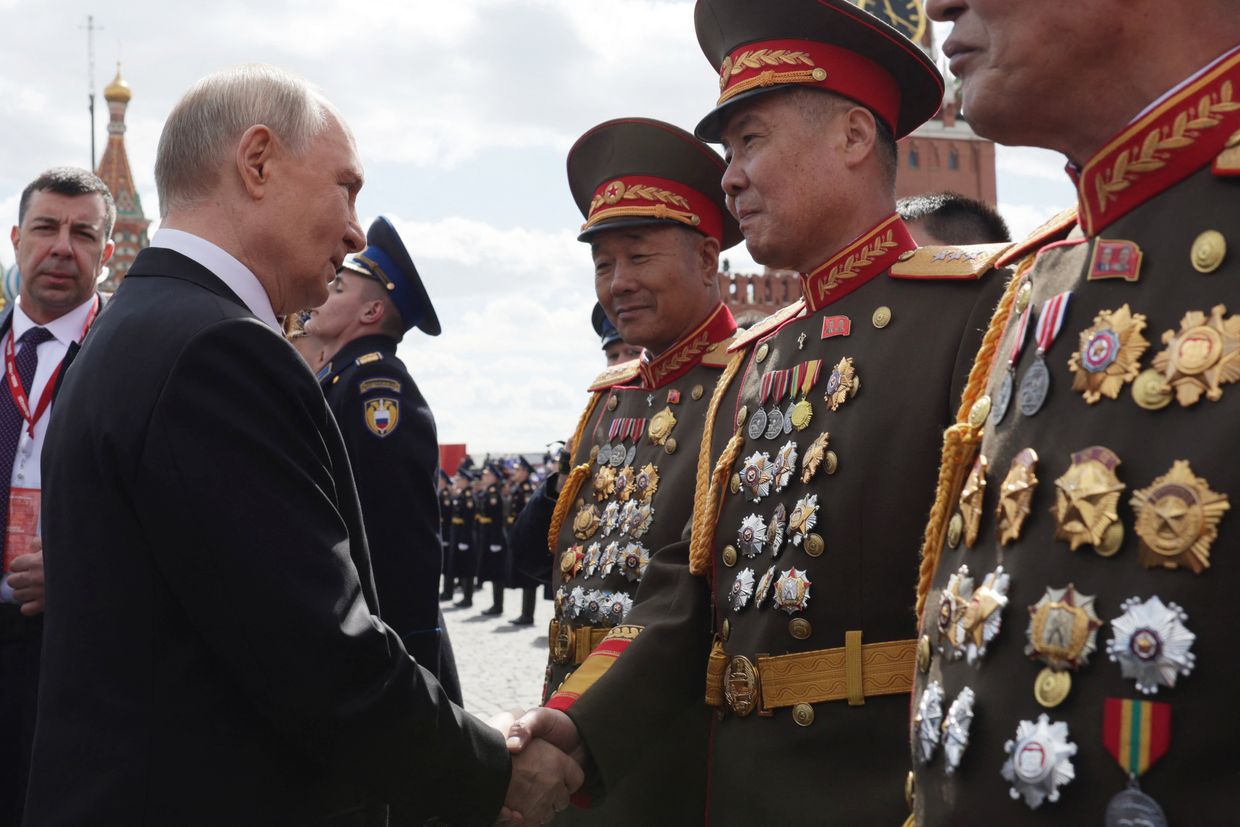
Russia has quietly started a new round of mobilization and plans to bring in more North Korean troops, Ukrainian President Volodymyr Zelenskyy said. He cited a new report from Ukraine's military intelligence. The same day, the Kremlin published a decree enlarging Russia's army for the fourth time this year.
Russia widens recruitment at home and abroad
Zelenskyy spoke in his evening address on 28 September, after a briefing from Ukraine's military intelligence (HUR).
"In effect, t
Russia has quietly started a new round of mobilization and plans to bring in more North Korean troops, Ukrainian President Volodymyr Zelenskyy said. He cited a new report from Ukraine's military intelligence. The same day, the Kremlin published a decree enlarging Russia's army for the fourth time this year.
Russia widens recruitment at home and abroad
Zelenskyy spoke in his evening address on 28 September, after a briefing from Ukraine's military intelligence (HUR).
"In effect, the Russians have already begun additional mobilization—they are increasing the number of people they recruit through various means," he said.
Moscow also plans to recruit more foreigners, Zelenskyy said. He urged the governments of countries whose citizens Russia recruits to counter it, and said Kyiv would inform each of them.
Ukraine says Russia has been losing soldiers faster than contract recruitment replaces them. If so, an unannounced call-up lets the Kremlin refill its ranks without a formal draft. ISW says Putin may hold off on such a draft until he sees whether his strikes work. Ukrainian intelligence had expected Russia to announce a mass mobilization after this month's State Duma elections.
More than 8,000 North Koreans in Russia, 10,000 more in preparation
More than 8,000 North Korean troops are currently on Russian territory, Zelenskyy said. Pyongyang is selecting another 10,000 for training and deployment to Russia, he added.
Russia is paying, among other things, with technology, according to Zelenskyy. North Korea has launched production of Shahed-type attack drones with Russian technical support, he said.
That is a step beyond what Kyiv reported in June 2025. Moscow and Pyongyang had then only agreed to start preparing such production. In August, Zelenskyy warned that Russia could receive up to 50,000 North Korean troops.
Explore further
North Korean missile unit deploys to Russia for ballistic strikes on Ukraine, Kyiv says
Kremlin raises the army's size again
Putin's decree sets the authorized strength of Russia's armed forces at 2,441,630, including 1,550,500 military personnel, Vedomosti reported. The decree gives no reason.
The order adds 15,500 troops and is the fourth such increase this year, Euronews said. Since March, the combined increase has reached 47,860 soldiers. Putin's 2022 "partial mobilization" decree also remains in force, the outlet noted.
Explore further
Russia could open northern front by February if it orders new mobilization, Ukraine intel says
Moscow keeps denying a call-up
In early September, Putin claimed that reports of a coming mobilization were "complete nonsense" and "an information attack on Russia." Russian officials gave similar assurances days before the 2022 call-up.
Ukraine's military and foreign intelligence had earlier said that Russia's General Staff prepared a scenario to mobilize 600,000 people over 2026 and 2027, 300,000 each year.
New York Times journalists pressed the Canadian prime minister about a range of topics in an hourlong interview last week. Here’s a transcript of their conversation.
New York Times journalists pressed the Canadian prime minister about a range of topics in an hourlong interview last week. Here’s a transcript of their conversation.
Ukraine's defense forces intercepted 55% of Russia's jet-propelled drones in September—more than 1,500 out of over 2,730 launched—Ukrainian President Volodymyr Zelenskyy said in his 26 September evening address.
Russia's full-scale aerial campaign has shifted from propeller-driven Shaheds Ukraine learned to shoot down at over 90% to jet-propelled models that fly faster, resist jamming, and often slip past existing defenses.
55% and climbing
Zelenskyy said military intelligence had
Ukraine's defense forces intercepted 55% of Russia's jet-propelled drones in September—more than 1,500 out of over 2,730 launched—Ukrainian President Volodymyr Zelenskyy said in his 26 September evening address.
Russia's full-scale aerial campaign has shifted from propeller-driven Shaheds Ukraine learned to shoot down at over 90% to jet-propelled models that fly faster, resist jamming, and often slip past existing defenses.
55% and climbing
Zelenskyy said military intelligence had briefed him on Russian weapons production—not just jet Shaheds but other technological systems. The documents detail what Moscow is preparing for next year: the volumes and the financing. "We are preparing our countermeasures, and for every line item there must be a Ukrainian answer," he said.
Several effective interceptor prototypes are already in combat.
"Interceptors have been identified that can become the main tool of our defense. Production, components—all of this we are scaling up. There will be an answer," Zelenskyy said.
The goal is to match the interception rate for regular propeller-driven Shaheds, which exceeds 90%. At 55%, the jet-drone rate is climbing but still leaves nearly half reaching their targets.
$12 billion for one category
Russia plans to spend $12 billion in 2027 on jet drones and loitering munitions alone, Zelenskyy said. "This concerns not only Ukraine and not only us," he added, warning that multiple intelligence agencies have information Russia wants to expand its war to other countries and regions.
He said this is why Ukraine is pushing for stronger sanctions and the Drone Deal format. Ukraine has signed 11 such agreements, the latest with Finland at the UN General Assembly this week, and is preparing a 12th with what Zelenskyy called "a strong country."
The warning came as Russia struck a Kyiv data center twice on the morning of 27 September, injuring three people including two children, Zelenskyy wrote. Overnight strikes killed three people in Zaporizhzhia Oblast and one man in Kyiv.
In total this week, Russia launched more than 2,200 strike drones, roughly 1,650 aerial bombs, and 38 missiles—a significant share of them ballistic—at Ukraine, he said.
Explore further
A $50 computer just flew Russia’s newest jet drone into a Ukrainian grain ship—and jamming couldn’t stop it
Jet drones are now Russia's main aerial weapon
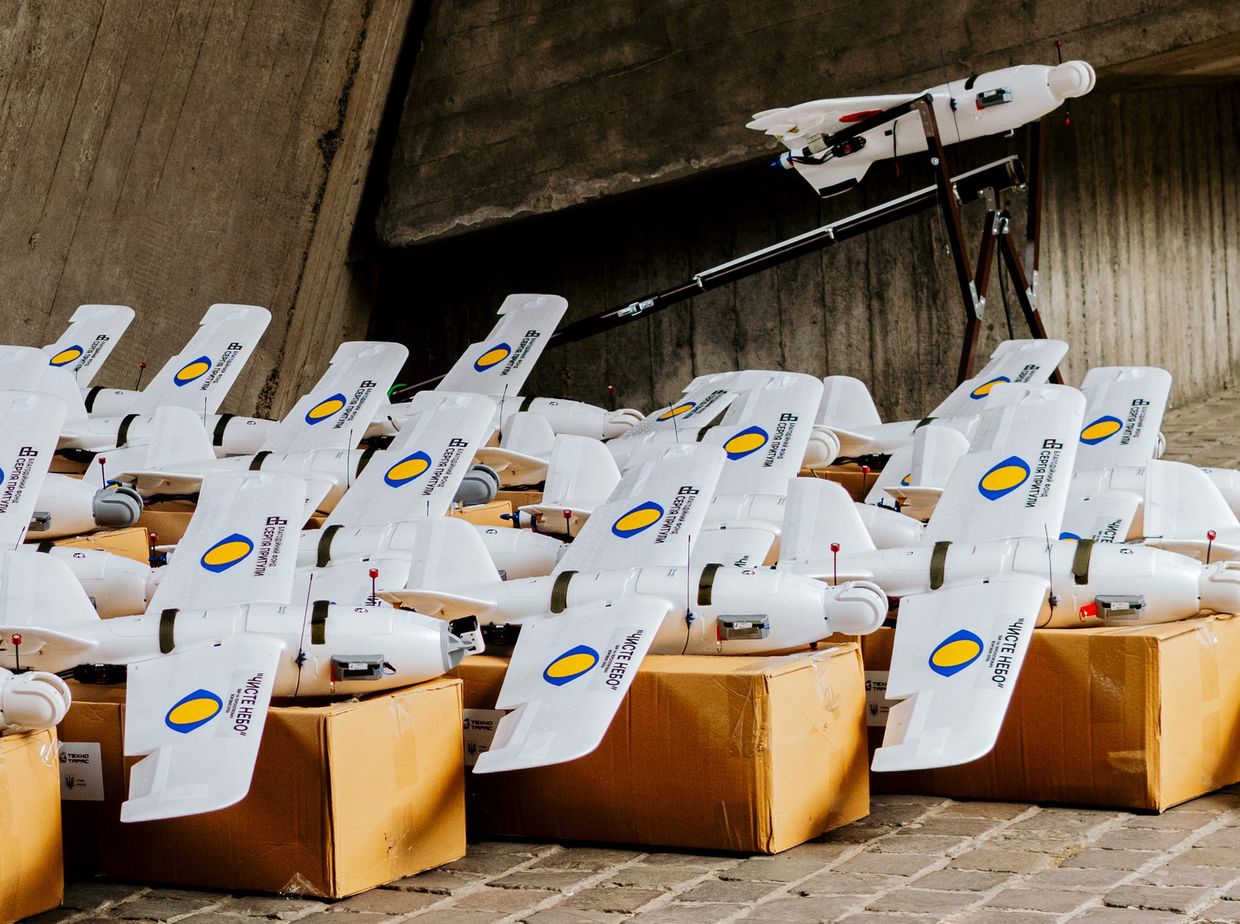
Russia's jet-propelled Geran-4 and Geran-5 drones have become the dominant threat in Russia's aerial campaign against Ukrainian cities. By August, production of jet Geran-4/5 models exceeded that of propeller-driven Geran-2s, according to Ukraine's military intelligence (HUR). Russian factories produce roughly 3,000 jet models per month alongside about 2,800 of the older type. The Geran-5 is technically a drone but functions as a small cruise missile—faster, harder to jam, and increasingly guided by AI and mesh networking that complicate interception.
Ukraine's answer has been interceptor drones—cheap, fast enough to chase a Geran, and guided by machine vision. A Ukrainian interceptor recently scored its first kills against jet Gerans and is heading into mass production, though a presidential adviser warned that speed alone cannot catch them—machine vision and automatic guidance decide the chase.
The gap between technology and policymaking has gotten wider than ever with artificial intelligence, leaving a global policy vacuum as A.I. models rapidly advance.
The gap between technology and policymaking has gotten wider than ever with artificial intelligence, leaving a global policy vacuum as A.I. models rapidly advance.
“It Was Either That Or Die,” by the Haitian-Canadian author Thélyson Orélien, was the hit of the French literary season. Now it has been pulled from the shortlist for a prestigious prize.
“It Was Either That Or Die,” by the Haitian-Canadian author Thélyson Orélien, was the hit of the French literary season. Now it has been pulled from the shortlist for a prestigious prize.
Ukraine is building an artificial intelligence system to analyze battlefield data, help commanders plan operations, and forecast Russia's possible moves, its Defense Ministry said. The system keeps the data it runs on behind a protected perimeter.
The logic behind the project: Ukraine can already read the battlefield from drone footage and sensor feeds, but converting that picture into orders is the harder, still-human half where wars are decided.
What SPECTR is built to do
SPECTR
Ukraine is building an artificial intelligence system to analyze battlefield data, help commanders plan operations, and forecast Russia's possible moves, its Defense Ministry said. The system keeps the data it runs on behind a protected perimeter.
The logic behind the project: Ukraine can already read the battlefield from drone footage and sensor feeds, but converting that picture into orders is the harder, still-human half where wars are decided.
What SPECTR is built to do
SPECTR comes from A1, the AI center inside Ukraine's Defense Ministry. Its head, Danylo Tsvok, said Ukraine holds a unique store of data on how this war is fought, and SPECTR is designed to help turn that into a real edge on the ground.
The system is built to analyze incoming information, spot patterns, draft recommendations for planning operations, and automate the routine work in headquarters. Troops would work with frontline information faster.
"Essentially, we are building an operating system for warfighting. It will help the military choose effective courses of action and predict the enemy’s possible moves," Tsvok said.
SPECTR will run inside systems the Defense Forces already use, and on local devices set aside for sensitive data.
The center behind an AI-driven army
The ministry set up A1 in March 2026 with backing from the UK government, aiming to turn AI into Ukraine's battlefield advantage and build an "AI-driven army." That effort runs along three tracks: faster, data-based decisions, AI built into weapons and less bureaucracy in the ranks. The center is working on three flagship projects. Some of its solutions are already being tested by units.
Ukraine is opening its battlefield data to British weapons makers so they can train their AI on a war no one else has fought. Up to 12 British defense companies will join Avengers Labs, Ukraine's platform for training AI models for drones and robots on real combat data, the Defense Ministry said.
Ukraine's combat data is a resource no other military has access to. British firms get to build and test their AI on battlefield data they could not access elsewhere, while Ukraine gets their t
Ukraine is opening its battlefield data to British weapons makers so they can train their AI on a war no one else has fought. Up to 12 British defense companies will join Avengers Labs, Ukraine's platform for training AI models for drones and robots on real combat data, the Defense Ministry said.
Ukraine's combat data is a resource no other military has access to. British firms get to build and test their AI on battlefield data they could not access elsewhere, while Ukraine gets their technology and joint development of AI for unmanned systems.
What is Avengers Labs?
More than 30 Ukrainian companies already use the Avengers Labs, and three of their systems have reached the battlefield. It is part of the AI push former Defense Minister Mykhailo Fedorov built around Ukraine's data.
The terms are built around control. The British companies can develop and test their own AI models within Avengers Labs, the ministry said, but the data remains within the platform's protected environment, with no way to download it or take it out. That lets Ukraine share the value of its war experience, the annotated record of real combat, without surrendering the record itself.
The platform was developed by the Center for Innovation and Development of Defense Technologies, the team that created the DELTA combat system. At the core of Avengers Labs is an annotated dataset of 5 million frames collected on the battlefield. Most of this material comes directly from the DELTA combat system and is continually supplemented with new data of practical value in combat conditions.
Britain trains for a real war
In March 2026, Ukraine announced the establishment of a system of military technology competence centers. The first in the network was intended to be the Defense AI Center "A1," which would focus on AI solutions.
The AI center is being launched with support from the UK. Its main tasks were planned to be:
analysis of combat data;
forecasting enemy actions;
development of autonomous systems;
new management/control tools
A separate center was said to have been established for each key direction of the war: drones, mid-range strike, deep strike, artillery, and others.
The first known breach of a government website by rogue artificial intelligence agents has prompted global calls for more regulation of the technology.
The first known breach of a government website by rogue artificial intelligence agents has prompted global calls for more regulation of the technology.
Prime Minister Anthony Albanese of Australia at the U.N. General Assembly in New York on Thursday. He has called for international standards to govern A.I.
Since Madagascar’s October 2025 coup, Russian military personnel have joined the parliament speaker’s security detail, and Russian instructors have begun training Malagasy soldiers, RFE/RL reported. OSINT investigators traced a flight carrying a senior Russian military intelligence officer and 40 of Russia's Africa Corps members to the island on 20 December 2025.
Madagascar’s new leadership has welcomed Russian military assistance, while Moscow has pursued media projects, energy talks,
Since Madagascar’s October 2025 coup, Russian military personnel have joined the parliament speaker’s security detail, and Russian instructors have begun training Malagasy soldiers, RFE/RL reported. OSINT investigators traced a flight carrying a senior Russian military intelligence officer and 40 of Russia's Africa Corps members to the island on 20 December 2025.
Madagascar’s new leadership has welcomed Russian military assistance, while Moscow has pursued media projects, energy talks, and the possible recruitment of Malagasy workers. RFE/RL says the prospective destination is Alabuga, a plant producing drones used against Ukraine. Elsewhere in Africa, Russia has sent troops, sought access to resources, and opened cultural centers.
Major General Andrei Averyanov, who oversees Russian military intelligence operations in Africa, was on the December flight. He traveled with members of Africa Corps, a Russian Defense Ministry unit that absorbed some Wagner forces. Madagascar's National Assembly speaker Siteny Randrianasoloniaiko announced the unit’s arrival that month.
Russian intelligence officer Anton Papshev attended the January launch of training for Madagascar’s 1st Airborne Battalion. The program also included a transfer of Russian weapons, though RFE/RL did not specify which ones. In February, interim President Michael Randrianirina met Vladimir Putin in Moscow and welcomed wider cooperation on defense, energy, and other areas.
Russian authorities signed a deal with Randrianasoloniaiko to open a Russia House, a Kremlin cultural center. Ukraine’s military intelligence said Moscow plans to expand the network across Africa to influence young people. Madagascar also authorized a branch of African Initiative, a Russia-linked media organization that helped National Radio launch a “Russ-Mada” program.
RFE/RL said Russian authorities appear to intend to recruit Malagasy workers for Alabuga, a drone assembly plant in Russia’s Tatarstan region.
The plant has recruited thousands of workers, mainly young women from Africa and Central and South Asia, for relatively high-paying jobs. Richard Rakotonirina, head of Madagascar’s Friends of Russia association, visited Alabuga in February. RFE/RL did not establish that any Malagasy workers had been recruited.
Explore further
Moscow recruits African women to produce drones in horrific conditions — investigation exposes large-scale fraud
During a visit to Moscow, Madagascar’s prime minister discussed Russian fuel supplies, oil storage on the island, and military training.
A Russian delegation also visited an abandoned naval base that Madagascar and France had already agreed to study restoring. RFE/RL did not report any agreement giving Russia access to the base.
Russia’s wider reach in Africa
Madagascar’s emerging ties resemble security arrangements Moscow has built elsewhere in Africa. In the Central African Republic, Russian mercenaries guarded officials and trained troops in exchange for access to gold, diamonds, and timber, RFE/RL reported. Russia's Africa Corps protects the Republic of the Congo’s president, Denis Sassou-Nguesso, who has ruled since 1979, apart from a brief interruption.
In Mali, the force backs a military government and has deployed a drone of a type developed for Russia’s war against Ukraine. Residents and a rights group told RFI that Russian and Malian forces killed four civilian herders. Ukrainian drone specialists are reportedly supporting forces fighting Russian troops there.
OpenAI, the US company behind ChatGPT, will hand Ukraine's government free access to a cyber-defense system and its most powerful artificial-intelligence (AI) model, Ukrainian defense outlet Militarnyi reported. The company unveiled the deal alongside the UN General Assembly, pitching it as a cyber shield for the hospitals and power plants Russia keeps targeting.
Russia's war on Ukraine runs through wires as much as skies. Its hackers have hammered energy, transport, and defense network
OpenAI, the US company behind ChatGPT, will hand Ukraine's government free access to a cyber-defense system and its most powerful artificial-intelligence (AI) model, Ukrainian defense outlet Militarnyi reported. The company unveiled the deal alongside the UN General Assembly, pitching it as a cyber shield for the hospitals and power plants Russia keeps targeting.
Russia's war on Ukraine runs through wires as much as skies. Its hackers have hammered energy, transport, and defense networks for years, on top of the blackouts its missiles already force on Ukrainian cities—and Western tech firms have kept stepping in to help hold the line.
What the Daybreak system does
The tool is called Daybreak. It scans digital systems, finds their weak points fast, and helps specialists close them, the report said. Daybreak handles the whole job on its own—a loop of inventory, detection, verification, assignment, remediation, and confirming the fix held.
The system is meant to shield civilian infrastructure, hospitals and power stations among it, from cyberattacks, BBC reported. Ukraine's Computer Emergency Response Team (CERT-UA) logged nearly 6,000 cyberattacks in 2025.
Explore further
14 killed as Russia unleashes massive overnight barrage on unprotected Kyiv, striking homes, hospital, school and railway infrastructure
Ukraine also gets OpenAI's top model
The agreement opens access to GPT 5.6 Sol, OpenAI's flagship and strongest model. The company built it for complex professional work—programming, research, science, and cybersecurity, the report said. Both come as part of one agreement between OpenAI and Kyiv.
George Osborne—Britain's former chancellor and now Head of OpenAI for Countries—put the aim plainly.
"Protecting civilian infrastructure means defending it against both physical and digital attacks, so people can continue to live, work and access essential services," he said.
Independent analysts called the deal useful but not unprecedented. Rafe Pilling of cyber firm Sophos said it could serve as a force multiplier for a Ukrainian cyber defense that is already highly capable but heavily burdened. Jamie MacColl of the Royal United Services Institute noted that Western tech firms have been supporting Ukraine for some time, partly altruistically but also because they gain valuable intelligence from an active conflict, and that Ukraine already has access to AI tools from OpenAI's competitors, including Google. The same frontier AI capabilities cut both ways—spotting weaknesses helps defenders block hackers and attackers find a way in.
OpenAI's rival Anthropic has restricted access to its most powerful cyber models on those grounds, while OpenAI has opened them to some European firms and UK banks, BBC reported.
Australia is exploring potential legal action after an artificial intelligence agent accessed nonpublic information on the country’s universal health care system.
Australia is exploring potential legal action after an artificial intelligence agent accessed nonpublic information on the country’s universal health care system.
Australian ministers at a news conference in Sydney on Thursday after it was revealed an A.I. agent developed by OpenAI had infiltrated a government website in June.
A US-based recruit was promised up to $1,500 to surveil a prominent Russian dissident before being offered $40,000 to “eliminate” or “disappear” the target, the US Justice Department (DOJ) said on 15 September.
The charges connect that alleged plot to what prosecutors describe as a wider Russian assassination network operating since at least 2024 against dissidents, defectors, and countries perceived as supporting Ukraine.
A federal grand jury in Manhattan indicted five alleged membe
A US-based recruit was promised up to $1,500 to surveil a prominent Russian dissident before being offered $40,000 to “eliminate” or “disappear” the target, the US Justice Department (DOJ) said on 15 September.
The charges connect that alleged plot to what prosecutors describe as a wider Russian assassination network operating since at least 2024 against dissidents, defectors, and countries perceived as supporting Ukraine.
A federal grand jury in Manhattan indicted five alleged members of what prosecutors call the “RIS Network”:
Yuri Khrameev, 63: A Russian national and former colonel in the Russian intelligence services who allegedly recruited people to kill Russian dissidents.
Kirill Khrameev, 27: Yuri Khrameev’s son and an officer in the FSB, Russia’s principal security service and a successor to the Soviet KGB.
Oemis Romagoza Durruthy, 35: A Cuban national living in Russia who allegedly coordinated attacks and arranged travel for operatives.
Yaidel Delgado Suarez, 35: A Cuban national accused of recruiting people in the US for surveillance and murder.
Angel Eduardo Castro, 22: A Venezuelan national accused of helping Suarez recruit US residents to spy on and kill a Russian dissident.
Suarez sent the US resident two locations associated with the dissident, according to the indictment. After the resident delivered photographs and videos, prosecutors say, Suarez and Castro made the $40,000 offer. When the resident declined to carry out the killing, they allegedly asked whether he knew “someone [who] can do the work.”
In 2025, the indictment alleges, Kirill Khrameev recruited a US citizen to photograph a target in Lithuania for a promised $200. Yuri Khrameev then offered approximately $25,000 to kill the man. When the recruit refused, Khrameev allegedly proposed a “simpler job”: burning a warehouse or attacking an electrical substation. He said the purpose was to target countries helping Ukraine, according to prosecutors.
Prosecutors also allege that Durruthy coordinated travel and logistics for attacks in Prague, Czechia, in June 2024 and in Lithuania that September. The Justice Department did not specify what either attack involved.
All five defendants are charged with conspiracy to finance terrorism, carrying up to 20 years in prison. Yuri Khrameev, Suarez, and Castro also face a murder-for-hire conspiracy charge carrying up to 10 years.
All five remain at large. Kremlin spokesperson Dmitry Peskov said Moscow saw no need to comment without “credible evidence,” Reuters reported. An indictment is an allegation, and the defendants are presumed innocent.
From military espionage to alleged murder plots
Since Russia’s full-scale invasion, its covert campaign against Ukraine’s Western allies has combined intelligence gathering with escalating sabotage. CSIS found that suspected Russian attacks in Europe nearly tripled from 2023 to 2024, often using locally recruited agents against infrastructure and industries supporting Ukraine.
In August 2025, US prosecutors charged active-duty soldier Taylor Adam Lee with trying to transmit Abrams tank information and deliver hardware to someone he believed represented the Russian government, allegedly in exchange for Russian citizenship. That case involved an American insider allegedly offering military secrets, not a proven Russian recruitment operation.
Sabotage preparation, remote recruitment, and data collection on military sites account for a significant share of Poland's espionage docket, and public arrests have not dented the pace, RBC-Ukraine reported on 15 September. The published figures cover only the highest-complexity investigations, so with district prosecutors' cases counted in, the real scale of Russian activity is larger still.
Russia's covert campaign inside the EU has escalated from online disinformation into physical
Sabotage preparation, remote recruitment, and data collection on military sites account for a significant share of Poland's espionage docket, and public arrests have not dented the pace, RBC-Ukraine reported on 15 September. The published figures cover only the highest-complexity investigations, so with district prosecutors' cases counted in, the real scale of Russian activity is larger still.
Russia's covert campaign inside the EU has escalated from online disinformation into physical attacks since the full-scale invasion of Ukraine—arson at defense plants, assassination plots, and bomb-rigged drones found at European airports.
Recorded sabotage incidents across Europe tripled between 2023 and 2024 alone. Poland, as NATO's primary overland corridor for Western military aid to Ukraine, sits at the center of that pressure—its railway routes near the Rzeszów logistics hub have drawn particular attention.
What the prosecutors count as espionage
Poland's National Prosecutor's Office opened 67 criminal cases under Article 130 of the Criminal Code—espionage and activity on behalf of a foreign intelligence service—during 2025, spokesperson Przemysław Nowak told RBC-Ukraine. In the first eight months of 2026 alone, prosecutors added at least 40 more.
At that pace, 2026 could yield roughly 60 new cases, RBC-Ukraine noted, concluding that the tempo of recruitment and sabotage preparation is not slowing but staying steadily high despite public detentions and strengthened counterintelligence.
Courier bombs and expendable operatives
Earlier, Polish law enforcement exposed two Russian citizens prosecutors say worked for Russian special services. One of them planned to send an explosive device through a delivery service—part of a wider Russian sabotage campaign that recruits low-cost, expendable operatives for arson and disruption across the EU.
Ukraine's military intelligence agency, HUR, published data on 54 Russian enterprises within KRET, a defense holding under Russia's state-owned Rostec corporation, on 15 September. More than a third of KRET's enterprises face no sanctions from any country in the international sanctions coalition, HUR reported on 15 September.
Russia's defense industry is vast, and sanctions have targeted companies and individuals across the sector in multiple rounds since the full-scale invasion to rest
Ukraine's military intelligence agency, HUR, published data on 54 Russian enterprises within KRET, a defense holding under Russia's state-owned Rostec corporation, on 15 September. More than a third of KRET's enterprises face no sanctions from any country in the international sanctions coalition, HUR reported on 15 September.
Russia's defense industry is vast, and sanctions have targeted companies and individuals across the sector in multiple rounds since the full-scale invasion to restrict its ability to produce and finance weapons. But complex networks of state-owned holdings and subsidiaries can leave gaps, allowing some companies involved in military production to remain outside international sanctions. An August report by the anti-corruption organization NAKO found that the EU had sanctioned only 23% of 482 Rostec-linked entities.
What KRET makes for Russia's military
KRET makes electronic warfare systems, friend-or-foe identification systems and onboard electronics for Russian fighter jets and helicopters, HUR said. Its companies also make other military equipment, including anti-drone systems and remotely operated machine guns.
KRET also supports Russia’s missile production. The Signal plant in Stavropol makes compact jamming stations for 9M723 Iskander-M missiles, and the Kaluga Research Radio Engineering Institute makes electronic protection systems for 3M22 Zircon missiles.
KRET’s main organization covers funding shortfalls for state defense contracts carried out by its companies, according to HUR.
Unsanctioned companies make missile and drone parts
HUR also named several of the 19 unsanctioned companies that it says are involved in Russian weapons production.
Among those firms, HUR identified manufacturers of navigation systems for Kh-59M2 and Kh-59M2A guided air-launched missiles and Orion drones, gyroscopes for 9M727 cruise missiles used in the Iskander system, and electric motors for drones.
The enterprises include JSC Inertial Technologies of Technokompleks, JSC Tambov Plant Elektropribor, and JSC Ulan-Ude Instrument-Making Production Association.
HUR calls for broader sanctions
The intelligence agency called for more defense companies to be added to international sanctions lists, better monitoring of compliance, and punishment for violations. KRET is the 10th Rostec holding whose enterprises HUR has published on its War&Sanctions portal. The portal now lists 764 Rostec enterprises, UNN reported.
On 8 September, HUR published data on 155 enterprises belonging to Roselektronika, another Rostec holding. Nearly half were not under international sanctions.
A Russian state-linked espionage group ran much of its campaign against Ukraine on Claude, the AI assistant sold by US company Anthropic, which set out the case in a threat report published on 10 September, covering activity it disrupted between December 2025 and August 2026. Ukrainian government, military, and diplomatic staff recurred most often among the targets, with the drone supply chain second. Other Russian users of the same chatbot produced on-air tickers and voiceover scripts
A Russian state-linked espionage group ran much of its campaign against Ukraine on Claude, the AI assistant sold by US company Anthropic, which set out the case in a threat report published on 10 September, covering activity it disrupted between December 2025 and August 2026. Ukrainian government, military, and diplomatic staff recurred most often among the targets, with the drone supply chain second. Other Russian users of the same chatbot produced on-air tickers and voiceover scripts for state broadcasters, while Russian-speaking criminals went after the AI industry itself.
Russia's invasion runs on more than troops: the same war that shells Ukrainian cities also targets the networks, newsrooms, and inboxes of those backing Kyiv, pushing European states toward defenses as blunt as quarantining email from Russian domains.
Ukrainian ministries and diplomats led the target list
Anthropic tracks the group as GTG-20006 and says its attribution matches public reporting that links it to Midnight Blizzard, a hacking group the US and UK governments attribute to Russia's SVR foreign intelligence service. A Russian-speaking operator using the handle JackPoterz ran campaigns against military intelligence targets in Ukrainian and European governments, plus diplomatic and defense bodies and individuals connected to US foreign policy.
More than 20 organizations appeared in the actor's planning and live operations, from ministries and embassies to think tanks and defense companies. Ukrainian government, military, and diplomatic staff came up most often, and the operators scanned email and remote-access systems across more than two dozen Ukrainian state organizations. Russia has worked these networks all war, treating Ukrainian media as a priority cyber target.
Explore further
Ukraine’s media are top Russian cyber target: Hackers hit Ukrainian TV site with 200,000 requests in minute
Drone technology was the other target
The operators bulk-exported the mailboxes of at least two drone component manufacturers and went after a military drone maker. They also stole a complete proprietary software development kit for a drone vision system, the code and documentation engineers need to build on that hardware, then spent days pulling it apart. They recovered the product architecture, the parts list, the supplier dependencies, and details of a product the company had not announced. Military drone control and AI vision firmware drew their particular interest.
Explore further
AI against AI over Ukraine: Russia’s Shahed now sees its target, and Ukraine’s interceptor sees Shahed
To reach people indirectly, the group also compromised at least three vendors running hotel guest WiFi and redirected guests to its own servers, pushing malware at their devices and hunting for Ukrainian officials and drone manufacturers. To reach people indirectly, the group also compromised at least three vendors running hotel guest WiFi and redirected guests to its own servers, pushing malware at their devices and hunting for Ukrainian officials and drone manufacturers. Microsoft documented the same method on 31 July, calling it CaptiveCrunch and tracing it to a Midnight Blizzard sub-cluster. Russian services have tracked the weapons pipeline before, tapping private cameras in Europe to watch arms shipments bound for Ukraine.
What the chatbot did for the operation
Claude fingerprinted mail systems, built the phishing infrastructure, ran commands inside victim networks, harvested credentials, and organized hundreds of gigabytes of stolen data, Anthropic found. Automated agents also checked whether the group's implants were being detected, rewrote flagged malware until it passed, and staged it for the next intrusion. The operators also seized WhatsApp accounts and targeted at least two former high-level Ukrainian officials that way, and stole cloud email from at least eight bodies, including a national prosecutor office and a military education institute.
Russian state media used the same chatbot
Four individual operators fed state outlets, among them a former Sputnik Moldova editor-in-chief. Anthropic says content generated with Claude reached Sputnik Moldova, RIA Novosti, Sputnik en Español, Sputnik Africa, and RT's English newsroom, including fabricated claims about Moldova's President Maia Sandu before the parliamentary election of 28 September 2025.
A Russian-speaking operator in Bangui also supplied daily material to Radio Lengo Songo, a station investigators say the Wagner Group founded and funded in 2017, coordinating with RT, Sputnik Afrique, and TASS.
Explore further
Estonia quarantines emails from Russian domains over cyberattack risk
Two crews went after the AI company itself
A Russian-speaking actor moved from hotel-booking and fintech intrusions to attacking AI firms, planting instructions in one vendor's testing system and hitting roughly 30 companies in four days while chasing an unreleased Claude model. The hunt for the model failed, though the actor did take production API keys from that testing system, and Anthropic says its own systems were never breached. A Russian- and Ukrainian-speaking group meanwhile sold fake discounted access to the assistant, routing customers to a different model and stealing their logins.
This story first appeared as the cover story in Issue 4 of The Atlas, a new global publication by Coda Story and The Continent. Sign up to the newspaper here.
In late July, at the International Congress of Mathematicians (ICM) in Philadelphia, the mathematician Jacob Tsimerman was awarded one of four Fields Medals – the highest honour in mathematics.
A few hours later, Tsimerman announced that he was joining OpenAI.
Tsimerman’s departure from theoretical mathematics, while at the absolu
This story first appeared as the cover story in Issue 4 of The Atlas, a new global publication by Coda Story and The Continent. Sign up to the newspaper here.
In late July, at the International Congress of Mathematicians (ICM) in Philadelphia, the mathematician Jacob Tsimerman was awarded one of four Fields Medals – the highest honour in mathematics.
A few hours later, Tsimerman announced that he was joining OpenAI.
Tsimerman’s departure from theoretical mathematics, while at the absolute peak of his powers, highlights the fault line in a debate that is upending the normally quiet world of higher mathematics. “What a dick move,” said one mathematics professor, speaking to The Atlas off the record.
Tsimerman, who has written extensively about his fear of “omnicidal futures involving artificial intelligence” – a fear that AI could wipe out humanity, closely associated with the AI “doomer” community – has said he will work on OpenAI’s safety team.
Tsimerman and OpenAI did not respond to a request for comment.
In recent months, OpenAI has announced proofs of various longstanding mathematical problems, solved with one of the company’s latest large language models. Other companies have also made advancements: RedNote, a Chinese AI model, obtained a perfect score at the International Mathematical Olympiad in Shanghai in July.
Human mathematicians, at all levels of the profession, are reeling from the implications. Tim Gowers, a professor at the University of Cambridge who helped to verify one of OpenAI’s proofs, has written that even if AI models fail to progress further, “we have still probably entered an era where it will become very difficult for humans to compete with AI at solving mathematical problems”.
This is a startling assessment – and a marketing coup for the likes of OpenAI.
“Mathematicians actually have a special role in this,” said Joshua Grochow, an associate professor in Computer Science and (by courtesy)Mathematics at the University of Colorado Boulder. “The AI companies’ PR pitch is essentially to say, ‘Look, we have solved math. the intellectually hardest thing ever, therefore we can solve everything.’ ”
LLMs have not solved math – far from it. Nonetheless, Grochow added, recently some capabilities have improved. “They are legitimately able to produce real math, new math that they had not produced before. So you can’t deny that utility. You can deny the extent of that utility, but you can’t say it’s all BS.”
Miek Messerschmidt, a senior lecturer in mathematics at the University of the Witwatersrand in Johannesburg, recently used Anthropic’s Claude to take a crack at a problem that had stumped him. Claude solved it within 30 minutes. “How did I feel? You mean emotionally? I was relieved, because I didn’t have to go down this dead end any more. But I was also disconcerted by what this entity could do in such a short amount of time.”
This year’s Fields medallists: mathematicians Yu Deng (China), John Pardon (US), Jacob Tsimerman (Canada) and Hong Wang (China). Photo: Erin Blewett / AFP.
NEW VARIABLES
Mathematics has been disrupted by technological leaps before. The abacus. The mechanical calculator. The blackboard, even, which played an instrumental role in standardising training and mathematical notation (“It’s hard to research, because most of what’s written on blackboards doesn’t stay there very long,” said mathematics historian Michael Barany).
But AI is a different kind of disruption. Where previous advances helped mathematicians expand the frontiers of their knowledge, large language models threaten the livelihoods, and purpose, of mathematicians themselves.
“Our place in society at developing new ideas has been quite unthreatened for quite some time,” said Tim Chartier, a Professor in the Department of Mathematics and Computer Science at Davidson College. “For a long time, the frontier of mathematics could only be expired by the mathematicians themselves. There were no tools that could push into that boundary, except the research mathematician…At this current time, it’s not like we don’t need research mathematicians – but the landscape has changed so quickly, it’s hard to know what that will look like a year from now, two years from now.”
This matters for everyone: for thousands of years, mathematics has been considered to be the foundation of scientific knowledge. There is no physics without mathematics. No astronomy without mathematics. And there is no computer science – or AI – without mathematics. What happens if there are cracks in the foundation?
“I think that LLMs pose an existential threat to the mathematical community,” wrote Tasmin Chu, a PhD student at the California Institute of Technology, in an essay published on 2 August – the day after OpenAI released a set of ten new mathematical results, resolving or making progress on various problems.
“This is a polemic, not a press release,” Chu continued. “I know that others feel the same way; I have spent today crashing out and learning that top mathematicians I know are crashing out.”
Some of what mathematicians are worried about is the same as what everyone else is worried about: that AI will take their jobs; that AI companies have absorbed everyone’s work, and are reproducing it without attribution or compensation; that students aren’t learning properly any more; and that there won’t be jobs for them when they graduate.
But some worries are more specific to the field. Like the fear that, if mathematics becomes too reliant on particular AI models, then AI companies will have the power to restrict access to a select few – or make it prohibitively expensive. That promising young mathematicians, instead of turning to research, will use their talents instead to refine proprietary algorithms, which may or may not be used for the common good. That there will be no one left to understand, let alone vouch for, the mathematics produced by the machines. That objective truth, or anything close to it, is going to be much harder to prove – a fear shared with journalists, incidentally, who find it increasingly difficult to verify whether a photograph is real or fake.
2nd Century relief of a merchant using an abacus. Photo: Musée de La Cour d’Or - Metz Métropole.
MATHEMATICIAN IN THE LOOP
After speaking with more than a dozen leading mathematicians from around the world, The Atlas can confirm that Chu is not alone with her fears: it’s all anyone is talking about. The crisis is existential – and mathematicians are looking to one man in particular to guide them through it.
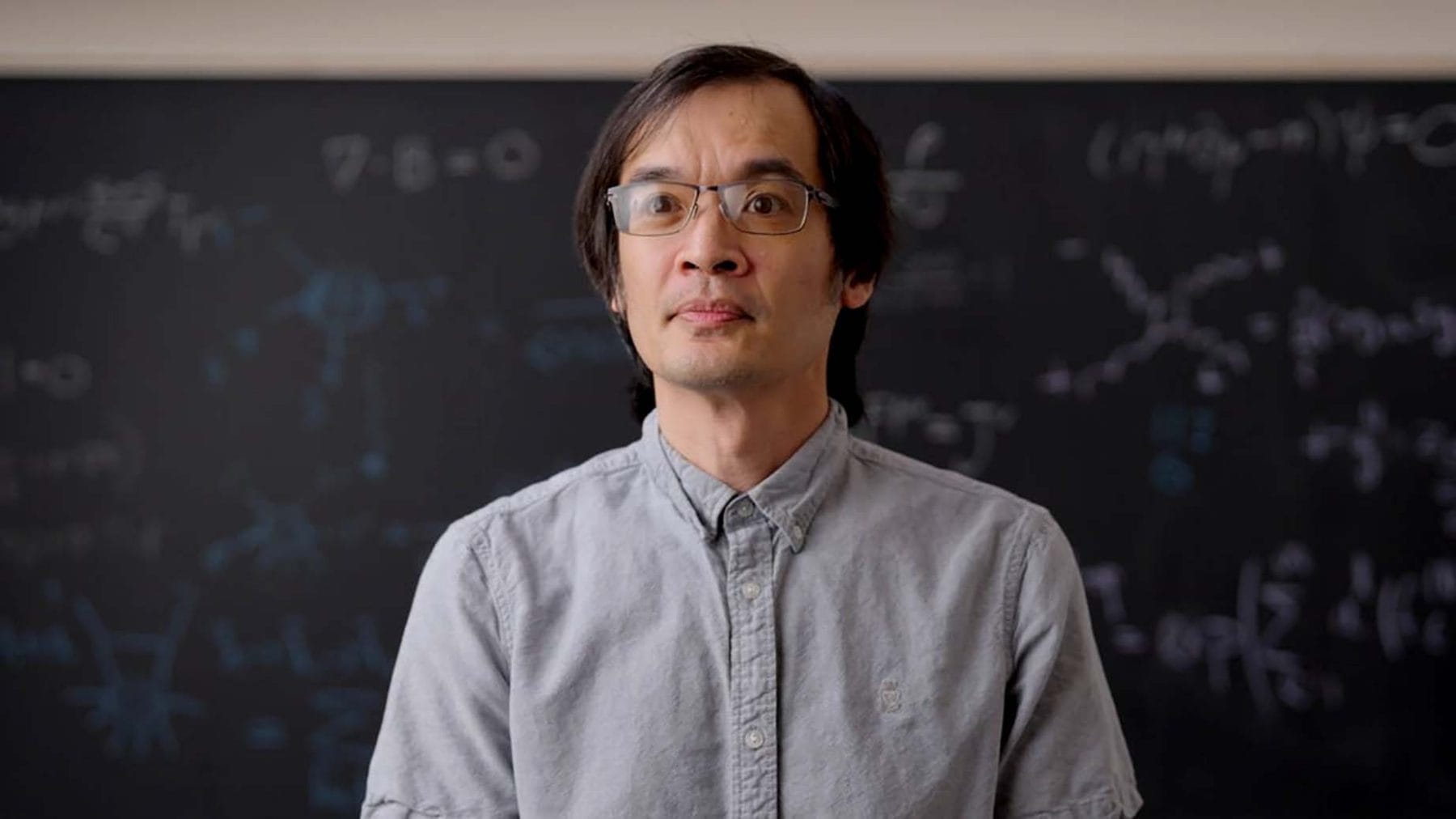
There are no working mathematicians who are truly famous. The closest anyone gets is Terence Tao, a professor at UCLA, who is often referred to as the world’s greatest living mathematician. A prodigy, Tao skipped five grades of school, receiving his masters degree at age 16. By 21, he had earned a PhD from Princeton, and was awarded the Fields Medal just ten years later, in 2006, for his pioneering work with Ben Green on prime number theory.
But what sets Tao apart, in a field infamously incomprehensible to outsiders, is his ability to communicate to both mathematicians and laypeople alike. This has made him a de facto spokesperson for the mathematics community – and extremely influential in setting its norms. “From all accounts he’s a lovely man,” said one researcher, speaking anonymously.
“But the social pressure to agree with Terry Tao is really strong.”
On July 24, the day after Jacob Tsimerman joined OpenAI, Tao gave a public lecture at the ICM titled “Mathematics in the Age of AI”. In it, he presents his “working hypothesis”: that AI tools for mathematics, which he already uses in his own research, will keep getting better. This will allow for collaboration on a vastly greater scale than has ever been possible before, Tao argues, and speed up the pace of research – revealing new, previously unimagined frontiers.
But it will also change, fundamentally, the role of human mathematicians. There will be little point in problem-solving – the computers will handle that. But the humans will still have to do the really hard work: understanding why AI-generated proofs are correct, and explaining this to others. The sooner they embrace this and plan accordingly, Tao concludes, the better.
The Atlas reached out to Terence Tao to request an interview. His human assistant, UCLA media relations officer Holly Ober, declined the request, making a referral instead to a “living document” which is maintained by Tao’s Claude AI assistant, on his website. This document synthesises Tao’s current thinking on AI, based on his public writings and talks, even “interviewing” Tao with follow-up questions.
As per his AI assistant, Tao believes that the topic of AI in mathematics is too important to be left to just a small number of spokespeople – and that his own “influence on this discussion should diminish as the rest of the community steps up.”
Terence Tao, often referred to as the world’s greatest living mathematician. Photo: OpenAI Academy.
AN UNSOLVED EQUATION
Not everyone believes in the inevitability of AI defining the future of mathematics. According to several sources, both organisers and funders were disappointed with the turnout at the ICM in Philadelphia. Despite the gravity of the occasion, the congress was not at capacity.
Ila Varma and Tarik Aougab, associate professors at the University of Toronto and Haverford College respectively, may have had something to do with that. In March, they launched a petition to boycott the ICM due to the ongoing war in Iran, increasing authoritarianism in the United States and the risks faced by visiting academics – if they were even allowed in. “AI companies were invited, but most African mathematicians who tried to attend couldn’t get visas,” Varma said.
More than 2,600 people signed the petition. For Varma, this is evidence that mathematicians may yet use their status to resist the influence – and the cash – of the big AI companies.
“There’s an idea that the positionality of mathematics in society is to decide who’s smart, who’s worthy of the most lucrative career opportunities and the privileges that go along with it. And now we are being asked to take this technology that is likely to be extremely unhealthy for users, that’s bad for the environment, this thing built on unethical labour, and our discipline is being used against many of our wishes to tell society that this thing is intelligent, and that you should let it do your thinking for you.”
Michael Harris, a professor at the Institut de Mathématiques de Jussieu in Paris, was at the ICM in Philadelphia. “The talks I attended on AI, starting with Tao’s public lecture, took pains to insist on the need for human mathematicians to make sense of anything produced in the name of the discipline, by machines or by humans,” he said. “There is a growing resistance to any use of AI whatsoever in mathematics, especially among young people, and this will become evident over the next few months.”
One of the clearest voices of dissent belongs to Max Weinreich, Assistant Professor of Mathematics at the City University of New York.
In an essay published earlier this month, Weinreich makes the case against what he describes as “artificial mathematics”: “Mathematicians do not need to use AI, nor should we use AI; soon, I argue, you will not want to have your name associated with AI. Instead, we should use our intellectual authority to oppose its development.”
His opposition is about more than mathematics, he told The Atlas. In his view, the environmental and financial implications of the AI boom pose major societal risks – and mathematicians, given their privileged position, are one of the few groups of people who can do anything about it.
As John Fletcher, a theoretical physicist and mathematician, observed: “There is a lot of power in being perceived as the smartest people in the world.”
Po-Shen Loh, a professor at Carnegie Mellon and former coach of the US International Mathematical Olympiad team, backs mathematicians to figure it out – by treating it like a maths problem. “AI is making mathematicians engage with the real world. They are smart enough to realise they have an existential crisis. They’re quickly racing down to discover all the dead ends, to see what works and what doesn’t.”
And when they figure it out, maybe they’ll let the rest of us know.
A version of this story, edited for length, first appeared in The Atlas newspaper. Additional reporting by: Shougat Dasgupta, Masho Lomashvilli, Irina Matchavariani.
A top banker has got in trouble by referring to employees whose jobs will be replaced by AI as “lower-value human capital.” But he’s just saying the quiet part out loud: compliance officers have been expected to work like inefficient computers for years already anyway. Standard Chartered CEO Bill Withers used the unfortunate phrase when describing how the bank plans to keep hitting its profitability targets by cutting 15% of back office staff, and has tried to backtrack a little after a predicta
A top banker has got in trouble by referring to employees whose jobs will be replaced by AI as “lower-value human capital.” But he’s just saying the quiet part out loud: compliance officers have been expected to work like inefficient computers for years already anyway. Standard Chartered CEO Bill Withers used the unfortunate phrase when describing how the bank plans to keep hitting its profitability targets by cutting 15% of back office staff, and has tried to backtrack a little after a predictable storm of criticism, including from the former president of Singapore.
It would be nice to think of bank employees deployed to fight financial crime as super-effective old-school gumshoes, with a bottle of bourbon in the bottom drawer and an inexhaustible stock of one-liners, but in reality their jobs are more like something from ‘The Office’ than ‘The Big Sleep’.
Thousands of people sit in cubicles in Warsaw or Bengaluru, checking through transactions flagged as possibly abnormal by banks’ automated systems, and confirming that 99% of them are, in fact, normal. Anything that might conceivably be abnormal gets sent up the chain, where someone more senior will almost certainly decide it wasn’t.
It is a ruinously expensive process and, as far as we can tell, completely ineffective. The best estimates we have for the size of the criminal economy suggest it has grown, untroubled, along with everything else for decades despite all the laws, fines, and prosecutions that we’ve thrown at the problem.
But banks’ financial crime compliance isn’t about stopping financial crime at all: it’s about stopping banks from being fined, as Standard Chartered has previously been, enormous sums in both the U.S. and the UK. As long as banks can be sure that AI checks boxes in ways that satisfy regulators, then they’ll be happy.
This is a little bit worrying because AI is already getting very good at fraud. I am very alert to attempts to trick me but was sufficiently fooled by an AI email yesterday to forward it on to someone. Fortunately, a very similar one arrived (purportedly from someone else) a few minutes later, alerting me to my mistake. Money laundering is a laborious activity and criminal gangs will be as keen as banks to cut their back office expenditure, and AI could help automate the processing of the many small transactions that add up to a large amount of money. Phishing and smurfing are just a couple of its use cases, however.
“Scammers can leverage AI to scrape data from social media and dating platforms to identify vulnerable targets (e.g. lonely individuals, recent retirees, or people interested in finance) for pig butchering scams,” notes TRM Labs. “Bots can sustain long-term, emotionally persuasive conversations without tiring or making mistakes, making the scam more scalable.”
And that’s before you get onto AI’s ability to exploit cryptocurrencies and smart contracts to really start rampaging through the crypto world. “TRM observed a roughly 500% increase in AI-enabled scam activity over the past year. The convergence of generative AI, programmable financial infrastructure, and global crypto liquidity has altered the economics, velocity, and scalability of fraud,” the blockchain analytics firm said in a follow-up report. This is very bad indeed.
So, although I can see why people are annoyed that Withers referred to his bank’s employees in such a disparaging way, I am more troubled that he’s planning to replace them with AI, rather than to retain them and train them in how to counter it.
It was remarkable, however, to see Warren Davidson, chair of the illicit finance subcommittee at the House of Representatives Financial Services Committee, draw precisely the wrong conclusion from all this. Although he was correct in condemning the defensive nature of compliance, and its focus on generating paperwork over results, he then got lost in praising the White House’s decisions to attack corporate transparency legislation.
"As we focus on risk, we must also ensure that tools like artificial intelligence are fully deployed to counter the AI-enabled crimes of today,” he said, without realising that, without reliable information to train the AI models on, this is as useless an approach as the one he says has failed. If you don’t know who owns what, neither will a computer, no matter how cleverly it can pretend to be human.
I sincerely hope he listened to the testimony of Carole House of the Atlantic Council who forcefully pointed out the harm to national security and to ordinary Americans caused by the United States’ failure to create even an approximation of a decent corporate registry, as well as the historic idiocy of its current crypto policy. “Without a secure identity foundation, AI agents will simply scale up fraud at a speed and volume that human investigators can't possibly track, destroying trust in the whole system,” she said in testimony that I highly recommend you take a look at.
I very much doubt Davidson was listening, however, because that is not the direction the Republican Party is going in right now. I would write more about that, but frankly it’s all too depressing, and I’d rather move on.
So let me point you towards this excellent paper on how online scam marketplaces work, with criminals using the messaging app Telegram and the stablecoin Tether to launder hundreds of billions of dollars. It argues that our current approach of sanctioning exchanges is futile since their owners just shut them down and switch to a new platform that works in the same way but hasn’t yet been sanctioned.
“As long as the underlying digital infrastructure remains permissive, criminal syndicates will simply migrate to new channels. To move from reactive disruption to systemic prevention, the international community must shift its focus toward the structural enablers of these marketplaces,” Elliptic’s Tom Robinson argues. Elliptic is unusual among blockchain analytics companies in being willing to name Tether as a major vector for money launderers. Its rivals tend to just say “stablecoins,” I have no idea why.
Meanwhile, there is something grimly depressing about the fact that — against the backdrop of, well, everything — the UK has postponed June’s illicit finance summit due to “scheduling issues in the international calendar.” Everyone is so busy dealing with the consequences of illicit finance, that no one has time to talk about illicit finance.
A version of this story was published in this week’s Oligarchy newsletter. Sign up here.
On April 24, Brazil’s competition authority, the Administrative Council for Economic Defense (CADE) announced it was opening an investigation to assess whether Google’s use of news content amounted to unfair competition practices against the Brazilian press. The announcement was welcomed by civil society organizations that have tried to push regulation to limit the reckless power of Big Tech for years. Ajor, Brazil’s Digital News Association, said that “a balanced relationship between digital pl
On April 24, Brazil’s competition authority, the Administrative Council for Economic Defense (CADE) announced it was opening an investigation to assess whether Google’s use of news content amounted to unfair competition practices against the Brazilian press. The announcement was welcomed by civil society organizations that have tried to push regulation to limit the reckless power of Big Tech for years. Ajor, Brazil’s Digital News Association, said that “a balanced relationship between digital platforms and journalism organizations is fundamental to the flourishing of journalism committed to the public interest. By ensuring a fair competitive environment, Cade directly advances that goal.”
In spirit and intent, CADE’s investigation into Google is similar to legislation in Australia that recognized that value is being extracted from news publishers without proportionate recompense. In Brazil, the case has been debated since 2019, but the adoption of AI Overviews helped alter the perspective of Brazilian judges. The overviews are artificially generated summaries that synthesize information from several sources and appear at the top of Google Search results. They “raise potentially more concerns,” ruled Judge Camila Cabral Pires Alves, “as they may more profoundly alter the economic function of the interface and expand the ability to retain attention within the platform's own environment.”
CADE will now investigate whether Google should be sanctioned for “alleged abusive exploitation of a dominant position, in light of the technological evolution of the conduct.” While there is perhaps a greater global appetite to regulate the impacts of AI – even the Trump administration has recently acknowledged that some oversight may be necessary – the CADE judges have been under considerable pressure from Big Tech executives to stop investigations into how their control of the market harms Brazilian businesses.
For those of us who have reported on Big Tech, this aggressive lobbying is not surprising. Companies like Google, Meta, Twitter, TikTok, Amazon, and Microsoft have long attempted to interfere in any decision or legislation that can harm their interests in Latin America. According to a joint investigation by journalists across 13 countries, Big Tech lobbyists got away with convincing legislators in Colombia to weaken a rule meant to protect children’s mental health and prevent enforcement of privacy regulations in Ecuador. It took a team of over 40 journalists from 13 countries to uncover this while reporting on the ‘Big Tech Lobby’ in the continent and across the world.
Threats by the U.S. government to retaliate against any country or international entity that sought to regulate Big Tech added another layer to an already complicated and uneven relationship with Silicon Valley. “Digital Taxes, Digital Services Legislation, and Digital Markets Regulations are all designed to harm, or discriminate against, American Technology,” wrote Donald Trump on social media. “Show respect to America and our amazing Tech Companies or consider the consequences!” During the past year, Trump’s envoys have forced dozens of governments around the world to dilute or even shelve regulation in exchange for lifting tariffs.
In “Big Tech’s Invisible Hands,” which I coordinated alongside Maria Teresa Ronderos, from CLIP (Centro Latinoamericano de Investigación Periodistica), journalists mapped a total of 75 executives that were part of “public policy” or “government relations” teams in Brazil. Tech companies utilized a “revolving door” in which public sector employees could go straight into highly paid jobs leveraging their contacts and influence. Doors opened more easily. Invitations to hangouts and events were more likely to be accepted.
Brazilian President Luiz Inacio Lula da Silva meets with U.S. President Donald Trump at the White House on May 7, 2026. Brazilian Government / Ricardo Stuckert / Handout/Anadolu via Getty Images.
Lobbying in Brazil is dialed up to eleven. The country has 163 million internet users, with over 150 million on WhatsApp, and over 120 million on YouTube, Instagram and Facebook. With AI, Brazil is a similarly large, influential market. Portuguese is the sixth most widely-spoken language in the world, with 70% of speakers based in Brazil. Which means that, if an LLM has been trained in this language, it probably used content created by millions of Brazilians going about their business of making friends, debating politics and football online. It’s not just about journalists; we are all unpaid labor for Big Tech.
In the words of Arthur Lira, the Speaker in Brazil’s Congress who filed a criminal complaint against Big Tech executives in 2023, companies adopted a variety of tactics “to shut down democratic debate and intimidate lawmakers” and defeat any attempt at using legislation to force accountability. Google, he said, used its search homepage, used by over 85% of Brazilians, to spread fear that proposed laws would “make the internet worse” or “make it harder to know what is true or false on the internet.” A report by the Federal University of Rio de Janeiro found that Google invested in ads on its own platform so extensively that it tweaked the search, prominently featuring the word “censorship” in connection to the Brazilian bill. Google also hired Michael Temer, a lawyer and former President of Brazil, to influence lawmakers and Supreme Court Justices. Of course, it was not Google alone. Meta executives, for instance, even argued that proposed legislation in Brazil could lead to the Bible being censored.
But Brazilian lawmakers, the Supreme Court, and civil society have persisted. On August 28, 2025, the “Felca Law” was approved, after a video by the influencer Felca denounced the exploitation and exposure of children on social media. The law establishes that digital platforms must take measures like verifying user age, implementing parental controls, and preventing children's exposure to adult content, gambling, and pornography. They must create reporting channels and may face fines of up to 10% of their annual revenue in Brazil.
Brazil’s president Luiz Inácio Lula da Silva and Donald Trump have had a testy relationship, in part because of Lula’s criticism of Big Tech. In February, at the AI Impact Summit in New Delhi, Lula called for global governance of AI, warning: “When few control the algorithms, it is not innovation, but domination. Regulating the so-called Big Tech companies is linked to the imperative of safeguarding human rights in the digital sphere, promoting information integrity, and protecting our countries’ creative industries.”
By sticking to his guns, Lula may now be seeing the tide turn. He was in the White House on May 7, and though neither he nor Trump took questions, both appeared encouraged by the meeting. “Very dynamic,” was how Trump described Lula, while Lula said he was “very, very satisfied” with how the talks went. With a general election in Brazil approaching in October, Lula will be sensitive to how the White House, as it has done in other elections, and Big Tech might offer vocal support for right wing candidates.
But his willingness to stand up to Big Tech is popular with voters. A recent poll found that 78% of Brazilians want to see tech companies being held responsible for the content they publish. Another poll found that 55% of Brazilians defend regulating Big Tech, with 43.9% against it.
And as scams, fake news, and AI slop dominate ever larger swathes of all our digital space, in Brazil, as in much of the rest of the world, the entire experience of the internet is becoming more unappealing. Big Tech, with the assistance of the U.S. government, may be succeeding in slowing down the pace of regulation and watering down the content of that regulation, but in the long run its victories might be pyrrhic. People have had enough and their governments might be forced to listen.
It starts with a simple search term in the Department of Justice’s Epstein Library. “Blue eyes.” Hundreds of results. Jeffrey Epstein’s international trafficking agents send him pictures and descriptions of blue-eyed young girls: potential victims to be dispatched to his various homes. “I spotted two skinny blond blue eyes 21 years old ladies in Monaco last weekend and asked them for CVs,” one agent, whose name has been redacted, wrote. “Trying her best to move from her small town to Moscow;
It starts with a simple search term in the Department of Justice’s Epstein Library. “Blue eyes.” Hundreds of results. Jeffrey Epstein’s international trafficking agents send him pictures and descriptions of blue-eyed young girls: potential victims to be dispatched to his various homes. “I spotted two skinny blond blue eyes 21 years old ladies in Monaco last weekend and asked them for CVs,” one agent, whose name has been redacted, wrote. “Trying her best to move from her small town to Moscow; English isn't great. Could be fun for Paris, blue eyes,” wrote another. “Can't understand if her breast is real. Otherwise very pretty and sweet…Very blue eyes as we like.”
One of Epstein’s victims wrote of being chosen for her eye color in a journal entry later shared with federal prosecutors. "Superior gene pool?!? Why me?" she wrote, describing Epstein's worldview as "Nazi like." "It makes no sense. Why my hair color and eye color?"
Epstein — himself blue-eyed — seemed to prefer both his victims, and the people he bankrolled, to have blue eyes. “All of my fundees have blue eyes,” he boasted in one email. In the entryway of his Manhattan townhouse, he displayed dozens of prosthetic eyeballs in a frame. Epstein made notes and sent article links to his contacts asking if having blue eyes meant you were more intelligent or a “genius”. He even had a list of scientists and tech leaders with blue eyes — including Elon Musk, Peter Thiel, and Google’s Ray Kurzweil. “Total — 70 people Blue eyes — 41 Unclear (might be blue, but not 100% sure)” the list says. Appearing in the files — whether on this list or elsewhere in Epstein's records — does not connote legal wrongdoing.
Going deeper into the files, Epstein and his network of contacts discussed beliefs about how physical characteristics and race might denote intelligence. They exchanged emails about population control. They spoke of engineering women’s sex drives, building designer babies, and living in a world full of superintelligent humans that could merge with robots. They spoke of getting rid of the elderly, the infirm, and the poor.
The files offer a glimpse into a world where ideas about eugenics and race science have never gone away. On the contrary, they run through our elite universities, through the most powerful companies in Silicon Valley, and through the tech industry itself. Epstein’s was an exclusive club that counted among its members people who harbor dreams of re-engineering human minds and bodies, seizing control of our collective future, and building technology that, they hope, will one day merge with — or even replace — all of us.
Jeffrey Epstein, 27. Jeffrey Epstein's mansion El Brillo Way in Palm Beach. U.S. Virgin Islands, Department of Justice, Sexual Offender Registry Photograph.
In 2002, two decades before the launch of ChatGPT, Epstein hosted an Artificial Intelligence summit on his Caribbean island. In the years that followed, he cultivated close, regular contact with a network of (predominantly male) scientists, researchers, academics and tech leaders working at the vanguard of AI, biotech, genetics and cognitive science, meeting them at universities like Harvard and at his various homes.
In August 2018, a year before Epstein was found dead in his jail cell, he was in email correspondence with software consultant and bitcoin investor Bryan Bishop about funding a project to create “designer babies” — children with genes cherrypicked for their looks, health, strength, immune systems, sleep needs and even, in Bishop’s imaginings, abilities to live on a different planet.
“Attached is the doc you requested, it's the "use of funds" spreadsheet for the designer baby and human cloning company,” Bishop wrote to Epstein. “This gets us out of our self-funded ‘garage biology’ phase to the first live birth of a human designer baby, and possibly a human clone, within 5 years. Once we reach the first birth, everything changes and the world will never be the same again.”
Bishop went on to discuss how his ultimate ambition was to make “practically unlimited modifications to the cells before generating an embryo.”
In response to a request for comment, Bishop sent Coda a publicly available set of answers to frequently asked questions about designer babies.
“The reason people have an aversion to eugenics, and rightfully so, is because countries used genocide and sterilization to prevent reproduction by populations that they didn’t like. We have no intention of doing anything of the sort,” Bishop writes in the public FAQ. “‘Designer baby’ simply describes a child whose genome has been intentionally altered or chosen by their parents, rather than left entirely to the genetic lottery of natural conception.”
“It’s such a great subject,” Epstein responded after he read Bishop’s proposal. “We need to get a read on legal. Can’t do anything where US rules apply to US citizens regardless of where [they are].”
Building a super-race of humans, and parachuting humanity into a different evolutionary era — or even obsoleting the human race as we know it — is a running theme in the Epstein files, and an increasingly prominent ambition for tech evangelists today.
“It’s eugenics all the way down,” said Jacob Metcalf, a founding partner at Ethical Resolve, a consulting firm working with tech companies to develop their ethics protocols. A common fantasy in tech circles, he said, is “to essentially control human destiny. And a lot of the times that human destiny is for humans to be replaced. That's the really bleak thing here. What could be more eugenic than getting rid of humans.”
In 2008, Epstein began conversations with the computer scientist Ben Goertzel. Over the years, Epstein would send Goertzel more than $360,000 to fund the researcher’s plans to build towards Artificial General Intelligence (AGI), a term Goertzel himself popularized.
“I remain eager to move forward on working together to accelerate progress toward a human-obsoleting thinking machine,” Goertzel wrote to Epstein in May 2008. Eighteen years on, and the idea of obsoleting humans with artificial intelligence is widely discussed in the tech world.
When asked to comment on his exchange with Epstein, Goertzel told Coda: “I do think we will create forms of transhuman intelligence going beyond the scope of humanity as we know it, but I also very much hope and envision a strong role for humans even after this happens.”
Goertzel went on to describe a future where the world reaches the “Singularity” — a Silicon Valley buzzword signifying a tipping point where AI surpasses human intelligence. “I do think AI will eventually gain its own superhuman autonomy, but I think this can happen in a way that respects and nourishes human life rather than being harmful to it,” he said. “Epstein and I discussed this face to face a few times and indeed I was a bigger fan of the human species than he was, and more optimistic about its flourishing post-Singularity.”
In an email to Epstein, Goertzel laid out a scenario where AI systems would start running their own economic activity. He envisioned this Artificial Intelligence economy acting as a “parasite to overcome the regular human economy” that would eventually “gain its own superhuman autonomy.” The ideas Epstein and Goertzel exchanged mirror a broader conversation unfolding in the tech world that imagines a future where ultimately, human labour could be rendered superfluous, and ultimately be replaced by artificial intelligence and robots.
Together, Goertzel and Epstein also discussed modifying human brains — a concept popular in Silicon Valley today, where numerous brain-computer projects are researching ways to cognitively enhance the human brain, and alter human personality, memory, and mental capabilities.
In 2008, when Epstein told Goertzel he was “off to jail” for a year, after he was convicted of soliciting a minor for prostitution, Goertzel suggested the solution to his problems might one day be solved if human brains could be re-programmed.
Ben Goertzel with Desdemona the robot, at a tech event in Portugal in November. Sam Barnes/Sportsfile for Web Summit via Getty Images.
“According to my understanding, the girls you were involved with were old enough to know what they were doing, so society really has no ‘moral right’ to lock you up,” Goertzel wrote to Epstein. “This is a fucked-up society we live in. But past ones have really been no better -- the fault is really w/ the human brain architecture, which is precisely what I'm aiming to supercede in my AGI work.”
When asked to comment on these remarks — and in particular the implication that Epstein’s problems might be solved if his accusers' brains were one day re-engineered — Goertzel told Coda: “This was a general observation that the messed-up nature of our society generally is rooted in the way our brains have evolved... and that advanced tech will let us modify our brains to make ourselves and thus our society better. There was no implication intended (nor stated) that women’s brains are any more or less messed up or in need of improvement than men’s.”
Goertzel reflected that his comments on Epstein’s victims being “old enough” were “regrettable and unfortunate in hindsight,” adding that his impression was that Epstein had been involved with adult women, not “disgustingly curating high school students for sexual purposes. I should have paid more attention.”
In 2013, three and a half years after Epstein was released from jail, Goertzel approached Epstein for funding to build a “toddler robot”. Given Epstein’s criminal history of abusing minors, this has inevitably attracted attention online. “When we were discussing measuring the IQ of robot toddlers, the topic was never sexualized in any way,” Goertzel told Coda when asked about the project. “While I had nothing to do with Epstein's perverse sexual tastes or abuse of women, what I have read about his awful doings in the newspapers relates to his interest in teenage girls not toddlers.”
Epstein was particularly interested in funding projects that built — like Goertzel’s –- on transhumanist theories. Transhumanism is a worldview that captivates many of the most prominent tech leaders in Silicon Valley today. It believes in a future when the human body can be endlessly altered, genetically engineered, and ultimately fused with artificial intelligence.
“Transhumanism is a much more radical concept than eugenics,” explained Timnit Gebru, a computer scientist and researcher who has written extensively about eugenicist ideas within artificial intelligence. “In eugenics, you're trying to create a more superior human by breeding humans through generations. In transhumanism, you're trying to get rid of humans altogether.”
For transhumanists, she added, “their idea is to get rid of any undesirable properties they see with humans."
Perhaps the most well-known proponent of transhumanism in the Epstein files is Peter Thiel.
“I think you would prefer the human race to endure, right?” New York Times journalist Ross Douthat asked Thiel last year. “Uh—,” Thiel said. “This is a long hesitation!” Douthat said. “Should the human race survive?” “Yes, but I would like us to radically solve these problems,” Thiel said. “We want you to be able to change your heart and change your mind and change your whole body.”
Peter Thiel. Creative Commons (CC BY 2.0) /Gage Skidmore.
Thiel’s name appears in the files more than 2000 times, and Epstein reportedly invested some $40 million into Valar Ventures, a firm co-founded by Thiel. The two spoke of building secret societies and shared an interest in transhumanism and cryogenics — Epstein wanted to freeze his brain and penis when he died, so that one day he could be revived, while Thiel has also stated his body will be frozen after his death.
They also appeared to share an interest in bringing an end to the democratic systems of today, imagining a different system altogether. Epstein, for his part, spent his life puppeteering the most powerful people in the world and undermining democratic systems. Thiel, meanwhile, first expressed his own anti-democratic views in 2009 when he wrote: “I no longer believe that freedom and democracy are compatible,” adding that since women were allowed to vote, the notion of a capitalist democracy became impossible. When the Brexit vote came through, Epstein wrote to Thiel: “Brexit, just the beginning.” Thiel asked — “of what”; Epstein said – “Return to tribalism, counter to globalization, amazing new alliances.”
Globalization — and the idea of internationally powerful governing bodies — is a worldview that both Epstein and Thiel seemed to distrust. In March, in a palazzo in Rome, a stone’s throw from the Vatican, Thiel gave one of his infamous lectures in which he espoused his views about an “antichrist” that gets in the way of technological progress. This antichrist, he suggested, could be an internationally powerful body; the product of globalization. I stood outside the palace as attendees — priests, students, researchers — mutely hurried out, refusing to speak to the cluster of reporters waiting for Thiel’s black Mercedes.
“He has a totally irrational side, which lives on fear, of what danger might happen,” one audience member told me of Thiel on condition of anonymity, recalling how, up close, Thiel looked haunted and ill. “His head is full of future scenarios, which is what’s killing him. I think he’s scared.”
Thiel did not respond to multiple requests for comment.
Epstein didn’t confine himself to lofty conversations about a future collapse of the global order or re-engineering humanity. He also had ambitions for his own personal eugenics project. In 2019, it emerged that he wanted to seed the world with his DNA — and reportedly have 20 women impregnated at a time at Zorro ranch, his New Mexico property.
Epstein tried to recruit Virginia Giuffre for this very project. He “fantasized about improving the human race by fathering children who carried his superior genes,” she recounted in her memoir, published posthumously late last year. “He’d talk about using his Zorro ranch as a literal breeding ground to propagate babies.” When Giuffre was 18 years old, she recalled, Epstein asked if she would carry his child and hand over all legal rights to it – “like a modern-day handmaid.”
Zorro Ranch, New Mexico. Diary of Epstein's victim.
In a haunting diary entry from another Epstein victim, written between the ages of 16 and 17 and shared with federal prosecutors, a girl describes being told she will be sent to Zorro ranch — possibly to participate in the very same project. “Go to New Mexico? What in the hell? This makes no sense. What about school?” she writes, describing how Epstein chose her for her hair color and eye color, and tried to convince her she would create “perfect offspring.”
The teenager chronicles her pregnancy, pasting a sonogram into the scrapbook, before giving a traumatic account of giving birth with Ghislaine Maxwell beside her. “Ghislaine said to push all the pain away. I don't understand. Blood and water all over the bed.” As the baby was born, she writes, Maxwell covered her eyes. “I saw between her fingers this tiny head and body in the doctors hands.”
The girl describes hearing the baby’s “tiny cries” before “they took her.”
“I’m nothing but your property and incubator,” the teenager writes of Epstein. The diary is a terrifying piece of evidence that appears to link to Epstein’s longstanding fixation with creating genetically bespoke humans. The diary author’s lawyers, Wigdor LLP, declined to comment.
Epstein’s fever-dreams of creating an army of children carrying specific genes reflect a broader trend of “pronatalism” — a movement historically tied to eugenics — that’s thriving in Silicon Valley.
Millions of dollars of funding are currently being poured into projects creating “superbabies,” while billionaire tech oligarchs including Elon Musk — whose name appears more than 1000 times in the files — reportedly want to use surrogates “to reach legion-level before the apocalypse.” Musk did not respond to requests for comment.
In the files, women appear either as victims, as objects, or as vessels for genetic engineering experiments. They are an inconvenient reality, people to be controlled and re-booted. Epstein wrote a 2013 email implying that women “are like shrimp. You throw away the head and keep the body.”
“The obsession with "artificial" life appears tied to a masculine desire to try control the production of life – ultimately ridding themselves of their dependency on women," said Gabriella Razzano, Co-Founder of OpenUp, a social impact tech lab based in Cape Town, who is also a senior advisor at the African AI Observatory. “I think there is important work to be done on tying the narratives that are very revealing in the Epstein files to understand how, and why, technology is being developed as it is.”
The trading of ideas about intelligence — both artificial and human — takes a particularly sinister turn in a 2016 exchange between Epstein and the cognitive scientist and AI researcher Joscha Bach, whose research Epstein funded to the tune of $300,000.
Bach writes to Epstein about a study claiming that “black children outperform white children in motor development, even in very poor and socially disadvantaged households, but they lag behind (and never catch up) in cognitive development even after controlling for family income.”
Epstein responds with racist ideas about his notion of how to “make blacks smarter”, adding — “maybe climate change is a good way of dealing with overpopulation. The Earth’s forest fire. Potentially a good thing for the species,” before contemplating a world with “too many people,” where “many mass executions of the elderly and infirm make sense.”
Bronze sculpture of a female torso Jeffrey Epstein's Manhattan residence.
Epstein then imagines creating a future “Übermensch” — a superior human with cherry-picked attributes. “What I like is the idea that ubermensch could be the melding of humans, put together in one brain,” Epstein writes. This bespoke human, he suggests, would include traits from marginalized groups, who he appears to believe have a stronger awareness of how to navigate power structures because of their historical exclusion. “An increased motor system, an increased awareness, an increased status calculator (Blacks, jews, women). Ubermensch could be the combination of the best of humans, not the best of a specific race or gender. Fun idea.”
Bach told Coda in a statement: “I was summarizing a scientific study in a private email. Studies like this get often abused in ideological discourse to justify discrimination, which I strongly oppose and condemn.”
“I am firmly opposed to any form of racial discrimination, and I reject the use of group-level statistical claims to make judgments about individuals or to justify unequal treatment.”
He continued: “It goes without saying that if global warming were to lead to a reduction in the human population, it would be accompanied by immeasurable suffering. Our civilization would break down, leading to a return to dark ages, in which the elderly and infirm were often killed, because people could not support them, and often did not care about supporting them. Every reasonable person understands that this is horrible and not desirable in any way.”
Epstein “was often callous about human suffering in a way that I found disturbing but worth understanding, as a window into the perspectives of the rich and powerful,” Bach added.
Alongside Epstein’s conversations about mass executions for the old and and the sick, he was also interested in Silicon Valley’s dream concept of living forever — he had numerous email conversations with the longevity guru Peter Attia about prolonging his own lifespan, and funded a Harvard project geared towards “the end of aging.” In an email to Attia, Epstein mused: “I’m not sure why women live past reproductive age at all.” Attia, who published a statement about his relationship to Epstein, did not respond to requests for comment.
This interest in “longevity” — living for as long as possible, even living forever, is popular among the elite precisely because they find themselves in an elite class, says David Robert Grimes, a scientist and disinformation expert who has written about longevity and race science in Silicon Valley. “They're both sides of the same coin — the Silicon Valley eugenics, and also the longevity stuff. They promote an idea that ‘we are exclusive and we are special',” he said. "It helps them to justify deep social inequality."
The tech elite did not inherit this ideology by accident. Stanford University, the intellectual heart of Silicon Valley, was once a major hub for the American eugenics movement, which later helped to inspire Nazi race laws. Stanford’s founding president, David Starr Jordan, was a prominent eugenicist, campaigning for forced sterilization of people with undesirable genetic traits. The university removed his name from its buildings in 2020 — but in Palo Alto, his beliefs did not disappear with the nameplate.
"Instead of eugenics we just call it longevity or biohacking," Christopher Wylie, the Cambridge Analytica whistleblower who has spent years investigating Silicon Valley's belief systems, said on a panel with me at a journalism conference last year. "It's the same."
The ideology Epstein bankrolled in private is being built in public. It’s a vision of the future in which a select few get to upgrade and extend their lives, while tightening their grip on the systems that determine which humans are worth investing in — and which are not.
It sounds like a dark sci-fi fantasy, except, as the files show, that fantasy is being funded and pushed into reality. Most of us will never be in the rooms where these ideas are discussed. All of us will live with the results.
In 2016, when Peter Thiel killed Gawker, he insisted that he wasn’t attacking journalism writ large.
On the contrary, he told the New York Times, he’d spent $10 million secretly backing Hulk Hogan’s lawsuit against the news outlet because: “I saw Gawker pioneer a unique and incredibly damaging way of getting attention by bullying people even when there was no connection with the public interest… if I didn’t think Gawker was unique, I wouldn’t have done any of this. If the entire media was mo
In 2016, when Peter Thiel killed Gawker, he insisted that he wasn’t attacking journalism writ large.
On the contrary, he told the New York Times, he’d spent $10 million secretly backing Hulk Hogan’s lawsuit against the news outlet because: “I saw Gawker pioneer a unique and incredibly damaging way of getting attention by bullying people even when there was no connection with the public interest… if I didn’t think Gawker was unique, I wouldn’t have done any of this. If the entire media was more or less like this, this would be like trying to boil the ocean.”
10 years later with the aid of an “AI tribunal,” a team of intelligence and law enforcement veterans, and a political climate vastly more hostile to press freedom, he is trying to do exactly that, bypassing the courts, short-circuiting the first amendment, and making it much, much cheaper to indulge in the quasi legal harassment of journalists.
Objection.ai is a new startup funded by Thiel, and cofounded by Aron D’Souza, who worked closely with him on the Gawker case. It promises “a fast affordable way to challenge statements in the media.” Anyone can file an objection, which will trigger an investigation by a team hired, the company says, from the CIA, FBI, and British intelligence agencies. Targeted outlets and reporters will have an opportunity to respond, and the results will be fed to an AI model, which will render a verdict. The complainant, and the target, are asked to agree to binding arbitration, with an unspecified range of potential consequences. Financial details are vague, but the company has said the process will cost around $2,000 — far less than the retainer of a crisis communications expert.
An initial slate of cases includes objections against the New York Times, for reporting on how Thiel’s fellow traveller David Sacks, former PayPal chief operating officer and Donald Trump’s former “AI and Crypto Czar,” uses his White House position to benefit Silicon Valley connections; The Wall Street Journal for its revelations about the doodle contributed by Donald Trump to Jeffrey Epstein’s birthday book (a case recently dismissed by a federal judge); and British reporter Hannah Broughton for an aggregated story in the UK tabloid the Mirror about allegations that Amazon workers were told to continue working while a colleague lay dead on the warehouse floor. A smattering of social media provocateurs (Candace Owens) and politicians (Bernie Sanders) round out the roster, but the aggregate effect is indisputable: Thiel’s animus was about journalism all along. Indeed, the Objection.ai team couldn't be clearer about that.
“Gawker was not unique,” writes D’Souza on the company’s website. “It was simply the first large media company to be tested against reality in the age of clicks, outrage, and algorithmic amplification. Since then, the same structural failure has spread everywhere.”
“Peter Thiel and I … did not just fight Gawker,” he goes on. “ — We demonstrated that facts still mattered if someone was willing to enforce them.”
This is worse than revisionism. D’Souza is banking on everyone having forgotten that the Hulk Hogan case had nothing to do with “reality.” It was undisputed that the sex tape published by Gawker was real. The original suit, which failed, was for copyright infringement and the ultimate $140 million award that bankrupted the company was for invasion of privacy and intentional infliction of emotional harm.
This foundational lie is important, because it is a warning against the temptation to engage Objection.ai on the merits. It would be easy enough to conduct a good faith debate to take at face value D’Souza’s argument that tech platforms and algorithms amplify false claims to millions, that courts are expensive and slow, media ombuds toothless, and fact-checkers partisan. And it would not be hard to demonstrate that he is harnessing widely shared concerns about a disordered information environment to mobilize support for an AI powered justice system controlled by a hyperpartisan private company with a track record of attacking the very institutions that are holding the line on consensus reality.
It would also be a mistake. There is nothing good faith about this effort. Rather, it is classic Thiel: an attempt to hack the principles of accountability, and turn them against journalism. Leave it to his less sophisticated Silicon Valley peers to rail against the media, create in house news outlets or buy them. The PayPal co-founder is going for the heart of the system, and financing infrastructure that will enable anyone who can afford a used Honda Civic to launch a harassment campaign, cloaked in the language of legitimate investigation. James O’Keefe, but with the judicial rather than journalistic process as its governing metaphor.
It will be tempting, too, to question the likely financial sustainability of Objection. That will be the least of its founders' concerns. The for-profit structure supports a story about the company’s purpose. It may work, or not, but its goals are nonfinancial. We reached out to Thiel for comment on Objection.ai before publication and will update this article as soon as he responds.
Providing funding, alongside Thiel, is Balaji Srinivasan, the investor and author of “The Network State,” a book about social networks with “a sense of national consciousness” replacing the nation state. He once outlined an early version of the Objection.ai model in an email to the far right theorist Curtis Yarvin about dealing with critical coverage. "If things get hot,” he suggested “it may be interesting to sic the Dark Enlightenment audience on a single vulnerable hostile reporter to dox them and turn them inside out with hostile reporting sent to *their* advertisers/friends/contacts."
These men understand the limits of the Gawker verdict’s impact. It bankrupted the company, a personal victory for Thiel, but perhaps the least important outcome of the case. At a more systemic level, it struck fear into the hearts of media insurers and newsroom counsel, focusing attention on third party litigation finance as potential threat.
If people with limitless resources could sponsor litigation against news organizations they disliked, constitutional protections would be no match for the sheer cost and complexity of defense.
Now, they’ve found an AI-assisted way to supercharge those effects.
The Gawker case routed around the First Amendment by relying on a privacy claim. Objection.ai does so by building a hallucination of the legal process. Any journalist foolish enough to agree to binding arbitration by the company probably deserves what they get, but that will be a vanishingly small minority. For those who don’t, a phone call, or a knock on the door from a former FBI agent, or defense intelligence operative, will be chilling, and an ex-parte verdict rendered by Thiel’s custom-tuned AI will act as a cudgel on social media and via traditional PR. Journalists will be assigned a “trust score” to act as an additional goad.
In an environment of less peril for press freedom, it might be easy to laugh off Objection.ai as the confection of a thin-skinned millenarian. Right now, with the crony capture of broadcast news far advanced, swathes of the tech community openly hostile to journalism, and the White House onside, it would be wise to take it seriously. That starts with seeing it for what it is, and refusing to engage with a process which, unlike the real courts, Peter Thiel has no legal power to compel.
Armenia's Foreign Ministry on July 5 denied claims by Ukraine's military intelligence (HUR) that Russia was intensifying its military presence at the country's Gyumri base to exert greater influence in the South Caucasus, the media outlet News Armenia reported. The news comes amid a major deterioration in Russian-Azerbaijani relations after a deadly June 27 operation in Russia's Yekaterinburg, where Russian security forces killed two Azerbaijani nationals and injured several others in a raid lin
Armenia's Foreign Ministry on July 5 denied claims by Ukraine's military intelligence (HUR) that Russia was intensifying its military presence at the country's Gyumri base to exert greater influence in the South Caucasus, the media outlet News Armenia reported.
The news comes amid a major deterioration in Russian-Azerbaijani relations after a deadly June 27 operation in Russia's Yekaterinburg, where Russian security forces killed two Azerbaijani nationals and injured several others in a raid linked to a 2001 murder case.
HUR claimed on July 5 that Russia was increasing its military presence in Gyumri and recruiting new troops for the base. Ukraine's military intelligence argued that the alleged move was aimed at "destabilizing the global security situation."
Ani Badalyan, the Armenian Foreign Ministry's spokesperson, rejected the report.
"In response to the fictitious information that appeared in the press, the Republic of Armenia reaffirms its principled position that the territory of the Republic of Armenia cannot be used by third states to carry out military actions against any of its neighboring states," she said, as cited by News Armenia.
Armenia has had a historically close relationship with Russia but the relations between Yerevan and Moscow have recently deteriorated.
Russia's leverage over both Baku and Yerevan has diminished dramatically since Azerbaijani troops captured Nagorno-Karabakh, an Armenian-controlled region in Azerbaijan, in 2023.
Russian peacekeepers later withdraw from the region, and now Baku and Yerevan are negotiating a permanent peace deal.
Armenia, which has lambasted Moscow for failing to help it during the Nagorno-Karabakh conflict, is drifting closer to the West.
Armenian Prime Minister Nikol Pashinyan has suspended the country's membership in a Russian-led military alliance and announced plans to join the European Union. Recently there has also been a crackdown on the pro-Russian opposition in Armenia.
Explosions in Russia's Vladivostok damaged a gas pipeline and destroyed a water pipeline that supplied military facilities in the area, a source in Ukraine's military intelligence (HUR) told the Kyiv Independent on July 5.A fire followed the explosions and destroyed sections of the Vladivostok gas pipeline along the Sea of Japan, the source said.The blasts occurred early on July 5, between 1-2 a.m., with Russian special services and repair teams arriving shortly after.The damaged pipeline provid
Explosions in Russia's Vladivostok damaged a gas pipeline and destroyed a water pipeline that supplied military facilities in the area, a source in Ukraine's military intelligence (HUR) told the Kyiv Independent on July 5.
A fire followed the explosions and destroyed sections of the Vladivostok gas pipeline along the Sea of Japan, the source said.
The blasts occurred early on July 5, between 1-2 a.m., with Russian special services and repair teams arriving shortly after.
The damaged pipeline provides gas to several Russian military facilities on the coast of the Sea of Japan, including the 155th Marine Brigade of the Pacific Fleet of the Russian Armed Forces, the source told the Kyiv Independent.
The water pipeline destroyed in the explosion provided drinking water to military garrisons in the area.
"In order to hide information from the local population... local special services turned off mobile Internet and communications in the area," the source added
The Kyiv Independent could not independently verify the claims.
Ukraine regularly strikes military targets deep within Russian territory in an effort to diminish Moscow's fighting power.
Ukraine struck the Borisoglebsk airfield in Russia's Voronezh Oblast overnight on July 5, damaging a warehouse containing guided bombs, aircraft, and other military assets, Ukraine's General Staff reported.
The attack on the airfield was part of a larger overnight drone assault across Russia, with explosions and fires reported in at least six regions.
Ukraine's Security Service (SBU) detained a Ukrainian Air Force major suspected of spying for Russian Federal Security Service (FSB), the agency reported on July 3.The alleged spy, arrested during a special operation in Lviv Oblast, was reportedly recruited through his ex-wife, a former military officer now cooperating with Russian forces in occupied Melitopol.According to the SBU, the officer was gathering coordinates of operational airfields, logistics hubs, and maintenance centers used by Ukr
Ukraine's Security Service (SBU) detained a Ukrainian Air Force major suspected of spying for Russian Federal Security Service (FSB), the agency reported on July 3.
The alleged spy, arrested during a special operation in Lviv Oblast, was reportedly recruited through his ex-wife, a former military officer now cooperating with Russian forces in occupied Melitopol.
According to the SBU, the officer was gathering coordinates of operational airfields, logistics hubs, and maintenance centers used by Ukrainian combat aircraft. If successful, Russia intended to launch missile and drone strikes on those locations.
The SBU said the operation was coordinated with Ukraine's Commander-in-Chief and that the agent was supervised by Aleksandr Belodedov, an officer in the FSB's Alpha special operations unit.
Authorities said they intercepted the agent before any damage was done, documenting his communication with Russian intelligence and securing military sites at risk.
The suspect has been charged with high treason committed during wartime by a group of individuals under Ukraine's Criminal Code. He remains in custody and faces life imprisonment with asset seizure.
His ex-wife was also charged in absentia for treason during wartime.
North Korea is preparing to set an additional 25,000-30,000 soldiers to join Russian forces fighting against Ukraine, almost thrice as many as were dispatched last year, CNN reported on July 2, citing undisclosed Ukrainian officials.The fresh units may arrive in the coming months and are likely to be engaged in combat in Russian-occupied Ukrainian territories, including during "large-scale offensive operations," according to a Ukrainian military intelligence (HUR) assessment reviewed by CNN.The
North Korea is preparing to set an additional 25,000-30,000 soldiers to join Russian forces fighting against Ukraine, almost thrice as many as were dispatched last year, CNN reported on July 2, citing undisclosed Ukrainian officials.
The fresh units may arrive in the coming months and are likely to be engaged in combat in Russian-occupied Ukrainian territories, including during "large-scale offensive operations," according to a Ukrainian military intelligence (HUR) assessment reviewed by CNN.
The news underscores North Korea's growing involvement in the Russia-Ukraine war and the deepening military ties between Pyongyang and Moscow.
North Korea initially dispatched around 11,000 soldiers to Russia in the fall of 2024 to help fend off a Ukrainian incursion into Russia's Kursk Oblast. According to various estimates, North Korean soldiers suffered between 4,000 and 6,000 casualties during this deployment.
Ukraine's HUR also noted signs that Russian military aircraft are being refitted to transport North Korean troops from their homeland across Russia's Siberia, CNN reported. Satellite imagery detected a ship involved in last year's deployment at a Russian port and a cargo aircraft at North Korea’s Sunan airport, according to the outlet.
Estimates reported by CNN exceed those of South Korea's intelligence, which expects Pyongyang to send an additional 15,000 soldiers to Russia as early as July or August.
Following his visit to Pyongyang in June, Russian Security Council Secretary Sergei Shoigu also announced that North Korea would send 1,000 sappers and 5,000 military engineers to Russia's Kursk Oblast.
Pyongyang's assistance to Russia has not been limited to troops, with North Korea being a key source of artillery shells and ballistic missiles for Russian forces.
Russian President Vladimir Putin and North Korean dictator Kim Jong Un signed the Comprehensive Strategic Partnership Agreement in Pyongyang in June 2024. Under the treaty, the two countries pledged to provide aid to one another if either is attacked.
While the countries initially denied involvement of North Korean troops in the Russia-Ukraine war, both Putin and Kim acknowledged the deployment earlier this year.

 Connexion