Vue normale

  • ✇Coda Story
  • The Chilean curse is its abundance of riches
    After kilometers of flat, orange desert, the bus dives down through an increasingly lunar landscape as it reaches San Pedro de Atacama. Amidst the sea of red rocks, patchy vegetation and distant high plains known as altiplanos, a small sign appears on the side of the road. The entry marker has been tagged in graffiti. “Se vendió los salares.” “They sold the salt flats.”  The town of San Pedro, located in the north of Chile not far from the borders with Argentina and Bolivia, then appears like
     

The Chilean curse is its abundance of riches

15 juillet 2026 à 08:48

After kilometers of flat, orange desert, the bus dives down through an increasingly lunar landscape as it reaches San Pedro de Atacama. Amidst the sea of red rocks, patchy vegetation and distant high plains known as altiplanos, a small sign appears on the side of the road. The entry marker has been tagged in graffiti. “Se vendió los salares.” “They sold the salt flats.” 

The town of San Pedro, located in the north of Chile not far from the borders with Argentina and Bolivia, then appears like an oasis. In this hub for international tourism, small buses packed with visitors make trips from the dusty, bustling center to explore the region’s various geysers, sand dunes and volcanoes. Night sky tourism ventures offer a unique look at the southern stars. But it is the vast white salt flats, formed between 100 and 10 million years ago, that people come from around the world to see. 

As tectonic plates slowly shifted, water flowing from the Andes mountains lost access to the sea and settled into a natural drainage area known as an endorheic basin. Here, water evaporated quickly, leaving a white crust of salt on top and below, a rich mélange of minerals – lithium, potassium, magnesium, and boron — encased in brine. The Salar de Atacama is one of the biggest salt flats in the world — and one of the most important.

On March 11, Jose Antonio Kast, Chile’s new president took office. Kast, a conservative ostentatiously close to Donald Trump, has long been a critic of Chile’s national lithium strategy. One of his first actions as president was to sign an exploratory deal with the United States to extract rare earths and essential mirals. Chile, the world’s largest producer of copper and second largest of lithium, is central to the Trump administration’s plans to reduce its reliance on China as a source of the rare earths and metals that are fundamental to modern industry, from semiconductors to electric vehicles to batteries to defense technology.

Even before Kast took office, he attended Trump’s “Shield of the Americas” summit in Miami, an ostensibly security-related alliance that is also an attempt led by the U.S. to curb China’s growing influence in Latin America. Under the previous Chilean government, China had become a dominant player in the national lithium industry, as it had in Argentina. With Javier Milei, a Trump ally, in office in Buenos Aires, having another ally ensconced in Santiago has been a significant boost to U.S. plans to reclaim its role as the overwhelming regional hegemon. It was intervention from Washington, for instance, that led to Chile abandoning a $500 million Chinese telecom deal to link the two countries via undersea fiber optic cables.

Amidst the geopolitical wrangling, though, is the question of who benefits from Chile’s national resources and what impact the relentless drive to extract those resources has on the country and its people.

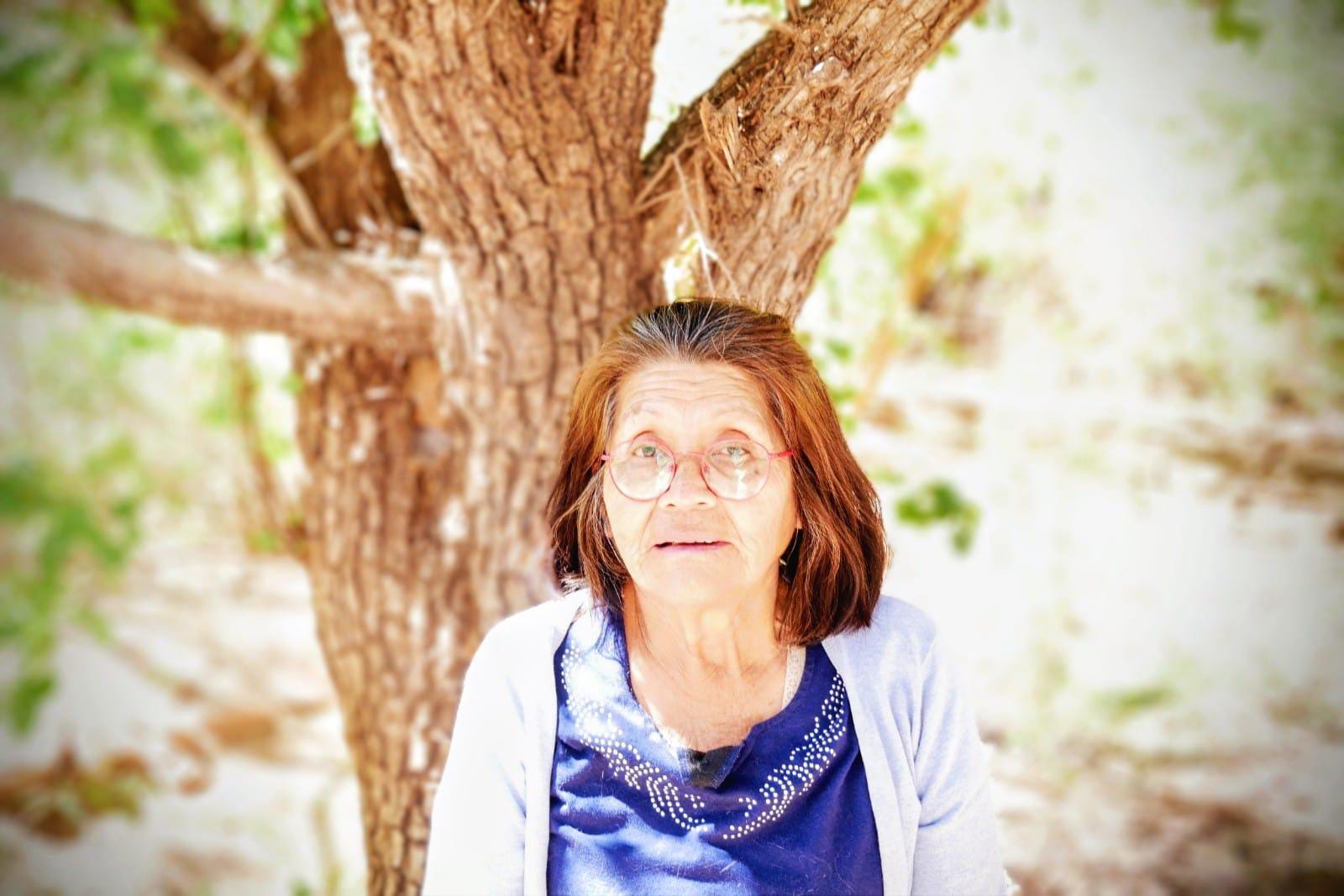
Sonia Ramos Chocobar sweeps kibble from the small kitchen table of her home on the outskirts of San Pedro and shoos her five dogs and three cats into the yard. Chocobar has just returned home after several days in neighboring Calama – where she was attending the first-ever Salt Flats Conference – and the house is a mess. The climate activist has made time between her afternoon grocery shopping and an evening community gathering to meet with me. 

Activist Sonia Ramos Chocobar. 

Chocobar, in her 70s, is a bit of a local legend. In 2009, she made national news when she and another environmental activist (Amelia Mamani, since deceased) silently walked from San Pedro to Santiago, a distance of 1,534 kilometers, to raise awareness about the environmental risks of geothermal exploration near a geyser known as El Tatio — sacred to the Lickanantay indigenous community she comes from. The “march of the grandmothers” was followed by other environmental actions. Most recently, Chocobar walked to Antofagasta, the gritty port town that exports much of the copper, lithium and other resources mined out of the vast expanses of land in what’s known as Chile’s Gran Norte (“Greater North”) region. 

This time her message was different: save the Atacama salt flats.

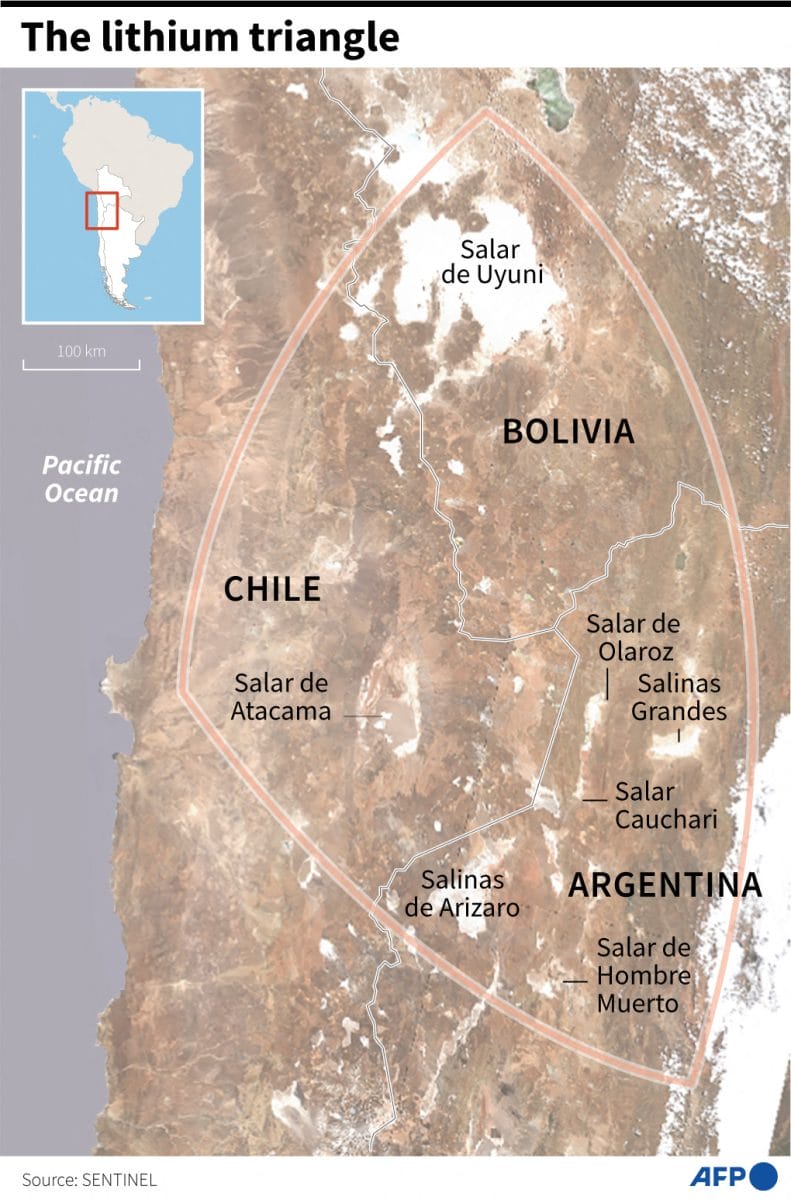
The broader area where the borders of Chile, Argentina and Bolivia converge is often referred to as the world’s “lithium triangle.” This lost corner of South America is believed to hold 68% of the world’s lithium reserves — a key element in the production of the lithium-ion batteries that fuel not only electric vehicles, but, increasingly, data centers and other large “green” infrastructure projects. San Pedro, roughly in the middle of the triangle, is sitting on a modern gold mine — and a faultline for the future of renewable energy.  

Map showing the "lithium triangle" comprising deposits of the key metal in Chile, Bolivia and Argentina. Graphic by AFP via Getty Images.

The town of 2,500 full-time residents has long been at the center of a tug-of-war between different actors, all of whom claim sovereignty – dominion – over the salt flats surrounding it: the indigenous communities who have called this environment home for centuries, the Chilean state and the international markets salivating over the “white gold” extracted from it. Over the years, and through much negotiation on local, national and international levels, a sort of entente had been reached: the state owns the resource, private companies exploit it and some of the profits kick back to local communities. Lithium was even granted a special status under a dictatorship-era decree: a “strategic” mineral, only to be mined with the express agreement of the State. The election of Kast has already disrupted this tenuous equilibrium. The Chilean president has removed environmental protections from roughly 40 different types of natural resources — reopening the tap that has long fueled extractivism and inequality in Chile after four years of left-wing, protectionist policies. 

With counter space cleared and the tape recorder set, Chocobar begins to speak, choosing her words carefully and pausing regularly for emphasis. She sounds tired, but steely. “We are always in a constant effort to protect our water, our land,” she tells me. “We have the misfortune of the Pacific. And we have the misfortune that the Salar de Atacama is one of the greatest lithium sources in the world.”

It wasn’t always this way — in fact, the “resource curse” is relatively new, she explains. For a long time, the Atacama desert was viewed by most Chileans as a no man’s land. Growing up as a member of the Lickanantay indigenous community — also known as the Atacameño people — Chocobar learned how to coexist with the harsh environment, rather than to dominate it. How to extract groundwater, which plants to grow, when and where to shuffle crops. “If we are millenary people, it is because we have found many ways to survive here,” she says. “People think the desert is lifeless, but it’s the exact opposite.” 

Over her many years, Chocobar has seen these techniques slowly disappear: dried-up streams, dying flora and fauna, water rerouted from communities to corporations. The natural richness of the desert lands she calls home has been converted into a monocrop for export. The culprit? The world’s increasingly rapacious appetite for rare earths and metals.

Flamingos drink from a pool on the salt flats of the lithium-rich Atacama desert. But numbers are falling, with studies linking it to mining activity in the area.

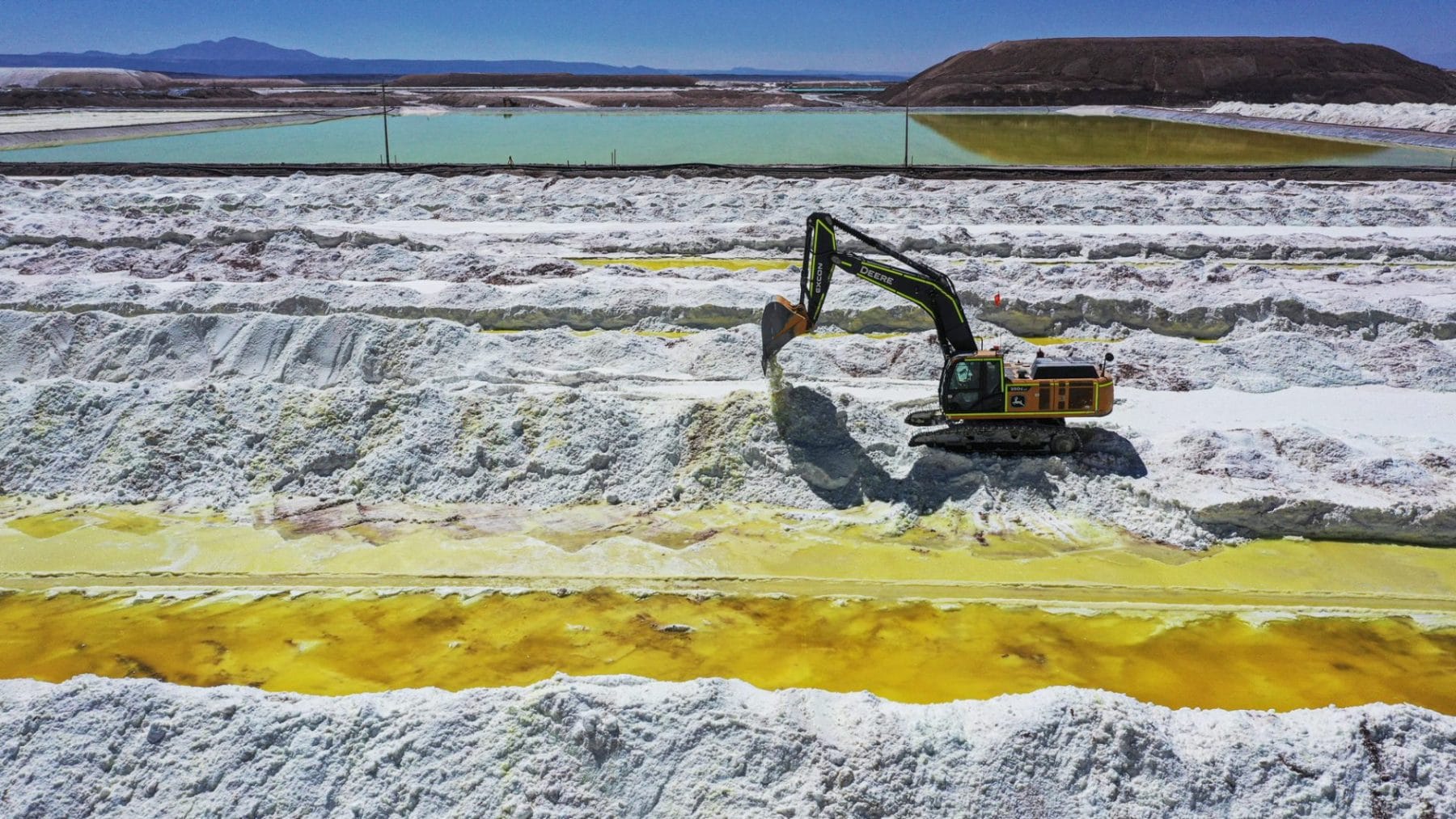
Lithium demands huge amounts of water. To extract the resource through a process called brine evaporation, mineral-rich groundwater is pumped from beneath the salt flats at a rate of thousands of liters per second into vast open-air ponds. Then, the water is evaporated to reveal the lithium. 95% of this groundwater — which once belonged to the smattering of 18 indigenous communities that inhabit the region — quite literally disappears into thin air. 

For local communities, the strain is already noticeable. In San Pedro, an estimated 49% of residents don’t have access to running water, says journalist Ernesto Picco. In one town — the ironically named Santiago del Rio Grande — Picco has reported, 100% of residents have no access to water. 

It's not only humans who are being affected. The water scarcity has modified the breeding and feeding habits of alpaca populations, a local llama herder in neighboring Toconao, Hugo Flores, told me. A river used to run through San Pedro. On one of my days in town, I climbed down a ladder and walked across the dried up stream to get a better view of the distant Licancabur Volcano. The caked ground chipped under my sandals.

“We’re sitting on a watershed, and yet there is water scarcity,” Chocobar explains. “We’re being conquered, in a sense — commercially, economically. It is a natural laboratory that is being destroyed.” 

Lithium hasn’t always been so coveted.

When it comes to minerals, in Chile, copper was for a long time — and still is, to a certain extent —king. Since its discovery in the 1880s, the South American country has been one of the world’s largest exporters of copper, which is drilled out of open pit mines in the Gran Norte region. From the window of a taxi in the port city of Antofagasta the day before, I had admired the massive telescopic loading chutes that transport the mineral directly into the hull of boats, releasing brown-gold particles into the air that settles on surfaces — park benches, balconies, cars — across the city.

It wasn't until the 1960s that the Chilean government began to recognize the benefits of lithium after accidentally discovering it buried in salt brine during an exploration aimed at identifying additional water sources for copper mining. The timing couldn’t have been better. “After World War II, there was a lot of speculative value in lithium as a nuclear material,” James J. A. Blair, a professor at Cal Poly Pomona who has published several papers on lithium mining in Chile, explained over a recent video call. 

In 1979, about six years into his 17-year iron reign and following the lead of the United States, which had done the same, Chilean dictator Augusto Pinochet declared lithium a “strategic resource” reserved exclusively for the state — not on account of its economic potential, which was at the time unknown, but as a national security stockpile. 

This seemingly small linguistic tweak has had long-lasting effects. 

After Pinochet’s decree, lithium extraction came under the auspices of Chile’s State Development Agency, CORFO, which started to ink contracts with private firms for further exploration. A year later, CORFO partnered with U.S.-based Foote Minerals to form the Chilean Lithium Company (SCL), in which the state held a 45% stake. 

What began as a Cold War precaution would quietly harden into one of the most unusual resource regimes in the world. By carving lithium out from the standard mining code, written in the 1930s, the Chilean state created a hybrid model. Lithium was not exactly nationalized, but neither was it fully privatized. “Lithium sits in a legal gray zone in Chile,” Blair told me. “It’s formally non-concessionable — meaning private actors can’t just stake a claim the way they would for copper — but in practice, the state has delegated extraction through long-term agreements that are incredibly favorable to a small number of firms.”

During the dictatorship’s wave of privatizations in the 1980s, control over key lithium assets was transferred to a small circle of politically connected actors. Among them: Julio Ponce Lerou, Pinochet’s son-in-law, who would go on to run SQM, now one of the world’s dominant lithium producers.

“Decisions were made in a highly centralized and opaque way,” researcher Gonzalo Gutiérrez told me over cafeteria food at the University of Chile, in Santiago. “By the time lithium became economically important, the institutional framework was already locked in.”

That framework has proven to be remarkably durable. Even as Chile transitioned back to democracy in the 1990s and expanded its role as a global mining powerhouse, lithium remained an exception — governed not through open concessions but through a handful of contracts administered by CORFO. 

In her 2025 book “Extraction,” researcher Thea Riofrancos notes that even today, two firms — SQM and Albemarle — effectively operate as a “a legally sanctioned private duopoly.” Control over lithium, she writes, is a tightrope between “the palpable potential of public control and the reality of corporate dominance.” 

For Ramón Balcázar, the founder of the San Pedro-based nonprofit, Fundacion Tantí, this legal exceptionalism has had profound consequences on the ground. “The state claims ownership, but the impacts are local,” he said. “Communities were never meaningfully included in the design of these contracts, yet they are the ones living with the depletion of water and the transformation of their ecosystems.”

Balcazar’s nonprofit sits on a side street in San Pedro, across from a trendy French bakery called La Franchuteria that sells iced lattes at European prices. 

Since its founding in 2016, Fundacion Tanti’s small team of researchers has studied the effects of lithium mining on indigenous communities in the Atacama desert. The period has coincided with nothing less than an explosion in the demand for Chilean lithium. 

The growth has mostly been tied to a dramatic rise in demand for electric vehicle batteries. Between 2015 and 2024, global lithium demand grew roughly sixfold, largely driven by EV batteries. The boom has fundamentally reshaped lithium markets: whereas EV batteries accounted for only about 15% of lithium demand in 2017, they made up roughly 85% by 2023. In Chile, arguably the world’s lithium breadbasket, raw materials are mined for export but rarely do its benefits trickle back down to communities.

Left: Brine ponds and processing areas of the lithium mine of the Chilean company SQM, in the Atacama Desert, Calama, Chile.
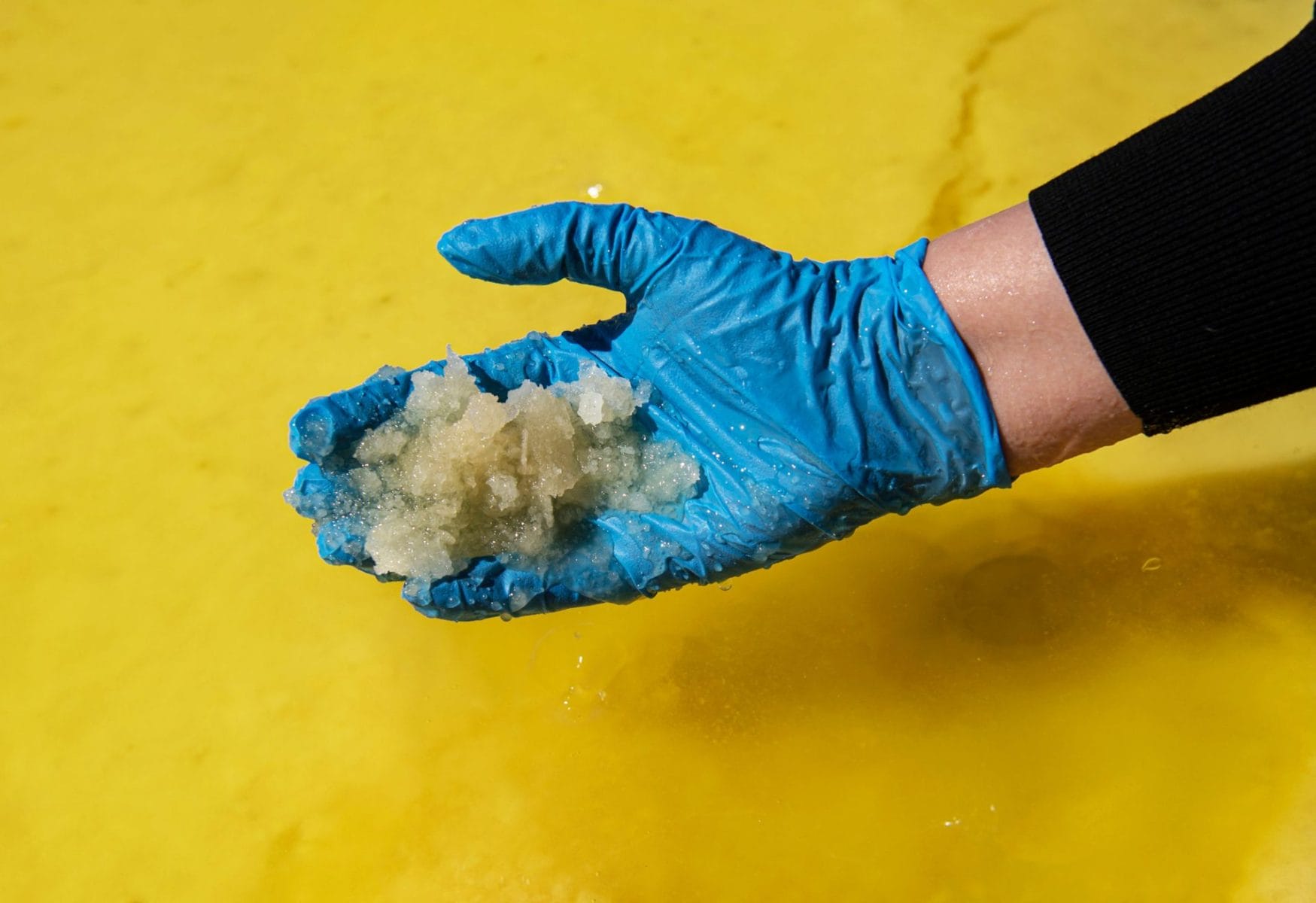
Right: A worker displays 9% lithium from a sample pool at Chilean company SQM's lithium mine in the Atacama Desert, Calama, Chile. Martin Bernetti/AFP via Getty Images.

“Where is the lithium going? To Elon Musk?” Daniela Rodriguez, a local journalist and activist I spoke with in San Pedro, asked. “To send rockets into space, to power electric cars that you never even see around here?” 

In 2021, Balcazar and fellow researchers came up with a neat term for this phenomenon: “green extractivism.” “What we are seeing is not an energy transition — it’s an expansion of the extractive frontier under a green label,” he told me. 

Faced with increasing demand for lithium to fuel the “green revolution,” the Chilean state has tried to thread the needle. In 2019, after a wave of mass protests against neoliberal inequality known as “el estallido social” (the social uprising), Chileans elected Gabriel Boric, a young, tattooed reformer who promised to, among other things, reassert state control over the lithium supply chain to redistribute its value. 

“Lithium is the mineral of the future,” Boric said on the campaign trail. “Chile can’t make the historic mistake of privatizing resources again.” His government promised a paradigm shift: more community involvement, more protection of wetlands, greener methods of extraction. Lithium, he seemed to say, would benefit Chileans across the whole supply chain and not just a select few at the top.

In April 2023, the government announced its National Lithium Strategy. The policy sought to expand production while increasing state control through public-private partnerships, renegotiate the contract with SQM (the same private company once headed by Pinochet’s son-in-law) and include community and indigenous participation in future lithium exploration decisions. 

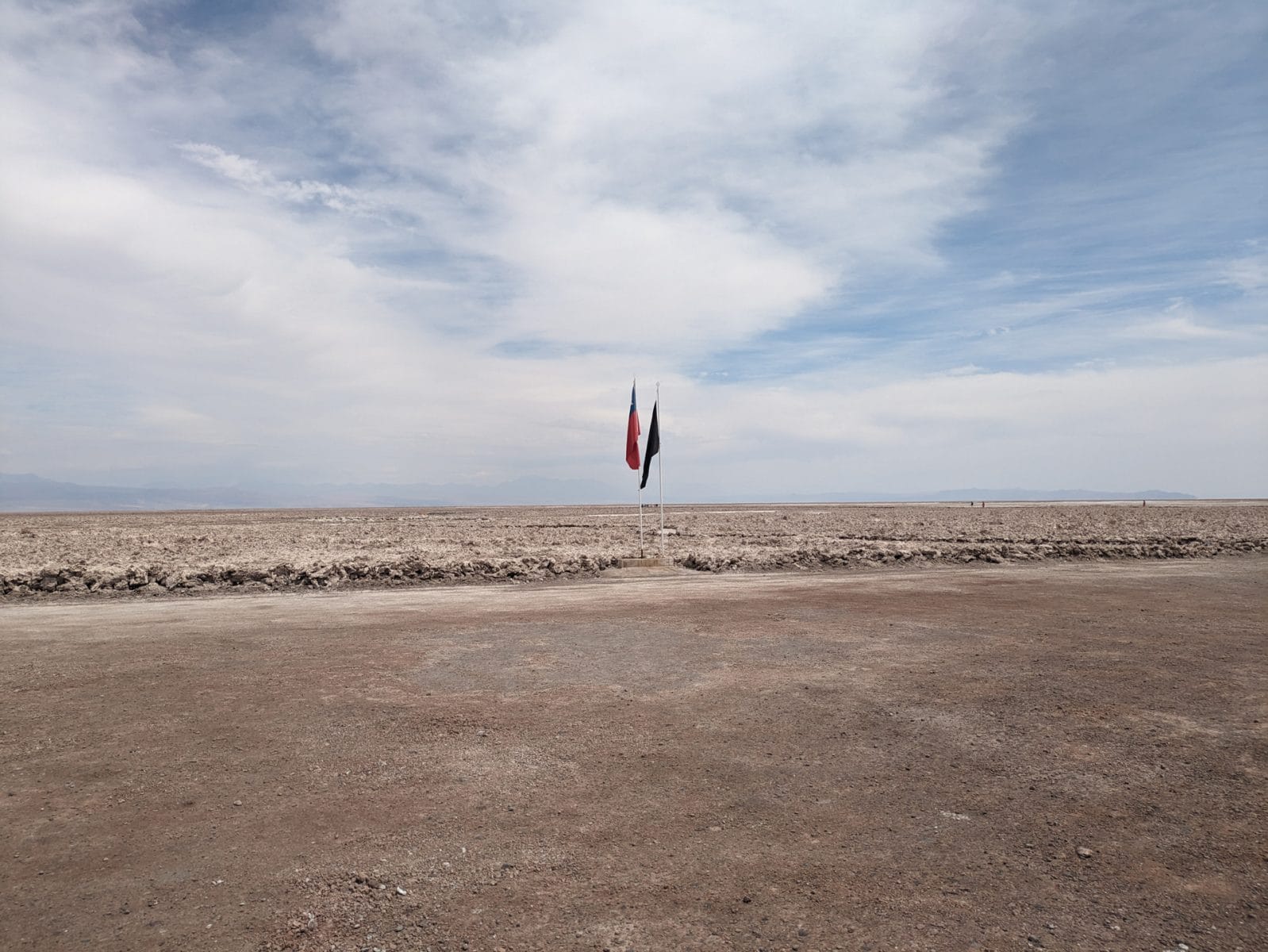
A Chilean flag next to a black flag symbolizing indigenous resistance. 

In all, Boric’s government identified 68 salt flats that could be opened to mining exploration, but also 27 wetlands to be protected, Riofrancos, the author of “Extraction,” notes in her book. 

“The national lithium strategy is Boric's most successful policy,” Nicolas Grau, Boric’s former finance minister, told me over the phone. “It will allow Chile to industrialize through lithium — growing the economy while also protecting the environment.” After years of passive control, the state would finally take a more “protagonistic role” in managing the resource, Grau said, without nationalizing it.

To Riofrancos, the juggling act under Boric was typical of what happens when a state tries to pry some space in a market where extractivism has long been left unchecked. “Boric’s blueprint cited Allende as an inspiration, but his approach was more conciliatory toward extractive capital than anything Allende had proposed,” she writes. 

Local communities in San Pedro felt similarly. “The only thing politicians care about is being in power,” Chocobar said in San Pedro. “For all intents and purposes, we might as well not exist.” 

Boric’s successor, Kast has quickly rolled back environmental protections, fulfilling his campaign promises of commercializing mining and partnering with the U.S. regardless of the environmental impacts on the salt flats. 

Jorge Heine, a former Chilean diplomat and expert on international relations, argues that Kast is more constrained than it might appear. “People tend to overestimate how much a single administration can reshape lithium policy,” Heine explained. “This is a sector governed by long-term contracts, by international commitments, and by a legal framework that has proven remarkably resilient. Kast can tweak, accelerate, or slow things down, but dismantling the model entirely would come at a significant political and economic cost.”

But huge costs are already being paid, costs that communities in San Pedro have been living with for decades. Could Kast’s attempts to liberalize lithium mining and potentially exacerbate inequalities and environmental damage galvanize resistance?

For now, the signs of that resistance are still weak: graffiti scrawled on the side of the road, a grandmother walking along a highway with a cardboard sign, four panels of wood hung in a town square. But like lithium itself, transformations tend to take place very slowly at first — millennia of build-up in the brine — until suddenly they happen very fast. From Santiago to Atacama, protesters have been taking to the streets. In June, broader protests against Kast’s dismantling of social programs and services turned violent. 

At some point, austerity for the people contrasted with largesse for mining companies, technology companies and acquisitive foreign powers becomes hard for even a government elected in a landslide to defend.

The post The Chilean curse is its abundance of riches appeared first on Coda Story.

  • ✇Coda Story
  • “All my fundees have blue eyes.” Epstein and the tech world’s dark ideology
    It starts with a simple search term in the Department of Justice’s Epstein Library. “Blue eyes.” Hundreds of results. Jeffrey Epstein’s international trafficking agents send him pictures and descriptions of blue-eyed young girls: potential victims to be dispatched to his various homes. “I spotted two skinny blond blue eyes 21 years old ladies in Monaco last weekend and asked them for CVs,” one agent, whose name has been redacted, wrote. “Trying her best to move from her small town to Moscow;
     

“All my fundees have blue eyes.” Epstein and the tech world’s dark ideology

28 avril 2026 à 14:15

It starts with a simple search term in the Department of Justice’s Epstein Library. “Blue eyes.” Hundreds of results. Jeffrey Epstein’s international trafficking agents send him pictures and descriptions of blue-eyed young girls: potential victims to be dispatched to his various homes. “I spotted two skinny blond blue eyes 21 years old ladies in Monaco last weekend and asked them for CVs,” one agent, whose name has been redacted, wrote. “Trying her best to move from her small town to Moscow; English isn't great. Could be fun for Paris, blue eyes,” wrote another. “Can't understand if her breast is real. Otherwise very pretty and sweet…Very blue eyes as we like.” 

One of Epstein’s victims wrote of being chosen for her eye color in a journal entry later shared with federal prosecutors. "Superior gene pool?!? Why me?" she wrote, describing Epstein's worldview as "Nazi like." "It makes no sense. Why my hair color and eye color?" 

Epstein — himself blue-eyed — seemed to prefer both his victims, and the people he bankrolled, to have blue eyes. “All of my fundees have blue eyes,” he boasted in one email. In the entryway of his Manhattan townhouse, he displayed dozens of prosthetic eyeballs in a frame. Epstein made notes and sent article links to his contacts asking if having blue eyes meant you were more intelligent or a “genius”. He even had a list of scientists and tech leaders with blue eyes — including Elon Musk, Peter Thiel, and Google’s Ray Kurzweil. “Total — 70 people Blue eyes — 41 Unclear (might be blue, but not 100% sure)” the list says. Appearing in the files — whether on this list or elsewhere in Epstein's records — does not connote legal wrongdoing.

Going deeper into the files, Epstein and his network of contacts discussed beliefs about how physical characteristics and race might denote intelligence. They exchanged emails about population control. They spoke of engineering women’s sex drives, building designer babies, and living in a world full of superintelligent humans that could merge with robots. They spoke of getting rid of the elderly, the infirm, and the poor.

The files offer a glimpse into a world where ideas about eugenics and race science have never gone away. On the contrary, they run through our elite universities, through the most powerful companies in Silicon Valley, and through the tech industry itself. Epstein’s was an exclusive club that counted among its members people who harbor dreams of re-engineering human minds and bodies, seizing control of our collective future, and building technology that, they hope, will one day merge with — or even replace — all of us.

Jeffrey Epstein, 27. Jeffrey Epstein's mansion El Brillo Way in Palm Beach. U.S. Virgin Islands, Department of Justice, Sexual Offender Registry Photograph.

In 2002, two decades before the launch of ChatGPT, Epstein hosted an Artificial Intelligence summit on his Caribbean island. In the years that followed, he cultivated close, regular contact with a network of  (predominantly male) scientists, researchers, academics and tech leaders working at the vanguard of AI, biotech, genetics and cognitive science, meeting them at universities like Harvard and at his various homes. 

In August 2018, a year before Epstein was found dead in his jail cell, he was in email correspondence with software consultant and bitcoin investor Bryan Bishop about funding a project to create “designer babies” — children with genes cherrypicked for their looks, health, strength, immune systems, sleep needs and even, in Bishop’s imaginings, abilities to live on a different planet. 

  “Attached is the doc you requested, it's the "use of funds" spreadsheet for the designer baby and human cloning company,” Bishop wrote to Epstein. “This gets us out of our self-funded ‘garage biology’ phase to the first live birth of a human designer baby, and possibly a human clone, within 5 years. Once we reach the first birth, everything changes and the world will never be the same again.”

Bishop went on to discuss how his ultimate ambition was to make “practically unlimited modifications to the cells before generating an embryo.”

In response to a request for comment, Bishop sent Coda a publicly available set of answers to frequently asked questions about designer babies.

“The reason people have an aversion to eugenics, and rightfully so, is because countries used genocide and sterilization to prevent reproduction by populations that they didn’t like. We have no intention of doing anything of the sort,” Bishop writes in the public FAQ. “‘Designer baby’ simply describes a child whose genome has been intentionally altered or chosen by their parents, rather than left entirely to the genetic lottery of natural conception.”

“It’s such a great subject,” Epstein responded after he read Bishop’s proposal. “We need to get a read on legal. Can’t do anything where US rules apply to US citizens regardless of where [they are].” 

Building a super-race of humans, and parachuting humanity into a different evolutionary era — or even obsoleting the human race as we know it — is a running theme in the Epstein files, and an increasingly prominent ambition for tech evangelists today.

“It’s eugenics all the way down,” said Jacob Metcalf, a founding partner at Ethical Resolve, a consulting firm working with tech companies to develop their ethics protocols. A common fantasy in tech circles, he said, is “to essentially control human destiny. And a lot of the times that human destiny is for humans to be replaced. That's the really bleak thing here. What could be more eugenic than getting rid of humans.”

In 2008, Epstein began conversations with the computer scientist Ben Goertzel. Over the years, Epstein would send Goertzel more than $360,000 to fund the researcher’s plans to build towards Artificial General Intelligence (AGI), a term Goertzel himself popularized.

“I remain eager to move forward on working together to accelerate progress toward a human-obsoleting thinking machine,” Goertzel wrote to Epstein in May 2008. Eighteen years on, and the idea of obsoleting humans with artificial intelligence is widely discussed in the tech world.


When asked to comment on his exchange with Epstein, Goertzel told Coda: “I do think we will create forms of transhuman intelligence going beyond the scope of humanity as we know it, but I also very much hope and envision a strong role for humans even after this happens.”

Goertzel went on to describe a future where the world reaches the “Singularity” — a Silicon Valley buzzword signifying a tipping point where AI surpasses human intelligence. “I do think AI will eventually gain its own superhuman autonomy, but I think this can happen in a way that respects and nourishes human life rather than being harmful to it,” he said. “Epstein and I discussed this face to face a few times and indeed I was a bigger fan of the human species than he was, and more optimistic about its flourishing post-Singularity.” 

In an email to Epstein, Goertzel laid out a scenario where AI systems would start running their own economic activity. He envisioned this Artificial Intelligence economy acting as a “parasite to overcome the regular human economy” that would eventually “gain its own superhuman autonomy.” The ideas Epstein and Goertzel exchanged mirror a broader conversation unfolding in the tech world that imagines a future where ultimately, human labour could be rendered superfluous, and ultimately be replaced by artificial intelligence and robots.

Together, Goertzel and Epstein also discussed modifying human brains — a concept popular in Silicon Valley today, where numerous brain-computer projects are researching ways to cognitively enhance the human brain, and alter human personality, memory, and mental capabilities.

In 2008, when Epstein told Goertzel he was “off to jail” for a year, after he was convicted of soliciting a minor for prostitution, Goertzel suggested the solution to his problems might one day be solved if human brains could be re-programmed.

Ben Goertzel with Desdemona the robot, at a tech event in Portugal in November. Sam Barnes/Sportsfile for Web Summit via Getty Images.

“According to my understanding, the girls you were involved with were old enough to know what they were doing, so society really has no ‘moral right’ to lock you up,” Goertzel wrote to Epstein. “This is a fucked-up society we live in. But past ones have really been no better -- the fault is really w/ the human brain architecture, which is precisely what I'm aiming to supercede in my AGI work.”

When asked to comment on these remarks — and in particular the implication that Epstein’s problems might be solved if his accusers' brains were one day re-engineered — Goertzel told Coda: “This was a general observation that the messed-up nature of our society generally is rooted in the way our brains have evolved... and that advanced tech will let us modify our brains to make ourselves and thus our society better.  There was no implication intended (nor stated) that women’s brains are any more or less messed up or in need of improvement than men’s.”

Goertzel reflected that his comments on Epstein’s victims being “old enough” were “regrettable and unfortunate in hindsight,” adding that his impression was that Epstein had been involved with adult women, not “disgustingly curating high school students for sexual purposes. I should have paid more attention.” 

In 2013, three and a half years after Epstein was released from jail, Goertzel approached Epstein for funding to build a “toddler robot”. Given Epstein’s criminal history of abusing minors, this has inevitably attracted attention online. “When we were discussing measuring the IQ of robot toddlers, the topic was never sexualized in any way,” Goertzel told Coda when asked about the project. “While I had nothing to do with Epstein's perverse sexual tastes or abuse of women, what I have read about his awful doings in the newspapers relates to his interest in teenage girls not toddlers.”

Epstein was particularly interested in funding projects that built — like Goertzel’s –- on transhumanist theories. Transhumanism is a worldview that captivates many of the most prominent tech leaders in Silicon Valley today. It believes in a future when the human body can be endlessly altered, genetically engineered, and ultimately fused with artificial intelligence. 

“Transhumanism is a much more radical concept than eugenics,” explained Timnit Gebru, a computer scientist and researcher who has written extensively about eugenicist ideas within artificial intelligence. “In eugenics, you're trying to create a more superior human by breeding humans through generations. In transhumanism, you're trying to get rid of humans altogether.”

For transhumanists, she added, “their idea is to get rid of any undesirable properties they see with humans."

Perhaps the most well-known proponent of transhumanism in the Epstein files is Peter Thiel.

“I think you would prefer the human race to endure, right?” New York Times journalist Ross Douthat asked Thiel last year. “Uh—,” Thiel said. “This is a long hesitation!” Douthat said. “Should the human race survive?” “Yes, but I would like us to radically solve these problems,” Thiel said. “We want you to be able to change your heart and change your mind and change your whole body.”

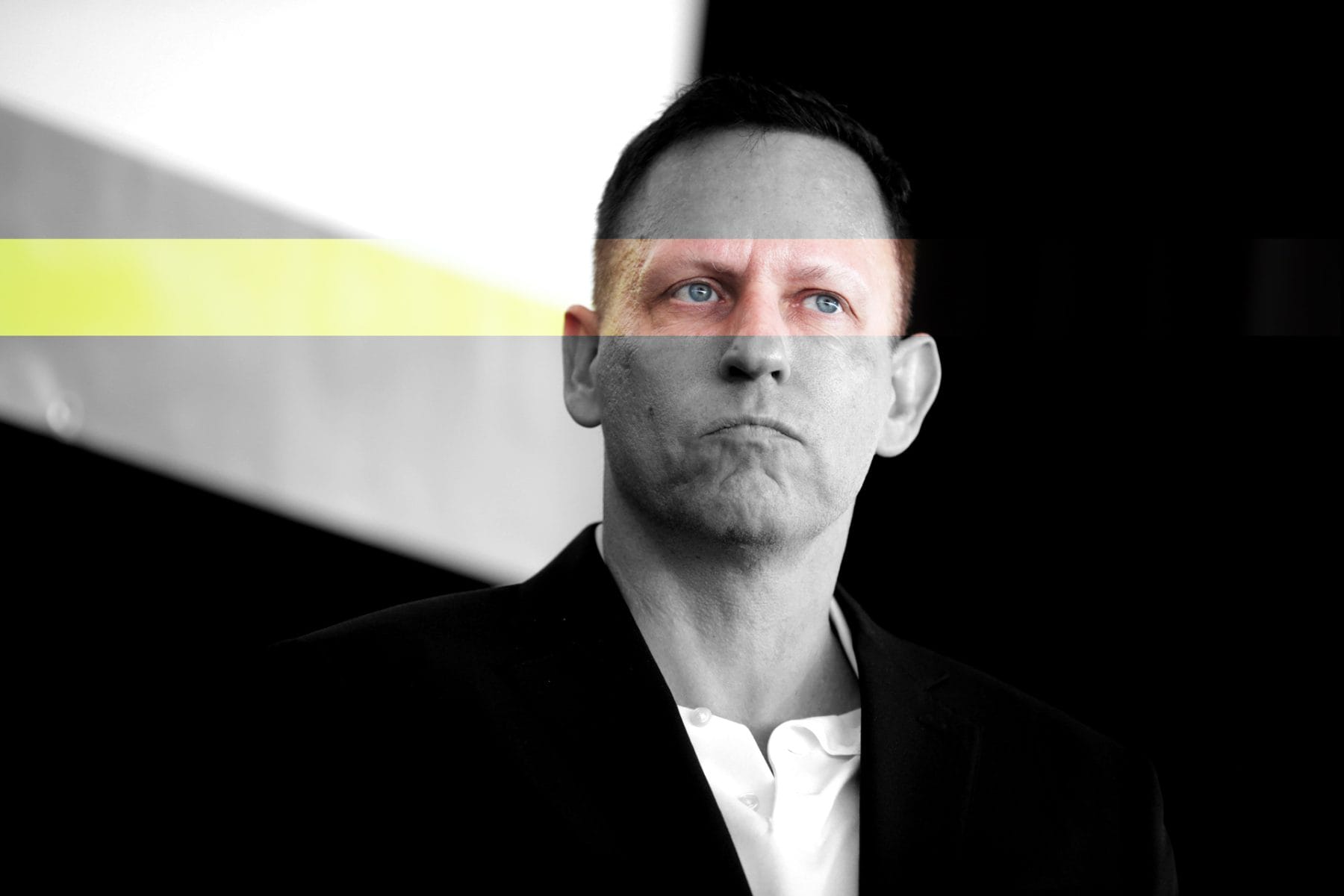
Peter Thiel. Creative Commons (CC BY 2.0) /Gage Skidmore.

Thiel’s name appears in the files more than 2000 times, and Epstein reportedly invested some $40 million into Valar Ventures, a firm co-founded by Thiel. The two spoke of building secret societies and shared an interest in transhumanism and cryogenics — Epstein wanted to freeze his brain and penis when he died, so that one day he could be revived, while Thiel has also stated his body will be frozen after his death. 

They also appeared to share an interest in bringing an end to the democratic systems of today, imagining a different system altogether. Epstein, for his part, spent his life puppeteering the most powerful people in the world and undermining democratic systems. Thiel, meanwhile, first expressed his own anti-democratic views in 2009 when he wrote: “I no longer believe that freedom and democracy are compatible,” adding that since women were allowed to vote, the notion of a capitalist democracy became impossible. When the Brexit vote came through, Epstein wrote to Thiel: “Brexit, just the beginning.” Thiel asked — “of what”; Epstein said – “Return to tribalism, counter to globalization, amazing new alliances.” 

Globalization — and the idea of internationally powerful governing bodies — is a worldview that both Epstein and Thiel seemed to distrust. In March, in a palazzo in Rome, a stone’s throw from the Vatican, Thiel gave one of his infamous lectures in which he espoused his views about an “antichrist” that gets in the way of technological progress. This antichrist, he suggested, could be an internationally powerful body; the product of globalization. I stood outside the palace as attendees — priests, students, researchers — mutely hurried out, refusing to speak to the cluster of reporters waiting for Thiel’s black Mercedes. 

“He has a totally irrational side, which lives on fear, of what danger might happen,” one audience member told me of Thiel on condition of anonymity, recalling how, up close, Thiel looked haunted and ill. “His head is full of future scenarios, which is what’s killing him. I think he’s scared.”

Thiel did not respond to multiple requests for comment. 

Epstein didn’t confine himself to lofty conversations about a future collapse of the global order or re-engineering humanity. He also had ambitions for his own personal eugenics project. In 2019, it emerged that he wanted to seed the world with his DNA — and reportedly have 20 women impregnated at a time at Zorro ranch, his New Mexico property.

Epstein tried to recruit Virginia Giuffre for this very project. He “fantasized about improving the human race by fathering children who carried his superior genes,” she recounted in her memoir, published posthumously late last year.  “He’d talk about using his Zorro ranch as a literal breeding ground to propagate babies.” When Giuffre was 18 years old, she recalled, Epstein asked if she would carry his child and hand over all legal rights to it – “like a modern-day handmaid.”

Zorro Ranch, New Mexico. Diary of Epstein's victim.

In a haunting diary entry from another Epstein victim, written between the ages of 16 and 17 and shared with federal prosecutors, a girl describes being told she will be sent to Zorro ranch — possibly to participate in the very same project. “Go to New Mexico? What in the hell? This makes no sense. What about school?” she writes, describing how Epstein chose her for her hair color and eye color, and tried to convince her she would create “perfect offspring.”

The teenager chronicles her pregnancy, pasting a sonogram into the scrapbook, before giving a traumatic account of giving birth with Ghislaine Maxwell beside her. “Ghislaine said to push all the pain away. I don't understand. Blood and water all over the bed.” As the baby was born, she writes, Maxwell covered her eyes. “I saw between her fingers this tiny head and body in the doctors hands.”

The girl describes hearing the baby’s “tiny cries” before “they took her.”

“I’m nothing but your property and incubator,” the teenager writes of Epstein. The diary is a terrifying piece of evidence that appears to link to Epstein’s longstanding fixation with creating genetically bespoke humans. The diary author’s lawyers, Wigdor LLP, declined to comment.   

Epstein’s fever-dreams of creating an army of children carrying specific genes reflect a broader trend of “pronatalism” — a movement historically tied to eugenics — that’s thriving in Silicon Valley.

 Millions of dollars of funding are currently being poured into projects creating “superbabies,” while billionaire tech oligarchs including Elon Musk — whose name appears more than 1000 times in the files — reportedly want to use surrogates “to reach legion-level before the apocalypse.” Musk did not respond to requests for comment.

In the files, women appear either as victims, as objects, or as vessels for genetic engineering experiments. They are an inconvenient reality, people to be controlled and re-booted. Epstein wrote a 2013 email implying that women “are like shrimp. You throw away the head and keep the body.” 

“The obsession with "artificial" life appears tied to a masculine desire to try control the production of life – ultimately ridding themselves of their dependency on women," said Gabriella Razzano, Co-Founder of OpenUp, a social impact tech lab based in Cape Town, who is also a senior advisor at the African AI Observatory. “I think there is important work to be done on tying the narratives that are very revealing in the Epstein files to understand how, and why, technology is being developed as it is.” 

The trading of ideas about intelligence — both artificial and human — takes a particularly sinister turn in a 2016 exchange between Epstein and the cognitive scientist and AI researcher Joscha Bach, whose research Epstein funded to the tune of $300,000.

Bach writes to Epstein about a study claiming that “black children outperform white children in motor development, even in very poor and socially disadvantaged households, but they lag behind (and never catch up) in cognitive development even after controlling for family income.”

Epstein responds with racist ideas about his notion of how to “make blacks smarter”, adding — “maybe climate change is a good way of dealing with overpopulation. The Earth’s forest fire. Potentially a good thing for the species,” before contemplating a world with “too many people,” where “many mass executions of the elderly and infirm make sense.” 

Bronze sculpture of a female torso Jeffrey Epstein's Manhattan residence.


Epstein then imagines creating a future “Übermensch” — a superior human with cherry-picked attributes. “What I like is the idea that ubermensch could be the melding of humans, put together in one brain,” Epstein writes. This bespoke human, he suggests, would include traits from marginalized groups, who he appears to believe have a stronger awareness of how to navigate power structures because of their historical exclusion. “An increased motor system, an increased awareness, an increased status calculator (Blacks, jews, women). Ubermensch could be the combination of the best of humans, not the best of a specific race or gender. Fun idea.” 

Bach told Coda in a statement: “I was summarizing a scientific study in a private email. Studies like this get often abused in ideological discourse to justify discrimination, which I strongly oppose and condemn.”

“I am firmly opposed to any form of racial discrimination, and I reject the use of group-level statistical claims to make judgments about individuals or to justify unequal treatment.” 

He continued: “It goes without saying that if global warming were to lead to a reduction in the human population, it would be accompanied by immeasurable suffering. Our civilization would break down, leading to a return to dark ages, in which the elderly and infirm were often killed, because people could not support them, and often did not care about supporting them. Every reasonable person understands that this is horrible and not desirable in any way.”

Epstein “was often callous about human suffering in a way that I found disturbing but worth understanding, as a window into the perspectives of the rich and powerful,” Bach added. 

Alongside Epstein’s conversations about mass executions for the old and and the sick, he was also interested in Silicon Valley’s dream concept of living forever — he had numerous email conversations with the longevity guru Peter Attia about prolonging his own lifespan, and funded a Harvard project geared towards “the end of aging.” In an email to Attia, Epstein mused: “I’m not sure why women live past reproductive age at all.” Attia, who published a statement about his relationship to Epstein, did not respond to requests for comment. 

This interest in “longevity” — living for as long as possible, even living forever, is popular among the elite precisely because they find themselves in an elite class, says David Robert Grimes, a scientist and disinformation expert who has written about longevity and race science in Silicon Valley. “They're both sides of the same coin — the Silicon Valley eugenics, and also the longevity stuff. They promote an idea that ‘we are exclusive and we are special',” he said. "It helps them to justify deep social inequality."

The tech elite did not inherit this ideology by accident. Stanford University, the intellectual heart of Silicon Valley, was once a major hub for the American eugenics movement, which later helped to inspire Nazi race laws. Stanford’s founding president, David Starr Jordan, was a prominent eugenicist, campaigning for forced sterilization of people with undesirable genetic traits. The university removed his name from its buildings in 2020 — but in Palo Alto, his beliefs did not disappear with the nameplate.

"Instead of eugenics we just call it longevity or biohacking," Christopher Wylie, the Cambridge Analytica whistleblower who has spent years investigating Silicon Valley's belief systems, said on a panel with me at a journalism conference last year. "It's the same."

The ideology Epstein bankrolled in private is being built in public. It’s a vision of the future in which a select few get to upgrade and extend their lives, while tightening their grip on the systems that determine which humans are worth investing in — and which are not.

It sounds like a dark sci-fi fantasy, except, as the files show, that fantasy is being funded and pushed into reality. Most of us will never be in the rooms where these ideas are discussed. All of us will live with the results.

The post “All my fundees have blue eyes.” Epstein and the tech world’s dark ideology appeared first on Coda Story.
❌