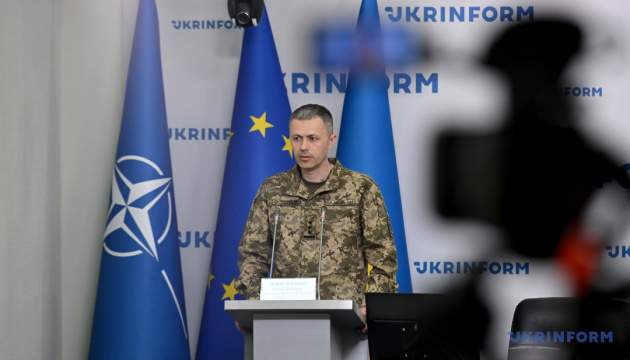
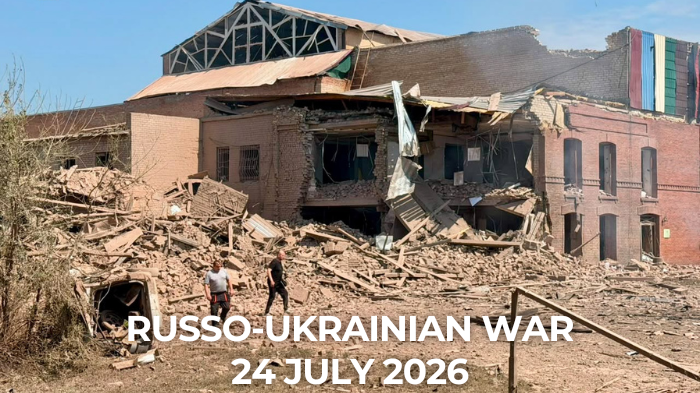
Russia continues to pressure Belarus, attempting to draw it into the war against Ukraine or to use its territory to redeploy its troops. At the same time, no strike groups are currently being formed near the Ukrainian border.
Russia continues to pressure Belarus, attempting to draw it into the war against Ukraine or to use its territory to redeploy its troops. At the same time, no strike groups are currently being formed near the Ukrainian border.
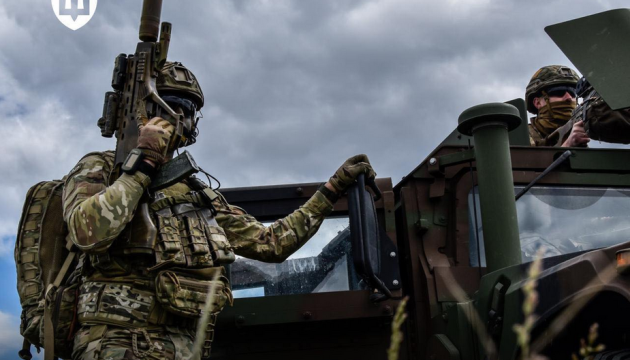
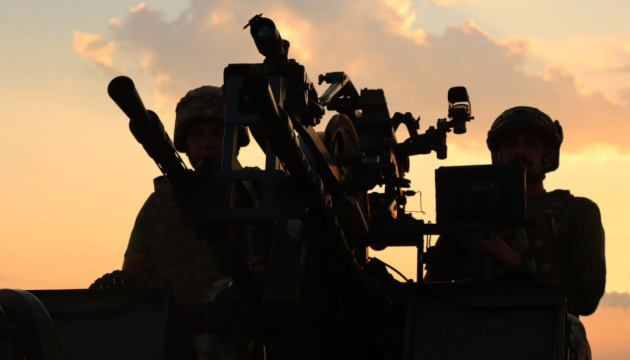
Soldiers of the 3rd Regiment of the Special Operations Forces of the Armed Forces of Ukraine cleared a forest area where Russian units had been hiding for a long time, enabling Ukrainian forces to establish a foothold in a previously inaccessible area.
Soldiers of the 3rd Regiment of the Special Operations Forces of the Armed Forces of Ukraine cleared a forest area where Russian units had been hiding for a long time, enabling Ukrainian forces to establish a foothold in a previously inaccessible area.
Former U.S. Secretary of Defense Mark Esper has described Ukraine as the most combat-capable and experienced army in Europe, noting that Ukrainians have effectively brought Russia's war to a stalemate while becoming innovators in modern warfare.
Former U.S. Secretary of Defense Mark Esper has described Ukraine as the most combat-capable and experienced army in Europe, noting that Ukrainians have effectively brought Russia's war to a stalemate while becoming innovators in modern warfare.
Ukraine's latest drone hunter is a surplus European naval helicopter
The nine Sea Kings in or bound for Ukraine are stable, capacious and cheap to operate
That makes them good platforms for launching small interceptor drones
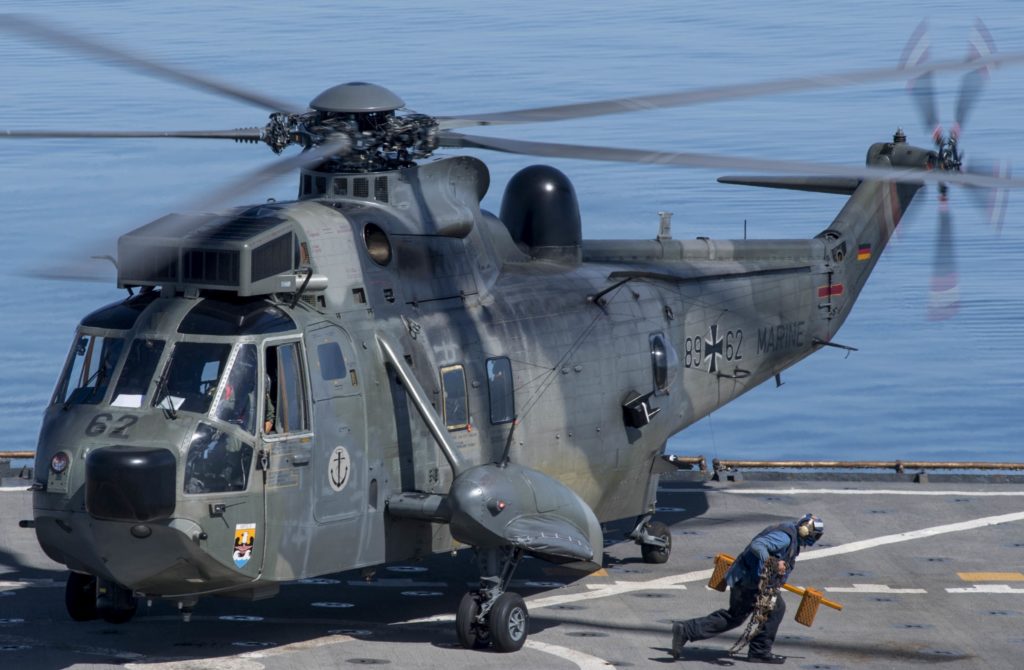
The Ukrainian navy's tiny fleet of donated Westland Sea King helicopters appears to have a new mission: hunting Russian Geran drones.
Aviation reporter H.I. Sutton was the first to note the new mission, when he spotted a specially equip
Ukraine's latest drone hunter is a surplus European naval helicopter
The nine Sea Kings in or bound for Ukraine are stable, capacious and cheap to operate
That makes them good platforms for launching small interceptor drones
The Ukrainian navy's tiny fleet of donated Westland Sea King helicopters appears to have a new mission: hunting Russian Geran drones.
Aviation reporter H.I. Sutton was the first to note the new mission, when he spotted a specially equipped Sea King on the ground at the Farnborough Air Show in the United Kingdom this week.
The 1970s-vintage Sea King had new equipment: an under-fuselage railing for small interceptor drones. Ukrainian forces use the inexpensive interceptors to chase down and take down Russia's Geran one-way attack drones. Some of the remote-controlled interceptors feature A.I.-assisted targeting and pack tiny explosive charges. Others are strictly manually controlled and knock down their targets through the sheer force of impact.
Regardless of the details of their designs, interceptors costing just a few thousand dollars apiece have helped Ukrainian air defenders blunt the impact of the thousands of Gerans, drones modeled after Iranian-made Shaheds, that Russia launches at Ukrainian cities every month. Air defenders typically take out around 90% of incoming Gerans.
But interceptor drones come with limitations. They're powered by batteries that exhaust themselves after just a few minutes of flight. And they are prone to being blinded by bad weather and low clouds. To prolong the interceptors' flights and get them above the rain and clouds, Ukrainian forces have begun using manned aircraft to loft the interceptors into the air before launching them.
The Sea King, it seems, is Ukraine's latest interceptor drone carrier. While the helicopter Sutton spotted at Farnborough was unmarked, it's likely one of six Sea Kings Germany has donated to the Ukrainian war effort. The United Kingdom previously donated three surplus Sea Kings to Ukraine. The Ukrainian navy's sole helicopter unit, the 10th Naval Aviation Brigade, reportedly operates the Ukrainian Sea Kings.
Before now, it seems the Ukrainian Sea Kings strictly flew coastal search and rescue flights in support of Ukrainian ground and naval forces. But there's an obvious need for more air defenses over the Ukrainian coast. Sea Kings hauling interceptor drones under their bellies, and the drones' operators in their cabins, could be just the thing.
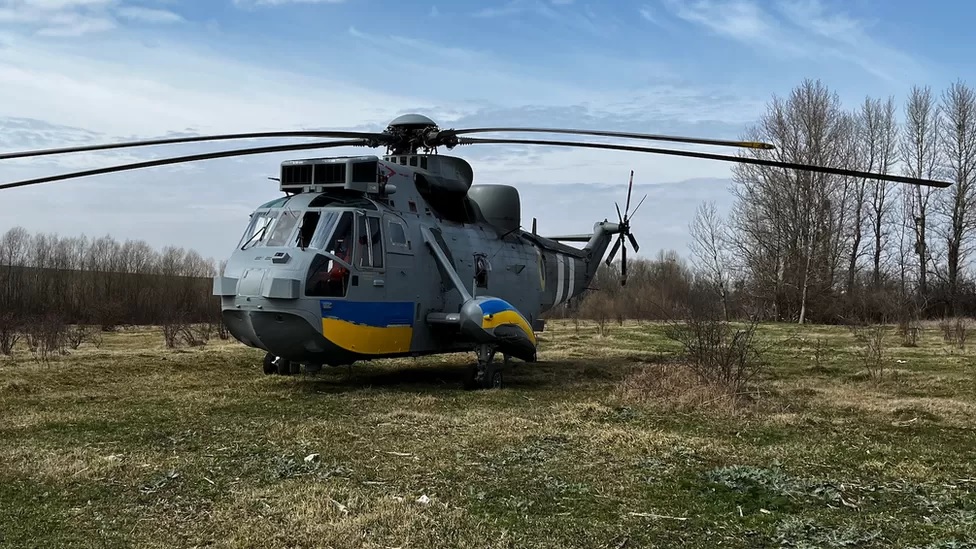
Westland Sea King helicopter of Ukraine's Navy. April 2023. Photo: BBC News
Geran killer
The threat: A.I.-assisted Geran drones. Shortly after Ukrainian drone forces began targeting the tankers, dry cargo ships and auxiliaries belonging to the unregistered "shadow fleet," Russian forces retaliated, launching cruise missiles and Gerans at grain ships and infrastructure in Odesa and other ports in southern Ukraine. Over weeks of near-daily port strikes, Russian missiles and drones have repeatedly hit grain carriers and terminals; the deadliest, a cruise-missile strike on the bulk carrier Golden Leo on 19 July, killed 10 of its crew.
An interceptor drone flying around 350 km/h is too slow to hit a cruise missile flying 900 km/h, but all but the fastest jet-powered Gerans are within the targeting envelope of all but the slowest interceptor drones. The problem, of course, is battery life and weather. To stand the greatest chance of hitting the most Gerans, the interceptors should launch from around a thousand meters in the air.
The Sea King is an old helicopter. But it's also reliable, cheap to operate and capacious. A solid platform for drone launches.
And it's part of a widening trend. This spring, Ukrainian forces armed an Antonov An-28 light turboprop transport with interceptor drones, complementing the An-28's existing side-firing gun and giving the lumbering transport great reach during its drone hunts.
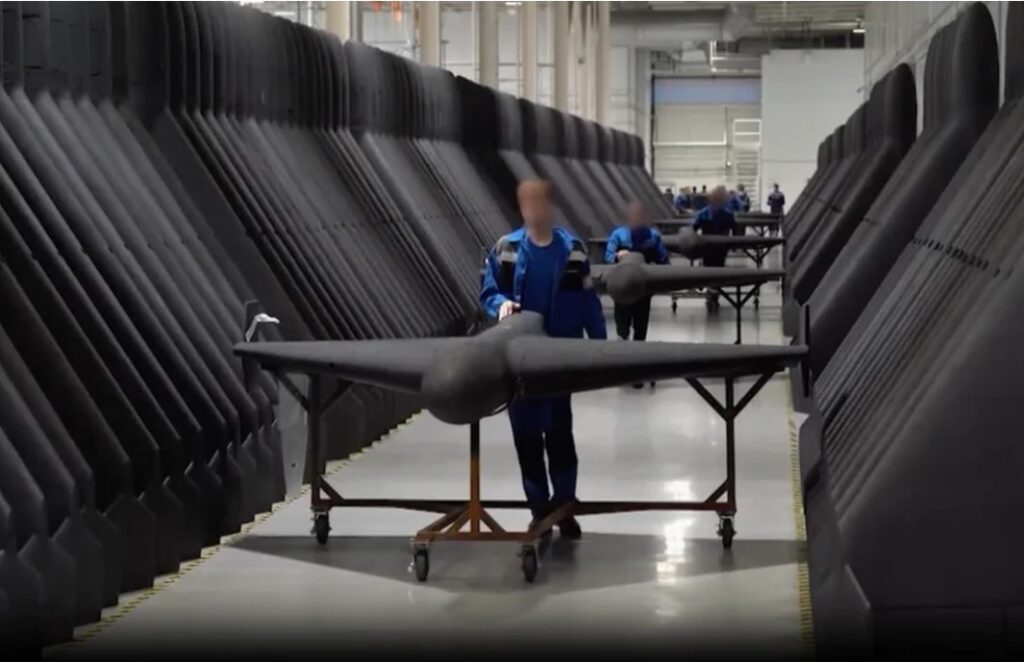
As a drone platform, the An-28 apparently works. Well enough, in fact, that Russian forces have copied the concept. A recent video depicts two old Russian warplanes getting the fittings for aerial interceptor drone launch: a Yakovlev Yak-52 turboprop trainer and an Antonov An-2 piston-powered transport.
Like the Ukrainians do, the Russians hang drones under the planes' wings and seat the drones' operators inside the cabin or cockpit. All aerial drone platforms require add-on radios and antennae to connect the seated operators to their interceptors so that the operators can see what the drones see, and steer them to a hit.
If the Sea Kings also work well as drone platforms (and there's no reason they shouldn't), the Ukrainians may well extend the concept to other airframes. Any helicopter, transport or trainer with a reasonable payload and some space in the cabin or cockpit is eligible.
The Sea King is the latest Ukrainian drone hunter, but it's probably not the last.
Exclusives
Russia took the cages off its newest tanks. The new Arena-M shield bought them a few minutes.. The Russians' new Arena-M systems shoots tiny projectiles at incoming enemy drones. But it didn't save a rare Russian tank assault this week.
Washington taxes Russian goods at the same rate as Norway’s. It is a blanket forced-labor measure, not a Russia policy—and the sanctions that would hurt Moscow are still stuck in Congress.
Germany’s Zeitenwende stops at
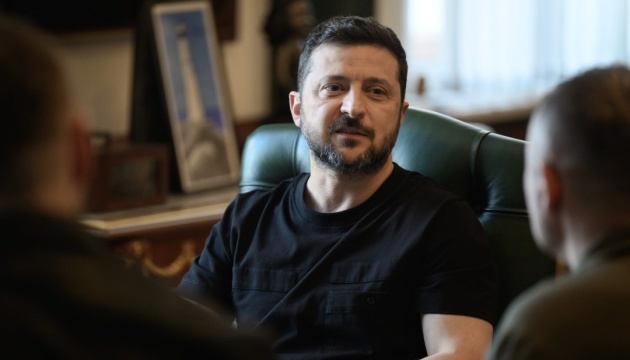
President Volodymyr Zelensky said that the weapons exhibition in the Kyiv region, which Russia struck on Friday, should never have been held there, and reminded everyone that in a war with an enemy like Russia, it is absolutely impossible to hold any weapons exhibitions with large crowds of people near residential buildings.
President Volodymyr Zelensky said that the weapons exhibition in the Kyiv region, which Russia struck on Friday, should never have been held there, and reminded everyone that in a war with an enemy like Russia, it is absolutely impossible to hold any weapons exhibitions with large crowds of people near residential buildings.
Russian tanks attacked toward the free city of Kramatorsk this week
Tank attacks are vanishingly rare owing to the threat from tiny drones
The tanks carried a new anti-drone shield instead of the usual welded cages
The shield bought them minutes, not survival
Overeager to break through Ukrainian defenses and march on the city of Kramatorsk from the south, the Russian Center Group of Forces got desperate and sloppy this week. They paid for their desperation
Russian tanks attacked toward the free city of Kramatorsk this week
Tank attacks are vanishingly rare owing to the threat from tiny drones
The tanks carried a new anti-drone shield instead of the usual welded cages
The shield bought them minutes, not survival
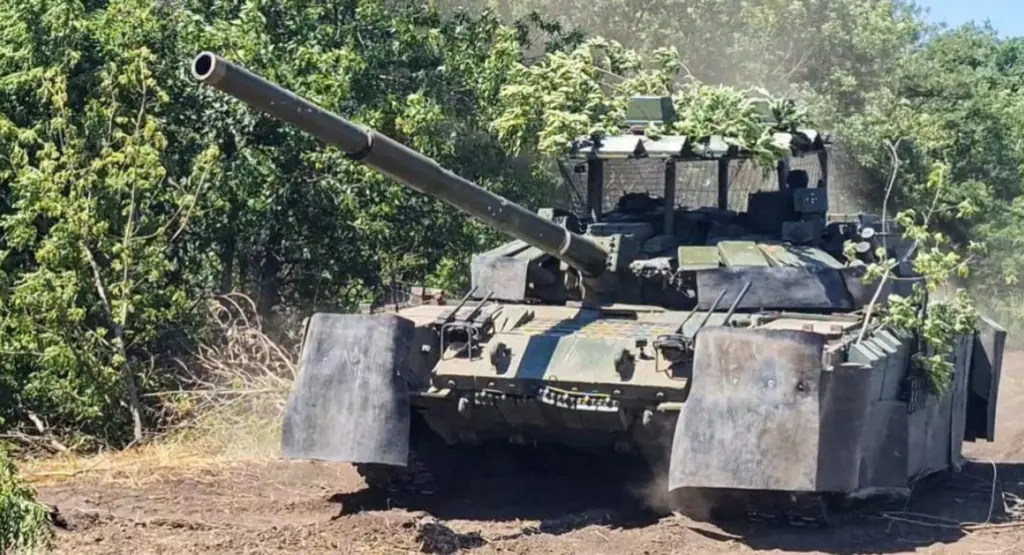
Overeager to break through Ukrainian defenses and march on the city of Kramatorsk from the south, the Russian Center Group of Forces got desperate and sloppy this week. They paid for their desperation and sloppiness in lives and metal. The tanks were carrying a brand-new anti-drone shield, and they had left the welded scrap metal at home.
That combination is the news. For more than a year, Russian commanders have kept their armor off the roads because Ukrainian drones kill tanks faster than factories can rebuild them. The Arena-M active protection system is the fix that was supposed to let the tanks come back—reliable enough, the Kremlin's own press said 10 days ago, to make the improvised cages unnecessary. This week it went out on a road in Donetsk Oblast without them.
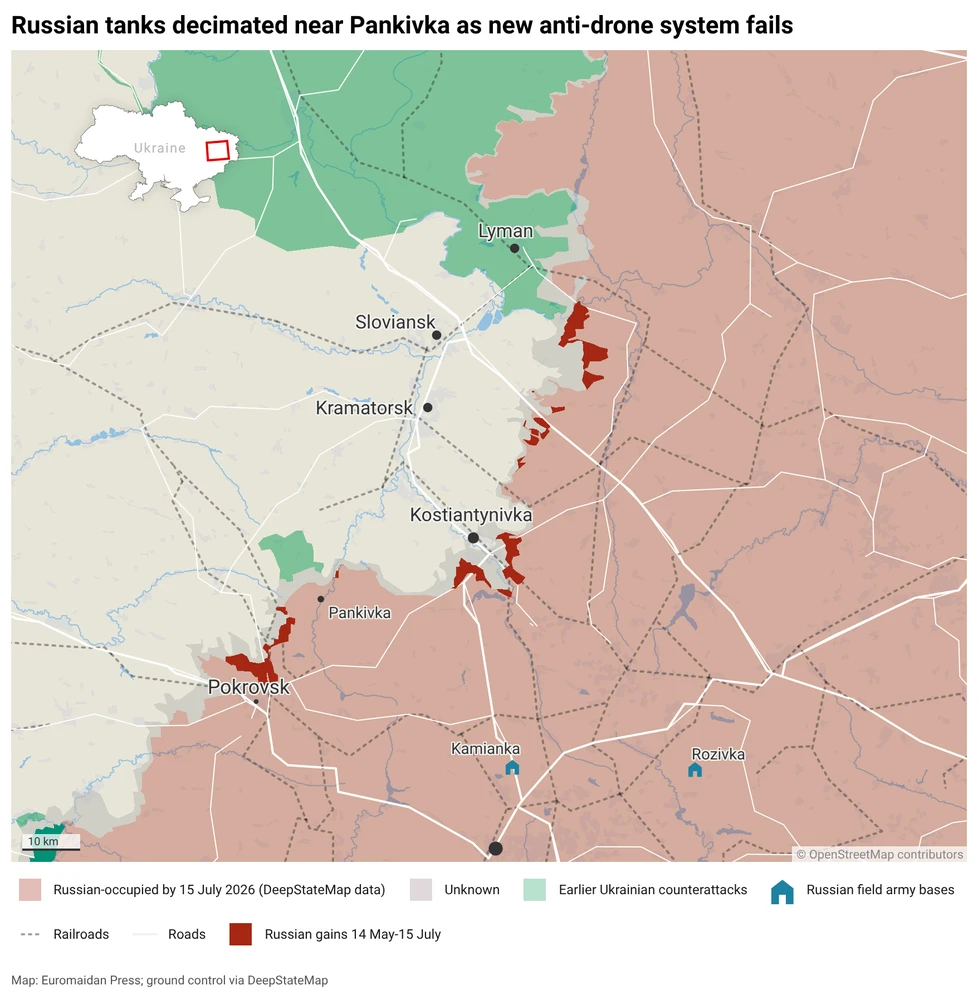
Pankivka on a map. Image: Euromaidan Press
On and around 23 July, the Russians rolled tanks along the road through the village of Pankivka, roughly 36 km southwest of Kramatorsk and its twin free city of Sloviansk in eastern Ukraine's Donetsk Oblast. Ukrainian drones spotted the tanks coming, and attacked.
When the smoke and dust cleared, the Russians had lost at least 9 tanks. Ukrainian tank kills were already running hot: the general staff in Kyiv claimed Ukrainian forces took out 28 Russian tanks across the 1,200-km gray zone in the two days before, 21–22 July. "It was a good day," wrote Dimko Zhluktenko, a soldier with the Ukrainian Unmanned Systems Forces' 413th Regiment.
The mechanized assault was unusual for its rarity. For more than a year now, the Russian army of occupation in Ukraine has mostly parked its armored vehicles, and instead attacked on foot or on motorcycles or other light vehicles. The pause in mechanized assaults has bought time for the Kremlin to ramp up vehicle production and bring battered regiments and brigades back to up to their full allotment of tanks and other armored vehicles.
But those vehicles aren't necessarily being used in Ukraine. Ukrainian tiny explosive drones are everywhere all the time, and Russian forces have few ways of reliably defeating them. Russian commanders correctly concluded that small groups of infantry stand a better chance of slipping past Ukraine's undermanned defenses than big, easy-to-detect tanks do.
Infantry infiltrations work. They're how Russian assault groups have ground their way into the city of Kostiantynivka, 24 km southeast of Kramatorsk. Moscow claimed the city on 3 July. Ukraine's general staff says it still holds it. And infiltration is how the Russians are gradually creeping around the city of Lyman, 21 km northeast of Sloviansk. The infiltrations are slowly closing a vice around Kramatorsk and Sloviansk, the last free big cities in Donetsk Oblast.
But the infantry action is costly. The Kremlin recruits around 30,000 fresh troops every month but, if the Ukrainian general staff's tallies of killed and wounded are accurate, loses roughly that many troops every month. Ukraine is desperately short of infantry. Russia isn't nearly as desperate, but that doesn't mean it's got infantry to spare.
Last month, analyst Jompy predicted that if infantry casualties spiked or recruitment slipped, Russian commanders "could also be forced to go back to mechanized warfare." That may be why the Center Group of Forces pivoted back to tank-led assaults in their south-to-north push toward Kramatorsk.
The shield that replaced the scrap metal
Without so-called "active defenses" that can shoot down incoming drones, "it is currently very easy to throw a tank battalion into [an] assault and lose it all without achieving anything," analyst Jakub Janovsky explained. The Arena-M is Russia's answer. It uses a Doppler radar to spot incoming rockets, missiles, and drones, and 12 launchers ringed around the turret fire tiny charges meant to shred the threat a few meters out.
Twelve is the whole magazine. And the system does not run itself: the commander switches it on when reconnaissance or a drone detector warns him, the Russian state newspaper Izvestia reported on 13 July, in a dispatch from a training range where crews of the Center grouping's 90th Tank Division were learning the new machines.
T-72B3A tank equipped with the Arena-M active protection system (APS). Photo: iz.ru/Dmitry Astrakhan
That dispatch is worth reading for what the reporter noticed was missing. No turtle armor. No tsar-mangal. No dreads, no cages, no hedgehogs—none of the welded scrap the Russian army has bolted onto its armor for two years. A company commander told Izvestia the system had shown high effectiveness against drones on the range, and that the tanks would reach the line of contact within days. Russian industry has been calling the Arena-M the first system in the world able to protect armor from FPV drones and loitering munitions. Israel's Rafael announced drone-interception upgrades to its Trophy system in January 2025.
Ten days later the tanks were on the road, without the cages, and Ukrainian drones found them. Footage published by Ukraine's border guards and by the National Guard's Omega unit shows a T-72B3A taking a hit to the rear, then two more drones finishing it. A second tank—this one wearing a conventional mangal cage—was leading it and was immobilized too. Both Russian answers to the drone problem were on that road. Neither one came off it.
What the shield actually did is contested, and the argument is worth following. One Russian armor specialist watching the video saw no reaction at all—countermeasures still sitting in their launchers, no attempt to engage. Observer Matt Drew, watching the same footage, read it the other way: a puff of smoke off the turret in the opening seconds, an explosion to the side, and several drone feeds that cut out before reaching the tank—which is what an interception looks like from the drone's camera. Only after the tanks were disabled and abandoned could the drones close in and linger, and it took bomber drones to finish the hulks. "Probably not the success the Russians were hoping for," Drew wrote, "but it definitely worked for a while."
A while is the problem. Twelve charges is a finite number and Ukrainian drone crews do not attack in twelves. A shield that intercepts the first drones and runs dry against the tenth turns a tank into a slower target, not a surviving one. And the latest push toward Kramatorsk failed.
That doesn't mean Kramatorsk and Sloviansk are safe. Hurling tens of thousands of troops and, occasionally, a few armored vehicles against Ukrainian defenses, the Russian Center Group of Forces is making very, very slow progress toward the twin cities from both the south and the north.
But every assault the Ukrainians defeat delays the day when Kramatorsk and Sloviansk come under direct siege and infiltration. The cities are most vulnerable from the north around Lyman, mapper Clément Molin noted. "The current situation is not very good for Ukraine in this direction."
At the current rate of advance, the Russians may be able to slip their first infiltrators into Sloviansk from the north some time next year, Molin concluded.
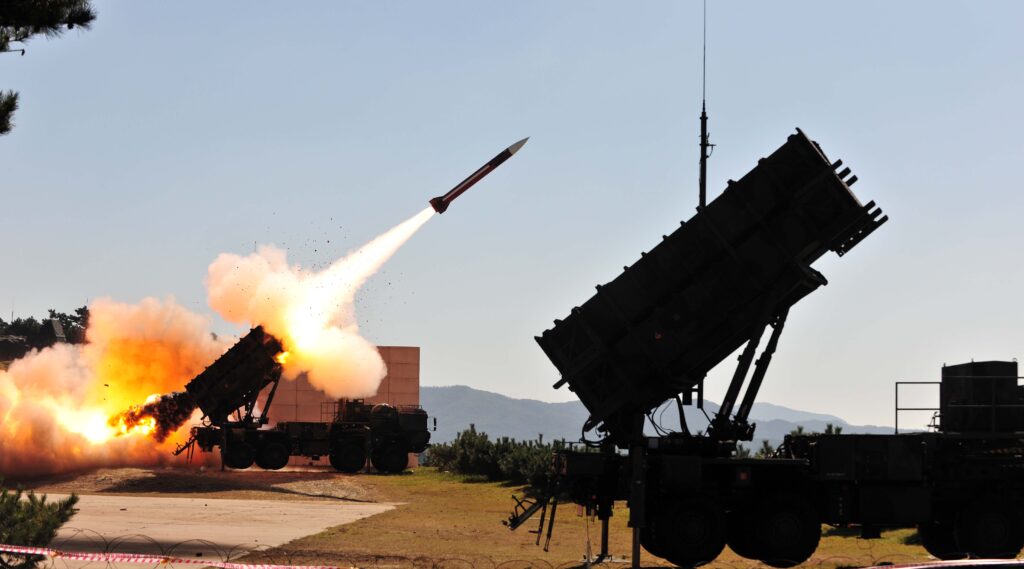
Poland has proposed a three-way defense industry partnership with the United States and Ukraine to produce missiles for Patriot air defense systems, Polish Deputy Defense Minister Magdalena Sobkowiak-Czarnecka said during talks in Washington, according to Polish state news agency PAP.
The proposal comes as Ukraine faces a growing threat from Russian ballistic missile attacks, while supplies of interceptors for the few systems capable of stopping them remain limited. Pat
Poland has proposed a three-way defense industry partnership with the United States and Ukraine to produce missiles for Patriot air defense systems, Polish Deputy Defense Minister Magdalena Sobkowiak-Czarnecka said during talks in Washington, according to Polish state news agency PAP.
The proposal comes as Ukraine faces a growing threat from Russian ballistic missile attacks, while supplies of interceptors for the few systems capable of stopping them remain limited. Patriot is currently Ukraine’s main defense against these weapons, making expanded production a key priority for Kyiv.
The proposal would involve cooperation between Poland, Ukraine, and the US, with production located in a secure location. Sobkowiak-Czarnecka said the offer was aimed at addressing concerns over where such manufacturing could take place, as Ukraine remains under Russian missile and drone attacks.
Proposal follows discussions on Patriot production in Ukraine
According to PAP, Sobkowiak-Czarnecka said her talks with officials from the Pentagon and the US State Department included potential Patriot missile production, defense cooperation, US military presence in Poland, and the SAFE financing mechanism.
She said discussions also covered remarks by US President Donald Trump at a NATO summit in Ankara about the possibility of establishing a Patriot production facility in Ukraine.
“The idea is for this production to be connected with Ukraine,” Sobkowiak-Czarnecka said, according to PAP.
The Polish deputy minister proposed expanding the arrangement into a trilateral partnership involving the US, Ukraine, and Poland, arguing that Poland could help provide a safer environment for production.
Explore further
Zelenskyy meets team from Raytheon, US company that builds Patriots, and says Ukraine is now negotiating joint interceptor production
Poland seeks role in Patriot maintenance and broader defense cooperation
Sobkowiak-Czarnecka also presented arguments for establishing a Patriot maintenance center in Poland, citing the country’s growing defense industry and strategic location on NATO’s eastern flank.
The talks in Washington also covered additional US military presence in Poland. Sobkowiak-Czarnecka said both countries have established teams working on preparations for a potential US base, though final decisions on troop deployments would depend on President Trump.
She also said discussions continued on a possible $4 billion US Foreign Military Financing loan for Poland to purchase American military equipment, with hopes that an agreement could be signed within weeks.
Ukraine seeks expanded air defense production amid Russian attacks
Patriot systems have become among Ukraine’s most important air defense assets, particularly against Russian ballistic missile attacks that are difficult to intercept with many other systems.
Ukraine has repeatedly called for greater air defense support as Russia continues large-scale missile and drone attacks against Ukrainian cities and infrastructure. Expanding production capacity for Patriot-related systems has become part of wider efforts by Kyiv and its partners to strengthen long-term defense capabilities.
Explore further
Russia launches record ballistic missile barrage on Kyiv, firing over 40 missiles in under an hour
Ukrainian forces struck a parking area for Russian military fuel trucks in occupied Luhansk, according to the pro-Ukrainian partisan movement ATESH, which said its agent inside the Russian military reported the attack.
The strike reportedly took place overnight on 22–23 July in the city’s Leninskyi district, hitting a location where five military fuel trucks were stationed before being sent to support Russia’s 15th Separate Motorized Rifle Brigade operating in the Donet
Ukrainian forces struck a parking area for Russian military fuel trucks in occupied Luhansk, according to the pro-Ukrainian partisan movement ATESH, which said its agent inside the Russian military reported the attack.
The strike reportedly took place overnight on 22–23 July in the city’s Leninskyi district, hitting a location where five military fuel trucks were stationed before being sent to support Russia’s 15th Separate Motorized Rifle Brigade operating in the Donetsk direction.
ATESH is a partisan network operating in Russian-occupied territories and inside Russia. Founded in 2022, the group says it consists of Ukrainians, Crimean Tatars, and anti-war Russians who conduct sabotage operations, gather intelligence on Russian military activity, and pass information to Ukrainian forces.
The group has previously claimed responsibility for identifying Russian military positions, tracking troop movements, and reporting information used in Ukrainian strikes.
Partisan group says strike disrupted fuel supplies
According to ATESH, the fuel trucks were destroyed or damaged before they could reach their intended destination, leaving the Russian unit without the supplies they were meant to provide.
The group said its agents, including local residents and members of the Russian military, continue gathering information on Russian troop movements, equipment concentrations, and logistics sites in occupied territories.
ATESH said the latest operation demonstrates the continued role of partisan networks in monitoring Russian military activity behind the front line, where they provide information on supply routes and concentrations of equipment.
Logistics remain a key target in Ukraine’s strikes
Fuel depots, supply routes, and military logistics hubs have increasingly become targets of Ukrainian strikes as Kyiv seeks to disrupt Russia’s ability to sustain operations on the front line.
Military fuel trucks are particularly important for maintaining armored vehicles, artillery systems, and other equipment operating away from fixed supply bases.
The reported strike comes as Ukraine continues targeting Russian military infrastructure in occupied territories and deeper inside Russia with drones and other long-range weapons.
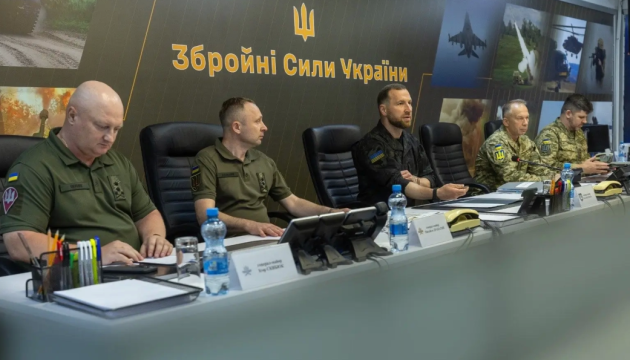
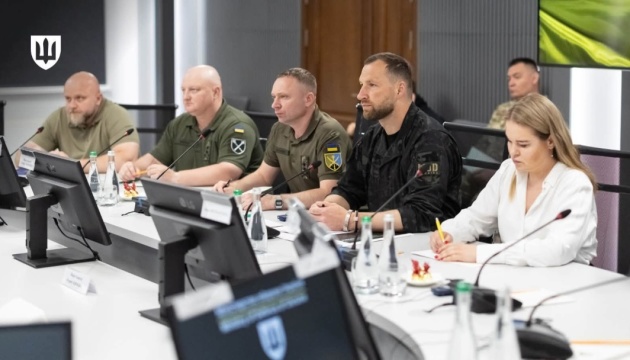
On Friday, Acting Defense Minister of Ukraine Yevhenii Khmara introduced the new Commander-in-Chief of the Armed Forces of Ukraine's, Major General Mykhailo Drapatyi, and the new Chief of the General Staff, Major General Ihor Skybiuk, to the leadership of the General Staff.
On Friday, Acting Defense Minister of Ukraine Yevhenii Khmara introduced the new Commander-in-Chief of the Armed Forces of Ukraine's, Major General Mykhailo Drapatyi, and the new Chief of the General Staff, Major General Ihor Skybiuk, to the leadership of the General Staff.
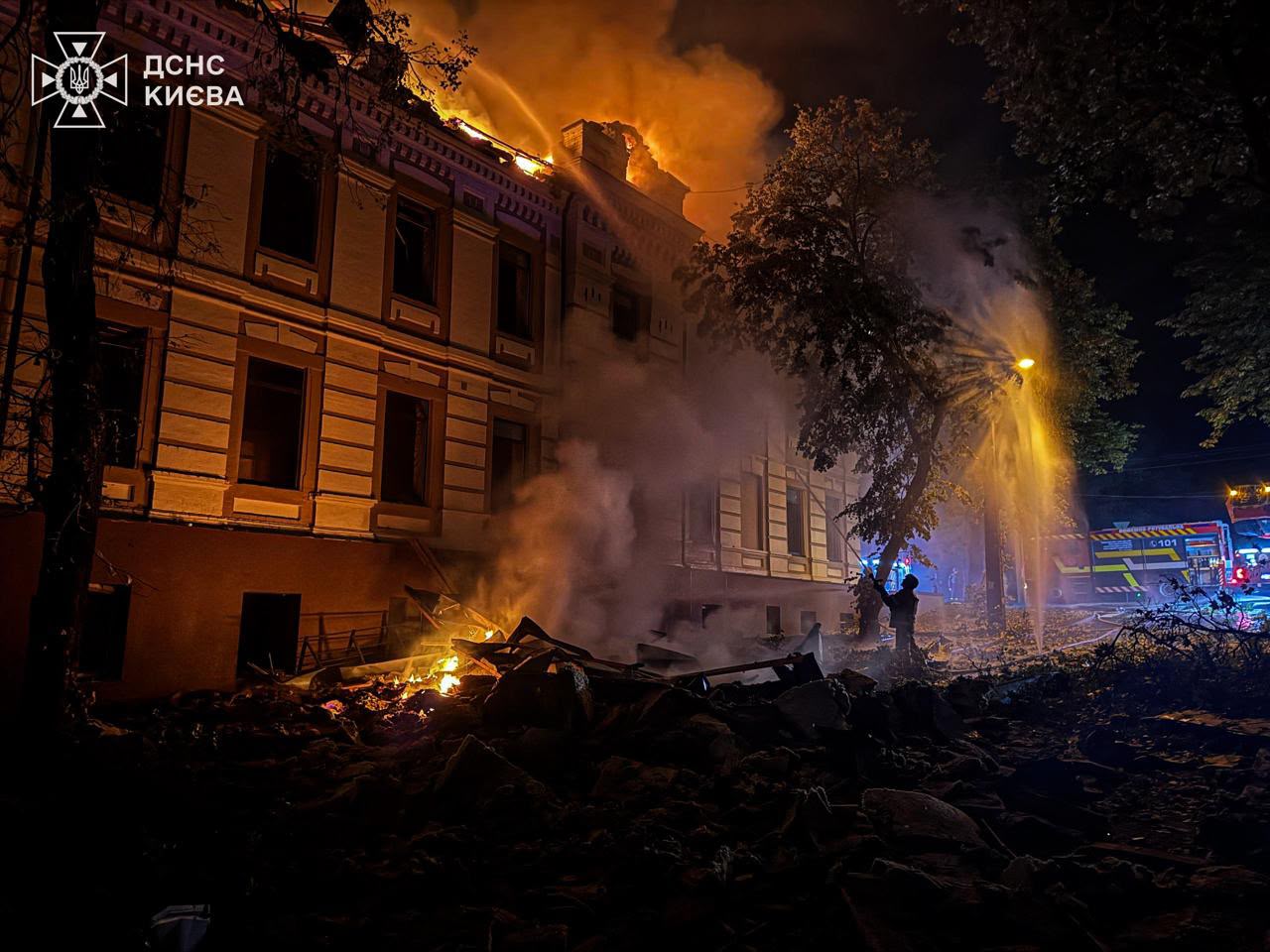
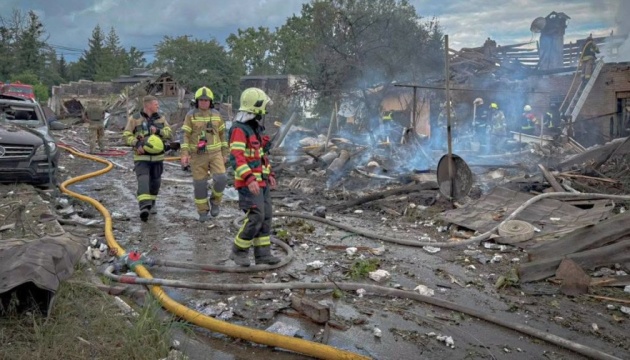
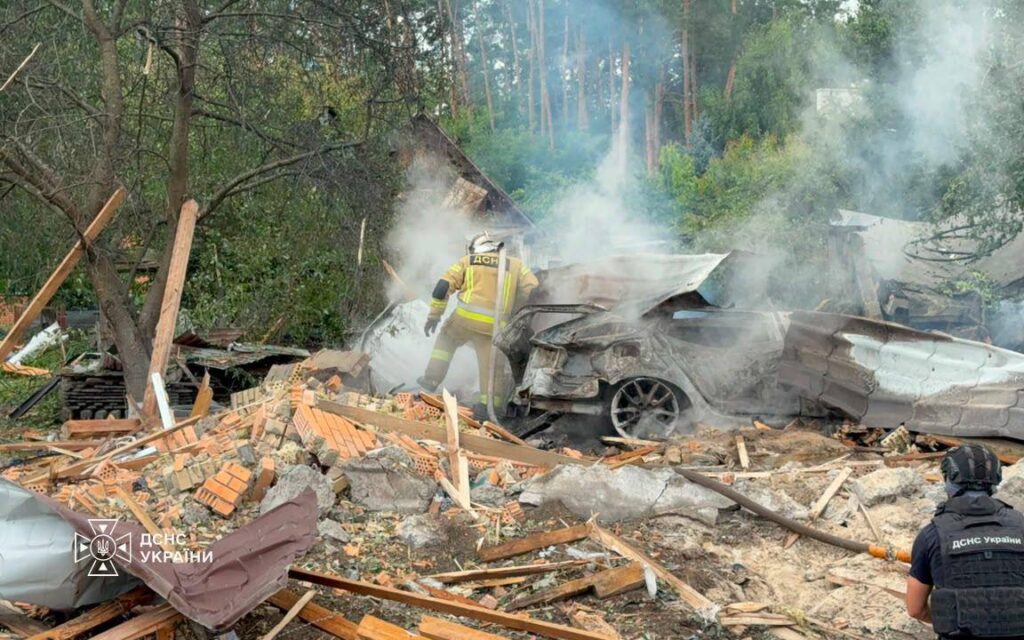
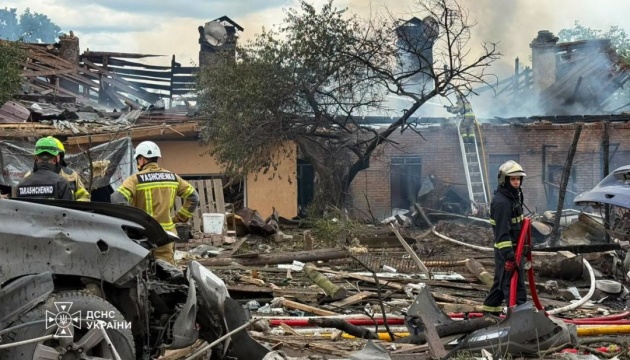
Emergency crews have completed search and rescue operations at the site of a Russian missile strike in the Bucha district of the Kyiv region on July 24. The attack killed 10 people and left dozens of others injured.
Emergency crews have completed search and rescue operations at the site of a Russian missile strike in the Bucha district of the Kyiv region on July 24. The attack killed 10 people and left dozens of others injured.
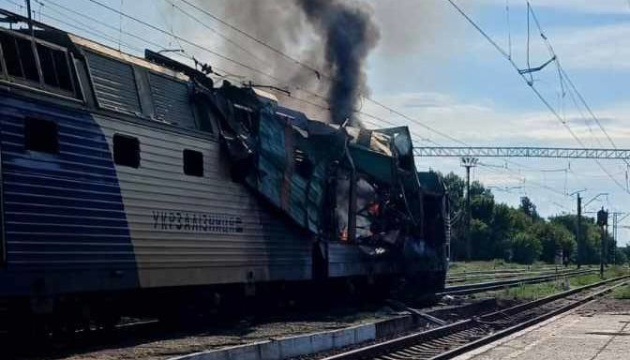
Russian forces struck the locomotive of a passenger train in Ukraine's Dnipropetrovsk region with a drone, but passengers and railway workers managed to evacuate before the impact.
Russian forces struck the locomotive of a passenger train in Ukraine's Dnipropetrovsk region with a drone, but passengers and railway workers managed to evacuate before the impact.
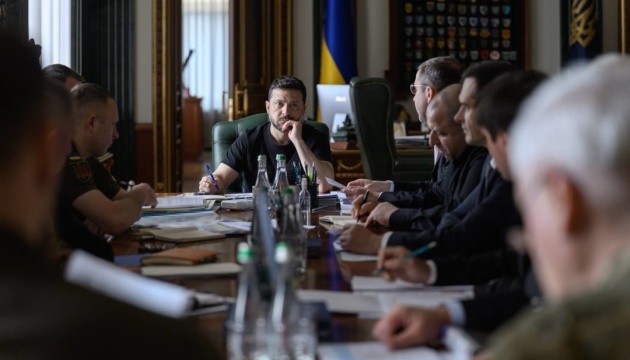
President Volodymyr Zelensky held a meeting with members of the newly reshuffled Cabinet of Ministers to discuss Ukraine's defense, economic, and diplomatic challenges and tasks for August and the months ahead.
President Volodymyr Zelensky held a meeting with members of the newly reshuffled Cabinet of Ministers to discuss Ukraine's defense, economic, and diplomatic challenges and tasks for August and the months ahead.
Ukraine's Security Service (SBU) says it has arrested two alleged Russian agents accused of illegally registering 76 Starlink satellite internet terminals for Russian forces, which investigators say were intended to support missile and drone strikes against Ukraine and identify Ukrainian electronic warfare systems.
According to an SBU statement on 24 July, the suspects were unemployed Kyiv residents allegedly recruited by Russia's Federal Security Service (FSB) through
Ukraine's Security Service (SBU) says it has arrested two alleged Russian agents accused of illegally registering 76 Starlink satellite internet terminals for Russian forces, which investigators say were intended to support missile and drone strikes against Ukraine and identify Ukrainian electronic warfare systems.
According to an SBU statement on 24 July, the suspects were unemployed Kyiv residents allegedly recruited by Russia's Federal Security Service (FSB) through Telegram channels advertising "easy money."
Agents allegedly used fake passports to activate Starlink terminals
The SBU said the two men initially registered Starlink terminals in their own names before passing the account credentials to their FSB handler.
Investigators allege they later used forged Ukrainian passports to activate additional terminals while unknowingly involving an employee at a postal branch to bypass Starlink's identity verification procedures.
Authorities say the scheme enabled the suspects to register 76 satellite internet terminals for Russian intelligence.
During searches of the suspects' homes, investigators said they seized mobile phones containing evidence of communication with the FSB.
The SBU added that all Starlink terminals allegedly registered through the scheme have now been blocked.
Explore further
Alleged Russian agent arrested in Dnipro, accused of activating 1,000+ Starlink communications terminals to support Russian forces
SBU says terminals were intended to support Russian military operations
According to the SBU, Russian intelligence planned to use the Starlink systems to coordinate missile and drone strikes against Ukraine and identify Ukrainian electronic warfare systems protecting frontline positions.
The agency did not say whether any of the terminals had already been deployed by Russian forces.
Starlink, operated by SpaceX, has become one of the most important communications systems on the modern battlefield, providing fast, reliable satellite internet that is difficult to jam. Ukraine has relied extensively on the network throughout Russia's full-scale invasion to maintain communications between military units and operate drones.
Russian forces have also sought access to the system, but their use has been significantly constrained. In cooperation with SpaceX, Ukraine has worked to limit Russian access by introducing verification measures and whitelisting legitimate users on the territory of Ukraine, disrupting Russian battlefield communications and forcing Moscow to seek alternative systems.
According to the SBU, the suspects' alleged scheme was designed to bypass those restrictions by fraudulently registering Starlink terminals using fake Ukrainian identities, allowing Russian forces to regain access to the satellite network.
Suspects face life imprisonment
The two suspects have been charged with high treason committed under martial law, an offense punishable by life imprisonment with confiscation of property under Ukraine's Criminal Code.
Both remain in custody pending further investigation.
The operation was carried out by the SBU's Main Directorate in Kyiv and Kyiv Oblast under the procedural supervision of the regional prosecutor's office.
Acting Defense Minister of Ukraine Yevhenii Khmara has urged US partners to accelerate the delivery of interceptor missiles for Patriot air defense systems, which are needed to counter Russian ballistic missiles.
Acting Defense Minister of Ukraine Yevhenii Khmara has urged US partners to accelerate the delivery of interceptor missiles for Patriot air defense systems, which are needed to counter Russian ballistic missiles.
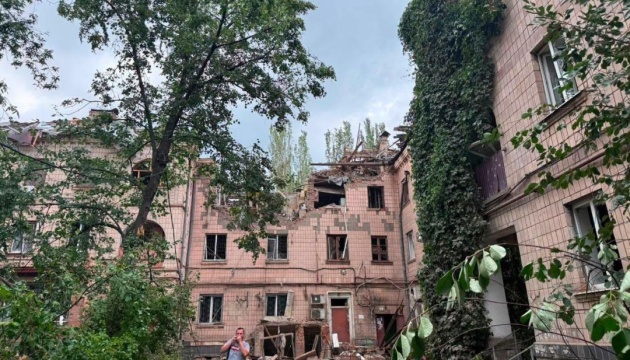
European Commission President Ursula von der Leyen has condemned the latest Russian strikes on the Kyiv region and Sloviansk, assuring that Europe will continue to support Ukraine.
European Commission President Ursula von der Leyen has condemned the latest Russian strikes on the Kyiv region and Sloviansk, assuring that Europe will continue to support Ukraine.
Following a meeting with Rustem Umerov and Ihor Klymenko, President Volodymyr Zelensky announced updates to the work of Ukraine's National Security and Defense Council (NSDC).
Following a meeting with Rustem Umerov and Ihor Klymenko, President Volodymyr Zelensky announced updates to the work of Ukraine's National Security and Defense Council (NSDC).
Ukraine's air defense forces neutralized one Iskander-M/S-400 ballistic missile and 81 drones used by Russia in a morning attack on Ukraine on July 24.
Ukraine's air defense forces neutralized one Iskander-M/S-400 ballistic missile and 81 drones used by Russia in a morning attack on Ukraine on July 24.
President Volodymyr Zelensky said that, together with Commander-in-Chief of the Armed Forces of Ukraine Mykhailo Drapatyi, acting Defense Minister Yevhenii Khmara, and Deputy Head of the Presidential Office Pavlo Palisa, he had outlined Ukraine's response measures to Russian attacks.
President Volodymyr Zelensky said that, together with Commander-in-Chief of the Armed Forces of Ukraine Mykhailo Drapatyi, acting Defense Minister Yevhenii Khmara, and Deputy Head of the Presidential Office Pavlo Palisa, he had outlined Ukraine's response measures to Russian attacks.
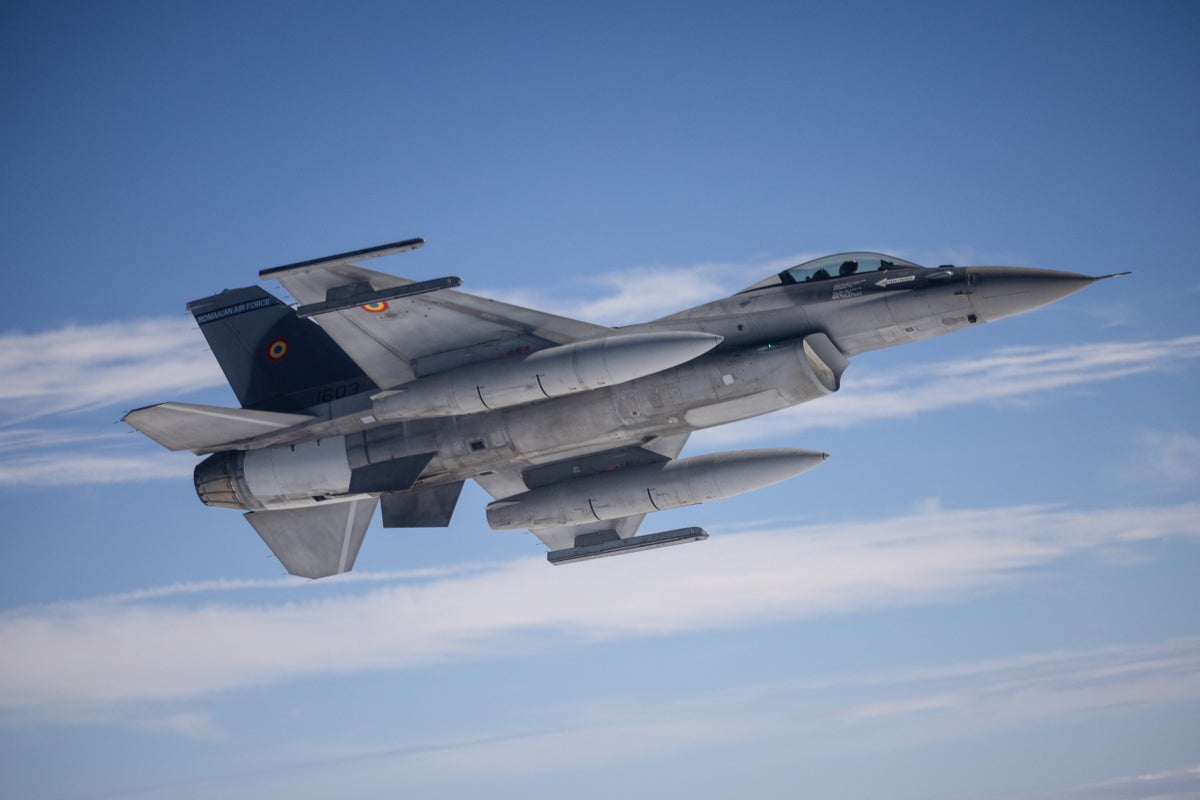
For the first known time, a Romanian fighter jet has fired on and destroyed a drone that violated the country's airspace. The intercept happened during a large Russian overnight attack on Ukraine that pushed some of the explosive drones toward the Romanian border. Bucharest has not said where the drone came from.
Russia's missiles and explosive drones batter Ukrainian homes and civilian infrastructure night after night, and some of those drones wander across borders
For the first known time, a Romanian fighter jet has fired on and destroyed a drone that violated the country's airspace. The intercept happened during a large Russian overnight attack on Ukraine that pushed some of the explosive drones toward the Romanian border. Bucharest has not said where the drone came from.
Russia's missiles and explosive drones batter Ukrainian homes and civilian infrastructure night after night, and some of those drones wander across borders into NATO states, where allied jets only lately opened fire after years of merely tracking them.
A pilot, an empty field, and an air-to-air missile
Romanian President Nicușor Dan announced the shootdown on X, saying a pilot flying an F-16 downed the drone around 11:00 on 24 July 2026. He noted the target fell over an uninhabited area, so the pilot could fire without endangering anyone below.
"At present, specialist teams from the relevant agencies are surveying the area to establish all the circumstances of the incident," Dan said some 30 minutes after the strike.
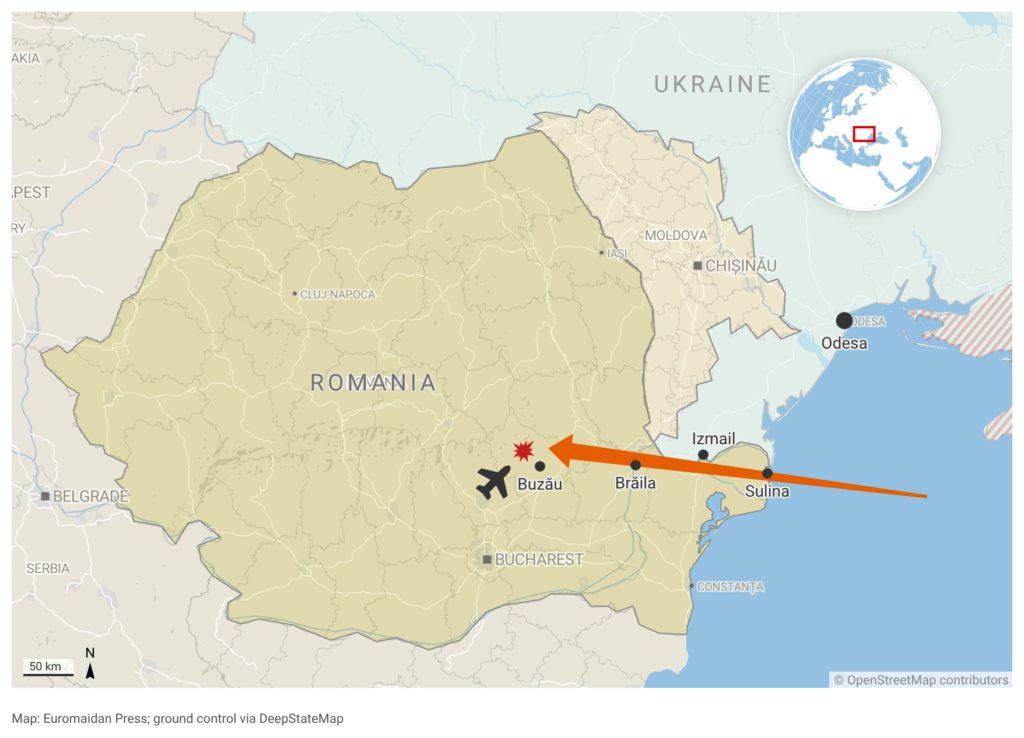
Romania's Defense Ministry detailed the sequence. Radar detected the drone at 09:39, roughly 20 km east of Sulina in the Danube delta. It then entered national airspace and flew a Sulina–Brăila–Fetești–Buzău route. Two Italian Air Force Eurofighter Typhoon jets on a NATO air policing mission from Mihail Kogălniceanu airbase went up, along with two Romanian F-16s from the 86th airbase at Fetești. At 11:02, one of the Romanian jets struck the drone with an air-to-air missile over an uninhabited area near Padina, in Buzău county.
The drone's flight path points to the Black Sea as its way in — the same route Russian drones tend to take when they go after the nearby Ukrainian Danube port of Izmail.
Until now, Romanian jets had only escorted a Russian drone near the Ukrainian border until it disappeared from radars. Overnight on 29 May, during a Russian attack on Odesa Oblast, a Geran-2 drone crashed into a 10-story residential building in Galați, hospitalizing two people and forcing 70 to evacuate.
Russia's overnight barrage on Ukraine
The intercept coincided with one of Russia's mass overnight strikes. Ukraine's Air Force reported that Russia launched 180 strike drones — Shahed types, including jet-powered ones, plus Gerbera, Italmas, and Parodiya decoy drones — and five X-59/69 guided missiles by preliminary count from the Black Sea areas, Russian regions and occupied territory. By 08:00, air defenses had downed or suppressed 160 drones and four missiles, though one missile and 14 drones hit across nine locations.
In Odesa Oblast, a Russian strike on a residential sector injured a woman and a child overnight, damaging an apartment roof, homes, cars, and an enterprise, the head of the Odesa Oblast military administration, Oleh Kiper, reported.
"The residential sector and industrial infrastructure were struck. Unfortunately, a woman and a 4-year-old child were injured," he said.
Farther south, Russia hit the Izmail district — the part of Odesa Oblast bordering Romania — damaging homes and a business without casualties, the district military administration said.
Explore further
NATO jets over the Baltics get authority to shoot down “objects that pose a threat”
Russian aerial bombs struck Izium in Kharkiv Oblast, hitting a Nova Poshta parcel depot and cutting power to part of the district. Four Geran drones set a boarding house in Radychiv, Chernihiv Oblast, ablaze, and the State Emergency Service noted the site was not in use. An evening attack damaged a house and an enterprise in Kirovohrad Oblast, without casualties, the regional administration said.
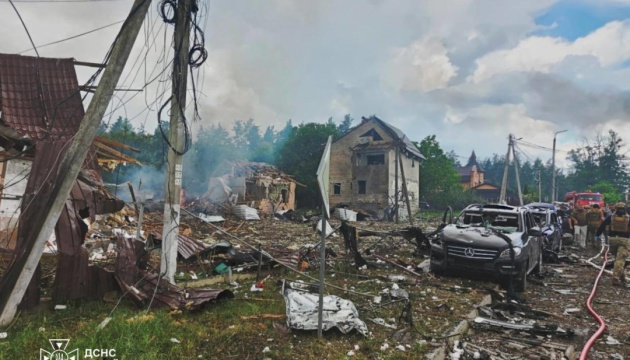
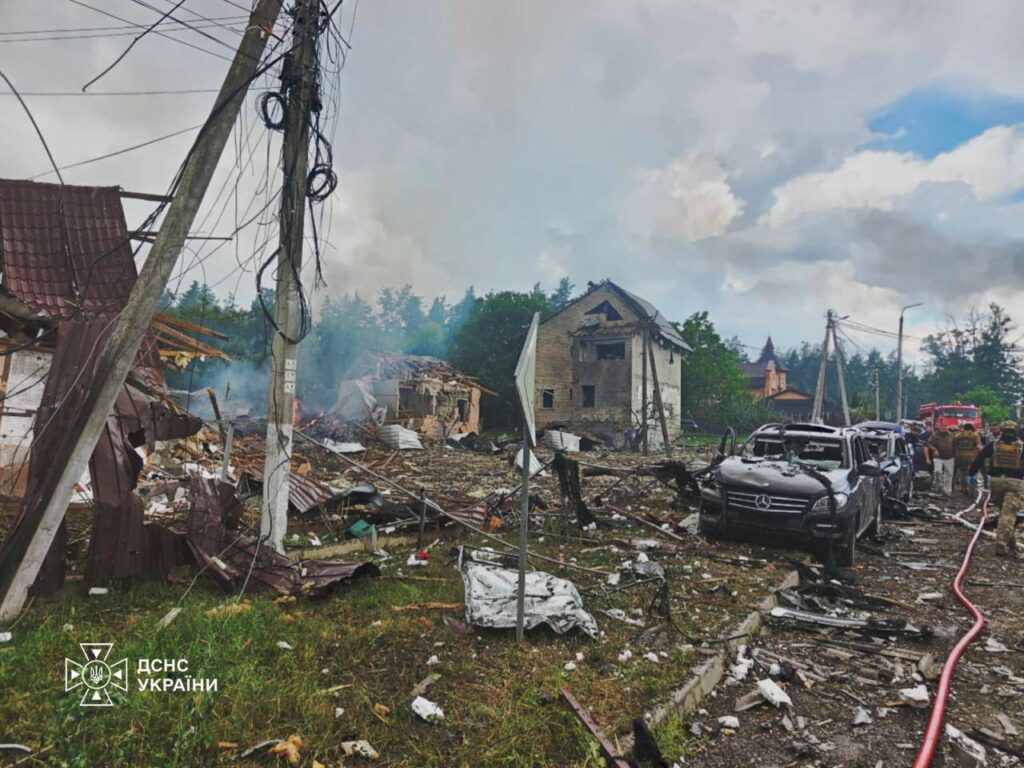
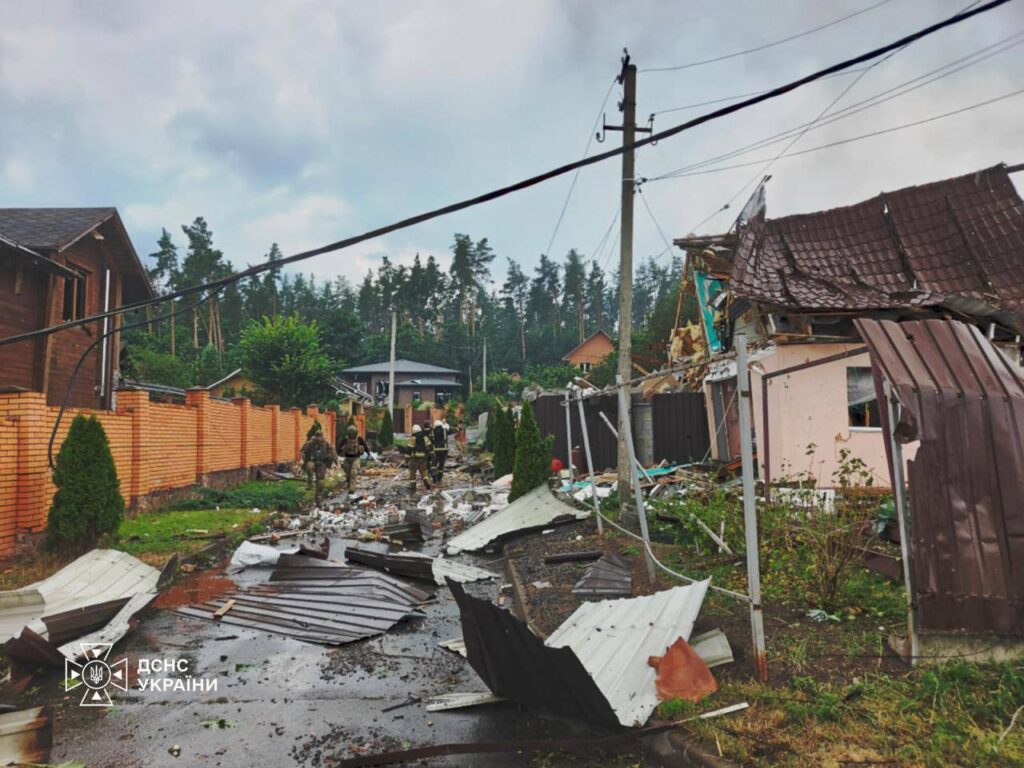
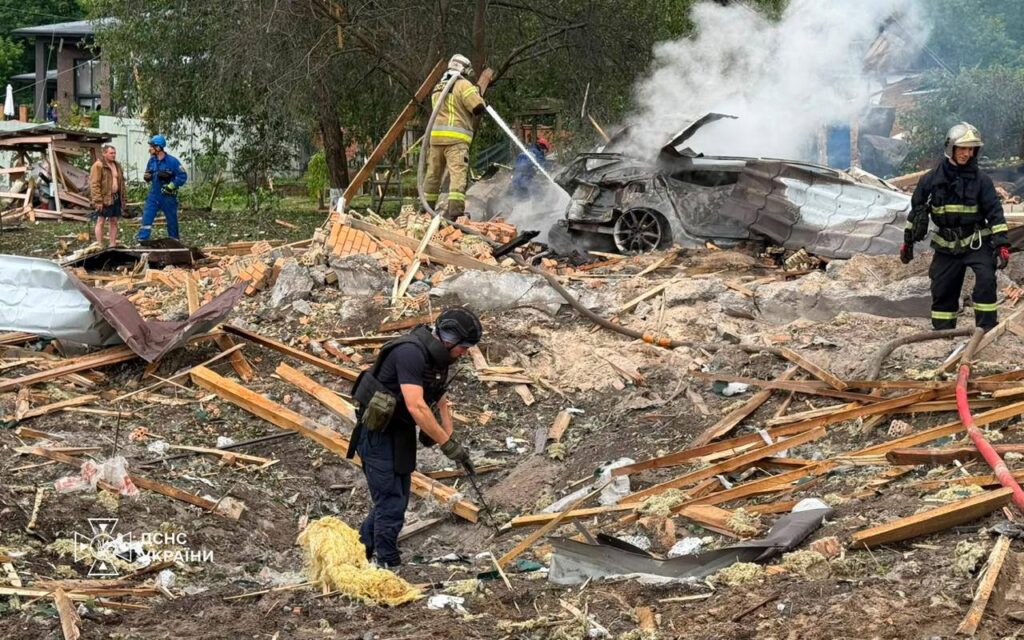
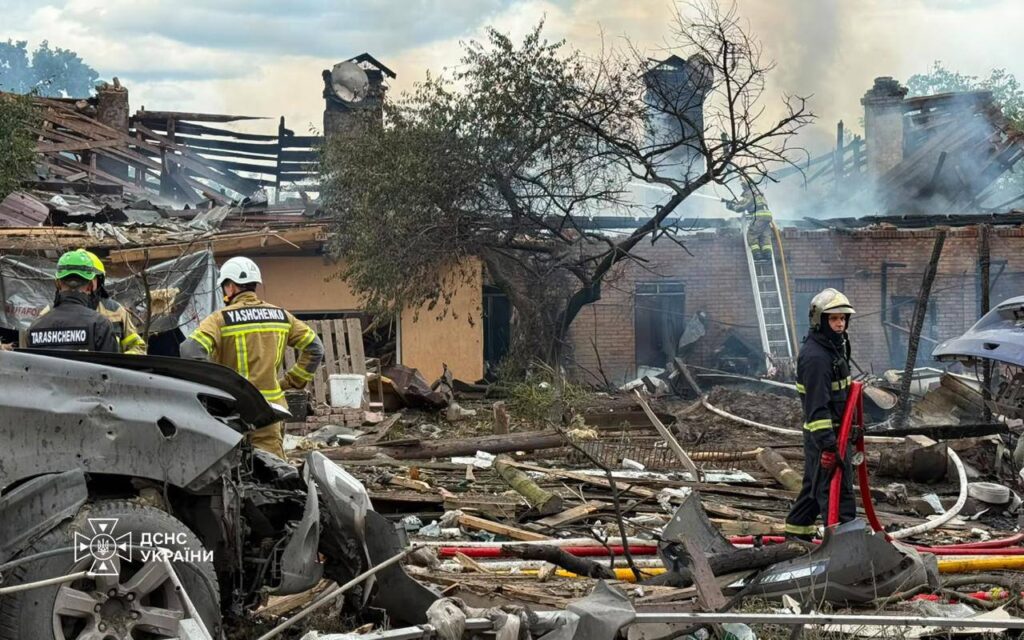
Russia launched a rare daytime ballistic missile strike on Kyiv Oblast on 24 July, killing at least 10 people and injuring around 100 after two missiles hit a private training ground where representatives of Ukraine's defense industry were gathered, Ukrainian officials said.
The attack came after an overnight drone assault on the Kyiv region and amid repeated warnings from Ukrainian military monitoring channels that Russia had accumulated large numbers of missiles and a
Russia launched a rare daytime ballistic missile strike on Kyiv Oblast on 24 July, killing at least 10 people and injuring around 100 after two missiles hit a private training ground where representatives of Ukraine's defense industry were gathered, Ukrainian officials said.
The attack came after an overnight drone assault on the Kyiv region and amid repeated warnings from Ukrainian military monitoring channels that Russia had accumulated large numbers of missiles and attack drones in preparation for a new mass strike on Kyiv.
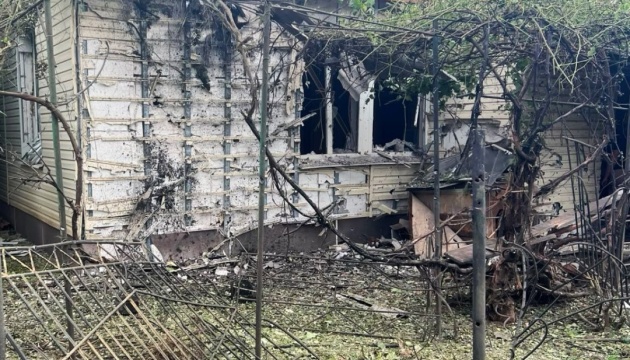
Beyond the strike on the training ground, the attack damaged 27 private homes and 44 vehicles in Bucha district, according to local authorities.
Aftermath of a Russian ballistic missile attack on Bucha district in Kyiv Oblast, Ukraine, 24 July 2026. Photo: Zelenskyy
Homes were torn apart after Russia's daytime ballistic missile attack on Ukraine’s Kyiv Oblast.
The strike killed at least 10 people and injured around 100 after missiles hit Bucha district. The attack damaged 27 private homes, leaving residents to pick through the wreckage.… pic.twitter.com/hAVKtYdeFt
Two ballistic missiles hit Kyiv Oblast, one intercepted
According to Prosecutor General Ruslan Kravchenko, at least 10 people were killed and about 100 injured in the strike. The casualty toll may rise as emergency crews continue working at the scene.
President Volodymyr Zelenskyy confirmed that Russia struck the grounds of a private training facility in Kyiv Oblast where an event was taking place. The Kyiv Oblast Military Administration said the Bucha district suffered the heaviest damage.
Ukraine's Air Force later clarified that Russia launched three Iskander-M or S-400 ballistic missiles from the north at around 11:30 a.m. Air defenses intercepted one missile, while two struck targets in Bucha district.
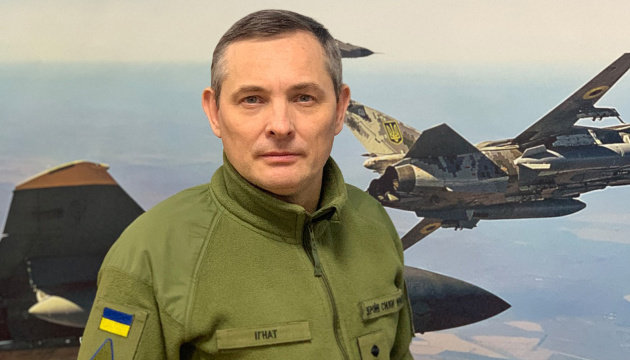
Air Force spokesperson Yurii Ihnat said the military has long prohibited large public gatherings because of the constant threat of Russian missile strikes, adding that investigators would determine whether security procedures had been properly followed, according to Suspilne.
The Prosecutor General's Office has opened two criminal investigations: one into a Russian war crime and another into possible negligence in organizing the event that may have contributed to the deaths.
Aftermath of a Russian ballistic missile attack on Bucha district in Kyiv Oblast, Ukraine, 24 July 2026. Photo: Zelenskyy
Ballistic missiles remain Ukraine's most difficult aerial threat
The daytime strike was unusual. Although Russia has sharply increased its use of ballistic missiles against Kyiv in recent months – now targeting the capital roughly once or twice a week – most of those attacks have been launched overnight. Friday's daylight strike showed that the threat is no longer confined to nighttime raids.
Ballistic missiles are among the most dangerous weapons in Russia's arsenal because they travel at several times the speed of sound, often leaving civilians only a few minutes to seek shelter after an air raid alert, which is simply impossible for most. Unlike slower cruise missiles and drones, they descend on steep trajectories, making them much harder to intercept.
Only a small number of advanced air defense systems, primarily the US-made Patriot, are capable of reliably engaging Russian ballistic missiles such as the Iskander-M and North Korean KN-23 variants. Ukraine has repeatedly warned that it does not have enough Patriot batteries or interceptor missiles to defend every threatened city, forcing commanders to prioritize protection of the most critical areas.
Russia has increasingly exploited those limitations. In recent months, ballistic missile attacks on Kyiv have become a weekly occurrence, causing repeated civilian casualties and widespread destruction despite Kyiv's otherwise-strong air defenses.
Aftermath of a Russian ballistic missile attack on Bucha district in Kyiv Oblast, Ukraine, 24 July 2026. Photo: Zelenskyy
More than 90 drones launched as warnings of larger strike persist
The ballistic attack formed part of a broader day of Russian aerial assaults.
According to the Air Force, Russia launched more than 90 attack drones between 7:00 a.m. and 4:30 p.m., over one-third of them jet-powered variants. Ukrainian air defenses reported shooting down or electronically suppressing 81 drones by 4:30 p.m.
The Air Force urged Ukrainians not to ignore air raid alerts, particularly when ballistic missile threats are announced.
For several days, Ukrainian military monitoring channels have warned that Russia has been conserving cruise missiles, ballistic missiles, and Shahed drones instead of expending them in routine nightly attacks, raising expectations of another coordinated mass strike.
As of Friday afternoon, those monitoring groups continued to assess that the main wave of the anticipated attack may still lie ahead, with Kyiv remaining among the most likely targets later on 24 July. Ukrainian authorities have not officially confirmed those assessments but continue to urge residents to respond immediately to all air raid alerts.
Aftermath of a Russian ballistic missile attack on Bucha district in Kyiv Oblast, Ukraine, 24 July 2026. Photo: Zelenskyy
Russian ballistic missiles killed six people and wounded dozens at a Ukrainian defense-industry site in Kyiv Oblast on 24 July.
The strike hit workers connected to Ukraine's defense sector—one of the industry's partner companies, according to Ihor Fedirko, executive director of… pic.twitter.com/si8LvA8Ieu
Later on Friday, Zelenskyy said he had received reports from Commander-in-Chief Mykhailo Drapatyi and senior military officials on the battlefield situation and Ukraine's response to Russia's missile campaign.
The president said Ukrainian authorities had approved a coordinated package of measures involving the Armed Forces, Defense Ministry, intelligence agencies, and other state institutions in response to Russia's continuing attacks on Kyiv and Kyiv Oblast, Ukraine's border and frontline regions, Odesa Oblast, and the country's Black Sea shipping corridor.
"We have a clear list of measures at every level," Zelenskyy said, adding that new decisions are also being prepared to speed delivery of commanders' operational requirements.
The United States put a new 12.5% tariff on Russian goods on 24 July, and it was not aimed at Russia. Moscow was swept in as one of 60 countries under a single trade order, taxed at the same rate as Norway or Australia, and higher than the allies who had moved against forced labor, the abuse the tariff targets.
The tariff that looks like pressure on Russia is a formality—the same rate a NATO neighbor pays, on trade already hollowed out by the war.
Countries that ba
The United States put a new 12.5% tariff on Russian goods on 24 July, and it was not aimed at Russia. Moscow was swept in as one of 60 countries under a single trade order, taxed at the same rate as Norway or Australia, and higher than the allies who had moved against forced labor, the abuse the tariff targets.
The tariff that looks like pressure on Russia is a formality—the same rate a NATO neighbor pays, on trade already hollowed out by the war.
Countries that ban imports made with forced labor—or pledged to bring in such a ban—paid a lower 10%: Canada, India, Mexico, and the United Kingdom among them. Everyone else paid the full rate. Russia was in that group—one of some 40 economies from Norway to Saudi Arabia—charged the standard rate for any country that had done nothing on forced labor, a Federal Register notice shows.
Why not the war
There is a reason the label is forced labor and not the war. Trump’s tariffs keep collapsing—the Supreme Court threw out his first attempt early this year as an abuse of emergency powers, and the temporary fix he reached for next ran out the same day.
A trade law built around forced labor gives them a sturdier footing that courts are likelier to uphold, a congressional analysis explains. Russia was just one of dozens named in the replacement.
For Russia, the sting is close to nothing. Years of sanctions have already cut what the United States buys from Russia to about $3.8 billion a year, according to US trade office figures—a rounding error beside the oil and gas money that funds the war.
For comparison, in 2025 the United States imported about $600 billion in goods from the European Union. A tariff on the scraps changes nothing in Moscow’s budget.
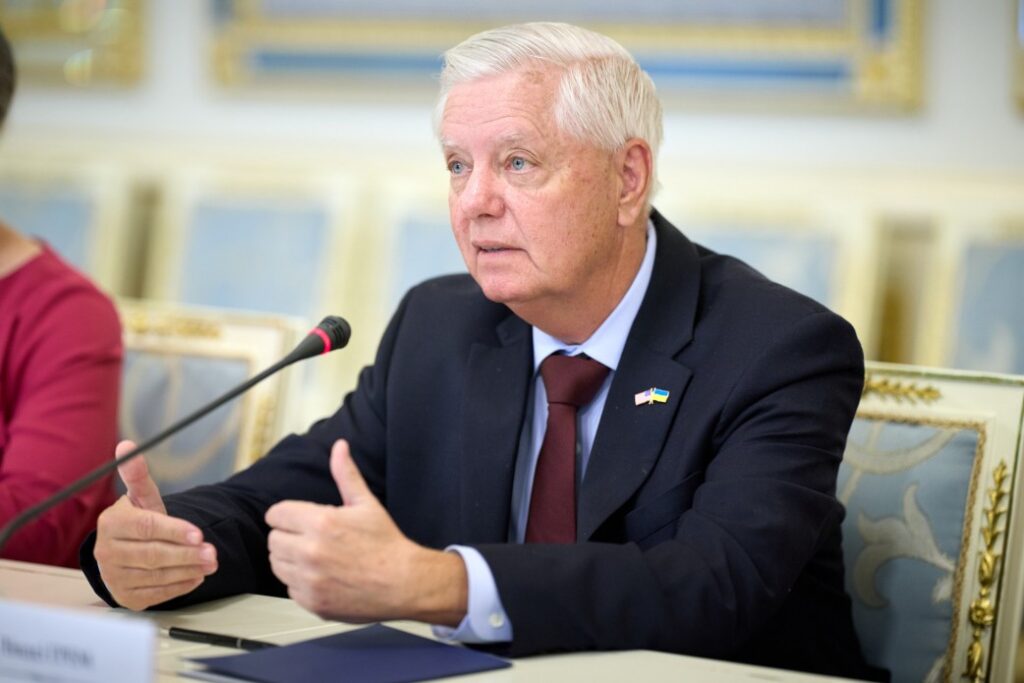
US Senator Lindsey Graham in Kyiv on 10 July 2026. Photo: president.gov.ua
The measure that would truly bite Moscow is different, and it is stuck. The measure that would truly bite Moscow is different, and it is stuck. A bill championed by the late Senator Lindsey Graham would let Washington put tariffs of up to 100% on the biggest buyers of Russian oil and gas—China and India—aiming at the revenue that keeps the war going.
Graham died on 11 July, a day after a visit to Kyiv. The bill now carries his name.
Explore further
US Sen. Graham’s Russia sanctions bill sat stalled for over a year—now the Senate has the votes to pass it
Already watered down from an earlier 500%, it still faces hurdles in the Senate and has yet to reach a vote.
So the tariff that looks like pressure on Russia is a formality—the same rate a NATO neighbor pays, on trade already hollowed out by the war. The one built to hurt Moscow is not law yet.
Russia believes that U.S. President Donald Trump is sincere in his efforts to end the war in Ukraine and will wait for Washington to put forward new proposals, even though the U.S. is continuing to provide weapons to Kyiv.
Russia believes that U.S. President Donald Trump is sincere in his efforts to end the war in Ukraine and will wait for Washington to put forward new proposals, even though the U.S. is continuing to provide weapons to Kyiv.
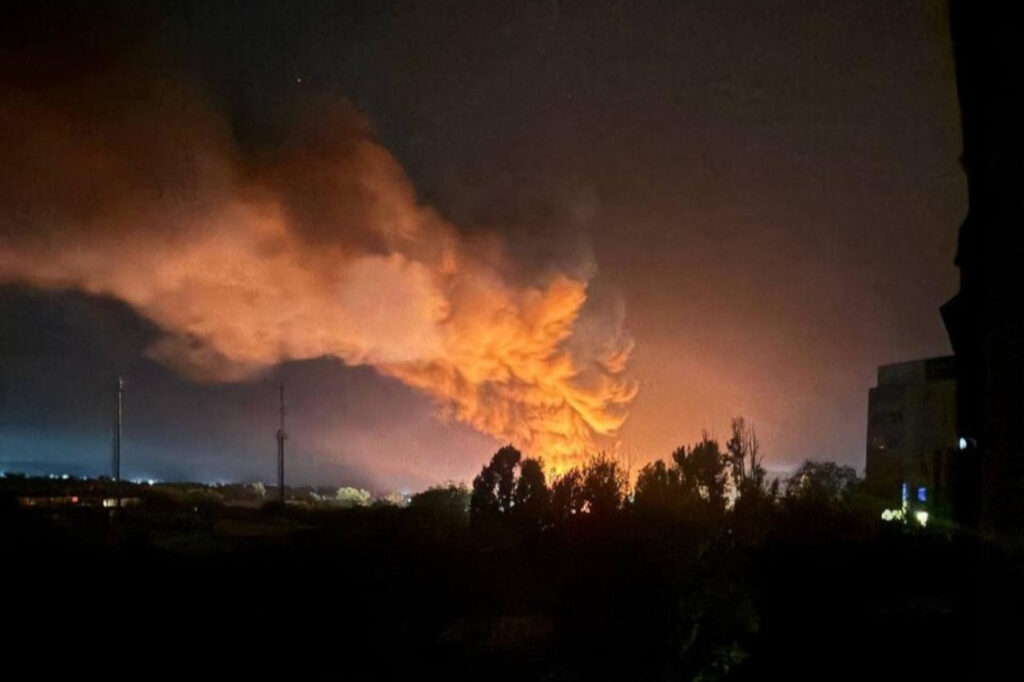
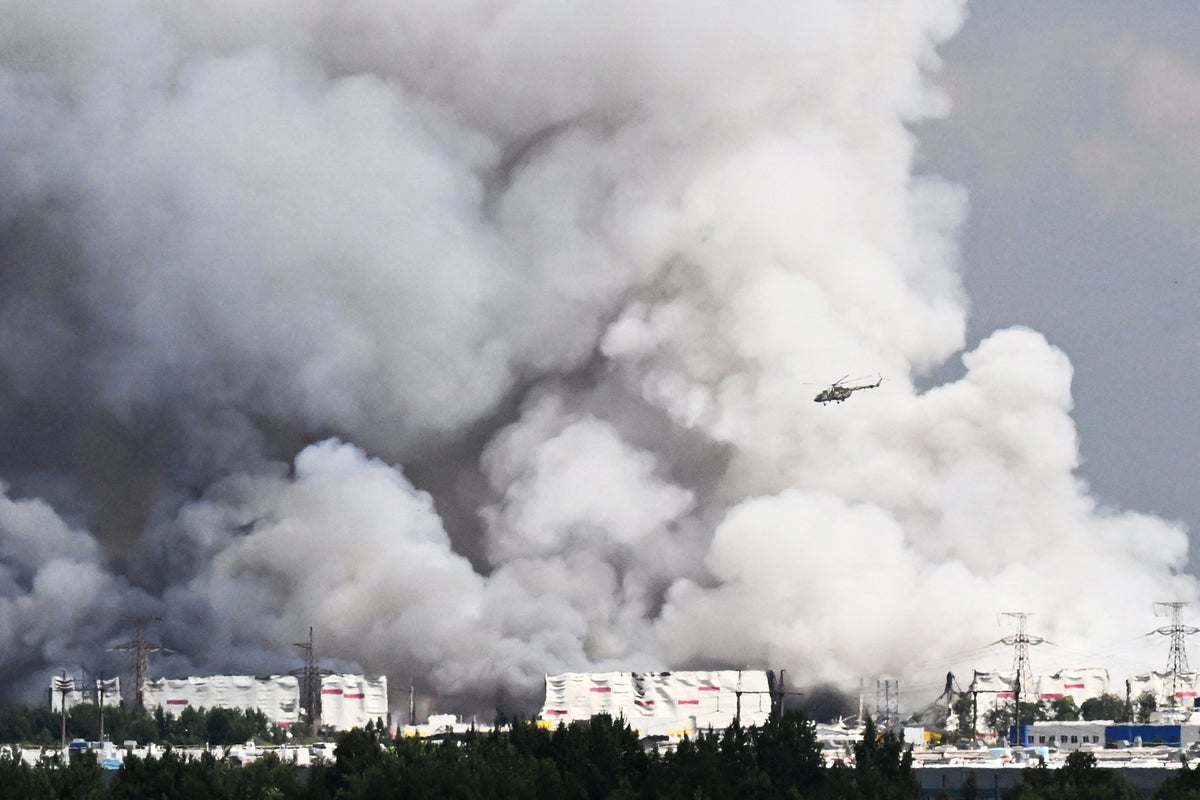
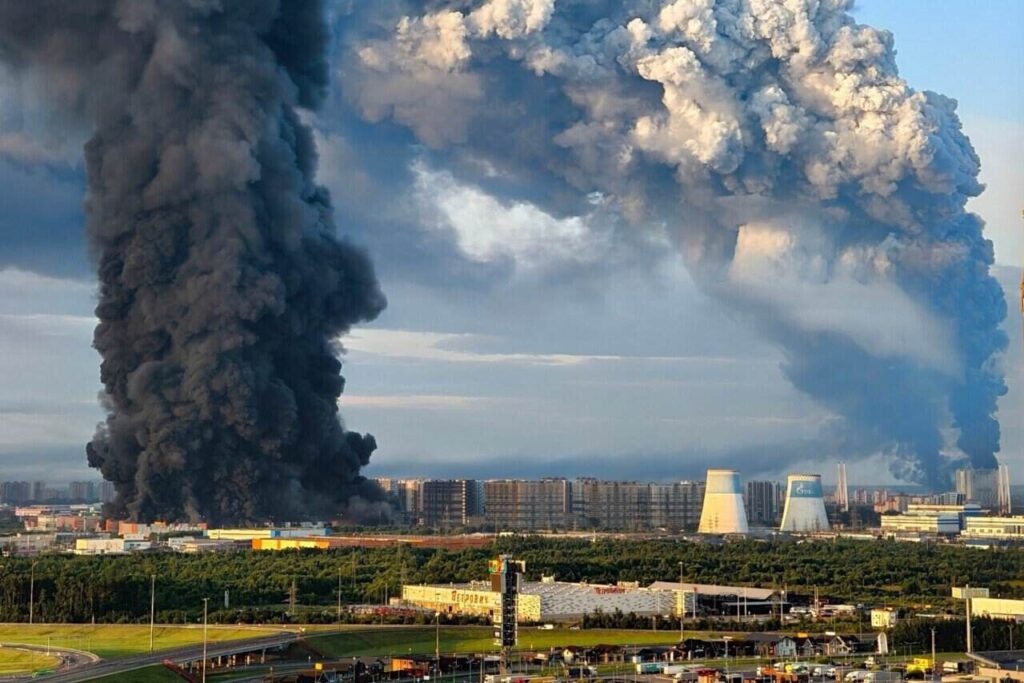
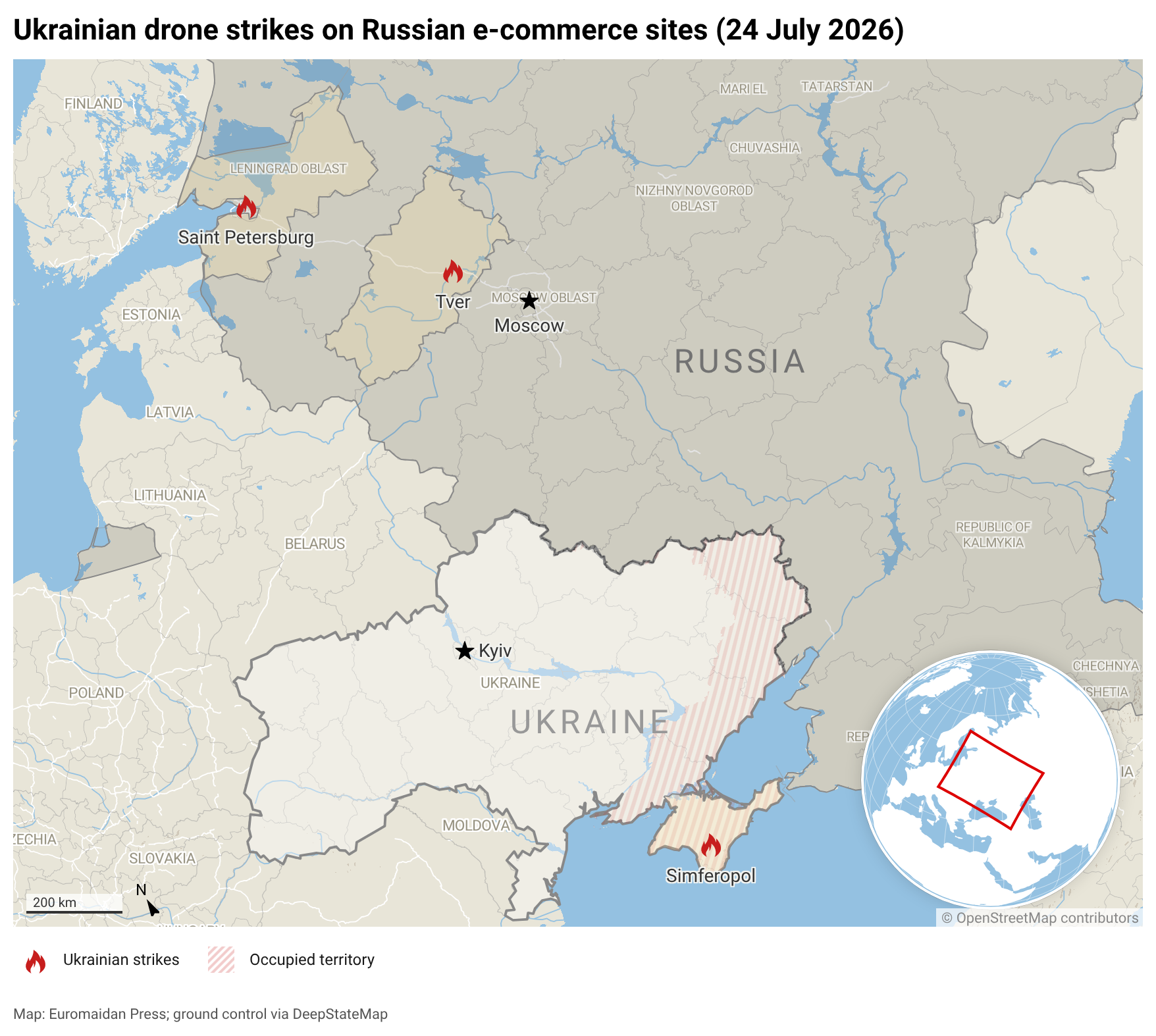
Ukrainian long-range drones struck warehouses of Russia's biggest online retailer overnight and into the morning of 24 July, hitting occupied Crimea and Russia's second-largest city, according to Ukrainian and Russian monitoring channels. Fires broke out at Wildberries logistics sites, and the company suspended operations near St. Petersburg while evacuating its sorting center in occupied Simferopol. Another—less successful—strike occured in Tver. Russia scrambled fight
Ukrainian long-range drones struck warehouses of Russia's biggest online retailer overnight and into the morning of 24 July, hitting occupied Crimea and Russia's second-largest city, according to Ukrainian and Russian monitoring channels. Fires broke out at Wildberries logistics sites, and the company suspended operations near St. Petersburg while evacuating its sorting center in occupied Simferopol. Another—less successful—strike occured in Tver. Russia scrambled fighter jets and claimed dozens of drones downed, but the warehouses burned.
Ukraine's long-range drone units have spent the summer turning Russia's rear-area commercial and fuel logistics into a repeat target, part of a widening deep-strike campaign that has hit warehouses and depots deep inside Russian territory.
Fires from occupied Crimea to the Baltic coast
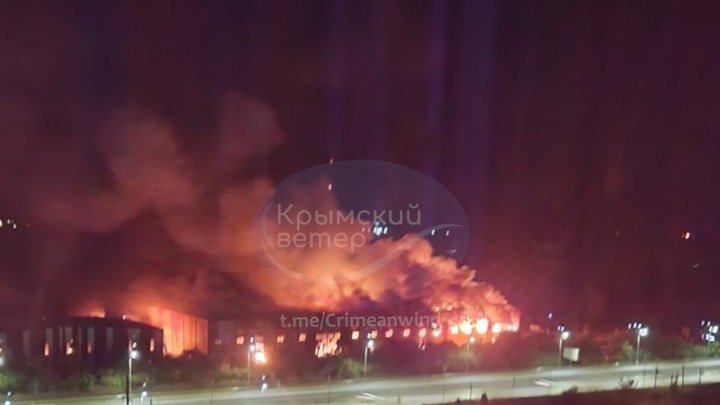
The night's strikes began over occupied Simferopol. The monitoring Telegram channel Krymsky Veter logged explosions from 23:55, pointing to a likely hit on a thermal power plant and a Wildberries warehouse, and later noted a fire at a substation in the Feodosia district. Ukrainian monitoring channel Exilenova+ also reported the Simferopol strike, while the Astra Telegram channel said the sorting center there was attacked overnight.
Fire at a Wildberries warehouse after a Ukrainian drone strike in occupied Simferopol, Crimea, 24 July 2026. Photo: Krymsky Veter
Wildberries confirmed it, saying it evacuated staff from the Simferopol center at 01:40 "in line with safety requirements." Founder Tatyana Kim later confirmed the warehouse had been hit.
By morning, the drones struck the St. Petersburg area. Videos published by Exilenova+ and reports cited by Astra documented two logistics centers on fire — one at Shushary in the city's Pushkinsky district, a roughly 106,000-square-meter complex among the retailer's largest in northwest Russia, and one at Utkina Zavod in the village of Novosaratovka, just across the city's administrative line.
Astra reported the Novosaratovka blaze. Wildberries said it had temporarily halted work at both. Ukraine's Defense Forces used long-range FP-1 drones made by Fire Point.
Russia's Amazon clone is burning again, and now its rival has joined it
Overnight strikes hit the Shushary complex inside Saint Petersburg, about 106,000 m² and one of Wildberries' biggest distribution centers in northwest Russia, along with the sprawling Utkina Zavod logistics… pic.twitter.com/8t0Cvnz8Yd
Ukraine's drone-force commander Robert Brovdi, call sign "Madyar," wrote on Facebook:
"Today from Simferopol to Piter" — Piter being the Russian nickname for St. Petersburg.
Leningrad Oblast Governor Aleksandr Drozdenko claimed air defenses shot down 59 drones. He also confirmed a hit on the Novosaratovka Wildberries warehouse that injured three people, and said drones struck a storage building at the "Severnaya" poultry farm in Sinyavino, collapsing part of one structure. St. Petersburg Governor Aleksandr Beglov acknowledged a drone hitting a "civilian infrastructure object."
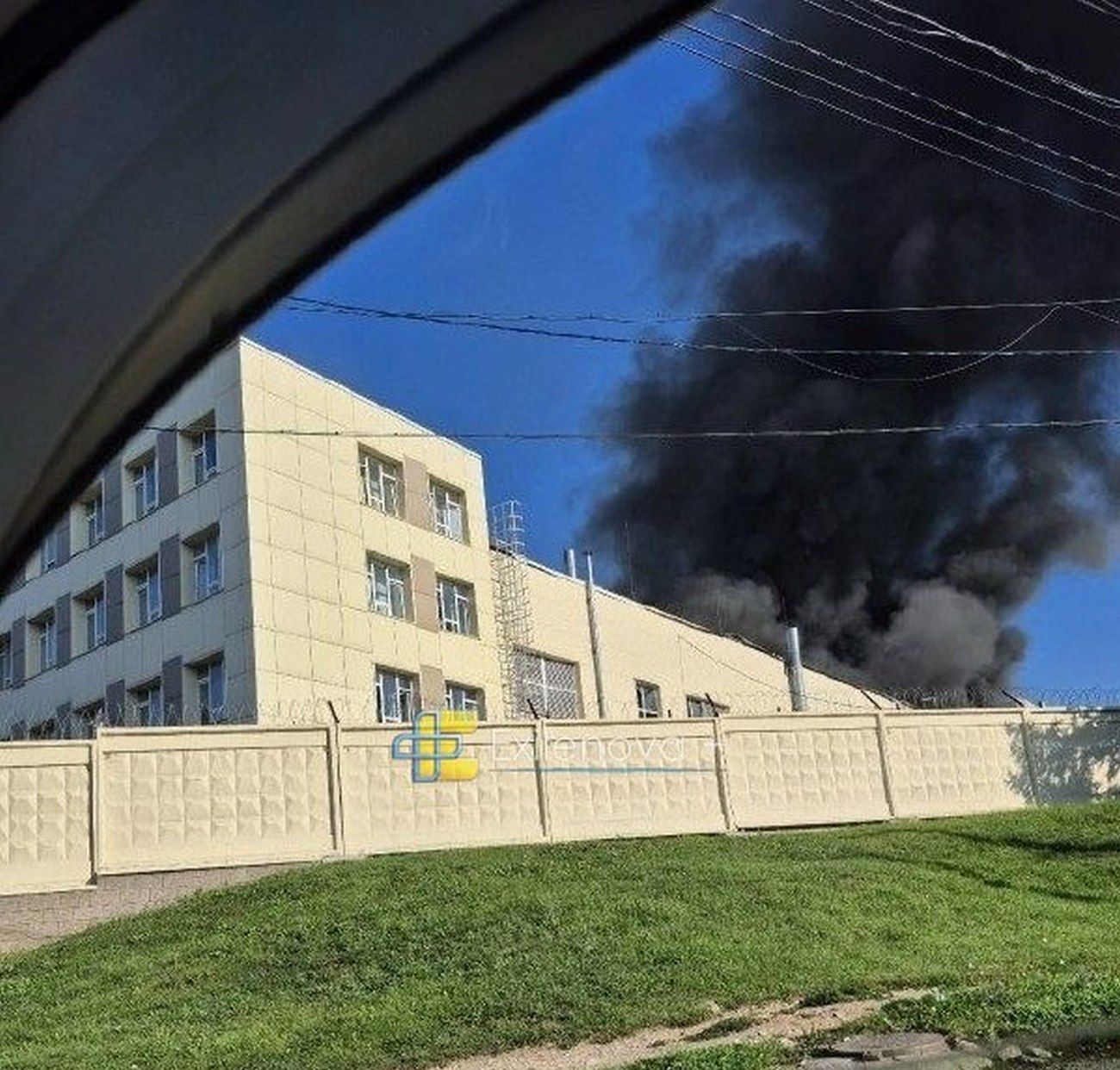
A fire also broke out at a logistics-center administrative building in Tver after a drone attack, which the acting regional governor said was already put out—one version held it was also a Wildberries warehouse.
Explore further
One plant makes the seats that save Russian pilots—Ukraine’s Flamingo missile torched it 1,200 km from home
Another week of strikes on the retailer
The day before, Ukrainian drones hit a Wildberries distribution center in Voronezh Oblast, where the governor acknowledged roof damage, and tried to reach a warehouse in Kazan, where locals said air defenses downed them.
Over the past week, Ukrainian drones struck about 10% of Wildberries' logistics network and knocked out 8% of its warehouses, Russian business daily Kommersant calculated from open data. Rebuilding the lost storage space alone, without equipment, was estimated at about $450 million, and company sources warned some sites may need full reconstruction.
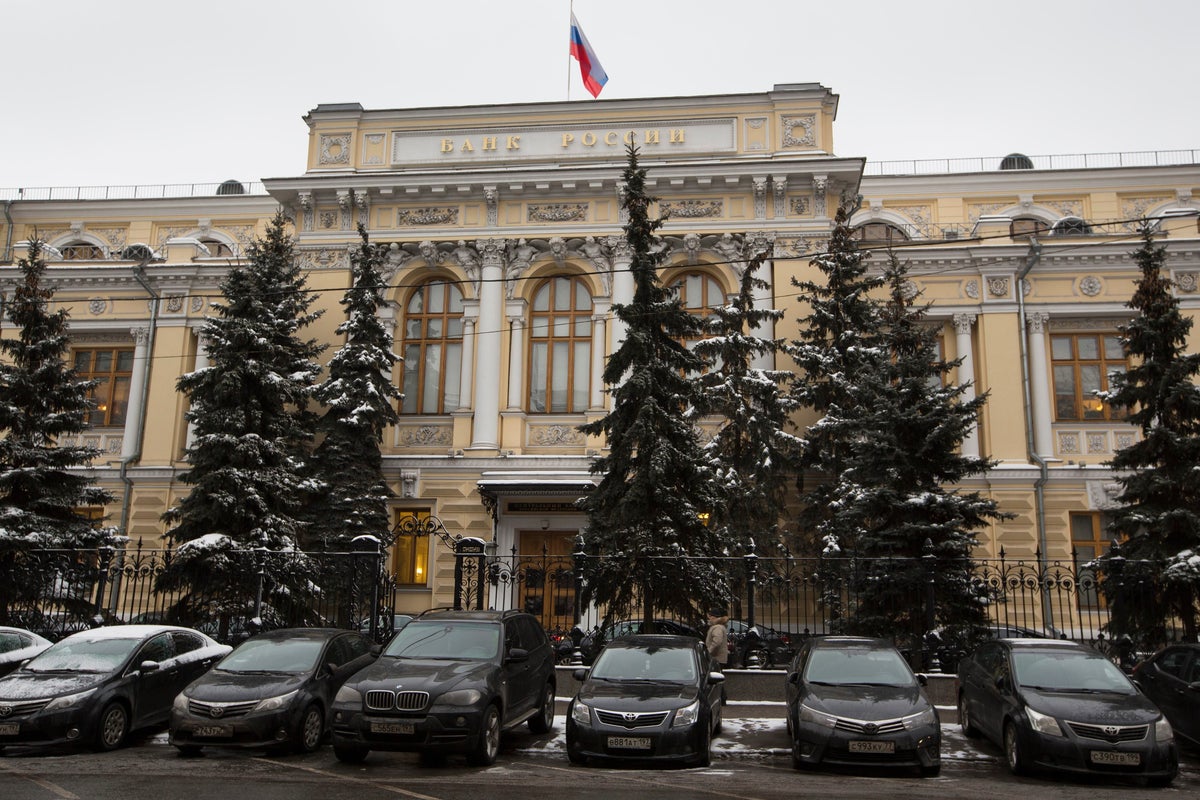
Russia’s central bank made a smaller than usual interest rate cut on Friday, a compromise move to support stagnating economic growth even as inflation fueled by war spending remains higher than the bank’s target
Russia’s central bank made a smaller than usual interest rate cut on Friday, a compromise move to support stagnating economic growth even as inflation fueled by war spending remains higher than the bank’s target
Russia launched an afternoon missile attack on Ukraine on July 24, firing two Oniks cruise missiles and three ballistic missiles, one of which was intercepted by Ukrainian air defenses. The daytime strike may have been timed to coincide with a public event taking place in the Kyiv region.
Russia launched an afternoon missile attack on Ukraine on July 24, firing two Oniks cruise missiles and three ballistic missiles, one of which was intercepted by Ukrainian air defenses. The daytime strike may have been timed to coincide with a public event taking place in the Kyiv region.
Russia's campaign of terror against civilian vessels in the Black Sea could trigger a surge in global food prices, hitting the world's most vulnerable populations the hardest.
Russia's campaign of terror against civilian vessels in the Black Sea could trigger a surge in global food prices, hitting the world's most vulnerable populations the hardest.
In July 2026, two things happened that the German government insists have nothing to do with each other. A German state licensed a factory to make nuclear fuel with Vladimir Putin’s atomic corporation. And a newspaper exposed a secret channel in Baku, where retired German grandees had been meeting Putin’s allies to talk about the war.Berlin is right: the two are unconnected. No shared actors. No money moving between them. Because the pull back toward Russia does not need t
In July 2026, two things happened that the German government insists have nothing to do with each other. A German state licensed a factory to make nuclear fuel with Vladimir Putin’s atomic corporation. And a newspaper exposed a secret channel in Baku, where retired German grandees had been meeting Putin’s allies to talk about the war.
Berlin is right: the two are unconnected. No shared actors. No money moving between them. Because the pull back toward Russia does not need to be coordinated.
Three years of war have changed Germany’s language about Moscow faster than its instinct to keep a door open—and the instinct keeps surfacing, in the quiet judgment calls that go Russia’s way, and in the old networks its elders keep warm.
The company that would supply the license is the same one that controls the occupied Zaporizhzhia nuclear plant, seized by Russian troops in 2022.
“No legal way to refuse”
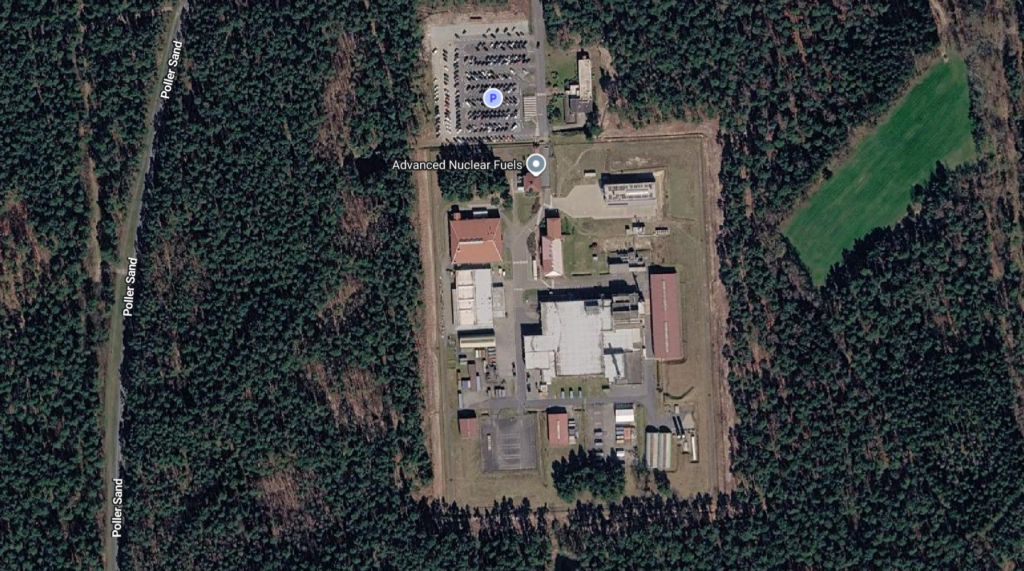
On 22 July, the state of Lower Saxony approved plans for the French firm Framatome to produce Russian-designed fuel elements at its Lingen plant, using the technology of Rosatom’s subsidiary TVEL. The company that would supply the license is the same one that controls the occupied Zaporizhzhia nuclear plant, seized by Russian troops in 2022.
Explore further
Surprise! Rosatom, that Russian “energy” giant, is actually building nukes for Putin
The decision came wrapped in a now-familiar argument: our hands are tied. German law compels an authority to grant a license once the technical conditions are met; political misgivings carry no weight.
The only instrument that could stop such cooperation, the federal environment ministry said, would be EU-wide nuclear sanctions—for which there is no majority among member states. The law had no off-switch, and the sanctions that would supply one do not exist.
It is a tidy account, and the legal mechanism is real: once the conditions are met, the ministry said in a statement, an atomic-law permit must be granted. But the account skips past where the discretion sat.
German atomic law allows the authority to refuse a permit on security grounds—the discretion the ministry had Professor Gerhard Roller assess in 2023—and the ministry’s own statement concedes the risks lie “within the authority’s discretion.” The license became unavoidable only after the government judged those risks manageable, subject to conditions.
Nor is the deal inevitable. Europe could make the same fuel rods with the US firm Westinghouse, Oleh Savytskyi of the Ukrainian campaign group Razom We Stand told Euromaidan Press. TVEL’s technology, he said, is “not secret and not exclusive anymore.” The claim that there is no alternative is not a fact.
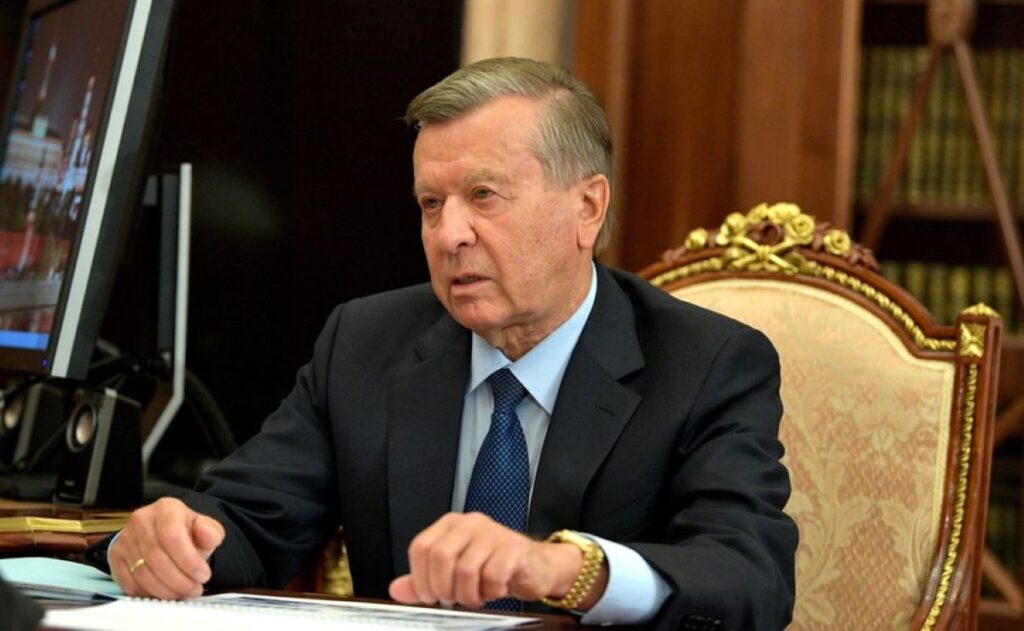
Viktor Zubkov, former Russian prime minister and chairman of Gazprom's board. Photo: kremlin.ru
The grandees never left the room
Five days before the Lingen approval, a Die Zeit and ARD investigation revealed the other face of the reflex. Since 2024, two retired German grandees—Ronald Pofalla, once Angela Merkel’s chief of staff, and Matthias Platzeck, former Social Democrat premier of Brandenburg—had been meeting Putin’s allies in Baku, among them Gazprom board chair and former Russian prime minister Viktor Zubkov.
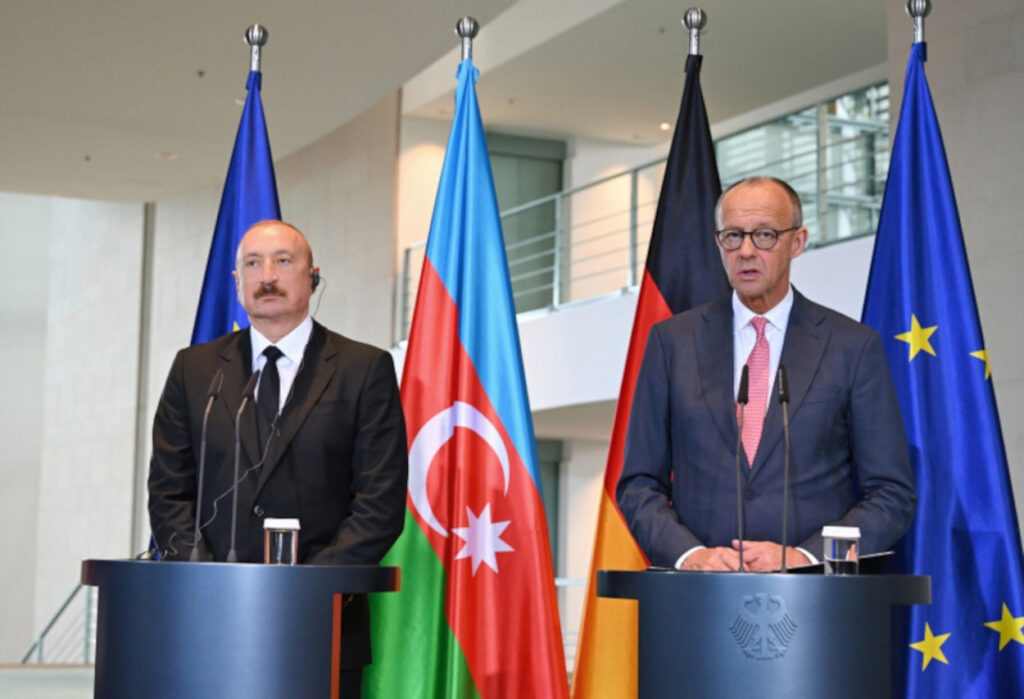
Azerbaijan’s president confirmed the July trip from flight records; Chancellor Friedrich Merz said he had known nothing about it. According to the journalistic investigation, German security services read these gatherings as a Russian influence operation designed to shape German policy.
Pofalla and Zubkov once co-chaired the Petersburg Dialogue, the forum built under Putin and Gerhard Schröder that Germany only abandoned after the full-scale invasion. An earlier Baku round, in 2025, included a sitting Social Democrat member of the Bundestag.
Azerbaijani President Ilham Aliyev and German Chancellor Friedrich Merz in Berlin, 21 July 2026. Photo: Azertag
Two costumes
“We had no legal way to refuse” and “we didn’t know about the meeting” are the same sentence in different clothes—each a way of keeping a channel to Russia open while disowning responsibility for it. One is procedural, licensed, and on the record. The other is clandestine and deniable.
The gas sector shows the reflex in a third register. Industry lobbying to revive Russian gas imports, Razom We Stand has documented, returns whenever prices spike—the same appeal to pragmatism and mutual interest that once sold Nord Stream, and that sells Lingen now.
Explore further
The lobbying to bring back Russian gas is back. Faster electrification is the answer
Nord Stream is the warning the others should have read: a project marketed for a decade as commercial common sense, until Russia turned the gas into a weapon and Germany learned what strategic dependence costs. The argument for Lingen is almost word-for-word the argument once made for the pipeline.
The Germans pushing the other way
None of this makes Germany a Russian client, though. Germany is among Ukraine’s largest arms suppliers. It was Germany’s own intelligence services that flagged the Baku channel as hostile. Berlin says it is still pressing for EU nuclear sanctions to end the Lingen loophole.
And the sharpest objections to the deal came from within Germany: the Green environment minister who signed the approval called it “grundfalsch”—fundamentally wrong—and Marc Henrichmann, the CDU lawmaker who chairs the Bundestag’s intelligence oversight panel, urged Framatome to abandon the partnership.
German Chancellor Olaf Scholz in the German parliament. Photo: Olaf Scholz via Facebook
The reflex, then, is not the whole country. On the sanctions that would shut the loophole for good, Berlin is pushing, not blocking. The obstacle is the lack of a majority among member states, with Hungary and Slovakia the most resistant. The people resisting the reflex are largely doing it in public and on the record. The reflex itself works out of sight—a discretionary judgment here, a private flight to Baku there.
That is the measure of Germany’s Zeitenwende, the historic turn German chancellor Olaf Scholz declared after February 2022. The state that proclaimed Russia its adversary keeps letting its laws, its lobbyists, and its elders find the exceptions—and the exceptions do not need to know each other to point in the same direction.
The Kharkiv region has received 250 power transformers provided with the support of Australia's Department of Foreign Affairs and Trade through the Ukraine Energy Support Fund.
The Kharkiv region has received 250 power transformers provided with the support of Australia's Department of Foreign Affairs and Trade through the Ukraine Energy Support Fund.
The Security Service of Ukraine (SSU) carried out another series of successful overnight strikes on July 24, targeting oil refineries, oil pumping facilities, and a radar station in Russia and temporarily occupied Crimea.
The Security Service of Ukraine (SSU) carried out another series of successful overnight strikes on July 24, targeting oil refineries, oil pumping facilities, and a radar station in Russia and temporarily occupied Crimea.
 Connexion