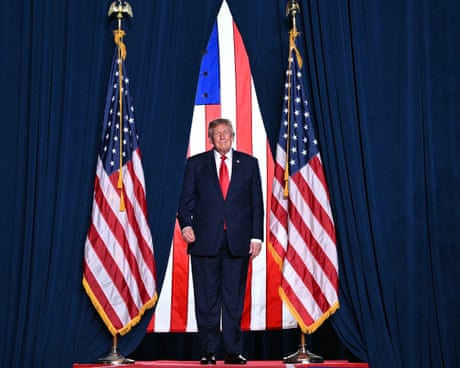
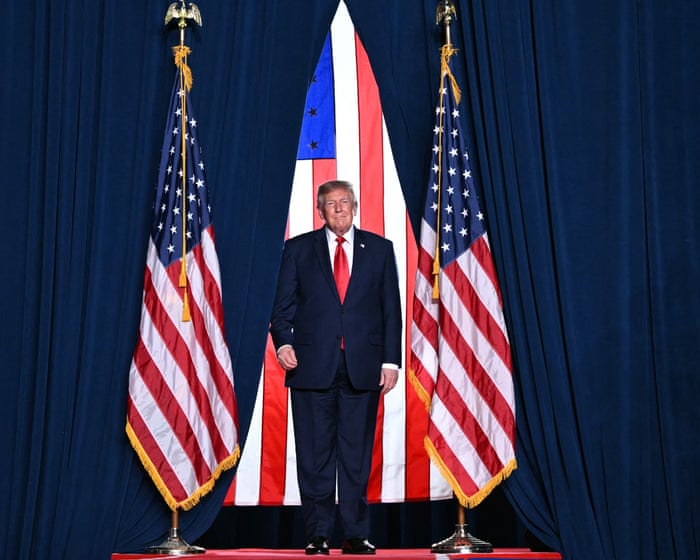
Senator Susan Collins, a Republican, and her Democratic challenger, Troy Jackson, disagreed over the war in Iran and President Trump in the third of four debates in a key race.
A bipartisan group of 12 senators called on the president to drop his decision to ease sanctions on Russia’s exports of diesel fuel, saying the deal would help Moscow continue the war in Ukraine.
The letter, led by Senator Richard Blumenthal, Democrat of Connecticut, came just weeks after Congress overwhelmingly approved legislation intended to increase economic pressure on Moscow and its allies.
After years of investigation, the Justice Department appears to be intensifying a criminal inquiry into the immigration history of Ilhan Omar, a Minnesota Democrat, and her family.
President Trump cut her loose after damaging news reports about her tenure as ambassador to Greece. Once a prominent Trump insider, she suggested she will now fight to defend her reputation.
Kimberly Guilfoyle with President Trump at a White House event in March. In announcing her resignation, Ms. Guilfoyle decried what she called false accusations.
Katie Zacharia’s maiden briefing was excruciating – at least her predecessor had delivered her propaganda hot
Well, that was weird. Katie Zacharia, the new White House press secretary, made her debut on the podium on Tuesday with all the warmth, wisdom and political dexterity of an AI avatar.
Zacharia was all stilted delivery, nervous tics and lack of eye contact. With an eerie lack of emotion, she served up pro-Trump talking points, took only three questions and vanished after 14 minutes. It was like the West Wing had turned into uncanny valley.
District judge Ana Reyes halts tree-cutting at the East Potomac golf course until 26 October, and now requires advance notice before making course changes
US district judge Ana Reyes on Tuesday ordered a halt to tree-cutting at the East Potomac golf course until 26 October, putting a further pause on work at the historic Washington DC course that has been part of Donald Trump’s plans to remake the country’’s capital city.
Reyes issued the order one day after a tense three-hour hearing in which she harshly criticized the government for having deceived her with its actions over the holiday weekend.
The ruling barred major modifications at the D.C. course while a federal judge seeks testimony from Interior Department officials about whether they ignored a court order.
When asked about the decision to request US ambassador Kimberly Guilfoyle's resignation, Donald Trump told the press she 'was doing a good job' but that the administration 'didn't like what we were reading', referring to allegations that Guilfoyle had asked a Trump donor to pay her credit card bill. Guilfoyle, who was once engaged to Trump’s son, Donald Jr, was a longstanding political ally
Ukraine has loosened its reliance on Washington but still depends on the United States in three military areas that let US President Donald Trump keep pressuring Kyiv, The Telegraph wrote on 12 October. That pressure now centers on the energy ceasefire Trump declared on 11 October, with US officials reportedly warning Kyiv not to hit Russian energy during the truce. Kyiv backs a mutual truce, but Moscow has not confirmed it, and Russian strikes on Ukraine’s grid have continued.
The paper named three such ties: satellite intelligence, Patriot interceptors, and American weapons bought with European money. A pause in any of them would hit just as Russia’s winter campaign begins. Ukraine says an intercepted document reportedly lays out up to 1,000 Russian missiles, drones, and bombs for 60 critical sites this winter, so any pause in US intelligence, interceptors, or PURL deliveries would land as that campaign gets under way.
Satellite intelligence: the US still holds the key
The Central Intelligence Agency (CIA) and other US services still pass precise satellite data that help Ukrainian forces hit targets inside Russia, by the paper’s estimate. Trump briefly suspended that flow in March 2025 to pressure Zelenskyy. A Ukrainian official told Axios that Trump envoys Steve Witkoff and Jared Kushner threatened during 9 October talks in Miami to cut off US intelligence.
Explore further
Russian ballistic missiles hit Kyiv before sirens, gap that lands hard amid fears that Washington could cut data that warns of launches
Patriot interceptors: no quick substitute
The Telegraph called interceptor missiles the second and probably sharpest dependency. Only American Patriot systems can down Russia’s most powerful missiles, which strike Ukrainian cities daily, the paper wrote. Kyiv’s PAC-3 stocks ran dry mainly because US reserves were diverted to the Middle East after America’s war against Iran, the paper added. Kyiv had warned in March that a long Middle East war would squeeze its PAC-3 supply.
Five European defense firms—Destinus, MBDA Deutschland, Safran, Airbus, and Thales—signed a letter of intent in July to develop a joint interceptor, but a testable prototype is not expected before next year, the paper wrote. Ukraine is also building its own interceptor with European allies under the FREYJA program.
Explore further
The night Trump announced a diesel deal with Putin, drones knocked out more than half the tanks at a Russian fuel-export terminal
US arms bought with European money
The third is buying American arms with European money through the Prioritized Ukraine Requirements List (PURL), a NATO-run purchasing scheme. US officials have reportedly warned Europe that Trump may halt those supplies if Ukraine keeps striking Russian oil refineries.
US President Donald Trump said on 13 October that the US continues to share intelligence with Ukraine, following reports that Washington had threatened to suspend intelligence assistance unless Kyiv stopped striking Russian oil refineries, POLITICO reported.
The comments came after Ukraine received no advance warning from its partners ahead of Russia's latest ballistic missile strike, raising fresh questions about intelligence sharing between Kyiv and Washington.
“We are helping them, and we are sharing intel. We want the war to end,” Trump told reporters at the White House, according to POLITICO, reaffirming US support after his recent efforts to reach an agreement with Russian President Vladimir Putin drew criticism over his approach to the war.
Trump reaffirms support after backlash over Russia deal
Last week, the US threatened to cut intelligence sharing if Ukraine did not stop attacking Russian oil refineries. Zelenskyy did not publicly confirm the reported threat.
The reports came amid criticism of Trump’s announcement of a deal to buy Russian oil and his pressure on Kyiv to make concessions, even as Russia continued attacking Ukraine.
Zelenskyy said Ukraine had refrained from striking Russian oil refineries and the energy sector for two days after Trump announced an energy ceasefire. Russia, however, continued attacking Ukrainian energy facilities and critical infrastructure, he said, with 19 Ukrainian regions coming under attack during those two days.
Trump said Monday that both Russia and Ukraine had violated the energy ceasefire, arguing that each side was responsible. He also said Putin wanted a deal and that Washington needed to persuade Zelenskyy to agree.
Trump's latest comments publicly reaffirm that intelligence sharing is continuing. However, the circumstances surrounding the latest Russian strike have raised questions about whether Ukraine is receiving the early warnings it needs to protect civilians.
Ukraine received no warning before latest Russian strike
Early warnings of incoming Russian ballistic missiles give Ukrainians a brief window to reach shelter before impact. US intelligence helps make those warnings possible, giving civilians crucial time to protect themselves.
Zelenskyy said Russia's latest attack involved five ballistic missiles and more than 100 drones, and that Ukraine received no warning from its partners before the strike.
“Intelligence on Russian ballistic missile launches helps save lives,” Zelenskyy said Tuesday. “This is precisely what helps prevent people from being killed — when there is an early warning about ballistic missiles.”
He added that Ukraine had received no warning ahead of the attack.
Explore further
Russian ballistic missiles hit Kyiv before sirens, gap that lands hard amid fears that Washington could cut data that warns of launches
Ukraine normally receives alerts about impending Russian missile launches through the Battlespace Command and Control Center, a system operated by the US military and NATO members, among others, POLITICO reported.
Citing an unnamed official familiar with the matter, POLITICO reported that US officials attributed the missing warning to bad weather. The explanation reportedly raised doubts among Ukrainian officials.
Ukrainian Air Force spokesperson Yurii Ihnat said the warning system had failed to transmit information on previous occasions. He said specialists would work with international partners to resolve any technical problems.
Ukrainian Foreign Minister Andrii Sybiha said Tuesday that intelligence sharing through the platform was continuing, according to POLITICO.
Democrats have described a raid on the home of Congresswoman Ilhan Omar as “deeply disturbing” and a “rogue abuse of power” by the Trump administration. The Democratic representative for Minnesota has long been a target of highly personal attacks by Donald Trump, who claims he was not involved in ordering the Justice Department raid. Omar criticised the raid as an attempt to “weaponize law enforcement” as part of a “campaign of political intimidation” against her. Lucy Hough speaks to Guardian US political reporter Shrai Popat – watch on YouTube
The Maga member believes the 2020 election was stolen and seemingly her new boss is saving the world from a cabal of satanic paedophiles. She’ll fit right in then
Poor Donald Trump. His (third) wife seemingly can’t bear to be near him and his (fifth) press secretary recently abandoned him to be with a baby she had only recently met.
“She decided she loved her children more than she loved Donald Trump,” the president lamented in August when Karoline Leavitt decided to step down a few months after giving birth. “I’m very upset about this. She has to go home and spend time with her children. That does happen on occasion with some people – when they love their children.”
Russian meddling probably didn’t affect the referendum result – but the Kremlin’s motives for wanting to undermine the EU still matter
Russian territorial aggression against Ukraine didn’t feature much in the Brexit referendum campaign. It made headlines briefly when Boris Johnson blamed Moscow’s 2014 annexation of Crimea on the European Union.
According to the Vote Leave frontman, Vladimir Putin’s land grab was a consequence of Brussels making foreign policy “on the hoof” and having “pretensions to running a defence policy”.
Russia has reaped a diesel deal and an increase in U.S. pressure on Ukraine as President Trump’s political needs align with his longstanding inclinations toward Russia.
A nonprofit watchdog group sued the Department of Government Efficiency, asserting that it should be subject to federal Freedom of Information Act discovery requests.
Kimberly Guilfoyle is stepping down as US ambassador to Greece after weeks of reports that she sought payment from a Trump donor in exchange for access to administration officials.
The decision, announced by the White House on Tuesday morning, ends the diplomatic career of one of Donald Trump’s longest-standing political allies. It came after the US president and Marco Rubio, the secretary of state, were reported to have grown furious over the allegations.
Ms. Guilfoyle was asked to quit by the White House after a string of damaging reports, including that she had asked a Republican donor to pay off a credit card.
Sean Duffy targets bike lanes and immigrant truck drivers while steering funds away from addressing lethal US roads
Barbara McCann may have been the first person to notice that the Federal Highway Administration had removed several safety policies from public view.
McCann worked on road safety policy at the US Department of Transportation (USDOT) for more than a decade across multiple administrations, retiring in January 2025 just before Donald Trump’s second term started. After Sean Duffy, the president’s ally and former Fox news host, took the wheel at USDOT, she became increasingly worried as the secretary appeared unmotivated to address pedestrian safety and regularly bashed bike infrastructure.
Ukrainian forces hit 12 large Russian refineries in September, Ukraine’s Ministry of Defense said, according to ArmyInform on 12 October. The farthest on the ministry’s list, Lukoil’s refinery in Perm, lies about 1,500 kilometers from Ukraine’s border. Since Trump's 11 October announcement, Euromaidan Press has found no reports of new Ukrainian refinery strikes in the official and unofficial Ukrainian and Russian sources it monitors.
A refinery-for-refinery pause would limit Ukraine’s ability to disrupt Russia’s oil industry while leaving Moscow free to keep attacking Ukraine’s energy system, giving Russia an advantage in a war where both sides use energy infrastructure as a target. The issue has become urgent since Trump announced an “energy ceasefire” on 11 October, after which Ukraine reported holding off strikes on Russian energy facilities while Zelenskyy said Russia attacked several Ukrainian energy sites.
The campaign continued into October. Ukraine’s General Staff said Ukrainian forces struck the Samara oil pumping station overnight into 10 October, the third attack on the station that month, according to Radio Svoboda.
Ukraine held off, Russia hit six energy sites
Zelenskyy said Ukraine had refrained from striking Russian energy facilities overnight on 11–12 October following Trump's announcement. Monitoring channels and official Russian sources did not report any new refinery strikes on 13 October.
“Last night, we did not attack any energy facilities on the territory of Russia because President Trump said that there would be an energy ceasefire,” Ukrainian President Volodymyr Zelenskyy said.
He added that Ukraine does not announce its next operational steps. Zelenskyy said Russia attacked six Ukrainian energy facilities on 12 October alone, according to Radio Svoboda.
Refineries first, power plants possibly later
A White House official told Axios that the proposal would begin with both sides halting attacks on oil refineries, with a possible agreement covering power plants to follow. Axios reported that Russia had not accepted a ceasefire.
The Institute for the Study of War (ISW) said the proposal, as described, would give Russia a major concession without offering Ukraine anything in return: Russia has scores of operating refineries, while Ukraine has one. ISW also said the proposal would allow Russia to continue its winter strikes on Ukrainian power stations.
Asked about apparent U.S. threats to cut off intelligence sharing with Kyiv, which can warn of Russian aerial attacks, President Trump said information continued to flow.
Two major Republican super PACs are said to be withdrawing cash from the races of the incumbent Representatives Thomas H. Kean Jr. of New Jersey and Mariannette Miller-Meeks of Iowa in an effort to triage the midterm map.
The pre-midterm defenestration of ACA enrollees looks like political madness – but the president appears to believe hitting poor people might work for him
There is a manic quality to Donald Trump’s desperate dash to do something, anything, ahead of November’s midterm elections to convince beleaguered Americans that he can make the pressures his policies have imposed on their livelihoods go away.
The US president offered to lower barriers against beef imports to limit surging meat prices, only to consider backtracking under pressure from the cow lobby. He offered to stop diesel exports, only to find oil companies werenot interested. He weakened fuel efficiency standards, claiming this would trim the price of a new car (and forgetting to point out it will also raise spending on gas.) In early October he started mailing $500 checks to nearly a million people touting his healthcare “wins”. Oh, and he promised adult Americans a $5,000 check if Republicans maintain control of Congress. That, too, will go nowhere.
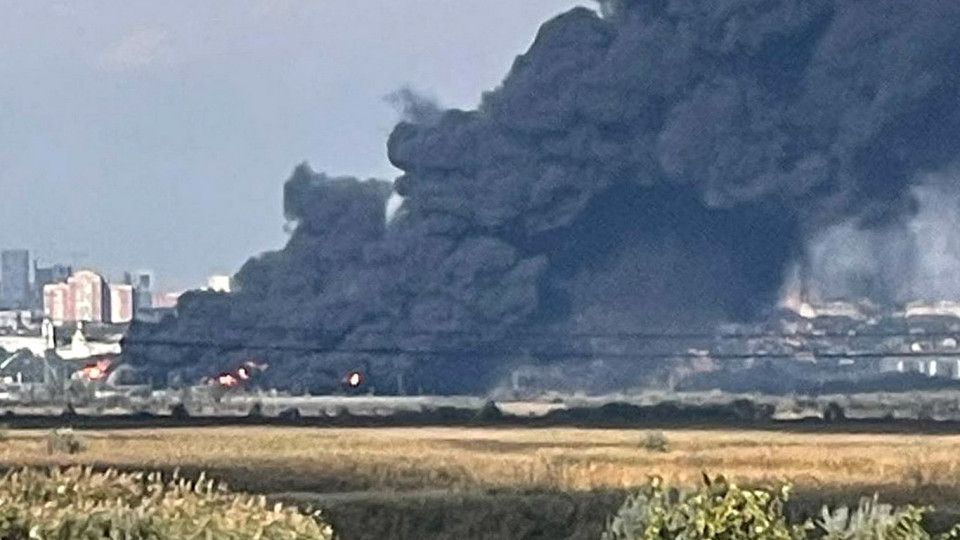
A drone strike on 10 October put more than half of the large fuel tanks out of action at an oil-loading terminal in Russia’s Rostov-on-Don, Russian news Telegram channel Astra found. The terminal loads fuel onto river and sea tankers for export, and it burned for two days while a local channel wrote that reeds might be on fire. Neither Kyiv nor Moscow has officially acknowledged the hit. It came hours after US President Donald Trump announced a diesel deal with Russian leader Vladimir Putin.
Russia has spent the autumn hammering Ukraine’s power grid ahead of winter. Ukraine’s long-range drones keep hitting the refineries, depots, and terminals that fuel Russia’s army and earn it export revenue. Every burned tank turns that revenue into repair bills, while Moscow is already subsidizing its own fuel pumps. A refinery-only truce of the kind the White House described a day after the strike would shield the Russian plants that feed terminals like this one.
Seven of 12 tanks out of action
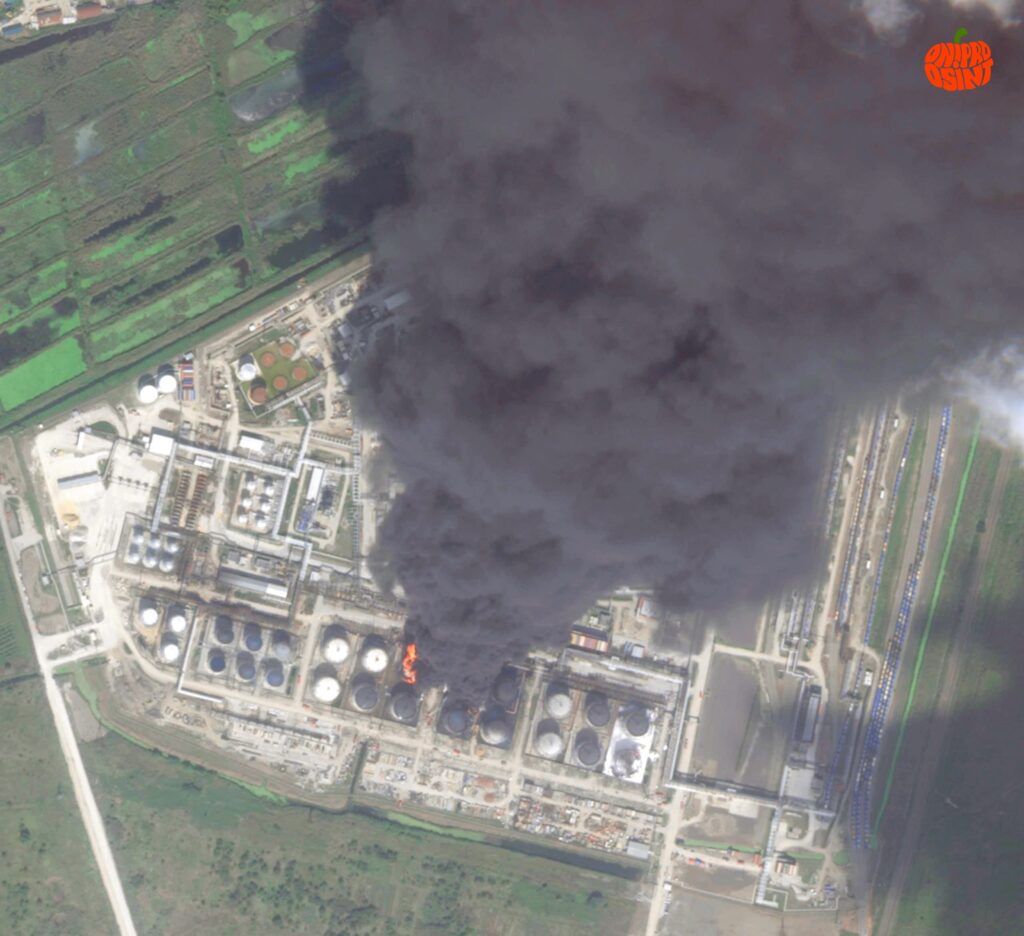
Astra’s analysts concluded from eyewitness footage that at least seven of the terminal’s 12 large tanks had been knocked out. Ukrainian monitoring channel Supernova+ counted seven burned-out tanks and one more scorched by the fire.
The fire was still burning in the early hours of 12 October. Local channel Rostov Glavny posted video of the burning tank farm, passing on rumors that reeds were on fire and noting the city’s second day under smoke, The Moscow Times reported. Footage filmed in the daytime on 12 October showed no more open flames, only gray smoke, according to Astra.
Satellite image of the oil-loading terminal of the Novoshakhtinsk refinery in Rostov-on-Don, Russia, during the fire, 10 October 2026. Satellite image: Radio Liberty
A terminal that loads fuel for export
The site is the oil-loading terminal of the Novoshakhtinsk Oil Products Plant, formerly known as Yug Rusi, in Rostov-on-Don’s Zheleznodorozhny District. It receives, stores, and transships fuel onto river and sea tankers, including for export, Ukrainian monitoring channel Exilenova+ said.
The terminal also supplies fuel to the Russian army and earns Moscow hard currency, ZN reported. The Moscow Times put its loading capacity at 3.5 million tons a year and its tank farm at about 60,000 cubic meters, roughly 16 million gallons.
Explore further
Trump’s Russian diesel deal, which drew fury in Ukraine, is unlikely to lower prices, experts say
The refinery itself stands in the town of Novoshakhtinsk near the border with Russian-occupied Luhansk Oblast. The terminal sits on the Don River with access to the Sea of Azov, Ukrainian military outlet Militarnyi noted. Ukraine hit the refinery in June, and Ukraine’s General Staff reported striking the Yug Rusi terminal on 9 July, placing it in Bataysk.
A night of drones over the region
Exilenova+ posted images of the burning terminal in the early hours of 10 October. It presented them as the site after Trump’s phone call with Putin. The channel later shared NASA satellite fire data showing the blaze.
Rostov Oblast Governor Yuri Slyusar claimed the attack injured six people. Slyusar further stated air defenses downed more than 100 drones over the region. Radio Liberty’s Russian Service noted that neither side had officially confirmed the hit on the terminal.
Aerial view of the oil-loading terminal of the Novoshakhtinsk refinery in Rostov-on-Don, Russia, with the tanks Astra assessed as hit marked in red and orange, 12 October 2026. Map: Astra
Hours after the US-Russia diesel deal
The strike came hours after Trump announced on 9 October that Russia had agreed to supply diesel to US and global markets. The US Treasury then cleared the trade with a sanctions license.
On 11 October, Trump declared an “energy ceasefire” between Russia and Ukraine. Under it, he expects Ukraine to stop striking Russian refineries, a White House official told Axios.
Ukrainian President Volodymyr Zelenskyy said that evening that Ukraine’s armed forces had received all relevant orders. Neither Ukrainian monitoring channels nor Russian officials have reported a new strike on a Russian oil facility since. On 13 October, Zelenskyy said Ukraine was ready to guarantee an energy ceasefire if Russia took matching steps.
Ahead of her White House podium debut, Katie Zacharia reportedly monitored Donald Trump’s public schedule every day, and monitored his Truth Social, and made sure she was on-air when she assumed he might be watching, according to Politico, citing a person familiar with the matter.
That source noted that and a number of high-profile conservative anchors – including from Fox News, Newsmax and OANN – also backed Zacharia for press secretary. She is now set to the sixth person to hold the role throughout both of Trump’s terms in office.
Away from the public eye, deportation planes at Youngstown-Warren and Akron-Canton airports carry hundreds of immigrants daily amid Trump’s ICE crackdown
Just after 10.30am on a recent weekday morning, a Bombardier CRJ200 Air Wisconsin aircraft landed at Youngstown-Warren regional airport.
Having made the 75-minute flight from Milwaukee, the 50-seater came to a halt and its twin engines fired down next to another Air Wisconsin plane and a larger Eastern Air Express Boeing 737, planes that flew in the evening before from Alexandria, Louisiana.
Trump’s reform law that seeks to make coverage harder to get, and to keep, includes working 80 hours a month
It is a date keeping US healthcare providers up at night: 1 January 2027.
As the midterm elections loom, everyone from hospital leaders and to patient advocates are focused on the New Year, when Republicans scheduled the most controversial elements of their healthcare reform law to go into effect.
Ukrainian drones have helped push Russia into its worst fuel crisis since the Soviet Union fell, The Washington Post (WaPo) reported on 11 October.
Diesel is where this war reaches American drivers. US President Donald Trump blames rising diesel prices mostly on Russia’s war in Ukraine, while experts blame mainly the US war with Iran. Some of his allies now accuse Kyiv of trying to sway the US midterms.
Drones go for the first stage of refining
The Washington Post looked at dozens of strikes between 1 April and 31 August. Three refinery experts then examined satellite images of 54 strikes with visible damage. In over half, the damage seems to be to the desalting and distillation units, known by the Russian acronym ELOU-AVT. These units clean the crude of water and salt, then split it into separate compounds, the first steps toward gasoline and diesel. More than a third appear to have hit secondary units, which turn those compounds into jet fuel, gasoline, and liquefied petroleum gas.
From April through August, drones struck two-thirds or more of the 36 big Russian refineries that S&P Global Energy tracks, a strike every third day. Some took as many as five hits. On 16 June, drones set the Moscow refinery’s distillation towers on fire. That strike and a second one days later kept the plant offline into September, WaPo reported, citing data firm Kpler. Ukraine targeted the refinery again on 20 September.
Explore further
Trump’s Russian diesel deal, which drew fury in Ukraine, is unlikely to lower prices, experts say
“We don’t need to hit the entire plant,” a Ukrainian drone battalion commander with the call sign Tango told The Washington Post. Ukraine knows where to strike so that a refinery stops and stays down, he said. His unit, Ukraine’s 1st Separate Center of Unmanned Systems, runs long-range strikes deep inside Russia.
Sanctions slow the repairs
The EU banned exports of oil-refining equipment to Russia the day after the 2022 invasion, and the US followed days later. WaPo reported that the bans cover the distillation and secondary processing units Ukraine keeps hitting. The bans make spare parts hard to get, Alexander Kolyandr of Eurasia Group told the paper, and the strikes come faster than repairs.
Since last year, Ukraine has doubled the size of each wave, decoys included, a person involved in the strike campaign told WaPo. The decoys are unarmed and draw Russian fire, wasting air-defense ammunition, WaPo explained. Without them, the person said, Ukraine would simply lose expensive systems. András Rácz of the German Council on Foreign Relations told WaPo that even if only 2–3% of drones get through, the damage is significant.
Shocked by the U.S. agreement with Russia, which Ukraine has called “a gift” to President Putin, officials in Europe have coalesced around a cautious diplomatic message.
Byron Donalds, the Republican nominee for governor, is working to win over Black voters who usually support Democrats as his party girds for the possibility of low turnout.
Pioneering computer scientist on why Trump is using ‘superintelligence’ wrong, whether AI could wipe out humanity – and how our biggest challenge will be accepting we’re not the only intelligent beings
Donald Trump is a “corrupt, senile felon” whose fixation on the term superintelligence proves he knows nothing about AI, said Geoffrey Hinton, “godfather” of the technology, in a wide-ranging interview where he doubled down on recent warnings that AI models pose an existential threat to humanity and scoffed at claims the industry could regulate itself.
The pioneering computer scientist, whose work helped lay the foundations of modern AI, has since become one of the technology’s most vocal critics. His latest remarks come after a tumultuous month during which a growing list of senior AI scientists and researchers havejoined Hinton in ringingthealarm about how the technology he helped create could ultimately escape human control, sparking an industry crisis, the hasty assembly of congressional meetings and a rare global consensus that something must be done.
Russian munitions brought down a stairwell of an apartment building in Kharkiv on the evening of 12 October, and rescuers recovered three bodies from the rubble overnight, local authorities reported. Survivors described fire, falling glass, and pets left behind. The strike came days after Washington waived sanctions on Russian diesel, as it expects Kyiv to stop hitting Russian refineries.
Russia hits Ukraine’s cities every day as it readies a winter campaign against Ukrainian infrastructure, and its oil exports keep bringing in the money that pays for the drones and missiles. A halt to Ukraine’s refinery strikes with no matching halt to Russia’s strikes would leave Moscow’s fuel income intact while Kharkiv digs through rubble. Estonia’s prime minister has already urged Europe to help Ukraine destroy those refineries instead.
A stairwell gone in Kholodnohirskyi district
Russian munitions hit Kharkiv’s Kholodnohirskyi district repeatedly from around 21:17, and Mayor Ihor Terekhov preliminarily identified them as Banderols. At 22:21, he said one strike had hit a residential building, possibly trapping people. He then added in a follow-up post: “Very serious destruction—an entire stairwell has collapsed.”
The strike destroyed an entrance of the four-story building, the State Emergency Service (DSNS) said. It counted 11 injured across the city’s evening strikes, and a rescuer was hospitalized, while Terekhov put the number at 10. By 06:56 on 13 October, rescuers had found a third body. Oblast head Oleh Syniehubov confirmed three dead and said the search continued. Experts will check whether the building is still fit to live in, he added.
A rescuer at the collapsed stairwell of an apartment building hit by a Russian strike in Kharkiv’s Kholodnohirskyi district, Ukraine, 12 October 2026. Photo: Oleksandr Manchenko/Suspilne Kharkiv
Over 24 hours, Russian attacks killed three people in Kharkiv and injured 37, including two children treated for acute stress, Syniehubov reported.
“I realize I’m on fire”: two residents recall the strike
Larysa Maksimenko had just put her bedridden husband to sleep when the strike hit, she told Suspilne Kharkiv. She suffered a head wound and burns.
“I went to the kitchen to switch on the kettle for myself, to have some coffee. I realize I’m on fire. Then glass fell on me. I came to, and I’m buried under everything. All covered in blood,” she said.
Larysa Maksimenko, a resident injured in the Russian strike on her apartment building in Kharkiv’s Kholodnohirskyi district, Ukraine, 13 October 2026. Photo: Valeriia Yemets/Suspilne Kharkiv
The window bars were broken, and medics carried her husband out through the window. Rescuers later found a woman under the rubble in her apartment, likely a neighbor, Maksimenko said. All she wants now, she said, is to get to her husband in hospital.
Viacheslav Chibitko, a resident of the apartment building hit by a Russian strike in Kharkiv’s Kholodnohirskyi district, Ukraine, with one of his dogs, 12 October 2026. Photo: Valeriia Yemets/Suspilne Kharkiv
Viacheslav Chibitko, who lives on the second floor next to the collapsed entrance, saw a flash, and then everything blew out. He got his three dogs out, but five cats are still inside. During the clearing, a concrete slab fell on a rescuer, Suspilne’s correspondent reported. Crews pulled him out and handed him to medics.
Cars burning outside a 25-story apartment building in Kyiv’s Darnytskyi district after a Russian drone strike, Kyiv, Ukraine, 12 October 2026. Photo: Office of the Prosecutor General of Ukraine
Kyiv’s toll rises, and strikes hit other cities overnight
The evening drone strike on a 25-story building in Kyiv’s Darnytskyi district killed two people, Kyiv prosecutors reported. The second victim was found dead in a car near the building. Prosecutors counted at least seven injured, including a 17-year-old girl, while Mayor Vitali Klitschko counted 11 in the capital.
Explore further
Russian ballistic missiles hit Kyiv before sirens, gap that lands hard amid fears that Washington could cut data that warns of launches
From 18:00 on 12 October, Russia launched five ballistic missiles, nine loitering munitions, and 108 attack drones, Ukraine’s Air Force reported. Air defenses downed or suppressed 88 drones. A Russian drone attack injured four patients at a medical facility in Khmelnytskyi Oblast, oblast head Serhii Tiurin said. In Dnipro, a Russian attack injured a 64-year-old man, oblast head Oleksandr Hanzha reported. A downed Russian drone set two houses on fire in Murovane near Lviv, oblast head Maksym Kozytskyi said.
On 12 October, a Russian Smerch rocket with a cluster warhead hit a house in Cherkaske, Donetsk Oblast, killing three people, including a 13-year-old girl, oblast head Vadym Filashkin reported.
Russian attacks killed more than 150 people in the week to 11 October, Ukrainian President Volodymyr Zelenskyy said. Russian bombs killed at least 20 people in Zaporizhzhia on 10 October, by the oblast’s count. On 9 October, the US waived its sanctions on Russian diesel until April 2027. The White House expects Kyiv to halt refinery strikes under its proposed energy ceasefire.

 Connexion