Vue normale

Reçu — 13 juillet 2026 Euromaidan Press
  • ✇Euromaidan Press
  • Ukraine put armed robot on Russian-held ground. Naval drone was landing craft
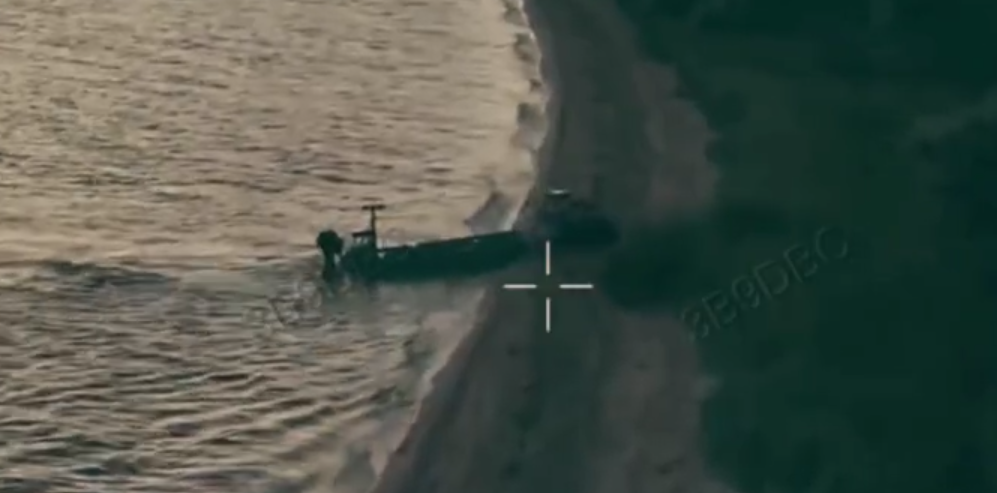
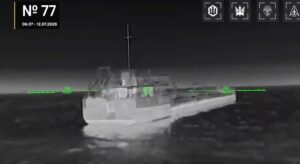
    Ukraine put a machine gun on an occupied beach without putting a man on it. Soldiers of the 123rd Territorial Defense Brigade have landed a ground robotic complex on the Russian-held shore of the Kinburn Spit in Mykolaiv Oblast, the brigade's 1st unmanned systems battalion "Zhakh z Nebes" (Terror from the Skies) said on Telegram. An unmanned naval platform carried the robot across the water, put it ashore on occupied territory, and the robot went to work. Russia has held t
     

Ukraine put armed robot on Russian-held ground. Naval drone was landing craft

13 juillet 2026 à 18:04

Soldiers of the 123rd Territorial Defense Brigade landed a ground robotic complex on the Russian-held shore of the Kinburn Spit in Mykolaiv Oblast. Source: The 123rd Territorial Defense Brigade

Ukraine put a machine gun on an occupied beach without putting a man on it. Soldiers of the 123rd Territorial Defense Brigade have landed a ground robotic complex on the Russian-held shore of the Kinburn Spit in Mykolaiv Oblast, the brigade's 1st unmanned systems battalion "Zhakh z Nebes" (Terror from the Skies) said on Telegram.

An unmanned naval platform carried the robot across the water, put it ashore on occupied territory, and the robot went to work.

Russia has held the sandbar since 2022 and uses it to block access to the Black Sea from Mykolaiv's seaports. Ukraine's military considered an operation to liberate Kinburn after the right bank of Kherson Oblast was freed in the fall of 2022. It never happened, as the costly Krynky landing on the left bank of the Dnipro is what a contested amphibious crossing looks like when the landing party is human.

"This is a new approach to war, where the machine performs the most dangerous tasks, and Ukrainian soldiers create new rules of modern combat," the unit said.

An unmanned raft with a ground robot allows delivering robotic complexes to places where the risk to a human is extremely high, it added. 

Naval drone becomes a landing craft

Ukraine's unmanned surface vessels made their name sinking things. Magura V5 drones sank the missile corvette Ivanovets. Sea Baby platforms were fitted with six 122mm Grad rockets and used to shell Russian positions on this same spit in May 2024. Ukrainian USV operations pushed the Russian Black Sea Fleet out of Sevastopol.

Carrying cargo to a hostile shore is a different job. A landing craft does not need to survive a warship; it needs to reach a beach, unload, and matter. What it unloads here is not infantry.

Ukraine has been removing human from assault

The landing extends a line Ukraine has been drawing all year. Ukrainian forces captured a Russian position for the first time using only drones and ground robots in April 2026. Ground robots ran 16,676 logistics and evacuation missions in June alone, up 122% since January, and Ukraine's Defense Ministry has codified 67 new ground robot models this year.

Most of those robots haul ammunition and carry out the wounded. Armed platforms are the smaller category, and the Kinburn landing puts one of them on ground that Ukraine does not hold.

Neither side fully controls the Kinburn Spit. Russian artillery on the sandbar has shelled Ochakiv across the strait for three years. Ukraine has raided it, hit it from the sea, and left again.

This time, what stepped off the boat did not need to come back.
  • ✇Euromaidan Press
  • Russo-Ukrainian war, day 1601: Ukraine’s Crimea blockade nears 100 ships
    Exclusives One Russian ship every 112 minutes for a week: Ukraine hits 14 more vessels as total tally nears 100. The Unmanned Systems Forces put July's running total at 91 vessels, with the live scoreboard still updating as reports get verified. Military Ukraine says Russia's Alabuga workers, including minors, are now inside Zaporizhzhia's reactor complex, turned into military base. Ukrainian intelligence says Russia has placed armor in ZNPP turbine halls, machine-gun nests on
     

Russo-Ukrainian war, day 1601: Ukraine’s Crimea blockade nears 100 ships

13 juillet 2026 à 17:44

Russo-Ukrainian war (daily review)

Exclusives

One Russian ship every 112 minutes for a week: Ukraine hits 14 more vessels as total tally nears 100. The Unmanned Systems Forces put July's running total at 91 vessels, with the live scoreboard still updating as reports get verified.

Military

Ukraine says Russia's Alabuga workers, including minors, are now inside Zaporizhzhia's reactor complex, turned into military base. Ukrainian intelligence says Russia has placed armor in ZNPP turbine halls, machine-gun nests on reactor roofs, and drone control points staffed by Alabuga workers.

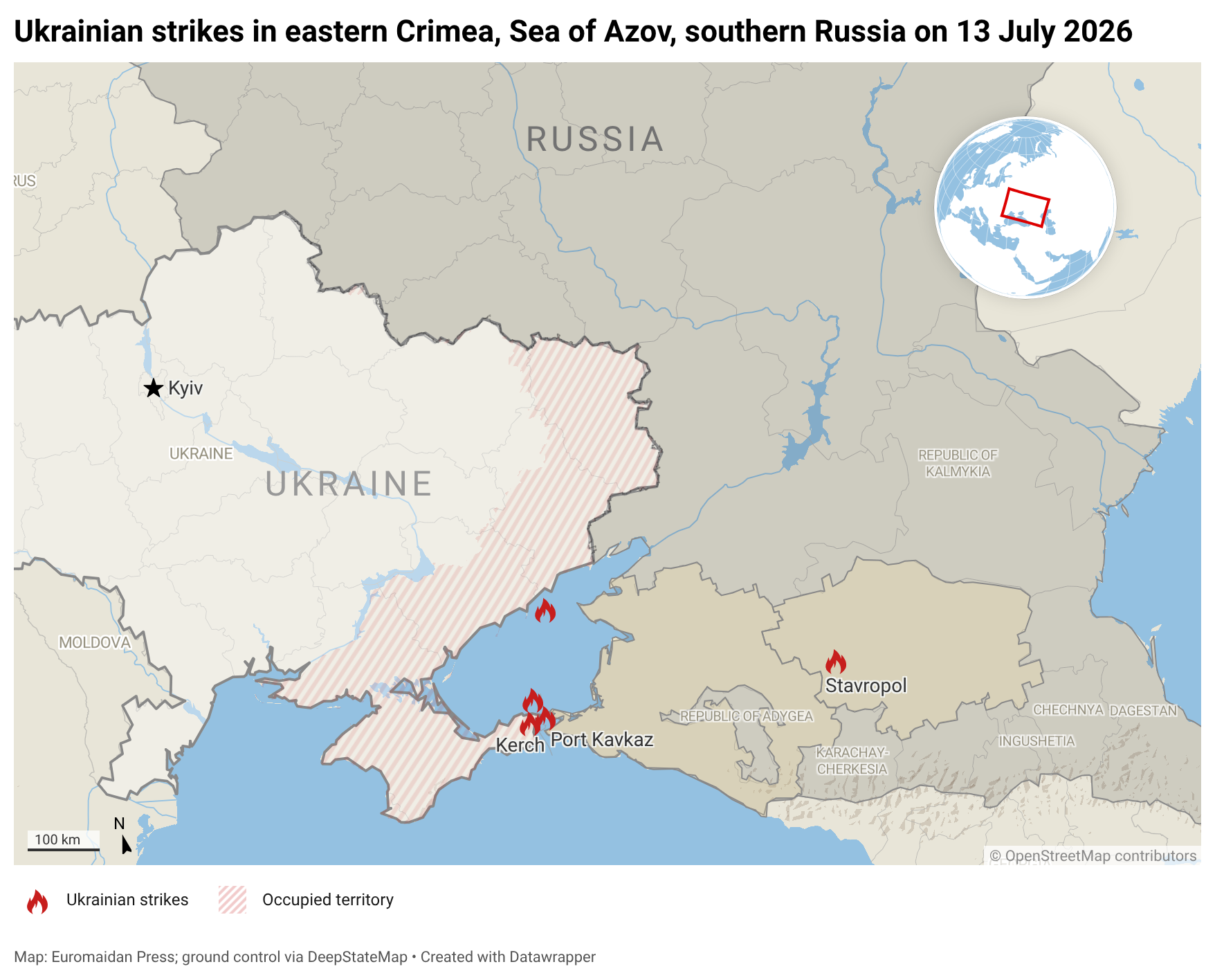
Fires at both ends of Russia's fuel chain: a Lukoil depot in Stavropol Krai and a ferry port facing Kerch. The governor confirmed the blaze in the industrial zone and evacuated a street; satellite data showed the oil transshipment complex at Port Kavkaz alight.

Ukraine hits 15 Russian vessels as drone blockade of Crimea spreads across Azov Sea. Thermal anomalies flared from occupied Mariupol to Kerch as Ukrainian drones struck ships, power links and the air defenses guarding Russia's routes into the peninsula.

Every primary unit at a Rosneft refinery is burning — 100% of its crude processing capacity. The plant turned 8.5 million tons of oil a year into gasoline, diesel, and jet fuel. Analysts say it now turns out nothing.

Intelligence and Technology

Ukraine approves more than two new drone systems a day this year. Almost all of them are now homemade. Ukraine's Defense Ministry codified 413 unmanned aerial systems in the first half of 2026, up 73% on 2024.

France licenses Ukraine to build missile for system that has already downed Russian jet. Macron announced a license for Ukraine to build Aster missiles for its SAMP/T systems, as well as for Rafale fighter jets to fly in Ukrainian skies by 2028-2029.

Ukraine's new grant list reads like map of war: exoskeletons, dugout-busters, lasers, and humanoids. Ukraine's Brave1 defense cluster opened new grants, including the BraveTech EU program for exoskeletons, evacuation drones, torpedoes, and anti-dugout munitions.

New York Times: Russian spies used Japan to source technology for war. A little-known GRU unit allegedly operated through an Aeroflot office near Japan's national police headquarters, according to NYT's reporting. They used business and logistics ties to obtain equipment for Russia's war machine.

Russia builds three ballistic missiles per day: Japan's entire annual Patriot output would cover only one mass strike on Kyiv, expert says. Ukraine needs 2,000 PAC-3 interceptors per year to defeat Russian ballistic missiles, Ukrainian analyst Oleksandr Kovalenko says.

International

Zelenskyy wants FREYJA flying within 12 months. Ten nations just joined European Anti-Ballistic Missile Coalition for first time. Zelenskyy told the first meeting of the European Anti-Ballistic Coalition that Ukraine is finishing its interceptor and hopes to see FREYJA working within 12 months.

Italy wants continental defense alliance, including Ukraine. Kyiv already out-produces all of NATO on drones. Italy's defense minister says European defense must extend past EU borders to Britain, Norway, Türkiye, and Ukraine as Washington looks to the Indo-Pacific.

EU says Russia's Venice pavilion could cost Biennale €2 million grant. Its commissioner is daughter of FSB general. The European Commission officially recommended terminating the €2 million grant to the Venice Biennale after Russia's pavilion reopened.

Humanitarian and Social Impact

He was saving 99 goats' worth of bride price. Russia sent him to die in Ukraine instead. A captured Kenyan told a Ukrainian journalist he signed what he believed was a security guard contract and learned he was in the Russian army only when they handed him a uniform.

100,000 dolphins killed in the Black Sea because of Russia's war, Ukrainian scientist warns: "We may lose a unique ecosystem". Researchers say documented strandings represent only a fraction of the true toll because an estimated 95% of dolphin carcasses sink before they can be counted.

Political and Legal Developments

Their father died defending Ukraine. A former Ukrainian brigade commander is now suspected in the murder of his two sons. Investigators suspect the former commander of the 155th Separate Mechanized Brigade ordered the abduction and killing of the two brothers of a fallen serviceman.

Russian who helped Ukraine's military faces deportation after decade under false identity. Ruslan Puptaiev says he fled persecution in Russia and built a new life in Ukraine under a false identity. After authorities uncovered his real identity, he was detained for deportation, though the European Court of Human Rights has temporarily blocked his return to Russia.

New Developments

Russia wants to run grain through its Syrian naval base—one berth for cargo, one for warships. Syrian officials say the commercial berth would take Russian grain, feed, oils, timber, steel, coal, rice and sugar—while Syria's port authority insists no such project exists.

Read our earlier daily review here.

  • ✇Euromaidan Press
  • Ukraine’s Supreme Court refused to lift Zelenskyy’s sanctions on opposition leader
    Ukraine's Supreme Court refused to lift the sanctions imposed by President Volodymyr Zelenskyy on the opposition leader who ran against him. The Cassation Administrative Court rejected Petro Poroshenko's lawsuit on 10 July, per Interfax Ukraine. Two of the five judges on the panel filed dissenting opinions. Zelenskyy imposed the sanctions by decree in 2025. They freeze Poroshenko's assets, ban him from economic activity, and revoke his state awards, sharply restricting
     

Ukraine’s Supreme Court refused to lift Zelenskyy’s sanctions on opposition leader

13 juillet 2026 à 17:36

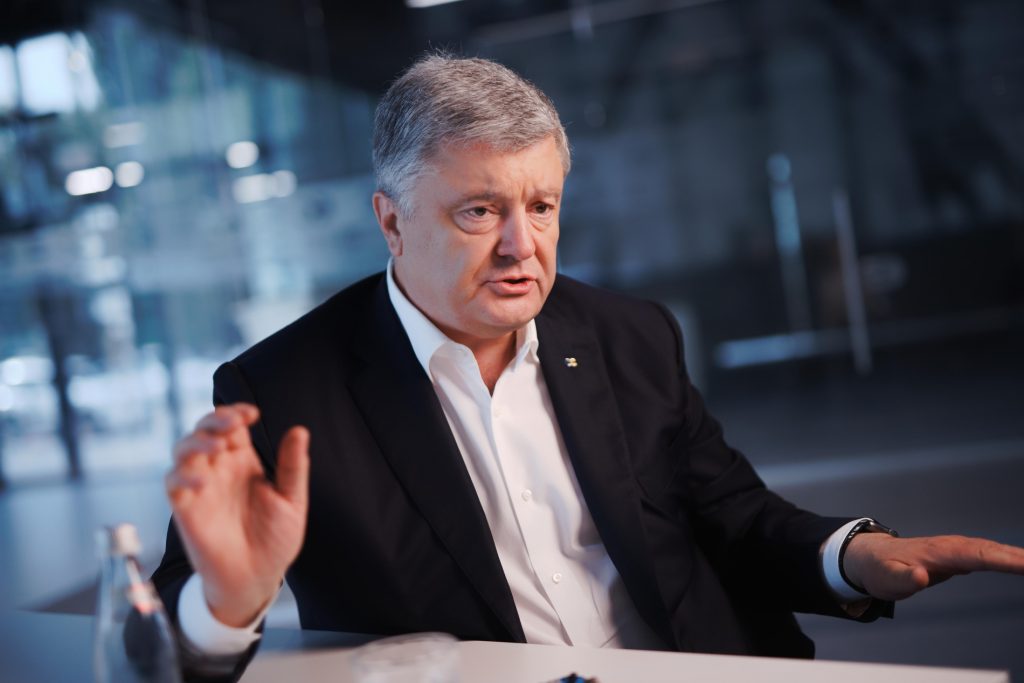
Former President Poroshenko, 2019

Ukraine's Supreme Court refused to lift the sanctions imposed by President Volodymyr Zelenskyy on the opposition leader who ran against him. The Cassation Administrative Court rejected Petro Poroshenko's lawsuit on 10 July, per Interfax Ukraine. Two of the five judges on the panel filed dissenting opinions.

Zelenskyy imposed the sanctions by decree in 2025. They freeze Poroshenko's assets, ban him from economic activity, and revoke his state awards, sharply restricting both his political and financial life.

The decision drew condemnation from the International Democrat Union, the global alliance of center-right parties, which called it a politically motivated attempt to suppress the opposition. Kyiv Mayor Vitali Klitschko warned that persecuting opposition leaders could threaten Ukrainian democracy.

Poroshenko has opposed Moscow consistently since 2014, and his foundation has delivered tens of thousands of drones to the army, including 500 FPV drones to an air defense regiment on the day the sanctions were announced.

Poroshenko says judges were blackmailed

The ruling was the result of pressure on the court, Poroshenko said on the day of the decision.

"The judges of this panel of five were blackmailed, including their relatives, with the opening of criminal cases if the wrong decision was taken," he said.

Poroshenko claimed he had plans to file a statement with law enforcement and provide journalists with materials for a journalistic investigation.

"Society has the right to know how Ukraine is being cut off from membership in the European Union," said Poroshenko.

His lawyer, Illia Novikov, said the pressure came from the Security Service on the instructions of Bankova, the seat of the President's Office.

"I will release new information that we have not published before... We had information that pressure was being applied to the court ... Now the time has come to name these people. According to our information, they are SBU officers Eduard Rudiuk and Vitalii Solodzhuk," Novikov said.

Novikov said he would ask their leadership to check whether the two men tried to pressure the court. He said four hearings had been disrupted since 5 January 2026, each of which could have been the last in the case, and argued the disruptions bought time to lean on the panel. The two dissenting opinions, he said, show two judges did not yield.

Poroshenko says the clusters will not open in July

Poroshenko said the ruling is blocking Ukraine's EU accession.

"Those who are trying to build authoritarianism in Ukraine instead of democracy have got what they wanted. Seven clusters will not be opened for us," he stressed.

He added that "the reason is today's decision."

"And apart from the foreign policy cluster, unfortunately, with high probability the clusters will not be opened in July," Poroshenko claimed.

He said four foundational documents had been adopted in the past week, including a European Parliament resolution stating that applying sanctions to the opposition leader is illegal, extrajudicial, and unconstitutional, and an OSCE Parliamentary Assembly decision recognizing extrajudicial sanctions against Ukrainian citizens as unlawful.

Poroshenko will appeal to the Supreme Court's Grand Chamber and then to the European Court of Human Rights, which accepted his case in May 2026. His lawyers have filed a second complaint in Strasbourg over the length of the proceedings, as Ukraine's administrative code allows two months for such a case. This one took eighteen.

  • ✇Euromaidan Press
  • Ukraine approves more than two new drone systems a day this year. Almost all of them are now homemade
    Ukraine codified 413 unmanned aerial systems in the first half of 2026. Almost all of them are Ukrainian-made, Ukraine's Defense Ministry said. That is more than 30% above the same period in 2025 and more than 73% above the same period in 2024. Two categories dominate the list — copter-type strike drones and fiber-optic systems, which cannot be jammed because they trail a physical cable rather than transmitting over radio. Front-strike drones also grew substantially. The co
     

Ukraine approves more than two new drone systems a day this year. Almost all of them are now homemade

13 juillet 2026 à 15:52

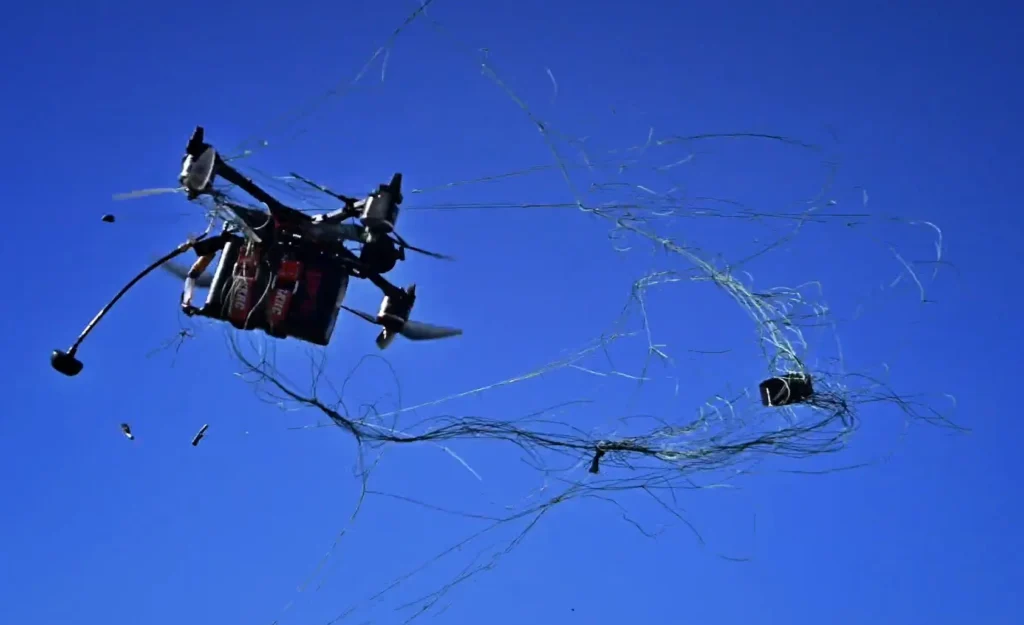
An FPV drone snared by a net fired from a Chipa net gun, developed by BlueBird Tech. Photo: BlueBird Tech via Defense Blog

Ukraine codified 413 unmanned aerial systems in the first half of 2026. Almost all of them are Ukrainian-made, Ukraine's Defense Ministry said. That is more than 30% above the same period in 2025 and more than 73% above the same period in 2024.

Two categories dominate the list — copter-type strike drones and fiber-optic systems, which cannot be jammed because they trail a physical cable rather than transmitting over radio.

Front-strike drones also grew substantially. The codified systems span aerostat, fixed-wing, and copter reconnaissance, fixed-wing and copter strike drones, FPVs, bombers, interceptors, signal relays, target drones, and deep-strike platforms.

The named systems include Halka, Skyriper Minotaur, Hor Elks, Beshket, Shturm, Bababoom, Zorro, Blinc, Optoslon, Chumak, Sokil, Hydra, Kruk, Dzyha, Kharyok, Buran, Bilyi Vovk, and Sichen.

The drone figure sits inside a broader codification surge. Ukraine's Defense Ministry authorized 1,000 weapons samples in the first half of 2026, of which 892 were made in Ukraine — a domestic share of nearly 90%, up from 69.6% in 2025.

Category list is ecosystem, not weapon

Relay drones, target drones, and interceptors appearing on the same codification list as strike platforms describe an air war that now needs its own supporting infrastructure. Relays extend control range.

Target drones train the interceptor crews. Interceptors are the answer to the Shahed.

Ukraine's interceptor lineup has filled quickly. The Defense Ministry is procuring 8,000 Octopus interceptors, a Shahed-killer with automatic terminal guidance developed inside the Ukrainian Armed Forces. Germany funded 15,000 units of the STRILA interceptor. Wild Hornets' Sting has destroyed more than 600 aerial targets. The Talion, codified on 1 July, can kill a drone or be one.

Ukraine's military received twice as many interceptor drones in the first four months of 2026 as in all of 2025, and Ukrainian interceptors destroyed a record 33,000 Russian UAVs in March 2026 alone.

Fiber-optic drones lead because Russia cannot jam them

The prominence of fiber-optic systems in the codification list reflects the electronic-warfare stalemate on both sides of the front. A fiber-optic drone spools out a hair-thin cable behind it and takes its commands down the wire. No radio signal means nothing to jam.

Ukraine aims to build seven million drones in 2026, roughly double its 2025 output. 

Ukraine says Russia’s Alabuga workers, including minors, are now inside Zaporizhzhia’s reactor complex, turned into military base

13 juillet 2026 à 15:34

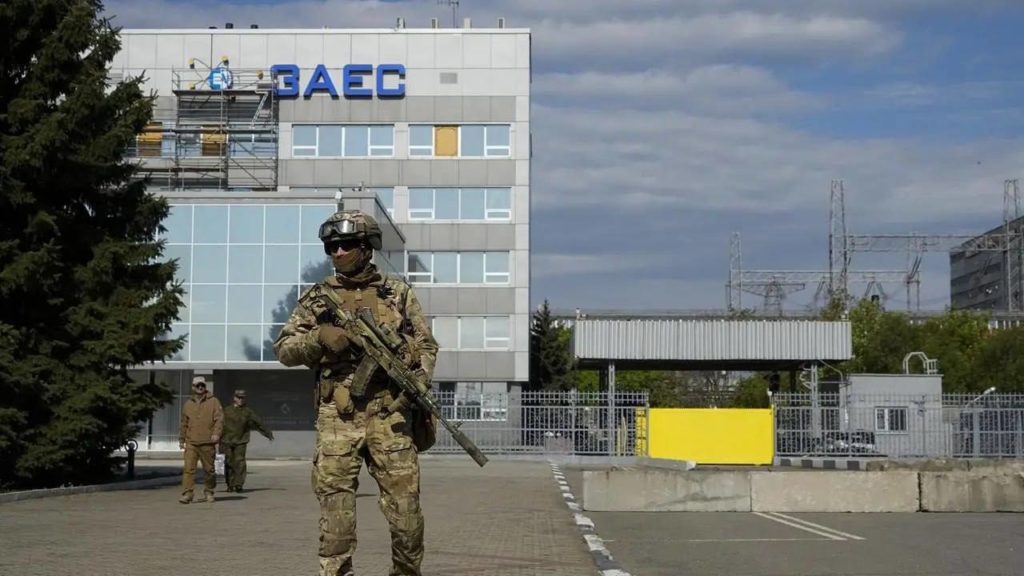
add new post russian troops ukraine's zaporizhzhia nuclear power plant illustrative image/ telegram channel tsaplienko occupiers prepping hold hostage znpp's personnel

Russia is operating Shahed drone control points inside Europe's largest nuclear plant. Ukraine's Defense Intelligence says Russian forces have deployed control points for Gerbera-Seeker and Geran-Seeker kamikaze drones at the occupied Zaporizhzhia Nuclear Power Plant (ZNPP), staffed with workers brought in from the Alabuga special economic zone, including underage students. 

Alabuga is Russia's main Shahed factory in Tatarstan, and it has a documented record of recruiting minors and foreign women onto its production lines. Ukrainian intelligence now reports that Alabuga personnel are inside the reactor complex of a six-reactor nuclear station.

All six ZNPP reactors are in cold shutdown. Russian occupying forces have parked military equipment directly in the turbine halls of reactor units 1, 2, 5, and 6, turned basements and bomb shelters into weapons depots, and installed machine-gun nests and missile systems on the roofs of the reactor buildings, per Ukrainian intelligence.

IAEA experts denied access to reactor halls

Ammunition and equipment are stored beneath the technical passages and overpasses that connect the reactor units to other buildings.

Some technical facilities near the shoreline of the former Kakhovka reservoir have been mined. A Rosgvardia contingent of 1,500 troops guards the plant.

IAEA experts do not have full access to the reactor units or the special technical facilities. Inspections are conducted along pre-agreed plans and routes, which Ukrainian intelligence says makes an objective assessment of the situation difficult or impossible. Russia has restricted IAEA access to reactor halls since at least 2024.

Plant has one power line left and 21 blackouts behind it

ZNPP had 10 external power lines before the occupation. One works now. The plant suffered another blackout on 3 July 2026 — the 21st since the full-scale war, per Ukrainian intelligence.

A nuclear plant in cold shutdown still needs electricity. Cooling systems for the reactors and the spent fuel storage run on it, and when off-site power fails, the plant falls back on diesel generators trucked in through a war zone. Europe's largest nuclear facility has been living on that margin since 2022.

The 17th blackout came in June 2026, the fifth of that year alone, and more than 500 missiles and drones were recorded inside the 30-km surveillance zones of Ukrainian nuclear plants during 2025

Cooling pond is two meters below its minimum

Russian occupiers are not maintaining the required water level in the cooling pond. As of July 2026, it stands at 12.86 meters, compared with a minimum of 15 meters.

Russia destroyed the Kakhovka Dam on 6 June 2023, which severed the plant's original water supply.

Rosatom is forcing staff onto its contracts

ZNPP employed roughly 11,000 people before the full-scale war. About 7,500 remain, including 500 workers from an outsourcing company that holds no license to work at the station.

All staff are being forced to sign contracts with Rosatom under threat of dismissal, according to the Ukrainian intelligence. Personnel brought in from Russia lack the qualifications to service the plant, because ZNPP differs substantially from Russian nuclear facilities.

Ukraine has proposed amending the IAEA statute to disqualify states that deliberately undermine nuclear safety from the agency's governing bodies. Russia sits on the IAEA Board of Governors.

  • ✇Euromaidan Press
  • France licenses Ukraine to build missile for system that has already downed Russian jet
    France will license Ukraine to build Aster missiles. President Emmanuel Macron announced the license at a joint briefing with Zelenskyy, German Chancellor Friedrich Merz, and British Prime Minister Keir Starmer after the Coalition of the Willing meeting in Paris. He also confirmed Ukraine will acquire Rafale fighter jets. "The first aircraft should already be flying in Ukrainian skies in 2028-2029," Macron said. The Aster license is the more immediately consequential of
     

France licenses Ukraine to build missile for system that has already downed Russian jet

13 juillet 2026 à 15:09

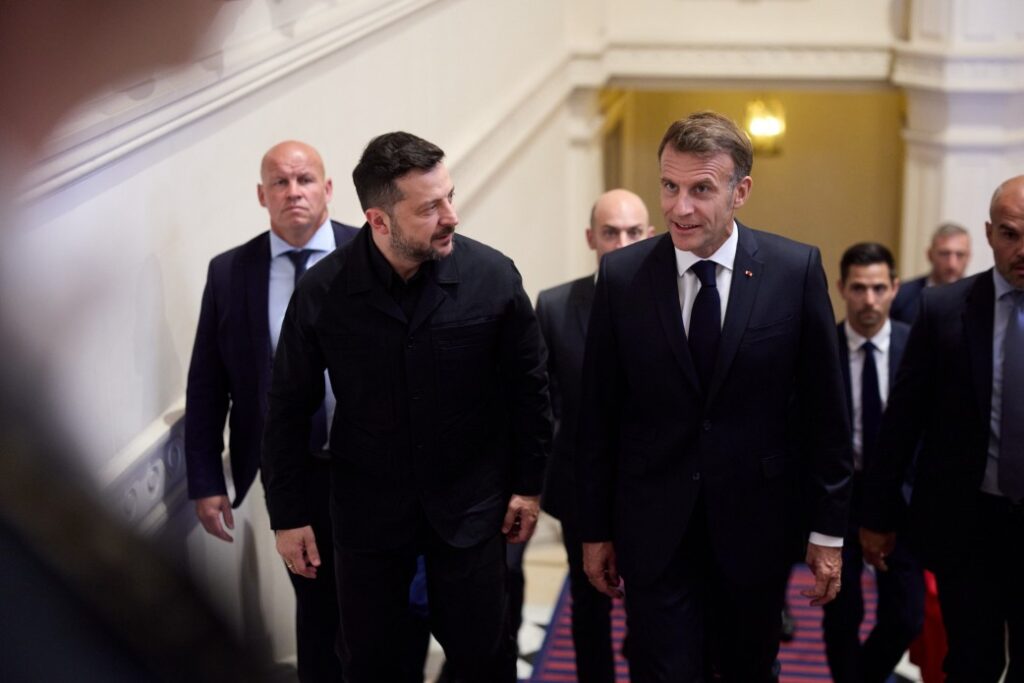
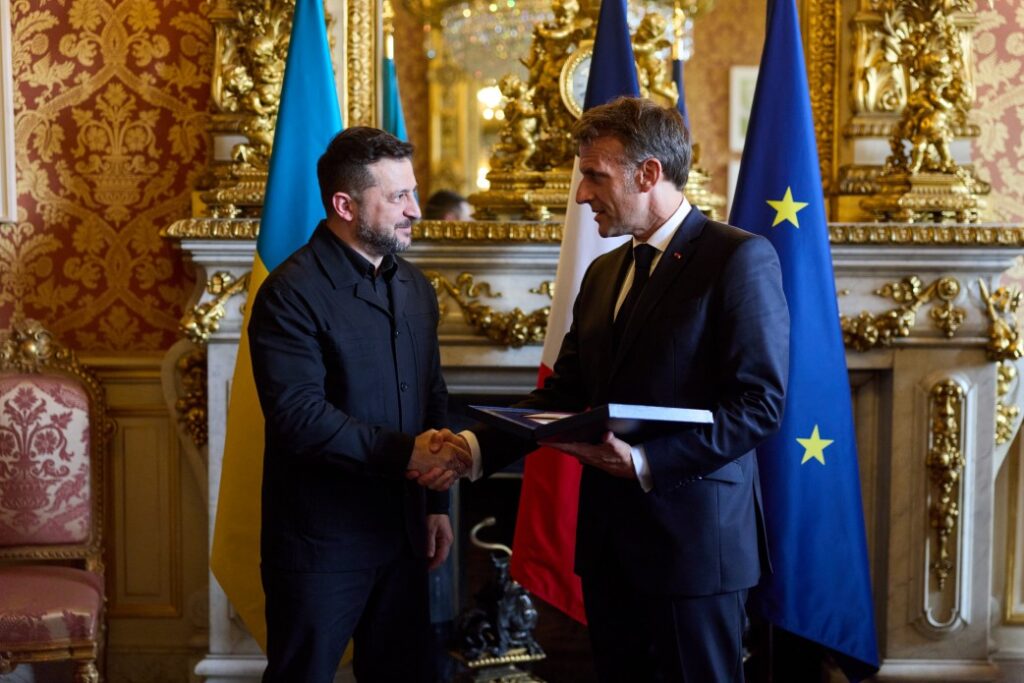
Ukrainian President Volodymyr Zelenskyy during a meeting with French President Emmanuel Macron on 13 July 2026. Source: President's Office

France will license Ukraine to build Aster missiles. President Emmanuel Macron announced the license at a joint briefing with Zelenskyy, German Chancellor Friedrich Merz, and British Prime Minister Keir Starmer after the Coalition of the Willing meeting in Paris.

He also confirmed Ukraine will acquire Rafale fighter jets.

"The first aircraft should already be flying in Ukrainian skies in 2028-2029," Macron said.

The Aster license is the more immediately consequential of the two announcements. Aster missiles arm the SAMP/T system, which Ukraine already operates and which has already shot down a Russian Sukhoi jet in combat.

SAMP/T is the European system closest to the Patriot in role, as it can engage aerodynamic targets out to 150 km and intercept ballistic missiles at 25 km.

Aster plans to expand to 300 missiles per one year

It is built by the EuroSAM consortium of MBDA France, MBDA Italy, and Thales, which means the license does not run through an American supply chain. The bottleneck has always been production: Aster output runs at roughly 80-100 missiles per year, with a plan to reach 300 per year by 2028.

The announcement comes six days after Trump promised Ukraine a Patriot production license at the NATO summit in Ankara — a promise Lockheed Martin and RTX had not been told about, with no timeline and no named manufacturer. Macron welcomed Trump's decision at the Paris briefing.

Zelenskyy thanked Macron directly.

"Thank you, Emmanuel, personally, for the readiness to grant licenses. This is a serious step forward. This will help a great deal. Licenses for Asters and SCALPs are important decisions," he said.

Rafales arrive in 2028, at earliest

Macron said the meeting demonstrated accelerated fulfillment of commitments made in recent months and named two areas of concrete progress: air defense assistance and the modernization and acquisition of Rafale strike aircraft by Ukraine.

Ukraine locked in a commitment to 100 French Rafales in February 2026, alongside 150 Swedish Gripen aircraft. Macron's 2028-2029 date is the first specific delivery window a French leader has attached to that commitment. It is also a reminder of what the aircraft cannot do: nothing about the Rafale addresses the ballistic missiles hitting Kyiv this month.

License lands the same week as the FREYJA coalition convenes

"We also decided to grant licenses for our missiles, and to create opportunities to draw on our forces and expertise to develop new anti-ballistic capabilities, and it is exactly in this vein that the flagship FREYJA project is working, which many manufacturers will join," Macron said.

The Anti-Ballistic Coalition held its first meeting this week, with ten countries — Ukraine, France, Britain, Germany, Italy, Norway, Denmark, Sweden, the Netherlands, and Spain — plus NATO, the EU, and European defense companies.

Zelenskyy said Ukraine is finishing work on its own anti-ballistic missile as its contribution to the system and hopes to see FREYJA operating within 12 months.

Zelenskyy thanked Britain and Germany for what he called consistently tangible steps to protect life in Ukraine, and said new defense pacts for Ukraine are coming.

Zelenskyy wants FREYJA flying within 12 months. Ten nations just joined European Anti-Ballistic Missile Coalition for first time

13 juillet 2026 à 14:49

Ukrainian President Volodymyr Zelenskyy during a meeting with French President Emmanuel Macron on 13 July 2026. Source: President's Office

Ukraine is finishing its own anti-ballistic missile. President Volodymyr Zelenskyy said at the first meeting of the European Anti-Ballistic Coalition that Ukraine will contribute a missile to FREYJA, a joint European missile defense system.

Ten countries have joined the Coalition — Ukraine, France, Britain, Germany, Italy, Norway, Denmark, Sweden, the Netherlands, and Spain — along with representatives of NATO, the European Union, and leading European defense companies.

"Ukraine can provide its part — the anti-ballistic missile. We are now completing work on it. Others have radar and other critical components. It is important that we combine our efforts," he said.

Four days ago, Zelenskyy told journalists that eight countries might join. Zelenskyy coordinated positions with French President Emmanuel Macron in a call before the meeting.

Zelenskyy set a timeline for his expectations for the new air defense missile. 

"I hope that within the next 12 months we will see FREYJA in operation," he revealed.

Zelenskyy divides work: Ukraine builds missile, partners build rest

Europe needs a modern, reliable, and more affordable system of protection against ballistic missiles, and partner countries are capable of building one together, Zelenskyy claimed.

He argued FREYJA should receive political support as a joint European initiative aimed at strengthening the security of the entire continent.

The division of labor Zelenskyy described aligns with the program's technical structure. Freya recycles a Soviet S-300 interceptor and relies on a German infrared seeker co-developed with Diehl Defense, and Kyiv munitions firm Fire Point is transforming its FP-7 ballistic missile into an air-defense missile under the initiative.

Radars and command systems come from partners. The Ukrainian company Fire Point aims to begin serial production in August 2026, building airframes and storing them until German seekers arrive.

Demand is rising faster than supply

Russia is betting on ballistic strikes against Ukrainian cities, and the missile programs of Russia, Iran, and North Korea are compounding the global threat.

Europe has all the technological preconditions to become a world leader in producing modern anti-ballistic systems without political dependence on other states, he said.

Russia produces roughly 800 ballistic missiles a year, compared with about 600 American PAC-3 interceptors, and a single Iskander can require two or three interceptors to bring down. Ukraine's Ministry of Defense reported an 89% interception rate against Russian air threats in June but only 40% against ballistic missiles.

  • ✇Euromaidan Press
  • Italy wants continental defense alliance, including Ukraine. Kyiv already out-produces all of NATO on drones
    Europe's future defense architecture must reach past the EU's borders. Italian Defense Minister Guido Crosetto told La Stampa that it should be genuinely continental and include partnerships with Britain, Norway, Switzerland, Moldova, the Western Balkans, Türkiye, and Ukraine, Türkiye Today reports. He is one data point in a recruitment system that has pulled at least 27,000 foreign nationals from more than 130 countries into Russia's army since February 2022, according to
     

Italy wants continental defense alliance, including Ukraine. Kyiv already out-produces all of NATO on drones

13 juillet 2026 à 11:44

Italian-flag

Europe's future defense architecture must reach past the EU's borders. Italian Defense Minister Guido Crosetto told La Stampa that it should be genuinely continental and include partnerships with Britain, Norway, Switzerland, Moldova, the Western Balkans, Türkiye, and Ukraine, Türkiye Today reports.

He is one data point in a recruitment system that has pulled at least 27,000 foreign nationals from more than 130 countries into Russia's army since February 2022, according to a joint report by the International Federation for Human Rights and Truth Hounds.

Crosetto's argument rests on two premises. European governments can no longer plan capability development on 10- to 15-year horizons because the security environment changes far faster than that.

And Europe must reckon with signals that the US will gradually reduce its military presence on the continent as Washington reorients toward the Indo-Pacific.

Remarks came after NATO summit in Ankara, which papered over cracks between allies

"Governments can no longer limit themselves to planning capabilities that will be available in ten or fifteen years, when the situation will have completely changed," Crosetto said.

The remarks came three days after the NATO summit in Ankara, where allies pledged roughly €140 billion ($160 billion) in military aid to Ukraine over 2026 and 2027. NATO's former deputy commander Richard Shirreff told Euromaidan Press that the summit papered over the cracks between Europe and America rather than closing them.

Strategy document names satellites, undersea cables, and hybrid warfare

Crosetto's statements draw on an Italian Defense Ministry strategic document setting defense priorities for the 2027-2029 budget cycle. It identifies satellite communications development as a key task, stresses the need to strengthen protection of undersea critical infrastructure, and gives substantial weight to cybersecurity and countering disinformation.

"A national and European center for countering hybrid warfare needs to be created," Crosetto said.

Such a structure would allow more effective sharing of information and tools between allies against cyberattacks, propaganda, information manipulation, and other hybrid threats.

Ukraine already supplies Europe more than it receives in some domains

Crosetto's inclusion of Ukraine in a continental defense architecture reflects a shift already underway. Ukraine signed drone agreements with Estonia, the Netherlands, and Denmark in July 2026 as European states tap Kyiv's battlefield-tested weapons technology. Ukraine produced roughly 4 million drones in 2025, exceeding the combined output of all NATO members, and aims to produce 7 million in 2026, according to Bloomberg. 

  • ✇Euromaidan Press
  • He was saving 99 goats’ worth of bride price. Russia sent him to die in Ukraine instead
    Francis realized he had joined the Russian army when they handed him a uniform. The 35-year-old Kenyan, an electrical engineer by training, had signed what he believed was a contract for security guard work in Russia, he told Ukrainian journalist Dmytro Karpenko in an interview after his capture.  He is one data point in a recruitment system that has pulled at least 27,000 foreign nationals from more than 130 countries into Russia's army since February 2022, according to a
     

He was saving 99 goats’ worth of bride price. Russia sent him to die in Ukraine instead

13 juillet 2026 à 11:30

Kenyan citizen Francis says he didn't know he was going to the war until he appeared in the training camp. But there he didn't decline the service. Source: UNIAN

Francis realized he had joined the Russian army when they handed him a uniform. The 35-year-old Kenyan, an electrical engineer by training, had signed what he believed was a contract for security guard work in Russia, he told Ukrainian journalist Dmytro Karpenko in an interview after his capture. 

He is one data point in a recruitment system that has pulled at least 27,000 foreign nationals from more than 130 countries into Russia's army since February 2022, according to a joint report by the International Federation for Human Rights and Truth Hounds.

The European Parliament voted 479 to 17 in March 2026 to condemn the practice and classify it as human trafficking. Ukrainian intelligence estimates more than 1,700 fighters from 36 African countries have joined Russian forces. Kenya has shut down over 600 recruitment agencies. Ghana has confirmed more than 50 of its citizens killed.

The recruitment method is consistent across cases: a promise of civilian work, a contract in Russian that the recruit cannot read, and a uniform on arrival.

Job offer came from university friend

Francis finished a contract with a large company and was picking up odd jobs in his city. It was not enough to support his wife and daughter. In July 2025, he met a friend from university who told him about a security guard vacancy in Russia. Francis was out of steady work. He agreed.

The paperwork was minimal: a passport copy, a certificate of no criminal record, and a medical certificate. Even when he signed the contract, Francis says, he believed he was going to work as a guard.

He learned otherwise at the military base when they issued him a uniform.

Two weeks of training, then the front

Francis says he received roughly $9,000 during his service. He planned to build a house with it.

"The money would have been enough to build my own home," he said.

He also described the bride price tradition in his community, which can run to 99 goats but is negotiated between the groom and the bride's parents.

"It is a matter of negotiation. You do not need to pay everything at once. You can pay gradually, even over many years. If your father-in-law and mother-in-law see that you are a good husband, they can say: enough, we forgive the rest," he revealed.

In the war he was sent to fight in, Francis says he understood little.

"I only knew there was some kind of conflict between Russia and Ukraine, but I did not understand it was a full-scale war," he suggested.

He was sent to the front after two weeks of training. He was captured on 22 November 2025 while his unit was changing positions. His commander had stepped on a mine, and the unit was ordered to withdraw to another position.

"We were approaching the Ukrainian side, and during the crossing, we met two Ukrainian soldiers who fired shots into the air," Francis said.

He says he did not immediately understand what had happened, but when he saw his commander throw down his weapon and lie on the ground, he did the same.

Russia recruits where the jobs are not

Russia has built parallel manpower pipelines to avoid a full mobilization that would carry domestic political risk. Contract soldiers inside Russia, North Korean troops, and recruitment networks across Africa, Asia, and Latin America feed the front.

The African networks operate through what the New York Times called "fly-by-night companies", presenting themselves as travel agencies or job placement firms and advertising on WhatsApp and Telegram

Kenya's foreign minister says Russia agreed in March 2026 to stop recruiting Kenyan citizens. Families of the missing are still waiting.

  • ✇Euromaidan Press
  • Ukraine’s new grant list reads like map of war: exoskeletons, dugout-busters, lasers, and humanoids
    Ukraine's Brave1 defense innovation cluster has opened new grants for exoskeletons and anti-dugout munitions. Both categories address specific frontline gaps that Ukrainian companies have been experimenting with informally through 2025 and 2026, according to Ukraine's Defense Ministry. Ukraine's Defense Ministry announced 53 new technological priorities across nine directions in the updated Brave1 grant program. Grants range from $12,000 to $192,000, depending on the full d
     

Ukraine’s new grant list reads like map of war: exoskeletons, dugout-busters, lasers, and humanoids

13 juillet 2026 à 11:13

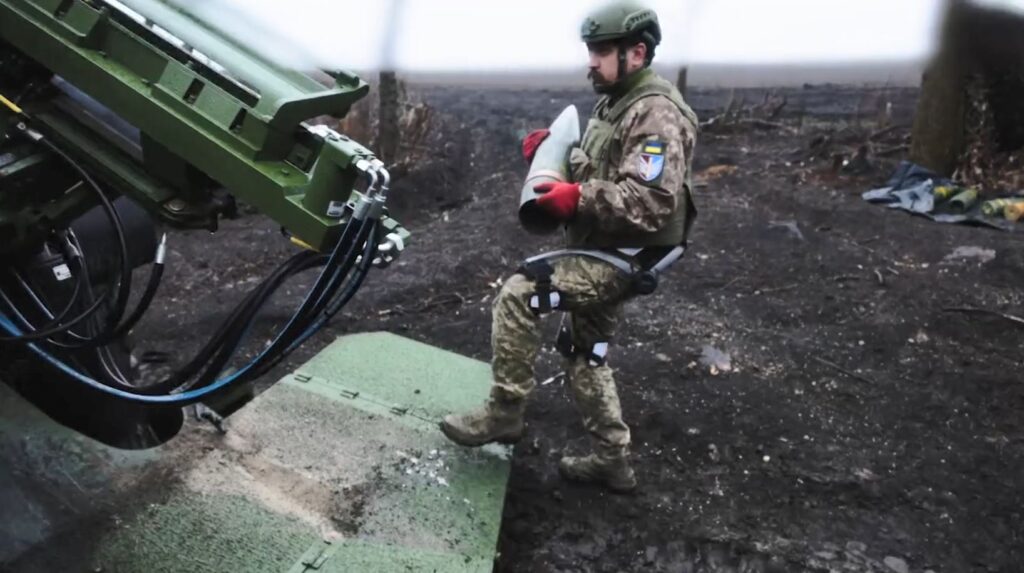
gunners can carry small car's weight shells every day — ukraine fields exoskeletons pokrovsk front · post soldier 147th separate artillery brigade wearing exoskeleton carries round loading arm caesar howitzer

Ukraine's Brave1 defense innovation cluster has opened new grants for exoskeletons and anti-dugout munitions. Both categories address specific frontline gaps that Ukrainian companies have been experimenting with informally through 2025 and 2026, according to Ukraine's Defense Ministry.

Ukraine's Defense Ministry announced 53 new technological priorities across nine directions in the updated Brave1 grant program. Grants range from $12,000 to $192,000, depending on the full development cycle, from idea validation to finished-product testing.

Why does Ukraine need exoskeletons?

Exoskeletons address the load-carrying gap on a frontline where Russian FPV drones destroy nearly any motor vehicle within 20 kilometers. Ukrainian infantry carry 30 to 40 kilograms of gear into positions that must be reached on foot. They evacuate wounded soldiers without vehicles. They build fortifications by hand because tools drop out to Russian drones.

State grant funding formalizes what has been ad-hoc Ukrainian company experimentation.

Anti-dugout munitions address a different tactical gap

Russian forces have built extensive reinforced field shelters across the frontline zones, and standard Ukrainian FPV warheads at 2 to 3 kilograms do not defeat these positions.

Precision-delivered munitions designed to penetrate reinforced dugouts would let Ukrainian infantry break Russian positions at standoff distance rather than closing to grenade range through saturated Russian FPV zones. Ukraine's larger-scale answer to fortified positions is the Vyrivniuvach guided bomb, which entered combat use on 18 May 2026.

What is Brave1? 

Brave1 has become the central hub of Ukraine's wartime defense innovation ecosystem. As of June 2026, the cluster had processed over $235 million in procurement orders, registered more than 3,600 developments, secured 300 NATO-codified items, and disbursed $50 million in defense innovation grants.

The grant expansion sits alongside a growing network of bilateral defense innovation partnerships. Brave1 already runs Brave Germany, Brave France with $22 million from the French Defense Innovation Agency, Brave NATO through the UNITE program, and Brave Prime for global industrial alliances joined by Airbus in July 2026.

Brave1 also plans humanoid robots and laser air defense

Brave1 will soon announce additional grant competitions totaling over $2.4 million for breakthrough technologies, including humanoid robots, aerobuggies, anti-KAB (glide-bomb) systems, laser air defense, and Ukrainian radars.

The humanoid robot funding continues the world-first Ukrainian program that opened for grants earlier in July 2026. Ukraine became the first state to fund combat humanoid robots as a separate defense procurement category, treating them as a distinct line rather than as commercial adaptations.

Anti-KAB systems address one of Ukraine's most difficult tactical problems. Russia has deployed KAB glide bomb attacks at rates of thousands per month, giving its air force a standoff strike capability. Laser air defense targets the persistent cost gap between Ukrainian air defense interceptors and Russian missile production. Ukrainian radars aim to replace foreign radar systems with domestically produced ones.

The detailed grant program and technological priorities are available at grants.brave1.tech.

  • ✇Euromaidan Press
  • Fires at both ends of Russia’s fuel chain: a Lukoil depot in Stavropol Krai and a ferry port facing Kerch
    Ukrainian drones struck an oil depot near Stavropol and set fire to the port that ferries Russian fuel and ammunition into occupied Crimea overnight on 13 July, according to monitoring channels. It was the second depot hit in the same locality in four days. Russia's local authorities confirmed the fire. Fuel keeps Russia's army in the occupied south running. Ukraine has spent months taking apart the chain that carries it — the refineries, the depots, the rail ferries, the t
     

Fires at both ends of Russia’s fuel chain: a Lukoil depot in Stavropol Krai and a ferry port facing Kerch

13 juillet 2026 à 10:30

fires both ends russia's fuel chain lukoil depot stavropol krai ferry port facing kerch · post smoke oil fire drifts over industrial area near russia 13 2026 4a4773de-e3fe-4db0-a597-58f2dd5605cd ukraine news

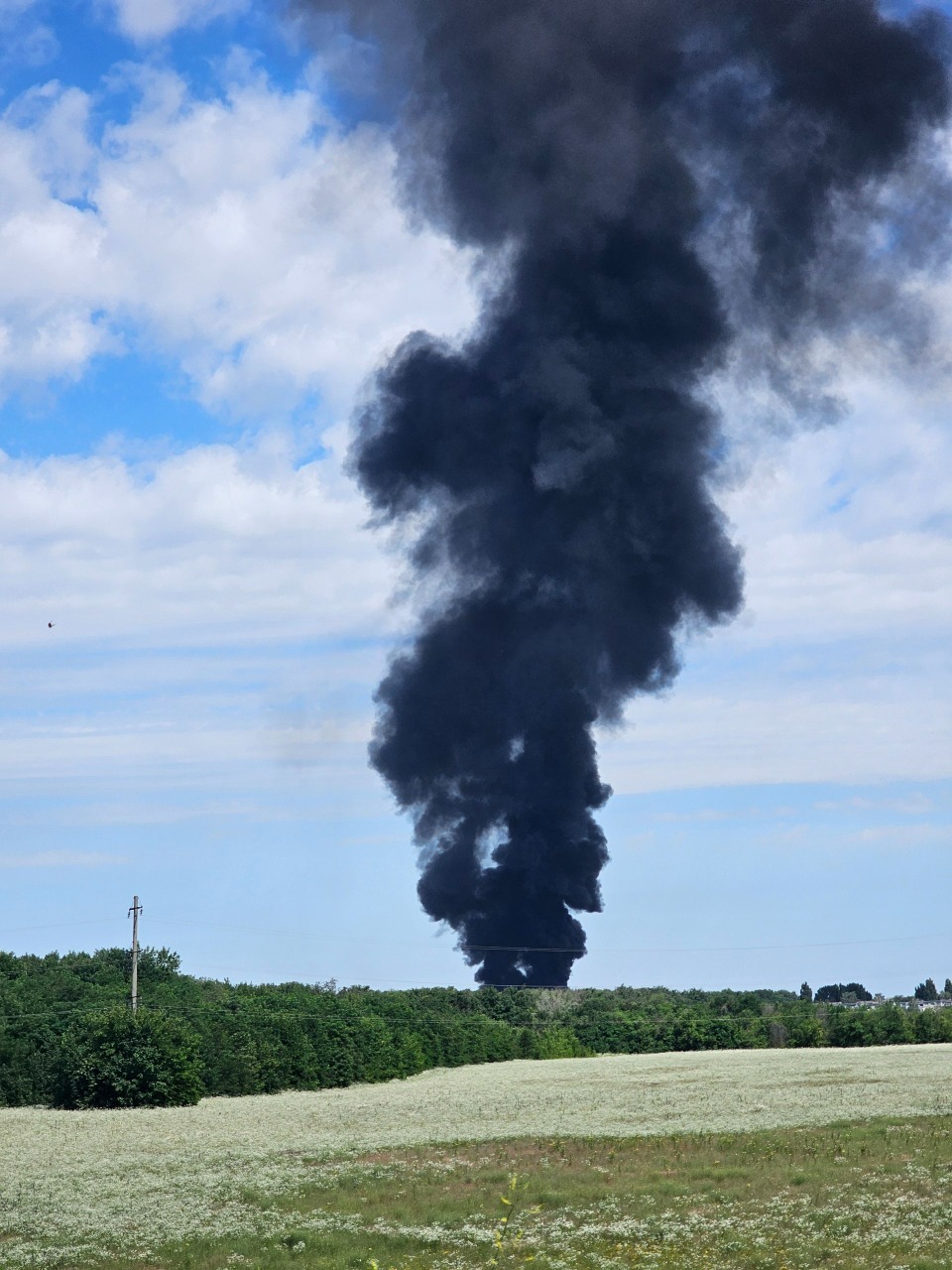
Ukrainian drones struck an oil depot near Stavropol and set fire to the port that ferries Russian fuel and ammunition into occupied Crimea overnight on 13 July, according to monitoring channels. It was the second depot hit in the same locality in four days. Russia's local authorities confirmed the fire.

Fuel keeps Russia's army in the occupied south running. Ukraine has spent months taking apart the chain that carries it — the refineries, the depots, the rail ferries, the tankers — while the gasoline shortage inside Russia spreads from one region to the next.

Two depots, four days, one kilometer apart

Drones hit the depot next to the railway in Vyazniki, near Stavropol, southern Russia, late at night, Russian news Telegram channel Astra reported after reviewing footage and eyewitness accounts. A powerful fire broke out. Ukrainian monitoring channel Exilenova+ showed it was still burning at 9 a.m. Ukrainian monitoring channel Supernova+ said at least two tanks caught fire. The blaze continued into the afternoon.

The site belongs to Lukoil-Yugnefteprodukt, a wholly owned subsidiary of Lukoil. It stores and ships gasoline, diesel, and other light petroleum products, and supplies Lukoil filling stations across Stavropol Krai and neighboring regions. The depot holds 17 large tanks, four medium ones, and 21 small vessels.

Ukrainian drones set a fuel depot burning in Russia's Stavropol Krai — again

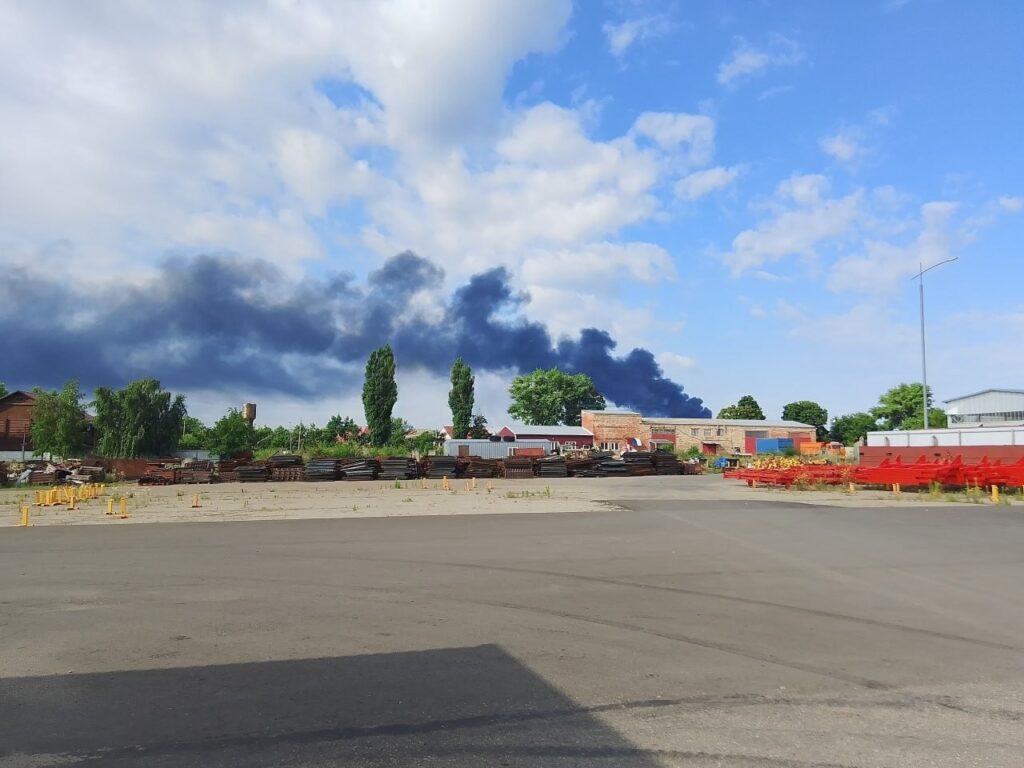
Reservoirs caught fire at the oil depot in Mikhailovsk, a satellite city of Stavropol, after the overnight strike on 13 July, monitoring channels report.

Residents filmed the fire and thick smoke… pic.twitter.com/MWyg2XQ8Qo

— Euromaidan Press (@EuromaidanPress) July 13, 2026

Residents of Mykhailovsk — the town adjoining Vyazniki — and nearby settlements reported a series of powerful explosions. Fuel tanks then began exploding, spreading the fire.

Stavropol Krai governor Vladimir Vladimirov confirmed the drone raid on the "outskirts of Stavropol" and the fire in the industrial zone of Vyazniki. He claimed nobody was hurt. Authorities evacuated residents of the street next to the industrial zone because of the risk of further explosions.

fires both ends russia's fuel chain lukoil depot stavropol krai ferry port facing kerch · post column black smoke rises over burning oil near russia around noon 13 2026 40762774-35fa-4112-b58b-b8f8b981d4bc
A column of black smoke rises over the burning oil depot near Stavropol, Stavropol Krai, Russia, around noon of 13 July 2026. Photo: Exilenova+/Telegram
Drones already hit a depot in the same village on 9 July. That site, owned by Rosneft-Stavropolye, sits 1.2 km from the one burning now.

The port that keeps Crimea supplied

In Krasnodar Krai's Temryuk district, the regional operational headquarters reported a fire "on the territory of one of the enterprises." Ukrainian monitoring group Krymsky Veter identified the site from satellite imagery: the oil products transshipment complex and the railway station of the port of Kavkaz.

The terminal has a capacity of about 3 million tons a year. It moves crude and fuel oil from rail cars, road tankers, and ships, and holds a tank farm of roughly 100,000 cubic meters plus rail racks where fuel is drained from tank cars. Exilenova+ added that the tank farm itself was on fire.
Russian ships burning after successful Ukrainian strikes on 12-13 July 2026.
Explore further

Ukraine hits 15 Russian vessels as drone blockade of Crimea spreads across Azov Sea

Port Kavkaz links Russia to occupied Crimea through the Kerch ferry crossing. Russia has used those ferries to push ammunition, weapons, and fuel onto the peninsula. Ukraine hit the port on 21 and 23 June, igniting its oil terminal. After the first of those strikes, Krasnodar authorities suspended ferry traffic and told truck drivers to reach Crimea by the land corridor instead.

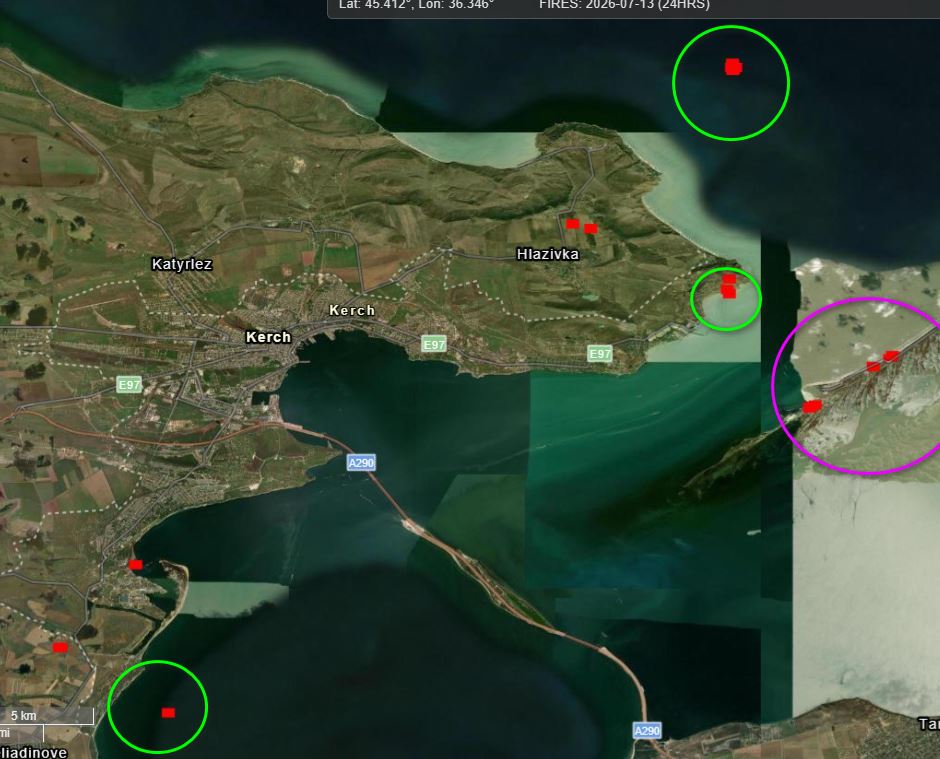
fires both ends russia's fuel chain lukoil depot stavropol krai ferry port facing kerch · post nasa firms satellite fire data 13 2026 shows blazes around strait sea near occupied
NASA FIRMS satellite fire data for 13 July 2026 shows blazes around the Kerch Strait: fires at sea near occupied Kerch (green circles) and at Russia's Port Kavkaz on the far side of the strait (magenta circle). Map: NASA FIRMS

Russia's Defense Ministry claimed air defenses and electronic warfare "intercepted" 342 Ukrainian fixed-wing drones over 16 regions, including Moscow and Moscow Oblast, and over the Azov and Black seas. 

Their father died defending Ukraine. A former Ukrainian brigade commander is now suspected in the murder of his two sons

13 juillet 2026 à 10:04

Stanislav Luchanov.

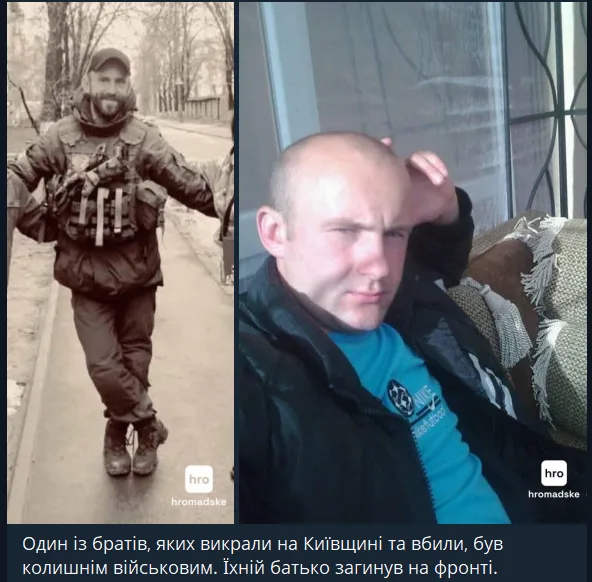
former Ukrainian brigade commander is ігізусеув of ordering the abduction and killing of two civilian brothers in Kyiv Oblast, investigators say. Nine of his soldiers have been detained, and ex-commander Stanislav Luchanov himself — who had gone absent without leave after their arrests — was detained in Kyiv on 13 July, bringing the total to 10

Since 2022, Ukraine has argued that its war differs in kind, not in degree, from Russia's. Ukraine's military command says punishment here will follow regardless of rank or past decorations. The case puts that promise in front of Ukraine's own courts, and it is the second scandal in a month reaching into the army's assault formations.

The night in Kalynivka

Seven armed men entered a private yard in Kalynivka, a village in the Bila Tserkva district of Kyiv Oblast, overnight on 27–28 June. Neighbors heard shots. Two brothers, Maksym and Roman Moseichuk, were taken away. Serhii, their surviving brother, noticed they were gone several days later. Serhii searched for them himself; it was law enforcement that told him his brothers had been abducted, Focus reported.

Brothers Maksym Moseichuk and Roman Moseichuk. Photo: Hromadske

Investigators say the men were driven to Poltava Oblast, where the 155th Separate Mechanized Brigade has its training ground, and killed there. Some accounts place the site in neighboring Dnipropetrovsk Oblast. Bodies believed to be theirs were later exhumed. Kyiv Oblast police, working with the Armed Forces' internal security directorate, opened proceedings under articles covering premeditated murder and unlawful deprivation of liberty.

The war had already taken the family

Serhii Moseichuk Sr., the brothers' father, served from the invasion's first days in the 28th Rifle Battalion. His vehicle drove onto mines on 20 July 2023, and he was killed at the front.

Maksym joined the National Guard in 2022 and served roughly two and a half years. In the war's first days, he fought near Brovary, on the eastern approach to Kyiv. His godfather, Vasyl Dmytriienko, told Hromadske the young man knocked out two Russian tanks there. Maksym stayed in the service for another year after his father died, then left. Roman was a civilian.

"Our father was killed in the war. One of the brothers served in Ukraine's National Guard. He too defended Ukraine from the first days. He was both a grenadier and an assault soldier. They were discharged on account of our father," Serhii Moseichuk, the surviving brother, told Hromadske.

The motorcycles

Stanislav Luchanov, then the commander of the 155th, had his wife, Daryna, and her mother living in Kalynivka. Residents of the village told Hromadske that his wife had repeatedly complained about motorcycle noise disturbing her small child. In the days before the abduction, soldiers of the 155th had reportedly walked through the village with a paper list. They asked locals for the addresses on it — apparently, a register of motorcycle owners. Serhii Moseichuk's name was on it. Maksym's and Roman's were not.

The commander and the regiment before him

Luchanov was appointed to command the newly formed 155th Separate Mechanized Brigade in February 2026. He received the Order of Courage, third degree, in the summer of 2024. When his subordinates were detained, he left his unit without authorization. He was detained in Kyiv on 13 July, the Prosecutor General's Office said.

Before the 155th, he had served briefly as chief of staff at the 425th Separate Assault Regiment Skelia, Ukraine's largest assault regiment. The regiment is regularly assigned high-risk assault missions and takes higher-than-average battlefield losses. On 23 June, Babel published an investigation into 25 non-combat deaths among Skelia recruits at its training centers.

Skelia publicly distanced itself from Luchanov on 12 July. It noted that he had held the Skelia post for less than a year. His transfer to the 155th preceded the alleged crimes by about five months. On the facts, the distancing is legally correct. Criminal liability is personal.

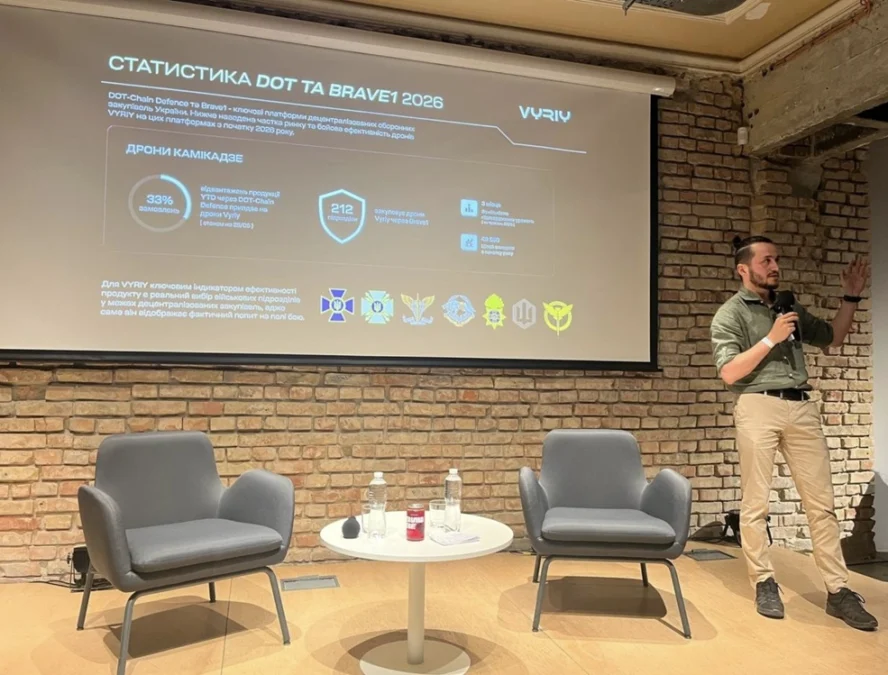
Skelia's statement also acknowledged the regiment is undergoing "deep transformation" and "systematic renewal of internal processes." On 7 July, investigators raided the drone manufacturer Vyriy Industries, whose chief executive owns Babel.

Oleksii Babenko. Photo: Babel
Explore further

CEO of one of Ukraine’s biggest drone makers just got raided. He also owns outlet that exposed 25 non-combat deaths at military unit

The arrests

A battalion commander is among those detained, suspected of involvement in the murder itself. At his hearing he did not name who ordered it. Eight have been ordered held without bail. The detentions were carried out across several Ukrainian oblasts on the orders of Commander-in-Chief Oleksandr Syrskyi. Ukraine's Ground Forces Command confirmed it is cooperating with the investigation.

  • ✇Euromaidan Press
  • Ukraine hits 15 Russian vessels as drone blockade of Crimea spreads across Azov Sea
    Ukraine's drone blockade of Crimea widened across the Sea of Azov overnight on 12–13 July. The Unmanned Systems Forces said they struck 15 Russian vessels, nine energy nodes, and four air-defense assets. Commander Robert “Madyar” Brovdi said the maritime targets included seven tankers, five dry-cargo ships, one ferry, and two tugs. Censor reported that the same operation hit the “Crimea” electricity-transfer point on the Kuban-Crimea energy bridge for the second time in
     

Ukraine hits 15 Russian vessels as drone blockade of Crimea spreads across Azov Sea

13 juillet 2026 à 09:37

Russian ships burning after successful Ukrainian strikes on 12-13 July 2026.

Ukraine's drone blockade of Crimea widened across the Sea of Azov overnight on 12–13 July. The Unmanned Systems Forces said they struck 15 Russian vessels, nine energy nodes, and four air-defense assets.

Commander Robert “Madyar” Brovdi said the maritime targets included seven tankers, five dry-cargo ships, one ferry, and two tugs. Censor reported that the same operation hit the “Crimea” electricity-transfer point on the Kuban-Crimea energy bridge for the second time in 48 hours. Brovdi also claimed the destruction of an S-400 launcher, a Tor system, and two radar complexes. The damage could not be independently confirmed.

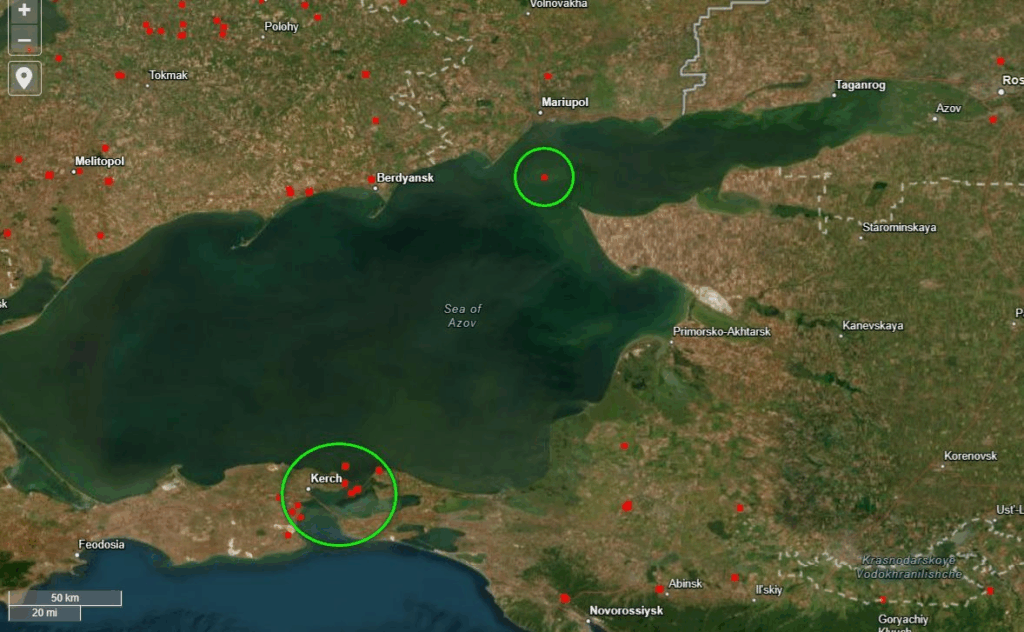
NASA FIRMS registered thermal anomalies across the Sea of Azov, including south of occupied Mariupol and around Kerch. Credit: NASA FIRMS.

RBC-Ukraine reported that NASA FIRMS satellite data showed thermal anomalies in the Sea of Azov and at the Port Kavkaz railway station, a transport hub serving routes to Crimea.

A wider FIRMS screenshot also showed a hotspot south of the occupied city of Mariupol. NASA FIRMS detects heat signatures but cannot determine their cause.

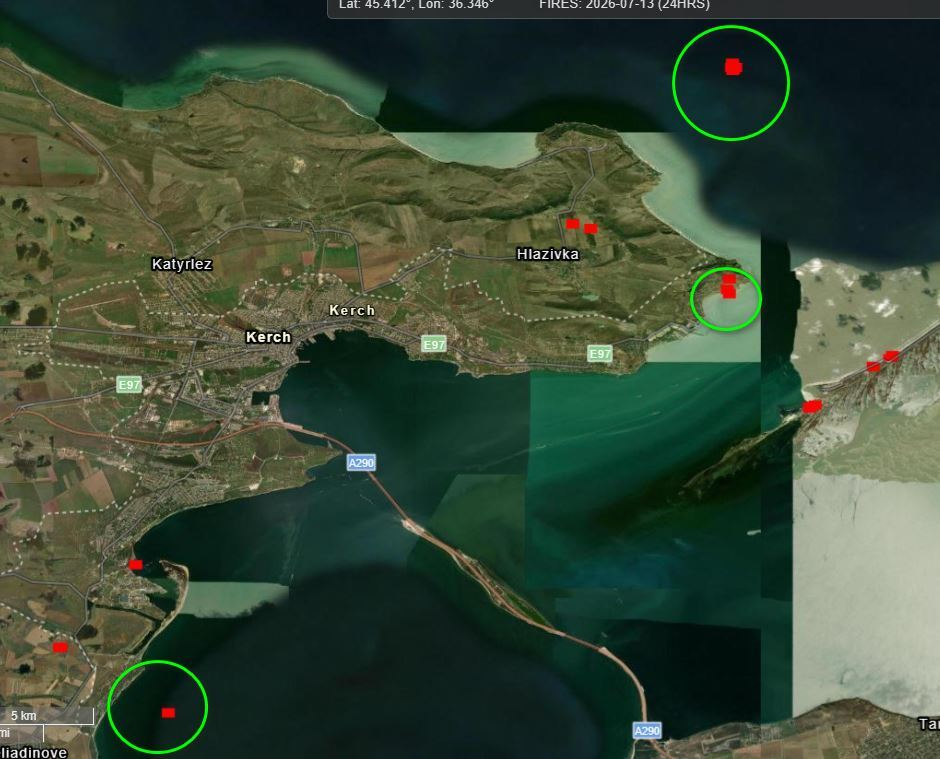
Thermal anomalies appeared north and south of Kerch following Ukraine’s overnight drone operation. Credit: NASA FIRMS.

The strikes targeted several parts of the network linking occupied Crimea to Russia. By hitting shipping, power infrastructure, and air defenses together, Ukraine is tightening the noose around occupied Crimea's supply lines. Each strike makes the remaining links harder to use.

Crimea.Realities reported that Russian authorities kept the Kerch Bridge closed for more than 11 hours, from 9:51 p.m. on 12 July until 9:06 a.m. the next morning. Local residents reported drones, air-defense fire, and explosions around Kerch throughout the closure

Citing the Crimean Wind monitoring channel, Ukrinform reported that fires broke out near Cape Fonar, where Russian air defense units are deployed.

How Ukraine tightened the ring around Crimea

The operation followed a week of strikes on the same routes. On 10 July, Ukrainian forces hit vessels, both Azov loading ports, five oil depots, and Crimea’s power grid.

Russia then halted traffic through the Don-Azov shipping channel and stopped accepting requests for passage through the Kerch Strait. By 12 July, the Unmanned Systems Forces said they had struck 90 vessels in seven days. Brovdi put the total for 6–13 July at 105 successful strikes on vessels.

  • ✇Euromaidan Press
  • Every primary unit at a Rosneft refinery is burning — 100% of its crude processing capacity
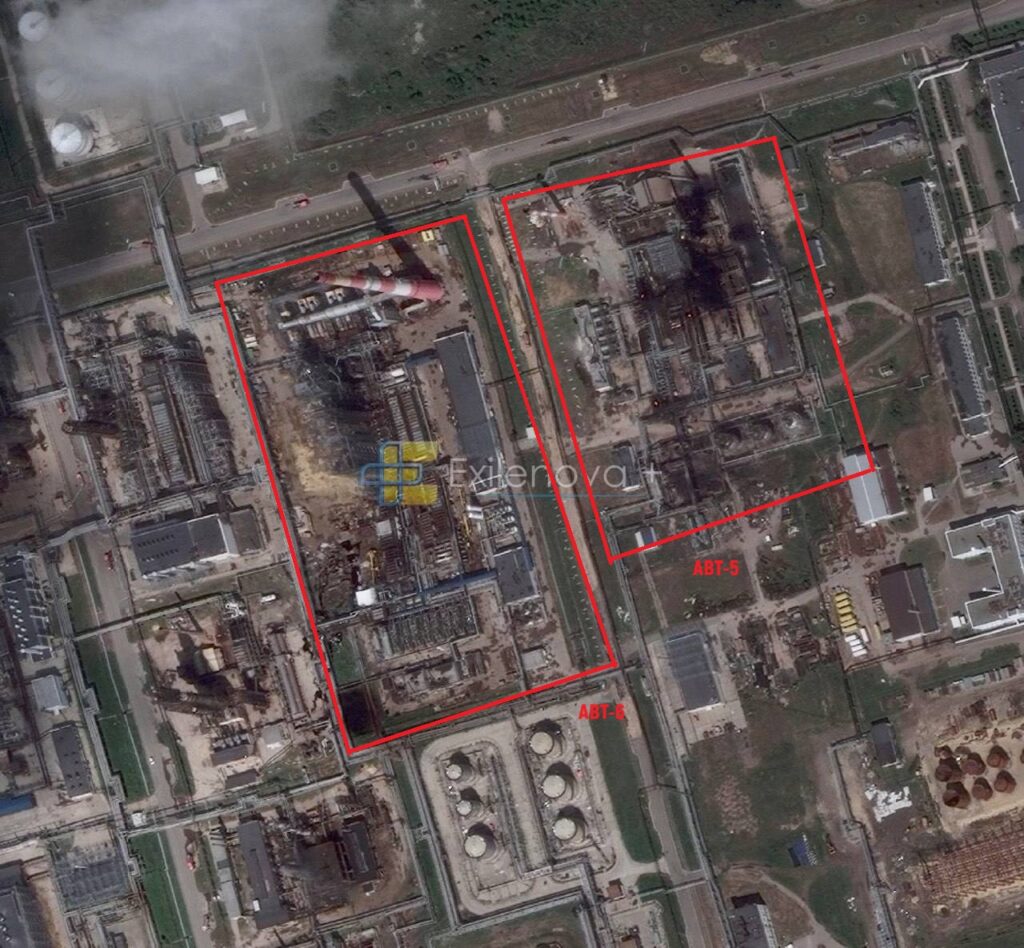
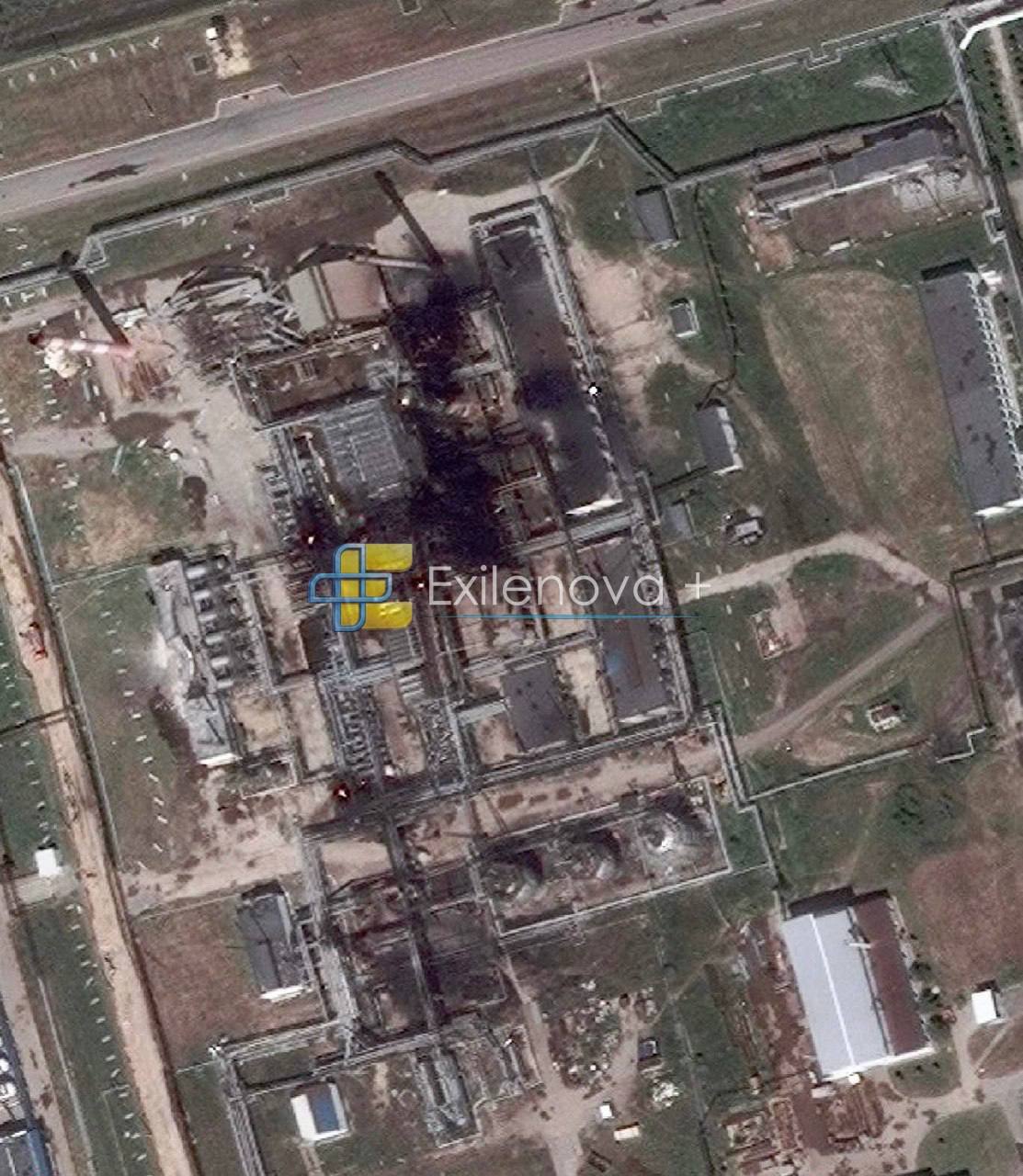
    Satellite images have confirmed the scale of the damage at Russia's Syzran oil refinery in Samara Oblast, where Ukrainian FP-1 strike drones started a large fire on 12 July. Imagery published by the Ukrainian Telegram channel Exilenova+ shows the AVT-5 primary distillation unit burning at several separate points, technical pipe racks burned across the plant, and significant further damage to the second primary unit, AVT-6, Militarnyi reported. Russia's oil pays for the army
     

Every primary unit at a Rosneft refinery is burning — 100% of its crude processing capacity

13 juillet 2026 à 08:21

AVT-5 and AVT-6 units at the Syzran Oil Refinery, 12 July 2026. Photo: Exilenova+

Satellite images have confirmed the scale of the damage at Russia's Syzran oil refinery in Samara Oblast, where Ukrainian FP-1 strike drones started a large fire on 12 July.

Imagery published by the Ukrainian Telegram channel Exilenova+ shows the AVT-5 primary distillation unit burning at several separate points, technical pipe racks burned across the plant, and significant further damage to the second primary unit, AVT-6, Militarnyi reported.

Russia's oil pays for the army destroying Ukrainian cities, and the war is in its fifth year. Ukraine's answer has been to reach the refineries themselves — targets that Moscow long assumed sat safely out of range, deep in the interior.

Both distillation units are down.

AVT-5 processes 2.6 million tons of crude a year, about 30% of the plant's throughput. AVT-6 handles the remaining 70% — 6.3 million tons, by Ukrainian OSINT channel Cyberboroshno's count, though Militarnyi puts it at up to 6 million. Together, they are the refinery's entire primary processing capability.

AVT-5 unit at the Syzran Oil Refinery, 12 July 2026. Photo: Exilenova+

Cyberboroshno mapped hits on both units and reported 100% of primary processing capacity damaged — a combined 8.9 million tons a year, Euromaidan Press reported. Nothing leaves a refinery that cannot distill crude in the first place, the analysts pointed out.

A third hit landed on the LCh-35/11-600 catalytic reformer, which makes components gasoline cannot be blended without. Cyberboroshno says that the hit was pure chance. In one video published by Exilenova+, the reformer's stack looms up in front of an incoming drone. The warhead detonates in mid-air right over the unit, and the fragments tear through it. It is seen burning in later footage.

A plant that keeps burning

Rosneft owns Syzran, one of the Volga region's key fuel producers, and the plant supplies the Russian army's logistics directly. It refines 8.5–8.9 million tons of crude a year, over 3% of Russia's total, and sits more than 800 km from Ukraine's border.

Drones struck the facility on 21 May, seriously damaging AVT-6 and forcing a prolonged shutdown. Reuters reported on 25 May, citing sources, that the plant had suspended operations. Drones also hit the plant three times in August 2025, and the May strike was already the 11th on the facility. Local authorities claimed the latest fire was caused by falling drone debris.

100,000 dolphins killed in the Black Sea because of Russia’s war, Ukrainian scientist warns: “We may lose a unique ecosystem”

13 juillet 2026 à 07:55

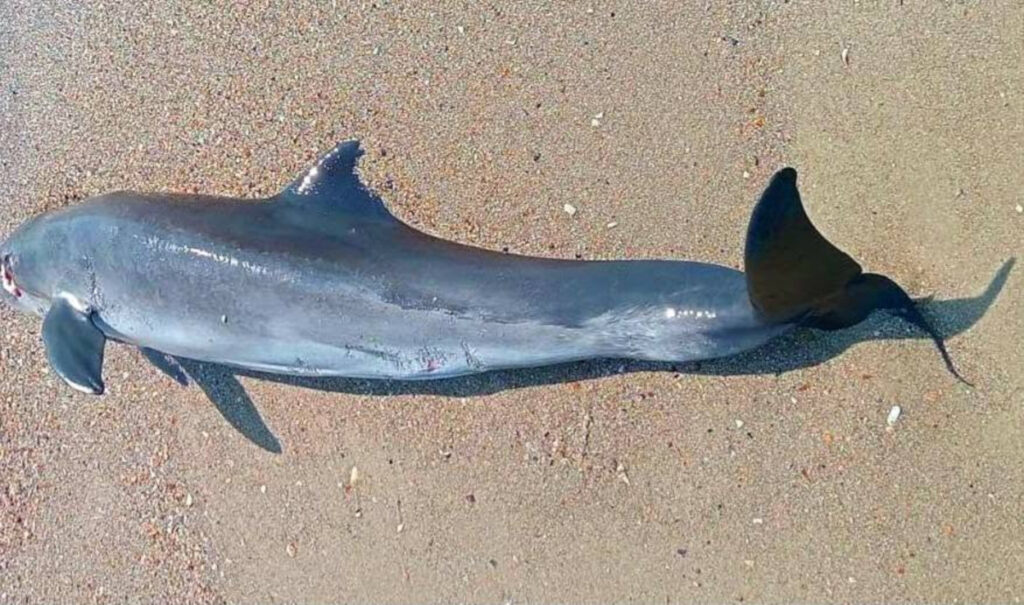
A dead dolphin on Ukraine’s Odesa coast, where scientists link rising marine deaths to Russia’s war in the Black Sea. Photo: Ivan Rusev on Facebook

Russia's full-scale invasion of Ukraine has killed more than 100,000 dolphins in the Black Sea and could trigger irreversible damage to the sea's ecosystem if the losses continue, according to a leading Ukrainian marine biologist.

The warning comes as scientists continue documenting the environmental impact of the war in the Black Sea, with growing numbers of dead marine mammals forming part of evidence in Ukraine's ecocide investigation against Russia. Underwater explosions, naval activity, pollution, and other military operations have all been linked to the deaths.

In an interview with RBK-Ukraine, Ivan Rusev, head of the research department at Ukraine's Tuzly Lagoons National Nature Park, said researchers estimate that about 20,000 dolphins died in the first half of 2026 alone, bringing the total since Russia launched its full-scale invasion to more than 100,000.

"We may lose a unique ecosystem. Without dolphins, the Black Sea will cease to be 'alive.' It will begin to degrade, and life in it will gradually disappear," Rusev told the outlet.

Scientists say most deaths go undocumented

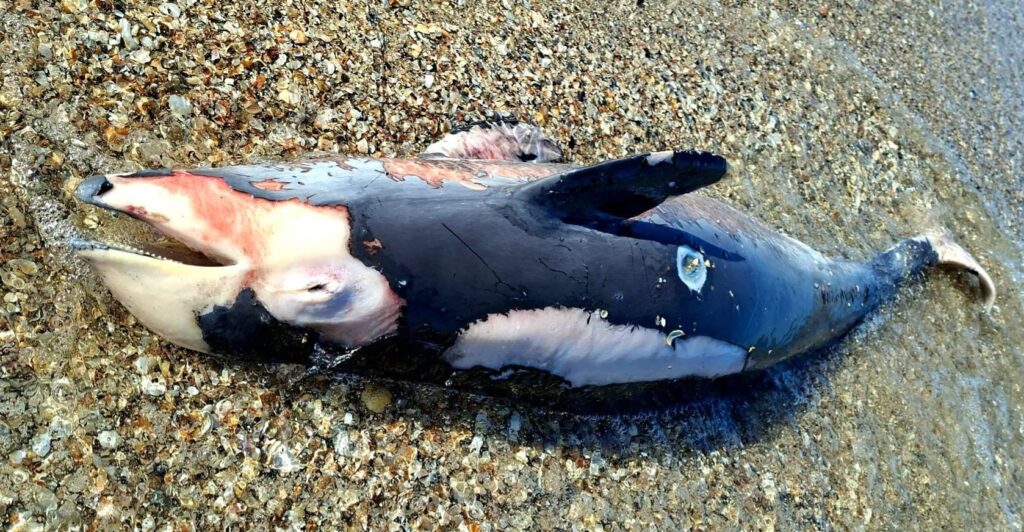
Rusev said the documented toll represents only a small fraction of the true number of deaths because roughly 95% of dolphin carcasses sink before reaching shore.

Even among the few bodies washed ashore, researchers recover only a small proportion before they decompose or are carried away, making accurate documentation a race against time, he said.

The estimates build on months of monitoring by researchers at Tuzly Lagoons National Nature Park, who earlier this month reported finding 63 dead harbor porpoises along Ukraine's Black Sea coast since late May. They said the strandings likely represent only a small fraction of total deaths and are providing evidence to prosecutors investigating alleged Russian ecocide.

A dead dolphin on Ukraine’s Odesa coast, where scientists link rising marine deaths to Russia’s war in the Black Sea. Photo: Ivan Rusev

War-related threats multiply

According to Rusev, dolphins are being affected by multiple war-related factors.

He said powerful military sonar disrupts their echolocation and navigation, while underwater explosions can cause severe acoustic trauma, decompression sickness, and heart damage. Dolphins are also threatened by sea mines, exploding munitions, naval drones, chemical contamination, and burns caused by phosphorus munitions, he said.

Rusev added that stress and food shortages weaken the animals' immune systems, making them more vulnerable to infections that would normally not be fatal.

The exact causes of individual deaths have not been conclusively established, though scientists have repeatedly linked the rising mortality to the cumulative effects of Russia's war in the Black Sea.

Dolphins flee combat zones

Rusev said researchers in Romania, Bulgaria, and Türkiye have observed unusually large numbers of dolphins after many animals fled areas affected by fighting.

While the migration may improve the chances of survival for some dolphins, he warned that the overall population remains significantly depleted.

He also warned that chemical pollution generated by the war could eventually spread throughout the Black Sea, reaching as far as the Bosporus Strait and threatening the wider marine ecosystem.

Evidence gathered for ecocide investigation

Rusev stressed that documenting the deaths is essential, arguing that without evidence, the environmental consequences of the war could later be disputed.

The deaths of dolphins and other marine mammals are already being examined by Ukrainian authorities as part of an ecocide investigation into Russia's actions, with researchers preserving carcasses and submitting evidence to prosecutors for forensic analysis.

  • ✇Euromaidan Press
  • Russian who helped Ukraine’s military faces deportation after decade under false identity
    A Russian national known in Ukraine as volunteer Aslan Khakimov is in fact Ruslan Puptaiev, a man who entered Ukraine illegally, lived for more than a decade under false documents, and is wanted by Interpol at Russia's request, according to an investigation by Babel. The case has become one of Ukraine's most closely watched deportation disputes, drawing support from soldiers, volunteers, human rights advocates, and lawmakers. Backers argue Puptaiev's contributions to Uk
     

Russian who helped Ukraine’s military faces deportation after decade under false identity

13 juillet 2026 à 07:13

Ruslan Puptaiev, also known as Aslan Khakimov, his wife Oleksandra, and their daughter Amina in 2025. Puptaiev is contesting deportation from Ukraine after authorities discovered he had lived for years under a false identity. Photo from social media, via Babel

A Russian national known in Ukraine as volunteer Aslan Khakimov is in fact Ruslan Puptaiev, a man who entered Ukraine illegally, lived for more than a decade under false documents, and is wanted by Interpol at Russia's request, according to an investigation by Babel.

The case has become one of Ukraine's most closely watched deportation disputes, drawing support from soldiers, volunteers, human rights advocates, and lawmakers. Backers argue Puptaiev's contributions to Ukraine's defense and the risk of torture if returned to Russia should outweigh his immigration violations, while Ukrainian authorities maintain he lived in the country illegally under forged documents.

According to the investigation, Ukraine's State Migration Service cancelled the documents issued under the false identity in October 2025. After Puptaiev failed to regularize his legal status or challenge the decision, the agency ordered his forced deportation in April 2026. He has since been held at a temporary detention facility for foreigners in Lutsk while legal proceedings continue.

Claims of persecution in Russia

Puptaiev told Babel he fled Russia in 2015 after allegedly being detained and tortured by Russia's Federal Security Service (FSB), which he says accused him of Islamist extremism following his conversion to Islam while serving a prison sentence.

He says he entered Ukraine illegally because he feared seeking legal protection would expose him to extradition. Rather than applying for refugee status or other international protection, he instead acquired forged Ukrainian identity documents under the name Aslan Khakimov and later used them to obtain genuine state-issued documents based on the false identity, Babel reports.

Over the following years, he established businesses, married Ukrainian citizens, and registered his children using the fabricated identity.

Volunteer work after Russia's full-scale invasion

Babel reports that Puptaiev became involved in supporting Ukraine's military after Russia launched its full-scale invasion in 2022.

After Russia's full-scale invasion, Puptaiev supported Ukraine's military by donating money, developing equipment including unmanned ground vehicle components and airless evacuation wheels, and training dozens of service members, according to Babel.

Babel reports he has received letters of appreciation from Ukraine's military intelligence agency (HUR), Special Operations Forces, Armed Forces, Ministry of Defense, and individual units recognizing his volunteer work.

His public appeals for support began only after he was detained in April 2026, with supporters portraying the case as an attempt by Ukraine to extradite a volunteer to Russia.

Interpol notice and Russian conviction

According to Babel, Ukraine's National Police confirmed that Puptaiev is the subject of an Interpol notice requested by Russia.

Russian authorities accuse him of financing terrorism and maintaining links to the Islamic State group. Babel notes that Russian media reported he was convicted in absentia by a Russian military court in 2024 and sentenced to 20 years in prison on terrorism-related charges. 

Puptaiev denies Russia's allegations and maintains that he is being politically persecuted.

ECHR blocks deportation to Russia

Puptaiev's lawyers say Ukraine's original deportation order referred only to his "country of origin" – Russia. After his legal team appealed to the European Court of Human Rights (ECHR), the court issued interim measures under Rule 39 on 26 May, temporarily barring Ukraine from returning him to Russia while it considers the case.

Human rights experts told Babel that Rule 39 is reserved for exceptional cases where there is a credible risk of irreparable harm, including torture or threats to life. They said the measure does not determine the outcome of the case but requires Ukraine to avoid returning Puptaiev to Russia while proceedings continue.

Babel reports that Ukrainian authorities are also exploring whether Puptaiev could instead be deported to Kyrgyzstan, where he was born, or Türkiye. His lawyers argue that either country could ultimately extradite him to Russia, exposing him to the same risks the ECHR sought to prevent.

The ECHR case remains pending.

  • ✇Euromaidan Press
  • New York Times: Russian spies used Japan to source technology for war
    Russia has turned Japan into a key base for obtaining high-tech equipment to sustain its war against Ukraine. A New York Times investigation reveals how GRU military intelligence operatives work under cover in Tokyo to acquire banned components for Russian weapons. The investigation found that officers from Russia’s GRU military intelligence service operated in Japan under diplomatic and commercial cover. GRU officers sought to acquire electronics, machine tools and oth
     

New York Times: Russian spies used Japan to source technology for war

13 juillet 2026 à 07:10

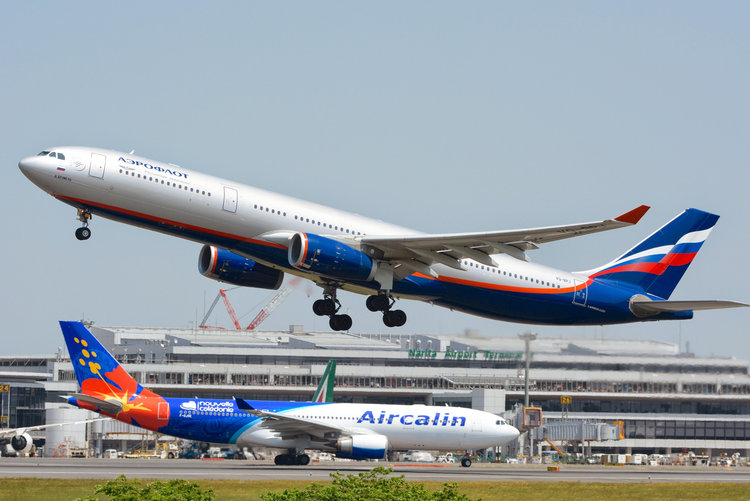
Aeroflot Airbus A330 at Narita Airport, illustrating the airline’s reported role as cover for Russian industrial espionage in Japan.

Russia has turned Japan into a key base for obtaining high-tech equipment to sustain its war against Ukraine. A New York Times investigation reveals how GRU military intelligence operatives work under cover in Tokyo to acquire banned components for Russian weapons.

The investigation found that officers from Russia’s GRU military intelligence service operated in Japan under diplomatic and commercial cover. GRU officers sought to acquire electronics, machine tools and other technology for routing to Russia and use in weapons production.

At the center of the operation is the GRU’s little-known 20th Directorate, according to current and former Western intelligence officials interviewed by the Times.

One of its key figures is Maksim Vladimirovich Filchenkov, a 49-year-old GRU veteran who arrived in Tokyo in February 2024. He officially works for Russia’s state airline, Aeroflot.

Western officials told the Times that Filchenkov oversees the directorate’s work from an Aeroflot office about a 10-minute walk from Japan’s National Police Agency.

Russian and Soviet intelligence officers have used Aeroflot positions as cover for industrial espionage since the Soviet era.

The network reportedly relies on relationships with shipping and logistics companies. Russian agents send sensitive goods first to countries where Aeroflot still operates, then route them to Russia through intermediaries and misleading paperwork.

According to the Times, Filchenkov developed ties with Tokyo logistics company Proco Air. Proco Air denied knowingly transporting prohibited goods and has not faced charges of wrongdoing.

Japanese components continue to reach Russian weapons

Japan is especially valuable to Russia because of its large high-tech industry and comparatively weak espionage laws.

Ukraine has repeatedly warned Tokyo that Japanese-made components are reaching Russian weapons. Vladyslav Vlasiuk, Ukraine's presidential sanctions commissioner, said Japanese parts appear in around 90% of Russian cruise missiles, ballistic missiles and drones. Vlasiuk made the remarks to Kyodo News, as reported by 47News.

He also named 13 Japanese companies whose products had been found in Russian weapons. Kyiv is now pressing Tokyo to tighten export controls on civilian dual-use goods rerouted through third countries.

There is no evidence that Japanese manufacturers knowingly supplied Russia’s military. Components can pass through several distributors and countries before reaching Russian weapons producers.

  • ✇Euromaidan Press
  • Russia wants to run grain through its Syrian naval base—one berth for cargo, one for warships
    Russia wants to start moving grain and other cargo through the Syrian naval base it leases, keeping warships at one berth and commercial shipments at the other, Reuters reported. Syrian officials describe the plan as central to Moscow's effort to hold on to Syria through trade after losing its closest Middle Eastern ally. Syria's port authority denies the project exists. Every ton Moscow ships abroad pays for something at home, including its war against Ukraine, and the foo
     

Russia wants to run grain through its Syrian naval base—one berth for cargo, one for warships

13 juillet 2026 à 05:56

uk intel russia’s mediterranean presence doubt after assad regime collapse russian naval base syria's tartus before fall hisutton's video british defense ministry reported its intelligence update 21 operations eastern have

Russia wants to start moving grain and other cargo through the Syrian naval base it leases, keeping warships at one berth and commercial shipments at the other, Reuters reported. Syrian officials describe the plan as central to Moscow's effort to hold on to Syria through trade after losing its closest Middle Eastern ally. Syria's port authority denies the project exists.

Every ton Moscow ships abroad pays for something at home, including its war against Ukraine, and the food it sells is often taken from the land it occupies. Kyiv has spent four years trying to make that trade costly — tracking the vessels, naming the buyers, pressing sanctions onto the operators.

Wheat at one berth, warships at the other

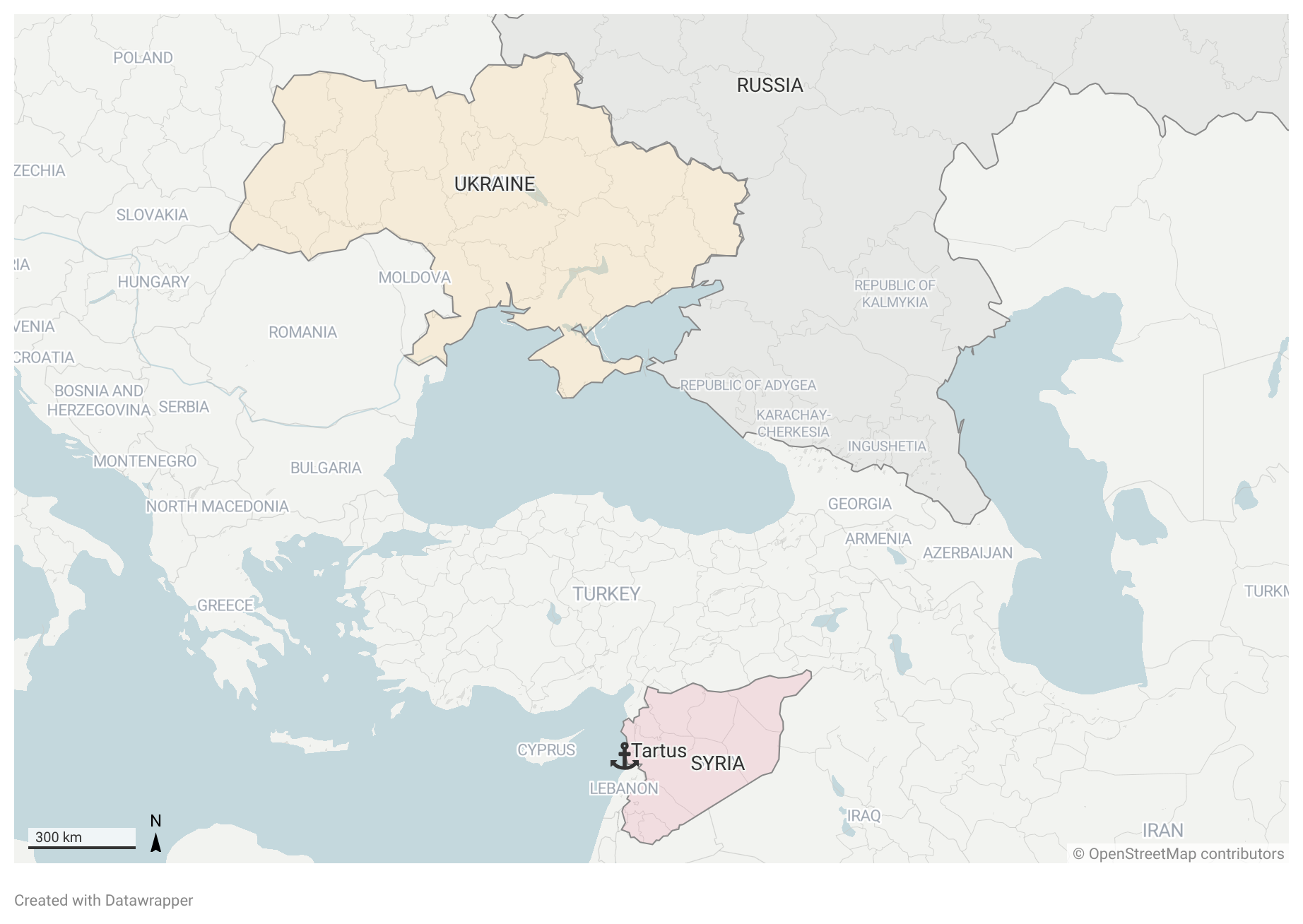
Russia hopes the logistics hub at Tartus will be working by mid-July, Syrian officials said. The first cargoes, according to Ajaj, run from wheat, grain, and animal feed to vegetable and mineral oils, timber, steel, clinker, coal, rice, and sugar. Organizers are targeting about 250,000 tons of cargo a month. The opening shipment is meant to be 30,000 tons of grain.

Rus Line, a Syrian logistics firm, is developing the hub together with Russian companies that sit under the Russian-Syrian Business Council — a body run by Russia's Industry and Trade Ministry. The council announced an "assembly and distribution center for Russian goods" at the port on 6 June.

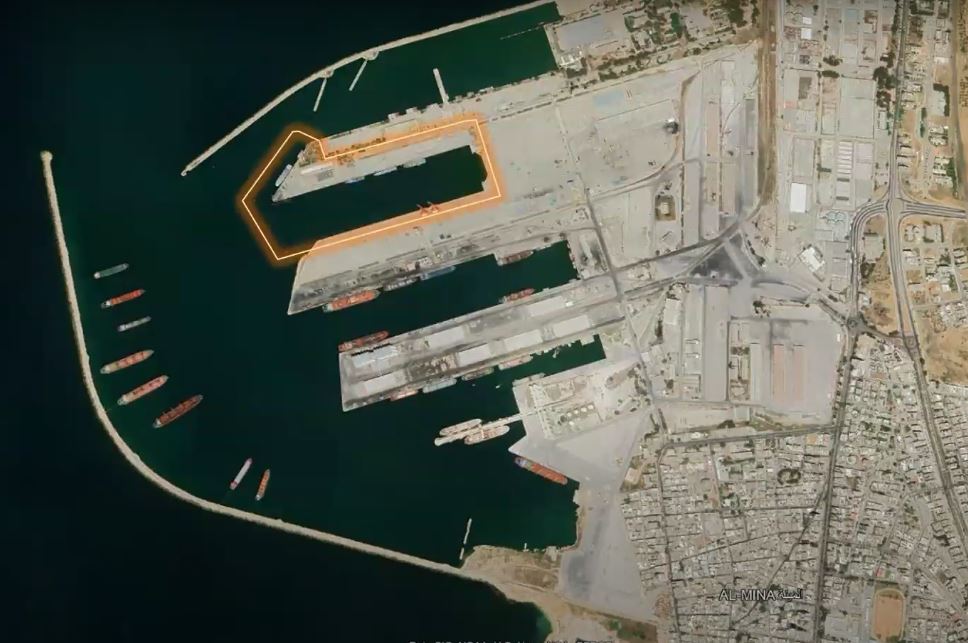
Pier No. 4 is where the cargo will be handled, Rus Line chief executive Jinan Mubadda said. The company's general manager, Ossama Ajaj, called that pier a "restricted zone" of the naval base, and said the site stays under Syrian command: nothing moves without a green light from Syria's General Authority for Ports and Customs. Ajaj also suggested Russia would keep a "reduced military presence."

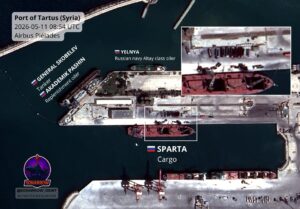
Russian cargo ship SPARTA unloading at Tartus naval base in Syria with Russian escort warships, satellite imagery analyzed by GeoInsider and SONARROW showing renewed Russian deliveries after Assad’s fall.
Explore further

Russia maintains military presence in post-Assad Syria – but Damascus now holds leverage

The port authority rejected the account after publication. Spokesman Mazen Alloush called reports of a Russian commercial hub at Tartus "entirely false" and said any deal over Syrian ports or border crossings would go public only via official state channels.

russia's african presence risk potential syria naval base loss expert says location russian tartus port hisutton's video independent analyst hi sutton reports ability maintain its military influence africa faces significant
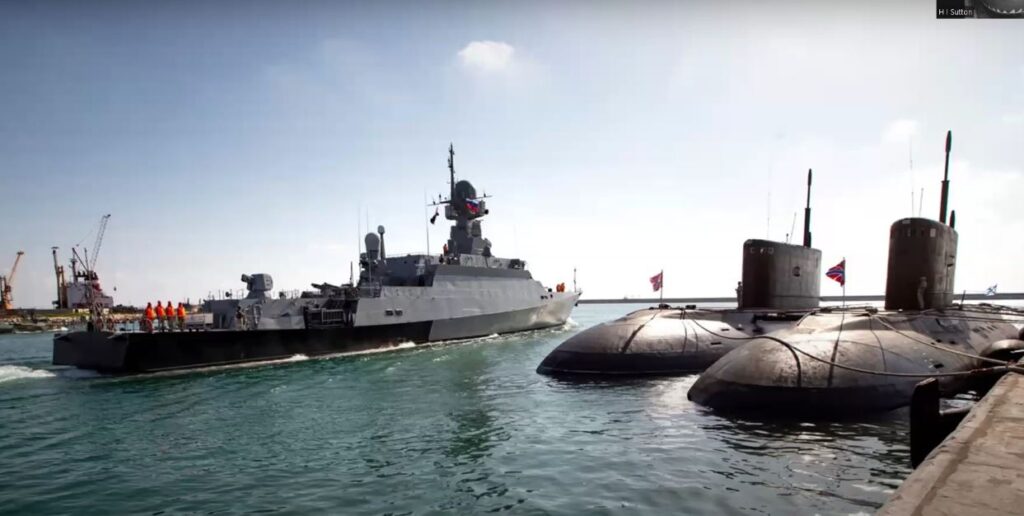
Location of the Russian naval base in the Tartus port. Screenshot from H.I.Sutton's video

The plan builds a regular shipping line between Novorossiysk—Russia's port on the northeastern Black Sea coast—and Tartus, with goods distributed onward across Syria and its neighbors. Iraq and Jordan come first on Ajaj's list of destinations, with the Gulf — Saudi Arabia, Kuwait, Qatar, Bahrain — next in line.

What Moscow already holds in Syria

The hub would extend an economic grip that survived the collapse of Russia's military position. Russia and Russian-occupied Crimea supply 85% of the wheat Syria imports — 2.9 million tons this 2025-26 season, according to a Syrian customs document. Ukraine's Foreign Intelligence Service has documented that shipments of grain grown on occupied Ukrainian land resumed to Syria in 2025.

Syrian reliance on Russian crude has grown since Assad's fall. The country took about 16.8 million barrels of Russian oil in 2025 and roughly 60,000 barrels a day in early 2026.

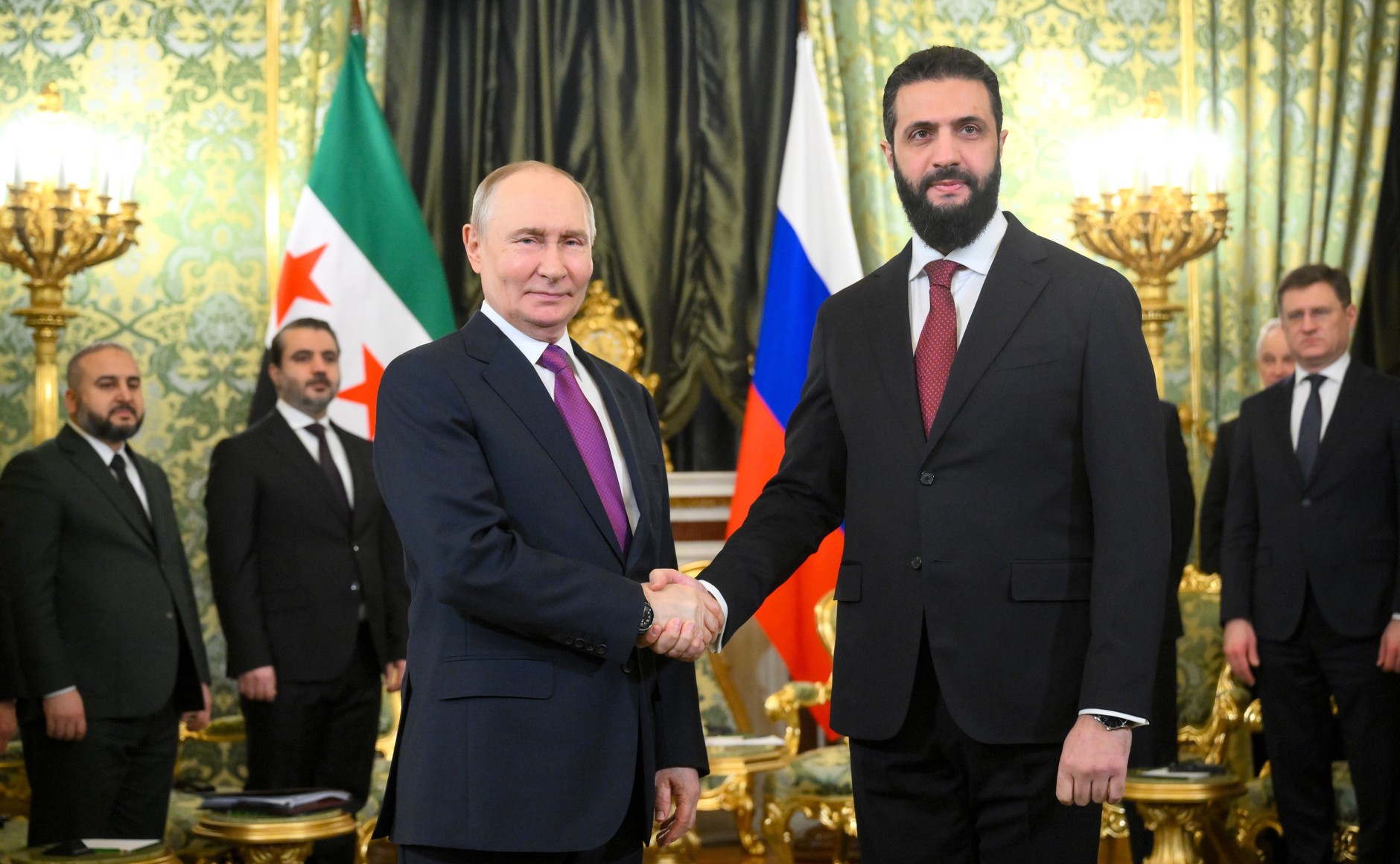
Syrian President Ahmed al-Sharaa and Russian President Vladimir Putin in Moscow, 28 January 2026.
Explore further

Post-Assad Syria still dependent on Russian oil despite shift to the West – Reuters

After Assad fell in 2024, Moscow lost its main Middle Eastern ally, and its Syrian leases became uncertain. In 2025, Syria canceled Stroytransgaz's 49-year contract to develop commercial facilities at Tartus — the very business Russia is now trying to restart.

Russian military flights returned to the Hmeimim airbase in late October 2025. Moscow and Damascus are still negotiating the fate of both installations. Russian Foreign Ministry spokeswoman Maria Zakharova claimed in June that the sides were discussing a possible "reformatting" of Russia's military facilities.

EU says Russia’s Venice pavilion could cost Biennale €2 million grant. Its commissioner is daughter of FSB general

13 juillet 2026 à 03:10

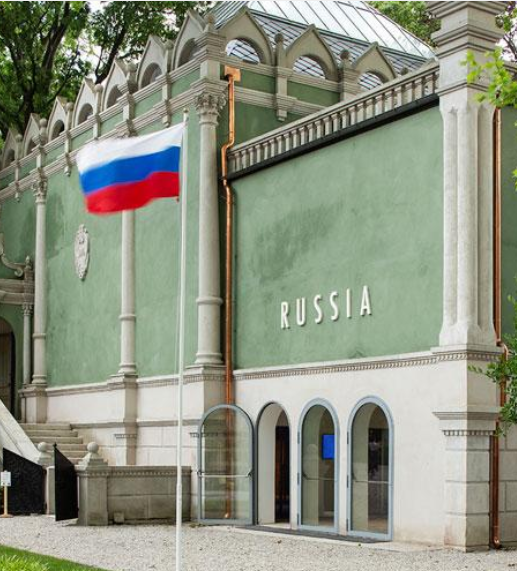
A Russian pavillon at the Venice Biennale. Source: Labiennale

The European Commission officially recommended terminating the €2 million grant to the Venice Biennale due to the reopening of Russia's pavilion. European Commission Vice President Henna Virkkunen announced the recommendation on X.

Russia's aggression has nothing to do with art and culture. Ukrainian Ministry of Culture data shows that the Russian war has destroyed or damaged 1,913 cultural heritage monuments and 2,573 cultural infrastructure objects in Ukraine. Russia continues stealing Ukrainian archaeological finds from occupied territories and taking them to Moscow. The Hermitage Museum in St. Petersburg displayed archaeological finds taken from the occupied Kherson Oblast in April 2026. 

The Russian pavilion opened at the 61st Venice Biennale in April 2026, following its absence in 2022 and 2024. Its commissioner is Anastasia Karneeva, daughter of a senior figure at the Rostec state defense corporation and a former FSB general, and is financed by the oligarch Leonid Mikhelson's Novatek company.

Ukraine sanctioned Karneeva and four other Russian cultural figures at the pavilion in April 2026 as "cultural propagandists" spreading Russian state narratives. Over 20 countries condemned Russia's participation. Seventy-one Parliamentary Assembly of the Council of Europe delegates from 29 countries called for the pavilion's cancellation. 

Russia's culture: genocide

The largest Russian attack on Kyiv's cultural institutions occurred in May 2026. It damaged the National Art Museum of Ukraine (NAMU), the National Philharmonic of Ukraine, the National Music Academy of Ukraine, the National Center "Ukrainian House," the National Library of Ukraine named after Yaroslav the Wise, and the Kyiv Academic Theater of Opera and Ballet for Children and Youth.

The National "Chornobyl" Museum sustained significant damage. Numerous architectural monuments were affected, including the Kyiv Contract House and the Post Station.

Three UNESCO World Heritage Sites in Ukraine and their buffer zones have suffered damage. Damage in the historic center of Odesa is among the documented cases.

The EU's recommendation escalates from the April 2026 warning that the Commission could freeze the grant.

"The Commission officially recommends EACEA to terminate the €2 million grant to the Venice Biennale. This follows a thorough assessment of the replies from the Biennale to justify the re-opening of Russia's pavilion," Virkkunen wrote.

Ukraine called on the Biennale leadership to maintain the principled position it held from 2022 to 2024, excluding Russia.

 Italian government opposes EU action

The European Commission's recommendation runs against the Italian government's position on Russian participation. Italian Deputy Prime Minister Matteo Salvini criticized Brussels' position and did not object to Russia's participation.

Veneto regional president Alberto Stefani called the EU's actions "unacceptable," arguing that art should "facilitate moments of cultural dialogue, which can become opportunities to forge connections, especially when official diplomacy cannot find solutions."

The Biennale replied to Italian Culture Minister Alessandro Giuli that there had been "no violation of the rules" in admitting Russia and that "the sanctions against the Russian Federation were fully observed."

Russia builds three ballistic missiles per day: Japan’s entire annual Patriot output would cover only one mass strike on Kyiv, expert says

13 juillet 2026 à 02:44

kyiv attack

Ukraine needs a minimum of 2,000 PAC-3 interceptors per year to defeat Russian ballistic missiles. Ukrainian military-political analyst Oleksandr Kovalenko from the Informational Resistance group said on Espreso TV that Ukraine's requirement is 2,000 PAC-3 per year, against Russia's production of the 9M723 ballistic missile for the Iskander-M complex at 3 per day, or more than 1,000 per year.

The US produces about 700 PAC-3 interceptors per year at Lockheed Martin, per Kovalenko. Japan produces roughly 70 PAC-3 per year at Mitsubishi Heavy Industries under license. Global combined output stands at approximately 770 PAC-3 per year, compared with Ukraine's 2,000-per-year requirement.

"We need at least 2,000 anti-missiles of the PAC-3 type just to intercept the 9M723 production. That is why PAC-3 production is very important for us," Kovalenko said.

Just one mass strike takes annual Japanese production

Kovalenko noted that 70 PAC-3 interceptors, the annual Japanese output, cover just one massed strike on Kyiv when Russia launches 20 to 30 ballistic missiles.

Ukraine's Patriot ask has received three positive signals from Trump in three weeks. Trump announced at the NATO summit in Ankara on 8 July that the US will give Ukraine a license to manufacture Patriots, though Lockheed Martin and RTX Corporation had not been informed.

However, the production of Ukraine's Patriot systems will face years of supply chain and security constraints.

Russia produces three Iskander-M ballistic missiles per day

Russia's monthly ballistic missile production exceeds Lockheed Martin's monthly PAC-3 production, Defense Express analyst Oleh Katkov says.

Each Russian ballistic missile typically requires two to three PAC-3 interceptors to intercept, meaning the effective Ukrainian requirement climbs beyond the raw Russian production count.

Kovalenko's 2,000 figure treats 1,000 annual Iskander-M plus a two-to-one intercept ratio as the minimum floor. It does not include Russia's Kinzhal, Zircon, or S-400 ballistic-profile launches, all of which also require Patriot interceptors.

Real Ukrainian PAC-3 needs likely exceed 2,000 per year when the full Russian ballistic threat is counted.

Ukraine already burns through about 60 Patriot interceptors per month on what its Air Force calls a "starvation ration" against Russian ballistic strikes. Ukraine's Ministry of Defense reported an overall interception rate of 89 percent for Russian air targets in June 2026, but only 40 percent for ballistic missiles specifically.

Ukraine's Freya anti-ballistic program runs in parallel

Launching PAC-3 production in Ukraine will take substantial time, Kovalenko said.

"We need to invest in PAC-3 production, but in addition, we must develop our own anti-ballistic program," he stresses. 

Ukraine's Freya interceptor program is the parallel track. Zelenskyy said this week that eight European countries could join Ukraine's Freya project, with Sweden and Germany already committed as partners.

Ukraine's Fire Point aims to begin serial production of Freya in August 2026, with the first ballistic intercept targeted for the end of 2027.

Kovalenko's assessment implies Ukraine cannot afford to wait for either PAC-3 licensing or Freya to solve the ballistic gap alone. Both tracks need to move at maximum speed simultaneously, and neither is currently sized to Kovalenko's 2,000-per-year requirement.

❌