Ukraine’s strikes deep into Russia have not helped end the war or slow Russia’s advance, US Under Secretary of War for Policy Elbridge Colby told the Ukraine Defense Contact Group at NATO headquarters, according to remarks the Department of War published on 17 November. The meeting’s British and German co-chairs disagreed at a joint press conference that evening, which NATO streamed.
The split came hours after Ukraine brought down the road span of Russia’s Kerch bridge. It also came two
Ukraine’s strikes deep into Russia have not helped end the war or slow Russia’s advance, US Under Secretary of War for Policy Elbridge Colby told the Ukraine Defense Contact Group at NATO headquarters, according to remarks the Department of War published on 17 November. The meeting’s British and German co-chairs disagreed at a joint press conference that evening, which NATO streamed.
The split came hours after Ukraine brought down the road span of Russia’s Kerch bridge. It also came two days before US President Donald Trump, Russian President Vladimir Putin, and Chinese President Xi Jinping meet in Shenzhen, a summit China’s Foreign Ministry announced for 19 November. Washington has already pressed Kyiv over refinery strikes this fall. This time, Colby argued for restraint in the same speech in which he said Europe had taken “primary responsibility for Ukraine’s defense.”
The Pentagon wants support aimed at the front line
Colby also called Ukrainian strikes on the objects inside Russia “the spectacle of deep strikes designed to incur pain on the Russian population,” and added that “in our assessment is that such strikes have not been effective in driving an end to the war.” Hits on targets like the retailer Wildberries have probably “hardened the Russian public’s resolve,” in his view, and Moscow may hold the advantage in a long-range duel.
The Pentagon instead wants allied support focused on the front line and mid-range strikes. At the same time, the under secretary said Ukraine should not be made to fight “with its hands tied behind its back,” and that “strikes that target Russia’s warmaking machinery can also help contribute to slowing Russia’s advance on the front lines.”
Streeting and Khmara: Kyiv decides how to fight
Asked by the BBC about Colby’s criticism, UK Defense Secretary Wes Streeting said that “it’s not for us to tell Ukraine how to fight their war.” Deep strikes, he added, have “helped to degrade Putin’s war machine, buying time and saving lives.”
Ukrainian Defense Minister Evgeniy Khmara said Ukraine has “the right to retaliate.” Russia has struck Ukraine’s bridges across the Dnipro 12 times since 1 October, he said, while Ukraine planned one strike on the Kerch bridge. “For each strike they’re hitting our territory we’ll retaliate twofold, tenfold,” he said, adding that Kyiv plans to scale up its deep-strike capacity threefold next year.
Rutte sidesteps Colby, Pistorius calls the criticism stupid
Before the meeting opened, NATO Secretary General Mark Rutte was asked about the Kerch bridge strike. He told reporters that Ukraine’s defense “means also hitting out at logistical nodes, that’s unavoidable.” He said it remained to be seen what exactly happened, but that judging by the media footage, “it seems that they were successful.”
At the press conference, Reuters asked whether he shared Colby’s position. Rutte did not name Colby, but he said allies agree that disabling “Russia’s war machine” is “necessary,” NATO’s transcript shows.
German Defense Minister Boris Pistorius then said he agreed with Rutte, Khmara, and Streeting. Criticizing strikes on “strategic military and military-use targets” in Russia is “quite a stupid thing,” he said. Allies should instead talk about Russia’s “terroristic strikes every night and every day” on Ukraine’s energy, water, and heat.
Ukraine finally dropped part of the strategic Kerch Bridge on 17 November
The complex strike operation involved several new capabilities
Now Russian logistics into occupied southern Ukraine are partially throttled
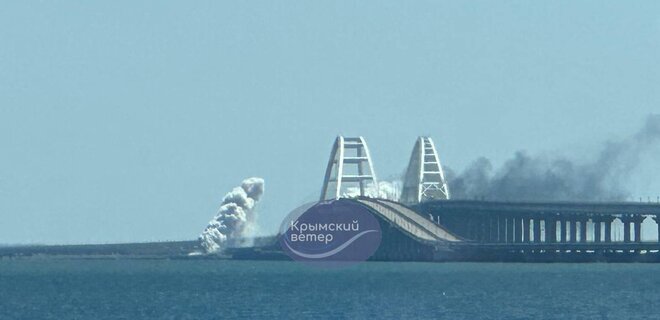
After years of trying, Ukrainian forces finally dropped a portion of the strategic Kerch Bridge connecting southern Russia to occupied Crimea over the narrow Kerch Strait overnight on 17 November, a day after a first strike knocked one of its arches askew.
Paralle
Ukraine finally dropped part of the strategic Kerch Bridge on 17 November
The complex strike operation involved several new capabilities
Now Russian logistics into occupied southern Ukraine are partially throttled
After years of trying, Ukrainian forces finally dropped a portion of the strategic Kerch Bridge connecting southern Russia to occupied Crimea over the narrow Kerch Strait overnight on 17 November, a day after a first strike knocked one of its arches askew.
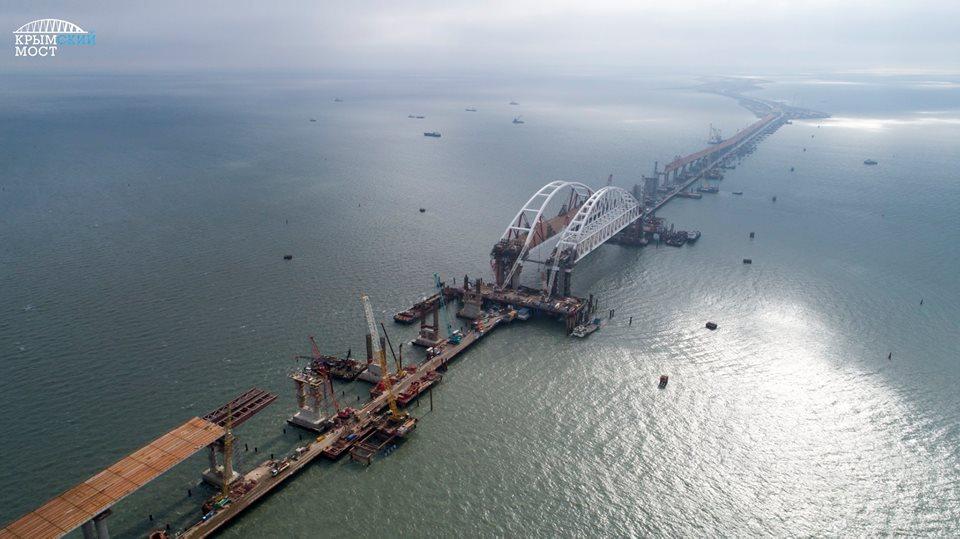
Parallel spans carry—or carried—vehicles and trains back and forth, helping feed, fuel, and supply Russian forces in Crimea. There are other supply lines for Russian forces in occupied southern Ukraine, but the 19-km bridge—which Russia built after seizing Crimea in 2014 and opened in 2018, at a cost of about $3.7 billion—is or was one of the main ones.
Now it's half wrecked, with the vehicle span severed in the middle, the train span damaged, and wreckage blocking the ship channel beneath the bridge for as long as it takes for Russia to mount a major repair and salvage effort. An effort that the Russians may have to attempt under further Ukrainian attack.
Grateful to the Security Service of Ukraine, all units of Ukraine’s Defense Forces involved, Ukraine’s Minister of Defense, the Commander-in-Chief of the Armed Forces of Ukraine and the General Staff, and all our weapons manufacturers for an unprecedented operation in response to… pic.twitter.com/pgUxGrE61K
— Volodymyr Zelenskyy / Володимир Зеленський (@ZelenskyyUa) November 17, 2026
"Today, everyone can see the consequences for the main military crossing from Russian territory into our Ukrainian Crimea," Ukrainian President Volodymyr Zelenskyy wrote. "This is the result of the seventh stage of an operation carried out over several weeks, developed and coordinated by the Security Service of Ukraine together with the General Staff of the Armed Forces of Ukraine."
Ukraine has attacked the Kerch Bridge at least once a year every year since 2022, striking with a truck bomb, drones, missiles, and underwater explosives. None of those attacks inflicted nearly as much damage as the 16 and 17 November strikes. For the most recent and most successful raid, Ukraine mobilized many of its best deep strike forces, including some brand-new capabilities such as jet-propelled drones and operator-guided cruise missiles.
The view from a remote-controlled FP-5 as it nears the Kerch Bridge. Fire Point capture.
New drones and missiles
Three stand out:
the new Ruta cruise missile from Dutch firm Destinus
a new jet-propelled version of Ukrainian firm Antonov's An-196 Liutyi attack drone
and a new variant of Kyiv-based Fire Point's FP-5 Flamingo cruise missile that a remote operator directly steers via a low-lag radio signal.
In all, various drone units from the Ukrainian army, navy, and special services may have launched hundreds of drones and missiles over a period of nearly a month in order to first clear a path through Russian air defenses—and then strike the bridge.
"Our warriors gradually destroyed air defense systems, radars, electronic warfare equipment, and other designated targets on the way to the final objective," Zelenskyy wrote. For this, the president added, they used 11 different kinds of drone and missile, including Palianytsias, Mich-2000s, Rutas, Neptunes, and the jet-propelled Liutyis, also known as An-197s.
Once the Russian defenses were sufficiently degraded, drones and missiles took aim at the bridge. "At the key stage, the Palianytsia drones performed exceptionally well, striking the road section of the bridge," Zelenskyy wrote, "while Neptune missiles, Ruta drones, and FP-5 drones struck the railway section."
Official videos revealed that the FP-5s weren't the usual versions of the heavyweight cruise missile, which hauls a 1,150-kg warhead as far as 3,000 km. Normally, the Flamingo navigates by way of an internal inertial system that, while helpfully self-contained, tends to drift over long distances—and also results in the missile cruising at an altitude of several hundred feet, high enough to make it an easy target for Russian air defenses.
Explore further
Missile-drones, cruise missiles, and a Flamingo guided to the last second: Kyiv’s account of the night Russia’s Kerch bridge lost its road
The Flamingos that struck the Kerch Bridge were steered by remote operators seeing what the missiles saw through forward-looking cameras. That makes the missiles more accurate, and probably helps them fly lower—and past Russian defenses. The downside of direct remote control is that it demands a stable and low-lag radio connection, possibly via a mesh radio network made up of many interconnected drones receiving and sending signals.
The apparent mesh radio network did its job. "Using Flamingo, our warriors carried out a precision-guided strike—and the communications uplink worked flawlessly until the very last seconds," Zelenskyy stated.
What happens next depends on how quickly the Russians can begin repairing the bridge, and whether the Ukrainians continue striking. In any event, "the destruction of the Kerch Bridge will save many Ukrainian lives, both on the front and in the occupied territories," mapper Ukraine Control Map noted.
Explore further
Ukraine struck Russia’s Kerch bridge again. The EU firms that helped build it barely suffered.
On 17 November, Ukrainians jubilated: Russia's bridge to Crimea had been struck twice in two days. The arch over its shipping channel and a road span collapsed; whether transport can resume is unclear.
The bridge Ukraine is now dismantling should never have stood. The hardest job in building it—driving piles up to 105 m deep through the Kerch Strait's silt—was done in part with European machinery, sold in breach of the EU sanctions written to prevent exactly that; the Dutch prosecutor l
On 17 November, Ukrainians jubilated: Russia's bridge to Crimea had been struck twice in two days. The arch over its shipping channel and a road span collapsed; whether transport can resume is unclear.
The bridge Ukraine is now dismantling should never have stood. The hardest job in building it—driving piles up to 105 m deep through the Kerch Strait's silt—was done in part with European machinery, sold in breach of the EU sanctions written to prevent exactly that; the Dutch prosecutor later said the bridge was built partly thanks to Dutch knowledge and expertise.
And when the Netherlands and Germany finally caught the suppliers, years late, the reckoning was a handful of fines at a fraction of the profit made, some community service, and a single Dutch court conviction—of a company the court did not name.
That lenience may well have set the tone for today's porous sanctions regime, in which Western chips still end up in Russian missiles, reaching Russia through intermediaries—a flow no one has managed to stop.
The Kerch bridge is seen damaged after the Ukrainian strike. Source: Exilenova+
EU companies helped Russia solidify its grip over Crimea
When Russia annexed it in 2014, Crimea had an umbilical cord through its isthmus, relying on Ukraine for over 80% of its power and water. A ferry offered a precarious connection to Russia's Krasnodar Krai.
Yet Russia gradually secured its grip over the peninsula—with the help of EU companies. Two cases stand out.
One is the Siemens turbines: sold to Russia, they were delivered to Crimea in 2017 in breach of sanctions—without its knowledge, Siemens says—and installed in new power plants in Simferopol and Sevastopol.
The other is the Kerch bridge: opened to road traffic in 2018 and rail in 2019, built with equipment from seven Dutch companies and one German one, according to Dutch and German prosecutors.
It played a key role in the 2022 invasion and was Russia's main supply artery to southern Ukraine until July 2023. Crimea still mattered to Russia's war: before this week's strike, an estimated 30–40% of supplies to Russia's forces in the occupied south came through it, according to Oleksii Yizhak of Ukraine's National Institute for Strategic Studies.
Map: Euromaidan Press
Ukraine targeted the bridge at least five times before this week, from a truck bomb in October 2022 to underwater charges in June 2025, and Russia restored traffic each time. The 16–17 November strikes, all with Ukrainian-made weapons, were the first to bring a span down from the air: Ukraine's Security Service (SBU) says its Palianytsia missile-drones dropped the road span, while Neptune and FP-5 Flamingo missiles hit the rail section.
Europe helped Russia build the bridge. It has taken Ukraine nearly five years and at least six tries to start pulling it down.
How the companies that built the bridge were found out
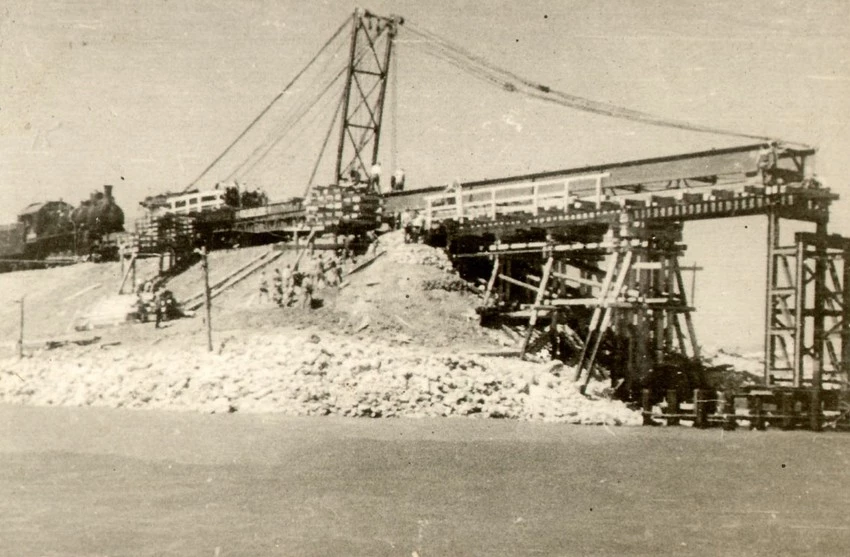
Russia had dreamt of this bridge for well over a century. Tsarist, Nazi, and Soviet planners all tried to cross the Kerch Strait. The only bridge actually completed, a 4.5 km Soviet railway bridge thrown across in 1944, was too lightly built for the strait: drift ice swept it away in February 1945, after about 150 days. Under the water lies the deeper problem: instead of bedrock, the strait's floor is many meters of silt and sand. To reach solid ground, the new bridge's piles had to be driven as deep as 105 m.
Only after occupying Crimea did Russia build the thing—this time, with the help of the sanctions-breaking Western engineering that drove the pillars past the silt. Dutch companies had the know-how: after all, they had been building on the sea for centuries.
The scheme was meant to stay hidden—Russia insisted only Russian firms had built the bridge. The companies stripped the branding off their equipment to hide whose it was. It surfaced on 1 September 2017, when the Dutch regional daily De Gelderlander revealed that two firms from the Gelderland villages of Dodewaard and Milsbeek had made key equipment for driving the bridge's piles: Dematec Equipment built a special pile-driving hammer, and Bijlard Hydrauliek supplied its key component.
The exposé prompted the Dutch Public Prosecution Service (OM) to open a criminal investigation under the EU's 2014 sanctions, which barred EU firms from helping build Crimea's infrastructure. By May 2018, it covered seven companies.
The OM named only Dieseko, so the other names come from the press and from a 2019 dossier by Ukrainian prosecutors, reported by the Dutch investigative platform Investico:
Dieseko Group—at least four vibro blocks (~€1.5 mn each, 2015–16) to drive the bridge's piles into the seabed, shipped via Finland. The company also gave on-site technical assistance to the builders.
Allpacks International B.V.—a hammer to vibrate the foundation piles.
Allnamics Pile Testing Experts B.V.—the pile-testing and measurement equipment, plus a training course for the Russian builders, to verify the piles were driven correctly and would hold.
A German company from Schleswig-Holstein supplied a hydraulic hammer—also for the hardest construction work, driving the piles into the silt. A court in Kiel later confiscated €1.3 mn from the company and fined its director. Like every Dutch company except Dieseko, it was never named by the authorities.
Ironically, Germany never sent Ukraine its powerful Taurus missiles, which Ukraine had officially requested in 2023. In a call Russia leaked in 2024, senior Luftwaffe officers discussed how Ukraine could use them to bring down the Kerch bridge. A German firm, meanwhile, had supplied the hammer that helped build it.
A slap on the wrist
The Russian firms that did the actual building shrugged off their own penalty. The EU sanctioned six of them in July 2018: Mostotrest, Stroygazmontazh, Stroygazmontazh Most, VAD, GPSM, and Zaliv Shipyard. Arkady Rotenberg, the Putin ally who owns the first three, brushed it off: "We're all proud of our work and if someone doesn't like it that's not our problem."
By then, the road bridge was already open. The sanctions meant to stop it—the EU's 2014 ban on helping build Crimea's infrastructure—had not.
The construction of the largest pillars of the bridge took place in July 2017, according to the website most.life, specially developed for the bridge
The European suppliers fared better still. The OM settled with six companies and ten individuals out of court, starting with four companies and eight individuals in October 2023. A seventh company was fined €120,000 by an Amsterdam court in November 2024—the only Dutch conviction in seven years. It is still unnamed. Two more individuals were acquitted.
The figures look serious until you read them.
Explore further
Sanctions lawyer: Dutch firms get slap on wrist for Crimea bridge work
Dieseko paid €1.78 mn; the German supplier, €1.3 mn. But the bulk of both is confiscation—the state clawing back the profit from the job, which leaves the company no worse off than if it had never taken it. The actual fines, on top, are beneath the pain threshold: €180,000 for Dieseko, €18,000 for the German firm's director, €120,000 for the convicted Dutch company, and €160,000 split among the four fined in 2023. Hand back what you earned, add a fine worth a fraction of it, and the account is closed.
For helping build a bridge that would carry an occupying army, eight people agreed to between 20 and 60 hours of community service in settlements with prosecutors.
Heleen over de Linden, a Dutch lawyer specializing in sanctions. Photo: rechta.com
Importantly, the companies' reputations did not suffer. The prosecutors named no company apart from Dieseko—every other settlement was anonymized, sparing the firms the single penalty a company actually fears: its name in the press beside the word "sanctions."
It was slow, too: the first Dutch penalties came in 2023, six years after the breach surfaced.
"Six years is a very long time in the Netherlands to be under suspicion," the Dutch sanctions lawyer Heleen over de Linden told Euromaidan Press. "This is the only reason for the very mild convictions."
On the penalties themselves she was blunter: "for Dutch standards, these are very low penalties, basically nothing."
What helping Russia costs
A penalty this small is not a deterrent. It is a price—cheap, deferred, and anonymous.
The Kerch Bridge cases put that price on public record: hand back the profit, years later, with your name kept out of the papers. For a firm weighing a lucrative Russian contract, that is hardly a reason to say no.
In 2017, the suppliers' defense was that they had sold to Russia, not Crimea. "EU sanctions state that we are not allowed to work in Crimea, but we can in Russia," Dematec director Derk Van den Heuvel said. Bijlard Hydrauliek's Marcel Bijlard said he had "just delivered a part to a customer in the Netherlands. No more."
That line did not always hold. In the one Dutch case that reached a verdict, the company's own staff working on site came to suspect they were in Crimea, the court found.
The pattern repeats today. Western microchips and parts keep turning up inside the missiles and drones Russia fires at Ukrainian cities, routed in through Kazakhstan, Armenia, Türkiye, and others.
It is the same maneuver the bridge suppliers, and the shippers of the Siemens turbines now running in Crimea's power stations, used back then: sell to "Russia," not "Crimea"; let an intermediary blur the final destination; say you could not have known. The bridge and Siemens cases were an early test: caught in the open, documented—and toothless.
We do not know if more resolute action on the bridge and the Siemens turbines would have slowed the flow of chips into Russian missiles now. We do know that the sanctions regime failed to stop Western help for Russia's occupation back then, and is failing to stop it for Russia's war now.
Kyiv put the road span in the sea this week; it is the only party that has made the bridge cost Russia anything it noticed. European prosecutors learned of the breach nine years ago and, in the end, publicly named only Dieseko. Until helping Russia costs more than handing back the change, there is no reason on earth for the next company to refuse.
Another pointed sanctions violation case
How Siemens chose to ignore the obvious. An investigation into the Crimean sanctions break
A weeks-long Ukrainian operation with missiles and drones brought down the road span of Russia's Kerch bridge, Ukraine's Security Service (SBU) said. President Volodymyr Zelenskyy listed the weapons, while Russia restarted trains on one track across the bridge and opened a terrorism case. Drones also hit the highway near a second bridge on Russia's overland route to Crimea.
Russia strikes Ukraine's infrastructure every day, including bridges in Kyiv, Dnipro, Zaporizhzhia, and Odesa Obla
A weeks-long Ukrainian operation with missiles and drones brought down the road span of Russia's Kerch bridge, Ukraine's Security Service (SBU) said. President Volodymyr Zelenskyy listed the weapons, while Russia restarted trains on one track across the bridge and opened a terrorism case. Drones also hit the highway near a second bridge on Russia's overland route to Crimea.
Russia strikes Ukraine's infrastructure every day, including bridges in Kyiv, Dnipro, Zaporizhzhia, and Odesa Oblast, Zelenskyy said. He called the Kerch bridge Russia's main military crossing into Russian-occupied Crimea. The arch carrying its road over the shipping lane fell overnight, a day after a strike on 16 November. Russia's other road into Crimea runs from Rostov through occupied southern Ukraine, and drones hit it again this morning near a bridge in Rostov Oblast.
Seven stages, 11 weapons
The road span fell in the seventh stage of an operation the SBU and Ukraine's General Staff ran for several weeks, Zelenskyy said. Stage by stage, he said, Ukrainian forces knocked out air defense systems, radars, and electronic warfare equipment on the way to the bridge. The weapons used were Dovbush, Vendetta, Da Vinci, Sichen, MICH 2000, Ruta, Palianytsia, An-197, FP-1, FP-5 Flamingo, and R-360 Neptune.
Grateful to the Security Service of Ukraine, all units of Ukraine’s Defense Forces involved, Ukraine’s Minister of Defense, the Commander-in-Chief of the Armed Forces of Ukraine and the General Staff, and all our weapons manufacturers for an unprecedented operation in response to… pic.twitter.com/pgUxGrE61K
— Volodymyr Zelenskyy / Володимир Зеленський (@ZelenskyyUa) November 17, 2026
At the key stage today, Palianytsia missile-drones hit the road section, while Neptune missiles, Ruta, and FP-5 Flamingos hit the railway section, Zelenskyy said. Using a Flamingo, Ukrainian forces carried out a guided strike, and the link held until the last seconds, he added. Ukraine repeatedly offered Russia steps to de-escalate and heard only loud refusals, he said.
"But we also remind Russia that war will always return to where it began," Zelenskyy said.
SBU: its fourth strike on the bridge
The SBU says the operation took about a month and had seven stages. The SBU carried out some of the strikes on the bridge on its own, and other Ukrainian forces joined at the final stage. The SBU's Alpha special forces then hit the road section with Palianytsia missile-drones, and the span fell into the water. One of the bridge's two steel arches and the road span beneath it are completely destroyed, the SBU says, and the rail section was also damaged, according to preliminary information.
This is the SBU's fourth strike on the bridge, the agency says. In October 2022, it blew up a truck packed with explosives on the bridge. In July 2023, its Sea Baby naval drones attacked the supports, and in June 2025, it set off explosives under water.
Explore further
One arch left standing: Ukraine’s second strike in two days sends the road span of Russia’s Kerch bridge into the sea
The SBU's 34-second video includes thermal drone footage of the bridge after the strike. It shows the rail arch standing alone over the strait, with the road span gone.
Missile maker claims seven Ruta hits
Destinus, which builds Ruta missiles in the Netherlands, gave its own account later on 17 November, Defence Blog reported.
"Last night's strikes damaged the bridge's upper load-bearing structure. Today, seven RUTA missiles hit the bridge, causing one span to collapse," the company wrote.
The company added that Ukraine used its LORD and Da Vinci drones against Russian air defenses. Da Vinci is Ukraine's name for the company's LORD drone, Defence Blog noted. The SBU credits Palianytsia missile-drones for the fallen road span, while Zelenskyy listed Ruta among the weapons that hit the rail section.
Trains run on one track, the road is "dead"
Ukraine's General Staff says the road part of the bridge is "dead" and no vehicle can cross it. The rail branch still stands, but its arch is damaged, the General Staff added.
Russia's Transport Ministry said rail traffic across the bridge has resumed on one track, while repairs continue on the second section. The Tavria train from Moscow left Taman, on the Russian side of the strait, for Kerch at 13:04 Moscow time, according to the ministry. Sergey Aksyonov, Crimea's Russian-installed head, said that passengers without cars can cross the Kerch Strait by ferry, and urged everyone to ignore "fakes."
Explore further
Russia says Ukraine attacks Crimean Bridge again after 2023. Each strike burns costly S-400 missiles and strips occupied peninsula’s cover, expert says
The bridge's official Telegram channel posted at 22:54 Kyiv time on 16 November that road traffic was temporarily closed, and pointed readers to its channel on Russia's MAX messenger. It had posted nothing more on Telegram by mid-afternoon on 17 November. Russia's Investigative Committee opened a terrorism case into the attacks of 16 and 17 November. It said Ukraine used drones and damaged the bridge's structure, without mentioning missiles.
Drones hit the road near the Mius bridge again
Drones also struck the R-280 highway near the Mius River bridge in Russia's Rostov Oblast this morning. The roadway and metal guardrails were damaged, Rostov Governor Yuri Slyusar said, citing preliminary information. He reported no casualties. Traffic across the bridge has been suspended since 8 November, when drones damaged it.
Explore further
Russia was widening this bridge to four lanes for its Crimea road. Drones have now closed it
The R-280 links Rostov-on-Don with occupied Mariupol and is part of Russia's land route to Crimea. In June, Ukrainian drones hit the bridges at Chonhar and Henichesk, two of the crossings into Crimea from occupied southern Ukraine.
Ukraine’s Defense Forces attacked a military site near the former airfield in Russian-occupied Luhansk on 3 November, Ukrainian military outlet Militarnyi reported. Russian combat helicopters had been seen at the airfield before, and Russian troops were using the grounds next to it. It was the second attack on the area in a week, and it came a day after drones hit the occupied city’s phone network.
Russia’s war on Ukraine runs on what it keeps behind the front: ammunition, aircraft, fue
Ukraine’s Defense Forces attacked a military site near the former airfield in Russian-occupied Luhansk on 3 November, Ukrainian military outlet Militarnyi reported. Russian combat helicopters had been seen at the airfield before, and Russian troops were using the grounds next to it. It was the second attack on the area in a week, and it came a day after drones hit the occupied city’s phone network.
Russia’s war on Ukraine runs on what it keeps behind the front: ammunition, aircraft, fuel, and the troops who use them. Much of that rear sits on occupied Ukrainian land. This autumn, Ukraine has gone after it from both ends, from three refineries deep in Russia that together handle about a tenth of its refining to a supply base that burned in occupied Luhansk Oblast in October. Whatever survives there feeds Russia’s assaults on what remains of Ukrainian-held Donbas.
Black smoke over the old airfield
The strike hit the area of the abandoned airfield, Ukrainian Telegram channel Exilenova+ reported shortly before 09:00 Kyiv time. Russian occupation forces use the airfield’s infrastructure for military purposes, the channel added. A fire broke out on the grounds of a military unit, and a thick column of black smoke rose into the sky, Militarnyi said.
The Exilenova+ video shows a wide column of dark smoke rising behind houses on the edge of the city.
In Luhansk, a strike hit the area around an abandoned airfield, the infrastructure of which the occupying forces are using for military purposes. pic.twitter.com/wtQ9zvaDGU
Another Ukrainian monitoring channel, Supernova+, described the site as an ammunition storage area, without giving details. Pro-Russian Telegram channel LNR Today wrote of an explosion and a large fire near Luhansk airport.
Helicopters at the airfield, troops in the aviation school
Russia has occupied Luhansk, a regional capital in eastern Ukraine, since 2014. Russian Ka-52 and Mi-28 attack helicopters had earlier been spotted at its airfield, Militarnyi noted. So had Mi-8/Mi-17 transport helicopters.
Next to the airfield stands the former Luhansk Higher Military Aviation School of Navigators. Russian occupation troops used its grounds to house personnel and equipment, the outlet added.
The ruined terminal of Luhansk International Airport, Ukraine, 4 September 2014. Photo: newsanna/Wikimedia Commons
The site has drawn Ukrainian fire before. In October 2023, Ukraine’s US-made ATACMS missiles destroyed Russian helicopters at air bases in occupied Luhansk and Berdiansk.
A week ago, overnight on 27 October, drones attacked the city of Luhansk for more than four hours. The main strike then also hit the former airfield. On Russia’s Yandex Maps, the area around it is blurred, the way the service hides military sites.
No claim from Kyiv, no comment from the occupation authorities
Ukraine’s General Staff has not claimed the strike. By late morning, it had posted only its regular morning updates. Russia’s occupation authorities in Luhansk have not commented either.
Russia’s Defense Ministry claimed it downed 856 Ukrainian drones overnight, including over occupied Crimea and the Black Sea, Russian Telegram channel Astra reported.
A day earlier, drones hit the occupied city’s phone network
Overnight on 2 November, drones struck the building of the occupation’s backbone telecom operator in Luhansk, Exilenova+ said. The operator provides mobile service and internet across occupied Luhansk Oblast, and Russian occupation army units use its infrastructure, the channel added. Drones also hit the premises of the Luhansk Telephone Company, it wrote.
Night footage from the city shows a fire glowing between apartment blocks.
Preliminary reports indicate that the Luhansk Telephone Company in Luhansk was attacked. pic.twitter.com/wJrSkW2XqL
Four drones hit the operator’s building and three hit the telephone company, Oleksandra Veselova, a deputy head of the occupation’s “digital development ministry,” said, local outlet Realna Gazeta reported. She said no one was hurt. The operator’s management said the strike had paralyzed its work and that restoring service would take time. It closed its customer office on Karla Marksa Street and stopped serving customers at two others.
Explore further
Phones down, water off, a factory roof broken open: Russian-occupied Luhansk counts the damage after another night of drones
The operator works out of the seized Ukrtelecom building, which drones also hit on 21 October. The occupation built its mobile network there on equipment taken from Ukraine’s Kyivstar.
A new fire near Antratsyt on NASA’s map
NASA’s FIRMS satellite fire map shows a new heat source on 2 November near Dubivskyi, a village in the Antratsyt community of occupied Luhansk Oblast. The map recorded no fires at that spot all October. That evening, the occupation’s energy “minister” said an “emergency situation” had cut power in eight districts, Antratsyt among them, the occupation’s news agency LIC reported. No source has linked the two.
Fires in Kerch and a blackout in occupied Crimea
Last night, a strike hit the military unit that guards the Kerch Bridge in occupied Crimea, Ukrainian Telegram channel Krymsky Veter (Crimean Wind) reported, citing a reader. Fire and detonations at an ammunition depot there went on until morning, the channel said. The bridge, which links the peninsula to Russia, stayed closed to traffic until 08:50, the channel added.
Power went out across Crimea from about 03:10, Krymsky Veter said. The Russian-run power company Krymenergo blamed an accident outside the peninsula, the channel added. Mikhail Razvozhayev, Russia’s occupation head of Sevastopol, said energy facilities outside the city had been hit again. Even the rotating outage schedule could not be kept for now, he added. Occupied Crimea has lost power after drone attacks before.
Ukrainian partisan movement Atesh reported a large column of smoke inside Sevastopol shortly before 01:00 Kyiv time.

 Connexion