Vue normale

“In intercepts, they’re screaming”: Russia occupied this spit to control Ukraine’s ports. Military says it has now isolated 2,500-strong grouping and destroyed all its artillery
31 août 2026 à 12:06

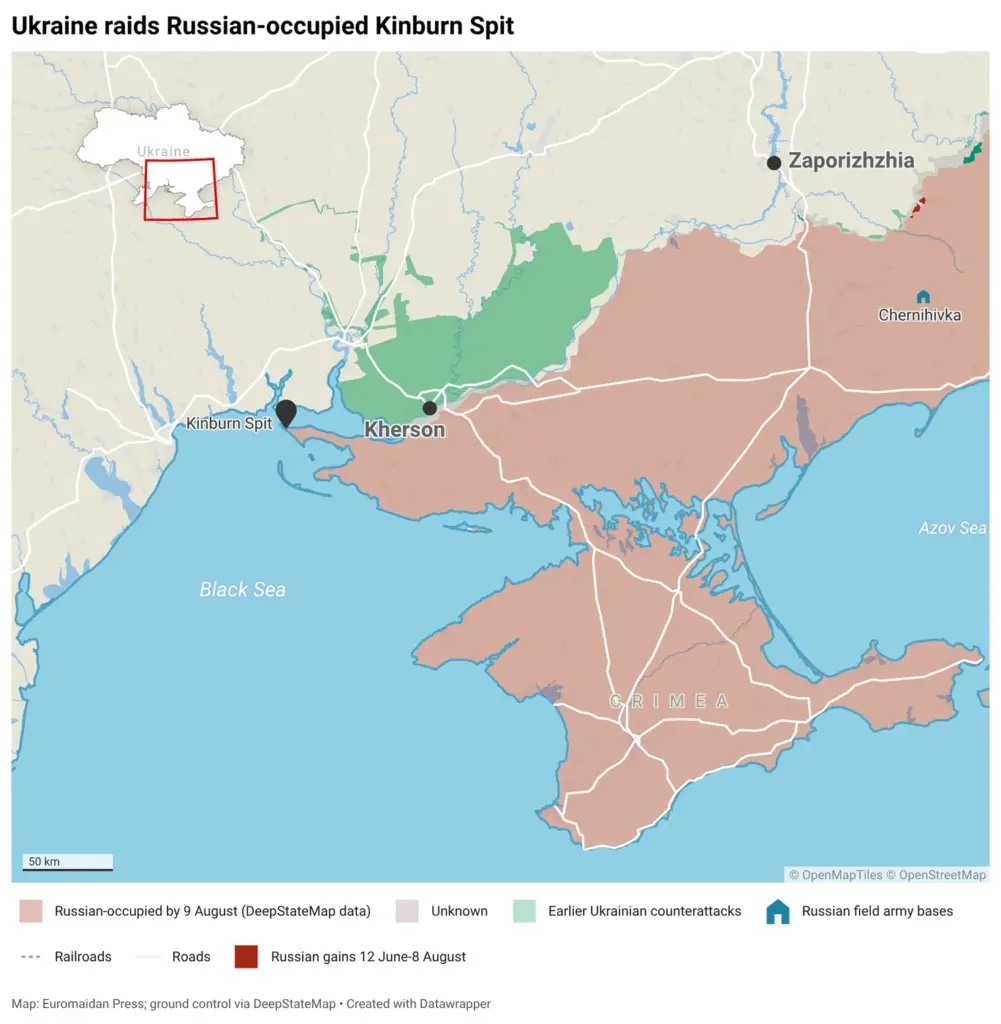
Location of Kinburn Spit. Map: Euromaidan Press

Ukrainian troops say they have trapped about 2,500 Russian soldiers on the Kinburn Spit. Systematic drone strikes and remote mining have let them cut the Russian supply lines and destroy almost all of Russia's artillery on the spit, scouts told Radio Free Europe/Radio Liberty's "Crimea.Realities" project.

The Kinburn Spit is a narrow sandy peninsula about 40 kilometers long, between the Dnipro-Buh Estuary and the Black Sea, the last part of Mykolaiv Oblast that Russia has held since 2022. Whoever controls the spit controls the sea exit from the ports, which is why Moscow kept artillery there to shell the southern coast, said former Head of the Mykolaiv Regional State Administration Vitali Kim.

Now, the troops say, Russia can reach the coastal zone of Mykolaiv Oblast only with long-range guns from occupied Kherson Oblast.

Supply runs through a single corridor

The Russian force has one way in — a single land route Ukrainian troops keep under fire, from Zaliznyi Port through Heroiske.

"Our task here is to neutralize everything that drives onto the Kinburn Spit. Since we started destroying Russian troops at a rapid pace, they cannot bring in anything effective," reconnaissance unit commander with the call sign "Yava" explained.

A scout calls the spit a trap

Intercepts show panic among the Russian units, the troops say.

"In the intercepts, they're screaming that they can't do logistics, that they don't want to go in, because it's death. The road is cut, and they have very little ammunition. The spit is a trap for them," the scout said.

Mining the supply routes is the main method

The problem, the troops say, is that the occupiers disguise themselves as civilians, changing into civilian clothes, which places limits on when Ukrainian soldiers can strike. The main method is catching the Russians on logistics by mining their routes.

"A vehicle hit a mine that was dropped maybe a week ago, maybe yesterday. The first thing is cutting Russia's logistics — the vehicles, the resupply by quad bikes and motorcycles," deputy reconnaissance company commander with the call sign "Holova" explained.

  • ✇Euromaidan Press
  • Ukraine may have just lost its first Swedish assault boat—to a Russian jet drone
    Sweden and its neighbors gave Ukraine the fast assault boats that carry raiders to Russian-held beaches Russia is now hunting those boats with Geran-4 jet drones One of the two boats hit this month may be the first CB-90 Ukraine has lost On or around 12 August, a Russian Geran-4 attack drone found a Ukrainian navy CB-90 in the waters off the Kinburn Spit and attacked it. Three days later, another Geran-4 went after a Ukrainian tugboat in the same waters. If th
     

Ukraine may have just lost its first Swedish assault boat—to a Russian jet drone

Par : David Axe
17 août 2026 à 08:48

Ukrainian Navy CB90 assault boats sailing Black Sea patrol operations coastal defense against Russian drones

  • Sweden and its neighbors gave Ukraine the fast assault boats that carry raiders to Russian-held beaches
  • Russia is now hunting those boats with Geran-4 jet drones
  • One of the two boats hit this month may be the first CB-90 Ukraine has lost

On or around 12 August, a Russian Geran-4 attack drone found a Ukrainian navy CB-90 in the waters off the Kinburn Spit and attacked it. Three days later, another Geran-4 went after a Ukrainian tugboat in the same waters. If the CB-90 sank, it may be the first one the Ukrainian navy has lost.

The CB-90 is a Swedish design and a Swedish gift, and it is the reason Ukraine can raid the spit at all. Fifteen meters long, armored against small arms, gun-armed and capable of around 40 knots, it can put 21 troops—or a ton of machinery—onto a hostile beach and be gone before the defenders react. Sweden has supplied most of the more than 38 in Ukrainian service; Norway, the Netherlands and the Ukrainian billionaire Rinat Akhmetov's Steel Front initiative supplied the rest. Swedish instructors trained the crews.

Russia has now answered Ukraine's raids, and it is aiming at the boats rather than the raiders. The Geran-4s doing the hunting are jet-propelled, AI-assisted and fast enough to outrun most of what Ukraine can shoot back with. If the campaign continues, it could close the approach that has made the raids possible.

What that approach makes possible is worth spelling out. In July, unmanned boats belonging to the Ukrainian Territorial Defense Forces landed at least one gun-armed unmanned ground vehicle on the Kinburn Spit, the westernmost Russian outpost in occupied Ukraine. As aerial drones watched, the UGV opened fire on a nearby Russian installation. No Ukrainian was anywhere near the beach.

Russian forces on the Kinburn Spit can monitor Ukrainian maritime traffic, making the narrow sandy spit a key outpost in the ongoing battle for the Black Sea's most important sea lanes. Ukrainian forces are determined to dislodge Russian forces from the spit. The Russians are determined to cling to their sandy outpost.

Минобороны России опубликовало видео поражения украинского патрульного катера CB-90 беспилотным летательным аппаратом «Герань-4 сикер» близ Очакова 12 августа 2026 года.

📷Геопривязка (https://t.co/oFm8LyBAdt) pic.twitter.com/SgQnTRerm9

— Lost Armour (@lostarmour) August 12, 2026

The Geran attacks are helping. The 12 August Geran raid targeted the CB-90. The 15 August Geran raid targeted the tugboat. It's unclear how much damage the Gerans inflicted, but it's worth noting that the CB-90 is just 15 m long; a tugboat might be slightly longer. A Geran's warhead weighs as much as 90 kg—probably enough to sink such a small vessel or burn it down to the keel.

The Ukrainian navy has only a few large warships, and they're all donated minehunters that have been waiting out the current wider war in the relative safety of European waters. The bulk of the Ukrainian fleet is made up of small patrol boats, auxiliaries such as tugs, and several types of unmanned surface vessels. These vessels defend waterways and ports and, more rarely, support offensive operations.

A Russian Gerbera drone struck a tugboat of the Ukrainian Navy in the Dniprovska Gulf, opposite Russian positions on the Kinburn Spit. pic.twitter.com/Arnwts6BEL

— AMK Mapping 🇳🇿 (@AMK_Mapping_) August 15, 2026

Spit raids

The July robot landing was one episode in a long Ukrainian raiding campaign along the spit—the kind of operation the Geran-4s are now trying to spoil.

Location of Kinburn Spit. Map: Euromaidan Press

The Geran strikes on Ukrainian boats could blunt these raids and help the Russians maintain their tenuous hold on the Kinburn Spit. The Russian strikes are part of a wider maritime campaign. Shortly after Ukrainian drone units began targeting the unregistered cargo ships and tankers belonging to Russia's shadow fleet, Russian drone and missile units retaliated—with devastating attacks on Ukrainian ports and the ships sailing to and from these ports in support of Ukraine's lucrative grain exports.

The Ukrainian attacks on the shadow fleet damaged hundreds of ships and effectively ground Russian Black Sea trade to a halt. But Russian attacks on Ukrainian ports effectively ground Ukrainian Black Sea trade to a halt, too.

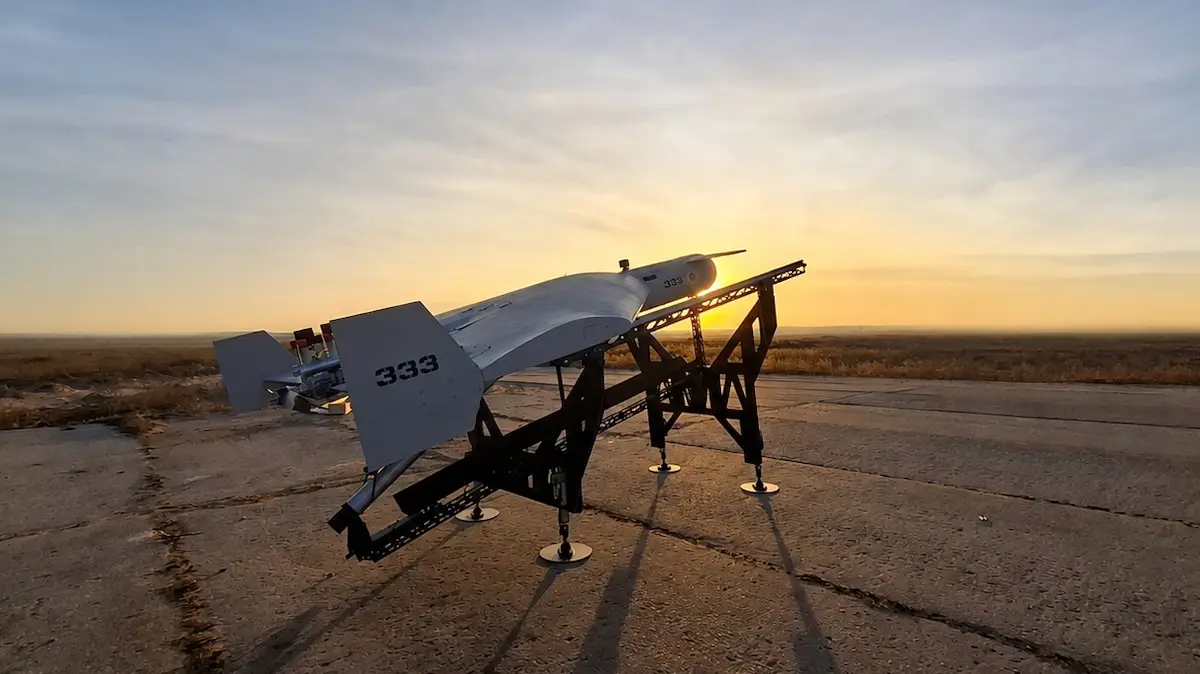
The MICH 2000 drone can fly up to 2,000 km and carry a warhead weighing up to 60kg. Photo courtesy of the manufacturer
Explore further

Ukraine’s new Tu-95 killer is a $48,000 copy of a drone China refused to sell

The new jet-propelled Geran-4s with their AI-assisted targeting were central to the effort. Their 500 km/h top speed makes them hard to shoot down. And the AI makes jamming far less useful than it used to be: the operator locks the drone onto a target, and from there the machine vision flies the attack, holding the lock even if Ukrainian electronic warfare severs the radio link in the final seconds.

That makes the CB-90s valuable targets. Armed with guns and armored against enemy small arms fire, they're perfect for raiding far-flung enemy outposts such as those on the Kinburn Spit. But they're vulnerable to drone attack—and each one is irreplaceable in the sense that matters, since Ukraine cannot build them and has to wait for the next donation.

Ukrainian forces aren't powerless to stop the Russians from spoiling Ukrainian raids on the spit. Geran-4s might be too fast for Ukrainian gun teams, armed light aircraft, and cheap interceptor drones, but they're not too fast for supersonic Ukrainian air force MiG-29 fighters.

Several of the MiGs patrol over the western Black Sea. One crashed recently, but others remain.

❌