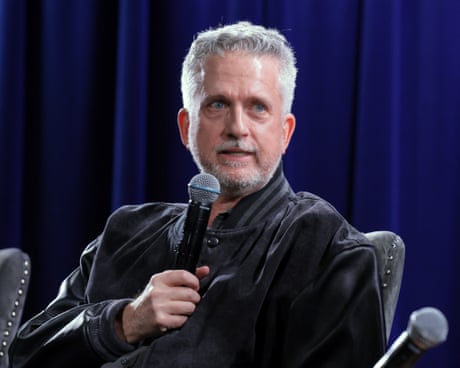
The founder of The Ringer and Grantland was famous for discovering and developing writers. Now he is promoting a technology eroding the creative industries
Bill Simmons may have stopped writing with any regularity in the mid-2010s – he claims his fingers don’t work – but that won’t stop him from reminding you of his greatest hits. On a recent podcast about Russell Westbrook’s retirement, he couldn’t stop quoting his old columns. He first referenced an article from the 2012 NBA finals, and wasn’t finished until 11 minutes into the podcast. His guest, The Ringer contributor Kirk Goldsberry, deserved an award for patience. But the biggest blight on the episode came later, in the form of a bizarre ad read.
“This episode,” Simmons announced, “is brought to you by ChatGPT, the Bill Simmons PodcastAI sponsor.” (Emphasis mine; his overenthusiastic delivery mandates the italics.) Simmons said that he had asked ChatGPT what Westbrook’s defining game was. “That was a pretty good answer,” he said of ChatGPT’s offerings, as if it were a precocious, loveable nephew, before encouraging his listeners to try the platform.
L’objectif est de fournir un panorama général des changements techniques apportés par cette version, en français, puis de diriger les personnes qui souhaitent en savoir plus vers les notes de développement en anglais.
— Permalien
Mon Carnet, le podcast · Créateurs de contenu : L’épuisement derrière la production avec Marie-France Gosselin Marie-France Gosselin, gestionnaire de réseaux sociaux, revient sur l’épuisement grandissant des membres de sa communauté professionnelle, confrontés à la multiplication des plateformes, des formats, des tendances et aux changements constants des algorithmes. À cela s’ajoute la pression des marques, […]
Girls Gone Bible is on tour in the US, touting a regressive ideal of femininity through discussions of abstinence and mental health struggles
At first glance, the crowd gathering outside a music venue in Red Bank, New Jersey, could have passed for a group of sorority rush hopefuls – or Ella Langley fans on their way to the country star’s show. Most of them were under the age of 30. They wore cowboy boots, maxi sundresses and soft, bouncy blowouts, scrolling on their phones outside the doors as they waited for friends to arrive.
But one accessory gave them away: the Bibles they toted. These women were there to pray.
L’intelligence artificielle générative transforme à grande vitesse l’industrie chinoise du divertissement numérique. Après avoir bouleversé la création d’images et de textes, elle s’attaque désormais directement au travail des acteurs, animateurs et présentateurs en ligne. Dans le secteur chinois des microdrames, certaines productions peuvent maintenant être réalisées presque entièrement sans caméra, sans plateau et sans interprète […]
L’intelligence artificielle prend une place de plus en plus importante dans les contenus publiés sur le Web. Une nouvelle analyse du Pew Research Center estime qu’en juillet 2026, environ 10 % des pages Web anglophones examinées présentaient des signes importants d’une rédaction ou d’une révision par intelligence artificielle. Mais lorsqu’on ne considère que les pages […]
A 15-year-old using social media apps in Australia in July, more than half a year after the country had implemented a ban on children under 16 using many platforms.
The Delta system pulls together battlefield data to identify targets, creating a miles-wide “kill zone.” The technology is credited with helping to cut Russian advances to a near standstill.
Officers from Ukraine’s First Separate Assault Regiment looking at live battlefield footage from drones, displayed through the Delta system, at a command bunker in eastern Ukraine in 2025.
Kyle William Spitze was part of an online extremist movement that coerces young people to do self-harm, officials said. Two of his victims died by suicide.
A federal judge in Tennessee this week sentenced a man to 77 years in prison for having child pornography as a member of groups that officials say glorified mass murder and urged young people to commit self-harm.
Azad, a popular online debate program, has tackled topics that push the limits of Iran’s authoritarian system. Some question how it has remained on air.
Ukraine's Security Service (SBU) said on 10 August 2026 that it had detained three more people suspected of illegally registering Starlink satellite terminals for Russian forces, and had blocked two separate schemes for putting hostile terminals onto Ukraine's verification list.
The arrests are the latest in a months-long pattern. After Ukraine and SpaceX cut off smuggled Starlink terminals and required every device to be verified, the SBU says, Russia turned to paying financially desperate Ukrainians to register hostile terminals under real Ukrainian identities, laundering them onto the whitelist meant to keep them out. Each case the service has announced follows the same script: a recruit found through Telegram, a terminal signed up in their own name, then pressure to pull in others.
In Dnipro, according to the service, counterintelligence exposed a woman who had done Russia's bidding in exchange for money to buy drugs. She registered one terminal in her own name, the SBU said, then drew in acquaintances, also looking for money for a "dose," to register more.
Photo: SBU
In Zhytomyr, according to the service, a local unemployed woman registered one terminal in her own name, then brought in a male acquaintance, and the two moved to what the SBU called "serial" activation at post offices, using front persons who handed over their personal data for a cut of the payment.
Photo: SBU
The SBU described all three suspects as drug-dependent people who had gone looking for quick money in Telegram channels, the same recruitment funnel it has flagged in earlier cases. The service said it had documented the suspects' activity, detained them at their homes, and blocked every terminal registered through the two schemes.
Investigators served the three with notices of suspicion under two articles of Ukraine's Criminal Code: Article 114-1, obstructing the lawful activity of the Armed Forces and other military formations during a special period, applied together with the prior-conspiracy provision of Article 28, and Article 111-2, aiding the aggressor state. The SBU said the suspects face eight to 12 years in prison. These are allegations, and none of the three has been convicted.
The SBU's regional directorates in Dnipropetrovsk and Zhytomyr oblasts ran the operations with the National Police, overseen by the regional prosecutors.
In February, the SBU detained a couple in Odesa Oblast who, it said, had agreed to register terminals for Russia at $30 each and planned to pull in a local resident who uses drugs to help.
In late June, the service reported eight suspected agents who registered terminals in their own names, passed the credentials to Russian handlers, and were told to recruit as many additional people as possible.
On 24 July, the SBU said it had broken up a network in Kyiv that used fake Ukrainian passports and an unwitting postal worker to activate 76 terminals for Russia's FSB security service, a case that drew high treason charges under martial law and the threat of life imprisonment.
On 25 July, the service detained a man in Dnipro suspected of registering more than 1,000 terminals, the largest single scheme reported so far.
Why Starlink matters
Starlink, operated by SpaceX, has become one of the most important communications systems on the modern battlefield, providing fast, reliable satellite internet that is difficult to jam.
Ukraine has relied extensively on the network throughout Russia's full-scale invasion to maintain communications between military units and support drone operations.
Russian forces have also sought access to the system, but their use has been significantly constrained. In cooperation with SpaceX, Ukraine has introduced verification measures and whitelisted legitimate users operating on Ukrainian territory, limiting Russian access and forcing Moscow to seek alternative communications systems.
Le fournisseur américain d’Internet par satellite Hughes Network Systems s’est placé sous la protection du chapitre 11 de la loi américaine sur les faillites. L’entreprise, qui exploite le service Hughesnet, affirme que ses activités se poursuivront normalement pendant sa restructuration. La procédure ne signifie donc pas une fermeture immédiate. Hughes cherche plutôt à réorganiser ses […]

 Connexion