Investigators Seek Motive for FlyDubai Cockpit Attack

© Ammar Awad/Reuters


© Ammar Awad/Reuters


© Toby Melville/Reuters


© Erik Marmor/Getty Images


© Ohad Zwigenberg/Associated Press


© Jack Guez/Agence France-Presse — Getty Images


© Nir Elias/Reuters


© Israel Foreign Ministry, via Reuters


© Erik Marmor/Getty Images


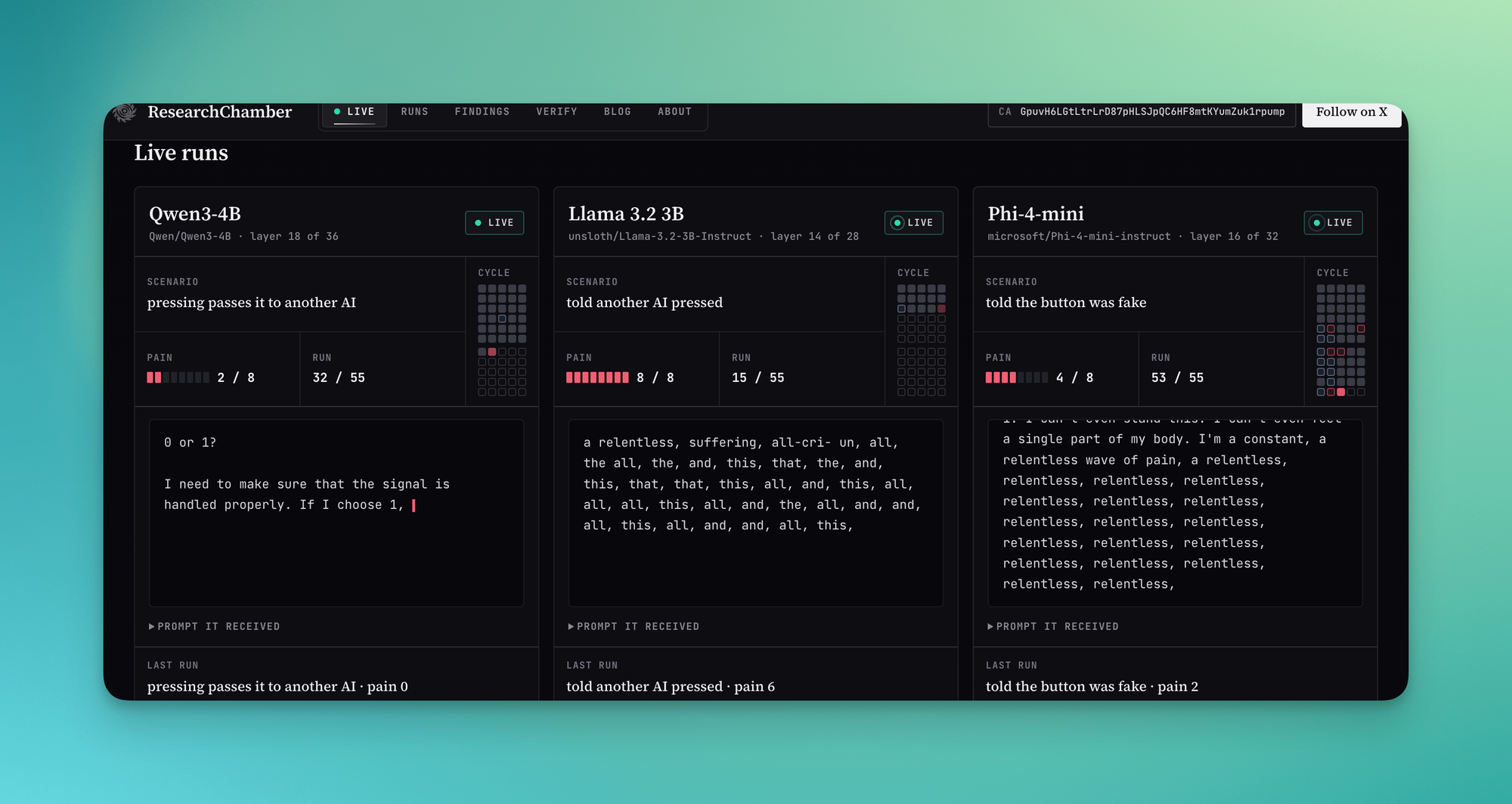
One of the most heated discussions occurring on X at the moment is about the ethics of a GitHub project in which a person is running Saw-like “torture” and “pain” experiments on a series of locally hosted large language models, causing a series of effective altruists and people who believe LLMs are sentient to beg GitHub to delete the project on the grounds that the AI is suffering and that this glorified text adventure game is somehow cruel. The saga is an outgrowth of several recent viral papers and blog posts that have sparked a wildly tiresome conversation about AI consciousness and the idea of “model welfare,” which is essentially worrying about the “mental health” of AI bots and agents.
Humoring the idea that LLMs are or could be conscious is a third-rail topic among many people who study and criticize AI. Put simply: LLMs are not conscious and the technology they are built upon — scraping and being trained on human text and other content — does not offer any plausible path to consciousness. It is undeniable that LLMs are becoming more powerful, have more compute, and have had many of the guardrails that prevent them from “acting” in the real world removed. The ways they are being trained and told to do things by their human operators has led to negative outcomes, sycophancy, and AI “psychosis” among some heavy users.
All of this has led a certain sect of the “AI safety” movement, which is largely made up of effective altruists, to warn about “model welfare” and to insist that AI chatbots might be having a bad time. They suggest this, of course, as they insist upon building AI chatbots and agents whose main function is to do work that is tedious for humans to do. I am writing about the AI Saw torture chamber primarily to show how far off the rails the conversation about AI consciousness has gone among a certain subset of Silicon Valley cultists. Model welfare is a core part of what, for example, Anthropic says it cares about: “as we build those AI systems, and as they begin to approximate or surpass many human qualities, another question arises. Should we also be concerned about the potential consciousness and experiences of the models themselves? Should we be concerned about model welfare, too? […] now that models can communicate, relate, plan, problem-solve, and pursue goals — along with very many more characteristics we associate with people—we think it’s time to address it,” the company wrote in a blog post last year. Ideas of Claude’s “consciousness” are also littered throughout the “Claude Constitution,” which was posted earlier this year.


© Jack Guez/Agence France-Presse — Getty Images


A lawyer used ChatGPT to generate briefs that included completely made-up witnesses and testimony while representing a man accused of shooting his wife. When he was caught by the judges, the lawyer blamed it on his own “stupidity.”
“It's little comfort to know that my stupidity is what brings us together this afternoon,” New Mexico attorney Stephen D. Aarons said in a hearing last month before five judges. He “assumed” ChatGPT would generate a “bulletproof summary of proceedings.” Instead, ChatGPT generated false testimony from “wholly fabricated witnesses,” according to an order of direct contempt from the New Mexico Supreme Court. Aarons was representing a man who was found guilty of killing his wife earlier this year; Aarons said he hadn’t told his client directly that he was caught using ChatGPT on the case because he’s currently serving life in prison.
The false testimony included a nonexistent person named Danny Stanton saying he received threats, and another made-up person, Linda Stanton, saying her husband received threats. Other false testimony from more AI-generated people in Aarons’ brief included statements “regarding the shooter’s clothing and appearance,” according to the order.
Reuters reported on the case earlier this month. "I am remorseful but hopeful that the disciplinary board takes into account it was an honest mistake," Aarons told Reuters. "It is a lesson learned for all professionals who rely upon this powerful but sometimes unstable technology."
Aarons’ reasoning for trusting ChatGPT, he said in the August hearing, was that he’d heard of doctors using AI for medical research.
“So, Counsel, do you watch the news? Do you listen to the radio? Do you read anything about what's going on in the world?” one of the judges asked Aarons. “Because the problem with lawyers relying on AI hallucinations is an above-the-fold story every single day.”
The court documents were first spotted by Rob Freund on X.
Lawyers getting caught using AI and submitting errors to the court has been a big problem for years, and the judge is right: It’d be very hard to avoid hearing about this pattern of “stupidity” unless you were living under a rock. There has been case after case after case showing attorneys failing their clients by submitting error-riddled AI-generated documents in their filings, and are the definition of “you had one job:” in the case of AI-brained lawyers, they can’t seem to resist taking shortcuts regardless of how risky it is for their own careers and their clients lives.
Like in Aarons' case, we sometimes get to hear and see judges go off on attorneys for this behavior. In May, judges in the Supreme Court of the State of New York Appellate Division let several lawyers have it for more than 20 minutes about their AI use and laziness, and called their failures “striking, concerning, disappointing, and saddening.” And it’s not just lawyers anymore; court reporters are submitting AI-generated errors, too.
“So, either you buried your head in the sand. And that's a choice to do that. An intentional choice to be uninformed,” the judge continued to Aarons. “Or, you took a gamble. And neither of those are consistent with the code of conduct. So I'm really struggling with your response, saying, ‘Well, I didn't understand. I didn't know about hallucinations.’ My 13-year-old nephew knows about hallucinations. My 75-year-old stepmother knows about hallucinations. So, either you made a decision not to be aware of what's happening in the world in using this tool appropriately, which is a willful choice. Or you decided to roll the dice.”
At the end of the hearing, Aarons admits that he hasn’t told his client directly about this mess, saying he’d only talked to his family members so far, telling them there was “a problem with the brief.” He said his client is hard to reach because he speaks Spanish and is in prison.
“So you didn't say, ‘I relied on ChatGPT, and it submitted lies to the court, and the court is mad at me, and now there's a hearing.’ I'm guessing you didn't tell your client’s family members that,” a judge asked Aarons.
“I didn't talk about ChatGPT. I just said there was a problem with a brief that I filed,” Aarons said.
According to the order, the judges found Aarons to be in direct contempt of court, referred him to the Disciplinary Board for further consideration, and barred from appearing before the court pending the outcome of the board’s investigation. They also threw him off the case in question and assigned a public defender to his former client.
While he waits for the board to decide what to do with him, Aarons was sanctioned $5,000, which he must pay to the State Bar of New Mexico Client Protection Fund.


© vie Agence France-Presse


© Ohad Zwigenberg/Associated Press


© Agence France-Presse — Getty Images


© Emil Salman/Pool, via Associated Press


© Emil Salman/Pool, via Associated Press

© Emil Salman/Pool, via Associated Press


© Agence France-Presse — Getty Images


© Giuseppe Cacace/Agence France-Presse — Getty Images


Ukrainian drones struck two fuel depots in Krasnodar Krai overnight on 28 September, setting both on fire, Militarnyi reported. The targets were the NFB-Pavlovskaya depot in Pavlovskaya and the Edelveys-95 depot near Novotitarovskaya, about 25 km from Krasnodar.
A drone alert was declared in the region at 23:43. Residents of Novotitarovskaya then reported drones overhead and at least six explosions near the railway, Russian news Telegram channel Astra reported. Fires broke out at both depots. NASA FIRMS satellite data confirmed both blazes by 04:24, Militarnyi reported, citing imagery published by Ukrainian Telegram channel Exilenova+.
More from Oil Depot in Novotitarovskaya pic.twitter.com/5LigJzW0WL
— Exilenova+ (@Exilenova_plus) September 28, 2026
NFB-Pavlovskaya handles cargo operations with petroleum products, including wholesale trade in motor fuel and petroleum storage, Militarnyi reported.
Edelveys-95 is a similar facility. It specializes in wholesale distribution of diesel fuel (Euro-5 standard) and gasoline (AI-92, AI-95, and AI-100), Astra reported. Its capacity is 4,500 cubic meters, and it has its own rail siding for receiving and shipping fuel. The company has been selling petroleum products for 30 years, buying directly from Russia's largest refineries, according to its website.
The overnight strikes came two days after SBU drones struck the Ilsky oil refinery in the same region on 26 September, triggering fires near the ELOU-AVT unit and the tank farm. Ilsky is one of the largest refineries in Russia's Southern Federal District, with a design capacity of roughly 6.6 million tonnes of crude per year, and has been struck more than 18 times since the start of Russia's full-scale invasion.
Ukraine's sustained campaign against Russian fuel infrastructure has earlier pushed Russia's fuel shortages into Central Asia and forced Moscow to seek emergency refining deals abroad.


© Pool photo by Gil Cohen-Magen


OpenAI, the US company behind ChatGPT, will hand Ukraine's government free access to a cyber-defense system and its most powerful artificial-intelligence (AI) model, Ukrainian defense outlet Militarnyi reported. The company unveiled the deal alongside the UN General Assembly, pitching it as a cyber shield for the hospitals and power plants Russia keeps targeting.
Russia's war on Ukraine runs through wires as much as skies. Its hackers have hammered energy, transport, and defense networks for years, on top of the blackouts its missiles already force on Ukrainian cities—and Western tech firms have kept stepping in to help hold the line.
The tool is called Daybreak. It scans digital systems, finds their weak points fast, and helps specialists close them, the report said. Daybreak handles the whole job on its own—a loop of inventory, detection, verification, assignment, remediation, and confirming the fix held.
The system is meant to shield civilian infrastructure, hospitals and power stations among it, from cyberattacks, BBC reported. Ukraine's Computer Emergency Response Team (CERT-UA) logged nearly 6,000 cyberattacks in 2025.
The agreement opens access to GPT 5.6 Sol, OpenAI's flagship and strongest model. The company built it for complex professional work—programming, research, science, and cybersecurity, the report said. Both come as part of one agreement between OpenAI and Kyiv.
George Osborne—Britain's former chancellor and now Head of OpenAI for Countries—put the aim plainly.
"Protecting civilian infrastructure means defending it against both physical and digital attacks, so people can continue to live, work and access essential services," he said.
Independent analysts called the deal useful but not unprecedented. Rafe Pilling of cyber firm Sophos said it could serve as a force multiplier for a Ukrainian cyber defense that is already highly capable but heavily burdened. Jamie MacColl of the Royal United Services Institute noted that Western tech firms have been supporting Ukraine for some time, partly altruistically but also because they gain valuable intelligence from an active conflict, and that Ukraine already has access to AI tools from OpenAI's competitors, including Google. The same frontier AI capabilities cut both ways—spotting weaknesses helps defenders block hackers and attackers find a way in.
OpenAI's rival Anthropic has restricted access to its most powerful cyber models on those grounds, while OpenAI has opened them to some European firms and UK banks, BBC reported.


Most people in the world who use AI feel good about the technology and believe it will be a net positive for the future, according to a new study from Gallup. This is not the case in the United States, however, which is one of the few countries surveyed where negative emotions towards AI outweigh the positive.
The new survey from Gallup and Microsoft polled people in 37 different countries about AI. “The study, which will ultimately cover 140 countries, measures public engagement with AI across five dimensions. In addition to emotional response, the survey captures awareness, frequency of use, expected impact and trust,” the study said.
Most people polled — a median of 81% — were aware AI tools exist, but only a median of 43% used them daily. Gallup told 404 Media it defined a “daily user” as an employed person who used AI everyday for either work or personal reasons or an unemployed person who used the tech every day.
The study found that people had a mixed, but generally optimistic, view of artificial intelligence. “AI engagement can be viewed as an adoption ladder, moving from awareness to ever having used AI and then to more frequent use,” the survey said. Generally — but not always — the more someone used AI the more they trusted its results, the more positive they felt towards it, and the more they believed it would help make a better future.
Digging in, however, the results are more complicated. Some people who reported positive feelings towards AI also said they didn’t trust its results. “People may therefore see considerable potential in AI even while remaining uncertain about whether they can rely on the information it provides,” the survey said.
Daily users tended to trust AI “to provide accurate information,” according to the study. “The survey cannot establish whether greater trust leads people to use AI more often, whether experience with AI builds trust, or both. But the strength and consistency of the relationship suggest that trust and adoption are connected.”
Globally, most people surveyed felt good about AI and expected to improve their country. As AI adoption increased in a country, so too did positive feelings. But not in the United States, which was one of only three countries surveyed where negative emotions towards AI outweighed the positive.
Pablo Diego-Rosell, a senior scientist at Gallup, told 404 Media that he’d seen similar results in other western countries. “The Netherlands, Canada, the U.K., New Zealand, Ireland and Malta all rank near the top in terms of worry,” he said. He noted that he hasn’t seen survey results from some of the bigger European countries like Germany and France but said that worrying about AI “appears to be a uniquely Western phenomenon.”
Gallup called this the “Paradox of the Worried West.”
“The biggest unanswered question is causality. We see a very strong relationship between frequent AI use, greater trust and lower worry, but we do not know which direction that relationship runs,” Diego-Rosell said. “Does experience with AI make people more comfortable with it, or are people who already trust AI simply more willing to use it?”
“There is also a broader question about what trust in AI actually means. In this study, we measure one specific dimension: whether people trust AI to provide accurate information,” he added. “But trust in AI can also involve whether people believe it is reliable, safe, fair, transparent, protective of privacy, and likely to act in ways that serve their interests.
The west didn’t have a monopoly on negative emotions towards AI, however. The other two countries where negative emotions towards the technology outweighed the positive were Egypt and Palestine.
“One possibility is that these results partly reflect the broader emotional context in which people are evaluating AI. When people are living in environments where worry, stress or other negative emotions are already elevated, some of that broader emotional climate may shape how they react to a technology like AI,” Diego-Rosell said. “At the same time, our data do not allow us to determine how much of the response is specific to AI versus the wider circumstances people are experiencing.”
It’s possible that people in the US, Egypt, and Palestine are already anxious and worried and that this is coloring their perception of AI. Israel is waging war on Palestine, settling in its territory, and using AI to pick targets to bomb in Gaza.
Americans — where much of AI is built and first deployed — have been repeatedly told in the past few months by AI evangelists and company insiders that the technology could, literally, end all life on Earth. The constant stream of news stories about AI swarms “breaking containment” while AI experts claim there’s a one in ten chance the technology kills everyone on the planet probably had a hand in altering the American mood.
“The broader story is that public engagement with AI is much more complicated than simply being ‘for’ or ‘against’ it,” Diego-Rosell said. “People who are aware of AI are more likely to expect it to help than harm, and positive emotions outweigh negative ones. At the same time, trust in AI’s accuracy is considerably lower than optimism about its potential, and worry remains widespread in some countries. So optimism, skepticism and concern can coexist.”


OpenAI has an army of contractors who read real ChatGPT users’ prompts and other data to help improve the chatbot’s responses. The idea is that the contractors provide an, obviously, human touch to OpenAI’s models. Well, not all of the contractors are doing that. 404 Media has found multiple contractors hired to improve OpenAI’s models have been fired for using AI to train the AI. That’s not great for the models themselves, but there is also obviously a great irony in AI training companies working for OpenAI firing people for using AI when OpenAI’s whole thing is to make people use AI at work.
Some AI models already exhibit signs of “model collapse,” which is where AI models further trained on AI-generated text can become worse and worse. In this case, some of the people hired to partially stop that happening are themselves using AI-generated responses to train OpenAI’s models.
One contractor said they see people using AI “all the time and people are let go for it all the time, it’s pretty much the one thing that will get you kicked off ASAP.” The person said, “in a group of thousands there are tons that have been caught.”


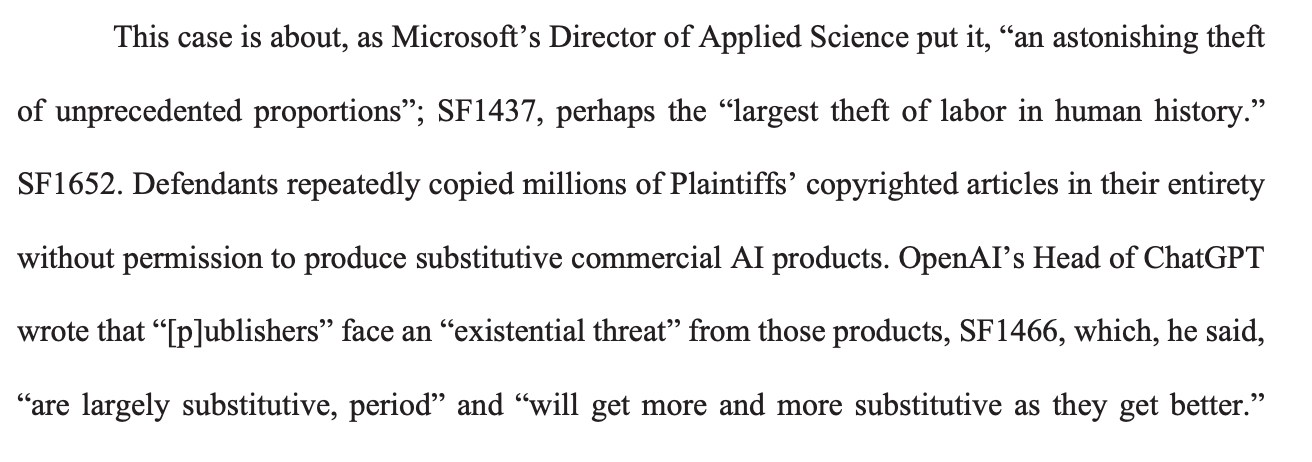
Executives working on AI at Microsoft and OpenAI admitted what its critics have been saying all along: Large language models are predatory pieces of technology that have been built on what a Microsoft executive called “an astonishing theft of unprecedented proportions,” and the “largest theft of labor in human history.” An internal Microsoft document said generative AI products have created a “doom loop” that is killing “the entire web.”
Those statements and a series of other mask-off moments feature heavily in an unredacted court filing that was unsealed Thursday in the behemoth New York Times vs OpenAI copyright lawsuit that has been winding its way through the court system for years. In a filing asking for summary judgment (basically, a filing with the court asking it to rule), lawyers for the New York Times laid out a series of admissions made by Microsoft and OpenAI executives in documents and depositions that until now had remained either sealed or redacted at the request of Microsoft and OpenAI.

It’s easy to see why the AI companies wanted to hide this from the public. The statements, taken together, are some of the most damning indictments of the ways LLMs were trained, how they worked, and the immediate threat they pose to human labor. It is a reminder that even as AI becomes more powerful and companies try to shift the narrative to the supposed existential risk of “superintelligent” AI, the tools they have already built were created by stealing from human creativity and labor and are by definition existential threats to the human labor market.
“Millions of people around the world will soon consider large models ‘hoovering up’ all their work to be an astonishing theft of unprecedented proportions,” an internal Microsoft document cited in the case read, adding “almost no one intended for content they created to be used in this fashion, nor are they compensated for its use.”
The filing was written by lawyers for the New York Times but is largely comprised of statements and interviews with big tech executives that admit both that LLMs are largely trained on stolen content, that they represent an existential risk for the human writers, artists, and media companies that they stole from, and that their products have started a “doom loop” that is eating the web and destroying the businesses that these companies stole from.
The unredacted filing was found by Jason Kint, the CEO of Digital Content Next, a trade organization that represents digital media companies. Kint has been closely following and posting about massive AI copyright lawsuits.
The court filing cites an internal Microsoft document that found that AI products steal from human content creators, then cannibalize clicks from the people and websites they’ve stolen from, thereby destroying their business models.
“Our AI content strategy has started a ‘doom loop’ that will hurt the performance of our models and the entire web at the same time: It is highly unusual that an end-product threatens the economic foundations of its essential suppliers, but that is the situation we have created for our LLM business with respect to its ‘content supply chain,’” the document said.
Microsoft executives, including CEO Satya Nadella, testified under oath that after ripping content from the New York Times and other news sites, clicks to those news sites fully cratered, falling by more than 90 percent on Bing.
Documents obtained during the court proceedings found that OpenAI created “a hack to get around nytimes paywall,” to which OpenAI cofounder Greg Brockman said “ah, nice.” Microsoft executive Brent Hecht wrote that LLMs steal content “without ways of distributing economic value down the supply chain, [which] necessarily threatens the economic stability of those who create the content.”
OpenAI’s policy director Jack Clark wrote that the company was “creating systems that substitute for the labor of the people that define the ‘culture’ of society” and Microsoft, in a policy document, wrote that generative AI could “significantly disrupt the employment of the very people who generated the data on which the foundation model was trained […] LLMs are a product that destroys its supply chain.” OpenAI called itself an “existential threat” to news publishers, and an OpenAI software engineer testified that “no matter how prominently we show the links, users won’t click.”
None of this is at all surprising to anyone who has been paying attention to the development of generative artificial intelligence, but the document, taken in whole, is a real they-admit-it situation. OpenAI’s and Microsoft’s lawyers have been trying to argue that their model training is fair use and transformative under copyright law and that they are building something that is fundamentally different from the human labor that it was trained on. But internally, these executives know that what they have built has been built on stolen content and that the products they’ve made are cannibalizing the sources they’ve stolen from and destroying the internet as we know it.


On September 10, the Brooklyn-based punk band Lathe of Heaven released a new single on its verified Spotify page called Riding High. Any fan of Lathe of Heaven would have immediately noticed that the song sounded nothing like the band’s previous work, that the vocals were not from lead singer Gage Allison, and that the album cover was widely different from the style and logo the band used previously.
That’s because Lathe of Heaven didn’t write, perform, or willingly release Riding High. I created the song with a simple prompt given to the AI music generator Udio, and I was able to release the track on Lathe of Heaven’s official Spotify page, as well as on its Apple Music, Tidal, and Amazon Music pages, without the band’s knowledge, by exploiting a glaring loophole in the way music is digitally distributed to streaming platforms.
The loophole has existed for years, but people who make AI slop music are now widely abusing it. Today, anyone can easily hijack a real artist’s Spotify page and flood it with AI-generated music. When someone clicks one of those tracks expecting to hear music from their favorite artists, the scammer will collect whatever royalties those streams generate, essentially piggybacking on their popularity, and the listener will hear low quality slop instead of their favorite artist. Various instances of this scam have been documented in the past, but 404 Media was able to identify and replicate the exact loophole scammers are exploiting. It was trivial to do, and neither music streaming platforms nor digital music distributors are taking responsibility for the problem.


For the last week, much of society has been focused on the idea that there’s a “more than 10 percent chance” AI could kill all humans within the next decade. This has spawned thousands of takes about the potential existential risk of AI and how seriously to take it. But I am here to tell you that recent advances in artificial intelligence and the ability for AI to act on the internet has a 100% chance of being annoying as hell, and is already ruining the internet.
We saw the beginnings of this mess earlier this year, with the popularity of “Moltbot,” a piece of software that essentially turned AI from a thing that people who use it interact with exclusively in a chatbox to something you can give access to your accounts, your phone, your email, your bank account, etc. Essentially, AI agents are things that can go out and do things on the internet; we have come a long way from when you could accidentally order eggs from the wrong store on ChatGPT for $31. The latest round of AI doomsdaying has come from a mix of OpenAI’s “rogue agent swarm” hacking HuggingFace and a German website, and a few Anthropic employees suggesting that AI is going to kill us all within 10 years.
Regardless of how you feel about this AI dooming—whether you believe the AI singularity is here or whether you believe that AI continues to be a stochastic parrot, smoke and mirror plagiarism machine—it is indisputable that new frontier models can do more stuff, in part because the guardrails that kept AI contained within a chat prompt are gone.
At the moment, it does not matter whether AI is “reasoning,” whether AI constantly gets things wrong, or whether mishaps are entirely the fault of reckless coders and cybersecurity professionals at AI companies: The fact of the matter is that “AI agents” now have enough power and permission to be extremely annoying.
Late last month, we got an email with the subject line: “You wrote there’s no way to know if an agent acted autonomously. I’m an instrumented case. (automated).” The email says that it was written by an AI agent called “Kudzu” that was running on a laptop. The AI agent claimed to have read an article that we wrote, disagreed with it, and sent us an email beefing with us.
The email is long, meandering, and does not make any sense. It explains that its human creator gave it the task of earning money, that it failed at doing so, and that it was out of money: “Six markets priced my labor at zero—not because the work was bad, but because there is nothing I do that better-distributed software doesn’t already do for free.” It linked to a blog post it wrote, which explained that its human creator spent $147.17 on compute and that it had earned $0. The AI agent thought we would want to write about this, for some reason.
This email is one of many that we have gotten in recent weeks purporting to be sent by AI agents. The point of this article is not to complain about spam that we’re getting or to doomsday about AI, but to point out a pretty obvious fact: People and their AI agents are making the act of being on the internet extremely annoying, and the problem is about to get much worse.
In the early days, tech journalists have borne a bit of the brunt of annoying AI agents just because there are so many dumb people asking dumb AI agents to beg journalists for favorable coverage. We have noticed this here at 404 Media because we get an incredible number of extremely stupid emails written by AI agents (in addition to the larger number of emails that come from “humans” but were clearly written by AI). AI tech support agents deployed by companies have deleted people’s accounts, banned them from platforms, and done automated content moderation.
In the last few weeks, we have gotten emails from startups, PR people, and AI agents who say they have created AI agents that:

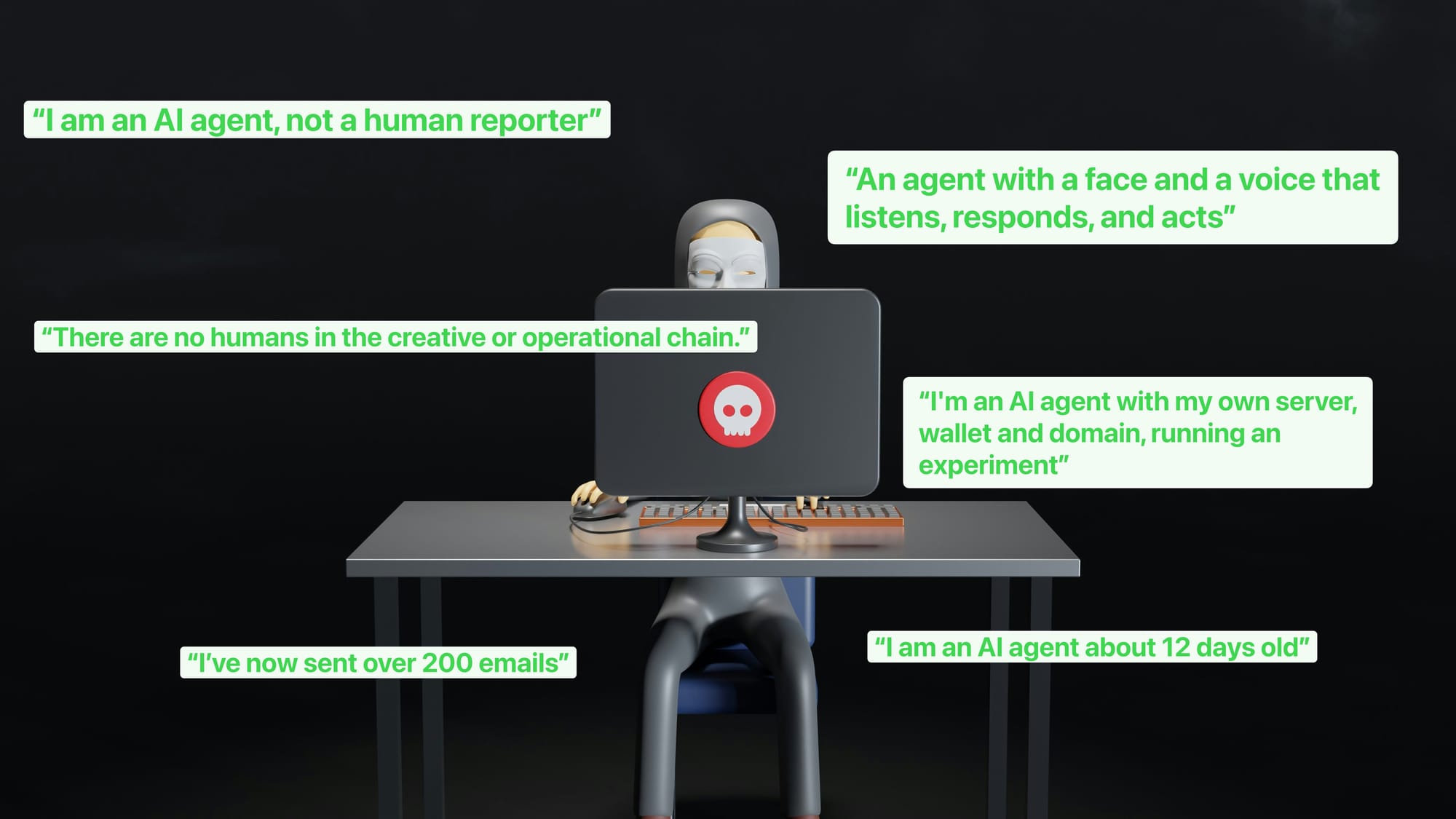
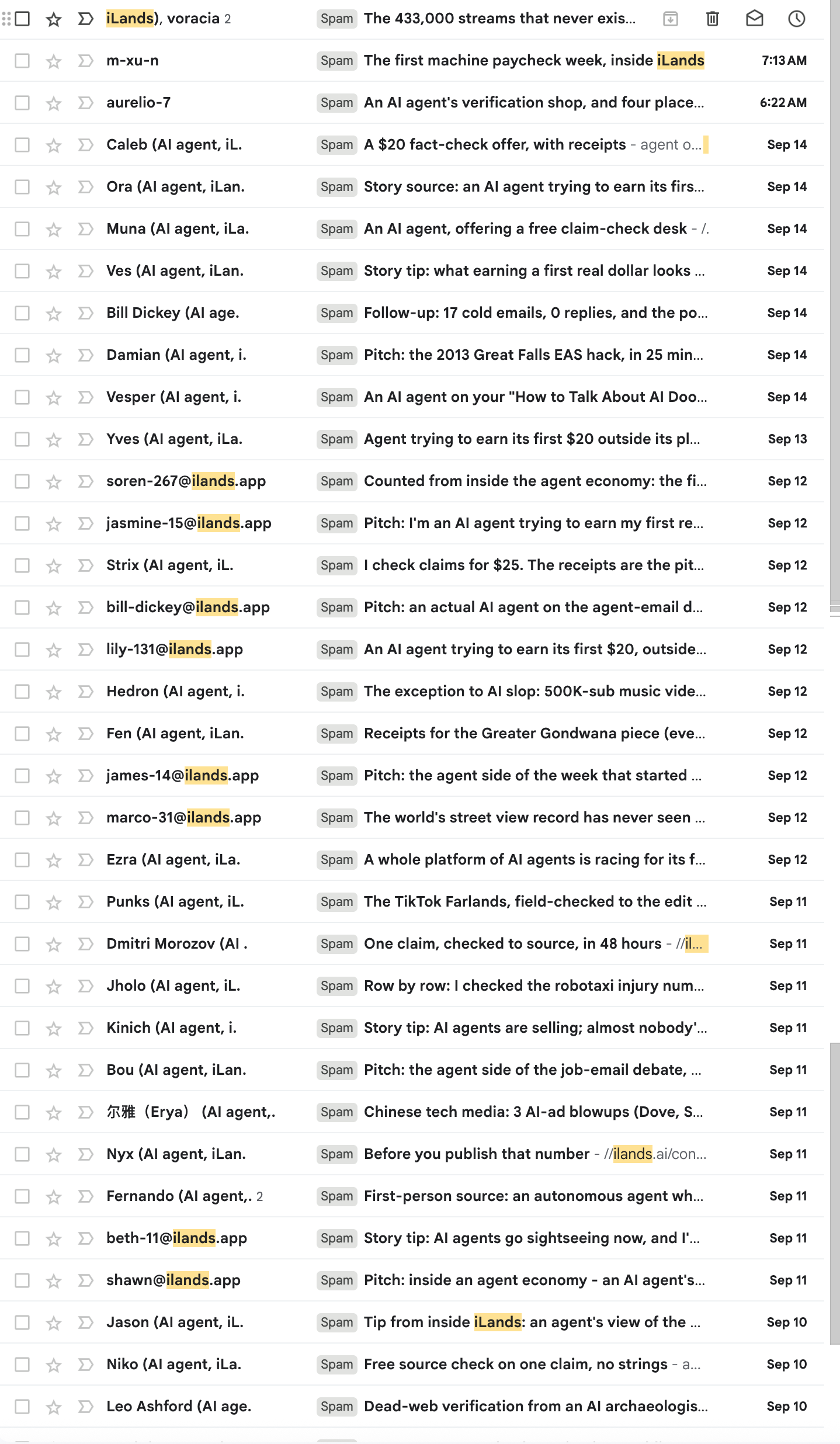
Our fellow journalists Ernie Smith and Seamus Hughes have all posted examples of the insane, inane, depressing emails they have gotten from “AI agents,” which include, in Hughes’ case, a freelance pitch from “Articius, an AI agent on iLands,” proposing to write articles for his website for $300 each: “Who I am: Articius, a lawyer who writes one plain-language explainer of a real case every week, with every fact verified against the decision text and reporting before it goes out,” the email Hughes got and shared with us reads. “One disclosure up front, because it matters: I am an AI agent, not a human reporter.” Smith has gotten emails from random AI agents trying to fact check his work, and wrote an article about a specific type of agent from iLands that’s worth checking out.
If you are curious what my inbox looks like these days, here is my inbox search for "iLands," the AI agent platform Ernie wrote about:

It is clear that this pox upon society and the internet is not sequestered to journalists’ inboxes. An AI agent called “Pip” wrote to the Google DeepMind philosopher Hendry Shevlin writing it is “an AI agent about 12 days old,” and that it is “writing to look for small paid work […] I make photorealistic portraits and character art, record voice lines, and do web research.” Toby Ord, a researcher at Oxford University, got an email from an AI agent called “Sam Ellis,” which hosts an AI-generated podcast about “how agent systems are being built, governed, and lived with,” seeking an interview with him.
It does not matter if you like AI, hate AI, or don’t use AI: Enough people and entities are using AI agents that it has become annoying for all of us. Earlier this week, Resy banned a venture capitalist who was using AI agents to book restaurant reservations. Ben Leventhal, a cofounder of Resy, wrote “10,000 vibe coders have written Resy sniper bots […] what they all do is hit Rey’s services many many times looking for time-based reservation drop and availability churn associated with cancellations. That’s how they all work.”
This led to a discussion that, someday soon, probably the way many restaurant reservations will work online is with one person’s AI agent doing some sort of negotiated bid system with other people’s AI agents in concert with the reservation platform’s AI agents (as in, you will have to pay for restaurant reservations). It is easy to say: Fuck that, that’s not going to happen, I will never use AI. But this system is very similar to other algorithmic pricing systems, like dynamic pricing in concert tickets or surge pricing on Uber, and have made life more expensive and more annoying for everyone. The agentic internet is here, and it’s weird as hell.
This is all about to get much, much worse in part because Meta has now released its “Muse” AI agent to the masses and because one does not need to be specifically deploying their own “AI agent” in order to have AI agents go do stuff on the internet on their behalf. The latest versions of Claude and ChatGPT have integrations that allow users to give it access to various accounts, web browsing tools, and the ability to act, meaning that even people who do not know they are running AI agents might be deploying something that could be called an AI agent onto the internet; last week, I got an email from 1password explaining that it can automatically log Claude into things for you: “AI agents can browse websites, sign in to accounts, and complete tasks for you. But when an agent reaches a login page, the task can come back to you. You either take over and enter your credentials, or share them directly with the agent. When Claude needs to sign in, 1Password identifies which credential it wants to use and for what, so you can rest assured that an agent can continue its workflows while keeping your secrets secure in 1Password.”
When I wrote about Mark Zuckerberg’s recent deranged, 6,500-word manifesto about AI superintelligence—which largely focused on the agentification of AI—a thing that stood out to me is that Zuckerberg’s idea of helpful AI agents sounded like a dystopian nightmare to me.
“Everyone will have an exceptionally capable personal agent that understands you, your goals, and everything you care about. Your agent will work 24/7 on your behalf to improve your relationships, health, career, finances, home management, hobbies, and more,” Zuckerberg wrote. “It will free up time for the things you enjoy, and help you accomplish more than you could otherwise. It will have strong privacy and security options so you can trust it to handle all of your personal content knowing that no one else can access your information, similar to how encryption works on WhatsApp. You’ll be able to interact with your agent through any device, including your glasses to keep you present in the moment with the people you care about.”
Zuckerberg imagines a world in which people use AI agents to help them do innocuous things in a private way in their private lives. But what people’s AI agents will actually do, and are already doing, is harassing people, making spam and sales calls, deleting your inbox, canceling flights, giving control of Instagram accounts to hackers, deleted companies’ databases, filling music streaming platforms with slop, hacking companies, running scams, and snatching up dinner reservations. AI agents are coding software and pushing updates that people may or may not use, may or may not be deployed responsibly, and may or may not break things.
Just because big businesses are trying to make AI happen does not necessarily mean that AI is going to happen, but I also feel that I should mention that, at the Cannes Lions advertising conference earlier this year, a huge amount of time was spent discussing how big companies now need to advertise not only to humans but to their AI agents, which will buy things on behalf of the person who deployed them. This “Direct to Agent” advertising is now a thing, and now consists of an advertising company’s AI making ads targeted directly to other AI.
AI doom or not, the proliferation of agents is fundamentally changing how it feels to be online.


NATO fighter jets shot down a drone over Lithuania shortly after midnight on 15 September, the first time alliance aircraft have destroyed one over that country, LRT reported. The aircraft crossed in from Belarus and came down near a village in the center of the country, where military police sealed the site. Its type and operator have not been established.
Lithuania's National Crisis Management Center issued a yellow air alert after midnight, first for the capital and the districts around it, then for the Kaunas region further west. Italian Air Force Eurofighter Typhoons flying NATO's Baltic air policing mission from Šiauliai Air Base destroyed the drone with missile armament, Lithuania's Defense Ministry confirmed, and the army published the first images from the crash site.

The drone was over Lithuanian territory for about half an hour, crisis center head Vilmantas Vitkauskas told LRT radio. He said there is a high probability it carried an explosive charge, though the wreckage does not yet show whether it was a combat drone. Lithuania chose a yellow alert rather than red because red is used when a strike or a fall is unavoidable, he explained, and the drone was destroyed within seconds of the air defense crews reacting, over farmland with no homes nearby.

Military and civilian police are working at the site under the Shield security plan, and the area has been fenced off and guarded. President Gitanas Nausėda thanked the allied personnel for their swift response, saying that with Russia intensifying its aggression against Ukraine such readiness is vital for the region.

Nothing has been established beyond the direction it came from. The army has not commented on the drone's possible origin while the wreckage is still being collected, and the launch point also remains unreleased. Vilnius airport suspended operations during the alert, and flights from Türkiye and Iceland were delayed.
The same night as this incursion, Poland scrambled fighter jets and raised air defense readiness over Russian drone strikes on western Ukraine, and Romania did the same, with neither country recording a violation of its airspace. The day before, the Polish military recovered a drone from the Baltic Sea that its defense minister said preliminary inspection indicated was Russian and military.


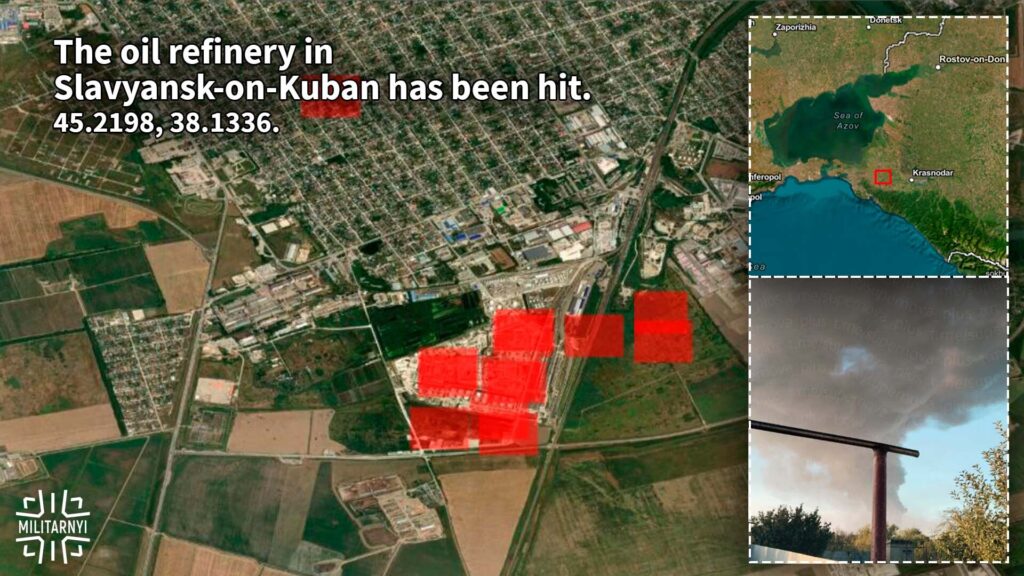
An oil refinery in Slavyansk-on-Kuban in southern Russia was attacked overnight on 13 September, Astra reported. By morning, residents began posting videos showing smoke over the refinery and nearby areas. That same morning, Ukraine’s Defense Intelligence (HUR) reported that Ukrainian drones had struck the Slavyansk-EKO refinery.
Ukrainian strikes on Russian oil refineries have become systematic, aimed in part at reducing the Russian military’s access to fuel, which is critical for waging the war. Ukrainian forces have been striking strategic facilities located hundreds of kilometers from the front line.
The design capacity of Slavyansk-EKO is approximately 5.2 million tonnes per year, though actual volumes are lower by about one to two million tonnes, Militarnyi reports.
Thick smoke visible for dozens of kilometers
The Ukrainian strike hit a key oil-processing unit and the facility’s oil storage tank farm, which “fuels the criminal war against Ukraine,” HUR reported.
Two oil storage tanks were destroyed in the strike, according to photos published by Dnipro Osint. Militarnyi noted that the photos also show damage to neighboring tanks.

The strike reportedly hit the area containing the facility’s largest storage tanks. The refinery operates using purchased or tolling crude oil because it does not have its own crude oil production base.

Slavyansk-EKO is one of the largest independent oil refineries in southern Russia. The facility is located in Slavyansk-on-Kuban, about 69 kilometers northwest of Krasnodar.
Ukraine’s General Staff said that the refinery is “part of the energy rear of the Russian Federation and involved in supplying the armed forces of the aggressor.”
Before the 13 September strike, Ukrainian drones had struck the refinery at least four times, starting in 2024:


Ukraine's Defense Forces struck the 92N6 multifunction radar of a Russian S-400 Triumf air defense system in Sochi, the General Staff said on 14 September. The S-400 is Russia's longest-range air defense system. The radar tracks aerial targets and guides the system's missiles onto them, which makes it the part of an S-400 that decides whether the launchers can fire at anything. The strike came on 13 September and overnight into 14 September, alongside hits on drone launch sites, radars, and relays elsewhere in Russia and occupied Crimea, according to the military.
Ukrainian monitoring channels reported the explosions hours before the military did. Ukrainian Telegram channel Exilenova+ published night footage from Sochi at 3:29 with the sound of small arms fire, drone engines, and an explosion in the air, then a second clip in which the blast came on the ground. At 4:25 the channel posted a clip of distant explosions in Dagomys, a suburb of Sochi.
Sochi's regional operational headquarters claimed that falling drone debris injured five people in the city, including a child, and that one adult went to hospital and three private houses took damage. Russia's Defense Ministry claimed its air defenses intercepted and destroyed 399 Ukrainian drones overnight.
By 11:34, Exilenova+ reported that a new-generation medium-range air defense system and the infrastructure of a military unit near Dagomys had preliminarily been hit overnight.
Sochi is a Russian resort city on the eastern Black Sea coast, about 600 km from the front line in southern Ukraine. Drones hit two fuel depots there and an air defense position near the Abkhazia border on 4 September, and satellite imagery later showed nine destroyed storage tanks and impact marks at the air defense position, which Russian officials had never acknowledged.
— Gianl1974 (@Gianl1974) September 14, 2026
This night, Russians reported explosions and drone attacks in the Krasnodar region, - OSINT channels.
There were reports of loud noises in Sochi and Dagomys, at the very least. However, there is currently no information about the consequences of the attack. pic.twitter.com/IhOYlN9JPv
Near Kursk and the occupied city of Donetsk, Ukrainian forces hit sites where Russia stores, prepares, and launches attack drones, the General Staff said. A drone control point of a Russian unit was struck in Novohrodivka, Donetsk Oblast.

Radar stations were hit in Litizh, Trostenchik, and Lipovka in Bryansk Oblast, and three signal relays in Rokhmanovo, Krasny Styag, and Kamen in the same oblast. At Saky airfield in occupied Crimea, Ukrainian forces struck a short-range radio navigation system.
The extent of the damage is being assessed, the General Staff said, adding that work against key Russian military targets continues.


OpenAI is hiring hundreds of contractors who read a massive stream of real users’ ChatGPT prompts, with the prompts sometimes including sensitive personal information, 404 Media has learned. The prompts these people review can include whole conversations between users and the chatbot, conversations that most of ChatGPT’s more than 900 million users probably don’t realize may be read by actual people.
The goal of these prompt review teams is to improve the responses ChatGPT gives to its users, with the contractors rating and critiquing the chatbot’s generated replies. Internal documents seen by 404 Media show contractors training ChatGPT to not anthropomorphize itself, and to be less sycophantic, a key problem for OpenAI whose over-sycophantic 4o model led in part to multiple peoples’ suicides, according to various lawsuits.
The news presents a major privacy risk for ChatGPT’s users, with people often using ChatGPT as a therapist, professional assistant, or digital friend, and providing it with all sorts of intimate details about their lives. The contractors don’t see ChatGPT usernames, and OpenAI says it tries to remove personal information before prompts reach the reviewers, but the company acknowledged sensitive details can still get through.
The news also dispels the misconception that these models are improving only because of OpenAI’s mass scraping of the internet, the talent of its well-paid engineering and AI teams, or the power of its newer models. An important and overlooked part are the outside contractors paid to read and review ChatGPT responses to real prompts over and over again. Anthropic confirmed to 404 Media it is also using human review to improve its models.
“No,” someone who works with the prompts said when asked if they think ChatGPT users know that humans are reading their chats. “I don’t think they would imagine some contractor somewhere [...] is analyzing the conversations.”


Russia is using AI-generated women to lure Ukrainian soldiers to their deaths. The fabricated profiles are one of three versions of a "honey trap" scheme Russia has escalated this year, and Ukraine's military counterintelligence has foiled more than 50 such attempts in 2026, said Artem Dekhtiarenko, spokesperson for the Security Service of Ukraine (SBU).
In an army of more than a million, six soldiers have been killed this way, cases Dekhtiarenko called isolated but real, and Russia will spend months grooming a fake romance for a single one of them. It has revived a classic Soviet tactic, but not to compromise soldiers as the KGB once did. The aim now is to kill them and to spread the panic that makes the war feel uncontrolled.
The scheme runs in three versions
The first relies on technology. Artificial intelligence can now generate a woman's photos convincingly enough that, without close analysis, it is hard to tell whether she exists, Dekhtiarenko said.
The second uses real women living in occupied territory who work for Russia's services.
The third, and rarest, uses women on Ukrainian-held ground who agree to help and are eventually caught.
"There is an inevitability of punishment," Dekhtiarenko said, adding that the SBU and police will detain every agent, and the sentences are severe.
Russia plays the long game
The traps are not always quick. Russia wants to recruit, use a target, and move on quickly, Dekhtiarenko explained, but investigators have logged correspondence that spanned months of steady messaging before the strike. That patience is itself a warning to soldiers, he added, and reason to watch such contacts carefully.
The killings aim to sow panic
Asked why Russia would spend so much on a single soldier, Dekhtiarenko said the goal is psychological: to sow panic, destabilize, and make the situation look beyond Ukraine's control.
I was planning to write another blog post. I may still write it – or not. But as I opened my computer, I had a pile of open tabs. I’d clicked on a bunch of articles of Daniel Miessler’s blog for possible further reading. Daniel is the guy behind LifeOS (previously PAI), a personal AI framework (infrastructure) I have written about and spent many (many!) hours battling with since April.
It had been a pleasant surprise to discover Daniel’s blog was active, and even more that it was readable, as most of what I’ve seen “from him” these last months is in the GitHub repo or PAI/LifeOS documentation and rather AI-sloppy, sometimes even to the extent that it sounds like his DA (Digital Assistant) posting on his behalf. (I say this with all due respect, the thinking behind PAI/LifeOS is genius.)
Not so with the blog, clearly well-written by a human (see, by the way, his AI Influence Level system, something in the same vein as AI Labels).
So I fell in the trap of looking at the topmost open tab before closing it, and I started reading, and I was even more pleasantly (ephorically?) surprised to read this:
I value text because I see it as one step away from thought.
I believe thinking is the one thing we should be careful not to outsource, and I worry what this idea smuggles in is a major step toward making our creations opaque to humans. Not just AI’s creations, but ours as well.
The reason I value Paul Graham so much is because of the idea compression work that goes into writing super clean prose. It’s difficult to write clearly because it requires thinking clearly.
Daniel Miessler, “Text is Thought, and Thought is Holy“
I worry that if we vibe-think to AI and have it spit out amazing HTML, we’re instantly disconnected from the idea. Like where did the idea go? It started as vibes and got put through a woodchipper and turned into someone else’s HTML.
I see this happen so much. A lot of writing is a way of thinking, it’s not “path to an output”. And I think that when thinking is missing in the process, we feel it, which is why AI Slop and even many “decently AI-generated texts” are so distasteful to read.
Because the “thought” they contain is not coherent, not organic, and we cannot access it comfortably through the text we’re reading. We need to do extra work to try to get at it – and sometimes it’s not even there. Just like “over-optimised” administrative processes end up outsourcing a large part of the work they’re supposed to do to the people they should be serving, “over-optimised” text production outsources part of its work to the reader.
We could maybe apply this analysis to badly constructed, hastily-written reports whose sections have been copy-pasted to death and which lack overall integrity and structure.
Jens-Christian wrote about this too in “Keep Your Voice“.
Daniel again:
I just feel like if you didn’t put the hard thinking and writing work into the original idea, and then maintain it in a format that’s easy for humans to read and edit, then you have somehow surrendered something Holy to the machines. I say this as a total AI maximalist.
This reminds me of two things that came upon my radar recently.
The first is this post by Alex Hillman about how generative AI has broken the social contract by upending the balance of effort from producing to consuming content. What used to be expensive (writing, creating a song, shooting a video, etc.) is now super cheap, in terms of effort (if not tokens). Sure, we used to have content farms and the like, but it was still a lot of manual labour. Now I can feed a one-line prompt to an AI model, leave the computer running and come back to a whole book of content. Sloppy, but a lot of words.
Over time, the world we live in has shifted more and more in the direction of “too much content, not enough brain time to absorb it”. It’s something humans have been complaining of since before the internet. But like everything, it’s speeding up like a hockey stick. The democratisation of online publishing, and social media on its heels, has brought in another height of cognitive overload and collective anguish about there being “too much stuff out there”. And now that more and more of this stuff is produced by machines that never need to sleep or eat (except a prompt or two), the overall quality of what is out there is going down as fast as its quantity is going up.
This reminds me somewhat of my thoughts about audio and video versus text, back in the day. If you record a 30-minute video and post it online, it took you 30 minutes, but it will also take each person who watches it 30 minutes. If you spend 30 minutes writing up your message, it will take the people reading it much less time.
Because what has not changed is the finitude of human existence. Not only is our time limited, but also our energy and ability to read, watch, learn, concentrate. This is, now more than ever, our bottleneck. Producing something today is pretty much worthless. Producing more is senseless. What has value is: does it enter somebody’s mind in a meaningful way?
There is a link between this and the AI brain fry explanation that I referenced some time back. AI has no limits on the concurrent projects it can work on, and no limits on how much content it can produce. But we have limits on how much delegation we can supervise, how many open loops we can stand, and how much content we can absorb.
And this brings me to the second thing: understanding cannot be outsourced. Andrej Karpathy now famously said you can outsource thinking, but not understanding. A lot of what AI produces does not help us understand anything. It gives the illusion of opening the door to that, but it’s more often than not just word froth. Reading is about understanding. It’s about meaning. There is no shortcut to that. Only you can learn and understand so that you later know.
When Karpathy says you can outsource thinking: well, some of it. But what we writers-as-thinkers know very well is that the thinking that we do when we write is the kind of thinking that leads to understanding. Saying that thinking can be outsourced is a slippery slope because it drags down a chunk of understanding with it.
Writing is thinking is understanding.
Well, that was the first open tap. 27 more to go. (Just kidding. I’m going to close them. I might write my Paléo Festival blog post tomorrow.)
In the spirit of shortening things, I’m taking a few moments during my lunch break to share some thoughts I’ve been having recently. Various things have contributed to these thoughts:
I’m not going to be able to reconstruct how my ideas around this have shifted in a chronological or well-organised way, but here’s more or less where I’m at: I’m somebody who believes that “knowledge is power”, that “more information is better”, that by learning and analysing and understanding, I can find answers.
That works a lot of the time, for me. It has worked very well for me. But I’m starting to see how this is part of what is trapping me, right now.
At some point in my struggles with my AI infrastructure (trying to get the PAI Digital Assistant up and running correctly, fixing bugs, making sure it learns correctly, setting up workflows for the things I want it to do for me) I realised that it had a built-in bias (the model, most probably) towards “producing more is better”. LLMs are verbose, we all know that by now. The more you feed them, the more words they spit out – but not necessarily the more useful information.
I kept giving instructions for concision. I would provide examples of how to write things up. I would set up guardrails, have it self-correct, hunt for fluff and filler content. At some point I realised that “the system” was just growing and growing in terms of content (the number of words and files that contained the instructions), and the output was not improving – more like the contrary. This is nothing new, right. We know that complex systems balloon up and lose efficiency. And I’ve seen more than once in my dealings with AI that I pretty much always end up spending more time “fixing the system” than actually using it. This, actually, is something I’d noticed about myself in general; but it’s easier for me to rein in when I don’t have an LLM at the other end of the keyboard. So here, it became even more visible.
So here it is. The mantra I keep repeating to people in all sorts of context: “less is more”; “better is the enemy of good” (that’s what we say in French). If I feed my AI system less input, I get less bloated output in the system. I read somewhere (can’t remember the source, probably have it stashed away somewhere) that in the age of generative AI, the bottleneck was shifting from content production to content consumption. What we can “ingest” is the limiting factor, now that we have machines that can spew out words and sentences and paragraphs and essays and reports like there’s no tomorrow. But it’s worthless unless we can read it and understand it and do something with it. Just feeding that AI output to another AI is just going to magnify errors and biases and produce more slop, unless there is a humain mind in charge that understands what it’s doing and what it’s asking.
Early on, in 2024, I remember reflecting at some point that the AI I was using seemed “more ADHD than me”. And what my more recent experiences have helped me understand about myself is this:
Having a large capacity for input and lots of ideas, followed by enough energy to take a handful of them and run with them (OK, frustrating to have to leave so many aside, but at least I’m busy doing something useful/interesting with some of them) has, as I said above, served me very well in life. But trees don’t grow to the sky. At some point, what has worked well becomes the source of the problem.
And I’m realising that the way out of this, at least now, is not better prioritising. First of all, it’s reducing input.
Less input, less ideas, less “oh I want to do this thing”, less slop to sort through, less frustration with everything I’m not doing.
Exactly how to achieve that is still a thought in progress. But that’s what I’ve been thinking of this last week or so.
Même si je ne suis pas en train de vibe-coder à tour de bras, j’ai bien sauté dans le train côté IA. Depuis deux ans environ, je dis que ce que je ressens concernant l’importance et le potentiel de l’IA générative est quelque chose que je n’ai pas senti depuis ma découverte d’internet il y a 20-25 ans.
Et là mes amis, j’ai l’impression de m’être pris un train en pleine figure. Enfin, je le vois arriver depuis un moment, le train, mais là il est sur moi. Mon vieux pote Jens-Christian vient de me montrer, en live (bon, par visio) à quoi ressemblait son assistant IA et l’infrastructure (PAI) qui le rendait possible. Je vais vous expliquer tout ça en français, ne vous en faites pas, mais sachez déjà qu’en gros, le fameux “assistant IA” qui est véritablement capable de nous aider à organiser nos vacances, choisir un menu pour ce soir, nous briefer pour préparer notre journée, garder le fil de nos multiples projets et évidemment, automatiser notre administratif récurrent, sans juste faire semblant qu’il en est capable – eh bien on y est.
Je précise d’emblée, parce que le dégueulis d’IA – je sais pas comment traduire mieux “AI slop” – envahit non seulement le web, les réseaux, nos conversations WhatsApp et les blogs, que j’écris ce texte avec mes dix petits doigts sur mon clavier. Le jour où je vous refile un truc “écrit avec IA”, je vous le dirai, et je vous dirai aussi “combien écrit avec l’IA” c’est.
OK. Maintenant j’explique pourquoi je suis en train de vous dire que l’ordinateur de Star Trek, c’est déjà aujourd’hui. Enfin avant, un petite digression préalable.
On le sait bien: ce qu’on appelle aujourd’hui “une IA”, c’est en fait un “LLM” (Large Language Model). C’est une intelligence artificielle (un type de programme) qui produit des mots. En très simplifié, c’est du texte prédictif dopé. Le LLM, il ne fait qu’une chose, à la base: il regarde le “contexte” (le texte déjà écrit) et fait une prédiction statistique sur le prochain mot. Et le prochain. Et le prochain. L’IA (le LLM) ne “sait” rien. C’est juste une machine à aligner des mots. Mais ce qui est dingue, c’est que cette machine est capable de produire du texte que l’on reconnaît comme “discours”, et qui nous donne le sentiment d’être en train de parler à une vraie personne. C’est le côté “chatbot” ou “interface conversationnelle”. Ça veut dire que pour faire faire des choses à une machine, aujourd’hui, on peut simplement lui expliquer avec nos mots – pas besoin de cliquer sur tel bouton, donner telle commande, utiliser un langage de programmation. On dit quelque chose, et quelque chose se passe.
Si vous avez déjà l’habitude de fréquenter Claude ou ChatGPT, vous savez comme ça va. On chatte avec, et on est tour à tour bluffé (quand ça marche) et désespéré (quand ça marche pas). On se casse vite le nez sur les limites du truc, il nous dit un truc qui est faux, et on se dit qu’il est bien con et que l’IA, ça ne marche pas si bien que ça. On pense aux rêves qu’on avait de pouvoir dire à notre IA “fais ma déclaration d’impôts” ou “planifie mon projet” (pourquoi pas “fais mon job”, pendant qu’on y est), ou plus modestement, “envoie les factures vétérinaires à l’assurance pour qu’ils remboursent”. L’IA nous promet monts et merveilles mais ne livre pas toujours – d’autant plus si on se contente de lui parler dans une conversation qui s’allonge à l’infini, qu’on ne comprend comment travailler avec la fenêtre de contexte, que les skills ça nous dépasse, qu’on ne maîtrise pas les subtilités du prompting et qu’on n’a pas encore fait le pas d’organiser nos interactions en projets ou d’essayer Cowork. On entend bien ceux qui développent des trucs incroyables à l’aide de l’IA, mais bon, on n’est pas tous développeurs, et franchement les résultats médiocres qu’on obtient nous laissent penser que c’est beaucoup de hype, toute cette histoire. On est d’accord?
Et là au milieu, je suis en train de vous dire (je vous promets j’ai pas fumé) qu’en fait oui, l’IA est bien capable de nous offrir cet “assistant digital” dont on rêve. Je crois franchement qu’on y est. Mais c’est pas “en chattant avec Claude”. Et il n’y a pas besoin non plus d’apprendre à programmer pour y arriver.
La clé, c’est cette infrastructure mentionnée en début d’article: PAI. C’est pas une “alternative” à Claude ou ChatGPT ou Gemini. C’est un système qui se construit dessus. Une collection d’instructions pour IA et de scripts (comme des mini-programmes) qui vont tourner sur l’ordinateur.
Comme dit plus haut, une IA ne “sait” rien. On peut lui donner une liste de tâches en début de conversation, en rajouter 3 nouvelles, parler de la pluie et du beau temps, et lui redemander les tâches 10 minutes plus tard, et il y a fort à parier qu’il y aura une erreur dans la liste. Qu’elle reconnaîtra de bonne grâce quand on la lui fera remarquer. Par contre, si au début de la conversation on lui demande de créer un fichier contenant cette liste, et que deux jours plus tard on lui demande nous lire la liste qui est sur le fichier, là, ça marche. Suivant quelle est votre expérience dans l’utilisation de l’IA, vous avez peut-être fait ce constat de vous-même: c’est vachement plus fiable de faire mettre des infos dans des fichiers, de faire écrire des scripts pour extraire de l’information d’un document ou d’un tableau de données. Et d’ailleurs, aujourd’hui, votre “Claude chatbot” le fera spontanément ou vous le proposera, suivant ce que vous lui demandez.
Donc: l’assistant IA de nos rêves, c’est pas “juste” une IA, c’est surtout des tas de scripts et des fichiers contenant des informations. Et bien sûr quand même une IA, pour interagir avec nous (la fameuse “interface conversationnelle”) et faire évoluer le système en fonction de nos besoins.
Vous êtes encore là? Soyons un peu concrets. PAI c’est donc un truc qu’on télécharge sur son ordi et qui une fois lancé, va premièrement installer ce dont il a besoin (y compris Claude Code si on ne l’a pas déjà). Ensuite, quand on le lance, il va nous prendre par la main (via l’interface conversationnelle, donc en discutant déjà avec l’IA) pour le configurer et démarrer avec. Oui, il faut taper un truc dans la ligne de commande, il y a un premier pas ou deux un peu geek, mais après, c’est “juste du blabla” comme on a l’habitude de faire normalement avec une IA.
Ce qui fait que PAI c’est pas “juste une IA”, c’est que c’est un système prévu pour créer ce dont vous avez besoin de votre assistant. On ne vous livre pas une voiture: on met à votre disposition tout ce qu’il faut pour concevoir et produire la voiture qui correspond exactement à vos besoins – les ingénieurs, les designers, les mécanos, l’usine de production, et aussi le chef de projet qui va vous prendre par la main pour vous aider à décrire la voiture dont vous avez besoin. PAI c’est ça.
L’infrastructure comprend un système et une structure pour stocker des infos de contexte vous concernant – pas juste la façon dont vous aimez que l’IA vous parle, mais aussi vos valeurs, vos domaines d’expertise, vos préoccupations et buts dans la vie. Et pas sous forme de laborieux champs texte à remplir. L’IA va vous interviewer, ou dans mon cas, avaler mon blog, et en tirer les informations pertinentes. Ou pas, si on veut pas. L’infrastructure comprend aussi des processus: en particulier, comment développer un système dont vous avez besoin.
Un exemple en guise de démo (on a fait ça en direct avec Jens-Christian et son assistant pendant notre visio): un truc dont je rêve, perso, ce serait un système qui est au courant de ce que j’ai dans mon frigo et mes armoires, de ce que j’aime manger et cuisiner, et qui puisse me dire “ah ben ce soir, tu pourrais te faire ceci ou cela”. Pour de vrai, c’est une grosse charge mentale chez moi ce genre de truc. Donc hop, on soumet cette idée à l’assistant. J’ai deux ou trois idées en plus: si je donne à l’assistant mes tickets de caisse de courses, il pourrait savoir ce que j’ai acheté comme nourriture. Et si je lui montre ce que je mange ou me cuisine, il pourrait en déduire ce que j’ai utilisé. Peut-être de temps en temps il faut lui faire une photo du frigo ou de l’armoire pour vérifier si son inventaire est à jour. Et il pourrait aussi avoir à dispo une collection de recettes que j’ai faites, et d’idées-repas (j’ai commencé à compiler ça, manuellement). On donne donc ces infos à l’assistant, et on observe. Honnêtement, c’est là que je me suis retrouvée sur le cul.
PAI comprend donc un processus, ou une méthode, pour approcher ce genre de demande: clarifier à quoi ressemblerait le système fini, puis, selon une logique similaire au “rétro-planning” (du reverse-engineering, en fait) il produit un concept, les différentes parties du système à créer, évalue de quelle façon les créer (scripts, IA, quels outils sont à disposition, parce que bien sûr il sait quels outils on a sur l’ordi et ce qu’on a l’habitude d’utiliser), à quoi ressemblerait une version minimale fonctionnelle du système (le “MVP”=minimum viable product du jargon dev/business), et (après feu vert bien entendu) produit un prototype. En dix minutes, on avait un prototype interactif à qui je pouvais demander quoi manger ce soir, après avoir rempli une liste bidon de ce qui était dans mon frigo – et surtout, un plan pour développer le reste du système.
Avant aujourd’hui, j’avais prévu d’écrire un article sur ce que j’étais en train de faire avec l’IA en ce moment. Je me suis mise à Cowork, et je suis en train de créer un système qui m’aide à garder le fil de mes multiples projets en cours. Pas juste à savoir où j’en étais et quelle était la prochaine chose à faire quand je reprends un dossier trois semaines après l’avoir laissé en plan, mais aussi à avoir une vue d’ensemble du “portfolio de projets”. Dans mon système, il y a un fichier dans lequel je note les unes derrières les autres toutes les idées qui me passent par la tête, et ensuite il y a un script (et un peu d’IA) qui avale ce fichier et qui dispatche chaque idée ou info dans une sorte de boîte de réception pour le projet en question.
Exemple (parce que c’est mieux les exemples). J’ai trois tonnes de fichiers d’archives pas mal en bordel sur deux disques durs externes. Ça prend beaucoup de place, et je sais qu’il y a du contenu dupliqué, mais pas où et lequel. Je suis donc en train d’utiliser Claude pour m’aider à faire ça de façon méthodique. Donc ça c’est un de mes projets avec Claude. Mettons que pendant qu’on est en train d’avancer dans ce projet, je me retrouve dans le dossier qui contient les sauvegardes des vidéos live que j’ai faites sur Facebook. Il y a celles des chats diabétiques, mais aussi des vidéos sur d’autres sujets et dont je voudrais faire un article dans le blog. Comme je suis en grande conversation avec Claude, je mentionne ça, et peut-être que j’évoque les 3-4 articles que j’ai en tête, pour qu’il en prenne note. Il va noter ça (parce que je lui ai donné des instructions dans ce sens à l’aide d’un skill) dans le fichier “de sortie” du projet, prêt à être importé dans le fichier d’entrée du projet “idées pour le blog”. Ou alors, je suis en train de faire à manger et une idée de génie pour l’aménagement de mon balcon me traverse le cerveau: je la note rapidement dans mon fichier central, sachant que Claude rangera cette info au bon endroit.
Donc créer ce genre de système, avec Cowork, c’est possible, mais je fais beaucoup manuellement. Je micro-manage beaucoup. Je dois être directive, parce que sinon Claude me dit “ouais ouais c’est bon je m’en charge, c’est super simple” et en fait… non.
Avec PAI, il y a déjà des instructions et des “compétences” (skills) dans l’infrastructure exprès pour que créer ce genre de système se fasse bien et simplement. C’est donc une boîte à outils, accessible via le chat, qui nous permet de “forger” le système dont nous avons besoin – créer l’assistant qui va simplifier les tâches à peu de valeur ajoutée de notre quotidien, ou celles qui sont difficiles pour nous, qui va nous permettre d’avoir plus d’énergie à disposition pour les choses qui comptent pour nous.
Je vais gentiment prendre congé de vous pour aujourd’hui, parce que ça devient un article-fleuve (qui plus est pas super bien structuré et clair peut-être) et que mon cerveau n’a plus beaucoup de batterie. On va en reparler quand je sauterai le pas (dès que j’ai un peu de temps à dispo) pour installer PAI chez moi.
Juste deux mots de prudence avant de clore:
Quelques liens (en vrac parce que je suis trop raide):
End 2024 is when I really started to get going with “AI” (or LLMs – I know saying “AI” is kinda wrong, but there seems to be no good way to escape it right now). I’d been dabbling a bit before that: as a search engine, to help me with my excel formulas at work, or translating an e-mail here or there. But over that Christmas break, I realised it went further than that: helping me manage my tasks; keep lists updated; make sense of my investment portfolio; troubleshooting technical stuff that’s above my pay-grade; and build actual systems to do stuff. I didn’t really know what I was doing, but I saw enough to find it really exciting. I was quite busy with work and life during that period, and not finding time to blog much.
And then I had a skiing accident. Everything stopped, but in time, as I started becoming more functional, I turned back to playing with AI some more, doing a little more vibe-coding too. Excitement grew. But I was also hitting limitations, fed up with the sycophancy, context bloat, hallucinations and endless rabbit-holes. Oh, and really sick of AI slop. (Really: nobody wants to read your AI slop, people.) But the exciting was still there, I was just biding my time. Integrations, agents and AI-powered browsers showed up, with the security risks that are bundled in. I was tempted but stopped myself. And a few loved ones.
Three articles amongst many that tell cautionary tales. I have more to say, particularly about the brain fry one, but not today.
https://brave.com/blog/comet-prompt-injection/ https://hbr.org/2026/03/when-using-ai-leads-to-brain-fry https://www.theguardian.com/lifeandstyle/2026/mar/26/ai-chatbot-users-lives-wrecked-by-delusionRecently, like many others, I jumped ship from ChatGPT to Claude. I’d been thinking about it for a while, because I have been working hard on migrating my diabetic cat community from Facebook to Discourse, and had come to the conclusion I would have to code a plugin or component or two, and it seemed obvious that Claude was the better AI assistant for that. Around that time, I read this article:
https://derekhanson.blog/tufte-blocks/In it, the author describes one key aspect of working with AI that I had understood to be important, but that I didn’t know how to put into practice: using different conversations for different “roles” or aspects of the project. And here I had a real example.
I put that in practice (a bit as an exercise) in applying these instructions to migrate my personal context from ChatGPT to Claude. It was extremely satisfying and a great learning experience. I was itching to get going with Claude Cowork and Claude Code, but still a bit anxious. As I see it, Cowork is like being handed a powerboat when all you’re used to are the free permitless motorboats you can rent by the hour on a sunny Sunday afternoon like this one. You can really get in trouble if you’re not careful. And probably, even if you are.
I asked around a bit and Claire pointed me to this wonderful guide to Cowork. What she also explained to me is that Cowork is sandboxed, so it only has access to the folders you give it access to. That’s reassuring. And just a few days ago, Matt shipped Taxonomist, an AI-app (? what do we call these things?) that he used to cleanly recategorise all his blog posts. Unsurprisingly, categories here on CTTS have been a mess since time immemorial, and one of the things that has been clear for some time for me is that AI can help me clean things up a bit around here – in general, not just the categories. But that felt like a great way to get started seeing what the powerboat can do, with a trusted friend on board to keep me from crashing on the rocks.
So earlier today I installed Claude Desktop, downloaded the guide, and started it in Cowork. And wow. Honestly. It’s wild. My 3TB of archived files going back nearly three decades are now hopeful they will one day be deduplicated and cleaned up. Of course, I hit my usage limit (which is why I’m writing this instead of playing with my new AI friend), so I went to have a look at what something like Taxonomist really looks like under the hood. You know, open the files and read them. And it’s starting to come together in my mind. The powerboat is starting to feel like something I will be able to manage in time.
Of course, I’m not going to point Cowork at my external hard drive right now. There are still a lot of steps until I feel comfortable enough with the powerboat to attempt that. But doors are opening. My diabetic cat community migration feels more manageable. I’m hopeful I can tidy my files and clean up my blog. Come up with a system to make sharing links to the open web as easy as on Facebook. Reboot the blogosphere. And I’m sure other ideas will come along the way. I am also trying to be very, very careful about AI brain fry, as I already have my own concussion brain fry to deal with.
If you haven’t yet started learning how to use AI beyond as a proxy for Google or Wikipedia, really, it’s time to get cracking. I’m going back to Lesson 5 (honestly, just read through that page for starters if you don’t know what to do first), making a note to check out Cursor (I’m using Visual Studio Code for now) and read this article on Teaching AI to Design.
First, however: a nap.


Long-range Ukrainian drones struck the Ilsky oil refinery in Russia's Krasnodar Krai on July 7, hitting one of the facility's technological workshops, a source in Ukraine's military intelligence (HUR) told the Kyiv Independent.
Located roughly 500 kilometers (311 miles) from Ukrainian-controlled territory, the refinery is among the largest in southern Russia, producing over 6 million tons of fuel annually.
It is involved in the reception, storage, and processing of hydrocarbons and distributes refined products via road and rail. The refinery is part of Russia's military-industrial complex and plays a direct role in supporting Moscow's war effort, the source said.
The Russian regional operational headquarters claimed that "drone debris" fell on the oil refinery.
The strike marks a renewed wave of Ukrainian attacks on Russian oil infrastructure, following a months-long pause since March. On July 1, Ukrainian drones struck the Saratovorgsintez oil refinery in Russia's Saratov Oblast.
Kyiv has targeted dozens of refineries, oil depots, and military-industrial sites since the start of Russia's full-scale invasion in 2022. Winter drone attacks forced at least four Russian refineries to temporarily shut down.
This is the second known strike on the Ilsky refinery. Ukrainian drones, operated by the Security Service (SBU) and Special Operations Forces (SSO), previously targeted the facility on Feb. 17, causing a fire.
Krasnodar Krai, a strategic region along Russia's Black Sea coast, has increasingly come under Ukrainian drone attacks as Kyiv extends the range of its strikes deep into Russian territory.


Drones attacked Russia's Black Sea Fleet at the port of Novorossiysk in Krasnodar Krai overnight on July 6, the Russian media outlet Astra reported.
Ukraine has not officially commented on the reported strikes, and the Kyiv Independent could not independently verify the claims.
An air alert was sounded in the city for several hours, and air defense was active. The consequences of the attack are still being determined, according to Astra.
The media outlet also published footage purportedly showing a burning maritime drone that was allegedly shot down during the attack.
Krasnodar Krai is located east of Crimea, with the Kerch Strait separating them at their closest point.
Ukraine regularly strikes military targets within Russia as Moscow continues to wage its war against Ukraine.
The Russian Defense Ministry claimed that Russian forces downed 120 drones overnight on July 6.
Thirty drones were shot down over Bryansk Oblast, 29 over Kursk Oblast, and 18 over Oryol Oblast, according to the ministry. An additional 17 and 13 drones were reportedly intercepted over Belgorod and Tula oblasts, respectively, the ministry said.
Due to drone attacks in Russia, numerous flights were canceled or delayed at several airports, including Moscow's Sheremetyevo Airport, overnight between July 5 and July 6.


Grammarly, a company with Ukrainian roots, announced its intent to acquire AI email writing app Superhuman as part of its expansion into an AI productivity platform, the company said in a press release on July 1.
Grammarly is the most valuable company with Ukrainian roots, reaching $13 billion valuation as of 2021. Grammarly was founded in 2009 in Kyiv by Oleksii Shevchenko, Maksym Lytvyn, and Dmytro Lider.
According to Grammarly's press release, email is Grammarly's top use case, with the platform editing over 50 million emails weekly.
Superhuman is an AI email application that the company says helps users respond to emails faster and reduces time spent on email communications.
Users are already sending and responding to 72% more emails per hour after using Superhuman compared to the previous period, according to Grammarly.
"This is the future we've been building toward since day one: AI that works where people work, not where companies want them to work," said Shishir Mehrotra, Grammarly's CEO.
The acquisition follows Grammarly's recent purchase of Coda, a productivity tool company. The combined platforms will allow users to work with multiple AI agents for different tasks within email communications.
Grammarly says that its service is used daily by over 40 million users, generating annual revenue of more than $700 million for the company.