❌

Vue normale

Ukraine outfoxes Russia near Donetsk’s fortress belt with Soviet BTR-60s rebuilt as kamikaze robots, storms a key hub and takes 250 Russian prisoners

28 septembre 2026 à 06:40

The image shows Russian prisoners of war on the Lyman direction. Source: The 3rd Army Corps

Ukraine's 3rd Army Corps has defeated Russia at the key settlement of Nove in Donetsk Oblast by pointing it the wrong way. Russia has poured its reserves into counterattacks on a feint axis and "slept through" the real strike, which took the important hub in the village and closed the decisive third season of the Vivaldi offensive, commander Andrii Biletskyi said.

Vivaldi is Ukraine's counteroffensive aimed at disrupting Russian forces' plans to encircle the fortress-belt cities in Donetsk Oblast from the north and south. Among them are Sloviansk, Kramatorsk, Druzhkivka, and Kostiantynivka. These cities have helped hold back Russian forces since 2014.

Over its first two "seasons," the 3rd Army Corps and attached units have retaken more than 125 square kilometers, half of it de-occupied outright, and inflicted more than 3,000 casualties on Russian forces.

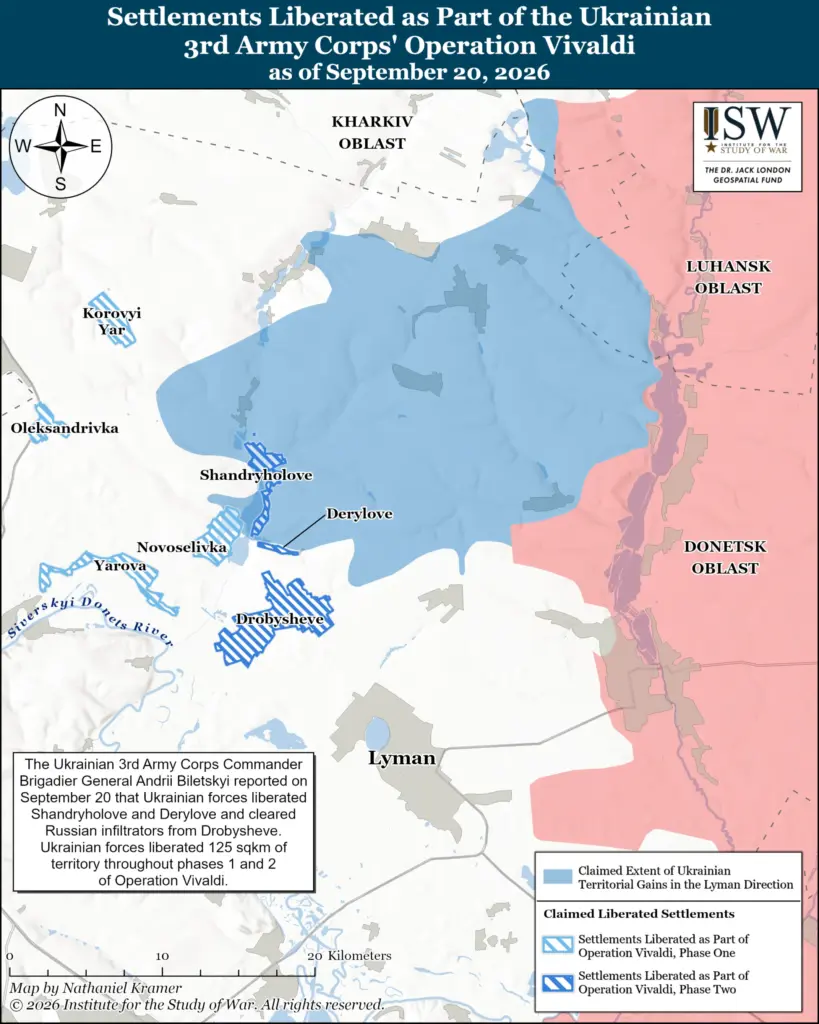
The operation in Nove was its "third season," Biletskyi said, the turning point of the whole operation. The corps liberated Nove, Ridkodub, and Katerynivka and restored control of Karpivka and Novomykhailivka, adding 51 square kilometers, bringing the total liberated since the offensive began to 176. Ukrainian forces have taken 250 Russians captive.

The feint drew Russia's reserves

The victory, by Biletskyi's account, was won by deception.

"The enemy was convinced the main direction of the strike was Shandryholove–Zelena Dolyna," he revealed, and it burned its reserves counterattacking there.

He added that the Russians slept through the real strike, which was concentrated on taking Nove. The village was the prize, a key Russian hub on the bridgehead, ringed by heights that command the surrounding ground.

"Who controls the heights holds the initiative," Biletskyi said.

By spending its reserves on the wrong axis, he suggested, Russia had little left to hold Nove when the real assault arrived.

Old APCs crack the defense

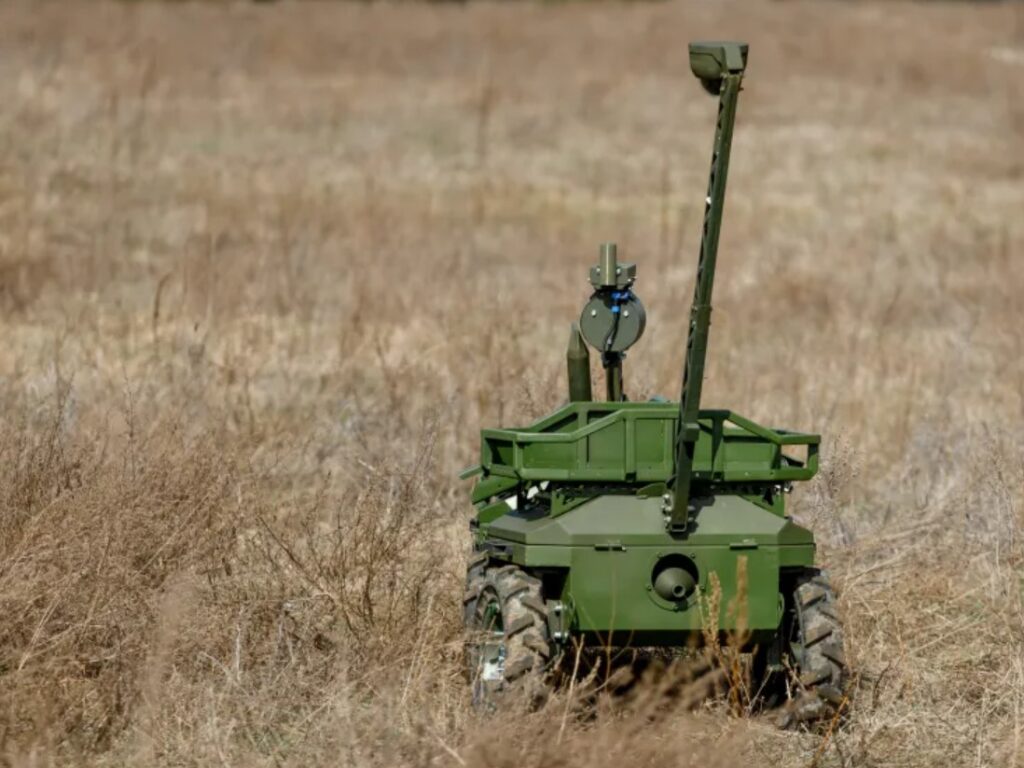
To break the strongest fortifications, the corps said, it used a homemade weapon: Soviet BTR-60 armored carriers converted into remote-controlled kamikaze robots, driven into Russia's toughest positions and detonated.

In 2024, the Ukrainian forces received another local upgrade of the post-Soviet BTR-60 wheeled armored personnel carrier. This time it was fitted with the BM-7 "Parus" turret, known from the BTR-4 "Bucephalus" The main armament consisted of a 30 mm ZTM-1 automatic cannon paired with a 7.62 mm KT-7.62 universal machine gun.

Additional armament might include a set of four anti-tank guided missile launchers mounted on the sides, or two launchers and a 30 mm KBA-117 automatic grenade launcher. As a result, this upgraded BTR-60 saw a significant improvement in firepower, although the vehicle still has very weak armor and less-than-optimal access to the troop compartment.

It was the latest of the corps' robotic improvisations in Vivaldi, which have included air-dropped ground drones and Bullspike grenade-launcher-armed UGVs. They are Bulgarian hand-held, rocket-propelled anti-tank grenade launchers based on the Soviet RPG-22, which the Bulgarian defense industry previously produced under license.

The corps has leaned on such machines throughout the operation to keep its infantry out of the deadliest fights.

Whole units surrender

As the defense broke down, Russians gave up in groups, including officers, pilots, and artillery soldiers, the corps said. The 3rd Assault Brigade carried much of the fighting, while the 3rd Border Guard Detachment, named for the fallen Colonel Yevhen Pikus, retook Ridkodub and dug in on the new line, with the 10th Mobile Border Guard Detachment "DOZOR" taking an active part in the assault.

They say Dobropillia is encircled, but they are actually 10+ km away: ISW publishes map disproving Russia’s claim

25 septembre 2026 à 10:10

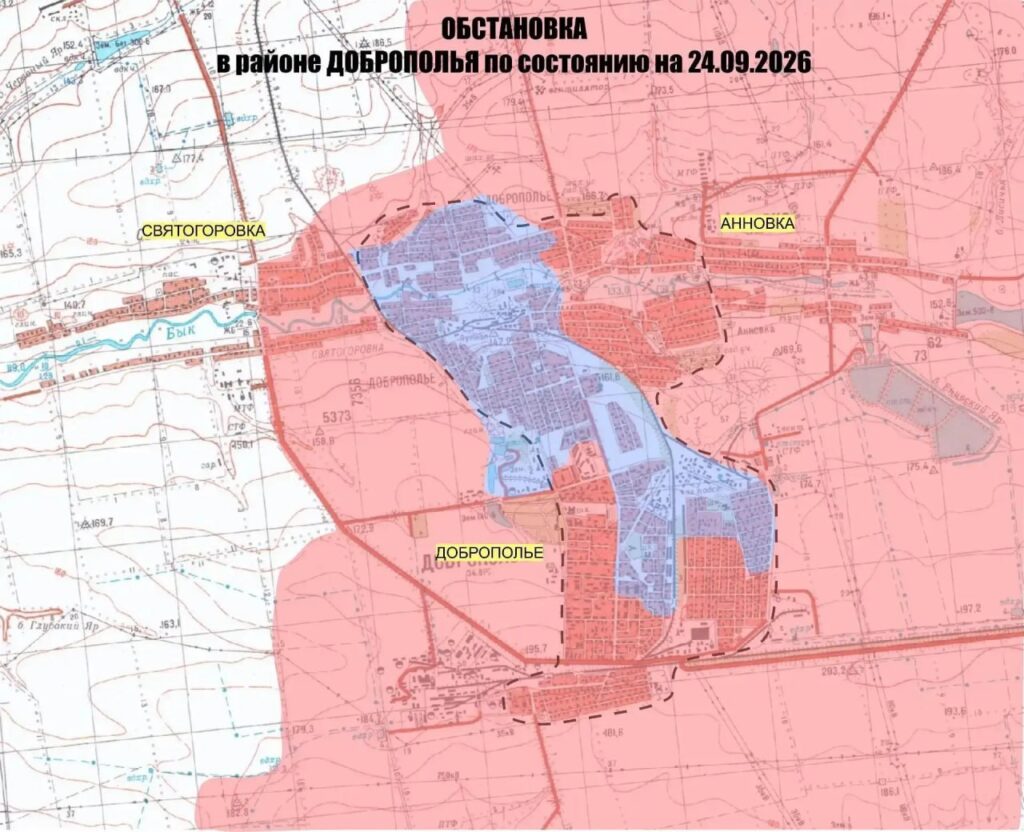
A map showing the territories around Dobropillia that Russia claims to have captured (purple) and analysts’ assessment that Russian forces are 10.2 kilometers from the southeastern outskirts of Dobropillia. Map: Institute for the Study of War

The Institute for the Study of War (ISW) published a map in its analytical report on 24 September that contrasts the claimed Russian encirclement with the location of Russian forces as assessed by the experts. Based on the evidence observed by ISW, the nearest area where Russian forces are present is 10.2 kilometers from the southeastern outskirts of Dobropillia.

Russia has been spreading disinformation about its successes around Dobropillia as part of what ISW calls a cognitive warfare effort to portray Ukrainian defenses as on the verge of collapse. Russia's Defense Ministry published a map claiming the city was surrounded. ISW's own map challenges it. The Ukrainian military says the city remains under its control.

Russian Defense Ministry claims it is already destroying encircled Ukrainian troops in Dobropillia and moving further

Units of Russia's Center Grouping of Forces continue combat operations against encircled Ukrainian forces in the Dobropillia area of Donetsk Oblast while simultaneously advancing toward Oleksandrivka, the Russian Defense Ministry claimed. ISW analysts, meanwhile, said they have not observed evidence supporting Russia's claim that the city is encircled. They also noted that Ukrainian officials "directly refute" the claim.

A Russian map showing the complete encirclement of Dobropillia. ISW and the Ukrainian Armed Forces reject this claim. Map: Russian Defense Ministry

ISW observed evidence that Russian infiltrators, small groups, were operating east and northeast of Dobropillia on 19 and 20 September. The institute did not assess that these infiltrators had consolidated their positions.

Ukrainian forces maintain positions south and northeast of Dobropillia, military observer Kostiantyn Mashovets said on 20 September, according to ISW.

Russian forces have not made major gains in the Dobropillia direction, the chief of staff of an artillery reconnaissance battalion said on 22 September, according to the institute. On the same day, a Russian milblogger described the "alleged Russian encirclement of Dobropillia" as potentially meaning not the direct presence of infantry, but only the establishment of fire control over Ukrainian logistics, including roads west of Dobropillia and toward Sviatohorivka, according to ISW.

ISW noted that Russia's pervasive military culture of lying—what Russian milbloggers themselves call "beautiful reports"—has degraded the Defense Ministry's own ability to understand the battlefield and enabled inflated claims like the Dobropillia encirclement.

Russia uses this disinformation as a "diversion"

In its statement, the Russian Defense Ministry itself described Dobropillia as a "strongly fortified settlement" whose seizure would threaten key Ukrainian supply lines running from Dnipropetrovsk Oblast toward the Fortress Belt—the Sloviansk-Kramatorsk-Druzhkivka urban agglomeration.

Russia has recently renewed its attempts to break through toward Dobropillia.

Third Army Corps Commander Andrii Biletskyi said that Russian forces sought to bypass the fortified cities through Dobropillia and link up with troops advancing from north of Lyman, rather than launch a direct assault. ISW noted on 16 September that the Vivaldi operation disrupted Russia's two-pronged plan. In its 24 September report, ISW said Russia's claims about Dobropillia were partly intended to divert attention from Ukraine's elimination of the Russian salient north of Lyman, which has likely forced Russia's command to rethink its wider encirclement plans.

  • ✇Euromaidan Press
  • Ukraine put robots where its soldiers used to die clearing mines—and lost none
    Ukraine's Third Army Corps says it became the first military unit in the world to use ground robots for mine clearance inside a live offensive, sending the machines ahead of its infantry into the deadliest sectors to keep soldiers out of the line of fire, Censor.NET reported. The corps built the capability from nothing during its Operation Vivaldi counteroffensive in Donetsk Oblast. Keeping soldiers alive has become the organizing principle of how Ukraine fights, and handing the jobs mo
     

Ukraine put robots where its soldiers used to die clearing mines—and lost none

24 septembre 2026 à 14:04

One of Ukraine's fiber optic-controlled UGVs.

Ukraine's Third Army Corps says it became the first military unit in the world to use ground robots for mine clearance inside a live offensive, sending the machines ahead of its infantry into the deadliest sectors to keep soldiers out of the line of fire, Censor.NET reported. The corps built the capability from nothing during its Operation Vivaldi counteroffensive in Donetsk Oblast.

Keeping soldiers alive has become the organizing principle of how Ukraine fights, and handing the jobs most likely to kill them to ground robots is how an army that refuses to treat its people as expendable defends the line.

Robots cleared 30 km of routes in two nights

On the Shandryholove axis, the robots cleared 30 kilometers of routes in two nights—work that two companies of sappers would have needed a full week to finish. The corps reported no losses among its sappers there. Announcing the operation's second phase, corps commander Brigadier General Andrii Biletskyi said protecting personnel drives how his troops plan and fight:

"People often ask, but what about our losses? My answer: we minimize them by every possible means. In assault operations, drones and ground robots always move ahead of the infantry," he said.

Robots clear most of the mines and mine Russian routes in return

The corps says it built the system from scratch and scaled it from a single squad up to the entire corps, arguing that manual clearing would be impossible across open terrain swept by fire. Ground robots now lift roughly 60% of the anti-personnel mines in its area of responsibility. They also work in reverse, remotely mining Russian advance routes—one crew can lay up to 200 meters a day, cutting off enemy reserves. The same machines carry frontline logistics, evacuating the wounded and hauling in provisions and equipment.

Operation Vivaldi continues in Donetsk Oblast, where the corps recently air-dropped robots behind Russian lines. Its advance has disrupted Russia's plan to encircle the fortified belt of Donetsk cities. In the second phase, the Third Army Corps liberated Shandryholove and Derylove and took full control of Drobysheve. Across the operation's first two phases, it has retaken 125 square kilometers.

Ukraine’s Vivaldi counteroffensive near Lyman just got help from behind Russian lines: partisans say they cut rail supply to three Russian regiments, no explosion needed

23 septembre 2026 à 10:54

ATESH partisan Footage of a fire on a relay cabinet at the Bataysk railway junction, near Rostov-On-Don, Russia, 21 December 2025. Screenshot from video: ATESH

Ukrainian partisans say they have sabotaged the railway signaling that keeps Russian troops supplied on the Lyman front. The ATESH movement reports that its agents disabled four relay cabinets on a line through Voronezh Oblast that carries military cargo to Russian forces there, delaying ammunition to three regiments.

The strike was timed to help Ukraine's Operation Vivaldi, the counteroffensive the Third Army Corps is running near Lyman in northern Donetsk. In its first phase, the operation cleared 75 square kilometers of Russian infiltrators and de-occupied another 10.

Cutting the rail line that feeds the Russian units facing that offensive is, by ATESH's account, part of the same fight, targeting the supply line rather than the front.

Four cabinets go dark

The sabotage hit a rail corridor running through the Voronezh, Novovoronezh, Liski, and Ostrogozhsk areas of Voronezh Oblast, a route ATESH says Russia uses to move military cargo toward the Lyman axis.

Relay cabinets house the switching gear that runs a line's automatic signals. Knocking them out can freeze traffic on a stretch of track without a single explosion, and ATESH says its agents disabled four of them. As with the movement's other claims, the account could not be independently verified.

Ammunition backs up

By ATESH's telling, the signaling failure delayed shipments of ammunition and engineering materiel to the 1st and 15th Guards regiments and the 254th Motor Rifle Regiment. Russian commanders, it said, had to rush in repair crews and divert resources to guard the infrastructure. A delayed shipment, far behind the front, can be felt at it, where an assaulted position waits for the ammunition that does not arrive.

ATESH hunts the supply lines

ATESH is a network of pro-Ukrainian agents operating inside Russia and Russian-occupied territory, and it has increasingly gone after the rail and power infrastructure that sustains Moscow's war. This month, the group also said it knocked out the power supply of a plant in Voronezh that makes components for Russian missiles.

  • ✇Euromaidan Press
  • Vivaldi erased Russia’s Lyman pincer. Now Moscow is pushing toward Sloviansk instead
    Ukraine's Vivaldi counteroffensive rolled back a Russian advance north of Lyman in Donetsk Oblast. However, Moscow shifted part of its forces south, Roman Pohorilyi, co-founder of the Ukrainian battlefield mapping project DeepState, told Radio NV. Russian troops are now infiltrating Mykolaivka, a key strongpoint on the approach to the fortress city of Sloviansk, Pohorilyi said. The halted advance was one arm of Russia's plan to encircle Ukraine's Donetsk fortress belt—the fortified citi
     

Vivaldi erased Russia’s Lyman pincer. Now Moscow is pushing toward Sloviansk instead

23 septembre 2026 à 09:51

Two soldiers of Ukraine’s Third Army Corps silhouetted among bare trees at twilight; one holds a radio to his mouth.

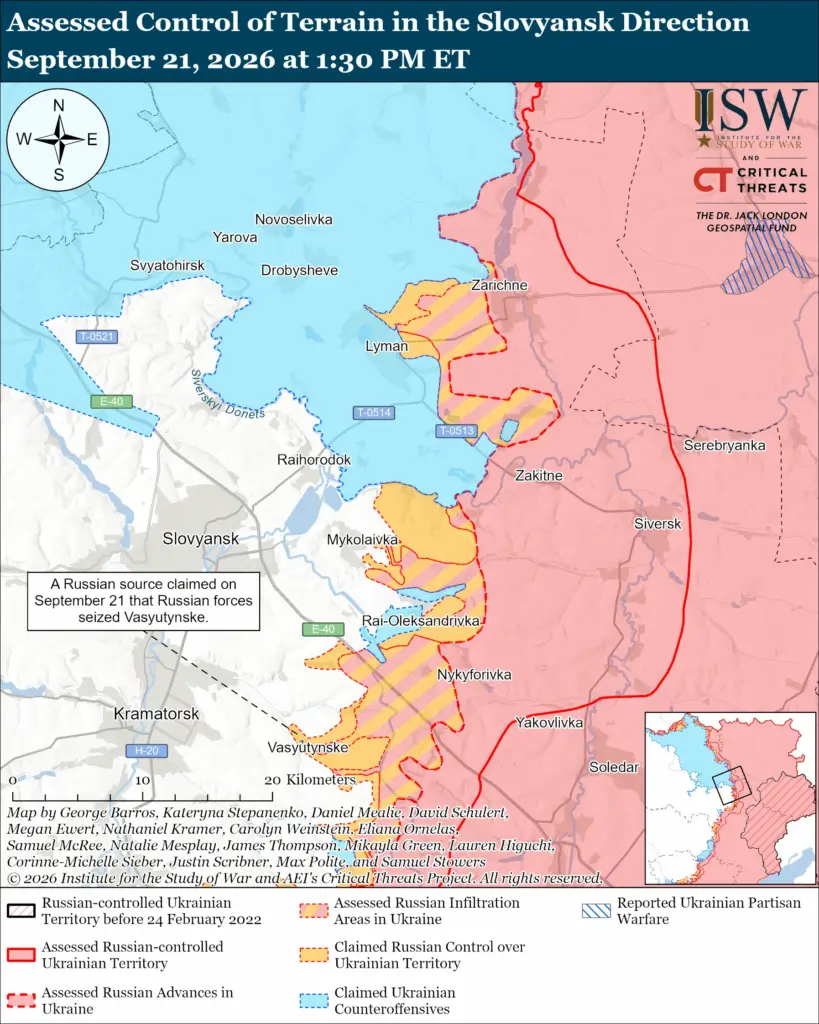
Ukraine's Vivaldi counteroffensive rolled back a Russian advance north of Lyman in Donetsk Oblast. However, Moscow shifted part of its forces south, Roman Pohorilyi, co-founder of the Ukrainian battlefield mapping project DeepState, told Radio NV. Russian troops are now infiltrating Mykolaivka, a key strongpoint on the approach to the fortress city of Sloviansk, Pohorilyi said.

The halted advance was one arm of Russia's plan to encircle Ukraine's Donetsk fortress belt—the fortified cities of Sloviansk, Kramatorsk, Druzhkivka, and Kostiantynivka. Pohorilyi warned that losing Mykolaivka would create serious problems for Sloviansk's defenders. Russia is still pressing toward Dobropillia on the belt's southwestern flank.

Pohorilyi said Russia formed a "claw" north of Lyman by exploiting Ukrainian brigades short of personnel and pushing small groups into their lines. Ukraine's Third Army Corps stabilized the area, built up forces, and counterattacked. The push "multiplied all [Russia's] previous efforts by zero," he said.

Russian forces had repeatedly tried to capture or bypass Lyman, Pohorilyi said. Russian groups still infiltrate the approaches to the city, although Ukrainian forces have stabilized the situation there.

The corps says Vivaldi's first two phases regained control of 125 square kilometers, including 50 that had been under Russian occupation. It reported liberating Shandryholove and Derylove, securing Drobysheve, and inflicting more than 3,000 Russian personnel losses. Those battlefield figures have not been independently verified.

vivaldi's secret weapon targeting robots third corps reconnaissance mapped russian command nodes hit cause panic · post graphic ukraine's army / telegram під час операції вівальді нрк десантували щоб порушити
Explore further

Vivaldi’s secret weapon was the targeting, not the robots: Third Corps reconnaissance mapped Russian command nodes, then hit them to cause panic

Pohorilyi noted that the area around Mykolaivka had, until recently, been under the responsibility of Ukraine's 11th Army Corps and is now under the Third Army Corps.

Ukrainian troops must now find and stop infiltrating Russian groups before they establish control, he said. Personnel shortages on the Lyman axis persist, although he said reinforcements are being distributed more evenly.

Map: ISW

Operation Vivaldi and the wider fight for Donetsk's fortress belt

The Third Army Corps first disclosed Operation Vivaldi on 15 September after conducting the counteroffensive north of Lyman under information silence. Commander Andrii Biletskyi said the announced gains were only the first phase; the corps said its attacks had disrupted Russian supply routes.

A 60th Mechanized Brigade captain said Ukrainian units quietly assembled near Derylove and Drobysheve, then struck Russian drone launch sites at planned times so infantry could advance. The corps disclosed a second phase on 20 September.

Farther southwest, Dobropillia faces even heavier pressure, Pohorilyi said. Russia has concentrated large forces there and is pushing with relentless infantry across a wide front, backed by thousands of drones each month—reconnaissance, strike, FPV, and Lancets—with numbers still rising. Russian troops are moving on settlements south of Dobropillia to establish a strongpoint and push deeper into Donetsk Oblast.

The pressure is not new: Biletskyi said Ukrainian troops halted a Russian incursion there last year. After Moscow claimed on 22 September to have encircled the town, the Institute for the Study of War found no evidence to support the claim.

Vivaldi’s secret weapon was the targeting, not the robots: Third Corps reconnaissance mapped Russian command nodes, then hit them to cause panic

23 septembre 2026 à 05:24

vivaldi's secret weapon targeting robots third corps reconnaissance mapped russian command nodes hit cause panic · post graphic ukraine's army / telegram під час операції вівальді нрк десантували щоб порушити

Ukraine's Third Army Corps dropped kamikaze ground robots on Russian command nodes identified by reconnaissance during Operation Vivaldi, a corps intelligence officer told Radio NV. The strikes aimed to break command coordination and force Russia to divert combat troops to guard its own headquarters, while a parallel campaign destroyed a diesel pipeline that fed about half the daily fuel needs of Russia's entire West grouping.

Russia's full-scale war against Ukraine is now in its fifth year, with Moscow pushing simultaneously along the front and striking cities behind it with drones, cruise and ballistic missiles, and glide bombs. The Vivaldi operation is the first time Ukraine has publicly shown how a reconnaissance-to-robot strike chain works against command nodes without risking infantry, a method that could be replicated across other sectors where Russia's coordination depends on forward headquarters within drone range.

Reconnaissance identified command nodes, robots hit them

One of the tasks set by corps commander Brigadier General Andrii Biletskyi was to disrupt command and communications in the Russian chain of command, the officer said. Brigade and corps reconnaissance identified areas where a strike could break Russian control.

"Reconnaissance of the brigades and the corps identified such areas that could affect the disruption of enemy command. It was into these areas that robots were dropped to create panic, disrupt command, and prevent the enemy from being effective," the officer told Radio NV.

To protect their command posts from the robots, Russian forces had to pull in additional personnel—troops that could not then be used to resist the Third Corps' ground assault.

Map: ISW

The Third Corps announced on 20 September that heavy bomber drones delivered kamikaze ground robots more than 10 km behind Russian lines, calling it a world first.

The same intel operation identified a frontline diesel pipeline

The same intelligence operation uncovered a pipeline running from Voronezh Oblast to temporarily occupied Luhansk Oblast. The pipeline carried finished diesel, not crude oil, and supplied about 50% of the daily fuel needs of Russia's forces on the direction, the officer said.

The corps struck both the intake point where fuel entered the pipeline and the output point where it was loaded onto tankers. The strikes forced Russia to dismantle the pipeline entirely. Russian forces now truck fuel from Voronezh Oblast, a 400 km supply run.

The pipeline's destruction affected not just the Lyman direction but the entire West grouping, including the Kupiansk and Borova directions, the officer said. The logistical disruption left frontline Russian drone units unable to refuel generators to charge batteries, and electronic warfare systems had to operate in a reduced mode.

Repair bases struck, 250 km logistics detour

Third Corps intelligence also located the repair base of Russia's 20th Army and its 144th Division. Ukrainian strikes during the preparatory phase forced Russia to relocate the base to Voronezh Oblast, increasing the repair route to 250 km.

Russia's 20th Army and its 144th Division, reinforced by assault detachments from the First Tank Army, remain the main strike force on the Oskil-Sviatohirsk direction, the officer said. The First Tank Army has been sending additional assault units to stabilize the Russian defensive line after Vivaldi, but these reinforcements are taking critical losses on logistics routes before reaching the combat zone.

vivaldi's secret weapon targeting robots third corps reconnaissance mapped russian command nodes hit cause panic · post isw slovyansk-direction-september-21-2026 ukraine news ukrainian reports

Rubikon pulled out, Russian drone units at 70–90% strength

The officer said the corps headquarters specifically targeted Russia's most effective drone formations. During the preparatory phase, the elite Russian drone unit Rubikon was identified as a critical threat that could isolate the area of operations and obstruct Ukrainian maneuver.

Ukrainian reconnaissance located and passed targeting data to strike assets. Rubikon suffered heavy losses in equipment and personnel, and a senior Russian commander—misjudging the Third Corps' offensive potential—pulled the unit to rear areas for recovery at what turned out to be the worst possible moment, just as Ukraine's assault began.

Russian drone units on the direction are now staffed at 70–90%, the officer said. The corps is working to degrade their capability through targeted strikes on launch sites, pilot positions, and logistics in the second and third echelons.

Four seasons, two public

The officer said Russia's current task is to stabilize its defensive line, restore its observation network, and bring in additional reserves for counterattacks. Russia does not have enough personnel and will have to pull troops from training grounds before they finish their courses, shortening training cycles.

Operation Vivaldi has at least four "seasons," of which only the first two have been made public. The operation's name refers to Italian baroque composer Antonio Vivaldi, and The Four Seasons is his best-known set of four violin concerti.

Biletskyi confirmed the liberation of Shandryholove, Derylove, and full control over Drobysheve on 20 September, bringing the total to 40 km² of freed territory in the second season alone. Russian losses have reached an estimated 3,000 personnel overall, over 12,000 drones in the first season, and hundreds of vehicles, according to the Third Corps. ISW assessed that the operation disrupted Russia's plan to encircle the fortress belt of Donetsk cities—Sloviansk, Kramatorsk, Druzhkivka, and Kostiantynivka.

❌