A Russian strike killed two Norwegian People's Aid deminers and wounded four others in Kherson Oblast on 24 June, the group said. The team was clearing mines from Ukrainian farmland when the strike hit. Ukrainian prosecutors opened a war-crimes investigation.
Kherson Oblast, partly freed from Russian occupation in 2022, stays heavily mined and under daily Russian fire from across the Dnipro River. The same drones and shelling that hit the deminers struck across the oblast t
A Russian strike killed two Norwegian People's Aid deminers and wounded four others in Kherson Oblast on 24 June, the group said. The team was clearing mines from Ukrainian farmland when the strike hit. Ukrainian prosecutors opened a war-crimes investigation.
Kherson Oblast, partly freed from Russian occupation in 2022, stays heavily mined and under daily Russian fire from across the Dnipro River. The same drones and shelling that hit the deminers struck across the oblast that day and into the next, killing and wounding civilians far from any front line. Such attacks repeat every day in the region and are known as the so-called "human safari."
Russia has turned Ukraine into the world's most mined country, contaminating tens of thousands of square kilometers of farmland that only a few thousand clearance workers can slowly make safe—work measured in decades, not years.
A strike at midday on a demining team
The strike hit at about 12:50 p.m. near the village of Novopetrivka, in the Vysokopillia community, Norwegian People's Aid said. One worker was killed at the scene, and a colleague taken to hospital later died of wounds. Four others were wounded, two in serious condition as doctors fought to save their lives.
The dead and wounded were all Ukrainian nationals, the group said. A 24-year-old demining specialist was among those killed, the head of Kherson Oblast Military Administration, Oleksandr Prokudin, reported. The team had been clearing land of mines and unexploded ordnance, a basic condition for farmers to return to their fields and for displaced people to come home.
"Military authorities in Kherson report through Ukrainian media that Norwegian People's Aid was struck by a Russian Iskander‑M missile. The organization is still working to verify this information and the exact circumstances surrounding the attack," the organization wrote in its press release.
Despite the fact that it's always Russia deliberately targeting first responders and humanitarian organizations, the group called on "all parties" to respect international humanitarian law and stressed that humanitarian workers are not a target. It suspended all its demining operations in Ukraine after the strike.
Explore further
24-year-old foreign deminer came to clear Russia’s mines in Kherson. Russian shelling killed him and wounded four colleagues
A war-crimes case
Viktoriya Fedotova, head of the Ukrainian NGO Martin-Club and a partner of the demining team, wrote that the workers had taken no part in combat. They were clearing Ukrainian soil so civilians could be safe, she said, and her own team had trained alongside the dead only recently. Attacking those who save lives and make land safe is a gross violation of international humanitarian law, she added.
The Kherson regional prosecutor's office opened a war-crimes case under Article 438 of Ukraine's Criminal Code. Investigators said Russian forces struck near Novopetrivka at around 1 p.m., hitting members of the non-governmental organization as they cleared the ground.
Explore further
Russia kills four firefighters in Kharkiv hitting the same spot twice in one night
A usual day of Russian strikes across the oblast
Across Kherson Oblast over the preceding 24 hours, Russian drones and artillery hit Kherson city and dozens of settlements, the regional administration reported. The strikes killed two people while wounding 16.
By late afternoon on 24 June, prosecutors had logged one civilian killed and 11 wounded across the oblast from artillery, mortars, drones, and a ballistic strike. A drone hit a civilian fuel station around 5 p.m., seriously wounding two people.
Explore further
Russia kills firefighter in Kharkiv double-tap attack and strikes Kyiv’s Brodsky Synagogue—both hit in 130-drone overnight assault
The strikes continued the next morning.
On 25 June, prosecutors opened a fresh war-crimes case over drone attacks on a city hospital and a utility worker.
Around 8 a.m., a drone strike on the Kherson hospital wounded five of its medical and technical staff.
At 9:10 a.m., a drone wounded a 63-year-old utility worker in the Korabelnyi district, and just before 11 a.m. another strike hurt a 61-year-old man in the same district.
A 62-year-old woman was hospitalized with blast and head injuries from a Shahed strike in the Central district the day before, and a 16-year-old boy needed care for a blast injury from another drone strike there.
A 60-year-old woman and a man sought help after a drone hit their car between Bilozerka and Pryozerne.
Explore further
Russian missiles hit kindergarten and kill rescuer in overnight strikes across Ukraine
A pattern of strikes on those who help
UN investigators have previously ruled Russia's deliberate drone hunting of Kherson's civilians and rescuers a crime against humanity, tracing the campaign up the chain of command. Russian forces have hit humanitarian deminers before: in September 2025, a Russian missile killed two workers and wounded five from a Danish Refugee Council clearance team near Chernihiv, in northern Ukraine.
Russian forces have killed a foreign humanitarian deminer in Kherson Oblast. Shelling on the village of Novopetrivka killed a 24-year-old demining specialist working for Norwegian People's Aid and wounded four of his colleagues, head of Kherson Oblast Military Administration Oleksandr Prokudin reported.
The strike hit people whose job is to undo Russia's damage. Ukraine fields about 3,000 deminers against some 180,000 square kilometers of contaminated land, Euromaidan P
Russian forces have killed a foreign humanitarian deminer in Kherson Oblast. Shelling on the village of Novopetrivka killed a 24-year-old demining specialist working for Norwegian People's Aid and wounded four of his colleagues, head of Kherson Oblast Military Administration Oleksandr Prokudinreported.
The strike hit people whose job is to undo Russia's damage. Ukraine fields about 3,000 deminers against some 180,000 square kilometers of contaminated land, Euromaidan Press found this week, and Russian attacks keep thinning their ranks even as Russian forces lay new mines nightly.
Kherson Oblast, partly liberated from Russian occupation in 2022, stays heavily mined and under regular fire from across the Dnipro.
Shelling hits Vysokopilska community
Russian troops shelled Novopetrivka in Vysokopilska community, Prokudin said. The 24-year-old was killed, and four other Norwegian People's Aid workers were hospitalized, two of them in serious condition as medics fought to save their lives.
The area was retaken from Russian forces in 2022 and remains littered with mines and unexploded ordnance, the kind of contamination the clearance teams had come to remove.
Strikes target deminers repeatedly
Russian forces have hit humanitarian deminers before. In September 2025, a Russian missile killed two workers and wounded five from a Danish Refugee Council clearance team near Chernihiv, the city's military administration said.
Ukraine's human rights commissioner called the strike a cynical crime against people carrying out humanitarian work, and the team's employer described it as a serious violation of international humanitarian law. Clearance crews make liberated land safe for residents to return, and mine clearance in Ukraine is already a job measured in decades.
Attacks hit aid operations
Russia has repeatedly struck humanitarian operations across Ukraine. In May, a precision Iskander missile damaged a UN World Food Program warehouse in Dnipro, the agency said, cutting into food meant for about 130,000 people.
The agency reported more than 84 incidents affecting its warehouses, distribution points, and transport across Ukraine over the previous 18 months, and Kyiv has urged the UN to press Russia to halt the attacks.
Ukraine's military shared the demining technologies tested at UTTC Technology Week 2026. The 40-tonne ScanJack 3500 heavy demining machine and robotic platforms for urban operations were among the showcased systems, ArmyInform reports.
The combined heavy-machine and robotic-platform showcase fits Ukraine's broader shift toward remote demining, with the defenders emphasizing field experience over theoretical demonstration. Ukraine remains the world's most mine-contaminated c
Ukraine's military shared the demining technologies tested at UTTC Technology Week 2026. The 40-tonne ScanJack 3500 heavy demining machine and robotic platforms for urban operations were among the showcased systems, ArmyInform reports.
The combined heavy-machine and robotic-platform showcase fits Ukraine's broader shift toward remote demining, with the defenders emphasizing field experience over theoretical demonstration. Ukraine remains the world's most mine-contaminated country, with approximately 460,000 hectares of territory identified for clearance.
Practical goals from the showcase are to reduce risk to personnel, shorten survey and clearance times, raise situational awareness, and expand the share of dangerous work performed remotely, per ArmyInform.
ScanJack 3500 clears mines to 30–40 cm depth at walking pace
The ScanJack 3500 weighs nearly 40 tonnes and clears mines to a maximum depth of 30 to 40 centimeters. The machine operates at speeds between 0.2 and 1.5 kilometers per hour during demining and consumes 50 to 90 liters of fuel per hour, depending on conditions.
The operator works from inside an armored cab covered with steel paneling and bulletproof glass, controlling the system via a joystick. The Swedish-built machine carries two engines — one for the vehicle's drivetrain and one for the demining attachment.
Robotic platforms tackle urban demining in destroyed areas
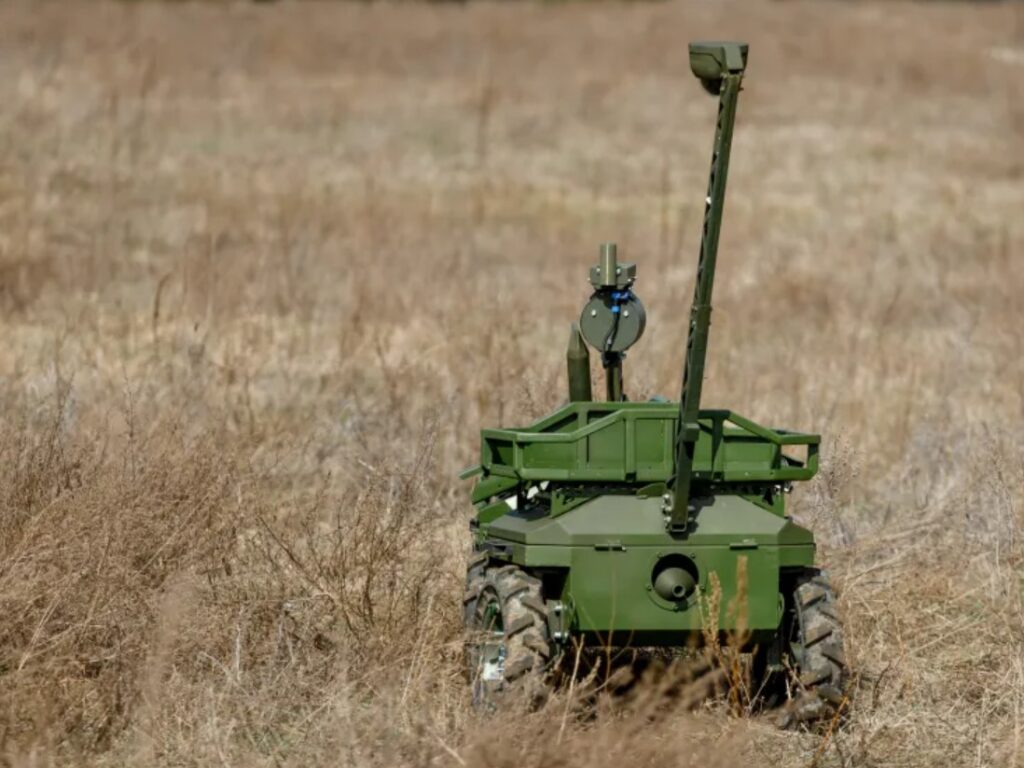
Robotic platforms for searching, detecting, and destroying explosive ordnance were also showcased for use in hard-to-access urban environments such as destroyed settlements, industrial zones, and private-sector buildings. Work in urban conditions is jewelry-precise and super-dangerous because of mine-traps, trip wires, and rubble. The ground robotic platforms' main task is not only to neutralize explosives but to keep Ukrainian sappers out of immediate proximity to them.
In recent months, Ukraine has codified domestic ground robots specifically for sapper roles, including the NEO-1 modular platform and the upgraded Vepr ground robotic complex. The Defense Ministry's broader procurement target is more than 25,000 ground robotic complexes in the first half of 2026, which is twice as many as in all of 2025.
Shuvarskyi says showcase reflected operational practice, not theory
"What we presented at UTTC Technology Week was not theoretical projections, but real field experience of demining units," Colonel Oleh Shuvarskyi said during demonstration events.
Most demonstrated technologies have dual-use applications and can be deployed for both humanitarian demining and military mobility, engineering reconnaissance, remote inspection of dangerous territories, logistics, evacuation, and engineering tasks in combat areas.
Maksym Dobrianskyi fought as a commander around Bakhmut and Avdiivka until 2023, when he stepped on an anti-personnel mine and lost a leg. He is now in mine action—one of a growing number of war-wounded Ukrainian veterans being retrained for the decades-long job of making their country safe to walk again.Euromaidan Press heard him speak this month at a demining-technology exercise in Lviv Oblast.
Maksym Dobrianskyi fought as a commander around Bakhmut and Avdiivka until 2023, when he stepped on an anti-personnel mine and lost a leg. He is now in mine action—one of a growing number of war-wounded Ukrainian veterans being retrained for the decades-long job of making their country safe to walk again.
Euromaidan Press heard him speak this month at a demining-technology exercise in Lviv Oblast.
Explore further
Dust and demining in Lviv Oblast—where the future of clearing the world’s most mined country meets the county fair
The Ministry of Veterans Affairs already counts well over a million veterans, a figure that climbs every month, and projects five to six million veterans and their families once the war ends. Set against a clearance task measured in decades—patient, ground-level labor—Ukraine is not short of people who could do the work, only of the money to hire them.
An earlier round trained 22; 11 found work.
The effort that brought Dobrianskyi in is paid for one grant at a time. Its latest cohort, under a UNDP-backed program—40 specialists, many of them veterans with disabilities—began work in Kharkiv Oblast in January 2026 on 12-month contracts.
They are trained in non-technical survey and risk education: the unglamorous front end of demining, working out which land is dangerous and warning the people who live on it. An earlier round trained 22; 11 found work. The Netherlands and Luxembourg funded this one. How big the next one is depends on who funds it.
Ihor Bezkaravainyi has argued that mine survivors make natural recruits for mine action.
Russia’s war has left farmland larger than Croatia unusable, at a cost Kyiv puts at $11 billion a year—and by the government’s own reckoning, the job will take at least a decade, with some land never safe to return to at all.
Deputy Minister Ihor Bezkaravainyi, who coordinates the demining response, lost his own leg to a Russian anti-tank mine in 2015 and has argued that mine survivors make natural recruits for mine action. Dobrianskyi is what that argument looks like in a field.
Deputy Minister Ihor Bezkaravainyi, who coordinates Ukraine's demining response, at the UTTC Technology Week media day. Photo: Olha Zalizniak / UNDP Ukraine
He had braced himself, he says, for a life of sitting at home and grieving, until a leaflet at an employment center offered retraining. He would rather not remember the treatment, the rehabilitation, the prosthetics. What changed was the work and the people beside him.
The veterans he trained with, he added, are “like a family now.”
“I was wounded, and I want to help people the same way,” he said, “so that this doesn’t happen.” The veterans he trained with, he added, are “like a family now.”
The cameras were up and the film was rolling, and so was the ScanJack 3500—the biggest machine on the field, four wheels, roughly the size of a bus. It crawled along the sandy ground for over five minutes, engine deafening, its chains churning the soil and raising a cloud of dust and sand, pace glacial, every lens trained on it and waiting.
It was the one moment all day that went exactly to plan—a machine doing on cue what the brochure promises.
When it finally rea
The cameras were up and the film was rolling, and so was the ScanJack 3500—the biggest machine on the field, four wheels, roughly the size of a bus. It crawled along the sandy ground for over five minutes, engine deafening, its chains churning the soil and raising a cloud of dust and sand, pace glacial, every lens trained on it and waiting.
It was the one moment all day that went exactly to plan—a machine doing on cue what the brochure promises.
When it finally reached its mine and set it off, the bang caught the whole press corps out: we twitched as one, then burst out laughing, a little sheepishly, at having flinched. It was the one moment all day that went exactly to plan—a machine doing on cue what the brochure promises—and we had been walked over specially to see it.
This was the second UTTC Technology Week, its media day of live trials on 17 June at a field in Lviv Oblast nobody would name. The Ministry of Defense staged it with the Ministry of Economy, Environment and Agriculture and the UN Development Programme, and the pitch was the future of demining: minefields cleared by drones, AI, and robots, with people kept as far from the bang as possible.
The demining robot Germina rolls past during the march of technologies. Photo: Olha Zalizniak / UNDP Ukraine
A swimming meet in the dust
The centerpiece was a “technology relay.” Whatever that would mean.
In the end, it was two teams—government operators on one side, commercial deminers on the other—turned loose on two plots, an open agricultural field and a wooded strip, apparently seeded with mines and tripwires.
There was the roar of engines, the scorching sun that fried us where we stood, giant horseflies buzzing bloodthirstily around, and the machines.
Apparently, because for the time we were there, nothing on those plots went off. There was the roar of engines, the scorching sun that fried us where we stood, giant horseflies buzzing bloodthirstily around, and the machines spent half the time too far off or behind the trees and bushes to make anything out.
Drones whirred overhead and fed images to the screens in the nearby tent; a woman with a microphone narrated gamely, and still none of it resolved into anything I could follow. The officials kept insisting this was not a competition but an exchange of experience—a strange thing to say about two teams racing each other across a minefield.
During the debrief, one veteran of the event admitted he had stood at the edge of the same field with the same question I had.
I kept thinking of Raoul Duke—Hunter S. Thompson’s stand-in in Fear and Loathing in Las Vegas—out at the mad racing event called Mint 400, trying and failing to keep track of a race behind a wall of dust and chaos. I was not alone in this. During the debrief, one veteran of the event admitted he had stood at the edge of the same field with the same question I had: Okay, but what is actually going on here?
Euromaidan Press journalist Peeter Helme, second from left, inspects the crater left after the ScanJack 3500 detonated a mine. Photo: Olha Zalizniak / UNDP Ukraine
The cast
There were speeches, because there always are. Oleg Shuvarskyi of the Ministry of Defense opened by promising the equipment on show was no longer absurdly expensive—that it had, as he put it, more “earthly” prices now.
Then came Deputy Minister Ihor Bezkaravainyi, who lost his own leg to a Russian anti-tank mine in 2015 and now coordinates Ukraine’s demining response. He reached for Lao Tzu—governing a state, the saying goes, is like cooking a small fish—and then delivered the line he repeats like a mantra: mine action is not about demining. Demining is only part of it. The rest is economy, agriculture, environment, governance, the whole slow business of making land usable again.
Explore further
Russian mines cost Ukraine $11 billion every year. Clearing them is the work of decades
The UN’s people spoke too. Ben Lark, who runs UNDP’s mine action program here, framed the day as less about the machines than about getting operators, manufacturers, scientists, and donors into one field to argue with each other.
His research specialist, Edward Crowther, was bolder about the stakes: Ukraine, he said, is at the cutting edge of humanitarian demining technology worldwide right now. Coming from the organization writing some of the checks, it is the kind of claim worth holding at arm’s length—though on the evidence of the impressive-looking hardware rolling past, not an empty one.
UNDP’s Edward Crowther addresses journalists at UTTC Technology Week. Photo: Euromaidan Press
The march of machines
Before the relay, there was a “march of technologies.” The whole arsenal passed us in single file—driven, flown, or, for the small things like experimental battery packs or smaller medical units, carried by hand.
A good deal of it still experimental, being tested and tweaked on this very ground.
Among them: the behemoth ScanJack 3500, different soil-tilling rigs and remote-controlled mowers, the medium MV-4 and the Neo ground robots, drones for visual and magnetic survey, an electromagnetic trawl for detonating mines from a distance, even a portable Vodafone base station for throwing up a signal in a field.
Most of it Ukrainian-made. A good deal of it still experimental, being tested and tweaked on this very ground, partially on this very day.
Maksym Dobrianskyi, a war veteran who lost a leg to an anti-personnel mine in 2023 and retrained as a humanitarian deminer, at UTTC Technology Week. Photo: Euromaidan Press
A quieter corner
At a separate briefing held for the small group of journalists present, in a calmer corner of the field, a veteran named Maksym Dobrianskyi told us how he came to this work. He fought around Bakhmut and Avdiivka, and in 2023, he stepped on an anti-personnel mine and lost a leg.
Instead, he found a leaflet at an employment center advertising retraining for wounded veterans as humanitarian deminers, and took it.
He had braced himself, he said, for a life of sitting at home and grieving. Instead, he found a leaflet at an employment center advertising retraining for wounded veterans as humanitarian deminers, and took it. He clears mines now.
“I was wounded, and I want to help people the same way,” he said, “so that this doesn’t happen.” Two men in the same field, both missing a leg to a Russian mine, both now spending their lives on it.
Explore further
Ukraine has a million wounded veterans—and the funding to train forty as deminers
Macarons and minefields
The lunch was warm—a choice of sausage or baked fish, spaghetti with herbs—and the spread around it was generous: fruit and vegetables, little cakes, macarons, different salads. We stood eating there in a dust-blown field while fat horseflies worked our arms and legs, and I felt the sunburn slowly but surely taking hold of my face and neck.
Mines and unexploded ordnance have killed more than 400 people and injured over 1,000 since the full-scale invasion.
Russia’s war has affected roughly 133,300 square kilometers of Ukraine, including 57,900 square kilometers of farmland—an area larger than Croatia—at a cost Kyiv puts at $11 billion a year. Mines and unexploded ordnance have killed more than 400 people and injured over 1,000 since the full-scale invasion, by Ukraine’s own count.
Bezkaravainyi has said openly that parts of the country may never come back: a Ukrainian Zone Rouge to set beside the one the First World War left in France, or beside Chornobyl.
What the machines still can’t do
The jury’s sharpest verdict of the day was not praise but a wish list. Deminers are still hauling five or six separate robots to a site—one to fly, one to search, one to dig, one to blow things up—when what they want is a single universal machine that does it all. Whether it’s a realistic direction engineers are working toward or a sci-fi dream remains one of the day’s mysteries.
Innovation has been far better at killing in this war than at cleaning up after it.
Another remark was that although at the exercise field the teams could freely use airborne drones for reconnaissance, in reality, it would be impossible near the front because such drones are not hardened against electronic warfare.
And the minister whose ministry helped stage the whole show is the same man who told me, a month earlier, that innovation has been far better at killing in this war than at cleaning up after it. Machines identify, Bezkaravainyi said. Humans still clear.
I was sunburned, bitten raw by horseflies, and too fried to follow the closing remarks, which had drifted into the kind of shop talk only the people who do this for a living could love.
By the end of the day, I was sunburned, bitten raw by horseflies, and too fried to follow the closing remarks, which had drifted into the kind of shop talk only the people who do this for a living could love and understand.
When it was over, the buses took us back. Bone-tired as I was, I held off until we hit the main road and the signal returned, then grabbed my phone and frantically thumbed through a day’s worth of emails and messages, feeling naked after so long cut off from the world.
Italy has pledged 1.5 million euros (approximately $1.6 million) to support humanitarian demining efforts in Ukraine, deepening its partnership with the United Nations Development Programme (UNDP) and the Ukrainian government. The agreement was formalized during a high-level ceremony in Kyiv on June 23 attended by Italian Ambassador Carlo Formosa, UN Assistant Secretary-General and new UNDP Administrator Haoliang Xu, Jaco Cilliers, Resident Representative of the UNDP in Ukraine, and Ukraine’s Fi
Italy has pledged 1.5 million euros (approximately $1.6 million) to support humanitarian demining efforts in Ukraine, deepening its partnership with the United Nations Development Programme (UNDP) and the Ukrainian government.
The agreement was formalized during a high-level ceremony in Kyiv on June 23 attended by Italian Ambassador Carlo Formosa, UN Assistant Secretary-General and new UNDP Administrator Haoliang Xu, Jaco Cilliers, Resident Representative of the UNDP in Ukraine, and Ukraine’s First Deputy Prime Minister and Economy Minister Yuliia Svyrydenko.
"Demining is not just a technical operation; it is a deeply humanitarian act that combines cooperation and innovation to restore hope in Ukraine," Ambassador Formosa said. "This project is not only a response to the emergency — it’s a step toward recovery. It’s about returning land to farmers, playgrounds to children, and safe roads to families."
The funding will support UNDP’s mine action program, which focuses on clearing land contaminated by mines and explosive remnants of war, ensuring the safe return of land to Ukrainian communities.
The initiative comes as Ukraine continues to grapple with one of the world’s largest demining challenges. According to the State Emergency Service, the total area of potentially mined land has been reduced by over 20% since late 2022. However, approximately 137,000 square kilometers (52,900 square miles) — much of it farmland — remain contaminated. Demining operations are carried out by the emergency service personnel, National Police, Ministry of Defense, and non-governmental organizations.
Currently, 112 certified demining operators, including eight international groups, are active in Ukraine, the State Emergency Service reported on June 24. Their combined capacity includes more than 9,000 personnel, 278 specialized vehicles, and over 13,000 metal detectors.
While significant progress has been made, Ukrainian officials stress that continued international support and funding are critical to accelerating clearance efforts.