The gap between technology and policymaking has gotten wider than ever with artificial intelligence, leaving a global policy vacuum as A.I. models rapidly advance.
The gap between technology and policymaking has gotten wider than ever with artificial intelligence, leaving a global policy vacuum as A.I. models rapidly advance.
President Trump has repeatedly proclaimed that he controls spending of MAGA Inc., the super PAC his advisers run. A new complaint argues this is against the law.
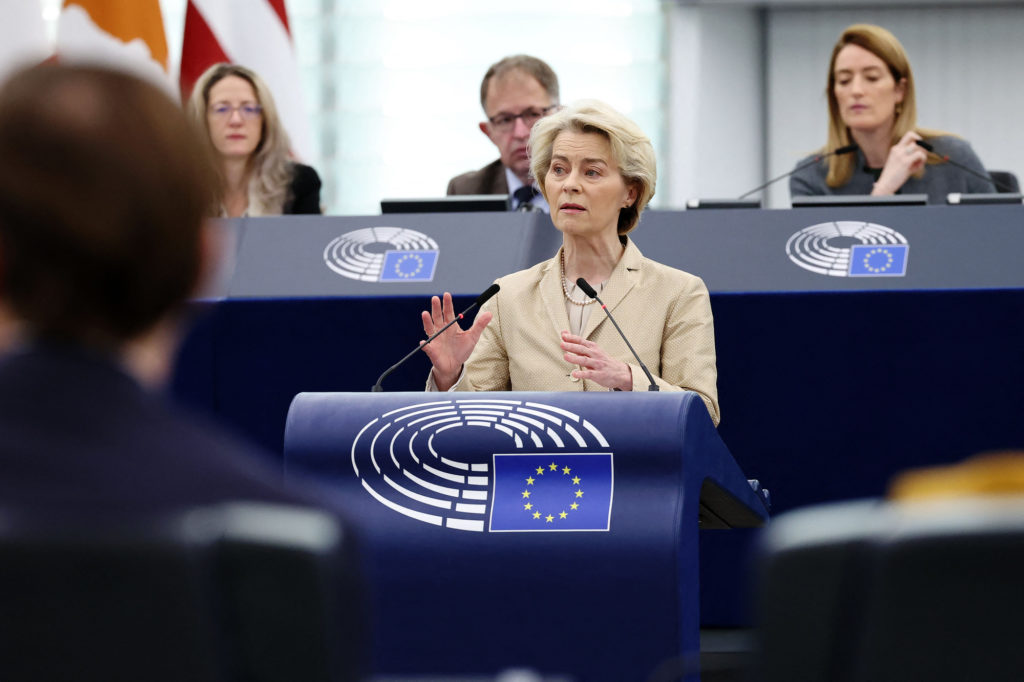
EU Commission President Ursula von der Leyen says Europe will provide Ukraine with another €3.3 billion for missiles and drones as Russia intensifies attacks on Kyiv and seeks to make daily life in Ukraine's cities impossible.
Ukraine has repeatedly appealed to its partners for more air defense as Russia develops increasingly sophisticated ways to attack Ukrainian cities, while Ukraine’s stocks of air-defense interceptors have fallen to critically low levels.
Following a call with Pr
EU Commission President Ursula von der Leyen says Europe will provide Ukraine with another €3.3 billion for missiles and drones as Russia intensifies attacks on Kyiv and seeks to make daily life in Ukraine's cities impossible.
Ukraine has repeatedly appealed to its partners for more air defense as Russia develops increasingly sophisticated ways to attack Ukrainian cities, while Ukraine’s stocks of air-defense interceptors have fallen to critically low levels.
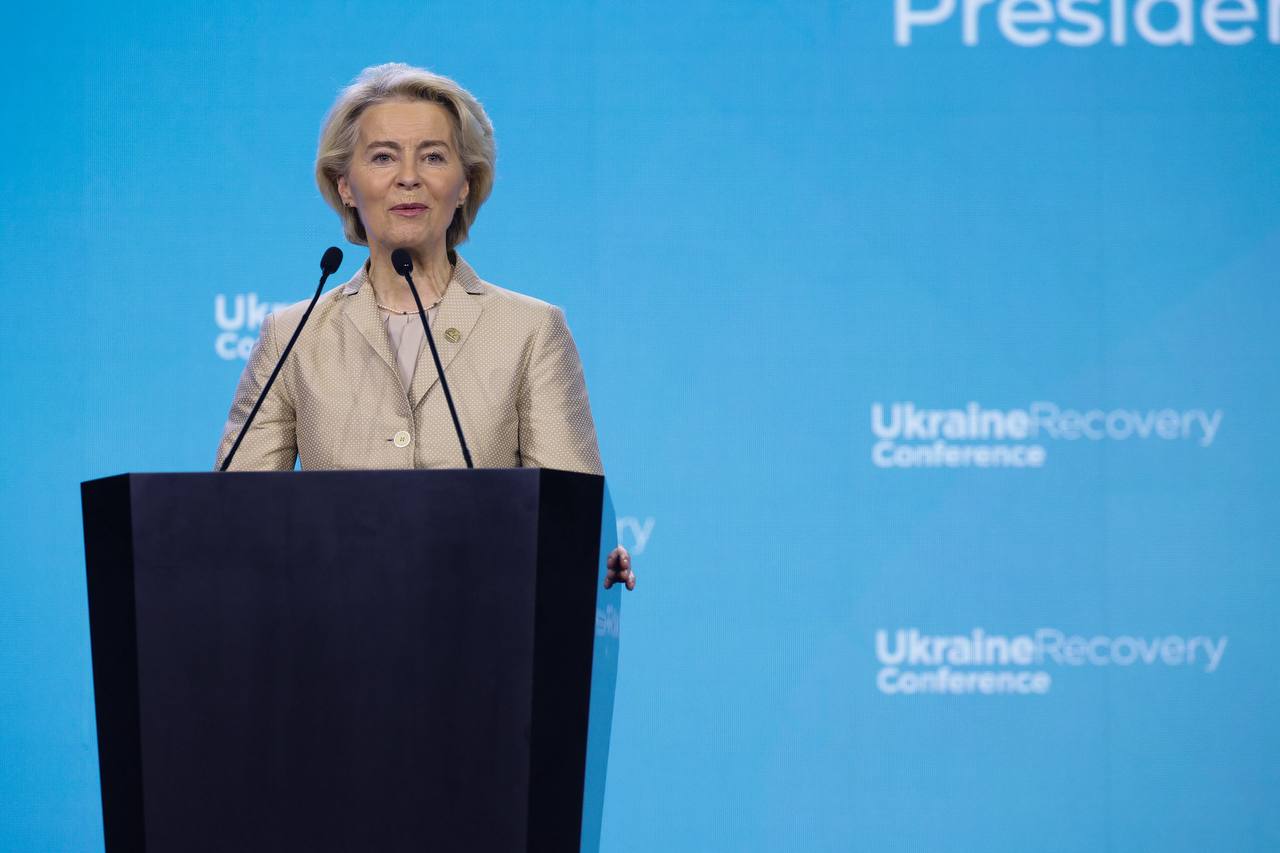
Following a call with President Volodymyr Zelenskyy, von der Leyen said the EU would disburse the funds on 18 September. She also said the EU had approved funding for Patriot air defense systems through its Ukraine Support Loan.
Ukraine needs more air defense
Russia has increasingly combined large numbers of attack drones with ballistic and cruise missiles, forcing Ukraine to defend vast areas while facing shortages of high-end interceptors.
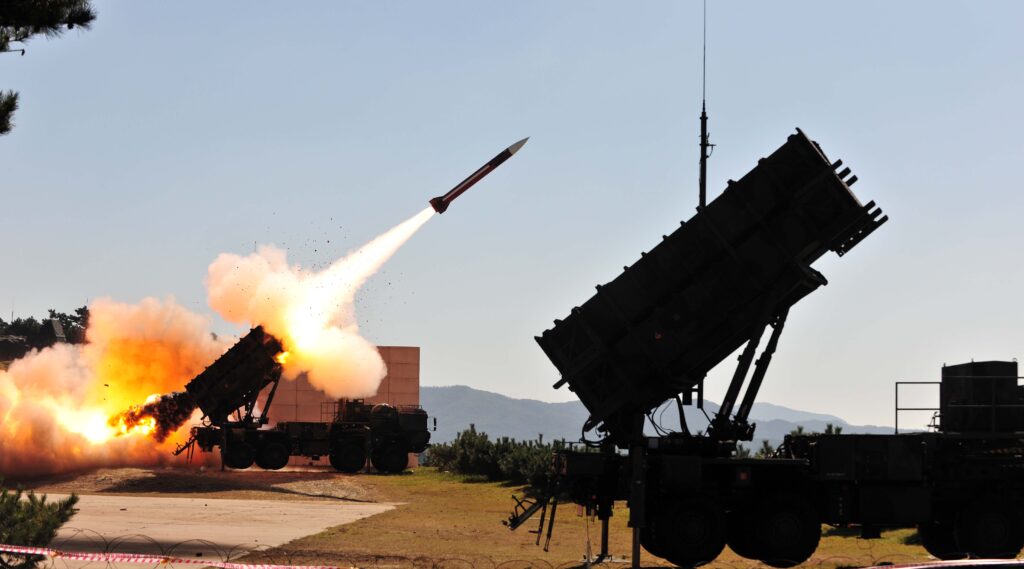
The most difficult targets are Russia’s ballistic missiles, which can reach Ukrainian cities within minutes and require specialized systems such as Patriot to intercept. Ukraine has repeatedly called for more Patriot batteries and interceptors as Russia increases missile attacks.
Ukraine also needs additional air defense capabilities to counter Russia’s increasingly sophisticated drone attacks. Russia is deploying faster, more advanced Geran-type drones that are more difficult to intercept, increasing pressure on Ukraine’s already limited air-defense stocks.
Von der Leyen said the EU had approved funding for Patriot systems last week, but acknowledged that “clearly more is needed.”
The new €3.3 billion package will fund the procurement of missiles and drones for Ukraine, strengthening its ability to defend against Russian attacks.
I just had a phone call with President @ZelenskyyUa.
Tomorrow we will disburse €3.3 billion for missile and drones in Ukraine.
Von der Leyen also announced that the EU is prepared to use remaining funds from its Security Action for Europe (SAFE) program to launch a new joint EU-Ukraine defense initiative.
The proposed program would focus on developing a European air and missile defense system, building on the jointly developed anti-ballistic Freya system.
The goal is to combine Ukraine’s battlefield experience and defense innovation with European technology and industrial capacity, according to von der Leyen.
The announcement comes as Ukraine is trying to strengthen its air defenses ahead of another winter of Russian attacks, when strikes against energy and other critical infrastructure could have an especially severe impact on civilians.
Explore further
The EU has billions in unspent defense funds. It wants to use them for projects with Ukraine
Von der Leyen calls for broader support
Von der Leyen said the EU has already mobilized nearly €15 billion for Ukraine in 2026, with additional support planned. She added that “more is coming.”
She also said Ukraine needs to complete reforms in the Verkhovna Rada to unlock further funding and continue its path toward EU membership.
“Europe is stepping up,” von der Leyen said. “Now others must step up their support too.”
Bo French, a candidate for the Texas Railroad Commission, drew bipartisan criticism for his social media posts. Above, at a conservative conference in March.
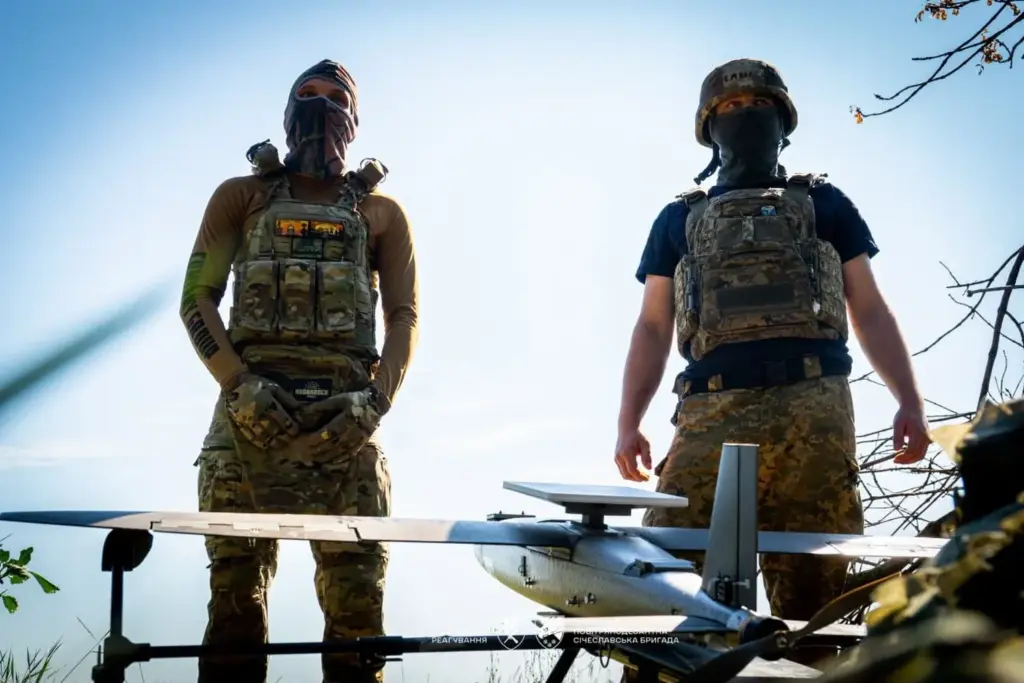
Ukraine's battlefield-tested drone makers and Europe's arms firms have sat down together for the first time to build drones and the systems to shoot drones down as a single industry. Eighteen companies, nine Ukrainian and nine European, held the opening meeting of the EU-Ukraine Drone Alliance in Brussels, Defender Media reported.
The alliance answers a threat both sides now share. Russia is scaling up its own drone production. Its drone war has spilled past Ukraine, with its drones cro
Ukraine's battlefield-tested drone makers and Europe's arms firms have sat down together for the first time to build drones and the systems to shoot drones down as a single industry. Eighteen companies, nine Ukrainian and nine European, held the opening meeting of the EU-Ukraine Drone Alliance in Brussels, Defender Media reported.
The alliance answers a threat both sides now share. Russia is scaling up its own drone production. Its drone war has spilled past Ukraine, with its drones crossing repeatedly into NATO airspace this summer and showing Europe how unready it is for the fighting Ukraine has learned the hard way.
The Alliance will support Ukraine's capabilities it needs on the battlefield, while strengthening Europe's defense readiness for the future.
The alliance sets up shop
The first job is organizational, said Roman Tkachenko, a co-founder of the Ukrainian firm Tencore: form the governing bodies and set the priorities. The 18 members were chosen from about 400 applicants, Kubilius said, and the alliance is designed as a decision-making body, according to UA News.
On the Ukrainian side, it includes Tencore, Athlon Avia, and Vyriy Industry. On the European side, Germany's Quantum Systems, Italy's Fincantieri, and Denmark's Terma.
Kubilius, who opened the session and called it historic, said the first tangible results should come by the end of the year. He named accelerating joint ventures and counter-drone projects as the top tasks.
Europe wants Ukraine's combat edge
Kubilius was blunt about what Europe hopes to learn: how to adapt a product in days, shorten development cycles, and scale a production line from a peacetime trickle to full output within weeks. In return, he said, the EU offers Ukraine cutting-edge technology and continent-wide manufacturing.
The Alliance will bring together companies, start-ups, researchers, armed forces, and other users from EU countries and Ukraine.
The Alliance is a result of the Drone Deal, announced by President Ursula von der Leyen in Kyiv on 15 July, according to the EU Commission.
The European Commission has formally approved €6.1 billion ($7.1 billion) for Ukraine's air defense, drones, and missiles, EU Defense and Space Commissioner Andrius Kubilius announced on 12 September. The decision lets Ukraine order American Patriot Advanced Capability-3 (PAC-3) interceptors for its Patriot launchers, and it includes five exceptions to the EU's own purchasing rules. With it, all the defense money Europe set aside for Ukraine this year has been assigned.
The European Commission has formally approved €6.1 billion ($7.1 billion) for Ukraine's air defense, drones, and missiles, EU Defense and Space Commissioner Andrius Kubilius announced on 12 September. The decision lets Ukraine order American Patriot Advanced Capability-3 (PAC-3) interceptors for its Patriot launchers, and it includes five exceptions to the EU's own purchasing rules. With it, all the defense money Europe set aside for Ukraine this year has been assigned.
As Russia keeps hitting Ukrainian cities with missiles and drones, Ukraine defends them with two supply chains it does not control—an American interceptor pipeline measured in years, and a domestic drone industry limited by how much anyone will pay for it. European money is the biggest lever that moves either.
What the decision unlocks
The funding will support Ukraine's ability to withstand what Kubilius called the continued intensification of Russian ballistic missile and drone strikes.
The money comes from the €90 billion ($105 billion) loan the EU built for Ukraine, of which €60 billion ($70 billion) is set aside for weapons across 2026 and 2027. One route runs through PURL, the arrangement under which allied governments pay for American weapons and NATO organizes delivery.
Five exceptions to Europe's own rules
The package carries five exemptions from the loan's standard purchasing rules, Kubilius said. Three of them cover Ukrainian-made drones and components that cost more than the rules allow. The other two cover American equipment, including the PAC-3 missiles.
The exceptions are what was settled this week. The Commission had signed off on the €6.1 billion package on 24 August, covering air and missile defense systems, missiles, ammunition, and radars. What remained was the rules governing how the money could be spent.
Explore further
1,000 Patriot missiles arrive too late for this winter, so Ukraine asked the Ramstein arms coalition to open its warehouses
This year's money is all committed
All €28.3 billion ($33 billion) allocated for Ukraine's defense from the loan in 2026 has now been agreed, Kubilius said.
Earlier slices went the same way. In July, the Commission released €3.47 billion ($4 billion) for drones, missiles, air defense, and Swedish Gripen fighter jets, the first 16 of which reach Ukraine in early 2027. On 8 September Brussels approved Ukraine's own application, filed five days earlier, to spend more than €2 billion ($2.3 billion) of loan money on Patriot interceptors.
What money cannot buy quickly
An approval is not a delivery. The 1,000 Patriot interceptors Ukraine has ordered arrive too late for this winter, which is why Kyiv asked allied governments to release rounds from their warehouses now and accept replacements later. A sum above €2 billion buys somewhere between roughly 190 and 580 interceptors, depending on the price Washington sets.
Russia, meanwhile, turns out about 100 of its deadliest missiles a month, 60 of them Iskander-Ms, and about 3,000 jet-powered drones in the same period. Ukraine intercepted one of the 57 ballistic missiles fired in the first eight days of August.
The European Commission has approved Ukraine's request to buy US-made Patriot interceptor missiles with money from the European Union's €90 billion ($105 billion) loan, an EU official told Suspilne. Kyiv filed the application four days earlier and asked for more than €2 billion ($2.3 billion). The decision settles who pays, not when the missiles arrive.
Russia has been firing ballistic missiles at Ukrainian cities faster than the country's air defense can destroy them,
The European Commission has approved Ukraine's request to buy US-made Patriot interceptor missiles with money from the European Union's €90 billion ($105 billion) loan, an EU official told Suspilne. Kyiv filed the application four days earlier and asked for more than €2 billion ($2.3 billion). The decision settles who pays, not when the missiles arrive.
Russia has been firing ballistic missiles at Ukrainian cities faster than the country's air defense can destroy them, and the interceptors that stop that class of missile come off one production line in one country. Currently, most of Russia's ballistics reach their targets.
Brussels signed off four days after the request
Ukraine submitted the application on 3 September under the Ukraine Support Loan program. The Commission said at the time it was working to clear it in the shortest possible period.
Kyiv asked for the money to buy interceptors, and it falls under the EU credit line for 2026 and 2027. That sum can buy anywhere from about 190 to 580 interceptors, depending on the price Washington sets.
Explore further
Trump’s peace envoys left, and Russia hit Kyiv with ballistics—the one thing Ukraine still struggles to stop
What the €90 billion covers
The European Council decided to create the loan in December 2025, and the Council of the EU finalized the financing mechanism in April 2026. Hungary's veto held the package up for months before it cleared, and Ukraine's parliament then accepted a wartime tax overhaul to unlock the first tranche.
About €30 billion ($35 billion) of the total goes to economic support and €60 billion ($70 billion) to military needs and defense capabilities. The EU raises the money by borrowing on international capital markets against guarantees from its own budget.
Why European money buys American missiles
The military half of the program funds arms purchases, Ukrainian and European defense industry in particular. It also allows purchases outside the bloc when European producers cannot supply enough of what Ukraine needs.
On 6 August the Commission confirmed Ukraine may use loan money for interceptors, noting that Kyiv defines its own requirements and files the applications. That opened the door to non-European weapons. Nothing in Ukraine's inventory stops Russian ballistic missiles without Patriot interceptors, as Russia showed in August by hitting Kyiv and the Boryspil airport hub twice inside a day.
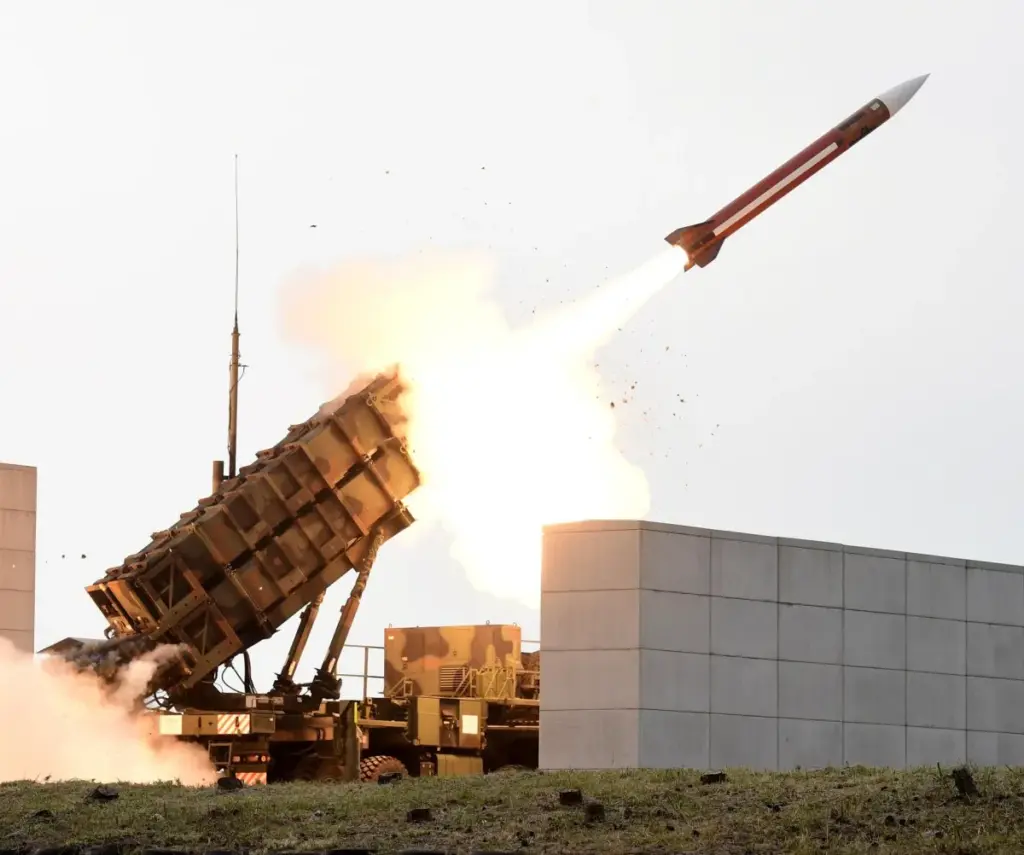
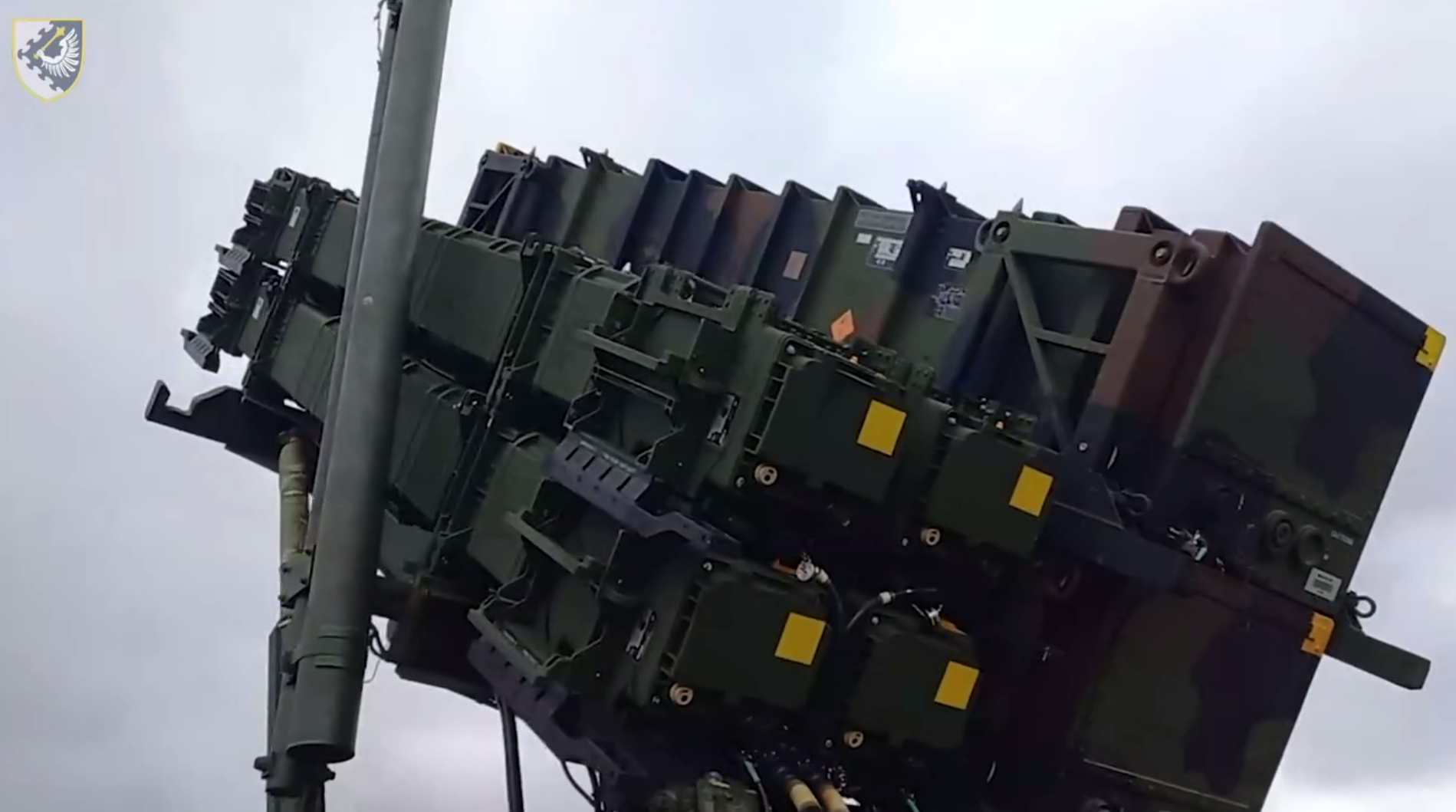
A Patriot MIM-104 air defense system in service with a unit of Air Defense Forces West, 10 April 2026. Photo: Air Command West, Ukrainian Air Force
Ukraine's interceptor arithmetic
Zelenskyy has said Ukraine agreed with the US on monthly interceptor deliveries, while calling the volumes short of what the country needs. He put the winter requirement at no less than about 5% of American output of these missiles.
A shortage of allied Patriot missiles, combined with heavier Russian strikes, made July the deadliest month for Ukrainian civilians since April 2022, according to UN figures.
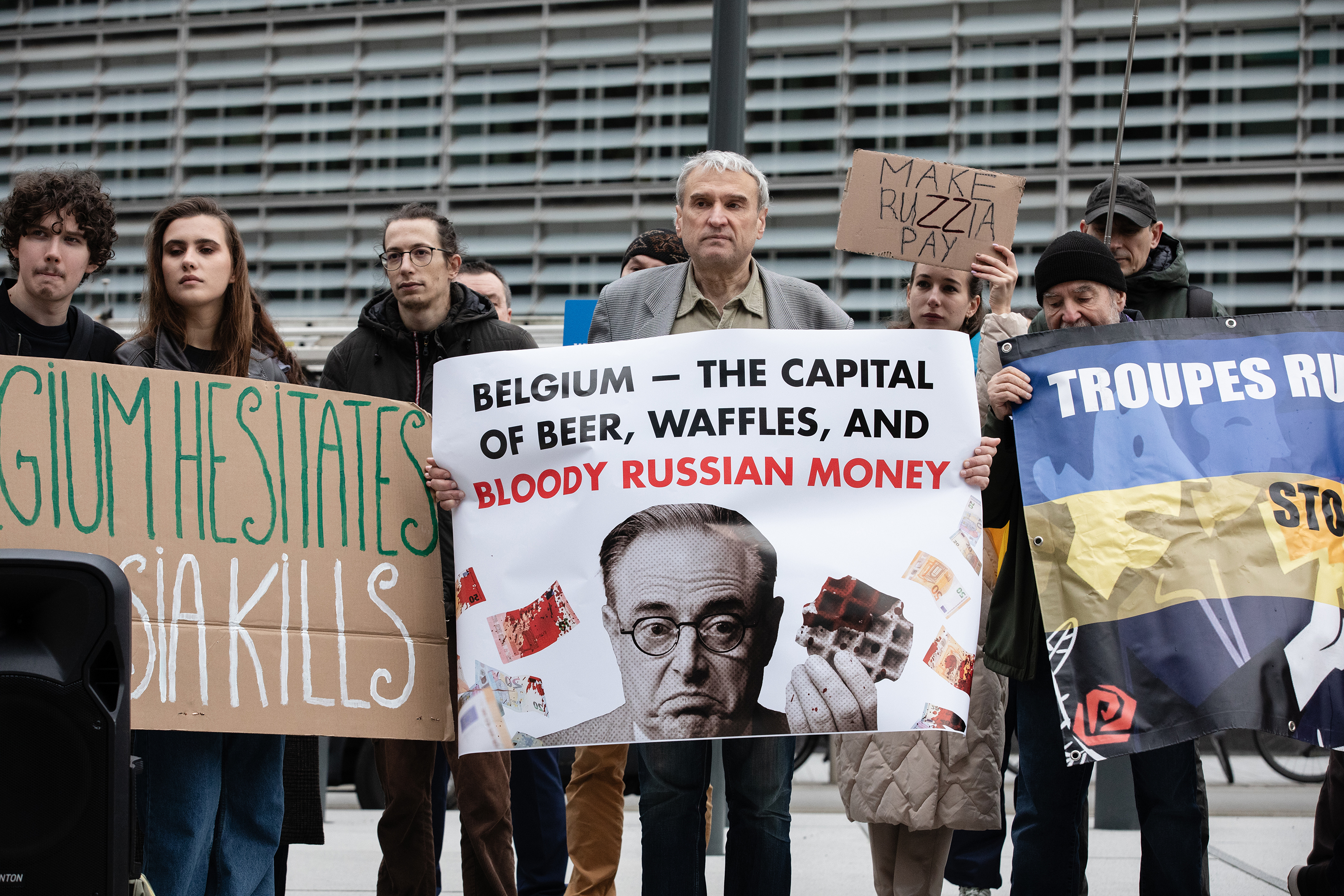
Belgium's foreign minister said the kingdom's opposition to using Russia's frozen assets for Ukraine has not changed, Reuters reported. A push by four member states to revive the plan "generated little enthusiasm or appetite" among European Union foreign ministers, he said. Belgium points instead to part of an already-agreed European loan arriving sooner.
Russia's invasion has become a contest of endurance in which Moscow spends at war rates and counts on Western money
Belgium's foreign minister said the kingdom's opposition to using Russia's frozen assets for Ukraine has not changed, Reuters reported. A push by four member states to revive the plan "generated little enthusiasm or appetite" among European Union foreign ministers, he said. Belgium points instead to part of an already-agreed European loan arriving sooner.
Russia's invasion has become a contest of endurance in which Moscow spends at war rates and counts on Western money thinning out first. Ukraine's army runs on financing decided in foreign capitals, so how fast Europe settles who pays sets what Kyiv can order and field. EU governments have held some $243.7 billion of Russian central-bank money since Russia's full-scale invasion began in February 2022. About €214 billion of it sits at Euroclear, the Brussels depository at the center of the argument.
Nothing has changed, Belgium's foreign minister told the room
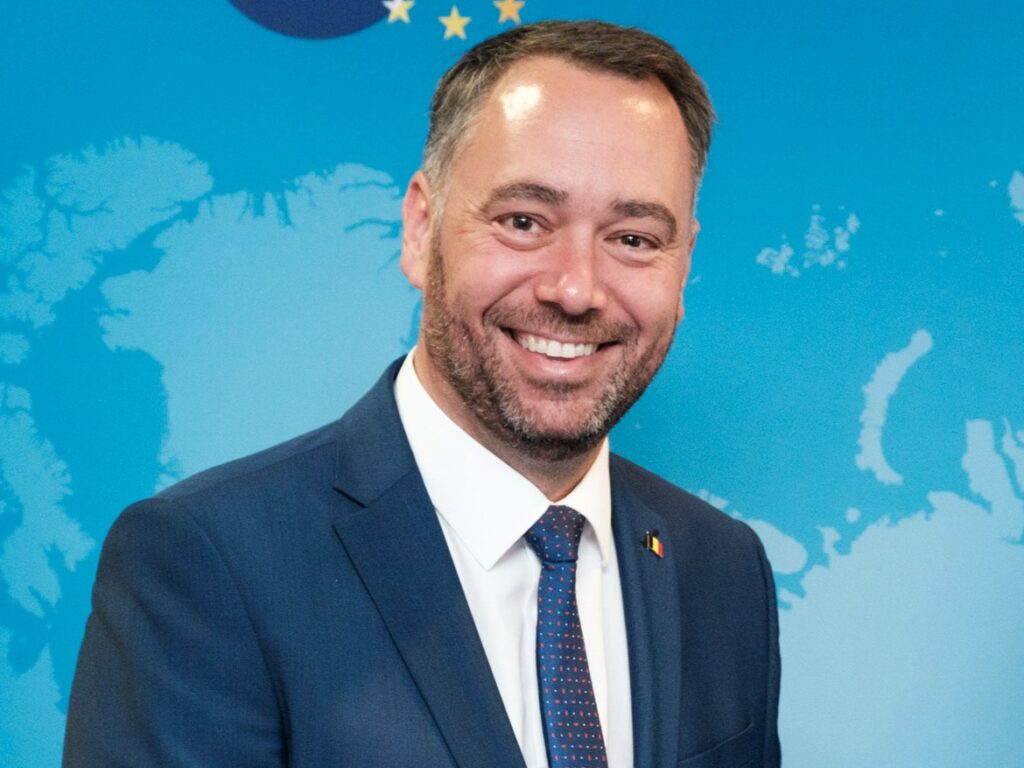
Belgian Foreign Minister Maxime Prévot spoke after an informal meeting of EU foreign ministers in Ireland on 2 September. Four countries had put the frozen-assets question back on the agenda, and his colleagues showed little interest in taking it up, he said. Belgium's own position has not moved in a year, he added. Anything that amounts to confiscating the money would carry very significant risks for his country, he said.
The country's Defense Minister Theo Francken told Flemish broadcaster VRT in remarks published on 30 August that the door is closed and the question is not open for discussion. He also said the Baltic States should be more careful about returning to it, and recalled how much support Belgium gives Lithuania, Latvia, and Estonia, The Moscow Times reported.
Explore further
Ukrainians rally across dozens of countries to demand Europe use Russia’s frozen billions
Ukraine has asked the EU to spend billions from its support loan on Patriot air-defense missiles, a request European Commission President Ursula von der Leyen confirmed the bloc is weighing. How far the money would stretch depends on a price only Washington controls.
Russia keeps firing more ballistic missiles at Ukrainian cities than the country can shoot down, the warheads hardest for its air defenses to stop. Only a US-made Patriot system can catch them, and their in
Ukraine has asked the EU to spend billions from its support loan on Patriot air-defense missiles, a request European Commission President Ursula von der Leyen confirmed the bloc is weighing. How far the money would stretch depends on a price only Washington controls.
Russia keeps firing more ballistic missiles at Ukrainian cities than the country can shoot down, the warheads hardest for its air defenses to stop. Only a US-made Patriot system can catch them, and their interceptors remain in short supply worldwide, so who pays for them and Washington that agrees or disagrees to sell them now shapes how many cities stay covered.
The exemption Kyiv needs
The European Commission has already received a payment request covering Ukraine's air defenses, including the PAC-3 interceptors that arm Patriot systems. Von der Leyen put it at "several billion euros" and said member states were reviewing it, without naming a figure.
Suspilne, citing its own sources, reported that the request seeks just over $2.3 billion, with another $4.6 billion from the loan's defense tranche going to arms manufactured in Ukraine and the EU, mostly drones.
The money would come from the EU's $104 billion support loan for 2026–27. Because PAC-3 is US technology, spending loan money on it needs an EU exemption. National representatives will take up the decision on 7 September.
What the money actually buys
Defense Express has calculated how many interceptor missiles Ukraine can get with the loan. At the $4–5 million per round the US Army pays, $2.3 billion would fund 460-580 interceptors. At the $6.61 million export price Germany paid in late 2024, about 315. At up to $12.3 million each, the US cleared for Saudi Arabia on 30 January 2026, just 190.
Why money isn't the real problem
For Ukraine, the harder question is not price but whether it can get the missiles at all. Even 315 rounds would equal about half the world's current yearly output, which the sole producer, Lockheed Martin, is straining to lift from around 600 a year to 2,000 by 2030.
Kyiv has been short of interceptors for months. In August, Zelenskyy said Ukraine reached a deal with the US for monthly Patriot deliveries, but that it still needs at least around 5% of American output to get through winter. EU Foreign Policy Chief Kaja Kallas has urged member states to hand over interceptors, especially those with shelf lives nearing their end.
Le rassemblement dans le jardin de la Grande Bibliothèque
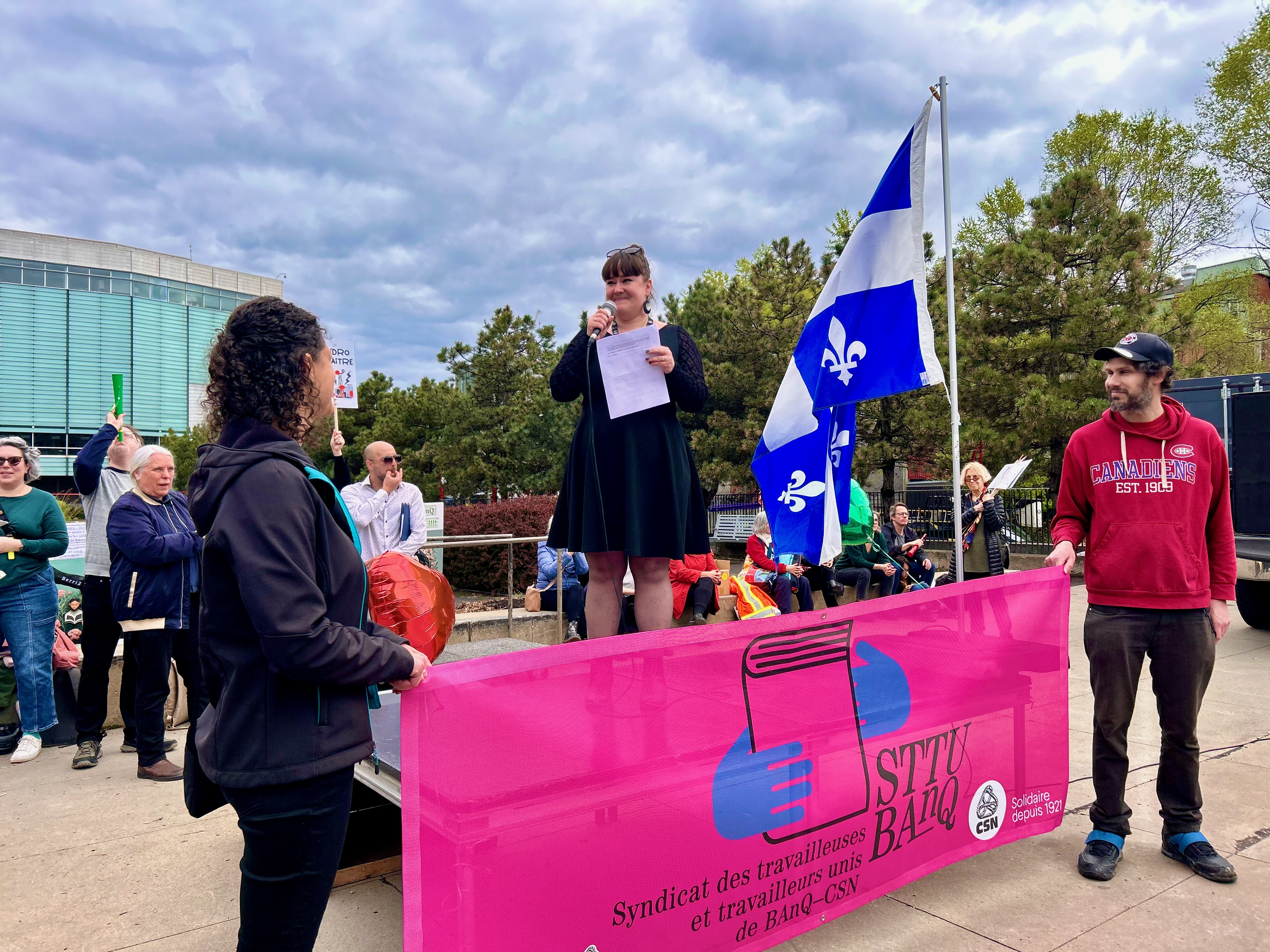
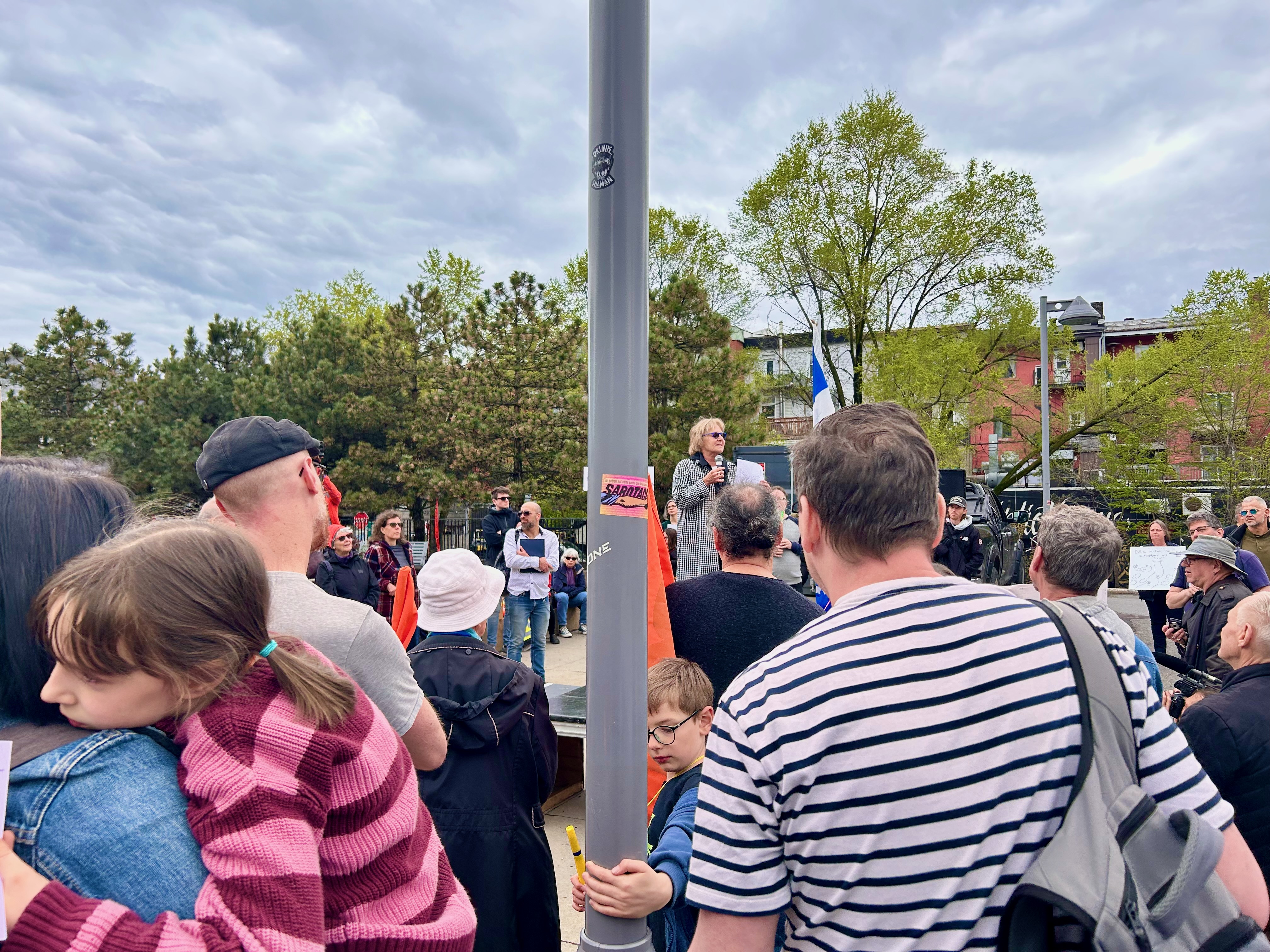
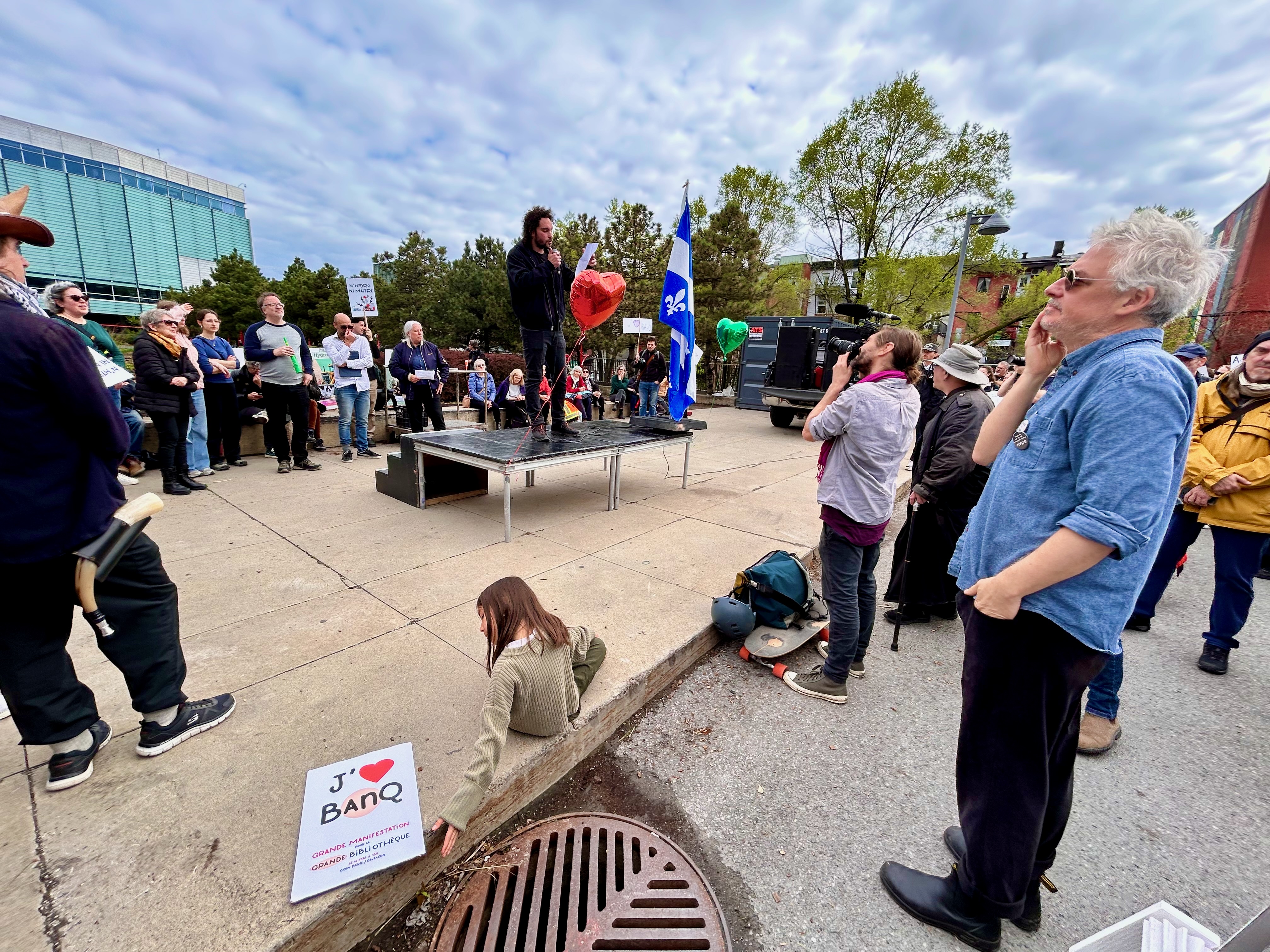
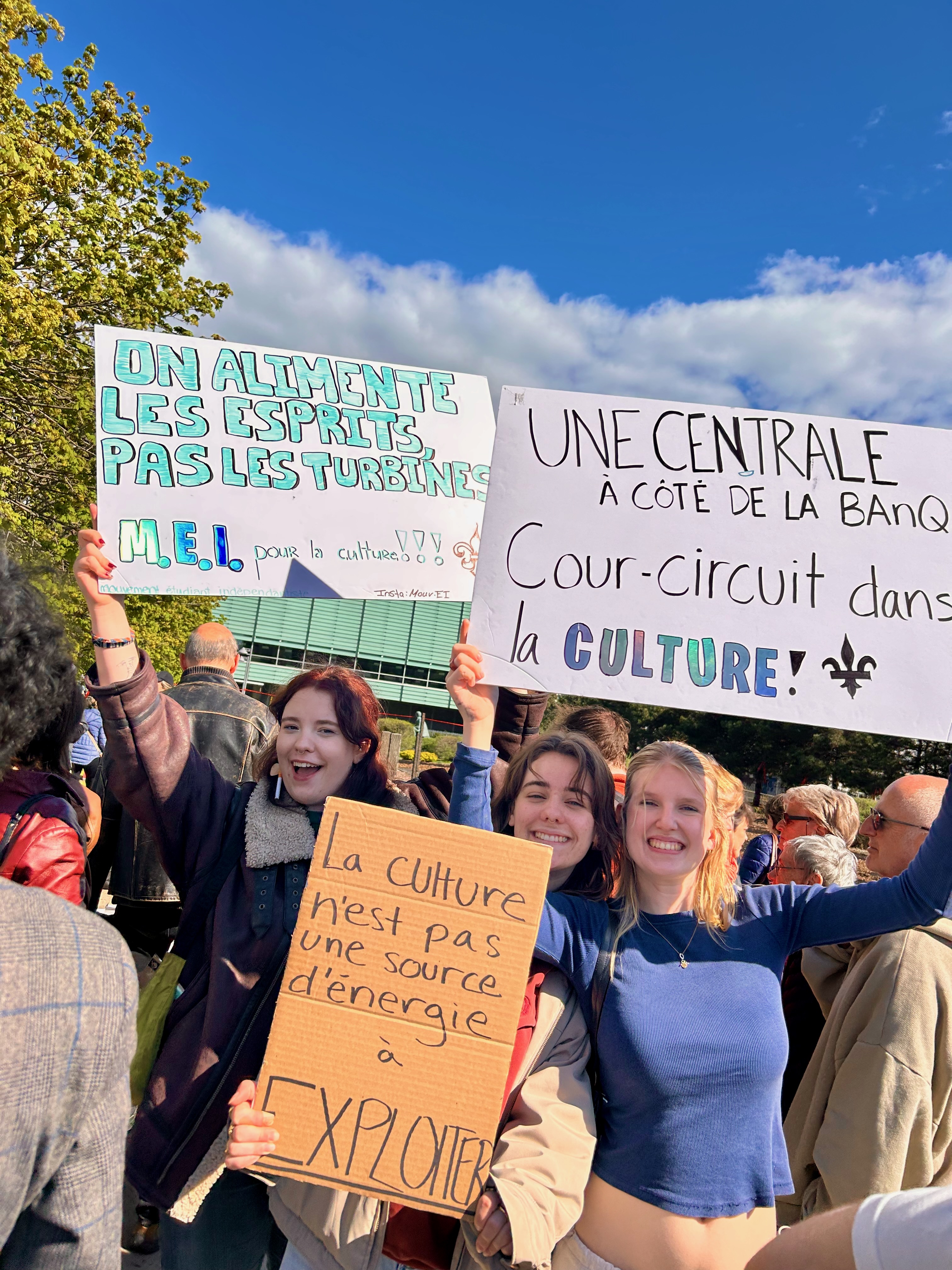
Le 10 mai 2025, un rassemblement citoyen a eu lieu dans le jardin de la Grande Bibliothèque (BAnQ) à Montréal. Organisé en opposition au projet d’Hydro-Québec d’y installer un poste de transformation électrique de 315 000 volts, l’événement a réuni des citoyen·nes, bibliothécaires, archivistes, artistes, urbanistes et personnalités politiques autour d’une même conviction : cet espace est un bien commun, culturel et mémoriel, et ne
Le rassemblement dans le jardin de la Grande Bibliothèque
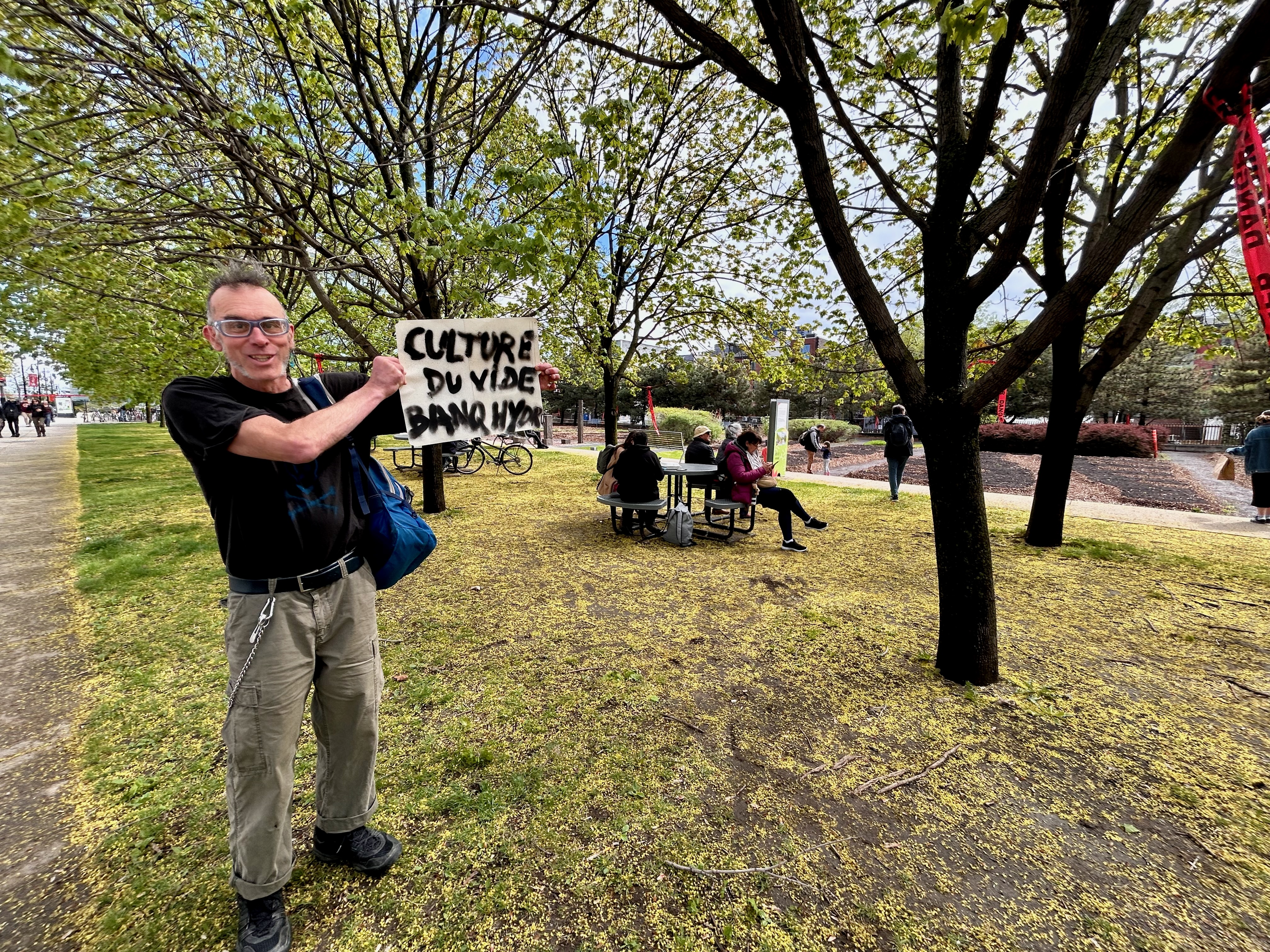
Le 10 mai 2025, un rassemblement citoyen a eu lieu dans le jardin de la Grande Bibliothèque (BAnQ) à Montréal. Organisé en opposition au projet d’Hydro-Québec d’y installer un poste de transformation électrique de 315 000 volts, l’événement a réuni des citoyen·nes, bibliothécaires, archivistes, artistes, urbanistes et personnalités politiques autour d’une même conviction : cet espace est un bien commun, culturel et mémoriel, et ne doit pas être sacrifié.
Un terrain stratégique, pas un terrain vague
Dès 1998, lors du choix du site de la Grande Bibliothèque, le terrain adjacent avait été réservé pour permettre une éventuelle expansion, conformément aux normes internationales en bibliothéconomie. Guylaine Beaudry, bibliothécaire chevronnée ayant œuvré dans plusieurs universités, a rappelé que le choix du terrain de la Grande Bibliothèque avait été guidé par une analyse rigoureuse. Ce site avait été retenu pour son potentiel à accueillir un lieu inspirant, tout en répondant aux besoins futurs en matière d’espaces pour BAnQ — conformément aux recommandations de la Fédération internationale des associations de bibliothèques, qui préconise une capacité d’agrandissement de 60 à 70 %.
« Le Jardin d’art n’est pas une incongruité ou une anomalie pour BAnQ. Le Jardin d’art n’est pas un actif superflu à vendre pour combler un déficit ou assurer les coûts d’un projet. Le Jardin de BAnQ n’est pas à vendre, il fait partie du tissu du Quartier latin et de l’avenir de la Grande Bibliothèque. »
Le jardin de la Grande Bibliothèque
De plus, dans ses 30 années de pratique, elle n’a « jamais vu un poste de transformation électrique à côté d’une bibliothèque ».
Plus préoccupant encore, le projet prévoit de réserver deux étages dans le poste électrique pour entreposer des collections de BAnQ. « Ahurissant ! », s’indigne Guylaine Beaudry, en rappelant que les collections de bibliothèques et les archives doivent être conservées dans des conditions strictes : « à environnement contrôlé et selon des critères de température et d’humidité très précis. » Elle affirme : « Dans toutes ces normes, rien, mais absolument rien, ne peut permettre d’aménager un centre de conservation dans un poste électrique. »
Guylaine Beaudry souligne également que les pires cauchemars des bibliothécaires et archivistes concernent « le feu, l’eau et les cyberattaques », et qu’un poste électrique adossé à une bibliothèque fait partie des risques majeurs. Des études en ingénierie démontrent que les risques d’incendie pour ce type d’installation peuvent être quatre fois plus élevés que dans un édifice public traditionnel.
« D’un point de vue urbanistique, il s’agit d’une proposition inacceptable. Aux plans archivistique et bibliothéconomique, ce projet est saugrenu, insoutenable et insensé. En augmentant les risques quant aux conditions de conservation, on met en péril une partie de la mission de
La première présidente-directrice générale, Mme Lise Bissonnette et Guylaine Beaudry, bibliothécaire
BAnQ. »
La première présidente-directrice générale, Mme Lise Bissonnette, était présente à ce « love-in » pour la Grande Bibliothèque, qui célébrait le 30 avril dernier ses 20 ans d’existence. En 2024, ce sont un million et demi de personnes qui ont franchi ses portes. Sa présence témoignait de l’attachement durable à cette institution née d’un projet visionnaire, devenu un lieu emblématique de savoir, de culture et de vie citoyenne.
Les racines d’une aberration
Pierre MacDuff, pour sa part, rappelle que la construction du poste de transformation projetée nécessite une superficie de 80 000 pieds carrés — soit l’équivalent d’un terrain et demi de football américain. « La volumétrie de ce bâtiment sera plus imposante que celle de la Grande Bibliothèque elle-même », précise-t-il.
Comment a-t-on pu en arriver à une telle « aberration » : implanter un poste électrique massif au cœur du jardin de la Grande Bibliothèque ? Plusieurs éléments se conjuguent pour expliquer cette dérive.
MacDuff dénonce, premièrement, le « catimini » dans lequel ce projet a été développé. Il est stupéfiant de constater que « deux sociétés d’État, on ne parle pas de promoteurs privés désireux de se soustraire aux regards de la compétition, ont fait avancer ce projet dans l’ombre ». Cette absence totale de transparence soulève de sérieuses questions quant au processus décisionnel.
Deuxièmement, « l’aplaventrisme » manifeste de BAnQ et de ses instances dirigeantes. On ne peut que déplorer que « son conseil d’administration accepte sans broncher de se laisser déposséder de ce terrain et que sa présidente-directrice générale refuse incidemment toute entrevue sur le sujet ».
Troisièmement, « l’insensibilité » dont fait preuve Hydro-Québec face aux enjeux culturels et urbanistiques. La société d’État démontre une complète « insensibilité à l’égard des besoins de la Grande Bibliothèque ainsi qu’à l’égard du Quartier latin dont ce sera le plus imposant bâtiment». Cette approche technocratique ignore les dimensions patrimoniales et communautaires.
Ramon Vitesse, zinester et acteur innovant du monde des bibliothèques
Enfin, et non le moindre des aspects, « le silence » assourdissant des autorités municipales. Plutôt que de défendre les intérêts des citoyens et des citoyennes ainsi que du patrimoine culturel, « la Ville de Montréal a eu peur d’affronter Hydro-Québec ». Plus révélateur encore, « il y a un an, elle a plutôt renoncé, au profit d’Hydro-Québec, à une partie de la servitude de passage de ce terrain ». Même les récentes prises de position politiques semblent timides, préférant demander des consultations plutôt que d’opposer un refus catégorique à ce projet inapproprié.
Une lueur d’espoir: la vente du terrain nécessite encore l’autorisation gouvernementale via un décret qui n’a pas été signé.
Une mobilisation politique face à un projet opaque
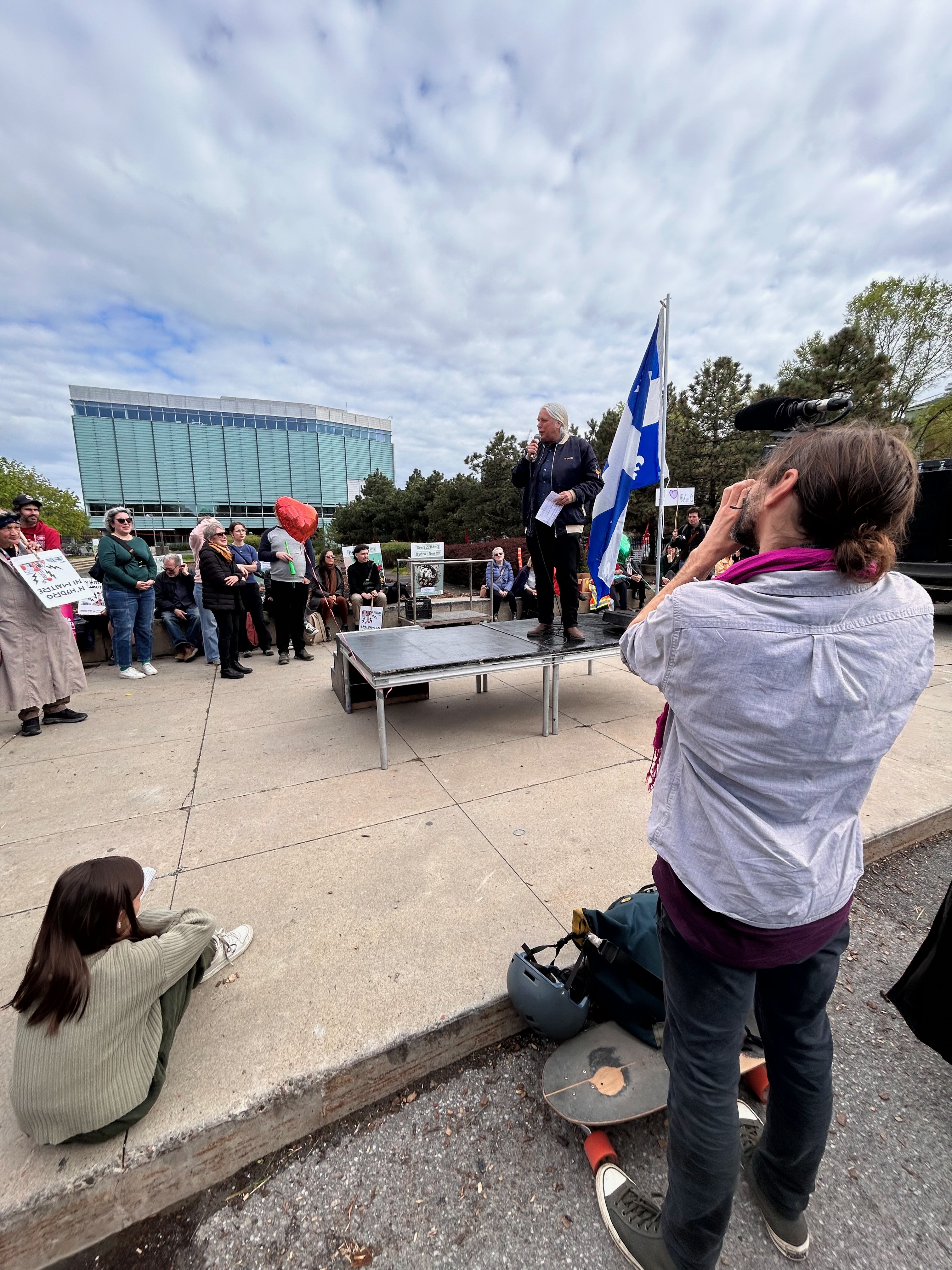
Manon Massé, députée de Sainte-Marie–Saint-Jacques, Québec solidaire
La députée de Québec solidaire, Manon Massé, revient sur son implication et la mobilisation qu’elle mène contre le projet de poste électrique d’Hydro-Québec. Informée dès l’automne 2023 par un lanceur d’alerte, elle a entrepris depuis une série d’interventions soutenues auprès du gouvernement caquiste. Courriels, questions, interpellations : rien n’y fait. Les réponses tardent, ou se contentent de reprendre les arguments de la société d’État.
« Ça a été long… j’ai à peu près jamais eu de réponse, sinon mot pour mot le même discours qu’Hydro-Québec », déplore-t-elle, en évoquant ses échanges avec Christine Fréchette, ministre de l’Économie, de l’Innovation et de l’Énergie, également responsable de la Métropole. Cette dernière la renvoie finalement à Mathieu Lacombe, ministre de la Culture, qui finit par lui répondre :
« Ce que je peux vous dire, c’est que lorsqu’il y aura transaction, ma condition, c’est que ce soit au bénéfice du milieu culturel. »
Une déclaration jugée évasive, inquiétante et largement déconnectée par rapport à l’ampleur de l’enjeu. Manon Massé prévient que la bataille citoyenne est loin d’être terminée et que les citoyennes et citoyens qui sont engagés ici sont « du bon côté de l’histoire ».
Une voix de l’intérieur contre le projet
Sylviane Cossette, représentante syndicale et travailleuse de la Grande Bibliothèque, a dénoncé à son tour avec force le projet. Elle y voit un symptôme de plus du sous-financement chronique de cette institution culturelle pourtant vitale :
« Ceci fait remonter un problème récurrent : le manque de financement chronique de cette institution et son manque d’espace pour la conservation des archives du Québec. »
Sylviane Cossette, représentante syndicale et travailleuse de la Grande Bibliothèque
Elle rappelle que cela fait vingt ans que les citoyennes et citoyens se sont approprié·es la Grande Bibliothèque et son jardin, un espace qui vit, respire et rayonne à travers des projets inspirants de médiation culturelle, comme le jardin de plantes comestibles en 2023 ou les œuvres d’art en plein air.
Elle critique aussi l’absence de vision durable, et l’hypocrisie d’une solution qui ferait de l’espace pour les archives au cœur même d’un poste électrique : « C’est tout simplement mettre un pansement sur une plaie déjà ouverte. »
Sylviane Cossette rappelle que des institutions comme Bibliothèque et Archives Canada, confrontées aux mêmes défis, ont su obtenir des investissements majeurs pour construire de véritables centres de conservation. BAnQ, elle, voit son potentiel d’expansion compromis. « La vente des terrains empêcherait de bâtir un projet du type de celui dont a besoin BAnQ pour ses collections. » Elle conclut en lançant un appel à la transparence, à la démocratie participative, et à la protection de l’intérêt public.
Pour une culture centrale, pas périphérique
Lorraine Pintal insiste sur l’importance, pour une nation rassemblée autour de la devise « Je me souviens », de se remémorer les idéaux qui ont inspiré la création de la Grande Bibliothèque, portée avec tant de conviction par Lise Bissonnette. Aujourd’hui, ces raisons demeurent : une métropole culturelle digne de ce nom doit pouvoir compter sur une institution phare au cœur de la ville, à la fois lieu de mémoire, de savoir et de transmission.
« Ce poumon vert au cœur du Quartier Latin en pleine métamorphose, est un espace de réflexion où bon nombre de citoyens et citoyennes viennent puiser une élévation de l’esprit en lien direct avec la richesse littéraire de BAnQ. C’est aussi un lieu de rassemblement où la culture dans toute sa diversité regroupe des communautés avides de découvertes et de dialogues. »
Lorraine Pintal, metteure en scène, comédienne, autrice
L’idée d’y implanter un poste de transformation électrique d’Hydro-Québec témoigne d’une forme d’« amnésie collective », oubliant que Montréal a déjà souffert de décisions hâtives, de projets mal situés, conçus sans consultation sérieuse. Toutefois, « il est encore temps d’empêcher l’inévitable […] Nous pourrons dire avec fierté Je me souviens.»
Dans une adresse vibrante, Hugo Fréjabise, a proclamé que la culture n’est pas une option ni un loisir de fin de semaine, mais un besoin vital et politique :
« Nous pensons tout ce qui est art et culture comme une urgence très sérieuse, très centrale et vitale. »
Hugo Fréjabise, auteur et metteur en scène
Engagé dans la Grande mobilisation pour les arts, qui a contribué à l’obtention d’une hausse du financement public en culture, il témoigne de l’impact concret que peut avoir la résistance citoyenne planifiée et déterminée. Il dénonce le réflexe de reléguer la culture « au vendredi cinq à sept » ou « au samedi après-midi », comme si elle ne méritait pas d’être au cœur des décisions publiques. Hugo Fréjabise termine avec les mots percutants de Jean-Luc Lagarce, rappelant la mission fondamentale des lieux culturels :
« Nous devons préserver les lieux de la création, les lieux du luxe de la pensée, les lieux de l’invention de tout ce qui n’existe pas encore… Ce sont nos maisons à tous. »
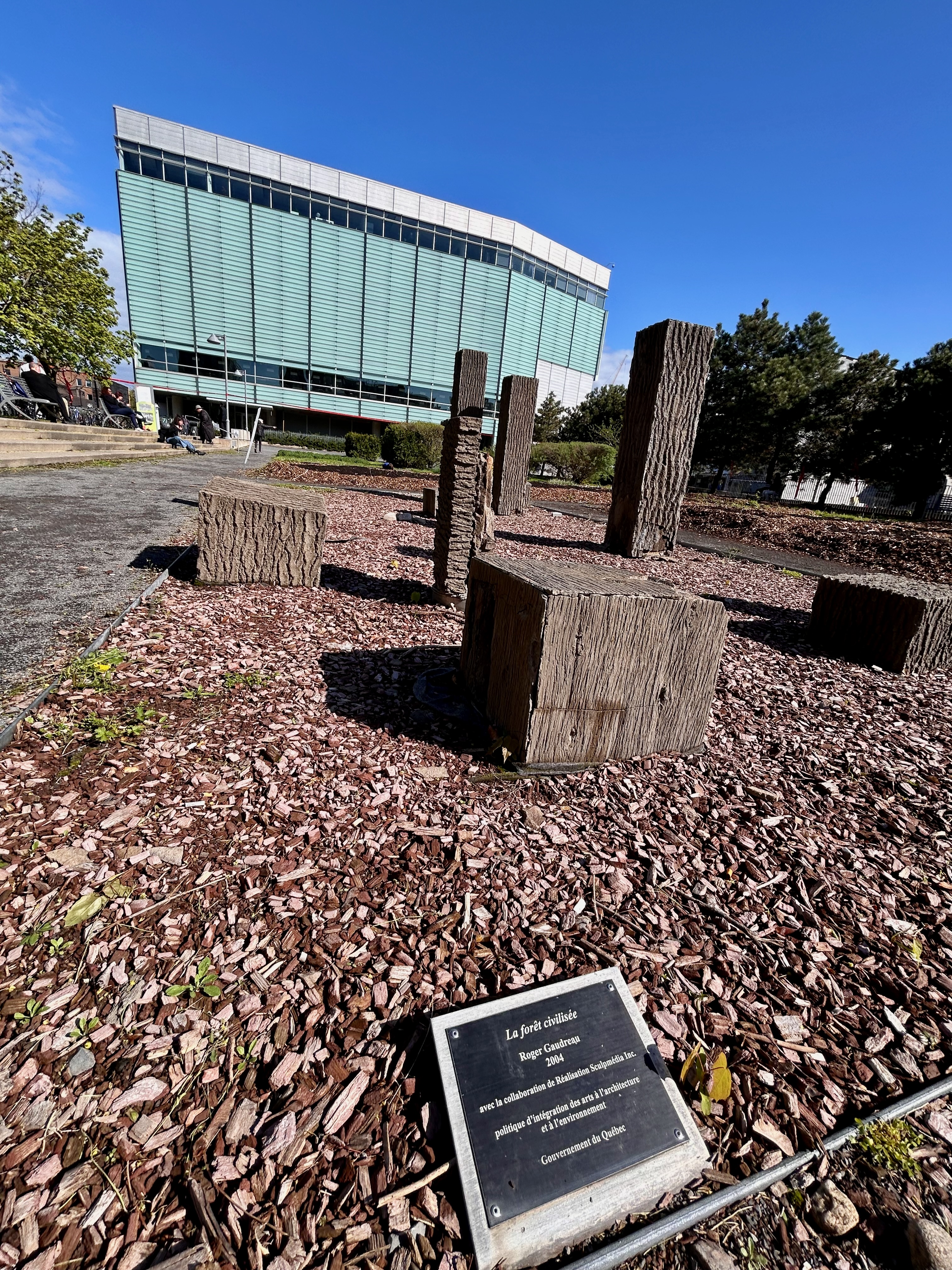
La forêt civilisée de 2005 par Robert Gaudreau dans le jardin de la Grande Bibliothèque
Pas un terrain vacant
Ce terrain n’est pas vacant. Depuis des années, il accueille des projets de médiation culturelle, des œuvres d’art en plein air, des activités communautaires et des jardins comestibles. Il constitue un refuge urbain et un tiers lieu précieux au cœur d’un quartier en transformation, marqué par la densification, la fermeture de commerces de proximité et la fragilisation du tissu social.
Face à cette situation déplorable, les attentes citoyennes que Pierre MacDuff réitère sont claires et se déclinent en trois points essentiels :
La Ville de Montréal, tant Projet Montréal qu’Ensemble Montréal, doit exprimer sans ambiguïté son opposition au projet, en raison de sa non-acceptabilité sociale.
Le gouvernement du Québec ne doit pas signer le décret autorisant la vente du terrain appartenant à BAnQ.
Et surtout, Hydro-Québec doit renoncer à cet emplacement, définitivement.
Pour Pierre MacDuff, l’élan citoyen qui s’est formé au fil des mois témoigne d’un refus clair et organisé. En l’espace d’un an, des lettres ouvertes ont été publiées, une page Facebook a été créée, une pétition a recueilli près de 1 300 signatures. Des citoyen·nes sont intervenu·es en conseil municipal, l’ensemble des député·es de l’Assemblée nationale ont été contacté·es, et la députée de Sainte-Marie–Saint-Jacques, Manon Massé, a relayé ces préoccupations jusqu’à Québec. Le rassemblement d’aujourd’hui n’est qu’une étape. Il y en aura d’autres, affirme-t-il, tant qu’Hydro-Québec n’aura pas renoncé à ce site.
Militantisme documentaire
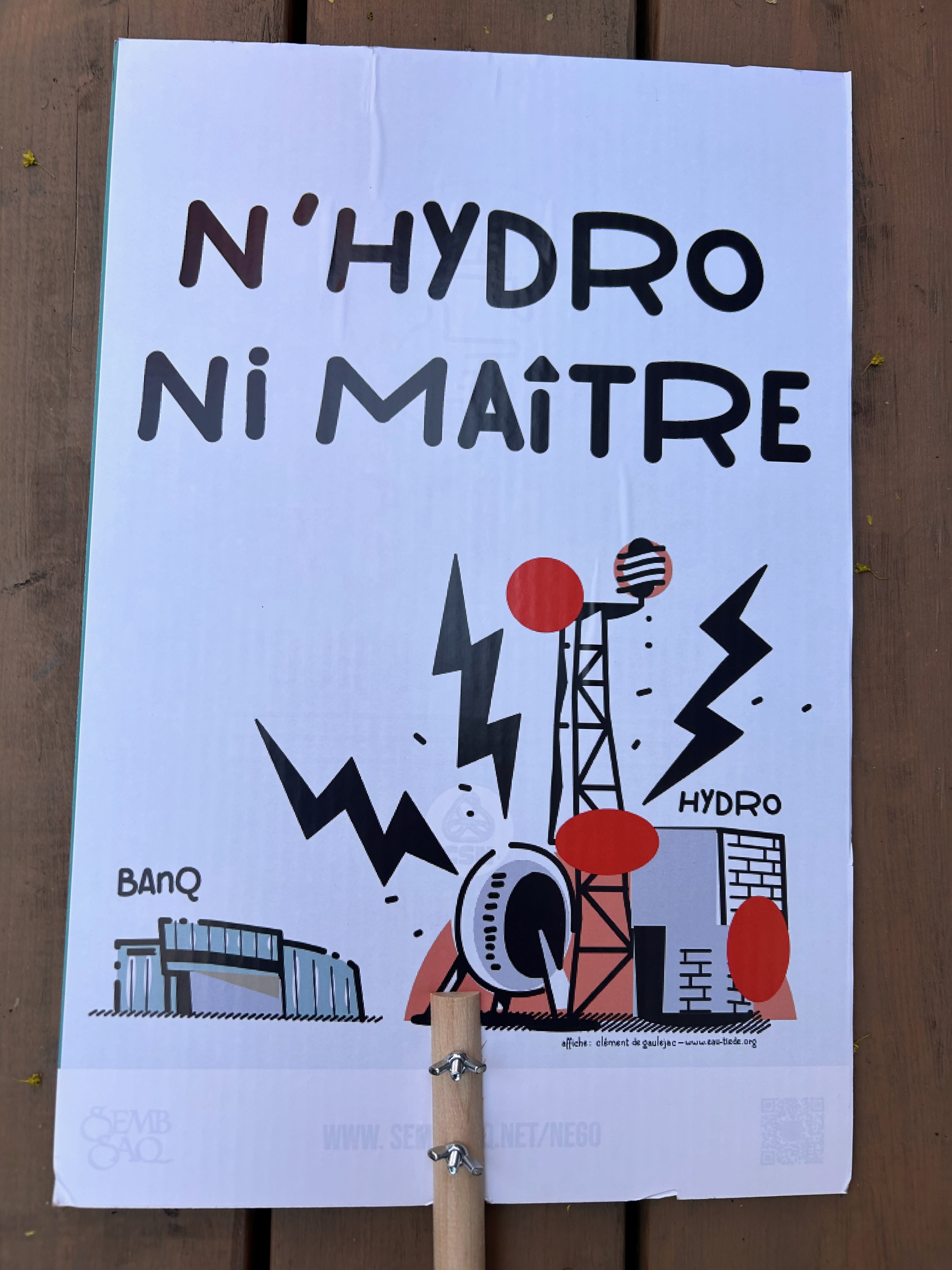
Un des affiches de l’auteur et artiste Clément de Gaulejac en contexte
Cet article s’inscrit dans une démarche de militantisme documentaire : il rassemble, documente et articule des prises de parole citoyennes, politiques, culturelles et professionnelles autour d’un enjeu urbain majeur, soit le projet d’implantation d’un poste électrique sur le terrain de la Grande Bibliothèque. Témoignages, citations, références médiatiques, et appels à l’action y sont consignés non seulement pour informer, mais pour nourrir la mémoire collective d’une mobilisation en cours.
En cela, le texte fonctionne comme une archive militante : il conserve les traces d’un moment de résistance civique, tout en donnant sens et portée aux gestes, aux voix et aux arguments qui s’y expriment. Il contribue à fixer une mémoire vive, ancrée dans la défense d’un bien commun culturel et environnemental.
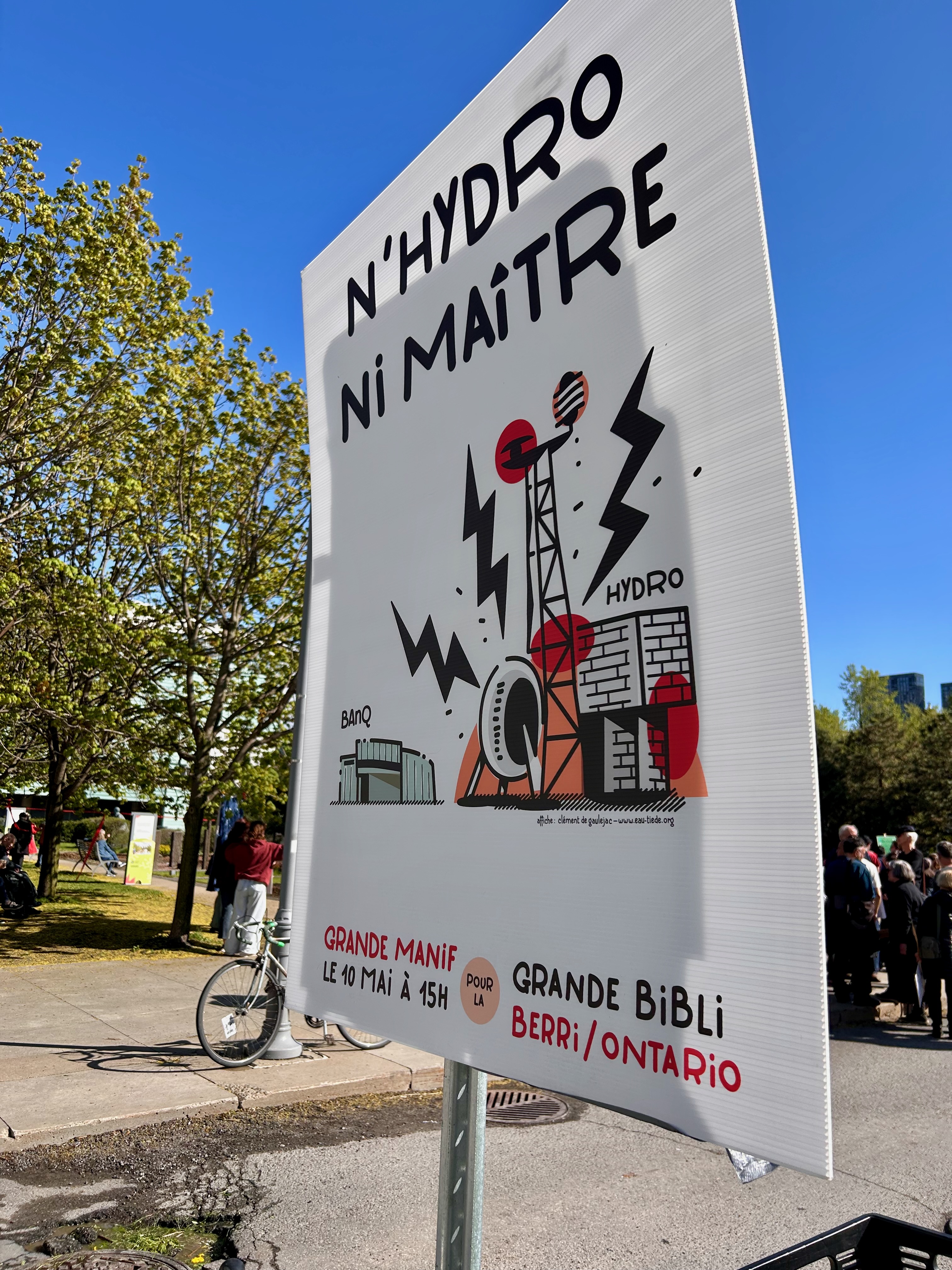
Parmi les traces de cette mobilisation, les logos d’invitation et les illustrations des pancartes créées, entre autres, par l’auteur et artiste Clément de Gaulejac distribuées par les organisateurs et organisatrices. Un zine d’amour a aussi été partagé.
L’affiche J’aime BAnQ de Clément de GaulejacL’affiche N’Hydro ni Maître de Clément de Gaulejac Le verso d’une affiche N’Hydro ni Maître, conçu par Réjean Gagnon (à l’aide d’une IAG) Le feuillet du syndicatLe zine
Pour aller plus loin : comprendre les enjeux autour de BAnQ et du projet de poste électrique
Album photo – Mobilisation du 10 mai 2025 Une série de photos publiées sur Flickr documente le rassemblement citoyen en soutien à la Grande Bibliothèque et contre la vente de son terrain.
L’Action nationale – « BAnQ / Le saccage » Un dossier qui analyse en profondeur la crise institutionnelle que traverse Bibliothèque et Archives nationales du Québec et les menaces qui pèsent sur sa mission.
Le Devoir – Quartier latin unis contre le projet d’Hydro-Québec Article de Jean-François Nadeau, 5 février 2025 Un reportage qui rend compte de la mobilisation locale et de l’attachement des citoyens à ce lieu emblématique.
Le Devoir – BAnQ à vendre, une institution de moins en moins grande et une décision sans vision pour l’avenir Une tribune publiée le 1er mars sur les enjeux politiques et symboliques liés à la vente du terrain et au projet de poste électrique.
Radio-Canada – Berri 2 : un projet d’Hydro-Québec qui suscite de l’opposition Article de Jérôme Labbé, 18 février 2025 Un article de synthèse qui expose les tensions entourant le projet de poste électrique à proximité de BAnQ.
Actualitté – Non au béton et aux kilovolts à la place de la culture et des espaces verts Article de Hocine Bouhadjera, 28 avril 2025 Un article relayant les préoccupations citoyennes et professionnelles quant à l’avenir de ce lieu public.
Pétition contre le projet de poste électrique L’appel lancé par des citoyen·nes, chercheur·es et membres de la communauté universitaire pour préserver les terrains de la Grande Bibliothèque.
Sélection d’activités de médiation culturelle proposées dans le jardin
Médiation culturelle, expositions et installations artistiques Le Jardin d’art accueille des œuvres en plein air, offrant aux visiteurs une expérience culturelle immersive.
Potager éducatif et plantes comestibles. Un potager urbain a été aménagé pour sensibiliser à l’agriculture urbaine et à l’autonomie alimentaire; certaines en collaboration avec Montréal, métropole en santé et l’organisme Sentier urbain.
Lectures pour les enfants dans le jardin. Des séances de lecture sont organisées en plein air, offrant aux enfants une expérience littéraire au milieu de la nature.
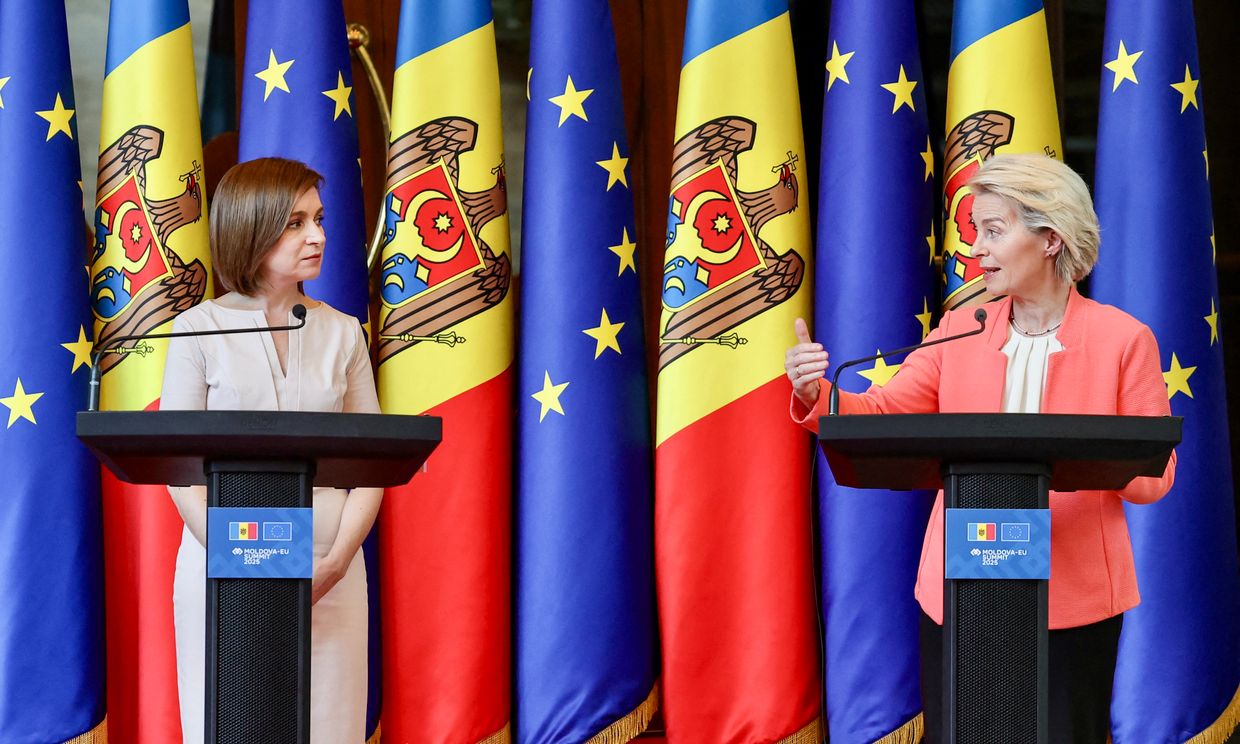
European Commission President Ursula von der Leyen pledged on July 4 that the European Union will help Moldova defend itself against hybrid threats by "agents of autocracy.""We are committed to protecting you against the hybrid attacks and the energy shocks that your country has been a victim of," von der Leyen said following the EU-Moldova summit in Chisinau."Who is behind those attacks is clear to all of us here. These are the same agents of autocracy trying to undermine our democracies everyw
European Commission President Ursula von der Leyen pledged on July 4 that the European Union will help Moldova defend itself against hybrid threats by "agents of autocracy."
"We are committed to protecting you against the hybrid attacks and the energy shocks that your country has been a victim of," von der Leyen said following the EU-Moldova summit in Chisinau.
"Who is behind those attacks is clear to all of us here. These are the same agents of autocracy trying to undermine our democracies everywhere in Europe."
Von der Leyen praised Moldova's support for Ukraine and the EU, noting its acceptance of hundreds of thousands of Ukrainian refugees and its assistance with European wildfire response efforts.
The visit was made in show of solidarity with Moldova, one of Europe's poorest countries, as it prepares for high-stakes parliamentary elections on Sept. 28.
The pro-European government of President Maia Sandu faces a challenge from the pro-Russian Socialist Party, amid growing fears of destabilization ahead of the vote.
Sandu has accused Russia of using its military presence in Moldova's Russian-occupied Transnistria region to stir unrest and derail the country's EU aspirations. On June 12, she warned that Moscow could provoke a crisis in Transnistria to influence the election outcome.
Transnistria has been under Russian-backed separatist control since the early 1990s, with approximately 1,000 to 1,500 Russian troops still stationed in the region.
On June 11, Transnistrian authorities declared a 30-day state of emergency after a sharp drop in natural gas supplies. The unrecognized region has faced mounting energy shortages since January, when Russian energy giant Gazprom halted deliveries in what many see as an attempt to destabilize the situation in Moldova.
Moldova was granted EU candidate status in 2022. Sandu's ruling Party of Action and Solidarity aims to maintain its parliamentary majority and move the country closer to full membership by 2030.
Moldovan Prime Minister Dorin Recean earlier told the Financial Times that Russia plans to send 10,000 troops to Transnistria and establish a pro-Kremlin government in Moldova.
The European Commission has proposed that Ukraine join the European Union's mobile roaming area starting January 1, 2026, providing Ukrainian users the ability to make phone calls, texts, and use mobile data in the bloc's 27 countries at no extra charge. "We want Ukrainian citizens to stay connected to their loved ones across the EU, as well as in their home country. That's why we propose that Ukraine join our roaming family," European Commission President Ursula von der Leyen said in a statemen
The European Commission has proposed that Ukraine join the European Union's mobile roaming area starting January 1, 2026, providing Ukrainian users the ability to make phone calls, texts, and use mobile data in the bloc's 27 countries at no extra charge.
"We want Ukrainian citizens to stay connected to their loved ones across the EU, as well as in their home country. That's why we propose that Ukraine join our roaming family," European Commission President Ursula von der Leyen said in a statement.
The proposal, first announced on June 16, will serve as a means of integration into the European Union's "Roam like at Home" provision in affect between all EU nations. The proposed change will impact the over four million Ukrainian refugees living in the EU.
Ukraine's full integration in the roaming provisions will replace voluntary measures that "allowed for roaming without surcharges and affordable international calls for EU and Ukrainian citizens abroad," according to the European Commission. The current measure will extend to December 31, 2025, ahead of the planned integration.
If approved, Ukraine will become the only country outside of the EU to join the bloc's "Roam like at Home" policy.
The move, which awaits European Council approval, comes as Ukraine continues to implement reforms in pursuing membership in the European Union.
Ukraine applied for EU membership at the onset of Russia's full-scale invasion in 2022. The country has made quick progress, achieving candidate status within months, with the initial negotiations formally launching in June 2024.
Since the start of 2025, Ukraine has opened three negotiation clusters under Poland's rotating presidency.
Poland lead the EU Council's presidency until June, and Denmark will take over the role in July. Ukraine aims to open the remaining three negotiation clusters in the second half of 2025 under the Danish chairmanship, the President Volodymyr Zelensky said.
There are six accession negotiation clusters, consisting of several individual chapters. Negotiations prepare a candidate country to become an EU member.
The EU’s Commissioner for Enlargement, Oliver Varhelyi, said that Ukraine could potentially join the bloc by 2029 if it successfully implements necessary reforms.
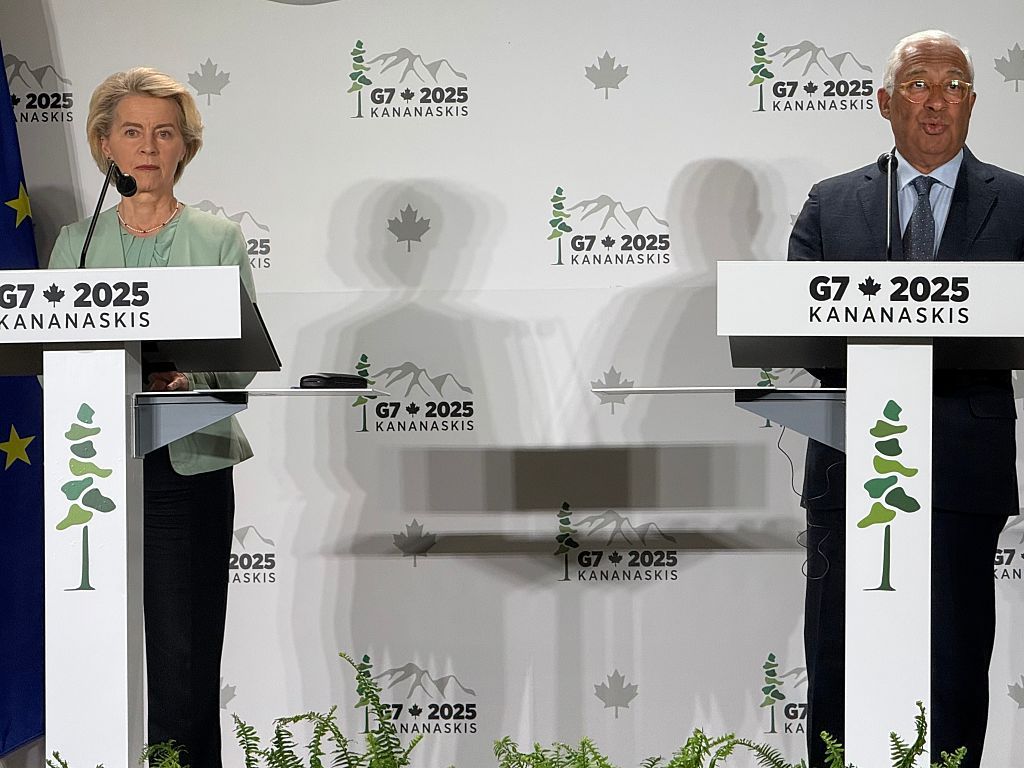
The Group of Seven (G7) nations need to impose harsher sanctions on Moscow in order to secure a ceasefire in the war against Ukraine, European Commission President Ursula von der Leyen and European Council President Antonio Costa said at the start of the G7 summit in Canada.The G7 Leaders Summit kicked off on June 15 in Kananaskis, Canada, with official talks held June 16-17. While Ukraine hopes to win economic support and unified pressure against Russia, the rapidly escalating conflict between
The Group of Seven (G7) nations need to impose harsher sanctions on Moscow in order to secure a ceasefire in the war against Ukraine, European Commission President Ursula von der Leyen and European Council President Antonio Costa said at the start of the G7 summit in Canada.
The G7 Leaders Summit kicked off on June 15 in Kananaskis, Canada, with official talks held June 16-17. While Ukraine hopes to win economic support and unified pressure against Russia, the rapidly escalating conflict between Israel and Iran may dominate this year's conference.
"To achieve peaceful strength we must put more pressure on Russia to secure a real ceasefire, to bring Russia to the negotiating table, and to end this war. Sanctions are critical to that end," von der Leyen said at a press briefing on June 15 attended by a Kyiv Independent journalist.
Economic sanctions have been an effective intervention since the start of Russia's full-scale invasion, von der Leyen said. She noted that combined G7 and European Union sanctions have decreased Russian oil and gas revenues by nearly 80% since February 2022.
"(T)he sanctions are working, and we will do more," she said.
Von der Leyen urged the G7 to adapt the economic restrictions proposed in the EU's 18th sanctions package, announced on June 10. The new measures target Russia's energy and banking sectors and propose a further reduction in the oil price cap, bringing the cap down from $60 to $45 per barrel.
"I will invite all G7 partners to join us in this endeavor," she said.
Costa echoed the call for sanctions and the necessity of economic pressure in order to achieve a ceasefire. Europe is committed to "increasing additional sanctions to cripple (Russia's) ability to wage war and pressing for an unconditional ceasefire," he said.
Europe's call for unity may meet with resistance from the United States, which has assumed a dramatically different posture towards Ukraine and Russia since President Donald Trump took office in January. Trump has not imposed any new sanctions against Russia, even Moscow blatantly obstructs peace efforts and escalates mass strikes against Ukrainian cities.
The U.S. also reportedly opposes lowering the G7 oil price cap — a measure first introduced in December 2022 that prohibits Western companies from shipping, insuring, or otherwise servicing Russian oil sold above $60 per barrel.
The price cap debate has become more urgent as oil prices, which had fallen below the $60 cap in recent months, surged following Israel's recent strikes against Iran.
Despite U.S. resistance, the EU and the United Kingdom — backed by other European G7 countries and Canada — have said they are prepared to move forward with the proposal, even without Washington's endorsement.
President Volodymyr Zelensky, on the other hand, has said the EU sanctions and proposed price cap drop don't go far enough. Zelensky on June 11 said the EU's 18th round of sanctions "could be stronger" and proposed further slashing the oil price cap to $30 per barrel.
"A ceiling of $45 per barrel of oil is better than $60, that's clear, that's true. But real peace will come with a ceiling of $30," he said. "That's the level that will really change the mindset in Moscow."
Zelensky and Trump are expected to meet on the sidelines of the G7 summit on June 17. The meeting will mark their third in-person encounter since Trump took office.
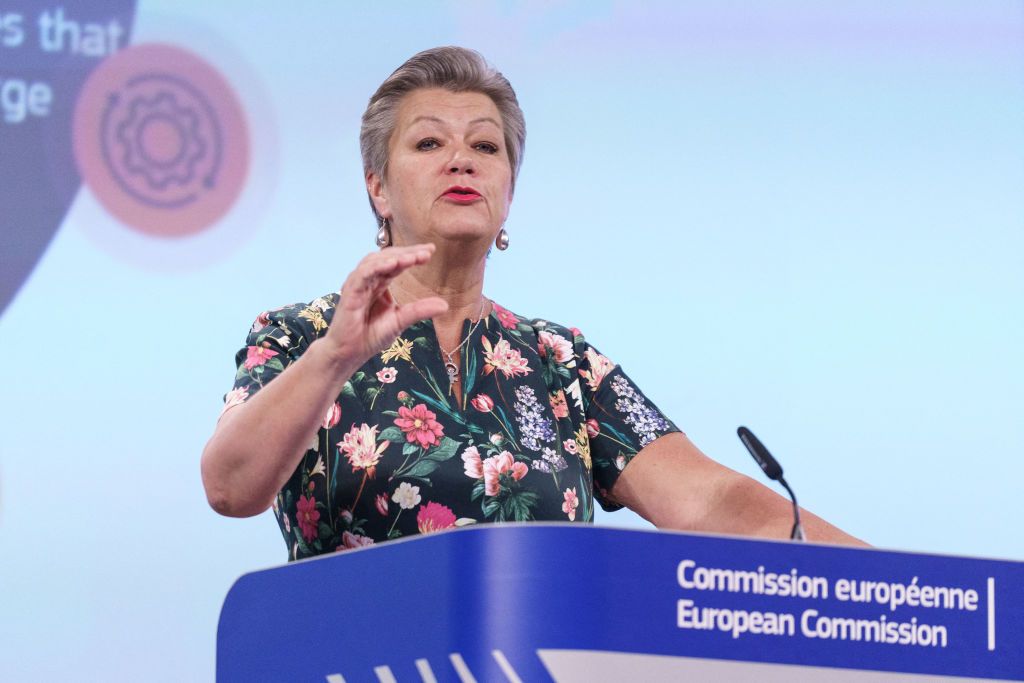
Ylva Johansson, former European Commissioner for Home Affairs, will serve as the European Union's new special envoy for Ukrainians in the bloc, POLITICO reported on June 12.According to anonymous officials that spoke to POLITICO, Johansson will fill the newly created post, overseeing the Commission's long-term strategy for Ukrainian refugees currently residing in the European Union.Johansson, a former Swedish minister and European Commission official, previously visited Ukraine on several occasi
Ylva Johansson, former European Commissioner for Home Affairs, will serve as the European Union's new special envoy for Ukrainians in the bloc, POLITICO reported on June 12.
According to anonymous officials that spoke to POLITICO, Johansson will fill the newly created post, overseeing the Commission's long-term strategy for Ukrainian refugees currently residing in the European Union.
Johansson, a former Swedish minister and European Commission official, previously visited Ukraine on several occasions, including a refugee camp on the border with Romania. She received the Ukrainian order of merit in September 2024.
As special envoy, Johansson will be responsible for EU initiatives focused on helping Ukrainian refugees transition into permanent legal statuses or return home.
As part of these initiatives, the EU will launch "unity hubs" – information centers jointly managed with the Ukrainian government. The hubs will support Ukrainian refugees to integrate with EU host countries or repatriate to Ukraine.
Germany, which has has taken in more than 1 million Ukrainian refugees since the start of the full-scale invasion, recently committed to establishing unity hubs in Berlin. The unity hubs in Berlin will provide Ukrainians with access to educational and career opportunities both in Ukraine and Germany.
The European Commission also recently extended temporary protection Ukrainian refugees who fled to the EU following Russia's invasion of Ukraine.
According to Eurostat, 4.26 million Ukrainians currently hold temporary protection status in the EU as of April 2025.

 Connexion