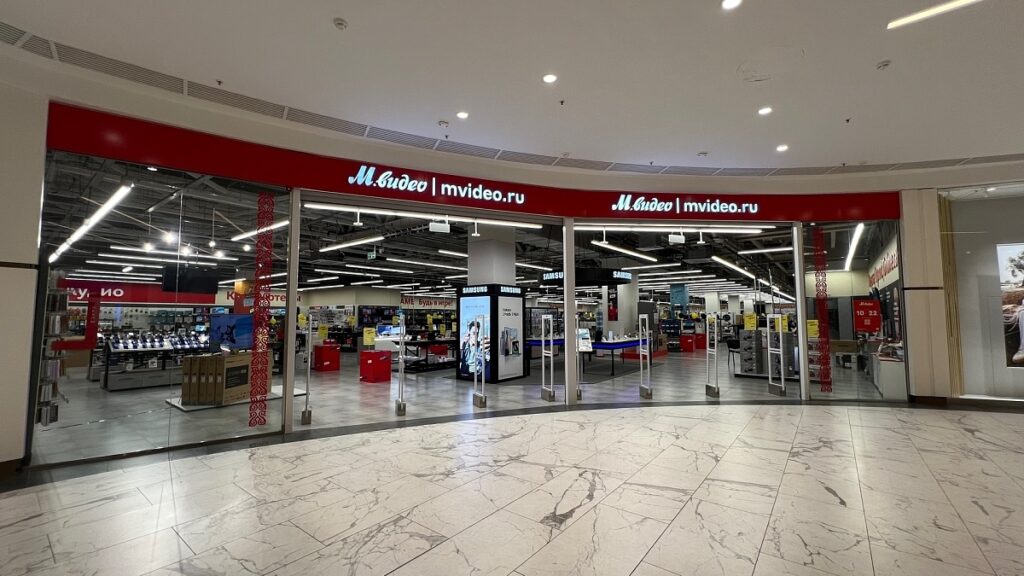
Independent businesses selling through M.Video, Russia’s largest electronics chain, waited months to receive customer payments for goods already sold. One seller received it only after filing a formal demand that usually precedes a lawsuit, according to a Vedomosti report.
The sellers are independent businesses using M.Video’s website as their storefront. Under M.Video’s seller contract, a customer buys from the independent business while M.Video collects the payment as
Independent businesses selling through M.Video, Russia’s largest electronics chain, waited months to receive customer payments for goods already sold. One seller received it only after filing a formal demand that usually precedes a lawsuit, according to a Vedomosti report.
The sellers are independent businesses using M.Video’s website as their storefront. Under M.Video’s seller contract, a customer buys from the independent business while M.Video collects the payment as the seller’s agent.
The business pays M.Video a commission for listing the product and handling payment and delivery. Until M.Video transfers the proceeds, the seller has already handed over the product but has not received the money from the sale.
Some sellers turn to legal demands
Sellers said payments for goods sold in May and June were still missing in August. One sent M.Video a formal demand on 13 August, giving the company five days to pay and waiving interest. The money arrived on 18 August.
Another business said its demand went unanswered, while its assigned manager stopped responding. It continued shipping orders until mid-July because M.Video had promised to transfer payment for its May sales.
Similar complaints had already surfaced two months earlier. M.Video told ABN that transfers were regular, but rapid growth sometimes required additional checks before funds could be released. The same report cited a business that had waited 24 working days after approving its sales statement; its previous transfer had also arrived late.
Independent sellers are taking a larger role in M.Video’s business. M.Video’s annual results show that products from these sellers accounted for one in every ten orders in 2025. According to its half-year marketplace update, turnover from these businesses quadrupled year-on-year as M.Video expanded beyond electronics. The number of products listed grew nearly sixfold.
The shift follows heavy losses in M.Video’s store-based business. M.Video’s annual results show that it lost about 64 billion rubles (about $770 million)—nearly one-fifth of its annual revenue. The chain closed hundreds of underperforming stores and opened only 11.
Treasury Secretary Scott Bessent said the United States would “tighten the noose” around Iran by imposing sanctions on every source or facilitator of its revenue.
The US is scooping up treasury bonds in an effort to raise their price and push yields down – but it’s not workingThe bond market is driving the Trump administration crazy. Last week, the treasury secretary, Scott Bessent, announced that the government would sharply ramp up its purchase of treasury bonds, in an effort to raise their price and thus push down their yield, which amounts to the interest rate the government pays on its debt.It didn’t quite work as planned. Yields on treasurys fell af
The US is scooping up treasury bonds in an effort to raise their price and push yields down – but it’s not working
The bond market is driving the Trump administration crazy. Last week, the treasury secretary, Scott Bessent, announced that the government would sharply ramp up its purchase of treasury bonds, in an effort to raise their price and thus push down their yield, which amounts to the interest rate the government pays on its debt.
It didn’t quite work as planned. Yields on treasurys fell after Bessent’s bond market intervention but soon bounced back. By Friday afternoon, the yield on the 10-year treasury was back near where it was before the secretary’s announcement. The yield on the 30-year bond was again trading around its highest level in 20 years or more.
Treasury Secretary Scott Bessent said last week that countries that continue to do business with Iran would face the “full might and force” of the U.S. government.
Investors will hope Kevin Warsh offers ‘comfort blanket’ at annual meeting of central banks amid bond market anxietyThe new US Federal Reserve chair, Kevin Warsh, faces a critical test this week amid anxiety in government bond markets over inflation and Donald Trump’s tax and spending plans.As the world’s most powerful central bank prepares for its annual Jackson Hole conference, analysts said bond traders would be looking for signals from Warsh over its commitment to fighting inflation. Continu
Investors will hope Kevin Warsh offers ‘comfort blanket’ at annual meeting of central banks amid bond market anxiety
The new US Federal Reserve chair, Kevin Warsh, faces a critical test this week amid anxiety in government bond markets over inflation and Donald Trump’s tax and spending plans.
As the world’s most powerful central bank prepares for its annual Jackson Hole conference, analysts said bond traders would be looking for signals from Warsh over its commitment to fighting inflation.
Treasury secretary Scott Bessent’s attempt to calm bond markets is a sign of weakness not strength“Look, there’s nothing magic about that $40tn number,” the US Treasury secretary, Scott Bessent, told CNBC insouciantly last week, as the country’s debt mountain surpassed another bleak record.Yet Bessent’s decision to intervene in government bond markets in an effort to combat soaring yields belied his studied calm in TV interviews – and reignited fears the US may be on the road to a debt crisis. C
Treasury secretary Scott Bessent’s attempt to calm bond markets is a sign of weakness not strength
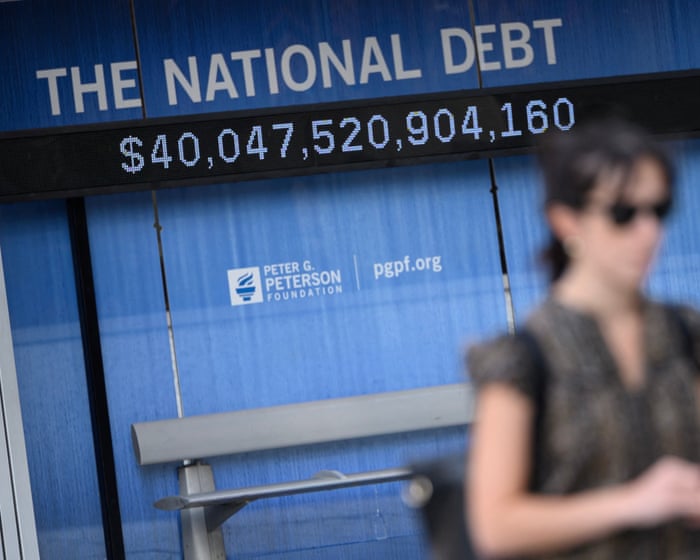
“Look, there’s nothing magic about that $40tn number,” the US Treasury secretary, Scott Bessent, told CNBC insouciantly last week, as the country’s debt mountain surpassed another bleak record.
Yet Bessent’s decision to intervene in government bond markets in an effort to combat soaring yields belied his studied calm in TV interviews – and reignited fears the US may be on the road to a debt crisis.
Prime Minister Mark Carney gave a powerful speech to Canadians on Saturday morning, hours after ordering negotiators to suspend U.S. trade talks despite President Trump’s punishing tariffs.
Prime Minister Mark Carney gave a powerful speech to Canadians on Saturday morning, hours after ordering negotiators to suspend U.S. trade talks despite President Trump’s punishing tariffs.
Prime Minister Mark Carney of Canada said that he had pulled negotiators out of trade talks with the United States because the Trump administration had “asked too much and offered too little.”
Canada’s prime minister walked away from what he thought was a bad trade deal with the United States. Many Canadians are behind him, but it will be costly.
Canada’s prime minister walked away from what he thought was a bad trade deal with the United States. Many Canadians are behind him, but it will be costly.
Ravil Dzhamally fled when Russian forces occupied his farm in Kherson Oblast, then returned after liberation to clear mines and plant again. Now, tons of his grain lie unsold in plastic sleeves across his fields because Russian attacks have nearly halted exports through Odesa, Bloomberg reported on 20 August.
Odesa’s Black Sea ports handle almost all of Ukraine’s grain exports, Bloomberg reported. Weekly grain and oilseed exports have fallen by more than 90% since early
Ravil Dzhamally fled when Russian forces occupied his farm in Kherson Oblast, then returned after liberation to clear mines and plant again. Now, tons of his grain lie unsold in plastic sleeves across his fields because Russian attacks have nearly halted exports through Odesa, Bloomberg reported on 20 August.
Odesa’s Black Sea ports handle almost all of Ukraine’s grain exports, Bloomberg reported. Weekly grain and oilseed exports have fallen by more than 90% since early July, data from commodity-data firm Kpler show. That threatens fall planting and the sector that generates more than half of Ukraine’s export revenue. The disruption is also raising food costs in countries that rely on imported grain, Reuters reported.
Farmers must either store harvests they cannot export or sell locally at about one-third of global prices, Bloomberg reported. They say this year’s crisis is worse than the 2022 blockade because the financial reserves that carried them through six months of disruption then have since been depleted.
Russian attacks drive ships from Ukraine’s grain corridor
Ukraine’s Black Sea grain corridor—the wartime shipping route from Odesa—was never formally closed, Euromaidan Press reported. Four or five ships entered Ukraine’s ports on 21 July. Still, none arrived the next day because shipowners had paused calls, not because Ukraine had restricted navigation, Agriculture Minister Taras Vysotskyi told Ukrainian agricultural outlet Latifundist.
Ukraine’s state railway, Ukrzaliznytsia, subsequently restricted selected wheat and barley shipments to Odesa ports. Its register did not state a reason, and the railway did not publicly link the orders to the shipping disruption.
Oleksandr Havryliuk, who farms near the front in Kharkiv Oblast, told Bloomberg that losing his harvest would probably bankrupt him and force him to sell the farm. The National Bank of Ukraine estimates that Ukraine could lose about $2.5 billion in export revenue during the second half of 2026, Reuters reported. Bloomberg said the disruption could trigger widespread farm bankruptcies.
Ukraine seeks EU aid and export routes as losses mount
Financing was already constrained before the port crisis: available financing and insurance were “enough to keep the sector surviving, not enough to keep it growing,” Vysotskyi told Euromaidan Press in May.
Before Russia’s full-scale invasion, agriculture accounted for more than 10% of Ukraine’s economic output, according to World Bank data cited by Bloomberg.
The sector has since grown more important as Russian attacks have destroyed much of the country’s heavy industry, Evghenia Sleptsova, a senior economist at the economic forecasting firm Oxford Economics, told Bloomberg.
Her firm estimates that the disruption could cost the equivalent of 1.8% of GDP this year and 2.1% in 2027. Under a prolonged severe disruption, the 2027 loss could instead reach 5.3%, Oxford Economics said.
Ukraine could exhaust its grain-storage capacity by early November if exports do not recover, the Agriculture Ministry said, according to Bloomberg. Even using every available route, the country may export only about 30 million tons this season, leaving roughly the same volume stored or rotting, Vysotskyi said.
Ukraine’s Agriculture Ministry requested a €220 million EU grant to subsidize interest and unlock up to €4 billion in loans, the ministry said.
Ukraine and Moldova are also discussing a rail route through Moldova to Romania’s port of Constanța, Reuters reported, citing unnamed sources in both countries. Kyiv estimates the route could carry about 10% of its grain exports.
Western rail corridors have limited capacity, while low water levels restrict traffic through Danube ports. Both alternatives cost more than shipping through the Black Sea, Bloomberg reported.
The enormous US debt under Trump will hobble the next Democratic administration – just as the GOP plannedWhy is the Trump administration causing turmoil in the bond markets?You could pin the US’s staggering $40tn in government debt to Donald Trump’s Keystone Cops-style governance. Tariffs he sold as a new source of revenue were struck down by the supreme court, forcing the government to return tens of billions of dollars to importers. Elon Musk’s “department of government efficiency” (Doge), ost
You could pin the US’s staggering $40tn in government debt to Donald Trump’s Keystone Cops-style governance. Tariffs he sold as a new source of revenue were struck down by the supreme court, forcing the government to return tens of billions of dollars to importers. Elon Musk’s “department of government efficiency” (Doge), ostensibly created to stop wasteful government spending, decimated federal programs and probably killed millions of children, but did nothing to close the budget deficit. The burst of inflation following Trump’s misguided adventure in Iran sharply raised the cost of serving the government’s obligations.
Yet as the federal debt hits an all-time high, up from about $35tn when Trump took office less than two years ago, it is worth noting that the US’s gargantuan indebtedness is in fact the product of a longstanding Republican strategy that took shape well before Trump could even dream about gold-plating the White House. It was called “starve the beast”.
By now we know that charity, generosity and compassion are virtues that the US president doesn’t seem to have even in trace amountsMany years ago, in the crowded corridor of a Manhattan hotel, I was surprised to find myself standing face-to-face with Imelda Marcos, then the first lady of the Philippines. At that time, she was said to possess 3,000 pairs of shoes.I desperately longed to ask the wife of the dictatorial president Ferdinand Marcos why anyone could need all those shoes. And more impo
By now we know that charity, generosity and compassion are virtues that the US president doesn’t seem to have even in trace amounts
Many years ago, in the crowded corridor of a Manhattan hotel, I was surprised to find myself standing face-to-face with Imelda Marcos, then the first lady of the Philippines. At that time, she was said to possess 3,000 pairs of shoes.
I desperately longed to ask the wife of the dictatorial president Ferdinand Marcos why anyone could need all those shoes. And more importantly, why would someone spend so much of her country’s wealth on stiletto heels when so many citizens were so desperately poor? But natural reticence, good manners or simply fear prevailed, and I walked away.
The head of UN Tourism, Shaikha Al Nowais, named medical tourism and Ukraine's IT sector as the country's strongest cards for winning back foreign visitors after the war, at a Kyiv briefing. Ukraine already holds everything a tourism economy needs, she said, from culture and landscapes to cuisine. Al Nowais, the first woman to lead the organization in its history, was making the first visit by a UN Tourism chief to Ukraine in a decade.
A UN specialized agency publicly t
The head of UN Tourism, Shaikha Al Nowais, named medical tourism and Ukraine's IT sector as the country's strongest cards for winning back foreign visitors after the war, at a Kyiv briefing. Ukraine already holds everything a tourism economy needs, she said, from culture and landscapes to cuisine. Al Nowais, the first woman to lead the organization in its history, was making the first visit by a UN Tourism chief to Ukraine in a decade.
A UN specialized agency publicly treated Ukraine as a future destination rather than a war zone, as Kyiv tries to anchor its reconstruction to sectors that can earn hard currency and bring people back to emptied regions. Both sectors she named were among Ukraine's stronger performers before 2022.
Before the invasion, Ukraine was receiving about 13 million visitors a year, with tourism worth roughly 3 to 4 percent of GDP, RBC-Ukraine reported citing the numbers mentioned at the briefing.
"Bringing all stakeholders in the tourism process together with the state under one umbrella could unlock great potential," Al Nowais said.
A medical tourism hub before the war
Before Russia's full-scale invasion, Ukraine had a reputation as an affordable place for fertility treatment and surrogacy, dentistry, laser eye surgery, and cosmetic procedures, the US-based Medical Tourism Association said. Prices often ran a fraction of Western European ones. In the late 2010s, the country's medical tourism association counted tens of thousands of foreign patients a year. Because that trade rests on clinics and specialists rather than rebuilt infrastructure, Al Nowais said it could bounce back fairly quickly once the war ends.
A tech sector that grew through the war
Ukraine's IT exports reached about $6.8 billion in 2021, close to a tenth of all the country's exports, and the industry has been one of the few to keep growing through the war. The same ecosystem produced the Diia app, a state-services platform installed by more than a third of Ukrainian adults before the invasion, along with globally used products such as Grammarly and GitLab. A sector that has shown it can ship and scale under bombardment is, on Al Nowais's logic, well placed to build the booking, logistics and guide services a returning tourism market will need.
Ukraine's Acting Foreign Minister Andrii Sybiha met her in Kyiv on 15 August 2026 to discuss tourism's place in reconstruction, and UN Tourism agreed to provide 500 scholarships for Ukrainians to study at its Online Academy, 200 of them reserved for veterans, with Kyiv setting the rest of the allocation.
Ukraine can now measure how cost-effectively it kills, and the math favors it. Every dollar Ukraine's Defense Forces spend on striking a target inflicts several times more losses on Russia, as confirmed by the Mission Control module in the DELTA battle system, Ukraine's Defense Ministry reported.
Mission Control, launched six months ago, now processes 50,000 missions a week and over 230,000 reports, allowing Ukraine to track not just what it hits but also what each stri
Ukraine can now measure how cost-effectively it kills, and the math favors it. Every dollar Ukraine's Defense Forces spend on striking a target inflicts several times more losses on Russia, as confirmed by the Mission Control module in the DELTA battle system, Ukraine's Defense Ministry reported.
Mission Control, launched six months ago, now processes 50,000 missions a week and over 230,000 reports, allowing Ukraine to track not just what it hits but also what each strike costs relative to the damage it causes. In June, every dollar Ukraine spent on a strike cost Russia nearly five times as much.
The economics favor Ukraine's strikes
The system prices both sides of every strike. Mission Control records the cost of what Russia loses, ranging from a few hundred dollars for telecommunications equipment to hundreds of thousands of dollars for air-defense systems and other high-value targets.
The June figures show the gap. Hitting one enemy soldier costs Ukraine $3,032, compared with roughly $65,000 that Russia spends to maintain one. Meanwhile, hitting a piece of equipment costs $2,674, and targeting an infrastructure object costs $1,487.
Every mission feeds the next
Mission Control logs each mission to sharpen the next. The military analyzes what worked, what did not, and why to adjust tactics for the next mission rather than blindly repeating mistakes, according to the Defense Ministry.
The data breaks down by mission type and depth. It sorts missions into reconnaissance, strike, logistics, and evacuation, and by range, 20-plus and 50-plus kilometers, showing for each unit what it strikes, how effectively, at what cost, and what economic damage it inflicts, while also tracking which Ukrainian equipment is lost, at what depth, and under what circumstances.
The goal is fewer Ukrainian lives spent
The measurement serves a purpose beyond economics. The Defense Ministry said it continues implementing technologies so each mission makes the next more precise and helps preserve the lives of Ukrainian soldiers, gradually shifting the most dangerous battlefield tasks to robotic systems.
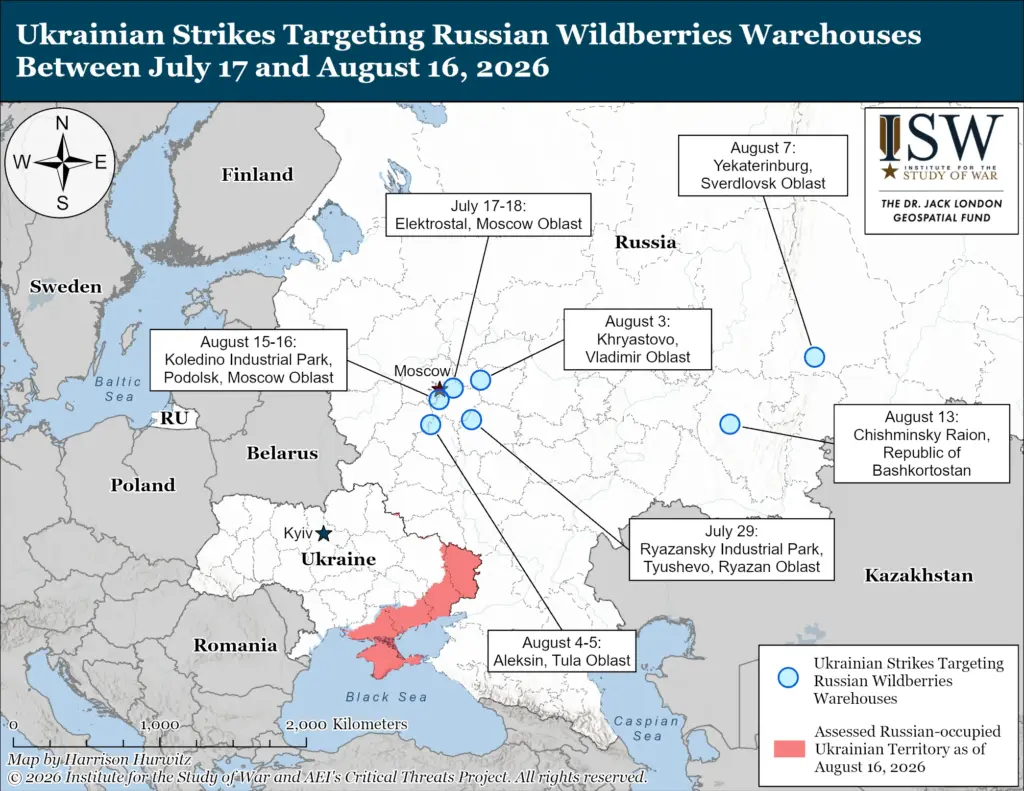
Ukraine has knocked out seven of the 10 largest logistics hubs run by Russia's biggest online retailer, the US-based Institute for the Study of War assessed. The strikes are part of a campaign to wear down Russia's defense industry and the dual-use supply lines that feed its war. The newest raids hit two warehouses near Moscow overnight.
Ukraine has pushed its long-range drone war deep into Russia, hunting the oil, freight, and factory sites that keep Moscow's invasion
Ukraine has knocked out seven of the 10 largest logistics hubs run by Russia's biggest online retailer, the US-based Institute for the Study of War assessed. The strikes are part of a campaign to wear down Russia's defense industry and the dual-use supply lines that feed its war. The newest raids hit two warehouses near Moscow overnight.
Ukraine has pushed its long-range drone war deep into Russia, hunting the oil, freight, and factory sites that keep Moscow's invasion supplied. Each strike that lands far from the front tests how much of its own territory Russia can actually defend. ISW assessed that the campaign is squeezing both Russia's economy and its overstretched air defenses, with no sign the retailer's biggest depots are getting any safer.
Two hubs near Moscow burned overnight
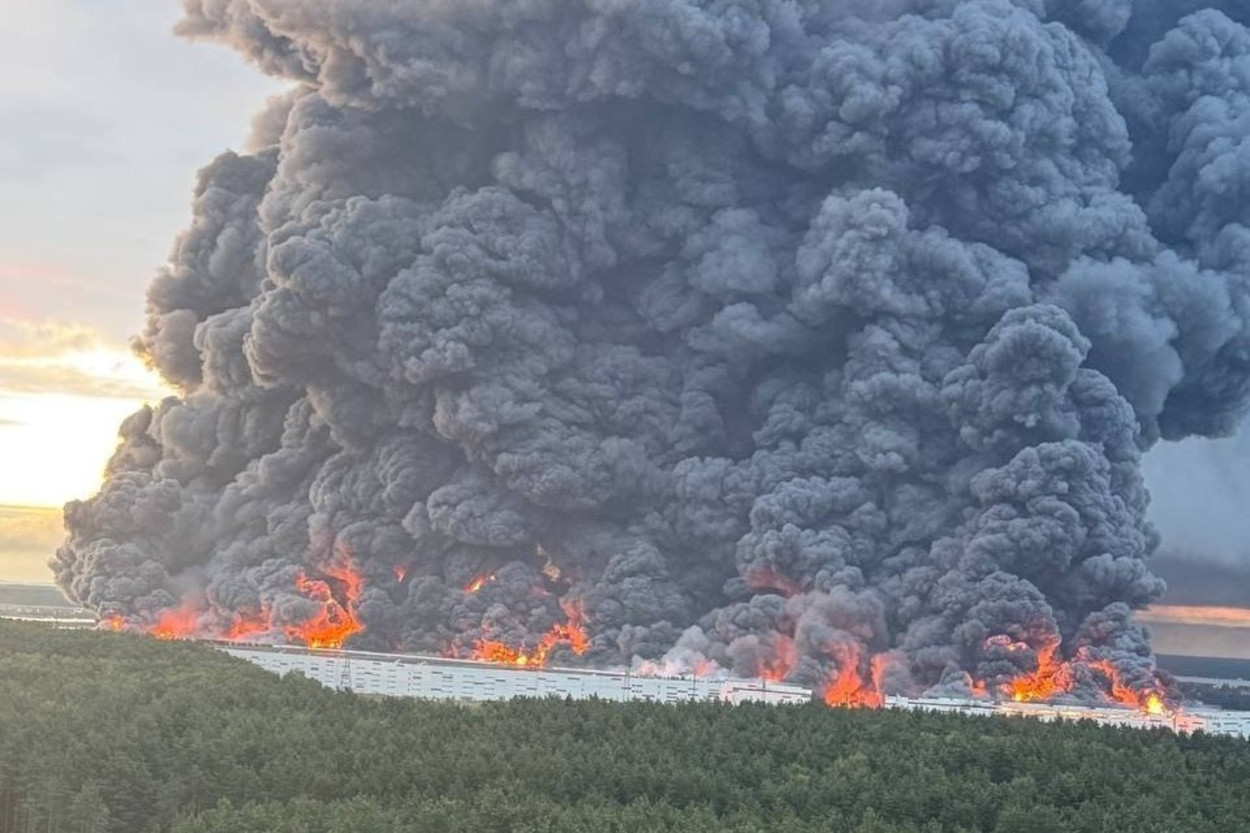
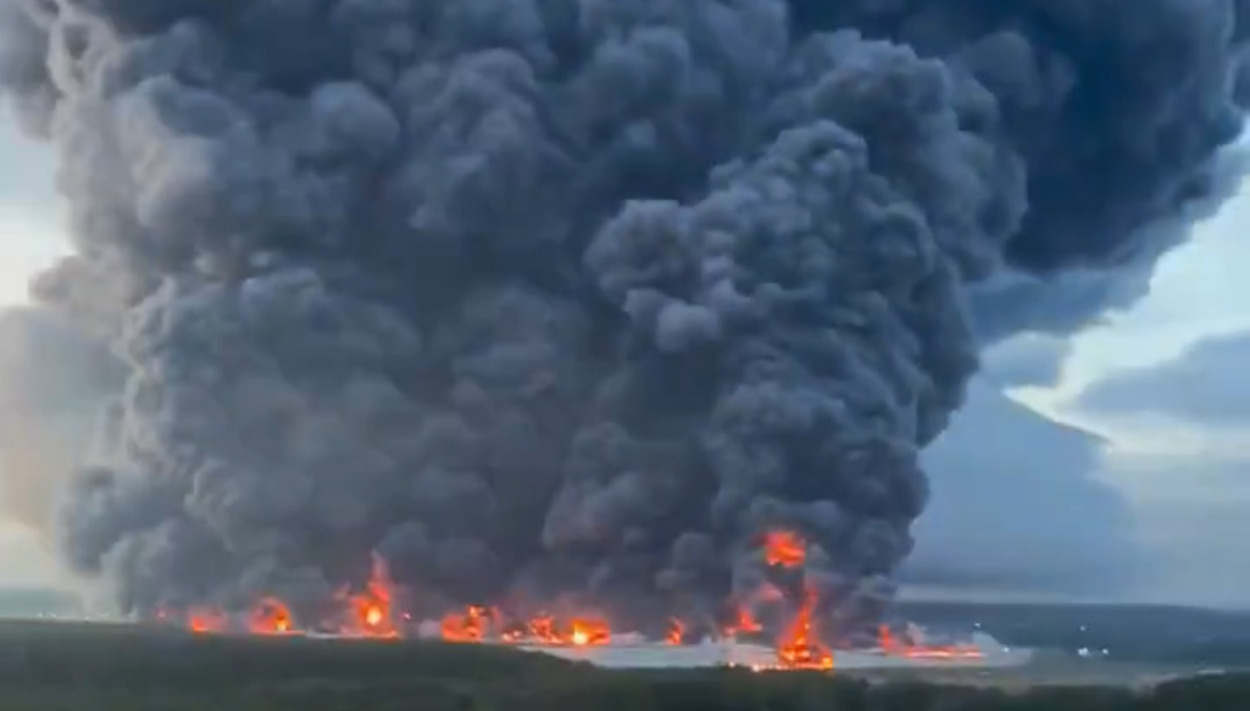
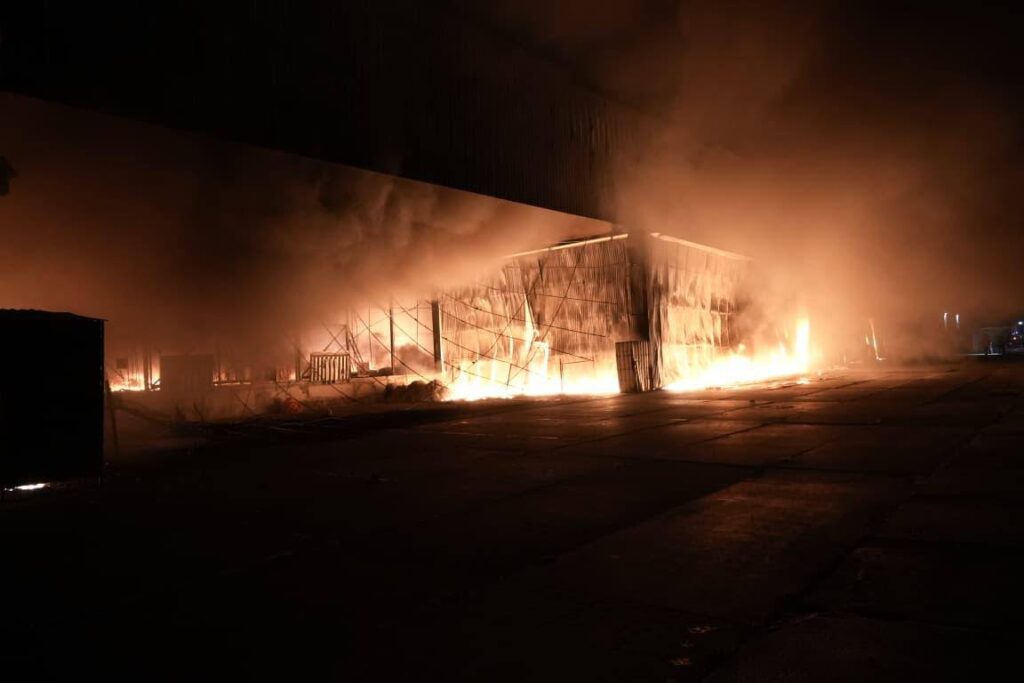
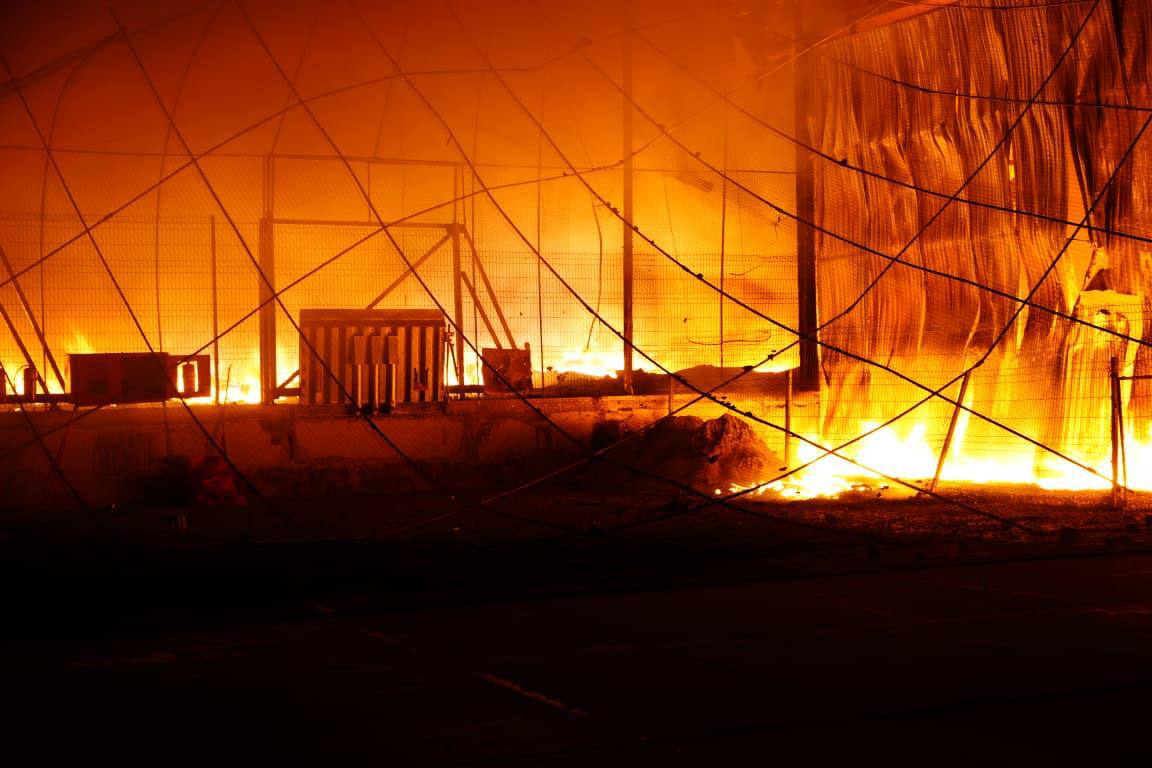
On 15-16 August, Ukrainian drones struck Wildberries' single largest hub, a 250,000-square-meter depot in the Koledino Industrial Park in Podolsk, Moscow Oblast. Ukraine's Defense Ministry reported the hit, about 420 kilometers from the border.
Explore further
“One of the most massive” Ukrainian drone attacks hits Moscow Oblast: two major warehouses ablaze
Wildberries confirmed the fire and said it had to reorganize its supply chains. Moscow Oblast Governor Andrei Vorobyov acknowledged the strike, and geolocated footage showed the depot ablaze.
Drones also hit a second warehouse the same night, in Domodedovo, roughly 430 kilometers from the border. Footage showed a fire at the Severnoye Domodedovo complex.
Why the warehouses are targets
Ukrainian officials say Wildberries helps supply the Russian military, moving drone components and navigation gear. Kyiv folded the retailer into a deep-strike campaign that began in mid-July.
The company is Russia's answer to Amazon, its largest online marketplace. Its sprawling depots make broad, hard-to-defend targets.
Wildberries warehouse burning in Russia's Koledino following a Ukrainian drone strike, 16 August 2026. Screenshot from video: bayraktar_1love
The damage keeps growing
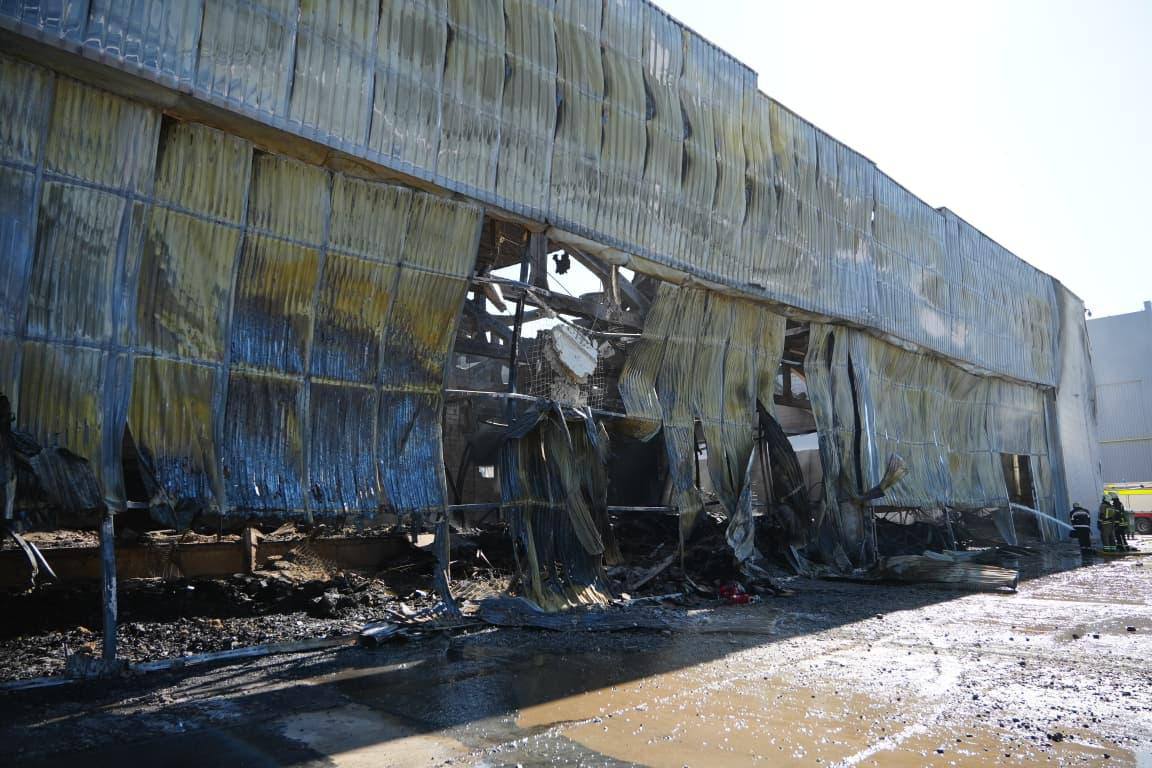
By early August, the strikes had destroyed at least 1.18 million square meters of Wildberries storage, about a fifth of its capacity, ISW noted. The toll has climbed since.
The losses ripple outward to independent sellers who rent space in the hubs. Many have watched their stock burn with no compensation.
Russia's economy grew 1.3% in the second quarter of 2026, the state news agency TASS reported on 12 August, citing preliminary estimates from the state statistics agency Rosstat — a figure that, if accurate, would end a slump that had opened the year with the country's first quarterly contraction since 2023.
And it comes from a state agency months after Putin dressed down his economic team in April and demanded "concrete measures" to restore growth — the print then beat
Russia's economy grew 1.3% in the second quarter of 2026, the state news agency TASS reported on 12 August, citing preliminary estimates from the state statistics agency Rosstat — a figure that, if accurate, would end a slump that had opened the year with the country's first quarterly contraction since 2023.
And it comes from a state agency months after Putin dressed down his economic team in April and demanded "concrete measures" to restore growth — the print then beat the government's own economists in exactly the direction he wanted.
The quarter may have brought a real if shallow rebound, or the state's statisticians may have produced the figure the president wanted. Either way it matters, because Russia's economy is what pays for its war, and its strength sets the ceiling on how long the Kremlin can keep fighting.
Barely growing all year
Even taken straight, the rebound is thinner than it looks. The first quarter had closed 0.2% down, and across the whole first half of the year output rose just 0.6%, half of last year's pace and close to seven times slower than the wartime boom of 2023 and 2024. The quarterly figure jumped. The underlying trend barely moved.
The weakness had been building for over a year. War spending drove the 2023–24 boom and overheated the economy; to curb the resulting inflation, the central bank raised its key rate to 21%, choking lending and investment. It has cut rates since, to 14% in July, but money is still tight and inflation is rising again as Ukrainian strikes push up fuel prices.
Growth the war paid for
As The Moscow Times set out, reviewing the data and the economists reading it, most of the quarter's growth rested on one-off factors: more working days than a year earlier, a temporary oil-revenue spike during the Iran war, and a budget that lifted spending 16%, a third of it on the army and weapons. The split underneath is the tell.
Military plants kept raising output; civilian industry kept shrinking, down 3.2% from a year earlier by the Center for Macroeconomic Analysis and Short-Term Forecasting (CMASF), a Russian forecasting institute, according to its estimate.
Rosstat also billed the quarter as its strongest in six, and said it had beaten the forecasts of both the economy ministry, which had projected 0.9%, and the central bank, which saw 0.8%.
Few expect it to last
Russia will "remain in a state of stagnation" for the foreseeable future, said Liam Peach of Capital Economics, citing high interest rates and the fuel crisis.
Ukraine's long-range drones are adding to the strain. Their strikes have cut Russian oil refining to its lowest level in more than two decades, draining fuel supply and pushing prices up at home, and forcing Moscow, an oil giant, to import gasoline from as far as Morocco.
Russia’s war budget got a brief respite this spring, when the Iran war pushed oil prices up. By July, it was gone. A single month swung from a rare surplus to an $8.8 billion deficit, leaving the seven-month shortfall already bigger than the entire deficit Russia ran last year, with five months still to run.As oil money drains away, the Kremlin is covering the gap by taxing ordinary Russians harder and eyeing their savings.
Moscow will not run out of cash soon, but it i
Russia’s war budget got a brief respite this spring, when the Iran war pushed oil prices up. By July, it was gone. A single month swung from a rare surplus to an $8.8 billion deficit, leaving the seven-month shortfall already bigger than the entire deficit Russia ran last year, with five months still to run.
As oil money drains away, the Kremlin is covering the gap by taxing ordinary Russians harder and eyeing their savings.
Moscow will not run out of cash soon, but it is running out of politically affordable ways to raise it.
Oil-and-gas income, long the war’s financial engine, fell by about a sixth from a year earlier to 4.6 trillion rubles ($56 billion), Finance Ministry figures show. Spending outpaced revenue, with state procurement up by nearly two-fifths.
The hole was plugged by value-added tax, whose receipts jumped by a quarter after Moscow raised the rate to 22% at the start of the year—a tax levied on ordinary Russians’ spending, not on oil prices or economic growth.
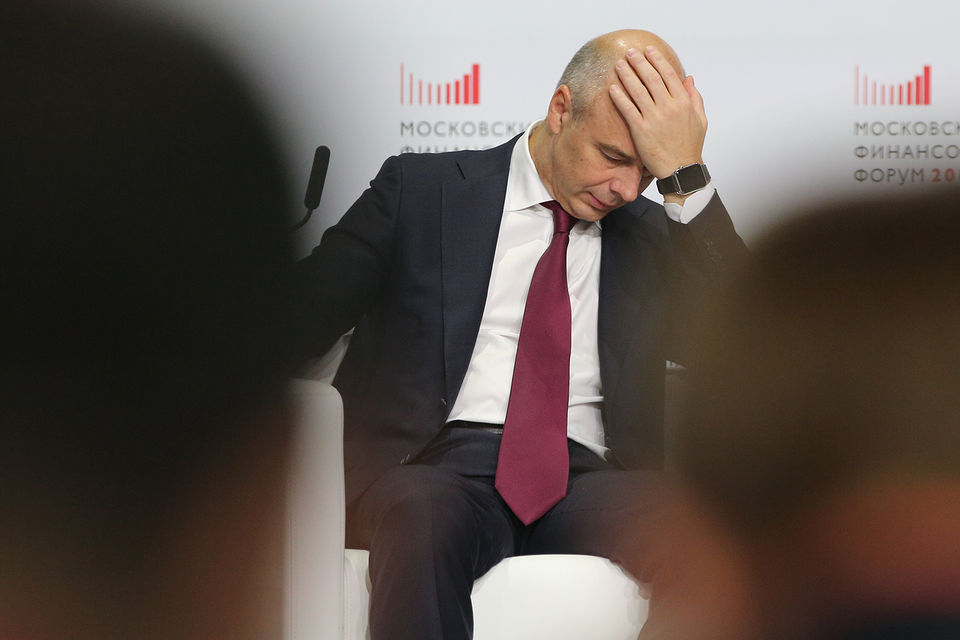
Anton Siluanov, Russian Finance Minister. Photo: vedomosti.ru
One month of relief, then the gap reopened
The reprieve proved brief. July’s deficit followed June’s surplus even though spring’s higher oil prices should have cushioned the books, Bloomberg calculations showed.
Russia’s oil revenues collapse 24% as global prices slide further (INFOGRAPHICS)
With the economy barely growing in the first half, a second-half recession could knock out another chunk of tax revenue just as the shortfall widens. Yaroslav Kabakov of the Finam brokerage expects the full-year deficit to approach double last year’s by year-end. Even as revenue shrinks, the military reportedly wants roughly 40% more than planned.
Borrowing, the other fallback, is jamming too. Russia suspended government bond auctions in July after investors balked and it could no longer raise money cheaply at home, even as Finance Minister Anton Siluanov vowed to shield defense and social spending.
Moscow shifts the burden to households
The burden is shifting onto households. The VAT rise alone will raise about $13 billion a year—barely a month of military spending—yet, unlike seizures aimed at billionaires, it reaches nearly every Russian, columnist Agathe Demarais wrote in Foreign Policy.
A draft law would allow the state to move around $40 billion from private pension accounts, and Communist leader Gennady Zyuganov has urged Vladimir Putin to tap the savings Russians hold in banks. Moscow will not run out of cash soon, Demarais argued, but it is “running out of politically affordable ways to raise it.”
Ordinary Russians are already moving their money. Through the first half of 2026, they withdrew cash from the banking system at the fastest pace since the pandemic, and the Central Bank has begun allowing banks to flag and freeze “suspicious” withdrawals, Euromaidan Press reported.
The US Department of Agriculture's Foreign Agricultural Service (FAS) forecasts that Ukraine's grain exports will fall steeply in the 2026-27 season, with corn shipments dropping 39% to 14 million tonnes and wheat 26% to 10.8 million, World Grain reported. The agency tied the decline to Russia's summer campaign against the Odesa ports, which handle roughly 90% of the country's grain.
The forecast puts Washington's own numbers behind what Kyiv has warned for weeks. Ukrai
The US Department of Agriculture's Foreign Agricultural Service (FAS) forecasts that Ukraine's grain exports will fall steeply in the 2026-27 season, with corn shipments dropping 39% to 14 million tonnes and wheat 26% to 10.8 million, World Grain reported. The agency tied the decline to Russia's summer campaign against the Odesa ports, which handle roughly 90% of the country's grain.
The forecast puts Washington's own numbers behind what Kyiv has warned for weeks. Ukraine's agriculture ministry projects farm exports could fall by almost half this season, and the FAS estimate — from a body with no stake in Ukraine's budget — points the same way. The difference is where the FAS looks: not at the ships that cannot sail, but at the grain that cannot follow them out.
Grain with nowhere to go
The clearest sign of the blockage is in ending stocks — grain left sitting in the country when the season closes. The FAS expects Ukraine's corn stocks to jump more than tenfold, to 13.5 million tonnes from 1.3 million, and wheat stocks to more than double to 8.2 million. That is grain the harvest produced and the ports could not move.
Ukraine has more than 74 million tonnes of storage for grain and oilseeds, the FAS noted, including about 23 million tonnes of certified warehouse space. Even so, the agriculture ministry has said the country may need another 10 to 12 million tonnes of temporary storage to get through the corn harvest if the Black Sea disruptions continue — most acutely in regions near the front line.
Why Odesa decides the harvest
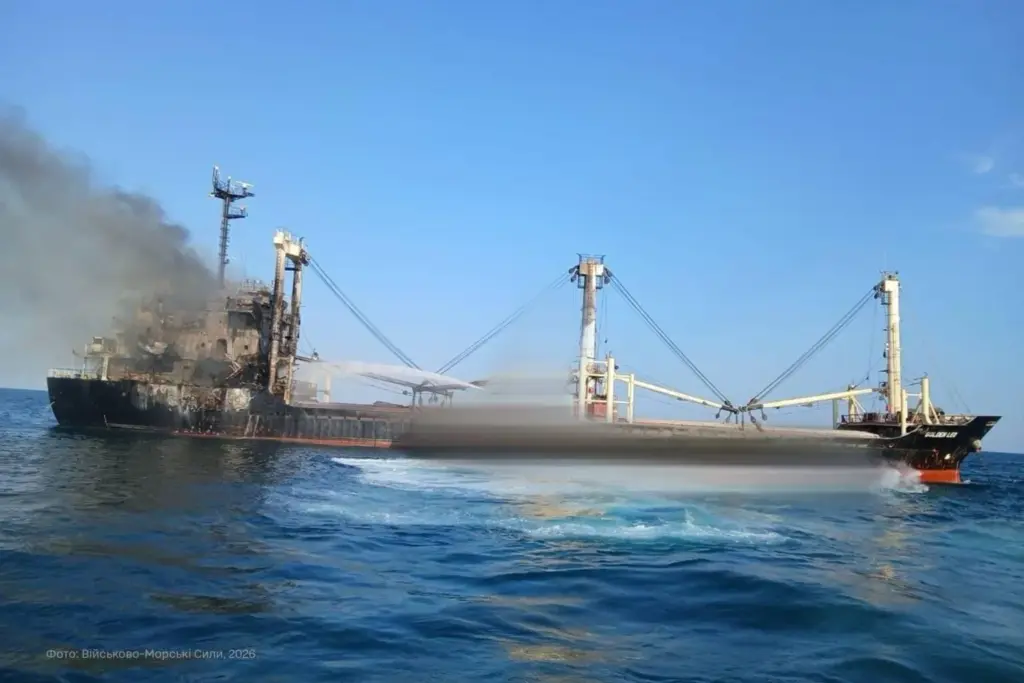
Almost everything moves through Odesa. Three deepwater ports in Odesa Oblast carry more than 90% of Ukraine's farm exports, and Russia spent the summer hitting them and the ships that call there. Missiles struck the Turkish-owned bulk carrier Golden Leo as it left Odesa loaded with grain on 19 July, killing 10. Days earlier, a Russian drone hit a Palau-flagged corn ship twice as it sailed for Greece.
The land routes that remain — rail, road, and the Danube — cannot take up the slack, and traders have pulled back from buying grain they have no way to ship.
Farming is Ukraine's biggest export earner, bringing in more than half of what the country made selling goods abroad last year. Ukraine is also among the world's largest corn suppliers, which is why a cut of this size registers well beyond its own budget. For the farmers holding this year's crop, the FAS forecast describes a harvest they may not be able to sell.
A Russian overnight strike heavily damaged a German-owned car-parts plant in Zhytomyr Oblast, forcing it to halt production, the company said. No workers were hurt, but the destruction was extensive. One of the region's major employers now has no restart date.
Russia increasingly hits the factories and warehouses of foreign companies that kept producing in Ukraine through the war, not only Ukrainian factories, energy facilities, infrastructure, and homes. Each strik
A Russian overnight strike heavily damaged a German-owned car-parts plant in Zhytomyr Oblast, forcing it to halt production, the company said. No workers were hurt, but the destruction was extensive. One of the region's major employers now has no restart date.
Russia increasingly hits the factories and warehouses of foreign companies that kept producing in Ukraine through the war, not only Ukrainian factories, energy facilities, infrastructure, and homes. Each strike on a foreign-owned factory chips away at the jobs and outside investment propping up Ukraine's wartime economy, adding to a burden the country's partners are scrambling to offset.
A German plant knocked offline
Russia struck Zhytomyr Oblast overnight into 9 August and hit the Kromberg & Schubert plant, which reported the attack on Facebook. Its production lines and infrastructure took heavy damage.
"The most important thing for us is that no employees were hurt in the attack," the statement said.
With the damage so severe, the plant suspended operations for an indefinite period. A restart depends on a technical assessment and the full scope of repairs, the company added.
Kromberg & Schubert is a civilian manufacturer with 100% German investment. It has run in the Zhytomyr region for 11 years and employs about 3,500 people. The plant makes the wiring harnesses that thread through cars, supplying European automakers.
The Kromberg & Schubert plant ablaze after the Russian strike in Zhytomyr Oblast, overnight on 9 August 2026. Photo: Vitalii Bunechko
Vitalii Bunechko, head of the Zhytomyr Oblast Military Administration, called it one of the region's budget-forming enterprises. He said the administration and local authorities are working to help the strategic investor and keep the plant running.
The burned-out Kromberg & Schubert plant after the Russian strike in Zhytomyr Oblast, 9 August 2026. Photo: Vitalii Bunechko
Part of a wider overnight assault
Bunechko reported that Russia had launched a massive strike on the oblast overnight. The attack also damaged civilian infrastructure, he said. State Emergency Service crews contained the fires, and investigators began work at the site.
Russia has repeatedly struck Zhytomyr Oblast during the war, stepping up its drone strikes on northwestern Ukraine, often exploiting Belarusian territory.
The European Commission is discussing with EU member states various options to cover Ukraine's budget deficit for next year, which could range from $8 billion to $19 billion, the Financial Times reported on July 8.International partners have provided Ukraine with over $39 billion for its wartime economy so far this year, Prime Minister Denys Shmyhal announced.The financial hole in Ukraine's budget is linked to reduced U.S. support and the lack of prospects for a swift ceasefire with Russia that
The European Commission is discussing with EU member states various options to cover Ukraine's budget deficit for next year, which could range from $8 billion to $19 billion, the Financial Times reported on July 8.
International partners have provided Ukraine with over $39 billion for its wartime economy so far this year, Prime Minister Denys Shmyhal announced.
The financial hole in Ukraine's budget is linked to reduced U.S. support and the lack of prospects for a swift ceasefire with Russia that Europe had hoped for, the Financial Times reported.
A senior EU official told the publication that many of Ukraine's partners had previously counted on a peace deal in 2025, but are now forced to revise their funding plans.
This includes the European Commission, which has already adjusted spending from Ukraine-related funding streams.
Without support from Western partners, Kyiv would face a budget deficit of $19 billion in 2026, according to the Financial Times. However, even if additional international financing for the wartime economy can be secured, a gap of at least $8 billion would remain.
To support Ukraine's budget, Europe is considering providing military aid in the form of off-budget grants that would be recorded separately as external transfers but would count toward NATO member countries' national defense spending targets.
One EU diplomat told the Financial Times that military support for Ukraine is viewed as a contribution to the defense of all of Europe.
In a document for G7 countries reviewed by Financial Times, Kyiv proposed that European allies co-finance Ukrainian forces, framing this as a service to strengthen continental security.
Other support options under discussion include potentially accelerating payments from the existing $50 billion G7 loan program and reinvesting frozen Russian assets in higher-yield financial instruments that the EU allocated to help service the debt.
According to the Financial Times, two sources confirmed that the commission planned to discuss these options with EU finance ministers on July 8.
The funding issue will also be raised at the Ukraine Recovery Conference in Rome on July 10-11, dedicated to Ukraine's reconstruction needs. European Commission President Ursula von der Leyen will attend the event.
Russia's economy, which defied initial sanctions and saw growth propelled by massive military spending and robust oil exports, is now showing significant signs of a downturn. Recent economic indicators are flashing red, with manufacturing activity declining, consumer spending tightening, and inflation remaining stubbornly high, straining the national budget, the Wall Street Journal (WSJ) reported on July 4. Russian officials are openly acknowledging the risks of a recession. Economy Minister Max
Russia's economy, which defied initial sanctions and saw growth propelled by massive military spending and robust oil exports, is now showing significant signs of a downturn.
Recent economic indicators are flashing red, with manufacturing activity declining, consumer spending tightening, and inflation remaining stubbornly high, straining the national budget, the Wall Street Journal (WSJ) reported on July 4.
Russian officials are openly acknowledging the risks of a recession. Economy Minister Maxim Reshetnikov warned last month that Russia was on the "verge of a recession," while Finance Minister Anton Siluanov described the situation as a "perfect storm." Companies, from agricultural machinery producers to furniture makers, are reducing output. The central bank announced on July 3 it would debate cutting its benchmark interest rate later this month, following a reduction in June.
While analysts suggest this economic sputtering is unlikely to immediately alter President Vladimir Putin’s war objectives—as his focus on "neutering Ukraine" overrides broader economic concerns—it exposes the limits of his war economy.
The slowdown indicates that Western sanctions, though not a knockout blow, are increasingly taking a toll. If sanctions intensify further or global oil prices fall, Russia’s economy could face more severe instability. This downturn undermines Putin's strategic bet that Russia can financially outlast Ukraine and its Western allies, suggesting Moscow may struggle to finance the war indefinitely.
Experts warn that Russia's economic growth model, overly reliant on military spending, is unsustainable and necessitates a contraction of civilian economic capacities to free up workers for the war machine, which is not a viable long-term strategy. Putin recently dismissed suggestions that the war is stifling the economy, echoing Mark Twain by stating reports of its death "are greatly exaggerated." However, he also cautioned that a recession or stagflation "should not be allowed under any circumstances."
After a brief recession in 2022, military spending, which accounts for over 6% of gross domestic product this year (the highest since Soviet times) and approximately 40% of total government spending, had propped up Russia’s economy and blunted the impact of Western sanctions. Russia’s ability to reroute oil exports to China and Beijing’s support with electronics and machinery provided additional economic stimulus. This created an economic paradox: the most sanctioned major economy was, for a period, growing faster than many advanced economies.
However, this military spending "sugar rush" fueled runaway inflation, compelling the central bank to raise interest rates to a record 21% to try and tame it. Higher interest rates increased borrowing costs for businesses, curbing investment, expansion plans, and squeezing profits. The economic comedown has already begun.
Official data shows Russian GDP growth slowed to 1.4% in the first quarter compared to a year earlier, down significantly from 4.5% in the fourth quarter of 2024. S&P Global’s purchasing managers’ index indicated Russia’s manufacturing sector contracted at its sharpest rate in over three years in June, and new car sales dropped nearly 30% year-over-year in June.
Businesses across Russia are feeling the effects, according to the WSJ. Rostselmash, the country’s largest producer of agricultural machinery, announced in May it would cut production and investment, and pull forward mandatory annual leave for its 15,000 employees due to a lack of demand. In Siberia, electricity grid operator Rosseti Sibir stated it was on the verge of bankruptcy due to high debt, halting investments and proposing tariff hikes for industrial users.
While some analysts argue the Russian banking system remains stable, others warn of increasing instability. A recent report by the Washington, D.C.-based Center for Strategic and International Studies (CSIS) highlighted risks from a government decision to control war-related lending at major Russian banks. The state could direct banks to offer preferential loans, potentially forcing the government to absorb losses if high interest rates prevent companies from meeting obligations.
The Moscow-based Center for Macroeconomic Analysis and Short-Term Forecasting also assessed in May that the risk of a protracted systemic banking crisis in 2026 was "moderate" and growing.
These economic challenges intensify pressure on the Kremlin by reducing its financial capacity to fund its war in Ukraine. The government has operated with a budget deficit throughout the war and projects this will continue for at least two more years. This fiscal strain could provide an opening for Western nations to implement more powerful sanctions.
Falling oil prices present another significant risk for Russia, as energy sales account for about a third of its budget revenues. The price of Russian crude has consistently remained below the level assumed in this year’s budget, and Russia’s oil-and-gas revenue in June fell to its lowest level since January 2023, according to Finance Ministry data.
BlackRock, a U.S. investment firm, suspended work on a multibillion-dollar Ukraine recovery fund following U.S. President Donald Trump's election victory, prompting France to work on a replacement, Bloomberg reported on July 5.The plan nearly secured the initial support of institutions backed by the governments of Germany, Italy, and Poland, people familiar with the matter told Bloomberg.Kyiv has sought to secure investment in Ukraine's reconstruction as Russia's war continues to destroy infrast
BlackRock, a U.S. investment firm, suspended work on a multibillion-dollar Ukraine recovery fund following U.S. President Donald Trump's election victory, prompting France to work on a replacement, Bloomberg reported on July 5.
The plan nearly secured the initial support of institutions backed by the governments of Germany, Italy, and Poland, people familiar with the matter told Bloomberg.
Kyiv has sought to secure investment in Ukraine's reconstruction as Russia's war continues to destroy infrastructure across the country.
BlackRock halted its search for institutional investors in January, causing the planned funding that sought to secure $500 million from governments, development grants, and investment banks, and another $2 billion from private investors, to fall through.
The investment firm halted talks with institutional investors in January due to a lack of interest amid perceived uncertainty in Ukraine.
The fund was set to be unveiled by BlackRock at the upcoming Ukraine Recovery Conference on July 10-11 in Rome, Bloomberg reported.
A spokesperson for BlackRock said the investment firm completed advisory work for the recovery fund pro bono in 2024 and no longer has "any active mandate."
France is working on a proposal to replace the recovery fund led by BlackRock, people familiar with the matter told Bloomberg, adding that it remains uncertain how effective the plan will be without Washington's backing.
President Volodymyr Zelensky and Italian Prime Minister Giorgia Meloni are expected to attend the Ukraine Recovery Conference next week.
Despite a partial rebound from a 30% economic slump in 2022, foreign investment in Ukraine remains underwhelming.
Iran is reportedly preparing to mine the Strait of Hormuz, a move that would spike global oil prices and give a significant boost to the Russian economy and its war machine in Ukraine.Reuters reported on July 1 that Iran loaded naval mines onto vessels in the Persian Gulf last month, citing two U.S. officials, who said the preparations had been detected after Israel launched its "preemptive" attack against Iran on June 13.Amid the conflict with Israel which has currently settled into an uneasy c
Iran is reportedly preparing to mine the Strait of Hormuz, a move that would spike global oil prices and give a significant boost to the Russian economy and its war machine in Ukraine.
Reuters reported on July 1 that Iran loaded naval mines onto vessels in the Persian Gulf last month, citing two U.S. officials, who said the preparations had been detected after Israel launched its "preemptive" attack against Iran on June 13.
Amid the conflict with Israel which has currently settled into an uneasy ceasefire, Iran has repeatedly threatened to block the Strait of Hormuz as a means of deterrence.
If the Strait were mined, Iran could block one-fifth of global oil demand and spike world energy prices — a boon for Russia's oil-dependent economy.
"Any disruption to Gulf supplies would push up global crude prices. Prices for Russian crude would rise in line," John Gawthrop, Argus Eurasia Energy editor, told the Kyiv Independent.
Russia’s energy sector made up 35-40% of its budget revenues pre-full-scale invasion and is powering its war machine.
Western sanctions on Russian energy and the G7’s Russian oil price cap of $60 per barrel have hampered its profits, with Russia losing more than $150 billion over the last three years, but have yet to deal a crippling blow.
The conflict between Israel and Iran caused a spike in prices — Brent crude, the global benchmark, on June 13 jumped from $69.36 to $75 per barrel, a surge that looked like it could grant Russia's economy a reprieve.
Until the Israeli attacks, the future for Russian crude wasn’t looking so bright. Europe was planning its 18th sanctions package targeting Russia's energy sector, and the G7 was pushing for a $45 price cap. Hungary and Slovakia have since blocked the sanctions package.
Prices have since settled along with the conflict and on July 2 Brent crude was $67.50, but if Iran does go ahead with mining the Strait of Hormuz, blocking one-fifth of global oil demand, another surge would follow.
This would also mean Iran blocks its own oil exports too, so it would only be a last resort from Tehran, David Fyfe, chief economist at Argus Media, a market analyst group, told the Kyiv Independent last month.
Editor's note: The article was updated with a statement from Ukraine's military intelligence agency.A tanker carrying 1 million barrels of oil experienced an explosion near Libya, its operator, TMS Tankers, said on June 30. The vessel, Vilamoura, is now being towed to Greece, where the extent of the damage will be assessed upon arrival. The blast caused the engine room to flood due to water intake, though the cause of the explosion remains unclear, according to a company spokesperson.The spokesp
Editor's note: The article was updated with a statement from Ukraine's military intelligence agency.
A tanker carrying 1 million barrels of oil experienced an explosion near Libya, its operator, TMS Tankers, said on June 30. The vessel, Vilamoura, is now being towed to Greece, where the extent of the damage will be assessed upon arrival.
The blast caused the engine room to flood due to water intake, though the cause of the explosion remains unclear, according to a company spokesperson.
The spokesperson confirmed that the crew is safe and no pollution has been reported.
The explosion occurred on June 27 as the vessel was departing the Libyan port of Zuwetina, some 150 kilometers (90 miles) northeast of Libyan territorial waters, Ukraine's military intelligence reported.
The incident comes amid a series of unexplained blasts targeting oil tankers that had previously visited Russian ports. In response, shipowners have started inspecting their vessels for mines using divers and underwater drones.
Vilamoura had visited Russian oil terminals twice since April, loading Kazakh-origin crude rather than Russian oil. According to Bloomberg vessel-tracking data, the tanker called at the Russian port of Ust-Luga in early April and at the Caspian Pipeline Consortium (CPC) terminal near Novorossiysk in May. Both terminals primarily handle Kazakh crude exports.
Maritime risk consultancy Vanguard Tech reported that four other vessels have been damaged by explosions since the beginning of the year. Each had recently docked at Russian ports, the firm said.
Ukraine has targeted Russian energy assets throughout the full-scale invasion, including a drone strike in February on the CPC pipeline, a route responsible for moving roughly 80% of Kazakhstan’s oil exports.
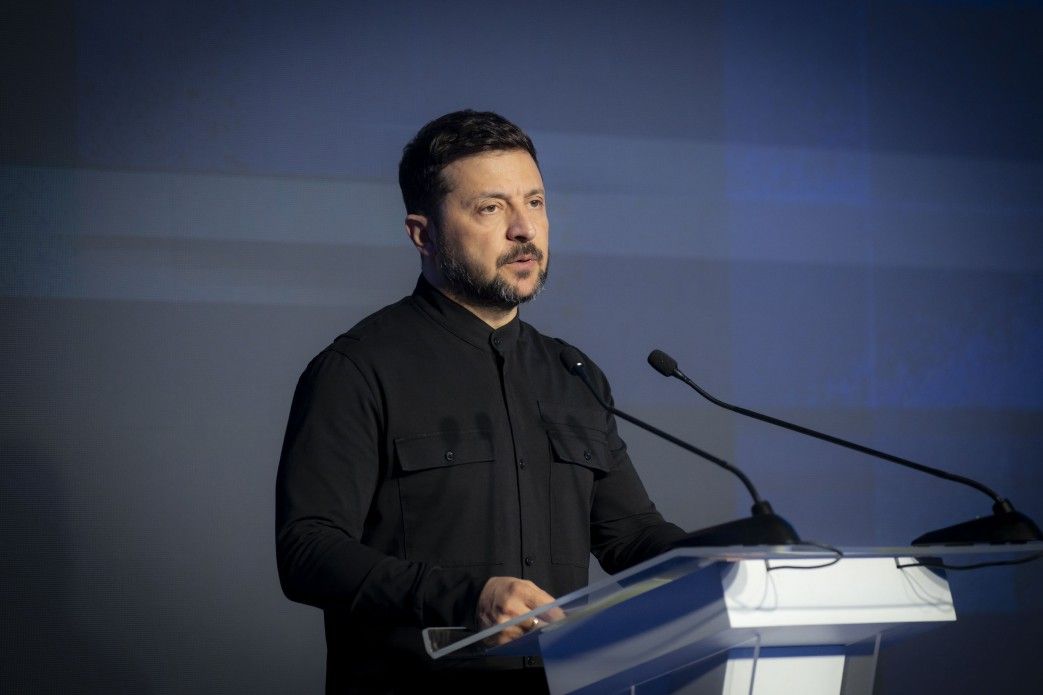
President Volodymyr Zelensky has instructed government officials to prepare a decision introducing a long-term moratorium on business inspections in Ukraine, the Presidential Office announced on June 27. Zelensky discussed the moratorium during an address at the "State and Business Forum: From Dialogue to Partnership," held in Kyiv. "I have instructed that a decision on a long-term moratorium on business inspections be prepared to protect businesses from any pressure by unscrupulous individuals
President Volodymyr Zelensky has instructed government officials to prepare a decision introducing a long-term moratorium on business inspections in Ukraine, the Presidential Office announced on June 27.
Zelensky discussed the moratorium during an address at the "State and Business Forum: From Dialogue to Partnership," held in Kyiv.
"I have instructed that a decision on a long-term moratorium on business inspections be prepared to protect businesses from any pressure by unscrupulous individuals in various government positions," he said.
Economic growth is a vital component of Ukrainian resilience, necessitating ongoing dialogue between the government and entrepreneurs, Zelensky said. In addition to imposing the moratorium on inspections, Kyiv will also expand the Council for Entrepreneurship Support in an effort to cultivate entrepreneurship in Ukraine.
"Even under such harsh conditions of this war, Ukraine can rely on its entrepreneurs — on our domestic Ukrainian manufacturing, our Ukrainian logistics, our Ukrainian services across all sectors — from security to everyday life, as well as on Ukrainian developments and investments," the president said.
Following Russia's full-scale invasion in early 2022 and the onset of martial law, Ukraine temporarily suspended certain business regulations, including tax inspections for businesses. Zelensky signed a law resuming tax inspections for certain businesses in December 2023.
Now in its fourth year of full-scale war against Russia, Ukraine's economy is still attempting to recover from the massive blow dealt in 2022, when the GDP dropped by 29.1%. At the same forum on June 27, Ukraine's new Prosecutor General Ruslan Kravchenko announced another measure meant to boost business: an audit of criminal cases related to businesses in Ukraine.
"The second priority is to finally sort out the proceedings related to business, protect business, and achieve justice in these matters," Kravchenko said.
The Prosecutor's Office will be dedicated to "ensuring the rights of investors and businesses," Kravchenko wrote on his Telegram channel on June 26. Efforts to safeguard businesses will not interfere with Ukraine's legal obligations and the regulatory reforms required for its integration into the European Union, he said.
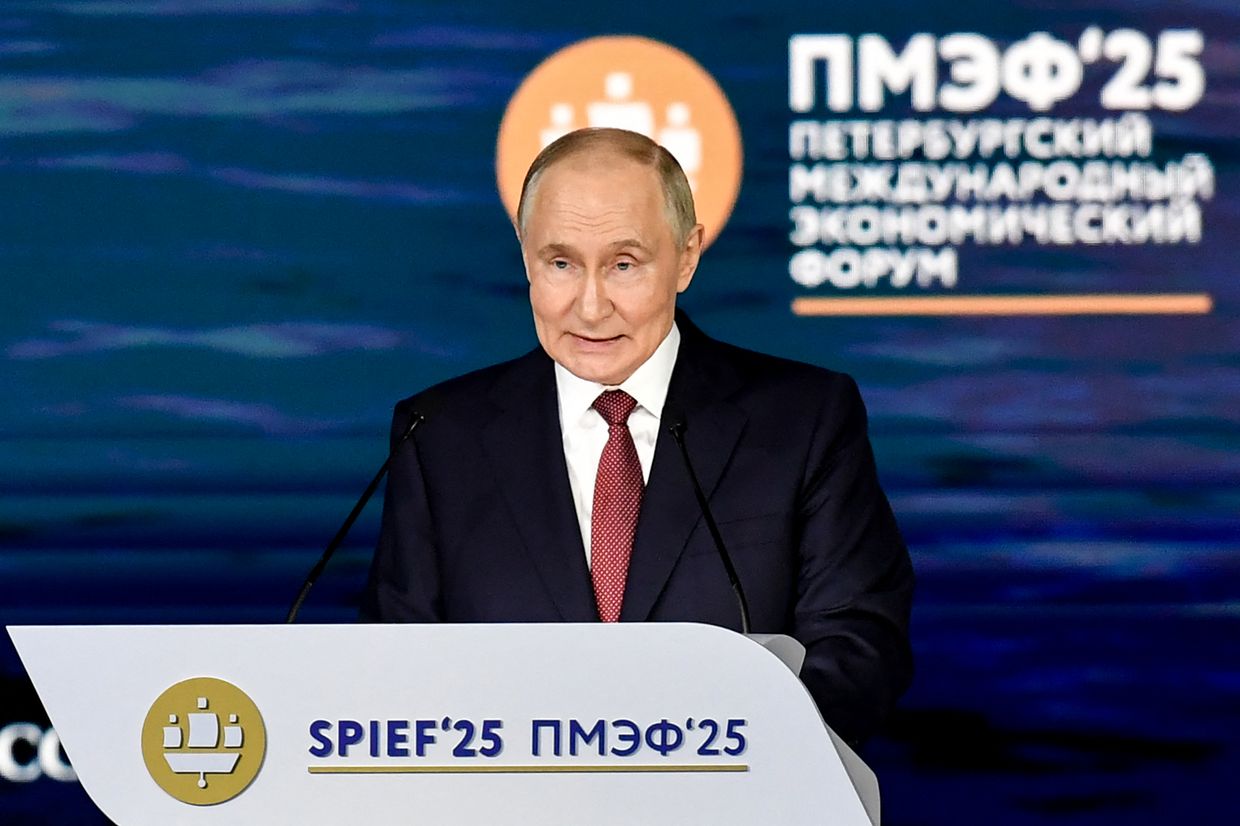
President Vladimir Putin claimed on June 20 that Russia's economy is strong despite war and sanctions, brushing off mounting warnings from his own officials about stagnation and looming recession.Speaking at the St. Petersburg International Economic Forum, Putin was asked about reports that the ongoing war in Ukraine was "killing" the Russian economy."Rumors of my death are greatly exaggerated," he replied, quoting American writer Mark Twain.The president claimed that Russia has outpaced global
President Vladimir Putin claimed on June 20 that Russia's economy is strong despite war and sanctions, brushing off mounting warnings from his own officials about stagnation and looming recession.
Speaking at the St. Petersburg International Economic Forum, Putin was asked about reports that the ongoing war in Ukraine was "killing" the Russian economy.
"Rumors of my death are greatly exaggerated," he replied, quoting American writer Mark Twain.
The president claimed that Russia has outpaced global economic growth over the past two years, allegedly expanding by over 4% annually.
"Our most important task is to ensure the economy's transition to a balanced growth trajectory," Putin said. "At the same time, some specialists and experts point to the risks of stagnation and even recession. This should not be allowed under any circumstances."
The statement came just a day after Central Bank Governor Elvira Nabiullina warned on that Russia's wartime economic momentum is fading fast. She said the economy is approaching the limits of its growth potential, adding that previously effective tools are now exhausted.
Economy Minister Maxim Reshetnikov echoed the concerns, telling a separate forum audience on June 19 that Russia is "on the verge of a transition to recession." He emphasized that recession is not inevitable and that "everything depends on our decisions."
Moscow has experienced rapid inflation and historically high interest rates amid its full-scale invasion of Ukraine. The central bank raised rates repeatedly to combat inflation, but on June 6, it made its first cut in nearly two years, from 21% to 20%.
Putin has criticized the central bank's tight monetary policy for choking off private investment, especially in non-defense sectors.
Despite Putin's optimistic rhetoric, analysts attribute Russia's economic slowdown to sustained international sanctions, falling oil prices, rising wartime spending, and supply disruptions.
Russia's ever-mounting losses on the battlefield which recently passed the 1 million mark are also likely contrbuting to the economic turmoil as the Kremlin is having to pay people to sign up to fight rather than introduce what would be a hugely unpopular mass mobilization.
According to an analysis by economist Janis Kluge, Russia's daily bill just for sign-up bonuses is $24 million.
Editor's note: This story was updated to include Russian President Vladimir Putin's remarks at the St. Petersburg International Economic Forum. Russia's wartime economic momentum is fading fast, with key resources nearly exhausted, Russian Central Bank Governor Elvira Nabiullina said, warning that the country can no longer rely on the same tools that sustained growth in the first two years of the full-scale war against Ukraine, the Moscow Times reported on June 19.Speaking at the St. Petersburg
Editor's note: This story was updated to include Russian President Vladimir Putin's remarks at the St. Petersburg International Economic Forum.
Russia's wartime economic momentum is fading fast, with key resources nearly exhausted, Russian Central Bank Governor Elvira Nabiullina said, warning that the country can no longer rely on the same tools that sustained growth in the first two years of the full-scale war against Ukraine, the Moscow Times reported on June 19.
Speaking at the St. Petersburg International Economic Forum, Nabiullina said that the Russian economy had been expanding on the back of "free resources," including labor, industrial capacity, bank capital reserves, and liquid assets from the National Wealth Fund (NWF) — all of which are now reportedly nearing depletion.
"We grew for two years at a fairly high pace because free resources were activated," she said. "We need to understand that many of those resources have truly been exhausted."
Speaking at the same forum, Russian President Vladimir Putin ordered officials "not to allow stagnation or recession" in the Russian economy under any circumstances.
"We must consistently change the structure of our economy," he said.
The comments come after Russia's ambassador to the U.K., Andrei Kelin, claimed in an interview with CNN this week that Russia is spending "only 5–7%" of its federal budget on the war. Kelin claimed that Russia can continue waging its war, saying Moscow "is winning."
According to the state statistics agency Rosstat, Russia's unemployment rate has dropped to a historic low of 2.3%. At the same time, mass emigration and large-scale wartime recruitment have created a labor shortage estimated at 2 million people. Industrial capacity utilization has surged beyond 80%, the highest in modern Russian history.
Russia's economy is now "on the verge of a transition to recession," Russian Economy Minister Maxim Reshetnikov said at the same forum. Official data show that GDP growth slowed from 4.1% in late 2023 to just 1.4% in the first quarter of 2024, with the economy contracting quarter-on-quarter for the first time since 2022.
Business profits in March fell by one-third overall and dropped by half in the critical oil and gas sector. Industrial growth stagnated at 1.2% year-over-year between January and April, while civilian sectors of the economy began shrinking. Retail turnover growth slowed from 7.2% in December to just 2.4% in April.
An anonymous Russian analyst told Novaya Gazeta Europe that government technocrats are effectively telling Putin it's time to choose between "war or economy."
During its invasion of Ukraine, Russia has faced rising inflation due to record military spending, pushing the central bank to maintain high interest rates. Under government pressure, the bank cut the rate slightly from 21% to 20% earlier in June, despite concerns about weakened private investment.
Officials have scaled back key development projects and reduced shipments of metals and oil products. Early hopes for recovery in 2025, driven by talks with the U.S., have faded as inflation and sanctions weigh heavily on growth.
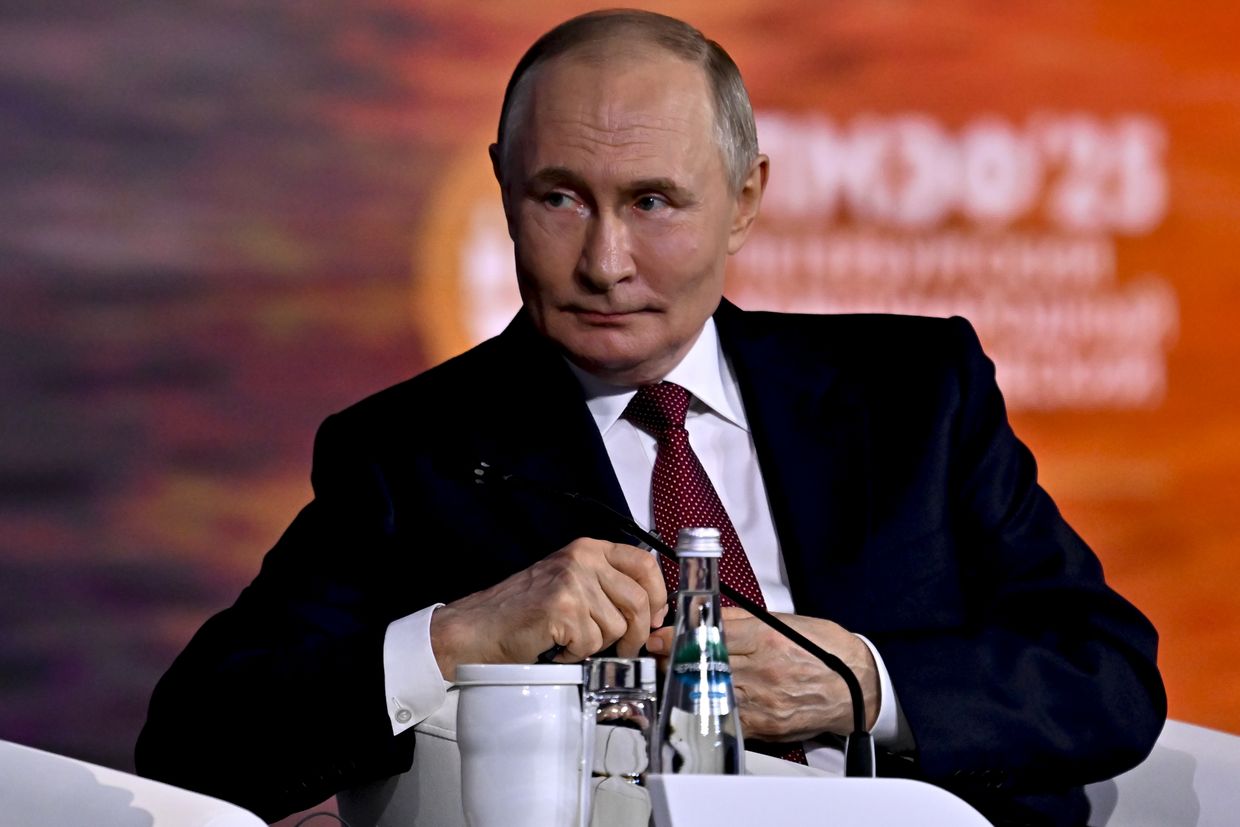
The Russian economy appears to be "on the verge of a transition to recession," Russian Economy Minister Maxim Reshetnikov said on June 19, adding that the next step will be decisive.The comments underscore Russia's mounting economic challenges as it continues its all-out war against Ukraine."According to figures, we have a cooling stage (in the economy). But all our numbers are like a rearview mirror," Reshetnikov said at the St. Petersburg International Economic Forum when asked about Russia's
The Russian economy appears to be "on the verge of a transition to recession," Russian Economy Minister Maxim Reshetnikov said on June 19, adding that the next step will be decisive.
The comments underscore Russia's mounting economic challenges as it continues its all-out war against Ukraine.
"According to figures, we have a cooling stage (in the economy). But all our numbers are like a rearview mirror," Reshetnikov said at the St. Petersburg International Economic Forum when asked about Russia's economic situation.
"According to current business perceptions, we are already, it seems, on the verge of a transition to a recession," the minister added. Reshetnikov clarified that recession is not inevitable and that "everything depends on our decisions."
Russia has faced soaring inflation during its invasion of Ukraine, driven by record wartime spending. This forced the central bank to set one of the highest key interest rates in decades, hurting private investments in non-defense-related sectors.
Facing government pressure, the central bank slashed the interest rate from 21% to 20% earlier this month.
Reshetnikov himself urged the central bank to cut rates in order to boost growth, aiming to achieve a 3% growth target set by Russian President Vladimir Putin.
Russia has been forced to slash key projects across various sectors in the face of an economic slowdown, brought on in part by plummeting oil prices. Major Russian exporters have also cut down on rail shipments of metals and oil products, even beyond earlier projected reductions.
After some positive signals earlier in 2025 due to U.S. President Donald Trump's outreach to Moscow and hopes for a ceasefire, more recent reports again indicate a sharp slowdown in Russia's economic growth.
Analysts have connected this development to the central bank policies, sanctions, low oil prices, supply difficulties, and high inflation.

 Connexion