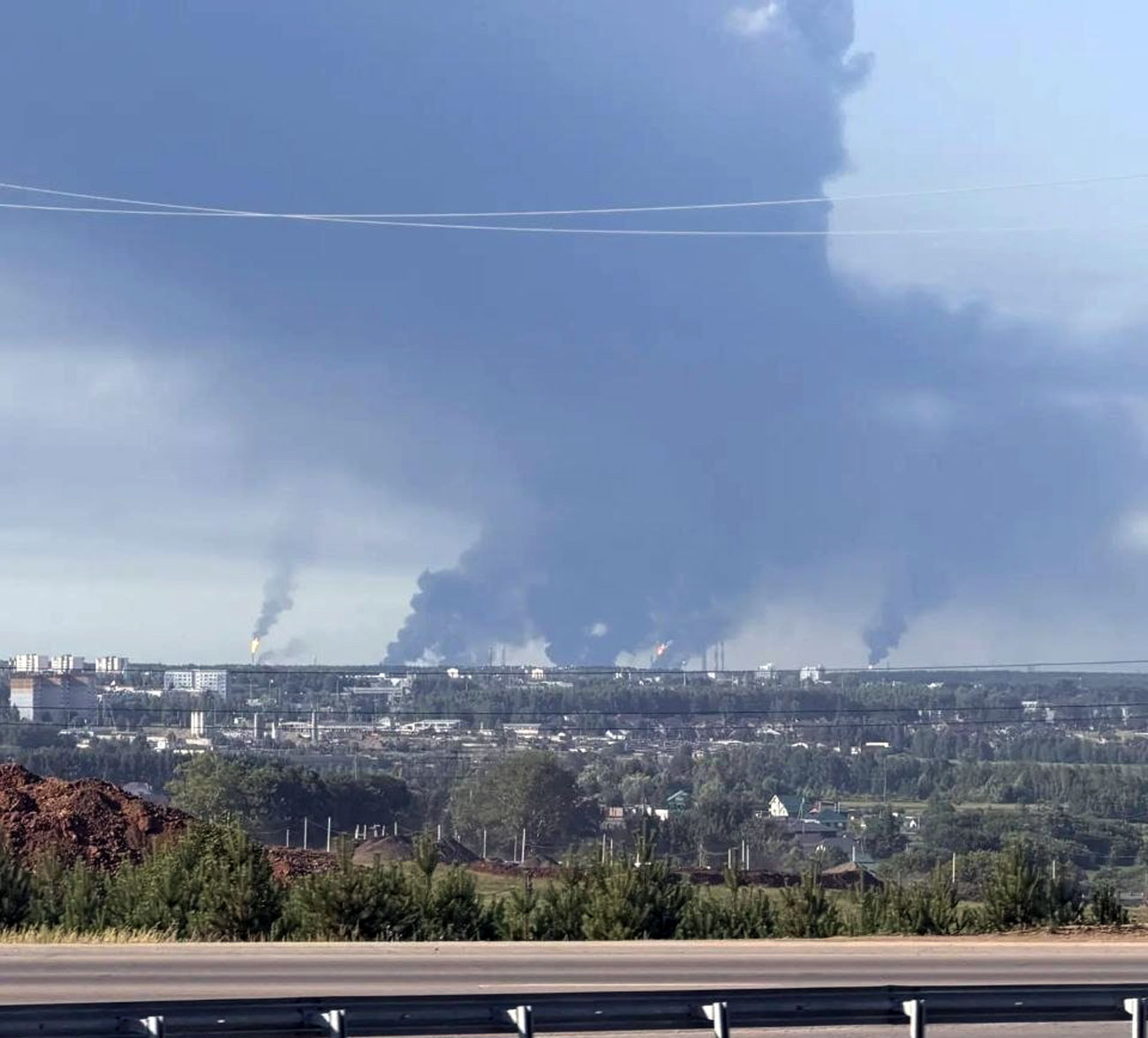
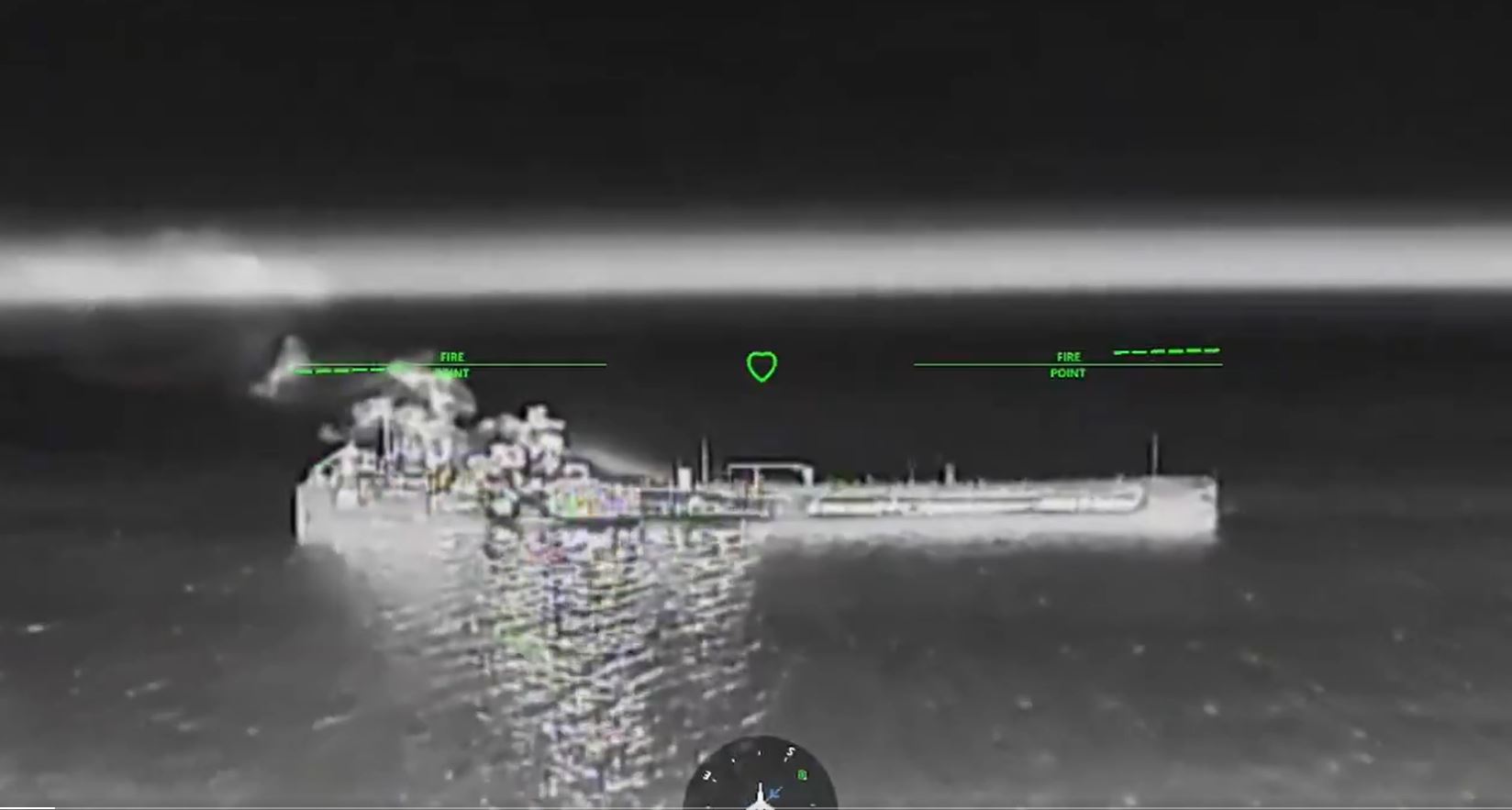
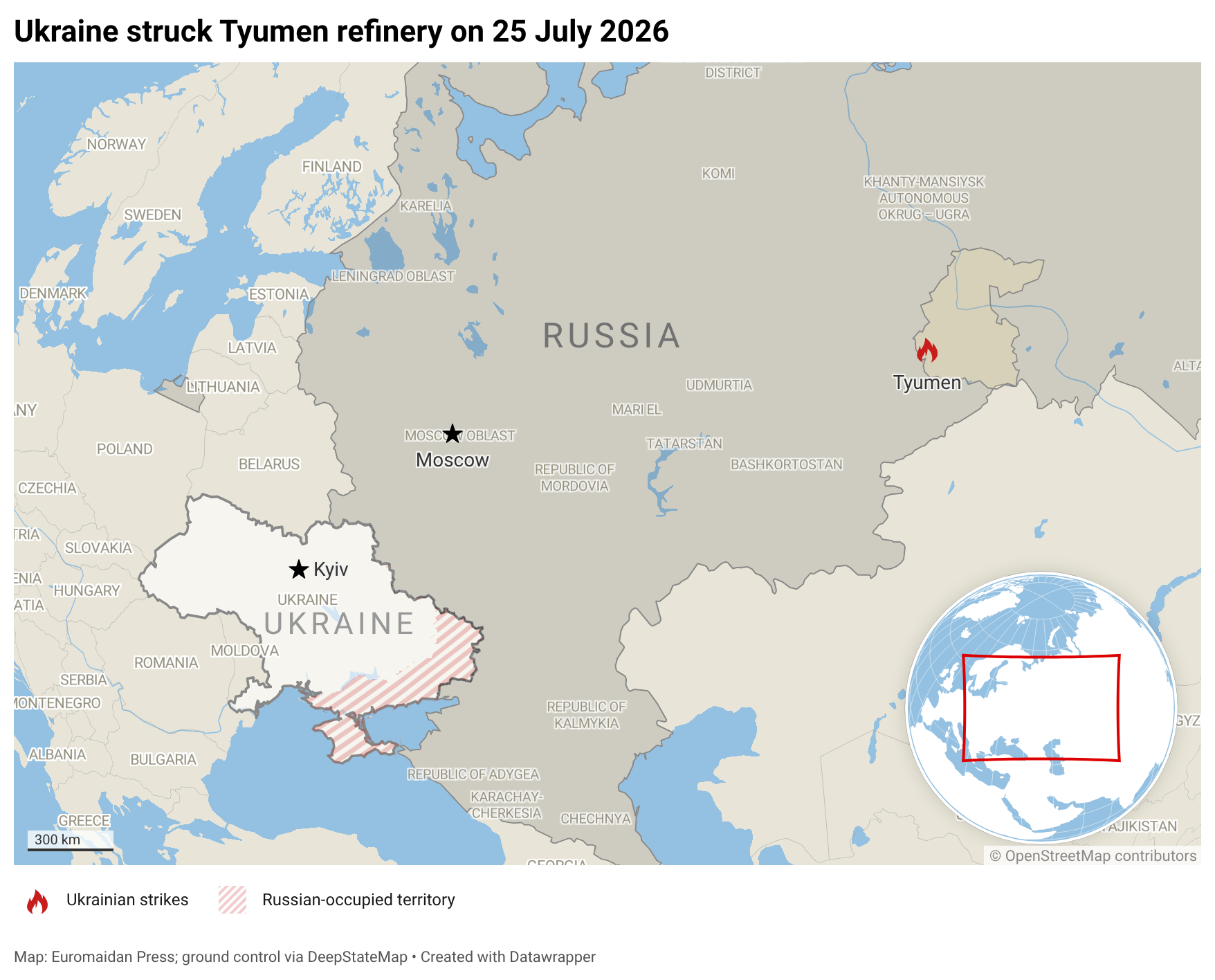
Russia's Tyumen oil refinery has fully halted crude processing and fuel output since a late-July Ukrainian drone strike, two industry sources told Reuters on 28 July. The plant sits more than 2,000 kilometers from Ukraine, deep in western Siberia. How long the damaged gasoline production will take to repair remains unclear.
Ukraine's drone campaign against Russian fuel plants and depots has pushed rationing from Russian border regions all the way into Siberia, turni
Russia's Tyumen oil refinery has fully halted crude processing and fuel output since a late-July Ukrainian drone strike, two industry sources told Reuters on 28 July. The plant sits more than 2,000 kilometers from Ukraine, deep in western Siberia. How long the damaged gasoline production will take to repair remains unclear.
Ukraine's drone campaign against Russian fuel plants and depots has pushed rationing from Russian border regions all the way into Siberia, turning gasoline supply and oil revenue into pressure points on Moscow's war economy. Every refinery knocked offline trims the fuel and cash that sustain Russia's invasion, and Kyiv often keeps returning to the same targets faster than Moscow can rebuild them.
The plant stopped making fuel
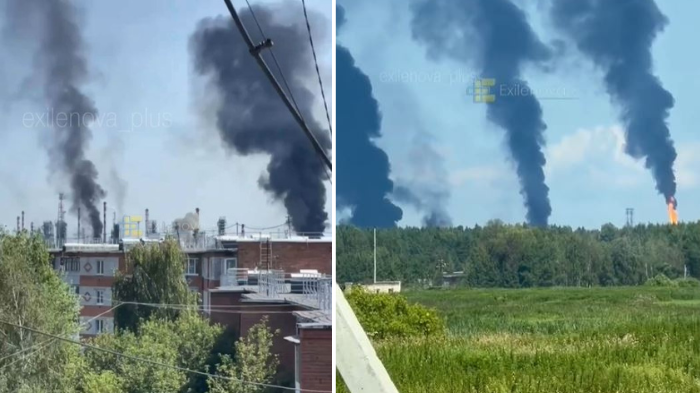
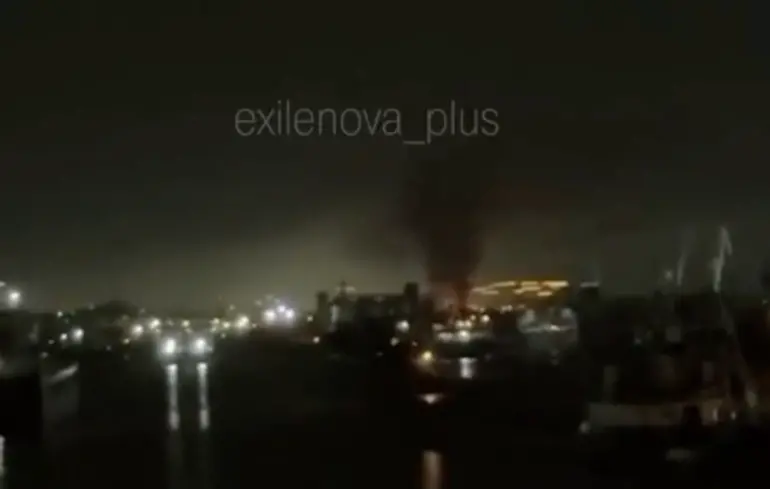
RI-Invest, which owns the Tyumen refinery, shut down crude processing and all product output on 25 July, when the Ukrainian drones hit the facility, according to the two sources in a Reuters report carried by The Moscow Times. The drone strike that day damaged the plant's secondary units and set them on fire.
The blaze hit a diesel hydrotreating unit rated at 2.6 million tons a year. It also struck the combined high-octane gasoline complex, which pairs a catalytic reformer with an isomerization unit. Neither source could estimate how long the gasoline repairs would run, according to Reuters.
Explore further
Oil sites 1,300 km east, a port terminal near the front—Russia’s deep rear had one loud night
A plant already patching an older fire
The same diesel hydrotreating unit spent last month under repair after a 6 June fire from internal causes. The gasoline complex was built under a license from the US firm UOP and started operating in 2018. The refinery's full capacity reaches 9 million tons a year, the sources said. In 2024 it processed 5.7 million tons of crude, turning out 0.5 million tons of gasoline and 2.8 million tons of diesel.
Drones over Siberia, far from any front
On 25 July, Tyumen Oblast Governor Alexander Moor confirmed the drone attack on the region and reported no casualties.
Ukrainian drones had already reached the same plant on 20 June. The lost output tightens a home fuel market that has run short since spring, as Kyiv escalated its campaign against oil-processing plants.
Tyumen Oblast is currently also bracing for major flooding as the Tura River rises.
Russian strikes on Black Sea shipping have brought Ukraine’s grain corridor to its first full stop since it opened in August 2023, Ag Bull Trading reported. The freeze is splitting the price of wheat in two, pushing it down on Ukrainian farms even as it climbs abroad, Latifundist’s analysis found.Rapeseed now sells for about $70 a ton less than it did a week earlier, and wheat at the farm is fetching roughly a fifth less than last autumn. Some buyers are cutting their offe
Russian strikes on Black Sea shipping have brought Ukraine’s grain corridor to its first full stop since it opened in August 2023, Ag Bull Trading reported. The freeze is splitting the price of wheat in two, pushing it down on Ukrainian farms even as it climbs abroad, Latifundist’s analysis found.
Rapeseed now sells for about $70 a ton less than it did a week earlier, and wheat at the farm is fetching roughly a fifth less than last autumn. Some buyers are cutting their offers overnight, market participants reported.
With ships no longer calling, traders have stopped buying, and grain that would have sailed has nowhere to go; the near-total halt of seaport trade has pushed prices down at the ports. More than 90% of Ukraine’s farm exports move through three deepwater Odesa ports.
Explore further
Russia’s port strikes leave Ukraine’s grain with almost nowhere else to go
Carriers pull out as world prices climb
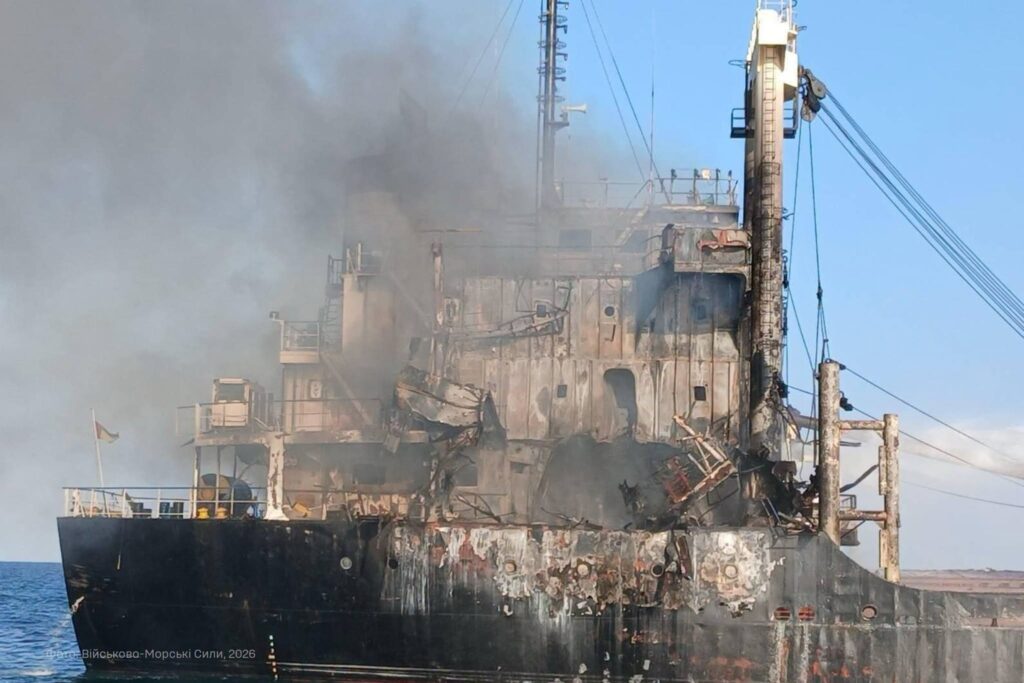
Maersk suspended service at a terminal in Chornomorsk’s fishing port and rerouted cargo to Romania’s Constanta, while the main ports and the corridor itself stayed open, as ThePublic reported; Hapag-Lloyd also paused its Chornomorsk calls.
On world exchanges, the same grain is moving the other way: Chicago wheat has jumped about 16% in July as attacks on Black Sea shipping stoke supply fears. Egypt, Algeria, and Indonesia together buy about 60% of Ukraine’s wheat, USDA figures show.
The freeze is splitting the price of wheat in two, pushing it down on Ukrainian farms even as it climbs abroad.
Grain piles up with nowhere to go
Seaborne farm exports have all but stopped, and with about 10 million metric tons of grain unsold from last season already competing for storage with the new crop, prices for growers keep sliding. The strain on the farm sector could turn critical within two to three months, the All-Ukrainian Agrarian Council’s deputy head Denys Marchuk warned.
The state has imposed no restrictions—shipowners paused their own calls after a run of Russian strikes on civilian cargo ships, Agriculture Minister Taras Vysotskyi told Latifundist.
He urged growers who can afford it to hold off selling, and said Ukraine may need to store an extra 10 to 12 million metric tons of grain it cannot ship, appealing to international partners for temporary storage capacity. The strikes went to the UN Security Council on 27 July, a session convened at Kyiv’s request.
Explore further
Russia’s ship strikes stall Ukraine’s grain corridor. The damage is moving inland
Growers face rising costs of their own—fuel, fertilizer, and equipment—and some are buying diesel on credit at about 87 hryvnias ($1.93) a liter, leaving little room to hold grain off a falling market.
Yet nothing has been formally closed. The deadliest strike came on 19 July, when Russian missiles hit the Golden Leo, a Turkish-owned bulk carrier, as it left Odesa loaded with grain, a strike killing 10. The corridor remains officially open. The harvest has fewer ways out.
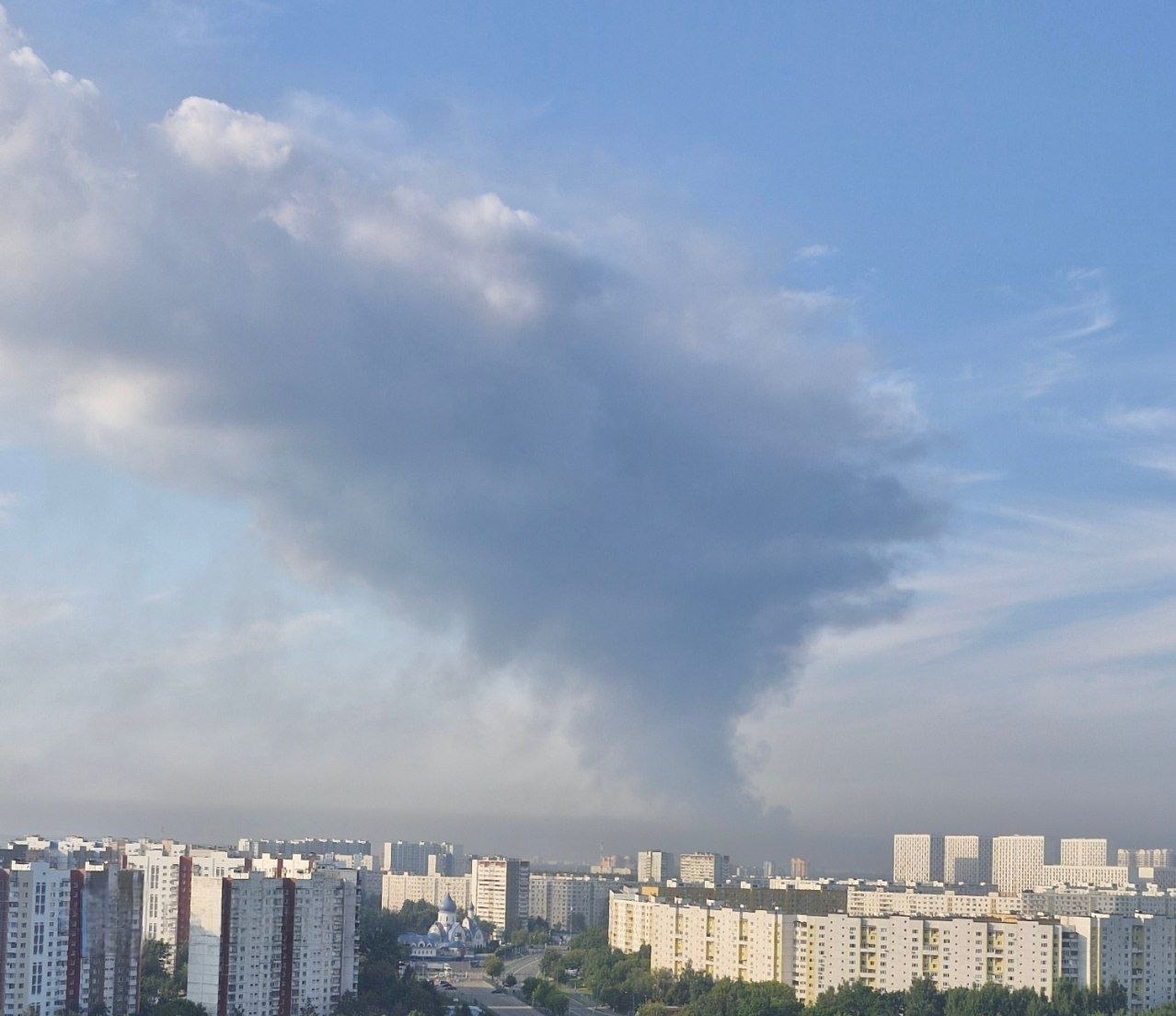
Ukrainian drones struck logistics and industrial sites across Russia's Moscow Oblast on the morning of 28 July, according to monitoring channels and local authorities. Fires broke out near Podolsk and in Chekhov, while Russia's biggest online marketplace said its own warehouse kept running. Russian officials claimed air defenses downed hundreds of drones.
Earlier this month, Ukraine expanded its deep-strike campaign from primarily oil refineries and fuel depots in R
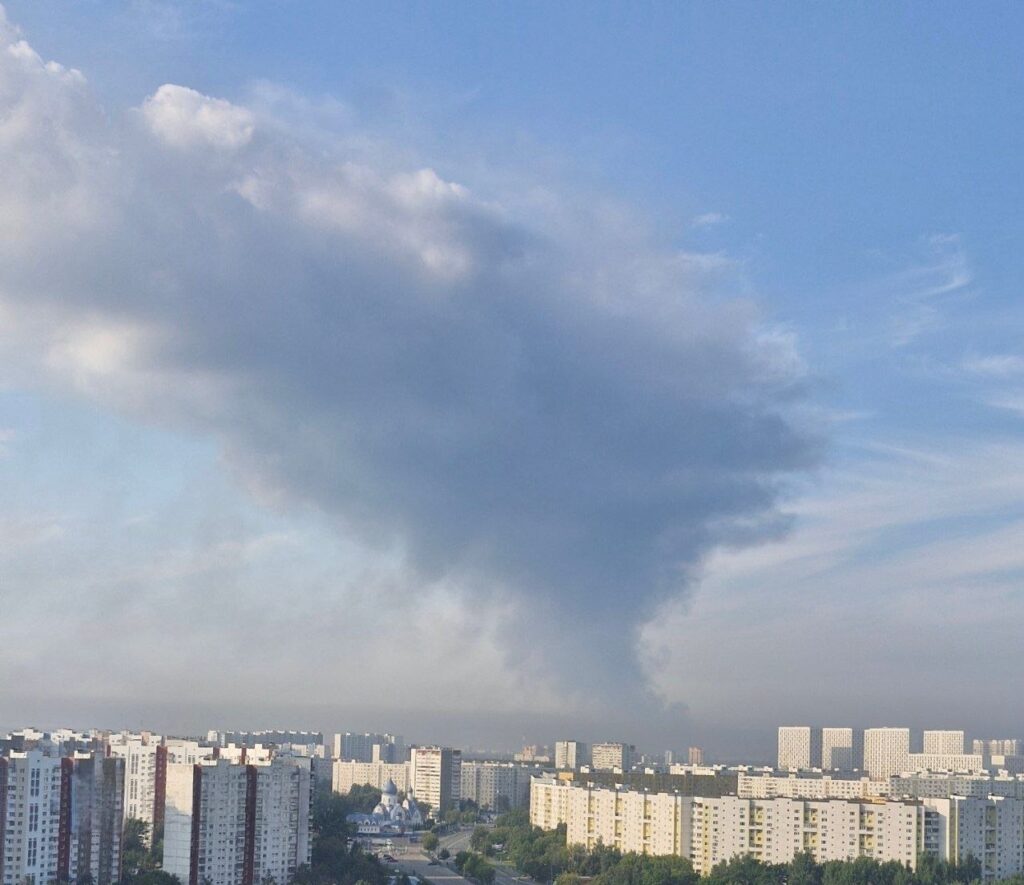
Ukrainian drones struck logistics and industrial sites across Russia's Moscow Oblast on the morning of 28 July, according to monitoring channels and local authorities. Fires broke out near Podolsk and in Chekhov, while Russia's biggest online marketplace said its own warehouse kept running. Russian officials claimed air defenses downed hundreds of drones.
Earlier this month, Ukraine expanded its deep-strike campaign from primarily oil refineries and fuel depots in Russia to the warehouses of Wildberries, Russia's largest e-marketplace. The campaign aims at undermining Russia's wartime economy that sustains the ongoing invasion of Ukraine.
Aimed at Russia's Amazon, the hit landed next door
Early on 28 July, Ukrainian monitoring channel Exilenova+ started reporting drone activity over Moscow Oblast. Over the next hours it posted photos, video, and its own read of the target. The channel judged the strike as a likely attempt on the large Wildberries logistics center in Koledino, south of Podolsk. Air-defense fire, it said, probably pushed the hit onto the third-party warehouse right beside it.
Wildberries is Russia's biggest online retailer, its answer to America's Amazon or China's AliExpress. The neighboring depot belongs to Koledino 3PL, an independent logistics and fulfillment operator.
Russian news Telegram channel Astra identified the burning building as that 3PL site. Residents of nearby Podolsk reported explosions and a fire that same morning. Supernova+ backed the account of a hit on the 3PL warehouse.
The operator's own site lists the warehouse at about 10,000 m². It stores goods, packs orders, labels and ships for clients that include Auchan, Magnit, Lenta, Pyaterochka, Fix Price and Detsky Mir. Next to it sits what one industry listing calls the marketplace's largest distribution center, over 200,000 m². Wildberries' press service said the complex was working normally. Monitoring channels still believe the intended target was the Wildberries hub.
Warehouse of the 3PL logistics operator is burning near Moscow
In Koledino, Ukrainian drones struck the facility sitting next to a large Wildberries warehouse, which remains unharmed.
Podolsk district head Grigory Artamonov played it down, reporting only a damaged fence at a private house and a fire in a wooded area.
A rubber plant on fire in Chekhov
Video published by Exilenova+ also showed drones hitting an enterprise in Chekhov. More footage captured a fire after a drone reportedly struck a smokestack on a plant's grounds. Astra's analysis placed the blaze at the Chekhov Regeneration Plant. Residents had reported explosions overnight.
The plant recycles worn car tires into regenerate, rubber crumb and powder, and makes more than 600 rubber goods. By its own account, it is one of Russia's biggest producers in the field. Chekhov municipal head Mikhail Sobakin confirmed the attack, saying rubber had caught fire at the plant and crews were putting it out, with several buildings in the city damaged.
Moscow mayor Sergei Sobyanin first claimed 12 drones downed near the capital around 5 a.m. He later put more than 390 aircraft over the region between 20:30 and 6:30, saying air defenses hit most "on distant approaches" and 81 near Moscow. Russia's Defense Ministry claimed its air defenses downed 356 Ukrainian drones overnight, across a dozen regions plus the Moscow area, occupied Crimea and the Azov Sea. None of the figures could be independently checked.
Explore further
Ukraine went for Russia’s “AliExpress” again—its next-door warehouse was ablaze
Deep-strike campaign continues
Since 18 July, Ukrainian drones have hit at least ten of the marketplace's centers, in Elektrostal, Kotovsk, Krasnodar, Nevinnomyssk, Voronezh and Yekaterinburg. The previous successful strike came on 24 July, at complexes near St. Petersburg, in Leningrad Oblast and in occupied Simferopol. On 20 July, drones struck the Wildberries center in Podolsk and an oil depot in nearby Lvovsky, both catching fire, as the effort widened from oil refineries to retail and industry.
Ukrainian President Volodymyr Zelenskyy has earlier explained the strikes on the "Russian AliExpress" by saying Moscow uses the platform to bring in sanctioned drone and navigation parts.
Ukrainian long-range drones struck targets across several Russian regions overnight on 27 July, hitting sites from the front line to more than a thousand kilometers inside the country, monitoring channels reported. President Volodymyr Zelenskyy confirmed the attacks and tied them to what he calls Ukraine's plan of long-range sanctions on Moscow's war economy. The targets ran from a sea-port terminal near the war zone to oil infrastructure deep in Russia's rear.
Russia built
Ukrainian long-range drones struck targets across several Russian regions overnight on 27 July, hitting sites from the front line to more than a thousand kilometers inside the country, monitoring channels reported. President Volodymyr Zelenskyy confirmed the attacks and tied them to what he calls Ukraine's plan of long-range sanctions on Moscow's war economy. The targets ran from a sea-port terminal near the war zone to oil infrastructure deep in Russia's rear.
Russia built its war economy behind an interior it assumed no weapon could reach, but years of increasingly deep Ukrainian strikes have steadily eroded the protection once afforded by distance.
Belgorod: a strike near the FSB, then a missile system detonated
In Belgorod, drones hit near the Federal Security Service (FSB) compound, Russia's domestic security agency, while more explosions and fires were recorded elsewhere in the city, local outlet Pepel reported. Ukrainian reports also listed Interior Ministry offices among the targets.
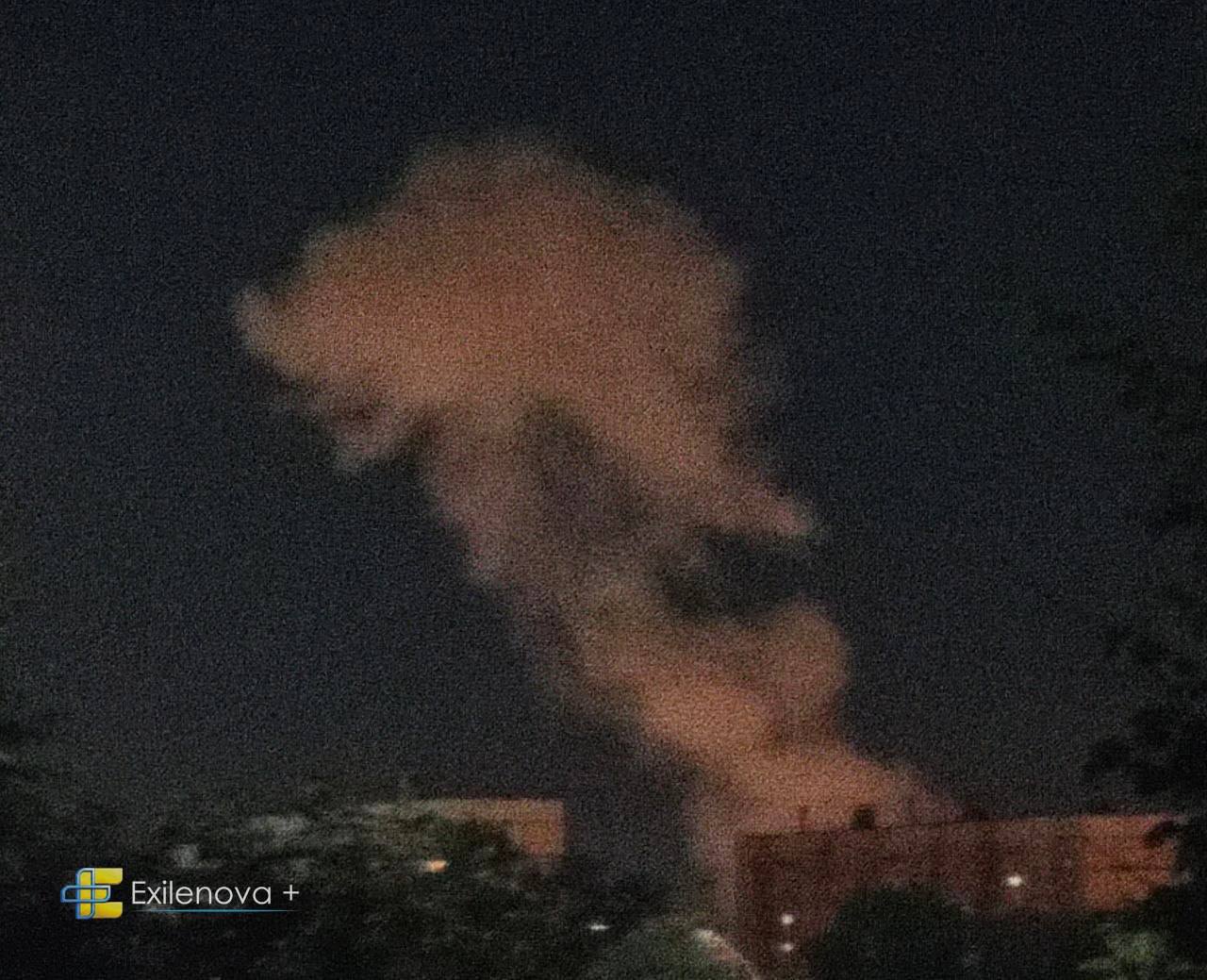
A smoke cloud lit by fire rises over Belgorod, Russia, after a Ukrainian drone attack, overnight on 27 July 2026. Photo: Exilenova+
Ukraine likely struck an air-defense system in the city too. Footage shared by Exilenova+ showed a fixed-wing drone hitting a target in the center, followed by a detonation typical of a solid-fuel missile and a column of black smoke, Militarnyi reported.
Belgorod's operational headquarters confirmed the attack, claiming several apartments and more than 15 parked cars caught fire. Parts of the city lost power and water, Pepel noted.
Rostov-on-Don: fire at the sea port
At Rostov-on-Don, Astra placed the strike at the sea trade port, with smoke rising over its fourth cargo district by morning. The port sits on the Don River but holds sea-port status in the Azov–Black Sea basin, handling foreign-flagged ships bound for the Black Sea and Mediterranean.
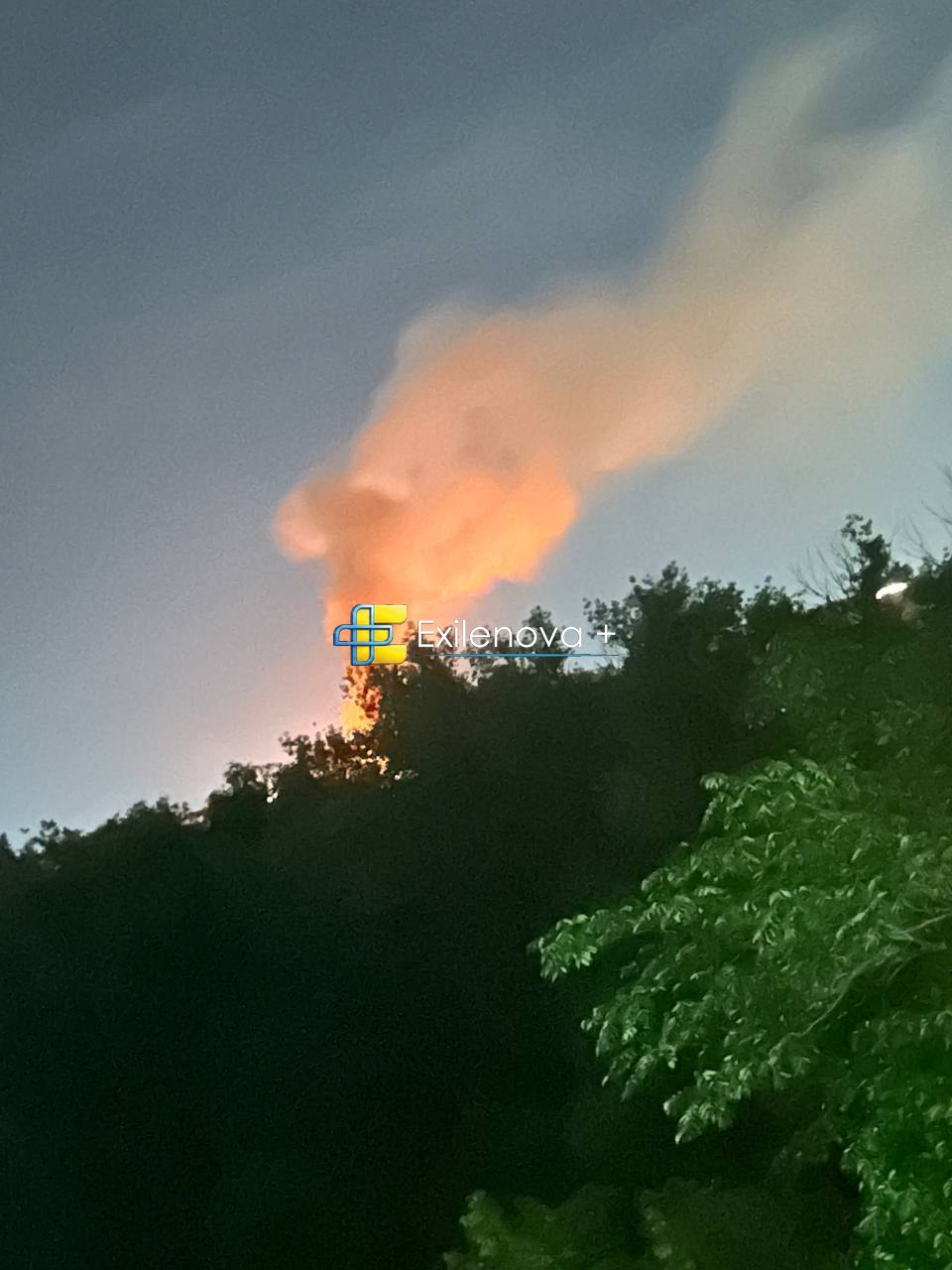
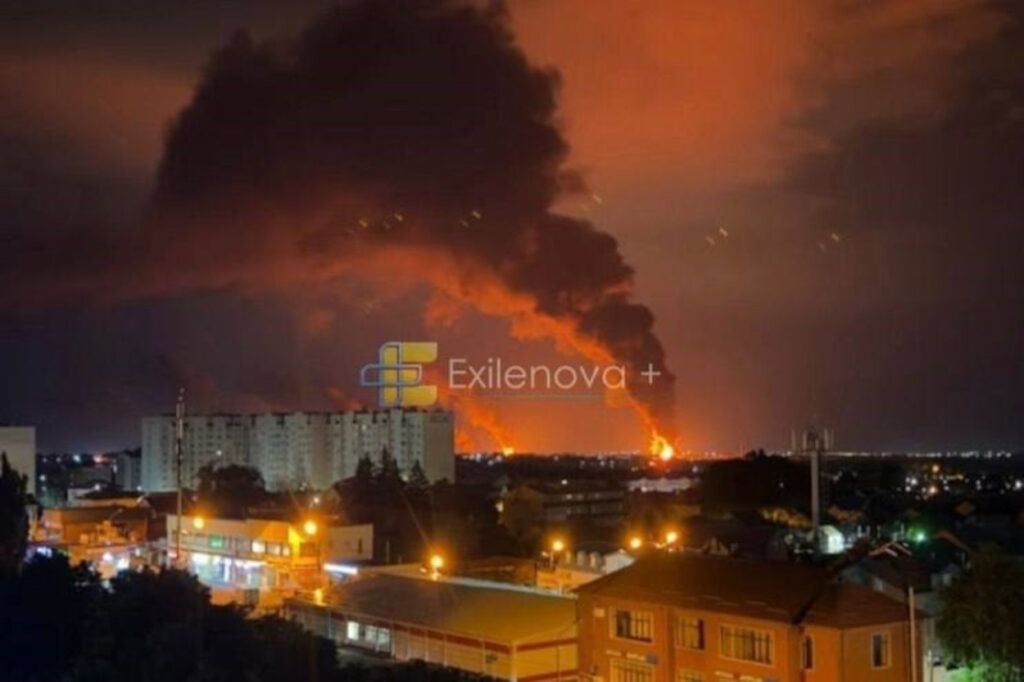
Flames and smoke rise after a Ukrainian drone strike in Rostov-on-Don, 27 July 2026. Photo: Exilenova+
At the time of the strike, ship-tracking service MarineTraffic showed five civilian vessels in the Don near the city, Militarnyi reported. Rostov's governor, Yuri Slyusar, claimed fires at a private enterprise and warehouses, though his casualty figures shifted between statements.
The port already runs at minimal capacity amid Operation MoLoChKa—whose stylized name abbreviates “Moscow will fall through Crimea”—Ukraine's campaign against Russian maritime logistics, including the shadow fleet that circumvents sanctions to transport oil. Its drones have struck 200 vessels in the Azov and Black seas, according to the current stats on the drone forces website.
Udmurtia: explosions 1,300 km away
Far to the east, explosions hit the Udmurt Republic near Sarapul, Astra reported, and Exilenova+ noted smoke on the town's outskirts. The head of the republic, Aleksandr Brechalov, claimed air defenses were repelling a large attack and that several drones were shot down.
Haze from a fire drifts over the river at Sarapul, in Russia's Udmurt Republic, after a Ukrainian drone attack, 27 July 2026. Photo: Exilenova+
Zelenskyy and the General Staff confirm
Zelenskyy confirmed drones hit an export terminal in Rostov Oblast, about 250 kilometers from the front line. Deep strikes also hit oil facilities in Yaroslavl Oblast and the Udmurt Republic, roughly 1,300 kilometers from Ukraine's border, he said.
"This night our long-range sanctions worked in Rostov Oblast," he wrote, saying the strikes reduce Russia's ability to finance the war.
Ukraine's General Staff said its forces struck the Rostov-on-Don terminal, recording a hit followed by a fire.
Russia's Defense Ministry claimed it downed 276 drones overnight, without saying how many got through.
Explore further
Ukraine draws up a new target list for its long-range drones—and vows to keep firing
A week earlier, Ukraine's Security Service said drones damaged the tank farm of the Subkhankulovo oil-pumping station in Bashkortostan, then the agency's farthest strike at 1,350 kilometers.
On 25 June, Ukrainian drones hit the Tyumen oil refinery some 2,000 km out and set fire to a Wildberries warehouse in Yekaterinburg roughly 1,800 km away.
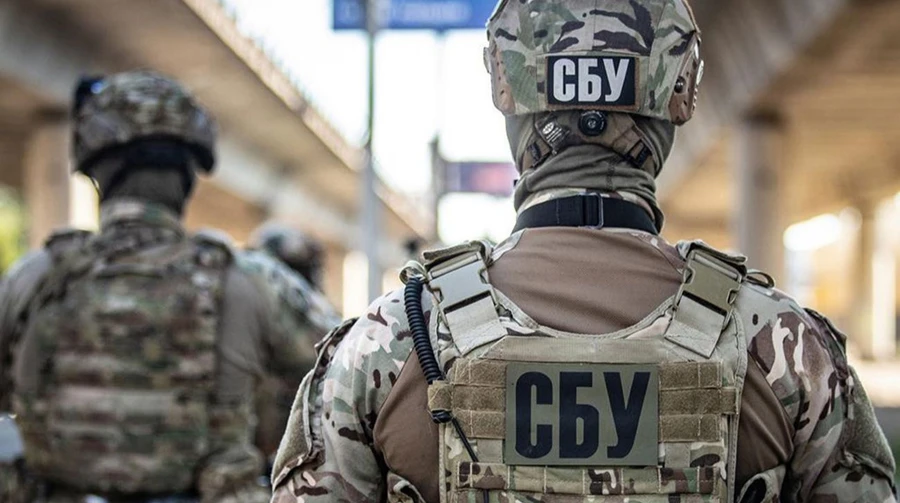
Ukraine's counterintelligence of a spy agency has detained a young woman accused of helping Russia prepare an air strike meant to leave Poltava—a city in central Ukraine—without power, the Security Service of Ukraine (SBU) said. Investigators say the student mapped the city's energy sites in Poltava and the surrounding area and filmed Ukrainian air-defense units for Russian handlers before any strike could land. She now sits in custody and faces life imprisonment with c
Ukraine's counterintelligence of a spy agency has detained a young woman accused of helping Russia prepare an air strike meant to leave Poltava—a city in central Ukraine—without power, the Security Service of Ukraine (SBU) said. Investigators say the student mapped the city's energy sites in Poltava and the surrounding area and filmed Ukrainian air-defense units for Russian handlers before any strike could land. She now sits in custody and faces life imprisonment with confiscation of property.
As the war drags on, Russia increasingly fishes for hard-up civilians over the internet, recruiting people inside Ukraine to do its scouting and sabotage cheaply and at arm's length.
A student lured by "easy money"
The suspect is a student at a local university in Poltava Oblast, the SBU reported. She came to the attention of Russia's Federal Security Service (FSB) while hunting for easy money in Telegram channels, according to the agency. After recruiting her, her handlers set her to work in her own hometown.
Mapping the grid, filming the defenses
Under the guise of walks, she moved through the city and surrounding area to fix the locations of energy facilities that feed the oblast center and nearby districts. Those were the sites Russia was preparing to hit from the air. She also rode around Poltava Oblast by taxi, taking photos and video of Ukrainian air-defense units. Officers say they exposed her in advance and detained her before any strike. During a search, they seized smartphones and computer equipment holding evidence of her work for the enemy.
Investigators served her a suspicion notice under Part 2 of Article 111 of Ukraine's Criminal Code, which covers high treason committed under martial law. She is being held without the right to bail. She faces life imprisonment with confiscation of property.
Explore further
Bomb-maker working for Russia’s military intelligence in Zaporizhzhia loses his freedom for 15 years
What came before
Russia keeps leaning on Ukrainians recruited online to scout for its strikes, and Ukraine's security service reports such arrests regularly. Days earlier, officers detained another suspect in Kharkiv Oblast, accused of planting hidden cameras to guide Russian attacks. The kind of energy sites she scouted have sat at the center of Russia's long campaign against Ukraine's power grid, which has forced blackouts through successive winters.
Russia struck two Ukrainian cities hundreds of kilometers apart in daytime attacks on 26 July, hitting a supermarket and residential areas and killing civilians including a child, according to President Volodymyr Zelenskyy and local officials in Chernihiv and Zaporizhzhia. The local authorities reported deaths and more than a dozen wounded. Zelenskyy called the strikes deliberate terror with no military purpose and renewed his push for tougher sanctions on Moscow.
Russi
Russia struck two Ukrainian cities hundreds of kilometers apart in daytime attacks on 26 July, hitting a supermarket and residential areas and killing civilians including a child, according to President Volodymyr Zelenskyy and local officials in Chernihiv and Zaporizhzhia. The local authorities reported deaths and more than a dozen wounded. Zelenskyy called the strikes deliberate terror with no military purpose and renewed his push for tougher sanctions on Moscow.
Russian missiles, attack drones, and glide bombs strike Ukrainian cities away from the front, while Russian attacks of several kinds continue every day. The small drones have become the weapons that kill the most Ukrainian civilians than any other weapon, according to UN monitors.
Zelenskyy wrote on Telegram that Russian forces keep "defeating" ordinary civilian objects, calling the Chernihiv strike an absolutely cynical drone attack on an ordinary supermarket. Meanwhile, Zaporizhzhia was struck by aerial bombs.
"They hit people directly, with no military sense at all," he said. "This is deliberate Russian terror that has no military justification whatsoever."
Russia struck a supermarket full of shoppers and killed a 9-year-old girl
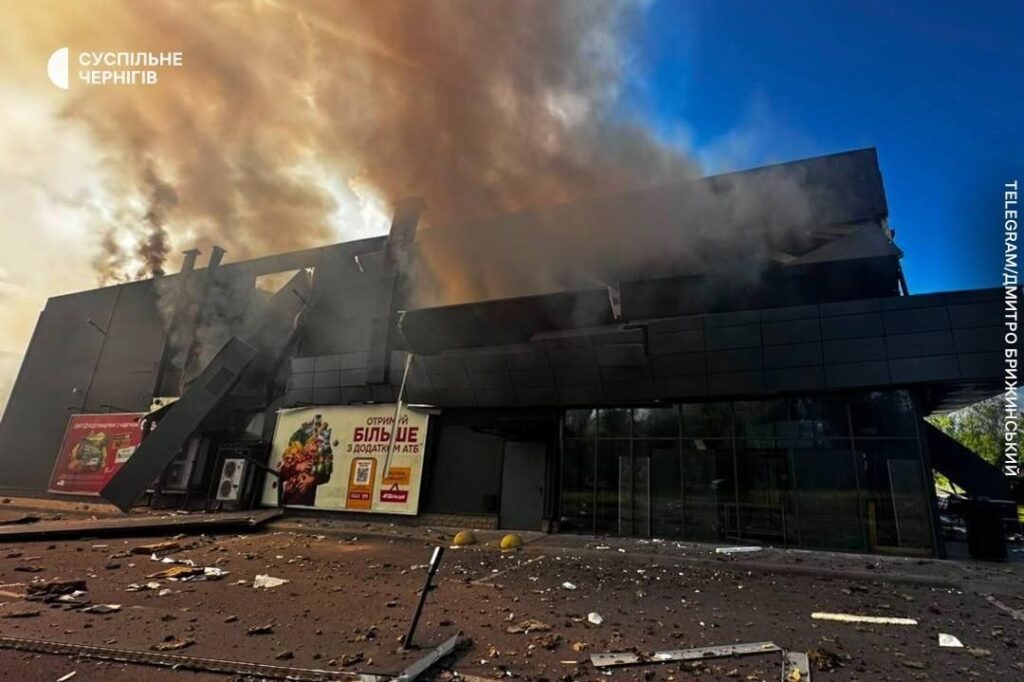
A Russian drone tore into an ATB grocery store in Chernihiv on 26 July while people shopped inside, setting the building on fire. The strike killed two people, one of them the young girl, and wounded… pic.twitter.com/8AguDH4gP8
In the northern city of Chernihiv, a Russian drone struck an ATB supermarket, part of Ukraine’s largest no-frills grocery network, around the middle of the day. City military administration head Dmytro Bryzhynskyi first reported two people killed and three wounded. He later noted that a child was among the dead. As rescuers worked, he reported one victim in serious condition, then said the number of wounded had climbed to seven.
Later that afternoon, he updated the toll to 13 injured — four men and nine women — with three hospitalized in moderate condition. In a subsequent update, he said 20 people had sought medical care and three were hospitalized.
Russia struck a supermarket in Chernihiv, killing two people, including a 9-year-old girl
Thirteen others were wounded in the attack, including a 10-year-old boy. Officials continue clarifying the full extent of the damage State Emergency Service of Ukraine pic.twitter.com/l3mMxKmQKM
Chernihiv Oblast administration head Viacheslav Chaus identified the dead child as a 9-year-old girl. He said a 10-year-old boy was among the wounded and that three people were in intensive care. Other strikes in the city damaged cars and vehicle service stations, Chaus added.
Guided bombs killed a man in Zaporizhzhia
Far to the south, Russian guided aerial bombs hit the city of Zaporizhzhia. Regional administration head Ivan Fedorov reported that the bombs damaged residential and non-residential buildings and an educational institution. One person was killed and six were wounded, according to Fedorov and the regional prosecutor’s office. The man who died was 46. The regional prosecutor's office said a gas station was also damaged.
Explore further
Russia destroys a Home Depot-style megastore in Kryvyi Rih—the third one it has erased in the same region since 2024
Hours earlier, Russian drones burned down a home-improvement megastore in Kryvyi Rih, the third such store wrecked in that southern region since 2024.
Russian drones struck and burned down the Epicenter, a major home-improvement hypermarket, in the central city of Kryvyi Rih on the morning of 26 July, the head of the Dnipropetrovsk Oblast Council and the local Telegram channels said. No one was hurt, but the strike destroyed a store that employed around 400 people. It was the third store of the same chain that Russia has destroyed in this one region since the full-scale invasion began.
Russian missiles and drones cont
Russian drones struck and burned down the Epicenter, a major home-improvement hypermarket, in the central city of Kryvyi Rih on the morning of 26 July, the head of the Dnipropetrovsk Oblast Council and the local Telegram channels said. No one was hurt, but the strike destroyed a store that employed around 400 people. It was the third store of the same chain that Russia has destroyed in this one region since the full-scale invasion began.
Russian missiles and drones continue hitting residential areas and civilian infrastructure across Ukraine on a daily basis. Russia and pro-Russian commentators may present the Kryvyi Rih strike as payback for Ukraine's ongoing drone raids on Wildberries, Russia's Amazon-style company — but Russia has been burning down Ukrainian shopping centers since June 2022, from the Amstor mall in Kremenchuk to the Epicenter store where glide bombs killed 19 people in Kharkiv in 2024, years before Ukraine ever hit a Wildberries warehouse.
Russian attack sets a Kryvyi Rih superstore ablaze
Russian forces launched several strikes on the Epicenter hypermarket in Kryvyi Rih, regional council head Mykola Lukashuk wrote on Telegram. Telegram channels posted video of the impact and reported that Russia used Shahed drones, the Iranian-designed attack drones Moscow launches at Ukrainian cities in swarms.
Epicenter is Ukraine's largest home-improvement chain, a rough local equivalent of Home Depot.
Fire spread across more than 16,000 m² of the building, the State Emergency Service reported. Crews contained the blaze, but firefighting remained difficult. Repeated air-raid alerts and the threat of fresh strikes kept forcing them back. No one was injured. The store was completely destroyed, Epicenter's head of public relations, Yulia Chudnovets, told Liga.
"The assessment of the destroyed property will be carried out after the inspection is completed and the scale of the losses is determined," she said.
Russia injures three people in attack on Kyiv
One person was hospitalized after the Russian attack, Kyiv Mayor Vitali Klitschko reported. Two others received outpatient treatment.
Third store the chain has lost in Dnipropetrovsk Oblast
The Kryvyi Rih hypermarket is the third Epicenter that Russia has destroyed in Dnipropetrovsk Oblast since the full-scale invasion, Lukashuk said. Earlier strikes burned down the chain’s store in Nikopol and destroyed its store in Kamianske. The Kryvyi Rih strike landed exactly one year, to the day, after that attack on Kamianske.
The Kryvyi Rih store had traded for nearly 19 years, employing around 400 people and paying taxes into the local budget.
Russia strikes Kharkiv homes, injuring two children
Seven people were injured in the city’s Slobidskyi district, including two children. The attack damaged more than 10 private houses, Mayor Ihor Terekhov said. The full extent of the destruction is still being assessed.
Across Ukraine, Russia has now completely destroyed 11 Epicenter shopping centers and damaged 14 more since the start of the full-scale invasion, the company reported. One of its logistics complexes has been wrecked as well.
The chain has been a repeated target.
Overnight on 21 July, Russian drones destroyed an Epicenter in Sumy, where repeated strikes stopped rescuers from starting to put out the fire at once and one State Emergency Service vehicle was destroyed.
In February 2026, a Russian strike damaged an Epicenter in Zaporizhzhia, though crews saved most of the building and the company said it would rebuild.
The deadliest attack on the chain came in Kharkiv, where Russian glide bombs tore through an Epicenter store and killed 19 people in 2024.
Russian forces struck a Nova Poshta sorting terminal in Zaporizhzhia
Attacking a parcel delivery network makes no military sense, but it fits Russia's broader strategy of wearing down Ukraine's civilian economy Ochi Vsiudy pic.twitter.com/hBe14UFBHD
Russian drones and missiles regularly hit Ukrainian cities, while Russian attacks of all types killed at least seven civilians and injured 58 across the country over the past day, regional authorities reported on 26 July.
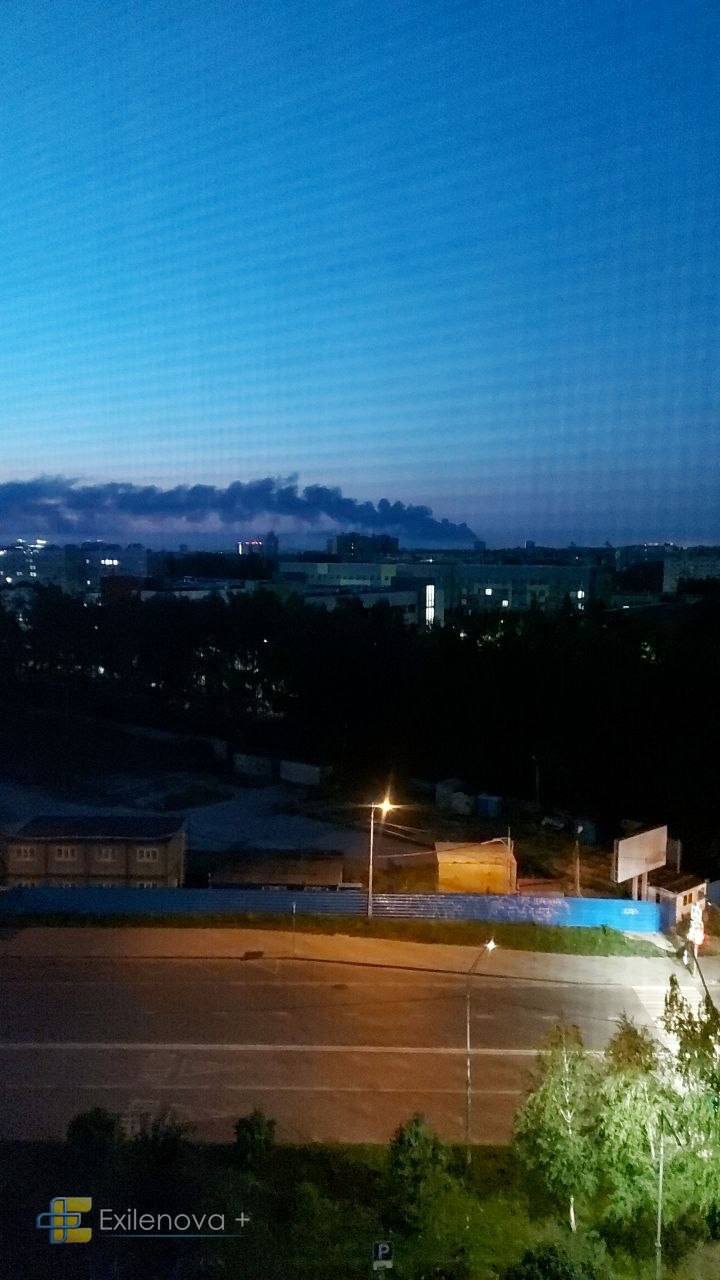
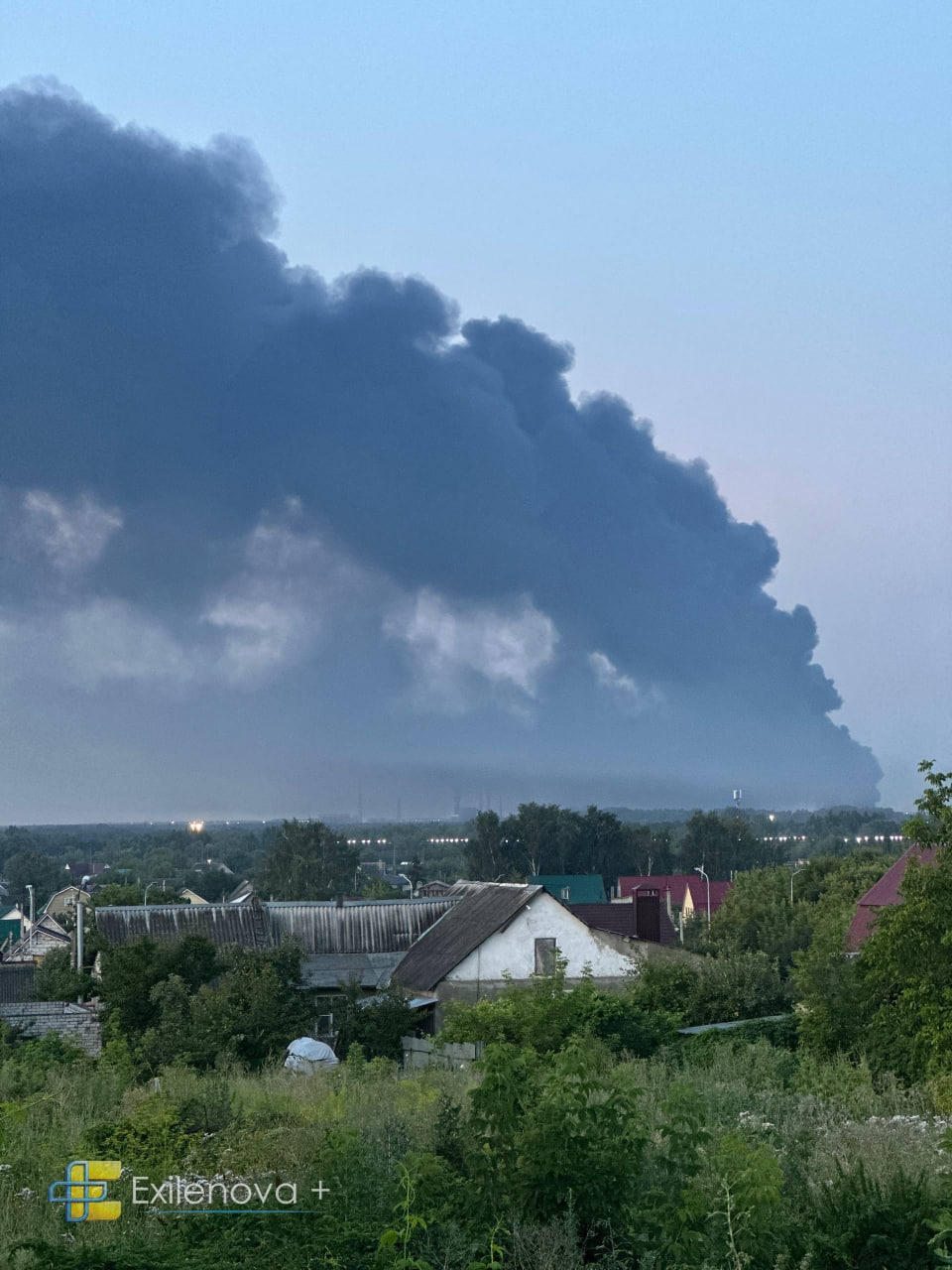
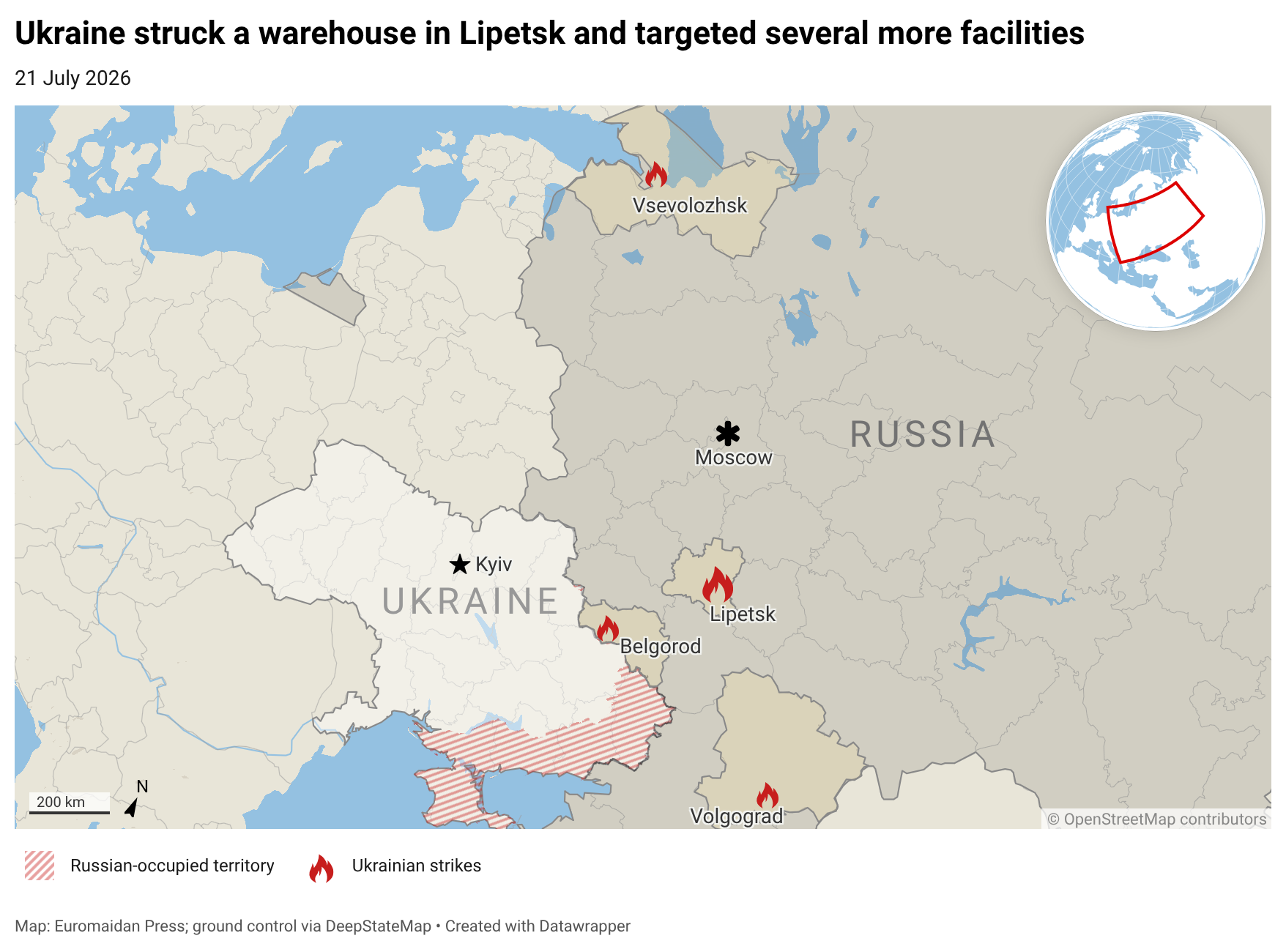
Explosions under an hours-long missile alert ended in a large industrial fire in the Russian city of Lipetsk overnight on 21 July, monitoring channels and Russian officials reported. The blaze rose beside facilities central to Russia's steel output and heat supply, and what exactly came down on the city remains unconfirmed. Lipetsk is about 300 km from Ukraine's northeastern border.
Ukraine's long-range campaign now hits Russian rear infrastructure nightly, from oil depots
Explosions under an hours-long missile alert ended in a large industrial fire in the Russian city of Lipetsk overnight on 21 July, monitoring channels and Russian officials reported. The blaze rose beside facilities central to Russia's steel output and heat supply, and what exactly came down on the city remains unconfirmed. Lipetsk is about 300 km from Ukraine's northeastern border.
Ukraine's long-range campaign now hits Russian rear infrastructure nightly, from oil depots in Stavropol Krai to logistics hubs near Moscow, forcing Russia to defend targets far behind the front. Every new fire at plants tied to weapons production deepens the strain on a war economy whose oil refining has already sunk to a two-decade low, and the night's missile warnings point to Ukraine's expanding options for reaching targets hundreds of kilometers inside Russia.
Fire erupts between power plant and steel giant
Lipetsk Oblast had declared missile and drone danger from the previous evening. Residents then reported explosions over the city, followed by a spreading fire. The Russian news Telegram channel Astra wrote that locals described blasts and flames through the night. Later eyewitness footage, published by the channel, showed the aftermath of what residents called a missile attack.
Smoke from a fire in Lipetsk's industrial zone rises on the horizon after a night of explosions and missile alerts, Russia, 21 July 2026. Photo: Exilenova+
Videos posted by the Ukrainian monitoring Telegram channel Exilenova+ and Astra's OSINT analysis captured a thick smoke column and flashes of explosions. Astra's geolocation work placed the fire between the city's CHPP-2 heat-and-power plant and the Novolipetsk Metallurgical Combine (NLMK). Which facility took the hit remains unknown.
A dark smoke plume hangs over Lipetsk in the early hours after residents reported explosions, Russia, 21 July 2026. Photo: Exilenova+
Lipetsk Oblast Governor Igor Artamonov confirmed the fire, putting its area at about 2,500 square meters. He said the blaze broke out at an open site among production facilities on Peredelcheskaya Street. The governor named no weapon behind the fire, and Astra noted the causes were "being established." Artamonov claimed no one died or suffered injuries.
OSINT analysts of the Falcon insight map channel concluded from available footage that a logistics warehouse was burning. The Ukrainian monitoring channel Supernova+ located the fire at a warehouse on Almaznaya Street holding NLMK facilities, near Peredelcheskaya. Other, unconfirmed reports suggested the Indesit appliance plant near CHPP-2 might have caught fire.
Explosions and large fire hit Russia's Lipetsk last night
Residents of Lipetsk reported blasts last night as a blaze broke out between the TETs-2 thermal power plant and the Novolipetsk Metallurgical Combine, one of Russia's largest steel plants. The burning site is possibly a… pic.twitter.com/h93hRj3EaE
NLMK is Russia's largest steel producer, making about 20% of all Russian steel. The plant works for Russia's defense-industrial complex and fulfills a large number of state orders. Its metal goes into Russian missiles, artillery, and other weaponry. Ukrainian drones have attacked the combine before, and a February 2025 drone strike injured a worker there. Astra has documented NLMK steel going to companies specializing in missile production.
Lipetsk CHPP-2 is one of the largest thermal power plants in Russia's Chernozem region. It supplies heat to Lipetsk and several industrial enterprises around the city.
Belgorod loses water, Volgograd hears blasts
Belgorod—a city between Lipetsk and Ukraine—and its surrounding settlements also came under attack the same night. Monitoring channels said a rain of debris from downed missiles fell over the city and the Belgorod agglomeration. Parts of the city lost water supply, with probable hits on energy infrastructure.
In Volgograd, residents reported explosions and sirens under a declared missile danger. No information about any aftermath had emerged by morning.
A powerful fire broke out the same night in the Vsevolozhsk district of Leningrad Oblast. Regional authorities said a polymer production facility caught fire at the Ladoga industrial park, covering 5,900 square meters. Open data lists the companies Terra-Plast, Miksplast, and the Center of Radiation Technologies at the site.
Russia's Defense Ministry claimed its air defenses and electronic warfare intercepted 209 Ukrainian drones over Russian regions overnight.
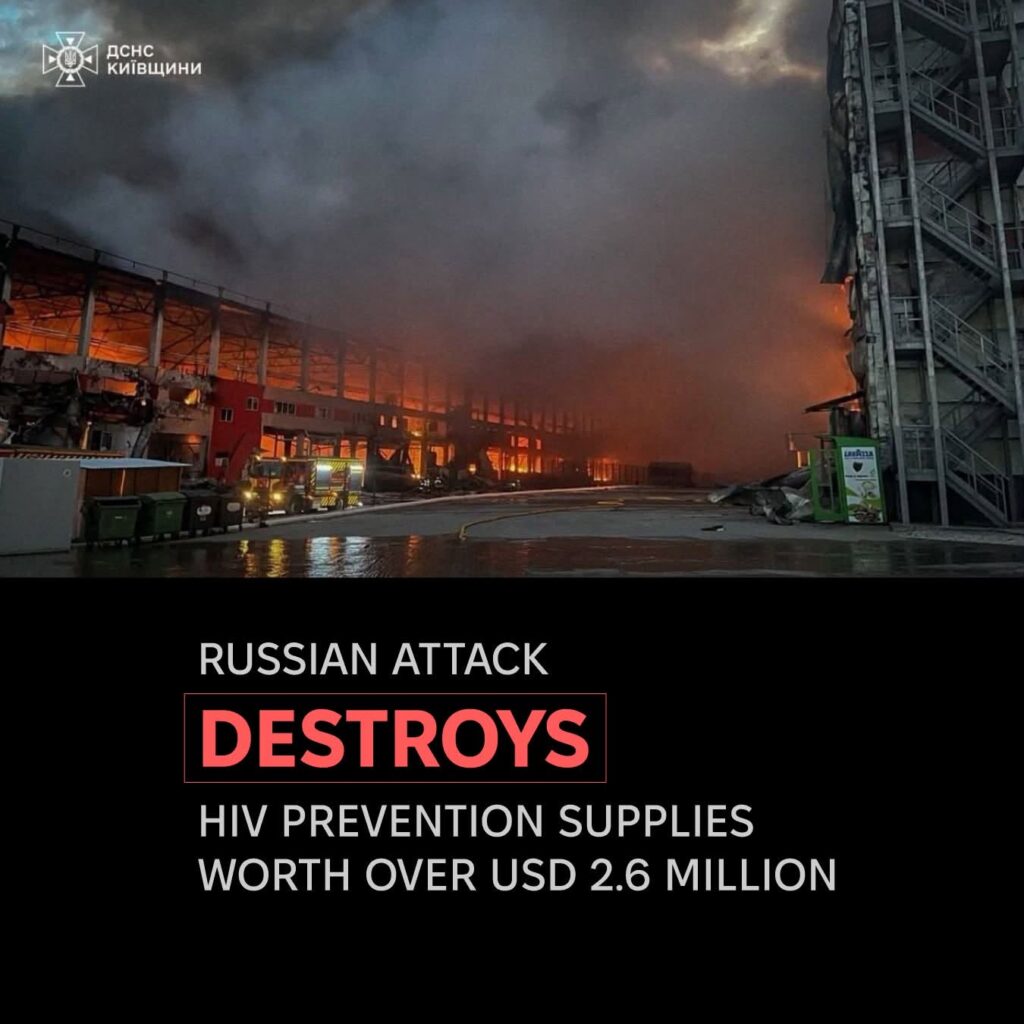
A Russian strike burned the supplies that keep Ukraine's HIV epidemic under control. The attack on the night of 19 July completely destroyed a contractor warehouse of the Alliance for Public Health in Kyiv Oblast, where medical goods and HIV-prevention supplies were stored, the nongovernmental organization said on Facebook.
The warehouse held syringes, needles, alcohol wipes, condoms, lubricants, and other medical products purchased by the Alliance for more than $2.6 millio
A Russian strike burned the supplies that keep Ukraine's HIV epidemic under control. The attack on the night of 19 July completely destroyed a contractor warehouse of the Alliance for Public Health in Kyiv Oblast, where medical goods and HIV-prevention supplies were stored, the nongovernmental organization said on Facebook.
The warehouse held syringes, needles, alcohol wipes, condoms, lubricants, and other medical products purchased by the Alliance for more than $2.6 million that serve over 300,000 people a year.
"Russia continues to destroy not only Ukraine's civilian and medical infrastructure, but also the resources on which people's health directly depends," the Alliance said.
June decision saved this year's services
The Alliance's risk-management system is the reason no one has lost services this year. Back in June, the organization carried out an early distribution of stocks across Ukraine's regions, moving supplies out of central storage and into the field ahead of need.
Because of that, all partners of the Alliance and of the Public Health Center are fully supplied with prevention materials through the end of 2026, and there will be no interruption in prevention services, the organization said.
What burned in the warehouse was the reserve intended to cover 2027. Those stocks were completely destroyed, and the Alliance has already informed its international donors of the losses and of the urgent need to restock HIV-prevention supplies for Ukraine's needs next year.
Why supplies matter
Ukraine has one of the largest HIV epidemics in Europe, and its control depends on exactly the unglamorous items the warehouse holds. Sterile syringes and needles are the backbone of harm-reduction programs that stop transmission among people who inject drugs.
In 2025, HIV-positive patients across Ukraine faced a crisis when US-funded treatment programs remained in political limbo. A report published on 13 May highlighted that medication supplies, including for children, are only guaranteed until November, following a funding freeze by the US President Donald Trump administration in January.
Ukrainian long-range strikes targeted Russian fuel infrastructure in Stavropol Krai overnight on July 19, with Ukrainian President Volodymyr Zelenskyy saying Ukraine’s Security Service (SBU) hit three oil depots and the Armed Forces struck another fuel facility in the region.
Ukraine has increasingly targeted Russian oil refineries, fuel depots, logistics hubs, and other infrastructure linked to Russia’s war effort as part of its campaign to disrupt the supply chains su
Ukrainian long-range strikes targeted Russian fuel infrastructure in Stavropol Krai overnight on July 19, with Ukrainian President Volodymyr Zelenskyy saying Ukraine’s Security Service (SBU) hit three oil depots and the Armed Forces struck another fuel facility in the region.
Ukraine has increasingly targeted Russian oil refineries, fuel depots, logistics hubs, and other infrastructure linked to Russia’s war effort as part of its campaign to disrupt the supply chains supporting Moscow’s military operations.
Russian authorities reported multiple fires in the Stavropol area following the drone attack. The Russian regional governor said there were no casualties, but a local state of emergency was introduced.
Ukraine says it struck three Russian oil depots in Stavropol Krai overnight, causing fires at fuel facilities deep inside Russia.
President Volodymyr Zelenskyy said the strikes were carried out by Ukraine’s Security Service and targeted infrastructure that “provides and finances… pic.twitter.com/MICyJjkiiB
Russian Governor Vladimir Vladimirov said two fires broke out in industrial areas of Stavropol Krai – one near the village of Vyazniki in the Shpakovsky district and another in northern Stavropol near the district border.
Videos shared online showed large fires in the area. Russian independent outlet Astra reported that three oil depots may have been affected, based on footage showing a fire near one of several nearby fuel storage facilities.
According to monitoring channel Supernova+, fires were recorded at two oil facilities in the evening of 19 July: the LUKOIL-Yugnefteprodukt oil depot and the Stavropol oil depot operated by Promkhim.
Zelenskyy confirms strikes on Russian energy targets
Later on July 19, Zelenskyy confirmed that Ukrainian forces had targeted Russian fuel infrastructure in the region.
“Ukraine’s long-range sanctions” had reached facilities that “provide and finance Russian aggression,” Zelenskyy said, adding that SBU units struck three oil depots in Stavropol Krai while Ukrainian military units hit another fuel-related facility there.
Zelenskyy also said Ukrainian forces hit three Russian “shadow fleet” tankers in the Black Sea.
He thanked the Ukrainian units carrying out the strikes, saying the operations were intended to increase pressure on Russia and demonstrate the cost of continuing the war.
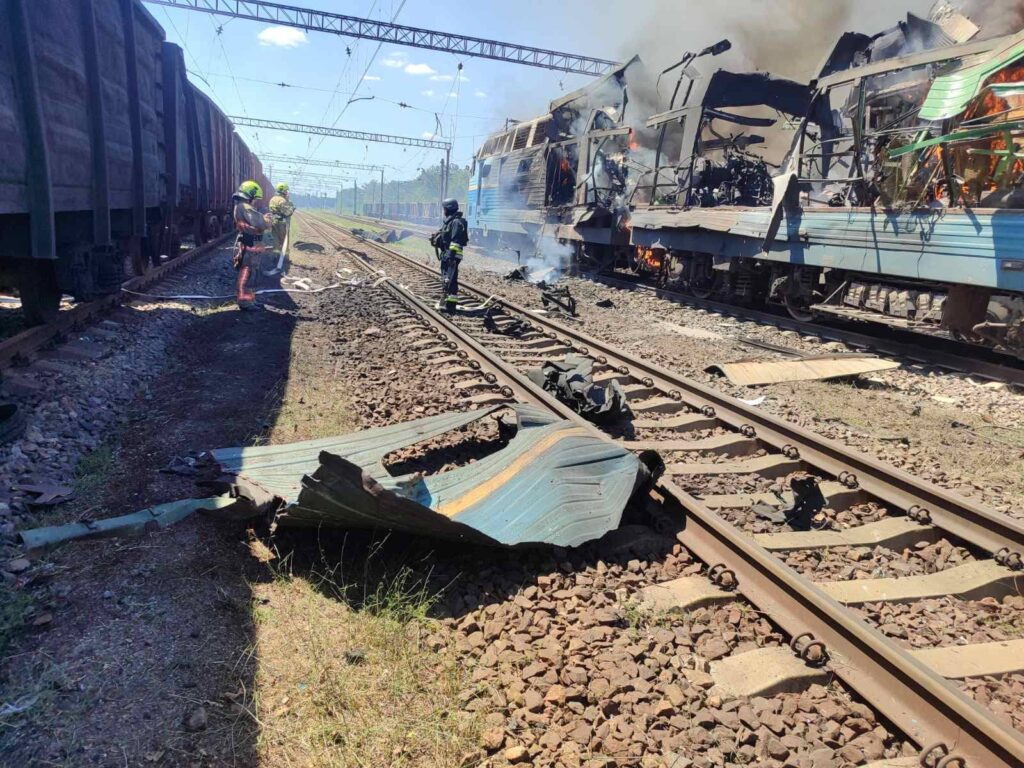
Russia hit a passenger train, then hit it again. Russian forces carried out a double strike on a locomotive and passenger carriages of a train in Zaporizhzhia Oblast, Ukrainian Minister for Restoration, Infrastructure and Transport Mykola Kalashnyk said.
Thanks to a monitoring group, the professional actions of railway workers, and a timely response, all passengers and staff were moved to safety in time. No one was hurt.
The no-casualties outcome is the system Ukraine buil
Russia hit a passenger train, then hit it again. Russian forces carried out a double strike on a locomotive and passenger carriages of a train in Zaporizhzhia Oblast, Ukrainian Minister for Restoration, Infrastructure and Transport Mykola Kalashnyk said.
Thanks to a monitoring group, the professional actions of railway workers, and a timely response, all passengers and staff were moved to safety in time. No one was hurt.
The no-casualties outcome is the system Ukraine built for exactly this. Russia has turned Ukraine's trains into targets, striking the railway about 1,200 times in 2025 and killing roughly 40 railway workers since 2022.
People have minutes to hind
To keep crews alive, Ukrzaliznytsia now runs monitoring groups that detect incoming drones and has installed more than 800 mobile blast shelters at junctions and depots so people can take cover within seconds of an alert. On this train, the warning came in time. In others in the same oblast, it has not.
"Russia deliberately continues to strike civilian infrastructure, trying to intimidate people and disrupt the transport system," Kalashnyk said.
Double-tap is the tactic that makes these strikes war crimes
The two-strike pattern is not incidental. Russia has repeatedly used the "double-tap" tactic when a first strike is followed by a second on the same target that maximizes harm to the people who respond to the first hit. Ukrainian prosecutors have documented this tactic across thousands of attacks on civilians.
Against a train, the double-tap is aimed at the moment of evacuation: the first strike to stop the train and force people out, the second to catch them in the open or the responders as they arrive.
Zaporizhzhia Oblast has already paid the other price. In June 2026, a Russian strike on three Ukrzaliznytsia locomotives killed an assistant driver who could not get clear of his rear cab in time. Crews there have had minutes, sometimes less.
Railway keeps running because breaking it is point
Kalashnyk framed the strike as part of a deliberate campaign, and the archive supports him. Russia has stepped up attacks on civilian rail specifically because the network carries both civilian passengers and wartime logistics, and because keeping it running is essential to Ukraine's economy, its evacuations, and its supply lines.
The cost is mounting faster than repairs. Russia damaged more than 200 Ukrainian locomotives in the first half of 2026 alone, roughly matching the entire prior 15-month toll, along with hundreds of passenger and freight carriages. Ukrzaliznytsia has warned that the summer of 2026 will be its hardest yet because strikes are depleting its carriages faster than the company can replace them.
"Ukrainian railways continue to work, ensuring uninterrupted connection and carrying out their critically important mission even under constant attacks," Kalashnyk said.
The Ministry, together with the Defense Ministry and Ukrzaliznytsia, is working to strengthen the resilience of rail transport even under such conditions, he added.
Ukraine's private air defense continues to grow. Some 51 companies have now joined the experimental program that folds private enterprises into the country's air defense system, Ukraine's Defense Ministry said.
The idea behind the program is to engage businesses in defending their own critical infrastructure, so the Air Force does not have to cover every site on its own.
Air defense crews from four enterprises are already on combat duty, and they have downed more than 5
Ukraine's private air defense continues to grow. Some 51 companies have now joined the experimental program that folds private enterprises into the country's air defense system, Ukraine's Defense Ministry said.
The idea behind the program is to engage businesses in defending their own critical infrastructure, so the Air Force does not have to cover every site on its own.
Air defense crews from four enterprises are already on combat duty, and they have downed more than 50 Shahed attack drones and Zala reconnaissance UAVs. The private crews do not act on their own — they operate as part of the overall system under the Air Force's Air Command.
Ukraine's Defense Ministry wants private and conventional air defenses to work together to repel 95% of aerial attacks, calling private crews one layer of a multi-layered shield.
Private crews already down the hard targets
At the start of June, the program counted 30 enterprises. The initiative has roughly quadrupled since spring. It counted 13 enterprises in March, 24 in May, 30 in early June, and 51 now.
The private groups are not limited to slow, easy drones. A private company's crew in Kharkiv Oblast downed a jet-powered Shahed in April 2026. This case marked the first time the business-based network intercepted the faster variant that outrun much of Ukraine's cheap interceptor fleet.
The crews train on the same equipment the Air Force uses. Training runs on virtual-reality goggles and Browning machine guns against simulated Shahed attacks, with a separate track for FPV interceptor-drone pilots.
Private air defense is one layer of wideningsystem
The private program sits within a broader decentralization of Ukraine's air defenses. Ukraine has also allowed local governments to fund community air defense units under Air Force control directly and has deployed privately operated, remotely controlled machine-gun turrets to guard infrastructure.
The push comes as Russia launches hundreds of Shaheds and dozens of missiles at Ukraine on its heaviest nights, and no single state air force can cover every substation, port, and factory across the country.
Ukraine's drone blockade of Crimea widened across the Sea of Azov overnight on 12–13 July. The Unmanned Systems Forces said they struck 15 Russian vessels, nine energy nodes, and four air-defense assets.
Commander Robert “Madyar” Brovdi said the maritime targets included seven tankers, five dry-cargo ships, one ferry, and two tugs. Censor reported that the same operation hit the “Crimea” electricity-transfer point on the Kuban-Crimea energy bridge for the second time in
Ukraine's drone blockade of Crimea widened across the Sea of Azov overnight on 12–13 July. The Unmanned Systems Forces said they struck 15 Russian vessels, nine energy nodes, and four air-defense assets.
Commander Robert “Madyar” Brovdi said the maritime targets included seven tankers, five dry-cargo ships, one ferry, and two tugs. Censor reported that the same operation hit the “Crimea” electricity-transfer point on the Kuban-Crimea energy bridge for the second time in 48 hours. Brovdi also claimed the destruction of an S-400 launcher, a Tor system, and two radar complexes. The damage could not be independently confirmed.
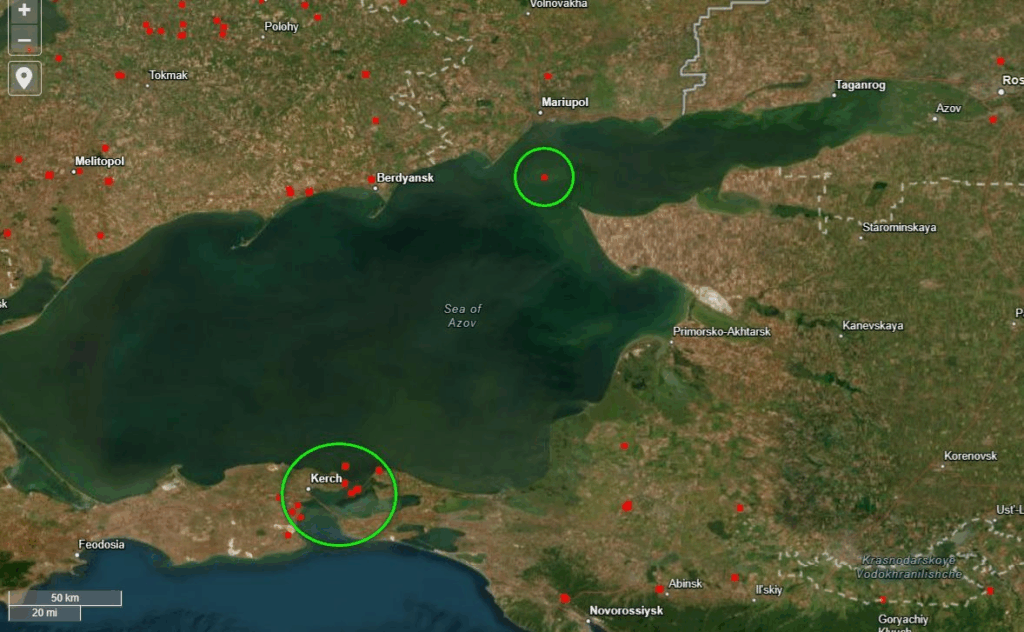
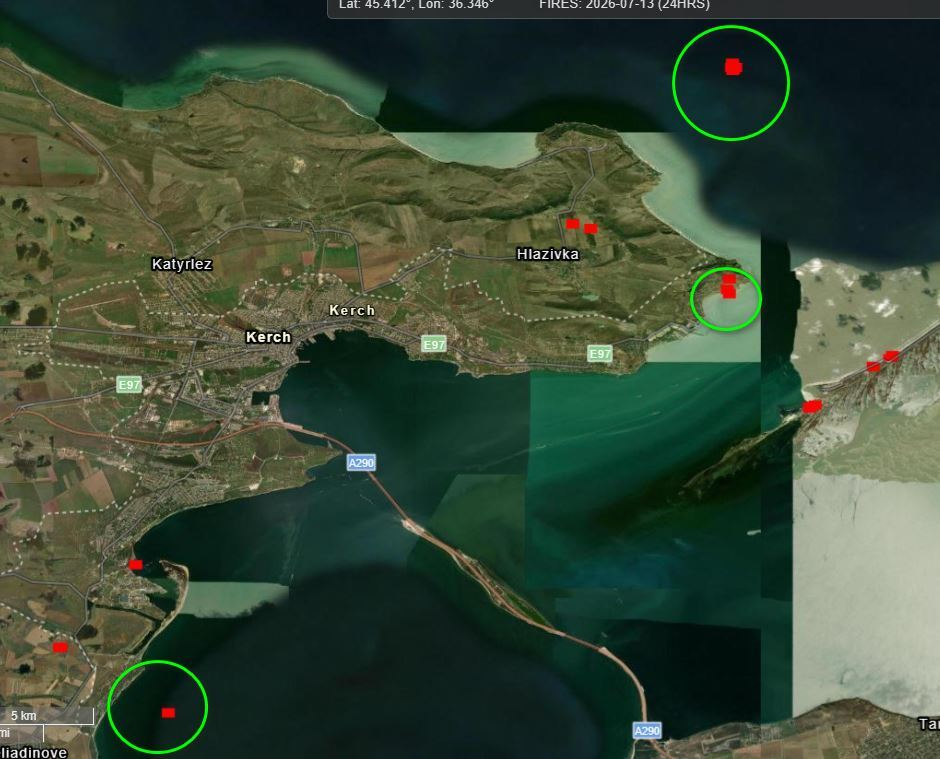
NASA FIRMS registered thermal anomalies across the Sea of Azov, including south of occupied Mariupol and around Kerch. Credit: NASA FIRMS.
RBC-Ukraine reported that NASA FIRMS satellite data showed thermal anomalies in the Sea of Azov and at the Port Kavkaz railway station, a transport hub serving routes to Crimea.
A wider FIRMS screenshot also showed a hotspot south of the occupied city of Mariupol. NASA FIRMS detects heat signatures but cannot determine their cause.
Thermal anomalies appeared north and south of Kerch following Ukraine’s overnight drone operation. Credit: NASA FIRMS.
The strikes targeted several parts of the network linking occupied Crimea to Russia. By hitting shipping, power infrastructure, and air defenses together, Ukraine is tightening the noose around occupied Crimea's supply lines. Each strike makes the remaining links harder to use.
Crimea.Realities reportedthat Russian authorities kept the Kerch Bridge closed for more than 11 hours, from 9:51 p.m. on 12 July until 9:06 a.m. the next morning. Local residents reported drones, air-defense fire, and explosions around Kerch throughout the closure
Citing the Crimean Wind monitoring channel, Ukrinform reported that fires broke out near Cape Fonar, where Russian air defense units are deployed.
How Ukraine tightened the ring around Crimea
The operation followed a week of strikes on the same routes. On 10 July, Ukrainian forces hit vessels, both Azov loading ports, five oil depots, and Crimea’s power grid.
Russia then halted traffic through the Don-Azov shipping channel and stopped accepting requests for passage through the Kerch Strait. By 12 July, the Unmanned Systems Forces said they had struck 90 vessels in seven days. Brovdi put the total for 6–13 July at 105 successful strikes on vessels.
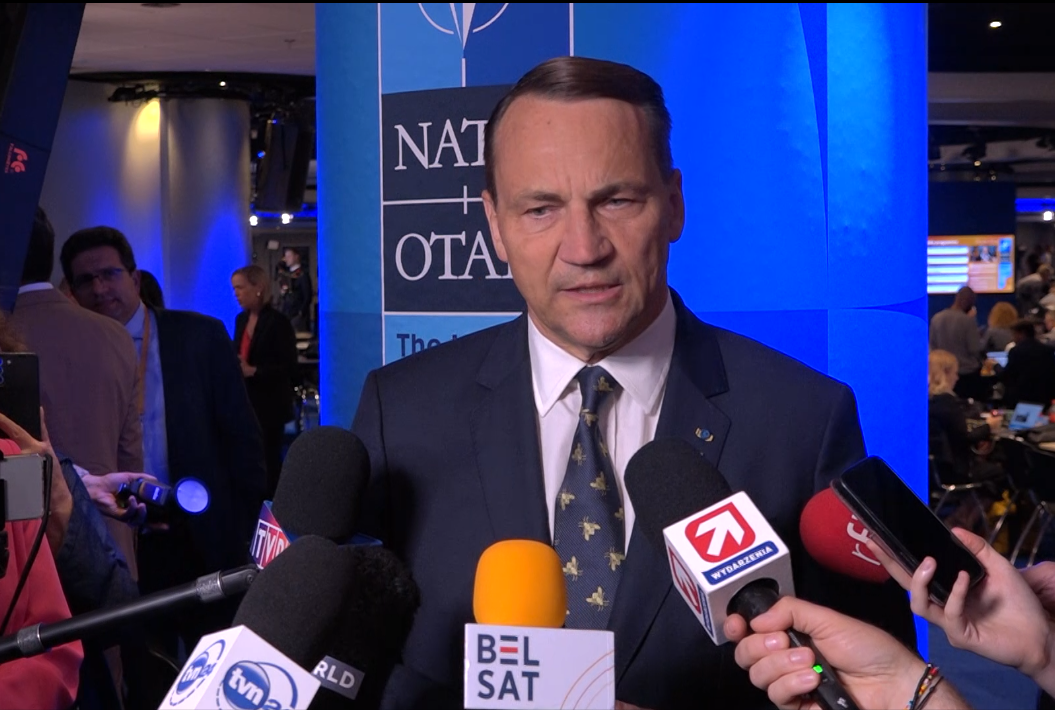
Poland holds credible information that Russia is again planning provocations, and it is publicizing that fact to stop Moscow from acting, Foreign Minister Radosław Sikorski said in Warsaw, Polish broadcaster RMF24 reported. Speaking alongside his French counterpart on 9 July, he set the intelligence against a long list of Russian covert operations across Europe. Sikorski framed exposure as a weapon that has worked against the Kremlin before.
Russia's full-scale invasion of
Poland holds credible information that Russia is again planning provocations, and it is publicizing that fact to stop Moscow from acting, Foreign Minister Radosław Sikorski said in Warsaw, Polish broadcaster RMF24 reported. Speaking alongside his French counterpart on 9 July, he set the intelligence against a long list of Russian covert operations across Europe. Sikorski framed exposure as a weapon that has worked against the Kremlin before.
Russia's full-scale invasion of Ukraine is in its fifth year, and the same Russian services fighting it run a documented campaign of arson and sabotage across NATO countries, which European intelligence agencies expect to intensify while Moscow probes for a chance to test the alliance before Europe finishes rearming. A provocation that slips past the warnings would land on states carrying Ukraine's lifeline — Poland is the indispensable overland route for Western aid — and each disclosure now doubles as a test of whether publicity alone can still make the Kremlin stand down.
"The Russians are again planning something"
Sikorski and French Foreign Minister Jean-Noël Barrot faced questions about recent media reports, including in the Washington Post, that Russia is actively considering attacks on NATO targets and that the US has warned allies. Sikorski declined to comment on what intelligence services say. Poland's deputy prime minister, he still left no doubt about the broader picture.
"But the fact that Russia is waging a hybrid and kinetic war against both France and Poland is no secret," he said.
Sikorski added:
"That the Russians attack our systems of party competition, our critical infrastructure, or use shadow-fleet ships to map critical infrastructure — all of this is known. But also arson, attacks on rail tracks, drone attacks, and sending death squads to kill Vladimir Putin's enemies — all of these are hostile activities. We do nothing of the sort in Russia."
Explore further
Polish FM warns Putin’s retaliatory rhetoric sounds like “an announcement of a provocation”
The 2022 precedent: exposure works
Sikorski recalled that before invading Ukraine, Russia intended to stage classic false-flag provocations to hand itself a pretext for the attack.
"Back then, the services of the United States warned about this, and that deterred Russia from carrying out those provocations," he said.
The same logic drives today's disclosure: "The aim of these warnings is to deter them from carrying out these provocations. And may it be so," Sikorski told a journalist.
He aired a similar caution in June, saying the Kremlin could stage a false-flag operation within the next two years.
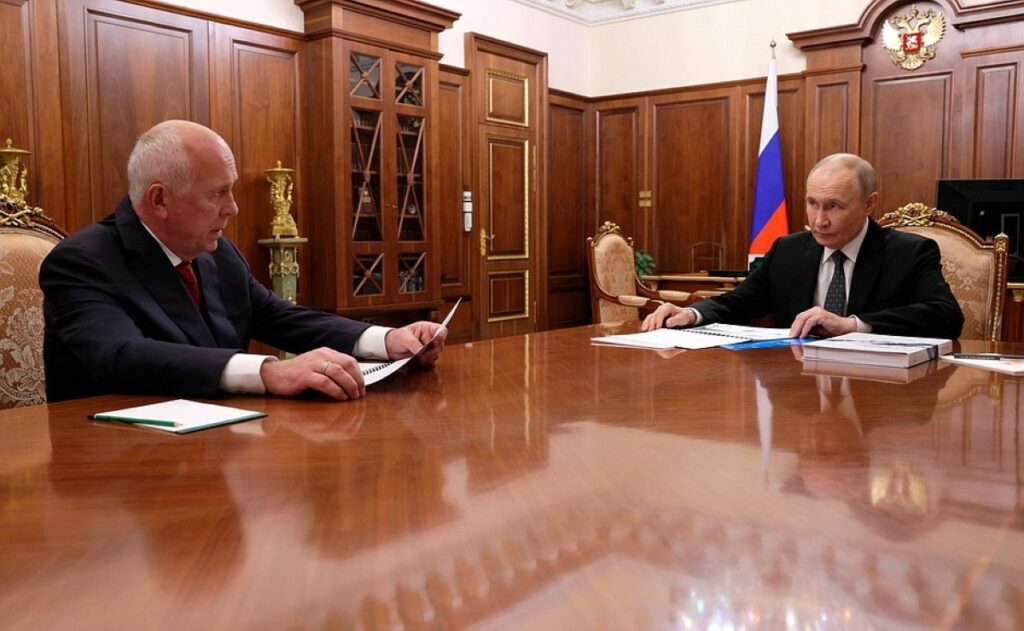
On 17 June 2025—a year ago—Rostec CEO Sergei Chemezov met Putin at the Kremlin and reported that the state arms corporation had more than doubled its net profit to roughly $1.4 billion. Then, in the same meeting, he said three waste incineration plants would have to be frozen “until better days, when money is cheaper.”Rostec produces 80% of the weapons Russia fires in Ukraine.
Rostec CEO Sergei Chemezov briefs Vladimir Putin at the Kremlin on 17 June 2025. In the same m
On 17 June 2025—a year ago—Rostec CEO Sergei Chemezov met Putin at the Kremlin and reported that the state arms corporation had more than doubled its net profit to roughly $1.4 billion. Then, in the same meeting, he said three waste incineration plants would have to be frozen “until better days, when money is cheaper.”
Rostec produces 80% of the weapons Russia fires in Ukraine.
Rostec CEO Sergei Chemezov briefs Vladimir Putin at the Kremlin on 17 June 2025. In the same meeting, Chemezov reported record arms profits—and said the company could not afford to finish its civilian projects. Photo: Kremlin.ru
Long-term investments have become unviable
In June 2026, a study found that Russia had suspended roughly $2.3 billion worth of data center construction—gutting the infrastructure its government says is essential for sovereign AI.
In May 2026, it emerged that the railway to Putin’s flagship Arctic coal port had been halted because Russian Railways could not pay the builders, leaving a terminal that opened to great fanfare shipping just 3% of its design capacity.
“The goal of restoring economic growth is incompatible with the war and accelerating nationalization.”
Russia’s war spending has pushed interest rates high enough to make decade-long investments mathematically unviable, emptied the federal budget, and left state companies choosing between the front and the future.
Boris Grozovsky, a Russian economic journalist and editor of the independent outlet Strana i Mir, told Radio Liberty that the government has no interest in restoring economic growth: “The goal of restoring economic growth is incompatible with the war and accelerating nationalization, and I don’t see anyone seriously pursuing it.”
The data centers Russia cannot build
Russia suspended 38 data center projects over the preceding three years, worth roughly $2.3 billion in total, according to a study by the consulting firm Tekhexpo and the research group PKR, reviewed by Forbes Russia.
“It remains unclear how the task of developing independent AI can be achieved.”
Russia is simultaneously drafting legislation to mandate a sovereign domestic artificial intelligence ecosystem—and watching the buildings that AI needs go unbuilt. “It remains unclear how the task of developing independent AI can be achieved, especially as legislation governing artificial intelligence is now being prepared for adoption,” Filipp Vratskikh, CEO of Tekhexpo, told Forbes.
Commercial data centers are built to pay back over roughly ten years. Stanislav Mirin, an analyst at iKS-Consulting, told Forbes that the Central Bank’s benchmark rate hit 21% in 2025 before falling to still above 14%: “At such rates, the business model often simply does not work.”
Those rates exist because war spending fuels inflation, and the Central Bank raises rates to contain it—a loop that makes any investment taking years to pay back impossible to finance.
Explore further
Russia’s top bankers break taboo, admit war is hurting the economy
Electricity is the second obstacle. About three-quarters of Russia’s commercial data center capacity is in the Moscow region, where obtaining approval for new power connections has become “virtually impossible” for new investors, according to the same study.
Rostelecom president Mikhail Oseyevsky has warned that spare electricity capacity in Russia’s largest cities is nearly exhausted.
Rostelecom president Mikhail Oseyevsky has warned that spare electricity capacity in Russia’s largest cities is nearly exhausted, already limiting new data center construction and blocking large-scale deployment of AI, The Moscow Times reported.
The Arctic port with no railway
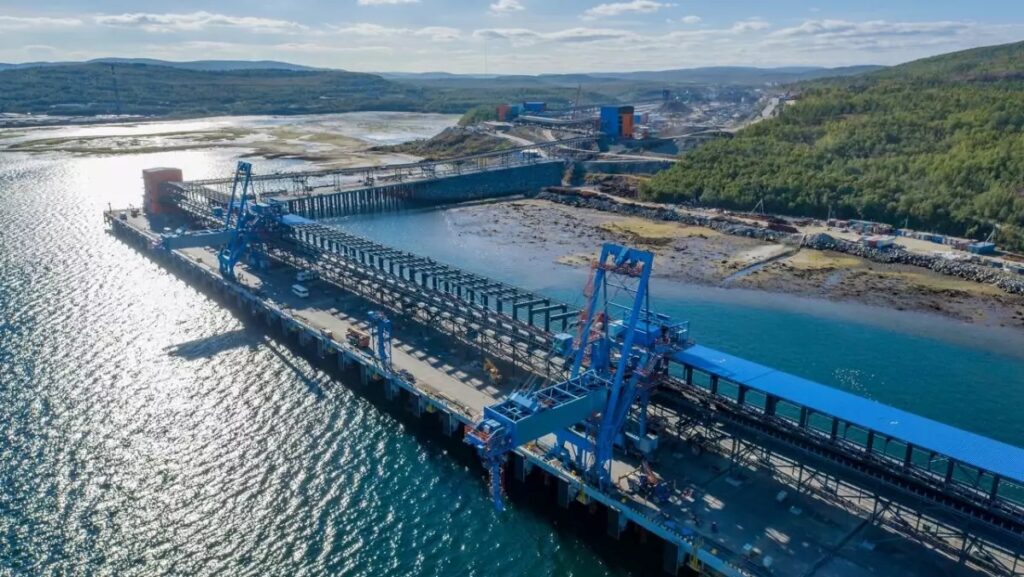
In March 2025, Russia opened the Lavna coal terminal in Murmansk—a deep-water port on the western shore of the Kola Bay that Putin personally inspected by helicopter in 2023, describing it as essential to Russia’s Northern Sea Route ambitions.
The project had been in development for more than a decade, with total investment in the wider Murmansk Transport Hub exceeding $1.7 billion. Design capacity: 18 million tons of coal per year.
The port is open. The train cannot reach it.
The Barents Observer reported in May 2026 that construction of the railway branch line connecting the terminal to Russia’s national network had been suspended because Russian Railways lacked the funds to pay its contractors.
The port is open. The train cannot reach it. In its first seven months of operation, the terminal shipped just 3% of its annual design capacity, according to The Coal Hub, an independent coal market platform.
Coal throughput at the older Murmansk Commercial Sea Port has been falling alongside the new terminal’s failure to ramp up, The Barents Observer found—down more than 40% year-on-year in January 2026 alone, and roughly 60% below its 2020 peak, according to The Barents Observer’s investigation published in May 2026.
Coal for Lavna comes mainly from Kuzbass—Russia’s main coal-mining region in southwestern Siberia, on the other side of the country.
The deeper problem is that even a completed railway might not save the project. Coal for Lavna comes mainly from Kuzbass—Russia’s main coal-mining region in southwestern Siberia, on the other side of the country—where production has been falling for years and dropped sharply again in early 2026.
“Even if the state manages to secure the funding to fully commission the Lavna port and the railway line leading to it,” The Barents Observer concluded, “there will be nothing to load.”
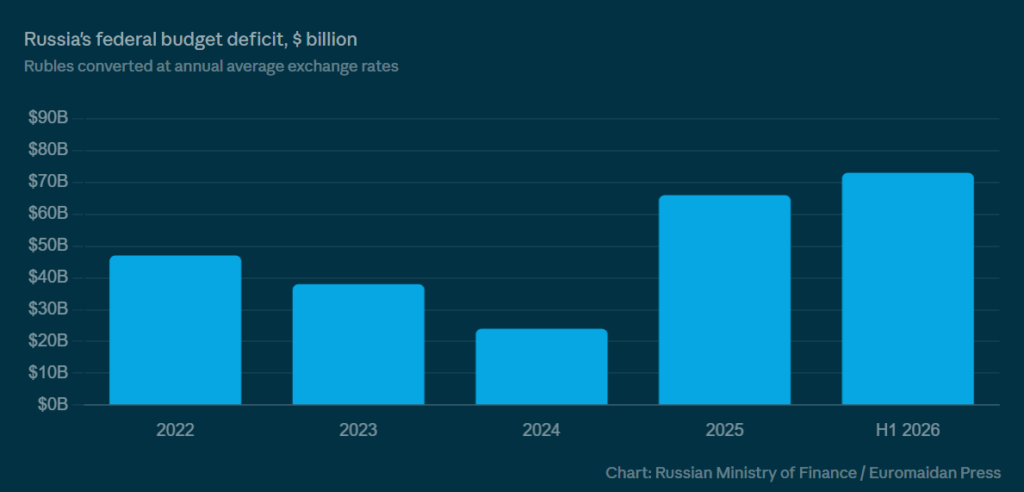
Russia’s federal budget deficit shrank in 2024 as oil revenues held up, then nearly tripled in 2025 as war spending accelerated. In the first half of 2026 alone, the deficit has already reached $73 billion—51% above the target set for the entire year. Chart: Russian Ministry of Finance / Euromaidan Press
The mechanism
The same forces drive both failures. Russia’s Finance Ministry data, relayed by Interfax, put the federal budget deficit at $77 billion for January–May 2026—already 51% above the full-year target.
The government’s priority is funding the military and defense industry.
The war share of spending keeps growing; everything else competes for what remains. Grozovsky told Radio Liberty that the government’s priority is funding the military and defense industry “in the volumes it needs,” while preventing mass wage arrears and social unrest.
Ukrainian drones struck oil depots in Russia's Tver Oblast and Stavropol Krai overnight on 9 July, setting fuel tanks ablaze at both, regional officials and OSINT analysts reported. Ukraine's SBU security service confirmed the strikes, and monitors separately reported a hit on one of Russia's three largest refineries. Ukrainian President Volodymyr Zelenskyy called the attacks part of Ukraine's "long-range sanctions plan."
Ukraine's deep-strike campaign targets Russian fuel
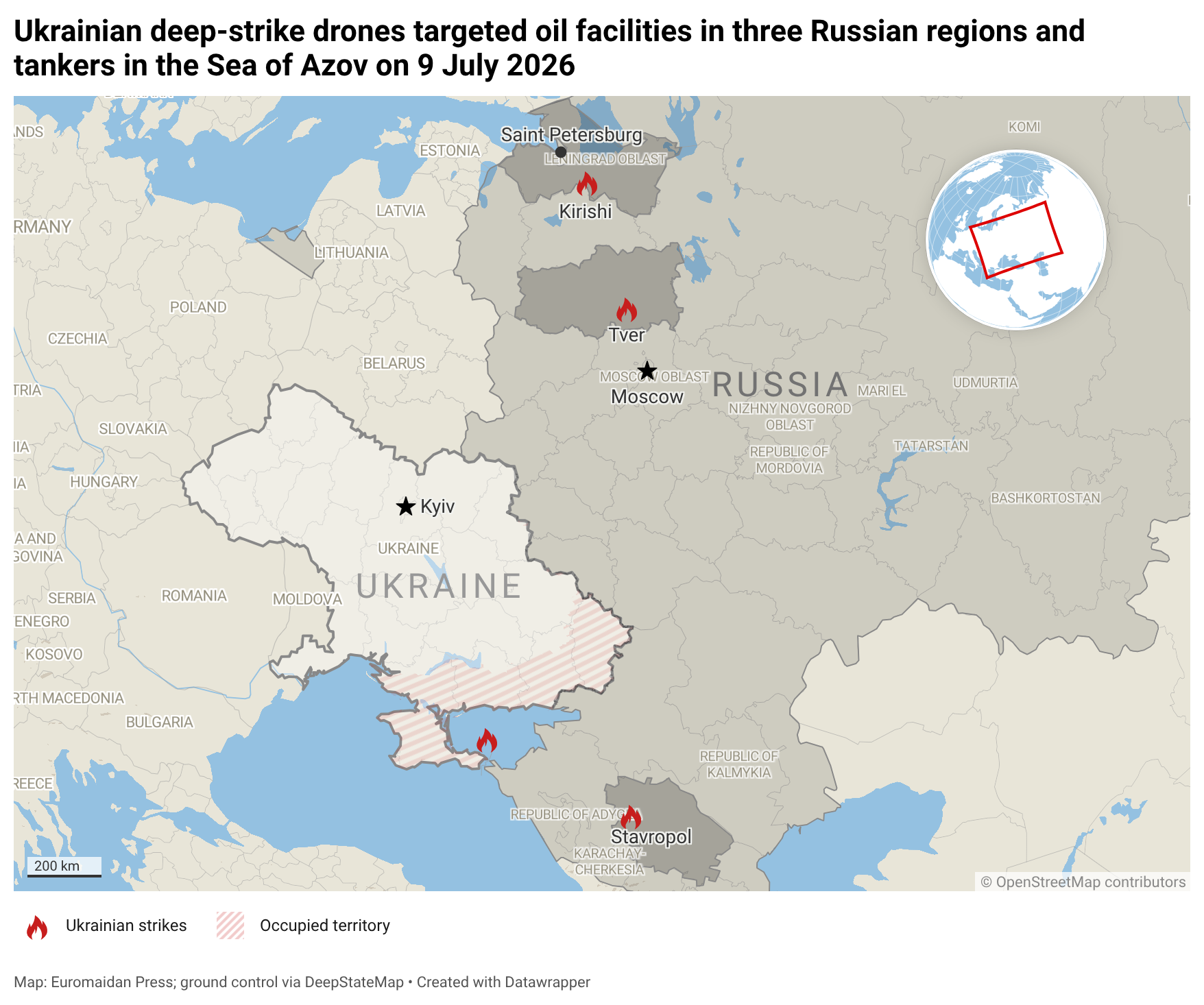
Ukrainian drones struck oil depots in Russia's Tver Oblast and Stavropol Krai overnight on 9 July, setting fuel tanks ablaze at both, regional officials and OSINT analysts reported. Ukraine's SBU security service confirmed the strikes, and monitors separately reported a hit on one of Russia's three largest refineries. Ukrainian President Volodymyr Zelenskyy called the attacks part of Ukraine's "long-range sanctions plan."
Ukraine's deep-strike campaign targets Russian fuel to choke the army's logistics and the oil revenue funding the invasion. The General Staff said earlier that the campaign has knocked out 42% of Russia's refining and cost the industry $13.5 billion since August 2025, pushing fuel rationing into most Russian regions.
Tver depot burns despite anti-drone nets
Tver Oblast head Vitaly Korolyov confirmeda fire in one reservoir of the "Tver oil depot" after what he called the repelling of a drone attack. Astra analyzed eyewitness footage and identified the burning site as the main depot of Tverneftprodukt, a subsidiary of Surgutneftegaz. The company stores and dispenses gasoline and diesel, supplying its own network of 52 filling stations and wholesale buyers across Tver Oblast.
Pre-strike satellite image shows protective nets over the fuel reservoirs of the Tverneftprodukt oil depot in Tver, Russia. Photo: Astra
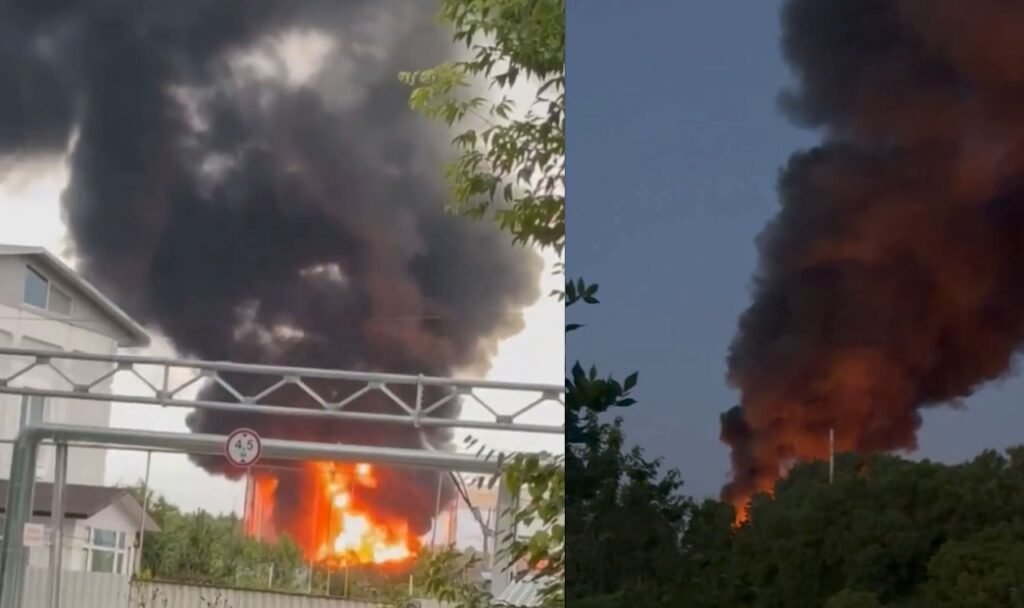
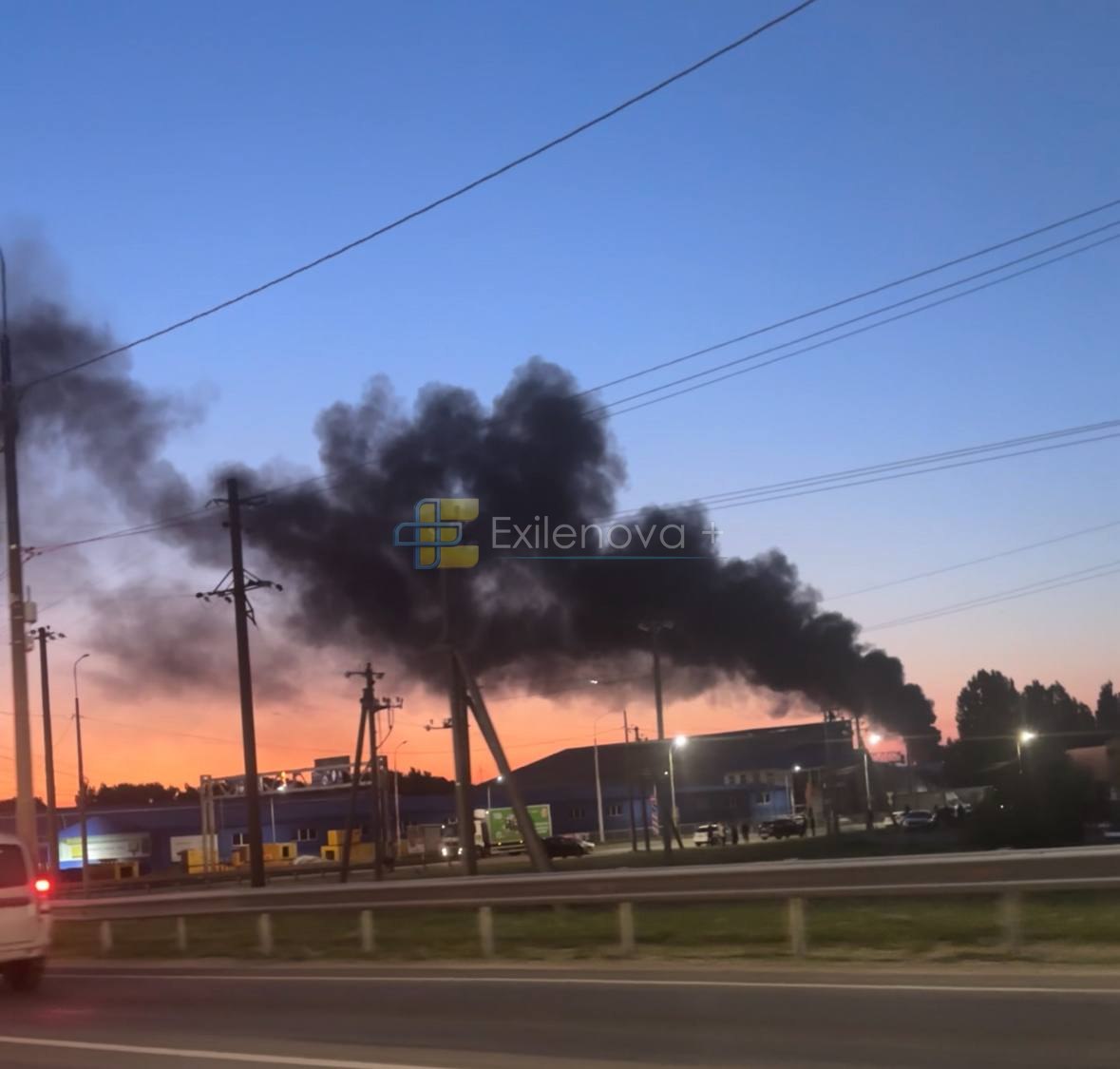
Satellite images taken before the attack show protective nets over part of the reservoirs, Astra noted. The netting did not save the depot: at least one tank burned in its southwestern section. Monitoring channel Supernova+ also tracked the fire, and Exilenova+ published footage of thick black smoke over both struck depots.
Stavropol fire reaches the fuel tanks
In Stavropol Krai, southern Russia, Astra's initial analysis pointed to the Lukoil-Yugnefteprodukt depot in Mikhaylovsk. The outlet then refined its conclusion: the burning site is a separate, larger depot in the hamlet of Vyazniki, 1.3 km away — a major rear hub for receiving, storing, and shipping diesel and gasoline, built around a tank farm with a loading rack.
Governor Vladimir Vladimirov confirmed the strike on Vyazniki. The fire intensified by around seven in the morning and reached reservoirs holding flammable materials, he said, prompting the evacuation of residents from an adjacent street to temporary shelters.
Black smoke rises over the oil depot in Vyazniki, Stavropol Krai, Russia, after a Ukrainian drone strike, 9 July 2026. Photo: Exilenova+
Kirishi refinery reportedly hit
Supernova+ reporteda strike on the Kirishinefteorgsintez (KINEF) refinery in Kirishi, Leningrad Oblast, citing local accounts. KINEF ranks among Russia's three largest refineries, processing 20–21 million tons of oil a year — over 6% of the country's total refining. Governor Aleksandr Drozdenko claimed air defenses downed one drone and denied casualties or damage. Russia's defense ministry claimed to have intercepted 73 drones over 11 regions and occupied Crimea overnight.
Oil depot near Stavropol, southern Russia, is burning after a Ukrainian attack
Last night, Ukrainian forces struck several more fuel facilities across Russia.
— Euromaidan Press (@EuromaidanPress) July 9, 2026
SBU and Zelenskyy confirm the depot strikes
The SBU confirmed that it hit two Russian oil infrastructure sites: the Krasnaya Zarya depot in Tver Oblast, 520 km from Ukraine's border, and the Stavropolskaya depot in Stavropol Krai, over 500 km out. Both handle gasoline and diesel. The agency called the operation part of its systematic work against the Russian oil sector, a key source of war financing.
Explore further
Russia’s refinery in Saratov, two in Tatarstan, a pumping station in Bashkortostan — one night’s oil target list
"Our warriors are carrying out the long-range sanctions plan in response to Russia dragging out the war and continuing its attacks," he said.
Explore further
Three days, 21 ships: Russia’s Azov Sea fuel run to occupied Crimea is turning into a shooting gallery
He added that Ukraine's Defense Forces also hit a reserve fuel storage site about 800 km from the front, an oil loading terminal in Rostov Oblast, and the pumping station near Ufa struck a day earlier.
"We offered Russia a way to end this war long ago, and every day it chooses to prolong it should bring the reality of war back to where it began – to Russia," Zelenskyy said.

 Connexion


 Exilenova+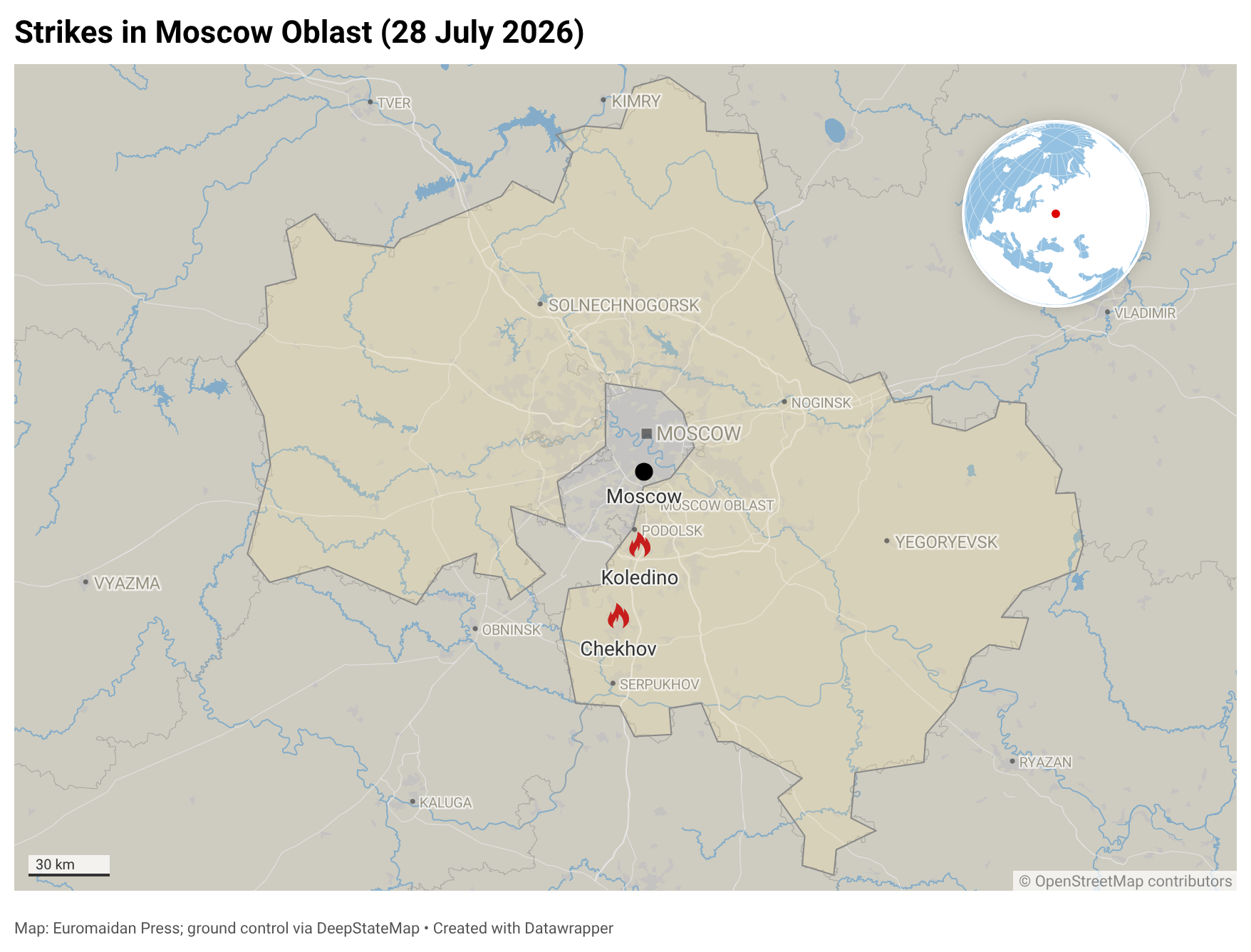


 State Emergency Service of Ukraine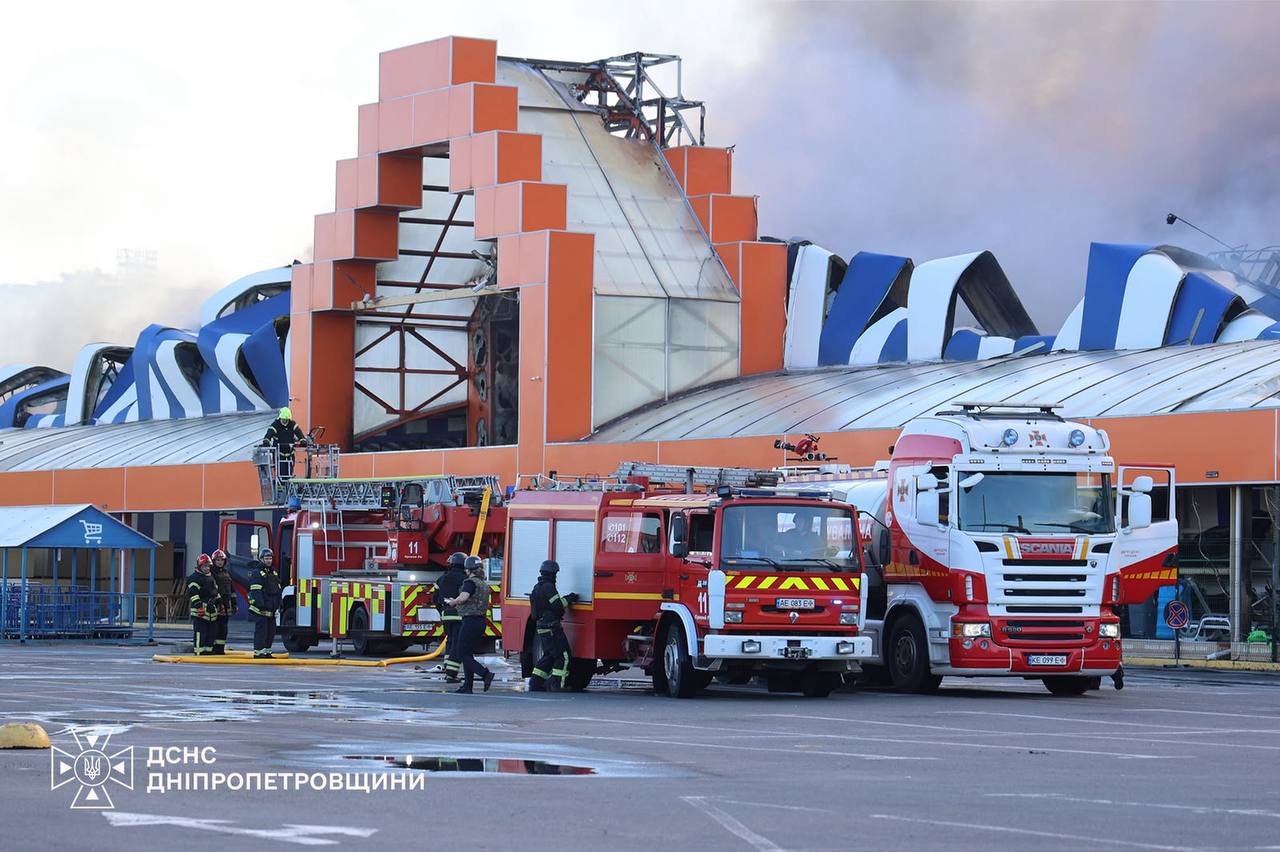
 Suspilne News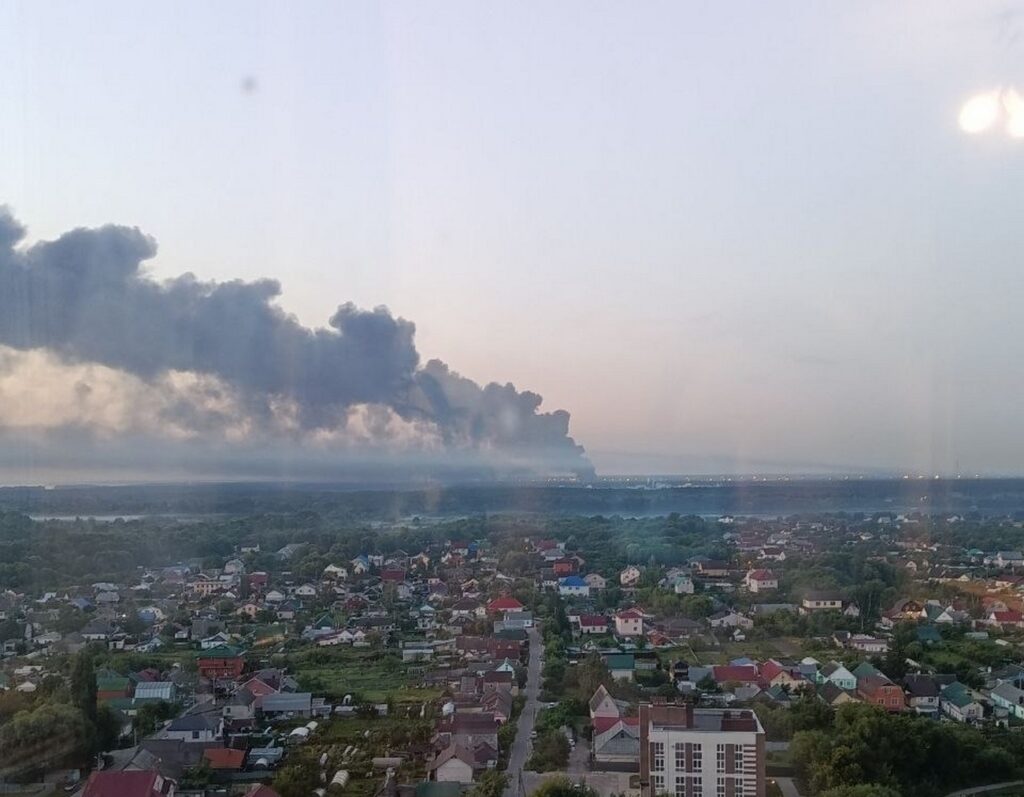





 Exilenova+