Cette somme s’ajoute aux 6 milliards $ déjà annoncés par le gouvernement Carney dans son énoncé économique de printemps pour recruter, former et embaucher jusqu’à 100 000 nouveaux travailleurs spécialisés.
Pour y parvenir, il compte notamment bonifier la rémunération des apprentis.
Le gouvernement fédéral souhaite entamer prochainement des discussions avec les provinces afin de conclure des accords de financement.
Christine Fréchette avait fait savoir en avril dernier au ministre fédéral des finances:
que la formation des travailleurs continuerait d’être gérée par le Québec;
qu’elle s’attendait à ce que les fonds fédéraux lui soient transférés.
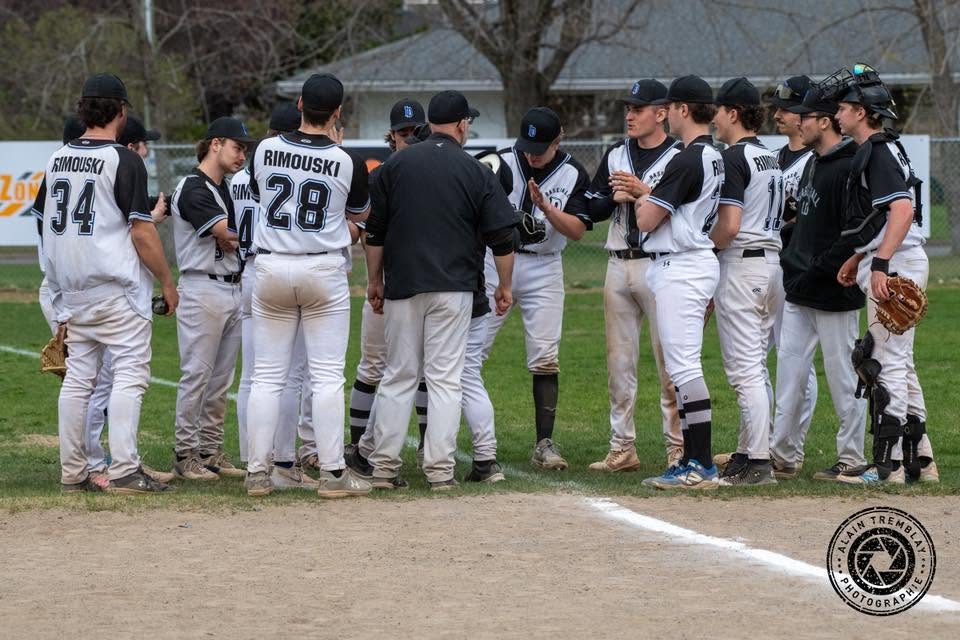
Le Rimouskois, Charles-Éric Maltais, a pris part à la Classique Claude-Raymond, un événement annuel qui regroupe les 84 meilleurs joueurs de baseball de 14 ans et moins du Québec.
C’est en fin de semaine dernière qu’il a vécu cette expérience en présence de monsieur Raymond, 89 ans, une légende du baseball québécois qui a connu une très belle carrière dans les ligues majeures. Il a notamment participé au match des étoiles de 1966 à Houston, il y a 60 ans !
C’est d’ailleurs lui qui a présenté, individuellement, les joueurs des équipes participantes lors de l’ouverture officielle le vendredi soir.
Charles-Éric Maltais dans le chandail des Riverains du Bas-Saint-Laurent, secteur Est. (Photo : ABMR)
« J’ai été choisi après avoir participé à un camp d’évaluation de quatre heures à Québec. On a été évalué sur nos lancers, notre coup de bâton et notre défensive. Par la suite, les évaluateurs sont venus me voir jouer deux ou trois parties pour faire la sélection finale », explique-t-il en entrevue avec Le Soir.
L’expérience est unique pour les participants qui obtiennent un encadrement de première qualité dans un très bel environnement au Stade Richard-Lafontaine de Saint-Jean-sur-Richelieu. La Classique en était à une 11e édition.
« C’était vraiment le fun. Ça m’a permis de voir d’autres joueurs que je ne connaissais pas et qui sont parmi les meilleurs. Il y a moins d’erreurs, c’est davantage une bonne qualité de jeu », poursuit celui qui occupe la position de voltigeur de centre ou celle de voltigeur de gauche.
Charles-Éric Maltais avec Jean-Guy Dionne et, à gauche, son père Bruno. Le petit-fils de M. Dionne, Jordan Laurin, jouait pour l’équipe des Gris qui a remporté la Classique. Il réside à Laval. (Photo courtoisie)
Charles-Éric évoluait pour l’équipe des Rouge qui a gagné une de ses quatre parties durant le tournoi. « Il y avait six équipes. On a perdu en quart-de-finale contre les Vert qui ont perdu en finale. »
Il est un produit de l’Association du baseball mineur avec qui il a commencé en bas âge dans le Rallye Cap. Cette saison, il évolue avec les Riverains 15U AA, du secteur Est à Rimouski, dans la Ligue de la région de Québec.
La cinquième édition du Tournoi provincial de baseball junior AA de Rimouski se tient en fin de semaine au Stade du Complexe sportif Guillaume-Leblanc.
Comme par les années passées, huit équipes seront de la partie, deux du Bas-Saint-Laurent, deux de la région de Québec, les autres venant de Repentigny, de Victoriaville, de Richelieu-Yamaska et des Laurentides,.
Calendrier vendredi
10 h Baseball ID de Rimouski vs RDL Hyundai de Saint-Pascal
13 h 30 Monarques de Lévis-Lotbinière vs Carnavals blanc de la Capitale nationale
17 h Laurier de Victoriaville vs Seigneurs élites de Repentigny
20 h 30 Patriotes des Laurentides vs Guerriers de Richelieu Yamaska
Si le Baseball ID gagne vendredi, son deuxième match se jouera samedi à 13 h 30. En cas de défaite vendredi, ce sera à 10 h 30.
Bien implanté
« Encore une fois, les équipes s’arrachaient les places. Le tournoi va bien et répond à un besoin. Après cinq ans, on est bien implanté. Les installations et le fait de le présenter durant les Terrasses urbaines représentent un beau combo. Ça tombe durant une bonne période. Je m’attends à du jeu relevé. Richelieu-Yamaska et Laurentides sont dans les meilleures de leur ligue », explique le président de l’événement, Luc Jobin.
Ce dernier, qui est également président de Baseball Bas-Saint-Laurent, mijote aussi un autre projet.
« Je suis en discussion avec Baseball Québec. Est-ce qu’on ne pourrait pas faire une finale entre les deux ligues junior AA dans la province qui serait un espèce de Final Four quelque part en septembre dans la région de Québec ? Ça pourrait être quelque chose d’intéressant. »
Trois champions de la région
Les trois premières éditions du tournoi ont vu à chaque fois deux équipes du Bas-Saint-Laurent croiser le fer en finale.
En 2022 et 2023, Trois-Pistoles a remporté le championnat contre Rimouski alors qu’en 2024, la formation des Basques s’est inclinée 7-6 contre celle du Kamouraska.
L’an dernier, deux équipes de l’extérieur étaient du match ultime : les Carnavals 1 de la Capitale nationale ont alors remporté la finale par la marque de 19-6 sur les Monarques des Seigneuries de Lévis.
Les demi-finales seront disputées dimanche à 10 h et 13 h alors que la finale suivra à 16 h 30
À noter que l’accès au stade sera gratuit tout au long de la fin de semaine et qu’un service de cantine sera offert.
Les nageurs du Club de natation Les Dauphins de Rimouski, Maxim Bélanger, Hugo Brouillet et Emma Ducharme, ont participé, du 5 au 9 juillet, aux essais canadiensqui se tenaient au Parc olympique de Montréal.
Hugo Brouillet était qualifié à cinq épreuves. Il a participé à une finale chez les juniors au 50 mètres brasse et a terminé au 9e rang. Le Rimouskois s’est également classé 21e au 100 mètres brasse et dans le top 30 au 50 mètres libre, au 50 mètres papillon ainsi qu’à l’épreuve de 200 mètres quatre nages individuel.
De son côté, Emma Ducharme était qualifiée au 50 mètres dos. Elle a participé à la finale B et a terminé au 14e rang de l’épreuve.
Finalement, Maxim Bélanger s’est classée au 50 mètres et au 100 mètres brasse. Elle a terminé 25e et 34e rang à ces deux épreuves.
La compétition regroupait 704 athlètes de partout au pays qui tentaient de se tailler une place sur l’équipe canadienne pour participer aux Jeux pan-pacifiques.
Huit nageurs des Dauphins sont présentement au parc Jean Drapeaux à Montréal pour le Grand Prix du Québec qui se tient jusqu’au 17 juillet.
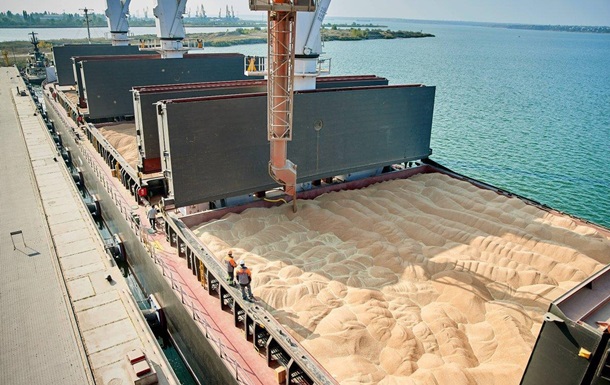
Between 92% and 95% of Ukraine’s export grain reaches the ports by rail. The deepwater terminals that once stockpiled up to seven million tons a month can now hold four to five—a gap of about 2.5 million tons a month that the Danube barges, the trucks, and the western rail crossings together cannot come close to filling, wrote Bohdan Kostetskyi, operating partner at the trade and analysis firm Barva Invest.
Türkiye raised its transit fee by about 15% on 1 July, and Ukrzaliznytsia has proposed a 30% rail increase from 1 August.
The country’s main farmers’ union now estimates Ukraine has lost about a third of its capacity to export grain by sea, as reported by Reuters. More than 90% of its farm exports move through three ports in Odesa Oblast, and the country had forecast around 43 million tons for the 2026/27 season, which began in July, compared with 37 million last year.
The squeeze is set to tighten on schedule: Türkiye raised its transit fee by about 15% on 1 July, and Ukrzaliznytsia has proposed a 30% rail increase from 1 August that would add $5 to $6 per ton.
Explore further
Russia can’t blockade Ukraine’s grain ports, so it bombs them—exports could drop a third
The shock reaches world markets
World wheat markets reacted immediately. Euronext wheat jumped 7% on 15 July to €231.75 ($265) a ton, its highest since February 2025. The move ran both ways: Ukraine has been hitting Russia’s own Black Sea shipping, striking more than 100 vessels in the Sea of Azov and choking a route that carries roughly a quarter of Russian grain exports.
Shipowners have begun refusing to enter Ukrainian ports, citing force majeure.
Major traders have now suspended purchases for delivery to deepwater terminals, and shipowners have begun refusing to enter Ukrainian ports, citing force majeure, Barva Invest’s Kostetskyi said. Four of Ukraine’s 13 large export terminals had stopped buying, industry sources told Reuters.
Kernel, the country’s largest grain exporter, halted operations at its Chornomorsk terminals after strikes on 10–12 July, with around 45,000 tons of wheat and 9,000 tons of sunflower oil lost or damaged, the company reported. Deputy Economy Minister Taras Vysotskyi said the state will do what it can to keep exports at or above last year’s level.
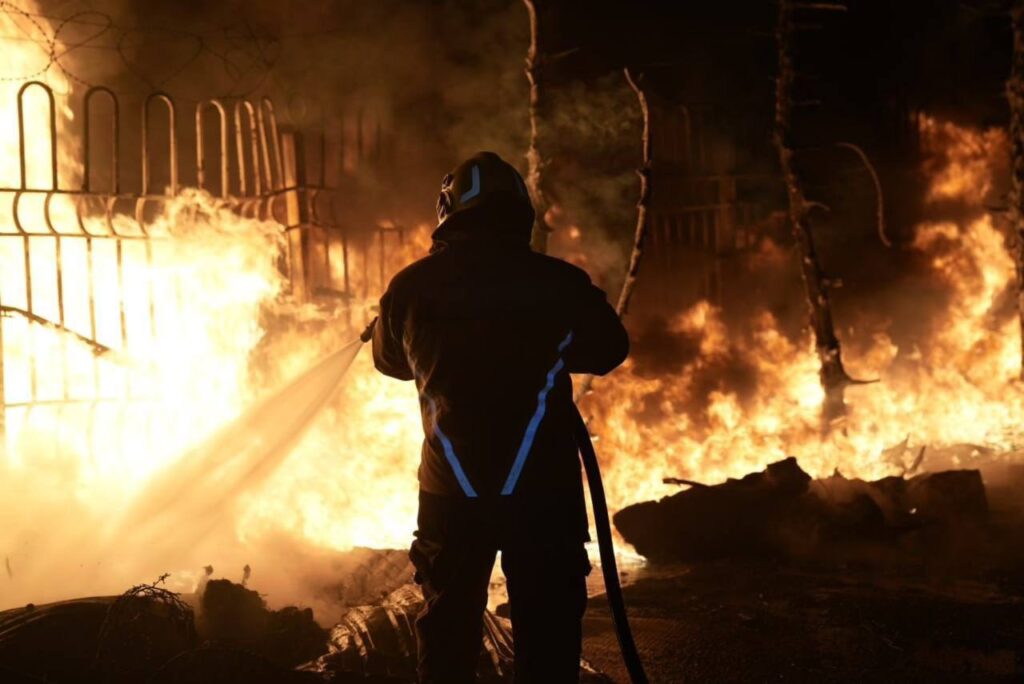
A rescuer extinguishes a fire at port infrastructure in Odesa Oblast after Russian drone strikes overnight on 2-3 May 2026. Credit: Oleh Kiper/Telegram
No way around the rail line
By Kostetskyi’s figures, the land alternatives cannot take up the slack. River exports through the Danube ports run about 100,000 tons a month, truck exports roughly the same, and rail to the western border crossings tops out at 300,000 to 400,000 tons—set against the 2.5 million tons of monthly capacity the ports have lost, a trickle.
The zone where trucking can compete with rail has narrowed to about 200 km from the ports.
They are also getting harder to feed: the zone where trucking can compete with rail has narrowed to about 200 km from the ports, so even a rail tariff rise that might, in theory, widen the delivery radius runs into trucking costs too high to close the gap.
Falling prices hit farmers
The damage travels straight to the farm gate. With deepwater buyers gone, purchase prices have fallen within days—rapeseed bids at crushing plants dropped about 1,000 hryvnia per ton (about $24) over the week, and Kernel cut its terminal bids about 200 hryvnia per ton (about $5) in a single day, trade outlet Latifundist reported.
The share of the big bulk carriers that haul grain to Asia has fallen to about 20%, down from 40% to 45% in earlier years.
Every hryvnia off the price lands on producers who, the All-Ukrainian Agrarian Council warns, are being pushed toward running out of working capital for the next sowing campaign. The council, which represents more than 1,400 small and mid-sized producers, has backed port operators in asking the government and foreign partners to widen war-risk insurance and compensation.
War-risk premiums are already built into the sea leg—freight from Constanța to Alexandria runs about $5 per ton cheaper than from Odesa, and the share of the big bulk carriers that haul grain to Asia has fallen to about 20%, down from 40% to 45% in earlier years. Türkiye’s higher transit fee and the proposed rail hike would pile several more dollars per ton onto grain that is already struggling to reach a ship.
The rail line still carries almost everything.
Kostetskyi does not expect a full, prolonged shutdown of maritime exports, reading the current strikes as a fixed campaign window rather than a permanent blockade. But the constraint he describes does not lift when the strikes pause. The rail line still carries almost everything, the ports still handle less than they did, and the routes meant as a fallback were never built for this.
Ukraine's Security Service (SBU) struck two sanctioned Russian oil tankers with naval drones in the Black Sea, the SBU said. The vessels belong to the shadow fleet Moscow uses to sell crude around Western sanctions, and Russian aircraft tried and failed to stop the attack.
Oil exports remain the biggest source of cash for Russia's war, and Ukraine has spent 2026 attacking that revenue, where Western measures have left the money moving. Ukraine keeps targeting Russian oil refineries, oil pipelines, depots, export terminals, and tankers. Forcing Moscow to defend its own oil exports at sea makes every shipment slower and costlier, compounding a fuel crisis already reshaping daily life inside Russia.
Two tankers, one sanctions-busting job
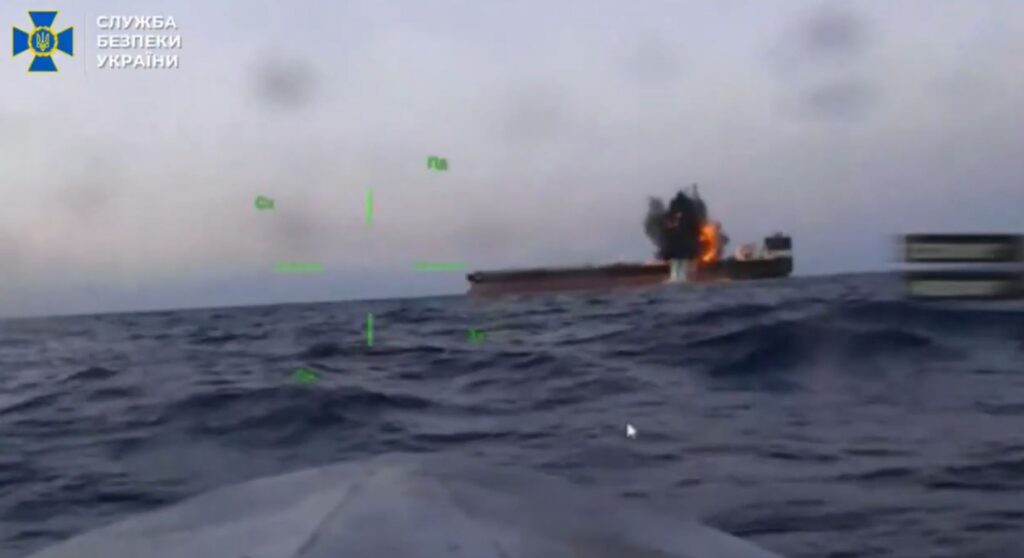
The SBU, working with the Navy, hit the ocean-going tankers Louise 1 and Banda — both under Ukrainian sanctions — with Mamai naval drones.
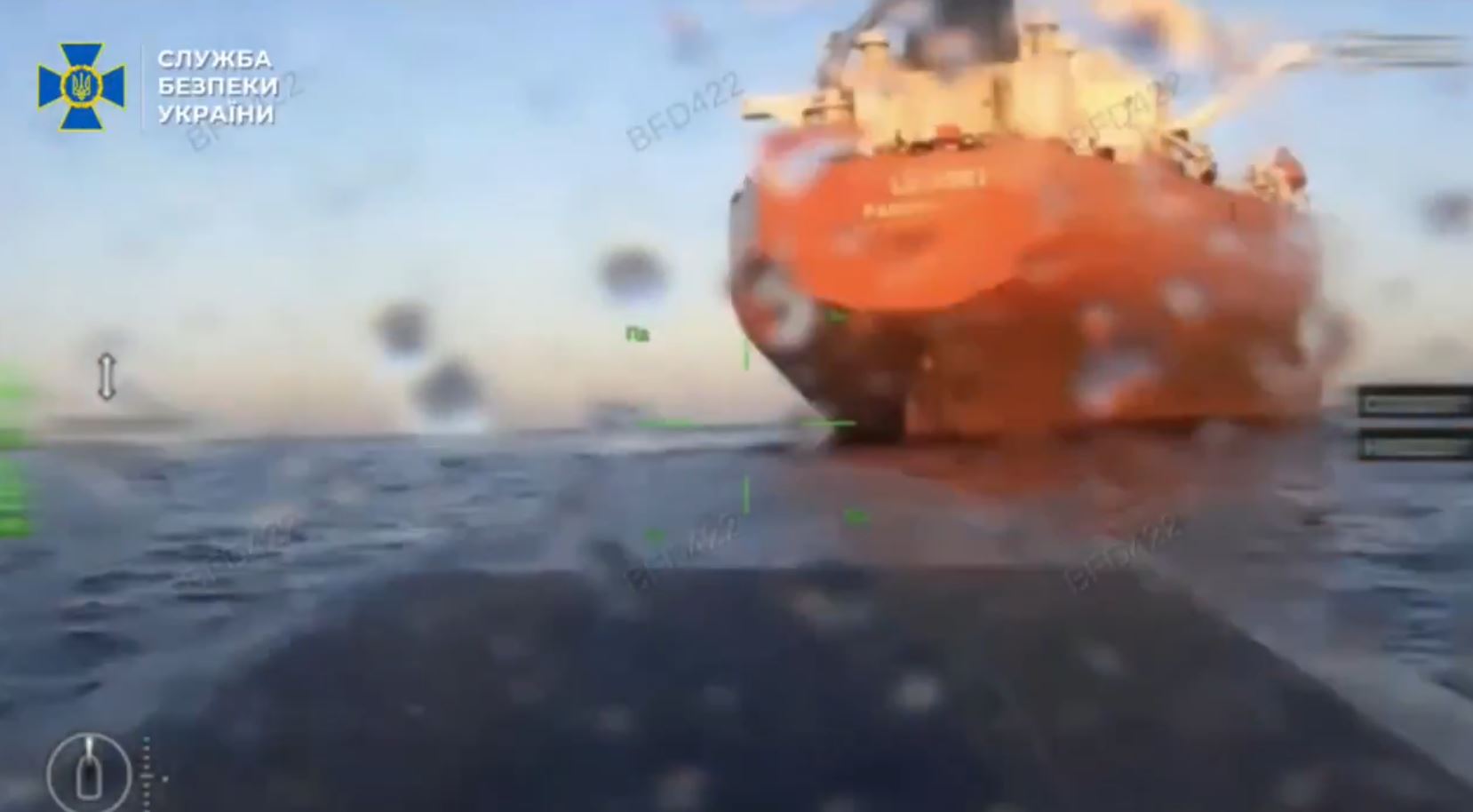
An SBU naval drone closes on the stern of the Russian shadow-fleet tanker Louise 1 in the Black Sea, 16 July 2026. Screenshot from SBU video
Louise 1 had moved Russian crude through the G7 and EU embargo, loading at Baltic and Black Sea ports with its transponder switched off. In 2026 alone, it carried nearly 3 million tons of Russian Urals crude, the SBU said.
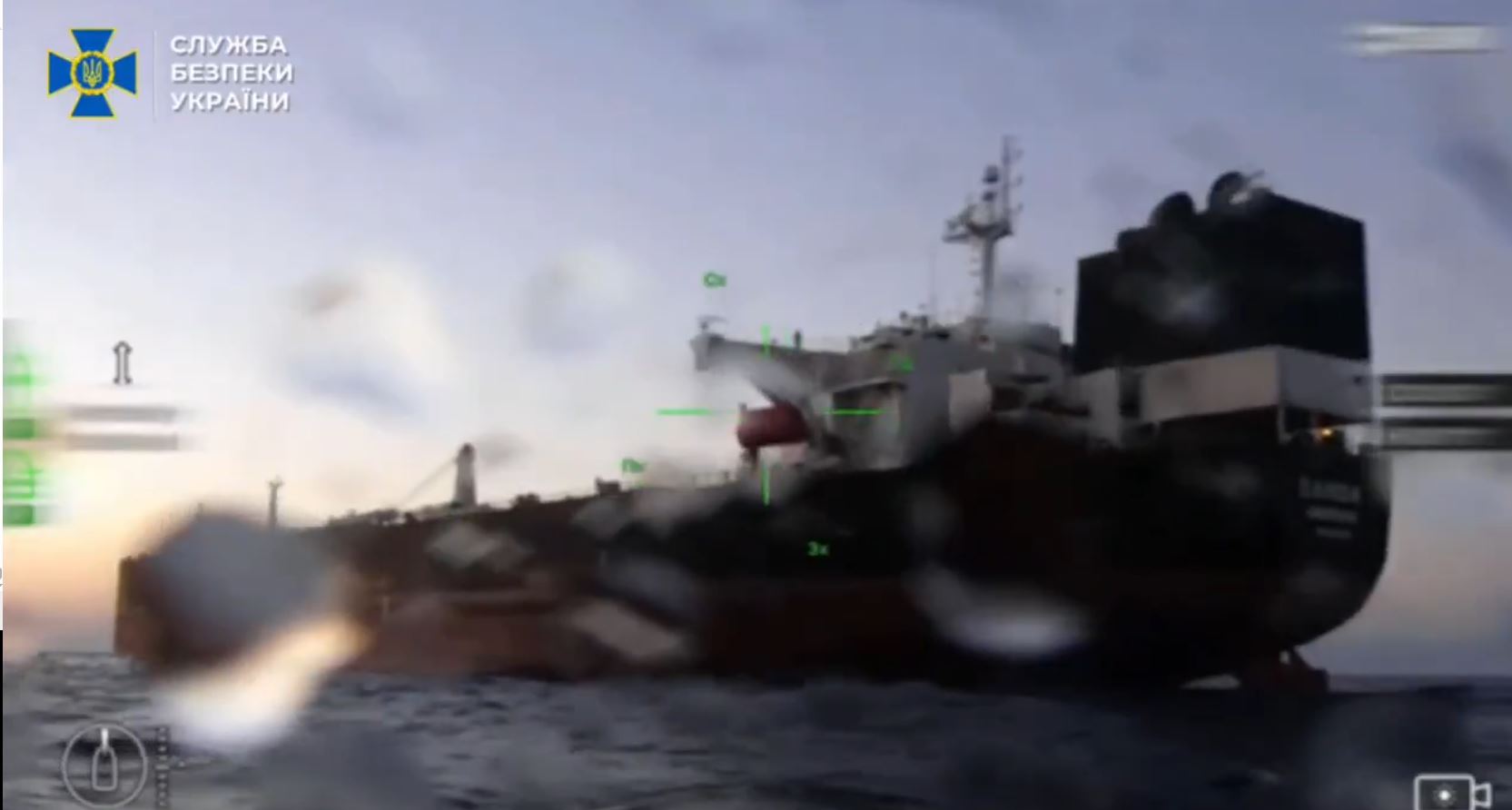
The sanctioned Russian tanker Banda in the sight of an SBU naval drone before the strike in the Black Sea, 16 July 2026. Screenshot from SBU video
Banda had run Russian crude out of four ports: Ust-Luga, Kerch, Novorossiysk, and Nakhodka.
Ukraine's SBU hits two shadow-fleet tankers in the Black Sea
The Security Service of Ukraine and Navy struck the sanctioned tankers Louise 1 and Banda with Mamai sea drones, the SBU said. The Louise 1 alone moved nearly 3 mn tons of Russian crude in 2026.
The service calls each shadow-fleet tanker a legitimate target and a working part of Russia's war machine. Every strike, it says, cuts the oil money paying for the invasion.
A week earlier, the SBU's Sea Baby drone hit the sanctioned tanker Blue in Ukraine's waters off occupied Yalta. Ukraine has spent 2026 turning cheap drones into kinetic sanctions on Russia's tanker fleet. Sea Baby drones have wrecked shadow-fleet tankers across the Black Sea since late 2025.
The air campaign running alongside it
The naval strikes run in parallel with an aerial-drone campaign by the Unmanned Systems Forces (SBS). On 16 July, SBS operators struck 11 more shadow-fleet vessels — five oil tankers, a gas carrier, three dry-cargo ships, and two tugs.
Ukraine's drones hit 11 more shadow-fleet ships in a single day, pushing the 10-day total to 147
Ukraine's Unmanned Systems Forces (SBS) struck 11 vessels of Russia's sanctions-dodging shadow fleet on 16 July, commander Robert "Madyar" Brovdi said. The day's haul, in the Black… pic.twitter.com/4iZPIjoT2B
Greece is blocking the European Union's newest round of sanctions on Russian gas to shield a single shipping company, the Financial Times reported. The objection has stalled the bloc's 21st sanctions package for a week and forced an emergency extension of the cap on Russian oil prices. At the center sits one Greek tycoon and a fleet of tankers built for Russia's Arctic.
As Russia's full-scale war grinds on, the money that funds it still moves by sea, and the tangle of Western-owned vessels wired into that trade keeps blunting the sanctions meant to cut it off.
The company at the center
Athens is protecting Dynagas after its ambassador warned the sanctions would "ruin" the company owned by Greek shipowner George Prokopiou. Greece's ambassador to the EU told fellow envoys on Wednesday that the planned measures, which would ban transporting Russian LNG to third countries, would "ruin" the firm, two people briefed on his remarks said. Two others confirmed he had named Dynagas as the reason Greece could not back the package.
The company operates 27 gas tankers, according to maritime data portal Equasis. A third of them are Arc7 vessels, ice-hardened ships built to handle the frozen waters near the Yamal plant on Russia's northern coast. Only 15 such carriers keep Yamal's exports running year-round, and European companies control most of them, an arrangement that leaves Russia's Arctic gas trade exposed to any Western move against the ships.
Dynagas has moved more than 10 million tons of Russian LNG since the start of 2025, the FT calculated using data from analytics firm Kpler, identifying 11 of its ships that completed 144 voyages in that time.
Explore further
Europe can legally quit Russian LNG today. It keeps choosing not to.
A veto that freezes the whole package
The EU's 21st sanctions package needs unanimous support, so one refusal is enough to hold it. Greece's objection has left the rest of the package stalled, freezing planned measures against additional Russian banks, crypto platforms, and defense-industry firms. The package also carries a mechanism to lower the ceiling above which companies may legally buy and transport Russian crude.
The bloc's previous round added 46 shadow-fleet tankers to its blacklist, bringing the total past 630 ships.
Prokopiou controls Dynagas alongside Dynacom, whose Russian-crude trade has brought in $915 million over three years — the biggest such haul of any Greek shipowner. When the US-Israel war with Iran erupted, Dynacom was among the earliest operators willing to run tankers through the Strait of Hormuz.

 Connexion








 SBU
SBU